
Submitted:
04 May 2024
Posted:
06 May 2024
Read the latest preprint version here
Abstract
The physics of Hubble's law, motivated by the anomalous
acceleration of Pioneer 10/11, suggests that the Hubble constant
corresponds to a gravitational field of the Universe. The Hubble
constant inferred from Pioneer 10/11 data is \(\sim 69\) km/s/Mpc.
The anomalous acceleration of Pioneer 10/11 can be interpreted as
an observational evidence for Mach's principle. The redshift is
an apparent value. Its intrinsic value has a limit resulting to
$v
Keywords:
Pioneer 10/11 anomalous acceleration
; Hubble's law
; Mach's principle
1. Introduction
Jet Propulsion Laboratory’s program analysis of Pioneer 10/11 data had indicated some extra tiny slowing down of their outward motion, giving rise to much interest in its origin [1]. Gas leak from thruster, radiative cooling of the electronics, and heat reflection off of the antenna dish were suggested for the systematic possibility [2–4]. Its physical possibility was also scrutinized from various points of view such as [5]. Scheffer affirmed the radiation effect, negating a new physics [6]. In a certain sense, the residual error was likely to end up with a systematic origin. Following the thermal analysis of Francisco et al. [7], Turyshev et al. issued a conclusive support for its thermal origin [8]. In their announcement, Anderson et al. noticed that the size of the anomaly is of the order of , the light speed times the Hubble constant, which had been assumed by Milgrom in the missing mass problem of galaxies [9]. Strange as it was, it might have been a clue. In attempts to find a physical explanation, I came to see a fundamental physics inherent in Hubble’s linear relation in which is seen to be a gravitational field of the Universe [10]. The anomalous acceleration acting on the Pioneer 10/11 spacecraft could then be explained physically as an inertial reaction to the gravitational field of the Universe acting on the solar system.
It was around the same time as the anomalous acceleration of Pioneer 10/11 was published. Two groups of astronomers, Riess et al. and Perlmutter et al., published observational evidence from Type Ia supernovae for an accelerating expansion of the Universe [11,12]. The expansion of the Universe had been expected to be decelerating from the gravitational attraction of matter. The observation was explained in terms of dark energy, which was contrary to the expectation. In the framework of general relativity, the expansion of the Universe has been considered to be accelerating. Meanwhile, the Pioneer anomaly was found unexpectedly in their tracking. Along with the systematic possibility, the residual error has opened a new question to our understanding. I was led to the speculation about as an acceleration in Hubble’s law, which received little attention in the established thought. However, it picked out the physical point of Hubble’s law. Although a long time has passed, this is a direct continuation. The purpose of this paper is to complete the physics of Hubble’s law on astronomical considerations. By showing a comparison with the observation of Type Ia supernovae, phenomenologically, I would like to demonstrate that the Hubble constant is a measure for the gravitational field rather than the expansion rate of the Universe.
2. Preliminary
There is no need to assume the existence of hidden mass in galaxy if the motion of galaxy is described by a modified form of gravitational force. According to Milgrom, the transition from the Newtonian regime to the small acceleration regime occurs within a range of order around [13]. With an acceleration , the modified Newtonian dynamics has been assumed to explain the flat rotation curve of disk galaxies. There is an alternative. If is an external acceleration such as the gravitational field of the Universe, a transition from the bound state to the unbound state of motion of galaxies can then be assumed in the small acceleration region. The flatness of the velocity curves can also be explained with an acceleration in Newtonian dynamics.
Motivated by the anomalous Pioneer 10/11 acceleration, I had come to see a physics Hubble’s law has shown to us. It came out clearly when the distance of a galaxy is written in terms of time for light to travel: . An observation at the present time has come to us from a distant source at an earlier or retarded time. As the distance increases far away, the time goes back to the remote past. The increase in recessional velocities with distances from the point of observation can therefore be put in the form of a decrease in relative velocities with times up to the time of observation. Hubble’s law in terms of time appears as symmetrical with respect to the axis of redshift. From Hubble’s linear relation it appears evident that distant galaxies are in free fall. In other words, the redshift of distant galaxies is ultimately a “universal” gravitational redshift.1 Hubble’s law finds its physical explanation in terms of an acceleration directed toward the solar system.
In the first, I inferred the Hubble constant to be km/s/Mpc from cm/s2 on the assumption that the anomalous acceleration is an inertial effect in the solar system due to the “universal” acceleration. This needs to be detailed. The solar system is not a fixed system in space; it is traveling along the rotating rim of the Milky Way Galaxy. We must consider an effective acceleration relative to the rotating system [15]. The centrifugal acceleration of the solar system is estimated to be cm/s2 and the Coriolis effect on Pioneer 10/11 moving away from the Sun at 12.5 km/s is about 11% of it. Taking into account the centrifugal acceleration of the solar system and the Coriolis effect on Pioneer 10/11, the effective anomalous acceleration relative to the rotating solar system is estimated to be cm/s2. Then the Hubble constant inferred from Pioneer 10/11 data becomes km/s/Mpc. Based on the extended data of Pioneer 10 and studies of all the systematics, later, Anderson et al. gave a result of cm/s2 for the anomalous acceleration [16]. From their result, in this second, I infer the Hubble constant to be km/s/Mpc.
3. The Factor of (1 + z)
The redshift needs to be discussed in parallel with Hubble’s law. When the observer and source are in relative motion, the observed velocity of light becomes different from the intrinsic velocity of light. The difference, dependent on their relative velocity, is known as aberration. The redshift is a displacement of the spectrum lines toward the red, resulting from a change of the velocity of light. In the case of low redshift galaxies, there is little difference between the apparent velocity and the intrinsic velocity. But for high redshift galaxies the apparent velocity is much different from the intrinsic velocity in speed and direction. With this very reason, we need to make a correction to the velocity of light observed from distant galaxies.
It is important to notice that a factor can be a measure for the ratio of those velocities:
In this equation, and are the observed wavelength and velocity of light. The factor can then be used in relation to the Döppler shift formula
where , , and n is a unit vector in the direction of the line of sight. Equation (2) is the customary Döppler shift modified by the factor of . Several hundred quasars have been observed, a good fraction of which have and a few have . If a quasar has , for example, then the observed velocity of light is . If the quasar is moving at right angle with the line of sight, then the velocity of the quasar is estimated to be though the observed velocity is . This shows how the factor works. Note that the velocity of quasar changes at the same rate as the velocity of light. This is because c is used as a unit of velocity, as can be seen in the example. We need to distinguish between the apparent and the intrinsic.
The light curve of a distant supernova is shown to be broadened by a factor compared to a nearby supernova. From a comparison of the broadening of light curve with an ageing of supernova, Goldhaber et al. and Leibundgut et al. put forward the interpretation of it as an effect of time dilation [17,18]. The factor has since been used as a cosmological time dilation [19–21]. The physical concept of time dilation has been a cosmological discussion of expanding Universe. In form, we can make its relation to the factor: . The discussion should be regarded as justified physically. However, I cannot but mention a nature of the factor. In the theory of special relativity, the factor is discussed in relation to time. But the factor appears associated with velocity, phenomenologically. As a matter of fact, the experiment of relativistic mass cannot be explained by the physics of special relativity. There is no room for the relativistic mass in the four-vector formulation of special relativity as suggested by Minkowski. In spite of ample experimental evidence, finally, the concept of relativistic mass has not been accepted in teaching physics [22]. Okun addressed that the relativistic mass is misleading, arguing that the experiment tested actually the velocity dependence of momentum [23]. While the experiment of time dilation has been accepted, the experiment of relativistic mass has not been accepted anyway.
In the experiment of time dilation, the mean free path of a decaying meson beam was measured using a scintillation counter telescope and was divided by the intrinsic mean velocity [24]. The result was discussed in relation to the time dilation. But it could have been due to an apparent velocity. In the experiment of relativistic mass, the velocity of an electron was determined by means of an electrostatic spectrograph [25]. As in the cyclotron, however, an aberration of uniform magnetic field was overlooked and is not realized still [26]. The field aberration changes the frequency to in the cyclotron and the velocity to in the spectrograph, disproving not only the relativistic mass but also the time dilation.2 The factor also follows from the stellar aberration, in consequence of a vector difference between velocities with respect to the observer. In a consistent manner, the factor arises out of aberration. The factor is an astronomical counterpart of the factor. From the physical or astronomical point of view, each of them characterizes a relation of the intrinsic to apparent velocities of light. It should be noted that they are related to the propagation or observation at the velocity of light. In comparing the light curves of distant and nearby supernovae, phenomenologically, it is natural and reasonable to interpret the factor in relation not to the time dilation but to an apparent velocity.
4. Physics of Hubble’s Law
It is known that the spherically symmetric distribution of matter produces a constant acceleration inside the distribution. As viewed from this point, the value observed in Hubble’s law can be assumed to be the acceleration expected from the matter distribution surrounding the solar system in the Universe. If we assume a gravitational field of the Universe, it would appear as an inertial force in the solar system. If is the gravitational field of the Universe, the gravitational field of the solar system would then be
where G is the gravitational constant and the solar mass. It is significant that the replacement is in the effect of inertia in complete accord with Mach’s principle.3 The anomalous acceleration of Pioneer 10/11 can then be interpreted conversely as an observational evidence for Mach’s principle. As a standard physics for the systematic error of a constant bias in the acceleration residuals, it is required to model Mach’s principle by which the surrounding mass distribution may produce such inertial effect in the solar gravitational field. Note the observational fact that the Pioneer effect could only be seen beyond 20 AU because of the solar radiation pressure.
The Schwarzschild solution for light is written
with the components
The replacement enables the component to be modified:
But there is a problem. From the gravitational field of the Universe we cannot assume the field equations to be in space as in the Schwarzschild solution. Furthermore, we cannot impose on the components the boundary condition that for the components must approach the Minkowskian. The problem does not seem solvable. By assuming an inertial force, in classical mechanics, we may treat an equation of motion in the noninertial system just like the equation of motion in an inertial system. The modification may be vindicated from that point of view.
In the optical approach, I have suggested to identify as by showing an agreement in form between the geodesic equation of general relativity and the equation for rays in geometrical optics [28]. For this reason, instead of Equation (5), I assume the expression
This form has nothing to do with general relativity but rather is of geometrical optics. Far from the Sun, the metric components become
This is a realistic metric that can be expected of space from Hubble’s law. The Minkowskian is an ideal metric for space without matter nor gravity. The speculation about as an acceleration has come to a formulation in space for Mach’s principle. With Mach’s principle, Brans and Dicke assumed G to be related to the mass distribution in the expanding Universe [29]. Compared to their scalar field analogous to , simply but definitely, is deduced for Mach’s principle from the physics of Hubble’s law revealed by the anomalous Pioneer 10/11 acceleration.
Shapiro proposed the radar echo delay [30]. Shapiro et al. had carried out measurements of the time required for radar signals to travel to Mercury and be reflected back to Earth [31]. The time delay was a result of the radar path bending near the Sun and the light speed varying therein.4 From Equation (7), we may think of an effect of time delay in the observation of light from distant galaxies. Here, the time delay is due solely to the light speed varying in the propagation of light. So far as a gravitational effect is concerned, we may think of a varying speed of light and thus an effect of time delay. Compared to a gravity free space, consequently, the effect of time delay is identified itself with the time of propagation in the space of a gravitational field.
Let us evaluate the effect of time delay. The time of propagation of light in space is given by
From Equation (7) we obtain
Conventionally writing, this reads
We have used the relation for a velocity small compared to the velocity of light, from which we can expect to take the intrinsic form of Hubble’s relation. Hubble’s relation is presented in such a form as if Hubble’s law is written in terms of time. The change in the form of relation is due to a delay effect in the time of propagation. There is no effect of time delay if in space. We then have the linear relations such as and , that is to say, if the Hubble constant is by no means a gravitational effect.
Equation (10) states that the redshift has a limit: . This means the limit of . As remarked at the beginning, the redshift observed is an apparent value. So is the velocity measured in high energy physics laboratories. The aberration is unavoidable, in so far as the observation or measurement is performed with the velocity of light. We can make it clear by noting that the ratio is not t but or exactly. The factor arises from the observation of , not from itself. The effect of aberration makes such a change in the velocity of observation. It gives rise to the same effect as would be the case if the velocity scale were changed in the velocity of observation. This reminds us of the relation used in the time experiment though the use is made of light instead of a particle, reflecting the experimental result. In the theory of special relativity, the optical distance is related formally to the dilation of time scales. However, the optical distance is related directly to an apparent velocity of light in optics. As for the effect of special relativity, phenomenologically, this suggests to replace the time dilation by an apparent velocity.5
Let t and represent two times. The description of motion of a system is in terms of and , but the connection of two systems in motion be in terms of and . The motion of a system is a relative motion of the system with respect to an observer in which the time is assumed to be equal. The relativity is subject to them in motion relative to each other, not to their relative motion in space with time. Two systems in motion can be connected with respect to an observation of light. The connection provides a description of motion in which the motion of a system is observed at the speed of light instead of instantaneously. It draws a physical distinction between Newtonian dynamics and special relativity. The velocity of observation goes a step further, suggesting a phenomenological explanation of special relativity. Because of relative motion during observation, two systems correspond relatively to the present and retarded points of observation. Compared to the retarded point, the effect of aberration comes to the present point and makes a change in the observed velocity of light and the resulting optical distance.
5. Comparison with Observations
The consideration of Hubble’s relation can be tested by comparing with the observations of two supernova groups. One group was High-z Supernova Search Team. Following Schmidt et al. [32], Riess et al. had reported observations of 10 high redshift Type Ia supernovae [11]. They remarked, the distances of the high redshift Type Ia supernovae are farther than expected in the cosmological model. Figure 1 shows a reasonable agreement between Equation (10) and observations. For the distance modulus, here, I have used in Table 6 of their observations. For example, the farthest is 1997ck at to which the luminosity distance is 7244.36 Mpc. Using the factor , I have evaluated 1997ck to be a supernova of at 3677.34 Mpc. The other group was Supernova Cosmology Project. Perlmutter et al. had reported observations of 42 Type Ia supernovae [12]. They remarked, the high redshift supernovae appear fainter than the low redshift supernovae. Figure 2 shows in the spread of data a remarkable agreement between Equation (10) and observations. For the distance modulus, I have used the relation . The apparent magnitude was (9) in Table 1 of their measurements and the absolute magnitude was assumed to be from [33]. For example, the farthest is 1997K at to which the luminosity distance is 5942.92 Mpc. By the factor , 1997K has been evaluated to be a supernova of at 3732.99 Mpc. Comparisons lead to the conclusion that the deviation from linearity of high redshift Type Ia supernovae can physically be explained by Hubble’s relation taking into consideration the effect of time delay.
Both groups concluded the expansion of the Universe to be accelerating from the observation of supernovae being farther than expected in the cosmological model. Apart from whether the cosmological parameters are reasonable, in principle, it is meaningless to use apparent values in evaluating the cosmological parameters. The exception may come across when the apparent are cancelled out. Their evaluation may be the case. But their relation is implicit in their observations. What I have done here is change apparent into intrinsic values for evaluating their observations. The relation of the apparent to the intrinsic is explicit in their comparison with Hubble’s relation. In terms of intrinsic values, the deviation from linearity of supernovae can be explained as a delay effect in the time of propagation due to the gravitational field of the Universe. The delay effect appears a longer propagation time which we may misread as due to a farther distant source. The observation of supernovae would be an illustration. In conclusion, the observation of farther than expected supernovae is supposed to be an apparent result of the velocity of light being affected by the gravitational field of the Universe.
At the high redshift end, the Hubble Space Telescope has been used for follow up of supernovae discovered from the ground. Amanullah et al. presented 6 well-measured Type Ia supernovae [34]. Two parameters and were fitted to each light curves and were combined to form the distance modulus. Their coefficients and , which they call nuisance parameters, were determined by fitting simultaneously with the cosmological parameters. I have used values for range. Figure 3 shows a difference between Equation (10) and observations. In Figure 3, a comparison has been made with their distance given by the modulus . In Figure 1, 1997ck at has shown a similar difference.
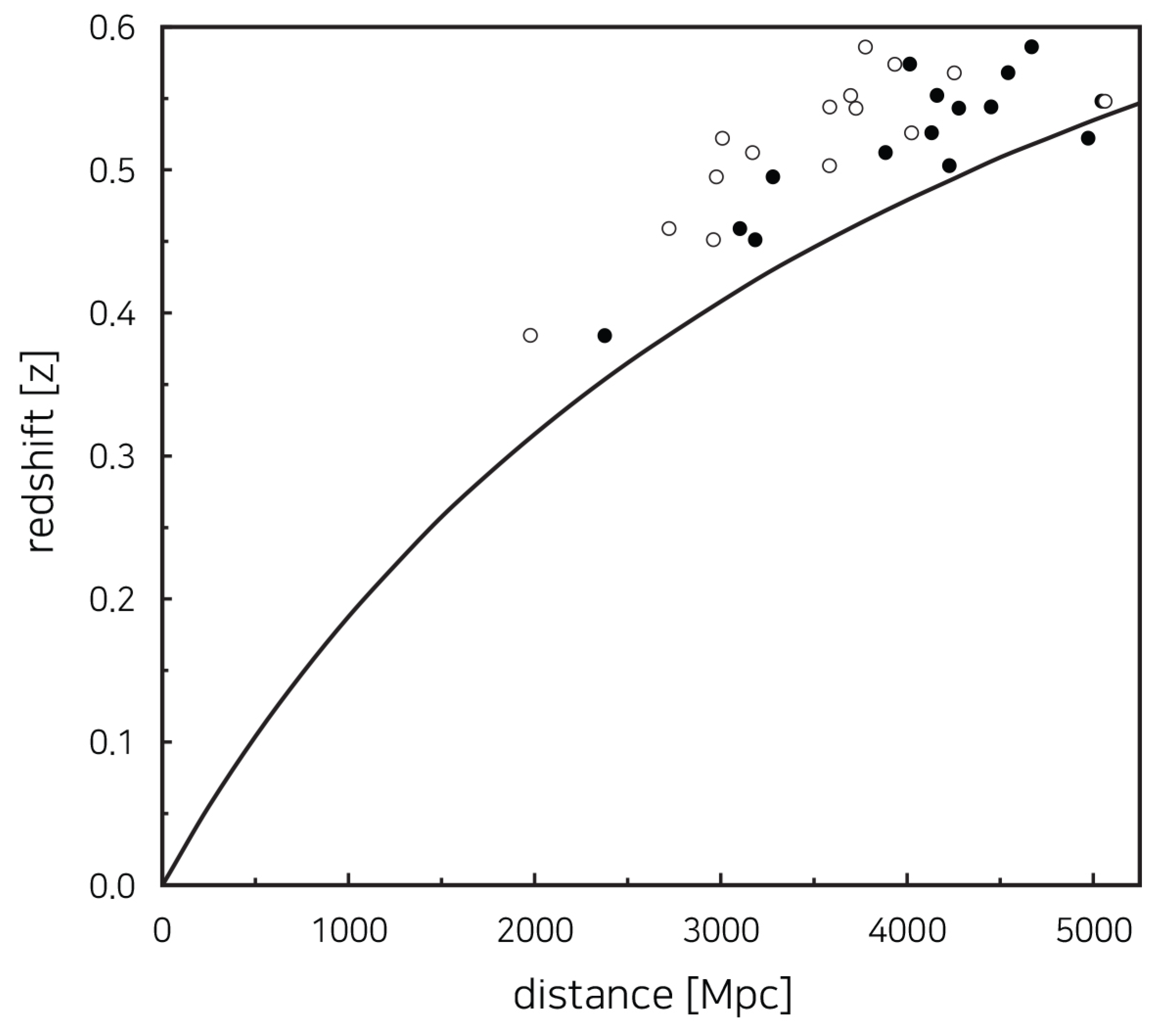
An effective strategy was to survey very distant galaxy clusters beyond with the Hubble Space Telescope. In a series of the survey, Suzuki et al. presented 15 Type Ia supernovae discovered at redshifts and used them to improve the constrain on dark energy [35]. The fitted parameters were combined here with the host mass to form the distance modulus. Figure 4 also shows such a difference between Equation (10) and observations. In the case of using the distance modulus , their distance increases but falls short of the distance expected from the present point of view. Only in the trend of difference may one say a reasonable agreement with Equation (10).
In their evaluations, the distance modulus involves two kinds of parameters. For any reason, it is unnatural to fit the light curve parameters with the cosmological model parameters. It is to reconcile the model with observations in the combination of their parameters. On the other hand, one may assume a difference of redshift dependent on the point of observation. The limb effect, which states the center to limb increase in the gravitational redshift of the solar disk, may be an example. If clusters beyond are as far away as the boundary region of the visible Universe, there might be a boundary effect in addition to the constant acceleration inside the Universe.
6. Concluding Remarks
The geometric for a general isotropic and homogeneous space is known as the Robertson-Walker metric in cosmology, where the scale of space is the cosmic scale factor. As a result, the cosmic expansion rate is given in terms of the cosmic scale factor in the Friedmann solution. Lemaître assumed it to be a constant, making a connection to the redshift of galaxies. This was subsequently corroborated by Hubble’s discovery of the redshift-distance relation of galaxies. Their model has thus been the paradigm of expanding Universe.
However, a real question lies in such a connection. How come the ratio of the cosmic scale factor to its time rate of change corresponds to that of the distance of galaxies to their velocity? Even so, the velocity of light is the time rate of change of the distance to galaxies. It is plain that the distance to galaxies is required for light to observe galaxies. Above all, there is no notion for the light propagation in the geometric of time and space.6 In evaluating the observation of supernovae, indeed, a difference in time of observations was left out of consideration. Nor is time different in Hubble’s law. In form, the distance covers the time it takes to observe. Newton’s law defines a gravitational force in terms of distance between two point masses. In classical physics, such a static force is an example of action at a distance, implying no difference in time of propagation. The example has led to the retarded potentials in electrodynamics [36]. Hubble’s law turns out to be another example, redshifts at any distance. Without intention, Hubble’s law has taken over the static redshift into the observational cosmology. The physics of Hubble’s law has touched this problem without noticing it.
The physics disputes the paradigm. The expansion or accelerated expansion of the Universe is only when we see galaxies or supernovae just as they are observed at any distance. We may say so, because the cosmological model has induced such conclusions from redshifts observed at any distance. They were concluded by the model from static redshifts. We must consider the speed at which redshifts are observed. The speed of light gives a difference in time of observations, which makes it impossible to observe how the Universe changes. From redshifts at any distance, therefore, we cannot conclude the expansion or accelerated expansion. We do not know, in fact.7 The static redshift, assumed in Hubble’s law, has been embodying by equating the Hubble constant with the cosmic expansion rate in the ill-conceived paradigm [37]. We have to rethink of it as the retarded redshift resulting to the speed of light instead of instantaneously as in electrodynamics.8 This requires to use their optical distance in place of the geometric distance of galaxies or supernovae, in which the Hubble constant corresponds to a gravitational field of the Universe.
Funding
There was no funding.
Data Availability Statement
No new data were created or analyzed in this study.
Conflicts of Interest
The author declares no conflicts of interest.
Appendix A. Additional Notes
Einstein’s explanation of the factor as a time scale is based entirely on the Lorentz transformation equations, which were derived from the condition . The relation is easily interpreted as expressing a propagation of starlight as seen in x direction, passing x at t and at from a star on y axis at . From the Newtonian dynamical perspective, correspondingly, one may assume a contrasting relation . But the meaning seems recondite. Not until I came to look at the stellar aberration could I find out its physical explanation [26].
The aberration of starlight, observed by J. Bradley in 1727, is written in the form . This gives as a relation of the apparent to intrinsic velocities of light, identifying the factor as a velocity scale by the aberration effect. The transformation equation based on the aberration of starlight gives the relation between and c, which is just the second relation in Equation (2). In the form of expression, the aberration effect is equivalent to the Döppler effect. The factor should be understood as an effect associated with velocity in relation to the factor.
By Einstein’s energy equation, the aberration relation can be written in terms of energy and momentum: . The energy-momentum relation shows their covariance to keep a reference value, showing a way to use the measured values. In contrast with physical experiments, observed values have been used without their covariance in evaluating astronomical observations. They are apparent values. We must make a correction directly to the observed values, for that reason, if we have to make use of them without their covariant condition. The factor can then be used inversely to correct the velocity scale, cancelling out the aberration effect. This has been done here for evaluating the observation of supernovae. It is just like determining the particle velocity as v from a relativistic velocity of measured in high energy physics laboratories.
| 1 | Hubble’s law established in most astronomer’s minds the interpretation of redshifts as a cosmological Döppler effect. But there must also be an effect caused by the gravitational field of the Universe, said Weinberg in [14]. The physics of Hubble’s law fits in completely with the physical point of view as a whole. |
| 2 | There is no need to experiment. The superluminal motion of jet in quasars has sufficiently shown that the velocity itself appears dilated to us. In the OPERA experiment [27], the neutrino speed was determined by direct measurements of time and distance. The factor cannot be assumed nor be defined in such measurements. |
| 3 | For the origin of inertia, Newton explained acceleration with respect to the space fixed in the Earth. Leibniz objected to the conception of space unrelated to matter. Mach conceived acceleration with respect to the mass of the Earth and the celestial bodies. We may extend the issue to the solar system, where we can see as such effect. |
| 4 | Shapiro explained that the speed of light depends on the gravitational potential according to general relativity. This elucidates the physical meaning of . The radar echo delay is more than the test of general relativity. The time component of metric is not t but , and appears as associated not with t but with c as shown in [28]. |
| 5 | In form, the relativistic velocity is equal to an apparent velocity. But it so happens as a result of not assuming the dilation of distance in the definition. We may note a difference in terms of and . The theory of special relativity transforms them into and , whereas they appear as and in the effect of aberration. |
| 6 | In the Schwarzschild solution, we have the components and , where . In the optical approach, I have shown that they correspond to and in the equation for light rays. The form of optical path does not follow in the components of the Robertson-Walker metric. In content, either, the cosmic scale factor or expansion rate is not a physical quantity observable at the speed of light but a geometric term. |
| 7 | To study how stars evolve, we observe numerous stars at various points in their lifetime. So we do for galaxies. But there is no way to observe the Universe. The study is limited to the model, from which we can only infer. |
| 8 | The idea of retarded potentials was more than 20 years previous to the paradigm of expanding Universe. Liénard’s paper was published in 1898 by L’Éclairage Électrique and Wiechert’s paper in 1901 by Annalen der Physik. The paradigm of expanding Universe has begun with static redshifts in the geometrical formalism. |
References
- Anderson, J.D.; Laing, P.A.; Lau, E.L.; Liu, A.S.; Nieto, M.M.; Turyshev, S.G. Indication, from Pioneer 10/11, Galileo, and Ulysses data, of an apparent anomalous, weak, long-range acceleration Phys. Rev. Lett. 1998, 81, 2858. [Google Scholar] [CrossRef]
- Musser, G. Pioneering gas leak? Sc. Am. 1998, 199. [Google Scholar] [CrossRef]
- Murphy, E.M. Prosaic explanation for the anomalous acceleration seen in distant spacecraft. Phys. Rev. Lett. 1999, 83, 1890. [Google Scholar] [CrossRef]
- Katz, J.I. Comment on “Indication, from Pioneer 10/11, Galileo, and Ulysses data, of an apparent anomalous, weak, long-range acceleration”. Phys. Rev. Lett. 1999, 83, 1892. [Google Scholar] [CrossRef]
- Scheffer, L.K. Conventional forces can explain the anomalous acceleration of Pioneer 10. Phys. Rev. D 2003, 67, 084021. [Google Scholar] [CrossRef]
- Francisco, F.; Bertolami, O.; Gil, P.; Páramos, J. Modelling the reflective thermal contribution to the acceleration of the Pioneer spacecraft. Phys. Lett. B 2012, 711, 337. [Google Scholar] [CrossRef]
- Turyshev, S.G.; Toth, V.T.; et al. Support for the thermal origin of the Pioneer anomaly. Phys. Rev. Lett. 2012, 108, 241101. [Google Scholar] [CrossRef] [PubMed]
- Wilson, T.L.; Blome, H.-J. The Pioneer anomaly and a rotating Gödel universe. Adv. Space Res. 2009, 44, 1345. [Google Scholar] [CrossRef]
- Milgrom, M. Dynamics with a nonstandard inertia-acceleration relation: An alternative to dark matter in galactic systems. Ann. Phys. 1994, 229, 384–415. [Google Scholar] [CrossRef]
- Yi, Y.G. On the indication from Pioneer 10/11 data of an apparent anomalous, weak, long-range acceleration. Gen. Rel. Gravit. 2004, 36, 875. [Google Scholar] [CrossRef]
- Riess, A.G.; et al. Observational evidence from supernovae for an accelerating universe and a cosmological constant. Astron. J. 1998, 116, 1009. [Google Scholar] [CrossRef]
- Perlmutter, S. Measurements of Ω and Λ from 42 high-redshift supernovae. Astrophys. J. 1999, 517, 565. [Google Scholar] [CrossRef]
- Milgrom, M. A modification of the Newtonian dynamics as a possible alternative to the hidden mass hypothesis. Astrophys. J. 1983, 270, 365. [Google Scholar] [CrossRef]
- Weinberg, S. Gravitation and Cosmology; John Wiley & Sons: New York, NY, USA, 1972; Volume 417. [Google Scholar]
- Goldstein, H. Classical Mechanics; Addison-Wesley: Reading, USA, 1950; Volume 135. [Google Scholar]
- Anderson, J.D.; Laing, P.A.; Lau, E.L.; Liu, A.S.; Nieto, M.M.; Turyshev, S.G. Study of the anomalous acceleration of Pioneer 10 and 11. Phys. Rev. D 2002, 65, 082004. [Google Scholar] [CrossRef]
- Goldhaber, G. Observation of cosmological time dilation using Type Ia supernovae as clocks. arXiv, 1996. [Google Scholar]
- Leibundgut, B. Time dilation in the light curve of the distant Type Ia supernova SN 1995K. Astrophys. J. 1996, 466, L21. [Google Scholar] [CrossRef]
- Riess, A.G. Time dilation from spectral feature age measurements of Type Ia supernovae. Astron. J. 1997, 114, 722. [Google Scholar] [CrossRef]
- Blondin, S. Time dilation in Type Ia supernova spectra at high redshift. Astrophys. J. 2008, 682, 724. [Google Scholar] [CrossRef]
- Anderson, R.I. Towards a 1% measurement of the Hubble constant: accounting for time dilation in variable-star light curves. Astron. Astrophys. 2019, 631, A165. [Google Scholar] [CrossRef]
- Adler, C.G. Does mass really depend on velocity, dad? Am. J. Phys. 1987, 55, 739–743. [Google Scholar] [CrossRef]
- Okun, L.B. The concept of mass. Phys. Today 1989, 31. [Google Scholar] [CrossRef]
- Durbin, R.P.; Loar, H.H.; Havens Jr., W.W. The lifetimes of the π+ and π- mesons. Phys. Rev. 1952, 88, 179. [Google Scholar] [CrossRef]
- Rogers, M.M.; McReynolds, A.W.; Rogers Jr., F.T. A determination of the masses and velocities of three Radium B β particles: The relativistic mass of the electron. Phys. Rev. 1940, 57, 379. [Google Scholar] [CrossRef]
- Yi, Y.G. Physics of aberration rather than special relativity. arXiv, 0006. [Google Scholar]
- Adam, T.; et al. Measurement of the neutrino velocity with the OPERA detector in the CNGS beam. arXiv 2011, 4897. [Google Scholar]
- Yi, Y.G. Optical approach to gravitational redshift. Astrophys. Space Sci. 2011, 336, 347. [Google Scholar] [CrossRef]
- Brans, C.; Dicke, R.H. Mach’s principle and a relativistic theory of gravitation. Phys. Rev. 1961, 124, 925. [Google Scholar] [CrossRef]
- Shapiro, I.I. Fourth test of general relativity. Phys. Rev. Lett. 1964, 13, 789. [Google Scholar] [CrossRef]
- Shapiro, I.I.; et al. Fourth test of general relativity: Preliminary results. Phys. Rev. Lett. 1968, 20, 1265. [Google Scholar] [CrossRef]
- Schmidt, B.P.; et al. The High-z Supernova Search: Measuring cosmic deceleration and global curvature of the Universe using Type Ia supernovae. Astrophys. J. 1998, 507, 46. [Google Scholar] [CrossRef]
- Kim, A.G.; et al. Implications for the Hubble constant from the first seven supernovae at z≥0.35. Astrophys. J. 1997, 476, L63. [Google Scholar] [CrossRef]
- Amanullah, R.; et al. Spectra and HST light curves of 6 Type Ia supernovae at 0.511<z<1,12 and the Union2 compilation. Astrophys. J. 2010, 716, 712. [Google Scholar]
- Suzuki, N.; et al. The Hubble Space Telescope Cluster Supernova Survey. V. Improving the dark energy constraints above z>1 and building an early type hosted supernova sample. Astrophys. J. 2012, 746, 85. [Google Scholar] [CrossRef]
- Jackson, J.D. Classical Electrodynamics, 2nd ed.; John Wiley & Sons: New York, NY, USA, 1975; Volume 654. [Google Scholar]
- Kragh, H. Hubble law or Hubble-Lemaître law? the IAU resolution. arXiv 2018. [Google Scholar]
Figure 1.
Hubble’s relation of km/s/Mpc and intrinsic mean values of supernovae.
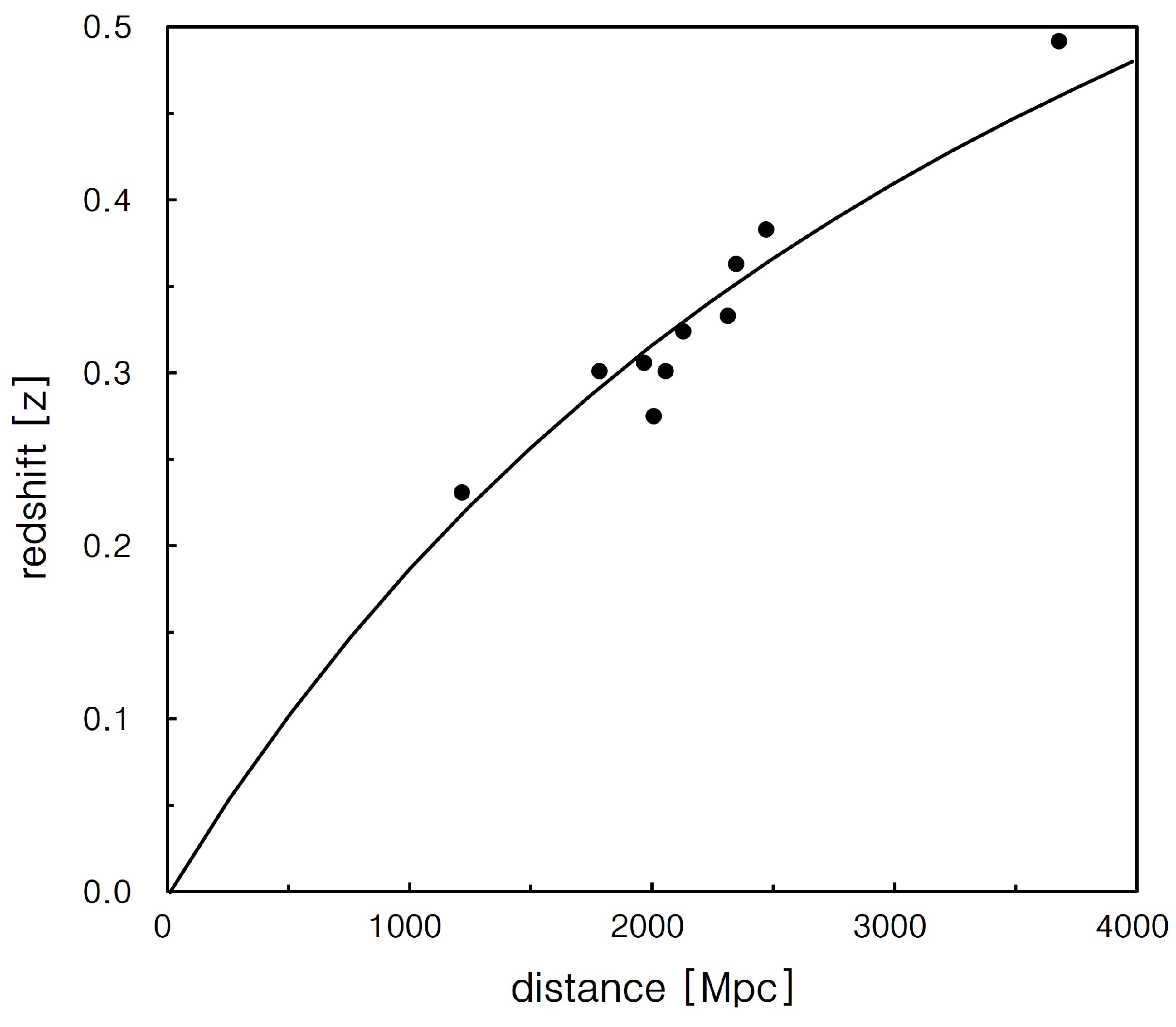
Figure 2.
Hubble’s relation of km/s/Mpc and intrinsic mean values of supernovae.
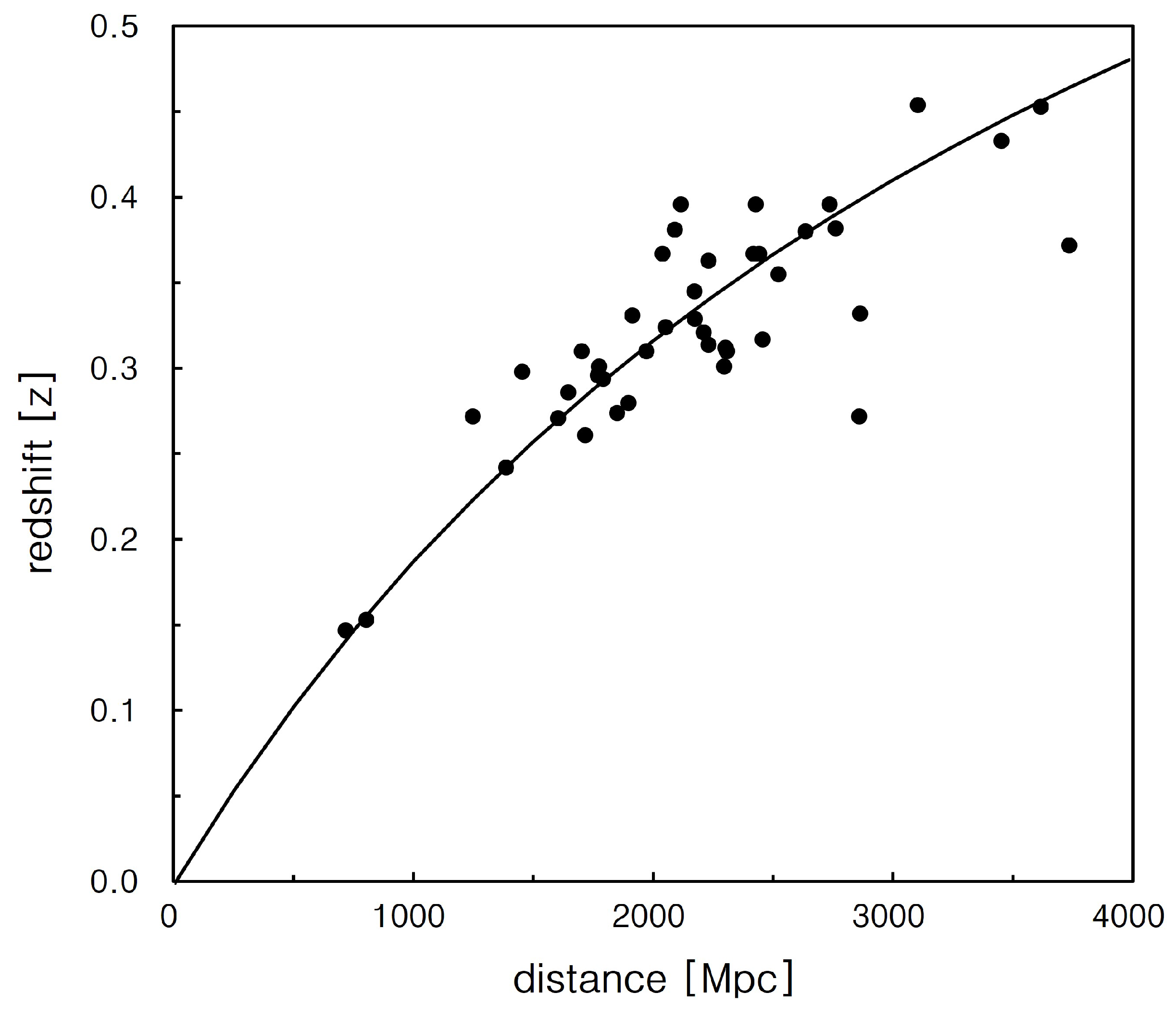
Figure 3.
Hubble’s relation of km/s/Mpc and intrinsic mean values of supernovae.
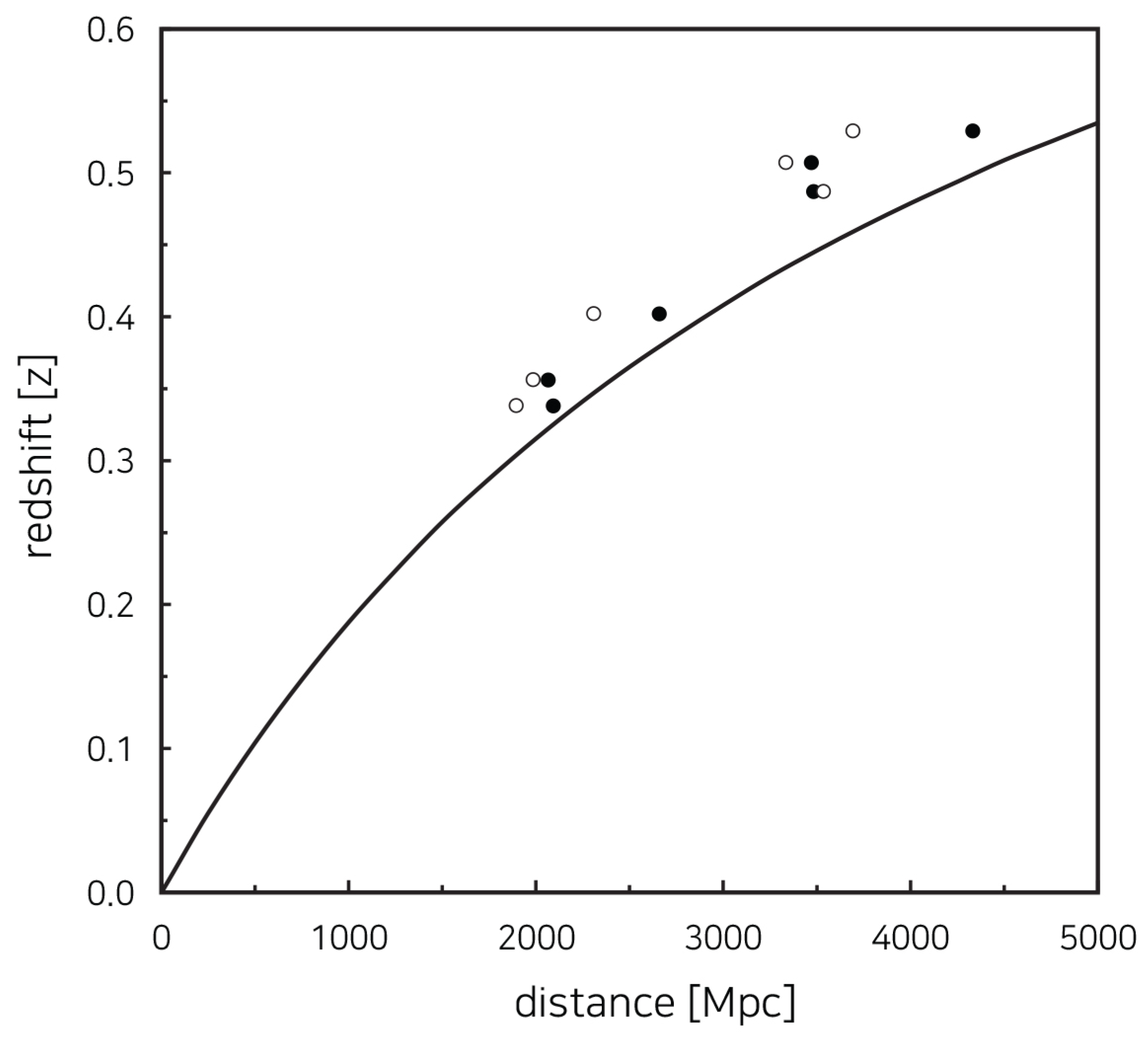
Figure 4.
Hubble’s relation of km/s/Mpc and intrinsic mean values of supernovae.
Disclaimer/Publisher’s Note: The statements, opinions and data contained in all publications are solely those of the individual author(s) and contributor(s) and not of MDPI and/or the editor(s). MDPI and/or the editor(s) disclaim responsibility for any injury to people or property resulting from any ideas, methods, instructions or products referred to in the content. |
© 2024 by the authors. Licensee MDPI, Basel, Switzerland. This article is an open access article distributed under the terms and conditions of the Creative Commons Attribution (CC BY) license (http://creativecommons.org/licenses/by/4.0/).
Copyright: This open access article is published under a Creative Commons CC BY 4.0 license, which permit the free download, distribution, and reuse, provided that the author and preprint are cited in any reuse.