

Submitted:
04 May 2024
Posted:
06 May 2024
You are already at the latest version
Abstract
This comparative study aims to investigate environmental awareness, knowledge, and safety among students in Montenegro and North Macedonia, considering the unique socio-cultural and environmental contexts of both countries. A mixed-methods approach involving surveys and interviews was employed to gather data from students in educational institutions across Montenegro and North Macedonia. The study assessed various factors, including students' awareness of environmental issues, their perceived level of knowledge, and their attitudes towards safety measures. A comprehensive series of 400 face-to-face interviews was carried out and these interviews encompassed 200 students from Montenegro and an equal number from North Macedonia, taking place at two esteemed academic institutions: The University of Montenegro in Podgorica and The University of St. Clement of Ohrid, Bitola, Republic of North Macedonia. Our hypothetical conceptual framework proposes that a combination of variables, including gender (H1), age (H2), year of study (H3), and rate of study (H4), significantly influences the attitudes of students from Montenegro and North Macedonia towards environmental awareness, safety, and knowledge. Research findings indicate significant variations in environmental awareness and knowledge perception among students in the two countries. While both Montenegro and North Macedonia face environmental challenges, differences in educational systems and socio-economic factors contribute to distinct attitudes and behaviors towards environmental issues and safety practices. This study sheds light on the importance of understanding regional differences in environmental awareness and knowledge perception among students. By identifying areas of strength and areas needing improvement, policymakers and educators can develop targeted interventions to enhance environmental education and foster a culture of sustainability in both Montenegro and North Macedonia.
Keywords:
environment
; awareness
; knowledge
; safety
; perception
; comparative study
; students
; survey
; Mon-tenegro
; North Macedonia
1. Introduction
In recent years, the importance of environmental awareness has become increasingly evident as global challenges related to climate change and environmental degradation intensify [1]. Understanding the perceptions and knowledge of young individuals regarding environmental issues is crucial for developing effective educational strategies and policies that promote sustainable practices [2,3,4,5,6,7]. Environmental issues today span the globe, influencing both present and prospective environmental conditions. These challenges differ from one region to another but collectively require a comprehensive and collaborative response from multiple sectors [8]. Promoting awareness and encouraging changes in behavior toward environmental sustainability is crucial in lessening the detrimental effects of unsustainable practices on both human health and the broader ecosystem [8,9]. To effectively address the intricate nature of these environmental challenges, a cooperative effort among varied scientific disciplines is essential [4,10,11,12,13].
The trajectory of each individual's life journey, their existence, and the experiences they undergo, collectively define the path towards achieving set goals, driven by the pursuit of needs, desires, and aspirations [14]. Paramount among the objectives humanity must urgently pursue today is a fundamental shift in behavior and mindset towards ensuring the sustainability and adaptability of our environment [9,15,16,17]. Central to this imperative is the cultivation of respect for and stewardship of nature and resources, advocating for sustainable living as a cornerstone of human values, attitudes, existence, and lifestyle [18,19,20]. In recognizing humanity's pivotal role in causing harm, pollution, and depletion of the very resources upon which our survival hinges, the primary aim of the global environmental movement becomes clear: to foster heightened environmental awareness regarding available resources, prevailing environmental challenges, and ongoing changes [21].
Through this heightened awareness, the movement seeks to catalyze a transformative shift in human behavior towards a more sustainable existence [22]. Furthermore, environmental awareness refers to the awareness and understanding individuals possess about the environmental impacts of their actions and the broader ecological challenges facing our planet [10,23,24,25]. This awareness is increasingly critical as we confront escalating issues such as climate change and ecological degradation [26]. The development of this awareness is influenced by various factors, including education, media exposure, cultural values, and personal experiences with nature [26,27]. Raising ecological awareness is vital for instilling a sense of environmental responsibility and encouraging sustainable practices among individuals and communities [28]. It plays a foundational role in shaping attitudes and behaviors that support environmental stewardship. As the world grapples with diverse and complex environmental challenges that differ from region to region, a multifaceted and collaborative approach involving multiple sectors is essential for effective management and mitigation [29].
On the other side, environmental knowledge refers to the understanding and information that individuals have about the environment and its various components, including ecosystems, biodiversity, natural resources, and the human impact on these elements [30]. This knowledge encompasses both scientific facts and a broader understanding of environmental policies, sustainability practices, and the ecological consequences of human actions [31,32,33,34,35]. Having a robust body of environmental knowledge is crucial because it empowers individuals to make informed decisions about their behaviors and practices that impact the environment [35]. It also plays a critical role in shaping attitudes towards environmental conservation and sustainability. People who are more knowledgeable about the environment are generally more likely to engage in behaviors that contribute to its preservation and restoration [36].
The educational system in every nation, Montenegro and North Macedonia included, holds the responsibility of instilling foundational values and fostering a deep understanding of environmental stewardship, nature appreciation, human potential, and the importance of sustainable living. This framework not only supports individual development efforts but also underscores the necessity of managing resources judiciously to meet escalating human demands. Moreover, within this system, educators play a pivotal role as they possess the potential to shape the attitudes and perceptions of children, adolescents, and students towards sustainability. They should actively promote sustainable lifestyles, introduce ecological concepts, and underscore the significance of resource limitations. Failure to embrace sustainable practices and the reckless exploitation of resources not only jeopardize environmental integrity but also pose substantial security threats, impeding future human progress and stability.
In recent years, concerns about environmental sustainability and awareness have increasingly gained prominence worldwide [37]. As societies grapple with the challenges posed by climate change, pollution, and dwindling natural resources, understanding the dynamics of environmental awareness and knowledge perception becomes imperative [38,39,40]. This study delves into these intricacies, focusing on the perspectives of students in Montenegro and North Macedonia. Montenegro and North Macedonia, two Balkan countries characterized by diverse landscapes and ecosystems, provide an intriguing backdrop for examining environmental attitudes and perceptions among the youth [41,42,43,44]. Despite sharing geographical proximity and similar environmental concerns, disparities in educational systems, cultural influences, and socioeconomic factors may shape distinct outlooks on environmental issues [20,45].
By conducting a comparative analysis between these two nations, this study aims to unravel the nuances of environmental awareness and knowledge perception among students. Specifically, it seeks to elucidate how environmental awareness is cultivated, the extent of knowledge acquisition regarding ecological matters, and the perceived sense of safety and preparedness in addressing environmental challenges. Through a comprehensive examination of survey data, qualitative interviews, and relevant literature, this research endeavors to contribute valuable insights into the drivers and barriers shaping environmental attitudes among the youth in Montenegro and North Macedonia. By shedding light on these dimensions, policymakers, educators, and environmental advocates can devise more effective strategies for fostering environmental stewardship and resilience in future generations.
1.1. Literature Review
Various studies [31,46,47,48,49] suggest that environmental awareness and behavior are influenced by a combination of cognitive, emotional, and behavioral factors. In nations such as Switzerland, the United States of America, China, and Malaysia, citizen engagement and active involvement contribute to the enhancement of environmental sustainability awareness [37]. Also, environmental knowledge plays a key role in shaping conservation activities, perception, and pro-environmental behavior, both privately and publicly, and is further affected by psychological, educational, and cultural elements [13,33,50,51]. Besides that, the research [35,39,52] indicates that familiarity with local environmental issues plays a constructive role in encouraging pro-environmental conduct through several channels. These include motivation, perception of effectiveness, understanding consequences, education, and cultural values [53,54]. Additionally, local environmental knowledge contributes to policy formation and planning. Personal, social, and demographic factors are also noted to significantly influence these dynamics [55,56,57].
Students typically exhibit a pro-environmental mindset, which is influenced by a variety of factors such as their level of comprehension, societal security, socio-economic background, and formal education [20]. However, their grasp of ecological concepts and information tends to be modest, with secondary school students marginally better informed [45]. Although students express heightened concern regarding air pollution stemming from vehicular traffic, their awareness regarding issues of injury and violence remains conspicuously low [58]. Notwithstanding, approximately 70% of high school students in Macedonia voice apprehension about environmental matters [18], echoing findings that both Serbian and Macedonian students harbor a degree of environmental awareness and ecological perspective [59].
Participation in academic pursuits is linked to engagement in environmental conservation activities, suggesting a correlation between perception, attitude, and action [60]. Nonetheless, students' perceptions and understanding of environmental challenges exhibit variance across local, national, and global scales, with age and gender groups displaying only a tenuous correlation [32]. In Bodrum, Turkey, the foremost environmental health concerns among students revolve around smoking, air pollution, and ozone depletion [61]. While many Macedonian secondary education students evince an inclination toward environmental issues, there exists a recognized necessity for more comprehensive environmental education and motivation from extracurricular societal avenues [62]. Over time, Macedonian students' environmental knowledge has witnessed a decline, with average levels diminishing from 39.19% in 2002 to 34.71% in 2009 [63]. Factors such as motivation and perceived effectiveness significantly influence the adoption of pro-environmental behaviors among university students [35]. In Hong Kong, students demonstrate a limited grasp of environmental issues and experience minimal concern for environmental quality [64]. Nonetheless, a majority of Macedonian students display a readiness to actively engage in addressing environmental pollution issues [65].
Ensuring the safety, cleanliness, and hygiene-promoting attributes of school facilities ranks high on the agenda in North Macedonia [66]. Students exhibit a predilection for social risk factors, with terrorism taking precedence, alongside considerations of water pollution and nuclear power plants as significant technological hazards [67]. In northeastern Montenegro, there exists a pressing need for heightened environmental awareness, as public participation in environmental protection endeavors remains inadequate [25]. While many students across diverse studies demonstrate an awareness of environmental issues, there frequently exists a dearth of knowledge and support for environmental protection measures [68]. Both in Turkey and Macedonia, the emphasis is predominantly placed on knowledge acquisition, while the cultivation of skills, attitudes, and environmentally responsible behaviors receives comparatively lesser attention [69].
Literature reviews reveal significant gender discrepancies in environmental attitudes and behaviors. Across diverse socio-economic strata, females consistently demonstrate heightened environmental responsibility in comparison to males [70]. Pro-environmental conduct manifests distinct gender patterns, with specific psychological determinants exerting varying influences on each gender [71]. Notably, a discernible gender divide in sustainability awareness persists, intensifying with age and notably accentuated within institutions prioritizing Education for Sustainable Development (ESD) [72]. Although the impact of gender on environmental awareness among post-graduate cohorts may lack consistency, certain studies indicate a propensity towards heightened awareness among females [73]. Additionally, female students tend to perceive environmental risks with greater acuity relative to their male counterparts [74] and articulate heightened levels of environmental concern overall [74,75].
Research spanning various fields highlights how age influences perceptions and behaviors across different contexts, emphasizing the need for age-responsive strategies in workplace safety, environmental knowledge, and health competencies [76,77,78]. In construction sites, older workers' perceptions of safety are mainly shaped by workload and job satisfaction, whereas younger workers focus more on organizational relationships, mental stress, and job security [76]. This contrast extends to environmental contexts, where a decline in intergenerational sharing of knowledge among indigenous populations points to the rigidity of local knowledge systems against rapid ecological changes, posing risks to adaptive management strategies [77]. The pandemic underscored the generational differences in valuing certain competencies, revealing an increased appreciation for health-oriented and safety-conscious behaviors across age groups [78]. Similarly, in educational settings, primary school students' environmental awareness is linked to their existing knowledge and motivation for conservation, indicating that age influences environmental awareness development [46]. For older women in urban settings, safety perceptions are categorized into psychological, functional, and environmental concerns, suggesting that policy interventions should address these aspects to support active ageing [79]. Additionally, environmental perceptions significantly impact the mental and physical health of middle-aged and older adults, with disparities more pronounced among females, rural residents, those with less education, and lower-income groups [80].
The relationship between an individual's living environment and their understanding and perception of environmental awareness, knowledge, and safety is intricately linked [81,82,83]. Studies show that living near hazardous facilities like nuclear power plants can alter how communities perceive risks—those in closer proximity often feel less threatened and may even incorporate the facility into their local identity positively [81]. During the COVID-19 lockdowns, it was observed that being confined to one place might lead to increased pro-social and environmental behaviors, with these new habits potentially improving overall well-being. A strong connection to one's place of residence could further encourage these behaviors [82]. Further, a sense of belonging to a community is generally associated with enhanced quality of life, though this isn't directly connected to feeling attached to a place. Smaller towns, in particular, are noted for boosting the environmental, psychological, and relational aspects of life, underscoring the advantages of living outside major urban centres [83]. In terms of climate change risks, where one lives determines their risk exposure and how effectively a community can manage and respond to these risks, highlighting the importance of geographic factors in public health strategies [84]. Perceptions of a safe living environment also contribute to reducing anxiety related to safety, enhancing awareness of safety culture, and lowering the incidence of accidents. This suggests that both the tangible and psychological aspects of an environment are crucial to creating safer living conditions [85,86,87].
In reviewing the literature [7,22,34,88,89,90] on educational impact in environmental and safety studies, various findings highlight the complex relationship between the duration of the study and environmental and safety perceptions across different student populations. Interestingly, the academic year of environmental studies students does not significantly influence their sustainability habits, suggesting that the duration of their study alone may not be a decisive factor in developing sustainable habits (54). In contrast, the length of time spent in environmental education slightly boosts environmental appreciation and intentions for proactive environmental behaviors and learning, with students showing incremental increases each year [7]. Among pedagogical university students, first-year students exhibit a stronger inclination towards pro-environmental behaviors compared to other student groups, suggesting a high initial motivation that may need nurturing to sustain over time [88].
This readiness appears to grow as students advance, with each additional year spent on campus increasing the likelihood of engaging in pro-environmental behaviors by 4 to 10 percentage points annually [89]. In the context of patient safety, nursing students report a high perception of their knowledge and competencies, particularly in their first year. However, this perception adjusts to moderate in the second year and then increases again by the third year, indicating a fluctuating self-assessment of skills as they progress through their studies [34]. For younger learners, fourth- and fifth-graders involved in environmental education programs show a growing awareness of their potential impact on nature over a school year. However, this does not necessarily translate into an enhanced appreciation for the environment or an increase in intentions to learn or behave environmentally, which raises questions about the effectiveness of current educational approaches [7]. Finally, there appears to be no significant link between environmental knowledge and attitudes among students in their final year of secondary school, pointing to a disconnect that might limit the effectiveness of environmental education in fostering a proactive environmental attitude [90].
2. Methods
This comparative study aims to investigate environmental awareness, perception of knowledge, and safety among students in Montenegro and North Macedonia, considering the unique socio-cultural and environmental contexts of both countries. A mixed-methods approach involving surveys and interviews was employed to gather data from students in educational institutions across Montenegro (The University of Montenegro in Podgorica) and North Macedonia (The University of St. Clement of Ohrid, Bitola, Republic of North Macedonia). The study assessed various factors, including students' awareness of environmental issues, their perceived level of knowledge, and their attitudes towards safety measures. A multistage random sampling method was employed for a study conducted in 2023-2024 within two Universities across Montenegro and North Macedonia.
The initial phase involved the purposive selection of two universities, namely The University of Montenegro in Podgorica and The University of St. Clement of Ohrid, Bitola, Republic of North Macedonia. These universities were intentionally chosen due to their prominence and representativeness within their respective countries' educational landscapes. The University of Montenegro stands as a leading academic institution in Montenegro, while The University of St. Clement of Ohrid, Bitola, is recognized for its significance in North Macedonia's higher education system. Their selection ensures a comprehensive representation of students from diverse academic backgrounds and geographic regions within Montenegro and North Macedonia. Following this deliberate selection process, the study progressed to the subsequent phase where specific classrooms were chosen for conducting face-to-face interviews with students.
A comprehensive series of 400 face-to-face interviews was carried out and these interviews encompassed 200 students from Montenegro and an equal number from North Macedonia, taking place at two esteemed academic institutions: The University of Montenegro in Podgorica and The University of St. Clement of Ohrid, Bitola, Republic of North Macedonia (Figure 1).
Our hypothetical conceptual framework proposes that a combination of variables, including gender (H1), age (H2), year of study (H3), and rate of study (H4), significantly influences the attitudes of students from Montenegro and North Macedonia towards environmental awareness, safety, and knowledge (Figure 1).
2.1. Study Area
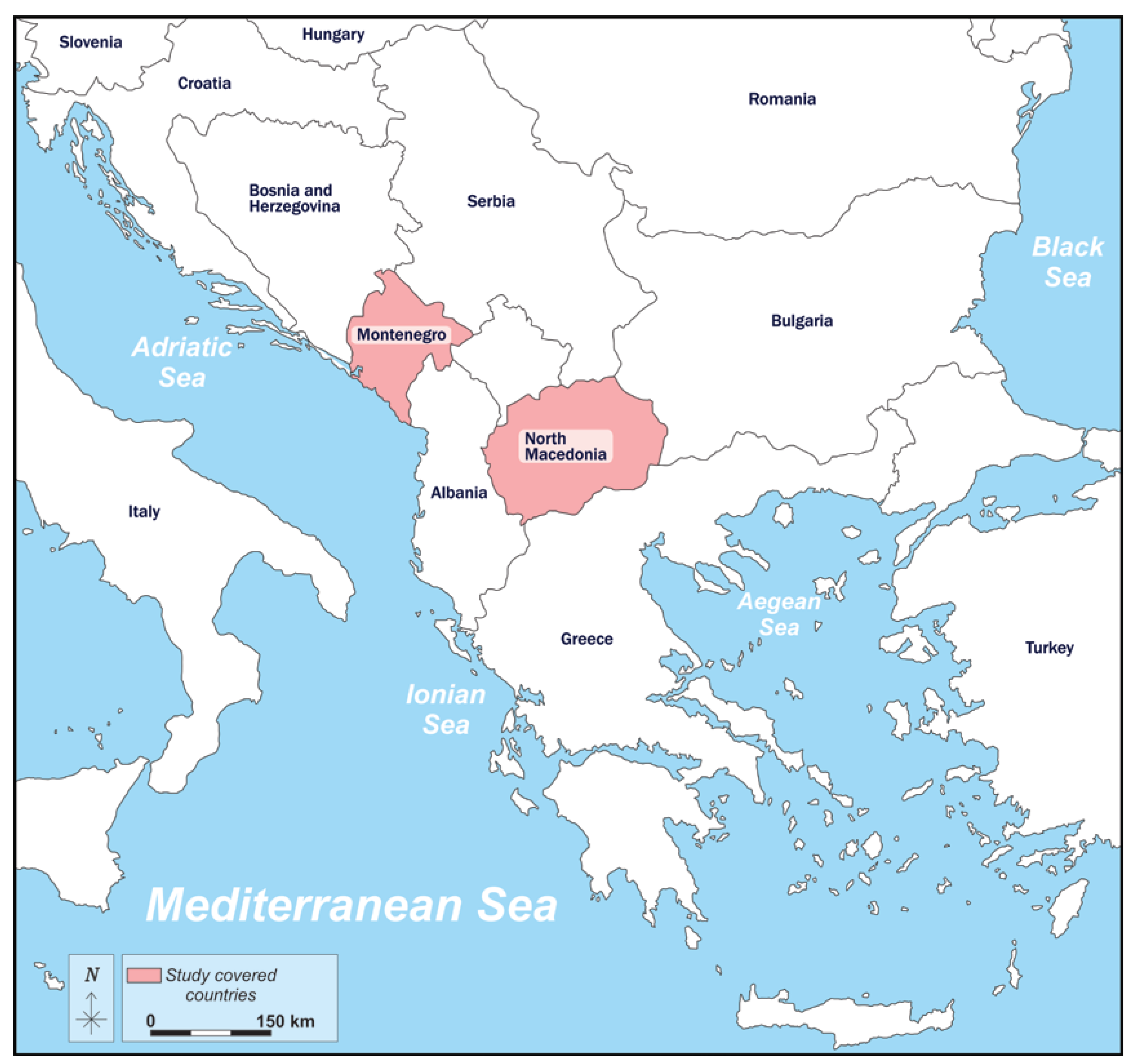
The study was conducted across two distinct regions: Montenegro and North Macedonia (Figure 2). Montenegro, located in the Balkans region of Southeast Europe, is characterized by diverse landscapes, including coastal areas along the Adriatic Sea, mountainous terrain, and inland regions [41,42]. The Republic of Montenegro, covering an expanse of 13,812 square kilometres, is positioned within the category of smaller European nations, occupying the 39th position in terms of landmass. Notably, it boasts diverse aquatic territories, including 347 square kilometres of inland sea, 2047 square kilometres of territorial sea, and a substantial continental shelf sea spanning 4917 square kilometres [91]. North Macedonia, situated to the east of Montenegro, shares similar geographic features, with mountainous regions, lakes, and valleys defining its landscape [43,44]. The Republic of North Macedonia encompasses an area totaling 25,713 square kilometres and is centrally situated on the Balkan Peninsula. Within its borders, crucial road arteries, such as corridors 8 and 10, serve as vital conduits linking it to the wider international community. Stretching back to the Paleogene era, North Macedonia has resided within the South Balkan extensional region, witnessing ongoing Neogene extension activities that persist to the present day. Its geological narrative is intricately intertwined with the North Anatolian fault and the Southern Hellenic trench [91,92].
Both countries have unique socio-cultural backgrounds and environmental contexts that shape the perceptions and attitudes of their inhabitants, particularly concerning environmental awareness, knowledge perception, and safety awareness among students [20,45]. Montenegro and North Macedonia face various environmental challenges, including issues related to waste management, air and water pollution, and natural resource conservation [18,58,59]. Additionally, safety concerns such as emergency preparedness, personal security, and adherence to safety protocols also contribute to the overall well-being of individuals within these regions [66].
Figure 2.
Study area: Location of Montenegro and North Macedonia.
2.2. Socio-Economic and Demographic Characteristics of Respondents
The sample includes basic socio-economic and demographic data for 400 students, with an equal split between Montenegro and North Macedonia. When considering gender distribution, the sample exhibits a higher proportion of males (52.5%) compared to females (47.5%). In terms of age composition, the majority of students fall within the 21-year-old category (29.0%), whereas the smallest cohort consists of 22-year-old students (26.0%). Concerning residential locations, the majority hail from urban areas (33.75%), with smaller proportions from suburban and rural regions. Regarding academic progression, the highest enrollment is observed in the fourth year (27.0%), contrasting with the lowest enrollment in the first year (18.75%). Academic achievement shows that a larger percentage of students regularly pass exams (42.5%), while a smaller group encounters difficulties with examinations (30.0%) (Table 1).
In the sample from Montenegro, the student demographic consists of 110 males (55%) and 90 females (45%). The age distribution spans from 19 to 22 years, with 40 students aged 16 (20%), 50 aged 20 (25%), 56 aged 21 (28%), and 54 aged 22 (27%). Regarding residence, 66 students live in the city centre (33%), 80 in suburban areas (40%), and 54 in villages (27%). The academic distribution shows 45 students in their first year (22.5%), 46 in their second (23%), 51 in their third (25.5%), and 58 in their fourth (29%). Regarding their study rate, 80 students (40%) regularly pass exams, 30 (15%) have pending exams, and 90 (45%) face difficulties (Table 1).
In the sample from North Macedonia, the gender balance tips slightly towards females with 95 males (47.5%) and 105 females (52.5%). Age-wise, the students are distributed as 35 at age 19 (17.5%), 55 at age 20 (27.5%), 60 at age 21 (30%), and 50 at age 22 (25%). In terms of their living situation, 70 students reside in the city centre (35%), 67 in suburban areas (33.5%), and 63 in villages (31.5%). The year of study breakdown includes 65 students in the first year (32.5%), 56 in the second (28%), 57 in the third (28.5%), and 22 in the fourth (11%). Study rates show that 90 students (45%) regularly pass their exams, 50 (25%) have pending exams, and 60 (30%) encounter difficulties (Table 1).
2.3. Questionnaire Design for Surveys and Focus Group Interviews:
The questionnaire on environmental awareness, knowledge, and safety is structured into several sections to comprehensively capture respondents' socio-demographic information, attitudes towards environmental awareness, knowledge of environmental protection, and contributions to environmental protection. Here's an analytical dissection of its constituent parts: a) socio-demographic questions: this section collects basic information about the respondents, including gender, age, education level, region of origin, parents' education, residence during studies, year of study, and study rate; b) environmental awareness attitudes: respondents are asked to rate their agreement with statements reflecting environmental awareness attitudes on a scale from strongly disagree to strongly agree. The questions cover various aspects such as humanity's impact on the environment, the importance of natural resources, and the role of individuals in environmental protection; c) knowledge of environmental protection attitudes: similar to the previous section, respondents rate their agreement with statements related to knowledge of environmental protection on a scale from strongly disagree to strongly agree. These questions address topics such as sustainable development, climate change, recycling, and government responsibility in environmental conservation; d) contribute to environmental protection: respondents are asked how they would contribute to environmental protection, along with their opinions on essential actions for protecting the environment and actions that should be avoided. Additionally, they are given the opportunity to suggest any missing questions in the questionnaire. By including these sections, the questionnaire aims to gather comprehensive data on respondents' attitudes, knowledge, and behaviors related to environmental issues, providing valuable insights for research and policy-making.
A meticulously designed survey tool was carefully developed, incorporating a blend of closed-ended inquiries and a 5-point Likert scale spanning from 1 (strongly disagree) to 5 (strongly agree). Various established survey methodologies [13,31,33,35,39,46,47,48,49,50,51,52] were consulted and adapted to align with the specific context of enhancing community resilience to disasters in Serbia. To evaluate the questionnaire's clarity and effectiveness, a preliminary test involving 35 participants was conducted in Belgrade (central Serbia) in March 2024, with feedback collected through online platforms. Our study rigorously adhered to the principles outlined in the Helsinki Declaration, which provides guidelines for socio-medical research involving human subjects. Prior to their participation, all individuals provided informed consent. The research protocol obtained approval from the Scientific-Professional Society for Disaster Risk Management's scientific research group review board, ID—01012024.
The focus group was presented with questions derived from earlier stages of the research, honing in on key aspects highlighted by the overarching study. These encompass: a) Perspectives regarding Montenegro's environmental condition b) Identification of the top five environmental challenges in Montenegro c) Recognition of institutions within Montenegro engaged in environmental preservation d) Recommendations for safeguarding Montenegro's natural heritage. It's noteworthy that these inquiries are meticulously formulated to allow for a thorough exploration of the subject matter, without necessitating detailed responses, thereby eliciting authentic reactions from participants. This approach ensures an authentic evaluation of participants' viewpoints and sentiments.
2.4. Analyses
The analysis deployed an array of statistical methods such as t-tests, one-way ANOVA, Pearson's correlation, and multivariate linear regression. An initial evaluation uncovered non-compliance with the homogeneity of variance assumption, prompting the application of the Welsh and Brown–Forsythe tests, which adeptly handle such deviations. These statistical procedures were conducted using a two-tailed approach with a defined significance level of p < 0.05, employing IBM SPSS Statistics (Version 26, New York, NY, USA). Further scrutiny of the internal consistency across several subscales via Likert scales yielded encouraging outcomes. Notably, the Environmental Awareness Attitudes Subscale, incorporating 15 variables, achieved a Cronbach’s alpha of 0.88. Environmental Knowledge Assessment Subscale, with 18 variables, reached an alpha of 0.82; and the Environmental Knowledge Assessment, also with 5 variables, mirrored this value at 0.81. This thorough methodological approach provides a dependable framework for understanding the key factors that contribute to environmental awareness, perception of knowledge, and safety among students in Montenegro and North Macedonia.
Besides that, this analysis, coupled with the focus group interview, endeavors to delve deeper into the perceptions and comprehension of environmental issues among students. Through the qualitative insights gleaned from the focus group discussions, we aim to elucidate the subtleties in students' attitudes and awareness regarding environmental concerns. Furthermore, the focus group interview serves as a platform for exploring participants' viewpoints on the prioritization of environmental issues within Montenegro. By affording participants the liberty to articulate their opinions and rationale freely, our objective is to unearth valuable insights into their familiarity with environmental institutions and elicit constructive suggestions for addressing environmental challenges. Ultimately, the analysis of data from the focus group interview will furnish a comprehensive understanding of students' environmental awareness, thus offering invaluable insights for future interventions and policy formulation in environmental education and advocacy. Following this, the analysis was structured around particular inquiries, with the primary criteria for comparison including: a) regional categorization, b) type of secondary education completed, and c) the status of the participant (whether they were a regular or non-regular student).
3. Results
The results of the study are presented in four dimensions: the predictors of environmental awareness, safety and environmental knowledge; comparative descriptive statistical analysis of students' environmental knowledge, awareness, and safety attitudes in Montenegro and North Macedonia; influences of demographic and socioeconomic factors on the environmental awareness and perception of knowledge, and safety; and influences of demographic and socioeconomic factors on the environmental awareness and perception of knowledge, and safety; additional findings from the focus group interview in Montenegro.
3.1. The Predictors of Environmental Awareness, Safety and Environmental Knowledge
Multivariate regression analysis was employed to explore the interplay between six demographic and socio-economic variables (gender, age, academic year, study pace) and three dimensions of students' perspectives on environmental awareness (15 variables), and knowledge (15 variables), and contribute to environmental safety (5 variables). These dimensions encompass attitudes towards environmental awareness, knowledge of environmental protection, and contributions to environmental safety. The conducted analysis verified that the assumptions of normal distribution, linearity, multicollinearity, and homogeneity of variance were met, which are essential for this analytical method. This extensive verification significantly strengthens the reliability of the study's outcomes and enhances the trustworthiness of the statistical procedures used.
The results of the multivariate regressions regarding contributions to environmental safety indicate that gender (β = 0.16) emerges as the most significant predictor, explaining 1.6% of the variance. However, other variables such as age, place of residence, year of study, and study rate did not show statistically significant effects on contributions to environmental safety. This model (R2 = 0.027, Adj. R2 = 0.015, F = 3.01, t = 61.25, p < 0.01), with all the mentioned independent variables, explains the 1.5% variance in contributions to environmental safety (Table 2).
Conversely, the findings from the multivariate regression analysis concerning the subscale of environmental awareness attitudes indicate that, despite including all specified independent variables, this model (R2 = 0.019, Adj. R2 = 0.006, F = 1.51, t = 80.30, p ≥ 0.05) only accounts for a mere 0.6% of the variance in environmental awareness attitudes. Consequently, it is deemed statistically insignificant (Table 2).
At least, the results from the multivariate regression analysis of the knowledge of environmental protection attitudes subscale reveal that this model (R2 = 0.013, Adj. R2 = 0.002, F = 1.11, t = 28.30, p ≥ 0.05), which includes all specified independent variables, explains only 0.2% of the variance in attitudes towards environmental protection. This indicates that the model does not reach statistical significance (Table 2).
3.2. A Comparative Descriptive Statistical Analysis of Students' Environmental Awareness, Knowledge and Safety Attitudes in Montenegro and North Macedonia
3.2.1. Environmental Awareness Attitudes
The research findings indicate that students from Montenegro and North Macedonia rate the following attitudes with the highest values: biodiversity preservation is vital for humanity (M = 3.92), individuals significantly influence the environment (M = 4.77), and knowledge fosters environmental awareness (M = 4.22). These findings suggest a high level of awareness regarding the importance of biodiversity, the influence of individuals on the environment, and the significance of knowledge in promoting environmental awareness among students in both countries. In contrast, they rate the following three items with the lowest values: humanity is responsible for environmental damage (M = 3.63), legal regulations govern nature conservation (M = 2.78), and nature benefits humanity (M = 3.63). These findings point to potentially less pronounced awareness of individual responsibility for environmental damage, legal regulations in nature conservation, and the benefits nature provides to humanity among the respondents (Table 3 and Figure 3).
The research findings on the differences in the level of environmental awareness between students from Montenegro and North Macedonia reveal significant disparities in their perspectives. Namely, students in Montenegro demonstrate a higher awareness of the importance of access to natural resources for the survival of humankind compared to their counterparts in North Macedonia (M = 3.97 versus M = 3.05). Furthermore, Montenegrin students stand out with significantly higher average ratings when it comes to perceiving the impact of environmental conditions on human health compared to students in North Macedonia (M = 4.53 versus M = 2.86). Additionally, Montenegrin students exhibit greater awareness of how resource scarcity jeopardizes national security and well-being compared to students in North Macedonia (M = 4.02 versus M = 3.25). Moreover, students in Montenegro surpass their peers in North Macedonia with a higher average rating regarding the belief that legal regulations govern nature conservation (M = 3.20 versus M = 2.35) (Table 3 and Figure 3).
On the other hand, students in North Macedonia stand out with significantly higher average ratings concerning the belief that natural resources are universally available compared to students in Montenegro (M = 4.72 versus M = 3.13). Similarly, students in North Macedonia demonstrate greater awareness of the importance of biodiversity preservation for humanity compared to students in Montenegro (M = 4.17 versus M = 2.09). Moreover, students in North Macedonia exhibit slightly higher average ratings concerning the belief that environmental awareness begins in families compared to students in Montenegro (M = 4.14 versus M = 3.78). Additionally, students in North Macedonia show slightly higher average ratings regarding the belief that knowledge fosters environmental awareness compared to students in Montenegro (M = 4.25 versus M = 4.01). Conversely, students in North Macedonia express greater trust in the renewability of natural resources compared to students in Montenegro (M = 3.47 versus M = 2.73). Furthermore, students in North Macedonia stand out with slightly higher average ratings concerning the belief that development often harms the environment compared to students in Montenegro (M = 4.18 versus M = 3.86) (Table 3 and Figure 3).
Ultimately, it was found that there is no significant difference between students from both countries regarding the belief that individuals significantly influence the environment (M = 4.65 versus M = 4.88). Similarly, there is no significant difference between students from both countries regarding the belief that immersion in nature fosters environmental stewardship (M = 4.24 versus M = 4.20). Additionally, there is no significant difference between students from both countries regarding the belief that humanity is responsible for environmental damage (M = 3.59 versus M = 4.02). Moreover, there is no significant difference between students from both countries regarding the belief that collective action protects nature (M = 4.09 versus M = 3.95). Likewise, there is no significant difference between students from both countries regarding the belief that nature benefits humanity (M = 3.65 versus M = 3.61) (Table 3 and Figure 3).
In response to the question of whether human survival depends on the accessibility of natural resources, most respondents in both samples provided affirmative answers. Statistically, a higher level of agreement (83%) was observed in the North Macedonian sample compared to 75% in the Montenegrin sample. Researchers attribute this variance to Montenegro's neoliberal economic model over the past two decades, which prioritizes prosperity and development over the conservation of natural resources. Both samples exhibited significant scepticism regarding the universal accessibility of natural resources, with 30% of respondents from each sample expressing doubt. Furthermore, a considerable proportion (28% in each sample) suggested that natural resources are not equally accessible to everyone. Researchers attribute this sentiment to the neoliberal economic framework, where access to resources is primarily controlled by powerful economic entities through state or private capital. The unregulated exploitation of these resources leads to swift profits, exacerbating the division between affluent and impoverished economies and resulting in significant harm to both humanity and the environment.
The combined sample showed significant agreement on this topic, with 88% expressing alignment with this notion. Minor instances of scepticism and disagreement were deemed statistically insignificant for further consideration. A vast majority of respondents (95% of the combined sample) concurred that the environment directly affects human health, rendering the 5% discordance statistically inconsequential. Both samples predominantly disagreed or expressed doubt regarding the renewability of natural resources. Sustainable resource management systems necessitate a delicate balance between exploitation and regeneration, achieved through meticulous management and legislative measures. The constraints imposed by the finite nature of natural resources underscore the skepticism regarding their renewability.
Responses to the question regarding the negative environmental impact of development varied, ranging from affirmative acknowledgement to skepticism about its validity. Such opinions are influenced by educational levels, awareness, quality of life, and environmental circumstances. While examples worldwide illustrate the positive influence of development on the environment, instances of adverse environmental impacts, particularly in Montenegro's coastal regions due to excessive construction, have also shaped public opinion. While a majority of respondents (73%) affirmed the positive impact of nature exposure on environmental awareness, nearly one-third (27%) expressed skepticism. This discrepancy raises questions about the role of modern lifestyles, dominated by technology, in impeding positive experiences with nature. Further analysis and research may shed light on this topic in the future.
Respondents across both samples showed notable skepticism regarding the universal accessibility of natural resources, with 30% of each sample expressing doubt. Additionally, a substantial portion (28% in each sample) suggested that natural resources are not equally accessible to everyone. Researchers attribute this sentiment to the neoliberal economic framework, wherein access to resources is primarily controlled by powerful economic entities through state or private capital. The unregulated exploitation of these resources leads to swift profits, exacerbating the division between affluent and impoverished economies and resulting in significant harm to both humanity and the environment.
Concerning the impact of natural resource scarcity or depletion on the security of the country and individuals, 80% of students across both samples responded positively. However, the 20% who answered negatively or expressed doubt raised questions about their understanding of the various types of security impacted by such scarcity or depletion. The researchers suggest that a lack of awareness about environmental issues may contribute to this sentiment, as the diminishing natural resources can profoundly undermine the country's power and overall economic development, potentially jeopardizing both the nation's and individuals' survival.
As for whether the protection and preservation of nature and natural resources are solely governed by laws, the situation varied within each sample. In North Macedonia, 50% of respondents answered positively, while the remaining 50% expressed doubt or provided negative responses. In Montenegro, 41% responded positively, while 59% expressed doubt or negativity. This distribution prompts inquiries into the reasons behind such varied perceptions. Researchers attribute this to a lack of environmental awareness among respondents, as legal regulations represent just one aspect of environmental protection. Both North Macedonia and Montenegro, aspiring EU members, have signed numerous international strategies, declarations, conventions, and protocols committing to nature and natural resource conservation. However, effective enforcement and implementation of these regulations require a high level of societal and individual environmental awareness.
The necessity of biodiversity conservation for human survival was questioned, with 89% of students across both samples responding negatively and only 11% responding positively. This could be interpreted as a consequence of insufficient attention or understanding among respondents, possibly due to the complex nature of the question or the lack of focus during the response. Regarding whether environmental awareness is instilled within families, 76% of respondents across the entire sample answered positively, with 13% expressing doubt and 11% responding negatively. Given the multifaceted nature of family upbringing and its impact on environmental awareness, this question warrants further sociological analysis. Similarly, the question of whether environmental awareness is acquired through knowledge yielded similar responses across both samples. It is worth emphasizing that a well-established environmental awareness within families can further enhance and deepen environmental awareness acquired through education.
Lastly, the significance of a collective approach to nature and natural resource protection was highlighted, with 78% of respondents across the entire sample providing positive responses. Given the global nature of environmental issues, a collective, socially and corporately responsible approach is deemed essential for effective nature and natural resource conservation. Such an approach involves a spectrum of activities at national, transnational, and international levels, emphasizing the shared responsibility of all segments of society, from families and educational institutions to communities and employees. The perception that nature exists to serve humanity garnered varied responses, with 69% providing positive responses, 20% offering negative responses, and 11% expressing doubt. This diversity in responses underscores the complexity of environmental attitudes shaped by factors such as exposure to nature, understanding of biodiversity conservation, and environmental awareness.
3.2.2. Environmental Knowledge Attitudes
Results of the research indicate that students from Montenegro and North Macedonia rate the following aspects with the highest values: the protection of flora and fauna is imperative for their preservation (M = 4.14, SD = 1.08); human activities stand as the primary catalysts of climate change (M = 3.96, SD = 1.12); sustainable development involves finding a harmonious equilibrium (M = 3.75, SD = 0.90). Conversely, they rate the following three aspects with the lowest values: human actions indeed have an impact on the ozone layer (M = 2.15, SD = 1.06); waste, when managed effectively, can be a valuable resource (M = 2.73, SD = 1.02); water resources, contrary to common belief, are not inexhaustible (M = 2.61, SD = 1.18) (Table 4 and Figure 4).
Montenegrin students generally rate the concept of finding a harmonious equilibrium slightly higher (M = 3.91) compared to their peers in North Macedonia (M = 3.56) concerning sustainable development. Likewise, Montenegrin students rate human activities as primary catalysts of climate change lower (M = 3.55) compared to North Macedonian students (M = 4.38). Both groups assign high importance to the protection of flora and fauna for their preservation, with Montenegrin students rating it slightly higher (M = 4.18) than those in North Macedonia (M = 4.10). Moreover, Montenegrin students recognize the importance of recycling more (M = 4.02) compared to their counterparts in North Macedonia (M = 2.49) concerning recycling efforts and energy conservation. However, human actions impacting the ozone layer receive slightly higher ratings from Montenegrin students (M = 1.97) than from those in North Macedonia (M = 2.33). Additionally, regarding water resources and their exhaustibility, Montenegrin students have a lower perception (M = 2.23) compared to their peers in North Macedonia (M = 2.98). Notably, North Macedonian students rate human activities affecting water quality higher (M = 3.56) than those in Montenegro (M = 2.84). Moreover, vehicle emissions and their impact on the ozone layer receive higher ratings from Montenegrin students (M = 4.10) compared to those in North Macedonia (M = 3.43). Montenegrin students also attribute more value to effective waste management (M = 3.38) than their counterparts in North Macedonia (M = 2.08) regarding waste management as a valuable resource (Table 4 and Figure 4).
On the other side, North Macedonian students rate the impact of forest resource protection on air quality notably higher (M = 3.87) than those in Montenegro (M = 2.24). Additionally, the establishment of protected areas for preservation receives higher ratings from North Macedonian students (M = 4.04) compared to those in Montenegro (M = 3.60). Both groups acknowledge the direct threats posed by fossil fuel use, with similar ratings between Montenegrin (M = 4.13) and North Macedonian (M = 3.95) students regarding the utilization of fossil fuels and human health.
However, North Macedonian students attribute more responsibility to governments (M = 3.93) than those in Montenegro (M = 3.45) regarding government responsibility for resource management. Montenegrin students rate environmental protection achieved through laws and strategies slightly higher (M = 3.83) than their counterparts in North Macedonia (M = 3.79). Effective waste management as a pressing environmental challenge is perceived as more pressing by North Macedonian students (M = 4.02) than by those in Montenegro (M = 3.71) (Table 4 and Figure 4).
Figure 4.
Environmental Knowledge Variables Comparison between Montenegro and North Macedonia.
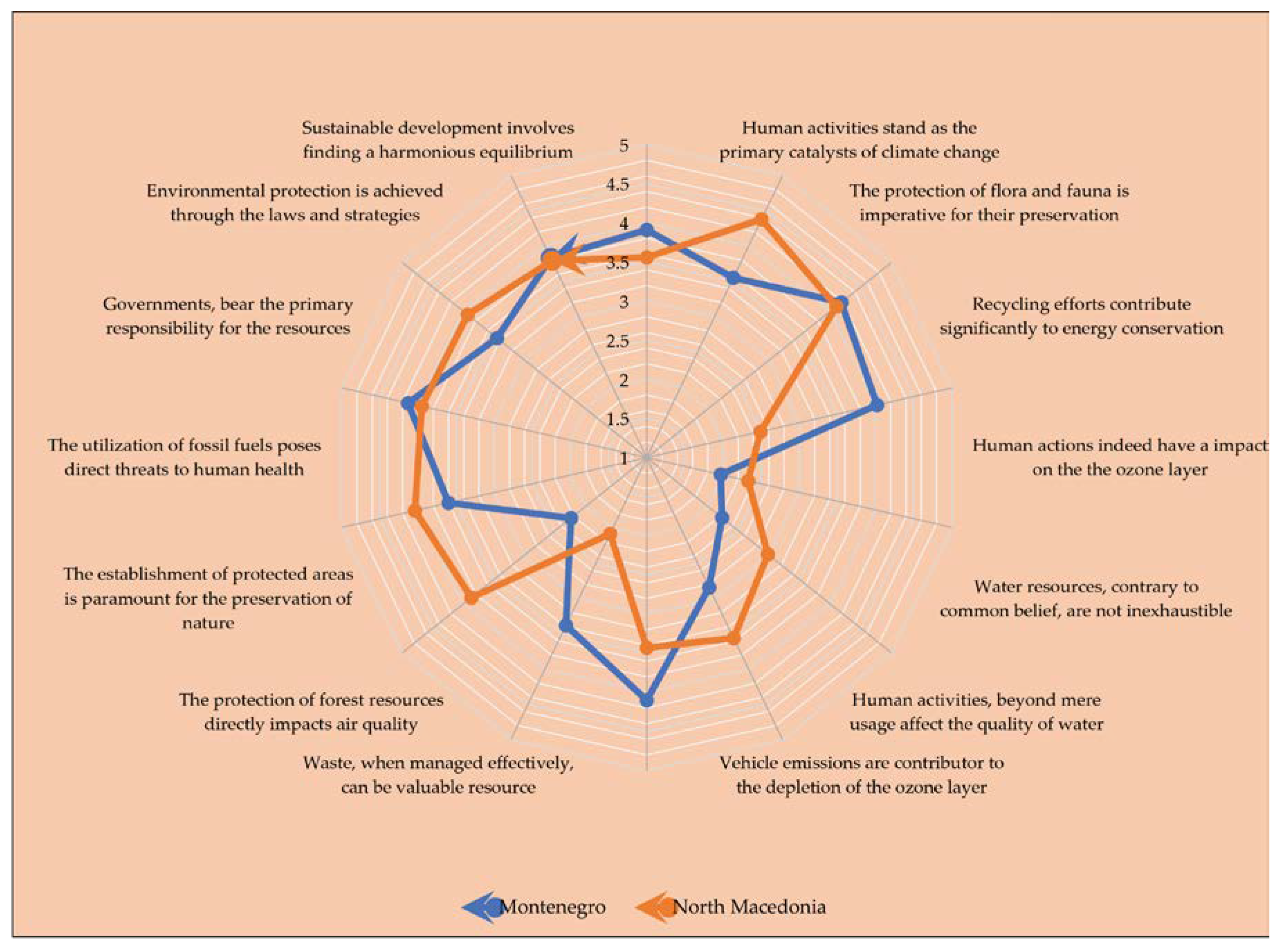
Overall, these findings suggest nuanced differences in environmental knowledge between students from Montenegro and North Macedonia. While students in Montenegro tend to prioritize the protection of flora and fauna and recognize the importance of sustainable development, their counterparts in North Macedonia show a stronger emphasis on the role of human activities in climate change and the significance of recycling efforts. These variations may reflect different educational approaches, cultural attitudes, and environmental challenges in each country.
Sustainable development epitomizes a nuanced equilibrium among technological advancement, environmental stewardship, and the sociopolitical fabric of society. Within the North Macedonian cohort, 51% exhibited affirmative responses, while 38% harboured uncertainty, with a further 10% in dissent. Those hesitating in their response, in the researcher's estimation, may lack comprehensive understanding or, drawing from personal encounters, harbor skepticism toward the assertion. Conversely, within the Montenegrin cohort, it's salient to note that 8 respondents refrained from answering, constituting 8% of the sample. Notably, 68% of respondents unequivocally endorsed the statement, with 24% expressing ambivalence. The notable prevalence of uncertainty can be elucidated by the composition of the sample, wherein 56% comprise first and second-year students, potentially possessing limited exposure to interdisciplinary paradigms and the fundamental underpinnings of environmental conservation and sustainable development.
Attribution of climate change to human activity emerges prominently. In the North Macedonian sample, 58% concurred, with 21% uncertain and a corresponding 21% dissenting. Likewise, in the Montenegrin cohort, 66% acknowledged human influence, while 17% remained uncertain, and 14% dissented. Comparative analysis underscores the conspicuous representation of the "unsure" and "disagree" factions within the Montenegrin cohort. It's reasonable to anticipate heightened cognizance of the issue among individuals inclined toward biological pursuits. However, it also serves as a barometer of deficient comprehension concerning climate change, thus necessitating a reservoir of individuals capable of devising judicious normative, strategic, and pragmatic remedies.
Consensus among pertinent international institutions corroborates the anthropogenic origins of climate change. Concurrently, efforts pivot on mitigating its repercussions, adaptive responses, and prognostic prognoses. The prodigious consumption of fossil fuels has engendered a palpable surge in atmospheric carbon dioxide levels, concomitant with exacerbating particulate matter, deleteriously impacting air quality and climate dynamics. Conjoined with apprehensions surrounding ozone depletion, escalating deforestation, biodiversity loss, and dwindling arable land, the collective repercussions underscore the exigency of scrutinizing climate change, relegating it to the zenith of global political agendas. Ergo, the elevated incidence of negative or skeptical responses attests to the gravity of the global predicament.
Preservation of flora and fauna mandates safeguarding measures. In the North Macedonian cohort, a substantive majority (86%) advocated for protective measures, while 14% evinced skepticism or dissent. Similarly, in the Montenegrin demographic, 89% articulated support, with 11% oscillating between uncertainty and rejection. Although ostensibly minor, these proportions furnish a compelling impetus to fortify and augment educational outreach concerning these themes. In deliberating on the collective approach toward nature conservation and resource preservation, the study expounds on North Macedonia and Montenegro's accession to international commitments under the aegis of nature conservation imperatives. This entails meticulous alignment of domestic legislation and comprehensive implementation of protective protocols, mindful of the economic, social, and ecological capacities of the state, communities, and individuals. Crucially, robust data and understanding of species, their vulnerability, and prudent management are indispensable prerequisites. This imperative finds manifestation in Red Books, seminal compilations maintained by the International Union for Conservation of Nature [93], delineating protected species and conservation strategies. Legal safeguards, predominantly manifest in stringent nature reserves with minimal human intrusion, fortify the preservation paradigm. National parks, emblematic of holistic conservation endeavors, orchestrate an intricate tapestry of protection and sustainable utilization to safeguard the intrinsic worth of the locale. Complementing the Red Books, the scholarly community has promulgated the Black Book[94], cataloguing species extinct or imperiled due to human negligence, underscoring the imperative of responsible stewardship. The extensive implementation of all these measures in North Macedonia and Montenegro implies that any responses falling under the "disagree" or "uncertain" categories can be attributed, at the very least, to inadequate knowledge or lack of information.
In the North Macedonian sample, 80% of respondents provided affirmative responses, while 10% expressed negative views, and 10% were uncertain regarding recycling conserves energy. In the Montenegrin cohort, the distribution differs slightly, though insignificantly for this analysis - 77% responded positively, 9% negatively, and 14% indicated uncertainty. Waste resulting from human activities, whether direct or indirect, as a consequence of meeting escalating human needs, disrupts the environmental and societal quality of life. Numerous waste materials can undergo reuse through proper disposal methods, namely, by segregating fractions. This practice culminates in recycling, a process that engenders novel products from items or materials with renewed utility value. Consequently, the establishment of recycling centers emerges as one of the most efficacious means of waste management and reduction.
Human activities do not influence ozone layer depletion: Within the North Macedonian sample, 55% of participants affirmed this assertion, 14% exhibited uncertainty, and 31% dissented. Conversely, within the Montenegrin sample, 76% agreed, 10% were uncertain, and 8% dissented. This query may be construed as a trick question due to its negative framing, where a negative response paradoxically affirms the premise - namely, that human activities do not affect ozone layer depletion. Hence, it is plausible that some respondents may have misconstrued the query. Nevertheless, despite such ambiguities, there is a pressing need to bolster and deepen educational initiatives concerning these topics to ensure that the knowledge and awareness of future policymakers or practitioners attain the requisite level for innovatively addressing issues pertinent to ozone layer preservation.
Through routine economic activities, human endeavors contribute to ozone layer depletion. Chief among these deleterious impacts are greenhouse gases (GHGs) and chlorofluorocarbons (CFCs). Freon, among the most noxious substances to the ozone, finds application in the fabrication of refrigeration and air conditioning units. Although proscribed in many developed nations, it continues to be employed in less developed and developing countries. Additionally, exhaust emissions from transportation and detonations of nuclear weapons, releasing hazardous nitrogen dioxide gas, pose significant threats to the ozone layer.
Water resources are inexhaustible: In the North Macedonian sample, 58% disagreed with this statement, 21% were uncertain, and 21% concurred. Conversely, within the Montenegrin cohort, 34% disagreed, 36% expressed uncertainty, and 25% agreed. A substantial proportion of respondents in both groups concur with this assertion, indicative, in the researchers' view, of the prevailing circumstances or conditions within which respondents reside. This phenomenon is closely tied to the abundant water resources and commendable water quality in North Macedonia and Montenegro, obviating the perception of global scarcity or limitation of this crucial resource.
Water quality hinges not directly on human activities but on its utilization: Respondents from North Macedonia articulated their viewpoints on this matter as follows: 34% dissented, 24% were uncertain, and 42% assented. Similarly, respondents from Montenegro voiced their opinions as follows: 6% dissented, 9% were uncertain, and 85% assented. Notably, the percentage of dissent among North Macedonian respondents (34%) is noteworthy, alongside those expressing uncertainty, constituting 58% of the total sample. This sizable percentage of negative or undecided responses, according to the researchers, may be attributed to insufficient knowledge and awareness among students from North Macedonia regarding the impacts of economic activities and lifestyle choices. This underscores the imperative to intensify educational efforts to enhance awareness and understanding of environmental protection issues and natural resources, as well as the responsibilities incumbent upon all, from governmental entities to individual citizens, to ensure the sustainable utilization of resources that directly and indirectly impact the quality of life and the survival of humanity.
In the Montenegrin sample, 15% of respondents disagreed, 33% were uncertain, and 48% agreed that vehicle exhaust emissions contribute to ozone layer depletion. In the North Macedonian sample, 14% disagreed, 27% were uncertain, and 59% agreed with this statement. Regarding the question of whether waste is a resource, 20% of respondents from North Macedonia disagreed, 20% were uncertain, and 60% agreed. In Montenegro, 13% disagreed, 20% were uncertain, and 65% agreed. Despite the similar responses, a notable divergence is observed, with more North Macedonian respondents considering waste not a resource. Strategic waste management requires significant human and financial resources, aiming to reduce environmental vulnerability and improve the quality of life. Managing waste adequately, considering it a resource represents a highly profitable economic activity. Inadequate waste management or its absence affects air quality, and availability of healthy natural resources, and ultimately contributes to climate change.
The perception that protected areas are crucial for nature conservation elicited responses from North Macedonian respondents where 17% disagreed, 10% were uncertain, and 73% agreed. In Montenegro, 4% disagreed, 23% were uncertain, and 73% agreed. This question underscores the need to strengthen knowledge about resource protection methods and individual and institutional responsibilities. International conventions and EU directives also impose obligations to ensure future generations enjoy resources (sustainable development). Respondents from North Macedonia answered as follows: 7% disagreed, 15% were uncertain, and 78% agreed that Fossil fuel use (coal, oil, and natural gas) with directly and indirectly impact human health. Similarly, respondents from Montenegro provided very similar responses: 5% disagreed, 19% were uncertain, and 76% agreed. These responses highlight the current relevance of this issue globally and in both countries, driven by the number of vehicles and congested traffic in major cities where the majority of respondents reside.
In the North Macedonian sample, 7% disagreed, 14% were uncertain, and 79% agreed that governments (at national and local levels) bear the most responsibility for resource preservation and use. In the Montenegro sample, 15% disagreed, 36% were uncertain, and 49% agreed. The divergence in responses, especially in Montenegro, indicates two possibilities: individual responsibility and unfamiliarity with the responsibilities and obligations of state institutions at national and local levels. Therefore, environmental governance, management, and legislative acts require scrutiny, particularly in educational programs focusing on environmental protection.
Respondents from North Macedonia expressed their views as follows: 14% disagreed, 10% were uncertain, and 76% agreed that nature conservation is achieved through laws and strategies. In Montenegro, responses were as follows: 6% disagreed, 24% were uncertain, and 70% agreed. The sizable portion of uncertain responses indicates potential trust issues in state institutions, possibly due to political upheavals in both countries in recent decades and political interference in resource allocation. These findings serve as a warning to political structures and governments in both countries to ensure effective law enforcement relies on citizen trust in institutions and their intentions. The biggest ecological problem in Montenegro/North Macedonia is waste. In the North Macedonian sample, 14% disagreed, 21% were uncertain, and 65% agreed. In the Montenegrin sample, 13% disagreed, 28% were uncertain, and 59% agreed.
Considering both countries are in development, and heavily influenced by tourism and agriculture, the responses indicate that waste management is a pressing issue for further sustainable and cleaner development, generating less waste and protecting resources. These responses could be subject to future analysis. In the context of the research results, participants were asked how they believed they could best contribute to environmental protection. They were presented with three options: a) Declaration of Protected Areas: This option involves safeguarding resources and biodiversity by declaring protected areas. In response, 89% of respondents from Montenegro (MNE) agreed, while 70% of respondents from North Macedonia (SMAK) expressed agreement; b) Waste Reduction: This option entails reducing waste through minimizing production and waste generation, as well as through recycling efforts. Among respondents, 82% from Montenegro (MNE) and 69% from North Macedonia (SMAK) agreed with this approach; c) Raising Awareness: This option involves raising and/or strengthening awareness of environmentally friendly and necessary behaviors, such as living in harmony with nature, sustainable resource use, and avoiding environmental pollution. A significant majority of respondents supported this option, with 92% from Montenegro (MNE) and 83% from North Macedonia (SMAK) expressing agreement.
3.2.3. Environmental Safety Attitudes
The analysis of environmental safety variables for the total sample indicates that "Raising awareness of environmentally responsible behavior" received the highest rating (M = 4.22, SD = 0.81), while "Reducing waste through decreased production and recycling" was rated the lowest (M = 3.98, SD = 1.12). Further, the obtained results indicate several significant differences in environmental protection awareness between Montenegro and North Macedonia. In terms of declaring protected areas and conserving resources and biodiversity, students from Montenegro demonstrate a higher level of awareness (M = 4.27) compared to students from North Macedonia (M = 3.95). Although the difference is less pronounced, students from Montenegro also exhibit a slightly higher level of awareness of waste reduction through decreased production and recycling (M = 4.04) compared to participants from North Macedonia (M = 3.93) (Table 5 and Figure 5).
However, the most significant difference is observed in raising awareness of responsible behavior towards the environment, where students from Montenegro show a considerably higher level of awareness (M = 4.65) compared to students from North Macedonia (M = 3.79). These results suggest the need for further exploration of differences in environmental policies and educational programs between these two countries, as well as potential strategies to enhance environmental protection awareness in North Macedonia (Table 5 and Figure 5).
3.3. Influences of Demographic and Socioeconomic Factors on the Environmental Awareness and Perception of Knowledge, and Safety
The results of the examination of these correlations are presented in two parts: influences on environmental awareness and safety, and influences on the perception of environmental knowledge. This approach was chosen to systematize the results and enhance clarity in understanding the influences of various factors.
3.3.1. Influences on the Environmental Awareness and Safety Attitudes
According to the results of Pearson's correlation, it was found that there is a statistically significant correlation between the students' age and the next variables regarding environmental awareness and safety: humanity's survival hinges on natural resource accessibility (p = 0.000); natural resources are universally available (p = 0.035); individuals significantly influence the environment (p = 0.002); environmental conditions profoundly impact human health (p = 0.013); all natural resources have renewable potential (p = 0.002); resource scarcity jeopardizes national security and well-being (p = 0.000); legal regulations govern nature conservation (p = 0.000); biodiversity preservation is vital for humanity (p = 0.000); environmental awareness begins in families (p = 0.000); reducing waste through decreased production and recycling (p = 0.026) (Table 6).
However, according to Pearson's correlation results, there is no statistically significant relationship found between the student's age and the following variables: development often harms the environment (p = 0.470); immersion in nature fosters environmental stewardship (p = 0.918); humanity is responsible for environmental damage (p = 0.832); knowledge fosters environmental awareness (p = 0.054); collective action protects nature (p = 0.960); nature benefits humanity (p = 0.297); declaring protected areas and conserving resources and biodiversity (p = 0.333) (Table 6).
In further analyses, it was found that with an increase in students' age, students demonstrate a heightened awareness of the crucial role of access to natural resources for humanity's survival. Additionally, as students grow older, there is an increasing recognition of the influence individuals exert on the environment and the profound impact of environmental conditions on human health. Concurrently, the perceived importance of the renewable potential of all natural resources tends to increase with age. Furthermore, older students exhibit a greater awareness of the risks posed by resource scarcity to national security and well-being. Likewise, there is an escalating acknowledgment of the importance of legal regulations in governing nature conservation and the preservation of biodiversity for the benefit of humanity. Moreover, older students increasingly recognize the significance of the family's role in fostering environmental awareness. Overall, the findings highlight a compelling trajectory in students' environmental awareness as they mature, marked by a growing recognition of key factors shaping sustainability efforts and environmental stewardship.
However, a contrasting trend is observed regarding the belief in the effectiveness of waste reduction through decreased production and recycling efforts. This finding suggests that older students may have less faith in the efficacy of waste reduction and recycling endeavours. The declining trend in belief in the effectiveness of waste reduction and recycling efforts warrants further investigation to better understand its nature and potential underlying causes.
The results of independent samples t-tests for gender differences in students' environmental awareness and safety variables suggest a statistically significant relationship with the following variables: survival hinges on resource accessibility (p = 0.002); individuals influence the environment (p = 0.001); development harms the environment (p = 0.045); environmental awareness begins in families (p = 0.001); knowledge fosters environmental awareness (p = 0.017); and environmental behaviour awareness (p = 0.001) (Table 7).
Instead, there was no statistically significant relationship found between gender and the remaining variables: resources are universally available (p = 0.719); environmental conditions affect health (p = 0.139); all resources have renewable potential (p = 0.082); resource scarcity jeopardizes security (p = 0.720); legal regulations govern conservation (p = 0.365); biodiversity preservation is vital (p = 0.310); humanity is responsible for damage (p = 0.983); collective action protects nature (p = 0.657); nature benefits humanity (p = 0.356); protected areas and biodiversity conservation (p = 0.376); waste reduction and recycling (p = 0.176); nature immersion fosters stewardship (p = 0.087) ) (Table 7).
Further results show that men (M = 4.78; SD = 0.44) believe that individuals have a greater impact on the environment than women (M = 4.58; SD = 0.67). They also believe more (M = 3.73; SD = 0.89) that development harms the environment compared to women (M = 3.50; SD = 1.10), that environmental awareness begins in the family (M = 4.12; SD = 0.94) compared to women (M = 3.70; SD = 1.25). Furthermore, they are more likely to believe (M = 4.20; SD = 0.80) that knowledge fosters environmental awareness than women (M = 3.97; SD = 1.09). Additionally, they rate environmental behavior awareness higher (M = 4.65; SD = 0.53) compared to women (M = 4.36; SD = 0.99). In contrast, women are more likely to believe (M = 4.31; SD = 0.92) that survival depends on resource availability compared to men (M = 4.00; SD = 1.02) (Table 7).
The results of the one-way ANOVA indicated connections between the place of residence of students and the next variables: resource scarcity jeopardizes security (F = 3.706, p = 0.025), and biodiversity preservation is vital (F = 10.720, p = 0.000). With other variables, no statistically significant association with place of residence was found (Table 8).
Further analysis revealed that students living in rural areas (M = 3.25; SD = 1.22) reported higher scores for the belief that resource scarcity jeopardizes security compared to students residing in urban centres (M = 3.16; SD = 1.02) and suburban areas (M = 2.97; SD = 1.10). Additionally, it was found that students living in rural areas (M = 2.59; SD = 0.99) expressed stronger beliefs in the importance of biodiversity preservation compared to those living in urban centres (M = 2.36; SD = 0.99) and suburban areas (M = 1.98; SD = 0.98).
After performing further analyses, it has been determined that correlations exist between students' study year and next variables: survival hinges on resource accessibility (F = 6.159, p = 0.000); environmental conditions affect health (F = 6.842, p = 0.000); all resources have renewable potential (F = 4.603, p = 0.004); development harms the environment (F = 6.361, p = 0.000); resource scarcity jeopardizes security (F = 4.468, p = 0.004); legal regulations govern conservation (F = 4.546, p = 0.003); knowledge fosters environmental awareness (F = 2.647, p = 0.049); nature benefits humanity (F = 10.419, p = 0.000); waste reduction and recycling (F = 2.150, p = 0.093); environmental behaviour awareness (F = 4.224, p = 0.006). With other variables, no statistically significant association with place of residence was found (Table 8).
Additional analysis indicates that fourth-year students (M = 4.43; SD = 0.98) exhibited stronger endorsements for the notion that survival hinges on resource accessibility, surpassing both second-year (M = 4.11; SD = 1.01) and first-year counterparts (M = 3.86; SD = 0.90). Moreover, fourth-year students (M = 4.90; SD = 0.80) demonstrated heightened awareness regarding the impact of environmental conditions on health, in contrast to their first-year peers (M = 4.49; SD = 0.85). Furthermore, third-year students (M = 3.05; SD = 1.17) expressed a more pronounced belief in the renewability of all resources compared to first-year students (M = 2.29; SD = 1.15). Conversely, first-year students (M = 4.00; SD = 1.05) were more inclined to perceive development as harmful to the environment than their third-year counterparts (M = 3.87; SD = 1.01). Similarly, fourth-year students (M = 4.29; SD = 1.04) demonstrated a heightened concern regarding the security implications of resource scarcity compared to first-year students (M = 4.16; SD = 1.01). Additionally, fourth-year students (M = 4.35; SD = 1.01) displayed a stronger belief in the role of legal regulations in conservation compared to first-year students (M = 4.08; SD = 1.00). Moreover, fourth-year students (M = 3.42; SD = 1.08) underscored the importance of biodiversity preservation more emphatically than first-year students (M = 2.97; SD = 1.03). Further examination revealed that fourth-year students consistently attributed higher scores to the following variables: the role of knowledge in fostering environmental awareness (M = 4.26; SD = 0.87), the benefits of nature to humanity (M = 3.54; SD = 0.78), and the awareness of environmental behavior (M = 4.17; SD = 0.75).
Following additional analyses, it has been discovered that correlations exist between students' study rate and the next variables: survival hinges on resource accessibility (F = 6.727, p = 0.000); all resources have renewable potential (F = 8.246, p = 0.000); development harms the environment (F = 8.370, p = 0.000); resource scarcity jeopardizes security (F = 12.589, p = 0.000); legal regulations govern conservation (F = 7.641, p = 0.000); humanity is responsible for damage (F = 6.952, p = 0.000); nature benefits humanity (F = 2.732, p = 0.044); protected areas and biodiversity conservation (F = 6.991, p = 0.000); waste reduction and recycling (F = 13.519, p = 0.000); environmental behavior awareness (F = 3.284, p = 0.021). With other variables, no statistically significant association with place of residence was found.
Additional analysis indicates that students who reported having pending exams and obligations alongside regularly passing exams (M = 4.43; SD = 0.00) demonstrated the highest scores regarding survival hinges on resource accessibility, while those who reported regularly passing exams and fulfilling obligations (M = 3.86; SD = 0.00) showed the lowest scores. Students who reported regularly passing exams but also having pending exams and obligations (M = 4.28; SD = 0.704) demonstrated the highest scores regarding protected areas and biodiversity conservation, while those who reported "Other" (M = 4.09; SD = 0.898) showed the lowest scores. Also, students who reported regularly passing exams and fulfilling obligations (M = 4.00; SD = 1.050) demonstrated the highest scores regarding development harms the environment, while those who reported regularly passing exams but also having pending exams and obligations (M = 3.36; SD = 0.857) showed the lowest scores.
On the other side, students who reported having difficulties with passing exams and fulfilling obligations (M = 3.22; SD = 0.911) demonstrated the highest scores regarding all resources having renewable potential, while those who reported "Other" (M = 3.06; SD = 1.275) showed the lowest scores. Also, students who reported having difficulties with passing exams and fulfilling obligations (M = 3.42; SD = 1.297) demonstrated the highest scores regarding humanity being responsible for damage, while those who reported regularly passing exams and fulfilling obligations (M = 2.92; SD = 1.057) showed the lowest scores.
Furthermore, students who reported "Other" (M = 4.10; SD = 1.019) demonstrated the highest scores regarding waste reduction and recycling, while those who reported having difficulties with passing exams and fulfilling obligations (M = 3.75; SD = 1.403) showed the lowest scores. Also, students who reported, "Other" (M = 4.62; SD = 0.579) demonstrated the highest scores regarding environmental behavior awareness, while those who reported regularly passing exams and fulfilling obligations (M = 4.50; SD = 0.658) showed the lowest scores. Similarly, students who reported "Other" (M = 3.96; SD = 1.125) demonstrated the highest scores regarding nature benefits humanity, while those who reported regularly passing exams but also having pending exams and obligations (M = 3.14; SD = 1.149) showed the lowest scores. Additionally, students who reported "Other" (M = 4.35; SD = 0.625) demonstrated the highest scores regarding resource scarcity jeopardising security, while those who reported regularly passing exams but also having pending exams and obligations (M = 3.41; SD = 1.085) showed the lowest scores. Finally, students who reported "Other" (M = 4.35; SD = 0.625) demonstrated the highest scores regarding legal regulations governing conservation, while those who reported having difficulties with passing exams and fulfilling obligations (M = 3.94; SD = 1.149) showed the lowest scores.
3.3.2. Influences on Environmental Knowledge Attitudes
According to the results of Pearson's correlation, it was found that there is a statistically significant correlation between the students age and next variables regarding perception of environmental knowledge: sustainable development involves finding a harmonious equilibrium among technological advancement, environmental conservation (p = 0.010); human activities stand as the primary catalysts of climate change (p = 0.001); human actions indeed have an impact on the ozone layer (p = 0.612); vehicle emissions are a contributor to the depletion of the ozone layer (p = 0.001); waste, when managed effectively, can be a valuable resource (p = 0.005); the utilization of fossil fuels poses direct threats to human health (p = 0.027); governments bear the primary responsibility for the resources (p = 0.001); environmental protection is achieved through laws and strategies (p = 0.004); effective waste management emerges as the most pressing environmental challenge in north Macedonia (p = 0.000) (Table 9).
However, according to the Pearson's correlation results, there is no statistically significant relationship found between the student's age and the following variables: the protection of flora and fauna is imperative for their preservation (p = 0.105); recycling efforts contribute significantly to energy conservation (p = 0.350); water resources, contrary to common belief, are not inexhaustible (p = 0.766); human activities, beyond mere usage, affect the quality of water (p = 0.129); the protection of forest resources directly impacts air quality (p = 0.886); the establishment of protected areas is paramount for the preservation of nature (p = 0.146) (Table 9).
In further analyses, it was found that older students tend to demonstrate a heightened awareness of sustainable development, the role of human activities in climate change, the impact of vehicle emissions on the ozone layer, the potential of effective waste management, the health risks associated with fossil fuel utilization, and the role of governments in environmental protection. They also perceive effective waste management as a pressing environmental challenge in North Macedonia. However, there are no significant associations between age and the perception of the importance of protecting flora and fauna, recycling efforts, water resource conservation, the impact of human activities on water quality, the protection of forest resources, and the establishment of protected areas.
The results of independent samples t-tests for gender differences in students' environmental knowledge perception variables suggest a statistically significant relationship with the following variables: human activities and climate change (p = 0.005); recycling and energy conservation (p = 0.028); human actions and the ozone layer (p = 0.001); water resources sustainability (p = 0.001); human activities and water quality (p = 0.003); vehicle emissions and the ozone layer (p = 0.001); fossil fuels and human health (p = 0.001) (Table 10). In place, there was no statistically significant relationship found between gender and the remaining variables: sustainable development (p = 0.057), flora and fauna preservation (p = 0.959), waste management (p = 0.871), forest resources and air quality (p = 0.287), protected areas and nature preservation (p = 0.109), government responsibility for resources (p = 0.890), environmental protection laws and strategies (p = 0.565), waste management in North Macedonia (p = 0.321) (Table 10).
Further results indicate that men more prominently (M = 3.71; SD = 0.938) than women (M = 3.37; SD = 1.412) emphasize that human activities stand as the primary catalysts of climate change. Additionally, men more significantly (M = 4.17; SD = 0.801) compared to women (M = 3.93; SD = 1.283) believe that recycling efforts contribute significantly to energy conservation. Furthermore, men more prominently (M = 1.86; SD = 0.874) compared to women (M = 2.62; SD = 1.432) highlight that human actions indeed have a substantial impact on the depletion of the ozone layer. Moreover, men (M = 4.00; SD = 0.888) more significantly compared to women (M = 3.64; SD = 1.110) affirm that vehicle emissions are a significant contributor to the depletion of the ozone layer. Lastly, it was determined that men (M = 4.30, SD = 0.669) more prominently compared to women (M = 3.85, SD = 1.031) emphasize that the utilization of fossil fuels, such as coal, oil, and natural gas, poses direct threats to human health (Table 10).
The outcomes of the one-way ANOVA demonstrated associations between students' place of residence and such as flora and fauna preservation (F = 4.45, p = 0.012) and vehicle emissions and the ozone layer (F = 5.68, p = 0.004). With other variables, no statistically significant association with place of residence was found (Table 11).
Further analysis revealed that students living in rural areas (M = 4.41; SD = 0.62) reported higher scores for the belief the protection of flora and fauna is imperative for their preservation compared to students residing in urban centres (M = 4.14; SD = 1.01) and suburban areas (M = 4.41; SD = 0.99). Additionally, it was found that students living in suburban areas (M = 4.01; SD = 0.93) expressed stronger beliefs that vehicle emissions are a contributor to the depletion of the ozone layer compared to those living in rural (M = 3.84; SD = 0.93) and urban centres (M = 3.65; SD = 1.08).
After performing further analyses, it has been determined that correlations exist between students' study year and the next variables: flora and fauna preservation (F = 2.638, p = 0.049); recycling and energy conservation (F = 3.047, p = 0.029); human actions and the ozone layer (F = 4.399, p = 0.005); water resources sustainability (F = 4.896, p = 0.002); human activities and water quality (F = 11.931, p = 0.000); vehicle emissions and the ozone layer (F = 20.532, p = 0.000); waste management (F = 10.142, p = 0.000); forest resources and air quality (F = 9.518, p = 0.000); fossil fuels and human health (F = 4.332, p = 0.005); waste management in North Macedonia (F = 7.038, p = 0.000); government responsibility for resources (F = 6.188, p = 0.000). With other variables, no statistically significant association with students' study year was found (Table 11).
Further analysis revealed that students in the second year of the study demonstrated the highest average score (M = 4.49; SD = 0.592) for the "Flora and fauna preservation" topic, while those in the third year had the lowest average score (M = 4.15; SD = 1.174). Regarding "Recycling and energy conservation," fourth-year students had the highest average score (M = 4.26; SD = 1.094), whereas first-year students had the lowest average score (M = 3.89; SD = 0.956). For the "Human actions and the ozone layer" topic, fourth-year students had the highest average score (M = 2.43; SD = 1.376), while first-year students had the lowest average score (M = 1.79; SD = 0.682). In terms of "Water resources sustainability," first-year students had the highest average score (M = 2.56; SD = 1.297), whereas fourth-year students had the lowest average score (M = 1.97; SD = 1.070). Second-year students had the highest average score (M = 3.39; SD = 1.146) for the "Human activities and water quality" topic, while fourth-year students had the lowest average score (M = 2.46; SD = 1.267). Also, the "Vehicle emissions and the ozone layer" topic saw second-year students with the highest average score (M = 4.25; SD = 0.678), and fourth-year students with the lowest average score (M = 3.32; SD = 1.060). Further, for "Waste management," second-year students had the highest average score (M = 3.96; SD = 0.943), whereas first-year students had the lowest average score (M = 3.15; SD = 0.778). Also, second-year students also had the highest average score (M = 2.48; SD = 1.152) for "Forest resources and air quality," while fourth-year students had the lowest average score (M = 1.80; SD = 0.861). Similarly, in the field of "Fossil fuels and human health," second-year students had the highest average score (M = 3.84; SD = 0.928), and first-year students had the lowest average score (M = 3.47; SD = 1.021). Additionally, "Waste Management in North Macedonia" had second-year students with the highest average score (M = 4.01; SD = 0.994), and first-year students with the lowest average score (M = 3.32; SD = 1.074). Lastly, for "Government responsibility for resources," fourth-year students had the highest average score (M = 3.95; SD = 0.974), and first-year students had the lowest average score (M = 3.32; SD = 1.262).
Overall, the results suggest that students' engagement with environmental issues tends to increase as they progress through their studies. Second-year and fourth-year students show the highest levels of interest and awareness, while first-year students may benefit from more targeted education and awareness campaigns to increase their engagement.
Following additional analyses, it has been discovered that correlations exist between students' study rate and the following variables: sustainable development (F = 0.165, p = 0.848); human activities and climate change (F = 0.553, p = 0.575); recycling and energy conservation (F = 0.346, p = 0.708); human actions and the ozone layer (F = 1.043, p = 0.353); human activities and water quality (F = 0.768, p = 0.465); vehicle emissions and the ozone layer (F = 5.682, p = 0.004); waste management (F = 0.558, p = 0.573); forest resources and air quality (F = 0.606, p = 0.546); environmental protection laws and strategies (F = 0.896, p = 0.409); waste management in North Macedonia (F = 2.329, p = 0.099). With other variables, no statistically significant association with students' study year was found (Table 11).
Further analysis revealed that students who regularly pass exams and fulfil obligations demonstrated the highest average scores for the attitude "Sustainable development involves finding a harmonious equilibrium among technological advancement, environmental conservation" (M = 4.06; SD = 0.951), while those who have difficulties with passing exams and fulfilling obligations showed the lowest average scores (M = 3.43; SD = 0.801). Regarding the attitude "Human activities stand as the primary catalysts of climate change," students who regularly pass exams had slightly higher average scores (M = 3.67; SD = 1.222) than those who faced difficulties with passing exams (M = 3.05; SD = 1.306). When it comes to the attitude "Recycling efforts contribute significantly to energy conservation," students who regularly pass exams obtained the highest average scores (M = 4.18; SD = 1.054), whereas those who have difficulties with passing exams achieved the lowest average scores (M = 3.76; SD = 1.358). For the attitude "Human actions indeed have an impact on the ozone layer," students who regularly pass exams had lower average scores (M = 2.53; SD = 1.341) compared to those who have difficulties with passing exams (M = 1.90; SD = 0.983). Besides that, the attitude "Vehicle emissions are a contributor to the depletion of the ozone layer" showed that students who regularly pass exams had lower average scores (M = 2.70; SD = 1.212) than those who have difficulties with passing exams (M = 3.40; SD = 1.257). In terms of the attitude "Waste, when managed effectively, can be a valuable resource," students who regularly pass exams demonstrated average scores close to the average (M = 3.75; SD = 1.222), while those who have difficulties with passing exams also showed similar average scores (M = 3.81; SD = 0.740). Regarding the attitude "The protection of forest resources directly impacts air quality," students who regularly pass exams had similar average scores (M = 3.39; SD = 1.126) to those who have difficulties with passing exams (M = 3.71; SD = 0.944). Regarding "Environmental Protection Laws and Strategies," students who regularly pass exams had lower average scores (M = 3.71; SD = 1.299) compared to students who have difficulties with passing exams (M = 4.19; SD = 0.917). Finally, for "Waste Management in North Macedonia," students who regularly pass exams had lower average scores (M = 3.43; SD = 1.104) than those who have difficulties with passing exams (M = 3.70; SD = 1.018).
3.4. Additional Findings from the Focus Group Interview in Montenegro
3.4.1. Assessing Environmental Perceptions in Montenegro: A Comparative Analysis by Region and Student Characteristics
For this investigation, participants were presented with three response options and encouraged to provide a rationale for their selection. The response choices were: a) poor; b) good; and c) excellent. The analysis is conducted through two distinct criteria: a) Regional breakdown and representation of secondary schools, and b) Comparison based on academic year and student status. The researcher perceives the rationale behind this analysis as the need to assess the quality of information relative to the type of secondary education completed and to evaluate environmental awareness and comprehension in relation to academic progression. Furthermore, through the second criterion, the aim is to discern the quality of information conveyed by regular versus non-regular students. The analysis, based on regional demographics and secondary school representation, is elaborated in Table 12.
Among graduates from gymnasiums, 44% perceive Montenegro's environmental state as unfavourable, while 56% view it positively. When considering the overall respondent pool, 23% of gymnasium graduates express pessimism regarding the environmental state, contrasted with 29% who hold an optimistic outlook. Notably, all students who completed medical school (100%) share a perception of the environmental state as poor. Within this group, 23% of respondents who graduated from medical schools align with this viewpoint. For students from other secondary schools, 25% perceive the environmental state as unfavourable, 50% as favourable, and 25% as excellent. In terms of the entire respondent population from other secondary schools, 6% view the environmental state negatively, 13% positively, and 6% excellently.
While these statistics provide numerical insights, the narratives behind these perceptions offer a richer understanding. In the central region, rationales are grounded in everyday observations rather than formal education. Surprisingly, students from other secondary schools demonstrate a deeper understanding of environmental issues compared to gymnasium graduates, as evidenced by their comprehensive examples. Conversely, the southern region highlights different concerns. Despite a basic grasp of the subject, students primarily focus on local environmental challenges, particularly coastal protection and urbanization issues. While positive instances of coastal protection are cited, concerns arise regarding excessive urbanization leading to environmental degradation. In the northern region, a notable depth of knowledge and comprehension regarding environmental matters is observed. Interestingly, there's no discrepancy in understanding between gymnasium and other secondary school graduates. Rural residency among 20% of focus group participants in this region suggests that their justifications are backed by tangible examples, such as deforestation, inadequate protection of national parks, lax enforcement of hunting and fishing laws, and unauthorized construction. Moreover, students express dissatisfaction with Montenegro's stringent yet poorly enforced laws, signalling a higher level of education fostered by collaboration with governmental institutions and numerous non-governmental organizations. Ultimately, their proposals for environmental improvement stem from practical experiences, demonstrating a high degree of realism. The analysis, based on student representation by academic year and study status, is detailed in Table 13.
This table indicates that as students progress through higher years of university, the number of those who believe the environmental state is good decreases. The reasons lie both in the maturation of awareness regarding real environmental issues and in the decline in students' exam performance. The assumption is that studying leads to the strengthening of critical awareness and awareness of the environment and its protection issues.
3.4.2. The quintessential Environmental Challenges in Montenegro
The investigation into this matter has been somewhat explored in the preceding inquiry. Here, the crux lies in confirming whether students possess a genuine grasp of the most pivotal ecological issues and their ability to compile a roster of priority concerns regarding the environment. The analytical framework incorporates regional categorization, academic progression, and student categorization. Table No. 8a furnishes a breakdown of responses delineating ecological issues by region. Upon scrutinizing the data and corresponding tables, a mosaic of logical yet intriguing insights emerges. Notably, the prevalence of diverse waste types and ensuing pollution manifests prominently in the perspectives of respondents, offering a lucid portrayal. Within the central region, such perspectives stem from the presence of the Aluminum Plant in Podgorica and its raw materials repository in the Nikšić bauxite mine, where waste generation lacks adequate management. Concurrently, the spectre of air pollution pervades the proximal and distal environs of these industrial nodes, alongside the looming menace of water contamination and agricultural soil degradation. This vantage point bespeaks discontent fueled by the dearth of recycling hubs and essential water treatment facilities. Conversely, in the southern precincts, waste concerns pivot not on industrial edifices but on the paucity of suitable waste storage or recycling avenues for daily refuse emanating from tourist and residential hubs. In the northern expanse, the waste conundrum intertwines with the coal mine and thermal power plant in Pljevlja, acting as the solitary economic entities engendering a gamut of waste categories. Within the narratives of the central and northern locales, recommendations advocating heightened investments in innovative technologies and meticulous blueprinting of potential recycling outposts and landfill sites abound, while the southern domain finds solace in earmarking adequate waste disposal locales. The pervasive conundrum of unchecked urbanization casts its shadow across all realms, albeit to varying degrees. Significantly, the southern landscape emerges as the epicentre of this predicament, wherein "territorial desolation in the service of tourism prevails, with all endeavours conducted haphazardly, in defiance of Montenegro's spatial blueprint" (quote from a respondent).
Indicative markers in these tabulations unfold as follows: a) three-fifths (or marginally less than two-fifths) of respondents hailing from the central quadrant accord precedence to waste as an ecological quandary, with an analogous cohort earmarking water pollution as paramount, while a mere one-seventh discern excessive urbanization as a salient environmental issue. Notably, respondents from the central swathes do not perceive natural endowments like flora and fauna as imperilled, particularly given the presence of national parks like "Skadar Lake" and "Lovćen."; b) forty per cent of respondents from the southern sphere identify excessive urbanization as the chief ecological bugbear, whereas 20% apportion equal priority to waste, preservation of natural resources, and safeguarding of flora and fauna. Intriguingly, respondents from the southern sector do not construe water pollution as an urgent concern. This stance may stem from conflating wastewater issues with waste, despite clear delineations in the questioning, or from the overarching nature of the excessive urbanization issue, which encapsulates water pollution concerns. The impetus behind their emphasis on preserving flora and fauna lies in the dwindling spatial expanse due to urban sprawl and the heightened incidence of forest conflagrations along coastal peripheries.
3.4.3. Institutions in Montenegro Engaged in Environmental Protection and Methods of Protecting Natural Resources in Montenegro
The aim of this inquiry was to gain an understanding of students' general awareness of institutions involved in environmental protection, as well as to assess their knowledge of the hierarchical status of state institutions. The indicators are as follows: 63% of respondents know which institutions in the country are engaged in environmental protection, while the remaining 27% of the focus group is partially familiar with this topic, and 10% of respondents are unaware of the relevant institutions; and the best knowledge of institutions engaged in environmental protection is demonstrated by respondents from the northern region, followed by those from the central region, with the fewest respondents from the southern region.
The goal of this inquiry (methods of protecting natural resources in Montenegro) was to ascertain whether respondents possess an understanding of how and which priorities are set for the protection of natural resources in Montenegro. The aim was not to determine percentages but rather to see if environmental considerations are made in line with principles of environmental protection and sustainable management. Apart from the southern region, respondents offered a number of proposals, which can be categorized into a) administrative and b) educational-operational measures. Regarding administrative measures, respondents pay the most attention to a) strict enforcement of laws; b) strengthening inspection activities; and c) detailed planning and broader community involvement in planning. Concerning educational-operational measures, students particularly emphasize raising awareness among the population. Such an approach is characteristic of every region in Montenegro.
Operational measures vary from region to region. In the southern region, respondents insist on protecting space and water, as well as drastically reducing urbanization. Respondents from this region exhibit conflicting views, as they do not prioritize water pollution among the top five environmental problems, yet all propose measures for water protection. This is the best evidence supporting the conclusion drawn by the researcher in the chapter on major environmental problems, where it is noted that students from the southern region perceive this water pollution issue as part of the broader issue of space pollution.
In the central region, operational measures are reduced to detailed planning within spatial planning frameworks, as well as controlled use of natural resources. Detailed planning within spatial plans must adhere to sustainable planning and management of natural resources. Controlled use of natural resources implies the utilization of resources entrusted through the Concessions Law, as envisaged by law and with enhanced control over plans and their implementation, as well as those resources used for tourism-educational purposes, managed by National Parks. In the northern region, the most measures are proposed, ranging from administrative to protective measures, such as: a) preserving green areas; b) using alternative energy and heating systems; c) establishing new green spaces; and d) treating wastewater. Additionally, proposals are made regarding cooperation among institutions, the non-governmental sector, and local communities in planning and implementing plans, aiming for transparent processes related to environmental protection. It is entirely logical that most measures and activities are found in the northern region, considering that the spectrum of environmental protection issues is most prevalent in this area.
3.4.4. Enhancing Environmental Awareness: Analyzing the Focus Group's Insights
The analysis of the focus group regarding environmental knowledge represents a logical progression from the initial phase, during which eighteen (18) questions were included in the survey. Building upon the insights gleaned in the initial phase, four (4) key questions were singled out for the focus group: a) How many National Parks exist in Montenegro, and what measures are in place to safeguard the natural assets placed under their protection?; b) Strategies for addressing and mitigating waste issues in Montenegro; c) Identifying sustainable practices for the utilization of natural resources; d) Assessing Montenegro's vulnerability to climate change and exploring strategies for resilience and adaptation (Table 14).
The primary objective of this analysis is to gauge the depth of environmental knowledge possessed by students at the time of the study and to ascertain how this knowledge level varies across different academic years at the Faculty of Biology. Inquiring about the number of National Parks in Montenegro and the methods employed to protect the natural resources within them revealed a comprehensive understanding among respondents. They demonstrated awareness not only of National Parks but also of other protective designations like regional parks, nature reserves, and natural monuments. However, responses to the latter part of the questions largely revealed gaps in information, particularly concerning the scope of protection provided by National Parks, which respondents believed was primarily physical.
Table 14 offers an in-depth analysis of this query, yet it leaves a lingering inquiry into the methods employed to safeguard natural assets. Specifically, only one (1) student asserted that they are preserved through regulatory measures, representing merely 6% of the focus group or 33% of the cohort comprising non-regular students. The researcher notes an evident dearth in knowledge or comprehension regarding both natural resources and the legislative framework governing this domain. While there exists a conventional enumeration of protected natural assets, a prevailing situation emerges where the criteria for delineating these assets hierarchically remain elusive, coupled with a conspicuous absence of familiarity with protective measures.
3.4.5. Waste Management Solutions in Montenegro
This question stands out as one of the most significant within the scope of this research, as it fundamentally provides insights into students' understanding of the environment and environmental protection issues. Centred on waste management, statistically marked as the foremost environmental concern, the question is designed, according to the researcher's perspective, to reveal the knowledge or lack thereof among students, rather than extracting "dry percentages" for analysis.
Given that waste is identified as Montenegro's major ecological challenge, corresponding knowledge is expected. However, the insights drawn from this analysis directly reflect the lack of awareness or distinction between industrial and other forms of waste. Most respondents frequently propose the establishment of recycling centers, the introduction of various waste containers, the standardization of landfills, and similar measures. Notably, the absence of suggestions on addressing solid and liquid waste from mines, such as tailings, is evident.
Examining the situation regionally, distinct patterns emerge: a) in the southern region, waste management is primarily seen through addressing landfill issues in one or more municipalities. Proposals focus on securing suitable spaces for standardized landfills or constructing regional landfills, which seems reasonable given the absence of major land-based industrial entities causing significant pollution. Notably, proposals regarding liquid waste and waste polluting the sea, both from tourist complexes and ships, particularly in the Bar port, are lacking, as are adequate suggestions for addressing communal pollution; b) in the central region, major polluters like the aluminium plant (KAP) and the bauxite mine in Nikšić prompt respondents to address air and water pollution issues. However, solid waste resulting from the operations of these entities is not identified by respondents. Suggestions revolve around technological advancements, especially in air and water purification near these industrial sites; c) in the northern region, all respondents highlight issues with the Pljevlja municipality and its thermal power plant and coal mine. Problems with air pollution are more pronounced here, with Pljevlja being a notorious environmental hotspot in the country. It's logical to expect respondents from this region to demonstrate more knowledge about waste, which they do, primarily in terms of identification. Proposed solutions lean towards "green methods" within the operations of these entities, advocating for increased investments in the production segments causing the most air pollution.
3.4.6. Identifying Sustainable Practices for Utilizing Natural Resources
The sustainable way of using natural resources was the primary focus of this question. Its aim was to determine which natural resources are being utilized and whether they fall under the term sustainable management based on the way they are used. This question is the best indicator of how life in a specific region of the country shapes environmental attitudes. In this approach, it was necessary to present to the respondents all natural resources—assets managed according to the principle of direct utilization, in accordance with Montenegro's legislative framework. According to regions, the situation appears as follows: a) in the southern region, respondents primarily view the sea, forests, flora, and fauna as natural resources. Concerning the sea, students believe it is not being managed sustainably, especially regarding the use of fishery resources. The prevailing opinion is that fish are being overfished, and there are insufficient data on fish stocks, suggesting a need for strengthened control. However, according to the researcher's opinion, enhanced control is only a means of sustainable management, while a proposal for a sustainable management method is lacking. Forests in the southern region are not interesting in terms of exploitation but are significant from a protective aspect, particularly against forest fires. Hence, reforestation of burnt areas with fire-resistant species is suggested to expedite the return of nature to its normal state, creating conditions for the re-establishment of wildlife, which is forced to leave its natural habitat; b) in the central region, lifestyle determines a different perspective on the sustainable use of natural resources. In this region, respondents prioritize the following natural resources for sustainable management: a) utilization of National Parks; b) water usage; and c) hunting and fishing.
The use of national parks - Skadar Lake and Lovćen - is not conducted sustainably. While the tourist aspect of utilizing national parks isn't questioned by students, the management of natural resources within the parks is brought into focus. The primary issue concerning Skadar Lake is illegal fishing and the lack of data on its fish stock. Illegal fishing cannot be tolerated, especially through unconventional and prohibited methods. Regarding Lovćen National Park, students identify the main problem as the perceived poor management of its forests and suggest strengthening control given existing management plans.
In the central region, students believe water resources are not managed sustainably. They advocate for regulating river flows and utilizing their full energy potential while safeguarding the environment. Since water resources are managed through concessions, strict adherence to concession laws is recommended, along with enhanced control over concessionaires. Due to the lack of data on fish stocks, maximum control over fishing activities and adherence to conventional fishing methods are proposed. Additionally, students suggest valorizing water resources through quality water sports offerings. Students believe hunting and fishing can be controlled through legal compliance, good management plans for hunting grounds, enhanced inspection oversight, and educational programs involving hunters, fishermen, and local communities. In the northern region, students identify management issues in national parks, forests, and water bodies, which will be further analyzed. Three national parks are located in this region: Durmitor, Biogradska Gora, and Prokletije.
For Durmitor National Park, students propose maximal protection, especially considering its UNESCO status. They emphasize uncoordinated construction within the park, treating any such construction as illegal, and suggest restrictive construction practices to ensure sustainable management. Given its susceptibility to forest fires, modern protection methods, education investment, and proper equipment are recommended. Students propose similar measures for Biogradska Gora National Park, which generally faces fewer issues, focusing on maximizing planning documents for tourism and education activities. For Prokletije National Park, which recently gained status, students recommend rational planning for forest, wildlife, and water resource utilization, emphasizing the protection of key water bodies.
Forest resource utilization is seen as a point of contention between state and non-state institutions. Students propose measures ranging from transparent forest planning to intensified reforestation efforts and strengthened inspection oversight over forest management. Regarding water resources in the northern region, students advocate for hydroelectric potential utilization, tourist valorization of water bodies, rigorous inspection oversight and punitive measures.
3.4.7. Climate Change Threat and Adaptation Strategies for Montenegro
The importance of climate change worldwide was a sufficient reason for students to be asked this question at this stage of the research. Additionally, the aim of this question is to determine whether there is an intention among students to permanently monitor environmental issues, as this can be established in the second part of the question, where methods of resistance and adaptation to climate change in Montenegro are sought. Table No. 10 depicts students' attitudes according to their year of study regarding the degree of threat to Montenegro from climate change.
The dominant perception among respondents is that Montenegro faces a modest threat from climate change, with 47% of the focus group sharing this view. Meanwhile, 29% of respondents believe that Montenegro is not threatened by climate change, while 24% consider the threat to be significant. A thorough examination of the data highlights key insights into the preconceptions formed by students during their secondary education and the evolution of their understanding during their academic pursuits, profoundly shaping their perspectives. Specifically, among first and second-year students, there is a lack of consensus regarding the severity of the threat posed by climate change in Montenegro; half of them perceive no threat, while the other half perceive a slight threat. However, this perception shifts significantly in later years, when the majority recognizes a substantial threat to Montenegro.
As for the strategies to combat or adapt to climate change, the analysis reveals regional disparities in priorities and approaches among students. Nonetheless, common themes emerge across all regions, emphasizing the need to curtail urbanization, enhance green spaces, and impose stricter regulations on natural resource utilization. Moreover, there is a unanimous call for legal reforms aimed at effectively monitoring gas emissions, curbing excessive urban development, and managing natural resources more sustainably.
4. Discussion
The findings of this comparative study underscore the significant role that socio-cultural and environmental contexts play in shaping the environmental awareness, perception of knowledge, and attitudes towards safety among students in Montenegro and North Macedonia. The results of this study highlight notable differences in environmental awareness among students from Montenegro and North Macedonia, providing valuable insights into their perceptions and attitudes towards environmental issues. The obtained results indicating differences between students are similar to the findings of previous research in other countries [4,10,11,20,24,45,62].
The results from our study provide a multifaceted view of the influence of demographic and socio-economic variables on environmental awareness, safety, and knowledge among students from Montenegro and North Macedonia. Utilizing a hypothetical conceptual framework, we aimed to discern the specific roles of gender, age, year of study, study rate, and parental education levels in shaping these environmental attitudes. Our multivariate regression analysis reveals that gender emerges as the most significant predictor in the domain of contributions to environmental safety. This suggests that gender-related differences may influence how students perceive and engage in activities related to environmental safety [75,95,96]. The small effect size, however, indicates that while gender is a predictor, it alone does not substantially explain the variance in environmental safety attitudes, suggesting that other unexamined factors might also play significant roles [16]. In contrast, the regression models for environmental awareness and knowledge of environmental protection show that none of the variables included—gender, age, place of residence, year of study, study rate, and parental education—statistically significantly impact these dimensions. This could suggest that these aspects of environmental awareness might be influenced more by other, non-examined factors such as personal experiences [16,54], peer influence [97], or specific educational content related to environmental issues [6,98].
The overall low explanatory power of our models highlights a crucial aspect of environmental education and behaviour research: the complexity and potentially multifaceted nature of the influences on environmental attitudes. It indicates that simple demographic and socio-economic factors might not be sufficient to fully explain the variations in environmental awareness and suggests a need for further research to explore other variables that could play significant roles. For instance, qualitative factors such as personal values [2,99,100], cultural influences [101], or specific educational interventions [102] might provide deeper insights into the shaping of these attitudes [103,104].
A significant finding from our research is the high rating of certain environmental attitudes by students from both countries. For instance, the belief that biodiversity preservation is crucial for humanity received a high mean, indicating a strong recognition of the importance of biodiversity. Similarly, students expressed a robust conviction that individuals significantly impact the environment and that knowledge enhances environmental awareness. These findings underscore a well-established awareness among students about the pivotal role of individual actions and education in environmental sustainability [105,106]. Contrarily, some attitudes related to environmental responsibility and legal regulations received notably lower ratings. The perceived responsibility of humanity for environmental damage and the role of legal regulations in nature conservation were among the lowest rated. This suggests a possible gap in recognizing the broader societal and legal frameworks necessary for effective environmental management [107]. The relatively low rating for the statement that nature benefits humanity further indicates a potential undervaluation of the ecosystem services provided by nature, which are crucial for human survival and well-being [108]. Moreover, the disparities between students from Montenegro and North Macedonia in understanding the impact of environmental conditions on human health and national security are particularly striking. Montenegrin students displayed a higher level of awareness regarding the importance of natural resources for human survival and the implications of resource scarcity on national security compared to their North Macedonian counterparts. This suggests that environmental education and the prevailing socio-economic contexts might influence environmental perceptions differently in the two countries [109].
The environmental knowledge assessment underscores notable differences in environmental understanding among students from Montenegro and North Macedonia, reflecting the distinct impacts of socio-cultural and educational contexts on their perceptions. Also, the findings show a robust consensus across both student groups about the critical importance of biodiversity protection, emphasizing the general awareness of biodiversity's essential role in ecological sustainability [110]. Despite this shared understanding, other aspects of environmental knowledge reveal significant discrepancies. Montenegrin students exhibit a greater appreciation for the principles of sustainable development [111], suggesting a possibly more integrated approach to sustainability in their education or national policy, as compared to their peers in North Macedonia. Conversely, students from North Macedonia demonstrate a more acute awareness of the direct effects of human activities on climate change, which may reflect direct engagement with or education about the global impacts of local actions [5], possibly driven by different environmental experiences or curriculum focuses [38].
The assessment also uncovered areas of lower awareness, notably the impacts of human actions on the ozone layer, the value of waste as a resource, and the non-inexhaustibility of water resources. These findings suggest that environmental education on these topics may be lacking or insufficient in both countries [112], potentially hindering effective environmental management and practices [106]. Divergences in perceptions about recycling and waste management are particularly pronounced. Montenegrin students have a much higher regard for the importance of recycling compared to North Macedonian students. This disparity might indicate the need for more focused educational initiatives in North Macedonia to elevate awareness and practice of recycling [113].
The findings of this analysis on environmental safety variables reveal pivotal insights into environmental protection awareness among students from Montenegro and North Macedonia. The highest ratings were given to the importance of raising awareness of environmentally responsible behavior, suggesting a strong recognition among students of the critical role that individual and collective actions play in environmental sustainability. This could reflect the success of current educational campaigns and initiatives aimed at fostering a culture of environmental responsibility [40,114]. Conversely, the aspect of reducing waste through decreased production and recycling received the lowest ratings. This indicates a potential area for improvement in environmental education and policy-making [115]. The lower emphasis on waste reduction might suggest a lack of exposure [116] to, or understanding of, the practical measures needed to implement these critical sustainability practices effectively [15]. It may also reflect challenges related to infrastructure and accessibility of recycling programs or a broader cultural perspective on consumption and waste [117].
Moreover, the study highlights a discernible difference in the level of environmental protection awareness between the two countries. Students from Montenegro generally demonstrate a higher awareness in areas such as declaring protected areas and conserving resources and biodiversity, compared to their counterparts in North Macedonia. This heightened awareness might be attributed to Montenegro's strong emphasis on environmental protection in its national policies and educational curricula, which are likely influenced by its geographic and biological diversity [25,117].
The less pronounced but still notable higher awareness among Montenegrin students regarding waste reduction through decreased production and recycling also suggests that national policies and educational initiatives could be having a more significant impact in Montenegro than in North Macedonia [118]. These differences underline the importance of targeted educational programs and the adaptation of policy frameworks that cater specifically to the needs and contexts of each country [119]. Also, the results suggest that as students mature, they tend to develop a deeper understanding of environmental issues and their implications for society. This maturation process aligns with developmental theories which emphasize that cognitive and social development significantly influence individuals' awareness and attitudes towards environmental issues [120]. The observed increase in recognition of the critical roles of natural resources in humanity's survival, individual impact on the environment, and the effects of environmental conditions on human health highlights the pivotal role of education and experience in fostering environmental awareness. As students age, their exposure to environmental education and real-world experiences likely contributes to this enhanced awareness, emphasizing the need for continuous educational engagement throughout their developmental stages [121].
Furthermore, the acknowledgment of the importance of legal regulations in governing nature conservation underscores the critical role of policy interventions in promoting environmental sustainability [121,122]. This observation suggests that while educational efforts are crucial, they should be complemented by robust regulatory frameworks [123]. Such frameworks are essential for effectively addressing environmental challenges and promoting responsible stewardship of natural resources, indicating a synergistic approach where education and policy work in concert [17].
Additionally, the increasing recognition of the family's role in fostering environmental awareness highlights the importance of socialization processes in shaping individuals' environmental values and behaviors [124]. This finding implies that interventions targeting families and broader social networks can play a crucial role in cultivating environmentally responsible attitudes and behaviors across all age groups [125]. By engaging families in environmental education, we can leverage the influence of familial bonds and social interactions to reinforce environmental awareness from an early age [126]. However, the declining belief in the effectiveness of waste reduction and recycling efforts among older students presents a challenge [126]. This trend suggests potential gaps in waste management education and communication strategies, indicating a need for targeted interventions [127]. Tailored educational programs that adapt to the evolving perceptions of students as they age could be more effective in maintaining engagement and promoting sustainable practices [128].
The results have shown that men show a greater tendency to believe that individuals have a greater impact on the environment, that development harms the environment, that environmental awareness begins in the family, that knowledge fosters environmental awareness, and that they are more aware of environmental behaviour. On the other hand, women express a greater belief that survival depends on resource availability. These results emphasize the need to understand and take into account the different perspectives of men and women in the development of strategies and policies for environmental preservation [73,74,75,95,129]. Differences may arise from sociocultural factors [12,130,131], such as traditional gender roles and expectations [132,133,134,135,136,137,138,139,140]. Additionally, different experiences of men and women may influence their perceptions, with women possibly paying more attention to everyday environmental practices [107,141,142,143,144,145], while men are more focused on broader environmental issues [16,73,75,129].
The level of education and information can also be important, as educated individuals may have different perspectives on issues such as the impact of individuals on the environment or the importance of recycling [103,117]. There are also theories suggesting that biological factors may play a role, although this issue is complex [146]. The results suggest intriguing connections between students' place of residence and their perceptions of environmental issues, notably that resource scarcity jeopardizes security and that biodiversity preservation is vital. Students living in rural areas reported stronger beliefs in these areas compared to their urban and suburban counterparts, which may reflect a closer daily interaction with natural resources and firsthand experiences of biodiversity's benefits and vulnerabilities [147].
Further analyses indicate significant differences in how students from various academic years perceive environmental issues. Notably, fourth-year students exhibited stronger endorsements of the notion that survival hinges on resource accessibility and displayed a heightened awareness of the impact of environmental conditions on health. This progression suggests that as students advance in their studies, they likely gain a deeper understanding and appreciation of complex environmental dynamics, potentially influenced by their academic exposure and maturation [148,149]. Additionally, the study also explored correlations between students' study rates and various environmental variables. Findings reveal that students engaged in faster-paced studies tend to have more pronounced awareness and concern for issues like resource scarcity, the harm of development on the environment, and the importance of legal regulations in conservation. This might indicate that students who progress more rapidly through their curriculum are either more exposed to or possibly more receptive to environmental education [150].
Interestingly, the analysis related to students' academic performance and exam pressures showed varied responses. Students facing academic difficulties or juggling pending exams often demonstrated higher scores in understanding the renewability of resources and recognizing humanity's responsibility for environmental damage. This could suggest that students who experience academic challenges may also reflect more critically on broader societal issues, including environmental sustainability [19,151,152]. Overall, these results underscore the critical influence of educational progress, place of residence, and academic pressures on students' environmental awareness.
Furthermore, students from rural areas have a heightened awareness of the importance of preserving flora and fauna, likely due to their closer proximity to natural environments and direct experiences with biodiversity. Conversely, students from suburban areas show a greater awareness of the effects of vehicle emissions on the ozone layer, possibly reflecting higher exposure to urban pollution dynamics compared to their rural and urban counterparts. Also, further analysis indicates notable variations across different years of study, revealing that students' environmental awareness evolves as they progress academically. Second-year students frequently report higher scores on a variety of environmental topics, suggesting an initial peak of engagement that may be driven by the curriculum's focus during these formative years. In contrast, first-year students often show lower awareness, which may highlight the need for integrating environmental education more thoroughly at the onset of higher education to build a strong foundation of environmental understanding [153]. These patterns not only reflect the impact of academic progression on environmental awareness but also suggest the influence of curriculum design and the timing of environmental education delivery within academic programs [154]. Enhancing early exposure to environmental topics could foster a more uniformly high level of awareness from the beginning of students' academic journeys, potentially leading to more informed and engaged future citizens [3].
5. Recommendations
Based on the findings of this comparative study, several recommendations can be proposed to enhance the environmental awareness, perception of knowledge, and attitudes towards safety among students in Montenegro and North Macedonia: a) given the significant differences in environmental awareness between students from Montenegro and North Macedonia, integrating environmental education early in the academic curriculum and maintaining this integration throughout all years of study can help bridge these gaps; b) educational programs should consider the unique socio-cultural and environmental contexts of each country. Tailored content that addresses specific local and national environmental challenges can make education more relevant and impactful for students; c) since the family's role in fostering environmental awareness is significant, creating educational programs that involve families and communities can amplify the impact of formal education; d) strengthening policy and regulatory frameworks, along with ensuring these are well communicated to the younger population, could enhance understanding and compliance; e) programs designed to engage all genders equally, and challenge existing stereotypes can ensure more balanced involvement and empowerment in environmental actions; f) given the low ratings for waste management education, particularly in recycling and reducing waste production, there is a clear need for targeted educational interventions; g) regular updates reflecting the latest scientific findings and current environmental challenges will keep the educational content relevant and engaging; h) promoting educational approaches that intersect with economics, sociology, science, and politics can provide students with a holistic view of how environmental issues are interlinked with other societal elements
6. Conclusions
In this comparative study, we have identified key areas where environmental education can be enhanced to better address the challenges of environmental sustainability in both countries. The findings suggest that while students possess a strong foundational awareness of biodiversity and the importance of environmentally responsible behavior, there are significant variances in their understanding of other crucial environmental practices, such as waste reduction and resource management. The study reveals a need for more comprehensive curricula that not only educate but also equip students with the practical skills necessary for fostering sustainable environmental practices.
There is a clear call for educational programs that are tailored to address specific gaps in awareness and that integrate a broader range of influences, including cultural, psychological, and contextual factors. Such tailored approaches can help bridge the identified gaps, enhance the effectiveness of environmental education, and promote a robust environmental awareness across diverse student populations. Moreover, the findings underscore the importance of policy interventions and targeted educational enhancements to address disparities in environmental knowledge. This could include revising educational frameworks to include more focused initiatives on recycling, waste management, and the broader implications of environmental degradation. By doing so, both Montenegro and North Macedonia can bolster their overall sustainability efforts and foster a more uniform understanding of environmental issues among students.
As environmental challenges such as climate change continue to gain global importance, the study highlights the necessity for nations to prioritize environmental education and workforce development. This involves not only specialized training but also adopting interdisciplinary approaches that integrate environmental education across various sectors of governance and community involvement. This study advocates for an integrated approach involving educational enhancements, policy reforms, and international cooperation to effectively tackle environmental issues. By investing in human capital and enhancing institutional capacities to align with international environmental standards, Montenegro and North Macedonia can lead by example in promoting sustainable development and environmental stewardship at both national and global levels.
Given the significance and intricacy of environmental concerns, coupled with their global relevance and the collective efforts underway, it's natural to anticipate that environmental knowledge should evolve in tandem with global developments. As conservation efforts and the safeguarding of natural resources assume a prominent role on the international stage, it's imperative for every nation to engage in a unified approach towards environmental preservation across all pertinent sectors. Environmental literacy emerges as a pivotal factor in addressing key aspects such as nature conservation, resource management, and climate change mitigation. Each country and economy, tailored to its capacities, must contribute to cultivating specialized expertise and human capital to effectively address these pressing issues. This necessitates swift adaptations within educational frameworks, offering avenues for further training and adopting an integrative approach essential for navigating the complexities of environmental protection and climate change. The advancement of human capital and institutional capacity should unfold in two key dimensions: a) specialized training and skill development in targeted fields, underscored by an appreciation for interdisciplinary problem-solving approaches, and b) enhancement of governmental administrative structures tasked with enacting and aligning domestic legislation with international standards, alongside robust oversight of environmental protection laws, fostering interdisciplinary collaboration and active engagement from both economic stakeholders and local communities.
Considering the global nature of environmental issues and the increasing complexity of challenges like climate change, it's imperative that nations prioritize environmental education and workforce development. This entails not only specialized training but also the integration of interdisciplinary approaches. Furthermore, governments must enhance their administrative capacities to align domestic policies with international standards, ensuring effective implementation and enforcement. By investing in both human capital and institutional frameworks, countries can collectively tackle environmental protection and sustainable development in a more comprehensive and impactful manner.
Author Contributions
V.M.C. conceived the original idea for this study and developed the study design and questionnaire. Also, V.M.C. and S.S. contributed to the dissemination of the questionnaire, while V.M.C. analyzed and interpreted the data. T.L. made a significant contribution by drafting the introduction; V.M.C. and S.S. drafted the discussion, and V.M.C., T.L., and S.S. composed the conclusions. V.M.C., T.L., and S.S. critically reviewed the data analysis and contributed to revising and finalizing the manuscript. All authors have read and agreed to the published version of the manuscript.
Funding
This research was funded by the Scientific–Professional Society for Disaster Risk Management, Belgrade (https://upravljanje-rizicima.com/, accessed on 11 May 2024) and the International Institute for Disaster Research (https://idr.edu.rs/, accessed on 11 May 2024), Belgrade, Serbia.
Institutional Review Board Statement
The study was conducted according to the guidelines of the Declaration of Helsinki and approved by the Institutional Review Board of the Scientific–Professional Society for Disaster Risk Management and the International Institute for Disaster Research (protocol code 005/2024, 1 January 2024).
Informed Consent Statement
Informed consent was obtained from all subjects involved in the study.
Data Availability Statement
Data are contained within the article.
Conflicts of Interest
The authors declare no conflicts of interest.
Appendix A
1. Questionnaire on Environmental Awareness, Knowledge, and Safety
I. Socio-demographic Questions:
1. Gender: (Please circle one)
a. Female b. Male
2. Age: (Please write your age)
3. Highest Level of Education Completed (Name of school and city): (Please circle and complete)
a. Gymnasium
b. High School
4. Region where you were born and lived until enrolling in college: (Please circle one)
a. Eastern Region
b. Northeastern Region
c. Pelagonian Region
d. Polog Region
e. Skopje Region
f. Southeastern Region
g. Southwest Region
h. Vardar Region
5. Parents' Education: (Complete with ES, HS, SS, Vocational School, College, M.Sc., Ph.D.)
a. Mother's: b. Father's:
6. Residence: (Please circle one)
a. City center b. Suburban area c. Village
7. Year of Study: (Please circle one)
a. I b. II c. III d. IV
8. Where do you live during your studies?
a. Student dormitory b. Renting
c. With relatives
d. With parents
e. Traveling
f. Other
9. How do you rate your studies?
a. I regularly pass exams and fulfil obligations
b. I have pending exams and obligations
c. I have difficulties with passing exams and fulfilling obligations
d. Other
II. Environmental Awareness Attitudes
Response: Please select the most suitable option by circling the corresponding number. 1 = Strongly disagree, 2 = Disagree, 3 = Unsure, 4 = Agree, 5 = Strongly agree.
1. Humanity's survival hinges on natural resource accessibility (1 | 2 | 3 | 4 | 5)
2. Natural resources are universally available (1 | 2 | 3 | 4 | 5)
3. Individuals significantly influence the environment (1 | 2 | 3 | 4 | 5)
4. Environmental conditions profoundly impact human health (1 | 2 | 3 | 4 | 5)
5. All natural resources have renewable potential (1 | 2 | 3 | 4 | 5)
6. Development often harms the environment (1 | 2 | 3 | 4 | 5)
7. Immersion in nature fosters environmental stewardship (1 | 2 | 3 | 4 | 5)
8. Resource scarcity jeopardizes national security and well-being (1 | 2 | 3 | 4 | 5)
9. Legal regulations govern nature conservation (1 | 2 | 3 | 4 | 5)
10. Biodiversity preservation is vital for humanity (1 | 2 | 3 | 4 | 5)
11. Humanity is responsible for environmental damage (1 | 2 | 3 | 4 | 5)
12. Environmental awareness begins in families (1 | 2 | 3 | 4 | 5)
13. Knowledge fosters environmental awareness (1 | 2 | 3 | 4 | 5)
14. Collective action protects nature (1 | 2 | 3 | 4 | 5)
15. Nature benefits humanity (1 | 2 | 3 | 4 | 5)
III. Knowledge of Environmental Protection Attitudes
Response: Please select the most suitable option by circling the corresponding number. 1 = Strongly disagree, 2 = Disagree, 3 = Unsure, 4 = Agree, 5 = Strongly agree.
1. Sustainable development involves finding a harmonious equilibrium among technological advancement, environmental conservation, and societal democracy or social status (1 | 2 | 3 | 4 | 5)
2. Human activities stand as the primary catalysts of climate change (1 | 2 | 3 | 4 | 5)
3. The protection of flora and fauna is imperative for their preservation (1 | 2 | 3 | 4 | 5)
4. Recycling efforts contribute significantly to energy conservation (1 | 2 | 3 | 4 | 5)
5. Human actions indeed have a substantial impact on the depletion of the ozone layer (1 | 2 | 3 | 4 | 5)
6. Water resources, contrary to common belief, are not inexhaustible (1 | 2 | 3 | 4 | 5)
7. Human activities, beyond mere usage, significantly affect the quality of water (1 | 2 | 3 | 4 | 5)
8. Vehicle emissions are a significant contributor to the depletion of the ozone layer (1 | 2 | 3 | 4 | 5)
9. Waste, when managed effectively, can be regarded as a valuable resource (1 | 2 | 3 | 4 | 5)
10. The protection of forest resources directly impacts air quality, including the attainment of clean air (1 | 2 | 3 | 4 | 5)
11. The establishment of protected areas is paramount for the preservation of nature (1 | 2 | 3 | 4 | 5)
12. The utilization of fossil fuels, such as coal, oil, and natural gas, poses direct threats to human health (1 | 2 | 3 | 4 | 5)
13. Governments, operating at both national and local levels, bear the primary responsibility for the conservation and management of resources (1 | 2 | 3 | 4 | 5)
14. Environmental protection is achieved through the formulation and enforcement of laws and the implementation of strategic initiatives (1 | 2 | 3 | 4 | 5)
15. Effective waste management emerges as the most pressing environmental challenge in North Macedonia (1 | 2 | 3 | 4 | 5)
IV Contribute to Environmental Protection
Alongside your opinion, how would you best contribute to environmental protection?
Answer: Please circle the appropriate field. 1 = Strongly disagree, 2 = Disagree, 3 = Unsure, 4 = Agree, 5 = Strongly agree
- By declaring protected areas and conserving resources and biodiversity. (1 | 2 | 3 | 4 | 5)
- By reducing waste through decreased production and recycling. (1 | 2 | 3 | 4 | 5)
- By raising and/or strengthening awareness of environmentally responsible behavior (living in harmony with nature, sustainable resource use, and/or non-pollution of the environment and resources). (1 | 2 | 3 | 4 | 5)
- According to your opinion, what three actions are essential to protect the environment?______________________________________________________________________________
- According to your opinion, what three actions should never be taken to protect the environment? ______________________________________________________________________________
- Is there anything you expected us to ask but didn't find in the questionnaire? (What would you ask if you were conducting this research?) ______________________________________________
2. Questionnaire for Focus Group Interview
I Socio-demographic Inquiry
- Gender: Please indicate your gender.
- Age: State your age.
- Highest Education Attained: Specify the highest level of education you have completed.
- Region of Origin and Residence until Commencing College: Identify the region where you were born and resided until beginning college.
- Parental Education: Provide details on your parents' educational background.
- Place of Residence: Describe your current residential setting.
- Academic Year at the Faculty: Indicate your current academic year.
- Residence during Academic Pursuits: Specify your living arrangements while attending university.
II Environmental Awareness
- Assessment of Environmental Conditions in Montenegro: Express your viewpoint regarding the environmental status in Montenegro.
- Primary Environmental Concerns in Montenegro: Enumerate the five most pressing ecological issues necessitating resolution in Montenegro.
- Environmental Institutions in Montenegro: Identify and rank institutions in Montenegro engaged in environmental protection.
- Strategies for Safeguarding Natural Resources in Montenegro: Propose methodologies for safeguarding natural resources within Montenegro.
III Environmental Protection Proficiency
- National Park Analysis in Montenegro: Quantify the number of national parks and evaluate their efficacy in conserving designated natural resources.
- Waste Management Solutions in Montenegro: Devise strategies for mitigating or resolving waste-related challenges.
- Sustainable Utilization of Montenegro's Natural Endowments: Suggest sustainable approaches for harnessing natural resources.
- Climate Change Perception and Adaptation Strategies in Montenegro: Assess the perceived threat of climate change and outline strategies for resistance or adaptation.
References
- Schmidt, M.; Onyango, V.; Palekhov, D. Environmental Challenges and Management of Natural Resources. Implementing Environmental and Resource Management: Springer; 2011, 1-4.
- Spruyt, B.; De Keere, K.; Keppens, G.; Roggemans, L.; Van Droogenbroeck, F. What is it worth? An empirical investigation into attitudes towards education amongst youngsters following secondary education in Flanders. British Journal of Sociology of Education 2016, 37, 586–606. [Google Scholar] [CrossRef]
- Barrón, N.G.; Gruber, S.; Huffman, G. Student engagement and environmental awareness: Gen Z and ecocomposition. Environmental Humanities 2022, 14, 219–232. [Google Scholar] [CrossRef]
- Bashir, Z.; Umar, S.; Bashir, S.; Kuchey, Z.F.; ud din Bhat, M. A study of environmental awareness, attitude and participation among secondary school students of district Kulgam, J&K., India. International Journal of Multidisciplinary Educational Research 2022, 11, 4. [Google Scholar]
- Bello, T.O. Assessment of secondary school students’ awareness of climate change. International Journal of Scientific Research and Education 2014, 2, 2713–2723. [Google Scholar]
- Berglund, T.; Gericke, N.; Boeve-de Pauw, J.; Olsson, D.; Chang, T.-C. A cross-cultural comparative study of sustainability awareness between students in Taiwan and Sweden. Environment, Development and Sustainability 2020, 22, 6287–6313. [Google Scholar] [CrossRef]
- Bergman, B.G. Assessing impacts of locally designed environmental education projects on students’ environmental attitudes, awareness, and intention to act. Environmental Education Research 2016, 22, 480–503. [Google Scholar] [CrossRef]
- Rapport, D.J. Sustainability science: an eco-health perspective. Sustainability Science 2007, 2, 77–84. [Google Scholar] [CrossRef] [PubMed]
- Norton, B. Sustainability, human welfare, and ecosystem health. Environmental values 1992, 1, 97–111. [Google Scholar] [CrossRef]
- Bajaj, M. Environmental Awareness by curricular and Co-curricular activities among student teachers. Sparkling International Journal of Multidisciplinary Research Studies 2019, 2, 11–16. [Google Scholar]
- Bhola, N. A study of environmental awareness among secondary school students. EXCEL International Journal of Multidisciplinary Management Studies 2013, 3, 57–63. [Google Scholar]
- Cvetković, V.M.; Tanasić, J.; Ocal, A.; Kešetović, Ž.; Nikolić, N.; Dragašević, A. Capacity Development of Local Self-Governments for Disaster Risk Management. International Journal of Environmental Research and Public Health 2021, 18, 10406. [Google Scholar] [CrossRef] [PubMed]
- Marques, V.; Ursi, S.; Lima, E.; Katon, G. Environmental perception: Notes on transdisciplinary approach. Scientific Journal of Biology & Life Sciences 2020, 1, 1–9. [Google Scholar]
- Berrios, R.; Totterdell, P.; Kellett, S. Individual differences in mixed emotions moderate the negative consequences of goal conflict on life purpose. Personality and Individual Differences 2017, 110, 18–22. [Google Scholar] [CrossRef]
- El-Haggar, S.M. Sustainability of municipal solid waste management. Sustain Ind Des Waste Manag 2007, 149–196. [Google Scholar]
- Kassinis, G.; Panayiotou, A.; Dimou, A.; Katsifaraki, G. Gender and environmental sustainability: A longitudinal analysis. Corporate Social Responsibility and Environmental Management 2016, 23, 399–412. [Google Scholar] [CrossRef]
- Mathevet, R.; Bousquet, F.; Raymond, C.M. The concept of stewardship in sustainability science and conservation biology. Biological Conservation 2018, 217, 363–370. [Google Scholar] [CrossRef]
- Asan, I.; Mile, S.; Ibrahim, J. Attitudes of Macedonian high school students towards the environment. Procedia-Social and Behavioral Sciences 2014, 159, 636–642. [Google Scholar] [CrossRef]
- Cvetković V, Milašinović, Srđan, Lazić, Željko. Examination of citizens' attitudes towards providing support to vulnerable people and volunteering during natural disasters. 2017.
- Srbinovski, M.S. Environmental attitudes of Macedonian school students in the period 1995-2016. Inovacije u nastavi-časopis za savremenu nastavu 2019, 32, 81–96. [Google Scholar] [CrossRef]
- McCarthy, M.A.; Thompson, C.J.; Hauser, C.; et al. Resource allocation for efficient environmental management. Ecology Letters 2010, 13, 1280–1289. [Google Scholar] [CrossRef]
- Maltseva, S.M.; Balashova, E.S.; Bystrova, N.V.; Stroganov, D.A. Ecological Safety in the Ecological Awareness of Pedagogical University Students. Siberian Journal of Life Sciences and Agriculture 2021, 13, 133–145. [Google Scholar] [CrossRef]
- Panov, V.I.; Mdivani, M.O.; Sh, R.K.; Lidskaya, E.V. The development of the questionnaire for investigation of ecological awareness of townspeople in Russia. Procedia-Social and Behavioral Sciences 2013, 86, 384–389. [Google Scholar] [CrossRef]
- Oğuz, D.; Çakci, I.; Kavas, S. Environmental awareness of university students in Ankara, Turkey. African Journal of Agricultural Research 2010, 5, 2629–2636. [Google Scholar]
- Rajovic, G.; Bulatovic, J. State of environmental awareness in northeastern Montenegro: a review. International Letters of Natural Sciences 2015. [CrossRef]
- Sharma, K.; Bansal, M. Environmental awareness, its antecedents and behavioural outcomes. Journal of Indian Business Research 2013, 5, 198–214. [Google Scholar] [CrossRef]
- Cherdymova, E.I.; Afanasjeva, S.A.; Parkhomenko, A.G.; et al. Student ecological awareness as determining component of ecological-oriented activity. EurAsian Journal of BioSciences 2018, 12, 167–174. [Google Scholar]
- Kaiser, F.G.; Shimoda, T.A. Responsibility as a predictor of ecological behaviour. Journal of environmental psychology 1999, 19, 243–253. [Google Scholar] [CrossRef]
- Taylor, B.; de Loë, R.C. Conceptualizations of local knowledge in collaborative environmental governance. Geoforum 2012, 43, 1207–1217. [Google Scholar] [CrossRef]
- Hooper, D.U.; Chapin Iii, F.S.; Ewel, J.J.; et al. Effects of biodiversity on ecosystem functioning: a consensus of current knowledge. Ecological monographs 2005, 75, 3–35. [Google Scholar] [CrossRef]
- Karjalainen, T.P.; Habeck, J.O. When'the environment'comes to visit: Local environmental knowledge in the far north of Russia. Environmental Values 2004, 13, 167–186. [Google Scholar] [CrossRef]
- Kulözü, N. Youths’ perception and knowledge towards environmental problems in a developing country: in the case of Atatürk University, Turkey. Environmental Science and Pollution Research 2016, 23, 12482–12490. [Google Scholar] [CrossRef]
- Lian, Z.; Qian, Q.; Bao, L. Environment Knowledge, Law-Abiding Awareness and Risk Perception Influencing Environmental Behavior. 2020, EDP Sciences. p. 02032.
- Stevanin, S.; Bressan, V.; Bulfone, G.; Zanini, A.; Dante, A.; Palese, A. Knowledge and competence with patient safety as perceived by nursing students: The findings of a cross-sectional study. Nurse education today 2015, 35, 926–934. [Google Scholar] [CrossRef]
- Vicente-Molina, M.A.; Fernández-Sáinz, A.; Izagirre-Olaizola, J. Environmental knowledge and other variables affecting pro-environmental behaviour: comparison of university students from emerging and advanced countries. Journal of Cleaner Production 2013, 61, 130–138. [Google Scholar] [CrossRef]
- Schneiderhan-Opel, J.; Bogner, F.X. The relation between knowledge acquisition and environmental values within the scope of a biodiversity learning module. Sustainability 2020, 12, 2036. [Google Scholar] [CrossRef]
- Rahman, H.A. Environmental sustainability awareness in selected countries. International Journal of Academic Research in Business and Social Sciences 2020, 10, 85–97. [Google Scholar]
- Karpudewan, M.; Mohd Ali Khan, N.S. Experiential-based climate change education: Fostering students' knowledge and motivation towards the environment. International Research in Geographical and Environmental Education 2017, 26, 207–222. [Google Scholar] [CrossRef]
- Masud, M.M.; Akhtar, R.; Afroz, R.; Al-Amin, A.Q.; Kari, F.B. Pro-environmental behavior and public understanding of climate change. Mitigation and Adaptation Strategies for Global Change 2015, 20, 591–600. [Google Scholar] [CrossRef]
- Roy, T.; Hasan, M.K.; Sony, M.M.A.A.M. Climate change, conflict, and prosocial behavior in Southwestern Bangladesh: implications for environmental justice. Environment, climate, and social justice: perspectives and practices from the Global South: Springer; 2022, 349–369.
- Frankl, A.; Lenaerts, T.; Radusinović, S.; Spalevic, V.; Nyssen, J. The regional geomorphology of Montenegro mapped using Land Surface Parameters. Zeitschrift fur Geomorphologie 2016, 60, 1–14. [Google Scholar] [CrossRef]
- Djurović, P.; Djurović, M. Physical geographic characteristics and sustainable development of the mountain area in Montenegro. Sustainable Development in Mountain Regions: Southeastern Europe 2016, 93–111. [Google Scholar]
- Tošić, B.; Živanović, Z. Comparative analysis of spatial planning systems and policies: Case study of Montenegro, Republic of North Macedonia and Republic of Serbia. Zbornik radova-Geografski fakultet Univerziteta u Beogradu 2019, 5–19. [Google Scholar] [CrossRef]
- Gecevska, V. Report on ICT in Education in the Republic of North Macedonia. Comparative Analysis of ICT in Education Between China and Central and Eastern European Countries 2020, 261–283. [Google Scholar]
- Srbinovski, M. Macedonian students’ ecological knowledge and level of information about the environment. Nastava i vaspitanje 2019, 68, 381–392. [Google Scholar] [CrossRef]
- Padalka, R. The psychological constitution of environmental awareness in primary school students. Natura;2016.
- Sarancha, I.; Fushtei, O. Conscious perception of environmental threats: the role of environmental psychology in the formation of environmental awareness. Personality and environmental issues 2023, 2, 5–11. [Google Scholar] [CrossRef]
- Duan, W.; Sheng, J. How can environmental knowledge transfer into pro-environmental behavior among Chinese individuals? Environmental pollution perception matters. Journal of Public Health 2018, 26, 289–300. [Google Scholar]
- Rabinovich, M.I.; Zaks, M.A.; Varona, P. Sequential dynamics of complex networks in mind: Awareness and creativity. Physics Reports 2020, 883, 1–32. [Google Scholar] [CrossRef]
- Gärling, T.; Golledge, R.G. Environmental perception and cognition. Advance in Environment, Behavior, and Design: Volume 2, Springer; 1989, 203–236.
- Shumilina, A.; Anсiferova, N. Mechanisms for developing and shaping environmental awareness in the globalised world. 2023, EDP Sciences. p. 06023.
- Liobikienė, G.; Poškus, M.S. The importance of environmental knowledge for private and public sphere pro-environmental behavior: modifying the value-belief-norm theory. Sustainability 2019, 11, 3324. [Google Scholar] [CrossRef]
- Kollmuss, A.; Agyeman, J. Mind the gap: why do people act environmentally and what are the barriers to pro-environmental behavior? Environmental education research 2002, 8, 239–260. [Google Scholar] [CrossRef]
- Gifford, R.; Nilsson, A. Personal and social factors that influence pro-environmental concern and behaviour: A review. International journal of psychology 2014, 49, 141–157. [Google Scholar] [CrossRef]
- Corburn, J. Bringing local knowledge into environmental decision making: Improving urban planning for communities at risk. Journal of planning education and research 2003, 22, 420–433. [Google Scholar] [CrossRef]
- Geiger, S.M.; Geiger, M.; Wilhelm, O. Environment-specific vs. general knowledge and their role in pro-environmental behavior. Frontiers in psychology 2019, 10, 405705. [Google Scholar] [CrossRef]
- Amoah, A.; Addoah, T. Does environmental knowledge drive pro-environmental behaviour in developing countries? Evidence from households in Ghana. Environment, Development and Sustainability 2021, 23, 2719–2738. [Google Scholar] [CrossRef]
- Dimovska, M.; Gjorgjev, D.; Tozija, F. Are schools in Macedonia ready to achieve children‘s environmental and health policy priority goals? Injury prevention 2012, 18, A105. [Google Scholar] [CrossRef]
- Srbinovski, M.; Stanišić, J. Environmental worldviews of Serbian and Macedonian school students. Australian Journal of Environmental Education 2020, 36, 20–43. [Google Scholar] [CrossRef]
- Boca, G.D.; Saraçlı, S. Environmental education and student’s perception, for sustainability. Sustainability 2019, 11, 1553. [Google Scholar] [CrossRef]
- Sevencan, F.; Yavuz, C.I.; Acar Vaizoğlu, S. Environmental awareness of students from secondary and high schools in Bodrum, Turkey. Environmental Science and Pollution Research 2017, 24, 3045–3053. [Google Scholar] [CrossRef] [PubMed]
- Ntanos, S.; Kyriakopoulos, G.L.; Arabatzis, G.; Palios, V.; Chalikias, M. Environmental behavior of secondary education students: A case study at central Greece. Sustainability 2018, 10, 1663. [Google Scholar] [CrossRef]
- Srbinovski, M.; Ismaili, M.; Abazi, A. The trend of the high school students’ level of environmental knowledge in the republic of Macedonia. Procedia-Social and Behavioral Sciences 2011, 15, 1395–1400. [Google Scholar] [CrossRef]
- Yeung, S.P.M. Environmental awareness among students in senior secondary schools: The case of Hong Kong. Environmental Education Research 1998, 4, 251–268. [Google Scholar] [CrossRef]
- Ismaili, M.; Srbinovski, M.; Sapuric, Z. Students’ conative component about the environment in the Republic of Macedonia. Procedia-Social and Behavioral Sciences 2014, 116, 95–100. [Google Scholar] [CrossRef]
- Prosheva, S.; Kjosevska, E.; Stefanovska, V.V. Assessment of the physical environment situation in primary schools in the Republic of North Macedonia. Archives of Public Health 2020, 12, 5–15. [Google Scholar] [CrossRef]
- Bilgin, A.; Radziemska, M.; Fronczyk, J. Determination of risk perceptions of university students and evaluating their environmental awareness in Poland. Cumhuriyet Üniversitesi Fen Edebiyat Fakültesi Fen Bilimleri Dergisi 2016, 37, 418–425. [Google Scholar] [CrossRef]
- Vaizoglu, S.; Altintas, H.; Temel, F. Evaluation of the environmental awareness of the students in a medical faculty in Ankara. 2005.
- Srbinovski, M.; Erdogan, M.; Ismaili, M. Environmental literacy in the science education curriculum in Macedonia and Turkey. Procedia-Social and Behavioral Sciences 2010, 2, 4528–4532. [Google Scholar] [CrossRef]
- Hampel, B.; Boldero, J.; Holdsworth, R. Gender patterns in environmental awareness among adolescents. The Australian and New Zealand journal of sociology 1996, 32, 58–71. [Google Scholar] [CrossRef]
- Vicente-Molina, M.A.; Fernández-Sainz, A.; Izagirre-Olaizola, J. Does gender make a difference in pro-environmental behavior? The case of the Basque Country University students. Journal of Cleaner Production 2018, 176, 89–98. [Google Scholar] [CrossRef]
- Olsson, D.; Gericke, N. The effect of gender on students' sustainability awareness: A nationwide Swedish study. The Journal of Environmental Education 2017, 48, 357–370. [Google Scholar] [CrossRef]
- Shivakumara, K.; Sangeetha Mane, R.; Diksha, J.; Nagara, O. Effect of gender on environmental awareness of post-graduate students. British Journal of Education, Society and Behavioural Science 2015, 8, 25–33. [Google Scholar] [CrossRef] [PubMed]
- Riechard, D.E.; Peterson, S.J. Perception of environmental risk related to gender, community socioeconomic setting, age, and locus of control. The Journal of environmental education 1998, 30, 11–19. [Google Scholar] [CrossRef]
- MacDonald, W.L.; Hara, N. Gender differences in environmental concern among college students. Sex Roles 1994, 31, 369–374. [Google Scholar] [CrossRef]
- Idrees, M.D.; Hafeez, M.; Kim, J.-Y. Workers’ age and the impact of psychological factors on the perception of safety at construction sites. Sustainability 2017, 9, 745. [Google Scholar] [CrossRef]
- Fernández-Llamazares, Á.; Díaz-Reviriego, I.; Luz, A.C.; Cabeza, M.; Pyhälä, A.; Reyes-García, V. Rapid ecosystem change challenges the adaptive capacity of local environmental knowledge. Global Environmental Change 2015, 31, 272–284. [Google Scholar] [CrossRef]
- Garai-Fodor, M. The Impact of the Coronavirus on Competence from a Generation-Specific Perspective. Acta Polytechnica Hungarica 2022, 19, 111–125. [Google Scholar] [CrossRef]
- Lak, A.; Aghamolaei, R.; Myint, P.K. How do older women perceive their safety in Iranian urban outdoor environments? Ageing International 2020, 45, 411–433. [Google Scholar] [CrossRef]
- Liu, T.; Liu, H.; You, S. Analysis of the impact of environmental perception on the health status of middle-aged and older adults: a study based on CFPS 2020 data. International Journal of Environmental Research and Public Health 2023, 20, 2422. [Google Scholar] [CrossRef] [PubMed]
- Venables, D.; Pidgeon, N.F.; Parkhill, K.A.; Henwood, K.L.; Simmons, P. Living with nuclear power: Sense of place, proximity, and risk perceptions in local host communities. Journal of Environmental Psychology 2012, 32, 371–383. [Google Scholar] [CrossRef]
- Ramkissoon, H. COVID-19 Place confinement, pro-social, pro-environmental behaviors, and residents’ wellbeing: A new conceptual framework. Frontiers in Psychology 2020, 11, 566333. [Google Scholar] [CrossRef]
- Gattino, S.; De Piccoli, N.; Fassio, O.; Rollero, C. Quality of life and sense of community. A study on health and place of residence. Journal of Community Psychology 2013, 41, 811–826. [Google Scholar] [CrossRef]
- Hess, J.J.; Malilay, J.N.; Parkinson, A.J. Climate change: the importance of place. American journal of preventive medicine 2008, 35, 468–478. [Google Scholar] [CrossRef] [PubMed]
- Kim, J.-S. A Study on the Relationship between Psychological Responses and Safety Accidents to Safe Housing Environments. Journal of the Korean Society of Hazard Mitigation 2018, 18, 9–19. [Google Scholar] [CrossRef]
- Karaca, F.; Turkyilmaz, A.; Myrzagali, A.; Kerimray, A.; Bell, P. An Empirical Model for Assessing the Impact of Air Quality on Urban Residents’ Loyalty to Place of Residence. Environment and Urbanization ASIA 2021, 12, 292–309. [Google Scholar] [CrossRef]
- Lewinson, T.; Morgan, K. Living in extended-stay hotels: Older residents’ perceptions of satisfying and stressful environmental conditions. Journal of Housing for the Elderly 2014, 28, 243–267. [Google Scholar] [CrossRef]
- Chuvieco, E.; Burgui-Burgui, M.; Da Silva, E.V.; Hussein, K.; Alkaabi, K. Factors affecting environmental sustainability habits of university students: Intercomparison analysis in three countries (Spain, Brazil and UAE). Journal of cleaner production 2018, 198, 1372–1380. [Google Scholar] [CrossRef]
- Meyer, A. Heterogeneity in the preferences and pro-environmental behavior of college students: The effects of years on campus, demographics, and external factors. Journal of Cleaner Production 2016, 112, 3451–3463. [Google Scholar] [CrossRef]
- DeChano, L.M. A multi-country examination of the relationship between environmental knowledge and attitudes. International Research in Geographical & Environmental Education 2006, 15, 15–28. [Google Scholar]
- Grozdanić, G.; Cvetković, V.M.; Lukić, T.; Ivanov, A. Sustainable Earthquake Preparedness: A Cross-Cultural Comparative Analysis in Montenegro, North Macedonia, and Serbia. Sustainability 2024, 16, 3138. [Google Scholar] [CrossRef]
- Dumurdzanov, N.; Serafimovski, T.; Burchfiel, B.C. Cenozoic tectonics of Macedonia and its relation to the South Balkan extensional regime. Geosphere 2005, 1, 1–22. [Google Scholar] [CrossRef]
- The IUCN Red List Categories and Criteria. Gland, Switzerland IUCN, Gland, Switzerland and Cambridge, UK; 2012.
- Levchev, V.; Taylor, H. Black book of the endangered species Paperback: Word Works Books; 1999.
- Rönnlund, M. Student participation in activities with influential outcomes: Issues of gender, individuality and collective thinking in Swedish secondary schools. European Educational Research Journal 2010, 9, 208–219. [Google Scholar] [CrossRef]
- Veselinovska, S.S.; Osogovska, T.L. Engagement of students in environmental activities in school. Procedia-Social and Behavioral Sciences 2012, 46, 5015–5020. [Google Scholar] [CrossRef]
- Tarantino, N.; Tully, E.C.; Garcia, S.E.; South, S.; Iacono, W.G.; McGue, M. Genetic and environmental influences on affiliation with deviant peers during adolescence and early adulthood. Developmental psychology 2014, 50, 663. [Google Scholar] [CrossRef] [PubMed]
- Krasilnikova, E.V.; Kuznecova, S.N. On the formation of environmental awareness among students of an agricultural university. 2021, IOP Publishing. p. 042006.
- Pitts, R.E.; Canty, A.L.; Tsalikis, J. Exploring the impact of personal values on socially oriented communications. Psychology & Marketing 1985, 2, 267–278. [Google Scholar]
- Meggers, B.J. Environmental limitation on the development of culture. American anthropologist 1954, 56, 801–824. [Google Scholar] [CrossRef]
- Chwialkowska, A.; Bhatti, W.A.; Glowik, M. The influence of cultural values on pro-environmental behavior. Journal of Cleaner Production 2020, 268, 122305. [Google Scholar] [CrossRef]
- Bonell, C.; Wells, H.; Harden, A.; et al. The effects on student health of interventions modifying the school environment: systematic review. J Epidemiol Community Health 2013, 67, 677–681. [Google Scholar] [CrossRef] [PubMed]
- Popescu, S.; Rusu, D.; Dragomir, M.; Popescu, D.; Nedelcu, Ș. Competitive development tools in identifying efficient educational interventions for improving pro-environmental and recycling behavior. International Journal of Environmental Research and Public Health 2020, 17, 156. [Google Scholar] [CrossRef] [PubMed]
- Berryhill, J.C.; Prinz, R.J. Environmental interventions to enhance student adjustment: Implications for prevention. Prevention Science 2003, 4, 65–87. [Google Scholar] [CrossRef] [PubMed]
- Robinson, J.; Shallcross, T. Social change and education for sustainable living. Curriculum Studies 1998, 6, 69–84. [Google Scholar] [CrossRef]
- Boyes, E.; Stanisstreet, M. Environmental education for behaviour change: Which actions should be targeted? International Journal of Science Education 2012, 34, 1591–1614. [Google Scholar] [CrossRef]
- de Anguita, P.M.; Alonso, E.; Martin, M.A. Environmental economic, political and ethical integration in a common decision-making framework. Journal of environmental management 2008, 88, 154–164. [Google Scholar] [CrossRef]
- Costanza, R. Social goals and the valuation of ecosystem services. Ecosystems 2000, 4–10. [Google Scholar] [CrossRef]
- Marquart-Pyatt, S.T. Contextual influences on environmental concerns cross-nationally: A multilevel investigation. Social science research 2012, 41, 1085–1099. [Google Scholar] [CrossRef]
- Burton, P.J.; Balisky, A.C.; Coward, L.P.; Kneeshaw, D.D.; Cumming, S.G. The value of managing for biodiversity. The forestry chronicle 1992, 68, 225–237. [Google Scholar] [CrossRef]
- Buchtele, R.; Lapka, M. The usual discourse of sustainable development and its impact on students of economics: a case from Czech higher education context. International Journal of Sustainability in Higher Education 2022, 23, 1001–1018. [Google Scholar] [CrossRef]
- Ardoin, N.M.; Bowers, A.W.; Gaillard, E. Environmental education outcomes for conservation: A systematic review. Biological conservation 2020, 241, 108224. [Google Scholar] [CrossRef]
- Stojanovski, V. Policy Processes in the Institutionalisation of Private Forestry in the Republic of North Macedonia. Sustainability 2022, 14, 4018. [Google Scholar] [CrossRef]
- Öllerer, K. Environmental education–the bumpy road from childhood foraging to literacy and active responsibility. Journal of Integrative Environmental Sciences 2015, 12, 205–216. [Google Scholar] [CrossRef]
- Willis, K.; Maureaud, C.; Wilcox, C.; Hardesty, B.D. How successful are waste abatement campaigns and government policies at reducing plastic waste into the marine environment? Marine Policy 2018, 96, 243–249. [Google Scholar] [CrossRef]
- Seadon, J.K. Sustainable waste management systems. Journal of cleaner production 2010, 18, 1639–1651. [Google Scholar] [CrossRef]
- Tansel, B. From electronic consumer products to e-wastes: Global outlook, waste quantities, recycling challenges. Environment international 2017, 98, 35–45. [Google Scholar] [CrossRef] [PubMed]
- Bloodworth, A. Educational (de) segregation in North Macedonia: The intersection of policies, schools, and individuals. European Educational Research Journal 2020, 19, 310–328. [Google Scholar] [CrossRef]
- Blanco, M.B.; Rudman, A.N.; Greene, L.K.; Razafindrainibe, F.; Andrianandrasana, L.; Welch, C. Back to basics: Gaps in baseline data call for revisiting an environmental education program in the SAVA region, Madagascar. PloS one 2020, 15, e0231822. [Google Scholar] [CrossRef] [PubMed]
- Rutter, M. Family and school influences on cognitive development. Journal of child psychology and psychiatry 1985, 26, 683–704. [Google Scholar] [CrossRef] [PubMed]
- Zsóka, Á.; Szerényi, Z.M.; Széchy, A.; Kocsis, T. Greening due to environmental education? Environmental knowledge, attitudes, consumer behavior and everyday pro-environmental activities of Hungarian high school and university students. Journal of cleaner production 2013, 48, 126–138. [Google Scholar] [CrossRef]
- Elvan, O.D. The legal environmental risk analysis (LERA) sample of mining and the environment in Turkish legislation. Resources Policy 2013, 38, 252–257. [Google Scholar] [CrossRef]
- Koebel, J.T. Facilitating university compliance using regulatory policy incentives. JC & UL 2018, 44, 160. [Google Scholar]
- Katz-Gerro, T.; Greenspan, I.; Handy, F.; Vered, Y. Environmental behavior in three countries: The role of intergenerational transmission and domains of socialization. Journal of Environmental Psychology 2020, 71, 101343. [Google Scholar] [CrossRef]
- Rezaei, A.; Ahmadi, S.; Karimi, H. The role of online social networks in university students’ environmentally responsible behavior. International Journal of Sustainability in Higher Education 2022, 23, 1045–1069. [Google Scholar] [CrossRef]
- Nazir, J.; Pedretti, E. Educators’ perceptions of bringing students to environmental awareness through engaging outdoor experiences. Environmental Education Research 2016, 22, 288–304. [Google Scholar] [CrossRef]
- Kirkman, R.; Voulvoulis, N. The role of public communication in decision making for waste management infrastructure. Journal of environmental management 2017, 203, 640–647. [Google Scholar] [CrossRef] [PubMed]
- Chen, R.H. Effects of deliberate practice on blended learning sustainability: A community of inquiry perspective. Sustainability 2022, 14, 1785. [Google Scholar] [CrossRef]
- Cvetković, V.; Roder, G.; Öcal, A.; Tarolli, P.; Dragićević, S. The Role of Gender in Preparedness and Response Behaviors towards Flood Risk in Serbia. International Journal of Environmental Research and Public Health 2018, 15, 2761. [Google Scholar] [CrossRef] [PubMed]
- Cvetković, V.; Nikolić, N.; Nenadić, R.U.; Ocal, A.; Zečević, M. Preparedness and Preventive Behaviors for a Pandemic Disaster Caused by COVID-19 in Serbia. International Journal of Environmental Research and Public Health 2020, 17, 4124. [Google Scholar] [CrossRef]
- Ocal, A.; Cvetković, V.; Baytiyeh, H.; Tedim, F.; Zečević, M. Public reactions to the disaster COVID-19, A comparative study in Italy, Lebanon, Portugal, and Serbia. Geomatics, Natural Hazards and Risk 2020, 11, 1864–1885. [Google Scholar] [CrossRef]
- Adem, Ö.J.I.J.o.D.R.M. Natural Disasters in Turkey: Social and Economic Perspective. 2019, 1, 51–61. [Google Scholar]
- Aktar, M.A.; Shohani, K.; Hasan, M.N.; Hasan, M.K. Flood Vulnerability Assessment by Flood Vulnerability Index (FVI) Method: A Study on Sirajganj Sadar Upazila. International Journal of Disaster Risk Management 2021, 3, 1–14. [Google Scholar] [CrossRef]
- Al-ramlawi, A.; El-Mougher, M.; Al-Agha, M. The Role of Al-Shifa Medical Complex Administration in Evacuation & Sheltering Planning. International Journal of Disaster Risk Management 2020, 2. [Google Scholar]
- Aleksandrina, M.; Budiarti, D.; Yu, Z.; Pasha, F.; Shaw, R. Governmental Incentivization for SMEs’ Engagement in Disaster Resilience in Southeast Asia. International Journal of Disaster Risk Management 2019, 1, 32–50. [Google Scholar]
- Baruh, S.; Dey, C.; Dutta, N.P.M.K. Dima Hasao, Assam (India) landslides’ 2022, A lesson learnt. International Journal of Disaster Risk Management 2023, 5, 1–13. [Google Scholar] [CrossRef]
- Carla, S.R.G. School-community collaboration: disaster preparedness towards building resilient communities. International Journal of Disaster Risk Management 2019, 1, 45–59. [Google Scholar]
- Chakma, U.K.; Hossain, A.; Islam, K.; Hasnat, G.T. Water crisis and adaptation strategies by tribal community: A case study in Baghaichari Upazila of Rangamati District in Bangladesh. International Journal of Disaster Risk Management 2020, 2. [Google Scholar] [CrossRef]
- Cvetković, V. Risk Perception of Building Fires in Belgrade. International Journal of Disaster Risk Management 2019, 1, 81–91. [Google Scholar] [CrossRef]
- El-Mougher, M.M.; Sharekh, S.A.M.A.; Ali, M.R.F.A.; Zuhud, E.A.A.M. Risk Management of Gas Stations that Urban Expansion Crept into in the Gaza Strip. International Journal of Disaster Risk Management 2023, 5, 13–27. [Google Scholar] [CrossRef]
- Cvetković, V.; Dragićević, S.; Petrović, M.; Mijaković, S.; Jakovljević, V.; Gačić, J. Knowledge and perception of secondary school students in Belgrade about earthquakes as natural disasters. Polish journal of environmental studies 2015, 24, 1553–1561. [Google Scholar] [CrossRef]
- Cvetković, V.; Nikolić, N.; Ocal, A.; Martinović, J.; Dragašević, A. A Predictive Model of Pandemic Disaster Fear Caused by Coronavirus (COVID-19): Implications for Decision-Makers. International Journal of Environmental Research and Public Health 2022, 19, 652. [Google Scholar] [CrossRef] [PubMed]
- Cvetković, V.; Stanišić, J. Relationship between demographic and environmental factors with knowledge of secondary school students on natural disasters. , SASA. Journal of the Geographical Institute Jovan Cvijic 2015, 65, 323–340. [Google Scholar] [CrossRef]
- Cvetković, Vladimir M., Adem Öcal, Yuliya Lyamzina, Eric K. Noji, Neda Nikolić, and Goran Milošević. Nuclear Power Risk Perception in Serbia: Fear of Exposure to Radiation vs. Social Benefits" Energies 14, no. 9, 2464. [CrossRef]
- Nikolić, N.C.V.; Zečević, M. Human Resource Management in Environmental Protection in Serbia. Bulletin of the Serbian Geographical Society 2020, 100, 51–72. [Google Scholar] [CrossRef]
- Piqueira, J.R.C. A mathematical view of biological complexity. Communications in Nonlinear Science and Numerical Simulation 2009, 14, 2581–2586. [Google Scholar] [CrossRef]
- Xu, J. Role of Indigenous people in biodiversity conservation and utilization in Jinping divide Nature Reserve: An ethnoecological perpective. Chinese Journal of Ecology 2003, 86. [Google Scholar]
- Brymer, E.; Davids, K. Ecological dynamics as a theoretical framework for development of sustainable behaviours towards the environment. Environmental Education Research 2013, 19, 45–63. [Google Scholar] [CrossRef]
- Shernoff, D.J.; Kelly, S.; Tonks, S.M.; et al. Student engagement as a function of environmental complexity in high school classrooms. Learning and Instruction 2016, 43, 52–60. [Google Scholar] [CrossRef]
- Goldman, D.; Assaraf, O.B.Z.; Shaharabani, D. Influence of a non-formal environmental education programme on junior-high-school students’ environmental literacy. International Journal of Science Education 2013, 35, 515–545. [Google Scholar] [CrossRef]
- Cvetković, A.I.V.; Sudar, S. Recognition and perception of risks and environmental hazards on the part of the student population in the Republic of Macedonia. 2015, University “St. Kliment Ohridski” - Bitola Faculty of Security.
- Cvetković, VM. , Dragašević, A, Protić, D, Janković, B, Nikolić, N, Milošević, P. Fire Safety Behavior Model for Residential Buildings: Implications for Disaster Risk Reduction. International journal of disaster risk reduction 2022, 75, 102981. [Google Scholar]
- Parham-Mocello, J.; Smith, M. Environmentally Responsible Engineering in a New First-Year Engineering Experience. 2022, IEEE. p. 1-8.
- Irby, D.M.; Wilkerson, L. Educational innovations in academic medicine and environmental trends. Journal of General Internal Medicine 2003, 18, 370–376. [Google Scholar] [CrossRef]
Figure 1.
Designing research steps to explore students' perspectives on environmental awareness perception of knowledge, and safety.
Figure 1.
Designing research steps to explore students' perspectives on environmental awareness perception of knowledge, and safety.
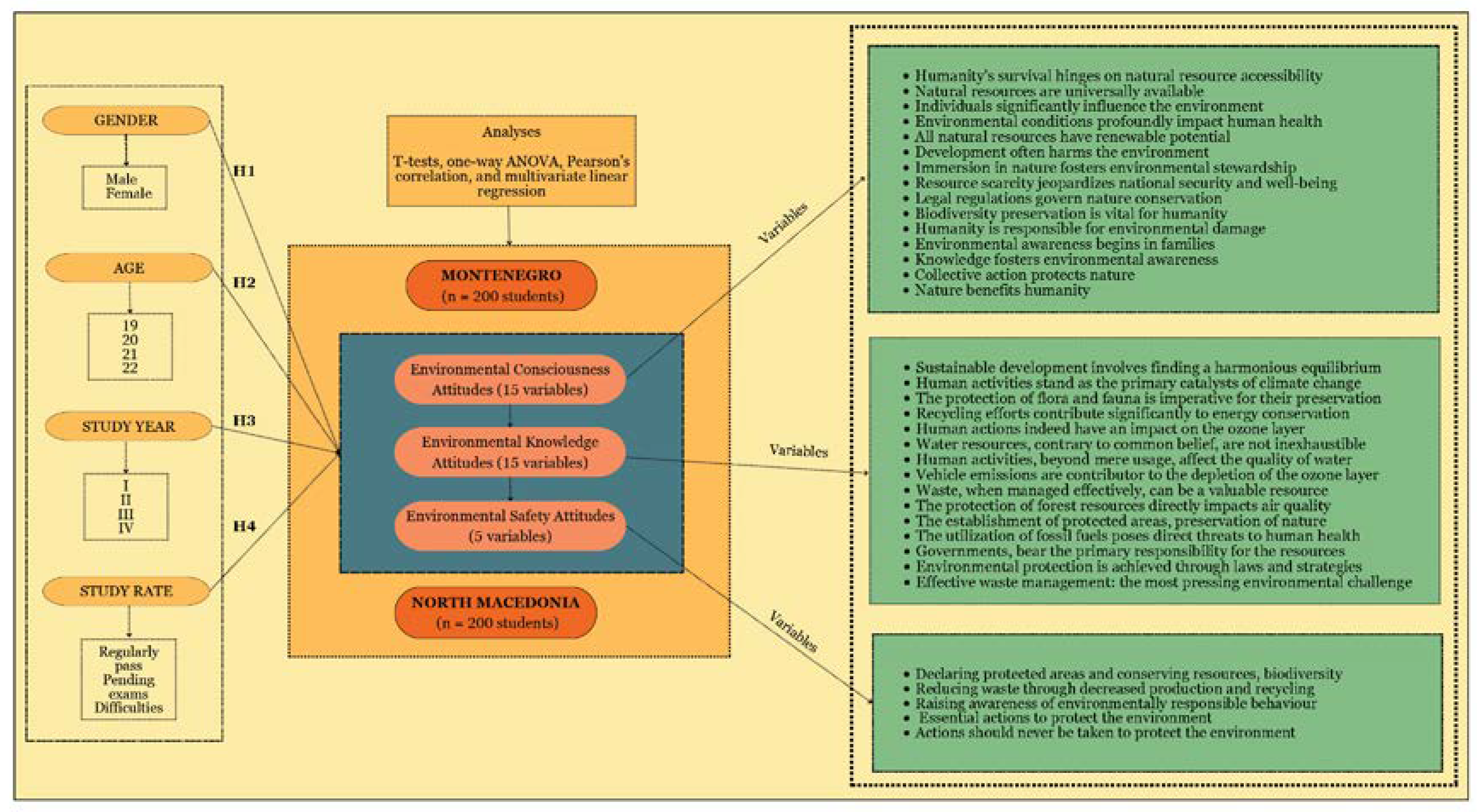
Figure 3.
Environmental Awareness Variables Comparison between Montenegro and North Macedonia.
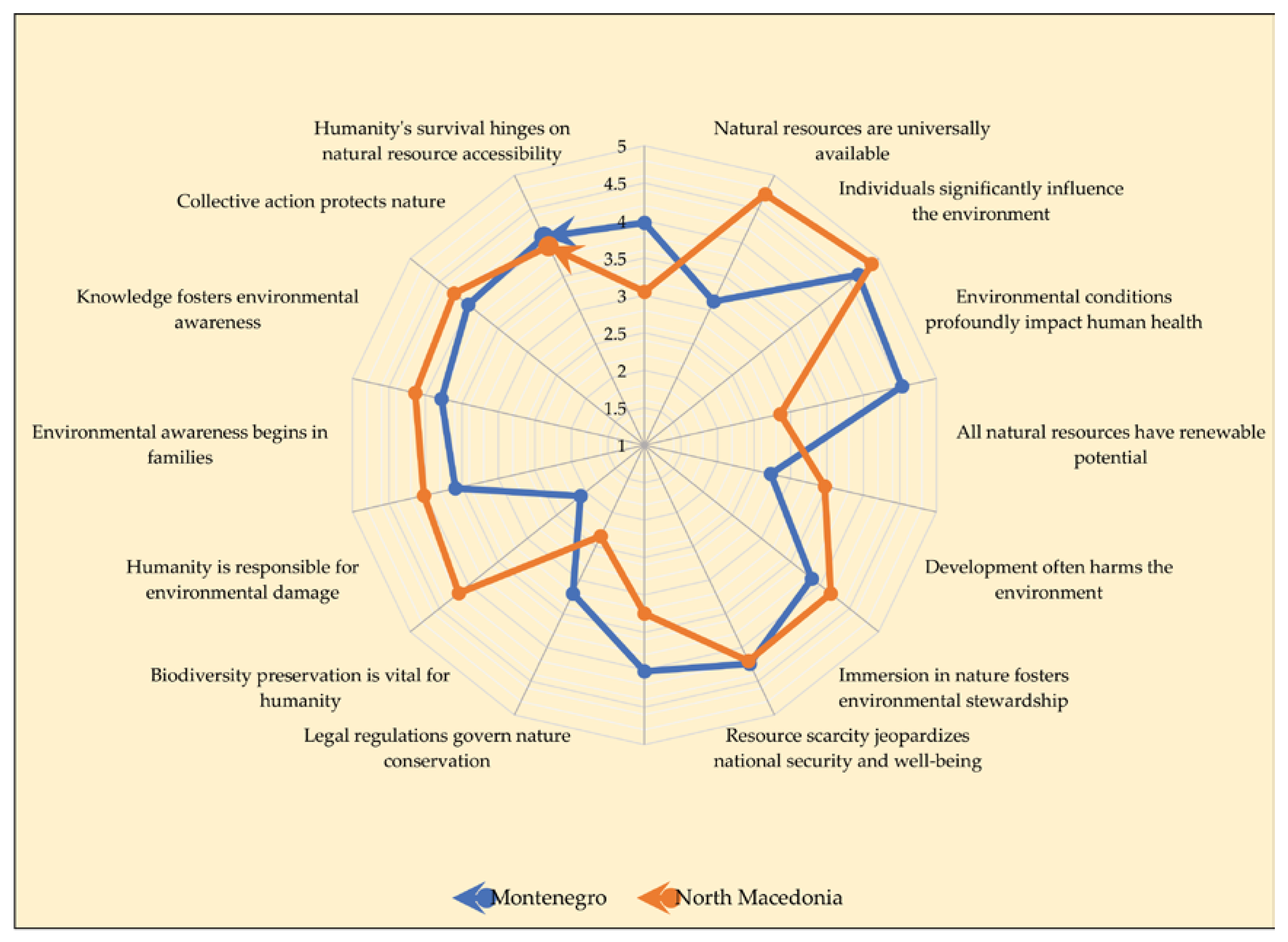
Figure 5.
Environmental Protection Impact Assessment between Montenegro and North Macedonia.
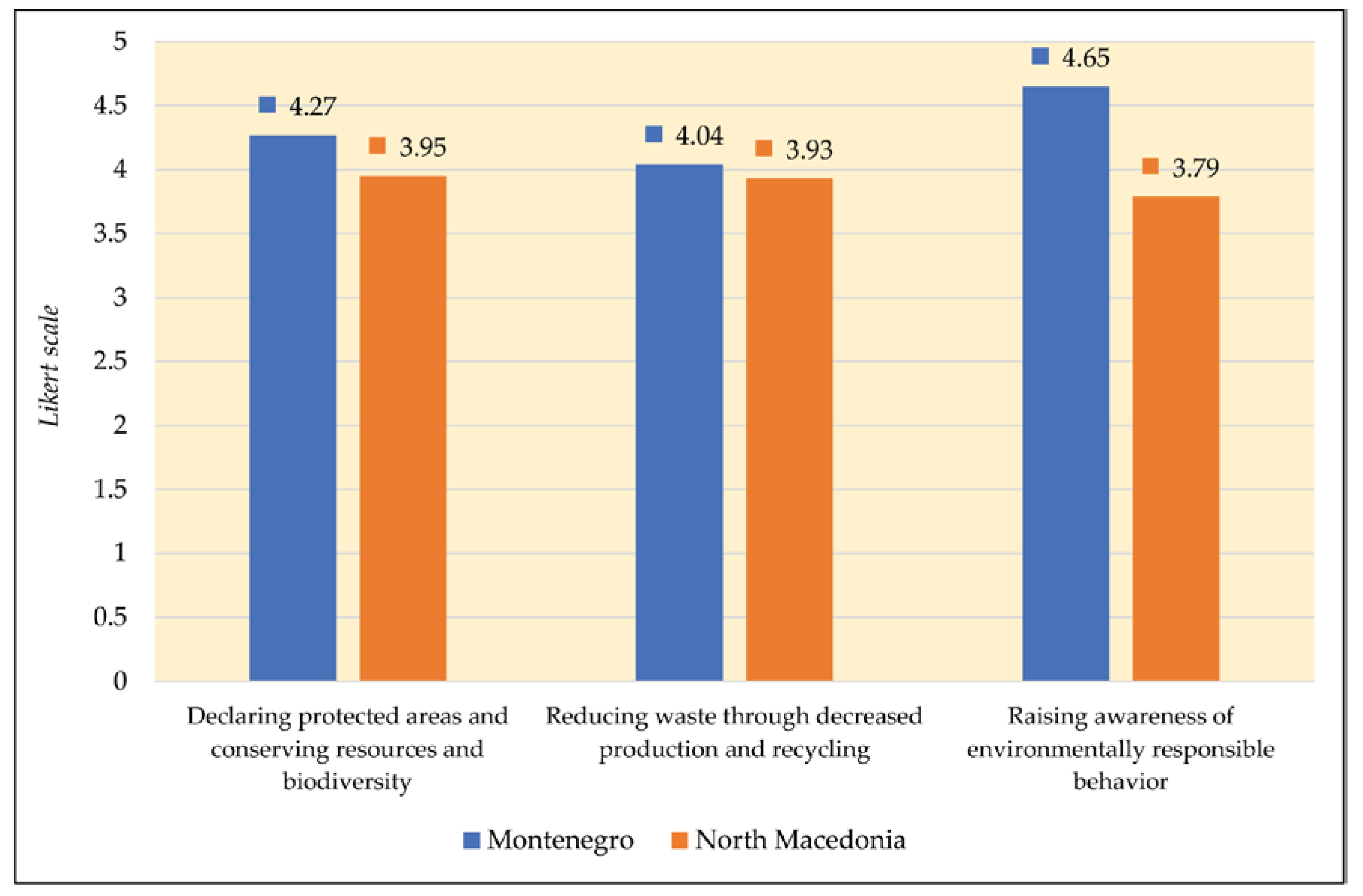

Table 1.
Basic socio-economic and demographic data for students in Montenegro and North Macedonia (n = 400).
Table 1.
Basic socio-economic and demographic data for students in Montenegro and North Macedonia (n = 400).
| Variables | Category | Montenegro |
North Macedonia |
Total | |||
| N | % | N | % | N | % | ||
| Gender | Male Female |
110 90 |
55.0 45.0 |
95 105 |
47.5 52.5 |
205 195 |
52.5 47.5 |
| Age | 19 20 21 22 |
40 50 56 54 |
20.0 25.0 28.0 27.0 |
35 55 60 50 |
17.5 27.5 30.0 25.0 |
75 105 116 104 |
18.75 26.25 29.0 26.0 |
| Place of residence | City centre Suburban area Village |
66 80 54 |
33.0 40.0 27.0 |
70 67 63 |
25.0 33.5 31.5 |
136 147 117 |
33.75 36.75 29.5 |
| Study year | I II III IV |
45 46 51 58 |
22.50 23.0 25.50 29.0 |
65 56 57 22 |
32.5 28.0 28.5 11.0 |
110 102 108 80 |
27.5 25.5 27.0 20.0 |
| Study rate | Regularly pass exams Pending exams Difficulties with exams |
80 30 90 |
40.0 15.0 45.0 |
90 50 60 |
45.0 25.0 30.0 |
170 80 150 |
42.5 20.0 37.5 |
Table 2.
Results of a multivariate regression analysis concerning students' insights on environmental awareness, safety and environmental knowledge (n = 400).
Table 2.
Results of a multivariate regression analysis concerning students' insights on environmental awareness, safety and environmental knowledge (n = 400).
|
Predictor Variable |
Environmental awareness attitudes |
Knowledge of environmental protection attitudes |
Contribute to environmental safety |
||||||
| B | SE | β | B | SE | β | B | SE | β | |
| Gender | 0.067 | 0.048 | 0.074 | ̶ 0.058 | 0.051 | ̶ 0.060 | 0.245 | 0.082 | 0.158 |
| Age | ̶ 0.135 | 0.056 | ̶ 0.146 | 0.007 | 0.059 | 0.007 | 0.020 | 0.095 | 0.013 |
| Place of residence | 0.035 | 0.073 | 0.024 | 0.034 | 0.077 | 0.022 | ̶ 0.104 | 0.125 | ̶ 0.042 |
| Studu year | 0.125 | 0.061 | 0.128 | ̶ 0.135 | 0.065 | ̶ 0.131 | 0.144 | 0.105 | 0.086 |
| Study rate | 0.028 | 0.047 | 0.031 | ̶ 0.042 | 0.049 | ̶ 0.044 | ̶ 0.005 | 0.080 | ̶ 0.003 |
| 0.019 (0.006) | 0.020 (0.008) | 0.027 (0.015) | |||||||
* p ≤ 0.05; ** p ≤ 0.01; B: unstandardized (B) coefficients; SE: std. error; β: standardized (β) coefficients. Note: male, aged 21 to 22, from a rural area and in the fourth year of university, consistently excels in exams and fulfils academic obligations, have been coded as 1; 0 has been assigned otherwise.
Table 3.
Environmental Awareness Variables Comparison between Montenegro and North Macedonia.
| Environmental awareness variables | Montenegro | North Macedonia | Total | |||
| M | SD | M | SD | M | SD | |
| Humanity's survival hinges on natural resource accessibility | 3.97 | 0.99 | 3.05 | 1.23 | 3.51 | 1.06 |
| Natural resources are universally available | 3.13 | 1.04 | 4.72 | 0.59 | 3.92 | 1.08 |
| Individuals significantly influence the environment | 4.65 | 0.53 | 4.88 | 0.53 | 4.77 | 0.79 |
| Environmental conditions profoundly impact human health | 4.53 | 0.79 | 2.86 | 1.25 | 3.70 | 1.02 |
| All natural resources have renewable potential | 2.73 | 1.13 | 3.47 | 1.01 | 3.10 | 1.07 |
| Development often harms the environment | 3.86 | 0.98 | 4.18 | 1.19 | 4.02 | 1.09 |
| Immersion in nature fosters environmental stewardship | 4.24 | 0.77 | 4.20 | 0.99 | 4.22 | 0.88 |
| Resource scarcity jeopardizes national security and well-being | 4.02 | 0.87 | 3.25 | 1.13 | 3.64 | 0.92 |
| Legal regulations govern nature conservation | 3.20 | 1.18 | 2.35 | 1.03 | 2.78 | 0.12 |
| Biodiversity preservation is vital for humanity | 2.09 | 0.90 | 4.17 | 0.98 | 3.13 | 0.87 |
| Humanity is responsible for environmental damage | 3.59 | 1.19 | 4.02 | 1.13 | 3.80 | 1.16 |
| Environmental awareness begins in families | 3.78 | 1.13 | 4.14 | 1.00 | 3.96 | 0.99 |
| Knowledge fosters environmental awareness | 4.01 | 0.93 | 4.25 | 0.93 | 4.13 | 0.95 |
| Collective action protects nature | 4.09 | 0.92 | 3.95 | 1.24 | 4.02 | 1.16 |
| Nature benefits humanity | 3.65 | 1.23 | 3.61 | 1.01 | 3.63 | 1.10 |
Table 4.
Environmental Knowledge Variables Comparison between Montenegro and North Macedonia.
| Environmental knowledge variables | Montenegro | North Macedonia |
Total | |||
|---|---|---|---|---|---|---|
| M | SD | M | SD | M | SD | |
| Sustainable development involves finding a harmonious equilibrium | 3.91 | 0.66 | 3.56 | 1.30 | 3.75 | 0.90 |
| Human activities stand as the primary catalysts of climate change | 3.55 | 1.09 | 4.38 | 0.95 | 3.96 | 1.12 |
| The protection of flora and fauna is imperative for their preservation | 4.18 | 0.84 | 4.10 | 1.21 | 4.14 | 1.08 |
| Recycling efforts contribute significantly to energy conservation | 4.02 | 0.89 | 2.49 | 1.45 | 3.26 | 1.17 |
| Human actions indeed have an impact on the ozone layer | 1.97 | 0.89 | 2.33 | 1.24 | 2.15 | 1.06 |
| Water resources, contrary to common belief, are not inexhaustible | 2.23 | 1.06 | 2.98 | 1.29 | 2.61 | 1.18 |
| Human activities, beyond mere usage, affect the quality of water | 2.84 | 1.06 | 3.56 | 1.13 | 3.20 | 1.10 |
| Vehicle emissions are contributor to the depletion of the ozone layer | 4.10 | 0.79 | 3.43 | 1.15 | 3.77 | 0.99 |
| Waste, when managed effectively, can be a valuable resource | 3.38 | 1.06 | 2.08 | 0.99 | 2.73 | 1.02 |
| The protection of forest resources directly impacts air quality | 2.24 | 1.10 | 3.87 | 1.09 | 3.05 | 1.05 |
| The establishment of protected areas is paramount for the preservation | 3.60 | 1.01 | 4.04 | 1.00 | 3.99 | 1.05 |
| The utilization of fossil fuels poses direct threats to human health | 4.13 | 0.75 | 3.95 | 1.06 | 4.04 | 1.01 |
| Governments, bear the primary responsibility for the resources | 3.45 | 1.06 | 3.93 | 1.19 | 3.69 | 1.13 |
| Environmental protection is achieved through laws and strategies | 3.83 | 0.91 | 3.79 | 1.00 | 3.81 | 0.92 |
| Effective waste management, the most pressing, environmental challenge | 3.71 | 1.10 | 4.02 | 0.85 | 3.87 | 0.95 |
Table 5.
Environmental Protection Impact Assessment between Montenegro and North Macedonia.
| Environmental safety variables | Montenegro | North Macedonia |
Total | |||
|---|---|---|---|---|---|---|
| M | SD | M | SD | M | SD | |
| Declaring protected areas and conserving resources, biodiversity | 4.27 | 0.87 | 3.95 | 1.06 | 4.11 | 0.98 |
| Reducing waste through decreased production and recycling | 4.04 | 1.05 | 3.93 | 1.19 | 3.98 | 1.12 |
| Raising awareness of environmentally responsible behavior | 4.65 | 0.59 | 3.79 | 1.00 | 4.22 | 0.81 |
Table 6.
Pearson’s correlation results for the relationship between students' environmental awareness, safety and their age (n = 400).
Table 6.
Pearson’s correlation results for the relationship between students' environmental awareness, safety and their age (n = 400).
| Variables | Age | |
|---|---|---|
| Sig. | r | |
| Humanity's survival hinges on natural resource accessibility | 0.000** | 0.209 |
| Natural resources are universally available | 0.035* | 0.106 |
| Individuals significantly influence the environment | 0.002* | 0.154 |
| Environmental conditions profoundly impact human health | 0.013* | 0.123 |
| All natural resources have renewable potential | 0.002* | 0.156 |
| Development often harms the environment | 0.470 | 0.042 |
| Immersion in nature fosters environmental stewardship | 0.918 | 0.005 |
| Resource scarcity jeopardizes national security and well-being | 0.000** | 0.244 |
| Legal regulations govern nature conservation | 0.000** | 0.266 |
| Biodiversity preservation is vital for humanity | 0.000** | 0.189 |
| Humanity is responsible for environmental damage | 0.832 | 0.011 |
| Environmental awareness begins in families | 0.000** | 0.204 |
| Knowledge fosters environmental awareness | 0.054 | 0.96 |
| Collective action protects nature | 0.960 | 0.003 |
| Nature benefits humanity | 0.297 | 0.052 |
| Declaring protected areas and conserving resources and biodiversity | 0.333 | 0.049 |
| Reducing waste through decreased production and recycling | 0.026* | ̶ 0.112 |
| Raising awareness of environmentally responsible behavior | 0.090 | 0.086 |
Note: * p ≤ 0.05; ** p ≤ 0.01.
Table 7.
Independent samples t-test findings on gender disparities in students' environmental awareness and safety variables (n = 400).
Table 7.
Independent samples t-test findings on gender disparities in students' environmental awareness and safety variables (n = 400).
| Variable | F | t | Sig. (2-Tailed) |
df | Male M (SD) |
Female M (SD) |
|---|---|---|---|---|---|---|
| Survival hinges on resource accessibility | 0.041 | ̶ 3.072 | 0.002* | 392 | 4.00 (1.017) | 4.31 (0.921) |
| Resources are universally available | 0.112 | 3.470 | 0.719 | 396 | 3.08 (1.077) | 3.12 (1.200) |
| Individuals influence the environment | 50.819 | 0.000 | 0.001** | 396 | 4.78 (0.441) | 4.58 (0.665) |
| Environmental conditions affect health | 6.231 | ̶ 0.360 | 0.139 | 392 | 4.66 (0.774) | 4.76 (0.608) |
| All resources have renewable potential | 6.244 | ̶ 0.359 | 0.082 | 396 | 2.69 (1.084) | 2.90 (1.308) |
| Development harms the environment | 7.483 | 3.470 | 0.045* | 396 | 3.73 (0.891) | 3.50 (1.103) |
| Nature immersion fosters stewardship | 14.49 | 3.430 | 0.087 | 392 | 4.29 (0.810) | 4.11 (1.180) |
| Resource scarcity jeopardizes security | 5.926 | ̶ 1.472 | 0.720 | 396 | 4.12 (0.840) | 4.09 (1.040) |
| Legal regulations govern conservation | 1.791 | ̶ 1.483 | 0.365 | 392 | 3.19 (1.100) | 3.29 (1.203) |
| Biodiversity preservation is vital | 6.790 | ̶ 1.746 | 0.310 | 298 | 2.17 (0.972) | 2.27 (0.991) |
| Humanity is responsible for the damage | 1.905 | ̶ 1.730 | 0.983 | 388 | 3.88 (1.099) | 3.87 (1.168) |
| Environmental awareness begins in families | 24.23 | 1.953 | 0.000** | 396 | 4.12 (0.942) | 3.70 (1.247) |
| Knowledge fosters environmental awareness | 7.057 | 2.011 | 0.017** | 392 | 4.20 (0.800) | 3.97 (1.094) |
| Collective action protects nature | 5.547 | 1.714 | 0.657 | 396 | 4.19 (0.843) | 4.15 (1.027) |
| Nature benefits humanity | 2.256 | 1.707 | 0.356 | 392 | 3.74 (1.216) | 3.86 (1.289) |
| Protected areas and biodiversity conservation | 0.786 | 1.429 | 0.376 | 393 | 4.21 (0.812) | 4.08 (0.941) |
| Waste reduction and recycling | 1.836 | 1.124 | 0.176 | 394 | 4.03 (1.11) | 3.89 (1.23) |
| Environmental behaviour awareness | 28.65 | 3.689 | 0.000** | 395 | 4.65 (0.53) | 4.36 (0.994) |
Note: * p ≤ 0.05; ** p ≤ 0.01.
Table 8.
One-way ANOVA results examine the relationship between students' place of residence, study year, study rate, and variables related to students' environmental awareness and safety variables (n = 400).
Table 8.
One-way ANOVA results examine the relationship between students' place of residence, study year, study rate, and variables related to students' environmental awareness and safety variables (n = 400).
| Variables | Place of Residence |
Study Year |
Study Rate |
|||
|---|---|---|---|---|---|---|
| F | p | F | p | F | p | |
| Survival hinges on resource accessibility | 0.038 | 0.963 | 6.159 | 0.000** | 6.727 | 0.000** |
| Resources are universally available | 1.689 | 0.186 | 0.966 | 0.409 | 3.410 | 0.018* |
| Individuals influence the environment | 0.326 | 0.722 | 1.779 | 0.151 | 0.585 | 0.625 |
| Environmental conditions affect health | 1.113 | 0.330 | 6.842 | 0.000** | 0.825 | 0.481 |
| All resources have renewable potential | 0.102 | 0.903 | 4.603 | 0.004* | 8.246 | 0.000** |
| Development harms the environment | 1.374 | 0.255 | 6.361 | 0.000** | 8.370 | 0.000** |
| Nature immersion fosters stewardship | 0.775 | 0.462 | 0.605 | 0.612 | 2.092 | 0.101 |
| Resource scarcity jeopardizes security | 3.706 | 0.025* | 4.468 | 0.004* | 12.589 | 0.000** |
| Legal regulations govern conservation | 0.526 | 0.591 | 4.546 | 0.003* | 7.641 | 0.000** |
| Biodiversity preservation is vital | 10.720 | 0.000** | 2.651 | 0.048* | 1.856 | 0.137 |
| Humanity is responsible for the damage | 0.341 | 0.711 | 0.982 | 0.401 | 6.952 | 0.000** |
| Environmental awareness begins in families | 2.042 | 0.131 | 1.914 | 0.127 | 4.125 | 0.007* |
| Knowledge fosters environmental awareness | 2.101 | 0.124 | 2.647 | 0.049* | 2.933 | 0.033* |
| Collective action protects nature | 2.675 | 0.070 | 1.463 | 0.224 | 29.241 | 0.000** |
| Nature benefits humanity | 2.732 | 0.066 | 10.419 | 0.000** | 2.732 | 0.044* |
| Protected areas and biodiversity conservation | 1.212 | 0.299 | 1.005 | 0.391 | 6.991 | 0.000** |
| Waste reduction and recycling | 0.442 | 0.643 | 2.150 | 0.093 | 13.519 | 0.000** |
| Environmental behaviour awareness | 1.388 | 0.251 | 4.224 | 0.006* | 3.284 | 0.021* |
Note: * p ≤ 0.05; ** p ≤ 0.01.
Table 9.
Pearson’s correlation results for the relationship between students' perception of environmental knowledge and their age (n = 400).
Table 9.
Pearson’s correlation results for the relationship between students' perception of environmental knowledge and their age (n = 400).
| Variables | Age | |
|---|---|---|
| Sig. | r | |
| Sustainable development involves finding a harmonious equilibrium | 0.010* | 0.131 |
| Human activities stand as the primary catalysts of climate change | 0.001** | 0.165 |
| The protection of flora and fauna is imperative for their preservation | 0.105 | 0.081 |
| Recycling efforts contribute significantly to energy conservation | 0.350 | 0.047 |
| Human actions indeed have an impact on the ozone layer | 0.612 | 0.026 |
| Water resources, contrary to common belief, are not inexhaustible | 0.766 | ̶ 0.015 |
| Human activities, beyond mere usage, affect the quality of water | 0.129 | ̶ 0.076 |
| Vehicle emissions are contributor to the depletion of the ozone layer | 0.001** | 0.159 |
| Waste, when managed effectively, can be a valuable resource | 0.005* | ̶ 0.140 |
| The protection of forest resources directly impacts air quality | 0.886 | ̶ 0.007 |
| The establishment of protected areas, preservation of nature | 0.146 | 0.073 |
| The utilization of fossil fuels poses direct threats to human health | 0.027* | 0.110 |
| Governments, bear the primary responsibility for the resources | 0.001** | 0.172 |
| Environmental protection is achieved through laws and strategies | 0.004* | 0.145 |
| Effective waste management: the most pressing environmental challenge | 0.000** | 0.298 |
Note: * p ≤ 0.05; ** p ≤ 0.01.
Table 10.
Independent samples t-test findings on gender disparities in students' environmental knowledge perception (n = 400).
Table 10.
Independent samples t-test findings on gender disparities in students' environmental knowledge perception (n = 400).
| Variable | F | t | Sig. (2-Tailed) |
df | Male M (SD) |
Female M (SD) |
|---|---|---|---|---|---|---|
| Sustainable development | 57.10 | 1.909 | 0.057 | 382 | 3.84 (0.715) | 3.67 (1.001) |
| Human activities and climate change | 14.11 | 2.847 | 0.005* | 394 | 3.71 (0.938) | 3.37 (1.412) |
| Flora and fauna preservation | 18.08 | 2.819 | 0.959 | 382 | 3.37 (1.412) | 4.28 (1.038) |
| Recycling and energy conservation | 117.78 | 2.204 | 0.028* | 394 | 4.17 (0.801) | 3.93 (1.283) |
| Human actions and the ozone layer | 13.64 | 2.185 | 0.000** | 394 | 1.86 (0.874) | 2.62 (1.432) |
| Water resources sustainability | 1.527 | ̶ 6.299 | 0.000** | 392 | 2.05 (1.060) | 2.52 (1.217) |
| Human activities and water quality | 14.66 | ̶ 6.255 | 0.003* | 382 | 2.74 (1.102) | 3.09 (1.251) |
| Vehicle emissions and the ozone layer | 0.111 | ̶ 4.106 | 0.000** | 390 | 4.00 (0.888) | 3.64 (1.110) |
| Waste management | 0.011 | ̶ 4.098 | 0.871 | 382 | 3.41 (1.106) | 3.39 (1.123) |
| Forest resources and air quality | 0.077 | ̶ 2.995 | 0.287 | 390 | 2.10 (1.069) | 2.22 (1.037) |
| Protected areas and nature preservation | 5.283 | ̶ 2.986 | 0.109 | 382 | 3.65 (1.010) | 3.82 (1.114) |
| Fossil fuels and human health | 0.302 | 3.560 | 0.000** | 394 | 4.30 (0.669) | 3.85 (1.031) |
| Government responsibility for resources | 19.92 | 3.537 | 0.890 | 382 | 3.69 (1.051) | 3.71 (1.141) |
| Environmental protection laws and strategies | 19.95 | 0.162 | 0.565 | 396 | 3.91 (0.871) | 3.84 (1.240) |
| Waste management in North Macedonia | 57.10 | ̶ 1.066 | 0.321 | 396 | 3.80 (0.944) | 3.68 (1.159) |
Note: * p ≤ 0.05; ** p ≤ 0.01.
Table 11.
One-way ANOVA results examine the relationship between students' place of residence, study year, study rate, and variables related to students' environmental knowledge perception (n = 400).
Table 11.
One-way ANOVA results examine the relationship between students' place of residence, study year, study rate, and variables related to students' environmental knowledge perception (n = 400).
| Variables | Place of Residence |
Study Year |
Study Rate |
|||
|---|---|---|---|---|---|---|
| F | p | F | p | F | p | |
| Sustainable development | 0.165 | 0.848 | 1.540 | 0.204 | 15.933 | 0.000** |
| Human activities and climate change | 0.553 | 0.575 | 6.886 | 0.000** | 3.282 | 0.021* |
| Flora and fauna preservation | 4.450 | 0.012* | 2.638 | 0.049* | 0.759 | 0.518 |
| Recycling and energy conservation | 0.346 | 0.708 | 3.047 | 0.029* | 8.499 | 0.000** |
| Human actions and the ozone layer | 1.043 | 0.353 | 4.399 | 0.005* | 10.124 | 0.000** |
| Water resources sustainability | 0.674 | 0.510 | 4.896 | 0.002* | 1.504 | 0.213 |
| Human activities and water quality | 0.768 | 0.465 | 11.931 | 0.000** | 5.299 | 0.001** |
| Vehicle emissions and the ozone layer | 5.682 | 0.004* | 20.532 | 0.000** | 3.702 | 0.012* |
| Waste management | 0.558 | 0.573 | 10.142 | 0.000** | 4.173 | 0.006* |
| Forest resources and air quality | 0.606 | 0.546 | 9.518 | 0.000** | 5.600 | 0.001** |
| Protected areas and nature preservation | 0.785 | 0.457 | 1.892 | 0.130 | 2.383 | 0.069 |
| Fossil fuels and human health | 0.477 | 0.621 | 4.332 | 0.005* | 1.322 | 0.267 |
| Government responsibility for resources | 1.156 | 0.316 | 6.188 | 0.000** | 0.148 | 0.931 |
| Environmental protection laws and strategies | 0.896 | 0.409 | 1.579 | 0.194 | 3.191 | 0.024* |
| Waste management in North Macedonia | 2.329 | 0.099 | 7.038 | 0.000** | 12.281 | 0.000** |
Note: * p ≤ 0.05; ** p ≤ 0.01.
Table 12.
Distribution of Participants and Type of Completed Secondary School by Regions in Montenegro.
Table 12.
Distribution of Participants and Type of Completed Secondary School by Regions in Montenegro.
| State of the environment | Region | ||||||||
| Central | Southern | Northern | |||||||
| Type of completed secondary school | |||||||||
| High School | Medical School | Other Secondary Schools училишта | High School | Medical School | Other Secondary Schools училишта | High School | Medical School | Other Secondary Schools училишта | |
| Bad | 2 | 2 | 0 | 1 | 1 | 0 | 1 | 1 | 1 |
| Good | 2 | 0 | 1 | 2 | 0 | 0 | 1 | 0 | 1 |
| Excellent | 0 | 0 | 0 | 0 | 0 | 1 | 0 | 0 | 0 |
| Total | 4 | 2 | 1 | 3 | 1 | 1 | 2 | 1 | 2 |
Table 13.
The representation of examinees-students at the University of Montenegro (UCG) according to the year and student status.
Table 13.
The representation of examinees-students at the University of Montenegro (UCG) according to the year and student status.
| Environmental condition | Year of Study | |||||||
| I | II | III | IV | |||||
| Regular | Non-regular | Regular | Non-regular | Regular | Non-regular | Regular | Non-regular | |
| Poor | 2 | / | 2 | / | 1 | 2 | 1 | 1 |
| Good | 2 | / | 3 | / | 1 | / | 1 | / |
| Excellent | 1 | / | 0 | / | / | / | / | / |
| Total | 5 | / | 5 | / | 2 | 2 | 2 | 1 |
Table 14.
Detailed analysis of these questions along with the corresponding responses.
| Year, number, and status of the student according to the year of study | Offered questions | ||||||||||||||||
| National parks present in Montenegro | Protection of natural resources occurs in national parks | Protection of natural resources | |||||||||||||||
| Regular | Non-regular | Regular | Non-regular | Regular | Non-regular | Regular | Non-regular | ||||||||||
| a | b | c | a | b | c | a | b | a | b | a | b | c | a | b | c | ||
| 5 | 0 | / | / | 5 | / | / | / | 5 | / | / | / | 1 | / | 4 | / | / | / |
| I | 5 | 5 | 1 | 4 | |||||||||||||
| 5 | 0 | / | / | 5 | / | / | / | 5 | / | / | / | 2 | / | 3 | / | / | / |
| II | / | / | 5 | / | / | / | 5 | / | / | / | 2 | / | 3 | / | / | / | |
| 2 | 2 | / | / | 2 | / | / | 2 | 2 | / | 2 | / | 2 | / | / | 1 | / | 1 |
| III | / | / | 2 | / | / | 2 | 2 | / | 2 | / | 2 | / | / | 1 | / | 1 | |
| 2 | 1 | / | / | / | 1 | / | / | 2 | / | 1 | / | 1 | 1 | / | 1 | / | / |
| IV | / | / | 2 | / | / | 2 | / | 1 | / | 1 | 1 | / | 1 | / | / | ||
| 14 | 3 | / | / | 14 | 1 | / | 2 | 14 | / | 3 | / | 6 | 1 | 7 | 2 | / | 1 |
| 17 | 17 | 17 | 17 | ||||||||||||||
Disclaimer/Publisher’s Note: The statements, opinions and data contained in all publications are solely those of the individual author(s) and contributor(s) and not of MDPI and/or the editor(s). MDPI and/or the editor(s) disclaim responsibility for any injury to people or property resulting from any ideas, methods, instructions or products referred to in the content. |
© 2024 by the authors. Licensee MDPI, Basel, Switzerland. This article is an open access article distributed under the terms and conditions of the Creative Commons Attribution (CC BY) license (http://creativecommons.org/licenses/by/4.0/).
Copyright: This open access article is published under a Creative Commons CC BY 4.0 license, which permit the free download, distribution, and reuse, provided that the author and preprint are cited in any reuse.


