

Submitted:
28 October 2025
Posted:
29 October 2025
You are already at the latest version
Abstract
This study attempts to analyse the environmental knowledge, attitudes and behaviour of secondary school teachers. Factors affecting environmental knowledge, attitudes and behaviour were also identified. Furthermore, the importance that teachers give to Environmental Education (Ε.Ε.) in their lessons was analyzed. This research involved the use of both quantitative and qualitative modes of inquiry. Two hundred questionnaire respondents took part in the research. Statistical and thematic analysis of the data obtained from the questionnaires was carried out respectively. Tri-angulation of data was also done. The analysis revealed that secondary school teachers have an overall good level of environmental knowledge, although lacking some details and they do have an overall positive attitude and behaviour towards the environment. A significant relationship be-tween the environmental attitudes and behaviour as well as the environmental knowledge and behaviour was identified. The implementation of E.E. by secondary school teachers was charac-terised by a strong influence of the curriculum. In addition, they also incorporate E.E. through pro-environmental behaviour, particularly concerning waste issues. The main restrictions that limit secondary school teachers from including E.E. are time constraints and the negative feedback they receive. With regards to the grounding offered to teachers related to E.E., secondary school teachers described the teacher training courses as being more theoretical rather than focusing on practical applications. In light of these findings, this research puts forward suggestions for a better structure of teacher training courses. This study aims at investigating secondary school students’ knowledge of and attitudes towards environment on different variables. The study was conducted with 300 secondary school teachers through the descriptive survey model. 'Environmental Knowledge Test' and 'Environmental Attitude Scale' were used to collect data for the study. The results showed that secondary school teachers’ knowledge of and attitudes towards environment did not differ on gender. Finally, some suggestions based on results were included in the study.
Keywords:
sustainable development
; environmental education
; 17 SDG’s
; knowledge
; attitudes and behavior
1. Introduction
Over recent years, UNESCO (United Nations Educational, Scientific and Cultural Organization) has played a leading role in promoting environmental education across the globe. One of the most defining events in this process was the 1976 conference held in Belgrade, Serbia, where the Belgrade Charter was introduced under UNESCO’s supervision [1]. This charter outlined the pressing need to transform societal values and behaviors through coordinated global efforts, especially by embedding environmental awareness within school education. It acknowledged that effective and sustainable environmental action originates from learners who possess adequate knowledge and environmental awareness. This initiative led to the creation of a comprehensive educational strategy that allowed both institutions and educators to design and deliver better-organized and more insightful curricula focusing on ecological challenges and their potential solutions. The ultimate objective was to cultivate a sense of balance and sustainability in the interaction between humans and the environment.
As a result, schools in many parts of the world began to adopt environmental education programs aimed at equipping students with the tools, knowledge, and ethical perspective necessary to become proactive and environmentally responsible citizens. These programs serve not only to inform but also to inspire a new generation to respond thoughtfully and effectively to the evolving needs of both society and the planet. UNESCO has remained firmly committed to advancing environmental education. A clear example of this dedication was seen in 1977 at the International Conference in Tbilisi (Georgia) [2], where it was strongly affirmed that environmental education holds critical scientific value. Rather than being viewed as a supplementary subject, it was agreed that it should be deeply embedded within the core of educational systems, reflecting its essential role in shaping informed and responsible future generations.
Alongside the rise of Environmental Education, a global initiative emerged to acknowledge and preserve geological heritage. This movement gained formal recognition in 1972 with the adoption of the Convention for the Protection of the World Cultural and Natural Heritage in Paris, France. Nearly two decades later, in 1991, the commitment to protecting Earth’s geological legacy was further solidified through the International Declaration on the Rights of the Memory of the Earth, held in Digne (France) [3]. These milestones reflect a growing international awareness of the need to safeguard both cultural and natural landmarks as vital parts of our shared global heritage. Although various initiatives have aimed to support and safeguard environment and geological heritage, environmental education often falls short of thoroughly addressing topics such as geoethics, geodiversity and geoheritage. This highlights a clear need to develop and promote environmental education and geoeducation [4,5] as a specialized field dedicated to these areas. Moreover, geoeducation would play a central role in introducing learners to the significance of geologically important sites and in raising awareness about their value. Such an approach also creates a pathway for the growth of geotourism [6], which relies on geoeducational principles to make environmental sites with high value, accessible to the public. Through guided activities that blend learning and leisure, geotourism helps transform these locations into spaces for both education and recreation [7,8]. Although numerous international initiatives have sought to strengthen environmental education, in practice it often remains marginal and underdeveloped within many educational systems.
A clear example of the abovementioned statement can be observed in Greek secondary schools, where first and second-year high school students receive only limited instruction—approximately one to two hours per week—in subjects such as Geology and Geography. These courses typically do not offer in-depth exploration of environmental issues, resulting in the neglect of important areas such as geoethics, geodiversity, and biodiversity [9]. As a result, students are not sufficiently equipped with the knowledge or critical understanding needed to value, engage with, or help preserve the natural environment. This educational gap is further confirmed by research conducted by Georgousis et al. [10], which indicates that a large proportion of Greek students show limited awareness and understanding of geoheritage and its relevance. The findings suggest that environmental education is still not fully integrated into the core structure of school curricula, often being treated as an additional or secondary topic rather than a key pillar of student learning and development.
To address this gap, there is a pressing need for more structured and targeted initiatives that emphasize the value of environmental education and its extension into geoeducation. Educational programs must be redesigned to include specific content on geological heritage and the ethical relationship between humans and the Earth. Developing such initiatives can foster curiosity, responsibility, and a deeper connection between students and their environment. It is essential to cultivate educational frameworks that not only raise awareness but also encourage geotourism as a tool for experiential learning.
By doing so, students and the wider public will be able to interact with geosites, not only gaining knowledge but also appreciating their scientific, ecological, and cultural value. These actions are critical in forming future citizens who are informed, active, and capable of making decisions that support sustainability.
Finally, aligning environmental education with the 17 Sustainable Development Goals (SDGs) of the UNESCO Agenda is essential for fostering holistic awareness and action. Topics such as climate change, biodiversity, and responsible consumption—key aspects of the SDGs—can be meaningfully integrated into school curricula. By embedding these global goals into education, students are empowered to think critically about the planet’s needs and to contribute positively to their communities. This alignment not only enriches academic learning but also promotes civic engagement and social responsibility, helping to shape a generation that values sustainability, equity, and long-term ecological well-being [11].
2. Methodology
First of all, it is worth mentioning that Greek educators’ perspectives on environmental education are explored in this study through a structured research approach (Figure 1). Initially, an extensive literature review was conducted to identify key themes and inform the development of a targeted questionnaire. The instrument was then distributed to a representative sample of 270 educators across Greece. Following data collection, quantitative analysis was performed to evaluate responses. The results revealed important trends in teachers’ knowledge, attitudes, and practices regarding environmental topics. The discussion highlights implications for improving educational strategies and emphasizes the need for enhanced teacher training to foster more effective environmental awareness and sustainability education in Greek schools.
One of the key elements of the study was to record and evaluate the attitudes, knowledge and behaviors of secondary school teachers, specifically regarding key topics in Environmental Education and Education for Sustainable Development. The effectiveness of the environmental education initiatives largely depends on teacher‘s understanding and perceptions of environmental issues, as these directly influence their ability to foster and promote positive environmental attitudes among students. This is evident in the ability of secondary school teachers to transmit and cultivate positive environmental values and behaviors towards the natural environment among their students. In this context, the study also assessed and documented the perspectives of primary school teachers across the country, using data collected from randomly selected participants via online surveys.
The central research questions addressed in this research were as follows:
- What are the attitudes and behaviour of secondary school teachers towards Environmental Education?
- To what extent are they trained in Environmental Education and Education for Sustainable Development?
- Does age ultimately affect the knowledge that secondary school teachers have on Environmental Education and Education for Sustainable Development?
- What is teachers’ final participation in environmental education programmes and whether attending seminars influences their views regarding the factors that are “barriers” to environmental education?
- Does whether teachers have attended workshops, seminars and conferences regarding the environment relate to whether they have implemented or participated in environmental education programmes in their school?
2.1. Research Tool—Data Collection Instruments
The questionnaire served as the primary instrument for data collection in this study. It enabled the researcher reach a relatively large sample and obtain a broader undestanding of the investigating issues. The use of an anonymous questionnaire facilitated an effortless expression of teachers’ perceptions, attitudes and behaviors. Data collection was conducted via an electronic questionnaire created on the Google Forms online platform. Prior to its distribution, all necessary permissions were obtained from the relevant authorities, school principals and the Department of Ethics of the Ionian University. The questionnaire also included the necessary instructions to guide participants in its completion. Furthermore, all participants were fully informed of the survey‘s objectives prior to participation and were assured that their answers would be used solely for research purposes.
The survey sample (N=270) comprised primary school teachers from the Greek territory representing rural, semi-urban and urban areas. The majority of the participants were women aged 30 to 39 years, with most holding substitute teaching positions. Most respodents were undergraduate degree holders, while only a small proportion has pursued postgraduate studies in Environmental Education or Education for Sustainable Development (ESD) and even a smaller number had completed a doctoral degree in these fields. For the purpose of this survey, a 3-module questionnaire was used. The first section explores the demographic profile of teachers through closed-ended questions. The second section focuses on the teachers’ expertise in environmental issues and their general opinion on them incorporating multiple choice and Likert scale questions.
The third and last section explores the participants’ views on environmental education and sustainable development education through Likert-type questions. The statistical software SPSSv25 was used for the analysis and presentation of the results. In descriptive statistics, percentages, frequencies, mean values and standard deviations were used to study all the questions in the questionnaire. Regarding the research questions, parametric t-test, non-parametric KruskalWallis t-test analyses were conducted. Additionally, the necessary tables and corresponding graphs were generated for optimal visualization of the results. In the following section, the variables of the questionnaire are analysed. The first section analyses the demographic characteristics of the teachers, the second section analyses their general views/ options and expertise on environmental issues, while the third section includes their views on environmental education and education for sustainability.
3. Results
This section presents the results of the survey based on N= 270 questionnaires collected. The percentages and frequencies of respondents are illustrated in the form of tables followed by the charts to facilitate clearer visualization of the data. As indicated in Table 1, 71.9% of teachers are female, while 28.1% are male.
Table 2 shows that 33.7% of respondents were between 41 and 50 years old, while 33% were over 50. Additionally, 20.4% were aged of 31-40 years old, and only 13% were new teachers aged 22-30.
Table 3 reveals a concerning trend, indicating that 64.4% of teachers were unemployed, while 25.6% held hourly positions and only 10% were permanently employed within the education sector.
Table 4 illustrates the distribution of respondents’ teaching experience, showing that only 3% had more than 36 years of experience. Meanwhile, 13% had 6-12 years, 13.3% had 26-35 years, and 34.4% had 0-5 years of experience. Notably, the largest group, comprising 46.3% of respondents, had 13-25 years of experience in the education sector.
Table 5 presents the academic level of the respondents. The day indicate that 54.4% hold at least a Master’s degree, while 22.2% possess only an undergraduate degree, and 10% have attained a PhD. It is noteworthy that only 4.4% hold a Master’s degree specifically in Environmental Education and equal proportion (4.4%) hold a PhD on Education for Sustainable Development.

Table 5.
Studies level of participants.
| Studies | Frequency | Percent |
|---|---|---|
| Undergraduate Master PhD Master on E.E. / EfS. PhD on E.E. / EfS. Other |
60 147 27 11 12 13 |
22.2% 54.4% 10.0% 4.1% 4.4% 4.8% |
Table 6.
(Q1) - Is your lesson related with E.E. & EfS.
| Q1 | Frequency | Percent |
| Yes No |
120 149 |
44,4% 55.4% |
Teachers possess substantial knowledge of Education for Sustainable Development (ESD) and demonstrate a strong willingness to integrate it into their courses, an important variant in advancing sustainability education initiatives [21]. The extent to which educators at all levels engage in ESD depend on their academic knowledge and experience. As emphasized by UNESCO [21], teachers with extensive and multifaceted expertise in sustainability, are better equipped to integrate emerging concepts and approaches in their context and methodology. Educators are thus encouraged to address sustainability through a holistic lens that includes environmental, social, and economic spectra in order to effectively convey all interrelated issues to their students. [22,23,24].
It is widely noted that sustainability knowledge of educators has an immense impact on their practices. Studies by Wals [25] and Walshe [26] assert that educators qualified and trained in sustainability are more likely to adopt experiential and inquiry-based learning approaches. It should be noted that, according to Hartel T. et al. [34], Roczen et al. in the Environmental Literacy Model claim that student’s environmental attitudes positively influence their sustainable behaviors, and are also linked to their knowledge of environmental systems.
Relevant literature reveals that some scholars take a stance to suggest that teachers’ knowledge of sustainability issues and concepts may influence their level of alertness to effectively engage in ESD. For instance, Vukelic [27] examined the relationship between teachers’ readiness to teach ESD and their prior exposure to training programs. The study results confirmed that the teachers’ initial training significantly affected the level of their readiness to ESD. Similarly, other authors [27] observed that pre-service teachers in the field of the natural sciences were comparatively less inclined to adopt ESD than students from other fields (humanities, arts, and social sciences), signifying that the programs that exposed students to sustainability concepts correlated with pre-service teachers’ readiness in ESD.
Further evidence reinforces the need for a solid foundation of ESD-related knowledge and skills among educators. Research by [28] emphasized that educators require a specific level of knowledge and skill to develop and implement ESD effectively. Eliyawati et al. [29] highlighted the need to integrate ESD teaching abilities with subject - scientific teaching abilities, particularly in science education. From a different perspective, Mulyadi et al. [30] concluded that the perceptions of the teachers regarding their ESD knowledge correlated positively with the implementation of ESD in schools. Finally, Mahid et al.[33] assert that teachers are expected to reshape their identities by developing key knowledge, values, attitudes and skills to understand and implement ESD to their teaching, a process that supports their own sustainable skill development while empowering pupils take action on the climate emergency.
Beyond knowledge and skills, educator’s attitudes also play a vital role, Fernandez I.L. et al. [35], explored the potential influence of age on teacher’s perception of inclusive education. The authors note that, while some studies indicate that age may affect these attitudes, others have found no significant relationship. Specifically, Fernandez et al. [35] referred to the findings of Arnaiz et al. who observed no significant association between primary school teachers’ age and their attitudes toward inclusive education. Moreover, the same study emphasized that the relationship between age and teachers’ attitudes toward inclusion may vary depending on the specific context and population examined.
Another important dimension of educators’ attitudes relates to their recognition of the significance of their role in supporting students’ mental health, as highlighted by Lekvovich et al. [36]. The authors report that teachers acknowledge their responsibility to monitor students’ well-being, identify vulnerable individuals and coordinate access for appropriate support and intervention. Nevertheless, despite this awareness, teachers often express uncertainty about their specific responsibilities and report insufficient training and skills in providing mental health support. Furthermore, the study notes that teachers emphasize the importance of professional collaboration with mental health specialists.
Ultimately, according to Flores N. de J. C. [37] existing literature highlights that students generally exhibit positive attitudes toward sustainable development, while the teacher’s role is crucial in promoting university students’ engagement, including their engagement with sustainability – related issues. The same study further emphasizes that students’ perceptions of their teachers can significantly affect their academic performance. Consequently, teacher effectiveness a central topic of academic debate, given that student learning outcomes and performance are strongly associated with instructional quality.
Respondents were asked to indicate, based on their judgment and experience, whether they agreed or disagreed with the statements presented. The corresponding responses and results are summarized in the tables below.
As presented in Table 7, respondents were asked to answer whether they agree or disagree with the following statement: do you think that Environmental Education and Education for Sustainability contributes to the quality of life? The result show that only 0.7% of participants disagreed, while 2.2% categorically disagreed. A neutral stance was reported by 8.5% of respondents. Notably, 40.75% expressed agreement and 47.8% approved.
The respondents were asked to answer whether they agree or disagree with the following statement: do you think that Environmental Education and Education for Sustainable Development is a key pillar of sustainable development? Table 8 marks that only 1.5% either strongly disagreed or disagreed with the statement. 8.5% took a neutral stance, while 37.0% agreed and 51.5% unanimously agreed.
Table 9 presents responses to the question: How far Environmental Education and Education for Sustainable Development contribute to environmental citizens. Respondents were asked to answer whether they agree or disagree with the above statement.
Only 1.1% refused, 2.5% categorically refused, 5.2% remained neutral to this proposition. It is noteworthy that 35.95% agreed and 56.3% agreed completely.
As shown in Table 10, respondents were asked to answer whether they agree or disagree with the following statement: Do you think that Environmental and Sustainable Development Education in school improves children’s livelihoods in adulthood? Only 1.9% disagreed, 2.2% strongly refused, 10.4% remained neutral on this view, while 40.7% agreed and 44.8% strongly agreed.
A question similar to the previous one was presented to teachers as shown in Table 11. The respondents answered whether they agree or disagree with the following statement: Do you think that Environmental Education and Education for Sustainable Development increases environmental knowledge and contributes to changing attitudes towards environmental protection? A total of 1.9% refused, 1.5% strongly disagreed, 5.2% remained neutral on this view, while 35.2% agreed and 56.3% strongly agreed.
A core question on the actual impact of teaching of Environmental Education and Education for Sustainable Development, is presented in Table 12. Respondents answered whether they agree or disagree with the statement: Do you think that Environmental Education and Education for Sustainable Development to be a separate compulsory subject in primary and secondary education. Only 1.9% refused, 1.5% strongly disagreed, 5.2% remained neutral on this view, while 35.2% agreed and 56.3% strongly agreed.
Table 13 addresses the following question: Should Environmental Education and Education for Sustainable Development be gradually integrated into all subjects of school curricula in primary and secondary education. Respondents were asked to answer whether they agree or disagree and their answers revealed that only 3.3% decisively disagreed, 3.7% refused, 14.8% were neutral, 39.6% agreed and 38.5% strongly agreed.
The question answered in Table 14, tackles the significance of the evaluation process of E.E./ EfS programs specifically whether it constitutes and essential stage in their implementation. Respondents were asked to indicate their level of agreement or disagreement. Only 1.1% disagreed, 1.7% categorically refused, 19.3% were inactive, 55.9% agreed and 22.2% voted in favor.
Table 15 shows a remarkable accordance of the respondents on the question whether the design of E.E/ EfS program should include a final evaluation of the achievement of the objectives set. Only a minimal percentage of 1.1% disagreed, 1.9% strongly disagreed, 10.4% were neutral while 49.6% agreed and 37.0% were of absolute accordance.
Table 16 presents teacher’s responses to the statement regarding whether the evaluation of an E.E/ EfS Program aimed solely at improving learning outcomes. It is worth noting here that 28.5% were against the proposition, 20.7% were neutral, 24.1% were in favor, 18.5% were categorically against and only 8.1% were in favor.
The correlation of the N = 270 survey participants is recorded in Table 17 between the ages of 31-40 years who were asked whether and how many environmental and sustainable development education programs they had participated in during their school years. The Pearson’s Correlation was found to be 0.281, indicating a positive but relatively weak association between the two variables, as it falls within the range of 0.25<r<0.75.
The overall internal consistency of the 11 questionnaires (11-item scale) was evaluated, resulted in a Cronbach’s Alpha of .840, indicating good reliability across all participants.
Table 19 presents the internal consistency reliability of the 11-item scale (11 questionnaires) across gender groups. Cronbach’s alpha coefficient for male participants was .870, indicating excellent internal consistency, while the coefficient for female participants was .830 reflecting good reliability. These results suggest that the scale demonstrates stable and consistent measurement properties for both genders, with only minor variation between groups. This finding aligns with the overall reliability reported in Table 18, further indicating that the instrument provides reliable measurement both for the entire sample and within gender subgroups.
Table 18.
Cronbach’s Alpha Reliability Coefficients by Gender.
| Cronbach’s Alpha | N of items |
| .870 | 11 |
Table 19.
Cronbach’s Alpha Reliability Coefficients by Gender.
| Participant Gender | Cronbach’s Alpha | N of items |
| Male | .870 | 11 |
| Female | .826 | 11 |
The results of exploratory factor analysis (EFA) are presented in the Table 20. The initial eigenvalues indicate that three components had eigenvalues greater than 1, accounting for a cumulative 68.42% of the total variance. Specifically, the first component explained 46.77% of the variance, the second 11.70%, and the third 9.95%, suggesting that these three factors capture the majority of the variance in the dataset. Following rotation, the variance was slightly redistributed, with the first, second and third components explaining 42.69%, 15.47% and 10.26% respectively, for a cumulative 58.16%, indicating improved interpretability of the factor structure. These findings suggest a robust three-factor solution providing a meaningful structure for the 11 questionnaires and supporting the contrast validity of the instrument.
Table 21 shows the average responses of male and female participants on 11 questions about Environmental Education (E.E.) and Education for Sustainability (EfS). Overall, female participants reported slightly higher ratings than males, suggesting they view E.E/EfS more positively. For example, females scored higher on questions about E.E./EfS improving quality of life and supporting sustainable development. Males reported lower averages on items related to making E.E./EfS a separate subject and on evaluation – focused questions. The results give a clear picture of small gender differences in perceptions, which can be further tested via independent samples t-tests.
Table 21.
Descriptive Statistics of Survey Responses on Environmental Education and Education for Sustainability by Gender. (t-test).
Table 21.
Descriptive Statistics of Survey Responses on Environmental Education and Education for Sustainability by Gender. (t-test).
| Participant Gender | N | Mean | Std. Deviation | Std. Error Mean | |
| Q1: Is your lesson related with E.E. & EfS |
MALE | 76 | ,58 | ,497 | ,057 |
| FEMALE | 194 | ,54 | ,500 | ,036 | |
| Q2: Do you agree with the view that EEE contributes to improving the quality of life. |
MALE | 76 | 3,22 | ,918 | ,105 |
| FEMALE | 194 | 3,35 | ,801 | ,058 | |
| Q3:The Ε.Ε./EfS is a key pillar of sustainable development. |
MALE | 76 | 3,18 | ,948 | ,109 |
| FEMALE | 194 | 3,42 | ,753 | ,054 | |
| Q4: E.E/ EfS contributes to the creation of environmentally aware citizens. |
MALE | 76 | 3,36 | ,844 | ,097 |
| FEMALE | 194 | 3,48 | ,743 | ,053 | |
| Q5: Does E.E./ EfS in school improve children’s livelihoods in adulthood as they grow up? |
MALE | 76 | 3,09 | ,996 | ,114 |
| FEMALE | 194 | 3,30 | ,823 | ,059 | |
| Q6: E.E./ EfS increases environmental knowledge and contributes to changing attitudes towards environmental protection. |
MALE | 76 | 3,39 | ,767 | ,088 |
| FEMALE | 194 | 3,44 | ,814 | ,058 | |
| Q7: E.E./ EfS to be a separate compulsory subject in primary and secondary education. |
MALE | 76 | 2,67 | 1,159 | ,133 |
| FEMALE | 194 | 2,89 | 1,121 | ,081 | |
| Q8: E.E/ EfS to be gradually integrated into all subjects in the school curricula at primary and secondary level. |
MALE | 76 | 3,07 | 1,063 | ,122 |
| FEMALE | 194 | 3,06 | ,964 | ,069 | |
| Q9: The evaluation process of E.E/ EfS programmes is an important stage in the implementation of E.E/ EfS programmes. |
MALE | 76 | 3,03 | ,765 | ,088 |
| FEMALE | 194 | 2,94 | ,773 | ,055 | |
| Q10: The design of a E.E/ EfS programme should include a final evaluation of theachievement of the objectives set. |
MALE | 76 | 3,21 | ,789 | ,090 |
| FEMALE | 194 | 3,18 | ,817 | ,059 | |
| Q11: The evaluation of a PE/ED programme is aimed solely at improving learning outcomes. |
MALE | 76 | 2,00 | 1,317 | ,151 |
| FEMALE | 194 | 1,65 | 1,196 | ,086 |
Table 22.
Independent Sample t-test.
| F | Sig. | t | df | Significance | Mean Difference | Std. Error Difference | 95% Confidence Interval of the Difference | ||||
| One-Sided p | Two-Sided p | Lower | Upper | ||||||||
| Q1: Is your lesson related with E.E. & EfS |
Equal variances assumed | 1,523 | ,218 | ,559 | 268 | ,288 | ,577 | ,038 | ,068 | -,095 | ,171 |
| Equal variances not assumed | ,560 | 137,739 | ,288 | ,576 | ,038 | ,067 | -,095 | ,171 | |||
| Q2: Do you agree with the view that EEE contributes to improving the quality of life. |
Equal variances assumed | ,592 | ,442 | -1,076 | 268 | ,141 | ,283 | -,122 | ,113 | -,344 | ,101 |
| Equal variances not assumed | -1,014 | 122,204 | ,156 | ,313 | -,122 | ,120 | -,359 | ,116 | |||
| Q3:The Ε.Ε./EfS is a key pillar of sustainable development. |
Equal variances assumed | 2,666 | ,104 | -2,170 | 268 | ,015 | ,031 | -,238 | ,110 | -,455 | -,022 |
| Equal variances not assumed | -1,964 | 113,907 | ,026 | ,052 | -,238 | ,121 | -,479 | ,002 | |||
| Q4: E.E/ EfS contributes to the creation of environmentally aware citizens. |
Equal variances assumed | 1,608 | ,206 | -1,188 | 268 | ,118 | ,236 | -,124 | ,105 | -,330 | ,082 |
| Equal variances not assumed | -1,123 | 123,003 | ,132 | ,264 | -,124 | ,111 | -,343 | ,095 | |||
| Q5: Does E.E./ EfS in school improve children’s livelihoods in adulthood as they grow up? |
Equal variances assumed | 1,466 | ,227 | -1,748 | 268 | ,041 | ,082 | -,207 | ,118 | -,440 | ,026 |
| Equal variances not assumed | -1,609 | 117,234 | ,055 | ,110 | -,207 | ,129 | -,462 | ,048 | |||
| Q6: E.E./ EfS increases environmental knowledge and contributes to changing attitudes towards environmental protection. |
Equal variances assumed | ,179 | ,673 | -,448 | 268 | ,327 | ,655 | -,049 | ,108 | -,262 | ,165 |
| Equal variances not assumed | -,460 | 144,771 | ,323 | ,646 | -,049 | ,106 | -,257 | ,160 | |||
| Q7: E.E./ EfS to be a separate compulsory subject in primary and secondary education. |
Equal variances assumed | ,562 | ,454 | -1,441 | 268 | ,075 | ,151 | -,221 | ,153 | -,522 | ,081 |
| Equal variances not assumed | -1,420 | 133,129 | ,079 | ,158 | -,221 | ,155 | -,528 | ,087 | |||
| Q8: E.E/ EfS to be gradually integrated into all subjects in the school curricula at primary and secondary level. |
Equal variances assumed | ,973 | ,325 | ,029 | 268 | ,488 | ,977 | ,004 | ,134 | -,260 | ,268 |
| Equal variances not assumed | ,028 | 126,047 | ,489 | ,978 | ,004 | ,140 | -,273 | ,281 | |||
| Q9: The evaluation process of E.E/ EfS programmes is an important stage in the implementation of E.E/ EfS programmes. |
Equal variances assumed | ,002 | ,961 | ,845 | 268 | ,199 | ,399 | ,088 | ,104 | -,117 | ,294 |
| Equal variances not assumed | ,849 | 138,278 | ,199 | ,397 | ,088 | ,104 | -,117 | ,294 | |||
| Q10: The design of a E.E/ EfS programme should include a final evaluation of theachievement of the objectives set. |
Equal variances assumed | ,001 | ,972 | ,275 | 268 | ,392 | ,783 | ,030 | ,109 | -,185 | ,246 |
| Equal variances not assumed | ,279 | 141,546 | ,390 | ,780 | ,030 | ,108 | -,183 | ,243 | |||
| Q11: The evaluation of a PE/ED programme is aimed solely at improving learning outcomes. |
Equal variances assumed | ,641 | ,424 | 2,104 | 268 | ,018 | ,036 | ,351 | ,167 | ,023 | ,679 |
| Equal variances not assumed | 2,018 | 126,224 | ,023 | ,046 | ,351 | ,174 | ,007 | ,694 | |||
The independent sample t-test was used to compare male and female participants’ average responses to each survey item about Environmental Education (E.E.) and Education for Sustainability (EfS). For most items, the p-values were greater than .05, indicating no statistically significant gender difference. However, three items showed significant differences. Specifically, item Q3 had a p-value of .015 with females scoring higher on average than males. Item Q5 had a p-value of .041 also with females rating it more positively. And item Q11 had a p-value of .018, with males giving a higher average score than females. Therefore, most questions about environmental education showed no significant difference between men and women, though women rated three items higher than men, and one item was rated higher by men. As a result, the 11-item E.E./EfS scale demonstrated strong reliability (Cronbach’s alpha = 0.840) and a clear three-factor structure explaining 68.42% of the variance. Females generally rated E.E./EfS more positively than males, with some differences statistically significant, indicating that the scale is both reliable and valid across genders.
4. Discussion
In conclusion, the analysis of the present study provides a comprehensive discussion of the findings and results, highlighting the general knowledge, attitudes, behaviors and opinions of secondary school teachers in relation to their knowledge of environmental education and education for sustainable development. The survey involved 270 teachers from urban, semi-urban and rural areas of the Greek territory participated in the survey, the majority of whom were women, permanent staff members and aged 41 to 50 years. Most participants held postgraduate degrees and reported and average teaching experience of up to five years. The questionnaire initially sought to explore teachers’ views on environmental education and education for sustainable development, emphasizing their perspectives on the integration of these subjects into the secondary school curriculum. At the same time, the results of the revealed that most teachers are not specialized in environmental education and have moderate to no information on these issues. However, they have participated in environmental programs and attended relevant seminars.
The findings indicate that the majority of respondents strongly support that environmental education can contribute positively to raising awareness of environmental issues among students. Furthermore, to a moderate extent they believe that there is interest from their colleagues to promote environmental education in schools. In addition, most of them have participated in or implemented an environmental program, and most respondents agree that the programs contribute to active participation for taking action. It can be concluded that respondents hold a positive view regarding the benefits and contribution that environmental education activities and programs can have in addressing their ignorance on environmental education and education for sustainable development. Through the first research question, it emerged that many respondents over 50 years of age have more knowledge regarding global warming, while respondents aged 40 to 49 years have more knowledge regarding the destruction of ecosystems. Furthermore, the analysis of the second research question indicates that respondents who have not participated in environmental programs are more likely to perceive that teachers possess insufficient knowledge about climate change and that schools demonstrate limited interest in these issues.
At the same time, teachers who have not attended seminars on the environment are more likely to perceive that teachers generally lack sufficient knowledge about environmental issues. This finding aligns with previous research in which many teachers highlighted the high relevance of environmental problems such as deforestation, global warming, pollution, over-exploitation of natural resources, and soil degradation. Similarly, several studies report that both science teachers and prospective science teachers consider the most pressing environmental challenges such as deforestation [12,13,14,15,16], global warming various types of pollution, the over-exploitation of natural resources to be the most pressing environmental challenges of our time [17,18,19,20]. Other environmental concerns, including ozone layer depletion, intensive agricultural production, overpopulation and acid rain, were also deemed relevant, though to a lower extent. The environmental problem of ozone layer depletion has also been identified in studies by Kasanda et al. and Berber [12,16], where it was identified as a relevant concern for science teachers and prospective science teachers [31].
However, the study by Sadik F. and Sadik S. [13], reported that acid rain was regarded as an environmental problem of little significance. Although in the present study teachers perceived acid rain as relevant, it was nevertheless the environmental issue to which they attached the least importance.
On the other hand, participants in the studies by Yli-Panula et al. and Natalia et al. [19,32] regarded overpopulation as one of the main environmental problems of significant concern, which contradicts the results of the present study, where overpopulation was considered as one of the problems to which the least relevance was attributed, compared to the others mentioned above.
Regarding the third research question, the results indicate that teachers with less professional experience tend to participate more frequently in environmental projects. For the fourth research question, it was found that teachers’ age does not have a statistically significant effect on their opinion on the contribution of environmental education to informing and raising teachers’ awareness on environmental issues. Concerning the fifth and final research question, it emerged that respondents who have attended workshops, seminars and conferences related to the environment are more likely to take part in environmental education programs, compared to those who have not attended similar training programs. Overall, the results of the research reveal the knowledge, opinions and perceptions of secondary school teachers on environmental aspects as well as the important place of Environmental Education in addressing these challenges.
5. Conclusions
The analysis of the 270 completed questionnaires demonstrates the direct contact of secondary school teachers to the themes of Environmental Education and Education for Sustainable Development. Teachers seem to have a general knowledge of the topics of Environmental Education and Environmental Programs of Education for Sustainable Development, although they are not specialized and report limited information on these topics. Nevertheless, their answers reflect a positive attitude and awareness of their potential to influence and broaden the horizons of their students through the educational process. Additionally, teachers stated a clear need for training and the development of new environmental programs, since most of them indicated that there is no state provision for their education and training.
It is essential to transcend the limitations of a simplistic attitude toward phenomena. and to address the immediate need for a change of behavior that will serve as a model, particularly for secondary school teachers through participation in a multitude of environmental actions in cooperation with specialized scientists and governmental bodies. In particular, the following proposals are listed below:
-The mandatory training of teachers on environmental and sustainability issues at the in-school or collective level.
- The compulsory implementation or design of programs focusing on environmental issues after the completion of their compulsory training, during the school year.
- The systematization of environmental knowledge through the reform of curricula in a simple and experiential way.
- The attendance at organized seminars or workshops by university professors with specialized knowledge of environmental issues.
- The provision of greater incentive to teachers, through the award of post-graduate degrees, to take up posts as environmental trainers.
- The creation of environmental education programs by the Ministry of Education, Research and Religious Affairs focused in an understandable and transparent way on contemporary environmental needs.
Author Contributions
Conceptualization, E.L. and A.M.; methodology, E.L.; formal analysis, E.L..; investigation, G.Z.; resources, G.Z.; data curation, E.L..; writing—original draft preparation, A.K., G.Z.; writing—review and editing, E.L.,A.K., A.M.,G.Z..; supervision, A.M.. All authors have read and agreed to the published version of the manuscript.
Funding
This research received no external funding.
Data Availability Statement
The data presented in this study are available upon request from the corresponding author.
Acknowledgments
The authors gratefully thank the journal editor and the three reviewers for their thorough consideration of this paper.
Conflicts of Interest
The authors declare no conflicts of interest.
Abbreviations
The following abbreviations are used in this manuscript:
| E.E. | Environmental Education |
| EfS | Education for Sustainability |
| I.U.C.N. | International Union for Conservation of Nature |
Appendix A
Appendix A.1-The Questionnaire
Q1. Gender
1.1 Female
1.2 Male
Q2. Age
2.1 22-30
2.2 31- 40
2.3. 41-50
2.4. >50
Q3. Marital status
3.1 Single
3.2 Married without children
3.3 Married with children
4. Employment status
4.1 Hourly-paid
4.2 Permanent
4.3 Unemployed
5. Years of work experience
5.1 0–5 years
5.2 6–12 years
5.3 13–25 years
5.4 26–35 years
5.5 36+ years
6. Years of Work Experience
6.1 0–5 years
6.2 6–12 years
6.3 13–25 years
6.4 26–35 years
6.5 36+ years
7. Place of Residence
☑ Urban ☑ Semi-urban ☑ Rural
8.. Studies (circle all that apply)
☑ Undergraduate ☑ Master’s Degree ☑ PhD
☑ Master’s in Environmental Education/Sustainable Development
☑ PhD in Environmental Education/Sustainable Development
☑ Special Education ☑ Humanities ☑ Sciences
9. Write the first 5 words that come to mind when you hear the term “Environmental Problems”
1.____________ 2. ____________ 3. ____________ 4. ____________ 5. ____________
10. Write the first 5 words that come to mind when you hear the term “Environmental Education”
1.____________ 2. ____________ 3. ____________ 4. ____________ 5. ____________
11. Does the subject you teach relate to the environment?
☑ Not at all ☑ A little ☑ Moderately ☑ Much ☑ Very much
____________________________________________________________
12. Indicate your level of agreement or disagreement with the following statements:
(Scale: Strongly Disagree, Disagree, Neutral, Agree, Strongly Agree)
12.1. EE contributes to improving the quality of life.
12.2 EE/ESD is a key pillar of sustainable development.
12.3 EE/ESD contributes to creating environmentally conscious citizens.
12.4 EE/ESD in schools enhances children’s environmental awareness into adulthood.
12.5 EE/ESD increases environmental knowledge and contributes to behavioral change.
12.6 EE/ESD should become a separate subject in primary and secondary education.
12.7 EE/ESD should be gradually integrated into all subjects of school curricula.
13. Have you received training in Environmental Education or Sustainable Development?
☑ Yes ☑ No
14. Years of involvement in EE/ESD programs
☑ 0–2 ☑ 3–5 ☑ 6–10 ☑ 11–15 ☑ 15+
15. Number of EE/ESD programs you’ve participated in:
Number: ____________
16. Indicate your level of agreement with the following:
- 16.1
- The evaluation process of EE/ESD programs is a crucial stage of implementation.
- 16.2
- Program design should include final assessment of objectives.
- 16.3
- The evaluation of EE/ESD programs aims solely to improve learning outcomes.
- 16.4
- Teachers can develop reliable evaluation tools for EE/ESD.
17. Environmental education seminars improve environmental knowledge.
☑ Not at all ☑ A little ☑ Moderately ☑ Much ☑ Very much
18. Environmental education is linked to sustainable development.
☑ Not at all ☑ A little ☑ Moderately ☑ Much ☑ Very much
19. Environmental protection is more important than economic growth.
☑ Not at all ☑ A little ☑ Moderately ☑ Much ☑ Very much
20. Environmental protection always conflicts with economic development.
☑ Not at all ☑ A little ☑ Moderately ☑ Much ☑ Very much
21. Which of the following do you consider as complete EE/ESD programs?
Life in Water
- 21.1
- Life on Land
- 21.2
- Caring for the Environment, Promoting Health and Culture
- 21.3
- Reduced Inequalities
- 21.4
- Sustainable Waste Management
- 21.5
- Sustainable School / Resource Management
- 21.6
- ICT Tools in EE/ESD
- 21.7
- Environment and Communication
- 21.8
- Safe Use of Public Spaces
- 21.9
- School Garden
- 21.10
- Solar Radiation and Effects
- 21.11
- Human Rights
- 21.12
- Built Environment and Sustainable Development
22. Which of the following do you believe are obstacles to EE/ESD implementation?
(Select 5 most important)
- 22.1
- Lack of information about EE/ESD programs
- 22.2
- Insufficient guidance from Sustainability Education Coordinators
- 22.3
- Understaffing of Environmental Education Centers
- 22.4
- Need for well-supported, specialized programs
- 22.5
- Lack of training on EE/ESD implementation strategies
- 22.6
- No funding
- 22.7
- Inadequate infrastructure
- 22.8
- Fear of program failure
- 22.9
- Lack of teacher collaboration
- 22.10
- Lack of principal support
- 22.11
- Lack of parental support
- 22.12
- Increased workload
- 22.13
- Lack of external incentives
- 22.14
- Personal reasons
- 22.15
- Time-consuming bureaucracy
- 22.16
- No evident impact on child development
- 22.17
- Anxiety due to outdoor activities
- 22.18
- Difficulty in student transportation
- 22.19
- Student diversity
- 22.20
- Lack of curriculum on EE/ESD
23. Students’ involvement in EE/ESD enhanced their social, emotional, and cognitive skills.
☑ Not at all ☑ A little ☑ Moderately ☑ Much ☑ Very much
24. Indicate the theme(s) of the EE/ESD program(s) implemented in your school during your tenure:
- 24.1
- Life in Water
- 24.2
- Life on Land
- 24.3
- Caring for the Environment, Promoting Health and Culture
- 24.4
- Reduced Inequalities
- 24.5
- Sustainable Waste Management
- 24.6
- Sustainable School / Resource Management
- 24.7
- ICT Tools in EE/ESD
- 24.8
- Environment and Communication
- 24.9
- Safe Use of Public Spaces
- 24.10
- School Garden
- 24.11
- Solar Radiation and Effects
- 24.12
- Human Rights
- 24.13
- Built Environment and Sustainable Development
25. Please use the space below to write any comments you wish to make about the questionnaire or the research:
References
- UNESCO - U.N. Environment Program, International Workshop on Environmental Education at Belgrade, 13-22 October 652 1975, 1-4.
- UNESCO – Intergovernmental Conference Education, Tbilisi, 14-26 October, 1977, 1-96.
- Martini G. (Ed.) (1993) – Actes du premier symposium international sur la protection au patrimonie geologique [Proceed-655 ings of the First Symposium on Earth Heritage Conservation], Digne, France, 11– 16 June 1991. Memoires de la Societe 656 geologique de France, numero special 165, 276 p.
- Zafeiropoulos, G.; Drinia, H.; Antonarakou, A.; Zouros, N. From Geoheritage to Geoeducation, Geoethics and Geotourism: A Critical Evaluation of the Greek Region. Geosciences 2021, 11, 381. [Google Scholar] [CrossRef]
- Zafeiropoulos, G.; Drinia, H. Evaluating the Impact of Geoeducation Programs on Student Learning and Geoheritage Awareness in Greece. Geosciences 2024, 14, 348. [Google Scholar] [CrossRef]
- Farsani, N.D.; Coelho, C.; Costa, C. Geotourism and Geoparks as novel strategies for socio-economic development in rural 661 areas. Int. J. Tour. Res. 2011, 13, 68–81. [Google Scholar] [CrossRef]
- Dowling R., Newsome D. (eds.), Geotourism, Elsevier/ Heineman, Oxford, UK, 2006.
- Hose T. A., 3G’s for Modern Geotourism, “Geoheritage”, 4, 1-2, 2012, 7–24.
- Meléndez, G.; Fermeli, G.; Koutsouveli, A. Analyzing Geology textbooks for secondary school curricula in Greece and 775 Spain: Educational use of geological heritage. Bull. Geol. Soc. Greece 2007, 40, 1819–1832. [Google Scholar] [CrossRef]
- Georgousis, E.; Savelides, S.; Mosios, S.; Holokolos, M.-V.; Drinia, H. The Need for Geoethical Awareness: The Importance of Geoenvironmental Education in Geoheritage Understanding in the Case of Meteora Geomorphes, Greece. Sustainability 2021, 13, 6626. [Google Scholar] [CrossRef]
- The Importance of Geoenvironmental Education in Understanding Geological Heritage and Promoting Geoethical Awareness: Development and Implementation of an Innovative Assessment Method, with a Case Study of the Southeast Aegean Islands; Doctoral Dissertation, National and Kapodistrian University of Athens (NKUA), School of Science, Department of Geology and Geoenvironment: Athens, Greece, 2024. http://dx.doi.org/10.12681/eadd/57905.
- Kasanda, C.; Zealand, D.; Taylor, N. Namibian Pre-Service Science Teachers’ Perspectives on Environmental Issues. Econ. Environ. Stud. 2014, 14, 21–37. [Google Scholar]
- Sadik, F.; Sadik, S. A Study on Environmental Knowledge and Attitudes of Teacher Candidates. Procedia Soc. Behav. Sci. 2014, 116, 2379–2385. [Google Scholar] [CrossRef]
- Meilinda, M.; Rustaman, N.; Tjasyono, B. The Perceptions of Pre-Service Science Teachers and Science Teachers about Climate Change. J. Pendidik. IPA Indones. 2017, 6, 292–297. [Google Scholar] [CrossRef]
- Ozata Yucel, E.; Ozkan, M. Determining the Perceptions of Pre-Service Science Teachers Regarding Environmental Problems through Word Association. Int. J. Learn. Teach. 2016, 8, 164–173. [Google Scholar] [CrossRef]
- Berber, A. How Do Candidate Science Teachers Solve Environmental Problems? Shanlax Int. J. Educ. 2021, 9, 247–258. [Google Scholar] [CrossRef]
- Begum, S. A Secondary Science Teacher’s Beliefs about Environmental Education and Its Relationship with the Classroom Practices. Int. J. Soc. Sci. Educ. 2012, 2, 10–29. [Google Scholar]
- Campbell, T.; Medina-Jerez, W.; Erdogan, I.; Zhang, D. Exploring Science Teachers’ Attitudes and Knowledge about Environmental Education in Three International Teaching Communities. Int. J. Environ. Sci. Educ. 2010, 5, 3–29. [Google Scholar]
- Yli-Panula, E.; Jeronen, E.; Vesterkvist, S.; Mulari, L. Subject student teachers’ perceptions of key environmental problems and their own role as environmental problem solvers. Education Sci. 2023, 13, 779. [Google Scholar] [CrossRef]
- Baker, M.; Grundy, M.; Junmookda, K.; Macer, D.; Manzanero, L.; Reyes, D.; Tuyen, N.; Waller, A. Environmental ethics education. Eubios Ethics Institute, 2019.
- United Nations Educational, Scientific and Cultural Organization. UNESCO Roadmap for Implementing the Global Action Programme on Education for Sustainable Development; United Nations Educational, Scientific and Cultural Organization: Paris, France, 2014. [Google Scholar]
- Hopkinson, P.; Hudges, P.; Layer, G. Education for Sustainable Development: Using the UNESCO Framework to Embed ESD in a Student Learning and Living Experience. Policy Pract. A Dev. Educ. Rev. 2008, 6, 17–29. Available online: https://www.developmenteducationreview.com/sites/default/files/Issue6.pdf (accessed on 22 May 2025).
- Pavlova, M. Two Pathways, One Destination—TVET for a Sustainable Future. In Proceedings of the Conference Report for the UNESCO-UNEVOC Virtual Conference, Virtual, 22 October–10 November 2007; Volume 22. [Google Scholar]
- UNESCO. Education for Sustainable Development Toolkit, Learning & Training Tools; Section for Education for Sustainable Development (ED/UNP/ESD): Paris, France, 2006. [Google Scholar]
- Wals, A.E.J. A Mid-DESD Review: Key Findings and Ways Forward. J. Educ. Sustain. Dev. 2009, 3, 195–204. [Google Scholar] [CrossRef]
- Walshe, N. Understanding Students’ Conceptions of Sustainability. Environ. Educ. Res. 2008, 14, 537–558. [Google Scholar] [CrossRef]
- Vukelić, N. Student Teachers’ Readiness to Implement Education for Sustainable Development. Educ. Sci. 2022, 12, 505. [Google Scholar] [CrossRef]
- Aceska, N.; Nikoloski, D. The Role of Teachers’ Competencies in Education for Sustainable Development. In Proceedings of the International Balkan and Near Eastern Social Sciences Conference Serie (IBANESS), Ohrid, North Macedonia, 28–29 October 2017. [Google Scholar]
- Eliyawati,; Widodo, A. ; Kaniawati, I.; Fujii, H. The Development and Validation of an Instrument for Assessing Science Teacher Competency to Teach ESD. Sustainability 2023, 15, 3276.
- Mulyadi, D.; Ali, M.; Ropo, E.; Dewi, L. Correlational Study: Teacher Perceptions and the Implementation of Education for Sustainable Development Competency for Junior High School Teachers. J. Educ. Technol. 2023, 299–307. [Google Scholar] [CrossRef]
- Yurttas, G.D.; Sülün, Y. What Are the Most Important Environmental Problems According to the Pre-Service Science Teachers? Procedia Soc. Behav. Sci. 2010, 2, 3412–3416. [Google Scholar] [CrossRef]
- Natalia, M.; Ullah, W.; Khan, A.R.; Wahid, A.; Mehmood, M.S.; Naz, M. Investigation among Students’ and Teachers’ Perception of Climate Health Awareness Regarding Low Carbon Ecofriendly Practices. Front. Environ. Sci. 2023, 11, 1177952. [Google Scholar] [CrossRef]
- Majid, N.; Marston, S.; Johnson, J.A.R.; Happle, A. ; Reconceptualising Preservice Teachers’ Subject Knowledge in Climate Change and Sustainability Education: A Framework for Initial Teacher Education from England, UK. Sustainability 2023, 15, 12237,/doi. [Google Scholar] [CrossRef]
- Härtel, T.; Randler, Ch.; Baur, A. Using Species Knowledge to Promote Pro-Environmental Attitudes? The Association among Species Knowledge, Environmental System Knowledge and Attitude towards the Environment in Secondary School Students. 2023, 13, 972. [Google Scholar] [CrossRef] [PubMed]
- Fernandez, I.L.; Santamaria, M.D.; Mondragon, N.I.; Ozamiz-Etxebarria, N. ; Teachers’ Involvement in Inclusive Education: Attitudes of Future Teachers. Educ. Sci. 2023, 13, 851. [Google Scholar] [CrossRef]
- Levkovich, I.; Stregolev, B. ; Non-Suicidal Self-Injury among Adolescents: Effect of Knowledge, Attitudes, Role Perceptions, and Barriers in Mental Health Care on Teachers’ Responses. Behav. Sci. 2024, 14, 617. [Google Scholar] [CrossRef] [PubMed]
- Flores N. de J. C.; Vargas –Martinez M.R.; De Henriquez J. C. T.; Valerio C. M. D.; Environmental, Social and Economic Attitudes and Sustainable Knowledge on the Sustainable Behavior of Engineering Students: An Analysis Based on Attitudes towards Teachers. Sustainability 2023, 15, 13537. [CrossRef]
Figure 1.
Conceptual Framework defining the basic phases of the research.
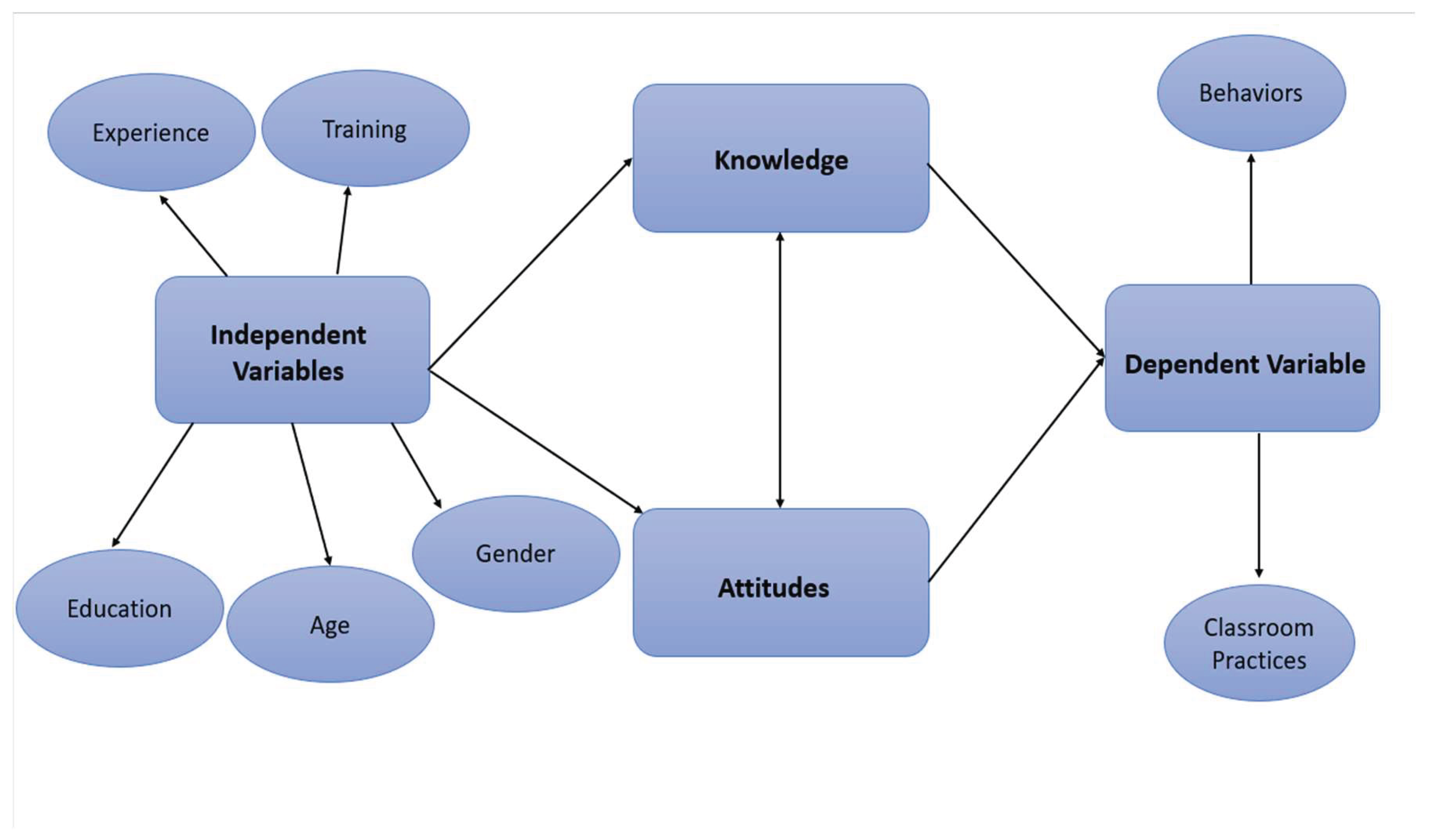
Table 1.
Gender of participants.
| Gender | Frequency | Percent |
|---|---|---|
| Man | 76 | 28.1% |
| Woman | 194 | 71.9% |
Table 2.
Age of the participants.
| Age | Frequency | Percent |
|---|---|---|
| 22-30 | 35 | 13% |
| 31-40 41-50 >50 |
55 91 89 |
20.4% 33.7% 33% |
Table 3.
Working Relationship of participants.
| Working Relation | Frequency | Percent |
|---|---|---|
| Hourly Worker | 69 | 25,6% |
| Permanent No job |
27 174 |
10% 64,4% |
Table 4.
Working Expirience of participants.
| Working Relation | Frequency | Percent |
|---|---|---|
| 0-5 | 93 | 34,4% |
| 6-12 13-25 26-35 36+ |
35 98 36 8 |
13% 46.3% 13,3% 3% |
Table 7.
(Q2) - Do you agree with the view that EEE contributes to improving the quality of life.
| (Q2) | Frequency | Percent |
| Absolutely No No N/A Yes Asolutely Yes |
8 2 23 110 129 |
2.2% 0.7% 8.5% 40.7% 47.8% |
Table 8.
(Q3) - The Ε.Ε./EfS is a key pillar of sustainable development.
| Q3 | Frequency | Percent |
| Absolutely No | 4 | 1.5% |
| No | 4 | 1.5% |
| N/A | 23 | 8.5% |
| Yes | 100 | 37.0% |
| Absolutely Yes | 139 | 51.5% |
Table 9.
(Q4)- E.E/ EfS contributes to the creation of environmentally aware citizens.
| Q4 | Frequency | Percent |
| Absolutely No | 4 | 1.5% |
| No | 3 | 1.1% |
| N/A | 14 | 5.2% |
| Yes | 97 | 35.9% |
| Absolutely Yes | 152 | 56.3% |
Table 10.
(Q5) - Does E.E./ EfS in school improve children’s livelihoods in adulthood as they grow up?
Table 10.
(Q5) - Does E.E./ EfS in school improve children’s livelihoods in adulthood as they grow up?
| Q5 | Frequency | Percent |
| Absolutely No | 6 | 2.2% |
| No | 5 | 1.9% |
| N/A | 28 | 10.4% |
| Yes | 110 | 40.7% |
| Absolutely Yes | 121 | 44.8% |
Table 11.
(Q6) E.E./ EfS increases environmental knowledge and contributes to changing attitudes towards environmental protection.
Table 11.
(Q6) E.E./ EfS increases environmental knowledge and contributes to changing attitudes towards environmental protection.
| Q6 | Frequency | Percent |
| Absolutely No | 4 | 1.5% |
| No | 5 | 1.9% |
| N/A | 14 | 5.2% |
| Yes | 95 | 35.2% |
| Absolutely Yes | 152 | 56.3% |
Table 12.
(Q7) - E.E./ EfS to be a separate compulsory subject in primary and secondary education.
| Q7 | Frequency | Percent |
| Absolutely No | 4 | 1.5% |
| No | 5 | 1.9% |
| N/A | 14 | 5.2% |
| Yes | 95 | 35.2% |
| Absolutely Yes | 152 | 56.3% |
Table 13.
(Q8) - E.E/ EfS to be gradually integrated into all subjects in the school curricula at primary and secondary level.
Table 13.
(Q8) - E.E/ EfS to be gradually integrated into all subjects in the school curricula at primary and secondary level.
| Q8 | Frequency | Percent |
| Absolutely No | 9 | 3.3% |
| No | 10 | 3.7% |
| N/A | 40 | 14.8% |
| Yes | 107 | 39.6% |
| Absolutely Yes | 104 | 38.5% |
Table 14.
(Q9) - The evaluation process of E.E/ EfS programmes is an important stage in the implementation of E.E/ EfS programmes.
Table 14.
(Q9) - The evaluation process of E.E/ EfS programmes is an important stage in the implementation of E.E/ EfS programmes.
| Q9 | Frequency | Percent |
| Absolutely No | 4 | 1.5% |
| No | 3 | 1.1% |
| N/A | 52 | 19.3% |
| Yes | 151 | 55.9% |
| Absolutely Yes | 60 | 22.2% |
Table 15.
(Q10) - The design of a E.E/ EfS program should include a final evaluation of the achievement of the objectives set.
Table 15.
(Q10) - The design of a E.E/ EfS program should include a final evaluation of the achievement of the objectives set.
| Q10 | Frequency | Percent |
| Absolutely No | 5 | 1.9% |
| No | 3 | 1.1% |
| N/A | 28 | 10.4% |
| Yes | 134 | 49.6% |
| Absolutely Yes | 100 | 37.0% |
Table 16.
(Q11) - The evaluation of a PE/ED programme is aimed solely at improving learning outcomes.
Table 16.
(Q11) - The evaluation of a PE/ED programme is aimed solely at improving learning outcomes.
| Q11 | Frequency | Percent |
| Absolutely No | 50 | 18.5% |
| No | 77 | 28.5% |
| N/A | 56 | 20.7% |
| Yes | 65 | 24.1% |
| Absolutely Yes | 22 | 8.1% |
Table 17.
Correlation between age of attedance and the number of environmental programs attended.
| Correlations | |||
| Age | How many environmental programs have you participated in? | ||
| Age | Pearson Correlation | 1 | .281** |
| Sig. (2-tailed) | .000 | ||
| N | 270 | 270 | |
| How many environmental programs do you participate? | Pearson Correlation | .281** | 1 |
| Sig. (2-tailed) | .000 | ||
| N | 270 | 270 | |
| **. Correlation is significant at the 0.01 level (2-tailed). | |||
Table 20.
Variance Contribution of Extracted Factors (EFA/PCA results).
| Component | Initial Eigenvalues | Extraction Sums of Squared Loadings | Rotation Sums of Squared Loadings | ||||||
| Total | % of Variance | Cumulative % | Total | % of Variance | Cumulative % | Total | % of Variance | Cumulative % | |
| 1 | 5,145 | 46,771 | 46,771 | 5,145 | 46,771 | 46,771 | 4,696 | 42,690 |
42,690 |
| 2 | 1,287 | 11,700 | 58,470 | 1,287 | 11,700 | 58,470 | 1,702 | 15,471 |
58,161 |
| 3 | 1,095 | 9,952 | 68,422 | 1,095 | 9,952 | 68,422 | 1,129 | 10,261 |
68,422 |
| 4 | ,946 | 8,598 | 77,020 | ||||||
| 5 | ,623 | 5,667 | 82,687 | ||||||
| 6 | ,473 | 4,303 | 86,990 | ||||||
| 7 | ,403 | 3,665 | 90,655 | ||||||
| 8 | ,365 | 3,322 | 93,977 | ||||||
| 9 | ,286 | 2,602 | 96,579 | ||||||
| 10 | ,222 | 2,016 | 98,595 | ||||||
| 11 | ,155 | 1,405 | 100,000 | ||||||
Disclaimer/Publisher’s Note: The statements, opinions and data contained in all publications are solely those of the individual author(s) and contributor(s) and not of MDPI and/or the editor(s). MDPI and/or the editor(s) disclaim responsibility for any injury to people or property resulting from any ideas, methods, instructions or products referred to in the content. |
© 2025 by the authors. Licensee MDPI, Basel, Switzerland. This article is an open access article distributed under the terms and conditions of the Creative Commons Attribution (CC BY) license (http://creativecommons.org/licenses/by/4.0/).
Copyright: This open access article is published under a Creative Commons CC BY 4.0 license, which permit the free download, distribution, and reuse, provided that the author and preprint are cited in any reuse.


