

Submitted:
02 May 2024
Posted:
06 May 2024
You are already at the latest version
Abstract
Prenylated flavonoids of Humulus lupulus L. have gained attention for their potential health benefits. In this study, Amber ALE and Russian Imperial Stout beers were prepared. In order to increase the content of prenylated flavonoids in beer, there was added ethanol extract of Polaris hops, they were dry hopping with Polaris hops or pure xanthohumol was added. In unfiltered beers, the highest total content of polyphenols (3.60 ± 0.32 g/L gallic acid) was determined on the eighth day of fermentation and maturation in Amber ALE beer without the addition of extract. The highest total antioxidant capacity was determined in Russian Imperial Stout beer with the addition of xanthohumol on the eighth day of fermentation and maturation (0.675 ± 0.008 mmol/L Trolox). This type of beer also had a high antioxidant efficiency (85.96 - 88.00%). Xanthohumol (2.05 mg/L) and isoxanthohumol (2.819 mg/L) were detectable only until the thirteenth day of fermentation and beer maturation. Therefore, the beers were filtered, and the ethanol extract of the Polaris was added to them for 24 hours. This procedure was used to prepare a functional beer of the Amber ALE type (15.210 ± 0.053 mg xanthohumol in 1 L and 0.922 ± 0.077 mg isoxanthohumol in 1 L) and a functional beer of the Russian Imperial Stout type (32.375 ± 0.032 mg xanthohumol in 1 L and 1.877 ± 0.043 mg isoxanthohumol in 1 L).
Keywords:
functional beers
; prenylated flavonoids
; hops extract
; antioxidant
1. Introduction
Beer is a traditional fermented alcoholic beverage, containing malt carbohydrates, proteins, vitamins and, above all, the taste-typical organic substances from hops. Antioxidants are substances that are present in foods in lower concentrations than the concentrations of oxidizable substrates and act by slowing down or inhibiting the oxidation of such substrates. In beer, these compounds are present from malt (70%) and hops (30%). Three main metabolites, bitter acids, prenylated chalcones and essential oils, pass from hops into beer during the brewing and fermentation process. All of them are considered biologically active substances, but from the point of view of antioxidant activity and health benefits, prenylated chalcones are the most interesting. Prenylated hop chalcones include xanthohumol, desmethylxanthohumol, xanthogalenol and isoxanthohumol, 6-prenylnaringenin, 8-prenylnaringenin and 8-geranylnaringenin [1]. Of these, xanthohumol is special because it is characterized by high antioxidant activity, even stronger than that provided by resveratrol in white wine. However, during heat treatment, xanthohumol is isomerized to isoxanthohumol. Isoxanthohumol has a significant phytoestrogen effect [2]. 8-prenylnaringenin also has about 100 times higher activity as a phytoestrogen than genistein [3] and therefore has potential use in eliminating problems associated with menopause and post-menopause.
The attention of the brewing industry has recently been focused on the production of functional beers enriched with biologically active substances, especially antioxidants [4] with the aim of providing health benefits beyond the nutritional value [5]. Increasing the antioxidant capacity of beer by adding polyphenols is also technologically important, because these substances stabilize the sensory profile of beer and foam, help stabilize beer as a colloidal system, and their presence is also reflected in a longer shelf life of the product compared to classic beers [6].
In order to manifest the pharmacological effects of xanthohumol on the human body, it is recommended that nutritional supplements contain a dose corresponding to 1.35 to 2.5 mg/kg per day [7]. In addition to oral consumption via capsules, this compound can also be added to foods and beverages [8]. Beer, including non-alcoholic and radlers, is thus one of the food sources of xanthohumol. Special beers specifically enriched with xanthohumol with a concentration of 1.9 mg/L [9] or 3.5 mg/L [10] were prepared, but it was possible to prepare beer with a xanthohumol content of up to 10 mg/L [11]. The concentration of xanthohumol is greatly reduced in the traditional way of beer production. Its content is on average around 0.2 mg/L, because during the cooking of the wort it is isomerized to isoxanthohumol. Concentration reduction also occurs through absorption on the yeast surface, during filtration and stabilization of beer [12]. It is possible to increase the content of xanthohumol in beer by using a greather amount of hops, by producing extra dry hopping beer, which has a xanthohumol content of up to 3.2 mg/L, or by using hop products enriched with xanthohumol. Furthermore, it is possible to add pure xanthohumol or hops before the end of the wort cooking, as well as to keep the temperature of the wort below 80 °C, to prevent the isomerization of xanthohumol [13]. Xanthohumol can be increased by adding roasted malt extracts, because they are able to form stable complexes with xanthohumol and are preserved in beer, which can thus contain up to 10 mg of xanthohumol in 1 liter [14]. It is also possible to use the genetically modified yeast Saccharomyces cerevisiae, which produces xanthohumol and desmethylxanthohumol de novo [15]. Up to 90% of xanthohumol was isomerized when using pilsner-type malt, while only 65-85% with caramel malts and even only 50% of xanthohumol with roasted malts [16]. Dark malts contain Maillard reaction products that act as an immobilizing carrier for xanthohumol, increasing its stability and inhibiting isomerization to isoxanthohumol [17,18]. The content of xanthohumol, isoxanthohumol and 8-prenylnaringenin in different beers was analyzed and found that the content of isoxanthohumol was from 0.04 to 3.44 mg/L, while the content of xanthohumol was only 0.001–0.11 mg/L and 8-prenylnaringenin from 0.002 to 0.69 mg/L [19]. The preparation of functional beers with a higher content of biologically active substances involves either the incorporation of ingredients rich in bioactive compounds or the modification of the technological brewing process [14]. This means adjusting mashing temperatures, fermentation conditions to optimize flavor extraction and retention of bioactive compounds. As additional ingredients to increase the content of biologically active substances, e.g. ginger, turmeric, cinnamon, and ginseng [20], or concentrated extracts from herbs containing flavonoids, phenolic acids and terpenes, such as extracts from green tea, chamomile, or echinacea [21,22] are used. Fruit concentrates containing vitamins, minerals and polyphenols are also added at various stages of the brewing process, including wort boiling, fermentation, maturation, and bottling [23].
2. Materials and Methods
2.1. Materials and Equipments
Three varieties of hops were used, which were purchased from Maroma s.r.o. (Slovakia): var. Polaris was a hops with a content of 17.6% alpha-bitter acids and 6.0% beta-bitter acids, var. Premiant was a hops with a content of 7.3% alpha-bitter acids and 3.5% beta-bitter acids and var. Galaxy containing 13.6% alpha-bitter acids and 5.2% beta-bitter acids [24].
Chemicals: ethanol 99.9% (p.a.), 99.9% methanol (HPLC grade), 99.9% 2-propanol (HPLC grade), Xanthohumol (≥ 96% HPLC standard), Isoxanthohumol (≥ 99% HPLC standard), gallic acid (p.a.), Folin-Ciocalteau reagent, 6-hydroxy-2,5 acid, 7,8-tetramethylchroman-2-carboxylic acid (Trolox), diammonium-2,2'-azino-bis(3-ethylbenzothiazoline-6)-sulfonic acid (ABTS), 1,1-diphenyl-2-(2,4, 6-trinitrophenyl)-hydrazyl (DPPH) were obtained from Sigma-Aldrich (SRN). Sodium carbonate and potassium peroxysulfate were analytical pure reagents. Diatomaceous earth was obtained from Thermo Scientific (USA).
Equipments: Vortex Reax Control (Heidolph Instruments, SRN), Heidolph Rotary Vacuum Evaporator (Heidolph Instruments, SRN), Genesys 10S UV-VIS Spectrophotometer (Thermo Scientifics, USA), Dionex ASE 350 Extraction System (Thermo Scientifics, USA), HPLC DAD Dionex Ultimate 3000 (Thermo Scientifics, USA).
2.2. Extraction of Prenylated Flavonoids from Humulus lupulus var. Polaris
For the extraction of flavonoids from hops var. Polaris used the Dionex ASE 350 extraction system. 2 g diatomaceous earth was added to 1 g of a homogenized sample of hops pellets and the extraction was carried out with 99.9% (vol.) ethanol. The sample was extracted in six successive five-minute extraction cycles at a pressure of 10.5 MPa and a temperature of 50 oC. Immediately after extraction, total polyphenol content and total antioxidant capacity were determined in the extract. Subsequently, the extract was concentrated by vacuum evaporation and stored at a temperature of 4 oC [24].
2.3. Determination of the Total Content of Polyphenols
The method is based on the reduction of the Folin-Ciocalteau reagent. The color change caused by the reduction reaction is recorded photometrically by measuring the absorbance at a wavelength of 700-760 nm. The reduction reaction is more intense under alkaline conditions created by sodium carbonate solution. 25 µL of sample and 1 mL of Folin-Ciocalteau reagent, diluted with demineralized water in a ratio of 1:9, were added to 1 mL of demineralized water. The solution was vigorously vortexed. After five minutes, 1 mL of saturated sodium carbonate solution was added to the reaction mixture and the reaction proceeded for fifteen minutes at room temperature. The total content of polyphenols was determined by measuring the absorbance at a wavelength of 750 nm and expressed as concentration equivalents of gallic acid (g/L GAE). The reference solution for the photometric measurement was prepared in the same way, but instead of the sample, it contained demineralized water.
2.4. Determination of the Total Antioxidant Capacity by the ABTS Method
The cationic radical ABTS+• was generated by mixing 8 mmol/L ABTS and 3 mmol/L potassium peroxysulfate in a ratio of 2:1 (vol.). The reaction took place in the dark at room temperature for 12 hours. To determine the total antioxidant capacity, the ABTS+• solution was diluted with 96% (vol.) ethanol so that the absorbance of the solution at a wavelength of 734 nm was equal to max. absorbance of the calibration line, prepared by determining the antioxidant capacity of Trolox. 2 mL of ABTS+• was pipetted into the photometric cuvette, to which 25 µL of the sample was added. The reaction was carried out in the dark at room temperature for thirty minutes without stirring. Antioxidant activity was determined by measuring absorbance at a wavelength of 734 nm. Results expressed in mmol/L of Trolox as "Trolox-Equivalents" (TE) were determined by a calibration curve constructed by measuring the absorbance at a wavelength of 734 nm of reactions of ABTS+• with 100-600 µmol/L of Trolox.
2.5. Determination of Antioxidant Activity by the DPPH Method
The reduction of DPPH by an antioxidant is manifested by the discoloration of the solution, and the change in color intensity is determined spectrophotometrically at a wavelength of 515 nm. Antioxidant activity was expressed as % inhibition of DPPH radical reactivity. 100 µL of sample was added to 1.90 mL of DPPH working solution (10 mL of 6.1 µmol/L DPPH diluted in 45 mL of 99.8% (vol.) methanol) into the photometric cuvette. The reaction took place in the dark at room temperature and after thirty minutes the absorbance was measured at a wavelength of 515 nm. The control contained 100 µL of extraction reagent instead of the sample.
where A0 is the absorbance of the control and A1 is the absorbance of the sample [25].
DPPH• inhibition (%) = [(A0-A1)/A0]x100
2.6. Quantitative Determination of Prenylated Flavonoids by HPLC-DAD
Analysis of xanthohumol and isoxanthohumol was performed using HPLC-DAD (Dionex Ultimate 3000). Analytes were separated on a Kromasil 100-7-C18 chromatographic column (5 μm, 100 Å, 250 mm × 4.6 mm) at a column temperature of 25 °C. A water-methanol mixture was used as the mobile phase, under isocratic conditions, at a constant flow rate of 1 ml/min and an analysis time of sixty minutes. The volume of the sample dosed on the column was 20 μL. The absorption spectrum of xanthohumol was recorded at a wavelength of 370 nm, the absorption spectrum of isoxanthohumol was recorded at a wavelength of 290 nm. The amount of xanthohumol and isoxanthohumol was determined by standards (xanthohumol 0.5–0.0625 mg/mL and isoxanthohumol 1.0–0.0625 mg/mL). Chromeleon 7 software (Chromeleon™ Chromatography Data System Software, Thermo Scientific, USA) was used for quantitative evaluation and processing of analytical data.
The statistical evaluation (ẋ average, σ standard deviation, linear regresion) was carried out using Microsoft Excel 365 Analytical Tools.
3. RESULTS AND DISCUSSION
3.1. Analysis of ASE Extract from Hops of the Polaris Variety
Polyphenols are generally considered heat-labile compounds [27], therefore the conditions for the preparation of the extract using the Accelerated Solvent Extractor were as follows: pressure 10.5 MPa and temperature 50 oC. The total content of polyphenols in the ethanol extract of var. Polaris, corresponded to 1.180 g/L of gallic acid. The extract contained substances with an antioxidant activity corresponding to 15.960 mmol/L TE and an antioxidant efficiency of 85.6% of N• inhibition (Table 1).
The content of prenylated flavonoids in hops depends on the variety, growing conditions, processing, and storage of hops. It is generally stated that there are about 5 g of these compounds in 100 g of hop dry matter [16]. The amount of xanthohumol is 0.2-1.1 g in 100 g of dry hop mass [3]. In the ethanol extract of hops var. Polaris prenylated flavonoids were quantified by HPLC-DAD. The extract contained 5.765 mg/mL xanthohumol and 1.096 mg/mL isoxanthohumol (Table 2).
Prenylchalcones, which also includes xanthohumol, are substances with a polar character [27] and have a high affinity for polar solvents such as ethanol [7]. Therefore, there is a relatively high concentration of xanthohumol in the prepared extract.
The extract was used to prepare functional beers.
3.2. Functional Unfiltered Beers
Beer No.1 type Amber ALE and Beer No.2 dark beer type Russian Imperial Stout were prepared. Amber ALE is a beer style characterized by a medium to dark amber color, balanced malt content and mild hops bitterness [28]. Russian Imperial Stout is a special type of beer, with a higher alcohol content, usually 8.0-12.0% (vol.). Beers of this style are characterized by fullness, richness of flavors and complexity. They often have flavors and aromas of dried fruit, coffee, and dark chocolate [29,30]. Fermentation and maturation of beers were monitored for twenty days. Beers were unfiltered with combined primary and secondary fermentation and therefore antioxidant activity and prenylated flavonoids were analyzed from the eighth day, when the yeast gradually sedimented and the beer became clear.
Beer No. 1 was brewed in the style of Amber ALE with malt Pale ALE extract (90% Pale ALE, 10% barley malt) [31]. During the ninety-minute boiling of 15 liters of wort, the hops was added in three steps, namely at the beginning of boiling at the zero minute, at the sixtieth minute and at the eightieth minute, while the addition of hops var. Polaris was 7g of hops pellets in each step. The prepared wort was fermented with Lallemand Voss Kveik top-fermenting yeast and the primary fermentation took place at a temperature of 32°C for three days. Yeast flocculation was high [32], therefore the brewed beer was clear. To increase the amount of biologically active substances, the following variants were prepared from beer after primary fermentation:
• Beer No. 1/A unfiltered beer without the addition of active substances
• Beer No. 1/B unfiltered beer with the addition of pure xanthohumol up to a concentration of 3.4 mg/L of beer [19]
• Beer No. 1/C unfiltered beer with the addition of ethanol extract of the Polaris variety to a final concentration of 3.4 mg of xanthohumol in L of beer
• Beer No. 1/D after primary fermentation, dry hopping with the addition of 0.56 g of Polaris hops to 400 ml of beer (preserving the dose of hops per volume of beer according to the hop brewery).
Beer No. 2 was brewed in the Russian Imperial Stout style with dark malt extract (25% fermented rye malt and 75% barley malt) [33] and Premiant, Galaxy and Polaris hops. To 15 liters of wort, hops of the Premiant variety (2 g) were used in the first hop in the fifth minute, in the second hop in the forty-fifth minute, hops of the Galaxy variety (6.2 g) were added, and the last hop was in the seventy-fifth minute with Polaris hops (4 g). The wort was fermented with dried top-fermenting yeast New world strong Ale yeast M 42. The primary fermentation took place at a temperature of 24 °C for four days. Glucose (6 g/L) was added to the boiled wort before fermentation. Adding glucose to the wort increases the content of fermentable sugar, which can increase the alcohol content of the finished beer without significantly increasing the sweetness [34,35]. To increase the amount of biologically active substances, the following variants were prepared from beer after primary fermentation:
• Beer No. 2/A unfiltered beer without the addition of active substances
• Beer No. 2/B unfiltered beer with the addition of pure xanthohumol to a concentration of 3.4 mg/L of beer [19]
• Beer No. 2/C unfiltered beer with the addition of ethanol extract of the Polaris variety to a final concentration of 3.4 mg of xanthohumol in L of beer
• Beer No. 2/D after primary fermentation, cold hopping with the addition of 0.44 g of Polaris hops to 400 ml of beer (preserving the dose of hops per volume of beer according to the hop brewery).
Beer No. 1
The highest total content of polyphenols was determined on the fifteenth day of fermentation in beer without addition (Beer No. 1/A), namely 3.600 g/L GAE (Table 3). A distinct effect of the additions was manifested only in dry hopping beer (Beer No. 1/D) on the twentieth day of fermentation, when the concentration of polyphenols corresponding to 3.100 g/L GAE was determined. However, it is likely that this effect is also a consequence of yeast autolysis, in which dying cells release their contents into the surrounding beer [36]. In typical brewing processes, yeast autolysis is not a significant problem. However, if the beer remains in contact with the yeast for an extended period, such as during extended maturation or conditioning, autolysis occurs. For most types of beer, a fifteen-day fermentation period followed by bottling and conditioning should not result in significant yeast autolysis [37,38].
The highest antioxidant capacity (determined by the reaction with ABTS+•, Figure 1) was determined on the thirteenth day in Beer No. 1/C (0.660 mmol/L TE) and Beer No. 1/D (0.610 mmol/L TE). However, even in this case, a high antioxidant capacity was determined on the eighth day of fermentation in the beer without the addition of biologically active substances (0.630 mmol/L TE). The most significant decrease in antioxidant capacity was determined between the 13th and 15th day of fermentation and maturation. In Beer No. 1/A this change corresponded to the amount of 0.39 mmol/L TE and in Beer No. 1/C corresponded to the amount of 0.36 mmol/L TE, respectively. Beer is a dynamic colloidal system with living and gradually dying microorganisms. In this system, chemical and physical interactions take place, which can also affect the ability of antioxidants to react effectively. Trend lines (based on linear regression) predict the tendency of changes in antioxidant capacity, from which it follows that in Beer No. 1/A, 1/B and 1/D depending on the time of fermentation and maturation of the beer, the total antioxidant capacity decreases. In Beer No. 1/C, which was a beer with the addition of an ethanolic extract of Polaris hops, a tendency to increase the antioxidant capacity was predicted.
Antioxidant efficiency (determined by scavenging of DPPH, Figure 2) increased in all variants of Beer No. 1 on the thirteenth day of fermentation: 73.3% efficiency was determined in beer without addition, 71.30% efficiency in beer with addition of pure xanthohumol (Beer No.1/B), 70.00% efficiency in beer with addition of Polaris extract (Beer No.1/C) and 68.40% efficiency in beer dry hopping with Polaris hops (Beer No. 1/D). With continued fermentation and maturation of the beer, the antioxidant efficiency decreased in all variants of Beer No. 1.
It follows from the trend lines that, depending on the time of fermentation and maturation of the beer, in all analyzed variants Beer No. 1 radical scavengign capacity had decreasing trend.
Prenylated flavonoids were not detected in any of the Beer No.1 variants using HPLC-DAD. Both primary and secondary fermentation took place in the beers without affecting the amount of yeast, so the flavonoids were in contact with the microorganisms for twenty days. Although microorganisms are essential for fermentation, on the other hand, they can metabolize or bind phenolic substances to their surface [39]. Based on the obtained results, it is possible to recommend, from a technological point of view, to produce Amber ALE style beer with the highest possible overall antioxidant capacity, a procedure in which the sedimented yeast will be removed no later than on the thirteenth day of fermentation.
Beer No.2
Beer No.2 was prepared in the Russian Imperial Stout style. Special malts, hops varieties or different additives can contribute to a higher amount of polyphenols in Russian Imperial Stout [40]. However, some stouts can therefore have a touch of bitterness [41].
The highest total content of polyphenols was determined on the fifteenth day of fermentation in Beer No. 2/B (1.72 g/L GAE) and in Beer No. 2/D (1.73 g/L GAE) (Table 4). Compared to Beer No. 1, prepared with the Amber ALE style and exclusively with Polaris hops, polyphenol concentrations in these beers were on average more than 41% lower.
The highest total antioxidant capacity (determined by the reaction with ABTS+•, Figure 3) had all variants of Beer No. 2 on the eighth day of fermentation and maturation (0.595 – 0.675 mmol/L TE). The most significant changes in the antioxidant capacity were determined in the variant Beer No. 2/D. The trend lines showed a gradual decrease in the antioxidant capacity of all variants of Beer No. 2.
Even in the analysis of antioxidant efficiency, changes were determined primarily in Beer No. 2/D (Figure 4). Beers on the eighth day of fermentation and maturation had a very high ability of scavenging of DPPH radical (85.96– 88.00%). A trend of gradual reduction of antioxidant efficiency during fermentation and maturation of beer was determined.
Beer No. 2 was prepared with dark malt in which Maillard reaction products are present, which can interact with hops polyphenols. The formation of complexes affects the solubility, stability, and bioavailability of these compounds in the beer matrix, which is also reflected in their concentration in the final product [42].
Analysis using HPLC showed that in Beer No. 2, xanthohumol and isoxanthohumol were detectable only until the thirteenth day of fermentation and maturation (Table 5). The highest concentration of prenylated flavonoids was determined on the eighth day in Beer No. 2/B (xanthohumol 2.05 mg/L, isoxanthohumol 2.819 mg/L).
3.3. Functional Filtered Beers
Based on the results of the analysis of prenylated flavonoids in prepared unfiltered functional beers, of which only Beer No. 2 detected xanthohumol and isoxanthohumol, experiments were carried out with the addition of hops extracts to filtered beer. As in industrial conditions, where the yeasts are removed by filtration after primary fermentation and the beer is usually left to rest for a maximum of one day (so as not to lose its sensory profile) before being put into barrels or bottled, Beer No. 1 and Beer No. 2 were filtered (“F" designation). To increase the concentration of prenylated flavonoids, hops extract was added to the filtered beers as follows:
• Beer No. 1/FA and Beer No. 2/FA addition of ethanol extract of the Polaris variety to a final concentration of 3.4 mg of xanthohumol in L of beer
• Beer No. 1/FB and Beer No. 2/FB addition of the ethanol extract of the Polaris variety to a final concentration of 6.8 mg of xanthohumol in L of beer.
Using HPLC, after the addition of the extract and 24 hours of standing beer without mixing, in Beer No. 1/FA was determined concentration of xanthohumol 8.32 mg/L and in Beer No. 1/FB 15.3 mg/L. The same hops extract was also added to the second variant of beer, resulting in Beer No. 2/FA with a xanthohumol concentration of 15.21 mg/L and Beer No. 2/FB with a xanthohumol content of 32.38 mg/L (Table 6).
4. Conclusion
The obtained results show that the addition of hop extracts to filtered beer is important for increasing the concentration of prenylated flavonoids. Prenylated flavonoids have a high affinity for proteins in biological membranes [43]. Prenylation increases the lipophilicity of flavonoids, which can also result in interaction with lipoproteins of biological membranes [44]. Furthermore, it is possible to confirm the contribution of Maillard reaction products for the stability of xanthohumol and isoxanthohumol because the content of these substances in the prepared dark beer was higher than in light beers. The result of the reaction is the formation of high-molecular melanoidins, which act as xanthohumol carriers, thereby stabilizing its content in beer [45,46]. Ethanol hops extract can be more cost-effective than using whole hops, especially in large brewing operations, because it eliminates the difficult storage and transportation of hops, reducing labor and logistics costs associated with handling whole hops [7]. The addition of ethanol extract from hops to filtered beer offers brewers an effective way to enhance taste, aroma and bitterness while maintaining the consistency of the product, with the added value of increased content of biologically active prenylated flavonoids.
Author Contributions
Conceptualization, D.U., N.H., B.D.; methodology, D.U., N.H., B.D.; formal analysis, N.H., B.D.; writing N.H., D.U.; funding acquisition D.U. All authors have read and sgreed to the published version of the manuscript.
Funding
This work was supported by project KEGA K-24-008-00.
Data Availability Statement
The original contributions presented in the study are included in the article, further inquiries can be directed to the corresponding author.
Conflicts of Interest
The authors declare no conficts of interest.
References
- Zhao, F., Watanabe., Y., Nozawa, H., Daikonnya, A., Kondo, K., Kitanaka. S. (2005). Prenylflavonoids and Phloroglucinol Derivatives from Hops (Humulus lupulus). Journal of Natural Products, 68, 1, 43–49. [CrossRef]
- Żołnierczyk, A. K., Mączka, W. K., Grabarczyk, M. ł., Wińska, K., Woźniak, E., Anioł, M. ł. (2015). Isoxanthohumol — Biologically active hop flavonoid. Fitoterapia, 103, 71–82. [CrossRef]
- Karabín, M., Hudcová, T., Jelínek, L., Dostálek, P. (2012). Význam chmelových prenylflavonoidů pro lidské zdraví. Chemické listy, 106(12), 1095-1103. http://www.chemicke-listy.cz/docs/full/2012_12_1095-1103.pdf.
- Santarelli, V., Neri, L., Carbone, K., Macchioni, V., Faieta, M., & Pittia, P. (2023). Conventional and innovative extraction technologies to produce food-grade hop extracts: Influence on bitter acids content and volatile organic compounds profile. Journal of Food Science, 88(4), 1308-1324. [CrossRef]
- Rošul, M. Đ., Mandić, A. I., Mišan, A. Č., Đerić, N. R., & Pejin, J. D. (2019). Review of trends in formulation of functional beer. Food and Feed research, 46(1), 23-35. [CrossRef]
- Nardini, M. (2023). An Overview of Bioactive Phenolic Molecules and Antioxidant Properties of Beer: Emerging Trends. Molecules, 28(7), 3221. [CrossRef]
- de Andrade Silva, G. V., Arend, G. D., Zielinski, A. A. F., Di Luccio, M., Ambrosi, A. (2023). Xanthohumol properties and strategies for extraction from hops and brewery residues: A review. Food Chemistry, 404, 134629. [CrossRef]
- Weiskirchen, R., Mahli, A., Weiskirchen, S., & Hellerbrand, C. (2015). The hop constituent xanthohumol exhibits hepatoprotective effects and inhibits the activation of hepatic stellate cells at different levels. Frontiers in Physiology, 6, 140. [CrossRef]
- Karabín, M., Jelínek, L., Kinčl, T., Hudcová, T., Kotlíková, B., & Dostálek, P. (2013). New approach to the production of xanthohumol-enriched beers. Journal of the Institute of Brewing, 119(3), 98-102. [CrossRef]
- Magalhães, P. J., Guido, L. F., Cruz, J. M., Barros, A. A. (2007). Analysis of xanthohumol and isoxanthohumol in different hop products by liquid chromatography-diode array detection-electrospray ionization tandem mass spectrometry. Journal of Chromatography A, 1150(1–2), 295–301. [CrossRef]
- Wunderlich, S., Zürcher, A., & Back, W. (2005). Enrichment of xanthohumol in the brewing process. Molecular Nutrition & Food Research, 49(9), 874-881. [CrossRef]
- Protsenko, L., Rudyk, R., Hryniuk, T., Vlasenko, A., Prostenko, A., Litvynchuk, S.,. Ovadenko, O. (2018). Beer enrichment with biologically active hop compounds. Ukrainian Food Journal, 7(1). [CrossRef]
- Kyselová, L., & Brányik, T. (2015). Quality improvement and fermentation control in beer. In Advances in fermented foods and beverages (pp. 477-500). Woodhead Publishing. [CrossRef]
- Habschied, K., Živković, A., Krstanović, V., Mastanjević, K. (2020). Functional Beer- A Review on Possibilities. Beverages, 6(3). [CrossRef]
- Yang, S., Chen, R., Cao, X., Wang, G., & Zhou, Y. J. (2024). De novo biosynthesis of the hops bioactive flavonoid xanthohumol in yeast. Nature Communications, 15(1), 253. [CrossRef]
- Rosaria Ciriminna, R., Albanese, L., Di Stefano, V., Delisi, R., Avellone, G., Meneguzzo, F., Pagliaro, M. (2018). Beer produced via hydrodynamic cavitation retains higher amounts of xanthohumol and other hops prenylflavonoids. In LWT, 91, 160-167. [CrossRef]
- Silva, K. F. C. E., Strieder, M. M., Pinto, M. B. C., Rostagno, M. A., & Hubinger, M. D. (2023). Processing strategies for extraction and concentration of bitter acids and polyphenols from Brewing By-Products: A Comprehensive Review. Processes, 11(3), 921. [CrossRef]
- Wasmuht, I. (2024). Relevant process steps influencing wort and beer composition and its quality: A review. Brewing Science Yearbook 2023, 113.
- Stevens, J. F., Taylor, A. W., Deinzer, M. L. (1999). Quantitative analysis of xanthohumol and related prenylflavonoids in hops and beer by liquid chromatography–tandem mass spectrometry. Journal of Chromatography A, 832(1–2), 97–107. [CrossRef]
- Deng, Y., Lim, J., Nguyen, T. T. H., Mok, I. K., Piao, M., & Kim, D. (2020). Composition and biochemical properties of ale beer enriched with lignans from Schisandra chinensis Baillon (omija) fruits. Food Science and Biotechnology, 29, 609-617. [CrossRef]
- Nardini, M., & Foddai, M. S. (2020). Phenolics profile and antioxidant activity of special beers. Molecules, 25(11), 2466. [CrossRef]
- Pluháčková, H., Gregor, T., Boško, R., Běláková, S., Svoboda, Z., & Benešová, K. (2020). Fortification of beer with extracts of the selected Czech medicinal herbs and plants. Kvasny prumysl, 66(4), 314-319. [CrossRef]
- Cho, J. H., Kim, I. D., Dhungana, S. K., Do, H. M., & Shin, D. H. (2018). Persimmon fruit enhanced quality characteristics and antioxidant potential of beer. Food science and biotechnology, 27, 1067-1073. [CrossRef]
- Gil-Ramírez, A., Mendiola, J., Arranz, E., Ruíz-Rodriguéz, A., Reglero, G., Ibánez, E., Marín, F. (2012). Highly isoxanthohumol enriched hop extract obtained by pressurized hot water extraction (PHWE). Chemical and functional characterization. Innovative Food Science & Emerging Technologies, 16, 54-60. [CrossRef]
- Adebiyi, O. E., Olayemi, F. O., Ning-Hua, T., & Guang-Zhi, Z. (2017). In vitro antioxidant activity, total phenolic and flavonoid contents of ethanol extract of stem and leaf of Grewia carpinifolia. Beni-Suef University Journal of Basic and Applied Sciences, 6(1), 10-14. [CrossRef]
- Rajbhar, K., Dawda, H., Mukundan, U. (2015). Polyphenols: Methods of extraction. Sci. Revs. Chem. Commun, 5(1), 1-6.
- Stevens, J. F., Page, J. E. (2004). Xanthohumol and related prenylflavonoids from hops and beer: to your good health! Phytochemistry, 65(10), 1317–1330. [CrossRef]
- Roth, C. (2023). American Amber. On Tap, 2023(3), 46-47.
- Villacreces, S., Blanco, C. A., & Caballero, I. (2022). Developments and characteristics of craft beer production processes. Food bioscience, 45, 101495. [CrossRef]
- Heath, E., & Milam, J. (2023). Perceptions of China and Russian chinoiserie under Empress Elisabeth Petrovna. In Russian Orientalism in a global context (pp. 50-74). Manchester University Press.
- https://www.uvartesipivo.sk/Sladovy-vytazok-PALE-ALE-1-7-kg-d691.htm.
- Paszkot, J., Kawa-Rygielska, J., & Anioł, M. (2021). Properties of Dry Hopped Dark Beers with High Xanthohumol Content. Antioxidants, 10(5), 763. [CrossRef]
- https://www.kupsito.sk/i/13912478418/supravy-na-varenie-piva/tmavy-pivny-sladovy-extrakt-1-2kg-brewa.
- Tretyak, L., Rebezov, M., Kenijz, N., Khayrullin, M., Gribkova, V., & Goncharov, A. (2020). Controlled Glycolysis as the Basis of Beer Technology with Specified Consumer Properties. Systematic Reviews in Pharmacy, 11(5). [CrossRef]
- Paoeltta, C., Balog, C., Higgs, A., Liskin, D., Kingsbury, K., Brehm, A., & Quinlan, R. A. (2023). Science of Brewing: An Introduction to the Impact of Local Regions on a Favorite Fermented Beverage. In Chemistry of Alcoholic Beverages. 10, 187-215. DOI: 10.1021/bk-2023-1455.ch010. [CrossRef]
- Alves, E. M., de Souza, J. F., de Oliva Neto, P., (2021). Advances in yeast autolysis technology - a faster and safer new bioprocess. Braz. J. Food Technol. 24. [CrossRef]
- Wang, J., Li, M., Zheng, F., Niu, C., Liu, C., Li, Q., & Sun, J. (2018). Cell wall polysaccharides: Before and after autolysis of brewer’s yeast. World Journal of Microbiology and Biotechnology, 34, 1-8. [CrossRef]
- Jaeger, A., Arendt, E. K., Zannini, E., & Sahin, A. W. (2020). Brewer’s spent yeast (BSY), an underutilized brewing by-product. Fermentation, 6(4), 123. [CrossRef]
- Yang, F., Chen, C., Ni, D., Yang, Y., Tian, J., Li, Y., & Wang, L. (2023). Effects of Fermentation on Bioactivity and the Composition of Polyphenols Contained in Polyphenol-Rich Foods: A Review. Foods, 12(17), 3315. [CrossRef]
- Silva, S., Oliveira, A. I., Cruz, A., Oliveira, R. F., Almeida, R., & Pinho, C. (2022). Physicochemical Properties and Antioxidant Activity of Portuguese Craft Beers and Raw Materials. Molecules, 27(22), 8007. [CrossRef]
- Pilcher, J. M. (2024). Imperial Hops: Beer in the Age of Empire. Global Food History, 10(1), 52-67. [CrossRef]
- Wang, X., Lu, J., Cai, G., & Wu, D. (2023). Advances in Maillard reaction products on color, flavor and biological activity of specialty malt. Systems Microbiology and Biomanufacturing, 1-11. [CrossRef]
- Nakayama, T., Takahashi, S., & Waki, T. (2019). Formation of flavonoid metabolons: functional significance of protein-protein interactions and impact on flavonoid chemodiversity. Frontiers in Plant Science, 10, 460916. [CrossRef]
- Mukai, R. (2018). Prenylation enhances the biological activity of dietary flavonoids by altering their bioavailability. Bioscience. Biotechnology and Biochemistry, 82(2), 207-215. [CrossRef]
- Wunderlich, S., Wurzbacher, M., & Back, W. (2013). Roasting of malt and xanthohumol enrichment in beer. European Food Research and Technology, 237, 137-148. [CrossRef]
- Adamczyk, B., Simon, J., Kitunen, V., Adamczyk, S., & Smolander, A. (2017). Tannins and their complex interaction with different organic nitrogen compounds and enzymes: old paradigms versus recent advances. ChemistryOpen, 6(5), 610-614. [CrossRef]
Figure 1.
Changes in the antioxidant capacity of Beer No. 1 variants.
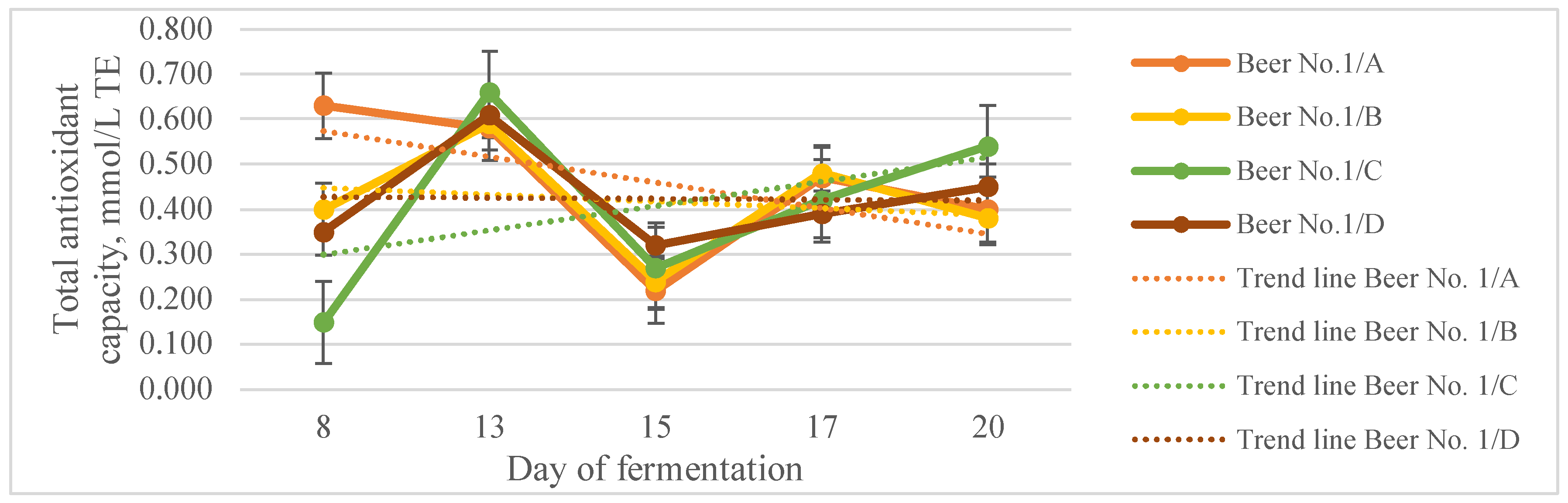
Figure 2.
Changes in the antioxidant efficiency of Beer No. 1 variants.
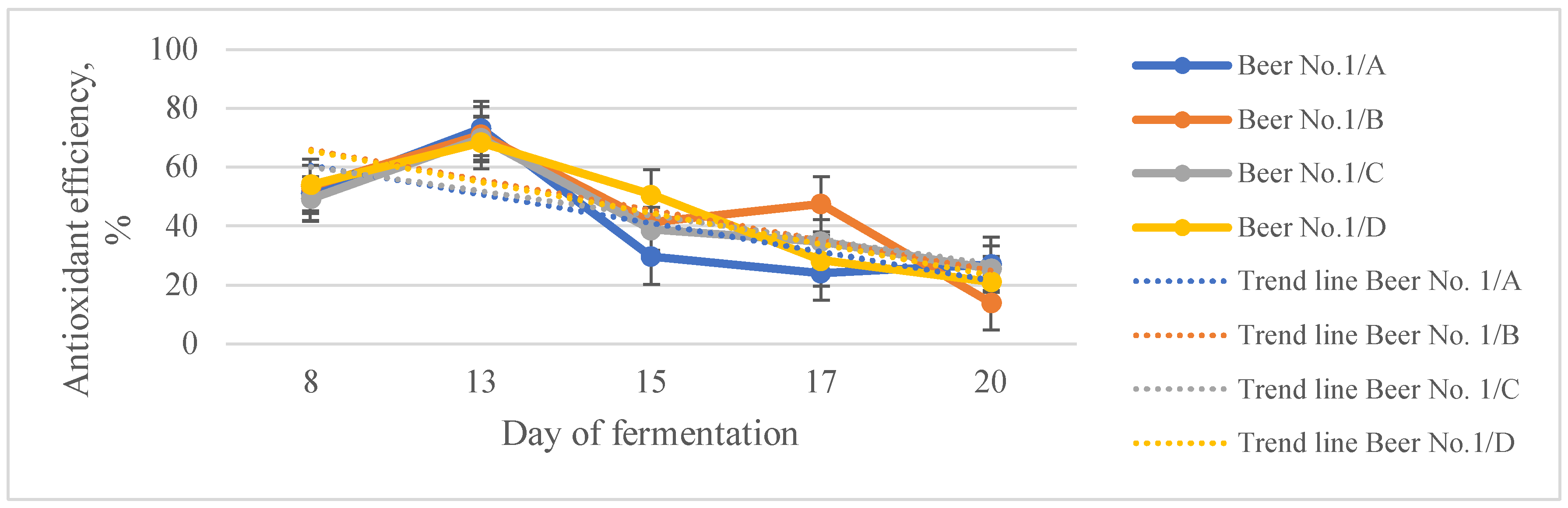
Figure 3.
Changes in the antioxidant capacity of Beer No. 2 variants.
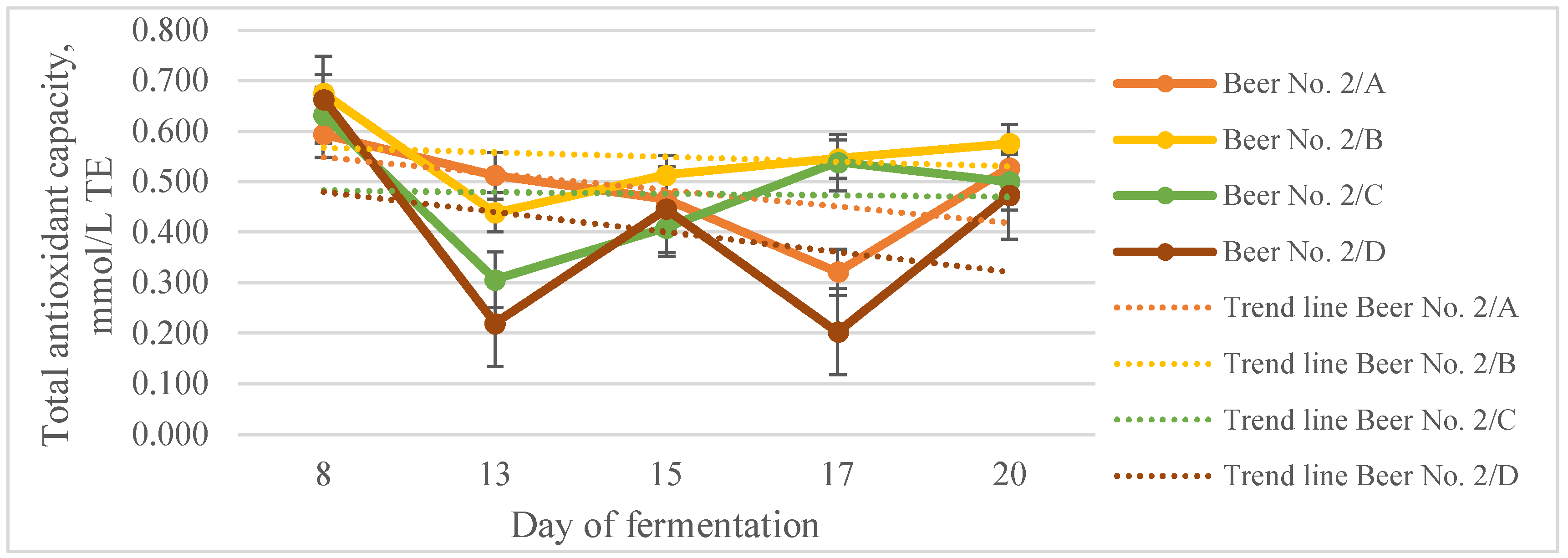
Figure 4.
Changes in the antioxidant efficiency of Beer No. 2 variants.
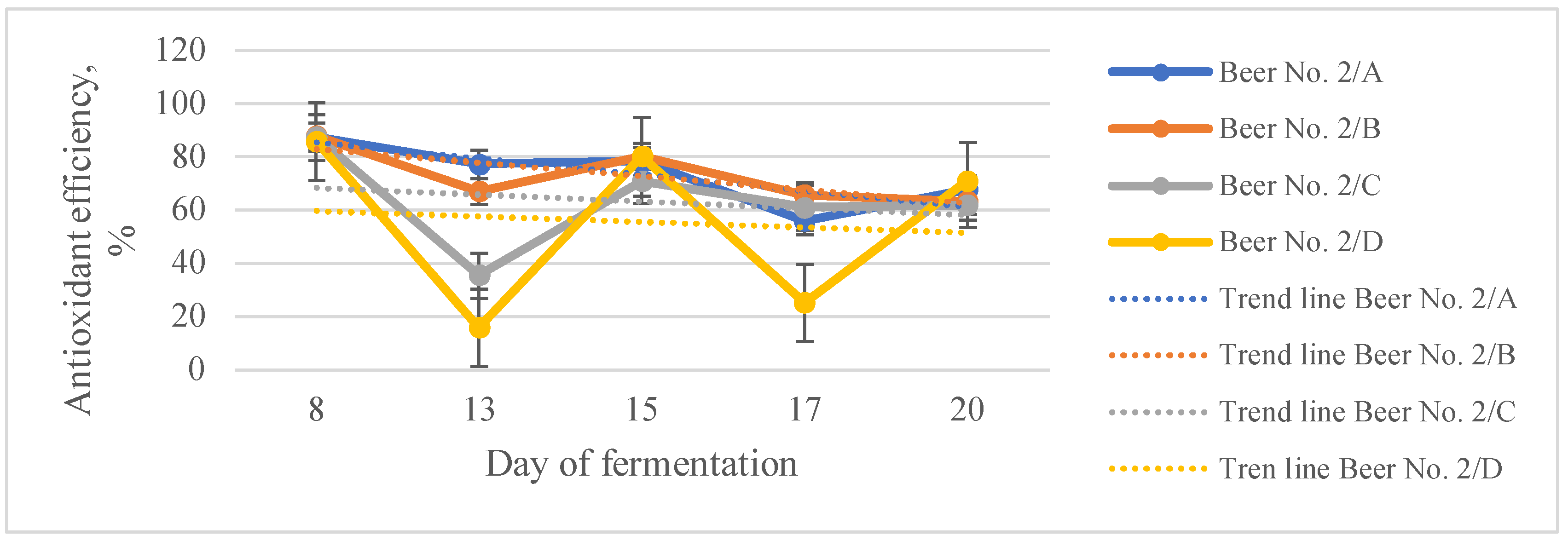

Table 1.
ASE extrakt from hops of the Polaris variety.
| Total polyphenols content, g/L GAE | Total antioxidant capacity, mmol/L TE | Antioxidant efficiency, % | |
|---|---|---|---|
| ẋ (n=6) | 1.180 | 15.960 | 85.63 |
| σ | 0.025 | 0.289 | 0.45 |
Table 2.
Content of prenylated flavonoids in extrakt from hops of the Polaris variety.
| Xanthohumol, mg/mL | Izoxanthohumol, mg/mL | |
|---|---|---|
| (n=6) | 5.765 | 1.096 |
| σ | 0.397 | 0.177 |
Table 3.
Total polyphenols content in Beer No. 1 variants.
| Variant of beer | Total polyphenols content, g/L GAE | |||||
| Day of fermentation | ||||||
| 8 | 13 | 15 | 17 | 20 | ||
| Beer No. 1/A | ẋ (n=6) | 2.220 | 2.280 | 3.600 | 2.290 | 2.500 |
| σ | 0.043 | 0.564 | 0.320 | 0.078 | 0.007 | |
| Beer No. 1/B | ẋ (n=6) | 2.190 | 0.260 | 2.700 | 3.180 | 2.340 |
| σ | 0.076 | 0.023 | 0.433 | 0.065 | 0.432 | |
| Beer No. 1/C | ẋ (n=6) | 2.350 | 2.400 | 2.400 | 2.330 | 2.440 |
| σ | 0.022 | 0.065 | 0.005 | 0.008 | 0.021 | |
| Beer No. 1/D | ẋ (n=6) | 2.470 | 2.460 | 1.640 | 2.410 | 3.010 |
| σ | 0.041 | 0.022 | 0.008 | 0.043 | 0.032 | |
Table 4.
Total polyphenols content in Beer No. 2 variants.
| Variant of beer | Total polyphenols content, g/L GAE | |||||
| Day of fermentation | ||||||
| 8 | 13 | 15 | 17 | 20 | ||
| Beer No. 2/A | ẋ (n=6) | 1.420 | 1.340 | 1.480 | 1.400 | 1.440 |
| σ | 0.010 | 0.070 | 0.770 | 0.040 | 0.210 | |
| Beer No. 2/B | ẋ (n=6) | 1.630 | 1.420 | 1.720 | 1.380 | 1.510 |
| σ | 0.028 | 0.010 | 0.120 | 0.090 | 0.060 | |
| Beer No. 2/C | ẋ (n=6) | 1.500 | 1.360 | 1.490 | 1.370 | 1.500 |
| σ | 0.010 | 0.070 | 0.077 | 0.040 | 0.021 | |
| Beer No. 2/D | ẋ (n=6) | 1.350 | 1.230 | 1.730 | 1.270 | 1.250 |
| σ | 0.076 | 0.023 | 0.043 | 0.065 | 0.043 | |
Table 5.
Content of xanthohumol and izoxanthohumol in Beer No. 2 variants.
| Variant of beer | Xanthohumol, mg/L | Izoxanthohumol, mg/L | |||
| Day of fermentation | |||||
| 8 | 13 | 8 | 13 | ||
| Beer No. 2/A | ẋ (n=6) | 1.040 | 0.000 | 1.245 | 0.902 |
| σ | 0.005 | 0.000 | 0.005 | 0.004 | |
| Beer No. 2/B | ẋ (n=6) | 2.050 | 1.640 | 2.819 | 0.486 |
| σ | 0.008 | 0.038 | 0.006 | 0.002 | |
| Beer No. 2/C | ẋ (n=6) | 1.920 | 1.860 | 1.598 | 0.752 |
| σ | 0.052 | 0.028 | 0.001 | 0.006 | |
| Beer No. 2/D | ẋ (n=6) | 1.880 | 0.000 | 1.082 | 0.513 |
| σ | 0.005 | 0.000 | 0.012 | 0.076 | |
Table 6.
Content of xanthohumol and izoxanthohumol in variants of filtered beer.
| Variant of beer | Xanthohumol, mg/L | Izoxanthohumol, mg/L | |
| Beer No. 1/FA | ẋ (n=6) | 8.315 | 0.654 |
| σ | 0.006 | 0.006 | |
| Beer No. 1/FB | ẋ (n=6) | 15.210 | 0.922 |
| σ | 0.053 | 0.007 | |
| Beer No. 2/FA | ẋ (n=6) | 15.300 | 0.982 |
| σ | 0.005 | 0.009 | |
| Beer No. 2/FB | ẋ (n=6) | 32.375 | 1.877 |
| σ | 0.032 | 0.043 | |
Disclaimer/Publisher’s Note: The statements, opinions and data contained in all publications are solely those of the individual author(s) and contributor(s) and not of MDPI and/or the editor(s). MDPI and/or the editor(s) disclaim responsibility for any injury to people or property resulting from any ideas, methods, instructions or products referred to in the content. |
© 2024 by the authors. Licensee MDPI, Basel, Switzerland. This article is an open access article distributed under the terms and conditions of the Creative Commons Attribution (CC BY) license (http://creativecommons.org/licenses/by/4.0/).
Copyright: This open access article is published under a Creative Commons CC BY 4.0 license, which permit the free download, distribution, and reuse, provided that the author and preprint are cited in any reuse.


