
Submitted:
29 April 2024
Posted:
30 April 2024
You are already at the latest version
Abstract
This review paper presents a comprehensive synthesis of current knowledge on the contamination of water systems by polycyclic aromatic hydrocarbons (PAHs). PAHs, organic contaminants characterized by two or more fused aromatic rings, are notably problematic due to their persistence, bioaccumulation, and significant health risks. The review commences with an examination of various sources of PAHs in aquatic environments, encompassing both anthropogenic activities, such as industrial discharges, urban runoff, and oil spills, and natural phenomena including volcanic eruptions and wildfires. Subsequently, the discussion shifts to the distribution patterns of PAHs within different aquatic ecosystems, with an analysis of factors that influence their transport. Considerable focus is placed on the entry mechanisms of PAHs into water systems and their interactions with diverse environmental matrices. Additionally, the ecotoxicological effects of PAHs on aquatic life are scrutinized, with particular emphasis on molecular, individual, and ecosystemic impacts. This includes an exploration of PAH bioaccumulation in aquatic organisms and their potential mutagenic and carcinogenic consequences. The review further addresses the challenges associated with detecting and quantifying PAHs in aquatic settings, reflecting on the advancements in analytical methodologies and the complexities introduced by their varied physicochemical properties. The paper concludes with a summary of existing regulatory frameworks and guidelines governing PAH contamination in water systems, underscoring the imperative for global collaboration in the monitoring and management of PAH pollution.
Keywords:
Polycyclic Aromatic Hydrocarbons
; Water Pollution
; Ecotoxicology
; Environmental Distribution
; Analytical Methods
; Regulatory Frameworks.
1. Introduction
1.1. Polycyclic Aromatic Hydrocarbons
Polycyclic aromatic hydrocarbons (PAHs) are a class of semi-volatile organic pollutants, ubiquitous in the environment. PAHs contain two or more aromatic rings and are produced mainly by incomplete combustion of organic matter in the environment. They are classified as low molecular weight (LMW) with two to three fused aromatic rings, and high molecular weight (HMW) that contain four or more fused aromatic rings [1,2]. LMW PAHs are recognized for causing significant and immediate toxicity in living organisms, whereas HMW PAHs are known for their potential to cause cancer, mutations, genotoxicity, and teratogenicity to living organisms [1,3]. Increase in molecular weight among PAH chemical species, will increase hydrophobicity, lipophilicity, melting, and boiling point [4], while water solubility and vapor pressure decreases [5]. These physicochemical properties affect their distribution, transportation, and fate in the environment.
PAH transfer among food web compartments is promoted by their lipophilic nature [6] that promotes bioaccumulation in animal bodies [7], exposing human consumers eventually [7,8]. On the other hand, HMW PAHs are more persistent compounds in the environment making them less biodegradable [9]. These characteristics and environmental behaviors of PAHs are crucial for comprehensive understanding of their impacts on ecosystems and human health.
PAHs originate from pyrogenic, petrogenic, and biogenic processes occurring during natural phenomena or anthropogenic activities. In the environment, these compounds originate primarily from pyrogenic and petrogenic processes [10]. Pyrogenic PAHs results from high temperature combustion, incomplete combustion and/or pyrolysis of organic matter under low or no oxygen conditions, such as the combustion of fossil fuels, wood, wildfires, coal, and volcanic activity [11]. The diagenesis of organic matter occurring over extended periods of time at specific temperature and pressure conditions leads to formation of petrogenic PAHs [12,13,14]. Common anthropogenic emissions of petrogenic PAHs to the environment, are petroleum-derived products, fossil fuels, oily-lubricant leakage, and crude oil exploration activities from industry, commercial, and transportation development [1,11]. While natural emissions consist of petroleum seepage lakes, marine oil seeps, and crude oil-tar lagoons [14,15,16]. Lastly, biogenic PAHs are synthetized by microorganisms (bacteria, fungi), plants, or phytoplankton without involvement of diagenesis processes [7,17,18]. Some documented emissions sources of biogenic PAHs are termite nests [19,20], bio-synthetization by magnolia flowers [21], and Annonaceae family in Amazon rainforest [22]. Diverse anthropogenic and natural emissions discharge PAHs into the environment through the three main origin processes, and can be tracked by analyzing PAH compositional pattern in sample matrices [23,24,25].
Globally, a great concern is arising about the presence and persistency of PAHs in aquatic, terrestrial, and atmospheric systems [26]. More than 200 PAHs had been discovered in the environment [10]. However, only 14 to 20 individual PAHs are of regulatory and research interests [11]. Various governmental and non-governmental organizations, such as the United States Environmental Protection Agency (USEPA) and Greenpeace [27], are actively involved in monitoring these pollutants. USEPA established 16 PAHs as priority pollutants for monitoring in the environment [28,29,30]. These 16 priority PAHs, were selected based on human health risk, exposure, toxicity, and occurrence in environment [31]. Many studies are focused on reporting the concentration and presence of these 16 priority PAHs in the environment. Table 1 presents the summary of the physicochemical properties (e.g., melting point, solubility, etc.), chemical structure, and classification of the 16 USEPA priority PAHs.
PAHs are ubiquitous in the environment and occur in various environmental compartments, raising concerns of possible ecological and human health impacts. When formed, PAHs reach the atmosphere as particles bound or gas forms [36]. In the atmosphere LMW PAHs remain in vapor phase while HMW PAHs tend to adsorb to particulate matter [37] facilitating there Long-range transport (LRT) [38]. Eventually by wet or dry deposition they enter terrestrial or aquatic environment [11]. In Figure 1, PAH dynamics in the environment involve their mobility upon deposition on soil surfaces [39], often facilitated by runoff or weathering processes, and subsequently be transported into water systems [40]. In water systems PAHs partition, either binding to sediment or present in the dissolved phase, posing ecological and health risks to aquatic organisms and humans [39].
PAHs can enter aquatic systems through various pathways, primarily via wet and dry deposition from the atmosphere, sewage discharges, industrial effluents, and runoff from urban or agricultural areas. In water they can be in dissolved phase, bound to organic matter, or adsorbed onto particulate matter or sediment [41]. Distribution in the water column is influenced by the sediment-water partition coefficient [42]. Sediment-bound PAHs can be resuspended into the water column, increasing exposure risk to aquatic organisms and undergo long-range transport within watersheds before eventually reaching the ocean.
PAHs produces toxic effects on various living organisms that includes humans, animals, and microorganisms. Biochemical persistence derives from the dense π electrons in their ring structure that makes them resistant to nucleophilic attack [5]. Some PAHs are known for their genotoxicity, mutagenicity, carcinogenicity, and teratogenicity, posing risks to the endocrine system [43,44]. HMW PAHs are less volatile, more lipophilic, environmentally persistent, and hydrophobic, raising concerns about their associated risks to humans, the environment, and living organisms [45]. They also bind to dissolved organic matter deposited in sediment thus accumulating in the aquatic environment, increasing toxicity levels in the benthic area of aquatic systems [2,41,46]. Also rain runoff can transfer soil-bound PAHs to water, affecting flora, aquatic life, and food chains, ultimately posing health risks to humans [47]. PAHs are characterized by their diverse toxic effects and persistence in the environment, presenting significant risks to human health and the environment from their toxicity perspective and their potential to bioaccumulation.
1.2. Freshwater Systems
Freshwater systems, comprise 2.5% the world’s terrestrial surface area [48,49]. These terrestrial freshwater systems are vital resource for human consumption and ecological integrity [50]. Encompassing diverse water bodies such as lakes, ponds, reservoirs, rivers, streams, groundwater aquifers, estuaries, and wetlands that cover 0.8% of the Earth’s surface and are unequally distributed globally [51,52,53]. Despite their significance, freshwater resources face vulnerability not only by their geographical limitations but also due to human interventions and pollution [52,54]. The broader context of Earth’s water distribution reveals that while approximately 71% of the Earth’s surface is water-covered, the oceans hold the majority, about 96.5%. Within the limited freshwater supply, the majority is locked in ice and underground compartments, with slightly more than 1.2% constituting surface water, meeting the essential needs of life [48]. Figure 2 illustrates the proportion of water found in different reservoirs, including oceans, glaciers and ice caps, groundwater, lakes, and rivers as relative percentage of water stored in each reservoir. Managing and preserving the relatively small portion of freshwater available for sustaining various life and ecosystem’s function, is fundamental.
Increase in industrialization, agricultural practices, and socio-economic development near freshwater systems, contributes with diverse organic pollutants that impacts environmental quality [56]. Among organic micropollutants, PAHs are one of the most abundant in freshwater systems and present toxic properties even at low doses, leading to bioaccumulation in fishes [57], invertebrates [7], and algae [58]. The prevalence of PAHs in freshwater systems poses a significant environmental concern, with their discharge into aquatic environments occurring through various pathways, including atmospheric deposition, runoff, and wastewater inputs [59]. Their hydrophobic nature promotes the adsorption of PAHs to suspended sediments in diverse aquatic ecosystems composed by wetlands, rivers, lakes, and estuarine environments [60,61,62]. A comprehensive understanding of the impacts of PAH pollution on freshwater systems globally, is necessary to assess and mitigate its effects in freshwater systems, their biodiversity and human health protection.
PAHs occurrence, distribution, and fate [63] represent an existing global [64] threat to freshwater ecosystems, irrespective of their geographical remoteness [65]. Inputs from both point and non-point sources, continuously introduce these compounds into freshwater systems, resulting in temporal and spatial heterogeneity [28,66]. PAHs, deposited from atmospheric sources, runoff, and water discharge inputs, either adsorb onto suspended sediments or exist in a freely dissolved state within freshwater systems [67]. Despite the growing awareness of atmospheric PAHs, the study of these compounds in terrestrial and freshwater systems is limited [68]. Thus, the widespread distribution, emission sources, and impacts of PAHs in freshwater systems must be thoroughly reviewed and critically examined in recent literature.
There have been numerous and recent literature reviews about PAH dynamics in different environmental topics [1,11,31,63,68,69,70,71,72]. On the other hand, recent publications had examined specialized aspects of PAHs in freshwater systems. [2,31,47,71,73,74,75]. A comprehensive overview of PAHs in freshwater systems will provide a better understanding of the behavior and dynamics of these compounds in natural environments. Thus, is necessary to provide a recent comprehensive literature review that discusses general aspects of PAHs in freshwater systems.
The main objective of this review paper is to synthesize the most recent literature on the sources, distribution, and impacts of PAHs in freshwater systems, with additional focus on regulations and commonly implemented analytical methods for their environmental monitoring and management. A synthesis of this recent information will establish a comprehensive understanding and contribute significantly to the current state of knowledge, thereby informing further research and regulatory direction.
2. Sources of PAHs in Freshwater Environments
PAHs may enter freshwater systems through diverse processes and emission sources. It is possible to identify PAHs origins and emissions through a combination of data analysis models, such as molecular diagnostic ratios, principal component analysis (PCA), positive matrix factorization model, and other methods [76]. These sources can be influenced by geographic features [77], topography [78], hydrological conditions [79], landscape characteristics [80], land use patterns [81], climate variations [82], anthropogenic activities, and natural phenomena [11]. The interaction of these factors can contribute to PAHs discharges on freshwater systems. Additionally, the type of freshwater body with their distinct physical, chemical, and hydrological properties, affect PAHs dynamics in water [11,83,84]. Identifying the sources and understanding the factors influencing PAHs concentration in these systems is crucial for comprehending their ecological impacts and formulating effective mitigation strategies.
2.1. Lakes
The availability of water resources impacts the economic development of a region, involving water supply, recreational opportunities, fisheries, and other ecosystem services that lakes provide. In the case of lakes, surrounded by urban settings, pose unique challenges when diverse emission sources contribute to the presence of PAHs. PAHs sources in lakes, includes those from petroleum, biomass, heavy oils, and natural gas consumption [85]. Studies have reported varying ∑16PAHs of USEPA priority list, with concentrations reaching more than 10,000 ng L−1 [86]. LMW congeners and monomeric PAHs dominate in dissolved water phase at high levels, being naphthalene the most abundant, while HMW stay adsorbed into sediments (Figure 3) [87,88]. Comprehensive analyses in Ontario Lakes reveal that local sources, especially non-point atmospheric sources from pyrogenic activities can have a more substantial impact than regional sources [10]. While successful policies for point sources reduction had been implemented in different countries [89,90], non-point sources like atmospheric deposition and surface runoff are major contributors to lake systems [91].
HMW PAHs with geochemical and environmental significance, dominate recent sediment cores from northern Ontario Lakes and indicated a predominant pyrogenic local sources [92]. While coal-tar sealed pavement contributes to the transfer of PAHs into lakes through various pathways (Figure 4) [93], resulting in higher Σ16PAHs concentrations in Great Lakes Basin watershed compared with other water bodies throughout the world [94]. Urbanization intensifies the presence of PAHs in lakes, associated with the degree of urbanization and increased runoff from impervious surfaces [85,95,96]. Economic development in the Taihu Lake Basin correlates with changes in PAHs sediment composition, highlighting the need for up-to-date ecological risks assessment and protection efforts [97]. In the case of remote lakes less affected by anthropogenic activities, atmospheric deposition from long-range transported PAHs and wildfires can be the main contributors [47,98,99]. On the other hand, studies spanning from 2002 to 2018 emphasize that ubiquitousness of PAHs in lake sediments is caused by anthropogenic combustion, petroleum industries, road traffic, and socioeconomic factors, being China, Egypt, United States of America (USA), and some African lakes as the more polluted [10]. The presence of PAHs in lakes are mainly driven by diverse urban and anthropogenic activities in the surrounding landscape, with wildfires as main contributor in remote lakes.
2.2. Rivers
Rivers play a fundamental role as primary transport pathways for organic pollutants, from upstream to downstream until discharging them in lakes, wetlands, or estuaries [100,101]. Specifically, large rivers with expansive watersheds and upstream tributaries contain PAHs from mixed emission sources [61,102,103]. An example is the Buffalo River Estuary in South Africa, where pollutant levels are influenced primarily by pyrolytic sources, such as effluent discharge from automobile, petrochemical industries, landfill leachate, domestic and industrial wastewater, vehicle emissions on highways, harbor activities, and drains from urban runoff from the city [104]. Oil related activities with weaker combustion contribution are also main non-point sources of PAHs in Nun River, Nigeria [105]. While, anthropogenic expansion promotes deposition of PAHs in surface water, water column layers, and sediments [106], increasing ecological risk in rivers [107]. Euphrates River in Iraq, is the longest river in southwest Asia and presented pollution sources from petroleum product consumption influenced by the increase of private car and home electricity generators ownership [108]. Predominance of HMW PAHs in riparian soils from rivers impacted by coal mining areas, indicated origins of pyrogenic sources like vehicular emissions, biomass, and coal combustion [109]. San Joaquin River in Northen California (USA) surface and core sediment analysis estimated that pyrogenic sources increased with time, while biogenic sources were the main contributors in the past [110]. Studies on the River Benue, Nigeria (Africa) emphasize the contribution of diverse anthropogenic activities, with petrogenic and pyrogenic sources of PAHs in equal magnitudes [111]. Specifically, a comprehensive review of PAHs in seven main river basins in China, reported coal and biomass combustion from pyrogenic sources as the main contributors [112]. Further analysis in riverine transport of PAHs in middle-lower Yangtze River, China, determined coal and coke combustions along with vehicle emissions [113]. In this case, sediments acted as secondary emission sources of LMW PAHs and as a sink for HMW PAHs through water-sediment exchange, resuspension, and deposition (Figure 5) [113]. Whereas, 30 river systems in Taiwan reported that PAHs sources in sediments varied across geographic locations with seasons [114]. A assessment of PAHs in USA coastal areas, were various rivers discharge, established that pyrogenic PAHs dominates [115], while estuarine river systems in Mumbai, India resulted in mixed sources [116]. Rivers serve as a conduit for PAHs and large drainage basins presents mixed emissions, been pyrogenic the main contributor due to diverse land use characteristics. There is a need for comprehensive management and analysis that addresses ecological risks along river catchments.
2.3. Streams
While most studies have traditionally focused on examining PAHs in large and publicly significant rivers, there is a growing interest in assessing these pollutants in smaller streams to understand primary sources and their relative contribution [94]. Urban streams offer a comprehensive insight into proportion of sources, were in the case of an eco-industrial park in China sources identified were coal/biomass combustion (61%), followed by non-combustion sources (21%), and vehicular emissions (18%), being residential and commercial playing a minimal role [117]. Surface streambed sediment of 10 urban watershed in three regions of USA, suggest that pavement areas drive occurrence of PAHs in urban streams [118]. While bottom sediments in two urban streams of Poland, indicated pyrogenic origins from biomass, coal, and petroleum combustion [119]. Although PAHs can have mixed influence of petrogenic and pyrogenic origins in urban streams, pyrogenic is the dominant source in most of recent reports [120]. In the case of forested streams, post-wildfire runoff contribute substantially with pyrogenic PAHs content through various pathways (Figure 6) [47,121,122]. Although, streams presents mix of petrogenic and pyrogenic origin of PAHs, most of them are emitted in distant parts [123]. PAHs emissions are linked to diverse economic factors [113,124]. Overall, smaller streams highlight the major occurrence of pyrogenic sources of PAHs, with urban streams revealing coal/biomass combustion emissions and forested streams showing significant contributions from post-wildfire runoffs.
2.4. Groundwater
Groundwater serves as the primary freshwater source for domestic, agricultural, and industrial purposes, while being the source of drinking water for one third of the world’s population [125]. Reports indicate PAHs are introduced by various pathways, increasing levels in groundwater systems [126]. Upon deposition in soil, they may leach through the soil profile or be transported by surface runoff impacting both surface and groundwater systems [68]. The input of PAHs from surface water to groundwater, occurs when a strong correlation and hydrological connectivity exists between them, allowing the former to influence the sources and distribution on the latter [78,127].
In the Yellow River Delta, China, strong correlation of surface water and groundwater indicated that pyrogenic PAHs from petroleum combustion were the primary sources [127]. While, groundwater assessment in the Abou Ali River System in North Lebanon, also indicated pyrogenic inputs from fuel combustion, incineration, and miscellaneous burning [128]. On the other hand, peri-urban forest wildfires significantly impact groundwater quality connected to public supply systems, contributing predominantly pyrogenic PAHs during post-wildfire events [129].
PAHs may migrate vertically from surface soils to groundwater systems [78], but their concentration may decrease with soil depth [130]. In the case of karstic topography, PAHs migrate much faster through conduits, infiltration, sinkholes, and fissures (Figure 7) [131]. While in large abandoned industrial complexes, can introduce mainly pyrogenic origin PAHs, with a minor contribution from petrogenic PAHs to groundwater aquifers through vertical migration [130].
Despite the slow migration of PAHs over an extended period, emission sources evolved with the economic development of the region. In the case of karstic regions, rapid migration of PAHs to groundwater systems, exhibit a shift in emission sources from coal combustion to vehicular contributions over a 10-year period, while maintaining a pattern of pyrogenic origin [132]. Soil and spring water PAHs were derived mainly by grass, wood, and coal combustion in karstic springs of Southwest, China that are affected by total organic carbon and large water fluxes [78]. Additionally, groundwater samples of major cities in China, indicated pyrogenic combustion as the primary contributor PAHs [133]. Similarly, in the Campania Plain, Italy, the major source of pollution in groundwater was attributed to pyrogenic origins from burning carbon and fuel during illegal practices of burning abandoned solid waste piles [134]. While oil-producing areas with petroleum-related activities, compositional patterns of PAHs reflect a balance between major emissions of pyrogenic and petrogenic mixed sources associated with petroleum development activities in areas near to groundwater systems [135]. Although emission sources of PAHs depend on anthropogenic factors in the area where groundwater systems reside, pyrogenic sources present a significant contribution to the input of PAHs into groundwater systems.
2.5. Wetlands
Freshwater wetlands are some of the most biologically diverse, crucial, and productive ecosystems globally, contributing to biogeochemical cycles and functioning as mega-diversity regions [136,137,138]. Freshwater wetlands constitute about 5 to 8 percent of Earth’s land surface [139] and provide essential ecosystem services [140]. They serve as transitional zones between terrestrial and aquatic ecosystems and are recognized for their irreplaceable ecological functions like water and soil conservation, water purification, climate regulation, and biodiversity protection [141,142]. However, industrialization and increasing human disturbances have led to wetland degradation and declining biodiversity, with oil exploitation posing a particularly detrimental and challenging issue [143,144]. Despite their ecological significance, research on PAHs in wetland’s environmental media remains limited, although their presence spans in several wetlands throughout the world [138]. The vulnerability of wetlands to PAHs highlights the need for a comprehensive understanding of potential sources to these freshwater systems.
Freshwater wetlands are vulnerable to the presence of PAHs that originate from various pollution sources and impacts wetlands, based on their characteristics. Anzali Wetland is Iran’s largest freshwater wetland and pollution is affected by nearby cities, wastewater discharge, tourism, and fishing activities [145,146]. Surface sediment in the western and central part of the lagoon revealed higher levels in coastal areas with a main attribution by oil-related activities dating back to the 1800s [147]. Although, recently a comprehensive study indicated petrogenic origin in water and pyrogenic origin of PAHs in sediments, attributed by the difference in distribution of LMW and HMW PAHs in these environmental matrices (Figure 8) [59]. Another study in Northeastern China wetlands, showed that PAHs originated mainly from coal burning and vehicle emissions, with high concentration in industrial areas [148]. Freshwater wetlands are vulnerable to diverse PAH origins that highlight complex emission sources impacting these ecosystems.
Constructed and urban wetlands are vital for water treatment, but they face a threat from the continuous discharge of effluents containing PAHs [143,149,150]. PAH assessments in constructed wetlands are focused on the study of pollutant bioremediation [151,152]. A study on a typical constructed wetland specify that PAHs mainly originate from a mix of fossil fuel combustion and petroleum leakage sources, although distribution between sediments and surface water is influenced by molecular weight (Figure 9) [153]. On the other hand, urban wetlands can have diverse sources of PAH pollution, including agricultural practices [154], wastewater discharge [59], and vehicular exhaust emissions [109]. Ashtamudi Wetland, India, was confirmed that petrogenic and pyrogenic origins of PAHs are related to the impact of urban activities. Reports from Shadegan Wetland, Iran revealed anthropogenic pollution sources were dominated by petrogenic origin from oil-related activities, such as oil spills near petrochemical complexes [138,156] and a lesser pyrogenic origin from incomplete combustion, bulrush combustion, vehicular exhaust, and fishing boat emissions [138]. In the case of Hoor-Al-Azim Wetland in Lower Mesopotamia faces challenges from PAHs derived from mixed sources, with a primarily pyrogenic contribution percentage of 62.62% that includes unburned and combusted fossil fuels from fishing boats and vehicle engines, fuel incomplete combustion, and oil leakage [140]. Wetland protection areas like Momoge Wetland, China, highlights the importance of promoting an effective management and conservation strategies for managing multiple petroleum sources of PAHs, generated by oil exploitation [157]. While other protected wetlands considered as Ramsar site importance, are degraded by a complex mix of multiple petrogenic and pyrogenic PAHs sources when they serve as the final receiver of river water [158]. The paradigm of PAH mixed sources freshwater urban wetlands near oil exploitation activity, can be easily affected by extraordinary events, like crude oil spills or discharge [159].
Other types of freshwater wetlands are peatlands, marshes, and bogs. Peatlands can serve as environmental archives of the historical PAH pollution sources [160]. In the case of an ombrotrophic peatland in Great Hinggan Mountain, Northeast China, the main sources of PAHs were petrogenic and were caused by the oil extraction and refining process during the industrial development in the region after 1860 [160]. On the other hand, frequent wildfires in peatlands and bogs contribute to PAH accumulation [161] and eventually becoming the sole source of pyrogenic PAHs [162,163]. Typically oil exploitation activities, contributes mainly to petrogenic PAHs pollution on bogs, while pyrogenic PAHs originates from wildfire that occur sporadically over time [162].
In the case of freshwater marshes cover less than 20% of the world’s total wetlands and play a crucial role in supplying essential ecosystem services [164,165]. In the case of Iraq’s marshes, there is a concern to focus in petrogenic hydrocarbon pollution when Al-Hammar marshland was recognized with rich petroleum hydrocarbons [166]. Conversion of freshwater marshes to sugarcane cultivation in the Everglades Agricultural Area, Florida, USA, led to increased PAHs in soil layers used for sugarcane cultivation [167]. Particularly, illegal burnings associated with agriculture in the Pantanal, Brazil, along with anthropogenic factors, contributed to elevated levels of pyrogenic PAHs in the topsoil during the 2020 wildfires [168]. These diverse freshwater wetlands show distinct patterns for PAH pollution sources, with peatlands acting as historical pollution archives and increasing concerns over petrogenic PAH pollution in marshes and bogs due to the oil exploitation industry.
In summary, freshwater wetlands worldwide, from urban and constructed wetlands, peatlands, marshes, swamps, and bogs, face diverse sources of PAH pollution, including historical industrial activities, urbanization, and oil exploitation. The multifaceted nature of PAH origins is evident. These findings highlight the critical importance of adjusting management and conservation strategies to address the complex and varied sources of PAH pollution in freshwater wetlands globally.
2.6. Glaciers
Recent research reports sources of PAHs in various environments associated with glacial freshwater systems. Attribution ratios found that arctic freshwater environments indicated presence of atmospheric and combustion-derived sources of PAHs [68]. While samples of fresh meltwater from eastern Tibetan Glacier, showed that PAHs in this region are associated to incomplete coal combustion and coking that are deposited from long-range transport and local environmental settings [102]. Strong association of PAHs with soil organic matter in proglacial soils, affects retention in these environments [169]. Melting glaciers act as secondary sources of PAHs, leading to increased concentrations in sediment cores of proglacial lakes and glacial-fed streams, thereby establishing them as the most dominant persistent organic pollutants in the Arctic environment [170]. For instance, near the Kongsfjorden Glacier in Norway, PAH concentrations decrease with distance from the glacier, with local petrogenic combustion processes, long-range atmospheric transport, and historical coal mining identified as the primary sources [171]. Further, dissolved PAHs in the Kongsfjorden Glacier meltwater indicate grass, wood, and coal combustion as predominant sources, which are further influenced by ocean currents and glacier runoff [172].
Antarctica, the most remote continent on Earth, holds the largest reservoir of freshwater. Sources of PAHs had been studied to better understand dynamics in the Antarctic glaciers and their environment. Reports suggests that PAHs in Antarctic waters have a mix of from local consumed fuel combustion and global PAHs that arrived by long-range global transport (Figure 10) [173]. King George Island had PAHs accumulated in terrestrial soils, associated to electricity generators and light-duty gasoline used by scientific research and tourism [174]. Compared with other parts in the world, King George Island has significantly low terrestrial pollution of PAHs [175]. The reduction of fossil fuel consumption is recommended to mitigate PAH emissions in Arctic and Antarctic glacial freshwater environments.
Overall, the presence of PAHs in freshwater systems like lakes, rivers, streams, groundwater, wetlands, and glaciers are influenced by diverse emissions such as petroleum sources, biomass combustion, and urban activities (see Table 2). Lakes, particularly those in urban settings, face challenges from both point and non-point sources of PAHs, with atmospheric deposition and surface runoff playing significant roles. Rivers serve as primary pathways for PAH transport, reflecting mixed emission sources, while wetlands, groundwater, and glacial freshwater systems exhibit unique patterns of PAH contamination, emphasizing the need for comprehensive management, monitoring, research, and policy strategies.
3. Distribution of PAHs in Water Systems
3.1. Transport Mechanisms of PAHs in Water Bodies
The distribution and transport of PAHs in freshwater systems are dynamic processes influenced by various environmental factors. Several studies have shed light on these mechanisms, providing valuable insights into how PAHs move and persist in water bodies. Chen et al. [177] investigated the distribution of PAHs in karst spring systems in Central China. In karst regions, characterized by their unique geological structure of extensive fractures and conduits, groundwater is highly susceptible to pollution. This study focused on the infiltration of PAHs, primarily from human activities, into karst groundwater systems in Western Hubei. Through the analysis of various environmental media across ten karst springs, the research highlighted the predominance of low-molecular-weight PAHs and identified their primary sources as high-temperature combustion processes, including coal, biomass, and vehicular emissions. The findings underscore the swift transportation of PAHs within these systems, emphasizing the vulnerability of karst water resources to contamination. The study emphasized the rapid transport of PAHs from the recharge area soil to the discharge area of spring water and sediments, showcasing the dynamic movement of PAHs in karst environments [177]. In another study, Nikanorov et al. [178] documented the concentrations of polycyclic aromatic hydrocarbons and benzo[a]pyrene in water and sediment near the Baikal Pulp and Paper Mill, Lake Baikal, and the Selenga River delta. This research uncovered significant variations in benzo[a]pyrene levels, especially in sediments, indicating considerable pollution around the mill [178]. Conversely, concentrations in other areas generally did not surpass natural background levels. In a historical context, the study by Maier et al. [179] delved into the effects of coal-tar pipe linings on PAHs in drinking water, linking PAH presence to disinfectants like chlorine. Laboratory findings suggested that coal-tar surfaces encourage biofilm development, which may mitigate PAH release. They identified key factors promoting PAH presence, including disinfection practices, water stagnation, and anaerobic conditions, with mechanical disturbances significantly elevating PAH concentrations through biofilm disruption or the dislodgement of PAH-contaminated particles. Studies have shown that PAHs are transported from superficial water to sediment, supporting the idea that both compartments play a crucial role in the fate of PAHs in water bodies. The presence of individual PAHs in both water and sediment, along with their petrogenic or pyrolytic nature, further underscores the complexity of their transport mechanisms [180]. It has been observed that low molecular weight PAHs (2-3 rings) migrate faster in soil profiles than high molecular weight PAHs and are primarily transported in dissolved matter, indicating the significance of molecular weight in their environmental mobility [181]. In another research, Nganje et al. [182] investigated PAH distribution in contaminated soils and found that PAH concentrations decreased with depth from the spill site. The study found PAHs of both petrogenic and pyrogenic origins, and proposed the main mechanism of PAH transport in the area, emphasizing the significance of soil properties in PAH mobility [182]. Li et al. [183] study the spatial distribution of PAHs in Taihu Lake. They found that rivers flowing into Zhushan and Meiliang Bays were major contributors to PAH and sediment in the lake, with concentrations up to 5000 ng/g near river outlets, demonstrating the importance of riverine transport in PAH distribution [183]. This study also explored the origins of perylene in the lake, identifying both anthropogenic and biogenic sources. Near river outlets, perylene’s presence was largely anthropogenic, correlated with specific PAHs. Conversely, in areas further from the outlets, perylene was primarily biogenic, indicating that human activities might suppress its natural formation [183]. Gregg et al. [184] revealed that PAHs in the Columbia River estuary are present in suspended particulate material and are concentrated in the estuarine turbidity maximum (ETM) due to a particle-selective hydrodynamic trapping process. This ETM, a sedimentary feature at the river-sea interface, showed PAH concentrations, including environmentally concerning ones like fluoranthene, chrysene, and benzo[a]pyrene, surpassing EPA’s threshold levels, indicating higher pollution levels than many heavily industrialized areas [184]. This study highlighted the role of hydrodynamics in PAH transport. Gold-Bouchot et al. [185] investigated PAH distribution in the Perdido Fold Belt area of the Gulf of Mexico, a region influenced significantly by freshwater inputs. Their findings indicated the highest PAH concentrations during a survey conducted in September 2017, which were attributed primarily to riverine contributions. This underscores the seasonal and spatial variability of PAH levels in freshwater influenced marine environments. The initial survey pointed to pyrogenic (combustion-derived) hydrocarbons, while later surveys highlighted petrogenic (oil-derived) sources [185]. The spatial distribution patterns showed higher PAH concentrations in areas strongly affected by riverine discharges and the complex hydrodynamics of the region. These dynamics were crucial in driving the seasonal fluctuations of PAH levels and their dispersal, which were further influenced by eddy circulation and frontal systems [185]. This study emphasizes the interconnectedness of riverine and marine systems in the dispersion and concentration of PAHs, highlighting the need for integrated management strategies to address pollution in such ecologically sensitive areas. In another study on soil and sediment PAHs in Hanfeng Lake, China, Cai et al. [186] found that water dynamics and the physicochemical properties of PAHs influence their distribution in soils and sediments. The study highlighted the dominance of two- and three-ring PAHs, particularly phenanthrene, in the samples. The spatial distribution indicated that PAH transfer and fate were affected by water dynamics and the PAHs physicochemical properties. Analyses revealed over 75% of PAHs originated from coal combustion and vehicle emissions [186]. In a very recent research, the adoption of innovative methods, specifically thin-layer capping with activated biochar, was explored to address the challenge of mitigating the migration of PAHs from sediments to aquatic systems [187]. This approach, while effective in reducing PAH flux, has been identified to potentially facilitate the mobilization of arsenic (As) under oxygen-rich conditions, thereby underscoring the critical need for strategies that carefully consider the dynamics of multiple pollutants. The study, which used sediment samples from Bureå bay in Sweden, demonstrated that activated biochar effectively decreased PAH diffusion but inadvertently increased As mobility [187]. This finding highlights the importance of a balanced assessment in the application of biochar capping techniques, especially in sediments contaminated with various pollutants, to prevent the exacerbation of contaminant dispersion, particularly with arsenic. In a different context, shifting focus from aquatic bodies to snow, the transport of PAHs within snow cover was explored by Khaustov and Redina [188] at the campus of RUDN University, located in a relatively pristine sector of Moscow’s southwest. Despite the general cleanliness of the area, it was found that atmospheric pollutants, particularly PAHs, were significantly deposited in this region, primarily due to vehicular emissions from major roadways and other anthropogenic activities. This study revealed the presence of primary pollutants, including fluoranthene, pyrene, phenanthrene, and benzo[b]fluoranthene, distinct from those identified in prior reports, thereby challenging conventional perceptions of PAH distribution in different mediums such as soil and snow [188]. This discrepancy highlighted the nuances in PAH migration and accumulation, potentially tied to phase-structural shifts within the “snow-water” system during freeze-thaw cycles, and underscored the distinct nature of pyrogenic pollution [188].
In summary, the transport mechanisms of PAHs in water bodies are influenced by a myriad of factors, including their molecular weight, interaction with sediments and organic matter, and environmental processes such as runoff and erosion. The interplay of these factors determines the mobility, distribution, and ultimately the environmental impact of PAHs in aquatic systems. Understanding these mechanisms is crucial for developing effective strategies for mitigating the presence of PAHs and other similar pollutants in water bodies, thereby protecting aquatic ecosystems and human health. Further research in this area will continue to uncover the complexities of PAH transport and provide insights into more effective pollution control and remediation strategies.
3.2. Factors Affecting the Distribution
The distribution of PAHs in freshwater systems is a topic of considerable environmental significance, given the persistence, bioaccumulative potential, and carcinogenic properties of these compounds. PAHs enter freshwater ecosystems through various pathways, including atmospheric deposition, industrial discharges, urban runoff, and natural seeps, and their distribution within these systems is influenced by a complex interplay of physical, chemical, biological, and ecological factors.
The physicochemical properties of PAH molecules themselves are primary determinants of their environmental behavior. Their hydrophobic nature leads to low solubility in water and a strong affinity for organic matter, significantly influencing their distribution between water, sediments, and biota in aquatic environments [189]. The molecular weight of PAH compounds is a critical factor; low molecular weight PAHs (with two or three aromatic rings) tend to be more soluble in water and more volatile, whereas PAHs (with four or more rings) are more likely to adsorb to particulate matter and accumulate in sediments [190]. In a study conducted in China several years ago, Cui et al. [191] investigated the distribution and contamination levels of PAHs on atmospheric particulates in Jinan. They pinpointed emission intensity and meteorological conditions as critical determinants influencing the distribution of PAHs, and advocated for a numerical model to predict and mitigate PAH air pollution in the area. Also in China, Ou et al. [192] discovered that the seasonal fluctuations in concentrations of PAHs in freshwater ecosystems were modulated by temperature in the overlying waters and by the presence of organic carbon and soot carbon in surface sediments. Their research assessed the pollution levels, along with the temporal and spatial variations of PAHs in aquatic environments, identifying an elevation in PAH concentrations during the dry season. Among the PAHs analyzed, phenanthrene emerged as the predominant compound. The investigation elucidated that while temperature was a key driver for the seasonal variability of PAH concentrations in water, organic and soot carbon significantly influenced the accumulation of PAHs in sediments [192]. Furthermore, the study underscored the role of hydrodynamic conditions and anthropogenic influences in shaping the distribution and sources of PAHs, thereby indicating potential ecological threats to the Yangtze ecosystem. Notably, the concentrations of certain PAHs surpassed ecological and water quality benchmarks, underscoring substantial environmental issues [192]. In a relatively dated publication, Van Hattum et al. [193] observed that hydrodynamic forces and seasonal fluctuations significantly influenced the distribution of PAHs in freshwater ecosystems. In their study, they explored the bioaccumulation of 13 PAHs in freshwater isopods, assessing their distribution across sediments, particulate matter, and aqueous phases within eight different water systems in The Netherlands. They reported marked disparities in the concentrations of PAHs and the presence of individual PAHs among various environmental compartments and geographic locations [193]. Their analysis identified pronounced differences in the PAH profiles between sediments, predominantly characterized by HMW PAHs, and water, where naphthalene was more prevalent. Isopods were found to mainly bioaccumulate fluoranthene and pyrene. The research highlighted that the bioconcentration factors (BCFs) for PAHs in isopods increased with the compounds’ hydrophobicity, although lower than expected BCFs were noted for PAHs with a log Kow greater than 6.1, attributed to reduced bioavailability and the impact of growth dilution on accumulation. The study also found that abiotic partitioning coefficients, such as the organic carbon normalized sediment–water partition coefficient (Koc) and the particulate matter–water distribution coefficient (Kpm), escalated with the hydrophobicity of PAHs, especially for those with a log Kow less than 6.1, and correlated with the organic carbon content in sediments. The results underscored the significant capacity of isopods to bioaccumulate PAHs, with their tissue concentrations reflecting the spatial and temporal variations in PAH availability in littoral freshwater habitats [193]. In their recent investigation, Soukarieh et al. [194] assessed the contamination levels of 17 PAHs across marine and continental water bodies in Lebanon, finding a significantly higher level of PAH pollution in Lebanese seawater compared to other Mediterranean regions. The research recorded PAH concentrations in the marine domain ranging from 55.7 to 2683.8 ng/L in water and from 19.09 to 2025.03 ng/g in sediments. In contrast, continental aquatic systems presented elevated levels of contamination, with water concentrations spanning from 465.7 to 1399.9 ng/L and sediment concentrations from 72.6 to 1074.7 ng/g. It was determined that PAHs possessing greater numbers of rings and higher molecular weights predominantly settled in sediments, while those with increased solubility and vapor pressure were more likely to remain in the water phase. The study traced the sources of PAHs in Lebanese sediments primarily to combustion processes, notably from industrial activities adjacent to aquatic environments and dense traffic along the coastline. The research suggested that, although certain sites might occasionally pose risks to benthic life, the overarching ecological threat posed by PAHs in Lebanese sediments was deemed low [194]. Huang et al. [195] conducted a study on parent and alkylated polycyclic aromatic hydrocarbons (PAHs and A-PAHs) in sediments from six mangrove wetlands across the Taiwan Strait, China, aiming to pinpoint their origins and evaluate the ecological risks posed. The research uncovered significant variations in total PAH concentrations, with a marked underestimation observed when analysis was restricted to only 16 priority PAHs. It identified coal and petroleum combustion as the main sources of PAHs, with the significance of each source differing among the wetland sites and various factors influencing their distribution. Moreover, the research stressed the critical need for creating ecological risk assessment guidelines for individual A-PAHs, due to the absence of specific criteria for these substances [195]. In a recent investigation, Cai et al. [196] conducted an analysis on the occurrence, sources, and pollution levels of PAHs within the surface soil of the Yellow River Delta (YRD) wetland, China. The results indicated PAH concentrations ranging from 14.1 to 47.1 ng/g, with a mean value of 28.3 ng/g, which implies a relatively low level of contamination. The research attributed the predominant sources of PAHs to oil spills, vehicular emissions, and the combustion of coal and biomass. Moreover, the study revealed that the geographical distribution of PAHs was significantly affected by factors such as vegetation type, soil pH, organic matter content, water content, and soil texture [196]. In another study conducted in the Wang Lake Wetland region of China, Shi et al. [197] investigated how various factors, including dynamic water levels and human activities, impact the distribution of PAHs. Sampling across different locations under varying water flow conditions revealed a significant increase in PAHs associated with suspended particulate matter (SPM) following the onset of the rainy season, while the levels of dissolved PAHs remained constant. The analysis indicated that petrogenic sources were primarily responsible for the PAHs, even though pyrogenic sources were also present. The study further emphasized the challenges in evaluating PAH partitioning, noting discrepancies between theoretical and actual partition coefficients, particularly during periods of high-water flow which could lead to the release of higher molecular weight PAHs from sediments [197]. It was determined that human activities were the predominant source of PAHs during low water flow, while during high-flow conditions, factors such as increased rainfall, temperature rise, and fishery activities had a significant impact on PAH concentrations in the wetland [197]. Reback and Martins [198] conducted the initial evaluation of PAHs within the mangrove sediments of the Paranaguá Estuarine System (PES) in South Brazil, focusing particularly on areas influenced by freshwater inputs. They reported concentrations of 16 EPA-listed priority PAHs peaking at 234.3 ng/g, noting these levels were higher than those previously reported in purely freshwater sediment studies [198]. The observed concentrations were comparable to other estuaries affected by human activities but were less than those found in heavily polluted marine environments. The moderate level of anthropogenic contamination was mainly attributed to local shipping activities and domestic sewage that impact the freshwater sections of the estuary. Through the examination of bulk parameters such as the TOC/TN ratio and δ13C values, the researchers delineated the transitional areas within the estuary from freshwater to brackish environments [198]. They pinpointed the primary sites of PAH accumulation, linking them to the presence of organic matter and fine sediments in freshwater regions. The study further indicated that factors such as hydrodynamics and dilution processes predominantly influenced the spatial distribution of PAHs, with higher concentrations found in the estuary’s sheltered freshwater regions and progressively lower concentrations as the waters mixed with the more turbulent saline conditions of the outer estuary [198]. This focus on freshwater influences provides crucial insights into how PAHs disperse and accumulate in estuarine systems that begin as freshwater environments.
The studies previously mentioned underscore the complex array of factors that determine the distribution of PAHs in freshwater ecosystems. Hydrodynamic conditions, temperature variations, the organic content of sediments, human-induced pollution, and seasonal variations are among the critical elements that significantly impact PAH pollution levels and their distribution within water bodies. Each of these factors contributes to the overall pattern of PAH contamination, affecting how these hazardous compounds are dispersed and concentrated in aquatic environments. Comprehending the intricate relationships among these variables is vital for the development of efficient strategies aimed at managing and reducing PAH pollution in freshwater systems. This understanding facilitates the identification of primary sources of PAHs, helps predict their behavior under different environmental conditions, and enables the implementation of targeted remediation efforts to safeguard aquatic life and water quality.
3.3. Interaction with Environmental Matrices
The interaction of PAHs with environmental matrices, such as sediments and biota, is a critical area of research due to the widespread presence of these compounds and their potential ecological and health impacts. In this context, Kieta et al. [199] conducted a study on the effects of the 2018 Shovel Lake wildfire on the origins of sediment in downstream water bodies in British Columbia, employing both PAHs and color metrics as indicators. From 2018 to 2021, sediment collections were made from three tributaries impacted by the fire and from two locations along the Nechako River. The analysis included comparisons of sediments from areas affected by the fire and those that were not, as well as sediments from riverbanks and areas adjacent to roads, looking at both PAH concentrations and color characteristics. Findings indicated that sediments from burned areas substantially affected the tributaries, in contrast to the Nechako River, where sediment primarily originated from riverbank erosion. The study found that color indicators were more effective than PAHs in tracing sediment sources, indicating that wildfires have a pronounced effect on sediment contribution in smaller waterways, an effect that becomes less apparent in larger river systems. In a separate study, Stephansen et al. [200] investigated sediment and invertebrate samples from nine stormwater retention ponds (SWRPs) and eleven natural shallow lakes in Denmark for the presence of PAHs. The research revealed that the sediment of both SWRPs and lakes contained comparable amounts of total PAHs, although SWRPs were characterized by a higher concentration of heavier PAH compounds. Similarly, invertebrates from both types of aquatic environments displayed analogous levels of PAHs. Through principal component analysis, it was determined that SWRPs receiving runoff from highways shared similarities with natural lakes situated in areas of forest and farmland, as well as with some ponds in residential zones. The findings indicated that SWRPs, particularly those handling highway runoff, featured sediment PAH levels similar to those found in natural lakes, suggesting no increased risk of PAH bioaccumulation in invertebrate communities within these ponds compared to lakes in the same region. In a significant investigation, Jesús et al. [201] explored the distribution of PAHs in freshwater ecosystems and their effects on benthic fauna. The study highlighted the tendency of PAHs to accumulate in sediments due to their hydrophobic nature, presenting a threat to the benthic species residing in these vital habitats. The research revealed that PAH concentrations were substantially higher in sediment layers than in the water column, with a strong link to the hydrophobic properties of the PAHs. Through the use of Species Sensitivity Distributions for toxicity assessment, the study uncovered a broad spectrum of hazardous concentration levels for 5% of species (HC5) associated with various PAHs, which showed an inverse relationship with their hydrophobicity [201]. Within this framework, Raudonytė-Svirbutavičienė et al. [202] undertook an extensive investigation into the pollution of water bodies by heavy metals and PAHs, examining their spatial distribution, sources, and ecological impacts. Chemical assessments confirmed persistent long-term pollution in select areas along various rivers in Lithuania. Lake Talkša, situated in an urbanized zone and subject to direct human-induced stress, exhibited the most significant concentrations of both heavy metals and PAHs. The research further identified vehicular and industrial activities as the predominant sources of these contaminants. Genotoxic irregularities were found to be more prevalent in riverine environments than in lacustrine settings, with the Nemunas River downstream of Alytus and Kaunas presenting the highest levels of genotoxic risk. Interestingly, despite its heavy contamination, Lake Talkša was associated with only moderate genotoxic risks, suggesting an adaptive response by the biota in stagnant water bodies to sustained pollution exposure [202]. In a study focused on lake littoral zones [203], researchers utilized the native clam Corbicula fluminea to investigate the impact of pollution sources on ecological risk by analyzing the bioavailability of six trace metals and fourteen PAHs. They discovered substantial spatial variation in contaminant levels across the lake’s littoral zone, both in sediments and in clams, indicating localized ecological risks. The study found a strong correlation between the clams’ PAH levels and sediment contamination, suggesting sediment as the primary source of PAHs for benthic organisms. Additionally, trace metal concentrations in the clams were linked to stormwater runoff, highlighting its role in littoral zone contamination [203]. The research emphasized the difference in bioconcentration of various contaminants within C. fluminea, demonstrating the varying bioavailability of trace metals and PAHs. In a recent study, Skic et al. [204] delved into the sorption dynamics of PAHs within bottom sediments. The investigation revealed that PAHs, prone to sediment accumulation due to their hydrophobic nature, were majorly composed of higher-molecular-weight compounds, constituting 73% of the total PAH concentration. The team uncovered a sorption mechanism driven by steric effects, significantly influenced by negatively dissociating structures such as carboxylic and phenolic groups. Specifically, PAH molecules with 5- and 6-rings showed a tendency for size-exclusion effects, with sequestration primarily occurring in pores smaller than 5 µm. The findings also highlighted a decrease in PAH bioavailability in sediment rich in organic matter, evidenced by lowered PAH bioaccumulation factors correlating with increased total organic carbon (TOC) levels. Additionally, the research noted that higher and medium TOC concentrations in samples were associated with greater mortality and growth inhibition of the ostracod Heterocypris incongruens, underscoring the role of organic matter in modulating PAH toxicity [204]. In the same vein, addressing the detrimental impacts of PAHs on aquatic life, Rezan Rasheed [205] undertook an investigation into the seasonal fluctuations of PAH concentrations in the muscle tissue of catfish (Silurus triostegus) within the Derbendikhan Reservoir, ranking as the second-largest reservoir in the Iraqi Kurdistan region. This study identified a surge in PAH levels during the spring season, a phenomenon attributed to the use of outdated fishing methods and the seasonal variation in water temperatures. The detected PAH concentrations in the fish muscle ranged from 0.098 to 1.271 μg/g, which surpasses the World Health Organization’s (WHO) acceptable limit of 0.001 μg/g, indicating a pronounced bioaccumulation and biomagnification of these compounds. As previously demonstrated, PAHs interact with the aquatic matrix in which they are found, including sediments and biota, leading to significant pollution issues in both the environment and aquatic life. In this context, the study conducted by Mdaini et al. [206] on the Tunis Lagoon, an internationally significant coastal wetland, serves as another example. The research measured PAH concentrations in the bodies and excrements of Marphysa sanguinea (an aquatic polychaete worm used as a pollution indicator) and in surface sediments, finding total mean concentrations reaching up to 2398 ng/g dry weight (DW) in sediments, 1007.19 ng/g DW in M. sanguinea, and 2602.05 ng/g DW in excrements. The study determined that the origins of these PAHs were predominantly pyrogenic. Principal component analysis revealed a clear distinction between PAHs in polychaetes and those in sediments and excrements, implying that sediments may not be the main source of bioaccumulation in M. sanguinea. Moreover, PAHs associated with sediments were found to pose a moderate to high toxicity risk to benthic organisms [206].
These studies collectively highlight the complex interactions of PAHs with different environmental matrices. Factors such as fire events, sediment composition, treatment processes, and ecotoxicological risks play crucial roles in determining the fate and impact of PAHs in various ecosystems. Understanding these interactions is essential for assessing ecological risks and developing effective strategies for managing PAH pollution.
4. Ecotoxicological Impacts of PAHs
4.1. Molecular and Cellular Level Effects
PAHs, recognized as pervasive environmental pollutants, have garnered extensive scrutiny for their interactions with cellular components and the consequent induction of oxidative stress. This interaction unfolds through the generation of reactive oxygen species (ROS), either directly by PAHs or indirectly via their metabolic intermediates [207]. ROS, comprising chemically reactive molecules containing oxygen, can inflict considerable damage on cellular structures [208]. Upon cellular entry, PAHs undergo metabolic activation catalyzed by cytochrome P450 enzymes, leading to the formation of PAH quinones, redox-active metabolites capable of redox cycling [209]. This process significantly contributes to the generation of ROS, including superoxide anions (O2−), hydrogen peroxide (H2O2), and hydroxyl radicals (.OH), overwhelming the cellular antioxidant defense mechanisms, such as glutathione (GSH), superoxide dismutase (SOD), and catalase (CAT), and resulting in oxidative stress [210]. The oxidative stress induced by PAHs can cause extensive damage to critical biomolecules. Lipids, particularly polyunsaturated fatty acids in cellular membranes, are susceptible to peroxidation, leading to membrane integrity disruption [211]. Proteins can undergo oxidation of side chains, backbone cleavage, and formation of protein-protein cross-links, impairing their function and turnover [212]. The cellular damage inflicted by oxidative stress can disrupt normal cellular functions and signal transduction pathways, potentially leading to a cascade of events culminating in cell death [210,212]. Cells may undergo apoptosis, a form of programmed cell death characterized by specific morphological and biochemical features, as a response to mild to moderate oxidative damage [213]. Alternatively, severe oxidative damage may result in necrosis, a form of uncontrolled cell death associated with inflammation and further tissue damage [213].
Additionally, PAHs can cause DNA damage and subsequent mutagenesis. This concern stems primarily from the capacity of PAH metabolites to interact with DNA, forming PAH-DNA adducts [214]. These adducts pose a critical challenge to genomic integrity, as they can induce mutations during the process of DNA replication if they are not accurately repaired by the cell’s intrinsic repair mechanisms [214]. Historically, the formation of PAH-DNA adducts has been recognized as a pivotal event in the initiation of carcinogenesis. The mutagenic potential of these adducts, characterized by their ability to cause errors in the DNA replication process, has been linked to the onset of uncontrolled cellular proliferation and the development of cancerous tumors [215]. The mechanistic pathway involves the metabolic activation of PAHs by cytochrome P450 enzymes to form reactive metabolites capable of covalently binding to DNA. This binding can disrupt the normal base-pairing and template functions of DNA, leading to mutations that, if propagated, can contribute to carcinogenesis [215]. Among the most ubiquitous PAH compounds, benzo[a]pyrene has been extensively investigated for its potent mutagenic and carcinogenic properties. This PAH compound serves as a model for studying the molecular mechanisms underpinning the genotoxic effects of PAH exposure. Benzo[a]pyrene’s metabolites, particularly its diol-epoxide derivatives, have been shown to form stable adducts with the nucleophilic sites in DNA, primarily with guanine bases [216]. These adducts are capable of inducing miscoding during DNA replication, thereby increasing the likelihood of mutation occurrence. Research spanning several decades has elucidated that the mutagenic and carcinogenic potentials of PAHs vary significantly among different compounds [217]. This variability is attributed to differences in their chemical structures and the efficiency with which they are metabolized to form DNA-reactive metabolites. Moreover, the cellular context, including the availability and effectiveness of DNA repair mechanisms, plays a crucial role in modulating the mutagenic outcomes of PAH exposure.
PAHs have also been implicated in endocrine disruption, with the potential to mimic or interfere with hormone activities, leading to significant alterations in hormone signaling pathways [218]. This interference primarily manifested in aquatic organisms, where it precipitated a range of developmental and reproductive abnormalities. Notable among these were skewed sex ratios, diminished fertility rates, and the occurrence of developmental anomalies in offspring [219]. The underlying mechanism of endocrine disruption attributed to PAHs entailed a complex interaction with hormone receptors. By binding to or mimicking the structure of natural hormones, PAHs could competitively inhibit or falsely initiate hormone receptor signaling [220]. This aberrant signaling was capable of inducing profound alterations in the normal physiological processes governed by these hormones. Furthermore, PAHs exerted influence over hormone synthesis and metabolism, either by inducing or suppressing the enzymatic pathways involved in hormone production and degradation. These disruptions were not uniform across all PAH compounds [221]; rather, specific PAHs exhibited distinct affinities and mechanisms of action on various hormone receptors. Research into the endocrine-disruptive effects of PAHs underscored the compound-specific nature of these interactions. Investigations into the molecular dynamics of PAH-hormone receptor binding revealed that certain PAH molecules could preferentially bind to estrogen, androgen, or thyroid hormone receptors, among others, leading to differential effects on hormone-regulated biological functions. Such specificity suggested that the endocrine-disruptive potential of PAHs was mediated by their chemical structure, the presence of functional groups, and their metabolic biotransformation products [222]. The implications of these findings were particularly pronounced in studies of aquatic ecosystems, where PAH contamination has been linked to reproductive and developmental perturbations in wildlife. Observations of altered sex ratios reduced reproductive success, and developmental defects in fish and amphibian populations in PAH-contaminated environments provided empirical evidence of the endocrine-disruptive capabilities of PAHs. These effects were not confined to direct exposure scenarios but also extended to subsequent generations, indicating the potential for long-term ecological and evolutionary impacts [223].
4.2. Impact on Aquatic Organisms
The impact of PAHs on aquatic organisms is a subject of considerable environmental concern, given their toxicity, persistence, and bioaccumulative properties. The molecular and cellular disruptions caused by PAHs can have significant implications for aquatic organisms. These impacts range from sub-lethal effects, such as changes in behavior and physiology, to lethal outcomes.
Chronic exposure to PAHs, even at low concentrations, can lead to long-term health effects in aquatic organisms, impacting their survival, growth, and reproduction. Here’s an in-depth exploration of the two key aspects of this impact: bioaccumulation, and mutagenic and carcinogenic effects.
4.2.1. Bioaccumulation
PAHs are hydrophobic and lipophilic, meaning they have a tendency to accumulate in the fatty tissues of organisms. This leads to bioaccumulation, where the concentration of PAHs in the organism becomes higher than in the surrounding environment. Net et al. [224] conducted a comprehensive analysis of PAHs in Dakar, Senegal, an area characterized by heavy industrial activity and a significant portion of the country’s population. This investigation measured the contamination levels of PAHs in both sediments and various aquatic organisms, revealing a wide range of pollutant concentrations ranging from 2 to 636 μg/kg. Notably, higher concentrations of pollutants were found in sediments compared to aquatic organisms, with certain species showing significantly higher levels of specific pollutants. Mercury levels were also assessed, indicating a potential for biomagnification and bioaccumulation within the aquatic food chain. The primary source of PAH contamination was identified as pyrogenic, and an evaluation suggested minimal adverse biological effects. Furthermore, the quality of edible aquatic species met European Union standards for human consumption regarding PCBs, PAHs, and mercury levels. This research is a clear example of the differential accumulation of PAHs in various environmental matrices and organisms. The bioaccumulation factor (BAF) is an essential metric in these studies. It is a ratio that compares the concentration of a substance in an organism to the concentration in water. High BAF values for PAHs in aquatic organisms, especially in species at the bottom of the food chain, highlight the risk of biomagnification. Bioaccumulation patterns exhibit variation contingent upon the molecular weight of PAHs. Studies conducted across various global regions have consistently demonstrated that PAHs with higher molecular weights are predisposed to bioaccumulate to a greater extent compared to those with lower molecular weights [218]. This phenomenon has been substantiated through research findings that underscore the differential propensity for accumulation, which is significantly influenced by the molecular structure and size of the PAH molecules involved [218]. In another notable example, Lettoof et al. [225] carried out a comprehensive broad-scale analysis of contaminants in Australian wetlands, investigating 17 metals and trace elements, 21 organochlorine pesticides, and 14 PAHs in both sediments and the livers of western tiger snakes (Notechis scutatus occidentalis) from four wetlands in Perth, Western Australia. The study confirmed the presence of all targeted metals and trace elements in the examined sediments and snake livers, with some concentrations exceeding established limits [225]. While elevated levels of specific pesticides and hydrocarbons were identified in the sediments of one wetland, these contaminants were absent in the tiger snakes. Contaminant concentrations were higher in sediments and snakes from more urbanized wetlands, whereas agricultural runoff was implicated as a source of contamination in less urbanized locations [225].
4.2.2. Mutagenic and Carcinogenic Effects
Research into the carcinogenic effects of PAHs on both humans and mammals has identified eight PAHs as potential carcinogens, with benzo[a]pyrene (BaP) recognized for its significant oncogenic potential [226]. Investigations have connected BaP-related mutations to a majority of lung cancer cases and identified its role in cancers of the cervix, bladder, breast, and prostate [227].
In aquatic life, the study of PAHs has linked environmental pollution to increased cancer rates in species such as English sole and flounder, with juvenile sole showing a notably high binding of BaP to liver DNA [218]. This contrasts with Sprague Dawley rats, which are less susceptible to BaP-induced liver cancer. The research in fish has primarily focused on toxicological impacts, including those on early development and reproduction, with medaka and zebrafish being key models in OECD guidelines [218]. Additionally, the issue of PAHs adhering to microplastics in aquatic environments is highlighted, underscoring the broader concern of plastic pollution [228]. Teleost fish embryos are particularly vulnerable to PAHs during two critical stages of their development [218,229]. First, early on, PAHs can mess up the normal signaling needed for proper body orientation development, leading to embryos that are overly developed on one side and do not survive. The second critical stage is during heart development, where PAH exposure can severely affect the heart’s function, endangering the fish’s survival from a young age to adulthood [218]. This is because a healthy heart is crucial for delivering oxygen throughout the body and for supporting swimming. The Deepwater Horizon oil spill, which released a lot of PAHs, showed how these chemicals can cause heart problems in embryos by interfering with heart muscle cells and the heart’s electrical signals [230]. Besides affecting the heart, PAHs from oil can also harm eye development and function, leading to visible abnormalities in larvae. Studies on Atlantic haddock embryos have shown that even low levels of PAHs can stick to the embryos and cause heart and developmental issues [231]. The Japanese medaka, a fish often used in research, helped scientists understand how certain PAHs (specifically, 3-hydroxybenzo[c]phenanthrene or 3-OHBcP) can be toxic, especially during early development stages [218]. Using a precise method called nanoinjection to study this, researchers found that 3-OHBcP exposure could speed up heart development abnormally and affect genes related to heart and eye health, muscle development, and the body’s stress response. This shows that 3-OHBcP and similar PAHs can be harmful to the development of fish embryos [218].
Research has highlighted significant concerns about the effects of PAHs on both fish and invertebrates in aquatic environments. In fish, substances like BaP and 7,12-dimethylbenz[a]anthracene, found in pollutants such as cigarette smoke, have been linked to a reduction in bone strength and mass. Similar findings have been observed in mammals, where exposure to atmospheric PAHs correlates with decreased bone density, particularly in postmenopausal women. This suggests a broader impact of PAHs on bone health across different species. Furthermore, fish bone metabolism is disrupted by PAH exposure, evident in species like Pacific herring and medaka, emphasizing the need for more focused studies on fish bone health [218].
Teleost scales, a type of calcified tissue in fish, have been instrumental in studying the effects of PAHs on bone cells [232]. These scales act as calcium reservoirs, mirroring the function of bones in mammals, and have led to the development of assays that can measure the activity of bone-forming and bone-resorbing cells. These studies have shown that hormones and pollutants can significantly affect the health of fish bones, mirroring the effects seen in mammalian bone studies [232].
The liver, another critical organ affected by PAHs, shows significant bioaccumulation of these harmful substances [233]. In fish living in contaminated habitats, PAH levels have been directly linked to adverse effects on liver cells, including carcinogenic and endocrine-disruptive actions. This has been further evidenced by studies in fish, where exposure to certain PAHs altered liver function and disrupted lipid metabolism [233].
PAH exposure also poses a threat to reproductive health in fish, affecting gene expression in both the liver and gonads and disrupting important metabolic and hormonal pathways [234]. Some PAH metabolites, due to their structural similarity to estrogen, can bind to estrogen receptors, suggesting a potential for endocrine disruption beyond their direct toxic effects [218,234].
The issue of plastic pollution, particularly microplastics, has introduced a new vector for PAH toxicity in aquatic environments. Microplastics can carry PAHs, potentially introducing these harmful substances to aquatic organisms. While immediate toxicity varies, the presence of PAH-laden microplastics necessitates further research into their long-term effects on marine life [235].
Finally, toxicity studies on invertebrates have revealed varying sensitivities to PAHs, with some species showing significant adverse effects. Recent research on urchins has begun to uncover the impact of PAHs and their metabolites on embryonic development, indicating that PAHs and their conversion products are harmful not only to fish but also to invertebrates at early life stages [236]. This comprehensive look at the effects of PAHs across different organisms highlights the need for continued and diverse research to fully understand and mitigate the impact of these pollutants on aquatic ecosystems.
4.3. Case Studies of PAH Impact in Specific Water Systems
In exploring the impact of PAHs in specific water systems, several case studies offer valuable insights. A study by Lee et al. analyzed PAH contamination in whales, revealing evidence of maternal transfer of PAHs to the fetus, indicating in-utero exposure to PAH contamination [237]. Liver and muscle tissues from stranded individuals were analyzed. The findings revealed significant PAH concentrations, particularly C3-phenanthrenes/anthracenes, C4-dibenzothiophenes, and C4-phenanthrenes/anthracenes, indicating substantial contamination across the sampled tissues [237]. The analysis also differentiated the sources of PAHs affecting each killer whale group; SRKWs showed signs of petrogenic (oil-derived) contamination, while Bigg’s killer whales had pyrogenic (fire-related) burdens. This variation likely stems from differences in their living areas, diet, and metabolic processes [237]. A particularly concerning discovery was the evidence of PAH transfer from mother to fetus, observed through a mother-fetus muscle sample pair. It was found that low molecular weight PAHs such as C3-fluorenes, dibenzothiophene, and naphthalene were efficiently transferred to the fetus, showcasing in-utero exposure to these toxic substances [237].
In another research, Zhang et al. [238] in Houshui and Yangpu Bays found that heavy metal pollution had a more significant effect on benthic foraminiferal assemblages than PAHs, highlighting the complex interactions between different pollutants in aquatic ecosystems. Sampling 30 different locations, they looked into the composition of these microorganism communities, alongside pollution levels. They found that most of the organic material in the area came from algae, and the PAHs present were mainly from oil and its combustion [238]. This study grouped 35 common foraminiferal species into two categories and similarly classified the sampling sites by their location. The investigation revealed that heavy metals had the most significant impact on these communities, followed by TOC and then PAHs. One group of species, which included both agglutinated and some resilient hyaline forms, thrived with higher heavy metal concentrations. Another group, mainly consisting of porcelaneous and some hyaline types, was more positively associated with TOC and PAH levels [238].
In relation to fish production and processing for consumption, Bomfeh et al. [239] conducted a recent study to enhance the fish smoking system, developing a method known as the FAO-Thiaroye Technique (FTT) in Ghana to examine its potential in reducing exposure to harmful chemicals, specifically PAHs, found in traditionally smoked fish. The study compared the traditional smoking methods, such as the Chorkor smoker and metal drum oven, to fish smoked using the FTT. Additionally, fish from local markets were tested for PAH levels using sophisticated analytical techniques. Surveys were conducted to gauge the consumption of smoked fish across different regions of Ghana. The research team utilized a targeted risk assessment approach, focusing on benzo[a]pyrene (BaP), to evaluate the health risks. The results revealed that traditional smoking techniques and market-sourced fish contained high BaP levels, presenting a considerable health hazard. Conversely, fish smoked using the FTT method demonstrated significantly lower risks, indicating it as a safer alternative [239].
In a study conducted by Semenov et al. [240] on the composition, concentration, and origin of PAHs in the surface waters and bottom sediments of Lake Baikal and its tributaries, the concentrations of PAHs in water and sediments were analyzed using gas chromatography and analytical models for source identification. The findings revealed that PAH concentrations in water ranged from 5 to 200 ng/L and in sediments from 50 to 700 ng/g, with lighter PAHs prevailing in water and heavier ones in sediments due to fractionation in the soil-water system [240]. The main sources of PAHs were identified as biomass and fossil fuel combustion. Discrepancies with the data from previous studies were attributed to differences in suspended sediment concentrations, suggesting a need for uniform PAH measurement methods. Correlation analyses between partitioning coefficients indicated levels of ecosystem contamination, with specific patterns suggesting either sediment or water pollution. The study concluded that the distribution of PAHs is influenced by molecule size and particle distribution, confirming that biomass and fossil fuel combustion are the primary sources [240].
5. Characterization and Quantification of PAHs
5.1. Characterization Techniques
Sample preparation stands as a pivotal element within the analytical framework, its primary aim being the concentration of PAHs whilst concurrently eliminating any matrix interferences that could skew results. This step is instrumental in ensuring that subsequent analytical procedures yield accurate and reliable data, tailoring the method of preparation to align with the intrinsic characteristics of the sample matrix as well as the specific requisites of the analysis that follows. Among the most widely used preparation techniques, the following stand out: i) Solid-Phase Extraction (SPE) [241] emerges as a prevalent technique for the preparation of water samples. This method entails the passage of the sample through a cartridge or disk imbued with a solid adsorbent material. The operational principle of SPE hinges on the adsorbent’s capacity to selectively retain PAHs, thereby allowing other constituents of the sample to pass through unimpeded. This selective retention facilitates the effective concentration of PAHs, rendering SPE an invaluable tool in the purification and preparation of samples for detailed analysis; ii) Solid-Phase Microextraction (SPME) [242] represents an innovative, solvent-free extraction methodology. This technique is predicated on the exposure of a fiber, which has been coated with an adsorbent material, to the sample. The adsorbent coating harbors the capacity to absorb PAHs directly from the sample, a process that is markedly efficient for both aqueous and gaseous samples. Given its solvent-free nature, SPME stands out for its environmental friendliness and operational efficiency, offering a sustainable alternative for sample preparation; iii) Soxhlet Extraction [243,244], a method steeped in tradition, is tailored for the extraction of PAHs from solid samples, such as soil and sediment. This technique involves the continuous extraction of the sample using a solvent under reflux conditions. The repeated washing of the sample with solvent ensures thorough extraction of PAHs, making Soxhlet Extraction a robust method for preparing solid samples for comprehensive PAH analysis; iv) Liquid-Liquid Extraction (LLE) is a commonly applied extraction technique; however, it is increasingly influenced by principles of “green” chemistry, which advocate for the reduction of hazardous substances in laboratory settings. A notable application of this principle is demonstrated in the work of Termedashev et al. [245] who utilized ultrasound-assisted dispersive liquid-liquid micro-extraction (DLLME). This approach employs a solvent mixture of chloroform-acetone and acetonitrile for the extraction of PAHs from aquatic environments such as Lake Karasun, the Azov Sea, and the Black Sea. The method reported extraction recoveries ranging from 88% to 103%, with relative standard deviations (RSD) spanning from 3.1% to 7.8%; v) Ionic Liquid-Based Dispersive Liquid-Liquid Microextraction (ILDLLME), developed by Peña et al. [246] This technique not only extracts but also concentrates the analyte in a single step, thus enhancing efficiency. Notably, this method avoids the use of chlorinated solvents, which are often employed but pose significant environmental and health risks. The ILDLLME technique has demonstrated extraction yields between 90.3% and 103.8%, with detection limits ranging from 0.1 ngL-1 to 7 ngL-1, and a standard deviation from 1.2% to 5.7% [246]; and vi) Supercritical Fluid Extraction (SFE) [247] utilizes supercritical CO2 as the extracting solvent, heralding a host of advantages in terms of efficiency and reduced environmental impact. The supercritical state of CO2—characterized by fluid-like densities and gas-like diffusivities—facilitates the efficient penetration and extraction of PAHs from solid matrices. The environmental benignity of CO2, coupled with the efficiency of the extraction process, positions SFE as a particularly effective method for the preparation of solid samples, aligning with the overarching goal of analytical chemistry to devise more sustainable and efficient analytical methodologies.
The comprehensive suite of analytical methodologies employed for the characterization of PAHs encompasses several advanced techniques that cater to various requirements based on the physicochemical properties of the analytes and the complexities of the environmental matrices involved. The primary methodologies include gas chromatography coupled with mass spectrometry (GC-MS) and high-performance liquid chromatography paired with ultraviolet detection (HPLC-UV). These foundational techniques are further augmented by HPLC interfaced with diode-array and fluorescence detection (HPLC-DAD-FLD) as well as HPLC linked with fluorescence and ultraviolet detection (HPLC-FLD-UV). Although these supplementary methods are utilized less frequently, they offer invaluable spectral data and heightened sensitivity for detecting certain PAH compounds under specific analytical conditions [248,249,250,251]. GC-MS is particularly noteworthy for its superior sensitivity, selectivity, and operational efficiency, which positions it as the method of choice for analyzing volatile and semi-volatile organic compounds, including PAHs. This technique effectively utilizes the capabilities of gas chromatography to separate complex mixtures based on the volatility and polarity of the constituent compounds. It is complemented by the robust detection capabilities of mass spectrometry, which provides critical molecular weight information that is essential for the definitive identification of compounds [249,250]. The synergy between these components ensures precise quantification and identification, making GC-MS indispensable in environmental analysis. However, the widespread implementation of GC-MS technology encounters obstacles, primarily due to its significant cost. The investment required for state-of-the-art GC-MS systems is considerable, posing a barrier to their adoption in resource-limited settings. This financial burden affects not only the initial acquisition but also the ongoing maintenance and operational costs. Moreover, these systems require highly trained personnel to perform analyses and interpret sophisticated data, further escalating the overall expense [252]. In contrast, HPLC-UV presents a more economically feasible option for analyzing non-volatile PAHs. This technique employs high-pressure pumps to drive liquid samples through a packed column, where separation of analytes occurs predominantly through hydrophobic interactions. Detection via ultraviolet light provides quantitative data based on the absorbance of specific wavelengths by the analytes. While generally less sensitive and selective than GC-MS, HPLC-UV is invaluable for its broad applicability to a wider array of substances, including those that are non-volatile or thermally labile. The analytical repertoire for PAH detection is further enhanced by HPLC-DAD-FLD and HPLC-FLD-UV technologies, which are particularly adept at identifying specific PAHs with high sensitivity owing to their unique fluorescence properties [253,254]. The diode-array detector (DAD) in HPLC-DAD allows for the simultaneous detection of multiple wavelengths, providing a comprehensive spectral fingerprint of the analytes. Similarly, fluorescence detection employed in HPLC-FLD and HPLC-FLD-UV techniques capitalizes on the native fluorescence of some PAHs or employs derivatization techniques to enhance detectability. These methods are especially beneficial in complex matrices, where increased specificity and sensitivity are crucial for accurate analysis [253,255]. Ultimately, the choice of an analytical method for PAH determination is influenced by several factors, including the nature of the sample, the complexity of the matrix, the specific PAHs of interest, and the available resources within the laboratory setting. Collectively, these methods provide a versatile and effective toolkit for the accurate and efficient detection and quantification of PAHs in a variety of environmental, biological, and industrial samples, facilitating comprehensive assessments of their presence and impact in the ecosystem.
5.2. Advanced Methodologies
Recent advances in nanotechnology have significantly impacted the field of environmental science, particularly in the development of novel methodologies for the extraction, detection, and degradation of PAHs in environmental matrices, especially water. One notable application is the use of nanomaterials to enhance these processes, offering potential breakthroughs in environmental remediation technologies. For instance, Han et al. [256] demonstrated the use of graphene oxide (GO) aggregates combined with sodium chloride to effectively concentrate and separate PAHs in aqueous solutions. Their method, which involves a sample volume of 40 mL, achieved a detection limit ranging between 10 to 30 ng/L. The method also reported excellent analytical performance with a correlation coefficient (R2) exceeding 0.99 and recovery yields ranging from 80 to 111% [256]. This procedure is particularly noteworthy for its simplicity and environmental sustainability, as it significantly reduces the use of organic solvents, utilizing only 1 mL of hexane for GC-MS analysis, thus aligning with green chemistry principles. Another innovative approach involves the use of silver nanoparticles embedded within a porous graphitic carbon nitride matrix (Ag/pg-CN). Lu et al. [257] reported that this nanocomposite material enhances the detection capabilities for PAHs such as fluorene by leveraging the high surface-enhanced Raman scattering (SERS) sensitivity provided by the silver nanoparticles [257]. This method exemplifies the potential of nano-enhanced substrates to improve the sensitivity and specificity of PAH detection. Further studies have explored the utility of gold nanorods array functionalized with 4-dodecyl benzenediazonium tetrafluoroborate as a SERS substrate for the detection of benzo[a]pyrene (BaP), fluoranthene (FL), and naphthalene (NAP) [258]. The reported detection limits for these PAHs were notably low, ranging from 0.026 mg/L for BaP to 3.94 mg/L for NAP, indicating high sensitivity [258]. This material also demonstrated excellent reproducibility and reusability, which are critical features for practical environmental monitoring applications [257,258]. Additionally, metal-organic frameworks (MOFs) have been extensively tested due to their high chemical stability and porosity, which make them ideal for adsorbing PAHs. One such development involves the synthesis of MOF-199 combined with graphene (MOF-199/Gr) [259], which showed a high absorption capacity for various PAHs, with detection limits ranging from 3 to 10 pg/mL and relative standard deviations (RSD) between 5.0 to 7.4% [260]. Another noteworthy innovation is the use of zinc MOF covalently linked to organic frameworks (Zn-MOF/COF) as SPME applications, achieving detection limits from 0.1 to 1 ng/g and high recovery rates in real soil samples [260]. In an attempt to direct trends towards sustainable practices, spent tea leaves from Camellia sinensis have been repurposed as SPME materials for extracting different PAHs from water samples [261]. This method not only supports waste reuse but also achieves high correlation coefficients (0.9952 to 0.9983) and recovery rates (88.0 to 111.4%) under optimal conditions, illustrating its potential as a sensitive, cost-effective, and environmentally friendly analytical tool [261].
The advancement of sensor technology is crucial for the in situ detection of contaminants such as PAHs in environmental matrices. Notably, Ferreto et al. [262] have identified excitation-emission matrix (EEM) fluorescence spectroscopy combined with parallel factor (PARAFAC) analysis as effective methods for identifying and characterizing PAHs in water. These techniques leverage the unique fluorescence properties of PAHs to facilitate accurate and detailed detection. Rosental et al. [263] furthered this research by synthesizing phosphane-gold (I)-naphthalimide complexes to explore the interactions between these complexes and specific PAHs—namely naphthalene, phenanthrene, anthracene, and pyrene. Their study revealed that these complexes exhibit high affinity for anthracene and pyrene, but not for naphthalene, suggesting weak π-π interactions for the latter. This insight into the molecular interactions assists in refining the sensitivity of sensors to different PAH structures [263]. Aside from these chemical methods, biomarkers and bio-monitors represent alternative approaches for detecting PAHs. However, their effectiveness is often constrained by the choice of organisms used and the quantification capabilities within the specific environmental matrix [252]. To address some of these limitations, immunoassay techniques such as chemiluminescence immunoassays (CLIA), fluoroimmunoassays (FIA), radioimmunoassay (RIA), and enzyme-linked immunosorbent assays (ELISA) have been developed [252]. Commercially available kits like the Rapid Assay® PAH test kit and Envirogard® are employed for PAH detection, but these methods can be time-consuming and may lose sensitivity in matrices that contain a mixture of PAHs [252]. A more innovative approach involves the use of immunosensors, which integrate immunoassay techniques into microdevices. These compact analytical devices are designed with an antigen-antibody complex on the surface and can detect changes through electrical, mechanical, or biomechanical signals. This method boasts several advantages, including minimal sample and solvent requirements and the development of small-scale instrumental devices [252]. A notable application of this technology is the lab-on-a-chip device, which has been developed to detect benzo[a]pyrene (BaP) in water using an electrochemical immunoassay technique [264]. The detection process occurs within a microfluidic cell equipped with a chip, where the electrochemical reactions are analyzed through cyclic voltammetry [264]. Another sophisticated implementation is the in-line fiber optofluidic sensor, which uses an antiresonant-reflecting optical waveguide for the detection of BaP with a sensitivity of up to 23 pm/pM [264]. All these advancements highlight the dynamic nature of sensor development for environmental monitoring, underscoring the potential of nanotechnology and bioengineering to enhance the detection and quantification of hazardous substances like PAHs in different environments.
Computational chemistry plays a pivotal role in advancing environmental chemistry, particularly through the development of methods for studying and managing contaminants such as PAHs. The application of various computational techniques, including molecular mechanics, molecular dynamics, and hybrid methods, enables researchers to delve deeply into the interactions between PAHs, environmental matrices, and potential remediation materials. One of the significant contributions of computational chemistry is in exploring the transformation pathways of PAHs through environmental reactions, such as atmospheric photooxidation. By simulating these processes, researchers can predict the behavior and fate of these contaminants under various environmental conditions, guiding effective mitigation strategies.
The use of density functional theory (DFT), particularly the B3LYP/6-31G level of theory, has been instrumental in comparing the thermodynamic stability of hydroxylated PAHs (OHPAHs) and analyzing the average local ionization energy (ALIE) [265]. These computational studies have been validated against published experimental data, demonstrating that these theoretical approaches provide accurate predictions of PAH stability and reactivity. Furthermore, computational chemistry has facilitated the development of innovative biosensors for detecting PAHs. For instance, a DNA/Cu2O-GS nanostructure was evaluated using the DFT methods implemented in the QUANTUM ESPRESSO software alongside the BoltzTrap computing code [266]. The results from this study indicated that the DNA/Cu2O-GS nanostructure could function effectively as a field-effect transistor for PAH detection. This capability is attributed to the observed changes in electrical conductivity when PAHs interact with the biosensor, highlighting the potential of computational tools in designing sensitive and specific detection systems for environmental contaminants [266]. Another interesting study by Zhao et al. [267] assessed the interaction capabilities of PAHs with different media. To do this, molecular dynamics and electrostatic potential surface simulations were conducted to investigate the adsorption of PAHs in soil, focusing on the roles of quartz, leonardite humic acid (LHA), and water. The results indicated that PAHs bound more strongly to LHA than to quartz, primarily due to the hydroxyl and carboxyl groups in LHA and their π-π interactions. Water, while mobile on quartz, adversely affected PAH adsorption on both surfaces. Notably, when the water layer thickness exceeded 2.0 nm, it significantly reduced the adsorption capabilities of both quartz and LHA [267]. In another study conducted by Zeng et al. [268] the oxidation of anthracene (ANT) and phenanthrene (PHE) initiated by OH radicals was explored using quantum chemistry and chemical kinetics. The process begins with PAH-OH adducts reacting with O2 and NO2, forming radical species that can either revert, isomerize to oxygenated PAHs (OPAHs), or react with NO. The study found that ANT-9-OH, PHE-4-OH, and PHE-1-OH have slow reaction rates with O2, leading to the formation of both OPAHs and significant quantities of nitrated PAHs (NPAHs). Conversely, ANT-1-OH and PHE-10-OH react rapidly with O2 to form only OPAHs. Field measurements confirmed the formation of NPAHs, supporting these findings, while the presence of 9-NPHE suggested an alternative primary source such as biomass burning, due to its unlikely formation from OH or NO3 reactions. These recent examples are just one instance of how various simulation and calculation methods can be applied to characterize the genesis of PAHs and their potential processes of degradation and transformation into other species with different environmental implications. Overall, the integration of computational chemistry into environmental science not only enhances our understanding of chemical interactions and transformations in the environment but also drives the innovation of new technologies and methodologies that can be used for the effective detection and remediation of hazardous substances.
6. Regulatory Frameworks
The evaluation of PAHs in surface waters is critically important due to the significant adverse effects these hazardous substances can have on environmental quality, as well as on human and animal health. PAHs are known for their persistence in the environment and their potential to bioaccumulate in wildlife and humans, posing serious health risks including cancer and reproductive issues. Given their toxicological significance, regulatory frameworks have been established globally to monitor PAHs and their derivatives in different environmental matrices, including surface water. To effectively manage and mitigate the risks associated with PAHs in surface waters, it is crucial to continually refine monitoring standards, analytical methods, and regulatory measures to align with the specific uses or potential uses of each water reservoir or watershed. This requires a dynamic regulatory approach that adapts to emerging scientific knowledge and technological advancements in water quality assessment.
The establishment of the Environmental Protection Agency (EPA) in 1970 under the Code of Federal Regulations, Title 40, marked a significant milestone in the United States’ commitment to environmental protection. This was followed by the enactment of the Clean Water Act (CWA) in 1972, codified at 33 U.S.C. §1251 et seq., which aimed to “restore and maintain the chemical, physical, and biological integrity of the Nation’s waters” [269]. This legislation set the stage for comprehensive federal water pollution control activities, including setting wastewater standards for industry and water quality standards for all contaminants in surface waters [270]. Furthermore, the Safe Drinking Water Act (SDWA), established under 42 U.S.C. §300f et seq., mandates the EPA to protect the quality of drinking water in the U.S., empowering the agency to set minimum standards to safeguard public health. One of the key actions taken by the EPA under the SDWA was to establish a Priority Chemical list that includes several PAH compounds such as Acenaphthene, Acenaphtylene, Anthracene, Benzo[ghi]perylene, Fluorene, Phenanthrene, and Pyrene due to their toxicity and prevalence in the environment [270].
Internationally, approaches to regulating PAHs in freshwater vary significantly. For instance, the European Union under its Water Framework Directive has established standards for 8 specific PAH compounds, reflecting a targeted approach to managing these pollutants in European waters [271,272,273,274]. However, not all countries have consistent or comprehensive regulations regarding PAHs in freshwater. For example, while the European Community does not prioritize the same list of contaminants in drinking water as the USA and Turkey, nations like Japan set their water quality parameters according to guidelines established by the WHO, which has set a guideline value of 0.7 μg/L for benzo[a]pyrene due to its potent carcinogenicity [251,275,276,277]. Research such as that conducted by Yao et al. [276] which examined PAH concentrations at 42 different surface water sites, underscores the necessity for robust monitoring and regulation of PAHs in freshwater. This study highlighted the variable presence of PAHs across diverse aquatic environments and has been instrumental in advocating for more stringent and localized water quality standards, particularly in regions like China where industrial and urban runoff pose significant risks to water quality [276]. Canada’s approach, focusing on the protection of aquatic life, demonstrates another dimension of PAH regulation, emphasizing ecological health alongside human health considerations [277]. This perspective is crucial as it recognizes the ecological impacts of PAH contamination, which can affect biodiversity and the functioning of aquatic ecosystems. The global challenge of regulating PAHs in surface water is complex and demands a coordinated, scientifically informed approach that incorporates international cooperation and local action. Continuous improvement of analytical methods, alongside adaptive regulatory frameworks, is essential for the effective management of PAH pollution and the protection of public and ecological health. This multifaceted approach ensures that water quality management keeps pace with both technological advancements and expanding scientific understanding of the impacts of PAHs.
7. Conclusion
In conclusion, this comprehensive review has thoroughly examined the sources, distribution, ecotoxicological impacts, detection methods, and regulatory frameworks concerning PAHs in water systems. The review illuminates the multifaceted nature of PAH contamination, delineating both anthropogenic and natural origins. The significant anthropogenic sources, including industrial discharges, urban runoff, and oil spills, juxtapose against natural sources such as volcanic activities and wildfires, underscoring the pervasive nature of PAHs across various environmental contexts. The complexity of PAH distribution in aquatic environments has been elaborated upon, revealing how transport mechanisms and environmental interactions, such as with sediments and biota, are influenced by dynamic factors including hydrodynamics and seasonal variations. This distribution is critical to understanding the persistence and movement of PAHs in freshwater ecosystems, which directly impacts their bioavailability and ecological consequences. The section on ecotoxicological impacts has highlighted the profound effects of PAHs at molecular, organismal, and ecosystem levels. The evidence of bioaccumulation, alongside mutagenic and carcinogenic effects on aquatic life, emphasizes the severe risk PAHs pose to biodiversity and ecological health. Case studies have further exemplified the tangible impacts of these compounds in specific water systems, offering insight into the mechanisms of PAH-induced ecological degradation. The discussion of analytical methods for PAH detection has brought to light both traditional and advanced techniques, acknowledging ongoing challenges due to the diverse physicochemical properties of PAHs. The evolution of these methodologies not only enhances our capability to detect and quantify PAHs but also raises critical considerations for methodological accuracy and environmental monitoring. The regulatory frameworks have provided a perspective on the existing measures aimed at managing PAH contamination. A comparative analysis of international standards has revealed significant disparities, highlighting the need for a unified global strategy to address the complexities of PAH pollution effectively. The identified gaps in current regulatory approaches underscore the urgency of refining legal and policy measures to encompass a broader spectrum of PAH-related environmental and health impacts.
In conclusion, this review emphasizes the necessity for an integrated approach that combines robust scientific research with strict regulatory measures. Enhancing our understanding of PAH dynamics and their harmful effects on freshwater ecosystems will guide more effective environmental management and policymaking. Ultimately, addressing the challenges posed by PAH pollution is essential for protecting our water resources and ensuring a sustainable ecological future, necessitating collaborative efforts from researchers, policymakers, and stakeholders alike.
Author Contributions
Conceptualization, P.J.B.-R., M.C. and F.M.; methodology, P.J.B.-R., M.C. and F.M.; writing—original draft preparation, P.J.B.-R., M.C. and F.M.; writing—review and editing, P.J.B.-R., M.C. and F.M.; supervision, M.C.; funding acquisition, M.C. and F.M.; All authors have read and agreed to the published version of the manuscript.
Funding
Financial support from NSF Center for the Advancement of Wearable Technologies-CAWT (Grant 1849243) is gratefully acknowledged.
Data Availability Statement
The data is contained in the article and is available from the corresponding authors on reasonable request.
Conflicts of Interest
The authors declare no conflict of interest.
List of Acronyms
| PAH | Polycyclic aromatic hydrocarbon |
| LMW-PAH | Low molecular weight polycyclic aromatic hydrocarbon |
| HMW-PAH | High molecular weight polycyclic aromatic hydrocarbon |
| USEPA | United States Environmental Protection Agency |
| LRT | Long-range transport |
| ETM | Estuarine turbidity maximum |
| BCF | Bioconcentration factor |
| Kow | Octanol-water partition coefficient |
| Koc | Organic carbon normalized sediment–water partition coefficient |
| Kpm | Particulate matter–water distribution coefficient |
| A-PAH | Alkylated polycyclic aromatic hydrocarbon |
| YRD | Yellow River Delta |
| SPM | Suspended particulate matter |
| PES | Paranaguá Estuarine System |
| TOC/TN | Total organic carbon/total nitrogen ratio |
| δ13C | 13C isotropic chemical shift |
| SWRP | Stormwater retention pond |
| HC5 | Hazardous concentration levels for 5% of species |
| WHO | World Health Organization |
| DW | Dry weight |
| ROS | Reactive oxygen species |
| GSH | Glutathione |
| CAT | Catalase |
| SOD | Superoxide dismutase |
| PCB | Polychlorinated biphenyl |
| BAF | Bioaccumulation factor |
| BaP | Benzo[a]pyrene |
| OECD | Organization for Economic Co-operation and Development |
| 3-OHBcP | 3-hydroxybenzo[c]phenanthrene |
| SRKWs | Southern resident killer whales |
| FTT | FAO-Thiaroye processing technique |
| SPE | Solid-Phase Extraction |
| SPME | Solid-Phase Microextraction |
| LLE | Liquid-Liquid Extraction |
| DLLME | Dispersive liquid-liquid micro-extraction |
| ILDLLME | Ionic Liquid-Based Dispersive Liquid-Liquid Microextraction |
| SFE | Supercritical Fluid Extraction |
| GC-MS | Gas chromatography coupled with mass spectrometry |
| HPLC-UV | High-performance liquid chromatography with ultraviolet detection |
| HPLC-DAD-FLD | High-performance liquid chromatography with diode-array and fluorescence detection |
| HPLC-FLD-UV | High-performance liquid chromatography with fluorescence and ultraviolet detection |
| GO | Graphene oxide |
| Ag/pg-CN | Silver nanoparticles embedded within a porous graphitic carbon nitride matrix |
| SERS | Surface-enhanced Raman scattering |
| FL | Fluoranthene |
| NAP | Naphthalene |
| MOF | Metal-organic framework |
| RSD | Relative standard deviation |
| EEM | Excitation-emission matrix |
| PARAFAC | Parallel factor analysis |
| CLIA | Chemiluminescence immunoassay |
| FIA | Fluoroimmunoassay |
| RIA | Radioimmunoassay |
| ELISA | Enzyme-linked immunosorbent assay |
| DFT | Density functional theory |
| OHPAH | Hydroxylated PAH |
| ALIE | Average local ionization energy |
| LHA | Leonardite humic acid |
| PHE | Phenanthrene |
| OPAH | Oxygenated PAH |
| NPAH | Nitrated PAH |
| CWA | Clean Water Act |
| SDWA | Safe Drinking Water Act |
References
- Patel, A.B.; Shaikh, S.; Jain, K.R.; Desai, C.; Madamwar, D. Polycyclic Aromatic Hydrocarbons: Sources, Toxicity, and Remediation Approaches. Front. Microbiol. 2020, 11, 562813. [Google Scholar] [CrossRef] [PubMed]
- Jesus, F.; Pereira, J.L.; Campos, I.; Santos, M.; Ré, A.; Keizer, J.; Nogueira, A.; Gonçalves, F.J.M.; Abrantes, N.; Serpa, D. A Review on Polycyclic Aromatic Hydrocarbons Distribution in Freshwater Ecosystems and Their Toxicity to Benthic Fauna. Science of The Total Environment 2022, 820, 153282. [Google Scholar] [CrossRef]
- Hussain, K.; Balachandran, S.; Rafiqul Hoque, R. Sources of Polycyclic Aromatic Hydrocarbons in Sediments of the Bharalu River, a Tributary of the River Brahmaputra in Guwahati, India. Ecotoxicology and Environmental Safety 2015, 122, 61–67. [Google Scholar] [CrossRef]
- Edokpayi, J.; Odiyo, J.; Popoola, O.; Msagati, T. Determination and Distribution of Polycyclic Aromatic Hydrocarbons in Rivers, Sediments and Wastewater Effluents in Vhembe District, South Africa. International Journal of Environmental Research and Public Health 2016, 13, 387. [Google Scholar] [CrossRef] [PubMed]
- Gupte, A.; Tripathi, A.; Patel, H.; Rudakiya, D.; Gupte, S. Bioremediation of Polycyclic Aromatic Hydrocarbon (PAHs): A Perspective. The Open Biotechnology Journal 2016, 10, 363–378. [Google Scholar] [CrossRef]
- Baumard, P.; Budzinski, H.; Michon, Q.; Garrigues, P.; Burgeot, T.; Bellocq, J. Origin and Bioavailability of PAHs in the Mediterranean Sea from Mussel and Sediment Records. Estuarine, Coastal and Shelf Science 1998, 47, 77–90. [Google Scholar] [CrossRef]
- Honda, M.; Suzuki, N. Toxicities of Polycyclic Aromatic Hydrocarbons for Aquatic Animals. International Journal of Environmental Research and Public Health 2020, 17, 1363. [Google Scholar] [CrossRef] [PubMed]
- Man, Y.B.; Mo, W.Y.; Zhang, F.; Wong, M.H. Health Risk Assessments Based on Polycyclic Aromatic Hydrocarbons in Freshwater Fish Cultured Using Food Waste-Based Diets. Environmental Pollution 2020, 256, 113380. [Google Scholar] [CrossRef] [PubMed]
- Méndez García, M.; García de Llasera, M.P. A Review on the Enzymes and Metabolites Identified by Mass Spectrometry from Bacteria and Microalgae Involved in the Degradation of High Molecular Weight PAHs. Science of The Total Environment 2021, 797, 149035. [Google Scholar] [CrossRef] [PubMed]
- Du, J.; Jing, C. Anthropogenic PAHs in Lake Sediments: A Literature Review (2002–2018). Environ. Sci.: Processes Impacts 2018, 20, 1649–1666. [Google Scholar] [CrossRef] [PubMed]
- Abdel-Shafy, H.I.; Mansour, M.S.M. A Review on Polycyclic Aromatic Hydrocarbons: Source, Environmental Impact, Effect on Human Health and Remediation. Egyptian Journal of Petroleum 2016, 25, 107–123. [Google Scholar] [CrossRef]
- Boehm, P.D.; Page, D.S.; Brown, J.S.; Neff, J.M.; Burns, W.A. Polycyclic Aromatic Hydrocarbon Levels in Mussels from Prince William Sound, ALASKA, USA, Document the Return to Baseline Conditions. Environmental Toxicology and Chemistry 2004, 23, 2916–2929. [Google Scholar] [CrossRef] [PubMed]
- Baali, A.; Yahyaoui, A.; Baali, A.; Yahyaoui, A. Polycyclic Aromatic Hydrocarbons (PAHs) and Their Influence to Some Aquatic Species. In Biochemical Toxicology - Heavy Metals and Nanomaterials; IntechOpen, 2019 ISBN 978-1-78984-697-3.
- Provencher, J.F.; Thomas, P.J.; Pauli, B.; Braune, B.M.; Franckowiak, R.P.; Gendron, M.; Savard, G.; Sarma, S.N.; Crump, D.; Zahaby, Y.; et al. Polycyclic Aromatic Compounds (PACs) and Trace Elements in Four Marine Bird Species from Northern Canada in a Region of Natural Marine Oil and Gas Seeps. Science of The Total Environment 2020, 744, 140959. [Google Scholar] [CrossRef] [PubMed]
- Hosein, A.; Mohammed, A.; Umaharan, P.; Ramsubhag, A. Examining the Soils Adjacent to the Historical Pitch Lake for Levels of Polycyclic Aromatic Hydrocarbons (Pahs) and Naturally Occurring Pah-Degrading Bacteria. American Research Journal of Earth Science 2019, 1. [Google Scholar] [CrossRef]
- Khlystov, O.M.; Izosimova, O.N.; Hachikubo, A.; Minami, H.; Makarov, M.M.; Gorshkov, A.G. A New Oil and Gas Seep in Lake Baikal. Pet. Chem. 2022, 62, 475–481. [Google Scholar] [CrossRef]
- Hansen, D.J.; DiToro, D.M.; McGrath, J.A.; Swartz, R.C.; Mount, D.R.; Spehar, R.L.; Burgess, R.M.; Ozretich, R.J.; Bell, H.E.; Reiley, M.C.; et al. Procedures for the Derivation of Equilibrium Partitioning Sediment Benchmarks (ESBs) for the Protection of Benthic Organisms: PAH Mixtures 2003.
- Dhar, K.; Subashchandrabose, S.R.; Venkateswarlu, K.; Krishnan, K.; Megharaj, M. Anaerobic Microbial Degradation of Polycyclic Aromatic Hydrocarbons: A Comprehensive Review. In Reviews of Environmental Contamination and Toxicology Volume 251; de Voogt, P., Ed.; Reviews of Environmental Contamination and Toxicology; Springer International Publishing: Cham, 2020; pp. 25–108 ISBN 978-3-030-27149-7.
- Wilcke, W.; Amelung, W.; Krauss, M.; Martius, C.; Bandeira, A.; Garcia, M. Polycyclic Aromatic Hydrocarbon (PAH) Patterns in Climatically Different Ecological Zones of Brazil. Organic Geochemistry 2003, 34, 1405–1417. [Google Scholar] [CrossRef]
- Oyo-Ita, O.E.; Oyo-Ita, I.O.; Ugim, S.U. Distribution of Polycyclic Aromatic Hydrocarbons (PAHs) and Sterols in Termite Nest, Soil, and Sediment from Great Kwa River, SE Nigeria. Environ Monit Assess 2013, 185, 1413–1426. [Google Scholar] [CrossRef]
- Azuma, H.; Toyota, M.; Asakawa, Y.; Kawano, S. Naphthalene—a Constituent of Magnolia Flowers. Phytochemistry 1996, 42, 999–1004. [Google Scholar] [CrossRef]
- Jürgens, A.; Webber, A.C.; Gottsberger, G. Floral Scent Compounds of Amazonian Annonaceae Species Pollinated by Small Beetles and Thrips. Phytochemistry 2000, 55, 551–558. [Google Scholar] [CrossRef]
- Wang, Z.; Yang, C.; Parrott, J.L.; Frank, R.A.; Yang, Z.; Brown, C.E.; Hollebone, B.P.; Landriault, M.; Fieldhouse, B.; Liu, Y.; et al. Forensic Source Differentiation of Petrogenic, Pyrogenic, and Biogenic Hydrocarbons in Canadian Oil Sands Environmental Samples. Journal of Hazardous Materials 2014, 271, 166–177. [Google Scholar] [CrossRef]
- Mali, M.; Ragone, R.; Dell’Anna, M.M.; Romanazzi, G.; Damiani, L.; Mastrorilli, P. Improved Identification of Pollution Source Attribution by Using PAH Ratios Combined with Multivariate Statistics. Sci Rep 2022, 12, 19298. [Google Scholar] [CrossRef] [PubMed]
- Pang, S.Y.; Suratman, S.; Latif, M.T.; Khan, M.F.; Simoneit, B.R.T.; Mohd Tahir, N. Polycyclic Aromatic Hydrocarbons in Coastal Sediments of Southern Terengganu, South China Sea, Malaysia: Source Assessment Using Diagnostic Ratios and Multivariate Statistic. Environ Sci Pollut Res 2022, 29, 15849–15862. [Google Scholar] [CrossRef] [PubMed]
- Ashayeri, N.Y.; Keshavarzi, B.; Moore, F.; Kersten, M.; Yazdi, M.; Lahijanzadeh, A.R. Presence of Polycyclic Aromatic Hydrocarbons in Sediments and Surface Water from Shadegan Wetland – Iran: A Focus on Source Apportionment, Human and Ecological Risk Assessment and Sediment-Water Exchange. Ecotoxicology and Environmental Safety 2018, 148, 1054–1066. [Google Scholar] [CrossRef]
- Kelly, C.; Santillo, D.; Johnston, P.; Fayad, G.; Baker, K.L.; Law, R.J. Polycyclic Aromatic Hydrocarbons in Oysters from Coastal Waters of the Lebanon 10 Months after the Jiyeh Oil Spill in 2006. Marine Pollution Bulletin 2008, 56, 1215–1218. [Google Scholar] [CrossRef] [PubMed]
- Manoli, E.; Samara, C. Polycyclic Aromatic Hydrocarbons in Natural Waters: Sources, Occurrence and Analysis. TrAC Trends in Analytical Chemistry 1999, 18, 417–428. [Google Scholar] [CrossRef]
- Wang, Y.; Zhang, S.; Cui, W.; Meng, X.; Tang, X. Polycyclic Aromatic Hydrocarbons and Organochlorine Pesticides in Surface Water from the Yongding River Basin, China: Seasonal Distribution, Source Apportionment, and Potential Risk Assessment. Science of The Total Environment 2018, 618, 419–429. [Google Scholar] [CrossRef]
- Dai, Q.; Wang, Y.; Chen, L.; Li, P.; Xia, S.; Huang, Q.; nueva, E. a sitio externo E. enlace se abrirá en una ventana Contamination of 16 Priority Polycyclic Aromatic Hydrocarbons (PAHs) in Urban Source Water at the Tidal Reach of the Yangtze River. Environmental Science and Pollution Research 2022, 29, 61222–61235. [Google Scholar] [CrossRef]
- Mojiri, A.; Zhou, J.L.; Ohashi, A.; Ozaki, N.; Kindaichi, T. Comprehensive Review of Polycyclic Aromatic Hydrocarbons in Water Sources, Their Effects and Treatments. Science of The Total Environment 2019, 696, 133971. [Google Scholar] [CrossRef] [PubMed]
- National Center for Biotechnology Information PubChem Dataset 2023.
- Shen, H. Polycyclic Aromatic Hydrocarbons; Springer Theses; Springer Berlin Heidelberg: Berlin, Heidelberg, 2016; ISBN 978-3-662-49678-7.
- Agency for Toxic Substances and Disease Registry Toxicological Profile for Polycyclic Aromatic Hydrocarbons 1996.
- Mackay, D.; Shiu, W.-Y.; Shiu, W.-Y.; Lee, S.C. Handbook of Physical-Chemical Properties and Environmental Fate for Organic Chemicals; 0 ed.; CRC Press, 2006; ISBN 978-0-429-15007-4.
- Bralewska, K.; Rakowska, J. Concentrations of Particulate Matter and PM-Bound Polycyclic Aromatic Hydrocarbons Released during Combustion of Various Types of Materials and Possible Toxicological Potential of the Emissions: The Results of Preliminary Studies. International Journal of Environmental Research and Public Health 2020, 17, 3202. [Google Scholar] [CrossRef]
- Zhang, L.; Yang, L.; Zhou, Q.; Zhang, X.; Xing, W.; Wei, Y.; Hu, M.; Zhao, L.; Toriba, A.; Hayakawa, K.; et al. Size Distribution of Particulate Polycyclic Aromatic Hydrocarbons in Fresh Combustion Smoke and Ambient Air: A Review. Journal of Environmental Sciences 2020, 88, 370–384. [Google Scholar] [CrossRef] [PubMed]
- Shimada, K.; Nohchi, M.; Yang, X.; Sugiyama, T.; Miura, K.; Takami, A.; Sato, K.; Chen, X.; Kato, S.; Kajii, Y.; et al. Degradation of PAHs during Long Range Transport Based on Simultaneous Measurements at Tuoji Island, China, and at Fukue Island and Cape Hedo, Japan. Environmental Pollution 2020, 260, 113906. [Google Scholar] [CrossRef] [PubMed]
- Hussain, K.; Hoque, R.R.; Balachandran, S.; Medhi, S.; Idris, M.G.; Rahman, M.; Hussain, F.L. Monitoring and Risk Analysis of PAHs in the Environment. In Handbook of Environmental Materials Management; Hussain, C.M., Ed.; Springer International Publishing: Cham, 2019; pp. 973–1007. ISBN 978-3-319-73645-7. [Google Scholar]
- Singh, S.S.B. , Astha Bhatia, Gulshan Bhagat, Simran Singh, Salwinder Singh Dhaliwal, Vivek Sharma, Vibha Verma, Rui Yin, Jaswinder PAHs in Terrestrial Environment and Their Phytoremediation. In Bioremediation for Sustainable Environmental Cleanup; CRC Press, 2024 ISBN 978-1-00-327794-1.
- Montuori, P.; De Rosa, E.; Di Duca, F.; De Simone, B.; Scippa, S.; Russo, I.; Sarnacchiaro, P.; Triassi, M. Polycyclic Aromatic Hydrocarbons (PAHs) in the Dissolved Phase, Particulate Matter, and Sediment of the Sele River, Southern Italy: A Focus on Distribution, Risk Assessment, and Sources. Toxics 2022, 10, 401. [Google Scholar] [CrossRef] [PubMed]
- Yang, J.; Qadeer, A.; Liu, M.; Zhu, J.-M.; Huang, Y.-P.; Du, W.-N.; Wei, X.-Y. Occurrence, Source, and Partition of PAHs, PCBs, and OCPs in the Multiphase System of an Urban Lake, Shanghai. Applied Geochemistry 2019, 106, 17–25. [Google Scholar] [CrossRef]
- Cathey, A.L.; Watkins, D.J.; Rosario, Z.Y.; Vélez Vega, C.M.; Loch-Caruso, R.; Alshawabkeh, A.N.; Cordero, J.F.; Meeker, J.D. Polycyclic Aromatic Hydrocarbon Exposure Results in Altered CRH, Reproductive, and Thyroid Hormone Concentrations during Human Pregnancy. Science of The Total Environment 2020, 749, 141581. [Google Scholar] [CrossRef] [PubMed]
- Sun, K.; Song, Y.; He, F.; Jing, M.; Tang, J.; Liu, R. A Review of Human and Animals Exposure to Polycyclic Aromatic Hydrocarbons: Health Risk and Adverse Effects, Photo-Induced Toxicity and Regulating Effect of Microplastics. Science of The Total Environment 2021, 773, 145403. [Google Scholar] [CrossRef] [PubMed]
- Barbosa, F.; Rocha, B.A.; Souza, M.C.O.; Bocato, M.Z.; Azevedo, L.F.; Adeyemi, J.A.; Santana, A.; Campiglia, A.D. Polycyclic Aromatic Hydrocarbons (PAHs): Updated Aspects of Their Determination, Kinetics in the Human Body, and Toxicity. J Toxicol Environ Health B Crit Rev 2023, 26, 28–65. [Google Scholar] [CrossRef] [PubMed]
- Baran, A.; Klimkowicz-Pawlas, A.; Ukalska-Jaruga, A.; Mierzwa-Hersztek, M.; Gondek, K.; Szara-Bąk, M.; Tarnawski, M.; Spałek, I. Distribution of Polycyclic Aromatic Hydrocarbons (PAHs) in the Bottom Sediments of a Dam Reservoir, Their Interaction with Organic Matter and Risk to Benthic Fauna. J Soils Sediments 2021, 21, 2418–2431. [Google Scholar] [CrossRef]
- Campos, I.; Abrantes, N. Forest Fires as Drivers of Contamination of Polycyclic Aromatic Hydrocarbons to the Terrestrial and Aquatic Ecosystems. Current Opinion in Environmental Science & Health 2021, 24, 100293. [Google Scholar] [CrossRef]
- Shiklomanov, I. World Fresh Water Resources. In Water in Crisis: A Guide to the World’s Fresh Water Resources; Gleick, P.H., Ed.; Oxford University Press: New York, USA, 1993 ISBN 0-19-507628-1.
- Shiklomanov, I.A. Appraisal and Assessment of World Water Resources. Water International 2000, 25, 11–32. [Google Scholar] [CrossRef]
- Reid, A.J.; Carlson, A.K.; Creed, I.F.; Eliason, E.J.; Gell, P.A.; Johnson, P.T.J.; Kidd, K.A.; MacCormack, T.J.; Olden, J.D.; Ormerod, S.J.; et al. Emerging Threats and Persistent Conservation Challenges for Freshwater Biodiversity. Biological Reviews 2019, 94, 849–873. [Google Scholar] [CrossRef] [PubMed]
- Gleick, P.H. Water Resources. In Encyclopedia of Climate and Weather; Oxford University Press: New York, 1996; pp. 817–823. [Google Scholar]
- Dudgeon, D.; Arthington, A.H.; Gessner, M.O.; Kawabata, Z.-I.; Knowler, D.J.; Lévêque, C.; Naiman, R.J.; Prieur-Richard, A.-H.; Soto, D.; Stiassny, M.L.J.; et al. Freshwater Biodiversity: Importance, Threats, Status and Conservation Challenges. Biological Reviews 2006, 81, 163–182. [Google Scholar] [CrossRef] [PubMed]
- Irfan, S.; Alatawi, A.M.M. Aquatic Ecosystem and Biodiversity: A Review. Open Journal of Ecology 2019, 9, 1–13. [Google Scholar] [CrossRef]
- Albert, J.S.; Destouni, G.; Duke-Sylvester, S.M.; Magurran, A.E.; Oberdorff, T.; Reis, R.E.; Winemiller, K.O.; Ripple, W.J. Scientists’ Warning to Humanity on the Freshwater Biodiversity Crisis. Ambio 2021, 50, 85–94. [Google Scholar] [CrossRef] [PubMed]
- U.S. Geological Survey The Distribution of Water on, in, and above the Earth. Available online: https://www.usgs.gov/media/images/distribution-water-and-above-earth (accessed on 19 February 2024).
- UNEP Global Chemicals Outlook II: From Legacies to Innovative Solutions; United Nations Environment Programme: Geneva, 2019.
- Kuhn, A.V.; Pont, G.D.; Cozer, N.; Sadauskas-Henrique, H. The Concentrations of Polycyclic Aromatic Hydrocarbons in Fish: A Systematic Review. Marine Pollution Bulletin 2024, 198, 115778. [Google Scholar] [CrossRef] [PubMed]
- Xia, L.; Zhao, Z.; Lang, Z.; Qin, Z.; Zhu, Y. Exploring the Cumulative Selectivity of Polycyclic Aromatic Hydrocarbons in Phytoplankton, Water, and Sediment in Typical Urban Water Bodies. Water 2022, 14, 3145. [Google Scholar] [CrossRef]
- Cheshmvahm, H.; Keshavarzi, B.; Moore, F.; Zarei, M.; Esmaeili, H.R.; Hooda, P.S. Investigation of the Concentration, Origin and Health Effects of PAHs in the Anzali Wetland: The Most Important Coastal Freshwater Wetland of Iran. Marine Pollution Bulletin 2023, 193, 115191. [Google Scholar] [CrossRef] [PubMed]
- Wetzel, D.L.; Van Vleet, E.S. Accumulation and Distribution of Petroleum Hydrocarbons Found in Mussels (Mytilus Galloprovincialis) in the Canals of Venice, Italy. Marine Pollution Bulletin 2004, 48, 927–936. [Google Scholar] [CrossRef] [PubMed]
- Ambade, B.; Sethi, S.S. Health Risk Assessment and Characterization of Polycyclic Aromatic Hydrocarbon from the Hydrosphere. Journal of Hazardous, Toxic, and Radioactive Waste 2021, 25, 05020008. [Google Scholar] [CrossRef]
- Santos, E.; Souza, M.R.R.; Junior, A.R.V.; da Silva Soares, L.; Frena, M.; Alexandre, M.R. Polycyclic Aromatic Hydrocarbons in Suspended Particulate Matter of a Region Influenced by Agricultural Activities in Northeast Brazil. Regional Studies in Marine Science 2023, 57, 102683. [Google Scholar] [CrossRef]
- Vijayanand, M.; Ramakrishnan, A.; Subramanian, R.; Issac, P.K.; Nasr, M.; Khoo, K.S.; Rajagopal, R.; Greff, B.; Wan Azelee, N.I.; Jeon, B.-H.; et al. Polyaromatic Hydrocarbons (PAHs) in the Water Environment: A Review on Toxicity, Microbial Biodegradation, Systematic Biological Advancements, and Environmental Fate. Environmental Research 2023, 227, 115716. [Google Scholar] [CrossRef] [PubMed]
- Lu, X.-Y.; Zhang, T.; Fang, H.H.-P. Bacteria-Mediated PAH Degradation in Soil and Sediment. Appl Microbiol Biotechnol 2011, 89, 1357–1371. [Google Scholar] [CrossRef] [PubMed]
- Bai, Y.; Yu, H.; Shi, K.; Shang, N.; He, Y.; Meng, L.; Huang, T.; Yang, H.; Huang, C. Polycyclic Aromatic Hydrocarbons in Remote Lakes from the Tibetan Plateau: Concentrations, Source, Ecological Risk, and Influencing Factors. Journal of Environmental Management 2022, 319, 115689. [Google Scholar] [CrossRef] [PubMed]
- House, W.A. Sampling Techniques for Organic Substances in Surface Waters. International Journal of Environmental Analytical Chemistry 1994, 57, 207–214. [Google Scholar] [CrossRef]
- Frapiccini, E.; Panfili, M.; Guicciardi, S.; Santojanni, A.; Marini, M.; Truzzi, C.; Annibaldi, A. Effects of Biological Factors and Seasonality on the Level of Polycyclic Aromatic Hydrocarbons in Red Mullet (Mullus Barbatus). Environmental Pollution 2020, 258, 113742. [Google Scholar] [CrossRef]
- Balmer, J.E.; Hung, H.; Yu, Y.; Letcher, R.J.; Muir, D.C.G. Sources and Environmental Fate of Pyrogenic Polycyclic Aromatic Hydrocarbons (PAHs) in the Arctic. Emerging Contaminants 2019, 5, 128–142. [Google Scholar] [CrossRef]
- Kumar, V.; Kothiyal, N.C.; Saruchi; Vikas, P. ; Sharma, R. Sources, Distribution, and Health Effect of Carcinogenic Polycyclic Aromatic Hydrocarbons (PAHs) – Current Knowledge and Future Directions. Journal of the Chinese Advanced Materials Society 2016, 4, 302–321. [Google Scholar] [CrossRef]
- Dat, N.-D.; Chang, M.B. Review on Characteristics of PAHs in Atmosphere, Anthropogenic Sources and Control Technologies. Science of The Total Environment 2017, 609, 682–693. [Google Scholar] [CrossRef]
- Ceschin, S.; Bellini, A.; Scalici, M. Aquatic Plants and Ecotoxicological Assessment in Freshwater Ecosystems: A Review. Environ Sci Pollut Res 2021, 28, 4975–4988. [Google Scholar] [CrossRef] [PubMed]
- Robin, S.L.; Marchand, C. Polycyclic Aromatic Hydrocarbons (PAHs) in Mangrove Ecosystems: A Review. Environmental Pollution 2022, 311, 119959. [Google Scholar] [CrossRef] [PubMed]
- Behera, B.K.; Das, A.; Sarkar, D.J.; Weerathunge, P.; Parida, P.K.; Das, B.K.; Thavamani, P.; Ramanathan, R.; Bansal, V. Polycyclic Aromatic Hydrocarbons (PAHs) in Inland Aquatic Ecosystems: Perils and Remedies through Biosensors and Bioremediation. Environmental Pollution 2018, 241, 212–233. [Google Scholar] [CrossRef] [PubMed]
- Simão, F.C.P.; Gravato, C.; Machado, A.L.; Soares, A.M.V.M.; Pestana, J.L.T. Toxicity of Different Polycyclic Aromatic Hydrocarbons (PAHs) to the Freshwater Planarian Girardia Tigrina. Environ Pollut 2020, 266, 115185. [Google Scholar] [CrossRef] [PubMed]
- Ben Othman, H.; Pick, F.R.; Sakka Hlaili, A.; Leboulanger, C. Effects of Polycyclic Aromatic Hydrocarbons on Marine and Freshwater Microalgae – A Review. Journal of Hazardous Materials 2023, 441, 129869. [Google Scholar] [CrossRef] [PubMed]
- Famiyeh, Lord; Chen, K. ; Xu, J.; Sun, Y.; Guo, Q.; Wang, C.; Lv, J.; Tang, Y.-T.; Yu, H.; Snape, C.; et al. A Review on Analysis Methods, Source Identification, and Cancer Risk Evaluation of Atmospheric Polycyclic Aromatic Hydrocarbons. Science of The Total Environment 2021, 789, 147741. [Google Scholar] [CrossRef]
- Gong, X.; Zhao, Z.; Zhang, L.; Yao, S.; Xue, B. North-South Geographic Heterogeneity and Control Strategies for Polycyclic Aromatic Hydrocarbons (PAHs) in Chinese Lake Sediments Illustrated by Forward and Backward Source Apportionments. Journal of Hazardous Materials 2022, 431, 128545. [Google Scholar] [CrossRef] [PubMed]
- Sun, Y.; Zhang, S.; Lan, J.; Xie, Z.; Pu, J.; Yuan, D.; Yang, H.; Xing, B. Vertical Migration from Surface Soils to Groundwater and Source Appointment of Polycyclic Aromatic Hydrocarbons in Epikarst Spring Systems, Southwest China. Chemosphere 2019, 230, 616–627. [Google Scholar] [CrossRef] [PubMed]
- Birks, S.J.; Cho, S.; Taylor, E.; Yi, Y.; Gibson, J.J. Characterizing the PAHs in Surface Waters and Snow in the Athabasca Region: Implications for Identifying Hydrological Pathways of Atmospheric Deposition. Science of The Total Environment 2017, 603–604, 570–583. [Google Scholar] [CrossRef] [PubMed]
- Heintzman, L.J.; Anderson, T.A.; Carr, D.L.; McIntyre, N.E. Local and Landscape Influences on PAH Contamination in Urban Stormwater. Landscape and Urban Planning 2015, 142, 29–37. [Google Scholar] [CrossRef]
- Awonaike, B.; Lei, Y.D.; Parajulee, A.; Mitchell, C.P.J.; Wania, F. Polycyclic Aromatic Hydrocarbons and Quinones in Urban and Rural Stormwater Runoff: Effects of Land Use and Storm Characteristics. ACS EST Water 2021, 1, 1209–1219. [Google Scholar] [CrossRef]
- Marquès, M.; Mari, M.; Audí-Miró, C.; Sierra, J.; Soler, A.; Nadal, M.; Domingo, J.L. Climate Change Impact on the PAH Photodegradation in Soils: Characterization and Metabolites Identification. Environment International 2016, 89–90, 155–165. [Google Scholar] [CrossRef] [PubMed]
- Alegbeleye, O.O.; Opeolu, B.O.; Jackson, V.A. Polycyclic Aromatic Hydrocarbons: A Critical Review of Environmental Occurrence and Bioremediation. Environmental Management 2017, 60, 758–783. [Google Scholar] [CrossRef]
- Akinpelumi, V.K.; Kumi, K.G.; Onyena, A.P.; Sam, K.; Ezejiofor, A.N.; Frazzoli, C.; Ekhator, O.C.; Udom, G.J.; Orisakwe, O.E. A Comparative Study of the Impacts of Polycyclic Aromatic Hydrocarbons in Water and Soils in Nigeria and Ghana: Towards a Framework for Public Health Protection. Journal of Hazardous Materials Advances 2023, 11, 100336. [Google Scholar] [CrossRef]
- Yao, K.; Xie, Z.; Zhi, L.; Wang, Z.; Qu, C. Polycyclic Aromatic Hydrocarbons in the Water Bodies of Dong Lake and Tangxun Lake, China: Spatial Distribution, Potential Sources and Risk Assessment. Water 2023, 15, 2416. [Google Scholar] [CrossRef]
- Zhang, Y.; Lu, Y.; Xu, J.; Yu, T.; Zhao, W. Spatial Distribution of Polycyclic Aromatic Hydrocarbons from Lake Taihu, China. Bulletin of Environmental Contamination and Toxicology 2011, 87, 80–85. [Google Scholar] [CrossRef] [PubMed]
- Meng, Y.; Liu, X.; Lu, S.; Zhang, T.; Jin, B.; Wang, Q.; Tang, Z.; Liu, Y.; Guo, X.; Zhou, J.; et al. A Review on Occurrence and Risk of Polycyclic Aromatic Hydrocarbons (PAHs) in Lakes of China. Science of The Total Environment 2019, 651, 2497–2506. [Google Scholar] [CrossRef] [PubMed]
- Niu, L.; Luo, X.; Cai, H.; Liu, F.; Zhang, T.; Yang, Q. Seasonal Dynamics of Polycyclic Aromatic Hydrocarbons between Water and Sediment in a Tide-Dominated Estuary and Ecological Risks for Estuary Management. Marine Pollution Bulletin 2021, 162, 111831. [Google Scholar] [CrossRef] [PubMed]
- Keiser, D.A.; Shapiro, J.S. Consequences of the Clean Water Act and the Demand for Water Quality *. Quarterly Journal of Economics 2019, 134, 349–396. [Google Scholar] [CrossRef]
- Zhou, Z.; Liu, J.; Zhou, N.; Zhang, T.; Zeng, H. Does the “10-Point Water Plan” Reduce the Intensity of Industrial Water Pollution? Quasi-Experimental Evidence from China. Journal of Environmental Management 2021, 295, 113048. [Google Scholar] [CrossRef] [PubMed]
- Dong, Y.; Guo, Y.; Wang, Y.; Zeng, W. Spatial and Temporal Evolution of the “Source–Sink” Risk Pattern of NPS Pollution in the Upper Reaches of Erhai Lake Basin under Land Use Changes in 2005–2020. Water Air Soil Pollut 2022, 233, 202. [Google Scholar] [CrossRef]
- Colby GA. 2019. Deposition of Polycyclic Aromatic Hydrocarbons (PAHs) into Northern Ontario Lake Sediments. bioRxiv.:786913. doi:10.1101/786913. [accessed 2021 May 7]. https://www.biorxiv.org/content/10.1101/786913v1. [CrossRef]
- Mahler, B.J.; Metre, P.C.V.; Crane, J.L.; Watts, A.W.; Scoggins, M.; Williams, E.S. Coal-Tar-Based Pavement Sealcoat and PAHs: Implications for the Environment, Human Health, and Stormwater Management. Environ. Sci. Technol. 2012, 46, 3039–3045. [Google Scholar] [CrossRef]
- Baldwin, A.K.; Corsi, S.R.; Oliver, S.K.; Lenaker, P.L.; Nott, M.A.; Mills, M.A.; Norris, G.A.; Paatero, P. Primary Sources of Polycyclic Aromatic Hydrocarbons to Streambed Sediment in Great Lakes Tributaries Using Multiple Lines of Evidence. Environmental Toxicology and Chemistry 2020, 39, 1392–1408. [Google Scholar] [CrossRef] [PubMed]
- Yan, J.; Liu, J.; Shi, X.; You, X.; Cao, Z. Polycyclic Aromatic Hydrocarbons (PAHs) in Water from Three Estuaries of China: Distribution, Seasonal Variations and Ecological Risk Assessment. Marine Pollution Bulletin 2016, 109, 471–479. [Google Scholar] [CrossRef] [PubMed]
- Yang, J.; Yang, Y.; Chen, R.-S.; Meng, X.-Z.; Xu, J.; Qadeer, A.; Liu, M. Modeling and Evaluating Spatial Variation of Polycyclic Aromatic Hydrocarbons in Urban Lake Surface Sediments in Shanghai. Environmental Pollution 2018, 235, 1–10. [Google Scholar] [CrossRef] [PubMed]
- Li, Y.; Wang, G.; Wang, J.; Jia, Z.; Zhou, Y.; Wang, C.; Li, Y.; Zhou, S. Determination of Influencing Factors on Historical Concentration Variations of PAHs in West Taihu Lake, China. Environmental Pollution 2019, 249, 573–580. [Google Scholar] [CrossRef]
- Golobokova, L.; Khodzher, T.; Khuriganova, O.; Marinayte, I.; Onishchuk, N.; Rusanova, P.; Potemkin, V. Variability of Chemical Properties of the Atmospheric Aerosol above Lake Baikal during Large Wildfires in Siberia. Atmosphere 2020, 11, 1230. [Google Scholar] [CrossRef]
- Gorshkov, A.G.; Izosimova, O.N.; Kustova, O.V.; Marinaite, I.I.; Galachyants, Y.P.; Sinyukovich, V.N.; Khodzher, T.V. Wildfires as a Source of PAHs in Surface Waters of Background Areas (Lake Baikal, Russia). Water 2021, 13, 2636. [Google Scholar] [CrossRef]
- Wu, Y.; Wang, X.; Ya, M.; Li, Y.; Hong, H. Seasonal Variation and Spatial Transport of Polycyclic Aromatic Hydrocarbons in Water of the Subtropical Jiulong River Watershed and Estuary, Southeast China. Chemosphere 2019, 234, 215–223. [Google Scholar] [CrossRef]
- Schwanen, C.A.; Kronsbein, P.M.; Balik, B.; Schwarzbauer, J. Dynamic Transport and Distribution of Organic Pollutants in Water and Sediments of the Rur River. Water Air Soil Pollut 2023, 235, 9. [Google Scholar] [CrossRef]
- Liu, X.; Dong, Z.; Baccolo, G.; Gao, W.; Li, Q.; Wei, T.; Qin, X. Distribution, Composition and Risk Assessment of PAHs and PCBs in Cryospheric Watersheds of the Eastern Tibetan Plateau. Science of The Total Environment 2023, 890, 164234. [Google Scholar] [CrossRef] [PubMed]
- Miao, X.; Hao, Y.; Cai, J.; Xie, Y.; Zhang, J. The Distribution, Sources and Health Risk of Polycyclic Aromatic Hydrocarbons (PAHs) in Sediments of Liujiang River Basin: A Field Study in Typical Karstic River. Marine Pollution Bulletin 2023, 188, 114666. [Google Scholar] [CrossRef] [PubMed]
- Adeniji, A.O.; Okoh, O.O.; Okoh, A.I. Levels of Polycyclic Aromatic Hydrocarbons in the Water and Sediment of Buffalo River Estuary, South Africa and Their Health Risk Assessment. Arch Environ Contam Toxicol 2019, 76, 657–669. [Google Scholar] [CrossRef]
- Leizou, K.E.; Ashraf, M.A. Distribution, Compositional Pattern and Potential to Human Exposure of PAHs in Water, Amassoma Axis, Nun River, Bayelsa State, Nigeria. Acta Chemica Malaysia 2019, 3, 16–20. [Google Scholar] [CrossRef]
- Adeniji, A.O.; Okoh, O.O.; Okoh, A.I. Analytical Methods for Polycyclic Aromatic Hydrocarbons and Their Global Trend of Distribution in Water and Sediment: A Review. In Recent Insights in Petroleum Science and Engineering; Zoveidavianpoor, M., Ed.; InTech, 2018 ISBN 978-953-51-3809-9.
- Umeh, C.T.; Nduka, J.K.; Omokpariola, D.O.; Morah, J.E.; Mmaduakor, C.; Okoye, N.H.; Lilian, E.-E.I.; Kalu, I.F. Ecological Pollution and Health Risk Monitoring Assessment of Polycyclic Aromatic Hydrocarbons and Heavy Metals in Surface Water, Southeastern Nigeria. 2023, 38.
- Grmasha, R.A.; Abdulameer, M.H.; Stenger-Kovács, C.; Al-sareji, O.J.; Al-Gazali, Z.; Al-Juboori, R.A.; Meiczinger, M.; Hashim, K.S. Polycyclic Aromatic Hydrocarbons in the Surface Water and Sediment along Euphrates River System: Occurrence, Sources, Ecological and Health Risk Assessment. Marine Pollution Bulletin 2023, 187, 114568. [Google Scholar] [CrossRef] [PubMed]
- Yuan, Z.; Shi, S.; Wu, X.; Wang, Q.; Wang, S.; Fan, Z. Polycyclic Aromatic Hydrocarbons (PAHs) in Riparian Soils of the Middle Reach of Huaihe River: A Typical Coal Mining Area in China. Soil and Sediment Contamination: An International Journal 2022, 0, 1–15. [Google Scholar] [CrossRef]
- Wakeham, S.G.; Canuel, E.A. Biogenic Polycyclic Aromatic Hydrocarbons in Sediments of the San Joaquin River in California (USA), and Current Paradigms on Their Formation. Environmental Science and Pollution Research International 2016, 23, 10426–10442. [Google Scholar] [CrossRef] [PubMed]
- Arowojolu, I.M.; Tongu, S.M.; Itodo, A.U.; Sodre, F.F.; Kyenge, B.A.; Nwankwo, R.C. Investigation of Sources, Ecological and Health Risks of Sedimentary Polycyclic Aromatic Hydrocarbons in River Benue, Nigeria. Environmental Technology & Innovation 2021, 22, 101457. [Google Scholar] [CrossRef]
- Yu, H.; Liu, Y.; Han, C.; Fang, H.; Weng, J.; Shu, X.; Pan, Y.; Ma, L. Polycyclic Aromatic Hydrocarbons in Surface Waters from the Seven Main River Basins of China: Spatial Distribution, Source Apportionment, and Potential Risk Assessment. Science of The Total Environment 2021, 752, 141764. [Google Scholar] [CrossRef] [PubMed]
- Zhao, Z.; Gong, X.; Zhang, L.; Jin, M.; Cai, Y.; Wang, X. Riverine Transport and Water-Sediment Exchange of Polycyclic Aromatic Hydrocarbons (PAHs) along the Middle-Lower Yangtze River, China. Journal of Hazardous Materials 2021, 403, 123973. [Google Scholar] [CrossRef] [PubMed]
- Lee, C.-C.; Chen, C.S.; Wang, Z.-X.; Tien, C.-J. Polycyclic Aromatic Hydrocarbons in 30 River Ecosystems, Taiwan: Sources, and Ecological and Human Health Risks. Science of The Total Environment 2021, 795, 148867. [Google Scholar] [CrossRef] [PubMed]
- Sakizadeh, M. Spatial Distribution and Source Identification Together with Environmental Health Risk Assessment of PAHs along the Coastal Zones of the USA. Environ Geochem Health 2020, 42, 3333–3350. [Google Scholar] [CrossRef] [PubMed]
- Nair, M.M.; Sreeraj, M.K.; Rakesh, P.S.; Thomas, J.K.; Kharat, P.Y.; Sukumaran, S. Distribution, Source and Potential Biological Impacts of Polycyclic Aromatic Hydrocarbons in the Core Sediments of a Networked Aquatic System in the Northwest Coast of India – A Special Focus on Thane Creek Flamingo Sanctuary (Ramsar Site). Regional Studies in Marine Science 2024, 103377. [Google Scholar] [CrossRef]
- Yuan, Z.; He, B.; Wu, X.; Simonich, S.L.M.; Liu, H.; Fu, J.; Chen, A.; Liu, H.; Wang, Q. Polycyclic Aromatic Hydrocarbons (PAHs) in Urban Stream Sediments of Suzhou Industrial Park, an Emerging Eco-Industrial Park in China: Occurrence, Sources and Potential Risk. Ecotoxicology and Environmental Safety 2021, 214, 112095. [Google Scholar] [CrossRef] [PubMed]
- Van Metre, P.C.; Mahler, B.J.; Qi, S.L.; Gellis, A.C.; Fuller, C.C.; Schmidt, T.S. Sediment Sources and Sealed-Pavement Area Drive Polycyclic Aromatic Hydrocarbon and Metal Occurrence in Urban Streams. Environ. Sci. Technol. 2022, 56, 1615–1626. [Google Scholar] [CrossRef] [PubMed]
- Nawrot, N.; Pouch, A.; Matej-Łukowicz, K.; Pazdro, K.; Mohsin, M.; Rezania, S.; Wojciechowska, E. A Multi-Criteria Approach to Investigate Spatial Distribution, Sources, and the Potential Toxicological Effect of Polycyclic Aromatic Hydrocarbons (PAHs) in Sediments of Urban Retention Tanks. Environ Sci Pollut Res 2023, 30, 27895–27911. [Google Scholar] [CrossRef] [PubMed]
- dos Santos, P.R.S.; Moreira, L.F.F.; Moraes, E.P.; de Farias, M.F.; Domingos, Y.S. Traffic-Related Polycyclic Aromatic Hydrocarbons (PAHs) Occurrence in a Tropical Environment. Environ Geochem Health 2021, 43, 4577–4587. [Google Scholar] [CrossRef] [PubMed]
- Carvalho, F.; Pradhan, A.; Abrantes, N.; Campos, I.; Keizer, J.J.; Cássio, F.; Pascoal, C. Wildfire Impacts on Freshwater Detrital Food Webs Depend on Runoff Load, Exposure Time and Burnt Forest Type. Science of The Total Environment 2019, 692, 691–700. [Google Scholar] [CrossRef]
- Kieta, K.A.; Owens, P.N.; Petticrew, E.L.; French, T.D.; Koiter, A.J.; Rutherford, P.M. Polycyclic Aromatic Hydrocarbons in Terrestrial and Aquatic Environments Following Wildfire: A Review. Environ. Rev. 2023, 31, 141–167. [Google Scholar] [CrossRef]
- Khiari, N.; Charef, A.; Atoui, A.; Azouzi, R.; Khalil, N.; Khadhar, S. Southern Mediterranean Coast Pollution: Long-Term Assessment and Evolution of PAH Pollutants in Monastir Bay (Tunisia). Marine Pollution Bulletin 2021, 167, 112268. [Google Scholar] [CrossRef] [PubMed]
- Li, R.; Hua, P.; Krebs, P. Global Trends and Drivers in Consumption- and Income-Based Emissions of Polycyclic Aromatic Hydrocarbons. Environ. Sci. Technol. 2022, 56, 131–144. [Google Scholar] [CrossRef] [PubMed]
- International Association of Hydrogeologists Groundwater - More about the Hidden Resource. Available online: https://iah.org/education/general-public/groundwater-hidden-resource (accessed on 16 January 2024).
- Li, P.; Karunanidhi, D.; Subramani, T.; Srinivasamoorthy, K. Sources and Consequences of Groundwater Contamination. Arch Environ Contam Toxicol 2021, 80, 1–10. [Google Scholar] [CrossRef] [PubMed]
- Li, J.; Li, F.; Liu, Q. PAHs Behavior in Surface Water and Groundwater of the Yellow River Estuary: Evidence from Isotopes and Hydrochemistry. Chemosphere 2017, 178, 143–153. [Google Scholar] [CrossRef] [PubMed]
- Jabali, Y.; Iaaly, A.; Millet, M. Environmental Occurrence, Spatial Distribution, and Source Identification of PAHs in Surface and Groundwater Samples of Abou Ali River-North Lebanon. Environmental Monitoring and Assessment 2021, 193. [Google Scholar] [CrossRef] [PubMed]
- Mansilha, C.; Melo, A.; Martins, Z.E.; Ferreira, I.M.P.L.V.O.; Pereira, A.M.; Espinha Marques, J. Wildfire Effects on Groundwater Quality from Springs Connected to Small Public Supply Systems in a Peri-Urban Forest Area (Braga Region, NW Portugal). Water 2020, 12, 1146. [Google Scholar] [CrossRef]
- Ilić, P.; Nešković Markić, D.; Stojanović Bjelić, L. Evaluation of Sources and Ecological Risk of PAHs in Different Layers of Soil and Groundwater. 2020. [CrossRef]
- Lan, J.; Sun, Y.; nueva, E. a sitio externo E. enlace se abrirá en una ventana; Yuan, D. Transport of Polycyclic Aromatic Hydrocarbons in a Highly Vulnerable Karst Underground River System of Southwest China. Environmental Science and Pollution Research 2018, 25, 34519–34530. [Google Scholar] [CrossRef] [PubMed]
- Qi, X.; Lan, J.; Sun, Y.; Wang, S.; Liu, L.; Wang, J.; Long, Q.; Huang, M.; Yue, K. Linking PAHs Concentration, Risk to PAHs Source Shift in Soil and Water in Epikarst Spring Systems, Southwest China. Ecotoxicology and Environmental Safety 2023, 264, 115465. [Google Scholar] [CrossRef] [PubMed]
- Qiao, X.; Zheng, B.; Li, X.; Zhao, X.; Dionysiou, D.D.; Liu, Y. Influencing Factors and Health Risk Assessment of Polycyclic Aromatic Hydrocarbons in Groundwater in China. Journal of Hazardous Materials 2021, 402, 123419. [Google Scholar] [CrossRef] [PubMed]
- Montuori, P.; De Rosa, E.; Cerino, P.; Pizzolante, A.; Nicodemo, F.; Gallo, A.; Rofrano, G.; De Vita, S.; Limone, A.; Triassi, M. Estimation of Polycyclic Aromatic Hydrocarbons in Groundwater from Campania Plain: Spatial Distribution, Source Attribution and Health Cancer Risk Evaluation. Toxics 2023, 11, 435. [Google Scholar] [CrossRef] [PubMed]
- Edet, A.; Nyong, E.; Ukpong, A.; Edet, C. Evaluation and Risk Assessment of Polycyclic Aromatic Hydrocarbons in Groundwater and Soil near a Petroleum Distribution Pipeline Spill Site, Eleme, Nigeria. Sustainable Water Resources Management 2021, 7. [Google Scholar] [CrossRef]
- Garg, J.K. Wetland Assessment, Monitoring and Management in India Using Geospatial Techniques. Journal of Environmental Management 2015, 148, 112–123. [Google Scholar] [CrossRef] [PubMed]
- Oyuela Leguizamo, M.A.; Fernández Gómez, W.D.; Sarmiento, M.C.G. Native Herbaceous Plant Species with Potential Use in Phytoremediation of Heavy Metals, Spotlight on Wetlands — A Review. Chemosphere 2017, 168, 1230–1247. [Google Scholar] [CrossRef] [PubMed]
- Ashayeri, N.Y.; Keshavarzi, B.; Moore, F.; Kersten, M.; Yazdi, M.; Lahijanzadeh, A.R. Presence of Polycyclic Aromatic Hydrocarbons in Sediments and Surface Water from Shadegan Wetland – Iran: A Focus on Source Apportionment, Human and Ecological Risk Assessment and Sediment-Water Exchange. Ecotoxicology and Environmental Safety 2018, 148, 1054–1066. [Google Scholar] [CrossRef]
- Mitsch, W.J.; Gosselink, J.G. Wetlands; John Wiley & Sons, 2007; ISBN 978-0-471-69967-5.
- Sheikh Fakhradini, S.; Moore, F.; Keshavarzi, B.; Lahijanzadeh, A. Polycyclic Aromatic Hydrocarbons (PAHs) in Water and Sediment of Hoor Al-Azim Wetland, Iran: A Focus on Source Apportionment, Environmental Risk Assessment, and Sediment-Water Partitioning. Environ Monit Assess 2019, 191, 233. [Google Scholar] [CrossRef] [PubMed]
- Costanza, R.; de Groot, R.; Sutton, P.; van der Ploeg, S.; Anderson, S.J.; Kubiszewski, I.; Farber, S.; Turner, R.K. Changes in the Global Value of Ecosystem Services. Global Environmental Change 2014, 26, 152–158. [Google Scholar] [CrossRef]
- Lynch, A.J.; Cooke, S.J.; Arthington, A.H.; Baigun, C.; Bossenbroek, L.; Dickens, C.; Harrison, I.; Kimirei, I.; Langhans, S.D.; Murchie, K.J.; et al. People Need Freshwater Biodiversity. WIREs Water 2023, 10, e1633. [Google Scholar] [CrossRef]
- Lettoof, D.C.; Bateman, P.W.; Aubret, F.; Gagnon, M.M. The Broad-Scale Analysis of Metals, Trace Elements, Organochlorine Pesticides and Polycyclic Aromatic Hydrocarbons in Wetlands Along an Urban Gradient, and the Use of a High Trophic Snake as a Bioindicator. Arch Environ Contam Toxicol 2020, 78, 631–645. [Google Scholar] [CrossRef] [PubMed]
- Zheng, X.; Wang, H.; Tao, Y.; Kou, X.; He, C.; Wang, Z. Community Diversity of Soil Meso-Fauna Indicates the Impacts of Oil Exploitation on Wetlands. Ecological Indicators 2022, 144, 109451. [Google Scholar] [CrossRef]
- Rasta, M.; Sattari, M.; Taleshi, M.S.; Namin, J.I. Identification and Distribution of Microplastics in the Sediments and Surface Waters of Anzali Wetland in the Southwest Caspian Sea, Northern Iran. Marine Pollution Bulletin 2020, 160, 111541. [Google Scholar] [CrossRef]
- Amini-Birami, F.; Keshavarzi, B.; Esmaeili, H.R.; Moore, F.; Busquets, R.; Saemi-Komsari, M.; Zarei, M.; Zarandian, A. Microplastics in Aquatic Species of Anzali Wetland: An Important Freshwater Biodiversity Hotspot in Iran. Environmental Pollution 2023, 330, 121762. [Google Scholar] [CrossRef]
- Yancheshmeh, R.A.; Bakhtiari, A.R.; Mortazavi, S.; Savabieasfahani, M. Sediment PAH: Contrasting Levels in the Caspian Sea and Anzali Wetland. Marine Pollution Bulletin 2014, 84, 391–400. [Google Scholar] [CrossRef]
- Yang, W.; Cao, Z.; Lang, Y. Pollution Status of Polycyclic Aromatic Hydrocarbons (PAHs) in Northeastern China: A Review and Metanalysis. Environ. Process. 2021, 8, 429–454. [Google Scholar] [CrossRef]
- Nas, B.; Argun, M.E.; Dolu, T.; Ateş, H.; Yel, E.; Koyuncu, S.; Dinç, S.; Kara, M. Occurrence, Loadings and Removal of EU-Priority Polycyclic Aromatic Hydrocarbons (PAHs) in Wastewater and Sludge by Advanced Biological Treatment, Stabilization Pond and Constructed Wetland. Journal of Environmental Management 2020, 268, 110580. [Google Scholar] [CrossRef] [PubMed]
- Alikhani, S.; Nummi, P.; Ojala, A. Urban Wetlands: A Review on Ecological and Cultural Values. Water 2021, 13, 3301. [Google Scholar] [CrossRef]
- Zhao, C.; Xu, J.; Shang, D.; Zhang, Y.; Zhang, J.; Xie, H.; Kong, Q.; Wang, Q. Application of Constructed Wetlands in the PAH Remediation of Surface Water: A Review. Science of The Total Environment 2021, 780, 146605. [Google Scholar] [CrossRef]
- Lu, J.; Zhang, J.; Xie, H.; Wu, H.; Jing, Y.; Ji, M.; Hu, Z. Transformation and Toxicity Dynamics of Polycyclic Aromatic Hydrocarbons in a Novel Biological-Constructed Wetland-Microalgal Wastewater Treatment Process. Water Research 2022, 223, 119023. [Google Scholar] [CrossRef] [PubMed]
- Chen, Z.; Ren, G.; Ma, X.; Zhou, B.; Yuan, D.; Liu, H.; Wei, Z. Presence of Polycyclic Aromatic Hydrocarbons among Multi-Media in a Typical Constructed Wetland Located in the Coastal Industrial Zone, Tianjin, China: Occurrence Characteristics, Source Apportionment and Model Simulation. Science of The Total Environment 2021, 800, 149601. [Google Scholar] [CrossRef] [PubMed]
- Chen, W.; Xian, W.; He, G.; Xue, Z.; Li, S.; Li, W.; Li, Y.; Zhang, Y.; Yang, X. Occurrence and Spatiotemporal Distribution of PAHs and OPAHs in Urban Agricultural Soils from Guangzhou City, China. Ecotoxicology and Environmental Safety 2023, 254, 114767. [Google Scholar] [CrossRef]
- Sreedevi, M.A.; Harikumar, P.S. Occurrence, Distribution, and Ecological Risk of Heavy Metals and Persistent Organic Pollutants (OCPs, PCBs, and PAHs) in Surface Sediments of the Ashtamudi Wetland, South-West Coast of India. Regional Studies in Marine Science 2023, 64, 103044. [Google Scholar] [CrossRef]
- Bemanikharanagh, A.; Bakhtiari, A.R.; Mohammadi, J.; Taghizadeh-Mehrjardi, R. Toxicity and Origins of PAHs in Sediments of Shadegan Wetland, in Khuzestan Province, Iran. 2017, 15.
- Xu, J.; Wang, H.; Sheng, L.; Liu, X.; Zheng, X. Distribution Characteristics and Risk Assessment of Polycyclic Aromatic Hydrocarbons in the Momoge Wetland, China. IJERPH 2017, 14, 85. [Google Scholar] [CrossRef] [PubMed]
- Rokhbar, M.; Keshavarzi, B.; Moore, F.; Zarei, M.; Hooda, P.S.; Risk, M.J. Occurrence and Source of PAHs in Miankaleh International Wetland in Iran. Chemosphere 2023, 321, 138140. [Google Scholar] [CrossRef]
- Singh, V.; Negi, R.; Jacob, M.; Gayathri, A.; Rokade, A.; Sarma, H.; Kalita, J.; Tasfia, S.T.; Bharti, R.; Wakid, A.; et al. Polycyclic Aromatic Hydrocarbons (PAHs) in Aquatic Ecosystem Exposed to the 2020 Baghjan Oil Spill in Upper Assam, India: Short-Term Toxicity and Ecological Risk Assessment. PLoS One 2023, 18, e0293601. [Google Scholar] [CrossRef] [PubMed]
- Bao, K.; Shen, J.; Zhang, Y.; Wang, J.; Wang, G. A 200-Year Record of Polycyclic Aromatic Hydrocarbons Contamination in an Ombrotrophic Peatland in Great Hinggan Mountain, Northeast China. J. Mt. Sci. 2014, 11, 1085–1096. [Google Scholar] [CrossRef]
- Nim, N.; Morris, J.; Tekasakul, P.; Dejchanchaiwong, R. Fine and Ultrafine Particle Emission Factors and New Diagnostic Ratios of PAHs for Peat Swamp Forest Fires. Environmental Pollution 2023, 335, 122237. [Google Scholar] [CrossRef] [PubMed]
- Russkikh, I.V.; Strel’nikova, E.B.; Serebrennikova, O.V.; Voistinova, E.S.; Kharanzhevskaya, Yu.A. Identification of Hydrocarbons in the Waters of Raised Bogs in the Southern Taiga of Western Siberia. Geochem. Int. 2020, 58, 447–455. [Google Scholar] [CrossRef]
- Zhang, Y.; Pelletier, R.; Noernberg, T.; Donner, M.W.; Grant-Weaver, I.; Martin, J.W.; Shotyk, W. Impact of the 2016 Fort McMurray Wildfires on Atmospheric Deposition of Polycyclic Aromatic Hydrocarbons and Trace Elements to Surrounding Ombrotrophic Bogs. Environment International 2022, 158, 106910. [Google Scholar] [CrossRef] [PubMed]
- Burton, T.M.; Uzarski, D.G. Marshes - Non-Wooded Wetlands. In Encyclopedia of Inland Waters; Likens, G.E., Ed.; Academic Press: Oxford, 2009; pp. 531–540. ISBN 978-0-12-370626-3. [Google Scholar]
- Fakhradini, S.S.; Moore, F.; Keshavarzi, B.; Lahijanzadeh, A. Polycyclic Aromatic Hydrocarbons (PAHs) in Water and Sediment of Hoor Al-Azim Wetland, Iran: A Focus on Source Apportionment, Environmental Risk Assessment, and Sediment-Water Partitioning. Environ Monit Assess 2019, 191, 233. [Google Scholar] [CrossRef]
- Salman, N.A.; Al-Saad, H.T.; Al-Imarah, F.J. The Status of Pollution in the Southern Marshes of Iraq: A Short Review. In Southern Iraq’s Marshes: Their Environment and Conservation; Jawad, L.A., Ed.; Coastal Research Library; Springer International Publishing: Cham, 2021; pp. 505–516. ISBN 978-3-030-66238-7. [Google Scholar]
- Zhang, Z.; Wang, J.J.; Lyu, X.; Jiang, M.; Bhadha, J.; Wright, A. Impacts of Land Use Change on Soil Organic Matter Chemistry in the Everglades, Florida - a Characterization with Pyrolysis-Gas Chromatography–Mass Spectrometry. Geoderma 2019, 338, 393–400. [Google Scholar] [CrossRef]
- Caumo, S.; Lázaro, W.L.; Sobreira Oliveira, E.; Beringui, K.; Gioda, A.; Massone, C.G.; Carreira, R.; de Freitas, D.S.; Ignacio, A.R.A.; Hacon, S. Human Risk Assessment of Ash Soil after 2020 Wildfires in Pantanal Biome (Brazil). Air Qual Atmos Health 2022, 15, 2239–2254. [Google Scholar] [CrossRef] [PubMed]
- Marchal, L.; Gateuille, D.; Naffrechoux, E.; Deline, P.; Baudin, F.; Clément, J.-C.; Poulenard, J. Polycyclic Aromatic Hydrocarbon Dynamics in Soils along Proglacial Chronosequences in the Alps. Science of The Total Environment 2023, 902, 165998. [Google Scholar] [CrossRef] [PubMed]
- Pawlak, F.; Koziol, K.; Polkowska, Z. Chemical Hazard in Glacial Melt? The Glacial System as a Secondary Source of POPs (in the Northern Hemisphere). A Systematic Review. Science of The Total Environment 2021, 778, 145244. [Google Scholar] [CrossRef] [PubMed]
- Ademollo, N.; Spataro, F.; Rauseo, J.; Pescatore, T.; Fattorini, N.; Valsecchi, S.; Polesello, S.; Patrolecco, L. Occurrence, Distribution and Pollution Pattern of Legacy and Emerging Organic Pollutants in Surface Water of the Kongsfjorden (Svalbard, Norway): Environmental Contamination, Seasonal Trend and Climate Change. Marine Pollution Bulletin 2021, 163, 111900. [Google Scholar] [CrossRef] [PubMed]
- Li, R.; Gao, H.; Ji, Z.; Jin, S.; Ge, L.; Zong, H.; Jiao, L.; Zhang, Z.; Na, G. Distribution and Sources of Polycyclic Aromatic Hydrocarbons in the Water Column of Kongsfjorden, Arctic. Journal of Environmental Sciences 2020, 97, 186–193. [Google Scholar] [CrossRef] [PubMed]
- Szopińska, M.; Szumińska, D.; Bialik, R.J.; Dymerski, T.; Rosenberg, E.; Polkowska, Ż. Determination of Polycyclic Aromatic Hydrocarbons (PAHs) and Other Organic Pollutants in Freshwaters on the Western Shore of Admiralty Bay (King George Island, Maritime Antarctica). Environ Sci Pollut Res 2019, 26, 18143–18161. [Google Scholar] [CrossRef] [PubMed]
- Deelaman, W.; Pongpiachan, S.; Tipmanee, D.; Suttinun, O.; Choochuay, C.; Iadtem, N.; Charoenkalunyuta, T.; Promdee, K. Source Apportionment of Polycyclic Aromatic Hydrocarbons in the Terrestrial Soils of King George Island, Antarctica. Journal of South American Earth Sciences 2020, 104, 102832. [Google Scholar] [CrossRef]
- Pongpiachan, S.; Hattayanone, M.; Tipmanee, D.; Suttinun, O.; Khumsup, C.; Kittikoon, I.; Hirunyatrakul, P. Chemical Characterization of Polycyclic Aromatic Hydrocarbons (PAHs) in 2013 Rayong Oil Spill-Affected Coastal Areas of Thailand. Environmental Pollution 2018, 233, 992–1002. [Google Scholar] [CrossRef]
- Umeh, C.T.; Nduka, J.K.; Omokpariola, D.O.; Morah, J.E.; Mmaduakor, E.C.; Okoye, N.H.; Lilian, E.-E.I.; Kalu, I.F. Ecological Pollution and Health Risk Monitoring Assessment of Polycyclic Aromatic Hydrocarbons and Heavy Metals in Surface Water, Southeastern Nigeria. Environ Anal Health Toxicol 2023, 38. [Google Scholar] [CrossRef] [PubMed]
- Chen, W.; Zhang, Z.; Zhu, Y.; Wang, X.; Wang, L.; Xiong, J.; Qian, Z.; Xiong, S.; Zhao, R.; Liu, W.; et al. Distribution, Sources and Transport of Polycyclic Aromatic Hydrocarbons (PAHs) in Karst Spring Systems from Western Hubei, Central China. Chemosphere 2022, 300, 134502. [Google Scholar] [CrossRef]
- Nikanorov, A.M.; Reznikov, S.A.; Matveev, A.A.; Arakelyan, V.S. Monitoring of Polycyclic Aromatic Hydrocarbons in the Lake Baikal Basin in the Areas of Intensive Anthropogenic Impact. Russ. Meteorol. Hydrol. 2012, 37, 477–484. [Google Scholar] [CrossRef]
- Maier, M.; Maier, D.; Lloyd, B.J. The Mobilisation of Polycyclic Aromatic Hydrocarbons (PAHs) from the Coal-Tar Lining of Water Pipes. Journal of Water Supply: Research and Technology—AQUA 1999, 48, 238–249. [Google Scholar] [CrossRef]
- Rojo-Nieto, E.; Sales, D.; Perales, J.A. Sources, Transport and Fate of PAHs in Sediments and Superficial Water of a Chronically Polluted Semi-Enclosed Body of Seawater: Linking of Compartments. Environ. Sci.: Processes Impacts 2013, 15, 986. [Google Scholar] [CrossRef]
- Jin, A.; He, J.; Chen, S.; Huang, G. Distribution and Transport of PAHs in Soil Profiles of Different Water Irrigation Areas in Beijing, China. Environ. Sci.: Processes Impacts 2014, 16, 1526. [Google Scholar] [CrossRef]
- Nganje, T.N.; Neji, P.A.; Ibe, K.A.; Adamu, C.I.; Edet, A. Fate, Distribution and Sources of Polycyclic Aromatic Hydrocarbons (PAHs) in Contaminated Soils in Parts of Calabar Metropolis, South Eastern Nigeria. Journal of Applied Sciences and Environmental Management 2014, 18, 309. [Google Scholar] [CrossRef]
- Li, A.; Beek, T.A.D.; Schubert, M.; Yu, Z.; Schiedek, T.; Schüth, C. Sedimentary Archive of Polycyclic Aromatic Hydrocarbons and Perylene Sources in the Northern Part of Taihu Lake, China. Environmental Pollution 2019, 246, 198–206. [Google Scholar] [CrossRef]
- Gregg, T.; Prahl, F.G.; Simoneit, B.R.T. Suspended Particulate Matter Transport of Polycyclic Aromatic Hydrocarbons in the Lower C Olumbia River and Its Estuary. Limnology & Oceanography 2015, 60, 1935–1949. [Google Scholar] [CrossRef]
- Gold-Bouchot, G.; Arcega-Cabrera, F.; Ceja-Moreno, V. Dissolved/Dispersed Polycyclic Aromatic Hydrocarbon Spatial and Temporal Changes in the Western Gulf of Mexico. Front. Mar. Sci. 2023, 9, 1069315. [Google Scholar] [CrossRef]
- Cai, J.; Gao, S.; Zhu, L.; Jia, X.; Zeng, X.; Yu, Z. Occurrence and Source Apportionment of Polycyclic Aromatic Hydrocarbons in Soils and Sediment from Hanfeng Lake, Three Gorges, China. Journal of Environmental Science and Health, Part A 2017, 52, 1226–1232. [Google Scholar] [CrossRef] [PubMed]
- Dublet-Adli, G.; Cornelissen, G.; Eek, E.; Sørmo, E.; Hansen, C.B.; Tjønneland, M.V.; Maurice, C. A Trade-off in Activated Biochar Capping of Complex Sediment Contamination: Reduced PAH Transport at the Cost of Potential As Mobilisation. J Soils Sediments 2024, 24, 497–508. [Google Scholar] [CrossRef]
- Khaustov, A.; Redina, M. Polycyclic Aromatic Hydrocarbons in the Snow Cover of Moscow (Case Study of the RUDN University Campus). Polycyclic Aromatic Compounds 2021, 41, 1030–1041. [Google Scholar] [CrossRef]
- Rabodonirina, S.; Net, S.; Ouddane, B.; Merhaby, D.; Dumoulin, D.; Popescu, T.; Ravelonandro, P. Distribution of Persistent Organic Pollutants (PAHs, Me-PAHs, PCBs) in Dissolved, Particulate and Sedimentary Phases in Freshwater Systems. Environmental Pollution 2015, 206, 38–48. [Google Scholar] [CrossRef] [PubMed]
- Semenov, M.Y.; Marinaite, I.I.; Zhuchenko, N.A.; Silaev, A.V.; Vershinin, K.E.; Semenov, Y.M. Revealing the Factors Affecting Occurrence and Distribution of Polycyclic Aromatic Hydrocarbons in Water and Sediments of Lake Baikal and Its Tributaries. Chemistry and Ecology 2018, 34, 925–940. [Google Scholar] [CrossRef]
- Cui, Z.J.; Xu, H.Y.; Du, S.Y. Distribution and Numerical Prediction of Polycyclic Aromatic Hydrocarbons (PAHs) on Atmospheric Particles in Jinan, China. AMR 2011, 183–185, 739–743. [Google Scholar] [CrossRef]
- Ou DN; Liu M; Xu SY; Cheng SB; Hou LJ; Wang LL Distribution and Ecological Risk Assessment of Polycyclic Aromatic Hydrocarbons in Overlying Waters and Surface Sediments from the Yangtze Estuarine and Coastal Areas. Huan Jing Ke Xue 2009, 30, 3043–3049.
- Hattum, B.V.; Pons, M.J.C.; Montañés, J.F.C. Polycyclic Aromatic Hydrocarbons in Freshwater Isopods and Field-Partitioning Between Abiotic Phases. Archives of Environmental Contamination and Toxicology 1998, 35, 257–267. [Google Scholar] [CrossRef]
- Soukarieh, B.; Hamieh, M.; Halloum, W.; Budzinski, H.; Jaber, F. The Effect of the Main Physicochemical Properties of Polycyclic Aromatic Hydrocarbons on Their Water/Sediments Distribution. Int. J. Environ. Sci. Technol. 2023, 20, 10261–10270. [Google Scholar] [CrossRef]
- Huang, Q.; Zhu, Y.; Wu, F.; Zhang, Y. Parent and Alkylated Polycyclic Aromatic Hydrocarbons in Surface Sediments of Mangrove Wetlands across Taiwan Strait, China: Characteristics, Sources and Ecological Risk Assessment. Chemosphere 2021, 265, 129168. [Google Scholar] [CrossRef] [PubMed]
- Cai, Y.; Wang, Z.; Cui, L.; Wang, J.; Zuo, X.; Lei, Y.; Zhao, X.; Zhai, X.; Li, J.; Li, W. Distribution, Source Diagnostics, and Factors Influencing Polycyclic Aromatic Hydrocarbons in the Yellow River Delta Wetland. Regional Studies in Marine Science 2023, 67, 103181. [Google Scholar] [CrossRef]
- Shi, C.; Qu, C.; Sun, W.; Zhou, J.; Zhang, J.; Cao, Y.; Zhang, Y.; Guo, J.; Zhang, J.; Qi, S. Multimedia Distribution of Polycyclic Aromatic Hydrocarbons in the Wang Lake Wetland, China. Environmental Pollution 2022, 306, 119358. [Google Scholar] [CrossRef] [PubMed]
- Garcia, M.R.; Martins, C.C. A Systematic Evaluation of Polycyclic Aromatic Hydrocarbons in South Atlantic Subtropical Mangrove Wetlands under a Coastal Zone Development Scenario. Journal of Environmental Management 2021, 277, 111421. [Google Scholar] [CrossRef] [PubMed]
- Kieta, K.A.; Owens, P.N.; Petticrew, E.L. Determination of Sediment Sources Following a Major Wildfire and Evaluation of the Use of Color Properties and Polycyclic Aromatic Hydrocarbons (PAHs) as Tracers. J Soils Sediments 2023, 23, 4187–4207. [Google Scholar] [CrossRef] [PubMed]
- Stephansen, D.A.; Arias, C.A.; Brix, H.; Fejerskov, M.L.; Nielsen, A.H. Relationship between Polycyclic Aromatic Hydrocarbons in Sediments and Invertebrates of Natural and Artificial Stormwater Retention Ponds. Water 2020, 12, 2020. [Google Scholar] [CrossRef]
- Jesus, F.; Pereira, J.L.; Campos, I.; Santos, M.; Ré, A.; Keizer, J.; Nogueira, A.; Gonçalves, F.J.M.; Abrantes, N.; Serpa, D. A Review on Polycyclic Aromatic Hydrocarbons Distribution in Freshwater Ecosystems and Their Toxicity to Benthic Fauna. Science of The Total Environment 2022, 820, 153282. [Google Scholar] [CrossRef] [PubMed]
- Raudonytė-Svirbutavičienė, E.; Jokšas, K.; Stakėnienė, R.; Rybakovas, A.; Nalivaikienė, R.; Višinskienė, G.; Arbačiauskas, K. Pollution Patterns and Their Effects on Biota within Lotic and Lentic Freshwater Ecosystems: How Well Contamination and Response Indicators Correspond? Environmental Pollution 2023, 335, 122294. [Google Scholar] [CrossRef] [PubMed]
- Lécrivain, N.; Duparc, A.; Clément, B.; Naffrechoux, E.; Frossard, V. Tracking Sources and Transfer of Contamination According to Pollutants Variety at the Sediment-Biota Interface Using a Clam as Bioindicator in Peri-Alpine Lakes. Chemosphere 2020, 238, 124569. [Google Scholar] [CrossRef] [PubMed]
- Skic, K.; Boguta, P.; Klimkowicz-Pawlas, A.; Ukalska-Jaruga, A.; Baran, A. Effect of Sorption Properties on the Content, Ecotoxicity, and Bioaccumulation of Polycyclic Aromatic Hydrocarbons (PAHs) in Bottom Sediments. Journal of Hazardous Materials 2023, 442, 130073. [Google Scholar] [CrossRef] [PubMed]
- Rasheed, R.O. Seasonal Variations of Polycyclic Aromatic Hydrocarbons in the Muscle Tissue of Silurus Triostegus Heckel, 1843 from Derbendikhan Reservoir. Polycyclic Aromatic Compounds 2023, 43, 2144–2151. [Google Scholar] [CrossRef]
- Mdaini, Z.; Telahigue, K.; Hajji, T.; Rabeh, I.; Pharand, P.; El Cafsi, M.; Tremblay, R.; Gagné, J.P. Spatio-Temporal Distribution and Sources of Polycyclic Aromatic Hydrocarbons in Tunis Lagoon: Concentrations in Sediments and Marphysa Sanguinea Body and Excrement. Marine Pollution Bulletin 2023, 189, 114769. [Google Scholar] [CrossRef] [PubMed]
- Cheng, X.-M.; Hu, Y.-Y.; Yang, T.; Wu, N.; Wang, X.-N. Reactive Oxygen Species and Oxidative Stress in Vascular-Related Diseases. Oxidative Medicine and Cellular Longevity 2022, 2022, 1–11. [Google Scholar] [CrossRef]
- MacKay, C.E.; Knock, G.A. Control of Vascular Smooth Muscle Function by Src-family Kinases and Reactive Oxygen Species in Health and Disease. The Journal of Physiology 2015, 593, 3815–3828. [Google Scholar] [CrossRef]
- Hrdina, A.I.H.; Kohale, I.N.; Kaushal, S.; Kelly, J.; Selin, N.E.; Engelward, B.P.; Kroll, J.H. The Parallel Transformations of Polycyclic Aromatic Hydrocarbons in the Body and in the Atmosphere. Environ Health Perspect 2022, 130, 025004. [Google Scholar] [CrossRef] [PubMed]
- Jomova, K.; Raptova, R.; Alomar, S.Y.; Alwasel, S.H.; Nepovimova, E.; Kuca, K.; Valko, M. Reactive Oxygen Species, Toxicity, Oxidative Stress, and Antioxidants: Chronic Diseases and Aging. Arch Toxicol 2023, 97, 2499–2574. [Google Scholar] [CrossRef]
- Madamanchi, N.R.; Vendrov, A.; Runge, M.S. Oxidative Stress and Vascular Disease. ATVB 2005, 25, 29–38. [Google Scholar] [CrossRef] [PubMed]
- Aranda-Rivera, A.K.; Cruz-Gregorio, A.; Arancibia-Hernández, Y.L.; Hernández-Cruz, E.Y.; Pedraza-Chaverri, J. RONS and Oxidative Stress: An Overview of Basic Concepts. Oxygen 2022, 2, 437–478. [Google Scholar] [CrossRef]
- Zhang, L.; Ji, X.; Ding, F.; Wu, X.; Tang, N.; Wu, Q. Apoptosis and Blood-Testis Barrier Disruption during Male Reproductive Dysfunction Induced by PAHs of Different Molecular Weights. Environmental Pollution 2022, 300, 118959. [Google Scholar] [CrossRef] [PubMed]
- Qin, C.; Hu, X.; Yang, B.; Liu, J.; Gao, Y. Amino, Nitro, Chloro, Hydroxyl and Methyl Substitutions May Inhibit the Binding of PAHs with DNA. Environmental Pollution 2021, 268, 115798. [Google Scholar] [CrossRef] [PubMed]
- Malik, S.; Prasad, S.; Kishore, S.; Kumar, A.; Upadhyay, V. A Perspective Review on Impact and Molecular Mechanism of Environmental Carcinogens on Human Health. Biotechnology and Genetic Engineering Reviews 2021, 37, 178–207. [Google Scholar] [CrossRef]
- Basu, A.K.; Essigmann, J.M. Establishing Linkages Among DNA Damage, Mutagenesis, and Genetic Diseases. Chem. Res. Toxicol. 2022, 35, 1655–1675. [Google Scholar] [CrossRef] [PubMed]
- Shukla, S.; Khan, R.; Bhattacharya, P.; Devanesan, S.; AlSalhi, M.S. Concentration, Source Apportionment and Potential Carcinogenic Risks of Polycyclic Aromatic Hydrocarbons (PAHs) in Roadside Soils. Chemosphere 2022, 292, 133413. [Google Scholar] [CrossRef]
- Honda, M.; Suzuki, N. Toxicities of Polycyclic Aromatic Hydrocarbons for Aquatic Animals. IJERPH 2020, 17, 1363. [Google Scholar] [CrossRef] [PubMed]
- Pironti, C.; Ricciardi, M.; Proto, A.; Bianco, P.M.; Montano, L.; Motta, O. Endocrine-Disrupting Compounds: An Overview on Their Occurrence in the Aquatic Environment and Human Exposure. Water 2021, 13, 1347. [Google Scholar] [CrossRef]
- Vallée, A.; Ceccaldi, P.; Carbonnel, M.; Feki, A.; Ayoubi, J. Pollution and Endometriosis: A Deep Dive into the Environmental Impacts on Women’s Health. BJOG 2024, 131, 401–414. [Google Scholar] [CrossRef] [PubMed]
- Tq, D.; L, C.; A, I.; K, N.; M, M.; Ml, S. In Vitro Profiling of the Potential Endocrine Disrupting Activities Affecting Steroid and Aryl Hydrocarbon Receptors of Compounds and Mixtures Prevalent in Human Drinking Water Resources. Chemosphere 2020, 258, 127332. [Google Scholar] [CrossRef] [PubMed]
- Vondráček, J.; Machala, M. The Role of Metabolism in Toxicity of Polycyclic Aromatic Hydrocarbons and Their Non-Genotoxic Modes of Action. CDM 2021, 22, 584–595. [Google Scholar] [CrossRef] [PubMed]
- Marlatt, V.L.; Bayen, S.; Castaneda-Cortès, D.; Delbès, G.; Grigorova, P.; Langlois, V.S.; Martyniuk, C.J.; Metcalfe, C.D.; Parent, L.; Rwigemera, A.; et al. Impacts of Endocrine Disrupting Chemicals on Reproduction in Wildlife and Humans. Environmental Research 2022, 208, 112584. [Google Scholar] [CrossRef]
- Net, S.; Henry, F.; Rabodonirina, S.; Diop, M.; Merhaby, D.; Mahfouz, C.; Amara, R.; Ouddane, B. Accumulation of PAHs, Me-PAHs, PCBs and Total Mercury in Sediments and Marine Species in Coastal Areas of Dakar, Senegal: Contamination Level and Impact. Int. J. Environ. Res. 2015, 9, 419–432. [Google Scholar] [CrossRef]
- Lettoof, D.C.; Bateman, P.W.; Aubret, F.; Gagnon, M.M. The Broad-Scale Analysis of Metals, Trace Elements, Organochlorine Pesticides and Polycyclic Aromatic Hydrocarbons in Wetlands Along an Urban Gradient, and the Use of a High Trophic Snake as a Bioindicator. Arch Environ Contam Toxicol 2020, 78, 631–645. [Google Scholar] [CrossRef]
- Kim, K.-H.; Jahan, S.A.; Kabir, E.; Brown, R.J.C. A Review of Airborne Polycyclic Aromatic Hydrocarbons (PAHs) and Their Human Health Effects. Environment International 2013, 60, 71–80. [Google Scholar] [CrossRef] [PubMed]
- Bukowska, B.; Mokra, K.; Michałowicz, J. Benzo[a]Pyrene—Environmental Occurrence, Human Exposure, and Mechanisms of Toxicity. IJMS 2022, 23, 6348. [Google Scholar] [CrossRef] [PubMed]
- Sharma, M.D.; Elanjickal, A.I.; Mankar, J.S.; Krupadam, R.J. Assessment of Cancer Risk of Microplastics Enriched with Polycyclic Aromatic Hydrocarbons. Journal of Hazardous Materials 2020, 398, 122994. [Google Scholar] [CrossRef]
- Bozinovic, G.; Shea, D.; Feng, Z.; Hinton, D.; Sit, T.; Oleksiak, M.F. PAH-Pollution Effects on Sensitive and Resistant Embryos: Integrating Structure and Function with Gene Expression. PLoS ONE 2021, 16, e0249432. [Google Scholar] [CrossRef] [PubMed]
- Barron, M.G.; Vivian, D.N.; Heintz, R.A.; Yim, U.H. Long-Term Ecological Impacts from Oil Spills: Comparison of Exxon Valdez, Hebei Spirit, and Deepwater Horizon. Environ. Sci. Technol. 2020, 54, 6456–6467. [Google Scholar] [CrossRef] [PubMed]
- Sørhus, E.; Sørensen, L.; Grøsvik, B.E.; Le Goff, J.; Incardona, J.P.; Linbo, T.L.; Baldwin, D.H.; Karlsen, Ø.; Nordtug, T.; Hansen, B.H.; et al. Crude Oil Exposure of Early Life Stages of Atlantic Haddock Suggests Threshold Levels for Developmental Toxicity as Low as 0.1 Μg Total Polyaromatic Hydrocarbon (TPAH)/L. Marine Pollution Bulletin 2023, 190, 114843. [Google Scholar] [CrossRef] [PubMed]
- Sekiguchi, T.; Honda, M.; Suzuki, N.; Mizoguchi, N.; Hano, T.; Takai, Y.; Oshima, Y.; Kawago, U.; Hatano, K.; Kitani, Y.; et al. Assessing the Influence of Polycyclic Aromatic Hydrocarbons on Aquatic Animals. In Field Work and Laboratory Experiments in Integrated Environmental Sciences; Hasebe, N., Honda, M., Fukushi, K., Nagao, S., Eds.; Springer Nature Singapore: Singapore, 2023; pp. 87–104. ISBN 978-981-9965-31-1. [Google Scholar]
- Bramatti, I.; Matos, B.; Figueiredo, N.; Pousão-Ferreira, P.; Branco, V.; Martins, M. Interaction of Polycyclic Aromatic Hydrocarbon Compounds in Fish Primary Hepatocytes: From Molecular Mechanisms to Genotoxic Effects. Science of The Total Environment 2023, 855, 158783. [Google Scholar] [CrossRef] [PubMed]
- Ramesh, A.; Harris, K.J.; Archibong, A.E. Reproductive Toxicity of Polycyclic Aromatic Hydrocarbons. In Reproductive and Developmental Toxicology; Elsevier, 2022; pp. 759–778 ISBN 978-0-323-89773-0.
- José, S.; Jordao, L. Exploring the Interaction between Microplastics, Polycyclic Aromatic Hydrocarbons and Biofilms in Freshwater. Polycyclic Aromatic Compounds 2022, 42, 2210–2221. [Google Scholar] [CrossRef]
- Albarano, L.; Zupo, V.; Guida, M.; Libralato, G.; Caramiello, D.; Ruocco, N.; Costantini, M. PAHs and PCBs Affect Functionally Intercorrelated Genes in the Sea Urchin Paracentrotus Lividus Embryos. IJMS 2021, 22, 12498. [Google Scholar] [CrossRef] [PubMed]
- Lee, K.; Raverty, S.; Cottrell, P.; Zoveidadianpour, Z.; Cottrell, B.; Price, D.; Alava, J.J. Polycyclic Aromatic Hydrocarbon (PAH) Source Identification and a Maternal Transfer Case Study in Threatened Killer Whales (Orcinus Orca) of British Columbia, Canada. Sci Rep 2023, 13, 22580. [Google Scholar] [CrossRef] [PubMed]
- Zhang, M.; Yang, C.; Cai, G.; Li, S.; Nie, X.; Zhou, S. Assessing the Effects of Heavy Metals and Polycyclic Aromatic Hydrocarbons on Benthic Foraminifera: The Case of Houshui and Yangpu Bays, Hainan Island, China. Front. Mar. Sci. 2023, 10, 1123453. [Google Scholar] [CrossRef]
- Bomfeh, K.; Jacxsens, L.; Amoa-Awua, W.K.; Gamarro, E.G.; Ouadi, Y.D.; De Meulenaer, B. Risk Assessment of Polycyclic Aromatic Hydrocarbons (PAHs) in Smoked Sardinella Sp. in Ghana: Impact of an Improved Oven on Public Health Protection. Risk Analysis 2022, 42, 1007–1022. [Google Scholar] [CrossRef]
- Semenov, M.Y.; Marinaite, I.I.; Silaev, A.V.; Begunova, L.A. Composition, Concentration and Origin of Polycyclic Aromatic Hydrocarbons in Waters and Bottom Sediments of Lake Baikal and Its Tributaries. Water 2023, 15, 2324. [Google Scholar] [CrossRef]
- Yan, X.Q.; Guo, Y.N.; Zheng, S.J.; Liu, Q.S.; Zhang, J.L. Solid Phase Extraction of 16 Polycyclic Aromatic Hydrocarbons from Environmental Water Samples by π-Hole Bonds. Journal of Chromatography A 2021, 1645, 462067. [Google Scholar] [CrossRef]
- Jalili, V.; Barkhordari, A.; Ghiasvand, A. Solid-Phase Microextraction Technique for Sampling and Preconcentration of Polycyclic Aromatic Hydrocarbons: A Review. Microchemical Journal 2020, 157, 104967. [Google Scholar] [CrossRef]
- Mukhopadhyay, S.; Dutta, R.; Das, P. A Critical Review on Plant Biomonitors for Determination of Polycyclic Aromatic Hydrocarbons (PAHs) in Air through Solvent Extraction Techniques. Chemosphere 2020, 251, 126441. [Google Scholar] [CrossRef] [PubMed]
- Castro-Guijarro, P.A.; Álvarez-Vázquez, E.R.; Fernández-Espinosa, A.J. A Rapid Soxhlet and Mini-SPE Method for Analysis of Polycyclic Aromatic Hydrocarbons in Atmospheric Particles. Anal Bioanal Chem 2021, 413, 2195–2206. [Google Scholar] [CrossRef]
- Termedashev, Z.A.; Volovik, S.P.; Korpakova, I.G.; Pavlenko, L.F.; Eletskiy, B.D. About the Nature of Origin of the Alkanes in the Productive Water Layer of the Open Regions of the East Part of the Black Sea. 2021, 25, 44–49. [CrossRef]
- Pena, M.T.; Casais, M.C.; Mejuto, M.C.; Cela, R. Development of an Ionic Liquid Based Dispersive Liquid–Liquid Microextraction Method for the Analysis of Polycyclic Aromatic Hydrocarbons in Water Samples. Journal of Chromatography A 2009, 1216, 6356–6364. [Google Scholar] [CrossRef] [PubMed]
- Zhang, Q.; Liu, P.; Li, S.; Zhang, X.; Chen, M. Progress in the Analytical Research Methods of Polycyclic Aromatic Hydrocarbons (PAHs). Journal of Liquid Chromatography & Related Technologies 2020, 43, 425–444. [Google Scholar] [CrossRef]
- Liu, Y.; Bu, Q.; Cao, H.; Zhang, H.; Liu, C.; He, X.; Yun, M. Polycyclic Aromatic Hydrocarbons in Surface Water from Wuhai and Lingwu Sections of the Yellow River: Concentrations, Sources, and Ecological Risk. Journal of Chemistry 2020, 2020, 1–8. [Google Scholar] [CrossRef]
- Soursou, V.; Campo, J.; Picó, Y. Revisiting the Analytical Determination of PAHs in Environmental Samples: An Update on Recent Advances. Trends in Environmental Analytical Chemistry 2023, 37, e00195. [Google Scholar] [CrossRef]
- Vistnes, H.; Sossalla, N.A.; Røsvik, A.; Gonzalez, S.V.; Zhang, J.; Meyn, T.; Asimakopoulos, A.G. The Determination of Polycyclic Aromatic Hydrocarbons (PAHs) with HPLC-DAD-FLD and GC-MS Techniques in the Dissolved and Particulate Phase of Road-Tunnel Wash Water: A Case Study for Cross-Array Comparisons and Applications. Toxics 2022, 10, 399. [Google Scholar] [CrossRef] [PubMed]
- Aygun, S.F.; Bagcevan, B. Determination of Polycyclic Aromatic Hydrocarbons (PAHs) in Drinking Water of Samsun and It’s Surrounding Areas, Turkey. J Environ Health Sci Engineer 2019, 17, 1205–1212. [Google Scholar] [CrossRef] [PubMed]
- Felemban, S.; Vazquez, P.; Moore, E. Future Trends for In Situ Monitoring of Polycyclic Aromatic Hydrocarbons in Water Sources: The Role of Immunosensing Techniques. Biosensors 2019, 9, 142. [Google Scholar] [CrossRef] [PubMed]
- Sartore, D.M.; Vargas Medina, D.A.; Bocelli, M.D.; Jordan-Sinisterra, M.; Santos-Neto, Á.J.; Lanças, F.M. Modern Automated Microextraction Procedures for Bioanalytical, Environmental, and Food Analyses. J of Separation Science 2023, 46, 2300215. [Google Scholar] [CrossRef] [PubMed]
- Guo, R.; Wu, J.; Zhang, H.; Li, Q. History of Organic Pollution in Montane Lake Issyk-Kul, Kyrgyzstan, Central Asia, Inferred from a Sediment Core. Environmental Research 2024, 250, 118505. [Google Scholar] [CrossRef] [PubMed]
- Zhao, Z.; Yao, X.; Ding, Q.; Gong, X.; Wang, J.; Tahir, S.; Kimirei, I.A.; Zhang, L. A Comprehensive Evaluation of Organic Micropollutants (OMPs) Pollution and Prioritization in Equatorial Lakes from Mainland Tanzania, East Africa. Water Research 2022, 217, 118400. [Google Scholar] [CrossRef] [PubMed]
- Han, B.; Li, Y.; Qian, B.; He, Y.; Peng, L.; Yu, H. Adsorption and Determination of Polycyclic Aromatic Hydrocarbons in Water through the Aggregation of Graphene Oxide. Open Chemistry 2018, 16, 716–725. [Google Scholar] [CrossRef]
- Lu, Y.; Bi, Z.; Shang, G. A Nanocomposite of Silver Nanoparticles and Porous G-C 3 N 4 for Recyclable SERS Detection of Trace Fluorene. ACS Appl. Nano Mater. 2024, 7, 466–475. [Google Scholar] [CrossRef]
- Tijunelyte, I.; Betelu, S.; Moreau, J.; Ignatiadis, I.; Berho, C.; Lidgi-Guigui, N.; Guénin, E.; David, C.; Vergnole, S.; Rinnert, E.; et al. Diazonium Salt-Based Surface-Enhanced Raman Spectroscopy Nanosensor: Detection and Quantitation of Aromatic Hydrocarbons in Water Samples. Sensors 2017, 17, 1198. [Google Scholar] [CrossRef]
- Amiri, A.; Ghaemi, F.; Maleki, B. Hybrid Nanocomposites Prepared from a Metal-Organic Framework of Type MOF-199(Cu) and Graphene or Fullerene as Sorbents for Dispersive Solid Phase Extraction of Polycyclic Aromatic Hydrocarbons. Microchim Acta 2019, 186, 131. [Google Scholar] [CrossRef]
- Koonani, S.; Ghiasvand, A. A Highly Porous Fiber Coating Based on a Zn-MOF/COF Hybrid Material for Solid-Phase Microextraction of PAHs in Soil. Talanta 2024, 267, 125236. [Google Scholar] [CrossRef] [PubMed]
- Atirah Mohd Nazir, N.; Raoov, M.; Mohamad, S. Spent Tea Leaves as an Adsorbent for Micro-Solid-Phase Extraction of Polycyclic Aromatic Hydrocarbons (PAHs) from Water and Food Samples Prior to GC-FID Analysis. Microchemical Journal 2020, 159, 105581. [Google Scholar] [CrossRef]
- Ferretto, N.; Tedetti, M.; Guigue, C.; Mounier, S.; Redon, R.; Goutx, M. Identification and Quantification of Known Polycyclic Aromatic Hydrocarbons and Pesticides in Complex Mixtures Using Fluorescence Excitation–Emission Matrices and Parallel Factor Analysis. Chemosphere 2014, 107, 344–353. [Google Scholar] [CrossRef] [PubMed]
- Rosental, M.; Coldman, R.N.; Moro, A.J.; Angurell, I.; Gomila, R.M.; Frontera, A.; Lima, J.C.; Rodríguez, L. Using Room Temperature Phosphorescence of Gold(I) Complexes for PAHs Sensing. Molecules 2021, 26, 2444. [Google Scholar] [CrossRef] [PubMed]
- Gao, R.; Lu, D.-F.; Zhang, M.-Y.; Qi, Z.-M. Optofluidic Immunosensor Based on Resonant Wavelength Shift of a Hollow Core Fiber for Ultratrace Detection of Carcinogenic Benzo[a]Pyrene. ACS Photonics 2018, 5, 1273–1280. [Google Scholar] [CrossRef]
- Titaley, I.A.; Walden, D.M.; Dorn, S.E.; Ogba, O.M.; Massey Simonich, S.L.; Cheong, P.H.-Y. Evaluating Computational and Structural Approaches to Predict Transformation Products of Polycyclic Aromatic Hydrocarbons. Environ. Sci. Technol. 2019, 53, 1595–1607. [Google Scholar] [CrossRef] [PubMed]
- Mirzaii Babolghani, F.; Mohammadi-Manesh, E. Simulation and Experimental Study of FET Biosensor to Detect Polycyclic Aromatic Hydrocarbons. Applied Surface Science 2019, 488, 662–670. [Google Scholar] [CrossRef]
- Zhao, N.; Ju, F.; Pan, H.; Tang, Z.; Ling, H. Molecular Dynamics Simulation of the Interaction of Water and Humic Acid in the Adsorption of Polycyclic Aromatic Hydrocarbons. Environ Sci Pollut Res 2020, 27, 25754–25765. [Google Scholar] [CrossRef] [PubMed]
- Zeng, M.; Liao, Z.; Wang, L. Atmospheric Oxidation of Gaseous Anthracene and Phenanthrene Initiated by OH Radicals. Atmospheric Environment 2020, 234, 117587. [Google Scholar] [CrossRef]
- EPA, Clean Water Act (CWA) and Federal Facilities. https://www.epa.gov/enforcement/clean-water-act-cwa-and-federal-facilities#:~:text=under%20the%20CWA.-,Application%20of%20CWA%20to%20Federal%20Facilities,Of%20dredged%20or%20fill%20material).
- EPA Safe Drinking Water Act. https://www.epa.gov/sdwa.
- Liefferink, D.; Wiering, M.; Uitenboogaart, Y. The EU Water Framework Directive: A Multi-Dimensional Analysis of Implementation and Domestic Impact. Land Use Policy 2011, 28, 712–722. [Google Scholar] [CrossRef]
- Kaika, M. The Water Framework Directive: A New Directive for a Changing Social, Political and Economic European Framework. European Planning Studies 2003, 11, 299–316. [Google Scholar] [CrossRef]
- Brack, W.; Dulio, V.; Ågerstrand, M.; Allan, I.; Altenburger, R.; Brinkmann, M.; Bunke, D.; Burgess, R.M.; Cousins, I.; Escher, B.I.; et al. Towards the Review of the European Union Water Framework Directive: Recommendations for More Efficient Assessment and Management of Chemical Contamination in European Surface Water Resources. Science of The Total Environment 2017, 576, 720–737. [Google Scholar] [CrossRef] [PubMed]
- Kallis, G. The EU Water Framework Directive: Measures and Implications. Water Policy 2001, 3, 125–142. [Google Scholar] [CrossRef]
- M. Taro; M. Takayuki; A. Mari Recent Contributions of the National Institute of Public Health to Drinking Water Quality Management in Japan. J. Natl. Inst. Public Health 2022, 55–64. [Google Scholar]
- Yao, Y.; Huang, C.-L.; Wang, J.-Z.; Ni, H.-G.; Yang, Z.-Y.; Huang, Z.-Y.; Bao, L.-J.; Zeng, E.Y. Significance of Anthropogenic Factors to Freely Dissolved Polycyclic Aromatic Hydrocarbons in Freshwater of China. Environ. Sci. Technol. 2017, 51, 8304–8312. [Google Scholar] [CrossRef] [PubMed]
- Canadian Council of Ministers of the Environment. https://Semspub.Epa.Gov/Work/10/500015457.pdf.
Figure 1.
Distribution of PAHs in air, terrestrial, and aquatic environments. Reprinted with permission from ref. [39], Copyright 2019, Springer.
Figure 1.
Distribution of PAHs in air, terrestrial, and aquatic environments. Reprinted with permission from ref. [39], Copyright 2019, Springer.
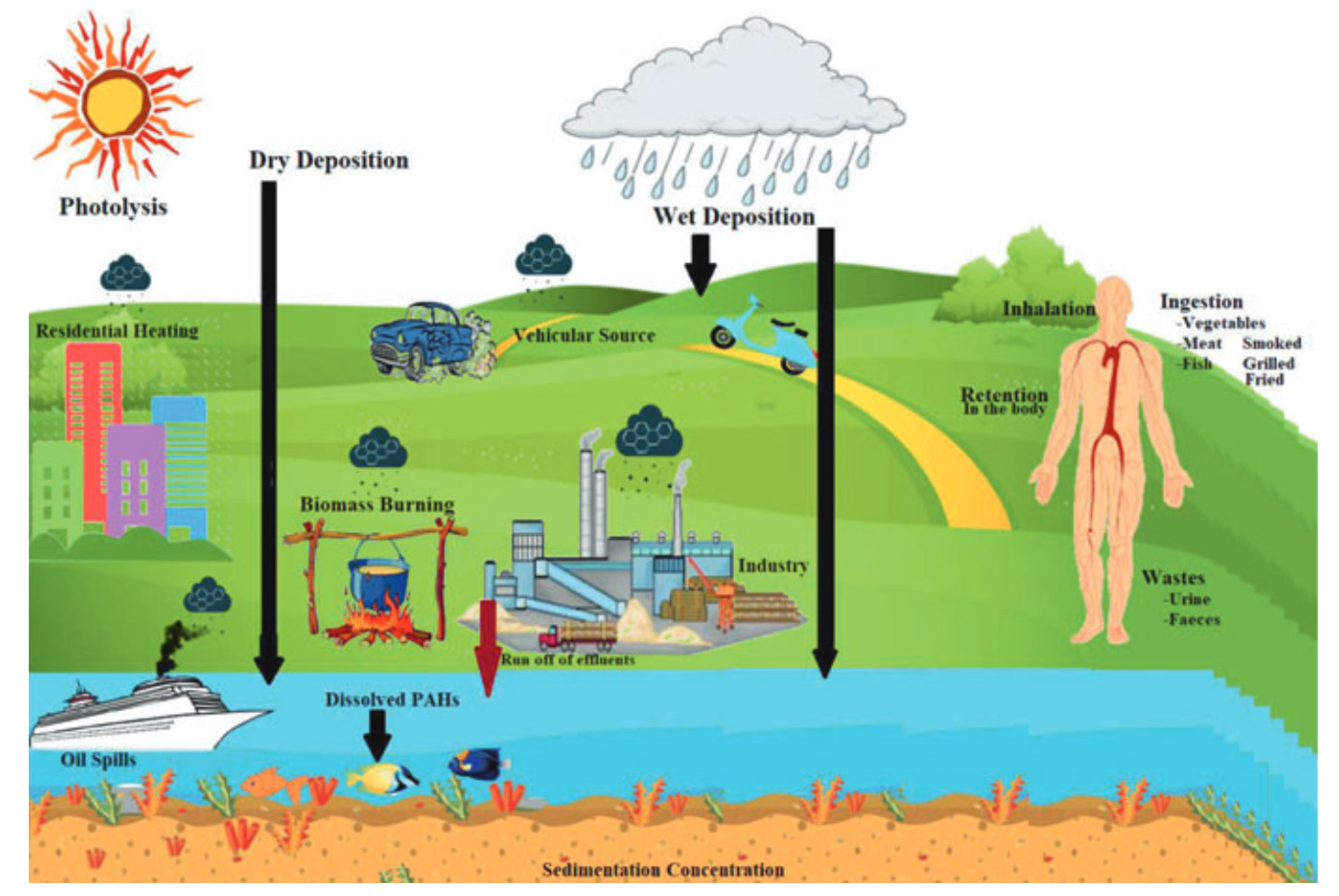
Figure 2.
Global water distribution by percentage in different reservoirs. Public domain image courtesy of [55] and data from [48].
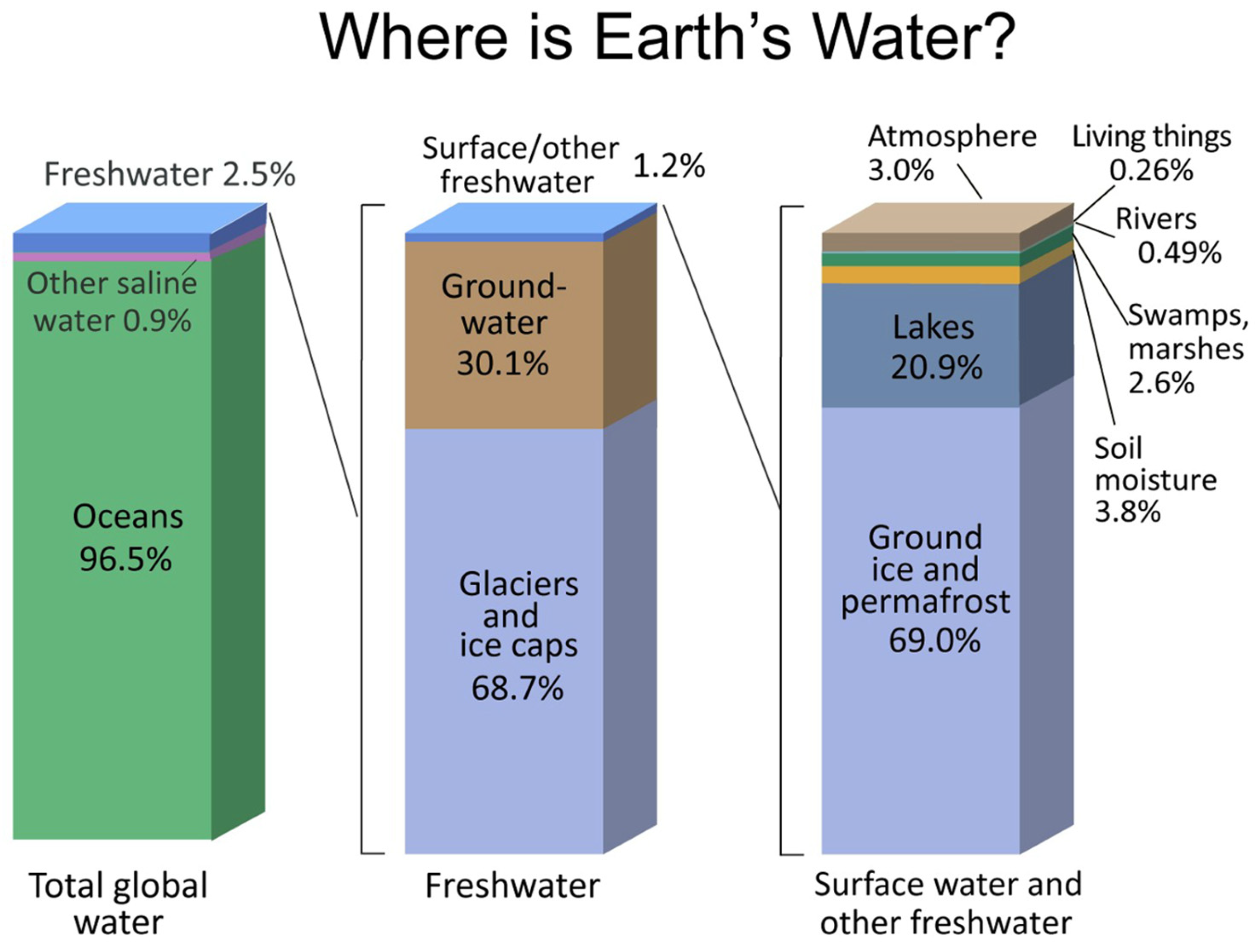
Figure 3.
Sources, distribution, and transfer of PAHs through environmental compartments in freshwater lakes until human exposure is achieved. Reprinted with permission from ref. [87], Copyright 2019, Elsevier.
Figure 3.
Sources, distribution, and transfer of PAHs through environmental compartments in freshwater lakes until human exposure is achieved. Reprinted with permission from ref. [87], Copyright 2019, Elsevier.
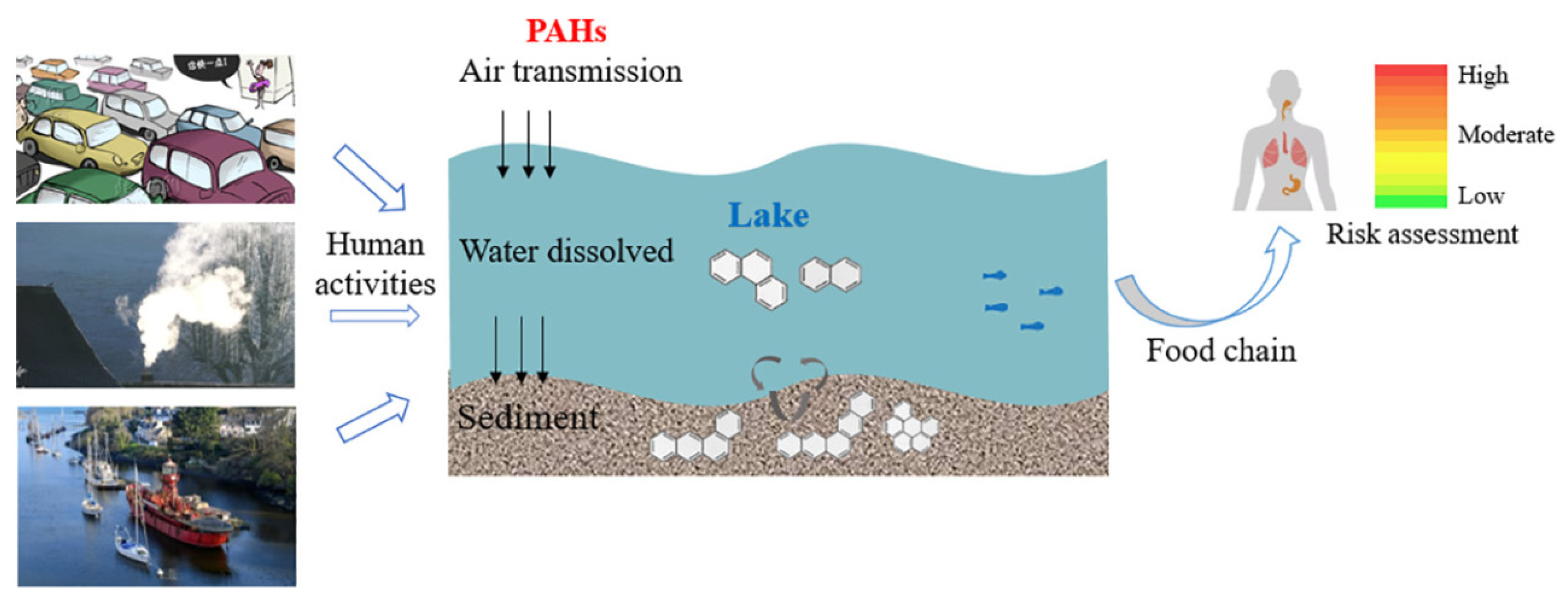
Figure 4.
The main pathways of PAHs from coal-tar based pavement, are dried sealcoat product (A), pavement dust (B) transported by surface runoff (C) that discharges dust into stormwater management infrastructure (D), streams, and lakes (E). In addition, dust attaches to vehicle tires (F) that can be transported further to other sites where wind and runoff continue to disperse PAHs to long distances (G). Attached dust in shoes transport PAHs into indoor environments (H). While volatile PAHs are released into the atmosphere by the coal-tar sealed pavement (I). Reprinted with permission from ref. [93], Copyright 2012, ACS.
Figure 4.
The main pathways of PAHs from coal-tar based pavement, are dried sealcoat product (A), pavement dust (B) transported by surface runoff (C) that discharges dust into stormwater management infrastructure (D), streams, and lakes (E). In addition, dust attaches to vehicle tires (F) that can be transported further to other sites where wind and runoff continue to disperse PAHs to long distances (G). Attached dust in shoes transport PAHs into indoor environments (H). While volatile PAHs are released into the atmosphere by the coal-tar sealed pavement (I). Reprinted with permission from ref. [93], Copyright 2012, ACS.
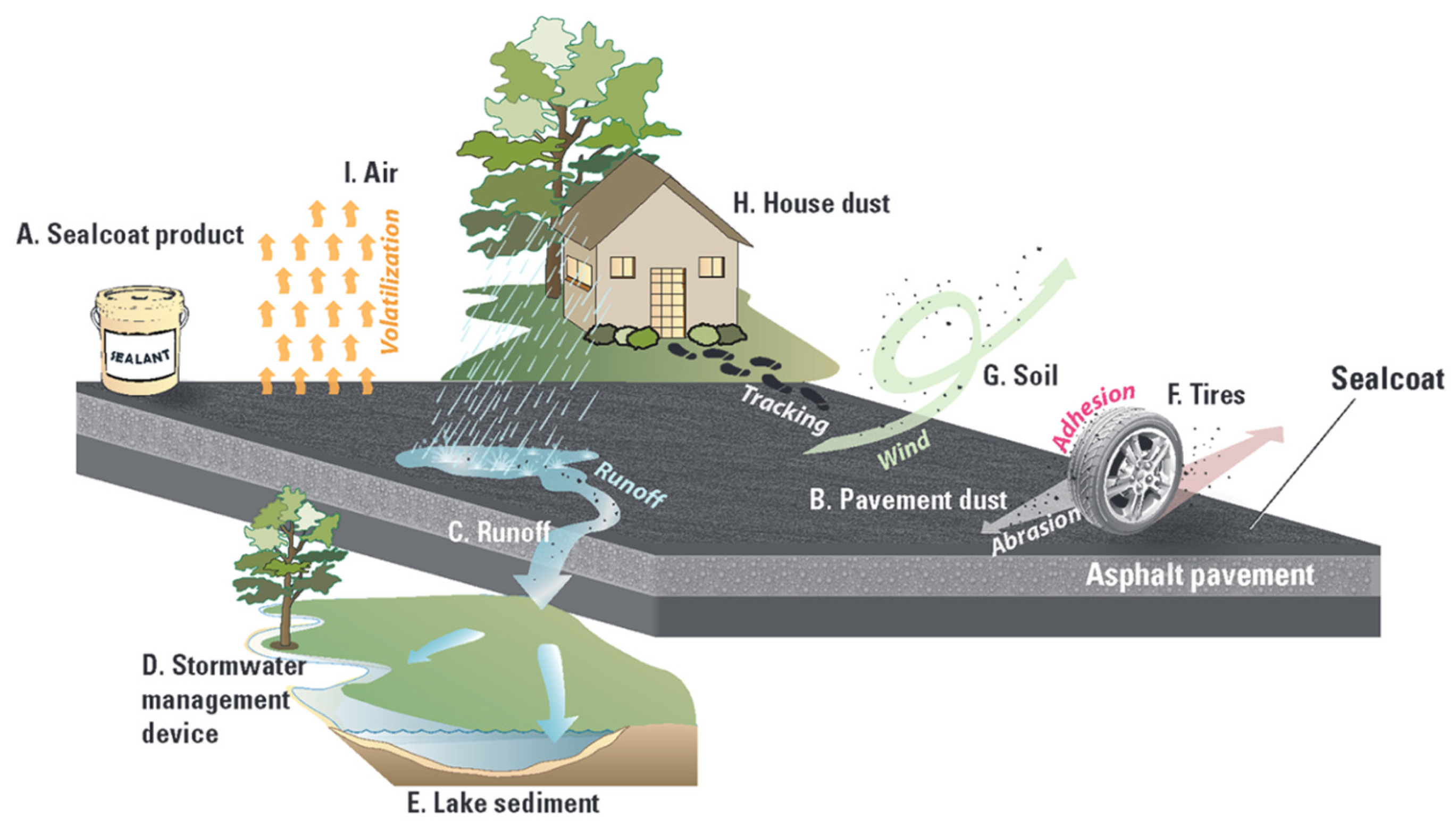
Figure 5.
Megacities water runoff from coal and coke combustions sources contributes to transport and increase in catchment retention of PAHs along Yangtze River, China. Reprinted with permission from ref. [113], Copyright 2021, Elsevier.
Figure 5.
Megacities water runoff from coal and coke combustions sources contributes to transport and increase in catchment retention of PAHs along Yangtze River, China. Reprinted with permission from ref. [113], Copyright 2021, Elsevier.
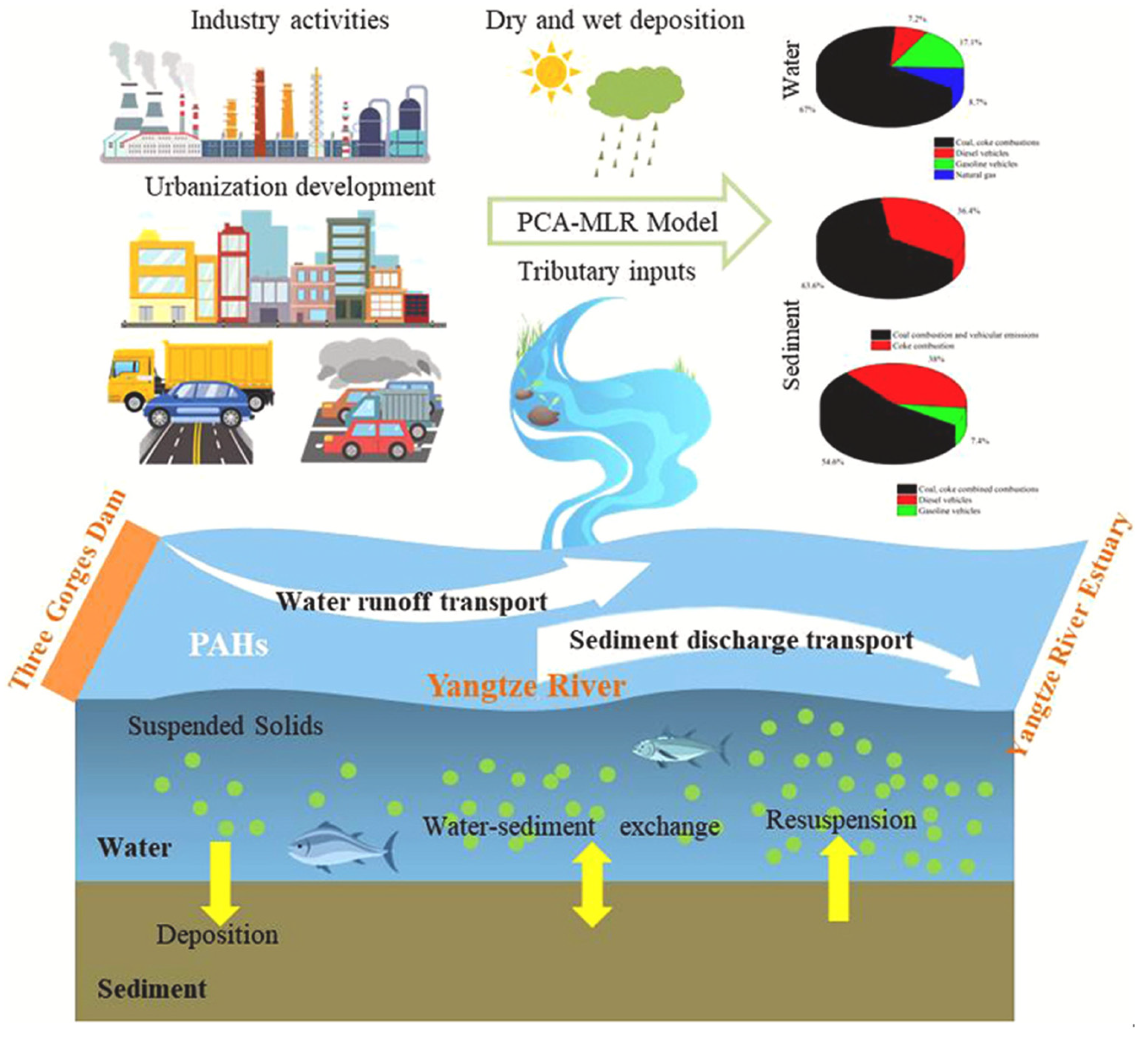
Figure 6.
Transfer, distribution, and pathways of wildfire produced PAHs into aquatic systems. Reprinted with permission from ref. [47], Copyright 2021, Elsevier.
Figure 6.
Transfer, distribution, and pathways of wildfire produced PAHs into aquatic systems. Reprinted with permission from ref. [47], Copyright 2021, Elsevier.
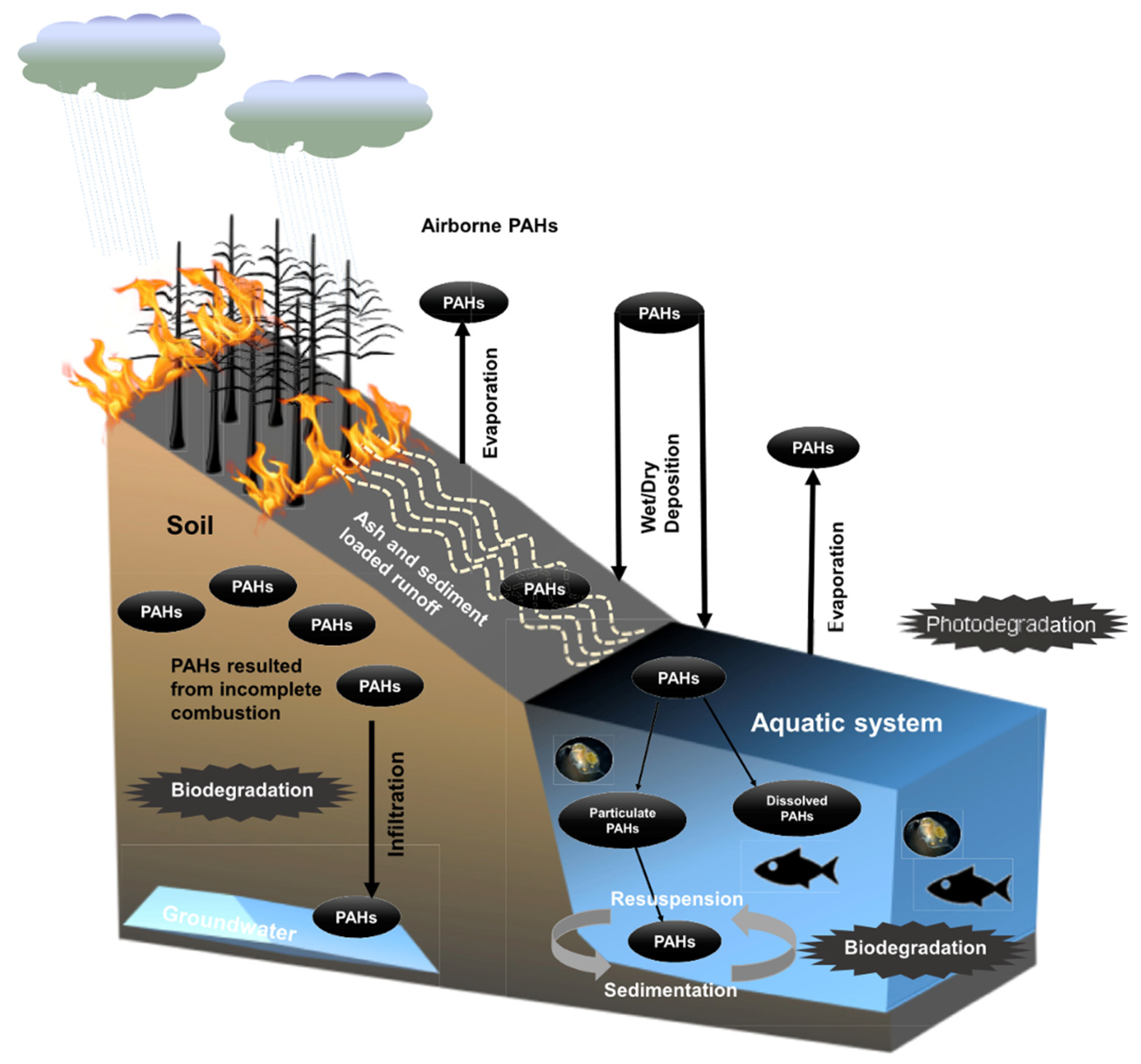
Figure 7.
Transport model for PAHs in a karst underground river system. Reprinted with permission from ref. [131], Copyright 2018, Springer.
Figure 7.
Transport model for PAHs in a karst underground river system. Reprinted with permission from ref. [131], Copyright 2018, Springer.
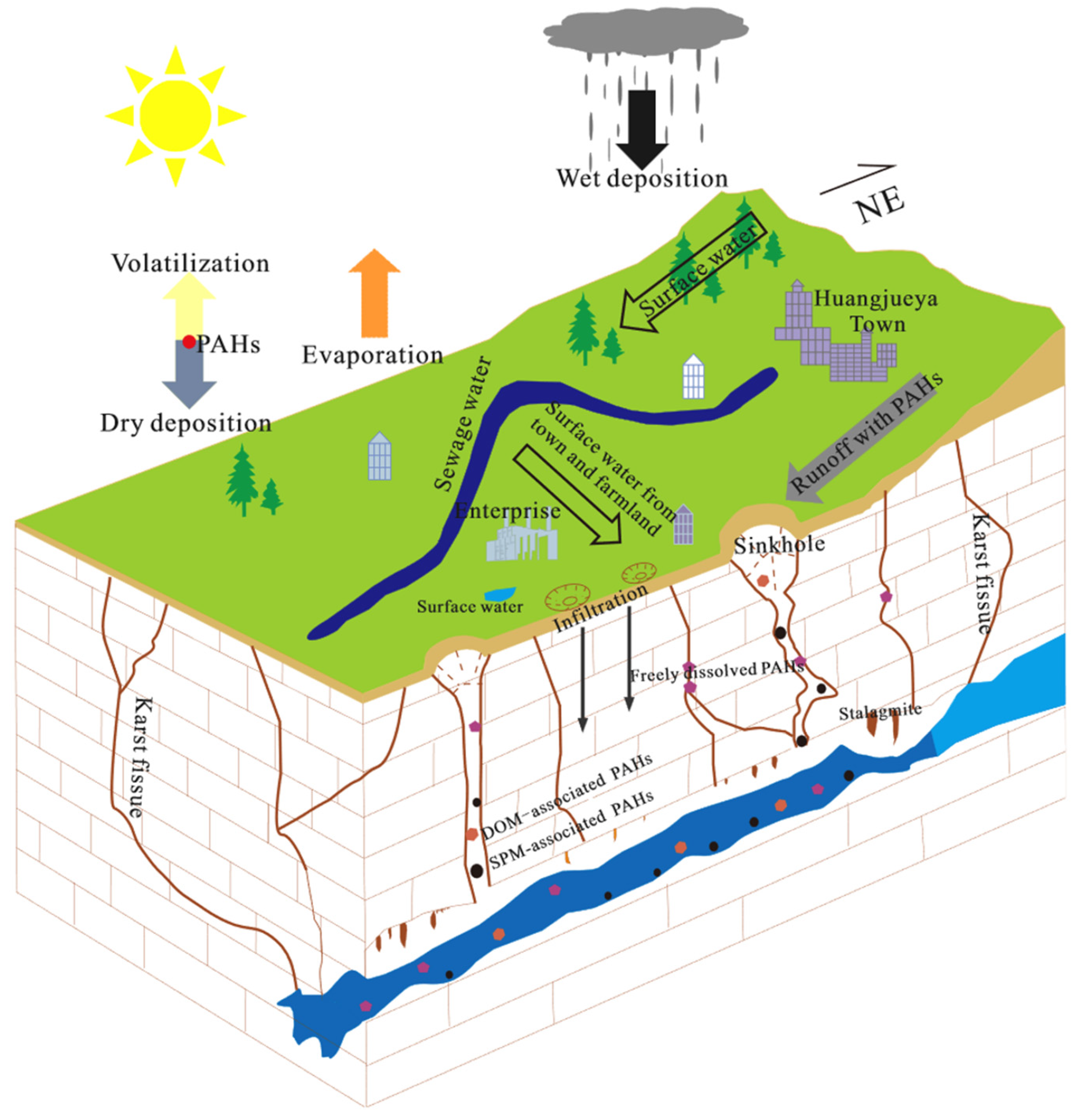
Figure 8.
PAHs sources and distribution in environmental matrices of a freshwater wetland. Reprinted with permission from ref. [59], Copyright 2023, Elsevier.
Figure 8.
PAHs sources and distribution in environmental matrices of a freshwater wetland. Reprinted with permission from ref. [59], Copyright 2023, Elsevier.
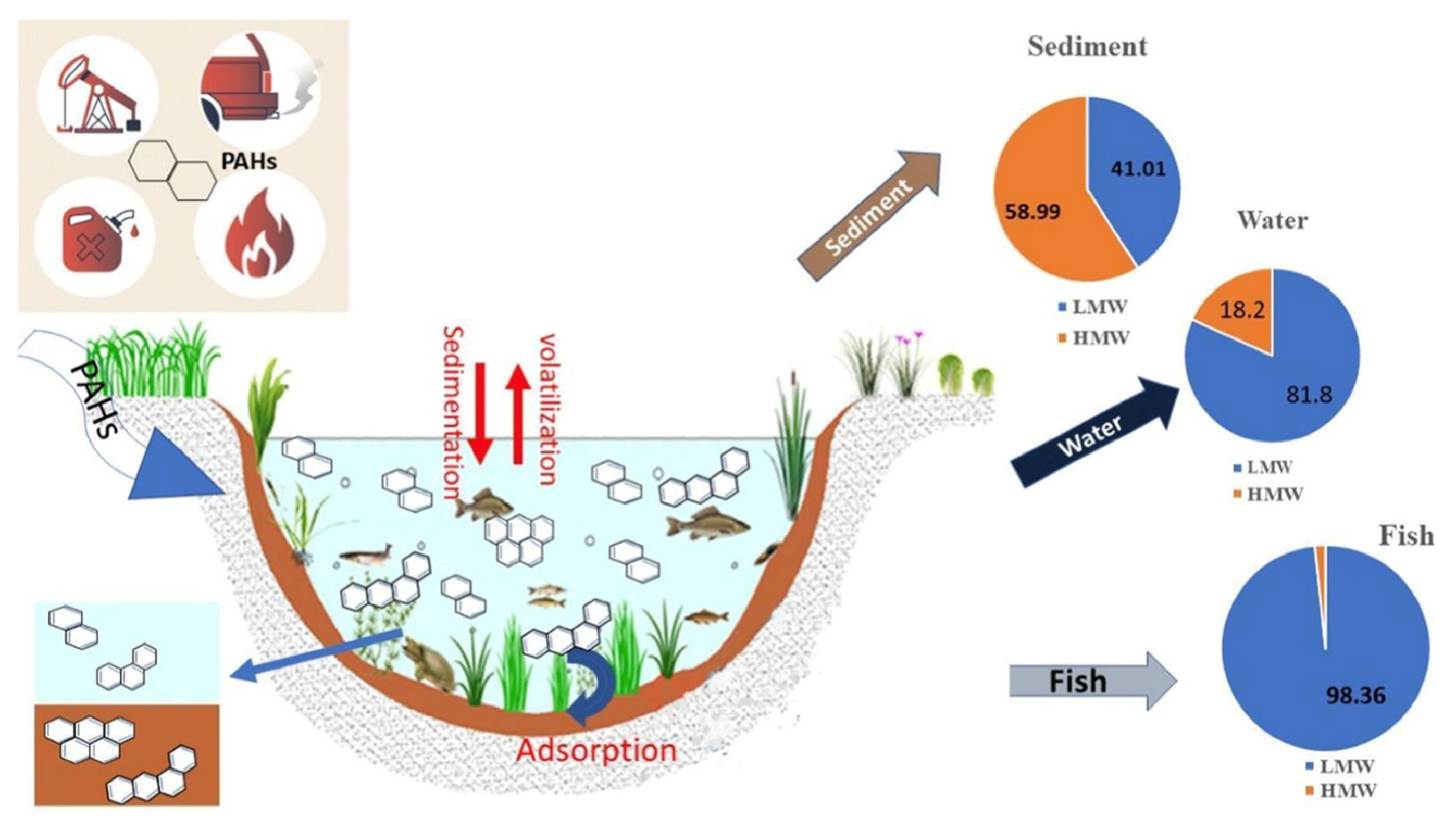
Figure 9.
Distribution of Total, LMW, and HMW PAHs in sediments, surface water, and reeds in a constructed wetland that receives water from a wastewater treatment plant. Reprinted with permission from ref. [153], Copyright 2021, Elsevier.
Figure 9.
Distribution of Total, LMW, and HMW PAHs in sediments, surface water, and reeds in a constructed wetland that receives water from a wastewater treatment plant. Reprinted with permission from ref. [153], Copyright 2021, Elsevier.
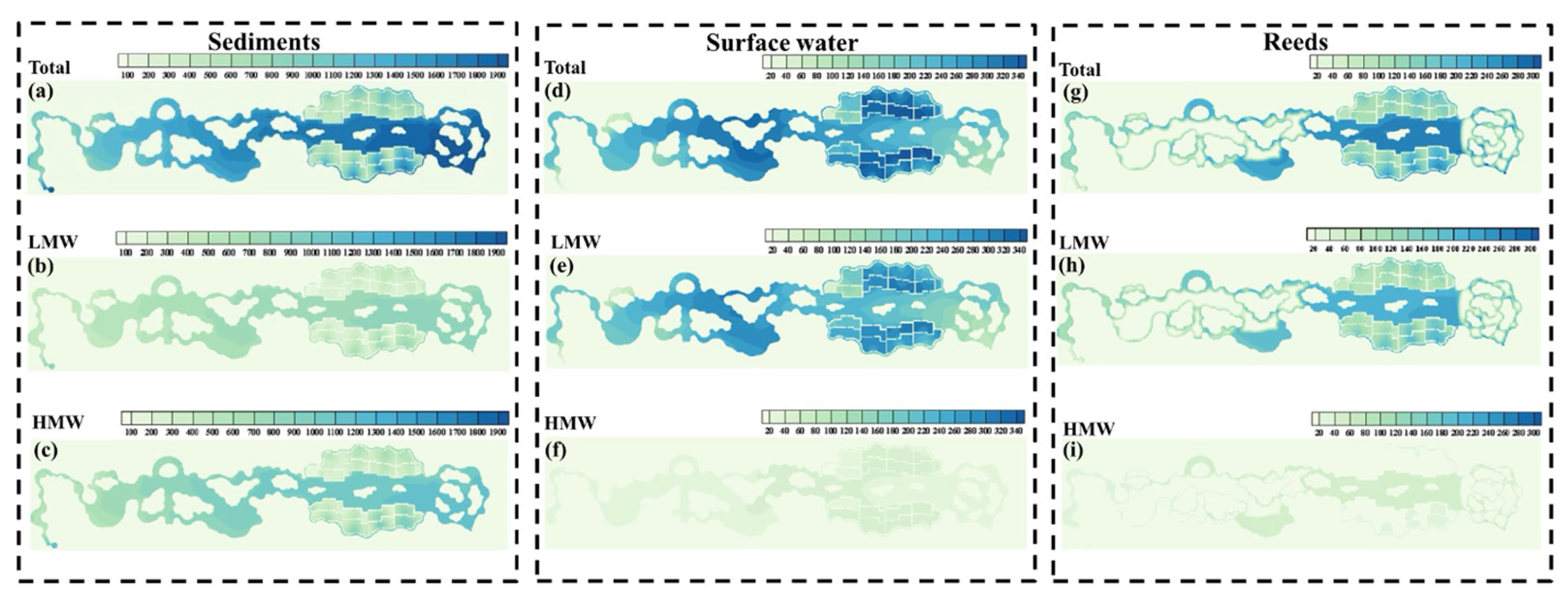
Figure 10.
PAH origins in the western shore of Admiralty Bay (King George Island, Maritime Antarctica). Reprinted with permission from ref. [173], Copyright 2019, Springer.
Figure 10.
PAH origins in the western shore of Admiralty Bay (King George Island, Maritime Antarctica). Reprinted with permission from ref. [173], Copyright 2019, Springer.
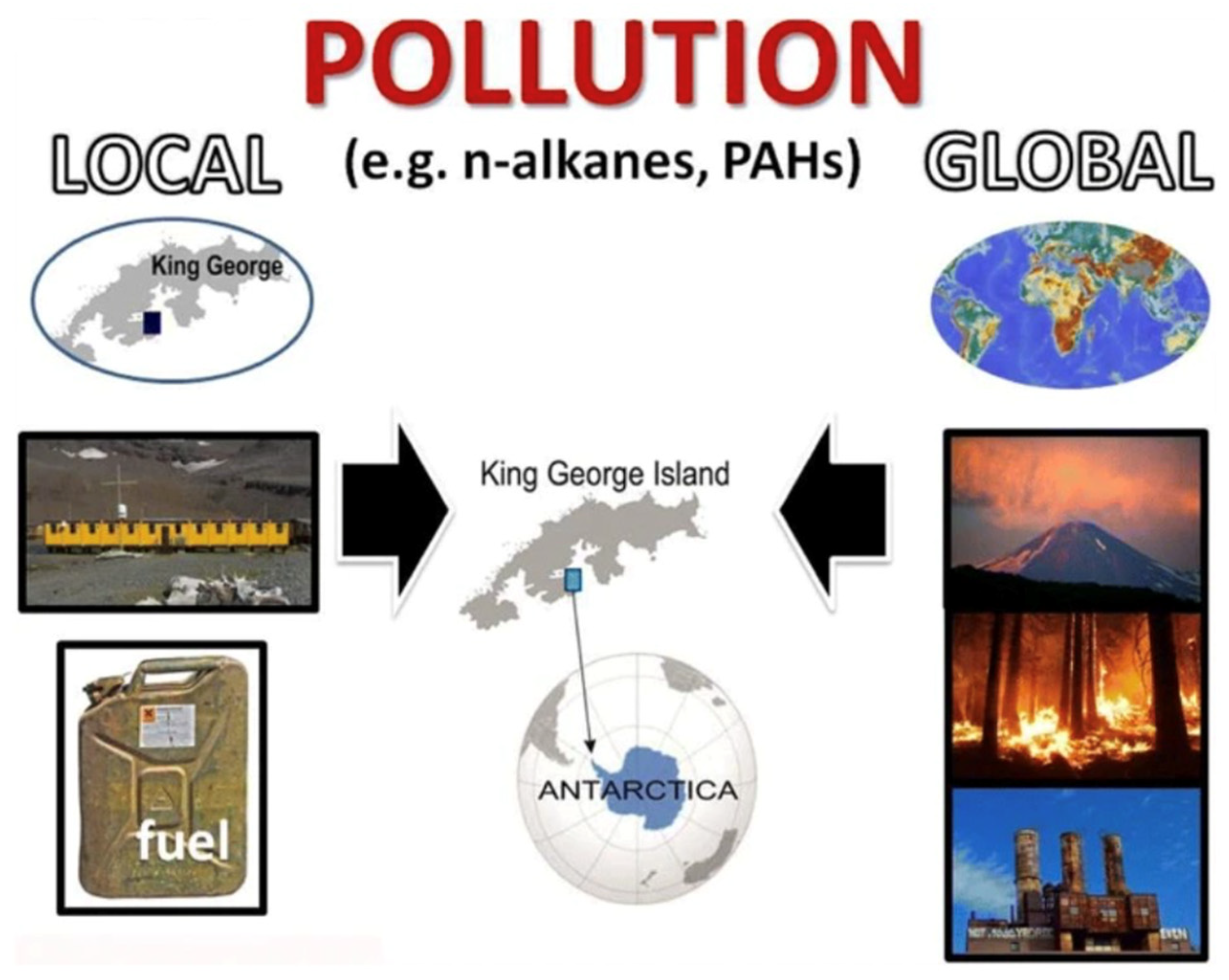

Table 1.
Physical properties and chemical structure of the 16 USEPA priority PAHs.
| No. | Name | CS(a) | Rings | Class.(b) | MW(c) | BP(d) | MP(e) | S(f) | Log Kow(g) | VP(h) |
|---|---|---|---|---|---|---|---|---|---|---|
| 1 | Naphthalene |  |
2 | LMW | 128.17 | 209 | 80 | 31.0 | 3.37 | 8.89E-2 |
| 2 | Acenaphthylene |  |
3 | LMW | 152.19 | 290 | 124 | 16.1 | 4.00 | 2.90E-0.2 |
| 3 | Acenaphthene |  |
3 | LMW | 154.21 | 252 | 108 | 3.8 | 3.92 | 3.75E-3 |
| 4 | Fluorene |  |
3 | LMW | 166.22 | 276 | 119 | 1.9 | 4.18 | 3.24E-3 |
| 5 | Phenanthrene |  |
3 | LMW | 178.23 | 326 | 136 | 1.1 | 4.57 | 6.80E-4 |
| 6 | Anthracene |  |
3 | LMW | 178.23 | 326 | 136 | 0.045 | 4.54 | 2.55E-5 |
| 7 | Fluoranthene |  |
4 | HMW | 202.25 | 369 | 166 | 0.26 | 5.22 | 8.13E-6 |
| 8 | Pyrene |  |
4 | HMW | 202.25 | 369 | 166 | 0.132 | 5.18 | 4.25E-6 |
| 9 | Benzo[a]anthracene |  |
4 | HMW | 228.30 | 400 | 177 | 0.011 | 5.91 | 1.54E-7 |
| 10 | Chrysene |  |
4 | HMW | 228.30 | 400 | 177 | 0.0015 | 5.91 | 7.80E-9 |
| 11 | Benzo[b]fluoranthene |  |
5 | HMW | 252.30 | 461 | 209 | 0.0015 | 5.80 | 8.06E-8 |
| 12 | Benzo[k]fluoranthene | 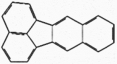 |
5 | HMW | 252.30 | 430 | 194 | 0.0008 | 6.00 | 9.59E-11 |
| 13 | Benzo[a]pyrene |  |
5 | HMW | 252.30 | 461 | 209 | 0.0038 | 5.91 | 4.89E-9 |
| 14 | Indeno [1,2,3-cd]pyrene |  |
6 | HMW | 276.30 | 498 | 233 | 0.062 | 6.50 | 1.40E-10 |
| 15 | Dibenz[a,h]anthracene |  |
6 | HMW | 278.30 | 487 | 218 | 0.0005 | 6.75 | 2.10E-11 |
| 16 | Benzo[g,h,i]perylene |  |
6 | HMW | 276.30 | 467 | 218 | 0.00026 | 6.50 | 1.00E-10 |
Table 2.
Origin and Sources of PAHs in Various Types of Freshwater Systems.
| Freshwater system | Name/Location | Environmental matrix | Origin of PAHs | PAH source | Citation |
|---|---|---|---|---|---|
| lake | Tangxun and Dong Lake, Wuhan, China | water | mixed | Petroleum biomass heavy oils natural gas |
[85] |
| lake | Soltaire and Fairbank, Central Ontario, Canada | sediment | pyrogenic | particulate deposition grass wood gasoline coal |
[92] |
| lake | Shangai, China | sediment | pyrogenic | vehicle emission coal biomass natural gas combustion |
[96] |
| lake | Lake Baikal, Siberia | aerosol | pyrogenic | wildfires | [98] |
| lake | Lake Baikal, Russia | water aerosol |
pyrogenic | wildfires | [99] |
| river | Jiulong River watershed and estuary, southeast China | water | pyrogenic | fossil fuel combustion petroleum combustion biomass combustion |
[100] |
| river | Rur River catchment, North Rhine-West-phalia, Germany | water sediment |
petrogenic | wastewater | [101] |
| river | Liujiang River Basin, China | sediment | pyrogenic | coal wood weed petroleum gasoline kerosene crude oil |
[103] |
| river | Buffalo River Estuary, South Africa | water sediment |
pyrogenic | highway runoff biomass combustion domestic wastes stormwater runoff |
[104] |
| river | Nun River, Bayelsa State, Nigeria | water | petrogenic | oil-related activities | [105] |
| river | Ekulu, Enugu metropolis, Nigeria | water | mixed | agricultural waste burning vehicular emissions power generators |
[176] |
| river | Euphrates River system, Iraq | water sediment |
pyrogenic | petroleum combustion vehicular emissions fossil fuel burning illegal waste disposal wastewater discharge |
[108] |
| river | Huaihe River, China | soil | pyrogenic | vehicular emissions biomass combustion coal combustion |
[109] |
| river | River Benue, Nigeria | sediment | mixed | coal combustion crude oil wood burning vehicular emissions |
[111] |
| river | Yangtze River, China | water sediment |
pyrogenic | coal burning coke plants biomass vehicular emissions energy consumption |
[113] |
| river | River systems, Taiwan | sediment fish |
pyrogenic | petroleum grass and wood burning coal |
[114] |
| river | Ulhas River, India | sediment | pyrogenic | wood burning coke plants coal gasoline and diesel |
[116] |
| river | Pitimbu River, Natal, Brazil | sediment | pyrogenic | biomass coal petroleum refined oil products |
[120] |
| river | Eastern Tibetean Plateau, China | water | pyrogenic | coal charcoal coking discharge |
[102] |
| river | Great Lakes tributaries, USA and Canada | sediment | petrogenic | coal-tar-sealed pavement | [94] |
| stream | Suzhou Industrial Park, China | sediment | pyrogenic | biomass coal petroleum |
[117] |
| stream | Oliwski and Strzyza, Gdansk, Poland | sediment | pyrogenic | biomass coal petroleum |
[119] |
| stream | North-central Portugal | water | pyrogenic | biomass wildfires |
[121] |
| stream | Monastir Bay, Tunisia | sediment | mixed | road runoff domestic wastewater industrial wastewater workshops waste oil industrial activity |
[123] |
| groundwater | Yellow River Estuary, China | water | pyrogenic | fossil fuels coal natural gas vehicular emissions |
[127] |
| groundwater | Chongqing, Southwest, China | water soil |
pyrogenic | grass wood coal |
[78] |
| groundwater | Abou Ali River-North Lebanon | water | pyrogenic | fuel incineration miscellaneous burning |
[128] |
| groundwater | Peri-Urban Forest Area, Braga Region, NW Portugal | water | pyrogenic | grass wood coal |
[129] |
| groundwater | Banja Luka, Republic of Srpska, Bosnia and Herzegovina | soil | mixed | traffic emissions coal combustion biomass combustion |
[130] |
| groundwater | Nanchuan catchment, Chongqing, Southwest, China | soil water |
pyrogenic | coal combustion vehicular emissions |
[132] |
| groundwater | Lanzhou, Shijiazhuang, and Golmud and Du’an County, China | water | mixed | oil pipeline leakage coal combustion wood and straw burning |
[133] |
| groundwater | Campania Plain, South Italy | water | pyrogenic | carbon and fuel | [134] |
| groundwater | Eleme, Nigeria | water soil |
mixed | petroleum extraction | [135] |
| wetland | Shadegan wetland, Iran | sediment water |
mixed | bulrush burning biomass combustion heavy gasoline oils lubricating oils used motor oils |
[138] |
| wetland |
Anzali Wetland, Caspian Sea, Iran | sediment | petrogenic | fuel oil light refined oil |
[147] |
| wetland | Anzali Wetland, Caspian Sea, Iran | water sediment fish |
mixed | crude oil combustion diesel fuel biomass coal and oil leakage |
[59] |
| wetland | Coastal Industrial Zone, Tianjin, China | sediment water reed |
mixed | fossil fuels combustion petroleum leakage |
[153] |
| wetland | Ashtamudi Wetland, south-west coast, India | sediment | mixed | biomass burning fuel combustion oil leakage |
[155] |
| wetland | Hoor Al-Azim Wetland, Iran | sediment | mixed | fossil fuel combustion oil leakage |
[140] |
| wetland | Momoge Wetland, China | soils | mixed | petroleum combustion coal combustion petroleum spills |
[157] |
| wetland | Miankaleh International Wetland, Iran | water sediment |
mixed | fossil fuel sewage discharge port activity |
[158] |
| wetland | Baghjan, upper Assam, India | water sediment fish |
petrogenic | oil spill | [159] |
| peatland | Songkhla Lake Basin Swamp Forest, Thailand | air | pyrogenic | biomass and peat burning | [161] |
| bog | Southern Taiga of Western Siberia | water peat |
pyrogenic | biomass and peat burning wildfires | [162] |
| marsh | Pantanal Biome, Brazil | soil | pyrogenic | biomass burning wildfires |
[168] |
| glacier | Tibetan Plateau, China | meltwater | pyrogenic | coal incomplete combustion biomass combustion coking discharge |
[102] |
| glacier | Kongsfjorden, Svalbard, Norway | water | pyrogenic | diesel fuel leakage heat and power generation dust from coal mining long-range transport |
[171] |
| glacier | Kongsfjorden, Arctic | water | pyrogenic | grass wood coal |
[172] |
| glacier | Admiralty Bay, King George Island, Maritime Antarctica | water | petrogenic | fuel consumption local human activity |
[173] |
| glacier | King George Island, Antarctica | soil | petrogenic | electricity generators light-duty gasoline fuel consumption |
[174] |
| glacier | Eastern Tibetean Plateau, China | water | pyrogenic | coal charcoal coking discharge |
[102] |
Disclaimer/Publisher’s Note: The statements, opinions and data contained in all publications are solely those of the individual author(s) and contributor(s) and not of MDPI and/or the editor(s). MDPI and/or the editor(s) disclaim responsibility for any injury to people or property resulting from any ideas, methods, instructions or products referred to in the content. |
© 2024 by the authors. Licensee MDPI, Basel, Switzerland. This article is an open access article distributed under the terms and conditions of the Creative Commons Attribution (CC BY) license (http://creativecommons.org/licenses/by/4.0/).
Copyright: This open access article is published under a Creative Commons CC BY 4.0 license, which permit the free download, distribution, and reuse, provided that the author and preprint are cited in any reuse.


