

Submitted:
04 September 2025
Posted:
05 September 2025
You are already at the latest version
Abstract
Polycyclic aromatic hydrocarbons (PAHs) are persistent organic pollutants with significant ecological and public health implications, particularly in urban wetlands exposed to chronic anthropogenic stress. This study evaluates the occurrence, spatial distribution, seasonal variability, and ecological risk of three low molecular weight PAHs (naphthalene, phenanthrene, and anthracene) in surface waters of Caño La Malaria, the main freshwater source of Cucharillas Marsh, Puerto Rico’s largest urban wetland. Samples were collected at four locations across multiple seasons. Liquid-liquid extraction, rotary evaporation, and GC-MS were used for quantification. naphthalene was the dominant compound, with total PAH concentrations ranging from 7.4 to 2,198.8 ng/L, and most wet season samples falling within the mild-to-moderate contamination range. PAH levels were significantly higher in the wet season (mean = 4,434.66 ng/L) than in the dry season (mean = 1,245.08 ng/L), confirmed by Friedman test (p < 0.000001). Compositional shifts indicated increased levels of phenanthrene and anthracene during the wet season. No significant spatial differences were found (p = 0.753), and high correlations between sites (r = 0.96) suggest uniform input sources. Diagnostic ratios, inter-species correlations, and principal component analysis (PCA), all support a predominant pyrogenic origin. High correlations between phenanthrene and anthracene (r = 0.824) further suggest shared combustion-related sources. PCA revealed a clear separation between dry- and wet-season samples, with the latter showing greater variability and stronger associations with naphthalene and anthracene. Ecological risk assessment using hazard quotients (HQ) indicated insignificant acute toxicity risk across all sites and seasons, with all HQ values <0.01. The highest HQ (0.0095) occurred upstream during the wet season, approaching the threshold for low ecological risk. These findings support integrated watershed management practices to control PAH pollution and ensure long-term ecological health in this tropical urban wetland.
Keywords:
Polycyclic aromatic hydrocarbons
; urban wetland
; surface water
; distribution
; PAH
1. Introduction
Polycyclic aromatic hydrocarbons (PAHs) are a diverse group of semi-volatile organic compounds composed of two or more fused aromatic rings. PAHs are typically categorized into low molecular weight (LMW) PAHs—comprising 2 to 3 aromatic rings—and high molecular weight (HMW) PAHs, which contain 4 or more rings [1]. This classification influences their behavior in the environment, as LMW-PAHs tend to be more soluble and volatile, while HMW-PAHs are more persistent and prone to sediment accumulation [2,3]. These compounds originate from a variety of natural and anthropogenic sources [1,4], including incomplete combustion of fossil fuels and biomass (pyrogenic) [5], petroleum refining and spillage (petrogenic), and biological synthesis by microorganisms and plants (biogenic) [1]. Combustion-related activities—such as the burning of fossil fuels [6] and wildfires—are among the primary environmental sources of PAHs globally, contributing to their widespread occurrence across atmospheric [7], terrestrial [8], and aquatic systems [9,10]. After their release into the environment, PAHs are transported between environmental compartments via pathways such as atmospheric deposition [11], urban runoff [12,13], and wastewater discharge [14]. These processes lead to their accumulation in sediments [15] and their transfer through food webs via bioaccumulation [16,17], ultimately resulting in biomagnification [18]. Due to their low solubility in water, high hydrophobicity [19], and chemical stability [20], PAHs are considered persistent organic pollutants (POPs) that exert toxic effects on biota following bioaccumulation [21].
The environmental persistence and ubiquity of PAHs has raised global concern due to their mutagenic, teratogenic, and carcinogenic effects [22,23] on ecosystems and human health [24,25]. Accordingly, regulatory agencies such as the United States Environmental Protection Agency (USEPA) have designated 16 PAHs as priority pollutants [26,27], based on their toxicity and ecological impact [28]. In aquatic environments, PAHs can affect a broad spectrum of organisms across trophic levels [29] and have been associated with sublethal effects such as oxidative stress, immunotoxicity, and reproductive impairment [30]. Such impacts are especially concerning in shallow, urban-influenced wetlands where PAH exposure is amplified by stormwater inputs [31] and limited dilution capacity [32].
Urban wetlands, located within or near densely populated areas, function as transitional ecosystems that provide critical services such as water filtration, flood control, and habitat for aquatic organisms [33]. Located in close proximity to anthropogenic emission sources, they are particularly vulnerable to contamination by persistent organic pollutants like PAHs [34,35]. In tropical urban regions, wetlands frequently receive inputs from traffic emissions, industrial discharges, atmospheric deposition, and unregulated stormwater runoff, often acting as both reservoirs and conduits for these contaminants [36,37,38]. Despite their role as pollutant sinks, they can also function as natural ecological filters, attenuating PAHs through microbial degradation, sedimentation, and plant uptake under favorable conditions [39].
Elevated concentrations of PAHs have been reported in urban rivers, lakes, and drainage canals across Asia, Africa, and Latin America, frequently surpassing international water quality standards [40,41,42,43]. Enclosed or semi-enclosed wetlands—such as urban marshes—often retain higher PAH loads due to restricted hydrological exchange and elevated organic matter content, which increase the potential for sedimentary accumulation and long-term ecological impacts [44,45,46]. Their shallow waters, organic-rich sediments, and limited flushing can enhance pollutant retention and ecological exposure [33,35]. However, in tropical urban wetlands, where environmental dynamics are intensified by climatic variability and human pressures—integrated assessments that capture the spatial and seasonal behavior of mobile PAH fractions, such as LMW-PAHs, remain scarce.
Spatial and seasonal assessments of PAHs—LMW-PAHs such as naphthalene (NAP ), phenanthrene (PHEN), and anthracene (ANT)—remain limited in tropical urban wetlands [47,48]. Due to their phase behavior and environmental mobility, these compounds are readily transported during rainfall events, which facilitates their dispersion but makes them difficult to monitor through sediment-based approaches [49,50]. In tropical urban environments, high temperatures and intense land-use pressures may amplify their ecological risks, through seasonal microbial degradation dynamics and transient contamination pulses [3,51,52,53]. However, studies that also quantify the ecological risk associated with LMW-PAH concentrations in tropical island wetlands remain notably absent.
Caño La Malaria is a tidal-influenced urban waterway within the highly urbanized Cucharillas Marsh watershed in Cataño, Puerto Rico, which plays a critical role in connecting upland runoff with the San Juan Bay Estuary [54,55,56]. It receives runoff from roads, informal settlements, and industrial zones before discharging into the San Juan Bay Estuary. Prior studies have reported elevated levels of fecal coliforms, heavy metals, and untreated sewage [56,57,58], yet the occurrence and seasonal behavior of PAHs in its surface waters remains uncharacterized. Given its location within a protected natural reserve and the lack of PAH monitoring in tropical urban channels in Puerto Rico, Caño La Malaria offers a relevant case study for evaluating spatial and seasonal variability of these compounds in an ecologically vulnerable wetland system.
Although PAHs are widely recognized as significant aquatic pollutants, comprehensive field assessments in tropical island environments are still scarce. Particularly in Puerto Rico, existing research has focused primarily on estuarine sediments and amphibian habitats [59,60,61,62], with no studies addressing the occurrence or seasonal variability of PAHs in waters of urban channels like Caño La Malaria, despite previous recommendations [63] and recent evidence of human exposure [64,65]. This urban waterway represents a critical yet understudied conduit of pollutant transfer into a protected tropical urban wetland. Within this context, this study addresses a critical knowledge gap by evaluating the occurrence, spatial distribution, seasonal trends, and potential sources of three LMW-PAHs—NAP, PHEN, and ANT—in Caño La Malaria. In addition, it integrates an ecological risk assessment (ERA) based on measured surface water concentrations and toxicity thresholds to estimate potential impacts on aquatic organisms. These findings support future monitoring and restoration efforts in tropical urban wetlands under similar anthropogenic pressures. This need is further emphasized by the lack of region-specific studies and long-term environmental assessments of PAH contamination in Caribbean urban wetlands, underscoring the urgency of sustained monitoring and management efforts [66].
2. Materials and Methods
2.1. Study Area and Sampling Design
Caño La Malaria is a tidal-influenced estuarine channel located in the municipality of Cataño, on the northern coast of Puerto Rico (18.4450° N, 66.1178° W). It functions as the primary hydrological conduit for surface water flow from the Cucharillas Marsh watershed into the San Juan Bay Estuary [56]. The channel receives year-round surface water inputs from upland tributaries such as the Santa Catalina and San Diego streams [67], which contribute to its continuous outflow into San Juan Bay. Its hydrological regime is artificially regulated by tide gates and a pump system located at the outlet, which limit marine–terrestrial exchange, block tidal inflow, and promote freshwater retention under seasonal rainfall conditions [54,55]. The region follows a bimodal precipitation pattern characteristic of Puerto Rico and the wider Caribbean, with a dry season (December–March), early rainfall (April–July), a brief midsummer drought, and late rainfall season (August–November) [68,69].
Surface water samples were collected at four fixed sampling sites—upstream (U), midstream (M), downstream (D), and outlet (O)— representing spatial variation from upstream headwaters to the canal’s outlet. Site selection was based on proximity to stormwater discharge points, urban infrastructure, and accessibility during both dry and wet seasons. A total of four sampling campaigns were conducted in March, September, and November 2022, and February 2023, corresponding to two dry- and wet-season events. At each sampling station and campaign, duplicate surface water samples were collected. Figure 1 illustrates the geographic context of the study area, including watershed boundaries, drainage features, and the spatial distribution of surface water sampling sites along Caño La Malaria.
2.2. Materials and Reagents
Surface water samples were collected in pre-assembled amber wide-mouth glass bottles (LabForce®, Thomas Scientific), equipped with PTFE-lined caps to prevent analyte adsorption and minimize photodegradation of PAHs during transport and storage. All laboratory glassware used in sample collection, extraction, and concentration was thoroughly cleaned following a multi-stage protocol. This included sequential washing with 1 % (w/v) Alconox® detergent solution, rinsing with distilled water, repeated rinses with deionized water, acid rinsing with 50% nitric acid to remove metal and organic residues, followed by additional deionized water rinses, and a final rinse with acetone. The glassware was subsequently dried in a laboratory oven at 100 °C for a minimum of 2 hours prior to use. The liquid-liquid extraction procedure employed certified HPLC-grade dichloromethane (DCM; CAS No. 75-09-2; GFS Chemicals). Anhydrous sodium sulfate (CAS No. 7757-82-6; Thermo Fisher Scientific), was used to remove residual water from the organic extracts. Analytical standards of PAHs, including NAP, PHEN, and ANT, were obtained as a certified solution at 1,000 µg/mL in DCM (Agilent Technologies, Method 610-compliant), and were used for calibration and quality control of gas chromatography-mass spectrometry (GC-MS) quantification procedures.
2.3. Sample Preparation and Extraction
PAHs were extracted from 1-liter surface water samples within 48 hours of collection to minimize degradation, using a liquid–liquid extraction adapted from the USEPA standard method [70]. Each sample was transferred to a 2,000 mL separatory funnel and extracted with three portions of 60 mL of DCM. The combined organic phases were dried with anhydrous sodium sulfate, followed by gravity filtration through Whatman #1 filter paper to eliminate particulate matter and drying agent. The dried extract was concentrated to dryness using a rotary evaporator. The residue was then reconstituted in 5 mL of DCM and transferred to amber glass vials. Extracts were stored at 4–6 °C in a laboratory-grade refrigerator and analyzed within 7 days. Each extract was injected in triplicate into the GC–MS.
2.4. GC-MS Instrumental Analysis
LMW-PAHs were quantified by GC–MS using a Shimadzu GC-2010 Plus–QP2020 system (Shimadzu, Kyoto, Japan). Separation of the target compounds was achieved using a Restek Rxi-5Sil MS capillary column (30m × 0.25mm i.d., 0.25µm film thickness; Restek Corporation, Bellefonte, PA, USA) with high-purity helium (99.999%) as the carrier gas at a constant linear velocity of 43.7 cm/s. The injection was conducted in splitless mode with an injector temperature of 300 °C, and an injection volume of 1 µL was delivered using an AOC-20i autosampler (Shimadzu, Kyoto, Japan). The oven temperature program was set as follows: initial temperature of 90 °C (held for 2 min), ramped at 5 °C/min to 320 °C, with a final hold time of 12 min, for a total runtime of 60 min. The MS was operated in electron ionization (EI) mode at 70eV, with an ion source temperature of 230 °C and an interface temperature of 300 °C. The solvent cut time was set at 3.5 min. Data acquisition was performed in Selected Ion Monitoring (SIM) mode, targeting characteristic m/z values of 128 (NAP), 178 (PHEN and ANT). Isomeric differentiation between PHEN and ANT was achieved by comparing retention times to those of certified standards.
2.5. Data Processing and Statistical Analysis
All GC-MS chromatograms were processed using the Postrun Analysis module of GCMSsolution software (Shimadzu Corporation, Japan) to quantify the peak areas and retention times of the target PAHs. External calibration curves were constructed using certified PAH standards (NAP, PHEN, and ANT) at known concentrations in DCM. The coefficient of determination (R²) for each compound exceeded 0.99. Quantified concentrations were compared against national and international water quality guidelines to assess their ecological significance. The Shapiro–Wilk test indicated that ∑3PAHs concentrations were not normally distributed (W = 0.76, p < 0.01, n = 16), supporting the use of non-parametric statistical tests. Accordingly, the Friedman test was applied to assess spatial and seasonal differences in PAH concentrations, using a significance level of α = 0.05. All statistical analyses were performed using Microsoft Excel (Microsoft 365; Microsoft Corporation, Redmond, WA, USA).
2.6. Quality Assurance and Quality Control
External calibration curves for each PAH were prepared daily using at least seven concentration levels (0.10–100.0 ng/L), achieving high linearity (R² > 0.99). The limits of detection (LOD) and limits of quantification (LOQ) were determined for each analyte and batch using the method based on the standard deviation of the intercept divided by the slope of the calibration curve [72]. LOD and LOQ were calculated using the formulas: LOD = 3.3 × SE / m and LOQ = 10 × SE / m, where SE is the standard error of the y-intercept and m is the slope of the calibration curve. All reported concentrations above LOQ were considered quantifiable, while values between LOD and LOQ were labeled nonquantifiable (NQ). LOD values ranged from 1.72 to 433.14 ng/L, and LOQ values ranged from 5.22 to 1312.56 ng/L across the four sampling campaigns (see Supplementary Table S2).
Blanks consisting of HPLC-grade DCM were injected into GC-MS throughout each run to confirm the absence of carryover and instrument background contamination. No target PAHs were detected in the blanks. Analytical precision was assessed through duplicate sample acquisition and triplicate injections in the GC-MS. Relative standard deviation (RSD) and coefficient of variation values were calculated for each sample (see Supplementary Table S3). Nondetected (ND) values in individual injections were treated as zero for mean concentration calculations.
2.7. Ecological Risk Assessment
To estimate the potential ecological risk associated with NAP in surface waters of Caño La Malaria, we applied the Hazard Quotient (HQ) method [73,74,75,76]. The HQ was calculated as follows:
HQwater = ECwater/PNECwater
PNECwater = L(E)C50/AF
The ECwater represents the maximum concentration of NAP detected in surface water (ng/L). The predicted no-effect concentration in water (PNECwater) was derived from acute toxicity data for Callinectes sapidus (blue crab), a native estuarine decapod crustacean widely distributed across Puerto Rico’s coastal wetlands [77]. Based on the 96-hour LC₅₀ (lethal concentration for 50% of test organisms), the lowest observed L(E)C₅₀ was 0.68 mg/L, applying an assessment factor (AF) of 10, and yielding a PNECwater of 0.068 mg/L (68,000 ng/L) [78]. Toxicity data for NAP, were obtained from the ECOTOX database [79].
HQ values were then calculated for each site and sampling date using the maximum observed NAP concentrations to reflect worst-case exposure scenarios. Ecological risk categories were assigned following the classification criteria by Li et al. [76]:

Table 1.
Ecological risk classification based on HQwater values [76].
Table 1.
Ecological risk classification based on HQwater values [76].
| HQwater Range | Ecological Risk Category |
|---|---|
| HQwater < 0.01 | Insignificant |
| 0.01 ≤ HQwater < 0.1 | Low |
| 0.1 ≤ HQwater < 1.0 | Moderate |
| HQwater ≥ 1.0 | High |
3. Results
3.1. Spatial and Seasonal Variability in PAH Concentrations
Table 2 presents the concentrations of NAP, PHEN, and ANT across four seasonal sampling campaigns and four stations along Caño La Malaria. PAH concentrations exhibited marked variability, with higher levels recorded during the wet season (September and November 2022) compared to the dry season (March 2022 and February 2023). For instance, Σ3PAHs during the dry season ranged from 7.40 ng/L (U, March) to 363.11 ng/L (O, February), while wet season values spiked up to 929.57 ng/L (M, September) and peaked at 2198.83 ng/L (U, November), driven by extreme ANT concentrations (up to 1313.60 ng/L). NAP was the most abundant compound, reaching 485.10 ng/L (U, September), although its dominance shifted to ANT in November. PHEN varied broadly (ND–557.43 ng/L), with notable peaks at M and U sites. The O consistently registered Σ3PAHs between 43.43–712.54 ng/L across all campaigns, underscoring its role as the final receptor before discharge into San Juan Bay.
Figure 2 presents the seasonal and spatial distribution of Σ3PAHs concentrations in surface waters of Caño La Malaria. Panel A illustrates that mean Σ3PAHs concentrations were elevated during the wet season, reaching 777.75 ng/L in September and 713.82 ng/L in November, in contrast to lower values observed in the dry season—31.44 ng/L in March and 343.09 ng/L in February. Panel B further underscores this seasonal trend, showing that overall mean concentrations during the wet season (4434.66 ng/L) were more than three times higher than those recorded during the dry season (1245.08 ng/L). Panel C depicts the spatial variation across the four sampling sites, with site U consistently exhibiting the highest concentrations, particularly in November 2022, whereas sites D and O showed persistently lower levels throughout the sampling period.
A Friedman test confirmed seasonal differences in Σ3PAHs concentrations across the four sampling campaigns (χ² = 21.00, p = 4.59 × 10⁻⁶), supporting the trend of elevated PAH levels during the wet season. In contrast, no significant differences were found among the sampling sites (χ² = 1.20, p = 0.753), suggesting a homogeneous spatial distribution of PAHs across Caño La Malaria, despite marked seasonal variability.
3.3. PAH Sources and Compositional Patterns
3.3.1. Compositional Patterns
Figure 3 illustrates the relative percentage composition of the three LMW-PAHs across all sampling sites and dates. During the first sampling campaign (March 2022), NAP dominated the ∑3PAHs composition at all sites, representing 80–100% of the total concentration. PHEN contributed at sites M and O (16–20%), while ANT was either absent or accounted for less than 10%. By September 2022, the compositional profile became more balanced, especially at sites U and M, where NAP accounted for approximately 59% and 36%. PHEN and ANT showed increased contributions at these sites during the wet season (e.g., PHEN: 16-39%; ANT: 25–24%).
In November 2022, ANT became the dominant compound at all sites, notably at U and M, where it represented approximately 60% and 57% of ∑3PAHs. PHEN also remained elevated (25–58%), while NAP accounted for less than ~20% of the total. In February 2023, PHEN was the most abundant PAH at sites D and O, contributing approximately 59% and 63% of ∑3PAHs, followed by ANT with 31% and 32%. NAP contributions were highly variable: low in November and February (6–15%), but much higher in March (70–98%) and September (28–59%). Across all campaigns, NAP represented between 4% and 98% of Σ₃PAHs, dominating during the March 2022 campaign. PHEN and ANT showed greater seasonal and spatial variability, with ANT being notably higher during the peak wet season and PHEN becoming more dominant at downstream sites in the final sampling campaign.
3.3.2. Sources by Diagnostic Ratios
PAH source apportionment was evaluated using two diagnostic ratios: ANT/(ANT + PHEN) and PHEN/ANT. The former distinguishes petrogenic sources (<0.10) from pyrogenic ones (>0.10), while the latter indicates pyrogenic inputs when values are below 10. As illustrated in Figure 4, all ANT/(ANT + PHEN) values exceeded the 0.10 threshold, indicating a consistent pyrogenic signature across Caño La Malaria’s surface waters. While PHEN/ANT ratios were also below 10, with most values under 2.5. Elevated values in both ratios aligned with periods of higher Σ3PAHs concentrations.
3.3.3. Sources by Principal Component Analysis
Principal Component Analysis (PCA) is a widely applied multivariate approach in PAH source apportionment, as it reduces complex datasets into a few principal components that explain most of the variance and reflect groups of correlated compounds [80]. The biplot of PC 1 and PC 2 (Figure 5), which together accounted for 96.7% of the total variance (84.8% and 11.9%, respectively), revealed a separation between samples collected during the dry and wet seasons. Dry-season samples clustered tightly in the lower-left quadrant, reflecting uniform PAH compositions and lower mean concentrations. In contrast, samples from the wet season exhibited greater dispersion and were oriented along the NAP and ANT vector directions. . Component loadings (Table S9) indicate that ANT had the strongest influence on PC1 (loading = 0.87794), followed by PHEN and NAP. Meanwhile, PC2 was primarily influenced by NAP (loading = 0.89129.
3.4. Correlation Patterns
Pearson correlation analysis between sampling points supported the spatial and seasonal patterns observed. A positive correlation was found between sites U and M (r = 0.964), while moderate associations between U–O and M–O suggest similar contamination sources or hydrological connectivity among most sites. In contrast, weak or negative correlations with D indicate local variability, driven by distinct inputs or site-specific environmental processes (Supplementary Table S7). Inter-species correlation analysis also revealed strong relationships between individual PAHs. In particular, PHEN and ANT were strongly correlated (r = 0.824), while NAP showed moderate correlation with both compounds (Supplementary Table S8).
3.5. Ecological Risk Assessment
HQwater values were calculated for each site and sampling event using the maximum observed NAP concentrations. Table 3 summarizes the HQwater values calculated for each site–season combination. All HQwater values were below 0.01 (Table 1), ranging from 9.12 × 10⁻⁵ to 9.55 × 10⁻³, indicating insignificant ecological risk across the study area and seasonal sampling campaigns (Table 3). The highest HQwater value (9.55 × 10⁻³), was observed at the upstream site during the September 2022 sampling campaign—corresponding to the wet season and the peak NAP concentrations. Although, this value approached the upper limit of the “insignificant” ecological risk category, it did not cross into the “low ecological risk” range.
Spatial patterns showed that HQwater values were higher at upstream locations (U and M), particularly during wet seasons. In contrast, downstream sites (D and O), consistently exhibited lower HQwater values. Seasonally, wet season events (September and November) show elevated HQwater relative to dry season campaigns (March and February). However, none of the HQs exceeded the threshold for “low risk”.
4. Discussion
4.1. Influence of Seasonal Hydrology on PAH Dynamics
The pronounced seasonal variation in Σ3PAHs concentrations observed in Caño La Malaria (mean = 4434.66 ng/L during the wet season vs. 1245.08 ng/L in the dry season) underscores the dominant role of rainfall-driven hydrological pulses in mobilizing PAHs withing tropical urban wetlands. This enrichment during the wet period is consistent with findings from other tropical and subtropical freshwater systems, including Ho Chi Minh City, Vietnam [81], Sergipe State, Brazil [82], and the Cross River Estuary, Nigeria [32], where elevated PAH concentrations were linked to runoff-driven inputs during rainy seasons. Across these systems, LMW-PAHs—particularly NAP, PHEN, and ANT—were consistently dominant, reflecting the compositional pattern found in our study.
Contrasting seasonal trends have been reported. For example, Na et al. [83] and Jiang et al. [84] observed higher PAH concentrations during the dry season in the East Liao River and coal-mining-impacted groundwater systems, attributing the lower wet-season levels to dilution and hydrodynamic flushing. Similar dry-season peaks were reported in the Olt River [85] and the Han River [86], suggesting that regional climate regimes, flow variability, and land-use characteristics can lead to divergent seasonal behaviors. These patterns suggest that regional climate, hydrology, and land use drive seasonal PAH dynamics, with the extensive impervious cover and limited riparian vegetation in Caño La Malaria amplifying runoff-driven transport of LMW-PAHs during intense tropical rainfall.
The predominance of LMW-PAHs—especially NAP—during the wet season in Caño La Malaria reflects a trend reported in other tropical aquatic systems, including the Subarnarekha Estuary [87], Gaoqiao wetland sediments [88], and the Sombreiro River Estuary [89]. Elevated temperatures during warmer months may further enhance the dissolution and water-phase partitioning of lighter PAHs [76,90], contributing to the seasonal increase in aqueous concentrations observed in our study. Dominance of LMW-PAHs has also been reported in highly industrialized watersheds, such as the Kolo Creek [91] and the Kuye River [92], reinforcing their utility as indicators of recent pyrogenic input and their susceptibility to hydrological mobilization. In Caño La Malaria, Σ3PAHs concentrations reached up to 2198.8 ng/L—exceeding values reported in many comparable tropical freshwater systems—highlighting the effects of sustained anthropogenic pressure, deficient stormwater infrastructure, and direct runoff inputs in this densely urbanized wetland catchment.
Compared to other global wetland systems, PAH levels in Caño La Malaria are elevated. For example, surface water concentrations of ∑3PAHs ranged from 50.1 to 365.8 ng/L in the Siahroud River Wetland, Iran [93], and between 7.95 and 122.41 ng/L in the Shadegan Wetland [94]—both well below our recorded peak concentrations of 2198.8 ng/L. Even in sediment-based studies such as the Anzali Wetland, PAH levels (52.3 to 408.2 ng/g) reflected moderate contamination compared to our surface water findings [95]. These comparisons reveal significant human impact in Cucharillas Marsh and support the need for pollution control strategies.
In summary, seasonal hydrology plays a pivotal role in shaping PAH dynamics in Caño La Malaria, primarily by facilitating the mobilization and aqueous partitioning of LMW-PAHs during periods of intense rainfall. These findings not only corroborate patterns of rainfall-driven PAH mobilization observed in other tropical systems [47,96], but also contribute novel data from a Caribbean urban wetland. While variability across studies reflects differences in regional hydrology, emission profiles, and land use, the strong influence of wet-season runoff on the transport of pyrogenic and petrogenic PAHs emerges as a consistent feature of tropical and subtropical aquatic systems.
4.2. Spatial Distribution and Attenuation of PAHs
Although the Friedman test revealed no statistically significant differences in Σ3PAHs concentrations across the four sampling sites (p = 0.753). Elevated concentrations at U and M sites—particularly during high-rainfall events—suggest local inputs from adjacent roadways and potential illicit discharges, in addition to diffuse runoff [53,97]. In contrast, D and O sites consistently showed lower concentrations, likely due to hydrological dilution , sorption to suspended particulates, and gradual deposition along the canal’s flow path. [98].
This U-to-D gradient aligns with patterns observed in other urban aquatic systems. For example, elevated PAHs have been reported in the Imiringi River due to vehicular emissions and localized combustion [99], and along the Nile River downstream of wastewater and industrial discharge zones [80]. Similar upstream enrichment has also been observed in the Lipu River [100], the Damodar River Basin [101], and the Guanzhong River in the Danjiangkou Reservoir, where fossil fuel combustion dominates [76]. These spatial trends are further corroborated by findings in Ho Chi Minh City and the East Liao River, where PAH concentrations were higher in densely urbanized, high-traffic areas [81,83]. A consistent pattern emerges in which upstream and highly urbanized segments function as hotspots of PAH contamination, whereas downstream reaches reflect the combined influences of hydrological dilution, sedimentation, and pollutant attenuation, particularly within aquatic coastal environments.
Beyond hydrological controls, land-use patterns exert influence on the spatial distribution of PAHs in Caño La Malaria. As demonstrated in the Sombreiro Estuary and Kuye River, where extreme PAH concentrations were detected near oil activity [89,92]. Although Σ₃PAHs in Caño La Malaria were lower than in oil-impacted rivers, the system still exhibited spatial heterogeneity linked to anthropogenic pressure. This pattern parallels observations in Baiyangdian Lake, where coal and biomass combustion contributed to PAH variability modulated by both source proximity and hydrological retention [102]. Comparable trends in Dong and Tangxun Lakes, Wang Lake Wetland, and Brazilian estuarine systems further support that spatial PAH heterogeneity in urbanized tropical wetlands is shaped by a combination of land use and flow dynamics [103,104,105]. These studies indicate that the spatial heterogeneity observed in Caño La Malaria reflects broader patterns in which land-use intensity and hydrological processes modulate PAH distributions in urbanized wetland systems.
In summary, the spatial distribution of Σ3PAHs in Caño La Malaria reflects localized contamination at U and M sites, driven by road runoff, stormwater discharges, and surrounding land use. Although concentrations gradually decline toward D and O sites—suggesting attenuation through hydrological dilution, sedimentation, or sorption—elevated upstream levels, particularly during the wet season, highlight the persistent influence of urban inputs near the canal headwaters. These findings may inform the prioritization of upstream pollution controls and stormwater management strategies in similarly urbanized wetland systems.
4.3. Source Apportionment of PAHs
Compositional profiles of PAHs in Caño La Malaria revealed distinct seasonal trends. NAP was the most abundant compound during the dry season, while PHEN and ANT increased notably during the wet season. This is consistent with our observations, where NAP contributed up to 98% of Σ3PAHs in March 2022, while PHEN and ANT together accounted for more than 70% at several sites in September and November. These shifts reflect changes in transport mechanisms: volatilization and solubility-driven movement dominate in dry periods [106], whereas particle-bound inputs and surface runoff prevail during rainfall events [32]. Diagnostic ratios [ANT/(ANT + PHEN) > 0.10; PHEN/ANT < 10] consistently pointed to pyrogenic sources, implicating vehicular emissions and biomass combustion [107]. The correlation between PHEN and ANT (r = 0.824) reinforces this common origin and behavior under combustion-influenced regimes. In late-season samples (February 2023), PHEN overtook ANT as the predominant PAH at downstream sites, indicating shifting dominance even within the wet-to-dry seasonal transition. Seasonal compositional shifts observed in Caño La Malaria suggest the combined influence of transport mechanisms and combustion-derived sources.
PCA was applied to differentiate seasonal variability in PAH profiles and support source apportionment. PC1 was primarily influenced by ANT, followed by PHEN and NAP, together explaining 96.7% of the total variance. ANT and PHEN are associated with pyrogenic emissions from industrial and residential combustion processes [108], while NAP is often considered a general marker of petrogenic inputs such as oil spills and petroleum leaks [93,109]. Comparable PCA-based approaches in other riverine systems have similarly identified combustion-derived PAHs as major drivers, with additional contributions from petroleum-related inputs depending on local activities and hydrological settings [53,99]. In Caño La Malaria, the loadings of ANT and NAP suggest pyrogenic and petrogenic influences, were the combined impact of combustion and petroleum sources influence PAH composition.
NAP dominated PC2 in our analysis, a pattern consistent with studies that linked strong NAP loadings to petroleum-derived inputs such as oil leaks and refined fuel residues [88,93]. Grmasha et al. [80] further emphasized that NAP is a major constituent of diesel fuels and gasoline, produced through incomplete combustion [110], and in their reported PCA, NAP appeared as a dominant component of PC1. The presence of NAP in PC2 indicates petroleum-derived sources, while the contributions of ANT and PHEN in PC1 reflect combustion markers, together accounting for the observed seasonal variations in PAHs. Overall, these findings demonstrate that PCA not only separates dry and wet season profiles but also highlights the dual influence of combustion and petroleum-related sources in shaping PAH dynamics in Caño La Malaria.
These diagnostic ratios, compositional profiles, and PCA-derived source attributions are consistent with broader reports from tropical and subtropical aquatic systems. In the Damodar River Basin and the East Liao River, 3- and 4-ring PAHs—including PHEN, fluoranthene, and pyrene—were associated with coal combustion and urban activity [83,101]. Similarly, PHEN and NAP were dominant in the Nile River and Ho Chi Minh City, reflecting urban runoff and motor vehicle emissions [81,111]. NAP was the most abundant PAH in the Danjiangkou Reservoir and the Taige Canal, attributed to petroleum combustion and diesel emissions, closely to the profiles observed in Caño La Malaria [76,112]. The compositional similarities between Caño La Malaria and other urban aquatic systems reveal that combustion-derived inputs are the dominant and persistent drivers of PAH behavior in this wetland.
Urban infrastructure facilitates the mobilization of combustion-derived PAHs, particularly in densely populated tropical catchments. Roads and stormwater systems promotes the transfer of particle-bound compounds into aquatic systems, a dynamic also observed near PR-5 and PR-165 sampling sites in our study area [113]. This process is further amplified during the wet season, when increased runoff remobilizes PAHs previously adsorbed to soils and sediments [114]. Similar seasonal enrichment of LMW-PAHs—especially NAP—in urban watersheds suggest the influence of rainfall-driven inputs on PAH dynamics [115,116]. These patterns align with our findings in Caño La Malaria, where combustion-derived LMW-PAHs consistently dominated across both dry and wet seasons. The persistence of pyrogenic markers throughout the study period indicates chronic anthropogenic pressure from vehicular traffic, industrial activity, and stormwater discharge [53]. Altogether, the compositional and multivariate patterns observed in Caño La Malaria underscore the predominance of combustion-derived PAHs, with episodic petroleum inputs amplified by rainfall and stormwater infrastructure. These dynamics highlight the vulnerability of this tropical urban wetland to chronic anthropogenic pressure and establish the importance of source-specific management strategies.
4.4. Environmental Benchmarks and Management Recommendations
The concentrations of PAHs measured in Caño La Malaria frequently exceed established national and international environmental guidelines. The maximum concentrations for NAP (0.649 µg/L) remained below its benchmark of 1.1 µg/L, while PHEN (0.561 µg/L) and ANT notably exceeded their respective freshwater screening benchmarks (0.4 and 0.012 µg/L) [117]. Based on reported classification frameworks that define ∑PAH contamination levels as slight (0–100 ng/L), mild (100–1000 ng/L), moderate (1000–5000 ng/L), and severe (>5000 ng/L), most wet season samples in this study fall within the mild contamination category, with only one site in November 2022 reaching moderate levels [118,119]. When compared to chronic freshwater quality criteria, PHEN concentrations exceeded the 0.3 µg/L benchmark, reaching up to 0.561 µg/L, while NAP and ANT remained below their respective thresholds of 1 µg/L and 4 µg/L [120]. According to EU guidelines for inland surface waters, NAP concentrations did not exceed the threshold of 2,000 ng/L, whereas ANT surpassed the 100 ng/L limit, particularly during the wet season [121,122]. Several wet season samples also exhibited ANT concentrations well above the 120 ng/L threshold set for marine organisms, with maximum values reaching 1,342.05 ng/L [123]. These exceedances indicate potential ecological risk under multiple regulatory frameworks and justify the integration of alternative assessment models.
Beyond regulatory benchmarks, the ecological significance of the observed concentrations is further supported by thresholds derived from the target lipid model [124] and guidelines for human health protection [125]. Σ16PAHs concentrations in the Euphrates River ranged from 464 to 992 ng/L, with higher levels downstream of urban areas [80]. In Dong and Tangxun Lakes (China), Yao et al. [105] reported Σ16PAHs ranging from 42.9 to 434.7 ng/L. Σ3PAHs in Caño La Malaria exceeded 2,000 ng/L, even though only three compounds were analyzed, compared to the full set of USEPA priority Σ16PAHs in other studies [80]. Also, surface water concentrations often exceeded 1,000 ng/L, likely due to the canal proximity to urban areas upstream [126,127], shallow depth [128], organic-rich sediments [129], and hydrological connectivity [130] with the San Juan Bay Estuary. Together, these comparisons reinforce that current environmental benchmarks may underestimate site-specific risks in tropical urban wetlands and highlight the need for more comprehensive water quality standards for PAHs.
Effective mitigation of PAH pollution in Caño La Malaria requires a watershed-scale management approach that integrates urban planning, regulatory oversight, and ecosystem-based solutions. In highly urbanized watersheds, persistent PAH contamination has been linked to vehicular emissions and stormwater runoff, which are also prominent sources in the Cucharillas Marsh area [81]. Nevertheless, despite improvements in water quality, legacy pollutants and diffuse PAH sources remain challenging to control without long-term strategies [100]. Among recommended strategies, nature-based solutions offer promising low-cost and sustainable alternatives [131]. Constructed wetlands have proven effective in attenuating PAHs through plant uptake, microbial degradation, and sedimentation [39]. Complementary stormwater management strategies, such as bio-swales [132] and infiltration basins [133] can further reduce runoff-borne PAHs before they enter the aquatic system. When implemented as small ponds or detention features along tributaries or upstream stormwater channels draining into Caño La Malaria, these interventions could intercept runoff during high-intensity rainfall events and significantly mitigate PAH inputs to the canal.
Findings from Caño La Malaria reveal that partial compliance with existing benchmarks does not guarantee ecological safety, because observed concentrations indicate risks that current standards do not fully capture. Traditional PAH assessments that focus solely on parent PAHs may underestimate total toxicity in aquatic systems by excluding substituted derivatives, such as nitrated and oxygenated PAHs, which have been shown to occur at higher concentrations and exhibit greater toxicity than parent compounds [108]. Expanding the analytical scope to include these compounds, alongside applying updated classification systems for PAH contamination [119,134], would strengthen future monitoring efforts. In parallel with improved monitoring, management interventions should not be limited to isolated hotspots [135,136]. Instead, efforts should also prioritize upstream pollution controls [137], the restoration of riparian buffers [138], and enhancements to stormwater infrastructure [139]. Ensuring long-term resilience in Cucharillas Marsh will require comprehensive, integrated monitoring and watershed-scale actions—rather than hotspot-only interventions—to mitigate chronic PAH pollution and protect ecological and hydrological functions.
4.5. Ecological Risk Assessment
The ecological risk associated with NAP in Caño La Malaria was found to be negligible across all sampling sites and seasons, with HQwater values ranging from 9.1 × 10⁻⁵ to 9.5 × 10⁻³. These values fall below the 0.01 threshold for "insignificant risk" suggesting negligible acute ecological threat under current environmental conditions. Even the highest HQwater—recorded at the upstream site during the wet season (September 2022)—remained within the insignificant risk range. These findings are consistent with assessments conducted in subtropical systems, where PAH-related risks increased during wet-season runoff events due to pollutant mobilization and elevated concentrations [76]. Similarly, in coastal environments like tidal creeks, hydrological pulses during wet periods facilitated contaminant transport and led to higher ecological risk values [74].
Although HQwater values in Caño La Malaria were consistently low, a clear spatial gradient was observed, with higher values upstream than downstream. This pattern aligns with findings from other river systems, where elevated upstream ecological risks are attributed to limited dilution capacity and closer proximity to pollutant sources [83]. Similarly, PAH-related risks in urbanized tidal creeks influenced by industrial and domestic discharges underscore the role of human activities in amplifying contaminant exposure [74]. Upstream sectors of urban wetlands serve as key vulnerability hotspots, where targeted ecological monitoring and management efforts are needed [140]. The elevated HQwater values observed at the upstream site correspond to the most urbanized section of the watershed, located in the upper reach of Caño La Malaria, where dense residential development and major roadway infrastructure are present.
In the context of each study’s ERA framework, findings across wetlands and estuarine systems under strong urban and industrial influence indicate a consistent pattern. In Shadegan Wetland (Iran), the risk of PAHs in water was classified as moderate for several compounds, with benzo[a]anthracene (BaA) reaching high risk levels at most sites, while overall sediment risk was lower [95]. Similarly, in the Hoor Al-Azim wetland (Iran), the authors reported high risk for BaA in water but generally low to moderate risk for most other PAHs, while sediments indicated low biological risk [94]. In Anzali Wetland (Iran), sediments overall showed no harmful biological effects, although site-specific exceedances occurred for fluorene and pyrene, and several compounds, including NAP and ANT, were frequently above negligible-effect thresholds [93]. Consistent with our finding of insignificant acute risk for dissolved NAP, Edku Wetland (Egypt) showed no observed ecological hazard during spring [141]. By contrast, in estuarine systems, several PAHs, including PHEN, pyrene, and fluorene, frequently exceeded ecological risk thresholds, with clear seasonal variability [142]. More recently, studies demonstrated that, even when PAH water risk was negligible [141], sediment-bound PAHs can pose major ecological hazards in areas with dense urban infrastructure [143]. These comparisons indicate that while Caño La Malaria is not pristine, its present surface-water PAH levels imply insignificant ecological risk (HQwater < 0.01) that those reported for other impacted wetlands; nonetheless, future risk assessments should integrate sediments and biota for a complete evaluation.
The ecological implications are particularly relevant when considering vulnerable benthic species such as the blue crab (Callinectes sapidus), which serves as a key ecological indicator in Puerto Rico's coastal wetlands. The negligible HQwater values obtained in this study, calculated using toxicity thresholds derived from Callinectes sapidus, studies confirm a low acute ecological risk under current PAH concentrations [76]. However, evidence indicates that this species bioaccumulates PAHs in its tissues under long-term exposure conditions—particularly during wet seasons—with PHEN and ANT showing persistence that suggests slow metabolic degradation [144]. Other studies found no physiological or molecular effects after short-term exposure to PAH-contaminated sediments, highlighting the importance of exposure duration and compartment in ecological risk assessment [145]. Although Callinectes sapidus does not biomagnify PAHs across trophic levels, it is known to bioaccumulate these compounds from sediments, porewater, and diet in estuarine environments, showing its role in shaping PAH bioavailability within aquatic food webs [146]. Additionally, comparative assessments in rivers have shown that crustaceans and mollusks often exhibit higher ecological risk than fish, reinforcing their importance in monitoring frameworks [147]. These findings reaffirm the utility of Callinectes sapidus as a sentinel species and highlight the need to consider long-term exposure, seasonal variability, and sediment-phase contamination in future assessments.
Despite the insights gained from this study, several limitations must be acknowledged to contextualize the ERA more accurately. The risk assessment was restricted to dissolved NAP and focused solely on acute toxicity endpoints. It did not account for sediment-associated PAHs, high molecular weight congeners, or sublethal and chronic toxic effects—factors which have been shown to elevate ecological risk in similar wetland systems [8,103]. However, LMW-PAHs can induce oxidative stress and endocrine disruption even at concentrations below acute toxicity benchmarks, particularly under chronic exposure scenarios [28,148]. Similarly, in estuarine studies, PAHs such as fluoranthene, pyrene, and BaA were major contributors to total ecological risk, particularly when sediment-phase concentrations were considered [142]. These limitations underscore the need for integrative ERA approaches in Caño La Malaria that incorporate multiple PAH compounds, additional environmental compartments, chronic toxicity endpoints, and cumulative exposure pathways to characterize long-term ecological threats more accurately.
5. Conclusions
This study provides a comprehensive assessment of 3 LMW-PAHs (NAP, PHEN, ANT) in surface waters of Caño La Malaria, a canalized waterbody within a tropical urban wetland in Puerto Rico. Results revealed seasonal variability, with higher concentrations during the wet season, reflecting the influence of rainfall-driven runoff on PAH mobilization across the urban environment. Spatial patterns suggested localized inputs near upstream segments followed by downstream attenuation through dilution, sedimentation, and sorption processes. While compositional analyses consistently pointed to pyrogenic sources—primarily vehicular emissions and biomass combustion. These findings align with observations from other tropical and subtropical systems; however, Σ3PAH concentrations in Caño La Malaria frequently exceeded those reported in comparable regions.
To further evaluate the ecological implications of these concentrations, a formal HQwater analysis was conducted using the highest measured NAP levels and conservative LC₅₀-based PNEC values. All calculated HQwater values were below 0.01, indicating “insignificant risk” for acute toxicity across all sites and seasons, even under peak wet season conditions. The highest HQwater (0.0095), observed at the upstream site in September 2022, approached the upper boundary of the “insignificant” category but did not cross the “low risk” range. These results suggest that, under current environmental conditions, acute ecological risk from dissolved NAP remains negligible. However, potential risk increase during wet season rainfall events. Nevertheless, the system’s ecological integrity may still be vulnerable to long-term PAH accumulation—particularly under scenarios of land-use change, climate-induced hydrological shifts, and continued contaminant inputs.
Although the acute risk assessment classified the system as low risk, the frequent exceedance of international water quality benchmarks raises concern regarding potential sublethal and chronic effects. Long-term exposure to LMW-PAHs can lead to disruptions in physiological processes. Peak concentrations measured during the wet season placed Caño La Malaria within moderate to heavy pollution categories, even though only three PAH compounds were analyzed. NAP and PHEN regularly exceeded freshwater guideline values, while ANT occasionally neared guideline values for marine organisms. These exceeding values indicate a potential risk of long-term disruptions to the health and functioning of aquatic organisms. Collectively, these findings indicate that current benchmark values may underestimate site-specific risks in Caño La Malaria, and that expanded monitoring strategies—accounting for chronic exposure scenarios and the system’s complex environmental dynamics—are needed.
From a management perspective, this study reinforces the urgency of adopting integrated, watershed-scale interventions. Nature-based solutions such as constructed wetlands, along with stormwater infrastructure upgrades—including green roofs, permeable pavements, and vegetated swales—and the restoration of riparian buffers, could serve as effective strategies to reduce PAH inputs. In addition, monitoring programs should expand to include the USEPA priority listed 16PAHs and derivatives, with special account for groundwater–surface water interactions and atmospheric deposition to capture the full PAH dynamics in the system. Also, active engagement with local communities and stakeholders is essential to ensure that mitigation efforts are inclusive and address environmental justice concerns.
Overall, the insights gained from Caño La Malaria highlight the complex relationship between hydrological processes, urban infrastructure, and pollutant dynamics in a tropical urban wetland system. This study reports the spatial and seasonal dynamics of three LMW-PAHs—NAP, PHEN, and ANT—in an understudied Caribbean urban wetland and provides a framework for assessing and managing PAH pollution in other systems with similar characteristics, facing comparable anthropogenic pressures worldwide.
Supplementary Materials
The following supporting information can be downloaded at: www.mdpi.com/xxx/s1, Table S2: Calibration curve parameters and calculated limits of detection (LOD) and quantification (LOQ) for naphthalene (NAP), phenanthrene (PHEN), and anthracene (ANT) in surface water samples; Table S3: Relative standard deviation (RSD%) and coefficient of variation (CV) for naphthalene (NAP), phenanthrene (PHEN), and anthracene (ANT) across all sites and sampling dates; Table S4: Shapiro–Wilk test for normality of Σ₃PAHs concentrations; Table S5: Friedman test for seasonal differences in Σ₃PAHs concentrations; Table S6: Friedman test for spatial differences in Σ₃PAHs concentrations among sampling sites across all campaigns; Table S7: Pearson correlation matrix of Σ₃PAHs concentrations between sampling sites in Caño La Malaria; Table S8: Pearson correlation matrix of naphthalene (NAP), phenanthrene (PHEN), and anthracene (ANT) concentrations in Caño La Malaria surface water; Table S9: Loadings of PAH compounds on the first three principal components derived from principal component analysis (PCA) of PAH concentrations in surface water samples from Caño La Malaria.
Author Contributions
Conceptualization, P.J.B.-R., M.C.C., and F.M.; methodology, P.J.B.-R., M.C.C., and F.M.; writing—original draft preparation, P.J.B.-R.; writing—review and editing, P.J.B.-R., M.C.C., and F.M.; supervision, M.C.C. The authors have reviewed and edited the output and take full responsibility for the content of this publication.
Funding
Financial support from NSF Center for the Advancement of Wearable Technologies-CAWT (Grant 1849243) and from the Consortium of Hybrid Resilient Energy Systems CHRES (DE-NA0003982), are gratefully acknowledged.
Institutional Review Board Statement
The study was approved by the Biosecurity Committee (Comité de Bioseguridad, IBC) of the Universidad Ana G. Méndez, Gurabo Campus, School of Natural Sciences and Technology (protocol code B03-111-19, approved on February 20, 2020).
Informed Consent Statement
No applicable.
Data Availability Statement
The data presented in this study are contained within the article and are available from the corresponding author upon reasonable request.
Acknowledgments
The authors express special thanks to Mariangely Colón-Cruz for her assistance with field sampling and her valuable input on methodological design and statistical analysis. Gratitude is extended to El Corredor del Yaguazo Inc., Pedro Carrión, and the personnel who provided access to key sampling areas near the Cucharillas Marsh Nature Reserve.
Conflicts of Interest
The authors declare no conflicts of interest.
Abbreviations
The following abbreviations are used in this manuscript:
| PAHs | polycyclic aromatic hydrocarbons |
| LMW-PAHs | low molecular weight polycyclic aromatic hydrocarbons |
| HMW-PAHs | high molecular weight polycyclic aromatic hydrocarbons |
| NAP | naphthalene |
| PHEN | phenanthrene |
| ANT BaA |
anthracene benzo[a]anthracene |
| Σ3PAHs | sum of three low molecular weight PAHs (naphthalene, phenanthrene, anthracene) |
| DCM | dichloromethane |
| PCA | Principal Component Analysis |
| USEPA | United States Environmental Protection Agency |
| GC-MS | Gas Chromatography–Mass Spectrometry |
| ng/L | Nanograms per Liter |
| U | upstream |
| M | midstream |
| D | downstream |
| O | outlet |
| RSD | relative Standard Deviation |
| EU | European Union |
| ND | nondetected |
| ERA | ecological risk assessment |
| HQ | hazard quotient |
| ECwater | environmental concentration in water |
| PNECwater | predicted no-effect concentration in water |
| L(E)C50 | lethal (or effect) concentration for 50% of organisms |
| AF | assessment factor |
References
- Abdel-Shafy, H.I.; Mansour, M.S.M. A Review on Polycyclic Aromatic Hydrocarbons: Source, Environmental Impact, Effect on Human Health and Remediation. Egypt. J. Pet. 2016, 25, 107–123. [Google Scholar] [CrossRef]
- Amodu, O.S.; Ojumu, T.V.; Ntwampe, S.K.O.; Amodu, O.S.; Ojumu, T.V.; Ntwampe, S.K.O. Bioavailability of High Molecular Weight Polycyclic Aromatic Hydrocarbons Using Renewable Resources. In Environmental Biotechnology - New Approaches and Prospective Applications; IntechOpen, 2013 ISBN 978-953-51-0972-3.
- Nahar, A.; Akbor, M.A.; Sarker, S.; Siddique, M.A.B.; Shaikh, M.A.A.; Chowdhury, N.J.; Ahmed, S.; Hasan, M.; Sultana, S. Dissemination and Risk Assessment of Polycyclic Aromatic Hydrocarbons (PAHs) in Water and Sediment of Buriganga and Dhaleswari Rivers of Dhaka, Bangladesh. Heliyon 2023, 9. [Google Scholar] [CrossRef]
- Alaekwe, I.O.; Abba, O. Polycyclic Aromatic Hydrocarbons in Water: A Review of the Sources, Properties, Exposure Pathways, Bionetwork and Strategies for Remediation. J. Geosci. Environ. Prot. 2022, 10, 137–144. [Google Scholar] [CrossRef]
- Ribeiro, A.M.; da Rocha, C.C.M.; Franco, C.F.J.; Fontana, L.F.; Pereira Netto, A.D. Seasonal Variation of Polycyclic Aromatic Hydrocarbons Concentrations in Urban Streams at Niterói City, RJ, Brazil. Mar. Pollut. Bull. 2012, 64, 2834–2838. [Google Scholar] [CrossRef]
- Sekar, M.; T R, P. Critical Review on the Formations and Exposure of Polycyclic Aromatic Hydrocarbons (PAHs) in the Conventional Hydrocarbon-Based Fuels: Prevention and Control Strategies. Chemosphere 2024, 350, 141005. [Google Scholar] [CrossRef] [PubMed]
- Dat, N.-D.; Chang, M.B. Review on Characteristics of PAHs in Atmosphere, Anthropogenic Sources and Control Technologies. Sci. Total Environ. 2017, 609, 682–693. [Google Scholar] [CrossRef]
- Singh, S.S.B., Astha Bhatia, Gulshan Bhagat, Simran Singh, Salwinder Singh Dhaliwal, Vivek Sharma, Vibha Verma, Rui Yin, Jaswinder PAHs in Terrestrial Environment and Their Phytoremediation. In Bioremediation for Sustainable Environmental Cleanup; CRC Press, 2024 ISBN 978-1-003-27794-1.
- Behera, B.K.; Das, A.; Sarkar, D.J.; Weerathunge, P.; Parida, P.K.; Das, B.K.; Thavamani, P.; Ramanathan, R.; Bansal, V. Polycyclic Aromatic Hydrocarbons (PAHs) in Inland Aquatic Ecosystems: Perils and Remedies through Biosensors and Bioremediation. Environ. Pollut. 2018, 241, 212–233. [Google Scholar] [CrossRef]
- Campos, I.; Abrantes, N. Forest Fires as Drivers of Contamination of Polycyclic Aromatic Hydrocarbons to the Terrestrial and Aquatic Ecosystems. Curr. Opin. Environ. Sci. Health 2021, 24, 100293. [Google Scholar] [CrossRef]
- Al Ali, S.; Debade, X.; Chebbo, G.; Béchet, B.; Bonhomme, C. Contribution of Atmospheric Dry Deposition to Stormwater Loads for PAHs and Trace Metals in a Small and Highly Trafficked Urban Road Catchment. Env. Sci Pollut Res 2017, 24, 26497–26512. [Google Scholar] [CrossRef]
- Awonaike, B.; Lei, Y.D.; Parajulee, A.; Mitchell, C.P.J.; Wania, F. Polycyclic Aromatic Hydrocarbons and Quinones in Urban and Rural Stormwater Runoff: Effects of Land Use and Storm Characteristics. ACS EST Water 2021, 1, 1209–1219. [Google Scholar] [CrossRef]
- Cojoc, L.; de Castro-Català, N.; de Guzmán, I.; González, J.; Arroita, M.; Besolí-Mestres, N.; Cadena, I.; Freixa, A.; Gutiérrez, O.; Larrañaga, A.; et al. Pollutants in Urban Runoff: Scientific Evidence on Toxicity and Impacts on Freshwater Ecosystems. Chemosphere 2024, 369, 143806. [Google Scholar] [CrossRef]
- Khan, S.; Qamar, Z.; Khan, A.; Waqas, M.; Nawab, J.; Khisroon, M.; Khan, A. Genotoxic Effects of Polycyclic Aromatic Hydrocarbons (PAHs) Present in Vehicle-Wash Wastewater on Grass Carp (Ctenopharyngodon Idella) and Freshwater Mussels (Anodonta Cygnea). Environ. Pollut. 2023, 327, 121513. [Google Scholar] [CrossRef] [PubMed]
- Frapiccini, E.; De Marco, R.; Grilli, F.; Marini, M.; Annibaldi, A.; Prezioso, E.; Tramontana, M.; Spagnoli, F. Anthropogenic Contribution, Transport, and Accumulation of Polycyclic Aromatic Hydrocarbons in Sediments of the Continental Shelf and Slope in the Mediterranean Sea. Chemosphere 2024, 352, 141285. [Google Scholar] [CrossRef]
- Han, M.; Li, H.; Kang, Y.; Liu, H.; Huang, X.; Zhang, R.; Yu, K. Bioaccumulation and Trophic Transfer of PAHs in Tropical Marine Food Webs from Coral Reef Ecosystems, the South China Sea: Compositional Pattern, Driving Factors, Ecological Aspects, and Risk Assessment. Chemosphere 2022, 308, 136295. [Google Scholar] [CrossRef]
- Wang, H.; Shu, Y.; Kuang, Z.; Han, Z.; Wu, J.; Huang, X.; Song, X.; Yang, J.; Fan, Z. Bioaccumulation and Potential Human Health Risks of PAHs in Marine Food Webs: A Trophic Transfer Perspective. J. Hazard. Mater. 2025, 485, 136946. [Google Scholar] [CrossRef] [PubMed]
- Long, S.; Hamilton, P.B.; Wang, C.; Li, C.; Zhao, Z.; Wu, P.; Hua, L.; Wang, X.; Uddin, M.M.; Xu, F. Key Role of Plankton Species and Nutrients on Biomagnification of PAHs in the Micro-Food Chain: A Case Study in Plateau Reservoirs of Guizhou, China. J. Hazard. Mater. 2024, 475, 134890. [Google Scholar] [CrossRef] [PubMed]
- Lee, B.-K.; Van, T.V. Sources, Distribution and Toxicity of Polyaromatic Hydrocarbons (PAHs) in Particulate Matter. In Air Pollution; Villanyi, V., Ed.; Sciyo, 2010 ISBN 978-953-307-143-5.
- Tang, L.; Wang, P.; Yu, C.; Jiang, N.; Hou, J.; Cui, J.; Xin, S.; Xin, Y.; Li, M. Adsorption of Polycyclic Aromatic Hydrocarbons (PAHs) in Soil and Water on Pyrochars: A Review. J. Environ. Chem. Eng. 2025, 13, 116081. [Google Scholar] [CrossRef]
- Honda, M.; Suzuki, N. Toxicities of Polycyclic Aromatic Hydrocarbons for Aquatic Animals. Int J Env. Res Public Health 2020, 17, 1363. [Google Scholar] [CrossRef]
- Ho, K.T.; Konovets, I.M.; Terletskaya, A.V.; Milyukin, M.V.; Lyashenko, A.V.; Shitikova, L.I.; Shevchuk, L.I.; Afanasyev, S.A.; Krot, Y.G.; Zorina-Sakharova, K.Ye.; et al. Contaminants, Mutagenicity and Toxicity in the Surface Waters of Kyiv, Ukraine. Mar. Pollut. Bull. 2020, 155, 111153. [Google Scholar] [CrossRef]
- da Silva Junior, F.C.; Felipe, M.B.M.C.; Castro, D.E.F. de; Araújo, S.C. da S.; Sisenando, H.C.N.; Batistuzzo de Medeiros, S.R. A Look beyond the Priority: A Systematic Review of the Genotoxic, Mutagenic, and Carcinogenic Endpoints of Non-Priority PAHs. Environ. Pollut. 2021, 278, 116838. [Google Scholar] [CrossRef]
- Agency for Toxic Substances and Disease Registry Toxicological Profile for Polycyclic Aromatic Hydrocarbons 1996.
- Arowojolu, I.M.; Tongu, S.M.; Itodo, A.U.; Sodre, F.F.; Kyenge, B.A.; Nwankwo, R.C. Investigation of Sources, Ecological and Health Risks of Sedimentary Polycyclic Aromatic Hydrocarbons in River Benue, Nigeria. Environ. Technol. Innov. 2021, 22, 101457. [Google Scholar] [CrossRef]
- Andersson, J.T.; Achten, C. Time to Say Goodbye to the 16 EPA PAHs? Toward an Up-to-Date Use of PACs for Environmental Purposes. Polycycl. Aromat. Compd. 2015, 35, 330–354. [Google Scholar] [CrossRef]
- Keith, L.H. The Source of U.S. EPA’s Sixteen PAH Priority Pollutants. Polycycl. Aromat. Compd. 2015, 35, 147–160. [Google Scholar] [CrossRef]
- Ndwabu, S.; Malungana, M.; Mahlambi, P. Efficiency Comparison of Extraction Methods for the Determination of 11 of the 16 USEPA Priority Polycyclic Aromatic Hydrocarbons in Water Matrices: Sources of Origin and Ecological Risk Assessment. Integr. Environ. Assess. Manag. 2024, 20, 1598–1610. [Google Scholar] [CrossRef]
- Tian, J.; Lu, Z.; Sanganyado, E.; Wang, Z.; Du, J.; Gao, X.; Gan, Z.; Wu, J. Trophic Transfer of Polycyclic Aromatic Hydrocarbons in Marine Mammals Based on Isotopic Determination. Sci. Total Environ. 2023, 875, 162531. [Google Scholar] [CrossRef] [PubMed]
- Sun, K.; Song, Y.; He, F.; Jing, M.; Tang, J.; Liu, R. A Review of Human and Animals Exposure to Polycyclic Aromatic Hydrocarbons: Health Risk and Adverse Effects, Photo-Induced Toxicity and Regulating Effect of Microplastics. Sci. Total Environ. 2021, 773, 145403. [Google Scholar] [CrossRef] [PubMed]
- Stephansen, D.A.; Arias, C.A.; Brix, H.; Fejerskov, M.L.; Nielsen, A.H. Relationship between Polycyclic Aromatic Hydrocarbons in Sediments and Invertebrates of Natural and Artificial Stormwater Retention Ponds. Water 2020, 12, 2020. [Google Scholar] [CrossRef]
- Oyo-Ita, I.; Nkom ,Patience Y.; Ugim ,Samuel U.; Bassey ,Francisca I.; and Oyo-Ita, O.E. Seasonal Changes of PAHs in Water and Suspended Particulate Matter from Cross River Estuary, SE Nigeria in Response to Human-Induced Activity and Hydrological Cycle. Polycycl. Aromat. Compd. 2022, 42, 5456–5473. [CrossRef]
- Alikhani, S.; Nummi, P.; Ojala, A. Urban Wetlands: A Review on Ecological and Cultural Values. Water 2021, 13, 3301. [Google Scholar] [CrossRef]
- Kimbrough, K.L.; Dickhut, R.M. Assessment of Polycyclic Aromatic Hydrocarbon Input to Urban Wetlands in Relation to Adjacent Land Use. Mar. Pollut. Bull. 2006, 52, 1355–1363. [Google Scholar] [CrossRef]
- Lettoof, D.C.; Bateman, P.W.; Aubret, F.; Gagnon, M.M. The Broad-Scale Analysis of Metals, Trace Elements, Organochlorine Pesticides and Polycyclic Aromatic Hydrocarbons in Wetlands Along an Urban Gradient, and the Use of a High Trophic Snake as a Bioindicator. Arch Env. Contam Toxicol 2020, 78, 631–645. [Google Scholar] [CrossRef]
- Chen, Z.; Ren, G.; Ma, X.; Zhou, B.; Yuan, D.; Liu, H.; Wei, Z. Presence of Polycyclic Aromatic Hydrocarbons among Multi-Media in a Typical Constructed Wetland Located in the Coastal Industrial Zone, Tianjin, China: Occurrence Characteristics, Source Apportionment and Model Simulation. Sci. Total Environ. 2021, 800, 149601. [Google Scholar] [CrossRef] [PubMed]
- Vijayanand, M.; Ramakrishnan, A.; Subramanian, R.; Issac, P.K.; Nasr, M.; Khoo, K.S.; Rajagopal, R.; Greff, B.; Wan Azelee, N.I.; Jeon, B.-H.; et al. Polyaromatic Hydrocarbons (PAHs) in the Water Environment: A Review on Toxicity, Microbial Biodegradation, Systematic Biological Advancements, and Environmental Fate. Environ. Res. 2023, 227, 115716. [Google Scholar] [CrossRef] [PubMed]
- Suresh, A.; Soman, V.; R, A.K.; A, R.; K, H.R. Sources, Toxicity, Fate and Transport of Polyaromatic Hydrocarbons (PAHs) in the Aquatic Environment: A Review. Environ. Forensics 2025. [Google Scholar] [CrossRef]
- Zhao, C.; Xu, J.; Shang, D.; Zhang, Y.; Zhang, J.; Xie, H.; Kong, Q.; Wang, Q. Application of Constructed Wetlands in the PAH Remediation of Surface Water: A Review. Sci. Total Environ. 2021, 780, 146605. [Google Scholar] [CrossRef]
- Olayinka, O.O.; Adewusi, A.A.; Olarenwaju, O.O.; Aladesida, A.A. Concentration of Polycyclic Aromatic Hydrocarbons and Estimated Human Health Risk of Water Samples Around Atlas Cove, Lagos, Nigeria. J. Health Pollut. 2018, 8, 181210. [Google Scholar] [CrossRef]
- Alves, R.N.; Mariz, C.F., Jr.; de Melo Alves, M.K.; Cavalcanti, M.G.N.; de Melo, T.J.B.; de Arruda-Santos, R.H.; Zanardi-Lamardo, E.; Carvalho, P.S.M. Contamination and Toxicity of Surface Waters Along Rural and Urban Regions of the Capibaribe River in Tropical Northeastern Brazil. Environ. Toxicol. Chem. 2021, 40, 3063–3077. [Google Scholar] [CrossRef]
- Lee, C.-C.; Chen, C.S.; Wang, Z.-X.; Tien, C.-J. Polycyclic Aromatic Hydrocarbons in 30 River Ecosystems, Taiwan: Sources, and Ecological and Human Health Risks. Sci. Total Environ. 2021, 795, 148867. [Google Scholar] [CrossRef]
- Makobe, S.; Seopela, M.P.; Ambushe, A.A. Seasonal Variations, Source Apportionment, and Risk Assessment of Polycyclic Aromatic Hydrocarbons (PAHs) in Sediments from Klip River, Johannesburg, South Africa. Env. Monit Assess 2025, 197, 257. [Google Scholar] [CrossRef]
- Caballero-Gallardo, K.; Olivero-Verbel, J.; Corada-Fernández, C.; Lara-Martín, P.A.; Juan-García, A. Emerging Contaminants and Priority Substances in Marine Sediments from Cartagena Bay and the Grand Marsh of Santa Marta (Ramsar Site), Colombia. Env. Monit Assess 2021, 193, 596. [Google Scholar] [CrossRef]
- Huang, R.; Zhang, C.; Xu, X.; Jin, R.; Li, D.; Christakos, G.; Xiao, X.; He, J.; Agusti, S.; Duarte, C.M.; et al. Underestimated PAH Accumulation Potential of Blue Carbon Vegetation: Evidence from Sedimentary Records of Saltmarsh and Mangrove in Yueqing Bay, China. Sci. Total Environ. 2022, 817, 152887. [Google Scholar] [CrossRef]
- Menone, M.L.; Díaz-Jaramillo, M.; Mitton, F.; Garanzini, D.S.; Costa, P.G.; Lupi, L.; Lukaszewicz, G.; Gonzalez, M.; Jara, S.; Miglioranza, K.S.B.; et al. Distribution of PAHs and Trace Elements in Spartina Densiflora and Associated Sediments from Low to Highly Contaminated South American Estuarine Saltmarshes. Sci. Total Environ. 2022, 842, 156783. [Google Scholar] [CrossRef]
- Billah, M.M.; Bhuiyan, M.K.A.; Amran, M.I.U.A.; Cabral, A.C.; Garcia, M.R.D. Polycyclic Aromatic Hydrocarbons (PAHs) Pollution in Mangrove Ecosystems: Global Synthesis and Future Research Directions. Rev Env. Sci Biotechnol 2022. [Google Scholar] [CrossRef]
- Wang, Z.; Meng, Q.; Sun, K.; Wen, Z. Spatiotemporal Distribution, Bioaccumulation, and Ecological and Human Health Risks of Polycyclic Aromatic Hydrocarbons in Surface Water: A Comprehensive Review. Sustainability 2024, 16, 10346. [Google Scholar] [CrossRef]
- Masih, J.; Singhvi, R.; Kumar, K.; Jain, V.K.; Taneja, A. Seasonal Variation and Sources of Polycyclic Aromatic Hydrocarbons (PAHs) in Indoor and Outdoor Air in a Semi Arid Tract of Northern India. Aerosol Air Qual. Res. 2012, 12, 515–525. [Google Scholar] [CrossRef]
- Liu, K.; Wang, X.; Zhang, H.; Wei, Y.; Zhao, G.; Liu, X.; Cui, H.; Han, J. Sources, Transport and Fate of Polycyclic Aromatic Hydrocarbons (PAHs) in a Typical River-Estuary System in the North China: From a New Perspective of PAHs Loading. Mar. Pollut. Bull. 2025, 214, 117692. [Google Scholar] [CrossRef] [PubMed]
- Jesus, F.; Pereira, J.L.; Campos, I.; Santos, M.; Ré, A.; Keizer, J.; Nogueira, A.; Gonçalves, F.J.M.; Abrantes, N.; Serpa, D. A Review on Polycyclic Aromatic Hydrocarbons Distribution in Freshwater Ecosystems and Their Toxicity to Benthic Fauna. Sci. Total Environ. 2022, 820, 153282. [Google Scholar] [CrossRef]
- Li, H.; Wang, X.; Peng, S.; Lai, Z.; Mai, Y. Seasonal Variation of Temperature Affects HMW-PAH Accumulation in Fishery Species by Bacterially Mediated LMW-PAH Degradation. Sci. Total Environ. 2022, 853, 158617. [Google Scholar] [CrossRef] [PubMed]
- Mu, G.; Bian, D.; Zou, M.; Wang, X.; Chen, F. Pollution and Risk Assessment of Polycyclic Aromatic Hydrocarbons in Urban Rivers in a Northeastern Chinese City: Implications for Continuous Rainfall Events. Sustainability 2023, 15, 5777. [Google Scholar] [CrossRef]
- Webb, R.M.; Gómez-Gómez, F. Synoptic Survey of Water Quality and Bottom Sediments, San Juan Bay Estuary System, Puerto Rico, December 1994-July 1995; U.S. Geological Survey ; Branch of Information Services: Guaynabo, PR, 1998;
- Branoff, B.; Cuevas, E.; Hernández, E. Assessment of Urban Coastal Wetlands Vulnerability to Hurricanes in Puerto Rico; Department of Natural Resources of Puerto Rico: San Juan, PR, 2018. [Google Scholar]
- Martínez Cintrón, A. Assessment of Land Use Land Cover Patterns Influence on Toxic Metals Distribution in Freshwater Sediments a Case Study – Ciénaga Las Cucharillas, Puerto Rico. Ph.D., 2025.
- United States Environmental Protection Agency 02/03/2003: EPA Proposes to Fine the Municipality of Cataño for Raw Sewage Discharges Available online:. Available online: https://www.epa.gov/archive/epapages/newsroom_archive/newsreleases/d568d21c3a4bd717852571630060f20d.html(accessed on 30 June 2025).
- Mejías, C.L.; Carlos Musa, J.; Otero, J. Exploratory Evaluation of Retranslocation and Bioconcentration of Heavy Metals in Three Species of Mangrove at Las Cucharillas Marsh, Puerto Rico. J. Trop. Life Sci. 2013, 3, 14–22. [Google Scholar] [CrossRef]
- Aldarondo-Torres, J.X.; Samara, F.; Mansilla-Rivera, I.; Aga, D.S.; Rodríguez-Sierra, C.J. Trace Metals, PAHs, and PCBs in Sediments from the Jobos Bay Area in Puerto Rico. Mar. Pollut. Bull. 2010, 60, 1350–1358. [Google Scholar] [CrossRef]
- Gjeltema, J.; Stoskopf, M.; Shea, D.; De Voe, R. Assessment of Polycyclic Aromatic Hydrocarbon Contamination of Breeding Pools Utilized by the Puerto Rican Crested Toad, Peltophryne Lemur. Int. Sch. Res. Not. 2012, 2012, 309853. [Google Scholar] [CrossRef]
- Pait, A.S.; Whitall, D.R.; Dieppa, A.; Newton, S.E.; Brune, L.; Caldow, C.; Mason, A.L.; Apeti, D.A.; Christensen, J.D. Characterization of Organic Chemical Contaminants in Sediments from Jobos Bay, Puerto Rico. Environ. Monit. Assess. 2012, 184, 5065–5075. [Google Scholar] [CrossRef]
- Whitall, D.; Mason, A.; Pait, A.; Brune, L.; Fulton, M.; Wirth, E.; Vandiver, L. Organic and Metal Contamination in Marine Surface Sediments of Guánica Bay, Puerto Rico. Mar. Pollut. Bull. 2014, 80, 293–301. [Google Scholar] [CrossRef]
- Marengo-Santiago, J.I. Evaluación de Plantas Con Potencial Fitoremediador de Hidrocarburos Aromaticos Policíclicos de La Ciénaga Las Cucharrillas, Universidad Metropolitana: San Juan, PR, 2008.
- Sturla Irizarry, S.M.; Cathey, A.L.; Zimmerman, E.; Rosario Pabón, Z.Y.; Huerta Montañez, G.; Vélez Vega, C.M.; Alshawabkeh, A.N.; Cordero, J.F.; Meeker, J.D.; Watkins, D.J. Prenatal Polycyclic Aromatic Hydrocarbon Exposure and Neurodevelopment among Children in Puerto Rico. Chemosphere 2024, 366, 143468. [Google Scholar] [CrossRef]
- Watkins, D.J.; Zayas, H.R.T.; Welton, M.; Vega, C.M.V.; Pabón, Z.R.; Arroyo, L.D.A.; Cathey, A.L.; Cordero, N.R.C.; Alshawabkeh, A.; Cordero, J.F.; et al. Changes in Exposure to Environmental Contaminants in the Aftermath of Hurricane Maria among Pregnant Women in Northern Puerto Rico. Heliyon 2024, 10. [Google Scholar] [CrossRef] [PubMed]
- Gramlich, K.C.; Monteiro, F.C.; Carreira, R. da S. Polycyclic Aromatic Hydrocarbons on the Atlantic Coast of South America and the Caribbean: A Systematic Literature Review on Biomonitoring Coastal Regions Employing Marine Invertebrates. Reg. Stud. Mar. Sci. 2024, 78, 103792. [Google Scholar] [CrossRef]
- Mendoza Pantojas, G.M.; Vélez, V.; Zayas, B.; Malavé Zayas, K. EVALUACIÓN DE LA CALIDAD MICROBIOLÓGICA DEL AGUA DEL CAÑO LA MALARIA Y EL RIESGO A LAS COMUNIDADES. Perspect. En Asun. Ambient. 2014, 3. [Google Scholar]
- Taylor, M.A.; Enfield, D.B.; Chen, A.A. Influence of the Tropical Atlantic versus the Tropical Pacific on Caribbean Rainfall. J. Geophys. Res. : Ocean. 2002, 107, 10–1. [Google Scholar] [CrossRef]
- Torres-Valcárcel, Á.; Harbor, J.; González-Avilés, C.; Torres-Valcárcel, A. Impacts of Urban Development on Precipitation in the Tropical Maritime Climate of Puerto Rico. Climate 2014, 2, 47–77. [Google Scholar] [CrossRef]
- United States Environmental Protection Agency Method 610: Polynuclear Aromatic Hydrocarbons; United States Environmental Protection Agency: Washington, DC, 1984;
- GIS Puerto Rico Geodatos—Sistemas de Información Geográfica (GIS) Available online: https://gis.pr.gov/ (accessed on 1 September 2025).
- European Union Reference Laboratories Guidance Document on the Estimation of LOD and LOQ for Measurements in the Field of Contaminants in Feed and Food; European Union Reference laboratory: Freiburg, Germany, 2016;
- Gao, X.; Li, J.; Wang, X.; Zhou, J.; Fan, B.; Li, W.; Liu, Z. Exposure and Ecological Risk of Phthalate Esters in the Taihu Lake Basin, China. Ecotoxicol. Environ. Saf. 2019, 171, 564–570. [Google Scholar] [CrossRef] [PubMed]
- Zhao, Y.; Li, J.; Qi, Y.; Guan, X.; Zhao, C.; Wang, H.; Zhu, S.; Fu, G.; Zhu, J.; He, J. Distribution, Sources, and Ecological Risk Assessment of Polycyclic Aromatic Hydrocarbons (PAHs) in the Tidal Creek Water of Coastal Tidal Flats in the Yellow River Delta, China. Mar. Pollut. Bull. 2021, 173, 113110. [Google Scholar] [CrossRef]
- Li, W.; Wang, L.; Wang, X.; Liu, R. Derivation of Predicted No Effect Concentration and Ecological Risk Assessment of Polycyclic Musks Tonalide and Galaxolide in Sediment. Ecotoxicol. Environ. Saf. 2022, 229, 113093. [Google Scholar] [CrossRef]
- Li, R.; Pang, H.; Guo, Y.; Zhou, X.; Fu, K.; Zhang, T.; Han, J.; Yang, L.; Zhou, B.; Zhou, S. Distribution of Polycyclic Aromatic Hydrocarbons and Pesticides in Danjiangkou Reservoir and Evaluation of Ecological Risk. Toxics 2024, 12, 859. [Google Scholar] [CrossRef]
- Windsor, A.M.; Moore, M.K.; Warner, K.A.; Stadig, S.R.; Deeds, J.R. Evaluation of Variation within the Barcode Region of Cytochrome c Oxidase I (COI) for the Detection of Commercial Callinectes Sapidus Rathbun, 1896 (Blue Crab) Products of Non-US Origin. PeerJ 2019, 7, e7827. [Google Scholar] [CrossRef]
- Sabourin, T.D. Respiratory and Circulatory Responses of the Blue Crab to Naphthalene and the Effect of Acclimation Salinity. Aquat. Toxicol. 1982, 2, 301–318. [Google Scholar] [CrossRef]
- United States Environmental Protection Agency ECOTOX Knowledgebase Available online:. Available online: https://cfpub.epa.gov/ecotox/ (accessed on 1 September 2025).
- Grmasha, R.A.; Abdulameer, M.H.; Stenger-Kovács, C.; Al-sareji, O.J.; Al-Gazali, Z.; Al-Juboori, R.A.; Meiczinger, M.; Hashim, K.S. Polycyclic Aromatic Hydrocarbons in the Surface Water and Sediment along Euphrates River System: Occurrence, Sources, Ecological and Health Risk Assessment. Mar. Pollut. Bull. 2023, 187, 114568. [Google Scholar] [CrossRef]
- Nguyen, N.T.; Nhon, N.T.T.; Hai, H.T.N.; Chi, N.D.T.; Hien, T.T. Characteristics of Microplastics and Their Affiliated PAHs in Surface Water in Ho Chi Minh City, Vietnam. Polymers 2022, 14, 2450. [Google Scholar] [CrossRef]
- de Souza Bery, C.C.; dos Santos Gois, A.R.; Silva, B.S.; da Silva Soares, L.; Santos, L.G.G.V.; Fonseca, L.C.; da Silva, G.F.; Freitas, L.S.; Santos, E.; Alexandre, M.R.; et al. Polycyclic Aromatic Hydrocarbons in Surface Water of Rivers in Sergipe State, Brazil: A Comprehensive Analysis of Sources, Spatial and Temporal Variation, and Ecotoxicological Risk. Mar. Pollut. Bull. 2024, 202, 116370. [Google Scholar] [CrossRef] [PubMed]
- Na, M.; Zhao, Y.; Rina, S.; Wang, R.; Liu, X.; Tong, Z.; Zhang, J. Residues, Potential Source and Ecological Risk Assessment of Polycyclic Aromatic Hydrocarbons (PAHs) in Surface Water of the East Liao River, Jilin Province, China. Sci. Total Environ. 2023, 886, 163977. [Google Scholar] [CrossRef] [PubMed]
- Jiang, C.; Zhao, D.; Chen, X.; Zheng, L.; Li, C.; Ren, M. Distribution, Source and Ecological Risk Assessment of Polycyclic Aromatic Hydrocarbons in Groundwater in a Coal Mining Area, China. Ecol. Indic. 2022, 136, 108683. [Google Scholar] [CrossRef]
- Teodora CIUCURE, C.; Geana, E.-I.; Lidia CHITESCU, C.; Laurentiu BADEA, S.; Elena IONETE, R. Distribution, Sources and Ecological Risk Assessment of Polycyclic Aromatic Hydrocarbons in Waters and Sediments from Olt River Dam Reservoirs in Romania. Chemosphere 2023, 311, 137024. [Google Scholar] [CrossRef]
- Dong, L.; Lin, L.; He, J.; Pan, X.; Wu, X.; Yang, Y.; Jing, Z.; Zhang, S.; Yin, G. PAHs in the Surface Water and Sediments of the Middle and Lower Reaches of the Han River, China: Occurrence, Source, and Probabilistic Risk Assessment. Process Saf. Environ. Prot. 2022, 164, 208–218. [Google Scholar] [CrossRef]
- Ambade, B.; Sethi, S.S.; Giri, B.; Biswas, J.K.; Bauddh, K. Characterization, Behavior, and Risk Assessment of Polycyclic Aromatic Hydrocarbons (PAHs) in the Estuary Sediments. Bull Env. Contam Toxicol 2022, 108, 243–252. [Google Scholar] [CrossRef] [PubMed]
- Yan, Y.; Bao, K.; Zhao, K.; Neupane, B.; Gao, C. A Baseline Study of Polycyclic Aromatic Hydrocarbons Distribution, Source and Ecological Risk in Zhanjiang Mangrove Wetlands, South China. Ecotoxicol. Environ. Saf. 2023, 249, 114437. [Google Scholar] [CrossRef]
- Iloma, R.U.; Okpara ,Kingsley Ezechukwu; Tesi ,Godswill Okeoghene; and Techato, K. Spatio-Temporal Distribution, Source Apportionment, Ecological and Human Health Risks Assessment of Polycyclic Aromatic Hydrocarbons in Sombreiro River Estuary, Niger Delta, Nigeria. Int. J. Environ. Health Res. 2024, 0, 1–22. [CrossRef]
- Li, A.; der Beek, T. aus; Zhang, J.; Schmid, C.; Schüth, C. Characterizing Spatiotemporal Variations of Polycyclic Aromatic Hydrocarbons in Taihu Lake, China. Env. Monit Assess 2022, 194, 713. [Google Scholar] [CrossRef] [PubMed]
- Ezekwe, C.; Onwudiegwu, C.A.; Uzoekwe, S.A. Risk Assessment and Distribution of Polycyclic Aromatic Hydrocarbons in Water and Sediments Along Ibelebiri Axis of Kolo Creek, Ogbia Local Government Area, Niger Delta Region of Nigeria. Chem. Afr. 2025, 8, 1199–1213. [Google Scholar] [CrossRef]
- Wu, X.; Dong, Y.; Zhao, J.; Liu, J.; Zhang, Y. Distribution, Sources, and Ecological Risk Assessment of Polycyclic Aromatic Hydrocarbons in Surface Water in the Coal Mining Area of Northern Shaanxi, China. Env. Sci Pollut Res 2023, 30, 50496–50508. [Google Scholar] [CrossRef]
- Cheshmvahm, H.; Keshavarzi, B.; Moore, F.; Zarei, M.; Esmaeili, H.R.; Hooda, P.S. Investigation of the Concentration, Origin and Health Effects of PAHs in the Anzali Wetland: The Most Important Coastal Freshwater Wetland of Iran. Mar. Pollut. Bull. 2023, 193, 115191. [Google Scholar] [CrossRef] [PubMed]
- Fakhradini, S.S.; Moore, F.; Keshavarzi, B.; Lahijanzadeh, A. Polycyclic Aromatic Hydrocarbons (PAHs) in Water and Sediment of Hoor Al-Azim Wetland, Iran: A Focus on Source Apportionment, Environmental Risk Assessment, and Sediment-Water Partitioning. Env. Monit Assess 2019, 191, 233. [Google Scholar] [CrossRef]
- Ashayeri, N.Y.; Keshavarzi, B.; Moore, F.; Kersten, M.; Yazdi, M.; Lahijanzadeh, A.R. Presence of Polycyclic Aromatic Hydrocarbons in Sediments and Surface Water from Shadegan Wetland – Iran: A Focus on Source Apportionment, Human and Ecological Risk Assessment and Sediment-Water Exchange. Ecotoxicol. Environ. Saf. 2018, 148, 1054–1066. [Google Scholar] [CrossRef]
- Mojiri, A.; Zhou, J.L.; Ohashi, A.; Ozaki, N.; Kindaichi, T. Comprehensive Review of Polycyclic Aromatic Hydrocarbons in Water Sources, Their Effects and Treatments. Sci. Total Environ. 2019, 696, 133971. [Google Scholar] [CrossRef]
- Zhu, Z.; Li, L.; Yu, Y.; Tan, L.; Wang, Z.; Suo, S.; Liu, C.; Qin, Y.; Peng, X.; Lu, H.; et al. Distribution, Source, Risk and Phytoremediation of Polycyclic Aromatic Hydrocarbons (PAHs) in Typical Urban Landscape Waters Recharged by Reclaimed Water. J. Environ. Manag. 2023, 330, 117214. [Google Scholar] [CrossRef]
- Koh, C.-H.; Khim, J.S.; Kannan, K.; Villeneuve, D.L.; Senthilkumar, K.; Giesy, J.P. Polychlorinated Dibenzo-p-Dioxins (PCDDs), Dibenzofurans (PCDFs), Biphenyls (PCBs), and Polycyclic Aromatic Hydrocarbons (PAHs) and 2,3,7,8-TCDD Equivalents (TEQs) in Sediment from the Hyeongsan River, Korea. Environ. Pollut. 2004, 132, 489–501. [Google Scholar] [CrossRef]
- Tarawou, T.; Erepamowei, Y.; Aigberua, A. Determination of Sources, Spatial Variability, and Concentration of Polycyclic Aromatic Hydrocarbons in Surface Water and Sediment of Imiringi River. World J. Adv. Res. Rev. 2021, 9, 309–318. [Google Scholar] [CrossRef]
- Luo, J.; Huang, G.-B.; Wang, M.; Zhang, Y.-N.; Liu, Z.-X.; Zhang, Q.; Bai, S.-Y.; Xu, D.-D.; Liu, H.-L.; Mo, S.-P.; et al. Composition Characteristics, Source Analysis and Risk Assessment of PAHs in Surface Waters of Lipu. J. Hazard. Mater. 2025, 490, 137733. [Google Scholar] [CrossRef]
- Ambade, B.; Sethi, S.S.; Kurwadkar, S.; Kumar, A.; Sankar, T.K. Toxicity and Health Risk Assessment of Polycyclic Aromatic Hydrocarbons in Surface Water, Sediments and Groundwater Vulnerability in Damodar River Basin. Groundw. Sustain. Dev. 2021, 13, 100553. [Google Scholar] [CrossRef]
- Kong, J.; Han, M.; Cao, X.; Cheng, X.; Yang, S.; Li, S.; Sun, C.; He, H. Sedimentary Spatial Variation, Source Identification and Ecological Risk Assessment of Parent, Nitrated and Oxygenated Polycyclic Aromatic Hydrocarbons in a Large Shallow Lake in China. Sci. Total Environ. 2023, 863, 160926. [Google Scholar] [CrossRef]
- Santos, E.; Souza, M.R.R.; Vilela Junior, A.R.; Soares, L.S.; Frena, M.; Alexandre, M.R. Polycyclic Aromatic Hydrocarbons (PAH) in Superficial Water from a Tropical Estuarine System: Distribution, Seasonal Variations, Sources and Ecological Risk Assessment. Mar Pollut Bull 2018, 127, 352–358. [Google Scholar] [CrossRef] [PubMed]
- Shi, C.; Qu, C.; Sun, W.; Zhou, J.; Zhang, J.; Cao, Y.; Zhang, Y.; Guo, J.; Zhang, J.; Qi, S. Multimedia Distribution of Polycyclic Aromatic Hydrocarbons in the Wang Lake Wetland, China. Environ. Pollut. 2022, 306, 119358. [Google Scholar] [CrossRef] [PubMed]
- Yao, K.; Xie, Z.; Zhi, L.; Wang, Z.; Qu, C. Polycyclic Aromatic Hydrocarbons in the Water Bodies of Dong Lake and Tangxun Lake, China: Spatial Distribution, Potential Sources and Risk Assessment. Water 2023, 15, 2416. [Google Scholar] [CrossRef]
- Areguamen, O.I.; Calvin, N.N.; Gimba, C.E.; Okunola, O.J.; Elebo, A. Seasonal Assessment of the Distribution, Source Apportionment, and Risk of Water-Contaminated Polycyclic Aromatic Hydrocarbons (PAHs). Env. Geochem Health 2023, 45, 5415–5439. [Google Scholar] [CrossRef]
- Yunker, M.B.; Macdonald, R.W.; Vingarzan, R.; Mitchell, R.H.; Goyette, D.; Sylvestre, S. PAHs in the Fraser River Basin: A Critical Appraisal of PAH Ratios as Indicators of PAH Source and Composition. Org. Geochem. 2002, 33, 489–515. [Google Scholar] [CrossRef]
- Fan, J.; Jing, Z.; Guo, F.; Jia, J.; Jiang, Y.; Cai, X.; Wang, S.; Zhao, H.; Song, X. Spatial Variation Characteristics of Polycyclic Aromatic Hydrocarbons and Their Derivatives in Surface Water of Suzhou City: Occurrence, Sources, and Risk Assessment. Toxics 2025, 13, 403. [Google Scholar] [CrossRef] [PubMed]
- Li, Y.; Liu, M.; Hou, L.; Li, X.; Yin, G.; Sun, P.; Yang, J.; Wei, X.; He, Y.; Zheng, D. Geographical Distribution of Polycyclic Aromatic Hydrocarbons in Estuarine Sediments over China: Human Impacts and Source Apportionment. Sci. Total Environ. 2021, 768, 145279. [Google Scholar] [CrossRef] [PubMed]
- Soltani, N.; Keshavarzi, B.; Moore, F.; Tavakol, T.; Lahijanzadeh, A.R.; Jaafarzadeh, N.; Kermani, M. Ecological and Human Health Hazards of Heavy Metals and Polycyclic Aromatic Hydrocarbons (PAHs) in Road Dust of Isfahan Metropolis, Iran. Sci. Total Environ. 2015, 505, 712–723. [Google Scholar] [CrossRef] [PubMed]
- Grmasha, R.A.; Stenger-Kovács, C.; Bedewy, B.A.H.; Al-sareji, O.J.; Al-Juboori, R.A.; Meiczinger, M.; Hashim, K.S. Ecological and Human Health Risk Assessment of Polycyclic Aromatic Hydrocarbons (PAH) in Tigris River near the Oil Refineries in Iraq. Environ. Res. 2023, 227, 115791. [Google Scholar] [CrossRef]
- Kong, J.; Ma, T.; Cao, X.; Li, W.; Zhu, F.; He, H.; Sun, C.; Yang, S.; Li, S.; Xian, Q. Occurrence, Partition Behavior, Source and Ecological Risk Assessment of Nitro-PAHs in the Sediment and Water of Taige Canal, China. J. Environ. Sci. 2023, 124, 782–793. [Google Scholar] [CrossRef]
- Azah, E.; Kim, H.; Townsend, T. Source of Polycyclic Aromatic Hydrocarbon in Roadway and Stormwater System Maintenance Residues. Env. Earth Sci 2015, 74, 3029–3039. [Google Scholar] [CrossRef]
- Deka, J.P.; Dash, S.; Sandil, S.; Chaminda, T.; Mahlknecht, J.; Kumar, M. Long-Range Transport of Polycyclic Aromatic Hydrocarbons and Metals in High Altitude Lacustrine Environments of the Eastern Himalayas: Speciation, and Source Apportionment Perspectives. ACS EST Water 2024, 4, 3400–3411. [Google Scholar] [CrossRef]
- Astrahan, P.; Lupu, A.; Leibovici, E.; Ninio, S. BTEX and PAH Contributions to Lake Kinneret Water: A Seasonal-Based Study of Volatile and Semi-Volatile Anthropogenic Pollutants in Freshwater Sources. Env. Sci Pollut Res 2023, 30, 61145–61159. [Google Scholar] [CrossRef] [PubMed]
- Chen, C.; Lin, T.; Sun, X.; Wu, Z.; Tang, J. Spatiotemporal Distribution and Particle–Water Partitioning of Polycyclic Aromatic Hydrocarbons in Bohai Sea, China. Water Res. 2023, 244, 120440. [Google Scholar] [CrossRef]
- United States Environmental Protection Agency Freshwater Screening Benchmarks; United States Environmental Protection Agency, 2006;
- Baumard, P.; Budzinski, H.; Michon, Q.; Garrigues, P.; Burgeot, T.; Bellocq, J. Origin and Bioavailability of PAHs in the Mediterranean Sea from Mussel and Sediment Records. Estuar. Coast. Shelf Sci. 1998, 47, 77–90. [Google Scholar] [CrossRef]
- Liu, S.; Yao, X.; Zang, S.; Wan, L.; Sun, L. A National-Scale Study of Polycyclic Aromatic Hydrocarbons in Surface Water: Levels, Sources, and Carcinogenic Risk. Water 2024, 16, 3027. [Google Scholar] [CrossRef]
- O’Riordan, J. Ambient Water Quality Criteria for Polycyclic Aromatic Hydrocarbons (PAHs); Ministry of the Environment, Land and Parks: British Columbia, Canada, 1993.
- Directive 2013/39/EU of the European Parliament and of the Council of 12 August 2013 Amending Directives 2000/60/EC and 2008/105/EC as Regards Priority Substances in the Field of Water Policy Text with EEA Relevance; 2013; Vol. 226.
- Sajid, M.; Nazal, M.K.; Ihsanullah, I. Novel Materials for Dispersive (Micro) Solid-Phase Extraction of Polycyclic Aromatic Hydrocarbons in Environmental Water Samples: A Review. Anal. Chim. Acta 2021, 1141, 246–262. [Google Scholar] [CrossRef]
- Nagpal, N.K. Ambient Water Quality Criteria for Polycyclic Aromatic Hydrocarbons (PAHs); Ministry of Environment, Lands and Parks Province of British Columbia: British Columbia, Canada, 1993. [Google Scholar]
- Tillmanns, A.R.; McGrath, J.A.; Di Toro, D.M. International Water Quality Guidelines for Polycyclic Aromatic Hydrocarbons: Advances to Improve Jurisdictional Uptake of Guidelines Derived Using The Target Lipid Model. Environ. Toxicol. Chem. 2024, 43, 686–700. [Google Scholar] [CrossRef] [PubMed]
- Chen, J.; Fan, B.; Li, J.; Wang, X.; Li, W.; Cui, L.; Liu, Z. Development of Human Health Ambient Water Quality Criteria of 12 Polycyclic Aromatic Hydrocarbons (PAH) and Risk Assessment in China. Chemosphere 2020, 252, 126590. [Google Scholar] [CrossRef]
- Han, M.; Liu, F.; Kang, Y.; Zhang, R.; Yu, K.; Wang, Y.; Wang, R. Occurrence, Distribution, Sources, and Bioaccumulation of Polycyclic Aromatic Hydrocarbons (PAHs) in Multi Environmental Media in Estuaries and the Coast of the Beibu Gulf, China: A Health Risk Assessment through Seafood Consumption. Env. Sci Pollut Res 2022, 29, 52493–52506. [Google Scholar] [CrossRef] [PubMed]
- Hoang, A.Q.; Tran, K.H.; Vu, Y.H.T.; Nguyen, T.P.T.; Nguyen, H.D.; Nguyen, H.T.; Hoang, N.; Van Vu, T.; Tran, T.M. Comprehensive Investigation of Polycyclic Aromatic Hydrocarbons in Multiple Water Types from Hanoi, Vietnam: Contamination Characteristics, Influencing Factors, and Ecological Risks. Environ. Toxicol. Chem. 2025. [Google Scholar] [CrossRef]
- Liu, S.; Liu, X.; Liu, M.; Yang, B.; Cheng, L.; Li, Y.; Qadeer, A. Levels, Sources and Risk Assessment of PAHs in Multi-Phases from Urbanized River Network System in Shanghai. Environ. Pollut. 2016, 219, 555–567. [Google Scholar] [CrossRef]
- Mundo, R.; Matsunaka, T.; Iwai, H.; Ochiai, S.; Nagao, S. Environmental Processes and Fate of PAHs at a Shallow and Enclosed Bay: West Nanao Bay, Noto Peninsula, Japan. Mar. Pollut. Bull. 2022, 184, 114105. [Google Scholar] [CrossRef]
- Zhang, S.; Xing, X.; Yu, H.; Du, M.; Zhang, Y.; Li, P.; Li, X.; Zou, Y.; Shi, M.; Liu, W.; et al. Fate of Polycyclic Aromatic Hydrocarbon (PAHs) in Urban Lakes under Hydrological Connectivity: A Multi-Media Mass Balance Approach. Environ. Pollut. 2025, 366, 125556. [Google Scholar] [CrossRef]
- Franchi, E.; Cardaci, A.; Pietrini, I.; Fusini, D.; Conte, A.; De Folly D’Auris, A.; Grifoni, M.; Pedron, F.; Barbafieri, M.; Petruzzelli, G.; et al. Nature-Based Solutions for Restoring an Agricultural Area Contaminated by an Oil Spill. Plants 2022, 11, 2250. [Google Scholar] [CrossRef]
- Wang, Y.; Yin, H.; Liu, Z.; Wang, X. A Systematic Review of the Scientific Literature on Pollutant Removal from Stormwater Runoff from Vacant Urban Lands. Sustainability 2022, 14, 12906. [Google Scholar] [CrossRef]
- Jafarzadeh, A.; Matta, A.; Moghadam, S.V.; Dessouky, S.; Hutchinson, J.; Kapoor, V. Field Performance of Two Stormwater Bioretention Systems for Treating Heavy Metals and Polycyclic Aromatic Hydrocarbons from Urban Runoff. J. Environ. Manag. 2024, 370, 123080. [Google Scholar] [CrossRef] [PubMed]
- Zoveidadianpour, Z.; Doustshenas, B.; Alava, J.J.; Savari, A.; Karimi Organi, F. Environmental and Human Health Risk Assessment of Polycyclic Aromatic Hydrocarbons in the Musa Estuary (Northwest of Persian Gulf), Iran. J. Sea Res. 2023, 191, 102335. [Google Scholar] [CrossRef]
- Chapman, D.V.; Sullivan, T. The Role of Water Quality Monitoring in the Sustainable Use of Ambient Waters. One Earth 2022, 5, 132–137. [Google Scholar] [CrossRef]
- Zerga, B. Integrated Watershed Management: A Review. Discov Sustain 2025, 6, 657. [Google Scholar] [CrossRef]
- Yoon, T.; Rhodes, C.; Shah, F.A. Upstream Water Resource Management to Address Downstream Pollution Concerns: A Policy Framework with Application to the Nakdong River Basin in South Korea. Water Resour. Res. 2015, 51, 787–805. [Google Scholar] [CrossRef]
- Pillay, V.; Moodley, B. Assessment of the Impact of Reforestation on Soil, Riparian Sediment and River Water Quality Based on Polyaromatic Hydrocarbon Pollutants. J. Environ. Manag. 2022, 324, 116331. [Google Scholar] [CrossRef]
- Gómez-Ávila, C.; Rao, B.; Hussain, T.; Zhou, H.; Pitt, R.; Colvin, M.; Hayman, N.; DeMyers, M.; Reible, D. Particle Size-Based Evaluation of Stormwater Control Measures in Reducing Solids, Polycyclic Aromatic Hydrocarbons (PAHs) and Polychlorinated Biphenyls (PCBs). Water Res. 2025, 277, 123299. [Google Scholar] [CrossRef]
- Sarkar, S.K.; Binelli, A.; Chatterjee, M.; Bhattacharya, B.D.; Parolini, M.; Riva, C.; Jonathan, M.P. Distribution and Ecosystem Risk Assessment of Polycyclic Aromatic Hydrocarbons (PAHs) in Core Sediments of Sundarban Mangrove Wetland, India. Polycycl. Aromat. Compd. 2012, 32, 1–26. [Google Scholar] [CrossRef]
- Okbah, M.A.; Nassar, M.; Ibrahim, M.S.; El-Gammal, M.I. Environmental Study of Some Polycyclic Aromatic Hydrocarbons in Edku Wetland Waters, Egypt. Egypt. J. Aquat. Biol. Fish. 2024, 28. [Google Scholar] [CrossRef]
- Yan, J.; Liu, J.; Shi, X.; You, X.; Cao, Z. Polycyclic Aromatic Hydrocarbons (PAHs) in Water from Three Estuaries of China: Distribution, Seasonal Variations and Ecological Risk Assessment. Mar. Pollut. Bull. 2016, 109, 471–479. [Google Scholar] [CrossRef] [PubMed]
- Nozarpour, R.; Bakhtiari, A.R.; Gorabi, F.G.; Azimi, A. Assessing Ecological and Health Risks of PAH Compounds in Anzali Wetland: A Weight of Evidence Perspective. Mar. Pollut. Bull. 2025, 220, 118428. [Google Scholar] [CrossRef]
- Ololade, I.A.; Lajide, L.; Amoo, I.A. Occurrence and Toxicity of Hydrocarbon Residues in Crab (Callinectes Sapidus) from Contaminated Site. J. Appl. Sci. Environ. Manag. 2008, 12. [Google Scholar] [CrossRef]
- Pie, H.V.; Schott, E.J.; Mitchelmore, C.L. Investigating Physiological, Cellular and Molecular Effects in Juvenile Blue Crab, Callinectus Sapidus, Exposed to Field-Collected Sediments Contaminated by Oil from the Deepwater Horizon Incident. Sci. Total Environ. 2015, 532, 528–539. [Google Scholar] [CrossRef]
- Khairy, M.A.; Weinstein, M.P.; Lohmann, R. Trophodynamic Behavior of Hydrophobic Organic Contaminants in the Aquatic Food Web of a Tidal River. Environ. Sci. Technol. 2014, 48, 12533–12542. [Google Scholar] [CrossRef] [PubMed]
- Feng, J.; Hu, P.; Li, X.; Liu, S.; Sun, J. Ecological and Health Risk Assessment of Polycyclic Aromatic Hydrocarbons (PAHs) in Surface Water from Middle and Lower Reaches of the Yellow River. Polycycl. Aromat. Compd. 2016, 36, 656–670. [Google Scholar] [CrossRef]
- Umeh, C.T.; Nduka, J.K.; Omokpariola, D.O.; Morah, J.E.; Mmaduakor, E.C.; Okoye, N.H.; Lilian, E.-E.I.; Kalu, I.F. Ecological Pollution and Health Risk Monitoring Assessment of Polycyclic Aromatic Hydrocarbons and Heavy Metals in Surface Water, Southeastern Nigeria. Env. Anal Health Toxicol 2023, 38. [Google Scholar] [CrossRef] [PubMed]
Figure 1.
Geographic location and spatial context of the study area within the Cucharillas Marsh watershed, Cataño, Puerto Rico. Panel (A) shows the location of Puerto Rico within the Caribbean region. Panel (B) highlights the position of the Cucharillas Marsh watershed on the island of Puerto Rico. Panel (C) presents the watershed boundary (red) and protected wetland area (green) over satellite imagery. Panel (D) displays the drainage network of Caño La Malaria (blue), the Cucharillas Marsh Protected Area boundary (green), and the Cucharillas Marsh watershed boundary (black). Red dots indicate surface water sampling stations corresponding to U, M, D, and O segments along the Caño La Malaria system. Maps prepared using publicly available data from GIS Puerto Rico [71].
Figure 1.
Geographic location and spatial context of the study area within the Cucharillas Marsh watershed, Cataño, Puerto Rico. Panel (A) shows the location of Puerto Rico within the Caribbean region. Panel (B) highlights the position of the Cucharillas Marsh watershed on the island of Puerto Rico. Panel (C) presents the watershed boundary (red) and protected wetland area (green) over satellite imagery. Panel (D) displays the drainage network of Caño La Malaria (blue), the Cucharillas Marsh Protected Area boundary (green), and the Cucharillas Marsh watershed boundary (black). Red dots indicate surface water sampling stations corresponding to U, M, D, and O segments along the Caño La Malaria system. Maps prepared using publicly available data from GIS Puerto Rico [71].
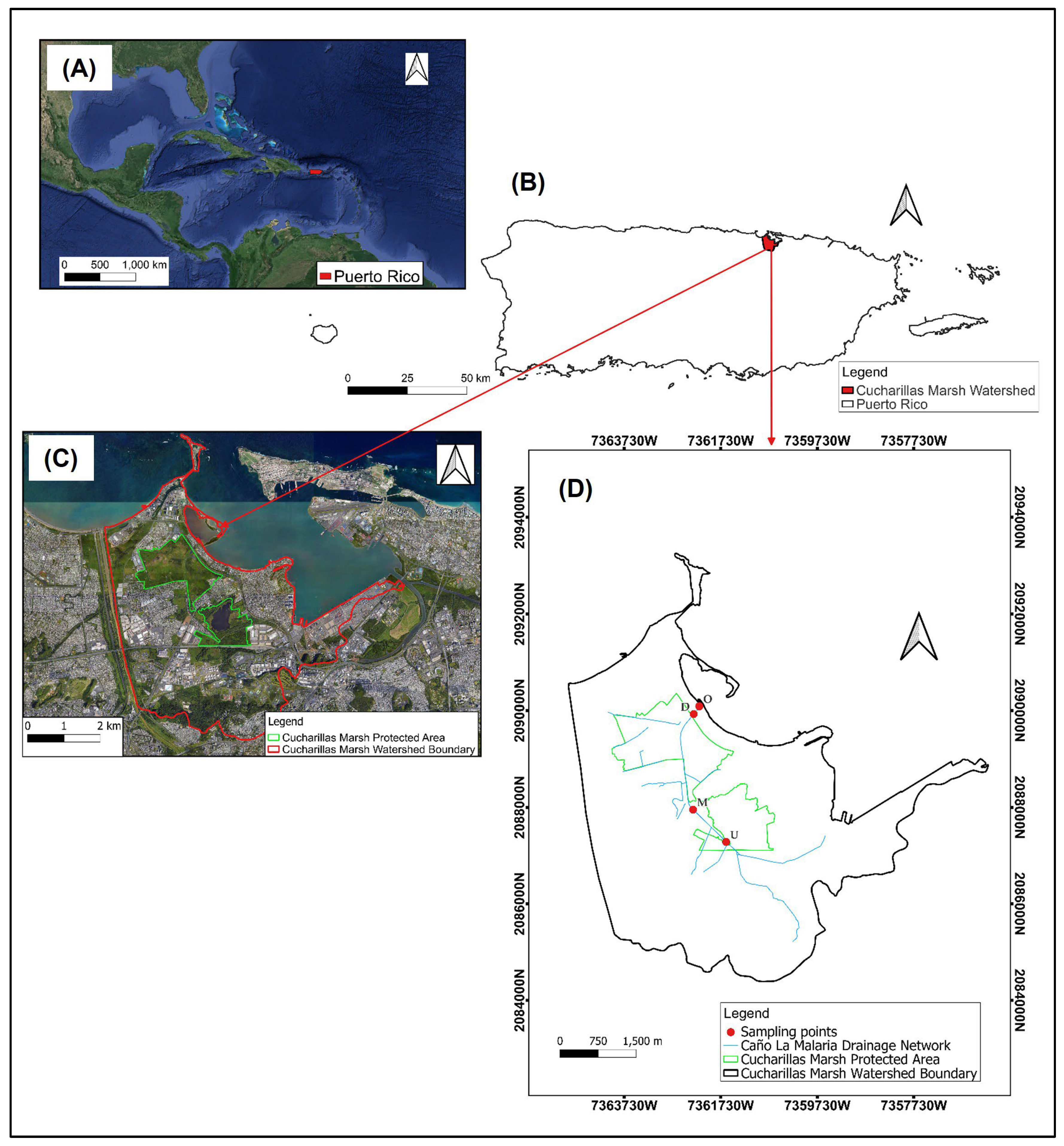
Figure 2.
Seasonal and spatial variation of total LMW-PAHs (Σ3PAHs: NAP, PHEN, and ANT) in surface water samples collected from Caño La Malaria. (A) Mean Σ3PAHs concentrations (ng/L) per sampling campaign. (B) Comparison of overall mean Σ3PAHs concentrations by season. (C) Spatial and seasonal distribution of Σ3PAHs across four sampling sites (U, M, D, O) and four campaigns.
Figure 2.
Seasonal and spatial variation of total LMW-PAHs (Σ3PAHs: NAP, PHEN, and ANT) in surface water samples collected from Caño La Malaria. (A) Mean Σ3PAHs concentrations (ng/L) per sampling campaign. (B) Comparison of overall mean Σ3PAHs concentrations by season. (C) Spatial and seasonal distribution of Σ3PAHs across four sampling sites (U, M, D, O) and four campaigns.
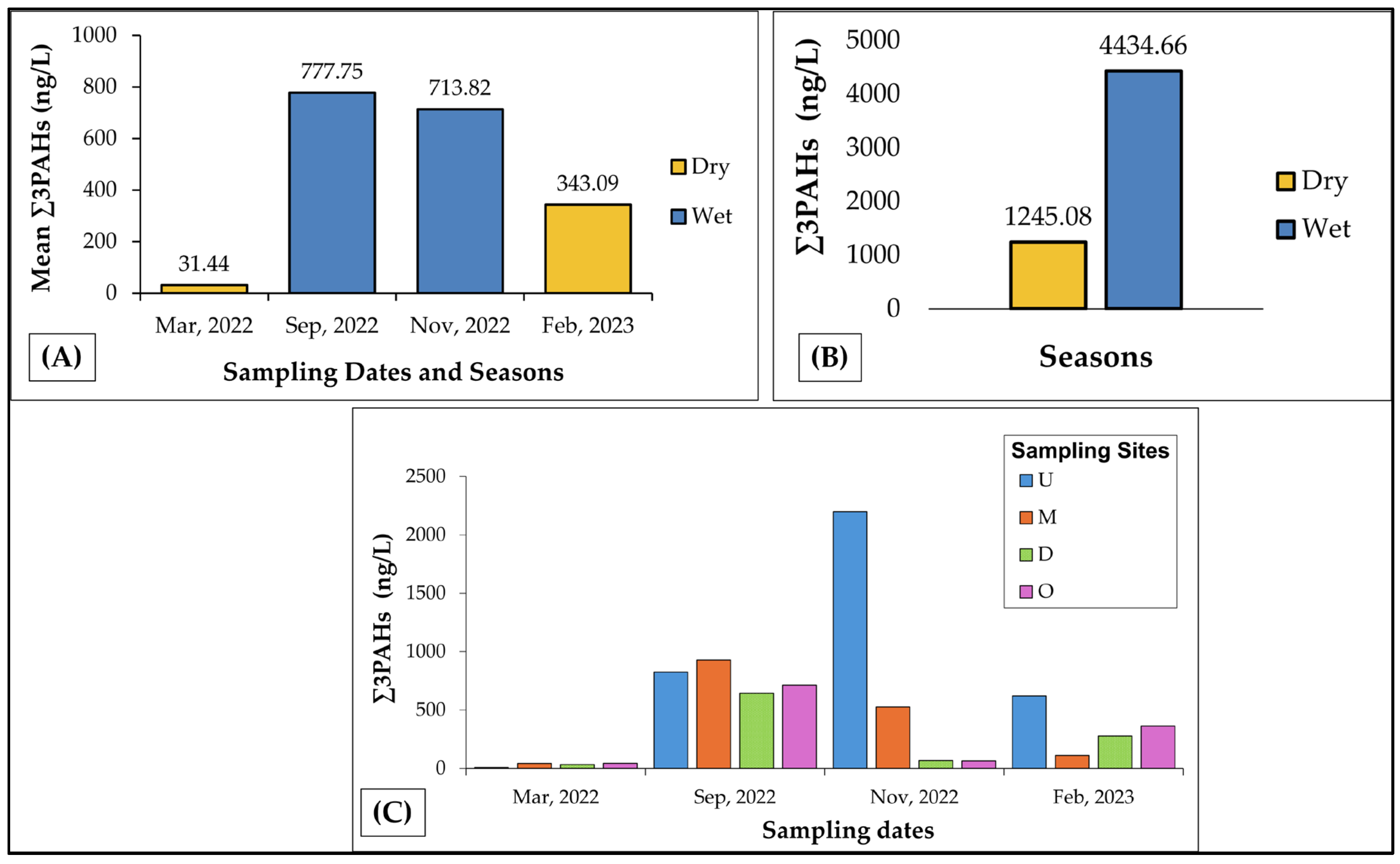
Figure 3.
Percentage composition of individual LMW-PAHs — NAP, PHEN, and ANT—in surface water samples collected from Caño La Malaria. Data is shown for four sites: U, M, D, O, across four sampling campaigns. Each bar represents the relative contribution (%) of each PAH to the total Σ3PAHs concentration.
Figure 3.
Percentage composition of individual LMW-PAHs — NAP, PHEN, and ANT—in surface water samples collected from Caño La Malaria. Data is shown for four sites: U, M, D, O, across four sampling campaigns. Each bar represents the relative contribution (%) of each PAH to the total Σ3PAHs concentration.
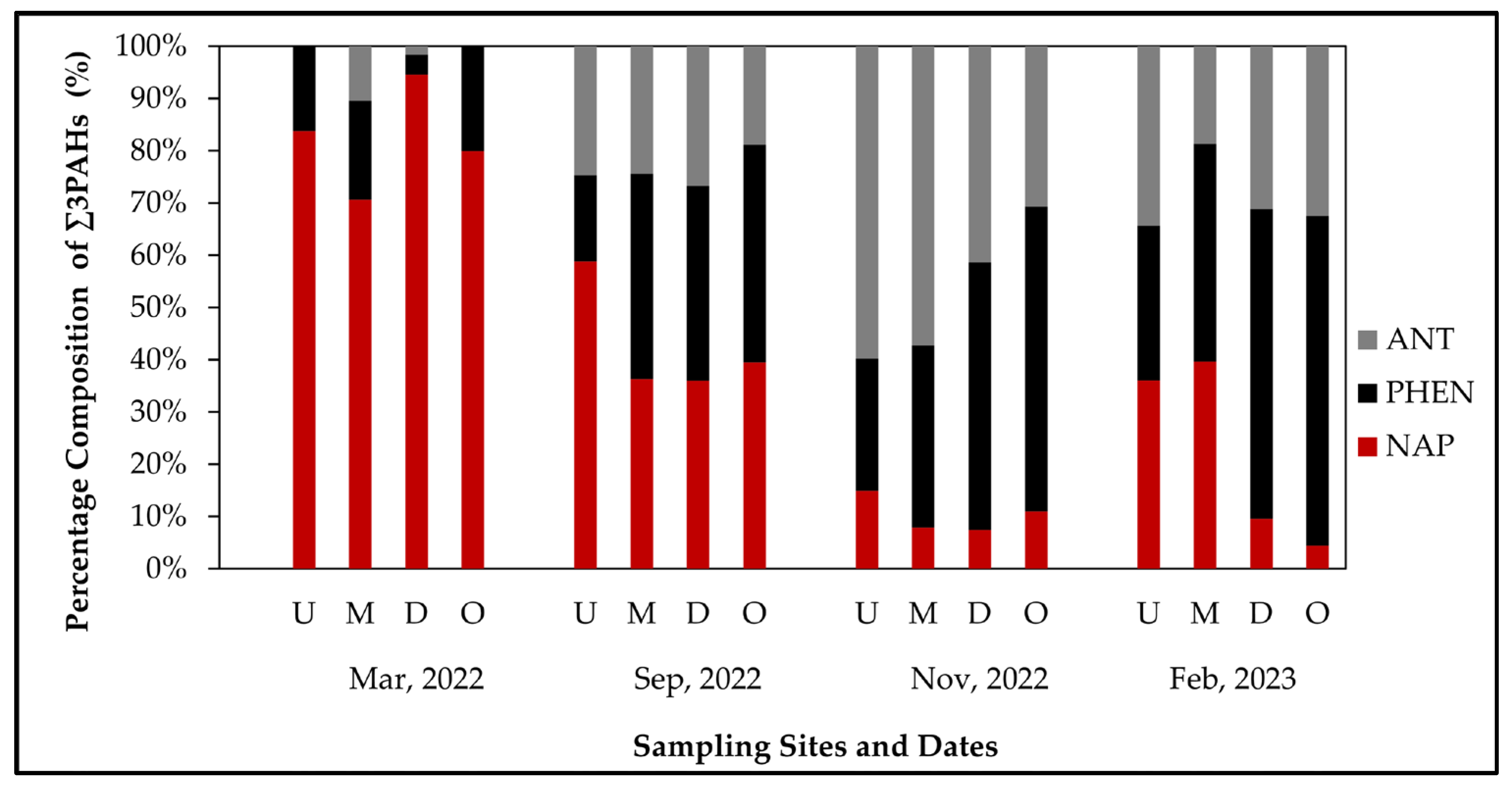
Figure 4.
Diagnostic ratios of PAHs used for emission source attribution in surface water samples from Caño La Malaria, collected at four sites—U, M, D, O—during the seasonal campaigns (March, September, November 2022, and February 2023). Bars represent the value generated by the diagnostic ratios used: ANT/(ANT + PHEN) (black) and PHEN/ANT (green). The red line indicates the threshold value of 0.10 for ANT/(ANT + PHEN), above which pyrogenic sources are inferred. PHEN/ANT values below 10 also suggest a pyrogenic origin.
Figure 4.
Diagnostic ratios of PAHs used for emission source attribution in surface water samples from Caño La Malaria, collected at four sites—U, M, D, O—during the seasonal campaigns (March, September, November 2022, and February 2023). Bars represent the value generated by the diagnostic ratios used: ANT/(ANT + PHEN) (black) and PHEN/ANT (green). The red line indicates the threshold value of 0.10 for ANT/(ANT + PHEN), above which pyrogenic sources are inferred. PHEN/ANT values below 10 also suggest a pyrogenic origin.
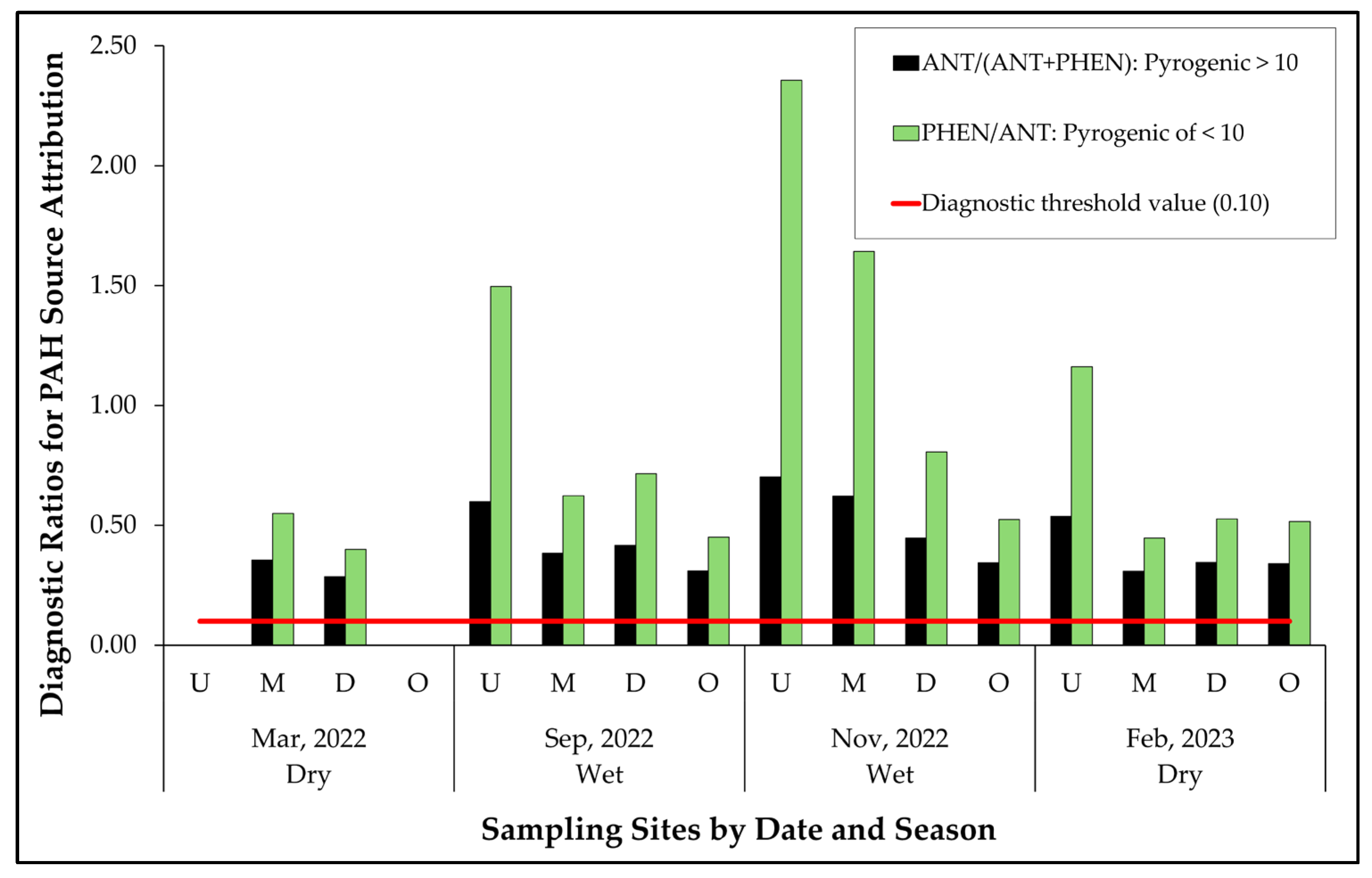
Figure 5.
PCA biplot of surface water samples from Caño La Malaria based on concentrations of three LMW-PAHs: NAP, PHEN, and ANT. The plot displays the distribution of 16 samples grouped by season (Dry vs. Wet) along the first two principal components (PC 1 and PC 2), which explain 84.8% and 11.9% of the total variance, respectively. Vectors represent the directional contribution of each PAH to the multivariate pattern. Samples from the wet season exhibit greater variability and are more strongly associated with NAP and ANT concentrations.
Figure 5.
PCA biplot of surface water samples from Caño La Malaria based on concentrations of three LMW-PAHs: NAP, PHEN, and ANT. The plot displays the distribution of 16 samples grouped by season (Dry vs. Wet) along the first two principal components (PC 1 and PC 2), which explain 84.8% and 11.9% of the total variance, respectively. Vectors represent the directional contribution of each PAH to the multivariate pattern. Samples from the wet season exhibit greater variability and are more strongly associated with NAP and ANT concentrations.
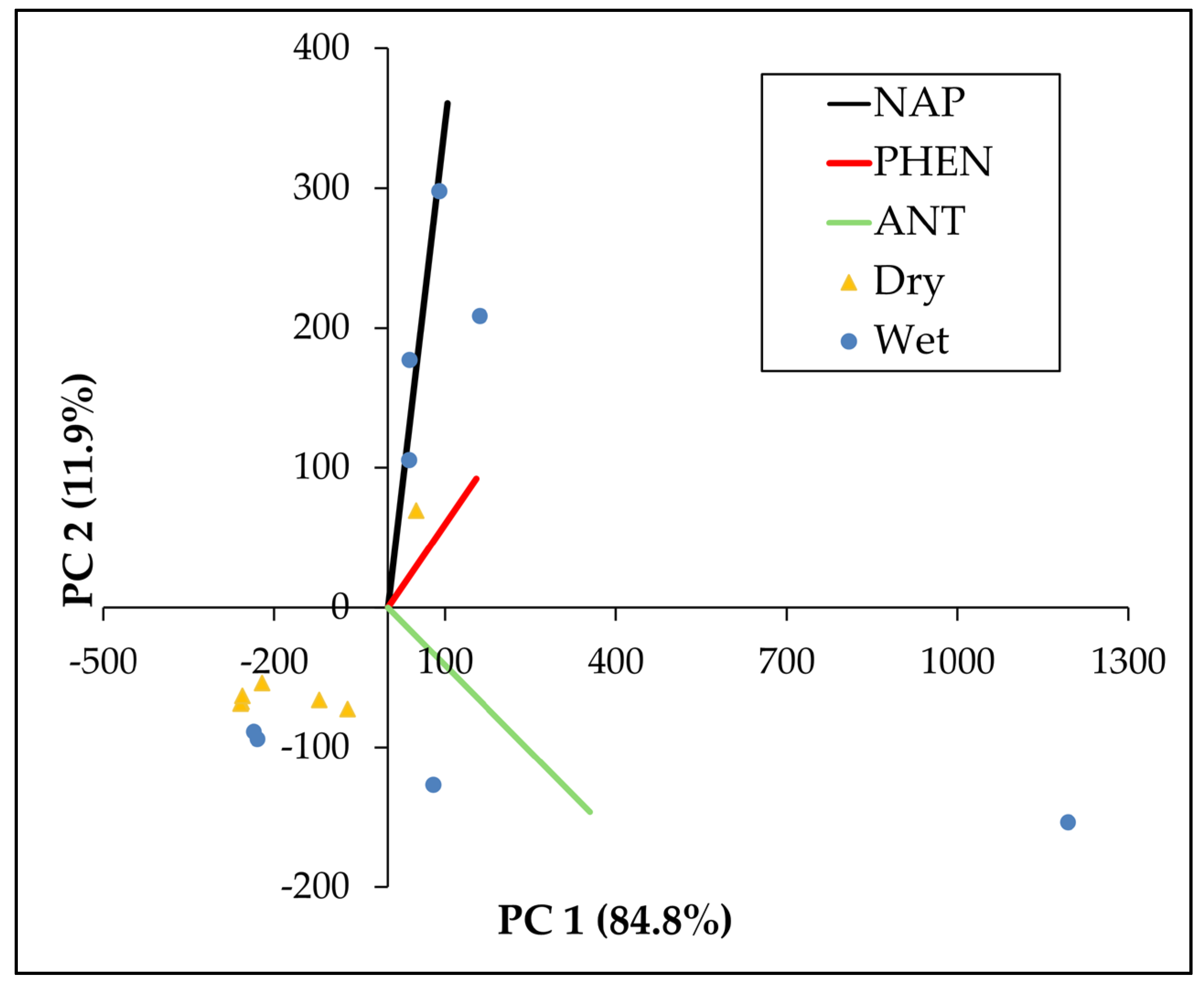
Table 2.
Mean concentrations (± standard deviation) and concentration ranges of NAP, PHEN, and ANT measured in surface water from four sites along Caño La Malaria, Puerto Rico, during four seasonal sampling campaigns conducted between March 2022 and February 2023.
Table 2.
Mean concentrations (± standard deviation) and concentration ranges of NAP, PHEN, and ANT measured in surface water from four sites along Caño La Malaria, Puerto Rico, during four seasonal sampling campaigns conducted between March 2022 and February 2023.
| Date | Site | NAP Mean (ng/L)±SD |
Range | PHEN Mean (ng/L)±SD |
Range | ANT Mean (ng/L)±SD |
Range | Σ3PAHs (ng/L) |
|---|---|---|---|---|---|---|---|---|
| Mar, 2022 | U | 6.20±0.00 | ND—6.20 | 1.20±0.00 | ND—1.20 | ND | ND | 7.40 |
| M | 30.13±28.46 | 10.00—50.25 | 8.10±1.91 | 6.75—9.45 | ND | ND | 38.23 | |
| D | 30.50±26.38 | 11.85—49.15 | 1.25±0.00 | ND—1.25 | 0.50±0.00 | ND—0.50 | 32.25 | |
| O | 34.73±32.99 | 11.40—58.05 | 8.70±0.00 | ND—8.70 | ND | ND | 43.43 | |
| Sep, 2022 | U | 485.10±231.93 | 321.10—649.10 | 135.87±48.11 | 85.65—181.55 | 203.40±0.00 | 114.50—292.30 | 824.37 |
| M | 337.60±32.39 | 308.60—372.55 | 364.72±47.34 | 321.55—415.35 | 227.25±109.39 | 149.90—304.60 | 929.57 | |
| D | 232.12±29.02 | 203.80—261.80 | 240.47±33.11 | 218.50—278.55 | 171.95±116.67 | 100.75—306.60 | 644.54 | |
| O | 281.62±67.63 | 230.50—358.30 | 297.17±81.43 | 224.35—385.10 | 133.75±36.98 | 108.90—176.25 | 712.54 | |
| Nov, 2022 | U | 327.80±183.92 | 197.75—457.85 | 557.43±0.00 | 554.05—560.80 | 1313.60±0.00 | 1285.15—1342.05 | 2198.83 |
| M | 41.48±38.36 | 14.35—68.60 | 183.30±167.02 | 65.20—301.40 | 301.08±383.29 | 30.05—572.10 | 525.86 | |
| D | 34.35±0.99 | 33.65—35.05 | 5.00±0.49 | 4.65—5.35 | 27.68±3.22 | 25.40—29.95 | 67.03 | |
| O | 6.98±4.56 | 3.75—10.20 | 37.13±12.48 | 28.30—45.95 | 19.48±2.02 | 18.05—20.90 | 63.59 | |
| Feb, 2023 | U | 223.66±185.24 | 43.00—399.15 | 183.49±191.92 | 5.60—359.70 | 213.04±213.39 | 2.25—412.20 | 620.19 |
| M | 43.76±1.29 | 41.75—45.75 | 46.04±9.44 | 31.95—54.90 | 20.57±17.34 | 2.45—39.10 | 110.37 | |
| D | 26.73±20.12 | NQ—52.80 | 165.11±61.73 | 115.35—255.00 | 86.87±15.61 | 72.20—112.95 | 278.71 | |
| O | 16.12±11.70 | 3.60—28.80 | 228.98±24.01 | 204.50—251.00 | 118.01±4.33 | 112.30—123.50 | 363.11 |
Sites: upstream (U); midstream (M); downstream (D), and outlet to San Juan Bay (O). Values in the first column of each PAH represent mean ± standard deviation across replicates for each site and date. ND: Not detected; below limit of detection (LOD). NQ: Non-quantifiable; concentration detected below the limit of quantification (LOQ). Σ3PAHs = sum of NAP, PHEN, and ANT concentrations. Range = minimum-maximum concentrations measured per site.
Table 3.
Hazard Quotient Summary by Site and Sampling Date. PNEC value: 68,000 ng/L, based on acute toxicity data for Callinectes sapidus [79].
Table 3.
Hazard Quotient Summary by Site and Sampling Date. PNEC value: 68,000 ng/L, based on acute toxicity data for Callinectes sapidus [79].
| Date | Site | Max. NAP (ng/L) |
HQ (ng/L) |
Ecological Risk Classification |
|---|---|---|---|---|
| Mar, 2022 | U | 6.20 | 9.12E-05 | Insignificant |
| M | 50.25 | 7.39E-04 | Insignificant | |
| D | 49.15 | 7.23E-04 | Insignificant | |
| O | 58.05 | 8.54E-04 | Insignificant | |
| Sep, 2022 | U | 649.10 | 9.55E-03 | Insignificant |
| M | 372.55 | 5.48E-03 | Insignificant | |
| D | 261.80 | 3.85E-03 | Insignificant | |
| O | 358.30 | 5.27E-03 | Insignificant | |
| Nov, 2022 | U | 457.85 | 6.73E-03 | Insignificant |
| M | 68.60 | 1.01E-03 | Insignificant | |
| D | 35.05 | 5.15E-04 | Insignificant | |
| O | 10.20 | 1.50E-04 | Insignificant | |
| Feb, 2023 | U | 399.15 | 5.87E-03 | Insignificant |
| M | 45.75 | 6.73E-04 | Insignificant | |
| D | 52.80 | 7.76E-04 | Insignificant | |
| O | 28.80 | 4.24E-04 | Insignificant |
Disclaimer/Publisher’s Note: The statements, opinions and data contained in all publications are solely those of the individual author(s) and contributor(s) and not of MDPI and/or the editor(s). MDPI and/or the editor(s) disclaim responsibility for any injury to people or property resulting from any ideas, methods, instructions or products referred to in the content. |
© 2025 by the authors. Licensee MDPI, Basel, Switzerland. This article is an open access article distributed under the terms and conditions of the Creative Commons Attribution (CC BY) license (http://creativecommons.org/licenses/by/4.0/).
Copyright: This open access article is published under a Creative Commons CC BY 4.0 license, which permit the free download, distribution, and reuse, provided that the author and preprint are cited in any reuse.


