

Submitted:
19 April 2024
Posted:
19 April 2024
You are already at the latest version
Abstract
The electric vehicle (EV) industry is experiencing rapid growth, accompanied by continuous advancements in charging infrastructure to satisfy the rising need for fast and reliable charging. Particularly, the focus has shifted towards EV fast charging (EVFC) and its impact on the power grid. This paper presents a comprehensive analysis and survey of scholarly literature and projects conducted in this field over the past decade. The findings highlight the rising demand for EVFC and the need to address its potential adverse effects on the power grid. However, there is a noticeable lack of clear research guidance regarding charging time. To tackle these challenges and pave the way for future solutions, extensive research on DC fast charging, ultra-fast charging, and the integration of vehicle-to-grid (V2G) systems is required. This review paper thoroughly investigates the development of fast charging technology for electric vehicles (EVs), including its advantages and comparative analyses from various perspectives. Furthermore, it delves into the advancements in DC fast charging infrastructure, emphasizing charging standards and control modes. The study also investigates different categories of battery chargers for both on-board and off-board charging. Additionally, it explores the classification of DC-DC converters in the context of DC fast charging stations, discusses control strategies for EV systems, identifies existing challenges, and outlines future trends in EV fast charging.
Keywords:
Electrical vehicles
; DC fast charging
; power electronics converters
; control strategies
1. Introduction
The emergence of electric vehicles (EVs) has heralded a new era of environmentally friendly transportation, promising lower emissions and a cleaner environment. As EV use grows, the necessity for efficient and fast charging options becomes ever more critical. Fast chargers meant to provide speedy charging periods for electric car batteries, have emerged as a possible answer to the problems encountered by EV drivers on longer excursions. These chargers provide a lifeline for travelers, allowing them to quickly recharge their automobiles while on the road, making long-distance electric mobility possible [1]. The requirement for fast battery charging has become a critical component in driving worldwide electric transportation growth. To encourage the widespread adoption of electric vehicles, charging choices that are dependable, convenient, and fast must compete with the refueling experience of traditional internal combustion engines [2,3]. As a result, researchers and industry participants have made major efforts to develop cutting-edge charging technologies capable of dramatically reducing charging periods, hence increasing the attraction and practicality of electric vehicles for consumers [4,5]. This study aims to shed light on the numerous fast charging technologies that have emerged in the electric vehicle ecosystem and power electronics converters. ,,Explore the latest advancements in fast charging infrastructure, detailing widely used strategies, advantages, and disadvantages. Also, discuss power electronic topologies and advanced control techniques aimed at reducing charging times and enhancing efficiency in fast charging systems. The goal is to offer valuable insights into how fast charging could revolutionize the electric car industry, promoting a cleaner and more sustainable future.
Electric Vehicle (EV) fast charging falls into two categories: alternative current (AC) charging and direct current (DC) charging [6,7]. AC charging, which involves an on-board battery charger within the EV, tends to be slower due to limited power ratings [8,9]. Conversely, DC charging utilizes off-board battery chargers outside, the vehicle, enabling faster charging speeds and greater power transfer capabilities [10,11]. As Battery Electric Vehicles (BEVs) become more widespread beside the charging station design is evolving rapidly BEVs [12,13,14,15,16]. The speed at which EV battery packs charge is directly tied to the power transfer rate from the station, leading to the creation of fast and ultrafast charging stations capable of quick, high-power charging [17,18]. EV charging systems can allow power flow in one direction or both directions [19]. While most on-board chargers facilitate one-way power flow, favoring grid-to-vehicle (G2V) charging [20]. This approach is preferred for its simplicity, reliability, affordability, and easy control strategy [19]. Bidirectional chargers, can feed power back into the grid through grid-to-vehicle V2G mode [10]. Bidirectional is increasingly recognized for its potential in balancing loads and integrating renewable energy, and reducing power losses in the grid [21,22,23,24]. This has sparked increased interest among researchers in bidirectional chargers as a growing option for future EVs applications. Charging units in AC bus-based architectures use separate rectifiers, enabling efficient and independent charging for multiple vehicles [25]. In contrast, systems with a common DC bus provide versatility and high-power operation [26,27]. Hybrid charging architectures, integrating AC and DC technologies alongside micro-grid systems, aim to optimize renewable energy use and enhance micro-grid performance beyond electric vehicle applications [28,29,30]. Researchers are dedicated to advancing charging stations through improved converters and smart control techniques to effectively manage the challenges of public charging. EV charging systems utilize multiple AC-DC and DC-DC converters and control strategies for safe and efficient battery charging, with converter topology choice affecting cost, size, performance, and efficiency [31,32,33,34]. High-power converters can reduce charging time and provide additional grid services [25,35]. The increasing number of EVs and the incorporating renewable energy sources into the grid pose challenges to power quality, grid operation, safety, and reliability [36,37,38]. Researchers are developing various power converters, charging methods, and integration techniques to harness EV benefits while addressing these challenges. EV charging standards vary globally, with different regions adopting standards like SAE J1772, IEC 61851, and GB/T. DC fast charging follows standards such as IEC-62196, CHAdeMO, CCS Type 1 and 2, and Tesla's proprietary standard. Standardization efforts are underway, including the ChaoJi standard. While AC-connected systems maintain reliability, DC microgrids offer efficiency but face standardization challenges [39]. High-power DC fast charging may require grid upgrades, especially in rural areas and highways [40,41]. Intelligent charging algorithms in modern chargers improve energy efficiency and grid stability, with energy storage systems aiding grid integration and cost reduction. Isolation from the AC grid is crucial in DC fast charging station design, achievable through low-frequency transformers or isolated DC-DC converters with careful consideration of soft-switching conditions [42].
This paper provides a comprehensive overview of the current state of EV fast charging infrastructure. It analyses electric vehicle fast charging techniques and delves into advanced infrastructure DC fast charging technical specifications for electric vehicles, including the charging standards and charging mode control. Described battery chargers’ categories for the on-board and off-board charging. By exploring converters, control strategies for EV systems, challenges, and future trends in EV fast charging. The research overview delves into strategies to enhance efficiency and performance of fast charging systems. Such insights can pave the way for optimised fast charging solutions and improved energy utilisation. By addressing these topics, this paper aims to contribute to the understanding and advancement of EV technology and fast charging infrastructure.
2. Electrical Vehicle’s Fast Charging Techniques
Research and development efforts in fast charging techniques for electric vehicles are increasingly vital, aiming to reduce charging times and enhance EV ownership convenience [43]. According to the International Energy Agency's 2022 report, global electric car sales have surged, reaching 14% of all new car purchases, up from 9% in 2021 and less than 5% in 2020. The first quarter of 2023 saw over 2.3 million electric cars sold, a 25% increase from the previous year. Projections suggest 14 million electric cars will be sold by the end of 2023, with expectations that they may constitute 18% of total car sales for the year. Forecasts under the IEA Stated Policies Scenario indicate that electric car sales could reach 35% globally by 2030. This increasing popularity underscores the importance of efficient fast charging methods to support widespread adoption. Addressing the time needed to recharge EV batteries is a key challenge as EV adoption grows. A survey by McKinsey & Company found that 80% of EV owners consider fast charging availability crucial in their purchase decisions. Fast charging infrastructure is also crucial for commercial sectors like taxi fleets and delivery services to minimize vehicle downtime and enhance operational efficiency. Various advancements in fast charging systems for EVs have been developed and implemented to meet the rising demand for high-power charging, enabling shorter charging times compared to traditional methods and various charging techniques depicted in Figure 1.
2.1. Inductive Charging
Inductive charging, known as wireless charging, eliminates the need for physical cables by transmitting energy through an electromagnetic field between a charging pad on the ground and a receiver on the electric vehicle [44]. While not as fast as some wired fast charging methods, wireless charging offers convenience, allowing drivers to park over a charging pad for automatic charging without connecting any cables [44]. Nikola Tesla's experiment in 1910 at the Wardenclyffe Tower laid the groundwork for wireless power transfer (WPT) [45,46]; smart cities with e-mobility mainly utilize WPT [47], employing methods like inductive power transfer (IPT) and capacitive power transfer (CPT). Improving IPT efficiency involves optimizing coil design, ensuring coil alignment, selecting appropriate batteries and charging standards, and using electromagnetic field shielding [45,47,48,49]. Advanced optimization techniques and control strategies, such as adjusting charging frequency and monitoring alignment, enhance power transfer efficiency and safety. Inductive charging systems can be static or dynamic, depending on their application.Top of Form
Static charging systems, similar to IPT, are commonly found in stationary locations like parking lots, traffic lights, and toll booths, as depicted in Figure 2 (a). These systems exhibit a higher degree of compatibility with electric vehicles and are efficient. However, in wireless EV charging, misalignment between transmitter and receiver coils can lead to fluctuations in the coupling coefficient, reducing system efficiency and power output [50]. Researchers are working to address misalignment issues in static WPT systems [50,51,52,53]. These systems typically have two stages: a high-frequency inverter converts input power to AC, which is then transferred to the primary coil to create an electromagnetic field. This induces AC power in the nearby receiver coil, which is then converted to DC power and stored in the vehicle's battery [45]. The system can achieve an efficiency of 85% or higher, with individual stages reaching efficiencies of up to 97%.
Dynamic inductive charging is a method that wirelessly charges a vehicle's battery while it's in motion, also known as on-the-go or road-based charging. This addresses the challenge of electric vehicles having a limited range for long-distance trips [54,55]. It's an emerging technology currently undergoing exploration in various pilot projects and research efforts. In dynamic inductive charging, depicted in Figure 2 (b), a primary coil buried along the road track and a secondary coil mounted on the vehicle chassis facilitate power transfer as the vehicle moves [47,56]. The primary infrastructure components include the Power Supply Unit and the Inductive Transmitter Units embedded in the road [47]. This charging method has several advantages; the major disadvantage is mentioned in Table 1.
2.2. Ultra-Fast Charging (UFC)
Ultra-fast charging (UFC) is a charging technology that significantly reduces EV charging times compared to traditional methods [57,58]. With power levels typically exceeding 350 kW, UFC delivers a large amount of energy to the vehicle's battery in a short period [57]. This approach addresses concerns about long charging times, making EV charging more comparable to refueling a conventional vehicle and alleviating range anxiety [59,60]. UFC systems employ control strategies for efficient power delivery and battery management, including Constant Current (CC) and Constant Voltage (CV) modes and temperature monitoring. Although UFC stations are still in the early deployment stages and less widespread than conventional infrastructure, their numbers are increasing, especially along major highways [61]. Both charging infrastructure and EVs must be compatible with higher power levels, requiring station design and in station and battery technology advancements. Automakers and charging providers are developing UFC technologies, introducing new standards like CCS and CHAdeMO 3.0 to support higher power levels [62,63]. Ongoing research aims to further improve charging speeds, infrastructure, and battery tech in the dynamic field of UFC [61].
2.3. DC Fast Charging (DCFC)
DC fast charging, also known as level 3 charging, is a prominent fast charging method that relies on high-power stations to deliver DC electricity directly to the vehicle battery, bypassing the onboard charger [18,64]. Unlike slower AC charging methods, which involve electricity passing through the vehicle's charger to convert AC power to DC, DCFC systems employ control strategies such as CC and CV modes, along with temperature monitoring, for safe and efficient charging. These systems often incorporate intelligent power electronics and communication capabilities to optimize the charging process and grid integration. With charging power typically ranging from 50 kW to 350 kW, DC fast charging drastically reduces charging times to as little as 30 minutes or less for a full charge, depending on factors like vehicle battery capacity and charging power level [65,66,67]. The global expansion of DC fast charging infrastructure, strategically placed along highways and urban areas [68,69], addresses range anxiety and promotes EV adoption feasibility. It's important to note that EV charging capabilities vary, with factors like vehicle model and battery technology influencing charging rates and maximum power support [70,71].
2.4. Tesla Superchargers
Tesla Superchargers are exclusively designed for Tesla vehicles and offer fast DC charging capabilities. These chargers are unique to Tesla and cannot be used with other electric vehicle brands [25]. Superchargers possess the ability to generate power outputs reaching a maximum of 250 kW, possibly adding up to 200 miles of range in just 15 minutes [72]. However, the charging rate experienced in practice can fluctuate due to various factors, including the battery's current charge level, battery temperature, and the capacity of the charging infrastructure [73]. Control strategies implemented in Tesla Superchargers include constant current and constant voltage modes, temperature monitoring, and battery management techniques. Tesla Superchargers also make use of advanced communication and vehicle-specific protocols to optimize the charging process and ensure compatibility and safety for Tesla vehicles.
The charging power levels of Superchargers have undergone advancements, resulting in newer versions that offer higher power outputs compared to their earlier counterparts. The charging time for Tesla vehicles utilizing Superchargers can also differ based on factors such as the specific model and battery size [74]. Superchargers can charge a Tesla vehicle to approximately 80% of its battery capacity in optimal conditions in about 20 minutes. However, it is important to note that the charging rate may slow down as the battery approaches full capacity to protect the battery's health and longevity [75]. Tesla has been continuously expanding its Supercharger network, adding new charging stations and increasing the number of charging stalls at existing locations [76]. This expansion aims to provide Tesla owners with convenient access to charging infrastructure, reduce range anxiety, and promote long-distance travel with electric vehicles.
2.5. Bidirectional Charging Integration
Bidirectional charging, also known as vehicle-to-grid integration, is a promising concept in the electric vehicle ecosystem. It allows electric vehicles not only to draw energy from the grid for charging but also to discharge stored energy back into the grid [77], as shown in Figure 3. This bidirectional energy flow turns EVs into mobile energy storage resources, offering flexibility and support to the power grid [78]. Advanced bidirectional charging systems use communication protocols and control strategies to manage power flow, ensuring grid stability and optimizing energy usage. By participating in grid services, EVs with V2G capabilities can stabilize the grid, manage loads, and integrate renewable energy sources. This integration enhances grid stability, enables load management, and supports renewable energy integration, optimizing renewable resources use and improving grid efficiency [25,74,78,79]. However, successful V2G integration depends on compatible infrastructure, communication systems, and regulatory support, which may vary by region and market dynamics [22,80].
2.6. Battery Swapping
Battery swapping addresses the issue of long charging times associated with traditional methods by allowing drivers to quickly exchange depleted batteries for fully charged ones. Typically taking just a few minutes, this process benefits businesses managing fleets and individuals on long trips, reducing downtime [85], as shown in Figure 4. At dedicated swapping stations, the EV's discharged battery is replaced with a fully charged one, supported by advanced automation and communication technologies ensuring safe and efficient operations [81]. The swapped-out battery is then recharged for future use. Stations accommodate various EV models and employ automated systems for alignment and connections [82]. Advantages include reduced charging times, convenience, and potentially lower battery degradation [83]. While battery swapping offers a faster alternative, challenges like standardization and infrastructure costs must be addressed for widespread implementation, especially as charging technologies evolve.
Table 1 provides comprehensive specifications for advancing of fast-charging techniques for EVs, including advantages and comparative analyses. The table covers several criteria essential to the effectiveness and viability of fast-charging systems, including convenience, safety, durability, integration with infrastructure, compatibility, battery degradation, scalability/upgradability, and efficiency. These criteria evaluate aspects such as user-friendliness, safety measures, long-term reliability, compatibility with existing infrastructure, impact on battery health, ability to handle increased demand, and energy conversion efficiency.
3. Advanced Infrastructure DC Fast Charging for Electric Vehicles
A crucial aspect of the evolving electric vehicle landscape involves the development of advanced infrastructure for fast DC charging. This involves implementing of state-of-the-art systems and technologies that enable the efficient and fast charging of electric vehicles [124]. This involves implementing of state-of-the-art systems and technologies that enable the efficient and fast charging of electric vehicles. Table 2 provides the power level charging ratings and classification standards for charging stations. The levels are categorized based on the supply system, maximum power rating (in kW), and maximum current rating (in A). DC fast charging, commonly referred to as Level 3 charging, offers much faster charging times [125]. It makes use of higher-voltage power supply, often in the 400 to 800 volt range, which makes it possible for EVs to charge significantly more quickly, frequently providing up to 80% charge in as little as 20 to 30 minutes [125].
Some many important elements and factors contribute to the sophisticated infrastructure for DC fast charging. Here are several crucial elements of charging standards and charging modes control:
3.1. Charging Standards
The creation and observance of charging standards are essential elements in the field of advanced infrastructure for DC fast charging [62,112]. For owners of EVs, charging standards enable compatibility, interoperability, and seamless charging experiences across multiple charging networks and hardware providers [94]. Here are the major standards of EV charging systems shown in Table 3, and some crucial points about charging specifications for cutting-edge DC fast charging infrastructure:
3.1.1. Organizations for Standardization
International bodies like the International Electrotechnical Commission (IEC), the Society of Automotive Engineers (SAE), and the International Organization for Standardization (ISO) are frequently responsible for developing and maintaining charging standards [97]. These groups work with industry participants to establish technical requirements and charging protocol standards for EVs.
3.1.2. Charging Connector Types
Various connector types and setups are examined to ensure a dependable and safe link between the charging station and the electric vehicle. Commonly utilized connectors for DC fast charging include CHAdeMO and CCS [62] connectors [129]. These connectors guarantee compatibility between EVs made by various manufacturers and the charging infrastructure.
3.1.3. Communication Protocols
Communication protocols that enable data transmission between the charging station and the EV are also included in charging standards. These protocols allow for essential features, including identification, control over power distribution, and real-time monitoring of charging conditions [128]. The Open Charge Point Protocol (OCPP) and ISO 15118 are two instances of communication protocols [130].
3.1.4. Power Level and Charging Speeds
Power levels and charging speeds enabled by the infrastructure are defined by charging standards. DC fast charging power levels can vary from 50 kW to several hundred kW, facilitating rapid charging durations [62]. Guidelines establish upper limits for power and voltage to ensure safe and efficient charging procedures.
Table 4 provides a comprehensive overview of the specifications for commercial Plug-in Hybrid Electric Vehicles (PHEVs), Fuel Cell Electric Vehicles (FCEVs), and Extended-Range Electric Vehicles (E-REVs). Key details encompass a variety of vehicle models, classification by powertrain type, battery capacity measured in kilowatts (KW), driving range expressed in kilometers (KM), and connector types required for charging.
3.2. Charging Modes Control
Charging modes are crucial in the field of modern fast charging infrastructure for maximising charging effectiveness and catering to the various needs of EV owners [131]. The term "charging modes" refers to the many power distribution and charging methods that can be used with DC fast charging infrastructure. Here is some essential information about charging modes:
3.2.1. Constant Current Charging
In this mode control, the charging station feeds the EV battery a steady current while it is being charged. During the initial phases of charging, when the battery's state of charge (SoC) remains relatively low, this mode control method is frequently employed [132]. Constant current charging facilitates faster charge rates, ensuring prompt replenishment of the battery's capacity.
3.2.2. Constant Voltage Charging
As the battery's SoC reaches a predefined level, the charging station transitions to constant voltage charging. In this control mode, the charging station gradually reduces the charging current while sustaining a consistent voltage. Constant voltage charging is employed during the final stage to prevent overcharging the battery and ensure its longevity. Throughout this stage, the charging system continuously monitors the battery voltage and adjusts the current to prevent it from surpassing the designated level.
3.2.3. Constant Power Charging
To uphold a consistent power level throughout the charging procedure, the constant power charging mode adjusts both the current and voltage. This mode optimizes charging speed and ensures efficient utilization of available resources by dynamically adapting the charging conditions based on the battery's status and temperature [133]. When the battery's SoC is low, it enables quicker charging rates and automatically lowers the charging power when the battery gets close to capacity. Dynamic power control also enables load management and helps balance the power demand and supply within the charging infrastructure.
3.2.4. Demand Response Charging
Demand-response charging capabilities may be included in advanced DC fast charging infrastructure. With this mode control, the charging station is able to dynamically modify the charging power dependent on the capacity of the grid and electricity demand [134]. Reducing the charging power during times of heightened demand or when the electrical grid is strained allows for the efficient utilization of grid resources.
3.2.5. Bidirectional Flow Charging
Bidirectional power flow is supported by some cutting-edge fast charging infrastructure, allowing for energy transmission to and from the EV's battery. By employing this capability, EVs receive grid-based charging and discharge energy back into the grid or supply power to other consuming devices [135]. Vehicle-to-grid applications, where EVs can help stabilise the grid and offer grid services, may be supported via bidirectional charging [137]. Different charging modes are implemented in sophisticated DC fast charging infrastructure, giving EV owners and grid operators flexibility and optimisation options based on battery state, grid limitations, and user choices; it enables efficient charging [94]. EVs may be charged quickly while preserving battery health, grid stability, and economical power usage by utilising the right charging mode. Furthermore, intelligent charging algorithms and communication protocols that enable real-time monitoring, control, and coordination of the charging process are frequently used in conjunction with charging modes [138]. These characteristics facilitate grid integration, optimise power distribution, and guarantee secure and dependable charging operations. Implementing of charging modes within advanced DC fast charging infrastructure enhances the user experience for electric vehicle owners during charging sessions. Additionally, it promotes optimal energy utilization and contributes to the broader adoption of EVs as a sustainable transportation option [139].
3.2.6. Temperature Monitoring and Control
DC fast charging produces heat because of the substantial charging currents it employs. Temperature monitoring and control techniques have been implemented to safeguard the battery against overheating. Temperature sensors are positioned inside the battery pack to monitor its temperature throughout the charging process [140]. The charging system utilizes this data to modify charging parameters like current or voltage, ensuring the battery remains within safe temperature thresholds. This practice is crucial for preserving optimal battery performance and extending its longevity [141].
3.2.7. State of Charge (SoC) Estimation
Accurate estimation of the battery's SoC is crucial for efficient charging. Control strategies utilise algorithms and models to estimate the SoC based on various parameters such as voltage, current, and temperature measurements [142,143,144]. These methods consider the battery's discharge and charge characteristics to provide a reliable estimate of its state of charge [142]. SoC estimation helps regulate the charging process, ensuring that the battery is neither undercharged nor overcharged [145].
4. Electric Vehicles Battery Chargers Category
Electric vehicle battery chargers can be classified according to charging capabilities, physical configurations, and intended applications as either on-board chargers or off-board chargers. On-board chargers are incorporated within the vehicle itself, and their capacity determines their charging rate. They are commonly found in electric vehicles and are compatible with various charging infrastructure. Off-board chargers, on the other hand, are external units, and their specifications determines their charging rate. They are used in public charging stations and private charging points where on-board charging is not possible or convenient.
4.1. On-Board Charging
On-board charging (OBC) in electric vehicles involves converting external AC power into DC power to charge the vehicle's battery pack. It's a critical process requiring various components like rectifiers and transformers to ensure safe and efficient charging [62]. The OBC, typically integrated into the vehicle's powertrain or near the battery pack, can be built within the vehicle or part of the charging cable [146], as shown in Figure 5. Common methods include Level 1, using standard outlets, and Level 2, with dedicated charging stations offering higher voltage. On-board charging offers convenience, as EVs can be charged at home, work, or other accessible locations. Level 1 charging (120 volts) is cost-effective, while Level 2 (240 volts) provides flexibility without requiring specialized infrastructure [3]. Owners can charge their vehicles wherever suitable outlets or stations are available [147]. Table 5 details the advantages and disadvantages of on-board and off-board chargers.
Top of Form
4.2. OFF-Board Charging
Off-board charging involves replenishing EV batteries outside the vehicle itself, typically at external charging stations or infrastructure [149], as shown in Figure 5. Researchers are exploring off-board and DC-based charging methods for EVs due to their potential impact on power quality and efficiency [143]. Common off-board charging methods include public Charging Stations, DC Fast Charging (Level 3), and wireless Charging (inductive charging) [121]. These methods have fewer conversion stages, making charging more efficient, especially with a DC power supply, which eliminates the need for AC-DC conversion and power factor correction stages. While DC chargers are not widely adopted in EVs yet, they offer the potential for integrating solar PV power. Some studies propose dual-input EV chargers that can utilize both AC grid power and standalone PV systems, operating in grid-connected mode during low solar irradiation and in V2G mode during idle hours [144]. Off-board chargers can be divided into isolated and non-isolated converters, with isolated converters being preferred at higher voltage levels and non-isolated topologies being feasible for low power levels [67,150,151].
5. Status of DC Fast Charging Station DC-DC Converters Classification
Efficiently fast-charging electric vehicles demand high-power DC-DC converters to adjust the charging infrastructure's high-voltage DC power to the battery's required voltage. Various converter topologies are used, with recent studies proposing designs with fewer active and passive components [152]. To minimize switching losses, soft-switching power electronic switches are being introduced [153,154]. These converters, used in both on-board and off-board chargers, include buck, boost, buck-boost, SEPIC, Cuk, Zeta, and Super-lift Luo converters [25,26,27].
Higher power chargers typically employ isolated DC-DC converters with options like fly-back, forward, push-pull, half-bridge, full bridge, and multilevel converters [150,155]. The bidirectional operation of the transformer is achievable in multiple switch topologies through the alternate operation of the switches [67]. However, this approach has limitations, including transformer core saturation and the strain on primary-side switches caused by operating in discontinuous mode [151]. Newer topologies, like bridgeless and interleaved configurations, aim to enhance efficiency, reduce voltage/current ripples, and streamline component count. Soft-switching techniques with resonant converter topologies may further boost charging efficiency [156]. For high-gain applications, multilevel converters are another multi-switch alternative. Additionally, it guarantees less electromagnetic interference (EMI) because there are fewer voltage jumps [152]. Prioritizing EV charger design effectiveness and charging time is crucial, considering most EVs require 3–4 hours to fully charge, a critical factor for their potential use in public transportation [153]. Figure 6 outlines a general classification of DC-DC converter topologies for EV powertrains.
Figure 7 illustrates the key components of a typical DC fast charger power system, featuring two conversion stages for converting three-phase AC power to DC, along with a DC-DC stage incorporating galvanic isolation [126]. The AC-DC rectification stage includes a Power Factor Correction circuit to meet grid codes' power quality requirements. The DC-DC stage facilitates parallel connectivity at the charger's output stage, ensuring isolation between the EV and the grid [126]. Two main approaches for achieving galvanic isolation are presented: One method involves utilizing a low-frequency transformer (LFT) positioned between the grid and the AC-DC stage, as depicted in Figure 7a. These techniques have been extensively discussed in various sources [68,155,157]. Alternatively, a high-frequency transformer (HFT) can be incorporated within the DC-DC stage, as shown in Figure 7b. These methods have also been explored in multiple references. Figure 7 visually represents the two isolation options, focusing on a single module charger for simplicity. However, as the power requirements of DC fast chargers increase, the system’s output power can be enhancing by connecting multiple identical modules in parallel. This approach enables the system to effectively meet the growing demand. For those seeking more detailed information and comprehensive insights into LF and HF transformer configurations, it is advised to refer to the aforementioned references [68,150,154,155,157,158]. The article proposes integrating a filter at the input stage to address the harmonic distortion originating from the rectifier. This filter aims to mitigate the inherent harmonic distortion in the current drawn by the rectifier. LC or LCL filters are typically favored over L filters due to their superior performance characteristics in this regard. Additional information on the advantages and specifications of LC or LCL filters can be found in references [159,160,161,162].
6. Control Strategies for EV System
This section focuses on the control technology employed in DC-DC converters for EV fast charging. It covers control objectives, methods, and challenges associated with different types of converters. Various control techniques such as voltage-mode, current-mode, peak current, and average current control are examined, applicable to both isolated and non-isolated converter systems. Table 6 offers a comparison of control strategies for these converter types.
Control objectives in DC-DC converter control technology refer to the desired performance criteria that need to be achieved. These objectives typically include regulating the output voltage or current, achieving a fast response to load changes, maintaining stability, minimising ripple and noise, and maximising efficiency. Ongoing research and development efforts continue to refine these control technologies and explore new approaches to optimize charging performance, integrate with smart grids, and enhance user experience. As the EV market expands, advancements in control technologies will play a vital role in shaping the future of fast and reliable charging infrastructure. Control methods in DC-DC converter control technology encompass the techniques and algorithms used to achieve the desired control objectives. Some commonly employed methods include voltage mode control, current mode control, peak current control, and average current control. Each method has its advantages and trade-offs in terms of response speed, stability, and complexity. However, despite the availability of various control methods, DC-DC converters can encounter common problems that need to be addressed. Some of these issues include output voltage or current overshoot or undershoot, instability leading to oscillations or ringing, poor transient response, excessive ripple or noise, and cross-regulation problems in multiple-output converters. Effective control strategies should consider these challenges and aim to mitigate them.
7. Challenges and Future Trends in EV Fast Charging
EV fast charging systems are continuously evolving to meet the demands of the growing electric mobility landscape. The challenges and future trends in EV fast charging revolve around addressing infrastructure limitations, such as expanding the charging network to cover various locations and managing grid capacity intelligently through technologies like load balancing and demand response. Universal standards and interoperability among charging systems are crucial for widespread EV adoption, requiring global collaboration to establish compatibility across networks and countries. Despite advancements, battery technology continues to pose challenges, necessitating improvements in chemical compositions and thermal management to enable faster charging without sacrificing battery longevity. In the future, the outlook for EV fast charging seems optimistic due to advancements in ultra-fast charging, integration of vehicle-to-grid systems, wireless charging, and battery technology. Sustained collaboration, innovation, and supportive policies are imperative to surmount these challenges and unlock the complete potential of electric vehicles.
The research paper on EV fast charging technology highlights key areas for recommended future research, emphasising the need to prioritise faster charging, improve infrastructure components, standardize charging processes, and optimise energy utilization through smart grid solutions and bidirectional chargers. It encourages exploration of battery advancements, wireless charging, battery swapping, and enhancing user experience. Future research should comprehensively analyse the impact of EV fast charging on the power grid, delve into DC fast charging, ultra-fast charging, and V2G systems, advance infrastructure, and control techniques, integrate renewable energy sources, address standardisation challenges, implement intelligent charging algorithms, and strategies for efficiency enhancement. Achieving faster charging times and exploring various charging techniques, control strategies, and the utilisation of EV batteries for grid services are crucial areas for ongoing exploration.
8. Research Contribution
This research paper makes insightful contributions to the field of EV fast charging, standing out for its comprehensive analysis of crucial aspects. It offers a multifaceted contribution that propels us towards a more electrifying future. The paper's impact on the field can be summarised in three keyways:
- Comprehensive Landscape Analysis: It paints a complete picture, delving into diverse charging categories, methods, infrastructure specifics, and crucial elements like charging modes control, standards, converters, and control strategies. This holistic view informs future research and development efforts.
- Detailed Comparative Evaluation: By meticulously analysing various charging techniques, including their advantages and limitations, the paper empowers informed decision-making for future infrastructure advancements and technology choices.
- Challenges and Future Outlook: The article doesn't shy away from addressing current limitations and boldly proposes future research directions. This forward-thinking approach paves the way for overcoming obstacles and achieving faster, more efficient, and sustainable EV charging solutions.
9. Conclusion
This paper aims to bring clarity to the pursuit of faster charging times to advance electric vehicles, with a particular emphasis on high-power fast charging as a significant focal point of EV charging technology. The research review explores methods to enhance the efficiency and effectiveness of fast charging systems. It provides insights into current developments in EV fast charging techniques and power electronic converters utilized in fast-charging systems. Furthermore, it explores control strategies for electric vehicles and analyses the impacts of high-power fast charging on battery systems, along with future developmental trends. The study extensively examined various fast charging methods for electric vehicles, encompassing inductive charging, UFC, DCFC, Tesla superchargers, V2G integration, and battery swapping. It provided a summary of the advantages and drawbacks associated with each technique. Moreover, it outlined the essential components and considerations involved in the intricate infrastructure for DC fast charging. The paper employed analysis to scrutinize high-power rear DC-DC converters, both isolated and non-isolated, utilized in on-board and off-board chargers. These converters, whether two-stage or single-stage, efficiently convert high-voltage DC power for the fast-charging infrastructure of electric vehicles' batteries. Additionally, it investigated the control strategies employed for these converters. The primary control objective of the DC-DC converter is to maintain consistent performance across the entire load spectrum, minimize current fluctuations, and enhance system efficiency. The efficiency, affordability, safety, reliability, and control mechanisms of converter configurations have significantly influenced the advancement of fast charging technology for electric vehicles. Fast charging systems integrated with V2G capabilities can effectively lower charging expenses and enable EVs to engage in grid services, extending their interaction with the electrical grid beyond conventional charging. When connected to the grid, EV batteries can serve various purposes, including grid stabilization, load management, and the integration of renewable energy sources.
References
- Szumska, E.M. Electric Vehicle Charging Infrastructure along Highways in the EU. Energies 2023, 16, 895. [Google Scholar] [CrossRef]
- Mohammed, A.; Saif, O.; Abo-Adma, M.; Fahmy, A.; Elazab, R. Strategies and sustainability in fast charging station deployment for electric vehicles. Sci. Rep. 2024, 14, 1–19. [Google Scholar] [CrossRef] [PubMed]
- M. S. Mastoi et al., “An in-depth analysis of electric vehicle charging station infrastructure, policy implications, and future trends,” Energy Reports. 2022, 8, 11504–11529.
- Emmanuel Augustine Etukudoh, Ahmad Hamdan, Valentine Ikenna Ilojianya, Cosmas Dominic Daudu, and Adefunke Fabuyide, “Electric Vehicle Charging Infrastructure: a Comparative Review in Canada, USA, and Africa,” Eng. Sci. Technol. J. 2024, 5, 1–245.
- Ntombela, M.; Musasa, K.; Moloi, K. A Comprehensive Review of the Incorporation of Electric Vehicles and Renewable Energy Distributed Generation Regarding Smart Grids. World Electr. Veh. J. 2023, 14, 176. [Google Scholar] [CrossRef]
- A. Mod. POWER Syst. CLEAN ENERGY. 2023, XX, 1–19.
- Arya, H.; Das, M. Fast Charging Station for Electric Vehicles Based on DC Microgrid. IEEE J. Emerg. Sel. Top. Ind. Electron. 2023, 4, 1204–1212. [Google Scholar] [CrossRef]
- Yahaya, A.A.; Edpuganti, A.; Khadkikar, V.; Zeineldin, H. A Novel Simultaneous AC and DC Charging Scheme for Electric Vehicles. IEEE Trans. Energy Convers. 2024, PP, 1–13. [Google Scholar] [CrossRef]
- M. Kumar, K. P. Panda, R. T. Naayagi, R. Thakur, and G. Panda, “Comprehensive Review of Electric Vehicle Technology and Its Impacts: Detailed Investigation of Charging Infrastructure, Power Management, and Control Techniques,” Appl. Sci. 2023, 13, 15–1.
- Khalid, M.; Ahmad, F.; Panigrahi, B.K.; Al-Fagih, L. A comprehensive review on advanced charging topologies and methodologies for electric vehicle battery. J. Energy Storage 2022, 53. [Google Scholar] [CrossRef]
- Dimitriadou, K.; Rigogiannis, N.; Fountoukidis, S.; Kotarela, F.; Kyritsis, A.; Papanikolaou, N. Current Trends in Electric Vehicle Charging Infrastructure; Opportunities and Challenges in Wireless Charging Integration. Energies 2023, 16, 2057. [Google Scholar] [CrossRef]
- T. Mehndiratta and R. Kumar, “Wireless Charging for Electric Vehicles: A Survey and Comprehensive Guide,” World Electr. Veh. J. 2024, 1065, 485–493.
- Barman, P.; Dutta, L. Charging infrastructure planning for transportation electrification in India: A review. Renew. Sustain. Energy Rev. 2024, 192. [Google Scholar] [CrossRef]
- Huang, X.; Lin, Y.; Lim, M.K.; Zhou, F.; Liu, F. Electric vehicle charging station diffusion: An agent-based evolutionary game model in complex networks. Energy 2022, 257. [Google Scholar] [CrossRef]
- M. S. Mastoi et al., “An in-depth analysis of electric vehicle charging station infrastructure, policy implications, and future trends,” Energy Reports. 2022, 8, 11504–11529.
- Costantino, G.; De Vincenzi, M.; Martinelli, F.; Matteucci, I. Electric Vehicle Security and Privacy: A Comparative Analysis of Charging Methods. 2023 IEEE 97th Vehicular Technology Conference (VTC2023-Spring). LOCATION OF CONFERENCE, ItalyDATE OF CONFERENCE; pp. 1–7.
- P, S. ; G.K, N. Review of Battery Charging Methods for Electric Vehicle. 2022 IEEE International Conference on Signal Processing, Informatics, Communication and Energy Systems (SPICES). LOCATION OF CONFERENCE, IndiaDATE OF CONFERENCE; pp. 395–400.
- Savari, G.F.; Sathik, M.J.; Raman, L.A.; El-Shahat, A.; Hasanien, H.M.; Almakhles, D.; Aleem, S.H.A.; Omar, A.I. Assessment of charging technologies, infrastructure and charging station recommendation schemes of electric vehicles: A review. Ain Shams Eng. J. 2023, 14. [Google Scholar] [CrossRef]
- H. Yu, S. Niu, Y. Shang, Z. Shao, Y. Jia, and L. Jian, “Electric vehicles integration and vehicle-to-grid operation in active distribution grids: A comprehensive review on power architectures, grid connection standards and typical applications,” Renew. Sustain. Energy Rev. 2022, 168, 1–22.
- El Kattel, M.B.; Mayer, R.; Ely, F.; Filho, B.d.J.C. Comprehensive review of battery charger structures of EVs and HEVs for levels 1–3. Int. J. Circuit Theory Appl. 2023, 51, 3514–3542. [Google Scholar] [CrossRef]
- Adegbohun, F.; von Jouanne, A.; Agamloh, E.; Yokochi, A. A Review of Bidirectional Charging Grid Support Applications and Battery Degradation Considerations. Energies 2024, 17, 1320. [Google Scholar] [CrossRef]
- Mastoi, M.S.; Zhuang, S.; Munir, H.M.; Haris, M.; Hassan, M.; Alqarni, M.; Alamri, B. A study of charging-dispatch strategies and vehicle-to-grid technologies for electric vehicles in distribution networks. Energy Rep. 2023, 9, 1777–1806. [Google Scholar] [CrossRef]
- Benedetto, G.; Bompard, E.; Mazza, A.; Pons, E.; Jaboeuf, R.; Tosco, P.; Zampolli, M. Impact of bidirectional EV charging stations on a distribution network: a Power Hardware-In-the-Loop implementation. Sustain. Energy, Grids Networks 2023, 35. [Google Scholar] [CrossRef]
- M. İnci, M. M. Savrun, and Ö. Çelik, “Integrating electric vehicles as virtual power plants: A comprehensive review on vehicle-to-grid (V2G) concepts, interface topologies, marketing and future prospects,” J. Energy Storage. 2022, 55, 1–20.
- S. Mateen, M. Amir, A. Haque, and F. I. Bakhsh, “Ultra-fast charging of electric vehicles: A review of power electronics converter, grid stability and optimal battery consideration in multi-energy systems,” Sustain. Energy, Grids Networks. 2023, 35, 1–34.
- M. A. H. Rafi and J. Bauman, “A Comprehensive Review of DC Fast-Charging Stations with Energy Storage: Architectures, Power Converters, and Analysis,” IEEE Trans. Transp. Electrif. 2021, 7, 345–368.
- Sharma, G.; Sood, V.K.; Alam, M.S.; Shariff, S.M. Comparison of common DC and AC bus architectures for EV fast charging stations and impact on power quality. eTransportation 2020, 5, 100066. [Google Scholar] [CrossRef]
- Elmouatamid, A.; Ouladsine, R.; Bakhouya, M.; El Kamoun, N.; Khaidar, M.; Zine-Dine, K. Review of Control and Energy Management Approaches in Micro-Grid Systems. Energies 2020, 14, 168. [Google Scholar] [CrossRef]
- Eriksson, E.L.V.; Gray, E.M.A. Optimization and integration of hybrid renewable energy hydrogen fuel cell energy systems–A critical review. Appl. Energy 2017, 202, 348–364. [Google Scholar] [CrossRef]
- T. Dragičević, X. Lu, J. C. Vasquez, and J. M. Guerrero, “DC Microgrids - Part II: A Review of Power Architectures, Applications, and Standardization Issues,” IEEE Trans. Power Electron. 2016, 31, 3528–3549.
- Waheed, A.; Rehman, S.U.; Alsaif, F.; Rauf, S.; Hossain, I.; Pushkarna, M.; Gebru, F.M. Hybrid multimodule DC–DC converters accelerated by wide bandgap devices for electric vehicle systems. Sci. Rep. 2024, 14, 1–23. [Google Scholar] [CrossRef]
- Singh, B.; Gupta, J. A Bidirectional Charging System for Electric Two-Wheelers and Three Wheelers. 2022 IEEE Global Conference on Computing, Power and Communication Technologies (GlobConPT). LOCATION OF CONFERENCE, IndiaDATE OF CONFERENCE; pp. 1–6.
- Gupta, J.; Singh, B. A Bidirectional On-Board Charging System for LEVs. 2021 IEEE 2nd International Conference on Smart Technologies for Power, Energy and Control (STPEC). LOCATION OF CONFERENCE, IndiaDATE OF CONFERENCE; pp. 1–6.
- Suresh, P.; Kalirajan, K.K.; Soundarapandian, K.A.; Nadar, E.R.S. Performance evaluation of improved Y source power factor correction converter with enhanced power quality in EV rapid charger application. Electr. Eng. 2024, 1–19. [Google Scholar] [CrossRef]
- S. Afshar, P. Macedo, F. Mohamed, and V. Disfani, “Mobile charging stations for electric vehicles — A review,” Renew. Sustain. Energy Rev. 2021, 152, 1–13.
- S. M. Shariff et al., “A state-of-the-art review on the impact of fast EV charging on the utility sector,” Energy Storage. 2022, 4, 1–21.
- Venegas, F.G.; Petit, M.; Perez, Y. Active integration of electric vehicles into distribution grids: Barriers and frameworks for flexibility services. Renew. Sustain. Energy Rev. 2021, 145. [Google Scholar] [CrossRef]
- A. Tavakoli, S. Saha, M. T. Arif, M. E. Haque, N. Mendis, and A. M. T. Oo, “Impacts of grid integration of solar PV and electric vehicle on grid stability, power quality and energy economics: A review,” IET Energy Syst. Integr. 2020, 2, 215–225.
- Arena, G.; Emiliani, P.; Chub, A.; Vinnikov, D.; De Carne, G. DC Fast Charging of Electric Vehicles: a Review on Architecture and Power Conversion Technology. 2023 IEEE 17th International Conference on Compatibility, Power Electronics and Power Engineering (CPE-POWERENG). LOCATION OF CONFERENCE, EstoniaDATE OF CONFERENCE; pp. 1–6.
- Feng, J.; Khan, A.M. Accelerating urban road transportation electrification: planning, technology, economic and implementation factors in converting gas stations into fast charging stations. Energy Syst. 2024, 1–32. [Google Scholar] [CrossRef]
- Gamage, T.; Tal, G.; Jenn, A.T. The costs and challenges of installing corridor DC Fast Chargers in California. Case Stud. Transp. Policy 2023, 11. [Google Scholar] [CrossRef]
- Igbinovia, F.O.; Fandi, G.; Mahmoud, R.; Tlustý, J. A Review of Electric Vehicles Emissions and its Smart Charging Techniques Influence on Power Distribution Grid. J. Eng. Sci. Technol. Rev. 2016, 2016, 80–85. [Google Scholar] [CrossRef]
- Ullah, I.; Liu, K.; Layeb, S.B.; Severino, A.; Jamal, A. Optimal Deployment of Electric Vehicles’ Fast-Charging Stations. J. Adv. Transp. 2023, 2023, 1–14. [Google Scholar] [CrossRef]
- Mohamed, A.A.; Shaier, A.A.; Metwally, H.; Selem, S.I. A comprehensive overview of inductive pad in electric vehicles stationary charging. Appl. Energy 2020, 262, 114584. [Google Scholar] [CrossRef]
- B. A. Rayan, U. Subramaniam, and S. Balamurugan, “Wireless Power Transfer in Electric Vehicles: A Review on Compensation Topologies, Coil Structures, and Safety Aspects,” Energies. 2023, 16, 1–46.
- N. Tesla, “Nikola Tesla U.S. Patent Apparatus for Transmitting Electrical Energy | Tesla Universe.” 1914. Available online: https://teslauniverse.com/nikola-tesla/patents/us-patent-1119732-apparatus-transmitting-electrical-energy (accessed on 5 April 2024).
- V. M. Macharia, V. K. Garg, and D. Kumar, “A review of electric vehicle technology: Architectures, battery technology and its management system, relevant standards, application of artificial intelligence, cyber security, and interoperability challenges,” IET Electr. Syst. Transp. 2023, 13, 1–25.
- Williamson, S.S.; Madawala, U.; Kumar, D. Guest Editorial Advances in Wireless Power Transfer Technologies. IEEE J. Emerg. Sel. Top. Ind. Electron. 2022, 3, 391–393. [Google Scholar] [CrossRef]
- Jamakani, B.E.; Mosallanejad, A.; Afjei, E.; Eshkevari, A.L. Investigation of triple quadrature pad for wireless power transfer system of electric vehicles. IET Electr. Syst. Transp. 2021, 11, 58–68. [Google Scholar] [CrossRef]
- Zhang, Y.; Huang, Z.; Wang, H.; Liu, C.; Mao, X. Achieving misalignment tolerance with hybrid topologies in electric vehicle wireless charging systems. Energy Rep. 2023, 9, 259–265. [Google Scholar] [CrossRef]
- Wen, H.; Wang, P.; Li, J.; Yang, J.; Zhang, K.; Yang, L.; Zhao, Y.; Tong, X. Improving the Misalignment Tolerance of Wireless Power Transfer System for AUV with Solenoid-Dual Combined Planar Magnetic Coupler. J. Mar. Sci. Eng. 2023, 11, 1571. [Google Scholar] [CrossRef]
- M. Amjad, M. Farooq-i-Azam, Q. Ni, M. Dong, and E. A. Ansari, “Wireless charging systems for electric vehicles,” Renew. Sustain. Energy Rev. 2022, 167, 1–21.
- Ahmad, A.; Alam, M.S.; Rafat, Y.; Shariff, S. Designing and demonstration of misalignment reduction for wireless charging of autonomous electric vehicle. eTransportation 2020, 4. [Google Scholar] [CrossRef]
- Palani, G.; Sengamalai, U.; Vishnuram, P.; Nastasi, B. Challenges and Barriers of Wireless Charging Technologies for Electric Vehicles. Energies 2023, 16, 2138. [Google Scholar] [CrossRef]
- Panchal, C.; Stegen, S.; Lu, J. Review of static and dynamic wireless electric vehicle charging system. Eng. Sci. Technol. Int. J. 2018, 21, 922–937. [Google Scholar] [CrossRef]
- Bosshard, R.; Kolar, J.W. Inductive power transfer for electric vehicle charging: Technical challenges and tradeoffs. IEEE Power Electron. Mag. 2016, 3, 22–30. [Google Scholar] [CrossRef]
- S. Mateen, M. Amir, and A. Haque, “Ultra-Fast Charging of Electric Vehicles: An Integrated Review of Advancements in Power Electronics Converter Topologies, Route of Grid Stability and Optimal Battery Consideration,” Sustain. Energy, Grids Networks. 2023, 35, 1–34.
- Zhou, K.; Wu, Y.; Wu, X.; Sun, Y.; Teng, D.; Liu, Y. Research and Development Review of Power Converter Topologies and Control Technology for Electric Vehicle Fast-Charging Systems. Electronics 2023, 12, 1581. [Google Scholar] [CrossRef]
- Meyer, D.; Wang, J. Integrating ultra-fast charging stations within the power grids of smart cities: a review. IET Smart Grid 2018, 1, 3–10. [Google Scholar] [CrossRef]
- Leone, C.; Longo, M.; Fernández-Ramírez, L.M. Optimal Size of a Smart Ultra-Fast Charging Station. Electronics 2021, 10, 2887. [Google Scholar] [CrossRef]
- P. Franzese et al., “Fast DC Charging Infrastructures for Electric Vehicles: Overview of Technologies, Standards, and Challenges,” IEEE Trans. Transp. Electrif. 2023, 9, 3780–3800.
- Rajendran, G.; Vaithilingam, C.A.; Misron, N.; Naidu, K.; Ahmed, R. A comprehensive review on system architecture and international standards for electric vehicle charging stations. J. Energy Storage 2021, 42, 103099. [Google Scholar] [CrossRef]
- Ashique, R.H.; Salam, Z.; Aziz, M.J.B.A.; Bhatti, A.R. Integrated photovoltaic-grid dc fast charging system for electric vehicle: A review of the architecture and control. Renew. Sustain. Energy Rev. 2017, 69, 1243–1257. [Google Scholar] [CrossRef]
- Shakeel, F.M.; Malik, O.P. Vehicle-To-Grid Technology in a Micro-grid Using DC Fast Charging Architecture. 2019 IEEE Canadian Conference of Electrical and Computer Engineering (CCECE). LOCATION OF CONFERENCE, CanadaDATE OF CONFERENCE;
- Saadaoui, A.; Ouassaid, M.; Maaroufi, M. Overview of Integration of Power Electronic Topologies and Advanced Control Techniques of Ultra-Fast EV Charging Stations in Standalone Microgrids. Energies 2023, 16, 1031. [Google Scholar] [CrossRef]
- Lim, K.L.; Speidel, S.; Bräunl, T. A comparative study of AC and DC public electric vehicle charging station usage in Western Australia. Renew. Sustain. Energy Transit. 2022, 2. [Google Scholar] [CrossRef]
- Safayatullah; Elrais, M. T.; Ghosh, S.; Rezaii, R.; Batarseh, I. A Comprehensive Review of Power Converter Topologies and Control Methods for Electric Vehicle Fast Charging Applications. IEEE Access 2022, 10, 40753–40793. [Google Scholar] [CrossRef]
- Ahmad, A.; Qin, Z.; Wijekoon, T.; Bauer, P. An Overview on Medium Voltage Grid Integration of Ultra-Fast Charging Stations: Current Status and Future Trends. IEEE Open J. Ind. Electron. Soc. 2022, 3, 420–447. [Google Scholar] [CrossRef]
- Sachan, S.; Deb, S.; Singh, P.P.; Alam, M.S.; Shariff, S.M. A comprehensive review of standards and best practices for utility grid integration with electric vehicle charging stations. WIREs Energy Environ. 2021, 11, e424. [Google Scholar] [CrossRef]
- A. Meintz et al., “Enabling fast charging – Vehicle considerations,” J. Power Sources. 2017, 367, 216–227.
- Burnham, A.; Dufek, E.J.; Stephens, T.; Francfort, J.; Michelbacher, C.; Carlson, R.B.; Zhang, J.; Vijayagopal, R.; Dias, F.; Mohanpurkar, M.; et al. Enabling fast charging – Infrastructure and economic considerations. J. Power Sources 2017, 367, 237–249. [Google Scholar] [CrossRef]
- Mahdy, A.; Hasanien, H.M.; Turky, R.A.; Aleem, S.H.A. Modeling and optimal operation of hybrid wave energy and PV system feeding supercharging stations based on golden jackal optimal control strategy. Energy 2023, 263. [Google Scholar] [CrossRef]
- Sanguesa, J.A.; Torres-Sanz, V.; Garrido, P.; Martinez, F.J.; Marquez-Barja, J.M. A Review on Electric Vehicles: Technologies and Challenges. Smart Cities 2021, 4, 372–404. [Google Scholar] [CrossRef]
- Hemavathi, S.; Shinisha, A. A study on trends and developments in electric vehicle charging technologies. J. Energy Storage 2022, 52. [Google Scholar] [CrossRef]
- Kim, S.; Tanim, T.R.; Dufek, E.J.; Scoffield, D.; Pennington, T.D.; Gering, K.L.; Colclasure, A.M.; Mai, W.; Meintz, A.; Bennett, J. Projecting Recent Advancements in Battery Technology to Next-Generation Electric Vehicles. Energy Technol. 2022, 10. [Google Scholar] [CrossRef]
- J. Y. Yong, W. S. Tan, M. Khorasany, and R. Razzaghi, “Electric vehicles destination charging: An overview of charging tariffs, business models and coordination strategies,” Renew. Sustain. Energy Rev. 2023, 184, 1–25.
- O’neill, D.; Yildiz, B.; Bilbao, J.I. An assessment of electric vehicles and vehicle to grid operations for residential microgrids. Energy Rep. 2022, 8, 4104–4116. [Google Scholar] [CrossRef]
- P. Seo-yeon and C. Sung-hoon, “Integrating Vehicle-to-Grid Technologies in Autonomous Electric Vehicle Systems,” Appl. Res. Artif. Intell. Cloud Comput. - ARAIC. 2022, 1, 105–120.
- K. Taghizad-Tavana, A. Alizadeh, M. Ghanbari-Ghalehjoughi, and S. Nojavan, “A Comprehensive Review of Electric Vehicles in Energy Systems: Integration with Renewable Energy Sources, Charging Levels, Different Types, and Standards,” Energies. 2023, 16, 1–23.
- Huang, Z.; Guo, Z.; Ma, P.; Wang, M.; Long, Y.; Zhang, M. Economic-environmental scheduling of microgrid considering V2G-enabled electric vehicles integration. Sustain. Energy, Grids Networks 2022, 32. [Google Scholar] [CrossRef]
- Tarar, M.O.; Hassan, N.U.; Naqvi, I.H.; Pecht, M. Techno-Economic Framework for Electric Vehicle Battery Swapping Stations. IEEE Trans. Transp. Electrification 2023, 9, 4458–4473. [Google Scholar] [CrossRef]
- Sayarshad, H.R.; Mahmoodian, V.; Gao, H.O. Non-myopic dynamic routing of electric taxis with battery swapping stations. Sustain. Cities Soc. 2020, 57, 102113. [Google Scholar] [CrossRef]
- Schmidt, S. Use of battery swapping for improving environmental balance and price-performance ratio of electric vehicles. eTransportation 2021, 9, 100128. [Google Scholar] [CrossRef]
- P. Patil, “Innovations in Electric Vehicle Technology: A Review of Emerging Trends and Their Potential Impacts on Transportation and Society,” Rev. Contemp. Bus. Anal. 2021, 2, 20–32.
- Sun, X.; Li, Z.; Wang, X.; Li, C. Technology Development of Electric Vehicles: A Review. Energies 2019, 13, 90. [Google Scholar] [CrossRef]
- Alanazi, F. Electric Vehicles: Benefits, Challenges, and Potential Solutions for Widespread Adaptation. Appl. Sci. 2023, 13, 6016. [Google Scholar] [CrossRef]
- A. A. Visaria, A. F. Jensen, M. Thorhauge, and S. E. Mabit, “User preferences for EV charging, pricing schemes, and charging infrastructure,” Transp. Res. Part A Policy Pract. 2022, 165, 120–143.
- Cedillo, M.H.; Sun, H.; Jiang, J.; Cao, Y. Dynamic pricing and control for EV charging stations with solar generation. Appl. Energy 2022, 326. [Google Scholar] [CrossRef]
- Solanke, T.U.; Ramachandaramurthy, V.K.; Yong, J.Y.; Pasupuleti, J.; Kasinathan, P.; Rajagopalan, A. A review of strategic charging–discharging control of grid-connected electric vehicles. J. Energy Storage 2020, 28, 101193. [Google Scholar] [CrossRef]
- Ahmad, F.; Alam, M.S.; Alsaidan, I.S.; Shariff, S.M. Battery swapping station for electric vehicles: opportunities and challenges. IET Smart Grid 2020, 3, 280–286. [Google Scholar] [CrossRef]
- Liang, Y.; Cai, H.; Zou, G. Configuration and system operation for battery swapping stations in Beijing. Energy 2020, 214, 118883. [Google Scholar] [CrossRef]
- Naor, M.; Coman, A.; Wiznizer, A. Vertically Integrated Supply Chain of Batteries, Electric Vehicles, and Charging Infrastructure: A Review of Three Milestone Projects from Theory of Constraints Perspective. Sustainability 2021, 13, 3632. [Google Scholar] [CrossRef]
- J. Levy, I. J. Levy, I. Riu, and C. Zoi, “The Costs of EV Fast Charging Infrastructure and Economic Benefits to Rapid Scale-Up,” EVGO FAST Charg. STORYBLOK, 2020.
- Das, H.S.; Rahman, M.M.; Li, S.; Tan, C.W. Electric vehicles standards, charging infrastructure, and impact on grid integration: A technological review. Renew. Sustain. Energy Rev. 2020, 120, 109618. [Google Scholar] [CrossRef]
- Arfeen, Z.A.; Khairuddin, A.B.; Azam, M.K.; Humayun, U.; Khidrani, A. V2G FACTS AND FACETS WITH MODELING OF ELECTRIC VEHICLE FAST-CHARGING STATION-STATUS AND TECHNOLOGICAL REVIEW. Pak. J. Sci. Res. 2021, 1, 1–7. [Google Scholar] [CrossRef]
- M. Gjelaj, S. Hashemi, C. Traeholt, and P. B. Andersen, “Grid integration of DC fast-charging stations for EVs by using modular li-ion batteries,” IET Gener. Transm. Distrib. 2018, 12, 4368–4376.
- Rubino, L.; Capasso, C.; Veneri, O. Review on plug-in electric vehicle charging architectures integrated with distributed energy sources for sustainable mobility. Appl. Energy 2017, 207, 438–464. [Google Scholar] [CrossRef]
- Deb, N.; Singh, R.; Brooks, R.R.; Bai, K. A Review of Extremely Fast Charging Stations for Electric Vehicles. Energies 2021, 14, 7566. [Google Scholar] [CrossRef]
- Xie, F.; Liu, C.; Li, S.; Lin, Z.; Huang, Y. Long-term strategic planning of inter-city fast charging infrastructure for battery electric vehicles. Transp. Res. Part E: Logist. Transp. Rev. 2018, 109, 261–276. [Google Scholar] [CrossRef]
- Roni, M.S.; Yi, Z.; Smart, J.G. Optimal charging management and infrastructure planning for free-floating shared electric vehicles. Transp. Res. Part D: Transp. Environ. 2019, 76, 155–175. [Google Scholar] [CrossRef]
- Ahmadi, M.; Kaleybar, H.J.; Brenna, M.; Castelli-Dezza, F.; Carmeli, M.S. Integration of Distributed Energy Resources and EV Fast-Charging Infrastructure in High-Speed Railway Systems. Electronics 2021, 10, 2555. [Google Scholar] [CrossRef]
- Ram, S.K.; Devassy, S.; Verma, B.K.; Mishra, S.; Akbar, S.A. Review on Renewable Energy Based EV Charging System with Grid Support Functionality. 2021 7th International Conference on Advanced Computing and Communication Systems (ICACCS). LOCATION OF CONFERENCE, IndiaDATE OF CONFERENCE; pp. 482–487.
- Vosooghi, R.; Puchinger, J.; Bischoff, J.; Jankovic, M.; Vouillon, A. Shared autonomous electric vehicle service performance: Assessing the impact of charging infrastructure. Transp. Res. Part D: Transp. Environ. 2020, 81, 102283. [Google Scholar] [CrossRef]
- Tao, Y.; Qiu, J.; Lai, S.; Sun, X.; Zhao, J.; Zhou, B.; Cheng, L. Data-driven on-demand energy supplement planning for electric vehicles considering multi-charging/swapping services. Appl. Energy 2022, 311, 118632. [Google Scholar] [CrossRef]
- K, J.K.; Kumar, S.; V. S, N. Standards for electric vehicle charging stations in India: A review. Energy Storage 2021, 4, e261. [Google Scholar] [CrossRef]
- S. Mateen, M. Amir, A. Haque, and F. I. Bakhsh, “Ultra-fast charging of electric vehicles: A review of power electronics converter, grid stability and optimal battery consideration in multi-energy systems,” Sustain. Energy, Grids Networks. 2023, 35, 1–34.
- Leone, C.; Longo, M. Modular Approach to Ultra-fast Charging Stations. J. Electr. Eng. Technol. 2021, 16, 1971–1984. [Google Scholar] [CrossRef]
- L. Wang, Z. Qin, T. Slangen, P. Bauer, and T. Van Wijk, “Grid Impact of Electric Vehicle Fast Charging Stations: Trends, Standards, Issues and Mitigation Measures - An Overview,” IEEE Open J. Power Electron. 2020, 2, 56–74.
- Zhang, C.; Jiang, J.; Gao, Y.; Zhang, W.; Liu, Q.; Hu, X. Charging optimization in lithium-ion batteries based on temperature rise and charge time. Appl. Energy 2017, 194, 569–577. [Google Scholar] [CrossRef]
- Leone, C.; Longo, M.; Fernandez-Ramirez, L.M.; Garcia-Trivino, P. Multi-Objective Optimization of PV and Energy Storage Systems for Ultra-Fast Charging Stations. IEEE Access 2022, 10, 14208–14224. [Google Scholar] [CrossRef]
- Motoaki, Y.; Yi, W.; Salisbury, S. Empirical analysis of electric vehicle fast charging under cold temperatures. Energy Policy 2018, 122, 162–168. [Google Scholar] [CrossRef]
- Xie, W.; Liu, X.; He, R.; Li, Y.; Gao, X.; Li, X.; Peng, Z.; Feng, S.; Feng, X.; Yang, S. Challenges and opportunities toward fast-charging of lithium-ion batteries. J. Energy Storage 2020, 32, 101837. [Google Scholar] [CrossRef]
- Zhang, C.; Jiang, J.; Gao, Y.; Zhang, W.; Liu, Q.; Hu, X. Charging optimization in lithium-ion batteries based on temperature rise and charge time. Appl. Energy 2017, 194, 569–577. [Google Scholar] [CrossRef]
- Chen, C.; Wei, Z.; Knoll, A.C. Charging Optimization for Li-Ion Battery in Electric Vehicles: A Review. IEEE Trans. Transp. Electrification 2021, 8, 3068–3089. [Google Scholar] [CrossRef]
- Tan, K.M.; Ramachandaramurthy, V.K.; Yong, J.Y. Integration of electric vehicles in smart grid: A review on vehicle to grid technologies and optimization techniques. Renew. Sustain. Energy Rev. 2016, 53, 720–732. [Google Scholar] [CrossRef]
- Tan, X.; Qu, G.; Sun, B.; Li, N.; Tsang, D.H.K. Optimal Scheduling of Battery Charging Station Serving Electric Vehicles Based on Battery Swapping. IEEE Trans. Smart Grid 2017, 10, 1372–1384. [Google Scholar] [CrossRef]
- Yuan, N.; Yu, Z.; Zhang, Y.; Chang, H.; Kang, H. Review of Electric Vehicle Ultra-Fast DC Charging Station. 2022 7th Asia Conference on Power and Electrical Engineering (ACPEE). LOCATION OF CONFERENCE, ChinaDATE OF CONFERENCE; pp. 1–9.
- Mahfouz, M.M.; Iravani, M.R. Grid-Integration of Battery-Enabled DC Fast Charging Station for Electric Vehicles. IEEE Trans. Energy Convers. 2019, 35, 375–385. [Google Scholar] [CrossRef]
- Atanalian, S.; Sebaaly, F.; Zgheib, R.; Al-Haddad, K. Modular Multilevel Converters for Fast Charging Stations of Electric Vehicles: An Overview. 2023 IEEE International Conference on Industrial Technology (ICIT). LOCATION OF CONFERENCE, United StatesDATE OF CONFERENCE; pp. 1–6.
- Mohamed, A.A.S.; Meintz, A.; Zhu, L. System Design and Optimization of In-Route Wireless Charging Infrastructure for Shared Automated Electric Vehicles. IEEE Access 2019, 7, 79968–79979. [Google Scholar] [CrossRef]
- Mohammed, S.A.Q.; Jung, J.-W. A Comprehensive State-of-the-Art Review of Wired/Wireless Charging Technologies for Battery Electric Vehicles: Classification/Common Topologies/Future Research Issues. IEEE Access 2021, 9, 19572–19585. [Google Scholar] [CrossRef]
- Cui, D.; Wang, Z.; Liu, P.; Wang, S.; Dorrell, D.G.; Li, X.; Zhan, W. Operation optimization approaches of electric vehicle battery swapping and charging station: A literature review. Energy 2023, 263. [Google Scholar] [CrossRef]
- Ding, R.; Liu, Z.; Li, X.; Hou, Y.; Sun, W.; Zhai, H.; Wei, X. Joint charging scheduling of electric vehicles with battery to grid technology in battery swapping station. Energy Rep. 2022, 8, 872–882. [Google Scholar] [CrossRef]
- He, H.; Sun, F.; Wang, Z.; Lin, C.; Zhang, C.; Xiong, R.; Deng, J.; Zhu, X.; Xie, P.; Zhang, S.; et al. China's battery electric vehicles lead the world: achievements in technology system architecture and technological breakthroughs. Green Energy Intell. Transp. 2022, 1. [Google Scholar] [CrossRef]
- Rajendran, G.; Vaithilingam, C.A.; Misron, N.; Naidu, K.; Ahmed, R. A comprehensive review on system architecture and international standards for electric vehicle charging stations. J. Energy Storage 2021, 42, 103099. [Google Scholar] [CrossRef]
- Ronanki, D.; Kelkar, A.; Williamson, S.S. Extreme Fast Charging Technology—Prospects to Enhance Sustainable Electric Transportation. Energies 2019, 12, 3721. [Google Scholar] [CrossRef]
- Genovese, M.; Cigolotti, V.; Jannelli, E.; Fragiacomo, P. Current standards and configurations for the permitting and operation of hydrogen refueling stations. Int. J. Hydrogen Energy 2023, 48, 19357–19371. [Google Scholar] [CrossRef]
- A. Draz, A. M. Othman, and A. A. El-fergany, “State-of-the-Art with numerical analysis on electric fast charging stations : infrastructures, standards, techniques, and challenges Electric vehicle Supply Equipment Point of Common Coupling,” Renew. Energy Focus J. 2023, 47, 1–23.
- Jaman, S.; Verbrugge, B.; Garcia, O.H.; Abdel-Monem, M.; Oliver, B.; Geury, T.; Hegazy, O. Development and Validation of V2G Technology for Electric Vehicle Chargers Using Combo CCS Type 2 Connector Standards. Energies 2022, 15, 7364. [Google Scholar] [CrossRef]
- Neaimeh, M.; Andersen, P.B. Mind the gap- open communication protocols for vehicle grid integration. Energy Informatics 2020, 3, 1–17. [Google Scholar] [CrossRef]
- A. Aretxabaleta, I. M. De Alegria, J. Andreu, I. Kortabarria, and E. Robles, “High-Voltage Stations for Electric Vehicle Fast-Charging: Trends, Standards, Charging Modes and Comparison of Unity Power-Factor Rectifiers,” IEEE Access. 2021, 9, 102177–102194.
- Jiang, L.; Li, Y.; Ma, J.; Cao, Y.; Huang, C.; Xu, Y.; Chen, H.; Huang, Y. Hybrid charging strategy with adaptive current control of lithium-ion battery for electric vehicles. Renew. Energy 2020, 160, 1385–1395. [Google Scholar] [CrossRef]
- M. F. Camacho and L. Mihet-Popa, “Fast Charging and Smart Charging Tests for Electric Vehicles Batteries Using Renewable Energy,” Oil Gas Sci. Technol. - Rev. IFP Energies Nouv. 2014, 71, 1–14.
- Elma, O. A dynamic charging strategy with hybrid fast charging station for electric vehicles. Energy 2020, 202, 117680. [Google Scholar] [CrossRef]
- Ben Sassi, H.; Alaoui, C.; Errahimi, F.; Es-Sbai, N. Vehicle-to-grid technology and its suitability for the Moroccan national grid. J. Energy Storage 2020, 33, 102023. [Google Scholar] [CrossRef]
- Gamage, T.; Tal, G.; Jenn, A.T. The costs and challenges of installing corridor DC Fast Chargers in California. Case Stud. Transp. Policy 2023, 11. [Google Scholar] [CrossRef]
- Sharma, A.; Sharma, S. Review of power electronics in vehicle-to-grid systems. J. Energy Storage 2019, 21, 337–361. [Google Scholar] [CrossRef]
- Subashini, M.; Vijayan, S. Smart Charging for Zero Emission Vehicles – A Comprehensive Review. Renew. Energy Focus 2023, 46, 57–67. [Google Scholar] [CrossRef]
- Dharavat, N.; Golla, N.K.; Sudabattula, S.K.; Velamuri, S.; Kantipudi, M.V.V.P.; Kotb, H.; AboRas, K.M. Impact of plug-in electric vehicles on grid integration with distributed energy resources: A review. Front. Energy Res. 2023, 10. [Google Scholar] [CrossRef]
- Wassiliadis, N.; Schneider, J.; Frank, A.; Wildfeuer, L.; Lin, X.; Jossen, A.; Lienkamp, M. Review of fast charging strategies for lithium-ion battery systems and their applicability for battery electric vehicles. J. Energy Storage 2021, 44, 103306. [Google Scholar] [CrossRef]
- M. S. Hossain Lipu et al., “Intelligent algorithms and control strategies for battery management system in electric vehicles: Progress, challenges and future outlook,” J. Clean. Prod. 2021, 292, 1–27.
- Wu, M.; Qin, L.; Wu, G. State of charge estimation of Power lithium-ion battery based on an Affine Iterative Adaptive Extended Kalman Filter. J. Energy Storage 2022, 51, 104472. [Google Scholar] [CrossRef]
- Ucer, E.; Koyuncu, I.; Kisacikoglu, M.C.; Yavuz, M.; Meintz, A.; Rames, C. Modeling and Analysis of a Fast Charging Station and Evaluation of Service Quality for Electric Vehicles. IEEE Trans. Transp. Electrification 2019, 5, 215–225. [Google Scholar] [CrossRef]
- Esfahani, F.N.; Darwish, A.; Williams, B.W. Power Converter Topologies for Grid-Tied Solar Photovoltaic (PV) Powered Electric Vehicles (EVs)—A Comprehensive Review. Energies 2022, 15, 4648. [Google Scholar] [CrossRef]
- Zhang, Z.; Jiang, L.; Zhang, L.; Huang, C. State-of-charge estimation of lithium-ion battery pack by using an adaptive extended Kalman filter for electric vehicles. J. Energy Storage 2021, 37, 102457. [Google Scholar] [CrossRef]
- M. Y. Metwly, M. S. Abdel-Majeed, A. S. Abdel-Khalik, R. A. Hamdy, M. S. Hamad, and S. Ahmed, “A Review of Integrated On-Board EV Battery Chargers: Advanced Topologies, Recent Developments and Optimal Selection of FSCW Slot/Pole Combination,” IEEE Access. 2020, 8, 85216–85242.
- Khaligh, A.; D'Antonio, M. Global Trends in High-Power On-Board Chargers for Electric Vehicles. IEEE Trans. Veh. Technol. 2019, 68, 3306–3324. [Google Scholar] [CrossRef]
- Bommana, B.; Kumar, J.S.V.S.; Nuvvula, R.S.S.; Kumar, P.P.; Khan, B.; Muthusamy, S.; Inapakurthi, R. A Comprehensive Examination of the Protocols, Technologies, and Safety Requirements for Electric Vehicle Charging Infrastructure. J. Adv. Transp. 2023, 2023, 1–26. [Google Scholar] [CrossRef]
- Brenna, M.; Foiadelli, F.; Leone, C.; Longo, M. Electric Vehicles Charging Technology Review and Optimal Size Estimation. J. Electr. Eng. Technol. 2020, 15, 2539–2552. [Google Scholar] [CrossRef]
- Mishra, D.K.; Ghadi, M.J.; Li, L.; Hossain, J.; Zhang, J.; Ray, P.K.; Mohanty, A. A review on solid-state transformer: A breakthrough technology for future smart distribution grids. Int. J. Electr. Power Energy Syst. 2021, 133, 107255. [Google Scholar] [CrossRef]
- Moghaddam, A.F.; Bossche, A.V.D. Forward Converter Current Fed Equalizer for Lithium Based Batteries in Ultralight Electrical Vehicles. Electronics 2019, 8, 408. [Google Scholar] [CrossRef]
- H. L. Jou, J. J. Huang, J. C. Wu, and K. Der Wu, “Novel isolated multilevel DC-DC power converter,” IEEE Trans. Power Electron. 2016, 31, 2690–2694.
- G. R. C. Mouli, P. Van Duijsen, F. Grazian, A. Jamodkar, P. Bauer, and O. Isabella, “Sustainable e-bike charging station that enables ac, dc andwireless charging from solar energy,” Energies. 2020, 13, 1–21.
- M. A. Hannan et al., “State of the art of solid-state transformers: Advanced topologies, implementation issues, recent progress and improvements,” IEEE Access. 2020, 8, 19113–19132.
- Atkar, D.D.; Chaturvedi, P.; Suryawanshi, H.M.; Nachankar, P.P.; Yadeo, D. Optimal Design of Solid State Transformer-Based Interlink Converter for Hybrid AC/DC Micro-Grid Applications. IEEE J. Emerg. Sel. Top. Power Electron. 2021, 10, 3685–3696. [Google Scholar] [CrossRef]
- Lee, H.-S.; Kang, B.; Kim, W.-S.; Yoon, S.-J. Reduction of input voltage/current ripples of boost half-bridge DC-DC converter for photovoltaic micro-inverter. Sol. Energy 2019, 188, 1084–1101. [Google Scholar] [CrossRef]
- P. Franzese et al., “Fast DC Charging Infrastructures for Electric Vehicles: Overview of Technologies, Standards, and Challenges,” IEEE Trans. Transp. Electrif. 2023, 9, 3780–3800.
- R. L. Da Silva, V. L. F. Borges, C. E. Possamai, and I. Barbi, “Solid-State Transformer for Power Distribution Grid Based on a Hybrid Switched-Capacitor LLC-SRC Converter: Analysis, Design, and Experimentation,” IEEE Access. 2020, 8, 141182–141207.
- Guo, W.; Chen, T.; Huang, A.Q. A Control Bandwidth Optimized Active Damping Scheme for LC and LCL Filter-Based Converters. IEEE Access 2023, 11, 34286–34296. [Google Scholar] [CrossRef]
- Xiang, Z.; Pang, Y.; Wang, L.; Wong, C.-K.; Lam, C.-S.; Wong, M.-C. Design, control and comparative analysis of an LCLC coupling hybrid active power filter. IET Power Electron. 2020, 13, 1207–1217. [Google Scholar] [CrossRef]
- M. Al-Barashi, X. Meng, Z. Liu, M. S. R. Saeed, I. A. Tasiu, and S. Wu, “Enhancing power quality of high-speed railway traction converters by fully integrated T-LCL filter,” IET Power Electron. 2023, 16, 699–714.
- Jiang, S.; Liu, Y.; Liang, W.; Peng, J.; Jiang, H. Active EMI Filter Design With a Modified LCL-LC Filter for Single-Phase Grid-Connected Inverter in Vehicle-to-Grid Application. IEEE Trans. Veh. Technol. 2019, 68, 10639–10650. [Google Scholar] [CrossRef]
Figure 1.
EV Charging Techniques
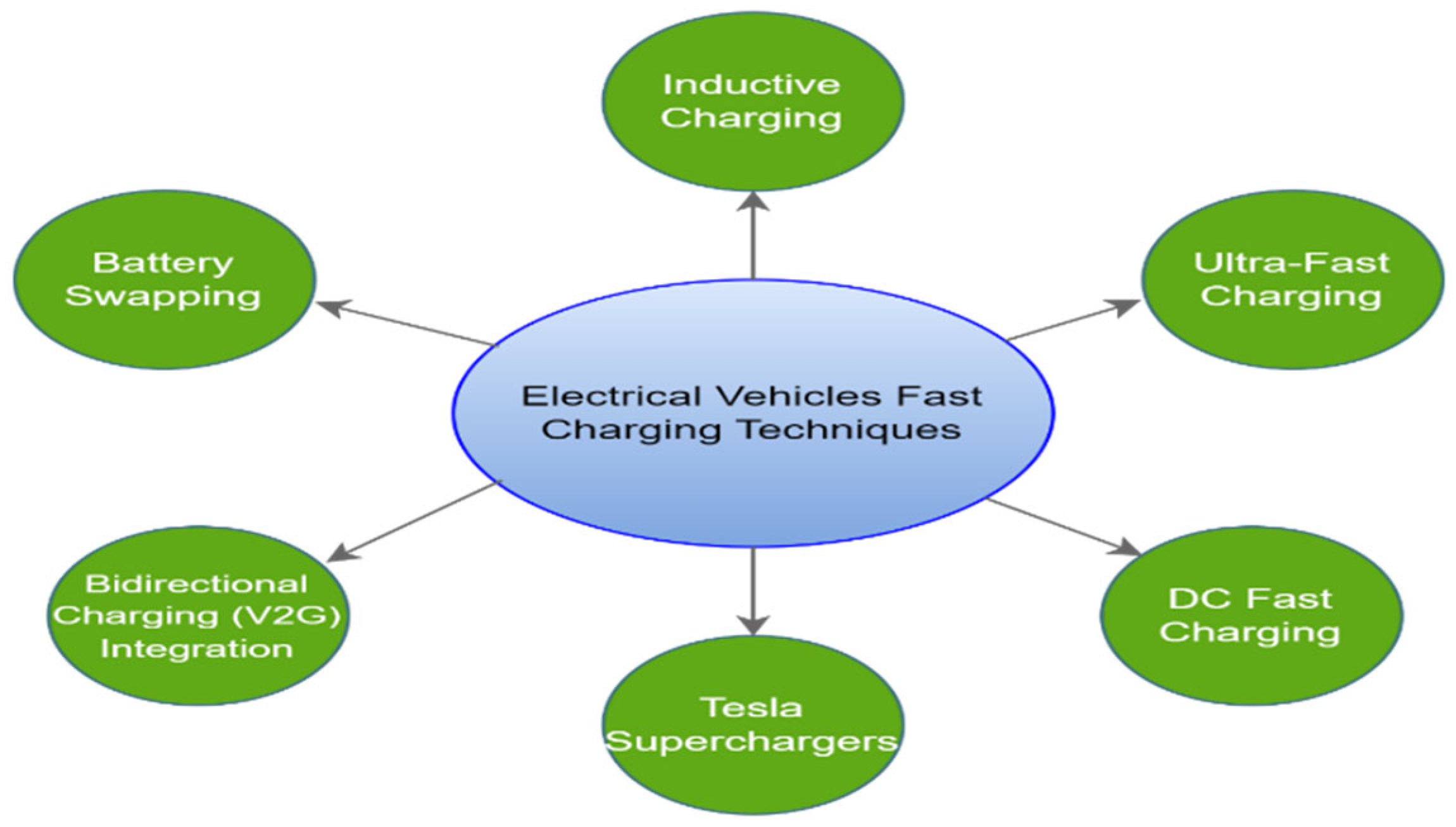
Figure 2.
Inductive charging: (a) Static Charging. (b) Dynamic Charging.
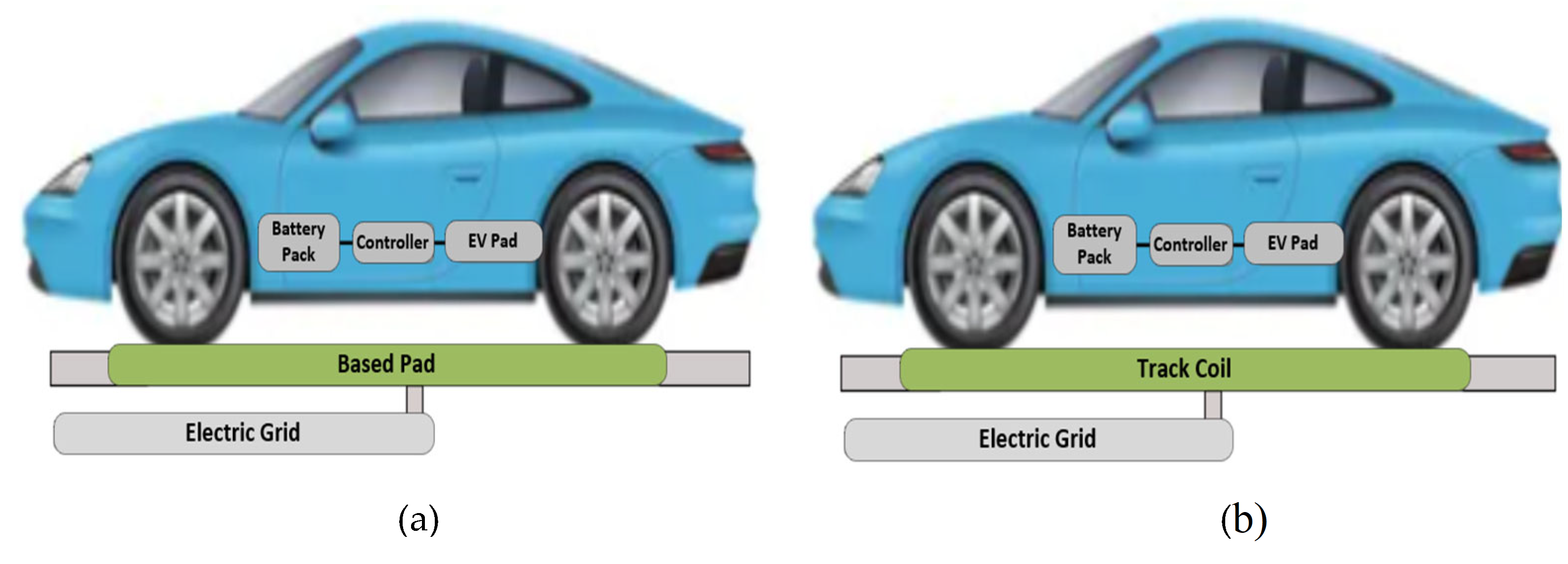
Figure 3.
Bidirectional EV Charging V2G.
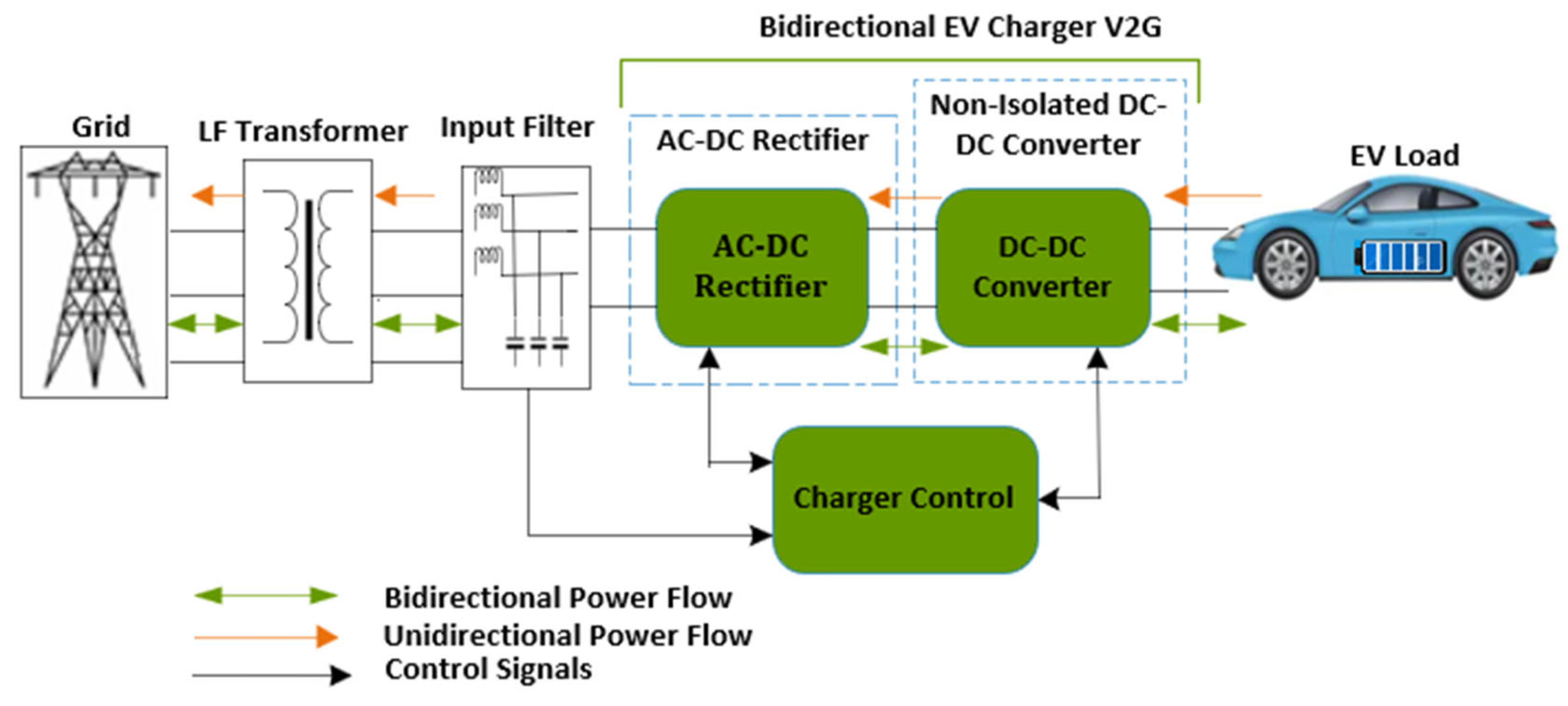
Figure 4.
Battery Swapping System.

Figure 5.
Illustrated on-board / Off-board EVs Fast Charging.
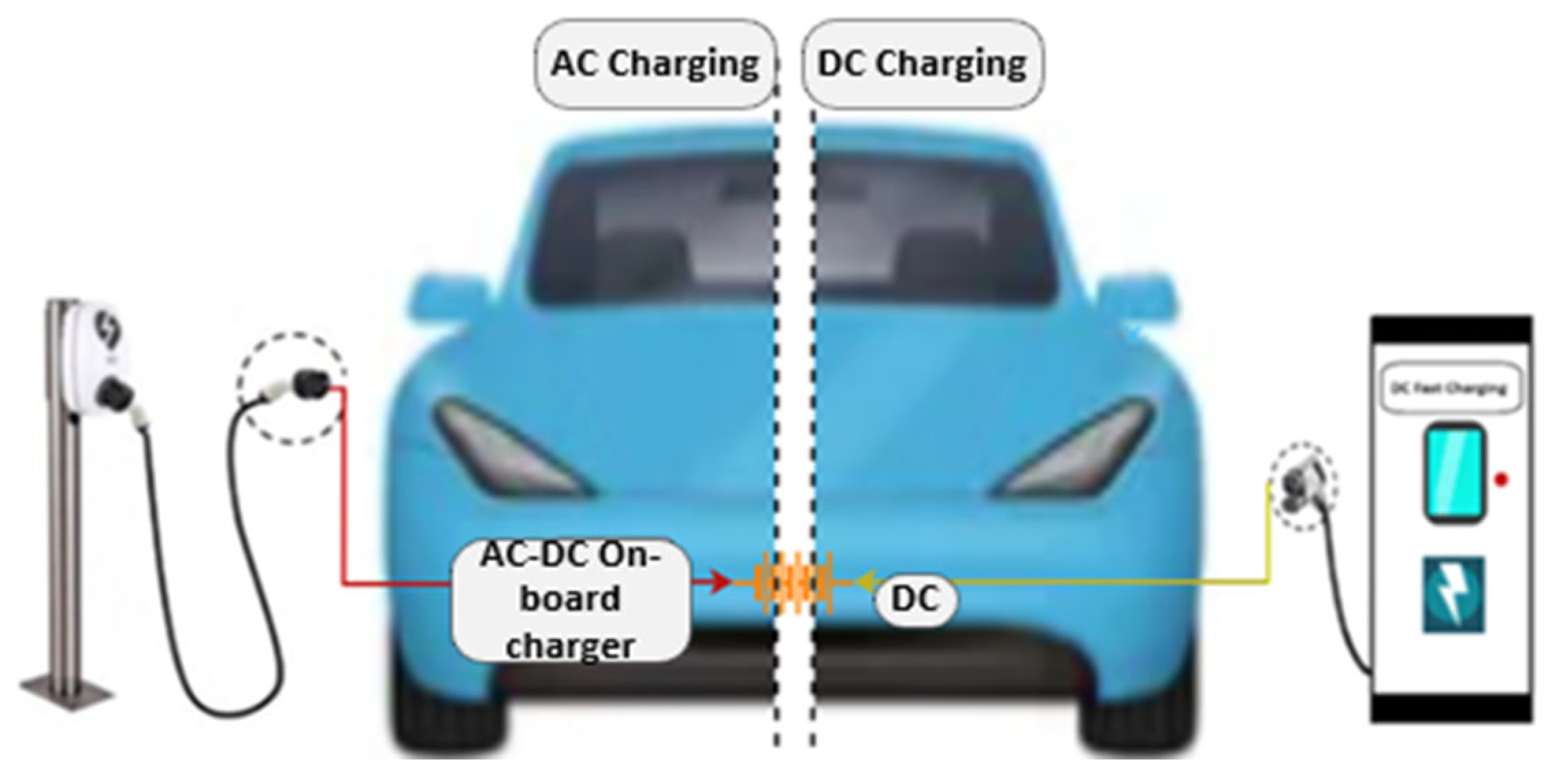
Figure 6.
Classification of DC-DC Converters Utilize for EV Charging System.
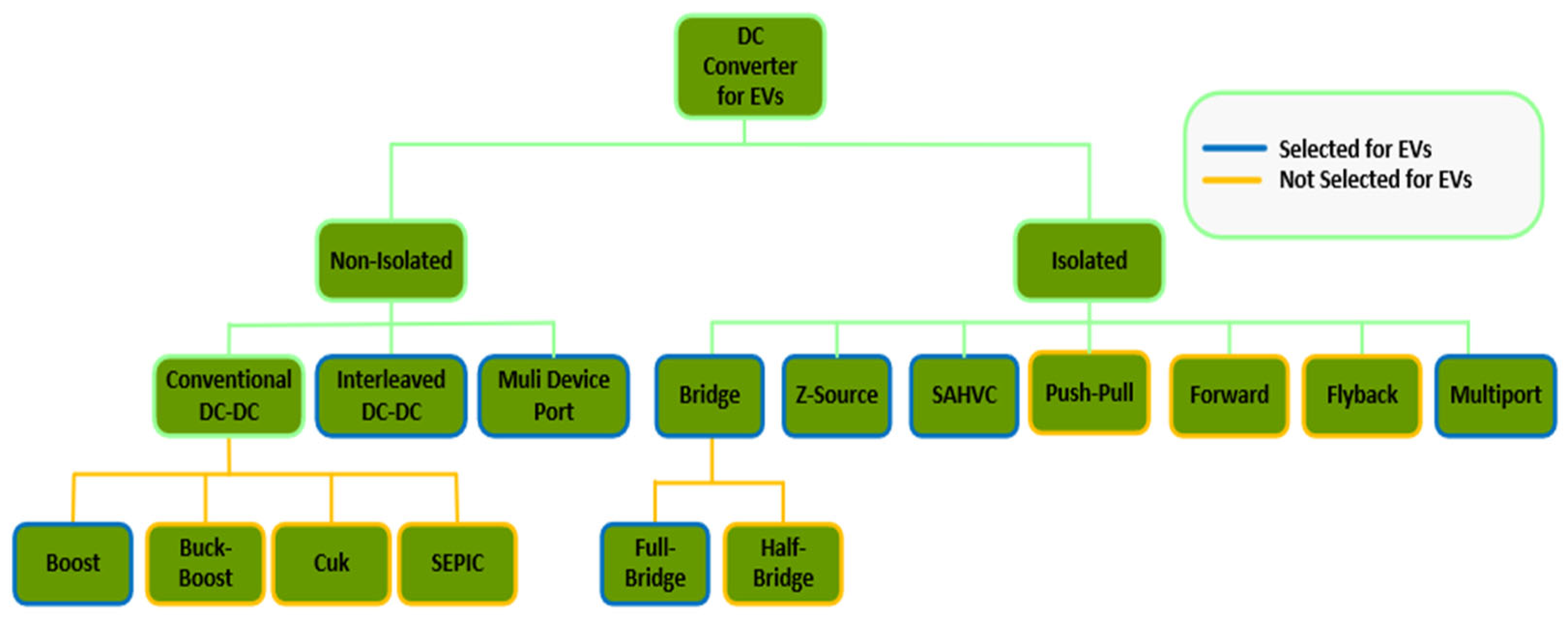
Figure 7.
Block diagram of DC Fast Charging Power Conversion Stage with: (a) LFTS Configuration. (b) SST-Based HFT Configuration.
Figure 7.
Block diagram of DC Fast Charging Power Conversion Stage with: (a) LFTS Configuration. (b) SST-Based HFT Configuration.
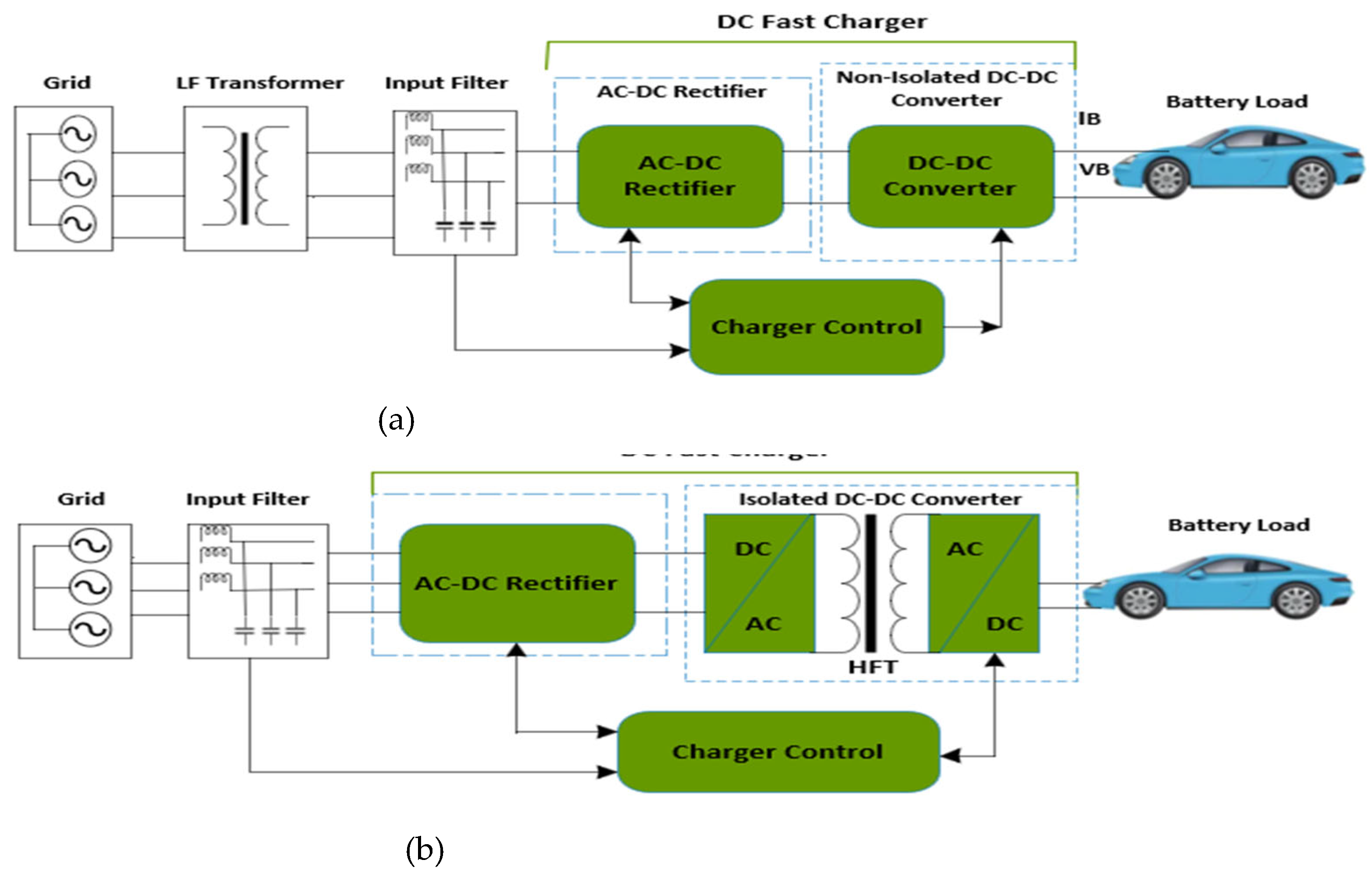

Table 1.
Electrical vehicles fast charging techniques VS EV Specs.
| EV Specifications | Ref | Inductive Charging | Ultra-Fast Charging | DC Fast Charging | Tesla Superchargers | Bidirectional Charging | Battery Swapping |
|---|---|---|---|---|---|---|---|
| Convenience | [84,85,86,87,88,89,90,91,92] | Medium to Low | High | Medium to High | High | Medium to Low | Medium to High |
| Safety | [88,92,95,96,97,98] | Medium | Medium to High | Medium to High | High | Medium to High | Medium to High |
| Durability | [96,100] | Medium | Medium | Medium | High | Medium | Medium to High |
| Integration with Infrastructure | [25,61,99,102,103,104,105,106,107,108,109] | Medium to Low | Medium to High | High | Medium to High | Medium to Low | Medium to Low |
| Compatibility | [91,94,106,111,112,113] | Low | Medium | Medium | Low | Medium to Low | Medium to High |
| Battery Degradation | [63,110,112,115,116,117,118,119,120,121] | Medium | High | High | Medium to High | Medium to High | Medium to High |
| Scalability and Upgradability | [15,25,100,122,123,124], | Medium | Medium to High | Medium | High | Medium to High | Medium to Low |
| Efficiency | [44,67,74,91,122,125,126,127,128], | Low | Medium to High | Medium | Medium to High | Medium to Low | Medium to High |
| Level of charging rating (A) | Supply system | Maximum power rating (kW) | Maximum current rating (A) |
|---|---|---|---|
| Level 1 (AC) (IEC) | 240 V | 4.7 | 16 |
| Level 2 (AC) (IEC) | 240 V | 11.5 | 32 |
| Level 3 (AC) (IEC) | 415 V | 90 | 250 |
| Fast DC Charging (DC) (IEC) | 600 V | 150 | 400 |
| Level 1 (AC) (SAE) | 120 V | 2 | 16 |
| Level 2 (AC) (SAE) | 208-240 V | 20 | 80 |
| Level 3 (AC)(SAE) | - V | ||
| Fast DC Charging (DC) (SAE) | -400 V |
| Standard | Description |
|---|---|
| IEC 60038 | Specifies the standard voltage levels used for electrical power systems. And charging applications |
| IEC 62196 | Standards conductive charging components for connectors, cables, outlets, plugs, inlets, and communication protocols used in AC charging of electric vehicles. |
| IEC 60664-1 | Insulation coordination for equipment within low-voltage systems |
| IEC 62752 | Provides guidelines for connecting of electric vehicles to information and communication technology ICT networks. |
| IEC 61851 | Covering various charging modes, communication protocols, and safety features. |
| SAE J1772 | Requirements for the electrical connectors and communication protocols for Level 1 and Level 2 charging used for AC charging of electric vehicles in North America. |
| SAE J2344 | Provides guidelines and test procedures for evaluating the crashworthiness and safety of electric vehicle battery systems. |
| SAE J2894/2 | Requirements for the power quality, conductive charge coupler used in DC fast charging electric vehicles. |
| SAE J2953 | Standards for interoperability to provide guidelines for conductive automated charging systems for electric vehicles |
| SAE J2847/1 | Communication between vehicles as a distributed energy source and grid |
| SAE J3068 | Wireless Power Transfer for Light-Duty Plug-In/Electric Vehicles and Alignment Methodology |
| SAE J2931/7 | Evaluating the electrical performance of components used in hybrid and electric vehicles |
| ISO 15118 | Standards for V2G communication protocols and interfaces between vehicle and charging infrastructure |
| ISO 17409 | Specifications and reliable measurement of energy consumption allow for accurate comparisons and evaluations of different EV models. |
| Category | Model | Type | Battery (KWh) | Range (Km) | Connector |
|---|---|---|---|---|---|
| Plug-in Hybrid (PHEV) | Chevrolet Volt | PHEV | 18.4 | 85 (battery) | Type 1 J1772 |
| Mitsubishi Outlander | PHEV | 20 | 84 (battery) | CCS, Type 2 | |
| Volvo XC40 | PHEV | 10.7 | 43 (battery) | CCS, Type | |
| Toyota Prius Prime | PHEV | 8.8 | 40 (battery) | SAE J1772 | |
| Nissan Leaf | PHEV | 64 | 480 | CHAdeMO, Type 2 | |
| Electric Vehicle (BEV) | Tesla Model S | BEV | 100 | 620 | Supercharger |
| Tesla Model X | BEV | 100 | 500 | Supercharger | |
| Tesla Model 3 | BEV | 82 | 580 | Supercharger | |
| Fuel Cell Electric Vehicle (FCEV) | Toyota Mirai | FCEV | 1.6 (hydrogen capacity) | 647 | N/A |
| Hyundai Nexo | FCEV | 40 (hydrogen capacity) | 570 | N/A | |
| Honda Clarity | FCEV | 25.5 (hydrogen capacity) | 550 | N/A | |
| Extended Range Electric Vehicle (E-REV) | BYD Atto3 | E-REV | 60.4 | 420 (battery) | CCS, Type 2 |
Table 5.
Comparison between on-board and off-board chargers [148].
Table 5.
Comparison between on-board and off-board chargers [148].
| Charging Methods | Advantage | Disadvantage |
|---|---|---|
| On-board charger |
|
|
| Off-board charger |
|
|
Table 6.
Control strategies for EV systems techniques for isolated and non-isolated DC-DC converters.
Table 6.
Control strategies for EV systems techniques for isolated and non-isolated DC-DC converters.
| Voltage Mode Control in Non-Isolated DC/DC Converters | Current Mode Control in Non-Isolated DC/DC Converters | Peak Current Control in Non-Isolated DC/DC Converters | Average Current Control in Non-Isolated DC/DC Converters | Voltage Mode Control in Isolated DC/DC Converters | Current Mode Control in Isolated DC/DC Converters | Peak Current Control in Isolated DC/DC Converters | Average Current Control in Isolated DC/DC Converters |
|---|---|---|---|---|---|---|---|
| Improves charging efficiency. | - Enhancing charging efficiency. | Prevent overloading the converter and charging infrastructure. | Optimizes energy transfer and improves charging. | Maintaining a stable output voltage. | Provide efficient energy transfer, stable from the grid to the EV battery. | Regulates and limits the peak current to optimize the charging process. | Regulate and maintain a stable average output current. |
| Fast response | Regulation protects the EV battery from overcharging or undercharging. | Ensures the charging current remains within a predetermined threshold. | Reduce charging times, minimized energy losses, and improved efficiency. | Prevents overvoltage or under voltage conditions, improving the charging efficiency of EV batteries. | Ensures reliable, safe, and fast charging operations. | Prevents the current from exceeding the peak limit, ensuring efficient energy transfer and providing overcurrent protection. | Ensures optimal charging performance and improves power quality. |
| Compatibility with the charging infrastructure | Fast dynamic response to load variations. | Enhances charging efficiency by minimizing energy losses and heat generation. | Improves voltage regulation and stability while protecting the battery from voltage fluctuations. | Excellent adaptability to load variations conditions. | Demand for rapid and reliable EV charging increases. | Ensures compatibility with grid constraints. | |
| Maintain a stable output voltage | Safeguards the charging infrastructure. | Compatibility with grid constraints, maintaining safety, optimizing energy transfer, and increasing charging efficiency demand for EV fast charging. | It ensures compatibility with charging infrastructure and provides flexibility in adapting to changing load conditions. | Allowing the system to accommodate different charging scenarios, optimizing energy transfer, reducing charging times, reliable, and high-performance charging infrastructure. | Ensuring safety and improving charging efficiency. | Achieving reliable, safe, and high-performance charging operations. | |
Disclaimer/Publisher’s Note: The statements, opinions and data contained in all publications are solely those of the individual author(s) and contributor(s) and not of MDPI and/or the editor(s). MDPI and/or the editor(s) disclaim responsibility for any injury to people or property resulting from any ideas, methods, instructions or products referred to in the content. |
© 2024 by the authors. Licensee MDPI, Basel, Switzerland. This article is an open access article distributed under the terms and conditions of the Creative Commons Attribution (CC BY) license (https://creativecommons.org/licenses/by/4.0/).
Copyright: This open access article is published under a Creative Commons CC BY 4.0 license, which permit the free download, distribution, and reuse, provided that the author and preprint are cited in any reuse.


