

Submitted:
15 April 2024
Posted:
17 April 2024
You are already at the latest version
Abstract
This paper describes an entropy equation that can be used for measuring energy. It originated from measuring economy in AI models, where the assumption would be that any organic system makes use of energy efficiency to form its structures. Looking at clustering and cohesion resulted in the equation E = (mean * variance). It was apparent however, that it was a very generic type of equation and it could be adjusted so that distance represents mean. This new version was applied to the domain of physics and the universe, when the equation can support the idea that work is done through the energy released by the 'change' in entropy. A comparison with Einstein's relativity equation is made and also the audacious suggestion that a black hole has only potential energy inside, which converts to kinetic energy after a Big Bang, for example. From that suggestion, a universal theory about state change can be made.
Keywords:
State Change
; Entropy
; Energy
; Physics
; Black Holes.
1. Introduction
This paper combines an earlier paper ‘An Entropy Equation for Energy’ [6] with ideas presented in blogs, due to an apparent increase of interest in this topic. Recent research into studying the cosmos has suggested that relativity and the quantum theories might not be completely correct and may need to be adjusted. This often relates to the missing dark matter and why the universe moves in the way it does. How do the celestial bodies move together and what is the gravity component that binds or pulls them apart? Black Holes emit matter, even though nothing should escape. The theory originated from looking at self-organising systems [7], but due to its simplicity, it evolved into a more general theory. The original measure was one of cohesion across patterns [8], but the result looked to be entropic [3] – a global measure rather than a local one. In fact, using the equation by itself simply to cluster information did not produce the best results. The clustering algorithm required a much more detailed algorithmic procedure, for example. A second look at the equation suggests that it is more akin to an energy comparison than an information one. It is a coincidence, but interesting, that the form of the equation bears a strong resemblance to Einstein’s famous relativity equation [2]. After further research and cross-referencing with two personal blogs [5], it became clear that the personal theories - about very large and small physics structures - had some themes in common. That common theme is the topic of this paper. As part of the discussion, comments about the universe, relativity, electromagnetism and black holes are made.
The rest of this paper is organised as follows: section 2 introduces some related work. Section 3 describes the origin of the equation and how it relates to Artificial Intelligence. Section 4 then extends the discussion to an equation about entropy and then to one about energy. Section 5 extends the theory into a universal one about state change. Finally, section 6 gives some conclusions on the work.
2. Related Work
This mostly relates to Physics, where the topics include entropy [4], gravity [3], black holes [9] and even the general theory of relativity [2]. More recent work from the established scientists [11], suggests a relation between energy variation and mass creation, where gravity can also vary due to entropic forces. That research describes the universe using the classical Newtonian model, rather than at the Quantum level, which can be left for the smaller atomic bodies. Entropic Gravity [12] is another theory that might be relevant. Similar ideas however can be applied to Machine Learning and AI [1], with regards to self-organising systems or information entropy. The relation between these algorithms and the human brain are considered in [7,8] and the author’s work is related much more to AI than to the topic of Physics.
3. Self-Organising System
This section gives some background to where the equation came from. Machine Learning [1] can be broadly categorised into supervised and unsupervised learning. With unsupervised learning, the system decides on the clustering details for itself, where there are many algorithms that can do this. One option here is to take a global or entropic view of the data. Is there a global measure that changes consistently when the clusters change? This is known as entropy and was included as part of a new self-organising algorithm [7], where it was used as a measure of cohesion [8]. A pattern could be split if the cohesive total for the sub-parts was better than for the pattern itself. The cohesion equation is described below:
Var = (1.0 - (standard deviation / mean local count))
CFp = (mean local count / mean global count) or mean R
Cohp = (Var * CFp)
Where:
Var = variance standard deviation that uses the average local count.
CFp = count difference to scale the variance by.
Cohp = cohesive value for the whole pattern.
The equation was derived by considering reinforcement counts, for when nodes occur as part of a cluster, but it is not the best method for creating the cluster model. It may be the case that it works better when pattern structures are already determined and the decision is about consistency over those structures. Ignoring the specifics about the different types of count, the essential properties are given in Equation 3, where the ‘mean’ relationship with the ‘variance’ is the key measure.
4. Entropy
Cohesion is a measure of consistency and so it would be possible to replace cohesion with the more general measure of entropy ([3], for example). The reinforcement counts would then also be generalised to some averaged value and so the entropy equation becomes:
where mean and variance are the standard statistical measurements. What they measure is not defined, but distance is likely to be key. This leads to the idea of ‘mean distance’ and ‘variance,’ rather than mean count. The equation therefore states that: for there to be entropy requires a distance between the entities and some measure of difference. It also states that as the distance or the variance tend to zero, then so does the entropy, or it achieves maximum order. Entropy is a measure of disorder in a system, where it is zero when there is complete order. The second law of thermodynamics however states that a system tends to disorder, or maximum entropy and as a result of this, energy is released. The third law of thermodynamics was however proved in [10] to be unattainable, meaning that zero entropy is not attainable by temperature reduction alone.
Entropy = (mean * variance)
4.1. Entropy in Physics
It is a coincidence, but also true that Equation 4 bears a striking resemblance to Einstein’s famous equation for relativity: E = mc2. Entropy has also been used to measure the physical properties of the Universe, especially about how it might have been created or die. The author would like to give a lightweight opinion about a new model that has some attractive properties. Its economy of energy would be difficult to argue with, for example. State change is not new. Newton, for example, realised that forces were only in existance when objects were moving, and moving relative to each other, so this is a clear indication of variance. He also proposed that gravity was a force. It is still not known exactly what gravity is, but theories include details about waves or particles, forces and electromagnetic waves. Entropic gravity [12] is a recent development that suggests an emerging, not constant, type of gravity, when the relative position of the two entites is important. If that is the case, then a distance that maybe extends to the centre of the bodies involved, would correlate quite well with relative masses. In Einstein’s equation, distance can somehow replace the idea of mass and variance can replace speed. Speed is the speed of light, which is a constant that does not die in a vacuum. It is also a very large number generated from the interation of the electric and the magnetic waves. As these electromagnetic waves change, they support each other and the correlation here is a continuing variance instead. If the electric particles cannot move, for example, then there is no magnetic field and the EM wave cannot sustain itself. Therefore, energy requires continuing variation to sustain itself. A recent paper [11] has surprisingly hit on some similar ideas about entropy and variance. Their new theory is able to explain the expansion of the universe and galactic rotation curves without the need for dark matter or dark energy. One quote is as follows:
‘Here, we immediately see, that when ‹(∇φ)2› >> ‹∇φ›2, we will see on average, a deviation from the Newtonian limit of general relativity. Indeed from Eq. (21), we see that the extra variance acts like a positive mass term. We call the regime when ‹(∇φ)2› >> ‹∇φ›2, the diffusion regime, since when the acceleration |∇φ| is small in comparison to its standard deviation, we will see a deviation from the Newtonian law of gravity. In Appendix D, we define an entropic force to be just such a deviation from the deterministic equations.’
A change in variance therefore acts like new mass and results in an entropic force. It also has a greater effect on a slower body that can result in a deviation in the Newtonian law of gravity. The paper [10] also deals with the ideas of thermodynamics and entropy.
4.2. Black Holes
The new theory is really about Black Holes [9]. They are known to be massively dense, but exactly what is going on inside is a bit of a mystery, because it cannot be measured properly. Black holes have maximum entropy and trap any matter or energy inside. Light, for example, cannot escape after it has passed the event horizon. This is because it is thought that the force of gravity inside a black hole is so great that something must travel faster than the speed of light to escape. Recent research however, has found anomalies in the standard models, leading to new theories about how the universe works. Therefore, as a new theory, what if there are simply no forces acting inside of the black hole, or the energy is all potential? If there is no work being done inside of the black hole, then light does not have any energy to escape with. The black hole can still be massively dense, but if it squeezes the mass closely-enough together, then maybe the particles have no room to move and so they remain exactly as they are. There is no state change and so there is no energy production. As a single solid body, it would in fact have maximum order. That would make sense in terms of the entropy equation and it is also a very economic theory.
5. Gravity and Time
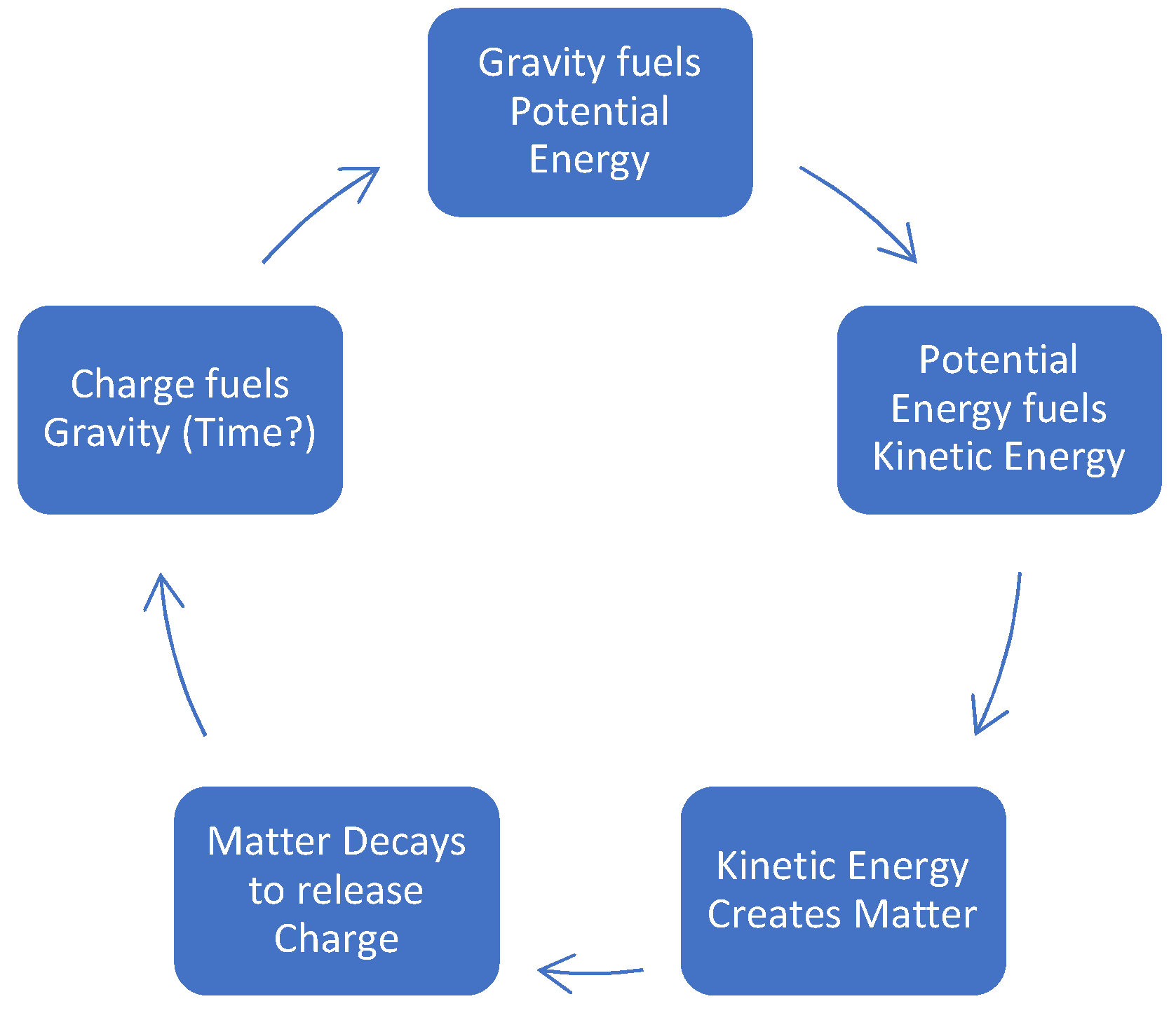
This section was originally a blog [5]. The impossible question is about the infinite nature of time and space. For our universe to be here, something outside of it must have put it here. But something outside of that must have put that there, before it could put our universe here, so the argument extends outwards to infinite space and backwards in time infinitely. Then of course the question is how matter is created, where this paper suggests that matter can be created from a change in entropy. Therefore, what kind of entropy change could have started this all off? Unfortunately, the infinite question is too difficult, but what type of process might create matter where there is none to start with? What about time itself? Time could be seen as a change in entropy, because it is continually changing. So could time itself in some way convert to energy, which can then convert into matter? In the new theory, black holes are composed mostly of potential energy. When this is released, through a Big Bang for example, it generates a massive amount of kinetic energy from which matter is created. This runs through to the end of the universe’s existence, when it declines back into chaos. Another black hole then starts a new cycle somewhere else.
What might be interesting is the role of time. If time is a force, or form of energy, then when matter decays, it releases its charge (electricity) and that could help to fuel future time events. But this also suggests that time may not be equal everywhere. Maybe time is local to a region and it flows unevenly through the universe. If there is less change then maybe time flows more slowly, or if the temperature drops (thermodynamics), slowing the change, then maybe time slows as well. Inside a black hole, for example, there is hardly any movement and so state changes slow-down completely, meaning that energy release also slows down, and also time. Reading about the Theory of Relativity shows a striking resemblance between the role of time in this discussion and gravity in the relativity theory. With the theory of relativity, gravity is thought to be an inertia not a force, with a global influence across space. It is also able to bend the spacetime continuum, which is not too different to variable time regions. Does gravity require matter first, or can it exist outside of that? Could a gravity inertia (still an entropy) replace time as the source of the Universe, obviously and probably yes. This section ends with a life cycle, shown in Figure 1.
An earlier blog made some light comments about the theory of relativity. It considered the composition of atoms and why they appear to be solid. It suggested that this is because the electrons move so quickly compared to our own world, that they always appear to be present. The idea was simply that relative speed gave the illusion of solidity, and the entity would then decay into something much less, when it ran out of energy. But also in relative terms, a slow-moving body is heavier than a fast-moving one. We therefore have the idea that mass is inversely related to state change and thus also relative speed. Also, if distance and variance are considered, then elements that are close together, inside of one body, will appear to be lightweight to themselves. The original equation related to more cohesive bodies, for example. The values are much larger between bodies, when interactions from the relative differences result in a type of gravitational pull, resembling weight. For example, the paper [11] notes that extra variance acts like a positive mass term. It also has a greater effect on a slower body.
6. Conclusions
This paper describes a short journey, from some very basic AI equations, to entropy and then over to a theory about the universe itself. The brain section has already been written about and focuses mostly on energy economy and synchronization of the firing elements. It may be the case that energy requires disorder to exist (first law of thermodynamics) and this disorder can be measured by something as simple as relative distance and difference. The second law of thermodynamics however, states that a system tends towards chaos and maximum entropy, when it then loses its ability to create more disorder. An orderly system is therefore at a higher potential state and that potential gets used up when work is done, resulting in the disorder. Similarly, a zero-entropy state system would be one with maximum potential, but again unable to do work. Work is done through the energy released by the change between states. The entropy Equation 4 could be broad enough to be applied in a general sense. The above arguments therefore give rise to a universal theory that makes ‘state change’ the key mechanism in the creation of our universe. The cycle shifts from all potential energy to all kinetic energy, until it runs out. Time and gravity may be the same and are not uniform, but local to the masses they interact with and may be the source of the universe itself.
References
- Alpaydin, E. (2020). Introduction to machine learning. MIT press.
- Einstein, A. (1916), Relativity: The Special and General Theory (Translation 1920), New York: H. Holt and Company.
- Feynman, R.P. (2005). The Feynman Lectures on Physics. 2 (2nd ed.). Addison-Wesley. ISBN 978-0-8053-9065-0.
- Goldstein, M. and Inge F. (1993). The Refrigerator and the Universe: Understanding the Laws of Energy. Harvard Univ. Press. ISBN 9780674753259.
- Greer, K. (2022). My Take on the Universe and Everything. Scribd. https://www.scribd.com/ document/556058784/My-Take-on-the-Universe-and-Everything.
- Greer, K. (2020). An Entropy Equation for Energy, IOSR Journal of Engineering (IOSRJEN), Vol. 10, No. 7, pp. 16-19. [CrossRef]
- Greer, K. (2020). A Pattern-Hierarchy Classifier for Reduced Teaching, WSEAS Transactions on Computers, ISSN / E-ISSN: 1109-2750 / 2224-2872, Volume 19, 2020, Art. #23, pp. 183-193. [CrossRef]
- Greer, K. (2021). A Brain-like Cognitive Process with Shared Methods, Int. J. Advanced Intelligence Paradigms, Vol. 18, No. 4, pp.481-501, Inderscience. [CrossRef]
- Hawking, S. (1988). A Brief History of Time. Bantam Books. ISBN 978-0-553-38016-3.
- Masanes, L. , Oppenheim, J. ( 2017). A general derivation and quantification of the third law of thermodynamics. Nat Commun 8, 14538. [CrossRef]
- Oppenheim, J. and Russo, A. (2024). Anomalous contribution to galactic rotation curves due to stochastic spacetime. arXiv:2402.19459v1 [gr-qc] 29 Feb 2024.
- Verlinde, E.P. (2011). On the origin of gravity and the laws of Newton. J. High Energ. Phys. No. 29. [CrossRef]
Figure 1.
Creation Cycle for a Universe.
Disclaimer/Publisher’s Note: The statements, opinions and data contained in all publications are solely those of the individual author(s) and contributor(s) and not of MDPI and/or the editor(s). MDPI and/or the editor(s) disclaim responsibility for any injury to people or property resulting from any ideas, methods, instructions or products referred to in the content. |
© 2024 by the authors. Licensee MDPI, Basel, Switzerland. This article is an open access article distributed under the terms and conditions of the Creative Commons Attribution (CC BY) license (https://creativecommons.org/licenses/by/4.0/).
Copyright: This open access article is published under a Creative Commons CC BY 4.0 license, which permit the free download, distribution, and reuse, provided that the author and preprint are cited in any reuse.


