

Submitted:
17 April 2024
Posted:
17 April 2024
You are already at the latest version
Abstract
To improve efficacy and safety of sunscreen emulsions, UV‐filter skin permeation could be kept as low as possible by reducing UV‐filter content or changing emulsion composition. In this work, different lipid phase ratio (12, 14 and 16% w/w) were assessed for their ability to affect the technological and sensory properties of O/W emulsions in which bemotrizinol (BMTZ), a broad spectrum sunscreen agent, was incorporated free or loaded into nanostructured lipid nanocarriers (NLC) to reduce its release from the vehicle and, hence, its skin permeation. The following technological properties were evaluated in vitro by suitable methodologies: spreadability, viscosity, pH, occlusion factor, BMTZ release, sun protection factor (SPF). Sensory attributes were assessed by trained panelists in three different phases: before/during pick‐up, rub‐in, after application. Raising the lipid phase ratio led to an increase of viscosity and to a corresponding drop of spreadability while the incorporation of BMTZ‐loaded NLC determined a decrease of occlusion factor and an increase of SPF. No BMTZ release was observed from all emulsions. Sensory attributes were mainly affected by lipid phase ratio. These results suggest that lipid phase ratio and BMTZ incorporation into NLC could contribute to determine technological and sensory properties of O/W emulsions.
Keywords:
bemotrizinol
; emulsions
; sensory evaluation
; UV-filters
; lipid nanoparticles
; in vitro SPF
1. Introduction
Emulsions are the most common formulations used in the manufacture of cosmetics because of their moisturizing effect, their ability to maintain the proper water-lipid balance of the cutaneous barrier and to deliver active ingredients into the deeper skin layers, thus improving the effectiveness of skin care products [1,2,3,4,5,6,7]. The main raw materials of these biphasic systems are water, lipids, viscosity-modifying agents, sensory agents (emollients, humectants) and emulsifiers [6,7,8,9]. The choice of type and amount of such raw materials may play a key role in determining the safety and efficacy of the resulting emulsions as skin permeation of incorporated active ingredients could be strongly affected by vehicle composition [10,11,12]. As far as sunscreen agents are concerned, skin permeation should be avoided, or at least minimized, to improve both safety and efficacy of sunscreen formulations [13,14]. In the last two decades, UV-filter incorporation into lipid nanoparticles has been proposed as a promising strategy to develop formulations containing lower amounts of organic UV-filters without reducing the sun protection factor (SPF), due to the ability of these nanocarriers to act as physical sunscreens [15,16,17,18,19,20]. The first generation of lipid nanoparticles, namely solid lipid nanoparticles (SLN), consisted of a solid lipid core stabilized by surfactants in aqueous media [21,22,23,24,25,26,27,28]. Due to their drawbacks, such as poor stability and loading capacity, a second generation of lipid nanoparticles (nanostructured lipid carriers, NLC) whose core was made up of mixtures of liquid and solid lipids was developed [29,30,31,32,33,34,35]. SLN and NLC have been extensively studied as carriers for drugs and cosmetic active ingredients owing to their many advantages including high biocompatibility, good tolerability, improved bioavailability, low cost of production and easy scale-up. In addition, several studies have highlighted the ability of SLN and NLC to incorporate organic UV-filters, thus supporting the feasibility of using these nanocarriers to develop sunscreen formulations [36,37,38,39].The increasing awareness of the harmful effects of both UV-A and UV-B radiation has drawn a great deal of attention to the search for broad-spectrum UV-filters that could effectively protect the skin from UV solar radiation after their topical application. In this context, bemotrizinol (BMTZ), a triazine derivative, has been designed to absorb UV radiation in the range 280-380 nm and launched in the market as a broad-spectrum sunscreen [40,41,42,43,44]
In a previous work of ours, BMTZ was incorporated into various types of NLC and the technological properties of O/W emulsions containing different percentages of optimized BMTZ-loaded NLC were evaluated [45]. These formulations showed interesting technological characteristics, such as low BMTZ release from the vehicle, good stability and about a 20% increase of in vitro SPF values in comparison with formulations containing the same percentage of free BMTZ.
As emulsion lipid content could affect both in vitro release and skin permeation of incorporated active ingredients, in this work we investigated the effects of using different percentages of lipid phase having the same composition on the technological properties (viscosity, spreadability, occlusion factor, stability, in vitro release and SPF value) of O/W emulsions in which BMTZ-loaded NLC were incorporated.
In addition to technological properties, formulation sensory attributes, which are involved in consumer acceptance of cosmetic products, could be influenced by emulsion lipid content [46,47]. Therefore, a sensory evaluation was performed on the emulsions under investigation to assess different parameters in the following steps: before and during product pick- up (glossiness, firmness, color, adhesiveness, elasticity), during product “rub-in” (stickiness, spreadability, absorbency, oiliness), and after emulsion application (“after feel”, glossiness, stickiness, oiliness).
2. Materials and Methods
2.1. Materials
Isopropyl myristate (IPM), disodium EDTA (EDTA), imidazolidinyl urea (Kemipur 100®), C12-15 alkyl benzoate (Acemoll TN®), beeswax and benzyl alcohol were supplied by Galeno (Carmignano-Prato, Italy). Almond oil and glycine soja oil were purchased from Farmalabor (Canosa di Puglia, Bari, Italy). Cetearyl alcohol (and) cetearyl glucoside (Montanov 68®) was supplied by Polichimica Srl (Bologna, Italy). Cetyl palmitate (Cutina CP®, CP), bis-ethylhexyloxyphenol methoxyphenyl triazine (bemotrizinol, Tinosorb S®, BMTZ), cetearyl isononanoate (Cetiol SN®) and glyceryl stearate (Cutina MD®) were a kind gift from BASF (Ludwigshafen, Germany). Oleth-20 (Brij 98®) was bought from Sigma-Aldrich (Milan, Italy). Glyceryl oleate (Tegin O®, GO) was obtained from A.C.E.F. S.p.A. (Fiorenzuola D’Arda-Piacenza, Italy).
2.2. Preparation and Characterization of Bemotrizinol Loaded Nanostructured Lipid Carriers (NLC)
NLC were prepared using the phase inversion temperature (PIT) method using cetyl palmitate as solid lipid (4% w/w), isopropyl myristate as liquid lipid (3 % w/w), bemotrizinol (8 % w/w), oleth-20 (8.7 % w/w) and glyceryl oleate (4.4 % w/w) as surfactant and co-surfactant, respectively [45]. The aqueous phase consisted of deionized water containing Kemipur 100® 0.35 % w/w as preservative. After heating separately both the oil and aqueous phase at 90 °C, the aqueous phase was added slowly to the oil phase under vigorous stirring (700 rpm) leading to a colloidal suspension that was allowed to cool down to room temperature under continuous stirring. Then, the samples were stored in airtight jars at room temperature and in the dark until used. Morphological analysis was performed by transmission electron microscopy (TEM) using a transmission electron microscope (model JEM 2010, Jeol, Peabody, MA, USA) operating at an acceleration voltage of 200 KV. Samples were prepared by placing 5 μL of colloidal suspension on a Formvar (200-mesh) copper grid (TAAB Laboratories Equipment, Berks, UK). The excess of sample was removed by filter paper and a drop of 2% (w/w) aqueous solution of uranyl acetate was added. The sample was analyzed after drying at room temperature. Mean particle size and size distribution (polydispersity index, PDI) of bemotrizinol-loaded NLC were determined by dynamic light scattering (Zetasizer Nano ZS90, Malvern Instruments, Malvern, UK), using a 4 mW laser diode at 670 nm and scattering light at 90°. Before the analysis, the sample was diluted (1:5, sample/distilled water) and let to settle down to 25°C for 2 min. The same Zetasizer was used to assess ζ-potential by laser Doppler velocimetry after diluting the samples in KCl 1 mM (pH 7.0).
2.3. Preparation of O/W Emulsions
The composition of O/W emulsions prepared using different percentages of oil phase is reported in Table 1. After heating phase A and B separately to 70 °C, the water phase was poured into the oil phase under vigorous stirring (Turbomixer Silverson SL2, Silverson Machines Inc., East Longmeadow, MA, USA). The resulting emulsion was cooled to 40 °C under slight stirring and then preservatives (phase C) were added. Afterwards, for samples A12NLC, A14NLC and A16NLC, the same amount (30.0 % w/w) of BMTZ loaded NLC colloidal suspension was added under gentle mixing. Then, the emulsion was cooled to room temperature under continuous and gentle stirring. All samples were stored in airtight glass jars at room temperature and in the dark until used. 48 h after emulsion preparation, pH measurements were performed by a Crison pH-meter mod. Basic 20 (Crison Instruments, Barcelona, Spain), after diluting the sample with distilled water to one-tenth of its original concentration as previously reported [47].
2.4. Stability Tests on O/W Emulsions
Accelerated stability tests were performed by centrifuging emulsion samples at 3,000 rpm for 20 min using a centrifuge MiniSpin Plus (Eppendorf, Hamburg, Germany). After centrifugation, appearance, pH and viscosity of the samples were evaluated.
Samples of the emulsions under investigation were stored in airtight glass jars at room temperature and at 37°C for three months, sheltered from light. At intervals (1 week, two weeks, one month, two months and three months), samples were analyzed to determine their appearance, pH and viscosity.
2.5. Spreadability
Spreadability was determined by the parallel-plate method [47,48] using two glass plates (diameter 9 cm). 1 g of sample was placed between the plates and a 50 g weight was put on the upper plate. After 1 min., the weight was removed and the spreading diameter (expressed in centimeters) was measured. Each measurement was carried out in triplicate.
2.6. Occlusion Factor
The occlusion factor was assessed according to a method previously reported [49,50]. Beakers (100 ml) containing 50 ml of distilled water were covered with filter paper (cellulose acetate filter, perfecte 2, 90 mm, cutoff size: 4 -7 µm, Cartiera Cordenons, Pordenone, Italy), sealed and 200 mg of emulsion were spread on the filter surface (18.8 cm2; applied amount 10.6 mg/cm2). After weighting accurately the sample, incubation was performed at 32°C (skin surface temperature) for 48 hours (50-55 % RH) in an incubator (Incubator IN 30, Memmert GmbH, Schwabach, Germany). Then, samples were weighted to determine water evaporation. Beakers covered with filter paper free of sample formulation were used as reference.
The occlusion factor (F) was calculated according to the following equation (1):
where A is the water loss without sample (reference) and B is the water loss with sample. Each experiment was performed in triplicate.
F = 100 x [(A-B)/A]
2.7. Viscosity
Viscosity measurements [51,52] were performed 48 h after emulsion preparation to allow the sample to settle down. Viscosity of the formulations under investigation was determined by a Brookfield DV-II+Pro EXTRA rotation viscosimeter (Brookfield Engineering Laboratories, Inc., Middleboro, MA, USA) using spindle number 6. The instrument was calibrated as described in the operating instructions of the instrument manual using silicone oil as standard fluid. Each formulation (25 mL) was placed in a glass vial and left to settle down for 1 h prior to performing the measurement. Then, viscosity was monitored for 30 seconds at 6 rpm and room temperature. Each measurement was carried out in triplicate with a time interval of 5 minutes and the results were expressed in cPs.
2.8. In Vitro Release of Bemotrizinol
Franz-type diffusion cells (LGA, Berkeley, CA, USA) were used to assess BMTZ release from the emulsions under investigation [53,54,55,56]. Experiments were performed using cellulose membranes previously moistened by immersion in distilled water for 1 hour at room temperature. This methodology to assess in vitro drug release from topical formulations has been reported to be suitable to obtain reliable results [57]. After placing the membrane between the donor and the receptor compartment, the surface area available for diffusion was 0.75 cm2. As BMTZ is a poorly water-soluble compound, a mixture consisting of water/ethanol (50/50 v/v) was used as receiving phase to ensure pseudo-sink conditions by increasing BMTZ solubility in the receiving phase. The use of receptor fluids containing solvents or surfactants to increase drug solubility has already been reported by others [58]. The receiving phase (4.5 mL) was stirred (700 rpm) and thermostated at 35°C to maintain the membrane surface at 32°C throughout the exepriment. After placing the sample (2 mg/cm2) in the donor compartment, 500 μl of the receiving solution were withdrawn at intervals (0, 30, 60, 90, 120, 240 min) and replaced with an equal volume of receptor fluid pre-thermostated to 35°C. The amount of BMTZ in such samples was determined spectrophotometrically (UV-VIS Spectrophotometer Shimadzu mod. UV-1601, Shimadzu Italia, Milan, Italy) at 340 nm. A calibration curve was constructed in the range 0.1 -1 μg/mL by dissolving BMTZ in water/ethanol (50/50 v/v) (limit of detection 0.01 μg/mL, limit of quantification 0.05 μg/mL). Each experiment was performed in triplicate and results were expressed as mean ± S.D.
2.9. Determination of In Vitro Sun Protection Factor (SPF)
To evaluate in vitro sun protection factor (SPF) values [59,60,61,62,63] of the formulations under investigation, the method described by Dutra et al. [64]was applied, with minor modifications. Each emulsion sample was properly diluted in deionized water (final concentration 200 μg/mL) and analysed spectrophotometrically (UV-VIS Spectrophotometer Shimadzu mod. UV-1601, Shimadzu Italia, Milan, Italy). Absorption data were acquired every 5 nm in the range 290–320 nm. SPF values were calculated according to equation (2):
where CF is the correction factor (= 10), EE(λ) is the erythemal effect of the radiation with wavelength λ, I(λ) is the solar intensity of radiation with wavelength λ, and Abs(λ) is the absorbance of the sunscreen product at wavelength λ.
The values of EE(λ) x I(λ) at each wavelength in the range 290-320 nm are constant as determined by Sayre et al. [65] and were used to calculated SPF values.
2.10. Sensory Evaluation
A descriptive sensory evaluation was performed by ten female panelists (aged 38 ± 8 years). Due to the nature of the study, the local Ethical Committee declared that no approval was required. After explaining the general concept of the study, detailed explanations of the test and on the use of the sensory descriptors were provided to all participants [47,66]. All participants provided their written informed consent to be enrolled in the study. Prior to performing the sensory evaluation on the investigated formulations, the panelists were trained by assessing three commercial O/W creams on the same attributes involved in the present study. In addition, panelists were instructed to apply about 2 mg of product over the back of the left hand.
The study was carried out under controlled temperature and relative humidity, and adequate light conditions. Panelists were asked to provide their assessment in three different steps: 1) before and during product pick-up; 2) during product rub-in; 3) after product application on the skin. Each attribute was graded using pre-defined descriptive terms to which a numeric value was associated, as reported in Table 2.
Freshly prepared samples were placed in containers labelled with four-digit code numbers and provided to the panelists along with an analysis form, reporting, for each step, the descriptive term and grading of the sensory attributes under evaluation. The participants were also asked to indicate the preferred formulation.
2.11. Statistical Analysis
Results were expressed as mean values ± standard deviation (S.D.) of three replicates. Statistical analysis was performed using Student’s t-test and values were considered statistically different when p < 0.05.
3. Results and Discussion
Pharmaceutical and cosmetic emulsions are complex systems in which several components may affect safety, efficacy and consumer acceptance of the final product. Otto et al. [67], reviewing the effects of emulsion composition on dermal and transdermal delivery of active ingredients, outlined the importance of the proper choice of emulsion constituents, such as emollients and emulsifiers, to optimize the skin penetration of an active ingredient. In particular, composition and amount of lipid phase could affect the performance of cosmetic emulsions. In this work, different lipid phase ratio were assessed for their ability to modify the technological and sensory properties of O/W emulsions incorporating free BMTZ and BMTZ-loaded NLC.
In a previous work [45], the feasibility of incorporating BMTZ in NLC with different oil composition was investigated. Using 3% w/w of isopropyl myristate and 4% of cetyl palmitate as components of NLC core, stable colloidal suspensions with a maximum loading capacity of 8% w/w BMTZ were obtained. In the present work, such BMTZ-loaded NLC were incorporated in O/W emulsions prepared using different lipid phase ratio (12, 14, 16% w/w). These nanoparticles were roughly spherical with no sign of aggregation and showed mean size (193.2 ± 8.8 nm), PDI (0.151 ± 0.012) and ζ-potential value (-11.1 ± 1.5 mV) suitable for incorporation into topical formulations. To evaluate the effects of BMTZ encapsulation into NLC, O/W emulsions containing the corresponding amount of free BMTZ (2.4% w/w) were prepared, as shown in Table 1. Preliminary investigation were carried out by comparing the technological properties (pH, viscosity, occlusion factor, spreadability) of the O/W emulsions containing 2.4% w/w of free BMTZ with those of O/W emulsions having the same lipid and aqueous phase composition but prepared without BMTZ. The results of these experiments showed no significant difference between emulsions without BMTZ and emulsions containing 2.4% w/w of BMTZ for all assessed parameters (data not shown).
Prior to evaluating the technological properties, the emulsions under investigation were assessed for their stability. Accelerated stability tests performed by centrifugation did not show any sign of emulsion separation or alteration. Storing emulsions at room temperature and 37°C for three months did not lead to any significant change of pH, viscosity and appearance of the samples (data not shown), thus suggesting a good stability of all formulations.
The technological properties of O/W emulsions containing free BMTZ and BMTZ loaded-NLC are summarized in Table 3. For all investigated emulsions, pH values were similar and ranged from 6.3 to 6.5. Although these values were greater than skin surface pH value (5-5.5), they were within the physiological value and could be regarded as safe. Increasing the lipid phase ratio led to a greater viscosity of the resulting emulsions and to a drop of spreadability. The incorporation of BMTZ-loaded NLC determined a decrease of viscosity of emulsions containing 12% w/w of oil phase while no significant difference was observed for emulsions prepared using 14 and 16% w/w of lipid phase. A corresponding but inverse trend was observed analyzing spreadability data. As shown in Figure 1, a good relationship (r2=0.9883) was observed between viscosity and spreadability values, which support previous observations about the possibility of predicting the spreadability of topical formulations by measuring their viscosity [68,69].
Results of experiments performed to evaluate the occlusion factor (F) of the emulsions under investigation showed that an increase of lipid phase content from 12 to 14 % w/w led to greater F values but a further increases from 14 to 16% w/w did not result in an additional increase. These results support the hypothesis that the occlusive properties of O/W emulsions could be affected by the amount of oils used for their preparation [70]. When BMTZ-loaded NLC were incorporated into the emulsions, F values decreased regardless of the lipid phase ratio, suggesting that BMTZ-loaded NLC could alter the emulsion structure making it more permeable to water. Previous differential scanning calorimetry studies [45] pointed out that BMTZ-loaded NLC had low crystallinity that was attributed to their high percentage of liquid lipid. As reported in the literature [49,71], lipid nanoparticles with low crystallinity could not be expected to provide a significant enhancement of the occlusion factor.
Early studies on skin permeation highlighted the key role of drug release from the vehicle in the percutaneous absorption process [72]. Indeed, for a drug to be able to permeate through the skin, its release form the formulation is an essential requisite. In the present work, BMTZ in vitro release from the emulsions under investigation was evaluated in experiments lasting 4 h because sunscreen formulations are not expected to remain on the skin surface for longer periods. As shown in Table 3, no BMTZ could be detected in the receiving phase, thus showing that the sunscreen agent was not released from the vehicle. These results suggest that no BMTZ skin permeation could be expected to occur after topical application of the investigated formulations.
The sun protection factor (SPF) is a fundamental parameter to assess the efficacy of sunscreen formulations. In 2006, the European Cosmetic and Perfumery Association (COLIPA) developed an in vivo method to determine SPF in humans [73] that has been used to draw up ISO 24444:2019 [74], the currently in use standardized in vivo SPF test. Being in vivo methods quite expensive and time-consuming, several alternative in vitro tests have been developed to obtain affordable, fast and reliable results [75,76,77,78]. In this work, the method based on Mansur equation was used to determine in vitro SPF values as this type of test has already been applied in the evaluation of skin photo-protection of an active ingredient incorporated into lipid nanoparticles [79]. However, the reliability of this spectrophotometric method has been questioned because of poor predictability of in vivo results, mainly due to an improper application of the method, such as incorrect dilution of the sample [80,81]. Recently, Hermund et al. [82], to evaluate the reliability of the Mansur method, tested three commercial sunscreen formulations by this in vitro method and compared the obtained results with the SPF value reported by the manufacturer. The authors found a good agreement between claimed SPF and SPF values determined using the Mansur equation, highlighting the advantages of this in vitro method (use of conventional equipment and inexpensive solvent) and its usefulness to screen products during the development step.
In this work, to assess the reliability of SPF values obtained by applying the Mansur equation, results were compared to those obtained in silico by the BASF sunscreen simulator (www.basf.com/sunscreen-simulator). This software is based on the concept that, according to Sayre et al. [65], SPF can be conceptualized as the ratio of areas between the erythemal weighted solar radiation intensity with and without sunscreen. As shown in Figure 2, the BASF sunscreen simulator predicted an SPF value of 5.9 for a formulation containing 2.4% w/w BMTZ. It is important to underline that this software was not able to account for vehicle effects and UV-filter incorporation into nanocarriers. Therefore, preliminarily, emulsions prepared using 12, 14 and 16 % w/w of lipid phase free of BMTZ were tested to determine their SPF providing very low values (0,95, 0,97 and 1,10, respectively).
A slight increase, although not statistically significant, of SPF value was observed by raising the percentage of lipid phase. These results suggest that, regardless of its composition, the content of lipid phase could affect the photo-protective activity of O/W emulsions.
Formulations A12, A14 and A16, containing 2.4% of free BMTZ, showed SPF values in good agreement with the predicted in silico value (6,4, 6,6, 6,7, respectively). The slight higher SPF values obtained by the Mansur method could be attributed to the contribution to SPF provided by the vehicle that was not accounted for when SPF was estimated in silico. The results reported in Figure 2 pointed out that the incorporation of BMTZ into NLC led to an improvement of SPF in comparison with the corresponding O/W emulsion containing the same percentage of free BMTZ. SPF increase was in the range 6% (formulation A12 NLC) – 15% (formulation A16NLC). As all data showed standard deviation values lower than 5%, the differences of SPF values between formulations containing free BMTZ and BMTZ-loaded NLC were statistically significant when compared using Student’s t-test. An increase of SPF value as a result of UV-filter incorporation into lipid nanoparticles has already reported in the literature. An early work by Wissing and Muller [83] reported about a 20% increase of SPF by encapsulating the UV-filter 2-hydroxy-4-methoxybenzophenone into SLN. Similarly, the entrapment of silymarin, a flavonoid with antioxidant activity, into NLC incorporated in O/W emulsions provided about a 20% increase of SPF in comparison with the same formulations containing free silymarin [79]. Recently, de Araújo et al. [84]reported an increased photo-protection due to UV-filter incorporation into NLC despite a 10 % reduction of filter content. The results of the present study are in good agreement with literature data, supporting a synergetic effect between UV-radiation absorption due to the organic filter and light scattering promoted by NLC, which could act like physical sunscreens because of their core structure, consisting mainly of solid lipid. Further studies have been planned to evaluate in vivo SPF of the investigated formulations to assess the reliability of in vitro data.
In addition to suitable SPF values, consumers require that sunscreen emulsions show proper sensory attributes, such as good spreadability, low oiliness and stickiness, lack of residues on the skin. Among these properties, spreadability plays a key role as sunscreen formulations are supposed to be applied in a thin and even layer on large area of the skin surface. Calvo et al. [8] summarized the most relevant sensory attributes that affect consumer acceptance of skin care products, highlighting the role of rheology and product formulation in determining the textural properties of cosmetic emulsions. A study performed on O/W emulsions containing different percentages of xanthan gum and oil phase showed the dependence on the percentage of such emulsion components of specific sensory attributes [85]. In particular, an increase of oil phase led to enhanced oiliness, consistency and stickiness of the formulations while different percentages of xanthan gum mainly affected integrity of shape, penetration force, wetness, spreadability and glossiness.
In this work, the effects of different oil phase ratio on the sensory attributes of O/W emulsions containing NLC loading BMTZ as sunscreen agent were evaluated. As NLC consist of solid and liquid lipids, their incorporation into O/W emulsions could affect consumer perception of several parameters, such as oiliness, spreadability, stickiness and glossiness. A statistical analysis (ANOVA, Analysis of variance) of panelist ability to provide reliable opinions was performed in the training phase showing that between-repetition and between-assessor variations were not significant (p > 0.05).
The results of sensory evaluation performed before and during product pick-up, during rub-in and after product application (after feel) are shown in Figure 3a-c.
When the product was in the container, the incorporation of NLC in the cream mainly af-fected color perception. Emulsions containing free BMTZ were perceived as yellowish or pale yellow while formulations incorporating BMTZ loaded into NLC were assessed as whitish or white. BMTZ is a light yellow powder whose addition to a cream gives the formulation a yellowish color. BMTZ incorporation into NLC seemed to mask almost completely the color of this UV-filter, leading to whitish or white formulations. In addition, it is interesting to note that the increase of lipid phase content for emulsions containing BMTZ-loaded NLC seemed to move the perception of color towards white. This observation requires further investigations to confirm these results using a large number of panelists and to provide a rational explanation of such finding. The emulsion (A16NLC) containing the highest percentage of lipid phase was considered the most elastic, adhesive and firm when BMTZ-loaded NLC were incorporated (Figure 3a). As expected, during rub-in, the formulation that was scored as the most spreadable was formulation A12, which showed the lowest viscosity. A close relationship between formulation viscosity and spreadability during application onto the skin surface has been reported in previous studies [86,87]. However, an increase of oil phase ratio from 12 to 14% w/w reduced the perceived ease of spreading but a further increase to 16% w/w did not alter this perception. These results could be attribute to the close viscosity values of emulsion A14 and A16 that did not allow the panelist to discriminate between these formulations. The incorporation of BMTZ-loaded NLC resulted in a decrease of spreadability in comparison to the corresponding emulsion containing free BMTZ. As shown in Figure 3b, oiliness increased by raising the ratio of oil phase and this effect was enhanced by the incorporation of BMTZ-loaded NLC. Reduced absorbency and increased stickiness of the products under evaluation were reported as a result of both higher oil phase content and BMTZ-loaded NLC incorporation. Sensations of oiliness and stickiness due to product application on the skin surface are regarded as important parameters in determining the answers provided by the panelists and the resulting hedonic response[88,89].
In the last phase, the panelists were asked to express their opinion about the residue remaining on the skin after application of the product (after feel). The incorporation of BMTZ-loaded NLC markedly increased the sensations of oiliness, glossiness and stickiness in formulations containing 14% and 16% of oil phase. A different trend was observed for formulations prepared with the lowest lipid ratio (12% w/w) in which the addition of BMTZ-loaded NLC resulted in lower glossiness and oiliness but greater stickiness.
At the end of the descriptive sensory evaluation, the panelist were asked to choose the cream that, in their opinion, has the best performance. Three panelists gave their preference to formulation A12 and three panelists preferred formulation A12NLC. The remaining four formulations received one preference each. These results suggest that the lipid phase content had a stronger influence on the sensory attributes that BMTZ incorporation into NLC.
4. Conclusions
Effectiveness, safety and sensory attributes of cosmetic emulsions are strongly affected by their constituents. As far as sunscreen emulsions are concerned, UV-filter skin permeation should be avoided, or at least kept as low as possible, to obtain safe and effective formulations. Different strategies have been proposed to achieve this goal, among which reducing UV-filter content and modifying emulsion composition are regarded as very promising. In this context, the results of the present work highlighted the strong impact of lipid phase ratio and encapsulation of UV-filter into NLC on the technological and sensory properties of the resulting O/W emulsions. In addition, UV-filter release from the investigated formulations was not detectable during 4h, thus suggesting that a proper choice of emulsion components could allow improving safety and efficacy of sunscreen formulations while obtaining products with a good consumer acceptance.
Author Contributions
Conceptualization, L.M.; methodology, L.M. and C.P.; validation, L.M. and C.P.; formal analysis, L.M. and D.S.; investigation, D.S.; resources, L.M. and C.P.; data curation, L.M..; writing—original draft preparation, L.M.; writing—review and editing, L.M., C.P. and D.S.; visualization, D.S.; supervision, L.M. and C.P.; project administration, L.M. All authors have read and agreed to the published version of the manuscript.
Funding
This research received no external funding.
Institutional Review Board Statement
Due to the nature of the study, the local ethical committee declared that no approval was required.
Informed Consent Statement
Informed consent was obtained from all subjects involved in the study.
Data Availability Statement
The data generated and/or analyzed during the current study are available from the corresponding author on reasonable request.
Conflicts of Interest
The authors declare no conflicts of interest.
References
- Sikora, E. Cosmetic Emulsions. Krakow 2019. [Google Scholar]
- Gold, M.H.; Nestor, M.S. A Supersaturated Oxygen Emulsion for Wound Care and Skin Rejuvenation. J Drugs Dermatol 2020, 19, 250–253. [Google Scholar] [CrossRef]
- Campanholi, K. da S.S.; da Silva, J.B.; Batistela, V.R.; Gonçalves, R.S.; Said dos Santos, R.; Balbinot, R.B.; Lazarin-Bidóia, D.; Bruschi, M.L.; Nakamura, T.U.; Nakamura, C.V.; et al. Design and Optimization of Stimuli-Responsive Emulsion-Filled Gel for Topical Delivery of Copaiba Oil-Resin. J Pharm Sci 2022, 111, 287–292. [Google Scholar] [CrossRef]
- Wang, Y.; Li, J.; Shang, Y.; Zeng, X. Study on the Development of Wax Emulsion with Liquid Crystal Structure and Its Moisturizing and Frictional Interactions with Skin. Colloids Surf B Biointerfaces 2018, 171, 335–342. [Google Scholar] [CrossRef]
- Dyja, R.; Jankowski, A. The Effect of Additives on Release and in Vitro Skin Retention of Flavonoids from Emulsion and Gel Semisolid Formulations. Int J Cosmet Sci 2017, 39, 442–449. [Google Scholar] [CrossRef]
- Yu, H.; Zou, H.; Wang, R.; Zhang, Z.; Qiu, S. Salt of Organosilicon Framework as a Novel Emulsifier for Various Water–Oil Biphasic Systems and a Catalyst for Dibromination of Olefins in an Aqueous Medium. ACS Appl Mater Interfaces 2021, 13, 33693–33703. [Google Scholar] [CrossRef]
- Chen, X.; Hu, Q.; Li, X.; Ma, C. Systematic Comparison of Structural and Lipid Oxidation in Oil-in-water and Water-in-oil Biphasic Emulgels: Effect of Emulsion Type, Oil-phase Composition, and Oil Fraction. J Sci Food Agric 2022, 102, 4200–4209. [Google Scholar] [CrossRef]
- Calvo, F.; Gómez, J.M.; Ricardez-Sandoval, L.; Alvarez, O. Integrated Design of Emulsified Cosmetic Products: A Review. Chemical Engineering Research and Design 2020, 161, 279–303. [Google Scholar] [CrossRef]
- Wibowo, C.; Ng, K.M. Product-oriented Process Synthesis and Development: Creams and Pastes. AIChE Journal 2001, 47, 2746–2767. [Google Scholar] [CrossRef]
- Barnes, T.M.; Mijaljica, D.; Townley, J.P.; Spada, F.; Harrison, I.P. Vehicles for Drug Delivery and Cosmetic Moisturizers: Review and Comparison. Pharmaceutics 2021, 13, 2012. [Google Scholar] [CrossRef]
- Zhang, A.; Jung, E.-C.; Zhu, H.; Zou, Y.; Hui, X.; Maibach, H. Vehicle Effects on Human Stratum Corneum Absorption and Skin Penetration. Toxicol Ind Health 2017, 33, 416–425. [Google Scholar] [CrossRef] [PubMed]
- Karadzovska, D.; Brooks, J.D.; Monteiro-Riviere, N.A.; Riviere, J.E. Predicting Skin Permeability from Complex Vehicles. Adv Drug Deliv Rev 2013, 65, 265–277. [Google Scholar] [CrossRef]
- Nohynek, G.J.; Schaefer, H. Benefit and Risk of Organic Ultraviolet Filters. Regulatory Toxicology and Pharmacology 2001, 33, 285–299. [Google Scholar] [CrossRef]
- Montenegro, L.; Turnaturi, R.; Parenti, C.; Pasquinucci, L. In Vitro Evaluation of Sunscreen Safety: Effects of the Vehicle and Repeated Applications on Skin Permeation from Topical Formulations. Pharmaceutics 2018, 10, 27. [Google Scholar] [CrossRef] [PubMed]
- Nikolić, S.; Keck, C.M.; Anselmi, C.; Müller, R.H. Skin Photoprotection Improvement: Synergistic Interaction between Lipid Nanoparticles and Organic UV Filters. Int J Pharm 2011, 414, 276–284. [Google Scholar] [CrossRef]
- Wissing, S. Cosmetic Applications for Solid Lipid Nanoparticles (SLN). Int J Pharm 2003, 254, 65–68. [Google Scholar] [CrossRef] [PubMed]
- Souto, E.B.; Jäger, E.; Jäger, A.; Štěpánek, P.; Cano, A.; Viseras, C.; de Melo Barbosa, R.; Chorilli, M.; Zielińska, A.; Severino, P.; et al. Lipid Nanomaterials for Targeted Delivery of Dermocosmetic Ingredients: Advances in Photoprotection and Skin Anti-Aging. Nanomaterials 2022, 12, 377. [Google Scholar] [CrossRef]
- Frank, L.A.; Contri, R. V.; Beck, R.C.R.; Pohlmann, A.R.; Guterres, S.S. Improving Drug Biological Effects by Encapsulation into Polymeric Nanocapsules. WIREs Nanomedicine and Nanobiotechnology 2015, 7, 623–639. [Google Scholar] [CrossRef]
- Jee, J.-P.; Lim, S.-J.; Park, J.-S.; Kim, C.-K. Stabilization of All-Trans Retinol by Loading Lipophilic Antioxidants in Solid Lipid Nanoparticles. European Journal of Pharmaceutics and Biopharmaceutics 2006, 63, 134–139. [Google Scholar] [CrossRef]
- Müller, R.H.; Radtke, M.; Wissing, S.A. Nanostructured Lipid Matrices for Improved Microencapsulation of Drugs. Int J Pharm 2002, 242, 121–128. [Google Scholar] [CrossRef]
- Ghasemiyeh, P.; Mohammadi-Samani, S. Solid Lipid Nanoparticles and Nanostructured Lipid Carriers as Novel Drug Delivery Systems: Applications, Advantages and Disadvantages. Res Pharm Sci 2018, 13, 288. [Google Scholar] [CrossRef] [PubMed]
- Müller, R.H.; Mäder, K.; Gohla, S. Solid Lipid Nanoparticles (SLN) for Controlled Drug Delivery- a Review of the State of the Art. European Journal of Pharmaceutics and Biopharmaceutics 2000, 50, 161–177. [Google Scholar] [CrossRef] [PubMed]
- Puglia, C.; Santonocito, D.; Bonaccorso, A.; Musumeci, T.; Ruozi, B.; Pignatello, R.; Carbone, C.; Parenti, C.; Chiechio, S. Lipid Nanoparticle Inclusion Prevents Capsaicin-Induced TRPV1 Defunctionalization. Pharmaceutics 2020, 12, 339. [Google Scholar] [CrossRef] [PubMed]
- Santonocito, D.; Raciti, G.; Campisi, A.; Sposito, G.; Panico, A.; Siciliano, E.A.; Sarpietro, M.G.; Damiani, E.; Puglia, C. Astaxanthin-Loaded Stealth Lipid Nanoparticles (AST-SSLN) as Potential Carriers for the Treatment of Alzheimer’s Disease: Formulation Development and Optimization. 2021. [Google Scholar]
- Eroğlu, C.; Sinani, G.; Ulker, Z. Current State of Lipid Nanoparticles (SLN and NLC) for Skin Applications. Curr Pharm Des 2023, 29, 1632–1644. [Google Scholar] [CrossRef] [PubMed]
- Samee, A.; Usman, F.; Wani, T.A.; Farooq, M.; Shah, H.S.; Javed, I.; Ahmad, H.; Khan, R.; Zargar, S.; Kausar, S. Sulconazole-Loaded Solid Lipid Nanoparticles for Enhanced Antifungal Activity: In Vitro and In Vivo Approach. Molecules 2023, 28, 7508. [Google Scholar] [CrossRef]
- Cassano, R.; Serini, S.; Curcio, F.; Trombino, S.; Calviello, G. Preparation and Study of Solid Lipid Nanoparticles Based on Curcumin, Resveratrol and Capsaicin Containing Linolenic Acid. Pharmaceutics 2022, 14, 1593. [Google Scholar] [CrossRef] [PubMed]
- Sohaib, M.; Shah, S.U.; Shah, K.U.; Shah, K.U.; Khan, N.R.; Irfan, M.M.; Niazi, Z.R.; Alqahtani, A.A.; Alasiri, A.; Walbi, I.A.; et al. Physicochemical Characterization of Chitosan-Decorated Finasteride Solid Lipid Nanoparticles for Skin Drug Delivery. Biomed Res Int 2022, 2022, 1–10. [Google Scholar] [CrossRef] [PubMed]
- Shidhaye, S.; Vaidya, R.; Sutar, S.; Patwardhan, A.; Kadam, V. Solid Lipid Nanoparticles and Nanostructured Lipid Carriers – Innovative Generations of Solid Lipid Carriers. Curr Drug Deliv 2008, 5, 324–331. [Google Scholar] [CrossRef]
- Montenegro, L.; Lai, F.; Offerta, A.; Sarpietro, M.G.; Micicchè, L.; Maccioni, A.M.; Valenti, D.; Fadda, A.M. From Nanoemulsions to Nanostructured Lipid Carriers: A Relevant Development in Dermal Delivery of Drugs and Cosmetics. J Drug Deliv Sci Technol 2016, 32, 100–112. [Google Scholar] [CrossRef]
- Santonocito, D.; Vivero-Lopez, M.; Lauro, M.R.; Torrisi, C.; Castelli, F.; Sarpietro, M.G.; Puglia, C. Design of Nanotechnological Carriers for Ocular Delivery of Mangiferin: Preformulation Study. Molecules 2022, 27. [Google Scholar] [CrossRef]
- Puglia, C.; Blasi, P.; Ostacolo, C.; Sommella, E.; Bucolo, C.; Platania, C.B.M.; Romano, G.L.; Geraci, F.; Drago, F.; Santonocito, D.; et al. Innovative Nanoparticles Enhance N-Palmitoylethanolamide Intraocular Delivery. Front Pharmacol 2018, 9. [Google Scholar] [CrossRef] [PubMed]
- Viegas, C.; Patrício, A.B.; Prata, J.M.; Nadhman, A.; Chintamaneni, P.K.; Fonte, P. Solid Lipid Nanoparticles vs. Nanostructured Lipid Carriers: A Comparative Review. Pharmaceutics 2023, 15, 1593. [Google Scholar] [CrossRef] [PubMed]
- Katari, O.; Jain, S. Solid Lipid Nanoparticles and Nanostructured Lipid Carrier-Based Nanotherapeutics for the Treatment of Psoriasis. Expert Opin Drug Deliv 2021, 18, 1857–1872. [Google Scholar] [CrossRef] [PubMed]
- Souto, E.B.; Baldim, I.; Oliveira, W.P.; Rao, R.; Yadav, N.; Gama, F.M.; Mahant, S. SLN and NLC for Topical, Dermal, and Transdermal Drug Delivery. Expert Opin Drug Deliv 2020, 17, 357–377. [Google Scholar] [CrossRef] [PubMed]
- Montenegro, L.; Sarpietro, M.G.; Ottimo, S.; Puglisi, G.; Castelli, F. Differential Scanning Calorimetry Studies on Sunscreen Loaded Solid Lipid Nanoparticles Prepared by the Phase Inversion Temperature Method. Int J Pharm 2011, 415, 301–306. [Google Scholar] [CrossRef] [PubMed]
- Wissing, S.A.; Müller, R.H. Solid Lipid Nanoparticles as Carrier for Sunscreens: In Vitro Release and in Vivo Skin Penetration. Journal of Controlled Release 2002, 81, 225–233. [Google Scholar] [CrossRef] [PubMed]
- Puglia, C.; Damiani, E.; Offerta, A.; Rizza, L.; Tirendi, G.G.; Tarico, M.S.; Curreri, S.; Bonina, F.; Perrotta, R.E. Evaluation of Nanostructured Lipid Carriers (NLC) and Nanoemulsions as Carriers for UV-Filters: Characterization, in Vitro Penetration and Photostability Studies. European Journal of Pharmaceutical Sciences 2014, 51, 211–217. [Google Scholar] [CrossRef] [PubMed]
- Lacatusu, I.; Badea, N.; Murariu, A.; Bojin, D.; Meghea, A. Effect of UV Sunscreens Loaded in Solid Lipid Nanoparticles: A Combinated SPF Assay and Photostability. Molecular Crystals and Liquid Crystals 2010, 523, 247/[819]–259/[831]. [Google Scholar] [CrossRef]
- E Chatelain; B Gabard Photostabilization of Butyl Methoxydibenzoylmethane (Avobenzone) and Ethylhexyl Methoxycinnamate by Bis-Ethylhexyloxyphenol Methoxyphenyl Triazine (Tinosorb S), a New UV Broadband Filter. Photochem Photobiol. 2001, 74, 401–406. [CrossRef]
- Benevenuto, C.G.; Guerra, L.O.; Gaspar, L.R. Combination of Retinyl Palmitate and UV-Filters: Phototoxic Risk Assessment Based on Photostability and in Vitro and in Vivo Phototoxicity Assays. European Journal of Pharmaceutical Sciences 2015, 68, 127–136. [Google Scholar] [CrossRef]
- Medeiros, T.S.; Moreira, L.M.C.C.; Oliveira, T.M.T.; Melo, D.F.; Azevedo, E.P.; Gadelha, A.E.G.; Fook, M.V.L.; Oshiro-Júnior, J.A.; Damasceno, B.P.G.L. Bemotrizinol-Loaded Carnauba Wax-Based Nanostructured Lipid Carriers for Sunscreen: Optimization, Characterization, and In Vitro Evaluation. AAPS PharmSciTech 2020, 21, 288. [Google Scholar] [CrossRef] [PubMed]
- Teixeira Gomes, J.V.; Cherem Peixoto da Silva, A.; Lamim Bello, M.; Rangel Rodrigues, C.; Aloise Maneira Corrêa Santos, B. Molecular Modeling as a Design Tool for Sunscreen Candidates: A Case Study of Bemotrizinol. J Mol Model 2019, 25, 362. [Google Scholar] [CrossRef] [PubMed]
- D’Ruiz, C.D.; Plautz, J.R.; Schuetz, R.; Sanabria, C.; Hammonds, J.; Erato, C.; Klock, J.; Vollhardt, J.; Mesaros, S. Preliminary Clinical Pharmacokinetic Evaluation of Bemotrizinol - A New Sunscreen Active Ingredient Being Considered for Inclusion under FDA’s over-the-Counter (OTC) Sunscreen Monograph. Regulatory Toxicology and Pharmacology 2023, 139, 105344. [Google Scholar] [CrossRef] [PubMed]
- Sarpietro, M.G.; Santonocito, D.; Castelli, F.; Russo, R.; Puglia, C.; Montenegro, L. Bemotrizinol-Loaded Nanostructured Lipid Carriers for the Development of Sunscreen Emulsions. Journal of Microencapsulation 2024. [Google Scholar]
- Lukic, M.; Jaksic, I.; Krstonosic, V.; Cekic, N.; Savic, S. A Combined Approach in Characterization of an Effective w/o Hand Cream: The Influence of Emollient on Textural, Sensorial and in Vivo Skin Performance. Int J Cosmet Sci 2012, 34, 140–149. [Google Scholar] [CrossRef] [PubMed]
- Montenegro, L.; Rapisarda, L.; Ministeri, C.; Puglisi, G. Effects of Lipids and Emulsifiers on the Physicochemical and Sensory Properties of Cosmetic Emulsions Containing Vitamin E. Cosmetics 2015, 2, 35–47. [Google Scholar] [CrossRef]
- Chaudhary, B.; Verma, S. Preparation and Evaluation of Novel In Situ Gels Containing Acyclovir for the Treatment of Oral Herpes Simplex Virus Infections. The Scientific World Journal 2014, 2014, 1–7. [Google Scholar] [CrossRef] [PubMed]
- Wissing, S.; Lippacher, A.; Müller, R. Investigations on the Occlusive Properties of Solid Lipid Nanoparticles (SLN). J Cosmet Sci 2001, 52, 313–324. [Google Scholar] [PubMed]
- Montenegro, L.; Santagati, L. Use of Vegetable Oils to Improve the Sun Protection Factor of Sunscreen Formulations. Cosmetics 2019, 6, 25. [Google Scholar] [CrossRef]
- Karamustafa, F.; Çelebi, N. Development of an Oral Microemulsion Formulation of Alendronate: Effects of Oil and Co-Surfactant Type on Phase Behaviour. J Microencapsul 2008, 25, 315–323. [Google Scholar] [CrossRef]
- Neufahrt, A.; Förster, F.J.; Heine, H.; Schaeg, G.; Leonhardi, G. Long-Term Tissue Culture of Epithelial-like Cells from Human Skin (NCTC Strain 2544). Archives for Dermatological Research 1976, 256, 255–260. [Google Scholar] [CrossRef] [PubMed]
- Puglia, C.; Tropea, S.; Rizza, L.; Santagati, N.A.; Bonina, F. In Vitro Percutaneous Absorption Studies and in Vivo Evaluation of Anti-Inflammatory Activity of Essential Fatty Acids (EFA) from Fish Oil Extracts. Int J Pharm 2005, 299, 41–48. [Google Scholar] [CrossRef] [PubMed]
- Fernandes, A.R.; Dias-Ferreira, J.; Cabral, C.; Garcia, M.L.; Souto, E.B. Release Kinetics and Cell Viability of Ibuprofen Nanocrystals Produced by Melt-Emulsification. Colloids Surf B Biointerfaces 2018, 166, 24–28. [Google Scholar] [CrossRef]
- Yu, L.; Madsen, F.B.; Eriksen, S.H.; Andersen, A.J.C.; Skov, A.L. A Reliable Quantitative Method for Determining CBD Content and Release from Transdermal Patches in Franz Cells. Phytochemical Analysis 2022, 33, 1257–1265. [Google Scholar] [CrossRef] [PubMed]
- Kirk, R.D.; Akanji, T.; Li, H.; Shen, J.; Allababidi, S.; Seeram, N.P.; Bertin, M.J.; Ma, H. Evaluations of Skin Permeability of Cannabidiol and Its Topical Formulations by Skin Membrane-Based Parallel Artificial Membrane Permeability Assay and Franz Cell Diffusion Assay. Med Cannabis Cannabinoids 2022, 5, 129–137. [Google Scholar] [CrossRef] [PubMed]
- Shah, V.P.; Elkins, J.; Lam, S.-Y.; Skelly, J.P. Determination of in Vitro Drug Release from Hydrocortisone Creams. Int J Pharm 1989, 53, 53–59. [Google Scholar] [CrossRef]
- Friend, D.R. In Vitro Skin Permeation Techniques. Journal of Controlled Release 1992, 18, 235–248. [Google Scholar] [CrossRef]
- Li, H.; Colantonio, S.; Dawson, A.; Lin, X.; Beecker, J. Sunscreen Application, Safety, and Sun Protection: The Evidence. J Cutan Med Surg 2019, 23, 357–369. [Google Scholar] [CrossRef] [PubMed]
- Kim, M.; Shin, S.; Ryu, D.; Cho, E.; Yoo, J.; Park, D.; Jung, E. Evaluating the Sun Protection Factor of Cosmetic Formulations Containing Afzelin. Chem Pharm Bull (Tokyo) 2021, 69, c21-00398. [Google Scholar] [CrossRef]
- Breneman, A. Sun Protection Factor Testing: A Call for an In Vitro Method. Cutis 2022, 110. [Google Scholar] [CrossRef]
- Fageon, L.; Moyal, D.; Coutet, J.; Candau, D. Importance of Sunscreen Products Spreading Protocol and Substrate Roughness for in Vitro Sun Protection Factor Assessment. Int J Cosmet Sci 2009, 31, 405–418. [Google Scholar] [CrossRef] [PubMed]
- Pardeike, J.; Hommoss, A.; Müller, R.H. Lipid Nanoparticles (SLN, NLC) in Cosmetic and Pharmaceutical Dermal Products. Int J Pharm 2009, 366, 170–184. [Google Scholar] [CrossRef] [PubMed]
- Dutra, E.A.; Oliveira, D.A.G. da C.; Kedor-Hackmann, E.R.M.; Santoro, M.I.R.M. Determination of Sun Protection Factor (SPF) of Sunscreens by Ultraviolet Spectrophotometry. Revista Brasileira de Ciências Farmacêuticas 2004, 40, 381–385. [Google Scholar] [CrossRef]
- Sayre, R.M.; Agin, P.P.; LeVee, G.J.; Marlowe, E. A COMPARISON OF IN VIVO AND IN VITRO TESTING OF SUNSCREENING FORMULAS. Photochem Photobiol 1979, 29, 559–566. [Google Scholar] [CrossRef]
- Fallica, F.; Leonardi, C.; Toscano, V.; Santonocito, D.; Leonardi, P.; Puglia, C. Assessment of Alcohol-Based Hand Sanitizers for Long-Term Use, Formulated with Addition of Natural Ingredients in Comparison to Who Formulation 1. Pharmaceutics 2021, 13. [Google Scholar] [CrossRef] [PubMed]
- Otto, A.; Du Plessis, J.; Wiechers, J.W. Formulation Effects of Topical Emulsions on Transdermal and Dermal Delivery. Int J Cosmet Sci 2009, 31, 1–19. [Google Scholar] [CrossRef] [PubMed]
- Lardy, F.; Vennat, B.; Pouget, M.P.; Pourrat, A. Functionalization of Hydrocolloids: Principal Component Analysis Applied to the Study of Correlations Between Parameters Describing the Consistency of Hydrogels. Drug Dev Ind Pharm 2000, 26, 715–721. [Google Scholar] [CrossRef] [PubMed]
- Garg, A.; Aggarwal, D.; Garg, S.; Singla, A.K. Spreading of Semisolid Formulations: An Update. Pharm. Technol. 2002, 26, 84–105. [Google Scholar] [CrossRef]
- Montenegro, L.; Parenti, C.; Turnaturi, R.; Pasquinucci, L. Resveratrol-Loaded Lipid Nanocarriers: Correlation between In Vitro Occlusion Factor and In Vivo Skin Hydrating Effect. Pharmaceutics 2017, 9, 58. [Google Scholar] [CrossRef]
- Wissing, S.A.; Müller, R.H. The Influence of the Crystallinity of Lipid Nanoparticles on Their Occlusive Properties. Int J Pharm 2002, 242, 377–379. [Google Scholar] [CrossRef]
- Wester, R.C.; Maibach, H.I. Cutaneous Pharmacokinetics: 10 Steps to Percutaneous Absorption. Drug Metab Rev 1983, 14, 169–205. [Google Scholar] [CrossRef]
- INTERNATIONAL SUN PROTECTION FACTOR (SPF) TEST METHOD. COLIPA Guidelines 2006.
- Cosmetics-Sun Protection Test Methods-In Vivo Determination of the Sun Protection Factor (SPF) COPYRIGHT PROTECTED DOCUMENT; ISO 24444:2019(E) 2019.
- Sheu, M.-T.; Lin, C.-W.; Huang, M.-C.; Shen, C.-H.; Ho, H.-O. Correlation of in Vivo and in Vitro Measurements of Sun Protection Factor. J Food Drug Anal 2020, 11. [Google Scholar] [CrossRef]
- Pissavini, M.; Tricaud, C.; Wiener, G.; Lauer, A.; Contier, M.; Kolbe, L.; Trullás Cabanas, C.; Boyer, F.; Meredith, E.; de Lapuente, J.; et al. Validation of a New in Vitro Sun Protection Factor Method to Include a Wide Range of Sunscreen Product Emulsion Types. Int J Cosmet Sci 2020, 42, 421–428. [Google Scholar] [CrossRef]
- Santos, E.P.; Freitas, Z.M.; Souza, K.R.; Garcia, S.; Vergnanini, A. In Vitro and In Vivo Determinations of Sun Protection Factors of Sunscreen Lotions with Octylmethoxycinnamate. Int J Cosmet Sci 1999, 21, 1–5. [Google Scholar] [CrossRef]
- Saraf, S.; Kaur, C. In Vitro Sun Protection Factor Determination of Herbal Oils Used in Cosmetics. Pharmacognosy Res 2010, 2, 22. [Google Scholar] [CrossRef] [PubMed]
- Netto MPharm, G.; Jose, J. Development, Characterization, and Evaluation of Sunscreen Cream Containing Solid Lipid Nanoparticles of Silymarin. J Cosmet Dermatol 2018, 17, 1073–1083. [Google Scholar] [CrossRef]
- Ácsová, A.; Hojerová, J.; Janotková, L.; Bendová, H.; Jedličková, L.; Hamranová, V.; Martiniaková, S. The Real UVB Photoprotective Efficacy of Vegetable Oils: In Vitro and in Vivo Studies. Photochemical & Photobiological Sciences 2021, 20, 139–151. [Google Scholar] [CrossRef]
- Yang, S.I.; Liu, S.; Brooks, G.J.; Lanctot, Y.; Gruber, J. V Reliable and Simple Spectrophotometric Determination of Sun Protection Factor: A Case Study Using Organic <scp>UV</Scp> Filter-based Sunscreen Products. J Cosmet Dermatol 2018, 17, 518–522. [Google Scholar] [CrossRef]
- Hermund, D.B.; Torsteinsen, H.; Vega, J.; Figueroa, F.L.; Jacobsen, C. Screening for New Cosmeceuticals from Brown Algae Fucus Vesiculosus with Antioxidant and Photo-Protecting Properties. Mar Drugs 2022, 20, 687. [Google Scholar] [CrossRef]
- Wissing, S.A.; Müller, R.H. Solid Lipid Nanoparticles (SLN)--a Novel Carrier for UV Blockers. Pharmazie 2001, 56, 783–786. [Google Scholar] [PubMed]
- de Araújo, M.M.; Schneid, A.C.; Oliveira, M.S.; Mussi, S. V.; de Freitas, M.N.; Carvalho, F.C.; Bernes Junior, E.A.; Faro, R.; Azevedo, H. NLC-Based Sunscreen Formulations with Optimized Proportion of Encapsulated and Free Filters Exhibit Enhanced UVA and UVB Photoprotection. Pharmaceutics 2024, 16, 427. [Google Scholar] [CrossRef] [PubMed]
- Dubuisson, P.; Picard, C.; Grisel, M.; Savary, G. How Does Composition Influence the Texture of Cosmetic Emulsions? Colloids Surf A Physicochem Eng Asp 2018, 536, 38–46. [Google Scholar] [CrossRef]
- Szulc-Musioł, B.; Siemiradzka, W.; Dolińska, B. Formulation and Evaluation of Hydrogels Based on Sodium Alginate and Cellulose Derivatives with Quercetin for Topical Application. Applied Sciences 2023, 13, 7826. [Google Scholar] [CrossRef]
- Gore, E.; Picard, C.; Savary, G. Spreading Behavior of Cosmetic Emulsions: Impact of the Oil Phase. Biotribology 2018, 16, 17–24. [Google Scholar] [CrossRef]
- Gonçalves, G.M.S.; Srebernich, S.M.; Souza, J.A. de M. Stability and Sensory Assessment of Emulsions Containing Propolis Extract and/or Tocopheryl Acetate. Brazilian Journal of Pharmaceutical Sciences 2011, 47, 585–592. [Google Scholar] [CrossRef]
- Kilcast, D.; Clegg, S. Sensory Perception of Creaminess and Its Relationship with Food Structure. Food Qual Prefer 2002, 13, 609–623. [Google Scholar] [CrossRef]
Figure 1.
Relationship between viscosity and spreadability of formulations A12, A12NLC, A14, A14NLC, A16, A16NLC.
Figure 1.
Relationship between viscosity and spreadability of formulations A12, A12NLC, A14, A14NLC, A16, A16NLC.
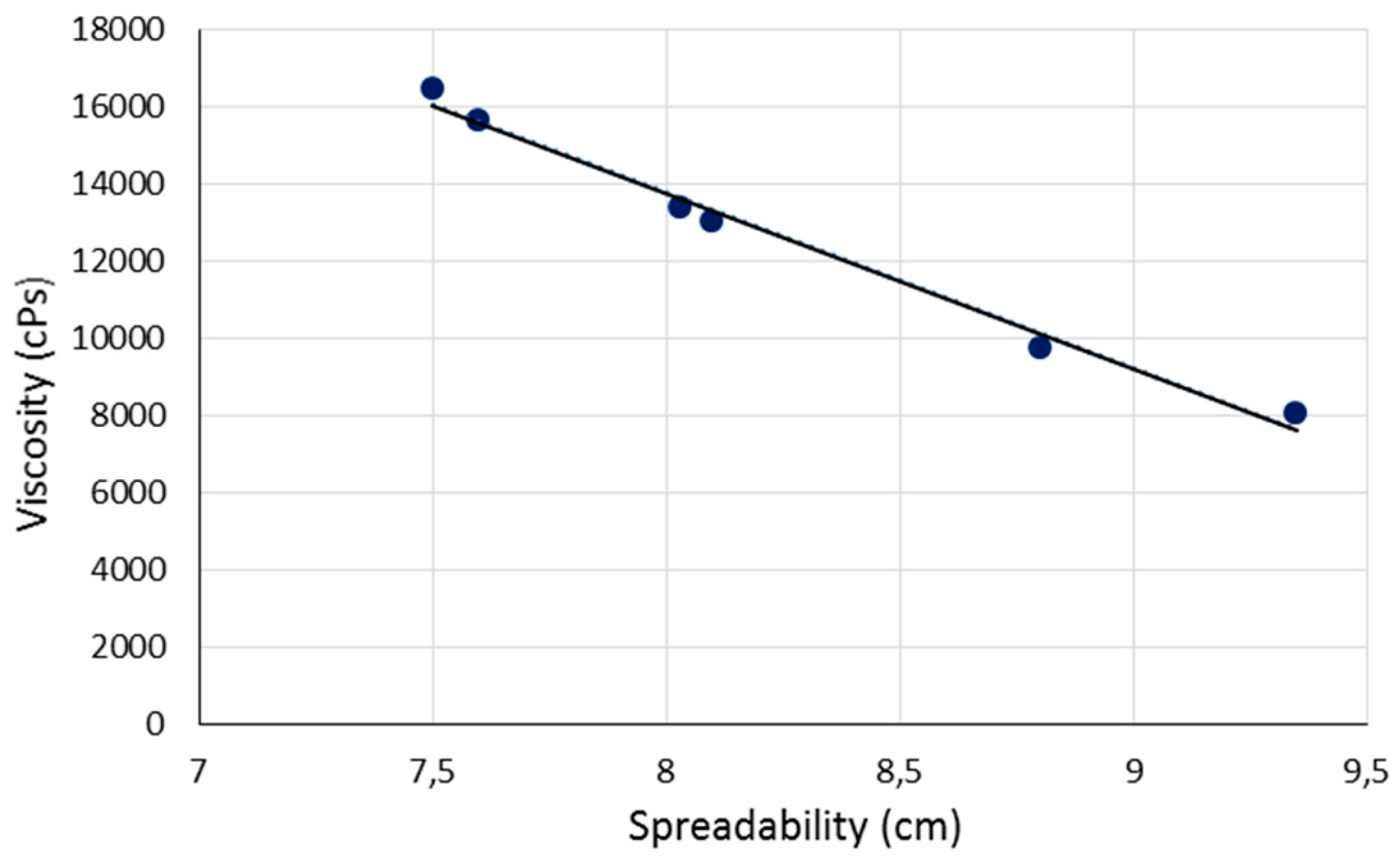
Figure 2.
Sun protection factor (SPF) calculated by BAF sunscreen simulator for 2.4% w/w bemotrizinol (in silico) and in vitro for formulations A12, A12 NLC, A14, A14NLC, A16, A16NLC.
Figure 2.
Sun protection factor (SPF) calculated by BAF sunscreen simulator for 2.4% w/w bemotrizinol (in silico) and in vitro for formulations A12, A12 NLC, A14, A14NLC, A16, A16NLC.
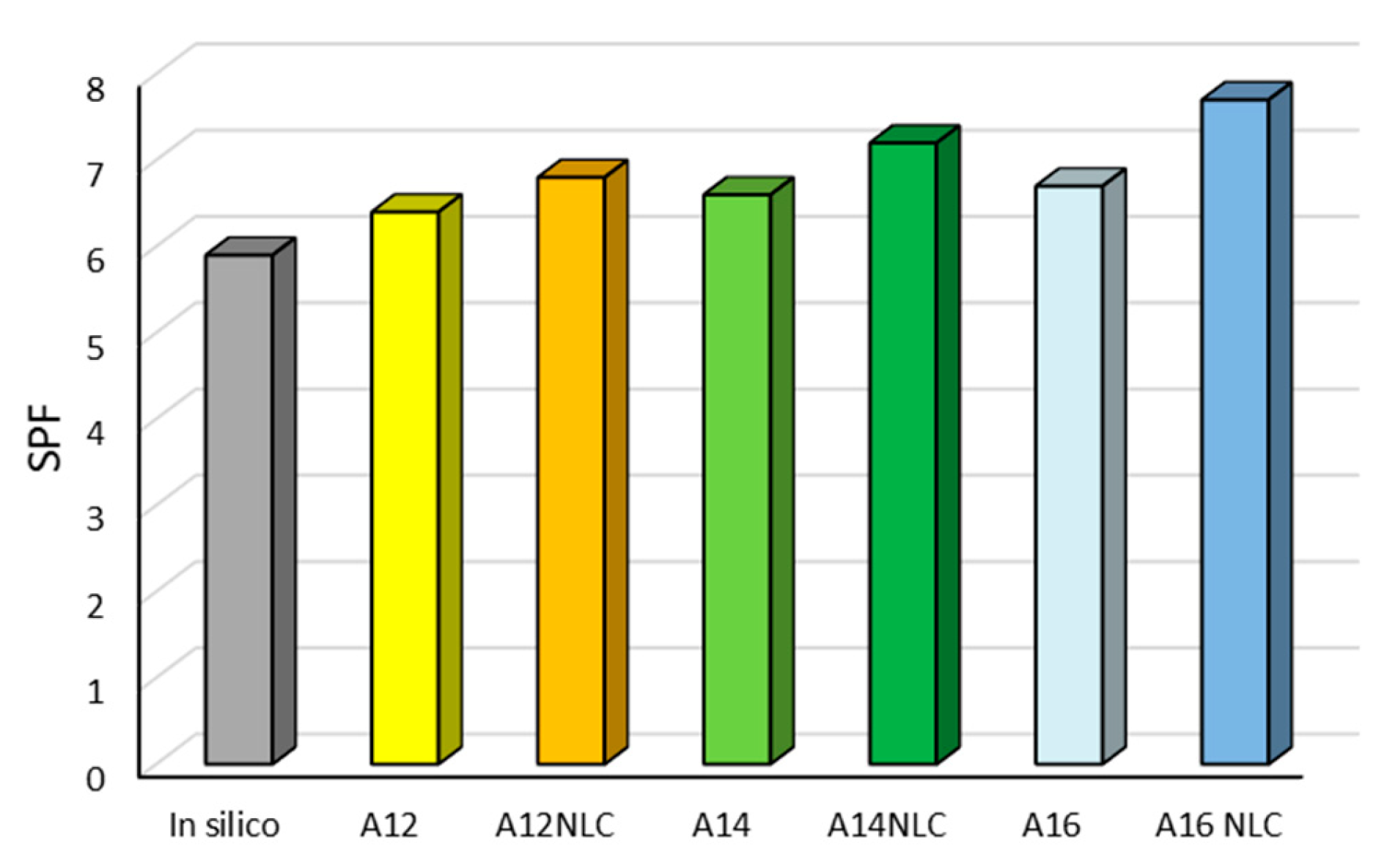
Figure 3.
Sensory evaluation of formulations A12, A12NLC, A14, A14NLC, A16, A16NLC in three different phases: a) before and during pick-up; b) during rub-in; c) after feel.
Figure 3.
Sensory evaluation of formulations A12, A12NLC, A14, A14NLC, A16, A16NLC in three different phases: a) before and during pick-up; b) during rub-in; c) after feel.
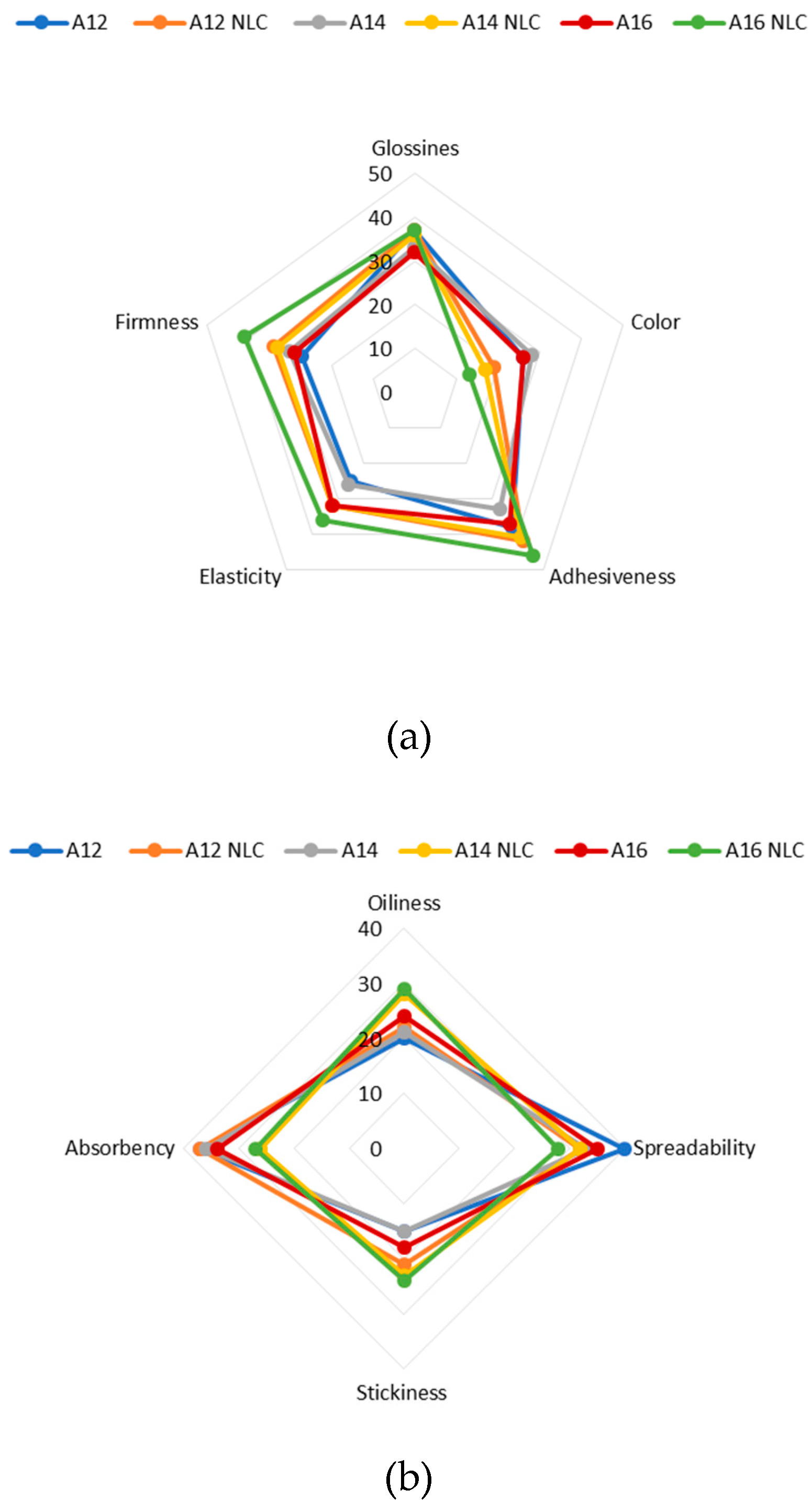
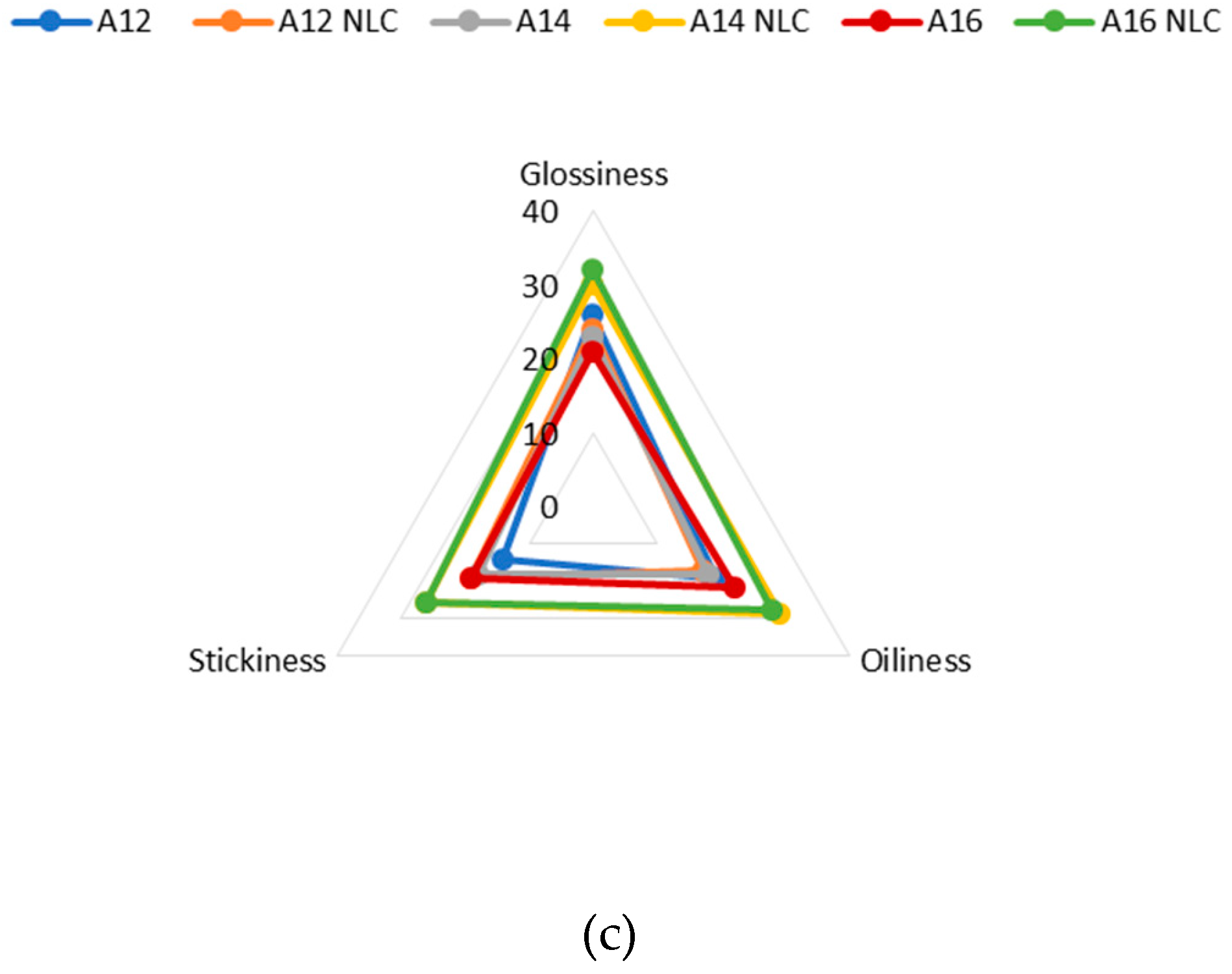

Table 1.
Composition (% w/w) of O/W emulsions containing free bemotrizinol (BMTZ) and BMTZ loaded nanostructured lipid carriers (NLC). q.s. = quantum sufficit to 100% w/w.
Table 1.
Composition (% w/w) of O/W emulsions containing free bemotrizinol (BMTZ) and BMTZ loaded nanostructured lipid carriers (NLC). q.s. = quantum sufficit to 100% w/w.
| Ingredients | Emulsion code | |||||
|---|---|---|---|---|---|---|
| A12 | A12NLC | A14 | A14NLC | A16 | A16NLC | |
| Phase A | ||||||
| Almond oil | 1.50 | 1.50 | 1.75 | 1.75 | 2.00 | 2.00 |
| Glycine Soja oil | 1.50 | 1.50 | 1.75 | 1.75 | 2.00 | 2.00 |
| Acemol TN | 3.60 | 3.60 | 4.20 | 4.20 | 4.80 | 4.80 |
| Cetiol SN | 1.20 | 1.20 | 1.40 | 1.40 | 1.60 | 1.60 |
| IPM | 1.20 | 1.20 | 1.40 | 1.40 | 1.60 | 1.60 |
| Montanov 68 | 2.40 | 2.40 | 2.80 | 2.80 | 3.20 | 3.20 |
| Beeswax | 0.30 | 0.30 | 0.35 | 0.35 | 0.40 | 0.40 |
| Cutina MD | 0.30 | 0.30 | 0.35 | 0.35 | 0.40 | 0.40 |
| BMTZ | 2.40 | --- | 2.40 | --- | 2.40 | --- |
| Phase B | ||||||
| EDTA | 0.1 | 0.1 | 0.1 | 0.1 | 0.1 | 0.1 |
| Water | q.s. | q.s. | q.s. | q.s. | q.s. | q.s. |
| Phase C | ||||||
| Kemipur 100 | 0.35 | 0.35 | 0.35 | 0.35 | 0.35 | 0.35 |
| Benzyl alcohol | 0.25 | 0.25 | 0.25 | 0.25 | 0.25 | 0.25 |
| Phase D | ||||||
| BMTZ-NLC | --- | 30.00 | --- | 30.00 | --- | 30.00 |
Table 2.
Description of attributes used for sensory evaluation.
| Phase | Sensory attribute | Description |
|---|---|---|
| Before and during pick-up | Color (in the container) | 1. White; 2. Whitish; 3 yellowish; 4. Pale yellow; 5. Yellow |
| Glossiness (in the container) | 1. Not glossy; 2. Slightly glossy; 3. Moderately glossy; 4. Glossy; 5. Very glossy | |
|
Adhesiveness Amount of sample that stays on forefinger after short contact (2 s) with sample in container |
1. Not adhesive; 2. Slightly adhesive; 3. Moderately adhesive; 4. Adhesive; 5. Very adhesive | |
|
Elasticity Degree to which product expands between thumb and forefinger |
1. Not elastic; 2. Slightly elastic; 3. Moderately elastic; 4. Elastic; 5. Very elastic | |
| Firmness (during pick-up) Resistance to deformation and difficulty of lifting from container. | 1. Not firm; 2. Slightly firm; 3. Moderately firm; 4. Firm; 5. Very firm | |
| During rub-in |
Oiliness Degree to which the sample feels oily |
1. Not oily; 2. Slightly oily; 3. Moderately oily; 4. Oily; 5. Very oily |
|
Spreadability Impression of the area that the sample will cover while being rubbed 8 times in a circular motion over the back of the hand |
1. Not spreadable; 2. Slightly spreadable; 3. Moderately spreadable; 4. Spreadable; 5. Very spreadable | |
|
Stickiness Degree to which the sample feels sticky (force required to separate finger from the skin) |
1. Not sticky; 2. Slightly sticky; 3. Moderately sticky; 4. Sticky; 5. Very sticky | |
|
Absorbency Impression of the rate of absorption of the sample into the skin |
1. Not absorbed; 2. Slowly absorbed; 3. Moderately absorbed; 4. Absorbed; 5. Fast absorbed | |
| After feel |
Stickiness Degree to which the sample leaves the skin feeling sticky 10 min after its application |
1. Not sticky; 2. Slightly sticky; 3. Moderately sticky; 4. Sticky; 5. Very sticky |
|
Oiliness Degree to which the sample leaves the skin feeling oily 10 min after its application |
1. Not oily; 2. Slightly oily; 3. Moderately oily; 4. Oily; 5. Very oily | |
|
Glossiness Degree to which the sample leaves the skin looking glossy 10 min after its application |
1. Not glossy; 2. Slightly glossy; 3. Moderately glossy; 4. Glossy; 5. Very glossy |
Table 3.
Emulsion technological properties: pH, occlusion factor (F), spreadability (S), viscosity and cumulative amount of bemotrizinol released after 4h from the vehicle. N.D. = not detectable.
Table 3.
Emulsion technological properties: pH, occlusion factor (F), spreadability (S), viscosity and cumulative amount of bemotrizinol released after 4h from the vehicle. N.D. = not detectable.
| EMULSION CODE | PH | F ± S.D. | S± S.D. (CM) |
V± S.D. (CPS) |
Q (μG/CM2) |
| A12 | 6,3 | 35,53 ± 5,69 | 8,80 ± 0,17 | 9.722 ± 1.295 | N.D. |
| A12NLC | 6,3 | 25,91 ± 1,57 | 9,35 ± 0,21 | 8.017 ± 143 | N.D. |
| A14 | 6,4 | 47,75 ± 1,16 | 8,10 ± 0,17 | 13.000 ± 441 | N.D. |
| A14NLC | 6,3 | 39,76 ± 2,99 | 8,03 ± 0,25 | 13.389 ± 1.004 | N.D. |
| A16 | 6,5 | 46,81 ± 1,55 | 7,60 ± 0,10 | 15.611 ± 1.549 | N.D. |
| A16NLC | 6,4 | 32,48 ± 2,09 | 7,50 ± 0,10 | 16.444 ± 770 | N.D. |
Disclaimer/Publisher’s Note: The statements, opinions and data contained in all publications are solely those of the individual author(s) and contributor(s) and not of MDPI and/or the editor(s). MDPI and/or the editor(s) disclaim responsibility for any injury to people or property resulting from any ideas, methods, instructions or products referred to in the content. |
© 2024 by the authors. Licensee MDPI, Basel, Switzerland. This article is an open access article distributed under the terms and conditions of the Creative Commons Attribution (CC BY) license (http://creativecommons.org/licenses/by/4.0/).
Copyright: This open access article is published under a Creative Commons CC BY 4.0 license, which permit the free download, distribution, and reuse, provided that the author and preprint are cited in any reuse.


