

Submitted:
15 April 2024
Posted:
17 April 2024
You are already at the latest version
Abstract
This study examines the role of using algorithmic HRM to make strategic decisions pertaining to HR activities in organizations. The study develops a scale to measure algorithmic HRM usage in its first phase, and in the second phase, it finds that algorithmic HRM having significant impact on the strategic HR decision making that helps and enables organization in creating the competitive advantage. Utilizing the author’s LinkedIn profile, 234 final participants considered for this research. Collected data analyzed by applying PLS SEM. It evaluates the mediation role of the HR strategic decision making, and the HR digital maturity as a moderator in seeing the impact of algorithmic HRM on the competitive advantage of the firm. The study finds a strong relationship between the algorithmic HRM usage and competitive advantage, a significant relationship between algorithmic HRM usage and the strategic HR decision making, and lastly, a significant relationship between strategic HR decision making and the competitive advantage. The moderating role of HR digital maturity was found to be insignificant in this research which paves the way for further research. This research, the model, and its findings contribute to the theory and implicate the practicality of algorithmic HRM. It's one of few papers that address the algorithmic HRM usage in the transitioning economy like Saudi Arabia.
Keywords:
Algorithmic HRM
; algorithmic HRM usage
; HR strategy
; digital HRM
; e-HRM
; Competitive advantage
; HR digital maturity
; resource-based view
; EFA
; PLS-SEM
1. Introduction
A flexible and adaptable business plan is crucial for a corporation to succeed in the market (Parent-Rochel au & Parker, 2022). In the post-COVID business scenario, a digital strategy and digital transformation are indispensable components that cannot be overlooked (Animi-Yeboah et al., 2020; Correani et al., 2020; Gobble, 2018; Kraus et al., 2021; Ross et al., 2017; Yeow et al., 2018). While many plans may seem successful initially, they often fail during implementation, highlighting the importance of simultaneously designing the strategy and its implementation (Bughin et al., 2018). Additionally, the execution of a company's strategy can be compromised without accurate and precise data (Larson & DeChurch, 2020; Teece, 1997).
The ability to make decisions effectively depends on possessing comprehensive knowledge, understanding the bigger picture, and connecting choices to the overarching strategic goal (Leicht-Deobald et al., 2019; Parry et al., 2016). To optimize decision-making, organizations require a combination of human and machine capabilities, facilitated by technological advancements and digitalization (Leonardi & Barley, 2010; Yeow et al., 2018). Making informed and sound choices is widely acknowledged to provide a competitive advantage to a company over its rivals, whether in the short or long term (Jarrahi, 2018; Lindebaum et al., 2020).
For a successful decision outcome, it is essential to have access to relevant data, understand the broader context, and interpret details in alignment with the overall strategic objective (Leicht-Deobald et al., 2019; Parry et al., 2016). Embracing technological advancements in digitization enables faster clarity in decision-making (Leonardi & Barley, 2010; Yeow et al., 2018), and improved decision-making capabilities can enhance a corporation's competitive edge over its rivals (Jarrahi, 2018; Lindebaum et al., 2020; Sousa-Zomer et al., 2020). A successful strategy should be adaptable to the dynamic competitive market environment (Parent-Rocheleau and Parker, 2022), and the importance of formulating and implementing a digital strategy while aligning operations with digital technology developments cannot be underestimated by any organization (Correani et al., 2020; Gobble, 2018; Sousa-Zomer et al., 2020; Yeow et al., 2018).
In the current business landscape, it is essential for organizations to leverage modern technologies (Li et al., 2018) while effectively managing their human resources. The field of HRM, often referred to as digital HRM, is undergoing digital transformation with the integration of knowledge and information from emerging technologies such as AI, blockchain technology (BCT), augmented reality (AR), big data (BD), machine learning (ML), and the Internet of Things (IoT) (Cheng & Hackett, 2021; Meijerink et al., 2021; Citron & Pasquale, 2014). These technologies enable organizations to decipher insights that may not be achievable manually within a reasonable time frame and with reduced efforts, while maintaining a high level of accuracy (Newman et al., 2020; Parry et al., 2016). The discourse on HRM has undergone rapid transformation with the emergence of technology, progressing from HR Information Systems (HRIS) to e-HRM, digital HRM, and more recently, algorithmic HRM. Algorithmic HRM refers to the formulation of rules and algorithms within computer systems to collect, analyze, and process big data from various sources, generating insights for HRM decision-making (Dugan et al., 2019; Meijerink et al., 2021; Newlands, 2021).
This approach facilitates HRM decisions and actions related to recruitment, pay increases, potential turnover, workforce planning, alignment of people management strategies with business strategies, reward systems, employee engagement, and satisfaction (Cheng & Hackett, 2021; Meijerink & Bondarouk, 2021; Raghavan et al., 2020; Vassilopoulou et al., 2020). Advocates argue that applying algorithmic HRM enables organizations to make more informed decisions directly impacting their business strategies (Lindebaum et al., 2020; Meijerink et al., 2021; Trunk et al., 2020). Algorithm can learn, understand, and apply on the history data, it learns from the errors or mistakes and builds the sustainable knowledge center keeping modified, updated, with the help of big data from several sources (Correani et al., 2020; Vrontis et al., 2022), and then processing it in a way that decisions and intelligence insights are fused together include but are not limited to AI and ML. (Dugan et al., 2019; Trunk et al., 2020).
Algorithmic HRM plays a significant role in various HR functions, including forecasting performance appraisal results, conducting interviews, hiring, and recommending suitable candidates (Ajunwa & Greene, 2019; Meijerink & Bondarouk, 2021; Waldkirch et al., 2021). Moreover, it aids in managing turnover by gathering data from multiple sources, such as voice recognition, people behavior, and customer services, achieving unprecedented levels of accuracy in forecasting. However, there is substantial criticism concerning algorithmic HRM, particularly regarding issues of privacy, conditionality, and ethics (Mittelstadt et al., 2016). Addressing these concerns is crucial for responsible use of algorithmic HRM (Muller, 2019; Ulbricht & Yeung, 2021; Wood, 2021).
The implementation of algorithmic HRM can lead to the elimination of biases (Raghavan et al., 2020) and promote justice and fairness in organizational practices (Newman et al., 2020). Scholars emphasize the significance of algorithmic HRM in making accurate and unbiased judgments, reducing biases, and enhancing reliance on systematic control (Hmoud & Laszlo, 2019; Lindebaum et al., 2020; Vallas & Schor, 2020).
Research Gap
Limited research has focused on the comprehensive impact and scope of algorithmic HRM (AHRM), highlighting the urgency for further investigation into its efficacy, role in HR strategic decision-making, and its contribution to the organizational competitive advantage (Cheng & Hackett, 2021; Leicht-Deobald et al., 2019; Meijerink et al., 2021). The adoption of algorithmic HRM and its conceptualization heavily relies on the organizational context, and the stakeholder readiness. Moreover, the organization's HR competency and its maturity are critical factors in leveraging technological input for achieving AHRM objectives.
The maturity, capabilities, and readiness of the HR professionals play a critical role in the effective execution of algorithmic HRM (AHRM) within an organization (Wang et al., 2022). Failing to consider ethical and trust-related concerns during AHRM adoption can lead to a potential harm and derailment of the integration process (Vassilopoulou et al., 2022). The current study aims to explore the dynamics of AHRM and its impact on leveraging the firm's competitive advantage for organizational success. It seeks to answer the following research questions:
RQ1: To what extent does the implementation of algorithmic HRM contribute to the strategic HR decision-making capability and its impact on the competitive advantage of a firm?
RQ2: Is the maturity of HR competence a critical factor in the realization of HR decision-making, and in the development of the competitive advantage?
The research aims to explore the value-addition of algorithmic HRM in enhancing the strategic HR decision-making process, its influence on the firm's competitive advantage, and the significance of the maturity of HR competence in this process.
2. Literature Review
The present research endeavors to undertake a literature review to examine the function of algorithmic HRM in augmenting competitive advantage. It will examine the theoretical foundations of HRM, its effects on the different HR decisions, activities, and transactions. It also examines the potential constraints and difficulties linked to the adoption of HR digital maturity (see Figure 1).
2.1. HR and Technology Background
The HRM landscape has undergone significant transformation due to technological advancements, encompassing various technologies such as IT, cloud computing, and AI. E-HRM, or electronic human resource management, is a widely adopted interface that facilitates interactions and transactions between HR activities, from pre-onboarding to post-offboarding, and technologies. Its purpose is to create, (re)configure, deliver, and enhance value-added services for employees, managers, HR practitioners, and other stakeholders (Bondarouk et al., 2017; Bondarouk & Rul, 2009). The implementation and utilization of e-HRM are often the result of managerial decision-making and strategic planning for HRM service delivery in many organizations. While the outcomes are not primarily aimed at strengthening the strategic aspect of HR jobs, they are intended to enhance the efficiency and effectiveness of HRM services provided (Marler & Parry, 2016).
The term e-HRM refers to the digitization of HR functions that were previously conducted manually. The rapid evolution of information technology (IT) has played a crucial role as a facilitator in achieving the desired automation of human resource management functions, leading to increased efficiency and productivity in organizations (Cheng & Hackett, 2021; Marler & Parry, 2016). This technological shift has compelled HR activities to become increasingly digital, prompting new thinking and a change in attitude to leverage cutting-edge technology for HR deliverables. Automation, as a key component of digitalization, focuses on analysis, innovation, and invention rather than solely delivering services. Its successful implementation requires the involvement of HR professionals to develop solutions, optimize processes, and streamline operations in a manner that is appropriate, aligned, and coherent with organizational goals (Meijerink et al., 2021; Raisch & Krakowski, 2021).
Over time, various technological advancements such as Enterprise Resource Planning (ERP), Human Resources Information System/Management System (HRIS/MS), e-HR, digital HR, and HR analytics have brought significant value to the HR architecture (Kim et al., 2021). However, technology experts are still pondering how to ensure that emerging technologies truly enhance HR management and provide value to businesses (Larson & DeChurch, 2020). Additionally, there is confusion regarding the distinctions between e-HRM, digital HR, and algorithmic HRM within the emerging technology landscape. Many HR professionals are grappling with the effectiveness and comprehensive understanding of Algorithmic HRM (AHRM), highlighting the need for further exploration in this area.
2.2. Algorithmic HRM Usage
Algorithmic HRM refers to intelligent rules and formulas that utilize a vast amount of data, information, and knowledge from diverse sources and technologies, including augmented reality (AR), machine learning (ML), artificial intelligence (AI), blockchain, big data (BD), and the Internet of Things (IoT). Its purpose is to learn, analyze, and make HR-related decisions with minimal or no human intervention (Meijerink et al., 2021; Strohmeier, 2020). This concept involves not only embracing technology but also adopting a digital mindset to facilitate change management, build capabilities, and create readiness for technological integration (Alabdali and Salam, 2022; Tabrizi et al., 2019). Algorithmic HRM encompasses elements of both digital and electronic HRM, but it stands out as it has the ability to learn autonomously and make decisions independently, without direct inputs from individuals (See Figure 2).
Applying and using algorithmic HRM helps to reach out to the right decisions that directly impact the company strategy (Lindebaum et al., 2020; Meijerink et al., 2021; Trunk et al., 2020). Strategy that is executed with the appropriate and accurate decisions help the organization in creating advance sustainable competitive advantage (Jarrahi, 2018; Parry et al., 2016; Ross et al., 2017).
Algorithmic HRM can learn, understand, and apply without human intervention. It builds on the history data, learns from the errors or mistakes, forecasts, and builds on the sustainable knowledge center that keeps modified, updated big data, and information from various sources (Correani et al., 2020; Vrontis et al., 2022), and process them in a way of decisions and intelligence insights which are not limited to AI and ML (Dugan et al., 2019; Trunk et al., 2020). Algorithmic HRM has revolutionized forecasting accuracy, enabling precise predictions in various HR activities (Meijerink & Bondarouk, 2021; Waldkirch et al., 2021).
With its implementation, organizations can forecast performance appraisal results, interview outcomes, future hiring needs, and identify the right job applicants (Ajunwa & Greene, 2019). While algorithms have historically been used in various fields like mathematics, science, and programming languages, their application to business and management has significantly transformed decision-making processes. Organizations can now access big data to analyze the benefits of services, products, and customer behavior (Kryscynski et al., 2017). Algorithmic HRM processes data using systems without direct human intervention to make decisions relevant to HR activities (Meijerink et al., 2021). Integrating humans and AI in algorithmic HRM can lead to mutual benefits, with increased data access and collaboration between humans and AI resulting in improved performance. However, this integration poses challenges from the perspective of human capital management (Meijerink et al., 2021).
The implementation of algorithmic HRM has resulted in significant change and transformation, prompting HR professionals, regulators, organizations, and researchers to address the impact of eliminating emotions in HR processes (Kryscynski et al., 2018). While algorithmic HRM offers numerous benefits, concerns about ethics, privacy, conditionality, worker exploitation, higher work intensity, lower perceptions of justice, and the appearance of objectivity need to be addressed (Mittelstadt, 2016; Parent-Rocheleau and Parker, 2021; Muller, 2019; Wood, 2021; Newman et al., 2020). To overcome these issues, it is essential to consider governance, legal, and regulatory perspectives (Ulbricht & Yeung, 2021). By focusing on eliminating biases and promoting justice and fair practices, algorithmic HRM can achieve positive outcomes (Raghavan et al., 2020; Newman et al., 2020). Addressing these concerns and leveraging the potential benefits of algorithmic HRM are critical for its responsible and effective implementation in HR practices.
2.3. HR Strategic Decision Making
The increasing recognition of big data's potential benefits for businesses has led to the development of algorithms to leverage this data for decision-making (George et al., 2014; Leicht-Deobald et al., 2019; Aral et al., 2012). Algorithmically driven decision-making tools enable the consolidation of data from various sources, proving to be more effective in certain contexts compared to human decision-making (Newman et al., 2020; Wilson et al., 2016; Cowgill, 2017), such as in selecting high-performing job candidates (Kuncel et al., 2013).
Both lines of research are relevant to top executives' decisions, as fully realized AI-based decision-making systems are likely to incorporate elements from both big data analysis and algorithmic decision-making. In the past, it has been suggested that de-individualizing the source of management decision-making could moderate intra-organizational conflicts when the consequences of such decisions are unfavorable to some members of the organization (Lindebaum et al., 2020). In the HR IT industry, companies like Oracle, IBM, and SAP are leaders that offer integrated talent management software packages capable of extracting information from diverse sources (Angrave et al., 2016; Newman et al., 2020).
As digitalization advances, AI-based decision systems in the workplace are likely to assign less weight to subjective and non-computable criteria, instead focusing on objective and computable factors, such as quantitative targets and qualitative values. These systems can autonomously "learn and evolve" beyond the initial stage of human instruction (Leicht-Deobald et al., 2019; Parry et al., 2016).
2.4. Organizational Competitive Advantage
The concept of dynamic capabilities and their potential for sustained competitive advantage in organizations has been a subject of academic debate. Recently, an integrative approach has emerged to reconcile conflicting perspectives on this matter. HR activities have started to leverage AI platforms for automation, such as AI-based recruitment processes (Ajunwa & Greene, 2019), and algorithms are being utilized to facilitate remote work (Donnelly & Johns, 2021). The future of work is expected to be closely associated with AI, with decisions being supported by AI systems (Jarrahi, 2018; Newman et al., 2020; Trunk et al., 2020).
Algorithmic HRM is proving useful in optimizing and leading remote teams (Leicht-Deobald et al., 2019). The formulae and rules used in algorithmic HRM are seen as a competitive advantage and are kept secure (Mittelstadt et al., 2016). The development of algorithmic HRM suggests that not only can HRM operational activities and transactions be improved through digital technology, but they can also be delegated to digital platforms, robots, or computers that learn and improve autonomously through machine learning, artificial intelligence, Internet of Things, and more (Cheng & Hackett, 2021; Duggan et al., 2019).
2.5. HR Digital Maturity
The ability of organizations to adapt quickly has been hindered by constraints on HR's ability to act on data. Apart from technical and data-related obstacles, the main barrier to analytics' maturity in some organizations is the management's incapacity to act on the data and analysis provided by HR (Orlikowski & Iacono, 2001). The maturity level of HR professionals and their capabilities and readiness are critical factors in effectively executing algorithmic HRM (Wang et al., 2022).
Algorithmic HRM has the potential to harm workers, particularly in the gig economy (Muller, 2019). Addressing concerns of fairness and ethics in designing algorithms that align with HR decision-making values is crucial (Vassilopoulou et al., 2022). Research has found a correlation between a company's level of HR digital maturity and the number of applications and tools it uses, the number of processes it has integrated, and the number of goals connected to AI (Hmoud & Laszlo, 2019; Trunk et al., 2020).
The potential of digital and algorithmic HRM is evident in the transformative impact that machine learning can have on various aspects of human resource management, including recruitment, selection, performance management, training and development, and employee engagement (Garg et al., 2022). By integrating machine learning algorithms into digital HRM, decision-making processes can be enhanced, resulting in improved efficiency and effectiveness of HR operations (Dabić et al., 2023; Trunk et al., 2020). Machine learning algorithms can also provide valuable insights into employee performance and engagement, empowering HR professionals to make data-driven decisions that enhance employee satisfaction and retention. This emphasizes the growing importance of digital and algorithmic HRM in modern work environments (Muller et al., 2019).
3. Conceptual Model
3.1. Theoretical Background
This study focuses on the impact of using algorithmic HRM for making strategic decisions in HR activities and suggests that the resource-based theory provides a strong theoretical foundation for this analysis. The resource-based view (RBV) theory proposes that organizations can gain a competitive advantage by leveraging their intangible resources effectively (Barney, 1991). Algorithmic HRM is considered an intangible resource for organizations, and the design of algorithms itself can be a key factor in achieving a competitive advantage (Mittelstadt et al., 2016).
RBV and dynamic capabilities (DC) theories are credited with understanding the sources of competitive advantage by examining their direct and indirect effects on a company's performance (Theriou et al., 2009). In the RBV framework, "resources" refer to tangible or intangible assets owned or acquired by an organization, while "capabilities" refer to the ability to use these resources to carry out tasks (Anim-Yeboah et al., 2020; Hall, 1993; Yang et al., 2009).
Technologically based resources and capabilities, such as exceptional access to specialized data, information, and knowledge, play a significant role in driving algorithmic HRM's effectiveness. This leads to superior decision-making without significant human interference and helps sustain a competitive advantage among firms. Organizations possessing valuable, rare, inimitable, and non-substitutable resources are better positioned to implement value-creating strategies that are difficult for competitors to replicate (Barney, 1991; 1995).
The dynamic capabilities (DC) theory highlights the necessity for organizations to possess the ability to develop and acquire the essential skills, knowledge, and capabilities to effectively respond to a rapidly changing environment (Teece et al., 1997). DC theory explores the relationships among organizational resources and emphasizes the importance of adapting internal resources and capabilities to external environmental changes. This adaptation is achieved through the integration of new technologies, which necessitates dynamic capabilities (Helfat & Martin, 2014; Helfat & Peteraf, 2015).
Creating a machine learning application requires diverse skills in data collection, algorithm creation, and overseeing the training process. To succeed in this rapidly evolving field, organizations must engage a diverse group of talented individuals to build organizational expertise in ML and AI (Akter et al., 2021; Akter et al., 2022; Cooper et al., 2023; Ransbotham et al., 2017). The study extends and integrates the Resource-Based View (RBV) and Dynamic Capabilities (DC) theories to explore the internal relationships between decision-making, internal resources, and competitive advantage. It also considers the implications of algorithmic HRM and HR strategic decision-making on the competitive advantage through the organization's mature HR capabilities, examining advanced technologies like ML, AI, BD, BCT, IoT, and algorithms (Akter et al., 2021; Akter et al., 2022; Cooper et al., 2023). The proposed model contributes to theoretical implications by connecting the use of algorithmic HRM with strategic decisions in HR activities, considering its impact on the organizational competitive advantage (see Figure 3).
3.2. Hypothesis Development
Algorithmic HRM Usage and HR Strategic Decisions
The usage of algorithms in human resource management (HRM) is increasingly significant as a tool for making informed decisions. Algorithms are considered key decision-making elements in various firms, businesses, regulations, and organizations. Regression-based forecasting approaches operated by predictive algorithms enable managers to predict employee attrition and estimate the future performance of job candidates (Cheng & Hackett, 2021; Leicht-Deobald et al., 2019).
Machine learning and data mining are techniques used in predictive HRM to identify patterns in data that may not be apparent to humans. The integration of algorithmic approaches allows for automated and augmented decision-making processes in HRM (Meijerink et al., 2021; Raisch & Krakowski, 2021; Tambe et al., 2019). These advancements in algorithmic HRM have the potential to significantly impact HR decision-making and organizational outcomes. Based on this premise, the first hypothesis is as follows:
H1:
Algorithmic HRM usage impacts positively to the HR strategic decision-making process.
Algorithmic HRM Usage and Competitive Advantage
Decisions made by a computer based on a set of rules or goals are said to be algorithmic (Krakowski et al., 2022). Part of the digital transformation adds value to the competitive advantage (Alabdali & Salam, 2022) using algorithmic HRM as part of the transformation agenda (Kraus et al., 2021). Besides that, examining the assumptions underlying algorithmic decision making in order to get a better sense of what it includes and how it can affect enterprises (Wang et al., 2022). This study analyzes and interprets in which the machine represents the pinnacle of algorithmic decision making and contributes to leveraging the competitive advantage of the firm with an integrated use of algorithmic HRM arrangement (Cheng & Hackett, 2021; Duggan et al., 2019).
The utilization of algorithmic HRM has gained significant traction as a prevalent method for administering human resources within organizations (Donnelly & Johns, 2021). Algorithmic HRM leverages sophisticated algorithms, AI and machine learning methodologies (Jarrahi, 2018; Newman et al., 2020; Trunk et al., 2020) to furnish HR practitioners with valuable insights and recommendations for making informed decisions pertaining to recruitment (Ajunwa & Greene, 2019), selection, performance management, working remotely, and employee engagement (Leicht-Deobald et al., 2019). Algorithmic HRM is commonly perceived as a means for organizations to gain a competitive edge through its implementation and efficient utilization (Donnelly & Johns, 2021). Nevertheless, the assertion lacks empirical substantiation.
In order to verify this supposition, it is imperative to carry out a study that scrutinizes the correlation between the utilization of algorithmic HRM and the attainment of competitive advantage (Kraus et al., 2021), employing suitable techniques for data gathering and analysis. The findings of this study hold significant implications for human resource practitioners and organizational executives, as they can inform their strategic choices regarding the integration and execution of algorithmic HRM to achieve a competitive edge (Mittelstadt et al., 2016). Thus, it is possible to formulate the research hypothesis in the following manner:
H2:
Algorithmic HRM usage contributes positively to the organizational competitive advantage.
HR Strategic Decision Making and Competitive Advantage
Human resources must start using evidence to back up their decisions instead of depending on hunches or speculation (George et al., 2014; Leicht-Deobald et al., 2019). The HR function is hampered by the fact that most HR practitioners come from the social sciences, and they lack the necessary arithmetical and analytical abilities (Kryscynski et al., 2018). Beeline (2012) argues that measuring the human elements of a business is crucial for increasing employee productivity. Businesses now need to realize that gaining a competitive edge and becoming strategic partners requires them to employ predictive modeling and HR analytics (Akter et al., 2022).
Therefore, it's important to retrain workers to have the necessary analytical skills. A company of any size can benefit greatly from using the analytical tools because of the high direct value they produce (Israrul Haque, 2022). In the realm of the human resources, the automation of decision making, and execution in areas like selection is most popular with the online labor platforms like Uber, Upwork, and Deliveroo (Meijerink et al., 2021).
A common assumption is that algorithm-based propositions will be impartial since they will not be influenced by any stereotyping or cultural bias (Parry et al., 2016). U.S. technologists share the viewpoint and rank human reasoning abilities below those of ever evolving computers. As a result, the more nuanced the choice, the more appealing it is to trust the efficacy of an algorithm. After all, citing the company's extremely complex and expensive algorithm-based HR decision making tool for use in such situations is a great way to reassure skeptical coworkers, higher management, or stockholders that the risky choice is well-reasoned. Algorithmic decision making can impose a monolatry and automation bias on humans, although some people may accept this to avoid responsibility for their own mistakes (Leicht-Deobald et al., 2019).
H3:
HR Strategic decision making positively contributes towards the creation of the organizational competitive advantage.
HR Strategic Decision Making and its Mediation Role
While the relationship between HRM and sustainable competitive advantage (SCA) is documented in the literature, the strength and nature of the relationship are inconsistent (Hamadamin & Atan, 2019). Besides, there is limited research focusing on the connection between HR strategic decisions and SCA (Wang et al., 2022). HR strategies are important for the success of firms since they shape the relationship between HRM and organizational competitive advantage (Quaye & Mensah, 2019). HR strategies assist the company to survive in the market by recruiting, training, motivating, and retaining the workforce. In the modern business setting, the use of modern technological tools is the key.
Algorithmic HRM is used to perform repetitive HR tasks, create predictive models, and assist managers in making informed decisions. Since strategic decision making requires the new thinking (Battour et al., 2021) which is made easier by algorithmic outputs (Burrell, 2016), and it helps organizations in becoming more competitive. HR strategies are pivotal in the implementation of an effective algorithmic HRM and organizational competitive advantage. Furthermore, the Algorithmic HRM support HRM decision making by providing information and automation, and algorithms develop outputs that help human decision-makers to make informed decisions (Meijerink et al., 2021). Besides, HRM algorithms can augment human decision making by providing predictions used to forecast how a strategic decision could impact the future outcomes (Rodgers et al., 2023). Therefore, the above discussions lead to the proposed hypothesis as follows:
H4:
HR strategic decision making mediates the relationship between algorithmic HRM usage and competitive advantage.
HR Digital Maturity as a Moderator
The level of an organization's HRM competence can be measured by looking at how well it manages and cultivates its employees. Developing effective HRM digital capabilities, and its digital maturity can be seen as an internal business process (Zare et al., 2018; Wang et al., 2022). Level of HRM digital maturity can serve as either a boon or a bane to the process of implementing the digital HR (Wang et al., 2022), and algorithmic HRM. HRM digital capability in the HRM architecture serves as the foundation for the HRM digitalization practices in an enterprise. Human resource management system (HRMS) maturity is also important in that regard, and it refers to the degree to which an organization's HRM procedures and systems are integrated and evolving (Curtis et al., 2009; Ford et al., 2012).
Human resource management (HRM) capability and its digital capacity maturity influence the digital HRM activities (Anim-Yeboah et al., 2020; Hannon et al., 1996) both in terms of how effective they are within the firm and with personnel. It’s proposed that the digital HRM practices facilitate the provision of efficient services that better suit the needs of line managers when HRM digital maturity is high (Wang et al., 2022). Based on this connotation, our proposed hypothesis is as follows:
H5:
HR digital maturity moderates the relationship between the use of algorithmic HRM usage and HR strategic decision making.
4. Research Methodology
Given that the research is quantitative, and that positivism is the guiding philosophy, the methodology that was applied was deductive. This meant that the provisional idea was developed in line with the theoretical basis where RBV and DC theories were applied utilizing current literature, and then coming up with the propositions that could be tested and controlled. This research makes use of a survey as its technique tied to the deductive approach which highly serves the present management research (Creswell, 2009). A questionnaire method is used for the data collection in accordance with the survey approach, and respondents were supposed to answer questions such as "what," "who," "where," "why," "when," and "how". Cross-sectional studies, which are generally matching the survey approach and examining the phenomena in particular period, often in less than six months as described in the timeline portion of this paper, have been selected as the time horizon for this study (Saunders et al., 2019). Thus, the data was collected between December 2022 and February 2023.
4.2. Sample Selection
In this study, the participants were selected using the convenience sampling method which forms the most basic and fundamental approach to the data collection (Taherdoost, 2016). Web-administrated questionnaires were used with brief information about algorithmic HRM and to give a basic idea about the proposed research and their suitability to know that at least what they have already experienced within their organizations using HR digital/technology to capture their perceptions about the usage of algorithmic HRM (see Appendix B).
4.3. Data Collection
Taking advantage of the one of the authors who has been a HR practitioner for more than 15 years, having wide HR network, and using his LinkedIn profile having around 30,000 network active members were utilized to reach to the desired HR constituency and having better efficacy of the sample selection for the desired research. In the first part of the research, a sample size of 85 were reached with an active completion of the 70 samples for developing the algorithmic HRM scale. In the second phase of the research, a larger sample size of 350 were approached which were the different set of samples from the first sample. For the data collection purpose, a message to the relevant connections were sent using a personalized message using their first name to give high level of importance for the sent electronic questionnaire and to increase the possibility of participation and facilitation of its completion. The approach of using web questionnaires eased and accelerated the procedure saving our time and efforts (Fowler, 2002; Grover, 2000; Scheaffer et al., 2011). In the second phase of the research, after the scale development, and its validation, 273 responses (out of 350 approached) were received while 39 responses were excluded due to their unsuitability to the required filter about the usage of algorithmic HRM in their organizations. Remaining 234 participants were finally considered as the sample for the second part of the research.
4.2. Measurement Items
Algorithmic HRM is an emergent and nascent topic, and in the absence of any scale for assessing the impact of algorithmic HRM, an attempt has been made to develop a scale for the algorithmic HRM usage (A). The authors appreciating the earlier work done on the algorithmic HRM by Cheng & Hackett (2021), Meijerink et al. (2021), and Meijerink & Bondarouk (2021) developed the scale for the usage of algorithmic HRM, validated it, and it was used in the subsequent research in evaluating the relationship with strategic HR decision making, competitive advantage, and the digital HR maturity of the firm. The other measurements were adopted from the previous research i.e., HR strategic decision (D) scale was adopted and amended from Jarupathirun et al. (2007), while competitive advantage (C) adopted from the study by Chang (2011), and HR digital maturity (M) adopted from the study by Irimiás & Mitev (2020) (see Appendix C for the details of the scales).
Phase 1. Algorithmic HRM Usage Scale Development
Scale development is a crucial aspect of research, especially in the social sciences, as it allows researchers to quantitatively measure abstract constructs and variables. A scale is a set of items or statements designed to assess individuals' attitudes, perceptions, behaviors, or other psychological or behavioral characteristics. The development of a reliable and valid scale is essential because it provides researchers with a standardized and systematic way to measure variables ensuring consistency and comparability across different studies. A well-constructed scale enhances the rigor and validity of research findings, enabling researchers to draw more accurate conclusions and make informed decisions. Additionally, it helps in in theory testing, hypothesis formulation, and establishment of the causal relationships between variables.
One of the main contributions of this research was to develop a measurement scale for the algorithmic HRM utilization construct. The scale development for the algorithmic HRM construct was inspired by the work done by Cheng & Hackett (2021), Meijerink et al. (2021), and Meijerink & Bondarouk (2021). To attain the stated goal, the present study employed Churchill's (1979) prescribed methodology which involves a methodical process beginning with a clear definition of the construct. Subsequently, a roster of preliminary items that accurately represent the construct are produced. This roster is further improved by eliminating redundancies, items that are extraneous or unclear, and incorporating items that encompass diverse facets of the construct. The wording of the items will be formulated in a manner that is both lucid and succinct ensuring comprehensibility among the intended audience.
Items Generation
Based on the literature, a long list of potential measurement items was generated. The items aimed to capture the various aspects of algorithmic HRM usage in organizations. In the absence of any given scale, it was difficult for us to adapt it for our context, and we preferred to look into the contextual realities of algorithmic HRM practices rather than the nuts and bolts of algorithmic HRM per se. The items were further analyzed keeping in mind the usage of Algorithmic HRM, and its challenges and circumstances. The exhaustive references of the literature used to capture the essence of algorithmic HRM realities and its context for its usage are listed in Table 1.
Expert Discussion
To ensure the suitability of the generated items from the literature, a panel discussion of nine experts comprising HR professionals, researchers, and IT-business analyst practitioners was undertaken (Boateng et al., 2018). The expert discussion sessions aimed to gather diverse perspectives and insights on the dimensions and indicators of algorithmic HRM and its use in the organization. It was difficult to ascertain the items of algorithmic HRM per se, so we were focused on the usage of algorithmic HRM, and what challenges and opportunities it brings. Seeing the complexity of algorithmic HR arrangements, the experts thru consensus supported the relevance of its usage, and their experiences, knowledge, and opinions were critical in refining our topic. As mentioned, the discussion played an important role in identifying key themes. Appendix A showcases the demographic details of the experts who participated in this discussion. The diverse participants, their background, and experiences added value to reach to the concluded keywords (Ahorsu et al., 2020). The keywords out of the discussion were focused on usage and raising concepts such as task (Rodgers et al., 2023), abilities (Chowdhury et al., 2023), role of HRM (Zhang et al., 2021), utilization (Parent-Rocheleau & Parker, 2022), and dependability (Benlian et al., 2022). These keywords seconded in the literature. This led to the refined items which discussed in the next subsection.
Items Refinement
From the literature review, expert discussion, and the analysis of the outcomes, as recommended by Hinkin (1998), the items were deductively assessed, refined, and summarized as given in the Table 2. The researchers reach to the following shortlisted items that will be applicable for further analysis and development which is elaborated in forthcoming subsections.
The scale for measuring algorithmic HRM usage developed by the authors and was inspired based on the work done by Cheng & Hackett (2021), Meijerink et al. (2021), and Meijerink & Bondarouk (2021). This scale measures algorithmic HRM usage and its ability to cope with the system inadequacy or expedite processes which is crucial for understanding how organizations can effectively cope with the challenges of algorithmic HRM usage. The scale design should also consider how HRM departments can effectively equip themselves with the necessary technological resources and take an active role in employing and using algorithms. Moreover, the scale should measure the ability of organizations to effectively deal with large data sets and reduce dependency on HR professionals. Accurately measuring these constructs is necessary for understanding the relationship between Algorithmic HRM usage and competitive advantage which can help inform organizational decision-making processes.
Moreover, this paper deliberates upon the suitable response alternatives for the measurement instrument ensuring that an adequate number of response options are included to encompass a diverse spectrum of responses. Upon devising the scale, the preliminary trial was conducted with a limited cohort of HR senior professionals who invited to participate in the data collection for the scale development. The assessment of the dependability and accuracy of the scale was facilitated by analysing the responses of the 70 participants in this stage and the sample size seems to be sufficient (de Winter et al., 2009).
The first phase of the study entails developing the new scale to measure the algorithmic HRM utilization construct. Upon completion of the scale finalization process, exploratory factor analysis (EFA) statistical technique was employed to assess the reliability and validity of the developed scale by using SPSS software. EFA detects latent factors or dimensions within the variables, and it involves analysing observed variables to identify patterns of correlation among them (Hair et al., 2020). According to Watkins (2018), one of the main objectives of operating EFA is to identify the minimum number of underlying factors that account for the observed variance in the data. Thus, An EFA was operated using principal component analysis and varimax rotation. The minimum factor loading criteria was set to 0.50. To ensure acceptable levels of explanation, the commonality of the scale should be assessed, which reveals the amount of variance in each dimension (Rogers, 2022). The results show that all commonalities were over 0.50 except A5 which was removed due to low loading i.e., 0.274.
A significant step involved weighing the overall significance of the correlation matrix through Bartlett’s Test of Sphericity, which provides a measure of the statistical probability that the correlation matrix has significant correlations among some of its components (Jolliffe & Cadima, 2016). The results were significant, x2 (n =70) = 87.230 (p < 0.000), which indicates its suitability for factor analysis.
Furthermore, the Kaiser–Meyer–Olkin Measure of Sampling Adequacy (MSA), which indicates the appropriateness of the data for factor analysis was applied (Lorenzo-Seva & Ferrando 2021). As recommended by Kaiser (1974) a value of KMO of 0.5 is barely accepted, values between 0.7-0.8 are acceptable, and values above 0.9 are excellent. for this study, the result was 0.768.
Nonetheless, in this initial EFA, one item (i.e., “A5. Algorithmic HRM usage will reduce the dependability on the HR professionals in the organization.”) failed to load on the dimension significantly. The authors repeated the EFA without incorporating this item. The results of this new analysis confirmed the four items structure theoretically defined in the research. The Kaiser–Meyer–Olkin MSA was 0.780. In this regard, data with MSA values were near 0.8 which is considered acceptable for factor analysis (Kaiser, 1974). Bartlett’s Test of sphericity proved to be significant, and commonalities were over the required value of 0.500. The four items identified as part of this EFA aligned with the theoretical proposition in this research (see Table 3).
Phase 2. Establishing the Relationship between Algorithmic HRM and Competitive Advantage
In addition to the algorithmic HRM usage (A) that was developed in its first phase, there are additional three variables namely, HR digital maturity (M), HR strategic decision making (D), and competitive advantage (C) used in this research as mentioned earlier. For HR digital maturity, scale given by Irimiás & Mitev (2020) was used having three items whereas for HR strategic decision (D) scale developed by Jarupathirun et al. (2007) was used having six items. The competitive advantages (C) scale by Chang (2011) is widely popular, and we used it having six items (refer to Appendix C). Table 4 presents the primary attributes of the assessment instruments utilized in this study. The reliability and internal consistency of each construct were measured using Cronbach's alpha, while the convergent validity was assessed using AVE. Cronbach's alpha is the coefficient used to measure internal consistency. The threshold level for reference value is established by Nunnally (1978) at 0.70. According to Hair et al. (2021) and Sarstedt et al. (2022), it is necessary for the AVE of convergent validity to exceed 0.50.
All of the constructs were graded using a seven-point Likert scale (Fornell & Larcker, 1981), with one point denoting "strongly disagree" and seven points denoting "strongly agree." This scale is superior to other measures in many ways (Dawes, 2008; Joshi et al., 2015; Vagias, 2006). Back translation has been performed on the instruments to ensure that there is no variation in the language used, which should be appropriate for the context and fulfill the requirements of the culture and society (Brislin, 1970). Web-based surveys that were available in both Arabic and English had been used to get a greater level of comprehension.
5. Results
5.1. Descriptive Analysis
The demographic items answered by the participants and the respondents’ profiles were analyzed and is described in the Table 5. Women constitutes 39% of the sample size, and majority of the participant are in their midcareer as 76% of the participants are less than 40 years old, and 95% of respondents are in specialist level or above with 96% having bachelor’s degree or above. These demographic details validate the profiles of the participants as qualified to participate and respond in terms of their experience and maturity to the application of algorithmic HRM arrangement in their organizations.
5.1. Common Method Bias/Variance (CMB/CMV)
It was shown that the MLMV technique (measured latent marker variable) might be utilized to discover issues with common method variance (CMV) in PLS-SEM models (Chin et al., 2013). A years of experience variable was not part of the study model, as it is measured and does not fall within the same domain as the other variables. Table 6 shows that the R2 value of dependent variables is not different after adding the year of experience which suggested model of this study was found to be free of CMB/CMV problems by applying MLMV (Chin et al., 2013; Podsakoff et al., 2003). Additionally, random variable also included in the data set and VIF was checked if it’s still less than 3.3 for both inner and outer models, which was also confirmed in this study and found in line with Kock (2015). The coefficient of determination R2 results were 0.450 and 0.448 for C and D respectively (see Table 7). Both met the cutoff moderate range (Hair et al., 2018; Kock, 2013).
5.3. Measurement Model
The applied model of this study had reflective constructs. Convergent and discriminant validity were examined in this study to investigate that the items in the questionnaire explain what it is supposed to measure.
5.3.1. Convergent Validity
Convergent validity was used to evaluate that the factors included in the questionnaire were associated and relevant to measure the construct. All factors’ loading was found to be 0.579 which indicate acceptable reliability and explain more than 50% of item’s variance (Hair et al., 2021). CA, rho_A and CR were found to be more than the requisite threshold > 0.5 and it confirms the internal reliability of the data (Hair et al., 2019). Moreover, all AVE results were found to be greater than the threshold value of 0.50 (Hair et al., 2021; Sarstedt et al., 2022) (see Table 7).
5.3.2. Discriminant Validity
Unlike convergent validity, discriminant validity investigates that the items of each construct should not be similar to the items of other constructs. It’s recommended to report only Heterotrait-Monotrait ratio (HTMT) criterion which is found to be consistent with the research, and it meets the threshold which is supposed to be less than 0.9 (Franke & Sarstedt, 2019; Hair et al., 2021; Henseler et al., 2015).(see Table 9). Moreover, discriminant validity could be achieved by the square root of AVE which should be more than the correlations of the latent variables, according to Fornel-Larcker Criterion and Hair et al. (2021). The diagonals are the square root of AVE and indicate the highest in the column and its left row (see Table 8).

Table 8.
Discriminant Validity (Fornel-Larcker Criterion) and Heterotrait-monotrait ratio (HTMT)h.
| Algorithmic HRM (A) | Competitive Advantage (C) | HR Digital Maturity (M) | HR Strategic Decision Making (D) | |
|---|---|---|---|---|
| Algorithmic HRM (A) | 0.730 | 0.723 h | 0.563 h | 0.783 h |
| Competitive Advantage (C) | 0.601 | 0.788 | 0.766 h | 0.693 h |
| HR Digital Maturity (M) | 0.463 | 0.673 | 0.897 | 0.455 h |
| HR Strategic Decision Making (D) | 0.657 | 0.620 | 0.407 | 0.800 |
Table 9.
Cross-loading.
| Algorithmic HRM (A) | Competitive Advantage (C) | HR Digital Maturity (M) | HR Strategic Decision Making (D) | |
|---|---|---|---|---|
| A1 | 0.791 | 0.443 | 0.378 | 0.560 |
| A2 | 0.724 | 0.465 | 0.442 | 0.384 |
| A3 | 0.766 | 0.428 | 0.231 | 0.468 |
| A4 | 0.579 | 0.356 | 0.299 | 0.452 |
| C1 | 0.461 | 0.738 | 0.425 | 0.458 |
| C2 | 0.498 | 0.847 | 0.643 | 0.452 |
| C3 | 0.467 | 0.776 | 0.530 | 0.410 |
| C4 | 0.543 | 0.830 | 0.539 | 0.612 |
| C5 | 0.488 | 0.800 | 0.531 | 0.493 |
| C6 | 0.362 | 0.726 | 0.515 | 0.474 |
| D1 | 0.502 | 0.414 | 0.182 | 0.773 |
| D2 | 0.568 | 0.508 | 0.332 | 0.850 |
| D3 | 0.634 | 0.558 | 0.350 | 0.808 |
| D4 | 0.512 | 0.484 | 0.404 | 0.844 |
| D5 | 0.504 | 0.530 | 0.308 | 0.816 |
| D6 | 0.400 | 0.461 | 0.362 | 0.698 |
| M1 | 0.414 | 0.576 | 0.896 | 0.318 |
| M2 | 0.423 | 0.612 | 0.920 | 0.387 |
| M3 | 0.409 | 0.620 | 0.874 | 0.381 |
Additionally, all cross-loading results were found to be more than the cutoff which is 0.5 (see Table 10) this is as per the rule of thumb defined by Hair et al. (2018). Thus, the construct measurements in this study were found to be reliable and valid, the next step lies to evaluate the structural model postulations.
To assess potential collinearity, Variance inflation factor (VIF) was used in the inner and outer reflective model and considered as not a problematic because the value of VIF < 3.3 (Kline, 2005; Hair et al., 2021). Table 10 shows that VIF value was less than 3 in all constructs that confirm no collinearity issues exist in the model.
5.4. Structural Model
Structural model assessment substantiated the measurement model assessment at the second step of evaluation, and the hypothetical assumptions were analyzed through a systematic process. The direct effects of algorithmic HRM usage (A), first, were examined in relation to HR Strategic Decision making (D). Second, the direct effects of Algorithmic HRM usage (A) were investigated with Competitive Advantage (C) (see Figure 4). Furthermore, in order to ascertain the significance of direct paths and estimate standard errors, bootstrap resampling method with 10,000 resamples (Ringle et al., 2005) was applied.
Table 11, moreover, represents the results of hypothetical assumptions for direct and indirect relationships. The hypotheses tests revealed a significant positive effect of algorithmic HRM usage to HR strategic decision-making (Hl: β=0.400, t=3.824, P= 0.000***) and to competitive advantage (H2: β = 0.662, t =7.978, p=0.000***). Results also show a significant impact of HR strategic decision making on the competitive advantage (H3: β = 0.403, t = 3.760, p=0.000***). Therefore, H1, H2 and H3 were established in this study.
The Q2 investigates the model to possess the predictive power of the data, the results were 0.383 and 0.426 for competitive advantage (C) and HR strategic decision Making (D) respectively which were above 0 (Stone, 1974; Hair et al., 2018).
In line with the recommendation of Hair et al. (2019), this study applied bootstrapping 10,000 to get the path coefficient, and confidence interval biased corrected including the model fit criterion. It was further tested for the indirect relations of HR strategic decision making’s (D) mediation role. The standardized root mean square residual (SRMR) value was reported as 0.076 which is less than the threshold 0.08 (Henseler et al., 2016; Hu & Bentler, 1998). This confirms the model fit accordingly.
This study postulates 5 relationship hypotheses, and barring the moderation relationship of HR digital maturity, other four hypotheses were got supported with high level of significance value where p-value was 0.000*** (see Table 12), and all paths’ coefficients were significant at 99.999% confidence interval. This confirmed the strong positive relationships between algorithmic HRM and HR strategic decision making, stronger association of HR strategic decision Making with the competitive advantage, and the positive algorithmic HRM relationship to the competitive advantage.
The results show that HR strategic decision making mediates the relationship between the algorithmic HRM and the competitive advantage. This relationship was supported significantly and can be seen as a contribution of this study. As the H1, H2 and H3 were supported and found positively significant, thus, the HR strategic decision-making partially mediates the relationship between the algorithmic HRM and the competitive advantage (see Table 11).
The Moderator Effect
Based on the standardized beta coefficient (Std Beta) of -0.104, it was found that there was a weak negative relationship between HR digital maturity and algorithmic HRM. This means that as HR digital maturity increases, the use of algorithmic HRM decreases slightly.
However, since the p-value (0.065) was found to be greater than the conventional threshold of 0.05, it is difficult to conclude that this relationship was statistically significant. This means that there was a possibility that the relationship observed could have occurred due to a chance and not because of a true relationship between HR digital maturity and algorithmic HRM. Therefore, the moderator analysis suggests that there was some weak relationship between HR digital maturity and algorithmic HRM, and it was not statistically significant. Further research is required to evaluate the dynamics of this relationship (see Figure 5).
6. Discussion
The study aimed to understand the role of algorithmic HRM usage in organization to leverage the HR strategic decisions in reinforcing organizational competitive advantage. Based on the RBV and DC theories, the study examined the interconnections between the algorithmic HRM and competitive advantage; HR decision making and competitive advantage; algorithmic HRM and HR strategic decision making; and evaluating the moderating role of the HR digital maturity, and the mediation role of HR strategic decision making between algorithmic HRM usage and organization competitive advantage.
The first hypothesis proposed in this study was that the algorithmic HRM has a positive impact on HR Strategic Decision making. The findings suggest that algorithmic HRM had a positive impact on HR Strategic Decisions with a p-value of 0.000***. According to Cheng & Hackett (2021), HRM algorithms are either predictive or descriptive, so they differ from empirically tested theories in that context, and these algorithms cannot be used independently to inform decision making process directly. However, algorithmic HRM has the potential to automate the decision making fully or partially in HRM (Meijerink & Keegan, 2019).
For example, the conversion of paper-based records into electronic records is one element of digitization that can help in capturing workers' behavior, actions, performance, and other domains of HRM. Algorithmic output could be in the form of descriptive statistics that offer additional insights into the workforce. Predictive algorithms in HR can include machine learning and data mining to explore patterns in data that humans could not have uncovered using their subconscious minds (Wang et al., 2022).
In this context, an argument can be done that an algorithm uses two underlying logics to understand the relationships between input and output namely deterministic and probabilistic (Cheng & Hackett, 2021). In HRM research both deterministic and probabilistic relationships are salient. Deterministic causal relationships help in the optimization of operational management in an organization whereas probabilistic algorithmic relationships are found useful in traditional HRM practices such as turnover, selection, and recruitment (Krakowski et al., 2022).
For instance, organizations use regression-based forecasting as one method which algorithms assist managers to predict the employees likely to quit and make predictions of their future performance (Tambe et al., 2019). In a related case, Artificial Neural Networks were used to identify future skills gap among the management team in an organization (Colomo Palacios et al., 2014). The application of these predictive modeling or data mining algorithm to forecast new or future occurrences in an organization forms the pinnacle of decision making in HRM (Raisch & Krakowski, 2021). Therefore, algorithmic HRM was found to influence HR strategic decisions positively and H1 was supported.
The current study also incurs that the algorithmic HRM usage helps in creating the competitive advantage (H2). The results of the analysis endorse this view with a P-value of 0.000. The use of information from algorithm outputs assists HR to make a more informed decision (Zerilli et al., 2019), and evidence suggests that many tech organizations use HR strategic decisions that are backed up by the sophisticated algorithms to run their organizations which is also referred as the transformation agenda (Kraus et al., 2021). Companies like Upwork use AI Algorithms to hire their employees, share orders, make payments, or even terminate the orders. These algorithms minimize the number of repetitive tasks that a human performs thus allowing them to be more productive in other qualitative tasks (Cappelli, 2017).
In this way, these companies stay ahead of their competitors who might be lagging in adopting algorithmic HRM. Furthermore, Kellogg et al., (2020) note that algorithms encourage interaction meaning that the employers can engage and monitor chat channels. HRM practices are critical to the business success because they shape relationships between organizations and employees. In the contemporary business environment, software algorithms are influencing how people work in an ever-growing number of fields.
This is a well-accepted fact that the digital strategies including investment in information technology and Internet-of-Things are critical domains of the overall business strategy, and it helps firms to differentiate from their competitors (Mithas et al., 2013; Correani et al., 2020; Krakowski et al., 2022). HRM algorithm usage is part of the transformation agenda that builds the competitive advantage. The present study reinforces this and confirms that algorithmic HRM usage helps in creating an organizational competitive advantage.
The third hypothesis (H3) proposed in the study relates to the HR strategic decision making’s impact on the organizational competitive advantage. The results of the analysis reveal that the HR strategic decision making contributes to strengthening the organizational competitive advantage showing P-value of 0.000. The RBV of human resource depicts that human capabilities serve as critical source of the competitive advantage. According to Mithas et al. (2013), these capabilities contribute to the better performance realization when used for strategic decisions and problem-solving. Strategic decision and agility play a critical role in achieving market sustainability when firms are competing in an unstable environment (Battour et al., 2021).
Furthermore, the ability to develop the new resources through strategic decision making is a critical factor in achieving the sustainable competitive advantage (Alshahrani & Salam, 2022; Mahdi & Nassar, 2021). Alabdali & Salam (2022) similarly emphasize the need for strategic agility and decisions in achieving competitive advantage. Also, the digital tools help organizations to adapt to a fast-paced environment to improve the employee performance, and in improving the HR strategy development (Schiemann et al., 2018), and in creating a competitive advantage (Wang et al., 2022). The study findings confirm that the strategic HR decision making in organization is crucial and contributes positively creating organizational competitive advantage.
Based on the existing theoretical background, the current study also proposed that the HR strategic decisions mediate the relationship between the algorithmic HRM adopted in an organization and competitive advantage. The results of the study find that the HR strategic decisions partially mediate the relationship between the algorithmic HRM and competitive advantage with a p-value of 0.000. Battour et al. (2021) concur that while the relationship between the HRM algorithm usage and competitive advantage exists and is well documented in the literature, the strengths and nature of this relationship remain inconsistent.
Van Giffen et al., (2022) also prescribe an indirect effect on the competitive advantage through the strategic decision as a variable. This notion means that the HRM algorithm has a causal relationship with the sustainable competitive advantage of the firm through the HR strategic decisions (Krakowski et al., 2022). However, the HRM algorithm was also found to have a direct correlation with the competitive advantage, and HR strategic decision making plays a partial mediating relationship role between the HRM algorithm and competitive advantage. While studies such as (Burrell, 2016; Angrave, 2016) support this hypothesis showing that organizations using algorithmic HRM to create a competitive advantage benefit from HR strategic decisions.
The fifth hypothesis (H5) proposed that the HR digital maturity moderates the relationship between the use of algorithmic HRM and HR strategic decision making. The results indicate that the HR digital maturity does not moderate the relationship between the use of algorithmic HRM and HR strategic decision making with a p-value of 0.065. HR digital maturity is recognized as an internal HRM capability that can either boost or derail the implementation of digital HR in a company. Wang et al., (2022) employed the adaptive structuration theory (AST) to explore the moderating effect of capability maturity on digital HRM and HR decision making process.
According to the AST, the effectiveness of advanced information technology depends on the structure of the technology and other structures, such as internal context (Meijerink et al., 2021). While HRM digital maturity makes the relationship between HR and line managers more efficient; in low-maturity firms, a lack of relevant knowledge and skills as well as poor communication issues can lead to significant workflow conflicts between their departments. Besides, Zare et al., (2018) found that if an organization’s HRM digital maturity fails to match the capability of a digital HRM system, the line managers lack effective channels to provide feedback to HR in the real-time, leading to inappropriate performance appraisals. In line with above proposition, the H5 was not validated, though it can be a subject of enquiry in the future research.
7. Implications, Limitations, and Conclusion
7.1. Theoretical Implications
This research makes use of the of the resource-based view (RBV) theory of Barney (1991) and dynamic capabilities (DC) theory developed by Teece (1997), and in addition to that it considers the work done by Wilson (1994), Barney (1995), and Marler & Parry (2016). The creation of a measurement scale for algorithmic HRM usage is a noteworthy advancement in the realm of HR, as it offers several significant contributions to the field. The scale presents a dependable and sound assessment of the utilization of algorithmic HRM, a domain of research that has gained significant prominence in the contemporary times. Through the assessment of algorithmic HRM utilization, entities can assess the efficacy of their HRM methodologies and arrive at well-informed determinations concerning the adoption and integration of HRM technologies. The present research analyzes the moderating influence of HR digital maturity to determine the readiness of using Algorithmic HRM for HR decisions making. This relationship was not established but HR digital capability and its maturity in organization play critical role in implementing critical HR decisions.
Within the fields of Algorithmic HRM, this research will surely provide benefits to the policy makers, business professionals, HR practitioners, and regulators as well as the study elucidates the factors and relationships that exist between the algorithmic HRM dispensation, HR strategic decision-making process, and resultant competitive advantage. The role of HR digital maturity is one area which warrants a further enquiry, and a mixed method of enquiry will reveal much deeper understanding on this issue.
The study has several theoretical implications. First, it enhances the learning derived from resource-based view and dynamic capabilities theories of HR, and their relevance in the realization of the competitive advantage of the firm. Very few studies have attempted to evaluate the mediating role of HR strategic decision making in establishing the relationship between algorithmic HRM and competitive advantage. Scholars have listed maturity, mindset of implementers, organizational characteristics and type, and competencies as four key reasons why algorithmic HRM is still unpopular (Krakowski et al., 2022). The maturity focus is hardly studied, in that background, the present study has attempted to open a pathway for exploring HR digital maturity and other related key domains further to understand the correlation between algorithmic HRM and its implementation to harness the competitive advantage in a firm.
7.2. Practical Implications
The study also holds significant practical implications. The study findings are essential for policy makers, business professionals, HR practitioners, and organizational leaders alike. It can help them in utilizing the knowledge gained through the study to gain the required competitive advantage, for example, by enhancing their HR strategic decision-making capability, and employing HRM algorithm. The current body of evidence suggests that algorithmic HRM has advantages for both employees and businesses, as demonstrated by Kellogg et al. (2020) and Mithas et al. (2013).
This study builds upon previous research and emphasizes the significance of HR strategic decisions in facilitating the connection between algorithmic HRM and competitive advantage. It is imperative for business practitioners and other stakeholders to recognize the crucial mediating roles played by HR strategic decisions in this relationship. When the HR digital maturity level is high, algorithmic HRM is more likely to positive impacts such as improved internal consistency, etc. (Wang et al., 2022). In order to realize the effectiveness of algorithmic HRM and achieve a competitive advantage, business experts and HR specialists need to improve HR strategic decisions specifically by building a workforce that supports strategic business approaches. In addition to that a competitive advantage analysis needs to be conducted before the implementation of any algorithmic HRM strategy to see its pre and post effect.
7.3. Limitations and Future Research Recommendations
This research like previous studies has a number of limitations that suggest directions for the future research. First, one of the areas in this study pertains to the mediating role played by the HR strategic decision making. However, there could be other factors that mediate the relationship between algorithmic HRM and competitive advantage. Future research needs to expand the scope of research to integrate other relevant variables to enrich the HRM algorithm discourse. Second, the study does not focus on a specific type of industry or using type of industry as a control variable, this can be attempted by focusing on various type of industry and documenting the efficacy of algorithmic HRM in that context.
Future researchers may also apply the learnings derived from this study to multiple contexts, such as in SMEs. Lastly, this was quantitative research, a mixed method will throw better insights in the future research specially on the moderating effect of HR digital maturity in evaluating the relationship of HRM algorithm on the HR decision making. The present research has its limitation as it does not cover some important issues regarding the usage of algorithmic HRM such as the processes, the challenge of implementing HRM algorithm, issues regarding the ethical usage of algorithmic HRM, and erosion of trust issue of employees.
7.4. Conclusion
There has been an upsurge in the usage of algorithmic HRM in the corporations. It is becoming a common sight in the organization that the digital transformation technology is emerging as an essential component for the achievement of the commercial success (Anim-Yeboah et al., 2020). The development of digital technologies like algorithmic HRM is marked by significant opportunities and challenges. The data and information that is gathered, shared, and analyzed by algorithmic HRM have a large influence on the processes and operations in organizations. It is to make HR decisions; the most fundamental use is for working together and exchanging information and activities both of which are extremely crucial to the process in a business.
The present study found that the algorithmic HRM has a direct influence over the competitive advantage while HR strategic decision making plays a partial mediating role in the realization of the relationship between the algorithmic HRM and the competitive advantage. On the other hand, HR digital maturity was found short of playing a moderating role in the causing the relationship between the algorithmic HRM usage and the HR strategic decisions. The study aimed to investigate the effectiveness of algorithmic HRM and its contextual factors as well as the status and utilization of this approach in the post-COVID-19 environment. The scale developed for algorithmic HRM usage is a vital result out of this study, and it contributes to the extant literature on measurement scale development for the creation of a novel measurement instrument for algorithmic HRM. The significance of utilizing suitable statistical methodology in the scale development is underscored by the implementation of EFA as a preliminary step in the scale development and its validation.
The research aimed to investigate the ways in which algorithmic HRM can contribute for improving competitive advantage through the implementation of automation, augmentation, and control within its operational sphere. This was achieved through the incorporation of the mediating role of HR strategic decisions and the moderating role of HR digital maturity. With the growing popularity of Internet-of-Things and Big Data analytics in business, the subject of algorithmic HRM is going to be the central issue for the business digitalization process, and extensive big data opportunities emerging in the businesses has forced organization to use and take advantage of algorithmic HRM to gain a competitive advantage for organizational excellence and survival alike. The study, therefore, contributes in setting up a clear boundary for the effectiveness of algorithmic HRM implementation in an organization by examining the interactions between algorithmic HRM, HR strategic decision, HR digital maturity level, and its resultant competitive advantage.
Appendix A. Profiles of the Experts Participated in the Discussion
| Participant Number | Position | Gender | Years of Experience | Industry |
| 1 | Employee Relations Specialist | Female | 6 | FMCG Local |
| 2 | HRIS Manager | Female | 9 | Oil & Gas |
| 3 | Personnel Supervisor | Male | 5 | Consultation |
| 4 | HR Business Partner | Female | 12 | Healthcare |
| 5 | HR Operations Manager | Male | 10 | FMCG |
| 6 | Talent Management Manager | Male | 5 | Digital Banking |
| 7 | HR Operational Excellence Head | Male | 18 | Holding Group |
| 8 | Head of HR | Male | 16 | FMCG MNC |
| 9 | CHRO | Male | 19 | Hospitality - F&B |
Appendix B. Elements That Were Used to Assure the Participants Are Qualified for This Study
Based on the definition provided, I clearly understand the differences between e-HRM, digital HR, and Algorithmic HRM. (Yes / No).
My employer already applied and used at least one of the following (select as many as applicable):
The HR function in my organization is known as the best-fit professional practices.
HR module within ERP such as Oracle, SAP, Microsoft Dynamics. etc. are being used.
- HRIS/MS stand-alone system in the organization.
- Web-based employees and managers’ self-services being used
- Mobile application for employees and managers’ self-services being used and supporting multiple platforms such as Android, iOS, HarmonyOS, Windows Mobile,.etc.
- Use of Advanced Artificial Intelligence, robotics, machine learning in all or some HR activities.
My employer willing to invest in the HR advanced technologies. (Yes / No).
My employer has a clear digital transformation agenda. (Yes / No).
Based on the definition provided, I exactly understand what the Algorithmic HRM is all about. (Yes / No).
Appendix C. Measurement Scale Used and the Items
| Construct | Item | Source |
| Algorithmic HRM Usage (A) | A1. Algorithmic HRM usage will increasingly perform HR tasks. A2. HRM is able to cope with the requirements of the Algorithmic HRM usage. A3. HRM has an active and leading role in the organizational Algorithmic implementation. A4. Algorithmic HRM usage will interact and process Big Data from several sources that can’t be handled manually. A5. Algorithmic HRM usage will reduce the dependability on the HR professionals in the organization (removed). |
Developed by the authors. |
| HR Strategic Decision (D) | D1. Decisions outcomes relevant to HR strategic activities (such as recruitment, performance, forecasting required workforce, anticipating turnover, reading the engagement indicators, etc.) will be accurate using Algorithmic HRM. D2. the time to arrive at decisions is fast when using the Algorithmic HRM. D3. The speed of arriving at decisions is high when using Algorithmic HRM D4. Decision outcomes are often correct when using Algorithmic HRM. D5. Decision outcomes are often precise when using Algorithmic HRM. D6. Decision outcomes are often flawless when using Algorithmic HRM. |
Jarupathirun et al. (2007) |
| Competitive Advantage (C) | C1. The quality of the products or services that the company offers is better than that of the competitor’s products or services. C2. the company is more capable of applying Algorithmic HRM than the competitors. C3. the company has better HR digital capability than the competitors. C4. the company’s profitability is better when using Algorithmic HRM C5. the corporate image of the company is better than that of the competitors when using Algorithmic HRM. C6. the competitors are difficult to take the place of the company’s competitive advantage by using Algorithmic HRM. |
Chang (2011) |
| HR Digital Maturity (M) | M1. In comparison with other firms in our industry, digital solutions in HR Department are more developed. M2. In comparison with our competitors, digital transformation in HR Department is substantially more advanced. M3. HR Department is a leader in digital transformation within the sector. |
Irimiás and Mitev (2020) |
References
- Ajunwa, I.; Greene, D. Platforms at work: Automated hiring platforms and other new intermediaries in the organization of work. In Work and labor in the digital age; 2019; pp. 61–91. [Google Scholar]
- Akter, S.; Dwivedi, Y.K.; Sajib, S.; Biswas, K.; Bandara, R.J.; Michael, K. Algorithmic bias in machine learning-based marketing models. Journal of Business Research 2022, 144, 201–216. [Google Scholar] [CrossRef]
- Akter, S.; McCarthy, G.; Sajib, S.; Michael, K.; Dwivedi, Y.K.; D’Ambra, J.; Shen, K.N. Algorithmic bias in data-driven innovation in the age of AI. International Journal of Information Management 2021, 60, 102387. [Google Scholar] [CrossRef]
- Alabdali, M.A.; Salam, M.A. The Impact of Digital Transformation on Supply Chain Procurement for Creating Competitive Advantage: An Empirical Study. Sustainability 2022, 14, 12269. [Google Scholar] [CrossRef]
- Alshahrani, M.A.; Salam, M.A. The Role of Supply Chain Resilience on SMEs’ Performance: The Case of an Emerging Economy. Logistics 2022, 6, 47. [Google Scholar] [CrossRef]
- Angrave, D.; Charlwood, A.; Kirkpatrick, I.; Lawrence, M.; Stuart, M. HR and analytics: why HR is set to fail the big data challenge. Human resource management journal 2016, 26, 1–11. [Google Scholar] [CrossRef]
- Anim-Yeboah, S.; Boateng, R.; Odoom, R.; Kolog, E.A. Digital transformation process and the capability and capacity implications for small and medium enterprises. International Journal of E-Entrepreneurship and Innovation 2020, 10, 26–44. [Google Scholar] [CrossRef]
- Aral, S.; Brynjolfsson, E.; Wu, L. Three-way complementarities: Performance pay, human resource analytics, and information technology. Management Science 2012, 58, 913–931. [Google Scholar] [CrossRef]
- Barney, J. Firm resources and sustained competitive advantage. Journal of management 1991, 17, 99–120. [Google Scholar] [CrossRef]
- Barney, J.B. Looking inside for competitive advantage. Academy of Management Perspectives 1995, 9, 49–61. [Google Scholar] [CrossRef]
- Battour, M.; Barahma, M.; Al-Awlaqi, M. The Relationship between HRM Strategies and Sustainable Competitive Advantage: Testing the Mediating Role of Strategic Agility. Sustainability 2021, 13, 5315. [Google Scholar] [CrossRef]
- Bondarouk, T.V.; Ruël, H.J. Electronic Human Resource Management: challenges in the digital era. The International Journal of Human Resource Management 2009, 20, 505–514. [Google Scholar] [CrossRef]
- Bondarouk, T.; Parry, E.; Furtmueller, E. Electronic HRM: four decades of research on adoption and consequences. The International Journal of human resource management 2017, 28, 98–131. [Google Scholar] [CrossRef]
- Brislin, R.W. Back-translation for cross-cultural research. Journal of cross-cultural psychology 1970, 1, 185–216. [Google Scholar] [CrossRef]
- Bughin, J.; Catlin, T.; Hirt, M.; Willmott, P. Why digital strategies fail. McKinsey Quarterly 2018, 1, 61–75. [Google Scholar]
- Burrell, J. How the machine ‘thinks’: Understanding opacity in machine learning algorithms. Big Data & Society 2016, 3, 1–12. [Google Scholar]
- Cappelli, P. There’s no such thing as big data in HR. Harvard Business Review 2017, 2, 2–4. [Google Scholar]
- Chang, C.H. The influence of corporate environmental ethics on competitive advantage: The mediation role of green innovation. Journal of business ethics 2011, 104, 361–370. [Google Scholar] [CrossRef]
- Cheng, M. M.; Hackett, R. D. A critical review of algorithms in HRM: Definition, theory, and practice. Human Resource Management Review 2021, 31, 100698. [Google Scholar] [CrossRef]
- Chin, W. W.; Thatcher, J. B.; Wright, R. T.; Steel, D. Controlling for common method variance in PLS analysis: the measured latent marker variable approach. In New perspectives in partial least squares and related methods; Springer, 2013; pp. 231–239. [Google Scholar]
- Churchill Jr, G.A. A paradigm for developing better measures of marketing constructs. Journal of marketing research 1979, 16, 64–73. [Google Scholar] [CrossRef]
- Citron, D.K.; Pasquale, F. The scored society: Due process for automated predictions. Washington Law Review 2014, 89, 1. [Google Scholar]
- Colomo-Palacios, R.; González-Carrasco, I.; López-Cuadrado, J. L.; Trigo, A.; Varajao, J. E. I-Competere: Using applied intelligence in search of competency gaps in software project managers. Information Systems Frontiers 2014, 16, 607–625. [Google Scholar] [CrossRef]
- Cooper, R.; Currie, W. L.; Seddon, J. J.; Van Vliet, B. Competitive advantage in algorithmic trading: a behavioral innovation economics approach. Review of Behavioral Finance 2022. [Google Scholar] [CrossRef]
- Correani, A.; De Massis, A.; Frattini, F.; Petruzzelli, A.M.; Natalicchio, A. Implementing a digital strategy: Learning from the experience of three digital transformation projects. California Management Review 2020, 62, 37–56. [Google Scholar] [CrossRef]
- Cowgill, B. Automating judgement and decision-making: Theory and evidence from résumé screening. In Columbia University, 2015 empirical management conference; 2017. [Google Scholar]
- Creswell, J. W. Research Design: Qualitative, Quantitative, and Mixed Methods Approaches, 3rd ed.; Sage Publications, Inc., 2009. [Google Scholar]
- Cronbach, L.J. Test validation. Educational Measurement 1971, 2, 443–507. [Google Scholar]
- Curtis, B.; Hefley, B.; Miller, S. People capability maturity model (P-CMM) version 2.0; CARNEGIE-Mellon Univ Pittsburgh Pa Software Engineering Inst., 2009. [Google Scholar]
- Dabić, M.; Maley, J. F.; Švarc, J.; Poček, J. Future of digital work: Challenges for sustainable human resources management. Journal of Innovation & Knowledge 2023, 8, 100353. [Google Scholar]
- Dawes, J. Do data characteristics change according to the number of scale points used? An experiment using 5-point, 7-point and 10-point scales. International journal of market research 2008, 50, 61–104. [Google Scholar] [CrossRef]
- de Winter, J. C.; Dodou, D. I. M. I. T. R. A.; Wieringa, P. A. Exploratory factor analysis with small sample sizes. Multivariate behavioral research 2009, 44, 147–181. [Google Scholar] [CrossRef] [PubMed]
- Donnelly, R.; Johns, J. Recontextualising remote working and its HRM in the digital economy: An integrated framework for theory and practice. The International Journal of Human Resource Management 2021, 32, 84–105. [Google Scholar] [CrossRef]
- Duggan, J.; Sherman, U.; Carbery, R.; McDonnell, A. Algorithmic management and app-work in the gig economy: A research agenda for employment relations and HRM. Human Resource Management Journal 2019, 30, 114–132. [Google Scholar] [CrossRef]
- Eroglu, S.A.; Machleit, K.A.; Davis, L.M. Atmospheric qualities of online retailing: A conceptual model and implications. Journal of Business research 2001, 54, 177–184. [Google Scholar] [CrossRef]
- Ford, M.W.; Evans, J.R.; Masterson, S.S. The road to maturity: Process management and integration of strategic human resources processes. Quality Management Journal 2012, 19, 30–46. [Google Scholar] [CrossRef]
- Fornell, C.; Larcker, D.F. Evaluating structural equation models with unobservable variables and measurement error. Journal of Marketing Research 1981, 18, 39–50. [Google Scholar] [CrossRef]
- Fowler, F.J., Jr. Survey Research Methods, 3rd ed.; Sage: Thousand Oaks, CA, 2002. [Google Scholar]
- Garg, S.; Sinha, S.; Kar, A.K.; Mani, M. A review of machine learning applications in human resource management. International Journal of Productivity and Performance Management 2022, 71, 1590–1610. [Google Scholar] [CrossRef]
- George, G.; Haas, M.R.; Pentland, A. Big data and management. Academy of management Journal 2014, 57, 321–326. [Google Scholar] [CrossRef]
- Gobble, M.M. Digital strategy and digital transformation. Research-Technology Management 2018, 61, 66–71. [Google Scholar] [CrossRef]
- Grover, V. A tutorial on survey research: From constructs to theory. IS World, 2000. [Google Scholar]
- Hair Jr, J.F.; Howard, M.C.; Nitzl, C. Assessing measurement model quality in PLS-SEM using confirmatory composite analysis. Journal of Business Research 2020, 109, 101–110. [Google Scholar] [CrossRef]
- Hair Jr, J. F.; Hult, G. T. M.; Ringle, C. M.; Sarstedt, M. A primer on partial least squares structural equation modeling (PLS-SEM); Sage publications, 2021. [Google Scholar]
- Hair Jr.; J. F.; Black, W. C.; Babin, B. J.; and Anderson, R. E. (2010). Multivariate Data Analysis: A Global Perspective.7th ed. Pearson Education International.
- Hall, R. A framework linking intangible resources and capabilities to sustainable competitive advantage. Strategic management journal 1993, 14, 607–618. [Google Scholar] [CrossRef]
- Hamadamin, H.H.; Atan, T. The impact of strategic human resource management practices on competitive advantage sustainability: The mediation of human capital development and employee commitment. Sustainability 2019, 11, 5782. [Google Scholar] [CrossRef]
- Hannon, J.; Jelf, G.; Brandes, D. Human resource information systems: Operational issues and strategic considerations in a global environment. International Journal Human Resources Management 1996, 7, 245–269. [Google Scholar] [CrossRef]
- Henseler, J.; Ringle, C.M.; Sarstedt, M. A new criterion for assessing discriminant validity in variance-based structural equation modeling. Journal of the Academy of Marketing Science 2015, 43, 115–135. [Google Scholar] [CrossRef]
- Hmoud, B.; Laszlo, V. Will artificial intelligence take over human resources recruitment and selection. Network Intelligence Studies 2019, 7, 21–30. [Google Scholar]
- Hu, L.-t.; and Bentler, P. M. Fit Indices in Covariance Structure Modeling: Sensitivity to Underparameterized Model Misspecification. Psychological Methods 1998, 3, 424–453. [Google Scholar] [CrossRef]
- Irimiás, A.; Mitev, A. Change management, digital maturity, and green development: Are successful firms leveraging on sustainability? Sustainability 2020, 12, 4019. [Google Scholar] [CrossRef]
- Israrul Haque, M. Human Resource Analytics: Key to Digital Transformation. IUP Journal of Management Research 2022, 21. [Google Scholar]
- Jarrahi, M.H. Artificial intelligence and the future of work: Human-AI symbiosis in organizational decision making. Business horizons 2018, 61, 577–586. [Google Scholar] [CrossRef]
- Jarupathirun, S. Exploring the influence of perceptual factors in the success of web-based spatial DSS. Decision support systems 2007, 43, 933–951. [Google Scholar] [CrossRef]
- Jolliffe, I. T.; Cadima, J. Principal component analysis: a review and recent developments. Philosophical transactions of the royal society A: Mathematical, Physical and Engineering Sciences 2016, 374, 20150202. [Google Scholar] [CrossRef]
- Joshi, A.; Kale, S.; Chandel, S.; Pal, D.K. Likert scale: Explored and explained. British Journal of Applied Science & Technology 2015, 7, 396–415. [Google Scholar]
- Kaiser, H.F. An index of factorial simplicity. psychometrika 1974, 39, 31–36. [Google Scholar] [CrossRef]
- Kellogg, K.C.; Valentine, M.A.; Christin, A. Algorithms at Work: The new Contested Terrain of Control. Academy of Management Annals 2020, 14, 366–410. [Google Scholar] [CrossRef]
- Kim, S.; Wang, Y.; Boon, C. Sixty years of research on technology and human resource management: Looking back and looking forward. Human Resource Management 2021, 60, 229–247. [Google Scholar] [CrossRef]
- Kline, R. B. Principles and practice of structural equation modelling; The Guilford Press: New York, 2005. [Google Scholar]
- Kock, N. Common method bias in PLS-SEM: A full collinearity assessment approach. International Journal of e-Collaboration 2015, 11, 1–10. [Google Scholar] [CrossRef]
- Krakowski, S.; Luger, J.; Raisch, S. Artificial intelligence and the changing sources of competitive advantage. Strategic Management Journal, 2022. [Google Scholar]
- Kraus, S.; Jones, P.; Kailer, N.; Weinmann, A.; Chaparro-Banegas, N.; Roig-Tierno, N. Digital transformation: An overview of the current state of the art of research. Sage Open 2021, 11, 21582440211047576. [Google Scholar] [CrossRef]
- Kryscynski, D.; Reeves, C.; Stice-Lusvardi, R.; Ulrich, M.; Russell, G. Analytical abilities and the performance of HR professionals. Human Resource Management 2018, 57, 715–738. [Google Scholar] [CrossRef]
- Kuncel, N.R.; Klieger, D.M.; Connelly, B.S.; Ones, D.S. Mechanical versus clinical data combination in selection and admissions decisions: a meta-analysis. Journal of applied psychology 2013, 98, 1060. [Google Scholar] [CrossRef] [PubMed]
- Lado, A.A.; Wilson, M.C. Human resource systems and sustained competitive advantage: A competency-based perspective. Academy of management review 1994, 19, 699–727. [Google Scholar] [CrossRef]
- Larson, L.; DeChurch, L.A. Leading teams in the digital age: Four perspectives on technology and what they mean for leading teams. The Leadership Quarterly 2020, 31, 101377. [Google Scholar] [CrossRef] [PubMed]
- Leicht-Deobald, U.; Busch, T.; Schank, C.; Weibel, A.; Schafheitle, S.; Wildhaber, I.; Kasper, G. The challenges of algorithm-abased HR decision-making for personal integrity. Journal of Business Ethics 2019, 160, 377–392. [Google Scholar] [CrossRef] [PubMed]
- Leonardi, P. M.; Barley, S. R. What’s under construction here? Social action, materiality, and power in constructivist studies of technology and organizing. Academy of Management Annals 2010, 4, 1–51. [Google Scholar] [CrossRef]
- Li, L.; Su, F.; Zhang, W.; Mao, J.Y. Digital transformation by SME entrepreneurs: A capability perspective. Information Systems Journal 2018, 28, 1129–1157. [Google Scholar] [CrossRef]
- Lindebaum, D.; Vesa, M.; Den Hond, F. Insights from “the machine stops” to better understand rational assumptions in algorithmic decision making and its implications for organizations. Academy of Management Review 2020, 45, 247–263. [Google Scholar] [CrossRef]
- Lorenzo-Seva, U.; Ferrando, P. J. MSA: the forgotten index for identifying inappropriate items before computing exploratory item factor analysis. Methodology 2021, 17, 296–306. [Google Scholar] [CrossRef]
- Mahdi, O.R.; Nassar, I.A. The business model of sustainable competitive advantage through strategic leadership capabilities and knowledge management processes to overcome covid-19 pandemic. Sustainability 2021, 13, 9891. [Google Scholar] [CrossRef]
- Marler, J. H.; Parry, E. Human resource management, strategic involvement and e-HRM technology. The International Journal of Human Resource Management 2016, 27, 2233–2253. [Google Scholar] [CrossRef]
- Mehrabian, A.; Russell, J. A. An approach to environmental psychology; the MIT Press, 1974. [Google Scholar]
- Meijerink, J.; Bondarouk, T. The duality of algorithmic management: Toward a research agenda on HRM algorithms, autonomy and value creation. Human resource management review 2021, 100876. [Google Scholar] [CrossRef]
- Meijerink, J.; Boons, M.; Keegan, A.; Marler, J. Algorithmic HRM: Synthesizing developments and cross-disciplinary insights on digital HRM. The International Journal of human resource management 2021, 32, 2545–2562. [Google Scholar] [CrossRef]
- Mithas, S.; Tafti, A.; Mitchell, W. How a firm's competitive environment and digital strategic posture influence digital business strategy. MIS quarterly 2013, 511–536. [Google Scholar] [CrossRef]
- Mittelstadt, B.D.; Allo, P.; Taddeo, M.; Wachter, S.; Floridi, L. The ethics of algorithms: Mapping the debate. Big Data & Society 2016, 3, 2053951716679679. [Google Scholar]
- Muller, Z. Algorithmic harms to workers in the platform economy: The case of Uber. Colum. JL & Soc. Probs. 2019, 53, 167. [Google Scholar]
- Newlands, G. Algorithmic surveillance in the gig economy: The organization of work through Lefebvrian conceived space. Organization Studies 2021, 42, 719–737. [Google Scholar] [CrossRef]
- Newman, D.T.; Fast, N.J.; Harmon, D.J. When eliminating bias isn’t fair: Algorithmic reductionism and procedural justice in human resource decisions. Organizational Behavior and Human Decision Processes 2020, 160, 149–167. [Google Scholar] [CrossRef]
- Orlikowski, W.J.; Iacono, C.S. Research commentary: Desperately seeking the “IT” in IT research—A call to theorizing the IT artifact. Information systems research 2001, 12, 121–134. [Google Scholar] [CrossRef]
- Parent-Rocheleau, X.; Parker, S.K. Algorithms as work designers: How algorithmic management influences the design of jobs. Human Resource Management Review 2022, 32, 100838. [Google Scholar] [CrossRef]
- Parry, K.; Cohen, M.; Bhattacharya, S. Rise of the machines: A critical consideration of automated leadership decision making in organizations. Group & Organization Management 2016, 41, 571–594. [Google Scholar]
- Podsakoff, P.M.; MacKenzie, S.B.; Lee, J.Y.; Podsakoff, N.P. Common method biases in behavioral research: A critical review of the literature and recommended remedies. Journal of Applied Psychology 2003, 88, 879. [Google Scholar] [CrossRef] [PubMed]
- Quaye, D.; Mensah, I. Marketing innovation and sustainable competitive advantage of manufacturing SMEs in Ghana. Management Decision 2019, 57, 1535–1553. [Google Scholar] [CrossRef]
- Raghavan, M.; Barocas, S.; Kleinberg, J.; Levy, K. Mitigating bias in algorithmic hiring: Evaluating claims and practices. In Proceedings of the 2020 conference on fairness, accountability, and transparency; 2020; pp. 469–481. [Google Scholar]
- Raisch, S.; Krakowski, S. Artificial intelligence and management: The automation–augmentation paradox. Academy of Management Review 2021, 46, 192–210. [Google Scholar] [CrossRef]
- Ransbotham, S.; Kiron, D.; Gerbert, P.; Reeves, M. Reshaping business with artificial intelligence: Closing the gap between ambition and action. MIT Sloan Management Review 2017, 59. [Google Scholar]
- Remenyi, D.; Williams, B.; Money, A.; and Swartz, E. Doing research in business and management: An introduction to process and method; Sage Publications Ltd.: London, 1998. [Google Scholar]
- Rodgers, W.; Murray, J.M.; Stefanidis, A.; Degbey, W.Y.; Tarba, S.Y. An artificial intelligence algorithmic approach to ethical decision-making in human resource management processes. Human Resource Management Review 2023, 33, 100925. [Google Scholar] [CrossRef]
- Rogers, P. Best practices for your exploratory factor analysis: A factor tutorial. Revista de Administração Contemporânea 2022, 26. [Google Scholar] [CrossRef]
- Ross, J.W.; Beath, C.M.; Sebastian, I.M. How to develop a great digital strategy. MIT Sloan Management Review 2017, 58, 7. [Google Scholar]
- Saunders, M. L.; Lewis, P. P.; Thornhill, A. Research Methods for Business Students; Pearson, 2019. [Google Scholar]
- Scheaffer, R. L.; Mendenhall III, W.; Ott, R. L.; Gerow, K. G. Elementary survey sampling; Cengage Learning, 2011. [Google Scholar]
- Schiemann, W.A.; Seibert, J.H.; Blankenship, M.H. Putting Human Capital Analytics to Work: Predicting and Driving Business Success. Human Resource Management 2018, 57, 795–807. [Google Scholar] [CrossRef]
- Schofield, M. J. Sampling in quantitative research; La Trope University, 2007. [Google Scholar]
- Sousa-Zomer, T.T.; Neely, A.; Martinez, V. Digital transforming capability and performance: a microfoundational perspective. International Journal of Operations & Production Management 2020, 40, 1095–1128. [Google Scholar]
- Sarstedt, M.; Radomir, L.; Moisescu, O.I.; Ringle, C.M. Latent class analysis in PLS-SEM: A review and recommendations for future applications. Journal of Business Research 2022, 138, 398–407. [Google Scholar] [CrossRef]
- Stone, M. Cross-validatory choice and assessment of statistical predictions. Journal of the royal statistical society: Series B (Methodological) 1974, 36, 111–133. [Google Scholar] [CrossRef]
- Strohmeier, S. Smart HRM–a Delphi study on the application and consequences of the Internet of Things in Human Resource Management. The International Journal of Human Resource Management 2020, 31, 2289–2318. [Google Scholar] [CrossRef]
- Tabachnick, B. G.; Fidell, L. S. Using Multivariate statistics; Pearson Education: Boston, 2007. [Google Scholar]
- Tabrizi, B.; Lam, E.; Girard, K.; Irvin, V. Digital transformation is not about technology. Harvard business review 2019, 13, 1–6. [Google Scholar]
- Taherdoost, H. Sampling methods in research methodology; how to choose a sampling technique for research. How to Choose a Sampling Technique for Research 2016. [Google Scholar] [CrossRef]
- Tambe, P.; Cappelli, P.; Yakubovich, V. Artificial intelligence in human resources management: Challenges and a path forward. California Management Review 2019, 61, 15–42. [Google Scholar] [CrossRef]
- Teece, D.J.; Pisano, G.; Shuen, A. Dynamic capabilities and strategic management. Strategic management journal 1997, 18, 509–533. [Google Scholar] [CrossRef]
- Theriou, N.G.; Aggelidia, V.; Theriou, G. A theoretical framework contrasting the resource-based perspective and the knowledge-based view. European Research Studies 2009, 7, 177–190. [Google Scholar]
- Trunk, A.; Birkel, H.; Hartmann, E. On the current state of combining human and artificial intelligence for strategic organizational decision making. Business Research 2020, 13, 875–919. [Google Scholar] [CrossRef]
- Ulbricht, L.; Yeung, K. Algorithmic regulation: A maturing concept for investigating regulation of and through algorithms. Regulation & Governance 2022, 16, 3–22. [Google Scholar]
- Vagias, W. M. Likert-type scale response anchors. Clemson International Institute for Tourism & Research Development, Department of Parks, Recreation and Tourism Management; Clemson University, 2006. [Google Scholar]
- Vallas, S.; Schor, J.B. What do platforms do? Understanding the gig economy. Annual Review of Sociology 2020, 46, 273–294. [Google Scholar] [CrossRef]
- Van Giffen, B.; Herhausen, D.; Fahse, T. Overcoming the pitfalls and perils of algorithms: A classification of machine learning biases and mitigation methods. Journal of Business Research 2022, 144, 93–106. [Google Scholar] [CrossRef]
- Vassilopoulou, J.; Kyriakidou, O.; Özbilgin, M. F.; Groutsis, D. Scientism as illusio in HR algorithms: Towards a framework for algorithmic hygiene for bias proofing. Human Resource Management Journal 2022. [Google Scholar] [CrossRef]
- Vrontis, D.; Christofi, M.; Pereira, V.; Tarba, S.; Makrides, A.; Trichina, E. Artificial intelligence, robotics, advanced technologies and human resource management: a systematic review. The International Journal of Human Resource Management 2022, 33, 1237–1266. [Google Scholar] [CrossRef]
- Waldkirch, M.; Bucher, E.; Schou, P. K.; Grünwald, E. Controlled by the algorithm, coached by the crowd–how HRM activities take shape on digital work platforms in the gig economy. The International Journal of Human Resource Management 2021, 32, 2643–2682. [Google Scholar] [CrossRef]
- Wang, L.; Zhou, Y.; Zheng, G. Linking Digital HRM Practices with HRM Effectiveness: The Moderate Role of HRM Capability Maturity from the Adaptive Structuration Perspective. Sustainability 2022, 14, 1003. [Google Scholar] [CrossRef]
- Watkins, M.W. Exploratory factor analysis: A guide to best practice. Journal of Black Psychology 2018, 44, 219–246. [Google Scholar] [CrossRef]
- Wilson, H.J.; Alter, A.; Shukla, P. Companies are reimagining business processes with algorithms. Harvard Business Review 2016, 8. [Google Scholar]
- Wood, A. J. (2021). Algorithmic management consequences for work organisation and working conditions (No. 2021/07). JRC Working Papers Series on Labour, Education and Technology.
- Yang, C. C.; Marlow, P. B.; Lu, C. S. Assessing resources, logistics service capabilities, innovation capabilities and the performance of container shipping services in Taiwan. International Journal of Production Economics 2009, 122, 4–20. [Google Scholar] [CrossRef]
- Yeow, A.; Soh, C.; Hansen, R. Aligning with new digital strategy: A dynamic capabilities approach. The Journal of Strategic Information Systems 2018, 27, 43–58. [Google Scholar] [CrossRef]
- Zare, M. S.; Tahmasebi, R.; Yazdani, H. Maturity assessment of HRM processes based on HR process survey tool: a case study. Business Process Management Journal 2018. [Google Scholar] [CrossRef]
- Zerilli, J.; Knott, A.; Maclaurin, J.; Gavaghan, C. Algorithmic decision-making and the control problem. Minds and Machines 2019, 29, 555–578. [Google Scholar] [CrossRef]
Figure 1.
The constructs Illustration.
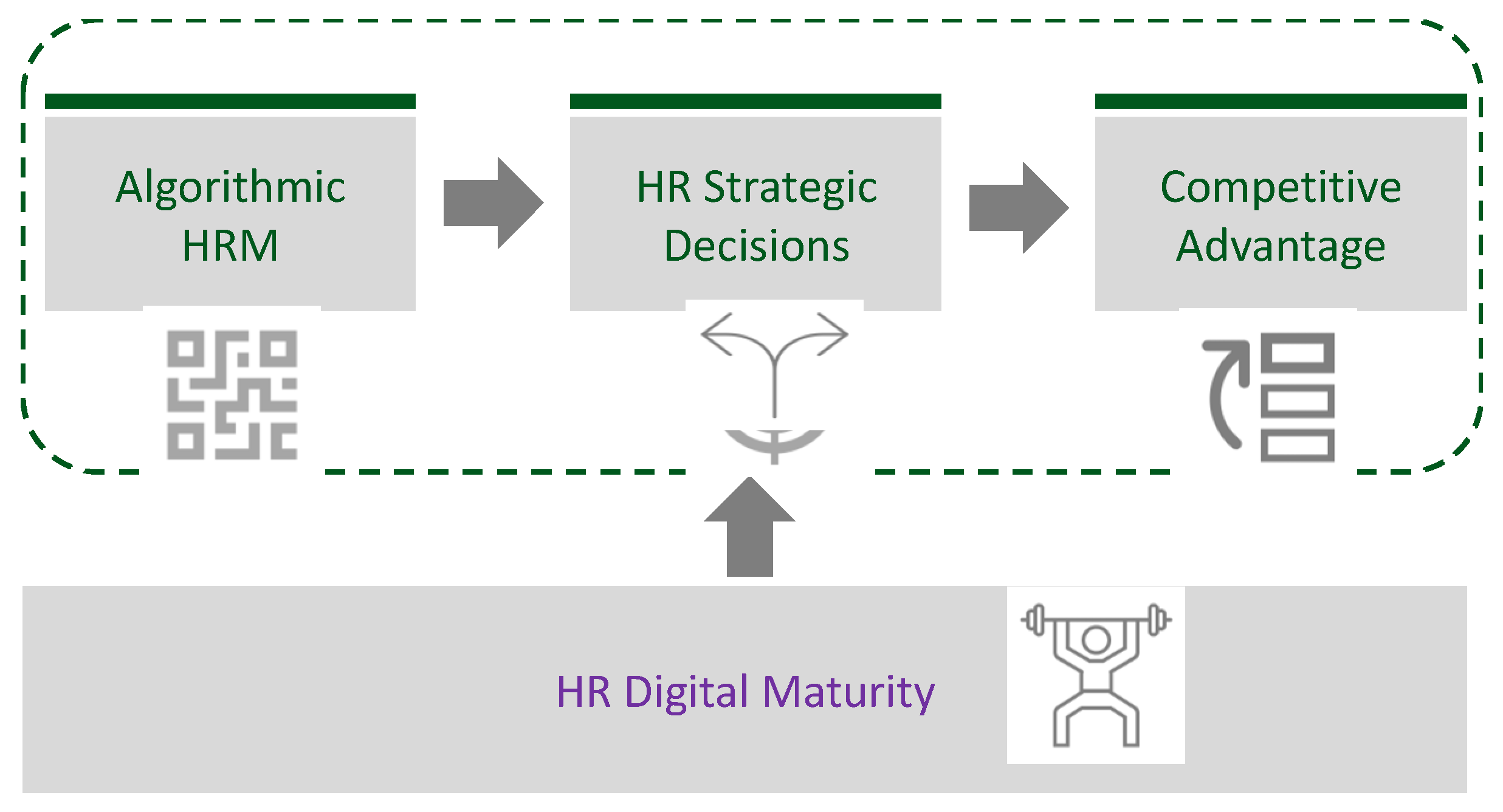
Figure 2.
Evolution of Digital and Technological HRM.

Figure 3.
The Conceptual Model based on Barny (1991, 1995), Marler & Parry (2016) and Teece (1997). Dotted line represents the indirect relationship.
Figure 3.
The Conceptual Model based on Barny (1991, 1995), Marler & Parry (2016) and Teece (1997). Dotted line represents the indirect relationship.
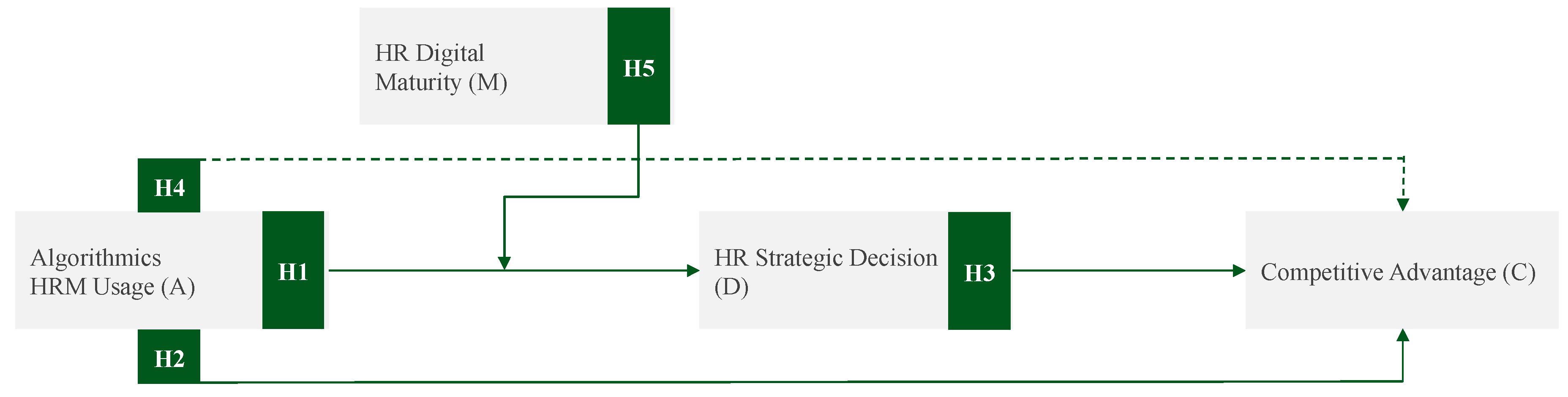
Figure 4.
Structural Model Result (source: analyzed by the authors and extracted from SmartPLS4 application).
Figure 4.
Structural Model Result (source: analyzed by the authors and extracted from SmartPLS4 application).
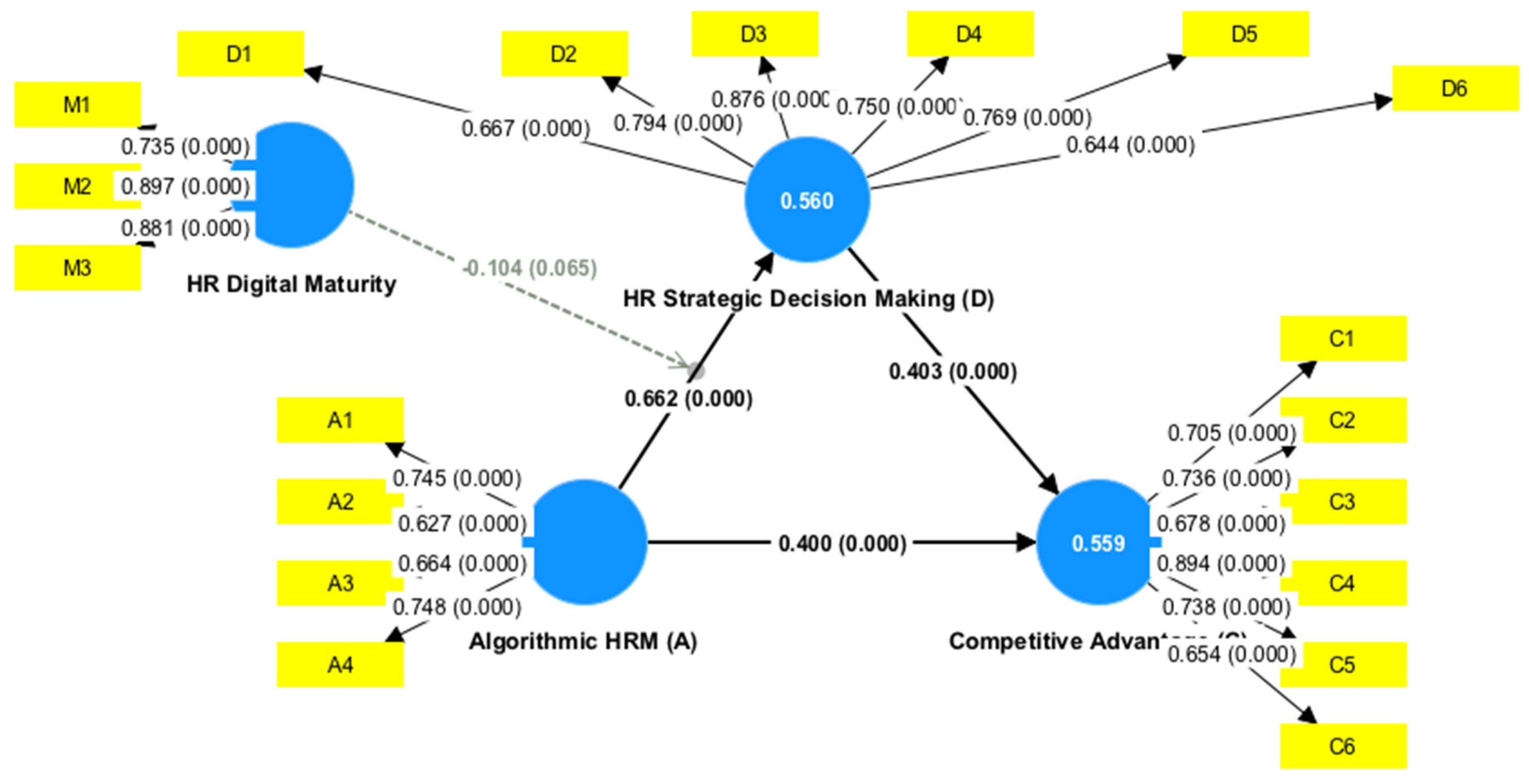
Figure 5.
The slope graph of moderation (source: extracted from SmartPLS 4 application).
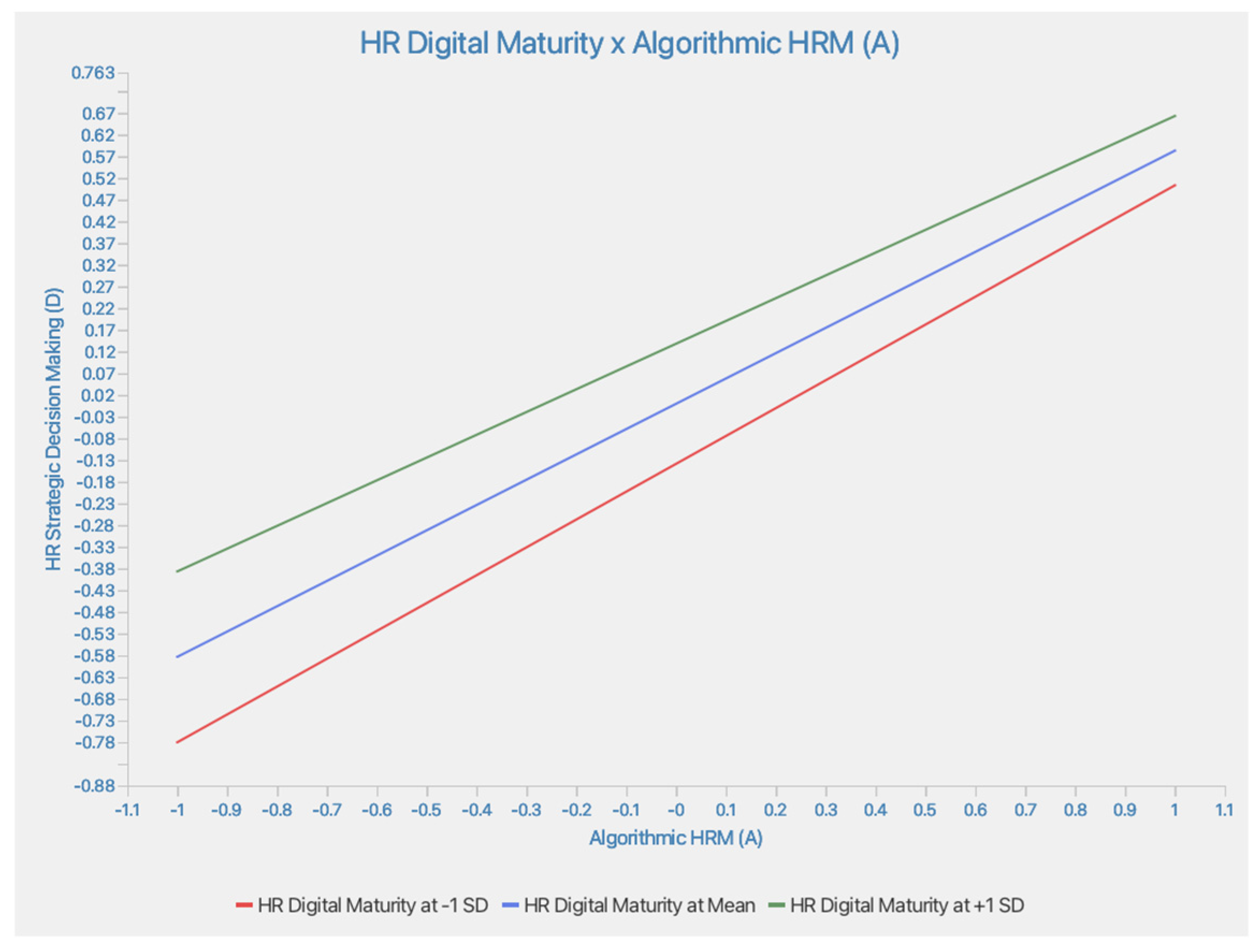
Table 1.
Item generated and sources.
| Item | Source |
|---|---|
| There has been a consensus that the use of digital HRM and algorithmic HRM in organization is a reality. Many researchers endorse that algorithmic HRM usage will improve the accuracy and efficiency of the HR processes. | Rodgers et al. (2023) |
| Training and new learning of HR professionals is a necessity in the new scenario, and HR professionals will require training and upskilling to effectively utilize algorithmic HRM tools in their organization. | Chowdhury et al. (2023) |
| Algorithmic HRM usage will enhance the quality of decision-making process in the HR-related activities. | Leicht-Deobald et al. (2022) |
| Algorithmic HRM and its usage will increasingly perform majority of HR tasks in organizations. | Meijerink et al. (2021) |
| HRM function has to collaborate with their IT counterparts to integrate algorithmic HRM systems to make it more credible and cohesive. | Duggan et al. (2023) |
| Algorithmic HRM usage will enable predictive analytics for HR planning and forecasting the workforce needs. | Rodgers et al. (2023) |
| Data privacy and security is also an important issue while making AHRM decisions, and HR departments will ensure the data privacy and security in algorithmic HRM implementation. | Langer & König (2023). |
| Most of the HRM function will be able to cope with the requirements of Algorithmic HRM usage, and its usage will be increased with time. | Arslan et al. (2022) |
| Algorithmic HRM can also tackle people management and engagement issues, and its usage will facilitate personalized employee experiences and engagement in organizations. | Malik et al. (2023) |
| HRM function has to play an active and leading role in the implementation of algorithmic HRM in organizations. | Oswald et al. (2020) |
| It will be imperative for HR departments to monitor and evaluate the performance and impact of algorithmic HRM systems. | Cheng & Hackett (2021) |
| Algorithmic HRM usage will require ongoing maintenance and updates to ensure its optimal functioning. | Duggan et al. (2023) |
| HR department has to look into the larger issue as well, and to evaluate the ethical implications and potential biases if any associated with the algorithmic HRM usage. | Köchling & Wehner (2020) |
| Algorithmic HRM usage will reinforce and support strategic workforce planning and talent management initiatives in organizations. | Rodgers et al. (2023) |
| In Algorithmic HRM usage, there is likelihood to interact and process Big Data from several sources that can’t be handled manually. | Hamilton & Sodeman (2020) |
| HRM function will leverage machine learning algorithms to automate candidate screening and selection in their organizations. | Garg et al. (2022) |
| Algorithmic HRM usage will enable HR professionals to focus on strategic initiatives and value-added tasks. | Nankervis et al. (2021) |
| HRM functionaries will collaborate with internal stakeholders to align algorithmic HRM practices with organizational goals. | Langer & König (2023) |
| Algorithmic HRM usage will reduce the dependability on the HR professionals in the organization. | Köchling & Wehner (2020) |
| HR professionals has to update their skill base, and to be more responsive and in time to come, the algorithmic HRM usage will ultimately enhance the HR agility and responsiveness to the changing business needs. | Chowdhury et al. (2023) |
Table 2.
Algorithmic HRM Usage: the refined items.
| Code | Item |
|---|---|
| A1 | Algorithmic HRM will be increasingly used in performing the HR tasks. |
| A2 | HRM function is able to cope with the requirements of Algorithmic HRM and its usage. |
| A3 | HRM function has an active and leading role in organizational algorithmic implementation. |
| A4 | Algorithmic HRM and its usage will interact and process Big Data from several sources that can’t be handled manually. |
| A5 | Algorithmic HRM and its usage will reduce the dependability on the HR professionals in the organization. |
Table 3.
EFA Results of the Algorithmic HRM Usage (A) (Source: analyzed by the authors using SPSS software).
Table 3.
EFA Results of the Algorithmic HRM Usage (A) (Source: analyzed by the authors using SPSS software).
| code | item | Loading |
|---|---|---|
| A1 | Algorithmic HRM usage will increasingly perform HR tasks. | 0.792 |
| A2 | HRM is able to cope with the requirements of Algorithmic HRM usage. | 0.715 |
| A3 | HRM has an active and leading role in organizational Algorithmic implementation. | 0.782 |
| A4 | Algorithmic HRM usage will interact and process Big Data from several sources that can’t be handled manually. | 0.796 |
| A5 | Algorithmic HRM usage will reduce the dependability on the HR professionals in the organization. | 0.274 (removed) |
Table 4.
Construct Validity.
| Construct measured | Scale used | Internal Consistency | AVE |
|---|---|---|---|
| Algorithmic HRM Usage (A) | Constructed during the exploratory phase. | α= 0.786 | 0.534 |
| HR Digital Maturity (M) | Irimiás & Mitev (2020) | α = 0.878 | 0.804 |
| HR Strategic Decision (D) | Jarupathirun et al. (2007) | α = 0.885 | 0.640 |
| Competitive Advantage (C) | Chang (2011) | α = 0.877 | 0.620 |
Table 5.
Analysis of the Respondents’ profiles & their demography (n = 234).
| Frequency | % | Frequency | % | ||
|---|---|---|---|---|---|
| Region | Occupational Level | ||||
| Saudi Arabia | 221 | 94% | Entry | 12 | 5% |
| Other | 13 | 6% | Specialist/Supervisor | 66 | 30% |
| Gender | Manager/Sr Manager | 77 | 35% | ||
| Male | 142 | 61% | Director | 52 | 24% |
| Female | 92 | 39% | Leadership | 14 | 6% |
| Age (years) | HR Specialty | ||||
| <20 | 0 | 0% | Relations and Services | 92 | 39% |
| 20 - 30 | 51 | 22% | HRIS | 6 | 3% |
| 31 - 40 | 127 | 54% | Talent Acquisition | 47 | 20% |
| 41 - 50 | 55 | 24% | T&D | 18 | 8% |
| 51 - 60 | 1 | 0% | Performance management | 23 | 10% |
| >61+ | 0 | 0% | Rewards/OD | 48 | 21% |
| Years of Experience (years) | Organization Size | ||||
| < 1 | 0 | 0% | <100 | 33 | 14% |
| 2 - 5 | 42 | 18% | 100 - 500 | 55 | 24% |
| 6 - 10 | 55 | 24% | 501 - 1000 | 29 | 12% |
| 11 - 15 | 71 | 30% | 1001 - 5000 | 79 | 34% |
| 16 - 20 | 45 | 19% | > 5000+ | 38 | 16% |
| 21+ | 21 | 9% | |||
| < 1 | 0 | 0% | |||
| Education level | |||||
| High school or less | 0 | 0% | |||
| Diploma | 8 | 3% | |||
| Bachelor | 112 | 48% | |||
| Master | 99 | 42% | |||
| Ph.D. | 15 | 6% | |||
Table 6.
Common Method Bias/Variance (CMB/CMV).
| R2 Without Marker Variable |
R2 with Marker Variable |
|
|---|---|---|
| Competitive Advantage (C) | 0.450 | 0.450 |
| HR Strategic Decision Making (D) | 0.448 | 0.448 |
Table 7.
Measurement Model, CA = Cronbach Alpha, CR = Composite Reliability, AVE = Average Variance Estimation.
Table 7.
Measurement Model, CA = Cronbach Alpha, CR = Composite Reliability, AVE = Average Variance Estimation.
| Construct | Item | Loading | VIF | CA | rho_A | CR | AVE |
|---|---|---|---|---|---|---|---|
| Algorithmic HRM Usage (A) | 0.777 | 0.786 | 0.850 | 0.534 | |||
| A1 | 0.745 | 1.699 | |||||
| A2 | 0.627 | 1.580 | |||||
| A3 | 0.664 | 1.751 | |||||
| A4 | 0.748 | 1.232 | |||||
| Competitive Advantage (C) | 0.877 | 0.884 | 0.907 | 0.620 | |||
| C1 | 0.705 | 1.698 | |||||
| C2 | 0.736 | 2.656 | |||||
| C3 | 0.678 | 2.062 | |||||
| C4 | 0.894 | 2.144 | |||||
| C5 | 0.738 | 2.018 | |||||
| C6 | 0.654 | 1.680 | |||||
| HR Digital Maturity (M) | 0.879 | 0.886 | 0.925 | 0.804 | |||
| M1 | 0.735 | 2.852 | |||||
| M2 | 0.897 | 2.995 | |||||
| M3 | 0.881 | 1.990 | |||||
| HR Strategic Decisions (D) | 0.887 | 0.893 | 0.914 | 0.640 | |||
| D1 | 0.667 | 1.931 | |||||
| D2 | 0.794 | 2.129 | |||||
| D3 | 0.876 | 2.696 | |||||
| D4 | 0.750 | 2.803 | |||||
| D5 | 0.769 | 2.506 | |||||
| D6 | 0.644 | 1.696 |
Table 10.
Collinearity assessment, VIF inner model.
| Competitive Advantage (C) | HR Strategic Decision Making (D) | |
|---|---|---|
| Algorithmic HRM (A) | 1.759 | 1.324 |
| HR Strategic Decision Making (D) | 1.759 | |
| HR Digital Maturity (M) | 1.293 |
Table 11.
Structural Model.
| Hypothesis | Relationship | Std Beta | Std Error | f2 | |t-value|^ | p-value | Decision |
|---|---|---|---|---|---|---|---|
| H1 | A → C | 0.400 | 0.104 | 0.165 | 3.824 | 0.000*** | Supported |
| H2 | A → D | 0.662 | 0.083 | 0.690 | 7.978 | 0.000*** | Supported |
| H3 | D → C | 0.403 | 0.107 | 0.168 | 3.760 | 0.000*** | Supported |
| H4 | A → D → C | 0.267 | 0.068 | 0.027 | 3.917 | 0.000*** | Supported |
| H5 | Moderation | -0.104 | 0.070 | 0.025 | 1.495 | 0.065 | Rejected |
Disclaimer/Publisher’s Note: The statements, opinions and data contained in all publications are solely those of the individual author(s) and contributor(s) and not of MDPI and/or the editor(s). MDPI and/or the editor(s) disclaim responsibility for any injury to people or property resulting from any ideas, methods, instructions or products referred to in the content. |
© 2024 by the authors. Licensee MDPI, Basel, Switzerland. This article is an open access article distributed under the terms and conditions of the Creative Commons Attribution (CC BY) license (http://creativecommons.org/licenses/by/4.0/).
Copyright: This open access article is published under a Creative Commons CC BY 4.0 license, which permit the free download, distribution, and reuse, provided that the author and preprint are cited in any reuse.