

Submitted:
10 December 2024
Posted:
12 December 2024
You are already at the latest version
Abstract
This study has a novel conceptual framework and uses SPSS version 23 and AMOS version 23 for analysis. These findings reveal that the use of AI in HR processes has, in fact, a positive significant effect on Employee Engagement and Retention, Data-Driven Decision Making, Smarter Recruitment, and Enhancing Performance Management but has no effect on Personalized Learning and Development. The novelty of this contribution lies in its focus on specific outcomes of the adoption of AI technology in managing the HRM process. This study fills the conceptual gap in the literature on HRM through the critical analysis of AI functions in the human resources process, focusing on the following critical outcome variables: employee engagement and retention, data-driven decision making, smarter recruitment, enhancing performance management, personalized learning, and development-the interrelations between HR artificial intelligence and these outcome variables.
Keywords:
AI
; HR
; Engagement
; Retention
; Performance Management
; Decision Making
1. Introduction
The world is witnessing an unprecedented period of technological advancement in various fields. This technological advancement helps address some of the biggest human resources problems in business organizations. The human resource management process has significantly influenced by artificial intelligence improved the fastest and best solutions to their problems and challenges faced. The HR department has always been very crucial to the success of any company since it generally deals with talent growth and acquisition, employee engagement, retention, and workforce development. Technology advancement leads the development of the human resources (HR) field. Recently, the integration of artificial intelligence (AI) into HR has significantly influenced the development of the concept of performance management. Generative AI makes use of machine learning (ML) and deep learning algorithms to produce high-quality material that is indistinguishable from human-generated content [1].
Artificial intelligence, robotics, and modern technological techniques and applications are among the positive and effective means that human resources management can rely on to develop and reengineer its operations. In fact, these technologies will foster creativity and innovation within human resources management functions and departments. Professionals and stakeholders view these technologies as essentials and fundamentals that foster competitiveness and guarantee a continuous path to success. Artificial intelligence applications can analyze, predict, and diagnose to help human resources teams and specialists make decisions [2]. Although the application of artificial intelligence is considered an optimistic opportunity that enhances the growth and development of organizations and supports functions such as recruitment, training, performance analysis, retention, and more, the majority of organizations are still hesitant or late in integrating artificial intelligence applications into their human resources management practices due to their cost. Understanding the meaning of AI and using it appropriately can create a better future by combining human and technical intelligence and boost the value of producing better and quicker solutions for HR processes and operations.
According to Murugesan et al. [3] AI algorithms assist in making real-time decisions and ensuring consistency in computational methods. The integration of AI and automation into workforce development marks a significant advancement in the field of study. HRM operations, including learning and development, talent development and management, and workforce planning, are incorporating these applications. For instance, the ability of artificial intelligence and automation to analyze data and recognize patterns has already disrupted the traditional methods of identifying and processing learning needs in learning and development. Furthermore, AI systems use natural language processing and machine learning to analyze employee input. They provide actionable insights into skill gaps and learning requirements. Therefore, using AI in HRM leads to more personalized learning experiences and helps find skill gaps through analytics, making sure that each employee gets the training that is best for them [4]. These technologies have changed HRM procedures, making them more effective and impactful, with the potential to fundamentally revolutionize the discipline [5].
Academics are increasingly interested in studying the impact of artificial intelligence (AI) on human resource management [6]. In this perspective, the present research focuses on the role of AI in five critical elements of human resource management: smarter recruitment, enhancing performance management, employee engagement and retention, data-driven decision-making, and personalized learning and development. Moreover, previous studies on the role of AI in HRM by Tambe et al. [7] have primarily focused on descriptive aspects without considering theoretical contributions. Thus, the present research adds new information to the existing literature. First, the research focuses on the function of AI in encouraging data-driven decision-making since there are few studies on this issue [8]. Second, the study's originality stems from its investigation of the role of artificial intelligence in fostering HR management processes. Third, there are a few studies on performance management in the setting of artificial intelligence [9]. Finally, the study explores the organizational outcomes of applying AI in HRM. Thus, this study also aims to develop a conceptual framework and examine the relationship among the potential outcomes of integrating AI into HRM. Furthermore, the above discussion has influenced the formulation of the study's question: What are the potential consequences of integrating AI into the HR management process?
2. Literature Review
2.1. Theoretical Background and Hypotheses Development
Socio-technical approach is "a way of seeing organization that emphasize the interdependence between the functioning of the social and technological systems within the organization and the relation of the organization as a whole in its operational environment." According to Passmore et al. [10] the socio-technical system view emphasizes that people in organizations who, through technology, produce goods and services are integral determinants of the functioning and appropriateness of the technology as well as the behaviors of the users of the technology. This definition includes the added value aspect in that the customers, as part of the organization's external environment, have valued the goods and services [11].
Emery [12] stated that socio-technical research concerns the mutual benefit arising from the conjunction of social and technical factors. This intersection emphasizes a reciprocal relationship between humans and machines, whereby a dual process of shaping social and technical systems occurs [13]. Thus, the socio-technical approach identifies social and technical dimensions, called subsystems, that form a system of interest or a broader system, known as the metasystem. The theory explained that a socio-technical system's success is the product of the contribution between these subsystems. Socio-technical theory emerged in response to the prevailing technocratic models, which were technologically deterministic and ignored human factors [14,15].
Kling's [14] study underscored the significance of proactive and imaginative analyses in addressing the implications of emerging technologies. The study considered "the potential capabilities, benefits, and harms of new technical developments," concluding that moral analyses of implications should incorporate social and economic factors rather than solely rely on technical aspects. A subsystem concept distinguishes between different aspects of a given system using a socio-technical theory. Early studies identified three dimensions of a socio-technical system: socio-psychological, which refers to people and their human aspects; technological, which refers to tools or objects; and economic, which represents the effectiveness of interactions between human and technological resources [16].
this technical subsystem is related to the physical and material proceeds within the transformation process, as well as the tasks, control, and maintenance functions, and when applied to the organizational setting, denotes the tools, techniques, skills, and devices that workers need to achieve organizational goals and tasks [17,18].
Numerous disciplines, including information systems (complex systems), organization/business/management studies, and engineering have applied sociotechnical theory, employing a variety of qualitative and quantitative methods as well as socio-technical design methodologies. Moreover, the application of socio-technical theory spans various contexts and levels [11,19].
2.2. Role of AI in Human Resources Management
Different scholars and experts have presented the definition of AI in various ways, highlighting its capabilities and aspects in terms of technical advancement and problem-solving efficiency. Agrawal et al. [20] stated that AI is basically the ability of computers to utilize voluminous data in order to predict outcomes or propose solutions for contexts that are multimodal as well as multidimensional. AI solutions analyze large volumes of data in critical situations to make informed predictions and judgments. AI is increasingly integrating into human resource management, thereby transforming nearly all pertinent aspects of HRM. Most operational procedures in human resource management have begun to make increasing use of AI because of the large number of data points relating to labor management and organizational operations. According to Votto et al. [21] this development aims to support sustainable company structures. Also, AI in HRM may enable business organizations to easily identify highly qualified candidates. Thus, recruiting can be far more efficient. For instance, [22] and [23] identified various opportunities that arise in the performance management context due to intelligent AI technologies. However, when businesses transform into knowledge-driven, organizations will be able to meet the needs of workforce training and development and enhance the quality of learning through the AI-based training application.
Businesses across the world have now realized the role of AI-based solutions in motivating improvements in several important human resources tasks. These technologies enhance work performance and cost efficiency, besides improving employee satisfaction and productivity. Other results that have emerged from the incorporation of AI include improved retention rates, more informed decision-making, and a significant reduction in human resources and operational costs [24]. The increased acceptance of AI in human resource management will be fostered by the realization of potential benefits to companies, employees, and customers alike. In fact, AI stands out to be quite useful in automating processes and hence freeing human resources for core activities down to real-time data analyses and predictive analytics. Artificial intelligence is changing the capability of the human resource sector at large in terms of decision-making and problem-solving [25,26,27].
SET or Social Exchange Theory explains how perceptions of HR management in integrating AI into the HRM process influence their strategies toward smarter recruitment, engaging employees and retaining them, enhancing performance management, personalized learning, and development, and making decisions. "SET" illustrated that, when organizations drive the AI-driven into the processes of HRM, people will perceive something special because this might lead to a greater likelihood of workers showing positive attitudes and behaviors. This could also support engagement and retention [28]. The implication of this study, therefore, is that integrating AI into the process of human resource management might come up with employee engagement and retention, guide the human resource team in more effective recruitment, improve performance management, create personalized learning and development, and inform decision-making. Figure 1 depicts the conceptual framework.
2.3. Potential Outcomes of Artificial Intelligence Technologies in HRM
2.3.1. Employee Engagement and Retention
According to SivaSubramanian [29] employee engagement patterns are shifting as generations change in the workplace. As a result, techniques for engaging and retaining people are evolving. Dell Technologies has shown that Generation Z is excited about how technology may transform the way workers work and participate. The availability of innovative technology made Gen Z employees more engaged and interested in their work. Moreover, new technologies such as machine learning and artificial intelligence are replacing traditional techniques of employee engagement, including two-way communication, employee recognition programs, and learning and development, unlike the yearly performance review platform.
A study by Hughes et al. [30] explained that utilizing artificial intelligence to provide feedback enhances employee engagement. Garg et al. [31] explained that AI systems may assist in analyzing employee feedback and satisfaction levels; consequently, this will assist workers in responding to an organization survey on their experiences at the workplace, analyze the inputs offered by the respondents, and deliver vital information to the organization for improving employee engagement and retention [32].
HR management can employ AI to get deeper insights into team dynamics, identify high-performing teams, and indicate areas for growth. This data-driven strategy allows firms to optimize team structures, efficiently allocate resources, and build a culture of continuous development. AI may analyze data based on employee behavior to discover individual skills, limitations, and preferences, as well as anticipate future performance. Real-time data is also essential for the personalized engagement process. Decision-makers may then utilize this reflective and predictive data to make informed choices. Among the primary benefits of personalized interaction are enhanced productivity and motivation [33]
When treated as individuals rather than as team members, employees were more likely to feel appreciated, Consequently, employees will show more commitment to their job. Another significant potential of AI is chatbots and virtual assistants, which are in high demand for employee engagement. Advanced AI-driven algorithms in the performance of chatbots or virtual assistants transform managerial communication with employees. Chatbots are those programs which interact with users by using human-like conversations [34].
2.3.2. Smarter Recruitment
Data-Driven Decision Making, and Personalized Learning and Development Generally, AI-driven solutions currently transform human resources management and the processes of recruitment and selection. The inclusion of AI in the process of recruitment is a paradigm shift which merges the interaction of tradition with advanced technologies. AI-driven candidate screening automates the process of preliminary screening of candidates, hence shortlisting applications that fit the requirements of the job description. Additionally, automated parsing utilizes natural language processing to optimize the assessment of abilities and experiences. Combined, video interviews and face analysis decipher nonverbal clues and provide subtle insights about applicant appropriateness [23].
While AI improved efficiency, it also strengthens candidate experience [35]. AI-powered chatbots respond to real-time candidate inquiries, ensuring smooth and dynamic interaction. Predictive analytics uses data-driven insights to evaluate candidate performance, finding the best-fit candidates via algorithmic analysis of past data [36].
Park [37] argued that AI-powered tools can predict which candidates will stay with an organization. As a result, the placement process could become significantly more efficient. Web-based recruitment tends to be impersonal. Web-based recruitment does not allow prospects to ask questions about the vacancy announcement. Job seekers frequently ask questions and tend to stay in touch with the organizations. However, approximately 40% of the applicants never receive responses from organizations [38].
2.3.3. Personalized Learning and Development
AI embeds intelligence in the process of onboarding and training employees, thus setting new highs in human resource management regarding personalized and effective learning. AI-powered onboarding proceeds with experiences designed to meet the needs of each employee. AI algorithms generate recommendations for personalized training through an analysis of employee profiles and experiences and recommend appropriate modules in line with the employee's skillset and learning speed [39].
The results of Holuša et al. [40] study indicated that the virtual reality-based simulations further plunge newly recruited employees into real situations where they receive hands-on training even before actually starting their jobs. This kind of approach toward learning promotes faster speeds and a greater understanding of the job responsibilities. Artificial intelligence gives real-time feedback, thereby enhancing the training capability. The employees get real-time feedback on their performances and thus have a drive to improve. Predictive analytics may help identify potential skill gaps and target training interventions, thereby enabling people to upskill themselves and remain relevant for the emerging demands of employment. Additionally, AI-supported training improves information retention using adaptive learning approaches, which alter the training material depending on an employee's progress and understanding level [41].
Budhwar et al. [42] discussed how AI technologies help workers learn and improve. HR managers may use AI technologies to identify employee skill gaps and build appropriate training programs. Furthermore, the HR manager's online and virtual training allows them to evaluate not only the effectiveness of the training provided but also the talents and experiences of employees. This ensures that the right people with appropriate talents are placed in the appropriate locations.
2.3.4. Performance Management
Performance management is the strategic process whereby companies plan, monitor, and analyze the performance of their employees to achieve both individual and corporate objectives. This involves setting their expectations, continually monitoring the progress with respect to set expectations, feedback, and embracing strategies for improvement. Traditionally, manual methods and subjective judgments have supported performance management. AI allowed higher accuracy and data-driven decisions to be made possible [43].
Performance management is a continuous process whereby employees' levels of performance are observed. Performance management involves observing and recognizing individual and team performance to achieve corporate objectives [7,44]. HR managers may use multi-attribute decision-making models to guarantee that workers get fair and complete appraisals. They highlight areas where workers may improve their talents and the extent to which they need development. Furthermore, they allow managers to assess employee performance and offer improvements, such as extra training, skill development, or higher education as required [42].
Integrating AI into the HR process system will enhance performance management. The organization can easily monitor the performance of workers across all departments and track individual performance. As workers update their goal progress, AI monitors performance measures and alerts you if they are not on pace to accomplish the targets. Then, you can take quick action by investigating what's causing performance concerns and providing assistance to help every employee achieve their goals [45].
Lake [46] conducted a case study on how AI influences performance management in a Fortune 500 firm. He realized that, after a while, the use of AI in performance management resulted in a reduction in time spent on administrative tasks of performance reviews by 30%. This result leads executives and managers to concentrate more on employee coaching and delivering relevant feedback to their staff, resulting in a 15% increase in overall employee performance. Furthermore, AI assisted in identifying patterns and trends in employee performance data, enabling firms to identify issues and seize opportunities for employee development.
2.3.5. Data-Driven Decision-Making
In today's technological advancement, an organization's ability to make educated, accurate, and timely decisions determines the road to success. AI helps organizations accelerate it through going through a large volume of data, coming up with trends, and determining what to do. All businesses are now undergoing a transformation in their decision-making process. AI integration into decision-making platforms is changing industries by enabling better, faster, and more impactful decisions. Its ability to quickly and accurately analyze massive volumes of data makes it perfect for decision-making in the twenty-first century [47].
Data-driven decision-making is a corporate strategy that involves using data analysis to make informed decisions. It entails collecting data and analyzing it in a way that provides insight into the information, thereby helping to drive the decision-making process. The essence of DDDM is the replacement of intuitive and gut sentiments with evidence-based insight—a process that reduces the margin of error and increases the possibility for success. Artificial intelligence in decision-making shows one of the biggest leaps beyond human capabilities. AI in decision-making extends its prime importance to banking, healthcare, manufacturing, and marketing [48]. This allows for faster and quicker processing of voluminous data, resulting in quicker and more informed decisions. This is particularly important in critical situations such as medical emergencies, where prompt analysis can differentiate between life and death. In addition, AI might identify trends and make predictions that would not come to a human decision-maker's attention; thus, it might obtain better outcomes in risk management, resource allocation, and policy development [45].
Luley [43] found that data-driven human resources decision-making, on the other hand, will enable the firm to align its human resources approach with wider business goals. In this regard, organizations can identify how human resources practices and initiatives help the organization achieve success by measuring human resources data against key business metrics, HR director and managers can make more effective and informed decisions about resources and workforce and align human resources process with overall goals and objectives.
3. Materials and Methods
3.1. Data Collection
The present investigation, therefore, uses the quantitative survey method, the base for which was taken from [49], in order to realize how the integration of AI into human resource processes has brought out certain implications on the HR functions of an organization. data collected from the respondents using a structured questionnaire. This study's measurement tools are based on twenty-six constructs developed from three studies, namely [50,51,52].
Respondents in this study are HR managers, recruitment managers, training managers, and their assistants who presently work in a five-star hotel chain in Egypt. The researchers contacted the general managers of those hotels for their consent to participate in the research. Thirty-four hotels agreed to participate, while five hotels declined to conduct the survey.
The questionnaires were administered to the respondents through the business emails obtained from the HR division. The hotels, which apply artificial intelligence in human resources practices to improve their operation performance based on facts and not emotions or biases, were the targets of the study. A random sampling approach was useful for data collection when respondents shared characteristics of smart technology use for hospitality and tourism [53]. A total of 275 valid questionnaires were collected, with a response rate of 78.5%. For rating of the study questions, a five-point Likert-type scale was utilized, where 1 pointed to "strongly disagree" and 5 to "strongly agree." Additionally, we asked participants to report some demographic information, such as age, gender, position, and years of experience.
Prior to the survey distribution, we conducted a pretest of the questionnaire with 30 samples to examine the reliability of the construct. We asked HR managers who have experience in artificial intelligence (AI) and hospitality management professors to participate in the pretest for the pilot test, aiming to assess logical consistency, comprehensibility, and task relevance.
Participants in the pretest provided suggestions on how to improve the questionnaire. The hypothetical framework led to the development of "the structural equation modeling," or SEM, which was used to test the hypotheses. While selecting the appropriate statistics for data analysis, there were several reasons to choose SEM as a proper method for the study analysis. First, Structural equation modeling represents a statistical modeling technique that encompasses several traditional multivariate approaches to factor analysis, regression or path analysis, discriminant analysis, and canonical correlation. It has been widely utilized in the behavioral sciences. This basic approach to the method is based on theoretical constructs represented by latent factors. Path analysis provides interrelationships of the theoretical constructs through the path coefficients, resulting in a path diagram that graphically represents the structural model. We used exploratory factor analysis (EFA) to find the main constructs in the first phase. In the second phase, confirmatory factor analysis (CFA), we used path analysis to find the causal relationships between these constructs [54,55]. Moreover, we used factor loadings to determine the extent to which certain questionnaire questions reflect their underlying components. Internal consistency was tested via alpha-Cronbach and composite reliability.
Construct validity was used to test for the actual lack of a relationship among measures that were not conceptually related to any great degree. Additionally, we precisely evaluated the validity of convergent constructs using AVE, and we followed Fornell & Larcker's approach to evaluate the discriminant construct validity.
3.2. Respondents’ Profile
The demographic characteristics are extracted to explain in detail the information required about the respondents. Table 1 explains that the majority of the respondents were males, which formed 71% of the total responses, while females rated for 29%. The age group of 35–54 accounted for 17% of the responses, while the age group of24–34 accounted for 36%. Regarding the years of experience, the results reveal that 50% of respondents have experience ranging from a year to 5 years, 35% have experience ranging from 6 to 10 years, and the rest of respondents is 15% have experience exceeding 10 years. additionally, 13% of total respondents were occupy a directors of HR jobs as well as HR managers; 12% were training managers; 10% were recruitment managers14% were HR assistant managers; 11% were assistant training managers; and 27% were HR supervisors.
3.3. Measurement Model
a confirmatory factor analysis (CFA) conducted first to determine the reliability and validity of the data measurements. The factor loading, Cronbach’s alpha (α), composite reliability (CR), and average value extracted (AVE) tests are used to check the reliability of study measures. Table 2 explains that all the variables reflect acceptable levels of reliability since they are all above 0.9: AI = 0.933, SR = 0.931, PM = 0.932, LD = 0.929, DM = 0.938. All Cronbach's alpha results were above the threshold value of 0.7 recommended; hence, measures utilized in this study are reliable, having high levels of internal consistency.
The Composite Reliability (CR) index test assesses the internal reliability of each measurement. In light of Hair et al. [56] and Lai et al. [57] who explained that a CR index greater than 0.7 is an indication of an acceptable internal consistency of the construct. The results indicate that the composite reliability (CR) of all items exceeded the recommended threshold (0.7), as they ranged from 0.832 to 0.903. These results therefore validate the existence of internal reliability for each of the study constructs.
The results of Table 2 demonstrate that all constructs' average extracted variance exceeded the threshold value of 0.50, indicating that the measurement instruments accurately represented the overall amount of variance in the study's indicators. All AVE values ranged from 0.684 to 0.785 and were thus acceptable, as recommended by [58] who asserted that the ideal value for the AVE should be greater than 0.5. Higher values for the variance-extracted estimate (greater than 0.50) reveal that the indicators represent the latent construct well [59].
3.4. Model Fit Indices
The model was evaluated using several measures to determine the acceptance level of the model fit. The Chi-Square value (χ2=1.639, df= 257) falls below the recommended threshold of less than 3.0, confirming the model's fit [61]. The results illustrate that the measurement model has an excellent fit with the data: GFI =.90, NFI =.911, TLI =.957, CFI =.963, and RMSEA =.048. These fit results show that the measurement model provides a satisfactory fit to the data, as recommended by Schumacker & Lomax [62] and Reinard [63] who asserted that the baseline comparison index should have values above.90, where a value of 1 indicates a perfect fit.
3.5. Structural Model Assessment
For hypothesis testing, the structural model assessed the causal relationships among six factors. The Chi-Square χ2=(1.655) meets the threshold of <3, confirming that there is an acceptable fit model. Regarding the baseline indicators, NFI, TLI, RFI, IFI, TLI, CFI, and GFI, the results were 0.906, 0.955, 0.90, 0.961, 0.955, 0.960, and 0.891, respectively. These confirm that there is a favorable fit since all the indices have met the recommended threshold ≥ 0.9. Furthermore, RMSEA at 0.049 indicates a good fit because the result meets the recommended threshold of < 0.06. We provided evidence of an acceptable model fit by comparing all the fit indices with their respective recommended values.
3.6. Hypothesis Testing Results
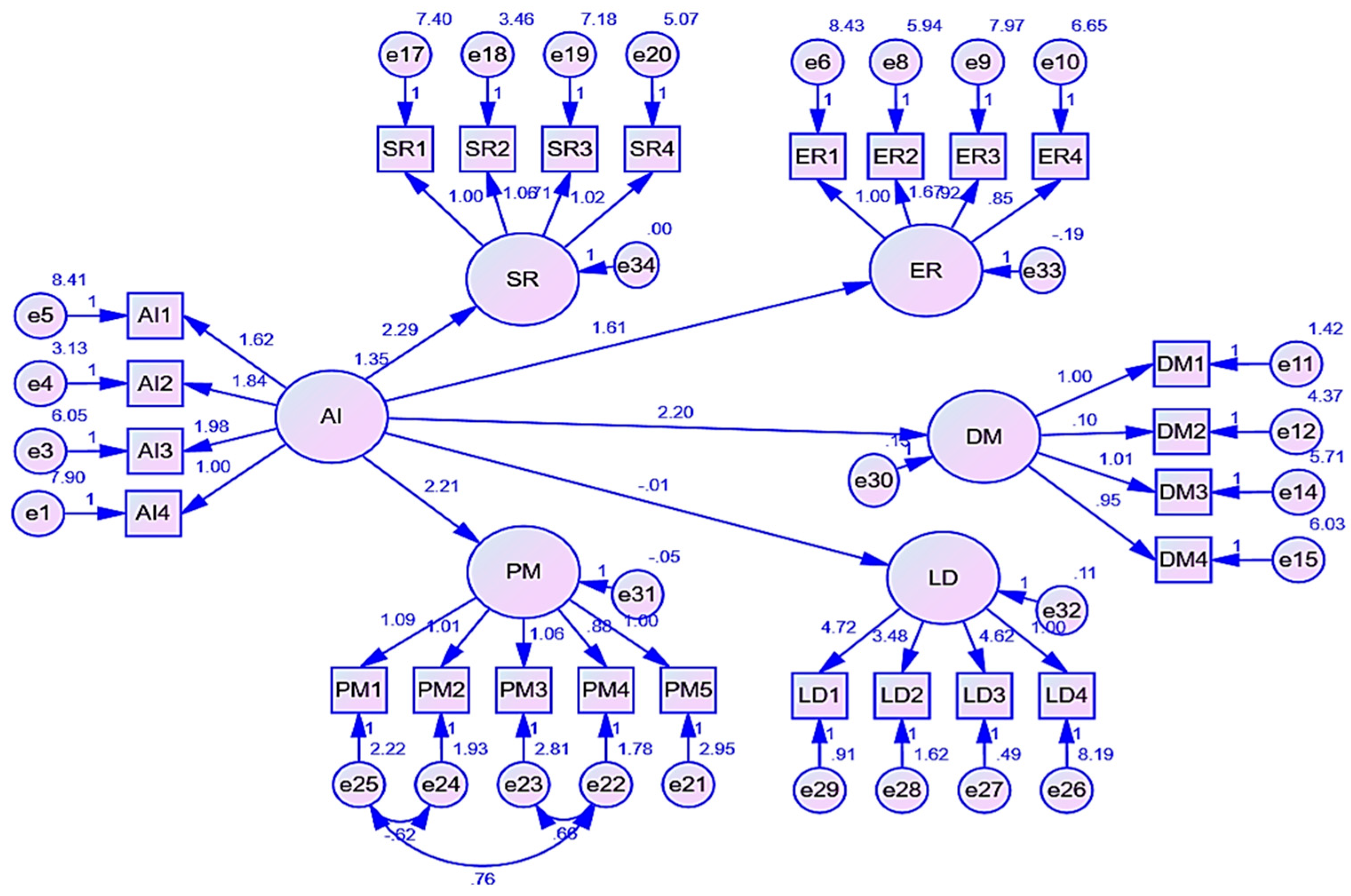
The path coefficients of the structural model in Table 4 showed that the strongest relationship was between AI and smarter hiring (β = 2.288, p < 0.001). Human resources teams rely on artificial intelligence to select the best candidates, matching their profiles to job positions that require specific skills, qualifications, and experiences. They filter the applications and exclude those that do not meet the requirements. This result supports the first hypothesis (H1).
Results of path coefficients indicated that the artificial intelligence had a positive and significant impact on Enhancing Performance Management (β = 2.213, p < 0.001). These results indicate that the integration of AI with HR processes makes organizations able to optimize various HR functions, identify the strengths and areas for improvement, enhance productivity, and improve talent acquisition and development. Thus (H2) is accepted.
The relationship between artificial intelligence and employee engagement and retention was found to be significant and positive (β = 1.608, p < 0.001); however, it is considered to be the least affected by artificial intelligence among all the intendent variables. The findings suggest that the integration of AI tools could enhance employee engagement and retention by achieving in-place rewards, promoting equity and diversity, providing opportunities for development and learning, and promoting inclusion by eliminating bias in recruitment and performance management procedures. Thus, (H3) was approved.
The results also explain that there is a positive and strong significant influence of artificial intelligence on data-driven decision-making (β = 2.196, p < 0.001). This result indicates that integrating AI-driven HR processes influences analytics and predictive information, which enables human resource development professionals to gain deep insights into employee performance, engagement, skill advancement, and workforce trends. AI provides crucial information that empowers human resource teams to confidently and efficiently make strategic decisions. This, therefore, implies that hypothesis H4 is true. On the contrary, the relationship of AI to personalized learning and development was not supported, given (β = -.006, p > 0.05); hence, hypothesis H5 was rejected (Figure 2).
Figure 2.
Structural equation modeling.
4. Discussion
The growth of the enormous volume of information has highlighted the importance of having an effective information system that can provide accurate and timely information to meet the needs of senior management. This has become one of the main problems facing senior management today. Based on the review of the study's findings, it was clear that the use of AI in HR processes demands further research by academics in a diverse range of areas. Therefore, this present study will look through the existing literature on the development of AI in HRM processes for a better understanding of their importance. AI developments in human resources management have increased incredibly due to workforce digitization.
This implies AI significantly influences the relation with hiring smarter employees, improving the processes of recruitment and hiring to make them more accurate and effective. These results confirm the fact that integration of AI with HR processes enables professionals to strategically and effectively hire the best talent in an organization aligned with the strategy behind meeting its goals. By reviewing candidates’ files and CVs, matching the necessary skills with the job requirements, and storing and archiving all CVs in an independent database for future reference, this process not only saves time and effort but also enhances the success and prosperity of the target job.
In addition, during the phase of employee tests and interviews, AI creates standardized questions to judge candidates’ skills and performs cognitive tests to measure the candidate’s ability to solve problems and think critically, as well as behavioral and psychological tests. The result is in line with the results of Sekhri & Cheema [64] who found that artificial intelligence (AI) is significantly impacting recruitment management at almost every step of the hiring process. These technologies have greatly helped in selecting the best qualified candidates from a seemingly limitless pool of applications.
Due to the large number of applications, HR departments face challenges in quickly identifying the best candidates for advertised positions [65]. Having many recruiters review and evaluate thousands of applications received for a single position has not only been very difficult but also excessively costly. Furthermore, digital technologies are significantly more effective and efficient in comparison to people. On the other hand, AI eliminated the possibility of cognitive biases [66]. Thus, HR departments should leverage AI-powered technologies and solutions to overcome these obstacles and speed up the hiring process.
Results from the study indicated that AI had a strong, significant positive relationship with performance management. The result would mean that the AI solution to performance management could help in raising performance management by giving the holistic view of real performance that would lead to meaningful interactions between managers and employees. Performance management systems can apply AI to the enhancement of efficiency in monitoring, assessing, and rewarding employees. This technology can facilitate more effective employee goal setting by HR professionals and managers, improve feedback, and identify any recommendations for development. Thus, the results of this study support the findings of Qasim [67] who reported that the application of AI can revolutionize performance management by automating and simplifying important stages in the process.
Theoretically, AI has brought a variety of benefits to performance management by being able to gather and process, in real time, large volumes of data about employee performance, summarize customer ratings and comments, and provide indications of sales volume in order to make judgments about how individuals and teams are performing. This allows the enterprise to proactively solve its performance problems and adapt data-driven decision making that enhances overall performance. A review by Brynjolfsson et al. [68] supports these results, as he mentioned that "integrating AI into HR management leads to improved organizational performance".
Hypothesis 4 results showed that there was a positive relationship between artificial intelligence and employee engagement and retention. This finding provides evidence that AI-powered tools and applications might boost employee engagement and productivity. AI-enabled chatbots and virtual assistants may be offering an enhanced level of communication, improved response time, and deliverance of critical information all the time. An AI-enabled chatbot can summarize employee and performance information and give significant insight into where the problems lie with managers, and thus it must be included in a proper development program. AI can also support HR managers in predicting the rate of employee turnover and plan employee incentives to encourage them.
From analyzing the direct paths of artificial intelligence and data-driven decision-making, it is obvious that the relationship between them is significant and positive; this proves that integrating AI into the processes of HR will improve its quality and efficiency. AI systems can also predict market trends, employee’s behavior, and operational inefficiencies, thus enabling organizations to act before a problem has a chance to arise or an opportunity is lost. They also analyze vast volumes of data to find patterns and relationships that may elude human analysts. Previous research by Ben-Gal [69] also supported the results that the influence of AI on HR data-driven decisions. According to him, AI can promote the process of decision-making at each stage of the employee life cycle.
Surprisingly, the outcome revealed that the fifth hypothesis could not support the significant role of AI in personalized learning and development. The result ran against Karaboga [70] who found that AI-driven tools support personalized learning systems and help meet the goal of selecting the most skilled and talented employees.
5. Conclusion
This study underlines that integration of artificial intelligence into human resources management procedures ensures the most desirable results, be it in recruitment, improvement of management's performance, rise of engagement, or retention of employees. Additionally, it is the best tool that helps in data and information collection with the intent of forecasting decisions believed to be optimal. Artificial Intelligence favors accelerating the hiring process further. Screening all the resumes and applications in time with precision is its work. It checks backgrounds and information provided and even suggests the best recommendations. Artificial intelligence provides new opportunities for enhanced training and development, including customized training programs tailored to each employee's needs and abilities. Equipped with AI, HR management could analyze performances in ways hitherto unimaginable: this form of intelligence in recognizing patterns and trends enables the development of more accurate and effective performance reviews.
Moreover, since AI takes over and can actually perform the more routine duties, HR personnel are now able to give their energy to tasks that are becoming increasingly complex and require significant human involvement. This involves fostering relationships with clients, actively participating in workplace activities, fostering employee development, and placing a strong focus on strategic planning. However, many businesses persist in using online learning tools for ongoing training. Companies carefully organize and deliver programs using artificial intelligence methods. AI has the potential to reduce various responsibilities within a corporation, including recruiting and training expenses. Through its analysis and prediction prowess, AI provides pertinent answers and is effective, enabling greater planning for future challenges.
Implications
Theoretically, this study strengthens the conceptual foundation of HRM by conducting a critical analysis of AI functions in the human resources process. The study found five main factors that help new technologies grow and be used in HRD. These are: efficiency, cost-effectiveness, personalization, adaptability, and data-driven decision-making. These five factors work together to make the dual-purpose mechanisms. First, they established a conceptual framework for continued research and, as a result, laid the groundwork for broader theories that could later inform empirical studies. Secondly, they provide HRD practitioners with a coherent framework for implementing AI and automation in an ethical and efficient manner, and finally, they improve the quality of the HRD intervention.
The integration of artificial intelligence into human resource management practices has raised both interest in and alarm over its potential consequences. Artificial intelligence in human resource management may herald a shift in how organizations select, develop, and maintain their human resources. AI offers a set of opportunities that could complement human resource management practices and further enhance the ability to boost corporate performance, including speeding up recruitment processes, offering personalized learning, and predicting employee flight risks. AI can help speed up the hiring process even as staffing requirements continue to increase. AI can help automate repetitive tasks by first working on big data analytics to identify trends. Organizations can incorporate AI technology, like chatbots, into their websites to draw visitors and boost conversation rates. This helps save time as it reduces the time spent on tedious hiring tasks like collecting candidate information, pre-qualifying candidates, and scheduling meetings and chat times.
AI technology can help in screening resumes and identifying the right employee for the desired position. Models trained in machine learning check experience, skills, education levels, and the organization's interests before selecting the candidate for the job. Organizations may form flexible, cross-functional teams with this level of awareness that can lead strategic initiatives and adjust to changing market situations [71].
HR departments may now train and assess employees using AI-based tools. AI tools have made it possible to detect skill gaps and create training plans for employees according to their needs. AI can create personalized learning routes for new employees according to their skills and abilities and match them up with projects of interest.
AI can analyze employee training metrics to determine which employees should undergo specific training. Conversely, with effective implementation of this technology, AI tools will enable employees to learn more efficiently and expedite their personal and professional development, thus enhancing productivity. With the facilitation of AI tools, it is quite easy to monitor the behavior and analyze the performance of every employee. Rewards can be recommended for faster achievement of goals, and AI can help with notifications and suggestions on topics to increase productivity when goals are not met on time. AI can remove potential biases in comparing employees' performances.
It also helps to realign the goals of those employees who are underperforming, hence enhancing their performance. AI can also provide information about the potential of an employee and performance prediction, which then becomes very important to the succession planning performed by the HR professional. Setting goals, tracking team and individual performances, capturing developments and changes are some tools that are being utilized by the HR professionals for saving operation time in order to reap optimal productivity and overall positive outcomes.
It simplifies data collection and analysis in HR operations, excluding biases and conjectures and selecting the best candidates and pay/benefit schemes. Examining recruitment data, for example, reveals issues that can be addressed objectively.HR practitioners may improve overall effectiveness by concentrating on measures related to expenses (e.g., job advertising performance, cost per hire), speed (e.g., time to fill, time to recruit), and quality (e.g., new-hire turnover, new-hire retention rate). AI is also altering HRM in the field of learning and development.
In conclusion, integrating AI with HR processes is an evolving area that enables HR to realize its potential as a genuine strategic partner. AI can amplify data's power so that HR professionals can leverage it to integrate their knowledge with the data to predict the future and take the required actions. AI also emphasizes the significance of AI as a supplement to sound and comprehensive logic in the operation of a well-functioning measurement system, ensuring that the insights from HR data serve as valid and reliable foundations for wise human capital decisions.
Acknowledgement
The authors extend their appreciation to the Deanship of Scientific Research at King Khalid University for funding this work through Large Group Research Project under grant number RGP2/458/45.
Conflict of Interest
The authors of the article "Technology Use Momentums by Human: The Potential Outcomes of Integrating Artificial Intelligence into Human Resources Process" declare that they have no known competing financial interests or personal relationships that could have appeared to influence the work reported in this paper.
References
- Budzik, J. and Hammond, K. (2022), User Interaction with Everyday Applications as Context for Just-In-Time Information’s Access, Proceedings of the 2000 International Conference on Intelligent User Interfaces.
- Kabudi, T.; Pappas, I.; Olsen, D.H. AI-enabled Adaptive Learning Systems: A Systematic Mapping of the Literature. 2021, 100017. [CrossRef]
- Murugesan, U.; Subramanian, P.; Srivastava, S.; Dwivedi, A. A study of Artificial Intelligence impacts on Human Resource Digitalization in Industry 4.0. Decis. Anal. J. 2023, 7. [Google Scholar] [CrossRef]
- Brynjolfsson, E.; Mitchell, T. What can machine learning do? Workforce implications. Science 2017, 358, 1530–1534. [Google Scholar] [CrossRef]
- Davenport, T.; Guha, A.; Grewal, D.; Bressgott, T. How artificial intelligence will change the future of marketing. J. Acad. Mark. Sci. 2019, 48, 24–42. [Google Scholar] [CrossRef]
- Faliagka, E.; Iliadis, L.; Karydis, I.; Rigou, M.; Sioutas, S.; Tsakalidis, A.; Tzimas, G. On-line consistent ranking on e-recruitment: seeking the truth behind a well-formed CV. Artif. Intell. Rev. 2013, 42, 515–528. [Google Scholar] [CrossRef]
- Tambe, P.; Cappelli, P.; Yakubovich, V. Artificial Intelligence in Human Resources Management: Challenges and a Path Forward. Calif. Manag. Rev. 2019, 61, 15–42. [Google Scholar] [CrossRef]
- Rathore, B. , Mathur, M., & Solanki, S. (2022). An exploratory study on role of artificial intelligence in overcoming biases to promote diversity and inclusion practices. Impact of artificial intelligence on organizational transformation (pp. 147–164). New York, NY: Wiley.
- Mer, A. , & Srivastava, A. (2023). Employee engagement in the new normal: Artificial intelligence as a buzzword or a game changer? In The adoption and effect of artificial intelligence on human resources management, Part 7A (pp. 15–46). Bingley: Emerald.
- Pasmore, W.; Francis, C.; Haldeman, J.; Shani, A. Sociotechnical Systems: A North American Reflection on Empirical Studies of the Seventies. Hum. Relations 1982, 35, 1179–1204. [Google Scholar] [CrossRef]
- Griffith, T.L.; Dougherty, D.J. Beyond socio-technical systems: introduction to the special issue. J. Eng. Technol. Manag. 2001, 18, 207–218. [Google Scholar] [CrossRef]
- Emery, F. Designing Socio-Technical Systems for 'Greenfield' Sites. Journal of Occupational Behaviour 1980, 1, 19–27. [Google Scholar]
- Ropohl, G. Philosophy of Socio-Technical Systems. Society for Philosophy and Technology Quarterly Electronic Journal 1999, 4, 186–194. [Google Scholar] [CrossRef]
- Kling, R. Social Analyses of Computing: Theoretical Perspectives in Recent Empirical Research. ACM Comput. Surv. 1980, 12, 61–110. [Google Scholar] [CrossRef]
- Trist, E.L. (1981). The evolution of socio-technical systems. Ontario Quality of Working Life Centre.
- Trist, E. , Higgin, G., Murray, H. & Pollock, A. (2016). Organizational Choice. Taylor & Francis Group.
- Trist, E.L.; Bamforth, K.W. Some Social and Psychological Consequences of the Longwall Method of Coal-Getting. Hum. Relations 1951, 4, 3–38. [Google Scholar] [CrossRef]
- Emery, F. (1993). Characteristics of Socio-Technical Systems In E. Trist, H. Murray & B. Trist (Ed.), The Social Engagement of Social Science, a Tavistock Anthology, Volume 2: A Tavistock Anthology-The Socio-Technical Perspective. University of Pennsylvania Press.
- Geels, F. Processes and patterns in transitions and system innovations: Refining the co-evolutionary multi-level perspective. Technol. Forecast. Soc. Chang. 2005, 72, 681–696. [Google Scholar] [CrossRef]
- Agrawal, A.; Gans, J.; Goldfarb, A. (2018). Prediction machines: the simple economics of artificial intelligence. Harvard Business Press.
- Votto, A.M.; Valecha, R.; Najafirad, P.; Rao, H.R. Artificial Intelligence in Tactical Human Resource Management: A Systematic Literature Review. Int. J. Inf. Manag. Data Insights 2021, 1, 100047. [Google Scholar] [CrossRef]
- Khaled, A. S. D., Sharma, D. K., Yashwanth, T., Reddy, V. M. K., doewes, R. I., & Naved, M. (2023). Evaluating the role of robotics. In S. Yadav, A. Haleem, P. K. Arora, & H. Kumar (Eds.), Machine Learning and Artificial Intelligence in the Field of Performance Management BT - Proceedings of Second International Conference in Mechanical and Energy Technology (pp. 285–293). Singapore: Springer Nature.
- Hemalatha, A., Kumari, P. B., Nawaz, N., & Gajenderan, V. (2021, March). Impact of artificial intelligence on recruitment and selection of information technology companies. In 2021 International Conference on Artificial Intelligence and Smart Systems (ICAIS) (pp. 60-66). IEEE.
- Bailey, D.E.; Faraj, S.; Hinds, P.J.; Leonardi, P.M.; von Krogh, G. We Are All Theorists of Technology Now: A Relational Perspective on Emerging Technology and Organizing. Organ. Sci. 2022, 33, 1–18. [Google Scholar] [CrossRef]
- Iansiti, M. , & Lakhani, K. R. (2020). Competing in the age of AI: Strategy and leadership when algorithms and networks run the world. Harvard Business Press.
- Deloitte. (2022a). Fueling the AI transformation: Four key actions powering widespread value from AI, right now. Deloitte's State of AI in the Enterprise, 5th Edition report.
- Margherita, A. Human resources analytics: A systematization of research topics and directions for future research. Hum. Resour. Manag. Rev. 2022, 32. [Google Scholar] [CrossRef]
- Chowdhury, S.; Dey, P.; Joel-Edgar, S.; Bhattacharya, S.; Rodriguez-Espindola, O.; Abadie, A.; Truong, L. Unlocking the value of artificial intelligence in human resource management through AI capability framework. Hum. Resour. Manag. Rev. 2022, 33. [Google Scholar] [CrossRef]
- SivaSubramanian, R. (2022). Machine learning and artificial intelligence: A futuristic approach to employee engagement.
- Hughes, C. , Robert, L., Frady, K., & Arroyos, A. (2019). Artificial intelligence, employee engagement, fairness, and job outcomes. In Managing technology and middle- and low-skilled employees (pp. 61–68). Bingley: Emerald.
- Garg, S.; Sinha, S.; Kar, A.K.; Mani, M. A review of machine learning applications in human resource management. Int. J. Prod. Perform. Manag. 2021, 71, 1590–1610. [Google Scholar] [CrossRef]
- Lai, J.; Ma, S.; Wang, Y.; Cai, Z.; Hu, J.; Wei, N.; Wu, J.; Du, H.; Chen, T.; Li, R.; et al. Factors associated with mental health outcomes among health care workers exposed to coronavirus disease 2019. JAMA Netw. Open 2020, 3, e203976. [Google Scholar] [CrossRef] [PubMed]
- Kailash. (2024, September 12). How AI can help you with employee engagement analytics? Culture Monkey Guides - Articles for People Leaders. https://www.culturemonkey.io/guides/measuring-employee-engagement/metrics-for employee-engagement/role-of-ai-in-employee-engagement-analytics/.
- Jha, N. (2024). The Role of AI in Employee Engagement | Avado. Avado. https://www.avadolearning.com/blog/role-of-ai-in-employee-engagement/.
- Li, X.; Guo, Z.; Cui, W.; Xing, C. A Review of Natural Language Processing and Machine Learning for Automated Resume Screening. International Journal of Machine Learning and Cybernetics 2021, 12, 1139–1156. [Google Scholar]
- Rana, G. (2018, May). Smart HR 4.0 – how industry 4.0 is disrupting HR.
- Park, L.D. L&E evolution part III: managing employees in a digital age. Labor Law Journal 2019, 70, 119–139. [Google Scholar]
- IDEAL (2019). Intelligent Data Engineering and Automated Learning. The International Conference on Intelligent Data Engineering and Automated Learning (IDEAL) is an annual international conference dedicated to emerging and challenging topics in intelligent data analysis, data mining and their associated learning systems and paradigms.
- Bhutoria, A. Personalized education and artificial intelligence in United States, China, and India: A systematic Review using a Human-In-The-Loop model. 2022, 100068. [CrossRef]
- Holuša, V.; Vaněk, M.; Beneš, F.; Švub, J.; Staša, P. Virtual Reality as a Tool for Sustainable Training and Education of Employees in Industrial Enterprises. Sustainability 2023, 15, 12886. [Google Scholar] [CrossRef]
- Liszniansky, H., & Liszniansky, H. (2024). VR Training for Employees (Getting Immersive Learning Right the First Time) - Round Table Learning. Round Table Learning - The Future of Learning. https://roundtablelearning.com/vr-training-for-employees-getting-immersive-learning-right/.
- Budhwar, P.; Malik, A.; De Silva, M.T.T.; Thevisuthan, P. Artificial intelligence – challenges and opportunities for international HRM: a review and research agenda. Int. J. Hum. Resour. Manag. 2022, 33, 1065–1097. [Google Scholar] [CrossRef]
- Luley, T. (2024). Role of AI in Performance Management. Talen Team. https://talenteam.com/blog/role-of-ai-in-performance-management/ vorecol.com. (n.d.-b). The Impact of Artificial Intelligence in Performance Management Platforms. https://vorecol.com/blogs/blog-the-impact-of-artificial-intelligence-in-performance-management-platforms-10161.
- Albrecht, S.L.; Bakker, A.B.; Gruman, J.A.; Macey, W.H.; Saks, A.M. Employee engagement, human resource management practices and competitive advantage: An integrated approach. Journal of organizational effectiveness: People and performance 2015, 2, 7–35. [Google Scholar] [CrossRef]
- Wholley, M. (2024). The Role of AI in Performance Management. Clear Company. www.The Role of AI in Performance Management | ClearCompany.
- Lake, S. (2024, October 6). AI assistants are ratting you out for badmouthing your coworkers. Fortune.https://fortune.com/2024/10/06/ai-assistants-ratting-out-for-badmouthing coworkers/.
- Intellias. (2024). AI Decision Making: What Is It, Benefits & Examples. Intellias. https://intellias.com/ai-decision-making/.
- Harper, J., & Harper, J. (2023). Data-Driven Decision Making in HR. The HR Digest. Data-Driven Decision Making in HR (thehrdigest.com).
- Bryman, A. and Bell, E., (2015). Business research methods.
- Srivastav, V. G. (2018). Application of Artificial Intelligence for Sustaining Green Human Resource Management. International Conference on Automation and Computational Engineering, 113.20.
- Guo, Q. J. (2018). A Conceptual Artificial Intelligence Application Framework in Human Resource Management. Association for Information Systems AIS Electronic Library (AISeL), 110.
- Steve Jacob, S. S. (2022). Artificial intelligence and the transformation of professions in human resource management. Research Chair on Public Administration in the Digital Age Quebec, 02.
- Watson, C.; McCarthy, J.; Rowley, J. Consumer attitudes towards mobile marketing in the smart phone era. Int. J. Inf. Manag. 2013, 33, 840–849. [Google Scholar] [CrossRef]
- Leong, L.-Y.; Hew, T.-S.; Lee, V.-H.; Ooi, K.-B. An SEM–artificial-neural-network analysis of the relationships between SERVPERF, customer satisfaction and loyalty among low-cost and full-service airline. Expert Syst. Appl. 2015, 42, 6620–6634. [Google Scholar] [CrossRef]
- Zopiatis, A.; Constanti, P.; Theocharous, A.L. Job involvement, commitment, satisfaction and turnover: Evidence from hotel employees in Cyprus. Tour. Manag. 2014, 41, 129–140. [Google Scholar] [CrossRef]
- Hair, J. , Black, W., Babin, B., Anderson, R. and Tatham, R. (2006) Multivariate Data Analysis. 6th Edition, Pearson Prentice Hall, Upper Saddle River.
- Lai, C.-S.; Chiu, C.-J.; Yang, C.-F.; Pai, D.-C. The Effects of Corporate Social Responsibility on Brand Performance: The Mediating Effect of Industrial Brand Equity and Corporate Reputation. J. Bus. Ethic- 2010, 95, 457–469. [Google Scholar] [CrossRef]
- Nusair, K.; Hua, N. Comparative assessment of structural equation modeling and multiple regression research methodologies: E-commerce context. Tour. Manag. 2010, 31, 314–324. [Google Scholar] [CrossRef]
- Fraering, M.; Minor, M.S. Sense of community: an exploratory study of US consumers of financial services. Int. J. Bank Mark. 2006, 24, 284–306. [Google Scholar] [CrossRef]
- Kline, C.E.; Ewing, G.B.; Burch, J.B.; Blair, S.N.; Durstine, J.L.; Davis, J.M.; Youngstedt, S.D. Exercise Training Improves Selected Aspects of Daytime Functioning in Adults with Obstructive Sleep Apnea. J. Clin. Sleep Med. 2012, 08, 357–365. [Google Scholar] [CrossRef] [PubMed]
- Chinomona, R.; Pretorius, M. Major dealers’ expert power in distribution channels. South African Journal of Economic and Management Sciences 2011, 14, 170–187. [Google Scholar] [CrossRef]
- Schumacker, R. & Lomax, R. (1996). A Guide to Structural Equations Modelling. Hillsdale, NJ: Erl-baum.
- Reinard, J.C. (2006). Communication research statistics. Sage.
- Sekhri, A.; Cheema, D.J. The new era of HRM: AI reinventing HRM functions. Int J Sci Res Rev 2019, 7, 3. [Google Scholar]
- Charalampous, M.; Grant, C.A.; Tramontano, C.; Michailidis, E. Systematically reviewing remote e-workers’ well-being at work: a multidimensional approach. Eur. J. Work Organ. Psychol. 2018, 28, 51–73. [Google Scholar] [CrossRef]
- Van Esch, Patrick, and J. Stewart Black (2019). “Factors That Influence New Generation Candidates to Engage with and Complete Digital, AI-Enabled Recruiting.” Business Horizons, vol. 62, no. 6, pp. 729–739. www.sciencedirect.com/science/article/pii/S0007681319300953.
- Qasim, B. (2024, September 30). The Impact of AI on Performance Management. Arab Leaders. https://arableaders.blog/the-impact-of-ai-on-performance-management/.
- Brynjolfsson, E., Mitchell, T., & Rock, D. (2018). What can machines learn and what does it mean for occupations and the economy? In AEA papers and proceedings (Vol. 108, pp. 43–47). 2014 Broadway, Suite 305, Nashville, TN 37203: American Economic Association.
- Ben-Gal, H.C. An ROI-based review of HR analytics: practical implementation tools. Pers. Rev. 2019, 48, 1429–1448. [Google Scholar] [CrossRef]
- Karaboga, T. (2023). The impact of industry 4.0 on talent management practices: A systematic review. In Leadership perspectives on effective intergenerational communication and management (pp. 53–71). IGI Global. [CrossRef]
- Kakulapati, V. , Chaitanya, K. K., Chaitanya, K. V. G., & Akshay, P. (2020). Predictive analytics of HR - A machine learning approach.
Figure 1.
Conceptual Framework.
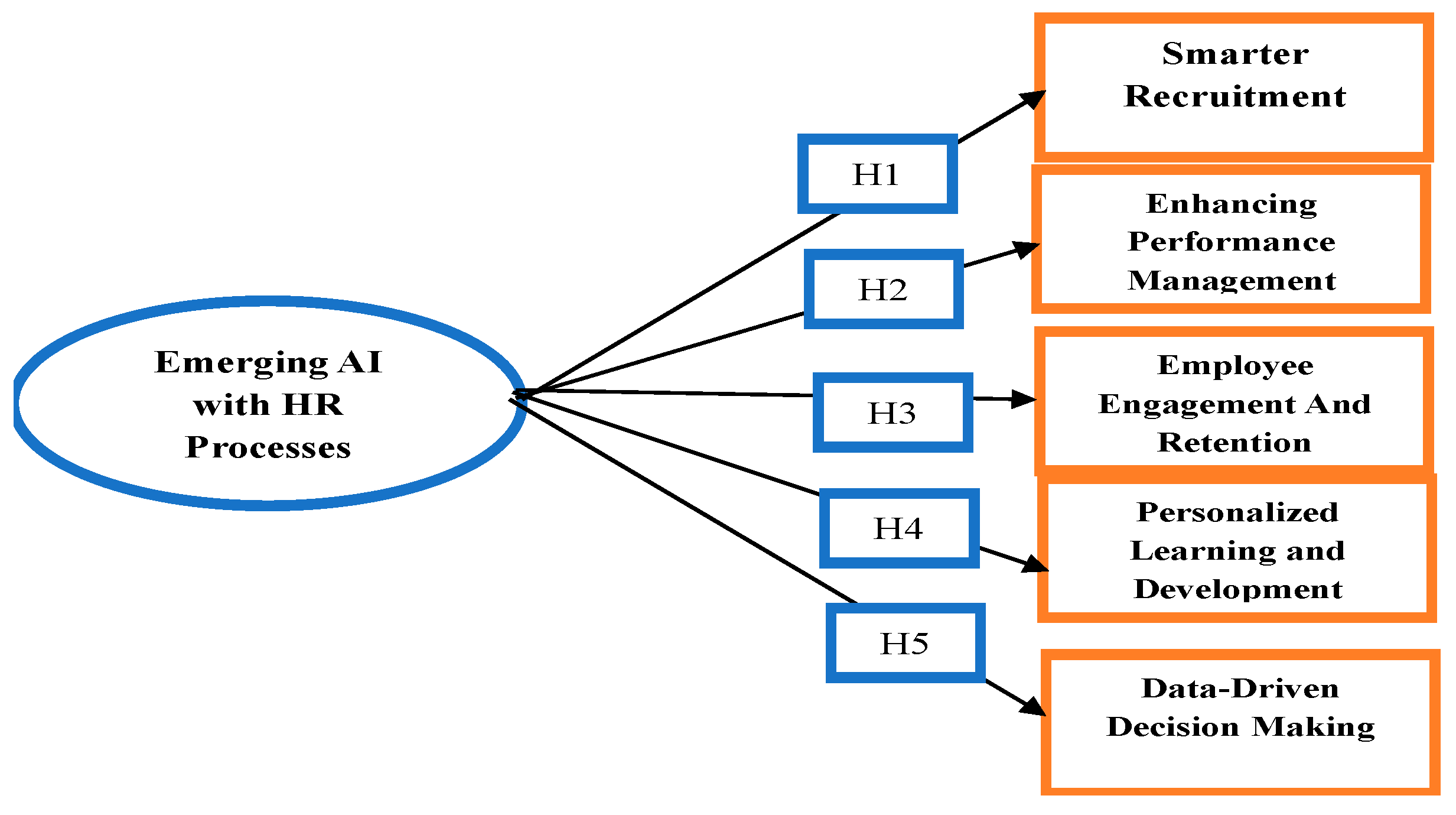

Table 1.
Sample characteristics.
| Indictor | Category | Percentages |
|
Gender: Male Female |
195 80 |
71 29 |
| Total | 275 | 100% |
|
Age: From 24 to less than 34 From 35 to less than 54 From 55 to above |
98 129 48 |
36 47 17 |
| Total | 275 | 100% |
|
Years of experience: From 1 year to 5 years From 6 years to 10 years Over 10 years |
138 95 42 |
50 35 15 |
|
Position: Director of HR HR manager Recruitment Manager Training Manager HR Asst. Manager Asst. Training Manager HR Supervisor |
35 35 29 32 39 31 74 |
13 13 10 12 14 11 27 |
| Total | 275 | 100% |
Table 2.
Convergent Validity.
| Constructs | Items | Loadings | Alpha | CR | AVE |
| artificial intelligence (AI) | AI1 | .776 | 0.933 | 0837 | 0.692 |
| AI2 | .716 | ||||
| AI3 | .751 | ||||
| AI4 | .757 | ||||
| Employee Engagement and Retention |
ER1 | .777 | 0.931 | 0.832 | 0.684 |
| ER2 | .711 | ||||
| ER3 | .783 | ||||
| ER4 | .705 | ||||
| Data-Driven Decision Making |
DM1 | .713 | 0.932 | 0.846 | 0.708 |
| DM2 | .764 | ||||
| DM3 | .844 | ||||
| DM4 | .721 | ||||
| Smarter Recruitment | SR1 | .786 | 0.930 | 0.864 | 0.738 |
| SR2 | .749 | ||||
| SR3 | .885 | ||||
| SR4 | .709 | ||||
| Enhancing Performance Management | PM1 | .725 | 0.929 | 0.903 | 0.731 |
| PM2 | .807 | ||||
| PM3 | .760 | ||||
| PM4 | .795 | ||||
| PM5 | .800 | ||||
| Personalized Learning and Development | LD1 | .764 | 0.938 | 0.889 | 0.785 |
| LD2 | .824 | ||||
| LD3 | .846 | ||||
| LD4 | .836 |
Table 3.
Discriminant Validity (Fornall-larcker).
| AI | ER | DM | SR | PM | LD | |
| AI | 0.831 | |||||
| ER | .683** | 0.827 | ||||
| DM | .680** | .776** | 0.841 | |||
| SR | .707** | .774** | .794** | 0.859 | ||
| PM | .774** | .816** | .829** | .862** | 0.854 | |
| LD | .006 | -.008 | -.021 | -.049 | -.015 | 0.886 |
Note: Diagonal values represent the square roots of AVE and below values represent correlation Coefficients.
Table 4.
Indicators of hypothesis evaluation.
| Description | Estimate | S.E. | p-values | Results | ||
| Smarter Recruitment | <--- | AI | 2.288 | .368 | 0.001 | Accepted |
| Enhancing Performance Management | <--- | AI |
2.213 | .341 | 0.001 | Accepted |
| Employee Engagement Redefined | <--- | AI | 1.608 | .283 | 0.001 | Accepted |
| Data-Driven Decision Making | <--- | AI | 2.196 | .333 | 0.001 | Accepted |
| Personalized Learning and Development | <--- | AI | -.006 | .019 | .736 | Rejected |
Disclaimer/Publisher’s Note: The statements, opinions and data contained in all publications are solely those of the individual author(s) and contributor(s) and not of MDPI and/or the editor(s). MDPI and/or the editor(s) disclaim responsibility for any injury to people or property resulting from any ideas, methods, instructions or products referred to in the content. |
© 2024 by the authors. Licensee MDPI, Basel, Switzerland. This article is an open access article distributed under the terms and conditions of the Creative Commons Attribution (CC BY) license (http://creativecommons.org/licenses/by/4.0/).
Copyright: This open access article is published under a Creative Commons CC BY 4.0 license, which permit the free download, distribution, and reuse, provided that the author and preprint are cited in any reuse.


