

Submitted:
16 April 2024
Posted:
16 April 2024
You are already at the latest version
Abstract
The study explores how different dimensions of perfectionism influence psychological well-being (PWB) in emerging adults. Literature has deepened the relationships between maladaptive perfectionism (e.g., excessive self-criticism, perceived discrepancy from the standards) and low PWB. Less is known about whether and how adaptive perfectionism (e.g., pursuing personal standards) relates to PWB. Secondly, the study has investigated whether self-compassion (i.e., self-benevolence, seeing personal imperfections as a common condition) may mediate the relationships between adaptive/maladaptive perfectionism and PWB. Participants (N=217, 18-35 y. o.) completed self-report questionnaires measuring: adaptive/maladaptive perfectionism (Almost Perfect Scale-Revised, APS-R: high standards and order/discrepancy, respectively), PWB, and self-compassion (SCS). Adaptive perfectionism resulted associated with PWB, particularly higher presence of purpose in life, environmental mastery, self-acceptance, and personal growth. Conversely, discrepancy resulted the most robust predictor of low PWB (β=-.68), followed by high standards with a positive direction (β=.23; Rc²=.514, p<.001). A strong negative association emerged between discrepancy and SCS (r=-.67, p<.001). A mediation analysis shows that self-compassion has an indirect effect reducing the strength of the relationship between discrepancy and low PWB. Results suggest focusing on self-compassion as a buffer factor that reduces the negative impact of maladaptive perfectionism on psychological well-being. Implications for education and health psychology are discussed.
Keywords:
psychological well-being
; perfectionism
; self-compassion
; emerging adults
1. Introduction
Going beyond a one-dimensional conception of the perfectionism and its role in many health problems (i.e., depression and eating disorders; [1]), 30 years of research have contributed to the shift toward a multifaceted view of perfectionism in which healthy and unhealthy components coexist [2]. Perfectionism is a multidimensional personality trait characterized by tendencies to strive for excellence, to be overly critical of one's performance when the results do not meet expectations, and to perceive high levels of distress for mistakes [3,4,5].
The coexistence of positive and negative aspects of perfectionism was proposed among the first ones by Hamachek [6] who distinguishes between normal and neurotic forms of perfectionistic traits. A key difference is that adaptive perfectionists set realistic goals for themselves, and experience satisfaction with their efforts and accomplishments, but are also flexible enough to tolerate occasional mistakes. Conversely, neurotic perfectionists are characterized by setting unrealistic performance standards, and feeling worry and dissatisfaction with their own performances. The neurotic perfectionism may be driven by the fear of failure, rather than the desire to achieve, and may lead to negative outcome such as procrastination, indecisiveness, and distress [7].
The distinction between normal/adaptive and neurotic/maladaptive perfectionism is supported by subsequent studies. In their review, Stoeber and Otto [8] outlined two higher-order dimensions that emerge across studies: perfectionistic strivings (setting high expectations for performance) and perfectionistic concerns (self-criticalness regarding performance). Perfectionistic striving describes people’s tendency to establish high goals and expectations for themselves (e.g., intrinsically motivated, or self-oriented perfectionism), and to search for order and organization. These personal tendencies are not necessarily negative, and they resulted associated with conscientiousness, positive affect, and problem-focused coping [9]. Conversely, perfectionistic concerns have been conceptualized in many as the maladaptive face of the perfectionism: they include individual’s tendency to believe that their significant others expect high standards from them (e.g., socially prescribed perfectionism), over-criticism of their own performances, and doubts about their ability to achieve the established standards [3,10]. Particularly, expectations of excellence and criticism from significant adults (mainly, parents and teachers) may be a developmental antecedent of perfectionistic tendencies [11]. Slaney and colleagues [12] introduce discrepancy as key dimension for maladaptive perfectionism, whereas high standards and order are viewed as the adaptive faces of perfectionism. The discrepancy is focused on the perception of the gap between one’s standards and actual performance, excessive self-criticism for own performance and negative feelings due to the inability to achieve the true perfection (i.e., “Doing my best never seems to be enough”). Assuming this multifaceted view of perfectionism, many studies have focused on the impact of maladaptive perfectionism on poor psychological functioning. Studies report that maladaptive perfectionism is generally associated with higher stress, anxiety, avoidant coping, low self-esteem and academic self-efficacy, eating disorders, depression, and suicide (for reviews, see [13,14]). Recently, perfectionism was explored in relation to distress and fear linked to COVID-19 pandemic [15]. However, compared to the large body of literature on negative outcomes, the role of perfectionism in healthy functioning remains a research field that has been partially neglected.
Previous studies have demonstrated the link between adaptive perfectionism and indicators of healthy functioning including challenge appraisals and effective coping [9], self-efficacy and academic achievement [16,17], happiness [18,19], and life satisfaction [20]. In addition, other studies suggest that some mediating variables can intervene in the relationship between perfectionism and healthy outcomes, such as self-esteem [21] and social problem-solving [22] buffering the impact of maladaptive perfectionism on depressive symptoms. Particularly, self-compassion recently emerged as a moderating variable that alters the association between maladaptive perfectionism and health problems, including distress, anxiety, and depression [23].
According to Neff [24], self-compassion is defined as “a healthy attitude toward oneself” during life difficulties, that is, a mindset characterized by feeling of self-benevolence and absence of criticism when one suffers, fails, or feels inadequate. Self-compassion has three basic interacting components: self-kindness versus self-judgment (being warm and kind to oneself instead of blaming for their own sufferings and negative feelings), common humanity versus isolation (recognizing that imperfections and failures are inevitable and that everyone can experience them as part of the human condition), and mindfulness versus over-identification (being aware and uncritical towards one’s painful thoughts and feelings, without repressing nor exaggerating them). Studies confirm that self-compassion weakens the influence of maladaptive perfectionism on negative affect and depressive symptoms [25,26]. Conversely, low self-compassion levels predict general distress and anxious symptoms in individuals with higher self-critical perfectionism traits [27]. Alongside these empirical data supporting the role of self-compassion as buffer variable for negative impact of maladaptive perfectionism, few studies have investigated both constructs of multidimensional perfectionism and self-compassion in relation to well-being indicators.
Moving from these premises, current study aimed to expand on previous findings on multidimensional perfectionism, self-compassion and psychological well-being in emerging adults. First, we assumed Ryff’s perspective on psychological well-being intended as the degree to which an individual experiences self-realization and positive functioning in his/her own life circumstances [28]. This eudaimonic perspective of psychological well-being differs from a hedonic perspective or subjective well-being (i.e., happiness or pleasant life). Psychological well-being combines feeling good and positive affective states (i.e., self-acceptance, positive social relations) with the individual’s perception of engagement and self-realization in activities that are congruent with personal values. In this sense, Ryff’s theoretical model includes factors such as autonomy, personal growth, environmental mastery, and purpose in life as core dimensions of psychological well-being [29]. These dimensions emphasize people’s ability to achieve what they want out of life, to improve and to cope with challenges, therefore they could be linked with the adaptive expressions of perfectionism [19]. The hypothesis we assumed is the following:
(H1) psychological well-being is negatively associated with discrepancy and positively with adaptive perfectionism (high standard/order), according to perfectionism dimensions proposed by Slaney and colleagues [12].
Secondly, the link between adaptive/maladaptive perfectionism and self-compassion was explored. Previous studies have reported mixed results, which only partially confirm this relationship. Specifically, in most studies [24,26,30,31] maladaptive perfectionism showed moderate-to-large associations with lower self-compassion levels. Maladaptive perfectionism drives the individual to focus mainly on shortcomings and performances that are perceived to be below expectations. This excessive self-criticism is the opposite of a self-compassionate attitude which makes people tolerant of imperfection and benevolent towards their own failures. Therefore, the hypothesis to test is that:
(H2) maladaptive perfectionism (discrepancy) has moderate-to-large associations with lower levels of self-compassion.
Conversely, the results for adaptive dimensions of perfectionism are mixed, therefore we expected:
Finally, current study investigates whether self-compassion may mediate the relationships between adaptive/maladaptive dimensions of perfectionism and psychological well-being. The role of self-compassion in mitigating the unhealthy impact of maladaptive perfectionism is well-documented in literature. Particularly, Mehr and Adams [25], among others, found that self-compassion buffered the impact of maladaptive perfectionism and depressive symptoms. Similarly, Wei and colleagues [31] showed that adaptive perfectionism and self-compassion negatively predicted depression levels; moreover, self-compassion moderated the impact of maladaptive perfectionism on depression levels. Conversely, studies on health outcomes are scarce. Şahin [32] observed that self-compassion fully mediates the relationship between maladaptive perfectionism and life-satisfaction, but no significant relationship between adaptive perfectionism and life-satisfaction emerged. In the current study, the hypothesis to test is:
(H4) self-compassion can intervene as a buffer variable between maladaptive perfectionism and psychological well-being.
2. Materials and Methods
2.1. Participants
Data was collected from a community sample (N=217) of young adults (18-35 y. o.; M= 23.7, SD= 3.3) mainly females (N= 150, 69.1%). Participants declared to be college students (64.6%), employed (25.4%) or unemployed (8.8%), while a small number did not report an occupation (1.2%). Almost all respondents were unmarried (90%), married (4%) or cohabiting (6%).
2.2. Procedure
The participants, all volunteers, were recruited through social networks using Google Forms. The online survey platform started with a brief presentation of the study aim, followed by the consent form. After giving their consent, participants were directed to the online questionnaire. The answers of each participant were aggregated to the database and stored without any personal identification code. The requested demographics were age, gender, marital status, and profession. Informed consent was obtained from all subjects involved in the study.
2.3. Measures
The Almost Perfect Scale Revised (APS-R; [12]) in the 20-item Italian adaptation [33] was used as a measure for the adaptive/maladaptive tendencies of the perfectionism. The dimensions that are assumed as adaptive are Order (4 items, e.g., “I always like to be organized and disciplined”) and High standards (6 items, e.g., “I set very high standards for myself”). The Discrepancy sub-scale (10 items) measures maladaptive aspects of perfectionisms, such as “I often feel frustrated because I can’t meet my goals”. Responses are rated on a 7-point Likert scale from 1 (strongly disagree) to 7 (strongly agree), with higher scores indicating stronger perfectionistic tendencies. The internal consistency (Cronbach’s α test) of the Italian questionnaire resulted adequate in the three dimensions: High Standards .71, Order .81, and Discrepancy .91.
The Self-Compassion Scale (SCS, [34]; It. ad. [35]) is a self-report questionnaire (26 items) measuring the components of self-compassion. The sub-scales with positive direction are Self-Kindness (e.g., “I try to be loving towards myself when I’m feeling emotional pain”), Common Humanity (“I try to see my failings as part of the human condition”), and Mindfulness (“When I’m feeling down, I try to approach my feelings with curiosity and openness”). The negative-reversed sub-scales are Self-Judgment (e.g., “I’m disapproving and judgmental about my own flaws and inadequacies”), Isolation (“When I think about my inadequacies it tends to make me feel more separate and cut off from the rest of the world”), and Over-Identification (“When I’m feeling down I tend to obsess and fixate on everything that’s wrong”). Respondent rates each item on a 5-point Likert scale from 1 (almost never) to 5 (almost always). Mean scores on the six sub-scales are then averaged after reversing the scores of items with negative direction. The overall self-compassion score ranges from 26 to 130, with higher scores indicating higher levels of self-compassion. In the present study, the total SCS had excellent internal consistency (α = .92).
The Psychological Well-Being Scales (PWB) by Ryff and Keyes ([36]; It. ad. [37]) is a self-report questionnaire assessing six areas: Autonomy (e.g., “I have confidence in my own opinions, even if they are different from the way most other people think”), Self-acceptance (“When I look at the story of my life, I am pleased with how things have turned out”), Environmental mastery (“In general, I feel I am in charge of the situation in which I live”), Personal growth (“I think it is important to have new experiences that challenge how you think about yourself and the world”), Purpose in life (“I am an active person in carrying out the plans I set for myself”), and Positive relations (“Most people see me as loving and affectionate”). Responses are expressed on a 6-point Likert scale from 1 (I do not agree) to 6 (completely agree), with high scores indicating perceived satisfaction and mastery in that area of personal life. In this study the internal consistency of the 54 items questionnaire resulted excellent for total scale (α = .95) and it ranged from .53 (Environmental mastery) to .89 (Self-acceptance) for subscales.
3. Results
3.1. Statistical Analysis
Data were processed using IBM SPSS Statistics for Windows 19.0. The first step was to calculate descriptive statistics (M, SD) for study measures: dimensions of perfectionism (APS-R sub-scales), self-compassion (SCS sub-scales), and psychological well-being (PWB sub-scales). Secondly, a correlational analysis (Pearson’s r) was performed to explore the relationships between study measures. Then, a linear stepwise regression analysis was calculated. Perfectionism dimensions (APS-R subscales) and self-compassion (SCS total score) were used to test factors predicting psychological well-being levels (PWB total score). Finally, a mediational analysis was calculated to test the direct and indirect effect for the relationship between maladaptive perfectionism and psychological well-being as mediated by self-compassion.
3.2. Preliminary Analysis
Descriptive statistics and bivariate Pearson’s correlations are presented in Table 1. Results show moderate to strong negative correlations (p<.01) between discrepancy (maladaptive perfectionism) and well-being dimensions. Regardless adaptive perfectionism, high standards showed weak to moderate positive correlations with well-being sub-scales, except for positive relations and autonomy where no significant associations emerge. Order has a weak but significant positive association with environmental mastery sub-scale (p<.01). With respect to self-compassion, no association resulted with high standards, whereas a strong negative association emerges with discrepancy (p<.001). Finally, well-being has significant correlations (ps <.05 and .01) with self-compassion dimensions, particularly with subscales with a positive direction: self-kindness, common humanity, and mindfulness have weak to strong Pearson’s correlations with all dimensions of psychological well-being.
3.3. Predictors of Psychological Well-Being
The regression analysis (Table 2) revealed a model with two factors explaining 51% of variability (Rc²=.51, F(1, 214) = 115.1, p<.001: perfectionism Discrepancy resulted the most robust predictor of low PWB (β =-.68, t = -13.66, p<.001), followed by High standards with a positive direction (β = .23; Rc²=.514, t = 4.92, p<.001).
3.4. Mediational Model
The hypothesized mediation model assumed direct and indirect effects for the relationship between unhealthy perfectionism (Discrepancy) and psychological well-being, as mediated by self-compassion. All paths are described in Figure 1. Higher scores on discrepancy had a significant direct effect on lower self-compassion scores (path a, discrepancy to self-compassion = −.33, 95% CI [−.38, −.28], p < .001) and lower psychological well-being scores (path c, discrepancy on psychological well-being= −.16, 95% CI [−.21, −.11], p < .001). Higher scores on self-compassion had a significant direct effect on higher psychological well-being (path b, self-compassion on psychological well-being = −.36, 95% CI [.26, .46], p < .001).
Bootstrapping indicated that the indirect path ab (linking discrepancy to psychological well-being via self-compassion) was = −.12, 95% CI [−.16, −.08], p < .001. Sobel test for significance of mediation effect was z= -6.02, p < .001. Therefore, this indirect effect suggests a reduction of the initial weight of discrepancy on psychological well-being levels.
Finally, the total effect (i.e., combined direct and indirect effects) of discrepancy on psychological well-being was −.28, 95% CI [−.32, −.24], p < .001.
4. Discussion
The long tradition of studies on the influence of perfectionism in the onset of psychopathology [14,38] probably overshadowed the interest for healthy outcomes. This has occurred despite the intuition by Stroeber and Otto [8] who had argued for the potential positive consequences of perfectionism traits, such as subjective happiness, self-efficacy or effective coping [9,16,17,19]. As far as authors know, few studies have explored the link between adaptive and maladaptive perfectionism and psychological well-being, with some exceptions (for example, [39,40]). Therefore, this study focused on the role of multidimensional perfectionism in psychological well-being. In addition, this study assumed an eudaimonic perspective of well-being [28] that connects the subjective well-being (hedonic perspective, i.e., happiness or life satisfaction) with the individual’s sense of full self-realization and involvement in life circumstances. Particularly, this composite model of psychological well-being includes the personal perception of competence and growth over time with experiences that meet the individual's values and direction of life. This eudaimonic perspective is recognized as relevant for adults’ perspective of life [36,41].
First, maladaptive perfectionism intended as discrepancy with respect to the expected standard resulted the most robust predictor of low psychological well-being. These findings are in line with existing literature that evidenced how maladaptive perfectionism leads people to accentuate the imperfections, experimenting feelings of inadequacy, anxiety, and distress [42,43]. Conversely, high standards reflect the positive face of the perfectionism, since people set realistic goals, take self-oriented actions, and strive to do the best experimenting the satisfaction of accomplishment [44]. The results from current study show positive associations between elevate standards and higher well-being, particularly the dimensions of purpose in life, environmental mastery, self-acceptance, and personal growth of Ryff’s scale. Findings extend with adults what was already observed among undergraduate students. Hill and colleagues [45] found that perfectionistic strivings, conceived as a healthy face of perfectionism, were positively linked with purpose in life. Gaudreau and Thompson [46] observed that healthy perfectionists - characterized by high academic standards and low evaluative concerns - report higher well-being than students who are constantly concerned about their performance. Finally, in Park and Jeong’s [47] study adaptive perfectionists obtained higher scores on purpose in life and personal growth than maladaptive perfectionists. As some scholars underlie [41], self-acceptance and personal growth, along with purpose in life and environmental mastery, can be conceived as a “health assets” of adults’ functioning. Particularly in the transition to adulthood, people may face growing challenges in various social and environmental situations, but they still want to maintain their autonomy and direction in life. The acceptance of their own limitations, without self-criticism and fear for social judgment, can help people to work on personal projects focusing more on perseverance and self-oriented behaviors than uniquely on performance results [48].
In this study, the self-compassion resulted linked with higher psychological well-being, as originally proposed by Neff [49] and confirmed in literature [e.g., 50]. More particularly, results show positive associations between the key dimensions of self-compassion (self-kindness, common humanity, and mindfulness) and eudaimonic well-being. Self-compassionate participants show a more realistic perceptions of themselves and tolerance for one's limits (self-acceptance), a sense of continuous development (personal growth) and meaning for one's existence (purpose in life), satisfaction with relationships (positive relations), self-determination (autonomy) and ability to actively manage the circumstances (environmental mastery). Treating oneself with compassion may be a resource when people experience challenges and failures, since it encourages action to change and supports personal growth maintaining well-being [49].
As for the dimensions of the perfectionism, no relationship emerged between the adaptive perfectionism (personal standards and order) and self-compassion. These findings are in accordance with Neff [49] and also replicate results from Ferrari and colleagues [26]. In line with hypothesis and previous studies (e.g., [25]) strong negative associations were found between discrepancy and self-compassion sub-scales. The discrepancy is characterized by an excessive self-criticism, dissatisfaction and perceived distance between expectations and the actual levels of performance. This excessive self-criticism is the opposite of self-compassion, that is, being tolerant of one’s flaws and inadequacies. People with high levels of maladaptive perfectionism and low self-compassion in the long-term show general distress, anxiety and depressive symptoms [27]. Conversely, self-compassion positively predicted subjective well-being (satisfaction with life) and negatively depression and negative affect [23]. Consequently, it is important to consider to what extent self-compassion can mitigate the impact of maladaptive perfectionism.
The mediational analysis confirms that self-compassion significantly mediates the association between discrepancy and low psychological well-being reducing the impact of maladaptive perfectionism on psychological well-being. This finding supports our hypothesis and extends previous studies that found that self-compassion attenuates self-criticism [26,31] and the negative reactions (such as a sense of failure and humiliation) to unpleasant life events [51]. Therefore, self-compassion is a psychological resource that should cultivated especially in individuals with high levels of maladaptive perfectionism [52,53].
This study has certain limitations that warrant consideration. First, the convenience sample is small in size, and it comes from participants who voluntarily jointed in the research disseminated online. Therefore, the generalizability of data is reduced and future research enlarging the sample size are needed. Secondly, the sample was unbalanced by gender (more women), probably due to the more likely involvement of females in social media. However, this study offers an empirical contribution to data still lacking in the field of the perfectionism and positive psychology among emerging adults. Whereas existing literature provide wide support on the role of self-compassion in decreasing the impact of maladaptive perfectionism on unhealthy outcomes (mainly, depressive symptoms [25,27,40]), this study has the merit of focusing on multidimensional perfectionism and well-being, thus offering insights for intervention.
5. Conclusions
Psychological interventions based on self-compassion can be advantageous for promoting psychological well-being in individuals with perfectionist tendencies. Findings from the current study confirm the multifaced nature of perfectionism (according to Slaney et al. [12], in which adaptive perfectionism (i.e., high personal standards) is linked to higher psychological well-being. Additionally, self-compassion resulted in a protective factor towards the psychological well-being of individuals with high levels of maladaptive perfectionism (i.e., discrepancy). These findings suggest that focusing on self-compassion is crucial for promoting healthy psychological functioning and reducing perfectionist thoughts. Existing cognitive-behavioural interventions (CBI) often aim to directly modify maladaptive perfectionism thoughts, as they are recognized as a trans-diagnostic component of psychological distress and a predictive factor of depression [54]. CBI encourage people to reappraise dysfunctional cognitions (e.g., “If I don't reach my best, I'm a failure”) leading to a change in excessive evaluative concerns and negative feelings. School-based interventions can help the students to recognize their beliefs about societal or parental pressures for excellence [55], reducing their vulnerability to maladaptive perfectionism (i.e., thinking that personal value or self-esteem does not depend on meeting external expectations). Furthermore, when students perceive teachers as supportive (i.e., they recognize their value as a person, regardless of achievement), their perfectionistic concerns decrease [56]. Alternatively, a complementary approach based on self-compassion help people to modify the relationship with their own thoughts of imperfection and failure, and to treat themselves with kindness [26]. Following guided self-compassion exercises, participants reported greater acceptance of painful emotions and a decrease in their habitual self-criticism [57]. James and Rimes [58] found that a group intervention focused on mindfulness-based cognitive therapy (MBCT) resulted in more efficacy in increasing self-compassion and reducing perfectionist thoughts, negative emotions and distress than a traditional self-help CBI. Similarly, Woodfin and colleagues [59] demonstrated beneficial outcomes of a brief (3 weeks) intervention based on self-compassion in reducing maladaptive perfectionism and anxiety/depression symptoms. These interventions based on self-compassion appear to be a promising approach to enhancing resilience and mitigating perfectionistic tendencies that can damage individual well-being.
Author Contributions
Conceptualization, L.B. and S.M.; methodology, L.B. and M.I.; formal analysis, M.I.; investigation, S.M.; data curation, L.B. and S.M.; writing—original draft preparation, S.M.; writing—review and editing, L.B. and M.I.; supervision, L.B. All authors have read and agreed to the published version of the manuscript.
Funding
This research received no external funding.
Institutional Review Board Statement
The study was conducted in accordance with the Declaration of Helsinki (2013) and approved by the Ethical Committee of the CeRIP - Center for Psychological Research and Intervention of the University of Messina (protocol code 93565, 23/07/2021).
Informed Consent Statement
Informed consent was obtained from all subjects involved in the study.
Conflicts of Interest
The authors declare no conflicts of interest.
References
- Bardone-Cone, A.M.; Wonderlich, S.A.; Frost, R.O.; Bulik, C.M.; Uppala, S.; Simonich, H. Perfectionism and eating disorders: Current status and future directions. Clin. Psychol. Rev. 2007, 27, 384–405. [Google Scholar] [CrossRef] [PubMed]
- Flett, G. L.; Hewitt, P. L. Reflections on three decades of research on multidimensional perfectionism: An introduction to the special issue on further advances in the assessment of perfectionism. J. Psychoed. Assess. 2020, 38, 3–14. [Google Scholar] [CrossRef]
- Frost, R.O.; Marten, P.; Lahart, C.M.; Rosenblate, R. The dimensions of perfectionism. Cogn. Ther. Res. 1990, 14, 449–468. [Google Scholar] [CrossRef]
- Flett, G. L.; Hewitt, P. L. Perfectionism and maladjustment: An overview of theoretical, definitional, and treatment issues. In Perfectionism: Theory, research, and treatment; Flett, G.L., Hewitt, P.L., Eds.; American Psychological Association, 2002; pp. 5–31. [Google Scholar] [CrossRef]
- Sirois, F. M.; Molnar, D. S.; Hirsch, J. K. A meta-analytic and conceptual update on the associations between procrastination and multidimensional perfectionism. EJP 2017, 31, 137–159. [Google Scholar] [CrossRef]
- Hamacheck, E. Psycodynamics of normal and neurotic perfectionism. Psychol., 1978, 15, 27–33. [Google Scholar]
- Pacht A., R. Reflections on perfection. Am. Psychol. 1984, 39, 386–390. [Google Scholar] [CrossRef]
- Stoeber, J.; Otto, K. Positive Conceptions of Perfectionism: Approaches, Evidence, Challenges. J. Pers. Soc. Psychol. Rev. 2006, 10, 295–319. [Google Scholar] [CrossRef] [PubMed]
- Stoeber, J.; Rennert, D. Perfectionism in School Teachers: Relations with Stress Appraisals, Coping Styles, and Burnout. Anxiety, Stress Coping 2008, 21, 37–53. [Google Scholar] [CrossRef] [PubMed]
- Hewitt, P. L.; Flett, G. L. Perfectionism in the self and social contexts: Conceptualization, assessment, and association with psychopathology. J. Pers. Soc. Psychol. Rev 1991, 60, 456–470. [Google Scholar] [CrossRef]
- Smith, M.M.; Hewitt, P.L.; Sherry, S.B.; Flett, G.L.; Ray, C. Parenting behaviors and trait perfectionism: A meta-analytic test of the social expectations and social learning models. J. Res. Pers. 2022, 96, 104180. [Google Scholar] [CrossRef]
- Slaney, R. B.; Rice, K. G.; Mobley, M.; Trippi, J.; Ashby, J. S. The Revised Almost Perfect Scale. Meas. Ev. Couns. Dev. 2001, 34, 130–145. [Google Scholar] [CrossRef]
- Limburg, K.; Watson, H.J.; Hagger, M.S.; Egan, S.J. The relationship between perfectionism and psychopathology: a meta-analysis. J. Clin. Psychol. 2017, 73, 1301–1326. [Google Scholar] [CrossRef] [PubMed]
- Patterson, H.; Firebaugh, C. M.; Zolnikov, T. R.; Wardlow, R.; Morgan, S. M.; Gordon, B. A Systematic Review on the Psychological Effects of Perfectionism and Accompanying Treatment. Psychol. 2021, 12, 1–24. [Google Scholar] [CrossRef]
- Pereira, A.T.; Cabaços, C.; Araújo, A.; Amaral, A.P.; Carvalho, F.; Macedo, A. COVID-19 psychological impact: The role of perfectionism. Pers. Individ. Differ. 2022, 184, 111160. [Google Scholar] [CrossRef] [PubMed]
- Chufar, B.M.; Pettijohn II, T.F. Meeting high standards: the effect of perfectionism on task performance, self-esteem, and self-efficacy in college students. Psychol. Behav. Sci. 2013, 2, 117–123. [Google Scholar] [CrossRef]
- Park, Y.; Heo, C.; Kim, J. S.; Rice, K. G.; Kim, Y. H. How does perfectionism affect academic achievement? Examining the mediating role of accurate self-assessment. Int. J. Psychol. 2020, 55, 936–940. [Google Scholar] [CrossRef] [PubMed]
- Badri, S.K.Z.; Kong, M.Y.; Wan Mohd Yunus, W.M.A.; Nordin, N.A.; Yap, W.M. Trait emotional intelligence and happiness of young adults: The mediating role of perfectionism. IJERPH 2021, 18, 10800. [Google Scholar] [CrossRef] [PubMed]
- Suh, H.; Gnilka, P. B.; Rice, K. G. Perfectionism and well-being: A positive psychology framework. Pers. Individ. Differ. 2017, 111, 25–30. [Google Scholar] [CrossRef]
- Smith, M. M.; Saklofske, D. H.; Yan, G. Perfectionism, trait emotional intelligence, and psychological outcomes. Pers. Individ. Differ. 2015, 85, 155–158. [Google Scholar] [CrossRef]
- Rice, K. G.; Ashby, J. S.; Slaney, R. B. Self-esteem as a mediator between perfectionism and depression: A structural equations analysis. J. Couns. Psychol. 1998, 45, 304–314. [Google Scholar] [CrossRef]
- Besser, A.; Flett, G.L.; Hewitt, P.L. Perfectionistic Self-Presentation and Trait Perfectionism in Social Problem-Solving Ability and Depressive Symptoms. J. Appl. Soc. Psychol. 2010, 40, 2121–2154. [Google Scholar] [CrossRef]
- Stoeber, J.; Lalova, A. V.; Lumley, E. J. Perfectionism, (self-)compassion, and subjective well-being: A mediation model. Pers. Individ. Differ. 2020, 154, 109708. [Google Scholar] [CrossRef]
- Neff, K. Self-compassion: An alternative conceptualization of a healthy attitude toward oneself. Self Identity, 2003, 2, 85–101. [Google Scholar] [CrossRef]
- Mehr, K.E.; Adams, A.C. Self-Compassion as a Mediator of Maladaptive Perfectionism and Depressive Symptoms in College Students. J. Coll. Stud. Psych. 2016, 30, 132–145. [Google Scholar] [CrossRef]
- Ferrari, M.; Yap, K.; Scott, N.; Einstein, D. A.; Ciarrochi, J. Self-Compassion Moderates the Perfectionism and Depression Link in Both Adolescence and Adulthood. PLoS One 2018, 13, e0192022. [Google Scholar] [CrossRef] [PubMed]
- Tobin, R.; Dunkley, D. M. Self-critical perfectionism and lower mindfulness and self-compassion predict anxious and depressive symptoms over two years. Behav. Res. Ther. 2021, 136, Article–103780. [Google Scholar] [CrossRef] [PubMed]
- Ryff, C. D. Happiness is everything, or is it? Explorations on the meaning of psychological well-being. J. Pers. Soc. Psychol. 1989, 57, 1069–1081. [Google Scholar] [CrossRef]
- Ryff, C. D.; Singer, B. H. Know thyself and become what you are: A eudaimonic approach to psychological well-being. J. Happiness Stud. 2008, 9, 13–39. [Google Scholar] [CrossRef]
- Mosewich, A.D.; Kowalski, K.C.; Sabiston, C.M.; Sedgwick, W.A. Self-Compassion: A potential resource for young women athletes. JSEP 2011, 33, 103–23. [Google Scholar] [CrossRef]
- Wei, S.; Li, L.; Shi, J.; Liang, H.; Yang, X. Self-compassion mediates the perfectionism and depression link on Chinese undergraduates. Ann. Palliat. Med. 2021, 10, 1950–1960. [Google Scholar] [CrossRef]
- Şahin, E.E. Self-Compassion as a Mediator Between Perfectionism and Life-Satisfaction Among University Students. IJPE 2021, 17, 201–214. [Google Scholar] [CrossRef]
- Filippello, P.; Sorrenti, L.; Buzzai, C.; Costa, S. The Almost Perfect Scale-Revised: An Italian adaptation. GIP 2016, 43, 911–932. [Google Scholar] [CrossRef]
- Neff, K.D. The development and validation of a scale to measure self-Compassion. Self Identity 2003, 2, 223–250. [Google Scholar] [CrossRef]
- Veneziani, C. A.; Fuochi, G.; Voci, A. Self-compassion as a healthy attitude toward the self: Factorial and construct validity in an Italian sample. Pers. Individ. Differ. 2017, 119, 60–68. [Google Scholar] [CrossRef]
- Ryff, C. D.; Keyes, C. L. M. The structure of psychological well-being revisited. J. Pers. Soc. Psychol. 1995, 69, 719–727. [Google Scholar] [CrossRef] [PubMed]
- Ruini, C.; Ottolini, F.; Rafanelli, C.; Ryff, C.; Fava, G. A. La validazione italiana delle Psychological Well-being Scales (PWB) [Italian validation of Psychological Well-being Scales (PWB)]. Riv. Psichiatr. 2003, 38, 117–130. [Google Scholar]
- Dahlenburg, S.C.; Gleaves, D.H.; Hutchinson, A.D. Anorexia nervosa and perfectionism: A meta-analysis. Int. J. Eat. Dis. 2019, 52, 219–229. [Google Scholar] [CrossRef] [PubMed]
- Liu, Q.; Zhao, X.; Liu, W. Are Perfectionists Always Dissatisfied with Life? An Empirical Study from the Perspective of Self-Determination Theory and Perceived Control. Behav. Sci. 2022, 12, 440. [Google Scholar] [CrossRef] [PubMed]
- Kawamoto, A.; Sheth, R.; Yang, M.; Demps, LT.; Sevig, T. The Role of Self-Compassion Among Adaptive and Maladaptive Perfectionists in University Students. Couns. Psychol. 2023, 51, 113–144. [Google Scholar] [CrossRef]
- De-Juanas, Á.; Bernal Romero, T.; Going, R. The Relationship Between Psychological Well-Being and Autonomy in Young People According to Age. Front. Psychol. 2020, 11, 559976. [Google Scholar] [CrossRef]
- Wang, Y.; Chen, J.; Zhang, X.; Lin, X.; Sun, Y.; Wang, N.; Wang, J.; Luo, F. The Relationship between Perfectionism and Social Anxiety: A Moderated Mediation Model. IJERPH 2022, 19, 12934. [Google Scholar] [CrossRef] [PubMed]
- Wang, C.; Huang, Y.; Xiao, Y. The Mediating Effect of Social Problem-Solving Between Perfectionism and Subjective Well-Being. Front. Psychol. 2021, 12, 764976. [Google Scholar] [CrossRef] [PubMed]
- Stoeber, J.; Harris, R. A.; Moon, P. S. Perfectionism and the experience of pride, shame, and guilt: Comparing healthy perfectionists, unhealthy perfectionists, and nonperfectionists. Pers. Individ. Differ. 2007, 43, 131–141. [Google Scholar] [CrossRef]
- Hill, R. W.; Huelsman, T. J.; Araujo, G. Perfectionistic concerns suppress associations between perfectionistic strivings and positive life outcomes. Pers. Individ. Differ. 2010, 48, 584–589. [Google Scholar] [CrossRef]
- Gaudreau, P.; Thompson, A. Testing a 2×2 model of dispositional perfectionism. Pers. Individ. Differ. 2010, 48, 532–537. [Google Scholar] [CrossRef]
- Park, H. J.; Jeong, D. Y. Psychological Well-Being, Life Satisfaction, and Self-Esteem among Adaptive Perfectionists, Maladaptive Perfectionists, and Nonperfectionists. Pers. Individ. Differ. 2015, 72, 165–170. [Google Scholar] [CrossRef]
- Powers, T.A.; Koestner, R.; Zuroff, D.C.; Milyavskaya, M.; Gorin, A.A. The effects of self-criticism and self-oriented perfectionism on goal pursuit. Pers Soc Psychol Bull. 2011, 37, 964–975. [Google Scholar] [CrossRef] [PubMed]
- Neff, K. Self-Compassion, Self-Esteem, and Well-Being. Soc. Pers. Psychol. Compass. 2011, 5, 1–12. [Google Scholar] [CrossRef]
- Zessin, U.; Dickhäuser, O.; Garbade, S. The Relationship Between Self-Compassion and Well-Being: A Meta-Analysis. AP:HWB 2015, 7, 340–64. [Google Scholar] [CrossRef]
- Leary, M. R.; Tate, E. B.; Adams, C. E.; Batts Allen, A.; Hancock, J. Self-compassion and reactions to unpleasant self-relevant events: the implications of treating oneself kindly. J. Pers. Soc. Psychol. 2007, 92, 887–904. [Google Scholar] [CrossRef]
- Ong, C.W.; Lee, E.B.; Petersen, J.M.; Levin, M.E.; Twohig, MP. Is perfectionism always unhealthy? Examining the moderating effects of psychological flexibility and self-compassion. J. Clin. Psychol. 2021, 77, 2576–2591. [Google Scholar] [CrossRef] [PubMed]
- Koutra, K.; Mouatsou, C.; Psoma, S. The Influence of Positive and Negative Aspects of Perfectionism on Psychological Distress in Emerging Adulthood: Exploring the Mediating Role of Self-Compassion. Behav. Sci. 2023, 13, 932. [Google Scholar] [CrossRef] [PubMed]
- Wegerer, M. Cognitive-Behavioral Treatment of Perfectionism: An Overview of the State of Research and Practical Therapeutical Procedures. Verhaltenstherapie 2024, 34, 1–10. [Google Scholar] [CrossRef]
- Curran, T.; Hill, A. P. Young people’s perceptions of their parents’ expectations and criticism are increasing over time: Implications for perfectionism. Psychol. Bull. 2022, 148, 107–128. [Google Scholar] [CrossRef] [PubMed]
- Domocus, I.; Damian, L.E. The role of parents and teachers in changing adolescents' perfectionism: A short-term longitudinal study. Pers. Individ. Diff. 2018, 131, 244–248. [Google Scholar] [CrossRef]
- Binder, P.-E.; Dundas, I.; Stige, S.H.; Hjeltnes, A.; Woodfin, V.; Moltu, C. Becoming aware of inner self-critique and kinder toward self: A qualitative study of experiences of outcome after a brief self-compassion intervention for university level students. Front. Psychol. 2019, 10, 2728. [Google Scholar] [CrossRef] [PubMed]
- James, K.; Rimes, K.A. Mindfulness-based cognitive therapy versus pure cognitive behavioural self-help for perfectionism: A pilot randomised study. Mindfulness, 2018, 9, 801–814. [Google Scholar] [CrossRef]
- Woodfin, V.; Molde, H.; Dundas, I.; Binder, P.E. A randomized control trial of a brief self-compassion intervention for perfectionism, anxiety, depression, and body image. Front. Psychol. 2021, 9, 751294. [Google Scholar] [CrossRef]
Figure 1.
Direct and indirect effects for the relationship between unhealthy perfectionism (Discrepancy) and psychological well-being, as mediated by self-compassion.
Figure 1.
Direct and indirect effects for the relationship between unhealthy perfectionism (Discrepancy) and psychological well-being, as mediated by self-compassion.
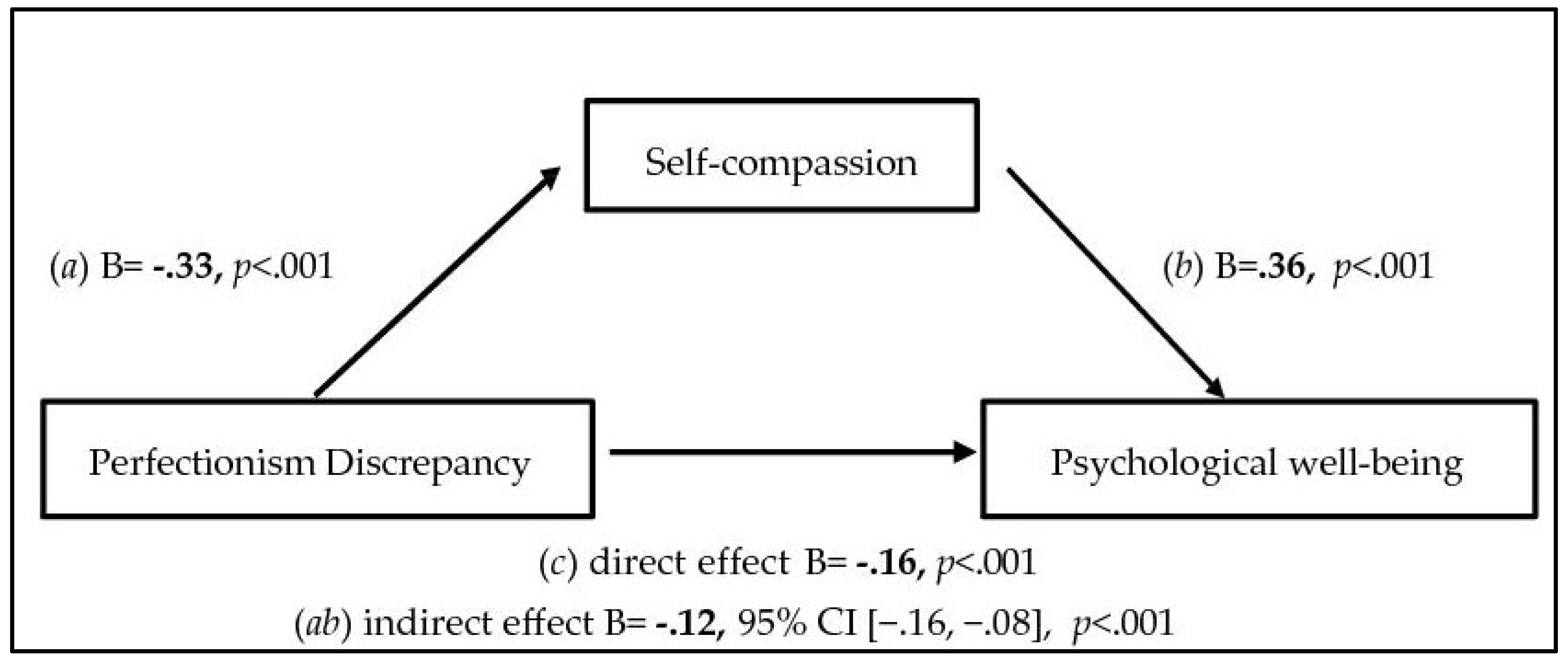

Table 1.
Descriptive statistics (Means and SD) and correlations (Pearson’s coefficients) among the study variables (N = 217).
Table 1.
Descriptive statistics (Means and SD) and correlations (Pearson’s coefficients) among the study variables (N = 217).
| Variable | M | SD | 1 | 2 | 3 | 4 | 5 | 6 | 7 | 8 | 9 | 10 | 11 | 12 | 13 | 14 | 15 |
|---|---|---|---|---|---|---|---|---|---|---|---|---|---|---|---|---|---|
| APS 1. High Standards |
5.33 | 0.80 | 1 | ||||||||||||||
| 2. Discrepancy | 4.07 | 1.34 | .01 | 1 | |||||||||||||
| 3. Order | 5.24 | 0.95 | .30** | .07 | 1 | ||||||||||||
| SCS 4. Self-Kindness |
3.07 | 0.90 | -.05 | -.47** | -.09 | 1 | |||||||||||
| 5. Self-Judgment | 2.90 | 0.94 | -.05 | -.63** | .00 | .13* | 1 | ||||||||||
| 6. Common Humanity | 3.22 | 0.89 | -.03 | -.29** | -.07 | .61** | .03 | 1 | |||||||||
| 7. Isolation | 2.89 | 1.06 | .10 | -.63** | -.03 | .15** | .71** | .08 | 1 | ||||||||
| 8. Mindfulness | 3.28 | 0.86 | .10 | -.33** | -.13 | .67** | .12* | .56** | .17** | 1 | |||||||
| 9. Over-identification | 2.86 | 1.04 | .12 | -.66** | -.07 | .09 | .76** | .01 | .76** | .12* | 1 | ||||||
| PWS 10. Positive relations |
4.14 | 0.90 | .06 | -.40** | .06 | .30** | .09 | .23** | .09 | .22** | .10 | 1 | |||||
| 11. Self-acceptance | 3.90 | 1.00 | .18** | -.69** | .03 | .63** | .16** | .49** | .12* | .53** | .14* | .47** | 1 | ||||
| 12. Purpose in life | 4.15 | 0.94 | .29** | -.63** | .05 | .46** | .17** | .36** | .17** | .45** | .18** | .53** | .82** | 1 | |||
| 13. Autonomy | 4.28 | 0.80 | .11 | -.37** | .01 | .28** | .03 | .24** | .04 | .28** | .03 | .34** | .46** | .44** | 1 | ||
| 14. Enviromental | 3.91 | 0.60 | .29** | -.53** | .19** | .46** | .11* | .36** | .08 | .42** | .10 | .45** | .74** | .70** | .45** | 1 | |
| 15. Personal growth | 4.78 | 0.70 | 17* | -.41** | .04 | .37** | .05 | .40** | .02 | .32** | .03 | .50** | .60** | .60** | .52** | .55** | 1 |
Note: APS-R = Almost Perfect Scale-Revised; SCS = Self-Compassion Scale; PWS= Psychological Well-being Scale; M = mean; SD = standard deviation. Correlation significant at *.05 or **.01 level (two-tailed).
Table 2.
Summary of regression analysis for Perfectionism dimensions (APS-R) predicting overall PWB.
Table 2.
Summary of regression analysis for Perfectionism dimensions (APS-R) predicting overall PWB.
| Model | Unstandardised Coefficients |
Standardised Coefficients |
95% Confidence Interval for B |
|||||
| B | SE | β | t | Sig. | Lower Bound | Upper Bound | ||
| 1 | (Costant) | 5.24 | .09 | 59.66 | ‹.001 | 5.06 | 5.41 | |
| ALMOST – Discrepancy | -.28 | .02 | -.68 | -13.64 | ‹.001 | -.32 | -.24 | |
| 2 | (Costant) | 4.39 | .19 | 22.99 | ‹.001 | 4.01 | 4.77 | |
| ALMOST – Discrepancy | -.28 | .02 | -.68 | -14.42 | ‹.001 | -.32 | -.24 | |
| ALMOST – High Standard |
.16 | .03 | .23 | 4.92 | ‹.001 | .10 | .22 | |
Note: N= 217, SE= Standard Error.
Disclaimer/Publisher’s Note: The statements, opinions and data contained in all publications are solely those of the individual author(s) and contributor(s) and not of MDPI and/or the editor(s). MDPI and/or the editor(s) disclaim responsibility for any injury to people or property resulting from any ideas, methods, instructions or products referred to in the content. |
© 2024 by the authors. Licensee MDPI, Basel, Switzerland. This article is an open access article distributed under the terms and conditions of the Creative Commons Attribution (CC BY) license (http://creativecommons.org/licenses/by/4.0/).
Copyright: This open access article is published under a Creative Commons CC BY 4.0 license, which permit the free download, distribution, and reuse, provided that the author and preprint are cited in any reuse.


