
Submitted:
12 April 2024
Posted:
15 April 2024
You are already at the latest version
Abstract
Soybean is one of the world’s most economically significant crops and is widely utilized as an essential source of vegetable protein and edible oil. Cultivated soybean is domesticated from its annual counterpart, wild soybean, which is considered valuable germplasm for soybean breeding. However, wild soybean accessions generally produce seeds with impermeable coats, a trait known as hard seededness (HS), which is beneficial for long-term seed survival but is undesirable for the uniform water absorption and germination of seeds, thus limiting the utilization of wild soybeans in breeding. However, moderate HS can isolate the embryo from the surrounding environment and is thus beneficial for long-term seed storage and germplasm preservation. The HS trait is primarily associated with the structure and chemical composition of the seed coat. However, its development is also influenced by various environmental conditions, such as water and temperature. Genetic analysis has revealed that HS of soybean is a complex quantitative trait controlled by multiple genes or minor quantitative trait loci (QTL), with many QTLs and several causal genes currently identified. Investigating the physiological and molecular mechanisms underlying this trait is crucial for soybean breeding, production, and food processing. For this article, the literature was reviewed and condensed to create a well-rounded picture of the current understanding of internal and external factors, QTLs, causal genes, and the regulatory mechanisms related to the HS of soybean, with the aim of providing reference for future research and utilization of this trait.
Keywords:
soybean
; hard seededness
; seed coat structure
; chemical component
; QTL
; gene
Introduction
Soybean [Glycine max (L.) Merr.] is an important leguminous crop due to its high protein and oil contents. Generally, oil, protein, and carbohydrate account for approximately 20%, 40%, and 35%, respectively, of the dry mass of cultivated soybean seeds, making it an excellent source of vegetable oil and protein for humans and livestock [1,2]. Cultivated soybean was domesticated from the annual wild soybean (Glycine soja Sieb. and Zucc.) ~5000 years ago, in the eastern half of north China and disseminated to Europe and America in the 18th century [3,4]. Compared to their wild relatives, cultivated soybeans have undergone significant changes in growth habits, plant architecture, seed morphology, and composition under long-term targeted selection and improvement [5,6,7]. Cultivated soybeans display a bush-type growth habit with a stout primary stem and sparse branches, bearing large seeds that are generally prone to water absorption and germination. In contrast, wild soybeans produce a procumbent or climbing vine with slender, many-branched stems bearing small, coarse seeds that are impermeable to water [8,9]. During selective domestication and specific breeding improvement, approximately 50% of the genetic diversity and 81% of rare alleles in wild soybeans have been lost [10]. At present, most soybean cultivars worldwide face a “genetic bottleneck” [11]. Many of the soybean cultivars come from a few ancestors [3,12,13], and the narrow genetic basis and limited gene sources not only hamper the further cultivar improvement, but also increase their vulnerability to abiotic stresses, disease, and pests [14].
Due to not being influenced by human selection, wild soybeans contain abundant genetic resources, which have advantages such as multiple flowers and pods, high protein contents, high reproductive coefficients, and tolerance to infertility [5,15]. In addition, wild and cultivated soybeans exhibit normal pairing of meiotic chromosomes and hybridize easily [4,5]. Thus, wild soybeans are an extraordinarily important gene pool for soybean breeding, which can enrich and broaden the genetic background of cultivated soybeans, and provide beneficial traits and genetic resources [16,17,18]. However, seeds from wild soybean accessions generally exhibit a hard seededness (HS) trait, which impedes the seeds’ water absorption and may appear as a “linkage drag” in hybrid breeding programs, seriously limiting the utilization of wild soybean resources [19]. By contrast, moderately impermeable seed coats can prevent seed decay and prolong seed lifespan by isolating the embryo from the surrounding environment and is thus beneficial for long-term seed storage and germplasm preservation [20,21,22,23]. Therefore, breeding programs have been aimed at developing soybean cultivars with seed coats that are reasonably permeable and fairly strong [24,25]. Understanding the physiological and molecular mechanisms controlling the HS trait of soybean is of great significance for its application. Previous studies have extensively investigated the seed coat structure and components, environmental factors, quantitative trait loci (QTL), causal genes, and regulatory mechanisms associated with HS. This paper aims to provide an overview of the research advances related to the HS trait of soybean and propose future research directions in this field.
Definition and Implications of the HS Trait
Hard seededness (HS), also known as physical dormancy, seed coat-imposed dormancy, or “stone” or “impermeable” seeds, has been found in ~15 angiosperm families, of which the Leguminosae is the largest [26,27,28]. HS is the second most common type of seed dormancy after physiological dormancy and occurs when the seed coat becomes thick or hard, impermeable to surrounding water and air, and keeps the embryo in a viable state for a long time [29,30,31]. HS is a biologically beneficial trait that plants have acquired over a long evolutionary process to adapt to environmental changes. For example, seeds with this trait are not easily detected by rodents through their sense of smell, are difficult to digest, and can spread to a larger region as the forager migrates [32]. Many of the hard seeds remain viable and can quickly resettle on areas after being affected by harsh environmental conditions such as floods and fires [33]. Hard seeds may benefit the continuation of species in nature by preserving a seed stock for many years so that seeds can germinate at different times to avoid sudden disasters [34,35]. The hard seed coat isolates the embryo from the outside air and water under rainy conditions to maintain the long-term vitality of the seed and avoid pathogen invasion [31,36]. For example, some legume seeds have remained viable for more than 100 years [37].
Like other plants, hard seeds from wild soybean accessions have higher vitality and long-term survival, which is beneficial for adaptation to unstable and unpredictable environmental conditions to ensure population continuity [38]. In contrast, most soybean landraces and cultivars can imbibe water in a short time without scarification of the seed coat, although considerable variation exists in their degree of seed coat permeability [39,40,41]. Moreover, adverse climatic conditions such as drought and heat during the growing season, especially as the seed matures, may trigger the occurrence of hard seeds in soybean production [42]. Generally, seeds that are prone to water absorption are termed “permeable” or “soft”, while those that remain impermeable even after several days of soaking in water are referred to as “impermeable” or “hard” seeds [43]. Currently, HS is often a disadvantageous trait for cultivated soybeans and seriously impedes seed production in agriculture [26,42]. Sowing of hard seeds leads to a dramatic decrease in field emergence rate and uniformity, resulting in different seedling density and mass weed growth, which seriously decreases the sowing quality and ultimately reduces the soybean yield [21,44]. Under the continuous cropping system, if hard seeds germinate the following year, they will mix with subsequent soybean seeds (sometimes from different cultivars), and the harvest quality will be decreased [45,46,47]. In the food industry, rapid and uniform hydration of soybean seeds is necessary for subsequent seed processing. Hard seeds will not only affect the sensory quality of whole-soy foods, including soybean sprouts, natto, and baked beans, but also reduce the milling quality of crack-soy foods such as soy milk, soy sauce, soy paste, miso, and tofu [48,49]. To ensure uniform water absorption and germination of soybean seeds with the HS trait, multiple methods, such as mechanical scratching, temperature upheaval, or soaking seeds with strong acid or alkaline solutions, have to be employed to break their seed coat [43,50,51]. Undoubtedly, these steps increase the processing costs and may also decrease the seed vitality.
In addition to the adverse effects on agricultural production and food processing, HS has also shown valuable utilization in certain agricultural practices. For example, if adverse weather occurs before seed maturity or harvest, the hard seed coat can hinder the diffusion of water and air to the embryo to prevent seed spoilage. Soybean seeds generally lack physiological dormancy and are prone to deterioration in seed viability under prolonged storage [52]. Thus, a moderate or rational level of HS can delay the embryo’s water absorption from the surrounding environment, resist pathogen invasion, and help the seed maintain strong vitality and good quality for a longer period [22,23,44,53,54]. In addition, HS may be associated with high calcium content in the seed coat and can therefore potentially enhance the nutritional value of soy-based foods [55,56,57,58,59]. Therefore, a deep understanding of the physiological and molecular basis of the HS trait is necessary for the rational application of wild soybean resources and the HS trait in soybean cultivar improvement, soybean production, and soy food processing practices.
Internal and External Factors Affecting the HS Trait
In terms of soybean seed characteristics, HS is mainly related to the structure and chemical composition of the seed coat [25,26,52]. Several studies have emphasized the role of the hilum or micropyle in water absorption [60,61,62]. The seed coat, the outer covering of the seed, is largely derived from the integuments of the maternal tissue after fertilization, consisting of an embryo and nutritive tissue [63]. It can not only transfer nutrients from the mother plant to the embryo during seed development but also protects the embryo from mechanical damage or pathogen invasion [64,65]. Meyer et al., [26] suggested that the imbibition process by soybean seeds occurs in two distinct phases, the first dominated by hydration of the seed coat and the second by hydration of the cotyledons, which is rate-limited by the former. After removal of the seed coats, no significant difference was found in the water absorption rates between permeable and impermeable seeds. The water permeability rate of the hard seed coat was found to be five times lower than that of the permeable seed, indicating that seed coat permeability is the main factor leading to the HS trait [26]. Moreover, permeable seeds typically imbibed water initially through their dorsal sides, opposite the hilum, forming wrinkles in their seed coats and delivering water to the underlying cotyledons [26]. The soybean seed coats are covered by a cuticle, which is subtended by closely packed palisade macrosclereids (also known as Malpighian layer cells), thick-walled osteosclereids (also known as hourglass cells), crushed parenchyma, and an intact aleurone layer [43,66]. The cuticle is a structural component of the seed coat that provides a potential barrier to water movement [67]. Using scanning electron microscopy (SEM), Ma et al., [25] observed the surface structure of seed coats from six soybean cultivars exhibiting different water imbibition rates. They found that the cuticle of permeable seeds has many microscopic cracks that typically penetrate the outer periclinal walls of the palisade layer, which occur more frequently on the dorsal side than in other regions. In contrast, the cuticle of hard seeds is relatively intact on the whole of the seed coat surface. Moreover, isolated pieces of cuticle from hard seeds were found to be stronger and less prone to breaking when handled than those isolated from permeable seeds [25]. After immersion in water, the typical water absorption phenomenon of seed coat wrinkles are first observed on the dorsal side, and then the wrinkles extend to the lateral side. In contrast, a fluorescent tracer dye assay showed that the hilum, micropyle, and raphe were not sites of initial water entry. Therefore, the authors suggested that the integrity of the cuticle and its underlying palisade layer at the dorsal site is the key factor that determines the permeability of a soybean seed coat [25]. A time-course observation of the seed coat from the developing seeds of different soybean cultivars showed that at the L2b stage, when seed expansion was maximal, cracks in the cuticle start to appear on the dorsal region of permeable seeds, but not impermeable seeds, regardless of their genotype [68]. These results further confirm that it is the outermost cuticle, especially when located on the dorsal side of seeds, that controls water flow into soybean seeds during imbibition [68]. In contrast, the determining factors of seed coat permeability in wild soybeans may differ from those in cultivated soybeans. The micropyle of wild soybean seeds cannot be observed under SEM due to them being covered by the cuticle. However, after treatment with concentrated sulfuric acid, which leads to the shedding of the cuticle, the micropyle of wild soybean seeds is exposed and the seeds become permeable [62]. Thus, Xu et al., [62] believed that the micropyle may be the main channel for water uptake. Additional experiments, such as the fluorescent tracer dye assay conducted by Ma et al., [25] were needed to determine the initial site of water entry in wild soybeans.
In addition to the seed coat structures, the presence of certain chemicals on the seed coat are also related to the HS trait. Mullin and Xu, [42] determined the chemical components of the seed coats of six soybean cultivars, and found that there was no correlation between the concentration of any of the cations and the occurrence of HS, although many other studies have shown that there is a close relationship between the calcium content of the seed coat and the HS trait of cultivated soybean [55,56,57,58,59]. Interestingly, low pectin content and high hemicelluloses, particularly xylans, can reduce hydrophilicity and may lead to the occurrence of HS [42]. Shao et al., [43] found that the outermost cuticle of hard seed coats contained a high amount of hydroxylated fatty acids relative to that of permeable seeds. Moreover, hard seeds treated by hot alkali released the ω-hydroxy fatty acid component of the cuticle and created holes in the seed coat surface, causing the seeds to become permeable [43]. Three major phenolics, namely epicatechin, cyanidin-3-O-glucoside, and delphinidin-3-O-glucoside, were isolated from wild soybean seed coats, and the changes in epicatechin content were significantly positively correlated with the HS trait under different water conditions during seed development and under different gas conditions during seed storage [8]. Similarly, Vijayan et al., [69] measured the phenols, tannins, proteins, trace elements, and metabolites in the seed coats of two soybean cultivars exhibiting different levels of water permeability. They found that phenols are the main compounds responsible for seed coat impermeability, which may provide strength to the seed coat.
Previous studies have also shown that the HS trait of soybean may also be related to seed color and size and is influenced by multiple environmental factors. Inheritance studies have found that there may be an association between pigmentation loci and HS in soybean, where dark-colored seeds generally exhibit lower imbibition rates than light-colored seeds [5,40,70,71]. However, several other studies have shown that seed coat pigmentation is not closely linked with HS, since many soybean lines without coloring possess an impermeable seed coat [25,39,53]. Qutob et al., [52] suggested a possible pleiotropic effect between pigmentation loci and permeability through their activity toward polyphenolic substrates that become impregnated in the cell wall. Small seeds, regardless of genotype, are found to be positively associated with HS [72,73,74,75,76,77,78]. Adverse growing conditions such as drought, low moisture, and high temperature, especially at the seeds’ late developmental stage, typically increase the occurrence of hard seeds in soybean; therefore, the hard seed ratio in cultivated soybean often vary between different years and geographic locations [41,50,72,79,80,81]. As observed by Ranathunge et al., [68], the cuticular cracks that are critical for seed permeability were induced by the internal hydrostatic forces of cotyledons when seed expansion was maximal. The reason why seeds with small sizes and those that encounter adverse climates are typically impermeable is probably because their cotyledons are unable to continue to expand rapidly later in development and are not prone to result in cuticular cracking [68].
QTL Mapping of HS Trait in Soybean
The localization and cloning of genes or QTLs for important traits are of great significance in crop breeding. In the past few decades, researchers have used many F2 populations and/or recombinant inbred lines (RILs) to perform extensive linkage analysis of QTLs associated with the HS trait of soybean. In general, researchers have found that the HS trait is a dominant trait in soybean, which is controlled by multiple genes or minor QTLs, although several papers have reported the monogenetic control of this trait [41,59]. Initially, Kilen and Harwig, [24] studied the inheritance of HS in soybeans by crossing two soybean breeding lines with different levels of seed coat permeability, and they speculated that as few as three major genes may control the variation in soybean HS. Using a F2 segregating population derived from a cross between G. max and Glycine soja, Keim et al., [53] identified five restriction fragment length polymorphism markers, located on chromosomes 2, 3, 8, and 19 [40], that were associated with variations in the HS trait. These markers and their epistatic interactions accounted for a total of 71% of variation in HS. Using a similar strategy, Sakamoto et al., [40] found that at least two major QTLs and one minor QTL were involved in controlling the HS trait. Among them, a QTL near Satt459, a simple sequence repeat (SSR) marker on chromosome 2, could explain 23.8% and 38.5% of the phenotypic variations in the F2 and F3 generations, respectively. Using an F2 population derived from two soybean cultivars exhibiting different levels of seed coat permeability, Singh et al., [82] found that four SSR markers, located on chromosomes 6, 8, 12, and 15, were significantly correlated with seed coat permeability, explaining 3.9%–4.5% of the total phenotypic variation. Among these markers, Satt281 also showed significant association with electrolyte leaching and explained 5.6% of the total variation for this trait, which was negatively associated with seed vigor during germination. Based on two F2 populations derived from a cross and reciprocal cross made between two G. max accessions exhibiting different levels of seed coat permeability, Kebede et al., [41] found that the main locus controlling soybean seed coat hardness in G. max accession PI594619 is located in a 0.18-Mb interval between the markers Satt202 and Satt459 on chromosome 2.
Compared to the F2 segregating population, the advantage of using a RIL population is that replicated experiments at different locations and/or times can be carried out and enable researchers to evaluate the environmental effects. Based on a RIL population derived from a cross between G.max and semi-wild G. max lines, Watanabe et al., [71] identified three QTLs (RAS1-3) on chromosomes 2, 6, and 20, which accounted for 10.6%, 26.0%, and 6.1% of the phenotypic variance of HS, respectively. Using a RIL population developed from a cross between G. max and G. soja, Liu et al., [5] found two HS QTLs on chromosomes 2 and 6, which were consistently detected over 2 years, accounting for more than 42% and 13% of the phenotypic variations, respectively. Based on a RIL population developed from a cross between a permeable soybean cultivar and an impermeable soybean landrace, Ai et al., [83] identified three QTLs for HS on chromosomes 2, 6, and 14, respectively, with a genetic contribution rate of 5.54%–12.94%. Additionally, four pairs of epistatic interaction QTLs were detected on chromosomes 2, 6, 9, 12, and 14, respectively, which explained 2.53%–3.47% of the phenotypic variation. Their results indicated that the epistatic interaction effect may play an important role in the genetic basis of the HS trait of soybean. Chen et al., [84] constructed F2 and RIL populations by crossing a soybean cultivar with a wild soybean accession. Based on bulked segregant analysis and traditional linkage mapping, three HS QTLs were detected on chromosomes 2, 3, and 6, respectively, which explained 4.9%–23.3% of the phenotypic variation. Chandra et al., [85] constructed 204 RILs by crossing two wild soybean accessions with a permeable soybean cultivar, and seven HS QTLs were mapped on chromosomes 2, 5, 12, 13, and 16, respectively, explaining 5.96%–39.67% of the phenotypic variations. Two main and stable QTLs distributed in tandem on chromosome 2 were consistent over the 3 years of testing, and they jointly explained 43.09%–62.92% of the phenotypic variations of the HS trait. The QTLs mapped and the linked markers identified in these studies are summarized in Table 1 and Figure 1, which would be useful in breeding soybean cultivars with rational seed coat permeability by suitable genetic modifications.
Genes Related to HS in Soybean
Although researchers have discovered a large number of QTLs related to soybean HS, it is still difficult to apply these QTLs to breeding due to the lack of accuracy and stability. Cloning causal genes underlying the HS trait of soybean and analyzing their regulatory mechanisms is of great significance for the utilization of HS trait. At present, three genes have been confirmed to regulate the formation of the HS trait in soybean seeds. Many studies have reported the presence of a common QTL on an overlapping region of soybean chromosome 2 [5,41,48,53,71]. To understand the molecular basis of HS, Sun et al., [59] developed two F2 populations by crossing the permeable soybean cultivar Williams 82 and two G. soja accessions, and they delimited the QTL to a 22-Kb region containing two genes. Among them, a single nucleotide polymorphism (SNP; C to T at the 1,154th site of its coding sequence) in Glyma02g43700 (Glyma.02g269500 in Wm82.v4), which could effectively distinguish between the parental genotypes and eight additional G. soja accessions, was found to be responsible for the occurrence of HS. Glyma02g43700 encodes a calcineurin-like metallophosphoesterase transmembrane protein that is primarily expressed in the Malpighian layer of the seed coat, and the amino acid switch (Thr to Met at the 385th site of its protein sequence) resulting from the gene mutation was predicted to be located outside the membranes and to affect the protein structure, and thus increased the seed coat permeability [59]. Jang et al., [86] developed a near-isogenic line (NIL) of a permeable cultivar containing the HS allele qHS1 from wild soybean. Phenotypic analysis revealed that the qHS1 gene can increase the amount of β-1,4-glucans in the outer layer of palisade cells of the seed coat on the dorsal side of seeds, known to be a point of entrance for water [25,26]. Fine mapping and soybean transformation confirmed that an endo-1,4-β-glucanase gene, Glyma02g43680 (Glyma.02g269400 in Wm82.v4), was the causal HS gene. A point mutation (G to T at the 863rd site of its coding sequence) introduced an amino acid substitution (Ser to Iso at the 288th site of its protein sequence) in a substrate-binding cleft of the enzyme, possibly reducing or eliminating its affinity for substrates in permeable cultivars from various regions, while the allele from the HS genotype was found to promote the accumulation of β-1,4-glucan derivatives that reinforce the HS trait [86]. The above two genes are both located within the previously reported chromosome 2 interval and are adjacent in position and may be related to the strength of the palisade layer of the seed coat [5,40,41,84,85]. Wang et al., [87] found that a polygalacturonase gene PG031 (Glyma.06G207300) was specifically expressed in the flowers and reproductive tissues of soybean plants, and that it was strongly induced when the seed coat absorbs water. PG031 underlies a QTL on chromosome 6 that can explain ~15% of phenotypic variation in seed coat permeability [5], and it has three haplotypes (PG031289H, PG031289Y, and PG031Hap3) in the soybean population. Overexpression of the impermeable allele PG031289H in the permeable cultivar reduced the permeability of transgenic seeds by reducing the level of pectins and decreasing intracellular spaces of the osteosclereid layer and parenchyma of the seed coat to decline water accessing the seed, and the 100-seed weight was also decreased. A genetic diversity analysis in a diverse soybean panel suggested that the permeable allele PG031289Y, associated with high permeability and high seed weight, is experiencing ongoing artificial selection [87]. In addition, two studies have predicted that several genes may be associated with HS of soybean based on comparative omics analysis. Whole-genome resequencing was conducted to identify the SNPs and InDels between genomes of cultivated and wild soybean in relation to their seed permeability characteristics [88]. Seven genes carrying nonsynonymous variants were found to play a probable role in influencing HS. Two of them (genes encoding type-I inositol polyphosphate-5-phosphatase-1 and E3 ubiquitin ligase) were found to segregate among the RILs in coherence with their permeability scores and showed a preliminary association with the desirable permeability characteristics [88]. Recently, Wang et al., [89] conducted transcriptomics and proteomics analysis of a hard-seeded chromosome segment substitution line R75 and its recurrent parent SN14, and multiple genes were found to associated with HS. Five of them were selected as candidates based on their expression patterns, functional annotations, SNPs, and protein structural changes. These genes may play important roles in the formation of the cell wall and seed coat, and showed significantly higher expression in seeds of R75 than in those of SN14. Kompetitive allele-specific PCR (KASP) markers were developed on the basis of their nonsynonymous SNP and showed high selection efficiency in distinguishing hard and nonhard soybean lines. The precise functions and regulatory mechanisms of these genes in regulating the HS trait require further research.
Lessons from Other Plants
In addition to those in soybean, genes in other plants have been found to regulate the level of seed coat permeability. In Arabidopsis, for example, mutants with altered proanthocyanidin production in the seed coat, such as ban [90] and transparent testa 1, 10, and 13 [91], and those defective in the secondary cell walls of the outer layers, such as ap2 [92], produce seeds that are more permeable than those of wild-type plants. Mutations of the laccase gene, AtLAC15, resulted in a reduction in lignin content and elevated permeability of Arabidopsis seed coats [93]. An acyl-CoA:glycerol-3-phosphate acyltransferase gene, AtGPAT5, is required for the synthesis of suberin in the seed coat and root of Arabidopsis, and mutations in this gene result in a reduction in the very long chain dicarboxylic acids and ω-hydroxy fatty acids typical of suberin and a steep increase in seed coat permeability [94]. Medicago truncata is a model plant of the legume family due to its small genome, short growth period, and high genetic transformation efficiency, and it generally produces hard seeds. By screening of Tnt1 retrotransposon-tagged Medicago truncata lines, Chai et al., [95] identified mutants that produce permeable seeds. A class II KNOTTED-like homeobox (KNOXII) gene, KNOX4, was found to be responsible for the loss of the HS trait in the seeds of the mutants. Mutation of KNOX4 altered seed coat cuticle composition, and the knox4 mutant developed a structurally anomalous cuticle. Subsequent experiments showed that CYP86A, a gene associated with cutin biosynthesis, is a downstream target of KNOX4 [95]. Furthermore, the expression level of a seed coat-expressed β-ketoacyl-CoA synthase gene, KCS12, was found to be regulated by KNOX4. The concentration of C24:0 lipid polyester monomers are significantly decreased in kcs12 mutant seeds, which exhibit irregular seed coats and lose the HS trait [96]. These findings reveal a molecular mechanism by which KNOX4 and KCS12 control development of the seed coat and the HS trait. Common bean (Phaseolus vulgaris) is an important legume crop for human consumption, and some cultivars still retain a high level of the HS trait. To investigate the molecular basis of the rate of seed water absorption, an RIL population segregating for HS was constructed, and the pectin acetylesterase 8 gene was found to be critical for the HS trait of common bean [97]. The nonfunction allele of pectin acetylesterase 8 may be responsible for the development of permeable seeds, and was formed under strong selection pressure through domestication [97]. In cowpea (Vigna stipulacea), another legume crop, researchers have found that a cellulose synthase, a catalytic subunit gene VsCESA7, and a phospholipid sterol acyltransferase gene VsPSAT1 may be responsible for the development of HS in their wild species [98,99]. These studies show that the biosynthesis of some key chemical components is critical for seed coat permeability, and provide insights for investigation into soybean’s HS trait.
Summary and Future Prospects
HS is a type of seed dormancy found in many angiosperms, which isolates the embryo from the external environment through its hard or impermeable seed coat, thus serving as an important mechanism for ensuring the survival and perpetuation of the species. This trait is particularly evident in leguminous plants, for example, wild soybeans, producing hard seeds. During domestication and breeding processes, most cultivated soybeans have lost the HS trait, which is beneficial for soybean production and processing. However, some cultivated soybean cultivars still exhibit the HS trait, and the expression of this trait is often influenced by environmental factors. Unveiling the physiological and molecular regulatory mechanisms governing the hard seed trait in soybeans is of significant importance for the utilization of wild soybeans in breeding, preservation of germplasm resources, and soybean production and processing. Previous studies on the hard seed trait in soybeans have made significant progress, and this paper provides a summary of this knowledge. The HS of soybeans is mainly associated with microscopic cracks in the seed coat’s cuticle layer. The composition and content of fatty acids, phenols, and xylans may be related to the strength of the cuticle layer, thus participating in the formation of the HS trait. To date, nearly 30 QTLs related to the HS trait have been discovered on 13 chromosomes of soybeans, with significant differences in their contributions to phenotypic variation. Among them, QTLs on chromosomes 2 and 6 have been repeatedly reported by different researchers, who have identified three causal genes responsible for HS based on this information. Through comparative omics analyses, some genes are also believed to be associated with the HS trait. In this report, we summarized the reported HS-related genes and their regulatory mechanisms in Arabidopsis and three legumes (Medicago truncatula, common bean, and cowpea), which mainly regulate HS by modulating the composition and content of the seed coat.
The above information provides insights into the mechanisms and utilization of the HS trait in soybeans, while there are still many unresolved issues in this research field. First, how do environmental conditions, especially adverse ones, regulate the formation of the HS trait? Are there other regulatory mechanisms besides limiting the expansion of mature soybean cotyledons? For instance, do environmental factors affect the expression levels of certain genes in the seed coat, thus directly influencing seed coat composition that contributes to HS? Second, besides substances already reported by previous studies, what other key substances determine the strength and permeability of soybean seed coats? How is the synthesis of these substances regulated, and how do they affect seed coat structure? Third, multiple HS QTLs have been discovered so far. Apart from chromosomes 2 and 6, which other genes on other chromosomes are involved in the formation of the HS trait in soybeans? Given that the HS trait is controlled by multiple genes, constructing genetically stable RILs or NILs will facilitate the cloning of other HS genes and the elucidation of regulatory mechanisms. Finally, how can currently cloned HS genes be utilized to breed soybean cultivars with moderately hard seed coats, thus not only maintaining soybean production and food processing but also extending the storage time of soybean seeds? Modifying the expression levels and biochemical activities of HS regulatory genes through gene editing techniques may be a preferable approach.
Author Contributions
Yongwang Sun: Conceptualization, Supervision, Writing & Editing, Funding acquisition. Yujie Gong: Writing–original draft.
Acknowledgments
This work was financially supported by National Natural Science Foundation of China (32101788), the Industrial Promotion Project of Shandong Agricultural Science and Technology Park (2019YQ035), the Open Project of Liaocheng Universtiy Landscape Architecture Discipline (319462212), the Higher Educational Program of Shandong Province for Introduction and Cultivation of Young Innovative Talents (S202210447038; CXCY2023264), and the Doctoral Research Start-up Foundation of Liaocheng University (318052021). We appreciate the linguistic assistance provided by ZYEdit during the preparation of this manuscript.
Conflicts of Interest
The authors declare that they have no known competing financial interests or personal relationships that could have appeared to influence the work reported in this paper.
References
- Medic, J.; Atkinson, C.; Hurburgh, C.R. Current knowledge in soybean composition. J. Am. Oil Chem. Soc. 2014, 91, 363–384. [Google Scholar] [CrossRef]
- Hudson, K. Soybean protein and oil variants identified through a forward genetic screen for seed composition. Plants. 2022, 11, 2966. [Google Scholar] [CrossRef] [PubMed]
- Li, Y.; Guan, R.; Liu, Z.; Ma, Y.; Wang, L.; Li, L.; Lin, F.; Luan, W.; Chen, P.; Yan, Z. Genetic structure and diversity of cultivated soybean (Glycine max (L.) Merr.) landraces in China. Theor. Appl. Genet. 2008, 117, 857–871. [Google Scholar] [CrossRef] [PubMed]
- Kim, M.Y.; Van, K.; Kang, Y.J.; Kim, K.H.; Lee, S.H. Tracing soybean domestication history: From nucleotide to genome. Breed Sci, 2012; 61, 445–452. [Google Scholar]
- Liu, B.; Fujita, T.; Yan, Z.H.; Sakamoto, S.; Xu, D.; Abe, J. QTL mapping of domestication-related traits in soybean (Glycine max). Ann. Bot. 2007, 100, 1027–1038. [Google Scholar] [CrossRef] [PubMed]
- Wen, Z.; Ding, Y.; Zhao, T.; Gai, J. Genetic diversity and peculiarity of annual wild soybean (G. soja Sieb. et Zucc.) from various ecoregions in China. Theor. Appl. Genet. 2009, 119, 371–381. [Google Scholar] [CrossRef] [PubMed]
- Yuan, B.; Yuan, C.; Wang, Y.; Liu, X.; Qi, G.; Wang, Y.; Dong, L.; Zhao, H.; Li, Y.; Dong, Y. Identification of genetic loci conferring seed coat color based on a high-density map in soybean. Front. Plant Sci. 2022, 13, 968618. [Google Scholar] [CrossRef] [PubMed]
- Zhou, S.; Sekizaki, H.; Yang, Z.; Sawa, S.; Pan, J. Phenolics in the seed coat of wild soybean (Glycine soja) and their significance for seed hardness and seed germination. J. Agric. Food Chem. 2010, 58, 10972. [Google Scholar] [CrossRef] [PubMed]
- Liu, C.; Chen, X.; Wang, W.; Hu, X.; Han, W.; He, Q.; Yang, H.; Xiang, S.; Gai, J. Identifying wild versus cultivated gene-alleles conferring seed coat color and days to flowering in soybean. Int. J. Mol. Sci. 2021, 22, 1559. [Google Scholar] [CrossRef] [PubMed]
- Hyten, D.; Song, Q.; Zhu, Y.; Choi, I.; Nelson, R.L.; Costa, J.M.; Specht, J.E.; Shoemaker, R.C.; Cregan, P.B. Impacts of genetic bottlenecks on soybean genome diversity. Proc. Natl. Acad. Sci. U.S.A. 2006, 103, 16666–16671. [Google Scholar] [CrossRef]
- Guo, J.; Wang, Y.; Song, C.; Zhou, J.; Qiu, L.; Huang, H.; Wang, Y. A single origin and moderate bottleneck during domestication of soybean (Glycine max): implications from microsatellites and nucleotide sequences. Ann. Bot. 2010, 106, 505–514. [Google Scholar] [CrossRef]
- Wysmierski, P.T.; Vello, N.A. The genetic base of Brazilian soybean cultivars: evolution over time and breeding implications. Genet. Mol. Biol. 2013, 36, 547–555. [Google Scholar] [CrossRef] [PubMed]
- Li, D.; Zhang, Z.; Gao, X.; Zhang, H.; Bai, D.; Wang, Q.; Zheng, T.; Li, Y.H.; Qiu, L.J. The elite variations in germplasms for soybean breeding. Mol. Breed. 2023, 43, 37. [Google Scholar] [CrossRef] [PubMed]
- Zhou, Z.; Yu, J.; Wang, Z.; Gou, Z.; Lyu, J.; Li, W.; Yu, Y.; Shu, L.; Zhao, Y.; Ma, Y. Resequencing 302 wild and cultivated accessions identifies genes related to domestication and improvement in soybean. Nat. Biotechnol. 2015, 33, 408–414. [Google Scholar] [CrossRef]
- Zeng, Q.Y.; Yang, C.Y.; Ma, Q.B.; Li, X.P.; Dong, W.W.; Nian, H. Identification of wild soybean miRNAs and their target genes responsive to aluminum stress. BMC Plant Biol. 2012, 12, 182. [Google Scholar] [CrossRef] [PubMed]
- Chen, X.F.; Ning, K.; Xu, H.L.; Yu, D.H.; Bi, Y.X. Research progress of wild soybean germplasms and utilization. ACS Agric. Sci. Technol. 2017, 18, 812–817. [Google Scholar]
- Kim, M.S.; Lozano, R.; Kim, J.H.; Bae, D.N.; Kim, S.T.; Park, J.H.; Choi, M.S.; Kim, J.; Ok, H.C.; Park, S.K. The patterns of deleterious mutations during the domestication of soybean. Nat. Commun. 2021, 12, 97. [Google Scholar] [CrossRef] [PubMed]
- Aleem, M.; Aleem, S.; Sharif, I.; Aleem, M.; Shahzad, R.; Khan, M.I.; Batool, A.; Sarwar, G.; Farooq, J.; Iqbal, A. Whole-genome identification of APX and CAT gene families in cultivated and wild soybeans and their regulatory function in plant development and stress response. Antioxidants (Basel). 2022, 11, 1626. [Google Scholar] [CrossRef] [PubMed]
- Sharma, S.; Paul, P.J.; Sameer Kumar, C.V.; Nimje, C. Utilizing wild Cajanus platycarpus, a tertiary genepool species for enriching variability in the primary genepool for pigeonpea improvement. Front Plant Sci 2020, 11, 1055. [Google Scholar] [CrossRef]
- Hartwig, E.E.; Potts, H.C. Development and evaluation of impermeable seed coats for preserving soybean seed quality. Crop Sci. 1987, 27, 506–508. [Google Scholar] [CrossRef]
- Tyler, J.M. Effect of impermeable seed coat on germination of seed from early maturing of soybean. Seed Scio. Technol. 1997, 19, 45–50. [Google Scholar]
- Kulik, M.M.; Yaklich, R.W. Soybean seed coat structures. Relationship to weathering and infection by the fungus Phomopsis phaseoli. Crop Sci. 1991, 31, 108–113. [Google Scholar]
- Roy, K.W.; Keith, B.C.; Andrews, C.H. Resistance of hardseeded soybean lines to seed infection by Phomopsis, other fungi and soybean mosaic virus. Can. J. Plant Pathol. 1995, 16, 122–128. [Google Scholar] [CrossRef]
- Kilen, T.C.; Hartwig, E.E. An inheritance study of impermeable seed in soybeans. Field Crop Res. 1978, 1, 65–70. [Google Scholar] [CrossRef]
- Ma, F.; Cholewa, E.; Mohamed, T.; Peterson, C.A.; Gijzen, M. Cracks in the palisade cuticle of soybean seed coats correlate with their permeability to water. Ann. Bot. 2004, 94, 213–228. [Google Scholar] [CrossRef] [PubMed]
- Meyer, C.J.; Steudle, E.; Peterson, C.A. Patterns and kinetics of water uptake by soybean seeds. J. Exp. Bot. 2007, 58, 717–32. [Google Scholar] [CrossRef] [PubMed]
- Baskin, C.C.; Baskin, J.M. Seeds: ecology, biogeography, and evolution of dormancy and germination. Crop Sci. 2014, 40, 564. [Google Scholar]
- Paulsen, T.R.; Högstedt, G.; Thompson, K.; Vandvik, V.; Eliassen, S.; Leishman, M. Conditions favouring hard seededness as a dispersal and predator escape strategy. J. Ecol. 2014, 102, 1475–1484. [Google Scholar] [CrossRef] [PubMed]
- Foley, M.E. Seed dormancy: an update on terminology, physiological genetics, and quantitative trait loci regulating germinability. Weed Sci. 2001, 49, 305–317. [Google Scholar] [CrossRef]
- Finch-Savage, W.E.; Leubner-Metzger, G. Seed dormancy and the control of germination. New Phytol. 2006, 171, 501–523. [Google Scholar] [CrossRef]
- Paulsen, T.R.; Colville, L.; Kranner, I.; Daws, M.I.; Högstedt, G.; Vandvik, V.; Thompson, K. Physical dormancy in seeds: a game of hide and seek? New Phytol. 2013, 198, 496–503. [Google Scholar] [CrossRef]
- Nik, W.Z.; Parbery, D.G. Studies of seed-borne fungi of tropical pasture legume species. Aust. J. Agric. Res. 1997, 28, 821–841. [Google Scholar] [CrossRef]
- Ferrandis, P.; Herranz, J.M.; MartinezSanchez, J.J. Effect of fire on hard-coated Cistaceae seed banks and its influence on techniques for quantifying seed banks. Plant Ecol. 1999, 144, 103–114. [Google Scholar] [CrossRef]
- Mohamed-Yasseen, Y.; Barringer, S.A.; Costanza, S.S. The role of seed coats in seed viability. TBR. 1994, 60, 426–439. [Google Scholar] [CrossRef]
- Koornneef, M.; Bentsink, L.; Hilhorst, H. Seed dormancy and germination. Curr. Opin. Plant Biol. 2002, 5, 33–36. [Google Scholar]
- Dalling, J.W.; Davis, A.S.; Schutte, B.J.; Arnold, A.E. Seed survival in soil: interacting effects of predation, dormancy and the soil microbial community. J. Ecol. 2011, 99, 89–95. [Google Scholar] [CrossRef]
- Rolston, M.P. Water impermeable seed dormancy. Bot. Rev. 1978, 44, 365–396. [Google Scholar] [CrossRef]
- Heatherly, L.G.; Kenty, M.M.; Kilen, T.C. Effects of storage environment and duration on impermeable seed coat in soybean. Field Crop Res. 1995, 40, 57–62. [Google Scholar] [CrossRef]
- Chachalis, D.; Smith, M.L. Imbibition behavior of soybean (Glycine max (L.) Merrill) accessions with different testa characteristics. Seed Sci. Technol. 2000, 28, 321–31. [Google Scholar]
- Sakamoto, S.I.; Abe, J.; Kanazawa, A.; Shimamoto, Y. Marker-assisted analysis for soybean hard seededness with isozyme and simple sequence repeat loci. Breeding Sci. 2004, 54, 133–139. [Google Scholar] [CrossRef]
- Kebede, H.; Smith, J.R.; Ray, J.D. Identification of a single gene for seed coat impermeability in soybean PI 594619. Theor. Appl. Genet. 2014, 127, 1991–2003. [Google Scholar] [CrossRef]
- Mullin, W.J.; Xu, W. Study of soybean seed coat components and their relationship to water absorption. J. Agric. Food Chem. 2001, 49, 5331–5335. [Google Scholar] [CrossRef] [PubMed]
- Shao, S.; Meyer, C.J.; Ma, F.; Peterson, C.A.; Bernards, M.A. The outermost cuticle of soybean seeds: chemical composition and function during imbibition. J. Exp. Bot. 2007, 58, 1071–1082. [Google Scholar] [CrossRef] [PubMed]
- Potts, H.C.; Duangpatra, J.; Hairston, W.G.; Delouche, J.C. Some influences of hardseededness on soybean seed quality. Crop Sci. 1978, 18, 221–224. [Google Scholar] [CrossRef]
- Keith, B.C.; Delouche, J.C. Seed quality, production and treatment. In: Heatherly lG, Hodges HF (eds) Soybean production in the midsouth. CrC Press, 1999, 197–239.
- Chris, J.M.; Ernst, S.; Carol, A.P. Patterns and kinetics of water uptake by soybean seeds. J. Exp. Bot. 2007, 58, 717–732. [Google Scholar]
- Abbo, S.; Zezak, I.; Schwartz, E.; Lev-Yadun, S.; Gopher, A. Experimental harvesting of wild peas in Israel: implications for the origins of near east farming. J Archaeol Sci. 2008, 35, 922–929. [Google Scholar] [CrossRef]
- Zhang, B.; Chen, P.; Chen,C. Y.; Wang,D.; Shi, A.; Hou, A.; Ishibashi, T. Quantitative trait loci mapping of seed hardness in soybean. Crop Sci. 2008, 48, 1341–1349. [Google Scholar] [CrossRef]
- Smýkal, P.; Vernoud, V.; Blair, M.W.; Soukup, A.; Thompson, R.D. The role of the testa during development and in establishment of dormancy of the legume seed. Front Plant Sci. 2014, 5, 1–19. [Google Scholar]
- Argel, P.J.; Paton, C.J.; Ferguson, J.E. Overcoming legume hard seededness. Forage seed, 1999, 247–276.
- Sun, X.M.; Wang, Z.; Li, S.G.; Meng, F.F.; Wang, S.M.; Zhang, J.P. Progress on formation mechanism and breaking methods of hard seed in soybean. Soybean Sci. Tech. 2014, 23–27.
- Qutob, Q.D.; Ma, M.F.; Peterson, P.A.C.; Bernards, B.A.M.; Gijzen, G.M. Structural and permeability properties of the soybean seed coat. Botany. 2008, 86, 219–227. [Google Scholar] [CrossRef]
- Keim, P.; Diers, B.W.; Shoemaker, R.C. Genetic analysis of soybean hard seededness with molecular markers. Theor. Appl. Genet. 1990, 79, 465–469. [Google Scholar] [CrossRef] [PubMed]
- Wang, J.L. Study on preservation of soybean germplasm using soybean hard seed. Soybean Sci. 1999, 18, 351–354. [Google Scholar]
- Saio, K.; Arai, K.; Watanabe, T. Fine structure of soybean seed coat and its changes on cooking. Cereal Sci. Today. 1973, 18, 197–201. [Google Scholar]
- Saio, K. Soybeans resistant to water absorption. Cereal Food World. 1976, 21, 168–173. [Google Scholar]
- Chen, P.; Huhn, M.R.; Buss, G.R.; Gunduz, I.; Wilson, J.H. Interrelationship among seed quality traits of specialty soybeans for natto and tofu. ASA–CSSA–SSSA, Int. Annu. Meet, 2001, 21–25.
- Zhang, B.; Chen, P.; Shi, A.; Hou, A.; Ishibashi, T.; Wang, D. Putative quantitative trait loci associated with calcium content in soybean seed. J. Hered. 2009, 100, 263–269. [Google Scholar] [CrossRef] [PubMed]
- Sun, L.; Miao, Z.; Cai, C.; Zhang, D.; Zhao, M.; Wu, Y.; Zhang, X.; Swarm, S.A.; Zhou, L.; Zhang, Z.J.; Nelson, R.L.; Ma, J. GmHs1-1, encoding a calcineurin-like protein, controls hard-seededness in soybean. Nat. Genet. 2015, 47, 939–43. [Google Scholar] [CrossRef] [PubMed]
- McDonald, M.R.; Vertucci, C.W.; Roos, E.E. Seed coat regulation of soybean seed imbibition. Crop Sci. 1988, 28, 987–992.
- Pietrzak, L.N.; Fregeau-Reid, J.; Chatson, B.; Blackwell, B. Observation on water distribution in soybean seed during hydration processes using nuclear magnetic resonance imaging. Can. J. Plant Sci. 2002, 82, 513–519. [Google Scholar] [CrossRef]
- Xu, L. ; Li,J. ; Yin, P.; Wang, G.; Yan, X.; Sun, B. Testa morphology structure and germination characteristic of Glycine soja. Soybean Sci. 2009, 28, 641–646. [Google Scholar]
- Boesewinkel, F.D.; Bouman, F. The seed: structure and function. Plenum Press. 1995, 1–24.
- Souza, F.H.; Marcos-Filho, J. The seed coat as a modulator of seed-environment relationships in Fabaceae. Braz. J. Bot. 2001, 24, 365–375. [Google Scholar] [CrossRef]
- Brooker, N.L.; Lagalle, C.D.; Zlatanic, A.; Javni, I.; Petrovic, Z. Soy polyol formulations as novel seed treatments for the management of soil-borne diseases of soybean. Commun. Agric. Appl. Biol. Sci. 2007, 72, 35–43.
- Yaklich, R.W.; Vigil, E.L.; Erbe, E.F.; Wergin, W.P. The fine structure of aleurone cells in the soybean seed coat. Protoplasma. 1992, 167, 108–119. [Google Scholar] [CrossRef]
- Heredia, A. Biophysical and biochemical characteristics of cutin a plant barrier biopolymer. Biochim. Biophys. Acta, 2003, 1620, 1–7. [Google Scholar] [CrossRef]
- Ranathunge, K.; Shao, S.; Qutob, D.; Gijzen, M.; Peterson, C.A.; Bernards, M.A. Properties of the soybean seed coat cuticle change during development. Planta. 2010, 231, 1171–1188. [Google Scholar] [CrossRef]
- Vijayan, S.S.; Nagarajappa, N.; Ranjitha, H.P. Seed coat composition in black and white soybean seeds with differential water permeability. Plant Biol. 2023, 25, 935–943. [Google Scholar] [CrossRef] [PubMed]
- Kuo, W.H.J. Delayed permeability of soybean seeds: Characteristics and screening methodology. Seed Sci. Technol. 1989, 27, 131–142. [Google Scholar]
- Watanabe, S.; Tajuddin, T.; Yamanaka, N.; Hayashi, M.; Harada, K. Analysis of QTLs for reproductive development and seed quality traits in soybean using recombinant inbred lines. Breeding Science. 2004, 54, 399–407. [Google Scholar] [CrossRef]
- Calero, E.; West, S.H.; Hinson, K. Water absorption of soybean seeds and associated causal factors. Crop Sci. 1981, 21, 926–933. [Google Scholar] [CrossRef]
- Nooden, L.D.; Blakley, K.A.; Grzybowski, J.M. Control of seed coat thickness and permeability in soybean: a possible adaptation to stress. Plant Physiol. 1985, 79, 543–545. [Google Scholar] [CrossRef] [PubMed]
- Hill, H.J.; West, S.H.; Hinson, K. Soybean seed size influences expression of the impermeable seed-coat trait 1. Crop Sci, 1986a, 26, 634–637.
- Yaklich, R.W.; Vigil, E.L.; Wergin, W.P. Pore development and seed coat permeability in soybean. Crop Sci. 1986, 26, 616–624. [Google Scholar] [CrossRef]
- Ragus, L.N. Role of water absorbing capacity in soybean germination and seedling vigour. Seed Sci. Technol. 1987, 15, 285–296. [Google Scholar]
- Taira, H. Quality of soybeans for processed foods in Japan. Jpn. Agric. Res. Q. 1990, 24, 224–230. [Google Scholar]
- Huang, J.; Lin, G.; Xu, S.; Chen, Z.; Wang, J. Water absorbing characteristics and its relation with germination in improved spring soybean varieties. Fujian J. Agric.Sci. 1999, 8–11.
- Hill, H.J.; West, S.H.; Hinson, K. Effect of water stress during seedfill on impermeable seed expression in soybean. Crop Sci. 1986b, 26, 807–812.
- Vieira, R.D.; Tekrony, D.; Egli, D.B. Effect of drought and defoliation stress in the field on soybean seed germination and vigor. Crop Sci. 1992, 32, 023110–023110. [Google Scholar] [CrossRef]
- Egli, D.B.; TeKrony, D.M.; Heitholt, J.J. Air temperature during seed filling and soybean seed germination and vigor. Crop Sci. 2005, 45, 1329–1335. [Google Scholar] [CrossRef]
- Singh, R.K.; Raipuria, P.K.; Bhatia, V.S.; Rani Pushpendra, A.; Husain, S.M.; Satyavathi, C.T.; Chauhan, G.S.; Mohapatra, T. Identification of SSR markers associated with seed coat permeability and electrolyte leaching in soybean. Physiol. Mol. Biol. Pla. 2008, 14, 173–177. [Google Scholar] [CrossRef] [PubMed]
- Ai, L.J.; Chen, Q.; Yang, C.Y.; Yan, L.; Wang, F.M.; Ge, R.C.; Zhang, M.C. Mapping main-effect and epistatic QTL for hard seededness in soybean. AAS. 2018, 44, 852–858. [Google Scholar] [CrossRef]
- Chen, J.; Liu, X.; Yu, L.; Lu, Y.; Zhang, S.; Zhang, H.; Guan, R.; Qiu, L. QTL mapping of hard seededness in wild soybean using BSA method. Sci. Agric. Sin. 2019, 52, 2208–2219. [Google Scholar]
- Chandra, S.; Taak, Y.; Rathod, D.Y.; Yadav, R.R.; Poonia, S.; Sreenivasa, V.; Talukdar, A. Genetics and mapping of seed coat impermeability in soybean using inter-specific populations. Physiol. Mol. Biol. Plants. 2020, 26, 2291–2299. [Google Scholar] [CrossRef] [PubMed]
- Jang, S.J.; Sato, M.; Sato, K.; Jisuyama, Y.; Fujino, K.; Mori, H.; Takahashi, R.; Beniez, E.R.; Liu, B.; Yamada, T.; et al. A single-nucleotide polymorphism in an endo-1,4-β-Glucanase gene controls seed coat permeability in soybean. Plos. One. 2015, 10, e0128527. [Google Scholar]
- Wang, F.; Sun, X.; Liu, B.; Kong, F.; Pan, X.; Zhang, H. A polygalacturonase gene PG031 regulates seed coat permeability with a pleiotropic effect on seed weight in soybean. Theor. Appl. Genet. 2022, 135, 1603–1618. [Google Scholar] [CrossRef] [PubMed]
- Ramakrishna, G.; Kaur, P.; Nigam, D.; Chaduvula, P.K.; Yadav, S.; Talukdar, A.; Singh, N.K.; Gaikwad, K. Genome-wide identification and characterization of InDels and SNPs in Glycine max and Glycine soja for contrasting seed permeability traits. BMC Plant Biol. 2018, 18, 141. [Google Scholar] [CrossRef] [PubMed]
- Wang, N.; Feng, S.; Ma, X.; Chen, Q.; Liu, C.; Qi, Z. Meta-analysis and multiomics of a chromosome segment substitution line reveal candidate genes associated with seed hardness in soybean. J. Agric. Food Chem. 2023, 71, 16840–16854. [Google Scholar] [CrossRef] [PubMed]
- Albert, S.; Delsene, M.; Devic, M. BANYLUS, a novel negative regulator of flavonoid biosynthesis in the Arabidopsis seed coat. Plant J. 1997, 11, 289–299 [PubMed]. [Google Scholar] [CrossRef]
- Debeaujon, I.; Léon-Kloosterziel, K.M.; Koornneef, M. Influence of the testa on seed dormancy, germination, and longevity in Arabidopsis. Plant Physiol. 2000, 122, 403–414. [Google Scholar] [CrossRef]
- Western, T.L.; Burn, J.; Tan, W.L.; Skinner, D.J.; Martin-McCaffrey, L.; Moffat, B.A.; Haughn, G.W. Isolation and characterization of mutants defective in seed coat mucilage secretory cell development in Arabidopsis. Plant Physiol. 2001, 127, 998–1011. [Google Scholar] [CrossRef] [PubMed]
- Liang, M.; Davis, E.; Gardner, D.; Cai, X.; Wu, Y. Involvement of AtLAC15 in lignin synthesis in seeds and in root elongation of Arabidopsis. Planta. 2006, 224, 1185–1196. [Google Scholar] [CrossRef] [PubMed]
- Beisson, F.; Li, Y.; Bonaventure, G.; Pollard, M.; Ohlrogge, J.B. The acyltransferase GPAT5 is required for the synthesis of suberin in seed coat and root of Arabidopsis. Plant Cell. 2007, 19, 351–368. [Google Scholar] [CrossRef] [PubMed]
- Chai, M.; Zhou, C.; Molina, I.; Fu, C.; Nakashima, J.; Li, G.; Zhang, W.; Park, J.; Tang, Y.; Jiang, Q.; et al. A class II KNOX gene, KNOX4, controls seed physical dormancy. P. Natl. Acad. Sci. U.S.A. 2016, 113, 6997–7002. [Google Scholar] [CrossRef] [PubMed]
- Chai, M.; Queralta Castillo, I.; Sonntag, A.; Wang, S.; Zhao, Z.; Liu, W.; Du, J.; Xie, H.; Liao, F.; Yun, J.; et al. A seed coat-specific β-ketoacyl-CoA synthase, KCS12, is critical for preserving seed physical dormancy. Plant Physiol. 2021, 186, 1606–1615. [Google Scholar] [CrossRef] [PubMed]
- Soltani, A.; Walter, K.A.; Wiersma, A.T.; Santiago, J.P.; Quiqley, M.; Chitwood, D.; Porch, T.G.; Miklas, P.; McClean, P.E.; Osorno, J.M.; et al. The genetics and physiology of seed dormancy, a crucial trait in common bean domestication. BMC Plant Biol. 2021, 21, 58–58. [Google Scholar] [CrossRef] [PubMed]
- Takahashi, Y.; Sakai, H.; Ariga, H.; Teramoto, S.; Shimada, T.L.; Eun, H.; Muto, C.; Naito, K.; Tomooka, N. Domesticating Vigna stipulacea: chromosome-level genome assembly reveals VsPSAT1 as a candidate gene decreasing hard-seededness. Front Plant Sci. 2023, 14, 1119625. [Google Scholar] [CrossRef]
- Takahashi, Y.; Sakai, H.; Yoshitsu, Y.; Muto, C.; Anai, T.; Pandiyan, M.; Senthil, N.; Tomooka, N.; Naito, K. Domesticating Vigna Stipulacea: A potential legume crop with broad resistance to biotic stresses. Front Plant Sci. 2019, 10, 1607. [Google Scholar] [CrossRef]
Figure 1.
Chromosomal locations of the hard seededness (HS) quantitative trait loci (QTLs) of soybean.
Figure 1.
Chromosomal locations of the hard seededness (HS) quantitative trait loci (QTLs) of soybean.
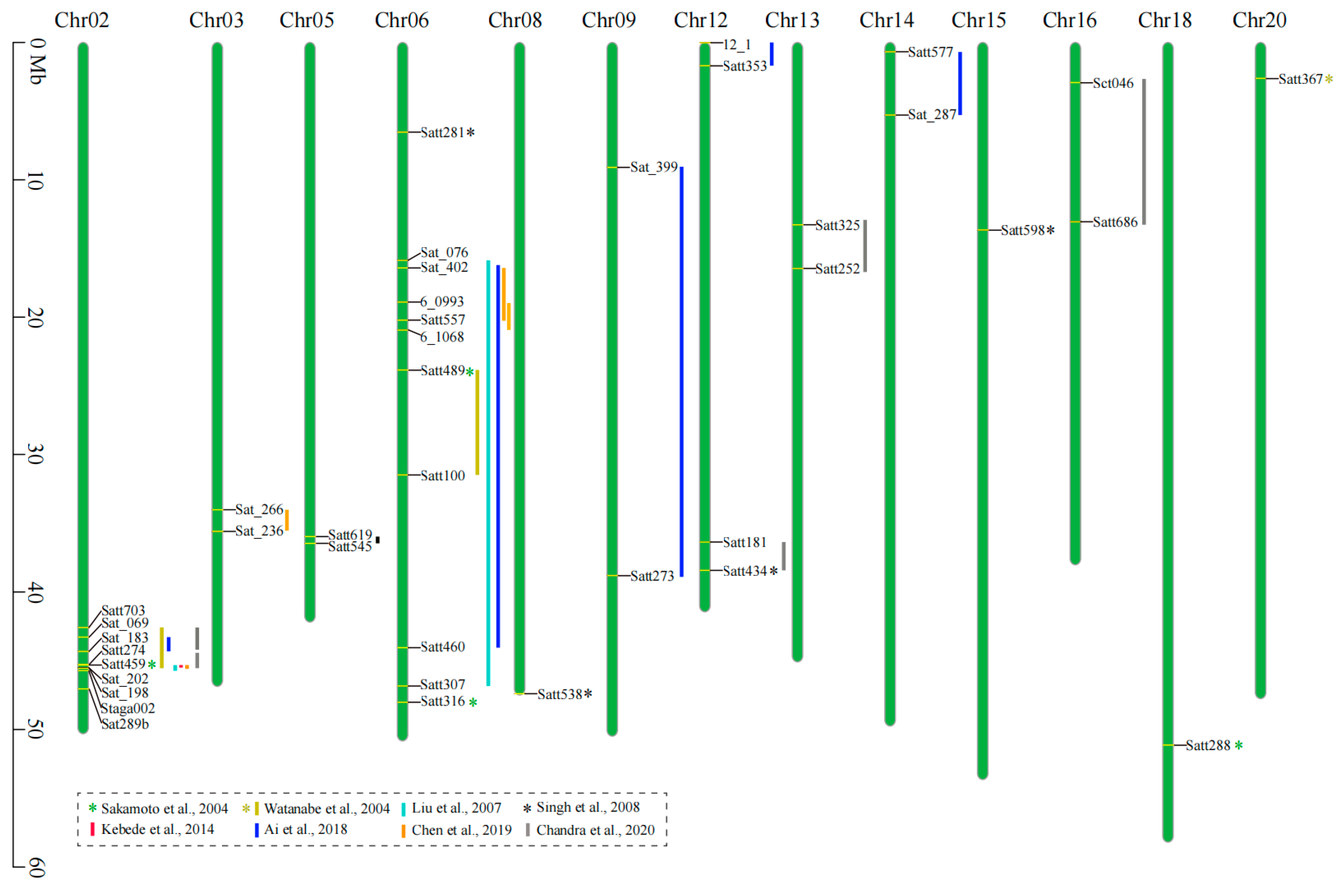

Table 1.
List of QTLs related to the HS trait of soybean.
| Population | Chromosome | QTL | Marker(s) | Location | LOD | PVE(%) | Reference |
|---|---|---|---|---|---|---|---|
| F2 (Tokei 780× B01167) | 6 | NG | Satt316 | 48016322 | NG | 24.8 | Sakamoto et al., 2004 |
| 6 | NG | Satt489 | 23848501 | NG | 8.6 | ||
| 2 | NG | Satt459 | 45311085 | NG | 23.8 | ||
| 18 | NG | Satt288 | 51127425 | NG | 9.1 | ||
| RIL (Misuzudaizu × Moshidou Gong 503) | 2 | RAS2 | Sat289b | 47042650 | 6.3 | 10.6 | Watanabe et al., 2004 |
| 6 | RAS1 | Satt489-Satt100 | 23848501-31490622 | 14 | 26 | ||
| 20 | RAS3 | Satt367 | 2615587 | 3.0 | 6.1 | ||
| RIL (Tokei 780 × Hidaka 4) | 6 | qHS-C2 | Sat_076-Satt307 | 16007694-46820673 | 5.9 | 18.5 | Liu et al., 2007 |
| 2 | qHS-D1b | Satt459-Staga002 | 45311085-46281147 | 12.5 | 42.5 | ||
| F2 (JS 71-05 × Brisa soya-1) | 12 | NG | Satt434 | 38428476 | NG | 3.9 | Singh et al., 2008 |
| 8 | NG | Satt538 | 47395378 | NG | 4.5 | ||
| 6 | NG | Satt281 | 6529270 | NG | 4.1 | ||
| 15 | NG | Satt598 | 13653981 | NG | 4.2 | ||
| F2 (PI 587982A × PI 594619) | 2 | Isc | Satt459-Sat_202 | 45311085-45497649 | 88.1 | 65.6 | Kebede et al., 2014 |
| RIL (Jidou 12 × ZDD03651) | 2 | qHS-2-1 | Sat_069-Sat_183 | 43278769-44317044 | 2.51 | 5.54 | Ai et al., 2018 |
| 6 | qHS-6-1 | Sat_402-Satt460 | 16418553-44049891 | 6.64 | 12.94 | ||
| 9 | qHS-9-1 | Sat_399-Satt273 | 9095532-38799271 | 7.24 | 3.36 | ||
| 12 | qHS-12-1 | 12_1-Satt353 | 18935-1687387 | 5.87 | 3.13 | ||
| 14 | qHS-14-1 | Satt577-Sat_287 | 675214-5287913 | 3.34 | 8.25 | ||
| F2 (ZH 39 × ZYD 2738) | 2 | NG | Satt274-Sat_198 | 45267040-45542863 | 13.3 | 17.2 | Chen et al., 2019 |
| 6 | NG | 6_0993-6_1068 | 18902966-20942203 | 13 | 17.8 | ||
| RIL (ZH 39 × ZYD 2738) | 3 | NG | Sat_266-Sat_236 | 34016929-35595364 | 2.7 | 4.9 | |
| 6 | NG | Sat_402-Satt557 | 16418553-20218893 | 11.5 | 20.4 | ||
| F2 (JS 335 × PI 424079)F2 (JS 335 × PI 136620)RIL (DS 9712 × DC 2008-1) | 2 | qScI-h 2-1 | Satt703-Satt274 | 42580676-45267040 | 6.32 | 16.49 | Chandra et al., 2020 |
| 2 | qScI-h 2-2 | Satt274-Sat_202 | 45267040-45497649 | 11.83 | 26.66 | ||
| 5 | qScI-h 5-1 | Satt619-Satt545 | 35971621-36463025 | 3.42 | 5.96 | ||
| 12 | qScI-h 12 | Satt181-Satt434 | 36365787-38428476 | 3.85 | 6.22 | ||
| 13 | qScI-h 13 | Satt325-Satt252 | 13272992-16454986 | 3.01 | 6.71 | ||
| 16 | qScI-h 16 | Sct046-Satt686 | 2919448-13053666 | 3.72 | 6.74 |
QTL, Quantitative trait loci; NG, the information was not given in the articles; LOD, logarithm of the odds; PVE, percentage of phenotypic variation.
Disclaimer/Publisher’s Note: The statements, opinions and data contained in all publications are solely those of the individual author(s) and contributor(s) and not of MDPI and/or the editor(s). MDPI and/or the editor(s) disclaim responsibility for any injury to people or property resulting from any ideas, methods, instructions or products referred to in the content. |
© 2024 by the authors. Licensee MDPI, Basel, Switzerland. This article is an open access article distributed under the terms and conditions of the Creative Commons Attribution (CC BY) license (http://creativecommons.org/licenses/by/4.0/).
Copyright: This open access article is published under a Creative Commons CC BY 4.0 license, which permit the free download, distribution, and reuse, provided that the author and preprint are cited in any reuse.


