

Submitted:
10 April 2024
Posted:
10 April 2024
You are already at the latest version
Abstract
Fusarium wilt (FW) caused by Fusarium oxysporum f. sp. Cucumerinum (Foc) of cucumber is a destructive soil-borne disease in cucumber (Cucumis sativus.L). There is limited knowledge on molecular mechanisms to FW resistance-mediated defense responses in cucumber. In this study, metabolome and transcriptome profiling were carried out in two FW, resistant (NR) and susceptible (NS), near isogenic lines (NILs) before and after Foc inoculation. The NILs showed consistent and stable FW resistances in multiple greenhouse and laboratory screening tests. Widely targeted metabolomic analysis identified differentially accumulated metabolites (DMAs) with significantly more accumulation in NR in response to Foc infection including many phenolic acid and flavonoid compounds from the flavonoid biosynthesis pathway. Transcriptome analysis identified differentially expressed genes (DEGs) between the NILs upon Foc inoculation including genes for secondary metabolite biosynthesis in or transcription factor genes regulating the flavonoid biosynthesis pathway. Joint analysis of the metabolomic and transcriptomic data identified DAMs and DEGs closely associated with biosynthesis of phenolic acid and flavonoid DAMs. The association of these compounds with NR-conferred FW resistance was exemplified by in vivo assays in which two phenolic acid compounds, bis (2-ethylhexyl) phthalate and diisooctyl phthalate, and the flavonoid compound gallocatechin 3-O-gallate were shown to have significant inhibitory effect on Foc growth. The antifungal effect of three compounds seems to be a novel finding. We conclude that phenolic acids and flavonoids play an important role in NR mediated FW resistance in cucumber.
Keywords:
Cucumber
; Cucumis sativus
; Fusarium wilt
; metabolomic
; RNA-seq
; phenolic acid
; flavonoids
; fungal resistance
1. Introduction
Cucumber, Cucumis sativus L. is among the most economically important vegetable crops. China is the dominant producer of cucumber in the world accounting for 70-80% of total world production annually in the last decade (https://faostat.fao.org/). Many diseases affect cucumber production, the soil-borne fungal Fusarium wilt (FW) is probably the most troublesome and difficult to control, which is particularly true in continuous cropping system and in protected environments. In China, under the continuous cropping system, FW incidences may range from 30 to 90% leading to significant yield loss (Zhou and Wu, 2012). The causal agent is Fusarium oxysporum f. sp. cucumerinum (Foc) (Owen, 1955). Typical symptoms of FW include yellowing, stunting, and death of seedlings, and yellowing and stunting of older plants. Infected plants wilt readily, lower leaves yellow and dry, the xylem tissues turn brown, and the plant may die. The symptoms are worsened when the plants are under stress or during fruiting. This pathogen can survive in plant debris and in soil for many years as chlamydospores (i.e. overwintering spores) and for shorter periods on greenhouse structures between crops as conidia. The large-scale, intensive cucumber production in protected environments such as greenhouses or high tunnels with infected soils increases FW severity and frequency and makes it more difficult to control this disease (Yu. et.al, 2000, Shen. et.al, 2008, Chen. et.al, 2012, Li. et.al, 2016).
Many integrated pest management (IPM) strategies such as deployment of resistant varieties, grafting, fumigation, crop rotation, and biological controls have been proposed to control FW in cucumber (Yu. et.al, 2000, Li. et.al, 2016, Tang. et.al, 2021, Nishioka. et.al, 2022) . Many of the proposed practices are not readily implementable for large scale commercial production. The development of resistant varieties is probably the most economical and environmentally sound measure for IPM of FW in cucumber production. In addition to reduce the disease incidence and yield loss, resistant varieties can also improve the rhizosphere microbial community and soil quality (Yao and Wu, 2010). In China, several studies have evaluated FW resistance in cucumber collections (Mao.et.al,2008, Li. et.al, 2015, Li. et.al, 2018). In a few cases, the FW resistance in different resistance sources has been characterized including the US cucumber inbred lines Wis248, WI2757, WisSMR-18 (Mao. et.al, 2008, D. Netzer, 1976, Vakalounakis,1993, Mao.et.al, 2008, Vakalounakis and Lamprou, 2018), the cucumber germplasm line 9110Gt (Zhang. et.al, 2014), as well as the North China type cucumber lines Rijiecheng (Dong. et.al, 2019) and ‘3461’ (Bartholomew. et.al, 2022). Interestingly, the FW resistance in all these lines seems to be controlled by a single dominant gene. The resistance gene CsChi23 from ‘3461’ has been cloned, which encodes a cucumber class I chitinase with antifungal properties (Bartholomew. et.al, 2022). Interestingly, molecular mapping studies suggest that the single domain resistance gene in all other cucumber lines seems to be located in the same region on cucumber chromosome 2 that harbors a cluster of NB-LRR resistance gene homologs (Zhang. et.al, 2014). However, the identity and exact functions of this gene are unknown.
The molecular mechanisms of resistance gene mediated defense responses have been extensively studied and reviewed (Jones and Dangl,2006, Spoel and Dong,2012, Cui.et.al,2015, Yuan. et.al, 2021, Aerts. et.al, 2022). Briefly, the establishment, penetration into the host cell wall and colonization of host plant by the pathogens are facilitated by various enzymes like pectinases, proteases, polygalacturonases and cellulases that are secreted by the pathogens. To counteract pathogen attacks, upon infection, plant immune receptors recognize diverse pathogen molecules, leading to elicitor triggered immunity (ETI). ETI involves activation of different biochemical pathways for biosynthesis of pathogenesis-related (PR) proteins, callose formation, accumulation of phytoalexins and cell wall modification that comprises lignification (Iqbal. et.al ,2021). Of particular importance is the synthesis of various secondary metabolites such as flavonoids, catecholamines, phenolic acids, phenols, and lignins, which play important roles in disease defense responses (Dixon and Barros, 2019, Campos. et.al, 2021).
How the FW resistance genes regulate defense responses against the Foc pathogen infection in cucumber is largely unknown. Chitinases are pathogenesis-related (PR) proteins that have been shown to play an important role in FW resistance (Bartholomew. et.al, 2022, Bartholomew. et.al, 2019, Xu. et.al, 2021). Zhang et al. (2016) (Zhang. et.al, 2016) conducted comparative proteomic analysis of roots between two resistant and a susceptible cucumber lines and identified 15 over accumulated proteins that were involved in defense and stress responses, oxidation-reduction, metabolism, transport and other processes, and jasmonic acid and redox signaling components. Xu et al. (2021) (Xu. et.al, 2021) also compared the proteomes of the FW resistant Rijiecheng and susceptible Superina and identified 210 and 243 differentially regulated proteins in response to Foc infection with 32 predominantly expressed in Superina and significantly up-regulated after Foc inoculation. Dong et al. (2020) (Dong. et.al, 2020) conducted transcriptome analysis in cucumber and suggested that ethylene-mediated defense responses play an important role against Foc infection in cucumber.
Integrated omics (genome, transcriptome, metabolomes and proteomes) approaches have provided powerful tools for understanding the molecular mechanisms of R-gene mediate defense responses in different crop plants (Kumar. et.al, 2016, Chen. et.al, 2019, Szymanski. et.al, 2020, Chai. et.al, 2021, Duan. et.al, 2022, Hussain. et.al, 2023). From our previous work, we identified a highly inbred cucumber line (NR) with high resistance to FW. Preliminary observations found that FW resistance in NR is controlled a single domain gene A spontaneous susceptible mutant plant (NS) was isolated from the resistant line (NR). The objective of this study was to investigate the transcriptomes and metabolomes of the two near isogenic lines (NILs) to understand resistance gene mediated defense responses. We evaluated the FW resistance of the NILs. We further conducted RNA-Seq and widely targeted metabolomic analyses using the two NILs. Comparative and integrated analyses of the transcriptomes and metabolomes identified key genes, phenolic acids and flavonoid secondary metabolites that may play important roles in FW resistance in NR.
2. Results
2.1. Foc Inoculation Responses of Near Isogenic Lines (NILs)
This section may be divided by subheadings. It should provide a concise and precise description of the experimental results, their interpretation, as well as the experimental conclusions that can be drawn.
We developed two highly inbred near isogenic lines NR and NS for FW resistance. To evaluate FW resistance of the two NILs, we conducted replicated trials in a plastic greenhouse in Hunan Vegetable Institute and the plants greenhouse in Hunan Institute of Plant Protection with RCBD (randomized complete block design) experiment design (three replications, 15 plants per rep) in three growing seasons: 2021 autumn (2021A), 2021 winter (2021W) and 2022 spring (2022S). The plants were grown in the soil known to be infected with the Foc pathogen (supplemental Figure S1A). Under natural infection, the NR plants consistently grew vigorously, while all NS plants exhibited typical stunt growth, wilting and eventually died of the Foc infection (Figure 1A-B). The stems of adult NR plants were growing strong and maintained greenish healthy while those from NS plants became dry and dead (insets of Figure 1A-B). We calculated the disease index (DI) of NR and NS plants using disease scored at 15 days post infection (dpi) from all three experiments, which are illustrated in Figure 1C. In all three seasons, the FW resistance of NR was highly stable with a mean DI of 8.02 while the NS was highly susceptible (mean DI = 90.73) (Figure 1C). Throughout the whole development stages, no morphological differences between the two NILs were visible, which was consistent with the near isogenic nature between the two lines. We also observed the FW resistance in F1 plants from the cross between NR and NS. All F1 plants (DI = 8.25) had as high as suggesting FW resistance in NR is dominant to susceptibility.
We further tested seedling stage FW resistance of NR and NS with artificial inoculation (3 reps, 10 seedlings per rep). Chlorosis and root length of each seedling were recorded at 0 (before inoculation) (NR0d and NS0d) and 4 dpi (NR4d and NS4d). By 4 dpi, NS began to show stunt growth, and clear chlorosis on cotyledons (Figure 1D and supplemental Figure S1B). Root growth was also inhibited in NS seedlings (Figure 1D). The average root length of NR0d, NS0d, NR4d and NS4d was 12.76 cm, 11.00 cm, 11.44 cm and 7.17 cm (Figure 1E), respectively. The root length of S4d was significantly shorter than that of NR4d which clearly was caused by Foc infection and NR4d (supplemental Figure S1A). Therefore, the data clearly suggest that FW resistance conferred by NR was effective throughout the whole development stages.
2.2. Metabolomic Analysis of NR and NS NILs in Response to Foc Inoculation
The seedling samples from the FW screening test described above were taken for widely targeted metabolome analysis which included two lines (NR and NS), two time points (NR0d, NS0d, NR4d, and NS4d); each sample had three biological replications (total 12 samples). Among the four samples, only NS4d showed significant symptom development, and the other three were considered symptom free (Figure 1D and supplemental Figure S1B). Data output from UPLC-MS/MS analysis were first subjected data cleanup and conversion. The cleaned data were further examined by performing correlation analysis. The Pearson’s correlation coefficient plot among all 12 samples is shown in Figure 2A, which was generally high with a mean of 0.90 suggesting the variation among different replications of the same sample is low and the reproducibility and is high. As such, data from individual replications were pooled for each sample for all subsequent analysis. We conducted principal component analyses (PCA) (Figure 2B) of the pooled data from the four samples, which indicated that PC1 and PC2 accounted for 26.11%, and 17.93% variation, respectively. Both NR4d and NS4d were further separated from NS0d and NR0d suggesting Foc inoculation had strong effects on the metabolomes in the two lines. In addition, NS4d and NR4d were also well separated indicating differential responses in the metabolomes of the two NILs upon Foc inoculation.
Based on OPLS-DA (orthogonal partial least squares discriminant analysis), 925 metabolites were obtained in all samples. Using the criteria of VIP (Variable Importance in the Projection) ≥ 1, Log2FC ≥ 2 and P < 0.05, 283 differentially accumulated metabolites (DAMs) were identified from the following four comparisons: NS0d_vs_NR0d (NS0d as the control group, NR0d as the test group, the same for other comparisons), NR0d_vs_NR4d, NS0d_vs_NS4d and NS4d_vs_NR4d. The last two comparisons were associated with different phenotypic responses upon Foc infection. The complete information of all 283 DAMs is presented in supplemental Table S1. These metabolites could be classified into 11 categories: alkaloids, amino acids and derivatives, flavonoids, lignans and coumarins, lipids, nucleotides and derivatives, organic acids, phenolic acids, quinones, terpenoids, and others; some categories could be further classified into subclasses (Table S1). There were 121 DAMs in NR0d_vs_NR4d, of which 87 and 34 showed decrease and increase in NR4, respectively (we will use down- and up-regulated, respectively hereinafter for convenience). There were 162 DAMs in NS0d_vs_NS4d (78 down and 84 up-regulated); 109 in NS0d_vs_NR0d (26 down- and 83 up-regulated); 70 from NS4d_vs_NR4d comparison (29 down- and 41 up-regulated).
Since two comparisons NS0d_vs_NS4d and NS4d_vs_NR4d were associated with phenotypic FW symptoms in responses to Foc inoculation, we focused subsequent studies on these two groups. The 70 DAMs between NS4d and NR4d included three alkaloids, two amino acids and derivatives, 16 flavonoids, two lignans and coumarins, two lipids, three organic acids, seven others, there were 19 phenolic acids, two quinones, 6 terpenoids, and seven unclassified (Table S1). The number of phenolic acids and flavonoids in this comparison accounted for almost 50% of total DAMs suggesting their close association with FW resistance. We paid special attention to DAMs that were down-regulated in NS0d_vs_NS4d but up-regulated in NS4d_vs_NR4d. We identified 30 DAMs falling into this category, 50% of which were phenolic acids (8) and flavonoids (7) (Figure 2C, Table S2). NR4d accumulate more phenolic acids and flavonoids than NS4d, which was 2.82 times and 4.74 times of those in NS4d, respectively. Indeed, KEGG pathway enrichment analysis indicated that these 30 DAMs were enriched in synthesis of various secondary metabolites in the flavonoid biosynthesis pathway (Figure 2D, Table S3). We validate this in independent experiments. We measured total phenolic acids and flavonoids in NS4d and NR4d, which revealed that the two groups of compounds in NR4d were 1.27 times and 1.52 times of those in NS4d, respectively (Figure 2E-F). Therefore, the increased accumulation of phenolic acids and flavonoids may play a key role in conferring FW resistance in NR.
2.3. Transcriptome Profiling of NR and NS NILs in Response to Foc Inoculation
It is well known that the accumulation of antimicrobe defense chemicals is due to resistance gene mediated transcription regulation of many biosynthetic genes. To understand the regulator network for the elevated accumulation of phenolic acids and flavonoids in NR, we conducted transcriptome profiling of the NILs using the same set of 12 samples used for metabolomic analysis. High throughput Illumina sequencing generated approximately 81.6 Gb clean reads with Q20 and Q30 quality scores of 96.7% and 91.1%, respectively, and > 92.74% reads could be uniquely mapped to the cucumber 9930 v2.0 genome (Table S4) indicating that the overall data quality was high. Using | log2 (Fold Change) | ≥ 1 and P-value < 0.05 as the threshold, differentially expressed genes (DEGs) were identified from four comparisons, which are presented in Figure 3A. There were 1101 (480 up-regulated and 621 down-regulated), 127 (42 up-regulated and 85 down-regulated), 1337 (624 up-regulated and 713 down-regulated), and 379 (172 up-regulated and 207 down-regulated) DEGs in the comparisons of NR0d_vs_NR4d, NS0d_vs_NR0d, NS0d_vs_NS4d, and NS4d_vs_NR4d, respectively. These data suggested there very little constitutive differences in gene expression between NR0d and NS0d, but significant changes occurred at 4dpi in both NR and NS transcriptomes in response to Foc inoculation.
We validated the expression patterns of selected DEGs by qRT-PCR. Primers for eight DEGs were designed (Table S5) including Csa1G043010, Csa4G620550, Csa6G084580, Csa6G401340 and four transcription factor (TF) genes that may be involved in regulating FW resistance: Csa1G071840, Csa1G586860, Csa2G403160 and Csa4G638510. As shown in Figure S2, the expression level of Csa1G043010, Csa4G620550, Csa6G084580 and Csa6G401340 in NR4d were 2.47, 2.32, 2.14 and 2.89 times of that in NS4d, respectively. The expression level of four TF genes Csa1G071840, Csa1G586860, Csa2G403160 and Csa4G638510 was 4.56, 2.47, 2.13 and 2.07 times, respectively. These data were consistent with that obtained from RNA-Seq, which further support the reliability of the RNA-Seq data.
We focused DEGs from comparisons between samples with obvious wilt phenotype differences (NS0d_vs_NS4d, NS4d_vs_NR4d). 60 DEGs were down-regulated in NS0d_vs_NS4d but up-regulated in NS4d_vs_NR4d (Figure 3B, Table S6), while 90 DEGs were up-regulated in NS0d_vs_NS4d and down-regulated in NS4d_vs_NR4d (Figure 3C). The GO enrichment of DEGs in the combination with FW phenotype differences was compared (Figure 3D). Most DEGs in the Cellular component term belonged to apoplast (GO:0048046). plant-type cell wall (GO:0009505) and integral component of plasma membrane (GO:0005887). In the Biological process, DEGs were enriched in GO terms like responses to phenylpropanoid (GO:0080184), oxidative stress (GO:0006979) and reactive oxygen species (GO:0000302). DEGs in the Molecular function term were enriched in oxidoreductase activity, acting on paired donors, with incorporation or reduction of molecular oxygen (GO:0016705), acid phosphatase activity (GO:0003993) and protein histidine kinase binding (GO:0043424) (Table S7). KEGG pathway enrichment analysis showed that DEGs in the NS0d_vs_NS4d, NS4d_vs_NR4d comparison were concentrated in pathways for biosynthesis of phenylpropanoids, flavonoids, flavone and flavonol, and isoflavonoids (Figure 3E, Table S8). These data were highly incongruent with results from metabolic analysis.
In addition, 1770 transcription factors (TFs) were detected, among which 182 were identified as significantly differentially expressed between NS and NR. The TFs related to against FW are mainly enriched in MYB, WRKY, NAC and bZIP transcription families. Further studies showed that one WRKY transcription factor (Csa3G119700), one bZIP transcription factor (Csa2G4031600) and two MYB family transcription factors (Csa1G071840, Csa4G638510) may be related to phenolic acid metabolites. A NAC transcription factor (Csa3G101810) and a MYB transcription factor (Csa1G586860) were associated with flavonoid metabolite synthesis (Figure 3F, Table S8). It is speculated that these transcription factor coding genes may play an important role in the regulatory mechanism of resistance to FW.
2.4. Integrated Analysis of Metabolome and Transcriptome Data
To further understand the relationships between DAMs and DEGs related to FW resistance in NR and NS NILs, we examined the association of DAMs and DEGs based on Pearson’s correlation coefficients (r). Using the criteria of |r| > 0.8 and P < 0.05, 27 DAMs were found to be associated with 95 DEGs. Among these 27 DAMs included seven phenolic acids that were associated with 14 DEGs (Figure S3A, Table S10) and six flavonoids that were associated with 14 DEGs (Figure S3B, Table S11). These data suggested that metabolites were strongly correlated with the corresponding differentially expressed genes. Based on the correlation network analysis, we further mapped the DAMs and DEGs from the NS4d_vs_NR4d comparison into the flavonoid biosynthesis pathway (starting from the shikimic acid), which is shown in Figure 4. From metabolic analysis, we identified 7 phenolic acid metabolites and 6 flavonoids (Tables S11 and S12). Several DEGs between NR4d and NS4d encode critical enzymes in this pathway. For example, CHS is a rate-limiting enzyme in the biosynthesis of flavonoids. The CHS (Csa6G401340) had higher expression in NR4d (2.13 times) than in NS4d. Similarly, the expression of FLS (flavonol synthase, Csa4G620550) and LAR (leucine thiocyanide reductase, Csa6G084580) was also significantly upregulated in NR4d, which was 2.16 and 2.21 times of that in NS4d.
Many TFs have been shown to play important roles in resistance gene-regulated flavonoid biosynthesis in response to pathogen infection (Sun.et.al, 2024, Hu.et.al, 2022). In this pathway, the MYB transcription factor encoding gene (Csa1G071840) in NR4d was 4.56 times that in NS4d. The carboxylesterase (Csa6G401340) gene was upregulated 2.89 times in NR4d compared with NS4d. The bZip TF gene Csa2G403160 controlled the production of jasmonic acid from benzoic acid, and the expression of this gene was high in NR and NS. The MYB transcription factor coding gene (Csa1G586860, 1.06) could regulate the synthesis of jasmonic acid into genetic acid esters.
2.5. Antifungal Effects of Selected Phenotypic Acid and Flavonoid Compounds on Foc Growth
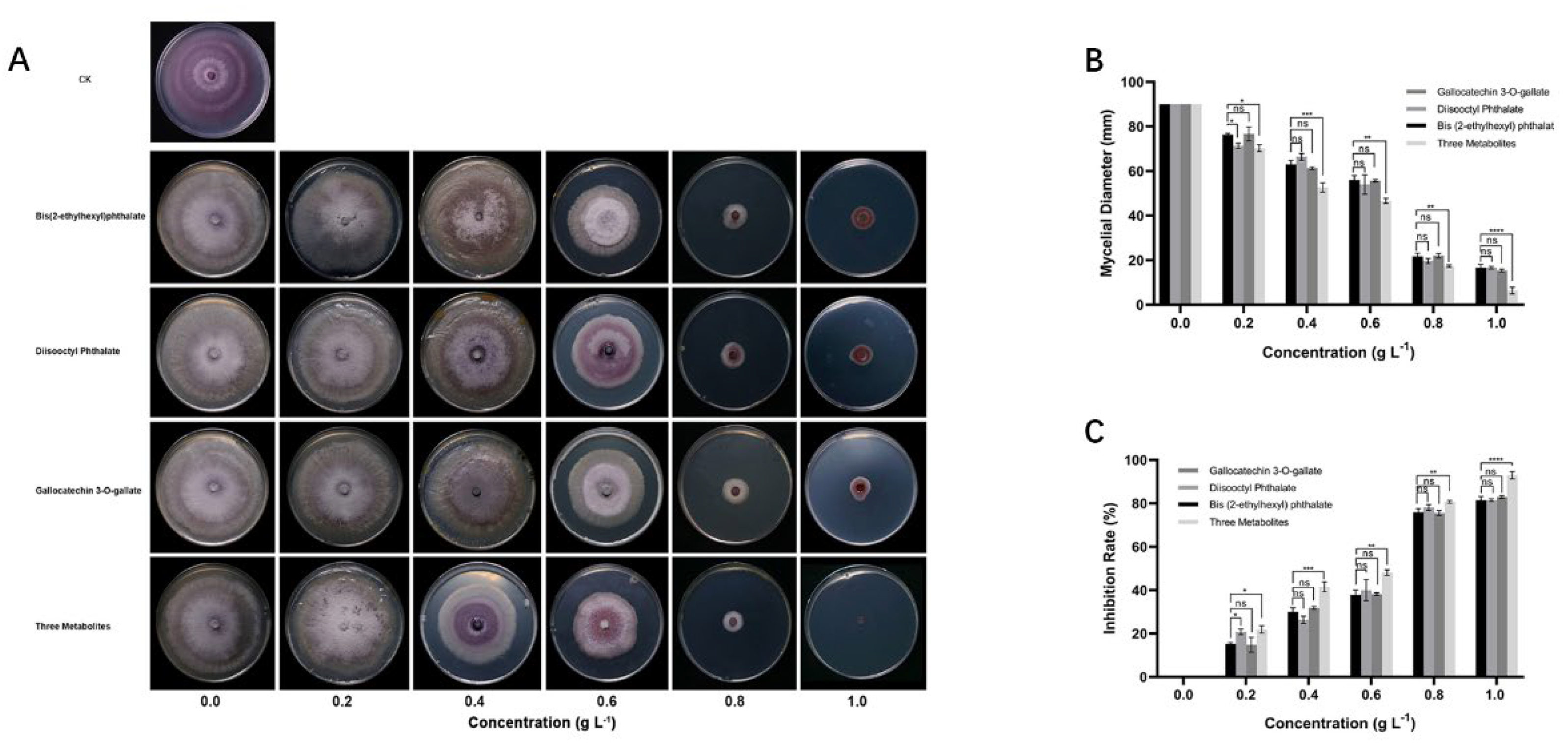
The more accumulation of many secondary metabolites from the flavonoid biosynthesis pathway in NR4d than in NS4d suggest that these compounds may contribute to antimicrobial effect and thus FW resistance. To confirm this, we conducted in vivo bioassay to evaluate the effects of selected DAMs on growth of the Foc pathogen. Two phenolic acids, bis(2-ethylhexyl) phthalate and diisooctyl phthalate, a flavonoid, gallocatechin 3-O-gallate and their mixture were tested (Figure 5). For each chemical/mixture, there were six concentrations in the PDA growth media (0, 0.2, 0.4, 0.6, 0.8 and 1.0 g L-1) (Figure 5A). Foc growth inhibition rate (Figure 5B) and mycelial diameter (Figure 5C) were measured at 7 days after culture. All three compounds showed clear inhibition on the growth of the pathogen. In each case, the inhibition rate and reduction of mycelial diameter was positively correlated the concentration of the metabolites. The inhibitory effect of three chemicals seems additive because the inhibition of pathogen growth was most effective with the mixture of the three compounds. The IC50 (half maximal inhibitory concentration) of bis(2-ethylhexyl) phthalate, diisooctyl phthalate, gallocatechin 3-O-gallate and their mixture for Foc was 170.0, 273.8, 163.2, and 296.4 g L-1, respectively.
3. Discussion
3.1. Accumulation of Phenolic Compounds is Positively Correlated with FW Resistance in NR
FW is a serious soilborne disease which is very difficult to control especially under continuous cropping in protected environments, which is popular in cucumber production in China (He. et.al, 2022). Development of host resistance is a critical component in IPM of diseases in crop production. Although several resistance sources to FW have been identified (see introduction), most cucumber varieties in commercial production in China are FW susceptible. The only FW resistance gene cloned is a single dominant gene Foc from the north China inbred line ‘3461’ which encodes a class I chitinase (Bartholomew. et.al, 2022). Overall, our understanding of the molecular mechanisms of FW resistance in cucumber is very limited. In this study, we developed NILs, NR and NS for FW resistance, which belong to the South China cucumber type ecotype. In multiple screening tests in both plastic greenhouses (natural infection) and the laboratory screening (artificial infection), the NR exhibited consistent and stable FW resistance (Figure 1 and supplemental Figure S1B). Based on results from the present study, this resistance gene is probably different from the Foc gene reported in 3461 (Bartholomew. et.al, 2022).
To understand the gene regulatory network in resistance gene mediated defense responses to Foc infection in NR NIL, we conducted both metabolome and transcriptome profiling of the two NILs before (0 dpi) and after (4 dpi) Foc inoculation using the same set of four samples (NR0d, NS0d, NR4d and NS4d) with three biological replications. Many differentially accumulated metabolites (DMAs) and differentially expressed genes (DEGs) were identified in comparison between the resistant and susceptible NILs (Figure 2 and Figure 3; Tables S1-8). Further analysis of the metabolomic data found significantly more accumulation of phenolic compounds (phenolic acids and flavonoids) in NR than in NS in response to Foc infection (Figure 2). In consistent with this, DEGs response for biosynthesis or regulation of secondary metabolite biosynthesis in the flavonoid biosynthesis pathway were highly enriched (Figure 3; Table S6-7). These data strongly suggest that accumulation of phenolic compounds from the phenylpropane and flavonoid biosynthesis pathways are contributing to the FW resistance in NR.
Phenolic compounds are secondary metabolites in plants which may include phenolic acids (e.g., chlorogenic acid, caffeic acid, p-hydroxybenzoic acid, ferulic acid, 4-coumaric acid and gallic acid), flavonoids (e.g., flavanones, flavonols and proanthocyanidins), tannins, stilbenes, and lignans which are mainly synthesized by the shikimic acid, chorismate and phenylalanine metabolic pathways (Dixon and Barros, 2019, Palacio. et.al, 2012) . Phenolic compounds have diverse functions in plant growth and development, reproduction, and defense, which may as antioxidants, structural polymers (lignin), attractants (flavonoids and carotenoids), UV screens (flavonoids), signal compounds (salicylic acid and flavonoids) and defense response chemicals (tannins and phytoalexins) (Dixon and Barros, 2019, Dicko. et.al, 2005, Visioli. et.al, 2011, Lima. et.al, 2019, Weisshaar and Jenkins, 1998). The roles of phenolic compounds in plant disease resistances have been extensively documented (Dixon and Barros, 2019, Kneusel. et.al, 1988, Jun Tsuji. et.al, 1992). For example, phenolic acids are key components of plant resistance to different pathogens (bacteria, fungi and viruses) (Santi M. Mandal, 2010, Boiteux. et.al, 2014, Zhang. et.al, 2022). Upon pathogen infection, plant may accumulate large amount phenolic acids (Mikulic-Petkovsek. et.al, 2013). Phenolic acids are key signaling molecules can be released rapidly from new roots during seed germination and seedling growth which may contribute to soil-borne pathogens (Santi M. Mandal, 2010, Ndakidemi and Dakora, 2003). Microbial changes influenced by signals from phenolic acids may have ecological effects on plant-microbial interactions (Shaw. et.al, 2006). Accumulation of flavonoids is part of the general defense responses in plants (Ndakidemi and Dakora, 2003, Li.et.al, 2011, Roy.et.al, 2018, Theunis. et.al, 2004). The antifungal effects of flavonoids were mainly manifested in inhibiting the growth of fungal colonies, spore germination and bud tube length (Xu.et.al, 2022). Therefore, data from present study were consistent with previous findings and support a critical role of phenolic acids in defense against Foc infection.
3.2. Key phenolic Acids and Flavonoids and Biosynthetic or Regulatory Genes Associated with FW Resistance
Joint analysis of the metabolomic and transcriptomic data using Pearson’s correlation coefficients identified important associations between 13 DAMs (phenolic acids/flavonoids) and 20 DEGs (Figure 4; Figure S3; Tables S11 and S12). Among the four phenolic acids, mudanoside A is one of the end products of phenolic acid compounds with gallic acid as the precursor of its synthesis which is catalyzed a hydrolase that seems to be associated with the function of Csa1G043010 (Figure 4), which is involved in the biosynthesis of tulitin, a defensive chemical with antibacterial activity against a variety of bacterial and fungal strains (Lima. et.al, 2019, Milinčić. et.al, 2021, Zhu. et.al, 2022). While gallic acid can synthesize and induce rice rhizobia resistance to rhizobia (Sarma and Singh, 2003). Hydrolase coding gene (Csa1G043010) hydrolyzes ferulic acid to produce phenolic compounds 3,4'-Dihydroxy-3',5'-dimethoxypropiophenone, which can hydrolyze caffeic shikimic acid into caffeic acid and shikimic acid. Ferulic acid not only inhibits the growth of anthrax, but also induces resistance of rice rhizobia to rhizobia. It can also regulate plant root growth (Santi M. Mandal,2010, Sarma and Singh, 2003, Zhijun.et.al, 2022). It is speculated that the high expression of these genes in the regulation pathway of phenolic acid synthesis may lead to the accumulation of these phenolic acid compounds, thus improving the resistance of plants to FW.
The synthesis of flavonoids in plants is a complex metabolic process, which is controlled by a series of enzymes and varies according to species and tissues (Mikulic-Petkovsek. et.al, 2013, Sade. et.al, 2015). In the study, we identified four flavonoid DAMs that were significantly more accumulated in NR including 1 intermediate product tricin-4'-O-glucoside and 2 end-products 6-hydroxykaempfero-7-O-glucoside and gallocatechin 3-O-gallate (Table S11). Three differentially expressed genes were strongly correlated with them, namely, carboxylesterase gene (Csa6G401340), UDP glycosyltransferase gene (Csa4G620550) and plant disease resistance protein gene (Csa6G084580). Compared with NS4d, the chalcone synthase gene (CHS) (Csa6G401340) was up-regulated 2.13 times in NR4d, which is the first key gene in phenylpropane biosynthesis to flavonoid biosynthesis. It regulates the formation of Tricin-4'-O-glucoside, which is an antioxidant flavonoid in plants and enhances the disease resistance of plants by improving the antioxidant activity of plants (Zhong. et.al, 2022). Flavanols, flavonols and flavones are important subclasses of flavonoid compounds (Chen. et.al, 2021). FLS (Csa4G620550) flavonol synthase coding gene was significantly upregulated in NR4d, 2.16 times of NS4d. This gene encodes UDP glycosyltransferase and catalyzes the formation of flavonol glucosides (Li. et.al, 2021). LAR (Csa6G084580) was 2.12 times more prevalent in NR4d than in NS4d, and it was associated with the synthesis of plant disease resistance response protein. In flax, three key genes of flavonoids, CHS, CHI and DFR, were synthesized by transgenic method, resulting in a significant increase in the contents of flavanones, flavonoids and flavanols. Increased flax resistance to Fusarium acarium (Lorenc-Kukuła. et.al, 2007).
In addition to biosynthetic genes, many DEGs for transcription factors (TFs) were also identified from RNA-Seq (Table S9). TFs, especially MYB and bZip TFs have been shown to play important roles in regulating phenolic compound accumulation for disease resistance (Bartholomew. et.al, 2022, Nuruzzaman. et.al, 2013, Shim. et.al, 2013, Liu. et.al, 2016, Jin. et.al, 2017, Tang. et.al, 2022). For example, MYB TFs plays an important role in plant defense response to biological stress that triggers a wide range of plant defenses. SpMYB (Solanum pimpinelifolium L3708) was significantly expressed in tobacco after infection with fusarium oxysporum. Overexpression of SpMYB in tobacco increased resistance to Fusarium oxysporum, and peroxidase, superoxide dismutase and phenylalanine increased the activity of ammonia lyase in transgenic plants (Wang. et.al, 2015, Xie. et.al, 2022). The DEGs associated with DAMs included four genes for MYB family transcription factors (Csa1G071840, Csa2G403160, Csa4G638510, Csa1G586860) and one for a bZIP transcription factor (Csa2G403160). The MYB transcription factor coding gene (Csa4G638510) activated the transcription of the auxin response gene IAA19 in response to auxin. Shikimic acid produces phenylalanine under the action of the R2R3MYB transcription factor coding gene (Csa1G071840), the transcription factor encoding gene can promote shimoic acid pathway to regulate volatile benzene and phenylpropane-activated EPSPS, ADTI, CFTA, CCoAOMT1 genes (Van Moerkercke. et.al, 2011, Shaipulah. et.al, 2016). Sallic Acid (SA) is an important phenolic acid compound. In recent years, PBS3 gene has been identified as the most critical enzyme encoding gene in the SA biosynthetic pathway (Rekhter. et.al, 2019). SA is an important plant disease resistance mediator. In our pathway, it is synthesized by the bZIP transcription factor encoding gene (Csa2G403160). This gene can mediate auxin and salicylic acid induced transcription in cauliflower Mosaic virus, and can interact with NPR1 to induce systemic acquired resistance in plants (Després. et.al, 2003). At the same time, SA can be reached by Salicylic Acid 5-Hydroxylase and participate in pathogen sensitivity. It is widely expressed from seedling to adult stage (Rekhter. et.al, 2019, Zhang. et.al, 2017, Torrens-Spence. et.al, 2019). SA is hydroxylated by the MYB transcription factor coding gene (Csa1G586860) to form Diisooctyl phthalate and Bis (2-ethylhexyl) phthalate, this gene activates SA-mediated defense and resistance to pathogens (Shim. et.al, 2013). In summary, we speculate that these transcription factor coding genes may be related to FW resistance genes.
3.3. Antimicrobial Effect of Phthalate Derivatives
This is example 1 of an equation: Phthalates are widely known as polymer materials in plasticizer. However, Phthalate compounds can be discovered in secondary metabolites of plants, animals and microorganisms since 1967 (Zhang. et.al, 2018, Roy, 2020). Eichhornia crassipes can produce mono-(2-ethyl hexyl) phthalate which shows bioactivity against Chl. Vulgaris (Sultan. et.al, 2009). Traditional medicinal plants produce an abundance of phthalate compounds with a variety of activities. These compounds isolated from the hairy vetch buds of Viciavillosa Roth, it showed inhibitory effects against phytopathogenic strains such as Rhizobium Cheonan 493 and Bacillus subtilis (Islam. et.al, 2013). Isolated from Sysimbrium officinale showed broad-spectrum antimicrobial activity against gram-positive and pathogenic fungi at a concentration of 0.5 mg/mL (Blažević. et.al, 2010). Phthalates were detected in the soil of tomatoes grown after biosolids application and radishes grown after compost (Mo. et.al, 2008, Sablayrolles. et.al, 2013). From the fruits of Acanthopanax sessiliflorus (Araliaceae), 13 different phthalates were isolated (D. T. Asilbekova.e t.al, 1985). In 2020, N. Kumari et al. published the isolation of dibutyl phthalate (5) as secondary metabolites of an actinomycetes strain grown on actinomycete isolation agar. However, in the same study tert-butylcalix arene, clearly, a synthetic product, was also found as a purported secondary metabolite of the actinomycetes strain (Kumari. et.al, 2020). Phthalic acid has been found in a number of plant extracts, such as in the ethyl acetate extract of Bridelia ovata and ethanolic extracts of licorice (Glycyrrhiza glabra) leaves, sometimes in concert with phthalates (Mohan and Anand, 2019, Poofery. et.al, 2020).
In this study, metabolic analysis identified two phenolic acid compounds, diisooctyl phthalate and bis(2-ethylhexyl) phthalate that were significantly more accumulated in NR than in NS at 4 dpi (Tables S1-2). In vivo assays suggested that they had inhibitory effect on Foc growth (Figure 4). The root exudates of Barnyard grass (Echinochloa crusgalli) contain diisooctyl phthalate, which reduces the germination and growth of monocotyledonous plants, lettuce and rice (Xuan. et.al, 2006). Diisooctyl phthalate is secreted from the water hyacinth (Eichhornia crassipes), and it possess strong inhibitory effects on Chlorella vulgaris (Liang. et.al, 2008). Bis (2-ethyl hexyl) phthalate can be produced by the strain of the fungus Cladosporium sp. F14 (Qi. et.al, 2009). Bis(2-ethylhexyl) phthalate isolated from the flower of Procera gigantea was found to be active against the grampositive bacteria staphylococcus aureus, bacillus subtilis, btreptococcus equosemens and sarcina lutea and against the gram-negative bacteria closteridium perfringens, pseudomonas aeruginosa and shigella dysenteriae (Habib and Karim, 2009, El-Sayed, 2013).
4. Materials and Methods
4.1. Plant Materials and FW Disease Screening Procedures
Two south China ecotype cucumber near isogenic lines (NILs), NR (high resistant) and NS (high susceptible) with contrasting FW inoculation responses were used int eh present study, which were provided by the cucumber research group of Hunan Vegetable Research Institute. The NS was found in a plastic greenhouse in 2018 among NR plants which was a highly inbred FW resistant line (>F2:3) continuously cultivated for over 23 years. The NS was further self-pollinated for four more generations by single seed descent (SSD). Thus, the highly inbred NR and NS were considered NILs for FW resistance.
FW resistance of the NILs were evaluated in three growing seasons: 2021 autumn, 2021 winter and 2022 spring in a randomized complete block design (RCBD) with 3 replications and 15 plants per replicate. Inoculation of the FW pathogen (Foc) followed the national standard established by the department of Agriculture and Rural Affairs of China (NY/T 1857.3-2010; available at https://hbba.sacinfo.org.cn). Briefly, the seeds of test cucumber lines were soaked in 5 % sodium hypochlorite solution for 10 min, washed with running water. The seeds were put into a Petri dish with two layers of filter paper and kept in an incubator at 28°C for germination. Germinated seeds were planted in sterilized seeding substrate with a relative humidity of 75%, 25°C/18°C, 16h day/8h night culture. The Foc fungal strain was isolated from the cucumber roots exhibiting FW symptoms which planted in the plastic greenhouse of Hunan Vegetable Institute, Hunan Province, China. For Foc inoculum preparation, propagated on potato dextrose agar (PDA) in plates at 28℃ for 2 days, and then spores were harvested from culture in a incubator shaker at 180 rpm for 5 days at 28°C in potato dextrose broth (PDB) and the spore concentration was adjust to 4×10⁶ spores ml-1. Seedlings at first-true-leaf stage were inoculated by the irrigation method. FW symptom development was observed daily until 15 dpi when the disease scores were used calculation of the disease index.
FW disease symptoms were rated with a 5-scale (0-4) system: 0 = no symptom; 1= cotyledon chlorosis but not wilting; 2=cotyledon wilting; 3= cotyledon and true leaf wilting or stunt seedling; and 4 = whole seedling withered (Lin. et.al, 2011). Disease index (DI) was calculated using the follow equation:
The categorical assessment of FW resistance for each line was based on the DI: DI ≤ 10, high resistance (HR); 10 ≤ DI ≤ 30, resistant (R); 30 ≤ DI ≤ 50, intermediate resistance (IR); 50 ≤ DI ≤ 70, susceptible (S); and DI > 70, highly susceptible (HS).
Root and stem samples were taken from NS and NR (pooled from 15 plants) at 0 and 4 days post inoculation (dpi), which were labels as NS0d, NS4d, NR0d, and NR4d, respectively. The samples were immediately flash frozen in liquid nitrogen and stored in a -80°C freezer for later use. The 12 samples were divided into two parts for metabolome and transcriptome analyses.
4.2. Metabolomic Analysis
12 samples (NS0d, NS4d, NR0d, and NR4d; 3 biological replications each) were subjected to metabolome analysis. The sample preparation, extract analysis, metabolite identification, and quantification were performed at Wuhan MetWare Biological Science and Technology Co. Ltd. (www.metware.cn) following their standard procedures (Liu. et.al, 2020).
Differentially accumulated metabolites (DAMs) were identified based on the variable importance of the projection (VIP) ≥ 1 and |log2(fold change) | ≥ 1. Venn diagrams were used to illustrate the number of differentially metabolites. The Kyoto Encyclopedia of Genes and Genomes (KEGG) database with a p-value < 0.01 was used to study differentially metabolites in resistance to cucumber FW.
4.3. RNA-Seq Analysis
We conducted transcriptome profiling of the NILs with RNA-seq to explore the gene regulatory network associated with FW resistance. Total RNAs were extracted from 12 samples with the RNAprep Pure Plant Plus Kit (Tiangen, China). RNA quality was evaluated with a Nano Photometer spectrophotometer (IMPLEN, CA, USA), and the Agilent Bioanalyzer 2100 system (Agilent Technologies, CA, USA). Library preparation and Illumina sequencing was carried out Metware Biotechnology Co. Ltd. (Wuhan, China). High quality clean reads were mapped to the 9930 v2.0 reference genome (http://cucurbitgenomics.org/organism/2). Gene expression levels were determined using the FPKM (Fragments per kilobase of transcript per million mapped reads). Differentially expressed genes (DEGs) were identified through DESeq2 with the p-value < 0.05 as the significance cutoff. GO enrichment and KEGG analysis of DEGs were performed at CuGenDBv2 (http://cucurbitgenomics.org/v2/).
4.4. Quantitation of Total Flavonoids and Phenolic Acids
Total flavonoid contents in NR and NS NILs were measured using the flavonoid content detection kit following the manufacturer’s protocols (Solarbio Biotechnology Co., LTD; https://www.solarbio.com/goods-6205.html). In the alkaline nitrite solution, flavonoids and aluminum ions form a red complex with characteristic absorption peak at 470nm. The flavonoid content can be calculated by measuring the absorbance value of sample extract at 470 nm. A standard curve was established by measuring the OD (optical density) of series dilution of the rutin (CAS: 153-18-4) at 1.5, 1.25, 0.625, 0.3125, 0.15625, 0.078, 0.039, 0.02 mg mL-1, and the experiment was carried out according to the standard tube and blank tube of the operation table. The OD value was measured and the flavonoid standard curve was drawn. The ΔA determination (y, ΔA determination) was put into the formula to calculate the sample concentration (x, mg mL-1).
The total phenolic acid contents in NR and NS were also measured using the total phenolic (TP) content detection kit from Solarbio. Under alkaline conditions, phenolic substances reduce tungstopolybdic acid to produce blue compounds with characteristic absorption peaks at 760 nm. The total phenolic content of the sample can be obtained by measuring the absorbance value at 760 nm. The gallic acid (CAS: 149-91-7) standard solution was diluted to 0.625, 0.15625, 0.078125, 0.039, 0.02, 0.01, 0.005 and 0.0025 mg mL-1 and the OD values for these solutions were draw the standard curve as the reference (Wang. et.al, 2020). (https://www.solarbio.com/goods-6204.html).
4.5. Quantitative Real-Time PCR (qRT-PCR)
We validated RNA-Seq data by qRT-PCR of eight selected DEGs. Gene specific primers were designed with Primer 5.0 (Table S9). The CsActin gene was used as the internal reference. Total RNA was extracted using the TaKaRa MiniBEST Plant RNA Extraction Kit (TaKaRa Bio Inc., Kusatsu, Japan). cDAN synthesis was performed with the TaKaRa PrimeScript™ RT reagent Kit with gDNA Eraser. PCR was carried out with TB Green Premix Ex Taq II (Tli RNaseH Plus) with (per 20.0 µL reaction) TB Green Premix Ex Taq II (2×), 10.0 µL; forward primer (10 µM), 0.5 µL; reverse primer (10 µM), 0.5 µL; ROX reference dye (50×) 0.4 µL; DNA template, 1.0 µL; ddH2O 7.6 µL. The reaction was performed in a fluorescence quantitative PCR instrument (ABI 7300, Thermo Fisher Scientific, USA). The amplification curve and melting curve of Real Time PCR were confirmed after the reaction. 2-∆∆CT method was used for calculation. Three biological replicates were performed for each RNA sample.
4.6. Antifungal Assays of Selected DAMs
We conducted antifungal assays with two phenolic acids (bis (2-ethylhexyl) phthalate and diisooctyl phthalate) and one flavone (gallocatechin 3-O-gallate) for their effects on inhibition of the growth of Foc following the procedure of an early study (Ji. et.al, 2018). Stuck solutions of the three metabolites were dissolved in the Foc culture PDA medium with different concentrations: 0, 0.2, 0.4, 0.6, 0.8, and 1.0 g L-1. The 5 mm mycelium discs were taken from the colonies cultured for 7 days and placed in the center of a Petri dish (90 mm diameter) containing 15 mL PDA. The dish was kept in an oven for culture at 28℃ and 90% relative humidity. The diameter of each colony was measured after 7 days and the inhibition rate and IC50 values were calculated.
Supplementary Materials
The following supporting information can be downloaded at the website of this paper posted on Preprints.org.
Author Contributions
Conceptualization, H.C. and Z.L.; methodology, K.Y. and G.Z.; software, K.Y. and C.C. F.Z.; validation, K.Y., Z.G. and C.C.; formal analysis, H.C., Z.L. and L.W.; investigation, K.Y.; resources, H.C., C.C. and X.L.; data curation, K.Y., X.L., F.Z. and L.W.; writing—original draft preparation, K.Y., G.Z., C.C. and F.Z.; writing—review and editing, H.C .;visualization, H.C.; supervision, H.C. and Z.L.; project administration, H.C., K.Y., G.Z., C.C.; funding acquisition, H.C., C.C. and X.L. All authors have read and agreed to the published version of the manuscript.
Funding
This research was funded of the National Natural Science Foundation of China, grant number 32172585; Natural Science Foundation of Hunan Province, grant number 2023JJ40389; Agricultural Science and Technology Innovation Program of Hunan Province, grant number 2023CX91; China Scholarship Council.
Institutional Review Board Statement
Not applicable.
Informed Consent Statement
Not applicable.
Data Availability Statement
The complete raw data for RNA-Seq reported in this study were deposited to NCBI PRJNA916850.
Acknowledgments
The authors are grateful to Yiqun Weng for his help with this paper.
Conflicts of Interest
The authors declare no conflict of interest.
References
- Zhou, X. and F. Wu, Dynamics of the diversity of fungal and Fusarium communities during continuous cropping of cucumber in the greenhouse. FEMS Microbiol Ecol 2012. 80(2): 469-78. [CrossRef]
- Owen, J.H.J.P., Fusarium wilt of Cucumber. 1955. 45.
- Yu, J.Q., Sen Yan Shou, Ya Rong Qian, Z.J. Zhu and W.H. Hu, Autotoxic potential of cucurbit crops. Plant and Soil 2000. 223: 147–151. [CrossRef]
- Shen, W., X. Lin, N. Gao, H. Zhang, R. Yin, W. Shi and Z. Duan, Land use intensification affects soil microbial populations, functional diversity and related suppressiveness of cucumber Fusarium wilt in China’s Yangtze River Delta. Plant and Soil 2008. 306(1-2): 117-127.
- Chen, L.H., X.Q. Huang, F.G. Zhang, D.K. Zhao, X.M. Yang and Q.R. Shen, Application of Trichoderma harzianum SQR-T037 bio-organic fertiliser significantly controls Fusarium wilt and affects the microbial communities of continuously cropped soil of cucumber. J Sci Food Agric 2012. 92(12): 2465-70. [CrossRef]
- Li, R., Z. Shen, L. Sun, R. Zhang, L. Fu, X. Deng and Q. Shen, Novel soil fumigation method for suppressing cucumber Fusarium wilt disease associated with soil microflora alterations. Applied Soil Ecology 2016. 101: 28-36. [CrossRef]
- Tang, L., Y. Hamid, Z. Chen, Q. Lin, M.J.I. Shohag, Z. He and X. Yang, A phytoremediation coupled with agro-production mode suppresses Fusarium wilt disease and alleviates cadmium phytotoxicity of cucumber (Cucumis sativus L.) in continuous cropping greenhouse soil. Chemosphere 2021. 270: 128634. [CrossRef]
- Nishioka, T., Haruhisa Suga and M. Shimizua, The stimulation of indigenous bacterial antagonists by γ-glutamyl-s-allyl-l-cysteine increases soil suppressiveness to Fusarium wilt. Applied and Environmental Microbiology 2022. 88(24). [CrossRef]
- Yao, H. and F. Wu, Soil microbial community structure in cucumber rhizosphere of different resistance cultivars to fusarium wilt. FEMS Microbiol Ecol 2010. 72(3): 456-63. [CrossRef]
- Mao, A., F. Zahng, L. Zhang and Y. Wang, Identification of resistance to Fusarium oxysporum f. sp. cucumerinum on cucumber. Acta Agriculturae Boreali-Sinica 2008. 23(2): 214-216. [CrossRef]
- Li, Y., H. Yue, D. Hou and D. Zhang, Screening of cucumber germplasms with resistance to fusarium wilt and analysis on distribution of resistant gene. Northern Horticulture 2015. 14: 121-124.
- Li, Y., D. Hou, H. Yue and D. Zhang, Evaluation on resistance of 33 cucumber core germplasms to fusarium wilt and studies on genetic characteristics. Gansu Agricultural Science and Technology 2018. 1: 25-30. [CrossRef]
- D. Netzer, S.N., and E. Galun, A Dominant Gene Conferring Resistance to Fusarium Wilt in Cucumber. Genetics 1976. 67: 525-527.
- Vakalounakis, D.J., Inheritance and genetic linkage of fusarium wilt {Fusarium oxysporum f.sp. cucumerinum race 1) and scab {Cladosporium cucumerinum) resistance genes in cucumber (Cucumis sativus). Annals of Applied Biology 1993. 123(2): 359-365. [CrossRef]
- Mao, A., F. Zahng, L. Zhang and Y. Wang, Analysis on the inheritance of resistance to Fusarium wilt race 4 and cucumber scab and their linkage in cucumber WIS2757. Scientia Agricultura Sinica 2008. 41(10): 3382-3388.
- Vakalounakis, D.J. and K. Lamprou, The Foc gene governs resistance to race 3 of Fusarium oxysporum f. sp. cucumerinum in the cucumber cv. SMR-18. European Journal of Plant Pathology 2018. 152(3): 653-656. [CrossRef]
- Zhang, S.-p., H. Miao, Y.-h. Yang, B.-y. Xie, Y. Wang and X.-f. Gu, A major quantitative trait locus conferring resistance to fusarium wilt was detected in cucumber by using recombinant inbred lines. Molecular Breeding 2014. 34(4): 1805-1815. [CrossRef]
- Dong, J., J. Xu, X. Xu, Q. Xu and X. Chen, Inheritance and Quantitative Trait Locus Mapping of Fusarium Wilt Resistance in Cucumber. Front Plant Sci 2019. 10: 1425. [CrossRef]
- Bartholomew, E.S., S. Xu, Y. Zhang, S. Yin, Z. Feng, S. Chen, L. Sun, S. Yang, Y. Wang, P. Liu, H. Ren and X. Liu, A chitinase CsChi23 promoter polymorphism underlies cucumber resistance against Fusarium oxysporum f. sp. cucumerinum. New Phytol 2022. 236(4): 1471-1486.
- Jones, J.D. and J.L. Dangl, The plant immune system. Nature 2006. 444(7117): 323-329. [CrossRef]
- Spoel, S.H. and X. Dong, How do plants achieve immunity? Defence without specialized immune cells. Nat Rev Immunol 2012. 12(2): 89-100. [CrossRef]
- Cui, H., K. Tsuda and J.E. Parker, Effector-triggered immunity: from pathogen perception to robust defense. Annu Rev Plant Biol 2015. 66: 487-511. [CrossRef]
- Yuan, M., B.P.M. Ngou, P. Ding and X.F. Xin, PTI-ETI crosstalk: an integrative view of plant immunity. Curr Opin Plant Biol 2021. 62: 102030. [CrossRef]
- Aerts, N., H. Chhillar, P. Ding and S.C.M. Van Wees, Transcriptional regulation of plant innate immunity. Essays Biochem 2022. 66(5): 607-620. [CrossRef]
- Iqbal, Z., M.S. Iqbal, A. Hashem, E.F. Abd Allah and M.I. Ansari, Plant Defense Responses to Biotic Stress and Its Interplay With Fluctuating Dark/Light Conditions. Front Plant Sci 2021. 12: 631810. [CrossRef]
- Dixon, R.A. and J. Barros, Lignin biosynthesis: old roads revisited and new roads explored. Open Biol 2019. 9(12): 190215. [CrossRef]
- Campos, M.D., M.D.R. Felix, M. Patanita, P. Materatski and C. Varanda, High throughput sequencing unravels tomato-pathogen interactions towards a sustainable plant breeding. Hortic Res 2021. 8(1): 171. [CrossRef]
- Bartholomew, E.S., K. Black, Z. Feng, W. Liu, N. Shan, X. Zhang, L. Wu, L. Bailey, N. Zhu, C. Qi, H. Ren and X. Liu, Comprehensive Analysis of the Chitinase Gene Family in Cucumber (Cucumis sativus L.): From Gene Identification and Evolution to Expression in Response to Fusarium oxysporum. Int J Mol Sci 2019. 20(21).
- . Xu, J., N. Zhang, K. Wang, Q. Xian, J. Dong, X. Qi and X. Chen, Chitinase Chi 2 Positively Regulates Cucumber Resistance against Fusarium oxysporum f. sp. cucumerinum. Genes (Basel) 2021. 13(1).
- Zhang, D., K.X. Meng, Y.H. Hao, H.Y. Fan, N. Cui, S.S. Wang and T.F. Song, Comparative proteomic analysis of cucumber roots infected by Fusarium oxysporum f. sp. cucumerium Owen. Physiological and Molecular Plant Pathology 2016. 96: 77-84. [CrossRef]
- Xu, J., K. Wang, Q. Xian, N. Zhang, J. Dong and X. Chen, Identification of Susceptibility Genes for Fusarium oxysporum in Cucumber via Comparative Proteomic Analysis. Genes 2021. 12(11). [CrossRef]
- Dong, J., Y. Wang, Q. Xian, X. Chen and J. Xu, Transcriptome analysis reveals ethylene-mediated defense responses to Fusarium oxysporum f. sp. cucumerinum infection in Cucumis sativus L. BMC Plant Biology 2020. 20(1). [CrossRef]
- Kumar, Y., L. Zhang, P. Panigrahi, B.B. Dholakia, V. Dewangan, S.G. Chavan, S.M. Kunjir, X. Wu, N. Li, P.R. Rajmohanan, N.Y. Kadoo, A.P. Giri, H. Tang and V.S. Gupta, Fusarium oxysporum mediates systems metabolic reprogramming of chickpea roots as revealed by a combination of proteomics and metabolomics. Plant Biotechnol J 2016. 14(7): 1589-603. [CrossRef]
- Chen, L., Q. Wu, W. He, T. He, Q. Wu and Y. Miao, Combined De Novo Transcriptome and Metabolome Analysis of Common Bean Response to Fusarium oxysporum f. sp. phaseoli Infection. Int J Mol Sci 2019. 20(24).
- Szymanski, J., S. Bocobza, S. Panda, P. Sonawane, P.D. Cardenas, J. Lashbrooke, A. Kamble, N. Shahaf, S. Meir, A. Bovy, J. Beekwilder, Y. Tikunov, I. Romero de la Fuente, D. Zamir, I. Rogachev and A. Aharoni, Analysis of wild tomato introgression lines elucidates the genetic basis of transcriptome and metabolome variation underlying fruit traits and pathogen response. Nat Genet 2020. 52(10): 1111-1121. [CrossRef]
- Chai, N., J. Xu, R. Zuo, Z. Sun, Y. Cheng, S. Sui, M. Li and D. Liu, Metabolic and Transcriptomic Profiling of Lilium Leaves Infected With Botrytis elliptica Reveals Different Stages of Plant Defense Mechanisms. Front Plant Sci 2021. 12: 730620. [CrossRef]
- Duan, W., L. Peng, J. Jiang, H. Zhang and G. Tong, Combined transcriptome and metabolome analysis of strawberry fruits in response to powdery mildew infection. Agronomy Journal 2022. 114(2): 1027-1039. [CrossRef]
- Hussain, K., T.H. Jaweed and A.C. Kamble, Modulation of phenylpropanoid and lignin biosynthetic pathway is crucial for conferring resistance in pigeon pea against Fusarium wilt. Gene 2023. 851: 146994. [CrossRef]
- He, Y., M. Wei, Y. Yan, C. Yu, S. Cheng, Y. Sun, X. Zhu, L. Wei, H. Wang and L. Miao, Research Advances in Genetic Mechanisms of Major Cucumber Diseases Resistance. Front Plant Sci 2022. 13: 862486. [CrossRef]
- Palacio, L., J.J. Cantero, R.M. Cusidó and M.E. Goleniowski, Phenolic compound production in relation to differentiation in cell and tissue cultures of Larrea divaricata (Cav.). Plant Science 2012. 193-194: 1-7. [CrossRef]
- Dicko, M.H., H. Gruppen, C. Barro, A.S. Traore, W.J. van Berkel and A.G. Voragen, Impact of phenolic compounds and related enzymes in sorghum varieties for resistance and susceptibility to biotic and abiotic stresses. J Chem Ecol 2005. 31(11): 2671-88. [CrossRef]
- Visioli, F., C.A. De La Lastra, C. Andres-Lacueva, M. Aviram, C. Calhau, A. Cassano, M. D'Archivio, A. Faria, G. Favé, V. Fogliano, R. Llorach, P. Vitaglione, M. Zoratti and M. Edeas, Polyphenols and human health: a prospectus. Crit Rev Food Sci Nutr 2011. 51(6): 524-46. [CrossRef]
- Lima, M.C., C. Paiva de Sousa, C. Fernandez-Prada, J. Harel, J.D. Dubreuil and E.L. de Souza, A review of the current evidence of fruit phenolic compounds as potential antimicrobials against pathogenic bacteria. Microb Pathog 2019. 130: 259-270. [CrossRef]
- Weisshaar, B. and G.I. Jenkins, Phenylpropanoid biosynthesis and its regulation.pdf. Current Opinion in Plant Biology 1998. 1(3): 251-257. [CrossRef]
- Kneusel, R.E., U. Matern and K. Nicolay, Formation of trans-caffeoyl-CoA from trans-4-coumaroyl-CoA by Zn2+-dep endent enzymes in cultured plant cells and its activation by an elicit or-induced pH shift. Archives of biochemistry and biophysics 1988. 269(2): 455-62. [CrossRef]
- Jun Tsuji, E. P., Jackson, D. A., Gage, Raymond-Hammerschmidt and S.C. Somerville, Phytoalexin Accumulation in Arabidopsis thaliana during the Hypersensitive Reaction to Pseudomonas syringae pv syringae.pdf. Plant Physiol. 1992. 98: 1304-1309. [CrossRef]
- Santi M. Mandal, D.C., Satyahari Dey1, Phenolic acids act as signaling molecules in plant-microbe symbioses. Plant Signaling & Behavior 2010. 5(4): 359-368. [CrossRef]
- Boiteux, J., C. Soto Vargas, P. Pizzuolo, G. Lucero and M.F. Silva, Phenolic characterization and antimicrobial activity of folk medicinal plant extracts for their applications in olive production. Electrophoresis 2014. 35(11): 1709-18. [CrossRef]
- Zhang, Z., J. Sun, S. Zhao, Q. Lu, L. Pan, B. Zhao and S. Yu, Effects of different rootstocks on phenolics in the skin of ‘Cabernet Sauvignon’ and widely targeted metabolome and transcriptome analysis. Horticulture Research 2022. 9. [CrossRef]
- Mikulic-Petkovsek, M., V. Schmitzer, A. Slatnar, N. Weber, R. Veberic, F. Stampar, A. Munda and D. Koron, Alteration of the content of primary and secondary metabolites in strawberry fruit by Colletotrichum nymphaeae infection. J Agric Food Chem 2013. 61(25): 5987-95. [CrossRef]
- Ndakidemi, P.A. and F.D. Dakora, Legume seed flavonoids and nitrogenous metabolites as signals and protectants in early seedling development. Funct Plant Biol 2003. 30(7): 729-745. [CrossRef]
- Shaw, L.J., P. Morris and J.E. Hooker, Perception and modification of plant flavonoid signals by rhizosphere microorganisms. Environ Microbiol 2006. 8(11): 1867-80. [CrossRef]
- Li, C., Z. Liu, Q. Zhang, R. Wang, L. Xiao, H. Ma, K. Chong and Y. Xu, SKP1 is involved in abscisic acid signalling to regulate seed germination, stomatal opening and root growth in Arabidopsis thaliana. Plant, Cell & Environment 2011. 35(5): 952-965.
- Roy, S., E. Nuckles and D.D. Archbold, Effects of Phenolic Compounds on Growth of Colletotrichum spp. In Vitro. Curr Microbiol 2018. 75(5): 550-556. [CrossRef]
- Theunis, M., H. Kobayashi, W.J. Broughton and E. Prinsen, Flavonoids, NodD1, NodD2, and nod-box NB15 modulate expression of the y4wEFG locus that is required for indole-3-acetic acid synthesis in Rhizobium sp. strain NGR234. Mol Plant Microbe Interact 2004. 17(10): 1153-61.
- Xu, H., G. Wang, J. Zhang, M. Zhang, M. Fu, K. Xiang, M. Zhang and X. Chen, Identification of phenolic compounds and active antifungal ingredients of walnut in response to anthracnose (Colletotrichum gloeosporioides). Postharvest Biology and Technology 2022. 192. [CrossRef]
- Milinčić, D.D., N.S. Stanisavljević, A.Ž. Kostić, S. Soković Bajić, M.O. Kojić, U.M. Gašić, M.B. Barać, S.P. Stanojević, Ž. Lj Tešić and M.B. Pešić, Phenolic compounds and biopotential of grape pomace extracts from Prokupac red grape variety. Lwt 2021. 138. [CrossRef]
- Zhu, F., Z. Wang, Y. Fang, J. Tong, J. Xiang, K. Yang, L. Xiao and R. Wang, Study on the Role of Phytohormones in Resistance to Watermelon Fusarium Wilt. Plants (Basel) 2022. 11(2). [CrossRef]
- Sarma, B. and U.P. Singh, Ferulic acid prevents infection by Sclerotium rolfsii in Cicer arietinum. World Journal of Microbiology and Biotechnology 2003. 19: 123-127.
- Zhijun, Z., S. Junli, Z. Shucheng, L. Qianjun, P. Lizhong, Z. Baolong and Y. Songlin, Effects of different rootstocks on phenolics in the skin of ‘Cabernet Sauvignon’ and widely targeted metabolome and transcriptome analysis. Horticulture Research 2022. 9.
- Sade, D., O. Shriki, A. Cuadros-Inostroza, T. Tohge, Y. Semel, Y. Haviv, L. Willmitzer, A.R. Fernie, H. Czosnek and Y. Brotman, Comparative metabolomics and transcriptomics of plant response to Tomato yellow leaf curl virus infection in resistant and susceptible tomato cultivars. Metabolomics 2015. 11(1): 81-97. [CrossRef]
- Zhong, Y., W. Xun, X. Wang, S. Tian, Y. Zhang, D. Li, Y. Zhou, Y. Qin, B. Zhang, G. Zhao, X. Cheng, Y. Liu, H. Chen, L. Li, A. Osbourn, W.J. Lucas, S. Huang, Y. Ma and Y. Shang, Root-secreted bitter triterpene modulates the rhizosphere microbiota to improve plant fitness. Nature Plants 2022. 8(8): 887-896.
- Chen, C., G. Zhou, J. Chen, X. Liu, X. Lu, H. Chen and Y. Tian, Integrated Metabolome and Transcriptome Analysis Unveils Novel Pathway Involved in the Formation of Yellow Peel in Cucumber. Int J Mol Sci 2021. 22(3). [CrossRef]
- Li, P., Z. Ruan, Z. Fei, J. Yan and G. Tang, Integrated Transcriptome and Metabolome Analysis Revealed That Flavonoid Biosynthesis May Dominate the Resistance of Zanthoxylum bungeanum against Stem Canker. J Agric Food Chem 2021. 69(22): 6360-6378. [CrossRef]
- Lorenc-Kukuła, K., M. Wróbel-Kwiatkowska, M. Starzycki and J. Szopa, Engineering flax with increased flavonoid content and thus Fusarium resistance. Physiological and Molecular Plant Pathology 2007. 70(1): 38-48. [CrossRef]
- Nuruzzaman, M., A.M. Sharoni and S. Kikuchi, Roles of NAC transcription factors in the regulation of biotic and abiotic stress responses in plants. Front Microbiol 2013. 4: 248. [CrossRef]
- Shim, J.S., C. Jung, S. Lee, K. Min, Y.W. Lee, Y. Choi, J.S. Lee, J.T. Song, J.K. Kim and Y.D. Choi, AtMYB44 regulates WRKY70 expression and modulates antagonistic interaction between salicylic acid and jasmonic acid signaling. Plant J 2013. 73(3): 483-95.
- Liu, Z., Y. Luan, J. Li and Y. Yin, Expression of a tomato MYB gene in transgenic tobacco increases resistance to Fusarium oxysporum and Botrytis cinerea. European Journal of Plant Pathology 2016. 144(3): 607-617. [CrossRef]
- Jin, J., F. Tian, D.C. Yang, Y.Q. Meng, L. Kong, J. Luo and G. Gao, PlantTFDB 4.0: toward a central hub for transcription factors and regulatory interactions in plants. Nucleic Acids Res 2017. 45(D1): D1040-d1045. [CrossRef]
- Tang, J., E. Mei, M. He, Q. Bu and X. Tian, Functions of OsWRKY24, OsWRKY70 and OsWRKY53 in regulating grain size in rice. Planta 2022. 255(4). [CrossRef]
- Wang, M., Y. Sun, G. Sun, X. Liu, L. Zhai, Q. Shen and S. Guo, Water balance altered in cucumber plants infected with Fusarium oxysporum f. sp. cucumerinum. Sci Rep 2015. 5: 7722. [CrossRef]
- Xie, J., Y. Ding, T. Gao, S. He, K. Zhao, X. Yang, J. Zhang and Z. Yang, Transcriptomic and proteomic analyses of Cucurbita ficifolia Bouche (Cucurbitaceae) response to Fusarium oxysporum f.sp. cucumerium. BMC Genomics 2022. 23(Suppl 1): 436. [CrossRef]
- Van Moerkercke, A., M.A. Haring and R.C. Schuurink, The transcription factor EMISSION OF BENZENOIDS II activates the MYB ODORANT1 promoter at a MYB binding site specific for fragrant petunias. Plant J 2011. 67(5): 917-28. [CrossRef]
- Shaipulah, N.F.M., J.K. Muhlemann, B.D. Woodworth, A. Van Moerkercke, J.C. Verdonk, A.A. Ramirez, M.A. Haring, N. Dudareva and R.C. Schuurink, CCoAOMT Down-Regulation Activates Anthocyanin Biosynthesis in Petunia. Plant physiology 2016. 170(2): 717-731. [CrossRef]
- Rekhter, D., D. Lüdke, Y. Ding, K. Feussner, K. Zienkiewicz, V. Lipka, M. Wiermer, Y. Zhang and I. Feussner, Isochorismate-derived biosynthesis of the plant stress hormone salicylic acid. Science 2019. 365(6452): 498-502. [CrossRef]
- Després, C., C. Chubak, A. Rochon, R. Clark, T. Bethune, D. Desveaux and P.R. Fobert, The Arabidopsis NPR1 disease resistance protein is a novel cofactor that confers redox regulation of DNA binding activity to the basic domain/leucine zipper transcription factor TGA1. Plant Cell 2003. 15(9): 2181-91. [CrossRef]
- Zhang, Y., L. Zhao, J. Zhao, Y. Li, J. Wang, R. Guo, S. Gan, C.J. Liu and K. Zhang, S5H/DMR6 Encodes a Salicylic Acid 5-Hydroxylase That Fine-Tunes Salicylic Acid Homeostasis. Plant Physiol 2017. 175(3): 1082-1093. [CrossRef]
- Torrens-Spence, M.P., A. Bobokalonova, V. Carballo, C.M. Glinkerman, T. Pluskal, A. Shen and J.K. Weng, PBS3 and EPS1 Complete Salicylic Acid Biosynthesis from Isochorismate in Arabidopsis. Mol Plant 2019. 12(12): 1577-1586. [CrossRef]
- Zhang, H., Y. Hua, J. Chen, X. Li, X. Bai and H. Wang, Organism-derived phthalate derivatives as bioactive natural products. Journal of Environmental Science and Health, Part C 2018. 36(3): 125-144. [CrossRef]
- Roy, R.N., Bioactive natural derivatives of phthalate ester. Critical Reviews in Biotechnology 2020. 40(7): 913-929.
- Sultan, M.Z., K. Park and S.S. Moon, Natural Phthalate Derivatives from the Bacterium <i>Burkholderia cepacia</i> K87. Journal of Scientific Research 2009. 2(1): 191-195.
- Islam, M.T., S.-Y. Ahn, S.M. Cho and H.K. Yun, Isolation of antibacterial compounds from hairy vetch (Vicia villosa) against grapevine crown gall pathogen. Horticulture, Environment, and Biotechnology 2013. 54(4): 338-345. [CrossRef]
- Blažević, I., A. Radonić, J. Mastelić, M. Zekić, M. Skočibušić and A. Maravić, Hedge Mustard (Sisymbrium officinale): Chemical Diversity of Volatiles and Their Antimicrobial Activity. Chemistry & Biodiversity 2010. 7(8): 2023-2034. [CrossRef]
- Mo, C.-H., Q.-Y. Cai, S.-R. Tang, Q.-Y. Zeng and Q.-T. Wu, Polycyclic Aromatic Hydrocarbons and Phthalic Acid Esters in Vegetables from Nine Farms of the Pearl River Delta, South China. Archives of Environmental Contamination and Toxicology 2008. 56(2): 181-189. [CrossRef]
- Sablayrolles, C., J. Silvestre, C. Lhoutellier and M. Montrejaud-Vignoles, Phthalates uptake by tomatoes after biosolids application worst case and operational practice in greenhouse conditions. Fresenius Environ.pdf. Fresenius Environmental Bulletin 2013. 22(4a): 1064-1074.
- D. T. Asilbekova, S. D. Gusakova and A.I. Glushenkova, Lipids in fruits of Acanthopanax sessiliflorus; Khim. .pdf. Plenum Publishing 1985: 719-724.
- Kumari, N., E. Menghani and R. Mithal, GCMS analysis & assessment of antimicrobial potential of rhizospheric Actinomycetes of AIA3 isolate. Indian J.pdf. Indian Journal of Traditional Knowledge 2020. 19(1): 111-119. [CrossRef]
- Mohan, S.C. and T. Anand, Comparative Study of Identification of Bioactive Compounds from Barringtonia acutangula Leaves and Bark Extracts and its Biological Activity. Journal of Applied Sciences 2019. 19(6): 528-536.
- Poofery, J., P. Khaw-on, S. Subhawa, B. Sripanidkulchai, A. Tantraworasin, S. Saeteng, S. Siwachat, N. Lertprasertsuke and R. Banjerdpongchai, Potential of Thai Herbal Extracts on Lung Cancer Treatment by Inducing Apoptosis and Synergizing Chemotherapy. Molecules 2020. 25(1). [CrossRef]
- Xuan, T.D., I.I.I.M. Chung, T.D. Khanh and S. Tawata, Identification of Phytotoxic Substances from Early Growth of Barnyard Grass (Echinochloa crusgalli) Root Exudates. Journal of Chemical Ecology 2006. 32(4): 895-906. [CrossRef]
- Liang, D.-W., T. Zhang, H.H.P. Fang and J. He, Phthalates biodegradation in the environment. Applied Microbiology and Biotechnology 2008. 80(2). [CrossRef]
- Qi, S.-H., Y. Xu, J. Gao, P.-Y. Qian and S. Zhang, Antibacterial and antilarval compounds from marine bacteriumPseudomonas rhizosphaerae. Annals of Microbiology 2009. 59(2): 229-233. [CrossRef]
- Habib, M.R. and M.R. Karim, Antimicrobial and Cytotoxic Activity of Di-(2-ethylhexyl) Phthalate and Anhydrosophoradiol-3-acetate Isolated from Calotropis gigantea (Linn.) Flower. Mycobiology 2009. 37(1): 31-36. [CrossRef]
- El-Sayed, M.H., Di-(2-ethylhexyl) phthalate, a major bioactive metabolite with antimicrobial and cytotoxic activity isolated from the culture filtrate of newly isolated soil Streptomyces (Streptomyces mirabilis strain NSQu-25). World Applied Sciences Journal 2013. 21(4): 465-475.
- Lin, Z., R. Wei, Y. Sheng, Q. Tang and Q. Xiao, Research Overview of Cucumber Fusarium Wilt. Beijing Agriculture 2011. 30: 91-92.
- Liu, C., Q. Yu, Z. Li, X. Jin and W. Xing, Metabolic and transcriptomic analysis related to flavonoid biosynthesis during the color formation of Michelia crassipes tepal. Plant Physiol Biochem 2020. 155: 938-951. [CrossRef]
- Wang, Y., S. Gao, X. He, Y. Li, Y. Zhang and W. Chen, Response of total phenols, flavonoids, minerals, and amino acids of four edible fern species to four shading treatments. PeerJ 2020. 8: e8354. [CrossRef]
- Ji, D., T. Chen, D. Ma, J. Liu, Y. Xu and S. Tian, Inhibitory effects of methyl thujate on mycelial growth of Botrytis cinerea and possible mechanisms. Postharvest Biology and Technology 2018. 142: 46-54. [CrossRef]
Figure 1.
Foc inoculation responses in NR and NS NILs. NR (A) and NS (B) are highly resistant and susceptible to FW at adult plant stage in the greenhouse with Foc pathogen in the soil. In three experiments, disease index of NR is consistently lower than that of NS (C). At seedling stage, 4 days after Foc inoculation, chlorosis of the cotyledons and first true leaves and inhibition of root growth are clearly visible in NS but not in NR (D-E). Data in C and E are based on three replications (n=15 in C and n=10 in E per rep), *P < 0.05, ** P < 0.01.
Figure 1.
Foc inoculation responses in NR and NS NILs. NR (A) and NS (B) are highly resistant and susceptible to FW at adult plant stage in the greenhouse with Foc pathogen in the soil. In three experiments, disease index of NR is consistently lower than that of NS (C). At seedling stage, 4 days after Foc inoculation, chlorosis of the cotyledons and first true leaves and inhibition of root growth are clearly visible in NS but not in NR (D-E). Data in C and E are based on three replications (n=15 in C and n=10 in E per rep), *P < 0.05, ** P < 0.01.
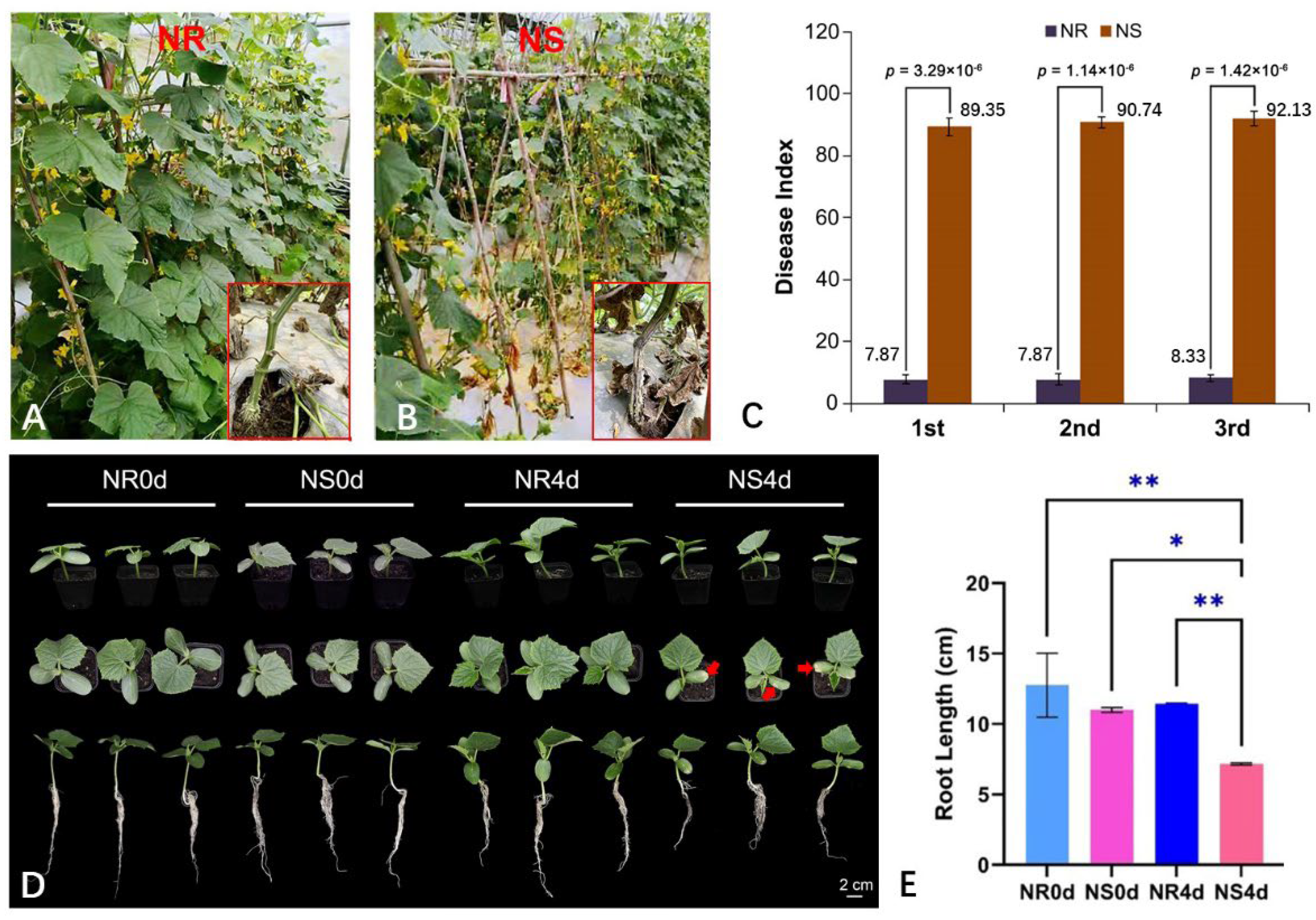
Figure 2.
Widely targeted metabolomic analysis of NR and NS NILs identifies key metabolites in the flavonoid biosynthesis pathway associated with FW resistance. (A) Pearson’s correlation coefficients in pairwise metabolic data among biological repetitions and treatments indicating high reproducibility of data among replications of each sample. (B) Tw-dimensional principal component analysis (2D-PCA) of metabolite profiles in NS0d, NS4d, NR0d, and NR4d. (C) Venn graph shows differential accumulated metabolites (DAMs) between NS0d_vs_NS4d and NS4d_vs_NR4d comparison. (D) Enriched KEGG pathways of DAMs in NS4d_vs_NR4d comparison. (E-F) Total phenolic acids and flavonoids in NR4d and NS4d samples. Each data point is mean ± SD (n=3). *** and **** indicates P<0.01 and P<0.001 respectively from paired t-tests.
Figure 2.
Widely targeted metabolomic analysis of NR and NS NILs identifies key metabolites in the flavonoid biosynthesis pathway associated with FW resistance. (A) Pearson’s correlation coefficients in pairwise metabolic data among biological repetitions and treatments indicating high reproducibility of data among replications of each sample. (B) Tw-dimensional principal component analysis (2D-PCA) of metabolite profiles in NS0d, NS4d, NR0d, and NR4d. (C) Venn graph shows differential accumulated metabolites (DAMs) between NS0d_vs_NS4d and NS4d_vs_NR4d comparison. (D) Enriched KEGG pathways of DAMs in NS4d_vs_NR4d comparison. (E-F) Total phenolic acids and flavonoids in NR4d and NS4d samples. Each data point is mean ± SD (n=3). *** and **** indicates P<0.01 and P<0.001 respectively from paired t-tests.
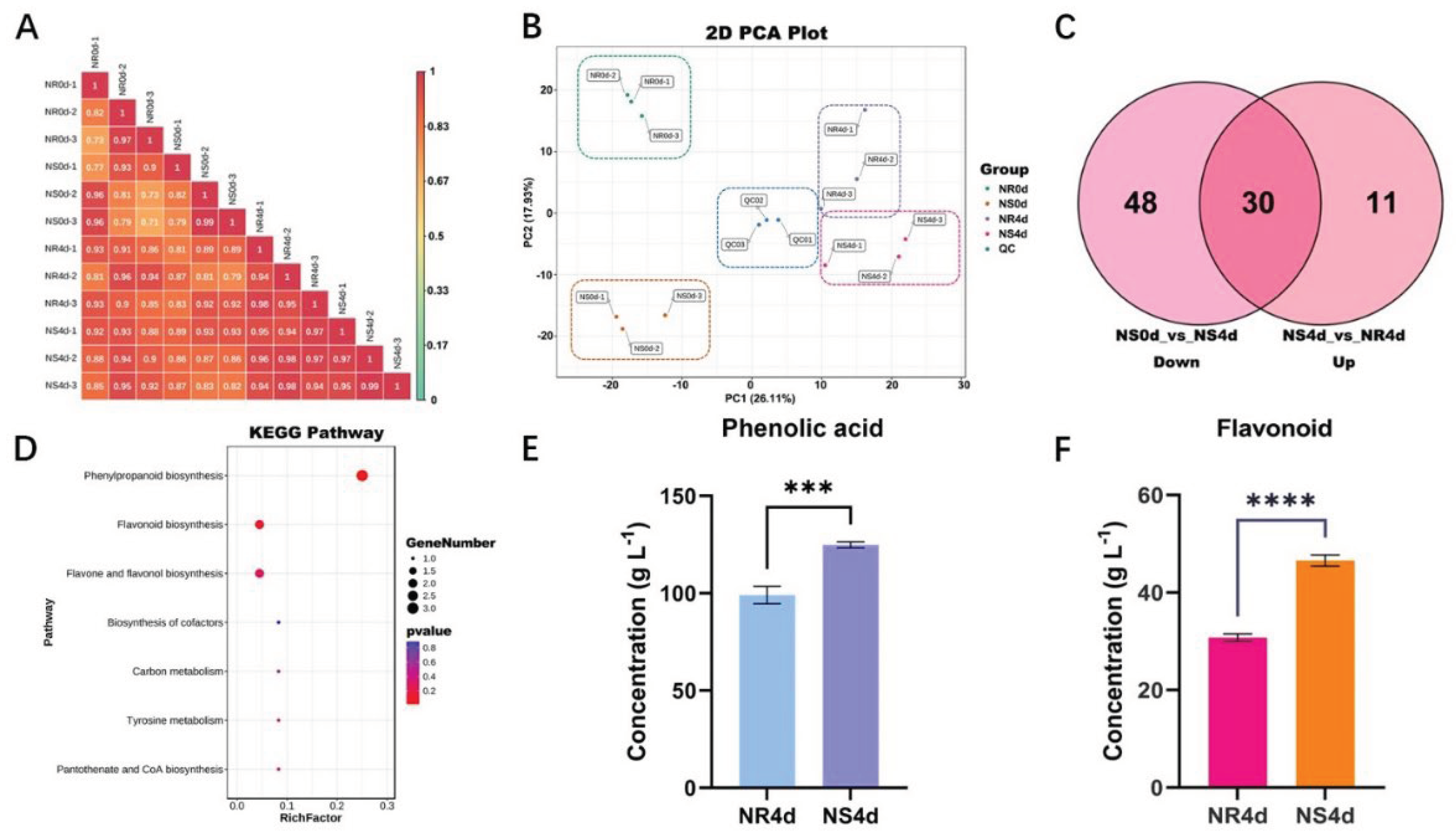
Figure 3.
Transcriptome analysis of NR and NS NILs. (A) Bar graph of number of differentially expressed genes (DEGs) in different comparisons. (B-C) Venn diagrams show DEGs from comparisons of different transcriptomes. (D) Enriched GO terms with DEGs in NS4d_vs_NR4d. (E) Enriched KEGG pathway terms from DEGS in NS4d_vs_NR4d. (F) Heat map of Log2 (Fold change) of selected DEGs. Blue rectangles and red circles indicate genes associated with phenolic acid and flavonoids biosynthesis, respectively.
Figure 3.
Transcriptome analysis of NR and NS NILs. (A) Bar graph of number of differentially expressed genes (DEGs) in different comparisons. (B-C) Venn diagrams show DEGs from comparisons of different transcriptomes. (D) Enriched GO terms with DEGs in NS4d_vs_NR4d. (E) Enriched KEGG pathway terms from DEGS in NS4d_vs_NR4d. (F) Heat map of Log2 (Fold change) of selected DEGs. Blue rectangles and red circles indicate genes associated with phenolic acid and flavonoids biosynthesis, respectively.
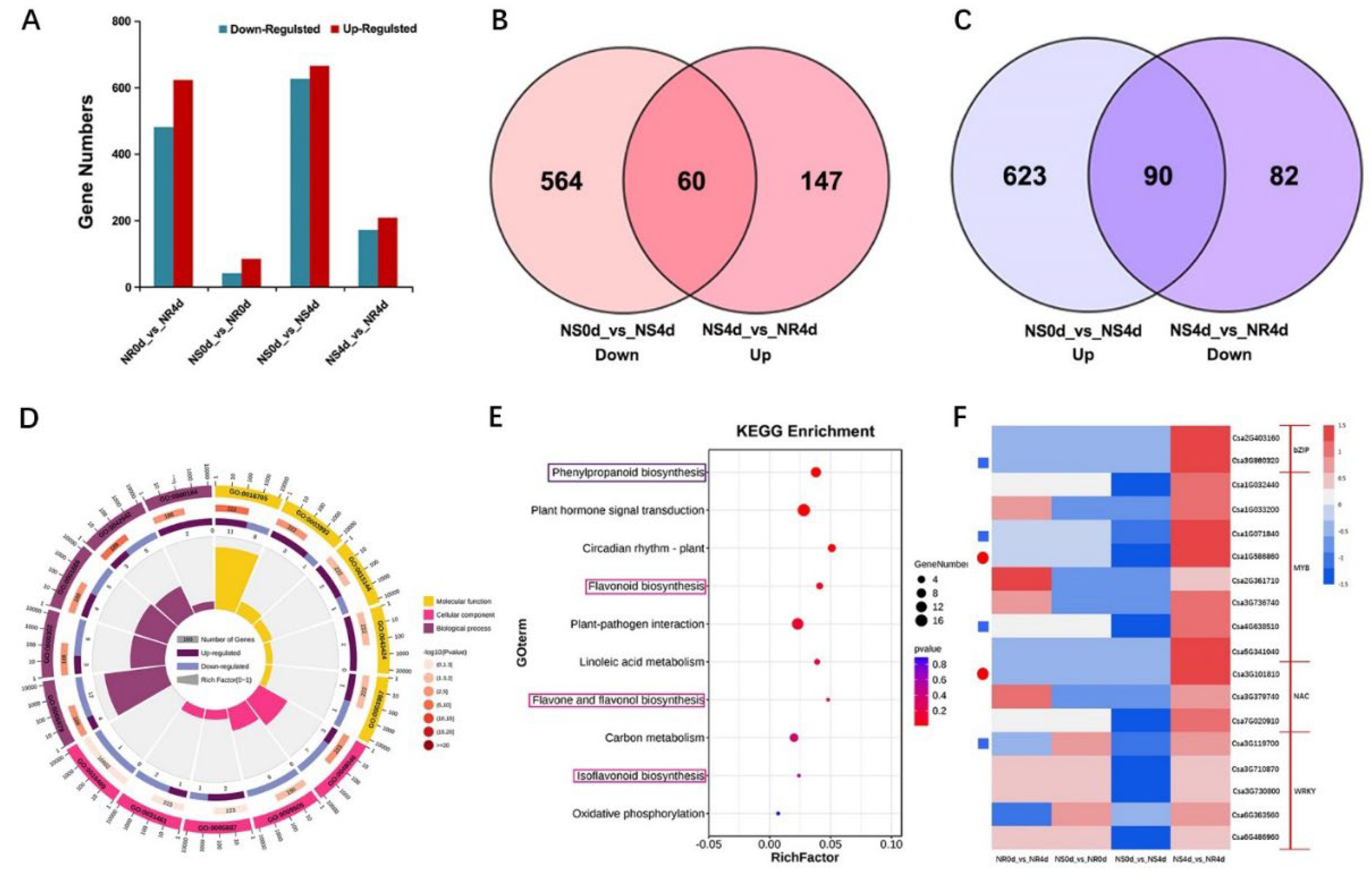
Figure 4.
DEGs and DAMs in the comparison between NS4d vs NR4d that are mapped in the phenolic acid and flavonoid metabolic pathways. DAHPS: 3-deoxy-D-arabino-heptulosonate-7-phosphate hikimate dehydrogenase. SK: shikimate kinase. ICS: isochorismate synthase. A1M1: absent in melanoma 1 BA2H: benzoic acid 2-hydroxylase. PBS3: avrPphB susceptible. S5H: salicylic acid 5-hydroxylase. CM: chorismate mutase. PAL: phenylalanine ammonia-lyase. C4H: cinnamate-4-hydroxylase. C3H: coumarate-3-hydroxylase. CoMT: caffeic acid O-methyltransferase. 4CL: 4-coumarate-CoA ligase. HCT: hydroxycinnamoyl transferase. CHS: chalcone synthase. CHI: chalcone isomerase. F3H: flavanone-3-hydroxylase. FLS: flavonol synthase. LAR: leucoanthocyanidin reductase.
Figure 4.
DEGs and DAMs in the comparison between NS4d vs NR4d that are mapped in the phenolic acid and flavonoid metabolic pathways. DAHPS: 3-deoxy-D-arabino-heptulosonate-7-phosphate hikimate dehydrogenase. SK: shikimate kinase. ICS: isochorismate synthase. A1M1: absent in melanoma 1 BA2H: benzoic acid 2-hydroxylase. PBS3: avrPphB susceptible. S5H: salicylic acid 5-hydroxylase. CM: chorismate mutase. PAL: phenylalanine ammonia-lyase. C4H: cinnamate-4-hydroxylase. C3H: coumarate-3-hydroxylase. CoMT: caffeic acid O-methyltransferase. 4CL: 4-coumarate-CoA ligase. HCT: hydroxycinnamoyl transferase. CHS: chalcone synthase. CHI: chalcone isomerase. F3H: flavanone-3-hydroxylase. FLS: flavonol synthase. LAR: leucoanthocyanidin reductase.
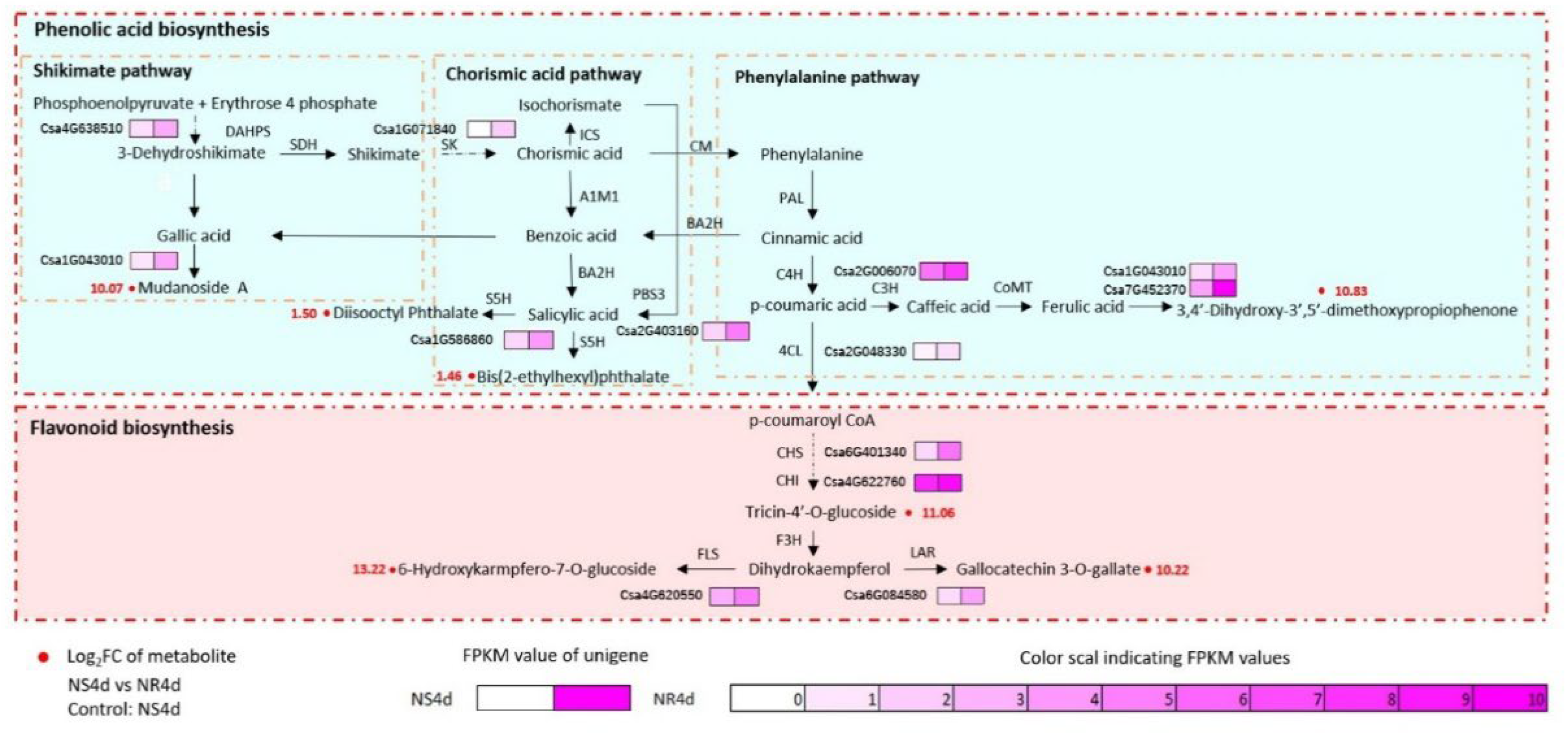
Figure 5.
Bioassay of inhibitory effects of selected phenolic acid and flavonoid compounds on growth of Foc pathogen. (A) In vitro growth of Foc treated with different concentrations of Bis(2-ethylhexyl) phthalate, Diisooctyl phthalate, Gallocatechin3-O-gallate and only PDA (CK) after incubation at 28°C for 7 days on PDA plate. (B) Inhibition rate of three chemicals and their combination on Foc growth. (B) Mycelial diameter of Foc colonies in different treatments. In B and C, each datapoint is mean ± SD (n=3). Asterisks (*) indicate the statistical significance of the difference between other compounds and the control group is Bis (2-ethylhexyl) phthalate. * P < 0.05, ** P < 0.01, *** P < 0.001, and **** P < 0.0001, ns = not significant.
Figure 5.
Bioassay of inhibitory effects of selected phenolic acid and flavonoid compounds on growth of Foc pathogen. (A) In vitro growth of Foc treated with different concentrations of Bis(2-ethylhexyl) phthalate, Diisooctyl phthalate, Gallocatechin3-O-gallate and only PDA (CK) after incubation at 28°C for 7 days on PDA plate. (B) Inhibition rate of three chemicals and their combination on Foc growth. (B) Mycelial diameter of Foc colonies in different treatments. In B and C, each datapoint is mean ± SD (n=3). Asterisks (*) indicate the statistical significance of the difference between other compounds and the control group is Bis (2-ethylhexyl) phthalate. * P < 0.05, ** P < 0.01, *** P < 0.001, and **** P < 0.0001, ns = not significant.
Disclaimer/Publisher’s Note: The statements, opinions and data contained in all publications are solely those of the individual author(s) and contributor(s) and not of MDPI and/or the editor(s). MDPI and/or the editor(s) disclaim responsibility for any injury to people or property resulting from any ideas, methods, instructions or products referred to in the content. |
© 2024 by the authors. Licensee MDPI, Basel, Switzerland. This article is an open access article distributed under the terms and conditions of the Creative Commons Attribution (CC BY) license (http://creativecommons.org/licenses/by/4.0/).
Copyright: This open access article is published under a Creative Commons CC BY 4.0 license, which permit the free download, distribution, and reuse, provided that the author and preprint are cited in any reuse.


