

Submitted:
02 April 2024
Posted:
03 April 2024
You are already at the latest version
Abstract
Productivity has been modest in construction due to many reasons, especially project-specific operations and fragmentation. The main aim of this research is to map the challenges towards industrialization in construction through a comparative study of the manufacturing industry. An inductive approach and a qualitative method are followed by applying semi-structured inter-views, and node-based thematic analysis. The key elements of industrialization in mature man-ufacturing companies are benchmarked. The findings indicate a specific order of steps for indus-trialization in construction. Data and information management with achieved systematization have been sources of productivity in manufacturing companies. However, the systematization starts from the offering, construction companies need to define their offering, that is the products, and define their respective data. Only accurate and good quality data on products enables the systematization of order delivery processes, which are the engine for a company’s success or failure. Continuous efficiency improvement is only possible with systematized processes and respective data related to the processes. The originality involves clarifying the industrialization of construction companies via products, respective data, and processes considering industrialized manufacturing companies.
Keywords:
predefined products
; predefined processes
; data management
; industrialized construction
1. Introduction
The construction industry has suffered productivity challenges for a very long time. However, there has been recent interest in the digital transformation and industrialization of construction to respond to these challenges. Industrialized construction refers to standardizing building processes and product parts and is characterized by using product modules with high levels of predefinition [1] and recurring processes in the construction company's production and supply chain supported by information flow and continuous improvement [2]. Off-site construction, prefabrication, pre-assembly, and modular construction are interchangeable terms used to describe the main approaches in industrialized construction [3]. Industrialized construction requires comprehensive process planning, control, and tightly connected design and operation management [4]. Such approaches are strategic by nature and affect the business. There is adequate evidence that industrialized construction increases productivity in construction [5], reduces construction costs and production time [6], and positively affects site operations [7] compared to traditional building methods.
Despite extensive research on information flow [8,9], processes integration [10], and communication and coordination [11], our understanding of why digitalization and data management are not fully embraced in construction and how to apply the approaches to facilitate the industrialization of construction remain limited [3]. Nevertheless, digital transformation and adoption of industrialized working methods have been rather slow on a practical level, and to some extent change resistance has occurred also [12]. More than implementing discrete digital technologies is required [13].
The operation model describes how business strategies and models are executed at a practical and more detailed level [14,15]. The industrial operation model is an integrative approach commonly used in manufacturing companies like Boeing and Toyota in their production system enabling utilization of scale of benefits [16]. In construction, the operation model has traditionally followed the so-called ’prototype model’ where the end-products are ‘let be’ unique. Uniqueness relates to the project-based approach, however, leading to several challenges in productivity. This approach differs from traditional engineer-to-order because it does not aim at systematizing the operations. The full potential of industrialization is currently not being leveraged in construction, nor is the potential of digitalization in this context fully understood.
Some industrialized construction companies operate according to a business strategy and operational structure that differs from that of traditional construction companies [17,18]. The industrialization of construction is seen to require a drastic shift in the operation model [19], including creating a shared understanding among distributed teams [20], and implementing efficient and streamlined processes to obtain expected outcomes [21]. Companies should pay attention to operations while formulating strategies [22], as operations are the profit-generating engine [23]. Evidently industrialization including information management has created benefits and productivity improvement in the manufacturing industry. Respectively construction has not been able to realize this potential. Therefore, this study aims to understand the differences between industrialization and its elements in the manufacturing industry and respectively compare these to the findings from construction. Ultimately our study aims to provide a transformation model for industrialization in construction companies. The above discussion can be framed into the following research questions (RQs):
RQ1: What are the challenges of industrialization in construction companies compared to manufacturing companies?
RQ2: What are the development steps and contents in the transformation towards industrialization?
First, the literature is reviewed to identify key elements of industrialization and to link data and information management into the context. The identified elements will be assessed in two contexts: benchmark manufacturing companies where the essence of industrialization is better conceived and forms an inseparable part of operations; and construction companies on the path to industrialization. Based on qualitative interview data we develop transformation steps for construction towards industrialization. Finally, the findings and implications are discussed, and the paper concluded.
2. Related Research for Industrialization of Construction
Construction has suffered from low productivity for decades and productivity being even negative in certain periods. The situation seems particularly bad when construction is compared to manufacturing industry or high-tech industry. [24] This does not mean that there has been zero development in construction, but that the input has grown more than the ratio of the output, while productivity is output divided with input [25]. Productivity can also be divided into internal efficiency and external effectiveness [25] when internal efficiency refers to internal processes and effectiveness respectively external deliverables for customers.
Perhaps one the most referred concepts of efficiency can be found in the Toyota Production System (TPS) – also called the Lean production system. The ultimate purpose of original TPS is to find the most efficient way for the production process, regardless of whether it is a partial process of one company or a system of generating value for the entire supply chain. [16] There is a great amount of research on Lean and its application to different industries. Lean can be approached from many different perspectives and in many ways. One of the most practical and utilized approach has been described by Womack and Jones [26] as the 5 lean principles; 1) defining value (what needs to be delivered to customer), 2) mapping the value stream (what is the process that delivers defined value), 3) creating flow (what are value adding activities in the flow of delivering the value), 4) using a pull system (pulling the value, when needed), and 5) pursuing perfection (continuous improvement of the value and the flow).
Fragmentation can be considered as one of the most significant challenges in construction in the way toward industrialization. It emerges both horizontally and vertically. Horizontal fragmentation means that the value chain is split into many phases that are typically managed by different operators and organizations. Vertical fragmentation means splitting the value creation process or flow into, for example, heating, ventilation, air conditioning, and automation etc. construction. [27] Resulting decentralized control model where no one has an interest in controlling the whole. In turn, every interface has points of discontinuity, where interruptions to the flow of information occur and in them one prepares for risk, and risk also has a price, not to mention lack of trust in the value chain.
Project orientation and systems, and short-term contracts hinder the smooth operation of value chains in construction [28]. The project-orientation is challenged in process systematization as almost every process is created from scratch for every project [14]. This makes continuous improvement challenging and hinders process repetition [29]. The lack of repetition results in difficulty of measuring process status, setting development targets, and measuring the impact of development actions. Variance in processes in response to project requirements makes optimization and systematic improvement challenging [30]. This hinders possibilities for economies of scale [2]. This despite the processes being similar among projects, with only the content changing [4]. Between different types of projects contracts it is also essential to pay attention to process ownership and related training in line with organizational development strategies.
There is, however, research on fundamental aspects of industrialized construction operations. According to Lessing [30], prefabrication of building parts, technical and IT systems, planning and control of processes, continuous improvement (CI), reuse of experiences and metrics, logistics and long-term relations are critical elements of industrialized construction. Annunen and Haapasalo [2] present industrial operation model to consisting of product, data, business processes flavored with CI.
In industrialized construction the level of industrialization affects the level and nature of project-specific work and relates to the level of predefinition in terms of products, ranging from the traditional project orientation to completely predefined products [18]. The transformation from traditional construction starts from strategic and business model level [31], while processes are the profit-generating engines [22,23]. In addition to business processes, offering – definition of deliverables – products, are one of the key elements in business models [32,33]. One of the great difficulties in construction is the cost-based pricing as a common revenue logic applied in construction business.
Repetitive processes enabling continuous improvement, reuse of experience, and performance measurement is another distinguishing feature of industrialized construction compared to project-oriented construction [30]. Repetitive processes also enable operationalization and control of the business model [34]. The typical operations of a company consist of a process for product development and a process for delivering customer orders [35]. Given the project-orientation, construction is challenged in process systematization as almost every process is created from scratch for every project [14]. This makes data reuse challenging in construction and hinders process repetition [29]. The lack of repetition causes difficulty of measuring process status, setting development targets, and measuring the impact of development actions. Variance in processes in response to project requirements makes optimization and systematic improvement challenging [30]. This, again, hinders possibilities for economies of scale [2].
The systematization and standardization processes and product offerings will ultimately lead to industrialization in the construction industry [1,28,30,36]. Pre-requisite for processes is a well-defined product and offering [37] enabling pre-fabrication of component or modules of a building thorough product design and development [30,38,39]. The predefined product structure precedes modularization and configuration. The benefits of modularization include possibilities to manage variation in product shape and function, whilst enabling standard component design, production, and modules within a product family [40,41,42]. Hvam et al. [43] demonstrate levels of product predefinition, from typical project-oriented engineering-to-order products to fully specified standard products where the customer selects an existing variant. In industrialized off-site construction, the idea is to achieve standardized products with minimized project specifications [18]. The predefined product improves predictability and stability of the business processes [44], reduces the manufacturing complexity enabling repetitive units [45], reduces delivery time [44,46] and production costs [47,48] and improves quality [49].
Organized product structure enables product data management, resulting in utilization of digital data management tools and methods. For a defined product, data should be definitive (master data) and structured, in line with shared business goals of the business processes [50,51]. However, lack of a well-designed transactional structure, problems in the reliable exchange of information, lack of system integration, and stakeholder’s challenges hinder the full BIM utilization [52]. A predefined standardized product structure has been proposed as an information repository, also seen as the missing link between the BIM approach, disconnected construction processes, and information systems [53,54,55].
Effective, integrated data management systems are needed to reap the potential efficiency gains enabled by predefined components [56]. Building Information Modelling (BIM) relies on effective data management while providing a digital platform for creating, managing, and sharing detailed information, considered crucial [57] to improve inefficiencies in the construction industry [58,59]. BIM plays a role in component production consistency [60] and productivity [61,62]. The promise includes opportunities by improved information exchange and knowledge management [63] and enhanced executive effectiveness [64].
As a summary: products, processes, data, and information systems are main enablers of performance improvements and industrialization. They are closely interrelated and play important roles in optimizing and shaping industrial operations and cannot exist one without the others. Predefined product offering emphasizes utilization of data related to deliverables in construction process or project. Product data, in turn, enables systemization of construction process or parts of it, incorporating for example vendor data to product data leading further to as-built data model [65] finally resulting even digital twins. These elements of industrial operations can be seen working in the manufacturing industry [2,50,51], but not yet fully utilized in the construction [52]. Therefore, our study aims to deliver a comparative study of these elements between manufacturing companies and construction companies.
3. Research Design and Methodology
This qualitative research investigates the elements of industrialization in construction industry compared to higher maturity companies in manufacturing industry. The main aim is to provide the main logic and contents for transformation in construction towards industrialization. Through interview we analyze differences between industrialization and its elements in manufacturing industry and respectively compare these on the findings on state-of-the-art construction. Ultimately our study aims to provide a transformation model for industrialization in construction companies. This aim is framed into research questions presented in the research in Figure 1. Our study follows an inductive approach and a qualitative method [66] and the basic logic of case studies [67], while the unit of analysis is a company level product, data and process. To advance our understanding the elements of industrialization and its potential to facilitate the industrialization of construction and the potential of digitalization, key elements are explored from the main contractor’s perspective since main contractors are the stakeholder who finally accumulate the cost of construction or result in cost savings for the entire project. In other words, the main contractors are responsible for manufacturing in construction. This is also the fundamental reason why mass production manufacturing companies were selected as comparison for benchmarking to outline the potential existing in industrialization for construction.
With the created research framework from literature (product, data and process) we have generated a questionnaire for semi-structured interviews [68] (Appendix A). The interview was divided also into three sections: Processes, Products, and Data carefully following the identified key elements of industrialization. Interviews were conducted by a focus group interview method [69]. The main advantage of focus group interviews is the purposeful use of interaction enabling discussion and development attitude to generate data. This is important in an inductive approach when pre-defined questions may not be fully accurate or cover entirely the area of research. However, the disadvantage of dissent individual voices was noted and covered by interviewers detailed questions for more silent interviewees [69].
The selection of the nine companies was carefully considered and aligned with the research objectives. The intention of the benchmark was to identify successful practices utilized by companies with established procedures that could be customized and implemented by construction companies to enhance their performance. Three advanced industrial manufacturing industry companies were selected as the benchmark companies (Table 1). These companies were selected due to being advanced in their operations and having established the configure-to-order mode of process and respective data management practices. In addition, very open access to these companies enabled the ability to collect rich data. The six companies from the construction industry are on their way to industrialization (Table 1), but still operating mainly in the engineer/design-to-order mode. These companies were very open to participate as they have interests in industrialization development.
Purposive sampling was applied [70] allowing companies to nominate participants to focus group interviews. Interviewees with substantial knowledge and interest in industrialization were requested. This sample size was seen appropriate for the qualitative study as the interview questions were answered comprehensively [71]. Interviewees' perspectives on crucial but not-yet-discussed topics were also questioned. Interviewees were provided with the interview questionnaire beforehand to allow smooth discussion and possibility to prepare for the interview. All interviews were conducted online and recorded and transcribed for the data analysis.
Gioia’s systematic approach [72] was applied for analysis of the data. This rigorous analytical and conceptual technique supports the inductive approach and enhances the accuracy of data interpretation and validity of results [72]. The first step, data coding, involves analyzing and grouping interview transcripts based on similarities in quotes. Quotes aligned with the research objectives were extracted and coded by phrasal descriptions. In the second step, theme development, the identified groups were given phrasal descriptions to be further developed into descriptive ‘Areas’. Based on similarities in quotes, the ‘Areas’ were divided into ‘Elements’, ‘sub-elements’, and ‘details’, creating a hierarchical data structure. In the third, final step, the ‘Areas’, ‘Elements’, ‘sub-elements’, and ‘details’ were linked to form a coherent structure to help explain the studied phenomenon. NVivo software was used to analyze the data following node-based thematic analysis [73], which ensured process rigor and made data management straightforward [74]. Data structures were analyzed via Gioia method [72] and NVIVO. Findings are presented in sections covering Business Processes, Products, and Data. The overall industrialization challenges have been synthetized and compared against benchmark companies. In the final phase, the empirical data, extant literature, and the parallel development of industrialization were systematically combined into steps for construction companies to improve their industrialized operations.
4. Results and Analysis
4.1. Findings from the Analysis
This section divides the analysis of the benchmark companies, construction companies, and the related findings into three sections: processes, products, and data. The term process stands for the operational business process; product refers to a tangible or intangible item offered for sale to customers, and data refers to data and data management processes. Each subsection begins with benchmark, followed by construction-related results, and concludes with a summary of analysis with relevant comparison to highlight areas for improvement.
4.1.1. Products
Benchmark Companies
Products in the benchmark companies were typically well defined based on predefined product requirements and required KPIs. The predefined product-related details and processes provided a common overview and shared understanding of the products. The products had owners from the concept to item, through product levels. Also, the apparent product lifecycle stages were mapped: time-to-market, market fulfilment (manufacturing), ramp-down, and sustaining services processes. In some cases, the product portfolios were consistently defined and structured on both technical and commercial sides, as a part of the companies’ well-defined PDM and PLM. However, there were some inconsistencies in describing the product portfolio due to the lack of proper product structure for some products/services.
Understanding the profitability of products was insufficient in one of the benchmark companies, which was caused by an extensively diverse portfolio, making it challenging to manage. They were aware of the problem and attempting to improve the consistency of the product portfolio and shift their focus towards profitable products.
Construction Companies
The construction companies did not seem to have a common understanding of the product. Regarding physical products, some considered the entire building as a product, while others viewed the building elements as products. Some viewed projects as products. Selling and renting services were also mentioned as service types of construction products. Product requirements and KPIs were, in some cases, defined and, in other cases, only partially defined and ambiguous. Only some products had owners, and there were phase or process owners instead of product owners.
A lack of agreement on stages of the product lifecycle was apparent, referring to the same as delivery project phases (project planning and development, premarketing, production and warranty), or main processes (research and project development, bidding, design, production, warranty, and care). The product portfolio was recognized and defined in some cases, but mainly commercially and the technical perspectives were poorly addressed. One of the companies claimed that the product portfolio is intentionally undefined, as products are customized and unique. The PDM and PLM processes were thoroughly defined in one case and were only loosely defined or not outlined in others.
Comparing Benchmark and Construction Company Products
The following areas are those where the benchmark companies are advanced, but construction companies have challenges:
- Unambiguity and shared understanding about the products, product lifecycle stages, PDM/PLM, Product /process owners' role and responsibilities, and product requirements, targets, and metrics
- Clear product ownerships
- The product portfolio being streamlined and well-developed
It was evidenced that a product is conceived as a ‘unique’ project in construction. The product definition is very flawed and lacks agreement. Initial steps were taken towards reaping the benefits of modularity, as certain predefined elements were applied in some companies. This is a step towards modularity but is half-hearted when there is no agreement about a product as an entity. This results in the product, its lifecycle stages, requirements, and even owners not being predefined. A defined product is a prerequisite for other activities in a business value chain, which is a significant gap in construction companies. This situation results in other product-related functions like PDM, PLM, and PPM suffering, and operating in an industrial, effective manner becoming challenging.
4.1.2. Processes
Benchmark Companies
The benchmark companies' processes are defined and mapped. Each process is composed of numerous subprocesses. The processes are typically divided into three categories: business, management, and support. Market-to-order, order-to-cash, and product lifecycle management are sequential subprocesses that, in conjunction with management and supporting processes, constitute the benchmark companies' major processes. Market-to-order creates products based on customer demand. This process involves collecting customer orders and translating them into a production plan. The market-to-order process ensures that products are manufactured based on actual customer demand, which reduces the need for excess inventory and helps to optimize production efficiency. Order-to-cash fulfills customer orders and receives payment. This process involves creating a sales order, packing the product, and delivering it to the customer. Once the product has been delivered, the customer pays for it, and the order is marked as complete. PLM is the process of managing a product from its inception to its retirement. This process involves several phases, including product design, prototyping, testing, and manufacturing. PLM ensures products are designed and manufactured efficiently, with minimal waste and errors. Customer-related processes are tied closely to the above processes. Management processes provide strategic planning, legal compliance, and mergers and acquisitions, all of which support and interact with other processes. Master data management and demand & development support are services that support management processes. Financial, human resources, marketing, and legal operations that complement and communicate with processes are examples of supporting processes. Certain complementary elements enrich each business process. The process model highlights how processes are linked.
The benchmark companies demonstrate advancement in the predefined processes and process requirements, as well as the process owners' well-defined roles and responsibilities at the unit and global levels. The key operational systems are mainly linked to the processes. The systems have clear roles, a PLM system is used to manage product data throughout the product lifecycle, a PPM system is used to manage the product portfolio, ERP manages delivery and maintenance data, and CRM manages sales processes and customer data. The finance and service system supports PayPal & netting services and spare parts pricing, for example. Performance management systems evaluate each process's performance against KPIs and identify areas for improvement. Moreover, a governance model aids standardization and ensures the implications of all these elements within the processes.
The findings indicate that the integration between processes and IT systems varies. In cases where the description of IT systems, relevant data, and roles are predefined, their interaction within the business process is well harmonized. In some processes, strict integration exists between the process and the IT system, and the workflow is directly impacted or controlled by the IT system. However, some processes are not directly connected, but the process and the IT system are in parallel. Master data are indicated as a connector of the integrated processes, and for those partially connected, the process owner plays a crucial role in ensuring data consistency based on predefined KPIs and requirements. Another challenge is the negative side of a high level of integration. Making changes in heavily linked IT systems and processes a complex and time-consuming task, hindering the realization of necessary improvements.
Construction Companies
In construction companies, the key processes were usually divided into two broad categories, construction processes and other processes. The construction processes start with research and project development and continue with bidding, production, warranty, and care processes. Other processes include sales and marketing, operational development, and support processes. Each of these processes is composed of numerous subprocesses.
Regarding the process ownerships, there was ambiguity in who is the owner of which process. The interviewee statements also vary in those cases where there are process owners, with some seeing individuals owning the processes and others a core group of individuals (such as board members). In some cases, there were phase owners (construction phase) instead of process owners.
Regarding the operational systems in use, it was found that various IT systems (BIM, CAD, CRM, PLM, Cost management, etc.) are not fully integrated with the processes. There are indications that the highest integration among IT systems and processes is in design and computing processes. Manual data transition takes place in other processes. The IT systems, such as BIM and PLM, are not part of the companies' operations; these systems are mostly used for viewing the building plans, and for limited managerial purposes. Consequently, there is no complete application of BIM, PDM, PLM, or ERP in the studied construction companies.
Comparing Benchmark and Construction Company Processes
The following areas are those where the benchmark companies succeed but construction companies have challenges:
- Uniform and defined processes
- Unambiguity in business process ownership
- Integration and efficient use of IT systems
In construction companies, there was ambiguity around processes and their requirements. Some processes had owners, and some not, and there was vagueness in the process owner roles. Process or phase owner, with a project-by-project variation were identified. Integrating IT systems and processes was mainly realized in design and computing processes, and other processes were not concerted via interoperable IT systems. Processes varying project-by-project, caused challenges in perceiving process requirements. When a business process exists, a process owner does not have a clear view of the process requirements, and their roles and responsibilities in managing the process. Similarly, ambiguous, and random data might be hindering processes linkage with IT systems.
4.1.3. Data
Benchmark Companies
Findings from the benchmark companies show that typically two types of data are created in processes; master data that defines the business process object in question (definitive) and transactional data. Examples of the definitive data are product and item master data, customer master data, vendor master data, and agreement master data. Service data, sales order, and purchase order data are examples of transactional data mentioned by benchmark companies. In addition, there were two types of data in use, the core data that are commonly used by different processes and the data that are not defined, but quality solutions monitor their consistency throughout the processes. The data is systematically stored locally and in the cloud in business IT tools.
There were well-defined processes for product data, starting with core data creation in PLM, which was common for all processes and consists of roughly ten attributes. The data owner extends the core data into Item master data, which have 40-50 attributes. The data owner also defines the KPIs, data quality rules and procedures. The item master data are marked as sellable items on SAP for E-commerce. Data quality solutions monitor and control the quality and consistency of master data across several IT systems.
Data ownership was typically clearly defined, depending on processes owned by PLM, the product owner or process owner. Regarding data strategy, guidelines are developed for PDM, indicating how data were created, enriched, utilized, and maintained. One of the cases used a matrix of master data and processes to highlight their intersections, analyze business and data processes contact points and to act based on predefined expectations.
The benchmark companies recognized the importance of an officially defined data strategy for effective product data management. While data strategy did not currently exist in benchmark companies, it was actively being developed to avoid the unnecessary data spread that currently occurs in benchmark companies. They also saw the potential for advancement in the significant amount of unused data, particularly data from services and consumer feedback that were not systematically looped back to the product development. A data hub in which data is collected and analyzed to support decision-making was yet to be realized but was being developed.
Construction Companies
The variety of data types generated in the processes of construction projects was wide. There was no formal categorization of data types in projects, and data types varied depending on the domain where data were created, including project development, construction and operations, customers, financial, suppliers, and personnel domains. Some of these data were definitive, such as product master data, project location master data, customer master data, supplier data, and financial data. It was evident that the value of definitive data was perceived in some areas; however, there was still no clear understanding of definitive data among the studied construction cases.
The companies had different viewpoints about which processes use what data, but it was commonly agreed that many processes depend on information from one to another. One company mentioned that data transferred between processes could be divided into three segments: data for accounting, construction sites, and IoT. Accounting receives data from IoT tools that convey financial details for accounting. Scheduling is essential regarding production; this sector could be improved further to improve construction site situational awareness. IoT communicates environmental data to enhance situational awareness, for example, regarding the realization of optimal drying and hardening for concrete structures. Another company noted how the data coming from the design and work site phases were used by different actors, warranty service departments, etc. However, there was much room for improvement to achieve a common understanding of data processes.
The construction companies suffered from disintegrated data and information systems. Only one of the cases indicated that the data were stored in a data hub that acts as centralized information storage. This evidence the feasibility of applying data hubs in construction projects. The companies had difficulties following where the latest, updated data was located, as data were stored in multiple silos: cloud, network drive and, even employees' computers. One of the companies had over 100 information systems in use, making their integration rather challenging. In addition, information sharing via documents, such as Excel tables, takes place. Another raised concerns over manual data entry, which is prone to errors as there is no automation.
Product data processes were not defined, but one logic existed: the next phase uses data created in the earlier phases. According to one company, data was flowing as needed, and there was no predefined holistic data flow strategy. There was high ambiguity regarding the process and product data owners. The process/phase owner owned the data, and as the process changes, the responsibilities of the process owner pass to the next process owner. Regarding product data ownership, only one company indicated that this role exists at item owner and concept owner levels. Other cases stated that the process owner or other project staff are considered as product data owners.
Comparing Benchmark and Construction Company Data
The following areas were those where the benchmark companies were advanced, but construction companies have challenges:
- Integrated processes create connected data
- Data is stored in a manner that it is available for all
- The role of definitive data is recognized and has a predefined structure
- There is unambiguity and understanding of data utilization processes and data ownership
- Product data processes are defined; and data flows based on product and process requirements
- Data strategy exists
- Process modelling for data
According to the findings, the value of data seems to be somewhat recognized but not realized in the construction companies. The discussed product and process-related challenges impact the realization of the data value in construction. Connected data are possible to be created and used in integrated processes. Should there be no defined data strategies and if the data flows as needed, the value of the data cannot be captured. Should the product, its requirements and target market not be predefined, ambiguity in product data processes is inevitable.
4.2. Analysis of Industrialisation Challenges
Table 2 summarizes data regarding the status of industrialization elements in benchmark and construction companies. As a result of the comparison, the industrialization challenges in construction companies are drawn.
In benchmark companies, processes, products, and data are appropriately integrated, and harmonized; this harmonization is made possible by predefined targets and metrics. Regarding the products, a shared understanding of products or services, sales and maintenance for a particular customer is observed. Also, the companies' products are well-defined based on requirements (product and customer) and KPIs. Moreover, in between, there is well-governed data.
Certain industrialization challenges in construction companies seem to prevent the above-mentioned. If compared to benchmark companies' status in industrialization, lower levels in defined products, processes and data can be observed in construction companies. The products are mainly conceived as unique and are poorly defined, hindering repetitive production that requires different arrangements in processes. Consequently, it appears challenging for the construction companies to predefine the business processes, resulting in ambiguities. The ambiguities in products and processes make the information flow challenging, even though advanced tools are being used.
4.3. Developing the Steps of Industrialization
The steps for industrialization are created to describe the fundamentals of project-based construction to transfer on industrialized business (Figure 2) from the analyzed comparison and supported with relevant earlier research. Product, process, and respective data on both are identified as key elements of industrialization. Naturally the nature of construction business requires a certain amount of project specific elements and uniqueness. In construction processes (implementations of projects) costs accumulate during the implementation. However, processes cannot operate without data, no matter the level of project specificity. In the manufacturing industry, even in engineering -to-order production mode is initiated with product specific data, opposite to construction where implementation typically begins with imperfect data or data changes during the process.
There are also a significant number of studies that support the use of module-based solutions in product specification [40,41,42]. Undeniably, there will be configurability and some personalization and uniqueness, but with sufficiently predefined product elements, it is possible to get close to a predefined offering. Even at the element level, a predefined product will considerably reduce rework for redesigning products in construction projects. Product structure is an approach that is the backbone of a predefined product allowing streamlined portfolio and transparent lifecycle stages of the product. As expected, it is shown that a predefined product facilitates a shared understanding of the product itself, its requirements, targets, metrics, and product lifecycle stages.
Finding 1: Increasing the level of predefined elements and modules increases the efficiency of the process. In the case of configurable or personalized building product specification still needs to be defined for the implementation.
The starting point for industrialized operations is the product. This underlines how crucial a predefined product is. From a well-defined product, product-related data can be derived to be used in business processes (sub-processes like production planning, scheduling, sourcing logistics etc. (see e.g [75]). In the product development process data is released to be used in other business processes. Indeed, for a defined product, the data should be definitive (master data) and structured based on the business objectives that are agreed on and shared across the business processes [76]. Product data needs to be defined concerning configurable and project-wise case-specific elements. Product data is often stored in PDM/PLM systems (product data management/product life-cycle management) to ensure flow through the life cycle. This is possible with transparent and defined product data processes. Construction aims to utilize BIM for the same purpose, but the maturity is very far from what manufacturing uses. Consequently, product data cannot be defined if the product is not well defined, resulting in ambiguity in product data processes.
With predefined product data, the process of data creation, storage and usage will become transparent. This confirms previous findings in the literature that a predefined standardized product structure as an information repository is the missing linkage between the disconnected construction processes and information systems [53,54,55]. These results extend our knowledge of facilitating data management in construction companies as a step towards applying a data strategy and data hub.
In addition to the definitive product data, the product-related business data and process data created in business processes need to be maintained to enable consistent data across the project [77]. Indeed, data obtained from predefined products and processes can flow from a product to processes and vice versa via different connected IT systems. Once the product is clearly defined and data are available, business processes can benefit from achieving economies of scale via systemized repetition in products and processes [52]. With modular and repeatable product architecture, also industrialization is supported [38]. Even though the configurable product greatly affects the cost of building, the cost of building is accumulated in products and processes. Indeed, if predefined systematization of the process that utilizes consistent product data exists, extensive savings in the production process could be achieved.
Finding 2: Product and business process data needs to be predefined to enable well planned operations and implementation. Changing and volatile data causes variability on all following processes, causing individualized and inconsistent activities in process, and finally resulting in inefficiency and impossibility for continuous improvement.
Operational business processes vary by company, but the main processes in all manufacturing company cases involve customer/sales, production/supply chain, and maintenance/service. The business processes need to be defined based on products and data. It is important to note that defining processes enables the use of several smaller processes rather than one large one (e.g., construction processes in construction), allowing for parallel processing and being more resilient and flexible. If these processes and their objectives are defined, the integration of business processes is being facilitated. Further, integrated business processes create integrated data. In addition to product data, business processes create customer/sales, production, supply chain, maintenance, and service data, referred to as product-related business data [76]. Regardless of the product or product-related business data, the data can link the product development process (predefined parts of the building and case specifically configured) and other business processes (construction and its sub-processes) [75]. This linkage enables addressing challenges in the integration of data and IT systems. Here the critical role of product, data and process owners cannot be underestimated. The definitive data enables integrating the connected IT systems and business processes. We propose that where systems cannot be connected, the product, data, and process owners collaboratively play a decisive role in the connection and flow of information between systems and business processes.
Finding 3: The operational business processes must be efficiently planned, organized, lead, and controlled thorough the defied product – e.g. construction and its sub-processes. Systematization of processes enables pre-planning and improved cost, quality, and time control and finally results efficiency improvement.
Finally predefined targets and metrics containing product and process requirements, product, data and process owners' roles and responsibilities, and data strategy play a crucial role in supporting the consistency of work, data flow, and the successful implementation of industrialization. This strengthens the argument made earlier about the crucial role that CI plays in the industrialization of construction industry since recurring processes allow for the reuse of metrics and expertise [2].
5. Conclusions
The key contribution of this study is in the elements and more specific descriptions and reasoning of the industrialization of the construction. Research on the repetitive manufacturing industry has described the importance of processes, predefined offerings (products) and respective data among other elements securing efficiency in their internal operations. In this study we have highlighted the logical order and connections of these elements in the industrialization of construction.
Comparative empirical data from manufacturing companies gives evidence that the industrial operational model can be implemented in configure-to-order, design-to-order, or even engineer-to-order modes. The logic applied in these analyzed comparative companies proves that this could be done in construction if willing to industrialize, increase efficiency and finally increase productivity. In construction companies, this requires a change in the mindset and an effort to end the project-specific mindset and prototype production logic.
Disengaging from project specificity means firstly, increasing the level of predefined elements and modules in the product (building). In addition, fundamental discipline on defining the product early and not leaving the product specification floating, then all following processes have the same and correct data. Secondly, defined specific and stable product data enables systematization; planning, organizing, leading, and controlling of the processes or subprocesses. Thirdly, systematic process management enables efficiency improvement in the industrialized set-up.
This logic is fully in line with what the automotive industry has implemented in Lean [16] with the linking element of data and information management. This study adds value to findings by Gann [78] and Jansson et al. [1] by emphasizing how prefabrication, or application of modularity are not enough for industrialization if the product as an entity is not defined, and the operations are more ad-hoc, unique projects. The findings provide support for Brege et al. [18] in understanding that the level of industrialization affects the level and nature of project-specific work and relates to the level of predefinition related to the products. This research provides the construction industry with a reference point to evaluate future opportunities and directions for industrialized construction.
Despite making an empirical contribution there are undoubtedly some limits to our study. Firstly, a limited number of companies are considered, which may affect the generalizability of the findings. Also, while we have included a mix of benchmark companies from manufacturing and companies from construction to provide context and compare the challenges, a larger sample for both qualitative and quantitative research may be necessary to fully establish the applicability of the findings and their validity. Furthermore, the applied qualitative approach may introduce bias or subjectivity in the data analysis. Finally, further work is needed to confirm the effectiveness of the proposed steps to improve industrialization in construction, as they can be seen as rather high-level and conceptual. It is important to note that the context of each organization may vary and what works for one may not work for another.
Funding
This research received no external funding.
Data Availability Statement
The original contributions presented in the study are included in the article, further inquiries can be directed to the corresponding author.
Conflicts of Interest
The authors declare no conflicts of interest.
Appendix A
| Interview questionnaire |
| Product |
| What are the products of your company? What is the primary source of income in your business? Do you have a consistent, structured way to describe your product portfolio? Commercially? Please describe. Technically? Please describe. Have you defined product lifecycle stages? If yes, please name them. Do you have a defined product management/product lifecycle management process? Do products have owners? Do you have well-defined product requirements, guidelines, targets, and metrics? Processes What are the main business processes of your company? – please name them. Do processes and sub-processes have owners? Which operational systems/tools do you utilize –PLM/ PDM, CAD/CAE, ERP, other? How do the IT systems integrate business processes? Do the IT systems link to the named business processes? |
| Data |
| What type of data are created by each of the business processes? Which of these data are definitive by nature? Please provide examples. Please go through the named business processes one by one. Where are these data stored? Do you know which business processes use that data and how/what for? What data do you receive from other business processes? Where do you get these data from? Are there any data you would need from other business processes but are not receiving at the moment? Do you know why you are not getting it at the moment? What data are owned by each business process? What are the main processes for product data? Has the company organized product data ownership, and if so, how? Do you have a defined data strategy? If yes, what is it like? Does the company have a data hub to collect and analyze the data for business decisions? What are the main challenges in data creation, utilization and quality in different business processes? |
References
- Jansson, G.; Johnsson, H.; Engström, D. Platform Use in Systems Building. Constr. Manag. Econ. 2014, 32, 70–82. [Google Scholar] [CrossRef]
- Annunen, P.; Haapasalo, H. Industrial Operation Model for the Construction Industry. Int. J. Constr. Manag. 2023, 23, 2736–2745. [Google Scholar] [CrossRef]
- Qi, B.; Razkenari, M.; Costin, A.; Kibert, C.; Fu, M. A Systematic Review of Emerging Technologies in Industrialized Construction. J. Build. Eng. 2021, 39, 102265. [Google Scholar] [CrossRef]
- Tetik, M.; Peltokorpi, A.; Seppänen, O.; Holmström, J. Direct Digital Construction: Technology-Based Operations Management Practice for Continuous Improvement of Construction Industry Performance. Autom. Constr. 2019, 107, 102910. [Google Scholar] [CrossRef]
- Hu, X.; Chong, H.-Y.; Wang, X.; London, K. Understanding Stakeholders in Off-Site Manufacturing: A Literature Review. J. Constr. Eng. Manag. 2019, 145, 03119003. [Google Scholar] [CrossRef]
- Qi, B.; Razkenari, M.; Li, J.; Costin, A.; Kibert, C.; Qian, S. Investigating U.S. Industry Practitioners’ Perspectives towards the Adoption of Emerging Technologies in Industrialized Construction. Buildings 2020, 10, 85. [Google Scholar] [CrossRef]
- Choi, J.O.; Chen, X.B.; Kim, T.W. Opportunities and Challenges of Modular Methods in Dense Urban Environment. Int. J. Constr. Manag. 2019, 19, 93–105. [Google Scholar] [CrossRef]
- Hyun, H.; Kim, H.; Lee, H.-S.; Park, M.; Lee, J. Integrated Design Process for Modular Construction Projects to Reduce Rework. Sustainability 2020, 12, 530. [Google Scholar] [CrossRef]
- Woodhead, R.; Stephenson, P.; Morrey, D. Digital Construction: From Point Solutions to IoT Ecosystem. Autom. Constr. 2018, 93, 35–46. [Google Scholar] [CrossRef]
- Arashpour, M.; Wakefield, R.; Blismas, N.; Minas, J. Optimization of Process Integration and Multi-Skilled Resource Utilization in off-Site Construction. Autom. Constr. 2015, 50, 72–80. [Google Scholar] [CrossRef]
- Ezzeddine, A.; García de Soto, B. Connecting Teams in Modular Construction Projects Using Game Engine Technology. Autom. Constr. 2021, 132, 103887. [Google Scholar] [CrossRef]
- Uusitalo, P.; Lavikka, R. Overcoming Path Dependency in an Industrialised House-Building Company through Entrepreneurial Orientation. Buildings 2020, 10, 45. [Google Scholar] [CrossRef]
- Kane, G.C.; Palmer, D.; Phillips, A.N.; Kiron, D.; Buckley, N. Strategy, Not Technology, Drives Digital Transformation; MITSloan, 2015; p. 29. [Google Scholar]
- Pekuri, A.; Pekuri, L.; Haapasalo, H. Business Models and Project Selection in Construction Companies. Constr. Innov. 2015, 15, 180–197. [Google Scholar] [CrossRef]
- Kwan, A.; Schroeck, M.; Kawamura, J. Architecting an Operating Model: A Platform for Accelerating Digital Transformation. Bus. Rev. 2017. [Google Scholar]
- Liker, J.K. The Toyota Way: 14 Management Principles from the World’s Greatest Manufacturer; 2nd ed.; McGraw Hill Education: New York, 2021; ISBN 978-1-260-46851-9. [Google Scholar]
- Brege, S.; Stehn, L.; Nord, T. Business Models in Industrialized Building of Multi-Storey Houses. Constr. Manag. Econ. 2014, 32, 208–226. [Google Scholar] [CrossRef]
- Lessing, J.; Brege, S. Industrialized Building Companies’ Business Models: Multiple Case Study of Swedish and North American Companies. J. Constr. Eng. Manag. 2018, 144, 05017019. [Google Scholar] [CrossRef]
- Razkenari, M.; Kibert, C.J. A Framework for Assessing Maturity and Readiness Towards Industrialized Construction. J. Archit. Eng. 2022, 28, 04022003. [Google Scholar] [CrossRef]
- Cash, P.; Dekoninck, E.A.; Ahmed-Kristensen, S. Supporting the Development of Shared Understanding in Distributed Design Teams. J. Eng. Des. 2017, 28, 147–170. [Google Scholar] [CrossRef]
- Leviäkangas, P.; Kauppila, O. Digitalisation of Industries: A Comparative Analysis from Australia and Finland. Int. J. Technol. Policy Manag. 2020, 20, 70–89. [Google Scholar] [CrossRef]
- Shavarini, S.; Salimian, H.; Nazemi, J.; Alborzi, M. Operations Strategy and Business Strategy Alignment Model (Case of Iranian Industries). Int. J. Oper. Prod. Manag. 2013, 33. [Google Scholar] [CrossRef]
- Stevenson, W.J. Operations Management, 4th ed.; McGraw-Hill Education: New York, NY, 2021; ISBN 978-1-260-23889-1. [Google Scholar]
- Pekuri, A.; Haapasalo, H.; Herrala, M. Productivity and Performance Management - Managerial Practices in the Construction Industry. Int. J. Perform. Meas. 2011, 1, 39–58. [Google Scholar]
- Sumanth, D.J. Total Productivity Management (TPmgt): A Systemic and Quantitative Approach to Compete in Quality, Price and Time; CRC Press, 1997; ISBN 978-1-57444-057-7. [Google Scholar]
- Womack, J.P.; Jones, D.T. Lean Thinking: Banish Waste and Create Wealth in Your Corporation, Revised and Updated, 2nd ed.; Free Press: New York, 2003; ISBN 978-0-7432-4927-0. [Google Scholar]
- Tampio, K.-P.; Haapasalo, H. Organising Methods Enabling Integration for Value Creation in Complex Projects. Constr. Innov. 2022, 24, 21–43. [Google Scholar] [CrossRef]
- Grenzfurtner, W.; Gronalt, M. Continuous Improvement of the Industrialised Housebuilding Order Fulfilment Process. Constr. Innov. 2020, 21, 22–39. [Google Scholar] [CrossRef]
- Davis, D. LEAN, Green and Seen. J. Build. Inf. Model. 2007, 1, 16–18. [Google Scholar]
- Lessing, J. Industrialised House-Building - Conceptual Orientation and Strategic Perspectives. Doctoral Thesis, (compilation) Lund University (Media-Tryck), 2015. [Google Scholar]
- Pekuri, A.; Pekuri, L.; Haapasalo, H. The Role of Business Models in Finnish Construction Companies. Australas. J. Constr. Econ. Build. 2013, 13, 13–23. [Google Scholar] [CrossRef]
- Suikki, R.M.; Goman, A.M.J.; Haapasalo, H.J.O. A Framework for Creating Business Models – a Challenge in Convergence of High Clock Speed Industry. Int. J. Bus. Environ. 2006, 1, 211–233. [Google Scholar] [CrossRef]
- Mansoori, S.; Harkonen, J.; Haapasalo, H. Productization and Product Structure Enabling BIM Implementation in Construction. Eng. Constr. Archit. Manag. 2022, 30, 2155–2184. [Google Scholar] [CrossRef]
- Osterwalder, A. The Business Model Ontology: A Proposition in a Design Science Approach. Doctoral Dissertation, University of Lausanne, Switzerland, 2004. [Google Scholar]
- Pekuri, A.; Suvanto, M.; Haapasalo, H.; Pekuri, L. Managing Value Creation: The Business Model Approach in Construction. Int. J. Bus. Innov. Res. 2014, 8, 36–51. [Google Scholar] [CrossRef]
- Cannas, V.G.; Gosling, J. A Decade of Engineering-to-Order (2010–2020): Progress and Emerging Themes. Int. J. Prod. Econ. 2021, 241, 108274. [Google Scholar] [CrossRef]
- Tessarolo, P. Is Integration Enough for Fast Product Development? An Empirical Investigation of the Contextual Effects of Product Vision*. J. Prod. Innov. Manag. 2007, 24, 69–82. [Google Scholar] [CrossRef]
- Cao, J.; Bucher, D.F.; Hall, D.M.; Lessing, J. Cross-Phase Product Configurator for Modular Buildings Using Kit-of-Parts. Autom. Constr. 2021, 123, 103437. [Google Scholar] [CrossRef]
- Wuni, I.Y.; Shen, G.Q. Critical Success Factors for Modular Integrated Construction Projects: A Review. Build. Res. Inf. 2020, 48, 763–784. [Google Scholar] [CrossRef]
- Hvolby, H.-H.; Trienekens, J.H.; Allan, S.C. Supply Chain Planning in Small and Medium-Sized Enterprises. In Proceedings of the Fourth SMESME International Conference; Dept. of Production, Aalborg University, 2001. [Google Scholar]
- Jensen, P.; Lidelöw, H.; Olofsson, T. Product Configuration in Construction. Int. J. Mass Cust. 2015, 5, 73. [Google Scholar] [CrossRef]
- Benbouja, M.; Echchatbi, A.; Charkaoui, A. An Integrated Planning Model for a Multi Echelon Supply Chain within Mass Customization. Int. J. Supply Oper. Manag. 2021, 8, 247–263. [Google Scholar] [CrossRef]
- Hvam, L.; Mortensen, N.H.; Riis, J. Product Customization; Springer Science & Business Media, 2008; ISBN 978-3-540-71449-1. [Google Scholar]
- Jonsson, H.; Rudberg, M. Classification of Production Systems for Industrialized Building: A Production Strategy Perspective. Constr. Manag. Econ. 2014, 32, 53–69. [Google Scholar] [CrossRef]
- Deng, E.-F.; Lian, J.-Y.; Liu, Z.; Zhang, G.-C.; Wang, S.-B.; Cao, D.-B. Compressive Behavior of a Fully Prefabricated Liftable Connection for Modular Steel Construction. Buildings 2022, 12, 649. [Google Scholar] [CrossRef]
- Chen, Y.; Okudan, G.E.; Riley, D.R. Decision Support for Construction Method Selection in Concrete Buildings: Prefabrication Adoption and Optimization. Autom. Constr. 2010, 19, 665–675. [Google Scholar] [CrossRef]
- Chauhan, K.; Peltokorpi, A.; Lavikka, R.; Seppänen, O. The Monetary and Non-Monetary Impacts of Prefabrication on Construction: The Effects of Product Modularity. Buildings 2022, 12, 459. [Google Scholar] [CrossRef]
- Gershenson, J.K.; Prasad, G.J.; Zhang, Y. Product Modularity: Definitions and Benefits. J. Eng. Des. 2003, 14, 295–313. [Google Scholar] [CrossRef]
- Arif, M.; Egbu, C. Making a Case for Offsite Construction in China. Eng. Constr. Archit. Manag. 2010, 17, 536–548. [Google Scholar] [CrossRef]
- Kropsu-Vehkapera, H.; Haapasalo, H.; Harkonen, J.; Silvola, R. Product Data Management Practices in High-tech Companies. Ind. Manag. Data Syst. 2009, 109, 758–774. [Google Scholar] [CrossRef]
- Silvola, R.; Jaaskelainen, O.; Kropsu-Vehkapera, H.; Haapasalo, H. Managing One Master Data–Challenges and Preconditions. Ind. Manag. Data Syst. 2011, 111, 146–162. [Google Scholar] [CrossRef]
- Mansoori, S.; Haapasalo, H.; Härkönen, J. On Construction-Specific Product Structure Design and Development : The BIM Enhancement Approach. Available online: https://oulurepo.oulu.fi/handle/10024/33403 (accessed on 26 March 2024).
- Holzer, D. Fostering the Link from PLM to ERP via BIM: The AEC Industry in Transition. In Product Lifecycle Management for a Global Market; Fukuda, S., Bernard, A., Gurumoorthy, B., Bouras, A., Eds.; Springer Berlin Heidelberg: Berlin, Heidelberg, 2014; ISBN 978-3-662-45936-2. [Google Scholar]
- Boton, C.; Rivest, L.; Forgues, D.; Jupp, J.R. Comparison of Shipbuilding and Construction Industries from the Product Structure Standpoint. Int. J. Prod. Lifecycle Manag. 2018, 11, 191. [Google Scholar] [CrossRef]
- Harkonen, J.; Tolonen, A.; Haapasalo, H. Modelling of Construction Products and Services for Effective Productisation. Management 2018, 13, 335–353. [Google Scholar] [CrossRef]
- Persson, S.; Malmgren, L.; Johnsson, H. Information Management in Industrial Housing Design and Manufacture. J. Inf. Technol. Constr. 2009, 14, 110–122. [Google Scholar]
- Wang, M.; Wang, C.C.; Sepasgozar, S.; Zlatanova, S. A Systematic Review of Digital Technology Adoption in Off-Site Construction: Current Status and Future Direction towards Industry 4.0. Buildings 2020, 10, 204. [Google Scholar] [CrossRef]
- Zuppa, D.; Issa, R.R.A.; Suermann, P.C. BIM’s Impact on the Success Measures of Construction Projects. 2012, 503–512. [CrossRef]
- Terreno, S.; Asadi, S.; Anumba, C. An Exploration of Synergies between Lean Concepts and BIM in FM: A Review and Directions for Future Research. Buildings 2019, 9, 147. [Google Scholar] [CrossRef]
- Wen, Q.-J.; Ren, Z.-J.; Lu, H.; Wu, J.-F. The Progress and Trend of BIM Research: A Bibliometrics-Based Visualization Analysis. Autom. Constr. 2021, 124, 103558. [Google Scholar] [CrossRef]
- Eastman, C.M. BIM Handbook: A Guide to Building Information Modeling for Owners, Managers, Designers, Engineers and Contractors; John Wiley & Sons, 2011; ISBN 978-0-470-54137-1. [Google Scholar]
- Durdyev, S.; Mbachu, J.; Thurnell, D.; Zhao, L.; Hosseini, M.R. BIM Adoption in the Cambodian Construction Industry: Key Drivers and Barriers. ISPRS Int. J. Geo-Inf. 2021, 10, 215. [Google Scholar] [CrossRef]
- Antwi-Afari, M.F.; Li, H.; Pärn, E.A.; Edwards, D.J. Critical Success Factors for Implementing Building Information Modelling (BIM): A Longitudinal Review. Autom. Constr. 2018, 91, 100–110. [Google Scholar] [CrossRef]
- Eadie, R.; Browne, M.; Odeyinka, H.; McKeown, C.; McNiff, S. BIM Implementation throughout the UK Construction Project Lifecycle: An Analysis. Autom. Constr. 2013, 36, 145–151. [Google Scholar] [CrossRef]
- Halttula, H.; Haapasalo, H.; Silvola, R. Managing Data Flows in Infrastructure Projects : The Lifecycle Process Model. Available online: https://oulurepo.oulu.fi/handle/10024/26436 (accessed on 14 March 2024).
- Bryman, A.; Bell, E. Business Research Methods, 2nd ed.; Oxford University Press: Oxford, 2007; ISBN 978-0-19-928498-6. [Google Scholar]
- Yin, R.K. Case Study Research: Design and Methods; SAGE, 2009; ISBN 978-1-4129-6099-1. [Google Scholar]
- Rocco, T.S. Qualitative Research Interviewing: Biographic Narrative and Semi-Structured Methods. Hum. Resour. Dev. Q. 2003, 14, 117–122. [Google Scholar] [CrossRef]
- McLafferty, I. Focus Group Interviews as a Data Collecting Strategy. J. Adv. Nurs. 2004, 48, 187–194. [Google Scholar] [CrossRef] [PubMed]
- Etikan, I. Comparison of Convenience Sampling and Purposive Sampling. Am. J. Theor. Appl. Stat. 2016, 5, 1. [Google Scholar] [CrossRef]
- Marshall, M.N. Sampling for Qualitative Research. Fam. Pract. 1996, 13, 522–526. [Google Scholar] [CrossRef] [PubMed]
- Gioia, D.A.; Corley, K.G.; Hamilton, A.L. Seeking Qualitative Rigor in Inductive Research: Notes on the Gioia Methodology. Organ. Res. Methods 2013, 16, 15–31. [Google Scholar] [CrossRef]
- Bergin, M. NVivo 8 and Consistency in Data Analysis: Reflecting on the Use of a Qualitative Data Analysis Program. Nurse Res. 2011, 18, 6–12. [Google Scholar] [CrossRef] [PubMed]
- Bazeley, P.; Jackson, K. Qualitative Data Analysis with NVivo, 2nd ed.; SAGE: Los Angeles London New Delhi, 2013; ISBN 978-1-4462-5655-8. [Google Scholar]
- Kropsu-Vehkapera, H.; Haapasalo, H. Defining Product Data Views for Different Stakeholders. J. Comput. Inf. Syst. 2011, 52, 61–72. [Google Scholar] [CrossRef]
- Silvola, R. One Product Data for Integrated Business Processes. Doctoral Dissertation, University of Oulu, Oulu, 2018. [Google Scholar]
- Hannila, H.; Silvola, R.; Harkonen, J.; Haapasalo, H. Data-Driven Begins with DATA; Potential of Data Assets. J. Comput. Inf. Syst. 2022, 62, 29–38. [Google Scholar] [CrossRef]
- Gann, D.M. Construction as a Manufacturing Process? Similarities and Differences between Industrialized Housing and Car production in Japan. Constr. Manag. Econ. 1996, 14, 437–450. [Google Scholar] [CrossRef]
Figure 1.
Research process.
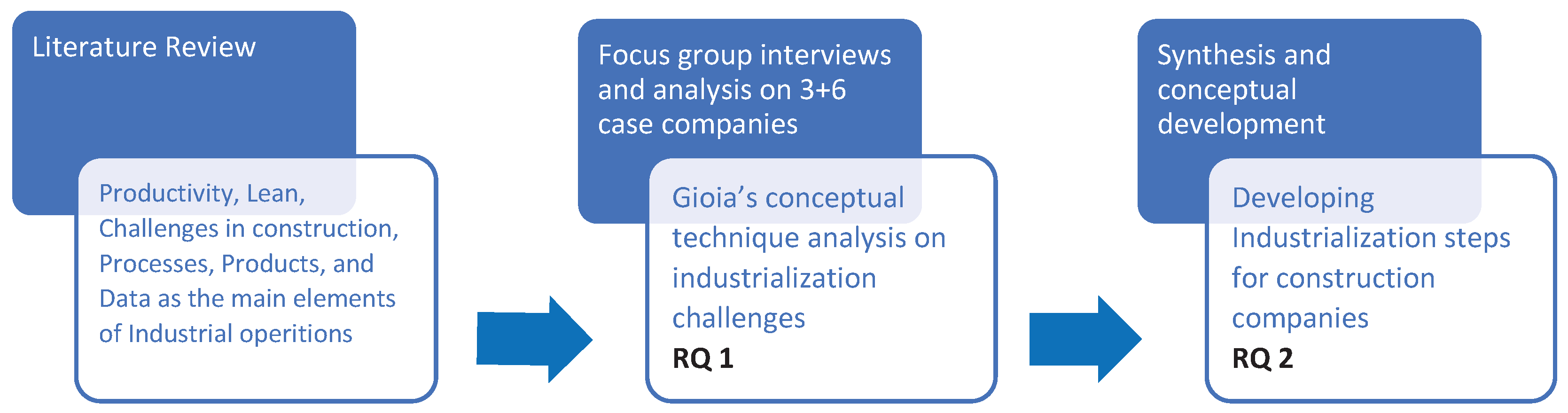
Figure 2.
Focus and key steps while working towards intensifying industrial operation in construction. Systematics to benefit industrialization and efficiency improvement.
Figure 2.
Focus and key steps while working towards intensifying industrial operation in construction. Systematics to benefit industrialization and efficiency improvement.
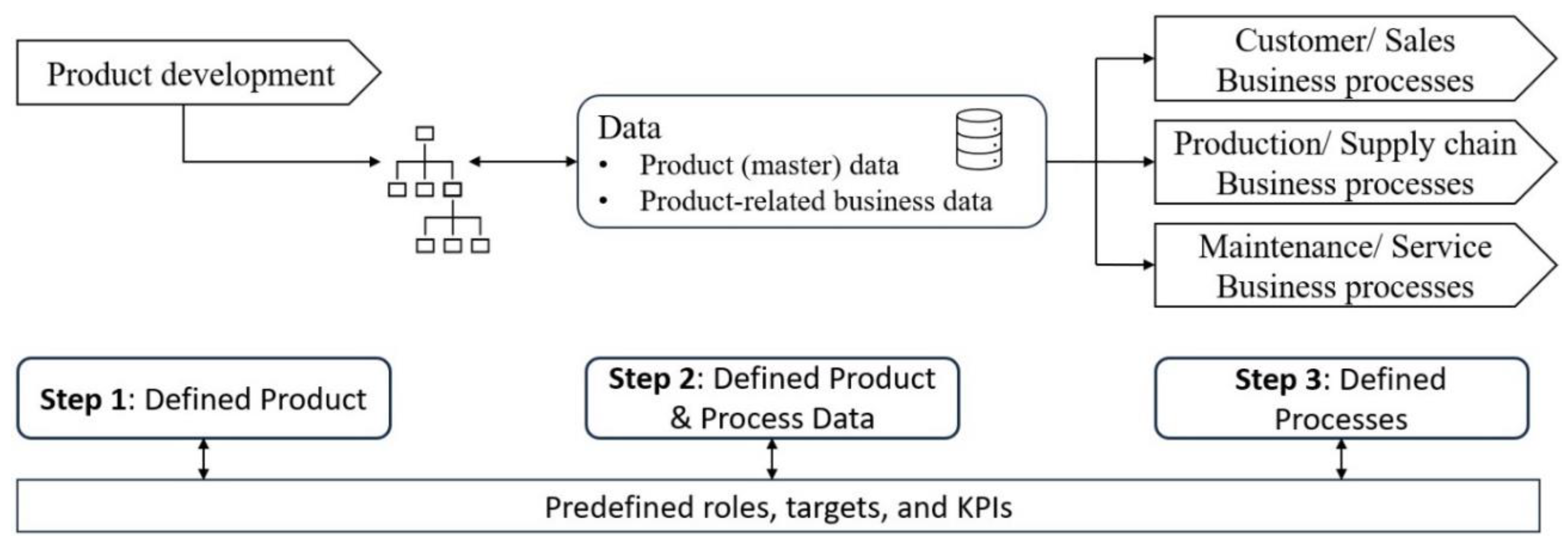

Table 1.
Details of case companies and interviewees.
| Company | Field of activity | Size of the company | No. of Interviewees | Role of Interviewees |
|---|---|---|---|---|
| I | Benchmarking company, Electronics manufacturing |
Large-sized business | 6 | VP, Business Development & Services Manager Engineering and After Sales Services Head of Digital Platform Master Data Management, Senior Manager Director, Design and Test Development Director of Information Technology |
| II | Benchmarking company, Engineering, manufacturing, and service company |
Large-sized business | 3 | Lean Operating Model Owner Enterprise Data Architect, PLM Head of Product Lifecycle Management |
| III | Benchmarking company, Engineering, manufacturing, and service company |
Large-sized business | 2 | Manager, Product Lifecycle Process Head of Data Governance & Master Data |
| IV | Construction Company, main contractor | Large-sized business | 3 | Building Systems Manager Chief Information Officer VDC & BIM Manager |
| V | Construction Company, main contractor | Large-sized business | 3 | Vice President, Digital Services and Innovation Vice President, R&D IT Manager |
| VI | Construction Company, main contractor | Large-sized business | 4 | Director of Investments and Risk Management Development Manager Senior Vice President, Customer ship and Living Services BIM Manager |
| VII | Construction Company, main contractor | Large-sized business | 2 | Chief executive officer Director of Development and Information Management |
| VIII | Construction Company, main contractor | Medium-sized businesses | 7 | Head of IT Business Analyst Development manager Development Engineer Construction project manager (x2) Cost Estimation Manager |
| IX | Construction Company, main contractor | Large-sized business | 2 | Developing manager IT Manager |
Table 2.
Industrialization challenges in construction companies.
| Findings in benchmark (manufacturing) companies | Findings in construction companies | Industrialization challenges in construction companies | |
|---|---|---|---|
| Product |
|
|
|
| Process |
|
|
|
| Data |
|
|
Disclaimer/Publisher’s Note: The statements, opinions and data contained in all publications are solely those of the individual author(s) and contributor(s) and not of MDPI and/or the editor(s). MDPI and/or the editor(s) disclaim responsibility for any injury to people or property resulting from any ideas, methods, instructions or products referred to in the content. |
© 2024 by the authors. Licensee MDPI, Basel, Switzerland. This article is an open access article distributed under the terms and conditions of the Creative Commons Attribution (CC BY) license (http://creativecommons.org/licenses/by/4.0/).
Copyright: This open access article is published under a Creative Commons CC BY 4.0 license, which permit the free download, distribution, and reuse, provided that the author and preprint are cited in any reuse.


