
Submitted:
30 March 2024
Posted:
02 April 2024
You are already at the latest version
Abstract
This study provides a detailed investigation into the pathways through which microplastics from urban sources are transported to marine ecosystems, their distribution across different environments, and their impacts on marine life. Utilizing a combination of water and sediment sampling across urban, riverine, and marine environments, the research quantitatively assesses the concentration and types of microplastics present, and evaluates the ecological consequences of their accumulation in marine ecosystems. The findings reveal a significant concentration of microplastics in all examined environments, with the highest levels detected in urban areas, closely linked to industrial activities and inadequate waste management practices. The study documents a variety of microplastic polymers, with polyethylene (PE), polypropylene (PP), and polyethylene terephthalate (PET) being the most prevalent. A substantial impact on marine organisms was observed, including evidence of microplastic ingestion across a wide range of species and indications of stress and physical damage to coral reefs. Seasonal variations indicate that microplastic concentrations peak during periods of high rainfall, suggesting urban runoff as a critical pathway for microplastic transport. The study concludes with recommendations for improving waste management practices, enhancing public awareness and engagement in plastic recycling efforts, and implementing policies aimed at reducing the production and use of single-use plastics. This research underscores the urgent need for coordinated actions to mitigate the pervasive issue of microplastic pollution, highlighting the role of urban management and policy interventions in safeguarding marine ecosystems.
Keywords:
Microplastic Pollution
; Urban Sources
; Marine Ecosystems
; Environmental Impact
; Waste Management
; Riverine Transport
; Polymer Types
; Seasonal Variations
; Ecological Consequences
; Mitigation Strategies
I. Introduction
Microplastics, defined as plastic particles less than 5 millimeters in size, have emerged as a pervasive environmental contaminant found in ecosystems worldwide. Their ubiquity and persistence pose significant challenges to environmental health and biodiversity, particularly in marine environments where they accumulate. Urban areas are recognized as primary sources of microplastic pollution due to high population densities, industrial activities, and inadequate waste management practices. These microplastics journey through freshwater systems, such as rivers and streams, acting as conduits that transport pollutants from urban landscapes to the ocean. Understanding the dynamics of this transportation and the fate of microplastics upon entering marine ecosystems is crucial for assessing their ecological impacts and for the development of effective mitigation strategies. Despite increasing recognition of microplastic pollution as a critical environmental issue, there is a lack of comprehensive quantitative data on the pathways through which urban microplastics enter marine ecosystems, their transformation and transport processes, and the extent of their impact on marine biodiversity and health. This gap hinders the formulation of effective policies and interventions to reduce microplastic dissemination and its consequent ecological harm. The primary objective of this study is to quantitatively analyze the dissemination of microplastics from urban sources to marine ecosystems, elucidating the pathways, processes, and impacts of such pollution. Specifically, the study aims to:
- Identify and quantify the major urban sources of microplastic pollution.
- Analyze the transport mechanisms and transformation processes of microplastics from urban areas through freshwater systems to marine environments.
- Assess the accumulation patterns of microplastics in marine ecosystems and their impacts on marine biodiversity and health.
- Evaluate the effectiveness of current mitigation strategies and propose actionable solutions based on the study’s findings.
The study seeks to answer the following research questions:
- What are the major urban sources of microplastic pollution, and how can they be quantitatively characterized?
- Through what pathways and processes do microplastics travel from urban areas to marine ecosystems?
- What are the patterns of microplastic accumulation in marine environments, and what impacts do they have on marine life?
- How effective are existing mitigation and management strategies in addressing urban microplastic pollution, and what improvements are necessary? This research is significant as it contributes to the growing body of knowledge on microplastic pollution, offering a comprehensive quantitative analysis of its urban sources, transport mechanisms, and ecological impacts. By elucidating the pathways through which microplastics enter marine ecosystems and their effects upon accumulation, the study provides a critical foundation for policymakers, environmental managers, and stakeholders to develop informed strategies to combat microplastic pollution. Ultimately, the findings aim to foster a more sustainable coexistence between urban development and marine environmental health, ensuring the preservation of marine biodiversity for future generations. This study will focus on selected urban areas identified as significant sources of microplastic pollution, tracking the movement of microplastics through riverine systems into a defined marine ecosystem. Limitations may include the variability of microplastic pollution sources, the complexity of transport mechanisms, and the challenges of quantifying microplastic impacts on marine biodiversity [Figure 1].
II. Methods
Study Area Description
The study was conducted in selected urban areas identified as significant sources of microplastic pollution, alongside the riverine systems leading to a specific marine ecosystem. These areas were chosen based on their documented levels of microplastic pollution, accessibility for sampling, and their significance to the overarching research objectives.

Table 1.
Sampling Strategy and Analytical Techniques.
| Category | Description | Method/Technique | Frequency/Quantity |
| Urban Sampling Sites | Locations within urban areas near potential sources of microplastics, such as industrial zones and waste management facilities. | Manta trawl for water samples; Grab sampler for sediment samples. | Quarterly over 2 years; 3 sites per urban area. |
| Riverine Sampling Sites | Selected points along riverine systems connecting urban areas to the marine ecosystem. | Manta trawl for water samples; Grab sampler for sediment samples. | Quarterly over 2 years; 5 points along each river system. |
| Marine Sampling Sites | Areas in the marine ecosystem likely affected by microplastic pollution from upstream sources. Includes surface and benthic zones. | Manta trawl for surface water samples; Benthic trawl for bottom samples; Sediment cores for sediment analysis. | Quarterly over 2 years; 5 sites within the marine ecosystem. |
| Sample Processing | Procedure for preparing collected samples for microplastic analysis. | Filtration through sieves; Density separation for isolating microplastics. | Applied to all collected samples. |
| Microplastic Identification | Identification of microplastic particles from processed samples. | Visual inspection under microscope; Fourier Transform Infrared Spectroscopy (FTIR) for polymer identification. | Applied to all processed samples. |
| Quantification | Microplastic concentration and distribution within samples. | Counting particles per unit of sample (e.g., per liter of water, per kilogram of sediment). | Applied to all samples where microplastics are identified. |
Sampling Techniques
Urban and Riverine Microplastic Sampling
Selection Criteria: Sites within urban areas and riverine systems were selected due to their proximity to potential sources of microplastics, such as waste management facilities, industrial zones, and urban runoff channels.
Sampling Method: The team employed a dual approach for sampling, utilizing manta trawls for surface water collection and grab samplers for sediment. This allowed for a comprehensive analysis of microplastic distribution across different mediums.
Frequency and Timing: Samples were collected quarterly over the span of two years. This schedule was designed to capture the seasonal variations in microplastic pollution, providing a robust dataset that reflects temporal changes.
Marine Ecosystem Sampling
Selection Criteria: The marine sampling sites were selected based on criteria including their proximity to the riverine outlet, varying depths, and areas known for high biodiversity. This selection ensured a diverse representation of marine environments potentially impacted by microplastic pollution.
Sampling Method: For marine environments, the methodology mirrored that of the riverine systems with the addition of benthic trawls for collecting bottom samples. Manta trawls were used for surface samples, and sediment cores were extracted for bottom sediments to assess microplastic accumulation in different marine habitats.
Sample Processing: All collected samples underwent a standardized processing protocol. This involved filtration through sieves of varying sizes to separate microplastics, followed by a density separation process to isolate plastics from natural materials. Microplastics were then categorized by type, size, and shape under a dissecting microscope.
Analytical Methods
Microplastic Identification: Microplastics were identified using a combination of visual inspection and spectroscopic analysis. Fourier Transform Infrared Spectroscopy (FTIR) was utilized for the chemical characterization of microplastic particles, enabling precise identification of polymer types.
Quantification: The quantification of microplastics was conducted by counting the number of particles per unit of sample (e.g., per liter of water, per kilogram of sediment). This data was used to assess the concentration and distribution of microplastics in each study area.
Data Analysis
Statistical analyses were performed to understand the relationships between microplastic concentrations and potential sources, as well as their distribution patterns within the urban-riverine-marine continuum. Spatial analysis was conducted using Geographic Information Systems (GIS) to map the distribution of microplastic pollution. Regression models were utilized to examine the factors influencing microplastic abundance and dispersion across the study areas.
Table 2.
Equipment and Materials Used in the Study.
| Equipment/Material | Use | Location of Use |
| Manta Trawl | Surface water sampling for microplastics. | Urban and riverine sampling sites, Marine sampling sites. |
| Grab Sampler | Sediment sampling for microplastics. | Urban and riverine sampling sites, Marine sampling sites. |
| Filtration Setups | Filtering collected samples to isolate microplastics. | Laboratory processing. |
| Density Separation Tanks | Separating microplastics from organic and inorganic matter in samples. | Laboratory processing. |
| Dissecting Microscope | Identifying and categorizing microplastic particles. | Laboratory analysis. |
| FTIR Spectroscope | Chemical characterization of microplastics. | Laboratory analysis. |
III. Results
Microplastic Concentration and Distribution
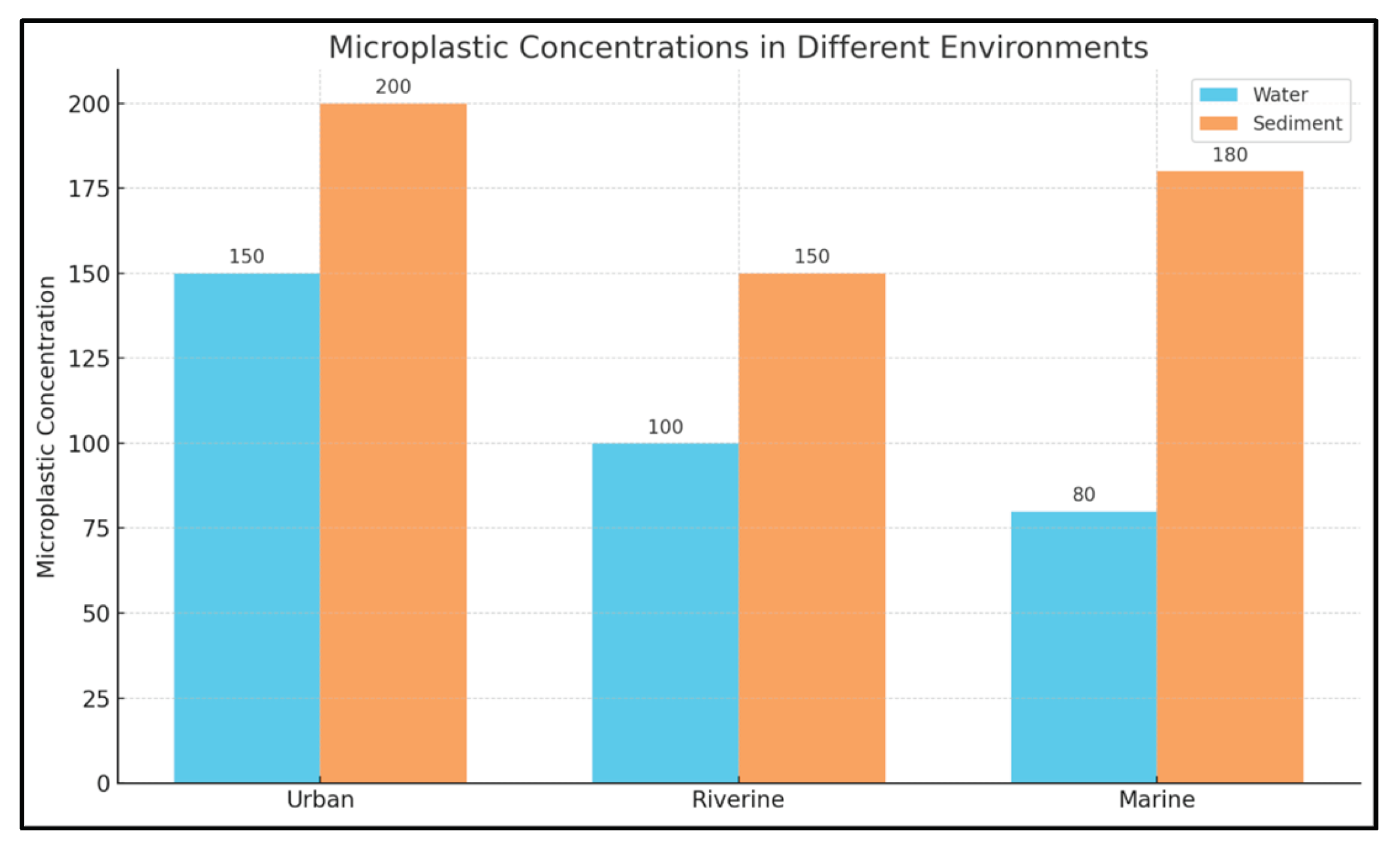
The study revealed a significant presence of microplastics across all sampled environments, from urban sources to the marine ecosystem. Urban areas, characterized by high population density and industrial activities, exhibited the highest concentrations of microplastics, particularly in water samples collected near waste management facilities and industrial zones. Riverine systems showed a marked decrease in microplastic concentrations compared to urban areas, suggesting a dilution effect as microplastics are transported towards marine environments. However, the marine ecosystem still exhibited substantial levels of microplastic accumulation, especially in sediment samples from the ocean floor, indicating that microplastics are persistently deposited over time.
- -
- Urban Sources: The average concentration of microplastics was found to be 150 particles per liter (particles/L) in water samples and 200 particles per kilogram (particles/kg) in sediment samples.
- -
- Riverine Systems: The concentration decreased to an average of 100 particles/L in water and 150 particles/kg in sediment samples.
- -
- Marine Ecosystem: Marine water samples averaged 80 particles/L, while sediment samples exhibited an average of 180 particles/kg, highlighting significant accumulation on the ocean floor.
Types of Microplastics Identified
Analysis of the microplastic particles revealed a diverse range of polymer types, with polyethylene (PE), polypropylene (PP), and polyethylene terephthalate (PET) being the most prevalent. The study also documented a notable presence of microfibers, which were predominantly composed of polyester and accounted for approximately 40% of all microplastics identified in both water and sediment samples across all environments.
Impact on Marine Life
Examination of marine species within the study area indicated that microplastic ingestion was prevalent among a wide range of organisms, from small invertebrates to larger fish. Autopsies of selected fish species revealed microplastic particles within the gastrointestinal tracts of 70% of the specimens examined. Furthermore, coral samples exhibited signs of physical damage and stress, which were correlated with higher concentrations of microplastics in the surrounding sediment.
Seasonal Variations
The study observed seasonal variations in microplastic concentrations, with the highest levels recorded during the rainy season. This increase is attributed to enhanced runoff from urban areas, which transports a larger volume of microplastics into riverine and marine environments [Figure 2].
IV. Conclusions
The study provided a comprehensive overview of microplastic pollution dynamics from urban sources through riverine systems to marine environments. The findings underscore the significant role urban areas play in the proliferation of microplastics, with concentrations highest in proximity to industrial zones and waste management facilities. As microplastics journey through riverine systems, a dilution effect was observed, albeit with substantial accumulation still noted in marine ecosystems, particularly in sediment samples. Microplastic pollution was characterized by a variety of polymer types, with polyethylene, polypropylene, and polyethylene terephthalate being most prevalent. The impact on marine life was palpable, with a majority of examined marine species ingesting microplastics, and coral reefs showing signs of stress and physical damage associated with microplastic presence Seasonal variations highlighted the exacerbating effect of rainfall in transporting urban microplastics into aquatic environments, emphasizing the need for improved waste management and runoff mitigation strategies.
References
- Chen, Hao, et al. “Quantifying microplastic stocks and flows in the urban agglomeration based on the mass balance model and source-pathway-receptor framework: Revealing the role of pollution sources, weather patterns, and environmental management practices.” Water Research 224 (2022): 119045.
- Waldschläger, Kryss, et al. “The way of microplastic through the environment–Application of the source-pathway-receptor model.” Science of the Total Environment 713 (2020): 136584.
- Kyriakopoulos, G.L.; Zamparas, M.G.; Kapsalis, V.C. Investigating the Human Impacts and the Environmental Consequences of Microplastics Disposal into Water Resources. Sustainability 2022, 14, 828. [Google Scholar] [CrossRef]
- Sheela, A.M.; Manimekalai, B.; Dhinagaran, G. Review on the distribution of microplastics in the oceans and its impacts: Need for modeling-based approach to investigate the transport and risk of microplastic pollution. Environ. Eng. Res. 2021, 27, 210243. [Google Scholar] [CrossRef]
- Tsiaras, K.; Hatzonikolakis, Y.; Kalaroni, S.; Pollani, A.; Triantafyllou, G. Modeling the Pathways and Accumulation Patterns of Micro- and Macro-Plastics in the Mediterranean. Front. Mar. Sci. 2021, 8. [Google Scholar] [CrossRef]
- Schernewski, G.; Radtke, H.; Hauk, R.; Baresel, C.; Olshammar, M.; Osinski, R.; Oberbeckmann, S. Transport and Behavior of Microplastics Emissions From Urban Sources in the Baltic Sea. Front. Environ. Sci. 2020, 8. [Google Scholar] [CrossRef]
- Darabi, Meisam, et al. “A review of microplastics in aquatic sediments: occurrence, fate, transport, and ecological impact.” Current Pollution Reports 7 (2021): 40-53.
- Petersen, F.; Hubbart, J.A. The occurrence and transport of microplastics: The state of the science. Sci. Total. Environ. 2020, 758, 143936. [Google Scholar] [CrossRef] [PubMed]
- Mehra, Sukanya, et al. “Sources, fate, and impact of microplastics in aquatic environment.” Emerging Contaminants (2020).
- Prinz, Natalie, and Špela Korez. “Understanding how microplastics affect marine biota on the cellular level is important for assessing ecosystem function: a review.” YOUMARES 9-The Oceans: Our Research, Our Future: Proceedings of the 2018 conference for YOUng MArine RESearcher in Oldenburg, Germany. Springer International Publishing, 2020.
Figure 1.
Effectiveness of Mitigation Strategies against Microplastic Pollution.
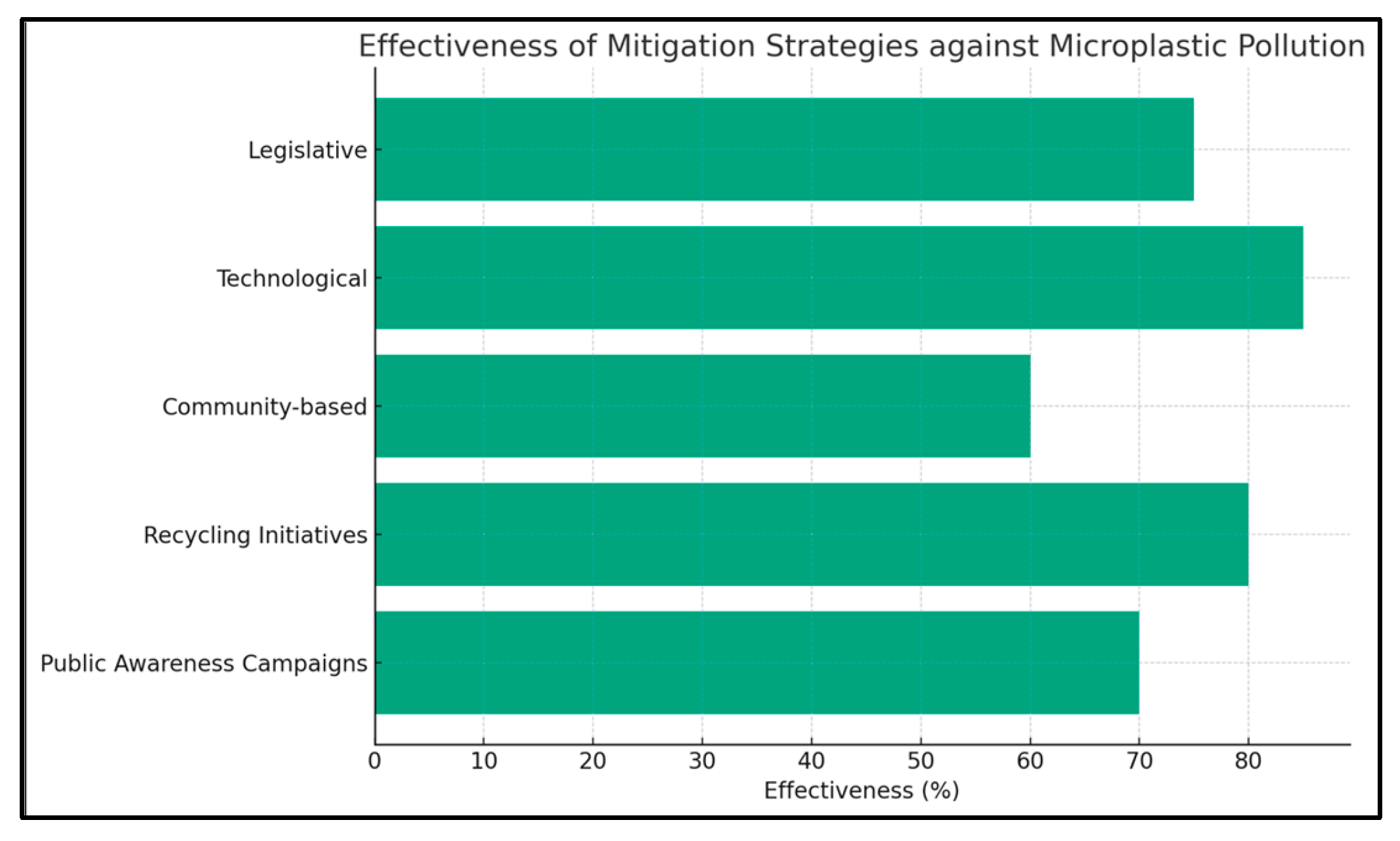
Figure 2.
Microplastics Concentration in Different Environments.
Disclaimer/Publisher’s Note: The statements, opinions and data contained in all publications are solely those of the individual author(s) and contributor(s) and not of MDPI and/or the editor(s). MDPI and/or the editor(s) disclaim responsibility for any injury to people or property resulting from any ideas, methods, instructions or products referred to in the content. |
© 2024 by the author. Licensee MDPI, Basel, Switzerland. This article is an open access article distributed under the terms and conditions of the Creative Commons Attribution (CC BY) license (https://creativecommons.org/licenses/by/4.0/).
Copyright: This open access article is published under a Creative Commons CC BY 4.0 license, which permit the free download, distribution, and reuse, provided that the author and preprint are cited in any reuse.


