

Submitted:
28 March 2024
Posted:
29 March 2024
You are already at the latest version
Abstract
In this work, we explore new constraints on phantom scalar field cosmologies with a scalar field employing early times catalogues related to CMB measurements, along with the local standard observables, like Supernovae Type Ia (SNIa), H(z) measurements (Cosmic Clocks), and Baryon Acoustic Oscillations (BAO) baselines. In particular, we studied a tracker phantom field with hyperbolic polar coordinates that have been proposed in the literature. The main goal is to obtain precise cosmological constraints for H0 and σ8, in comparison to other constructions that present tension in early cosmological parameters. Our results show that phantom scalar field cosmologies have a reduced statistical tension on H0 that it is less than 3σ using model-independent CMB catalogues as SPT-3G+WMAP9 and ACTPol DR-4+WMAP9 baselines. This suggests these models using a different phantom potential might address the Hubble constant problem and reduce the systematics involved.
Keywords:
dark energy
; precision cosmology
; cosmological parameters
; Hubble tension
1. Introduction
One of the first observational evidence of the late-time cosmic acceleration was shown through measurements of Type Ia Supernovae (SNIa) [1,2]. Subsequently, more observables confirmed these results, e.g. the Cosmic Microwave Background (CMB) [3], Baryon Acoustic Oscillations (BAO) [4,5], and weak gravitational lensing [6]. Moreover, the capability of SNIa’s to prove the cosmic acceleration is based on the facts that these objects are bright enough to be seen at large redshift and in large quantities with a precision of mag in brightness [7]. However, these observables have considerably been minimised by their associated statistical errors and the uncertainties in estimating cosmological parameters [8,9].
Furthermore, through the CMB temperature and polarization anisotropy observations we have been capable of setting a strong confirmation of the standard so-called -Cold Dark Matter (CDM) model associated with the structure formation. This model has the advantage of explaining with quite precision of other observations at different redshift ranges and also explaining the effects of the cosmic acceleration through the so-called dark energy (DE). However, with the increase in surveys and their experimental sensitivity, significant cosmological statistical tensions have been raised and related to certain discrepancies that could be due to systematic errors or modifications (or extensions) to the standard CDM model per se. While the persisting tensions of the CMB bring to discuss issues associated with with cosmic shear data [10], different from zero (flat cosmology) [11] and internal anomaly [12], the Hubble constant with local measurements, [13] is the most statistically significant tension at more than ∼4. In such case, CMB cosmological constraints, in specific, Planck constraints [14], can be obtained in a model-dependent way through the assumption of the CDM model, i.e. if we change the assumption, the constraints will change. These tensions have reached a level of statistical significance that understanding their physics is of importance for precision cosmology. However, if these issues are not related to systematics, they could represent a crisis for the CDM model, and their observational confirmation could bring a change in our current conceptions of the evolution and structure of the universe. Along with these ideas, several proposals and studies from theoretical and systematic points of view have been developed in the last years [15], and references therein. However, none of them have reached a fully solved foreground yet. This guides us to explore other schemes that could shed some light on the cosmological tensions, in particular on and tensions.
From the survey point of view, at local scales, several missions have been working to find better cosmological constraints adjoint with better systematics and increasing data baselines. Some of them as large-scale structure (LSS) observations with measurements from the Dark Energy Survey (DES) [16], the Dark Energy Spectroscopic Instrument (DESI) [17], the Legacy Survey of Space and Time (LSST) on the Vera Rubin Observatory [18], and Euclid [19], among others, have extended the concordance cosmological model to include EoS parameters of dark energy with some shifts within 1. At early scales, missions such as Planck 2018 [20], ACTPol DR-4 [21], and SPT-3G [22], have been working with CMB polarisations regarding in the likelihood precision measurements.
On this line of thought, an interesting path to study both the nature of dark energy and relax (even solve) cosmological tensions, has been to consider directly: (i) a negative Equation–of–State (EoS) constant value [23,24,25]. (ii) A dynamical EoS [26,27,28]. (iii) A dark energy component associated with extra terms obtained from first principles in alternative theories of gravity [29,30,31] and, (iv) a dark energy foreground in extended theories of gravity [32] and references therein, which shows a good promise to obtain a late cosmic acceleration. On the second classification, scalar fields with kinetic terms and potentials are considered as candidates to explain the dynamics of dark energy, e.g quintessence [33,34], K-essence, etc. However, these examples suffer from theoretical issues where values of are not allowed, this is the so-called phantom limit. To achieve a viable evolution for dark energy, we can propose phantom models [35,36,37], which denote the dynamics of . This kind of behaviour has been studied in the literature. For instance, using CMB, BAO and SNeIa data, it was found that the EoS of dark energy shows a phantom phase at low redshift [38]. Also, using Machine Learning techniques, phantom dark energy is preferred over a cosmological constant [39]. These features could be a good landscape to address the tension. Some effort on this scheme has proposed a statistical analysis of an inverse power law quintessence model constrained by Dark Energy Task Force simulated baseline [40], cosmological constraints on quintom tracker solutions using SNIa, BAO and the compressed Planck likelihood [41,42,43], which brings high correlations with the CDM model due the early times baselines calibrated with it. Some successful scenarios include a large class of quintessence models that experiment with an early dark energy phase [44], a model that has been proposed as a solution to the Hubble tension.
Since these approaches include early time baselines that are calibrated with the standard cosmological model, CDM, in this work we incorporate three CMB baselines that are model-independent and allow us to obtain in phantom scalar field cosmologies a reduced statistical tension on less is than 3 for the SPT3G+WMAP9 and ACTPol+WMAP9 baselines.
This work is divided as follows: In Section 2 we summarise the reconstruction of tracker quintessence cosmologies background and the most promising scenarios available to relax the tension. All of these cases are described through their Friedmann evolution equations. Furthermore, we are going to consider the standard CDM model in addition to these reconstructions. In Section 3 we present the statistical methodology employed for the baseline datasets mentioned. We divided our analysis into baseline (low-z) local observations and a high-z observables. Our results on new constraints and cosmological tensions discussions are presented in Section 4. Finally, our conclusions are given in Section 5.
2. Phantom Scalar Field Cosmology Background
Phantom scalar field dark energy models are described by an EoS that satisfies [45]. Even though the current observational data have shown a good agreement with the standard cosmological model plus a cosmological constant, some of these observational baselines suggest the presence of a phantom divide boundary, i.e. dynamical dark energy proposals. This aspect could be a signature of dynamical dark energy that can be well constrained by observational data, however, denotes a big challenge in precision cosmology. Furthermore, these models have introduced scalar fields to explore the dynamics of evolving dark energy through this phantom divided line, having issues like fine-tuning. Within this scheme, tracker scenarios have been considered [46,47] where the scalar field controls the energy density and reproduces attractor background solutions, which can be constrained with local observations. In this work, we will study the parameterisations proposed in [48,49] and in particular, the phantom scalar field dark energy model proposed in [50]. Considering several CMB baselines, we will verify if this model can solve (or relax) the tension. We will employ model-independent CMB experiments, and for comparison, we include Planck 2018 constraints [20] since this baseline is calibrated with the standard CDM model.
To incorporate a phantom scalar field term, we start with a gravitational action given by
where R is the Ricci scalar, is the scalar field Lagrangian (for a phantom scalar field, it is given by where is the potential of the scalar field) and is the matter Lagrangian. We will work in a flat Friedman-Lemaître-Robertson-Walker (FLRW) metric. By varying the action (1) with respect to the FLRW metric and to the scalar field and setting it to zero, we obtain the following Friedmann equations
and the Klein-Gordon equation for the scalar field given by
where and p are the density and pressure of the matter species, and the density and pressure of the scalar field . The density and pressure of the phantom scalar field are given by
and as we can see, these fields give rise to an equation of state . In this framework, it is customary to consider a new set of hyperbolic polar coordinates which ease the numerical computations [50]
which enables us to rewrite the Klein-Gordon equation (5) as
where the prime denotes the derivative with respect to conformal time. Also, , is the total EoS including the matter species and the scalar field density and pressure. Notice that in this set of variables we need to specify the function which is equivalent to specifying the potential . Moreover, by using the definitions of scalar field density and pressure (6), we obtain
Then, is the density parameter for the phantom scalar field. On the other hand, the EoS of this field is given by . The remaining part to solve the differential equations is to determine . A parameterisation can be considered [48,49]
where y is given by Eq. (7) and are free parameters of the phantom field. This form of allows us to consider a wide variety of potentials like thawing and freezing potentials [49] depending on the values of the free parameters .
However, even with this proposal, it was found that this kind of phantom model does not address the Hubble constant problem when considering a compressed Planck likelihood. This analysis gave a Hubble value of km/s/Mpc [50], which is in a C.L. tension with the latest result from the SH0ES collaboration [51]. In this work, we will reconstruct the constraints using the full Planck [20] likelihood. Furthermore, we will compare this constraint with the ones using model-independent CMB baselines. Within the baselines under consideration we have the ACTPol DR-4 [21], the SPT-3G [22] and the WMAP9 [52] datasets. This will determine whether a phantom scalar field model like this can predict a larger late-time expansion of the universe than CDM.
3. Methodology
To solve the above equations, we used our modified version of the Boltzmann code CLASS 1 [53], interfaced to the sampling code MontePython 2 [54,55]. One common core of the code is the initial conditions to perform the integrals, which were suggested in [50]. Following this suggestion, we considered the following initial conditions for
where the sub-index 0 means at present time. are the matter, radiation and phantom scalar field density parameters at the current time. is the scale factor at which CLASS starts the integration. We select by default. However, an important difference in our numerical code adaption is that we did not include the presence of a cosmological constant . Thus, we are letting the phantom scalar field drive the cosmic late-time accelerated expansion. Furthermore, A is a tuning parameter which varies until we satisfy the closure relation . We are considering a universe filled with matter, radiation and a phantom scalar field.
3.1. Observational Baselines
Our study is based on constraining the full tracker phantom model using two kinds of baseline: late-time and early-time surveys. According to this division, we can consider the following:
-
Late-time baselines:
- Supernovae Type Ia (SNIa) Pantheon: We use the 1048 data points provided by the Pantheon [56]. This baseline measure the apparent distance for several SNIa events in . Furthermore, this catalog provides SN magnitudes corrected for the stretch and colour effects along with the maximum brightness, the mass of the host galaxy, and sky position bias. To compute a cosmological useful quantity we can calculate the distance modulus , where M is the absolute magnitude that is considered a fixed value for our analyses. Furthermore, the for the Pantheon sample iswhere is the total covariance matrix for the data, S is the sum of all components of the inverse of the matrix and , using . Also, the distance modulus can be compute using the expression:and where is the luminosity distance given as:where c is the speed of light and is the Hubble parameter.
- Cosmic clocks (CC): This sample offers a good tool to constrain the Hubble rate at different z. To this end, the final catalog considered comes from the differential age method [57]. In particular, we consider the cosmic clocks 2016 catalog [58]. The CC method consists in using spectroscopic dating techniques on passively-evolving galaxies to compute the age difference between two galaxies at different z. By measuring this age difference, we can be compute . For our MCMC analysis, we compute to compare the agreement between the theoretical Hubble parameter values , with model parameters , and the observational Hubble data values , with an observational error of . Therefore, the is calculated using the following expression:
-
Baryon Acoustic Oscillations (BAO): In this work, we include measurements of the Hubble parameter and the corresponding comoving angular diameter at , which were obtained from the third generation of the SDSS mission (SDSS BOSS DR12) [59]. For this BAO baseline we compute the Hubble distance given by . We also use the angular diameter distance given bywhere the first is the comoving angular diameter distance given trough , and the second one is the volume average-distance given byAfterwards, we calculate the corresponding combination of results . For this, we require the comoving sound horizon at the end of the baryon drag epoch at [14] which can be calculated throughwhere we have considered a fiducial value of [14] with an assumption of [14] and . The corresponding is given bywhere and is the corresponding covariance matrix for the BAO observations.
-
Early-time baselines:
- Planck 2018: For this CMB observations, we took the high-ℓ TTTEE, low-ℓ EE, low-ℓ TT, and lensing likelihoods [20]. Furthermore, polarization and temperature TT-TE-EE baselines were used at high multipole likelihood Plik and at low multipoles TT-EE for .
- ACTPol DR-4: This is the third CMB catalog considered coming from the Data Release 4 measured by the Atacama Telescope (ACT) Collaboration [21]. To use this catalog along with MontePython, we utilised the pyactlike python package devised by the ACT Collaboration 3. This likelihood also includes a Gaussian prior on .
To sample the cosmological parameters of our tracker models, we consider three different baselines for the catalogues described:
- Planck 2018+BAO+Pantheon+Cosmic clocks,
- SPT-3G+WMAP9+BAO+Pantheon+Cosmic clocks,
- ACTPol DR-4+WMAP9+BAO+Pantheon+Cosmic clocks.
As we can notice, we included BAO, Pantheon and Cosmic clocks in our three combinations. In addition to this, we varied the CMB catalogues. Planck data was included in the first combination but not in the other ones to have two Planck-independent combinations to see if this improves or changes the convergence of the scalar field and cosmological free parameters with particular emphasis on the Hubble parameter at , .
4. Cosmological Tensions Analysis
We ran Monte Carlo Markov Chain (MCMC) methods to constrain the cosmological parameters. Furthermore, we repeated this analysis for both the tracker scalar field and the CDM model, to compare their performances. Moreover, we checked whether the tracker models reduced the tension compared to the last result from the SH0ES collaboration [51]. For a statistical comparison between models, we computed the Hubble tension with
We sampled the cosmological parameters using the Metropolis-Hastings method and used Gelman-Rubin’s convergence criterion [61].
We sampled over the free parameters , the free scalar field parameters , the nuisance parameters of the experiments considered and the derived parameters , . For the scalar field parameters, we consider uniform prior probabilities . These ranges were also considered to study tracker scalar field models [50]. Moreover, these priors also simplify the shooting CLASS method to compute the value of the derived parameter [50], and they are also consistent with the expected values of the potentials reported in [49].
We present the mean values along with the C.L. uncertainties of the cosmological parameters for the phantom scalar field model and CDM model in Table 1 and Table 2, respectively. We reported the results for the three baselines that we are considering: Planck 2018+BAO+Pantheon+Cosmic clocks, STP-3G+WMAP9+BAO+Pantheon+Cosmic clocks and ACTPol DR-4+WMAP9+BAO+Pantheon+Cosmic clocks. We also computed the tension between the Hubble constant derived from the MCMC and the latest SH0ES value of [51]. In Figure 1 and Figure 2 we show the confidence contours at and for the cosmological parameters and the phantom scalar field and CDM, respectively.
As we can see, the three phantom scalar field parameters did not converge well for the compressed Planck 2028 baseline. However, the confidence contours show that they tend to have high values. For the remaining baselines, the parameter is well constrained. However, the other two have high values as in the case of the Planck baseline. The rest of the cosmological parameters show good convergence. From the CMB catalogues considered in this work, Planck has the heavier baseline. Thus, we expect its confidence contours to be the smallest. We can see in Figure 1 and Figure 2 that this is indeed the case.
When considering the phantom scalar field, the Hubble tension gets reduced for the three baselines. However, for the Planck+Late baseline, it is still higher than C.L. Note that this is different from the result from [50] where they obtained using a compressed Planck likelihood. However, in our results, by using the full Planck likelihood alongside late-time data, we notice that these phantom dark energy models do not address the Hubble tension. However, the tension was reduced considerably for the remaining baselines that did not include Planck. Furthermore, it is interesting that the tension got below the C.L. This shows that tracker phantom scalar field dark energy models can reduce the Hubble constant tension for CMB baselines that do not include the Planck likelihood. For these kinds of models, , which can produce a larger late-time expansion of the universe and thus, a higher value of [62]. However, this particular model cannot fully solve the problem since its tension is higher than C.L.
To visualize these results, we present Figure 3. We included the results of the Hubble constant for the phantom scalar field (abbreviated SF) and CDM for the three baselines considered. We also included the result from [50] of this model by using a compressed Planck likelihood. Finally, we include the mean values and uncertainties at for Planck 2018 [20] and SH0ES 2022 [51]. As we can see, CDM is consistent with Planck 2018 for the three baselines and it is in tension with SH0ES 2022. On the other hand, the phantom scalar field gets a higher value of that departs from the CDM value but does not get high enough to be fully consistent with SH0ES 2022. However, other phantom scalar field models might be consistent with a higher by choosing a different parameterisation of or a different potential.
5. Conclusions
In this work, we studied new early constraints on tracker phantom scalar field cosmologies, in particular, some solutions regarding the proposal discussed in [50]. We focused on the case where the late-time accelerated expansion of the universe is solely caused by a scalar field without the assistance of a cosmological constant. We employed early-time catalogues regarding CMB measurements and a full late-time catalog which includes SNIa, cosmic clocks and BAO observables. For these models, the EoS of the scalar field gives , which enables a larger cosmic late-time expansion and then a possibly higher value of .
We considered three model-independent CMB catalogues: WMAP9, SPT-3G and ACTPol DR-4, alongside late-time catalogues. Our methodology in this part consisted of constraining the tracker phantom scalar field using three different baselines: Planck+Late, STP-3G+WMAP9+Late, and ACTPol+WMAP9+Late. To compare our analysis, we computed the constraints with CDM as a baseline model. The free parameters of the scalar field, named from Eq. 13 did not fully converge for the Planck 2018 baseline. For the remaining baselines, did not obtain a full convergence. However, they show a good performance for the case of . The remaining cosmological parameters of the model showed good convergence for all the baselines and both the scalar field and CDM models.
We were particularly interested in the constraints on the Hubble constant to study its statistical tension. For the Planck 2018 catalogue, the scalar field model shows a tension higher than C.L. when compared with the latest result from the SH0ES collaboration [51]. This result differs from the one reported in [50], where a study was made using a compressed Planck likelihood. However, for the remaining baselines (SPT-3G+WMAP9+Late and ACTPol+WMAP9+Late), the tension was reduced under C.L, without altering the value. Our results show that phantom scalar field models can reduce the constant tension when considering CMB model-independent baselines. However, it is important to mention that this particular model cannot completely solve the tension issue since the tension is not lower than . We expect that new definitions in (7), could lower the statistical tension at early times, e.g. from the ones reported in [63]. This aspect will be reported elsewhere.
Author Contributions
Conceptualization, Celia Escamilla-Rivera; Formal analysis, José Antonio Nájera and Celia Escamilla-Rivera; Investigation, José Antonio Nájera and Celia Escamilla-Rivera; Methodology, José Antonio Nájera and Celia Escamilla-Rivera; Resources, Celia Escamilla-Rivera; Software, José Antonio Nájera; Supervision, Celia Escamilla-Rivera; Validation, José Antonio Nájera and Celia Escamilla-Rivera; Visualization, José Antonio Nájera; Writing – original draft, José Antonio Nájera and Celia Escamilla-Rivera; Writing – review & editing, José Antonio Nájera and Celia Escamilla-Rivera.
Funding
This research has been carried out using computational facilities procured through the Cosmostatistics National Group ICN UNAM project. CE-R acknowledges the Royal Astronomical Society as FRAS 10147. JAN acknowledges financial support from the “Excellence Project Scholarship” funded by the Physics and Astronomy Department of the University of Padova. This article is based upon work from COST Action CA21136 Addressing observational tensions in cosmology with systematics and fundamental physics (CosmoVerse) supported by COST (European Cooperation in Science and Technology).
Conflicts of Interest
The Authors declare no conflicts of interest.
Abbreviations
The following abbreviations are used in this manuscript:
| CDM | Lambda cold dark matter |
References
- Perlmutter, S.; et al. Measurements of Ω and Λ from 42 high redshift supernovae. Astrophys. J. 1999, 517, 565–586. [Google Scholar] [CrossRef]
- Riess, A.G.; et al. Observational evidence from supernovae for an accelerating universe and a cosmological constant. Astron. J. 1998, 116, 1009–1038. [Google Scholar] [CrossRef]
- Jaffe, A.H.; et al. Cosmology from MAXIMA-1, BOOMERANG and COBE / DMR CMB observations. Phys. Rev. Lett. 2001, 86, 3475–3479. [Google Scholar] [CrossRef] [PubMed]
- Eisenstein, D.J.; et al. Detection of the Baryon Acoustic Peak in the Large-Scale Correlation Function of SDSS Luminous Red Galaxies. Astrophys. J. 2005, 633, 560–574. [Google Scholar] [CrossRef]
- Anderson, L.; et al. The clustering of galaxies in the SDSS-III Baryon Oscillation Spectroscopic Survey: baryon acoustic oscillations in the Data Releases 10 and 11 Galaxy samples. Mon. Not. Roy. Astron. Soc. 2014, arXiv:astro-ph.CO/1312.4877]441, 24–62. [Google Scholar] [CrossRef]
- Abbott, T.M.C.; et al. Dark Energy Survey year 1 results: Cosmological constraints from galaxy clustering and weak lensing. Phys. Rev. D 2018, arXiv:astro-ph.CO/1708.01530]98, 043526. [Google Scholar] [CrossRef]
- Brout, D.; et al. The Pantheon+ Analysis: Cosmological Constraints. Astrophys. J. 2022, arXiv:astro-ph.CO/2202.04077]938, 110. [Google Scholar] [CrossRef]
- Scolnic, D.; et al. The Next Generation of Cosmological Measurements with Type Ia Supernovae 2019. arXiv:astro-ph.CO/1903.05128].
- Lu, J.; Wang, L.; Chen, X.; Rubin, D.; Perlmutter, S.; Baade, D.; Mould, J.; Vinko, J.; Regos, E.; Koekemoer, A.M. Constraints on Cosmological Parameters with a Sample of Type Ia Supernovae from JWST. Astrophys. J. 2022, arXiv:astro-ph.CO/2210.00746]941, 71. [Google Scholar] [CrossRef]
- Di Valentino, E.; et al. Cosmology Intertwined III: fσ8 and S8. Astropart. Phys. 2021, arXiv:astro-ph.CO/2008.11285]131, 102604. [Google Scholar] [CrossRef]
- Di Valentino, E.; Melchiorri, A.; Silk, J. Planck evidence for a closed Universe and a possible crisis for cosmology. Nature Astron. 2019, arXiv:astro-ph.CO/1911.02087]4, 196–203. [Google Scholar] [CrossRef]
- Di Valentino, E.; et al. Snowmass2021 - Letter of interest cosmology intertwined IV: The age of the universe and its curvature. Astropart. Phys. 2021, arXiv:astro-ph.CO/2008.11286]131, 102607. [Google Scholar] [CrossRef]
- Di Valentino, E.; et al. Snowmass2021 - Letter of interest cosmology intertwined II: The hubble constant tension. Astropart. Phys. 2021, arXiv:astro-ph.CO/2008.11284]131, 102605. [Google Scholar] [CrossRef]
- Aghanim, N.; et al. Planck 2018 results. VI. Cosmological parameters. Astron. Astrophys. 2020, arXiv:astro-ph.CO/1807.06209]. [Erratum: Astron.Astrophys641, A6. [Google Scholar] [CrossRef]
- Abdalla, E.; et al. Cosmology intertwined: A review of the particle physics, astrophysics, and cosmology associated with the cosmological tensions and anomalies. JHEAp 2022, arXiv:astro-ph.CO/2203.06142]34, 49–211. [Google Scholar] [CrossRef]
- Abbott, T.; et al. The Dark Energy Survey: more than dark energy – an overview. Mon. Not. Roy. Astron. Soc. 2016, arXiv:astro-ph.CO/1601.00329]460, 1270–1299. [Google Scholar] [CrossRef]
- Aghamousa, A.; et al. The DESI Experiment Part I: Science,Targeting, and Survey Design 2016. arXiv:astro-ph.IM/1611.00036].
- Mandelbaum, R.; et al. The LSST Dark Energy Science Collaboration (DESC) Science Requirements Document 2018. arXiv:astro-ph.CO/1809.01669].
- Amendola, L.; et al. Cosmology and fundamental physics with the Euclid satellite. Living Rev. Rel. 2018, arXiv:astro-ph.CO/1606.00180]21, 2. [Google Scholar] [CrossRef]
- Aghanim, N.; Akrami, Y.; Ashdown, M.; Aumont, J.; Baccigalupi, C.; Ballardini, M.; Banday, A.; Barreiro, R.; Bartolo, N.; Basak, S.; et al. Planck 2018 results-VI. Cosmological parameters. Astronomy & Astrophysics 2020, 641, A6. [Google Scholar]
- Aiola, S.; Calabrese, E.; Maurin, L.; Naess, S.; Schmitt, B.L.; Abitbol, M.H.; Addison, G.E.; Ade, P.A.; Alonso, D.; Amiri, M.; et al. The Atacama Cosmology Telescope: DR4 maps and cosmological parameters. Journal of Cosmology and Astroparticle Physics 2020, 2020, 047. [Google Scholar] [CrossRef]
- Dutcher, D.; Balkenhol, L.; Ade, P.; Ahmed, Z.; Anderes, E.; Anderson, A.; Archipley, M.; Avva, J.; Aylor, K.; Barry, P.; et al. Measurements of the E-mode polarization and temperature-E-mode correlation of the CMB from SPT-3G 2018 data. Physical Review D 2021, 104, 022003. [Google Scholar] [CrossRef]
- Escamilla-Rivera, C.; Capozziello, S. Unveiling cosmography from the dark energy equation of state. Int. J. Mod. Phys. D 2019, arXiv:gr-qc/1905.04602]28, 1950154. [Google Scholar] [CrossRef]
- Escamilla-Rivera, C. Status on bidimensional dark energy parameterizations using SNe Ia JLA and BAO datasets. Galaxies 2016, arXiv:astro-ph.CO/1605.02702]4, 8. [Google Scholar] [CrossRef]
- Escamilla, L.A.; Giarè, W.; Di Valentino, E.; Nunes, R.C.; Vagnozzi, S. The state of the dark energy equation of state circa 2023 2023. arXiv:astro-ph.CO/2307.14802].
- Escamilla-Rivera, C.; Nájera, A. Dynamical dark energy models in the light of gravitational-wave transient catalogues. JCAP 2022, arXiv:gr-qc/2103.02097]03, 060. [Google Scholar] [CrossRef]
- Escamilla-Rivera, C.; Quintero, M.A.C.; Capozziello, S. A deep learning approach to cosmological dark energy models. JCAP 2020, arXiv:astro-ph.CO/1910.02788]03, 008. [Google Scholar] [CrossRef]
- Zhang, H.C. Dynamical dark energy can amplify the expansion rate of the Universe. Phys. Rev. D 2023, arXiv:gr-qc/2305.16586]107, 103529. [Google Scholar] [CrossRef]
- Jaime, L.G.; Jaber, M.; Escamilla-Rivera, C. New parametrized equation of state for dark energy surveys. Phys. Rev. D 2018, arXiv:astro-ph.CO/1804.04284]98, 083530. [Google Scholar] [CrossRef]
- Clifton, T.; Ferreira, P.G.; Padilla, A.; Skordis, C. Modified Gravity and Cosmology. Phys. Rept. 2012, arXiv:astro-ph.CO/1106.2476]513, 1–189. [Google Scholar] [CrossRef]
- Amendola, L.; Gannouji, R.; Polarski, D.; Tsujikawa, S. Conditions for the cosmological viability of f(R) dark energy models. Phys. Rev. D 2007, 75, 083504. [Google Scholar] [CrossRef]
- Bahamonde, S.; Dialektopoulos, K.F.; Escamilla-Rivera, C.; Farrugia, G.; Gakis, V.; Hendry, M.; Hohmann, M.; Levi Said, J.; Mifsud, J.; Di Valentino, E. Teleparallel gravity: from theory to cosmology. Rept. Prog. Phys. 2023, arXiv:gr-qc/2106.13793]86, 026901. [Google Scholar] [CrossRef] [PubMed]
- de Ritis, R.; Marino, A.A.; Rubano, C.; Scudellaro, P. Quintessence duality. Int. J. Mod. Phys. D 2001, 10, 921–926. [Google Scholar] [CrossRef]
- Alho, A.; Uggla, C.; Wainwright, J. Tracking Quintessence. Phys. Dark Univ. 2024, arXiv:gr-qc/2311.16775]44, 101433. [Google Scholar] [CrossRef]
- Cai, Y.F.; Saridakis, E.N.; Setare, M.R.; Xia, J.Q. Quintom cosmology: theoretical implications and observations. Physics Reports 2010, 493, 1–60. [Google Scholar] [CrossRef]
- Setare, M.; Saridakis, E. Coupled oscillators as models of quintom dark energy. Physics Letters B 2008, 668, 177–181. [Google Scholar] [CrossRef]
- Bamba, K.; Capozziello, S.; Nojiri, S.; Odintsov, S.D. Dark energy cosmology: the equivalent description via different theoretical models and cosmography tests. Astrophysics and Space Science 2012, 342, 155–228. [Google Scholar] [CrossRef]
- Teng, Y.P.; Lee, W.; Ng, K.W. Constraining the dark-energy equation of state with cosmological data. Physical Review D 2021, 104, 083519. [Google Scholar] [CrossRef]
- Gangopadhyay, M.R.; Sami, M.; Sharma, M.K. Phantom dark energy as a natural selection of evolutionary processes a la genetic algorithm and cosmological tensions. Physical Review D 2023, 108, 103526. [Google Scholar] [CrossRef]
- Yashar, M.; Bozek, B.; Abrahamse, A.; Albrecht, A.; Barnard, M. Exploring Parameter Constraints on Quintessential Dark Energy: the Inverse Power Law Model. Phys. Rev. D 2009, arXiv:astro-ph/0811.2253]79, 103004. [Google Scholar] [CrossRef]
- Ureña López, L.A.; Roy, N. Generalized tracker quintessence models for dark energy. Phys. Rev. D 2020, arXiv:astro-ph.CO/2007.08873]102, 063510. [Google Scholar] [CrossRef]
- Roy, N.; Ureña López, L.A. Tracker behaviour of quintom dark energy and the Hubble tension 2023. arXiv:astro-ph.CO/2312.04003].
- Adil, A.; Albrecht, A.; Knox, L. Quintessential cosmological tensions. Phys. Rev. D 2023, arXiv:astro-ph.CO/2207.10235]107, 063521. [Google Scholar] [CrossRef]
- Copeland, E.J.; Moss, A.; Sevillano Muñoz, S.; White, J.M.M. Scaling solutions as Early Dark Energy resolutions to the Hubble tension 2023. arXiv:astro-ph.CO/2309.15295].
- Caldwell, R.R. A phantom menace? Cosmological consequences of a dark energy component with super-negative equation of state. Physics Letters B 2002, 545, 23–29. [Google Scholar] [CrossRef]
- Ratra, B.; Peebles, P.J. Cosmological consequences of a rolling homogeneous scalar field. Physical Review D 1988, 37, 3406. [Google Scholar] [CrossRef]
- Steinhardt, P.J.; Wang, L.; Zlatev, I. Cosmological tracking solutions. Physical Review D 1999, 59, 123504. [Google Scholar] [CrossRef]
- Ureña-López, L.A.; Roy, N. Generalized tracker quintessence models for dark energy. Physical Review D 2020, 102, 063510. [Google Scholar] [CrossRef]
- Roy, N.; Gonzalez-Morales, A.X.; Ureña-López, L.A. New general parametrization of quintessence fields and its observational constraints. Physical Review D 2018, 98, 063530. [Google Scholar] [CrossRef]
- Cedeño, F.X.L.; Roy, N.; Ureña-López, L.A. Tracker phantom field and a cosmological constant: dynamics of a composite dark energy model. Physical Review D 2021, 104, 123502. [Google Scholar] [CrossRef]
- Riess, A.G.; Yuan, W.; Macri, L.M.; Scolnic, D.; Brout, D.; Casertano, S.; Jones, D.O.; Murakami, Y.; Anand, G.S.; Breuval, L.; et al. A Comprehensive Measurement of the Local Value of the Hubble Constant with 1 km s- 1 Mpc- 1 Uncertainty from the Hubble Space Telescope and the SH0ES Team. The Astrophysical Journal Letters 2022, 934, L7. [Google Scholar] [CrossRef]
- Hinshaw, G.; Larson, D.; Komatsu, E.; Spergel, D.N.; Bennett, C.; Dunkley, J.; Nolta, M.; Halpern, M.; Hill, R.; Odegard, N.; et al. Nine-year Wilkinson Microwave Anisotropy Probe (WMAP) observations: cosmological parameter results. The Astrophysical Journal Supplement Series 2013, 208, 19. [Google Scholar] [CrossRef]
- Blas, D.; Lesgourgues, J.; Tram, T. The cosmic linear anisotropy solving system (CLASS). Part II: approximation schemes. Journal of Cosmology and Astroparticle Physics 2011, 2011, 034. [Google Scholar] [CrossRef]
- Audren, B.; Lesgourgues, J.; Benabed, K.; Prunet, S. Conservative constraints on early cosmology with MONTE PYTHON. Journal of Cosmology and Astroparticle Physics 2013, 2013, 001. [Google Scholar] [CrossRef]
- Brinckmann, T.; Lesgourgues, J. MontePython 3: boosted MCMC sampler and other features. Physics of the Dark Universe 2019, 24, 100260. [Google Scholar] [CrossRef]
- Scolnic, D.M.; Jones, D.; Rest, A.; Pan, Y.; Chornock, R.; Foley, R.; Huber, M.; Kessler, R.; Narayan, G.; Riess, A.; et al. The complete light-curve sample of spectroscopically confirmed SNe Ia from Pan-STARRS1 and cosmological constraints from the combined pantheon sample. The Astrophysical Journal 2018, 859, 101. [Google Scholar] [CrossRef]
- Jimenez, R.; Loeb, A. Constraining cosmological parameters based on relative galaxy ages. The Astrophysical Journal 2002, 573, 37. [Google Scholar] [CrossRef]
- Moresco, M.; Pozzetti, L.; Cimatti, A.; Jimenez, R.; Maraston, C.; Verde, L.; Thomas, D.; Citro, A.; Tojeiro, R.; Wilkinson, D. A 6% measurement of the Hubble parameter at z 0.45: direct evidence of the epoch of cosmic re-acceleration. Journal of Cosmology and Astroparticle Physics 2016, 2016, 014. [Google Scholar] [CrossRef]
- Alam, S.; Ata, M.; Bailey, S.; Beutler, F.; Bizyaev, D.; Blazek, J.A.; Bolton, A.S.; Brownstein, J.R.; Burden, A.; Chuang, C.H.; et al. The clustering of galaxies in the completed SDSS-III Baryon Oscillation Spectroscopic Survey: cosmological analysis of the DR12 galaxy sample. Monthly Notices of the Royal Astronomical Society 2017, 470, 2617–2652. [Google Scholar] [CrossRef]
- Chudaykin, A.; Gorbunov, D.; Nedelko, N. Exploring Λ CDM extensions with SPT-3G and Planck data: 4σ evidence for neutrino masses, full resolution of the Hubble crisis by dark energy with phantom crossing, and all that. arXiv preprint arXiv:2203.03666, arXiv:2203.03666 2022.
- Gelman, A.; Rubin, D.B. Inference from iterative simulation using multiple sequences. Statistical science.
- Sharma, M.K.; Pacif, S.K.J.; Yergaliyeva, G.; Yesmakhanova, K. The Oscillatory Universe, phantom crossing and the Hubble tension. Annals of Physics 2023, 454, 169345. [Google Scholar] [CrossRef]
- Cai, Y.F.; Saridakis, E.N.; Setare, M.R.; Xia, J.Q. Quintom Cosmology: Theoretical implications and observations. Phys. Rept. 2010, arXiv:hep-th/0909.2776]493, 1–60. [Google Scholar] [CrossRef]
| 1 | |
| 2 | |
| 3 | |
| 4 |
Figure 1.
and confidence contours for the phantom scalar field cosmological parameters. We present the results for our three baselines: Planck 2018+BAO+Pantheon+Cosmic clocks, SPT-3G+WMAP9+BAO+Pantheon+Cosmic clocks, and ACTPol DR-4+WMAP9+BAO+Pantheon+Cosmic clocks.
Figure 1.
and confidence contours for the phantom scalar field cosmological parameters. We present the results for our three baselines: Planck 2018+BAO+Pantheon+Cosmic clocks, SPT-3G+WMAP9+BAO+Pantheon+Cosmic clocks, and ACTPol DR-4+WMAP9+BAO+Pantheon+Cosmic clocks.
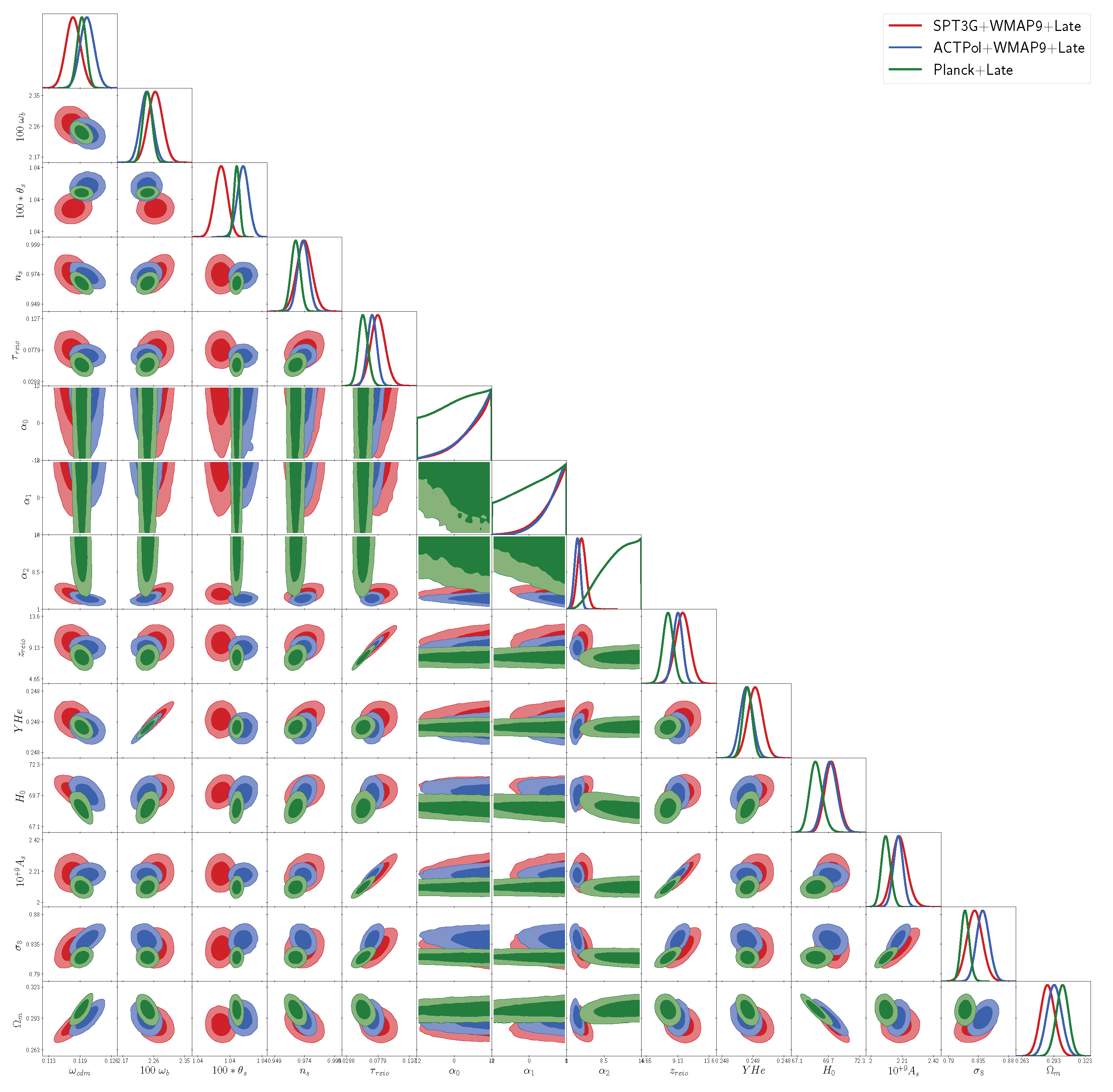
Figure 2.
and confidence contours for the CDM cosmological parameters. We present the results for the same baselines as for the phantom scalar field.
Figure 2.
and confidence contours for the CDM cosmological parameters. We present the results for the same baselines as for the phantom scalar field.
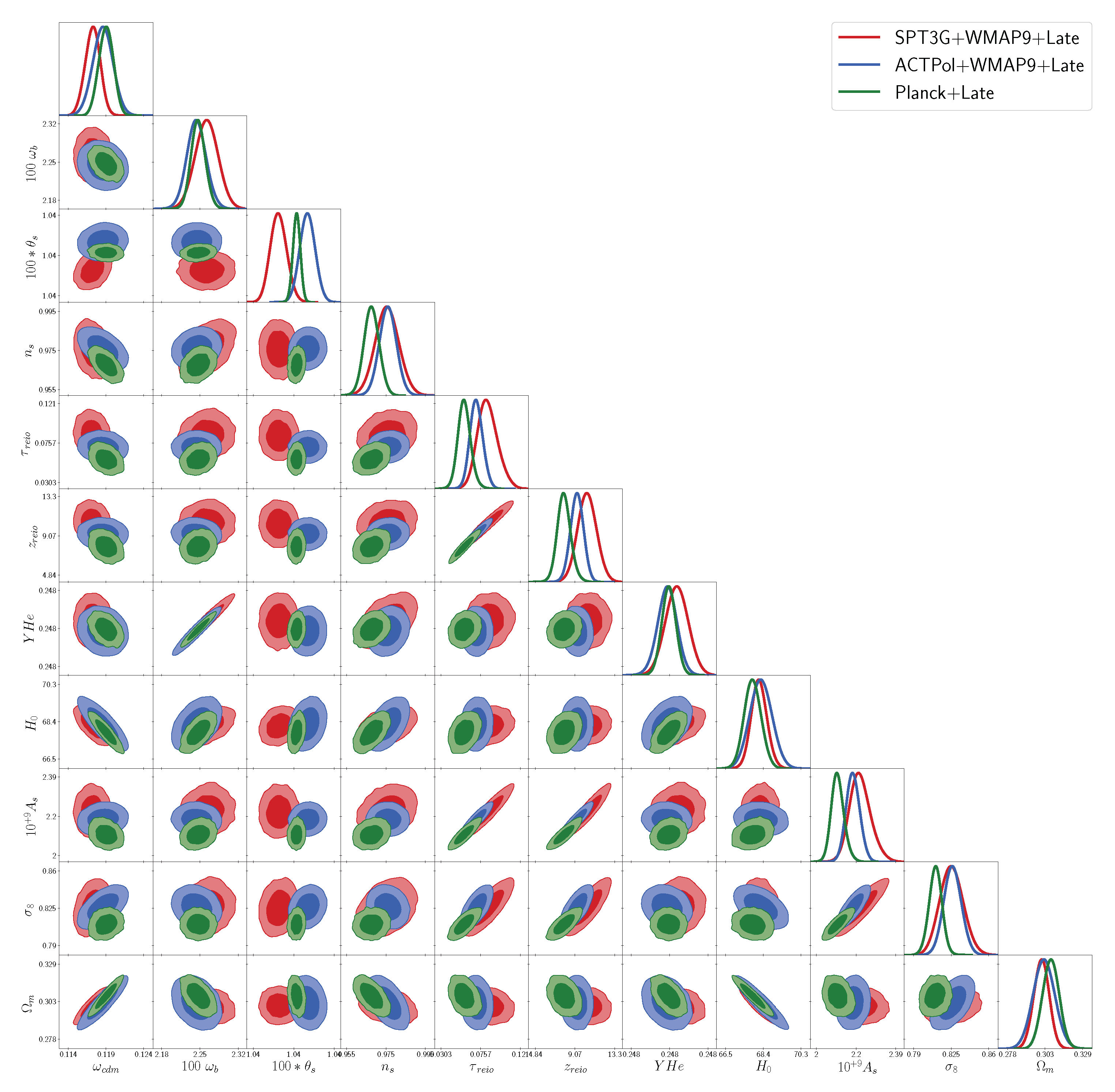
Figure 3.
Whisker plot with the mean values and uncertainties at C.L. for the phantom scalar field (abbreviated as SF) and the CDM models and the three baselines described. We also included the mean value and uncertainty at C.L. from the latest results from SH0ES collaboration [51] and Planck 2018 [20] to study the Hubble tension. A result from [50] was added for comparison.
Figure 3.
Whisker plot with the mean values and uncertainties at C.L. for the phantom scalar field (abbreviated as SF) and the CDM models and the three baselines described. We also included the mean value and uncertainty at C.L. from the latest results from SH0ES collaboration [51] and Planck 2018 [20] to study the Hubble tension. A result from [50] was added for comparison.
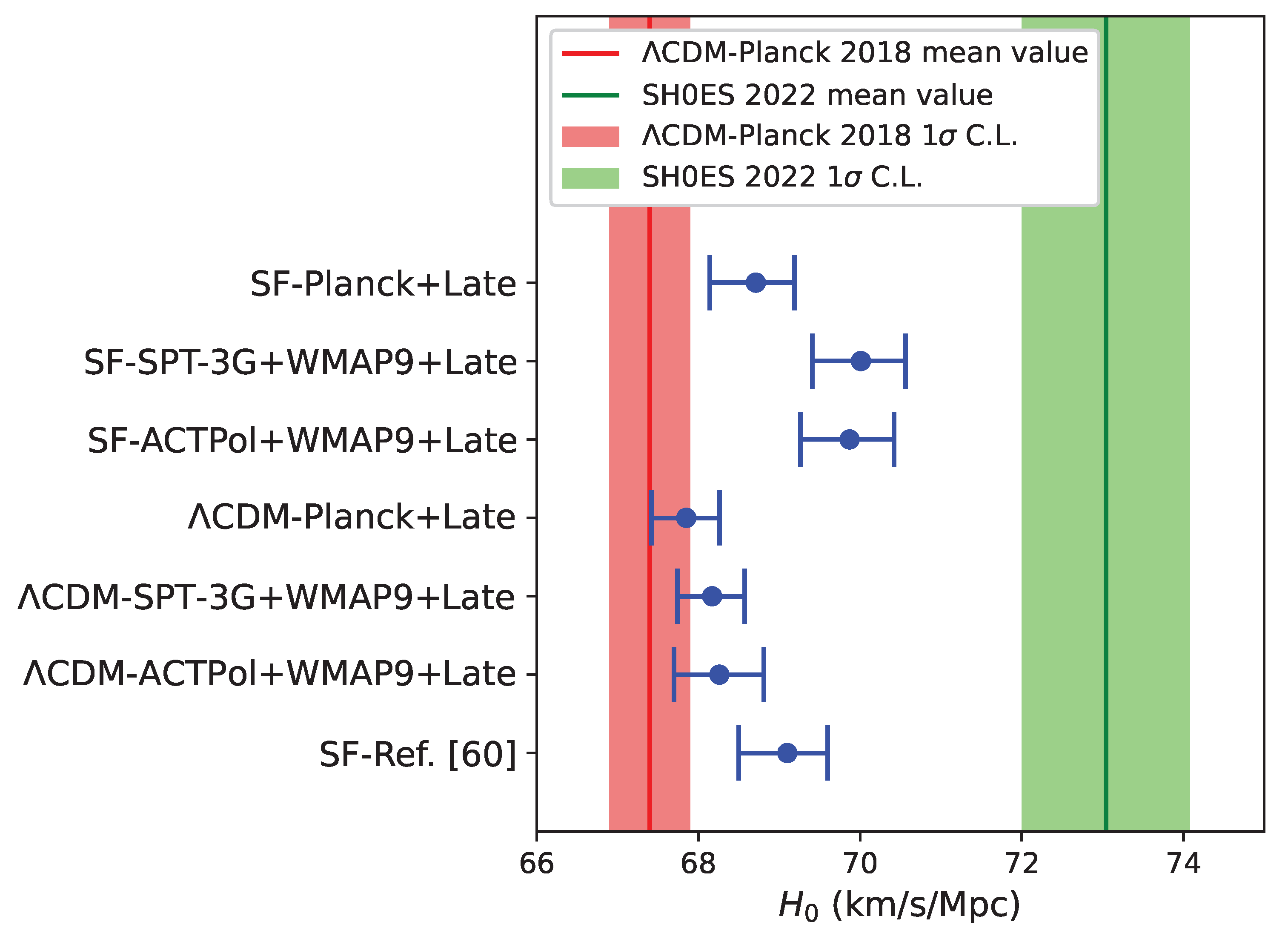

Table 1.
Mean values and uncertainties at C.L. for the phantom scalar field parameters. Notice that we included as a derived parameter instead of the traditional . We present the results for our three baselines for comparison between different CMB catalogues: Planck 2018+BAO+Pantheon+Cosmic clocks, SPT-3G+WMAP9+BAO+Pantheon+Cosmic clocks, and ACTPol DR-4+WMAP9+BAO+Pantheon+Cosmic clocks. We abbreviate the late-time catalogues (BAO+Pantheon+Cosmic clocks) as Late.
Table 1.
Mean values and uncertainties at C.L. for the phantom scalar field parameters. Notice that we included as a derived parameter instead of the traditional . We present the results for our three baselines for comparison between different CMB catalogues: Planck 2018+BAO+Pantheon+Cosmic clocks, SPT-3G+WMAP9+BAO+Pantheon+Cosmic clocks, and ACTPol DR-4+WMAP9+BAO+Pantheon+Cosmic clocks. We abbreviate the late-time catalogues (BAO+Pantheon+Cosmic clocks) as Late.
| Parameter | Planck 2018+Late | SPT-3G+WMAP9+Late | ACTPol DR-4+WMAP9+Late |
|---|---|---|---|
| 4.01 | 2.80 | 2.92 |
Table 2.
Mean values and uncertainties at C.L. for the CDM cosmological parameters. Notice that we include as a derived parameter instead of the traditional . We present the results for the same baselines as for the phantom scalar field for comparison.
Table 2.
Mean values and uncertainties at C.L. for the CDM cosmological parameters. Notice that we include as a derived parameter instead of the traditional . We present the results for the same baselines as for the phantom scalar field for comparison.
| Parameter | Planck 2018+Late | SPT-3G+WMAP9+Late | ACTPol DR-4+WMAP9+Late |
|---|---|---|---|
| 4.87 | 4.60 | 4.28 |
Disclaimer/Publisher’s Note: The statements, opinions and data contained in all publications are solely those of the individual author(s) and contributor(s) and not of MDPI and/or the editor(s). MDPI and/or the editor(s) disclaim responsibility for any injury to people or property resulting from any ideas, methods, instructions or products referred to in the content. |
© 2024 by the authors. Licensee MDPI, Basel, Switzerland. This article is an open access article distributed under the terms and conditions of the Creative Commons Attribution (CC BY) license (http://creativecommons.org/licenses/by/4.0/).
Copyright: This open access article is published under a Creative Commons CC BY 4.0 license, which permit the free download, distribution, and reuse, provided that the author and preprint are cited in any reuse.


