

Submitted:
26 March 2024
Posted:
29 March 2024
You are already at the latest version
Abstract
In the light of almost a century of struggle to make (common) sense of Quantum Mechanics and to reconcile it with General Relativity, it is proposed to (for some time) forget about quantizing gravity or striving for one Theory of Everything or “Weltformel”, which would describe the whole of reality without any joints or suture marks. Instead of one single monolithic formalism, a three-legged compound approach is argued for. Quantum Mechanics, Relativity and Thermodynamics are proposed as the main pillars of reality, each with its well-defined realm, specific features, and clearly marked interfaces between the three of them. Not only classical reality, which is rather directly accessible to us, is then comprehensively modelled by their encompassing combination. Quantum phenomena are understood as undoubtedly lying at the bottom of classical physics and at the same time, they become “fully real” only when embedded in classical frames between preparation and measurement in time. It is then where thermodynamics steps in and provides the mediating glue. The aim of this short contribution is not to deliver novel quantitative results but rather to propose a comprehensive research program and to coarsely lay out a very roughly coherent self-referential sketch starting from the beginning of the one universe, which we inhabit.
Keywords:
arrow of time
; timelessness
; entropy
; emergence
; braided universe
; self-reflecting and -consistent
Introduction
Arguments about how to understand and interpret Quantum Mechanics are as old as the first conceptualizations of the mathematical framework itself. Special and General Relativity, although markedly distinct from everyday direct human experience, appear somewhat easier to grasp. Given the paramount success of each theory in its field of application, the very best minds have toiled for more than 100 years to somehow reconcile quantum mechanics with relativity, alas hitherto without resounding success. Thermodynamics in its essence is more an abstract and, in a sense, eternal mathematical theory. According to the frequently cited assessment by Albert Einstein, thermodynamics uniquely constitutes one foundation of our understanding of the world, which will within the framework of the applicability of its basic concepts not be overthrown by new findings.
Here, it is humbly suggested to take a big step back and assume a very wide perspective for a fresh look, keeping for a start to a very coarse and superficial level while exploring what a rather sketchy but overarching picture comprising quantum mechanics, classical physics, relativity, and thermodynamics could look like. With more or less obvious paths leading to no breakthrough in unifying our currently best understanding of the universe, some apparently outlandish inspirations seem appropriate. In line with a recent account of cognition, it shall be tried to sketch a big schematic picture before details are worked out in necessary subsequent steps [1]. There is no doubt that at the end well-matching quantitative accounts are required. It should just be avoided that these (the difficulties finding them) block or blur an overall view and thus hamper progress from the onset.
Timeless Quantum World
From the very beginning of quantum physics, Niels Bohr emphasized the importance of the involved classical experimental apparatus. Quantum effects always are described and observed in a context in the real world [2]. On the coarsest “outside” level, the relevant context is classical; it frames free and undisturbed quantum states at a beginning event as well as at an endpoint. The latter ones we are usually well aware of when we record and report them. Definite measurements yield irreversible classical results, but any quantum state also needs some preparation harnessing classical boundary conditions [3,4]. Our everyday world is profoundly classical, and we know of (“weird”) quantum phenomena only from more detached constellations and deliberately arranged experiments. Exotic behaviors of quantum systems like entanglement and superposition of states are very fragile and occur almost exclusively in carefully controlled closed set-ups and for limited time intervals, well-shielded from any disturbing influence from an outside environment [5]. Inside, quantum theory does not distinguish between prediction and postdiction, the Born rule applies equally well in both directions of time [4].
Interfaces between quantum and classical phenomena are marked with time stamps, i.e., some type of classical memory. This need not be a record set in stone, fleeting traces suffice e.g. [6]. After some while, probably nothing more than a minute increase in overall entropy is left while some free energy has been consumed. Importantly, at every irreversible transition (like erasure, i.e., when the input state cannot be fully recovered from an output state) there is a concomitant change, i.e., increment, in entropy in some environment outside of the narrow (quantum) system under investigation [7,8,9].
It has been proposed that a clear Heisenberg cut could be identified with an increase of entropy and the associated transfer of energy (or another conserved quantity) between the investigated system and its environment according to Landauer’s principle [10]:
ΔE ≥ kT ln2
Unitary quantum systems inside their classical demarcations could then be conceptualized as “timeless” [10]. This condition provides all the internal opportunities for the exploration of each and every development, which is permitted by the boundary conditions, in parallel. All available options are taken into account as with Richard Feynman´s path integrals [11]. As long as nothing irreversible occurs, all possible states will somehow potentially/ghostly co-“exist” inside an isolated QM system according to the Schrödinger equation “at the same no-time”, with their respective probabilities for being observed given by the Born rule.
The Hamiltonian operator, corresponding to the total energy of a system, is firmly rooted in the classical reality, and it generates the time evolution of quantum states in the Schrödinger picture, in fact by defining boundary condition varying with respect to laboratory-time. For observables, speed limits apply [12]. Quantum systems are thus tightly tied to laboratory “standard” time during unitary evolution, while enjoying all the freedom also in their phasing such that only statistical predictions are possible before a (collapsing) measurement. In case external classical boundary conditions vary in time, the last version (defined by the Hamiltonian and by the associated classical time stamp) is decisive. Unintended disturbances interrupt the unitary evolution the same as for any static system as soon as enough energy is transferred / entropy produced.
Upon the collapse of the wavefunction, linearity and unitarity are broken, one classical outcome is materialized depending on the overall set-up, the apparatus; e.g., wave- or particle-behavior is observed [13]. This holds for single individual cases ideally. The picture is more complicated when unavoidable fluctuations are taken into account but Landauer´s principle is also valid then [9].
With multiple systems / repetitions statistics can be compiled, and in an intricate set-up a quantitative complementarity relation for wave-particle behaviors has been measured [14]. It is hypothesized that weak measurements employing an ancilla disturb / collapse the system of interest only partly and for each data point effectively transfer just a tiny amount of entropy / energy; no sudden collapse ensues but entropy will accumulate gradually. A trade-off between information gain, reversibility, and disturbance has been demonstrated for quantum measurements employing ensembles [15]. The more information is extracted, the more a state is disturbed or the less recoverable it is, this all for a constant space frame. There is a minimum amount of entropy production required for obtaining information about work done to a quantum system driven far from equilibrium [16]. Entropic uncertainty relations can be shown to be equivalent to wave-particle duality [17].
Contextuality denotes the fact that measurements of quantum observables can in no case be simply thought of as revealing pre-existing values [18,19]. Results depend on which other observables are measured together in a sequence. Projective measurements are not commutative; they in turn yield (new) classical results and constraints, their order matters. Surplus weirdness can be avoided when carefully keeping to the respectively applicable contexts [10,20,21].
Normally, we do not exactly know the complete frame. A single photon without a heralding companion does not tell whether or how there exist(s) any entangled state(s).
It is not so immediately clear that at the start of an (internally) timeless phase a similar discrete event has to happen for properly conditionalizing an thereafter isolated individual quantum system. The necessity of carefully preparing a quantum state has been described by Niels Bohr, Willis Eugene Lamb, John Archibald Wheeler, Andrei Khrennikov, and many others. Given that quantum theory is time-symmetric, it only seems natural that the beginning and the end of an isolated quantum system are considered equivalent. Current conceptualizations of Bell measurements emphasize their contextuality-aspects [22,23,24]. Experiments with photons from a distant star or quasar might raise some doubt but light quanta have not been detected as arriving in earmarked entangled pairs; such “fossile” light can effectively be used as a random generator for closing the freedom-of-choice loophole in Bell experiments [25].
Clocks in the Real World
The classical frames of quantum systems with their start- and end-points can, depending on the available details, be ordered in at least one way to form consistent histories. Time thus starts out locally and discrete. Events with their records have been described as creating empirical (space-)time before [26,27].
Not only collapse-events, but, of course, also interactions in the classical domain with energy transfer (and entropy production) generate timestamps and records. With the sheer number of related and partly overlapping and also nested / embedded systems following the same laws and producing records, which allows for qualified synchronization; practically smooth and continuous time emerges. Employing a model of a relaxation process, time can be shown to appear as a coarse-grained parameter in the statistics of measurements of events very similar to temperature [28].
Any clock produces entropy, and clocks need energy, the better they are, the more. The laws of thermodynamics dictate a trade-off between the amount of heat dissipated (entropy produced) on the one hand side and the accuracy and resolution on the other [29,30,31].
Boundary conditions are given by relativity; time stamps are relative in a context and they are local. The dependence of outcomes on the order of such events establishes one direction of time (in a context/history), which cannot simply be reversed. This is ascribed to the entropy generated when establishing the records. These traces together with the mechanism generating them effectively constitute clocks, which cannot exist as such inside an isolated timeless quantum system. Any clock needs something which changes, either periodically or as in some form of relaxation. The expansion of the universe is a special and most important example of the latter because all other clocks are one way or the other anchored to that universal reference [32].
The well-known Page Wootters mechanism for supplying clocks to a quantum system involves a second system, in which memories/records are conserved (effectively classical in disguise) [33]. Even disregarding a full collapse, energy cannot be measured arbitrarily fast by an external system, and the evolution observed by an internal clock cannot be unitary during an energy measurement regardless whether an internal or an external system carries out the measurement [34].
In general, quantum measurements cannot be performed instantaneously in decoherence-based interpretations either; the time required scales with the change of entropy of the measured system [35]. There are speed limits on observables both classically and for quantum systems [12]. Also in the light of what has been shown for (continuous) position, it is seems natural to state that time principally cannot be measured to arbitrary precision [36]. Measurements have a minimum energy cost, infinitively exact measurements quite generally require unbounded resources [31,37].
No clock is a clock without memory [10]. Clocks with some permanence require some entropy production; if they are all unitary and reversible there is the risk that they run in the wrong direction [38]. Any definite thermodynamic time’s arrow is restored by even a quantum measurement of entropy production [39]. In experiments purportedly putting counter-running arrows of time in a superposition, (only) the order of unitary evolution-steps was affected, and no record with entropy was generated during the process before the very end.
For periodic clocks, progressive counting is essential, and for aperiodic ones it is required to remember at least some starting value. Real physical clocks cannot be in equilibrium and they cannot be reversible, they require some reservoir of low entropy / some source of free energy. In suitably large enough real classical systems, memories, at least traces, are possible, and entropy is never decreasing; reversibility is barred, and causality can be relied on [40,41].
Causality is a time-oriented abstraction on the basis of correlations relatively high up in a hierarchy of concepts [42]. Human cognition unfolds in time, and it works with expectations but not in the sense that we only dream up and thus constitute regularities but rather that these are extracted from learning, in part already ground-laid by evolution over eons, as sketched in the Ouroboros Model [1]. Linking two events causally demands much more connection(s) between these two than mere succession in time [27,42]. To understand anything acceptably, detailed schemata have to be activated and filled without leaving big gaps between any purported cause and effect. This in turn does not mean that clocks would require some observer to read them or that cause and effect would wait for anyone to disentangle them.
Here it is argued that that one has to forego any tacit assumption that normal classical laboratory time can be extrapolated to the very beginning of the universe.
The Arrow of Time
Ordered records with reversible transitions in forward and in backward direction do not suffice for keeping time, nor for establishing a well-defined and univocal direction of time passing. A most simple example is given by an old film roll, which (given suitable content) can be seen with one or the other succession of frames without noticing any uncertainty or error. Similarly, it is currently agreed knowledge that the standard microscopic laws of physics, which describe possible developments in forward direction do this equally well in backward direction [39].
Common agreement can be refined and superseded as a result of more information (from additional sources like, e.g., more powerful instruments) being considered which then yields a new and improved understanding. Recently it has been shown that, indeed, there is a microscopic classical phenomenon, which unambiguously specifies an allowed forward direction of time. An accelerating wave equation has only a solution with time progressing but not in reverse [44,45]. The long-standing Abraham-Minkowski controversy about the speed and momentum of light in a changing medium has been resolved by carefully considering the used frames of reference; i.e., the discussed discrepancies can be ascribed to non-local observations. In terms of longitudinally accelerating waves, thus there is a well-defined direction of time, an "arrow of time." Relativistic (observer dependent) effects ensure the conservation of momentum of the wave between different media. The proper time of the accelerating wave is universal and analogous to the proper time in Special and General Relativity, not necessarily the same as laboratory time. With a constant reference velocity, momentum and energy are conserved for a wave moving along a geodesic.
Time dilatation as described in Special Relativity ensures a smooth interface to the timeless quantum realm: in a system speeding up and approaching the speed of light (thus also becoming ever more isolated), internal time drags on ever more slowly, and its passing diminishes, coming to a standstill in the limit (for an outside observer).
Since its first conception by Arthur Stanley Eddington, the arrow of time, which we experience in the macroscopic world, has been traced to a state of very low entropy at a beginning of the universe. Its continuous expansion goes hand in hand and delivers a backdrop with time progressing in only the forward direction [32]. With progressing time, the universe develops towards some equilibrium and entropy is increasing. This might go on until the universe has so much expanded that any finite region is empty; this would then be an effectively timeless condition with zero entropy (after some maximum in between).
While there is little disagreement about the principal existence of a postulated highly ordered state with low entropy in the early universe, it is not so clear how this purportedly very special state could ever have arisen. As to time then, it would progress very slowly due to the dilatation caused by the enormous mass concentration and possibly also resulting from the dilation as a consequence of very rapid expansion (all for later outside observers where possible). Leaving out for now the very first moments, there is an obvious way to pinpoint an important transition in time at decoupling when the universe was about 300000 years old and approximately 3000 K hot with expansion going on thereafter. This is documented in the cosmic microwave background, CMB [46].
The proposal is, again, to consider the full frame of reference, in particular its change from one condition to another in the early expanding universe. What was an average high entropy state of matter at an early point with basically only short-range forces, became one of very low entropy triggered by the changing balance between the contributions of the dominating forces. Gravity at that time of continued expansion becomes the most effective force on larger scales, and it is attractive. As gravity tends to clump matter together, a homogenous smooth state of high entropy turns into a highly improbable state of low entropy [47]. Roger Penrose with his Conformal Cyclic Cosmology, for example, has raised similar arguments (in order to bypass questions relating to special initial conditions, hypothesizing an eternal recurrent universe) [48].
Deemphasizing the role of gravity, another special point in time has been proposed by Carlo Rovelli [6]. At about “one second” after Big Bang, protons and neutrons were no longer in thermal equilibrium due to the expansion of the universe. At the freeze out temperature of 0.7 MeV the ratio between helium and hydrogen was fixed. Giant clouds of hydrogen can later be identified as providing one suitable reservoir of low entropy [49].
Very recent calculations arrive at the conclusion that the universe at its current state with low entropy and a small cosmological constant may actually not be so special anyway [50]. Even if coarse graining is required for defining entropy, this does not necessarily mean that the arrow of time turns fully perspectival, and could only be rescued with some type of anthropic argument as has been proposed [49].
The Bekenstein bound specifies an upper limit how much entropy can be contained in a volume with a given energy following the second law of thermodynamics [51]. As soon as there is an environment to which enough entropy can be dumped, quantum states can be framed (classically), and matter can turn into real, the expansion process at least then becomes irreversible. It has been argued that time dilation itself (both from special relativity and gravitational causes) produces entropy [52]. For the early constituents of Big Bang, which fly rapidly apart, time dilation would have applied with the expansion possibly generating entropy (and time).
Each single photon of the CMB detected now has lost most of its energy since it had been emitted, redshifted due to the expansion of the universe. Propagating all the time with the speed of light, these photons cannot really be called “tired” but they are definitively “stretched”. Here, it is hypothesized that the “lost” energy went into entropy production, again adhering to Landauer’s principle. The ratio between energy and entropy thus changes during expansion, which fits with an increase of the Bekenstein bound [51].
The expanding universe in total can be seen as an “absorber”, allowing only outward spreading electromagnetic waves. The microscopic direction of time from the accelerating wave equation thus fits nicely with the general cosmological arrow of time, and so do all other such arrows, e.g., our perceptual and psychological ones, too. Animals including humans actually are (inter alia) clocks employing in fact a plentitude of mechanisms in parallel, which might be one reason why a timeless quantum world is so hard to imagine and is felt to be so strange.
No Need for Inflation
In standard scenarios of Big Bang, time and gravity, and actually all of the world, starts in a state at least close to a mathematical infinity. Inflation during a first short period then is purported to finally yield a universe, which matches with current observations.
The classical preparation of an isolated quantum systems poses a challenge in every laboratory. With gravity probably assuming no decisive role before freeze out or recombination and transparency, quantum effects of the other three fundamental forces of nature dominated. The very beginnings of the universe certainly were not classical, and the conditions of systems separation, thermodynamic imbalance and long thermalization times for memory and traces very probably were not met [6]. With time only emerging in the process and diverse non-linear feedback between all constituents, no nice linear scale for the development of anything can be expected.
The proposal here is to consider the possibility that time in some way progressed from a very beginning but clocks ticked differently before the advent of hadrons and/or neutral atoms, which could provide some basis for classical boundary conditions and a suitable environment for records and for dumping entropy. The idea is trivial: something can seem extremely fast in case the available clock runs slow. Not some intrinsic speed but rather the applicable scale would be to investigate for answering open questions, e.g, concerning smoothness. A “slow genesis” of space and time during that initial phase might in hindsight just look like “inflation” (with its “timely duration” constrained also by some sort of time/energy uncertainty relation).
Presumably the Hubble tension could be addressed by allowing time to pass differently in very early and later phases of the unfolding expanding universe, similar in effect to changing coupling constants. At the time the cosmological microwave background froze out the transition most likely was not razor-sharp, and remainders of earlier “slower time” might have still been effective (the universe appears to be expanding faster in our (local and temporal) vicinity). This might just match with (almost) no time passing before decoupling (given ample opportunities for all types of development like in isolated quantum systems). The time passing close to the center of the young expanding universe would have been gravitationally dilated compared to more peripheral volumes experiencing a weaker gravitational potential, and expansion speed (probably higher at the periphery) could have had an influence, too. Baryonic acoustic oscillation features observed in the CMB now would be blurred due to these gradients.
Inflation has been proposed to solve a number of problems like the observed homogeneity of the visible universe in every direction [53]. After tremendous success, foremost earlier proponents have turned sceptics. Discrepancies between ever more exact measurements have surfaced, and it seems that in order to avoid extreme finetuning for certain parameters others have to lie in unbelievable narrow regions [47,54].
A deep arrow of time pointing in the usual direction but with “less speed” might obviate the need for an inflationary phase. Homogeneity does not always require direct interaction. Behavior of the constituents according to the same laws, which became effective after wider separation, could have lead to very similar outcomes overall. With one common timescale for all phenomena ascribed to the first moments after the big bang, it can be speculated, that changing just that scaling has only moderate impact on all the specific mechanisms unfolding. With space expanding, unitarity breaks down even without disturbance, and only isometry appears to be left [55,56].
Matter and Antimatter
While gravity might not be of top importance directly for the progressing of time in the earliest phases it might be interesting to note that within the initial gigantic concentration of energy/mass (even if not infinite), conditions will vary to some extent.
Gravity defines geometry and there has to be some initial difference whether particles are located at the middle of the baby universe or at its periphery. Some type of gradients appears unavoidable. Even in a constant gravity field, the temperature in a gas in thermal equilibrium and in gravitational equilibrium cannot be uniform [57]. In this case, still, a uniform temperature is seen by an observer due to gravitational redshift. Given the universality of free fall, the validity of the Stefan–Boltzmann law is not affected by a temperature gradient stemming from gravity [58]. The Tolman–Ehrenfest effect probably canceled (almost all) imbalance in the CMB measured today.
If gravity affected matter and antimatter slightly differently this might be the reason for the absence of antimatter in the observable universe. First measurements of the behavior of antimatter in the weak gravitational field of the earth show no difference to ordinary matter but need not be of real relevance for very high concentrations of energy and gravity. The recent CERN experiment most probably was far too insensitive to see any difference in gravitation for matter and antimatter at a level likely required to explain the imbalance observed in the universe today [59]. Actually, it is not so obvious how any finding in such an experiment would relate to a minuscule asymmetry during baryogenesis [60].
Some tiny violation only of the CPT symmetry could probably explain the dominating prevalence of matter over antimatter [61,62]. Charge and parity appear pretty quantized and solid. This is different for time. Here it is suggested that in fact, time-symmetry is the crucial component, and it is violated in a relevant context far out of equilibrium. With time itself only emerging during the violent processes of expansion and baryogenesis, it certainly cannot in this epoch be considered as an effectively static “container” in which any development can run unaffectedly in forward or backward direction equal in all detail. To a much lesser extent this applies in general: already Heraclitus knew that no one can step into the same river two times.
Gravity from Thermodynamics and the Other Way Round
Gravity might be seen emergent as an entropic force. Ted Jacobsen has shown that the Einstein field equations, which describe relativistic gravitation, can be derived by combining general thermodynamic considerations with the equivalence principle (involving the Bekenstein bound) [51,63].
If it is most difficult to reconcile gravity and quantum physics at the beginning of time it could be interesting to look at the other side, to the end of time. With expansion going on forever (let us assume), probably even accelerating most of the time, the universe turns basically into an empty void. Still, gravity might not peter out incessantly and drop to perfect zero. Time itself would freeze, and with it some bottom value of gravity. In addition, the very act of measuring would require some means, i.e., some type of apparatus, which cannot completely be devoid of mass or energy. This, in turn, would produce gravity, albeit very weak. At least some inevitably self-induced gravity thus will always be present [31]. This would be another analogy to thermodynamics, i.e., to the third law, saying that absolute zero cannot be achieved in finite time.
It is proposed to see gravity not smoothly dropping to zero in the weak limit as an argument for some type of modified Newton/Einstein gravity, MOND. Modified newton gravity has recently booked some success in various versions; rotation curves of spiral galaxies [64,65], gravitationally weekly coupled binary star systems [66], the cosmic microwave background [67], and the observed bulk flow [68] can be described.
To account for gravitational lensing, earlier versions of MOND need to be generalized and relativistic. Maybe, in the end matters are more complicated, and some tensor-vector-scalar theory as proposed by Jacob Bekenstein is required [69,70]. Einstein’s General Relativity would suffer the same fate as Newton´s gravity before: i.e., rendered a most appropriate and useful approximation in certain somewhat limited domains.
A concept of “thermal time”, with dynamical laws fully and only determined by correlations, has been considered as a possible basis for fully general-relativistic thermodynamics. In the presence of gravity, temperature is not constant in space in equilibrium. This Tolman-Ehrenfest effect linking thermodynamics and gravity can be derived by applying the equivalence principle to a key feature, i.e., the “speed of time”, which is the ratio between the flow of thermal time and the flow of proper time [40,71]. This speed of time in turn can be identified as the local temperature.
No Need for Dark Matter Nor Dark Energy
As decades of dedicated search for dark matter (particles) and dark energy have so far turned back basically empty-handed, gravity as an emergent phenomenon might be worthwhile a consideration. Some version of MOND could almost certainly deliver the observable performance as dark matter. Heuristically, it has been sketched how space, gravity, and spacetime could emerge in a holographic scenario and rather directly yield Newton’s law of gravitation [72,73]. Displacements change the entropy and lead to reaction forces. Gravity as an entropic force would then result from such changes in the information about the positions of material bodies. Generalization to relativity could further lead to the Einstein equations. The law of inertia might thus have an entropic origin following the equivalence principle. Entropic gravity can in a toy model also be linked to the quantum entanglement of small bits of spacetime information [74].
While it seems that there are several connections between quantum entanglement, gravity and dark matter, there might also be mechanisms for dark energy [75,76]. For the latter it might be more natural to consider that our galaxy is located in a (not really very pronounced) under-dense region in the local universe. In this context it is interesting to observe that MOND does predict more clumpy structures early on than plain General Relativity / standard Lambda-cold dark matter (ɅCDM) models [68]. At the same time, JWST observations of the early universe are in strong tension with ɅCDM cosmology, which seems to favor hybrid models [77]. In any case, adapting / enhancing gravity looks more promising than searching forever for seemingly directly non-observable dark matter or dark energy, the latter driving an obviously observed accelerated expansion of the universe.
There might also be a little space for some dark baryonic matter in the vast expanses between far distant galaxies.
No need or Place for Many Worlds
It looks like all of the above can nicely fit with one real world, the universe which we inhabit and observe. Quantum systems need classical framing while purported effects from un-reflected uses of unitary quantum physics seem dispensable and not contributing too much to our understanding. Nice and elegant as a theory, which needs nothing else but itself for its own interpretation, might be, it has been argued before that not only quantum but even classical systems always require some sperate reference [78].
It seems clear that for physical models we have to stay inside the universe as observed (if we do not want to rely on some metaphysical external god’s eye perspective or help; doing this in effect by enthroning abstracted formalisms including a postulation of perfectly plain equality for some conditions does not look like an convincing option).
Frames and records as suggested here, can naturally match with time as described in Special and General Relativity. It has been argued that Einstein´s equivalence principle can be generalized such that it applies for reference frames, which are associated to quantum systems, even when in a superposition of spacetimes [79]. This way, there seems to be no basic conflict between Quantum Theory and General Relativity. Nevertheless, this does not mean that massive bodies actually could be in superpositions; this appears to be prevented by inevitable phonons, which would be generated when trying to prepare a superposition of a massive body [80].
Spacetime cannot be infinitively smooth. At some (small) scale, fluctuations must appear due to the quantum nature of many observables, and also time [30]. Landauer’s principle stays valid with fluctuation taken into account [9].
Attempts to arrive at classical manifest observations and one solid world based on fleeting quantum mechanical behavior have basically followed two routes: decoherence (staying inside unitary QM formalism) and modifying Schrödinger´s equation (postulating external influences). Here it is proposed to leave QM inside alone, but effectively limit quantum systems by relatively hard boundaries at their preparation and collapse. One mandatory ingredient required for reconciling the quantum with the classical realm obviously is a certain level of randomness; some type of fluctuations thus play an important role in all accounts.
In a very recent proposal of marrying quantum mechanics and gravity, fluctuations feature prominently, and it is hypothesized that small masses can be measured as fluctuating [81,82]. Zero-point fluctuations with particle-antiparticle pairs leading to a polarizability of the vacuum also play a decisive role in an attempt to address the cosmological enigma and derive (some) dark energy as vacuum energy from Casimir self-interaction of quantum electrodynamic fields [83].
Other Speculative Parallels to the Outside of the Physical Box
The “natural“ but not naïve interpretation of quantum mechanics described above has to be considered local, everything happens in the end in a (classical) context. Any prima facie non-local effect can solely be detected by employing meta- selections the specifications of which itself cannot be transmitted without relying on at least some classical communication. Quantum mechanics is thus left in a situation akin to the case of mathematics: the impossibility to demonstrate some basic tenets of quantum reality without resorting to classical means can be seen as corresponding to Gödel´s incomplete ness result. Some “external” reference for non-contradictory self-consistent grounding is required for “completeness”. This open-ended nature of the undertakings (in mathematics and for physics) does not prevent beautiful and useful results, on the contrary.
David Hilbert’s program of strict and complete axiomatization of mathematics has been proven impossible. Kurt Gödel’s incompleteness proof just the same as Alan Turing’s work with self-referring statements at their core. The demonstrated irresolvable contradictions can be ascribed to a clash between a sought for “eternal” (timeless) mathematical solid structure and a “dynamical” twist to it, which contraposes different “moments”. If that famous guy from Crete had made reference to the respective actual time in the real world and exclaimed “I lie now: (in this following interval, with this specific well-defined statement)” nobody would have ever bothered much.
In the light of the above, taking time fully into account offers the best way out, and this is often a resolution of apparently infinite regress. Bhartṛhari and Julian Roberts have had that idea (long) before [84].
The topic of complexity with a main distinction between problem classes belonging to P (solvable in polynomial time) versus NP (not solvable in polynomial time) might have some additional bearing on solidly establishing (and limiting) a basis for our possible understanding of the world. A very rough analogy between graphs and quantum systems can be seen by identifying nodes with (classical records of) events and links with (timeless quantum mechanical) developments between these specific points. There are very many possible arrangements for successively connecting nodes/events with one link exactly, while there is a limited number of possibilities for traversing links when nodes (events) are only encountered once on each route.
Comparing the number of possible Eulerian paths between few nodes, with the number of Hamiltonian paths, a tremendous imbalance is obvious (e.g., demonstrated in the nice animation in [85]); there are overwhelmingly more Hamiltonian paths. While it takes a slow exponential algorithm to find a solution for a Hamiltonian path, any route can be checked for correctness in polynomial time. For Euler graphs, both finding and verifying correct routes is easy with a fast polynomial algorithm. In Quantum Mechanics, events (with irreversible real records in entropy) are fewer than possible connections between them (links are manyfold and timeless).
Conclusions
Emancipating ourselves and renouncing the reliance on some external clockmaker or eternal formalisms (and their respective perspectives), we have to assemble our understanding of the universe from what is accessible to us inside. The widest possible consistency between different constituents and their strongest achievable interlinking is then all, which we can strive for. Approximating the emergence of reality by decoherence seems to deliver similarly but this cannot be the whole story. It can be argued that in a somewhat paradoxical twist objects can theoretically decohere to profoundly non-quantum superpositions of massive bodies [80,86].
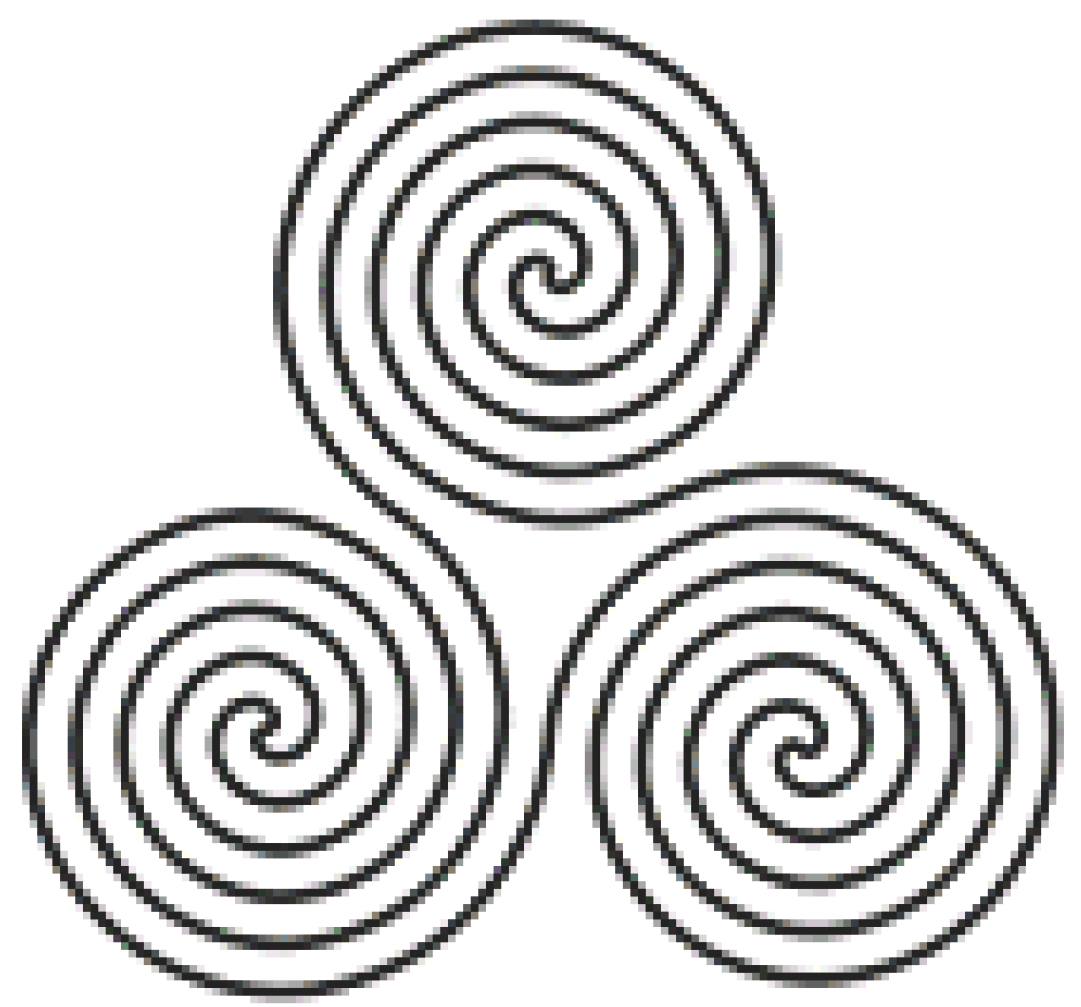
So, some type of “Ouroboros”-arrangements is the best, which we can ever achieve. For the here advocated three-legged approach the Triskelion might be a fitting symbol, see Figure 1.
For the whole ideograph all three legs are necessary, none is more basic than the others. No vicious circle nor indiscriminate associationism is meant but an overarching consistent narrative with well-defined building blocks embedded in some meaningful (time-) structure. Circles and loops are perfect, but more is required than just making ends meet; spirals are preferred and they have to have to feature a large enough diameter and embrace the knitwork of the entire universe, at least potentially as far as can be seen.
This actually is the same, for physical theories, especially about the beginning of the universe, as it is for understanding consciousness and Free Will [88]. Also there, self-reference causes no problems as long as time is taken into account properly. Staying inside the given universe, widest-ranging and well-organized self-referral is the best one can hope for.
The proposal here is to see space as primary basis for a better overview and put grainy emerging time as “main culprit” for unavoidable fluctuations, which are essential for linking the quantum and real domains, at the forefront. Time itself is anchored in the expanding space of the universe, all void without material content [32]. Fluctuations themselves are “timeless” and not really “real” as long as they do not produce entropy and records, just as in isolated quantum systems.
The important point then is that relieving gravity from standing a solitary pillar to some emergent status and tying it closer to thermodynamics could somewhat close a braided picture just the same as for the case of time. A self-consistent and intricate interplay of mutually self-reinforcing dependencies like between quantum and classical mechanics might probably the best the we can strive for. This is quite similar to the relation between spacetime and gravity where neither space nor time would exist without massive objects, the latter also experiencing gravity in the spacetime warped by masses, which in turn sense accelerations in time.
Identifying quantum physics as basis for classical phenomena while quantum effects becoming real only when suitably framed by classical events, seems only appropriate. Similarly, understanding space and time as emergent from an underlying microscopic substrate, dovetails with real irreversible time being established only in interactions and always involving some type of records and classical entropy generation. It is no deficiency that the derivations of General Relativity leverage ideas, which had been developed from observations and models of gravity before [63,73]; one has to iteratively use the material, which is available (at the time in question). The point is that in the end the overall picture is grounded, coherent, and consistent with all available, in particular experimental, evidence.
What applies to dark matter, i.e., giving up a fruitless search for whatever exotic particle and rather accepting a view of “geometric” emergence in the real universe might be applicable the same for dark energy. While an increasing production of vacuum energy appears promising by attributing some repulsion to the emerging number of possibilities with growing space [83], living in a relative empty local bubble might also be worthwhile a consideration [68]. Running against the fundamental wish for simple explanations, there is no reason why nature should not have settled with a constellation combining diverse effects and contributions, on the contrary.
A compound conceptualization with growth plates (“Wachstumsfugen”, the German word is better by highlighting the malleable space between more solid parts) instead of smooth uniformity might be the way to describe our many-faceted universe. In restricted specific contexts (in praxis, with different approximations and associated ranges of applicability) if --> then causal dependencies can be sought for and often successfully delineated.
The author hopes that with this very rough sketch the thicket of intricate formalisms could be recast in a “democratic” perspective, and the whole somewhat ordered in a coarsely systematic and not completely haphazard way. The “three pillars” in the end are abstractions themselves in a web of manyfold dependencies and (abstractable) regularities.
There is nothing like “substance”, which would obey the definition of Spinoza, i.e., something that is “in itself and is conceived through itself, that is, that whose concept does not require the concept of another thing, from which it must be formed” [89]. The concept of substance like that of physical laws are abstractions, i.e., Platonic figures, grounded in, but detached from reality.
Facts are not relative/private other than described by Relativity and inherent limitations for communication, even if there can be many diverse perspectives. Ultimately, overall consistency with all boundary conditions and developments is the touch stone for “truth”, i.e., fully convincing models, which allow to explain known facts and to formulate interesting predictions.
An ontology like the one by Nicolai Hartman is demanded as soon as (self-) interactions and combinations begin to build up higher-order phenomena [42]. While a certain reaction between two entities interacting might be the only possible one in a certain context, a lot of development and time might have been necessary in order to arrive at that particular state. Gestation of an embryo in an egg needs very little input in terms of external energy/heat but it starts from a most peculiar point with a tremendous history to draw information from. Synergetics as developed by Hermann Haken and emphasizing time offers the best chances to describe how different levels of organization can interact and make novel features and structures emerge [90]. Following this line of thinking, it is tried here to sketch that a self-organizing approach with mutual dependencies and promotions, leading to the unfolding emergence of our one reality, can form a suitable basis for the existence of the universe and our understanding of it.
Transformations involving energy in the real world are inevitably associated with losses for a source and with entropy production. Some principal uncertainty alone and, especially, adhering to some type of energy / time uncertainty relations, forbids 100 % efficiency and perfectly sharp demarcations. Entropy is not the same as information or simple lack thereof. Information is information only for a prepared suitably knowledgeable recipient, and it is easily possible that only fractions of the total content can be transmitted and decoded. A most stupid guy, probably not even able to read a single word, knows that burning a (holy) book hurts the targeted audience. Collecting all photons would not bring back the meaningful content.
Even if still striving for some unification, a non-hierarchical lay-out of physical theory has to some extent been proposed before by Carl Friedrich von Weizsäcker in the format of a “Kreisgang” (walking in a circle) through a web of relations and dependencies [91]. By establishing records at disruptions, the unitary evolution of quantum states, which is information-preserving and time-reversible, can be reconciled with the global evolution of the universe following the second law of thermodynamics, which, in general, is neither. Poincaré recurrence is a mathematical construct not applying to the real non-conservative world; even inside the quantum realm, ergodicity can be broken because of destructive interferences [92].
Emphasizing a braided lay-out in a “process-view”, self-referring and with high interconnectedness, could be seen as an attempt of combining Eastern and Western traditions, which, amongst others, have been found to put different weights on physical laws as part of the respective cultures [93].
Letting go of any form of unique metaphysical goal-directedness, the here suggested lay-out and path forward is probably but one of several or many possibilities to approach an overall consistent picture (each emphasizing different constituents and relations). This should be seen as encouraging and as overall witness of possibly achieving some comprehensive understanding covering many facets and including various diverse chains of argument. For a very first shot aiming at a really big picture, the author took the liberty to discard many details leaving a lot of room for serendipity. Attempting a coarse but encompassing view, how it all could fit together, hopefully helps to turn attention and effort to promising directions [88].
Acknowledgements
Very insightful and supportive comments by Časlav Brukner on [10] via private email are gratefully acknowledged.
References
- Thomsen, K. The Ouroboros Model in the light of venerable criteria. Neurocomputing 2010, 1, 121. [Google Scholar] [CrossRef]
- Bohr, N. (1935). Can Quantum-Mechanical Description of Physical Reality be Considered Complete? Reprinted in J. Faye and H. J. Folse (1998) (eds.), The Philosophical Writings of Niels Bohr, Vol. IV: Causality and Complementarity. Woodbridge: Ox Bow press UK.
- Lamb, W.E. An operational interpretation of nonrelativistic quantum mechanics. Physics Today 1969, 22, 23–28. [Google Scholar] [CrossRef]
- Di Biagio, A.; Donà, P.; Rovelli, C. The arrow of time in operational formulations of quantum theory. Quantum 2021, 5, 520. [Google Scholar] [CrossRef]
- Aubrun, G.; et al. Entangelement and superposition are equivalent concepts in any physical theory. Phys. Rev. Lett. 2022, 128, 160402. [Google Scholar] [CrossRef] [PubMed]
- Rovelli, C. Memory and entropy. Entropy 2022, 44, 1024. [Google Scholar] [CrossRef] [PubMed]
- Landauer, R. Irreversibility and heat generation in the computing process (PDF). IBM Journal of Research and Development 1961, 5, 183–191. [Google Scholar] [CrossRef]
- Bennett, C.H. Notes on Landauer’s principle, reversible computation, and Maxwell’s Demon. Studies in History and Philosophy of Modern Physics 2003, 34, 501–510. [Google Scholar] [CrossRef]
- Myrvold, W.C. Shakin’ All Over: Proving Landauer’s Principle without neglect of fluctuations. arXiv 2020, arXiv:2007.11748. [Google Scholar] [CrossRef]
- Thomsen, K. Timelessness Strictly inside the Quantum Realm. Entropy 2021, 23, 772. [Google Scholar] [CrossRef]
- Feynman, R.P.; Hibbs, A.R. Quantum Mechanics and Path Integrals, New York, McGraw-Hill, 1965.
- Garcia-Pintos, L.P.; et al. Unifying quantum and classical speed limits on observables, Phys. Rev. X 2022, 12, 011038. [Google Scholar] [CrossRef]
- Mertens, L. Inconsistency of linear dynamics and Born’s rule, Phys. Rev. A104, 05 2224, 2021. [Google Scholar] [CrossRef]
- Yoon, T.H.; Cho, M. Quantitative complementarity of wave-particle duality. Sci. Adv. 2021, 7, eabi9268. [Google Scholar] [CrossRef]
- Hong, S.; et al. Demonstration of complete information trade-off in quantum measurement. Phys. Rev. Lett. 2022, 128, 050401. [Google Scholar] [CrossRef]
- Kewming, M.J.; Shrapnel, S. Entropy production and fluctuation theorems in a continuously monitored optical cavity at zero temperature. Quantum. 2022, 6, 685. [Google Scholar] [CrossRef]
- Coles, P.; Kaniewski, J.; Wehner, S. Equivalence of wave-particle duality to entropic uncertainty. nature communications 2014. [Google Scholar] [CrossRef]
- Spekkens, R.W. Contextuality for preparations, transformations, and unsharp measurements. Physical Review A 2005, 71, 052108. [Google Scholar] [CrossRef]
- Matsushika, T.; Hofmann, F. Dependence of measurement coutcomes on the dynamics of quantum coherent interactiuons between the system and the meter. Phys. Rev. Res. 2023, 5, 033064. [Google Scholar] [CrossRef]
- Frauchiger, D.; Renner, R. Quantum theory cannot consistently describe the use of itself. Nat. Commun. 2018, 9, 1–10. [Google Scholar] [CrossRef] [PubMed]
- Hance, J.R.; Ji, M.; Hofmann, H.F. Contextuality, coherences, and quantum Chesire cats. New. J. Phys 2023, 25, 113028. [Google Scholar] [CrossRef]
- Kupczynski, M. Contextuality or nonlocality: what would John Bell choose today? Entropy 2023, 25, 280. [Google Scholar] [CrossRef]
- Khrennikov, A. Ist the devil in h? Entropy 2021, 23, 632. [Google Scholar] [CrossRef] [PubMed]
- Khrennikov, A. Contextuality, complementarity, signaling, and Bell tests. Entropy 2021, 23, 632. [Google Scholar] [CrossRef]
- Rauch, D.; et al. Cosmic Bell Test Using Random Measurement Settings from High-Redshift Quasars. Phys. Rev Lett. 2018, 121, 080403. [Google Scholar] [CrossRef] [PubMed]
- Schlatter, A. On the reality of quantum collapse and the emergence of space-time. Entropy 2019, 21, 323. [Google Scholar] [CrossRef] [PubMed]
- Lucia, U.; Grisolia, G. Thermodynamic Definition of Time: Considerations on the EPR Paradox. Mathematics 2022, 10, 2711. [Google Scholar] [CrossRef]
- Tanaka, S. Appearance of thermal time. Foundations of Physics 2012, 51, 34. [Google Scholar] [CrossRef]
- Erker, P.; et al. Autonomous quantum clocks: does thermodynamics limit our ability to measure time? Phys. Rev. X 2017, 7, 031022. [Google Scholar] [CrossRef]
- Pearson, A.N.; et al. Measuring the thermodynamic cost of timekeeping. Phys. Rev. X 2021, 11, 0210299. [Google Scholar] [CrossRef]
- Guryanova, Y.; Friis, N.; Huber, M. Ideal projective measurements have infinite resource costs. Quantum 2020, 4, 222. [Google Scholar] [CrossRef]
- Gold, T. The arrow of time. Am. J. Phys. 1982, 30, 403–410. [Google Scholar] [CrossRef]
- Page, D.N.; Wootters, W.K. Evolution without evolution: Dynamics described by stationary observables. Phys. Rev. D 1983, 27, 2885. [Google Scholar] [CrossRef]
- Piva, I.L.; Lobo, A.C.; Cohen, E. Flow of time during energy measurements and the resulting time-energy uncertainty relation. Quantum 2022, 6, 683. [Google Scholar] [CrossRef]
- Shettell, N.; Centrone, F.; Garcia-Pintos, L.P. Bounding the minimum time of a quantum measurement. Quantum 2023, 7, 1182. [Google Scholar] [CrossRef]
- Kuramochi, Y.; et al. Wigner-Araki-Yanase theorem for continuous and unbounded conserved observables. Phys. Rev. Lett. 2023, 131, 210201. [Google Scholar] [CrossRef]
- Jacobs, K. Quantum measurement and the first law of thermodynamics: The energy cost of measurement is the work value of the acquired information. Phys. Rev. E 2012, 86, 040106. [Google Scholar] [CrossRef] [PubMed]
- Zeilinger, A. A foundational principle for quantum mechanics. Foundations of Physics 1999, 29, 631–643. [Google Scholar] [CrossRef]
- Rubino, G.; Manzano, G.; Brukner, Ć. Quantum superposition of thermodynamic evolutions with opposing time’s arrows. Comm. Phys. 2021, 4, 251. [Google Scholar] [CrossRef]
- Milburn, G.J. The thermodynamics of clocks. Contemporary Physics 2020, 61. [Google Scholar] [CrossRef]
- Rovelli, C. How causation is rooted into thermodynamics. Philosophy of Physics 2023, 1, 11. [Google Scholar] [CrossRef]
- Hartmann, N. Die Erkenntnis im Lichte der Ontologie, mit einer Einführung von Josef Stallmach; Felix Meiner Verlag: Hamburg, Germany, 1982. [Google Scholar]
- Riek, R.; Chatterjee, A. Causality in discrete time derived from Maupertuis reduced action principle. Entropy 2021, 23, 1212. [Google Scholar] [CrossRef]
- Feng, G.; Huang, J. A heuristic resolution of the Abraham–Minkowski controversy. Eur. J. Phys. 2021, 136, 520. [Google Scholar] [CrossRef]
- Koivurova, M.; Robson, C.W.; Ornigotti, M. Time-varying media, relativity, and the arrow of time. Optica 2023, 10, 1398. [Google Scholar] [CrossRef]
- Collaboration, P. Planck 2013 results. XIII. Isotropy and statistics of the CMB. Astronomy&Astrphysics 2014, 571, A23. [Google Scholar] [CrossRef]
- Schulmann, L.S. Source of the observed thermodynamic arrow. J. of Physics: Conference Series 2009, 174. [Google Scholar] [CrossRef]
- Penrose, R. Before the Big Bang: an outrageous new perspective and its implications for particle physics, Proceedings of EPAC 2006, Edinburgh, Scotland, 2006.
- Rovelli, C. Where was past low-entropy? Entropy 2019, 21, 466. [Google Scholar] [CrossRef]
- Boyle, L.; Turok, N. Thermodynamic solution of the homogenity, isotropy and flatness puzzles (and a clue to the cosmological constant). Phys. Lett. B 2024, 849, 138442. [Google Scholar] [CrossRef]
- Bekenstein, J.D. Universal upper bound on the entropy-to-energy ratio for bounded systems. Phys. Rev. D 1981, 23, 287. [Google Scholar] [CrossRef]
- Basso, M.L.W.; Mazeiro, J.; Céleri, L.C. The irreversibility of relativistic time-dilation. Class. Quantum Grav. 2023, 40, 195001. [Google Scholar] [CrossRef]
- Albrecht, A.; Steinhardt, P.J. Cosmology For Grand Unified Theories With Radiatively Induced Symmetry Breaking. Physical Review Letters 1982, 48, 1220. [Google Scholar] [CrossRef]
- Iijas, A.; Loeb, A.; Steinhardt, P. Inflationary Paradigm in trouble after Planck 2013. Phys. Lett. B. 2013, 723, 261–266. [Google Scholar] [CrossRef]
- Dittrich, B.; Höhn, P.A. Canonical simplical gravity, Class. Quantum Grav. 2012, 29, 115009. [Google Scholar] [CrossRef]
- Cotler, J.; Strominger, A. The Universe as a quantum encoder. [CrossRef]
- Tolman, R.C. On the Weight of Heat and Thermal Equilibrium in General Relativity. Phys. Rev. 1930, 35, 904–924. [Google Scholar] [CrossRef]
- Santiago, J.; Visser, M. Tolman temperature gradients in a gravitational field. Eur. J. Phys. 2019, 40, 025604. [Google Scholar] [CrossRef]
- Anderson, E.K.; et al. Observation of the effect of gravity on the motion of antimatter. Nature 2023, 621, 716. [Google Scholar] [CrossRef]
- Blas, D. Theoretical aspects of antimatter and gravity. Phil. Trans R. Soc. 2018, A376, 20170277. [Google Scholar] [CrossRef] [PubMed]
- Stefan Meyer Institute for subatomic Physics Austrian Academy of Sciences, https://antimatter.at/welcome/description/cpt/#:~:text=An%20even%20tiny%20violation%20of,atom%20consisting%20purely%20of%20antimatter.
- Paul Scherrer Institut, Switzerland, https://www.psi.ch/en/nedm.
- Jacobsen, T. Thermodynamics of spacetime: The Einstein equation of state. Phys. Rev. Lett. 1995, 75, 1260. [Google Scholar] [CrossRef] [PubMed]
- Begeman, K.G.; Broeils, A.H.; Sanders, R.H. Extended rotation curves of spiral galaxies: dark haloes and modified dynamics. Mon. Not. Astr. Soc. 1991, 249, 523. [Google Scholar] [CrossRef]
- Wang, L.; Chen, D.-M. Comparison of modeling SPARC spiral galaxies‘ rotation curves: halo models vx. MOND. RAA 2021, 21, 271. [Google Scholar] [CrossRef]
- Chae, K.-H. Robust evidence fort he breakdown of standrc gravity at low acceleration from statisically pure bienaries free of hidden companions. The Strophysical Journal 2024, 960, 114. [Google Scholar] [CrossRef]
- Skordis, C.; Zlośnik, T. New relativistic theory for modified newtonian dynamics. Phys. Rev. Lett. 2021, 127, 161302. [Google Scholar] [CrossRef]
- Mazurenko, S.; Banik, I.; Kroupa, P.; Halsbauer, M. A simultaneous solution to the Hubbel tension and observed bulk flow within 250h-1 Mpc. MNRAS 2023, 527, 4388. [Google Scholar] [CrossRef]
- Bekenstein, J.D. Relativistic gravitation theory for the modified Newtonian dynamics paradigm. Phys. Rev. D 2004, 70, 083509. [Google Scholar] [CrossRef]
- Bekenstein, J.D. Relativistic MOND as an alternative to the dark matter paradigm. Nuclear Physics A 2009, 827, 555c. [Google Scholar] [CrossRef]
- Rovelli, C.; Smerlak, M. Class. Quantum Grv. 2011, 28, 075007. [Google Scholar] [CrossRef]
- Stephens, C.R.; ’t Hooft, G.; Whiting, B.F. Black hole evaporation without information loss. Classical and Quantum Gravity 1994, 11, 621–648. [Google Scholar] [CrossRef]
- Verlinde, E. On the origin of gravity and the laws of Newton. JHEP 2011, 04, 029. [Google Scholar] [CrossRef]
- Swingle, B. Spacetime from entanglement. Ann. Rev. Condens. Matter Phys. 2018, 9, 345–359. [Google Scholar] [CrossRef]
- Watson, C.N. Theory of gravity dependent on entropy. Reports in Advances of Physical Sciences 2023, 7, 2350006. [Google Scholar] [CrossRef]
- Schlatter, A.; Kastner, R.E. Gravity from transactions: fulfilling the entropic gravity program. J. Phys. Commun. 2023, 7, 065009. [Google Scholar] [CrossRef]
- Gupta, R. JWST early universe observations and ɅCDM cosmology. MNRAS 2023, 524, 3385. [Google Scholar] [CrossRef]
- Schumacher, B.; Westmoreland, M.D. Interpretation of quantum theory: the quantum „grue-bleen“ problem. Entropy 2022, 24, 1268. [Google Scholar] [CrossRef] [PubMed]
- Giacomini, F.; Brukner, C. Quantum superposition of spacetimes obeys Einstein´s equivalence principle. AVS Quantum Science 4, Special Collection: Celebrating Sir Roger Penrose's Nobel Prize 2022. [Google Scholar] [CrossRef]
- Henkel, C.; Folman, R. Universal limit on spatial quantum superpositions with massive objects due to phonons. [CrossRef]
- Oppenheim, J. A postquantum theory of classical gravity? Phys. Rev. X 2023, 13, 041040. [Google Scholar] [CrossRef]
- Oppenheim, J.; Sparaciari, C.; Šoda, B.; Weller-Davies, Z. Gravitationally induced decoherence vs space-time diffusion: testing the quantum nature of gravity. Nature Comm 2023, 14, 7910. [Google Scholar] [CrossRef] [PubMed]
- Tkatchenko, A.; Fedorov, D.V. Casimir self-interaction energy density of quantum electrodynamic fields, Phys. Rev. Lett. 2023, 130, 041601. [Google Scholar] [CrossRef] [PubMed]
- Wikipedia article titled „Liar Paradox“, accessed 11 March 2024.
- Brubaker, B. Complexity theory’s 50-year journey to the limits of knowledge, Quantamagazine17 August, 2023, https://www.quantamagazine.org/complexity-theorys-50-year-journey-to-the-limits-of-knowledge-20230817/.
- Filatov, S.; Auzinsh, M. Unitarity of decoherence implies possibility of decoherence-like dynamics towards macroscopic superpositions. Entropy 2022, 24, 1546. [Google Scholar] [CrossRef]
- Wikipedia article titled „Triskelion“, image downloaded 25 February, 2024.
- Thomsen, K. A challenge in A(G)I, cybernetics revived in the Ouroboros Model as one algorithm for all thinking. Artif. Intell. Auton. Syst. 2024. [Google Scholar] [CrossRef]
- Spinoza, B. Opera, Ethics, Part 3, Carl Winters, Heidelberg, 1925.
- Haken, H. Synergetics, An Introduction: Nonequilibrium Phase Transitions and Self-Organization in Physics, Chemistry, and Biology, 3rd ed.; Springer-Verlag: New York, NY, USA, 1983. [Google Scholar]
- von Weizsäcker, C.F. Aufbau der Physik, dtv, Carl Hanser Verlag, München, Wien, 1988.
- Thiel, F.; Mualem, I.; Kessler, D.; Barkai, E. Uncertainty relation between detection probability and energy fluctuations. Entropy 2021, 23, 595. [Google Scholar] [CrossRef]
- Memmi, D. Comparative foundations of Eastern and Western thought. AI & Soc 2017, 32, 359–368. [Google Scholar] [CrossRef]
Figure 1.
Triskelion symbol as a shorthand for how Quantum Physics, Thermodynamics, and Relativity are interlinked and mutually induce each other [87].
Figure 1.
Triskelion symbol as a shorthand for how Quantum Physics, Thermodynamics, and Relativity are interlinked and mutually induce each other [87].
Disclaimer/Publisher’s Note: The statements, opinions and data contained in all publications are solely those of the individual author(s) and contributor(s) and not of MDPI and/or the editor(s). MDPI and/or the editor(s) disclaim responsibility for any injury to people or property resulting from any ideas, methods, instructions or products referred to in the content. |
© 2024 by the authors. Licensee MDPI, Basel, Switzerland. This article is an open access article distributed under the terms and conditions of the Creative Commons Attribution (CC BY) license (http://creativecommons.org/licenses/by/4.0/).
Copyright: This open access article is published under a Creative Commons CC BY 4.0 license, which permit the free download, distribution, and reuse, provided that the author and preprint are cited in any reuse.


