

Submitted:
15 March 2024
Posted:
18 March 2024
You are already at the latest version
Abstract
The high genetic diversity of the tomato and its high micronutrient content make this fruit very interesting from an economic and nutritional point of view. The genetic erosion suffered by this crop, due to breeding objectives based on yield and marketing, makes it necessary to return to the origins in search of the nutritional and organoleptic quality lost in traditional varieties. In this study, the agronomic, physical, organoleptic and nutritional characteristics of eighteen F1 hybrids obtained by crossing fourteen traditional varieties, previously selected for their quality, were studied to select genotypes of superior quality that could be candidates for new. All parameters studied were strongly influenced by genotype, showing a wide range between cultivars. Principal Component Analysis revealed the characteristics of each hybrid that made it stand out from the others. Some hybrids (H3, H4, and H6) stand out because of their high concentration of active compounds, others (H16, H15, H10, H17, H9, and H11) because of agronomic performance and high content of β-carotene, and H5 was the only one to contain chlorophyll in their ripe fruits. Finally, the evaluation index allowed the selection of five hybrids with interesting characteristics, combining good yield performance and high quality
Keywords:
Landraces
; tomato breeding
; fruit quality
; evaluation index
1. Introduction
Tomato (Solanum lycopersicum L.) is one of the most widely consumed vegetables in the world all year round. The annual production of fresh tomatoes amounted to approximately 189 million tons in 2021 [1]. In addition to its economic relevance, tomato is a nutritionally well-balanced food that presents a high content of bioactive compounds [2,3,4,5]. Among the chemical compounds that can be found in ripe tomatoes, the most significant are carotenes (such as lycopene, β-carotene, and lutein), vitamin C, and phenolic compounds, which are considered health-promoting agents [6,7,8]. Specifically, carotenoids (lycopene and β-carotene) found in tomatoes are precursors of vitamin A and provide ripe tomatoes with their red colour [5,9,10]. Additionally, it has been reported that these bioactive compounds can inhibit the proliferation of many types of cancer cells and potentially serve as antioxidants to prevent the development of cardiovascular diseases, age-related macular degeneration, and other eye conditions [11]. Moreover, phenolic compounds may have beneficial effects on inflammation-based illnesses and various forms of cancer [12]. Finally, vitamin C demonstrates significant antioxidant and electron donation capabilities, thus protecting DNA from damage caused by oxidation [13]. Quality of tomatoes is not only determined by their nutritional value, but also by their organoleptic and flavour characteristics. These properties of the fruit result from the combination of taste and aromas created by various volatile and non-volatile compounds [14]. The balance and interaction between organic acids (malic, citric, and glutamic) and soluble sugars (fructose and glucose) contribute to the distinct flavours of tomatoes [10,15]. However, different studies have demonstrated that the production and accumulation of these compounds are influenced by various factors, including agronomic and environmental conditions, as well as genetic variations among cultivars [7,16].
Modern agriculture has prioritised the development of new tomato cultivars with high yield, uniform appearance, disease tolerance, and long shelf-life, aimed at enhancing crop management and market distribution. However, due to the limited number of commercial varieties used for tomato production across the globe, genetic erosion has become increasingly prevalent [17,18]. The decrease in biodiversity causes a decrease in genetic diversity, resulting in the loss of distinctive traits related to aroma, taste, and appearance that are characteristic of local varieties due to a lack of attention in recent times [14,19,20]. Specifically, research shows that breeding efforts have altered the metabolome of tomato fruit, leading to the loss of numerous genes associated with fruit quality in favour of higher yields [21]. Currently, the nutritional and organoleptic quality of fresh tomatoes is a vital parameter for growers and tomato breeders due to the rising consumer interest in healthy and flavourful food [5,22,23]. Landraces could serve as a workable solution, as they may possess beneficial allelic combinations that are absent in modern varieties [24,25]. Although these traditional types often possess exceptional organoleptic and nutritional characteristics, their agronomic performance in terms of yield or resistance to the prevailing biotic stresses is often unsatisfactory, rendering them inappropriate for widespread commercial cultivation under most circumstances [26].
In Spain, certain traditional varieties are arriving on the market and becoming viable alternatives for farmers in terms of economic profitability. This is mainly due to the successful implementation of breeding and valorisation programmes. Notably, the 'Valenciano d'El Perelló' and 'de Penjar d'Alcalà de Xivert' tomatoes in the Valencian Community are interesting examples in this regard [27]. A valorisation programme is currently underway, focusing on improving resistance to viruses and fungi, which have a significant impact on these tomato varieties [27,28]. Similarly, significant progress has been made in the development of high-performance materials for the 'De la Pera' and 'Mutxamel' tomatoes grown in Alicante, where resistance to viruses has been incorporated [29]. In addition, breeding efforts with 'Pera de Girona' and 'Montserrat' tomatoes in Catalonia have yielded remarkable results [30,31]. The successful implementation of these breeding programmes has the potential to offer farmers profitable alternatives in an increasingly competitive and complex agricultural landscape, thus ensuring the sustainability and development of the agricultural industry.
One objective of tomato breeding has been to produce heterozygous F1 hybrid cultivars. This is achieved by crossing two carefully-selected divergent parental lines, resulting in a combination of desirable traits from both parents and promoting heterosis [32,33]. As valuable quality gene pools, tomato landraces can consequently be used as good parents to develop high-quality F1 hybrid cultivars and exploit heterosis for competitive yields [34,35]. This strategy could effectively revalue traditional varieties as sources of nutritious food products while simultaneously increasing tomato production.
Given the above, the aim of this study was to 1) characterize the eighteen new hybrids in terms of their agronomic (total yield, mean fruit weight, and number of fruits), physical (polar diameter, equatorial diameter, and colour parameters), organoleptic (glucose, fructose, total soluble solids, and acidity) and nutritional (vitamin C, carotenoids, and phenolics) traits, and 2) select superior-quality genotypes, which may be candidates for new cultivars.
2. Materials and Methods
2.1. Cultivation Conditions and Plant Material
Plant material consisted of eighteen F1 hybrids developed from different combinations of crosses between nineteen parental lines (Table 1; FigureS1). Parent lines were traditional varieties from the germplasm bank (BAGERIM) of the Instituto Murciano de Investigación y Desarrollo Agrario y Medioambiental (IMIDA), selected on the basis of their agronomic performance, taste, and/or content of bioactive compounds among 46 genotypes evaluated in a previous study [5,36,37]. In addition, two commercial F1 hybrids (Mongo and Pasadena) were included as controls. Plants were grown in a greenhouse at an experimental farm (“Torreblanca”) located in Torre Pacheco (Murcia, SE Spain, 37.7939600, −0.9559300), on soil classified as clay loam and irrigated with water from the Tajo-Segura Transfer System (0.8–1.3 dS m−1). The area has a Mediterranean climate. Transplanting was conducted in December according to a randomised block design with three replicate plots and ten plants per replication. The distance between rows was 1.0 m, and the distance between adjacent plants within a row was 0.4 m. Plants were maintained until the end of the production phase (130–250 days after transplanting, depending on the genotype). Plots were managed according to a low-input tomato production management system, using integrated pest management with the support of flower margins to promote the presence of auxiliary fauna.
2.2. Agronomic and Phenotypic Evaluation
At the end of the growing season, three yield-related traits (total yield [TY], fruit number [FN], and mean fruit weight [NF]), and three morphological traits (equatorial [ED] and longitudinal diameters [LD], as well as external colour) were evaluated. For total yield, fruit number, and average fruit weight, all of the fruits from 3 plants per replicate were collected and individually weighed. Of these, 10 fruits from each block were randomly selected for morphological characterisation. Equatorial and longitudinal diameters and external colour were then measured using a Mitutoyo 500−196-30 Digimatic calliper (Kanagawa, Japan) and a Minolta CR-200 Chroma Meter (Ramsey, NJ, USA) respectively. The colour parameters L* (lightness), a* (redness), and b* (yellowness) were measured in three different areas of the fruit surface. The hue angle (HUE, h°= tan−1[b*/a*]) and the saturation or chroma (CH, C = [a*2 + b*2]/2) were calculated from the primary L*, a*, and b* measurements.
2.3. Analysis of Fruit Quality and Nutritional Value Traits
For total soluble solids (TSS) and titratable acidity (TA), about 20 fruits from the same replicate were then cut into small pieces, mixed, and frozen at −80 °C, then homogenised using a Thermomix and frozen at −80 °C until further analysis. TSS was measured by refractive index (expressed as °Brix) using a digital hand-held ”pocket“ refractometer PAL−1 (Atago, USA), and TA was determined by automatic titration (Mettler-Toledo DL15 automatic titrator) with 0.1 N sodium hydroxide and expressed as g of citric acid per L of juice.
2.4. Determination of Soluble Sugars
Triplicate aliquots of frozen tomatoes were used for the determination of soluble sugars (glucose [GLC] and fructose [FRT]). Compounds were extracted with deionised water, purified with C18 Sep-Pak cartridges, and analysed by molecular exclusion chromatography using an Agilent 1100 liquid chromatograph (Waldbronn, Germany) equipped with a refractive index detector and a CARBOSep CHO-682 LEAD 300 × 7.8 mm ID column using deionised water as a mobile phase at a flow rate of 0.4 mL min−1 [4]. The results are expressed as mg g−1 FW.
2.5. Determination of Carotenoids and Chlorophylls
Carotenoids and chlorophylls were extracted according to [38] using β-apo-8′-carotenal as an internal standard and determined on a Hewlett-Packard 1200 HPLC system (Santa Clara, CA, USA) equipped with an UV-visible photodiode array detector (spectral range from 250 to 800 nm), according to [39]. Separation was carried out at a flow rate of 1.0 mL min−1 in a 250 mm × 4.6 mm, i.d., 3 µm Prontosil C30 column (Bischoff, Leonberg, Germany), using methanol and methyl tert-butyl ether as a mobile phase. The main compounds were quantified as µg g−1 using the external standards, lycopene (LY), and β-carotene (BC) (Sigma-Aldrich, Germany) and lutein (LU), violaxanthin (VIO), and chlorophyll (CHL) (DHI LAB, Hoersholm, Denmark). Phytoene (PHE) and phytofluene (PHF) are expressed as β-carotene equivalents.
2.6. Determination of Vitamin C
For the extraction of vitamin C (ascorbic and dehydroascorbic acids), samples were homogenized with EDTA, 0.05% (w/v) and dithiothreitol (Sigma, Steinheim, Germany). Vitamin C was analysed using liquid chromatography equipped with a triple quadrupole mass spectrometer detector (Agilent Series 1200, Santa Clara, CA, USA) according to the methodology developed by [40]. Vitamin C (VC) was quantified as mg g−1 using commercial ascorbic acid as a standard (Sigma-Aldrich, Steinheim, Germany).
2.7. Determination of Phenolic Compounds
Phenolic compounds were extracted with methanol:formic acid (97:3) and identified as described by [41]. Analysis was performed by HPLC-MS/MS on a Lichrosphere C18 analytical column (250 mm × 4 mm and 5 μm particle size) according to [42]. Phenolic compounds were quantified against their corresponding standards purchased from Sigma-Aldrich. If no standards were available, the corresponding isomer, hydroxycinnamic acid or aglycone was used. The LC-QqQ analysis led to the identification of 18 compounds, which were grouped into different families: flavanones (FA), calculated as the sum of naringenin and naringenin-O-hexoside; flavonols (FO), calculated as the sum of rutin-O-hexoside and kaempferol-3-O-rutinoside; and hydroxycinnamic acids (HA), determined as the sum of chlorogenic acid, p-coumaric acid, ferulic acid, caffeic acid, homovanillic acid, and their respective isomers and derivatives. All of the compounds were quantified as µg g−1.
2.8. Statistical Analysis
Results were statistically analysed using IBM SPSS Statistic 25. Measures of dispersion were calculated (mean, standard deviation, coefficient of variation, range). Pearson's linear correlation coefficients (r) were calculated between pairs of traits, and the significance (p<0.05) of the correlations was assessed using the Bonferroni test.
Principal component analysis (PCA) was performed on the normalised compositional data using pairwise Euclidean distances between accession means. Eigenvalues and percent variance of each principal component were calculated, as well as the correlation coefficients between compositional traits and principal components.
Finally, in order to identify hybrids with a high fruit quality, an evaluation index (EI) was estimated by assigning to each trait a score ranging from a maximum of 18 to a minimum of 1, descending from the highest to the lowest value for all of the traits related to organoleptic (total soluble solids, total acidity, soluble sugars) and bioactive (vitamin C, phenolic compounds, carotenoids, and chlorophylls) characteristics.
3. Results
Twenty hybrid varieties were obtained by crossing fourteen traditional varieties belonging to eight tomato types (Corazón de Toro, Moruno, Flor de Baladre, Kumato, Mesa Murciano, Muchamiel, Pera, and Pimiento) from the IMIDA germplasm bank (Table 1). Progenitors included fruits of different sizes (medium, large, and extra-large), colours (pink, red, and red-black) and shapes (heart-shaped, pyriform, oblong, and rounded). A wide variability in size, shape, and colour was also observed among the hybrid varieties.
3.1. Description of Agronomic, Physical, Organoleptic, and Bioactive Traits in Parental Lines and Hybrids
Descriptive data confirmed the diversity of the accessions used as parental lines, which were subsequently used to obtain F1 hybrids. The evaluated parameters showed coefficients of variation (CV) ranging from 9% for total soluble solids to 54% for fruit number, displaying a sufficient variation for the different breeding objectives (Table 2). In both the parental and hybrid lines, the highest CV values were observed in plant yield traits, such as mean fruit weight (MFW), with 44 and 36%, respectively, and fruit number (FN), with 54 and 51%, respectively, whereas those related to the physical parameters of colour (chroma [CH] and hue [HUE]) and total soluble solids (organoleptic trait) showed the lowest CV percentages. In hybrids, the coefficients of variation were lower than in the parental lines, except for the yield and the total soluble solids. In addition, as expected, control varieties showed very low CVs in the parameters related to agronomic yield and organoleptic characteristics of the fruit, with percentages ranging between 0.7 and 12.5, i.e., lower than those determined in the parental lines and hybrids. On the other hand, these varieties showed higher coefficients of variation than the traditional varieties for two parameters related to bioactive quality: vitamin C (VC) and total phenolic compounds (FTC).
3.1.1. Agronomic and Physical Traits
A high phenotypic variability was observed among the hybrids of the traditional varieties for the studied parameters. In terms of agronomic traits, the total yield of the traditional hybrids ranged from 3.7 kg (H20) to 18.7 kg (H9); that of the traditional parents, from 6.0 to 15.1 kg; and that of the commercial hybrids, from 17.0 to 17.7 kg (Table 3). Results showed that 85% of the hybrids equalled or exceeded the yield of their parents (Table S1), and that only two of the new hybrids (H9 and H16) equalled or exceeded the yield of the control varieties. In traditional hybrids, the number of fruits ranged from 19 (H20) to 137 (H10), with no observed correlation with the mean fruit weight. For this parameter, the largest fruits were observed in H3 and H4 (349 and 395 g, respectively), whose common parent (P3) is a variety of the Flor de Baladre type (MFW > 350 g), and the smallest fruits were observed in H10, H17, and H18 (around 120 g), derived from the crosses Mesa Murciano x Kumato, Pera x Muchamiel and Pera x Pimiento, respectively. On the other hand, the longitudinal and equatorial diameters of the fruits varied between 51 cm (H10) and 91 cm (H20) and between 61 cm (H19) and 108 cm (H4), respectively. In this sense, hybrids (H19 and H20) derived from crosses with pepper varieties (traditional variety, characterised by its elongated shape) had the highest longitudinal diameter. Finally, Chroma and HUE ranged from 41 (H2) to 26 (H5) and 56 (H5) to 37 (H4), respectively.
3.1.2. Organoleptic and Bioactive Traits
Commercial and traditional hybrids were characterised for organoleptic (TSS, TA, and soluble sugars) and bioactive (vitamin C, carotenoids, and phenolic compounds) traits. In traditional hybrids, TSS ranged from 5.3 °Brix (H15) to 8.1 °Brix (H18) (Table 3), and four hybrids (H7, H13, H16, and H18) were characterised by higher TSS values than those of their progenitors (Table S1). In addition, 40% of the traditional hybrids exceeded the TSS of the commercial varieties. Acidity ranged between 2.7 and 5.2 (H16 and H15). Among new hybrids, 30% exceeded the TA of commercial controls, and 35% had higher values than their progenitors.
The main sugars determined in ripe tomato fruits were glucose and fructose, being the latter slightly more abundant in most of the hybrids, except for H3, H9, and H11 (Figure 1A). With regards to the values determined in the fruits of the traditional hybrids, glucose concentration ranged from 10.4 mg g−1 (H17) to 17.7 mg g−1 (H7), and fructose concentration, from 9.1 mg g−1 (H11) to 20.4 mg g−1 (H7). Compared to their parents, H6 and H7 had higher glucose and fructose values than their best progenitor (P2 and P7, respectively), and H9, H15, and H18 had lower values than their worst progenitor (P8, P9, and P13, respectively) (Figure S2A). Compared to commercial hybrids, 15% and 35% of the traditional hybrids exceeded their fructose and glucose content, respectively.
With regard to the bioactive compounds present in the fruit (vitamin C, carotenoids, and phenolic compounds), a large intervarietal variability was observed. In traditional hybrids, vitamin C content ranged from 0.12 mg g−1 (H9) to 0.20 mg g−1 (H14) (Figure 1B); total carotenoids (calculated as the sum of lycopene, β-carotene, violaxanthin, lutein, phytoene, and phytofluene) ranged from 26.0 µg g−1 (H9 and H10) to 40.2 µg g−1 (H5) (Figure 1C); and total phenolic content (calculated as the sum of hydroxycinnamic acids, flavonols, and flavanones) ranged from 52.4 µg g−1 (H11) to 174.6 µg g−1 (H6) (Figure 1D). In commercial hybrids, content of bioactive compounds ranged from 0.12 mg g−1 to 0.17 mg g−1, 65.3 µg g−1 to 114.1 µg g−1, and 44.6 µg g−1 to 49.3 µg g−1, and in progenitors, from 0.12 mg g−1 (P11) to 0.21 mg g−1 (P5), 21.6 µg g−1 (P11) to 51.1 µg g−1 (P14), and 55.4 µg g−1 (P6) to 195.3 µg g−1 (P2) for vitamin C, total carotenoids, and total phenolic compounds, respectively (Figures S2B–D). Thus, traditional hybrids exceeded or equalled commercial hybrids by 20% and 25%, and their parents by 5% and 35%, for phenolic compounds and vitamin C, respectively. On the other hand, none of the traditional hybrids exceeded the total carotenoid content of the commercial hybrids and their parents.
Lycopene, followed by β-carotene, were the main carotenoids present in traditional hybrids, parents, and commercial varieties (Figure 1C; Figure S2C). Thus, lycopene ranged from 11.1 µg g−1 (H10) to 22.2 µg g−1 (H5), and β-carotene, from 3.5 µg g−1 to 7.2 µg g−1 for H4 and H11, respectively. Lycopene concentrations were found to be higher in the commercial varieties and parents than in the traditional hybrids, whereas 19% and 38% of these hybrids exceeded the β-carotene concentrations found in the commercial varieties and parents. In addition, two compounds with carotenoid characteristics, violaxanthin and lutein, and the precursors of lycopene, phytoene, and phytofluene, were identified and quantified. Thus, the highest levels of violaxanthin (VIO) and lutein (LU) were found in H5 (Kumato x Moruno), whereas phytoene (PHE) and phytofluene (PHF) were higher in H3 and H4, whose common parent is of the Flor de Baladre type. On the other hand, and as expected due to the recessive nature of the chlorophyll retainer (cl) gene, of the five combinations on which at least one parent contained this gene, only H5, the result of the black Kumato (P3, cl+) x Moruno (A14, cl+) cross, showed a black colour and a significant chlorophyll concentration (2.9 µg g−1).
Finally, twenty-three phenolic compounds were identified. They belonged to three groups: hydroxycinnamic acids (chlorogenic, p-coumaric, ferulic, and caffeic acids and their derivatives), flavonols (rutin, kaempferol, and quercetin and their derivatives) and flavanones (naringenin and its derivatives). Hydroxycinnamic acids were the major group (50–80%) determined in both traditional hybrids and commercial and parental varieties, followed by flavonols (15–60%) and flavanones (0–45%) (Figure 1D; Figure S2D). The content and proportion of each group of compounds depended on the studied genotype. Thus, H4 and H11 stood out for their high percentage of hydroxycinnamic acids (about 81% of the total phenolic compounds), whereas H6 and H15 stood out for their percentage of flavonols (31.4%) and flavanones (30.8%), respectively. In terms of content, H6 stood out for its high content in all of the three groups: 84.9 µg g−1, 54.2 µg g−1, and 33.8 µg g−1 for hydroxycinnamic acids, flavonols, and flavanones, respectively.
3.2. Correlation between Agronomic, Physical, Organoleptic and Bioactive Traits and Similarities between Traditional Hybrids
Among agronomic traits, the number of fruits correlated positively with total production (r = 0.6) and negatively with mean fruit weight (r = -0.4), so that hybrids with larger fruits had a lower number of fruits per plant (Figure 2). These two parameters, mean weight and number of fruits, correlated with equatorial diameter in such a way that, as the latter increased, the mean weight increased (r = 0.9) and the number of fruits decreased (r= −0.4). In general, agronomic parameters were negatively correlated with the organoleptic and bioactive characteristics of the fruit, except for β-carotene, although in this case, correlation was very low (r = 0.2). As expected, positive and highly significant correlations (r = 0.6 and r = 0.7, respectively) were observed for the pairs TSS and TA and GLC and FRT, due to their relationship within fruit metabolism. The correlation between TC and LY was close to 1 (r = 0.97), as this compound is the main carotenoid that is present in ripe tomato fruit. Chlorophyll (CHL) was not included in this statistical analysis because only one of the studied hybrids contained chlorophylls.
Data were analysed using principal component analysis (PCA) to select those hybrids that, in addition to showing a good agronomic performance, produced fruit with high levels of key flavour compounds and health-promoting phytochemicals. PCA was applied to agronomic (TY, MFW, and FN), physical (ED, LD, CH, and HUE), organoleptic (TSS, TA; GLC, and FRT), and bioactive (VC, phenolic compounds [FA, FO, and HC], carotenoids [LU, VIO, LY, BC, PHF, and PHE] and chlorophyll [CHL]) traits of 18 traditional hybrids and 2 commercial controls. PCA details are shown in Table S2. According to the principle of an eigenvalue greater than 1, the first two components (PC1 and PC2) were used for further comprehensive evaluation. PC1 explained 24.8% of the total variation, and PC2, 19.5% of it, with a cumulative contribution rate of 44.3% (Figure 3). The first principal component (PC1) was positively correlated with several descriptors, such as MFW, ED, CH, and carotenoid precursors (PHF and PHE), and negatively correlated with FN, HUE, TSS, TA, BC, and VIO. The second principal component (PC2) was positively correlated with VC, phenolic compounds (HA, FA, FO), GLC, FRT, LYC, LU, and CHL.
Although the PCA dot plot showed a wide range of hybrids, some with outstanding characteristics could be identified. In the graphical representation of the PCA, three main clusters were spotted (Figure 3). The first one showed positive PC1 values and included hybrids H6 (P6xP2), H3 (P3xP2), and H4 (P3xP4), which shared different parents from local varieties Flor de Baladre and Moruno type. Accessions included in this cluster were characterised by a higher content of bioactive compounds in their fruits, such as vitamin C, total phenolic compounds, phytoene, phytofluene, flavonols, and hydroxycinnamic acids, as well as a high content of fructose. Along with having a better quality, the average fruit weight was higher, and the equatorial diameter was larger. The second cluster was identified by negative PC1 and PC2 values, and included genotypes H9, H10, H11, H15, H16, and H17. According to their position in the diagram, these accessions were characterised by a high number of fruits with a high β-carotene content compared to the other hybrids. The third cluster, with negative PC1 values and positive PC2 values, consisted of a single hybrid (H5), the only one with a red-black colour, due to the crossing between two traditional landraces with black fruits. This accession was therefore distinguished for its high chlorophyll and lutein content. All of the other genotypes had intermediate characteristics.
The evaluation index was calculated considering the organoleptic and bioactive traits, and was estimated assigning increasing values to each of the parameters for each of the hybrids. In our hybrids, EI ranged from a minimum of 96 (H11) to a maximum of 219 (H5), with a mean value of 162. Figure 4 shows the distribution of the eighteen traditional hybrids developed according to their EI value and total yield. This analysis clearly showed that five hybrids (H5, H18, H7, H6, and H19) were distinguished by good organoleptic and nutritional characteristics (EI > 200) and an acceptable yield (TY > 10 Kg). Moreover, the results also showed that the hybrids with the best agronomic performance (TY > 15 kg) had low evaluation index values (EI < 150). For example, H9 and H16 would be a good hybrid in terms of agronomic performance (TY = 19 kg), but their EI was 113 and 140, respectively. Unfortunately, no hybrids with high quality (EI > 200) and a high total yield (> 15 kg) were obtained, but using this index, some hybrids with very low values of EI (H11) or yield (H20) could be discarded.
4. Discussion
Growing consumer interest in healthy and tasty food has led tomato breeding, traditionally based on yield and resistance improvement, to focus on organoleptic and nutritional traits [23]. With this in mind, the outstanding quality traits of certain landraces can be a useful tool for the development of new commercial tomato varieties that incorporate these quality traits [20,21,25]. Currently, F1 hybrid tomato cultivars are the most widely grown due to advantages such as the heterosis factor, especially in the case of agronomic traits. Therefore, this study is based on the use of Spanish landraces, previously selected for their high quality [5,36,37], to develop F1 hybrids by means of a conventional breeding technique (natural cross-pollination). We evaluated their agronomic, physical, organoleptic, and nutritional performance with regards to commercial hybrids. In addition, genotypes of superior quality were selected considering their yield.
During the development of the hybrids, a special emphasis was placed on agronomic performance, in addition to fruit quality. A high variability in yield, mean fruit weight, and number of fruits was observed among the eighteen hybrids (Table 2). An important consideration is that hybrids should be superior to their parents in terms of agronomic traits to be commercially advantageous [33]. Generally speaking, the yield of the new hybrid varieties was higher than that of their parents, except for H13 (P9xP6) and H20 (P13xP14) (Tables 2 and S1). This could be attributed to a smaller genetic distance between these cultivars, as existing literature suggests that the greater the genetic distance between cultivars, the higher the hybrid vigour [32,33]. In addition, a high variability was found between fruit diameters (equatorial and longitudinal) due to the high diversity of the parents used in this study (Table 2). The colour attribute was studied using parameters such as the hue angle, which refers to the HUE, and the chroma (CR), which represents the quantitative attribute of colourfulness, so that as the CR increases, the colour becomes more intense [43]. Most of the hybrids showed a red colour at the ripening stage, except for H4, a cross between two traditional pink varieties, which resulted in maintaining its pink fruit colour, and H5, a cross between two traditional red-black varieties. It has been described that carotenoid biosynthesis and chlorophyll degradation pathways are closely related to colour development in tomato fruit [44]. The presence of pink colour in tomato fruit is controlled by a recessive (y) locus, which results in a colourless peel due to the absence of ripening-induced accumulation of yellow-coloured flavonoids [45]. In the case of red-black coloured fruits, this phenotype is observed due to the green-fresh (gf) mutation [46], which prevents normal chlorophyll degradation, resulting in a darker colouration of the fruit when combined with carotenoids [47]. These mutations in these genes are recessive; thus, hybrids with only one red-black (H3, H6, H10) or pink (H3, H6, H7, H11, H13) parent resulted in fully red fruits. The analysed red tomato varieties developed a similar colour at the deep red stage, with average colour angles ranging between 46 and 53 degrees.
Consumer preferences have an influence over the commercial value of tomatoes, with consumers generally tending to prefer sweet and sour tomato fruit [13]. In this sense, soluble solids and acidity content are important determinants of tomato fruit flavour [48]. In the developed hybrids, the TSS and total acidity ranged between 5.3 and 8.1 °Brix and 2.7 and 5.2 g L−1, respectively. Similar results were reported for traditional landraces [3,49]. When compared to their parents, a good increase in TSS and acidity was achieved by hybrids H13, H16, and H18, which would be associated with a high consumer acceptance [50]. Approximately half of the soluble solids content corresponds to the sugar fraction, which in tomato fruit consists of the monosaccharide-reducing sugars, glucose, and fructose, and their content can be influenced by many factors, including genotype, harvest period, and environmental conditions [6,10]. In our study, H7 and H6 had the highest content of reducing sugars and, in addition, H6 had a higher fructose content, with a glucose-fructose ratio of 1:1.3. The accumulation of fructose in the tomato fruit is advantageous in terms of flavour, as this soluble sugar is approximately twice as sweet as glucose and affects the taste of the fruit in a significant way [51].
In addition to the above-mentioned factors, in recent years, the nutritional value of agri-food products has received increasing attention from consumers due to the health benefits derived from their consumption [5,13,52]. Traditionally, tomatoes have been known for their high and varied composition of bioactive compounds and antioxidants [53]. In this sense, lycopene is the best-known antioxidant in tomatoes and the focus of many cancer studies, as its antioxidant properties protect against cancer processes by preventing DNA and protein damage and inducing apoptosis in cancer cells [53]. However, tomatoes also contain other interesting carotenoids such as β-carotene, lutein, violaxanthin, phytoene, and phytofluene [54,55,56,57]; vitamins such as vitamin C [3,6,58]; and phenolics such as flavanones, flavonols, and hydroxycinnamic acids [4,36,39].
In the developed hybrids, a wide variability was observed with regards to their bioactive components (Figure 1) and, in general, the values determined for these bioactive compounds are within the ranges previously described for different tomato cultivars; for example, vitamin C levels ranged from 0.12 to 0.20 mg g−1 in our hybrids, and values between 0.06 and 0.37 mg g−1 are described in literature [14,59,60,61], lycopene and β-carotene ranged from 11.1 to 22.2 µg g−1 and 3.5 to 7.3 µg g−1, respectively, in our hybrids, and from 11.6 to 65.0 µg g−1 and 0.5−15 µg g−1, respectively, in different tomato varieties [4,62,63,64]. In addition, and in relation to the phenolic composition of the traditional hybrids, the major group was hydroxycinnamic acids (40.1–85.2 µg g−1), followed by flavanols (3.5–55.6 µg g−1) and flavonols (6.2–54.5 µg g−1). The main phenolics found in our developed hybrids were chlorogenic acid (14.2–40.6 µg g−1), rutin (4.6–11.1 µg g−1), kaempferol (3.5–44.6 µg g−1), and naringenin (0–30.5 µg g−1). For these compounds, and for our crosses, the range of variation described in literature for the different compounds is very large because of the strong influence of factors like genotype, crop management, and environmental conditions [60,65,66,67].
The analysis of correlations was really useful to determine the relationship between the measured parameters. Highly significant positive correlations were observed between total yield and average fruit weight, number of fruits, and fruit equatorial diameter, whereas it was negative with longitudinal diameter (Figure 2). The “large fruit“ or large average fruit weight trait is easily identifiable by the breeder, and the selection of hybrid plants based on it, selecting the elites with the largest fruit size, will simultaneously ensure an improvement in productivity [33]. In addition, fruit size has been found to be positively correlated with the concentrations of phytofluene and phytoene, precursors of carotenoids, suggesting that fruit size should not be a limiting factor to increase nutritional compounds in breeding. Changes in tomato fruit colour during ripening from light green to bright red are consistent with the breakdown of chlorophyll and the synthesis of carotenoid pigments [6]. In this study, HUE and chroma are not correlated with the main carotenoids (lycopene and β-carotene). Contrary to our results, a positive correlation was observed between lycopene and chroma, being it negative between lycopene and HUE angle [43]. These data suggest that simple colour measurements cannot be used to estimate the amount of carotenoids in these essays and that direct HPLC measurements of lycopene should be performed, as observed by [52].
Principal component analysis (PCA) was applied to the combined agronomic, physical, organoleptic, and nutritional traits to identify the characteristics of each of the hybrids that made them stand out from the others (Figure 3). In particular, the PCA analysis identified some outstanding hybrids, grouped in three clusters according to the different traits that were studied. Cluster I (H6, H3, and H4), which includes varieties with a higher concentration of bioactive compounds in their fruits, such as vitamin C, phytoene, phytofluene, flavonols, and hydroxycinnamic acids, as well as a high fructose content; cluster II (H16, H15, H10, H17, H9, and H11), which includes genotypes with a high total yield related with a high number of fruits and a high content of β-carotene; and cluster III (H5), related to chlorophyll and lutein content. This latter hybrid was the only one to contain chlorophyll, being the result of a cross between two parentals expressing the green-fresh (gf) mutation [46]. These results have facilitated the identification of promising hybrids within all of the combinations of traditional varieties tested and the selection of those that stand out due to specific characteristics, such as bioactive quality (cluster I), agronomic yield (cluster II) or high content of specific compounds that are beneficial to human health due to their ability to absorb UV radiation, prevent oxidative stress, induce cancer cell apoptosis, and reduce cancer cell proliferation [53], such as phenolic compounds (H3 and H6), phytoene and phytofluene (H4), β-carotene (H11), chlorophyll (H5), etc. In addition, the analysis makes it possible to determine which traits have an important genetic basis in this collection of tested traditional varieties, since in many cases hybrids have retained or improved the characteristics of their parents. This is supported by literature indicating that the predominant gene action for traits such as lycopene content is additive [32].
Considering the above and the difficulty of selecting new ”balanced“ genotypes with an acceptable agronomic performance and excellent nutritional, organoleptic, and antioxidant properties to satisfy consumer/producer preferences [23], an evaluation index was estimated by assigning increasing values to each of the parameters for each of the hybrids and relating the obtained value to the total yield of each of the hybrids [13]. Thus, the combined use of the EI, which considers organoleptic and nutritional quality traits, with the total yield may facilitate the selection of hybrids with a good nutritional quality, since it has been shown that obtaining varieties with a high fruit quality has been hampered by the negative correlation between this trait and plant yield [68,69]. In this sense, five hybrids (H5, H18, H7, H6, and H19) were characterised by very good organoleptic, nutritional, and bioactive performance (EI > 200) and also by an acceptable total yield (TY ≈ 10 kg), which makes them very interesting to start a line of improvement based on their quality. In particular, H5 is one of the most interesting hybrids developed in this work, because it conserves the chlorophyll retention gene inherited from its parents (Moruno x Kumato). Additionally, it has high levels of acidity, flavonols, lycopene, and lutein, which make it a good variety in terms of nutritional quality. Another very interesting hybrid was H6, which stands out for its content of vitamin C, a powerful antioxidant that is thought to reduce the risk of gastric carcinogenesis by controlling the levels of ROS that can lead to DNA damage or by stopping the development of carcinogenic nitrosamines introduced as part of the diet [53], and for its high content of phenolic compounds, some of which also have antioxidant functions in human health, and H19, which does not stand out in any particular trait, but presents high scores on most of the nutritional, phenolic, and carotenoid traits, which make it one of the highest-scoring varieties overall. Results also showed that the hybrids with the best agronomic performance (TY > 15 kg) had low evaluation index values (EI < 150). In this sense, the negative relationship between the organoleptic and nutritional quality of tomato and its agronomic yield had already been observed by several authors [68,69]. In our case, this negative relationship was observed in six of the hybrids. Unfortunately, no hybrids with high quality (EI > 200) and high total yield (> 15 kg) were obtained, but using this index, some hybrids with very low values of EI (H11) or yield (H20) could be discarded. Our study could have granted the identification and promotion of hybrid tomato cultivars with good yield, fruit quality, and nutritional value, as tomato breeding needs to meet the increasing consumer demand for high quality fruit and chemical value [12].
5. Conclusions
A holistic description, including agronomic, morphological, organoleptic, and nutritional parameters, of eighteen F1 hybrids resulting from the crossing of fourteen traditional tomato cultivars was performed. The aim of this study was to characterise and select high-quality F1 tomato landraces, particularly for cultivation under organic or low-input conditions. Using a combined multivariate analysis based on the three quantitative yield components and thirteen qualitative physical, organoleptic, and nutritional parameters, we succeeded in identifying six promising F1 hybrids (H5, H18, H7, H6, H19, and H14) and discarded two (H11 and H20) for further improvement.
Supplementary Materials
The following supporting information can be downloaded at the website of this paper posted on Preprints.org, Figure S1: Eighteen F1 hybrid combinations obtained using fourteen different parental genotypes; Table S1: Total yield (TY; kg), mean fruit weight (MFW; g), fruit number (FN), longitudinal diameter (LD; mm), equatorial diameter (ED; mm), chroma (CH), hue (HUE), total soluble solids (TSS; °Brix) and titratable acidity (TA; g L-1), for the parental lines; Figure S2: A) Concentration of soluble sugars (a; mg g-1); B) vitamin C (b; mg g-1); C) total carotenoids, lycopene, β-carotene and chlorophylls (c; µg g-1) and D) total phenolic compounds, hydroxycinnamic acids, flavonols and flavanones (d; µg g-1) in traditional parental lines (P1 to P14); Table S2: Principal Component Analysis in tomato fruit for different agronomic, physical, organoleptic and bioactive traits.
Author Contributions
Conceptualization, P.F. and P.H.; methodology, E.M., N.L., E.S. A.S.S. and P.H.; software A.S.S. and P.H.; validation V.H. and P.F.; formal analysis, A.S.S., P.H., P.F. and V.H.; investigation, A.S.S., P.F., P.H., V.H. and E.S.; resources, P.F. and P.H.; data curation, P.F., P.H. and A.S.S; writing—original draft preparation, A.S.S. and P.H.; writing—review and editing, A.S.S. and P.H.; visualization, A.S.S., P.F., V.H. and J.F.; project administration, P.F.; funding acquisition, P.F. and P.H. All authors have read and agreed to the published version of the manuscript.
Funding
This research was funded by Spanish State Research Agency, project number PID2019-110221RR-C31 and grant number PRE2020-093994.
Acknowledgments
The authors are grateful to Inmaculada Garrido, Inmaculada Fernández, María Molina, Juana Mª Cava, Josefa Gomáriz and Carlos Colomer for technical assistance.
Conflicts of Interest
“The authors declare no conflict of interest.”
References
- FAO. FAO Statistical Datababases FAOSTAT. Available online: https://www.fao.org/ (accessed on 20 January 2024).
- Morales-Soto, A.; García-Salas, P.; Rodríguez-Pérez, C.; Jiménez-Sánchez, C.; Cádiz-Gurrea, M. de la L.; Segura-Carretero, A.; Fernández-Gutiérrez, A. Antioxidant capacity of 44 cultivars of fruits and vegetables grown in Andalusia (Spain). Food Res. Int. 2014, 58, 35–46. [Google Scholar] [CrossRef]
- Kavitha, P.; Shivashankara, K.S.; Rao, V.K.; Sadashiva, A.T.; Ravishankar, K.V.; Sathish, G.J. ; Genotypic variability for antioxidant and quality parameters among tomato cultivars, hybrids, cherry tomatoes and wild species. J. Sci. Food Agric. 2014, 94, 993–999. [Google Scholar] [CrossRef]
- Flores, P.; Hernández, V.; Hellín, P.; Fenoll, J.; Cava, J.; Mestre, T.; Martínez, V. Metabolite profile of the tomato dwarf cultivar Micro-Tom and comparative response to saline and nutritional stresses with regard to a commercial cultivar. J. Sci. Food Agric. 2016, 96, 1562–1570. [Google Scholar] [CrossRef]
- Flores, P.; Sánchez, E.; Fenoll, J.; Hellín, P. Genotypic variability of carotenoids in traditional tomato cultivars. Food Res. Int. 2017, 100, 510–516. [Google Scholar] [CrossRef]
- Felföldi, Z.; Ranga, F.; Roman, I.A.; Sestras, A.F.; Vodnar, D.C.; Prohens, J.; Sestras, R.E. Analysis of Physico-Chemical and Organoleptic Fruit Parameters Relevant for Tomato Quality. Agronomy. 2022, 12, 1–22. [Google Scholar] [CrossRef]
- Ali, M.Y.; Sina, A.A.I.; Khandker, S.S.; Neesa, L.; Tanvir, E.M.; Kabir, A.; Khalil, M.I.; Gan, S.H. Nutritional composition and bioactive compounds in tomatoes and their impact on human health and disease: A review. Foods. 2021, 10. [Google Scholar] [CrossRef] [PubMed]
- Wang, C.; Li, M.; Duan, X.; AbuIzneid, T.; Rauf, A.; Khan, Z.; Mitra, S.; Emran, T.B.; Aljohani, A.S.M.; Alhumaydhi, F.A.; Thiruvengadam, M.; Suleria H. A., R. Phytochemical and Nutritional Profiling of Tomatoes; Impact of Processing on Bioavailability - A Comprehensive Review. Food Reviews Int. 2023, 39: 8, 5986-6010. [Google Scholar]
- Adalid, A.M.; Roselló, S.; Nuez, F. Evaluation and selection of tomato accessions (Solanum lycopersicon) for content of lycopene, β-carotene and ascorbic acid. J. Food Comp. Anal. 2010, 23, 613–618. [Google Scholar] [CrossRef]
- Anđelini, M.; Major, N.; Išić, N.; Kovačević, T.K.; Ban, D.; Palčić, I.; Radunić, M.; Goreta Ban, S. Sugar and Organic Acid Content Is Dependent on Tomato (Solanum lycoperiscum L.) Peel Color. Hortic. 2023, 9, 313. [Google Scholar] [CrossRef]
- Friedman, M. Anticarcinogenic, cardioprotective, and other health benefits of tomato compounds lycopene, α-tomatine, and tomatidine in pure form and in fresh and processed tomatoes. J. Agric. Food Chem. 2013, 61, 9534–9950. [Google Scholar] [CrossRef] [PubMed]
- Tommonaro, G.; de Prisco, R.; Abbamondi, G.R.; Marzocco, S.; Saturnino, C.; Poli, A.; Nicolaus, B. Evaluation of antioxidant properties, total phenolic content, and biological activities of new tomato hybrids of industrial interest. J. Med. Food. 2012, 2012 15, 483–489. [Google Scholar] [CrossRef]
- Scarano, A.; Olivieri, F.; Gerardi, C.; Liso, M.; Chiesa, M.; Chieppa, M.; Frusciante, L.; Barone, A.; Santino, A.; Rigano, M.M. Selection of tomato landraces with high fruit yield and nutritional quality under elevated temperatures. J. Sci. Food Agric. 2020, 100, 2791–2799. [Google Scholar] [CrossRef]
- Figàs, M.R.; Prohens, J.; Raigón, M.D.; Fita, A.; García-Martínez, M.D.; Casanova, C.; Borràs, D.; Plazas, M.; Andújar, I.; Soler, S. Characterization of composition traits related to organoleptic and functional quality for the differentiation, selection and enhancement of local varieties of tomato from different cultivar groups. Food Chem. 2015, 187, 517–524. [Google Scholar] [CrossRef]
- Natalini, A.; Acciarri, N.; Cardi, T. Breeding for nutritional and organoleptic quality in vegetable crops: The case of tomato and cauliflower. Agriculture. 2021, 11, 1–21. [Google Scholar] [CrossRef]
- Dumas, Y.; Dadomo, M.; Di Lucca, G.; Grolier, P. Effects of environmental factors and agricultural techniques on antioxidant content of tomatoes. J. Sci. Food Agric 2003, 83, 369–382. [Google Scholar] [CrossRef]
- Messmer, MM. Plant breeding techniques-an assessment for organic farming. Research Institute of Org. Agric. 2015, 37. [Google Scholar]
- Ficiciyan, A.; Loos, J.; Sievers-Glotzbach, S.; Tscharntke, T. More than yield: Ecosystem services of traditional versus modern crop varieties revisited. Sustainability (Switzerland). 2018, 2018 10, 1–15. [Google Scholar] [CrossRef]
- Ribes-Moya, A.M.; Raigón, M.D.; Moreno-Peris, E.; Fita, A.; Rodríguez-Burruezo, A. Response to organic cultivation of heirloom Capsicum peppers: Variation in the level of bioactive compounds and effect of ripening. PLoS ONE. 2018, 13. [Google Scholar] [CrossRef] [PubMed]
- Casals, J.; Martí, M.; Rull, A.; Pons, C. Sustainable transfer of tomato landraces to modern cropping systems: The effects of environmental conditions and management practices on long-shelf-life tomatoes. Agronomy. 2021, 11. [Google Scholar] [CrossRef]
- Zhu, G.; Wang, S.; Huang, Z.; Zhang, S.; Liao, Q.; Zhang, C.; Lin, T.; Qin, M.; Peng, M.; Yang, C.; Cao, X.; Han, X.; Wang, X.; van der Knaap, E.; Zhang, Z.; Cui, X.; Klee, H.; Fernie, A.R.; Luo, J.; Huang, S. Rewiring of the Fruit Metabolome in Tomato Breeding. Cell 2018, 172, 249–261.e12. [Google Scholar] [CrossRef]
- Oltman, A.E.; Jervis, S.M.; Drake, M.A. Consumer attitudes and preferences for fresh market tomatoes. J. Food Sci. 2014, 79, S2091–S2097. [Google Scholar] [CrossRef] [PubMed]
- Sinesio, F.; Cammareri, M.; Cottet, V.; Fontanet, L.; Jost, M.; Moneta, E.; Palombieri, S.; Peparaio, M.; del Castillo, R.R.; Civitelli, E.S.; Spigno, P.; Vitiello, A.; Navez, B.; Casals, J.; Causse, M.; Granell, A.; Grandillo, S. Sensory traits and consumer’s perceived quality of traditional and modern fresh market tomato varieties: A study in three european countries. Foods. 2021, 10. [Google Scholar] [CrossRef]
- Arca, M.; Gouesnard, B.; Mary-Huard, T.; le Paslier, M.C.; Bauland, C.; Combes, V.; Madur, D.; Charcosset, A.; Nicolas, S.D. Genotyping of DNA pools identifies untapped landraces and genomic regions to develop next-generation varieties. J. Plant Biotech. 2023, 21, 1123–1139. [Google Scholar] [CrossRef]
- Caramante, M.; Rouphael, Y.; Corrado, G. Genetic diversity among and within tomato (Solanum lycopersicum L.) landraces grown in Southern Italy. Genet. Resour. Crop Evol. 2024, 71, 157–166. [Google Scholar] [CrossRef]
- Baldina, S.; Picarella, M.E.; Troise, A.D.; Pucci, A.; Ruggieri, V.; Ferracane, R.; Barone, A.; Fogliano, V.; Mazzucato, A. Metabolite profiling of Italian tomato landraces with different fruit types. Front. Plant Sci. 2016, 7, 1–13. [Google Scholar] [CrossRef]
- Figàs, M.; Soler, S.; Díez, M.J.; Granell, A.; Monforte, A.; Prohens, J. Strategies for the enhancement of local tomato varieties: a study case with varieties from the Spanish region of València. In Proceedings of INNOHORT Symposium, Avignon, France, June 2015. [Google Scholar]
- Soler, S.; Figàs, M.R.; Casanova, C.; Borràs, D.; Granell, A.; Prohens, J. Higher yield and more uniform fruit set in selections of the ‘Valenciana’ local tomato landrace. In Proceedings of the 12th Solanaceae Conference, Burdeos, France, October 2015. [Google Scholar]
- García-Martínez, S.; Grau, A.; Alonso, A.; Rubio, F.; Carbonell, P.; Ruiz, J.J. UMH 916, UMH 972, UMH 1093, UMH 1127, and UMH 1139: Four Freshmarket Breeding Lines Resistant to Viruses Within the Muchamiel Tomato Type. Hort. Science. 2015, 50, 927–929. [Google Scholar] [CrossRef]
- Casals, J.; Bosch, L.; Casañas, F.; Cebolla, J.; Nuez, F. Montgrí, a Cultivar within the Montserrat Tomato Type. Hort. Science. 2010, 45, 1885–1886. [Google Scholar] [CrossRef]
- Casals, J. Filogènia i variabilitat genètica de les varietats tradicionals de tomàquet (Solanum lycopersicum L.) Montserrat/Pera de Girona i Penjar. Estratègies per a la millora de la seva qualitat organolèptica. Doctoral thesis. Universitat Politècnica de Catalunya, Barcelona, 2014.
- Carli, P.; Barone, A.; Fogliano, V.; Frusciante, L.; Ercolano, M.R. Dissection of genetic and environmental factors involved in tomato organoleptic quality. BMC Plant Biol. 2011, 11. [Google Scholar] [CrossRef] [PubMed]
- Liu, Z.; Jiang, J.; Ren, A.; Xu, X.; Zhang, H.; Zhao, T.; Jiang, X.; Sun, Y.; Li, J.; Yang, H. Heterosis and combining ability analysis of fruit yield, early maturity, and quality in tomato. Agronomy. 2021, 11. [Google Scholar] [CrossRef]
- Fortuny, A.P.; Bueno, R.A.; Pereira Da Costa, J.H.; Zanor, M.I.; Rodríguez, G.R. Tomato fruit quality traits and metabolite content are affected by reciprocal crosses and heterosis. J. Exp. Bot. 2021, 72, 5407–5425. [Google Scholar] [CrossRef]
- Kumar, L.; Yadav, G.C. Evaluation of the Performance of Parental Lines and Their F1 Hybrids for Yield and Attributing Traits in Tomato (Solanum lycopersicum L.). Int. J. Plant Soil Sci. 2023, 35, 77–85. [Google Scholar] [CrossRef]
- Sánchez, A.; Hernández, V.; Molina, E.; Fenoll, J.; Flores, P.; Hellín, P. Characterization and phenotypic evaluation of fruit quality traits related to functional and organoleptic quality of Spanish tomato landraces. Agri. Food 2023, 11. [Google Scholar]
- Flores, A.; Pérez, A.; Abadía, E.; Sánchez, J.; Garrido, I.; Molina, MV.; Rodríguez-Burruezo, A.; Raigón, MD.; Ribes-Moya, AM.; Fenoll, J.; Hellín, P. Evaluación de la productividad de variedades tradicionales de tomate de alta calidad sensorial y nutricional. Actas Hortic. 2018, 80, 18–21. [Google Scholar]
- Böhm, V. Use of column temperature to optimize carotenoid isomer separation by C30 high performance liquid chromatography. J. Sep. Sci. 2001, 24, 955–959. [Google Scholar] [CrossRef]
- Hernandez, V.; Hellín, P.; Fenoll, J.; Flores, P. Increased temperature produces changes in the bioactive composition of tomato, depending on its developmental stage. J. Agric. Food Chem. 2015, 63, 2378–2382. [Google Scholar] [CrossRef]
- Fenoll, J.; Martínez, A.; Hellín, P.; Flores, P. Simultaneous determination of ascorbic and dehydroascorbic acids in vegetables and fruits by liquid chromatography with tandem-mass spectrometry. Food Chem. 2011, 127, 340–344. [Google Scholar] [CrossRef]
- Vallverdu-Queralt, A.; Jauregui, O.; Medina-Remon, A.; Andres-Lacueva, C.; Lamuela-Raventos, R.M. Improved characterization of tomato polyphenols using liquid chromatography/electrospray ionization linear ion trap quadrupole orbitrap mass spectrometry and liquid chromatography/electrospray ionization tandem mass spectrometry. Rapid Commun Mass Spectrom. 2010, 24, 2986–2992. [Google Scholar] [CrossRef]
- Flores, P.; Hernández, V.; Fenoll, J.; Hellín, P. Pre-harvest application of ozonated water on broccoli crops: Effect on head quality. J. Food Compos. Anal. 2019, 83, 10360. [Google Scholar] [CrossRef]
- Nour, V.; Ionica, M.E.; Trandatfir, I. Bioactive Compounds, Antioxidant Activity and Color of Hydroponic Tomato Fruits at Different Stages of Ripening. Not. Bot. Hortic. Agrobot. 2015, 43, 404–412. [Google Scholar] [CrossRef]
- Kang, S.I.; Hwang, I.; Goswani, G.; Jung, H.J.; Nath, U.K.; Yoo, H.J.; Lee, J.M.; Nous, I.S. Molecular insights reveal Psy1, SGR, and SlMYB12 genes are associated with diverse fruit color pigments in tomato (Solanum lycopersicum L.). Molecules. 2017, 22, 2180–10. [Google Scholar] [CrossRef]
- Ballester, A.R.; Molthoff, J.; de Vos, R.; Hekkert, B. te L.; Orzaez, D.; Fernández-Moreno, J.P.; Tripodi, P.; Grandillo, S.; Martin, C.; Heldens, J.; Ykema, M.; Granell, A.; Bovy, A. Biochemical and molecular analysis of pink tomatoes: Deregulated expression of the gene encoding transcription factor SLMYB12 leads to pink tomato fruit color. Plant Physiol. 2010, 152, 71–84. [Google Scholar] [CrossRef]
- Hu, Z.L.; Deng, L.; Yan, B.; Pan, Y.; Luo, M.; Chen, X.Q. Silencing of the LeSGR1 gene in tomato inhibits chlorophyll degradation and exhibits a stay-green phenotype. Biol. Plant. 2011, 55, 27–34. [Google Scholar] [CrossRef]
- Naeem, M.; Zhao, W.; Ahmad, N.; Zhao, L. Beyond green and red: unlocking the genetic orchestration of tomato fruit color and pigmentation. Funct. Integr. Genomics. 2023, 23, 243. [Google Scholar] [CrossRef] [PubMed]
- Levin, I.; Gilboa, N.; Yeselson, E.; Shen, S.; Schaffer, A.A. Fgr, a major locus that modulates the fructose to glucose ratio in mature tomato fruits. Theor. Appl. Genetics. 2000, 100, 256–262. [Google Scholar] [CrossRef]
- Glogovac, S.; Takač, A.; Belović, M.; Gvozdanović-Varga, J.; Nagl, N.; Červenski, J.; Danojević, D.; Trkulja, D.; Prodanović, S.; Živanović, T. Characterization of tomato genetic resources in the function of breeding. Ratarstvo i Povrtarstvo. 2022, 59, 1–8. [Google Scholar] [CrossRef]
- Casals, J.; Rivera, A.; Sabaté, J.; Romero del Castillo, R.; Simó, J. Cherry and Fresh Market Tomatoes: Differences in Chemical, Morphological, and Sensory Traits and Their Implications for Consumer Acceptance. Agronomy 2019, 9, 9. [Google Scholar] [CrossRef]
- Biester, A.M. Carbohydrate studies. I. Relative sweetness of pure sugars. Amer. J. Physiol. 1925, 73, 387–400. [Google Scholar] [CrossRef]
- Frusciante, L.; Carli, P.; Ercolano, M.R.; Pernice, R.; Matteo, A. di. Antioxidant nutritional quality of tomato. Mol. Nutr. Food Res. 2007, 609–617. [Google Scholar] [CrossRef]
- 53. Collins,E.J.; Bowyer,C.; Tsouza,A.;Chopra,M. Tomatoes: An Extensive Review of the Associated Health Impacts of Tomatoes and Factors That Can Affect Their Cultivation. Biology. 2022, 11, 239. [CrossRef]
- Jayappriyan, K.R.; Rajkumar, R.; Venkatakrishnan, V.; Nagaraj, S.; Rengasamy, R. In Vitro Anticancer Activity of Natural β-Carotene from Dunaliella Salina EU5891199 in PC-3. Cells. Biomed. Prev. Nutr. 2013, 3, 99–105. [Google Scholar] [CrossRef]
- Chew, B.P.; Park, J.S.; Wong, M.W.; Wong, T.S. A Comparison of the Anticancer Activities of Dietary Beta-Carotene, Canthaxanthin and Astaxanthinin Micein Vivo. Anticancer Res. 1999, 19, 1849–1853. [Google Scholar]
- Pezzuto, J.M. Plant- Derived Anticancer Agents. Biochem. Pharmacol. 1997, 53, 121–133. [Google Scholar] [CrossRef]
- Meléndez-Martínez, A.J.; Stinco, C.M.; Mapelli Brahm, P. Skin. Carotenoids in Public Health and Nutricosmetics: The Emerging Roles and Applications of the UV Radiation- Absorbing Colourless Carotenoids Phytoene and Phytofluene. Nutrients. 2019, 11, 1093. [Google Scholar] [CrossRef]
- Ruggieri, V.; Bostan, H.; Barone, A.; Frusciante, L.; Chiusano, M.L. Integrated bioinformatics to decipher the ascorbic acid metabolic network in tomato. Plant Mol. Biol 2016, 91, 397–412. [Google Scholar] [CrossRef]
- Suárez, M.H.; Rodríguez, E.R.; Romero, C.D. Analysis of organic acid content in cultivars of tomato harvested in Tenerife. Eur. Food Res. Technol. 2008, 226, 423–435. [Google Scholar] [CrossRef]
- Martí, R.; Leiva-Brondo, M.; Lahoz, I.; Campillo, C.; Cebolla-Cornejo, J.; Rosell´ o, S. Polyphenol and L-ascorbic acid content in tomato as influenced by high lycopene genotypes and organic farming at different environments. Food Chem. 2018, 239, 148–156. [Google Scholar] [CrossRef]
- Rosa-Martínez, E.; García-Martínez, M.D.; Adalid-Martínez, A.M.; Pereira-Dias, L.; Casanova, C.; Soler, E.; Figàs, M.R.; Raigón, M.D.; Plazas, M.; Soler, S.; Prohens, J. Fruit composition profile of pepper, tomato and eggplant varieties grown under uniform conditions. Food Res. Int. 2021, 147, 2021–110531. [Google Scholar] [CrossRef] [PubMed]
- Martínez-Valverde, I.; Periago, M.J.; Provan, G.; Chesson, A. Phenolic compounds, lycopene and antioxidant activity in commercial varieties of tomato (Lycopersicum esculentum). J. Sci. Food Agric. 2002, 82, 323–330. [Google Scholar] [CrossRef]
- Martí, R.; Roselló, S.; Cebolla-Cornejo, J. Tomato as a Source of Carotenoids and Polyphenols Targeted to Cancer Prevention. Cancers 2016, 8, 58. [Google Scholar] [CrossRef] [PubMed]
- Hallmann, E. The influence of organic and conventional cultivation systems on the nutritional value and content of bioactive compounds in selected tomato types. J. Sci. Food Agric 2012, 92, 2840–2848. [Google Scholar] [CrossRef] [PubMed]
- Hernández, V.; Hellín, P.; Fenoll, J.; Flores, P. Interaction of nitrogen and shading on tomato yield and quality. Sci. Hortic. 2019, 255, 255–259. [Google Scholar] [CrossRef]
- Hellín, P.; Hernández, V.; Sánchez, E.; Garrido, I.; Cava, J.; Pérez, A.; Gomariz, J.; Molina, M.V.; Fernández, I.; Molina, E.; López, N.; Fenoll, J.; Flores, P. Evaluation of genotype, environment, and genotype-by-environment interaction for phenolic compounds in tomato landraces. Acta Hortic. 2023, 1384, 497–50. [Google Scholar] [CrossRef]
- Chassy, A.W.; Bui, L.; Renaud, E.N.C.; Van Horn, M. ; Mitchell. A.E. Three-Year Comparison of the Content of Antioxidant Microconstituents and Several Quality Characteristics in Organic and Conventionally Managed Tomatoes and Bell Peppers. J. Agric. Food Chem. 2006, 54, 8244–8252. [Google Scholar]
- Ho, L.C. The Physiological Basis for Improving Tomato Fruit Quality. Acta Hortic. 1999, 487, 33–40. [Google Scholar] [CrossRef]
- Klee, H.J.; Tieman, D.M. Genetic challenges of flavor improvement in tomato. Trends Genetic. 2013, 29, 257–262. [Google Scholar] [CrossRef]
Figure 1.
Concentration of soluble sugars ((A); mg g-1), vitamin C ((B); mg g-1), total carotenoids, lycopene, β-carotene and chlorophylls ((C); µg g-1) and total phenolic compounds, hydroxycinnamic acids, flavonols and flavanones ((D); µg g-1) in traditional tomato hybrids (H3 to H20) and commercial varieties H1 (Pasadena) and H2 (Mongo). The bars represent the mean ± SE (n= 3).
Figure 1.
Concentration of soluble sugars ((A); mg g-1), vitamin C ((B); mg g-1), total carotenoids, lycopene, β-carotene and chlorophylls ((C); µg g-1) and total phenolic compounds, hydroxycinnamic acids, flavonols and flavanones ((D); µg g-1) in traditional tomato hybrids (H3 to H20) and commercial varieties H1 (Pasadena) and H2 (Mongo). The bars represent the mean ± SE (n= 3).
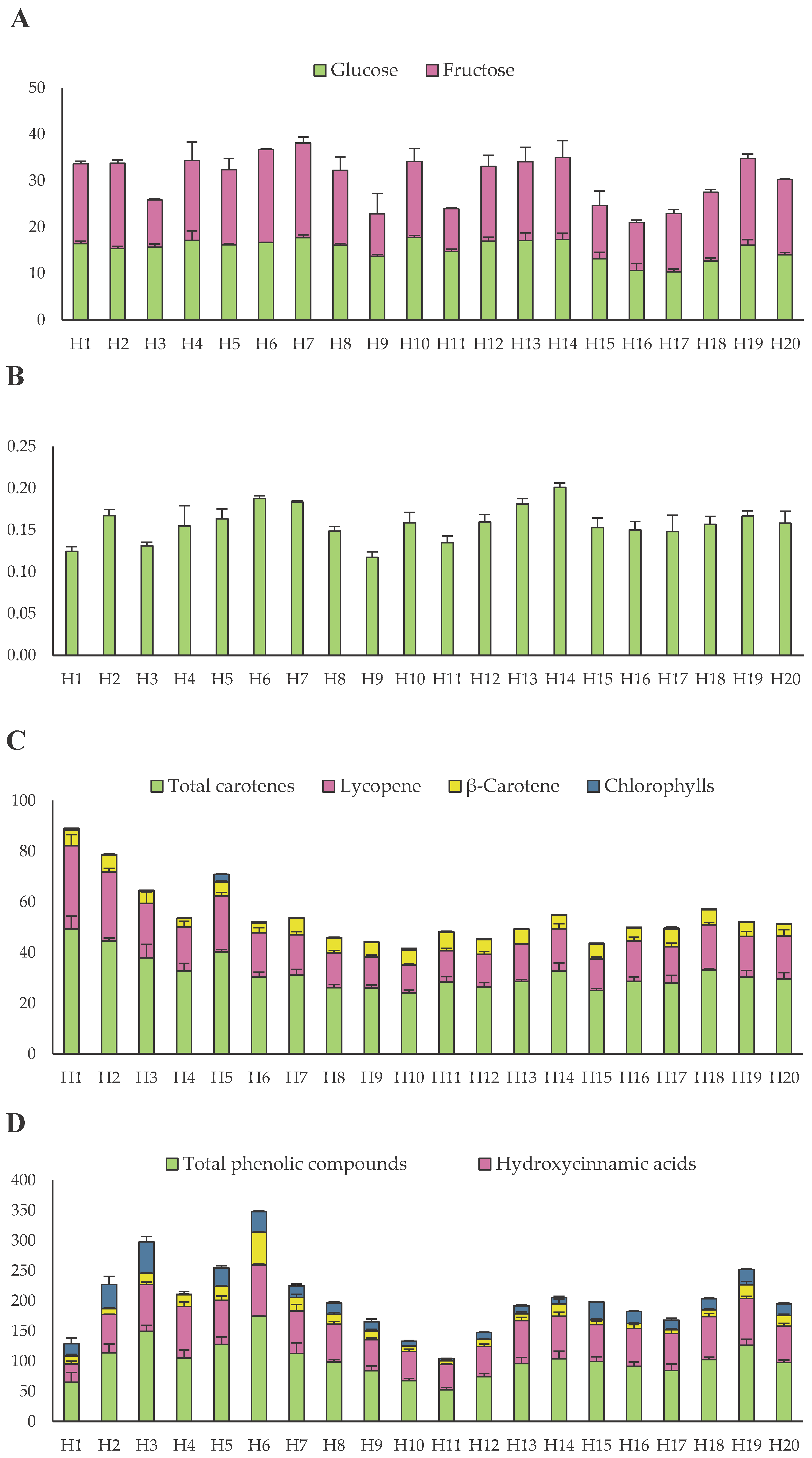
Figure 2.
Pearson correlation analysis of the agronomic (total yield [TY; kg], mean fruit weight [MFW; g], and fruit number [FN]), physical (equatorial diameter [ED; mm], longitudinal diameter [LD; mm], chroma [CH], and hue [HUE]), organoleptic (total soluble solids [TSS; °Brix], titratable acidity [TA; g L−1], glucose [GLC, mg g−1], and fructose [FRT, mg g−1]) and bioactive (vitamin C [VC; mg g−1], phenolic compounds [hydroxycinnamic acids {HA, µg g−1}, flavonols {FO, µg g−1}, and flavanones {FA, µg g−1}], carotenoids [lycopene {LY, µg g−1}, β-carotene {BC, µg g−1}, and total carotenoids {TC, µg g−1}]) traits analysed in traditional hybrids. Data are expressed in mean ± SD (n = 3).
Figure 2.
Pearson correlation analysis of the agronomic (total yield [TY; kg], mean fruit weight [MFW; g], and fruit number [FN]), physical (equatorial diameter [ED; mm], longitudinal diameter [LD; mm], chroma [CH], and hue [HUE]), organoleptic (total soluble solids [TSS; °Brix], titratable acidity [TA; g L−1], glucose [GLC, mg g−1], and fructose [FRT, mg g−1]) and bioactive (vitamin C [VC; mg g−1], phenolic compounds [hydroxycinnamic acids {HA, µg g−1}, flavonols {FO, µg g−1}, and flavanones {FA, µg g−1}], carotenoids [lycopene {LY, µg g−1}, β-carotene {BC, µg g−1}, and total carotenoids {TC, µg g−1}]) traits analysed in traditional hybrids. Data are expressed in mean ± SD (n = 3).
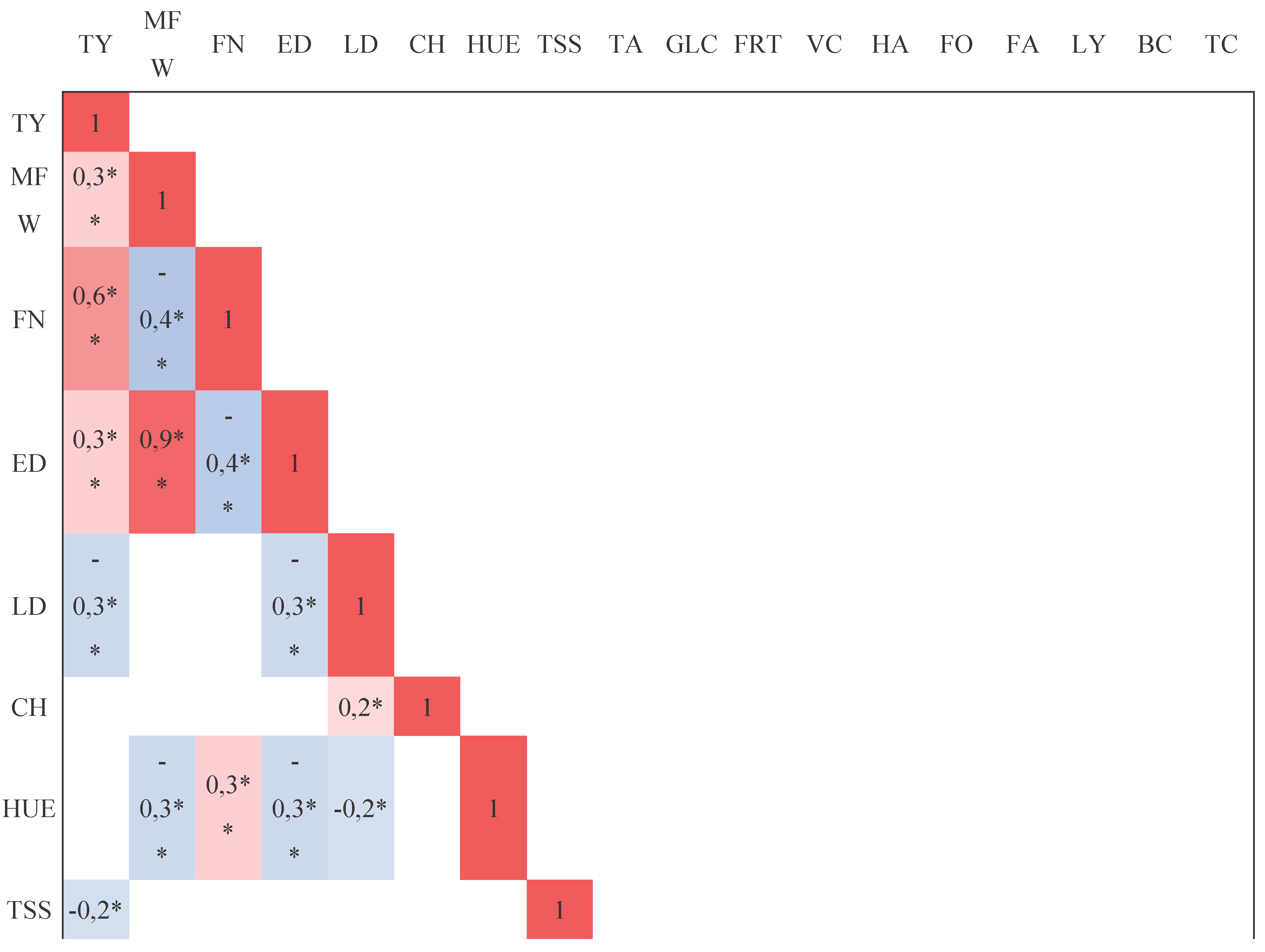
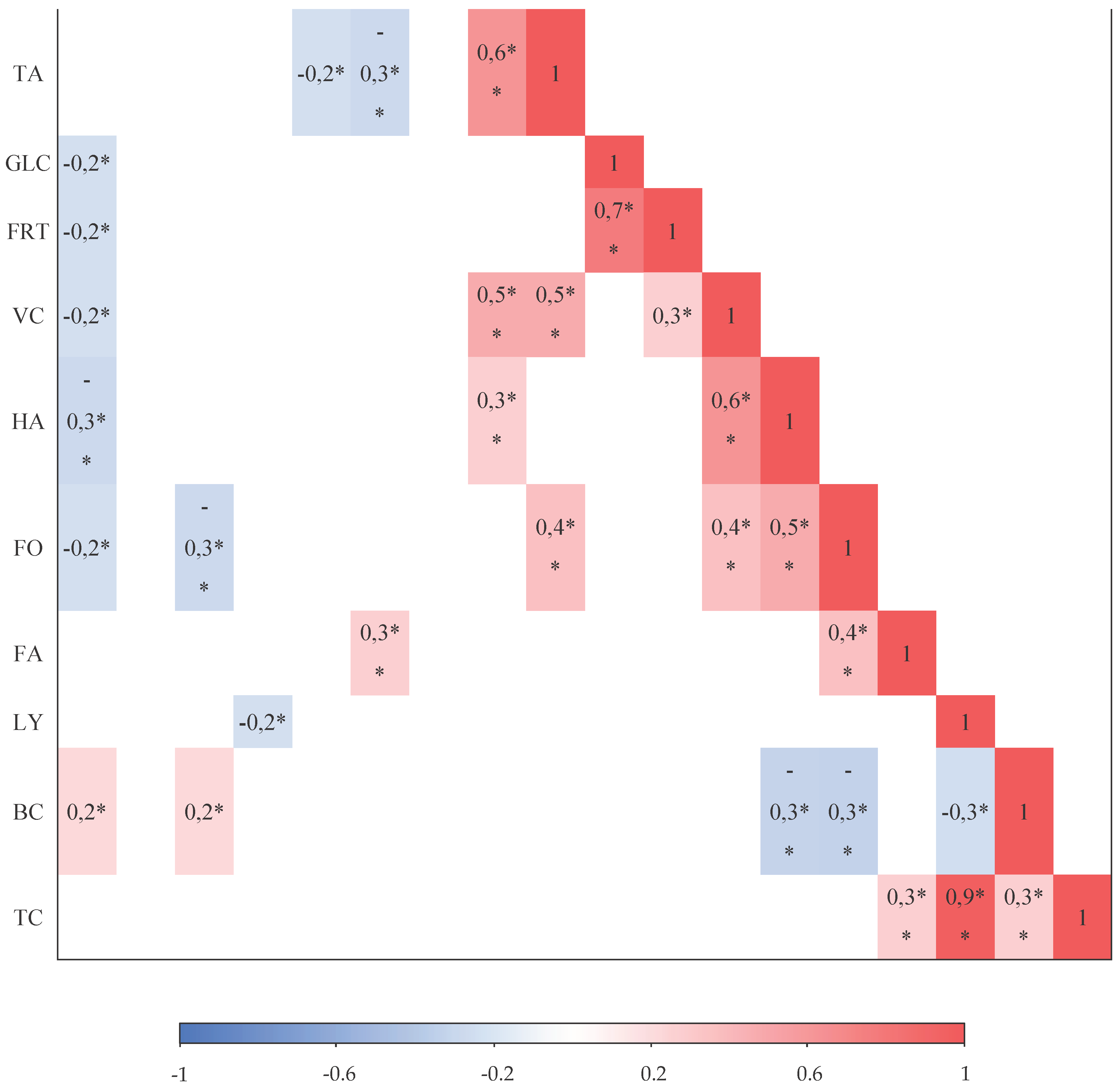
Figure 3.
Principal component analysis (PCA) of the agronomic (total yield [TY; kg], mean fruit weight [MFW; g], and fruit number [FN]), physical (equatorial diameter [ED; mm], longitudinal diameter [LD; mm], chroma [CH], and hue [HUE]), organoleptic (total soluble solids [TSS; °Brix], titratable acidity [TA; g L−1], glucose [GLC, mg g−1] and fructose [FRT, mg g−1]) and bioactive (vitamin C [VC; mg g−1], phenolic compounds [hydroxycinnamic acids {HA, µg g−1}, flavonols {FO, µg g−1}, and flavanones {FA, µg g−1}], chlorophylls [CHL, µg g−1], and carotenoids [lycopene {LY, µg g−1}, β-carotene {BC, µg g−1}, violaxanthin {VIO, µg g−1}, lutein {LU, µg g−1}, phytofluene {PHF, µg g−1}, and phytoene {PHE, µg g−1}]) traits evaluated in twenty F1 hybrids.
Figure 3.
Principal component analysis (PCA) of the agronomic (total yield [TY; kg], mean fruit weight [MFW; g], and fruit number [FN]), physical (equatorial diameter [ED; mm], longitudinal diameter [LD; mm], chroma [CH], and hue [HUE]), organoleptic (total soluble solids [TSS; °Brix], titratable acidity [TA; g L−1], glucose [GLC, mg g−1] and fructose [FRT, mg g−1]) and bioactive (vitamin C [VC; mg g−1], phenolic compounds [hydroxycinnamic acids {HA, µg g−1}, flavonols {FO, µg g−1}, and flavanones {FA, µg g−1}], chlorophylls [CHL, µg g−1], and carotenoids [lycopene {LY, µg g−1}, β-carotene {BC, µg g−1}, violaxanthin {VIO, µg g−1}, lutein {LU, µg g−1}, phytofluene {PHF, µg g−1}, and phytoene {PHE, µg g−1}]) traits evaluated in twenty F1 hybrids.
Figure 4.
Scatter diagram of the eighteen traditional F1 hybrids (H3 to H20) according to their evaluation index and total yield production.
Figure 4.
Scatter diagram of the eighteen traditional F1 hybrids (H3 to H20) according to their evaluation index and total yield production.
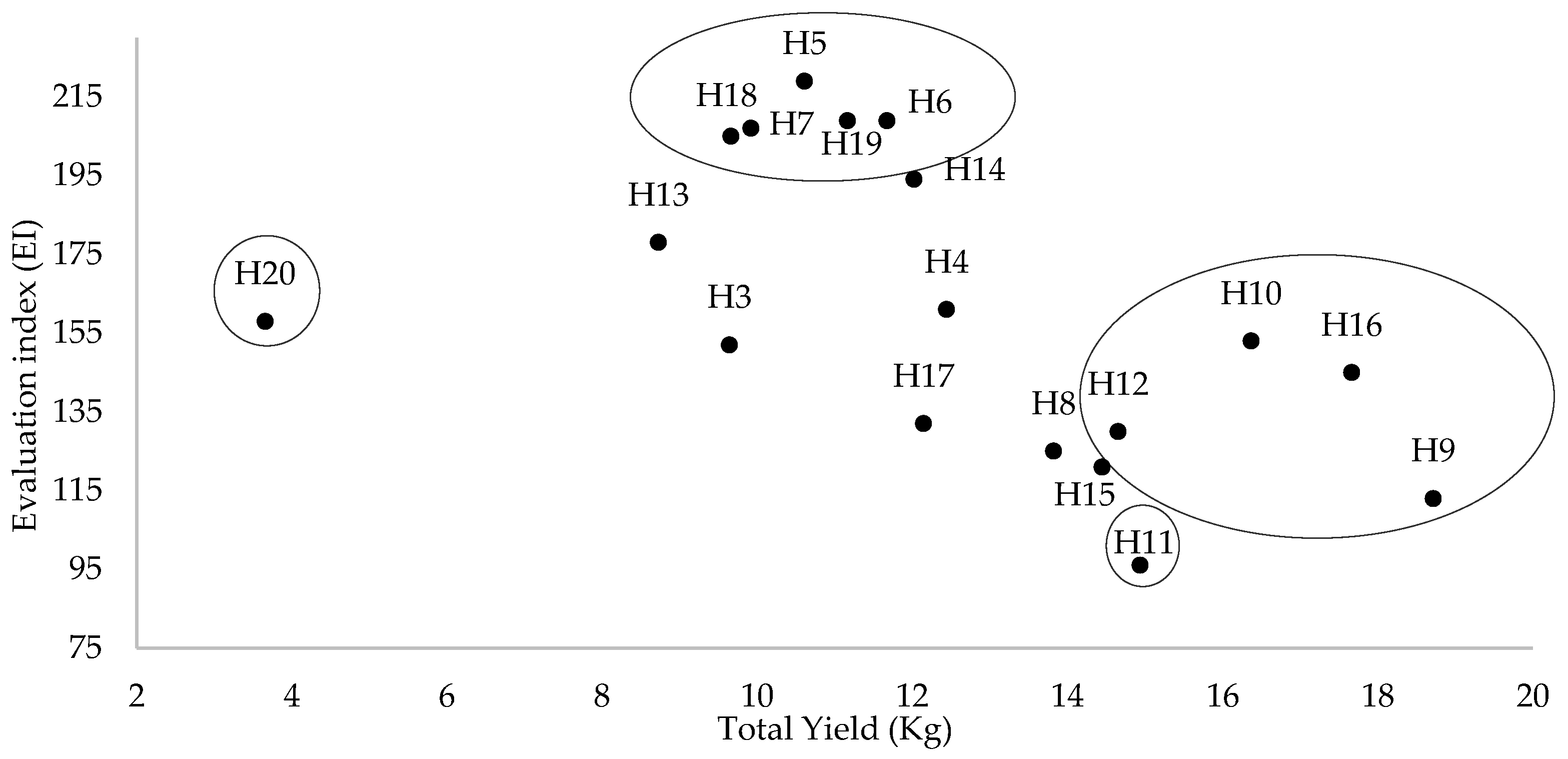

Table 1.
List tested of plant material (parent lines, F1 hybrids, and commercial controls), type of traditional variety, colour, and size. In the case of developed hybrids, the crosses are indicated and the code assigned to each hybrid is given in parentheses.
Table 1.
List tested of plant material (parent lines, F1 hybrids, and commercial controls), type of traditional variety, colour, and size. In the case of developed hybrids, the crosses are indicated and the code assigned to each hybrid is given in parentheses.
| Genotypes | Type | Colour | Size* |
| Parents | |||
| BGMU01010600 (P1) | Corazón de toro | Pink | L |
| BGMU01010922 (P2) | Moruno | Red-Black | XL |
| BGMU01010639 (P3) | Flor de Baladre | Pink | XL |
| BGMU01010640 (P4) | Flor de Baladre | Pink | XL |
| BGMU01010609 (P5) | Kumato | Red-Black | M |
| BGMU01010661 (P6) | Mesa Murciano | Pink | XL |
| BGMU01010643 (P7) | Mesa Murciano | Red | XL |
| BGMU01010675 (P8) | Mesa Murciano | Red | L |
| BGMU01010646 (P9) | Muchamiel | Red | L |
| BGMU01010665 (P10) | Muchamiel | Red | L |
| BGMU01010672 (P11) | Muchamiel | Red | XL |
| BGMU01010683 (P12) | Pera | Red | M |
| BGMU01010602 (P13) | Pimiento | Red | L |
| BGMU01010633 (P14) | Pimiento | Red | L |
| Hybrids | |||
| Pasadena (H1) | Tomate gordo | Red | L |
| Mongo (H2) | Marmande | Red | L |
| P3xP2 (H3) | Flor de baladre x Moruno | Red | XL |
| P3xP4 (H4) | Flor de baladre x Flor de baladre | Pink | XL |
| P5xP2 (H5) | Kumato x Moruno | Red-Black | M |
| P6xP2 (H6) | Mesa murciano x Moruno | Red | XL |
| P7xP6 (H7) | Mesa murciano x Mesa murciano | Red | XL |
| P7xP11 (H8) | Mesa murciano x Muchamiel | Red | XL |
| P8xP2 (H9) | Mesa murciano x Moruno | Red | L |
| P8xP5 (H10) | Mesa murciano x Kumato | Red | M |
| P8xP6 (H11) | Mesa murciano x Mesa murciano | Red | L |
| P8xP7 (H12) | Mesa murciano x Mesa murciano | Red | L |
| P9xP6 (H13) | Muchamiel x Mesa murciano | Red | L |
| P9xP7 (H14) | Muchamiel x Mesa murciano | Red | L |
| P9xP10 (H15) | Muchamiel x Muchamiel | Red | L |
| P9xP11 (H16) | Muchamiel x Muchamiel | Red | L |
| P12xP10 (H17) | Pera x Muchamiel | Red | M |
| P12xP13 (H18) | Pera x Pimiento | Red | M |
| P13xP1 (H19) | Pimiento x Corazón de toro | Red | L |
| P13xA40 (H20) | Pimiento x Pimiento | Red | L |
*Size according to: M (75-150 g), L (150-300 g) and XL (>300 g).
Table 2.
Descriptive statistics for agronomic (total yield [TY; kg], mean fruit weight [MFW; g], and fruit number [FN]), physical (equatorial diameter [ED; mm], longitudinal diameter [LD; mm], chroma [CH], and hue [HUE]), organoleptic (total soluble solids [TSS; °Brix], titratable acidity [TA; g L−1], glucose [GLC, mg g−1] and fructose [FRT, mg g−1]) and bioactive (vitamin C [VC; mg g−1], total phenolic compounds [TPC; µg g−1] and total carotenoids [TC; µg g−1]) analysed traits of 18 hybrids, 8 parental lines, and 2 commercial controls. Data are expressed in mean ± SD (n = 3).
Table 2.
Descriptive statistics for agronomic (total yield [TY; kg], mean fruit weight [MFW; g], and fruit number [FN]), physical (equatorial diameter [ED; mm], longitudinal diameter [LD; mm], chroma [CH], and hue [HUE]), organoleptic (total soluble solids [TSS; °Brix], titratable acidity [TA; g L−1], glucose [GLC, mg g−1] and fructose [FRT, mg g−1]) and bioactive (vitamin C [VC; mg g−1], total phenolic compounds [TPC; µg g−1] and total carotenoids [TC; µg g−1]) analysed traits of 18 hybrids, 8 parental lines, and 2 commercial controls. Data are expressed in mean ± SD (n = 3).
| Parental lines | Traditional hybrids | Control | |||||||
| Mean ± SD | CV | Range | Mean ± SD | CV | Range | Mean ± SD | CV | Range | |
| TY | 9.65 ± 1.33 | 25 | 5.97 - 15.07 | 12.35 ± 0.67 | 29 | 3.66 - 18.72 | 17.35 ± 1.35 | 3 | 16.99 - 17.70 |
| MFW | 243.47 ± 23.37 | 44 | 76.89 - 365.14 | 254.84 ± 11.32 | 36 | 140.47 - 436.69 | 232.68 ± 19.53 | 7 | 207.31 - 258.05 |
| FN | 48.60 ± 5.82 | 54 | 23.67 - 104.33 | 59.63 ± 1.85 | 51 | 19 - 137 | 87.00 ± 10.39 | 4 | 84.67 - 89.33 |
| ED | 80.33 ± 2.64 | 21 | 51.56 - 100.90 | 83.44 ± 1.47 | 17 | 61.22 - 108.31 | 81.17 ± 2.80 | 1 | 80.72 - 81.62 |
| LD | 68.51 ± 1.13 | 26 | 50.71 - 113.16 | 62.95 ± 0.86 | 17 | 50.34 - 90.66 | 57.00 ± 1.32 | 7 | 54.26 - 59.75 |
| CH | 34.49 ± 0.42 | 13 | 24.42 - 41.63 | 35.78 ± 0.24 | 10 | 26.25 - 40.53 | 37.13 ± 0.10 | 13 | 33.63 - 40.62 |
| HUE | 49.44 ± 0.25 | 16 | 37.28 - 64.09 | 49.38 ± 0.40 | 8 | 36.81 - 56.31 | 49.62 ± 2.07 | 0 | 49.47 - 49.77 |
| TSS | 6.34 ± 0.11 | 9 | 5.20 - 7.20 | 6.38 ± 0.08 | 12 | 5.3 - 8.1 | 5.84 ± 0.18 | 9 | 5.50 - 6.20 |
| TA | 4.02 ± 0.15 | 22 | 2.90 - 6.20 | 4.25 ± 0.02 | 16 | 2.7 - 5.2 | 4.22 ± 0.26 | 12 | 3.90 - 4.60 |
| GLC | 16.64 ± 0.40 | 16 | 13.60 - 24.60 | 15.24 ± 0.37 | 15 | 10.4 - 17.8 | 15.91 ± 0.23 | 5 | 15.40 - 16.40 |
| FRT | 17.16 ± 1.46 | 20 | 10.10 - 25.00 | 14.99 ± 0.81 | 24 | 9.1 - 20.4 | 17.82 ± 0.35 | 4 | 17.30 - 18.40 |
| VC | 0.16 ± 0.00 | 15 | 0.10 - 0.20 | 0.16 ± 0.00 | 13 | 0.1 - 0.2 | 0.15 ± 0.00 | 21 | 0.10 - 0.20 |
| TPC | 116.28 ± 5.56 | 33 | 8.10 - 130.40 | 102.79 ± 3.54 | 28 | 14.4 - 92.8 | 89.70 ± 5.81 | 38 | 36.50 - 57.90 |
| TC | 34.92 ± 0.18 | 24 | 21.60 - 51.10 | 29.98 ± 0.60 | 14 | 24.00 - 40.20 | 46.94 ± 2.27 | 7 | 44.60 - 49.30 |
Table 3.
Total yield (TY; kg), mean fruit weight (MFW; g), fruit number (FN), longitudinal diameter (LD; mm), equatorial diameter (ED; mm), chroma (CH), hue (HUE), total soluble solids (TSS; °Brix), and titratable acidity (TA; g L−1) for the traditional (H3 to H20) and commercial hybrids (H1 and H2). Data are expressed in mean ± SD (n = 3).
Table 3.
Total yield (TY; kg), mean fruit weight (MFW; g), fruit number (FN), longitudinal diameter (LD; mm), equatorial diameter (ED; mm), chroma (CH), hue (HUE), total soluble solids (TSS; °Brix), and titratable acidity (TA; g L−1) for the traditional (H3 to H20) and commercial hybrids (H1 and H2). Data are expressed in mean ± SD (n = 3).
| Hybrids | TY | MFW | FN | LD | ED | CH | HUE | TSS | TA |
| H1 | 17.7 ± 0.6 | 211 ± 12 | 85 ± 6 | 60 ± 2 | 82 ± 4 | 34 ± 1 | 49 ± 3 | 6.2 ± 0.4 | 4.6 ± 0.3 |
| H2 | 17.0 ± 3.1 | 192 ± 11 | 89 ± 17 | 54 ± 1 | 81 ± 4 | 41 ± 1 | 50 ± 1 | 5.5 ± 0.1 | 3.9 ± 0.3 |
| H3 | 9.6 ± 1.6 | 349 ± 33 | 27 ± 2 | 60 ± 2 | 93 ± 2 | 39 ± 2 | 50 ± 2 | 5.5 ± 0.3 | 3.0 ± 0.3 |
| H4 | 12.4 ± 2.2 | 395 ± 27 | 31 ± 4 | 63 ± 1 | 108 ± 4 | 29 ± 4 | 37 ± 1 | 6.6 ± 0.5 | 4.2 ± 0.2 |
| H5 | 10.6 ± 0.6 | 123 ± 5 | 86 ± 3 | 50 ± 2 | 67 ± 2 | 26 ± 0 | 56 ± 2 | 6.8 ± 0.3 | 5.2 ± 0.2 |
| H6 | 11.7 ± 1.7 | 301 ± 33 | 39 ± 5 | 58 ± 5 | 88 ± 9 | 35 ± 2 | 49 ± 1 | 5.5 ± 0.1 | 4.1 ± 0.1 |
| H7 | 9.9 ± 0.4 | 307 ± 20 | 33 ± 3 | 57 ± 0 | 91 ± 1 | 36 ± 1 | 51 ± 2 | 6.9 ± 0.4 | 4.7 ± 0.3 |
| H8 | 13.8 ± 1.1 | 319 ± 34 | 45 ± 7 | 59 ± 2 | 99 ± 5 | 34 ± 1 | 50 ± 2 | 6.0 ± 0.2 | 4.1 ± 0.1 |
| H9 | 18.7 ± 1.7 | 238 ± 10 | 79 ± 10 | 58 ± 2 | 87 ± 6 | 33 ± 1 | 51 ± 1 | 5.9 ± 0.1 | 5.0 ± 0.3 |
| H10 | 16.4 ± 3.1 | 118 ± 4 | 137 ± 22 | 51 ± 3 | 70 ± 3 | 32 ± 0 | 52 ± 1 | 6.2 ± 0.3 | 5.0 ± 0.8 |
| H11 | 14.9 ± 1.2 | 247 ± 20 | 62 ± 9 | 62 ± 1 | 93 ± 3 | 31 ± 1 | 51 ± 2 | 5.3 ± 0.2 | 3.6 ± 0.5 |
| H12 | 14.7 ± 1.9 | 256 ± 6 | 57 ± 6 | 60 ± 0 | 90 ± 2 | 34 ± 2 | 51 ± 1 | 6.6 ± 0.2 | 4.0 ± 0.4 |
| H13 | 8.7 ± 2.3 | 275 ± 33 | 31 ± 7 | 58 ± 4 | 86 ± 8 | 35 ± 4 | 49 ± 1 | 7.1 ± 0.4 | 4.7 ± 0.7 |
| H14 | 12.0 ± 2.2 | 274 ± 3 | 44 ± 9 | 56 ± 1 | 95 ± 2 | 38 ± 1 | 49 ± 1 | 6.2 ± 0.2 | 4.1 ± 0.0 |
| H15 | 14.5 ± 0.6 | 230 ± 17 | 64 ± 6 | 61 ± 2 | 80 ± 2 | 39 ± 1 | 48 ± 1 | 5.3 ± 0.2 | 2.7 ± 0.3 |
| H16 | 17.7 ± 2.0 | 278 ± 18 | 65 ± 12 | 62 ± 2 | 96 ± 2 | 39 ± 1 | 53 ± 3 | 7.3 ± 0.2 | 5.2 ± 0.8 |
| H17 | 12.1 ± 2.8 | 115 ± 11 | 105 ± 21 | 68 ± 3 | 62 ± 4 | 37 ± 1 | 48 ± 1 | 6.8 ± 0.4 | 3.5 ± 0.2 |
| H18 | 11.2 ± 4.7 | 119 ± 25 | 83 ± 30 | 76 ± 2 | 68 ± 3 | 38 ± 1 | 46 ± 1 | 8.1 ± 0.6 | 4.6 ± 0.3 |
| H19 | 9.7 ± 0.6 | 154 ± 19 | 66 ± 11 | 83 ± 3 | 61 ± 3 | 37 ± 1 | 47 ± 1 | 5.9 ± 0.3 | 4.2 ± 0.6 |
| H20 | 3.7 ± 0.2 | 195 ± 14 | 19 ± 2 | 91 ± 3 | 70 ± 2 | 31 ± 4 | 50 ± 1 | 6.4 ± 0.3 | 4.4 ± 0.2 |
Disclaimer/Publisher’s Note: The statements, opinions and data contained in all publications are solely those of the individual author(s) and contributor(s) and not of MDPI and/or the editor(s). MDPI and/or the editor(s) disclaim responsibility for any injury to people or property resulting from any ideas, methods, instructions or products referred to in the content. |
© 2024 by the authors. Licensee MDPI, Basel, Switzerland. This article is an open access article distributed under the terms and conditions of the Creative Commons Attribution (CC BY) license (http://creativecommons.org/licenses/by/4.0/).
Copyright: This open access article is published under a Creative Commons CC BY 4.0 license, which permit the free download, distribution, and reuse, provided that the author and preprint are cited in any reuse.


