

Submitted:
07 March 2024
Posted:
08 March 2024
You are already at the latest version
Abstract
The ongoing challenge to ensure a sustainable and affordable energy supply forces industrial companies to implement appropriate measures. These measures typically lead to an increased system complexity, which has to be addressed during operation. Whereas existing approaches from the field of supervisory and optimal control appear to be capable of mastering this issue, these are still not adopted in industry. Therefore, this work presents a procedure model for the systematic development of application-oriented operating strategies for industrial energy supply systems. The procedure model combines research approaches from the fields of sequencing control and approximate MPC to extract rule-based operating strategies. By splitting the procedure model into five phases, expert knowledge can be integrated in a target-oriented manner. Subsequently to the description, the procedure model is exemplary applied to the example of an industrial heating supply system. Throughout an optimization study, the developed operating strategy is compared to a MPC strategy as well as a baseline strategy. Whereas the conventional MPC approach is the upper bound with regard to optimality, the developed operating strategy is able to generate comparable results. Compared to the baseline strategy, a relative reduction in operating expenses of 5.4 % to 37.0 % are achieved in this specific use case.
Keywords:
Approximate MPC
; HVAC
; Procedure model
1. Introduction
The commitment towards climate-neutrality and the latest developments at the energy markets are just some aspects which underline the complexity of the task to ensure a resilient, sustainable and affordable energy supply. This particularly applies to industrial companies, as the industrial sector accounts for 38 % of the total final energy demand [1]. An increased energy-efficiency as well as the utilization of renewable energies (e.g. via electrification) are just some measures to address the aforementioned issue [2]. As large companies typically operate their own energy supply system, the adoption of those measures has to be addressed not only from an investment perspective but also with regard to the operation of those systems. For that, the development of operating strategies has to be conducted. These operating strategies need to be able to master the complexity of the underlying technical system while still ensuring implementation.
1.1. Operating Strategies
Roth provides a definition which defines the task of operating strategies as the control of complex systems or multiple interacting systems such that operating options are selected according to overarching objectives [3]. In the case of the control of industrial energy supply systems, those overarching objectives are of economical or ecological nature. The operating options, in turn, depend on the specific case of application. Here, Salsbury defines the following three main groups [4]:
- central plants,
- distribution systems and
- terminal units.
Central plants, for example, contain energy converters like CHP plants, HP or CT to provide heating, cooling or electricity. In terms of thermal energy, typically water or water-based distributions systems are used to transport the provided energy to its application. The actual application of the energy is controlled by the so-called terminal units. In the case of heating or cooling supply systems, relevant components are radiators or heat exchangers in combination with control valves. Those terminal units are typically controlled by local control functions like PID or hysteresis controllers.
Supervisory Control
In addition to local control functions, supervisory control functions have gained relevance, especially within the research community. According to Salsbury, supervisory control functions operate at a higher level than local control functions in the conceptual hierarchy of an operating strategy. More specific, a supervisory control function may apply different setpoints or mode changes to local control functions [4]. The specification of setpoints through a supervisory control function is illustrated in Figure 1. At the local level, a conventional controller (e.g. PID-controller) influences a control valve such that the desired flow temperature is achieved. At the supervisory level, a supervisory control function defines as a function of the return temperature as well as the ST temperature . In addition to the specification of setpoints, a supervisory control function may also decide on mode changes like the on/off status of one or multiple converters (also referred to as sequencing control). The nature of the supervisory control function depends on the specific case of application.
According to Wang et al., supervisory control functions can be differentiated into the following types: model-based methods, model-free methods, hybrid methods as well as performance map-based methods [5]. Within model-based methods, a model of the underlying system is used to decide on specific actions. A common example for a model-based supervisory control approach would be MPC. Within model-free methods, no specific model is used to decide on actions. Hybrid methods combine model-based and model-free methods or different types of models. An example of a hybrid method are reinforcement learning approaches, where physical models and black-box models are combined. Performance map-based methods rely stronger on expert knowledge. Here, simulation results or operational data is used to construct a so-called performance map, which then decides on the actions during operation.
Even though supervisory control being a relevant topic within the research community, a broad adoption of the aforementioned approaches in industry is still not present. According to a survey conducted by Royapoor et al., practitioners from industry see a lack of academias’ direct engagement, the complexity and performance uncertainty of the approaches as main obstacles of adoption [6].
The main goal of this work is therefore to contribute to the development of application-oriented operating strategies. Application-orientation should be ensured by the following two criteria. Firstly, the ability to formulate rule-based operating strategies, as those are easily implementable into state-of-the-art PLC. Secondly, the ability to integrate and rely on expert knowledge throughout the approach. During the course of this work, a procedure model is outlined which considers the above mentioned aspects. The procedure model is exemplary applied to an industrial heating supply system.
1.2. Structure of This Work
This work is structured as follows: within the section Related work, the research field is defined and relevant research papers are reviewed. Subsequently, the research gap is outlined. During the section Procedure model a procedure model for development of application-oriented operating strategies is illustrated. The procedure model aims at combining existing research approaches in a structured way, in order to provide a framework for developing application-oriented operating strategies.
Within the section Exemplary application, the procedure model is exemplary applied to an industrial heating supply system. Here, the focus lies on modeling aspects while still outlining the remaining phases. Throughout an optimization study, a performance assessment of the developed operating strategy is conducted. This work closes with a discussion on the advantages and disadvantages of the presented approach as well as an Outlook on further research activities.
2. Related Work
Due to the fact that the formulation of rule-based operating strategies is seen as a relevant criterion of application-orientation, relevant articles can be divided into two research fields. The first research field are so called sequencing control approaches. Here, the goal is to optimize the operation of multiple converters by deciding on their prioritization. The advantage of sequencing control approaches is, that the resulting operating strategy is generally already formulated in a rule-based manner. A research field which focuses on the extraction of rule-based operating strategies are so called approximate MPC approaches. Here, typically physical models (e.g. MILP models) are used for the generation of an optimal schedule. The schedule is then analyzed afterwards in order to extract rules that approximate the model (and its optimization).
2.1. Sequencing Control
In academia, sequencing control approaches are often applied to chiller systems, for example in [7,8,9,10]. In [7], Huang et al. developed a method which optimizes the load distribution between multiple chillers as well as the condenser set point temperature. This is done by optimizing the value of so called critical points. If the cooling load exceeds the critical point, the next chiller is activated. The method is subsequently applied to a simulation case study of three chillers, indicating energy efficiency gains especially during transition periods. Despite addressing a similar problem (load distribution and water temperature), Karami et al. present a different approach. In [8], they use a physical simulation model in combination with a particle swarm optimization to optimize the chilled water temperature setpoint, the condenser water temperature setpoint as well as the chiller sequence. The results indicate maximum energy savings of up to 13.6 %. To deal with measurement uncertainties, Zhuang et al. developed a risk-based approach to optimize chiller sequencing control [9]. The results show that the generated operating strategy is able to improve reliability of the chiller sequence control while decreasing energy consumption.
Summarizing, it can be said that the sequencing control approaches presented are able to generate advantages with regard to the selected optimization goal. At the same time, the approaches typically require to define the factors which influence the sequence during the model formulation. This can be challenging, especially within complex systems.
2.2. Approximate MPC
In [11], Stoffel et al. conduct a comparative study of advanced operating strategies including different MPC, reinforement learning as well as approximate MPC approaches. The approaches are applied to the example of a ventilation system and compared with regard to energy savings as well as qualitative criteria. As a result, Stoffel et al. find a energy saving potential of about 5 % for the approximate MPC algorithm whereas the conventional MPC approach reaches energy saving potentials of about 8 %. Regarding to qualitative criteria, Stoffel et al. state an advantage of approximate MPC in the fields of data quality dependence as well as transferability. At the same time, disadvantages with regard to adaptability and know-how dependence are outlined. An algorithmic approach which appears to be suitable for sequencing control problems is presented in [12]. Here, Domahidi et al. present an approach to approximate binary decisions (e.g. load, deload) by the so-called adaboost algorithm. More systematic approaches are presented in [13,14]. In [13], Drgona et al. develop a neural network approximation of a detailed MPC building operating strategies. The main steps are a linearisation of the building model, MPC performance evaluation as well as model selection, training and tuning. In [14], Maier et al. illustrate a similar approach which is reduced to four steps including clustering, operation optimization, rule mining as well as evaluation and interpretation. Here, the approach is applied to a HP system, deciding between five specific operating modes. To approximate the optimal schedule, random forest models are applied.
In conclusion, it can be claimed that a lot of research has been conducted on the approximation of optimal operating strategies as well as specific algorithms to address this problem. Nevertheless, the approaches typically lack generalization, especially with regard to the optimal operating strategies. Additionally, the integration of expert knowledge (e.g. within approximation) is barely considered.
3. Procedure Model
The procedure model illustrated in Figure 2 aims at supporting users throughout the development of application-oriented operating strategies. It can be applied during commissioning of new systems, extension of existing systems or improvement in general, e.g. in the course of energy consulting. By splitting the procedure model into five phases, competencies and expert knowledge of different stakeholders (e.g. energy management department, energy consulting firms as well as plant or automation engineering department) can be combined in a target-oriented manner. The competencies are segmented into the following fields:
- strategy and regulation
- plant and automation engineering
- statistical and physical modeling
Figure 2.
Phases of the procedure model and qualitative distribution of necessary competencies.
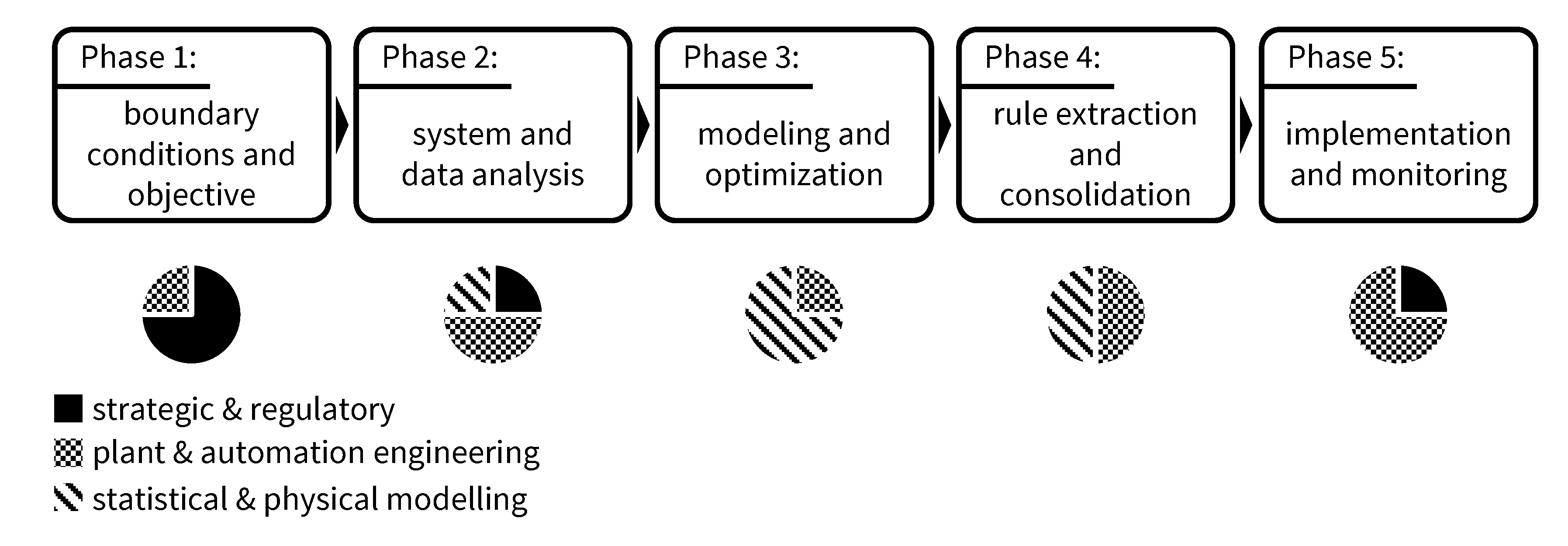
As the rule-based nature of the operating strategy is seen as a main requirement, phase two to four are inspired by approximate MPC approaches, such as presented in [14]. In the following, each phase is addressed by the description of its main findings as well as the contribution of each stakeholder.
3.1. Phase 1: Boundary Conditions and Objective
The goal of the first phase is to develop a common understanding of the underlying task. For that, it is necessary to specify the boundary conditions. This means, specifying for which system the operating strategy should be developed and which components (e.g. converters or storages) are within the scope. In addition, the objective must be defined. Thus, the question with regard to ecological, economical or even hybrid objectives must be answered. Here, company- or site-specific aspects like energy related taxes and incentives as well as types of energy sourcing must be considered.
The aforementioned aspects underline that this phase is mainly characterized by strategic and regulatory tasks. In practice, it is likely that this phase will be led by the energy management department and/or energy consulting firms, bringing together specialist departments if necessary.
3.2. Phase 2: System and Data Analysis
The second phase is divided into two sub tasks: system analysis as well as data analysis. The goal of the system analysis is to get a detailed understanding of underlying technical system to determine the scope of action of the operating strategy. For this purpose, possible operating modes (e.g. heat or electricity led) must be determined for all components. Additionally, it is necessary to specify operating ranges regarding minimal load as well as continuous or discrete control characteristics. Lastly, influence factors on the components performance must be determined. Those may be system internal such as the predominant demand and therefore the utilization rate of the converters, or system external such as ambient conditions.
After identification of the influence factors, the data analysis must be conducted. Here, the goal is to determine scenarios which are representative for the subsequent application of the operating strategy. This can also include the extrapolation of influence factors which may change in the future, like energy prices or demands. Phase two concludes with the definition of scenarios, which may require the adjustment or reformulation of the operating strategy, as rule-based approaches typically inherit disadvantages with regard to adaptability.
The required tasks and findings presented above underline the importance of expert knowledge during the second phase. As a profound understanding of the technical system and its operating behavior is necessary, expertise in the field of plant engineering as well as statistics is required.
3.3. Phase 3: Modeling and Optimization
The outcome of the third phase is to create optimized schedules for the technical system. This is done by developing a system model which is subsequently optimized for each scenario. The modeling as well as optimization builds upon the interim results of the second phase. It is mandatory that the system model represents the technical systems behavior as well as the scope of action of the operating strategy. Therefore, experts from the field of plant and automation engineering will still be enrolled in the third phase, even though the main tasks are from the field of statistical and physical modeling.
It should be noted that expertise in the field of statistical and physical modeling is currently uncommon in industrial companies - especially with regard to energy systems. Therefore, companies may rely on external expertise (e.g. energy consulting firms) in this phase.
3.4. Phase 4: Rule Extraction and Consolidation
Within the fourth phase, the operating strategy is created based upon the optimized schedules of phase three. For that, machine learning based approaches are most commonly applied in literature. Even though these approaches being numerically efficient, expert knowledge can still be integrated within that phase. To balance quality and complexity of the operating strategy, it can be beneficial to consider only a subset of the total operating states. Likewise, factors which influence the selection of specific operating states can be narrowed by findings of prior phases.
The tasks outlined above require profound competencies in statistics and data-driven approaches. At the same time, a solid understanding of the underlying technical system is necessary.
3.5. Phase 5: Implementation and Monitoring
The actual implementation of the operating strategy is conducted in phase five. This phase is mainly reliant on competencies from the field of automation engineering. However, due to disadvantages of rule-based approaches with regard to adaptability, it is necessary to conduct a monitoring of the strategy during operation. This may involve an assessment of the model quality of phase three as well as the examination if specific events (e.g. significant changes within energy sourcing) may require a reformulation of the operating strategy.
4. Exemplary Application
Within the following section the procedure model is applied to the example of an industrial heating supply system, illustrated in Figure 3. While the focus of this application is lying on phase three, the remaining phases are still exemplary conducted.
4.1. Boundary Condition and Objective
The heating supply system consists of one CHP and three HP as converters, a buffer storage as well as a network for heat distribution. The HP are connected to a cooling supply system to utilize industrial waste heat as a source of energy. The cooling supply system is additionally equipped with a CT.
However, throughout this exemplary application, the operating strategy focuses on the heating supply system, determining the optimal converter utilization regarding economic objectives. Here, operating expenses are influenced by the utilization of the final energies natural gas and electricity. Regarding energy sourcing, conventional supply contracts including peak and off-peak tariffs are assumed. As the heating supply system is a part of a larger industrial site, the CHPs generated electricity leads to a reduced electricity purchase, not to grid feed-in.
4.2. System and Data Analysis
This phase builds upon the interim results of the prior phase. Due to the technical system design and the focus on the heating supply system, it is assumed that all converters (CHP and HP) are operated heat led. Therefore, the operating strategy must decide on the optimal converter control sequence within the heating supply system. As the defined objective is primarily influenced by the amount and temporal course of the purchased final energies, the temporal utilization of the converters as well as their efficiencies are of key interest. Here, part-load as well as thermal efficiencies are important. The thermal efficiencies are influenced by the required flow temperatures. In heating networks, those are typically adjusted according to the ambient air temperature.
Through the conducted system analysis, the scope of action of the operating strategy is clarified. Key parameters of the heating supply system are outlined in Table 1.
Through analyzing the influences on the objective, influence factors are determined. Those are the predominant heating demand due to part-load efficiencies, the flow and ambient temperature due to thermal efficiencies as well as final energy prices. As the heating demand as well as the flow temperature depend on the ambient temperature, in total ten representative days are selected for the latter.
4.3. Modeling and Optimization
As stated in Phase3: modeling and optimization, the modeling and optimization phase must consider not only the technical systems behavior but also the scope of action of the operating strategy. Therefore, the following section is divided into two subsections: the operating strategy model formulation as well as the technical system model formulation. The actual optimization will not be described in detail, as commonly available frameworks and solvers are applied.
4.3.1. Operating Strategy Model Formulation
Subsequently, a model formulation for optimization of sequencing control problems is outlined. In contrast to existing sequencing control approaches, the presented model formulation does not rely on the definition of specific influence factors beforehand. By that, the model formulation can be applied to a broad range of technical systems.
The model formulation is characterized by the definition of two variables. Firstly, by the binary variable which defines whether converter is at priority at time step . Secondly, by the binary variable which defines whether the activation of a specific converter is allowed with regard to the sequencing control approach.
In addition to the variables mentioned, equation 1 ensures that each priority within the sequence is occupied by exactly one converter. On the other hand, equation 2 ensures that each converter occupies exactly on priority.
The activation of a specific converter through is limited by in equation 3. By that, a converter can only operate once it is set to the given priority. Additionally, as stated in equation 4, activation is depended on the relative utilization of the less prioritized converter, with and .
Finally, can then be used to control the activation of a specific converter as illustrated in equation 5. Here, the heating power of a specific converter is limited by and M, with and large enough.
4.3.2. Technical System Model Formulation
Within this subsection, the model formulation of the technical system is described. The model is formulated as a MILP, simplifying the systems behavior to power and energy balances.
The general system behavior of the CHP is outlined in equation 6 and 7. Here, not only efficiencies ( and ) but also a simplified part-load behavior is considered. This is done by penalizing the systems power balance through the binary variable . Thus, defines whether the CHP is activated from time step to .
Further part-load constraints are defined in equation 8 to 11. Here, is influenced by the binary variable , which defines the activation status of the CHP. The activation status, in turn, determines the allowed operating range (equation 10 and 11). Here, defines the minimal relative utilization with and .
The interaction between the operating strategy and the technical system is illustrated by equation 12. Here, the relative utilization variable from the prior subsection is defined as the fraction of the actual and rated gas consumption of the CHP. The CHP is therefore regarded as an entry of the converter set .
As displayed by equation 13 and 14, the system behavior of the HP is modeled according to the CHP. However, the thermal efficiency of the HP is influenced by the COP and therefore the flow temperatures of the heating and cooling network ( and ). The ideal COP is adjusted by the correction-factor .
Even though not being within the scope of the operating strategy, the influences on the CT’s operation still need to be considered, as they influence the objective. As displayed in equation 15, the CT’s system behavior is modeled depended on its EER. The EER however is modeled as a linear function of the ambient temperature, assuming dry cooling.
The heat storage is implemented by a basic energy balance, displayed in equation 16. Here, represents the predominant heating demand and the duration of one time step. The same holds true for the cool storage and network.
Finally, equation 17 defines the objective function. As stated beforehand, the objective is to minimize operating expenses, which are influenced by the final energy prices of electricity and natural gas .
4.4. Rule Extraction and Consolidation
Throughout this section, the rule extraction and consolidation of the operating strategy will be described. As the technical system model considered is rather simple, we do not apply complex machine learning approaches but rely on information gathered in prior phases.
In phase two, final energy prices and the ambient temperature are already identified as the main influence factors. Therefor, it can be analyzed which converter sequence is chosen based on those factors. This is illustrated in Figure 4.
It is observable, that chosen converter sequence (highlighted by different gray scales) is mainly influenced by the ambient temperature and less by the electricity price. Even though there are some outliers, the ambient temperature is selected as sole influence factor for the sake of simplicity.
Within Table 2, the sequence sets are displayed. Here, not only the converter priority but also the appropriate temperature interval is defined.
4.5. Implementation and Monitoring
Throughout this exemplary application, the operating strategy is not implemented into a PLC of the actual system. However, the operating strategy outlined beforehand, could be implemented by three if/else conditions.
4.6. Results and Discussion
To evaluate the performance of the developed operating strategy, a optimization study is conducted. Throughout the optimization study, the following operating strategies are compared: baseline-strategy, sequencing-strategy and MPC-strategy. We apply those strategies to a winter, spring and summer scenario with the duration of one week each.
Within the baseline-strategy, a simple decision rule is implemented, which is defined based on qualitative assumptions. Below the heating-threshold temperature of , the CHP is used as the prioritized converter. Above the heating-threshold temperature, the HP are prioritized with descending rating.
The sequencing-strategy is the strategy outlined beforehand, including the sequence sets and their corresponding temperature intervals.
The MPC-strategy represents a conventional optimization approach. Here, the scope of action is not limited to sequencing control, meaning that load can be splitted between multiple converters in parallel.
Figure 5 illustrates the system behavior throughout the optimization study. Here, for each scenario and operating strategy the converter utilization is outlined. It is observable that the converter utilization of the MPC-strategy and sequencing-strategy are quite similar throughout all scenarios. Nevertheless, differences are apparent during the spring scenario. Here, the MPC-strategy splits the load between the CHP and HP3. As load splitting between multiple converters is not in the scope of action of sequencing control approaches, the sequencing-strategy changes between the utilization of the CHP and the HP. Comparing the aforementioned operating strategies with the baseline-strategy outlines, that a prioritization of HP1 does lead to unfavorable system behavior. During the winter and summer scenario, the residual heating demand is not high enough for a sufficient utilization of HP1. Therefore, a high number of start-up cycles can be observed, which negatively influences the efficiency.
The aforementioned aspects can also be observed throughout a quantitative assessment. Table 3 shows the relative reduction in operating expenses of the MPC-strategy and sequencing-strategy in comparison to the baseline-strategy. During winter and summer the performance benefit of both operating strategies are almost identical. During the spring scenario, the MPC-strategy has considerable advantages over the sequencing-strategy. However, both operating strategies lead to a significant reduction in operating expenses with regard to the baseline-strategy.
The optimization study illustrated above outlines the importance of considering the system behavior during the development of operating strategies. At least for the given heating supply system, the developed rule-based operating strategy was able to reduce the operating expenses substantially, compared to the baseline.
However, it must also be noted that the illustrated approach has also some limitations. Due to the applied sequencing control approach, the operating strategy will lead to sub-optimal solutions because of load-splitting. Additionally, a high number of influence factors may lead to quite complex strategies, adversely affecting the implementation of rule-based operating strategies. Lastly, significant system changes may require the reformulation of the operating strategies.
5. Outlook
As the presented approach was applied to a rather isolated technical system throughout this work, we want to focus on more complex systems in the future. Here, the complexity with regard to multiple operating modes (e.g. heat and electricity led CHP) as well as the operation of storages are of particular interest.
By increasing the complexity of the underlying technical system, an increased complexity of the relating operating strategy can be assumed. Thus, the rule-extraction and consolidation of phase four becomes more challenging. Therefore, in future work, we want to focus on algorithmic aspects of phase four by determining which approaches are best suited for the proposed model formulation.
Additionally, as a flexible energy sourcing becomes increasingly important for industrial companies, we want to evaluate how rule-based operating strategies can contribute to that.
The overarching goal of the aforementioned investigations is to identify chances and limitations of rule-based operating strategies. The authors are aware of the benefits of pure algorithmic approaches, such as MPC. However, we regard the development and implementation of rule-based operating strategies as a chance to win the confidence in more advanced approaches, contributing to the common goal of an affordable and sustainable energy supply.
Author Contributions
L.T.: Conceptualization, Investigation, Methodology, Software, Writing - Original Draft; M.F.: Methodology, Software, Investigation, Writing - Original Draft; M.W.: Supervision, Funding acquisition, Writing - Review Editing. All authors have read and agreed to the published version of the manuscript.
Funding
This research was funded by the German Federal Ministry of Economic Affairs and Climate Action (BMWK) grant number 03EN2048A-I.
Institutional Review Board Statement
Not applicable.
Informed Consent Statement
Not applicable.
Data Availability Statement
We encourage all authors of articles published in MDPI journals to share their research data. In this section, please provide details regarding where data supporting reported results can be found, including links to publicly archived datasets analyzed or generated during the study. Where no new data were created, or where data is unavailable due to privacy or ethical restrictions, a statement is still required. Suggested Data Availability Statements are available in section “MDPI Research Data Policies” at https://www.mdpi.com/ethics.
Acknowledgments
The authors thankfully acknowledge the financial support of the research project “ETA im Bestand” by the Federal Ministry of Economic Affairs and Climate Action (BMWK) and the project supervision by the project management organisation Projektträger Jülich (PtJ).
Conflicts of Interest
The authors declare no conflicts of interest.
Abbreviations
The following abbreviations are used in this manuscript:
| CT | Cooling Tower |
| COP | Coefficient of Performance |
| CHP | Combined Heat and Power |
| EER | Energy Efficiency Ratio |
| HP | Heat Pump |
| PID | Proportional-Integral-Derivative |
| MPC | Model Predictive Control |
| ST | Storage |
| PLC | Programmable Logic Controller |
| MILP | Mixed-Integer Linear Programming |
References
- International Energy Agency. Global Energy and Climate Model: Net Zero Emissions by 2050 Scenario (NZE), 2022.
- International Energy Agency. Industry, 2022.
- Roth, M. Betriebsstrategie. In Energiemanagement im Kraftfahrzeug; Liebl, J., Lederer, M., Rohde-Brandenburger, K., Biermann, J.W., Roth, M., Schäfer, H., Eds.; Springer Fachmedien Wiesbaden: Wiesbaden, Germany, 2014; pp. 323–365. [Google Scholar]
- Salsbury, T.I. A SURVEY OF CONTROL TECHNOLOGIES IN THE BUILDING AUTOMATION INDUSTRY. IFAC Proceedings Volumes 2005, 38, 90–100. [Google Scholar] [CrossRef]
- Wang, S.; Ma, Z. Supervisory and Optimal Control of Building HVAC Systems: A Review. HVAC&R Research 2008, 14, 3–32. [Google Scholar]
- Royapoor, M.; Antony, A.; Roskilly, T. A review of building climate and plant controls, and a survey of industry perspectives. Energy and Buildings 2018, 158, 453–465. [Google Scholar] [CrossRef]
- Huang, S.; Zuo, W.; Sohn, M. A New Method for the Optimal Chiller Sequencing Control. In Proceedings of the Proceedings of Building Simulation 2015: 14th Conference of IBPSA, 2015, Building Simulation Conference Proceedings.
- Karami, M.; Wang, L. Particle Swarm optimization for control operation of an all-variable speed water-cooled chiller plant. Applied Thermal Engineering 2018, 130, 962–978. [Google Scholar] [CrossRef]
- Zhuang, C.; Wang, S.; Shan, K. A risk-based robust optimal chiller sequencing control strategy for energy-efficient operation considering measurement uncertainties. Applied Energy 2020, 280, 115983. [Google Scholar] [CrossRef]
- Chen, Y.; Yang, C.; Pan, X.; Da Yan. Design and operation optimization of multi-chiller plants based on energy performance simulation. Energy and Buildings 2020, 222, 110100. [Google Scholar] [CrossRef]
- Stoffel, P.; Maier, L.; Kümpel, A.; Schreiber, T.; Müller, D. Evaluation of advanced control strategies for building energy systems. Energy and Buildings 2023, 280, 112709. [Google Scholar] [CrossRef]
- Domahidi, A.; Ullmann, F.; Morari, M.; Jones, C.N. Learning decision rules for energy efficient building control. Journal of Process Control 2014, 24, 763–772. [Google Scholar] [CrossRef]
- Drgoňa, J.; Picard, D.; Kvasnica, M.; Helsen, L. Approximate model predictive building control via machine learning. Applied Energy 2018, 218, 199–216. [Google Scholar] [CrossRef]
- Maier, L.M.; Henn, S.; Mehrfeld, P.; Müller, D. Approximate Optimal Control for Heat Pumps in Building Energy Systems.
Figure 1.
Exemplary distinction between local and supervisory control functions.
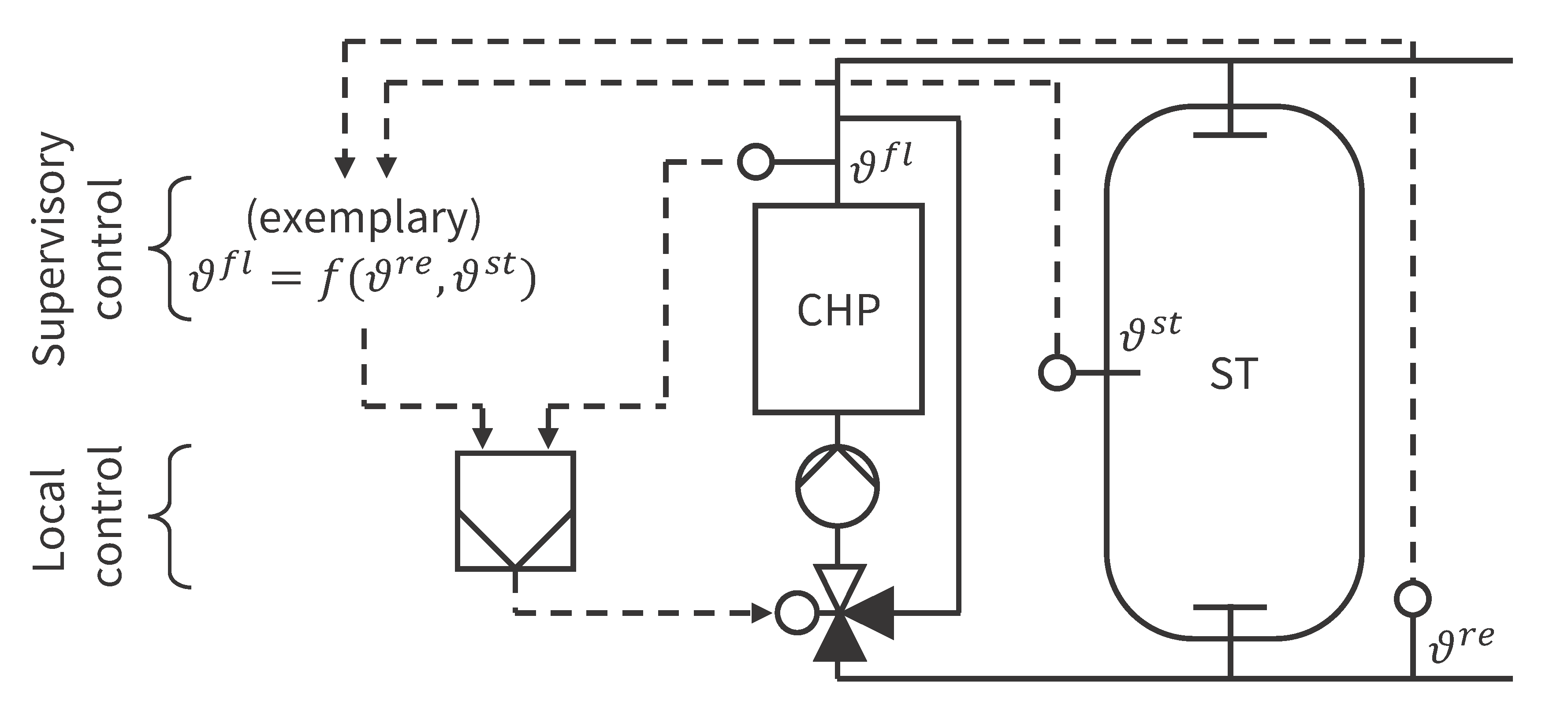
Figure 3.
Use case of an industrial heating supply system.
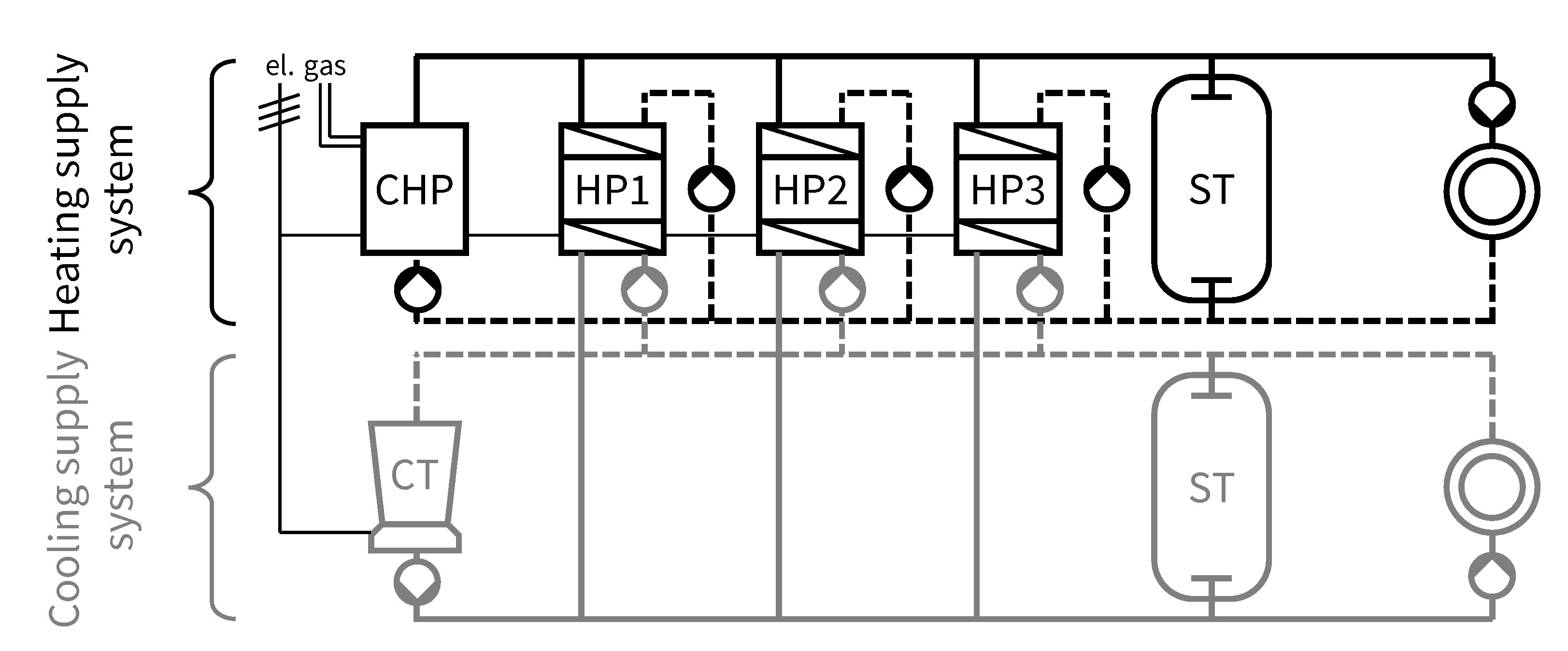
Figure 4.
Selected sequence sets based on the electricity price and ambient temperature.
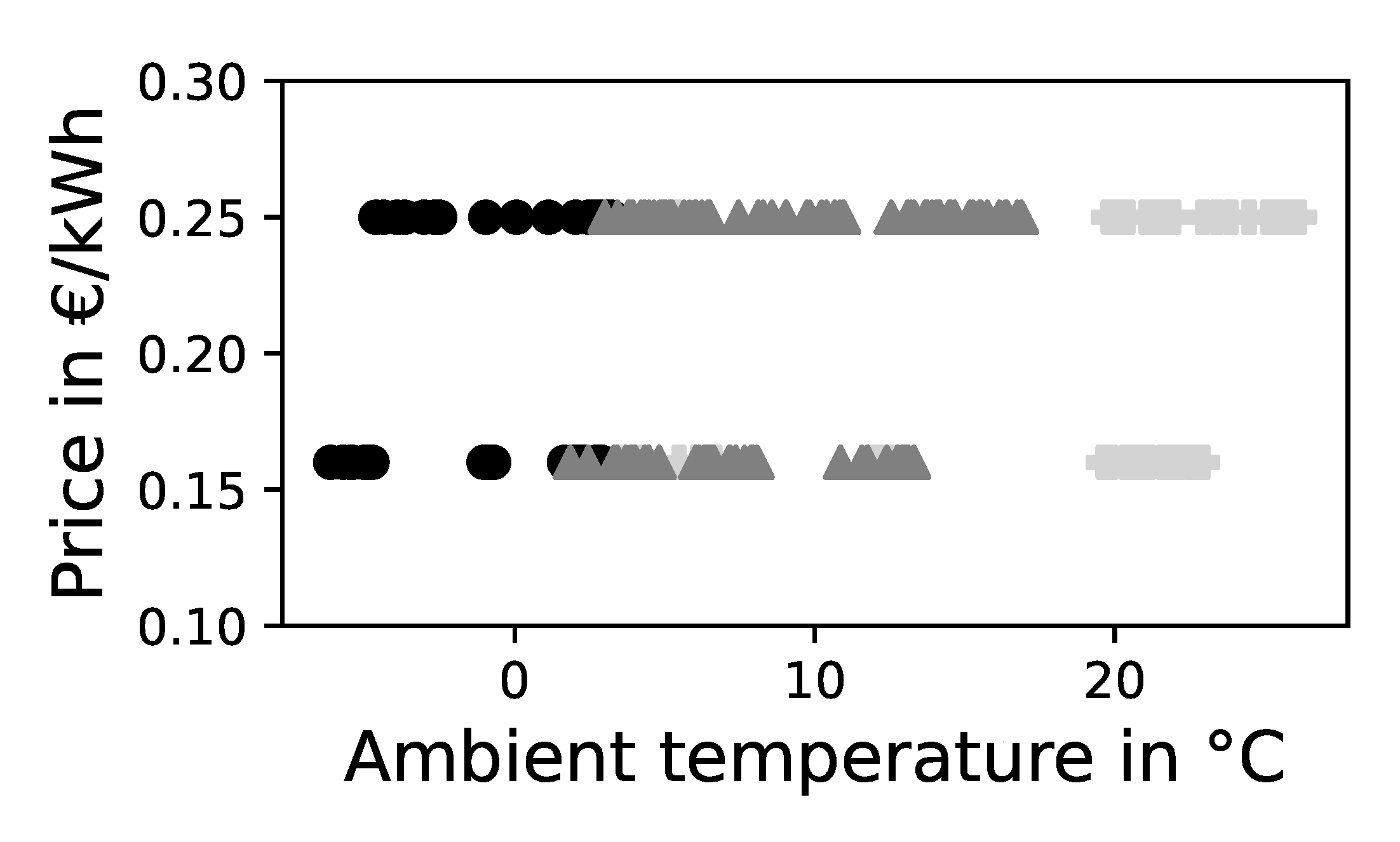
Figure 5.
System behavior throughout the optimization study.
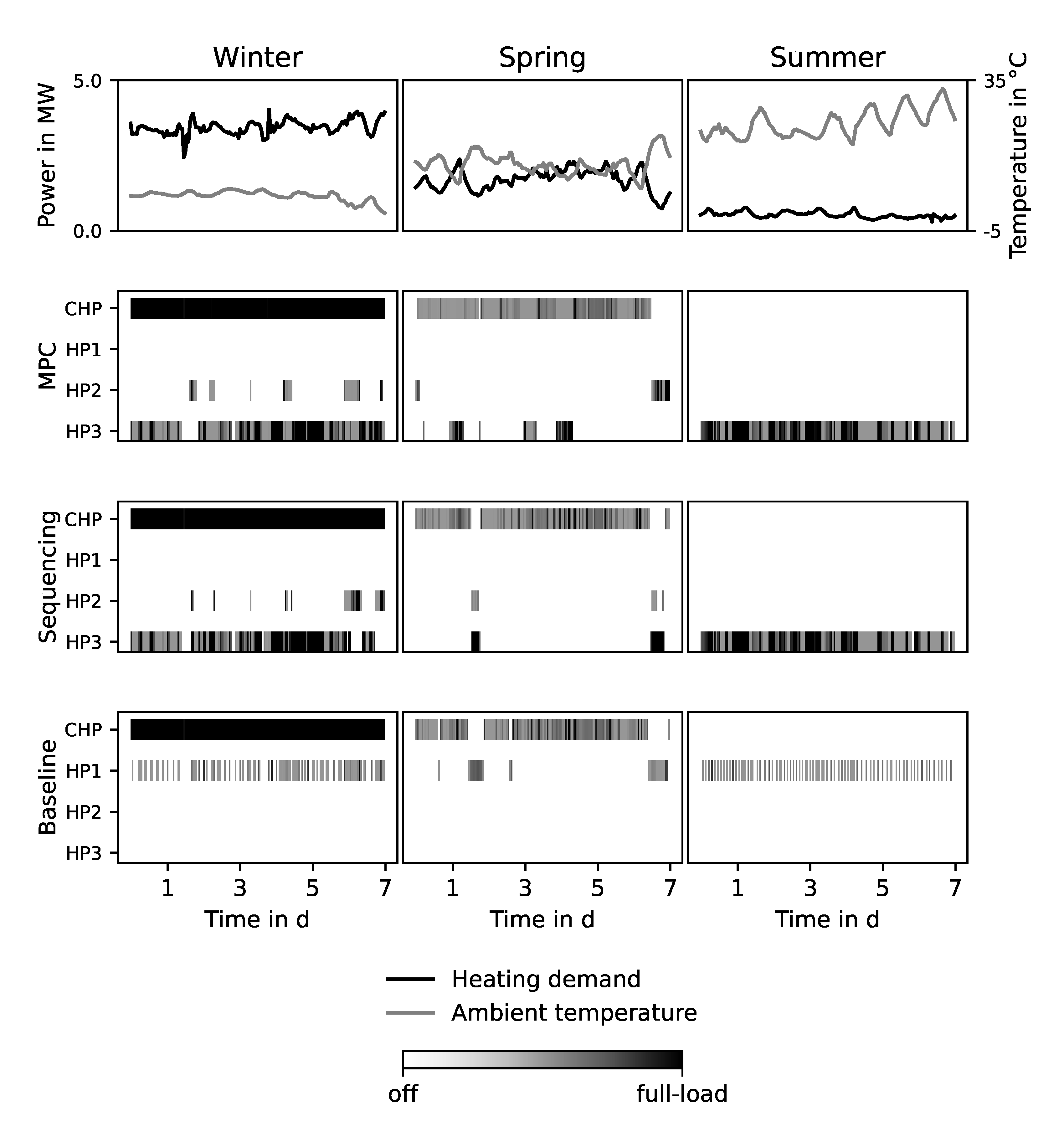

Table 1.
Parameters of the converters within the industrial heating supply system.
| CHP | HP1 | HP2 | HP3 | |
| Rated power | ||||
| Operating range |
Table 2.
Sequence sets used to approximate the optimal schedules.
| Set one (black) | Set two (gray) | Set three (light gray) | |
| CHP priority | 1 | 1 | 4 |
| HP1 priority | 4 | 4 | 3 |
| HP2 priority | 3 | 2 | 2 |
| HP3 priority | 2 | 3 | 1 |
| Temperature interval |
Table 3.
Relative reduction of operating expenses compared to the baseline-strategy.
| Winter scenario | Spring scenario | Summer scenario | |
| MPC | 12.4 % | 59.5 % | 5.4 % |
| Sequencing | 11.9 % | 37.0 % | 5.4 % |
Disclaimer/Publisher’s Note: The statements, opinions and data contained in all publications are solely those of the individual author(s) and contributor(s) and not of MDPI and/or the editor(s). MDPI and/or the editor(s) disclaim responsibility for any injury to people or property resulting from any ideas, methods, instructions or products referred to in the content. |
© 2024 by the authors. Licensee MDPI, Basel, Switzerland. This article is an open access article distributed under the terms and conditions of the Creative Commons Attribution (CC BY) license (http://creativecommons.org/licenses/by/4.0/).
Copyright: This open access article is published under a Creative Commons CC BY 4.0 license, which permit the free download, distribution, and reuse, provided that the author and preprint are cited in any reuse.


