

Submitted:
05 March 2024
Posted:
06 March 2024
You are already at the latest version
Abstract
Cities are complex systems requiring urban design models that balance order and disorder. Collective creativity initiatives engage citizens in these processes, empowering bottom-up approaches that prioritize people and social well-being within urban development. This paper investigates an 'Urban Laboratory' as a case study, examining the potential of collective creativity to address urban complexity. The successful and ongoing project 'El Campo de Cebada' in Madrid, Spain, demonstrates how a community transformed a vacant lot into a vibrant social hub. The phases of this study include case selection, data collection, data analysis, and presentation of the results. This study identifies key enabling factors, including agents, management, social dynamics, infrastructure, and actions. These insights offer a methodological framework for designing future collaborative, resilient, and inclusive urban spaces, addressing the complex needs of communities within our cities.
Keywords:
collective creativity
; co-creation
; complexity
; social imagination
; El Campo de Cebada
; urban laboratories
; urban design
; city
1. Introduction
Contemporary cities are complex and face a range of challenges, from inequality to a lack of sustainability. However, urban models based on traditional hierarchies and processes do not adequately address these problems. Instead, the cities of the future could be built through new strategies, considering today’s complexity and challenges. In this sense, there seems to be some consensus on the importance of collaboration and citizen participation to achieve more liveable, sustainable, and equitable cities. In this regard, the Sustainable Development Goals, specifically SDG11 [1] —sustainable cities and communities— aim to make cities more inclusive, resilient, safe, and sustainable. With a view to the year 2030, universal access to public spaces, increased participatory management, and the intensification of sustainable urbanisation are challenges.
This involves reclaiming the ‘right to the city’ [2,3,4,5,6] —where citizens can participate in the construction and management of urban spaces—; designing collaboratively [7,8,9,10,11,12,13] —including the diverse perspectives of all stakeholders—; using urban laboratories [14,15,16,17,18,19,20,21,22,23] —as experimental spaces that promote citizen participation, innovation, and co-creation—; and harnessing the temporary use of spaces [24,25,26,27,28] —as a reuse of abandoned or obsolete spaces to revitalise them and generate new opportunities—.
In the current contexts of urban and architectural complexity [29,30,31,32,33,34,35,36,37,38], multiple collectives of architects have emerged that propose new models of ideation, project development, and production of architectural actions. These models are based on collaborative processes [7,8,11,12,32,39,40,41,42,43,44,45,46]. These models are based on collaborative processes that observe and assume reality in a polyhedral way, developing complex strategies to intervene in it. In the current contexts of urban and architectural complexity, multiple collectives of architects have emerged that propose new models of ideation, project development and production of architectural actions. These models are based on collaborative processes that observe and assume reality in a polyhedral way, developing complex strategies to intervene in it. However, there are no studies that relate the level of complexity of urban spaces with collective creativity. Therefore, this article analyses the capacity of collective creativity to face emerging urban challenges and as a consequence to build more liveable, sustainable, and equitable cities. Specifically, it explores the capacity of collective creativity and collaborative processes, to take on a higher level of complexity in the field of citizen self-managed common spaces. ‘El Campo de Cebada’ has been selected as a case study because it is a successful urban laboratory. Certain variables have been extracted that define the complexity of this urban space. These variables are proposed as a measurement instrument for possible application in other cases.
2. Literature Review
2.1. Challenging Environments: Individualisation and Collaboration in Complex Scenarios
During the Industrial Revolution, progress was made through accumulation, ignoring the environmental impact and any other collateral damages. During the postmodern period, progress does not consist only of ‘improving’, but it implies losses, setbacks, and the appearance of problems that are difficult to solve. In fact, the nondesirable effects of the progress start to be taken into consideration. Walter Benjamin [47] inspired by the ‘Angelus Novus’ of Paul Klee adds that progress is made looking backward and not only moving forward without reflection and without considering the consequences of our actions. On the other hand, ‘Capitalism’ -apart from using a limited time frame and not considering the long-term consequences of their actions- is based on the individualism of societies, promoting competence and specialisation, and disconnecting people as a collective. Until very recent times, the specialisation has been crucial to manage the huge dimension of human knowledge; however, a more holistic view has emerged as a response to the uncertainty of the contemporaneous world. During the XX century, and usually linked to crisis periods, diverse collaborative experiences within architecture and within art. Some of the collectives that emerged during the twentieth century—surely a source of inspiration for contemporaneous collectives—that emerged during the twentieth century are CIAM, TAC ‘The Architects Collaborative’, ODAM ‘Organização dos Arquitectos Modernos, ‘grupo CoBrA’, ‘Team 10′, PAGON, ‘Grupo R’, ‘Internationale Situationniste’, ‘Metabolism’, ‘Archigram’, ‘Architecture Principe’, ‘Grupo 2C’, inter alia. Nevertheless, it is presently when much more complex collaborative processes are implemented.
‘Individualism’ is understood as an independent attitude from others. Although the concept of ‘individualisation’ also appears as the process of becoming an individual. Regarding this definition, Ulrich Beck claims the return of individuals to society and argues that individualisation makes integration possible: “As paradoxical as it seems, it is individualisation and fragmentation of growing inequities in separated biographies that make up a collective experience” [48]. However, what has prevailed throughout history is ‘cooperation’. According to Kropotkin [49] “the rampant individualism is a proof of more modern times, but it is certainly not a character of the ancient human”. And he continues to argue that, as much as the fight and the competence stand, it has always prevailed on the mutual support and the common good. So collaboration was the natural way to survive and move forward for ages. However, self-affirmation of the individual is also important for progress and for balancing the more than possible homogenising effect of the community. But “isolation could act against cooperation” [50], so it could be interesting to strengthen and increase networks to optimise interactions and synergies.
‘Social collective behaviour’ builds biological communities, digital networks, and cities indistinctly, first to survive and lately for the common good through profit-based exchange. ‘Swarm intelligence’ is based on emerging systems that could become brilliant innovators and adapt better to changes than any other model with rigid hierarchies. They are network structures distributed through self-organised systems that build their complex itineraries with bottom-up logic. In this sense, Michael Hardt and Antonio Negri [51] assert that ‘likewise, a network without a centre that commands, those who only think according to traditional models believe that there is no organisation at all and only see spontaneity and anarchies… but when looking from within the network, one could observe that there is an organisation, rationality, and creativity. It is swarm intelligence”. On the other hand, Lévy [52] defines ‘collective intelligence’ as “shared intelligence everywhere, constantly valued, coordinated in real time, that drives an effective mobilisation of competences”. This coordination requires a sort of appropriate communication, the communication and information technologies being those that better harmonise the interactions. In this way, “cyberspace appears as the organisational tool for all kinds of communities, and all dimensions in existing collectives, but also an instrument which permits that allows intelligent collectives to link up between them” [53].
2.2. The Right to the City and Urban Complexity
The concept of ‘the right to the city’ was defined by Henri Lefebvre [54] as the right of city inhabitants to build, decide and create the city. The author proposes a city model based on citizen participation and the right of everyone to enjoy the city. He opposes the concept of the city as a space of consumption, transit, and work, in order to defend the city as a space of life. Under this approach, it is a social space produced by human action that claims the ‘right to the city’ as a fundamental right that must be recognised by the state. On the other hand, Harvey [2,4] adds that it offers an alternative to traditional forms of ‘urban governance’, which generally exclude citizens and perpetuate social inequalities. Additionally, he asserts that the city is not only a physical structure, but a product of the social relationships and the political struggles that happen within. It is a political instrument to mobilise citizens in the search for more equal and fairer cities. [5].
In a context where cities are ‘complex’, their main character is the diversity of their population, activities, and structures. Such diversity supposes many challenges, as an opportunity for design, allowing us to tackle these challenges in a creative and innovative way [30]. Here, design could play a fundamental role in the creation of more habitable, more sustainable, and more fairer cities. This potential must be able to adapt to the complexity of cities and to the constant uncertainty that is its main character. If we tend to models that identify cities with complex systems, it could be convenient to abandon traditional urban planning to emphasise citizen participation and collaboration [35]. The growing complexity of today cities could also be defined as the set of interconnections, interdependences, and heterogeneities that are the main character of urban spaces. It is a phenomenon that has grown exponentially in recent decades, and it is necessary to understand y to face its key dimensions—diversity interconnection and inertia [29]. Three concepts are key in the science of complexity and very relevant to collaborative design: 1) emergency–it cannot be foreseen from its individual elements-; 2) adaptation-ability to get adapted to the new conditions on the environment-; 3) self-organisation–to be able to spontaneously getting organised not needing any external agent [33]. In fact, ‘self-organisation’ is fundamental to building positive conditions for interacting and cooperating between urban actors. In an urban scenario, it could emerge through informal networks, local initiatives, and innovative practices. It is a proper approach to handle the complexity and the uncertainty related to the contemporaneous cities. It can be concluded that these concepts aim to generate more resilient and sustainable urban processes that, simultaneously, could improve the quality of citizens [37,38].
2.3. Collective Creativity in Urban Spaces: Participation, Collaboration and Co-Creation
If the architecture repurposes its connection with the society and develops the interest for the common, it will surely generate more human cities. In cities, there is a facade of disorder and chaos, but it is actually the concealment of a complex order. To better understand urban order, one must understand cities and neighbourhoods as living organisms that are able to generate and maintain safety on their streets and to ensure freedom within the cities. Cities build their order ‘bottom-up’, and, as emerging systems, cities have the ability to learn and recognise patterns. “Metropolitan space is usually portrayed as ascending lines over the horizon, but the true magic of life in cities comes from its bottom” [55]. To enable these synergies, it is important to have real urban integration. In this sense, neighbourhoods are the more efficient local units of self-government. Furthermore, every action —as little and humble as it seems— is essential, because as Jacobs states, “despite so many experiments, planned or unplanned, there is no substitute for lively streets” [56].
Our starting point is that the city is a valuable resource that should be managed and preserved in a collective way. Therefore, democratic governance is forced to promote participation of citizens in the decision making about the future of their neighbourhoods [57]. This trend of citizen integrations in the creation of public spaces has three fundamental elements: citizen participation, co-creation, and social transformation [58]. It handles the implying of citizenhood, building spaces for the dialogue and the collaboration, but also participating in the design and the construction of these spaces. It is certainly remarkable that participation has four key dimensions: political, social, cognitive, and spatial. And four types of participation can be i: formal participation-linked to the authorities-; informal participation- out of the established frameworks-; direct participation, in which citizens make decisions and are accounted for those decisions; and indirect participation, in which there are citizen representatives [32]. Moreover, it could be defined as participative creativity as the collective process, located and distributed that is produced in the context of interactions and social relationships. Therefore, spaces of creative participation represent a promising way of promoting collaboration, innovation, and empowerment of the citizens through connection, experimentation, and recognition [59].
Today, there is abundant research on ‘co-creation’ as a tool for designers who are interested in creating innovative solutions. Furthermore, it is argued that co-creation can build stronger relationships between designers and users [60]. Among the elements that are linked to the dynamics of urban co-creation it is notable the active citizen participation, the facilitation of agents for the creation of collaborative environments, and the organisation that must have a clear structure and a well-defined process [23]. Furthermore, the promotion of urban resilience requires the development of effective tools for participation, which are based on co-design approaches linked to the network and open code [41]. Specifically, the so-called ‘creative places’ have grown in relevance today. Spaces such as cultural and art centres, but also co-working and digital manufacturing spaces, play an important role in promoting collaboration, innovation and social development within cities [61]. There are three key dimensions that describe these spaces: social cohesion and citizen participation, innovation and economic development, and sustainability, both social and environmental. Its potential lies in its capacity to generate synergies between various social agents, institutions, and economic sectors. In this line, it is held that collective culture in public space should not be limited to traditional spaces. It handles hybrid spaces, where commercial, cultural, and social activities are blended, and are especially suitable for the development of new forms of collective culture [62]. In all these spaces, even ruled by collaborative processes, conflicts and disagreements also emerge. Therefore, it is necessary to develop tools that help in its management to obtain satisfactory results for all parties involved [10].
2.4. ‘Urban Laboratories’ and Temporary Use of the City
Currently, both architectural collectives and emerging citizen processes focused on collaboration are multiplying and have generated several ‘Urban Laboratories’ whose experimentation is placed in the avant-garde of ‘new economic, cultural, social and political configurations within cities’ [14]. Crisis has served of great impulse in recent years, as it has generated realities that have stimulated the solidarity and the action of the neighbours that share a common place. Projects that take advantage of situations of nonoccupation and obsolescence to relaunch the urban fabric and the social cohesion, recovering the public space for the citizen. The growing interest in participative practices of public space creation is a sign that citizens are willing to take control of public space in the era of urban austerity. While working with citizens, establishing bonds, empowering them and evaluating public spaces, urban planners could create more inclusive, resilient, and fair spaces [63]. Creative initiatives that combine both participative approaches ‘bottom-up’, as formal strategies ‘top-down’, can create unique public spaces and not only commercial ones.
Architecture collectives have applied their new processes of production—without rigid hierarchies- to the urban projects in which they are working. Related to recent urban scenarios, Adolfo Estalella states [64]: “cities are mutating from one side of the globe to the other. Inhabitants that used to transit through its streets or walk through its gardens now live in the cities to furbish their places and occupy their lots. A new form of citizen urbanism emerges through which urban space is redesigned on and by the street”. The collective ‘Paisaje Transversal’ adds that “reformulation of the axioms that ruled the last century goes through subverting the object and process logic, claiming instead the value and potential of the process the image, the icon. It is also essential to recover the social value of architectural practice. In other words, let us be able to provide our knowledge and tools for the civil society to facilitate social transformations” [65].
‘Urban laboratories’, also known as urban social laboratories or urban living laboratories, are a way of open innovation, of experiencing and co-creation that uses citizen participation to address urban challenges [18,21,66,67,68,69]. The European Union officially recognised this concept in 2006, when the European Network Living Labs (ENOLL) was founded [70]. However, its beginnings date from the early 1990s, when a research team from the University of Pennsylvania developed a problem-solving method for a neighbourhood in Philadelphia [71]. The potential of these laboratories consists of their ability to generate new forms of social interaction, economic production, and political participation in urban space. In addition, it offers methodologies that address complex and emerging urban challenges [20,66,72]. Therefore, this participatory approach not only improves the quality of urban design, but also promotes social cohesion, civic participation, and people’s empowerment [73]. On the other hand, urban innovation practices are not only reactive responses to crisis situations -as proved on many occasions- but represent a commitment to social transformation and building more equitable and sustainable cities where people’s well-being increases [19,22,74,75].
‘Urban Laboratories’, which flourish in many cities, have a common ‘adhocracy’ and the recovery of spaces for participation and citizen management. This concept contrasts with the bureaucracy and is defined in organisations management framework as the absence of hierarchies. Robert H. Waterman describes this term as “any form of organisation that beaks bureaucratic lines in order to reach opportunities, solve problems, and obtain results” [76]. “Alternative processes to conquer urban wounds that stimulate new empowerment of the city and resistance to commodification of the public” [77] are being implemented. Self-managed urban spaces, as well as collectives of architects and designers, have thrived in recent years, empowered by gathering movements and social claims of the citizenhood. ‘It makes clear that there is another way to participate in the composition of the city by building spaces and designing needed so it is possible to live in common” [64] . It handles of “urban self-managed spaces of all kind: public spaces, social spaces, cultural spaces, central or peripheral spaces, citizens, neighbours spaces or whatever you would like to call it, they are occupied, squatted, transferred, rented… Spaces that have returned to the city and to the street its essential function of scenario, outline and environment of life in common” [78]. The challenge now is to make these claims, initiatives, and principles effective through public policies, promoting a new combination of disciplines to integrate the social, economic, and environmental development of urban contours [79].
This urban transformation movement has a holistic scope that goes beyond a simple physical transformation of the urban space to also cover social relationships and the fabric of the community [80]. Some of its contributions are the improvement of the quality of life of citizens, the strengthening of the link between local authorities and neighbours, the improvement of the development and quality, the acceleration of decision making and smooth implementation of solution implementation, stimulation of learning and the continuous improvement and boost of the flexibility and adaptability of spaces, inter alia [19,67,69,73]. The so-known ‘DIY Urbanism’ (Do It Yourself) [80,81] also promotes solidarity, cooperation, and collective action of citizens, contributing to fairer, more democratic, and more sustainable societies. It is remarkable that some research focused on digital ‘Urban Laboratories’ favours especially issues such as accessibility, efficiency, innovation, open democracy, and collaboration [82]. However, it also takes into account challenges such as the lack of financial resources, resistance of institutions and lack of legal background [74,81]; the constraint to define goals clearly, the goals in a clear way, the conflict management and scalability of conflicts [19]; social inequities, environmental degradation, and lack of available spaces [83] pressures from authorities and agents of the real states [80]; integration into physical reality, validation of ideas, or consent of local governments [82].
‘Occupancy’ of public spaces has as primary goal the claim of ‘the right to the city’ and it handles an emerging trend that is transforming the urban landscape [84]. Furthermore, this practice is understood as a way of urban activism and as a strategy for the temporal reuse of public space [27,85]. Several case studies of ‘Temporary Urbanism’ examine this kind of intervention that promotes citizen participation, as well as the creation of dynamic and comfortable spaces [24,25,26,86]. In all this research, it is concluded that it handles temporary transformation of abandoned or underused urban spaces into meeting places, cultural events, and leisure activities. This temporary utilisation offers as opportunities regeneration of public spaces, as well as experimentation with new models of urban development. Linked also to the concept of ‘Urban Laboratory’, these spaces are characterised by promoting innovation, flexibility, and collaboration in their quest to create more liveable and sustainable environments [87]. When a quality and well-managed ‘Temporary use’ is achieved, especially those related to ecological activities, it could make a significant contribution to the sustainable development of the neighbourhood. Similarly, ‘Temporary use’ could reduce the negative impact of vacant urban spaces [26,88]. In essence, our cities have always been the subject of transformations and redesigns, but the contribution of temporary uses can be a shunt for these processes—dealing with an important role of technology and current social networks [89].
3. Methodology
For the development of this research, the complexity of a unique case was studied as a reference of ‘Urban Laboratory’ (Figure 1). The ‘El Campo de Cebada’ project has been examined as a paradigmatic case study of this type of collective urban production processes, in which multiple collectives of architects and designers have participated. This study analyses a series of variables that show the capacity of collective creativity processes to address urban complexity and to articulate actions for the regeneration of degraded urban lots. In the research process, a literature review was carried out to describe the circumstances surrounding the ‘El Campo de Cebada’ project and the entire development process. Furthermore, the phenomena of collective creativity in this case, as well as the elements that define its level of complexity, have been studied in an exhaustive and qualitative way.
3.1. Study Case Selection
‘El Campo de Cebada’ has been chosen as a case study (Figure 2), located in the neighbourhood of Madrid, not because it is a common space, but an “urban experience based on community, inclusion, and connection, and not just the cold and individualistic logic of capitalistic speculation” [90]. Despite its very innovative and risky approaches, it proved long-term stability and great success within the community [16]. A guild of collectives with a large trajectory of social success, from its beginning in 2010 until its closing in 2017. “El Campo de Cebada is a critical position that is woven together to build positive actions. It is a public space that does not look for profit or for advantages for the associations and people who are in charge, but to learn a way of considering the city in a very different way, in which the public returns to be common, belonging to all the people” [91].
There are many other interesting experiences -as well elsewhere in Europe or at the global level- but Spain is consolidated as a great reference in the claim of the right to the city [54] and in the collaborative creation. Some of these referents are: ‘Can Batlló’, ‘Forat de la Vergonya’ and ‘Recreant Cruïlles’ (Barcelona); ‘El Solar Corona’ (Valencia); ‘Esta es una plaza’, ‘Tabacalera’, ‘Solarpiés’, ‘Solar Maravillas’, ‘Patio Maravillas’ and ‘Solar de Grilo’ (Madrid); ‘LaFábrikadetodalavida’ in Badajoz; ‘Astra’ en Guernica; ‘Ateneu Candela’ in Terrassa; ‘La Harinera’ in Zaragoza; ‘HirikiLabs’ of Tabakalera in Donostia; ‘la Casa Invisible’ in Málaga; ‘la Casa Grande del Pumarejo’ y ‘Tramallol’ in Sevilla; etc… All these places host, within their ‘Urban Laboratories’, innovation social activities related to culture, education and citizen participation.
3.2. Criteria for Case Selection
‘El Campo de Cebada’ has been selected because of its long trajectory over time and repercussions. The project began in 2010 and closed in 2017, but it could be said that it was completed when the new sports centre was built in 2022 —the competition, design, and construction of which was the reason for the creation of the citizens’ initiative—. It is also a large space, covering 1.2 hectares, which made it possible to generate a multifaceted urban project. It is a space with great evolution, resistance, and transformation over time, demonstrating its capacity for adaptation and resilience. ‘El Campo de Cebada’ is located in a strategic place, with great accessibility and open spaces that facilitate the development of multiple collective activities. In an initial analysis, this space manifests itself as a complex urban project and, therefore, seemed suitable for this type of study. Finally, the high level of intrinsic motivation of citizens to create and maintain the project was taken into consideration, mainly due to the feeling of loss of a community space in the neighbourhood —the sports centre of ‘La Latina’—.
3.3. Analysis of the Case Study
The case study was carried out by direct observation using various elements. In addition to the review of the available scientific literature, social networks and digital publications of citizen initiatives —active even after the closure of the laboratory as a physical space— have been monitored. We also analysed graphic documentation produced by citizens and professional groups, as well as press publications on the process of evolution of the urban space. Finally, interviews were conducted with the architectural groups involved in the project. Once the necessary data had been collected, they were analysed and interpreted. In general, the information obtained was classified to define the study variables involved in the description of the evolution of the level of complexity of this urban space throughout its history.
3.4. Study Variables
The variables identified were classified as follows: 1) times —chronology of the events and elements that emerge in ‘El Campo de Cebada’—; 2) agents —actors that are part of the project-; 3) management-forms of administration and governance—; 4) social dynamics —structures and organisation—; 5) Enabling infrastructures -material elements built and used—; and 6) Actions —activities developed—.
3.5. Complexity Map
The result of the analysis of the variables has been represented through the elaboration of a complexity map of ‘El Campo de Cebada’. In this graph, all study variables have been articulated chronologically, visually showing the complexity of this urban space during its historical evolution up to the present day. This map was the analytical approach used to derive conclusions.
4. Results and Discussion
4.1. Description of the Study Case: ‘El Campo de Cebada’ as Complex ‘Urban Laboratory’
‘El Campo de Cebada’, located in the ‘La Latina’ neighbourhood, is the history of an urban void [92] or the result of the demolition of a shared space. During the XVI century that the ‘Plaza de la Cebada’, one of the oldest squares in Madrid and a space full of life and history, was turned into a concrete hole in 2009. This square was built over an old muslin cemetery that was outside the walls of the town. There, the barley for the kings horses was separated from that intended for the cavalry regiment, and was the place where peasants coming from the surroundings of Madrid came to sell the grain. It was used as a market for cereals, vegetables and pork products, with an outdoor stand, which resulted that the “unifying element that generated the activity was the void itself, which opened in the city to host whatever activity required” [93].
Due to the growth of the population during the last decades of the XVIII century, the construction of the ‘Mercado de la Cebada’ is projected [94]. It was inaugurated in 1875 by the king Alfonso XII and, during the beginnings of the XX century, became one of the biggest and most important markets in Madrid. The modernist building is replaced by a new one, “but the location of the market neglected the public space, forgetting what it owed, and the square was resigned to a background spaces that lost connection whit other little squares of the area, in addition to the growth of rolling traffic made that pedestrians to be kept limited to a functional perimeter, and the main door was left of the public space”[93]. In 1968 the downturn of the public market —due to the appearance of other ways of commerce— and the growing worry in the city for hygiene provoked that half of the building was transformed into a sports centre that occupied the last empty space of the square. The building was counted with a covered swimming pool and turned out to be the only place for relationships in that quarter.
Already in XXI century, only the half of the market stands were occupied, and the local administration approved the ‘Special Improvement Plan’ [95] in order to rearrange the area. One of the goals of the plan of action for the revitalisation of the urban centre of 2004 was the realisation of a complex equipment. The so-called ‘Plan E’ was the starting point of an idea competition for the refurbishment convoked in 2006 —the first prize turn out null— and in a later call during 2007 which was won by the proposal entitled ‘+Público’. The preliminary design was submitted on December 7, 2007, and the final project was delivered on June 2008. This proposition raises a much modern and functional market, a sports centre, an underground car park, and the creation of new green areas that built meeting points and that favour urban habitability. Although the problem related to the money scarcity was well-known, the demolition of the existing sports centre began in 2009. In 2010 it was publicly admitted that there was no budget assigned to carry out the project, and all turn out in a concreted and fenced void of 2500 square metres attached to a decadent market (Figure 3): “La Cebada was nothing, it was a hole in the centre of Madrid” [96]. Lozano-Bright defies the situation of urban spaces “For a time and due to the heat of a neoliberal climax, city is no longer a place for reunion, discussion wandering, commercial exchange, in order to be fragmented into a parcel conceived just for the mere transit and consumption” [97].
In 2010 the ‘Basurama’ architectural collective was commissioned to take charge of the ‘Noche Blanca’ in Madrid and under the title ‘¡Hagan Juego!’ all the population was invited to participate in an active way. The proposal was based on: working with the existing —physically and symbolically—; networking —locally and globally—; proactive city; cutting production expenses = increasing number of projects; residues=resources, and second uses=continuous development projects. In this context, they discover La Cebada as an opportunity space for the city and invited the French and English architects collective EXYZT to make an ephemeral intervention that was called ‘City Island’[98,99]This collective of Parisian architects usually works in empty spaces or buildings in the cities, buying it temporarily with the allowance of its owners and transforming it through simple structures and mobile units with a ‘Do It Yourself’ aesthetics, that are quite cheap and easy to build. The ephemeral project included a swimming pool, a bar and a concert space, so during 10 days, La Latina quarter could enjoy again a common space. From then on, this light focused on what it was just a lifeless hole, served to reflect and discover its true value: “From then the concrete esplanade has been a fertile place” [100].
There were a series of circumstances, behaviours, and actions that created a stable ‘Urban Laboratory’ over time. It probably took a history of social movements of assembly nature for the ‘El Campo de Cebada’ to become a reality (Figure 4). As an example, the citizen movements in Madrid of ‘15M’, also known as the ‘Indignados’, stand out. The ‘15M’ was formed from the demonstration of 15 May 2011, where camps and assemblies emerged, which later became formalised as collectives and even political parties. Through an emerging citizenship, from their indignation [85,101], a whole series of dynamics based on social innovation and the city open to the citizen were activated: “This is how El Campo de Cebada began to grow, people from the neighbourhood of all ages, together with young architects, came together to imagine how the space could be used temporarily, until the sports centre project was restarted” [102]. The following words of Torres clarify the focus of this space: “El Campo de Cebada is a critical position that attempts to construct propositional actions. It is a space with a public character that does not seek any profit or advantage from the associations and people who coordinate it, but to learn a way of seeing the city in a different way where the public once again becomes the common, that which belongs to everyone” [91].
In complexity environments, architecture explores new models of production that are capable of giving answer to the rising challenges. At this point to Edgar Morin, as a referent of complexity, as a concept “It is complex whatever could not be summarised in a master word, whatever that could not be explained by a law, whatever that could not be reduced to a simple idea” [103]. On the other hand, instability, uncertainty and disorder look like a good breeding ground for generating changes in existing structures and facing new situations. In this context, collaboration processes —thanks to its ability to work with higher levels of complexity— are introduced in a natural way. But we need to consider global visions that integrate all the elements to help us understand the movements that surround us and that build new ways of acting over our environments.
‘El Campo de Cebada’ could be defined as a collective of collectives and as a living process, where the concept of emerging citizenship stands out as a social innovation for the recovery of an abandoned space. The takeover of the city by the residents of a neighbourhood generates highly creative processes, stimulated by the feeling of loss of the only relational place they used to enjoy. From this emerges a social, political, and ecological space, where experimentation and problem solving are constant and where multiple scales and formats are developed for the revitalisation of the neighbourhood through flexibility and dynamism [88,92]. A meeting place, but also a laboratory where new formulas for common debate, social cohesion, and enjoyment are tested. In this way, a multilayered city is generated —through the material-digital duality— weaving local community through the stimulation of relational activity and the creation of networks; and, at the same time, thinking about the global repercussion of the project in an open and connected way with the rest of the city.
4.2. Research Variables: Measuring Elements of the Complexity of ‘El Campo de Cebada’
4.2.1. Timeline
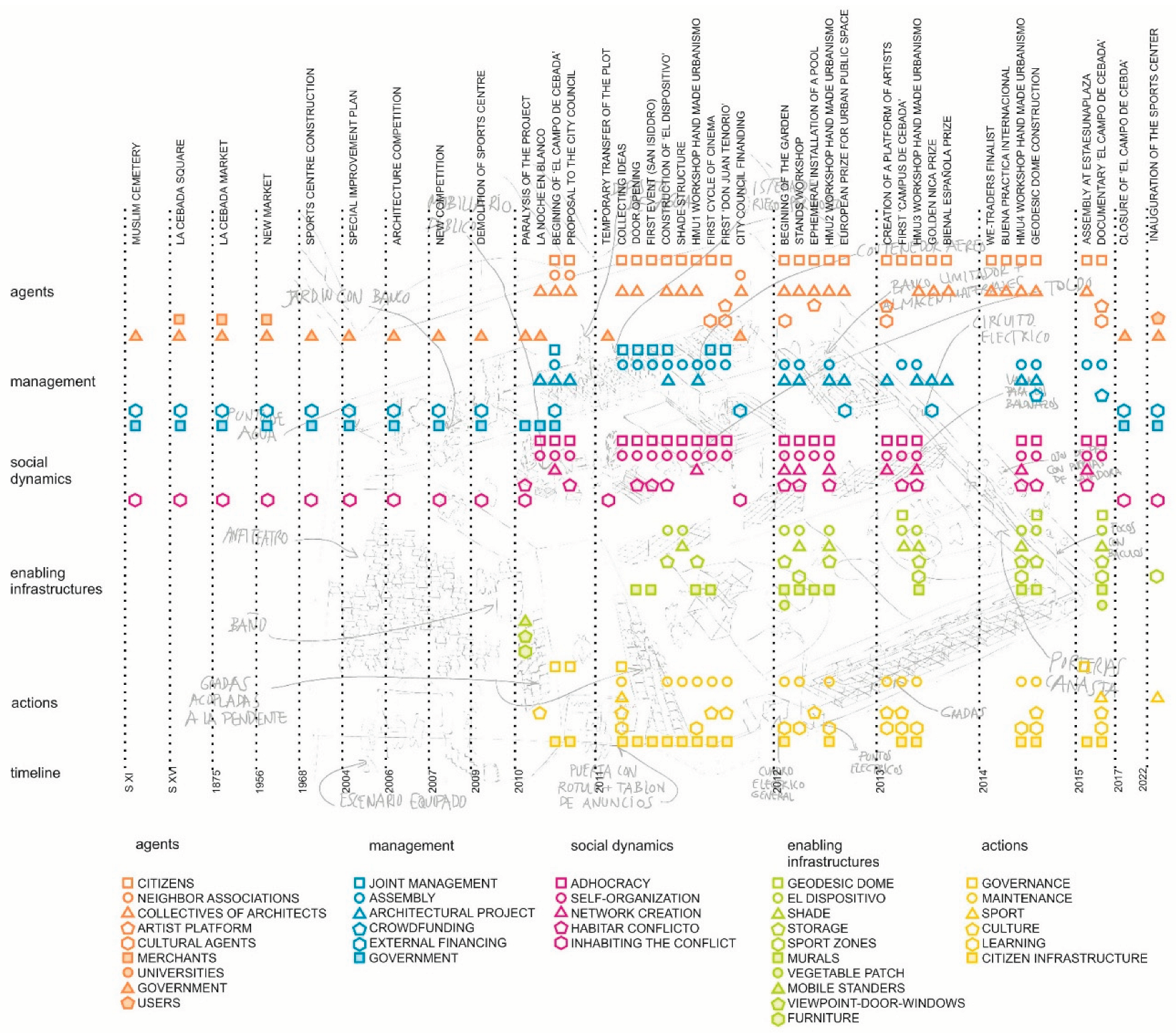
This variable is very relevant, as El Campo de Cebada is characterised by a biography of growth, continuous progress, and reinvention. Here, the figure of the promoter is diluted, and all the agents involved are part of the process and interrelate from the beginning. Among the events and actions that have been taking place, we can see how, from the proposal of the project to the City Council in 2010, a radical change has taken place in terms of the management and production of the ‘El Campo de Cebada’ space. It is a new paradigm of common space that integrates a greater diversity in the agents involved, as well as in the management of the space itself, the social dynamics, the design of enabling infrastructures, and the actions developed. There is another key concept for understanding the temporalisation of the project: expiration. ‘El Campo de Cebada’ is characterised by the ‘Temporary Use’ of the space, defined by the annual renewal of the cession for temporary and free use of the property; and by the date of closure due to the start of the works of the new municipal sports centre. Thus, uncertainty constitutes the backbone of the project, which encourages creativity in the search for adaptation to a transitory situation. The project is so solid that, as was finally proved—it would seek the continuity of the space in another place when the physical space was not available. Finally, ‘El Campo de Cebada’ handed over the keys to the City Council in 2017 to start the works of the New Sports Centre; however, it continues the activity through social networks and using other common spaces. Promises of the inclusion of a roof for citizen management in the new building disappeared, and other neighbourhood spaces in Madrid have also been evicted. Nevertheless, these are spaces of great immaterial wealth that seek new opportunities, because the place of occupation is not as relevant as the people’s project and the discovery of their right to the city. As a gesture of collective care for this place, the neighbours collected each of the plants as a ‘party’ so that on each balcony of the citizens of La Latina, a part of El Campo de Cebada survives. The works of the so-called ‘Centro Deportivo Municipal La Cebada’ were finished in January 2022 and at the end of the same year it was inaugurated. The complexity map shown below, visualises the temporalisation of not only of the process of ‘El Campo de Cebada’ but also of the previous uses of that part of the city. In short, it is confirmed that this urban space is a living space in time which, once the citizen-initiated management has begun, the level of complexity is accelerated through the intervention of the other variables.
4.2.2. Agents
It is essential for this project, as one of the fundamental pillars of the project’s success is the wide variety and the vast number of components that are part of El Campo de Cebada. “Promoter does not exist from the technical perspective and is actually about the purchase of an unuse place by a neighbours community” [77]. From its beginnings, it has been an open and inclusive initiative, in which the participation of as many elements as possible, symmetry, and hybridisation between them have always been always welcome (Figure 5). Subjects that have taken active part are, first, citizenhood escorted by neighbours associations and federations, besides architect and designer collectives, artists platforms, cultural agents, commerce associations, universities, and researching groups as well as the public administration. In terms of professional collectives that have collaborated in different stages and with different intensity: ‘Basurama’, ‘EXYZT’, ‘Zuloark’, ‘Todo por la Praxis’, ‘PKMN’, ‘Taller de Casquera’, and ‘Paisaje Transversal’. Emphasising the new and diverse role of the architect, in service of the needs of the whole process, in a continuous way and without any predefined expiration date. Intervention comes as a form of accompaniment and mediation, designing services, managing, developing strategies, negotiating, coordinating, teaching, and even building devices.
4.2.3. Management
This variable is crucial in defining the nature of the organisation of ‘El Campo de Cebada’. Here, it is called more precisely ‘comanagement’ as all the agents collaborate to manage the space, generating shared responsibility. Firstly, management starts with a request for transferring the space —made by the neighbours, architects of different collectives, and the neighbours association—. Then, a project was redacted and submitted to the department of governance, treasury, and public administration of the city Council. The management of ‘El Campo de Cebada’ is the management of complexity. It handles a chaotic environment that is always swinging between order and chaos, where system self-organisation emerges in a natural way. In this sense, there did exist just a few rules as a sort of internal regulation. These rules solely pretended to give a minimum level of order through the following bases: activities would only be approved in a general assembly; noise level would not disturb neighbours [104]; access would always be free of any charge; there would exist an opening schedule, cleanliness would be made after enjoying the space; no violence and no discrimination would be allowed within the premises. On the other hand, funding issue is also based in freedom, in order that the economic sustainability would never depend on institutions, administrations, or private companies. It handles a self-funding that begins with an initial grant and without profit-making intention, feeds from ‘crowdfunding’ or ‘microsponsorship’, forms the won prizes, and from the money that could have been collected during any event. “Management does not depend on one or another, it depends on every single one... It is not a collective; it is not an association that makes decisions... but a common space that gives the possibility of participating in it to whom it may intervene” [96].
4.2.4. Social Dynamics
Firstly, it is characterised by ‘adhocracy’, horizontality, and self-organisation. Beyond citizen participation, one could speak of an urban parliament where a large constellation of agents collaborate to generate collective intelligence. Like ants or bees, a highly advanced social engineering that creates enormous synergies through common sense and freedom. It is the construction of a real and open community —but also digital and networked— characterised by communal and assembly-based decision-making. And, as in any bottom-up process, order is created from the bottom up. In terms of conflict management, instead of fighting against it, it is decided to inhabit it. To confront it by encouraging commitment and dialogue, creating, little by little, a sense of belonging to the place that generates responsibility in the users of the space. “The city, the conscious collective, associates in community swarms to recover the commons. Not only physical spaces, but also the emotional, creative, the places of care where life is produced and reproduced in the capital” [97]. As can be seen in the complexity map, as the story of ‘La Cebada’ progresses, these dynamics become more diverse.
4.2.5. Enabling Infrastructures
This is dedicated to the material elements that have been built through direct processes and pedagogical environments. They are not designed as an end in themselves, but as mechanisms favouring the creation of events, situations, and relationships. In this way, an equipped square with infrastructures is configured, open and at the service of the citizens to facilitate its free use and enjoyment (Figure 6). The construction and manufacturing process is community-based and participatory, with a pedagogical workshop format open to all agents who wish to collaborate. As an example, the ‘Hand Made Urbanism’ workshops are based on open source, recycling of materials, and collective learning. All ideas developed must be adaptable, accessible, and replicable so that other spaces can use them at any time. Indistinctly, projects have been generated for the design and manufacture of: furniture, mobile stands, installation of devices —parterres, cultivation tables, mobile planters— for urban gardens and vegetation, viewpoints, urban art installations, sports courts, ‘the device’, the shade elements and the geodesic dome. All these elements have collaborated in the construction of the common space and have been created from processes of collective creativity. These workshops have been accompanied and promoted by different groups of architects, designers, and artists such as ‘Paisaje Transversal’, ‘PKMN’, ‘Zuloark’, ‘Basurama’, ‘Taller de Casquería’, ‘Todo por la Praxis’, ‘Prototyping’.
4.2.6. Actions
The last variable is a consequence of the activation of all previous structures. It is the life of ‘El Campo de Cebada’, which defines it, which makes visible its success as a public space, and which builds its social capital. The activities (Figure 7) that move the energy of this space are always open and free and can be classified into the following types: Governance —meetings, coordination assemblies, councils, and management coordination with the administration—; Maintenance —repair of furniture, care of the garden and cleaning—; Everyday —meeting, playing, resting, reading, playing—; Sports —football, basketball, aerobics, training—; Cultural —cinema, theatre, literature, music, gastronomy, circus, dance—; Pedagogical —popular university, self-training summer school, construction workshops—; and Citizen Infrastructure —use of space for groups and collectives with social development objectives—. The events programme is spread through the panels at the entrance gate, the website, social networks and, of course, through word of mouth among neighbours in the neighbourhood. Programmes are always alive and active, creating periodic cycles over time when they are well received, renewing themselves, and coming up with new events all the time. “The out turn of pure necessity. El Campo de Cebada is proof that crises also create opportunities. On the site of a demolished swimming pool, the surrounding neighbours built a place for human exchange, for creativity, for community gathering both live in the heart of Madrid and online. Everyone is invited to participate. The motto of El Campo de Cebada is transparency. People decide what happens in this place” [105].
4.3. Complexity Map of ‘El Campo de Cebada’
In the following, the complexity of ‘El Campo de Cebada’, the arrangement and classification of the elements that make up the system. In this sense, the observed and analysed variables were the ones needed to determine the complexity of this urban space. They determine the diversity, not only from activities, but from structure, purposes, organisation, and synergies of ‘El Campo de Cebada’. It handles elements that, in its evolution over time, proved the difference between conventional public spaces and complex ‘Urban Laboratories’ (Figure 8). From the muslin cemetery era, though the place of La Cebada, the market and the new market, the sports centre until its demolition, we find a low level of complexity. Agents who intervened were only government and public administrations. As far as the management of those agents, it was constraint to unilateral decisions, without any citizen participation, and funding consisted merely in the money given by institutions and governments. Social dynamics was practically inexistent, as it was spaces dedicated exclusively to trading products, in a regulated or informal manner. In these early stages, there are practically no interrelationships between governors and citizens. Finally, both enabling infrastructures and social actions go unnoticed. Only commercial transactions occur, and the material elements are limited to conventional urban furniture.
In contrast to these earlier periods, we find the ‘El Campo de Cebada’ project as an ‘Urban Laboratories’. The graph clearly shows the diversity that emerges in each of the variables studied. The participating agents are deployed, going from governors and administrators to neighbourhood associations, architects’ and designers’ collectives, artists’ platforms, universities, citizens, and users of all kinds. Management becomes more complex, leading to citizen assemblies, diverse architectural projects, and crowdfunding. In relation to social dynamics, self-organisation, networking, and adhocracy are emerging strongly. And the unilateral intervention of administrations and governments is reduced. Enabling infrastructures play a major role, with numerous devices being built as different needs arise in this civic space. Elements to create shade, allow planting, and carry out sporting and cultural activities, among others, are colonising the deserted site. There is also a great increase in the diversity of actions that take place in ‘El Campo de Cebada’. Governance, maintenance, sports, cultural, or pedagogical activities are multiplying with great acceptance by the citizens of the neighbourhood, whether they participate in the project, actively or not.
It could be said that where a thousand years ago a cemetery slept, a space full of life awoke. A place called ‘El Campo de Cebada’ where swarms of citizens pollinate the nodes of extensive networks that make contemporary complexity flourish. Generating a new paradigm of common spaces that claim the right to the city [106], through collective strategies of immaterial architectures. As the ‘Basurama’ collective -already involved since the ‘City Island’ project, the predecessor of ‘El Campo de Cebada’- affirms: “public space processes have left to have form in order to have meaning” [107].
The ultimate purpose of the ‘El Campo de Cebada’ case study is to produce inductive reasoning, so that -from research, observation, and data collection of a particular case- conclusions applicable to other cases could be drawn. As a result, this model of variable analysis can be extrapolated to other ‘Urban Laboratories’ cases. It can also be used as a tool for the design of resilient and sustainable urban spaces in the future of cities.
5. Conclusions
From the study carried out, it can be confirmed that the collaborative production processes of ‘El Campo de Cebada’ assume a high level of complexity. It has also demonstrated its suitability as a reference for ‘urban laboratories’ and for experimenting with models of citizen-initiated spaces. It is a project that promotes collective creativity, citizen participation, and the search for alternative resources. And it opens a way to take on the contemporary complexity of cities through collaborative processes. In this type of common spaces, it is possible to recover collective social well-being. Where, beyond territories dedicated to consumption, open and flexible places are designed to encourage diverse activities and social cohesion. In times of crisis, it is interesting to promote these urban models. In fact, the recurrence of crises of various kinds is becoming more and more frequent. So, it would be pertinent to compensate for individual and collective difficulties with complex community spaces. Projects that can provide, with few resources, actions that improve the resilience of neighbourhoods and cities.
The proposed complexity analysis model could be applied to other spaces, as well as the use of variables for the design of new ‘Urban Laboratories’. In future research work, the model is intended to be applied to other case studies to test its feasibility. In ‘El Campo de Cebada’, the evolution of the level of complexity is easily seen due to its antagonistic antecedents. However, it is possible that, in other cities, other neighbourhoods, and other urban spaces, an adjustment of the proposed model may be necessary.
Author Contributions
Conceptualization, A.M. and L.F.; methodology, A.M.; investigation, A.M.; writing—original draft preparation, A.M.; writing—review and editing, A.M.; supervision, L.F.; funding acquisition, A.M. and L.F. All authors have read and agreed to the published version of the manuscript.
Funding
This research received no external funding.
Conflicts of Interest
The authors declare no conflict of interest. The funders had no role in the design of the study; in the collection, analyses, or interpretation of data; in the writing of the manuscript; or in the decision to publish the results.
References
- Cities—United Nations Sustainable Development Action 2015. Available online: https://www.un.org/sustainabledevelopment/cities/ (accessed on 20 December 2023).
- Harvey, D. The Right to the City. In The City Reader; Routledge: Seventh edition. | Abingdon, Oxon ; New York, NY : Routledge, 2020. | Series: Routledge urban reader series, 2008; pp. 23–40. ISBN 9780429261732.
- Purcell, M. Possible Worlds: Henri Lefebvre and the Right to the City. http://dx.doi.org/10.1111/juaf.12034. 2016, 36, 141–154. [Google Scholar] [CrossRef]
- Harvey, D. Rebel Cities: From the Right to the City to the Urban Revolution; Verso.; New York. 2012. [Google Scholar]
- Garnier, J.-P. The Right to the City from Henri Lefebvre to David Harvey. Between Theories and Execution. Ciudades 2012, 15, 217–225. [Google Scholar] [CrossRef]
- Lefebvre, H. La Révolution Urbaine; 1970. [Google Scholar]
- Kennon, K. Does Collaboration Work? Architectural Design 2006, 76, 50–53. [Google Scholar] [CrossRef]
- Sawyer, R.K.; DeZutter, S. Distributed Creativity: How Collective Creations Emerge From Collaboration. Psychol Aesthet Creat Arts 2009, 3, 81–92. [Google Scholar] [CrossRef]
- Borkowski, A.; Branki, C.; Grabska, E.; Palacz, W. Towards Collaborative Creative Design. Autom Constr 2001, 10, 607–616. [Google Scholar] [CrossRef]
- Andersen, P.V.K.; Mosleh, W.S. Conflicts in Co-Design: Engaging with Tangible Artefacts in Multi-Stakeholder Collaboration. https://doi.org/10.1080/15710882.2020.1740279 2021, 17, 473–492. [CrossRef]
- Goldstein, B.E. Collaborative Resilience: Moving Through Crisis to Opportunity; MIT Press, 2011. 2011. [Google Scholar]
- Koutsikouri, D.; Austin, S.; Dainty, A. Critical Success Factors in Collaborative Multidisciplinary Design Projects. Journal of Engineering, Design and Technology 2008, 6, 198–226. [Google Scholar] [CrossRef]
- Terrin, J.-J. Conception Collaborative Pour Innover En Architecture : Processus, Méthodes, Outils; L’Harmattan: Paris, 2009; ISBN 9782296075344. [Google Scholar]
- Karvonen, A.; van Heur, B. Urban Laboratories: Experiments in Reworking Cities. Int J Urban Reg Res 2014, 38, 379–392. [Google Scholar] [CrossRef]
- Marvin, S.; Silver, J. The Urban Laboratory and Emerging Sites of Urban Experimentation. In The Experimental City; Taylor and Francis, 2016; pp. 47–60 ISBN 9781317517153.
- Rahmawan-Huizenga, S.; Ivanova, D. THE URBAN LAB: Imaginative Work in the City. Int J Urban Reg Res 2022. [Google Scholar] [CrossRef]
- Urban Living Lab for Local Regeneration; Aernouts, N., Cognetti, F., Maranghi, E., Eds. The Urban Book Series; Springer International Publishing: Cham, 2023; ISBN 978-3-031-19747-5.
- Scozzi, B.; Bellantuono, N.; Pontrandolfo, P. Managing Open Innovation in Urban Labs. Group Decis Negot 2017, 26, 857–874. [Google Scholar] [CrossRef]
- Nesti, G. Co-Production for Innovation: The Urban Living Lab Experience. Policy Soc 2018, 37, 310–325. [Google Scholar] [CrossRef]
- Steen, K.; van Bueren, E. The Defining Characteristics of Urban Living Labs. Technology Innovation Management Review 2017, 7, 21–33. [Google Scholar] [CrossRef]
- Franz, Y. Designing Social Living Labs in Urban Research. Info 2015, 17, 53–66. [Google Scholar] [CrossRef]
- Nevens, F.; Frantzeskaki, N.; Gorissen, L.; Loorbach, D. Urban Transition Labs: Co-Creating Transformative Action for Sustainable Cities. J Clean Prod 2013, 50, 111–122. [Google Scholar] [CrossRef]
- Puerari, E.; de Koning, J.I.J.C.; von Wirth, T.; Karré, P.M.; Mulder, I.J.; Loorbach, D.A. Co-Creation Dynamics in Urban Living Labs. Sustainability 2018, Vol. 10, Page 1893 2018, 10, 1893. [Google Scholar] [CrossRef]
- Cartagena, Y. Temporary Urbanism and Community Engagement: A Case Study of Piazza Scaravilli in Bologna. Advances in Science, Technology and Innovation 2022, 11–22.
- Bragaglia, F.; Caruso, N. Temporary Uses: A New Form of Inclusive Urban Regeneration or a Tool for Neoliberal Policy? https://doi.org/10.1080/17535069.2020.1775284 2020, 15, 194–214. [CrossRef]
- Chen, L.; Conroy, M.M. Vacant Urban Land Temporary Use and Neighborhood Sustainability: A Comparative Study of Two Midwestern Cities. https://doi.org/10.1080/07352166.2023.2168551 2023, 1–25. [CrossRef]
- Ferreri, M. Occupying Vacant Spaces: Precarious Politics of Temporary Urban Reuse., 2013.
- Dubeaux, S.; Cunningham Sabot, E. Maximizing the Potential of Vacant Spaces within Shrinking Cities, a German Approach. Cities 2018, 75, 6–11. [Google Scholar] [CrossRef]
- Hanna, S. Urban Complexity. In Machine Learning and the City; John Wiley & Sons, Ltd., 2022; pp. 1–13.
- Massara Rocha, B. City and Complexity: Reflections on the Practice of Contemporary Design. Oculum Ensaios 2018, 15, 87–98. [Google Scholar] [CrossRef]
- Walloth, C.; Gurr, J.M.; Schmidt, J.A. Understanding Complex Urban Systems : Multidisciplinary Approaches to Modeling; Springer, 2012; ISBN 3-319-02995-9.
- Mosleh, W.S.; Larsen, H. Exploring the Complexity of Participation. CoDesign 2020, 17, 454–472. [Google Scholar] [CrossRef]
- Johnson, J. Complexity Science in Collaborative Design. https://doi.org/10.1080/15710880500478346 2006, 1, 223–242. [CrossRef]
- Powers, A. Townscape as a Model of Organised Complexity. 2012, 37–41. [CrossRef]
- Portugali, J. Complexity Theories of Cities: Achievements, Criticism and Potentials. In Complexity Theories of Cities Have Come of Age; Springer, Berlin, Heidelberg, 2012; pp. 47–62.
- Roo, G. de. ; Hillier, Jean.; Wezemael, J. van. Complexity and Planning : Systems, Assemblages and Simulations; Ashgate.; Routledge, 2016; ISBN 1-315-57319-9. [Google Scholar]
- Moroni, S.; Rauws, W.; Cozzolino, S. Forms of Self-Organization: Urban Complexity and Planning Implications. https://doi.org/10.1177/2399808319857721 2019, 47, 220–234. [CrossRef]
- Moroni, S. Complexity and the Inherent Limits of Explanation and Prediction: Urban Codes for Self-Organising Cities. http://dx.doi.org/10.1177/1473095214521104 2014, 14, 248–267. [CrossRef]
- Sanders, E.B.N.; Stappers, P.J. Probes, Toolkits and Prototypes: Three Approaches to Making in Codesigning. https://doi.org/10.1080/15710882.2014.888183 2014, 10, 5–14. [CrossRef]
- Wang, X.; Chen, R. (Irene) An Experimental Study on Collaborative Effectiveness of Augmented Reality Potentials in Urban Design. Codesign-International Journal of Cocreation in Design and the Arts 2009, 5, 229–244. [Google Scholar] [CrossRef]
- Baibarac, C.; Petrescu, D. Co-Design and Urban Resilience: Visioning Tools for Commoning Resilience Practices. CoDesign 2017, 15, 91–109. [Google Scholar] [CrossRef]
- Beyerlein, S.T.; Beyerlein, M.M.; Kennedy, F.H. Innovation through Collaboration; Emerald Group Publishing Limited: Bradford England, 2009; Vol. 12; ISBN 184950430X :Đ62.95; 9781849504300 :Đ62.95; 1572-0977.
- Bjone, C. Art and Architecture :Strategies in Collaboration; Birkhaeuser Verlag: Boston, MA, 2009; ISBN 9783764399436. [Google Scholar]
- Fernie, J. Two Minds :Artists and Architects in Collaboration; Black Dog: London, 2006; ISBN 1904772269. [Google Scholar]
- Miell, D.; Littleton, K. Collaborative Creativity :Contemporary Perspectives; Free Association Books: London, 2004; ISBN 1853437638. [Google Scholar]
- Gloor, P.A. Swarm Creativity :Competitive Advantage through Collaborative Innovation Networks; Oxford University Press: Oxford; New York, 2006; ISBN 9780195304121; 0195304128.
- Benjamin, W. Angelus Novus; Edhasa: Barcelona, 1971. [Google Scholar]
- Beck, U.; Beck-Gernsheim, E. Individualization: Institutionalized Individualism and Its Social and Political Consequences; Sage Publications Limited: London, 2002; Vol. 13. [Google Scholar]
- Kropotkin, P.A. Mutual Aid: A Factor of Evolution; Heinemann: Londres, 1902. [Google Scholar]
- Ball, P. Critical Mass: How One Things Leads Into Another; Random: London, 2004. [Google Scholar]
- Hardt, Michael. ; Negri, A. Multitude: War and Democracy in the Age of Empire; Penguin Press: New York, 2004. [Google Scholar]
- Lévy, P. L’intelligence Collective: Pour Une Anthropologie Du Cyberspace; La Découverte Paris, 1994.
- Lévy, P. Cyberculture; U of Minnesota Press: Minneapolis, 2001; Vol. 4. [Google Scholar]
- Léfebvre, H. Le Droit À La Ville. Anthropos 1968.
- Johnson, S. Emergence: The Connected Lives of Ants, Brains, Cities and Software.; Allen Lane: New York, 2001. [Google Scholar]
- Jacobs, J. The Death and Life of Great American Cities; Vintage Books, 1961; Vol. V–241;
- Healey, P. On Creating the “City” as a Collective Resource. http://dx.doi.org/10.1080/0042098022000002957 2002, 39, 1777–1792. [CrossRef]
- Ermacora, T.; Bullivant, L. Recoded City: Co-Creating Urban Futures; Taylor and Francis, 2016; ISBN 9781317591429.
- Bratteteig, T.; Wagner, I. Spaces for Participatory Creativity. https://doi.org/10.1080/15710882.2012.672576 2012, 8, 105–126. [CrossRef]
- Sanders, E.B.-N.; Stappers, P.J. Co-Creation and the New Landscapes of Design. Co-design 2008, 799–809. [CrossRef]
- Franqueira, T. Creative Places for Collaborative Cities: Proposal for the ‘Progetto Habitat e Cultura’ in Milan. http://dx.doi.org/10.2752/175470710X12735884220934 2015, 13, 199–216. [CrossRef]
- Amin, A. Collective Culture and Urban Public Space. https://doi.org/10.1080/13604810801933495 2008, 12, 5–24. [CrossRef]
- Sara, R.; Jones, M.; Rice, L. Austerity Urbanism: Connecting Strategies and Tactics for Participatory Placemaking. https://doi.org/10.1080/15710882.2020.1761985 2020. [CrossRef]
- Estalella, A. Colectivos de Arquitectura: Otra Sensibilidad Urbana. Available online: http://www.prototyping.es/destacado/colectivos-de-arquitectura-otra-sensibilidad-urbana.
- Transversal, P. Friendly Madrid. El Mapa Ante El Cambio de Paradigma Arquitectónico. Pasajes de arquitectura y crítica, 2013; 39. [Google Scholar]
- Wachter, S. Governing with Urban Labs. In Urban Living Lab for Local Regeneration; 2023; pp. 39–52.
- Coenen, T.; Robijt, S. Heading for a FALL: A Framework for Agile Living Lab Projects. Technology Innovation Management Review 2017, 7, 37–43. [Google Scholar] [CrossRef]
- Haukipuro, L.; Väinämö, S.; Hyrkäs, P. Innovation Instruments to Co-Create Needs-Based Solutions in a Living Lab. Technology Innovation Management Review 2018, 8, 22–35. [Google Scholar] [CrossRef]
- Kareborn, B.B.; Stahlbrost, A. Living Lab: An Open and Citizen-Centric Approach for Innovation. International Journal of Innovation and Regional Development 2009, 1, 356. [Google Scholar] [CrossRef]
- European Network of Living Labs (ENoLL). Available online: https://enoll.org/about-us/ (accessed on 15 September 2022).
- Bajgier, S.M.; Maragah, H.D.; Saccucci, M.S.; Verzilli, A.; Prybutok, V.R. Introducing Students to Community Operations Research by Using a City Neighborhood As A Living Laboratory. https://doi.org/10.1287/opre.39.5.701 1991, 39, 701–709. https://doi.org/10.1287/OPRE.39.5.701. [CrossRef]
- Scholl, C.; De Kraker, J.; Hoeflehner, T.; Eriksen, M.A.; Wlasak, P.; Drage, T. Transitioning Urban Experiments: Reflections on Doing Action Research with Urban Labs. GAIA 2018, 27, 78–84. [Google Scholar] [CrossRef]
- Mueller, J.; Lu, H.; Chirkin, A.; Klein, B.; Schmitt, G. Citizen Design Science: A Strategy for Crowd-Creative Urban Design. Cities 2018, 72, 181–188. [Google Scholar] [CrossRef]
- Bialski, P.; Derwanz, H.; Otto, B. ; Vollme, rHans Saving the City: Collective Low-budget Organizing and Urban Practice. Ephemera Journal 2015, 1–19. [Google Scholar]
- Sharifi, A.; Reza Khavarian-Garmsir, A.; Mela, A.; Tousi, E.; Melas, E.; Varelidis, G. Spatial Distribution and Quality of Urban Public Spaces in the Attica Region (Greece) during the COVID-19 Pandemic: A Survey-Based Analysis. Urban Science 2024, Vol. 8, Page 2 2023, 8, 2. [Google Scholar] [CrossRef]
- Waterman, R.H. Adhocracy: The Power to Change; Norton: New York, 1992. [Google Scholar]
- Sanz de Haro, J. Ciudad Cebada: Un Artículo Sobre El Campo de La Cebada de Madrid, o La Ciudad Que Quizás Nos Espera. Available online: http://activistark.blogspot.com.es/2015/01/ciudad-cebada-un-articulo-sobre-el.html.
- Basurama Manifiesto Abierto Por Los Espacios Urbanos de Madrid. Available online: http://www.laciudadviva.org/blogs/?p=27961.
- Transversal, P. Escuchar y Transformar La Ciudad : Urbanismo Colaborativo y Participación Ciudadana; Madrid, 2018.
- Volont, L. DIY Urbanism and the Lens of the Commons: Observations from Spain: City Community 2019, 18, 257–279. 18. [CrossRef]
- Iveson, K. Cities within the City: Do-It-Yourself Urbanism and the Right to the City. Int J Urban Reg Res 2013, 37, 941–956. [Google Scholar] [CrossRef]
- Lanza, V.; Tilio, L.; Azzato, A.; Las Casas, G.B.; Pontrandolfi, P. From Urban Labs in the City to Urban Labs on the Web. Lecture Notes in Computer Science (including subseries Lecture Notes in Artificial Intelligence and Lecture Notes in Bioinformatics) 2012, 7334 LNCS, 686–698.
- Della Lucia, M. Creative Cities: Urban Experimental Labs. International Journal of Management Cases 2015, 17, 156–172. [Google Scholar]
- Rice, L. Occupied Space. Architectural Design 2013, 83, 70–75. [Google Scholar] [CrossRef]
- Gonick, S. Indignation and Inclusion: Activism, Difference, and Emergent Urban Politics in Postcrash Madrid. http://dx.doi.org/10.1177/0263775815608852 2015, 34, 209–226. [CrossRef]
- Madanipour, A. Temporary Use of Space: Urban Processes between Flexibility, Opportunity and Precarity. https://doi.org/10.1177/0042098017705546 2017, 55, 1093–1110. [CrossRef]
- Quentin, S. Temporary Uses of Urban Spaces: How Are They Understood as ‘Creative’? International Journal of Architectural Research 2018, 12, 90–107. [Google Scholar] [CrossRef]
- Gómez Nieto, A. Emerging Systems for Urban Regeneration and Production of Public Space. Ciudades 2017, 179–196. [Google Scholar] [CrossRef]
- Bishop, P.; Williams, L. The Temporary City; Williams, L., Ed.; Routledge: London ;, 2012; ISBN 9780415670555.
- Feinberg, M.I. Don Juan Tenorio in the Campo de Cebada: Restaging Urban Space after 15-M. Journal of Spanish Cultural Studies 2014, 15, 143–159. [Google Scholar] [CrossRef]
- Torres, I. El Campo de Cebada. Available online: http://elasuntourbano.mx/elcampodecebada/.
- Di Giovanni, A. Urban Voids as a Resource for the Design of Contemporary Public Spaces. Planum. The Journal of Urbanism 2019, 2, 1–28. [Google Scholar]
- n’UNDO Evolución Del Espacio Público de La Plaza de La Cebada…. Available online: https://mercadodelacebada.wordpress.com/2012/02/07/evolucion-del-espacio-publico-de-la-plaza-de-la-cebada/.
- Angulo Delgado, M.T. Arte, Participación y Comunidad: “El Campo de Cebada” Como Ejercicio de Intervención Crítica En El Espacio Público, 2019.
- Plan Especial Del Área de Planeamiento Específico 01.07/M ‘Plaza de La Cebada-Carrera de San Francisco’—Portal de Transparencia Del Ayuntamiento de Madrid. Available online: https://transparencia.madrid.es/portales/transparencia/es/Transparencia-por-sectores/Urbanismo/Planeamiento-urbanistico/Plan-Especial-del-Area-de-Planeamiento-Especifico-01-07-M-Plaza-de-la-Cebada-Carrera-de-San-Francisco/?vgnextfmt=default&vgnextoid=4556 (accessed on 18 February 2021).
- Avia Estrada, M. La Cebada No Tiene Una Identidad. Available online: https://espaciosilentes.wordpress.com/2015/04/29/el-campo-de-cebada-jacobo-garcia-fouz/.
- Lozano-Bright, C. El Campo de Cebada y Otros Laboratorios Urbanos. In; Clud de Debates Urbanos: Madrid, 2013. [Google Scholar]
- Anonymous El Campo de Cebada: Gestión Vecinal de La Plaza de La Cebada,Madrid. Arquitectura Viva 2012, 52–55.
- EXYZT; Römer, A.; Basurama City Island. Available online: https://old.constructlab.net/projects/city-island/ (accessed on 29 December 2023).
- Rodríguez-Pina, G.; Bracero, A. Campo de Cebada, Manual de Montaje de Una Plaza Hecha a Mano Por y Para Los Vecinos. El Huffingtonpost 2015.
- Gutiérrez, B. The Open Source City as the Transnational Democratic Future. In State of power; 2016; pp. 164–181.
- Kolesnikov, D. El Campo de Cebada. Design as Politics 2013, 2015. [Google Scholar]
- Morin, E. Introduction à La Pensée Complexe; ESPF: París, 1990; Vol. 1a. [Google Scholar]
- Terreros, J.M.S. de los Welcoming Sound: The Case of a Noise Complaint in the Weekly Assembly of El Campo de Cebada. Soc Mov Stud 2018, 17, 269–281. [Google Scholar] [CrossRef]
- Knoll, M. Winners Prix Ars Electronica 2013. Available online: http://www.aec.at/aeblog/en/2013/05/16/gewinnerinnen-prix-ars-electronica-2013/.
- Corsín Jiménez, A. The Right to Infrastructure: A Prototype for Open Source Urbanism. Environ Plan D 2014, 32, 342–362. [Google Scholar] [CrossRef]
- Basurama Sobre Nuestra Capacidad de Imaginación Política Para El Espacio Público. Available online: http://basurama.org/txt/sobre-nuestra-capacidad-de-imaginacion-politica-para-el-espacio-publico/.
Figure 1.
Case study process of ‘El Campo de Cebada’.
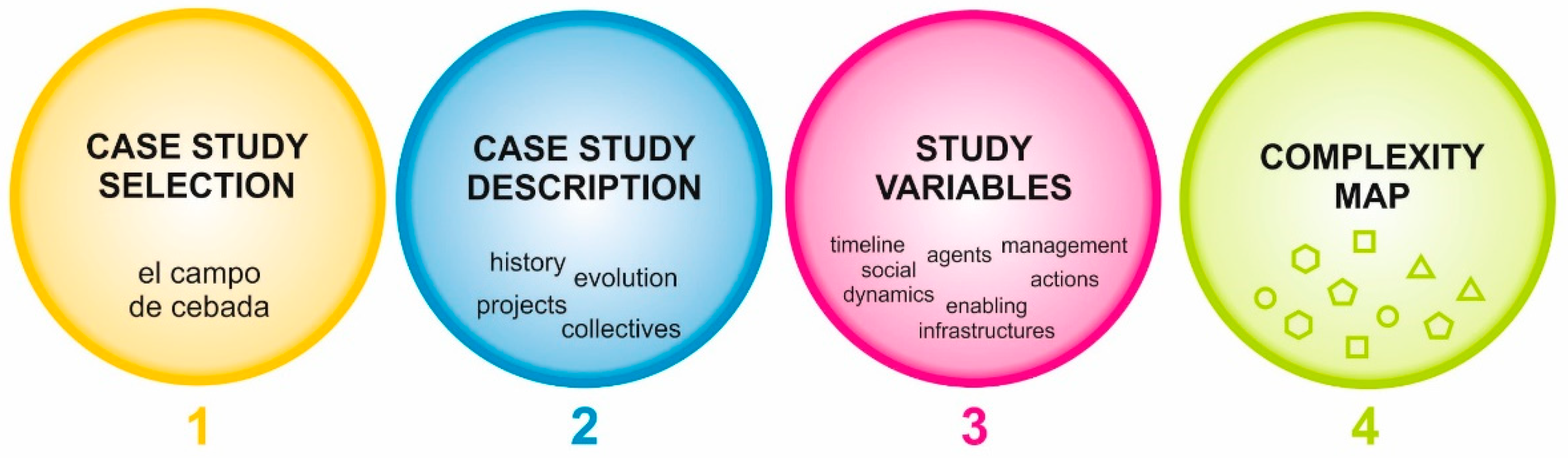
Figure 2.
‘El Campo de Cebada’ located in the ‘La Latina’ neighbourhood in Madrid (author: Manuel Domínguez Fernández, 2014, Creative Commons license).
Figure 2.
‘El Campo de Cebada’ located in the ‘La Latina’ neighbourhood in Madrid (author: Manuel Domínguez Fernández, 2014, Creative Commons license).

Figure 3.
Concrete lot turnout of the demolition of the sports centre (image courtesy of Zuloark).
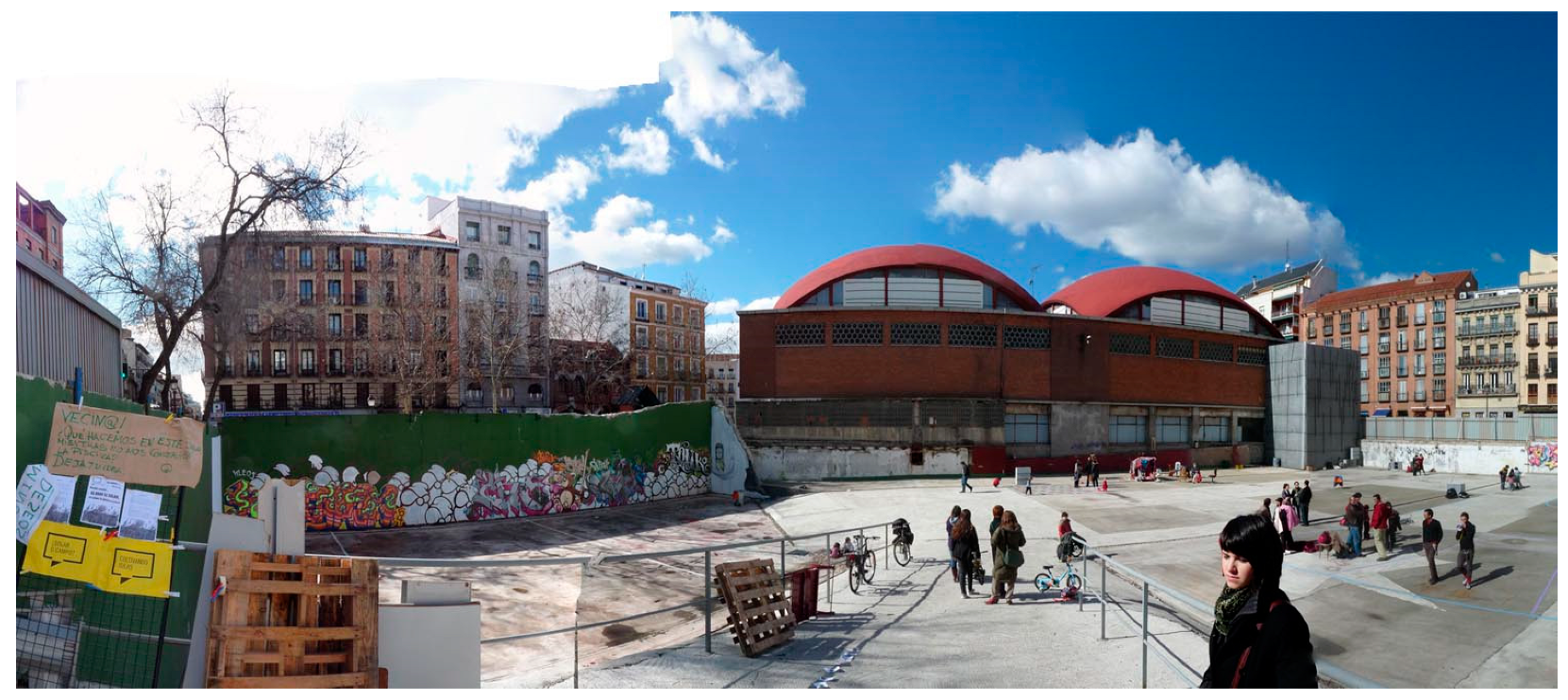
Figure 4.
Design of a common space for ‘El Campo de Cebada’ (image courtesy of Zuloark).
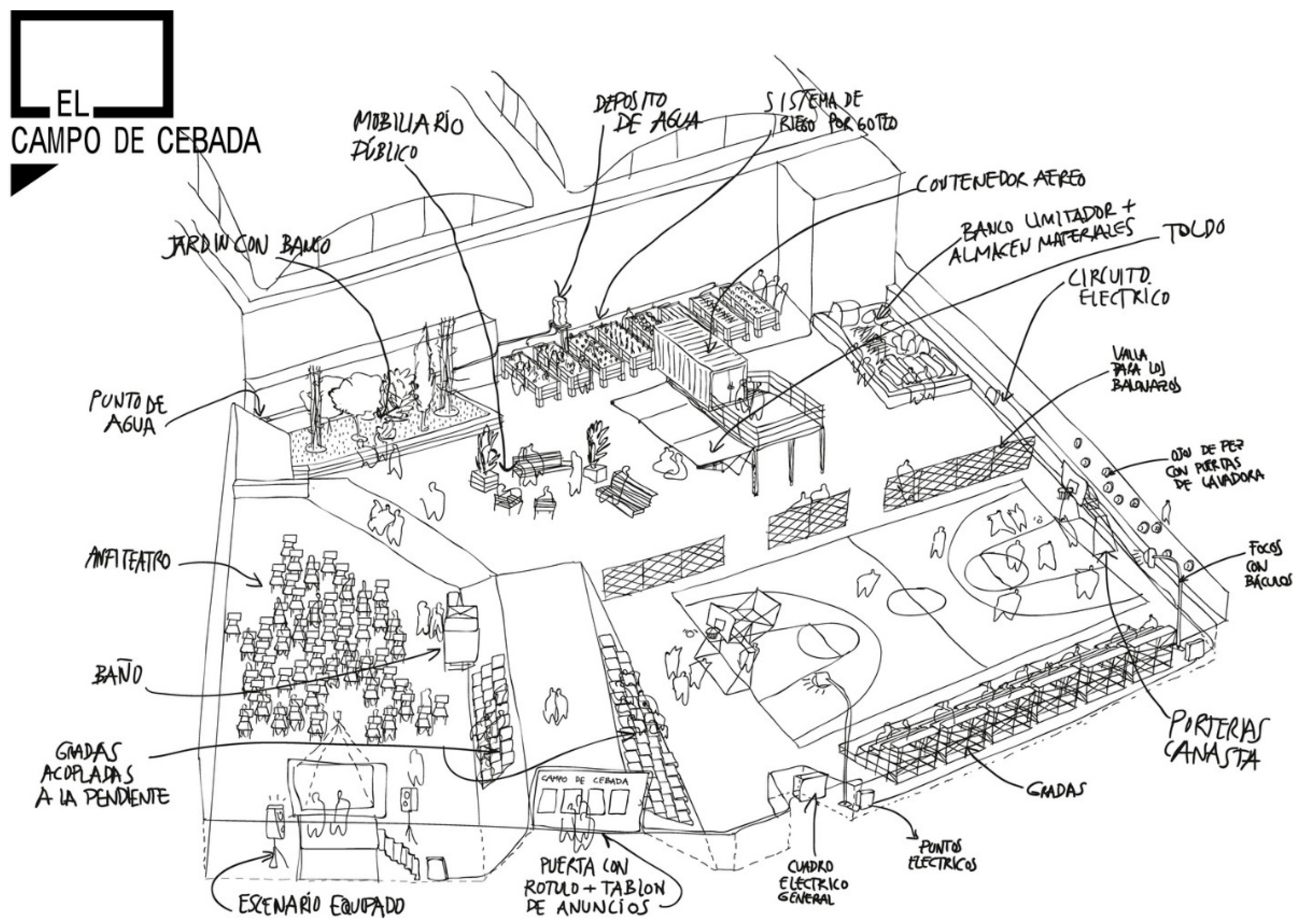
Figure 5.
Assembly of El Campo de Cebada (image courtesy of Zuloark).
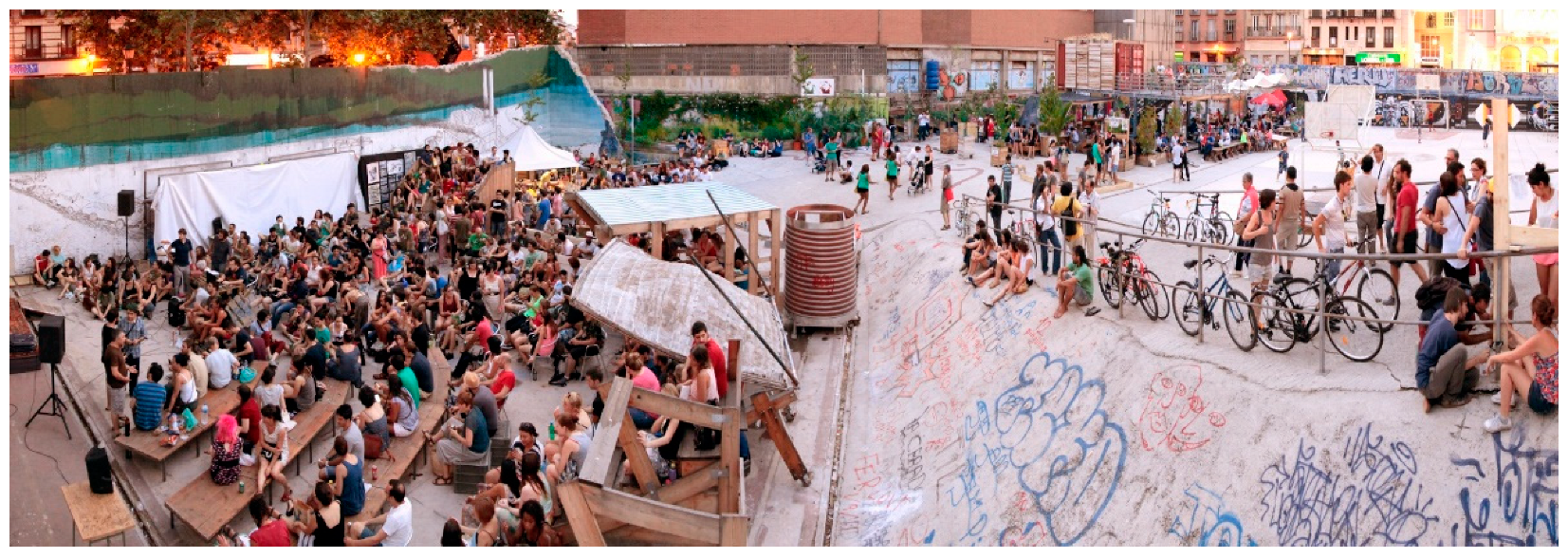
Figure 6.
Enabling infrastructures of ‘El Campo de Cebada’ (self-elaborated image from images courtesy of Zuloark).
Figure 6.
Enabling infrastructures of ‘El Campo de Cebada’ (self-elaborated image from images courtesy of Zuloark).
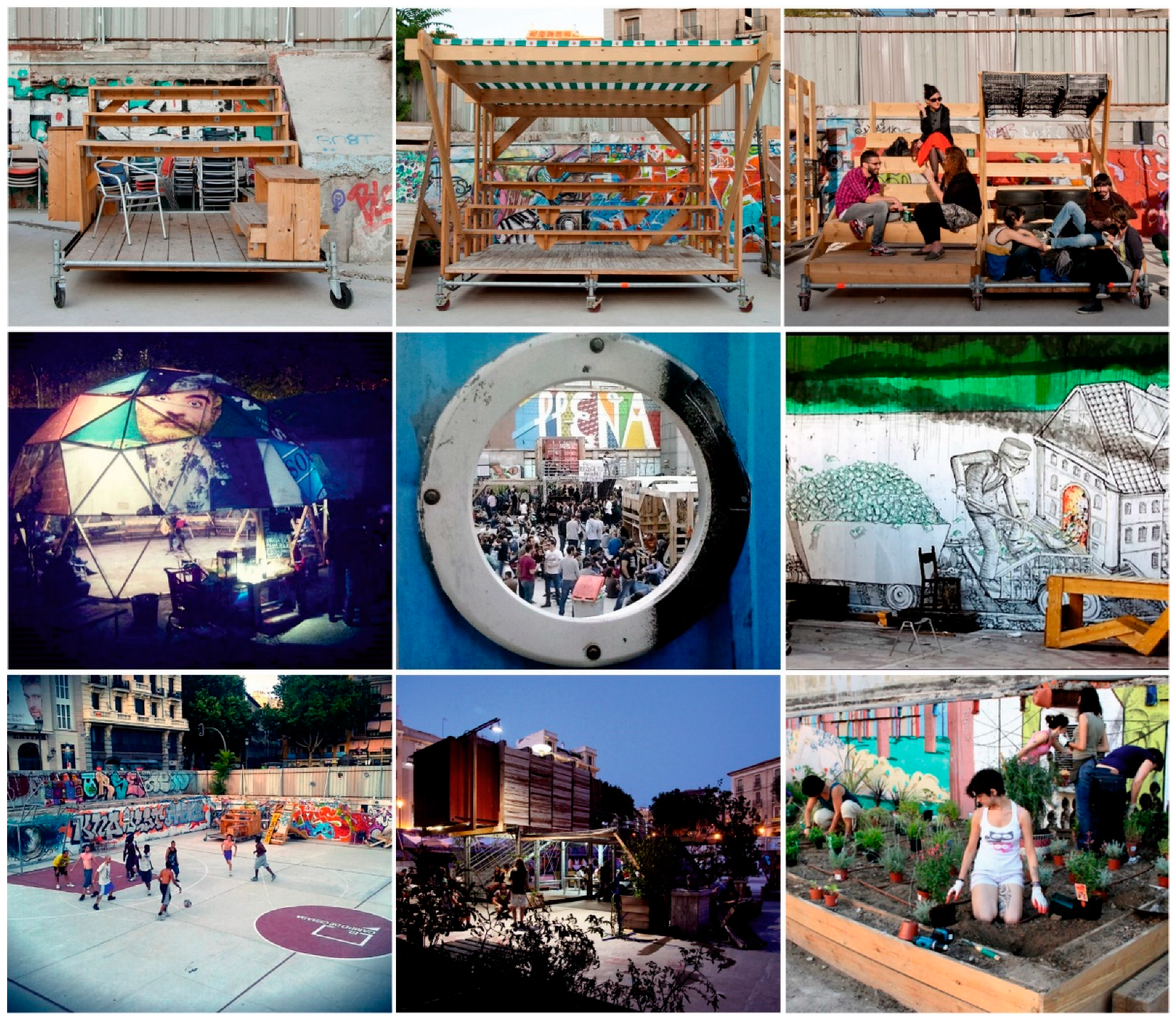
Figure 7.
Ted-talk held in El Campo de Cebada, first time in an open space (image courtesy of Zuloark).
Figure 7.
Ted-talk held in El Campo de Cebada, first time in an open space (image courtesy of Zuloark).
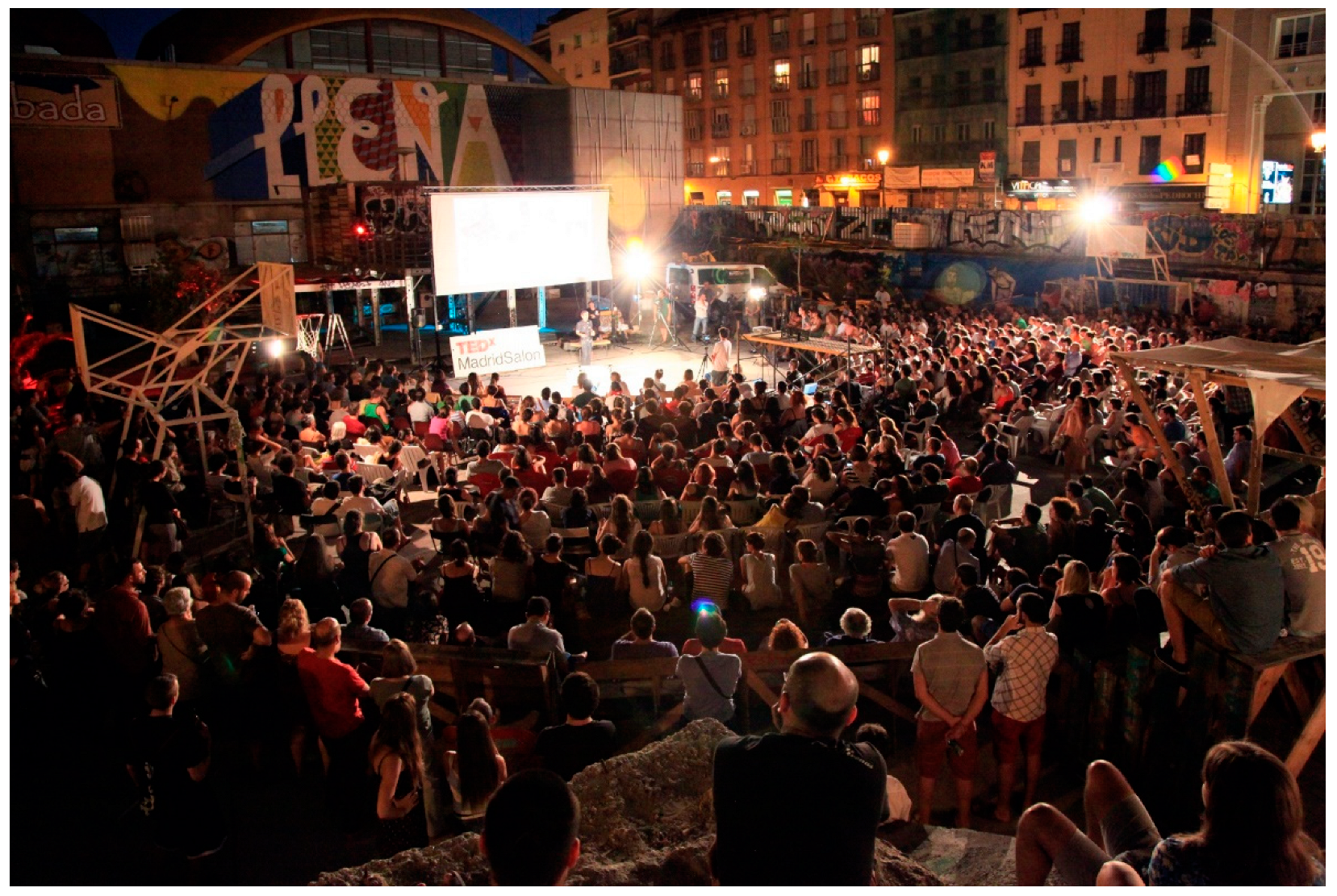
Figure 8.
Complexity map of ‘El Campo de Cebada’.
Disclaimer/Publisher’s Note: The statements, opinions and data contained in all publications are solely those of the individual author(s) and contributor(s) and not of MDPI and/or the editor(s). MDPI and/or the editor(s) disclaim responsibility for any injury to people or property resulting from any ideas, methods, instructions or products referred to in the content. |
© 2024 by the authors. Licensee MDPI, Basel, Switzerland. This article is an open access article distributed under the terms and conditions of the Creative Commons Attribution (CC BY) license (http://creativecommons.org/licenses/by/4.0/).
Copyright: This open access article is published under a Creative Commons CC BY 4.0 license, which permit the free download, distribution, and reuse, provided that the author and preprint are cited in any reuse.


