
Submitted:
29 February 2024
Posted:
29 February 2024
You are already at the latest version
Abstract
In the context of carbon neutrality and carbon peaking, in order to achieve low carbon emissions and promote the efficient utilization of wind energy, hydrogen energy as an important energy carrier is proposed to mix hydrogen and natural gas to form hydrogen enriched compressed natu-ral gas (HCNG). It is also injected into the natural gas pipeline network to realize the transmission and utilization of hydrogen energy. At the same time, the participation of demand response is considered, the load peak and trough period is adjusted, and large-scale consumption of renewa-ble energy and the reduction of carbon emissions are realized. First of all, a fine model of hydro-gen production and hydrogen use equipment is established to analyze the impact of adding hy-drogen mixing on the economy and low-carbon of the system. With green certificates and demand response, the utilization rate of hydrogen energy is improved to further explore the energy utiliza-tion rate and emission reduction capacity of the system. Secondly, on the basis of modeling, the optimal scheduling strategy is proposed with the sum of energy purchase cost, equipment opera-tion cost, carbon emission cost, wind curtailment cost and green certificate income as the lowest objective function. Considering the constraints such as hydrogen blending ratio and flexible load ratio of the pipeline network, a low-carbon economic scheduling model of hydrogen mixed natu-ral gas was established. The model was linearized and solved by using MATLAB and CPLEX solver. By comparing different scenarios, the superiority of the model and the effectiveness of the strategy are verified.
Keywords:
Hydrogen mixed natural gas
; Hydrogen fuel cell
; Wind power consumption
; Low-carbon
; Demand response
1. Introduction
Since the beginning of the industrial revolution, fossil fuels have been extensively developed and utilized, resulting in serious air pollution and increasing climate warming. The energy industry ranks at the forefront of carbon emissions. As an indispensable form of energy for human beings, thermal power is the main source of electricity supply and will produce a large amount of carbon dioxide [1]. In response to the call of the national "carbon peak, carbon neutral" goal, China has been actively promoting the low-carbon transformation of the energy system, promoting the development of renewable energy, and promoting the grid connection of new energy. With the continuous advancement of energy system reform and energy conservation and emission reduction requirements, the integrated energy system has become an effective way to achieve carbon emission reduction with its multi-energy flow complementary advantages [2]. With the large-scale grid connection of wind power, the problem of wind abandonment caused by its randomness and intermittency is also exposed. How to achieve high efficiency of wind power consumption and realize low-carbon economic operation has become a new hot issue.
Hydrogen energy is widely recognized as a clean energy source with significant development potential in the 21st century. As a crucial secondary energy to support the low-carbon transformation of the energy system, hydrogen energy possesses the advantage of zero carbon emissions and serves as an important catalyst for China's energy system transition [3,4]. Hydrogen energy operates within an integrated energy system framework, representing a novel mode of utilizing renewable resources. Currently, extensive research is being conducted both domestically and internationally on integrating hydrogen energy into optimized scheduling models for integrated energy systems. Power-to-gas technology has gained widespread adoption due to its ability to absorb excess renewable electricity generation [5]. In literature [6,7], power-to-gas technology was introduced into traditional electrical coupling systems, resulting in the construction of an optimized model aimed at minimizing overall economic costs. Literature [8] explored a combination of two-stage electric-gas conversion and hydrogen storage tank equipment while verifying the system's capacity for consuming renewable energies and promoting low-carbon properties. Diverging from conventional P2G technology, this approach utilizes hydrogen to produce methane after completing the electric hydrogen production stage. Literature [9] conducted a segmented study on the two-stage electric-gas conversion technology. After the electric hydrogen production stage, hydrogen energy is transported to the hydrogen fuel cell equipment to complete the coupling of hydrogen energy with electric energy and heat energy, so as to realize the fine utilization of hydrogen energy. Literature [10] constructed an electric hot gas hydrogen integrated energy system, and analyzed the feasibility of realizing the optimal scheduling of the system after adding hydrogen equipment for hydrogen production to the traditional integrated energy system. Literature [11] focused on the uncertainty of hydrogen demand to build a mobile hydrogen energy system, and deeply considered the impact of user-side hydrogen energy demand on the system, but did not consider the uncertainty of renewable energy supply at the source side, and paid little attention to hydrogen energy supply.
The above literature basically only considers the feasibility of hydrogen energy integration into the traditional electric integrated energy system and the feasibility of electric hydrogen production technology to absorb new energy such as wind, but with the large-scale grid connection of new energy, cost has become the most important factor limiting the hydrogen production and hydrogen energy utilization of renewable energy. In 2019, hydrogen energy was written into the Government Work Report for the first time [12]. Therefore, it is necessary to fully combine demand response technology and green energy use policy, actively exert the coupling scheduling potential of hydrogen energy, and promote the low-carbon transformation of the integrated energy system under the context of ensuring high economic benefits. Because the basic equipment for hydrogen distribution is not perfect, hydrogen enriched compressed natural gas (HCNG) came into being. After hydrogen is mixed with natural gas to form hydrogen-doped natural gas, It can be transmitted directly using natural gas pipelines currently in operation [13]. Literature [14] introduced gas hydrogen mixing technology into the integrated energy multi-microgrid, and compared the economic benefits under different percentages of hydrogen incorporation, but did not consider the impact of dynamic changes in hydrogen mixing ratio on the system. Literature [15] combined gas hydrogen blending technology and carbon trading mechanism to analyze the impact of gas hydrogen blending technology on the low-carbon property of the system, but it did not give full play to the potential of hydrogen energy scheduling and did not combine the load response ability. For new energy power generation and carbon emission reduction, China has introduced the green power certificate policy trading mode. Literature [16] introduced the joint trading mechanism of carbon trade-green certificate market, which improved the proportion of green electricity in the system during the dispatch cycle and promoted the consumption of new energy power. Literature [17] optimizes load matching degree through demand response to optimize equipment operating costs and carbon emissions.
To solve these problems, a comprehensive energy system model considering hydrogen blending and demand response is proposed. First of all, considering the production and utilization of hydrogen energy, the electrolytic hydrogen production equipment and hydrogen fuel cell were finely modeled, the electrohydrogen coupling model was constructed, and the promotion effect of green certificate income on hydrogen energy utilization was comprehensively considered. Secondly, considering the output of the gas unit and the electric-hydrogen coupling equipment, the demand response mechanism is introduced to optimize the output of the equipment, and a comprehensive energy system optimization method considering the demand response and hydrogen mixing of gas is proposed to establish the low-carbon economy optimization goal with the lowest comprehensive operating cost of the system. Finally, the influence of hydrogen energy utilization on system optimization is analyzed by setting different scenarios, and the economic issues of hydrogen energy utilization under green certificate and demand response policies are discussed.The innovations and main points of this paper are as follows:
- In order to realize large-scale grid-connection of new energy, a comprehensive energy optimization dispatching system is built with gas hydrogen generation technology as the core, and the absorption capacity of renewable energy is improved.
- Under the premise of considering the economic benefits of the system, the optimization of the output of the system equipment is realized in full combination with China's energy policy.
- In the integrated energy system, the influence of the change of hydrogen incorporation ratio on the equipment output and economy of the system is analyzed, and the economy of the system operation is further improved.
2. Materials and Methods
2.1. Considering the IES Structure Block Diagram Containing Hydrogen
The hydrogen-doped natural gas integrated energy system studied in this paper is shown in Figure 1 below. The system is mainly provided by the power supply system and the gas supply system, in which the electricity is mainly considered wind power generation and external electricity purchase. The electric-thermo-hydrogen coupling of the system is mainly completed by electrolytic hydrogen production equipment, hydrogen fuel cell and gas turbine equipment. The natural gas purchased from outside and the hydrogen produced by the electrolyzer are mixed and pressurized to form hydrogen-doped natural gas for the use of gas equipment, providing electric energy and heat energy for the park. The electrolyser realizes the coupling between electric energy and hydrogen energy, the gas turbine realizes the coupling of hydrogen-doped natural gas with electric energy and heat energy, and the hydrogen fuel cell realizes the coupling of hydrogen energy with electric energy and heat energy.
2.2. Mathematical Model of Hydrogen Energy Comprehensive Production and Utilization Unit
As a relatively pure and efficient new energy, hydrogen energy has a strong utilization and development potential in many fields such as industry, transportation and civil use. The comprehensive hydrogen energy production and utilization link mainly includes green hydrogen production link, hydrogen production electric heating link, gas network hydrogen mixing link and HCNG production electric heating link. In order to reflect the energy conversion characteristics and energy supply characteristics of each hydrogen energy utilization link, fine modeling is carried out for each link.
2.2.1. Green Hydrogen Production Link
Currently recognized as the simplest and most energy-saving power-to-gas technology is P2G technology, which is generally divided into two stages, namely electrolytic water reaction and catalytic reaction of hydrogen to produce methane. However, due to the low overall conversion efficiency of two-stage P2G, this paper only selects the P2H stage for hydrogen manufacturing to meet the energy requirements of gas turbines and hydrogen fuel cells. The basic principles are as follows:
The chemical formula of electrolytic water reaction is:
The specific mathematical model is as follows:
Where is the electrolytic hydrogen production power at time t, is the amount of electric power consumed at time t, is the conversion efficiency of the hydrogen production equipment by electrolytic water, and are the upper and lower limits of the electric energy of the output hydrogen production equipment, respectively.
2.2.2. Hydrogen Heating Process
Since fuel cells can perform the function of energy coupling between hydrogen energy, electric energy and heat energy, hydrogen fuel cells are selected in this paper to improve the collaboration between different forms of energy in the system. During the operation of hydrogen fuel cell, hydrogen energy is converted into electricity and heat energy, and there is no carbon dioxide emission of conventional thermal power units, which improves the cleanliness of the system. Its operating model is as follows
2.2.3. Hydrogen Mixing Link of Gas Network
The HCNG unit injected the hydrogen obtained from the electrolytic hydrogen production equipment into the natural gas pipeline and blended it with natural gas to form hydrogen-doped natural gas. Since there are two kinds of gas in the natural gas pipeline at the same time, in order to consider the operation safety of the equipment, the hydrogen ratio of hydrogen-doped natural gas with methane as the main and hydrogen as the auxiliary is set. Based on common domestic and foreign projects. In the United Kingdom, the hydrogen blending ratio of natural gas pipeline network in the HYDEPLOY project reached 20%[18], and in the domestic test of Yinchuan Ningdong natural gas blending pipeline project in Ningxia, the hydrogen blending ratio of natural gas reached 24%[19]. In this paper, the upper limit of hydrogen mixing ratio is selected as 20%. Set the hydrogen mixing volume ratio to y, then
In the formula, , and are the volume occupied by hydrogen-doped natural gas, hydrogen and methane respectively, and , and are the calorific value of hydrogen and methane respectively
2.2.4. HCNG Heating Process
As a traditional cogeneration equipment, gas turbine plays a major role in energy supply in conventional integrated energy system. However, while it provides a large amount of energy, it also causes a great deal of pollutant production and carbon dioxide emissions.
In this paper, hydrogen-doped natural gas is injected into the gas turbine for electricity and heat production, which not only reduces the emission of pollutants, but also increases the energy supply value due to the high calorific value of hydrogen energy.
The mathematical model of gas turbine is:
Where and are respectively the electrical power and thermal power output of the gas turbine at time t; and are respectively the volume values of natural gas and hydrogen consumed by the gas turbine at time t; and are respectively the upper and lower limits of the gas volume of the input gas turbine; and are respectively the upper and lower limits of the hydrogen volume of the input gas turbine. and are respectively the calorific value of natural gas and hydrogen, and are respectively the energy utilization rate and waste heat recovery rate of the gas turbine, K is the heat production coefficient set at 2, is the volume proportion of hydrogen at time t. and and and are the upper and lower climbing limits of electric energy and heat production of gas turbines, respectively.
2.3. IES System Economic Optimization Model
2.3.1. Objective Function
The system optimises the output of each device with the objective function of minimising the cost of running the system. The objective function is to minimise the sum of the cost of purchased energy, the cost of equipment operation, the cost of carbon trading, the cost of wind abandonment, and the benefit of green certificates, and the specific mathematical model is shown in equation (6):
In the formula, is the total cost, including five parts: energy purchase cost, equipment operation cost, wind abandonment penalty cost, green certificate income and carbon emission cost.
The specific expressions for each part are as follows
Energy purchase cost:
Where is the unit natural gas price, is the power corresponding to the natural gas purchase at time t, and is the electricity price at time t.
Equipment operating cost:
Where is the operating power of device i at time t, and is the unit operating price of device i;
Curtailment penalties cost:
Where is the penalty cost per unit of abandoned air volume, and is the abandoned air volume at time t.
Carbon emission cost:
Where is the carbon emissions generated by electricity consumption, is the carbon emissions generated by gas units, and is the carbon emission price.
Green certificate income:
stands for the selling price of the green card.
2.3.2 Construct the system operation model
The system includes three energy flows of electrothermal hydrogen. In order to ensure the supply and demand balance between the system and load, the power constraints of this part are as follows:
In the formula, and represent the electrical and thermal load demand of the system respectively; , and represent the charging energy of the electrical, thermal and hydrogen energy storage systems respectively; , and represent the discharge energy of the electrical, thermal and hydrogen energy storage systems respectively; , , and represent the power supply of wind power, gas turbine, power purchase and hydrogen fuel cell respectively; represents the power consumption of the electrolytic water device. and are the heat energy supplied by the gas turbine and hydrogen fuel cell respectively, is the hydrogen supplied by the water electrolytic device, and are the hydrogen consumed by the gas turbine and hydrogen fuel cell respectively.
The output constraint of wind power fluctuates greatly under the influence of wind direction and weather, and its operation constraint conditions are as follows:
Where is the value of wind power generation, is the actual wind power consumption, and is the actual curbed wind power.
For the system, in order to improve the flexible operation capacity of the system and promote the consumption of renewable energy, we should pay attention to the energy storage capacity of the system while considering the balance of energy supply and demand of the system, and the operation constraints of the energy storage equipment are as follows:
In the formula, and are the maximum and small storage capacity of the storage device, and are the charging and discharging states of the device, and are the maximum charging and discharging power of the system, and are the beginning and end states of the storage device. The operation constraint setting of heat storage equipment and hydrogen storage equipment is similar to that of electric storage equipment.
In order to ensure the reliability of energy supply of the system, while using renewable energy to generate electricity, the interaction between the system and the grid gas network should be considered. The constraints of system energy purchase are as follows:
and are the upper and lower limits of the interactive power between the system and the grid, and are the upper and lower limits of the interactive power between the system and the natural gas network, and an represent the system purchased electricity and system purchased gas, respectively.
3. Results
In this section, by setting different scenarios, the results of system operation are compared and analyzed from the perspective of economy and low carbon, and the utilization rate of renewable energy in the system is considered, reflecting the superiority of hydrogen energy addition to the system.
3.1. Economic Analysis of System Operation
In order to reflect the superiority of hydrogen transportation in natural gas network, three different operation scenarios are set up, and the carbon trading mechanism is unified unit price.
- Scenario one is the traditional integrated energy system that does not consider electrolytic equipment and hydrogen fuel cells;
- Scenario 2 is an integrated energy system of hydrogen energy utilization, and a fixed value of 10% hydrogen mixing ratio is considered;
- Scenario 3 is a comprehensive energy system of hydrogen energy utilization, and the change of hydrogen mixing ratio of the pipeline network is considered.
The total wind power consumption and dispatching results of different hydrogen-doped natural gas integrated energy systems are shown in Figures 4 and 5.
Figure 2.
Energy balance plot in scenario 2.
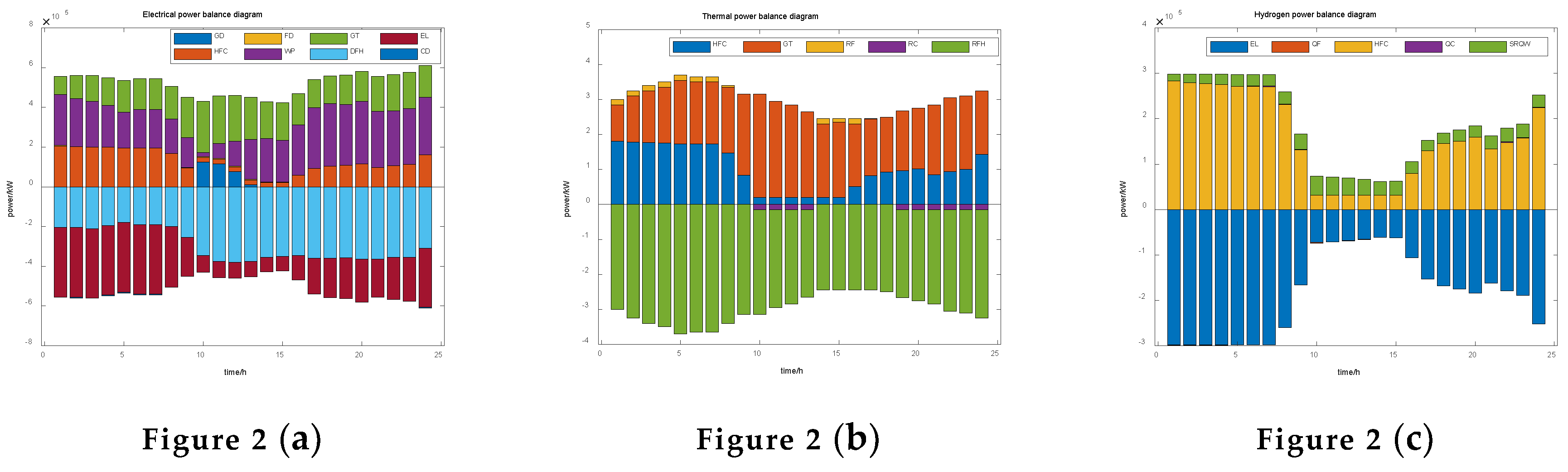
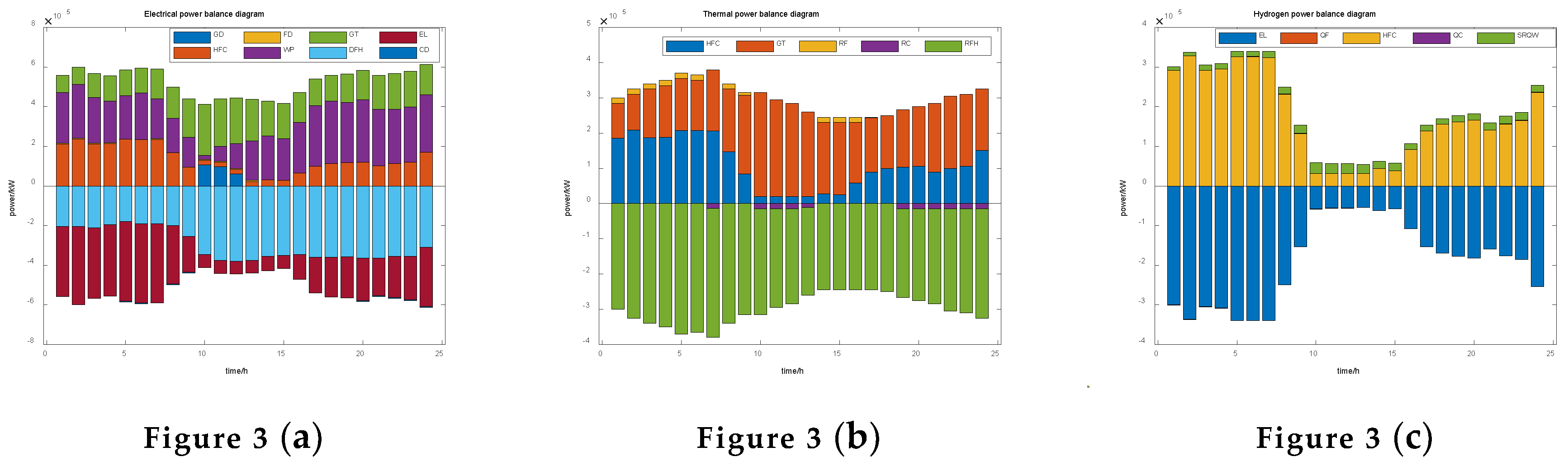
Figure 3.
Energy balance plot under Scenario 3.
The system operating costs in different scenarios are shown in Table 1. Compared with scenario 1, in scenario 2 and scenario 3, due to the addition of electrical-hydrogen coupling equipment in the system, the operating cost of system equipment is increased. However, compared with scenario 1, due to the addition of hydrogen production and hydrogen use equipment, the utilization rate of wind power is increased by 17.68% and 19.73% respectively, the wind power abandonment cost is reduced, and the unit output is increased. In scenario 2, Scenario 3 considers the variation of hydrogen blending ratio in hydrogen-doped natural gas, and the equipment operation cost is the highest among the three scenarios. However, due to the enhanced system flexibility and better unit output, the system wind abandonment penalty, carbon emission cost and energy purchasing cost are all lower than in scenario 2.
3.1.1. Analysis of System Wind Absorption
The output of wind power under different scenarios is shown in Figure 4 below. Since scenario 1 only considers the supply load demand of wind power generation, there are few utilization ways of wind power, and there is a lack of wind curtailment and absorption equipment, a large number of wind power curtailment phenomena occur as wind power output fluctuations. After considering the electric hydrogen production equipment, the system's electricity utilization path increases, and the wind power consumption capacity of scenario 2 and scenario 3 is significantly improved. In scenario 2, the wind power utilization rate is increased by 17.68%. In the high wind power output period from 0:00 to 7:00, due to the fixed hydrogen mixing ratio of the system, the output of the electric hydrogen production equipment is limited. There is still obvious wind abandonment phenomenon at 2:00 and 5:00, and the wind power utilization rate is insufficient compared with scenario 3. In scenario 3, due to the relatively flexible hydrogen mixing ratio, the hydrogen energy demand of hydrogen equipment further promotes the system to absorb wind power and produce hydrogen energy during the high power period of wind power from 0:00-6:00, so the wind power utilization rate is improved compared with scenario 2
3.1.2. Analysis of System Carbon Emission
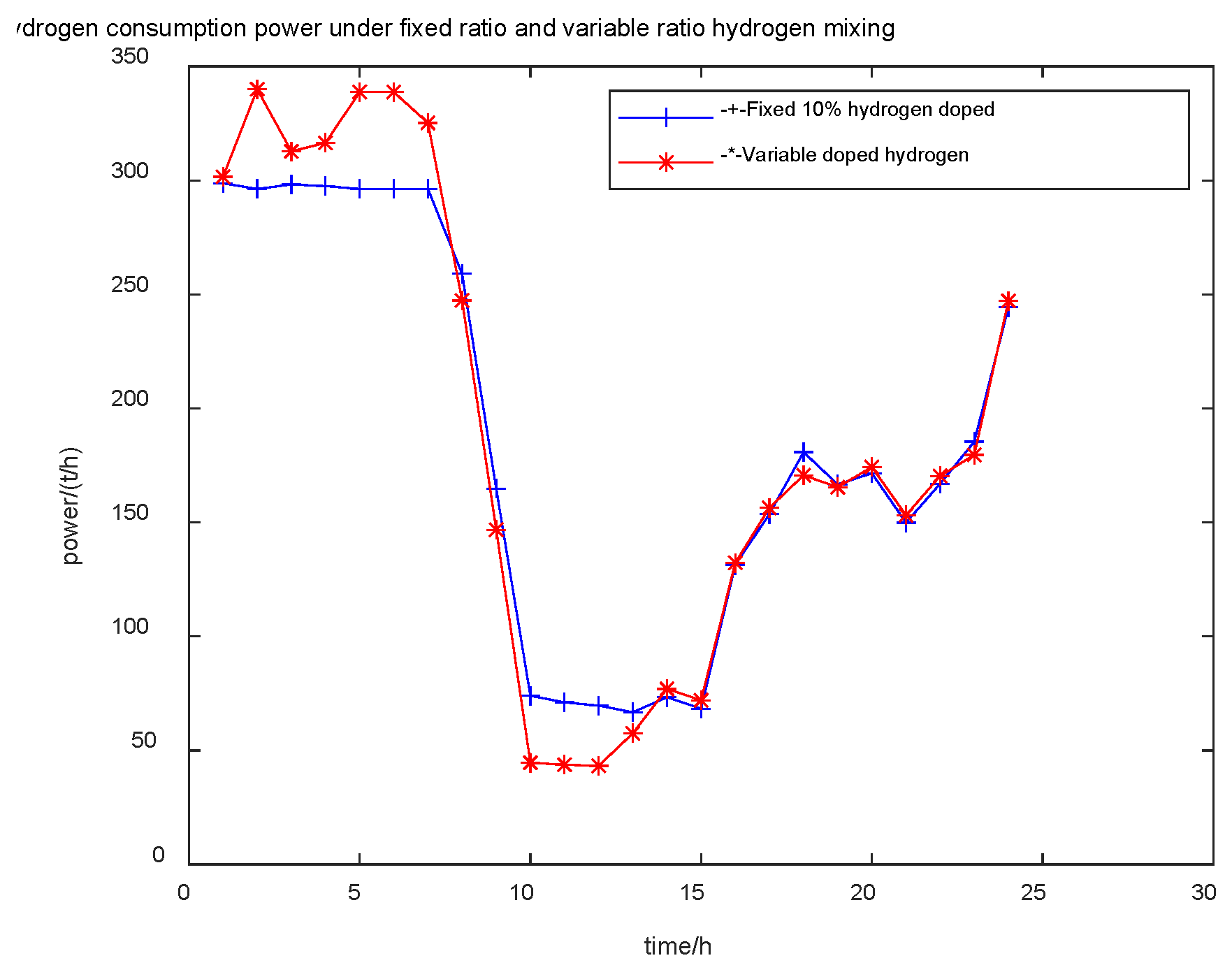
Compared with scenario 1, the system carbon emission cost of scenario 2 and scenario 3 decreased by 28,100 yuan and 122,400 yuan respectively. In scenario 2, the total carbon emissions generated by the operation and purchase of all equipment in the system are 2823070.90 tons, while in scenario 3, the total carbon emissions of the system are only 2635986.97 tons. In scenario 2 and scenario 3, hydrogen energy utilization equipment is added. Due to the cleanliness of hydrogen energy, carbon emission is not considered in the operation process of hydrogen equipment, thus reducing the carbon emission of the system. Moreover, the coupling of hydrogen electricity and hydrogen heat achieved by hydrogen fuel cells reduces the output of the gas unit in the system, reduces the carbon emission of the gas unit, and reduces the power purchase and gas purchase of the system. Reduce the carbon emissions brought by the purchase and realize the low carbon scheduling of the system. As can be seen from Figure 6, due to the variability of hydrogen mixing ratio in Scenario 3, it can be seen from the hydrogen power balance diagram that although the output of hydrogen production equipment in the period from 10:00 to 13:00 is lower than that in scenario 2, the output of hydrogen equipment in Scenario 3 is higher than that in scenario 2, so the overall low-carbon performance is better than that in scenario 2.
In summary, compared with the traditional power-gas integrated energy system, it has more far-reaching significance in improving the absorption capacity of wind energy, promoting the development of hydrogen energy, and completing the transformation of the system to the low-carbon direction.
3.2. Analysis of the Influence of Green Certificate Price on the Output of Hydrogen Equipment
The technical cost of hydrogen energy in transportation, storage and other aspects is higher than that of other energy sources, but with the development of skills, the reduction of hydrogen energy utilization cost, the improvement of operation efficiency and the support of national policies, the economy of hydrogen energy is constantly improving.
Referring to the price fluctuation range of each green certificate in recent years, the price of the unit green certificate is selected in the range of 0-80 yuan. Green certificate income and output of hydrogen fuel cells under different green certificate prices are considered respectively, and the variation is shown in Figure 5.
In this paper, gas turbine and hydrogen fuel cell are used as energy supply equipment. However, due to the relatively higher cost of hydrogen fuel cell, HFC will not work at full capacity when the price of green certificate is low, because of the poor economic efficiency of hydrogen fuel cell. However, with the increase of green certificate price, the green certificate income obtained by hydrogen fuel cell output increases, and the output state of hydrogen fuel cell is also slowly improving.
3.3. Analysis of the Influence of Hydrogen Mixing Ratio on the System
In this paper, after the use of abandoned wind for hydrogen production and storage, two modes of hydrogen use, hydrogen fuel cell and hydrogen mixed with gas, are considered. Due to the cleanliness of hydrogen energy and no carbon emission, the carbon emission during the working process of hydrogen fuel cell is 0MW. As can be seen from Figure 6, the output of hydrogen fuel cell reaches 3035.25MW, and hydrogen energy utilization is an effective way to absorb wind power.
In scenario 2 and scenario 3, due to different restrictions on the proportion of hydrogen in the hydrogen mixed natural gas, device output flexibility varies in different scenarios. Under the scenario of fixed hydrogen blending ratio, the proportion of hydrogen consumed by gas turbines remains unchanged at 10%, which is not affected by energy price and wind power output, and lacks flexibility. However, in the scenario of variable hydrogen mixing ratio, when the electricity price or electricity load demand is high, the system will reduce the hydrogen mixing amount of the hydrogen mixing device, and reduce the output of the electric hydrogen production equipment to reduce the consumption of electric energy. As can be seen from Figure 2 and Figure 3, in the night period, wind power is more used for electrolytic hydrogen production due to the high output of wind power and the low demand for electric load at this time. In Scenario 2, electrolytic hydrogen production equipment consumes 5,269MW of wind power, and in scenario 3, 5,382MW. The hydrogen reserve is abundant, so in scenario 3, the hydrogen mixing ratio of the system's hydrogen mixed natural gas is higher than that in scenario 2 from 0:00-6:00. During the period from 10:00 to 13:00, due to low wind power output and high electricity price, the system reduces the amount of hydrogen incorporation in the gas turbine under the scenario of variable hydrogen blending ratio; while under the scenario of fixed hydrogen blending ratio, due to the system's restriction on the amount of hydrogen in the hydrogen mixing natural gas, the system still needs to force hydrogen production to meet the requirements of hydrogen consumption. In this period, the turbine hydrogen energy consumption in scenario 3 is 39.69% lower than that in scenario 2. Compared with Table 1, it can be seen that under the scenario of reasonable control of hydrogen blending ratio of gas unit, the system has better emission reduction and economy.
Figure 6.
Hydrogen energy consumption under different hydrogen blending scenarios.
3.4. Analysis of User Energy Optimization Scheduling Results
In order to analyze the demand response of user units of the model proposed in this paper, two scenarios are set for analysis and comparison:
- Scenario 4, the user unit does not consider demand response;
- Scenario 5, the user unit considers demand response.
Figure 7.
Load change status before and after demand response.
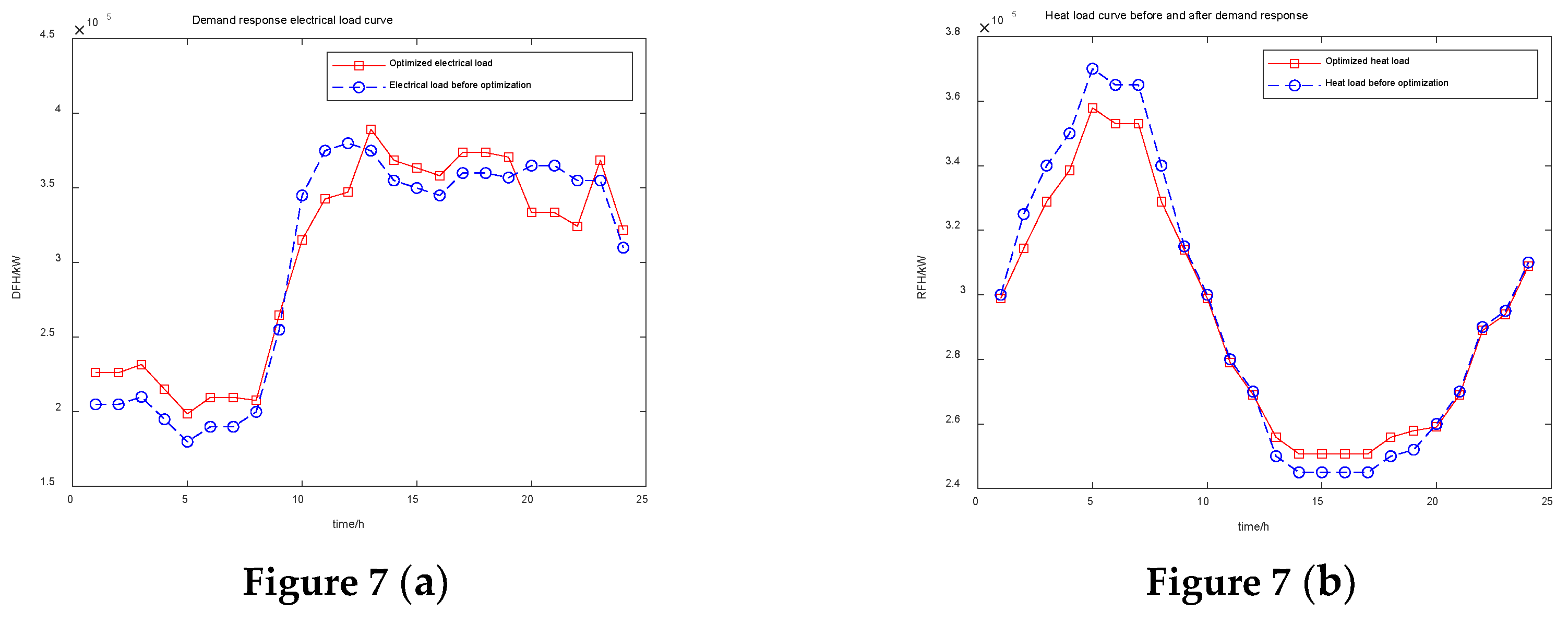
As shown above, the user unit performs flexible load reduction and transfer during the peak energy consumption period. According to the load optimization curve of the system, under the proposed model, the user unit participates in the demand response according to the changes in price signals, thus achieving load reduction and transfer during peak hours and smoothing the load curve. It plays an obvious role of peak cutting and valley filling, and the load peak and valley have been significantly improved. Compared with FIG. 5 and FIG. 7, due to the role of demand response, the optimized electricity load demand is closer to the output fluctuation of wind power, which helps to reduce the system air generation volume and optimize the output of hydrogen production equipment.
4. Discussion
Firstly, this paper considers the refined utilization mode of hydrogen energy, establishes a comprehensive energy system model, and analyzes the changes of flexibility, economy and cleanliness of the system under the new energy utilization mode compared with the traditional comprehensive energy system.
Secondly, in the simulation operation, considering the energy supply and demand balance of the system and the operation constraints of the equipment, ensuring the safe operation of the system in many aspects and accurately achieving the coordinated planning of supply and demand in the system is conducive to achieving the economic optimal of the system.
Finally, by setting different scenarios and analyzing the equipment output status during the system operation, the economic and environmental benefits in the system operation cycle are realized, and the scheme plan for the future development of the power system is provided as a reference.
Based on the design of this paper, combined with China's current energy policy research and analysis. The calculation shows that with the addition of hydrogen energy utilization, the operating cost of the system equipment increases, but the economic benefit is also better. As the country attaches importance to environmental benefits, in the future power system planning, the proportion of clean energy such as hydrogen energy will continue to increase, and with the development of hydrogen energy utilization technology, the energy cost of hydrogen energy will continue to decline.
5. Conclusions
In order to improve the low-carbon economic benefits of the power system, this paper constructs a comprehensive energy system optimization model of hydrogen mixed with gas and hydrogen fuel cells, fully combining the green certificate policy and demand response mechanism. The carbon emissions of the system under different hydrogen mixing ratio were analyzed considering hydrogen production and hydrogen use equipment. The following conclusions can be drawn from the Settings of different scenarios:
- Hydrogen production equipment is added to the system to optimize the peak and trough period of system load through demand response. In the low period of system power load, wind power hydrogen production is used to improve the system wind power consumption capacity, so that the system wind power consumption capacity is increased to more than 95%.
- The electric-hydrogen coupling unit in the system partially replaces and assumes the functions of thermal power units and natural gas sources for power supply and heating by means of technical means such as electrolytic hydrogen production, hydrogen fuel cell power generation and hydrogen blending, reducing the carbon emissions of the system and improving the flexibility and economy of the system.
- Compared with the traditional electric integrated energy system, hydrogen storage equipment and hydrogen equipment, the operation cost is very high. However, combined with the green certificate policy, the optimized model in this paper has significant advantages in improving the system's wind power consumption capacity and reducing the system's carbon emissions.
Author Contributions
Conceptualization, Z.Z.; methodology, Z.Z. and X.A; software, Z.Z.; validation, Z.Z. and Y.S.; formal analysis, Z.Z. and Y.S.; investigation, Z.Z.; resources, Z.Z. data curation, Z.Z.; writing—original draft preparation, Z.Z.and Y.S.; writing—review and editing, Z.Z.; supervision, X.A.; project administration, X.A.andZ.Z.; funding acquisition, Z.Z. All authors have read and agreed to the published version of the manuscript.
Funding
This paper is supported by the Natural Science Foundation of Xinjiang Uygur Autonomous Region, project No. 2022D01C664.
Data Availability Statement
Data are contined within paper.
Conflicts of Interest
The authors declare no conflicts of in-terest.
Abbreviations
The abbreviations or symbols used in this text are detailed below:
| T,t | Time state change collection |
| Battery change state set | |
| Collection of gas energy state changes GD Purchase electricity from the grid | |
| Collection of thermal energy state changes | |
| Collection of states of economic change | |
| , | Energy storage and release of system energy storage equipment |
| GT | Gas turbine |
| FD | Store and discharge electricity |
| CD | Charge amount of storage device |
| RC | Heat storage devices store energy |
| RF | The heat storage device releases energy |
| QC | Hydrogen storage devices store energy |
| QF | Hydrogen storage devices release energy |
| EL | Electrolytic device power consumption |
| HFC | Hydrogen fuel cell |
| WP | Wind power generation |
| DFH | Electric load |
Appendix A

Table A1.
Device Running Parameters.
| Equipment | Argument | Numerical Value |
|---|---|---|
| EL | Maximum/minimum power consumption(MW) | 400/0 |
| Unit climbing rate (MW/h) | 100 | |
| HFC | Maximum and minimum output (MW) | 350/0 |
| Unit climbing rate (MW/h) | 100 | |
| Power generation and heat efficiency | 85%/75% | |
| GT | Maximum and minimum output (MW) | 350/0 |
| Unit climbing rate (MW/h) | 50 | |
| Power generation and heat efficiency | 35%/40% | |
| Stored energy | Upper and lower limits of storage capacity (MW) | 500/50 |
| Maximum charge and discharge power (MW) | 100 | |
| Charge and discharge efficiency | 90% | |
| Initial capacity (MW) | 50 |
Table A2.
Time-of-use electricity price.
| Time Frame | Electricity Price /[Yuan/KW·h] |
|---|---|
| 0:00-7:00 | 0.35 |
| 8:00-9:00,13:00-19:00,23:00-24:00 | 0.68 |
| 10:00-12:00,20:00-22:00 | 1.09 |
Table A3.
time-sharing gas prices.
| Time Frame | Electricity Price /[Yuan /KW·h] |
|---|---|
| 0:00-1:00,9:00-12:00,20:00-24:00 | 3.25 |
| 2:00-8:00,18:00-19:00 | 3.65 |
| 13:00-17:00 | 2.65 |
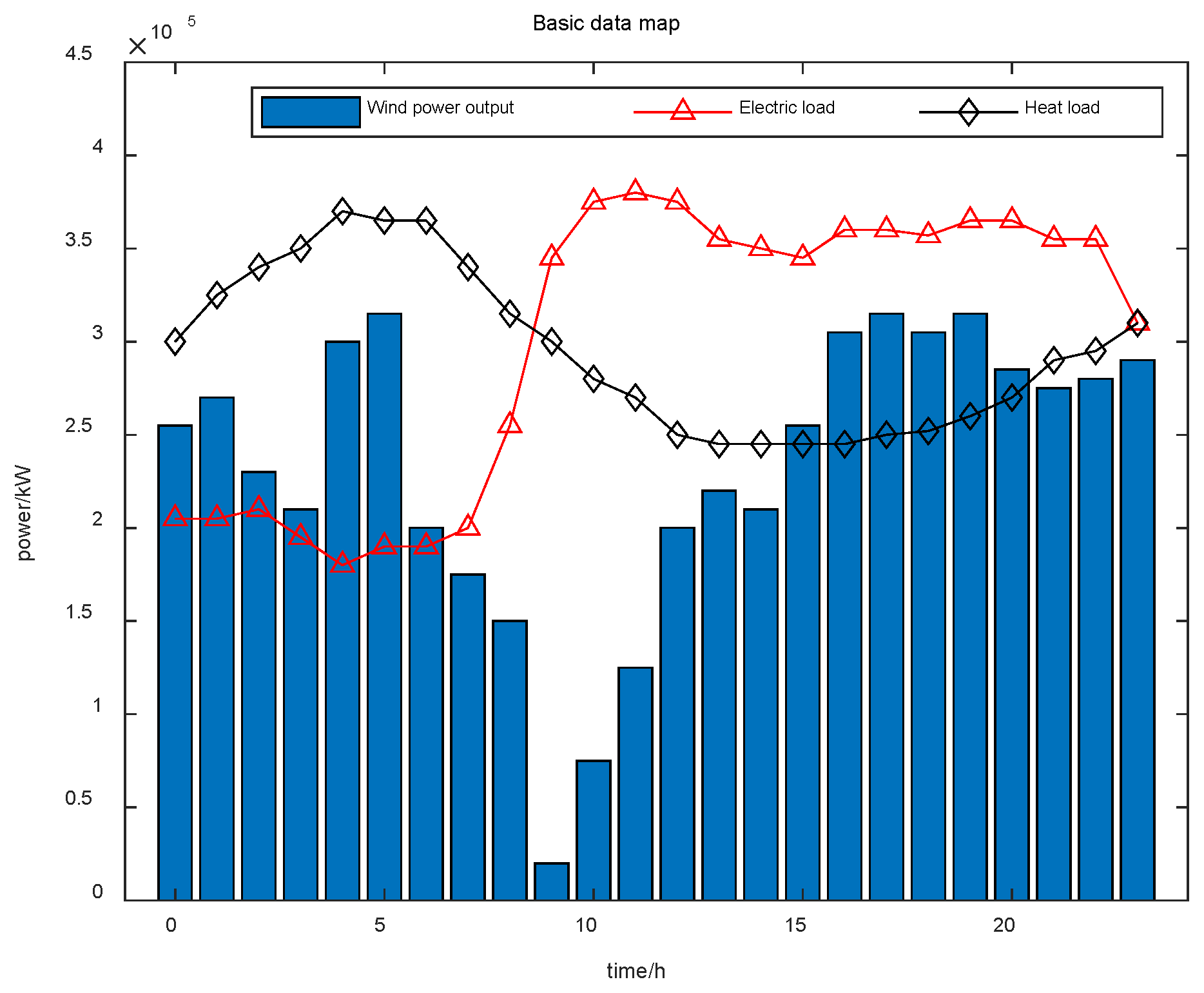
Figure A1.
Load and wind power output.
References
- Huang Liang. Analysis and control strategy of low-carbon transformation of next-generation power system under the goal of carbon neutrality[J]. Modern industrial economy and informatization,2023,13(10):181-183.
- Feng Yifu, Xu Yiyang, Zhang Ji. Application status and prospect of integrated energy system planning and design platform[J].Energy conservation and environmental protection. 2021(12):41-43.
- Xue Daowei. Application prospect of "green hydrogen" in integrated energy system[J].Contemporary Chemical Industry Research,2022(04):60-62.
- SUN Yuling,HU Zhihui,QIN Aning,et al. Analysis of strategy and technology situation on global hydrogen industry[J]. World Sci-Tech R & D,2020,42(4):455-465.
- Xiong Junhua, Jiao Yachun, Wang Mengdi. Optimal scheduling of regional integrated energy system considering power-to-gas[J].Modern Electric Power,2022,39(05):554-561.
- Zhang Chengxin, Bai Shangmin, Zhao Guanxiong, et al. Multi-objective Optimal Scheduling of Combined Cooling, Heating and Power Microgrid with Electricity-to-Gas[J]. Jilin Electric Power,2021,49(02):28-32.
- Zhou Buxiang, Hua Weijie, Zhang Yuanhong, et al. P2G Plant and Station Optimization Planning for Electricity-Gas Coupling and Low Carbon[J]. Journal of Electric Power System and Automation,2022,34(06):9-17+24.
- Gao Yuefen, Yuan Chengbo, Kong Fanpeng, et al. Optimization of Integrated Energy System Coupled with Electric-to-Gas and Carbon Capture Equipment under Demand Response Excitation[J/OL] China Electric Power:1-9[2023-11-29].
- Chen Y, Liu D, Gao F, et al. Optimal scheduling of regional integrated energy system considering the refined utilization of hydrogen energy in the power-to-gas link[J] .Power Supply,2021,38(11):59-67.
- Deng Yulong, Li Chunyan, Shao Changzheng, et al. Stochastic Optimal Scheduling of Electric, Heat, Gas and Hydrogen Integrated Energy System[J]. Acta Solar,2023,44(11):522-529.
- Ding Tao, Jia Wenhao, Huang Yuhan, et al. Collaborative Optimization of Hydrogen Production, Storage, and Transportation in Mobile Hydrogen Energy System Based on Distributed Robust Opportunistic Constraints[J/OL]. Power System Automation:1-13[2023-11-29].
- Wu Xiaotong, Tan Lei, Zheng Yueyuan, et al. Economic Prospect of Hydrogen and Economic Analysis of Water Electrolysis Technology for Hydrogen Production[J/OL]. Chemical Industry and Engineering:1-10[2023-12-10].
- Wang Xiting. Development Trends of Hydrogen-Mixed Natural Gas and HCNG[J]. Natural Gas Chemical Industry(C1 Chemistry and Chemical Industry),2018,43(06):23.
- Wang Kaiyan, Liang Yan, Jia Rong, et al. Two-stage Optimal Scheduling of Multi-microgrid for Integrated Energy with Hydrogen-doped Gas Based on Nash Negotiation in Uncertain Environment[J]. Power System Technology,2023,47(08):3141-3159.
- Cui Yang, Shen Zhuo, Wang Zheng et al. Green Dispatch of Regional Integrated Energy System Considering the Interaction Mechanism of Green Certificate-Carbon Emission Equivalence[J]. Proceedings of the CSEE,2023,43(12):4508-4517.
- Fan Hong, Yang Zhongquan, Xia Shiwei. Low-carbon economic operation of hydrogen-blended natural gas integrated energy system considering stepped carbon trading mechanism[J/OL]. Journal of Shanghai Jiao Tong University:1-21[2023-12-10].
- Yan L ,Yao W ,Hongli L , et al.Optimal Operation Of Integrated Energy System Considering Demand Response[J].Journal of Physics: Conference Series,2021,2087(1):.
- ISAAC T. HyDeploy: The UK’s first hydrogen blending deployment project [J]. Clean Energy, 2019, 3(2): 114-125.
- https://news.cctv.com/2023/04/16/ARTIT9Z4c3zoCOHqPAb2OwIU230416.shtml CCTV. Hydrogen blending ratio reaches 24%! China has made a breakthrough in this technology! [EB/OL]. (2023-4-17) [2023-08-22].
Figure 1.
Operational structure of the integrated energy system.
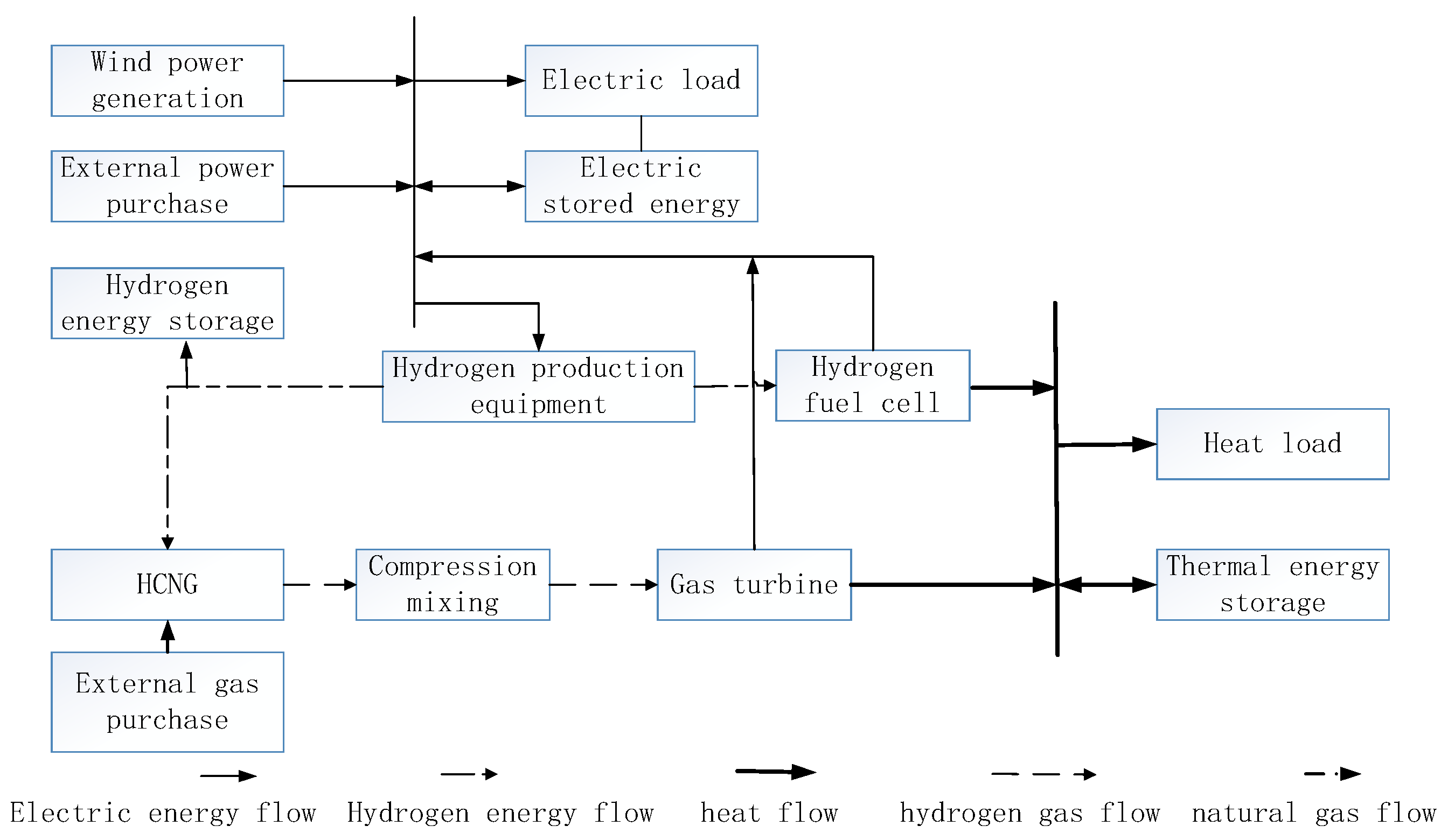
Figure 4.
Wind power output and energy consumption in different scenarios.
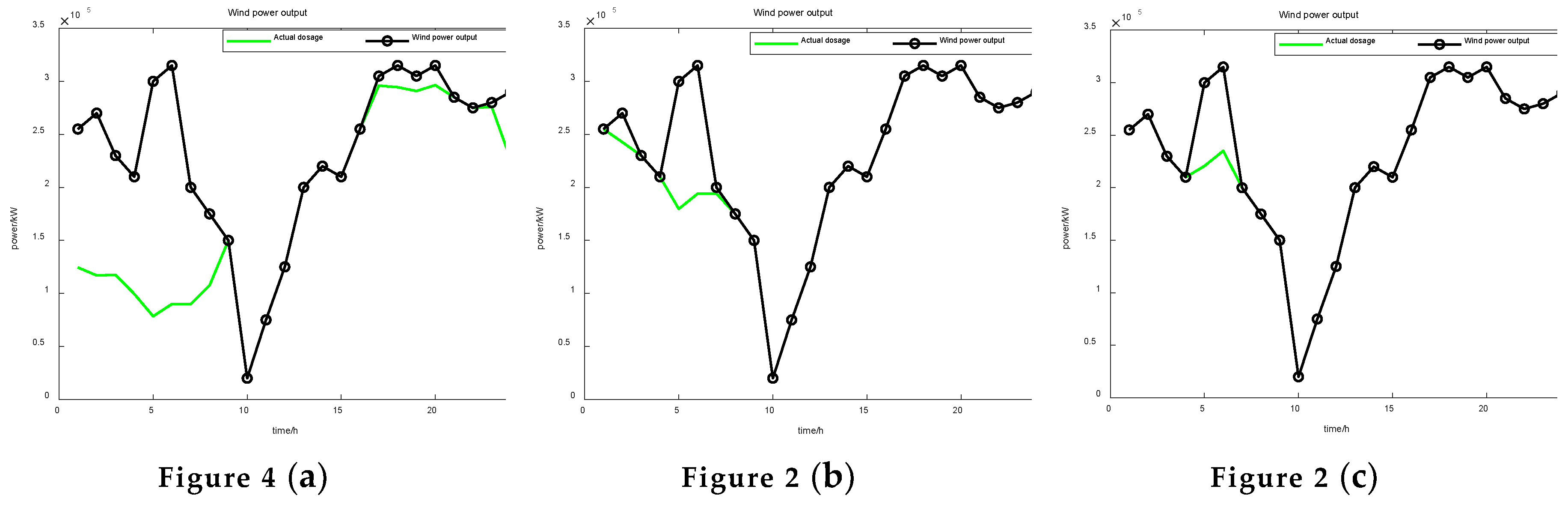
Figure 5.
HFC operation under different green certificate prices.
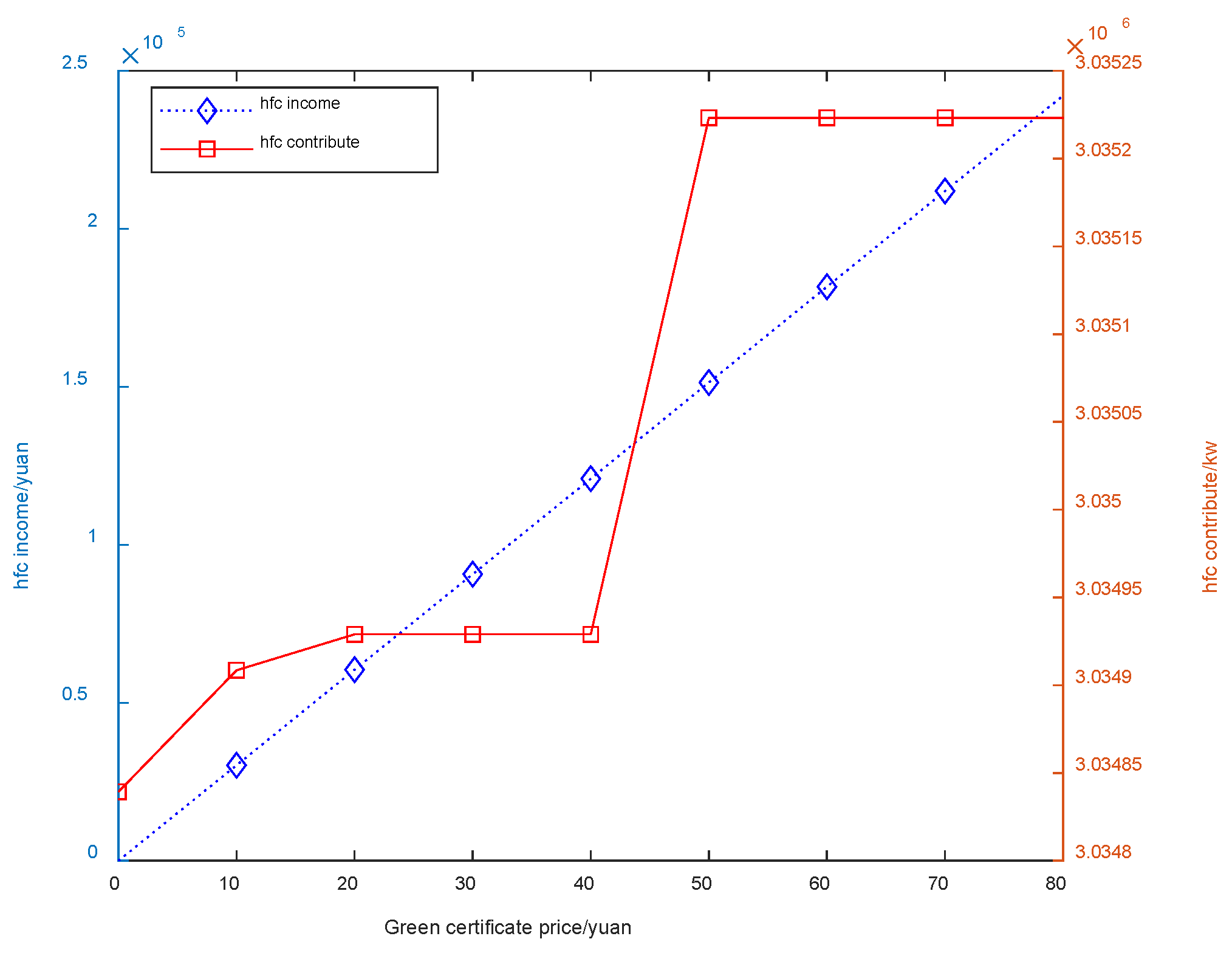
Table 1.
Parameter comparison in different scenarios.
| Argument | Scenario 1 | Scenario 2 | Scenario 3 |
|---|---|---|---|
| Utilization rate of wind power /% | 77.42 | 95.10 | 97.15 |
| Cost of purchasing power / 10,000 yuan | 589.80 | 413.81 | 396.13 |
| Carbon emission cost / 10,000 yuan | 143.74 | 140.93 | 131.50 |
| Curtailment cost /10,000 yuan | 104.43 | 13.67 | 7.95 |
| Running cost /10,000 yuan | 20.52 | 52.30 | 53.67 |
| Total cost / 10,000 yuan | 858.50 | 620.73 | 589.25 |
Disclaimer/Publisher’s Note: The statements, opinions and data contained in all publications are solely those of the individual author(s) and contributor(s) and not of MDPI and/or the editor(s). MDPI and/or the editor(s) disclaim responsibility for any injury to people or property resulting from any ideas, methods, instructions or products referred to in the content. |
© 2024 by the authors. Licensee MDPI, Basel, Switzerland. This article is an open access article distributed under the terms and conditions of the Creative Commons Attribution (CC BY) license (http://creativecommons.org/licenses/by/4.0/).
Copyright: This open access article is published under a Creative Commons CC BY 4.0 license, which permit the free download, distribution, and reuse, provided that the author and preprint are cited in any reuse.


