

Submitted:
30 December 2025
Posted:
31 December 2025
Read the latest preprint version here
Abstract
In this paper we conduct a model free analysis of the expansion of the universe using stellar luminosity data that is available for redshifts, z< 1.8. Our results lead to an expansion velocity of 6.87 0.36 × 10⁶ ms-1, and Hubble constant of 70.9 3.7 km/s/Mpc consistent with other theories. This analysis leads us to a new theory to explain the expansion of the universe that augments general relativity to create a container within which quantum effects can be explained by treating time as an artefact of a fourth, expanding, spatial dimension. We show that the theory can be applied to not only explain mass creation, the speed of light limit, gravity, black holes without singularities and other macroscopic effects, but also to interpret physical effects at the subatomic level such as wave particle duality and electron spin. It provides a solution to the double slit conundrum and can explain how quantum entangled partners can behave in a quantum way and pass seemingly time-defying information. The theory also provides a quantitative link to the fine structure constant from the expansion velocity.
Keywords:
universe expansion
; gravity
; wave-particle-duality
; electromagnetism
; fine structure constant
1. Introduction
The probabilistic nature of particles governed by the laws of quantum mechanics and the elegant curvature of spacetime dictated by gravity have long stood as two separate realms in the landscape of physics. While each theory has provided remarkable insights into the fundamental nature of the universe, the elusive bridge connecting these two pillars of modern physics continues to evade our grasp. The dichotomy between the microscopic world of quantum mechanics, where particles exist in superpositions and exhibit wave-particle duality, and the macroscopic realm of gravity, where massive bodies warp the very fabric of spacetime, poses one of the most profound puzzles in contemporary physics.
For decades, physicists have strived to reconcile the seemingly irreconcilable: the quantum realm described by the successful framework of quantum field theory and the gravitational domain governed by Einstein's general relativity. While both theories have stood the test of time in their respective domains, attempts to seamlessly integrate them into a unified framework have encountered formidable challenges. Theories to date have proved to be inherently incompatible or incapable of accurately predicting nature at all levels of magnitude.
In this paper, we review and expand upon a theory proposed in our earlier study [1] to link these two theories together. We initially take a largely model free approach (based purely on geometry and optics) to fitting the cosmic luminosity data to reveal a radial rate of increase of our universe. By doing this, the results allow us to focus our thinking and reveal what this might mean for our universe allowing us to create a container theory that encompasses both the large and small.
2. Method of Analysis
Stellar Luminosity data gathered by other studies, Reiss et al. [2], Betoule et al. [3] and Rubin et al[4] were used as the main set of data in this paper. These and other previous studies always presented the data along with a model (some variant of the Standard Model of Cosmology (Lambda-CDM)) to give parameters that define how the universe has expanded historically. We wanted to take a model free approach with some simple assumptions/premises to create an unbiased analysis of the data.
Premise 1: The expansion of the universe happens in all directions and is basically a stretching on top of the 3-dimensional space. This effect has been well documented since the time when Hubble realised that it was taking place and it is believed that, on the whole, it is happening isotropically with a current expansion rate of around 70 km/s/Mpc. This means that this expansion can be represented by a distance stretched per unit of time and will affect all 3 spatial dimensions equally.
Premise 2: We will view the expansion itself as a separate dimension of space. As all historical light reaching us from distant luminous objects must have travelled at the speed of light and in a straight line from its point of origin to reach us, we need to consider only one spatial dimension and one direction of expansion to analyse the expansion. It is assumed that the light that reaches us must have travelled within one of the space dimensions perpendicular to the origin point at t0 as visualised in Figure 1.
It is also assumed that bending of any of these light ray paths as caused by gravity effects of objects that the light passes will be random and equalise out when considering the universe as a whole. This would mean that to reach us, each light beam has taken a path along the surface of the expanding sphere. Although other light beams will have taken completely different paths, each light pinpoint can be dealt with similarly. Therefore, for each photon, if we take a slice through the expansion dimension and the straight-line spatial path that each photon takes, then you will end up with a spiral path (in time) consistent with the expansion of the universe.
A different photon would require a different cross section/alignment, but the spiral path would simplify to be the same assuming that the expansion of the universe has been isotropically similar and dependent only on the distance from the Earth to the object being observed.
To explain, if we take two objects on the surface of a sphere – the sphere is continually increasing in size. Light is emitted from one object, B and received at object A. The light will therefore follow a spiral path as it moves around the surface of the expanding sphere.
The spiral path the light will follow on the expanding sphere can be shown to be
Where and are the radii of the sphere at points A and B, the speed of increase in r and c is the speed of light (we have used H in to denote that this is the observed expansion velocity derived from Hubble expansion). There is the assumption here that the speed of light itself is not changed by the expansion.
The redshift observed for any point around the spiral will be directly related to the size of the universe at that point, i.e., the circumference. As the circumference of our expansion sphere is directly proportional to the radius, the stretching effect or redshift, z, is:
The magnitude of the observed light (expressed as the distance modulus m-M) of any object is related to the luminosity distance by:
where is the luminosity distance in Mpc and can be defined as
L is the intrinsic luminosity of the object, and F is the observed flux. For nearby objects (those for which the time that has passed is minimal and there has been little increase in radius), this would approximate to the distance around an arc of our spiral model, . For objects that are further away, then distortion will occur through two effects:
As the light stretches, the energy of the light diminishes, which causes a reduction in intensity. The wavelength of light will increase relative to , as the circumference becomes proportionally larger for the same angle, so consequently, the energy of the light will drop in intensity relative to /. Second, the stretch will mean that the photon arrival rate within a beam of photons will be reduced again according to /.
As the luminosity distance is proportional to the square root of the flux received and to account for the angular distance the light moves on the sphere then the luminosity distance (the apparent distance as seen in the measured data)
We then fitted the above against the measured luminosity data, varying only to determine the radial speed of expansion of the universe.
3. Results
Figure 2 shows the results of our fit to the luminosity data of Reiss et al. [2], Betoule et al. [3] and Rubin et al [4]. Although a constant velocity of expansion (as shown by the orange dashed line) fits reasonably well for nearby objects, the best fit is obtained by allowing the velocity of expansion to vary with time. We fitted the speed of expansion using a double exponential decay function of the expansion velocity from time zero, as we wanted a function that could allow the velocity to behave naturally
The expansion velocity versus the radius of the expansion sphere used in this model can be seen in Figure 3 over the range for which data are available. The utilization of the exponential decay function in this context is not intended to represent an exact mathematical depiction of reality. Instead, it is simply an algorithm employed to ascertain the pattern of changes in the expansion speed within the specified region of interest.
The parameters obtained from our fit were as follows = -0.02774, =0.9953, C=0.02821 (expressed as fractions of c, the speed of light), r=96.76 Mpc, k=0.1338 and k’=0.01708.
Although subtle, to get the most accurate fit, the tail of the curve actually increases in speed indicating the acceleration of the universe is expanding. This lines up with results of modelling by Lambda-CDM [2,5].
To explain the results, it is surmised that the expansion had an initial dramatic increase, but then all “particles” in the universe moved and interacted to such an extent that they slowed in their expansion over billions of years to the current resultant average velocity and that we now exist in the tail of the expansion wave. Later, we deduce that the initial speed of expansion at r=0 must be the speed of light, which has decayed away to the current speed we observe today.
3. Discussion
The above is perhaps illuminating just because it is clearer to see the expansion and how it physically manifests itself from a simple geometric point of view without trying to reverse engineer a model to show the results. Although we end up with much the same result, such an analysis has let us expand our thinking and led us to a deeper understanding as is described below with the speed of expansion rate playing a crucial role in unlocking the link to the subatomic realm.
Mass out of time and Special Relativity
Premise 2 which allows our fit to behave geometrically consistent is the subtle part of our analysis that differs from others, but it is crucial to the understanding that follows. Basically, this premise is that the expansion dimension is the same as the other more normal 3 dimensions of space except we travel along it – other than that it must have the same physics as the other 3 dimensions.
If we accept this for a moment and that the universe has always been expanding since the time of the big bang, the expansion will behave according to Newtons laws of motion and would therefore continue to expand at a constant speed unless something slowed it down. So what is it that is causing the slowing effect? There are a few possible effects in play which reveal themselves in different ways.
Figure 4.
Explanatory figure to illustrate the effects of movement on the resultant momentum vectors in a single time (vertical) and space (horizontal) direction. The case considered here is one of an object breaking up and being pushed apart creating two identical mass objects moving in opposing directions with the same velocity.
Figure 4.
Explanatory figure to illustrate the effects of movement on the resultant momentum vectors in a single time (vertical) and space (horizontal) direction. The case considered here is one of an object breaking up and being pushed apart creating two identical mass objects moving in opposing directions with the same velocity.
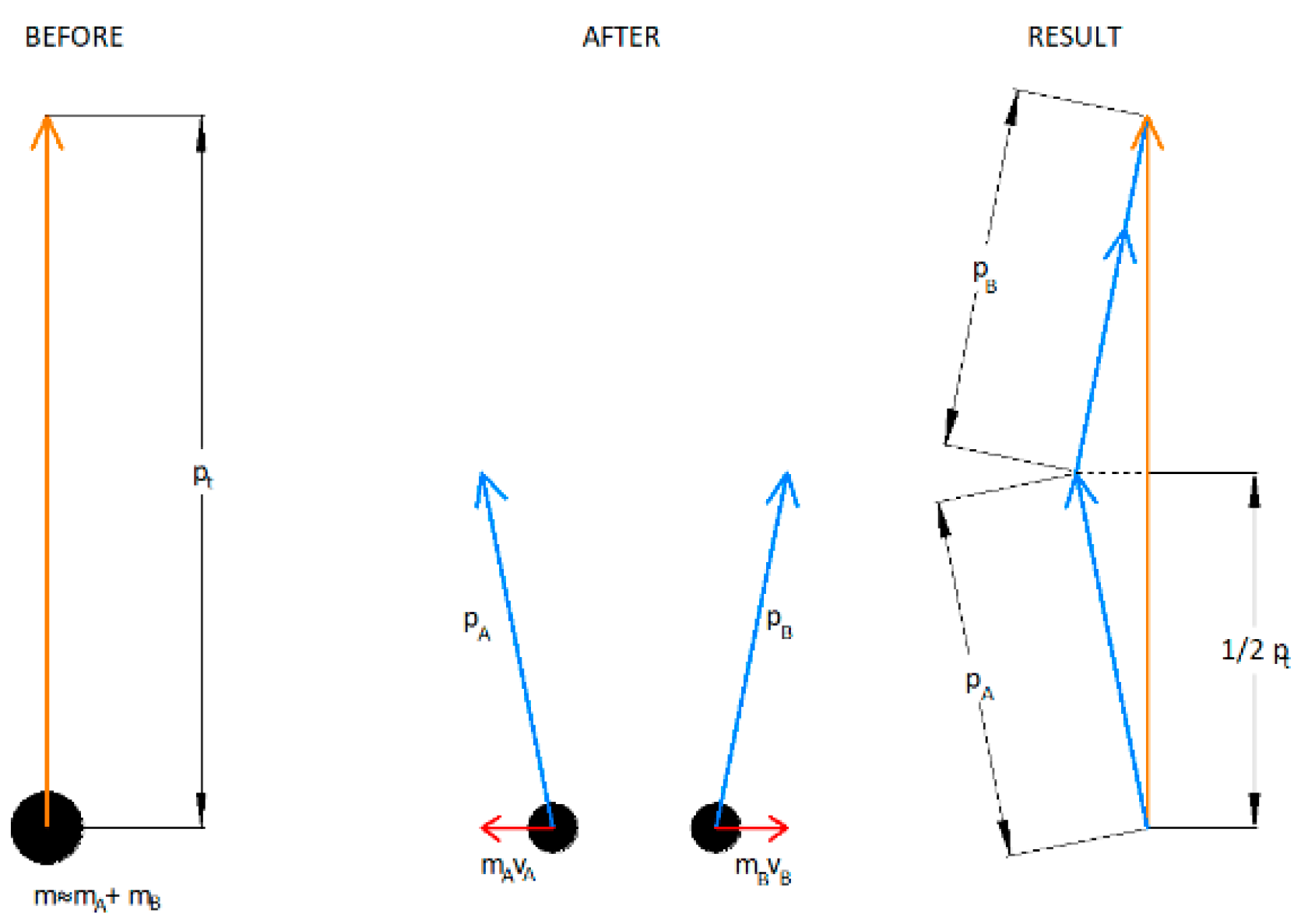
If we assume that the mass splits apart spontaneously, the momentum in the horizontal direction is zero before “push off”. After “push off”, then the overall momentum is still zero as the sum of the vectors of the two red arrows cancel each other out. However, as described in the previous section, the original particle is already moving in the time dimension so this momentum must also be conserved. As can be seen, the resultant momentum pA + pB must then equate to the initial momentum pt that comes about as a consequence of time expansion. As is clear, the resultant objects end up deviating on their path away from the origin of time. Let us assume to start with that the sum of the resultant masses is equal to the starting mass. If this were the case, then the resultant vector diagram would lead to:
Where vt is the unperturbed speed of expansion, vA is the velocity of the particle in space and vX is the resultant velocity vector. But – where did the energy come from to generate the push off? If it was simply a translation of the kinetic energy, then this would lead to:
This clearly is not the case. Consequently, it must be the mass of the object, rather than the velocity that provided the energy and must therefore change when it splits apart, so
Consequently, using this mechanism, we deduce that a sideways movement of particles perpendicular to the direction of expansion, caused by particles bumping into each other or decaying, creates a mechanism by which mass can apparently increase in our perceived 3-dimensional space. To conserve momentum following a deviation from the time trajectory, mass increases by
where is the unperturbed speed of expansion, is the velocity of a particle in normal space, is the mass of the particle hidden in the expansion dimension and is the resultant mass. Rearranging for , we obtain:
This parameter is the sideways or deflection (from complete expansion) velocity, which can be used to calculate the energy gained or released from the expansion dimension by mass production. This energy of deflection is simply the momentum squared divided by twice the average mass before and after the reaction:
where and are the masses before and after the interaction/reaction, respectively.
In other words, we say that by time dilation, mass energy is brought into the 3D world from the expansion dimension. Conversely, you could say that the expansion of an object has slowed, adding to the overall decrease in expansion and increase in observed mass. By combining equations 12 and 13 and simplifying, we can express this expression in terms of :
Now, considering a scenario where the initial mass is zero (equivalent to dealing with a delta in mass), then:
The above equation is obviously well known from special relativity, and we can conclude from this that is in fact the speed of light, c. This is perhaps no surprise as the only initial components of the universe are thought to be high energy radiation from which everything else was created. This gives us a good explanation of why this limit exists, and consequently why the phenomenon of special relativity occurs. If anything were able to travel any faster, then it would break away from our timeline and escape the universe we know.
What this means is that everything is travelling at the speed of light in one of 4 dimensions. If it is travelling perpendicular to the expansion path, we see the object travelling at c, and it appears as light. If it is travelling in our expansion direction, we will not observe it. For any direction in between, we will observe the object to be travelling along our timeline, and it will have realised mass.
From this, the expansion of the universe might be thought of like a series of fireworks forever going off. There is immediate expansion, which then slows before then exploding and exploding again. In our analogy, however, a new “firework” can be created from the coming together of previous debris to subsequently explode repeatedly. The overall initial trajectory continues away from the epicentre, and although, on the whole, it slows, every so often, there is a burst of expansion in different directions. If something is travelling at the speed of light, then it is contributing to the universe’s expansion, although not necessarily in the same direction as us. If it is travelling at a different trajectory to our expansion trajectory, then we will not view it as an expansion.
Light beams that reach us at Earth are expanding from their own origin and will effectively follow their own time path. From our point of view, they will reach us perpendicular to our own expansion along the surface of the expanding sphere. They will have an element of oscillation in the expansion dimension and perpendicular to this, as will be described in a later section and they will contribute to the overall isotropic expansion if taken as a whole, but from our point of view, they will arrive through 3D space.
The other implication that can be drawn from this thought process is that at the time of the big bang, the universe was composed entirely of radiation consequently travelling at the speed of light. So, the above is a mechanism for mass generation. Mass is created – or rather transformed out of - the expansion wave. Consequently, in our theory, the presence of mass represents that the particle has some presence in all 3 dimensions of “real” space. A “massless” particle like the photon has presence in only 2, as well as the expansion dimension, so has zero mass from our point of view.
Gravity
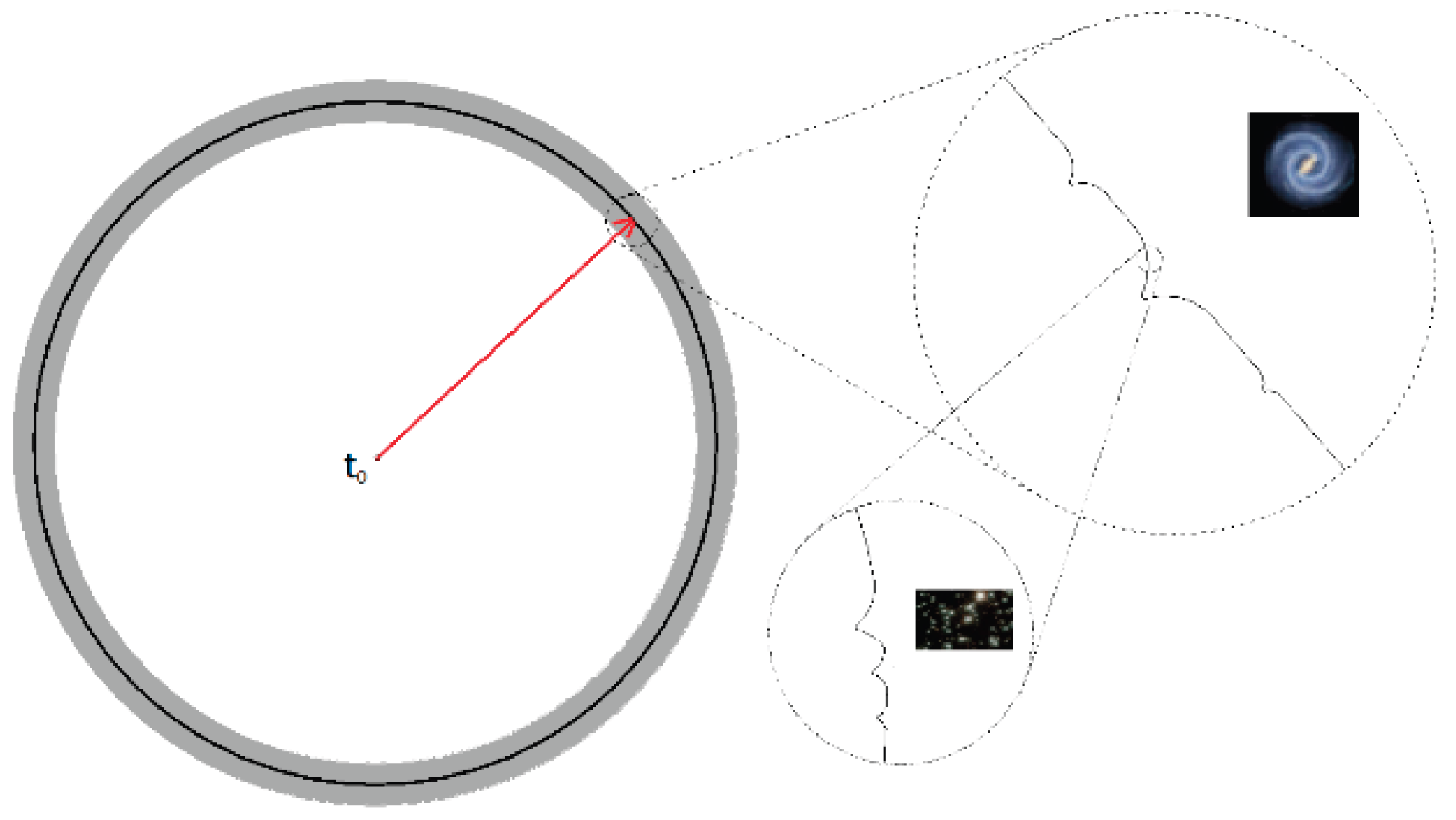
It follows that every distinct object in the universe has its own expansion trajectory within the expansion wave. As objects clump together and create a more massive single entity, by definition, they are not expanding away from each other as they coalesce. This movement toward each other will cause a time dilation (the universe expansion will be distorted), meaning that heavier objects will end up further back within the expansion wave. The more massive the object becomes because of this coalescence, the more dilated the space will be. In effect, a dimple will be created in the expansion sphere wave front, as shown in Figure 6, slowing the time in this region of space, which will mean that any object passing will accelerate toward the clump. In addition, those objects that have accelerated toward the massive object will in turn add to the combined mass of the object. Where more clumping has taken place, these areas of the expansion wave will sit closer to time zero than areas that have not clumped together. Note that this effect is subtly different from the “mass out of time” effect of radiation being slowed from expansion and creating mass. Gravity is an accumulation effect whereby two or more items that have mass coalesce and consequently are forced to follow the same trajectory, which has an overall effect of slowing down the expansion in that area, creating a time dilation, and consequently creating an attractive force for any object with mass in the vicinity.
The above leads us to the profound conclusion that the expansion of the universe causes the phenomenon we call time. The theory of general relativity linked time and space. This understanding perhaps takes a further step saying that the time dimension is no different to any space dimension – it is a spatial dimension, but one on which we travel in time and can therefore only appreciate a small sliver of it. But, without expansion, we would not perceive time. This is why time is not actually a constant in the universe – it is different for everyone. The expansion sphere is a time expansion wave.
Returning to general relativity – Einstein’s theory suggested that the observed gravitational effect comes about due to a warping of spacetime. The warping of spacetime creates a curvature in spacetime which then means any object close to the warping will be attracted or rather accelerated towards its centre. Time expansion theory, if we are to give this theory a name, suggests that the warping is in the time expansion wave front on which we ride and is simply caused by a retardation of the expansion due to mass build up in that region of the wave front. It is therefore easy to understand why the effects of gravity are indistinguishable from acceleration. It is the rate of expansion causing the distortion, so any object nearing the distortion will consequently experience a time dilation which will have the result that it will in effect accelerate towards it.
Black Holes
In general relativity, singularities, where spacetime curvature and density become infinitely large, exist at the heart of every black hole. Time expansion theory by contrast sees a black hole as a deep dimple on the expansion wave front where matter has conglomerated to such a density that it appears to occupy a volume of spacetime that is out of sight. In physical terms, we know this to be where the matter is compacted into a region smaller than the object’s Schwarzschild radius. In other words, the dimple is so deep that light travelling across the expansion wave front will disappear into the dimple and stay there – effectively entering a “time” zone that we would no longer have access to. But time expansion theory does not predict a singularity – it is just a dimple that we can’t see the bottom of. Information that has entered the black hole still exists, but it has travelled to a part of the time/expansion dimension that we cannot reach. If no matter ever enters the black hole again, then as the universe expands and the expansion wave front stretches, the dimple will diminish in density as it is stretched out and the matter and information that disappeared within it would be able to radiate out again once it is stretched beyond its Schwarzschild radius. The idea of a blackhole radiating is not new although it has never been experimentally observed. It is an idea that came about to address a principle in quantum mechanics that information must be conserved. Steven Hawkings came up with an idea that virtual particles created at the event horizon could radiate if one half of the split pair fell into the black hole and the other escaped [8]. The resolution to the information paradox, as provided by Hawking radiation, addresses the concerns about information loss associated with particles created near the event horizon. However, it does not extend a solution to the fate of particles that have already crossed the event horizon. Time expansion theory however allows for a mechanism by which the information is conserved.
Dark Matter and Dark Energy
Dark matter and dark energy are believed to exist in the universe to balance the observed expansion and gravity effects. Both are elusive and are labelled dark because they have never been observed directly. Yet, for example, spiral arms of galaxies have been observed spinning with greater velocity than they should at large distances from the galaxy centre if visible matter alone were present in the universe [9]. Dark matter has been proposed as the answer to balance this observation. Dark energy is an unknown force but is believed to drive the accelerated expansion of the universe.
In our theory we believe that these “dark” phenomena are evidence that on our wave of time expansion, matter is present behind and ahead of us. So, although we can perceive only a sliver of the wave of expansion, we merely sit at a point on the crest of the wave. The light grey bands of Figure 6 immediately before and after the point where we are respectively in time illustrate this. It is easy to believe that there may be matter behind us in the expansion wave that we cannot see or interact with unless we were a super massive object which has dipped the wavefront backwards to overlap with this matter; the larger the object, the more it will dip back in time on the expansion wave front and interact with matter behind us on the time expansion wave. This would explain the observations that particularly massive objects like galaxies are even more massive than they should be, but it would also answer why we are struggling to identify or observe dark matter. Dark energy by contrast might be the matter that lies ahead of us or is the vacuum beyond that is somehow dragging us into it.
Another possibility beyond dark energy exists to account for the increase in speed if we are thinking of the expansion like as a wave – it might simply be that something outside of the universe is limiting the growth of the universe and we are seeing a rebound effect much like you would get in a blast wave. By taking a model free approach then we are not limiting ourselves to the possibilities of what might be causing the apparent increase in acceleration in recent times.
Age of the Universe
Carrying out a simple calculation of from our model results in an age of the universe of 13.8 billion years. We used this as an input to our fit, so it consequently is consistent with other predictions. But note also that in our model varies over “time” – so the actual age of the universe must be < 13.7 billion years if we measured using today’s concept of a second. The actual age may be substantially smaller depending on the duration of the primary expansion. If the inflationary period were almost instantaneous to the extent that only the second term of our exponential decay dominated for most of time, then the actual age of the universe might be 10.6 billion years. But of course, if the universe’s perception of a second changes according to the speed we are expanding – then the 13.7 billion years would be the time expansion corrected value we observe.
Hubble tension
Although this new theory does not directly solve the Hubble tension that cosmic microwave background (CMB) data suggests an expansion rate of 67.66±0.42 km/s/Mpc [6] which is lower than the measurement found by distance ladder techniques, it does open new possibilities. For example, an early universe would probably have had more chaotic mixing of the matter in front of the wave and this in effect may have caused an early “dark energy” like effect.
To this point we have concentrated on the macroscopic universe to justify our theory. However, for it to be valid it must also be able to justify phenomena at all scales.
Linking to the Quantum World
So, we believe from our rethinking of the expansion of the universe that time is basically the distance our part of the universe expands divided by the speed of expansion and that we are gravitationally locked into our current time window with the other matter that immediately surrounds us. Nearby objects may experience very similar and overlapping timelines. It is plausible that the universe has a window of finite size within which objects can view and experience the time dimension. If it did, then this finite size would effectively allow for a certain degree of freedom regarding interactions between particles. For macroscopic objects much larger than this time slot, any variation in the position of the object within the window would be unnoticeable. However, if an object is smaller than the time slot or of similar size, then this degree of freedom becomes important. If such a window were to exist, a photon passing along the surface of the expansion sphere would effectively be able to resonate or rotate within the time expansion dimension. In other words, photons or subatomic particles would be able to travel back and forward ever so slightly in time from our point of view – from the particle/photon’s perspective the time dimension is just a spatial dimension; the consequence of this is that from our point of view a photon would be able to be in multiple places at any one instance of time and exhibit wave-like, probabilistic behaviour.
If there were a quantum of time then it is likely related to the Planck constant, h, which denotes a quantum of action. As time in our model is distance of expansion divided by the speed of expansion, then the related action is the mass of the particle multiplied by the velocity and the distance travelled. If time has a quantum of action h, then:
Where n is the quantum number. If we take for instance an electron as the mass, then the resultant value of d would be 1.06 10-10m using our calculated value for the speed of expansion, .
This result is around twice the Bohr radius, i.e. the Bohr diameter. So, from the above – the most favourable orbit of the electron would be the same one it adopts when it rotates freely around the proton in the hydrogen atom. Higher states would take up additional quanta of time etc fulfilling the higher states. So for the first time, we have a good fit from a measurement arrived at from the expansion of the universe and applied to the quantum realm. Although the Bohr model is an approximation, it does work well for simple case of Hydrogen and what the equation above is actually giving us is a link between the velocity of time and the fine structure constant, which governs the strength of the electromagnetic interaction in quantum mechanics.
The term comes about because of a flattening of time dimension. The above is a quantifiable verification that there is a link between the expansion effect and the quantum world. The hypotheses that follow are here to explain the far-reaching impacts of the above.
Wave‒Particle Duality
The classical Young’s double-slit [10] experiment carried out originally with sunlight proved that light behaves as a wave upon passing through a double slit, and an interference pattern emerges from the light coming out of the two slits. However, within his theory on the photoelectric effect, Einstein proved that a photon must have a physical or particle-like presence [11]. In the original Young’s double-slit experiment, one would therefore believe that this interference pattern occurs because photons interfere with other photons. To investigate this phenomenon, more recently, a double-slit experiment was carried out in which a single photon passed through the slits at a time [12]. However, the interference pattern is still observed. To date, despite being a well-established and experimentally verified aspect of quantum mechanics, the philosophical and interpretational aspects of this duality, continue to be the subject of debate and discussion in the physics community. By contrast, time expansion theory holds a reasonably logical and intuitive explanation.
If the photon is indeed a particle or at least a packet of energy, it is largely hidden in the temporal dimension and phases in and out of intensity as its presence or overlap with the observer’s time window comes into focus. In our theory, the photon is rotating in time which has the effect that it is present over a range of times, blurring its existence at any one point and allowing it to interfere with itself as in the single photon slit experiment. Therefore, prior to interaction, the photon is mostly hidden in the temporal dimension. Only when a photon encounters something wholly in 3D space, as revealed by the photoelectric effect, is the photon oscillation in time halted with the energy of the oscillation being absorbed by the object it interacts with.
The double-slit experiment was further enhanced so that it could be determined which slit the photon went through. When this occurs, the interference pattern disappears. When initially faced with this phenomenon it would appear as though the photon, upon being observed, promptly acknowledges its observation, aligns itself, and exhibits characteristics more reminiscent of a particle. Again, this effect has no current explanation beyond being dubbed a quantum effect. However, time expansion wave theory allows for this outcome in a far more tangible way. Basically, the “observation” point locks the photon into the current time zone and drags its energy completely into 3D space in much the same way as with the photoelectric effect.
An interesting experiment has been carried out recently allowing for the double-slit experiment to be carried out in time rather than space by using a film of iridium tin oxide to open and close the time slot. The results of this experiment showed that the beam seems to interfere across time with the beam from earlier and later times [13]. Again, this thus far has no explanation and seems counterintuitive until now. In contrast, if we think of an oscillating time expansion effect, this result provides strong evidence and support that our theory is correct, as if the light is rotating backwards and forwards in time – time is no different to space - then it will of course be able to interfere across time.
Through time expansion theory we can therefore provide an explanation of how light can interfere with itself even across time as it is indeed resonating in the time dimension, but we can also explain how it can be revealed as a particle upon interaction with an object that is already fully present in standard 3-dimensional space. While quantization of light is used as the explanation of the effect, time wave expansion theory explains how this quantization comes about and why it happens.
Electron Spin
The above effect will continue for subatomic particles that have mass in the 3D world. Support for this idea is that subatomic particles exhibit wave-like behaviour with electrons exhibiting interference patterns when passed through a slit [14]. As has already been determined above, because of its size, the electron is also able to oscillate within the time spatial dimension and consequently has wave-like properties like those of a photon. The wave‒particle duality observed basically occurs where particles slip in and out of the 4th temporal dimension. A photon is an extreme example restrained to the temporal dimension and 2 other spatial dimensions, but subatomic particles will also resonate within the narrow time gap because of their size relative to the window.
What follows is a discussion of how some of the vast complexity of quantum mechanics might spring out of this seemingly simple concept. It is not meant to be all inclusive but only touch on major areas to show that the basics of the theory not only hold true but provide explanations that make intuitive sense. The compartmentalisation of time into a finite window means that “particles” can be categorized as spinning one way or another relative to another dimension or the direction of expansion or confined to certain sized states due to the size of the window and this may then lead to these particles interacting in very specific ways and exhibiting properties specific to that quantization. This theory provides the container for quantum mechanics and gives it the link to the universe beyond being a mathematical representation.
The spin associated with electrons is believed to be a quantum property. This leads to many important quantum effects, such as Pauli’s exclusion principle—no two electrons occupy the exact same state, which arguably leads to all the chemistry we see around us. However, for the electron, it is at least believed that quantum spin is different from actual spin. It has all the hall marks of spin, appears to possess angular momentum and yet is not spin, as there is nothing that can spin. An electron, a charged particle, has a magnetic field that it would indeed have if it were allowed to spin. Previously, this has been described as a basic quantum mechanical property of all fundamental particles – an intrinsic form of angular momentum. However, our theory allows for actual spin—a spin within the time dimension—to exist. This simple concept has far-reaching consequences. Having a fourth spatial dimension available means that there is an extra degree of freedom. Therefore, an electron (or other particle) that rotates in time will also move in 3 other dimensions. It may rotate clockwise or anti-clockwise relative to the expansion direction. If we narrow it to spin in time and one other space dimension, we can either spin forward and backwards in time or spin perpendicular to the direction of expansion. This artefact of spin — that at any one specific point in time, the electron must be travelling one way or another and that this spin direction might cause a slightly different real-world effect means it can potentially be defined by a quantum number. The Stern–Gerlach experiment showed that the electron only possesses two possible spin states [15]. If we allow for a spin in the time dimension, then this spin can be categorised as going clockwise or anti-clockwise to the direction of travel (expansion in time). It’s therefore possible that the spin, as displayed in the Stern–Gerlach experiment, is the result of this perpendicular spin as the states reveal no difference in energy.
Spin forwards and backwards would result in a particle’s ability to travel in time and move energy in and out of the time dimension. Also as this seems to be linked to the fine structure constant this effect is more likely to connect to the charge effect we see in electrons.
First Light and the Creation of Charged Matter
As described above the evidence suggests that at the point of the big bang, everything was travelling at the speed of light and therefore must have existed only as radiation, i.e., photons – so nothing else existed. Therefore, the photon must be the building block of all the other particles or be able to energise something to create all other particles. The photon itself is only ever present in our world in 2D – choosing to hide its third side in the time dimension. However, by slowing down and moving into the 3 physical space dimensions, it forms every other particle type with all their properties—or it at least creates the “fundamental” particles that go on to create the others.
It seems that the speed of light is limited by the fact that as soon as the speed is achieved, the particle collapses entirely into only 2 dimensions and time. We see light travelling toward us; then, at right angles, we will see the electric field and magnetic field. These two “fields” are the remnants left over to the 3D world revealing the presence of something that is “hiding” in the time dimension. The electron also possesses these fields, but as it has mass, it is present in all 4 dimensions at the same time, with only some of its mass blurring into the time dimension.
It has been shown at least indirectly that an electron (and positron as a pair) can be created by crashing together two high-energy photons [16]. This process, or similar processes, must have therefore occurred in the early universe. We know that an electron and a positron have a characteristic called charge that the photon does not have. We believe that when they create, they create pairs of opposites so that the charge effectively cancels. What this must mean is that at the point of creation, the split causes an asymmetry of the resultant particles.
What could cause this asymmetry? If we consider this in terms of time expansion theory, one possibility might be that at the point of collision, the photon is either on the forwards part of its spin or on the backwards part of its spin. This phenomenon might then cause asymmetry in the particles that are produced. As we believe that electrons and positrons are always created in pairs, then the intimate part of the collision may cause the two particles to leave the interaction zone in an opposing time direction. However, if this assumption is correct, then once separated, this property is frozen within the newly created particles.
Therefore, if the charge is simply concerning whether a particle spins in a way that means, on average, it is dipping back in time from its mass baseline or is spinning forwards, a neutral particle would be one that has stabilised such that the forward and back motion is cancelled.
If the above is true and we assume that the electron reaches back in time and the positron forward, then this might explain why the universe in which we exist seems to be electron biased. By reaching back in time, toward the heavier mass bass line, the electron will be forever tied or drawn toward the mass in the expansion wave that we inhabit. In contrast, the positron will be attracted toward a part of the expansion wave just out of reach. We now live in a different place than the early universe. When the first electrons were created, there would have been no mass to be attracted towards and most positrons would escape only momentarily from their electrons to end up combining with a different electron. However, if the positrons from a zone that is historically and therefore gravitationally behind the current time zone come together, then on the subatomic level, a new electron may encounter the “positron” from a heavier gravitational zone and consequently see a heavier particle. This process is not likely to be happening in today’s universe, but we could conceive of such a mixing in the chaotic early universe.
If this conjecture is true, a negative charge can therefore be described as a particle that is able to rotate backwards in time from its centre of mass, and a positive charge is one that can reach forward. As the two types of particles obtain this ability via spin in the time dimension moving backwards and forward, they overlap and “see” the other particle before they come into physical contact. If the resultant combination is energy efficient, i.e., results in a loss of mass and more expansion, then the overlap would be favourable, and there would be an effective gradient of attraction. If the opposite is true, then they repel each other. Therefore, the spin in the dimension of time gives particles the ability to look ahead and see what they might become if they combine as they approach. It would therefore explain how attraction or repulsion can happen across empty space forming a field effect in normal 3D space. A positive particle spinning up and negative particle spinning down would result in a neutral particle that spins equally in both directions or may not spin at all. The result of such a combination would likely be beneficial overall from a symmetry point of view—the positive ion would perhaps be drawn away slightly from the time baseline, and the negative electron would be drawn down but overall—because of the mobility of the electron and its relative mass, the overall effect results in a lighter overall product. Basically, the universe appears to be forever trying to repair the expansion and return to a higher expansion rate—i.e., a lighter, more expanding state is favourable, which is consistent with simple entropy. Effectively, the universe would prefer to be much more spread out than clumped together. A hydrogen atom is lighter than the sum of a proton and electron combined because some of the mass is due to the energy of the electrostatic attraction of the two particles, and upon interaction, this energy is allowed to return to the time dimension.
The blurring of time that allows the electron to look forward and backwards basically explains why it and other subatomic particles can be described only by probability wave functions and not by classical mechanics. The force of attraction or repulsion must therefore be closely linked to the energy of the oscillation in time produced by this resonant effect.
Quantum Entanglement
In quantum mechanical terms, if two particles exist in a single wave function, they are said to be quantum entangled. Basically, if you know the quantum property of one entangled partner, you should be able to infer the property of the other. There were two schools of thought, at least theoretically, on how the properties are revealed by the two entangled partners. One idea was that the partners decide at the point of splitting which property they have—this is the classical view called hidden variables put forward initially by Einstein. The other idea, as defined by quantum mechanics, is much harder to understand because the properties are decided only at the point where they were measured. Faster than light travel would need to occur to pass the message from one entangled entity to the other such that it should behave in a certain way. Bell [17] derived what is now known as Bell's inequality, establishing a theoretical framework for testing the predictions of quantum mechanics in comparison to classical theories, particularly in the context of quantum entanglement. Bell's work laid the foundation for the initial experimental tests of quantum entanglement, conducted by Aspect [18] on photons. These experiments ultimately confirmed the results predicted by quantum mechanics.
This result seems counterintuitive unless, of course, you consider that the wave form of the entangled partners resonates in the time spatial dimension. This basically gives it the opportunity to time travel and pass information in a way that seems to move faster than light. However, the complete quantum theory posits that entangled partners could be located on opposite sides of the universe and still convey information at the moment of measurement. Yet in our theory, if the waveform has only a slight oscillation in time, the opportunity for communication will be extended but not indefinitely. Therefore, what we end up with in our oscillating time expansion wave theory effectively is a delay or blurring in the separation of entangled partners which leads to the opportunity for information to be passed after the perceived point of splitting.
Although later experiments increased the distance between source and decision points [19] they were only attempting to overcome the locality loophole thus ensuring only that they beat the speed of light. Thus, if the entangled partners are resonating in time as we believe, i.e. can look ahead, then this does not preclude the decision point being made at the point of separation but its realisation being blurred by this time travelling property. If the entangled partners were separated by a significant amount of time beyond the blurring window, then the decision would indeed be locked if our theory is correct. Therefore, it is our belief that the answer might lie somewhere between the two extremes of quantum mechanics and hidden variables. Hopefully, this can be confirmed experimentally in the future.
In a sense our theory is giving a reason for the quantum effect observed but also stating that there must be a limit as a particle’s ability to look ahead cannot be infinite.
4. Final Conclusions
The indications are that we exist in a 4-dimensional universe where each dimension is identical. At any moment though 3 of these dimensions appear as normal space and the 4th appears as time – a space dimension on which we travel. If we ourselves move in any direction, then we may change our direction in time too, but the axis of our dimension will change with us so from our point of view we would not notice the change. As we can only appreciate a small part of the 4th spatial dimension and this small part has a finite width then this creates quantum effects at the subatomic scale.
We have provided proof beyond our qualitative arguments, not only agreeing with current expansion rates and the age of universe but we also include intriguing numerical observations linking to the quantum realm with the fine structure constant. We have shown that time expansion wave theory provides the framework to explain some aspects of quantum mechanics. Once the concept of time expansion with a finite window size of appreciation is grasped, then wave particle duality, probabilistic wave functions and quantum entanglement are subsequently explainable. As a container for the quantum world then it is also easy to see why certain resonances and features arise due to the finite time window over which the expansion wave is viewed. We have not attempted to explain the whole of quantum physics here and clearly, we have entered into the realms of conjecture in some areas – but such conjecture is necessary at this stage as it gives the possibility of tangible explanations of observed seemingly impossible yet proven phenomena that exist in the universe that previously had no real explanation. Richard Feynman famously said, “If you think you understand quantum mechanics, you don’t understand quantum mechanics”. And the reason for this is because it is counter intuitive. Many effects in the subatomic world are simply explained as “quantum effects” – for example electron spin - and left at that with no further enlightenment. As detailed above, time expansion wave theory creates the container which can explain why quantum effects occur and by doing so this gives strong evidence for the theory’s validity. The time based double slit experiment, which previously created a puzzle, gives strong support for a theory that can oscillate in time. Further proof may lie in future quantum entanglement experiments with a larger separation of decision and source points.
References
- Jarvis, G. J Mod Appl Phys. 2022, 6(4), 1–17.
- Riess, AG; et al. 1998 Astron. J. 1998, 116, 1009–1038. [Google Scholar] [CrossRef]
- Betoule, M; et al. 2014 Astron Astrophys 568(A22), 22–53. [CrossRef]
- Rubin, D; et al. 2014 The Astrophysical Journal 763(35). [CrossRef]
- Pulmetter, S; et al. 1999. [CrossRef] [PubMed]
- Planck Collaboration. 2016 Planck 2015 results XIII. Cosmological parameters. A&A 2016, 594, A13. [Google Scholar] [CrossRef]
- Riess, AG; Casertano, S; Yuan, W; Macri, LM; Scolnic, D. 2019, 876(1), 85. [CrossRef]
- Hawking, S. Nature 1974, Vol. 248(No. 5443), 30–31. [CrossRef]
- Corbelli, E; Salucci, P. Monthly Notices of the Royal Astronomical Society 2000, Volume 311(Issue 2), 441–447. [CrossRef]
- Young, T. Proc. R. Soc. Lond 163–67. [CrossRef]
- Einstein, A. Ann. Phys. 17(132), 1905.
- Parker, S. A Single-Photon Double-Slit Interference Experiment. Am. J. Phys. 1971, 39, 420–424. [Google Scholar] [CrossRef]
- Tirole, R; Vezzoli, S; Galiffi, E; Robertson, I; Maruice, D; Tilmann, B; Maler, SA; Pendry, JB; Sapienza, R. Nature Physics Volume 19, 999–1002. [CrossRef]
- Merli, P G; Missiroli, G F; Pozzi, G. Am. J. Phys. 1976, 44, 306–7. [CrossRef]
- Stern, O. Zeitschrift für Physik 1921, 7, 249–253. [CrossRef]
- et al.; J. Adam et al. (STAR Collaboration) Rev. Lett. 127, 052302. [CrossRef]
- Bell, J. S. Physics 1964, 1(3), 195–200. [CrossRef]
- Aspect, A.; Grangier, P.; Roger, G. Physical Review Letters 1982, Volume 49(Issue 2). [CrossRef]
- Hensen, B. Nature 2015, 526, 682–686. [CrossRef] [PubMed]
Figure 1.
Visualisation of expansion cross section cutting through the expansion “dimension” (as shown by the radius) and a single space dimension (as shown by the circumference). This expansion “wave” started at time t0 and has reached time t1 signified by the dark black line.
Figure 1.
Visualisation of expansion cross section cutting through the expansion “dimension” (as shown by the radius) and a single space dimension (as shown by the circumference). This expansion “wave” started at time t0 and has reached time t1 signified by the dark black line.
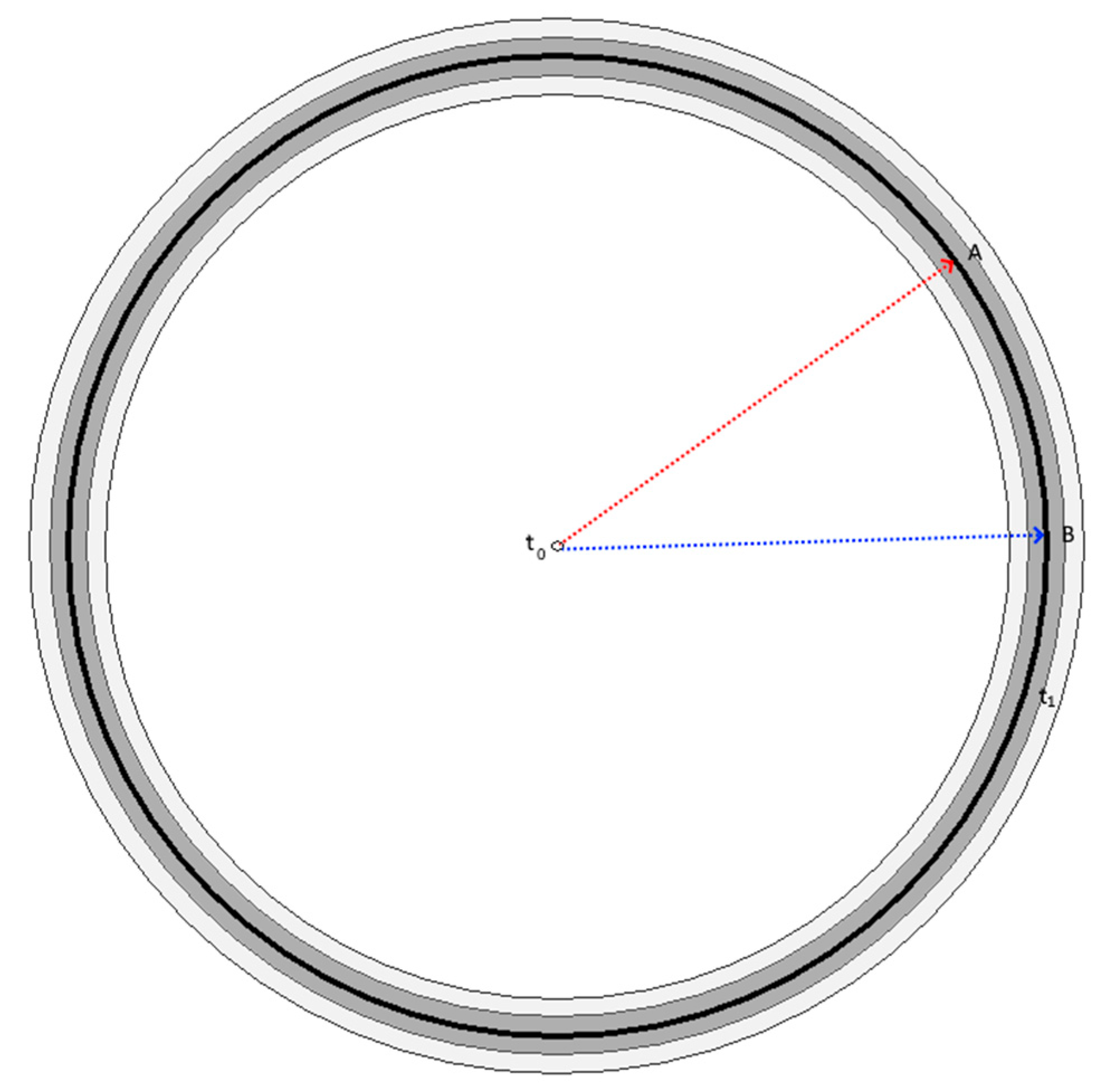
Figure 2.
Best fit modelled expansion wave allowing a fixed speed of expansion (orange dotted line) and a varying speed of expansion (red solid line) versus observational data taken by Reiss et al. (1998) Betoule et al (2014) and Rubin et al (2013) (points).
Figure 2.
Best fit modelled expansion wave allowing a fixed speed of expansion (orange dotted line) and a varying speed of expansion (red solid line) versus observational data taken by Reiss et al. (1998) Betoule et al (2014) and Rubin et al (2013) (points).
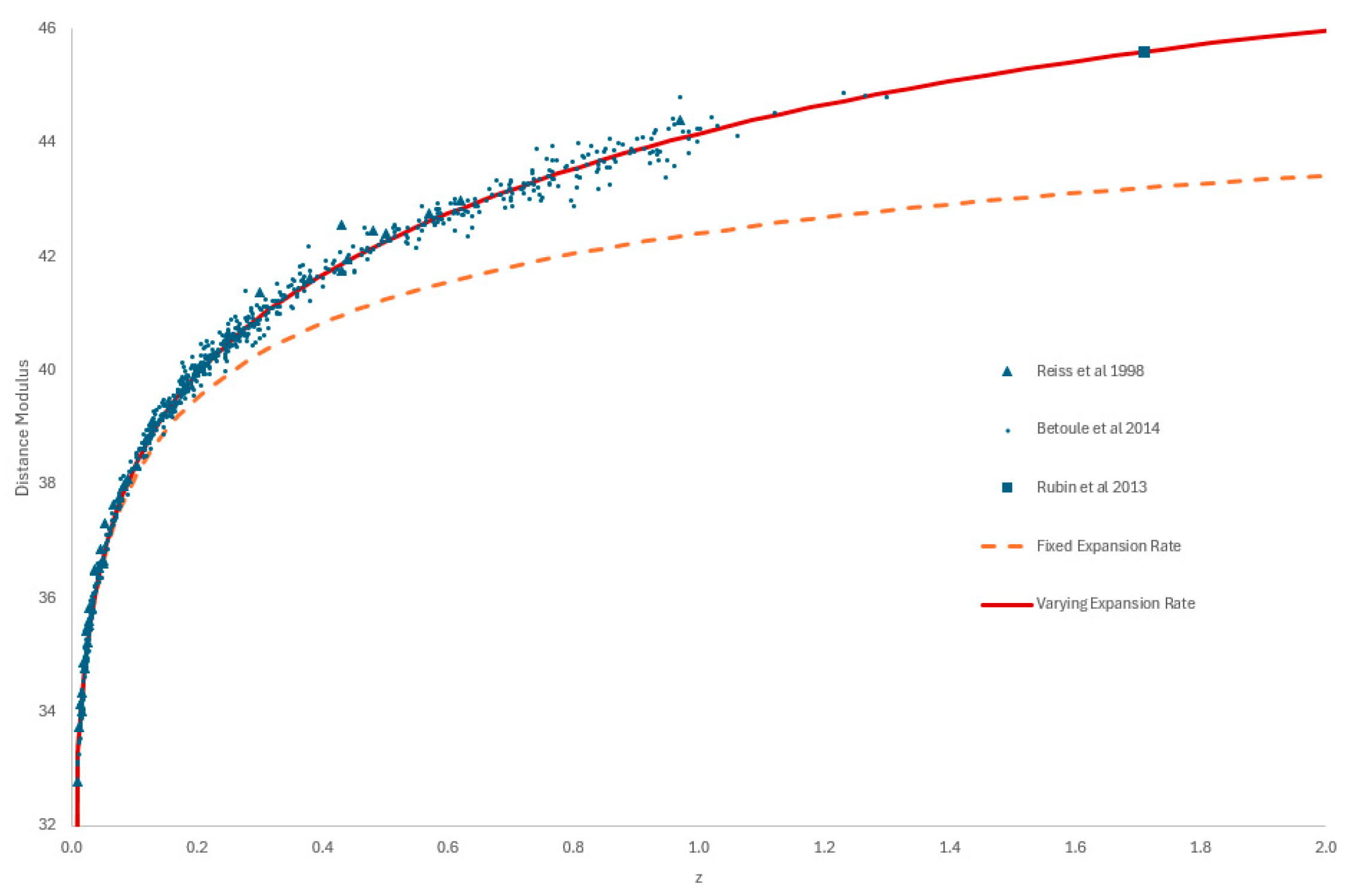
Figure 3.
Velocity decay curve versus the radius of the expansions sphere for best fit of the data seen in Figure 3. Mathematically this pattern can be achieved in different ways – we chose to use an exponential decay function as described in the text. As can be seen in the zoomed in section that the fine detail of the local data suggests an increase in the speed of expansion.
Figure 3.
Velocity decay curve versus the radius of the expansions sphere for best fit of the data seen in Figure 3. Mathematically this pattern can be achieved in different ways – we chose to use an exponential decay function as described in the text. As can be seen in the zoomed in section that the fine detail of the local data suggests an increase in the speed of expansion.
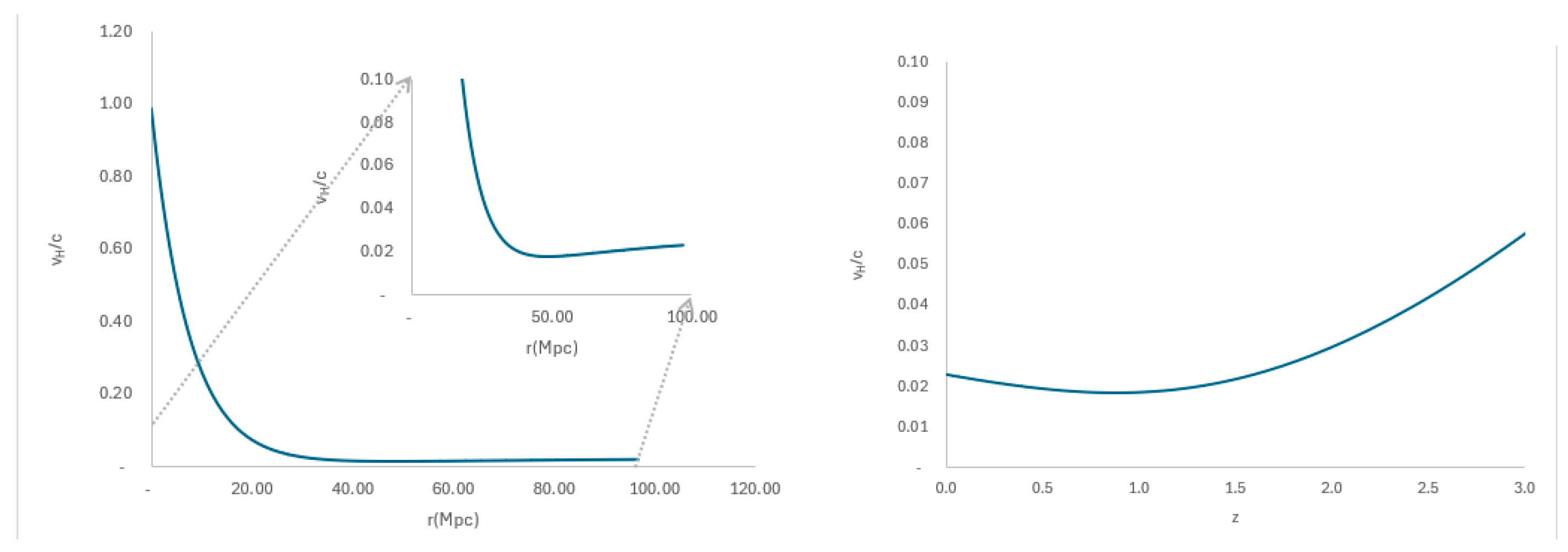
Figure 6.
Visualisation of a cross section cutting through the expansion “dimension” (as shown by the radius) and a single space dimension (as shown by the circumference). This expansion wave started at time t0 and has reached time t1 signified by the dark black line. Two gravitationally distinct objects would expand away from each other in space as the time expansion wave increases. Where objects have clumped together then dimples in the wavefront would show up as you zoom in. The thin black line shows the observable slice of time with the grey areas showing the possibility of matter existing outside of our observable time window.
Figure 6.
Visualisation of a cross section cutting through the expansion “dimension” (as shown by the radius) and a single space dimension (as shown by the circumference). This expansion wave started at time t0 and has reached time t1 signified by the dark black line. Two gravitationally distinct objects would expand away from each other in space as the time expansion wave increases. Where objects have clumped together then dimples in the wavefront would show up as you zoom in. The thin black line shows the observable slice of time with the grey areas showing the possibility of matter existing outside of our observable time window.
Disclaimer/Publisher’s Note: The statements, opinions and data contained in all publications are solely those of the individual author(s) and contributor(s) and not of MDPI and/or the editor(s). MDPI and/or the editor(s) disclaim responsibility for any injury to people or property resulting from any ideas, methods, instructions or products referred to in the content. |
© 2025 by the authors. Licensee MDPI, Basel, Switzerland. This article is an open access article distributed under the terms and conditions of the Creative Commons Attribution (CC BY) license (http://creativecommons.org/licenses/by/4.0/).
Copyright: This open access article is published under a Creative Commons CC BY 4.0 license, which permit the free download, distribution, and reuse, provided that the author and preprint are cited in any reuse.