

Submitted:
25 February 2024
Posted:
26 February 2024
You are already at the latest version
Abstract
First, an introductory essay is carried out to build a historical, economic-productive and legal theoretical framework of the origin and formation of Secondary Technical Schools in Europe, North America and the Argentine Republic. Then a normative introduction to Technical Education is carried out at the Technical School No. 2 “Independencia” of Concordia, Entre Ríos, Argentine Republic. Its regulations and Laws that govern technical education. We continue analyzing the development of five (5) case studies generated in the E.E.T. No. 2 “Independence” of the city of Concordia, Province of Entre Ríos, Argentine Republic. Case study No. 1: Face masks for Covid-19, designed with CAD-STL software and printed in polylactic acid (PLA) with 3D printers, for protection from SARS-CoV-2 (Coronavirus) or Covid-19. Case study No. 2: TURBO: air extractor/blower for environments contaminated by COVID-19. Case study No. 3: ROBOT-T2: Educational Robot Made by Students and Teachers of the Technical School No. 2 (E.E.T. No. 2) “Independencia”, Concordia, Entre Ríos, Argentine Republic. Case study No. 4: Self-construction EcoBlock, for social housing. Case study No. 5: Relationships of all sciences with abductive thinking, creativity, design, art and the main relationships between Social Sciences (philosophy, logic, hermeneutic research methodology, etc.) with Exact and Natural Sciences (mathematics, physics, chemistry, biology, genetics), other sciences and disciplines such as engineering, medicine, etc. We obtain the conclusions of the development. Bibliography.
Keywords:
Eduaction
; design and innovation
; E.E.T.Nº 2 "Independencia"
; city of Concordia
; Entre Ríos
; República Argentina
Essay to build a historical, economic-productive and legal theoretical framework of the origin and formation of Secondary Technical Schools in Europe, North America and the Argentine Republic
In the book edited by Federico del Giorgio Solfa and Mario Dorochesi Fernandois under the title Education, design and innovation in Latin America. Evolution, case analysis and perspectives on professional technical education: an approach from entrepreneurship and local development (2018). A book that collects experiences, reflections and new pedagogical proposals that are being incorporated into teaching practices, at different levels of technical education in our countries. The interventions of the various authors that cover different perspectives and degrees of depth, allowed us to understand and evaluate: the trajectories that technical education has had since its origins with the advances and setbacks that it has experienced locally, as a result of political, economic and social changes. productive; the methodologies to incorporate new industrial production models; entrepreneurship education experiences; and, technical-professional education in development processes.
Especially in Chapter 2, under the title National Technical Education and Industry 4.0. Disruptive creativity for the transversal teaching of industrial product models, curricular planning on the teaching of technical drawing in national technical schools was addressed, focusing on the case of the Province of Entre Ríos, coordinated by the INET under the Provincial Education Law N ° 9890, which is coupled with the National Education Law 26,206, This situation had already opened the debate on the relationships between art and design and other curricular spaces with a pedagogical foundation, on the teaching of technical drawing and its implications with the art at the Technical School No. 2 “Independencia” of the city of Concordia, province of Entre Ríos, Argentine Republic (case study, CUE: 3001188).
A brief epistemological foundation had been carried out, which drew conclusions between the evolution of the Industrial Revolution in its four phases and its main characteristics affecting pedagogical models. What has been associated with the various industrial models. After a review of the Prussian educational system, the criticism focused on the Fordist/Taylorist educational model and its strong impact on the National Technical Schools both in the US and its impact on the rest of the world and Latin America in general. as well as the Argentine Republic in particular. After a brief analysis of the theory of industrial design, architecture and engineering; It was concluded to close the theory with the analysis of a design case of an industrial product. Other interdisciplinary spaces were articulated in a transversal way, enabling new possibilities for pedagogy and teaching.
In this first part of the study of the book we focus on the relationship between the current educational system and its origin in the Prussian educational model of the 18th and 19th centuries (remembering that Prussia was not an independent country, but an ancient state that was part of the territory which today we know as Germany). Prussia was a powerful kingdom and later a member state of the German Empire, influenced by the European bourgeois revolutions and the Industrial Revolution. The text highlighted that the current educational system was designed for a different era and is based on two pillars: the economic (result of the capitalism of the Industrial Revolution) and the intellectual (result of the Enlightenment and the French Revolution).
Indeed, Prussia was influenced by European bourgeois revolutions, including the French Revolution (1789/1799) and the first phase of the Industrial Revolution in England (which developed from the mid-18th century). These historical events had a significant impact on the development of the Prussian educational system.
During the 18th century, the Enlightenment and the ideas of the French Revolution spread throughout Europe, including Prussia. The French Revolution promoted principles such as democracy, freedom and equality, which resonated in Prussian society and stimulated reforms in different areas, including education.
The heritage of the French Revolution and the Industrial Revolution were mixed with education, where the ideals of democracy, freedom (education for all) and reason are combined with technological progress. Where the educational system resembles the industrial chain production model (specifically with strong analogy in the second stage of the Industrial Revolution in the US, approximately between the mid-19th century and the beginning of the 20th century in the North American model: Fordist ), with emphasis on discipline and obedience. Education is compared to the manufacturing of a product, where each step is performed in a specific order.
Before the French Revolution, the educational system in France was highly stratified and marked by social inequality. Education was mainly reserved for the nobility and wealthy bourgeoisie, while the lower classes had limited or no access to formal education.
During the Ancien Regime, the educational system was dominated by religious institutions, such as schools and seminaries run by religious orders, mainly the Catholic Church. These educational institutions had a more theological focus and focused on the training of future clergy and religious leaders.
However, education for the popular classes was scarce and was mostly carried out through informal education transmitted at home or in trade learning workshops.
The French Revolution (which took place between 1789 and 1799) brought significant changes to the educational system in France. Although the implementation of these reforms took time and occurred over several years, here is a summary of the most important changes in terms of education: in 1792 religious teaching was abolished and a more secular approach to education was established, In 1793, free and compulsory primary schools were created, known as “schools of the nation.” These schools sought to provide basic education to all citizens, regardless of their social or economic origin.
In summary, changes in the French educational system occurred in a period spanning from the late 18th century to the early 19th century, with the gradual abolition of religious education, the creation of free and compulsory primary schools, and the implementation of a broader and hierarchical educational structure.
Free public education: The French Revolution advocated the creation of a free, public educational system for all citizens, regardless of their social or economic origin. Free primary schools were established throughout the country, allowing greater access to education for the popular classes.
Secularism: The French Revolution promoted secularism in education, separating teaching from the influence of the church. The privileges of the Catholic Church in education were ended and a more secular approach was established in schools.
Creation of high schools: High schools were created, secondary education institutions that offered a more advanced and extensive education compared to primary schools. These institutions were open to students from different social backgrounds and focused on the comprehensive training of students.
Curriculum uniformity: A unified curriculum was implemented for schools, with the objective of ensuring a standard and uniform education throughout the country. Study programs were established and standards were set for the different educational stages.
Professionalization of teachers: Standards and requirements for teacher training were established, with the aim of improving the quality of education. Normal schools were created to train teachers, leading to greater professionalization of the teaching profession.
Emphasis on civic and republican values: Education during the French Revolution placed a strong emphasis on civic and republican values. The aim was to form active citizens committed to the nation and the republic.
The relationship between the French Revolution and education in Prussia is indirect but significant. Although there was no direct relationship between the two events, it can be argued that the French Revolution had an impact on the development of education in Prussia.
The French Revolution, which took place between 1789 and 1799, established new ideas and political principles that influenced all of Europe, including Prussia. The French Revolution championed equality, freedom, and secularization, which inspired political movements and changes in other parts of the continent.
In Prussia, the most significant educational changes occurred in the early 19th century under the reign of King Frederick II (also known as Frederick the Great) and his successor Frederick William III. These changes occurred after the French Revolution and can be seen in part as a response to new ideas and political currents that emerged in France.
Frederick the Great had already implemented some educational reforms in Prussia before the French Revolution, such as the introduction of compulsory education and the creation of a network of primary schools. However, it was during the reign of Frederick William III (1797-1840) that more significant changes occurred in the Prussian educational system.
In 1809, Frederick William III issued a decree called the Generallandschulreglement2, which established a uniform and centralized educational structure in Prussia. This decree reorganized schools and curricula, establishing a system of primary, secondary and university education.
It is important to note that educational reforms in Prussia were not directly influenced by the French Revolution in terms of a direct causal relationship. However, it can be argued that the intellectual and political environment created by the French Revolution, with its emphasis on equality and freedom, may have influenced the willingness of Prussian leaders to implement changes to the educational system.
Furthermore, the Industrial Revolution in England, with its emphasis on technological progress and economic transformation, also influenced Prussia and other European countries. The Prussian educational model was adapted to meet the needs of the emerging industrial age, focusing on training a skilled workforce and preparing students for the world of work.
The Industrial Revolution, which took place mainly in England, brought with it technological advances and transformations in industry and the economy. The demand for specialized and technically trained labor increased considerably. To meet this demand, technical schools emerged that offered educational programs oriented toward the industrial and technical skills required by the time.
The First Industrial Revolution (late 18th century - early 19th century) was a period of significant changes in production, technology and society. Here are some main features:
Steam engine: The invention and perfection of the steam engine by James Watt was one of the main technological advances of the time. The steam engine enabled the mechanization of production and transportation, replacing human and animal labor in many industries.
Textiles and manufacturing: The textile industry was one of the most important sectors during the First Industrial Revolution. New machines and processes, such as the power loom and spinning machine, were introduced, increasing productivity and reducing production costs.
Agricultural change: A transformation occurred in agriculture with the use of new techniques and technologies. The agricultural revolution included improvements in agricultural machinery, crop rotation, and the application of more efficient farming methods.
Urbanization and migration: The process of industrialization attracted many people from the countryside to the cities in search of employment in factories and emerging industries. This caused rapid urbanization and changes in social structure.
Economic growth: The First Industrial Revolution laid the foundation for accelerated economic growth. Mass production and mechanization allowed for greater efficiency and a greater supply of goods and services, boosting trade and the overall economy.
Social changes: The First Industrial Revolution brought with it important social changes. A new industrial working class emerged and union movements formed in response to working conditions and economic inequality. Changes were also observed in family structures and in the role of women in society.
Overall, the First Industrial Revolution was a key transition period toward an economy driven by machinery, mass production, and urbanization. These changes laid the foundation for subsequent industrial revolutions and had a lasting impact on the way we live and work today.
It is important to clarify that although the Prussian educational model was mainly implemented in Prussian primary schools, it was in Prussia where free and compulsory primary education was first introduced, becoming one of the first countries to do so. However, as it spread throughout Europe, the Prussian educational model also influenced the development of secondary educational systems in other countries.
In the European context, the Prussian educational model had a significant impact on the design and structure of primary and secondary schools (technical and non-technical education). The idea of free, compulsory education for all children spread through educational reforms in various European countries, adopting elements of the Prussian model. Therefore, although its origin is in the primary schools of Prussia, its influences extended to other educational levels, including secondary schools in Europe.
Since the Prussian educational model had a significant influence on the creation of secondary level technical education schools. During the 19th century, Prussia became a benchmark in education and its system spread to other European countries and beyond.
The Prussian educational model promoted a comprehensive education that combined academic aspects with technical and practical training. The development of applied skills and knowledge was prioritized, especially in areas related to industry and technology.
Thus the Prussian educational model of technical secondary schools developed in a context in which the first phase of the Industrial Revolution in England was transforming the economy and society. These schools emerged as a response to the need to train skilled workers for the rapidly expanding industry, providing a combination of academic knowledge and practical skills related to the technological advances of the time.
These technical schools, also known as technical high schools or industrial schools, offered educational programs that prepared students to perform in specific industrial sectors. They provided more specialized and practical training compared to traditional high schools, which focused primarily on general academic subjects.
In the Prussian education system, non-technical secondary schools, which focused on general academic subjects without having a specific focus on technical skills, were commonly known as "Realgymnasien" (translated as "Gymnasiums"). These gymnasiums offered a more humanistic education and focused on disciplines such as literature, philosophy, history, classical languages (such as Latin and Greek), mathematics, and natural sciences.
However, the name "Realgymnasien" is not commonly used today and there may be some confusion about it. The "Realgymnasien" were secondary schools that offered a broader general education oriented towards preparation for higher education. These schools were intended for academically talented students and offered a more rigorous curriculum focused on academic subjects. Students who attended a "Gymnasium" (as they are currently called) generally continued their education at a university or institution of higher learning.
In the past, the "Realgymnasien" was a type of secondary school in Germany with a humanistic orientation. Currently, the term "Gymnasien" is used to refer to general education (humanistic) and academically oriented secondary schools in Germany.
The German education system has undergone changes and reforms over time, and school names have also evolved. Today, the term "Gymnasien" is used for secondary schools that offer a higher level of general and academic education, preparing students for higher and university education. These schools focus on academic subjects and have more rigorous entrance requirements.
Such academic-type secondary schools are known as "Gymnasien" (translated as "Gymnasiums"). These schools offer an education more oriented toward academic disciplines and often prepare students to access higher education, such as university. The "Gymnasien" focus on subjects such as mathematics, natural sciences, languages, literature, history, philosophy and other academic disciplines. The "Gymnasien" are characterized by having a broad and rigorous curriculum that seeks to provide students with a solid foundation in academic knowledge and critical thinking skills. In addition, they usually offer specialization options in areas such as sciences, humanities or foreign languages.
It is not correct to state that technical schools in Germany are called "Realschulen" and "Hauptschulen". I want to clarify that "Realschulen" and "Hauptschulen" are types of secondary schools in Germany, but they are not specifically oriented towards technical training.
The "Realschulen" offer an education more oriented towards practical skills and the world of work. The "Realschulen" curriculum focuses on a combination of academic and practical subjects, such as mathematics, natural sciences, foreign languages and vocational subjects. After completing education at a "Realschule", students can choose to enter directly into the world of work or continue their education at a Berufsschule (vocational school). These schools focus on preparing students for technical and industrial careers, providing them with skills and knowledge applicable in the world of work.
The Berufsschule is a vocational school that offers specific vocational training in different fields. Students acquire practical skills and specialized knowledge related to a specific field of work, such as electricity, mechanics, hospitality, among others. The Berufsschule complements the practical training that takes place in an apprenticeship program or in a specific job.
On the other hand, Hauptschulen are secondary schools that provide a basic and practical education. These schools focus on essential skills and prepare students to enter the workforce after secondary education. The Hauptschulen curriculum focuses on practical subjects, such as basic mathematics, foreign languages and vocational education. These schools are designed so that students enter directly into the world of work and do not continue studying.
Generally speaking, the Realschule is considered more challenging and academically demanding than the Hauptschule. The Realschule focuses on providing a broader and more advanced education compared to the Hauptschule, which offers a more basic and practical education.
In Prussia and Germany, technical schools are known as "Technische Schulen" or "Technische Gymnasien". These schools focus on education and training in technical and scientific skills, preparing students for careers in fields such as engineering, technology, computer science, electronics, mechanics, among others.
The "Technische Schulen" offer study programs that combine theoretical and practical subjects, providing students with a solid foundation in technical knowledge and practical skills. These schools provide opportunities for students to develop their problem-solving skills, creativity, and understanding of applied scientific principles.
On the other hand, "Technische Schulen" refers specifically to technical schools or technology schools (or true Technical School, equivalent of the Argentine Republic). Technical schools or "Technische Schulen" are a specialized type of school that focuses on education and training in technical and scientific skills. These schools provide students with practical knowledge and skills in fields such as engineering, technology, computing, electronics, mechanics, among others.
Some of the names of the most important technical schools in Germany are: Gewerbliche Schulen Backnang, Berufliche Schule der Landeshauptstadt Kiel, Berufsschule Wissen, Berufliche Schulen des Landkreises Kusel, Berufliche Schule Elmshorn, Berufliche Schule Uslar, Gewerblich-technische Schulen Schwäbisch Gmünd, Berufliche Schulen Groß-Gerau, Berufliche Schule für Wirtschaft und Verwaltung Tübingen and finally Berufsbildungszentrum Wirtschaft Flensburg
While technical schools focused on providing training more oriented towards industry and technical skills, gymnasiums sought to provide a broader and general education (what in the Argentine Republic was widely known as the Humanist Baccalaureate, in Natural Sciences and in Social Sciences), emphasizing the development of intellectual skills, cultural training and preparation for higher studies in academic disciplines. In other words, a baccalaureate - apart from preparing the student in General Culture - prepared the student to continue studying at the Tertiary level or at Universities.
The influence of the Prussian educational model spread throughout Europe and many nations adopted the idea of establishing secondary technical schools in their own educational systems. These schools played an important role in the training of the qualified workforce necessary for the growing industrialization of the time.ç
During the First Industrial Revolution in England, there were important changes to the education system that reflected the needs of growing industry. Although formal education existed, its access and quality varied by region and social class.
In rural areas, education was limited and was provided informally through local teachers or in small community schools. These schools focused on teaching basic skills such as reading, writing, and arithmetic.
In urban and industrial areas, technical and vocational schools emerged to meet the demand for specialized skills in industry. Some of the most common schools of that period included Mechanics' Institutes and Factory Schools. Mechanics' Institutes were educational institutions that offered training in technical skills, such as engineering and mechanics. “Factory Schools” were schools established by employers in the vicinity of factories to provide basic education to workers' children.
Access to technical and vocational education in England during this period was limited primarily to those from the working or lower classes. Quality education and training opportunities were more accessible to the upper and well-off class.
The economic and productive context of England at that time was one of rapid industrial growth. The Industrial Revolution was characterized by the development of new technologies, such as steam machinery, which fueled the growth of manufacturing industry and mass production. Factories multiplied and there was a growing demand for specialized labor.
Schools in England during the First Industrial Revolution had to adapt to the demands of expanding industry. Emphasis was placed on training in specific trades and skills required in factories and workshops. The goal was to prepare students to work in the industry and meet the employment needs of the moment.
In summary, during the First Industrial Revolution in England, technical and vocational schools were established to meet the demand for specialized skills in the growing industry. The schools adapted to the economic and productive context of the time, focusing on training in trades and skills required in factories. However, access to education and training opportunities varied by region and social class, with greater benefits for the upper and wealthy class.
The “Mechanics' Institutes” emerged in England at the beginning of the 19th century, around 1820. These institutions were established with the purpose of providing technical and scientific education to workers and the working class in general. They focused on topics such as mechanics, engineering and applied sciences.
“Factory Schools” emerged later in the 19th century, as concern grew about the working conditions of children in factories. These schools were established in the vicinity of factories to provide basic education to children employed in the industrial sector. The goal was to provide them with a minimal education while working in the factories, although often the quality of education offered was limited.
The School of Arts and Crafts was founded in London in 1837. Although it was established after the Mechanics' Institutes and the Factory Schools, it is important to mention it in this context because it also reflected the need for specialized training during the First World War. Industrial Revolution. This school focused on teaching practical skills in arts and crafts, such as carpentry, ceramics and painting, with the aim of fostering creativity and artistic excellence in an evolving industrial context.
During the First Industrial Revolution, which took place approximately between the end of the 18th century and the beginning of the 19th century, England experienced a major economic and productive change. Industrialization created a growing demand for technical skills and skilled labor. In this context, the educational system in England also underwent significant transformations.
During that period, various educational institutions emerged that sought to provide specialized training to meet the needs of the emerging industry. One of them was the “School of Arts and Crafts”, founded in London in 1837. This school focused on teaching practical skills in trades and arts, such as carpentry, ceramics, jewelry and painting. Its goal was to foster creativity and artistic excellence in an evolving industrial context.
The “School of Arts and Crafts” represented a response to the demand for specialized skills and reflected the influence of the First Industrial Revolution on the educational system. However, it is important to note that education in England during that period was not limited to this institution. Other technical and vocational schools also emerged with similar focuses, but with different names and locations.
These technical and vocational schools were primarily intended to prepare students for the ever-changing world of work. They provided practical and specialized training in fields such as mechanics, engineering and other trades relevant to the industry. Although they did not have the specific name “School of Arts and Crafts,” they shared the same mission of meeting the demands of the First Industrial Revolution in terms of job skills.
In summary, during the First Industrial Revolution in England, educational institutions such as the “School of Arts and Crafts” and other technical and vocational schools emerged that sought to provide specialized training to meet the demands of the evolving industry. While the School of Arts and Crafts focused on arts and crafts, other schools had broader focuses and covered a variety of technical fields. Both reflected the need to adapt education to the economic and productive changes of the time.
In the rest of Europe (such as the United Kingdom) in the 19th century, the “School of Arts and Crafts” movement emerged in response to the growing demand for skilled workers during the Revolution. Industrial. These institutions focus on practical training in trades and technical skills.
The term “Arts and Crafts” in English refers to an artistic and cultural movement that emerged in the United Kingdom at the end of the 19th century, during the Victorian era. The “Arts and Crafts” movement advocated the union of applied arts and craft skills with the aim of improving the quality of design in industrial production.
The movement was based on the idea that the design and production of everyday objects should be carried out by highly skilled artisans, and not be the result of impersonal mass production. Its defenders believed in the importance of craftsmanship and manual skill, and sought to rescue and revitalize traditional production techniques.
Arts and Crafts schools emerged as part of this movement, providing education and training in a variety of artistic disciplines and crafts, such as ceramics, metalworking, weaving, carpentry and interior design. These schools focused on teaching practical skills and fostering individual creativity.
One of the most prominent figures associated with the Arts and Crafts movement was the British designer William Morris. Morris advocated beauty in the design and production of utilitarian objects, and his influence spread through his designs, patterns, and writings.
In summary, the “Arts and Crafts” movement promoted the integration of arts and crafts, the valorization of craftsmanship and the promotion of quality design in industrial production.
1878 in the United Kingdom: The City and Guilds of London Institute is founded, setting quality standards and offering certifications in trades and technical skills.
In England, technical schools are known as "colleges" or "technical colleges." These institutions focus on technical and vocational education, offering a wide range of training programs in various fields. Some of the best-known technical colleges in England are: City and Guilds of London Art School, Barking & Dagenham College, City College Plymouth, Newcastle College, South Thames College, Eastleigh College, Weston College, Trafford College, Wakefield College, Blackpool and for finish The Fylde College.
These are just a few examples of some of the leading technical schools in England, and there are many more across the country offering technical training programs in a wide range of disciplines.
In Spain, secondary level technical education is known as "Professional Training" (FP). Vocational Training focuses on providing students with practical knowledge and specific skills to enter the world of work or continue with higher education in technical fields.
Vocational Training in Spain is organized into training cycles, which are divided into two levels: Medium Level Training Cycles (CFGM) and Higher Level Training Cycles (CFGS). These training cycles are designed to cover a wide range of fields and technical disciplines, such as electricity, mechanics, computing, hospitality, administration, graphic design, healthcare, among others.
Students who opt for Vocational Training can choose between different educational centers, such as secondary education institutes (IES) or specific vocational training centers. Some of the reference centers in Spain for Vocational Training are the Secondary Education Institutes (IES) and the Vocational Training Institutes (IFP).
Vocational Training in Spain is characterized by combining theoretical training with practice, offering students the opportunity to do internships in companies and acquire relevant work experience. Furthermore, at the end of the training cycles, students obtain an official degree that allows them to access the labor market or continue with higher education, such as university.
It is important to keep in mind that Vocational Training in Spain is constantly evolving and adapts to the demands and needs of the labor market, offering updated and relevant programs for students.
This is how we arrive at the axis of debate of this article around curricular planning, that is, technical drawing, its relationships with technological design and its specificity in the field of applied art (without losing sight of the crisis faced by the paradigm of current teaching that is based on a Fordist pedagogical model). This educational model, which is usually characterized as belonging to the second stage of the Industrial Revolution, is also usually called the phase of Industry 2.0.
It was started by the US in the so-called second phase of the Industrial Revolution in the United States, generally located between the decades of 1860 and 1914. Although there is no exact start or end date, this period of industrial and technological transformation encompassed from approximately after the American Civil War (1861-1865) to the beginning of World War I (1914). During this time, there were significant advances in areas such as electricity, oil, steel, the automotive industry, and mass production. It was a period of rapid industrial growth and economic development in the United States.
The Industry 2.0 production model introduced transformations (basically the improvement in Ford's assembly line), which affected the labor factor and the educational and scientific system. Assembly line production, mass production, was a system of mass production or mass manufacturing; As such, it was a revolutionary process in industrial production whose basis was the assembly line or continuous production line (which is preserved to the present in many industries). This form of production organization that delegates to each worker a specific and specialized function in also more developed machines was immediately transferred to the educational system in what is currently known as the Fordist Education model.
The Industry 2.0 production model, introduced in the early 20th century, revolutionized the way industrial production was carried out. One of the key aspects of this transformation was the implementation of the assembly line at Henry Ford's automobile factory, allowing for efficient, large-scale mass production.
The assembly line, also known as mass production or mass manufacturing, was based on a continuous assembly line, where each worker was responsible for a specific and specialized function on the machines. This form of organization not only optimized the production process, but also had a significant impact on the labor factor and other aspects of society (called Fordism).
In terms of the labor factor, the introduction of assembly line production generated significant changes. On the one hand, the demand for workers specialized in specific tasks increased, which led to the hiring of a large number of employees in factories. On the other hand, automation and mechanization reduced the need for general job skills, leading to greater specialization and a decreased importance of comprehensive worker training.
These changes in the workplace also had an impact on the educational system. The Industry 2.0 production model, known as the Fordist model, influenced the way education was structured. Teaching specific and technical skills, aligned with industry needs, was prioritized rather than promoting broader, general education.
Furthermore, it is important to mention that the Industry 2.0 production model not only transformed the work and educational environment, but also had implications for scientific development. The search for efficiency and productivity driven by mass production generated the need for scientific research and technological advances to improve industrial processes. This gave rise to important advances in engineering, physics and chemistry, among other disciplines, which contributed to the growth and development of society in general.
In summary, the production model of Industry 2.0 (second phase of the Industrial revolution), represented by assembly line production, not only transformed the way goods were produced, but also had significant impacts on the factor work, the educational system and scientific development. Its influence continued over time and has left a lasting mark on industrial society.
The Second Industrial Revolution in the United States took place roughly between the late 19th century and early 20th century, specifically from the 1870s until World War I in 1914. During this period, significant advances in technology, industrialization, and socioeconomic changes occurred.
As for people like Thomas Edison and Nikola Tesla, they were two prominent inventors and scientists of the time who made important contributions in the field of electricity and technology. While they had differences and rivalries in their approaches and patents, both played a crucial role in the electrification of the United States.
Thomas Edison, known as the “Wizard of Menlo Park,” developed the direct current (DC)-based electrical power distribution system and patented numerous inventions, including the phonograph and the incandescent lamp. He founded the General Electric Company (GE) in 1892 and was a prominent businessman in the electrical industry.
On the other hand, Nikola Tesla was an innovator and scientist of Serbian origin who worked in the field of electricity and developed the alternating current (AC) system for long-distance transmission of electrical energy. Although his contributions spanned several decades, his work on electrification and patents related to alternating current peaked in the 1880s and early 1890s.
Henry Ford, for his part, was a pioneering entrepreneur in the automotive industry and a leading figure in the Second Industrial Revolution. He founded the Ford Motor Company in 1903 and launched the Model T in 1908, which became the first affordable, mass-produced automobile. Mass production revolutionized the automobile industry and transformed American society.
John D. Rockefeller was a prominent American businessman and philanthropist, known for being one of the leading oil magnates of that period. The founding of the Standard Oil Company dates back to 1870, and Rockefeller consolidated his dominance in the oil industry through mergers and acquisitions. In 1911, the Standard Oil Company was dissolved by a ruling by the United States Supreme Court due to violations of antitrust laws.
It is true that people like Henry Ford played an important role in financing and promoting technical schools in the United States during the second phase of the Industrial Revolution (started in England and continued in the US). These educational institutions were created with the objective of training specialized workers and technicians trained to work in the growing industry.
The influence of these businessmen on pedagogy and the industrial revolution was significant. By funding and supporting technical schools, these business leaders sought to ensure a steady supply of skilled labor for their factories while promoting an educational approach aligned with the needs of the industry.
In pedagogical terms, the influence of these entrepreneurs was manifested in the promotion of technical and practical training rather than a purely academic approach. Technical schools prioritized the teaching of specific skills and knowledge related to the industry, such as mechanics, electricity, welding and other disciplines relevant to the industrial sector.
In addition to Henry Ford, other influential businessmen also played a leading role in promoting technical education during the industrial revolution in America. For example, steel magnate Andrew Carnegie established numerous libraries and financed the construction of technical schools and universities to provide educational opportunities for workers and their families.
These efforts by businessmen and industry leaders to promote technical education had a lasting impact on society and the economy. They contributed to the formation of a trained and specialized workforce, which boosted the productivity and growth of the industry. Furthermore, they laid the foundation for an educational approach more oriented towards practical training and the acquisition of technical skills, thus establishing a legacy that endures to this day in technical and vocational education.
Already in the 20th century in the United States, the Smith-Hughes Act of 1917 provided federal funds for technical and vocational education. Technical secondary schools are created that offer specialized programs in technical and vocational areas.
In the United States, there are different types of technical schools that offer education at both the secondary and technical levels. These schools are known as "vocational schools" or "technical schools."
Some of the most common technical schools are: “Career and Technical Education (CTE) High Schools”: These are secondary schools that offer vocational and technical education programs along with the regular curriculum. Students have the opportunity to gain practical skills in fields such as technology, business, health, engineering, culinary arts, among others.
Community Colleges in the United States offer a wide variety of technical and vocational programs. These programs are typically two years in length and award certificates or associate degrees. Students can specialize in fields such as information technology, healthcare, automotive mechanics, electricity, among others.
“Trade Schools” focus on practical and specific training in a technical or commercial field. These schools offer short, focused programs in areas such as welding, carpentry, plumbing, cosmetology, graphic design, among others. Students acquire practical skills that allow them to quickly enter the job market.
The “Career Colleges or Technical Institutes”, these institutions focus on technical and vocational programs in specific fields such as information technology, nursing, engineering, fashion design, gastronomy, among others. They usually offer associate degrees or diplomas.
Education in the United States underwent significant changes during the various industrial revolutions, especially in relation to vocational and technical schools. Below are some of the key changes that occurred in each of these revolutions:
During the Second Industrial Revolution, which took place roughly between the end of the 19th century and the beginning of the 20th century, education in the United States began to adapt to the needs of growing industry. Technical and vocational schools were established with the aim of providing practical, specialist training in skills relevant to work in factories and wider industry. Emphasis was placed on training in specific trades and skills, such as electricity, mechanics, and welding. Rapid growth occurred in industrialization and technology, particularly in the fields of electricity, communication, and mass production. These technical schools were developed in response to the demand for a skilled workforce for the expanding industry. This period of technological advancement created a need for a workforce trained in science, technology, engineering, and mathematics. While the term “STEM” was not yet in use at the time, education in these disciplines became increasingly important to prepare students for the new demands of the industry at the time.
STEM is the acronym for Science, Technology, Engineering, and Mathematics. In the United States educational context, STEM refers to a pedagogical approach that integrates these disciplines into teaching and learning. The goal is to foster student interest and competence in areas related to science, technology, engineering and mathematics, which are considered fundamental to technological advancement, innovation and economic competitiveness.
The emphasis on STEM education arises in response to the growing demand for professionals in fields related to science and technology. It seeks to develop skills and competencies in students to address the challenges and opportunities of a society increasingly driven by technology and innovation. This includes promoting problem solving, critical thinking, creativity and collaboration.
In the United States educational system, various initiatives have been implemented to strengthen STEM education, such as the creation of specialized academic programs, the promotion of extracurricular activities related to STEM, the training of teachers in these disciplines, and collaboration with industry and other institutions to provide practical experiences and learning opportunities in real contexts.
STEM education seeks to prepare students for careers in scientific, technological, engineering and mathematics fields, which are considered sectors of high growth and job demand. Furthermore, it is recognized that the development of STEM skills and competencies is also relevant to other professional areas, as it encourages critical thinking, problem solving and the ability to adapt to a constantly evolving environment.
In short, STEM in the United States education system refers to the integration of science, technology, engineering, and mathematics into teaching and learning, with the goal of preparing students for the challenges and opportunities of an increasingly diverse society. more technological and driven by innovation.
The STEM focus in the US education system is most closely related to the second and third industrial revolutions. Although there is no direct and exclusive correlation between the STEM approach and a specific industrial revolution, the principles and objectives of STEM align with the technological advances and skills demands that emerged during these industrial revolutions.
The third industrial revolution, beginning in the mid-20th century with the proliferation of electronics and computing, had a significant impact on the United States educational system. Emphasis was placed on science, technology, engineering and mathematics (STEM) education to prepare students for the demands of the digital age. Technical schools adapted to technological advances and new study programs related to computing, programming and information technology were introduced. Additionally, a greater connection between education and industry was promoted, through internship programs and partnerships with companies, to encourage better preparation for employment.
The third industrial revolution, which occurred in the mid-20th century with the proliferation of electronics and computing, also had a significant impact on the STEM focus in education. As digital technologies became more prominent, the need for skills in science, technology, engineering and mathematics became even more evident. STEM education focused on preparing students for the demands of the digital age, focusing on programming, computer science, electronics, and other related disciplines.
The differences between the second and third industrial revolution in the US are:
Historical context: The second industrial revolution took place approximately between the end of the 19th century and the beginning of the 20th century, while the third industrial revolution refers to technological advances that occurred from the mid-20th century and continues to the present day.
Technology: In the second industrial revolution, advances such as electricity, mass production, the development of heavy industry and the expansion of the railway network stood out. In contrast, the third industrial revolution is characterized by computing, digitalization, robotics, biotechnology and information and communications technologies, including the internet and mobile devices.
Economic sectors: During the second industrial revolution, there was a boom in industrial production, mining, and infrastructure construction, such as railways and factories. In the third industrial revolution, there was a shift towards a knowledge-based economy, with a focus on services, information technology, research and development, and the digital economy.
Impact on employment: The second industrial revolution involved the mechanization of many tasks, which led to a reduction in employment in certain sectors, although new job opportunities were also generated in the industry. For its part, the third industrial revolution has been associated with automation and artificial intelligence, which has led to the transformation of many jobs and the creation of new roles specialized in technology.
The similarities between the second and third industrial revolutions in the US are:
Economic transformation: Both the second and third industrial revolutions caused significant changes in the United States economy, boosting economic growth, productivity, and the development of new sectors.
Technological innovation: Both periods were marked by rapid technological evolution that transformed the way economic activities were carried out, improving efficiency and overall quality of life.
Social Impact: Both the second and third industrial revolutions had a profound impact on American society. They generated changes in ways of life, work patterns, urbanization and the distribution of wealth, among other aspects.
Drive for progress: Both revolutionary periods contributed to scientific and technological advancement, fostering innovation, discovery and the creation of new ideas and products.
While the fourth industrial revolution has also influenced STEM education, this revolution is still ongoing and its specific impacts and connections to the STEM approach are still developing. The fourth industrial revolution is characterized by digitalisation, artificial intelligence and automation, and skills in science, technology, engineering and mathematics are expected to become increasingly relevant in the labor market.
In summary, the STEM focus in the United States education system has developed and strengthened in response to the technological advances and skill demands that emerged during the second and third industrial revolutions. However, it is important to highlight that the STEM approach has adapted and evolved over time, and continues to be relevant today in the context of the fourth industrial revolution.
Second Industrial Revolution (mid-19th century - early 20th century):
The second industrial revolution was a period of economic and technological transformation that took place mainly in Europe and the United States. Main features:
Key technological advances: Major advances occurred in mass production, mechanization and electrification. The invention of the steam engine, electricity and the expansion of the railway network were notable elements.
Industrialization and urbanization: Industrial production expanded rapidly, transforming the economy and society. There was mass migration to cities in search of employment in factories and emerging industries.
New economic sectors: Heavy industries, such as steel and mining, emerged, along with mass production of consumer goods. There was an increase in productivity and efficiency.
Third Industrial Revolution (mid-20th century - present):
The third industrial revolution is characterized by technological advances in computing, information and communications technologies, and digitalization. Some key features are:
Digital technologies: Computing, digitalization, robotics and telecommunications were the pillars of this revolution. There was the appearance of the first computers, the creation of the Internet and the expansion of global communications.
Knowledge-based economy: There was a shift towards a knowledge-based economy, where information and technology played a fundamental role. Sectors such as computing, technological services and research and development stood out.
Automation and labor change: Task automation and artificial intelligence transformed industrial and labor processes. New jobs specialized in technology emerged, but there was also a restructuring of the labor market.
Fourth Industrial Revolution (from the second half of the 20th century - present):
The fourth industrial revolution is a term that refers to the convergence of digital, physical and biological technologies, and their impact on society. Some notable features are:
Integration of technologies: The fusion of technologies such as artificial intelligence, the internet of things, virtual/augmented reality, nanotechnology and biotechnology occurs.
Interconnectivity and big data: Devices and systems connect to each other, generating large amounts of data that are used for analysis and decision making. Artificial intelligence and machine learning play a crucial role.
Transformation of sectors: The fourth industrial revolution affects various sectors, including manufacturing, healthcare, agriculture, energy and mobility. There is talk of "smart factories", smart cities and advances in personalized medicine.
The fourth industrial revolution, characterized by digitalization, artificial intelligence, and automation, is underway and continues to transform education in the United States. The focus on digital skills development and technological literacy has intensified, as technical and digital skills are expected to become increasingly relevant in the labor market. Online and distance education programs have been implemented to accommodate the growing demand for flexible and distance learning. Additionally, there has been an increase in the integration of technology in classrooms, such as the use of electronic devices and digital tools to enhance the learning experience.
In general, throughout the various industrial revolutions, vocational and technical schools have played an important role in preparing students for work in specific sectors and have responded to the changing needs of industry. These educational institutions have evolved to provide specialized and practical training in line with technological advances and job demands of the moment.
Introduction in Argentina
Going down from North to South America, the relationship of Latin America, specifically Spanish-speaking countries, with technical education has been significant and has experienced different approaches over time. In the Argentine Republic, technical education in Argentina has been considered a valuable option for students who wish to acquire practical and technical skills in various fields.
In Argentina, technical education is supported by a series of laws and regulations that seek to promote its development and quality. Below we quote some Laws:
National Education Law (No. 26,206): This law, approved in 2006, establishes the general guidelines of the Argentine educational system. It recognizes technical education as a modality of compulsory education and promotes its coordination with general education. It also highlights the importance of the link between education and the world of work, as well as the development of technical and technological skills. This National Education Law must be analyzed together with the Education Law of the Province of Entre Ríos 9890, approved in 2008.
Technical-Professional Education Law (No. 26,058): This law, passed in 2005, establishes the regulatory framework for technical-professional education in Argentina. Its objective is to strengthen technical and professional training, promoting links with the world of work and the development of technical and technological skills. The law establishes that technical education must be inclusive, equitable and of quality, and contemplates the creation of higher technical training institutes.
Higher Education Law (No. 24,521): This law, passed in 1995, establishes the regulatory framework for higher education in Argentina. It recognizes the importance of technical and professional education in the higher education system and promotes its development and coordination with the productive sector. The law establishes that technical and professional education institutions must offer training programs in accordance with the economic and social development needs of the country.
It is important to highlight that these laws and policies seek to promote the development and quality of technical education in Argentina, promoting the training of students with technical skills and competencies, as well as the connection with the world of work. Each province in Argentina may have additional regulations and programs specific to technical education, complementing national-level policies. As is the case with the Education Law of the Province of Entre Ríos No. 9890, approved in 2008.
Technical Education in Argentina refers to educational institutions for the training of technicians. They are inserted within the middle level and there are a diversity of academic offers that respond to different professional profiles: civil constructions, electromechanics, chemistry, computer science, agriculture, etc. This definition includes Vocational Training Centers, which train human resources specialized in functions and tasks that respond to a specific area of services. The regulations that govern this educational modality are the Professional Technical Education Law No. 26,058/05.
Regarding the history of Argentine Technical Education. Technical education was born as an appendix to the old “Schools of Arts and Crafts” at the end of the 19th century and beginning of the 20th century. Technical training offered the possibility of obtaining more concrete and complete knowledge about specific demands that technological progress demanded. The beginning of technical schools in Argentina was the training of qualified labor, known as “Qualified Worker in the Trade” and “Master in the specialty.”
The pioneer in Argentina was the Otto Krause Technical School, inaugurated in Buenos Aires in 1899 under the presidency of Julio Argentino Roca, by the same Engineer Otto Krause. In the first instance it was called "Industrial School of the Nation" (Del Giorgio Solfa, 2018).
In the rest of the country they emerged gradually in relation to local needs and the demand emanating from the world of work. For example, in the city of General Roca, province of Río Negro, the first technical school was inaugurated in 1938, recognized as “School of Arts and Crafts”, which changed in 1950 to a Mixed Regional School and in 1957 it offered the Industrial modality with Basic Cycle. In the sixties, the higher cycle began with the Mechanical Specialty, from which the first 7 (seven) students graduated. In 1976 the Construction Specialty was launched and in 1988 the Specialty for Computer Technicians.2
Organizations such as the Federal Commission of Technical and Professional Education, which is a forum for discussion of the guidelines and criteria for the development of federal programs implemented by the Ministry of Education of the Nation through the INET. It brings together representatives of the modality of the 24 jurisdictions (the provinces and the Autonomous City of Buenos Aires), designated by the highest respective educational authorities. Although ministers from jurisdictional educational portfolios, including the national one, usually participate in the meetings. The ETP Law grants INET the function of coordinating the Commission.
The main function of the Commission is to prepare documents related to the policies to be implemented in the country's technical-professional institutions that will then be presented to the Federal Council of Education (CFE). It facilitates decision-making by the highest jurisdictional authorities. Strong and detailed technical work, shared planning, embodied in agreements, is carried out within it, on which the proposals for government action are supported, making possible the task of discussion and subsequent consensus in the CFE Assembly.
In 1992, Argentina decided -by Law 24,049- to transfer educational services that were directly administered by the national educational portfolio to the jurisdictions. The so-called Transfer Law implied the deepening of the need for interjurisdictional dialogue and consensus, as well as strengthening a federal work dynamic.
Technical Education, since 1959, had a work exercise to define its policy in areas of collegiate discussion through the operation of the National Council of Technical Education (CoNET). But it is from Law 15,240, with the creation of CoNET (of tripartite representation: State, Workers, and Employers) when Professional Technical Education (ETP) is organized and systematized - which will later be transferred to provincial jurisdictions and of CABA.
In 2002, the Federal Council of Culture and Education (CFCyE) established the methodology in Resolution 187/02. By then the “Federal Work Education Meetings” had been systematized and said resolution recognized them as areas of “consultation, consensus, exchanges of experiences and work.” This regulatory gesture by the Council institutionalized the ETP's federal work scope to this day.
The ETP Law 26,058, in force since 2005, recovered in its spirit the form of federal work, thus in its Chapter VII it establishes the Federal ETP Commission, and from there the Federal Work Education Meetings host the meetings of the Commission.
During the first government of General Juan Domingo Perón, in 1946, what was called the National Learning Commission (CNAOP) was born, thus promoting technical education as a complement to primary education. Technical training focused on education for the working class, within a country that was developing.
On November 15, 1959, the National Council of Technical Education (CONET) was created, in charge of unifying the Industrial Schools of the CNAOP and the remaining Schools of Arts and Crafts. This council achieved the unification of a 6 (six) year secondary school, where students attended in 2 (two) shifts. In the first they received the teaching of theoretical subjects, and in turn, the teaching from workshops in which generally the activities were purely practical.3.
In the 90s, there were moments of crisis for technical education. Through the Transfer Law, CONET is dissolved, and then, through the Federal Education Law, the structure that the technical school had until then was dismantled and it went from 6 (six) years to 3 (three) years as a Polymodal level.4.
In the last century, given the imminent development of the national industry, the dignity of the worker and the elevation of their consideration, demands for practical teaching began to arise from different sectors that required the then Ministry of Education and Justice of the Nation to create schools. technical and trade training, in parallel with the creation of specialized organizations for the management and supervision of all schools. Thus, by Decree No. 14538/44, the National Commission for Learning and Professional Guidance (CNAOP) was created, which subsequently, given the need to standardize and streamline matters related to technical and professional education, determined that it be merged with the National Directorate of Technical Education, giving rise to the National Council of Technical Education (CONET), created as an autonomous body through Law No. 15,240 sanctioned in 1959.
In recent decades, we have witnessed a process of modernization of the country, characterized by globalization as a direct consequence of the accelerated technological revolution that took place from the massive application of computing and new information and technology technologies. communication, the incorporation of dominant technologies and the challenges of the knowledge society.
In this context, in 1995 the National Institute of Technological Education (INET) was created - decree 606/95, with the aim of providing the Ministry of Education with an agile instrument for the development of policies related to Technical and Professional Education, facing to the new scenario proposed in the Educational System from the sanction of the Federal Education Law and the consequent transfer of the National Schools to the Provincial Jurisdictions dependent on the provincial Ministries of Education and the Autonomous City of Buenos Aires, as a continuator of the National Council of Technical Education (CONET).
After the 2001 crisis, education for the new millennium began to be rethought. After several debates, Law No. 26,075 (Educational Financing Law) was created in 2005, which increases investment in education, science and technology. Between 2006 and 2010, technical training schools throughout the country worked to obtain equipment, carry out building adaptations and repairs, obtain supplies for practices in workshops and laboratories, specific technical training and financing for the development of projects. socio-productive. On September 8, 2005, the Professional Technical Education Law No. 26058 was promulgated, defining the guidelines and specialization frameworks of technical education.5 The National Institute of Technological Education (INET) appears as the entity whose mission to regulate the different study plans at the middle levels of technical secondary education, non-university higher education and vocational training.
Normative introduction to Technical Education at the Technical School No. 2 “Independencia” of Concordia, Entre Ríos, Argentine Republic. Its regulations
Despite the attempts to give uniformity to all technical education establishments, the local reality plus provincial autonomy in educational matters means that various formats of technical schools exist in the country, for example: in the City of Buenos Aires there are the Training Centers. Technical Education with a duration of 6 (six) years, the same as in the Province of Buenos Aires, where the Provincial Education Law No. 13.6889 establishes mandatory secondary education of 6 (six) years for the Technical education modality -Professional. But in the province of Santa Fe, the Higher Industrial School dependent on the UNL (National University of the Litoral), extends its technical courses to a total of 7 (years) in duration. In the province of Río Negro, based on Ministerial Resolution No. 137/13 of the Provincial Council of Education, it approves the different specialties with a basic training cycle of 2 (two) years and a higher cycle of specific training of 4 (four) years, giving a 6-year training.
Technical training is a pedagogical unit, organized in 2 (two) cycles: one of common training and another of oriented training, which responded to the areas of knowledge, the social world and work. With the new curricular design established by the CFE (Federal Council of Education), more theoretical-humanistic or general training curricular spaces were incorporated. Based on this law, an attempt was made to find a balance between the different areas or fields of knowledge, distributing the workload of the homologation frameworks equally over humanistic, scientific, technological and specific technical training. In this way, the conception of a technician is not merely that of a worker, but rather that of granting them faculties that respond to strengthening them as people with a critical, reflective and thinking sense.
Technical School No. 2 “Independencia” of Concordia, Entre Ríos, seven (7) years long; with a Basic Cycle of three (3) years and a Higher Cycle of four (4) years, it has a regulatory framework that is constituted by Resolution No. 609/09 of the General Council of Education of the Province of Entre Ríos and Ref. DETP 2008 Starting with the National Education Law 26,206 of 2006 and in the Province of Entre Ríos with the Provincial Education Law No. 9890 coordinated by the INET: National Institute of Technological Education.
The Preliminary Curricular Guidelines of the Secondary School in the Vocational Technical Education Modality, includes the education provided by the Technical and Agrotechnical schools of the Secondary Level, lasting seven years, organized in a Basic Cycle (three years) and a Higher Cycle ( four years) and the Vocational Training Centers; within the framework of the Vocational Technical Education Law No. 26,058 and its regulations. The Province of Entre Ríos adheres in all its terms through Provincial Law No. 9673.
The curricular procedures for addressing the Axis of the article that concerns us here regarding these proposals in the modality of Technical Professional Education in the Province of Entre Ríos are explained in the sections referring to the document The Basic Cycle of the Institutions of Technical Professional Education corresponding to Secondary Education – Annex III. This document specifies the Field of “Specific Technical Training” in the Basic Cycle. Link with the World of Work and Production (VMTyP): Preliminary Guidelines for Technical Drawing.
We will analyze five (5) case studies generated in EET No. 2 “Independencia” of the city of Concordia, Province of Entre Ríos, Argentine Republic
Case study No. 1: Face masks for Covid-19, designed with CAD-STL software and printed in polylactic acid (PLA) with 3D printers, for protection from SARS-CoV-2 (Coronavirus) or Covid-19
In 2020, work on face masks for Covid-19 was carried out at Technical School No. 2 “Independencia” in the city of Concordia, Province of Entre Ríos. Work that received national and international publications with intellectual property of the International Standard Serial Number (ISSN). Which generated two publications (between national and international) in Spanish.
- The first two publications -national and international- of the same article in Spanish: In the magazine ArtyHum: Digital Magazine of Arts and Humanities No. 82, under the title “Masks for Covid-19 made by 3D printing at the Technical School No. 2” Independence". Analysis of a case generated in TSE No. 2: facial masks designed with CAD-STL software and printed in polylactic acid (PLA) with 3D printers, for protection from SARS-CoV-2 (Coronavirus)", the international publication was made in Spanish language with ISSN: 2341-4898.
As the summary of the article stored in the Database (Institutional Repository of the National University of La Plata: SEDICI UNLP): This work addresses curricular planning on the teaching of technical drawing in National Technical Schools, it focuses on the case of Province of Entre Ríos, coordinated by the INET (National Institute of Technological Education) under the Provincial Education Law No. 9890, which is coupled to the National Education Law 26,206 (year 2006). It opens the debate on the relationships between art and design and other curricular spaces (technical drawing, technological education and workshops among the main areas) with a pedagogical foundation, on the teaching of technical drawing and its implications with art in the Technical School No. 2 “Independence” of the city of Concordia, Entre Ríos, Argentine Republic. A brief epistemological foundation is made, which will draw conclusions between the evolution of the Industrial Revolution in its four phases and its main characteristics affecting pedagogical models. What has been associated with the various Industry models (from Industry 1.0 to 4.0). After a review of the Prussian educational system, criticism has focused on the Fordist/Taylorist educational model and its strong impact on the National Technical Schools. And also after a very brief analysis of the theory of industrial design, architecture and engineering; The teaching of technical drawing, technological education and creativity of the visual arts is concluded with the analysis of a case generated in Technical School No. 2: facial masks designed with CAD-STL software and printed in polylactic acid (PLA) with printers 3D, for protection from SARS-CoV-2 or COVID-19 (Coronavirus). Articulating other interdisciplinary spaces together with technical drawing and the design project, such as visual arts and technological education; in a transversal way and enabling new possibilities for pedagogy and teaching. For more information about the publication see the link left here 1.
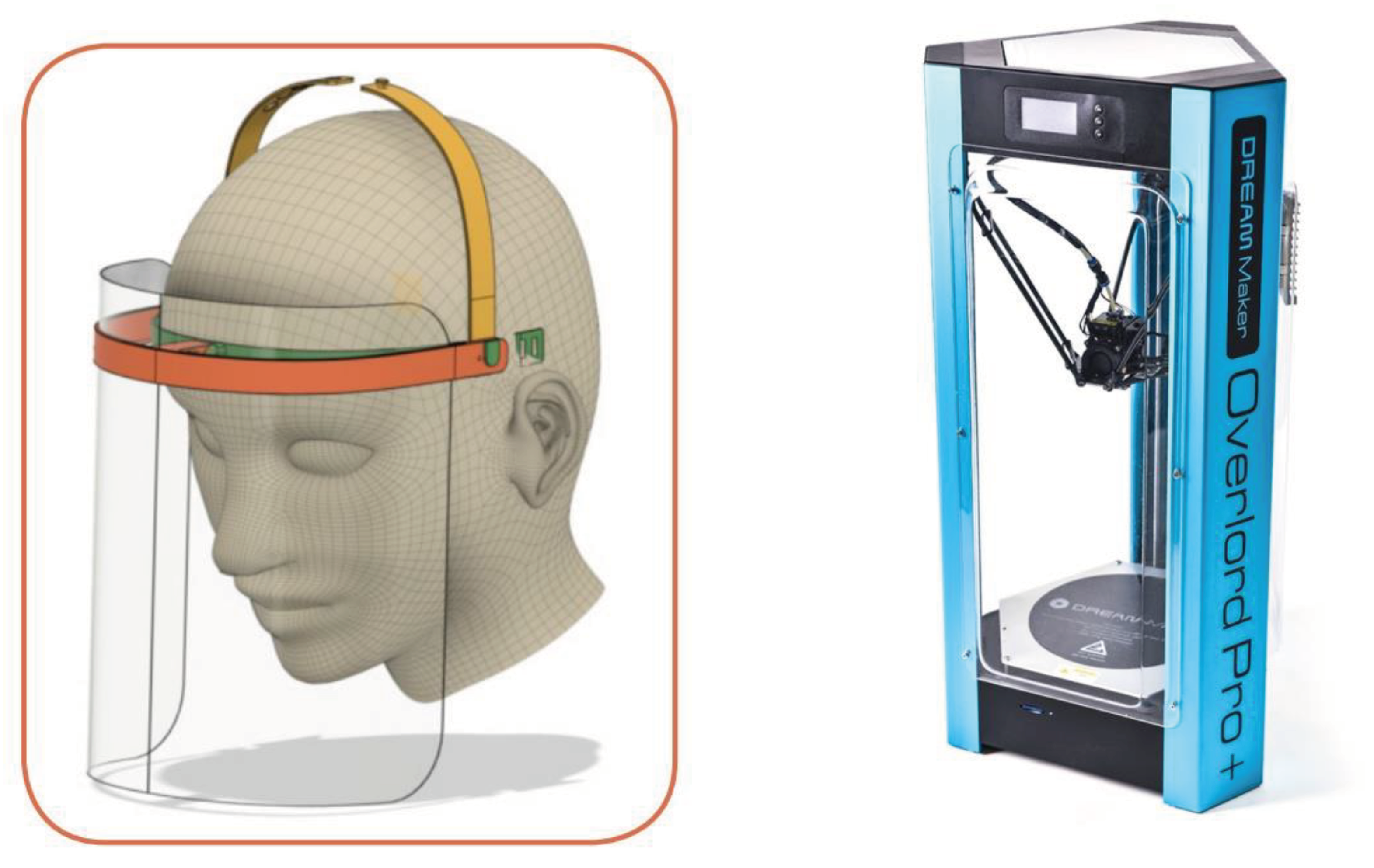
We worked with the Overlord Pro 3D printer, provided by the INET (National Institute of Technological Education of the Nation, Argentine Republic.
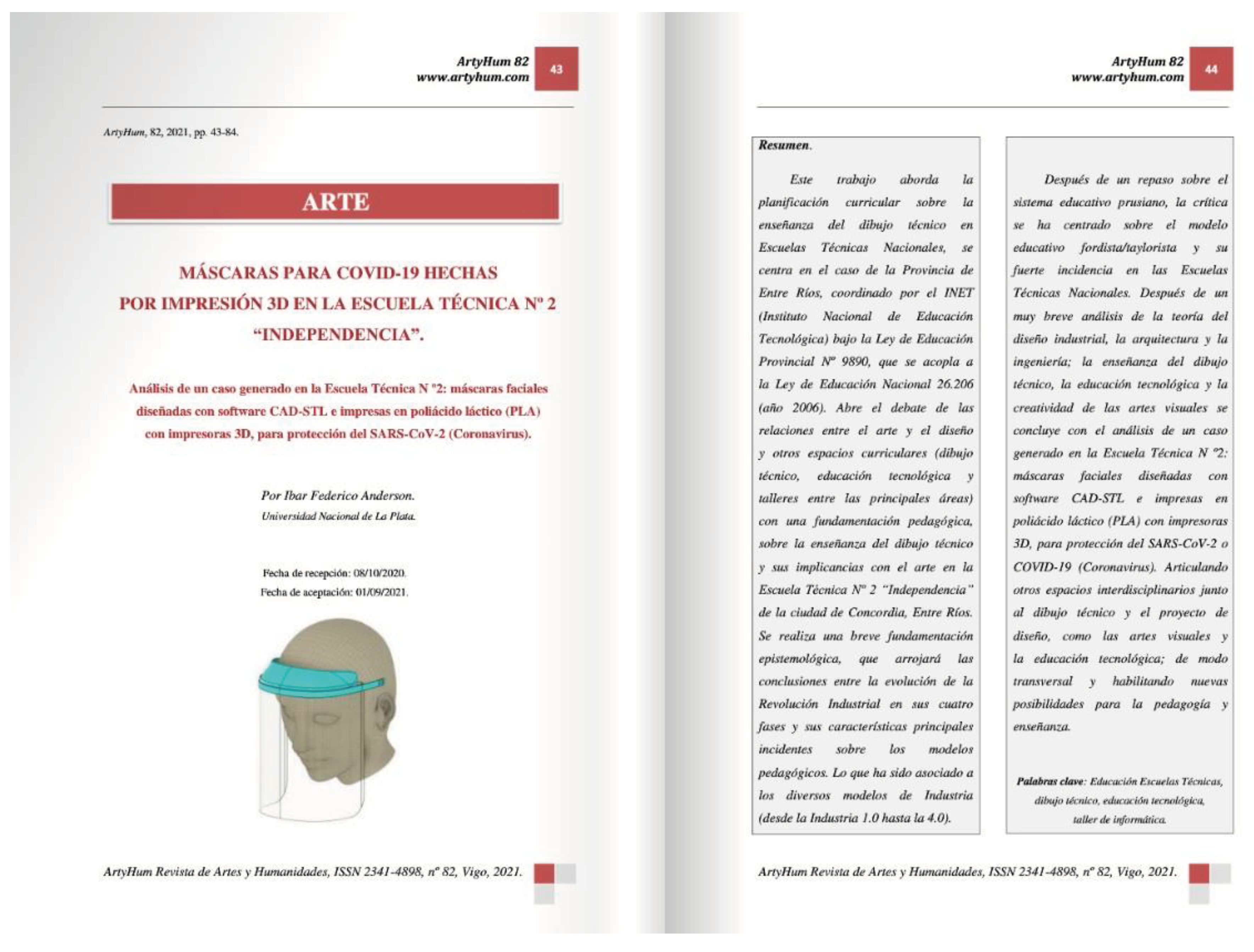
Screenshot of the publication in the digital magazine ArtyHum (Spain), whose title is: Masks for covid-19 made by 3D printing at the Technical School No. 2 “Independencia”. Analysis of a case generated in TSE No. 2: face masks designed with CAD-STL software and printed in polylactic acid (PLA) with 3D printers, for protection from SARS-CoV-2 (Coronavirus).
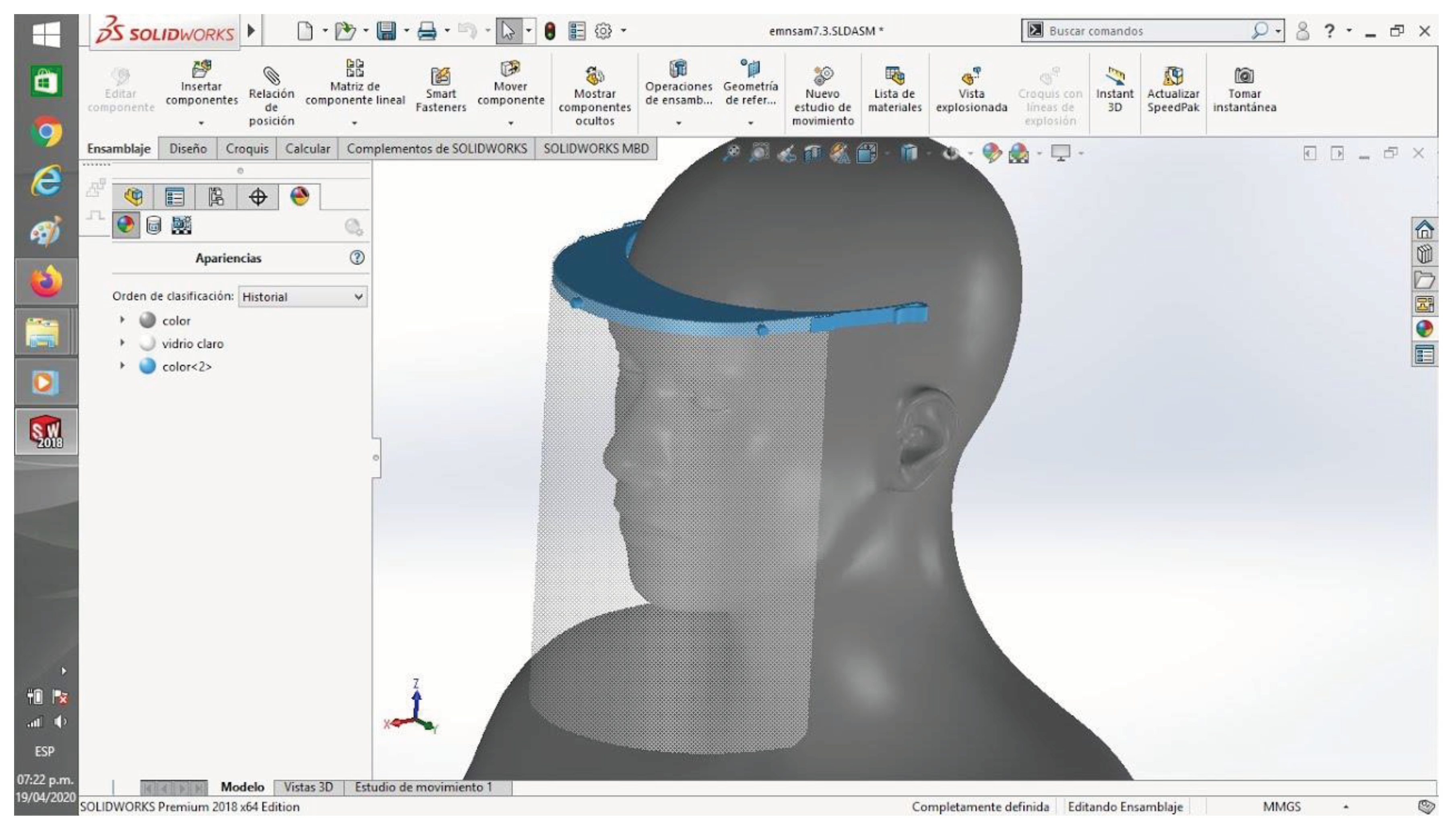
Screenshot of the Covid-19 masks worked in SolidWorks software.
Also, within the Virtual Interfaces VIII Congress in Palermo. Congress of Creativity, Technologies and Innovation for Educational Quality (Buenos Aires, 2021), the publication of the text Academic Reflection in Design and Communication was carried out; year XXII, vol. 48, under the title “Analysis of a case generated at Technical School No. 2: face masks designed in CAD-STL software and printed in polylactic acid (PLA) with 3D printers, for protection from SARS-CoV-2 or Covid-19. 19 (Coronavirus)”, the national publication was published in Spanish with ISSN: 1668-1673.
As the summary of the article stored in the Database (Institutional Repository of the National University of La Plata: SEDICI UNLP): This work addresses curricular planning on the teaching of technical drawing in National Technical Schools, it focuses on the case of Province of Entre Ríos, coordinated by the National Institute of Technological Education (INET) under the Provincial Education Law No. 9890, which is coupled to the National Education Law 26,206 (year 2006). It opens the debate on the relationships between art and design and other curricular spaces (technical drawing, technological education and workshops among the main areas) with a pedagogical foundation, on the teaching of technical drawing and its implications with art in the Technical School No. 2 Independence of the city of Concordia, Entre Ríos. A brief epistemological foundation is made, which will draw conclusions between the evolution of the Industrial Revolution in its four phases and its main characteristics affecting pedagogical models. What has been associated with the various Industry models (from Industry 1.0 to 4.0). After a review of the Prussian educational system, criticism has focused on the Fordist/Taylorist educational model and its strong impact on the National Technical Schools. After a very brief analysis of the theory of industrial design, architecture and engineering; The teaching of technical drawing, technological education and creativity of the visual arts is concluded with the analysis of a case generated in Technical School No. 2: facial masks designed with CAD-STL software and printed in polylactic acid (PLA) with 3D printers, for protection from SARS-CoV-2 or COVID-19 (Coronavirus). Articulating other interdisciplinary spaces together with technical drawing and the design project, such as visual arts and technological education; in a transversal way and enabling new possibilities for pedagogy and teaching. For more information about the publication see the link left here2.
Screenshot of the publication in Academic Reflection in Design and Communication, Year XXII, No. 48 of the UP.
Case study No. 2: TURBO: air extractor/blower for environments contaminated by COVID-19
In 2021, the sixteenth (16th) edition of the INNOVAR National Competition was participated.3organized by the Ministry of Science and Technology of the Nation (MINCYT) and with the endorsement of the National Agency for the Promotion of Research, Technological Development and Innovation (R+D+i Agency)4, having obtained 1st. placed in the COVID-19 projects category. Under the name: “TURBO: air extractor/blower for environments contaminated by COVID-19”.
As a novelty of this 16th. edition of the INNOVAR 2021 national contest (dependent on the MINCYT), the contest had the participation of the National Agency for the Promotion of Research, Technological Development and Innovation (R&D+i Agency), through a selection of the projects with greater potential, which will be offered training - in alliance with an accelerator - to continue with their developments and/or the materialization of prototypes. Among the most notable initiatives, the R&D&i Agency will distribute an additional contribution of money to continue promoting its evolution. In addition, during the evaluation stage, the Agency selected 20 projects related to the covid-19 issue, which were put to a public vote to find out society's perception of their impact levels on daily life. In this case, the most voted project was: “Turbo: air extractor/blower for environments with covid-19” presented by Ibar Anderson from the Technical School No. 2 "Independencia" of Concordia, Entre Ríos, which was awarded a special mention. This initiative received 2,345 votes out of a total of 5,423. The news of the award was published on different official government websites5.
This work gave rise to four (4) national and international publications in Spanish and English, with intellectual property of the International Standard Serial Number (ISSN), the International Standard Book Code (ISBN) and the Digital Material Identification (DOI). Which generated four (4) publications, both national and international in Spanish and English.
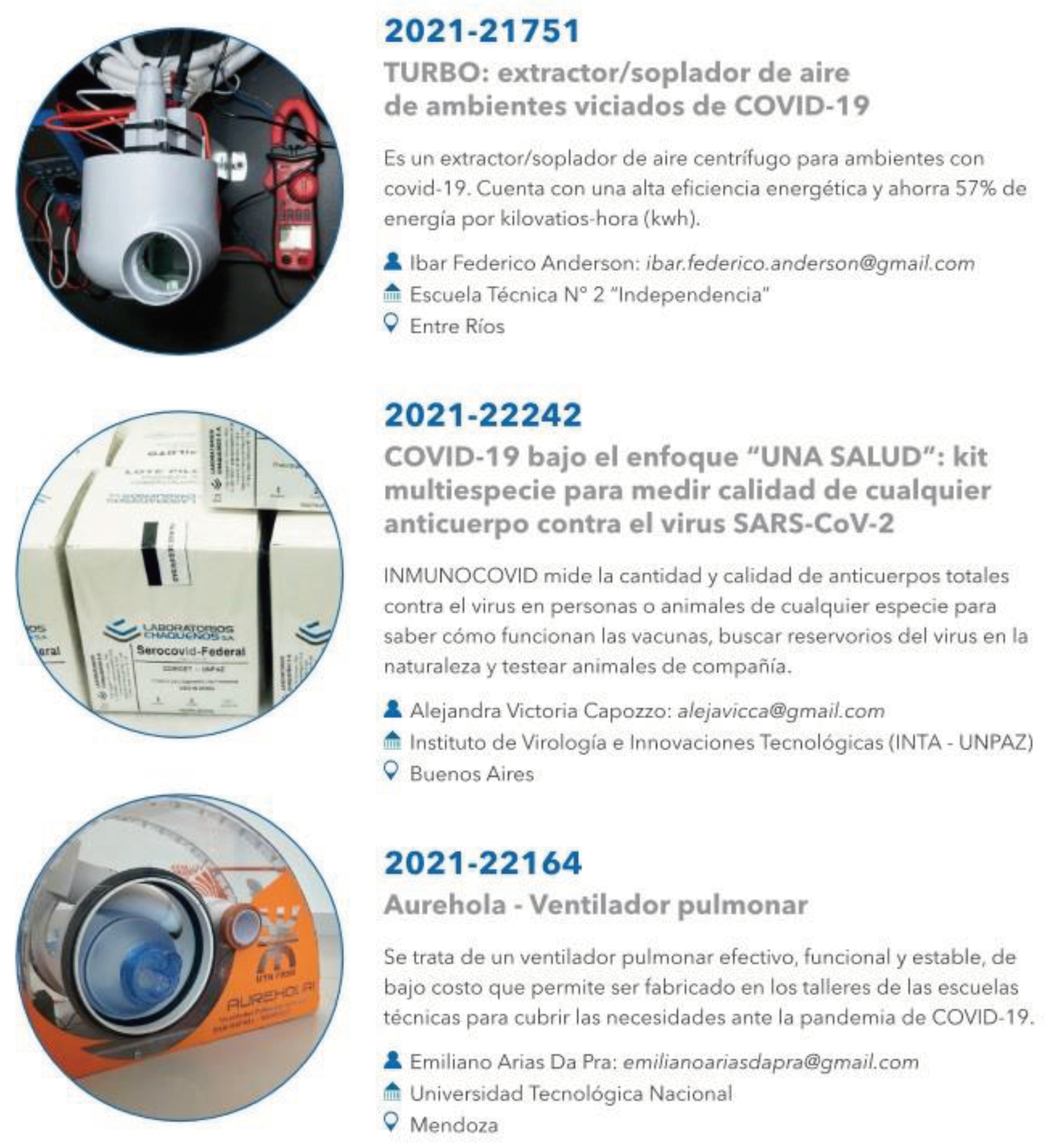
Screenshot of the image taken from the catalog of innovative products of the INNOVAR 2021 National Competition of the Ministry of Science and Technology of the Nation. For more information about the publication see the link left here6.
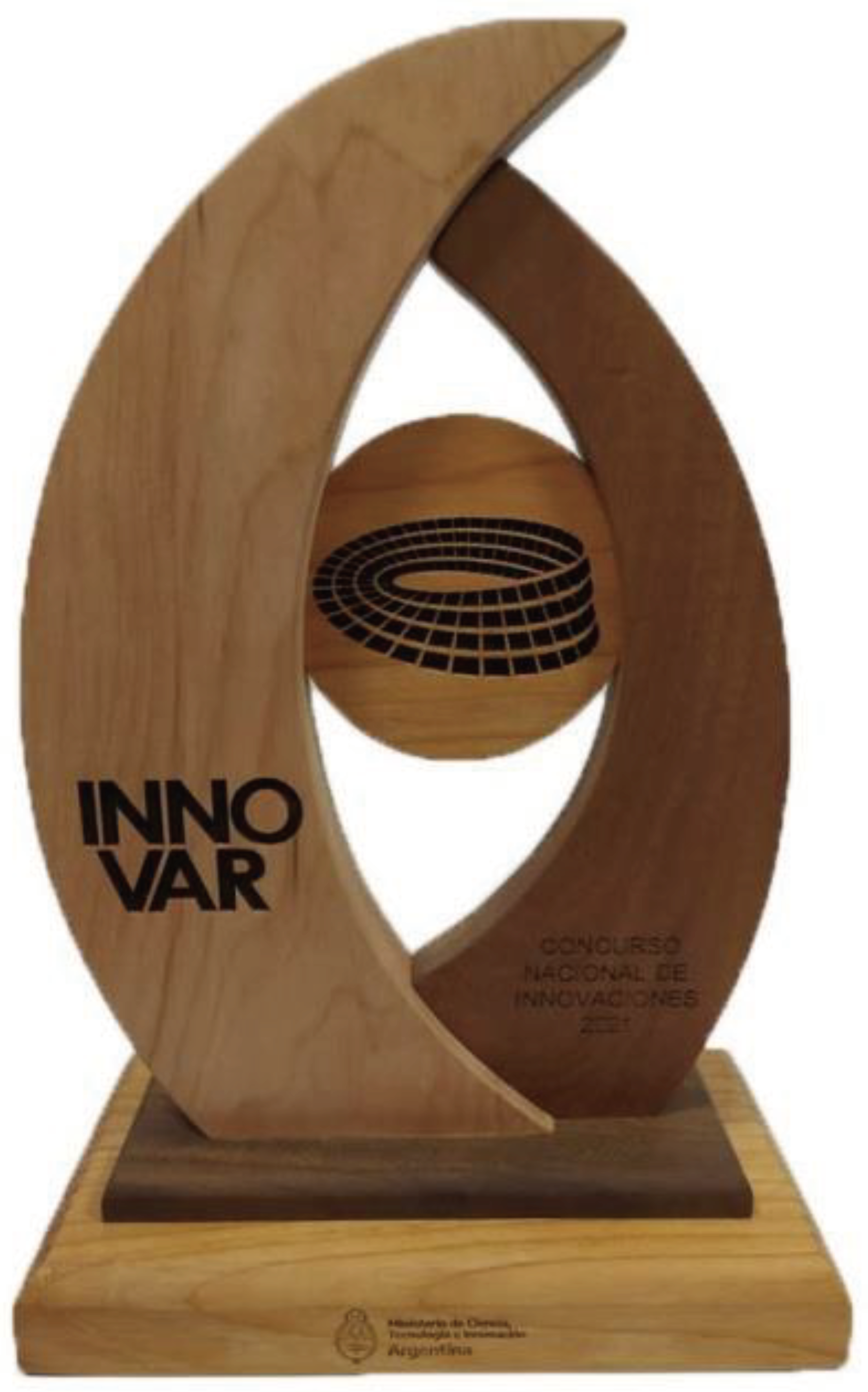
Photo of the Innovar Award statuette.
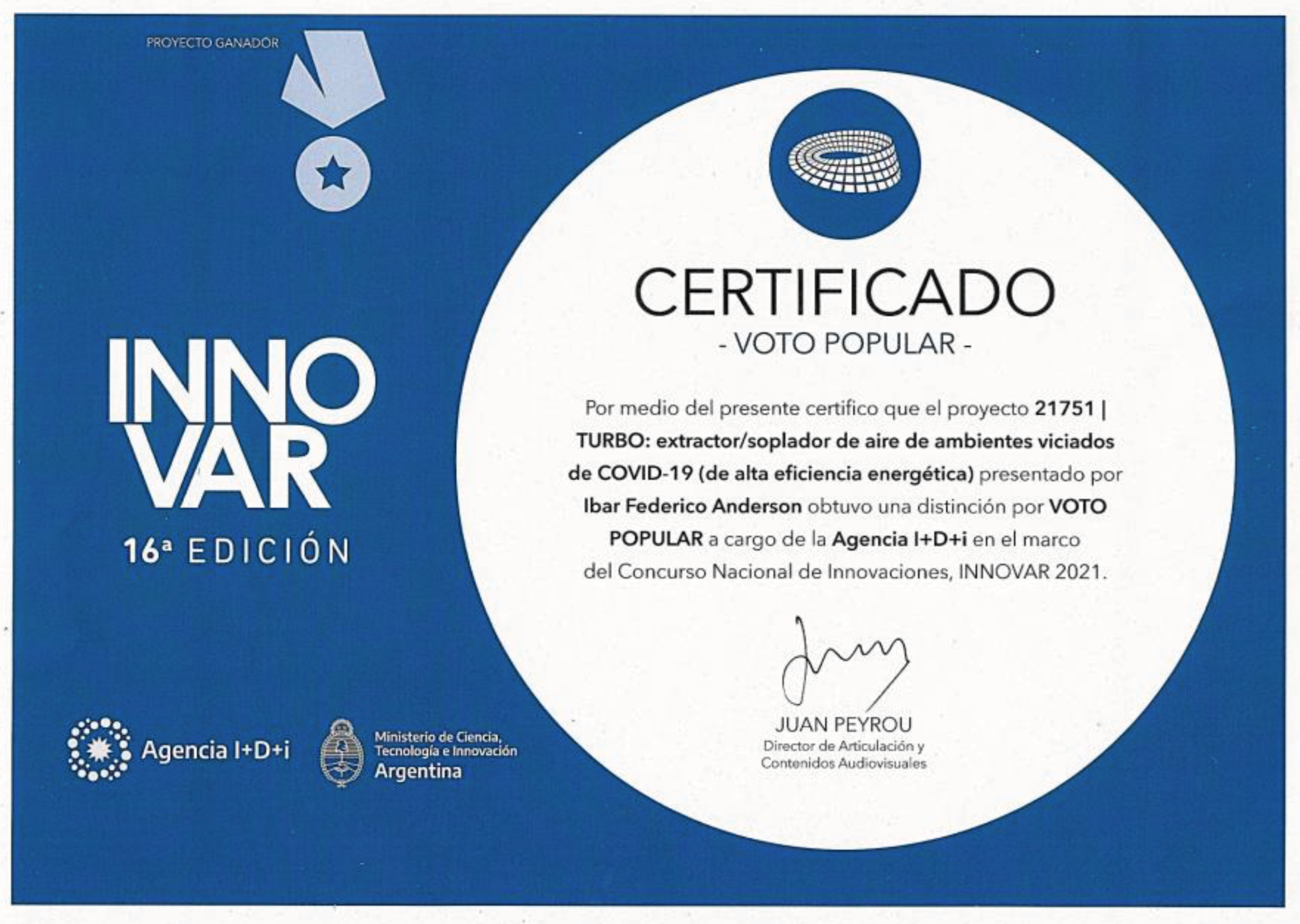
Image of the certificate of the WINNING PROJECT of the Innovar Award.
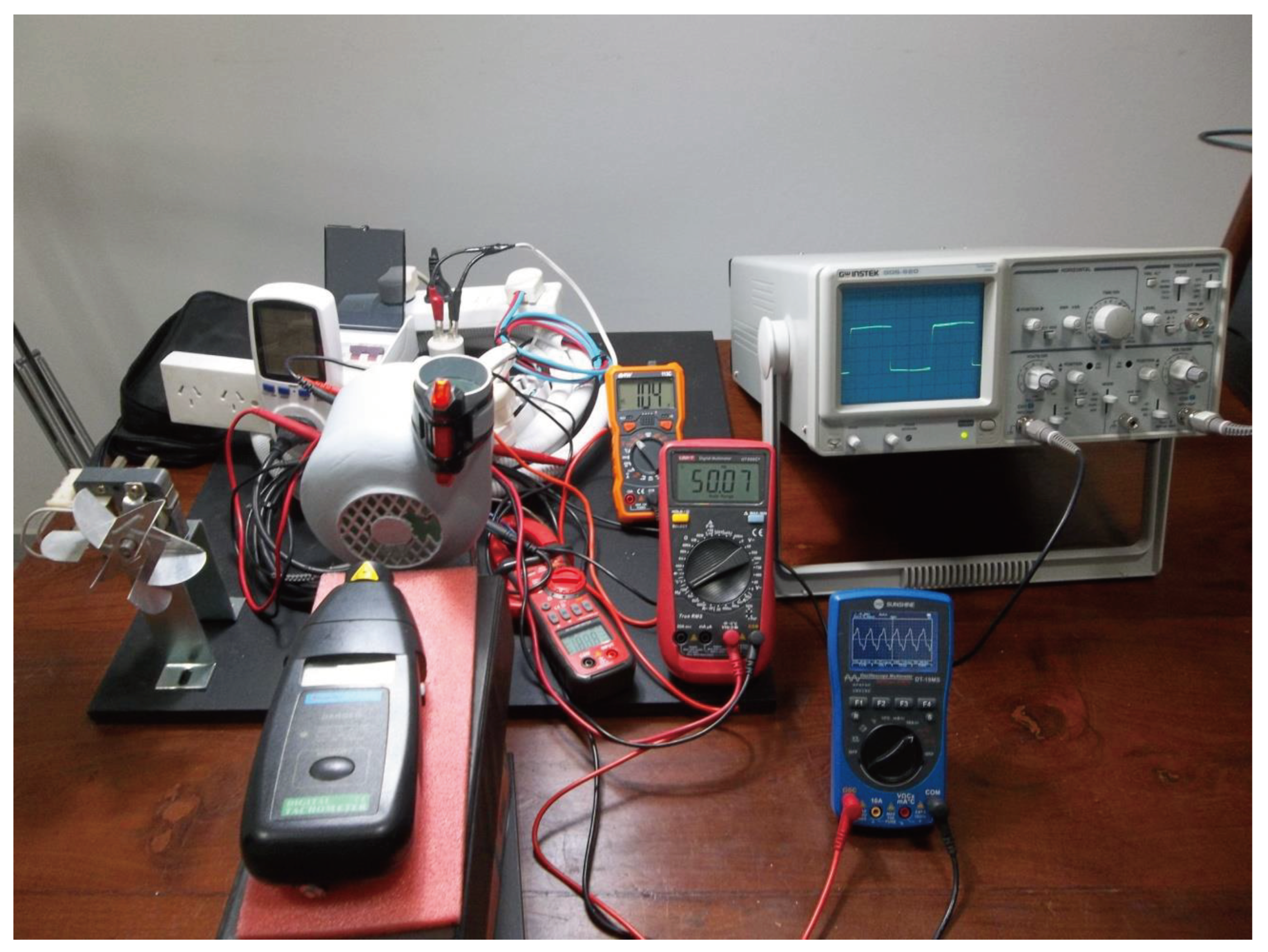
Test bench connected to the SARS-CoV-2 or Covid-19 (Coronavirus) stale air centrifugal extractor/blower motor: Turbo. With digital multimeter (volt meter in AC), amperometric clamp (current intensity meter in AC), frequency meter (Hertz meter), laser photocometer (speed meter in RPM), digital oscilloscope waveform meter alternating current in voltage (Vpeak-peak, Vavg, Vrms), for calculation of harmonic distortion crest factor, analog oscilloscope for qualitative observation of the THD (harmonic distortion of alternating current), wattmeter (active power meter in watts or watts), power factor (cosine of fi), power-meter (active energy consumption meter in kilowatt-hours: kwh). Source: self made.
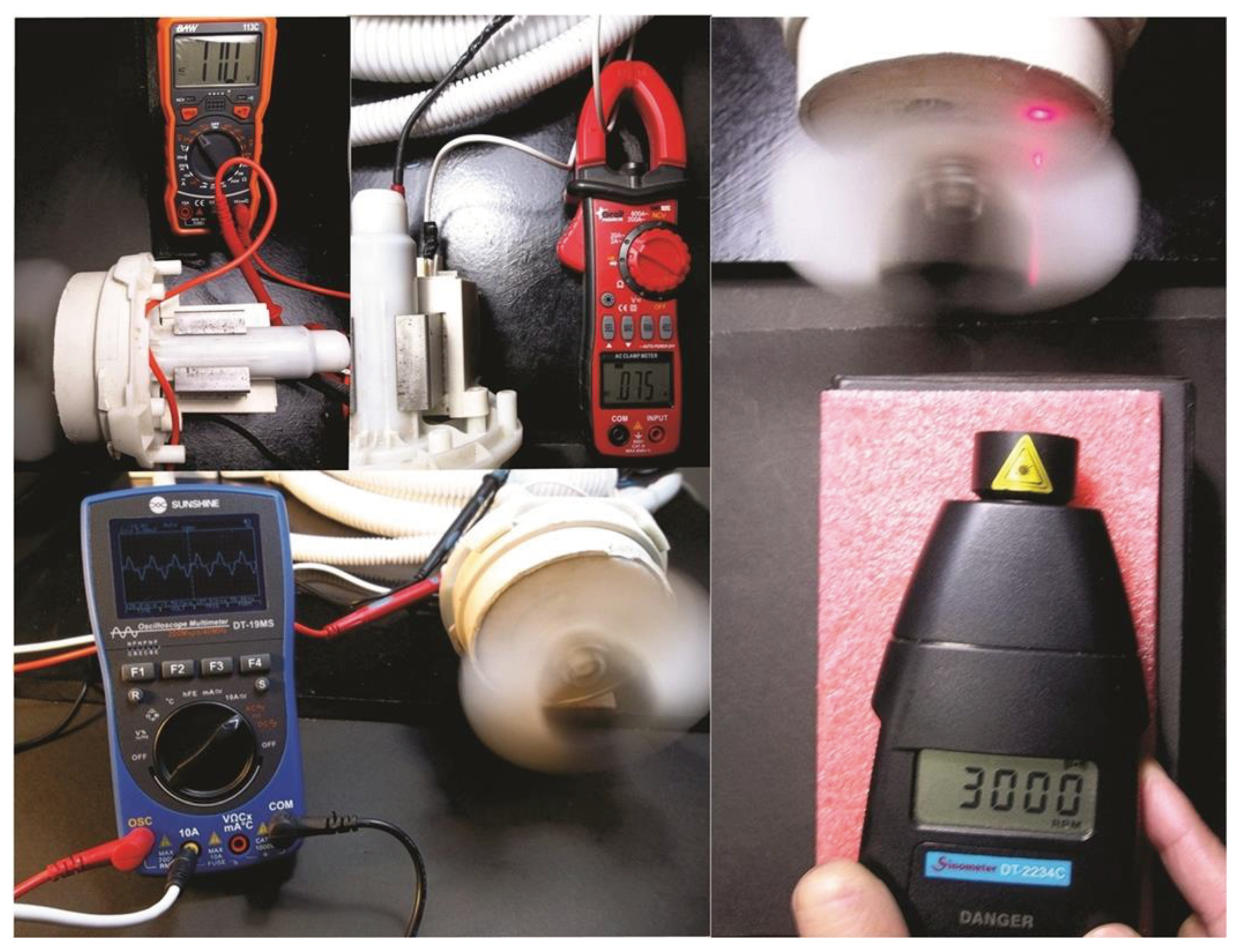
PMSM/IPM type synchronous motor connected to the oscilloscope showing the non-linear voltage waveform, also connected to the digital multimeter showing the voltage drop of 110 (volts), and to the amperometric clamp showing the drop in the circulation of the electric current at 0.075 (amperes) and the constant in the speed of the blade at 3000 (RPM). Source: self made.
As stated, this work gave rise to four (4) national and international publications in Spanish and English, with intellectual property of the International Standard Serial Number (ISSN), the International Standard Code for Books (ISBN) and the Identification of Digital Material. (DOI). Namely:
- Second national publication in Spanish:In the magazine Innovation and Technological and Social Development No. 4 (IDTS) of the National University of La Plata (UNLP), under the title “Energy efficient centrifugal air extractor for environments contaminated with SARS-CoV-2 (Coronavirus)”, made the national publication in Spanish with eISSN: 2683-8559.
As the summary of the article stored in the Database (Institutional Repository of the National University of La Plata: SEDICI UNLP): the product developed is a centrifugal air extractor/blower, which solves the problem of environments contaminated by SARS-CoV -2 or Covid-19 (Coronavirus), intended for domestic and commercial use. It works with a highly energy efficient single-phase 220 (V) and 50 (Hz) alternating current (AC) motor. It has been developed under the Design Thinking methodology. According to the preliminary conclusions, analyzed in the test bench, the PMSM/IPM type synchronous motor used in the centrifugal extractor, with the innovation of the inductive-reactance control in series plus the parallel capacitor, reduces the active power by 67% (Watts) and active energy consumption (kWh), performing 56% more mechanical work (Joules) on the fluid air, with a 50% reduction in the carbon footprint. It is shown that centrifugal fans can be developed that save electrical energy without resorting to: (a) the “Fan Affinity Law”, or (b) the use of variable speed drives (VDF) or frequency drives (which are devices with complex and expensive electronics). This innovation implies enormous savings in electrical energy expenditure for domestic, commercial and industrial ventilation, with simple, although rudimentary and limited, technology; but effective, economical and rustic (electromechanical and not electronic) that according to empirical evidence and experimental tests have shown that it actually works. The electromechanical design was simplified, reducing costs and obtaining economic savings in energy expenditure. For more information about the publication see the link left here7.
Also, within the scope of the UNLP, it was presented to the Nation: centrifugal air extractor, for environments contaminated with SARS-CoV-2, with high energy efficiency”, the national publication was published in Spanish with ISBN: 978-950-34-2166-6.
As the summary of the article stored in the Database (Institutional Repository of the National University of La Plata: SEDICI UNLP): The product is a centrifugal air extractor, which solves the problem of environments contaminated by SARS-CoV-2 or Covid-19 (Coronavirus), designed for civil and commercial use, works with a single-phase alternating current (AC) motor of 220 (V) and 50 (Hz), with high energy efficiency (EE). Developed under the Design Thinking methodology, by electromechanical simulation by NI Multisim 14.0 software, shell design by CAD by Cfturbo 2020 R2.0 software; with a prototype of the conventional stator winding of a synchronous motor with a two-pole PMSM/IPM type single-phase alternating current (AC) field winding and a 4000 (Gauss) ferromagnetic ceramic magnet rotor. Innovating on line no. 15 of Nikola Tesla's invention patent no. 381,968, 5/1/1888. It corresponds to the work developed within Project B374 based at the SCyTFBA-UNLP, whose title is: “Integrated Design and Innovation Management. Contributions for a theoretical-conceptual and methodological review” by the Director: Mg. DI Federico del Giorgio Solfa. In 2021, the project participated in the INNOVAR National Competition of the National R&D&i Agency and the National MINCYT, having won 1st place in Projects: Covid-19. For more information about the publication see the link left here8.
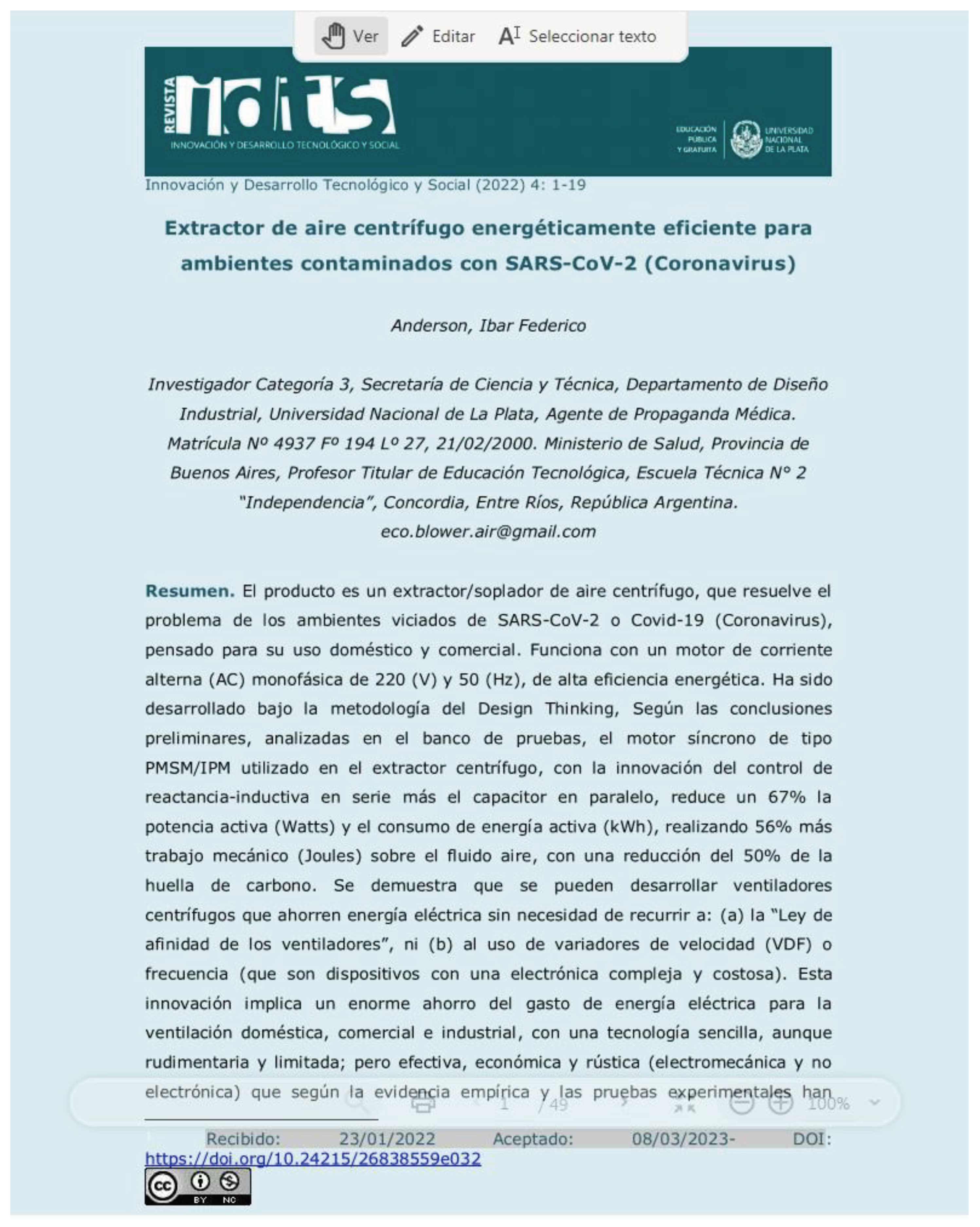
Screenshot of the publication in the IDTS UNLP magazine No. 4.
- Third national publication in Spanish: In the magazine Cuadernos Nº 193 of the University of Palermo (UP), under the title “Centrifugal air extractor that reduces the carbon footprint” the national publication was made in Spanish with ISSN Print 1668-0227, ISSN Online 1853-3523.
As the summary of the article stored in the Database (Institutional Repository of the National University of La Plata: SEDICI UNLP): this article delves into the centrifugal air extractor, whose objective is to extract air contaminated by SARS-CoV-2 or Covid-19 (Coronavirus); Designed for civil and commercial use. It works with a single-phase 220 (V) and 50 (Hz) alternating current (AC) motor, with high energy efficiency (EE). We went from consuming 202 (kWh) per year equivalent to 0.1 tons of CO2 to consuming 97 (kWh) per year equivalent to 0.05 tons of CO2 (which means a 50% reduction in the “carbon footprint”) that the present prototype development leaves on Planet Earth. Developed under the Design Thinking methodology, by electromechanical simulation by NI Multisim 14.0 software, casing design by Cfturbo 2020 R2.0 CAD software and 3D rapid prototyping with the OverLord Pro printer; with a prototype of the conventional stator winding of a synchronous motor with a two-pole PMSM/IPM type single-phase alternating current (AC) field winding and a 4000 (Gauss) ferromagnetic ceramic magnet rotor. Innovating on line no. 15 of Nikola Tesla's invention patent no. 381968, 5/1/1888. The results showed, according to the analysis of the test bench, that the PMSM/IPM type synchronous motor used in the centrifugal extractor, with the innovation of the inductive-reactance control in series plus the parallel capacitor, reduces the power by 67%. active (Watts) and active energy consumption (kWh), performing 56% more mechanical work (Joules) on the fluid air (with a 50% reduction in the carbon footprint). Which leads us to the following conclusion: centrifugal fans can be developed that save electrical energy (kWh) without resorting to (1) the Fan Affinity Law, or (2) the use of variable speed drives (VDF). or frequency (which are devices with complex and expensive electronics). Which would bring enormous savings in electrical energy costs. For more information about the publication see the link left here9.
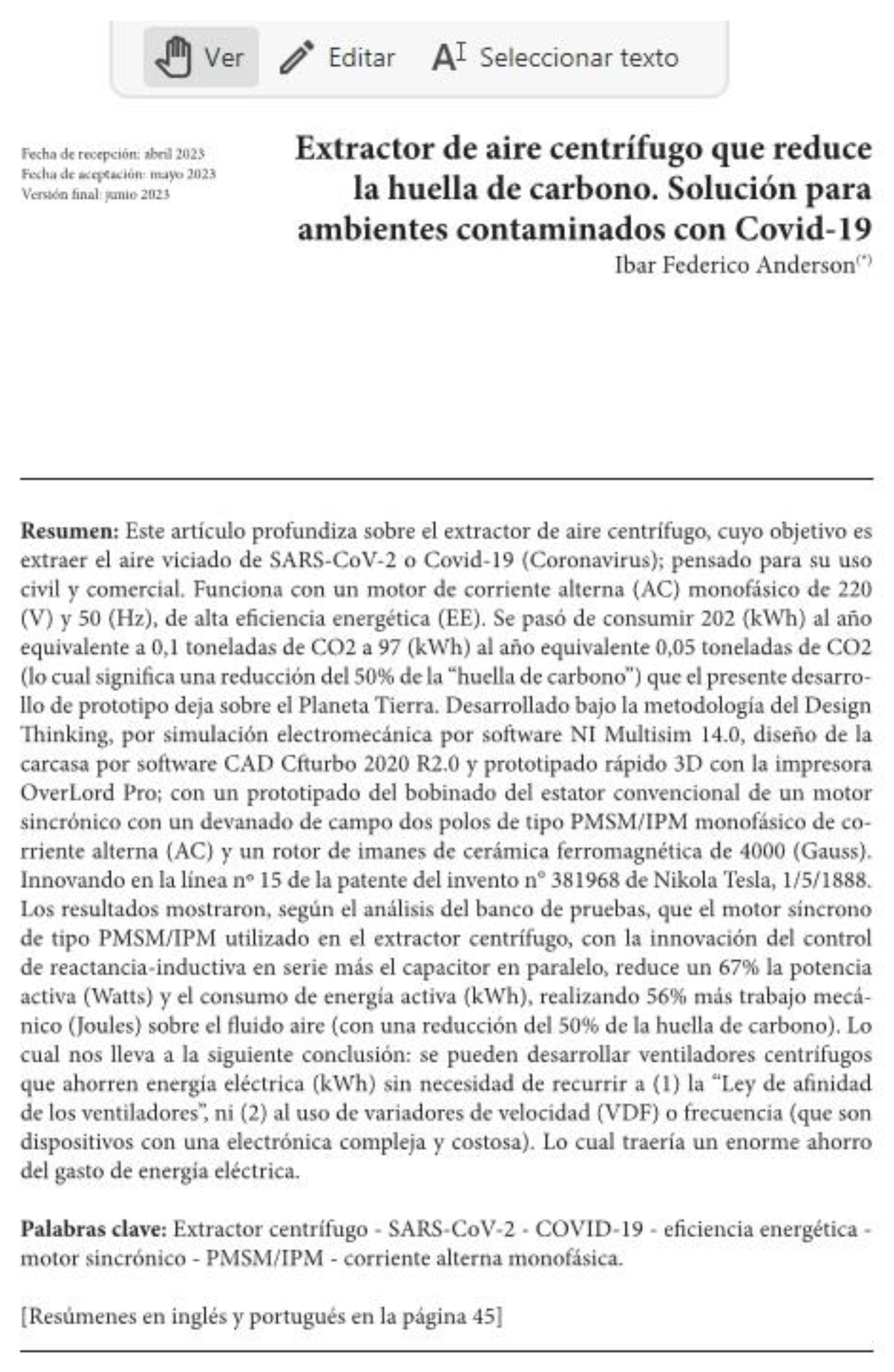
Screenshot of the publication in the magazine Cuadernos Nº 193, from the UP.
- Fourth international publication in Spanish:In the magazine TECSUP (I+i) Applied research and innovation No. 16, under the title “Industrial and electromechanical design of a high energy efficiency centrifugal air extractor for environments with Covid-19”, the national publication was made in Spanish. with ISSN: 1996-7551 and ISSN-L 2707-9368.
As the summary of the article stored in the Database (Institutional Repository of the National University of La Plata: SEDICI UNLP): The product is a centrifugal air extractor, whose objective is to extract air contaminated by SARS-CoV-2 or Covid -19 (Coronavirus); Designed for civil and commercial use, it works with a single-phase 220 (V) and 50 (Hz) alternating current (AC) motor, with high energy efficiency (EE). Developed under the Design Thinking methodology, by electromechanical simulation by NI Multisim 14.0 software, casing design by Cfturbo 2020 R2.0 CAD software and 3D rapid prototyping with the OverLord Pro printer; with a prototype of the conventional stator winding of a synchronous motor with a two-pole PMSM/IPM type single-phase alternating current (AC) field winding and a 4000 (Gauss) ferromagnetic ceramic magnet rotor. Innovating on line no. 15 of Nikola Tesla's invention patent no. 381968, 5/1/1888. The results showed, according to the analysis of the test bench, that the PMSM/IPM type synchronous motor used in the centrifugal extractor, with the innovation of the inductive-reactance control in series plus the parallel capacitor, reduces the power by 67%. active (Watts) and active energy consumption (kWh), performing 56% more mechanical work (Joules) on the fluid air (with a 50% reduction in the carbon footprint). Which leads us to the following conclusion: centrifugal fans can be developed that save electrical energy (kWh) without having to resort to (1) the “Fan Affinity Law” or (2) the use of variable speed drives ( VDF) or frequency (which are devices with complex and expensive electronics). Which would bring enormous savings in electrical energy costs. For more information about the publication see the link left here10.
Screenshot of the publication TECSUP (I+i) Applied research and innovation, No. 16.
- Fifth international publication in English:In the Journal of Electrical and Electronics Engineering No. 16 under the title “An Innovative Method to Increase Energy Efficiency of PMSM-Type Synchronous Motors”, the national publication was made in English with ISSN: 0974-1704.
As the abstract, stored in the Database (Institutional Repository of the National University of La Plata: SEDICI UNLP) says: This paper proposes reduction in the consumption of active electrical energy (kWh) by 67%, while maintaining the same mechanical work speed (RPM) at variable torque loads of water and similar fluids using the “Fan Affinity Law” in an innovative way in PMSM-type synchronous motors. The work is carried out comparatively between brushless asynchronous motors with starting loop (motor with a short-circuited loop) versus brushed asynchronous motors and PMSM-type synchronous motors without the need to use Variable Frequency Drives (VFD), simplifying the technology (electronics) and saving costs in an innovative way (R+D+i). The case study was developed on a design applied to a centrifugal air extractor/blower with PMSM/IPM type synchronous motor. The study focused on a specific bibliographical review of ecodesign and energy efficiency in refrigeration and ventilation systems, taking into account a couple of personal works and other general ones by various authors. For more information about the publication see the link here for the journal published in English in India: IUP Journal of Electrical and Electronics Engineering11. This international publication in English was a consequence of two publications with DOIs of type Preprints12and OSFpreprints13.
The final culmination of said publication concluded in a publication in English in the United States of America: Journal of Sensor Networks and Data Communications14.
Screenshot of the English publication in India: The IUP Journal of Electrical & Electronics Engineering, Vol. 16 No. 1.
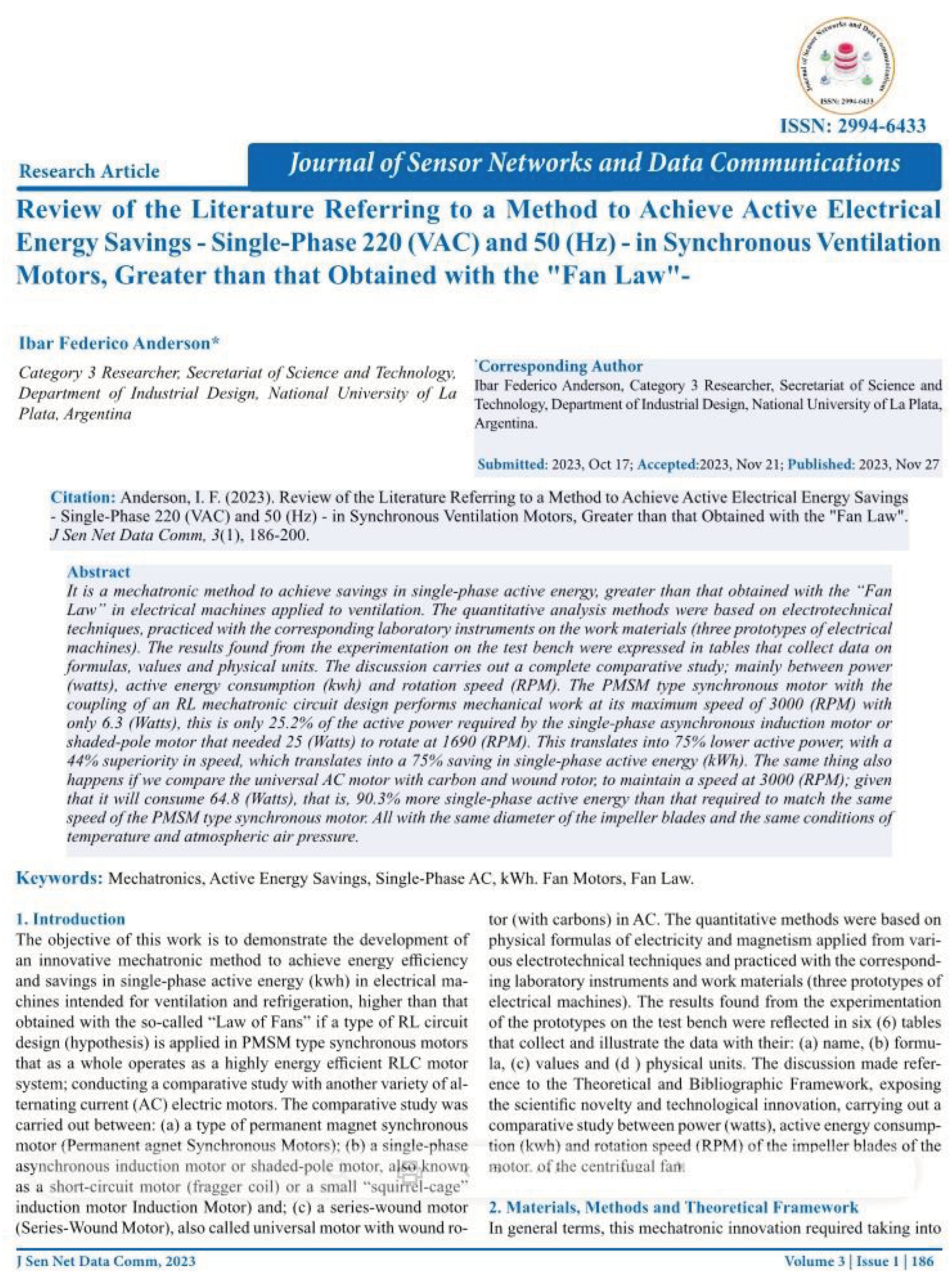
Screenshot of the English publication in India: The IUP Journal of Electrical & Electronics Engineering, Vol. 16 No. 1.
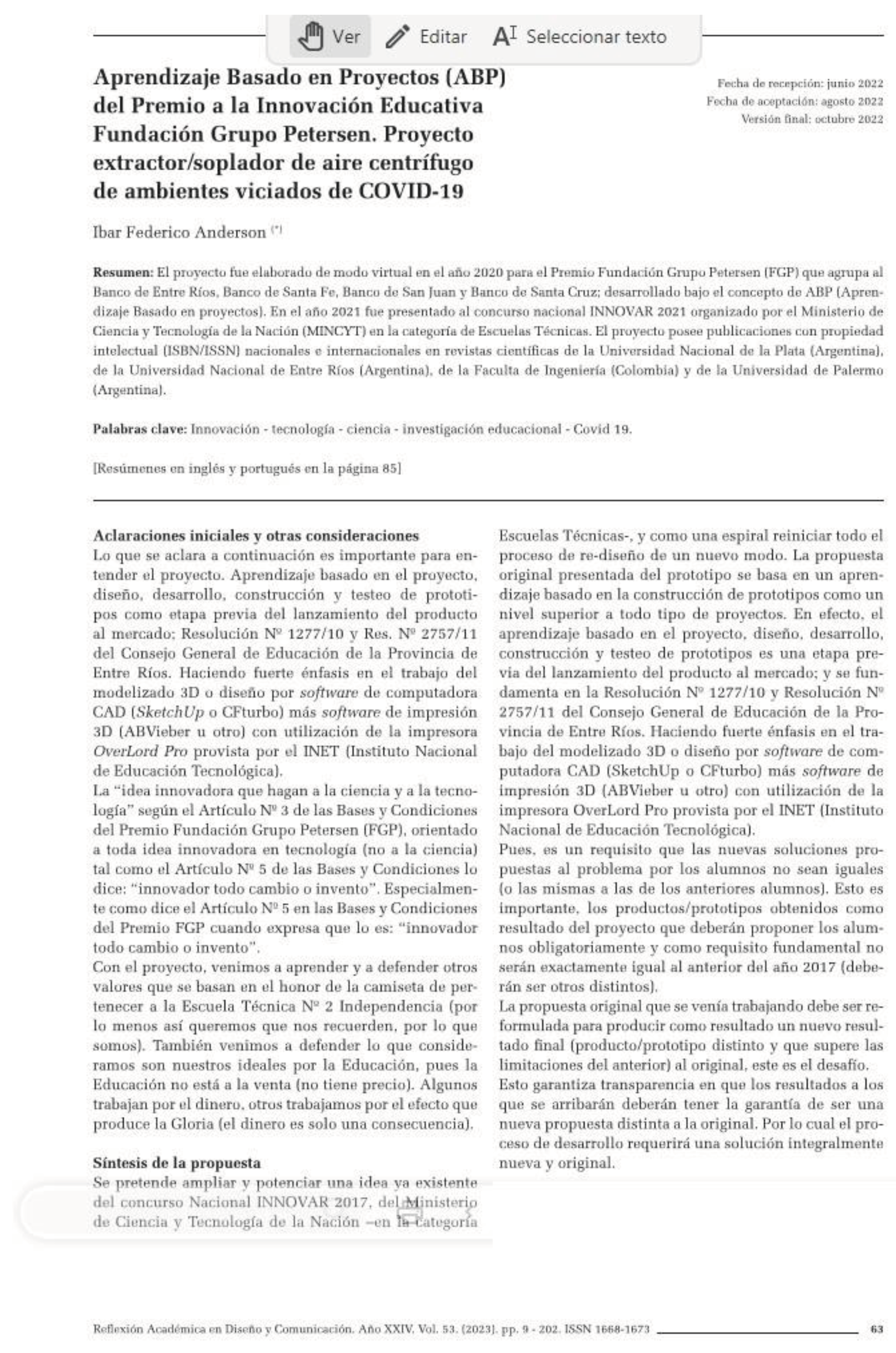
Screenshot of the publication in Academic Reflection in Design and Communication, Year XXIV, Vol 53.
Case study No. 3: ROBOT-T2: Educational Robot Made by Students and Teachers of the Technical School No. 2 (EET No. 2) “Independencia”, Concordia, Entre Ríos, Argentine Republic
In 2022, the seventeenth (17th) edition of the INNOVAR National Competition was participated.15organized by the Ministry of Science and Technology of the Nation (MINCYT) and with the endorsement of the National Agency for the Promotion of Research, Technological Development and Innovation (R+D+i Agency)16, having obtained 1st. placed in the COVID-19 projects category. Under the name: “TURBO: air extractor/blower for environments contaminated by COVID-19”. Which generated an international publication in Spanish.
- Sixth international publication in Spanish:In EdArXivPreprints under the title “ROBOT-T2: Educational Robot Made by Students and Teachers of the Technical School No. 2 (EET No. 2) “Independencia”, Concordia, Entre Ríos”, the international publication was made in English with DOI: 10.35542 /osf.io/ymd2r.
As the summary says, stored in the Database (Institutional Repository of the National University of La Plata: SEDICI UNLP): Robot-T2: is a teaching robot for pedagogical and educational purposes built by the Technical School No. 2 "Independencia" ( Concordia, Entre Ríos). It participated in the INNOVAR 2022 National Competition of the Ministry of Science and Technology of the Nation in 2022 and was selected to be exhibited at Tecnópolis. It was also included in the official catalog of the MINCYT-Nación, on page 139 of the following link:https://www.innovar.mincyt.gob.ar/catalogos/catalogo_innovar_2022.pdf. See the journalistic report on Professor Luis Ponti and students, from the YouTube Channel of the journalistic medium Canal “Nueve Litoral” (Paraná, Province of Entre Ríos) in the link that appears in “Related documents” (link:https://www.youtube.com/watch?v=lSfcM9_mfyU). For more information about the publication see the link left here17.
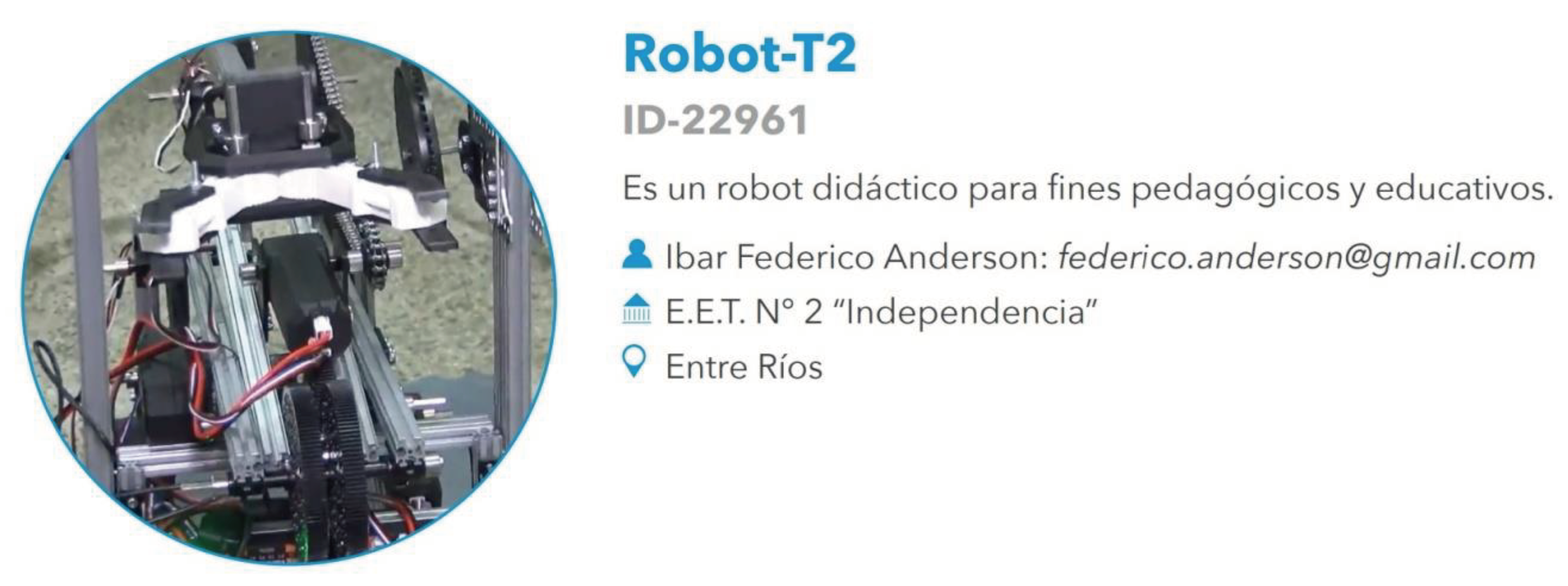
Image of the catalog of innovative products, INNOVAR 2022 MINCYT. “Robot-T2” was selected for exhibition at Tecnópolis and was included in the catalog of innovative inventions and products, in the “Robotics + Artificial Intelligence” category.
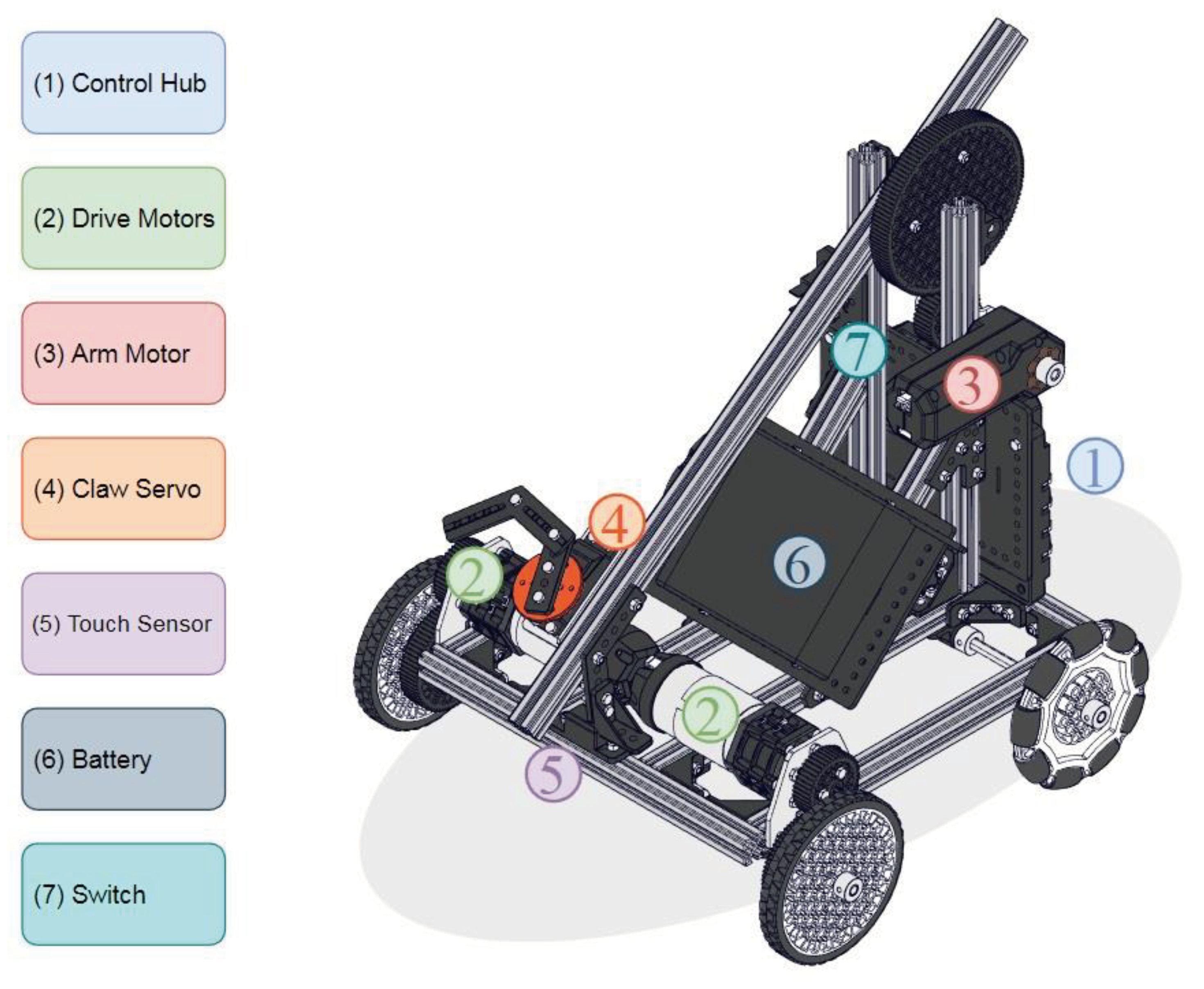
Parts of “Robot-T2”: Control center (1.Hub Control), drive motors (2.Drive motors), motor arm (3.Arm Motor), claw servo (4.Claw Servo), Touch Sensor ( 5.Touch Sensor), Battery (6.Battery) and Switch for change (7).
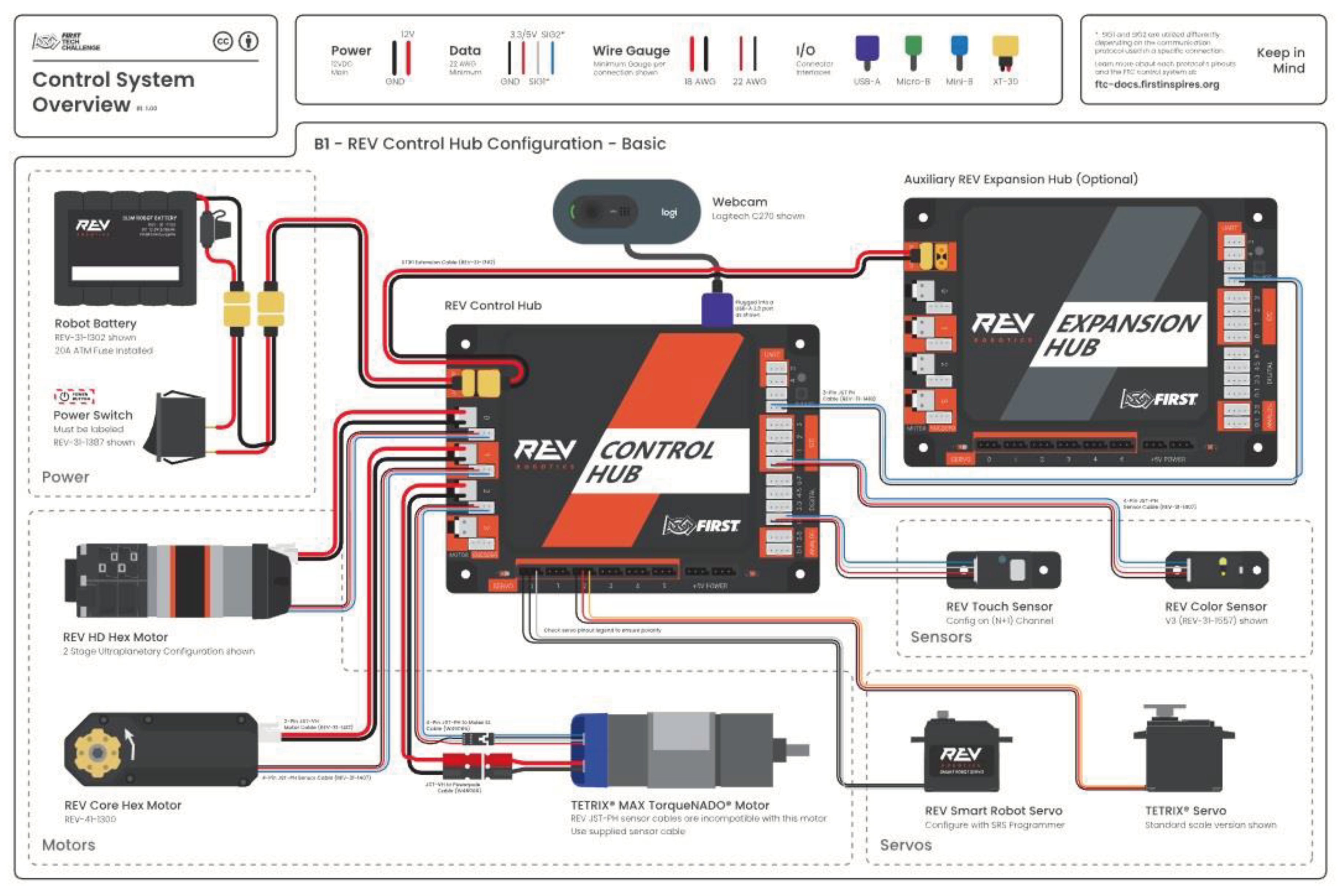
HubControl is a control and programming platform used in robotics and other automation projects. It is used to control and coordinate the robot's motors and sensors and to program its behavior. The HubControl consists of a central processing unit, sensors and actuators, as well as a programming interface.
The HubControl is a structure that houses the electronic components of the robot, such as the controller, battery, and other electronic devices. It works with a specific programming language called OnBotJava, which allows the robot to be programmed easily and quickly using predefined blocks of code.
Additionally, the HubControl is equipped with a tablet and remote controls that allow the user to control and program the robot remotely. Creating a private WiFi network between the HubControl and the tablet and controls allows for reliable and secure communication between these devices.
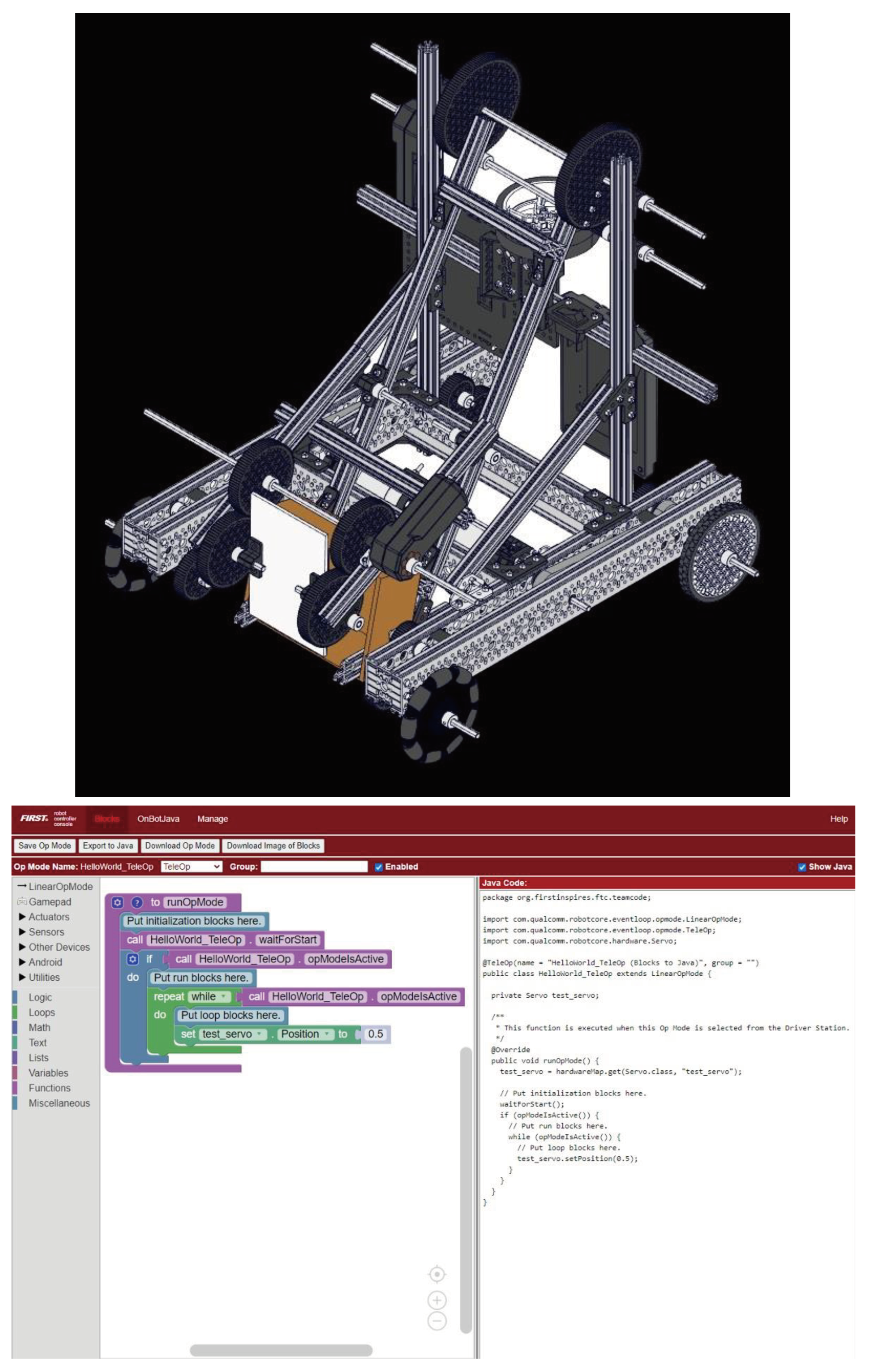
Screenshot image, a block programming language called OnBotJava was used that speeds up programming times and limits human errors when typing commands. This environment comes loaded in a “Hub” along with a Tablet and the controls at distance.
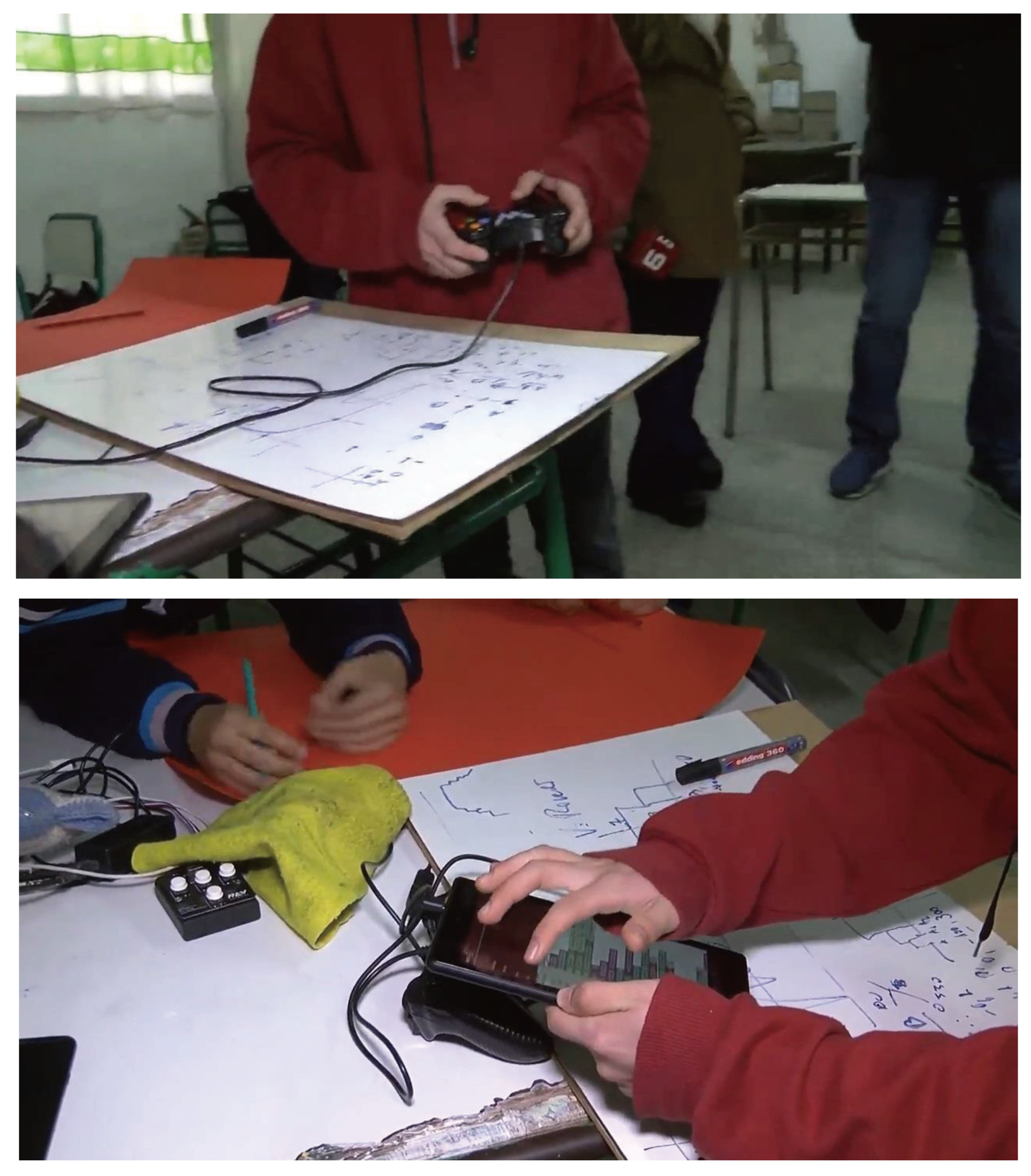
Students programming in OnBotJava and operating the robot with the Joystick.
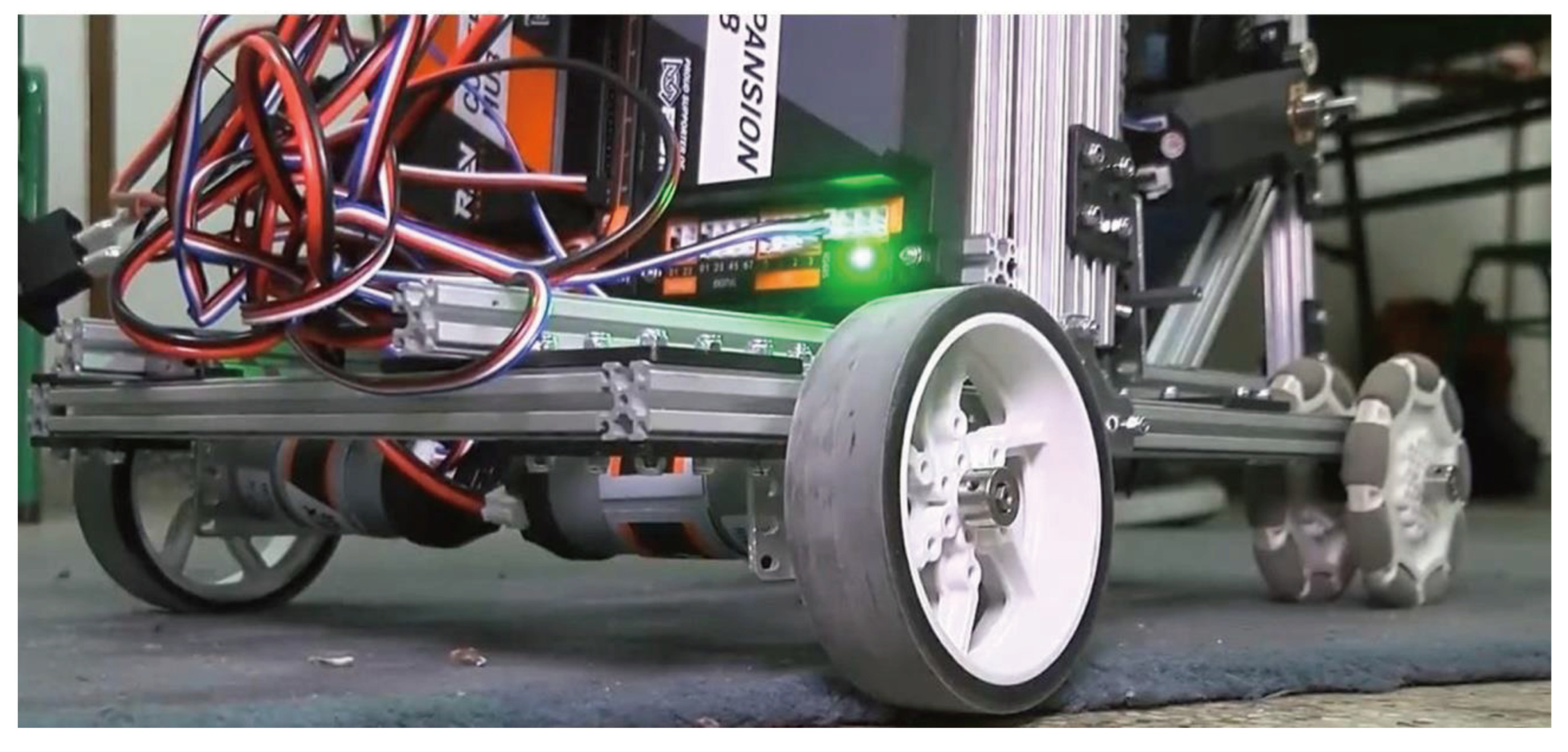
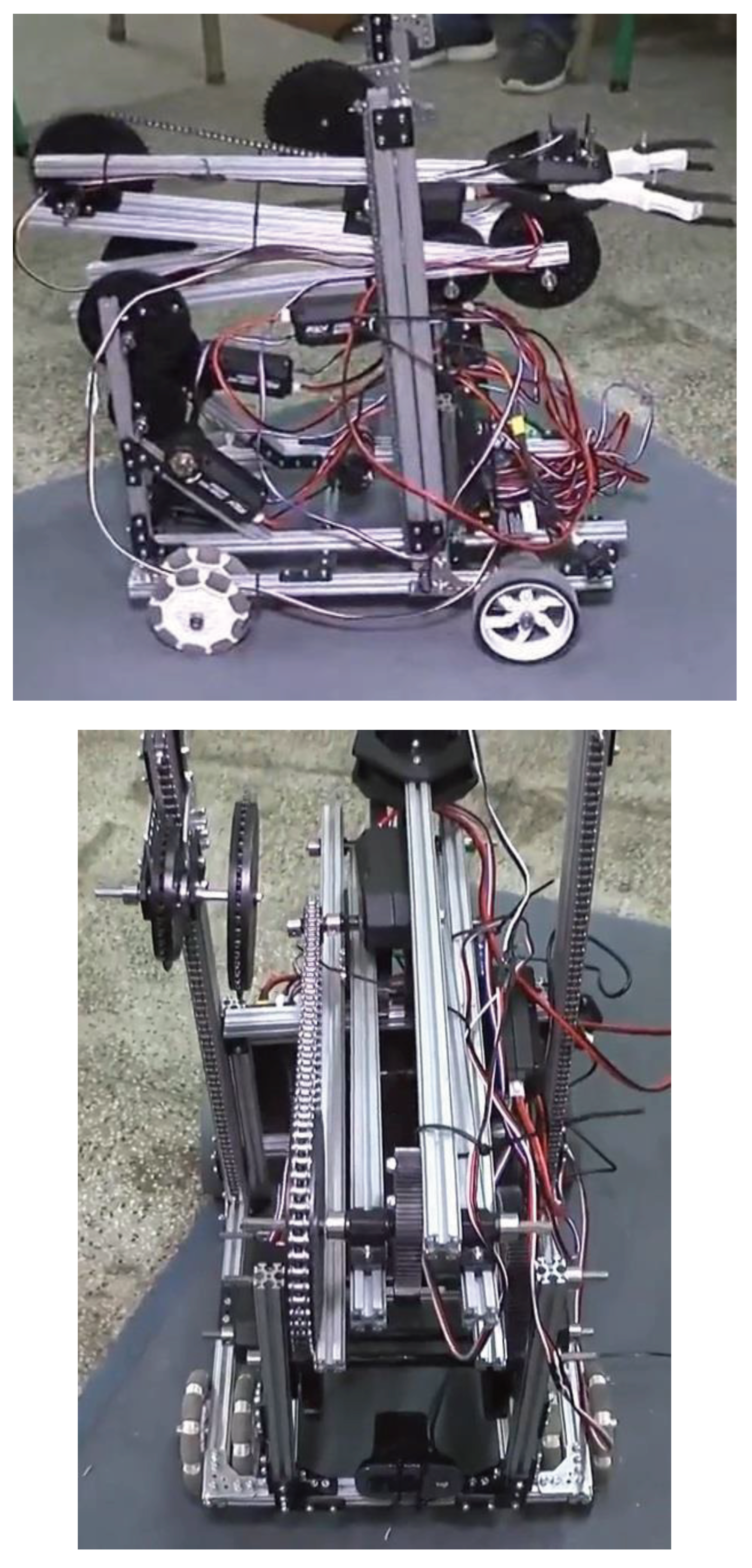
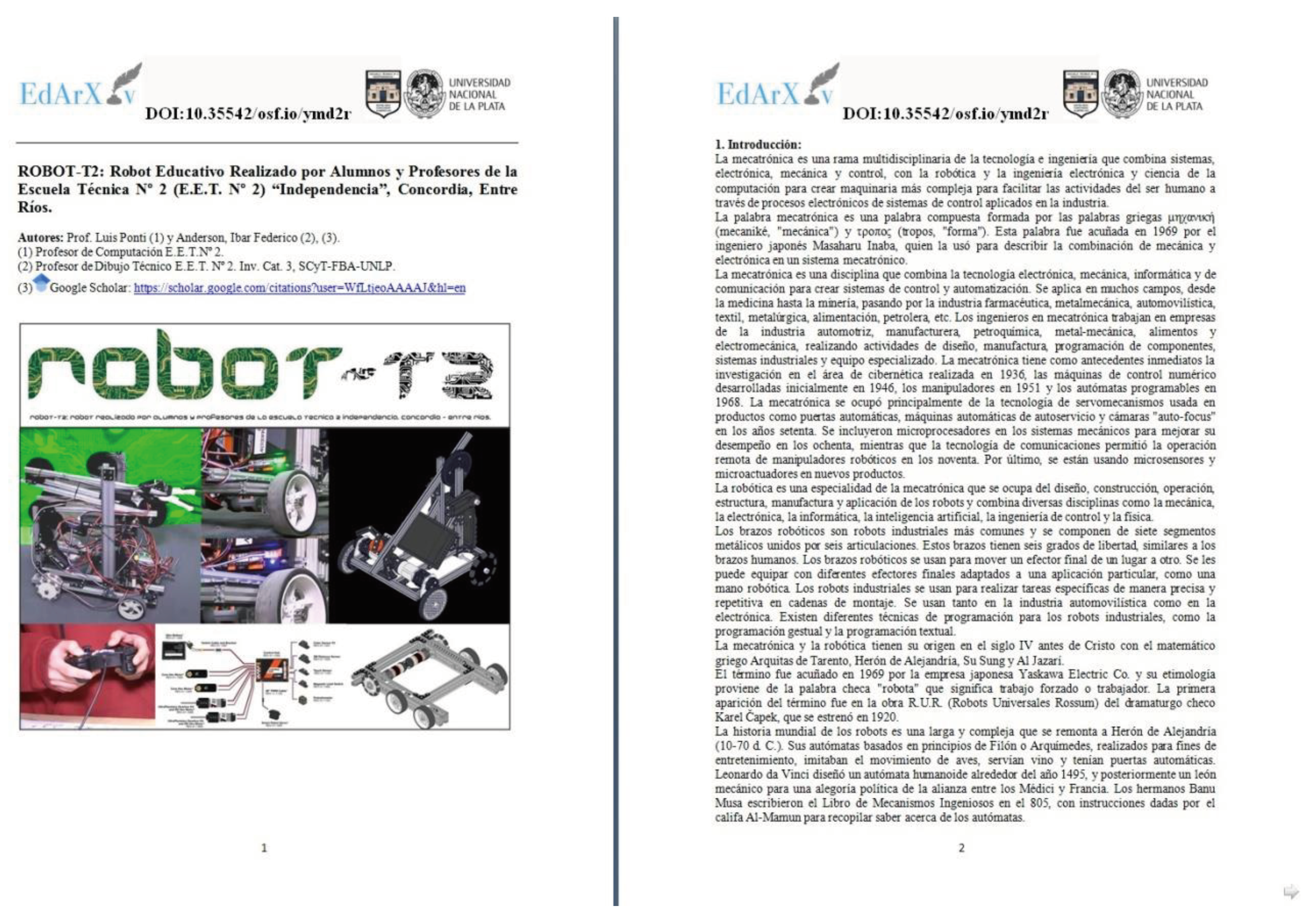
Case study No. 4: Self-construction EcoBlock, for social housing
In 2023, the eighteenth (18th) edition of the INNOVAR National Competition was held.18organized by the Ministry of Science and Technology of the Nation (MINCYT) and with the endorsement of the National Agency for the Promotion of Research, Technological Development and Innovation (R+D+i Agency)19the National Institute of Industrial Technology (INTI)20and the National Institute of Agricultural Technology (INTA)21. With the presence of the National Institute of Technological Education (INET)22.
This news received press as a joint news item from INET (National Institute of Technological Education), INTI (National Institute of Industrial Technology), INTA (National Institute of Agricultural Technology) and the MINCYT Nación (Ministry of Science and Technology of the Nation). Date: 05/15/202323 24.
Within the framework of the extension of the call for projects of the INNOVAR Contest, in its eighteenth (18th) edition of the INNOVAR 2023 National Contest, a presentation of the special category incorporated in this edition was made to encourage the participation of groups of students from technical and agrotechnical schools from all over the country in the contest.
The Minister of Science, Technology and Innovation, Daniel Filmus; the president of the National Institute of Industrial Technology (INTI), Sandra Mayol; the vice president of the National Institute of Agricultural Technology (INTA), Nacira Muñoz; The executive director of the National Institute of Technological Education (INET), Gerardo Marchesini, and the director of Articulation and Audiovisual Content of the scientific portfolio, Juan Peyrou, participated in the presentation of the category “Technical and agrotechnical schools” within the framework of the eighteenth edition of the INNOVAR National Innovation Competition.
Filmus highlighted about this new category “the successful coordination with INTA, INTI and INET that made it possible, together with the Ministry of Science, to create a window of opportunities for secondary technical and agrotechnical educational institutions throughout the country to participate and show the potential that they have in a contest that makes scientific and technological capabilities visible,” and explained “we want young people to show solutions to local productive demands and needs, ideas that are born in the classroom and that deserve to be exhibited in the final exhibition.” The minister expressed that “the support of professionals from the institutions of each province will give the support and confidence that innovative ideas need to come to fruition and the contest, in that sense, was born with the purpose of encouraging and rewarding those who dare. to develop products that positively impact society.”
During the presentation - made by the head of the area in charge of carrying out the INNOVAR Contest - Peyrou clarified that this category was specially articulated for technical and agrotechnical secondary educational institutions throughout the national territory with the aim of stimulating groups of students from the higher cycle “to recognize productive problems within their communities and to propose innovative solutions based on design and prototyping.” “In this way, the participating groups will be able to highlight the knowledge and skills learned during their school career,” added Peyrou.
To reinforce the federal nature of this category, the head of the DAyCA explained that “an inter-institutional committee will be formed that will select the best two initiatives from each province - one for technical schools and one for agrotechnical schools - to which a distinction will be awarded. of $300,000 that must be applied to the development of the proposed prototypes.” Peyrou also specified that "during the process of materializing the prototypes, the groups will receive technical assistance from INET, INTI and INTA - through a local reference - who will accompany each team in all stages of development" and indicated that "the groups will be invited to present their creations in the general exhibition of the contest that will be held during the month of September."
It should be noted that until May 31, teams will be able to register their project ideas on the contest website. More information is available in the annex of the “Technical and Agrotechnical Schools” category included in the Rules and Conditions of the INNOVAR Contest or the website.
Which generated an international publication in Spanish.
- Seventh international publication in Spanish:In EdArXivPreprints under the title “EcoBlock of self-construction, for social housing”, the international publication was made in Spanish with DOI: 10.35542/osf.io/e2nbd.
As the summary says, stored in the Database (Institutional Repository of the National University of La Plata: SEDICI UNLP): Self-construction EcoBlock for social housing of the "Do-It-Yourself" type, without consumption of energy for its cooking are ecological self-construction blocks (material composed of cement + recycled SBR rubber from tires + holes from PET bottles from the garbage used to fit the bricks together), for individuals with low-skilled labor; designed to combat the housing deficit of structural poverty and its "in situ" manufacturing of needs. They are self-construction blocks for social housing for low-income populations, it is economically and environmentally sustainable of vital importance for the circular economy of garbage. With which it is intended to achieve Sustainable Ecological, Technological and Social Development combined with Sustainable Economic Development (Circular Economy); which should lead to environmentally friendly and responsible development in reducing the “Carbon Footprint”. The SBR (styrene-butadiene) rubber crushed from discarded tires in a tire recycling plant is mixed very well with Portland cement to create a lightweight concrete composite material with an approximate value of 1500 (kg). /m3), and for normal aggregates a concrete is approximately 2500 (Kg/m3) and for heavy aggregates it is 3500 (kg/m3) and a compressive strength of approximately 15 (MPa). The compressive strength of rubber concrete can vary between 10 and 30 (MPa), depending on the amount of rubber used and its quality. The tensile strength of rubber concrete can be between 0.5 and 2.5 (MPa). Modulus of elasticity: The modulus of elasticity of rubber concrete is usually lower than that of conventional concrete, being in the range of 5 to 10 (GPa). This project was developed for the INNOVAR 2023 National Competition of the MINCYT (Ministry of Science and Technology of the Nation) together with the INET (National Institute of Technological Education), for the Technical School No. 2 “Independencia” of Concordia, Province of Entre Ríos. Together with the support of Project B374 accredited by the Secretariat of Science and Technology – FBA – National University of La Plata. For more information about the publication see the link left here25.
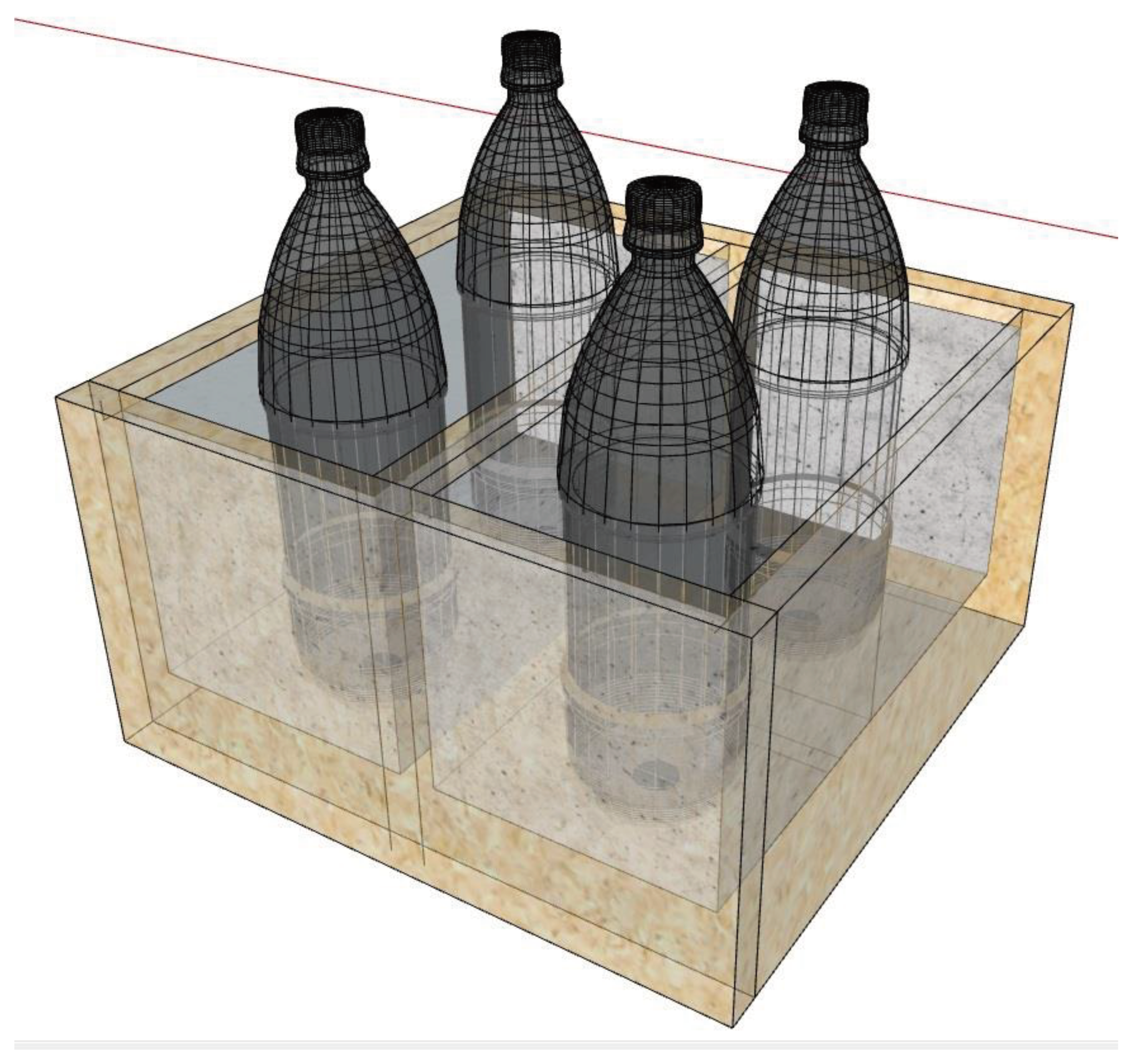
CAD (3D) drawing of axonometric perspective of the EcoBlock (transparency) with surface rendering in cement + SBR rubber and NURBS surfaces (meshes) of the PET bottles that expresses the central idea of the project; without energy consumption for firing, they are ecological self-construction blocks (material composed of cement + SBR rubber recycled from tires + holes made from PET bottles from the garbage used to fit the bricks together).
If the question can be posed as follows: How to achieve Ecological and Technological Development (sustainable or sustainable) combined with Social Development? In order to answer this question, a specific Theoretical Framework was required.26 27where the answer was born from the combination of multiple theories, namely: Schumacher (1973), Dickson (1978), Bonsiepe (1982), Max-Neef (1986), Papanek (1995) and Canale (2005) among others. authors.
Although the aforementioned authors come from different fields of study and approaches, it is possible to identify a common thread in their ideas: the importance of putting people and the environment at the center of economic, technological and design decisions.
Below is a list of the main ideas and an attempt to create a unified vision based on them:
- -
- Focus on the human scale:Both EF Schumacher and Manfred Max-Neef emphasize the importance of considering human needs and well-being in decision making. They advocate an economic and development approach that prioritizes people's quality of life over unlimited growth and unbridled consumption.
- -
- Technology and sustainability:Denis Dickson and Victor Papanek explore the relationship between technology and sustainability. Both defend the adoption of alternative and sustainable technologies that minimize environmental impact and promote a balance between technological progress and care for the environment.
- -
- Human-centered design:Gui Bonsiepe and Victor Papanek approach design from a human-centered perspective. Bonsiepe focuses on industrial design in Latin America and its relationship with local culture and economy, while Papanek highlights the importance of ethical and sustainable design that takes into account human needs and environmental impact.
- -
- Ethics and responsibility:Both Victor Papanek and EF Schumacher emphasize the importance of ethics and responsibility in design, economics and decision making. They advocate considering the social and environmental impacts of our actions and adopting a more conscious and ethical approach to development and design.
Overall, these authors share a concern for sustainability, human well-being, and ethics in design, economics, and development. They emphasize the need to adopt a more balanced and conscious approach that considers human needs, the preservation of the environment and the promotion of a satisfactory quality of life for all. The unified idea is the search for a comprehensive and responsible perspective that places people and the planet at the center of our actions and decisions, recognizing the interconnection and interdependence of all aspects of human life and its environment.
- -
- Focus on community participation:Considering the importance of involving local communities in the entire EcoBlocks implementation process. In addition to providing affordable housing, the project can be an opportunity to strengthen the participation and empowerment of low-income people. This involves including the community in decision-making, training in construction skills, and promoting self-construction. Community participation not only improves ownership and maintenance of housing, but also fosters a sense of belonging and social cohesion. Establish alliances and contacts, seeking collaborations with local organizations, NGOs, academic institutions, local governments or other entities interested in the construction of social housing. These alliances can help you obtain financial support, additional resources, and technical advice.
- -
- Training and empowerment:Organizing workshops and training to teach people with low job skills how to build homes using EcoBlocks. Encouraging community participation and promoting self-construction as a form of empowerment and self-sufficiency.
- -
- Encourage training and entrepreneurship:Consider how EcoBlocks can be a platform to promote training and skill development for low-income individuals. An employment opportunity, it could also encourage entrepreneurship and income generation through building sustainable homes for other communities.
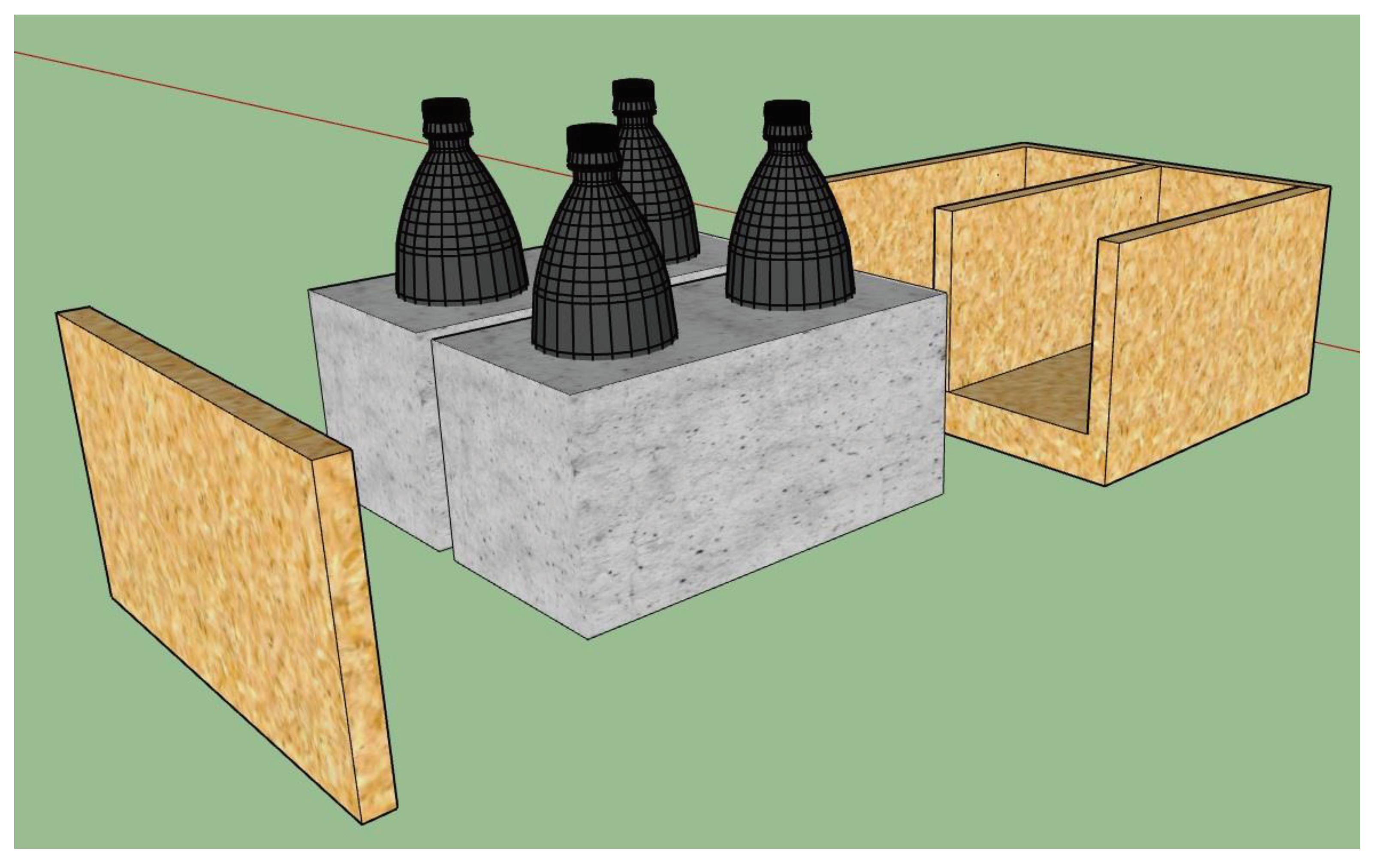
CAD (3D) drawing in isometric perspective of the disassembled wooden molds, to assemble two (2) self-construction Ecoblocks of cement mixture + recycled rubber from SBR tires + PET bottles.
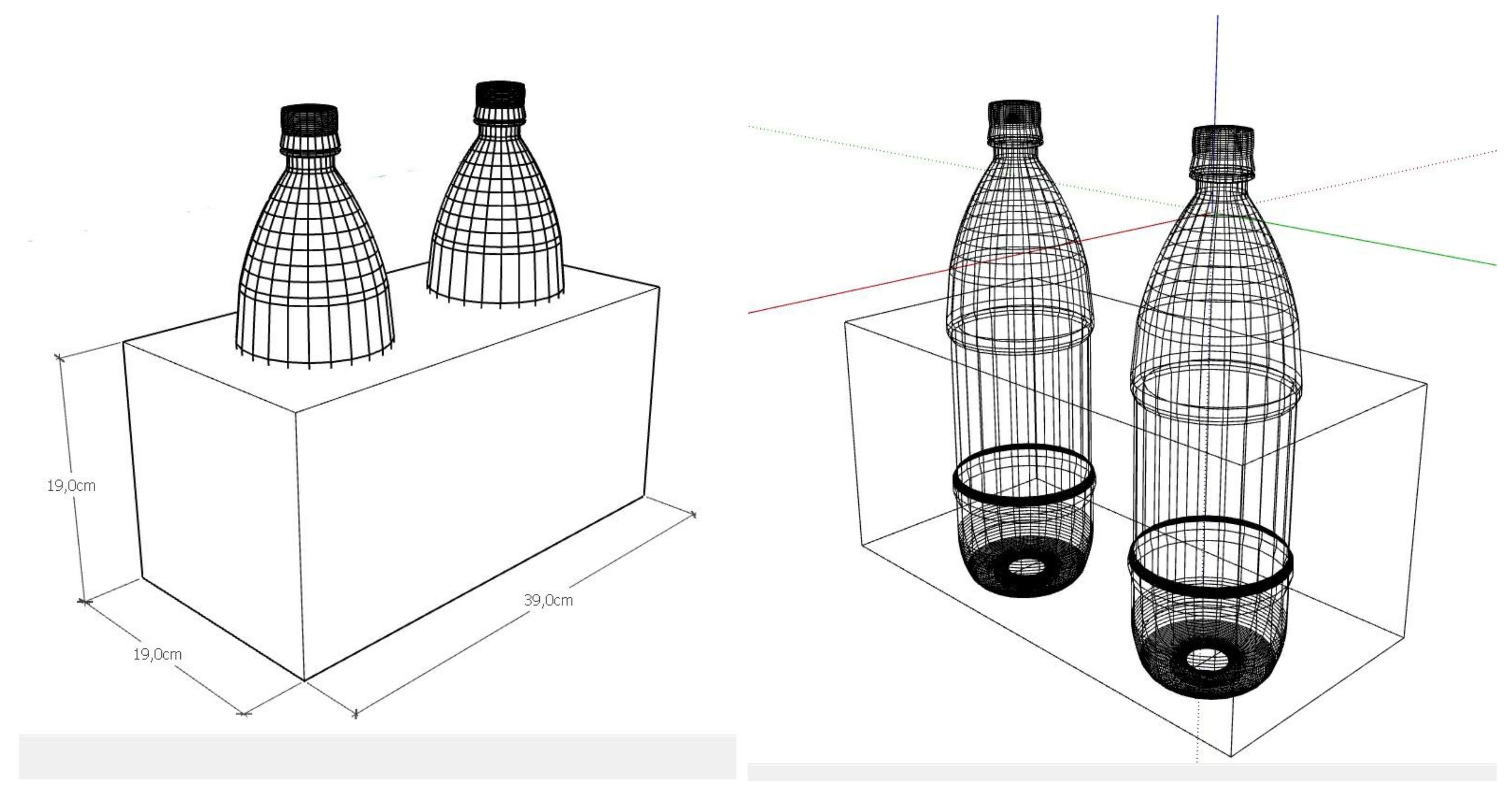
On the left, isometric perspective CAD (3D) drawing of the cement + SBR rubber EcoBlock with dimensions. On the right, isometric perspective drawing of the EcoBlock with transparency of the SBR rubber block and mesh lines (NURBS surfaces) of the PET bottles.
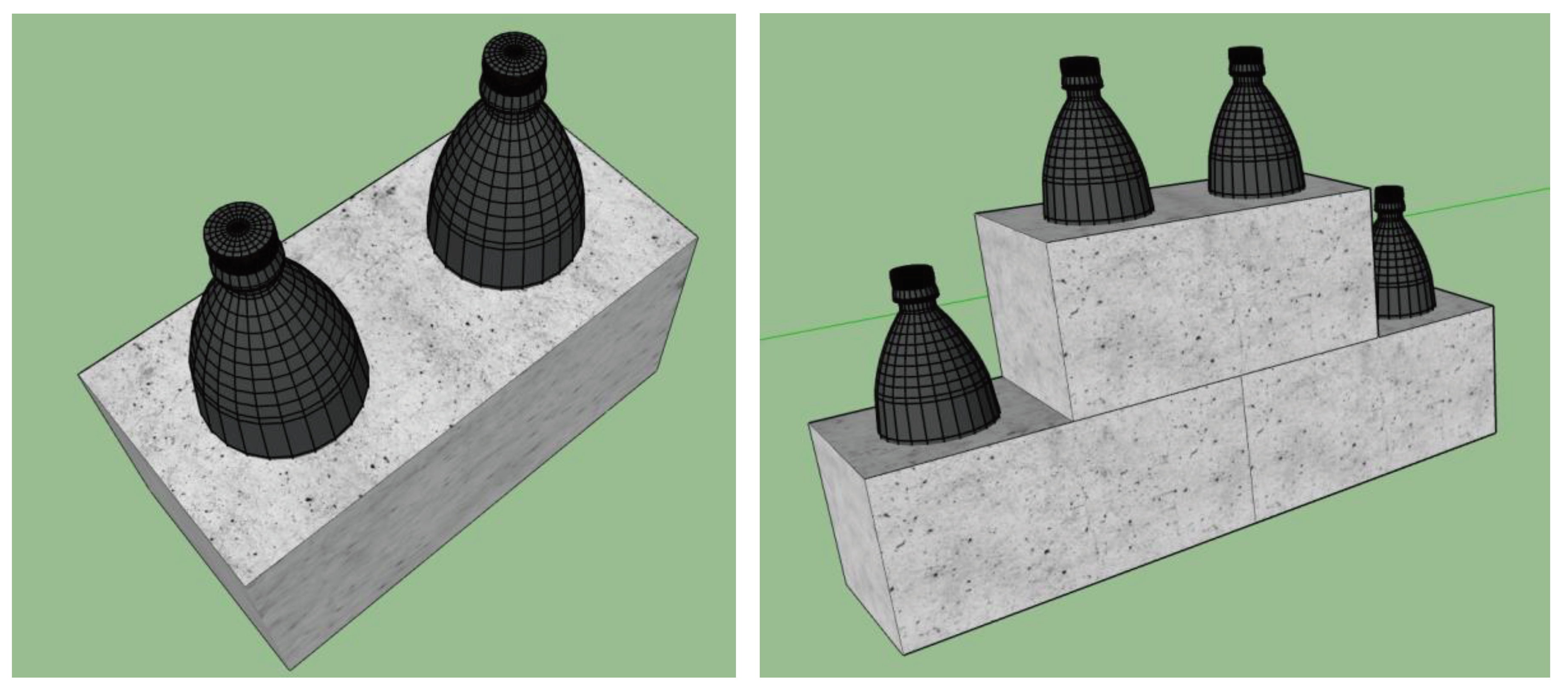
On the left, conical perspective CAD (3D) drawing of the EcoBlock with surface rendering in cement + SBR rubber and NURBS surfaces (meshes) of the PET bottles. On the right, dimetric perspective of three (3) embedded EcoBlocks.
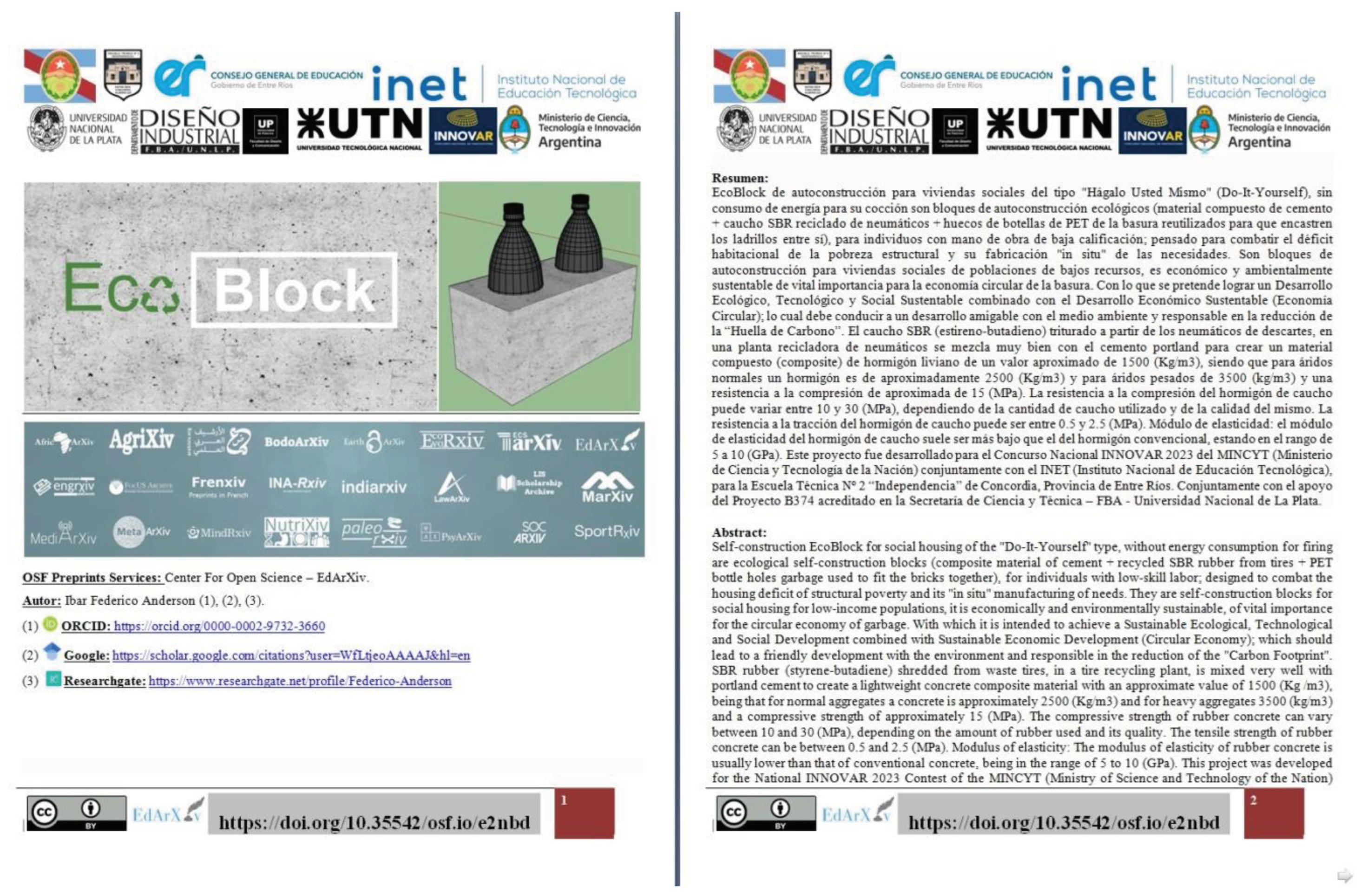
Case study No. 5: Relationships of all sciences with abductive thinking, creativity, design, art and the main relationships between Social Sciences (philosophy, logic, hermeneutic research methodology, etc.) with Exact and Natural Sciences (mathematics, physics, chemistry, biology, genetics), other sciences and disciplines such as engineering, medicine, etc
- Eighth, ninth and tenth international publications in Spanish:In the digital magazine ArtyHum No. 81 (August 2021), under the title “Abductive thinking and the use of artistic and design iconography in science. The methods of scientific thinking – inductive, hypothetico-deductive and abductive – and their relationships with analogies in research. Continuing in ArtyHum No. 83 (April 2022) under the title “Abductive thinking and the use of artistic and design iconography in the sciences (Part II). The abductive thinking method and its relationships with analogies in science research and the influences of artistic and design illustrations on scientific, theoretical and abstract models. To conclude ArtyHum No. 87 (August 2023) under the title “The use of artistic and design iconography in Sciences (Part III). Its historical application in Exact Sciences (Mathematics) and in Natural Sciences (Biology, Physics and Chemistry)”, the three (3) international publications were made in Spanish with ISSN: 2341-4898.
- As the summary says (Part I), stored in the Database (Institutional Repository of the National University of La Plata: SEDICI UNLP):Work that appeared in the digital magazine ArtyHum No. 81 (August 2021), under the title “Abductive thinking and the use of artistic and design iconography in science. The methods of scientific thinking – inductive, hypothetico-deductive and abductive – and their relationships with analogies in research. This work is part of my research within the research project accredited by the Secretariat of Science and Technology (SCyT) of the Faculty of Fine Arts (FBA), National University of La Plata (UNLP). Project Code B374-SCyT-FBA-UNLP, whose title is: «Integrated Design and Innovation Management. Contributions for a theoretical-conceptual and methodological review" by the Director: Dr. Industrial Designer Federico del Giorgio Solfa. This research presents a brief analysis of the three (3) methods of scientific thinking: (a) the inductive, (b) the hypothetico-deductive and (c) the abductive; to finish by relating it to the central method of research in Science: analogies. This article begins with a brief historical and particularized overview – also of examples – of some historical cases in which abductions, analogies and metaphors have illuminated Science and knowledge. As was the allegory of the Cave at the beginning of the VII book of the Republic (380 BC), made by the Greek philosopher Plato (427-347 BC) and The origin of species by means of natural selection (1859) by Charles Darwin (1809-1882), in biology. Other analogies are also studied, such as Henry Ford's assembly line (1862-1947) in the second phase of the Industrial Revolution and its implications with the Swift & Company's slaughterhouse and meat slaughtering in Cincinnati (Ohio, USA). At no time is it neglected that "abductive thinking" (basis for "design thinking") is strongly related to the use of analogies, metaphors and artistic and design iconography, which consolidate the explanatory theoretical models in Sciences. Finally, in the conclusions, we arrive at a brief table that summarizes these ideas about the method, the truth criterion, the demarcation criterion and their relationships with metaphysics – essential when understanding how to proceed methodologically – in: (1) the neopositivism of Carnap and the Vienna Circle, (2) the critical rationalism of Popper and (3) the other methods that bring together Lakatos, Pierce and Samaja. This last author takes the teachings of epistemologist Charles S. Peirce and abduction as a creative method to formulate hypotheses in Sciences, which are the basis of this article. For more information about the publication see the link left here28.
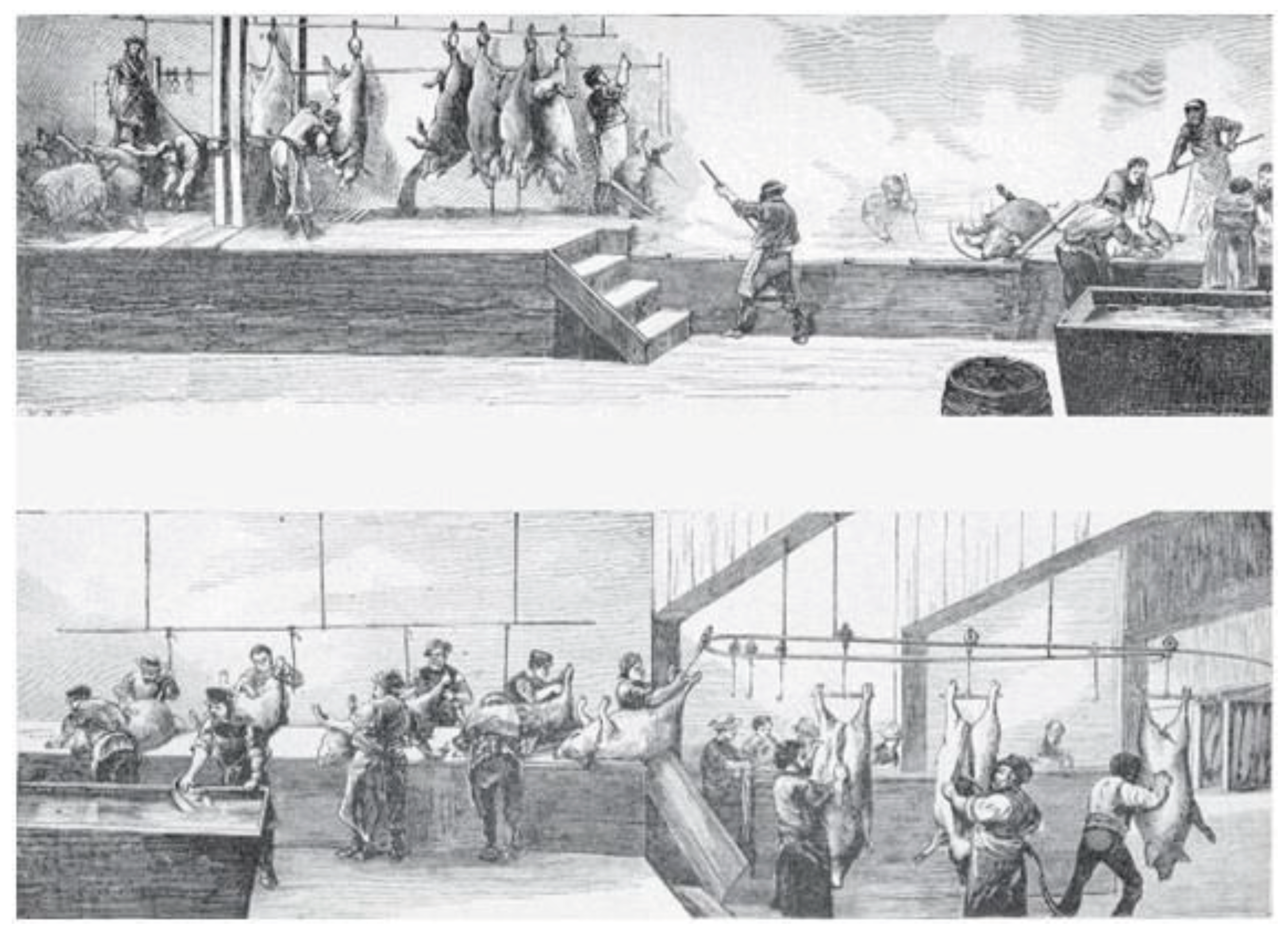
Image of the pork slaughterhouses in Cincinnati, Ohio (United States, engraving from 1880).
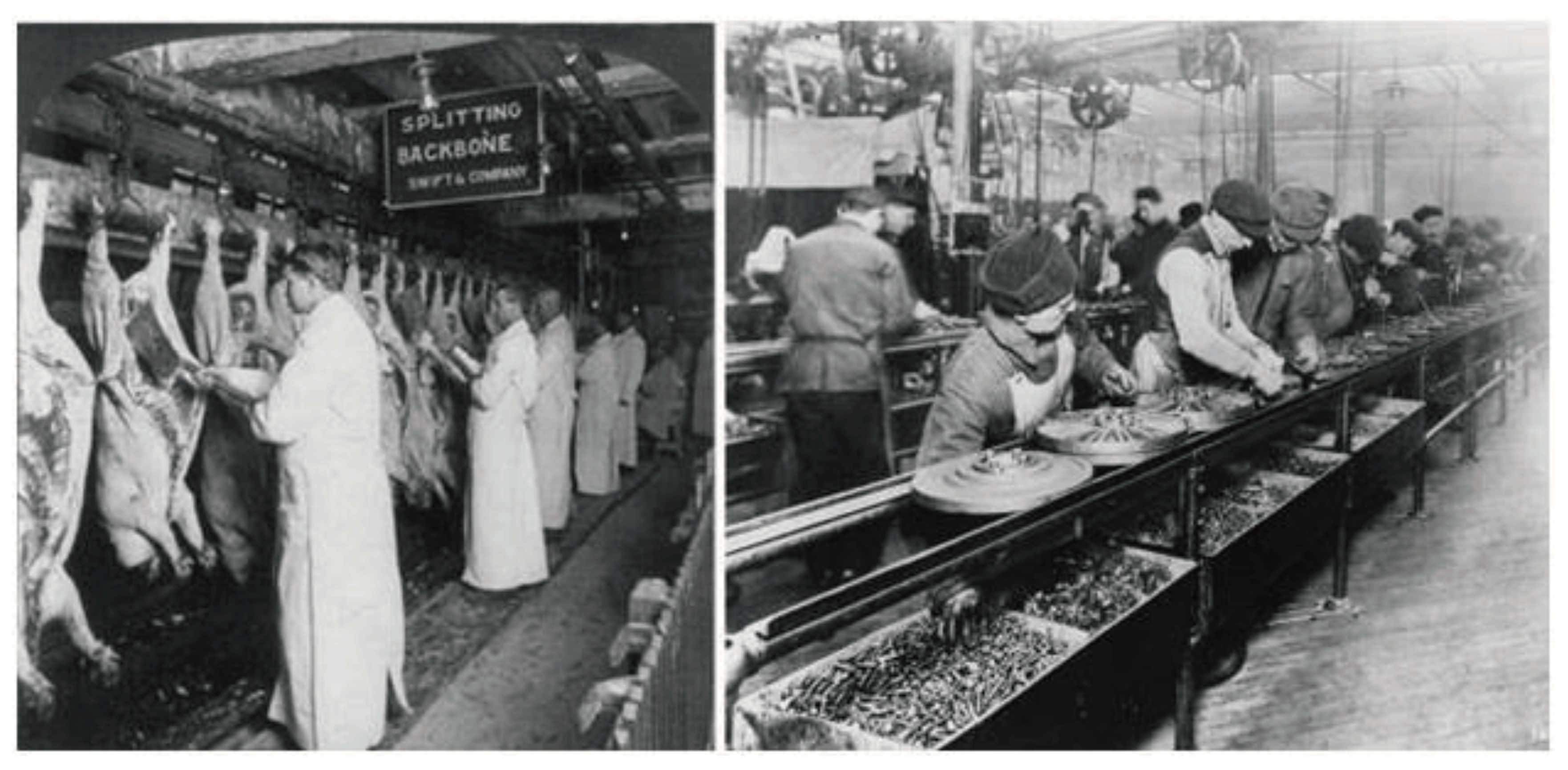
On the left, workers at the Chicago meatpacking factory. Demand for Ford cars was greater than they could be manufactured. William Klann was part of a team of advisors Ford sent to find a better means of production. Klann stumbled upon the Swift Meatpacking industry, located in Chicago, which was actually a disassembly line that they used to disassemble pigs and cows and that same system in reverse was the one that Ford used in its development of the moving assembly line for its Ford model "T". On the right, first Ford Assembly Line, 1913, dedicated to magnetos.
- As the summary says (Part II), stored in the Database (Institutional Repository of the National University of La Plata: SEDICI UNLP):This work appeared in the magazine ArtyHum No. 83 (April 2022) under the title “Abductive thinking and the use of artistic and design iconography in the sciences (Part II). The abductive thinking method and its relationships with analogies in science research and the influences of artistic and design illustrations on scientific, theoretical and abstract models. And it forms the continuation of the work published in the magazine ArtyHum No. 81 (April, 2022) under the title “Abductive thinking and the use of artistic and design iconography in science. The methods of scientific thinking - inductive, hypothetico-deductive and abductive - and their relationships with analogies in research. It is part of my research within the research project accredited by the Secretariat of Science and Technology (SCyT) of the Faculty of Fine Arts (FBA), National University of La Plata (UNLP). Project Code B374-SCyT-FBA-UNLP, whose title is: «Integrated Design and Innovation Management. Contributions for a theoretical-conceptual and methodological review" is headed by the Director: Mg. Industrial Designer Federico del Giorgio Solfa. The article proposes a continuation of the analysis of the abductive scientific thinking method (or analogical method); to finish by relating it to the design research method and the most modern forms of Design Thinking (analogical thinking). Here we propose a brief historical and particularized tour of the historical cases in which abductions and metaphors of Art have illuminated Science and knowledge; as it was in the cases of: (a) Dimitri Mendeleev (1834-1907) and the periodic table of the elements together with the chemical relationships of John Alexander Reina Newlands (1837-1898) with the musical octaves, (b) Niels Bohr (1885-1962) and his atomic model in analogy with the solar system in Physics, (c) Friedrich August Kekulé von Stradonitz (1829-1896) and Benzene in Chemistry with the Ouroboros, (d) Otto Loewi (1873-1961) and neurotransmitters in Biology and Medicine, (e) Frederick Grant Banting (1891-1941) and insulin in Medicine, (f) Jean-Louis-Rodolphe Agassiz (1807-1873) and the fossilized fish in Paleontology, (g) Elías Howe (1819-1867) and the sewing machine (a classic example of a problem that required an Industrial Design solution), (h) Oleg Antonov (1906-1984) and the Antei airplane in Aeronautical Engineering, (i) Srinivāsa Aiyangār Rāmānujan (1887-1920) and Mathematics, (j) René Descartes (1596-1650) and the Scientific Method (Cartesian) in Positive Philosophy, (k) Albert Einstein (1879-1955) and his theory of relativity in Physics. We will return to the conclusions with questions addressed in the first part of the article in the magazine ArtyHum No. 81. In such a way that we can historically equate the Social Science of Art to the levels of the Natural and Exact Sciences they possess, given that without the iconographic and symbolic component of the writing, These Sciences would not exist as such with their abstract component (a product of the complex process of Human Culture). For more information about the publication see the link left here29.
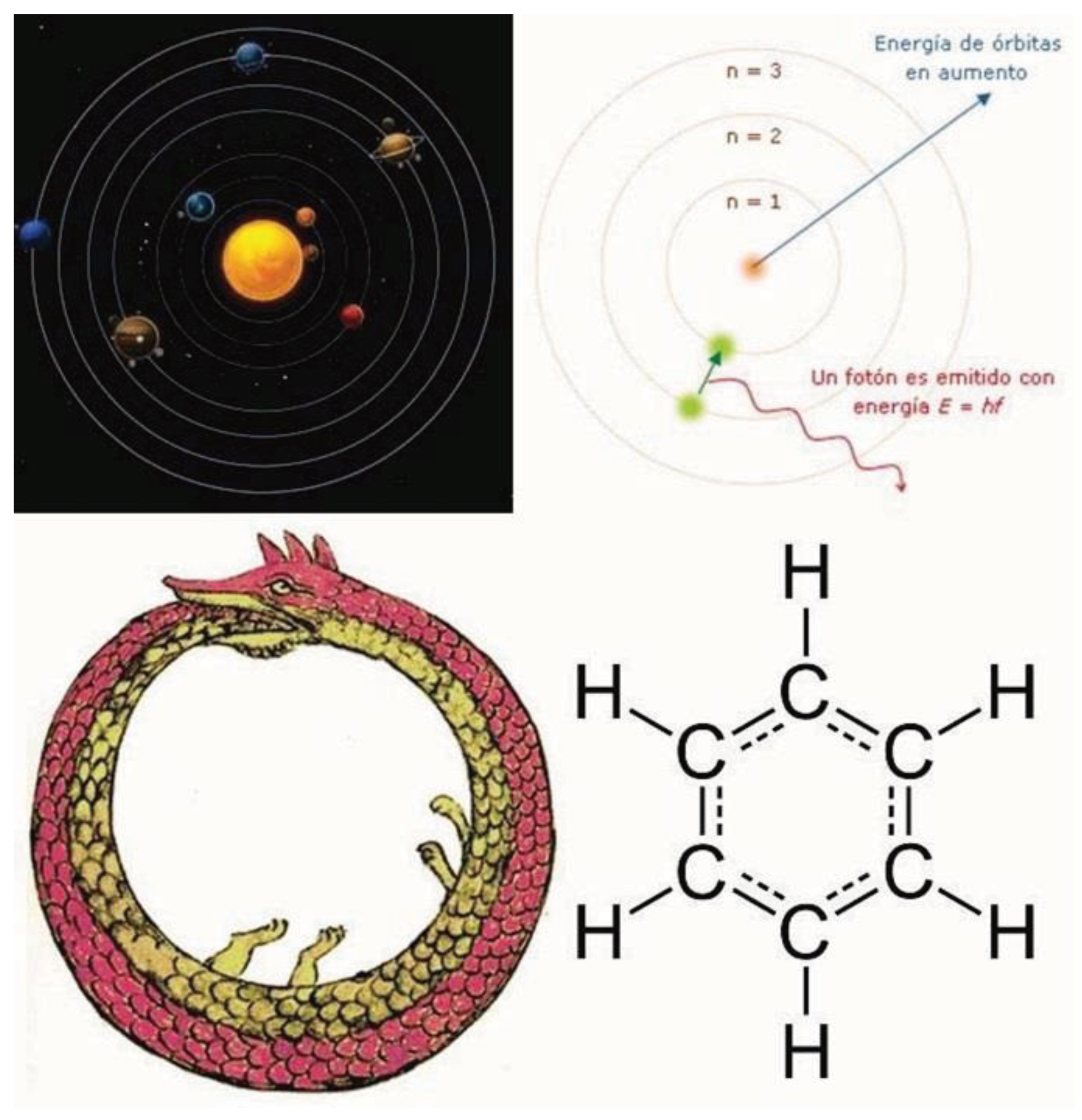
Top left image of the solar system. Above right image of Bohr's atomic model (analogous to a solar system), it is a classical model of the atom, but it was the first atomic model that is located between classical and quantum mechanics. It was proposed in 1913 by the Danish physicist Niels Bohr (1885-1962) to explain how electrons can have stable orbits around the nucleus and why atoms presented characteristic emission spectra (two problems that were ignored in Rutherford's previous model). In addition, Bohr's model incorporated ideas taken from the photoelectric effect, explained by Albert Einstein (1879-1955). Below left the Ouroboros or snake that eats its tail and forms a circle with its body. The chemist Friedrich August Kekulé von Stradonitz (1829-1896) dreamed of long lines of atoms moving like snakes and suddenly saw one of those snakes bite its own tail, the famous symbol of alchemy known as Ouroboros. Thus solving, in a dream, the mystery of the structure of the benzene ring so used today in chemistry. Below right the chemical structure of benzene: C6H6.
- As the summary says (Part III), stored in the Database (Institutional Repository of the National University of La Plata: SEDICI UNLP):This work appeared in ArtyHum magazine No. 87 (August 2023) under the title “The use of artistic and design iconography in Sciences (Part III). Its historical application in Exact Sciences (Mathematics) and in Natural Sciences (Biology, Physics and Chemistry)” and is the continuation of the article that appeared in ArtyHum No. 83 (April, 2022) under the title “Abductive thinking and the use of artistic and design iconographies in the sciences (Part II). The abductive thinking method and its relationships with analogies in science research and the influences of artistic and design illustrations on scientific, theoretical and abstract models. This work provides evidence – evidence – that maintains that the Exact Sciences (such as Mathematics) and Natural Sciences (such as Biology, Physics and Chemistry) would lack the methodological rigor that epistemologically bases them as such; without the necessary contribution of the Social Sciences (Art and Design), as will be demonstrated. This work demonstrates that without the iconographic component of writing (including abstract symbols and representations of theoretical models in concrete drawings), these Sciences would not exist as such with their powerful abstract and symbolic component. Well, in all the school texts in the world – from Schools of any initial, primary, secondary level and Teaching Institutions and Universities –, we have all seen in Science classes some of the images that are illustrated and epistemologically based here along with their formulas. and history that have impacted the entire world.
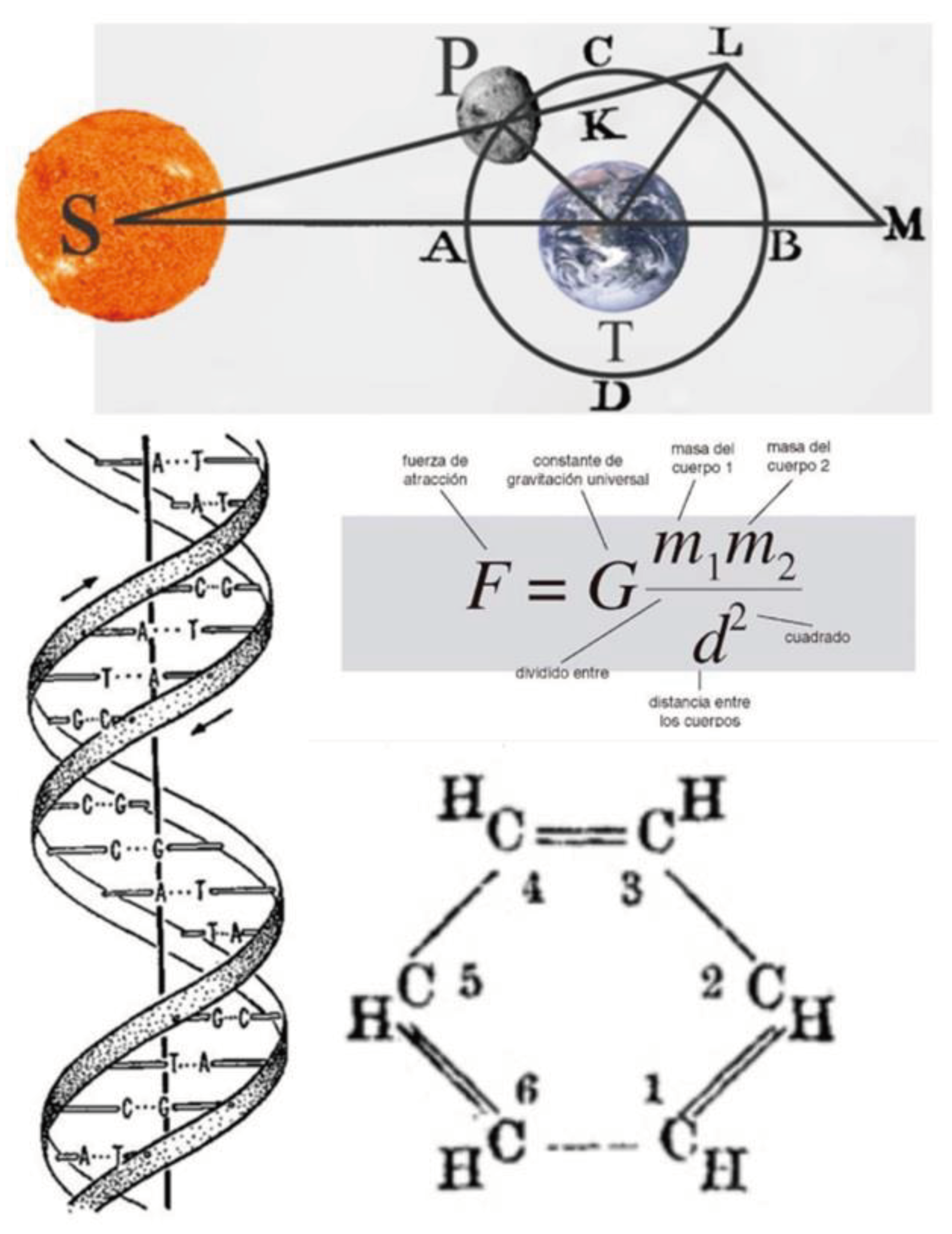
Illustrative composition based on the iconography of one of the most influential works of Physical Sciences by Isaac Newton in “Philosophiae Naturalis Principia Mathematica” (edition translated into English, year 1846) and its own assembly and composition against the formula of Gravity Universal. It is accompanied by the iconography of the structure of the DNA image from the article “Molecular Structure of Nucleic Acids: A Structure for Deoxyribose Nucleic Acid” by Watson, Francis Crick, published in 1953 in the journal Nature (of vital importance for the Sciences Biological). Expansion of the historical formula of benzene from the original publication of the article by August Kekulé, from 1872, entitled “Ueber einige Condensations producte des Aldehyds”. These images, visual representations – iconographic – are milestones in the World History of Sciences and elevate Art and Design to the status quo of an abstract, logical and symbolic complement to the exact physical-mathematical and Natural Sciences. For more information about the publication see the link left here30.
Conclusions
When the first Industrial Revolution occurred in England, which spanned approximately from the mid-18th century to the beginning of the 19th century, Prussia already existed as a political entity. Prussia was a state in northeastern Europe that played an important role in European and world history. It was a key player in later events, such as the Napoleonic Wars and the Congress of Vienna in 1815. Prussia therefore existed during the first Industrial Revolution in England.
Below is an informative table summarizing key aspects of the information provided on the evolution of technical and vocational education in the context of the industrial revolutions, with a special focus on Europe and the United States:
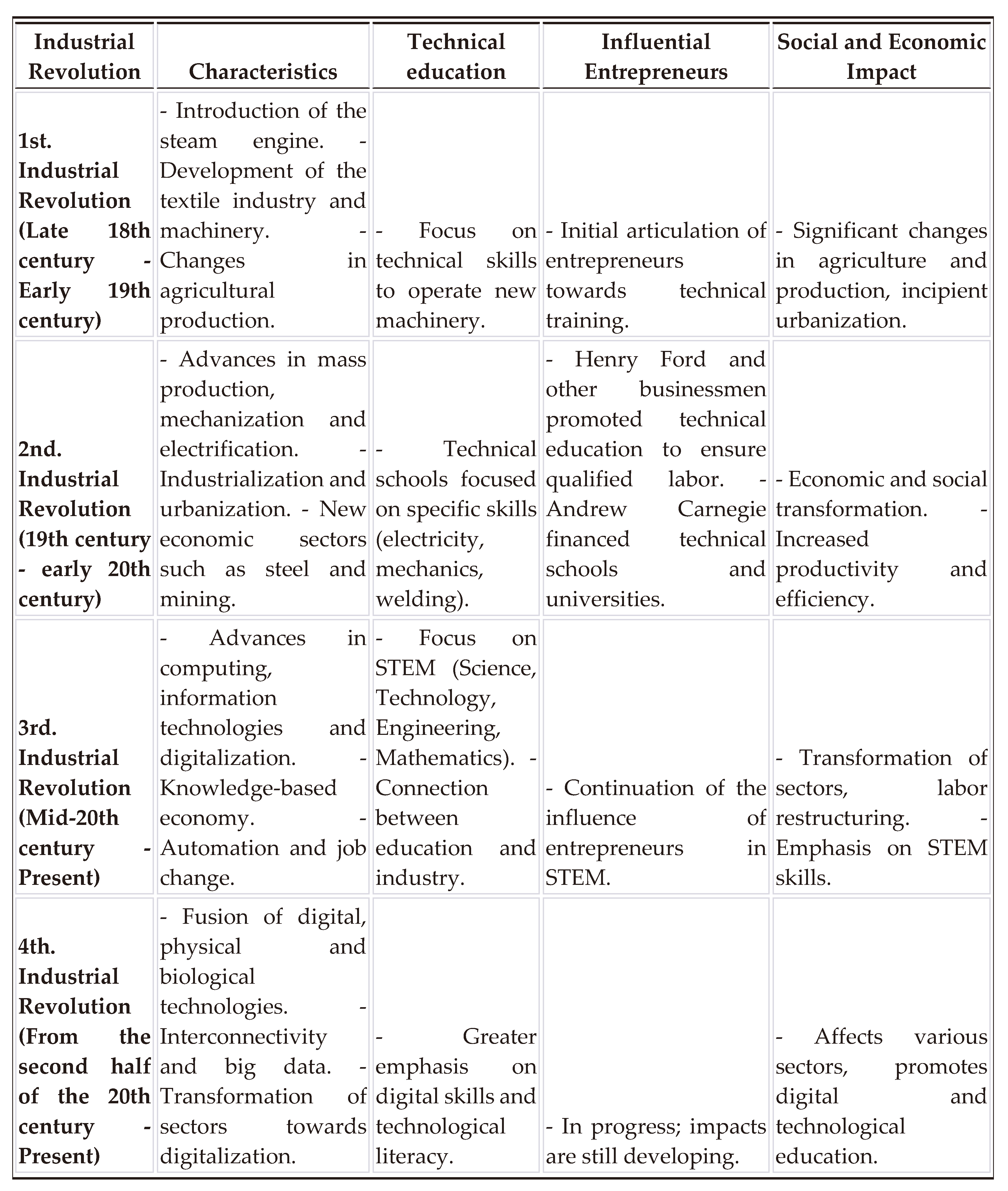
It should be noted that this table provides a general summary and that each industrial revolution had specific influences on education and society. Furthermore, the aforementioned businessmen played a crucial role in promoting technical and vocational education in their respective periods.
On the other hand, the relationship between Industry 2.0, 3.0 and 4.0 with education is fundamental to understand how industrial evolution has impacted educational approaches. Below are some important relationships and considerations:
- 1.
-
Industry 2.0:
- -
- Industry 2.0, which developed during the second phase of the Industrial Revolution, introduced significant advances in areas such as electricity, oil, steel, the automotive industry and mass production.
- -
- Relationship with Education: This production model introduced transformations that affected the educational system, promoting specialization and specific technical training to meet the demands of the industry at that time.
- 2.
-
Industry 3.0:
- -
- Industry 3.0 is characterized by advances in computing, information technologies and digitalization, as well as the transition towards an economy based on knowledge and automation.
- -
- Relationship with Education: Industry 3.0 has promoted a focus on STEM (Science, Technology, Engineering, Mathematics) in education, with a greater connection between education and industry.
- 3.
-
Industry 4.0:
- -
- Industry 4.0 is characterized by the convergence of digital, physical and biological technologies, interconnectivity and the use of big data, as well as the transformation of various sectors with advanced technologies.
- -
- Relationship with Education: Industry 4.0 has promoted the integration of advanced technologies in education, promoting disruptive creativity, innovation and adaptation to the changing demands of the industry.
In summary, each phase of the Industrial Revolution has influenced education by promoting technical specialization, integration and adaptation to the technological and labor demands of the moment. The evolution of industry has required education to adapt to prepare students for the challenges and opportunities of each industrial era.
What impact does Industry 4.0 have on the transversal teaching of industrial product models in national technical schools?
Industry 4.0 has had a significant impact on the transversal teaching of industrial product models in national technical schools. Some of the most relevant impacts include:
- Technology Integration: Industry 4.0 is characterized by digitalization, interconnectivity and the use of large amounts of data for decision making. In this context, technical schools have integrated advanced technologies into their educational programs, including the teaching of intelligent production systems, automation and data analysis.
- Focus on Disruptive Creativity: Industry 4.0 has promoted disruptive creativity in teaching industrial product models, encouraging innovation, advanced design and complex problem solving in a highly technological industrial environment.
- Adaptation to Industry Demands: Technical schools have had to adapt their curricula to reflect the changing demands of Industry 4.0, ensuring that students acquire skills relevant to advanced manufacturing, automation and data management in industrial environments.
- Transversal Teaching: The transversal teaching of industrial product models has incorporated interdisciplinary aspects, addressing the integration of technology, design, engineering and management in a modern industrial context.
In summary, Industry 4.0 has driven the evolution of teaching industrial product models in national technical schools, promoting technology integration, disruptive creativity and adaptation to the demands of modern industry. This transversal approach seeks to prepare students to perform in highly technological and automated industrial environments.
Below is an explanatory table that highlights the differences and similarities between Prussian education and technical education in the context of the industrial revolutions, considering the information provided. It is important to note that Prussian education and technical education during the industrial revolutions had different objectives and approaches, reflecting the needs and priorities of their respective historical contexts.
Table on Differences and Similarities:
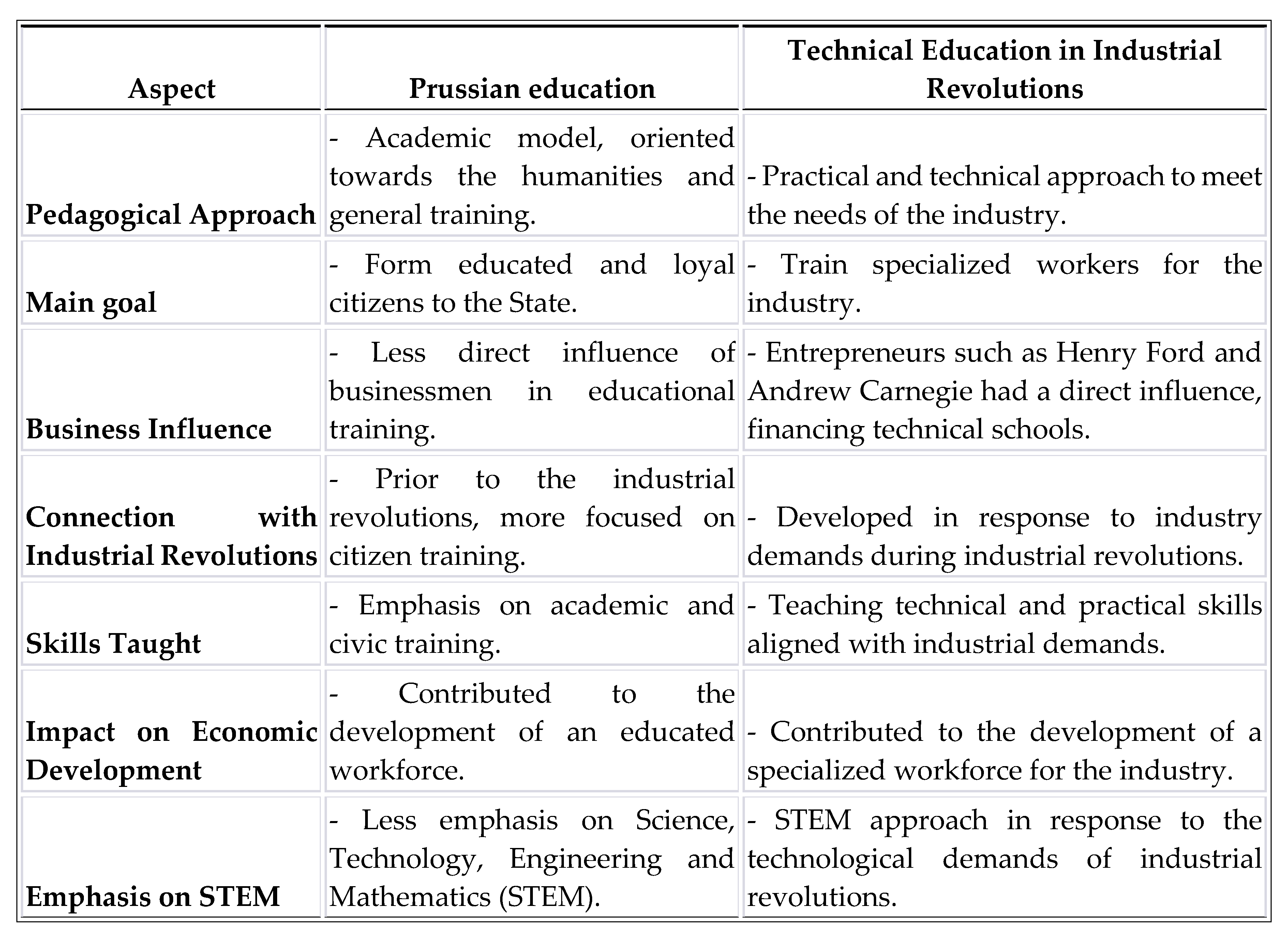
How has technical education in Latin America evolved over time, and what have been the main challenges it has faced?
Technical education in Latin America has undergone significant evolution over time, facing various challenges as it adapts to the changing demands of industry and the economy. Some relevant aspects of this evolution and the challenges faced include:
- 1.
-
Evolution of Technical Education:
- -
- Technical education has gone from being a secondary training option to a form of compulsory education in many Latin American countries.
- -
- There has been greater integration of technical education with general education, recognizing the importance of developing technical and technological skills in conjunction with a solid academic foundation.
- 2.
-
Challenges:
- -
- Access and Equity: One of the main challenges has been to guarantee equitable access to technical education for all students, regardless of their geographic location or socioeconomic condition.
- -
- Relevance and Update: Technical education has had to constantly adapt to technological advances and the changing needs of the industry, which has required a constant update of study plans and teaching methodologies.
- -
- Linkage with the World of Work: The effective connection between technical education and the world of work has been a challenge, since it is crucial that educational programs prepare students for the real demands of the labor market.
- 3.
-
Regulatory Framework:
- -
- The promulgation of specific laws and regulations, such as the National Education Law in Argentina (No. 26,206) and the Technical-Professional Education Law (No. 26,058), has sought to strengthen technical education and promote its articulation with the world of job.
In summary, technical education in Latin America has evolved to become an integral part of the educational system, facing challenges related to equitable access, curricular relevance and effective linkage with the world of work. Through regulatory frameworks and continuous updating efforts, technical education in the region seeks to prepare students to contribute to economic and social development.
National and Provincial Laws and Technical Education Resolutions consulted:
Consejo General de Educación (2008). Ley Provincial de Educación de Entre Ríos Nº 9890. Paraná: CGE [En línea]. Recuperado de http://www.cmariagualeguaychu.edu.ar/adjunto/resolucion_9890_ley_p rovincial_de_educacion.pdf
Consejo General de Educación (2005). Ley Provincial Nº 9673 de adhesión a la Ley de Educación Técnico Profesional. Paraná: AMET [En línea].
Recuperado de https://e67tabare.files.wordpress.com/2011/11/ley- 9673.pdf
Consejo General de Educación (2008). Lineamiento Preliminares para el diseño curricular de la modalidad. Educación Técnico Profesional. Resolución Nº 609/09. Ref. DETP 2008. Paraná: CGE [En línea]. Recuperado de https://e67tabare.files.wordpress.com/2011/11/resolucion-0609-11-cge-lineamientos-etp.pdf
Ministerio de Educación de la Nación (2006). Ley de Educación Nacional Nº 26206. Buenos Aires: CFE [En línea]. Recuperado de http://www.me.gov.ar/doc_pdf/ley_de_educ_nac.pdf
Ministerio de Educación de la Nación (2005). Ley de Educación Técnico Profesional Nº 26.058. Buenos Aires: INET [En línea]. Recuperado de http://www.inet.edu.ar/wp-content/uploads/2012/10/ley-26058.pdf
Piaget, (1964). Seis estudios de psicología. Barcelona: Editorial Labor[En línea]. Recuperado de http://dinterrondonia2010.pbworks.com/f/Jean_Piaget_-_Seis_estudios_de_Psicologia.pdf
| 1 | Anderson, I.F. (2021). Masks for covid-19 made by 3D printing at the Technical School No. 2 “Independencia”. Analysis of a case generated in TSE No. 2: face masks designed with CAD-STL software and printed in polylactic acid (PLA) with 3D printers, for protection from SARS-CoV-2 (Coronavirus). ArtyHum: Digital Magazine of Arts and Humanities, No. 82, 43-84. Handle: http://sedici.unlp.edu.ar/handle/10915/141734
|
| 2 | |
| 3 | |
| 4 | Anderson, I.F. (2021). Analysis of a case generated at Technical School No. 2: face masks designed in CAD-STL software and printed in polylactic acid (PLA) with 3D printers, for protection from SARS-CoV-2 or Covid-19 (Coronavirus). Academic Reflection in Design and Communication, year XXII, vol. 48, 77-87. Handle:http://sedici.unlp.edu.ar/handle/10915/142965 http://sedici.unlp.edu.ar/bitstream/handle/10915/142965/Documento_completo.pdf-PDFA.pdf?sequence=1&isAllowed=y |
| 5 | |
| 6 | Official website of the INNOVAR National Contest, dependent on the MINCYT (Ministry of Science and Technology of the Nation):https://www.innovar.mincyt.gob.ar/
|
| 7 | Official website of the National Agency for the Promotion of Research, Technological Development and Innovation (R&D&i Agency):https://www.argentina.gob.ar/ciencia/agencia
|
| 8 | Official news channel –www.argentina.gob.ar- where the information on the 16th was communicated. Awards ceremony edition of the INNOVAR 2021 National Competition, dependent on the MINCYT (Ministry of Science and Technology of the Nation):https://www.argentina.gob.ar/noticias/se-distinguieron-los-proyectos-ganadores-de-la-decimosexta-edicion-del-concurso-innovar
|
| 9 | Anderson, I.F. (2021). “Project: ID 2021-21751 Turbo: air extractor/blower for environments contaminated by COVID-19", in the National INNOVAR Competition, 16th Edition of the MINCYT (Ministry of Science, Technology and Productive Innovation of the Nation) and the Information Agency +D+i (National Agency for the Promotion of Research, Technological Development and Innovation. Buenos Aires. MINCYT + ANPCYT. Online:https://www.innovar.mincyt.gob.ar/docs/INNOVAR_ganadores_2021.pdf
|
| 10 | Anderson, I. F. (2023). Energy efficient centrifugal air extractor for environments contaminated with SARS-CoV-2 (Coronavirus). Innovation and Technological and Social Development, (4), 20-67. DOI:https://doi.org/10.24215/26838559e032. Handle:http://sedici.unlp.edu.ar/handle/10915/150657
|
| 11 | |
| 12 | Anderson, I. F. (2022). 1st National INNOVAR 2021 Award from the National R&D&I Agency – MINCYT Nation: centrifugal air extractor, for environments contaminated with SARS-CoV-2, with high energy efficiency. 10th Research Conference on Artistic and Project Disciplines (JIDAP) of the FBA-UNLP. Handle:http://sedici.unlp.edu.ar/handle/10915/148463
|
| 13 | |
| 14 | Anderson, I. F. (2023). Centrifugal air extractor that reduces the carbon footprint. Notebooks, 193, 31-46. Online:https://fido.palermo.edu/servicios_dyc/publicacionesdc/cuadernos/detalle_articulo.php?id_libro=1033&id_articulo=19856Handle:http://sedici.unlp.edu.ar/handle/10915/154308
|
| 15 | |
| 16 | Anderson, I. F. (2022). Industrial and electromechanical design of a highly energy efficient centrifugal air extractor for environments with Covid-19. TECSUP (R&I) Applied research and innovation, 16, 44-57. Handle:http://sedici.unlp.edu.ar/handle/10915/147583
|
| 17 | |
| 18 | Anderson, I. F. (2023). An Innovative Method to Increase Energy Efficiency of PMSM-Type Synchronous Motors. IUP Journal of Electrical and Electronics Engineering, 16, (1), 7-35. Handle:http://sedici.unlp.edu.ar/handle/10915/150750
|
| 19 | |
| 20 | Anderson, I. F. (2022). Energy Efficient Centrifugal Air Extractor for Environments Contaminated With Sars-Cov-2 (Coronavirus). How to Build a Motor That Saves Electricity. Preprints, 1-31. DOI:https://doi.org/10.31219/osf.io/gepbc. Handle:http://sedici.unlp.edu.ar/handle/10915/145958
|
| 21 | |
| 22 | Anderson, I. F. (2022). Hertzian motor: An innovative method to obtain an energy efficiency of 90%, in savings in single-phase active energy (kwh), if the “Fan Law” is applied to PMSM-type synchronous motors without the need to apply the use of Variable Frequency Drives (VFD). OSFpreprints, 1-53. DOI:https://osf.io/e7cv8. Handle:http://sedici.unlp.edu.ar/handle/10915/147431
|
| 23 | |
| 24 | Anderson, I. F. (2023). Review of the Literature Referring to a Method to Achieve Active Electrical Energy Savings -Single-Phase 220 (VAC) and 50 (Hz) -in Synchronous Ventilation Motors, Greater than that Obtained with the "Fan Law". Journal of Sensor Networks and Data Communications. DOI:https://doi.org/10.33140/JSNDC.03.01.11Handle:https://sedici.unlp.edu.ar/handle/10915/161060 https://sedici.unlp.edu.ar/bitstream/handle/10915/161060/Documento_completo.pdf-PDFA.pdf?sequence=1&isAllowed=y |
| 25 | Official website of the INNOVAR National Contest, dependent on the MINCYT (Ministry of Science and Technology of the Nation):https://www.innovar.mincyt.gob.ar/
|
| 26 | |
| 27 | Anderson, I. F. (2023). ROBOT-T2: Educational Robot Made by Students and Teachers of the Technical School No. 2 (EET No. 2) “Independencia”, Concordia, Entre Ríos. EdArXiv Preprints, 1-50. DOI:https://edarxiv.org/ymd2r. Handle:http://sedici.unlp.edu.ar/handle/10915/152697
|
| 28 | |
| 29 | Official website of the INNOVAR National Contest, dependent on the MINCYT (Ministry of Science and Technology of the Nation):https://www.innovar.mincyt.gob.ar/
|
| 30 | Official website of the National Agency for the Promotion of Research, Technological Development and Innovation (R&D&i Agency):https://www.argentina.gob.ar/ciencia/agencia
|
| 31 | Official website of the National Institute of Industrial Technology (INTI):https://www.argentina.gob.ar/inti
|
| 32 | Official website of the National Institute of Agricultural Technology (INTA):https://www.argentina.gob.ar/inta
|
| 33 | Official website of the National Institute of Technological Education (INET):https://www.inet.edu.ar/
|
| 34 | Source INET (National Institute of Technological Education)https://www.inet.edu.ar/index.php/el-ministerio-de-ciencia-junto-al-inet-inti-e-inta-promueven-la-participacion-de-escuelas-tecnicas-y- agrotechniques-in-innovate/ |
| 35 | Official information from the website –www.argentina.bob.ar-:https://www.argentina.gob.ar/noticias/se-lanza-una-nueva-edicion-de-innovar-que-premiara-proyectos-de-impacto-social-y-comercial
|
| 36 | Anderson, I. F. (2023). Self-construction EcoBlock, for social housing. EdArXiv Preprints, 1-46. DOI:https://edarxiv.org/e2nbd/. Handle:http://sedici.unlp.edu.ar/handle/10915/153895 http://sedici.unlp.edu.ar/bitstream/handle/10915/153895/Documento_completo.pdf-PDFA.pdf?sequence=1&isAllowed=y |
| 37 | Anderson, I. F. (2006). “How to do Industrial Design in cities, towns and deindustrialized or non-industrialized regions of Argentina?” Design Proceedings, (2), 34-38. Online:https://dspace.palermo.edu/ojs/index.php/actas/article/view/3361/3447
|
| 38 | Anderson, I. F. (2009). “Hybrid Technologies and Ecodesign.” Design Proceedings, (7), 43-45. Online:https://fido.palermo.edu/servicios_dyc/publicacionesdc/actas_de_diseno/detalle_articulo.php?id_libro=16&id_articulo=5863Handle:http://sedici.unlp.edu.ar/handle/10915/142558 http://sedici.unlp.edu.ar/bitstream/handle/10915/142558/Documento_completo.pdf-PDFA.pdf?sequence=1&isAllowed=y |
| 39 | Anderson, I.F. (2021). “Abductive thinking and the use of artistic and design iconography in the sciences.”ArtyHum: Digital Magazine of Arts and Humanities, 81, pp. 46-97. Handle:http://sedici.unlp.edu.ar/handle/10915/141081
|
| 40 | |
| 41 | Anderson, I.F. (2021). Abductive thinking and the use of artistic and design iconography in the sciences (Part 2). ArtyHum: Digital Journal of Arts and Humanities, 83, 122-171. Handle: http://sedici.unlp.edu.ar/handle/10915/141170
|
| 42 | |
| 43 | Anderson, I. F. (2023). “The use of artistic and design iconography in Sciences (Part III). Its historical application in Exact Sciences (Mathematics) and in Natural Sciences (Biology, Physics and Chemistry)”. ArtyHum: Digital Magazine of Arts and Humanities,No. 87, pp. Handle: |
References
- Anderson, I. F. (2006). “¿Cómo hacer Diseño Industrial en ciudades, localidades y regiones desindustrializadas o no-industrializadas de la Argentina?”. Actas de Diseño, (2), 34-38. En línea: https://dspace.palermo.edu/ojs/index.php/actas/article/view/3361/3447.
- Anderson, I. F. (2009). “Tecnologías Híbridas y Ecodiseño”. Actas de Diseño, (7), 43-45. En línea: https://fido.palermo.edu/servicios_dyc/publicacionesdc/actas_de_diseno/detalle_articulo.php?id_libro=16&id_articulo=5863.
- Anderson, I. F (2019). “Mejoras de eficiencia energética (EE) en los motores monofásicos sincrónicos de 220 (VAC)/50 (Hz), tipo PMSM”. Revista UIS Ingenierías, vol. 18 (4), pp. 57-70. En línea: https://revistas.uis.edu.co/index.php/revistauisingenierias/article/view/9300/9869. [CrossRef]
- 4. Anderson, I. F. (2019). “Eco-turbina. Turbo ventilador eléctrico 220 (VAC)–50 (Hz), de bajo consumo: eficiente energéticamente”. Innovación y Desarrollo Tecnológico y Social, vol. 1 (1), pp. 1-28. En línea: https://revistas.unlp.edu.ar/IDTS/article/view/6270/7812. [CrossRef]
- Anderson, I. F. (2020). Alicia a Través de las Puertas, los Espejos y las Ventanas. ArtyHum: Revista Digital de Artes y Humanidades, (69), 8-41. Handle: http://sedici.unlp.edu.ar/handle/10915/141523 http://sedici.unlp.edu.ar/bitstream/handle/10915/141523/Documento_completo.pdf-PDFA.pdf?sequence=1&isAllowed=y En línea: https://www.artyhum.com/revista/69/#p=8.
- Anderson, I. F. (2020). Breve historia occidental del diseño de muebles (Parte 1). ArtyHum: Revista Digital de Artes y Humanidades, (71), 61-114. Handle: http://sedici.unlp.edu.ar/handle/10915/141300 http://sedici.unlp.edu.ar/bitstream/handle/10915/141300/Documento_completo.pdf-PDFA.pdf?sequence=1&isAllowed=y En línea: https://www.artyhum.com/revista/71/#p=58.
- Anderson, I. F. (2020). La civilizada arquitectura europea y sus vínculos con el hábitat doméstico latinoamericano. ArtyHum: Revista Digital de Artes y Humanidades, (73), 8-63. Handle: http://sedici.unlp.edu.ar/handle/10915/141413 http://sedici.unlp.edu.ar/bitstream/handle/10915/141413/Documento_completo.pdf-PDFA.pdf?sequence=1&isAllowed=y En línea: https://www.artyhum.com/revista/73/ArtyHum%2073%20%20.html#p=8.
- Anderson, I. F. (2020). Breve historia occidental del diseño de muebles (parte 2). ArtyHum: Revista Digital de Artes y Humanidades, (74), 61-114. Handle: http://sedici.unlp.edu.ar/handle/10915/141346 http://sedici.unlp.edu.ar/bitstream/handle/10915/141346/Documento_completo.pdf-PDFA.pdf?sequence=1&isAllowed=y En línea: https://www.artyhum.com/revista/74/#p=62.
- Anderson, I. F. (2020). Teorema de lo bello (Parte IV). ArtyHum: Revista Digital de Artes y Humanidades, (75), 28-62. Handle: http://sedici.unlp.edu.ar/handle/10915/141037 http://sedici.unlp.edu.ar/bitstream/handle/10915/141037/Documento_completo.pdf-PDFA.pdf?sequence=1&isAllowed=y En línea: https://www.artyhum.com/revista/75/#p=29.
- Anderson, I. F. (2020). La estética de las máquinas de la Belle Époque europea y sus influencias culturales en Latinoamérica. ArtyHum: Revista Digital de Artes y Humanidades, (77), 65-106. Handle: http://sedici.unlp.edu.ar/handle/10915/141467 http://sedici.unlp.edu.ar/bitstream/handle/10915/141467/Documento_completo.pdf-PDFA.pdf?sequence=1&isAllowed=y En línea: https://www.artyhum.com/revista/77/#p=66.
- Anderson, I. F., Argüero, Á. J. A., Dorochesi Fernandois, M., Agrelo, P. J., Alfano, A. C., Bischoff, L. C. & Del Giorgio Solfa, F. (Dir.) (2020). Gestión integrada de diseño e innovación. Handle: http://sedici.unlp.edu.ar/handle/10915/125244.
- http://sedici.unlp.edu.ar/bitstream/handle/10915/125244/Documento_completo.pdf?sequence=1&isAllowed=y.
- Anderson, I. F. (2021). Máscaras para covid-19 hechas por impresión 3d en la Escuela Técnica Nº 2 “Independencia”. ArtyHum: Revista Digital de Artes y Humanidades, (82), 43-84. Handle: http://sedici.unlp.edu.ar/handle/10915/141734 http://sedici.unlp.edu.ar/bitstream/handle/10915/141734/Documento_completo.pdf-PDFA.pdf?sequence=1&isAllowed=y En línea: https://www.artyhum.com/revista/82/#p=44.
- Anderson, I. F. (2021). Análisis de un caso generado en la Escuela Técnica N° 2: máscaras faciales diseñadas en software CAD-STL e impresas en poliácido láctico (PLA) con impresoras 3D, para protección del SARS-CoV-2 o Covid-19 (Coronavirus). Reflexión Académica en Diseño y Comunicación, año XXII, vol. 48, 77-87. Handle: http://sedici.unlp.edu.ar/handle/10915/142965 http://sedici.unlp.edu.ar/bitstream/handle/10915/142965/Documento_completo.pdf-PDFA.pdf?sequence=1&isAllowed=y En línea: https://fido.palermo.edu/servicios_dyc/publicacionesdc/vista/detalle_articulo.php?id_libro=887&id_articulo=17861.
- Anderson, I. F. (2021). “Proyecto: ID 2021-21751 Turbo: extractor/soplador de aire de ambientes viciados de COVID-19", en Concurso Nacional INNOVAR, 16º Edición del MINCYT (Ministerio de Ciencia, Tecnología e Innovación Productiva de la Nación) y la Agencia de I+D+i (Agencia Nacional de Promoción de la Investigación, el Desarrollo Tecnológico y la Innovación. Buenos Aires. MINCYT + ANPCYT. En línea: https://www.innovar.mincyt.gob.ar/docs/INNOVAR_ganadores_2021.pdf.
- Anderson, I. F. (2021). El pensamiento abductivo y el uso de iconografías artísticas y de diseño en las ciencias. ArtyHum: Revista Digital de Artes y Humanidades, (81), 46-97. Handle: http://sedici.unlp.edu.ar/handle/10915/141081 http://sedici.unlp.edu.ar/bitstream/handle/10915/141081/Documento_completo.pdf-PDFA.pdf?sequence=1&isAllowed=y En línea: https://www.artyhum.com/revista/81/#p=46.
- Anderson, I. F. (2021). El pensamiento abductivo y el uso de iconografías artísticas y de diseño en las ciencias (parte 2). ArtyHum: Revista Digital de Artes y Humanidades, (83), 122-171. Handle: http://sedici.unlp.edu.ar/handle/10915/141170 http://sedici.unlp.edu.ar/bitstream/handle/10915/141170/Documento_completo.pdf-PDFA.pdf?sequence=1&isAllowed=y En línea: https://www.artyhum.com/revista/83/#p=122.
- Anderson, I. F. (2021). Turbo: energy efficient air blower. Academia Letters, Article 2161. https://doi.org/10.20935/AL2161 Handle: http://sedici.unlp.edu.ar/handle/10915/148031 http://sedici.unlp.edu.ar/bitstream/handle/10915/148031/Documento_completo.pdf-PDFA.pdf?sequence=1&isAllowed=y.
- Anderson, I. F. (2022). El pensamiento abductivo en el Design Thinking. Actas de Diseño, (41), 45-48. Handle: http://sedici.unlp.edu.ar/handle/10915/147254 http://sedici.unlp.edu.ar/bitstream/handle/10915/147254/Documento_completo.pdf-PDFA.pdf?sequence=1&isAllowed=y En línea: https://fido.palermo.edu/servicios_dyc/publicacionesdc/actas_de_diseno/detalle_articulo.php?id_libro=992&id_articulo=19228.
- Anderson, I. F. (2022). 1º Premio Nacional INNOVAR 2021 de la Agencia Nacional I+D+I – MINCYT Nación: extractor de aire centrífugo, para ambientes contaminados con SARS-CoV-2, de alta eficiencia energética. X Jornadas de Investigación en Disciplinas Artísticas y Proyectuales (JIDAP) de la FBA-UNLP. Handle: http://sedici.unlp.edu.ar/handle/10915/148463 http://sedici.unlp.edu.ar/bitstream/handle/10915/148463/Documento_completo.-ANDERSON.pdf-PDFA.pdf?sequence=1&isAllowed=y.
- Anderson, I. F. (2022). Diseño industrial y electromecánico de un extractor de aire centrífugo de alta eficiencia energética para ambientes con Covid-19. TECSUP (I+i) Investigación aplicada e innovación, 16, 44-57. Handle: http://sedici.unlp.edu.ar/handle/10915/147583 http://sedici.unlp.edu.ar/bitstream/handle/10915/147583/Documento_completo.pdf-PDFA.pdf?sequence=1&isAllowed=y En línea: https://drive.google.com/file/d/1a0by2eh0_hbXnZvFl-5-IBzYD_sjonOC/view.
- Anderson, I, F. (2022). El pensamiento abductivo y el uso de iconografías artísticas y de diseño en las ciencias (Parte II). ArtyHum Revista de Artes y Humanidades, 83. Handle: http://sedici.unlp.edu.ar/handle/10915/141170 http://sedici.unlp.edu.ar/bitstream/handle/10915/141170/Documento_completo.pdf-PDFA.pdf?sequence=1&isAllowed=y En línea: https://www.artyhum.com/revista/83/#p=122.
- Anderson, I. F. (2022). Energy Efficient Centrifugal Air Extractor for Environments Contaminated With Sars-Cov-2 (Coronavirus). How to Build a Motor That Saves Electricity. Preprints, 1-31. https://doi.org/10.31219/osf.io/gepbc. Handle: http://sedici.unlp.edu.ar/handle/10915/145958 http://sedici.unlp.edu.ar/bitstream/handle/10915/145958/Preprint.v1.pdf-PDFA.pdf?sequence=1&isAllowed=y.
- Anderson, I. F. (2022). Hertzian motor: An innovative method to obtain an energy efficiency of 90%, in savings in single-phase active energy (kwh), if the “Fan Law” is applied to PMSM-type synchronous motors without the need to apply the use of Variable Frequency Drives (VFD). OSFpreprints, 1-53. https://osf.io/e7cv8. Handle: http://sedici.unlp.edu.ar/handle/10915/147431 http://sedici.unlp.edu.ar/bitstream/handle/10915/147431/Documento_completo.pdf-PDFA.pdf?sequence=1&isAllowed=y.
- Anderson, I. F. (2023). Review of a method to achieve active single-phase energy savings in synchronous electric ventilation motors greater than that obtained with the 'Fan Law'. Academia Letters, Article 2161. Handle: http://sedici.unlp.edu.ar/handle/10915/158448 http://sedici.unlp.edu.ar/bitstream/handle/10915/158448/Documento_completo.pdf-PDFA.pdf?sequence=1&isAllowed=y.
- Anderson, I. F. (2023). An Innovative Method to Increase Energy Efficiency of PMSM-Type Synchronous Motors. IUP Journal of Electrical and Electronics Engineering, 16, (1), 7-35. Handle: http://sedici.unlp.edu.ar/handle/10915/150750 http://sedici.unlp.edu.ar/bitstream/handle/10915/150750/Documento_completo.pdf?sequence=1&isAllowed=y.
- Anderson, I. F. (2023). ROBOT-T2: Robot Educativo Realizado por Alumnos y Profesores de la Escuela Técnica Nº 2 (E.E.T. Nº 2) “Independencia”, Concordia, Entre Ríos. EdArXiv Preprints, 1-50. https://edarxiv.org/ymd2r. Handle: http://sedici.unlp.edu.ar/handle/10915/152697.
- Anderson, I. F. (2023). Extractor de aire centrífugo energéticamente eficiente para ambientes contaminados con SARS-CoV-2 (Coronavirus). Innovación Y Desarrollo Tecnológico Y Social, (4), 20-67. Handle: http://sedici.unlp.edu.ar/handle/10915/150657 http://sedici.unlp.edu.ar/bitstream/handle/10915/150657/Documento_completo.pdf-PDFA.pdf?sequence=1&isAllowed=y En línea: https://revistas.unlp.edu.ar/IDTS/article/view/13271. [CrossRef]
- Anderson, I. F. (2023). EcoBlock de autoconstrucción, para viviendas sociales. EdArXiv Preprints, 1-46. https://edarxiv.org/e2nbd/. Handle: http://sedici.unlp.edu.ar/handle/10915/153895 http://sedici.unlp.edu.ar/bitstream/handle/10915/153895/Documento_completo.pdf-PDFA.pdf?sequence=1&isAllowed=y.
- Anderson, I. F. (2023). Cristóbal Colón: Un pionero del Diseño Gráfico ¿Premoderno o moderno?. Actas de Diseño, 43, 57-64. En línea: https://fido.palermo.edu/servicios_dyc/publicacionesdc/archivos/1011_libro.pdf Handle: http://sedici.unlp.edu.ar/handle/10915/154204 http://sedici.unlp.edu.ar/bitstream/handle/10915/154204/Documento_completo.pdf-PDFA.pdf?sequence=1&isAllowed=y.
- Anderson, I. F. (2023). Aplicación estadístico-probabilística al concepto estético-filosófico de lo bello en el diseño industrial. Actas de Diseño, 43, 49-56. En línea: https://fido.palermo.edu/servicios_dyc/publicacionesdc/archivos/1011_libro.pdf Handle: http://sedici.unlp.edu.ar/handle/10915/154263 http://sedici.unlp.edu.ar/bitstream/handle/10915/154263/Documento_completo.pdf-PDFA.pdf?sequence=1&isAllowed=y.
- Anderson, I. F. (2023). Extractor de aire centrífugo que reduce la huella de carbono. Cuadernos, 193, 31-46. En línea: https://fido.palermo.edu/servicios_dyc/publicacionesdc/cuadernos/detalle_articulo.php?id_libro=1033&id_articulo=19856 Handle: http://sedici.unlp.edu.ar/handle/10915/154308 http://sedici.unlp.edu.ar/bitstream/handle/10915/154308/Documento_completo.pdf-PDFA.pdf?sequence=1&isAllowed=y.
- 33. Anderson, I. F. (2023). Review of the Literature Referring to a Method to Achieve Active Electrical Energy Savings -Single-Phase 220 (VAC) and 50 (Hz) -in Synchronous Ventilation Motors, Greater than that Obtained with the "Fan Law". Journal of Sensor Networks and Data Communications. Handle: https://sedici.unlp.edu.ar/handle/10915/161060 https://sedici.unlp.edu.ar/bitstream/handle/10915/161060/Documento_completo.pdf-PDFA.pdf?sequence=1&isAllowed=y. [CrossRef]
- Albano, C.; Camacho, N., Hernandez, M., A. J. Bravo y H. Guevara (2008). “Estudio de concreto elaborado con caucho de reciclado de diferentes tamanos de partículas”. Rev. Fac. Ing. UCV, 23(1). Caracas. http://ve.scielo.org/scielo.php?script=sci_arttext&pid=S0798-40652008000100005.
- Butynski, E., Belzunegui, D., Lloret, F., L. (2017). Producción de bloques eco modulares suelo cemento en Argentina. UTN. file:///C:/Users/Usuario/Downloads/Proyecto%20final%20Bloques%20Eco%20Modulares.pdf.
- Canale, G. (2010). Manual de diseño para la sustentabilidad. Buenos Aires: Diseño Librería Técnica CP67. [En línea]. Recuperado de: https://bibliotecadigital.cp67.com/reader/manual-de-diseno-para-la-sustentabilidad?location=1.
- Canale, G. (2010). “S.O.S. Diseño sustentable. Sustentabilidad, Economía y Diseño”. En 5º Foro de Ética y Sustentabilidad. Diseño Sustentable. Buenos Aires: 2009. Publicado en el Boletín Nº 158 del INTI. [En línea]. Disponible en: https://proyectaryproducir.com.ar/public_html/Seminarios_Posgrado/Bibliog_obligat/INTI%20bol158-1%20SOS%20Dise%C3%B1o%20Sustentable.pdf.
- Canale, G. (2013). “Ciclo de Vida de Productos. Aportes para su uso en Diseño Industrial”. Buenos Aires: INTI. [En línea]. Recuperado de: https://proyectaryproducir.com.ar/wp-content/uploads/2015/09/ACV%20Libro%20A4%20Rev%20b%2016-12-13.pdf.
- Canale, G. (2013). “Aportes de ACV simplificado al diseño para la sustentabilidad. Casos de aplicación industrial”. En V Conferencia Internacional sobre Análisis de Ciclo de Vida – CILCA 2013 Mendoza: Universidad Tecnológica Nacional. [En línea]. Disponible en: https://proyectaryproducir.com.ar/public_html/Seminarios_Posgrado/Bibliog_obligat/CILCA%202013%20en%20castellano%20FINAL%2001-2013.pdf.
- Canale, G. (2014). Materialoteca. Perfil ambiental de materiales (solamente la Introducción). [En línea]. Disponible en: https://proyectaryproducir.com.ar/public_html/Seminarios_Posgrado/Bibliog_obligat/Extracto%20de%20Introducci%C3%B3n%20-%20Materialoteca.pdf.
- Canale, G. (Editor). (2015). Manual de materiales para la sustentabilidad. Buenos Aires: Librería Técnica CP67. [En línea]. Recuperado de: https://bibliotecadigital.cp67.com/reader/materialoteca?location=178.
- Chapman, S. J. (1987). Máquinas eléctricas (5º Edición). México: Mc Graw Hill. [En línea]. Recuperado de: https://frrq.cvg.utn.edu.ar/pluginfile.php/20762/mod_resource/content/1/Maquinas-electricas-Chapman-5ta-edicion-pdf.
- Contreras Villamizar, E. F.; Sánchez Rodríguez, R. (2010). Diseño y construcción de un banco de prácticas en motores eléctricos, como apoyo a la asignatura diseño de máquinas II. Colombia: Universidad Industrial de Santander. [En línea]. Recuperado de: https://docplayer.es/7240795-Diseno-y-construccion-de-un-banco-de-practicas-en-motores-electricos-como-apoyo-a-la-asignatura-diseno-de-maquinas-ii.html.
- Harkins and Wilson. (1915). Niels Bohr and the Dawn of Quantum Theory. Philosophical Magazine 94 (27), 1406. https://www.researchgate.net/publication/265248963_Niels_Bohr_and_the_Dawn_of_Quantum_Theory.
- Instituto Argentino de Racionalización de Materiales (2009). Manual de normas de aplicación para dibujo técnico. Edición XXVII. Buenos Aires: IRAM [En línea]. Recuperado de https://infoxcad.files.wordpress.com/2010/02/normas_iram_2009.pdf.
- Kekulé, A. (1872), titulado “Ueber einige Condensationsproducte des Aldehyds” en: Liebigs Ann. Chem. 162 (1), 77–124. [CrossRef]
- Kragh, H. (2012). Rutherford, Radioactivity, and the Atomic Nucleus. ArXiv [physics.hist-Ph], 19. http://arxiv.org/abs/1202.0954.
- Kragh, H. (July 2010). The Early Reception of Bohr’s Atomic Theory (1913-1915): A Preliminary Investigation. RePoSS: Research Publications on Science Studies 9. Aarhus: Centre for Science Studies, University of Aarhus. https://css.au.dk/fileadmin/reposs/reposs-009.pdf.
- Fitzgerald, A. E.; Kingsley, Ch.; Umans, S. D. (2003). Máquinas eléctricas (6º Edición). México: Mc Graw Hill. [En línea]. Recuperado de: https://www.academia.edu/17314182/maquinas_electricas.
- Fitzgerald, A. E.; Kingsley, Ch.; Kusko, A. (1975). Teoría y análisis de las máquinas eléctricas. Barcelona: Editorial Hispano Europea. [En línea]. Recuperado de: https://es.scribd.com/document/185915953/teoria-y-analisis-de-las-maquinas-electricas-fitzgerald-kingsley-kusko.
- Fraile Mora, J. (2008). Máquinas eléctricas (6º Edición). Madrid: Mc Graw Hill. [En línea]. Recuperado de: https://www.academia.edu/42010234/Maquinas_electricas_6a_ed_Fraile_Mora_Jesus.
- Harper, G. (2006). El ABC de las máquinas eléctricas II. Motores de corriente alterna. México: Grupo Noriega Editores. [En línea]. Recuperado de:.
- https://www.academia.edu/15986437/EL_ABC_DE_LAS_MAQUINAS_ELECTRICAS_VOL_2_MOTORES_DE_CORRIENTE_ALTERNA.
- Harper, G. (2006). El ABC de las máquinas eléctricas III. Instalación y control de motores de corriente alterna. México: Grupo Noriega Editores. [En línea]. Recuperado de: https://es.scribd.com/document/388385650/El-ABC-de-La-Maquinas-Electricas-Instalacion-y-Control-de-Motores-de-Corriente-Alterna-Enrique-Harper-pdf.
- Instituto Tecnológico de Canarias. (2008). Energías renovables y eficiencia energética. Canarias. ITC, S. A. [En línea]. Recuperado de: https://www.cienciacanaria.es/files/Libro-de-energias-renovables-y-eficiencia-energetica.pdf.
- Lemaître, A. G. (1931). “A Homogeneous Universe of Constant Mass and Increasing Radius accounting for the Radial Velocity of Extra-galactic Nebulae”. Monthly Notices of the Royal Astronomical Society, Volume 91 (5), 483–490. [CrossRef]
- Ledesma, J. M. (2020). “La Caracterización Estructural del Benceno de Kekulé: un Ejemplo de Creatividad y Heurística en la Construcción del Conocimiento Químico.” Ciência & Educação (Bauru) 26 (July): e20019. [CrossRef]
- Lemaitre, G. “La Grandeur de l'Espace”. Publications du Laboratoire d'Astronomie et de Geodesie de l'Universite de Louvain, vol. 6, pp.9-36.
- Luminet, J. P. (2011). Editorial note to “The beginning of the world from the point of view of quantum theory” by Georges Lemaître. Gen. Rel. Grav. 43 (10), p. 2911-2928. [CrossRef]
- Luminet, J. P. (2013). Download Citation of Editorial Note to ‘A Homogeneous Universe of Constant Mass and Increasing Radius Accounting for the Radial Velocity of Extra-Galactic Nebulae’ by Georges Lemaître (1927). Gen Relativ Gravit, 45, 1619–1633. https://www.researchgate.net/publication/236946686_Editorial_note_to_A_Homogeneous_Universe_of_Constant_Mass_and_Increasing_Radius_accounting_for_the_Radial_Velocity_of_Extra--Galactic_Nebulae_by_Georges_Lemaitre_1927.
- McQuire, S. (2018). The power of diagrams: A typology of 21st century visualization practices. Theory, Culture & Society, 35(7-8), 181-203. [CrossRef]
- Mohan, N.; Undeland, T. M.; Robbins, W. (2009). ELECTRÓNICA DE POTENCIA. Convertidores, aplicaciones y diseño (3º Edición). México: Mc Grag Hill. [En línea]. Recuperado de: https://lc.fie.umich.mx/~jorgeahb/Pagina/materias/PIES/electronica-de-potencia-mohan-3ra-edicion.pdf.
- Ogburn, W., Thomas, D. (1922). Are Inventions Inevitable?: A Note on Social Evolution. Revista trimestral de Ciencia Política, vol. 37 (1), 83-98. Publicado por La Academia de Ciencias Políticas. https://www.jstor.org/stable/pdf/2142320.pdf.
- Odenbaugh, J. (2009). Images, models, and evidence in biology. Philosophy of Science, 76(5), 737-749. https://www.academia.edu/1956627/Models_in_biology.
- Resnick, R; Halliday, D; Krane, K; (2007). Física, Vol. 2 (6º Edición). México: Grupo Editorial Patria. [En línea]. Recuperado de: https://www.academia.edu/31428733/F%C3%ADsica_Vol_2_Halliday_Resnick_and_Krane_5th_Edition_Espa%C3%B1ol.
- Sali, S., Maclsaac, D. (2007). Using Gravitational Analogies to Introduce Elementary Electrical Field Theory Concepts. The Physics Teacher, 45(2), 104-108.
- https://www.researchgate.net/publication/243714967_Using_Gravitational_Analogies_to_Introduce_Elementary_Electrical_Field_Theory_Concepts.
- Watson, J. D. (1968). The double helix: A personal account of the discovery of the structure of DNA. Atheneum. https://sites.bu.edu/manove-ec101/files/2017/09/Watson_The_Double_Helix.pdf.
- Weinberger, P. (2014). Niels Bohr and the Dawn of Quantum Theory. Philosophical Magazine 94 (27). [CrossRef]
Disclaimer/Publisher’s Note: The statements, opinions and data contained in all publications are solely those of the individual author(s) and contributor(s) and not of MDPI and/or the editor(s). MDPI and/or the editor(s) disclaim responsibility for any injury to people or property resulting from any ideas, methods, instructions or products referred to in the content. |
© 2024 by the authors. Licensee MDPI, Basel, Switzerland. This article is an open access article distributed under the terms and conditions of the Creative Commons Attribution (CC BY) license (http://creativecommons.org/licenses/by/4.0/).
Copyright: This open access article is published under a Creative Commons CC BY 4.0 license, which permit the free download, distribution, and reuse, provided that the author and preprint are cited in any reuse.


