
Submitted:
21 February 2024
Posted:
22 February 2024
You are already at the latest version
Abstract
Turning ships in port turning basins is an important and responsible operation, mainly involving the ship itself and the port tugs. Such operations involve many maneuvers that consume a lot of energy (fuel) and emit a lot of emissions. Turning basins in harbors and quay approaches are in most cases relatively shallow. The paper examines the turning of ships in port turning basins using harbor tugs, the effect of shallow depth on ship turning, energy (fuel) consumption and the generation of emissions during such maneuvers of harbor tugs. The paper presents the developed theoretical models, and the experimental results on theoretical models, which were verified on real ships and using calibrated simulators. Discussions and conclusions prepared on the basis of the research base. The use of the developed methodology makes it possible to increase shipping safety, optimize maneuvers and reduce energy (fuel) consumption when turning ships in the port and at the same time reduce the amount of fuel consumed by port tugs and reduce the number of emissions of tugs during such operations.
Keywords:
sustainability
; ships turning basins in ports
; ships maneuvers
; tugs operation in ports
; emissions from ships
; maritime safety
; energy efficiency
1. Introduction
Ships in ports are usually turned around in ship turning basins or other harbor areas. These port operations are very important and responsible for ship crews, especially masters, as well as for port pilots and harbor tug masters. Turning operations are made even more special by the fact that ports are trying to attract larger ships with minimal infrastructure development, including the parameters of ship turning basins [1,2,3]. Large ships often do not have their own additional propulsion devices (thrusters) and in this case the harbor tugs basically perform the turning of the ships. Port depths are often limited, including turning basins or other areas where large ships are turned, i.e. ship turning operations are carried out at low clearance, i.e. the water gap between the hull of the ship and bottom of the ships turning basins [4,5].
Due to the relatively small parameters of the turning basins in some ports the ratio of the turning basin diameter to the length of the ship is close to 1.10 - 1.15 [6,7], which means, that a very precise performance of the ship’s turning operation is necessary. At the same time, imprecise ship turning planning often requires additional maneuvers of the ship itself and port tugs, which consume additional energy (fuel) and generate additional emissions [8,9].
Accurate planning and assessment of ship turning maneuvers in basins, including the optimal use of port tugs and accurate information about the ship's maneuverability at low clearance, allows to optimize maneuvers of the ship and port tugs performing the ship turning [10]. Good planning and execution of ship maneuvers allows to reduce the number of maneuvers of the ship and the tugboats performing ship turns and at the same time reduce energy (fuel) consumption and reduce the number of emissions [11,12].
The indicated ship turning operations in ports require precise knowledge of the ship's handling, the precise actions of the port tugs, if they are used, and of course, this depends primarily on the knowledge and experience of the ship's masters and harbor pilots (if their services are used) [10]. About 80% of ship accidents and emergency situations occur in port approaches and ports, and the majority of them are caused by human errors, which are: incorrect actions by ship captains and port pilots and in some cases also by port tugboat captains [13,14].
The main objective of the paper is to present a developed methodology to determine the optimal ship turning in ports ships turning basins in low clearance conditions, during which the ship is still well controlled by port tugboats, with minimum fuel consumption and minimum generated emissions, which is very important for the development of “green” ports [15,16]. The novelty of the article is based on development of the methodology that allows calculation of the optimal port tugboats, using minimum fuel consumption and generating minimum emissions, depending on the size of the clearance (in the case of low clearance).
The research methodology is based on the evaluation of the external and internal forces and moments acting on the ship when it is turning in the turning basins and water areas in harbor, in the presence of low clearance, while the ship is still well controlled by the tugs. Optimizing the bollard pull forces and the number of maneuvers of the tugboats turning the ship minimizes the fuel consumption of the tugboats and the number of generated emissions.
The main objective of optimization in case of low clearance is to ensure safe navigation of the turning ships in ports turning basins using harbor tugs, with minimum fuel consumption of the tugboats and generating minimum emissions by harbor tugs.
The article presents a method for calculating the optimal tugboats number and main engine power, which are important for many ports, using the minimum fuel consumption, and its application in specific conditions, which allows guaranteeing navigation safety in ports during ships turning, optimize fuel consumption, reduce emissions from port tugboats, research results [17]. The article consists of the research analysis of the existing situation, the principles of creating a mathematical model and the mathematical model itself. The application of the developed mathematical model in specific conditions, the results of experiments performed on real ships using port tugboats for the ships turning and using a calibrated visual simulator are presented [18,19]. It also presents the discussion and conclusions of the calculated and experimentally verified results of optimal number of port tugboats and its main engines powers, using minimal fuel consumption.
The scientific contribution of the conducted research is a new methodology that allows determining the optimal number of tugboats for the ships turning in port ship turning basins or other port water areas, with minimal fuel consumption and minimal impact on the environment.
2. Ships turning in ports situation and literature analysis
As the parameters of individual types of ships (tankers, container and bulk carriers) increase, ports try to accommodate larger ships with minimal development of existing infrastructure due to geographical limitations (urban areas, islands, etc.) and economic conditions (development of port infrastructure requires a lot of investment) [4,20]. Turnaround basins in ports are one of the very important infrastructure elements of the port and increasing their parameters also requires space and large investments.
Many researchers have studied the navigation of ships in harbor waters, including ship turning in turning basins and other harbor waters [21,22]. At the same time, researchers have paid very little attention to turning of ships with low clearance at the turning points, which is typical for many ports, using harbor tugs, evaluating their energy (fuel) consumption and generated emissions [9,16,23,24]. The turning process of ships in ports seems quite simple, but under the influence of external forces and low clearance, the processes of turning ships in ports become very complicated and require deep knowledge of such processes and good preparation of the ship and all persons involved [4,15,25,26,27]. A significant number of ship accidents in ports are related specifically to ship overturning, when this process was not properly prepared [5,13,20,22,28,29].
The parameters of the turning basins of ships in ports are usually selected using various recommendations, for example, PIANC [30], ROM [31], etc. The turning basins of ships in ports usually have smaller depths than the internal shipping channels of the port, so it is very important accurately to calculate their required depths in advance, assessing the possible tilting angles of ships due to external impact forces and especially due to the effect of harbor tugs when ships are turned around with their help.
In some ports, the parameters of the turning basins are small compared to the length of the turning vessels, for example, in the inner port of Gdansk, the diameter of the turning basin is about 310 m [6], but within it vessels are turning with a length of up to 295 m (PANAMAX type container ships) ( Figure 1), in Ventspils inner harbor there is a relatively small turning basin with a diameter of 280 m [7], and the length of turning vessels is up to 240 m. (Figure 2). Turning basins are relatively shallow in many ports, with ship draft to depth ratios of up to 0.9 and higher.
Many turning basins in ports have relatively limited depths, for example, the depth of the southern turning basin of Klaipeda port is -14.5 m [34] and ships with a draft of up to 13.8 m are turned in it, i.e. the ratio of the ship's draft to the depth of the turning basin (T/H) is about 0.95.
Many researchers have studied these problems, but at the same time, there are few studies on the effect of low clearance on the increase of ship draft due to momentary heeling and differential [1,4,21,25,35]. In some ports, where is soft ground in the turning basins, in some cases almost zero clearance is acceptable [25] and this does not significantly affect the safety (damage) of the ship's hull, but this situation greatly affects the handling of ships, i.e. energy (fuel) consumption and emissions of the ship itself and port tugs, if they are used to turn the ship around [11,36,37]. When the ship is moving straight and clearance is close to zero, this does not have a significant effect, except for the increase in the resistance of the transverse movement of the ship's hull, but when turning the ship in port turning basin, their resistance increases significantly [38]. With a very low clearance, navigational safety is very important, but at the same time the tugs consume more energy (fuel) compared to similar operations with a higher clearance, i.e. when T/H is lower than 0.5 - 0.7). Insufficient study of such operations, not only from the point of view of energy (fuel) consumption and generated emissions, but also from the point of view of the total cost of the ship itself, if only the main ship control devices (ship rudders and propellers) and additional ship control devices such as thrusters are used, also of the port tugs [39,40], do not allow to optimize the processes of turning ships in ports.
Turning of ships in port turning basins with small clearances is very important from the point of view of shipping safety and environmental impact [40,41]. The relatively small amount of research on these problems does not answer many important questions, such as the optimal tugs bollard pull requirements of tugboats for such operations. The minimum possible consumption of energy (fuel) to perform such operations, in case of low clearance and the possibility of minimizing the number of generated emissions, which would allow to minimize the impact on the environment, i.e. correctly deciding what is more beneficial: whether to use more and higher powerful tugs, or to perform additional maneuvers of the ship, is very important from the point of view of navigational safety and environmental impact.
In this way, the main goal of the article is to study ship turns in port ship turning basins, creating a practically acceptable methodology for solving the specified problems and optimizing maneuvers.
3. Theoretical justification of turning ships in port turning basins with low clearance
The theoretical justification of the article is primarily based on the characteristics of shipping safety, i.e. to turn the ship safely in the turning basin independently (using the ship's thrusters) or with the help of port tugs. In the case of a safe possible navigational operation, the focus is on the minimum energy (fuel) demand and the minimum emissions generated by the ship itself (self-rotating) or tugs.
3.1. Steps of research methodology
The following research methodology steps were used to conduct the study: Ships turning basins in ports analysis, literature review and data collection; Mathematical model development; Conducting calculations using developed mathematical model; Caring out experiments on real ships; Performing simulations using calibrated simulator; Drawing the discussions and conclusions (Figure 3). A mathematical model was created after a literature review and an analysis of turning basins of ships in ports and actual ship turning in ports.
Based on the presented principal methodology (Figure 3), a theoretical model of ship turning with the help of ship pushers or tugs was created and experiments were carried out with real ships and with the help of a calibrated simulator, finally - the theoretical model was improved on basis real ships and calibrated simulators experiments results [42,43]. After determining the possible optimal operations of turning ship in the turning basins, in case of low clearance, the estimated possible minimum energy (fuel) consumption and minimum generated emissions during the turning of the ship under various hydrological and hydro-meteorological conditions were calculated [44,45].
The resistance of the ship's hull when the ship turns is mostly related to lateral resistance of the ship's hull in the water, especially at low clearance, i.e. for the T/H ratio close to unity [27,46]. Since the turning of the ship in the port turning basin is performed either with help of the ship's propulsion mechanisms (thrusters, if there are such equipped) or with help of tugs, it is necessary to create forces and moments that overcome the lateral resistance of the ship from external forces [40,46,47]. In order to evaluate the controllability of the ship using tugs or ship steering devices, the methods of calculating the turning elements and the trajectory of the ship in shallow depth were used [35,48]. When calculating the ship's energy (fuel) consumption, the power of the tugboat engines or the ship's propulsion mechanisms was calculated, depending on the traction force created by the tugboats or ship's propulsion devices, and the number of emissions - according to the amount and quality of the fuel used (diesel or LNG), the actual ship's propulsion or the power and working time of the tugboat engine when turning the ship [39,49]. To evaluate the accuracy of the calculations and experimental results, the maximum distribution method was used using data obtained from experiments on simulators and real ships [50]. The maximum allocation method can be applied if at least 5 measurements are taken.
In order to verify the accuracy of the theoretical calculations and the practical application of the developed methodology, experiments were performed on the calibrated simulator and on real ships. The simulation was carried out using the full-mission simulator SimFlex Navigator (a product of Force Technology) [33], calibrated according to the results of real experiments on similar ships, with help of which similar maneuvers of real ships were tested and analyzed, taking into account external forces, turning real ships in a turning basin [51]. Container and bulk cargo ships and tankers of various sizes were used for the experiments. Tugs of 300 kN and 500 kN pulling power were used to turn the ships.
Then the results were analyzed, discussions were initiated, conclusions were drawn, and suggestions for further research were presented.
3.2. Mathematical model
The literature review, the results of simulators and real ship tests, when different clearances were used between the ship's hull and the bottom of the channels and port basins, were used to develop mathematical models of shipping navigational safety, energy (fuel) consumption and emission generation during ships turning in ports turning basins [3,24,35,38,52]. When conducting research and creating mathematical models, it was assumed that ships in port ships turning basins safe maneuvering independently using thrusters or using port tugs assistance, and the controllability of the ship is ensured by the ship's own steering equipment, thrusters or/and port tugs. In ship turning basins, ships turn with help of their control equipment (propulsion complex), and if necessary, they can use the help of ship steering devices (thrusters) and tugboats [40,47]. It is also assumed, that when ship turns and moves to quay wall or from quay wall due to the effect of low depth, the latitudinal and longitudinal resistance of the ship changes, the resistance of the ship's lateral and longitudinal movement additionally appears [40,47].
The safe depth of the port turning basin, so that the largest ship (with the largest draft) does not touch the bottom of the basin with its hull, can be calculated according to the following formula [17,40]:
where is the maximum draught of the calculated vessel; is the increase in draught due to settlement (speed) [3,17,40]. Ship’s speed during ship’s turning process is very low or clause to 0 and this factor could be excluded; is the increase in draught due to heeling as acting of the tugs [40]; is the increase in draught due to the effect of pitch (change in the different) [40]; is the accuracy of the depth measurement [3]; is the level of the water in the particular port [3]; is the accuracy of the measurement of the water level [3,40]; is the navigational margin, which can be decomposed into a direct navigational margin, which is assumed to be about 2 - 3 % of the ship's draught, by means of accurate bottom depth measurements (using modern depth measurement techniques), and a layer of sediment, which has to be periodically removed (cleaned). The above elements of formula (1) can be calculated using the methodology presented in [3,17].
External forces and moments acting on ship sailing by port navigational channels and port waters shall be compensated by forces and moments created by the ship’s rudder, or if the ship uses tugs assistance—created by additional tugs forces and moments. Thus, the calculation of the forces and moments can be conducted using the following mathematical model, based on the D’Alembert principle [3,40]:
Where are the inertia forces and the moment; are the forces and moment created by the ship’s hull, which could be calculated by using the methodology stated at [3,40]; are the ship’s hull as the acting “wing” related forces and the moment, which could be calculated using the methodology stated at [17]; are the forces and the moment created by the ship’s rudder or other steering equipment [40]; are forces and the moments created by thrusters [3,40]; are aerodynamic forces and the moment, which could be calculated using the methodology stated at [40]; are forces and the moment created by the current, which could be calculated using the methodology stated in [40]; are the forces and the moment created by waves, which could be calculated using the methodology stated in [40]; are the forces and the moment created by shallow water effect [39,40]; are the forces and the moment created by ship’s propeller (propellers), which could be calculated using the methodology stated in [38,40]; and are the forces and moment created by tugs. Additional forces and moments could be created by anchor or mooring ropes or other factors.
Big ship turning in ports made mainly by port tugs, especially if ship have not own thrusters, ships turning basin is very limited and impossible use ship’s propulsion devises, no waves and no current or current is constant in basin area, and ship have not movement in X and Y directions, ship’s turning moment could be expressed as follows:
The inertia moment, under the baseline conditions of turning the ship in port ships turning basin, could be expressed as follow [40]:
Where is the moment of inertia of the ship; is added moment of inertia of the ship turning in water; is the acceleration of the ship's rotational angular velocity.
Where is water density, ; - ships displacement, ; is ship’s length, .
Inertia moment together with added inertia moment of the ship, could be calculate as follows [40,53,54]:
Where – added moment coefficient, which for the analyzed situation (ship turning in port turning basin in case of T/H = 0.90 – 0.95), is equal to 3 [40,47]. Finally, Inertia moment with added inertia moment could be calculated as follows:
In this way, can be written as follows:
Where is ship’s inertia period, can be taken as (figure 4) ( experiments on real ships results).
experiments on real ships results).Ship's hull moment ( ) could be calculated as the resistance of the ship's hull to lateral movement at a large drift angle (about 90 degrees) [38,40]:
Where is the coefficient of the added water mass when the ship moves in the transverse direction; is the speed of the ship's movement in the transverse direction; is the average draft of the ship; is the depth of the port ships turning basin.
Where: is the aerodynamic coefficient of the above-water part of the ship; here is air density, 1.25 kg/m³ can be accepted for calculations; and here are the areas of the projections of the above-water part of the ship to the middle and transverse planes; here is the wind speed; is the abscissa of the aerodynamic force addition point with respect to the middle plane of the ship; is the wind heading angle at the start of the maneuver.
The ship will start turning when the moment created by the tugboats is greater than the moments of inertia and other external forces, i.e.:
When multiple tugs are used, the total moment generated by the tugs can be calculated as follows [12]:
Where , , are tugs 1, 2, 3 bollard pool; , , are the traction angles of tugs to the middle plane of the ship; , , are the distances from the middle plane of the ship of the towing ropes of the tugs fixed places on the ship, or the tugs pooling points to the ship's hull.
In this way, the part of the moment created by the tugs, which will act to turn the ship, will be [18]:
Finally, the obtained part of the moment created by the tractors can be written as follows:
Where is the total rolling resistance of the ship; the is relative length of the point of attachment of the tugboats from the middle plane of the ship; is the total resistance of the ship's hull to the rotation of the ship coefficient; here is the density of water; here is the area of the projection of the underwater part of the ship to the middle plane of the ship; the is speed of the ship's lateral movement at the point away from the center plane.
is the area of the projection of the underwater part of the ship onto the middle plane of the ship can be calculated as follows [3,40]:
Here, is the fullness coefficient of the projection of the ship's underwater area to the middle plane; is the average draft of the ship.
the distance of the point from the midline can be calculated as follows:
Where is number of tugs.
The speed of the lateral movement of the ship at the point far from the middle plane can be calculated as follows:
The angular velocity () of the ship can then be calculated as follows:
The turning of the ship in the turning basin course angle () can be calculated as follows:
In this way, the methodology developed for turning ships in the port's turning basins at shallow depth allows to evaluate the possibilities of turning ships in various conditions and to select the optimal number of tugboats, the power they use, and at the same time to reduce the number of emissions. during such operations.
Tugboats engine power () and the amount of fuel consumed () over a given period of tugs working, during which ship is turn, time (), e.g., an hour, and the relative fuel consumption () link as, [9,52,55]:
The amount of fuel consumed by tugboats when turning a ship in a port's turning pool can be calculated as:
Here, is the average engines power of the tugboats during the turn of the ship.
Emissions from tugboats during ship’s turning in port ships turning basin directly depend on the quantity and quality of fuel used, engine power and engine running time [11,24,41,56,57,58]. The main emissions from tugboats constitute: carbon dioxide (), nitrogen oxides (), carbon monoxide (), sulfur oxides () and particulate matter () [41]. Thus, the carbon dioxide emissions are calculated according to the formula [24,41,52]:
Here, is carbon dioxide coefficient for petroleum products (diesel, fuel oil) is between 3.0 and 3.5, for LNG between 2.5 and 2.9.
The Sulphur oxide content can be calculated using the formula:
Here, is the Sulphur oxide coefficient, which depends on the type of fuel: for petroleum products it ranges from 0.001 to 0.035, for LNG it is around zero.
The carbon monoxide content can be calculated using the formula:
Here, is carbon monoxide coefficient, which depends on the type of engine.
The amount of nitrogen oxides generated is calculated using the formula:
Here, is nitrogen oxide coefficient, depending on engine type.
The particulate matter generation is calculated using the formula:
Here, is the particulate matter coefficient, which depends on the type of engine and the type of fuel, up to 10 g/kWh for petroleum products and close to zero for LNG fuels [52].
Because of tugboats powerful engines, tugboats consume a lot of fuel when turn ship and decrease of the engines power can dramatically decrease fuel consumption and generated emissions quantities.
4. 4. Case study of the ship‘s turning in port ships turning basin.
As case study was taken Klaipeda port South turning basin (figure 5) [32] and real POST PANAMAX container vessel, which have length 330.0 m, width 42.8 m and draft 13.2 m, which was turn by two tugs with bollard pull 500 kN, which have 3500 kW main engines. As well, there was used calibrated, on basis of the real ship (POST PANAMAX container vessel) experimental data SimFlex Navigator simulator [33], by which were made a lot of experiments. The simulator calibration is based on obtaining the calibration correction coefficients by comparing the analog parameters of the simulator with the parameters of real ships and later, with the help of the obtained calibration coefficients, correcting the parameters obtained with the help of the simulator. The obtained simulation results were compared with real experimental data of similar ships. The arrival of similar ships in the port of Klaipeda happens every week and part of the experimental data was obtained with the help of AIS (automatic identification system) [51] and pilot navigation devices. This made it possible to sufficiently reliably check the correctness of the developed methodology.
The selected vessels are usually turned in the port turn basin using two 500 kN tugs. The turning of the real ship and the turning trajectory of the POST PANAMAX container ship were obtained of the real ship (figure 6).
The turning trajectory of a POST PANAMAX container ship in a port ships turning basin using two 500 kN tugs. The wind speed of up to 10 m/s and a current of 0.3 knots and a ship draft to depth (T/H) ratio of about 0.93 was obtained using a calibrated simulator (Figure 7).
In similar conditions (wind up to 10 m/s, current 0.3 knots, ship's draft and depth ratio about 0.93), the turning parameters of the POST PANAMAX container ship were calculated and experimentally obtained: turning time, tugs bollard pull, angular turning speed and clearance (Figure 8).
The obtained results of experiments with real ships were used to calibrate the SimFlex Navigator simulator, and about 50 experiments were carried out with the help of a calibrated simulator. The obtained results confirmed the correctness of the developed methodology for turning ships, using tugs or own ship's thrusters, in the presence of low clearance. The maximum distribution method [50] and the Kalman filter [59] were used to process the obtained experimental results (with the help of real ships and a simulator). The turning time of the POST PANAMAX container ship was obtained by the developed theoretical method and experimentally (real ship and using a calibrated simulator) ( experiments on real ships results), depending on the clearance, using two 500 kN tugs, presented in Figure 9.
experiments on real ships results), depending on the clearance, using two 500 kN tugs, presented in Figure 9. In ports, it is not always possible to use tugboats with extremely high pulling forces, and the use of lower engine power in tugboats offers the opportunity to reduce the environmental impact by reducing fuel consumption and emissions. Conducted studies using lower engine powers of port tugboats, i.e. reducing the power of the main tugboat engine by about 40-50 percent, showed that the turning time of ships in the port ships turning basin increases only by about 15-18 percent, but at the same time the number of emissions decreases by about 25-35 percent, which positively affects the development of “green” ports without the use of large investments ( experiments on real ships results) (figure 10).
experiments on real ships results) (figure 10).The angular rotation speed of the ships when turning the ships in the port turning basin of the ships is important, but when turning large ships, i.e. PANAMAX and larger ships, from the point of view of navigation safety, it is not recommended to exceed the angular rotation speed of the ship 15 - 18 degrees per minute, so it is often possible to use smaller tugs (which is not very acceptable for navigation from the point of view of safety in emergency situations). However, with the use of more powerful tugs, it is possible to reduce the power of their main engines up to 25 – 50 % and at the same time reduce fuel consumption and the number of emissions generated during such operations and have a reserve of the main engines (and at the same time bollard pull) of port tugs ( experiments on real ships results) (figure 11).
experiments on real ships results) (figure 11). The clearance has a significant influence on the lateral resistance of the ship and at the same time on the angular speed of the ship, turning the ship using tugs. Conducted research with real ships and using a calibrated simulator made it possible to verify the correctness of the developed methodology and at the same time to find the optimal bollard pull of the tugboats, depending on the size of the clearance, minimizing the possible power of the tugboat engines and at the same time the fuel consumption during the turning of the ships and the possible minimum generated emissions. The obtained maximum angular speeds of the POST PANAMAX container ship using two tugs with a pulling force of 500 kN, depending on the clearance, are presented in Figure 12 ( experiments on real ships results).
experiments on real ships results). It is necessary to note that the angular speed of rotation of large ships should not exceed 15 degrees/min, therefore, using the developed methodology, it is possible to plan in advance the necessary bollard pull of tugboats and at the same time estimate the possible powers of the tugboats' main engines and, at the same time, fuel consumption and the number of generated emissions.
Conducted experiments with real ships have shown that the methodology developed and presented in this article for ship turning in port ship turning basins, with small clearances, allows not only to optimize ship turning in ports, but also to minimize the impact on the environment.
Theoretical calculations and experimental studies of turning ships in ports and environmental impact assessments using the developed methodology, using tugs with bollard pull from 250 kN to 500 kN, depending on the size of the clearance, showed that it is very important to find the optimal bollard pull to guarantee the safety of shipping during such operations and to have the least impact on the environment.
The theoretical and experimental studies of the emissions of port tugboats when turning POST PANAMAX container ships in the ships turning basins of port are presented in Figure 13, Figure 14, Figure 15 and Figure 16.
When the tugboats use different fuels during the turn of the ship, i.e. diesel or LNG, depending on the draft and depth ratio of the POST PANAMAX container ship, turning the ship 180 degrees, the results of calculating the fuel consumption and emission generation, using the methodology presented in the article and experimentally, are presented in Figure 13 ( experiments on real ships results).
experiments on real ships results). The number of emissions generated by and directly depends on the amount and quality of fuel used (diesel, LNG, ammonia, etc.). Calculations of the number of emissions generated by and were performed and obtained during the experiment when turning the POST PANAMAX container ship (a measurement station was installed on one of the tugboats) depending on the draft and depth ratio of the turning ship, the results are presented in Figure 14 ( experiments on real ships results).
experiments on real ships results). When turning the POST PANAMAX container ship with help of two tugs, the amounts of and generated by the tugs, using different powers (bollard pull) of the tugs depending on the draft and depth ratio of the turning vessel being turned, are presented in Figure 15 and Figure 16 (, experiments on real ships results).
, experiments on real ships results).
, and the number of generated emissions depends on the power of the tugboat engines used and the working time when turning the ships. The results of emissions generated by tugboats when turning the POST PANAMAX container ship, depending on the bollard pull and the draft and depth ratio of the turning ship, are presented in Figure 17, Figure 18 and Figure 19.
When turning large ships in ports, it is necessary to maintain an angular rotation speed of not more than 12-15 degrees/min in order to be able to turn the ship safely and adjust to any non-standard situations in a timely and reliable manner and not to create large angles of inclination of the ship. Using the given case by case study, it can be seen from Figure 7 and Figure 8 that, assuming a turning angular speed of up to 15 degrees/min, with a ratio of the ship's draft to the depth of the turning basin of about 0.95, 2 tugs with a bollard pull of about 300 kN should be used and each tugboat ‘s main engine uses about 1900 kW. Under the specified conditions, the turnaround time of a POST PANAMAX container ship would be about 12 minutes and using diesel fuel for tugs would consume a total of about 170 kg of diesel fuel and would generate about: 540 kg of ; 0.18 kg ; 4.2 kg of ; 9.0 kg ; 0.43 kg .
As can be seen from the given example, by providing the necessary navigational safety, optimizing the turning of ships in ports with the help of tugs, the fuel consumption of tugs performing ship turning can be reduced by about 20-25% and the number of emissions generated by the same up to 20-30%, which is very important for ports especially located near large cities.
5. Discussions and conclusions
In developing “green” ports, it is essential to reduce the environmental impact of ships and port equipment whenever possible [9,15,39]. Ships and port tugs that serve them have high-powered engines, consume large amounts of fuel and generate a lot of emissions [11,16,24]. It is predicted, that the analysis of port operations with ships and other port equipment and the search for optimal solutions that allow reducing the impact on the environment is important. When turning ships in ports, the assistance of tugboats must first of all be focused on the navigational safety, therefore scientific research in this area is very important and must include not only navigational safety, but also reducing the impact on the environment [11].
The movement of vessels from harbor turning basins to quays and diversions from quays to harbor turning basins (basins) are also very important and should involve further research. Good theoretical education and practical experience of ship captains and harbor pilots are very important not only from the point of view of navigational safety, but also from the point of view of optimal solutions (maneuvers). Research and use of optimal solutions for navigation and other port operations are important for the development of ports and their parts.
Scientific research linked to the optimization of shipping, without reducing the navigational safety, is very important in reducing energy costs and minimizing generated emissions, thereby improving the quality of life in port cities.
The studies carried out with the help of tugboats on the turning of ships in harbor turning basins are important and allow, providing the navigational safety of ships, to optimize maneuvers and the fuel consumption of tugboats and at the same time minimize the impact on the environment. The developed methodology of turning ships in ports with the help of tugboats can be adapted to any port and at the same time be useful in implementing the “green” course in ports and port cities. The developed methodology was tested in real port conditions with real ships, which confirms the possibility of using the methodology and its novelty and innovativeness.
Further research in optimizing ship maneuvering in ports using tugs and the ships' own control devices (thrusters) is very important for minimizing energy consumption of ships maneuvering in ports and minimizing the impact on the environment and improving living conditions in ports and access to ports and to implement a “green” course idea in ports.
Author Contributions
Conceptualization, V.P.; methodology, V.P. and D.P.; software, V.P.; validation, V.P. and D.P.; formal analysis, V.P.; investigation, V.P.; resources, V.P. and D.P.; data curation, D.P.; writing—original draft preparation, V.P. and D.P.; writing—review and editing, D.P.; visualization, D.P.; supervision, V.P.; project administration, V.P.; funding acquisition, V.P. All authors have read and agreed to the published version of the manuscript.
Funding
This research received no external funding.
Institutional Review Board Statement
Not applicable
Informed Consent Statement
Not applicable
Data Availability Statement
No new data were created or analyzed in this study. Data sharing is not applicable to this article
Acknowledgments
This article is based on the research conducted in Maritime Engineering Department of the Klaipeda University.
Conflicts of Interest
The authors declare no conflict of interest.
References
- Coldwell, T.G. Marine traffic behavior in restricted waters. J. Navig. 1983, 36, 430–444. Consumption and Emissions. Appl. Sci. 2023, 13, 5582. [Google Scholar] [CrossRef]
- Szlapczynski, R.; Szlapczynska, J. Review of ship safety domains: Models and applications. Ocean Eng. 2017, 145, 277–289. [Google Scholar] [CrossRef]
- Paulauskas, V.; Paulauskas, D. Ship’s steering in port areas. Klaipeda University publish house, Klaipeda, 2009, 256 p. (LT).
- Bellsolà Olba, X.; Daamen, W.; Vellinga, T.; Hoogendoorn, S.P. Risk Assessment Methodology for Vessel Traffic in Ports by Defining the Nautical Port Risk Index. J. Mar. Sci. Eng. 2020, 8, 1. [Google Scholar] [CrossRef]
- Eleftheria, E.; Apostolos, P.; Markos, V. Statistical analysis of ship accidents and review of safety level. Saf. Sci. 2016, 85, 282–292. [Google Scholar]
- Gdansk port. www.portofgdansk.pl (Accessed: 25.01.2024).
- Ventspils port. www.portofventspils.lv (Accessed 25.01.2024).
- Pelic, V.; Ozren, B.; Radonja, R.; Degiuli, N. The Impact of Slow Steaming on Fuel Consumption and CO2 Emissions of a Container Ship. J. Mar. Sci. Eng. 2023, 11, 675. [Google Scholar] [CrossRef]
- Di Vaio, A.; Varriale, L. Management innovation for environmental sustainability in seaports: Managerial accounting instruments and training for competitive green ports beyond the regulations. Sustainability 2018, 10, 783. [Google Scholar] [CrossRef]
- Kornacki, J.; Galor, W. Analysis of Ships Turn Maneuvers in Port Water Area. Int. J. Mar. Navig. Saf. Sea Transp. 2007, 1, 95–100. [Google Scholar]
- Heinrich, L.; Koschinsky, A.; Markus, T.; Singh, P. Quantifying the fuel consumption, greenhouse gas emissions and air pollution of a potential commercial manganese nodule mining operation. Mar. Policy 2020, 114, 103678. [Google Scholar] [CrossRef]
- Aydin, C.; Karabulut, U.C.; Ünal, U.O.; Sariöz, K. Practical computational procedures for predicting steering and braking forces of escort tugs. Gemive Deniz Teknol. 2017, 21, 21–36. [Google Scholar] [CrossRef]
- Chauvin, C.; Lardjane, S.; Morel, G.; Clostermann, J.P.; Langard, B. Human and organizational factors in maritime accidents: Analysis of collisions at sea using the HFACS. Accid. Anal. Prev. 2013, 59, 26–37. [Google Scholar] [CrossRef]
- Wu, B.; Yan, X.; Wang, Y.; Soares, C.G. An evidential reasoning-based cream to human reliability analysis in maritime accident process. Risk Anal. 2017, 37, 1936–1957. [Google Scholar] [CrossRef] [PubMed]
- Corrigan, S.; Kay, A.; Ryan, M.; Ward, M.E.; Brazil, B. Human factors and safety culture: Challenges and opportunities for the port environment. Saf. Sci. 2019, 119, 252–265. [Google Scholar] [CrossRef]
- Endresen, Ø.; Sørgård, E.; Sundet, J.K.; Dalsøren, S.B.; Isaksen, I.S.A.; Berglen, T.F.; Gravir, G. Emission from international sea transportation and environmental impact. J. Geophys. Res. D Atmos. 2003, 108, ACH 14-1 ACH 14-22. [Google Scholar] [CrossRef]
- Paulauskas, V. Ships entering the ports. N.I.M.S. publish house, Riga, 2013, 240 p. ISBN: 9984-679-71-3.
- Piaggio, B.; Viviani, M.; Martelli, M.; Figari, M. Z-Drive Escort Tug maneuverability model and simulation. Ocean Eng. 2019, 191, 106461. [Google Scholar] [CrossRef]
- Theirs, G.F.; Jansses, G.K. A Port Simulation Model as a Performance Decision Instrument. Simulation 1998, 71, 117–125. [Google Scholar] [CrossRef]
- AIS; https://www.marinetraffic.com/en/ais/home/centerx:21.146/centery:55.656/zoom:15 (Accessed: 25.03.2023).
- Bojić, F.; Bošnjak, R.; Lušić, Z.; Gudelj, A. Methodology for the Development of Parameters for the Navigational Safety Risk Assessment Model in Port Approaches. TransNav, the International Journal on Marine Navigation and Safety of Sea Transportation, 2021, Vol. 15, No. 2, 365-370. [CrossRef]
- Bye Rolf, J. , Gilberg Asbjørn. (2018). Maritime navigation accidents and risk indicators: An exploratory statistical analysis using AIS data and accident reports. Reliab. Eng. Syst. Saf. 2018, 176, 174–186. [Google Scholar]
- Clume, S.F.; Belchior, C.R.P.; Gutiérrez, R.H.R.; Monteiro, U.A.; Vaz, L.A. Methodology for the validation of fuel consumption in diesel engines installed on board military ships, using diesel oil and biodiesel blends. J Braz Soc Mech Sci Eng 2019, 41, 516. [Google Scholar] [CrossRef]
- Heinrich, L.; Koschinsky, A.; Markus, T.; Singh, P. Quantifying the fuel consumption, greenhouse gas emissions and air pollution of a potential commercial manganese nodule mining operation. Mar. Policy, 2020, 114, 103678. [Google Scholar] [CrossRef]
- Lee, C.-K.; Moon, S.-B.; Jeong, T.-G. The investigation of ship maneuvering with hydrodynamic effects between ships in curved narrow channel. Int. J. Nav. Archit. Ocean. Eng. 2016, 8, 102–109. [Google Scholar] [CrossRef]
- Junjie Li, Xinyu Zhang, Bingdong Yang, Nannan Wang. Vessel traffic scheduling optimization for restricted channel in ports. Comput. Ind. Eng. 2021, 152. [Google Scholar] [CrossRef]
- Paulauskas, V.; Filina-Dawidowicz, L.; Paulauskas, D. Navigation of Ships in Channel Bends under Special Conditions Using Sensors Systems. Sensors 2022, 22, 8783. [Google Scholar] [CrossRef]
- Mou, J.M.; Chen, P.F.; He, Y.X.; Yip, T.L.; Li, W.H.; Tang, J.; Zhang, H.Z. Vessel traffic safety in busy waterways: A case study of accidents in western Shenzhen port. Accid. Anal. Prev. 2019, 123, 461–468. [Google Scholar] [CrossRef]
- Yıldırım, U.; Basar, E.; Ugurlu, Ö. Assessment of collisions and grounding accidents with human factors analysis and classification system (HFACS) and statistical methods. Saf. Sci. 2019, 119, 412–425. [Google Scholar] [CrossRef]
- PIANC, 2014. Harbor Approach Channels and Design Guidelines - Report No 121-2014, s.l.: The World Association for Waterborne Transport Infrastructure. Available on-line: http://marineman.ir/wp-content/uploads/2015/04/NAVIGATION-PIANC-Harbour-Approach-Channels-Design-Guidelines-2014.pdf (Accessed: 25 February 2023). 25 February.
- Puertos del Estado. 1999. ROM 3.1-99: Recommendation for Design of the Maritime Configuration of Ports, Approach Channels and Harbor Basins. Puertos del Estado [Ports of the State], Madrid, Spain. 382 p. Available from Internet: http://www. puertos.es/eu-es/BibliotecaV2/ROM%203.1-99%20(EN).pdf.
- Openseamap. https://map.openseamap.org/ (Accessed: 25.01.2024).
- “SimFlex Navigator” simulator, Force Technology, Denmark, license No 159.
- Klaipeda Seaport manual, maps and charts, 2024.
- Lisowski, J. Analysis of Methods of Determining the Safe Ship Trajectory. TransNav: International Journal on Marine Navigation and Safety of Sea Transportation, 2016, 10(2), 223–228. [CrossRef]
- Paulauskas, V.; Paulauskas, D.; Paulauskas, V. Impact of Port Clearance on Ships Safety, Energy Consumption and Emissions. Appl. Sci. 2023, 13, 5582. [Google Scholar] [CrossRef]
- Tadros M, Ventura M, Guedes Soares. Optimization procedure to minimize fuel consumption of a four-stroke marine turbocharged diesel engine. Energy 168(C), 2019, 897–908. [CrossRef]
- Molland, A.F.; Turnock, S.R.; Hudson, D.A. Ship Resistance and Propulsion. Practical Estimation of Propulsive Power. Cambridge University Press, 2011, 537 p. [CrossRef]
- Paulauskas, V.; Senčila, V.; Paulauskas, D.; Simutis, M. Impact of Port Shallowness (Clearance under the Ship’s Keel) on Shipping Safety, Energy Consumption and Sustainability of Green Ports. Sustainability 2023, 15, 15802. [Google Scholar] [CrossRef]
- Rawson K., J. , Tupper E.C. Basic Ship Theory (Fifth Edition). Elsever 2001, 727 p.
- Paulauskas, V.; Filina-Dawidowicz, L.; Paulauskas, D. The Method to Decrease Emissions from Ships in Port Areas. Sustainability 2020, 12, 4374. [Google Scholar] [CrossRef]
- Fan, S.; Zhang, J.; Blanco-Davis, E.; Yang, Z.; Wang, J.; Yan, X. Effects of seafarers’ emotion on human performance using bridge simulation. Ocean Eng., 2018, 170, 111–119. [Google Scholar] [CrossRef]
- Gucma, L. The risk assessment of ships maneuvering on the waterways based on generalized simulation data. Safety and Security Engineering II. WIT Transactions on the Built Environment, 2007, vol. 94, WIT Press. P. 58 – 69.
- Bitner-Gregerse, E.M.; Soares, C.G.; Vantorre, M. Adverse weather conditions for ship maneuverability. Transp. Res. Procedia 2016, 14, 1631–1640. [Google Scholar] [CrossRef]
- Quy, M.N.; Łazuga, K.; Gucma, L.; Vrijling, J.K.; van Gelder, P.H.A.J.M. Towards generalized ship’s maneuver models based on real time simulation results in port approach areas. Ocean. Eng. 2020, 209, 107476. [Google Scholar] [CrossRef]
- Nakamura, S. Study on Maneuvering Criteria for Safety Assessment in Shallow Water. TransNav: Int. J. Mar. Navig. Saf. Sea Transp. 2017, 11, 401–407. [Google Scholar] [CrossRef]
- Paulauskas, V.; Simutis, M.; Plačiene, B.; Barzdžiukas, R.; Jonkus, M.; Paulauskas, D. The Influence of Port Tugs on Improving the Navigational Safety of the Port. J. Mar. Sci. Eng. 2021, 9, 342. [Google Scholar] [CrossRef]
- Zheng, Y. Trajectory data mining: An overview. ACM Trans. Intell. Syst. Technol. 2015, 6, 1–41. [Google Scholar] [CrossRef]
- Lack, D.A.; Corbett, J.J. Black carbon from ships: A review of the effects of ship speed, fuel quality and exhaust gas scrubbing. Atmos. Chem. Phys. 2012, 12, 3985–4000. [Google Scholar] [CrossRef]
- Hanqing, J,, Shige, P. Optimal unbiased estimation for maximal distribution. American Institute of Mathematical Science, 2021, Volume 6, Issue 3: P. 189-198. [CrossRef]
- Asbjørn Lein, Aalberg Rolf, Johan Bye Peter, Risberg Ellevseth. Risk factors and navigation accidents: A historical analysis comparing accident-free and accident-prone vessels using indicators from AIS data and vessel databases 2020. Maritime Transport Research 3, 2022, 100062, 17. [CrossRef]
- Lion, S.; Vlaskos, I.; Taccani, R. A review of emissions reduction technologies for low and medium speed marine Diesel engines and their potential for waste heat recovery. Energy Convers. Manag., 2020, 207, 112553. [Google Scholar] [CrossRef]
- Raymond A. Serway (1986). Physics for Scientists and Engineers (2nd ed.). Saunders College Publishing. p. 202. ISBN 0-03-004534-7.
- S.S. Kianejad, Hossein Enshaei, Jonathan Duffy, Nazanin Ansarifard. Prediction of a ship roll added mass moment of inertia using numerical simulation. Ocean Engineering Volume 173, 1 February 2019, Pages 77-89.
- M. A. Kalam, M. Husnawan ∗, H.H. Masjuki. Exhaust emission and combustion evaluation of coconut oil-powered indirect injection diesel engine. Renewable Energy. 2003, 28, 2405–2415. [Google Scholar] [CrossRef]
- IMO, Amendments to the Annex of the Protocol of 1997 to Amend the International Convention for the Prevention of Pollution from Ships, 1973, as Modified by the Protocol of 1978 Relating thereto (MARPOL Annex VI), 2008. Available online: http://www.imo.org/includes/blastDataOnly.asp/data_id%3D23760/ 176 (accessed on 25 May 2020).
- Brynolf, S., Fridell, E., & Andersson, K. (2014). Environmental assessment of marine fuels: Liquefied natural gas, liquefied biogas, methanol and bio-methanol. Journal of Cleaner Production, 74, 86–95.
- IMO. Marine Engine Regulations; IMO: London, UK, 2015. [Google Scholar]
- Chauhan, S.; Patil, C.; Sinha, M.; Halder, A. Fuzzy state noise-driven Kalman filter for sensor fusion. Proc. Inst. Mech. Eng. Part. G J. Aerosp. Eng. 2009, 223, 1091–1097. [Google Scholar] [CrossRef]
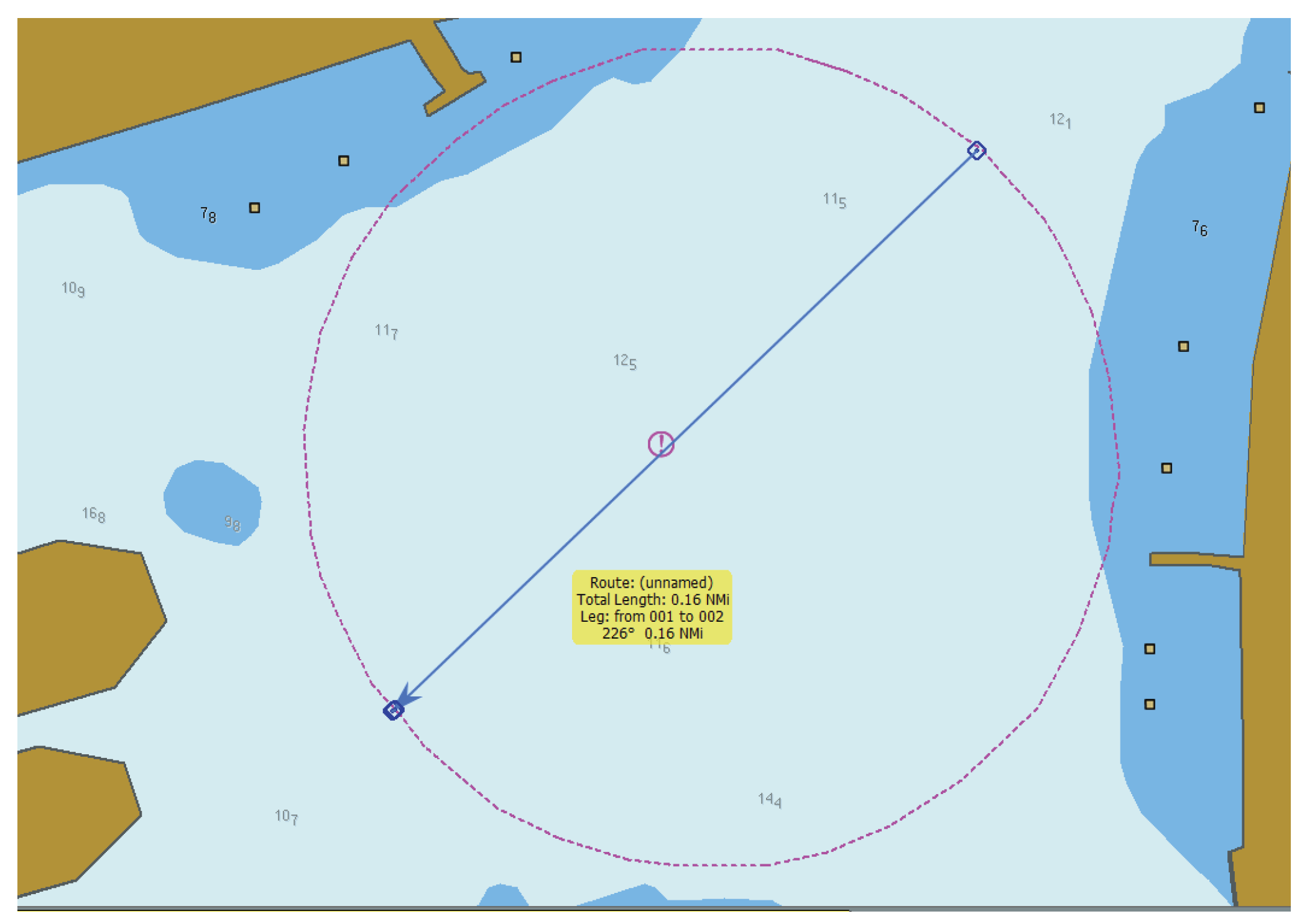
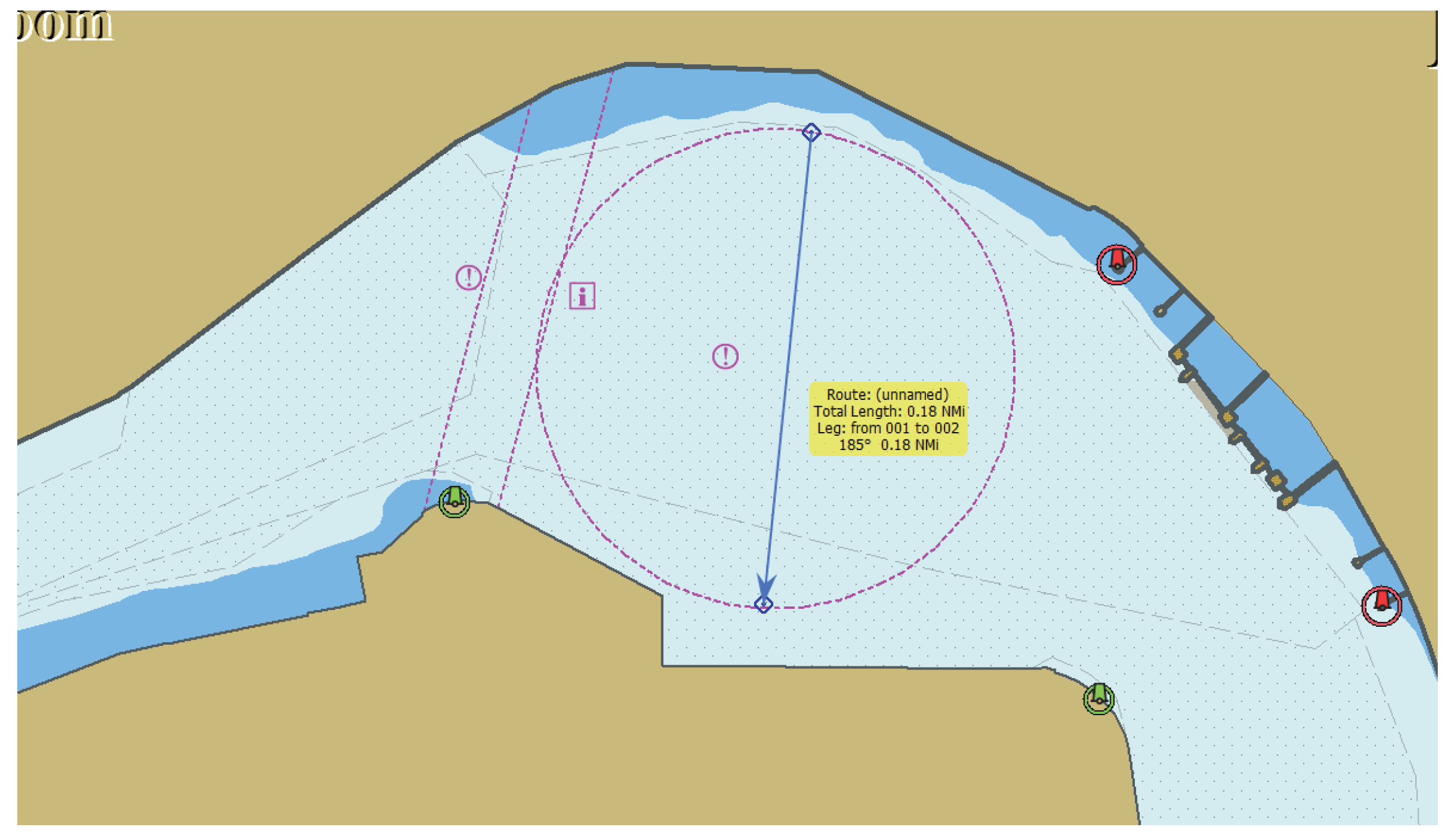
Figure 3.
The algorithm of the research methodology.
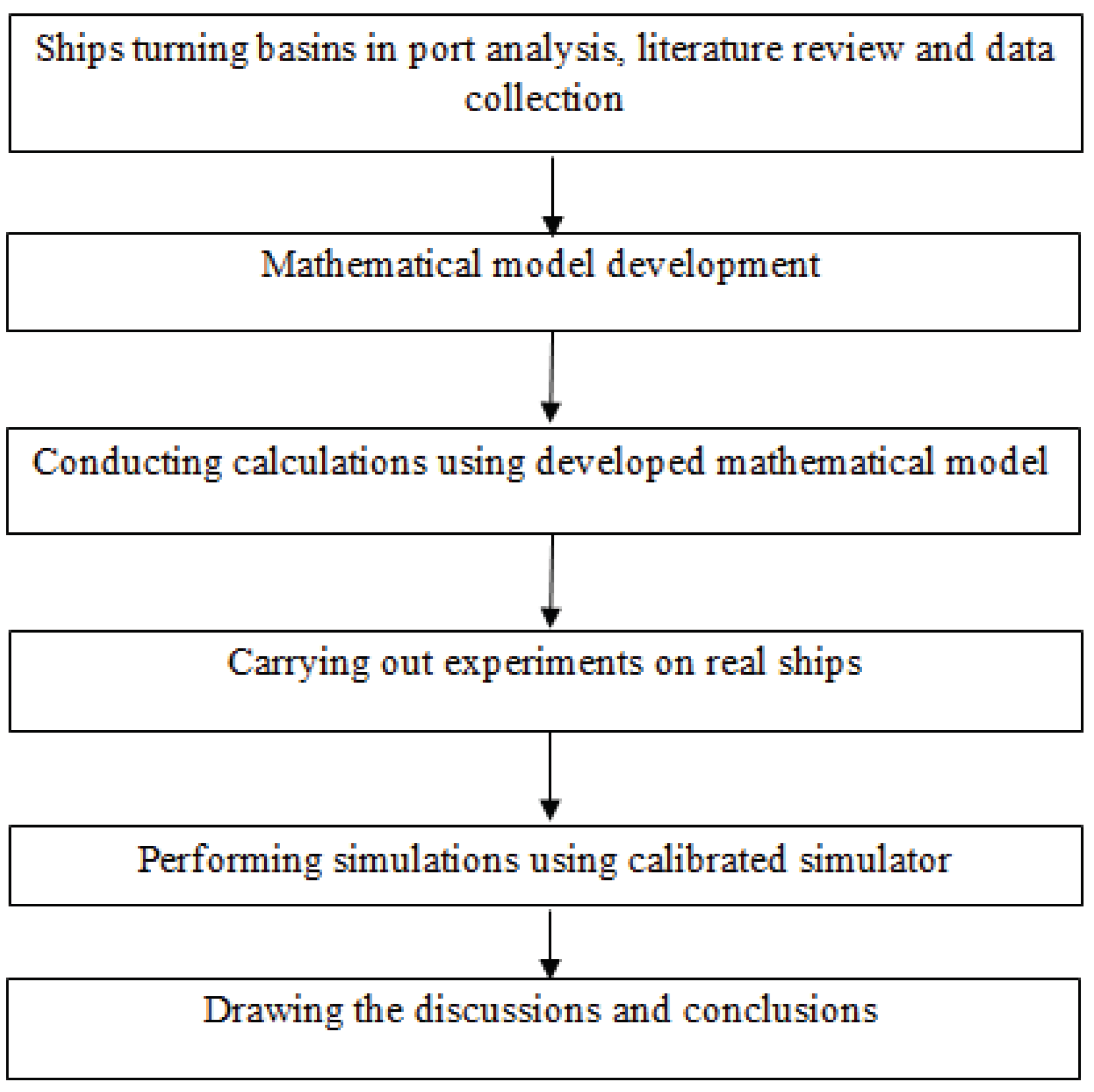
Figure 4.
Dependence of the period of the moment of inertia of ships, obtained by experiments of real ships, on length of the ship.
Figure 4.
Dependence of the period of the moment of inertia of ships, obtained by experiments of real ships, on length of the ship.
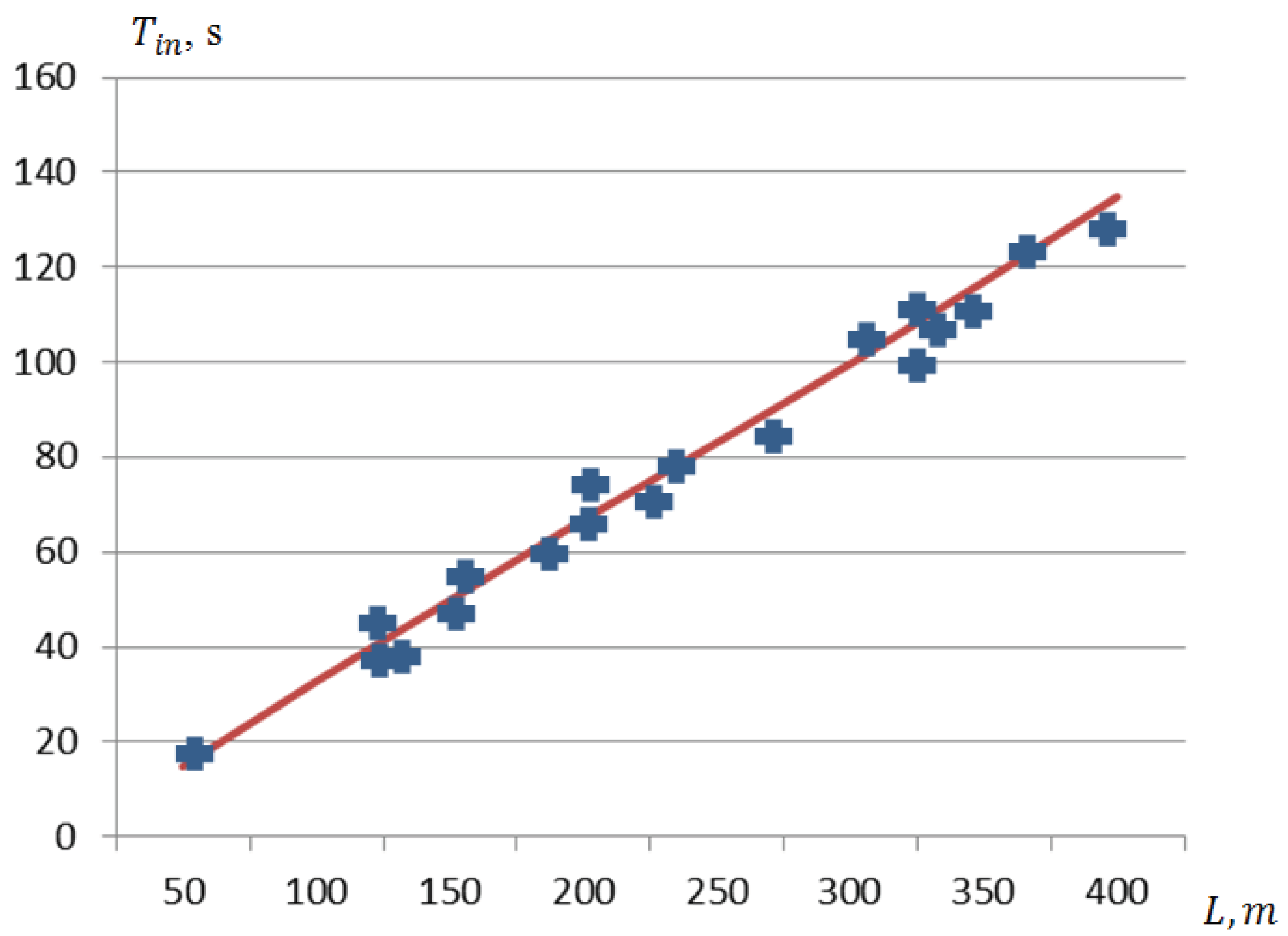
Figure 5.
Klaipeda port South ships turning basin.
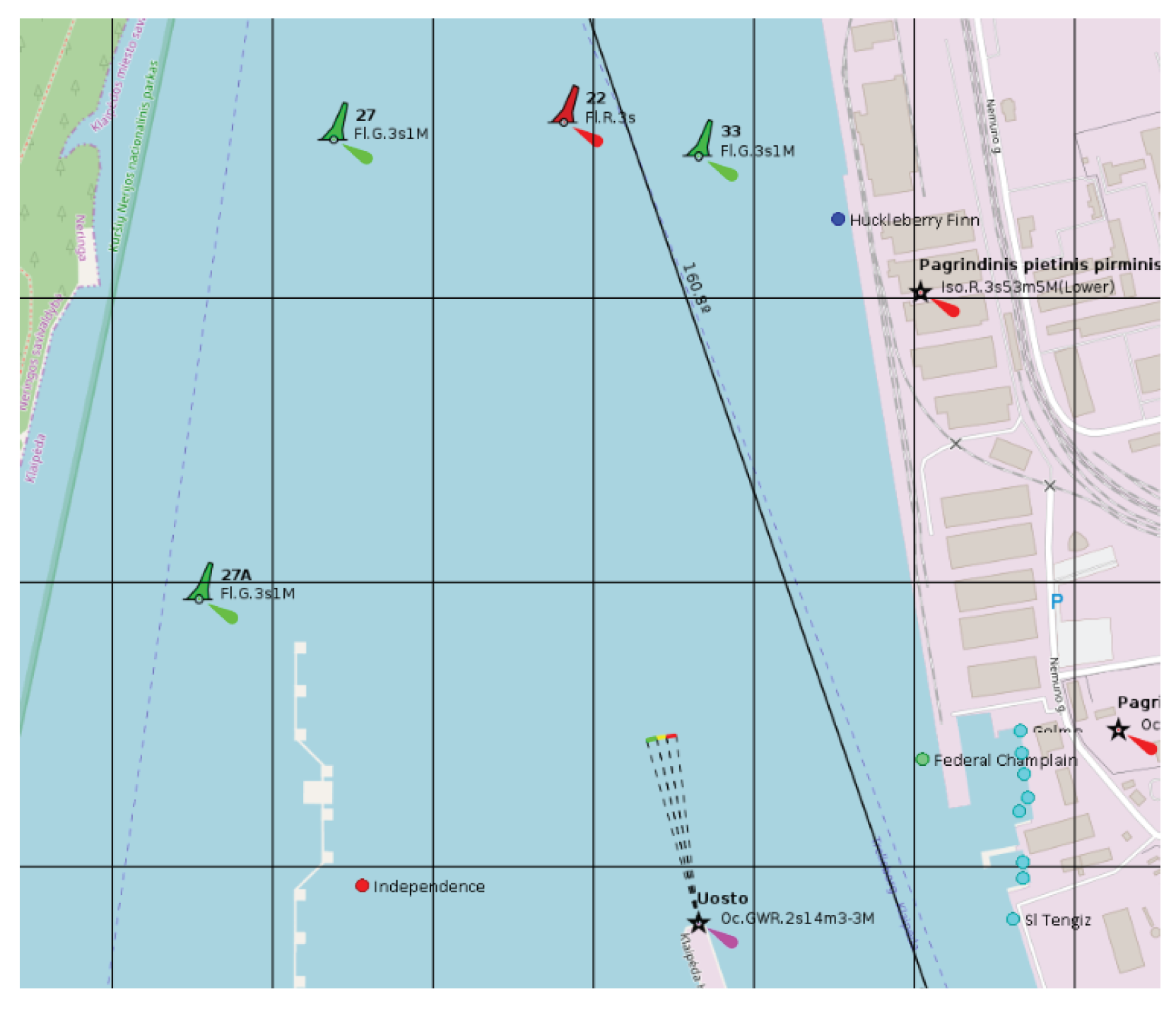
Figure 6.
Trajectory of the POST PANAMAX container vessel during turning in port ships turning basin (T/H about 0.95) received by calibrated simulator and on the real ship.
Figure 6.
Trajectory of the POST PANAMAX container vessel during turning in port ships turning basin (T/H about 0.95) received by calibrated simulator and on the real ship.
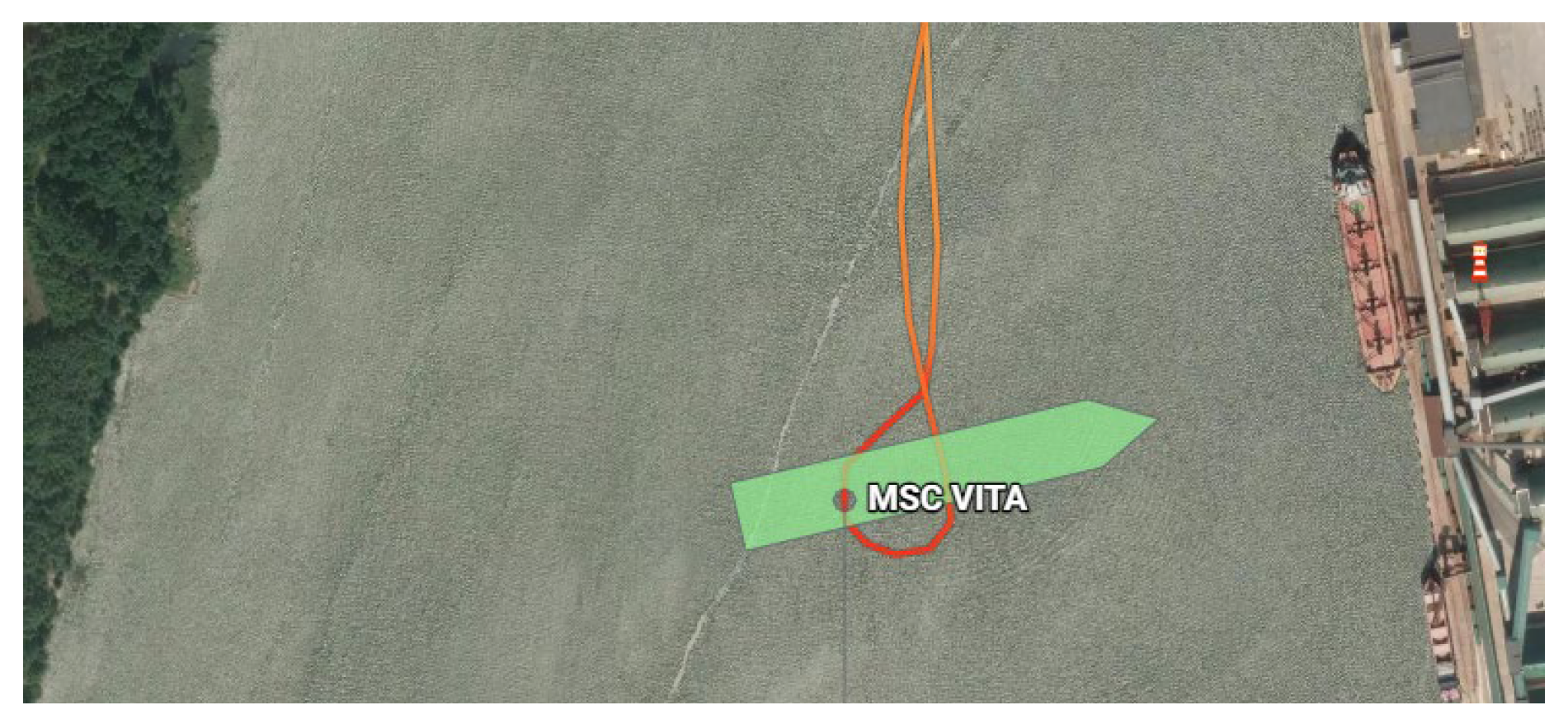
Figure 7.
POST PANAMAX container ship turning trajectory using two tugs, received by calibrated simulator.
Figure 7.
POST PANAMAX container ship turning trajectory using two tugs, received by calibrated simulator.
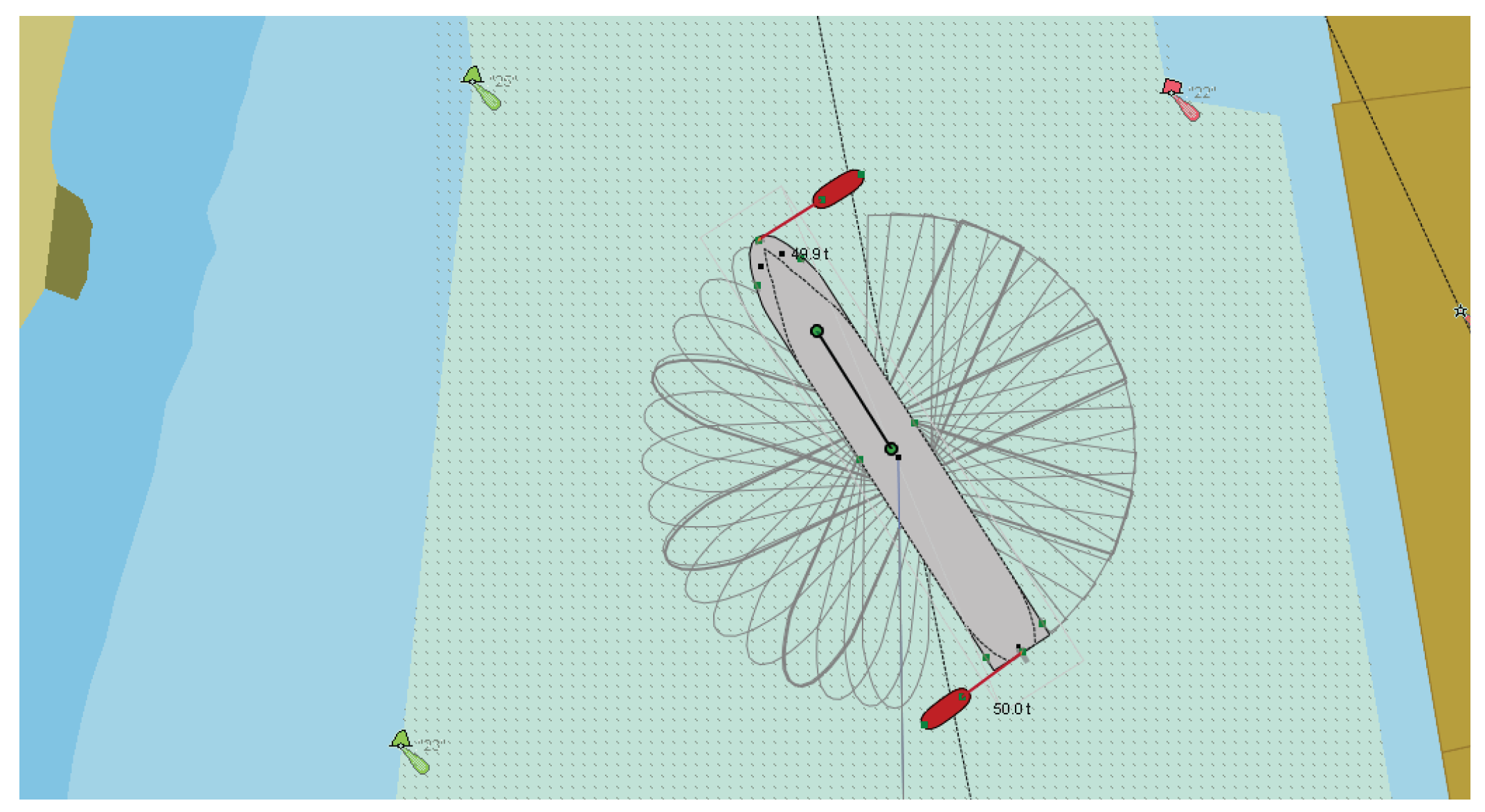
Figure 8.
POST PANAMAX container ship’s turning parameters: turning time; tugs bollard pull; angular speed of turning and clearance.
Figure 8.
POST PANAMAX container ship’s turning parameters: turning time; tugs bollard pull; angular speed of turning and clearance.
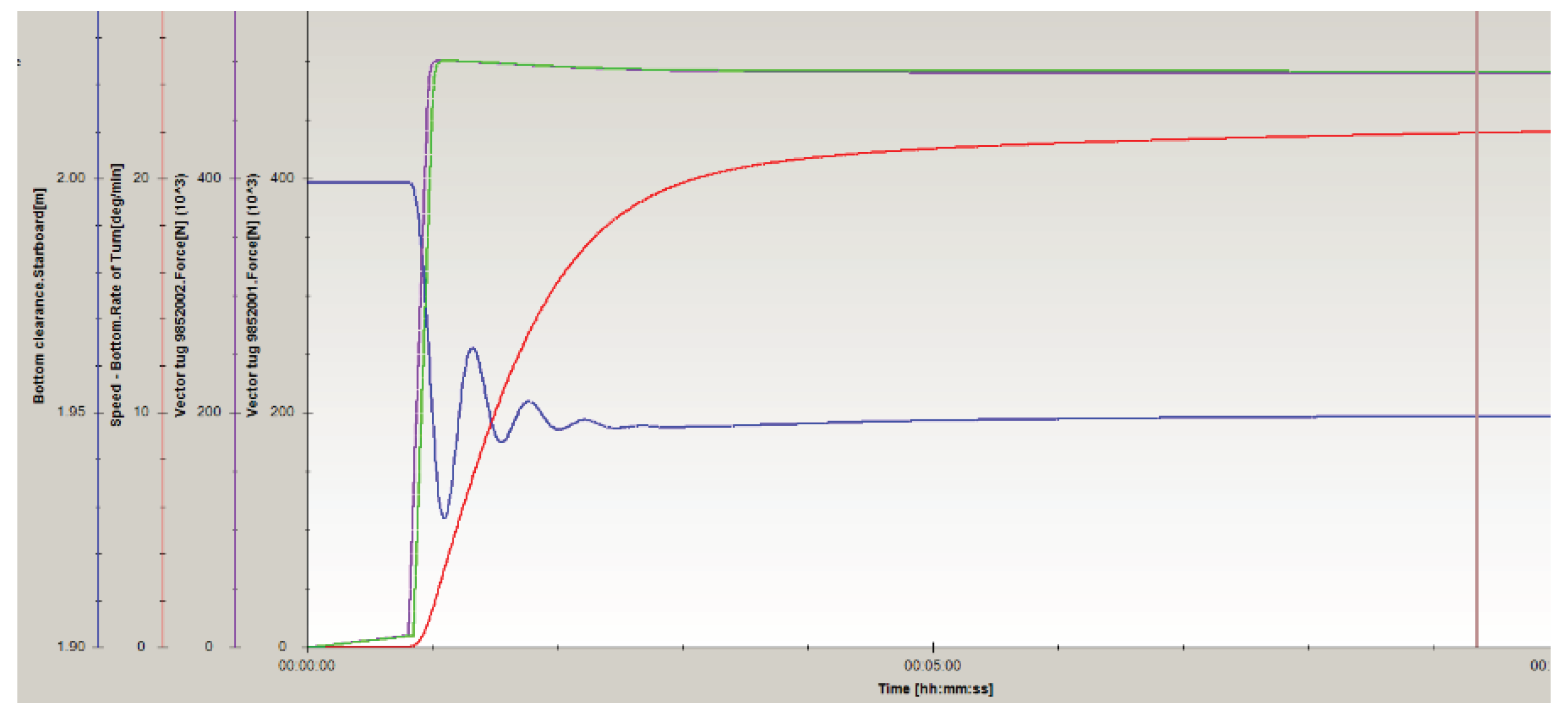
Figure 9.
POST PANAMAX Container vessel turning time use 2 tugboats (500 kN bollard pull) depends of the clearance between ship’s hull and ships turning basin bottom.
Figure 9.
POST PANAMAX Container vessel turning time use 2 tugboats (500 kN bollard pull) depends of the clearance between ship’s hull and ships turning basin bottom.
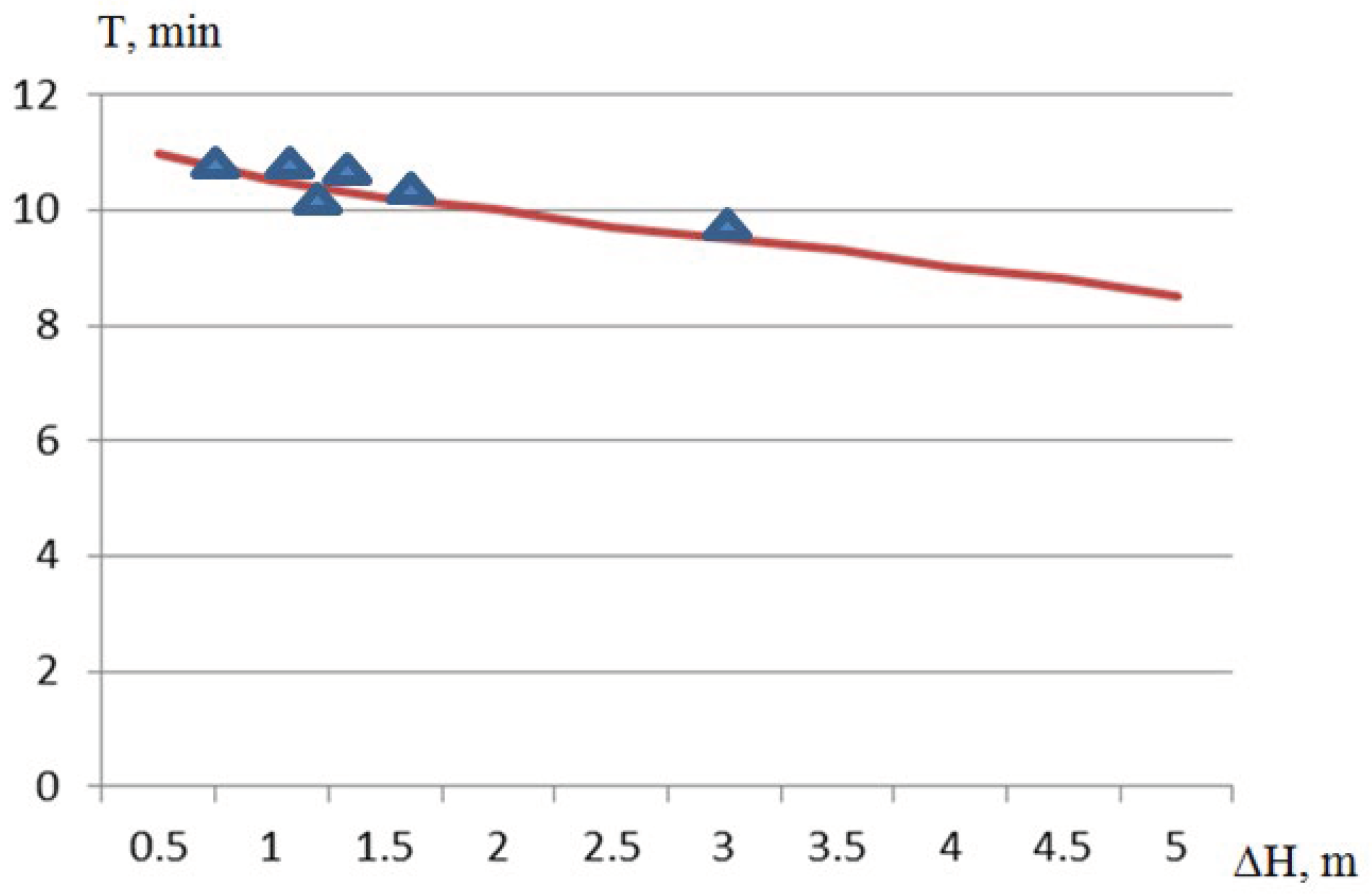
Figure 10.
POST PANAMAX turning time depends of the bollard pull of the tugboats (clearance between ship’s hull and ships turning basin bottom about 0.7 m).
Figure 10.
POST PANAMAX turning time depends of the bollard pull of the tugboats (clearance between ship’s hull and ships turning basin bottom about 0.7 m).
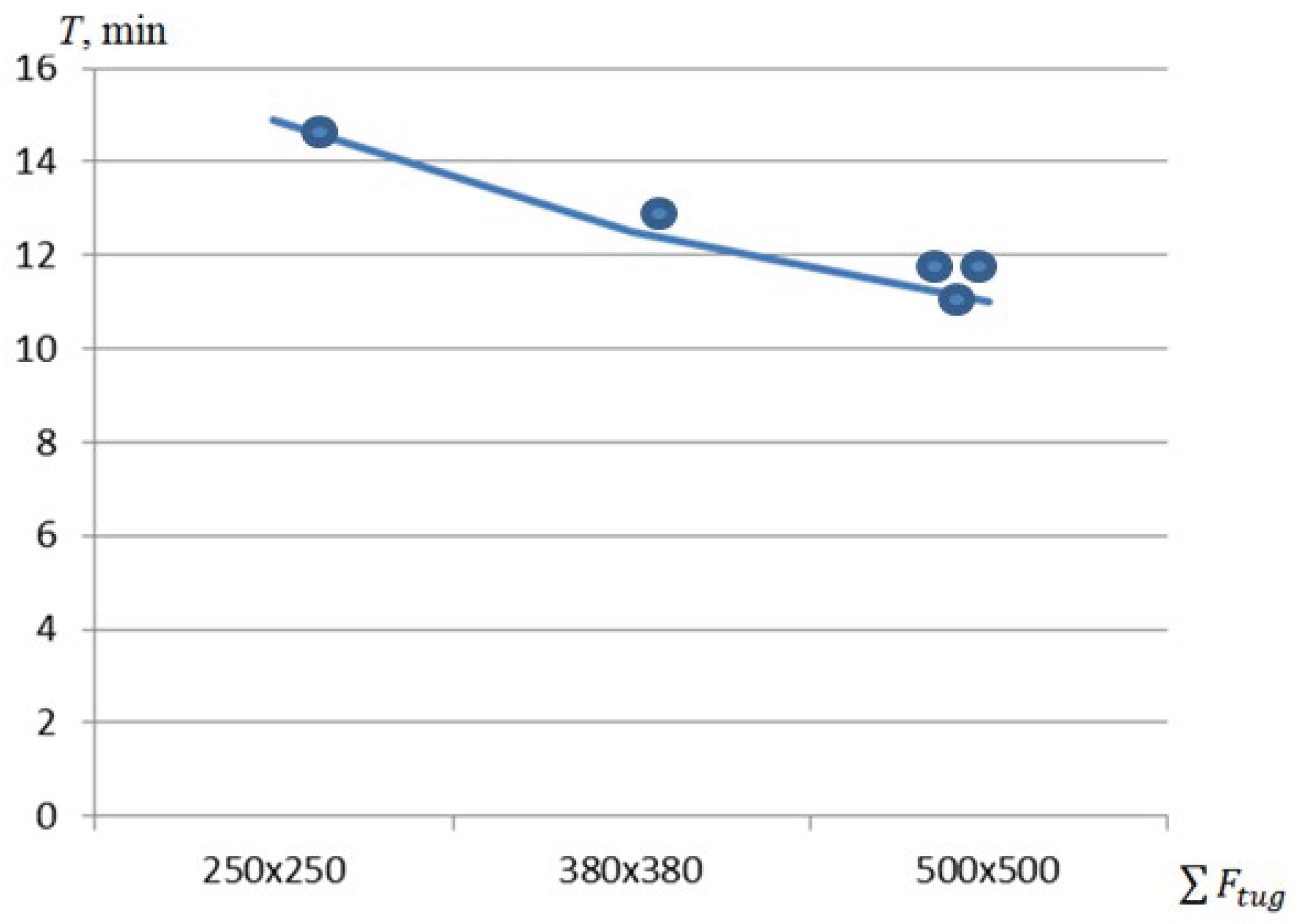
Figure 11.
Angular speed of POST PANAMAX container ship turning, depending on the bollard pulls of tugs (clearance is about 0.7 m).
Figure 11.
Angular speed of POST PANAMAX container ship turning, depending on the bollard pulls of tugs (clearance is about 0.7 m).
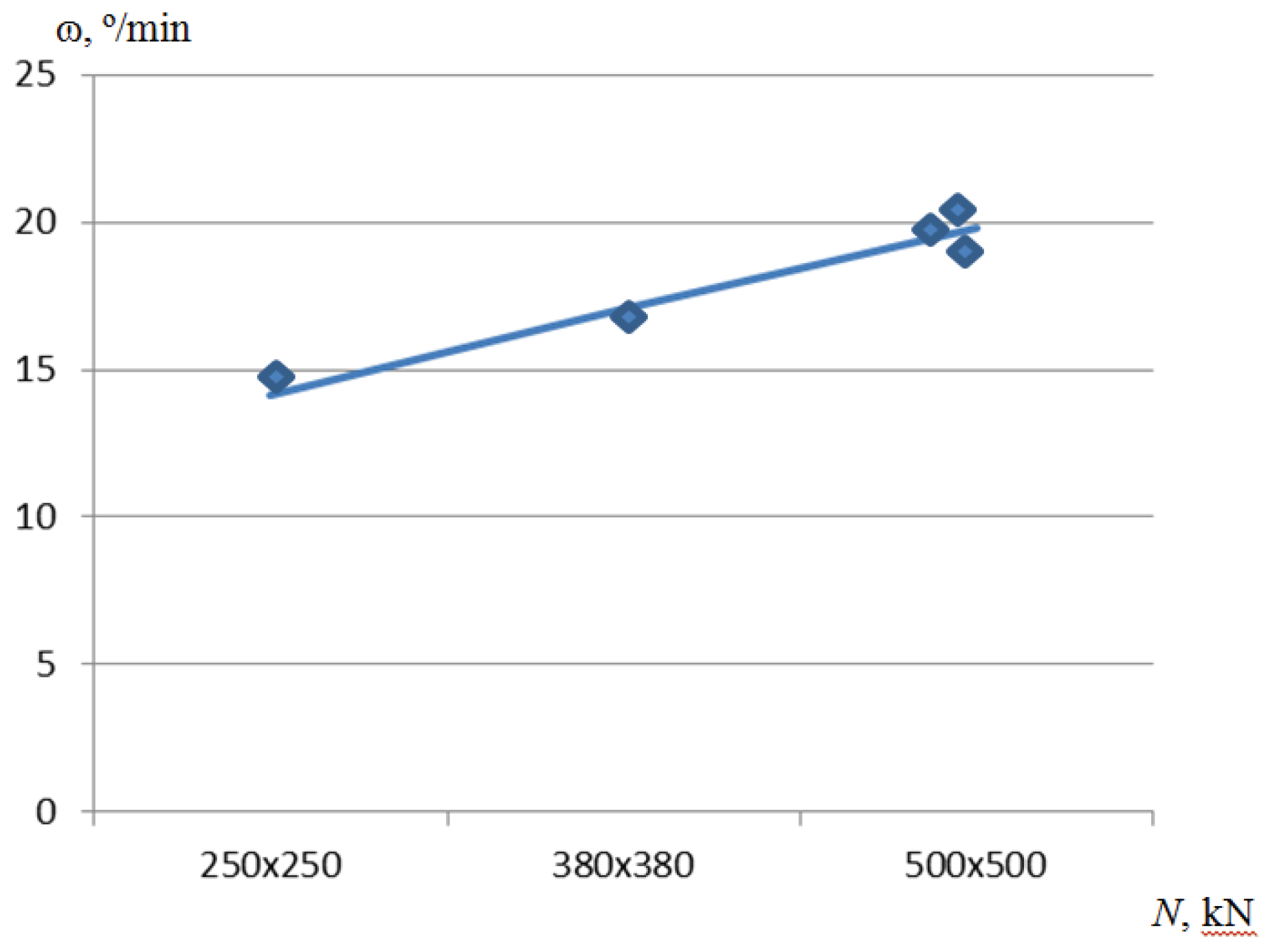
Figure 12.
POST PANAMAX container ship's maximum angular rotation speed depending on the clearance (2 bollard pull tugs of 500 kN are used).
Figure 12.
POST PANAMAX container ship's maximum angular rotation speed depending on the clearance (2 bollard pull tugs of 500 kN are used).
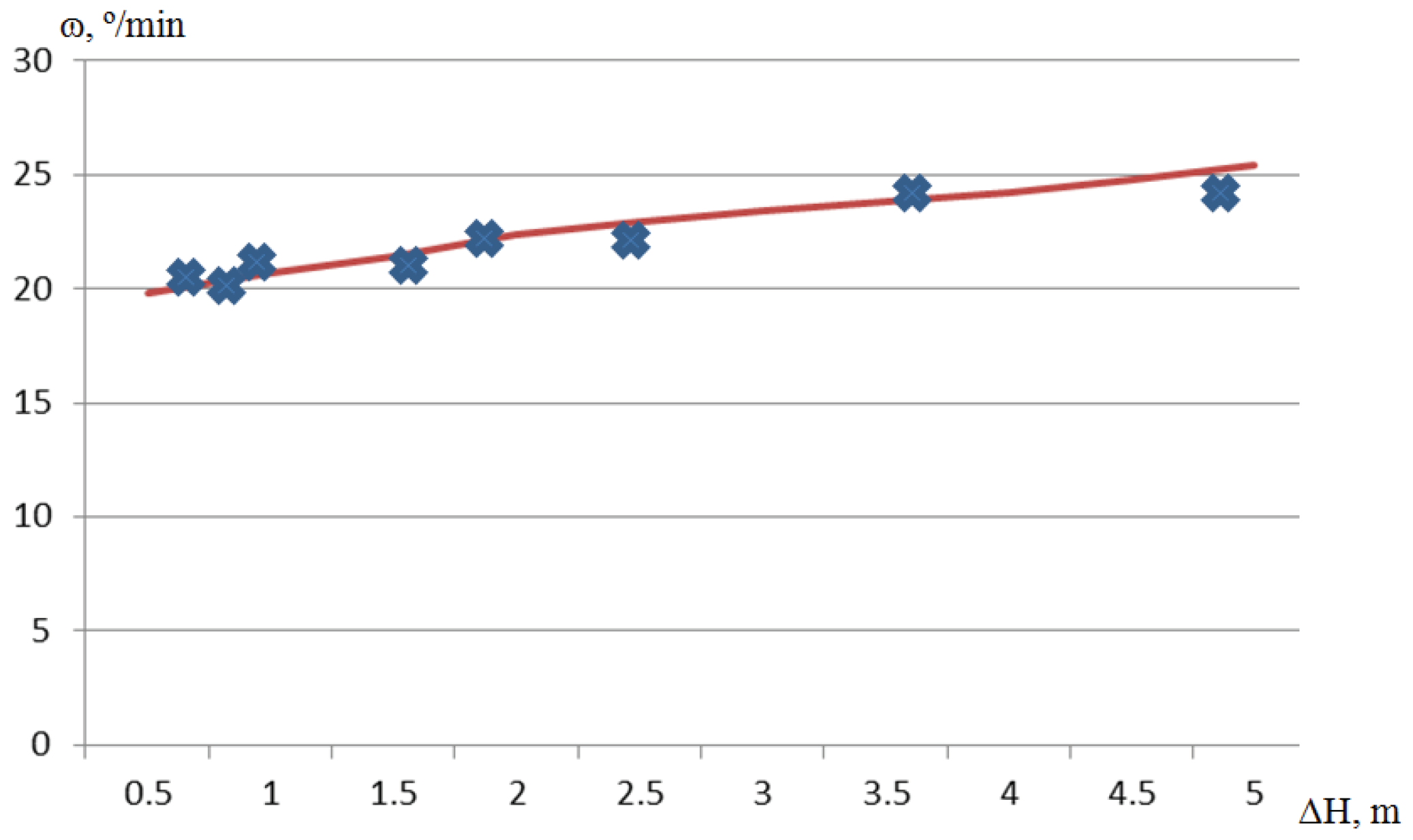
Figure 13.
Two tugboats (500 kN each) fuel consumption (diesel and LNG) when turning the POST PANAMAX container ship 180 degrees depending on the ship's draft and depth ratio (T/H).
Figure 13.
Two tugboats (500 kN each) fuel consumption (diesel and LNG) when turning the POST PANAMAX container ship 180 degrees depending on the ship's draft and depth ratio (T/H).
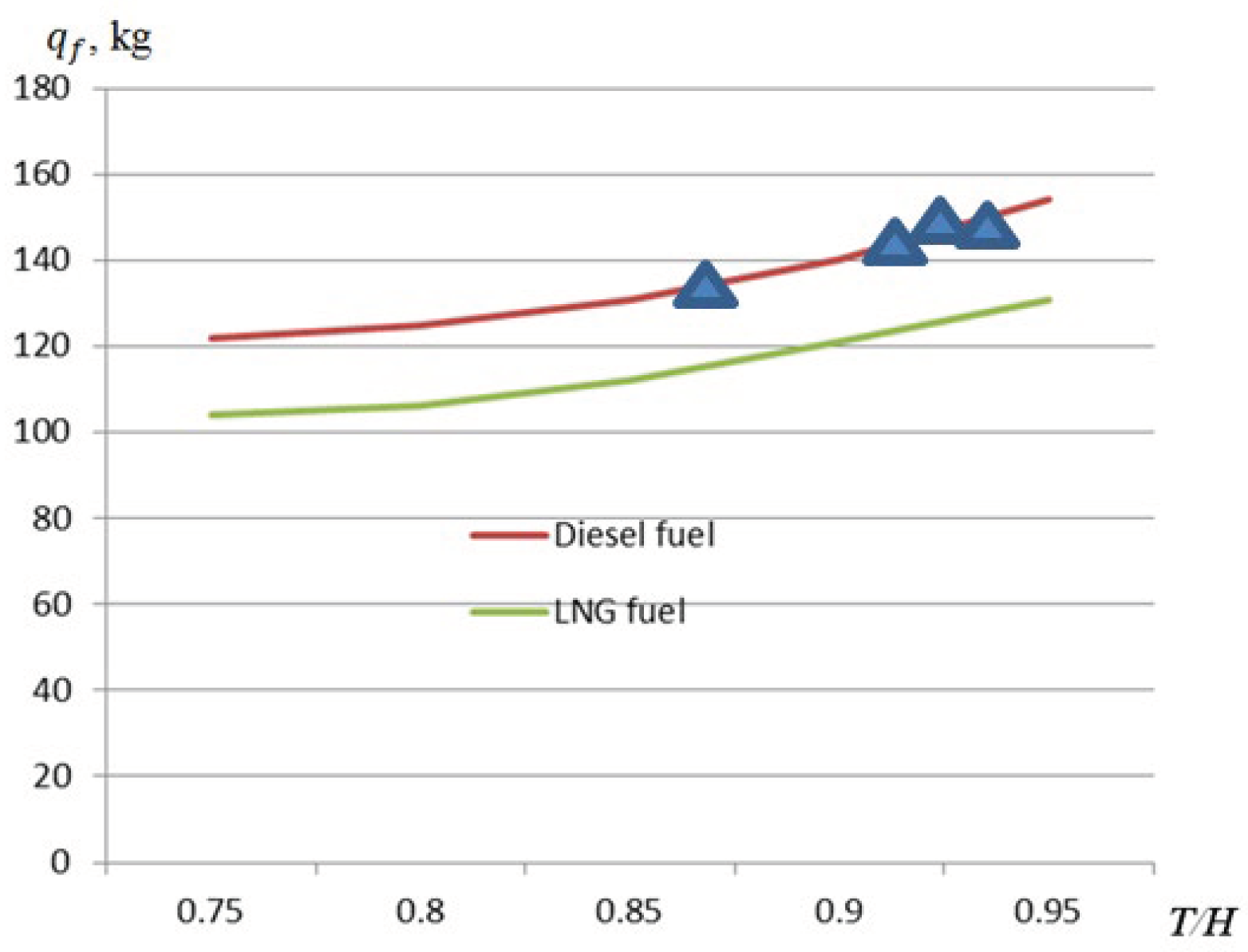
Figure 14.
Fuel consumption of tugboats (500 kN each) and the amount of emissions generated by turning the POST PANAMAX container ship 180 degrees depending on the ship's draft and depth ratio ().
Figure 14.
Fuel consumption of tugboats (500 kN each) and the amount of emissions generated by turning the POST PANAMAX container ship 180 degrees depending on the ship's draft and depth ratio ().
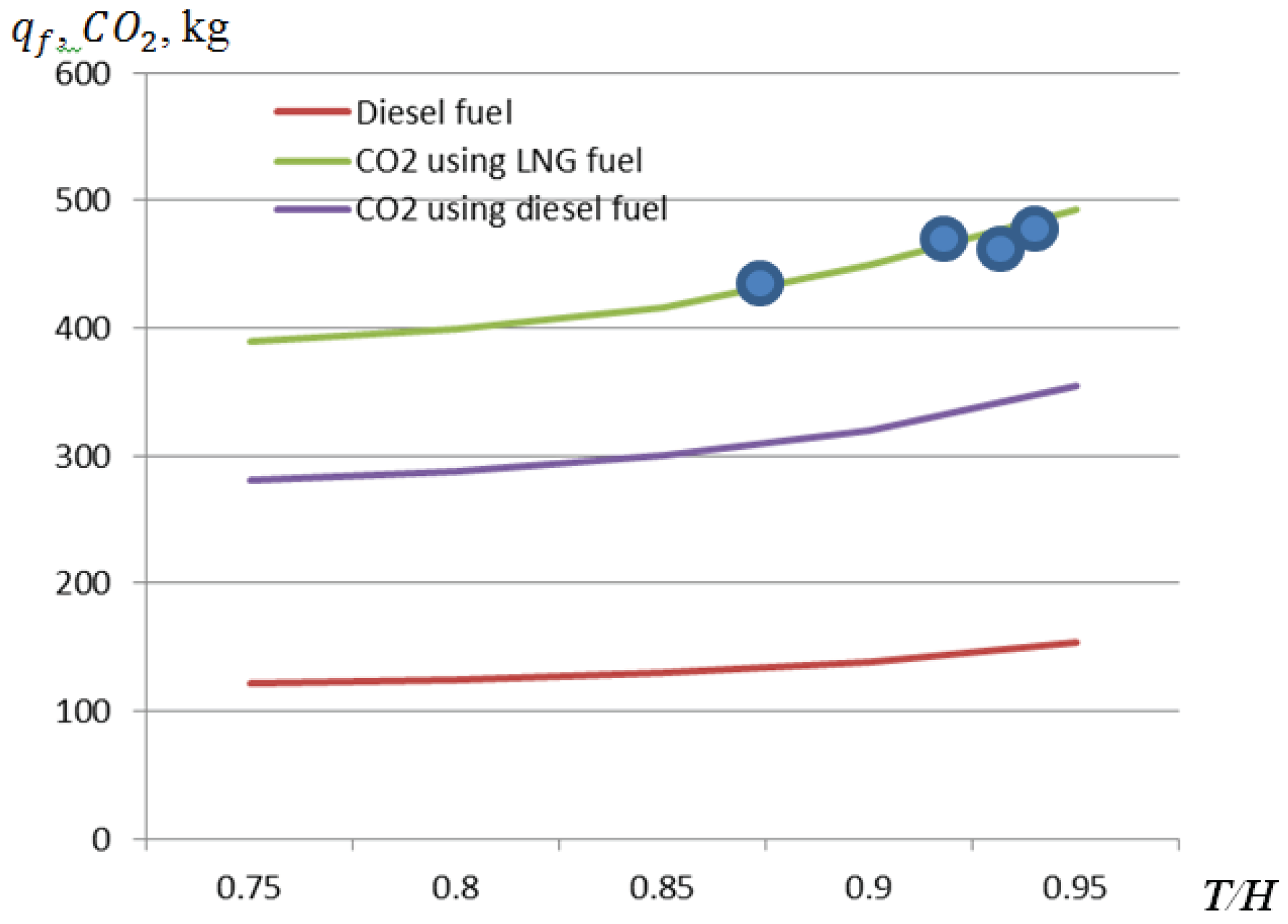
Figure 15.
The amount of emissions generated by the tugboats when turning the POST PANAMAX container ship 180 degrees depending on the draft and depth ratio () of the ship and the traction forces of the 2 tugboats,
Figure 15.
The amount of emissions generated by the tugboats when turning the POST PANAMAX container ship 180 degrees depending on the draft and depth ratio () of the ship and the traction forces of the 2 tugboats,
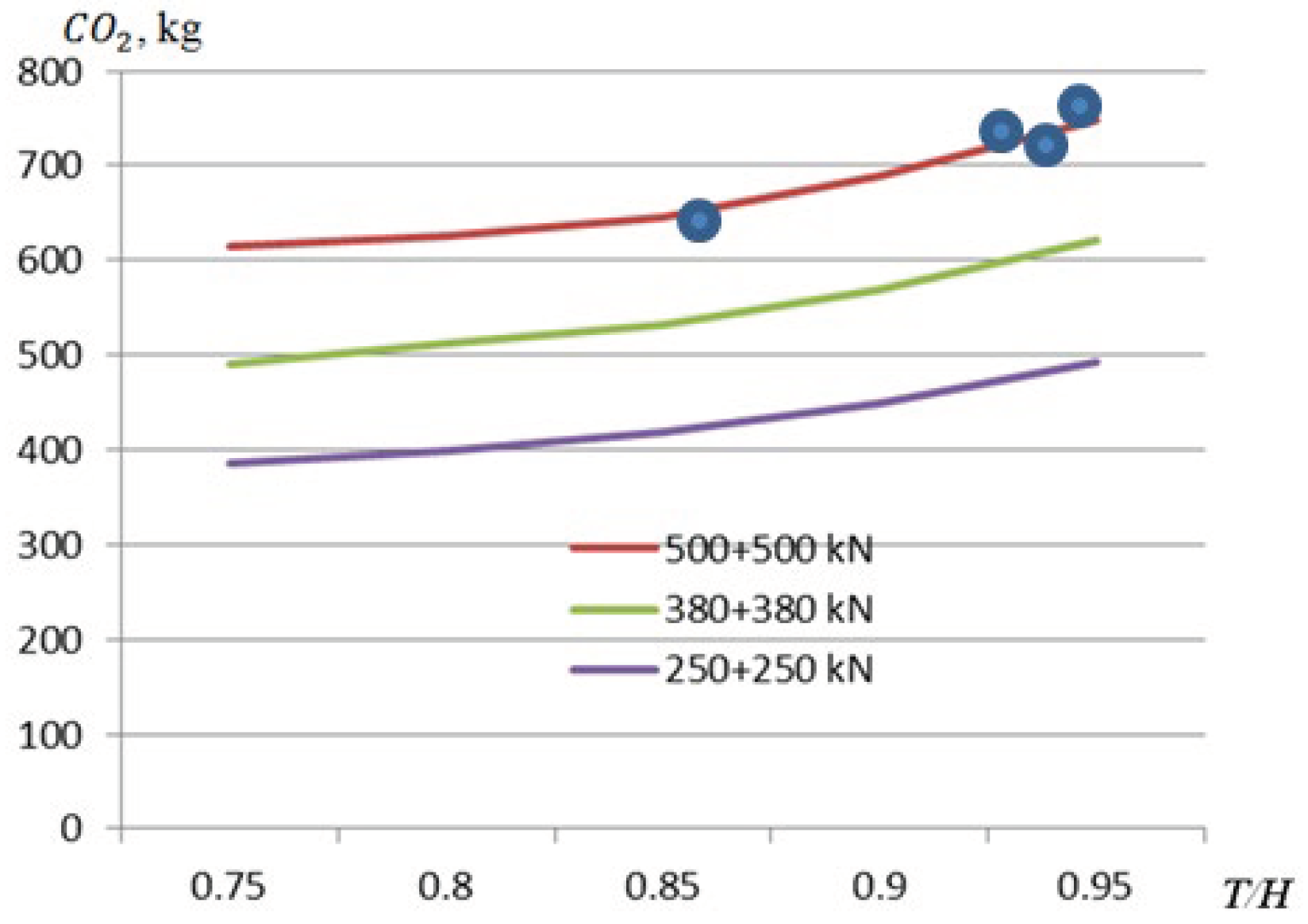
Figure 16.
Amount of emissions generated by tugboats when turning the POST PANAMAX container ship 180 degrees depending on the draft and depth ratio () of the ship and the traction forces of the 2 tugboats
Figure 16.
Amount of emissions generated by tugboats when turning the POST PANAMAX container ship 180 degrees depending on the draft and depth ratio () of the ship and the traction forces of the 2 tugboats
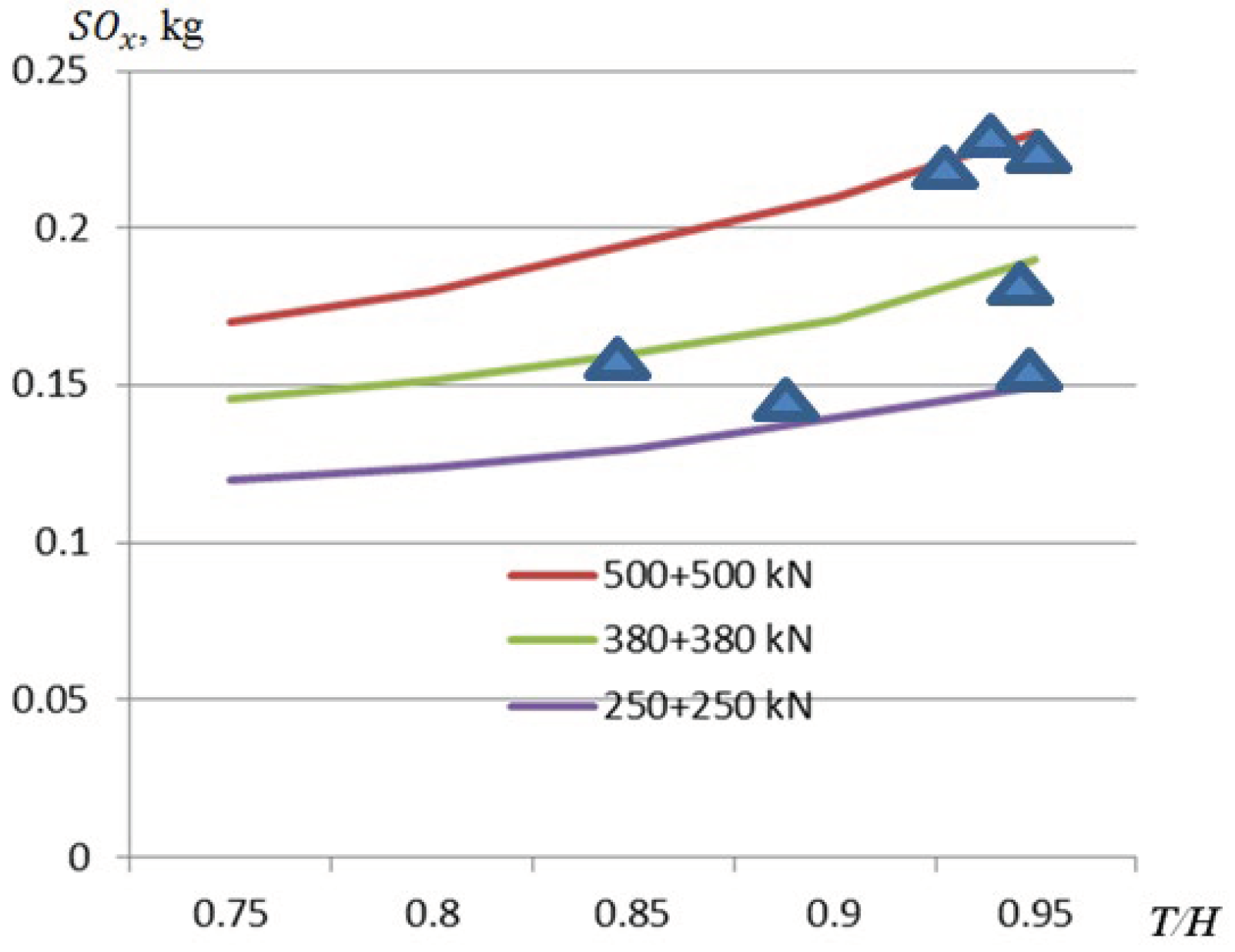
Figure 17.
The amount of emissions generated by tugboats when turning the POST PANAMAX container ship 180 degrees depending on the draft and depth ratio () of the ship, using the different traction forces of 2 tugboats.
Figure 17.
The amount of emissions generated by tugboats when turning the POST PANAMAX container ship 180 degrees depending on the draft and depth ratio () of the ship, using the different traction forces of 2 tugboats.
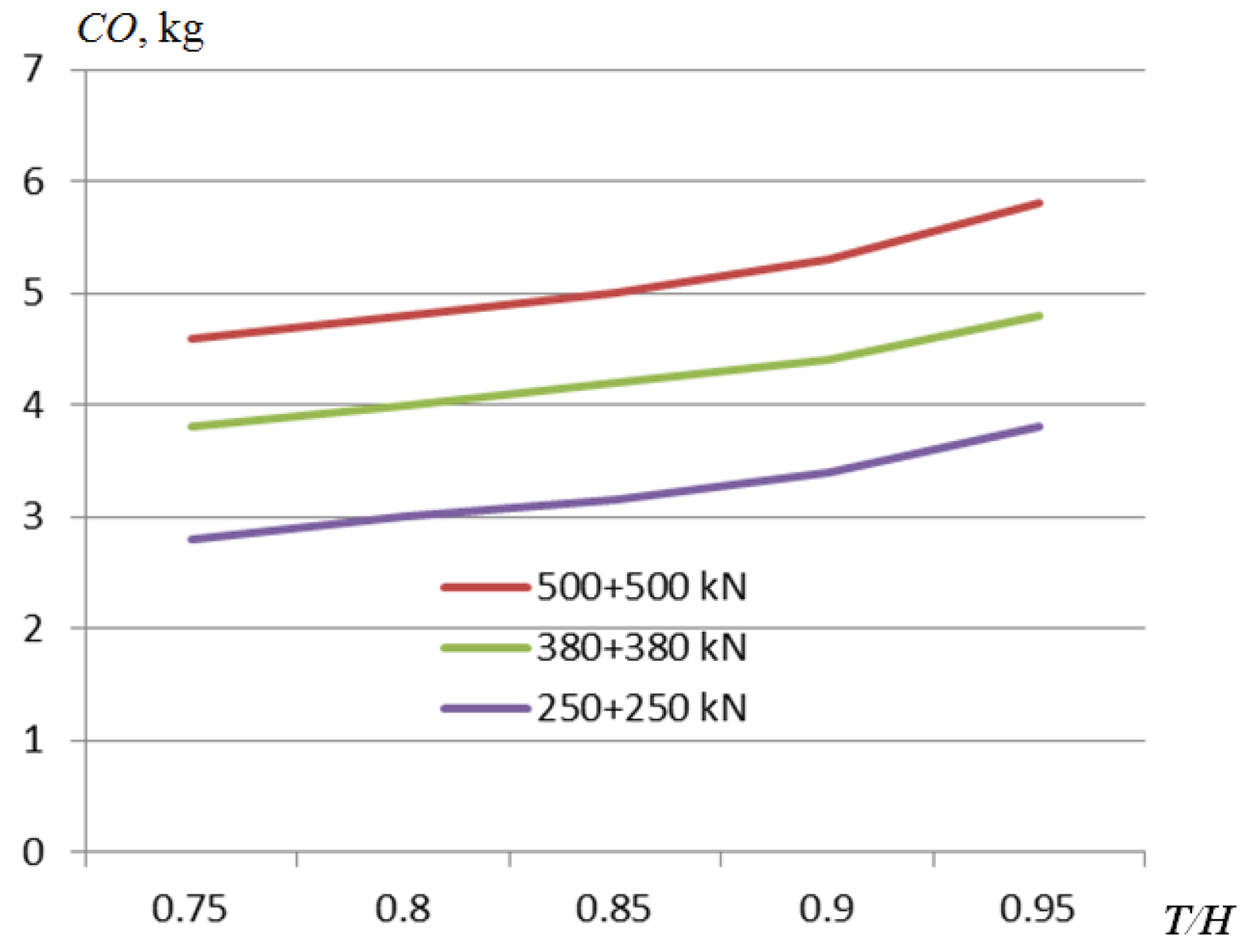
Figure 18.
Amount of emissions generated by tugboats when turning the POST PANAMAX container ship 180 degrees depending on the draft and depth ratio () of the ship, using different traction forces of 2 tugboats.
Figure 18.
Amount of emissions generated by tugboats when turning the POST PANAMAX container ship 180 degrees depending on the draft and depth ratio () of the ship, using different traction forces of 2 tugboats.
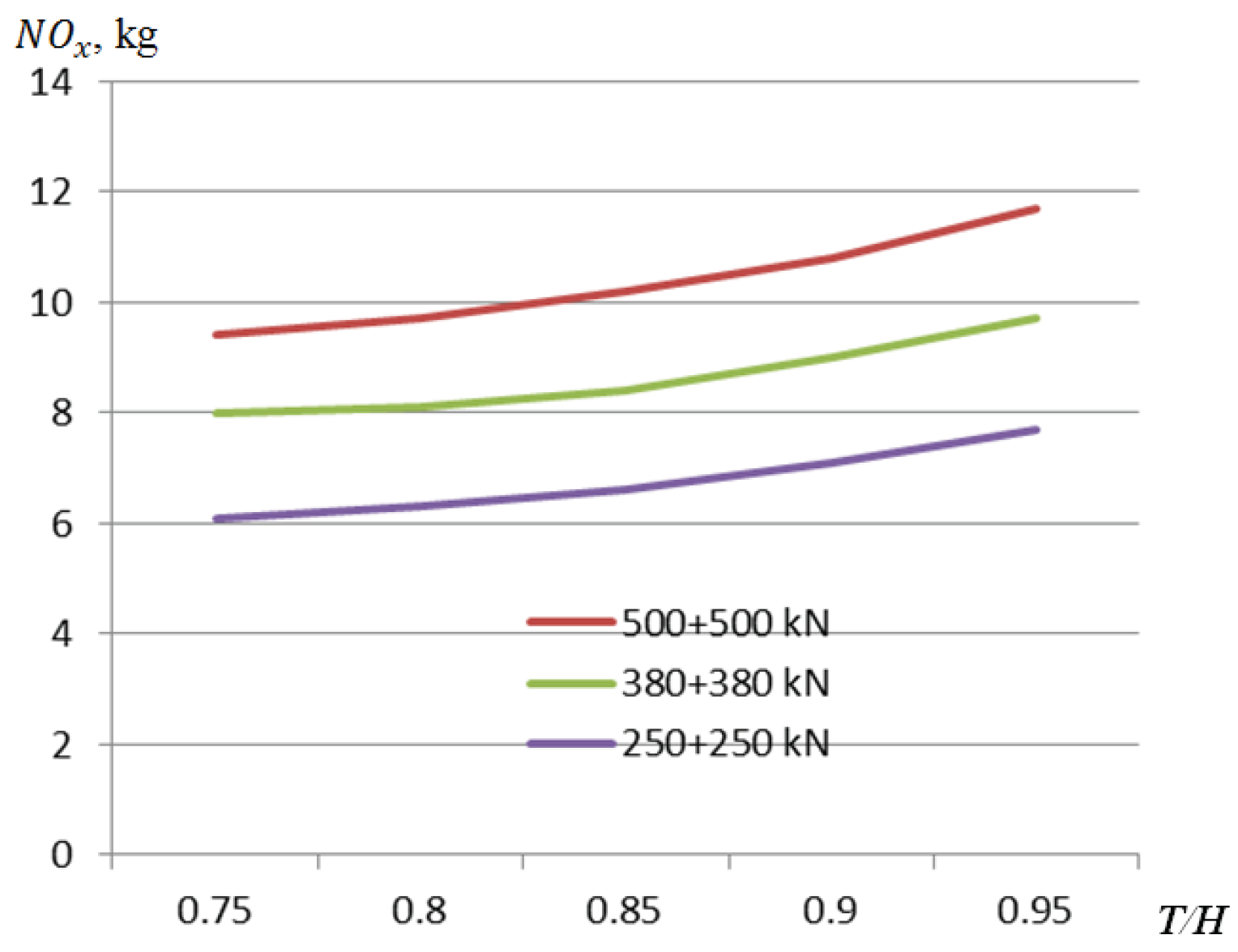
Figure 19.
Amount of emissions generated by tugboats when turning the POST PANAMAX container ship 180 degrees depending on the ship's draft and depth ratio (), using different pulling forces of 2 tugboats.
Figure 19.
Amount of emissions generated by tugboats when turning the POST PANAMAX container ship 180 degrees depending on the ship's draft and depth ratio (), using different pulling forces of 2 tugboats.
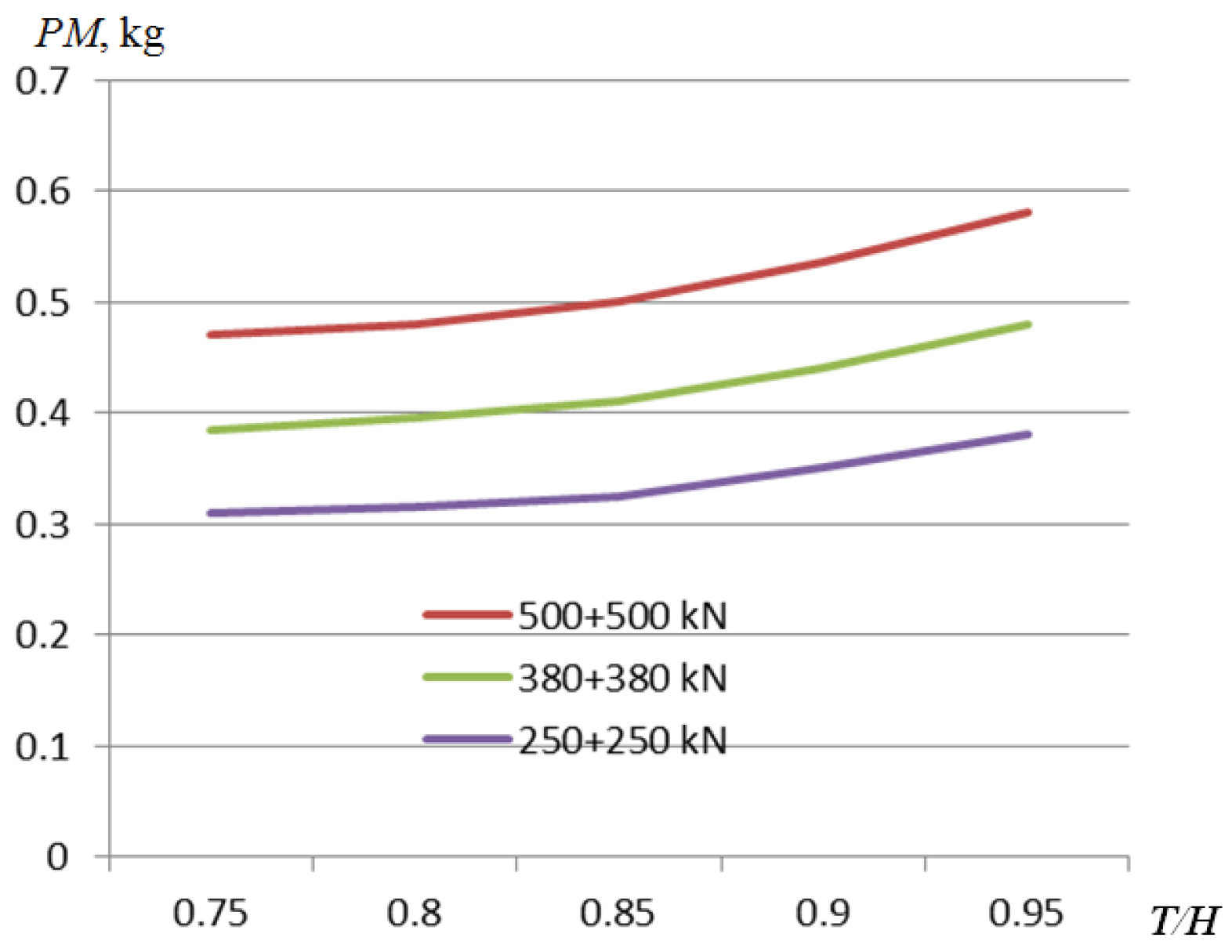
Disclaimer/Publisher’s Note: The statements, opinions and data contained in all publications are solely those of the individual author(s) and contributor(s) and not of MDPI and/or the editor(s). MDPI and/or the editor(s) disclaim responsibility for any injury to people or property resulting from any ideas, methods, instructions or products referred to in the content. |
© 2024 by the authors. Licensee MDPI, Basel, Switzerland. This article is an open access article distributed under the terms and conditions of the Creative Commons Attribution (CC BY) license (http://creativecommons.org/licenses/by/4.0/).
Copyright: This open access article is published under a Creative Commons CC BY 4.0 license, which permit the free download, distribution, and reuse, provided that the author and preprint are cited in any reuse.


