

Submitted:
19 February 2024
Posted:
20 February 2024
You are already at the latest version
Abstract
An off-grid solar energy storage system (ESS) in National Pingtung University of Science and Technology (NPUST) was built and officially operated on Jun. 16th 2022. The system is installed in a 40' general container with PV panels of solar power 8250 Wp on top of the container. The ESS is made by repurposed lithium iron phosphate (LFP) batteries of 20 kWh capacity, where a battery management system (BMS) is adopted to ensured the safety of the battery system. An energy management system (EMS) is built to receive, process, analyse, store, and output the energy information. In this manuscript, a brief engineering report about the system is given.
Keywords:
off grid
; energy storage system
; energy management system
; lithium-ion battery
; lithium iron phosphate battery
; LFP battery
; repurposed battery
; photovoltaic energy
1. Introduction
Super Double Power Technology Co., Ltd. (SDP) assisted National Pingtung University of Science and Technology (NPUST) to build an off-grid solar energy storage system (ESS). Some key features are listed below. The system is installed in a 40’ general container with PV panels of solar power 8250 on top of the container, serving as the primary energy source. The ESS is made by repurposed lithium iron phosphate (LFP) batteries of 48 V nominal voltage and 20 kWh capacity, where a battery management system (BMS) is adopted to ensured the safety of the battery system. An energy management system (EMS) is built to receive, process, analyse, store, and output the energy information. The secondary (optional) energy sources are also available in the designed system.
This manuscript provides a brief engineering report about the system1.
2. System Location
The system is installed in a 40’ general container with PV panels on top of the container in NPUST, Taiwan.
About Taiwan
Taiwan is an island country in East Asia (Figure 1a, at the junction of the East and South China Seas in the northwestern Pacific Ocean, with China to the northwest (separated by the Taiwan Strait), Japan to the northeast, and the Philippines to the south as shown in Figure 1b. The main island of Taiwan, formerly known as Formosa, has an area of ∼36,000 km2. With 23.45 million inhabitants, Taiwan is among the most densely populated countries in the world [1].
About NPUST
NPUST was established as the “Kaohsiung State Pingtung Extension School of Agriculture” in the 13th year of the Taishō period during the Japanese Colonial Era (1924). In 1954, the school was renamed as the Taiwan Provincial Institute of Agriculture. At that time, it was among the best of Taiwan’s vocational schools, training countless elites and becoming a foundation for Taiwan’s economic boom [2].
In 1991, the school reorganized to become a vocational college and, together with the National Taiwan Institute of Technology, was among the top two technical institutions of higher education in Taiwan. In 1997 the vocational college was upgraded to a university of science and technology, as well as occupied a leading position among vocational education institutions in Taiwan.
NPUST is in the Dawu Mountain foothills of northwestern Neipu Township in Pingtung County in the east of Pingtung city, near the Donggang River (as shown in Figure 1c,d. The campus covers an area of 2.983 km2 (Figure 1e,f).
The 40’ container containing the system locates next to the Sustainable R&D Center as shown in Figure 1g.
3. System Architecture
The system architecture is shown in Figure 2. The primary energy inputs include PV panel 1 and 2. Each PV panel is composed of 11 pieces of PV module of 375 and OCV of 40 . The 11 pieces of PV modules are connecting in series, giving a total peak solar power of 4125 and OCV of 440 . Two sets of PV panels can provide the system a total peak solar power of 8250 . The secondary (optional) energy inputs can be a generator of 1P2W 220 in series connection with the off-grid hybrid solar inverter, or it can be a fuel cell of nominal voltage V in parallel connection with the Li-ion battery ESS. The energy output to load of 1P2W 220 or 1P2W 110 at 60 Hz, which are compliant with Taiwan electricity specifications and suitable for general electrical use. An ideal energy output of 11 kW is available (regardless the energy conversion efficiency (inverter and transformer) and power line energy loss).
The off-grid hybrid solar inverter plays an important in converting DC and AC powers form power generators (e.g., PV panels, generators, or fuel cells) and DC power from the ESS to the AC power for the load. The DC and AC distribution boxes control the energy flow. When the system encounters some troubles, all or parts of the energy flows can be blocked, providing system safety. In this system, the solar energy generated by PV panels pass through MCCBs and SPDs in the DC distribution box to the off-grid hybrid solar inverter. The power from inverter (1P2W, 220 at 60 Hz) can pass through MCCB in the AC distribution box directly to the 220 load. On the other hand, the power from inverter can also pass through MCCB in the AC distribution box, transform into 110 at 60 Hz by the transformer for a maximum ideal power about 5 kW, and than go to the 110 load.
The Li-ion battery ESS pass through an MCCB in the DC distribution box to the inverter. The energy flow between ESS and inverter is bi-directional, indicating the energy can be saved in or taken from the ESS. In other words, when the load power is over the solar power, ESS will fill the unsufficient power. When the load power is less than the solar power, ESS will absorb the remaining power. The energy information of energy generation, usage, and storage is sent to the energy management system.
The system operation method, in general, is set at “solar first” mode, indicating that the generated solar energy is directly converted to AC power for the load instead of save the energy to the ESS first (“storage first” mode). “storage first” mode indicates that the solar energy will be saved to the ESS first and then the ESS will provide the energy for the load. Such mode possesses a benefit for maintaining the ESS at high remaining capacity, while it will cause twice energy consumptions during energy conversion between chemical energy and electricity. If the energy consumptions during energy conversion is 90%, the overall available energy becomes 81% ().
4. Energy Storage System
The repurposed LFP batteries are used with BMS in the energy storage system. The repurposed LFP batteries are in series connection (16S configuration), making a battery system with nominal voltage of 48 V and capacity about 20 kWh. A balance circuit is also applied in the system for balancing the voltage of each battery cell. The information of the ESS is sent to the EMS via CAN Bus.
About battery management system (BMS)
To use the battery safely, a well-designed BMS is required. A BMS is any electronic system that manages a battery cell, pack, or module system, such as protecting the battery from operating outside its safe operating area, monitoring its status, calculating secondary data, reporting that data, controlling its environment, and balancing it [3,4].
About repurposed Li-ion batteries
Owing to the promotion of commercialization and the popularization of electric vehicles (EVs) worldwide, the widely used Li-ion batteries leading to fundamental researches, industry development, as well as standard and policymaking in the field of Li-ion power batteries. Recently, the number of retired power batteries has largely increased, causing waste of resources and environmental protection threats. Recycling and utilization of such retired batteries have been promoted as a possible solution.Some retired power batteries still has about 80% initial capacity.These power batteries can be repurposed and utilized once again, e.g., serving as the battery modules in the stationary ESS.Governments in various countries have acknowledged this emergent issue and prepared to launch their policies to deal with the recovery and reuse of repurposing batteries, such as coding principles, traceability management system, manufacturing factory guidelines, dismantling process guidelines, residual energy measurement, federal and state tax credits, rebates, and other financial support [5].
Safety and performance are important in using the retired power batteries, i.e., repurposed batteries. Underwriters Laboratories (UL), a global safety certification company established in 1894, published the standard for evaluating the safety and performance of repurposing batteries in 2018 (UL 1974) [6].The charge and discharge profiles of Li-ion repurposed batteries could be measured based on UL 1974. The test procedures designed according to UL 1974 could be used to evaluate the safety and performance of the Li-ion repurposing batteries. The charge and discharge profile dataset in the study provided researchers and engineers the characteristic curves in estimating the repurposing batteries under UL 1974 [7,8].
5. Energy Management System
An embedded system with low-energy consumption is applied to build the hardware of the EMS. The linux-based operation system and applications are adopted as the software of the EMS. Some signal of the sensors away from the embedded system can be sent by RS-485 or CAN Bus. The energy information, such as energy generation, usage, and storage information, is sent to the EMS for processing, analysis, storage, and output.
For long-term and efficient data storage, a time-series database (TSDB) is used (instead of the traditional relational databases). A TSDB is a software system that is optimized for storing and dealing with time series through associated pairs of timestamp and associated data. In some fields, time series may be called profiles, curves, traces, or trends. In many cases, the repositories of time-series data will apply compression algorithms to optimize the data efficiently.
The main information can be obtained by other computer through local area network (LAN) and wireless LAN (WLAN), and than displayed on the monitor. The main system information according to customer request is described in Figure 3.
6. Brief Construction Procedure
After the container was placed at the set location, the system started to set up. A brief construction procedure is described in Figure 4. The total construction period is within 45 days (design period is not included).
The constructed container with the system is next to the Sustainable R&D Center as shown in Figure 5.
7. Summary
SDP assisted NPUST to build the off-grid solar ESS. Some key features of the system in NPUST are listed below. The system is installed in a 40’ general container with PV panels of solar power 8250 on top of the container. The ESS is made by repurposed LFP batteries of 20 kWh capacity, where a BMS is adopted to ensured the safety of the system. The EMS is built to receive, process, analyse, store, and output the energy information. The secondary (optional) energy sources are also available in the designed system.
Acknowledgments
The author (H. C. Chung) thanks the contributors to this article for their valuable discussions and recommendations, Jung-Feng Jack Lin, Hsiao-Wen Yang, Yen-Kai Lo, and An-De Andrew Chung. The author (H. C. Chung) thanks Pei-Ju Chien for English discussions and corrections as well as Ming-Hui Chung, Su-Ming Chen, Lien-Kuei Chien, and Mi-Lee Kao for financial support. This work was supported in part by Super Double Power Technology Co., Ltd., Taiwan, under the project “Development of Cloud-native Energy Management Systems for Medium-scale Energy Storage Systems (https://osf.io/7fr9z/)” (Grant number: SDP-RD-PROJ-001-2020).
| 1 | Some engineering details are not shown owing to the non-disclosure agreement (NDA). |
References
- Wikipedia. Taiwan.
- Wikipedia. National Pingtung University of Science and Technology.
- Chung, H.C.; Nguyen, T.D.H.; Lin, S.Y.; Li, W.B.; Tran, N.T.T.; Thi Han, N.; Liu, H.Y.; Pham, H.D.; Lin, M.F., Engineering integrations, potential applications, and outlooks of Li-ion battery industry. In First-Principles Calculations for Cathode, Electrolyte and Anode Battery Materials; IOP Publishing, 2021; book section 16, pp. 16–1 to 16–43. [CrossRef]
- Chung, H.C. Engineering integrations, potential applications, and outlooks of Li-ion batteries. engrXiv 2020. [Google Scholar] [CrossRef]
- Chung, H.C.; Cheng, Y.C. Action Planning and Situation Analysis of Repurposing Battery Recovery and Application in China. Journal of Taiwan Energy 2019, 6, 425. [Google Scholar] [CrossRef]
- Chung, H.C.; Cheng, Y.C. Summary of Safety Standards for Repurposing Batteries. Monthly Journal of Taipower’s Engineering 2020, 860, 35. [Google Scholar] [CrossRef]
- Chung, H.C. Charge and discharge profiles of repurposed LiFePO4 batteries based on the UL 1974 standard. Scientific Data 2021, 8, 165. [Google Scholar] [CrossRef] [PubMed]
- Chung, H.C. Charge/discharge profiles of LiFePO4 repurposing batteries based on UL 1974. engrXiv 2020. [Google Scholar] [CrossRef]
- (The opening of the four major teaching and R&D centers of NPUST, the layout of sustainable development), 2022.
- Chung, H.C.; Chiu, C.W.; Lin, M.F. Spin-polarized magneto-electronic properties in buckled monolayer GaAs. Scientific Reports 2019, 9, 2332. [Google Scholar] [CrossRef] [PubMed]
- Chung, H.C.; Lin, Y.T.; Lin, S.Y.; Ho, C.H.; Chang, C.P.; Lin, M.F. Magnetoelectronic and optical properties of nonuniform graphene nanoribbons. Carbon 2016, 109, 883. [Google Scholar] [CrossRef]
- Chung, H.C.; Chang, C.P.; Lin, C.Y.; Lin, M.F. Electronic and optical properties of graphene nanoribbons in external fields. Physical Chemistry Chemical Physics 2016, 18, 7573. [Google Scholar] [CrossRef] [PubMed]
- Chung, H.C.; Yang, P.H.; Li, T.S.; Lin, M.F. Effects of transverse electric fields on Landau subbands in bilayer zigzag graphene nanoribbons. Philosophical Magazine 2014, 94, 1859. [Google Scholar] [CrossRef]
- Chung, H.C.; Su, W.P.; Lin, M.F. Electric-field-induced destruction of quasi-Landau levels in bilayer graphene nanoribbons. Physical Chemistry Chemical Physics 2013, 15, 868. [Google Scholar] [CrossRef] [PubMed]
- Chung, H.C.; Lee, M.H.; Chang, C.P.; Lin, M.F. Exploration of edge-dependent optical selection rules for graphene nanoribbons. Optics Express 2011, 19, 23350–23363. [Google Scholar] [CrossRef] [PubMed]
- Chung, H.C.; Lee, M.H.; Chang, C.P.; Huang, Y.C.; Lin, M.F. Effects of transverse electric fields on quasi-Landau levels in zigzag graphene nanoribbons. Journal of the Physical Society of Japan 2011, 80, 044602. [Google Scholar] [CrossRef]
- Chung, H.C.; Huang, Y.C.; Lee, M.H.; Chang, C.C.; Lin, M.F. Quasi-Landau levels in bilayer zigzag graphene nanoribbons. Physica E 2010, 42, 711. [Google Scholar] [CrossRef]
 |
Hsien-Ching Chung received the Ph. D. degree in Physics from National Cheng Kung University, in 2011. Dr. Hsien-Ching Chung is the RD Manager in Super Double Power Technology Co., Ltd., Taiwan. He has complete experience in the lithium-ion battery industry supply chain, from battery cell factory, pack factory to system integration factory. Recent interests focus on system integration and application of Li-ion battery energy storage systems. Currently, he is conducting the RD project “Development of Cloud-native Energy Management Systems for Medium-scale Energy Storage Systems (https://osf.io/7fr9z/).” Dr. Chung also has rich experience in fundamental research. He received his Ph.D. in 2011 in physics from National Cheng Kung University, Taiwan. From 2011-2017, as a postdoctoral fellow, his main scientific interests in condensed matter physics include the electronic and optical properties of carbon-related materials, low-dimensional systems, and next-generation energy materials [10,11,12,13,14,15,16,17]. H. C. Chung is a senior member of the Institute of Electrical and Electronics Engineers (IEEE), a member of the American Physical Society (APS), and a member of the American Chemical Society (ACS). ORCiD: 0000-0001-9364-8858 |
Figure 1.
System location of the off-grid solar energy storage system in NPUST (a) Taiwan in the world map (the island colored in green). (b) Taiwan in Asia map, where Taiwan is marked by the red circle. (c) Pingtung city in Taiwan, where Pingtung city is marked by the red circle. (d) NPUST (marked by blue circle) in the east of Pingtung city (red circle). (e) System location in NPUST (street map), where the location is marked by the red rectangle. (f) System location (red rectangle) in NPUST (the satellite imagery counterpart to Figure 1(e)). (g) System location next to Sustainable R&D Center in NPUST (satellite imagery), where the blue and red rectangles represents the system location and Sustainable Circular Economy R&D Center, respectively. The scale bar is attached on the right bottom corner of each figure. (Source: (a) Wikipedia Commons World map blank with blue sea (b)–(g) Google map. Screenshots taken on Jul. 4th, 2022)
Figure 1.
System location of the off-grid solar energy storage system in NPUST (a) Taiwan in the world map (the island colored in green). (b) Taiwan in Asia map, where Taiwan is marked by the red circle. (c) Pingtung city in Taiwan, where Pingtung city is marked by the red circle. (d) NPUST (marked by blue circle) in the east of Pingtung city (red circle). (e) System location in NPUST (street map), where the location is marked by the red rectangle. (f) System location (red rectangle) in NPUST (the satellite imagery counterpart to Figure 1(e)). (g) System location next to Sustainable R&D Center in NPUST (satellite imagery), where the blue and red rectangles represents the system location and Sustainable Circular Economy R&D Center, respectively. The scale bar is attached on the right bottom corner of each figure. (Source: (a) Wikipedia Commons World map blank with blue sea (b)–(g) Google map. Screenshots taken on Jul. 4th, 2022)
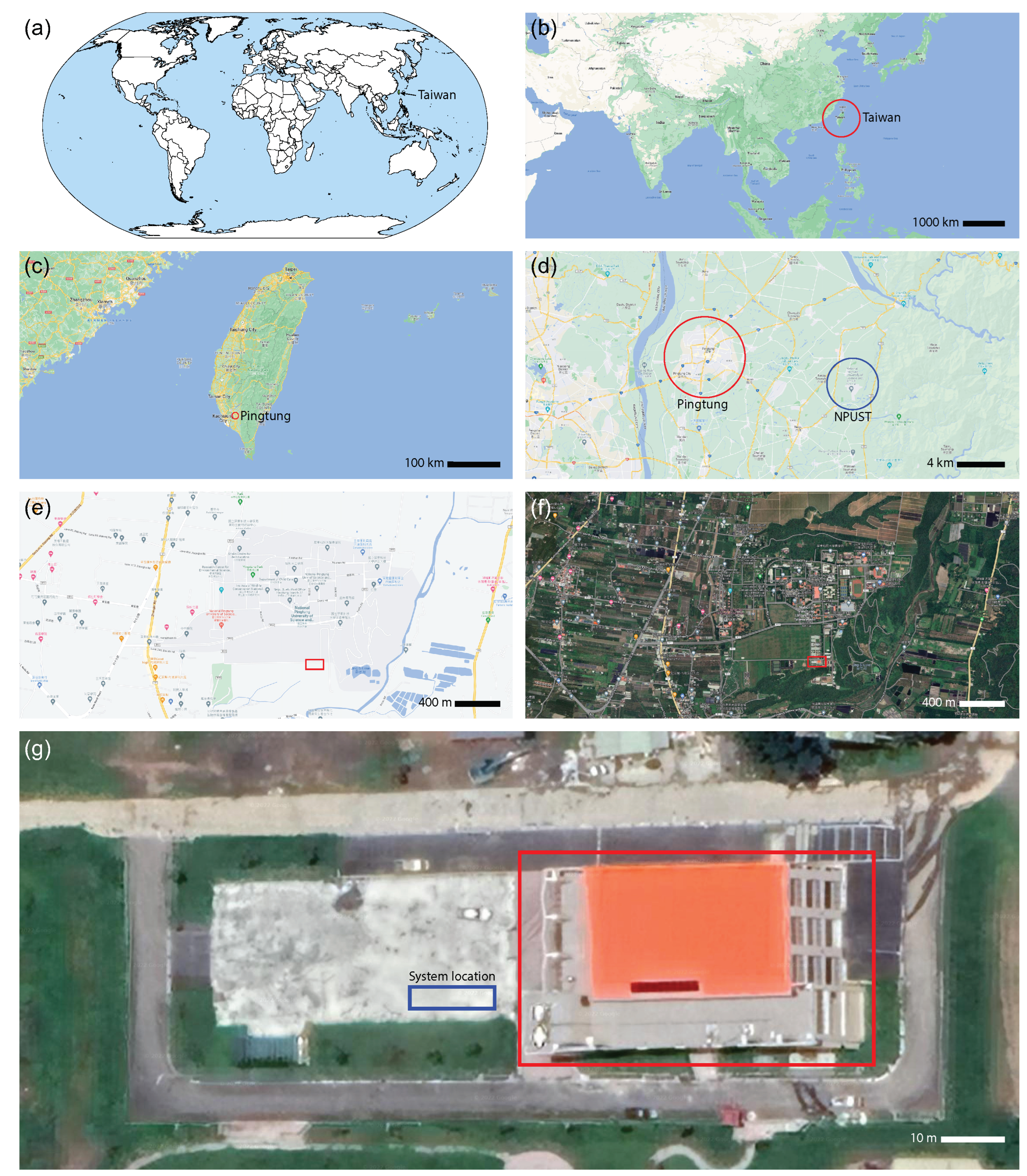
Figure 2.
System architecture of the off-grid solar energy storage system in NPUST On the left and right sides of the dotted lines are the energy inputs and outputs, respectively. The red, green, black dashed arrows indicate the AC, DC, and signal, respectively. The direction of arrow represents the energy or signal flow.
Figure 2.
System architecture of the off-grid solar energy storage system in NPUST On the left and right sides of the dotted lines are the energy inputs and outputs, respectively. The red, green, black dashed arrows indicate the AC, DC, and signal, respectively. The direction of arrow represents the energy or signal flow.
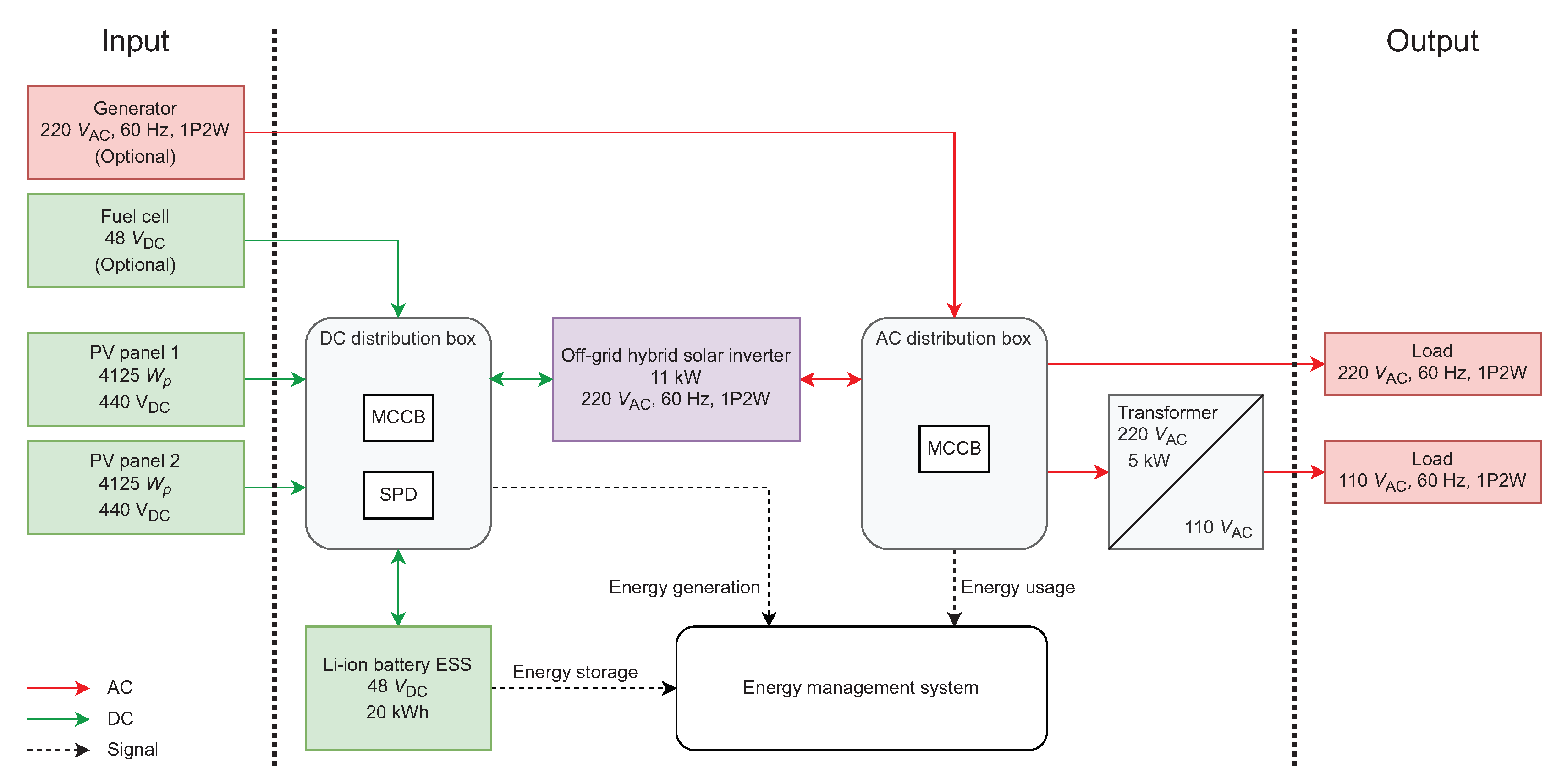
Figure 3.
Monitor of the EMS The monitor of the EMS can be divided into several ports for description. (a) Total solar power (W) with a maximum value of 8250 W. (b) Total voltage of the Li-ion battery ESS (V). When the voltage is within the normal range (48 V ∼ 58 V), the value and bar is colored in green. When the voltage is higher than 58 V (less than 48 V), the value and bar is colored in red (blue), indicating over voltage (under voltage). (c) Total load power (W) with a maximum value of 6000 W. (d) The system name, name and logo of NPUST, and name of “Sustainable Circular Economy R&D Center.” (e) More information about the ESS, i.e., condition of ESS total voltage and current. (f) Date, time and logo of SDP.
Figure 3.
Monitor of the EMS The monitor of the EMS can be divided into several ports for description. (a) Total solar power (W) with a maximum value of 8250 W. (b) Total voltage of the Li-ion battery ESS (V). When the voltage is within the normal range (48 V ∼ 58 V), the value and bar is colored in green. When the voltage is higher than 58 V (less than 48 V), the value and bar is colored in red (blue), indicating over voltage (under voltage). (c) Total load power (W) with a maximum value of 6000 W. (d) The system name, name and logo of NPUST, and name of “Sustainable Circular Economy R&D Center.” (e) More information about the ESS, i.e., condition of ESS total voltage and current. (f) Date, time and logo of SDP.
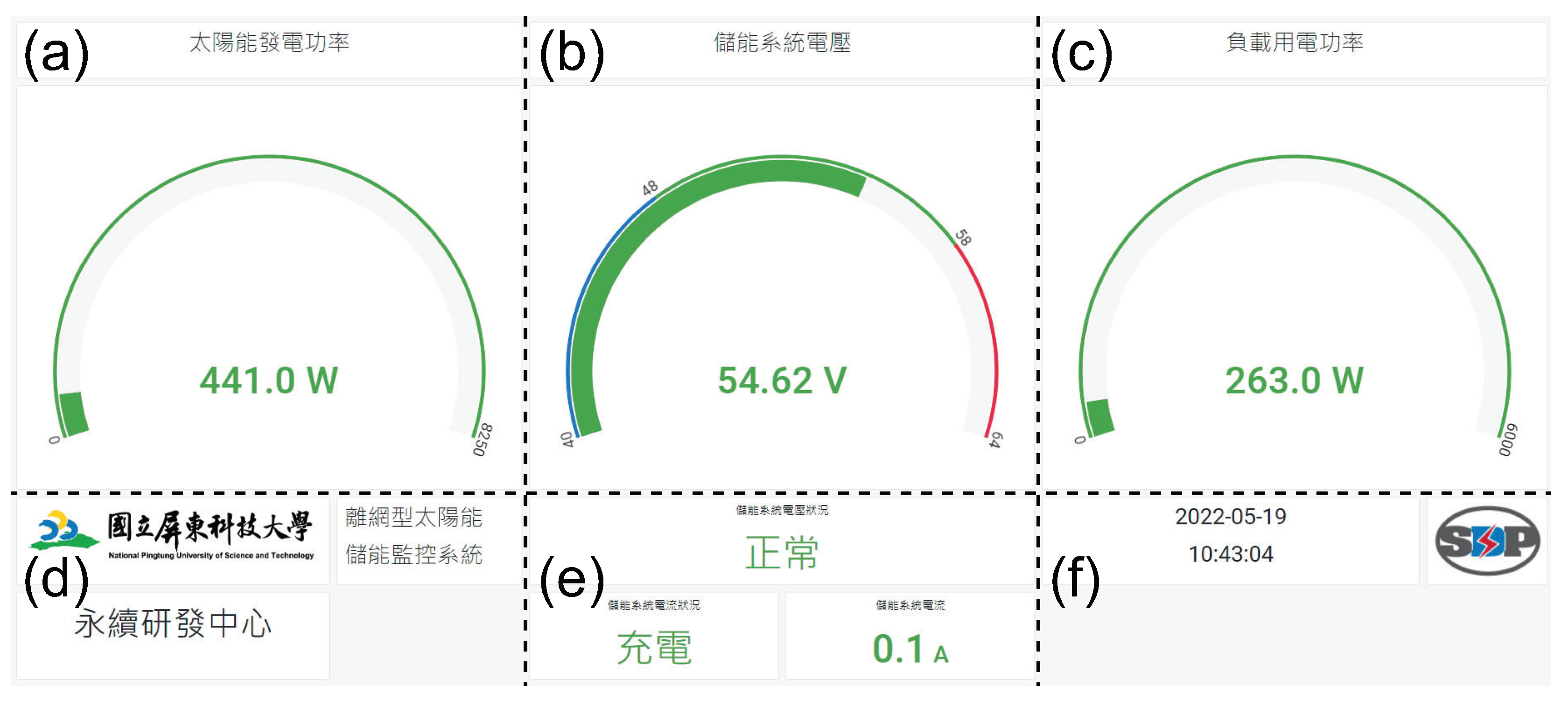
Figure 4.
Brief Construction Procedure (a) Installation of the Li-ion battery ESS, inverter, DC and AC distribution, power lines, signal lines, and EMS. (Photo taken on May 9th, 2022) (b) and (c) Erecting the PV panels. (Photo taken on May 10th, 2022) (d) EMS testing. (Photo taken on May 17th, 2022) (e) Installation of electric doors and iron rolling doors. (Photo taken on May 19th, 2022) (f) Installation of air conditioning. (Photo taken on Jun. 2nd, 2022)
Figure 4.
Brief Construction Procedure (a) Installation of the Li-ion battery ESS, inverter, DC and AC distribution, power lines, signal lines, and EMS. (Photo taken on May 9th, 2022) (b) and (c) Erecting the PV panels. (Photo taken on May 10th, 2022) (d) EMS testing. (Photo taken on May 17th, 2022) (e) Installation of electric doors and iron rolling doors. (Photo taken on May 19th, 2022) (f) Installation of air conditioning. (Photo taken on Jun. 2nd, 2022)
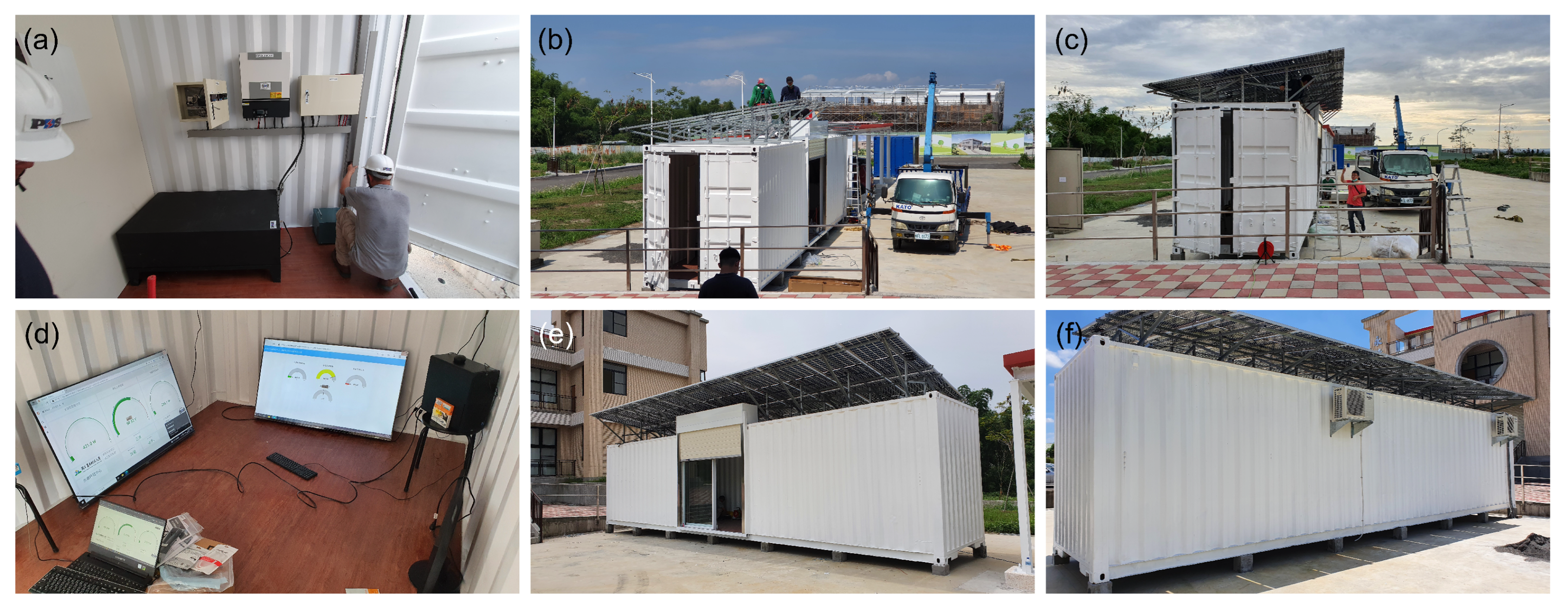
Figure 5.
Constructed system The white container with the system is next to the Sustainable R&D Center.
Figure 5.
Constructed system The white container with the system is next to the Sustainable R&D Center.
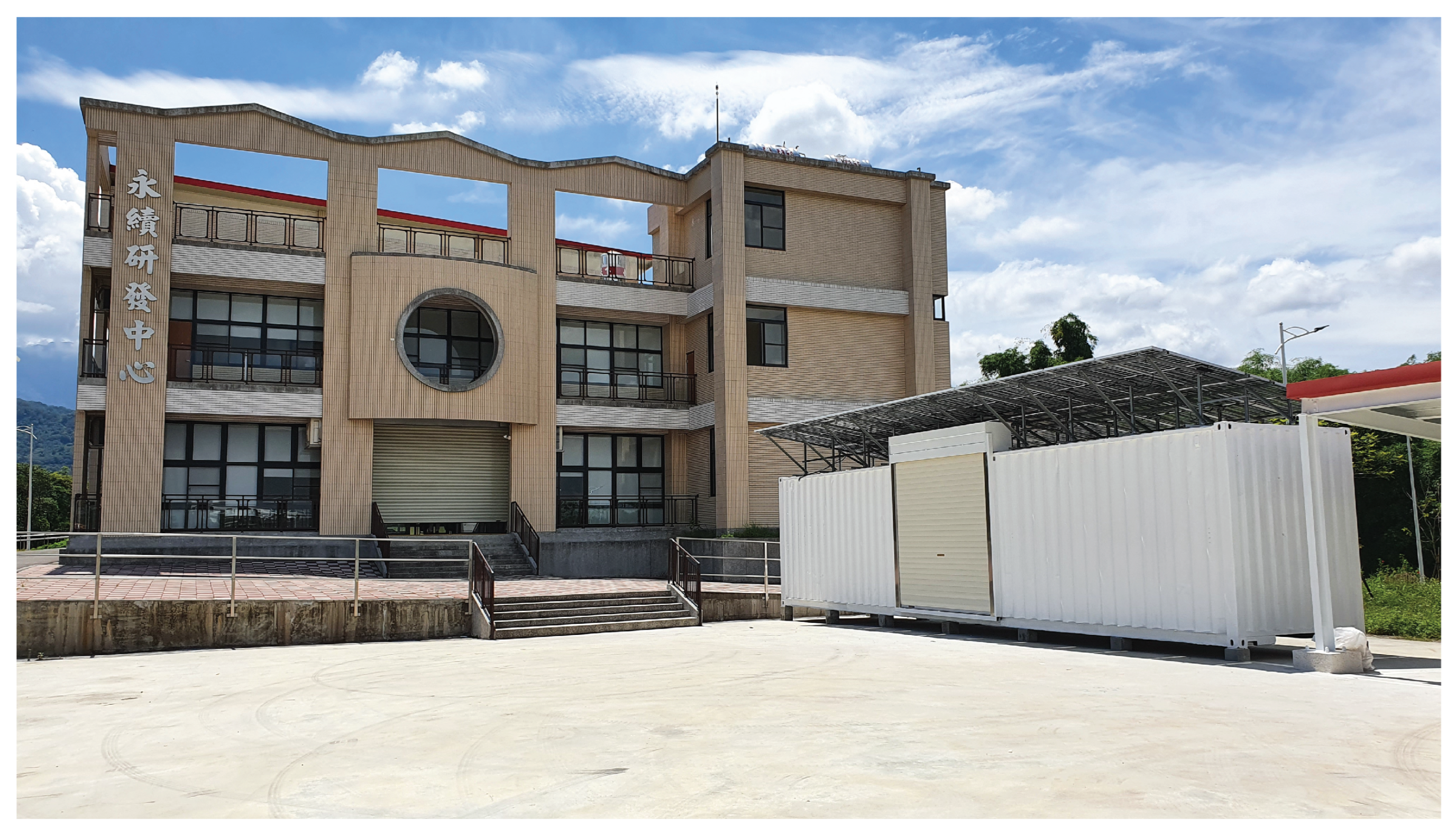
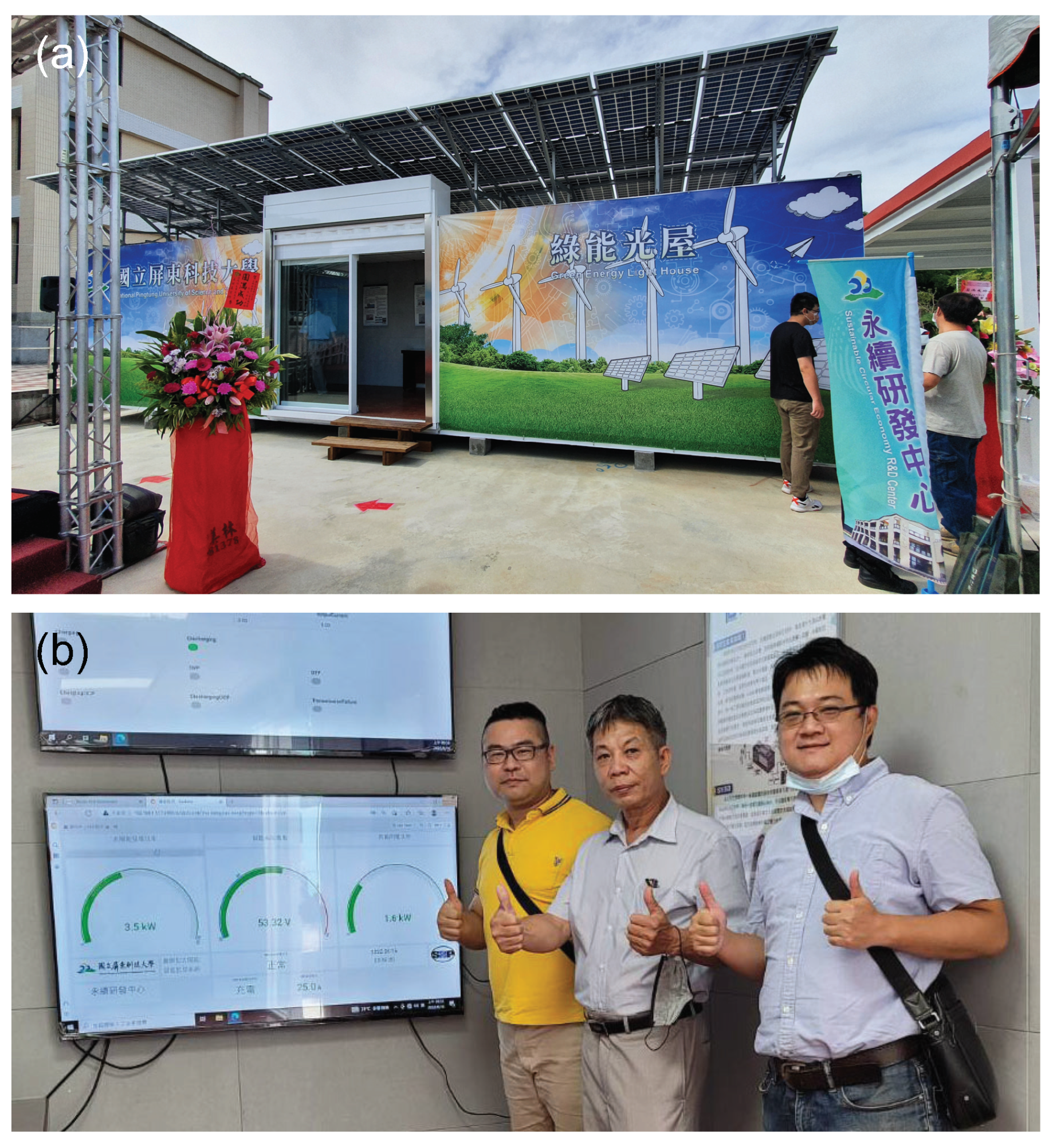
Figure 6.
Green Energy Light House in NPUST (a) Photograph of the Green Energy Light House taken at the opening ceremony on Jun. 16th, 2022. (b) Group photo of SDP staff in from of the EMS display in the Green Energy Light House. Personnel from left to right are Hsien-Ching Chung, Jung-Feng Jack Lin, and Yen-Kai Lo. (Photo (b): Amay Huang)
Figure 6.
Green Energy Light House in NPUST (a) Photograph of the Green Energy Light House taken at the opening ceremony on Jun. 16th, 2022. (b) Group photo of SDP staff in from of the EMS display in the Green Energy Light House. Personnel from left to right are Hsien-Ching Chung, Jung-Feng Jack Lin, and Yen-Kai Lo. (Photo (b): Amay Huang)
Disclaimer/Publisher’s Note: The statements, opinions and data contained in all publications are solely those of the individual author(s) and contributor(s) and not of MDPI and/or the editor(s). MDPI and/or the editor(s) disclaim responsibility for any injury to people or property resulting from any ideas, methods, instructions or products referred to in the content. |
© 2024 by the authors. Licensee MDPI, Basel, Switzerland. This article is an open access article distributed under the terms and conditions of the Creative Commons Attribution (CC BY) license (http://creativecommons.org/licenses/by/4.0/).
Copyright: This open access article is published under a Creative Commons CC BY 4.0 license, which permit the free download, distribution, and reuse, provided that the author and preprint are cited in any reuse.


