
Submitted:
16 February 2024
Posted:
16 February 2024
You are already at the latest version
Abstract
Abstract: Efforts for carbon emission reduction have been identified as a major climate change mitigation target in the Paris Agreement. The 26th Conference of Parties to the United Nations Framework Convention on Climate Change highlighted the worldwide effort for cleaner and greener mining, urging the mineral industry to embrace greener operational emissions reduction technologies and strategies. Ghana pledged at the Paris Conference to reduce CO2 emissions by 15% and increase renewable energy share to 10% of the national energy mix. Here the fundamental question is how Ghana’s mining industry can contribute to CO2 emission reduction efforts. This paper investigates barriers to low-carbon emission policy implementation among mining companies in Ghana. The questionnaire survey was conducted among Ghana’s four large-scale gold mining companies. As the sample number of available companies is limited, we used a descriptive analysis to assess the responses. The results show that the companies expressed widely different ways to respond to the issues of cost, a government policy/regulations for carbon emission reduction, and the adoption/acquisition of low-carbon technologies. Those companies that are relatively less prepared for this endeavor emphasized the uncertainties of securing sufficient energy in case of using low-carbon technologies. They also expressed a need for more trained workers to handle low-carbon technologies. All companies agreed with a expected high cost of adopting low-carbon options. There was a communication gap with the relevant government ministry about low-carbon mining options where the government should be able to facilitate the involvement of othe low technology providers, such as solar PV installation.
Keywords:
Mining companies
; Carbon Emissions
; Policy
; Low-carbon Technology
; Ghana
1. Introduction
For decades, international organizations have long expected that the mining sector contribute more to realizing low-carbon goals. As early as 1972, recommendation 56 of the Stockholm Action Plan urged nations to create a forum for exchanging information about mining and mineral processing, including the impact of mining on environmental conditions [1]. In 1992, Agenda 21 advocated for more sustainable green mining [1,2,3]. The 2012 UN Conference on Sustainable Development highlighted the need for strong and effective legal and regulatory frameworks, policies, and practices for the mining industry [3]. The 26th Conference of Parties to the United Nations Framework Convention on Climate Change (COP26-UNFCCC) urged the mining industry to adopt greener operations [4]. The World Economic Forum similarly emphasized the way the mining industry can benefit from low-carbon infrastructure development [5]. Major mining companies are now well-aware that their operations must lower carbon emissions [6].
The World Gold Council estimates that from 1991 to 2006, the average carbon and other GHG emission intensity from global gold mining was 11,500 kg CO2e/kg [7]. Similarly, it investigated carbon and GHG emissions from five large gold producers in 2016 and found that an average emission intensity was 23,300 kg CO2e per one kilogram of gold produced, significantly higher than the global average [8]. Mineral extraction activities significantly intensify climate vulnerability [9]. GHG emissions intensity in Australia’s mining industry increased by 40% from 14,100 kg CO2e/kg in 1991 to 19,740 kg CO2-e/kg in 2006 [10].
When Ghana ratified the Paris Agreement in September 2016 [11], its carbon and other GHG emissions had been in an increasing trend. According to its fourth Nationally Determined Contribution (NDC) to the UNFCCC, which was submitted in May 2020, the total CO2 and other GHG emissions in 2016 were estimated to be 42.2 million tons of MtCO2e, a 7.1% increase from 2012 [12]. The NDC targeted the agriculture, forestry, land, energy, waste, and industry sectors [12], but, for some reason, it did not include emissions from the mining and mineral sectors [13].
At the Paris Conference (2015), Ghana pledged to reduce CO2 emissions by 15% and increase its renewable energy share to 10% through the national energy mix. However, its efforts to implement a low-carbon policy were hampered for several reasons. Benefoh and Ackom [13] highlighted the challenge of finance and ineffective institutional capacity. Adenle et al. [14] similarly identified a lack of finance as a key challenge to achieving low-carbon development strategies (LCDs) in developing countries, particularly in Africa. Other prominent challenges affecting policy adoption include insufficient financial incentives, firms’ policy frameworks, and the relationship between the government and corporations [15].
Here we proposed three hypotheses. (1) Perceptions about costs associated with carbon emission reduction policy implementation vary among Ghana’s gold mining companies regarding the costs (cost perception). These perceptions influence their operations. (2) The effectiveness of the current governmental policy framework for reducing carbon emissions in Ghana influences the willingness of gold mining companies to adopt and implement low-carbon strategies (policy framework impact). (3) The readiness of gold mining companies in Ghana to adopt low-carbon technologies is influenced by uncertainties in the energy supply and the availability of expertise in adopting innovative low-emission technologies (technology adoption readiness).
Ghana is Africa’s leading gold producer and the world’s seventh largest producer [16]. Mining has contributed significantly to its foreign currency acquisition and government revenue. The gold mining sector contributes approximately 95% of Ghana’s total mineral revenue. Large-scale gold mining operations accounted for about 11% of Ghana’s national GHG emissions [17]. Considering these situations, the fundamental question is how Ghana’s mining industry can contribute to CO2 emission reduction. What is the status of their low-carbon practices? What are their perspectives and prospects of moving toward more sustainable practices of gold production in the future?
This paper, therefore, investigates barriers to low-carbon emission policy implementation among mining companies in Ghana. It focuses on four gold mining companies. Understanding and addressing hinderances to the implementation of carbon emission policies in Ghana’s mining sector is crucial for aligning economic development with environmental sustainability and meeting international climate commitments. In the following discussion, we first clarify the materials and methods. We explain the study area and our methods of collecting and analyzing data. We then discuss the results pertaining to the company’s perceived barriers to adopting low-carbon practices.
2. Materials and Methods
2.1. Study Area
For this study, we selected the southern part of Ghana, an area with a rich mineral resource endowment. During the 18th century, Ghana was known as the Gold Coast under the British colonial rule and was home to approximately 12 major large-scale mining companies [18]. These mining operations were dispersed across various regions within the southern area or so-called the “gold belt.” The gold belt is home to almost 90% of the country’s total estimated gold deposits [19].
Notable mining zones within this area include Upper Denkyira West, Obuasi, Asutifi North, and Tarkwa, all of which have a longstanding history of gold mining activities [20]. Upper Denkyira West District in the Central Region encompasses an area of 579.21 km2 and houses a population of 91,025 [21]. Obuasi is a town in the Ashanti Region, covering approximately 162.4 km2. This area is widely known for its prosperous gold mining activities. The town has a population of 104,297. Asutifi North District in the Ahafo Region encompasses 936 km2 and is inhabited by 73,556 people [21]. In the Ahafo Region the Ahafo Gold Mine is operated by the Newmont Mining Corporation [22]. Tarkwa, a town in the Western Region, serves as a center for gold mining. Its mining operations are prominently associated with the Tarkwa Gold Mine, operated by GoldFields Limited. The town has a population of 218,664 in a land area of 97,826 km2. Tarkwa is one of the largest gold mines in the nation.
Mining operations exert a multifaceted influence on local livelihoods and development. In 2020 alone, Ghana produced about five million ounces of gold [23,24], accounting for about 90% of the total mineral exports, and 49% of the total export value [25]. The government of Ghana receives 10% of the mining revenue in the form of taxes and royalties. The mining companies also create employment opportunities [26]. In 2023, a total of 12,294 people were employed in the mining industry in Ghana [27]. More importantly, mining enterprises have invested substantively in infrastructure developments, such as roads, educational institutions, healthcare facilities, and essential amenities [28]. Mining corporations have undertaken corporate social responsibility initiatives for education and healthcare [29].
Mining companies also have shown commitment to responsible and sustainable practices. For instance, the Tarkwa Goldfields Mine emphasizes environmental stewardship, community development, low-carbon practices in its infrastructure and community projects, as well as safety measures [30]. Similarly, AngloGold Ashanti, which oversees the redevelopment of the Obuasi mine, says that it adheres to carbon emission reduction, community engagement, safety, and environmental protection [31]. In Upper Denkyira West, Newmont’s Akyem mine announced that it has prioritized environmental stewardship, safety, and community development through rigorous environmental assessments, biodiversity conservation efforts, and safety protocols [32]. In Asutifi North District, Perseus Mining declares to maintain industry-standard emission reduction, safety, and environmental practices at the Edikan mine while actively engaging with local communities. These expressed efforts illustrate mining industry’s growing interest in sustainable and responsible operations [33].
However, the presence of mining operations has long raised concerns over carbon/environmental footprints. Previous research by Amoako et al., in 2018 identified that sizable gold mining operations (e.g., land use, explosives, mobile and stationary equipment fuel consumption, electricity consumption, waste disposal) were responsible for a substantial amount of CO2 and GHG emissions. Among these factors, electricity usage and fuel consumption in transportation account for 92.46% of the overall GHG emissions. On average, the large-scale gold mining sector in Ghana contributed about 11% to Ghana’s total national greenhouse gas emission inventory.
2.2. Data Collection and Analysis
To gather information on the low-carbon practices of mining companies in Ghana, we initiated contact with the companies’ representatives. With permission, we conducted expert interviews using a semi-structured questionnaire format. These interviews were conducted between 27 April and 20 May 2022. For confidentiality purposes, we have denoted these companies as Company A, Company B, Company Y, and Company Z (Figure 1). These four companies, according to the Ghana Chamber of Mines 2016 report, are recognized as major international mining enterprises in Ghana with operations spanning various mining zones.
In Ghana, Company A operates a gold mine in Obuasi. It is a prominent global gold producer with headquarters in South Africa. Company B also has South African roots and operates a mine at Tarkwa. Company Y is headquartered in Australia with operations at Ahafo. Company Z operates gold mines in the Upper Denkyire West area. Its headquarters is located in the United States.
All four companies (Company A, Company B, Company Y, and Company Z) are members of international organizations, including the International Council on Mining and Metals (ICMM), Task Force on Climate-Related Financial Disclosure (TCFD), Extractive Industries Transparency Initiative (EITI), and World Gold Council. All except Company Z are members of the Carbon Disclosure Project (CDP), an international non-profit organization that focuses on environmental reporting and the collection of information related to potential low-carbon practices [34].
The four companies operate gold mining in different scales. In 2020, the Minerals Commission of Ghana report highlighted that company B was the largest employer among the four companies with a workforce of 4576 employees. Company A employed approximately 4210 individuals. Company Z had around 3343 employees. Company Y employed 2000 people. In terms of gold production, Company B was the highest producer with an annual output of 526.3 koz. Companies Y and Z produced 270 koz and 157 koz, respectively, while Company A’s annual gold production was approximately 127 koz. Company A reported an annual estimated revenue of USD 4427 million from gold sales. Company B’s annual revenue was about USD 927.7 million. Company Y reported an annual revenue of USD 467.8 million, and Company Z’s annual revenue was USD 139.4 million. Table 1 shows these companies’ workforce, annual gold production and revenue generated from the sales of gold.
According to the Sustainability Report (2021), Companies A and B reported carbon dioxide emission levels of 40 kg/t CO2e and 33 kg/t CO2, respectively, for the year 2020. Companies Y and Z primarily focused on scopes 1 (direct emissions) and 2 (indirect emissions) in their carbon emissions intensity assessments without providing specific numerical figures. All four companies rely on grid electricity for their mining activities. However, Company B supplements its energy supply with solar and natural gas [35].
Due to the COVID-19 pandemic that prohibited us from conducting an in-person survey in Ghana, the survey was carried out by two local enumerators. Based on the information we obtained from published sources, we prepared a set of questions for the survey. The enumerators strictly adhered to these questions. One enumerator was responsible for Company A, while the other handled companies B, Y, and Z. To ensure clarity, we had detailed phone discussions with the enumerators, thoroughly explaining the questionnaire content. Responses were received from the environmental departments of the respective companies.
Our questionnaire interviews focused on identifying the companies’ challenges in adopting low-carbon technologies. We listed the following eight possible barriers for the respondents to choose: (1) lack of government policy on low-carbon emissions, (2) information availability on low-carbon mining, (3) cost of low-carbon technology, (4) the availability of long-term payment schemes, (5) availability of low-carbon technology, (6) power generation capacity, (7) low-carbon policy decision making, and (8) technical expertise. We assessed the degree of their agreement by defining 1 as strongly disagree and 5 as strongly agree on a 5-point Likert scale. To protect respondent anonymity due to the sensitivity of their opinions, we maintained confidentiality.
To understand perceptual variations among the companies’ responses, we conducted a means analysis to compare the average rating of each mean value on 5-point Likert scale intervals to determine the overall responses. The ranges on 5-point Likert scale intervals and mean values were calculated as follows:
Step 1: To estimate the Likert scale ranges, we first computed the average value by:
- Subtracting the 5-point Likert scale lowest value from the highest value (5 − 1 = 4).
- Dividing by the 5-point Likert scale number of responses (4/5 = 0.8).
- Adding (0.8 + 1 = 1.8). Where 1 = lower standard range (scale of 1 to 5) and 0.8 is the average mean value. Since the 5-point Likert scale has a range of 1 to 5, we expressed the first range as (1–1.8), where 1 = lower range and 1.8 = upper range.
- We added 0.8 to obtain the following upper ranges. [(1.8 + 0.8 = 2.6), (2.6 + 0.8 = 3.4), (3.4 + 0.8 = 4.2), (4.2 + 0.8 = 5)].
-
The lower ranges were determined as a sequence value of each upper range.[(1.8 → 1.9), (2.6→ 2.7), (3.4 → 3.5), (4.2 → 4.3)].
- We computed the ranges, and an interpretation was made as “strongly disagree” (scale 1 to 1.8), “disagree” (scale 1.9 to 2.6), “not sure” (scale 2.7 to 3.4), “agree” (scale 3.5 to 4.2), and “strongly agree” (scale 4.3 to 5).
Step 2: To find the mean values (Table 2), we modified the frequency mean distribution formula and developed an equation: . Where ∑R = sum of responses and TNC = total number of companies.
3. Results and Discussion
Company’s Responses to Barriers to Low-Carbon Policy Implementation
One of the important questions we do not know about low-carbon policy implementation among mining companies in Ghana is the extent to which government agencies have communicated with mining companies about the policy. In other words, to what extent are companies aware of government incentives for low-carbon options (Table 3)? This point has been emphasized in past studies [36].
In response to this question, companies A and Z were of the opinion that the Ghanaian government did not provide specific low-carbon emission incentives. Company B replied that the government had provided low-carbon policy information. Company Y was not sure. This result means that, overall, mining companies did not seem to have good communication with government agencies about low-carbon policies. In Ghana, the Ministry of Environment, Science, Technology and Innovations (MESTI), and the Environmental Protection Agency (EPA) enforce compliance with environmental laws and regulations at all levels. The primary tax advantages and incentives for private entities engaged in mining activities in Ghana revolve around reduced customs import duties for plant, machinery, equipment, and accessories exclusively imported for mineral operations [37].
In the next question, we asked whether the mining companies had sufficient information about low-carbon technologies and options. This question was based on the study by [38] who suggested that the corporate organizational structure and managerial perspectives significantly influence a firm’s ability to obtain information. In response to our question, companies A and Y strongly disagreed and disagreed about having sufficient information about low-carbon technologies and options. On the contrary, company B was confident that it had enough information with or without government information. Company Z was not sure.
Next, we asked the companies about the extent to which the cost for adopting solar and wind technologies were to be obstacles. According to GoldFields’ 2021 Sustainability Report, Agnew Mines’ renewable energy installations were recommended to be handled by independent power producers due to the large capital required to invest in renewable energy (IPPs). Independent power producers are private electricity suppliers who invest in corporate renewable energy production. However, past studies showed that the higher costs associated with adopting solar and wind technologies imposed a burden on private firms [39,40]. This is particularly so when developing countries, not having their own solar/wind producers, depend on imports with additional costs for import duties [41]. In response, all four companies agreed that the cost was one of major inhibiting factors (Table 3).
As mining is an energy-intensive industry, we asked the companies if energy generated by low-carbon technologies would be sufficient for their mining operations. In response, Company B strongly believed that low-carbon technologies would not supply sufficient energy for their operations. Companies A and Z agreed. Company Y disagreed with the statement, showing its capacity to incorporate renewable energies for its operation. This result (Table 3) shows varied responses among companies. Overall, this result suggests that electricity produced by low-carbon technologies is considered to be insufficient for mining operations, but this does not mean that all mining companies are incapable of adopting low-carbon technology.
Concerning policy decision making within the area of their companies’ operations, we questioned the extent to which the companies agreed that low-carbon technology is not emphasized at the top of the company policy agenda. All the companies disagreed (Table 3), suggesting that these companies placed a high priority on reducing carbon emissions. Among them, two companies (A and B) strongly disagreed, whereas the rest disagreed (company Y and Z). The study of the range by mean interpretation reveals that all four companies strongly disagreed (Table 3).
In terms of technical competence, we asked about the extent to which the companies were capable of managing low-carbon technologies using available workers. Companies A and Z agreed that additional technical knowledge is required to handle updated low-carbon technologies. Company Y was not sure (Table 1). We found that all elements of innovation, including adoption, operation, and maintenance, require technical skills. The skill level and capacity differed widely among companies.
4. Conclusions
This paper has discussed the barriers to implementing low-carbon practices at Ghana’s four main gold mining companies. Reflecting on what we discussed in the introduction, our findings should be once again placed within a context of global movement toward climate smart mining initiatives. Whereas the international community emphasized the importance of incorporating low-carbon options into the mining sector, past studies have not yet clarified how individual companies are ready for this undertaking. In addition, it has not been found how mining companies are operating in developing countries, in which strong legal/regulatory frameworks are not put in place in connection to smart climate actions. These questions are essential to make international low-carbon mining propositions more feasible.
Our paper examined four gold mining companies that are recognized as large-scale international mining enterprises that are operating in Ghana, primarily producing gold as key production activities. We discussed that these companies are the members of the International Council on Mining and Metals, Task Force on Climate-Related Financial Disclosure, Extractive Industries Transparency Initiative, and World Gold Council. This means that these companies had substantial knowledge about low-carbon mining options. Even though the companies recognized the need to reduce their carbon footprint, the results of our survey showed that overall cost concerns were the major barrier for all companies.
Another salient finding in this research was that the level of knowledge and capacity in dealing with their low-carbon operations in Ghana differed widely among companies. This can be translated into the question of the extent to which each company was committed to low-carbon efforts. Companies A and Y, for example, appeared to be more knowledgeable and committed to low-carbon operations than the others. In another words, challenges large-scale gold mining companies face differ partly because there is a large disconnect between responsible government agencies and the companies’ practices. In terms of acquiring sufficient technical expertise/resources and installing renewable energy sources (e.g., solar, wind), companies have decision making power without much regulatory constraints.
We found that one of the major challenges among companies was the expected cost of material-intensive low-carbon technology, which, to some extent, depends on the extraction of mineral resources. Past research highlighted that independent power producers may develop large-scale solar and wind projects, sell electricity to mining companies, and significantly contribute to energy efficiency improvements that, in turn, reduce mining carbon emissions. This has not been carried out yet in Ghana, partly because the Ghanaian government has not invested in its own low-carbon technology developments. There is also a lack of public–private partnership options for the mining industry in Ghana.
Our studies revealed that technical knowledge is required to handle innovative low-carbon technology within mining companies. Previous studies observed that managing cutting-edge technologies required professional expertise as well as the strong commitment of companies to investing in these technologies. If strongly committed, mining companies may create their own technologies in Ghana. Also, with enough investment in education, Ghana’s private sector may eventually provide outsourcing options for these mining companies in connection to adopting, operating, and maintaining these technologies. The Ministry of Education in charge of designing the educational curriculum in Ghana may incorporate low-carbon technology requirements.
Finally, we acknowledge that further research is needed to understand the cost-effectiveness of adopting low-carbon technology among mining companies. In particular, we need to know the extent to which tighter low-carbon or climate smart regulations in Ghana and other resource rich developing countries lead to low-cost technology and management innovations. This type of study may provide more specific guidelines for low-carbon mining operations in the future. Another fundamental question in the context of Ghana’s mining sector and possibly beyond is the question of control over mineral resources. Given the dominant presence of foreign mining corporations, it is important to examine how Ghana can regain more control over its natural resources for its sustainable and climate smart future.
Author Contributions
Conceptualization, S.A. and K.M.; methodology, S.A. and K.M.; analysis, S.A. and K.M.; investigation, S.A.; data curation, S.A. and K.M.; writing—original draft preparation, S.A.; writing—review and editing, K.M.; supervision, K.M. All authors have read and agreed to the published version of the manuscript.
Funding
This research received no funding from any organization, institution, or NGO.
Institutional Review Board Statement
Not applicable.
Informed Consent Statement
We explained the purpose of the study to the department of environment at the corresponding mining companies.
Data Availability Statement
Our dataset cannot be made accessible to the public due to stringent privacy and ethical constraints by companies (A, B, Y, and Z). These constraints prevent us from disclosing the data, as it includes sensitive information that must be safeguarded in compliance with the legal and ethical standards upheld by the mining companies participated in this research.
Acknowledgments
We would like to thank the enumerators and mining companies (A, B, Y, and Z) for their reception and assistance in gathering data for this research. We also show great appreciation to the department of environment at the corresponding mining companies, who sat down for hours to answer the questionnaire.
Conflicts of Interest
The authors declare no conflicts of interest.
References
- United Nations Development Programmed. Managing Mining for Sustainable Development. 2018. Available online: https://www.undp.org/content/undp/en/home/librarypage/poverty-reduction/Managing-Mining-for-SD.html (accessed on 7 September 2020).
- Cutifani, M.; Bryant, P. Reinventing Mining: Creating Sustainable Value. Kellogg Innovation Network. 2013. Available online: https://kellogg.campusgroups.com/kin/about/ (accessed on 24 May 2022).
- Malan. Advancing Sustainable Mining. IISD Negotiations Bulletin. Lesson from 50 years of UN Sustainable Development Policy. Available online: https://www.iisd.org/system/files/2021-10/still-one-earth-sustainable-mining.pdf (accessed on 14 August 2022).
- Smith, Herbert FreeHills. COP26 and Mining: What Does It Mean for the Sector? Legal Briefings. 2021. Available online: https://www.herbertsmithfreehills.com/insights/key-topics/mining (accessed on 5 June 2022).
- World Economic Forum. Seven Trends Shaping the Future of the Mining and Metals Industry. 2019. Available online: https://www.weforum.org/ (accessed on 1 September 2022).
- Ruokonen, E. Managerial perspectives on strategies for advancing environmental considerations in the mining industry. Extr. Ind. Soc. 2021, 8, 434–441. [Google Scholar] [CrossRef]
- World Gold Council. Gold and Climate Change: Current and Future Impacts, Vol. 40, World Gold Council. 2019. Available online: https://www.gold.org/download/file/14316/gold-and-climate-change-current-and-future-impacts.pdf (accessed on 12 January 2020).
- Tost, M.; Hitch, M.; Chandurkar, V.; Moser, P.; Feiel, S. The state of environmental sustainability considerations in mining. J. Clean. Prod. 2018, 182, 969–977. [Google Scholar] [CrossRef]
- Gasbarro, F.; Pinkse, J. Corporate adaptation behaviour to deal with climate change: the influence of firm-specific interpretations of physical climate impacts. Corp. Soc. Responsib. Environ. Manag. 2016, 23, 179–192. [Google Scholar] [CrossRef]
- Mudd, G.M. Gold mining in Australia: linking historical trends and environmental and resource sustainability. Environ. Sci. Policy 2007, 10, 629–644. [Google Scholar] [CrossRef]
- UNFCCC. The United Nations Framework Convention on Climate Change. Adoption of the Paris Agreement. 2015. Available online: http://unfccc.int/resource/docs/2015/cop21/eng/l09.pdf (accessed on 7 August 2022).
- Ministry of Environment, Science, Technology and Innovation. Ghana’s Fourth National Communication to the United Nations Framework Convention on Climate Change; Ministry of Environment, Science, Technology and Innovation: Accra Ghana, 2020. [Google Scholar]
- Benefoh, D.T.; Ackom, E.K. Energy and low carbon development efforts in Ghana: institutional arrangements, initiatives, challenges and the way forward. AIMS Energy 2016, 4, 481–503. [Google Scholar] [CrossRef]
- Adenle, A.A.; Manning, D.T.; Arbiol, J. Mitigating climate change in Africa: Barriers to financing low-carbon development. World Dev. 2017, 100, 123–132. [Google Scholar] [CrossRef]
- Liu, Y. Barriers to the adoption of low carbon production: A multiple-case study of Chinese industrial firms. Energy Policy 2014, 67, 412–421. [Google Scholar] [CrossRef]
- Ellis, K.; Baker, B.; Lemma, A. Policies for Low Carbon Growth; Overseas Development Institute: London, UK, 2009. [Google Scholar]
- Amoako, Y.K.; Gordon, C.; Sakyi, P.A.; Gyimah, R. Carbon Footprint of the large-scale gold mining industry of Ghana. West Afr. J. Appl. Ecol. 2018, 26, 242–260. [Google Scholar]
- Campbell, B. Revisiting the reform process of African mining regimes. Can. J. Dev. Stud. /Rev. Can. D’études Du Développement 2010, 30, 197–217. [Google Scholar] [CrossRef]
- Ghana Geological Department: Mapping (Geological, Geophysical, Geochemical, Hydrogeological)-Geological map of Ghana. 1995. Drawn and reproduced by Survey Department, Accra; compiled by and under the direction of D.A. Bates, M.B.E. M. Sc., Director, Geological Survey. Available online: https://mlnr.gov.gh/ (accessed on 8 November 2022).
- Okyere, M.; Ayitey, J.Z.; Ajabuin, B.A. Large scale mining in Ghana: a review of the implications on the host communities. J. Degrad. Min. Lands Manag. 2021, 9, 3193. [Google Scholar] [CrossRef]
- Ghana Statistical Service. Ghana Population and Housing Census. 2021. Available online: https://census2021.statsghana.gov.gh/ (accessed on 2 December 2023).
- Ansu-Mensah, P.; Marfo, E.O.; Awuah, L.S.; Amoako, K.O. Corporate social responsibility and stakeholder engagement in Ghana’s mining sector: A case study of Newmont Ahafo mines. Int. J. Corp. Soc. Responsib. 2021, 6, 1–22. [Google Scholar] [CrossRef]
- Ghana Chamber of Mines. Data on Fuel and Electricity Use by Large Scale Mining Companies in Ghana. 2016. Available online: https://ghanachamberofmines.org/ (accessed on 20 April 2022).
- NEWCORE Gold. Technical Report: Gold Production in Africa. 2022. Available online: https://newcoregold.com/enchi-project/technical-reports/ (accessed on 8 February 2023).
- Ayee, J.; Soreide, T.; Shukla, G.P.; Le, T.M. Political Economy of the Mining Sector in Ghana. World Bank Policy Research Working Paper No. 5730. 2011. Available online: https://ssrn.com/abstract=1892670 (accessed on 19 September 2023).
- Anaafo, D.; Nutsugbodo, R.Y.; Adusu, D. Mining and sustainable development in the Asutifi North District, Ghana. Resour. Policy 2023, 80, 1–18. [Google Scholar] [CrossRef]
- GHEITI. Ghana Extractive Industries Transparency Initiative. 2023. Available online: www.gheiti.gov.gh/files/ghana-eiti-technical-report-asm-sector.pdf (accessed on 17 January 2024).
- Owen, J.R.; Vivoda, V.; Kemp, D. Country-level governance frameworks for mining-induced resettlement. Environ. Dev. Sustain. 2020, 22, 4907–4928. [Google Scholar] [CrossRef]
- Kasimba, S.A.; Lujala, P. Examining host communities’ perceptions on trust funds as corporate strategies for community development in Ghana. J. Asian Afr. Stud. 2021, 56, 1386–1402. [Google Scholar] [CrossRef]
- GoldFields. Sustainability Report on Energy and Climate Change. 2020. Available online: https://www.goldfields.com/environment.php (accessed on 14 September 2020).
- AngloGold Ashanti. Sustainability Reporting, Performance, and Business Improvement. 2019. Available online: https://www.aga-reports.com/19/download/AGA-SR19.pdf (accessed on 21 September 2020).
- Minerals Commission of Ghana. Minerals Commission’s Data on Ghana’s Mining Sector. 2020. Available online: https://www.mincom.gov.gh/ (accessed on 24 March 2023).
- Amoah, P.; Eweje, G. Barriers to environmental sustainability practices of multinational mining companies in Ghana: an institutional complexity perspective. Corporate Governance: Int. J. Bus. Soc. 2022, 22, 364–384. [Google Scholar] [CrossRef]
- CDP. Action on Disclosure Insight. 2022. Available online: https://www.cdp.net/en (accessed on 31 December 2022).
- Ghana Chamber of Mines. Advancing a Legacy of Sustainable and Responsible Mining through Innovation and Partnership. 2021. Chamber 2021 Report new18.cdr. Available online: https://ghanachamberofmines.org/wp-content/uploads/2023/05/Annual-Report-2021-REPORT-Final.pdf (accessed on 22 December 2022).
- Khan, A.R.; Khandaker, S. A critical insight into policy implementation and implementation performance. Vies. Polit. Ir Adm. 2016, 15, 538–548. [Google Scholar]
- Kimathi & Partners Corporate Attorneys. At a Glance: Mining Duties, Royalties, and Taxes in Ghana. 2023. Available online: https://www.lexology.com/library/detail.aspx?g=197c4122-8fb4-4227-87c0-6d853bcd8f5b (accessed on 17 January 2024).
- McCreadie, M.; Rice, R.E. Trends in analyzing access to information. Part I: cross-disciplinary conceptualizations of access. Inf. Process. Manag. 1999, 35, 45–76. [Google Scholar] [CrossRef]
- Nordtømme, M.E.; Bjerkan, K.Y.; Sund, A.B. Barriers to urban freight policy implementation: The case of urban consolidation center in Oslo. Transp. Policy 2015, 44, 179–186. [Google Scholar] [CrossRef]
- McTigue, C.; Rye, T.; Monios, J. Identifying barriers to implementation of local transport policy–Lessons learned from case studies on bus policy implementation in Great Britain. Transp. Policy 2020, 91, 16–25. [Google Scholar] [CrossRef]
- Huang, J. Investigating the driving forces of China’s carbon intensity based on a dynamic spatial model. Environ. Sci. Pollut. Res. 2018, 25, 21833–21843. [Google Scholar] [CrossRef] [PubMed]
Figure 1.
The map illustrates study locations.
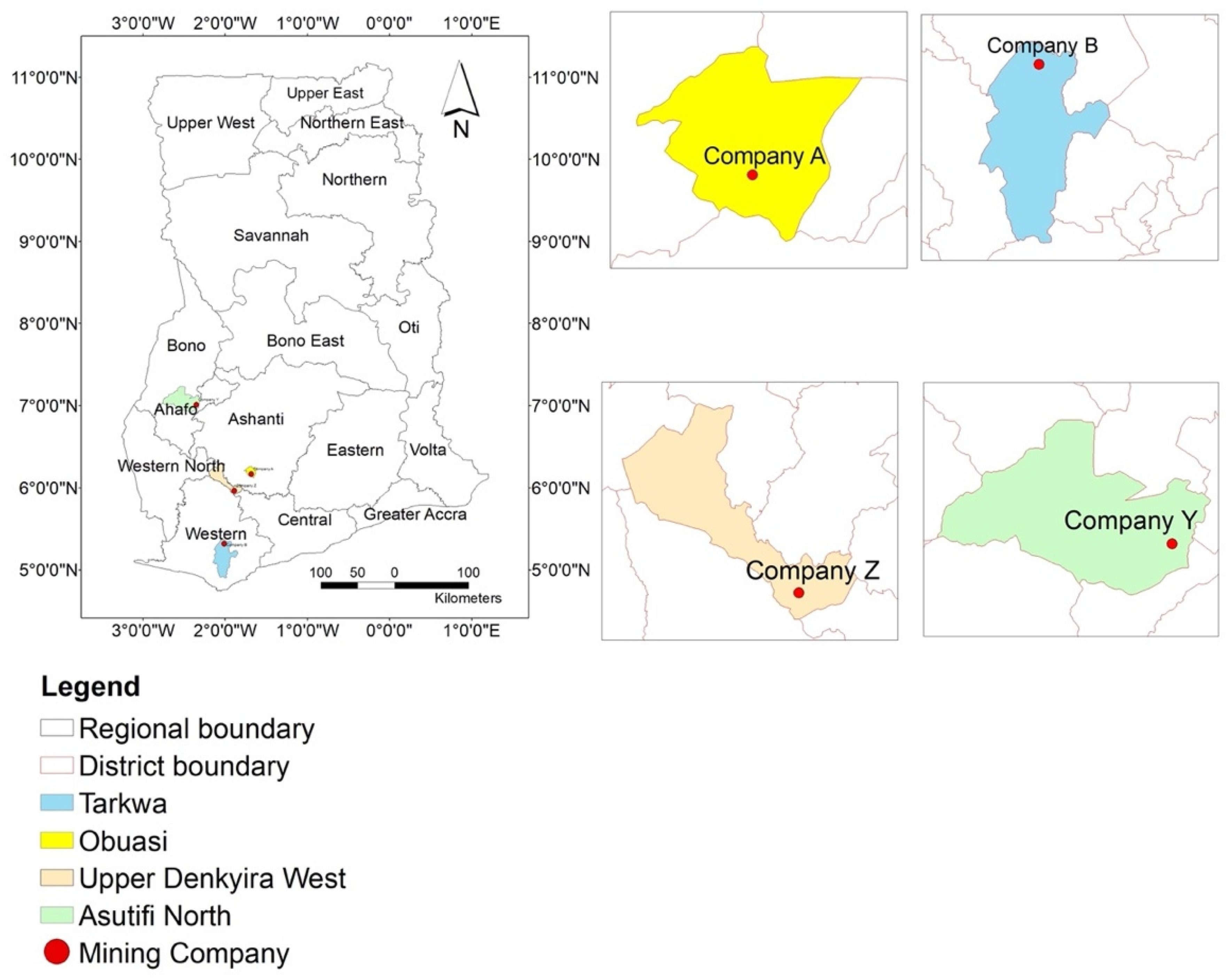

Table 1.
Characteristics of Gold Mining Companies.
| Company | Workforce |
Gold Production (Annual) Koz |
Revenue (Annual) Million (USD) |
| Company A | 4210 | 127 | 4427 |
| Company B | 4576 | 526.3 | 927.7 |
| Company Y | 2000 | 270 | 467.8 |
| Company Z | 3343 | 157 | 139.4 |
Table 2.
Calculation of mean values.
|
Responses Rate (Table 3) |
(∑R) | (∑R)/TNC | Mean Value |
| Statement 1 | 4 + 2 + 3 + 4 = 13 | 13/4 | 3.25 |
| Statement 2 | 1 + 5 + 2 + 3 = 11 | 11/4 | 2.75 |
| Statement 3 | 5 + 5 + 4 + 5 = 19 | 19/4 | 4.75 |
| Statement 4 | 4 + 4 + 5 + 2 = 15 | 15/4 | 3.75 |
| Statement 5 | 1 + 1 + 2 + 1 = 5 | 5/4 | 1.25 |
| Statement 6 | 1 + 2 + 1 + 2 = 6 | 6/4 | 1.50 |
| Statement 7 | 4 + 5 + 2 + 4 = 15 | 15/4 | 3.75 |
| Statement 8 | 4 + 3 + 4 + 4 = 15 | 15/4 | 3.75 |
| ∑R = sum of responses and TNC = total number of companies. | |||
| (Scale 1 to 5): SD = 1, D = 2, NS = 3, A = 4, SA = 5 (Reference Table 3) | |||
Mean values were estimated as “3.25”, “2.75”, “4.75”, “3.75”, “1.25”, “1.50”, “3.75”, “3.75”. Responses with a higher mean value suggest a greater potential barrier, whereas responses with a lower mean value imply a lower barrier to implementing low-carbon policies.
Table 3.
Companies’ responses about low-carbon implementation barriers.
| Statement | Company A Mines |
Company B Mines |
Company Y Mines | Company Z Mines | Mean | Interpretation |
| 1. The government does not give us specific policy frameworks to reduce carbon emission | Agree | Disagree | Not sure | Agree | 3.25 | NS |
| 2. Mining companies do not have sufficient information about low-carbon-emission | Strongly disagree | Strongly agree | Disagree | Not sure | 2.75 | NS |
| 3. Low-carbon technology is costly | Strongly agree | Strongly agree | Agree | Strongly agree | 4.75 | SA |
| 4. We need long-term payment plans for acquiring low-carbon technology | Agree | Agree | Strongly agree | disagree | 3.75 | A |
| 5. Low-carbon technology is not available | Strongly disagree | Strongly disagree | Disagree | Strongly disagree | 1.25 | SD |
| 6.Low-carbon technologies is not our priority | Strongly disagree | Disagree | Strongly disagree | Disagree | 1.50 | SD |
| 7. Electricity produced by low-carbon technologies is insufficient for mining operations | Agree | Strongly agree | disagree | Agree | 3.75 | A |
| 8. We need more trained workers to handle low-carbon technologies | Agree | Not sure | Agree | Agree | 3.75 | A |
NS-Not sure, D-Disagree, SD-Strongly disagree, A-Agree, SA-Strongly agree.
Disclaimer/Publisher’s Note: The statements, opinions and data contained in all publications are solely those of the individual author(s) and contributor(s) and not of MDPI and/or the editor(s). MDPI and/or the editor(s) disclaim responsibility for any injury to people or property resulting from any ideas, methods, instructions or products referred to in the content. |
© 2024 by the authors. Licensee MDPI, Basel, Switzerland. This article is an open access article distributed under the terms and conditions of the Creative Commons Attribution (CC BY) license (http://creativecommons.org/licenses/by/4.0/).
Copyright: This open access article is published under a Creative Commons CC BY 4.0 license, which permit the free download, distribution, and reuse, provided that the author and preprint are cited in any reuse.


