
Submitted:
24 May 2023
Posted:
25 May 2023
You are already at the latest version
Abstract
Climate change complies firms to introduce various measures to enhance both their competitiveness and sustainability, particularly energy efficiency measures (EEMs). Energy efficiency is particularly important in energy-intensive sectors such as the industrial sector. However, EEMs within the industrial firms are hindered by several internal barriers such as competing interests within firms, the lack of information regarding energy efficiency opportunities, and the low technical competence. In this regard, energy audit aims to improve energy efficiency in facilities and to tackle internal barriers to energy efficiency. We construct a model which aims to explore the importance of energy audit in implementing EEMs and reducing the intensity of internal barriers to energy efficiency. Our research model was empirically tested through survey data gathered from 193 industrial firms in Morocco. Results show that competing interests, the lack of information and the low technical competence hinder the adoption of EEMs within industrial firms. In addition, energy audits enhance EEMs, and mitigate the negative effect of the lack of information and the low technical competence on the adoption of EEMs. However, energy audits do not attenuate the negative effect of competing interests on EEMs. This study reinforces previous studies with additional confirmation regarding the importance of energy audits for tackling the lack of information, and the low technical competence within firms. Furthermore, our study extends prior research as we found that energy audits do not reduce the intensity of competing interests within firms regarding EMMs’ implementation.
Keywords:
Energy Efficiency
; Energy Audit
; Internal barriers
; Competing interests
; Lack of information
; Low technical competence
1. Introduction
Climate change is one of the most compelling issues of the twenty-first century (Solnørdal and Foss, 2018). This multifaceted challenge impinges upon a wide range of areas, including politics, the business world, and personal choices (Solnørdal and Foss, 2018). In this regard, energy efficiency is paramount to decrease firms’ climate footprint while enhancing their competitiveness (Bensouda and Benali, 2022b). Energy efficiency refers to the process of reducing energy consumption to its lowest possible level, without compromising the quality of production, the profitability, and the quality of life (Çengel, 2011; Lawrence et al., 2019).
A substantial body of the existing literature points to energy efficiency multiple benefits at the firm level (Russell, 2015; Zhang et al., 2015; Killip et al, 2019; Lung et al., 2019). However, energy efficiency potential is still untapped (Bensouda and Benali, 2022b), which means that there is a difference between energy efficiency potential and the current energy efficiency level (Solnørdal and Foss, 2018).
The energy efficiency gap is attributable to the existence of factors that impede the adoption of EEM, these factors are referred to as energy efficiency barriers (Bensouda and Benali, 2022a).
The empirical literature found that several barriers hinder energy efficiency within firms, including financial factors (Hill, 2019), organizational factors (Soepardi and Thollander, 2018), and behavioral factors (Abrardi, 2019; Bensouda and Benali, 2022a). Energy efficiency barriers could be classified into internal and external barriers to energy efficiency (Cagno et al., 2013). External barriers to energy efficiency are associated with institutional settings, while internal barriers are linked to internal capabilities and behaviors (Cattaneo, 2019).
In the current study, we will focus on the effect of internal barriers to energy efficiency on the implementation of EEMs, namely the competing interests within firms, the lack of information regarding energy efficiency, and the low technical competence within firms.
Competing interests could impede the adoption of EEMs within industrial firms, by attaching a high importance on expanding production capacity to the detriment of energy issues that could be beneficial as well (Soepardi and Thollander, 2018).
The lack of information concerning energy efficiency opportunities leads to non-optimal decisions regarding energy issues, or even the non-implementation of EEMs (Cagno et al, 2013).
The low technical competence within industrial firms is noticeable when it comes to sensing energy efficiency opportunities and integrating energy efficiency measures into the existing internal processes (Cagno et al., 2013).
We believe it is relevant to examine the effect of these internal barriers on the implementation of EEMs within the Moroccan industrial sector for the following reasons:
First, the industrial sector is well known for being an energy-intensive sector, a sector that could play a central role in decreasing the global energy consumption and in closing the energy efficiency gap (Bensouda and Benali, 2023). Second, in the Moroccan context, the industrial sector consumes one quarter of the overall energy production (Bensouda and Benali, 2022b); It is therefore relevant to explore the effect of internal barriers to energy efficiency within the Moroccan industrial sector in order to determine the most appropriate means to reduce their intensity.
Furthermore, in the current study, we explore the role of energy audits in tackling internal barriers to energy efficiency.
Energy audit is defined as an analysis of energy use within firms’ facilities in order to assess energy efficiency opportunities and identify avenues for energy savings (Thumann and Younger, 2008). Energy audits are powerful vehicles for encouraging firms to undertake energy efficiency investments (Kalantzis and Revoltella, 2019). Energy audits are important within the industrial sector for the following reasons:
To begin with, energy audits lead to cost savings within firms via lowering cost of maintenance, tracking energy savings, and enhancing equipment’s age (Katole and Katole, 2016). In addition, energy audits promote greater comforts within the workplace. Moreover, energy audits help firms to comply with current or potential regulations (Katole and Katole, 2016). Furthermore, several studies consider energy audits to be excellent instruments to overcome internal barriers to energy efficiency, including information barriers (Kalantzis and Revoltella, 2019), competing interests and competence related barriers (Chiaroni et al, 2017).
Overall, we explore in this study, First of all, the negative direct effect of competing interests, the lack of information and the low technical competence on the adoption of EEMs within the Moroccan industrial sector; Second of all, the positive direct effect of energy audits on the adoption of EEMs within the Moroccan industrial sector; Finally, the indirect moderating effect of energy audits on mitigating the negative effect of internal barriers to energy efficiency on the adoption of EEMs within the Moroccan industrial sector.
To the best of our knowledge, no empirical study in Morocco had put the emphasis on the role of energy audits on mitigating the negative effect of competing interests, the lack of information and the low technical competence on the adoption of EEMs within Moroccan industrial firms (Mohamed, 2017), that constitutes the originality of our study.
In the second section, we present our research model, the theorical background and our hypotheses. In the third section, we explain the method of the study. Then, in the fourth section, we present our results. Subsequently, in the fifth section, we discuss the findings of the study. Finally, in the sixth section, we elaborate on our study’s policy implications.
2. Theorical Background and Research Hypotheses
We build a model that examines the effect of competing interests, the lack of information and the low technical competence on EEMs’ adoption. We also explore the effect of energy audits on mitigating the negative effect of the aforementioned internal barriers on EEMs (See Figure 1).
From Figure 1, competing interests, the lack of information and the low technical competence are considered as potential barriers to EEMs. Moreover, energy audits could potentially enhance EEMs within firms and could dampen the negative effect of the aforementioned internal barriers on EEMs.
2.1. Internal Barriers to Energy Efficiency
The existing literature posits the existence of an untapped energy efficiency potential (Kalantzis and Revoltella, 2019), this potential is referred to as the energy efficiency gap (Koirala and Bohara, 2021). The energy efficiency gap is the difference between the theoretical energy efficiency potential and the current energy efficiency level (Dunlop, 2019).
The energy efficiency gap is attributed to the existence of energy efficiency barriers (Gerarden et al., 2015). Energy efficiency barriers could be internal (within firms) and external (with respect to firms) (Cagno et al., 2013). Internal barriers to energy efficiency are associated with internal competence and individual behaviors, while external barriers are linked to institutional and regulatory framework (Cattaneo, 2019).
Internal barriers arise from the lack of managerial competence and awareness, and a lack of management commitment to energy efficiency issues, but also from irrational behaviors and individual preferences within firms (Schleich et al., 2016; Cattenao, 2019).
Several energy efficiency barriers arise from firms, such as competing interests within firms and other priorities (Jalo et al., 2021a), the lack of information regarding energy efficiency technologies (Vakili et al., 2022), and the low technical competence within firms (Jalo et al., 2021b).
2.1.1. Competing interests
Competing priorities or competing interests or conflict of interests is undoubtedly a considerable internal barrier to energy efficiency within the industrial sector (Svensson and Paramonova, 2017; Chiaroni et al., 2017). The existence of competing priorities hinders EEMs by impeding the adoption of long-term perspectives, and by limiting firms’ ability to achieve their energy efficiency potential (Svensson and Paramonova, 2017).
In this regard, industrial firms tend to place a higher priority on production activities (Soepardi and Thollander, 2018). Industrial firms consider that the main value stream to be production, which explains the importance they attach to expanding their production capacity and increasing their market share (Soepardi and Thollander, 2018). By emphasizing on production activities, industrial firms’ management tends to neglect EEMs (Cooray, 1999).
Numerous papers have addressed how the existence competing interests within industrial firms could impede EEMs (Soepardi and Thollander, 2018; Johansson and Thollander, 2018; Lawrence et al., 2018). Therefore, hypothesis 1 is as follows:
H1.
The existence of competing interests has a negative effect on the adoption of EEMs.
2.1.2. Lack of information
The Lack of information regarding energy efficiency technologies is a prominent barrier to energy efficiency (Zafar, 2021).
The lack of information could be explained by the existence of transaction costs related to the collection and analysis of information on products and suppliers (Schleich et al., 2016). Furthermore, the lack of information could be a result of individual inattention, or the existence of constraints when assessing available information such as time constraints (Cattenao, 2019).
The adoption of EEMs is often hindered by firms’ lack of information (Sardianou, 2008); as a best-case scenario, the lack of information results in decision making based solely on the most noticeable features, which ultimately leads to non-optimal decisions (Cagno et al, 2013).
Several studies have examined the negative effect of a poor information regarding the benefits and costs, technologies, and suppliers of energy efficiency on implementing of EEMs (Bleischwitz and Andersen, 2009; Giraudet, 2020). Thus, hypothesis 4 is therefore as follows:
H2.
The lack of information regarding energy efficiency has a negative effect on the adoption of EEMs.
2.1.1. Low technical competence
The technical competence and expertise are paramount to implement EEMs (Zafar, 2021). In this regard, a low technical competence within firms delays the adoption of EEMs (Hrovatin et al., 2021), and could lead to the non-implementation of EEM (Backman, 2017).
Barriers related to internal competence is materialized by inefficient diagnosis related to firms’ energy needs, inefficiencies in sensing energy efficiency opportunities, difficulties regarding the integration of EEMs into the existing internal processes, and the difficulty of attracting external competent human resources (Cagno et al., 2013).
These barrier points to management lack of awareness regarding energy efficiency opportunities (Trianni et Cagno, 2012), and to inadequate management capacity (Cagno et al., 2013; Soepardi and Thollander, 2018).
Various studies have highlighted the impact of a low technical competence within firms on impeding EEMs within firms (Cagno et al., 2013; Cagno et al., 2015; Zafar, 2021). Thus, we propose the following hypothesis:
H3.
The low technical competence regarding energy efficiency has a negative effect on the adoption of EEMs.
2.2. Energy Audit
Energy audits are processes by which an auditor evaluates how facilities use different forms of energy, examines opportunities, and determines different routes for energy savings and areas for energy efficiency (Thumann and Younger, 2008). Energy audits do not result in energy savings (Paramonova and Thollander, 2016), but rather constitute a first step toward unlocking the untapped energy efficiency potential (Schleich, 2004; Backlund and Thollander, 2012). Thus, energy audits are great tools to incite firms to invest in energy-efficiency projects (Kalantzis and Revoltella, 2019).
Few studies found that energy audits might deter audit recipients to invest in energy efficiency when the perceived break-even point is reached only after a long period of time (Murphy, 2014; Barbetta et al., 2015). However, a vast body of the existing literature has shown that energy audits are critical to improve industrial firms’ energy management (Moya et al., 2016; Petek et al., 2016; Schleich and Fleiter, 2019; Kalantzis and Revoltella, 2019).
We believe that energy audits promote EEMs within industrial firms. Therefore, we have the following hypothesis:
H4.
Energy audits have a positive effect on the adoption of EEMs.
Energy audits reduce the intensity of energy efficiency barriers (Schleich, 2004; Jalo et al., 2021b). Energy audits could overcome competing interests and the low priority given to energy issues within firms by increasing employees’ involvement (Chiaroni et al., 2017). Energy audits enable employees’ early commitment through the multiple cross functional meetings (Chiaroni et al., 2017). Thus, we believe that energy audits reduce the negative effect of firms’ competing priorities regarding the adoption of EEMs.
H5.
Energy audits dampen the negative effect of competing interests on the adoption of EEMs.
Conducting energy audits is considered as an important tool to decrease the intensity of energy efficiency barriers, including the lack of information regarding energy efficiency opportunities (Schleich, 2004; Kalantzis and Revoltella, 2019). Therefore, we have the following hypothesis:
H6.
Energy audits dampen the negative effect of the lack of information on the adoption of EEMs.
Energy audits could tackle internal barriers to energy efficiency, including the low technical competence within firms (Chiaroni et al., 2017). By pinpointing the various inefficiencies, installing energy management software, introducing energy KPIs, defining employees’ roles, and by setting training programs, energy audits are most likely to overcome internal barriers related to competence (Chiaroni et al., 2017). We believe that energy audits mitigate the negative effect of the low technical competence within firms regarding EEM.
H7.
Energy audits dampen the negative effect of the low technical competence on the adoption of EEMs.
Figure 2 presents our research model and visualizes our seven research hypotheses.
3. Method
3.1. Measurement Development and Data Collection
Survey studies necessitate a carefully designed questionnaire. To ensure the quality of the questionnaire, several actions were taken. The measurements of constructs were built based on previous research (Backman, 2017; Zhang et al., 2018). We used simple and concise wordings, excluding those that could be seen as offensive. Afterwards, we started the pretest phase. Then, based on respondents’ feedback, minimal refinements were made resulting in the final version of our questionnaire.
Data collection lasted four-months, from May to August 2022. Questionnaires were made available to employees in industrial firms based in four regions: “Fes-Meknes”, “Tanger-Tétouan-Al Hoceïma”, “Casablanca-Settat”, and “Rabat-Salé-Kénitra”. We selected regions comprising the main industrial cities of Morocco.
Further to the data collection, 193 usable questionnaires were obtained. Most of the respondents are employees within a variety of departments such as production, finance, etc., which are arguably capable of providing answers regarding EEMs (Zhang et al., 2018).
Our sampling is constituted from industrial firms that belong to energy intensive sectors, composed of firms that implement energy audits.
3.2. Data Analysis Method
Once the data were collected, we employed the Partial least square (PLS) technique, and the software SmartPLS 3 to test the model and the research hypotheses. PLS is convenient to assess models with latent constructs, and moderating effects (Zhang et al., 2014; Zhang et al., 2018).
Data analysis through PLS-SEM comprises two major steps (Lacroux, 2009). One is the measurement model and the other one is the structural model. The measurement model examines the connection between variables/latent constructs and their corresponding items/measures. The structural model examines the connection among the various variables/latent constructs.
In our research, SmartPLS allowed us to assess the connection between our five latent variables and their observed indicators/measures. In addition, SmartPLS allowed us to analyze the direct effects, which refer to the effects of the independent variables, namely competing interests, the lack of information, the low technical competence, and energy audits, on the dependent variable which is EEMs. Furthermore, SmartPLS allowed us to analyze indirect moderating effects, which refer to the effect of energy audits on the relationship between the aforementioned internal barriers and the adoption of EEMs.
4. Results
4.1. Assessment of Measurement Model
4.1.1. Convergent Validity
To test the measurement model’s convergent validity, we began by assessing factor loadings. Factor loadings should be higher than 0.7 (Hair et al., 2014). Table 1 indicates that all factor loadings that we kept are greater than 0.7. Thus, all measures are sufficiently correlated to their corresponding latent variables.
In addition, we determined latent variables’ Cronbach’s alpha (CA) and composite reliability (CR). As shown in table 1, the five latent variables of our model have a Cronbach’s alpha higher than the 0.7 threshold (Adadan and Savasci, 2012). Our five latent variables have also a composite reliability greater than recommended value of 0.7 (Lenny and Kridanto, 2019). Consequently, the five constructs of our model are internally consistent (Netemeyer et al., 2003).
Furthermore, we determined the Average Variance Extracted (AVE) for each construct. All five constructs have an AVE greater than the recommended value of 0.5 (Fornell and Larcker, 1981). Thus, all five latent variables of our model explain their corresponding measures (Dos Santos and Cirillo, 2021).
Taken together, the convergent validity of the model is supported.
4.1.2. Discriminant validity
To test the measurement model’s discriminant validity, we conducted both Fornell and Larcker criterion and the heterotrait–monotrait ratio of correlations (HTMT ratio) (Henseler et al., 2015; Ab Hamid et al., 2017).
Table 2 shows that diagonal values corresponding to the square root of AVE are greater than inter-construct correlations. Therefore, all latent variables explain better the variance of their respective measures as compared to the variance of the remaining latent variables.
HTMT was also conducted to test the measurement model’s discriminant validity (Kline, 2011). Table 3 indicates that all HTMT values are inferior to the recommended value of 0.85 (Henseler et al., 2015; Voorhees et al., 2016).
Based on the results of both Fornell and Larcker criterion and HTMT ratio, the discriminant validity of our measurement model is stated.
4.2. Assessment of Structural Model
4.2.1. Direct Effect
Data analysis through PLS-SEM comprises two major phases. After the measurement model assessment, we conducted the assessment the structural model’s assessment. We started by determining R² value for our dependent variable. R² indicates the fraction of variation in the endogenous variable which could be explained by the combination of the exogenous variables (Hair et al., 2014). Table 4 shows that R² for our dependent variable “energy efficiency measures” is higher than 0.1 (Falk and Miller, 1992). Therefore, the constructs energy audits, competing interests, the lack of information, and the low technical competence together explain 58.2 percent of the dependent construct energy efficiency measures.
Moreover, we determined Q² for our dependent construct. Table 4 shows that Q² for the dependent construct is greater than 0 (Janadari et al., 2016). Thus, the predictive relevance of the model is established.
To establish the model fit, we used the standardized root mean square residual (SRMR). Table 5 shows that SRMR value is between 0 and 0.08, corresponding to the desirable range for SRMR (Hu and Bentler, 1999), and signifying adequate model fit.
Afterwards, we tested our research hypotheses. As shown in Table 6, competing interests has a negative direct effect on the adoption of EEMs (beta = -0.331, t-value = 4.513, p-value = 0.000), H1 is then supported. The lack of information regarding energy efficiency opportunities has a negative direct effect on the adoption of EEMs (beta = -0.136, t-value = 2.055, p-value = 0.000), H2 is then supported as well. The low technical competence within firms has a negative direct effect on the adoption of EEMs (beta = -0.191, t-value = 2.273, p-value = 0.000). Thus, H3 is supported. H4 which assumes that energy audits have a positive direct effect on the adoption of EEMs is also supported (beta = 0.425, t-value = 7.217, p-value = 0.000).
4.2.2. Indirect moderating effect
We also tested indirect moderating effects. The research model hypothesized that:
- -
- Energy audits mitigate the negative effect of competing interests on the adoption of EEMs.
- -
- Energy audits attenuate the negative effect of the lack of information on the adoption of EEMs.
- -
- Energy audits moderates the negative effect of the low technical competence on the adoption of EEMs.
From Table 7, H5 which posits that energy audits mitigate the negative effect of competing interests on the adoption of EEMs is not supported (beta = 0.037, t-value = 1.781, p-value = 0.076). Energy audits attenuate the negative effect of the lack of information on the adoption of EEMs (beta = 0.365, t-value = 6.926, p-value = 0.000), H6 is then supported. Energy audits moderate the negative effect of the low technical competence on the adoption of EEMs (beta = 0.321, t-value = 6.609, p-value = 0.000), H7 is supported as well.
Results of direct and indirect moderating analysis ‘structural model’ are presented in Figure 3.
5. Discussion
5.1. Discussion of Expected Results
This study centers on the importance of energy audits as an important vehicle to reduce the intensity of internal barriers to energy efficiency, namely, competing interests, the lack of information, and the low technical competence. After empirically testing our research model, the following findings were obtained:
H1, H2, H3, H4, H6, and H7 are consistent with our prior expectations and with the previous literature.
- (1)
- Competing interests have a negative direct effect on the adoption of EEMs. This could be explained by the fact that industrial firms tend to place their main attention on enhancing their productivity, to the disadvantage of energy related issues, including the adoption of EEMS, even if these measures could be beneficial, and could generate significant energy savings (Seopardi and Thollander, 2018).
- (2)
- The lack of information regarding energy efficiency opportunities has a negative direct effect on the adoption of EEMs, meaning that the lack of information concerning energy efficiency opportunities leads to non-optimal decisions regarding energy issues (Cagno et al, 2013).
- (3)
- The low technical competence has a negative direct effect on the adoption of EEMs. This result could be explained by management lack of awareness concerning energy efficiency opportunities (Trianni and Cagno, 2012), and also by inadequate managerial capacity (Soepardi and Thollander, 2018).
- (4)
- Energy audits have a positive direct effect on the adoption of EEMs. One possible explanation is that by implementing energy audits, firms determine energy efficiency opportunities, and identify avenues for energy savings (Thumann and Younger, 2008). Therefore, energy audits results are likely to encourage firms to undertake energy efficiency investments (Kalantzis and Revoltella, 2019).
- (5)
- Energy audits attenuate the negative effect of the lack of information regarding energy efficiency opportunities on the adoption of EEMs. One possible explanation is that energy audits create and share knowledge regarding technology options and their respective cost savings potential, which is likely to lead to the implementation of EEMs (Kalantzis and Revoltella, 2019).
- (6)
- Energy audits attenuate the negative effect of the low technical competence on the adoption of EEMs. One possible explanation is that energy audits upgrade employees’ technical competence through the introduction of energy KPIs, energy management software, and training programs (Chiaroni et al., 2017).
5.2. Discussion on Unexpected Results
However, H5 was not supported:
Energy audits do not attenuate the negative effect of competing interests on the adoption of EEMs. This finding is divergent from our prior prediction and from the previous literature that states that energy audits tackle internal barriers to energy efficiency, including competing/divergent interests (Chiaroni et al., 2017). Our findings extend prior research as we found that even if firms implement energy audits and raise awareness regarding energy efficiency opportunities, they do not consistently attenuate the negative effect of competing interests between energy managers and production managers regarding the adoption of EMMs.
Table 8 indicates that H1, H2, H3, H4, H6, and H7 are consistent with prior research, whereas H5 is inconsistent with the previous research.
Table 8 summarizes our research’ findings and categorizes the research's hypotheses and findings as either consistent or inconsistent with previous literature.
6. Conclusions and Implications:
In this research, we built a research model with the aim of determining the effect of energy audits on reducing the intensity of internal barriers to energy efficiency, namely competing interests, the lack of information regarding energy issues and opportunities, and the low technical competence. We collected data from 193 industrial firms in four Moroccan regions. We analyzed the collected data via the software SmartPLS 3, then we tested our hypotheses. The following findings were obtained:
- -
- Competing interests, the lack of information regarding energy issues and opportunities, and the lack of technical competence hinder the adoption of EEMs.
- -
- Energy audits lead to the implementation of EEMs.
- -
- Energy audits mitigate the negative effect of the lack of information and the low technical competence regarding the adoption of EEMs.
- -
- Energy audits do not attenuate the negative effect of competing interests regarding the adoption of EEMs.
Based on our results, our research has theorical and policy implications.
Theorical implications: Our research reinforces previous studies with additional confirmation regarding the importance of energy audits as a factor that reduces the intensity of internal barriers to energy efficiency. Furthermore, our research invalidates the fact that energy audits reduce the intensity of competing interest within firms regarding the adoption of EEMs. In this regard, our study extends prior research.
Policy implications: Because of the importance of energy audits in tackling internal barriers to energy efficiency, policy makers could do the following: First, provide financial support for firms to implement energy audits (Schubert et al., 2021). Second, provide other supporting measures, such as training programs and certifications for energy auditors (Shen et al., 2012). Third, promote energy audits among firms using information tools, namely energy efficiency networks (Kalantzis and Revoltella, 2019). Energy efficiency networks facilitate an early involvement of all pertinent stakeholders related to EEMs, including local administrations, ESCOs and financial institutions (Kalantzis and Revoltella, 2019).
Institutional Review Board Statement
Not applicable.
Informed Consent Statement
Not applicable.
Conflicts of Interest
The authors declare no conflict of interest.
References
- Giraudet, L.G. (2020). Energy efficiency as a credence good: A review of informational barriers to energy savings in the building sector. Energy Economics, 87, 104698. [CrossRef]
- Bleischwitz, R., & Andersen, L.M. (2009). Informational Barriers to Energy Efficiency–Theory and European Policies.
- Schubert, T., Breitschopf, B., & Plötz, P. (2021). Energy efficiency and the direct and indirect effects of energy audits and implementation support programmes in Germany. Energy Policy, 157, 112486. [CrossRef]
- Shen, B., Price, L., & Lu, H. (2012). Energy audit practices in China: National and local experiences and issues. Energy Policy, 46, 346-358. [CrossRef]
- Hill, D.R. (2019, August). Energy Efficiency Financing: A review of risks and uncertainties. In Energy Challenges for the Next Decade, 16th IAEE European Conference.
- Mohamed, B. (2017). Stratégies de développement durable en efficacité énergétique au Maroc.
- Katole, M.R., & KATOLE, M. (2016). Electrical energy audit and conservation. International Journal, 3, 162-166.
- Cagno, E., Worrell, E., Trianni, A., & Pugliese, G. (2013). A novel approach for barriers to industrial energy efficiency. Renewable and Sustainable Energy Reviews, 19, 290-308. [CrossRef]
- Cattaneo, C. (2019). Internal and external barriers to energy efficiency: which role for policy interventions?. Energy efficiency, 12(5), 1293-1311. [CrossRef]
- Bensouda, M., & Benali, M. (2022a). Behavioral Barriers to Energy Efficiency and Policy Interventions: A Survey of the Literature. International Journal of Energy Economics and Policy, 12(6), 305. [CrossRef]
- Bensouda, M., & Benali, M. (2022b). Overcoming Risk Aversion Regarding Energy Efficiency Practices through Mimetic Pressure and Financial Slack: Findings from the Moroccan Manufacturing Sector. Sustainability, 14(23), 16261. [CrossRef]
- Bensouda, M., & Benali, M. (2023). The Role of Institutional Pressure and Dynamic Capabilities in Promoting Energy Efficiency Practices: Evidence from the Moroccan Manufacturing Sector. International Journal of Energy Economics and Policy, 13(1), 352. [CrossRef]
- Solnørdal, M.T., & Foss, L. (2018). Closing the energy efficiency gap—A systematic review of empirical articles on drivers to energy efficiency in manufacturing firms. Energies, 11(3), 518. [CrossRef]
- Zhang, S., Worrell, E., & Crijns-Graus, W. (2015). Mapping and modeling multiple benefits of energy efficiency and emission mitigation in China’s cement industry at the provincial level. Applied Energy, 155, 35-58. [CrossRef]
- Killip, G., Fawcett, T., Cooremans, C., Wijns-Craus, W., Subramani, K., & Voswinkel, F. (2019, June). Multiple benefits of energy efficiency at the firm level: a literature review. European Council for an Energy Efficient Economy.
- Lung, B., Nimbalkar, S.U., & Wenning, T. (2019). Multiple Benefits of Industrial Energy Efficiency–Lessons Learned and New Initiatives. Oak Ridge National Lab.(ORNL), Oak Ridge, TN (United States).
- Russell, C. (2015, January). Multiple benefits of business-sector energy efficiency: a survey of existing and potential measures. American Council for an Energy-Efficient Economy.
- Kalantzis, F., & Revoltella, D. (2019). Do energy audits help SMEs to realize energy-efficiency opportunities?. Energy Economics, 83, 229-239. [CrossRef]
- Koirala, B.S., & Bohara, A.K. (2021). Do energy efficiency building codes help minimize the efficiency gap in the US? A dynamic panel data approach. Energy & Environment, 32(3), 506-518. [CrossRef]
- Dunlop, T. (2019). Mind the gap: A social sciences review of energy efficiency. Energy Research & Social Science, 56, 101216. [CrossRef]
- Gerarden, T.D., Newell, R.G., Stavins, R.N., & Stowe, R.C. (2015). An assessment of the energy-efficiency gap and its implications for climate-change policy (No. w20905). National Bureau of economic research. [CrossRef]
- Schleich, J., Gassmann, X., Faure, C., & Meissner, T. (2016). Making the implicit explicit: A look inside the implicit discount rate. Energy Policy, 97, 321-331. [CrossRef]
- Vakili, S.V., Ballini, F., Dalaklis, D., & Ölçer, A.I. (2022). A conceptual transdisciplinary framework to overcome energy efficiency barriers in ship operation cycles to meet IMO’s initial green house gas strategy goals: case study for an Iranian shipping company. Energies, 15(6), 2098. [CrossRef]
- Jalo, N., Johansson, I., Andrei, M., Nehler, T., & Thollander, P. (2021a). Barriers to and drivers of energy management in Swedish SMEs. Energies, 14(21), 6925. [CrossRef]
- Jalo, N., Johansson, I., Kanchiralla, F.M., & Thollander, P. (2021b). Do energy efficiency networks help reduce barriers to energy efficiency?-A case study of a regional Swedish policy program for industrial SMEs. Renewable and Sustainable Energy Reviews, 151, 111579. [CrossRef]
- Svensson, A., & Paramonova, S. (2017). An analytical model for identifying and addressing energy efficiency improvement opportunities in industrial production systems–Model development and testing experiences from Sweden. Journal of cleaner production, 142, 2407-2422. [CrossRef]
- Chiaroni, D., Chiesa, V., Franzò, S., Frattini, F., & Manfredi Latilla, V. (2017). Overcoming internal barriers to industrial energy efficiency through energy audit: a case study of a large manufacturing company in the home appliances industry. Clean Technologies and Environmental Policy, 19, 1031-1046. [CrossRef]
- Cooray, N. (1999). Cleaner production assessment in small and medium industries of Sri Lanka. Global Competitiveness through Cleaner Production: Second Asia Pacific Cleaner Production Roundtable.
- Johansson, M.T., & Thollander, P. (2018). A review of barriers to and driving forces for improved energy efficiency in Swedish industry–Recommendations for successful in-house energy management. Renewable and Sustainable Energy Reviews, 82, 618-628. [CrossRef]
- Lawrence, A., Thollander, P., & Karlsson, M. (2018). Drivers, barriers, and success factors for improving energy management in the pulp and paper industry. Sustainability, 10(6), 1851. [CrossRef]
- Zafar, S.S. (2021). Barriers involve in the energy efficiency in the manufacturing industries of Pakistan. International Journal of Energy Economics and Policy. [CrossRef]
- Sardianou, E. (2008). Barriers to industrial energy efficiency investments in Greece. Journal of Cleaner Production, 16(13), 1416-1423. [CrossRef]
- Hrovatin, N., Cagno, E., Dolšak, J., & Zorić, J. (2021). How important are perceived barriers and drivers versus other contextual factors for the adoption of energy efficiency measures: An empirical investigation in manufacturing SMEs. Journal of Cleaner Production, 323, 129123. [CrossRef]
- Trianni, A., & Cagno, E. (2012). Dealing with barriers to energy efficiency and SMEs: Some empirical evidences. Energy, 37(1), 494-504. [CrossRef]
- Cagno, E., Trianni, A., Abeelen, C., Worrell, E., & Miggiano, F. (2015). Barriers and drivers for energy efficiency: Different perspectives from an exploratory study in the Netherlands. Energy conversion and management, 102, 26-38. [CrossRef]
- Thumann, A., & Younger, W.J. (2008). Handbook of energy audits. The Fairmont Press, Inc..
- Backlund, S., Thollander, P., Palm, J., & Ottosson, M. (2012). Extending the energy efficiency gap. Energy Policy, 51, 392-396. [CrossRef]
- Murphy, L. (2014). The influence of energy audits on the energy efficiency investments of private owner-occupied households in the Netherlands. Energy Policy, 65, 398-407. [CrossRef]
- Barbetta, G.P., Canino, P., & Cima, S. (2015). The impact of energy audits on energy efficiency investment of public owners. Evidence from Italy. Energy, 93, 1199-1209. [CrossRef]
- Schleich, J., & Fleiter, T. (2019). Effectiveness of energy audits in small business organizations. Resource and Energy Economics, 56, 59-70. [CrossRef]
- Moya, D., Torres, R., & Stegen, S. (2016). Analysis of the Ecuadorian energy audit practices: A review of energy efficiency promotion. Renewable and Sustainable Energy Reviews, 62, 289-296. [CrossRef]
- Petek, J., Glavic, P., Kostevsek, A., 2016. Comprehensive approach to increase energy efficiency based on versatile industrial practices. Clean. Prod. 112, 2813–2821. [CrossRef]
- Schleich, J. (2004). Do energy audits help reduce barriers to energy efficiency? An empirical analysis for Germany. International Journal of Energy Technology and Policy, 2(3), 226-239. [CrossRef]
- Backman, F. (2017). Barriers to energy efficiency in Swedish non-energy-intensive micro-and small-sized enterprises—A case study of a local energy program. Energies, 10(1), 100. [CrossRef]
- Ab Hamid, M.R., Sami, W., & Sidek, M.M. (2017). Discriminant validity assessment: Use of Fornell & Larcker criterion versus HTMT criterion. In Journal of Physics: Conference Series (Vol. 890, No. 1, p. 012163). IOP Publishing.
- Abrardi, L. (2019). Behavioral barriers and the energy efficiency gap: a survey of the literature. Journal of Industrial and Business Economics, 46(1), 25-43. [CrossRef]
- Adadan, E., & Savasci, F. (2012). An analysis of 16–17-year-old students' understanding of solution chemistry concepts using a two-tier diagnostic instrument. International Journal of Science Education, 34(4), 513-544. [CrossRef]
- Backlund, S., Broberg, S., Ottosson, M., & Thollander, P. (2012). Energy efficiency potentials and energy management practices in Swedish firms. In Summer Study on energy efficiency in industry (eceee 2012), European Council for an Energy Efficient Economy, 11–14 September, Arnhem, Netherlands.
- Çengel, Y.A. (2011). Energy efficiency as an inexhaustible energy resource with perspectives from the US and Turkey. International Journal of Energy Research, 35(2), 153-161. [CrossRef]
- Dos Santos, P.M., & Cirillo, M.Â. (2021). Construction of the average variance extracted index for construct validation in structural equation models with adaptive regressions. Communications in Statistics-Simulation and Computation, 1-13. [CrossRef]
- Falk, R.F., & Miller, N.B. (1992). A primer for soft modeling. University of Akron Press.
- Fornell, C., & Larcker, D.F. (1981). Evaluating structural equation models with unobservable variables and measurement error. Journal of marketing research, 18(1), 39-50.
- A Primer on Partial Least Squares Structural Equation Modeling (PLS-SEM) (Los Angeles; Hair. J., Hult, GTM., Ringle, C., Sarstedt, M. (2014). A Primer on Partial Least Squares Structural Equation Modeling (PLS-SEM) (Los Angeles: SAGE Publications, Incorporated).
- Henseler, J., Ringle, C.M., & Sarstedt, M. (2015). A new criterion for assessing discriminant validity in variance-based structural equation modeling. Journal of the academy of marketing science, 43(1), 115-135. [CrossRef]
- Hu, L.T., & Bentler, P.M. (1999). Cutoff criteria for fit indexes in covariance structure analysis: Conventional criteria versus new alternatives. Structural equation modeling: a multidisciplinary journal, 6(1), 1-55. [CrossRef]
- Janadari, M.P.N., Sri Ramalu, S., Wei, C., & Abdullah, O.Y. (2016). Evaluation of measurment and structural model of the reflective model constructs in PLS–SEM. In Proceedings of the 6th International Symposium—2016 South Eastern University of Sri Lanka (SEUSL), Oluvil, Sri Lanka (pp. 20-21).
- Kline, R.B. (2011). Principles and practice of structural equation modeling (3. Baskı). New York, NY: Guilford, 14, 1497-1513.
- Lawrence, A., Thollander, P., Andrei, M., & Karlsson, M. (2019). Specific energy consumption/use (SEC) in energy management for improving energy efficiency in industry: Meaning, usage and differences. Energies, 12(2), 247. [CrossRef]
- Lenny, P.Y., & Kridanto, S. (2019). Analysis of user acceptance, service quality, and customer satisfaction of hospital management information system. In Journal of Physics: Conference Series (Vol. 1193, No. 1, p. 012001). IOP Publishing. [CrossRef]
- Netemeyer, R.G., Bearden, W.O., & Sharma, S. (2003). Scaling procedures: Issues and applications. sage publications.
- Soepardi, A., & Thollander, P. (2018). Analysis of relationships among organizational barriers to energy efficiency improvement: A case study in Indonesia’s steel industry. Sustainability, 10(1), 216. [CrossRef]
- Voorhees, C.M., Brady, M.K., Calantone, R., & Ramirez, E. (2016). Discriminant validity testing in marketing: an analysis, causes for concern, and proposed remedies. Journal of the academy of marketing science, 44(1), 119-134. [CrossRef]
- Zhang, Y., Wang, Z., & Zhou, G. (2014). Determinants of employee electricity saving: The role of social benefits, personal benefits and organizational electricity saving climate. Journal of cleaner production, 66, 280-287. [CrossRef]
- Zhang, Y., Wei, Y., & Zhou, G. (2018). Promoting firms’ energy-saving behavior: The role of institutional pressures, top management support and financial slack. Energy policy, 115, 230-238.
Figure 1.
Research model.
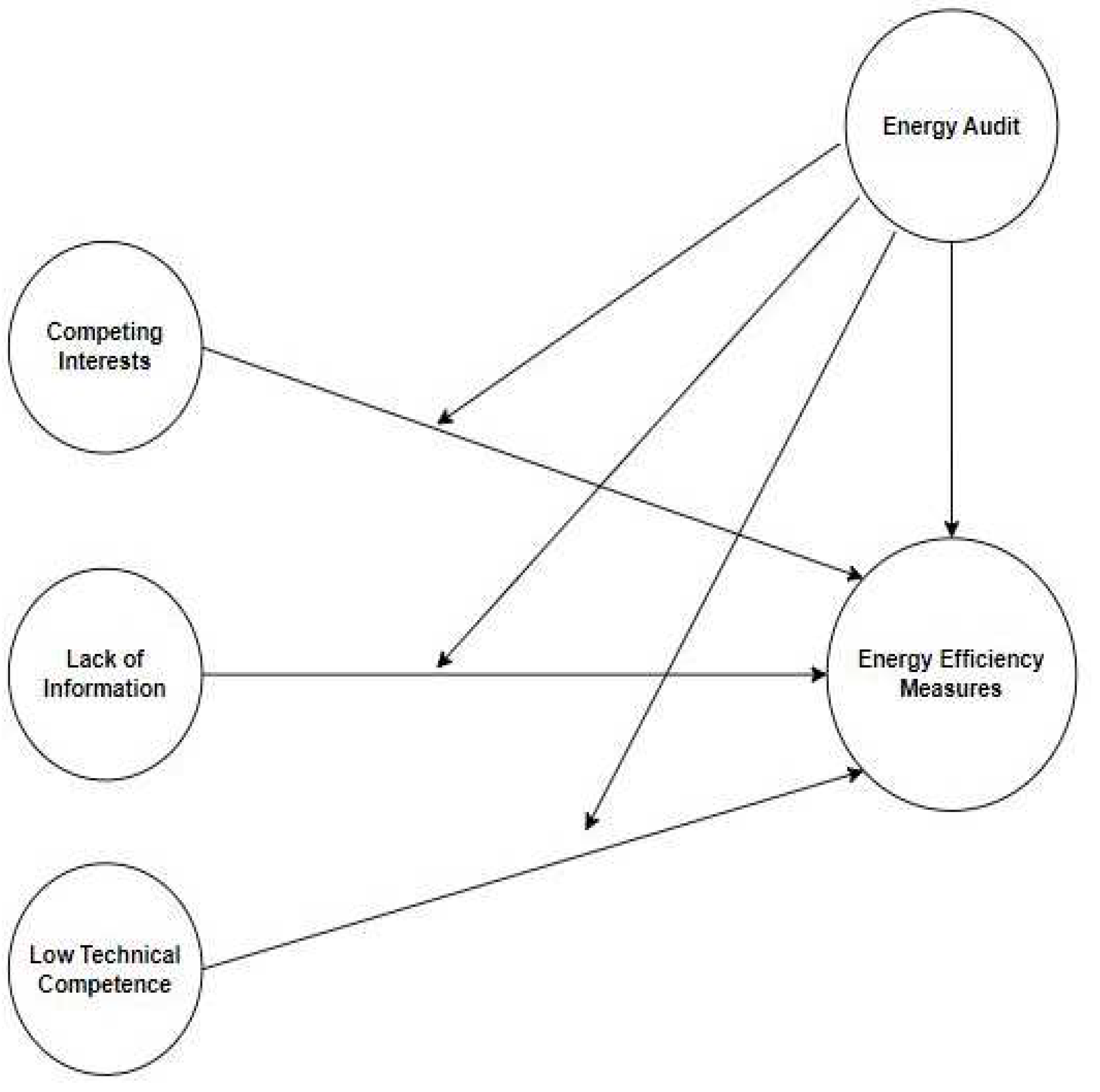
Figure 2.
Research model with hypotheses.
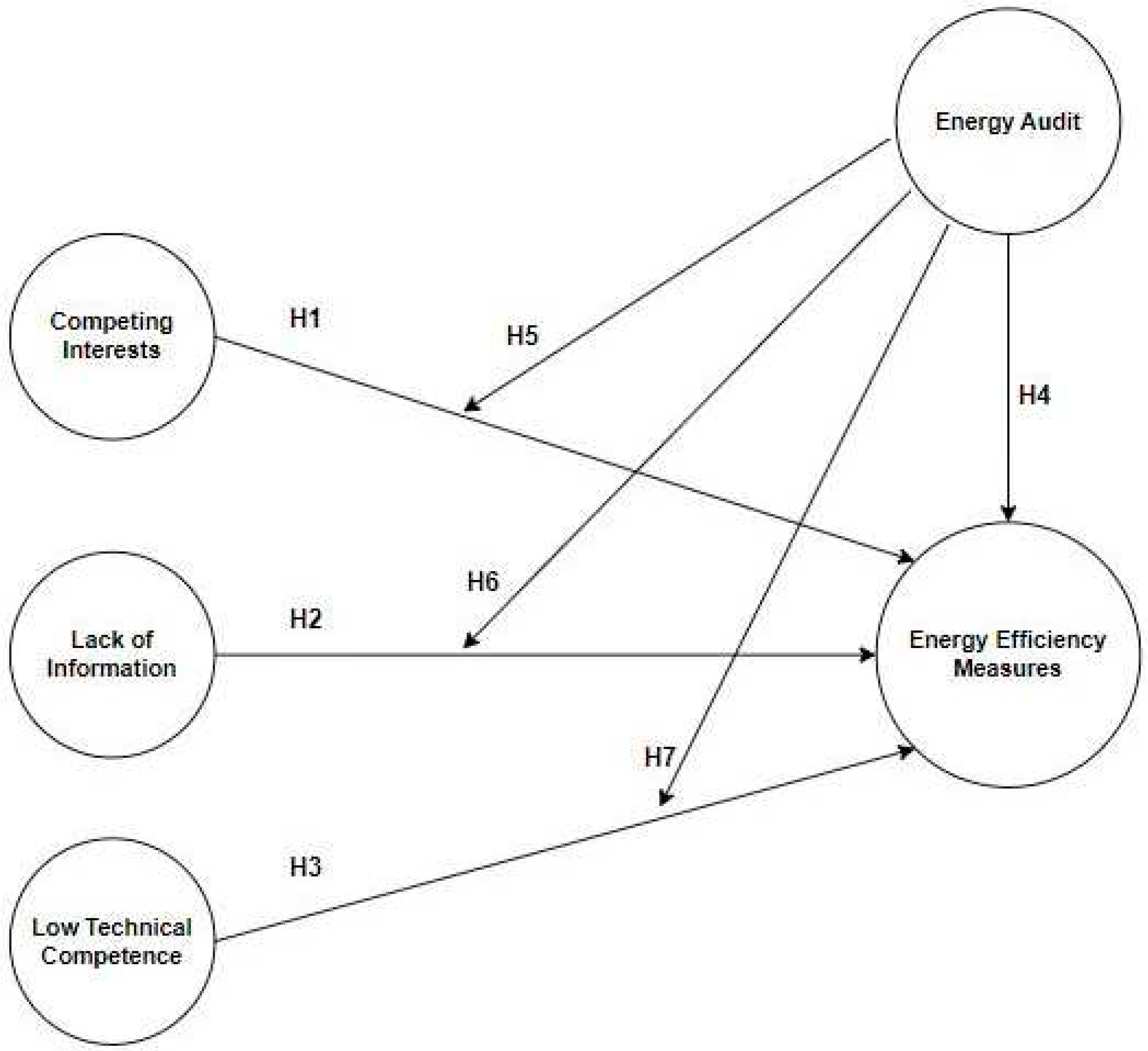
Figure 3.
Structural Model Assessment- Direct and moderating analysis.
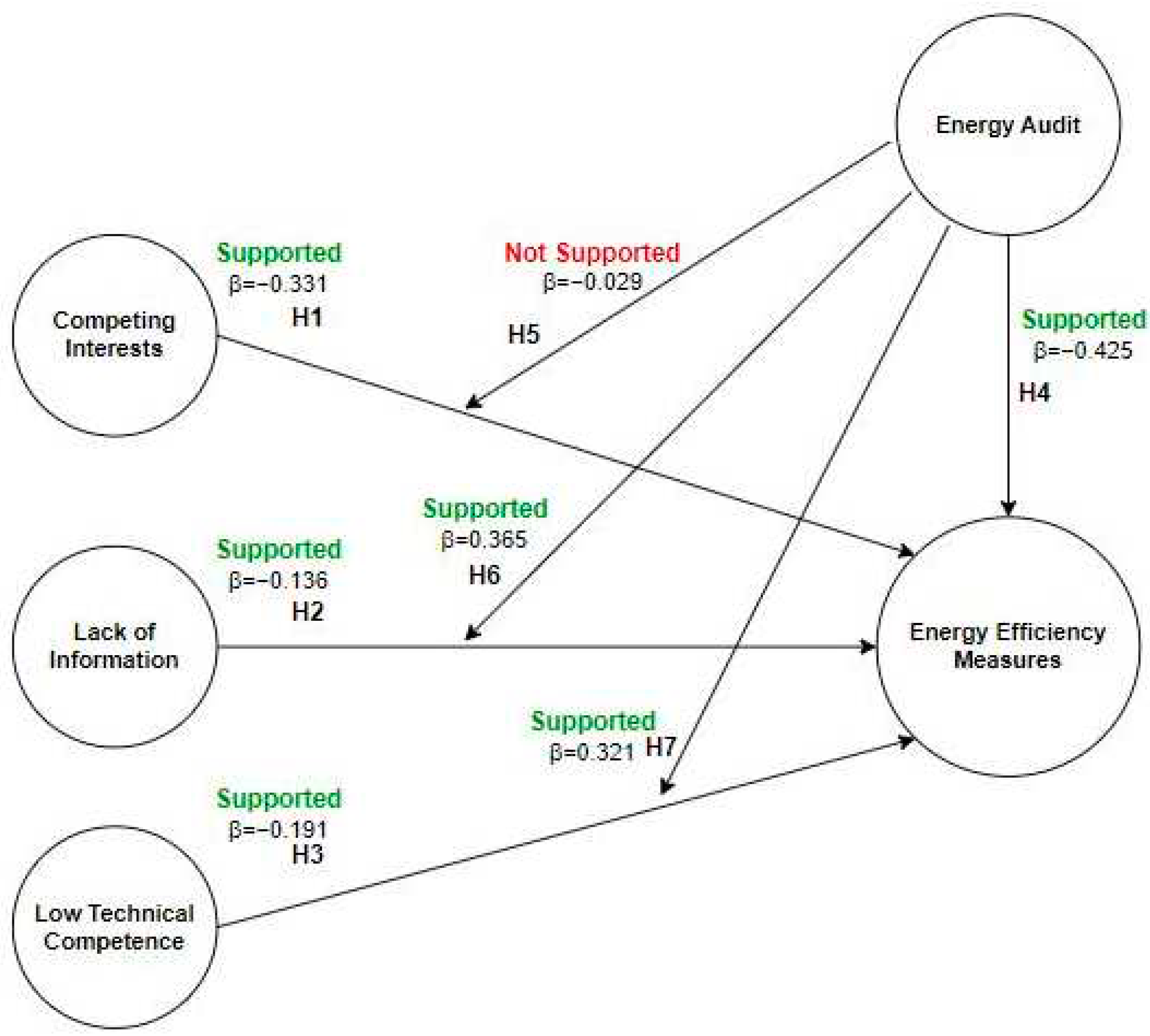

Table 1.
Convergent Validity Assessment- Measurement Model.
| Latent variables | Indicators | Loadings | CA | CR | AVE |
| The Low Technical Competence | LTC1 | 0.946 | 0.960 | 0.974 | 0.926 |
| LTC2 | 0.963 | ||||
| LTC3 | 0.960 | ||||
| Energy Audits | EA1 | 0.819 | 0.901 | 0.932 | 0.776 |
| EA2 | 0.941 | ||||
| EA3 | 0.957 | ||||
| EA4 | 0.795 | ||||
| Energy Efficiency Measures | EEM1 | 0.797 | 0.934 | 0.950 | 0.793 |
| EEM2 | 0.849 | ||||
| EEM3 | 0.938 | ||||
| EEM4 | 0.946 | ||||
| EEM5 | 0.915 | ||||
| Competing Interests | CI1 | 0.920 | 0.923 | 0.951 | 0.867 |
| CI2 | 0.944 | ||||
| CI3 | 0.929 | ||||
| The Lack of Information | LI1 | 0.940 | 0.897 | 0.936 | 0.830 |
| LI2 | 0.931 | ||||
| LI3 | 0.860 |
Table 2.
Discriminant Validity Assessment- Fornell and Larcker criterion.
| CI | EEM | EA | LTC | LI | |
| Competing Interests | 0.931 | ||||
| Energy Efficiency Measures | -0.613 | 0.891 | |||
| Energy Audits | -0.389 | 0.645 | 0.881 | ||
| The Low Technical Competence | 0.684 | -0.590 | -0.474 | 0.962 | |
| The Lack of Information | 0.496 | -0.529 | -0.568 | 0.559 | 0.911 |
Table 3.
Discriminant Validity Assessment- HTMT ratio.
| CI | EEM | EA | LTC | LI | |
| Competing Interests | |||||
| Energy Efficiency Measures | 0.657 | ||||
| Energy Audits | 0.420 | 0.702 | |||
| The Low Technical Competence | 0.724 | 0.622 | 0.503 | ||
| The Lack of Information | 0.549 | 0.578 | 0.633 | 0.606 |
Table 4.
R square & Q square values.
| R Square | Q Square | |
| Energy Efficiency Measures | 0.582 | 0.451 |
Table 5.
Model Fit Assessment- SRMR.
| Saturated Model | Estimated Model | |
| SRMR | 0.060 | 0.060 |
Table 6.
Structural Model Assessment- Direct path.
| Std. Beta | Std. Error | T Statistic | P Values | 2.5% | 97.5% | Supported? | |
| H1 CI -> EEM | -0.331 | 0.073 | 4.513 | 0.000 | -0.478 | -0.193 | YES |
| H2 LI -> EEM | -0.136 | 0.066 | 2.055 | 0.000 | -0.266 | -0.014 | YES |
| H3 LTC -> EEM | -0.191 | 0.049 | 2.273 | 0.000 | -0.283 | -0.064 | YES |
| H4 EA -> EEM | 0.425 | 0.059 | 7.217 | 0.000 | 0.310 | 0.541 | YES |
Table 7.
Structural Model Assessment- Indirect moderating path.
| Std. Beta | Std. error | T Statistic | P Values | 2.5% | 97.5% | Supported? | ||
| H5 | CI*EA -> EEM | 0.029 | 0.052 | 1.781 | 0.076 | -0.088 | 0.137 | NO |
| H6 | LI*EA -> EEM | 0.365 | 0.046 | 6.926 | 0.000 | 0.292 | 0.465 | YES |
| H7 | LTC*EA -> EEM | 0.321 | 0.055 | 6.609 | 0.000 | 0.299 | 0.457 | YES |
Table 8.
Research hypotheses and findings in light of prior literature.
| Hypotheses | Reference | Consistent findings with previous literature |
|---|---|---|
| Hypotheses | Reference | Consistent findings with previous literature |
| H1 | (Soepardi and Thollander, 2018) | Competing interests hinder the adoption of EEMs. |
| H2 | (Zafar, 2021) | The lack of information regarding EE impedes the adoption |
| of EEMs. | ||
| H3 | (Cagno et al., 2013 ; Cagno et al., 2015) | The low technical competence regarding EE inhibits the |
| adoption of EEMs. | ||
| H4 | (Schleich and Fleiter, 2019) | Energy audits have a positive effect on the adoption of EEMs. |
| H6 | (Kalantzis and Revoltella, 2019) | Energy audits mitigate the negative effect of the lack of information on the adoption of EEMs |
| H7 | (Chiaroni et al., 2017) | Energy audits attenuate the negative effect of the low technical competence on the adoption of EEMs. |
| Hypotheses | Reference | Inconsistent findings with previous literature |
| H5 | (Chiaroni et al., 2017): They found that energy audits reduce the intensity of competing/divergent interest within firms. | We found Energy audits raise awareness regarding energy efficiency opportunities, but do not consistently attenuate the negative effect of competing interests on the adoption of EEMs. |
Disclaimer/Publisher’s Note: The statements, opinions and data contained in all publications are solely those of the individual author(s) and contributor(s) and not of MDPI and/or the editor(s). MDPI and/or the editor(s) disclaim responsibility for any injury to people or property resulting from any ideas, methods, instructions or products referred to in the content. |
© 2023 by the authors. Licensee MDPI, Basel, Switzerland. This article is an open access article distributed under the terms and conditions of the Creative Commons Attribution (CC BY) license (http://creativecommons.org/licenses/by/4.0/).
Copyright: This open access article is published under a Creative Commons CC BY 4.0 license, which permit the free download, distribution, and reuse, provided that the author and preprint are cited in any reuse.


