

Submitted:
01 February 2024
Posted:
02 February 2024
You are already at the latest version
Abstract
The impact of controlled breathing on cognitive and affective processing has been recognized since ancient times, giving rise to multiple practices aimed at achieving different psychophysical states, mostly related to mental clarity and focus, stress reduction and relaxation. Previous scientific research explored the effects of unilateral nostril breathing (UNB) over brain activity, emotional and cognitive functions. Most evidence concluded for a contralateral effect, but many other controversial results make it difficult to come to an unambiguous interpretation. In the present study, we invited a pilot sample of 20 participants to take part in an 8-days breathing training, assigned either to the right nostril (URNB) or the left nostril breathing condition (ULNB). Then, each day, we assessed participants’ well-being indices with mood and mind-wandering scales. Results revealed that, after the daily practice, both groups reported improved well-being perception. However, the effect was specifically related to the nostril involved. URNB produced more benefits in terms of stress reduction and relaxation, while ULNB significantly reduced mind-wandering occurrences, increasingly over time. Our results are only partially in agreement with previous evidence, indicating the need for a more complex interpretive model that considers multiple brain networks and integrates central and peripheral nervous systems.
Keywords:
Unilateral nostril breathing
; pranayama
; brain lateralization
; psychological wellbeing
; Mind-wandering
; yoga
1. Introduction
A characteristic feature of biological systems is their symmetrical organization, particularly on the left-right (L-R) axis. This property is usually held in high regard, as it is associated with the concepts of harmony and perfection. Throughout history, the quest for balance between symmetry and asymmetry has widely inspired mankind in art and architecture, finding its greatest expression in ancient Greece. Here, in fact, symmetry is extended from a pure geometric property to a broader concept of order and beauty applicable to fields other than mathematics, including first and foremost architecture, music, astronomy, and science in general.
However, in nature, symmetry typically arises in biological structures with low complexity. When it comes to very complex organisms, instead, it is easier to find asymmetrical functional patterns [1]. Our brain is probably one of the most interesting example, since it is strongly asymmetrical between the two hemispheres [2,3], both in function and structure, with a lateralized organization of sensory, motor and cognitive domains. Language [4,5], face perception [6], and emotion processing [7,8] are among the most studied domains in the field of hemispheric differences.
Brain lateralization provides many advantages in terms of efficiency, since it allows parallel tasks and improves multitasking capabilities [1,9,10]; it also reduces redundancy of processing units, and finalizes action control [10].
Breathing is a lateralized function as well. Nasal airflow is not always identical between the two nostrils. In fact, at any given time, there is one nostril that is dominant over the other, with a greater airflow from one side. This occurs because the erectile tissue causes a transient obstruction of the nasal passage, alternating between the two nostrils, with a periodicity called the nasal cycle. The nasal cycle, which repeats approximately every 60-240 minutes, can thus be defined as a rhythm of nasal congestion and decongestion [11,12].
Controlled, deep breathing has many beneficial effects on our psychophysical well-being. There is a growing body of studies demonstrating the positive influence of breathing in the treatment and prevention of asthma, cardiovascular and gastrointestinal problems, hypertension, chronic pain, and inflammatory states [13,14].
In addition to physical health, mental health has received considerable interest, with regard to anxiety, obsessive compulsive disorder, depression, post-traumatic stress disorder, panic attacks, and addictions [15]. In fact, it can be applied to assist stress management and mood regulation, with subsequent favorable effects on social skills [13]. Thus, it is used in many clinical and non-clinical contexts to promote psychophysical well-being [14,16,17,18].
Scientific evidence proved that asymmetry of nasal airflow and brain asymmetry are linked. However, much older knowledge had already postulated such a relationship. In fact, the millennia-old teachings of the yogic tradition already described the possibility of influencing the activity of the cerebral hemispheres by different breathing techniques (pranayama), seeking diversified effects based on lateralization [19].
Anuloma-viloma pranayama consists of voluntarily breathing through only one nostril, closing the other with the fingers of the dominant hand [20]. In western societies this practice is known under the name of unilateral nostril breathing (UNB). There are two variants: surya anuloma-viloma (SAV), in which both inhalation and exhalation occur only from the right nostril (URNB) without any retention; and chandra anuloma-viloma (CAV), in which inhalation and exhalation occur only from the left nostril (ULNB). These two variations are thought to influence psychophysical wellbeing in different ways. While SAV means “heat-generating breathing practice”, its counterpart CAV is a “cooling breathing practice” [21]. Yoga states that anuloma-viloma is able to modify the nasal cycle, brain rhythms and corresponding psychophysical states [15]. In particular, CAV would directly control the ida channel - which flows into the right hemisphere and is connected to the parasympathetic system - while SAV stimulates the pingala channel - which culminates in the left hemisphere and activates the sympathetic branch. Hence, CAV is supposed to have calming effects, in contrast with the energizing effects of SAV [22]. According to yogic tradition, anuloma-viloma is able to selectively stimulate the contralateral hemisphere, supporting its activity and improving its performance [15].
This ancient knowledge has been challenged by science in recent decades. In fact, several scientific studies have been conducted to understand whether and how airflow lateralization affects the cerebral hemispheres. Experiments conducted in the 1980s showed that the nasal cycle is regulated by the autonomic nervous system [23]. Since most autonomic nerve fibers are lateralized, the dominant nostril during the nasal cycle corresponds to sympathetic activation in the corresponding side of the body and central nervous system. In the brain, the increase in sympathetic tone produces ipsilateral cortical vasoconstriction, with a consequent reduction in cognitive activity in that hemisphere. To compensate for the decrease in blood flow on one side, the other side undergoes vasodilation caused by an increase in parasympathetic tone [15]. Thus, experiments on the nasal cycle seem to confirm the contralateral effect proposed by yogic tradition.
The same mechanism applies to UNB. Shannahoff-Khalsa reports numerous studies relating indices of sympathetic system activation to URNB, including increased plasma glucose levels and increased heart rate [15]. In contrast, ULNB appears to be related to the stimulation of the parasympathetic system. For example, Telles and colleagues recorded a significant increase in the galvanic skin response (GSR) following breathing from the left nostril [21,24,25].
Because of its calming effects, ULNB has been effectively proposed to hypertensive patients with very interesting results [26]. In fact, after only 27 rounds of ULNB, all the measured cardiovascular parameters (among which heart rate, systolic pressure, and pulse pressure) were immediately improved.
Electrophysiological and neuroimaging techniques have been applied to study the effects of UNB not only on peripheral (autonomic), but also central (cognitive) functions. For example, an EEG study by Werntz and colleagues [23] demonstrated that the oscillations of cerebral hemispheric activity are coupled to the nasal cycle.
Nonetheless, data about the lateralization of this relationship are inconclusive. In fact, although the majority of studies showed a contralateral effect [11,12,27], evidence of an ipsilateral [28] or an absent relationship [29,30] do exist. For example, Jella and Shannahoff-khalsa [31] found a double dissociation, with ULNB improving spatial performance. Verbal scores were higher during URNB, but the effect did not reach statistical significance. Also, imaging data by functional magnetic resonance imaging (fNIRS, [32]) reported higher levels of oxygenated hemoglobin (oxyHb) concentrations in the contralateral frontal lobes.
There is still a lot of inconclusive or conflicting data regarding the psychological and cognitive effects of UNB. Furthermore, previous studies are mainly based on the analysis of asymmetries related to different cognitive tasks, whereas there is still much to be investigated about psychological and cognitive well-being.
The aim of our study was to evaluate the effect of unilateral breathing on two parameters that are still poorly analyzed in the literature: emotional state and mind-wandering. Both these parameters can be associated with a person's state of well-being and are, therefore, of particular relevance on the application level. In particular, people who mind-wander more frequently also seem to have worse psychological well-being and more negative affect [33,34], and this is especially true when mind-wandering is unintentional [35]. Moreover, individuals with depressive symptomatology are more likely to have high rates of mind wandering [33] and tend to report lower levels of happiness [36].
Furthermore, even on the theoretical level, emotions and mind-wandering are associated with physiological circuits that have been extensively studied by research about the relationship between breathing and the central nervous system. Emotional state has been studied not only in relation to the amygdala and the limbic system, but also from a hemispheric asymmetry point of view, particularly with respect to prefrontal areas. Mind-wandering, on the other hand, is traditionally associated with the activation of the Default Mode Network (DMN; [37,38]) and, therefore, opposed to the functioning of the prefrontal cognitive control system. Consequently, exploring the relationship between unilateral breathing and the above variables also allows inferences to be drawn with respect to the neurophysiological circuits involved.
Regarding the hypotheses of the study, we considered the two study traditions mentioned earlier. On the one hand, the yogic tradition leads to the postulation that breathing from the right nostril activates the left hemisphere, which is considered calming and therefore associated with more positive emotions and less arousal activation. Conversely, breathing from the left nostril would activate the right hemisphere more, with the effect of producing greater arousal and less egosyntonic states.
However, drawing on the relevant literature, we can therefore conclude for the following hypotheses:
- Right nostril breathing activates the sympathetic nervous system, causing an increase in arousal and thus energizing emotional states (happiness) and increased cognitive focus, with a decrease in mind-wandering [7].
- Breathing from the left nostril, on the other hand, activates the parasympathetic nervous system more, producing a state of decreased arousal and activation of the DMN, in turn favoring mind-wandering [33,34].
To test the research hypothesis, we run a study involving a small pilot sample of 20 participants who took part in a UNB training program of 8 days. Then, we assessed their mood states and mind-wandering occurrences.
2. Methods
2.1. Participants
Twenty adults, 12 women and 8 men (Mage = 22.95; SD = 2.35) took part in the research. Considering the nature of the experimental manipulation and the research hypotheses, all participants were right-handed. They all had normal or corrected-to-normal visual acuity. The study was conducted with the understanding and written consent of all participants, who had been informed of the research procedures and purposes according to the Declaration of Helsinki and with the approval from the local Ethical Committee (Università degli Studi di Milano; protocol code: 27/19).
After the enrollment, participants have been assigned to two experimental groups with pair matching method: ULNB and URNB. Ten of them were assigned to the unilateral left nostril breathing group (ULNB: 6 women, 4 men. Mage = 22.7; SD = 2), while the other ten were assigned to the unilateral right nostril breathing group (URNB: 6 women, 4 men. Mage = 23.2; SD = 2.7). Gender, age, and laterality quotient were the controlled paired variables among the two groups. Considering that data distribution was not normal for all the considered variables, we decided to perform non-parametric analyses. No differences have been found among groups regarding age, laterality quotient, or personality traits as assessed by non-parametric independent-samples Mann-Whitney U test (all p > 0.05).

Table 1.
Mann-Whitney U Test for age and personality variables between groups.
| VARIABLE | MANN- WHITNEY U |
STANDARD ERROR | STANDARDIZED TEST STATISTICS |
ASYMP. SIG. (2-TAILED) |
EXACT SIG. [2*(1-TAILED SIG.)] |
|---|---|---|---|---|---|
| Age | 48 | 13.05 | -.15 | .88 | .91 |
| Laterality quotient | 53.5 | 12.61 | .28 | .78 | .8 |
| Extraversion | 48 | 13.04 | -.15 | .88 | .91 |
| Agreeableness | 59 | 12.98 | .69 | .49 | .53 |
| Coscientiousness | 47 | 12.75 | -.24 | .81 | .85 |
| Emotional stability | 41 | 13.06 | -.69 | .49 | .53 |
| Openness | 34.5 | 12.97 | -1.2 | .23 | .25 |
| High Sensitive Trait | 49 | 13.22 | -.08 | .94 | .97 |
| BIS | 65.5 | 13.16 | 1.18 | .24 | .25 |
| BAS-D | 35.5 | 13.12 | -1.11 | .27 | .28 |
| BAS-FS | 42 | 13.08 | -.61 | .54 | .58 |
| BAS-RR | 40 | 13.08 | -.77 | .45 | .48 |
| Mind wandering | 62.5 | 13.19 | .95 | .34 | .35 |
| Absorption | 37.5 | 13.13 | -.95 | .34 | .35 |
2.2. Procedure
I) Participants were asked to complete demographics and general information (age; Edinburgh Inventory: laterality quotient; education), and personality scales (BIG-5; High Sensitivity Trait, HST; Behavioral Inhibition/Activation Scales: BIS/BAS; Mind Wandering Inventory: MWI; Tellegen Absorption Scale: TAS). Personality traits have been controlled to ensure the composition of balanced groups.
II) Participants were assigned with pair matching method to one of the two experimental groups: ULNB and URNB. Gender, age, and laterality quotient were the controlled paired variables among the two groups;
III) 1st trial of in-person breathing training with pre/post assessment of mood and post-breathing assessment of mind-wandering;
VI) 6-days of solo breathing training (audio-guide) with pre/post assessment of mood and post-breathing assessment of mind-wandering;
V) 8th trial of in-person breathing as in phase IV;
Figure 1.
Outline of stages 3, 4 and 5 of the procedure.
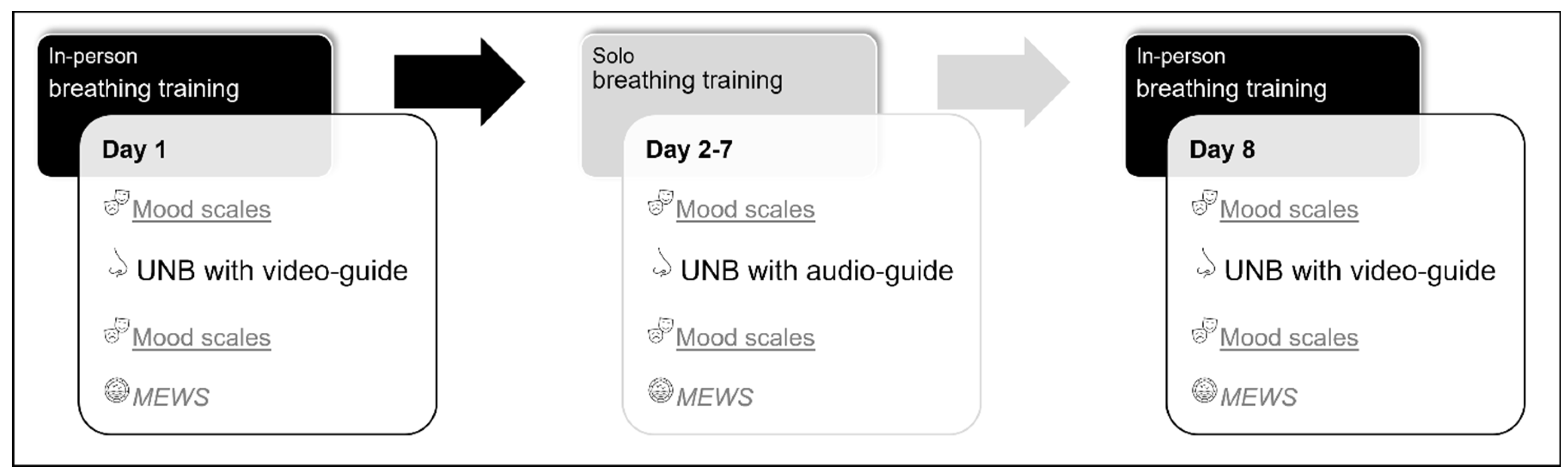
The procedure applied was the same for all participants. They were individually seated in a quiet room by the same experimenters. For phase 4 related to the breathing training, the lights were dimmed, and the participants were seated on a comfortable chair to create a relaxing environment.
2.3. Instruments
2.3.1. Handedness
Edinburgh Handedness Inventory (EHI). The questionnaire was developed to objectively assess which hand is normally used during certain everyday activities [39], of which we used the modified, shorter version [40]. Participants are asked to specify, for each item, which hand they usually use. If the preference is for a certain side, a (+) is assigned in the corresponding column. If the preference is so strong that the other side is never used, (++) is attributed. If either side is used indifferently, a (+) is assigned to both hands. The final score is called the “Laterality Quotient” and is calculated using the following formula: L.Q. = (R-L)/(R+L)*100, where R is the number of (+) assigned to the right side and L is the number of (+) assigned to the left side.
2.3.2. Personality Measures
BIG-5 Personality Questionnaire: For the purposes of the present paper we used the Big Five Inventory-10 (BFI-10) [41], which consists of 10 items to be rated on a five-step scale from 1 (“disagree strongly”) to 5 (“agree strongly”). It explores the Big Five Factor Model that includes the factors Extraversion, Agreeableness or Friendliness, Conscientiousness, Emotional Stability or Neuroticism, and Intellect or Openness to Experience.
Behavioral Inhibition/Activation Scales (BIS/BAS). The scale includes 24 items (20 score-items and four fillers) to be rated on a five-point Likert scale from 1 “not at all true” to 5 “completely true” [42,43]. The scoring included two subscales, one for BIS (7 items), and three for BAS (BAS-reward responsiveness; BAS-drive; BAS-fun seeking: 13 items).
Highly Sensitive Person Scale (HSPS) [44]: Aron and Aron suggested that people could differ in the way they neurologically transmit and process sensory information [45]. It is the case of sensory processing sensitivity (SPS), described as a personality trait modulated by genetic factors, which allows people feeling and processing more information at one time, and in a deeper way. Such sensitivity is referred to both external and internal stimuli [46]. Accordingly, Highly Sensitive Persons are more inclined to experience higher arousal during the exposure of environmental stimuli such as bright lights, strong smells, noisy and chaotic situations. To measure SPS Aron & Aron [44] implemented the HSPS, which includes 27 statements towards which the participant have to express their degree of agreement on a scale ranging from 1 (“totally disagree”) to 7 (“totally agree”).
Mind Wandering Inventory (MWI): The MWI is a recently developed instrument [47] to measure trait-mind-wandering as experienced in everyday life. The questionnaire consists of 10 items assessed via a Likert scale ranging from 1 (completely agree) to 4 (completely disagree). The first 3 items refer to detachment from one's surroundings; the following 3 items measure the tendency of the mind to wander in space and time; the last 4 capture variation in mental content and the spontaneous flow of thoughts.
Tellegen Absorption Scale (TAS): Absorption is a personality trait that reflects an individual's cognitive capacity to become fully engaged with sensory and imaginative experiences, to the extent that perception, memory, behaviour and emotional state are affected [48]. Absorption was measured with the original version of the TAS [49]. It is a questionnaire consisting of 34 items, which assess openness to experience, one's level of emotional and cognitive involvement in a range of situations, disposition to experience altered states of consciousness, and the quality of thoughts and memories. Participants were asked to tick only those items that correspond to their experience. The number of marked statements reflects the individual's level of absorption.
2.3.3. Mood assessment
Mood Scales: Before and after each breathing session, mood was assessed by mood scales. They are a useful tool for quickly measuring subjective experiences - in our case, emotional states. Participants are asked to indicate how they are feeling at the present time by indicating the level of intensity of five emotional states on a scale from 1 (emotion absent) to 10 (emotion very present). The states assessed were: stressed, mentally lucid, happy, calm, restless [50].
2.3.4. State Mind-wandering assessment
Mind Excessive Wandering Scale (MEWS) is a self-report scale composed by 15 items that assess trait mind-wandering [51]. Participants are asked to express the frequency with which they experience certain situations, using a Likert scale ranging from 0 (never) to 3 (practically always). For the purposes of this research, we modified the questionnaire so that it would reflect state mind-wandering, i.e. mind-wandering experienced during a specific task (breathing training). We therefore selected and adapted 11 items, choosing from those that best suited the purpose. Participants are asked to express their level of agreement with each statement on a Likert scale ranging from 0 (never) to 3 (practically always).
2.3.5. Pranayama technique
Unilateral nostril breathing (UNB) is typically executed by plugging one nostril to convey the air through the other nostril. To ensure a standardized procedure across participants, we created two video-tutorials under the supervision of a certified yoga instructor to be watched and followed during the first and 8th in-person sessions, and six audio-guides for the autonomous training, from day 2 to day 7.
Video tutorials: Two video tutorials were created: one for the unilateral right nostril breathing (URNB) group, and the other for the unilateral left nostril breathing (ULNB) group. They last 4-5 minutes each and contain all the practical instructions for performing the training correctly. In addition to detailed instructions for practicing the pranayama, the videos provide a visual demonstration of the two techniques, along with some tips for effective and comfortable breathing. They were both recorded by the same person, in the same style and following the same structure.
Audio guides: They were designed to accompany practitioners step-by-step through the six days of autonomous training. The aim was to ensure that all participants performed breathing as correctly as possible, both technically and in terms of the thoughts/attitudes associated with it. We created 6 different versions, one for each day, but all recorded by the same person and similar in duration (about 11-12 minutes), style and structure. In this way, we avoided the habituation effect due to the repetition of the same track but at the same time we preserved the training efficacy during the training days. The audios include both guidance on the correct execution of the practice and elements derived from mindfulness meditation, which include: careful observation of the breath and the bodily sensations, awareness of one's own internal states, focused and non-judgmental attention.
3. Results
Three sets of analyses were performed:
I) Descriptive statistics were conducted to explore the trend of outcome variables (mood and mind-wandering) over time.
II) To investigate the efficacy of the breathing practice, we compared pre and post-practice scores for mood scales and pre/post-training mind-wandering occurrences.
III) To assess the extent of the benefits of the practice based on time, we compared mood and mind-wandering scores from day 1 to day 8.
IV) To understand whether one practice was more effective than the other, we compared the outcome scores between groups.
3.1. Descriptive statistics
3.1.2. Mood scales
In the following graphs it is possible to visualize the trend of the five moods during the 8 days of training with regards to pre and post practice scores (see Figure 2). From a qualitative point of view, it appears how perceived stress and restlessness were visibly decreased after the practice, while calm was improved. For happiness the trend is similar, but the effect seems smaller; while for clarity of mind, the two lines overlap.
Also, for stressed and restless mood it is possible to notice how greater improvements have been made in the first days if the training, with a settling in the scores during the second half of the training.
For calm, instead, greater improvements seem to occur as the training progress. Finally, for some scales, it is possible to notice a difference between in-person and solo practice. In detail, restless, calm, and happiness scores seem to benefit more from the presence and guidance of the instructor.
3.1.3. Mind-wandering
The modified version of the Mind Excessive Wandering Scale was administered only after the practice, since it was referred to mind fluctuations experienced during the practice. Thus, in the graph it is possible to visualize the trend during the 8 days training (see Figure 3).
As you can see the trend is, in general, favorable. In fact, participants reported on average fewer occurrences of mind-wandering over time. However, it is interesting to note that lower scores were registered during in presence-training, with the assistance of the video-guide, as for mood assessment.
Starting from these first descriptive data, we performed inferential statistics. Considering that data distribution was not normal for some of the outcome variables, we run non-parametric analyses for the following steps.
3.2. The efficacy of UNB
To verify the efficacy of the training, we considered the averaged scores of mood scales before and after the practice, while we included pre and post-training mind-wandering values.
3.2.1. The efficacy of daily practice over mood states
Non-parametric Wilcoxon Test over each mood state between pre and post-practice values. The analysis returned significant results for stressed (z=-3.73; p<0.0005) and restless (z=-3.41; p<0.001) moods, with lower self-assessed scores post (Mstressed=3.4; sdstressed=2.1; Mrestless=2.99; sdrestless=1.5) than pre-practice training (Mstressed=4.54; sdstressed=2.17; Mrestless=4.14; sdrestless=1.8). Similarly, happy (z=2.32; p<0.05) and calm (z=3.74; p<0.0005) moods improved thanks to the practice, with higher self-assessed scores post (Mhappy=6.42; sdhappy=2.05; Mcalm=7.72; sdcalm=1.39) than pre-practice training (Mhappy=6.12; sdhappy=2.01; Mcalm=6.49; sdcalm=1.41). No significant results were found for clarity of mind (see Figure 4).
3.2.2. Mind-wandering
To verify the efficacy of the pranayama techniques we run non-parametric Wilcoxon Test over MEWS scores after the 1st and 8th practice. The test returned significant (z=-2.58; p<0.001), with fewer mind-wandering occurrences at the end (M=10; ds=7.55) than at the beginning (M=14.8; ds=7.43) of the training (see Figure 5).
3.3. Training progression
To verify the training progression day by day, we calculated delta values for mood scores as the subtraction between post and pre-practice values for “happy”, “calm”, “clear-minded”, and as the subtraction between pre and post practice values for “stressed”, and “restless”. This way, we obtained a measure of the gains thanks to the practice. Then, we compared the delta values of each day with each other. For mind-wandering, instead, the daily scores have been compared to each other.
3.3.1. Mood states
We performed non-parametric Friedman test over delta values from day 1 to 8 for each mood scale. Bonferroni correction was applied for multiple comparisons. Although the test returned a significant result for restlessness scores (X2=20.3; p<0.005), multiple comparisons did not reach statistical significance. From a qualitative point of view, it is possible to notice a drastic decrease in the gains obtained for self-assessed restlessness after the second half of the training, and specifically from day 4 (M=2.05; ds=1.93) to day 7 (M=0.4; ds=2.14), indicating larger improvements at the beginning of the training (see Figure 2).
3.3.2. Mind-wandering
We performed non-parametric Friedman test over to daily mind-wandering values. Bonferroni correction was applied for multiple comparisons. The test returned a significant result (X2=25.11; p<0.001). In detail, the mind-wandering occurrences recorded during the last (8th) day were significantly lower (M=10; sd=7.55) than those assessed at day 1 (p<0.05; M=14.8; sd=7.43), day 2 (p<0.005; M=16.8; sd=7), day 3 (p<0.05; M=16.5; sd=6.36), day 4 (p<0.05; M=16.2; sd=6.82), and day 5 (p<0.05; M=15.1; sd=7.1; see Figure 6).
3.4. Comparison between left vs right nostril breathing
To investigate the efficacy of one practice over the other, we compared delta values for each mood across groups. For mind-wandering scale, instead, we subdivided the database and then compared daily values separately for the two groups, similarly to 3.3.2.
3.4.1. Mood scales
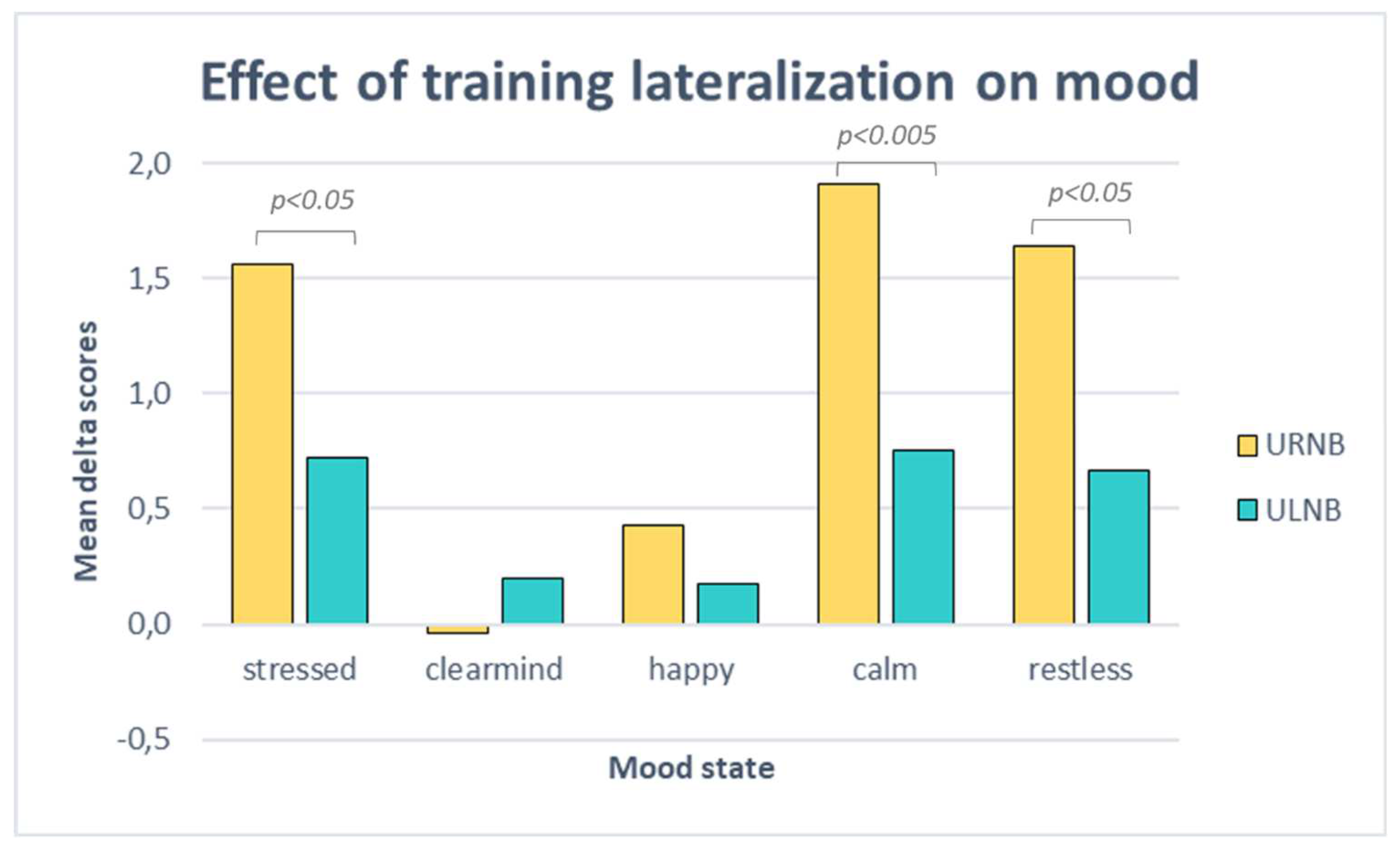
Mann-Whitney U test for independent samples identified significant differences between groups for stressed (z=-2.39, p<0.05), restless (z=-2.01, p<0.05), and calm (z=-2.84, p<0.005) moods, while no significant results emerged for clarity of mind and happiness (see Figure 5).
In detail, URNB group obtained higher gains than ULNB for stress (MURNB=1.56; sdURNB=.64. MULNB=.73; sdULNB=.66), restlessness (MURNB=1.64; sdURNB=.9. MULNB=.66; sdULNB=.9), and calm (MURNB=1.91; sdURNB=.83. MULNB=.75; sdULNB=.64).
Figure 7.
Mean delta values for mood states as self-assessed by URNB (yellow) and ULNB (water green) group.
Figure 7.
Mean delta values for mood states as self-assessed by URNB (yellow) and ULNB (water green) group.
3.4.2. Mind-wandering
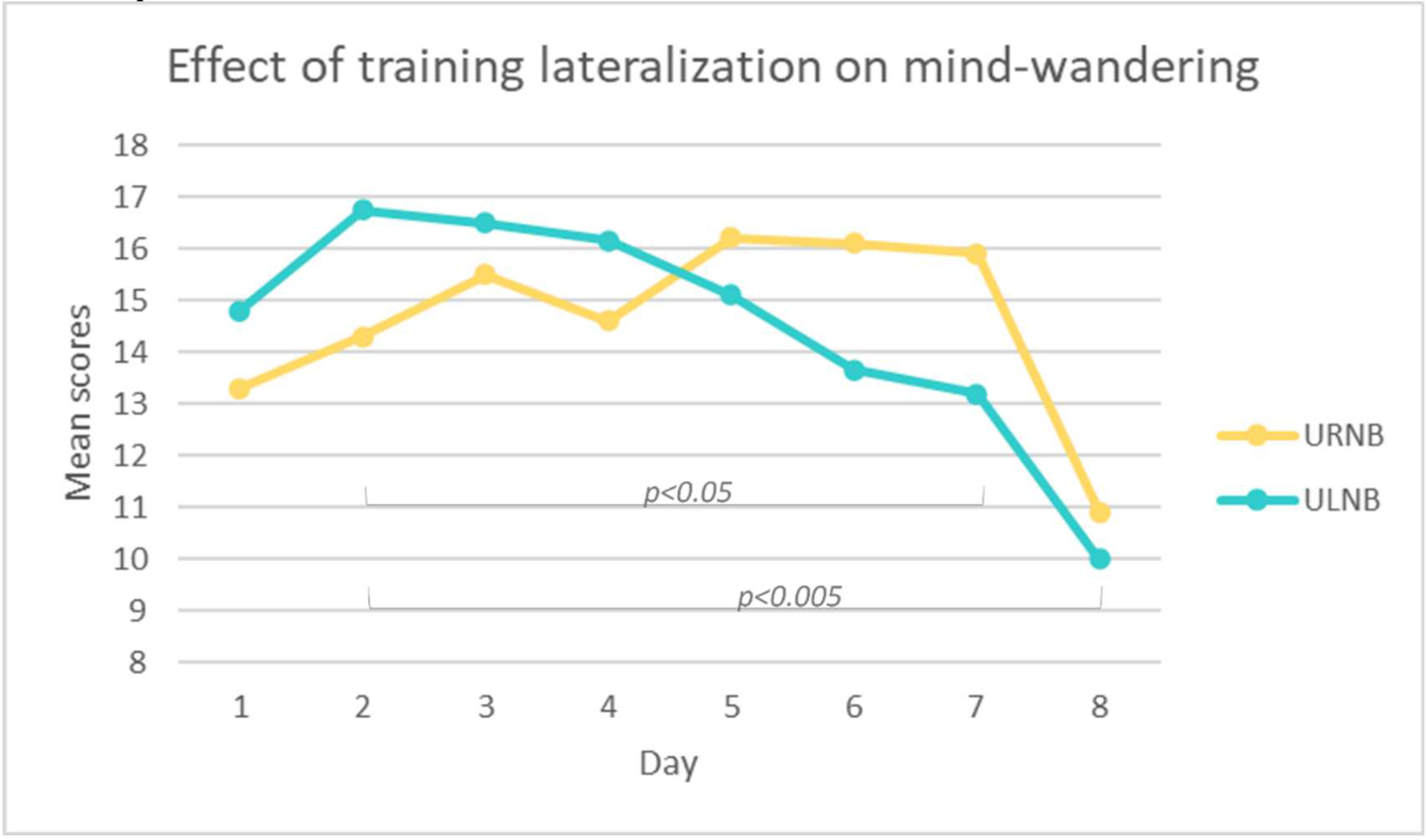
We performed non-parametric Friedman test to daily mind-wandering values separately for the two groups. Bonferroni correction was applied for multiple comparisons. The test did not return a significant result for URNB group, while it was significant for ULNB group (X2=29.12; p<0.0005; see Figure 8).
In detail, the mind-wandering occurrences recorded during the 2nd day were significantly higher (M=19.2; sd=6.23) than those assessed at day 7 (p<0.05; M=10.5; sd=7.09) and day 8 (p<0.005; M=9.1; sd=7.39; see Figure 9).
Discussion
Generally, our data support the idea that practicing breathing techniques (UNB in our case) may improve mood e reduce stress [18,52]. In fact, we found a significant decrease of self-perceived stress, restlessness, and mind-wandering, together with an increase in positive emotions, regardless of the nostril involved. These results are confirmed by previous literature both on general population [17,53] and in clinical conditions [18,54]. For example, Konrad and colleagues [17] engaged university students in a brief mindful breathing training and found lower stress scores, higher presence scores, higher motivation for the courses, and better mood. Similarly, patients with concussion enrolled in a pilot study by Cook and colleagues [18] reported a significant decreases in stress, tension, fatigue, and confusion.
Furthermore, mind-wandering significantly decreased as a function of time, so that practice progression produced better results. Moreover, from a qualitative point of view, the most effective sessions were conducted during in-presence training. This consideration could be helpful in designing future intervention, especially with clinical populations.
However, the most interesting data relates to nostril laterality. Our data showed that it is possible to obtain different psychological effects through URNB or ULNB. URNB had a higher impact on psychophysical wellbeing, with decreased stress and restlessness scores, together with increased calm scores. Instead, ULNB was more effective in reducing mind-wandering occurrences, thus preventing distraction, and potentially increasing cognitive focus.
Thus, we just partially obtained the expected results. While we expected a reduced mind-wandering activity thanks to ULNB, we did not expect to find a higher decrease of stress with URNB compared to ULNB. Since the right nostril breathing is associated with the activation of the sympathetic system, we expected to find an increase of energizing emotions and clarity of mind, instead of calm and relax. However, it is possible that the right-lateralized breathing has not a direct, unique interaction with a single hemisphere, but that its effects is due to the modulation of a larger and not-completely lateralized neuro-functional system, calling then for a more complex explanation of the breathing-related effects.
For example, traditional research associated unilateral breathing with the activation/deactivation of a specific hemisphere. However, to understand the psychological impact of breathing techniques it is probably better to associate breathing to the increase or decrease in the activity of specific systems (in particular, the sympathetic vs the parasympathetic one). Even if some research has showed a specific link between breathing and EEG modulation with animal models [55], in particular on the gamma rhythm, we still miss data to understand how this evidence may apply to humans and how physiological changes correlates with emotional and cognitive ones. For example, a previous EEG study by Werntz and colleagues [23] revealed that the oscillations of cerebral hemispheric activity are coupled to the nasal cycle, and different studies showed a contralateral effect [11,12,27]. However, other researchers failed to replicate the effects, finding an ipsilateral [28] or an absent relationship [29,30] instead.
It is possible to hypothesize that the URNB effect was not a direct a consequence of the activation of the left hemisphere, but instead it is probably a bilateral down-modulation of emotion through the synergic work of pre-frontal areas onto the limbic system. Mason and colleagues [13] showed the existence of a set of areas that can be directly modulated by voluntarily controlled breathing, including prefrontal areas (the medial frontal and orbitofrontal cortex, motor, and premotor areas) but also the insula and the amygdala. Our results seem to suggest that this modulation is particularly effective through URNB. At the opposite, the ULNB, being associated with parasympathetic activity, probably produced an unbalanced functioning of the prefrontal Executive Control Network (ECN), a system that includes the anterior cingulate cortex and the lateral prefrontal cortex [56] and DMN, that generally work in synergy [57]. ECN is indeed modulated by attention, being inhibited by alerting, and activated by orientation. Since alerting is associated with sympathetic activity (prepare the organism to react to stimuli) and orientation to the parasympathetic one (allow the organism to shape a coordinated and adequate response), it seems plausible that ECN is called-in by ULNB. However, this activation may produce a partial de-activation of the DMN, thus reducing the mind-wandering activity.
Conclusion
The significant impact of the breathing rhythm on cognitive and affective processing has been recognized since the ancient times, giving rise to multiple practices focused on controlling one's breath to achieve mental clarity and to reduce anxiety, stress, and pain [58,59]. Several studies had been run to understand this effect, both from a physiological and neurological point of view, shedding light to several neuro-physiological processes and functional networks. However, the evidence highlighted also the complexity of this issue, so that it is not possible to associate straightforwardly a certain breathing pattern to a precise psychological effect.
In our study we obtained mixed results since improvements on wellbeing is obtained by both URNB and ULNB. However, comparing the effects obtained by the two types of breathing, it is clear that URNB produce higher effects on emotions, while ULNB is more effective in reducing mind-wandering. Since both negative emotions and mind-wandering are associated with stress and wellbeing, both breathing techniques can be considered beneficial, but each of them can be used to reach specific purposes both in clinical and non-clinical populations.
Since we presented preliminary evidence from a pilot study, it is particularly important not to draw general conclusions just from the present study. However, we think that our results are promising both considering the development of practical applications and the possibility to increase our awareness of the effects of breathing on cognition and emotions.
Future studies should not only increase the sample size, but also include a longitudinal tracking of breathing effects. Furthermore, the use of bio-signal recording systems during lab sessions (but also in at-home setting), could be informative about the neuro-physiological correlates of breathing and to compare the scientific data with the yogic tradition.
Author Contributions
Conceptualization, M.E.V. and C.G.; Methodology, C. L. and M.E.V.; Validation, C.L.; Formal Analysis, M.E.V.; Investigation, C.G. and M.E.V.; Resources, C.L.; Writing – Original Draft Preparation, M.E.V. and C.L.; Writing – Review & Editing, M.E.V, C.L., and C.G.; Supervision, C.L.
Funding
This research was partially funded by the Department of Philosophy “Piero Martinetti” of the University of Milan under the Project “Departments of Excellence 2023–2027” awarded by the Ministry of University and Research (MUR).
Acknowledgments
We are grateful to Roberta Adorni for her meaningful comments and suggestions about data analysis and interpretation.
Conflicts of Interest
The authors declare no conflict of interest.
References
- Ocklenburg, S.; Mundorf, A. Symmetry and Asymmetry in Biological Structures. Proc. Natl. Acad. Sci. 2022, 119, e2204881119. [CrossRef]
- Kong, X.; Postema, M.C.; Guadalupe, T.; de Kovel, C.; Boedhoe, P.S.W.; Hoogman, M.; Mathias, S.R.; Van Rooij, D.; Schijven, D.; Glahn, D.C. Mapping Brain Asymmetry in Health and Disease through the ENIGMA Consortium. Hum. Brain Mapp. 2022, 43, 167–181. [CrossRef]
- Wang, B.; Yang, L.; Yan, W.; An, W.; Xiang, J.; Li, D. Brain Asymmetry: A Novel Perspective on Hemispheric Network. Brain Sci. Adv. 2023, 9, 56–77. [CrossRef]
- Knecht, S.; Deppe, M.; Dräger, B.; Bobe, L.; Lohmann, H.; Ringelstein, E.-B.; Henningsen, H. Language Lateralization in Healthy Right-Handers. Brain 2000, 123, 74–81. [CrossRef]
- Martin, I.; McDonald, S. That Can’t Be Right! What Causes Pragmatic Language Impairment Following Right Hemisphere Damage? Brain Impair. 2006, 7, 202–211. [CrossRef]
- Rangarajan, V.; Hermes, D.; Foster, B.L.; Weiner, K.S.; Jacques, C.; Grill-Spector, K.; Parvizi, J. Electrical Stimulation of the Left and Right Human Fusiform Gyrus Causes Different Effects in Conscious Face Perception. J. Neurosci. 2014, 34, 12828–12836. [CrossRef]
- Davidson, R.J. Anterior Cerebral Asymmetry and the Nature of Emotion. Brain Cogn. 1992, 20, 125–151. [CrossRef]
- Balconi, M.; Grippa, E.; Vanutelli, M.E. Resting Lateralized Activity Predicts the Cortical Response and Appraisal of Emotions: An FNIRS Study. Soc. Cogn. Affect. Neurosci. 2015, 10, 1607–1614.
- Duboc, V.; Dufourcq, P.; Blader, P.; Roussigné, M. Asymmetry of the Brain: Development and Implications. Annu. Rev. Genet. 2015, 49, 647–672. [CrossRef]
- Vallortigara, G.; Rogers, L.J. A Function for the Bicameral Mind. Cortex 2020, 124, 274–285. [CrossRef]
- Niazi, I.K.; Navid, M.S.; Bartley, J.; Shepherd, D.; Pedersen, M.; Burns, G.; Taylor, D.; White, D.E. EEG Signatures Change during Unilateral Yogi Nasal Breathing. Sci. Rep. 2022, 12, 520. [CrossRef]
- Kahana-Zweig, R.; Geva-Sagiv, M.; Weissbrod, A.; Secundo, L.; Soroker, N.; Sobel, N. Measuring and Characterizing the Human Nasal Cycle. PLoS One 2016, 11, e0162918. [CrossRef]
- Mason, H.; Gerbarg, P.L.; Brown, R.P. Psychophysiology: Healing Effects of Voluntarily Regulated Breathing Practices. In Handbook of Research on Evidence-Based Perspectives on the Psychophysiology of Yoga and its Applications; IGI Global, 2021; pp. 24–48.
- Yau, K.K.-Y.; Loke, A.Y. Effects of Diaphragmatic Deep Breathing Exercises on Prehypertensive or Hypertensive Adults: A Literature Review. Complement. Ther. Clin. Pract. 2021, 43, 101315. [CrossRef]
- Shannahoff-Khalsa, D.S. Psychophysiological States: The Ultradian Dynamics of Mind-Body Interactions. Int. Rev. Neurobiol. 2008, 80, 249.
- Hopper, S.I.; Murray, S.L.; Ferrara, L.R.; Singleton, J.K. Effectiveness of Diaphragmatic Breathing for Reducing Physiological and Psychological Stress in Adults: A Quantitative Systematic Review. JBI Evid. Synth. 2019, 17. [CrossRef]
- Konrad, A.C.; Engert, V.; Albrecht, R.; Dobel, C.; Döring, N.; Haueisen, J.; Klimecki, O.; Sandbothe, M.; Kanske, P. A Multicenter Feasibility Study on Implementing a Brief Mindful Breathing Exercise into Regular University Courses. Sci. Rep. 2023, 13, 7908. [CrossRef]
- Cook, N.E.; Huebschmann, N.A.; Iverson, G.L. Safety and Tolerability of an Innovative Virtual Reality-Based Deep Breathing Exercise in Concussion Rehabilitation: A Pilot Study. Dev. Neurorehabil. 2021, 24, 222–229. [CrossRef]
- Price, A.; Eccles, R. Nasal Airflow and Brain Activity: Is There a Link? J. Laryngol. Otol. 2016, 130, 794–799. [CrossRef]
- Kala, N.; Chetry, D.; Telles, S. Psychophysiological Effects and the Applications of Yoga Breathing Practices. In Handbook of Research on Evidence-Based Perspectives on the Psychophysiology of Yoga and Its Applications; IGI Global, 2021; pp. 1–23.
- Telles, S.; Nagarathna, R.; Nagendra, H.R. Breathing through a Particular Nostril Can Alter Metabolism and Autonomic Activities. Indian J. Physiol. Pharmacol. 1994, 38, 133.
- Muktibodhananda, S. Swara Yoga The Tantric Science of Brain Breathing; Yoga Publications Trust: Munger, Bihar, India, 1984.
- Werntz, D.A.; Bickford, R.G.; Shannahoff-Khalsa, D. Selective Hemispheric Stimulation by Unilateral Forced Nostril Breathing. Hum. Neurobiol. 1987.
- Telles, S.; Nagarathna, R.; Nagendra, H.R. Physiological Measures of Right Nostril Breathing. J. Altern. Complement. Med. 1996, 2, 479–484. [CrossRef]
- Raghuraj, P.; Telles, S. Immediate Effect of Specific Nostril Manipulating Yoga Breathing Practices on Autonomic and Respiratory Variables. Appl. Psychophysiol. Biofeedback 2008, 33, 65–75. [CrossRef]
- Bhavanani, A.B.; Sanjay, Z. Immediate Effect of Chandra Nadi Pranayama (Left Unilateral Forced Nostril Breathing) on Cardiovascular Parameters in Hypertensive Patients. Int. J. Yoga 2012, 5, 108. [CrossRef]
- Telles, S.; Raghuraj, P.; Maharana, S.; Nagendra, H.R. Immediate Effect of Three Yoga Breathing Techniques on Performance on a Letter-Cancellation Task. Percept. Mot. Skills 2007, 104, 1289–1296. [CrossRef]
- Block, R.A.; Arnott, D.P.; Quigley, B.; Lynch, W.C. Unilateral Nostril Breathing Influences Lateralized Cognitive Performance. Brain Cogn. 1989, 9, 181–190. [CrossRef]
- Santhanam Kumar, S.S.; Kamath, A.; Poojary, S. Effect of Unilateral Left Nostril Breathing (Chandra Anga Pranayama) on Cognitive Function in Healthy Yoga-Naïve Individuals: A Randomized, Controlled, Pilot Study. Complement. Med. Res. 2020, 27, 319–327. [CrossRef]
- Sanders, B.; Lattimore, C.; Smith, K.; Dierker, L. Forced Single-Nostril Breathing and Cognition. Percept. Mot. Skills 1994, 79, 1499–1506. [CrossRef]
- Jella, S.A.; Shannahoff-khalsa, D.S. The Effects of Unilateral Forced Nostril Breathing on Cognitive Performance. Int. J. Neurosci. 1993, 73, 61–68. [CrossRef]
- Singh, K.; Bhargav, H.; Srinivasan, T.M. Effect of Uninostril Yoga Breathing on Brain Hemodynamics: A Functional near-Infrared Spectroscopy Study. Int. J. Yoga 2016, 9, 12. [CrossRef]
- Deng, Y.-Q.; Li, S.; Tang, Y.-Y. The Relationship between Wandering Mind, Depression and Mindfulness. Mindfulness (N. Y). 2014, 5, 124–128. [CrossRef]
- Mason, M.F.; Brown, K.; Mar, R.A.; Smallwood, J. Driver of Discontent or Escape Vehicle: The Affective Consequences of Mindwandering. Front. Psychol. 2013, 4, 477. [CrossRef]
- Seli, P.; Beaty, R.E.; Marty-Dugas, J.; Smilek, D. Depression, Anxiety, and Stress and the Distinction between Intentional and Unintentional Mind Wandering. Psychol. Conscious. Theory, Res. Pract. 2019, 6, 163. [CrossRef]
- Killingsworth, M.A.; Gilbert, D.T. A Wandering Mind Is an Unhappy Mind. Science (80-. ). 2010, 330, 932. [CrossRef]
- Kajimura, S.; Kochiyama, T.; Nakai, R.; Abe, N.; Nomura, M. Causal Relationship between Effective Connectivity within the Default Mode Network and Mind-Wandering Regulation and Facilitation. Neuroimage 2016, 133, 21–30. [CrossRef]
- Lucchiari, C.; Sala, P.M.; Vanutelli, M.E. Promoting Creativity Through Transcranial Direct Current Stimulation (TDCS). A Critical Review. Front. Behav. Neurosci. 2018, 12, 167.
- Oldfield, R.C. The Assessment and Analysis of Handedness: The Edinburgh Inventory. Neuropsychologia 1971, 9, 97–113.
- Veale, J.F. Edinburgh Handedness Inventory–Short Form: A Revised Version Based on Confirmatory Factor Analysis. Laterality Asymmetries Body, Brain Cogn. 2014, 19, 164–177. [CrossRef]
- Rammstedt, B. The 10-Item Big Five Inventory. Eur. J. Psychol. Assess. 2007, 23, 193–201. [CrossRef]
- Carver, C.S.; White, T.L. Behavioral Inhibition, Behavioral Activation, and Affective Responses to Impending Reward and Punishment: The BIS/BAS Scales. J. Pers. Soc. Psychol. 1994, 67, 319–333. [CrossRef]
- Leone, L.; Pierro, A.; Mannetti, L. Validità Della Versione Italiana Delle Scale Bis/Bas Di Carver e White (1994): Generalizzabilità Della Struttura e Relazioni Con Costrutti Affini. G. Ital. di Psicol. 2002, 29, 413–434. [CrossRef]
- Aron, E.N.; Aron, A. Sensory-Processing Sensitivity and Its Relation to Introversion and Emotionality. J. Pers. Soc. Psychol. 1997, 73, 345. [CrossRef]
- Gerstenberg, F.X.R. Sensory-Processing Sensitivity Predicts Performance on a Visual Search Task Followed by an Increase in Perceived Stress. Pers. Individ. Dif. 2012, 53, 496–500. [CrossRef]
- Jagiellowicz, J.; Xu, X.; Aron, A.; Aron, E.; Cao, G.; Feng, T.; Weng, X. The Trait of Sensory Processing Sensitivity and Neural Responses to Changes in Visual Scenes. Soc. Cogn. Affect. Neurosci. 2011, 6, 38–47. [CrossRef]
- Dias Da Silva, M., Gonçalves, Ó. F., & Postma, M. Assessing the Relationship between Trait and State Levels of Mind Wandering during a Tracing Task. In Proceedings of the Proceedings of the 42nd Annual Meeting of the Cognitive Science Society: Developing a Mind: Learning in Humans, Animals, and Machines .; S. Denison, M. Mack, Y. Xu, & B.C.A., Ed.; Cognitive Science Society, 2020; pp. 3289–3294.
- Menzies, V.; Taylor, A.G.; Bourguignon, C. Absorption: An Individual Difference to Consider in Mind–Body Interventions. J. Holist. Nurs. 2008, 26, 297–302. [CrossRef]
- Tellegen, A.; Atkinson, G. Openness to Absorbing and Self-Altering Experiences (“ Absorption”), a Trait Related to Hypnotic Susceptibility. J. Abnorm. Psychol. 1974, 83, 268. [CrossRef]
- Badran, B.W.; Short, E.B. Abstract# 11: TDCS-Enhanced Meditation (E-Meditation) Reduces Mind Wandering and Stress State: An Open-Label Pilot Trial. Brain Stimul. Basic, Transl. Clin. Res. Neuromodulation 2019, 12, e4. [CrossRef]
- Mowlem, F.D.; Skirrow, C.; Reid, P.; Maltezos, S.; Nijjar, S.K.; Merwood, A.; Barker, E.; Cooper, R.; Kuntsi, J.; Asherson, P. Validation of the Mind Excessively Wandering Scale and the Relationship of Mind Wandering to Impairment in Adult ADHD. J. Atten. Disord. 2019, 23, 624–634. [CrossRef]
- Perciavalle, V.; Blandini, M.; Fecarotta, P.; Buscemi, A.; Di Corrado, D.; Bertolo, L.; Fichera, F.; Coco, M. The Role of Deep Breathing on Stress. Neurol. Sci. 2017, 38, 451–458. [CrossRef]
- Zaccaro, A.; Piarulli, A.; Laurino, M.; Garbella, E.; Menicucci, D.; Neri, B.; Gemignani, A. How Breath-Control Can Change Your Life: A Systematic Review on Psycho-Physiological Correlates of Slow Breathing. Front. Hum. Neurosci. 2018, 353. [CrossRef]
- Tran, E.; Aly, M.; Shah, N.; Phu, V.; Malvankar-Mehta, M.S. Benefits of Meditation and Breathing Exercises in Vision Loss Patients. Br. J. Vis. Impair. 2023, 02646196231201773. [CrossRef]
- Ito, J.; Roy, S.; Liu, Y.; Cao, Y.; Fletcher, M.; Lu, L.; Boughter, J.D.; Grün, S.; Heck, D.H. Whisker Barrel Cortex Delta Oscillations and Gamma Power in the Awake Mouse Are Linked to Respiration. Nat. Commun. 2014, 5, 3572. [CrossRef]
- Posner, M.I.; Fan, J. Attention as an Organ System. In Topics in Integrative Neuroscience: From cells to Cognition; Pomerantz, J.R., Ed.; Cambridge University Press: Cambridge, 2001; pp. 31–61.
- Simonton, D.K. On Praising Convergent Thinking: Creativity as Blind Variation and Selective Retention. Creat. Res. J. 2015, 27, 262–270. [CrossRef]
- Homma, I.; Masaoka, Y. Breathing Rhythms and Emotions. Exp. Physiol. 2008, 93, 1011–1021. [CrossRef]
- Jafari, H.; Courtois, I.; Van den Bergh, O.; Vlaeyen, J.W.S.; Van Diest, I. Pain and Respiration: A Systematic Review. Pain 2017, 158, 995–1006. [CrossRef]
Figure 2.
Line charts of mean self-perceived stressed and restless (up), calm (center), as well as clearmind and happy moods (bottom) for each day, before (blue) and after (orange) the breathing practice.
Figure 2.
Line charts of mean self-perceived stressed and restless (up), calm (center), as well as clearmind and happy moods (bottom) for each day, before (blue) and after (orange) the breathing practice.
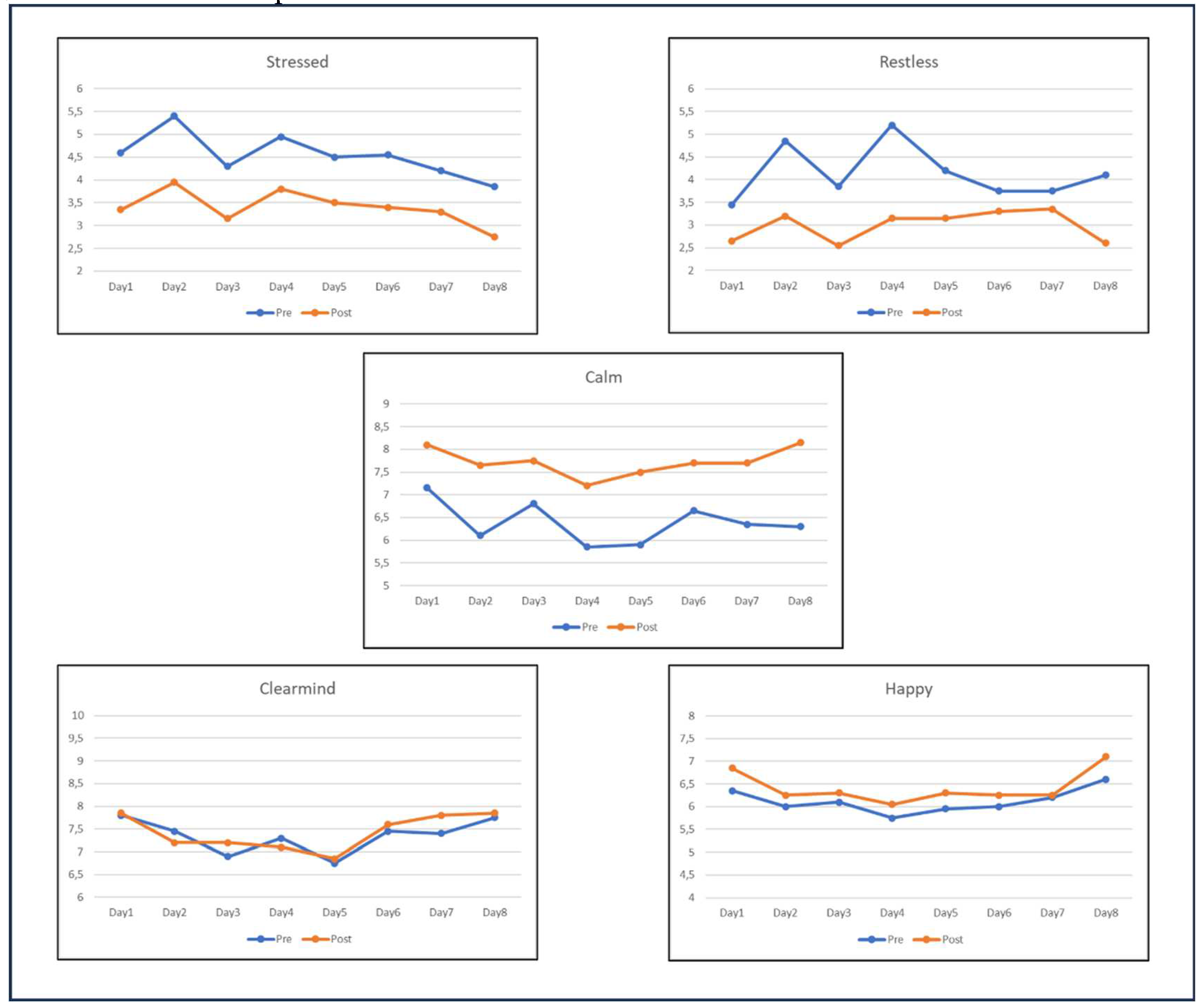
Figure 3.
Line chart of mean MEWS scores for each day.
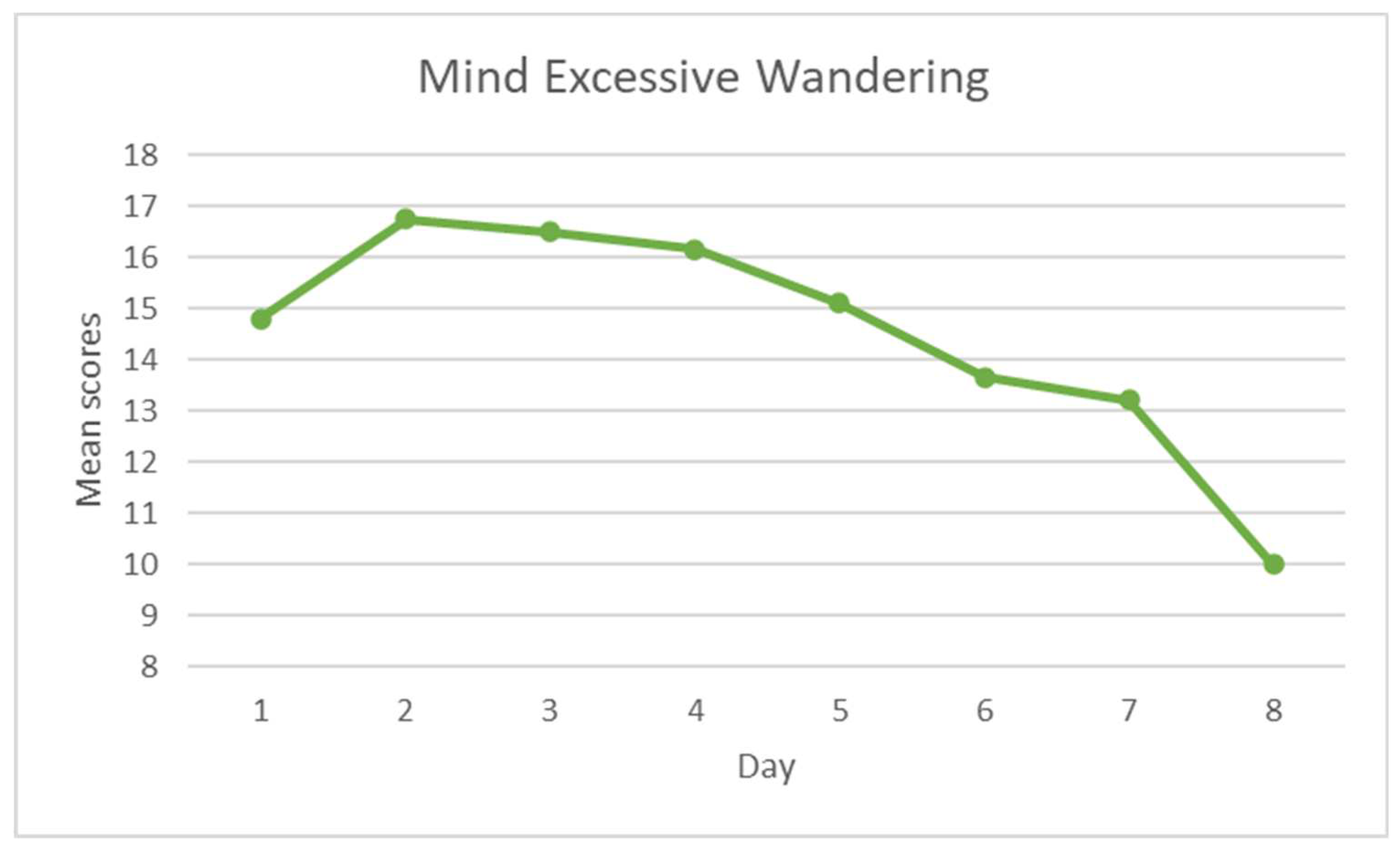
Figure 4.
Mean mood states as self-assessed before (blue) and after (orange) the daily practice.
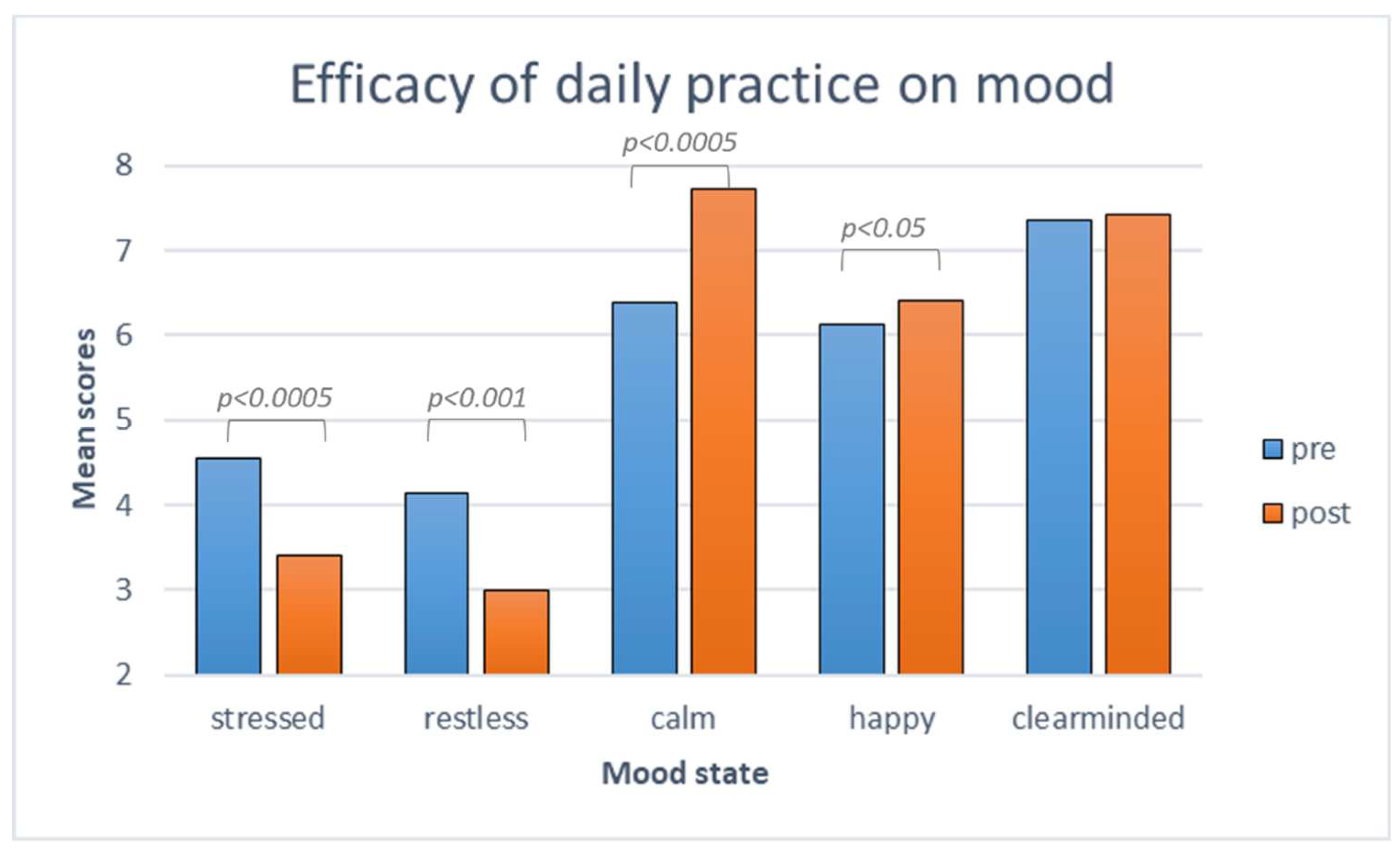
Figure 5.
Mean mind-wandering occurrences as self-assessed before (light green) and after (dark green) the training.
Figure 5.
Mean mind-wandering occurrences as self-assessed before (light green) and after (dark green) the training.
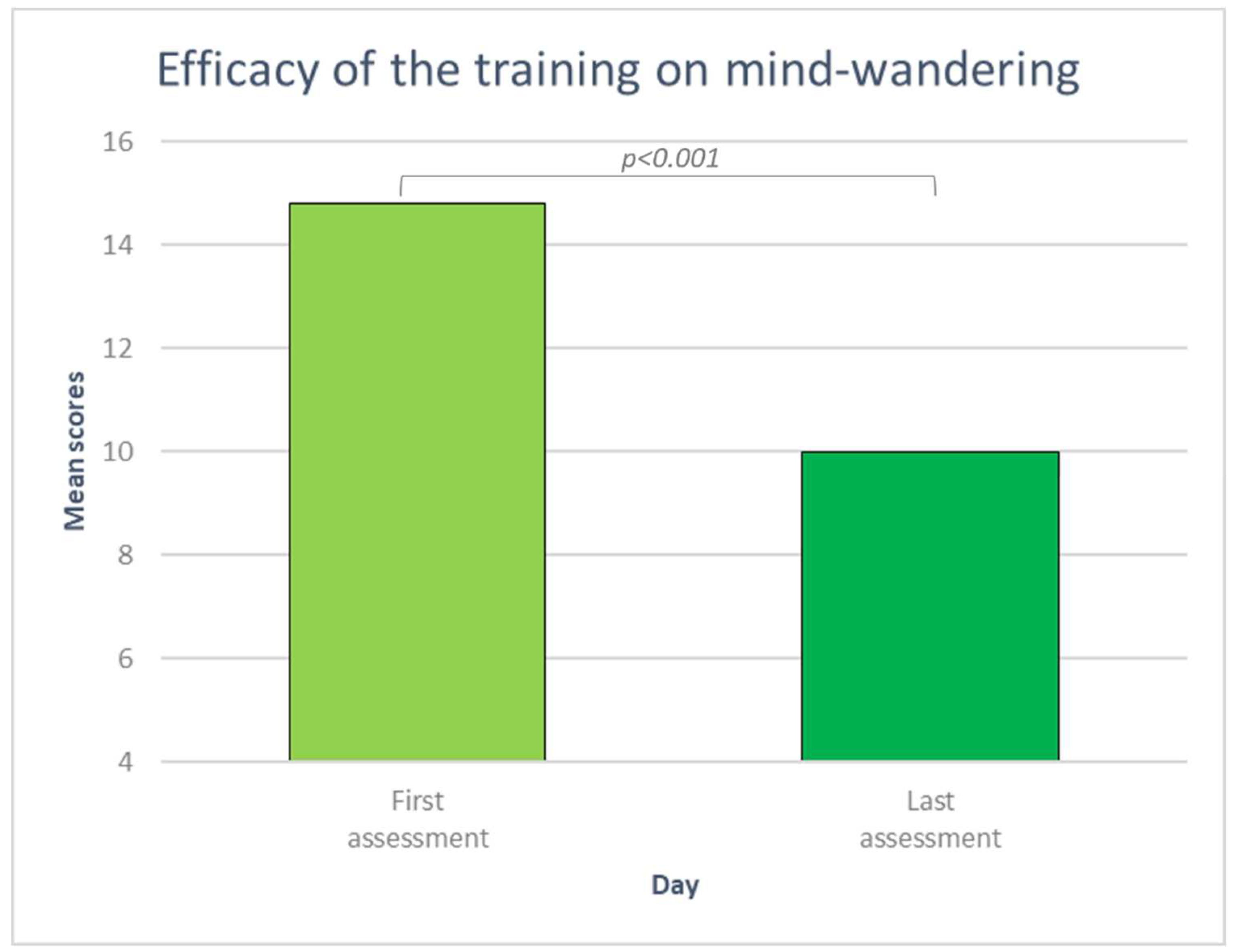
Figure 6.
Pairwise significant (bordeaux) and non-significant (blue) comparisons of daily mind-wandering values with the Friedman test. Significance values were adjusted by Bonferroni correction for multiple comparisons. Each node represents the daily assessment and shows the average rank.
Figure 6.
Pairwise significant (bordeaux) and non-significant (blue) comparisons of daily mind-wandering values with the Friedman test. Significance values were adjusted by Bonferroni correction for multiple comparisons. Each node represents the daily assessment and shows the average rank.
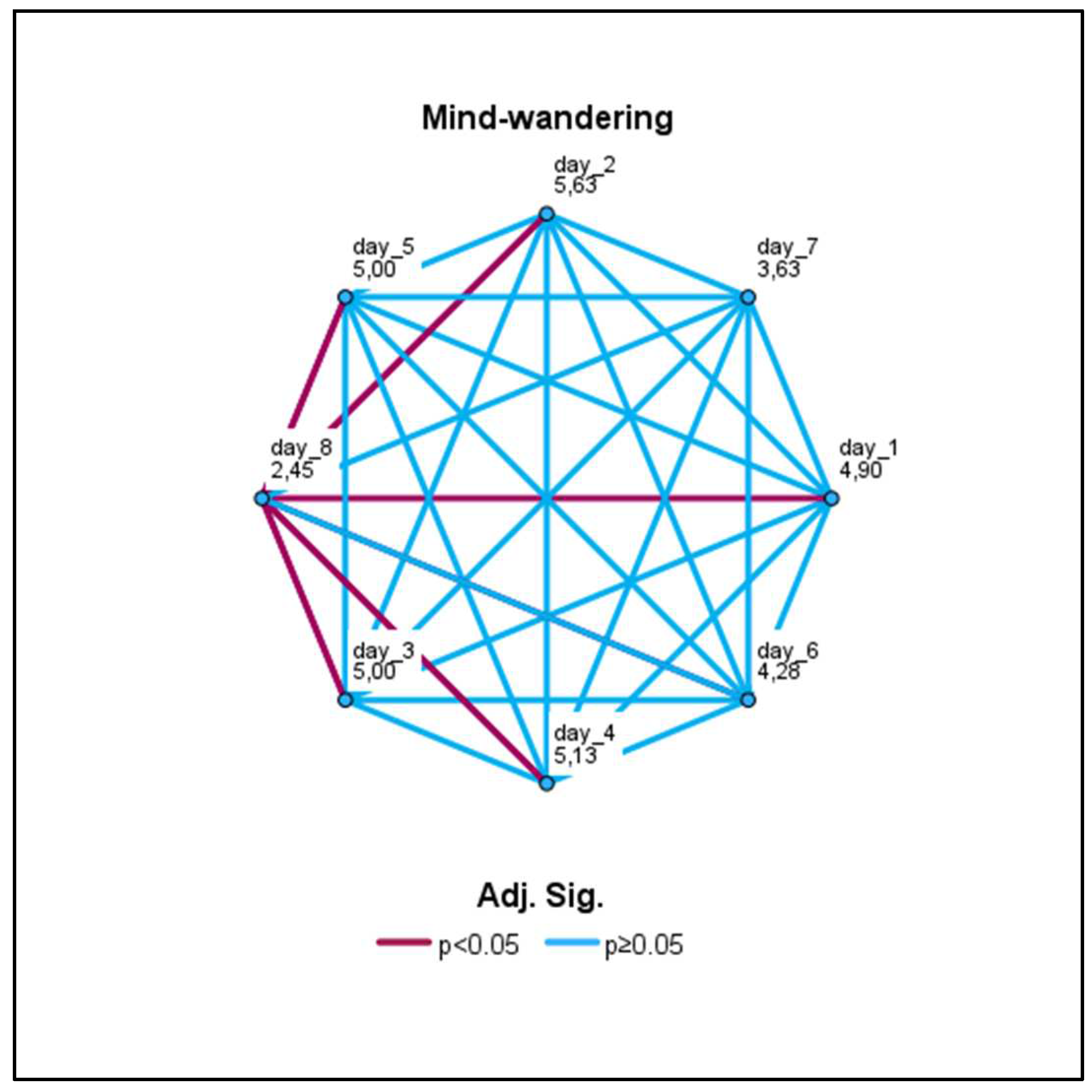
Figure 8.
Pairwise significant (bordeaux) and non-significant (blue) comparisons of daily mind-wandering values with the Friedman test for URNB group (left) and ULNB group (right). Significance values were adjusted by Bonferroni correction for multiple comparisons. Each node represents the daily assessment and shows the average rank.
Figure 8.
Pairwise significant (bordeaux) and non-significant (blue) comparisons of daily mind-wandering values with the Friedman test for URNB group (left) and ULNB group (right). Significance values were adjusted by Bonferroni correction for multiple comparisons. Each node represents the daily assessment and shows the average rank.
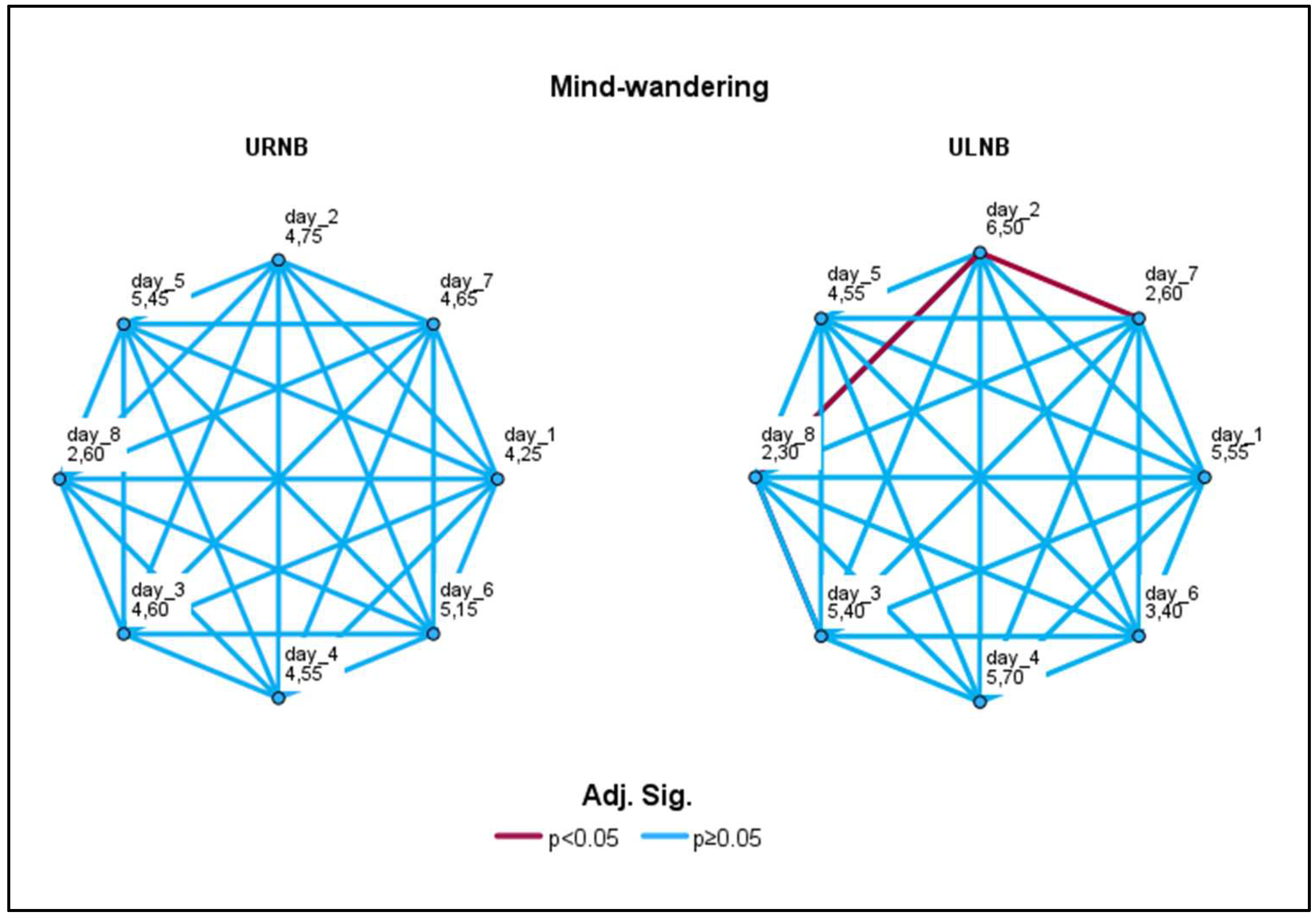
Figure 9.
Line charts of averaged MEWS scores for each day for URNB (blue) and ULNB (orange) groups.
Figure 9.
Line charts of averaged MEWS scores for each day for URNB (blue) and ULNB (orange) groups.
Disclaimer/Publisher’s Note: The statements, opinions and data contained in all publications are solely those of the individual author(s) and contributor(s) and not of MDPI and/or the editor(s). MDPI and/or the editor(s) disclaim responsibility for any injury to people or property resulting from any ideas, methods, instructions or products referred to in the content. |
© 2024 by the authors. Licensee MDPI, Basel, Switzerland. This article is an open access article distributed under the terms and conditions of the Creative Commons Attribution (CC BY) license (http://creativecommons.org/licenses/by/4.0/).
Copyright: This open access article is published under a Creative Commons CC BY 4.0 license, which permit the free download, distribution, and reuse, provided that the author and preprint are cited in any reuse.


