

Submitted:
01 February 2024
Posted:
01 February 2024
You are already at the latest version
Abstract
With the increasing demand for energy worldwide, researchers from different fields have been striving to improve the sustainability and proper utilization of energy resources. Passive radiative cooling, as a natural energy transport method, can achieve cooling without additional external energy input. This review provides a comprehensive examination of passive radiative cooling, including its fundamental theories and latest development. A particular emphasis is placed on the diverse range of fields where passive radiative cooling has been applied, notably including but not limited to construction and architecture. The current state of applications, potential challenges that may arise with wider adaption and promising research directions for each field are thoroughly discussed. This review underscores the universal applicability and feasibility of passive radiative cooling and contributes to its future development by identifying promising areas for further exploration.
Keywords:
radiative cooling
; energy sustainable development
; building energy efficiency
; smart textile
; metamaterials
; micro/nano structures.
1. Introduction
As global energy demand continues to rise, researchers across diverse disciplines are relentlessly exploring avenues to enhance the sustainability of energy production and its efficient usage. Active cooling technologies, mainly based on vapor compression cycles, currently dominate the cooling effect generation scenarios across various industries. Vapor compression refrigeration systems are mature, stable, and capable of high cooling output [1]. However, these widely used vapor compression systems, such as heating, ventilation, and air conditioning (HVAC) units, consume significant amounts of energy. Although novel refrigerants with low Global Warming Potential (GWP) and Ozone Depletion Potential (ODP), like R744, R1234yf, and R290 [2,3,4,5], have been introduced, they only represent a compromise under the ultimate goal of zero energy consumption. Thus, it is critical to develop alternative energy-saving and environmentally friendly cooling solutions considering long-term sustainability. Passive radiative cooling, a naturally occurring energy transfer process, offers a promising solution by providing cooling effect without additional external energy input [6]. Fundamentally, in the passive radiative cooling process, a sky-facing surface reflects solar irradiance with a wavelength range of 0.2–2.5 μm and dissipates its own heat in the form of thermal radiation to the cold outer space through the atmospheric window lying within 8–13 µm of the electromagnetic spectrum. Due to the large temperature difference between the sky-facing surface and the outer space (3 K), the outer space can act as a heat sink with nearly unlimited capacity, providing a cost-free and sustainable cooling solution [7]. In this study, we aim to systematically review the principle of this innovative cooling technology and its potential applications for a more sustainable energy future.
Systematic studies of passive radiative cooling can be dated back to the 1960s, with focuses limited on nighttime passive cooling in the 1970s and 1980s [8,9]. For nocturnal cooling, the performance mainly depends on the thermal radiation efficiency of the radiative cooler, which is determined by the emissivity in the mid-infrared (MIR) range. However, higher MIR emissivity comes with a higher absorptivity, which increases radiative absorption from the surroundings and hence reduces the cooling effectiveness. Thus, a selective radiative surface is required for optimal cooling efficiency in order to achieve daytime cooling. Ideally, a selective radiative cooling surface should achieve high emissivity only at the highly transparent atmospheric window for maximizing heat dissipation towards the outer space while close other atmospheric channels for minimizing radiative heat received. In addition, high reflection and low absorption for solar light is needed for daytime passive radiative cooling. For the first time in California USA, Raman used a passive radiative cooler with a multilayer photonic structure to achieve daytime cooling, which shows a cooling power of 40.1 W/m2 and a temperature drop of ~5 ℃ [10]. Since then, various materials have been proposed to achieve daytime radiative cooling with sub-ambient temperatures and great potential for practical applications.
One common material design concept is to enhance MIR emissivity and solar reflectance for high cooling efficiency [11]. Wide absorption bands of metal–O, nonmetal–O, and nonmetal–nonmetal bonds of inorganic dielectric materials can be used to achieve strong IR emission. Among these, SiO, SiO2, SixNyO, and other silicon-related materials have been widely used in radiative cooling applications [12,13,14,15]. Apart from silicon-based coatings, other inorganic coatings have also been explored for their potential in radiative cooling applications. For instance, coatings developed by Berdahl using magnesium oxide (MgO) and/or lithium fluoride (LiF) as radiators have demonstrated a remarkable cooling power of 85 W/m2 under a clear night sky [16]. Polymer-based materials have also been used for passive radiative cooling, such as polymethyl methacrylate (PMMA), polyvinylidene fluoride (PVDF), and Polydimethylsiloxane (PDMS) [17,18,19,20,21]. With the rapid development of micro/nanomaterials and advanced manufacturing technologies, high solar reflectance of over 97% and high selective MIR emissivity of up to 99% have been achieved [22,23]. A diverse range of passive radiative cooling material designs have been investigated, which show exciting application prospects. In addition to the aforementioned organic or inorganic film structure radiative coolers, pigment paint represents another viable option for nocturnal radiative cooling. Many oxides elements such as titanium (TiO2) [24,25], aluminum (Al2O3) [26,27], barium (BaSO4) [28,29], silicon (SiO2, SiOxNy) [30], and zinc (ZnS, ZnO, ZnSe) [26,31,32,33,34] exhibit high emissivity in the atmospheric window wavelength range and high reflectivity in the visible range.
The development and advancement of passive radiative cooling technologies brings us closer to large-scale applications, which promises an array of societal benefits beyond specific industries, extending to daily life. This review aims to deepen our understanding of the transformative potential of radiative cooling and highlight how this naturally occurring and energy-efficient process could contribute to sustainable cooling practices. By identifying the unique challenges and requirements in various applications, we provide several future research directions, which can potentially lead to a more energy-efficient and sustainable world.
In the forthcoming sections, we will start with the fundamental principle of passive radiative cooling, followed by a comprehensive overview of the real-world applications of radiative cooling under various circumstances including thermal regulation for buildings, human beings, PV panels, greenhouse and food storage as well as dew water collection. In each application scenario, we will highlight the specific characteristics that radiative cooling technology needs to be possessed to function effectively within that particular environment. Conclusively, we will identify the critical issues that should be addressed for large-scale practical applications of passive radiative cooling technology and further propose potential directions for future research.
2. Fundamentals of Passive Radiative Cooling
In the field of thermodynamics, it is understood that any object with a temperature above absolute zero (0 K) has the capability to spontaneously absorb and emit electromagnetic waves [35]. This interaction between objects of different temperatures results in a form of heat exchange among objects at varying temperatures through the process of absorption and emission of these electromagnetic waves. On Earth, the most critical example of radiative heat exchange takes place between the Earth's surface and outer space, which is a process moderated by the transparency of the Earth's atmosphere in the wavelength range of 8–13 µm [36], a phenomenon known as the atmospheric long-wave infrared (LWIR) transmission window and playing an integral role in maintaining the Earth's temperature within a range that supports life.
The net cooling power of a typical passive radiative cooler in daytime is determined by outgoing thermal radiation from the cooler, solar radiation absorption and atmospheric thermal radiation absorption by the cooler, and non-radiative heat transfer (shown in Figure 1a), and can be expressed as follows:
Where is the net cooling power of the cooler; is the radiative power of the cooler; and are the absorbed power from the atmospheric and solar radiation, respectively; is the power of all non-radiative heat transfer processes, i.e., convection and conduction, occurring between the radiative cooler and its surrounding environment. To maximize , it is advisable to amplify as much as possible and concurrently reduce . With regards to , the utilization of spectrally selective surfaces is crucial. Specifically, a daytime radiative cooler should be designed to exhibit low solar absorption while simultaneously maintaining high MIR emissivity (shown in Figure 1b). This characteristic facilitates the achievement of radiative cooling effect during the daytime. In terms of minimizing , it is paramount to effectively insulate the radiative cooler from its surrounding environment, which can minimize the heat transfer from convection and conduction.
3. Promising Applications of Passive Radiative Cooling
As people delve deeper into the realm of daytime radiative cooling, it becomes apparent that this technology holds significant potential for transformative applications across various sectors. In this section, we will explore several application scenarios in detail, highlighting the recent advances in daytime radiative cooling materials, devices, and systems that are not only paving the way for sustainable energy usage but are also redefining the landscape of temperature regulation.
3.1. Building cooling
In the realm of energy consumption pertinent to modern societies, cooling demand constitutes a substantial 40% of the overall energy utilization [37]. Within this significant proportion, it is interesting to note that conventional HVAC systems in architectural structures occupy a significant 65% of the energy usage [38]. Recent study illuminating the global status of HVAC systems suggests that by 2030, the annual electricity expenditure on HVAC systems could exceed hundreds of billions of dollars [39]. This underscores the critical role HVAC systems play in the larger context of energy consumption and the potential energy savings that could be realized in this sector. Against the backdrop of significant energy expenditure by traditional HVAC systems, passive radiative cooling emerges as a promising alternative in the field of building cooling. This technology, requiring no additional energy input, has the potential to achieve substantial cooling effects. The utilization of radiative cooling materials in the construction of building rooftops, often referred to as 'cooling roofs', is a well-established applications of radiative cooling technologies within the field of architecture. In periods of high ambient temperatures, the implementation of cooling roofs can considerably diminish the cooling load of a building. These specially designed roofs can reflect a large fraction of the incoming solar radiation, while concurrently emitting thermal radiation towards the outer space. This dual mechanism facilitates an efficient cooling process, making a substantial contribution to overall energy saving within buildings. Indeed, the film-type [10,13,16,17,18,24,29,34] and paint-type [12,25,26,27,28,29,32] materials introduced in the introduction section can all serve as potential candidates for building cooling. However, beyond the basic requirements of optical properties that enable radiative cooling, additional performance criteria should be evaluated for materials intended for building roofs, including durability and scalability, aesthetic functions (color), and cooling power self-adaptive. These factors play crucial roles in determining the practical applicability and long-term performance of these materials in real-world architectural contexts.
Many meticulously designed radiative coolers necessitate intricate manufacturing processes and are vulnerable to a variety of factors that can challenge their durability during outdoor applications. Instances such as material structural degradation due to prolonged and intense ultraviolet (UV) exposure, surface contamination or erosion caused by wind-borne sand and dust, and surface damage from accidental impacts or continuous friction can adversely affect their cooling efficiency. Researchers are actively engaged in efforts to mitigate these challenges. Titanium dioxide (TiO2) has high refractive index and excellent hydrophobic and UV-blocking properties [40], leading to radiative coolers using TiO2 nanoparticles exhibit high solar reflectance and dirt resistance. Song et al [41] demonstrated a strategy for realizing a durable radiative cooling coating through the evaporation-driven assembly of TiO2 nanoparticles. The UV resistance of the designed anti-aging cooling paint (AACP) is significantly enhanced by the formation of a porous layer using rutile TiO2 nanoparticles, without the incorporation of polymeric binders. When subjected to an accelerated aging test equivalent to one year of natural sunlight exposure, it was observed that the solar reflectance of the coating only diminished by a slight 0.5% (from 92.5% to 92.0%), while LWIR emissivity and contact angles were almost unchanged (shown in Figure 2a), maintaining reliable performance compared to the original state. In a similar vein, taking advantage of the intrinsic properties of TiO2, Li M et al. [42] developed a triple-layer structure radiative cooler based on polyethersulfone (PES) with TiO2 and Al2O3, using a phase change method (shown in Figure 2b). The top layer, consisting of high-refractive-index (n ≈ 1.8) Al2O3 nanoparticles treated with fluorides for enhanced hydrophobicity (with a contact angle of 168°), reflects most of the UV light and is waterproof, thereby protecting the underlying structure. This design exhibits efficient and durable daytime radiative cooling, even in harsh climates. Acknowledging the critical importance of enhancing the mechanical strength of materials used in passive radiative cooling, Li T et al [43] designed a wood-based passive radiative cooling material with enhanced tensile strength through delignification and re-pressing. This material features cellulose nanofibers that scatter solar irradiance and emit strongly in the MIR range, yielding an average daytime cooling power of 54 W/m². Significantly, the absence of lignin from the wood matrix results in an enhanced tensile strength, measured at 404.3 MPa—representing an 8.7-fold increase over conventional wood (shown in Figure 2c). This substantial reinforcement of mechanical properties confers resistance to erosive forces like wind-sand abrasion and incidental impacts, ensuring persistent and stable cooling performance. Additionally, to address challenges in cooling performance degradation caused by outdoor contamination, Wang et al [44] prepared a polymer composite coating of polystyrene, polydimethylsiloxane, and poly(ethyl cyanoacrylate) (PS/PDMS/PECA) using a simple two-step spray method. The ultra-hydrophobic self-cleaning characteristics of this coating can maintain the optical performance of the coating surface. During anti-fouling tests, it was observed that when mud was applied to the material's surface, it slid off instead of adhering to the surface due to the surface's ultra-hydrophobicity (shown in Figure 2d), thus not compromising the material's cooling efficiency. Meng et al. [45] reported a robust superhydrophobic self-cleaning porous coating characterized by the presence of nano-globules. This coating is synthesized through the thermal polymerization of methyl methacrylate (MMA) and ethylene glycol dimethacrylate (EDMA). The interconnected nano-globules structure contributes to increased surface roughness, endowing the surface with significant superhydrophobic properties, evidenced by a high contact angle of 165° (shown in Figure 2e). Moreover, the superhydrophobicity of the coating remained stable after rigorous testing, including tape peeling, abrasion with sandpaper, immersion in strong acids, and UV aging experiments. These findings suggest that the coating is highly resistant to dirt contamination, mechanical wear, chemical corrosion, and prolonged exposure to direct sunlight.
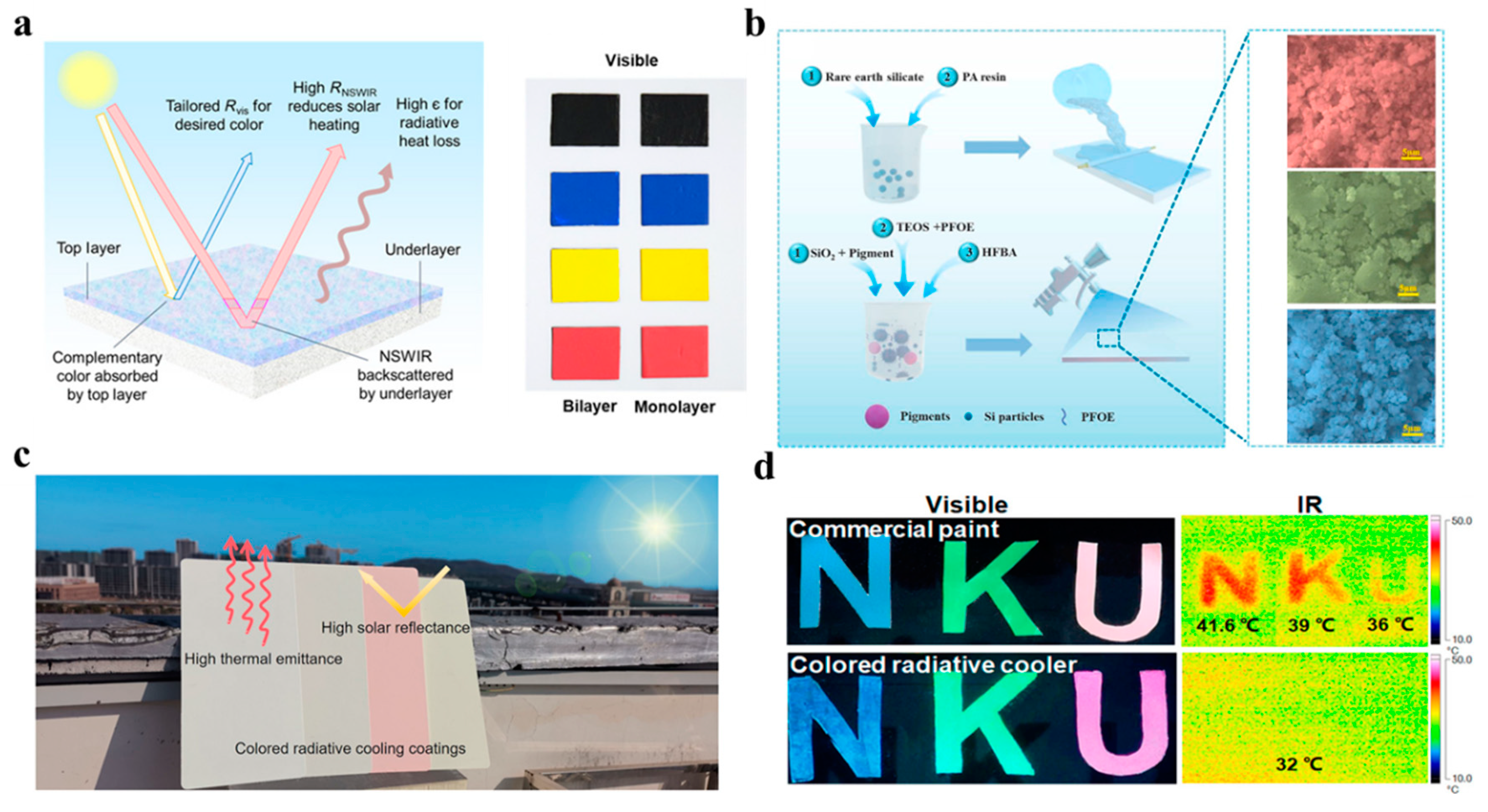
Reducing light pollution and glare is another challenge of radiative cooling for building applications. The development of radiative cooling materials with rich colors can not only solve the issue of glare but also improve visual aesthetics, enhancing the overall acceptability and appeal of colored radiative cooling technologies for building applications. The dye-rendering strategy is the simplest and most direct method to address color issue. Chen et al [46] combined commercial dyed coating layers with porous P(VdF-HFP) or TiO2/polymer composite films (shown in Figure 3a). The top layer selectively absorbs specific visible wavelengths to exhibit a particular color, while the bottom layer maximally reflects near-short-wavelength infrared (NSWIR) light to reduce solar heating. This approach accomplished a temperature drop of 15.6 ℃ during the hot summer. Tao et al. [47] engineered a colored radiative cooling emitter composed of a multilayer structure consisting of a high reflective substrate, a selective emission coating, and a sprayed pigment layer (shown in Figure 3b). A silver-aluminum alloy sheet serves as the high-reflectance substrate, with quinaldine red, phthalocyanine green, and phthalocyanine blue employed to achieve the primary colors of red, yellow, and blue, respectively. The results indicate that the emitter is capable of reflecting over 90% of near-infrared (NIR) light and demonstrates an infrared (IR) emission of over 85% within the atmospheric window. Compared to conventional colored polyurethane (PU) panels, the emitter achieves a temperature reduction of 5–10°C during the daytime and 3–5°C at night. In the pursuit of alternatives to conventional commercial dyes, phosphor dyes have attracted increasing attention from researchers. Xu et al. [48] employed luminescent diode phosphor materials such as Y3Al5O12:Ce, Y3(Al,Ga)5O12:Ce, SrSiO4:Eu, and CaAlSiN3:Eu as pigments to impart yellow, yellow-green, green, and red hues, respectively (shown in Figure 3c). These phosphors were applied to a dual-layer structured radiative cooler composed of TiO2 and BaSO4 powders embedded in a polyacrylic resin. Owing to the high selectivity of the phosphor dyes, which possess impurity bands within a large bandgap to circumvent extensive solar absorption and facilitate narrow-band visible light absorption, the colored radiative cooler achieved an optimization of color display while minimizing visible light absorption. It was demonstrated that the solar reflectance and the mid-to-far-IR emissivity of the cooler both exceed 90%. Under peak solar irradiation of 1000 W/m2 at noon, the device achieved a sub-ambient temperature of 2.7 °C.
However, the color-displaying dye material absorbs not only specific wavelengths of visible light but also intercepts a fraction of IR waves, which hinders the efficiency radiative cooling [49]. Besides dye-rendering strategy, another strategy is the structural color strategy [50], which achieves color decoration of the cooler through structural design. By meticulously arranging nano-scale or micro-scale structures, coloration is achieved through the interference of scattered light without absorbing extra energy in the IR wavelengths [51], thus enhancing the cooling performance. Through numerical simulation, Yalçın et al. [52] demonstrated that the spectral position of surface plasmon resonances can be tuned by adjusting the sizes of plasma core-shell nanoparticles (with a silica core and a silver shell) and ordinary silver nanoparticles embedded within a silica and polydimethylsiloxane matrix, thereby resulting in the manifestation of various colors. This coloration strategy offers the potential for obtaining radiative cooling structures with colored coatings without affecting the solar reflectance. Building upon this concept of tuning nanoparticle sizes within radiative cooler structures to experimentally achieve different colorations, Yu et al. [53] engineered a flexible, colored radiative cooler whose coloration is derived from structural color induced by interference backward reflection (shown in Figure 3d). The chromaticity can be finely tuned by modulating the diameter of the polystyrene (PS) microspheres responsible for the interference, thus rendering a broad color palette. Owing to its unique structural design, the cooler exhibits high solar reflectance (> 90%) and high MIR emissivity (96%). Zhu et al. [54] proposed an efficient structurally colored radiative cooling film with a photonic nanostructure, which is fabricated from natural cellulose nanocrystals (CNC). In this work, while achieving intense and fade-resistant coloration, they further diminished the sunlight absorption to approximately 3%, while achieving an emissivity of over 90% within the atmospheric window. Additionally, this film can be produced using a roll-to-roll (R2R) deposition process, thus suggesting its commercial viability.
Figure 3.
Colored radiative coolers. a) Bilayer colored radiative coolers s for enhanced NSWIR reflectance. From [46]. Reprinted with permission from AAAS. b) The schematic of colorful radiative cooling emitters. Reprinted from [47], with permission from Elsevier [OR APPLICABLE SOCIETY COPYRIGHT OWNER]. c) Colored radiative cooling coatings using phosphor dyes. Reprinted from [47,48] , with permission from Elsevier [OR APPLICABLE SOCIETY COPYRIGHT OWNER].d) Photonic-Structure Colored Radiative Coolers. Reprinted (adapted) with permission from [53]. Copyright 2024 American Chemical Society.
Figure 3.
Colored radiative coolers. a) Bilayer colored radiative coolers s for enhanced NSWIR reflectance. From [46]. Reprinted with permission from AAAS. b) The schematic of colorful radiative cooling emitters. Reprinted from [47], with permission from Elsevier [OR APPLICABLE SOCIETY COPYRIGHT OWNER]. c) Colored radiative cooling coatings using phosphor dyes. Reprinted from [47,48] , with permission from Elsevier [OR APPLICABLE SOCIETY COPYRIGHT OWNER].d) Photonic-Structure Colored Radiative Coolers. Reprinted (adapted) with permission from [53]. Copyright 2024 American Chemical Society.
All the above implementations are static passive radiative coolers, which maintain a continuous cooling effect regardless of the surrounding environmental conditions. However, the continues cooling during cold seasons or nighttime can exacerbate heating costs and personal thermal discomfort. In response to this, adaptive radiative cooling technology has been proposed. In accordance with the stimulation mechanism that switches between cooling and non-cooling (heating) modes, the previously reported switchable radiative cooling systems can be categorized into two groups: active systems and passive adaptive systems.
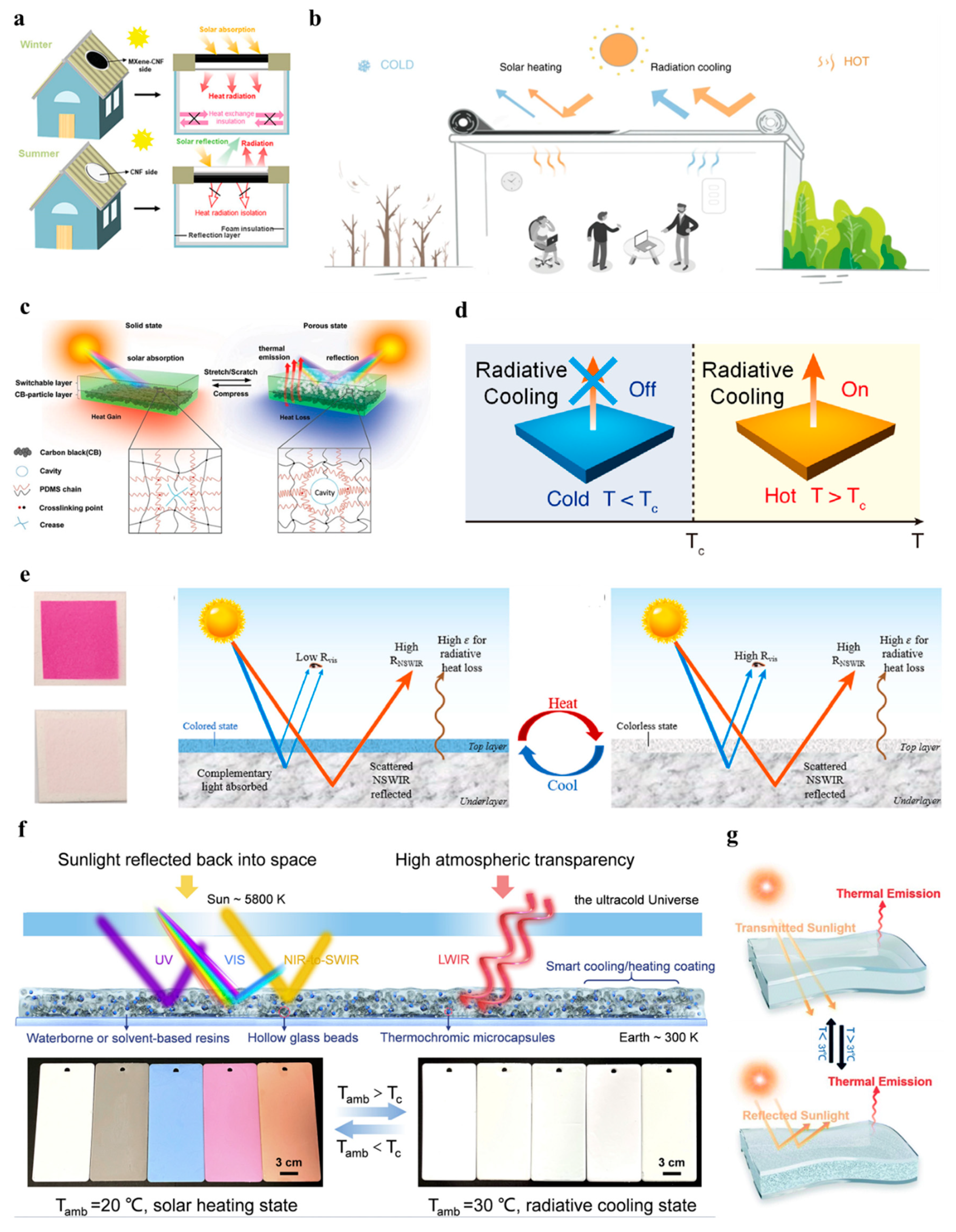
Active control systems, which combine external stimuli with responsive materials or structures, require extra energy input for the dynamic control of thermal performance. Yang et al. [55] proposed a Janus-structured bilayer aerogel composed of a photothermal MXene-cellulose nanofibers (CNF) layer and a radiative cooling CNF layer (shown in Figure 4a). By simply manually flipping the two sides, cooling power control can be achieved. At cold state, the MXene-CNF side was exposed to sunlight, harvesting solar energy with a high solar absorption (≈ 97.5%). And at hot state, the CNF side was exposed to sunlight, reflecting solar energy with low absorption (≈ 12%) and porous structure, thereby creating a comfortable cooling effect. Besides simply toggling cooling and heating materials, mode switching can be triggered under electrical and mechanical stimuli. Li et al. [56] designed a rollable structure powered by electricity that utilizes a pair of electronically controlled rotary actuators enabling the flipping of both sides of a thin film (shown in Figure 4b), thereby providing a seamless switch between solar heating and radiative cooling modes. In addition, Zhao et al. [19] achieved a spectrum switch through the induction of mechanical force. They induced cavitation in a dynamic porous silicon bilayer film by applying external compression and stretching (shown in Figure 4c). This enables a transition between a transparent solid state, which absorbs 95% of sunlight for heating, and a highly porous state, which reflects about 93% of solar radiation and allows for approximately 94% of LWIR thermal emission, facilitating solar reflection and radiative cooling.
Passive control method, which operates without additional energy and uses materials' innate reaction to environmental changes, offers a promising solution for more efficient and self-regulating radiative cooling. Designing adaptive radiative coolers with phase change materials is an effective approach. Taking advantage of the unique temperature-dependent emissivity adaption of VO2 , Fan et al. [57] proposed a concept based on a planar photonic multilayer system that incorporates VO2 and a spectrally selective filter (shown in Figure 4d). However, intrinsic VO2 exhibits a high phase transition temperature of ~ 68 °C, far exceeding the threshold of human thermal comfort. To achieve practically applicable adaptive cooling performance, Tang et al. [58] found that doping VO2 with tungsten significantly reduced its transition temperature. Thus, they fabricated a temperature-adaptive radiative coating based on WxV1-xO2, which switches thermal emittance from 0.20 (when the ambient temperature is lower than 15 °C) to 0.90 (when the ambient temperature is above 30 °C). Other temperature-responsive materials such as germanium antimony telluride (GST) [59,60,61], and perovskites (LMnO3) [62,63], undergo a phase transition from metallic to insulating states near room temperature. Their ability to modulate emissivity in the atmospheric window makes them ideal candidates for dynamically tuning daytime radiative cooling materials. In addition to altering the emissivity within the infrared band (including atmospheric window), since the visible light spectrum also makes a significant contribution to solar heating, modulating emissivity in this range is an effective strategy as well. Thermochromic materials that exhibit temperature-sensitive reflectivity within the visible light spectrum due to thermally reversible transformation of the molecular structure of the pigments are gaining significant scholarly attention. These materials undergo a decolorization process at elevated temperatures, thereby increasing solar reflectivity and minimizing solar absorption. Conversely, at lower temperatures, these materials display color, enhancing solar absorption to diminish the cooling power [64]. Wang J et al. [65] developed a temperature-adaptive radiative cooling coating consisting of a P(VdF-HFP) bottom layer and a thermochromic microcapsule top layer (shown in Figure 4e). Via color transitions at high and low temperatures (transition temperature @ 33 °C), this material demonstrates a capacity for ~ 20% modulation (91.25%–72.71%) in solar reflectivity. Further, Wang T et al. [66] incorporated a small quantity of reversible thermochromic chameleon microcapsules into environmentally friendly and low-cost hollow glass beads as a radiative cooling base (shown in Figure 4f). This facilitated the possibility for color diversity and achieved a temperature modulation capacity of ΔTcooling-heating = 9.5 °C. Organic thermochromic hydrogels have also been investigated and applied in self-adaptive radiative cooling technologies. At low temperatures, the refractive index of the hydrogel is similar to that of water, resulting in high solar light transmission. However, when temperature increases, the hydrogen bonds within the hydrogel break, leading to phase separation and polymer aggregation. This causes severe internal scattering and results in a low solar light transmission rate [67]. Xue et. al. [68] designed a self-adaptive film with a sandwich structure, based on a thermochromic poly(N-isopropylacrylamide) (PNIPAm) hydrogel and PVDF film with high IR emissivity (Figure 4g). This film exhibits a relatively low transition temperature (31 °C) and achieves a substantial modulation in visible light reflectance/transmittance (ΔRvis = 70.0% and ΔTvis = 86.3%). In addition to temperature-driven, Dastidar et al. [69] reported a humidity-induced cellulose-carbon nanotube film of the Janus structure, which reflects most sunlight (R = 88%) in a dry state and switches to absorbing sunlight (α = 60%) for rapid evaporation in a wet state.
Figure 4.
Adaptive radiative cooling design. a) Schematic of an engineering structural Janus MXene-nanofibrils aerogels. Figure by[55] is licensed under CC BY-NC 4.0, with the permission of John Wiley and Sons. b) Schematic of the dual-mode device at heating (left) mode and cooling (proper) mode. [56] is licensed under CC BY-NC 4.0. c) Schematic of the bilayer structure consisting of a switchable silicone top layer and carbon black particle-embedded bottom layer. Figure by[19] is licensed under CC BY-NC 4.0, with the permission of John Wiley and Sons. d) Concept of a temperature-dependent adaptive radiative cooler containing VO2. [57] is licensed under CC BY-NC 4.0. e) Schematic of a low-cost and scalable temperature adaptive radiation-cooling coating Reprinted from [47,65], with permission from Elsevier [OR APPLICABLE SOCIETY COPYRIGHT OWNER]. f) Schematic of a TiO2-free coating with self-adaptive switching between cooling. Reprinted from [47,66], with permission from Elsevier [OR APPLICABLE SOCIETY COPYRIGHT OWNER]. g) Schematic representation of the PVDF@PNIPAm film. Used with permission of Royal Society of Chemistry (Great Britain), from [68]; permission conveyed through Copyright Clearance Center, Inc.
Figure 4.
Adaptive radiative cooling design. a) Schematic of an engineering structural Janus MXene-nanofibrils aerogels. Figure by[55] is licensed under CC BY-NC 4.0, with the permission of John Wiley and Sons. b) Schematic of the dual-mode device at heating (left) mode and cooling (proper) mode. [56] is licensed under CC BY-NC 4.0. c) Schematic of the bilayer structure consisting of a switchable silicone top layer and carbon black particle-embedded bottom layer. Figure by[19] is licensed under CC BY-NC 4.0, with the permission of John Wiley and Sons. d) Concept of a temperature-dependent adaptive radiative cooler containing VO2. [57] is licensed under CC BY-NC 4.0. e) Schematic of a low-cost and scalable temperature adaptive radiation-cooling coating Reprinted from [47,65], with permission from Elsevier [OR APPLICABLE SOCIETY COPYRIGHT OWNER]. f) Schematic of a TiO2-free coating with self-adaptive switching between cooling. Reprinted from [47,66], with permission from Elsevier [OR APPLICABLE SOCIETY COPYRIGHT OWNER]. g) Schematic representation of the PVDF@PNIPAm film. Used with permission of Royal Society of Chemistry (Great Britain), from [68]; permission conveyed through Copyright Clearance Center, Inc.
3.2. Personal thermal management
While the implementation of radiative cooling in building envelopes has enhanced indoor comfort within architectural structures, it is equally imperative to address personal thermal management in expansive outdoor environments. The application of radiative cooling technologies to textiles emerges as a potential and promising solution, facilitating the creation of wearable and adaptive thermal management apparel [70,71,72]. The human body temperature is around 37 °C, which can emit MIR thermal radiation in a wavelength range of 7–14 µm with a peak at 9.5 µm, and emissivity of 0.98 [73]. Considering this characteristic, radiative cooling textiles can be conceptualized following two design perspectives: high MIR transparency and high MIR emissivity.
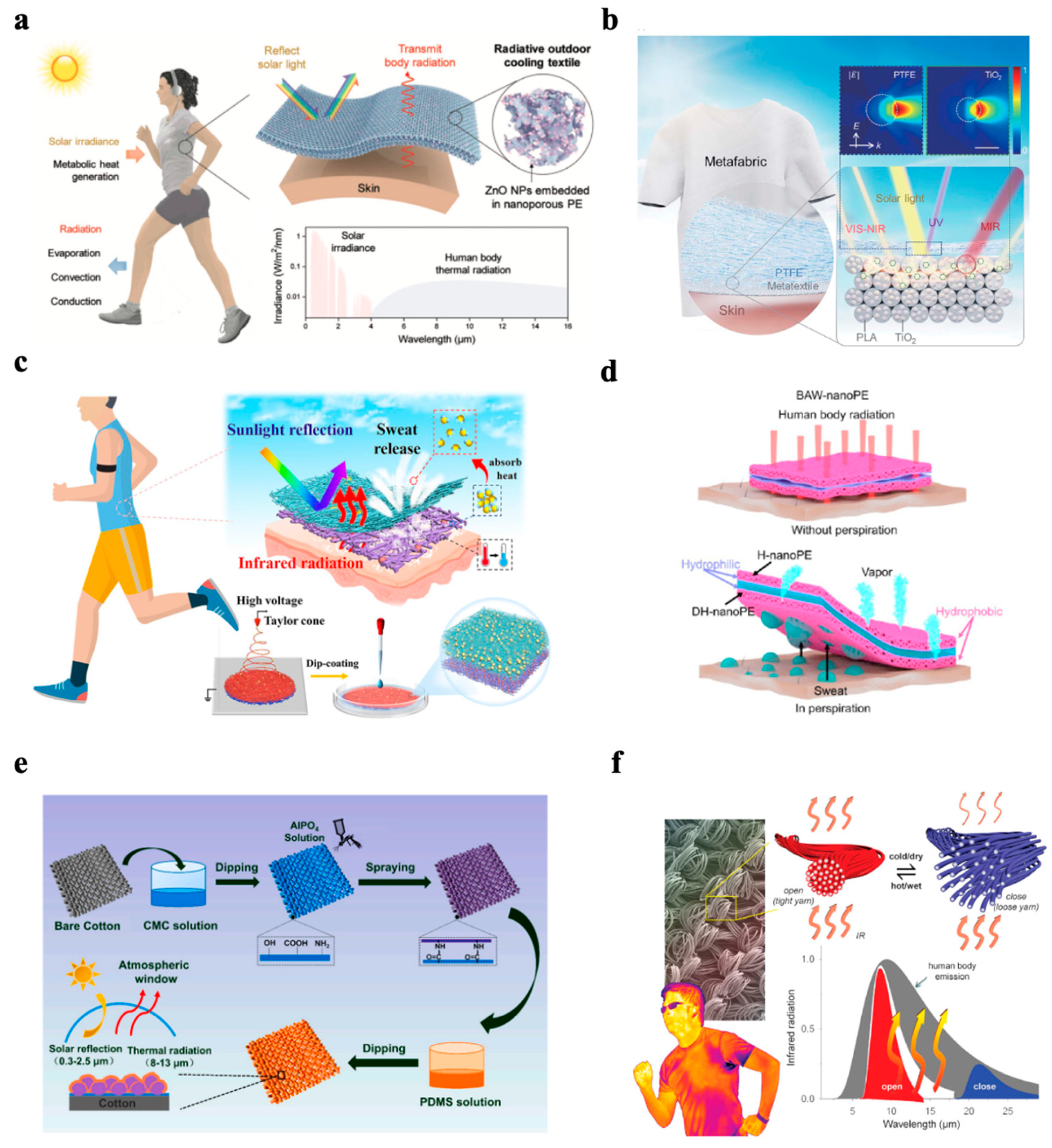
The fundamental premise behind the design guideline of high MIR transparent textiles is to allow, as much as possible, the dissipation of human body heat radiation - which is already situated within the atmospheric window - into outer space. Cai et al. [74] developed a spectrally selective nanocomposite textile by embedding zinc oxide nanoparticles into nanoporous polyethylene (ZnO-PE). This textile reflects over 90% of solar irradiance while maintaining approximately 80% high transmittance in the 7-14 µm range, where human body heat radiation is concentrated (shown in Figure 5a). Subsequently, they achieved coloring of the IR-transparent PE textile by utilizing unique inorganic pigment nanoparticles, enriching its visual appeal while maintaining negligible IR absorption, non-toxicity, and low cost [75]. To go a step further, Hsu et al. [76] proposed an IR-transparent textile composed of nanoporous polyethylene (nanoPE). This material features interconnected pores with diameters ranging from 50 to 1000 nm, comparable to the wavelengths of visible light (400–700 nm) but considerably smaller than those of IR light. Consequently, it exhibits an IR transmittance of over 90% and a visible light opacity exceeding 99%. Experimental validation, conducted with a device engineered to mimic skin heat output, indicated that when covered with the nanoPE fabric, the resulting temperature was 2.7 °C lower than that covered with cotton fabric. Due to the inherent high MIR transmissivity of PE, it is a straightforward and effective approach to integrate it with other conventional textiles. Liu et al. [77] developed an ultra-high molecular weight polyethylene (UHMWPE)/polyester composite fabric using the thermally induced phase separation method. This fabric demonstrates a weighted average human body MIR transmissivity of 82.8% and an opacity to visible light > 98%, while also maintaining an adequate moisture wicking rate, breathability, and mechanical strength. Considering the large-scale applications, Peng et al [78] reported the large-scale extrusion of uniform and continuous nanoPE microfibers for industrial mass production. They claimed that the proposed nanoPE fabric achieves a great radiative cooling power compared to cotton fabric with the same thickness, reducing the human skin temperature by 2.3 °C and leading to over 20% energy saving on indoor energy consumption for cooling demand.
Apart from MIR transparent textiles, the design of textiles with elevated surface IR emissivity presents a viable strategy for realizing personal thermal management. Such designs typically function by facilitating effective heat conduction between the textile and skin, thereby enabling the textile to serve as a radiator, effectively radiating heat towards the external sky. Song et al. [79] fabricated a novel porous PVDF fiber and the woven fabric via an in-situ microfiber method. This fabric demonstrates high MIR emissivity (94.5%) and opacity to solar radiation (90.3% in the NIR range and 94.2% in visible light range), thereby avoiding a simulated human body overheating effect of 17.7 °C under direct solar irradiance. Building on this accomplishment, the team subsequently developed a radiative cooling textile composed of a three-layer structure to further enhance the cooling effect and streamline the manufacturing process [80]. This structure is made of PVDF as the base layer, with nylon (PA) and PE stacked on top, fabricated using electrospinning. The textile presents substantial emissivity within the atmospheric window and over 90 % reflectance to visible light, resulting in a human body cooling effect of 6.5 ℃. In terms of large-scale applications, Zeng et al [70] produced large-scale woven metafabrics with high MIR emissivity (94.5%) and high solar reflectivity (92.4%) due to the hierarchical-morphology design of the randomly dispersed scatterers in the metafabric (shown in Figure 5b). Their experiments demonstrated that a human body covered by the designed metafabric could be ~ 4.8°C cooler than that covered by commercial cotton fabrics. They claimed that the metafabrics also possess preferred mechanical strength, waterproofness, and breathability through a scalable industrial textile manufacturing process.
To further meet the thermal comfort requirements under more practical conditions, the combination of passive radiative cooling and evaporative cooling is proposed. Zhang et al [81] designed and demonstrated a nanofiber membrane-based moisture-wicking passive cooling hierarchical metafabric, which couples selective radiative cooling and wick-evaporation cooling, for effective temperature and moisture regulation (shown in Figure 5c). Due to the optical properties of the material and hierarchical morphology design, the proposed hierarchical metafabric possessed high sunlight reflectivity (99.16% in the 300−760 nm range and 88.60% in the 760−2500 nm range), high MIR emissivity (78.13%), and preferred moisture permeability. Their experiments showed that covering simulated skin with the hierarchical metafabric prevented overheating by 16.6 °C compared to conventional textiles, where the management of the humidity contributed around ∼ 8.2 °C. Alberghini et al [82] engineered PE fibers, yarns and fabrics for efficient water wicking and fast-drying performance. Their high-performance PE fabrics are made from fibers melt spun and woven using standard equipment in the worldwide textile industry and do not need any chemical coatings. They claim that the evaporative cooling function of the engineered PE fabrics can not only reduce the tumble-drying cycle but also provide an additional passive cooling mechanism for both indoor and outdoor thermal comfort. Hu et al [83] developed a bilayer nanoPE membrane with anisotropic wettability, achieving superior radiative cooling ability (∼ 2.6 °C lower compared to cotton) without perspiration. Simultaneously, the proposed membrane has efficient sweat drainage and good evaporation cooling characteristics (∼ 1.0 °C lower compared to cotton) in perspiration to minimize sticky and hot sensations (shown in Figure 5d).
It is noteworthy that apart from thermal comfort, it is essential to meet the criteria of wear comfort for the practical application of radiative cooling textiles. Zhu et al. [71] proposed radiative cooling textiles by modifying silk with high wearability, which was accomplished using a coupling agent (tetrabutyl titanate) to bind high refractive index inorganic oxide nanoparticles (Al2O3) with the silk. The nanoprocessed silk not only exhibits high cooling performance (with a temperature reduction of 3.5 ℃), but also retains the high wearability and durability characteristics intrinsic to natural silk. In addition, from the perspective of long-term thermal regulation performance, superhydrophobic and self-cleaning properties of radiative cooling textiles are significant to enhance their durability and practicality, as the thermal regulation function of radiative cooling textiles may be compromised due to dampness and accumulation of surface stains. Zhong et al. [84] modified the cotton fabric to be superhydrophobic (contact angle ~152°) by introducing a PDMS top layer (shown in Figure 5e), allowing the fabric to maintain a cooling effect of 4.2 ℃ even after 20 washes. On the other hand, Cui et al. [85] employed a combination of template and etching techniques to create self-cleaning radiative cooling textiles using a porous coating of poly(vinylidene fluoride-co-hexafluoropropylene) (P(VDF-HFP)). The modified-coating fabric exhibits a hydrophobic contact angle of 124.9°, preventing contamination from aqueous pigments and maintaining a high solar reflectance of 0.93 and an IR emissivity of 0.98.
Additionally, similar to applications in buildings, the cooling demand from the human body is not always needed but dependent on the ambient season and environment. Therefore, adaptive textiles that can switch between cooling and heating mode as per the external conditions, also referred to as Janus textiles, are of significant interest. Active or passive switching methods have been proposed. In active switching methods, the most common one is wearing the textile inside out. Based on previous research on nanoPE [76], Hsu et al [86] demonstrated a dual-mode textile for heating and cooling using a bilayer thermal emitter embedded within the IR-transparent nanoPE. This dual-mode textile enables an easy transition between a heating mode, which can increase skin temperature by 3.4 °C, and a cooling mode, which can reduce skin temperature by 3.1 °C, thereby extending the thermal comfort zone by 6.5 °C through a simple inversion of the fabric from inside to outside. Abebe et al. [87] designed Janus yarns for a dual-mode double-sided thermoregulating fabric using asymmetric yarn composition with dual-emissivity properties. The strong emissivity difference between the two surfaces of the designed fabric is ~ 0.72, due to the metallic and dielectric fibers within the yarn. Thus, a wide set-point temperature window of 13.1 °C can be achieved, with the wearer maintaining thermal comfort between 11.3 °C and 24.4 °C. On the other hand, passive switching methods include dynamic switching the MIR emittance or transmittance, dynamic switching the thermal conductance, etc. Zhang et al. [88] constructed a humidity-responsive, IR-adaptive textile composed of polymer fibers coated with carbon nanotubes (shown in Figure 5f). Humidity-driven expansion and contraction of the textile yarn modulates inter-fiber meta-element proximity, triggering resonant electromagnetic coupling to elevate emissivity for improved thermal exchange. In arid conditions, the yarn's inverse reaction diminishes heat loss. Experimental results showed that when the humidity level increased from 10% to 75%, the spacing between the yarns decreased by 100 µm, thereby increasing the fabric's IR transmittance by 35.4%.
Figure 5.
Passive radiative cooling textiles. a) Schematic of the ZnO nanoparticle–embedded nanoPE radiative outdoor cooling textile. Figure by [74] is licensed under CC BY-NC 4.0, with the permission of John Wiley and Sons. b) Schematic of the structure and simulated properties of the daytime radiative cooling metafabric. From [70]. Reprinted with permission from AAAS. c) Schematic of the structure design and preparation process of the hierarchical metafabric. Reprinted (adapted) with permission from [81]. Copyright 2024 American Chemical Society. d) Schematic of the moisture/thermal management of the bilayer nanoPE. Reprinted (adapted) with permission from [83]. Copyright 2024 American Chemical Society. e) Schematic of the fabrication process of self-cleaning and spectrally selective cotton fabric with daytime radiative cooling. Reprinted from [84], with permission from Elsevier [OR APPLICABLE SOCIETY COPYRIGHT OWNER]. f) Schematic of design principles of an IR-adaptive textile. From [88]. Reprinted with permission from AAAS.
Figure 5.
Passive radiative cooling textiles. a) Schematic of the ZnO nanoparticle–embedded nanoPE radiative outdoor cooling textile. Figure by [74] is licensed under CC BY-NC 4.0, with the permission of John Wiley and Sons. b) Schematic of the structure and simulated properties of the daytime radiative cooling metafabric. From [70]. Reprinted with permission from AAAS. c) Schematic of the structure design and preparation process of the hierarchical metafabric. Reprinted (adapted) with permission from [81]. Copyright 2024 American Chemical Society. d) Schematic of the moisture/thermal management of the bilayer nanoPE. Reprinted (adapted) with permission from [83]. Copyright 2024 American Chemical Society. e) Schematic of the fabrication process of self-cleaning and spectrally selective cotton fabric with daytime radiative cooling. Reprinted from [84], with permission from Elsevier [OR APPLICABLE SOCIETY COPYRIGHT OWNER]. f) Schematic of design principles of an IR-adaptive textile. From [88]. Reprinted with permission from AAAS.
3.3. Other applications
a) Photovoltaics cooling
Photovoltaics (PV) is a novel renewable energy method that can convert incident radiation into electrical energy, and is considered as one of the most promising solutions to the current energy and environmental challenges we are facing [89]. However, despite its ability to absorb most of the solar energy, a significant portion of the absorbed sunlight cannot be converted into electrical energy, but instead generates heat. This heat generation can reduce the efficiency of PV systems and significantly shorten their lifespan [90,91,92]. Nowadays, silicon solar cells are predominantly used in PV systems. For crystalline silicon solar cells, every temperature rise of 1 K leads to a relative efficiency decline of about 0.45% [93]. Hence, it is imperative to engineer advanced cooling methodologies tailored for PV systems. Among the potential strategies, passive radiative cooling emerges as a feasible approach. Although the silicon-based cells already exhibit substantial emissivity, roughly 85% within the atmospheric window [94], further research to boost MIR emissivity is essential. Such studies would be crucial in achieving superior radiative cooling effects.
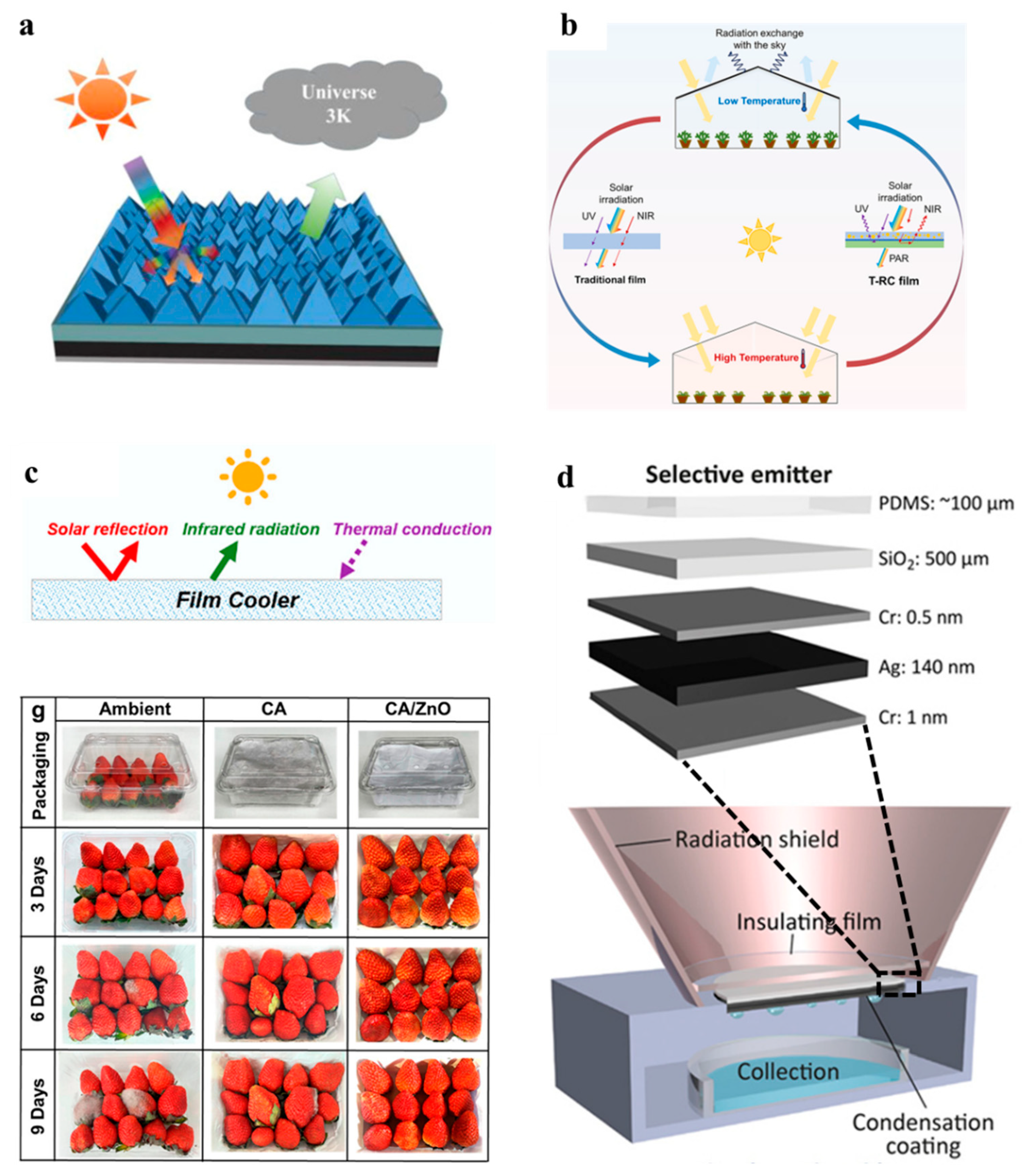
Through microstructural modifications to the silica on top of PV systems, the emissivity spectrum can be altered. Zhu et al. [95] optimized a pyramidal structure through numerical simulation, which significantly increased the emissivity of the outer surface of the PV across the entire IR spectrum. This enhancement passively lowered the operating temperature of the PV system by 18.3 K. Lu et al. [96] developed a durable, ultra-broadband multifunctional texture through the modification of silica sol-gel processes (shown in Figure 6a). When this texture is embossed onto the encapsulant polymer backsheet of silicon PV modules, it exhibits an emissivity greater than 0.96 within the atmospheric window. The appropriate incorporation of such radiative cooling effects has been demonstrated to enhance the conversion efficiency of PV systems by 3.13%. It is essential to recognize that while precise optical design is crucial for the development of future novel PV systems, retrofitting existing PV installations to enable radiative cooling is equally important. The development of transparent radiative cooling materials that can be applied over the surface of PV panels presents a promising solution. Lee et al. [97] implemented pyramidal structures into chemically stable and cost-effective PDMS, creating a flexible transparent film. The plain PDMS film with a thickness of 200 µm achieves a high emissivity exceeding 0.9 across the entire IR range of 4–26 µm.
b) Greenhouse temperature regulation
The principles of radiative cooling technologies that are revolutionizing the efficiency of PV systems have found a parallel application in the domain of agriculture, specifically in the design of greenhouses. Greenhouses, serving as agricultural hubs, provide critical protection for crops against inclement weather conditions [98,99]. However, the UV radiation that is transmitted through conventional covering materials of greenhouses can detrimentally affect pollination behaviors, while the substantial heat carried by IR waves constitutes a principal reason for the overheating of these structures during the hot seasons [100]. The application of radiative cooling technologies in greenhouses presents an effective approach to resolve the issue of heat stress in greenhouses during hot seasons without necessitating an increase in water and energy consumption. Distinct from applications in other domains, radiative coolers for greenhouses need to fulfill an additional requirement of allowing the transmission of photosynthetically active radiation (PAR; 400–700 nm), which is vital for supporting the photosynthesis process in the internal plant environment [101]. This dual functionality—merging high solar reflectance and MIR emission with the greenhouse's need for high PAR transmittance—underscores the need for a bespoke design that not only expels thermal energy but also harmonizes with the light requirements essential for plant growth and productivity.
Liu et al. [102] fabricated a monolayer film through co-extrusion molding, incorporating PE with UV stabilizers and metal oxide particles. This innovative material composition realized a temperature reduction of 2.2 °C in an ambient environment of 35 °C. Advancing the practical application of this design principle, Zou et al. [103] engineered a novel transparent radiative cooling film by synthesizing PE terephthalate (PET) with silver (Ag) nanoparticles (shown in Figure 6b). In comparative experiments with traditional polyolefin (PO) films, it was observed that the deployment of the proposed film within greenhouses led to an increase of approximately 20% in the productivity of three crop varieties: Chinese cabbage, pakchoi, and cherry radish. The outcomes of this research provide compelling evidence for the practical efficacy of transparent radiative cooling materials in diminishing thermal stress without sacrificing photosynthetic efficiency, thereby offering a promising solution for augmenting agricultural yield in controlled environments.
c) Food preservation and packaging
The preservation of food is a critical aspect of daily life, with low-temperature cooling being a key method for extending the shelf life of foodstuffs, particularly during long-distance transportation [104]. Passive radiative cooling, as an efficient and environmentally-friendly cooling approach, offers a sustainable pathway for maintaining the freshness of food. Cellulose acetate (CA) is an abundant and eco-friendly cellulose derivative, which is considered as a substrate material for the new generation of sustainable packaging films due to its biodegradable nature, low pollution profile, and non-fossil-fuel-based composition [105,106,107]. Li et al. [108] developed a flexible, layered packaging film based on CA molecules using the roll-to-roll electrospinning technique. Within this material, interconnected nanofibers create a hierarchy of multi-scale pores ranging from 500 nm to 3 μm, facilitating effective sunlight dispersion and thus granting the material with proficient radiative cooling capabilities (solar reflectance of 0.974, and MIR emissivity of 0.92). When the film is used to package ice cubes or ice cream, it can dramatically reduce the thermal load of chilled outdoor food products from 296 W/m2 to a mere 1 W/m2, showcasing its potential to significantly enhance thermal management in food packaging applications. Zhang et al [109] further advanced the application of CA by merging it with high-index-of-refraction ZnO (n≈2), engineering a multi-layered porous CA/ZnO film. This composite material exhibits a significantly improved MIR emissivity of 94%, which not only facilitates radiative cooling but also displays exceptional properties such as high hydrophobicity (contact angle of 138°), high tensile strength (2.7 MPa), and low thermal conductivity (0.07 W/mK) benefiting from its multiscale micro-nanostructure. These characteristics render it an ideal material for food preservation packaging applications. Experimental results indicated that utilizing this film for packaging strawberries under direct sunlight can extend their storage time up to 9 days (shown in Figure 6c), demonstrating its potential as a superior solution for food preservation. In further advancements, Chen et al. [110] developed a novel packaging material based on ZnO Nanorods/Cellulose Membrane-Starch Membrane@Bilberry Anthocyanins (ZnO-NRs/CM-SM@BA). This packaging material leverages the rod-like structure of ZnO nanorods, exhibiting a visible light reflectance of 94.4% and an IR emissivity of 98.8%, substantially reducing heat intake and enhancing the dissipation of thermal accumulation. Furthermore, its unidirectional water transport capability, arising from different water contact angles (WCAs) on either side of the membrane (WCA=100.2°, 34.9°), can maintain a dry environment inside the packaging, thus protecting the packaged food from bacterial spoilage. Experimental tests on the packaging performance with cherry tomatoes and grapes indicated that the packaging material extends the freshness period of the fruits to over five days.
d) Dew water harvesting
Clean freshwater resources are an essential pillar for human survival. However, freshwater scarcity has emerged as a significant threat to the sustainable development of human society, particularly for inhabitants in arid or coastal regions, due to limited freshwater resources on earth, burgeoning populations and escalating environmental pollution. Although around 70% of the world is covered by water, 96.5% is ocean and around 2.5% is freshwater while only ~ 1% of that freshwater is easily accessible for human usage [111]. Seawater desalination is generally hailed as a panacea to alleviate freshwater shortage [112], based on several mature commercial methodologies—such as reverse osmosis [113,114], multi-stage flash distillation [115,116,117], and membrane bioreactor systems [118]. However, the considerable economic and energetic inputs required for their operation, constraints relying on large amount of seawater, coupled with the environmental ramifications associated with byproduct pollution, curtail their widespread adoption on a larger and wider scale [119,120]. In addition, there are still challenges and difficulties for freshwater transportation and delivery in remote areas due to insufficient infrastructure, limited facility maintenance and high cost [121]. Thus, decentralized freshwater production is urgently needed, especially for residents living in remote regions and water-deficient countries.
It is noteworthy that atmospheric water is ubiquitous irrespective of geological or hydrological conditions, which is a huge renewable and clean reservoir of water (estimated water volume of around 12,900 km3), enough to meet the needs of every person on the planet [121,122]. The development of efficient technologies for harvesting atmospheric water represents a promising solution to the global water crisis [123,124]. Passive radiative cooling, offering a propitious avenue for the condensation of water vapor in the air into water, presents a compelling technological trajectory for sustainable water harvesting. Zhou et al. [125] designed and demonstrated a daytime passive radiative condenser, which is composed of a PDMS layer, a silver layer, and an aluminum plate. Their outdoor experiments at UW-Madison in September showed a daily water production of 0.8 mL using a 0.05 m2 radiative condenser by pumping in humified air (RH = 90%–95%) at ambient temperature. These investigations provide compelling evidence of the practicality of utilizing radiative cooling materials for dew water collection; nonetheless, achieving a fully passive and continuous 24-hour atmospheric water harvesting system remains an elusive challenge. Haechler et al. [126] designed a water collection system wherein the radiative emitter and the water collecting surface operate independently yet cohesively (shown in Figure 6d). A selective radiative emitter situated at the top, using a conical aluminum structure as a radiative shielding device, intercepts detrimental atmospheric radiative gains, while the bottom condensing collector features a superhydrophobic surface that facilitates the detachment and shedding of droplets. This decoupled and non-inhibitory configuration enables the uninterrupted 24-hour harvesting of atmospheric water. Outdoor experiments at ETH (Zurich, Switzerland) in August showed that the mean dew mass flux achieved 50 g/m2/hour (close to the theoretical limit of such systems) with a RH higher than 90% and a mean solar irradiation of over 200 W/m2. Additionally, the integration of solar interfacial evaporation with passive radiative cooling represents a viable strategic approach to realizing all-day freshwater collection [127,128,129]. Xu et al. [130] designed a dual-function film combining daytime solar thermal desalination and nighttime radiative cooling dew collection by applying carbon nanotubes (solar absorption of ∼ 95%) on a flexible PDMS substrate with high IR emissivity (∼ 90% in 8–13 μm range). This film achieves a daytime potable water collection efficiency of 71.1% and a nighttime peak dew water yield of 80 mL/m2.
Overall, the convergence of radiative cooling applications across different fields underscores their potential to address the intertwined challenges of energy efficiency and sustainable development. This technology not only addresses current environmental and resource challenges but also offers a pathway towards a more resilient and sustainable future.
Figure 6.
Other applications of radiative cooling. a) Schematic of the imprinted texture glass used in PV modules. Figure by [96] is licensed under CC BY-NC 4.0, with the permission of John Wiley and Sons. b) Schematic diagram for greenhouse temperature regulation using radiative cooling film. Reprinted from [103], with permission from Elsevier [OR APPLICABLE SOCIETY COPYRIGHT OWNER]. c) Cooling of strawberries via the hierarchically designed CA/ZnO film. Reprinted (adapted) with permission from [109]. Copyright 2024 American Chemical Society. d) Design of 24-hour atmospheric water harvesting system driven by radiative cooling. From [126]. Reprinted with permission from AAAS.
Figure 6.
Other applications of radiative cooling. a) Schematic of the imprinted texture glass used in PV modules. Figure by [96] is licensed under CC BY-NC 4.0, with the permission of John Wiley and Sons. b) Schematic diagram for greenhouse temperature regulation using radiative cooling film. Reprinted from [103], with permission from Elsevier [OR APPLICABLE SOCIETY COPYRIGHT OWNER]. c) Cooling of strawberries via the hierarchically designed CA/ZnO film. Reprinted (adapted) with permission from [109]. Copyright 2024 American Chemical Society. d) Design of 24-hour atmospheric water harvesting system driven by radiative cooling. From [126]. Reprinted with permission from AAAS.
4. Outlook
This review systematically encapsulates the current state of passive radiative cooling research, elucidating its potential as a sustainable cooling paradigm. It is evident from the literature that this technology, utilizing the atmospheric window to facilitate heat dissipation into space, introduces a new direction for energy-efficient cooling methods. The breadth of applications, from building envelopes to wearable textiles and from photovoltaic systems, agricultural facilities to dew water collection, demonstrates the vast potential of passive radiative cooling to contribute to energy savings and sustainability across multiple sectors. Nonetheless, the path from research to practical, widespread applications is paved with challenges that demand concerted scholarly attention. Three promising directions for future research are suggested and discussed, which have the potential to substantially influence the utilization and performance of passive radiative cooling solutions across various sectors.
- Enhancement of Durability and Self-Cleaning Properties: The long-term performance of passive radiative coolers is mainly dependent on their ability to maintain their optical properties in the face of environmental challenges, such as pollutant deposition and chemical contamination. Nano-engineered surfaces with self-cleaning properties, such as employing superhydrophobic or photocatalytic mechanisms, represent a promising avenue for research that could help to alleviate these concerns. Consequently, future studies could explore the potential of such surfaces to sustain high levels of solar reflectivity and MIR emissivity after extended outdoor exposure. Moreover, conducting comprehensive sustainability assessments on the lifecycle of radiative cooling materials is crucial. This ensures the environmental footprint of passive radiative cooling technologies is thoroughly understood and minimized. Research directed towards understanding how these materials interact with a wide array of environmental stressors will be invaluable in determining the long-term stability and suitability of radiative coolers for large-scale implementation.
- Adaptive Cooling Power Modulation: The static nature of traditional passive radiative cooling technologies does not accommodate the dynamic cooling demand imposed by diurnal and seasonal temperature variations, nor does it account for the diverse climatic conditions across different geographical regions. The integration of adaptive mechanisms, capable of modulating radiative cooling power, is therefore a significant research frontier. Materials with tunable emissivity, such as thermochromic, shape-memory, and phase-change materials, offer promising pathways for achieving adaptive cooling capabilities. Research should delve into the synthesis and characterization of these materials to lower their transition temperatures and enhance their responsiveness. Additionally, the incorporation of smart control systems that automate the adjustment of radiative cooling power based on real-time feedback of ambient conditions represents an interdisciplinary challenge with vast implications for energy conservation and thermal comfort of users.
- Scalability and Manufacturing Research: Transitioning passive radiative cooling technologies from prototype to large-scale production is an essential research focus. Future work should concentrate on refining manufacturing processes to enhance the scalability of passive radiative coolers. Roll-to-roll fabrication and modular design are promising methods that could facilitate mass production, improving consistency and reducing costs. Additionally, developing methodologies for standardized quality control will be vital to ensure the reliability and performance of radiative coolers at scale. Addressing these manufacturing challenges is the key to enabling the commercial adoption of passive radiative cooling technologies.
Author Contributions
Conceptualization, L.L., K.L. and S.C.; formal analysis L.L. and S.B.; investigation, L.L., S.B., S.C. and C.T.K.; writing—original draft preparation, L.L. and S.B.; writing—review and editing, L.L., S.B., K.L., Y.Z. and C.Y.T.; supervision, C.Y.T.; funding acquisition, C.Y.T. All authors have read and agreed to the published version of the manuscript.
Funding
This work was supported by Hong Kong Research Grant Council via General Research Fund (GRF) accounts 11200022 and 11200923, and via the Collaborative Research Fund (CRF) account C1105-20G, and via Strategic Topics Grant (STG) account STG2/E-605/23-N, as well as by the Innovation and Technology Commission via Innovation and Technology Fund (ITF) account ITS/128/22FP.
Institutional Review Board Statement
Not applicable.
Informed Consent Statement
Not applicable.
Data Availability Statement
No new data were created or analyzed in this study. Data sharing is not applicable to this article.
Acknowledgments
The authors wish to thank Prof. Lin LU and Dr. Jianheng CHEN Lin for the invitation to publish in this Sustainability Special Issue.
Conflicts of Interest
The authors declare no conflicts of interest.
References
- Shi, J. Y.; Han, D. L.; Li, Z. C.; Yang, L.; Lu, S. G.; Zhong, Z. F.; Chen, J. P.; Zhang, Q. M.; Qian, X. S. , Electrocaloric Cooling Materials and Devices for Zero-Global-Warming-Potential, High-Efficiency Refrigeration. Joule 2019, 3 (5), 1200–1225. [Google Scholar] [CrossRef]
- de Paula, C. H.; Duarte, W. M.; Rocha, T. T. M.; de Oliveira, R. N.; de Paoli Mendes, R.; Maia, A. A. T. , Thermo-economic and environmental analysis of a small capacity vapor compression refrigeration system using R290, R1234yf, and R600a. International Journal of Refrigeration 2020, 118, 250–260. [Google Scholar] [CrossRef]
- Gullo, P.; Elmegaard, B.; Cortella, G., Energy and environmental performance assessment of R744 booster supermarket refrigeration systems operating in warm climates. International Journal of Refrigeration-Revue Internationale Du Froid 2016, 64, 61-79.
- Abas, N.; Kalair, A. R.; Khan, N.; Haider, A.; Saleem, Z.; Saleem, M. S. , Natural and synthetic refrigerants, global warming: A review. Renew Sust Energ Rev 2018, 90, 557–569. [Google Scholar] [CrossRef]
- Kumma, N.; Kruthiventi, S. S. H. , Current status of refrigerants used in domestic applications: A review. Renewable and Sustainable Energy Reviews 2024, 189, 114073. [Google Scholar] [CrossRef]
- Hossain, M. M.; Gu, M. , Radiative Cooling: Principles, Progress, and Potentials. Adv Sci (Weinh) 2016, 3 (7), 1500360. [Google Scholar] [CrossRef] [PubMed]
- Catalanotti, S.; Cuomo, V.; Piro, G.; Ruggi, D.; Silvestrini, V.; Troise, G. J. S. E. , The radiative cooling of selective surfaces. Solar Energy 1975, 17 (2), 83–89. [Google Scholar] [CrossRef]
- Catalanotti, S.; Cuomo, V.; Piro, G.; Ruggi, D.; Silvestrini, V.; Troise, G. , The radiative cooling of selective surfaces. Solar Energy 1975, 17 (2), 83–89. [Google Scholar] [CrossRef]
- Granqvist, C. G.; Hjortsberg, A. , Radiative Cooling to Low-Temperatures - General-Considerations and Application to Selectively Emitting Sio Films. Journal of Applied Physics 1981, 52 (6), 4205–4220. [Google Scholar] [CrossRef]
- Raman, A. P.; Anoma, M. A.; Zhu, L.; Rephaeli, E.; Fan, S. , Passive radiative cooling below ambient air temperature under direct sunlight. Nature 2014, 515 (7528), 540–4. [Google Scholar] [CrossRef]
- Zhang, Q.; Wang, S.; Wang, X.; Jiang, Y.; Li, J.; Xu, W.; Zhu, B.; Zhu, J. , Recent Progress in Daytime Radiative Cooling: Advanced Material Designs and Applications. Small Methods 2022, 6 (4), e2101379. [Google Scholar] [CrossRef]
- Atiganyanun, S.; Plumley, J. B.; Han, S. J.; Hsu, K.; Cytrynbaum, J.; Peng, T. L.; Han, S. M.; Han, S. E. , Effective Radiative Cooling by Paint-Format Microsphere-Based Photonic Random Media. ACS Photonics 2018, 5 (4), 1181–1187. [Google Scholar] [CrossRef]
- Chae, D.; Kim, M.; Jung, P. H.; Son, S.; Seo, J.; Liu, Y.; Lee, B. J.; Lee, H. , Spectrally Selective Inorganic-Based Multilayer Emitter for Daytime Radiative Cooling. ACS Appl Mater Interfaces 2020, 12 (7), 8073–8081. [Google Scholar] [CrossRef] [PubMed]
- Chen, Z.; Zhu, L.; Raman, A.; Fan, S. , Radiative cooling to deep sub-freezing temperatures through a 24-h day-night cycle. Nat Commun 2016, 7 (1), 13729. [Google Scholar] [CrossRef]
- Miyazaki, H.; Okada, K.; Jinno, K.; Ota, T. , Fabrication of radiative cooling devices using Si<sub>2</sub>N<sub>2</sub>O nano-particles. Journal of the Ceramic Society of Japan 2016, 124 (11), 1185–1187. [Google Scholar]
- Berdahl, P. , Radiative cooling with MgO and/or LiF layers. Appl Opt 1984, 23 (3), 370. [Google Scholar] [CrossRef] [PubMed]
- Gao, W.; Lei, Z. Y.; Wu, K.; Chen, Y. P. , Reconfigurable and Renewable Nano-Micro-Structured Plastics for Radiative Cooling. Advanced Functional Materials 2021, 31 (21), 2100535. [Google Scholar] [CrossRef]
- Aili, A.; Wei, Z. Y.; Chen, Y. Z.; Zhao, D. L.; Yang, R. G.; Yin, X. B. , Selection of polymers with functional groups for daytime radiative cooling. Materials Today Physics 2019, 10, 100127. [Google Scholar] [CrossRef]
- Zhao, H.; Sun, Q.; Zhou, J.; Deng, X.; Cui, J. , Switchable Cavitation in Silicone Coatings for Energy-Saving Cooling and Heating. Adv Mater 2020, 32 (29), e2000870. [Google Scholar] [CrossRef] [PubMed]
- Wong, R. Y. M.; Tso, C. Y.; Fu, S.; Chao, C. Y. H. , Maxwell-Garnett permittivity optimized micro-porous PVDF/PMMA blend for near unity thermal emission through the atmospheric window. Solar Energy Materials and Solar Cells 2022, 248, 112003. [Google Scholar] [CrossRef]
- Yang, X. B.; Geng, J. L.; Tan, X. Y.; Liu, M.; Yao, S. M.; Tu, Y. T.; Li, S. S.; Qiao, Y. L.; Qi, G. G.; Xu, R. Z.; Nie, S. J. , A flexible PDMS@ZrO film for highly efficient passive radiative cooling. Inorganic Chemistry Communications 2023, 151, 110586. [Google Scholar] [CrossRef]
- Zhai, H. T.; Fan, D. S.; Li, Q. , Scalable and paint-format colored coatings for passive radiative cooling. Solar Energy Materials and Solar Cells 2022, 245, 111853. [Google Scholar] [CrossRef]
- Wang, T.; Wu, Y.; Shi, L.; Hu, X.; Chen, M.; Wu, L. , A structural polymer for highly efficient all-day passive radiative cooling. Nat Commun 2021, 12 (1), 365. [Google Scholar] [CrossRef]
- Jeong, S. Y.; Tso, C. Y.; Ha, J.; Wong, Y. M.; Chao, C. Y. H.; Huang, B. L.; Qiu, H. H. , Field investigation of a photonic multi-layered TiO passive radiative cooler in sub-tropical climate. Renewable Energy 2020, 146, 44–55. [Google Scholar] [CrossRef]
- Harrison, A. W.; Walton, M. R. , Radiative Cooling of Tio2 White Paint. Solar Energy 1978, 20 (2), 185–188. [Google Scholar] [CrossRef]
- Mandal, J.; Yang, Y.; Yu, N. F.; Raman, A. P. , Paints as a Scalable and Effective Radiative Cooling Technology for Buildings. Joule 2020, 4 (7), 1350–1356. [Google Scholar] [CrossRef]
- Chae, D.; Son, S.; Lim, H.; Jung, P.-H.; Ha, J.; Lee, H. , Scalable and paint-format microparticle–polymer composite enabling high-performance daytime radiative cooling. Materials Today Physics 2021, 18, 100389. [Google Scholar] [CrossRef]
- Tong, Z.; Peoples, J.; Li, X.; Yang, X.; Bao, H.; Ruan, X. , Electronic and phononic origins of BaSO as an ultra-efficient radiative cooling paint pigment. Materials Today Physics 2022, 24, 100658. [Google Scholar] [CrossRef]
- Li, X.; Peoples, J.; Yao, P.; Ruan, X. , Ultrawhite BaSO(4) Paints and Films for Remarkable Daytime Subambient Radiative Cooling. ACS Appl Mater Interfaces 2021, 13 (18), 21733–21739. [Google Scholar] [CrossRef]
- Farooq, A. S.; Zhang, P.; Gao, Y. F.; Gulfam, R. , Emerging radiative materials and prospective applications of radiative sky cooling - A review. Renew Sust Energ Rev 2021, 144, 110910. [Google Scholar] [CrossRef]
- Nilsson, T. M.; Niklasson, G. A.; Granqvist, C. G. , A solar reflecting material for radiative cooling applications: ZnS pigmented polyethylene. Solar Energy materials and Solar cells 1992, 28 (2), 175–193. [Google Scholar] [CrossRef]
- Huang, J.; Li, M. Z.; Fan, D. S. , Core-shell particles for devising high-performance full-day radiative cooling paint. Applied Materials Today 2021, 25, 101209. [Google Scholar] [CrossRef]
- Lv, J. P.; Tang, M. Z.; Quan, R. H.; Chai, Z. Y. , Synthesis of solar heat-reflective ZnTiO pigments with novel roof cooling effect. Ceramics International 2019, 45 (12), 15768–15771. [Google Scholar] [CrossRef]
- Lim, Y.-F., Novel materials and concepts for regulating infra-red radiation: radiative cooling and cool paint. In Energy Saving Coating Materials, Elsevier: 2020; pp 113-131.
- Howell, J. R.; Mengüç, M. P.; Daun, K.; Siegel, R. , Thermal radiation heat transfer. CRC press: 2020.
- Zevenhoven, R.; Fält, M. , Radiative cooling through the atmospheric window: A third, less intrusive geoengineering approach. Energy 2018, 152, 27–33. [Google Scholar] [CrossRef]
- Olivieri, L.; Tenorio, J. A.; Revuelta, D.; Navarro, L.; Cabeza, L. F. , Developing a PCM-enhanced mortar for thermally active precast walls. Construction and Building Materials 2018, 181, 638–649. [Google Scholar] [CrossRef]
- Lu, X.; Xu, P.; Wang, H. L.; Yang, T.; Hou, J. , Cooling potential and applications prospects of passive radiative cooling in buildings: The current state-of-the-art. Renew Sust Energ Rev 2016, 65, 1079–1097. [Google Scholar] [CrossRef]
- Mooney, C.; Dennis, B. J. H. s. w. t. m. f. t. c., The Washington Post, The world is about to install 700 million air conditioners. 2016.
- Xu, L.; Shen, Y.; Ding, Y.; Wang, L. , Superhydrophobic and Ultraviolet-Blocking Cotton Fabrics Based on TiO(2)/SiO(2) Composite Nanoparticles. J Nanosci Nanotechnol 2018, 18 (10), 6879–6886. [Google Scholar] [CrossRef]
- Song, J.; Zhang, W.; Sun, Z.; Pan, M.; Tian, F.; Li, X.; Ye, M.; Deng, X. , Durable radiative cooling against environmental aging. Nat Commun 2022, 13 (1), 4805. [Google Scholar] [CrossRef] [PubMed]
- Li, M.; Lin, C.; Li, K.; Ma, W.; Dopphoopha, B.; Li, Y.; Huang, B. , A UV-Reflective Organic-Inorganic Tandem Structure for Efficient and Durable Daytime Radiative Cooling in Harsh Climates. Small 2023, 19 (29), e2301159. [Google Scholar] [CrossRef] [PubMed]
- Li, T.; Zhai, Y.; He, S.; Gan, W.; Wei, Z.; Heidarinejad, M.; Dalgo, D.; Mi, R.; Zhao, X.; Song, J.; Dai, J.; Chen, C.; Aili, A.; Vellore, A.; Martini, A.; Yang, R.; Srebric, J.; Yin, X.; Hu, L. , A radiative cooling structural material. Science 2019, 364 (6442), 760–763. [Google Scholar] [CrossRef]
- Wang, H. D.; Xue, C. H.; Ji, Z. Y.; Huang, M. C.; Jiang, Z. H.; Liu, B. Y.; Deng, F. Q.; An, Q. F.; Guo, X. J. , Superhydrophobic Porous Coating of Polymer Composite for Scalable and Durable Daytime Radiative Cooling. ACS Appl Mater Interfaces 2022, 14 (45), 51307–51317. [Google Scholar] [CrossRef]
- Meng, X.; Chen, Z. C.; Qian, C. L.; Li, Q.; Chen, X. M. , Durable and mechanically robust superhydrophobic radiative cooling coating. Chemical Engineering Journal 2023, 478, 147341. [Google Scholar] [CrossRef]
- Chen, Y.; Mandal, J.; Li, W.; Smith-Washington, A.; Tsai, C. C.; Huang, W.; Shrestha, S.; Yu, N.; Han, R. P. S.; Cao, A.; Yang, Y. , Colored and paintable bilayer coatings with high solar-infrared reflectance for efficient cooling. Sci Adv 2020, 6 (17), eaaz5413. [Google Scholar] [CrossRef]
- Tao, S.; Guan, F. Q.; Chen, F. H.; Chen, M. X.; Fang, Z. G.; Lu, C. H.; Xu, Z. Z. , Construction of colorful super-omniphobic emitters for high-efficiency passive radiative cooling. Composites Communications 2021, 28, 100975. [Google Scholar] [CrossRef]
- Xu, J.; Wan, R.; Xu, W.; Ma, Z.; Cheng, X.; Yang, R.; Yin, X. , Colored radiative cooling coatings using phosphor dyes. Materials Today Nano 2022, 19, 100239. [Google Scholar] [CrossRef]
- Xi, W.; Liu, Y. D.; Zhao, W. X.; Hu, R.; Luo, X. B. , Colored radiative cooling: How to balance color display and radiative cooling performance. International Journal of Thermal Sciences 2021, 170, 107172. [Google Scholar] [CrossRef]
- Srinivasarao, M. , Nano-Optics in the Biological World: Beetles, Butterflies, Birds, and Moths. Chem Rev 1999, 99 (7), 1935–1962. [Google Scholar] [CrossRef] [PubMed]
- Baek, K.; Kim, Y.; Mohd-Noor, S.; Hyun, J. K. , Mie Resonant Structural Colors. ACS Appl Mater Interfaces 2020, 12 (5), 5300–5318. [Google Scholar] [CrossRef] [PubMed]
- Yalçın, R. A.; Blandre, E.; Joulain, K.; Drévillon, J. , Colored radiative cooling coatings with nanoparticles. ACS photonics 2020, 7 (5), 1312–1322. [Google Scholar] [CrossRef]
- Yu, S.; Zhang, Q.; Wang, Y.; Lv, Y.; Ma, R. , Photonic-Structure Colored Radiative Coolers for Daytime Subambient Cooling. Nano Lett 2022, 22 (12), 4925–4932. [Google Scholar] [CrossRef] [PubMed]
- Zhu, W.; Droguet, B.; Shen, Q.; Zhang, Y.; Parton, T. G.; Shan, X.; Parker, R. M.; De Volder, M. F. L.; Deng, T.; Vignolini, S.; Li, T. , Structurally Colored Radiative Cooling Cellulosic Films. Adv Sci (Weinh) 2022, 9 (26), e2202061. [Google Scholar] [CrossRef]
- Yang, W.; Xiao, P.; Li, S.; Deng, F.; Ni, F.; Zhang, C.; Gu, J.; Yang, J.; Kuo, S. W.; Geng, F.; Chen, T. , Engineering Structural Janus MXene-nanofibrils Aerogels for Season-Adaptive Radiative Thermal Regulation. Small 2023, e2302509. [Google Scholar] [CrossRef]
- Li, X.; Sun, B.; Sui, C.; Nandi, A.; Fang, H.; Peng, Y.; Tan, G.; Hsu, P. C. , Integration of daytime radiative cooling and solar heating for year-round energy saving in buildings. Nat Commun 2020, 11 (1), 6101. [Google Scholar] [CrossRef] [PubMed]
- Ono, M.; Chen, K.; Li, W.; Fan, S. , Self-adaptive radiative cooling based on phase change materials. Opt Express 2018, 26 (18), A777–A787. [Google Scholar] [CrossRef] [PubMed]
- Tang, K.; Dong, K.; Li, J.; Gordon, M. P.; Reichertz, F. G.; Kim, H.; Rho, Y.; Wang, Q.; Lin, C. Y.; Grigoropoulos, C. P.; Javey, A.; Urban, J. J.; Yao, J.; Levinson, R.; Wu, J. , Temperature-adaptive radiative coating for all-season household thermal regulation. Science 2021, 374 (6574), 1504–1509. [Google Scholar] [CrossRef] [PubMed]
- Du, K. K.; Li, Q.; Lyu, Y. B.; Ding, J. C.; Lu, Y.; Cheng, Z. Y.; Qiu, M. , Control over emissivity of zero-static-power thermal emitters based on phase-changing material GST. Light Sci Appl 2017, 6 (1), e16194. [Google Scholar]
- Xu, Z.; Luo, H.; Zhu, H.; Hong, Y.; Shen, W.; Ding, J.; Kaur, S.; Ghosh, P.; Qiu, M.; Li, Q. , Nonvolatile Optically Reconfigurable Radiative Metasurface with Visible Tunability for Anticounterfeiting. Nano Lett 2021, 21 (12), 5269–5276. [Google Scholar] [CrossRef]
- Abdollahramezani, S.; Hemmatyar, O.; Taghinejad, H.; Krasnok, A.; Kiarashinejad, Y.; Zandehshahvar, M.; Alù, A.; Adibi, A. , Tunable nanophotonics enabled by chalcogenide phase-change materials. Nanophotonics 2020, 9 (5), 1189–1241. [Google Scholar] [CrossRef]
- Tachikawa, S.; Ohnishi, A.; Okamoto, A.; Nakamura, Y. , Development of a variable emittance radiator based on a perovskite manganese oxide. Journal of Thermophysics and Heat Transfer 2003, 17 (2), 264–268. [Google Scholar] [CrossRef]
- Zhao, Y.; Fan, D. S.; Li, Q., Flexible perovskite-based photonic stack device for adaptive thermal management. Materials & Design 2022, 219, 110719.
- Granqvist, C. G. , Recent progress in thermochromics and electrochromics: A brief survey. Thin Solid Films 2016, 614, 90–96. [Google Scholar] [CrossRef]
- Wang, J.; Xie, M.; An, Y. Z.; Tao, Y. J.; Sun, J. Y.; Ji, C. , All-season thermal regulation with thermochromic temperature-adaptive radiative cooling coatings. Sol Energ Mat Sol C 2022, 246, 111883. [Google Scholar] [CrossRef]
- Wang, T.; Zhang, Y. A.; Chen, M.; Gu, M.; Wu, L. M., Scalable and waterborne titanium-dioxide-free thermochromic coatings for self-adaptive passive radiative cooling and heating. Cell Reports Physical Science 2022, 3, (3).
- An, Y. D.; Fu, Y.; Dai, J. G.; Yin, X. B.; Lei, D. Y., Switchable radiative cooling technologies for smart thermal management. Cell Reports Physical Science 2022, 3, (10).
- Mei, X.; Wang, T.; Chen, M.; Wu, L. M. , A self-adaptive film for passive radiative cooling and solar heating regulation. Journal of Materials Chemistry A 2022, 10 (20), 11092–11100. [Google Scholar] [CrossRef]
- Dastidar, S.; Alam, M. M.; Crispin, X.; Zhao, D.; Jonsson, M. P. , Janus cellulose for self-adaptive solar heating and evaporative drying. Cell Reports Physical Science 2022, 3 (12), 101196. [Google Scholar] [CrossRef]
- Zeng, S.; Pian, S.; Su, M.; Wang, Z.; Wu, M.; Liu, X.; Chen, M.; Xiang, Y.; Wu, J.; Zhang, M.; Cen, Q.; Tang, Y.; Zhou, X.; Huang, Z.; Wang, R.; Tunuhe, A.; Sun, X.; Xia, Z.; Tian, M.; Chen, M.; Ma, X.; Yang, L.; Zhou, J.; Zhou, H.; Yang, Q.; Li, X.; Ma, Y.; Tao, G. , Hierarchical-morphology metafabric for scalable passive daytime radiative cooling. Science 2021, 373 (6555), 692–696. [Google Scholar] [CrossRef] [PubMed]
- Zhu, B.; Li, W.; Zhang, Q.; Li, D.; Liu, X.; Wang, Y.; Xu, N.; Wu, Z.; Li, J.; Li, X.; Catrysse, P. B.; Xu, W.; Fan, S.; Zhu, J. , Subambient daytime radiative cooling textile based on nanoprocessed silk. Nat Nanotechnol 2021, (12), 1342–1348. [Google Scholar] [CrossRef] [PubMed]
- Hsu, P. C.; Li, X. , Photon-engineered radiative cooling textiles. Science 2020, 370 (6518), 784–785. [Google Scholar] [CrossRef] [PubMed]
- Steketee, J. , Spectral emissivity of skin and pericardium. Phys Med Biol 1973, 18 (5), 686–94. [Google Scholar] [CrossRef] [PubMed]
- Cai, L.; Song, A. Y.; Li, W.; Hsu, P. C.; Lin, D.; Catrysse, P. B.; Liu, Y.; Peng, Y.; Chen, J.; Wang, H.; Xu, J.; Yang, A.; Fan, S.; Cui, Y. , Spectrally Selective Nanocomposite Textile for Outdoor Personal Cooling. Adv Mater 2018, 30 (35), e1802152. [Google Scholar] [CrossRef] [PubMed]
- Cai, L. L.; Peng, Y. C.; Xu, J. W.; Zhou, C. Y.; Zhou, C. X.; Wu, P. L.; Lin, D. C.; Fan, S. H.; Cui, Y. , Temperature Regulation in Colored Infrared-Transparent Polyethylene Textiles. Joule 2019, 3 (6), 1478–1486. [Google Scholar] [CrossRef]
- Hsu, P. C.; Song, A. Y.; Catrysse, P. B.; Liu, C.; Peng, Y.; Xie, J.; Fan, S.; Cui, Y. , Radiative human body cooling by nanoporous polyethylene textile. Science 2016, 353 (6303), 1019–1023. [Google Scholar] [CrossRef] [PubMed]
- Liu, R.; Wang, X. W.; Yu, J. R.; Wang, Y.; Zhu, J.; Hu, Z. M. , A Novel Approach to Design Nanoporous Polyethylene/Polyester Composite Fabric via TIPS for Human Body Cooling. Macromolecular Materials and Engineering 2018, 303 (3), 1700456. [Google Scholar] [CrossRef]
- Peng, Y. C.; Chen, J.; Song, A. Y.; Catrysse, P. B.; Hsu, P. C.; Cai, L. L.; Liu, B. F.; Zhu, Y. Y.; Zhou, G. M.; Wu, D. S.; Lee, H. R.; Fan, S. H.; Cui, Y. , Nanoporous polyethylene microfibres for large-scale radiative cooling fabric. Nature Sustainability 2018, 1 (2), 105–112. [Google Scholar] [CrossRef]
- Song, Y.-N.; Lei, M.-Q.; Lei, J.; Li, Z.-M. , Spectrally selective polyvinylidene fluoride textile for passive human body cooling. Materials Today Energy 2020, 18, 100504. [Google Scholar] [CrossRef]
- Song, Y. N.; Li, Y.; Yan, D. X.; Lei, J.; Li, Z. M., Novel passive cooling composite textile for both outdoor and indoor personal thermal management. Composites Part a-Applied Science and Manufacturing 2020, 130, 105738.
- Zhang, X.; Yang, W.; Shao, Z.; Li, Y.; Su, Y.; Zhang, Q.; Hou, C.; Wang, H. , A Moisture-Wicking Passive Radiative Cooling Hierarchical Metafabric. ACS Nano 2022, 16 (2), 2188–2197. [Google Scholar] [CrossRef]
- Alberghini, M.; Hong, S.; Lozano, L. M.; Korolovych, V.; Huang, Y.; Signorato, F.; Zandavi, S. H.; Fucetola, C.; Uluturk, I.; Tolstorukov, M. Y.; Chen, G.; Asinari, P.; Osgood, R. M.; Fasano, M.; Boriskina, S. V. , Sustainable polyethylene fabrics with engineered moisture transport for passive cooling. Nature Sustainability 2021, 4 (8), 715–+. [Google Scholar] [CrossRef]
- Hu, R.; Wang, N.; Hou, L.; Liu, J.; Cui, Z.; Zhang, C.; Zhao, Y. , Bilayer Nanoporous Polyethylene Membrane with Anisotropic Wettability for Rapid Water Transportation/Evaporation and Radiative Cooling. ACS Appl Mater Interfaces 2022, 14 (7), 9833–9843. [Google Scholar] [CrossRef] [PubMed]
- Zhong, S. J.; Yi, L. M.; Zhang, J. W.; Xu, T. Q.; Xu, L.; Zhang, X.; Zuo, T.; Cai, Y. , Self-cleaning and spectrally selective coating on cotton fabric for passive daytime radiative cooling. Chemical Engineering Journal 2021, 407, 127104. [Google Scholar] [CrossRef]
- Cui, C. F.; Lu, J.; Zhang, S. Q.; Su, J. J.; Han, J. , Hierarchical-porous coating coupled with textile for passive daytime radiative cooling and self-cleaning. Solar Energy Materials and Solar Cells 2022, 247, 111954. [Google Scholar] [CrossRef]
- Hsu, P. C.; Liu, C.; Song, A. Y.; Zhang, Z.; Peng, Y.; Xie, J.; Liu, K.; Wu, C. L.; Catrysse, P. B.; Cai, L.; Zhai, S.; Majumdar, A.; Fan, S.; Cui, Y. , A dual-mode textile for human body radiative heating and cooling. Sci Adv 2017, 3 (11), e1700895. [Google Scholar] [CrossRef] [PubMed]
- Abebe, M. G.; De Corte, A.; Rosolen, G.; Maes, B. , Janus-Yarn Fabric for Dual-Mode Radiative Heat Management. Physical Review Applied 2021, 16 (5), 054013. [Google Scholar] [CrossRef]
- Zhang, X. A.; Yu, S.; Xu, B.; Li, M.; Peng, Z.; Wang, Y.; Deng, S.; Wu, X.; Wu, Z.; Ouyang, M.; Wang, Y. , Dynamic gating of infrared radiation in a textile. Science 2019, 363 (6427), 619–623. [Google Scholar] [CrossRef]
- Trapani, K.; Millar, D. L.; Smith, H. C. M. , Novel offshore application of photovoltaics in comparison to conventional marine renewable energy technologies. Renewable Energy 2013, 50, 879–888. [Google Scholar] [CrossRef]
- Menke, S. M.; Ran, N. A.; Bazan, G. C.; Friend, R. H. , Understanding Energy Loss in Organic Solar Cells: Toward a New Efficiency Regime. Joule 2018, 2 (1), 25–35. [Google Scholar] [CrossRef]
- Otth, D. H.; Ross, R. In Assessing photovoltaic module degradation and lifetime from long term environmental tests, 29th Institute of Environmental Sciences Technical Meeting, Los Angeles, CA, 1983; 1983; pp 121-126.
- Radziemska, E. , The effect of temperature on the power drop in crystalline silicon solar cells. Renewable Energy 2003, 28 (1), 1–12. [Google Scholar] [CrossRef]
- Skoplaki, E.; Palyvos, J. A. , On the temperature dependence of photovoltaic module electrical performance: A review of efficiency/power correlations. Solar Energy 2009, 83 (5), 614–624. [Google Scholar] [CrossRef]
- Gentle, A.; Smith, G. , Is enhanced radiative cooling of solar cell modules worth pursuing? Solar Energy Materials and Solar Cells 2016, 150, 39–42. [Google Scholar] [CrossRef]
- Zhu, L. X.; Raman, A.; Wang, K. X.; Abou Anoma, M.; Fan, S. H. , Radiative cooling of solar cells. Optica 2014, 1 (1), 32–38. [Google Scholar] [CrossRef]
- Lu, Y. H.; Chen, Z. C.; Ai, L.; Zhang, X. P.; Zhang, J.; Li, J.; Wang, W. Y.; Tan, R. Q.; Dai, N.; Song, W. J. , A Universal Route to Realize Radiative Cooling and Light Management in Photovoltaic Modules. Solar Rrl 2017, 1 (10), 1700084. [Google Scholar] [CrossRef]
- Lee, E.; Luo, T. F. , Black body-like radiative cooling for flexible thin-film solar cells. Solar Energy Materials and Solar Cells 2019, 194, 222–228. [Google Scholar] [CrossRef]
- Coelho, J. P.; Oliveira, P. B. D.; Cunha, J. B. , Greenhouse air temperature predictive control using the particle swarm optimisation algorithm. Computers and Electronics in Agriculture 2005, 49 (3), 330–344. [Google Scholar] [CrossRef]
- Aznar-Sanchez, J. A.; Velasco-Munoz, J. F.; Lopez-Felices, B.; Roman-Sanchez, I. M. , An Analysis of Global Research Trends on Greenhouse Technology: Towards a Sustainable Agriculture. Int J Environ Res Public Health 2020, 17 (2), 664. [Google Scholar] [CrossRef]
- Iddio, E.; Wang, L.; Thomas, Y.; McMorrow, G.; Denzer, A. , Energy efficient operation and modeling for greenhouses: A literature review. Renew Sust Energ Rev 2020, 117, 109480. [Google Scholar] [CrossRef]
- Wang, S. C.; Zhang, J.; Liu, L.; Yang, F.; Zhang, Y. H. , Evaluation of cooling property of high density polyethylene (HDPE)/titanium dioxide (TiO) composites after accelerated ultraviolet (UV) irradiation. Solar Energy Materials and Solar Cells 2015, 143, 120–127. [Google Scholar] [CrossRef]
- Liu, C. H.; Ay, C.; Tsai, C. Y.; Lee, M. T. , The Application of Passive Radiative Cooling in Greenhouses. Sustainability 2019, 11 (23), 6703. [Google Scholar] [CrossRef]
- Zou, H.; Wang, C. X.; Yu, J. Q.; Huang, D. F.; Yang, R. G.; Wang, R. Z., Eliminating greenhouse heat stress with transparent radiative cooling film. Cell Reports Physical Science 2023, 4, (8).
- Tassou, S. A.; De-Lille, G.; Ge, Y. T., Food transport refrigeration - Approaches to reduce energy consumption and environmental impacts of road transport. Applied Thermal Engineering 2009, 29, (8-9), 1467-1477.
- Gemili, S.; Yemenicioglu, A.; Altinkaya, S. A. , Development of cellulose acetate based antimicrobial food packaging materials for controlled release of lysozyme. Journal of Food Engineering 2009, 90 (4), 453–462. [Google Scholar] [CrossRef]
- Marrez, D. A.; Abdelhamid, A. E.; Darwesh, O. M. , Eco-friendly cellulose acetate green synthesized silver nano-composite as antibacterial packaging system for food safety. Food Packaging and Shelf Life 2019, 20, 100302. [Google Scholar] [CrossRef]
- Gouvêa, D. M.; Mendonça, R. C. S.; Soto, M. L.; Cruz, R. S., Acetate cellulose film with bacteriophages for potential antimicrobial use in food packaging. LWT-Food Science and Technology 2015, 63, (1), 85-91.
- Li, J.; Liang, Y.; Li, W.; Xu, N.; Zhu, B.; Wu, Z.; Wang, X.; Fan, S.; Wang, M.; Zhu, J., Protecting ice from melting under sunlight via radiative cooling. Sci Adv 2022, 8, (6), eabj9756.
- Zhang, K.; Mo, C. Q.; Tang, X. L.; Lei, X. J., Hierarchically Porous Cellulose-Based Radiative Cooler for Zero-Energy Food Preservation. Acs Sustainable Chemistry & Engineering 2023, 11, (20), 7745-7754.
- Chen, Y. N.; Wang, Z. Y.; Dai, Y. T.; Yang, D. Y.; Qiu, F. X.; Li, Y. Q.; Zhang, T., Green Food Packaging with Integrated Functions of High-Efficiency Radiation Cooling and Freshness Monitoring. Acs Sustainable Chemistry & Engineering 2023, 11, (41), 15135-15145.
- Mishra, R. K. , Fresh water availability and its global challenge. British Journal of Multidisciplinary and Advanced Studies 2023, 4 (3), 1–78. [Google Scholar] [CrossRef]
- Ng, K. C.; Thu, K.; Kim, Y.; Chakraborty, A.; Amy, G. , Adsorption desalination: An emerging low-cost thermal desalination method. Desalination 2013, 308, 161–179. [Google Scholar] [CrossRef]
- Linares, R. V.; Li, Z. Y.; Abu-Ghdaib, M.; Wei, C. H.; Amy, G.; Vrouwenvelder, J. S. , Water harvesting from municipal wastewater via osmotic gradient: An evaluation of process performance. Journal of Membrane Science 2013, 447, 50–56. [Google Scholar] [CrossRef]
- Ghermandi, A.; Messalem, R., Solar-driven desalination with reverse osmosis: the state of the art. Desalination and Water Treatment 2009, 7, (1-3), 285-296.
- Tareemi, A. A.; Sharshir, S. W. , A state-of-art overview of multi-stage flash desalination and water treatment: Principles, challenges, and heat recovery in hybrid systems. Solar Energy 2023, 266, 112157. [Google Scholar] [CrossRef]
- Khoshrou, I.; Nasr, M. R. J.; Bakhtari, K. , New opportunities in mass and energy consumption of the Multi-Stage Flash Distillation type of brackish water desalination process. Solar Energy 2017, 153, 115–125. [Google Scholar] [CrossRef]
- El-Dessouky, H. T.; Ettouney, H. M.; Al-Roumi, Y. , Multi-stage flash desalination: present and future outlook. Chemical Engineering Journal 1999, 73 (2), 173–190. [Google Scholar] [CrossRef]
- Khan, M. A.; Ngo, H. H.; Guo, W.; Liu, Y.; Chang, S. W.; Nguyen, D. D.; Nghiem, L. D.; Liang, H. , Can membrane bioreactor be a smart option for water treatment? Bioresource Technology Reports 2018, 4, 80–87. [Google Scholar] [CrossRef]
- Blandin, G.; Verliefde, A. R.; Comas, J.; Rodriguez-Roda, I.; Le-Clech, P. , Efficiently combining water reuse and desalination through forward osmosis—reverse osmosis (FO-RO) hybrids: a critical review. Membranes 2016, 6 (3), 37. [Google Scholar] [CrossRef] [PubMed]
- Holloway, R. W.; Achilli, A.; Cath, T. Y., The osmotic membrane bioreactor: a critical review. Environmental Science-Water Research & Technology 2015, 1, (5), 581-605.
- Tu, Y. D.; Wang, R. Z.; Zhang, Y. N.; Wang, J. Y. , Progress and Expectation of Atmospheric Water Harvesting. Joule 2018, 2 (8), 1452–1475. [Google Scholar] [CrossRef]
- Ejeian, M.; Wang, R. Z. , Adsorption-based atmospheric water harvesting. Joule 2021, 5 (7), 1678–1703. [Google Scholar] [CrossRef]
- Bengtsson, L. , The global atmospheric water cycle. Environmental Research Letters 2010, 5 (2), 025202. [Google Scholar] [CrossRef]
- Wahlgren, R. V. , Atmospheric water vapour processor designs for potable water production: a review. Water Res 2001, 35 (1), 1–22. [Google Scholar] [CrossRef]
- Zhou, M.; Song, H.; Xu, X.; Shahsafi, A.; Qu, Y.; Xia, Z.; Ma, Z.; Kats, M. A.; Zhu, J.; Ooi, B. S.; Gan, Q.; Yu, Z. , Vapor condensation with daytime radiative cooling. Proc Natl Acad Sci U S A 2021, 118 (14), e2019292118. [Google Scholar] [CrossRef]
- Haechler, I.; Park, H.; Schnoering, G.; Gulich, T.; Rohner, M.; Tripathy, A.; Milionis, A.; Schutzius, T. M.; Poulikakos, D. , Exploiting radiative cooling for uninterrupted 24-hour water harvesting from the atmosphere. Sci Adv 2021, 7 (26), eabf3978. [Google Scholar] [CrossRef]
- Xi, Z.; Li, S.; Yu, L.; Yan, H.; Chen, M. , All-Day Freshwater Harvesting by Selective Solar Absorption and Radiative Cooling. ACS Appl Mater Interfaces 2022, 14 (22), 26255–26263. [Google Scholar] [CrossRef] [PubMed]
- Li, Y.; Lin, C.; Huang, J.; Chi, C.; Huang, B. , Spectrally Selective Absorbers/Emitters for Solar Steam Generation and Radiative Cooling-Enabled Atmospheric Water Harvesting. Glob Chall 2021, 5 (1), 2000058. [Google Scholar] [CrossRef] [PubMed]
- Chen, Z.; Dong, M.; Wang, C. , Passive interfacial photothermal evaporation and sky radiative cooling assisted all-day freshwater harvesting: System design, experiment study, and performance evaluation. Applied Energy 2024, 355, 122254. [Google Scholar] [CrossRef]
- Xu, J.; Zhang, J.; Fu, B.; Song, C.; Shang, W.; Tao, P.; Deng, T. , All-Day Freshwater Harvesting through Combined Solar-Driven Interfacial Desalination and Passive Radiative Cooling. ACS Appl Mater Interfaces 2020, 12 (42), 47612–47622. [Google Scholar] [CrossRef] [PubMed]
Figure 1.
Fundamentals of passive radiative cooler. a) Schematic diagram of the heat transfer processes of a typical passive radiative cooler. b) The ideal solar reflectivity and MIR emissivity of daytime passive radiative cooling.
Figure 1.
Fundamentals of passive radiative cooler. a) Schematic diagram of the heat transfer processes of a typical passive radiative cooler. b) The ideal solar reflectivity and MIR emissivity of daytime passive radiative cooling.
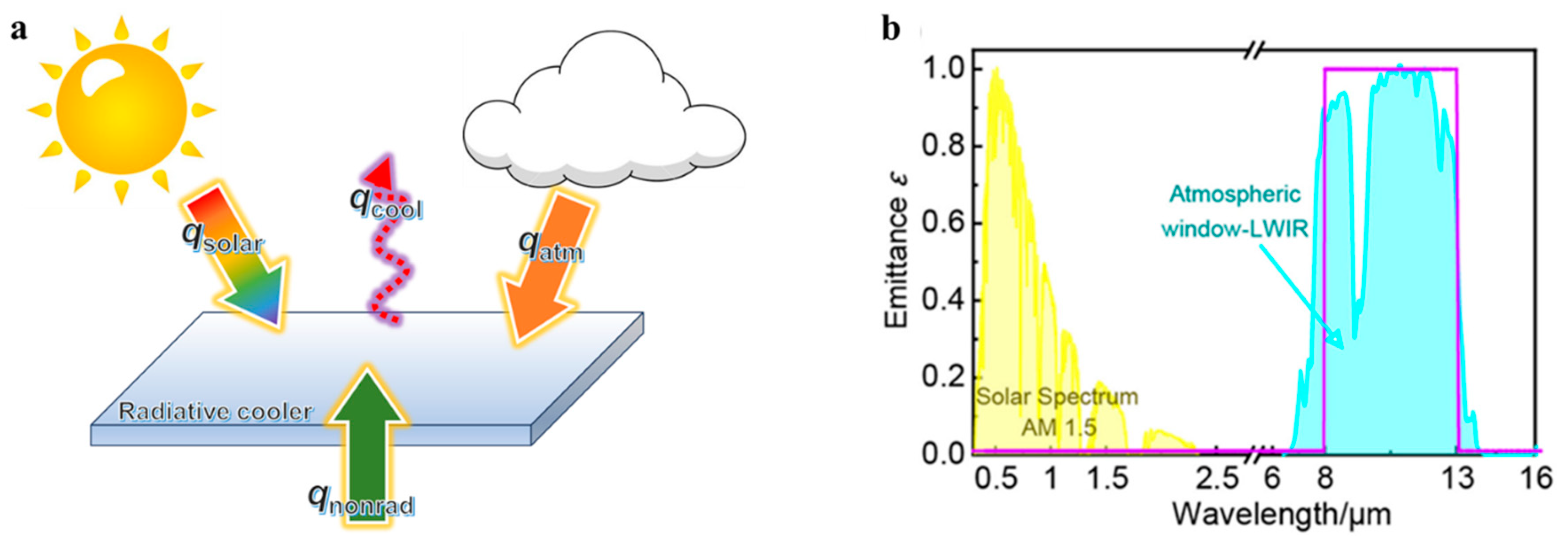
Figure 2.
High durability radiative cooler design. a) The almost unchanged optical and wetting properties of AACP coating after 1000 h of UV exposure. [41] is licensed under CC BY-NC 4.0. b) Cross-sectional schematic of the trilayer PES-TiO2-Al2O3 cooler and its UV resistance capability. Figures by [42] is licensed under CC BY-NC 4.0, with the permission of John Wiley and Sons. c) Schematic diagram of the cooling wood structure and its strength comparison with ordinary wood. [43] is licensed under CC BY-NC 4.0. d) Photograph of a mud slurry droplet on a PS/PDMS/PECA coating. Reprinted (adapted) with permission from [44]. Copyright 2024 American Chemical Society. e) Photograph of the spherical droplets of water, acid, alkali, and mud slurry on the coating. Reprinted from [45], with permission from Elsevier [OR APPLICABLE SOCIETY COPYRIGHT OWNER].
Figure 2.
High durability radiative cooler design. a) The almost unchanged optical and wetting properties of AACP coating after 1000 h of UV exposure. [41] is licensed under CC BY-NC 4.0. b) Cross-sectional schematic of the trilayer PES-TiO2-Al2O3 cooler and its UV resistance capability. Figures by [42] is licensed under CC BY-NC 4.0, with the permission of John Wiley and Sons. c) Schematic diagram of the cooling wood structure and its strength comparison with ordinary wood. [43] is licensed under CC BY-NC 4.0. d) Photograph of a mud slurry droplet on a PS/PDMS/PECA coating. Reprinted (adapted) with permission from [44]. Copyright 2024 American Chemical Society. e) Photograph of the spherical droplets of water, acid, alkali, and mud slurry on the coating. Reprinted from [45], with permission from Elsevier [OR APPLICABLE SOCIETY COPYRIGHT OWNER].
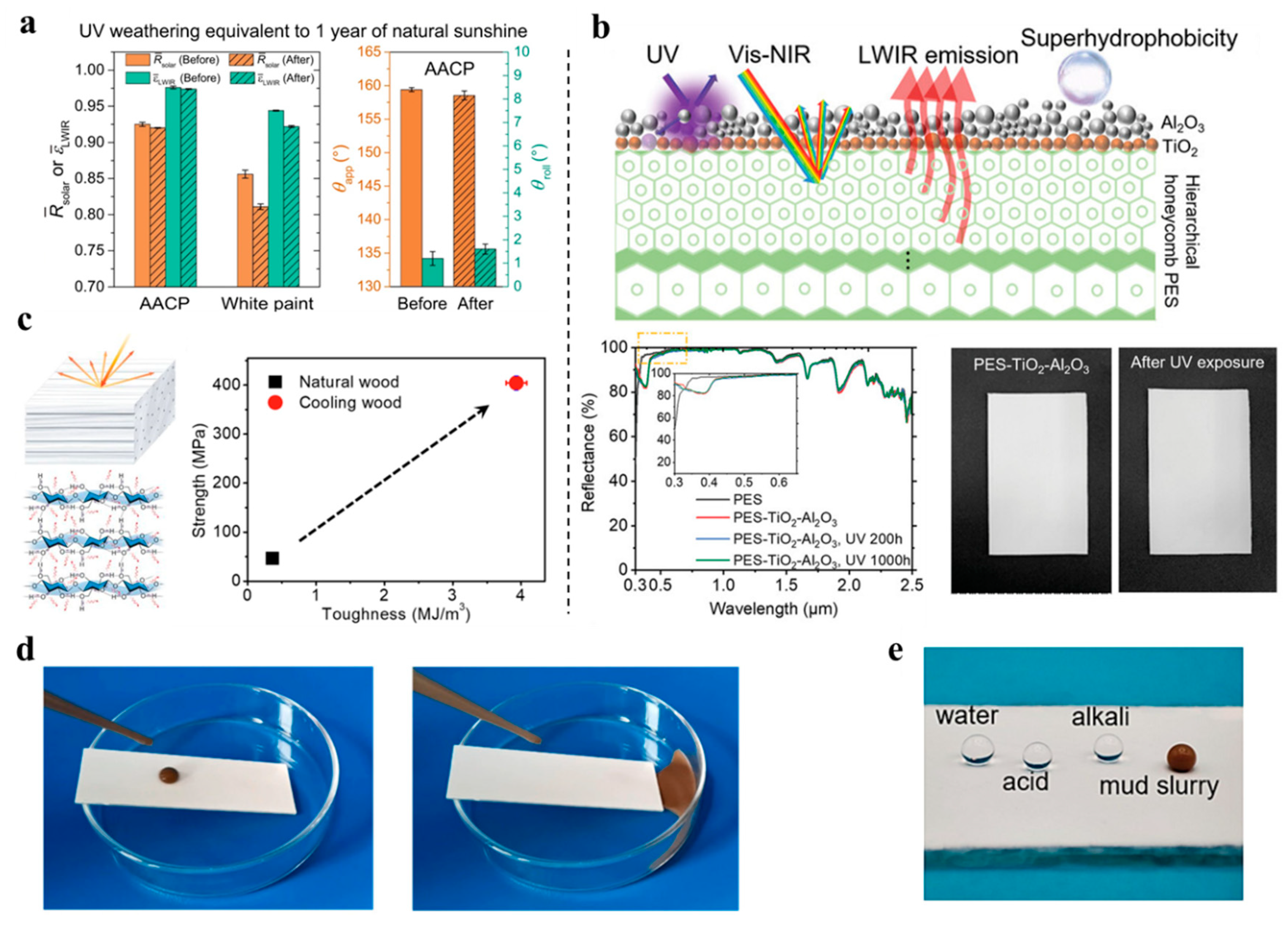
Disclaimer/Publisher’s Note: The statements, opinions and data contained in all publications are solely those of the individual author(s) and contributor(s) and not of MDPI and/or the editor(s). MDPI and/or the editor(s) disclaim responsibility for any injury to people or property resulting from any ideas, methods, instructions or products referred to in the content. |
© 2024 by the authors. Licensee MDPI, Basel, Switzerland. This article is an open access article distributed under the terms and conditions of the Creative Commons Attribution (CC BY) license (http://creativecommons.org/licenses/by/4.0/).
Copyright: This open access article is published under a Creative Commons CC BY 4.0 license, which permit the free download, distribution, and reuse, provided that the author and preprint are cited in any reuse.


