

Submitted:
09 January 2024
Posted:
10 January 2024
You are already at the latest version
Abstract
For the first time in the world, we provided a phenomenologically verifiable proof for the validation of origin of universe and perceivable reality from the unperceivable information based on Ayurveda. We also provided the axiomatic definitions for the terminologies used to deliver the theoretical framework for the same based on Bharatheeya Knowledge Systems. The presented manuscript provides a corelation between quantum information transport and emergence of gunam “Laghu” and gunam “Guru”. We identified that this point of emergence can be considered as the origin point in the continuous process of generation of Perceivable Reality “Vyaktham” from Unperceivable Information “Avyaktham”. In this context we can consider the unperceivable information in “Avyaktham” as dark matter. So, we must develop methods like gunascopy or informationscopy to understand the types of information imbibed in the quantum matter of a dravyam to understand its original physico-chemical-biological and information state of the constituent matter. This is possible through the assessment of Dravya Guna aspects and panchabhootha tatwas of the dravyas. For the first time in the world, we have developed the method to derive all the gunas from “guru” and “Laghu” and calculated the mass of the finitie components of Nava Dravyas including Mann, Aatma, Kaal, Disha, Aakash, Vaayu, Agni, Jal and Prithvi from the quantum information emergence equation. We strongly believe that this work will open up new avenues to explore the frontiers of reality and universe through natural cognition. The solutions to the Yang-Mill conjecture is achieved by our team using the Quantum Information Emergence and Transport Equations. We proved that the information bounded in the quantum states of the constituent quantum matter of quantum particles will provide them positive masses, even though they travel at the speed of light. Based on the phenomenologically verifiable axioms proposed in this work, we proved that the space on the topologically invarient 2D Poincare Sphere which is equivalent to a 2D space without boundaries can facilitate the never-ending loop of continuous quantum information transport between “Avyaktham” and “Vyaktham”. So the information availabe in the constituent quantum states of “Avyaktham” is equal to the postiive mass of quantum systems travelling at the speed of light. In such condition all the mass of the quantum particles will be converted in to information bounded in the corresponding quantum states of the quantum matter. This complete conversion of mass of the quantumparticles into information will happen only at maximum entropy. Thus at maximum entropy the information which is self information entangled with its own quantum states in “Avyaktham” will have a positive mass equal to the mass gap proposed in the Yang-Mill conjecture.
Keywords:
Quantum Information
; Emergence
; Complex System
; Gunam
; Ayuveda
; Phenomenology
1. Introduction
All the researchers working in the area of origin of universe, matter, life and consciousness are trying to understand the available resources through analytical methods and theoretical modelling. But, at the end, all these attempts are giving birth to new confusions, conjectures, and conundrums in current science. This drama is repeated as a loop and scientists and researchers claim it as the signature of science - which means, correcting the mistakes in the current knowledge systems and upgrade it to a better knowledge system by doing so. But the central dogma of these actions is the absence of a stable epistemic origin with foundations of philosophy to support the narrative of science. Since science is a human construct, it carries all the limitations of human cognition. This bias is the major root cause of all the problems in current bleeding edge science. The researchers are using only the computational aspects of the systems to understand the system as a whole. In the conventional schools of philosophy and sciences, there is no space to accommodate the non-computational aspects of systems. The top level scientific research committees override this issue by introducing terms like complex systems and emergence and equating these terminologies with noncomputational and non-deterministic phenomena. But recently almost all the top brains had given-up their empirical supremacy and evidence-based research framework by stating and accepting that the universe is a complex system and life is an emergent phenomenon. These statements may look very scientific, but in real it is not so. Finally, the scientific communities working in core areas of science agreed that they don’t know anything real about the systems they studied all these years.
Based on the computational approach a system is said to be complex, if there is a bidirectional non-separability between the identities of the parts and the identity of the whole. Then, not alone the identity of the whole is determined by the constituent parts, but also the identity of the parts are determined by the whole due to the Morinian nature of their interactions. Similarly, emergence is a phenomenon that happens due to the existence or formation of collective behaviours of the individual parts of the system. The beauty of all these definitions and statements are that, none of them give any deterministic aspects of the systems. From the above examples, we can understand the pinnacle of absurdity of conventional science. The current approach, in cutting edge science, uses theoretical models to understand more about complex systems and its emergence. The foundational problems in science - including dark matter, origin of universe, matter, life and consciousness - are fundamentally considered as problems involving complex systems and its corresponding emergences. The multiverse and quantum entanglement phenomena also fall under this realm. It is noted that recently scientist across the globe are focusing on theoretical models like information theory, Topological Geometrodynamic, etc., to explore the solutions to the above mentioned problems.
In real philosophical sense, the meaning of science is, knowledge. Any methodology to generate, explore and research knowledge system will be called as science. But modernity separated this by providing over weightages to the mind and gradually denied all the aspects of body, in the process of cognition. Due to this, science became a mere process of assimilation and accumulation of information and organizing them as data. As an outcome of these dogmas in current science, all the followers of empirical and computational aspects of science are at crossroads, without any tools to understand the reality of systems. Science without philosophy is comparable to a human body without mind. The biggest error of modernity is that, it developed computational frameworks for non-computational phenomenon like emergence and complex systems, which originally cannot be comprehended by human mind and cognition. This has created terrific confusion amongst researchers working in these bleeding edge technology domains, and majority of them have given-up their work or converted their work into dogmatic belief systems and have called it as traditional approach and spirituality. In this context, here we report the use of traditional indigenous knowledge system of Ayurveda as a model system to provide insights into the phenomenon of emergence in complex systems. For the first time in the world, we propose a model based on phenomenological frameworks to understand the complex systems and emergence - using Ayurveda as the model system. In this model, the quantum matter interactions between system variables in human body and its emergence, is used to depict the noncomputational aspects of systems biology. We also provide systematic explanations to the various emergent properties like health and diseases in human body, based on the complex system model of quantum biological variables in human system biology and its formation of collective behaviours of the individual parts of the system during complex interactions.
In modernity science caused the separation of mind and body and provided more value to mind than the body. Due to this the modern human beings now only have the capacity for impaired cognition. The literates learn from words and illiterates learn from worlds. The first one is mere a process of mere accumulation of information and the second one is the natural cognition. Even though science is a human construct it lost its experiential cognition part and become only a product of mind1. The big limitation of the current humanity is that the modern mind cannot comprehend the non-computational aspects of existential knowledge. Which leads to the process of partially cognizing the phenomenological frames works of complex systems like universe, life, and its emergence. The current empirical approach followed by all the top-notch research laboratories across the globe are miserably failing in solving and understanding the foundational problems by adding more technical data to the available bigdata and make it more complex to understand, comprehend and even process the derived data with proper corelation. If we convert all the processes in this universe with its functional behaviours it will not be computable using even with the most advanced quantum computers. The methods followed by the practitioners of current conventional science is not matured enough to understand the complex systems and its emergence in its full meaning. So even after such massive technology incubation conventional science become stand still with lot of conjectures and conundrums. As a result of this the current standard physics is flooded by various problems. These problems are fundamentally connected with the philosophy of science and theories represented as reductionism, materialism, determinism, and locality. Thermodynamics, special relativity, and general relativity are also standing on questionable postulates and definitions. In thermodynamics second law in its recent form and the assumption about fixed arrow of thermodynamical time can be questions since it is hard to understand biological evolution in this framework. Clearly, the relationship between the geometric time of physics and experienced time is poorly understood. In general relativity the beautiful symmetries of special relativity are in principle lost and by Noether’s theorem this also means the loss of classical conservation laws, even the definitions of energy and momentum are in principle lost. In quantum physics the basic problem is that the non-determinism of quantum measurement theory conflicts with the determinism of Schrödinger equation. Standard model is believed to summarize the recent understanding of physics. The attempts to extrapolate physics beyond standard model are based on naive length scale reductionism and have products Grand Unified Theories (GUTs), supersymmetric gauge theories (SUSYs). The attempts to include gravitation under same theoretical umbrella with electroweak and strong interactions has led to super-string models and M-theory. These programs have not been successful, and the recent dead-end culminating in the landscape problem of super string theories and M-theory could have its origins in the basic ontological assumptions about the nature of space-time and quantum. Even though theories like TGS, MEI and AT are evolved to fill these knowledge gap of science, still it lacks an empirical validation either through experimental frame works or phenomenological frame works.2,3,4 Also the foundation equations on which these theories are built is also questionable. The philosophers developed these theories used excellent assumptions and initial conditions which are fundamentally derived out of a reductionist view resulted out of human cognition. For example, in TGD model the transcendentals are outside of computationalism and Matti consider that it is also beyond cognition2. Due to the limitation of TGD model the noncomputational aspects can’t be accommodated in this model and due to this it became more vulnerable in the scenarios like developing an experimental test model of universe as a complex system using this theory. Also, TGD fails to propose any experimental model to evaluate and verify it, which means testing TGD in the context of perceivable universe falls under the nomenclature of Gedanken experiments. In a similar fashion MEI theory and negentropy concepts are theoretically looks very promising but in reality the theoretical framework consider the information as mere bits doesn’t address the fundamental issues involving noncomputational aspects of the real time problems like functional emergence as a derivative of information dynamics. The MEI theory also doesn’t provide any clear mechanism or experimental model to test the transformation of information to mass or energy. Also, it fails to demonstrate the process of how the intrinsic information providing the fundamental characteristics of elementary particles is stored as a fixed, quantifiable and computable value in its elementary particle with non-zero rest mass4. The assembly theory stands very parallel to the process of formation of matter defined in the philosophy of ayurveda. According to assembly theory the concept of object is finite, is distinguishable, persists over time and is breakable such that the set of constraints to construct it from elementary building blocks is quantifiable3.
But the divisibility of fundamental unit of matter is against the standard model of existing science. Also, assembly theory recognizes the smallest unit of matter is typically defined by the limits of observational measurements, this formalism makes it more rigorous to understand in terms of phenomenological frame works or real-life experimentations. The universal concept to treat objects as anything that can be broken and built put forward by assembly theory is not applicable in predicting the origin of emergence. Even though assembly theory can naturally account for how the emergent objects are produced by evolution and selection it fails to define the origin of building blocks which are the foundations to emergence of objects in assembly pool. All these models are considering information as the basic aspect of the model complex systems and its emergence. But these theories are halfway done and open up more complex arenas which are difficult to cognize and not possible to experimentally verify. In this scenario for the first time in the world we develop and extrapolate the standard philosophy of Ayurveda as a model for experimentally verifiable complex system and its associated emergent phenomena5.
Topological Geometro-Dynamics, Matter-energy-Information equivalence model, and Assembly theory are developed based on the theoretical frameworks to understand the complex system aspects and emergence of the universe. Till date, no experimental models are available in this regard. In this regard, for the first time in the world, we hereby present - the working model of Ayurveda - to test and validate, the Ayurvedic Philosophy of Origin of Universe and emergence of Reality, Vyaktham, from Avyaktham, through the process of topological distribution of quantum matter to form Dravyas and its corresponding gunas, and then, from that point, to emerge as the common world made up of Pancha Maha Bhutas. Our phenomenologically verifiable model of Ayurveda also provides the details about the origin of Mathematics, Jyothisham and Music and how the methods of Tantra -Mantra -Yantra can be considered as the tools for creation, maintenance and destruction of gunas. It also paves way to understand the epistemological, ontological and axiological roots of Kshetra-achara practices in Bharatha Desham, scientifically, technically and phenomenologically.
2. Ayurvedic Systems of Medicine: An Experimentally Verifiable Model of Complex System and Emergence
The indigenous people lived in the geographic domain called Bharatham developed knowledge systems named as Vedas through accumulation and consolidation of experiential knowledge. These outcomes of natural cognition happened over a period of lakhs of years are periodically consolidated after finetuning based on the philosophical frameworks available during those time periods correspondingly. These naturally cognized knowledge systems are transferred to generations through orations designed in a specific and systematic way. After a long period, this oral knowledge transition is reduced into written scripts later known as Vedas. The Vedas are the key pillars of Bharatheeya Knowledge Systems, originated and evolved along with the humanity lived in the geographic space of Bharatham. Ayurveda is defined as the knowledge of life, and it is an upaveda of one Veda called Atharvaveda. The currently available form of Ayurveda is a whole system medicine consolidated by Dhanvantari II (10960 BCE) who was a descendant of Ayu and disciple of Bharadwaj5. Contrary to the reductionist methodology of the current science, Ayurveda is rooted in the totality approach where all factors and elements of the universe and biological system are relevant in providing solutions to the wellbeing and sustainable health of the system. The frame work of Ayurveda is based on the gunas, panchaboothas, three doshas and shadrasas can be correlated to the phenomenological approach in understanding human health through macroscopic level of body, organ, tissues; mesoscale level of cells, organelles and proteins; nanoscale and atto scale levels of biomolecules, motifs and the quantum matter scale of information or guna driven interactions in the systems6. This phenomenological method can be used as a model to understand the complex system and its emergence6.
3. Axiomatic Definitions
3.1. Axiomatic Definition of Complex Systems
Axiom 1: A system is a nonempty ensemble Avyaktham of interconnected entities, and their interconnections, which together form an integrated whole exhibiting distinctive behaviour or meaning from those of its individual components.
Axiom 2: It is defined that a system is said to be complex if there is a bidirectional non-separability between the information carried by the parts and the information provided by the whole. Then, not only the information carried by the whole is determined by the constituent parts, but also the information of the parts is determined by the whole due to the interactions as transformers of the nature of the interacting objects and of the whole formed by them.
3.2. Axiomatic Definition of Emergence
Axiom 1: Emergence is a phenomena or generation of information happens due to the existence or formation of information or collective behaviours of the individual parts of the system.
3.3. Axiomatic Definition of Phenomenology
Axiom 1: Any experiential knowledge can be meta cognized based on the frame of events or phenomena exists in a specific time and space. The process of capturing these events or phenomena as either static or dynamic frame and meta cognizing the complete information of that framework to understand its perceiver aspects is called phenomenology.
3.4. Axiomatic Definition of Quantum Information
Axiom 1: Let ΔP be the Kanadhan wave function represented as a point ΔP on a topologically invariant 2D Poincare sphere P such that the 2D Poincare sphere P can be visualized as a circle on a plane, and the centre of this circle would correspond to the state of fully coherent superposition state of all the quantum states exist in the system such that at P =ΔP= ΔH where H is a Hilbert Space, also consider E as self-adjoint operator on ΔP representing a yes/no question7,8. Then, A quantum state ψ existing on topologically invariant 2D Poincare sphere P is completely characterized by the set of answers of all possible yes/no questions called Kshethram. That is, by the expectation values of all self-adjoint operators on P. Mathematically ψ is determined by ⟨ψ|E|ψ⟩ for all E, where Kshethram E ranges over all self-adjoint operators on H represented as a point on P.
Information as a Difference in Expectation Values:
Axiom 2:
Now, consider a quantum system initially in state |ψA1⟩. Suppose its state changes to |ψ′A1⟩ due to Self-Information Entanglement. If we compute the expectation value of an Emergence called Kshethram E before and after the change, the difference can be computed as,
Δ I = ⟨ψ′A1|E|ψ′A1⟩ − ⟨ψA1|E|ψA1⟩
The Δ I represent how the information about the emergence of Kshethram E changes due to the change in the quantum state.
This difference in information ΔI is perceived as the "information" gained or lost due to the change in the state.
If the expectation value remains unchanged (ΔI =0), then from the perspective of the perceivable Kshethram E, no information about the system’s emergence has been gained.
On the other hand, if ΔI is significant, we have gained some information about the system’s emergence or Kshethram’s Emergence by noting how the perception of Kshethram E are expected to change.
Perceiving how the expected information of emergence known as Kshethram (quantified by expectation values) change as the state evolves gives us information about the nature and effects of the processes causing the emergence of Kshethram.
Consider the Kanadhan operator is an infinite-dimensional nonlinear operator that acts on functions of the information state. The Kanadhan operator can be represented by Ki where i is the information. For a function g on the state space, the Kanadhan operator emerges it over information according to:
Kig(x)=g(fi(x))
Here, fi is the emergence operator or emergence map associated with the emerging system existing on topologically invariant 2D Poincare sphere. The expectation value of a function g with respect to a probability measure μ is given by:
Eμ[g]=∫g(x) dμ(x)
Now, if we have two functions g and h on the state space on topologically invariant 2D Poincare sphere surface, the sum of their expectation values is:
Eμ[g+h]=∫(g(x)+h(x)) dμ(x)
we can express this in terms of Kanadhan operators, as:
Eμ[g+h]=∫(Kig(x)+Uth(x)) dμ(x)
This is a general expression for the sum of expectation values of Kanadhan functions over a probability measure μ. The specific form of the integral and the emergence operator depends on the details of the dynamical system called Kshethram under consideration.
3.5. Axiomatic Definition of Avyaktham
Axiom 1: Avyaktham is defined as the coherently super positioned quantum state which is self-information entangled with its own emergent quantum state called Vyaktham such that, both the quantum states can mutually and spontaneously exchange the quantum information gained or lost during the phenomenon of emergence of Vyaktham to its corresponding original state. Due to this self-information entanglement of Avyaktham with Vyaktham no information will be available about both the systems and both will become unperceivable.
Axiom 2: Let ΔH be the quantum of Kanadhan wave function represented as a point ΔP on a topologically invariant 2D Poincare sphere P such that the 2D Poincare sphere P is reduced in to the centre of the circle on a plane, and the centre of this circle would correspond to the state of fully coherent superposition of all quantum states exists on the sphere P7,8. Since S=Smax at this state ΔI= ΔM=0,If the expectation value of the emergence of Kshethram remains unchanged (ΔI =ΔM=0), then from the perspective of the perceivable Kshethram E, no information about the system can be gained. This is state of a quantum system is defined as avyaktham.
3.6. Axiomatic Definition of Vyaktham
Axiom 1: The state |ψV0⟩ Vyaktham is defined as the quantum state emerged from the superposition quantum state Avyaktham represented as |ψA0⟩, through the process of self-information entanglement between the states |ψA0⟩ and |ψV0⟩.
In the self-information entanglement process the information ΔI is lost from the superposition state |ψA0⟩ Avyaktham is simultaneously gained and fed back to the superposition state |ψA0⟩ Avyaktham from its own emergent quantum state Vyaktham and |ψV0⟩. As a result of self-information entanglement process the emergent Kshethram is simultaneously created, maintained and destroyed and due to that no perceivable information about Kshethram will be available from the perspective of the perceivable Kshethram E (its own perspective). These types of Vyaktham are defined as unperceivable vyaktham existing in the unperceivable Avyaktham.
3.7. Emergence of Unperceivable Vyaktham from Unperceivable Avyaktham
In Avyaktham there is no time and space exist. All the material and energy in the universe will be converted into information entangled with its corresponding quantum states which all exists together as a superposition quantum state called Avyaktham. Thus information of the quantum states become unperceivable due to increase in entropy which reaches maximum at absolute temperature 0K and Entropy SMax. Due to this absolute temperature at maximum entropy in Avyaktham the expectation values of all the quantum states in Avyaktham are equal. So, the expectation value of superposition quantum state |ψA0⟩ can be calculated as sum of the probabilities of expectation values of constituent quantum states ∣ψAi⟩, where i = (1...n) i.e.;
|ψA0⟩=α∣ψA1⟩+β∣ψA2⟩+γ∣ψA3⟩+δ∣ψA4⟩+....+∞n∣ψAi0⟩
Since, ∣α∣2=∣β∣2=∣γ∣2=∣δ∣2=…=∣n∞∣2=∞.
The probability of measuring the system in coherent superposition state ∣ψA0⟩ is
∣α∣2 +∣β∣2 +∣γ∣2 +∣δ∣2+...... ∣∞∣2 =∞
which means that the probability of measuring the system cannot be done or probability can’t be determined. Which means the Kshethram called as perceivable reality don’t exist but the quantum states exist. This can be interpreted as the unperceivable information self-entangled with corresponding superposition quantum states existing in Avyaktham.
Now, consider two quantum systems in Avyaktham QA0 and QV0, such that the corresponding quantum states are represented as |ψA0⟩ and |ψV0⟩. Since the system is existing in the maximum entropy condition Smax, the state |ψA0⟩ is existing as the superposition of all the available quantum states in the system Avyaktham such that quantum state ∣ψA0⟩ is represented as the coherent superposition of various basis states ∣ψAi0⟩ with corresponding coefficients α,β,γ,δ,…n i.e; at Smax the probability is ∣α∣2=∣β∣2=∣γ∣2=∣δ∣2=…=∣n∞∣2=∞. Also, the state |ψV0⟩ is defined as the quantum state Vyaktham emerged from |ψA0⟩ the superposition quantum state, through the process of self-information entanglement between the states |ψA0⟩ and |ψV0⟩. In the self-information entanglement process the information ΔI is lost from the superposition state |ψA0⟩ Avyaktham and as a result, the state |ψA0⟩ Avyaktham is transformed into an emergent state of |ψA0⟩ Avyaktham represented as |ψV0⟩ Vyaktham.
In a self-information entangled system the information lost from state |ψA0⟩ Avyaktham is simultaneously fed back to the system |ψA0⟩ Avyaktham from the emergent state |ψV0⟩ Vyaktham, such that the emergent state known as Vyaktham is simultaneously generated and destroyed due to the continuous and simultaneous quantum information transport mutually happening between |ψA0⟩ Avyaktham and its emergent state |ψV0⟩ Vyaktham. As a result, the change in expectation values of the superposition quantum state |ψA0⟩ Avyaktham due to self-information entanglement phenomenon can be computed as,
ΔI = ⟨ψV0 |E|ψV0 ⟩ − ⟨ψA0 |E|ψA0 ⟩ =0 at SMax
since ΔI =ΔM at Smax and S=Smax at 0 K, ΔI =ΔM=0 at 0K and Smax
this difference ΔI is seen as the "information" or ΔM mass gained or lost due to the change in the states. If the expectation value remains unchanged (ΔI =ΔM=0), then from the perspective of the perceivable Kshethram E, no information about the system has been gained. Due to this even though the states |ψA0⟩ Avyaktham and its emergent state |ψV0⟩ Vyaktham are existing in Avyaktham, both will become unperceivable. This phenomenon is called as unperceivably of the superposition quantum state |ψA0⟩ Avyaktham and the quantum emergent state of |ψA0⟩ called as Vyaktham (|ψV0⟩) due to information invariance.
3.8. Emergence of Perceivable Vyaktham from Unperceivable Avyaktham
Consider two constituent quantum systems QA1 and QA2, of the superposition quantum state |ψA0⟩ Avyaktham, such that the corresponding quantum states of QA1 and QA2 are represented as |ψA1⟩ and |ψA2⟩. Since the system is existing in the maximum entropy condition Smax, the state Avyaktham |ψA0⟩ is existing as the superposition of all the available quantum states in the system Avyaktham such that quantum state ∣ψA0⟩ is represented as the coherent superposition of various basis states then,
|ψA0⟩ =∣ψA1⟩ + ∣ψA2⟩ + ∣ψA3⟩ +.....+ ∣ψAn⟩
with corresponding coefficients α,β,γ,δ,…∞ since at Smax all the information in the superposition state of Avyaktham are self-information entangled to its corresponding constituent quantum states so that all the constituent quantum states of the superposition quantum state ∣ψA0⟩ will have equal probabilities and expectation values which are equal to the expectation value of the superposition quantum state ∣ψA0⟩ and it can be written as,
⟨ψA0 |E|ψA0 ⟩ = ⟨ψA1 |E|ψA1 ⟩ + ⟨ψA2 |E|ψA2⟩ + ⟨ψA3 |E|ψA3 ⟩ +.........+ ⟨ψAn |E|ψAn⟩
Since, ∣ψA1⟩ = ∣ψA2⟩ = ∣ψA3⟩ =...= ∣ψAn⟩ and ∣α∣2=∣β∣2=∣γ∣2=∣δ∣2=…=∣∞∣2=∞,
The equation for expectation value for superposition quantum state called Avyaktham can also be written as ⟨ψA0 |E|ψA0 ⟩ = ⟨ψA1 |E| ψA1⟩ = ⟨ψA2 |E| ψA2⟩ = ⟨ψA3 |E| ψA3⟩ =.........= ⟨ψAn |E| ψAn⟩
Now, consider two constituent quantum systems QA1 and QA2 of superposition quantum states |ψA0⟩ Avyaktham represented as quantum states∣ψA1⟩ and ∣ψA2⟩ which are self-information entangled with its own emergent states represented as ∣ψv1⟩ and ∣ψv2⟩ then the information gained or lost due to the process of emergence can be written as;
ΔI 1=ΔM1=⟨ψv1 |E|ψv1 ⟩ - ⟨ψA1 |E|ψA1 ⟩ and ΔI 2=ΔM2=⟨ψv2 |E|ψv2 ⟩ - ⟨ψA2 |E|ψA2 ⟩
But at maximum entropy Smax, due to self-information entanglement phenomenon the above equation can be written as;
ΔI 1=ΔM1=⟨ψv1 |E|ψv1 ⟩ - ⟨ψA1 |E|ψA1 ⟩ = ΔI 2=ΔM2=⟨ψv2 |E|ψv2 ⟩ - ⟨ψA2 |E|ψA2 ⟩ = 0
But due to the entanglement of information between the quantum systems QA1 and QA2 the quantum information will be transported from QA1 to QA2 ;
So the information ΔI available in the state ∣ψA1⟩ will be transported to the quantum state |ψA2 ⟩ and vice versa.
Then the quantum state ∣ψA2⟩ existing nearest to the quantum state ∣ψA1⟩ will gain the lost information from the state ∣ψA1⟩ and will transform into a new state represented as |ψA2G⟩ and the state ∣ψA1⟩ which lost the information will transform into a new state represented as ∣ψA1L⟩. Due to this the self-information entanglement phenomenon happening in the systems ∣ψA1⟩ and ∣ψA2⟩ will be destroyed. The superposition state ∣ψA0⟩ will be perturbed due to the creation of this imbalance in entropy and will transport the information corresponding to the states ∣ψA1L⟩ and |ψA2G⟩ to its emergent state |ψV0⟩ thus the states ∣ψA1L⟩ and |ψA2G⟩ and its corresponding information will be made available in self-information entangled state of Avyaktham. As a result of this process the information emerged from ∣ψA0⟩ Avyaktham will be made available for perception through the emergent state |ψV0⟩Vyaktham of the superposition state ∣ψA0⟩ Avyaktham. The information corresponding to the emergence of Vyaktham from Avyaktham due to self-information entanglement is simultaneously fed back to the Avyaktham but the perturbations in Avyaktham will be transported into the boundaries of Avyaktham and added into an additional information to the Vyaktham. Thus the changes in the information density in |ψV0⟩ Vyaktham will happen, and |ψV0⟩ will be transformed in to |ψV0⟩ + |ψV0(L,G)⟩, but the |ψV0⟩ component of the quantum states and corresponding information will be simultaneously created, maintained and destructed due to the self-information entanglement process which happens continuously as an information transport loop. So in the perspective of emergent phenomena only the information corresponding to the component of Vyaktham represented as |ψV0(L,G)⟩ will be available for perception.
Since the original states ∣ψA1⟩ and ∣ψA2⟩ are no more available in the superposition state ∣ψA0⟩ the information corresponding to the change in expectation values of ∣ψA1⟩ and ∣ψA2⟩ which transported in to the self-information entangled state ∣ψV0⟩ as |ψV0(L,G)⟩ will not undergo self-information entanglement with Avyaktham state ∣ψA0⟩. So the emergent states |ψV0(L)⟩ and |ψV0(G)⟩ which are holding the information which caused the transformation of ∣ψA1⟩ to ∣ψA1L⟩ and ∣ψA2⟩ to ∣ψA2G⟩ can be written as the quantum states |ψV0(L)⟩ and |ψV0(G)⟩ with corresponding information added to the emergent state Vyaktham ∣ψV0⟩ then, |ψV0(L)⟩ = ∣ψA1L⟩ |ψV0(G)⟩ = |ψA2G⟩; and the state |ψV0(L)⟩ called as Laghu is the first quantum state emerged out of corresponding constituent quantum states of Avyaktham existing in superposition state ∣ψA0⟩
and |ψV0(L)⟩ + |ψV0(G)⟩ = ∣ψA1L⟩ + |ψA2G⟩; |ψV0(L)⟩ = ∣ψA1L⟩; |ψV0(G)⟩ = |ψA2G⟩
The quantum state holding the corresponding information of the transformed state ∣ψA2G⟩ emerged from state ∣ψA2⟩ by receiving or gaining the information ΔI lost from ∣ψA1⟩ is called as Guru.
3.9. Perception of Directly Unperceivable Avyaktham through the Perceivable Vyaktham
The Avyaktham existing as the superposition state of all the existing quantum states present in the system will be in a state of self-information entanglement with its own Emergent state called Vyaktham. Due to the self-information entanglement the information in the emergent state vyaktham will not be perceivable in the perspective of emergent state. Now consider a phenomenon in which the constituent states QA1 to QA2 represented by quantum states ∣ψA1⟩ and ∣ψA2⟩ exchanges and information ΔI between them in such a way that due to the loss of the information the state ∣ψA1⟩ become Laghu and ∣ψA2⟩ become Guru.
Now,
⟨ψA0 |E|ψA0 ⟩ - ΔI = ⟨ψv0 |E|ψv0⟩ then due to Self-information entanglement the information ΔI lost from Avyaktham will be simultaneously pumped back from the emerged state Vyaktham to Avyaktham so that ⟨ψv0 |E|ψv0⟩- ΔI = ⟨ψA0 |E|ψA0 ⟩, at maximum entropy Smax
Due to the emergence of these gunas in Avyaktham the information simultaneously transported between the ∣ψA1⟩ and ∣ψA2⟩ with its own emergent states due to self-information entanglement which was presented as a component in the Emergent state ∣ψv0⟩Vyaktham of superposition state ∣ψA0⟩Avyaktham will not be able to simultaneously fed back to the Avyaktham from Vyaktham. Due to this, the emergent components of the state Vyaktham represented as |ψV0(L)⟩ which is equal to the information in the transformed state ∣ψA1L⟩ of constituent state ∣ψA1⟩ of Superposition state Avyaktham ∣ψA0⟩ and |ψV0(G)⟩ which is equal to the information in the transformed state ∣ψA2G⟩ of constituent state ∣ψA2⟩ of Superposition state Avyaktham ∣ψA0⟩ will not be simultaneously exchange between ∣ψA0⟩ and ∣ψv0⟩ so that the self-information entangled state equation of Avyaktham can be written as,
⟨ψA0 |E|ψA0 ⟩ +/- [ΔI] = ⟨ψv0 |E|ψv0⟩+/- [ΔI] such that in the perspective of E no information will be available about Avyaktham and Vyaktham.
then due to collapse of Self information entanglement of ∣ψA1⟩ and ∣ψA2⟩, the AV equation will be transformed as a transport equation for information from Avyaktham to Vyaktham which will be available for perception since it can’t be fed back simultaneously to the Avyaktham why because the respective original states ∣ψA1⟩ and ∣ψA2⟩ of the emergent states ∣ψA1L⟩ and ∣ψA2G⟩ are no more available in the state Avyaktham ∣ψA0⟩ which exists as the superposition of all the constituent states including ∣ψA1⟩ and ∣ψA2⟩.
So the information transport equation representing the collapse of Self information entanglement the constituent states of superposition state Avyaktham ∣ψA0⟩ from which the perceivable information in the current universe emerged can be written as;
the state
⟨ψA0 |E|ψA0 ⟩ +/- [ΔI] - [⟨ψA1L |E|ψA1L ⟩ - ⟨ψA1 |E|ψA1 ⟩ ] - [⟨ψA2G |E|ψA2G ⟩ - ⟨ψA2 |E|ψA2 ⟩=
⟨ψv0 |E|ψv0⟩+/- [ΔI] + ⟨ψV0(L) |EL|ψV0(L)⟩ +⟨ψV0(G) |EG|ψV0(G)⟩ =
⟨ψv0 |E|ψv0⟩+/- [ΔI] + [ΔL] +[ΔG]
Due to the transport of information Gunam Laghu and Gunam Guru in the corresponding emergent states |ψV0L ⟩ and |ψA2G ⟩, from the Superposition state Avyaktham ∣ψA0⟩ to Emergence state Vyaktham ∣ψV0⟩ which is always in self-information entanglement with the superposition state Avyaktham the emergent state Vyaktham ∣ψV0⟩ which was simultaneously created, maintained and destroyed will be modified as,
∣ψV0⟩+|ψV0(L)⟩ + |ψV0(G)⟩
Since |ψA1(L)⟩ = |ψV0(G)⟩ and |ψA2(G)⟩ = |ψV0(L)⟩
∣ψV0⟩+|ψV0(L)⟩ += ∣ψV0⟩+|ψA1(L)⟩ + |ψA2(G)⟩
Since the perceivable information of the state |ψV0(L)⟩ as the expectation value ⟨ψV0(L) |EL|ψV0(L)⟩ was emerged in Vyaktham due to the emergence of the unperceivable constituent state |ψA2(G)⟩ containing unperceivable information as the expectation value ⟨ψA2G |E|ψA2G ⟩ in Avyaktham as the result of gain in information ΔI from the state |ψA1⟩ with expectation value ⟨ψA1 |E|ψA1 ⟩,it is defined in Ayurveda as “Aadhya Bhootham Aakasham”. Similarly the emergence of state |ψV0(G)⟩ as the expectation value ⟨ψV0(G) |EL|ψV0(G)⟩ was emerged in Vyaktham due to the emergence of the unperceivable constituent state |ψA1(L)⟩ containing unperceivable information as the expectation value ⟨ψA1L |E|ψA1L ⟩ in Avyaktham as the result of lose in information ΔI from the state |ψA2⟩ with expectation value ⟨ψA2 |E|ψA2 ⟩,it is defined in Ayurveda as “Aadhya Pathana Karanam Guru”5.
3.10. Axiomatic Definition of Quantum Matter
Axiom 1: Quantum matter of a dravyam is defined as the confined systems composed of many interacting quantum states holding same type of quantum information distributed on surface of topologically invariant 2D Poincare sphere. The behaviour of this entire quantum matter is an emergent phenomenon due to the mutual interactions of the emergent behaviours of the constituent quantum states holding corresponding information by which the quantum matter is made up of.
Axiom 2: In quantum matter, the gunas of the entire system emerges from the topological dynamics of the quantum systems or quantum states on the surface of topologically invariant 2D Poincare sphere and interactions between quantum states and gunas are emerged during the assembly or orientation of quantum states or quantum matter on different levels of curvature of the surface of the 2D Poincare sphere. The curvature of the surface of 2D Poincare sphere also influence and generate change in intensity levels or density of quantum states of corresponding gunas.
3.11. Axiomatic Definition of Time Named as “Kaal”
Axom1: The emergence of Gunam Laghu and Gunam Guru will happen in such a way that the corresponding quantum states |ψV0(L)⟩ and |ψV0(G)⟩ with respective information ΔL and ΔG, will occupy the topologically invariant 2D Poincare space on the surface of a 2D Poincare sphere in Eight Directions called Ashtha Diks. The rate of emergence of the quantum matter of a dravyam by the topological arrangement of corresponding quantum states with respective gunas are called as Kaal or time. Since 8 directions are there 8 types of gunas will emerge from the fundamental gunas called as Laghu and Guru. Thus 10 types of Gunas are emerged in Vyaktham due to the various permutation and combination of fundamental gunas Laghu and Guru in Ashtha diks5. Thus, the fundamental measure of mass of time can be calculated as the mass of the information occupied on an area of 2D Poincare sphere by the smallest quantity of Quantum matter of Dravya holding the Gunas Laghu and Guru5.
3.12. Axiomatic Definition of Gunam
Axiom 1: The topological distribution of quantum states loaded or associated or entangled with its corresponding information on the surface of 2D Poincare sphere is called as the quantum matter of that specific dravyam. The information due to which the change in degree of freedom of these quantum states happens and results in the specific topological distribution of quantum matter is called as its gunam. The interaction between these quantum matter and gunam will make them available as an entity which is perceivable by human beings called as dravyam. The gunam imbibed in the dravyam can perform a specific set of functional operations and transportation of information is called as its karmam.
Axiom 2: Gunam of a dravyam can be perceived by human beings through a fundamental process called as indriyartha sannikarsham9,10
Axiom 3: Gunam can be defined as the information which can generate a change in degree of freedom of topologically confined quantum states distributed over the surface of topologically invariant 2D Poincare sphere. These topologically confined quantum states holding specific and unique type of information called as “Gunam” is defined as the quantum matter of its corresponding dravyam.
Axiom 4: The processes involved in human perception of dravyam can cause a change or transformation in its gunam.
Axiom 5: 41 types of gunas are existing in this humanly perceivable universe. This nomenclature is based on the 41 types of topological distributions of quantum matter holding corresponding information which caused the change in degree of freedom of respective quantum states. 41 types of topologically invariant emergence of quantum matter from its corresponding quantum states are possible due to the permutation and combination of the information exchange processes between the quantum states during the generation of human reality(perceivable Vyaktham). The generation of human reality can be mapped by its respective phenomenological frames of quantum matter and gunas on the surface of 2D Poincare sphere called as Poincare surface frame of event or Poincare surface frame of phenomenon.
Axiom 6: Gunas can undergo permutation, combination and transformation which causes emergence of gunas which results in emergence of different type and classes of dravyas and karmas.
3.13. Axiomatic Definition of Matter Named as Dravyam
Axiom 1: The interaction between these quantum matter and gunam will make them available as an entity which is perceivable by human beings called as dravyam.
3.14. Axiomatic Definition of Karmam
Axiom 1: The gunam imbibed in the dravyam can perform a specific set of functional operations or actions or generate outcomes called as its karmam.
3.15. Axiomatic Definition of Dik
Axiom 1: Dik is defined as the direction of emergence of space in vyaktham, due to the orientation of quantum matter of quantum states with its corresponding information, known as Guna. The emergence of quantum matter using guna will make the dravya available for perception.
Dik is divided into ten types, for the convenience of expressions. Since Dik is defined in the context of kshethram of earth, which is an emergent system from Sun, we provide it with conjunctions, in relation to the region of the rising sun.
In Bharatheeya Knowledge Systems and philosophy 10 Diks are symbolized and protected or represented by 10 Gods respectively.
- I.
-
Prachi (East) – Represented as the Sankalpa of Indra: The Lord of Heaven, Weather, Sky, Rain, and Storm.The direction with the conjunction of the sun in the present, past and future times is prachi or east. The direction in which the sun rises or the sun is visualized foremost is called prachi.
- II.
-
Pratichi or pashchima (West) – Represented as the Sankalpa of Varuna: God of the Seas, Oceans, and RainThe direction in which the sun sets is called pratici. The direction of the vicinity of the setting mountain (astachala) or nearer to sunset is pratichi or pashchima.
- III.
-
Udichi or uttara (North) – Represented as the Sankalpa of Kubera: The God of FortuneThe direction in which the sun moves upward. On facing towards the east, the direction on the left side is called udichi or uttara.
- IV.
-
Avachi or Dakshina (South) – Represented as the Sankalpa of Yama: The God of Justice and DeathThe direction where the sun moves in the downward direction is avachi or dakshina.
- V.
-
Agneya (South-East)– Represented as the Sankalpa of Agni: God of FireThe direction between the east and south (dakshinapurva).
- VI.
-
Nairuti (South-West) – Represented as the Sankalpa of Nirṛta: God of Death, Sorrow, and DecayThe direction between the south and west (dakshinapashchima).
- VII.
-
Vayavya (North-West) – Represented as the Sankalpa of Vayu: God of the Winds and AirThe direction between the west and north (uttarapashchima).
- VIII.
-
Eshanya (North-East) – Represented as the Sankalpa of Ishana: God of Birth, Death, Resurrection, and TimeThe direction between the north and east (uttarapurva).These last four are called sub directions (upadishi).
- IX.
- Brahmi (Up) – Represented as the Sankalpa of Brahman: God of Creation, Creator of the Universe and Epitome of knowledge and the Vedas
- a.
- It is the upper direction towards the direction of emergence of the Vyaktham. Due to this it is symbolically represented as Brahman in BKS philosophy (urdhwadik).
- X.
- Nagi (down) - adhadik/Lagnam – Represented as the Sankalpa of “Lord Maha Vishnu” in the form of “Ananthasayanam” in the palazhi (Sea of milk).
- XI.
- It is the downward direction towards the origin of emergence in the 2D Poincare Sphere and it end up in Avyaktham. Due to this it is also known as Lagnam which is symbolically represents as Mahavishnu in Yoga Nidra in Palazhi in BKS philosophy (Coldest state of unperceivable information and quantum states).
Mahavishnu in the form of Ananthasayanam is the symbolic representation of the Avyaktham, the quantum states which are not perceivable due to the absence of information exchange at Maximum entropy. The milk symbolises the sheetha guna which exits at the maximum entropy as a result of static states of quantum states in Avyaktham. So, in Bharatheeya Philosophy, this is represented as the Vishnupadam or Saanthi, the state of ultimate bliss or peace or moksha.
3.16. Paradi Gunas
Paradi gunas are emerged as an outcome of the assembly and orientation of quantum matter of Manas in the topologically invarient space on the surface of the 2D Poincare Sphere. According to the NGVCKL Formalism, Manas as a Dravya emerges from 5 types of manas generated as a result of emergence and interact with each other. As a result of these interaction Manas emerges as the sukshma Dravyams of corresponding PBMs.
3.16.1. Gunas of Dik
- a)
- Numerics (sankhya)
- b)
- Measurement (parimana)
- c)
- Distinctness (prithaktwa)
- d)
- Conjunction (samyoga)
- e)
- Disjunction (vibhaga)
Based on the direction of the assembly and orientation the quantum matter of the manas will achieve different gunas. This is due to the spatial corelation of quantum information happening due to the variation in geometro dynamics of the quantum matter onthe surface of the topologically varient 2D Poincare Sphere.
3.17. Axiomatic Definition of Prabhavam
Axiom 1: Prabhavam is defined as the gunas which are not directly perceivable in a Dravya but emerges when it undergoes the process of sannikarsham. Prabhavam is emerged due to the process of variation in quantum states and its corresponding quantum matter during the process of sannikarsham with quantum matters present in PMBs.
3.18. Axiomatic Definition of Pancha Maha Bhutham (PMB)
Axiom 1: Pancha Maha Bhutham is defined as the quantum matter emerged due to the permutation and combination of quantum states holding its corresponding specific information which become perceivable as Dravya Gunas through the process of Indriyaartha Sannikarsham.
3.19. Axiomatic Definition of Dosham
Axiom 1: Pancha Maha Bhuthas are manifested as human body. The quantum information dynamics between PMBs will cause an emergence of 3 types of functions defined as creation, maintenance, and destruction known as Dosham. This processes are already mentioned in Bharatheeya Knowledge Systems as Sristhi, Stithi and Samharam symbolized as Brahma, Vishnu and Maheswara. This sanathana knowledge is preserved and practiced in Hinduism from the origin of Bharatheeya Knowledge Systems documented later as Vedas and Upanishads.
3.20. Axiomatic Definition of Malam
Axiom 1: Malam is defined as the quantum matter remaining after the removal of useful gunas from the quantum matter of the Dravyas, using Agni as the tool for guna samyogam or guna vibhajanam. This is symbolized as the Lord Ganesha or Ganapathi bhagavan in Bharatheeya Knowledge systems and Vedas.
3.21. Axiomatic Definition of Srotas
Axiom 1: Srotas is defined as the quantum biological systems in human body where the Pancha Maha Bhuthas can selectively perform the Guna Sannikarsham. Ayurveda provided 15 types of Srotas for classifying Srotas in the body of women and 13 types of Srotas for classifying the Srotas in men.
3.22. Axiomatic Definition of Dhatu
Axiom 1: The quantum biological systems and quantum matter systems by which human body is made up of, is referred to as Dhatu. Dhatu is defined as the corresponding quantum matter of Pancha Maha Bhutas which manifests in a specific way as Dravyam which have specific quantum information bounded in its quantum matter to perform corresponding specific Karmas.
3.23. Axiomatic Definition of Rasam
Axiom 1: Rasam is defined as the dhatu made up of the purest form of Gunas, after the interaction with the Agni in the body, which is ready to get absorbed by the PMBs in the body.
3.24. Axiomatic Definition of Aamam
Axiom 1. Aamam is defined as the inhibition in absorption of rasa dhatu in the body because of the pranjaparadham happened due to the impaired or incorrect or lack of perfect sannikarsham between the Gunas of PMBs of Sareera with its counterpart Gunas of PMBs in Manas.
3.25. Axiomatic Definition of Manas
Axiom 1: Manas is defined as the dravyam or quantum matter emerged from the gunas generated during the formation of respective counterparts of these gunas from the quantum matters of Pancha Maha bhuthas from which the Sareeram was evolved during the emergence.
3.26. Axiomatic Definition of Aatman
Axiom 1: Aatman is defined as the quantum information or quantum matter which is information entangled with its corresponding quantum state existing in unperceivable Vyaktham, in the origin of emergence. The quantum information transported from unperceivable Avyaktham to the perceivable Vyaktham will be always in tandem resonance with the emergent quantum states or quantum matter simultaneously created, maintained, and destroyed (Self information entangled state) in the unperceivable Vyaktham. Due to this, Ayurveda considers Aatman as Dravyam. Ayurveda uses specific techniques to transport and modify the information states of the Aatman Dravya through various Guna Sannikarsha through methods called Daivavyapashraya Chikitsa and Mantra Vada. Ayurveda uses Jyothisha to calculate the probability of distribution of Gunas and dravyas in 10 diks with its respective combination of time or mass or information or topological distribution of Quantum matter, with specific quantum information over the surface of a topologically invariant 2D Poincare Sphere.
3.27. Axiomatic Defintion of Budhi
Axiom 1: Buddhi is defined as a phenomenon or emergence caused by the dynamics of quantum states (Quantum information transport) which happens due to the interaction of constituent quantum states of manas of Pancha Maha Bhutas with that of its respective Sareeram.
3.28. Axiomatic Definition of Sareeram
Axiom 1: Sareeram is defined as the outcome of emergence of Pancha Maha Bhutas having perceivable quantum states with its constituent Gunas which are perceivable through the process of Indriya artha Sannikarsha.
3.29. Axiomatic Definition of Artham
Axiom 1: Artham is defined as the quantum information which can be specifically transported through the quantum states of Pancha Maha Bhutas of the Sareera to the quantum states of its corresponding Pancha Maha Bhutas of the Manas during the process of Indriya artha Sannikarsha.
3.30. Axiomatic Definition of Pranjaparadham
Axiom 1: Prajnaparadham is defined as the phenomenon of emergence of error in quantum information exchange between the Quantum matter of sareera Dravyas of PMBs with Quantum matter of Mano Dravyas of the same PMBs due to the impaired or improper communication of Quantum information during the Guna Sannikarsha Process.

| No: |
Pancha Maha Bhuta’s (PMB’s) Sareera Component |
Gunas |
NGVCKL Formalism Manas as a Dravya emerges from 5 types of manas generated as a result of emergence and interact with each other. As a result of these interaction Manas emerges as the sukshma Dravyams of corresponding PBMs Pancha Maha Bhuta’s (PMB’s) Manas Component |
| 1 | Prithwi |
|
|
| 2 | Jala |
|
|
| 3 | Agni |
|
|
| 4 | Vayu |
|
|
| 5 | Akasa |
|
|
4. Pancha Mahabhutas Are Made Up of Permutation and Combination of Specific Groups and Combinations of 28 Gunas
- 1)
- Dravaḥ (liquid)
- 2)
- Guruḥ (heaviness)
- 3)
- Gandhaḥ guṇaḥ (Olfaction)
- 4)
- Kharaḥ (rough)
- 5)
- Kaṭhinaḥ (hardness)
- 6)
- Laghuḥ (lightness)
- 7)
- Mr̥duḥ (fluffy)
- 8)
- Mandaḥ (softness / slowness)
- 9)
- Picchilaḥ (Turbid)
- 10)
- Rūpa guṇaḥ (vision)
- 11)
- Rūkṣaḥ (dryness)
- 12)
- Rasa guṇaḥ (gustation)
- 13)
- Sūkṣmaḥ (Subtle)
- 14)
- Sparśaḥ guṇaḥ (touch)
- 15)
- Ślakṣṇaḥ (smooth)
- 16)
- Sāndraḥ (thickness / density / viscidity)
- 17)
- Sthū̄laḥ (having a form)
- 18)
- Sthiraḥ (stablility)
- 19)
- Śabdaḥ guṇaḥ (audition)
- 20)
- Snigdhaḥ (unctuous)
- 21)
- Śītaḥ (cold)
- 22)
- Saraḥ (Fluid)
- 23)
- Tīkṣṇaḥ (penetrating)
- 24)
- Uṣṇaḥ (hot)
- 25)
- Vikāśi ( causing weakness of joints and lower the vitality of the tissues)
- 26)
- Viśadāḥ (Clear)
- 27)
- Vyavāyi (Penetrating)
- 28)
- Viviktha (separated)
In this regard we identified Systems of Ayurveda as a phenomenological model to test and validate the complex system model of Universe and its emergence from Avyaktham through a mechanism of quantum information transport. Ayurveda understands the human body as a non-linear complex system based on the emergence of Gunas and provided a successful model to predict, manipulate and manage this emergent gunas. This emergence can be equated with samavaya and it is hereafter called the theory of Gunas. We provide a phenomenologically verifiable model of origin of universe from Gunam Laghu and Gunam Guru. This model provides a comprehensive method to understand, predict and manipulate the emergence of perceivable universe through quantum information transport between omnipresent quantum states of Avyaktham. The philosophy of Ayurveda in detail with its epistemological and ontological data based on the axioms defined in the above sections are given below.
5. Philosophy of Ayurveda

(Ashtanga Sangraha/Sutra sthana/Chapter 1/Verse 33)
Combining together similar type of quantum information or information states in the form of gunas will give increase of the similar gunas and combing together opposite gunas give rise to decrease of the similar gunas. Ayurveda provided a framework of two sets of gunas to represent all the quantum information transport happens during the process of emergence of universe. 41 types of gunas are defined in Ayurveda to represent various levels of quantum information transport continuously happening in the cyclic emergence of Universe on the surface of topologically invariant 2D Poincare sphere. They are classified as 20 Gurvadi gunas, 5 visesha Gunas, 6 Adhyathma Gunas and 10 Paradi Samanya Gunas. Ayurveda considers human body also as the part of these complex emergent phenomena and provide methods to predict, manage, manipulate and control emergence of the corresponding gunas associated with various structure-property relationship of quantum matter of dravyas from which the human body is emerged and continuing the emergence towards the point of maximum entropy in the cyclic emergence of the universe. The quantum information required to create, maintain and destruct the emergence of constituent pancha bhoothas of respective human bodies can be controlled through the gunas provided in the form of Food, habits, herbs and climate according to its information types and composition.
Emergence and order of emergence of Guna is provided in the Sutrasthanam 1st chapter of Ashtanga Hrudayam as follows,
Figure 1.
Order of emergence provided in the classical reference.
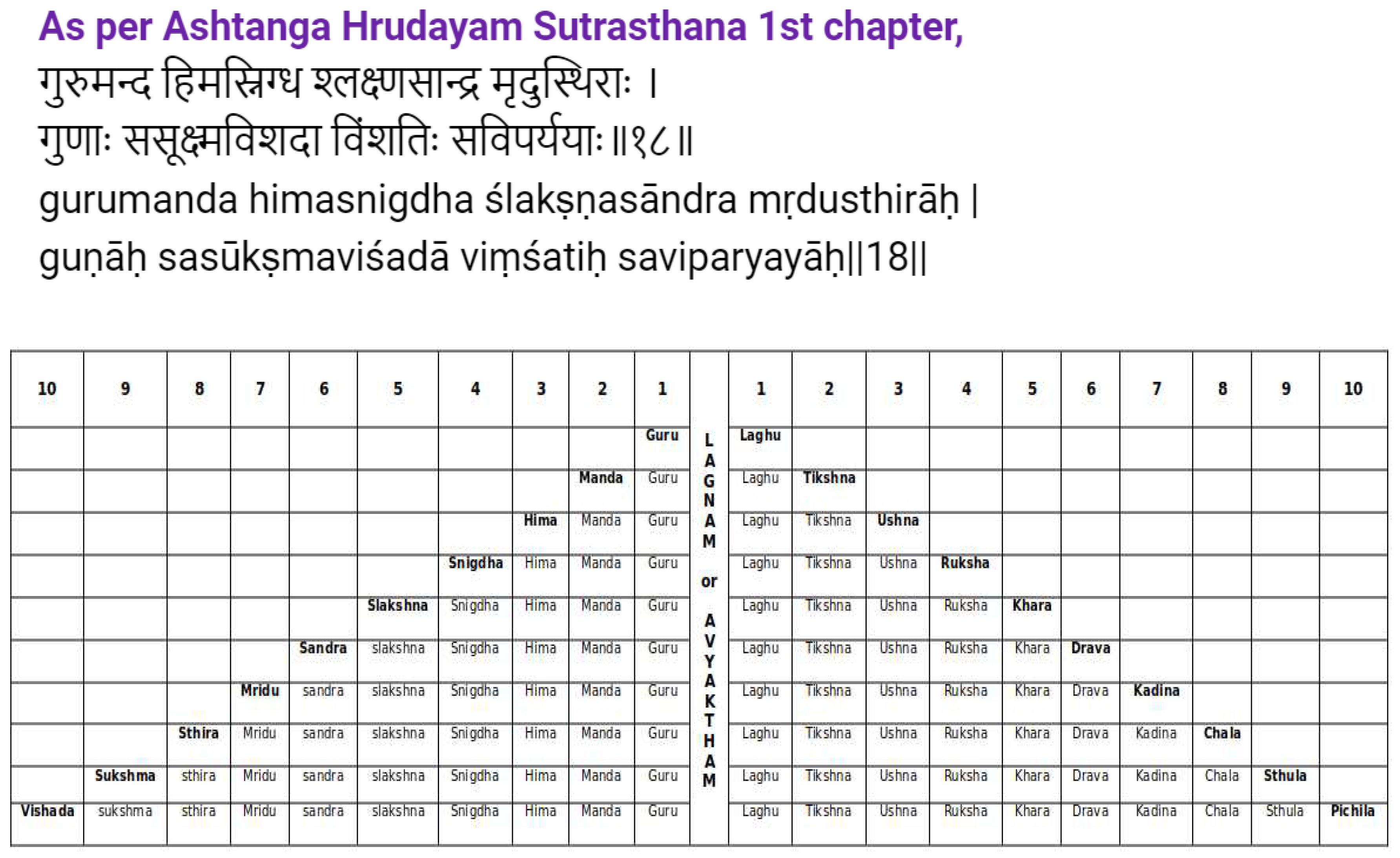
Figure 2.
Order of emergence derived from Gunam “Laghu” and Gunam “Guru”.
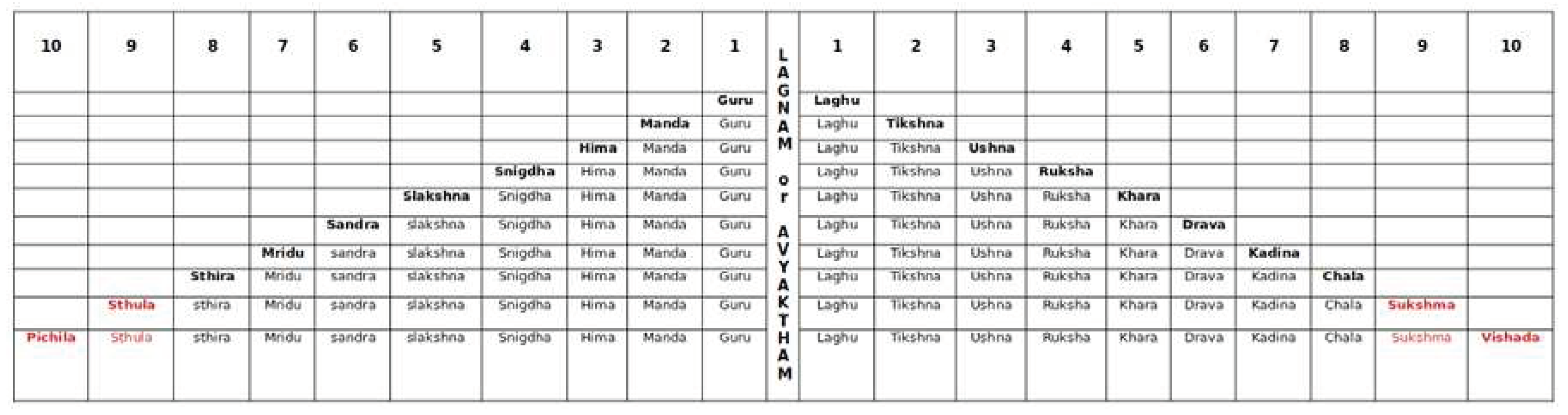
It is clearly identified from the Figure 1 and Figure 2 that there is a variation in the order of emergence at the ending points. The classical references provided the Gunams “Sukshma” and “Vishada” as the final emergent states of Guru. Similarly in classical reference the Gunam “Laghu” emerges and end as Gunam “Sthula” and Gunam “ Pichila”. But in real computational process our team identified that the Emergence of “Guru” is ending as “Sthula” and “Pichila” and the Emergence of “Laghu” ends as “Sukshma” and “Vishada”. For the first time in the world we identified and proved that there is an error in the order of emergence provided in the classical reference. But we also assume that this error may be an intentionally introduced by the acharyas to hihglight the impotance of cyclic loop of information transport in the process of “ulapthi” and “maha pralayam”. Because the “Laghu” and “Guru” emerged from Avyaktham will undergo all the transformations during the very long time frame of emergence of Universe and complete one full entropic cycle of emergence starting from maximum entropy in Avyaktham to maximum entropy in Vyaktham. Then the Avyaktham will be completely emerged in to a state of Vyaktham and Vyakthma will be completely emerged in to a state of Avyaktham, and whole process of emergence will again start as mentioned as per the mechanism of orign of emergence from Avayaktham developed by our team. Due to this the Laghu emerged in Vyaktham as the first Guna of Aakasha Bhutha will topologically tranform and become the Guru in Sthula and Pichila, and the Guru emerged in Vyaktham as the cause of origin of Aaksha Bhutha and the first Guna of Prithwi will topologically transform and become Guru in Sukshma and Vishada. Similarly all the Gunas will tranform into its counter parts during the cycle of Maximum entropy to Maximum entropy throguh the Zero entropy point. This topological transformation of Gunas are the cause of swaping transformation of Avyaktha to Vyaktha and vice versa. This process is an never ending information invarient cyclic loop due to quantum information transport from Avyaktham to Vyaktham. In summary the Avyaktham and Vykatham stands eternal. All these informations are naturally cognized and documneted by our ancestor and acharyas and put into linguistic,cultural and all the possible ontological and axiological frameworks which were synthesized by humanity over the very large time period of Srishti and Maha Pralayam. If we assume our position as the component of the emergence, this perception of large time period for completing one emergence cycle seems to be very huge and looks beyond human cognition. But if we take the position of Avyaktham it is very short entropy cycle. Which means the Vyktham is a virtual process through which the Avyaktham manifests to perceive itself. In that context Vyaktham is unreal and very short lived. The Vyaktham is continuously and simultaneously created, maintained and destroyed through the selfinformation entanglement mechanism. So it will be availabe as a premeyam which can be cognized as time or space or mass or information. So the process of perception from perceiver (Avyaktham) point of view can be sujected to the “Prama” as a “Premeyam” in sannikarsha for a very short time or space, we defined that space as “Kshethram”.
The kshethram is the space or time or mass or information that can be used to create, maintain and destroy Gunas through the process of manipulation of Quantum information in the quantum states or quantummatter availabe in Vyaktham or Avyaktham depending on the quantum information transportation dynamics. The above process clearly proves the scientific or phenomenological significance of various traditional and indigenous practices including Tantra, Mantra, Yantra, Jyothisha, Kshetra-Acharams and various temple practices and Symbolic diety based Guna manipulation systems exisitng for lakhs of years in Bharatham. We can identify a huge empirically, experimentally and phenomenologically verified Big Data in this context, availbe as documents like Vedas, Upanishads and other Oral and Practice based epistemological data banks saved as inclusive knowledge in indigenous communities and systems.
These Bid Data can be only cognized by practising it. But modernity and involvment of human bias in handling these knowledge systems made it very difficult to differentiate the dogmatic derivatives of these precisous indigenous knowledge system from its original version. This is the challenge faced by all the indigenous knowledge systems including Bharatheeya Knowledge Systems. But fortunatley Bharatheeya Knowledge Systems are preserved in all the humanly possible ways in such a way that it will survive the emergence catastrophy. So it is mentioned as “Sanathan”, which means stand original across timeless period. In actual human sense it can be cognized as the timeless knowing and learning (quantumin formation transport process) happening during the process of timeless cycles of emergence of Avyaktham and Vyaktham and can be equated to the process in which the Avyaktham tries to perceive itself thorugh the process (self information entanglement) of emergence of Vyktham. Since we are also one of the component of these emergent systems, Bharatheeya Knowledge Systems accomodated this process and represent as a humanly cognizable philosophy of self ralization or “Moksha”. Various indigneous communitiies of humanbeings cognized the same and still continue to practice this philosophy in enumerous ways. Bharatheeya Knowledge Systems have a Big Data of these indigenously cognized knowledge coded in symbols and deity representations, all these are ultimately the consoldiated representation of 41 types of Gunas and its permutations and combinations manifests as emergence. In this regard we hereby provide few major examples in Bharatheeya Knowledge Systems in the table number 3 given below,
| No. | Cognizable Human Construct or Deity |
Example for Location of Installation of Quantm information transport systems for management of Gunam |
Guna Varnana (Qunatum information encoded as Gunam) |
|---|---|---|---|
| 1 | Lord Maha Vishnu | Sree Padmanabhaswamy Temple, in the form of Sankalpa of Ananthasayanam, Thiruvananthapuram |
शान्ताकारं भुजगशयनं पद्मनाभं सुरेशं विश्वाधारं गगनसदृशं मेघवर्णं शुभाङ्गम् । लक्ष्मीकान्तं कमलनयनं योगिभिर्ध्यानगम्यं वन्दे विष्णुं भवभयहरं सर्वलोकैकनाथम् ॥ Reprentation of Information in Quantum states of unperceivable “Avyaktham” exisitng in cold state and Maximum information entropy. The Lakshmi Devi represnt the human construct to cognize the existence of Smallest self emergent unperceivable “Vyaktham” in the biggest unperceivable “Avyaktham” |
| 2 | Mother Goddess Shakti | Astadasha Maha Shakti Pithas including location given below,
|
Guna Varnana: Avyaktham represented as Devi. Sourced from Devi Mahatmyam, Markandeya Puranm. Also Guna varnanas in Skanda Puranam and other vedas and upanishads |
| 3 | Brahma-Vishnu-Maheswara The triad emerged from the human cognition or Avyaktham’s self emergent construct of Creation-Maintenance and Destruction of Vyaktham as the Emergent state of Avyaktham through the Qauntum information transport process happens during the self information entanglemnt. This represents or symbolizes the Human cognitive construct of Sthithi-Srishti and Samharam. All these three quantum information transport processes are simultaneously and spontaneously happening and will continue as a never ending process. No time exists in this context. The quantum matter of dravyam “time” was simultnaously created, maintianed and destructed, Thus it is a timless quantuminformation transport process happening on the surface of a information invarient and topologically invarient 2D Poincare Sphere. We can consider it as a quantum information transportation process in an infinite cyclic loop. |
Various locations are there in the geographical location of Bharatham mentioned in Bharatheeya Knowledge Systems. Few are listed below, i.Mahadevan Pancha Bhuta Sthala i.a.Ekambareswarar Temple, Kanchipuram, Bhumi Lingam i.b. Jambukeshwarar Temple, Thiruvanaikaval, Varuna Lingam (Jambu Lingam) i.c. Arunachalesvara Temple, Thiruvannamalai, Agni Lingam (Jyothi Lingam) i.d. SriKalahasti Temple, Kalahasti, Vayu Lingam i.e. Thillai Natarajar Temple, Chidambaram, Indra Lingam (Akasha Lingam) ii. Brahma Devan, Brahmapureeswarar Temple, Tirupattur iii. Vishnu Devan, Dwarkadheesh temple, Mathura iv. Vishnu Devan, Sreekrishna Temple, Gurupavanapuri |
Various Guna Varnanas are availabe few are listed below, i. Lord Shiva Manifested in various Pancha Bhutas with constituent Gunas i.a. Pritwi Bhuta Gunas:
Gandhaḥ guṇaḥ i.b. Jala Bhuta Gunas:
Rasa guṇaḥ i.c. Agni Bhuta Gunas:
Rupa gunah i.d. Vayu Bhuta Gunas:
Sparsah gunah i.e. Aakasha Bhuta Gunas:
Sabdah gunah ii. Lord Bharma Manifested without pride (ahamkaram). Gunas connected to Ahamkaram. ii. Lord Vishu Manifested as Krishana. Various Guna Varnanas are availabe as per respective legends provided in Vedas. iv. Lord Vishnu manifests as Guruvayurappan. Gunas: Guru and Gunas of Vayu Bhuta |
| 4 | Lord Hanuman | Represent the process of perceving the unperceivable “Avyaktham” through the perceivable “Vyaktham” Guna varnana symbolizing Hauman Swamy as Chiranjeevi representing Avyaktham as “Jnana Guna Saagaram”. Also the Gunas of Vayu Bhuta. Guna varnana provided in Hanuman Chalisa: चौपाई:- जय हनुमान ज्ञान गुन सागर। जय कपीस तिहुं लोक उजागर।। रामदूत अतुलित बल धामा। अंजनि-पुत्र पवनसुत नामा।। |
|
| 5 | Lord Murugan | Subramania Swamy, Arulmiku Subramaniaswamy Temple Marudamalai, Marudamalai. |
Guna varnana: திருப்புகழ், Kanda Sasti Kavacam, Which represents the dynamics of Gunas happening during the process of emergence due to quantum information transport between the respective type of gunas from which the Sa|Ra|Va|Na (Saravana) sankalpa is derived. |
| 6 | Lord Vigneshwara | Guna varnana: शुक्लाम्बरधरं विष्णुं शशिवर्णं चतुर्भुजम् । प्रसन्नवदनं ध्यायेत् सर्वविघ्नोपशान्तये ॥ Shukla-Ambara-Dharam Vissnnum Shashi-Varnnam Catur-Bhujam | Prasanna-Vadanam Dhyaayet Sarva-Vighno Upashaantaye || The lord Vigneswaar is the symbolic representation of Agni Bhuta. Gunas:
Rupa gunah Without agni no gunas can under go sannikarsha, samyoga, vibhajana and transformation from one bhuta to another bhuta. All the problems in quantum information transport is basically rooted to the exchange of quantum information between the states of quantummatter of the Dravya. So the agni which controlls these operations through the information bounded in the quantum matter of the Dravys or its gunas is symbolized as the Deity of Vigneswara the god which removes the obstacles. Due to this in the practice of all Bharatheeeya Knowledge Systems we do the sankalpa of Vigneswara and offer the dravyas which can so proper sanniakrsha with Agni Bhuta. |
In the above context enumrable version of emergence and its dynamics are coded and symbolized in languages including Tamil, Sanskrit and all other regional and indigenous languages used in Bharatheeya Knowledge Systems. The Kshethram is the space on the surface of a topologically invarient 2D Poincare Sphere, where the simultaneous creation, maintanence and destruction of the gunas are happening. The perception of the kshethra can be manipulated with variouos indigenous practices mentioned and documented in Bharatheeya Knowledge Systems. The Dravyas and other sources and outcomes used in the Kshetra-aachara practices in Bharatheeya Knowledge System are designed based on guna and optimising sannikarsha and quantum information transport between the required or desirable states of quantum matter of the pramata and premeyam to obtain the prama in the form of quantum states or quantum information. These prama can be transported in to desired dravyas and gunas through various processes. For example the nivedhyam from the temple practices served after the tantra or mantra or yantra saadhana based on the deity is a method for transporting required gunas of that sankalpa for the utilisation to attain prama.
6. Pancha Maha Bhuta (PMB)
PMBs are the foundational units of objective state of Vyaktham emerged out of gunas. Each PMB is emerged as the results of permutation and combination of different types of Gunas during the emergence of quantum matter by the process of combination or coherence of quantum states and corresponding quantum information in a topological invariant confined Poincare space. There are five types of PMBs as follows,
- a)
- Prithwi PMB
- b)
- Jala PMB
- c)
- Agni PMB
- d)
- Vayu PMB
- e)
- Akasha PMB
The comprehensive information about the emergence of 5 types of PMBs from different types of Gunas are provided in the table 1. Each quantum information state is bound to its paired state which is a state of information entanglement during the emergence of Gunas and form its corresponding quantum states holding specific information because of quantum information exchange between its emergent quantum information entangled pair. This is like the mechanism of emergence of Gunam Laghu and Gunam Guru at the point of origin of emergence on the 2D Poincare sphere, which emerged as universe with a distorted Poincare sphere shape known as ‘aṇḍākāraḥ’ in Ayurveda. This is due to the imbalance in the mass happening during the emergence of Aakasha Bhutham initiated with the emergence of Gunam Laghu due to the quantum information transport happened between the two quantum states in highest proximity in the state of unperceivable Avyaktham. As a result, the Gunam Guru is formed with higher density of information and the 2D Poincare sphere is deformed in to the form of ‘aṇḍākāraḥ’ which is equal to the distorted oval shape. The word “brahmanda” was originated in Veda to represent this phenomenon and epistemologically accommodated in the philosophy of Bharatheeya Knowledge Systems form the beginning of its emergence. The human body emerged as the manifestation of these PMBs can interact the PMBs and Gunams in food and drinks and also through the five sense organs listed below,
- a)
- Olfaction/smell – Prithwi PMB
- b)
- Gustatory/taste – Jala PMB
- c)
- Vision – Agni PMB
- d)
- Touch – Vayu PMB
- e)
- Audition – Akasha PMB
The Shadrasas are emerged due to the various types of combinations of PMBs, based on this composition of PMBs manifested as food and drinks six types of rasas (tastes) are emerged from Gunas. The details of this emergence is provided in the table No:4.
| Sl.No. | Taste | Pancha maha bhutas (PMBs) |
| 1. | Madhura (sweet) | Prithvi PMB + Jala PMB |
| 2. | Amla (Sour) | Prithvi PMB + Agni PMB |
| 3. | Lavaṇa (salty) | Jala PMB + Agni PMB |
| 4. | Tikta (Bitter) | Vāyu PMB + Ākāśā PMB |
| 5. | Kaṭu (Pungent) | Vāyu PMB + Agni PMB |
| 6. | Kaṣāya (Astringent) | Vāyu PMB + Prithvi PMB |
Health as defined by Ayurvedic philosophy, requires balance of Doshas, which itself is balance of PMBs. Diseases also requires PMBs. Therefore, health and disease are basically transaction and maintenance of PMBs which can be availed by the body not alone through food and drinks but also through the five sense organs as indriya padarthas. This opens the possibility of predicting, diagnosing, understanding, and treating diseases through the five sensory pathways listed as given below,
- a)
- Smell
- b)
- Taste
- c)
- Vision /colour
- d)
- Touch
- e)
- Sound
7. Emergence of Tridoshas as a complex system
Complex systems are systems made of a large number of microscopic components interacting with each other in nontrivial ways. Many real-world systems can be understood as complex systems, where critically important information resides in the relationships between the parts and not necessarily within the parts themselves. (Hiroki Sayama - Introduction to the Modelling and Analysis of Complex Systems). Human body can be considered as a complex system due to the immense number of functions that determine its status of health or disease at any given point of time.
Ayurveda medical system, uses three basic Relationships known as doshas, to group the basic components of PMBs of the human body:
VĀYU PITHA KAPHA SCHETHI TRAYO DOṣA SAMĀSADHA
VIKRITHA AVIKRITHA DEHAM GHNANTHI TE VARTHAYANTHI CHA
(AH/SU/1/7)
- i.
- Vatha - Akasha PMB and Vayu PMB of the body are grouped based on a relationship where there is samhara of Gunas and PMBs
- ii.
- Pitha - Agni PMB and Jala PMB of the body are grouped based on a relationship where there is sthithi of Gunas and PMBs using quantum information exchange technique.
- iii.
- Kapha - Prithwi PMB and Jala PMB of the body are grouped based on a relationship where there is Srishti of Gunas and PMBs using quantum information exchange technique.
All activities of the PMBs (Topologically confined Gunas) in the form of human body are grouped into three systems based upon the relationship by which quantum information exchange is managed within the body. List of Gurvadi Gunas with details are given as follows,
- a)
-
GuruAdya patana samavayi kaaranam gurutwam. Prithvi jala vrithi(tarkasangraha/verse 30)Refers to massFound in Prthwi PMB and Jala PMBRefers to lack of mass
- b)
-
LaghuMade up of Vayu PMB, Agni PMB and Akasa PMB
- c)
-
Mandaमन्दःसकलकार्येषुष्टशष्टिलोऽल्पोऽष्टपकथ्यतेmandaḥ sakalakāryēṣu śithilōalpōapi kathyatē[bhāvaprakāśa / pūrva khaṇḍa /Prathama bhāga/ miśra prakaraṇa /verse 220]Slow acting or inertness – due to lack of Agni PMB and Akasa PMB —made up of Prthwi PMB and Jala PMB
- d)
-
ThikshnaProperty of fast action or reactivenessMade up of Agni PMB
- e)
-
SheethaCapacity to paralyze movements.Made up of Jala PMB. Result of endothermic process
- f)
-
Ushna (hot)Capacity to produce sweatMade up of Agni PMB. Exothermic process
- g)
-
Snigdha (oiliness)Choornadi pindibhava hetur gunaha snehaha. Jala matra vrithi(tarkasangraha/ verse 32)The property that binds powders together.Made up of Jala PMB.Produce humidity or kledanam, which causes adherence and building up of structure for storage of energy.
- h)
-
Rukhsa (dryness)The property that prevents particles from binding together.Made up of Prthwi PMB and Vayu PMBProduce dryness due to breaking off adherence caused by structural disintegration to release energy
- i)
-
Slakshna (smoothness)Capacity to produce wound healing (edges of wound to be even to join together)Smoothness when dry becomes hard or viscous and when humid becomes slipperyMust be made up of Prthwi PMB and Jala PMBStructural symmetry of crystal surfaces due to perfect organization
- j)
-
Kharam (rough / causing abrasion / uneven)Property that delays wound healing – due to uneven edges joined togetherProperty which helps to smoothen rough surfaces by abrasion (itself made of uneven hard surface)Produce heat when used and increases dosha pitha as a by product and calms vatha and kapha due to the heat generated.Must be made up of Prthwi PMB and Vayu PMB (rough and hard)
- k)
-
Sandram (viscous)Property that helps in sticking together (bandha karam)must be made up of Prthwi PMBproperty of liquid – implying the presence of dissolved materials in the solvent, which makes the flow of the liquid slow.
- l)
-
Dravam (Fluidity)Capacity to wash off dirtProperty of liquid – implying the lack of dissolved material in the liquid, which makes the flow of the liquid easy or fastCapacity to produce wetness (due to more solvent which can dissolve more solute) and capacity to spread (having less ingredients dissolved within)must be made up of Jala PMB, Agni PMB and Vayu PMB (all elements which has fluidity or lack structural rigidity)
- m)
-
MriduCapacity to produce softness (sladhanam)Made up of Jala PMB and Akasa PMBWhich reduces the rigidness of structure (foam is made up of Vayu and Jala, here imagine the same where Jala PMB is foamed with Akasa PMB)
- n)
-
KadinamCapacity to produce hardness (dridanam)must be made up of Prthwi PMB and dryness of air or drying up due to fire
- o)
-
SthiramCapacity to produce stability (dhaaranam)Produce constipation and blockage of elimination of flatulence.must be made up of Prthwi PMB
- p)
-
ChalamCapacity to produce instabilityHelps to eliminate stools and activates dosha vathamust be made up of Jala PMB, Agni PMB, Vayu PMB and Akasa PMB
- q)
-
SukshmamCapacity to enter into minute openings (Vivaranam)must be made up of Vayu PMB and Akasa PMB
- r)
-
SthulamCapacity to obstruct (samvaranam)Anabolic and produce blockage of body canalsmust be made up of Prthwi PMB and Jala PMB
- s)
-
VishadamCapacity to wash off (kshalanam)Made up of Prthwi PMB and Vayu PMBHelps to remove humidity or wetnessHelps to heal wound
- t)
-
PichilamCapacity to produce layers (lepanam)Made up of Jala PMBIs heavy (has more mass)Made up of threadsHelps to heal woundIncreases body strength and immunity
7.1. Swasthyam or Health as an Emergent Property
samadōṣaḥ samāgniśca samadhātumalakriyaḥ |
prasannātmēndriyamanāḥ svastha ityabhidhīyatē
(Su/Sutra/15/41)
Health, according to ayurvedic medicine is defined as an emergence or samavaya (innate union) of the following components:
balanced doshas are equivalent to balanced Quantum biological functions.
balanced body tissues are equal to the balanced information, energy and material production and nourishment,
balanced production and elimination of waste materials are similar to balance in production and elimination information/gunas/entropy.
clear exchange of information between the quantum states of satwa and quantum states of atma through proper sannikarsham is defined as the proper neuronal functioning.
Proper exchange of information between the constituent quantum states of Gunas in PMBs of sense organs with the constituent quantum states of Gunas in PMBs of premeyam is equal to the optimal sannikarsham and functioning of sensory organs
Health is an emergence produced when the body is having non-linear complex emergence. This emergence (of health) is produced when the doshas are in equilibrium or are within the synchronized limit of the prakriti, where prakriti is the tipping point of that particular emergence.
The component factors of health (emergence) can be modified by external factors like climate, time, senses, food and habits through the sannikarsham of gunas imbibed in corresponding PBMs.
Health (emergence) can be maintained and protected by preventing the alteration of the gunas of food, habits, climate, or time and thereby stabilizing the components of the emergence including doshas, dhatus, malas, manas(mind), Atma(spirit) and sense organs.
7.2. Disease and Health Are Emergence, Both Can be Altered by Altering Just One Precise Node
- Calculated manipulation of the gunas of the PMBs in human body through information/Gunas loaded in PMBs of the dravyamas of gunams undergo sannikarsham with the PMBs of human body will produce the emergent phenomena of health.
7.3. Disease – Each Disease is an Independent Emergent Phenomenon
Dosha eva hi sarva roga eka karanam
Vikrita avikirita deham khnanthi tat varttayati cha
(Ashtanga hridya/Sutra sthana/chapter 1/verse 7)
Disease according to ayurvedic medicine is produced by the interaction of:
- imbalanced doshas (three basic Relationships between the PMBs within the body),
- with imbalanced dushyas (dhatus & malas).
When the imbalanced dosha interacts with the defective dhatus (tissues) or defective malas (waste materials), a disease is manifested. Disease is manifested as an emergence produced by imbalanced dosha and defective dhatus (tissues) or defective malas (waste materials).
Disease (roga) is not lack of health. Each disease is a separate independent emergence produced by the interaction of imbalanced doshas, unhealthy dhatus and unhealthy malas. Each disease has a unique set of variables (doshas, dhatus and malas) which produce a specific emergence or specific disease.
The defect is caused by vishesha or particular accumulation of one or more of the 20 gunas (structural-functional properties) of Doshas and Dushyas, beyond their normal level.
The normal level is the tipping point determined by prakriti which is a samanya or generalized limit of gunas for maintaining health.
Imbalance of Doshas and Dushyas (Dhatus and malas) are produced by consuming non-optimum quantities of gunas (structural-functional properties) in the form of food, habits, climate and time.
The emergence of each specific imbalance is a new disease.
7.4. Difference between the Emergence Which Produces Health as Opposite to the Emergence Which Produces Disease
Emergence is a characteristic property of non-linearity or complexity. Health is an emergence due to the samavayam (innate union) of samanyam (generality), whereas disease is an emergence due to the samavayam (innate union) of vishesham (particularity).
7.5. Ama (Chronic Inflammation)
ushmano alpa balatwena
dhatumadyam apachitham
dushtam amashaya gatham
rasam aamam prachakshathe
(Ashtanga Hridayam/Sutra Sthanam/13/25)
The pathological state in which one or more doshas do not transform the dhatu rasa (nourishing) into the next dhatu Raktha (blood), due to weakness of the digestive fire is known as Ama (chronic inflammation) The body (quantum biological system) consumes gunas or informations from the environment:
- to gain energy to perform work, work can be autopoesis (maintaining and developing the system) & allopoesis (to perform some functions in the environment).
- and produces residue (metabolic waste =urine, faeces and sweat) considered as entropy.
7.6. Process Defines the Actual Steps Involved in Transforming the Input into Output
Inputs are:
- food
- drinks
- psycho-somatic enviorment
- Field of emergence
Outputs are:
- information and energy output (managed as vatha – catabaolic, pitha – transformative & kapha - anabolic)
- waste materials = entropy (urine, faeces and sweat)
Efficiency is the ratio between information/gunas acquired and information/gunas lost during a process.
Efficiency = Entropyinput/Entropyoutput
Aama or inflammation is defined as the phenomenon in which the gunas /quantum information bounded in the quantum states of quantum matter of rasa is unable to be exchanged between the quantum states of quantum matter of PMBs of the human body with its counter parts in human mind due to pranjaparadham.
Therefore, during aama or inflammation, the efficiency of the body is very low and entropy is very high. Ama or chronic inflammation is Linear. The body loses its emergence of health during ama or chronic inflammation. Ama or chronic inflammation can occur at any time in the body, except when there is health. This includes Aama as part of a disease and Aama also when there is no disease (stages of pathogenesis before disease)
7.7. Shadkriya Kaalam
Due to the topological transformations of same gunas in different Kshethrams, six types of karmas are emerged from the same set of gunas due to the topological variation of distribution of the corresponding quantum matter of the gunas in the Kshethram of emergence. According to Ayurveda, this leads to various stages of pathogenesis due to different types of sannikarsha between PMBs of sareeram(body) with that of Manas (mind).
Six types of information are exchanged during the sannikarsha between sareera and manas due to the topological variation of same set of gunas in human beings. This causes a variation from its starting conditions of health (emergence in nonlinear complex state) and then losing health due to imbalance of its constituting parameters (loss of emergence and currently linear status) and then passing through topological transitions of the respective quantum matters with corresponding Gunas. These transitions (linear transitions) will produce the emergence of chaos called as diseases. Eventually disease chronicity is explained by the emergence of Dravyas called Shadkriya kaalas. This is due to the six types of topological variations happening to the quantum matter of dravyas during the emergence of diseases. The spatial orientation of same group of gunas will cause different levels of emergences in pathogenesis according to Ayurveda.
There are six topological transitions of quantum matter of corresponding gunas from starting conditions to disease chronicity. Disease is an emergent property and topological transitions of quantum matter of gunas will cause the emergence of six stages of pathogenesis. These are the sub steps between health and diseases. Both health and Diseases are nonlinear complex states, while the Shadkriya kaala or emergence of 6 types of quantum matters and gunas in pathogenesis according to Ayurveda, which is the status between the two (health & disease) is linear and non-complex without any emergence. Thus, Aama according to quantum biological framework is considered as the state of linear processes. It is proposed that the mechanism of transformation from non-linear emergence to linear – transformations are activated in the body based on the Buddhi to protect the Body and Manas from undesirable chaos which leads to deterioration of the quantum matter components of the PMBs. We can consider it as a sub step of vyadhikshmatwa or bala activated during the action of pranjaparadham.
In a similar fashion the Aavaranam is another type of emergence which facilitates the processes od emergence in which the groups of gunas with similar topological dynamics of quantum matter and quantum states can interact at different levels of the counterparts in PBMs, and the quantum information exchange and entanglement happening during this emergence can generate a chaos or complication in various levels of sannikarsham
7.8. Disease Treatment as the Phenomenon of Toppling the Emergence
Aim of disease treatment is to topple its unique emergence. Emergence can be toppled and thereby the disease can be cured by modifying one of its constituent parameters (nodes). Curing a disease (emergence), by altering at least one component of the emergence i.e. food, habit or medicine, is the techniques in the treatment used in Ayurvedic medicine. Few Examples are given below:
- In Ayurveda, pain is considered as a symptom produced by dosha vatha, due to the accumulation of excess cold. All pain, except those produced by circulatory defects fall under this category of vatha and can be cured by application of warmth just by applying sauna – heat. This reduces the body pain, caused by cold of dosha vatha.
- increasing immunity by drinking boiled water (which increases lightness and thereby increase quality of digestion)
The construct of each emergence (disease) can be toppled by influencing one or a combination of key guna within the PMBs (doshas and dushyas) which has been causing the disease. Thus, the emergence can be dismantled or toppled, and the disease will disappear.
7.8.1. Nodes of Chaos in Emergence as the Pancha Maha Bhutas
- akasha PMB
- vayu PMB
- Agni PMB
- Jala PMB
- Prithwi PMB
7.8.2. Edge of Chaos in Emergence as Tridosha Siddhantha
- vatha/ catabolic activities
- pitha / transformative activities
- kapha /anabolic activities
Mutual information exchanges happening among these five elements during the emergent phenomena cannot be stopped, all elements in our body are interconnected to each other, pancha vatha/pancha pitha/pancha kapha
Degree of connectivity as edges / nodes which are equal to the vpk/total amount of panchabhutas in our body
Average path length is equal to the average of the length between all nodes (distance between pancha maha bhutas)
Degree of connectivity of vatha PMB is equal to the average distance between gas atoms/number of atoms in a gas molecule
PMB are totally interconnected connected networks. It is a canonical ensembale in which total information is a constant and all nodes are connected to each other.
Clustering- probability of connection between nodes – gunas which constitute the PMBs can be having varying connectivity between themselves, based on the actions (karma) they produce, when combined.
As the elements within a system become more interconnected and interdependent, it is increasingly the structure and type of relationship between the elements that come to define them - as in human body according to Ayurveda – structure (structural classification of body elements as solid, liquid and gas; types of relationships between the elements - anabolic, transformative, catabolic)]
7.8.3. Nested Hierarchy / Composite Containment Hierarchy
According to Ayurveda, PMBs are the basic structural and functional unit of the universe.
The 20 Gunas are the components that constitute the PMBs.
All hierarchies can be decomposed to their constituent 20 gunas. Thus, the Nested Hierarchy / Composite containment hierarchy are based on the 20 gunas at all levels.
Nested Hierarchy / Composite containment hierarchy occurs in Ayurveda in two contexts:
- the organization of human body
- the organization of the universe
The organization of body - the PMB nodes are connected using the relationship of doshas within the body.
Gunas are a set of binary opposites of pysico-chemical properties of matter which define the structure and function of everything in this universe, including the Pancha maha Bhutas (PMBs). There are 20 different gunas. 20 gunas are 10 pairs of binary opposites.
Pancha maha bhutas (PMB) are the basic structural and functional units of the universe. They are made up of the 20 gunas. PMB form the mesoscale level of cells, organelles and proteins; nanoscale and atto scale level of biomolecules, motifs and finally the quantum matter scale of energy driven interactions in the systems towards one end and the cellular organelle, the cells, the tissues, the organs, the organ system, the body, the environment and the universe towards the other end in each hierarchy.
Hierarchy within the human body
- Node = pancha maha bhuta (akasha PMB, vayu PMB, Agni PMB, Jala PMB, prithwi PMB)
-
Edge = tridosha siddhantha (vatha/pitha /kapha = catabolism/transformation/anabolism)The hierarchy within the body is: Gunas < PMB < Doshas/dhatus/Malas < Srotas < Sareeramodel of a system consists of
- elements and
-
relationship between elements. (the relationship between elements connect them to some shared functions or process.)in ayurveda, human body as a complex system has:
- elements = pancha maha bhutas ie, earth, water, fire, air, space
-
relationship between elements -= vatha-catabaolic/pitha transormative/kapha anabolic)]The organization of universe - the PMB nodes are connected using the relationship of rasas).
- Node = pancha maha bhuta (akasha PMB, vayu PMB, Agni PMB, Jala PMB, Prithwi PMB)
-
Edge = shadrasa theory (there are six tastes, madhura = prithwi PMB + Jala PMB; Amla = prithw PMB + Agni PMB; Lavana = Agni PMB + Jala PMB; Tikta = vayu PMB + akasha PMB; Katu = vayu PMB + Agni PMB; Kahaya = vayu PMB + vayu PMB)The hierarchy in the universe is Gunas < Bhutas < Rasas (the organization of universe)PMB are totally connected networks – all nodes are connected to each other
7.8.4. Diagnosis
Diagnosis is the iterative procedure using 18 parameters (ashta sthana pariskha & dasa vidha pariksha) to evaluate the strength of the constituting parts of the emergence – Doshas, Dhatus and malas.
- 1.
- Nadi – status of pulse, to evaluate the activity of heart and conducting system.
- a.
- Rapid and fluctuating rhythm indicate vatha,
- b.
- non fluctuating and soft pulse indicate pitha and
- c.
- non fluctuating and heavy pulse indicate kapha
- 2.
- Malam (stools) – reflect the status of digestion.
- a.
- Hard, dry, formed stools with constipation and irregular rhythm of bowel movements indicate increased vatha.
- b.
- Loose stools with high frequency indicate increased dosha pitha and
- c.
- formed stools without constipation and dryness and with regular bowel movements indicate increased dosha kapha
- 3.
- Mootram (Urine) - to evaluate the fluid content and the efficiency to maintain homeostasis of fluids required for the system.
- 4.
- Jihwa (tongue)
- a.
- bitter taste (formed in the mouth naturally without any food) indicate unbalanced dosha vatha,
- b.
- sour taste (formed in the mouth naturally without any food) indicate unbalanced dosha pitha and
- c.
- sweet taste (formed in the mouth naturally without any food) indicate unbalanced dosha kapha.
- 5.
- Sabdam (voice) –
- a.
- fluctuating tone indicate unbalanced vatha,
- b.
- stable tone with hash words indicates unbalanced pitha and
- c.
- stable tone and resonating voice with comforting words indicate balanced kapha
- 6.
- Sparsham –
- a.
- cold and dryness of body indicate balanced vatha,
- b.
- warmness indicates balanced pitha and
- c.
- cold with oiliness balanced indicate kapha
- 7.
- Drik – eyesight is a joint activity produced by
- a.
- the transformative capacity (pitha) of the retinal pigments,
- b.
- the conducting pathway of the impulse to the brain and the neuronal activity to construct an image (vatha).
- c.
-
Still including the structural quality of the cornea, lens etc to focus the light on the retina (kapha).The efficiency of this function is a measure of the functional status of the body as a whole.
- 8.
- Akriti –
- a.
- skinny and short body stature indicate vatha constitution,
- b.
- medium stature and structure indicate pitha,
- c.
-
tall and wide structure with well-nourished body tissues indicate kaphaDasa vidha pariksha / 10 functional analysis
- a)
-
Dushyam – pancha doshas / saptha dhatus / Tri malas
- Indicates which among
- the subdivisions of doshas are affected in the disease condition +
- the seven dhatus are affected +
-
3 malas are affected.– in the pathogenesis
- b)
-
Desham (place of activity) – rogi desham (residence of patient) / roga desham (disease activity within the body)
- Rogi desham- indicate the geographical site where the patient is currently living currently (vridhi desham) and which was the geographical type where the patient was born (janma desham)
- roga desham – indicate the srotas or system in which the disease is being developed.
- c)
-
Balam (strength) – rogi balam/roga balam
- Roga balam (strength of disease) – evaluating the disease strength by the following parameters.
- Causative factors- the more causative factors were involved in the pathology, the disease is more strong
- Signs and symptoms – if the disease shows all the signs and symptoms then the disease is strong.
- Doshas involved – more doshas involved in the pathology indicates a strong disease
- Dhatus involved – if the pathology involves more dhatus or tissues, then the disease is more strong
- If the person having the disease is living in a geographical place which is same as the dosha type of the disease, then the disease is strong.
- If the person having the disease is of the age which is same as the dosha type of the disease, then the disease is strong.
- Rogi Balam (strength of patient) – Evaluating the physical endurance of the patient. If he is able to tolerate mild, medium or heavy physical exercises.
- d)
-
Kaalam (time frame) – kshanadi kaalam /roga kaalam (shad kriya kaalam)
-
Kshanadi kaalam - refers to the season in which the patient is currently living. There are six seasons (2 months each) according to Ayurveda. It is basically emerged due to the change in the gunas of the PMBs of Bhumi and its surrounding ecosystems.
- Shishiram (final part of winter)
- Vasantham (spring) – dosha kapha is imbalance naturally
- Grishmam (summer)
- Varsham (monsoon) – dosha vatha is imbalanced naturally
- Sharath (Autumn) – Dosha pitha is imbalanced naturally
- Hemantham (first phase of winter)
-
Roga kalam – refers to the six phases of dohsas in the pathogenesis, It is basically emerged due to the change in the gunas of the PMBs of Manas and its Sareeram
- i.
- Chayam
- ii.
- Prakopam
- iii.
- Prasaram
- iv.
- Sthana samshrayam
- v.
- Vyakthi
- vi.
- bhedam
-
- e)
-
Analam – agni (kruram/vishamam/mandam)
- Refers to the three pathological and one physiological status of digestive fire.
- Sama-agni: balanced status of digestive fire; indicates good digestion – physiological status.
- Pathological status of digestive fire:
- Vishama-agni: fluctuating status of digestive fire – indicating pathological status of digestive fire produced by dosha vatha
- Thikshna agni: excessively strong digestive fire – indicating pathological status of digestive fire produced by dosha pitha
- Manda agni: weak digestive fire – indicating pathological status of digestive fire produced by dosha kapha
- f)
-
Prakriti – 7 types
-
Seven body types. Seven different initial conditions of the body
- i.
- Vatha
- ii.
- Pitha
- iii.
- Kapha
- iv.
- Vatha-Pitha
- v.
- Pitha-Kapha
- vi.
- Vatha-Kapha
- vii.
- Vatha-Pitha-Kapha
-
- g)
-
Vayas – 3
-
Three age groups
- Baalam – childhood – 0 to 18 years of age – age of dosha kapha
- Madhyamam – 18 years to 80 years – age of dosha pitha
- Vardhakyam – 80 + years – age of dosha vatha
-
- h)
-
Satwam –mano balam ( evaluated by memory)
-
Satwa - Strength of mind is evaluated by the quality of memory.
- Strong
- Medium
- Weak
-
- i)
-
Satmyam – habits
-
Satmyam – habits
- Cold
- Alcohol usage
- Drug usage etc
-
- j)
-
Aharam –food habits
-
- Abhyavaharana shakthi – capacity to tolerate quantity of food
-
Shadrasas – number of tastes being used regularly
- ○
- Eka rasa – habituated to only one taste
- ○
- Shad rasas – habituated to all six tastes
-
The sum total result of this iterative evaluation gives an insight of which among the three doshas are imbalance and to which extend, together with their relative strength and supporting factors.
7.8.5. Prakriti or 7 Body Constitutions: Are the Initial Condition & Tipping Points and Control
Prakriti is the quantity of PMBs within the body (measured in terms of Doshas) at the moment of birth.
Prakriti is the initial condition of the body defined by the composition of its doshas (PMBs grouped according to the three basic Relationships among themselves) at birth.
Prakriti is also the control - within the adaptive system the control element is the mechanism that guides the system. Prakriti is the decision-making subsystem that regulates the pattern of activities governing input, processing and output.
Seven body types. Seven different initial conditions of the body
- Vatha
- Pitha
- Kapha
- Vatha-Pitha
- Pitha-Kapha
- Vatha-Kapha
- Vatha-Pitha-Kapha
The seven body constitutions or prakritis are the different initial conditions. They define the limit beyond which the doshas produce disease. If the doshas are functioning within the limit (prakriti) of initial condition, they do not produce disease.
Prakritis or seven body constitutions themselves are the initial conditions and are also the tipping points.
When the body is within this tipping point, they are in the state of non-linearity. As soon as they cross this limit, they lose their complexity and become linear.
[initial condition also determines the tipping point of the system as defined by shad kriya kala
Initial condition defines the limit (tipping point) upto which a node can be modified, before losing the emergence (non-linearity/complexity), within a nested system]
7.8.6. Poly Herbal Combinations & Cooked Food
Poly herbal combinations (and cooked food) are composed of many individual herbs which are cooked together to form a final product which is chemically different from the individual ingredients. The final product is a new entity which is different from any of the individual components - is an emergence.
This poly herbal combination &/or cooked food produce an emergence and that emergence is the remedy to cure its indicated disease (another emergence).
The emergence within a poly herbal combination &/or a cooked food is a meticulously constructed key having the exact guna composition necessary to topple the PMBs (of the doshas and dushyas) which support the disease emergence.
7.8.7. Immunity Called as Vyadhi Kshamatwam
It has two subdivisions:
-
Vyadi utpadaka pradibandhakatwam (Balam) or Robustness is produced by using Rasayana or strength potentiating medicines known as rasayana – After losing the emergence of health (non- linearity/ complexity), the body resists the tendency to produce a new emergence which can cause a disease. The phase transitions begin when the robustness is exhausted. Within the limit of robustness, the body does not need to adaptThis is the process of potentiating the innate or natural immunity by using specific products.
-
Vyadi bala virodithwam (Satmyam) or Adaptation is produced by using pathya ahara and vihara or wholesome food and habits– Adjustment done by the body as a response to disease causing factors, so as to delay the progression of the disease is known as adaptation. Adaptation is the limit to which a body could tolerate disease causing factors without causing a disease. Satmyam or adaptability will cause less diseases.The phase transitions happen in this situation.This is the basis of acquired immunity. Getting used to disease causing factors pre-emptively in small gradual or regular doses.
8. Panchakarma
Panchakarma is the process of reducing the entropy. Entropy is increased when the waste materials are produced in excess and the efficiency is reduced – all due to deranged doshas.
There are five locations where panchakarma is applied:
- Nasya – nasal passage
- Vamana – stomach
- Virechana – small intestine
- Sneha vasthy – large intestine
- Kashaya vasthy – large intestine
Panchakarma aims at:
- ➢
- Eliminating the unwanted quantum matter and quantum informations stored in quantumbiological constituents of systems biology components of human body due to undesirable topological transformation of quantum matter within the human body. These accumulated dravyas are produced by Doshas.
- ➢
- Re-establishing the equilibrium in the dynamics of gunas and indriyartha sannikarsha in human body by:
- ▪
- Nourishing the weakened quantum biological systems including gnome, biome, virome and micro-biome by resetting the required quantum information transport networks in human body by correcting the quantum biological functional systems and srotas in human body and its systems biology components to improve and correct desirable information to facilitate the healthy emergence in human body which leads to optimum sustinable health.
- ▪
- Reducing the excessively proliferated quantum matter and its functional quantum biological derivatives and regulate their topological transformative processes.
Thus, cleaning the excess or incorrect biomolecules produced which are cluttering the system together with regulation of the micro-biomes of each of the five internal micro environments are achieved through panchakarma
9. Ageing
Topological transformation of qauntum matter of quantumbiological systems in human body leading to step wise deterioration of the efficiency of the body (system) is known as ageing.
10. Rasayana
Regression of topological transformation by enhancing the efficiency of the body is known as rasayana or rejuvenation. It is the regression of ageing.
Steps include:
- ➢
- Panchakarma – cleaning the waste materials (reducing entropy) clogging the system and regulation of the micro-biomes
- ➢
- Rasayana seva – Increasing the efficiency of the body (system) by consuming specially prepared combinations under strict or relaxed habits.
11. Death
Any change in the parameters which causes and maintain the emergence known as Ayus or life, causes death. Ayus or life, is an emergent phenomenon produced by the alignment of:
- ➢
- Sareera (PMBs) – physical body
- ➢
- Indriya (PMBs) – sense organs
- ➢
- Satwa (Gunam”Laghu”)- mind (itself an emergent phenomenon produced by neurological activities)
- ➢
- Atma (Dravyam or Quantum information or entangled with quatum states in Avyaktham”) – soul (itself an emergent phenomenon produced by neurological activities)
12. Conclusions
Ayurveda is constituted on the framework of complex systems. Our work is to provide a phenomenologically verifiable working model for testing and validation of Emergence and its origin based on Ayurveda and Bharatheeya Knowledge systems. In conclusion for the first time in the world we proved that Ayurveda can serve as a fully developed model for understanding the science of complex system, thereby helping new advancements in complex system learning. In the due course of establishment of this framework we proved that rest mass can be zero and will have a minimum mass of ΔI. Hence, we solved the Yang-Mill conjecture by providing a solution based on Mass of non-perceivable information existing in Avyaktham as information or mass bound to its quantum states. This model can be tested and validated in any scenario of Emergent phenomena including Mathematics, Music and Jyothisha to predict, manipulate and understand the levels and chaos in the emergence and develop a strategy for natural cognition to cognize it in full sense.
References
- Jinan K.B.,(2023).Seeing with hands: How children use drawing to make sense of the world, BlueOne Ink LLP, ISBN: 978-93-92209-42-0, 2023.
- Pitkänen,M.(2016).Topological Geometrodynamics: Revised Edition.Egypt:Bentham Science Publishers, ISBN: 9781681081793.
- Abhishek Sharma, et. al.,, Assembly theory explains and quantifie selection and evolution, Nature. [CrossRef]
- Melvin M. Vopson, The mass-energy-information equivalence principleAIP Advances 9, 095206(2019); [CrossRef]
- Charaka Samhitha by Acharya Charaka.
- Vijay Carolin, et.al., Complex system approach in Ayurveda using phenomenological frameworks: A quantum leap in providing sustainable one health solutions, ICTAM2023, Department of Biochemistry, St.Thomas College, Palai, Kottayam, Volume: ISBN: 9789357807302.
- Grisha Perelman, The entropy formula for the Ricci flow and its geometric applications. [CrossRef]
- Grisha Perelman, Ricci flow with surgery on three manifolds. [CrossRef]
- Sreekumar Namboothiri and Oriparambil Sivaraman Nirmal Ghosh, Human reality as an outcome of human cognition based on Indriyarthasannikarsha initiated by an intentional perception of dravya gunas through an outward process to an inward process, ICTAM2023, Department of Biochemistry, St.Thomas College, Palai, Kottayam, Volume: ISBN: 9789357807302.
- Tarka Samgraha with Dipika of Sri Annambhatta.
- Competing interests: .
- The authors declare no competing interests. The data provided in this manuscript and theoretical and experimental corelation of origin of universe and emergence with epistemological, ontological and axiological aspects of Bharatheeya Knowledge Systems is done only due to the academic interest and purpose of reinstating the research in the domain of Bharatheeya Knowledge Systems. By doing so we never intended to hurt the belief or feelings of the practitioners of any religion or cast or geopolitical divisons or scenarios. Due to scientific reasons we declare that the content of this manuscript is not in compliance with gender equality standards. The time frames mentioned in the phenomenological frame works has to be further revalidated using astro archeaological surveys and data analysis. This manuscript contains exclusive politically incorrect infromation since the political correctness do not have any scope of existence in a complex system manifests as an emergent phenomena through the process of chaotic emergence.
Disclaimer/Publisher’s Note: The statements, opinions and data contained in all publications are solely those of the individual author(s) and contributor(s) and not of MDPI and/or the editor(s). MDPI and/or the editor(s) disclaim responsibility for any injury to people or property resulting from any ideas, methods, instructions or products referred to in the content. |
© 2024 by the authors. Licensee MDPI, Basel, Switzerland. This article is an open access article distributed under the terms and conditions of the Creative Commons Attribution (CC BY) license (http://creativecommons.org/licenses/by/4.0/).
Copyright: This open access article is published under a Creative Commons CC BY 4.0 license, which permit the free download, distribution, and reuse, provided that the author and preprint are cited in any reuse.


