
Submitted:
20 December 2023
Posted:
22 December 2023
You are already at the latest version
Abstract
The reduction of Ce cations in CeO2 can be enhanced by its partial substitution by Fe cations. The enhanced reduction of Ce cations results in a considerable increase in the reaction rates for thermal water splitting reaction when compared to CeO2 alone. This mixed oxide has a smaller crystallite size when compared to CeO2 in addition to a smaller lattice size. In this work, two Fe-substituted Ce oxides are studied (Ce0.95Fe0.05O2 and Ce0.75Fe0.25O2) by core and valence level spectroscopy in their as-prepared and Ar-ions sputtered states. Ar-ions sputtering substantially increases Ce4f lines at about 1.5 eV below the Fermi level. In addition, it is found that the XPS Ce5p/O2s ratio is sensitive to the degree of reduction, most likely due to a higher charge transfer from the oxygen to Ce ions upon reduction. Quantitatively it is also found that XPS Ce3d of the fraction of Ce3+ (uo, u’ and vo, v’) formed upon Ar-ions sputtering and the ratio Ce5p/O2s lines are higher for reduced Ce0.95Fe0.05O2 than for reduced Ce0.75Fe0.25O2. XPS Fe2p showed however no preferential increase for Fe3+ reduction to Fe0 with increasing time for both oxides. Since water splitting was higher on Ce0.95Fe0.05O2 when compared to Ce0.75Fe0.25O2, it is inferred that the reaction centers for the thermal water splitting to hydrogen are the reduced Ce cations and not the reduced Fe cations. These reduced Ce cations can be tracked by their XPS Ce5p/O2s ratio in addition to the common XPS Ce3d lines.
Keywords:
Cerium oxide reduction
; Cerium cation substitution
; X-ray valence band spectroscopy
; thermogravimetric analysis
; XPS Ce4f
; XPS Fe2p
1. Introduction
Cerium oxide is one of the most known stable redox oxides. This property makes it the oxide support of choice for automobile catalytic converters (three-way catalyst, TWC) which has been in implementation for decades [1]. The relative ease by which it goes through reduction and re-oxidation cycles while maintaining its crystallographic structure (fluorite) is the main reason [2]. This particular property also makes it among the best-known support oxides for other redox catalytic reactions such as the water gas shift reaction (WGSR) [3]. For both reactions (WGSR and TWC) the reduction of CeO2 occurs chemically. In other words, the input of energy is from a hydrocarbon in the case of the TWC and from CO in the case of WGSR [4]. This allows the redox cycle to occur at relatively low temperatures relevant for catalytic reactions.
CeO2 is also one of the most active and stable known oxides for the thermochemical water splitting to H2 and O2; for energy applications [5]. For this reaction, however, the reduction is considered in the absence of a reducing agent and where heat (from the sun) is the sole energy input. Temperatures typically above 1500oC are needed for an appreciable reduction to take place [6]. This adds a considerable strain on the process and so far, possible applications would be very costly and largely unpractical. To this end, much work addressing the reduction of CeO2 in order to understand its steps at the fundamental and applied levels has been pursued.
One of the strategies to enhance the reduction of CeO2 is to mix it with other oxides. This may be grouped into three categories.
- Size substitution (iso-valency): Compensation for lattice expansion. Upon the reduction of Ce4+ cations to Ce3+ the unit cell of CeO2 increases. This is because the eight-coordinated Ce4+ cation size is about 1 Å, while the eight-coordinated Ce3+ cation size is about 1.1 Å. Substituting part of Ce4+ cations with a metal cation with the same formal oxidation state (M4+) but a smaller size compensates partly for the lattice expansion. This is in particular successful when Zr4+ cation is used (size ca. 0.8 Å) [7,8]. While the substitution is valid up to about 50% (maintaining the fluorite structure of CeO2) [9] phase segregation occurs at high temperatures (at 1000oC or so) [10].
- Charge transfer: substitution with reducible higher valence cations. In this case, a fraction of Ce4+ is substituted by a meal cation that can donate an electron and itself be oxidized [11]. The substitution of Ce4+ by U4+ was found to enhance the reduction of CeO2, in particular at low levels [12,13]. Upon the removal of an oxygen atom, three Ce3+ cations are formed (instead of two) and one U4+ is oxidized to U5+. In addition, the fact that both oxides CeO2 and UO2 have the fluorite structure and both cations have the same size, makes them miscible for the entire ratio range [14]. The optimal dosing for the reduction of Ce cations is not clear yet, and neither is the temperature at which phase segregation occurs.
- Charge compensation (alio-valencies): lattice distortion. While the substitution of Ce4+ with metal cations of lower oxidation will create vacancies, these vacancies are not charged. In other words, there is no increase in electron charge. The effect is however clear, for example, the substitution of Ce4+ by Fe3+ cations (up to about 20 %) results in a considerable reduction of the host oxide [15]. This is thought to be due to the distortion of the lattice structure making it less stable and therefore enabling further reduction [16]. In recent work, this was found to be the case upon high temperature reduction (with no chemical input). Yet, considerable phase segregation occurred after one TCWS reaction cycle [17].
In the case of alio-valence substitution (the word substitution is sometimes mentioned as doping; strictly doping is the addition of another element in ppm or ppb amounts to change electronic properties and is not necessary added as a substitution) a large number of elements were studied and most showed that Ce4+ reduction to Ce3+ was enhanced. These include, Co (4%) co-precipitation for the photoreduction of CO2 to CH4, [18] Co (23%) for COS hydrolysis [19], Co (20%) for Hg removal [20], Pr (10-50%) in which Pr3+ increases the creation of oxygen vacancies and Pr4+ increases oxygen storage capacity [21], and Mn (12 %) enhancing oxygen mobility via vacancy formation [22]. Computationally a large body of work was also conducted to study the creation of oxygen vacancies upon alio-valent cation substitution. These include the following: Mn (DFT + U and HSE06) [23], Cu (DFT + U) [24], Ni (DFT + U and HSE06) [25] and (DFT + U) [26], and other rare earth elements (Sc, Y, Gd, La) by DFT + U and Monte Carlo simulations [27].
Focusing on Fe substitution considerable work at the experimental and theoretical work has been conducted and a few are mentioned here. Fe substitution in less than 30% increased the number of oxygen vacancies [28] and the selective catalytic reduction of NO with NH3. DFT +U results of Fe-doped ceria(111) indicated that oxygen vacancy formation energy is lower when compared to ceria alone and that Fe tends to be the center of the oxygen vacancy clusters [29]. Improved CO conversion over CeO2-Fe2O3 mixed oxide was also seen and attributed to the formation of more mobile oxygen atoms in the redox cycle [30]. Fe substitution was previously studied for the thermochemical water splitting among other cation substitutions (Mn, Ni, and Cu), and the CeO2 substituted was found still active after four reaction cycles (O2 and H2 release) [31] at 1273K (1000oC). In another work for the same reaction, Fe 5% was tested at 1550oC and was found to be more active (higher production rate per unit weight) and faster (higher rate of release of hydrogen) than CeO2 alone. However, considerable phase segregation occurred, due to the very high thermal reduction, 1550oC, after one cycle of reaction [17].
2. Experimental
Cerium/Iron oxide catalysts were synthesized using the co-precipitation method already presented in other work [17]. In brief, cerium (III) nitrate hexahydrate (Sigma Aldrich) was dissolved in deionized water along with Iron nitrate (Sigma Aldrich). Then ammonium hydroxide, used as a precipitating agent (70%) was added to the cerium/iron mixture while stirring vigorously until the solution reached a pH of 9-10. After filtration of the precipitate it was washed using deionized water until a neutral pH was obtained. After drying the hydroxide/oxide in an oven at 100°C it was crushed, loaded into a crucible, and calcined in air at 500°C for 12 hours with a temperature ramp of 15°C min-1.
X-ray diffraction (XRD) data sets were collected using a PANalytical EMPYREAN diffractometer in Bragg–Brentano geometry with Cu K excitation at 45 kV and 40 mA and a linear position sensitive detector. The diffractometer was configured with a 0.25° diverging slit, 0.5° anti-scattering slit, 2.3° Soller slits, and a Ni filter. Data were acquired in continuous scanning mode over the 2 range 10–90°, using a step interval of 0.01° and a counting time of 0.5 s per step. Experiments conducted as a function of temperature were conducted in ambient conditions.
Transmission electron microscopy (TEM) studies were conducted using Titan ST microscope (FEI company) operated at an accelerating voltage of 300 kV equipped with a field emission electron gun, a 4k×4k CCD camera, a Gatan imaging filter (GIF), and Gatan microscopy suite (GMS). Scanning TEM (STEM) – Electron Energy Loss Spectroscopy (EELS) data were obtained in the dual-EELS mode which acquires low-loss (signal from valence electrons) and core-loss (signal from core-shell electrons) EELS spectra simultaneously using a high-speed electrostatic shutter. The core-loss EELS spectra provided the energy-loss edges of Fe-L2,3, Ce-M4,5 and O-K at the values of (721, 708) eV, (901, 883) eV, and 532 eV, respectively.
X-ray photoelectron spectroscopy (XPS) was conducted using a Thermo scientific ESCALAB 250 Xi. Spectra were calibrated with respect to C1s at 284.7 eV. The Fe2p, O1s, Ce3d, Ce4d, C1s, O2s, Ce5s, Ce5p, and the valence band (O2p, Ce4f and Fe3d) binding energy regions were scanned. Typical acquisition conditions were as follows: pass energy = 20 eV and scan rate = 0.1 eV per 200 ms. Ar ion bombardment was performed with an EX06 ion gun at 1 kV beam energy and 10 mA emission current. The sputtered area of 900 × 900 m2 was larger than the analyzed area: 600 × 600 m2. Self-supported oxide disks of approximately 0.5 cm diameter were loaded into the chamber. Data acquisition and treatment were done using the Avantage software. Charge neutralization was used for all samples (1 eV) and all binding energies were referenced to adventitious carbon at a binding energy of 284.7 eV.
All experimental work was conducted at SABIC research centers of KAUST and Riyadh.
3. Results and Discussions
The prepared CeO2 and Fe substituted CeO2 were studied in some detail previously by TEM, EELS, XRD, and TPR among other methods [17]. Figure 1 gives a brief description of Ce0.95Fe0.05O2 and Ce0.75Fe0.25O2. Both oxides are composed of small crystallites upon calcination (500oC). These were about 8 and 5 nm for Ce0.95Fe0.05O2 and Ce0.75Fe0.25O2, respectively. TEM images show that they are dominantly (111) terminated. These crystals are identical to those of CeO2 (not shown), which is composed of crystallites of about 14 nm in size. The decrease in the crystallite sizes upon Fe substitution is also similar to that previously reported by others [32]. This is most likely due to the change in ionicity of the sol-gel medium during the precipitation [33]. Also, as seen the only observed phase (XRD, TEM) is the fluorite one. The unit cells show a slight decrease due to Fe substitution (0.543, 0.539, 0.536 nm for CeO2, Ce0.95Fe0.05O2 and Ce0.75Fe0.25O2, respectively). As shown in Figure 1 (C and D) up to 700oC there is a gradual small increase in the lattice and crystallite sizes. An abrupt change occurs at 900oC where considerable sintering is seen and is accompanied by the appearance of lines due to Fe oxides indicating the beginning of the phase segregation process, which was accentuated by 1100oC.
Figure 2 (A and B) presents the valence band and shallow core levels (Ce5p, O2s, and Ce5s) of Ce0.75Fe0.25O2 and Ce0.95Fe0.05O2 before and after 1-, 2-, and 5-minute argon ions sputtering. The initial spectra of the as-prepared oxides (0 minute) are dominated by the O2p, O2s, Ce5p, and Ce5s lines and are hardly distinguishable for both oxides. There are traces of unavoidable surface hydroxyls (-OH, 3) at a binding energy of ca. 10 eV and some contribution from reduced Ce cations (Ce4f, Ce3+) and reduced Fe cations (Fe3d, oxidation state < +3), both below the O2p band with a binding energy of 0.5-2 eV. Upon argon ions sputtering, three changes are noticeable. (i) Increase in the signal before the O2p (due to increased concentrations of Ce3+ and Fe+x, x < +3). (ii) Increase in surface hydroxyls. (iii) A relative increase in the Ce5p with respect to the O2s signals. For (i) the increase is expected and is treated in more detail in this work to extract quantitative information. For (ii) the increase has been seen before and is linked to the increase in the sticking coefficient of dissociatively adsorbed water (in the background) over a reduced metal oxide when compared to its stoichiometric form. The ion bombardment causes a reduction due to oxygen removal (as atoms) and the remaining electrons (two for each oxygen atom removed) are transferred to Ce4+ (and Fe3+) to reduce them. The creation of the oxygen vacancy leads to preferential dissociative adsorption of a water molecule. This results in the formation of two pairs of surface hydroxyls for each oxygen vacancy healed. This is not the purpose of this study and will not be further treated. For (iii) this observation is unexpected and is treated here qualitatively.
Figure 3 (A and B) presents the valence band region, in which the signal below the O2p was fitted for two peaks. The first at about 0.4 eV and the second at ca. 1.5 eV, below the Fermi level. There are no noticeable changes in the largely O2p lines shape with sputtering time. For both oxides, the signal attributed to Ce4f is higher than that of Fe3d. The increase of Ce4f upon reduction is more pronounced in the case of low Fe concentration when compared to the other oxide. This is consistent with the other core levels (see below) as well as with the TCWS results (also see below). Computing the peak areas of the two peaks seems to indicate that there is no incentive to further reduce Ce cations with a higher % of Fe. At low % increasing reduction time affects mostly Ce cations while at Fe % it favors Fe reduction. This might be simply due to the probability of hitting the atoms during bombardment. At high Fe %, the probability of oxygen removal adjacent to Fe atoms is high, and therefore more Fe is reduced, while at low Fe % the oxide is more homogeneous and the chemical effect on the reduction has a higher effect.
Figure 4 (A and B) presents the valence band together with the Ce5p and O2s lines. The spectra are baseline subtracted and then normalized to highlight the differences. Ion sputtering of both oxides results in a preferential increase of the Ce5p when compared to the O2s lines. In addition, the O2s line becomes narrower upon ion sputtering. There is no noticeable shift in binding energy before or after ion bombardment. Similar experiments were conducted on CeO2 and no change was seen (SI Figure S1). Obtaining quantitative information from polycrystalline oxides is more difficult because of the unavoidable grain boundary effect (channeling), and shadowing both would make ion sputtering less efficient when compared to sputtering thin films or single crystals. Nevertheless, some qualitative information may be drawn by comparison to previous work conducted by others. One of the most relevant to this present work is a study by ion bombardment [34] of CeO2 in which it was shown (Figure 3 (a and b) of ref. [34]) that the relative ratio is indeed increased in favor of Ce5p. Actually, the exact position of the O2s with respect to Ce5p1/2 is not clear. In this work, it is put after the Ce5p1/2 lines in line with other work, although others have put it in between Ce5p3/2 and Ce5p1/2 energy position, based on relativistic computation of CeO8 and Ce63O216 clusters [35]. One of the motivations of the studies of O2s and Ce5p is charge transfer where these lines because of their quasi-degenerate energy positions are sensitive to the oxidation state of Ce cations. The spectra in Figure 4 are similar to those reported on a thin film of CeO2 grown on Rh(111) [36] excited with photon energy equal to 125 eV (Ce4d-Ce4f resonance). The spectra are also similar to irradiated (with Xe ions) CeO2 thin film and bulk [34]. The authors pointed out the final state effect (3d94f1OVMO-1 (outer valence molecular orbital, OVMO) and 3d95p5np1 (inner valence molecular orbital, INVO)). In another work [33], the authors indicated the Ce 5p atomic orbitals participate in the formation of both OVMO and IVMO where a large part of the latter is taken by the filled Ce 5p1/2, 5p3/2, and O 2s atomic shells.
The spectra of Figure 4 are fitted in SI Figure S2. Four peaks are considered (Ce5p3/2,1/2 and two for O2s). The two O2s peaks are for the two different (bulk and surface oxygen atoms) environments and are separated by about 2.5 eV (similar to the O1s signal). It is to be noted that similar attribution was given for the O2s of clean and glycine-dosed surfaces where the high binding O2s line is due to surface hydroxyls and carboxylates [37].
Figure 5 presents XPS Ce3d of Ce cations of the fresh and Ar ions reduced samples. The presence of both oxidation states of Ce cations is clear even in the freshly prepared oxides. However in this case Ce3+ cations concentration is small and most likely resides in deeper layers from the surface. In Figure 5 A and B) are shown the lines position and attribution (3d5/2: u, u’’ and u’’’ and 3d3/2: v, v’’ and v’’’ for Ce4+ cations and 3d5/2: uo, u’ and 3d3/2: vo and v’ for Ce3+ cations). Upon fitting for these peaks, information can be obtained. In Figure 5 and the inset table, a comparison between the fresh and the most reduced samples is made. The presence of Fe 5% resulted in a more pronounced Ce3+ concentration when compared to Fe 25%. This is in line with the valence band results presented in Figure 2 and Figure 3. CeO2 alone showed a very mild increase upon reduction; this is also in line with the virtually no change in the Ce5p/O2s lines in SI Figure S1. Ar ions sputtering relies on the momentum transfer of incoming ions (in this case 1 keV kinetic energy) that results in breaking the chemical bonds. As such there should be no difference between CeO2 and Fe-substituted CeO2 since the incoming ions have a much larger energy than the chemical bond, assuming complete energy transfer. However, this is a cascade reaction where the energy transfer occurs consecutively and therefore the last steps of an incoming ion (before it leaves the material or is implanted in it irreversibly) would be more efficient for weaker bonding. This is particularly important for polycrystalline nanoparticles where interparticle pore diffusion dominates.
Based on the Ce4f/O2p, Ce5p/O2s, and Ce3d (for Ce4+ and Ce3+) XPS signals, Table 1 is constructed to provide an estimate of the reduction of Ce cations in this work.
The XPS core levels of iron oxides are among the most studied oxides [38]. There are three common oxidation states for the oxides, Fe3+ such as in Fe2O3, Fe2+ such as in FeO, and Fe3O4, in addition to metallic Fe. The spectra are complicated by the presence of satellites [39,40,41], iron hydroxide (FeOOH) [42,43], and many multiplets [44]. The binding energy of XPS Fe2p is at about 707 eV for metallic iron, 710 eV for Fe2+, and 711 eV for Fe3+ cations. In the present study, a further complication arises from the presence of Ce Auger lines in the Fe2p region. Moreover, although a charge neutralization was used, the as-prepared oxide always had wider peaks when compared to that reduced upon ion sputtering. Therefore, peak areas are to be taken with an estimate of 20% errors and binding energies within 0.5 eV accuracy. Both oxides show very similar spectra and trends upon reduction. While as expected, the as-prepared oxides contained Fe3+ cations, they however contained Fe2+ and some metallic iron. Fe2+ might be formed upon the already reduced states during the preparation (Figure 6). The presence of metallic iron was not expected and is most likely due to interstitial atoms formed due to strong lattice distortion. The insets in both figures show the trend during the reduction. It was opted to subtract the Fe2+ and Fe0 contribution of the as-prepared oxides to see the trend. In both cases, the amount of Fe2+ increases, similar to a previous study [45], then decreases to zero indicating that within the reduction time studied all reducible Fe3+ cations were transformed to metallic Fe. In line with the valence band results, it appears that both Ce4+ and Fe3+ cations are more efficiently reduced when in small amounts (Fe0.05) as seen in Figure 6 B, although the difference is not dramatic.
Figure 7 presents the hydrogen production of the three oxides from water at 700oC. The point in the figure is to relate the production to the observed reduced states of the oxides. Because as indicated the two mixed oxides are not segregated when heated to this temperature, the link to spectroscopic measurements would be relevant even though as such it is not practical (since the oxides were previously reduced with molecular hydrogen). CeO2 alone shows negligible activity while Fe-substituted cerium oxides are active (the production is given in Table 1). The activity of the Ce0.95Fe0.05O2 is almost twice that of the Ce0.75Fe0.25O2. This suggests that the activity is more linked to Ce3+ than to Fe0 (based on XPS Ce3d, and XPS Ce5p/O2s). This is because the content of Fe0 in both reduced oxides was similar (XPS Fe2p) while that of Ce3+ was higher for Ce0.95Fe0.05O2 than for Ce0.75Fe0.25O2.
4. Conclusions
In this work, the extent of reduction by Ar-ions sputtering of metal cations in CeO2, Ce0.95Fe0.05O2, and Ce0.75Fe0.25O2 is studied by core and valence level spectroscopy to link it to the increased reaction rates of the thermal water splitting when compared to CeO2 alone. Ar ions sputtering resulted in an increase in the intensity of Ce4f lines at about 1.5 eV below the Fermi level when compared to the O2p lines. Moreover, the XPS Ce5p/O2s ratio is found to be sensitive to the degree of reduction which is attributed to a higher charge transfer from the oxygen to Ce ions upon reduction. This increase is concomitant with the increase of the XPS Ce3d of the fraction of Ce3+. Both increases are found to be higher for reduced Ce0.95Fe0.05O2 when compared to Ce0.75Fe0.25O2. On the other hand, the XPS Fe2p showed no preferential increase between the two mixed oxides. Because water splitting to molecular hydrogen was found to be higher on Ce0.95Fe0.05O2 than on Ce0.75Fe0.25O2, it is postulated that the active sites for the reaction are those of Ce3+ cations and not metallic Fe.
Supplementary Materials
The following supporting information can be downloaded at the website of this paper posted on Preprints.org.
Acknowledgments
The author thanks Mr. Yahya Al-Salik (SABIC, STC-KAUST) for preparing the mixed oxides and for his technical help throughout the study and Dr. Toseef Ahmed (SABIC, STC-Riyadh) for the XPS data acquisition.
References
- Trovarelli, A. Catalytic Properties of Ceria and CeO2-Containing Materials. Catalysis Reviews Science and Engineering 1996, 38, 439–520. [Google Scholar] [CrossRef]
- Yang, C.; Lu, Y.; Zhang, L.; Kong, Z.; Yang, T.; Tao, L.; Zou, Y.; Wang, S. Defect Engineering on CeO2-Based Catalysts for Heterogeneous Catalytic Applications. Small Struct. 2021, 2, 2100058. [Google Scholar] [CrossRef]
- Torrente-Murciano, L.; Garcia-Garcia, R.R. Effect of nanostructured support on the WGSR activity of Pt/CeO2 catalysts. Catalysis Communications 2015, 71, 1–6. [Google Scholar] [CrossRef]
- Idriss, H. Oxygen vacancies role in thermally driven and photon driven catalytic reactions. Chem. Catalysis 2022, 2, 1549–1560. [Google Scholar] [CrossRef]
- Onigbajumo, A.; Swarnkar, P.; Will, G.; Sundararajan, T.; Taghipour, A.; Couperthwaite, S.; Steinberg, T.; Rainey, T. Techno-economic evaluation of solar-driven ceria thermochemical water-splitting for hydrogen production in a fluidized bed reactor. Journal of Cleaner Production 2022, 371, 133303. [Google Scholar] [CrossRef]
- Chueh, W.C.; Falter, C.; Abbott, M.; Scipio, D.; Furler; Haile, S.M.; Steinfeld, A. High-flux solar-driven thermochemical dissociation of CO2 and H2O using nonstoichiometric ceria. Science 2010, 330, 797–801. [Google Scholar] [CrossRef]
- Alifanti, M.; Baps, B.; Blangenois, N.; Naud, J.; Grange, P.; Delmon, B. Characterization of CeO2-ZrO2 Mixed Oxides. Comparison of the Citrate and Sol-Gel Preparation Methods. Chem. Mater. 2003, 15, 395–403. [Google Scholar] [CrossRef]
- Andersson, D.A.; Simak, S.I.; Skorodumova, N.V.; Abrikosov, I.A.; Johansson, B. Redox properties of CeO2–MO2 (M = Ti, Zr, Hf, or Th) solid solutions from first principles calculations. Appl Phys Lett. 2007, 90, 031909. [Google Scholar] [CrossRef]
- Diagne, C.; Idriss, H.; Kiennemann, A. Hydrogen Production by Ethanol Reforming over Rh/CeO2-ZrO2 Catalysts. Catal. Commun. 2002, 3, 565–571. [Google Scholar] [CrossRef]
- Grau-Crespo, R.; de Leeuw, N.H.; Hamad, S.; Waghmare, U.V. Phase separation and surface segregation in ceria–zirconia solid solutions. Proc. R. Soc. A 2011, 467, 1925–1938. [Google Scholar] [CrossRef]
- Hanken, B.E.; Stanek, C.R.; Grønbech-Jensen, N.; Asta, M. Computational study of the energetics of charge and cation mixing in U1-xCexO2. Phys. Rev. B 2011, 84, 085131. [Google Scholar] [CrossRef]
- Scaranto, G.; Idriss, H. The Effect of Uranium Cations on the Redox Properties of CeO2 Within the Context of Hydrogen Production from Water. Top. Catal. 2015, 58, 143–148. [Google Scholar] [CrossRef]
- Al-Shankiti, I.; Al-Otaibi, F.; Al-Salik, Y.; Idriss, H. Solar thermal hydrogen production from water over modified CeO2 materials. Top. Catal. 2013, 56, 1129–1138. [Google Scholar] [CrossRef]
- Prieur, D.; Vigier, J.-F.; Popa, K.; Walter, O.; Dieste, O.; Varga, Z.; Beck, A.; Vitova, T.; Scheinost, A.; Martin, P. Charge distribution in U1-xCexO2+y nanoparticles. Inorganic Chemistry 2021, 60, 14550–14556. [Google Scholar] [CrossRef]
- Gupta, A.; Waghmare, U.V.; Hegde, M.S. Correlation of Oxygen Storage Capacity and Structural Distortion in Transition-Metal-, Noble-Metal-, and Rare-Earth-Ion-Substituted CeO2 from First Principles Calculation. Chem. Mater. 2010, 22, 5184–5198. [Google Scholar] [CrossRef]
- Gupta, A.; Kumar, A.; Waghmare, U.V.; Hegde, M.S. Origin of activation of Lattice Oxygen and Synergistic Interaction in Bimetal-Ionic Ce0.89Fe0.1Pd0.01O2-δ Catalyst. Chem. Mater. 2009, 21, 4880–4891. [Google Scholar] [CrossRef]
- Al-Taweel, S.; Nadeem, M.A.; Idriss, H. A study of CexFe1-xO2 as a reducible oxide for the thermal hydrogen production from water. Energy Technology 2022, 2100491, 1–9. [Google Scholar] [CrossRef]
- Cheng, L.; Yue, X.; Fan, J.; Xiang, Q. Site-Specific Electron-Driving Observations of CO2-to-CH4 Photoreduction on Co-Doped CeO2/Crystalline Carbon Nitride S-Scheme Heterojunctions. Adv. Mater. 2022, 34, 2200929. [Google Scholar] [CrossRef] [PubMed]
- Zhao, S.; Kang, D.; Liu, Y.; Wen, Y.; Xie, X.; Yi, H.; Tang, X. Spontaneous Formation of Asymmetric Oxygen Vacancies in Transition-Metal-Doped CeO2 Nanorods with Improved Activity for Carbonyl Sulfide Hydrolysis. ACS Catal. 2020, 10, 11739–11750. [Google Scholar] [CrossRef]
- He, W.; Ran, J.; Yang, G.; He, Z.; Huang, X.; Crittenden, J. Promoting effect of Co-doped CeO2 nanorods activity and SO2 resistance for Hg0 removal. Fuel 2022, 317, 123320–1. [Google Scholar] [CrossRef]
- Ahn, K.; Yoo, D.S.; Prasad, D.H.; Lee, H.-W.; Chung, Y.-C.; Lee, J.-H. Role of Multivalent Pr in the Formation and Migration of Oxygen Vacancy in Pr-Doped Ceria: Experimental and First-Principles Investigations. Chem. Mater. 2012, 24, 4261–4267. [Google Scholar] [CrossRef]
- Zhang, M.; Jiang, D.; Jiang, H. Enhanced oxygen storage capacity of Ce0.88Mn0.12Oy compared to CeO2: An experimental and theoretical investigation. Materials Research Bulletin 2012, 47, 4006–4012. [Google Scholar] [CrossRef]
- Krcha, M.D.; Janik, M.J. Examination of Oxygen Vacancy Formation in Mn-Doped CeO2 (111) Using DFT+U and the Hybrid Functional HSE06. Langmuir 2013, 29, 10120–10131. [Google Scholar] [CrossRef]
- Righi, G.; Benedetti, S.; Rita Magri, R. Investigation of the structural and electronic differences between silver and copper doped ceria using the density functional theory. J. Phys.: Condens. Matter, 2022; 34, 10p, 204010. [Google Scholar]
- Nolan, M. Enhanced oxygen vacancy formation in ceria (111) and (110) surfaces doped with divalent cations. J. Mater. Chem. 2011, 21, 9160–9168. [Google Scholar] [CrossRef]
- Wang, X.; Shen, M.; Wang, J.; Fabris, S. Enhanced Oxygen Buffering by Substitutional and Interstitial Ni Point Defects in Ceria: A First-Principles DFT+U Study. J. Phys. Chem. C 2010, 114, 10221–10228. [Google Scholar] [CrossRef]
- Grieshammer, S.; Grope, B.O.H.; Koettgen, J.; Martin, M. A combined DFT + U and Monte Carlo study on rare earth doped ceria. Phys. Chem. Chem. Phys. 2014, 16, 9974–9986. [Google Scholar] [CrossRef]
- Wang, H.; Qu, Z.; Xie, H.; Maeda, N.; Miao, L.; Wang, Z. Insight into the mesoporous FexCe1-xO2-x catalysts for selective catalytic reduction of NO with NH3: Regulable structure and activity. Journal of Catalysis 2016, 338, 56–67. [Google Scholar] [CrossRef]
- Liu, X.-S.; Wang, X.-D.; Yao, M.; Cui, W.; Yan, H. Effects of Fe doping on oxygen vacancy formation and CO adsorption and oxidation at the ceria(111) surface. Catalysis Communications 2015, 63, 35–40. [Google Scholar] [CrossRef]
- Lykaki, M.; Stefa, S.; Carabineiro, S.A.C.; Pandis, P.K.; Stathopoulos, V.N.; Konsolakis, M. Facet-Dependent Reactivity of Fe2O3/CeO2 Nanocomposites: Effect of Ceria Morphology on CO Oxidation. Catalysts 2019, 9, 371–1. [Google Scholar] [CrossRef]
- Kaneko, H.; Miura, T.; Ishihara, H.; Taku, S.; Yokoyama, T.; Nakajima, H.; Tamaura, Y. Reactive ceramics of CeO2–xMOx (M=Mn, Fe, Ni, Cu) for H2 generation by two-step water splitting using concentrated solar thermal energy. Energy 2007, 32, 656–663. [Google Scholar] [CrossRef]
- Liang, C.; Ma, Z.; Lin, H.; Ding, L.; Qiu, J.; Frandsen, W.; Su, D. Template preparation of nanoscale CexFe1-xO2 solid solutions and their catalytic properties for ethanol steam reforming. J. Mater. Chem. 2009, 19, 1417–1424. [Google Scholar] [CrossRef]
- Metal Oxide Nanostructures Chemistry: Synthesis from Aqueous Solutions. Second Edition. Jean-Pierre Jolivet, Oxford University Press (2015) Editions EDP Sciences. Chapter 5, Surface Chemistry and Physicochemistry of Oxides. 181–226.
- Maslakov, K.I.; Teterin, Y.A.; Popel, A.J.; Teterin, A.Y.; Ivanov, K.E.; Kalmykov, S.N.; Petrov, V.G.; Petrov, P.K.; Farnan, I. XPS study of ion irradiated and unirradiated CeO2 bulk and thin film Samples. Applied Surface Science 2018, 448, 154–162. [Google Scholar] [CrossRef]
- Maslakov, K.I.; Teterin, Y.A.; Ryzhkov, M.V.; Ivanov, K.E.; Popel, A.J.; Teterin, A.Y.; Kalmykov, S.N.; Petrov, V.G.; Petrov, P.K.; Farnan. The electronic structure and the nature of the chemical bond in CeO2. Phys. Chem. Chem. Phys. 2018, 20, 16167–16175. [Google Scholar] [CrossRef]
- Eck, S.; Castellarin-Cudia, C.; Surnev, S.; Ramsey, M.G.; Netzer, F.P. Growth and thermal properties of ultrathin cerium oxide layers on Rh(111). Surface Science 2002, 520, 173–185. [Google Scholar] [CrossRef]
- Soria, E.; Román, E.; Williams, E.M.; de Segovia, J.L. Observations with synchrotron radiation (20–120 eV) of the TiO2(110)–glycine interface. Surface Science 1999, 433–435, 543–548. [Google Scholar] [CrossRef]
- Parkinson, G.S. Iron oxide surfaces. Surface Science Reports 2016, 71, 272–365. [Google Scholar] [CrossRef]
- Mansour, A.N.; Brizzolara, R.A. Characterization of the Surface of FeO Powder by XPS. Surf. Sci. Spectra 1996, 4, 345–350. [Google Scholar] [CrossRef]
- Preisinger, M.; Krispin, M.; Rudolf, T.; Horn, S.; Strongin, D.R. Electronic structure of nanoscale iron oxide particles measured by scanning tunneling and photoelectron spectroscopies. Phys. Rev. B 2005, 71, 165409–1. [Google Scholar] [CrossRef]
- Radu, T.; Iacovita, C.; Benea, D.; Turcu, R. X-Ray Photoelectron Spectroscopic Characterization of Iron Oxide Nanoparticles. Applied Surface Science 2017, 405, 337–343. [Google Scholar] [CrossRef]
- Grosvenor, A.P.; Kobe, B.A.; McIntyre, N.S. Studies of the oxidation of iron by water vapour using X-ray photoelectron spectroscopy and QUASES. Surface Science 2004, 572, 217–227. [Google Scholar] [CrossRef]
- Temesghen, W.; Sherwood, P.M.A. Analytical utility of valence band X-ray photoelectron spectroscopy of iron and its oxides, with spectral interpretation by cluster and band structure calculations. Anal Bioanal Chem 2002, 373, 601–608. [Google Scholar] [CrossRef] [PubMed]
- Bagus, P.S.; Nelin, C.J.; Brundle, C.R.; Vincent Crist, C.B.; Lahiri, N.; Rosso, K.M. Combined multiplet theory and experiment for the Fe 2p and 3p XPS of FeO and Fe2O3. J. Chem. Phys. 2021, 154, 094709. [Google Scholar] [CrossRef] [PubMed]
- Fondell, M.; Gorgoi, M.; Boman, M.; Lindblad, A. Surface modification of iron oxides by ion bombardment – Comparing depth profiling by HAXPES and Ar ion sputtering. Journal of Electron Spectroscopy and Related Phenomena 2018, 224, 23–26. [Google Scholar] [CrossRef]
Figure 1.
Transmission Electron Microscopy (TEM) (A and B), energy dispersive X-ray (EDX) (insets in A and B), and X-ray diffraction (XRD) of (C) Ce0.95Fe0.05O2 and (D) Ce0.75Fe0.25O2. The figures are adapted with permission from Ref. [17].
Figure 1.
Transmission Electron Microscopy (TEM) (A and B), energy dispersive X-ray (EDX) (insets in A and B), and X-ray diffraction (XRD) of (C) Ce0.95Fe0.05O2 and (D) Ce0.75Fe0.25O2. The figures are adapted with permission from Ref. [17].
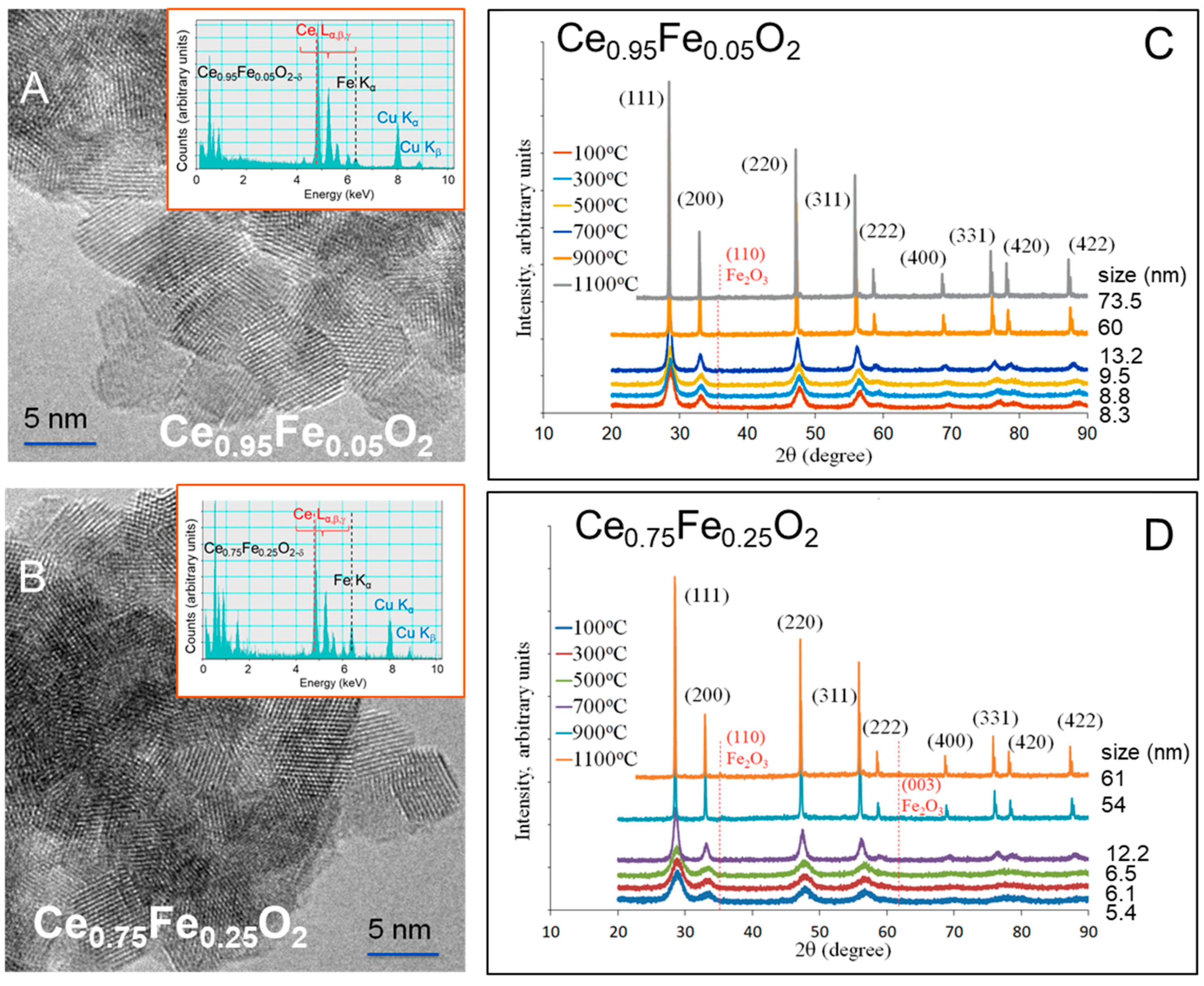
Figure 2.
A. Valence band-XPS (green shaded) and Ce5p, O2s (Blue shaded), and Ce5s of Ce0.75Fe0.25O2 before (0 minute) and after Argon ions sputtering (x minutes). B. Valence band-XPS (green shaded) and Ce5p, O2s (Blue shaded), and Ce5s of Ce0.95Fe0.05O2 before (0 minute) and after Argon ions sputtering (x minutes).
Figure 2.
A. Valence band-XPS (green shaded) and Ce5p, O2s (Blue shaded), and Ce5s of Ce0.75Fe0.25O2 before (0 minute) and after Argon ions sputtering (x minutes). B. Valence band-XPS (green shaded) and Ce5p, O2s (Blue shaded), and Ce5s of Ce0.95Fe0.05O2 before (0 minute) and after Argon ions sputtering (x minutes).
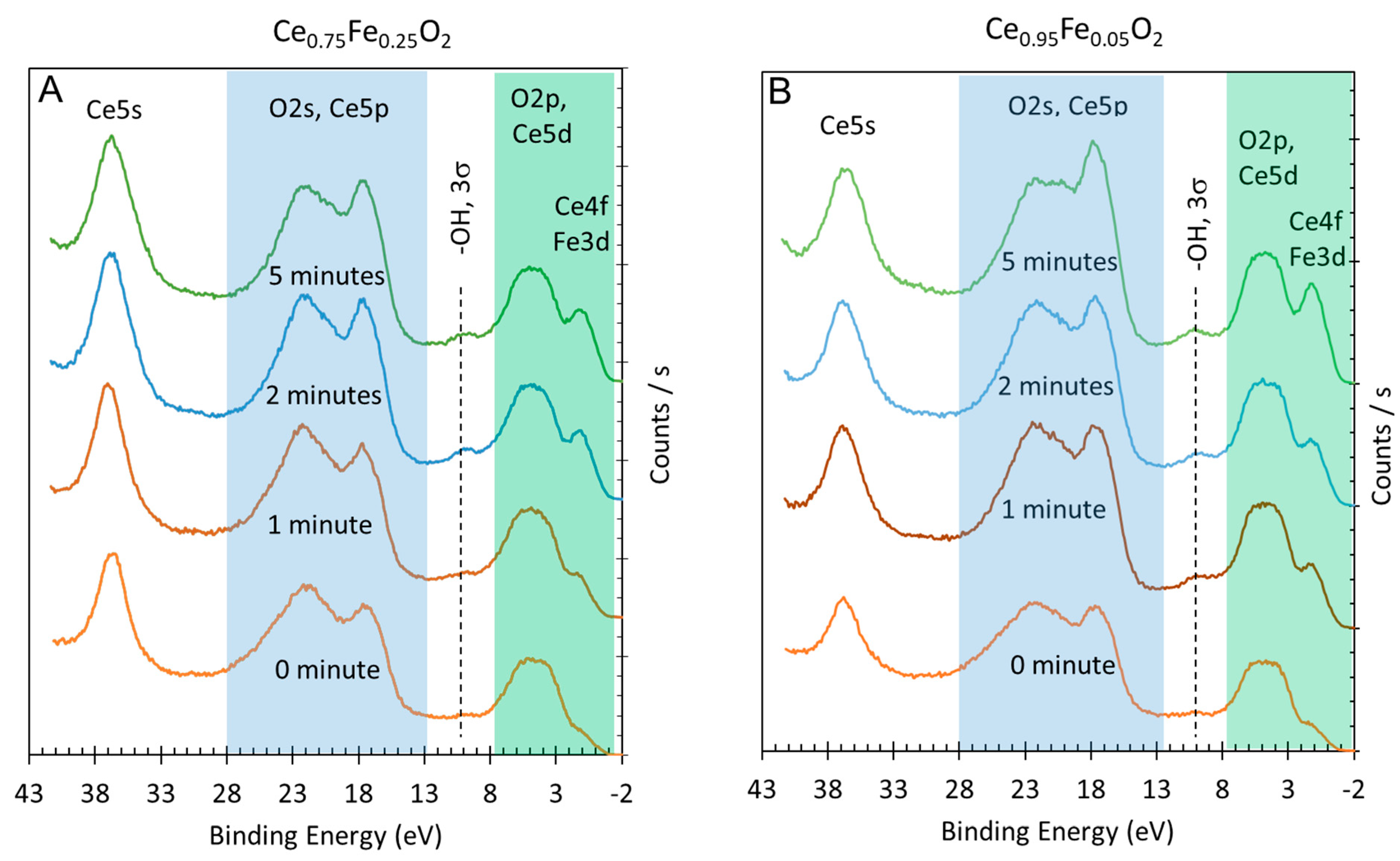
Figure 3.
A. Valence band XPS of as prepared Ce0.75Fe0.25O2 and after 1, 2, and 5-minute Ar ions sputtering. B. Valence band XPS of as prepared Ce0.95Fe0.05O2 and after 1, 2, and 5-minutes Ar ions sputtering. C and D computed peak areas of fitted Ce4f (FWHM = 1.5 eV) and Fe3d (FWHM = 1.5 eV) signals.
Figure 3.
A. Valence band XPS of as prepared Ce0.75Fe0.25O2 and after 1, 2, and 5-minute Ar ions sputtering. B. Valence band XPS of as prepared Ce0.95Fe0.05O2 and after 1, 2, and 5-minutes Ar ions sputtering. C and D computed peak areas of fitted Ce4f (FWHM = 1.5 eV) and Fe3d (FWHM = 1.5 eV) signals.
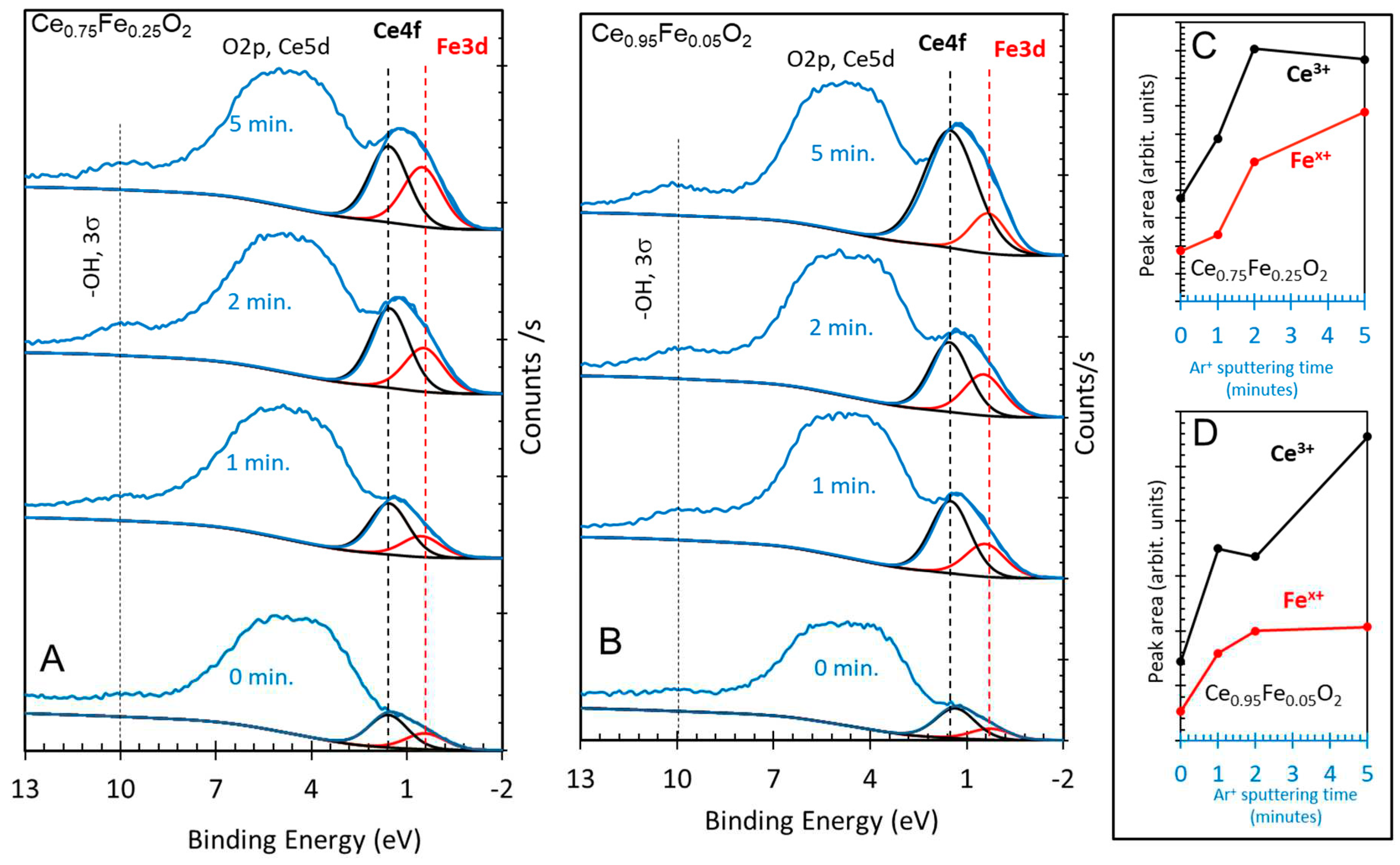
Figure 4.
A. Normalized valence band-XPS and Ce5p, O2s and Ce5s of Ce0.75Fe0.25O2 before (0 minute) and after 5 minutes Argon ions sputtering. B. Normalized valence band-XPS and Ce5p, O2s and Ce5s of Ce0.95Fe0.05O2 before (0 minute) and after 5 minutes Argon ions sputtering. Note the change in intensity of the Ce5p when compared to the O2s.
Figure 4.
A. Normalized valence band-XPS and Ce5p, O2s and Ce5s of Ce0.75Fe0.25O2 before (0 minute) and after 5 minutes Argon ions sputtering. B. Normalized valence band-XPS and Ce5p, O2s and Ce5s of Ce0.95Fe0.05O2 before (0 minute) and after 5 minutes Argon ions sputtering. Note the change in intensity of the Ce5p when compared to the O2s.
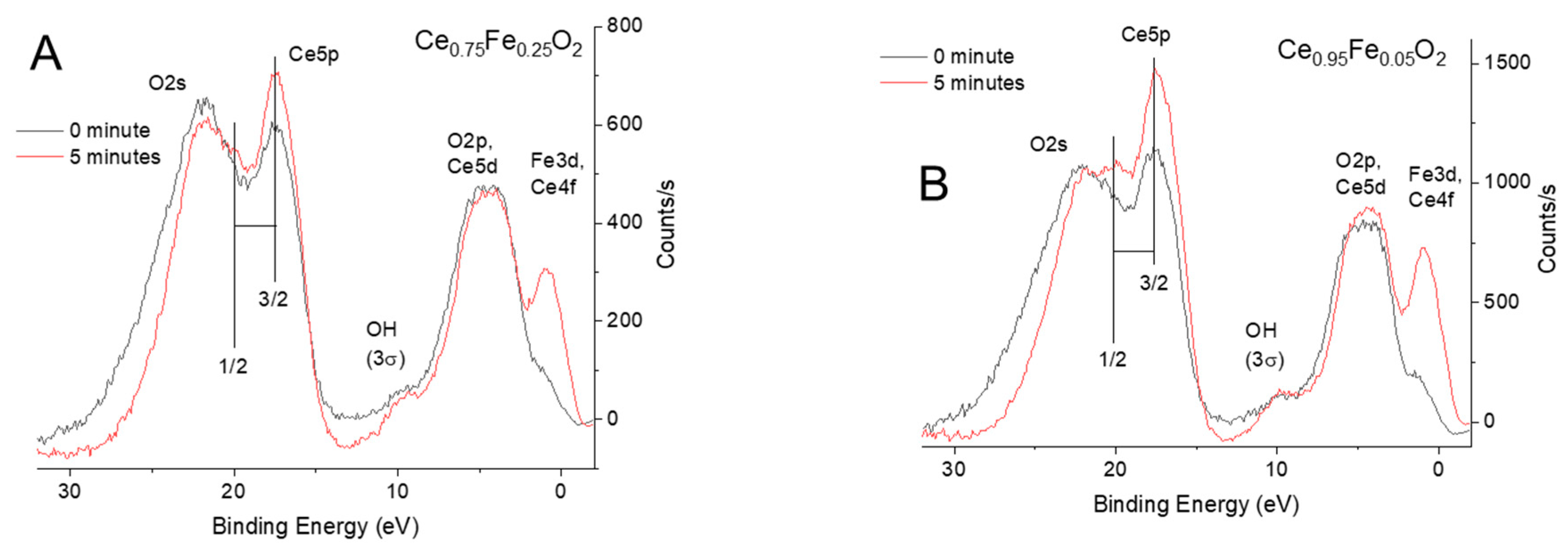
Figure 5.
XPS Ce3d of as prepared CeO2, Ce0.75Fe0.25O2, and Ce0.95Fe0.05O2 and after 5 minutes Ar ions sputtering. Also shown are the computed contribution of Ce3+ and Ce4+ cations.
Figure 5.
XPS Ce3d of as prepared CeO2, Ce0.75Fe0.25O2, and Ce0.95Fe0.05O2 and after 5 minutes Ar ions sputtering. Also shown are the computed contribution of Ce3+ and Ce4+ cations.
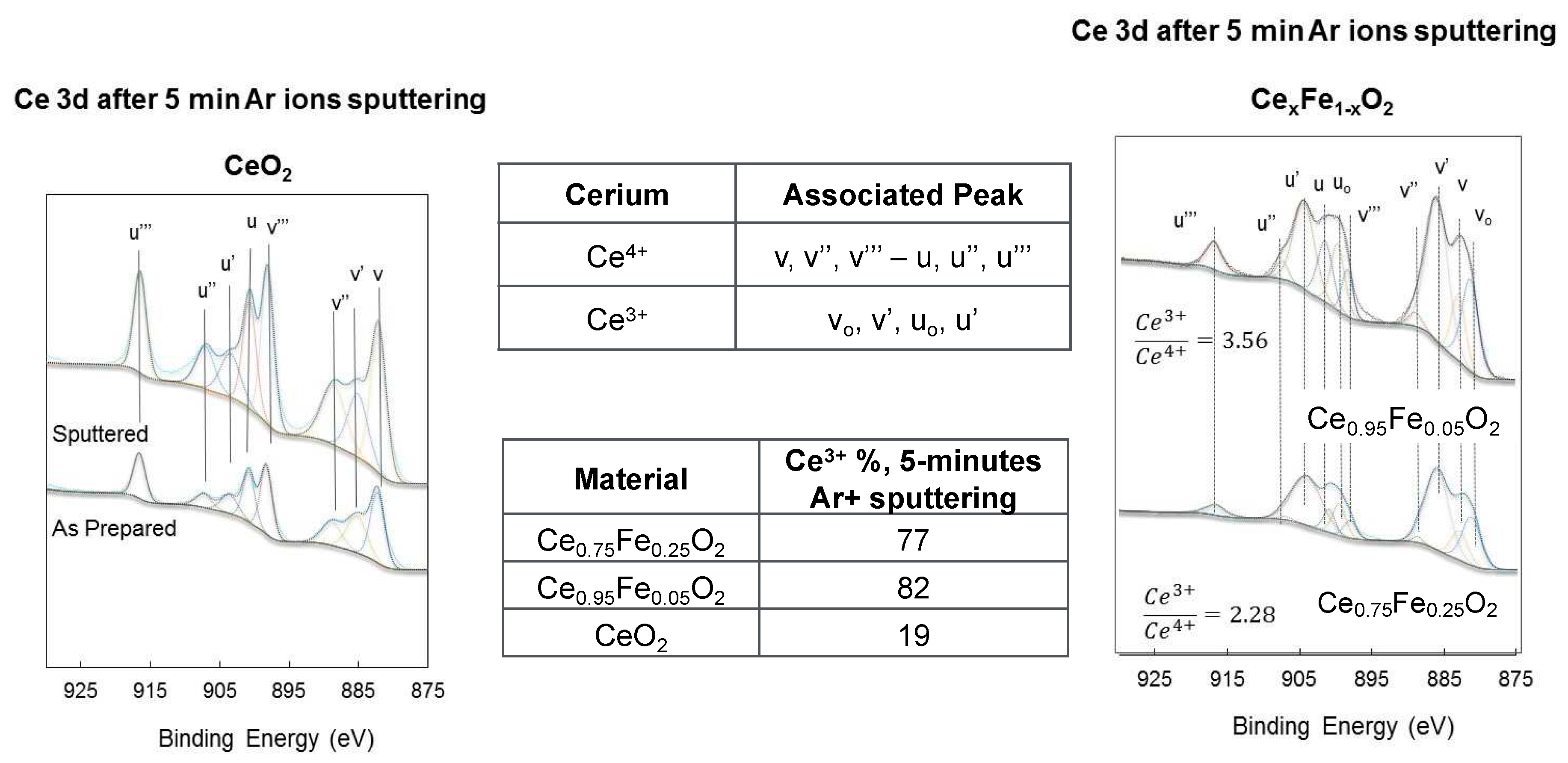
Figure 6.
A. XPS Fe2p of as prepared Ce0.75Fe0.25O2 and after 5-minute Ar ions sputtering. B. XPS Fe2p of as prepared Ce0.95Fe0.05O2 and 5-minute Ar ions sputtering. Insets in A and B: quantitative analysis of XPS Fe2p of Ce0.75Fe0.25O2 and Ce0.95Fe0.05O2 before and after sputtering at the indicated time.
Figure 6.
A. XPS Fe2p of as prepared Ce0.75Fe0.25O2 and after 5-minute Ar ions sputtering. B. XPS Fe2p of as prepared Ce0.95Fe0.05O2 and 5-minute Ar ions sputtering. Insets in A and B: quantitative analysis of XPS Fe2p of Ce0.75Fe0.25O2 and Ce0.95Fe0.05O2 before and after sputtering at the indicated time.
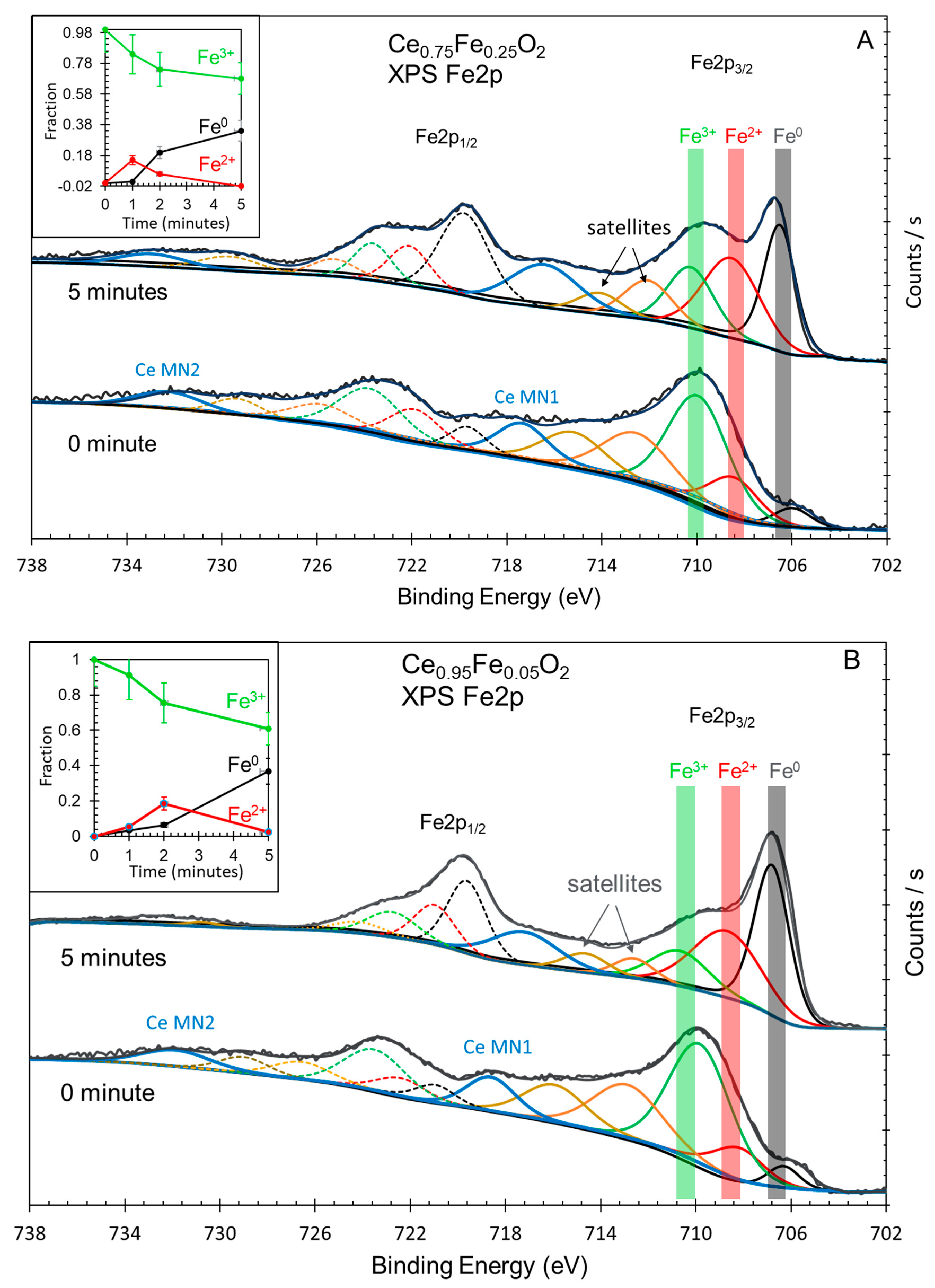
Figure 7.
Hydrogen production from water over CeO2, Ce0.75Fe0.25O2, and Ce0.95Fe0.05O2 that were prior reduced with hydrogen at 700oC at one atmosphere.
Figure 7.
Hydrogen production from water over CeO2, Ce0.75Fe0.25O2, and Ce0.95Fe0.05O2 that were prior reduced with hydrogen at 700oC at one atmosphere.
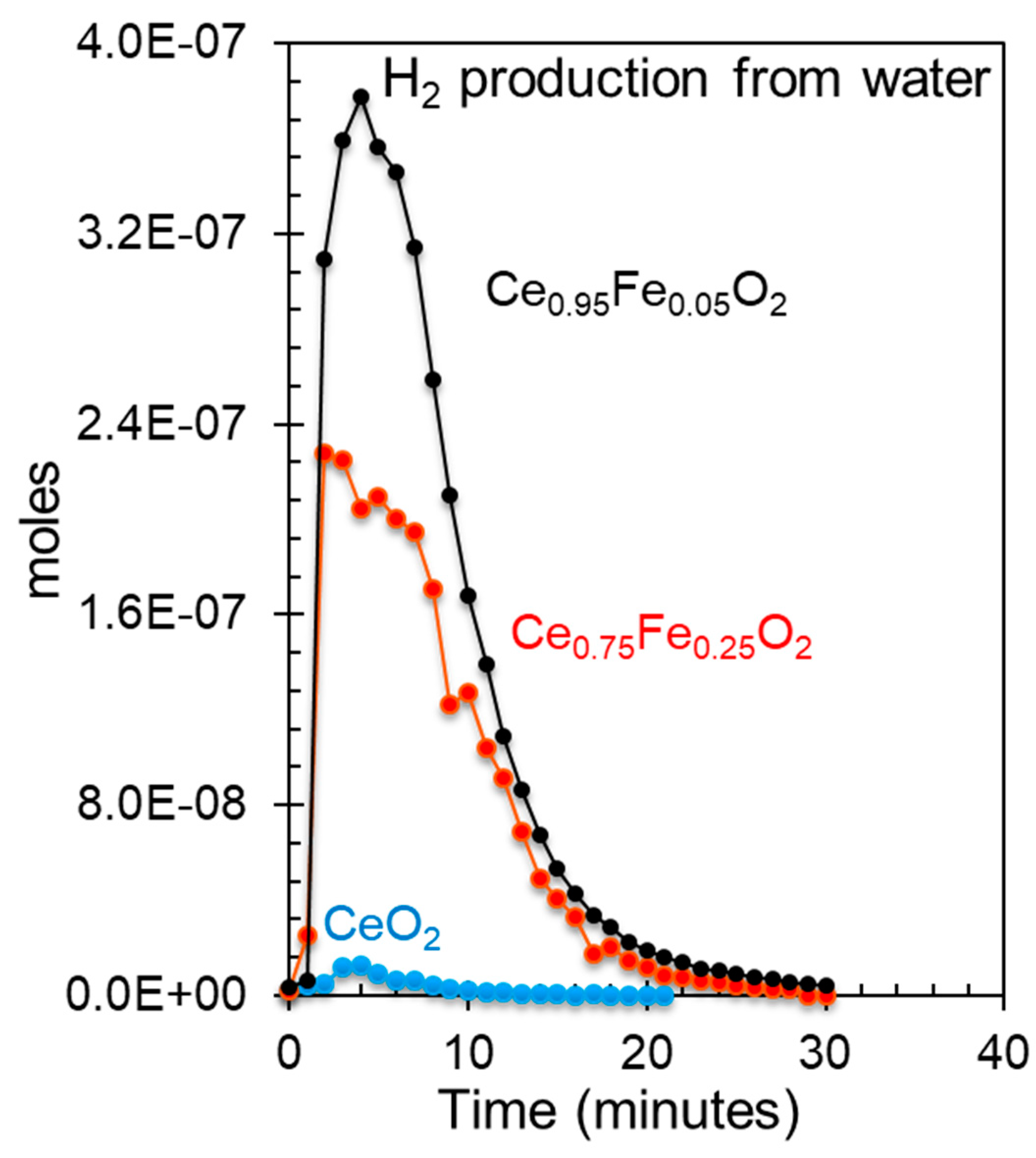

Table 1.
Extracted quantitative values from XPS Ce3d, Ce4f, Ce5p, Fe2p, and thermochemical water splitting to hydrogen over reduced oxides. The XPS data are those for reduced oxides upon 5 minutes of argon ions sputtering. The hydrogen production data are at 700oC under N2 from prior hydrogen-reduced oxides at 700oC.
Table 1.
Extracted quantitative values from XPS Ce3d, Ce4f, Ce5p, Fe2p, and thermochemical water splitting to hydrogen over reduced oxides. The XPS data are those for reduced oxides upon 5 minutes of argon ions sputtering. The hydrogen production data are at 700oC under N2 from prior hydrogen-reduced oxides at 700oC.
| Oxide | Ce3+/Ce4+ Ce3d |
[Ce 4f + Fe 3dx]/O 2p | Fe0/Fe3+ Fe2p |
Ce 5p/O 2s | H2 Production (mol/g) |
|---|---|---|---|---|---|
| CeO2 | 0.2 | - | - | 0 | 0.2 × 10⁻⁶ |
| Ce0.75Fe0.25O2 | 2.3 | 0.3 | 0.5 | 1.6 | 7.4 × 10⁻⁶ |
| Ce0.95Fe0.05O2 | 3.6 | 0.4 | 0.6 | 1.75 | 11.4 × 10⁻⁶ |
Disclaimer/Publisher’s Note: The statements, opinions and data contained in all publications are solely those of the individual author(s) and contributor(s) and not of MDPI and/or the editor(s). MDPI and/or the editor(s) disclaim responsibility for any injury to people or property resulting from any ideas, methods, instructions or products referred to in the content. |
© 2023 by the authors. Licensee MDPI, Basel, Switzerland. This article is an open access article distributed under the terms and conditions of the Creative Commons Attribution (CC BY) license (http://creativecommons.org/licenses/by/4.0/).
Copyright: This open access article is published under a Creative Commons CC BY 4.0 license, which permit the free download, distribution, and reuse, provided that the author and preprint are cited in any reuse.


