

Submitted:
11 December 2023
Posted:
15 December 2023
You are already at the latest version
Abstract
This paper aims to propose improvements for plastic waste management in Salvador – the Brazilian third most populated metropolis – via Partial Least Squares Structural Equation Modeling (PLS-SEM). All indicators, constructs, and hypotheses regarding collection, sorting, recycling, and disposal in the proposed PLS model were derived from the literature review, and the dependence of the performance construct on efficiency, effectiveness, municipality's socioeconomic aspects and municipality infrastructure is evaluated. Academic and practitioner publics were surveyed, and after analysis in both SmartPLS and RStudio software, suggestions for improvement regarding plastics recycling rate, market maturity, and infrastructural aspects for optimized reverse logistics were made. Since almost double the minimum number of respondents answered the survey questionnaire and the PLS-SEM statistics showed that the modeling presents consistency, the discussion is relevant. The model can and will evolve, but examples of suggested improvement are the installation of Deposit-Return Systems (DRS) in parks, streets, and avenues for increasing selective collection and the direct purchasing of waste from residents by municipal administration, compensating them with vouchers for food. The model can be a basis for other cities worldwide sharing analogous characteristics. By considering it, organizations can contribute to both reduced Greenhouse Gas (GHG) emissions and reduced terrestrial pollution.
Keywords:
plastic waste management
; circular economy
; structural equation modeling
; reverse logistics
1. Introduction
Debates surrounding plastics manufacturing and waste management have intensified due to factors such as the increased use of plastics in recent decades and the consequent rise of plastic waste generation [1] (conference paper).
According to the Waste Hierarchy, despite recycling is preferable over landfilling and disposing as Municipal Solid Waste (MSW) management practices in favor of sustainability [2], open dumps continue to be a key waste disposal method in Brazil, being a significant environmental issue [3]. By 2015, 60% of Brazilian municipalities were still utilizing this approach, even after the deadline set by their solid waste policy (PNRS) to close them [4].
This study contributes to the knowledge gap that still exists because there are few studies addressing plastic waste management in a developing country’s metropolis in the Americas [5]. The research questions concern how the management performance can be measured, and what contributes to improving it.
This paper aims to propose improvements for plastic waste management in the Brazilian metropolis of Salvador, which are able to both benefit the local economy and advance in the accomplishment of Sustainable Development Goals (SDGs). In this sense, it approaches indicators regarding collection, sorting, recycling, and disposal methods to increase both efficiency and effectiveness, two factors that contribute to performance [6].
In Salvador, Brazil's third most populated city with 2,418,005 inhabitants [7], 16 operational cooperatives are partnering with Limpurb (the public urban cleaning company) [8]. This metropolis had a low collection rate of recyclables in 2017, which was only 0.49% or 4,300 tons per year out of the 871,395 tons of MSW collected [9]. The recyclable waste was collected by waste pickers' associations with the assistance of the city council.
Although the city council had developed a selective collection program, it faced some challenges in maintaining its operation. In 2019, there were 65 voluntary waste disposal points available to the public, and three cooperatives were responsible for receiving, sorting, weighing, and selling the waste [10]. Based on the most recent data from SNIS (the Brazilian information system on sanitation), 72.8% of the population was served daily by mixed collection service and 27.2% was served two or three times a week by Salvador’s city council in 2021 [11].
The startup So+ma has already set up 12 collection points in Salvador in partnership with the Secretariat for Sustainability and Resilience (Secis), and more than 736 tons of recyclable materials have already been collected between January and November 2022. Through a benefits program, participants exchange recyclable waste for points that enable them to take training courses, exams, and discounts in supermarkets [12].
The paper proceeds with materials and methods (section 2), results (section 3), discussion (section 4) and conclusions (section 5).
2. Materials and Methods
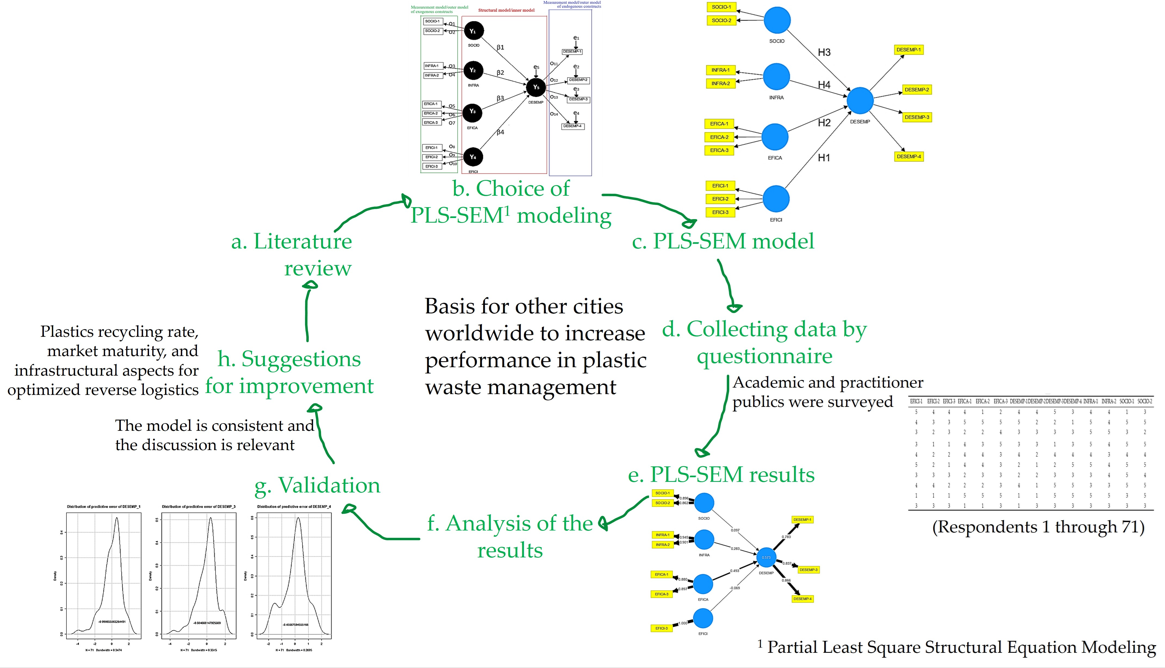
In the literature review, a search was conducted to find publications on successful initiatives in reverse logistics (RL) of plastic waste all over the world, allowing for the consideration of them to propose improvements to the Salvador metropolis. Also, research on the local plastic recycling market and waste management companies was done. Considering the adoption of Partial Least Squares Structural Equation Modeling (PLS-SEM) as the method, the methodology steps – including the ones to be described in the following sections – are shown in a flowchart in Figure 1.
2.1. The choice of the PLS-SEM method for mathematical modeling
Partial Least Squares Structural Equation Modeling (PLS-SEM) is a robust statistical method that facilitates the examination of hypothetical relationships between elements [13]. PLS-SEM can be employed even when the collected data do not exhibit a Normal (Gaussian) distribution and when the sample size is small (N < 100) [14]. Besides, it is adequate for exploratory studies. That is why it was chosen as the method for this research instead of CB-SEM (Covariance-Based Structural Equation Modeling), which demands confirmatory studies, Normal distribution, and large sample sizes (N > 100) [15].
2.2. Specifying the structural model
For modeling plastic waste reverse logistics, four hypotheses (in Table 1) were elaborated based on the literature.
A brief description of the hypotheses is provided below.
- H1: By optimizing collection networks, and recovering value, Reverse Logistics (RL) efficiency is achieved. This can help companies decrease RL costs, reduce expenditures, and improve performance (effectivity) [16]. Increasing efficiency leads to a decrease in both plastic waste and pollution. Besides that, adopting a sustainability system enables industries to access new markets, thus promoting growth in sales and revenues, and consequently, competitive advantage [17].
- H2: The fast handling of collected products, the upgrading of return policies, and the operation of take-back networks enable companies to use the resultant RL effectiveness to strengthen their competitiveness by increasing consumer confidence in both brand and image [16], which improves RL performance. The trained employee demonstrates in a company a positive relation between higher performance and effectiveness [18].
- H3: Socioeconomic aspects comprise not only income and consumption expenses—which are positively correlated with waste generation—but also the Gross Domestic Product (GDP) [14]. Also, there is a relationship between the growth of GDP and the increase in the generation of recyclable MSW [19,20]. It is reasonable to think that the bigger the GDP, the greater the positive influence on the performance of plastics RL if economies of scale are considered.
The performance construct is going to be evaluated concerning its dependence on the other constructs.
2.3. Specifying the measurement model
There are reflective and formative PLS measurement models [15]. The reflective scheme aims to verify whether the model explains the real phenomenon by observation since each construct has a direct arrow to the indicator. The accuracy of the model can be assessed by the measurements extracted by observation [15].
The formative scheme minimizes or maximizes a target construct through the relationships between elements present in the model, with the real measurements (indicators) being used as a driver [15].
In Table 2, each indicator is followed with the corresponding basis from the literature. To construct the structural model, the fourteen indicators were grouped into five constructs. It is worth noting that about the position in the model, an exogenous construct means that it is independent, while an endogenous one is dependent on other constructs.
Remarks from the literature about the indicators are as follows.
EFICI-1. The complexity of plastic packaging shapes contributes to losses in recycling yield after sorting [21]. Manufacturers using less recyclable or poorly designed materials should pay higher environmental fees [22].
EFICI-2. The diversity of materials in various plastic layers leads to losses in recycling yield [21].
EFICI-3. Post-consumer packaging contaminated with food causes losses in recycling yield [21]. Proper separation and clean disposal of plastics by the population are crucial as the steps before mechanical recycling (the most commonly performed) involve separation, sorting, baling, washing, grinding, composting, and palletizing [17]. Pre-treatment may also be required to remove food residues, for example in yogurt packaging made of HDPE and margarine packaging made of PP [24].
EFICA-1. Environmental concerns, economic gains, and government regulations drive reverse logistics (RL) implementation in the plastic manufacturing industry [25]. Global worries about the future of the Earth and highs in oil prices, such as those observed during the COVID-19 pandemic, elevate the demand for recycled products [26].
EFICA-2. The projection of the plastic waste market and the adoption of biodegradable materials to replace conventional plastics can increase the value of plastic waste [27].
EFICA-3. Economically viable sorting and mechanical recycling of new polymers require scale-up in volumes. As the scale of recycling operations increases, the economics of recycled plastics become more analogous to those of virgin plastics [19].
DESEMP-1. A combination of a high collection rate (83%) with improved recyclability of plastic polymers was found to be the only situation in which the recycling rate reached the European Union's 55% target for 2030 [22,28].
DESEMP-2. The use of WtE (Waste-to-Energy) facilities reduces both landfill and open dumps usage and encourages better recycling and MSW (Municipal Solid Waste) management practices in communities nearby, which are more likely to be informed and progressive. As cities with WtE facilities handle the MSW stream more often, they have greater options for recycling. Besides, on-site materials recovery at the WtE plant can be combined with a municipal recycling program [29].
DESEMP-3. When 40 management scenarios of Extended Producer Responsibility (EPR) on plastic packaging waste generated by Italian households were considered, the likelihood of each polymer being profitable was calculated. Recycling clear and light-blue HDPE, PET, and PP was profitable above 90% of cases; but mixed-color PET was only 35% of cases [22]. Economic factors are one of the motivating drivers of reverse logistics because of the potential for profits through recycling and the reduction of costs related to raw materials [30]. Minimizing environmental pollution and enhancing industry profits can come true due to an environmentally friendly waste management system [24].
DESEMP-4. High-tech Material Recovery Facilities (MRFs) utilize advanced technologies, such as eddy currents, magnetic pulleys, optical sensors, and air classifiers, to quicken the separation of unsorted recyclables [31]. Tracer-Based Sorting (TBS) has the potential to make some sorting and recycling steps obsolete, which can support sustainability and a better circular economy for plastics [32].
INFRA-1. In Brazil, the percentage of Plastic Packaging Waste (PPW) recovered in selective MSW collection (14.4%) was nearly double that of mixed collection (7.3%) in 2017 [33].
INFRA-2. DRSs, as implemented in Sweden, Denmark, and Norway, involve consumers paying an extra deposit because of the packaging when purchasing a drink, and they get a refund upon returning an empty bottle. These systems have achieved remarkable success with recycling rates between 85% and 95% of the bottles collected by them [34].
SOCIO-1. In the case of Brazil, for example, although some governments have implemented public policies to overcome the marginalization of waste pickers, there are still many people working in the informal collection. The socio-productive inclusion of waste pickers in management systems is fundamental, given that informal collection was 24% higher than the formal selective collection of plastics [33].
SOCIO-2. Das et al. [35] proposed an optimal MSW collection and transportation scheme that minimized the total path length. It was reduced by more than 30% due to the fact of reaching still as many inhabitants but at shorter distances.
2.4. The choice for the reflective measurement model
A reflective measurement model allows for finding causality flows stemming from the construct to indicators [15]. Reflective indicators can be regarded as a representative subset of all potential items within the conceptual domain of the construct [15].
Indicators linked to a specific reflective construct should exhibit a high degree of correlation among themselves and be interchangeable. It is acceptable to exclude any single item without modifying the construct's intended meaning, provided that adequate reliability is maintained.
Figure 2 illustrates this kind of model, with constructs (Y1 to Y5) represented as circles and indicators as rectangles. Error terms (e1 to e4) concerning DESEMP-1, DESEMP-2, DESEMP-3, and DESEMP-4 indicators indirectly impact the endogenous construct. The structural model includes the error term e5 concerning the Y5 endogenous construct [15]. Each outer loading is represented by oi and each path coefficient is βi [15].
The reflective structure proposed is shown in Figure 3, with indicators in rectangles and constructs in circles.
2.5. Data collection, Exploratory Factor Analysis, and the parameters for the algorithm run
The numerical scale for the survey, as well as aspects of the respondent public and the sample size, are discussed in this subsection.
The adoption of a numerical scale for answer options was needed to facilitate quantitative measurement with greater accuracy of non-metric answers. Employing a 5-point response option offers benefits in comparison to utilizing a 3-point response category, like a higher variance explained (42.9%) than the 3-point (31.1%) and the 7-point (41.5%) in an empirical study [36]. Also, it doesn't present a significant drawback in terms of reliability when contrasted with the 7-point version. Mirahmadizadeh [37] affirm in a review article that among 60 articles examined, the 5-point scale is the most common. Thus, the 5-point Likert Scale was adopted in the present study.
The electronically delivered survey (Table A1) collected opinions about the degree of influence of each indicator on the performance of collection, sorting, recycling, and return to the plastics market in Salvador. Electricity generation through Waste-to-Energy was considered when recycling was not possible.
For the "10-times rule", the smallest number of respondents should be equal to ten times the largest number of structural paths directed at a construct [38], then 10 x 4 = 40. However, 71 people among the academic and practitioner publics accepted to answer. A hundred invitations were sent.
The data collected from the respondents are shown in Table A2. Available answer options ranged from 1 to 5 regarding the degree of influence with which the evaluated indicator positively influenced the performance of plastic waste reverse logistics.
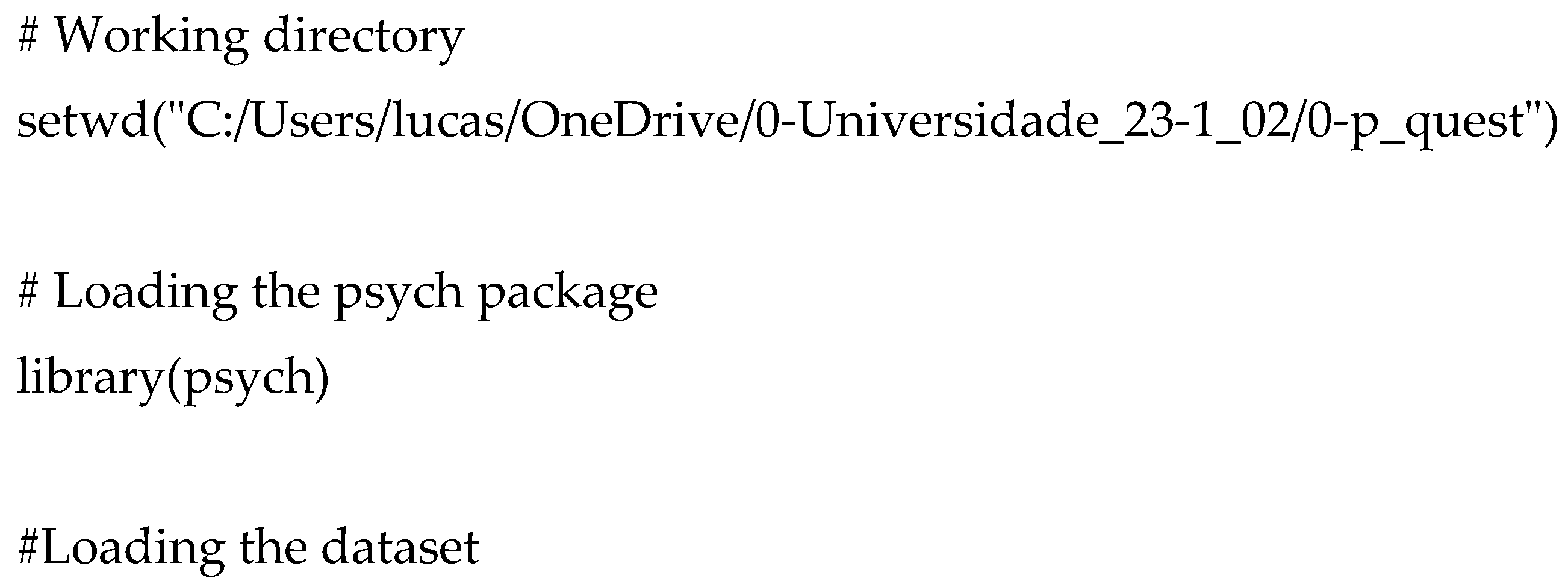
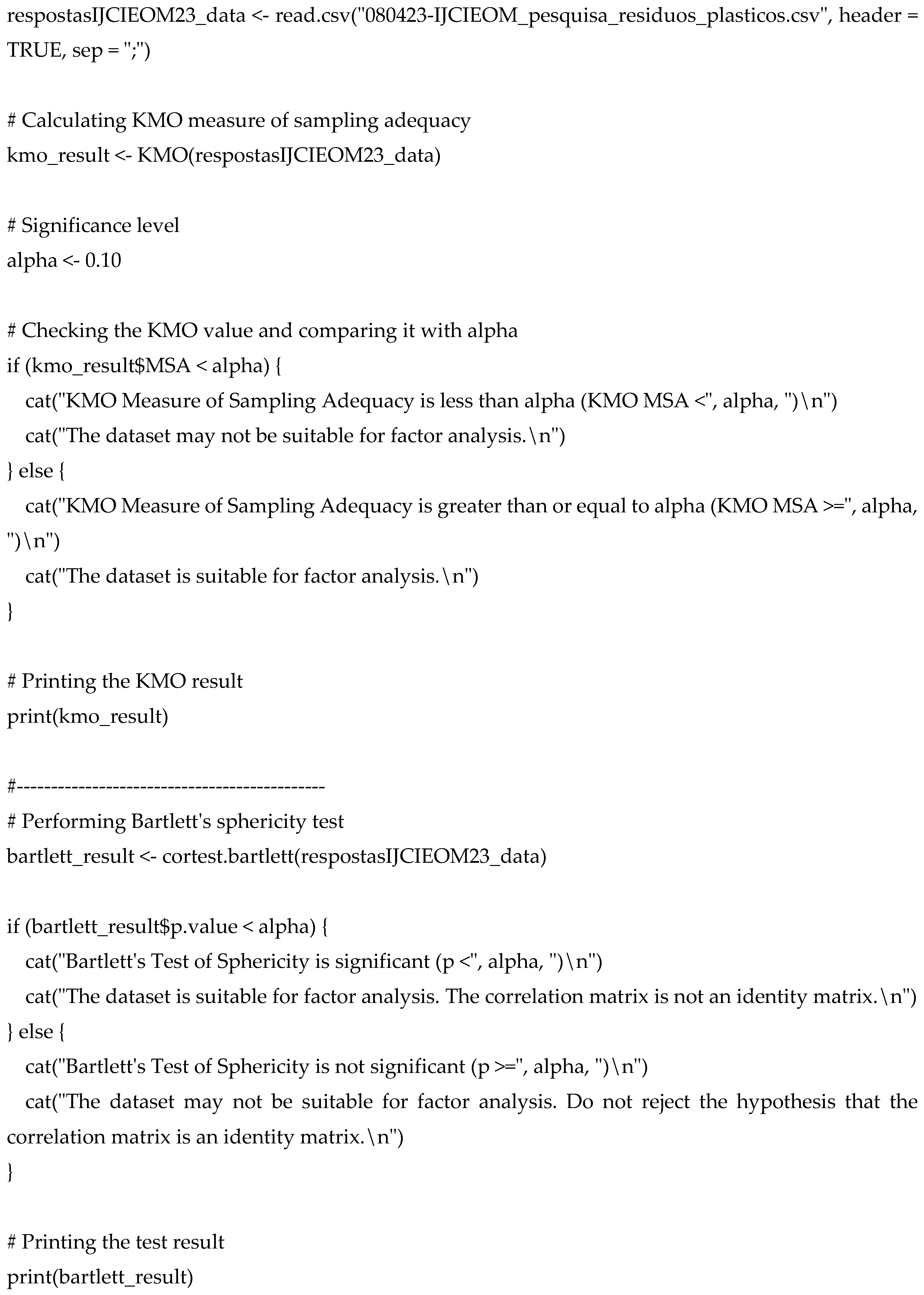
The Kaiser-Meyer-Olkin (KMO) test was run using the KMO command from the psych library in RStudio software to measure the dataset adequacy for sampling [39,40,41]. It yielded a result of 0.738, which was greater than the significance level of 0.10 for exploratory studies [15], and then the dataset is suitable for factor analysis.
With the same library but the cortest.bartlett command, the Bartlett's test of sphericity was conducted to assess their suitability for factor analysis [42]. As p_value resulted in 1.926x10-43, it demonstrated significance (p_value < significance level), with chi-squared yielding 418.278, and 91 degrees of freedom. The R code that performed both tests is in Appendix A
These two preliminary findings in the Exploratory Factor Analysis affirm that the dataset was both sufficient and appropriate for conducting factor analysis, which is done in section 3.
The default estimation parameters of the SmartPLS 4 software were kept: all weights as 1.0; the maximum number of iterations as 300; stop criterion as 10-7; no use of the Lohmoeller settings; and path as the weighting scheme.
3. Results of the PLS-SEM path model estimation
The PLS-SEM results are discussed in the following subsections.
3.1. Assessing the initial PLS-SEM results
A screenshot of the path coefficients and the outer loadings after the initial execution of the PLS-SEM algorithm is shown in Figure 4. The thickness of the arrows is given by relative values. Indicators are in yellow, and constructs are in blue.
Concerning Outer Loading measurements associated with the indicators, it is recommended that they should be at least 0.708 but below 0.95, above of which would suggest redundancy and thus diminish construct validity [15].
The four indicators whose outer loadings were below the threshold were removed and the algorithm was run again. They were EFICI-1 (0.645), EFICI-2 (0.529), EFICA-2 (0.675), and DESEMP-2 (0.396). The other ten outer indicators, which outer loadings yielded above 0.708, were held because of their high significance for the model [1]. Figure 5 shows the new path coefficients and outer loadings after the second algorithm run.
3.2. Assessing PLS-SEM results of the reflective measurement model
No collinearity problem concerning the outer model was detected. The VIF (Variance Inflation Factor) values ranged 1.000–2.013. Only values of 5.000 or above would indicate a problem [15].
For the assessment of Internal Consistency, three criteria must be met. First, each Cronbach's Alpha (CA) measurement should fall above 0.7 but below 0.95. Second, Composite Reliability (CR) measurements should exceed 0.7. Third, rho_A, which offers an average value between CA and CR, should be greater than 0.7 [15].
3.3. Assessing PLS-SEM results of the structural model
Concerning the assessment of Discriminant Validity, three criteria are considered. First, no cross-loadings (correlations) with other constructs should be higher or equal to an indicator's outer loading with its construct. Second, the square root of each construct's AVE should exceed its highest correlation with any other construct, according to the Fornell-Larcker criterion [43,44]. Lastly, the Heterotrait-Monotrait Ratio (HTMT) of the correlations, representing the ratio of between-trait correlations to within-trait correlations, should be below 0.90, but below 0.85 is allowed in cases where constructs are highly conceptually distinctive in the path model [45].
HTMT requires the Bootstrapping procedure, which assesses the significance of statistics yielded by the PLS-SEM and finds out if any unsupported relations exist when the dataset cannot be guaranteed to follow a Normal (Gaussian) distribution pattern.
Considering 14 questions answered by each of the 71 respondents, 994 was the total number of answers. The average option did not concentrate most of the occurrences, as the distribution was: alternative 1 (10.3%), alternative 2 (13.7%), alternative 3 (22.8%), alternative 4 (20.4%), and alternative 5 (32.8%).
The number of bootstrapping samples should be high and at least equal to the number of observations. Each sample from the total of 5000 (SmartPLS 4 default value) contained 71 observations. Thus, 5000 structural models via PLS-SEM were estimated. The confidence interval method was Bias-corrected and accelerated bootstrap, and the test type was Two-tailed with a significance level of 0.10 supported by [15]. Table 4 shows all the values.
In the inner model, there were also no collinearity problems. VIF values ranged 1.181–1.576. None was 5.000 or above [15].
The Coefficient of Determination (R²) assesses the explained variance in dependent (endogenous) constructs caused by all independent (exogenous) constructs. As a guideline, substantial, moderate, or weak predictive accuracy are respectively indicated by the R² values of 0.75, 0.50, or 0.25 [15]. For the Performance endogenous construct, it yielded 0.573 for the Original R2, and 0.606 for the Sample Mean R2 from bootstrapping.
Path coefficients (β) play a pivotal role in the evaluation of causal connections between constructs. Path coefficients below 0.10 are not considered statistically significant, while those exceeding 0.20 are typically significant. It is important to note that, at a 10% significance level, the t-value should exceed 1.65 for a Two-tailed test, as stipulated by [15].
For assessing the effect of excluding an exogenous construct from the model, the use of Effect size (f²) is necessary, as proposed by [46]. The measurement for each construct can result in small, medium, or large effect sizes, respectively indicated by values around 0.02, 0.15, and 0.35 [15,38].
Table 5 shows all the values, being the Sample mean computed considering all the 5000 bootstrapping samples.
According to Table 5, all exogenous constructs on the left showed a positive influence on Performance, except Efficiency. The negative sign in the path coefficient for EFICI is an undesired consequence of a mistake. This is explained because its remaining indicator, EFICI-3-variability (impurity), has meaning in itself not beneficial for the RL performance in the respondents' opinions as if it were a matter of inefficiency instead of efficiency.
The reader, if they want, is free to think that if Inefficiency obtained a coefficient of -0.072, then the correspondence for Efficiency is 0.072. Thus, the purity in the waste must favor performance [1]. Similarly, the hypothesis would not be supported, and the indicator’ inherent meaning should be corrected for broader versions of this research in the future.
The hypotheses H2 and H4 – respectively the direct correlation of the EFICA construct on Performance, and the direct correlation of the INFRA construct on Performance – were supported. H3, related to municipality's socioeconomic aspects, could be supported because of its sample mean β of 0.100, but the original β is 0.097 and the t-value is below the threshold. Socioeconomic issues divide opinions and may need a better specification of indicators for conclusive findings.
The endogenous construct Performance (DESEMP), in this study, should be calculated using Equation 1, considering the noise ζ treated in it.
DESEMP = 0.286 INFRA + 0.492 EFICA + ζ
The higher the value of the non-metric construct DESEMP, the better the outcome for the performance of plastics reverse logistics [1].
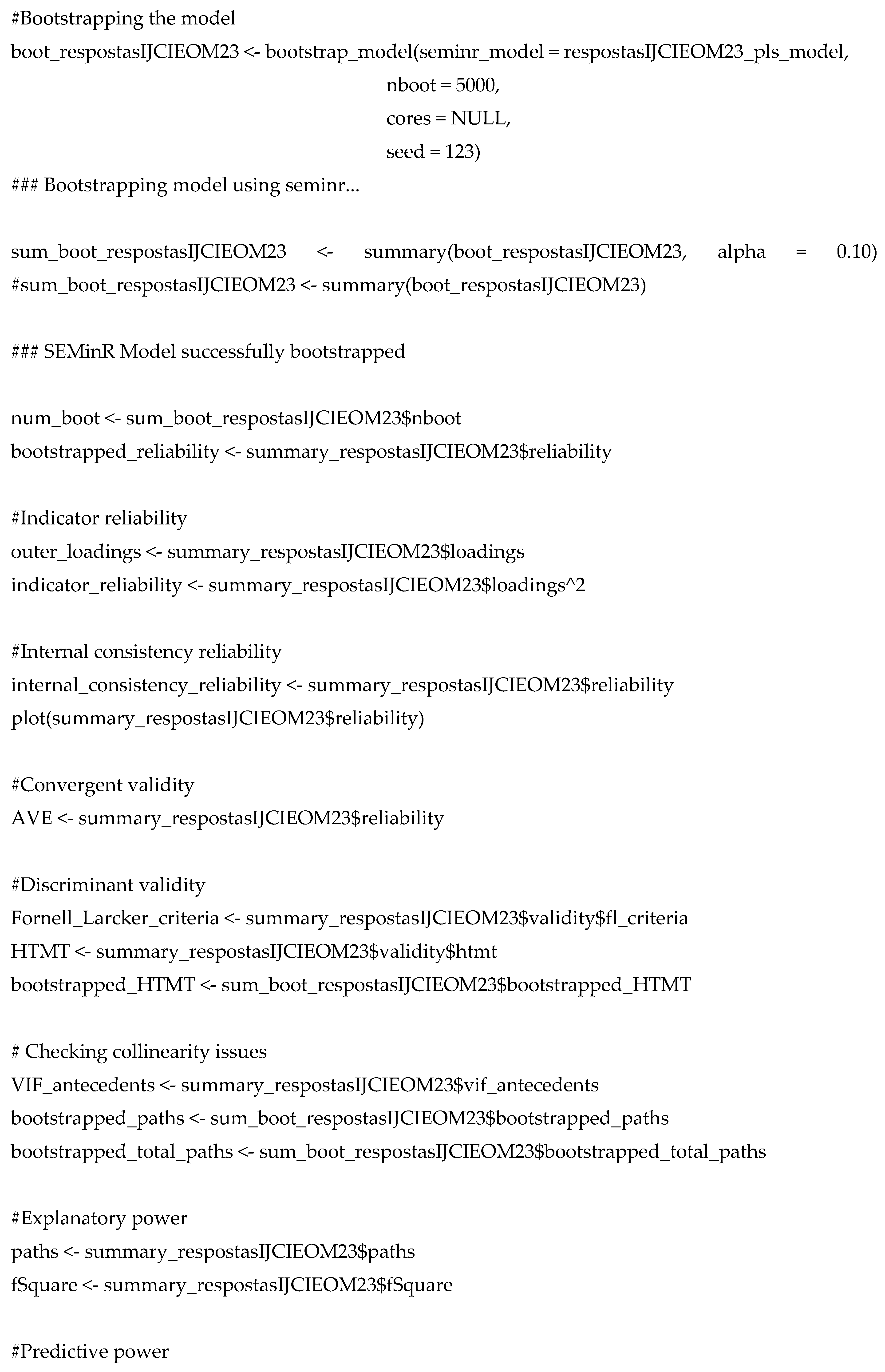
The Q2, also known as Predictive Relevance or Out-of-Sample Predictive Power, measures how well the path model can predict the original values in the dataset. The effect size (q2) compares the relative impact of the constructs’ predictive relevance [15]. Q² and q² could not be measured in SmartPLS 4 because they are not available in the free version that the authors were able to access until the conclusion of this exploratory study. Instead, R language in RStudio was used.
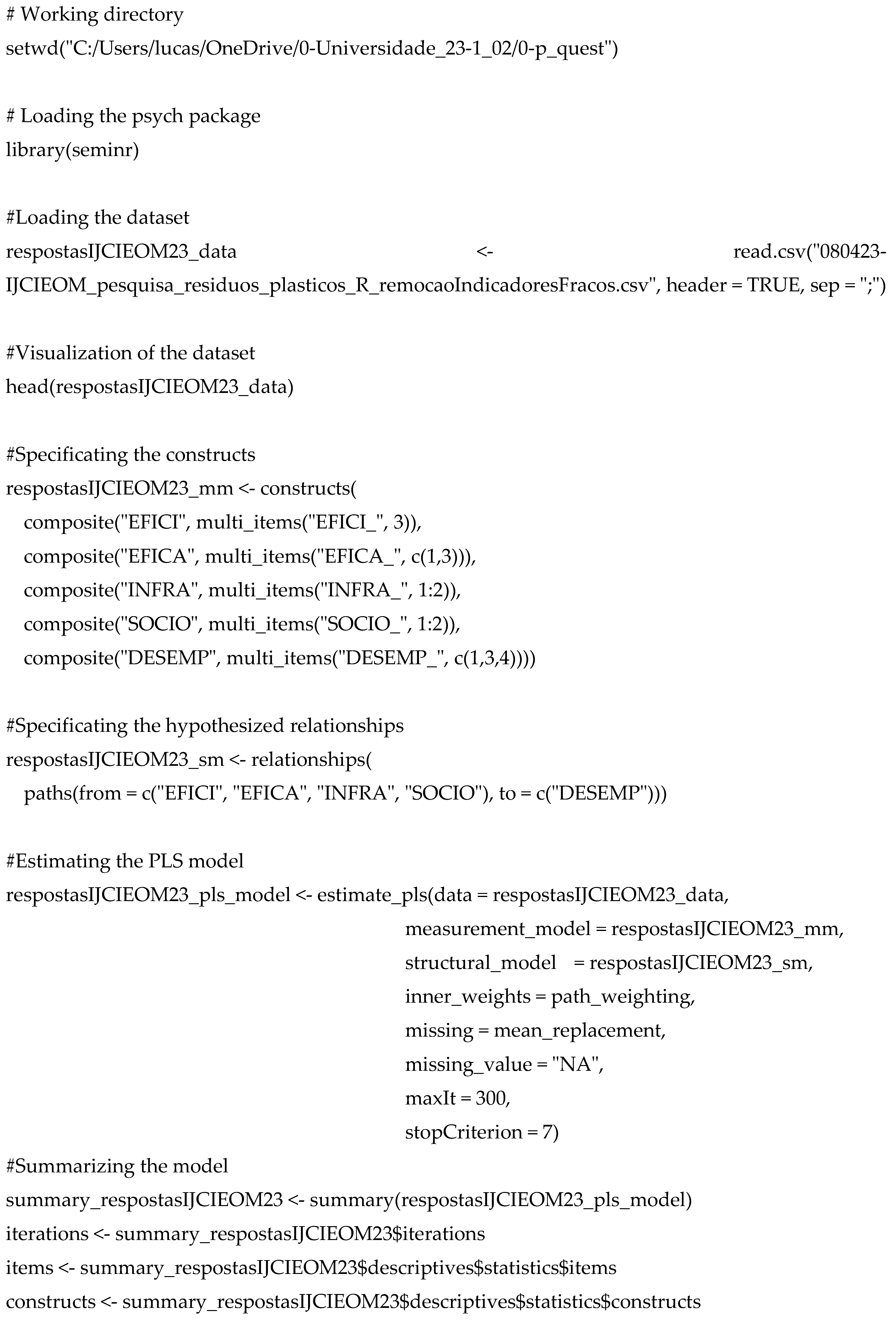
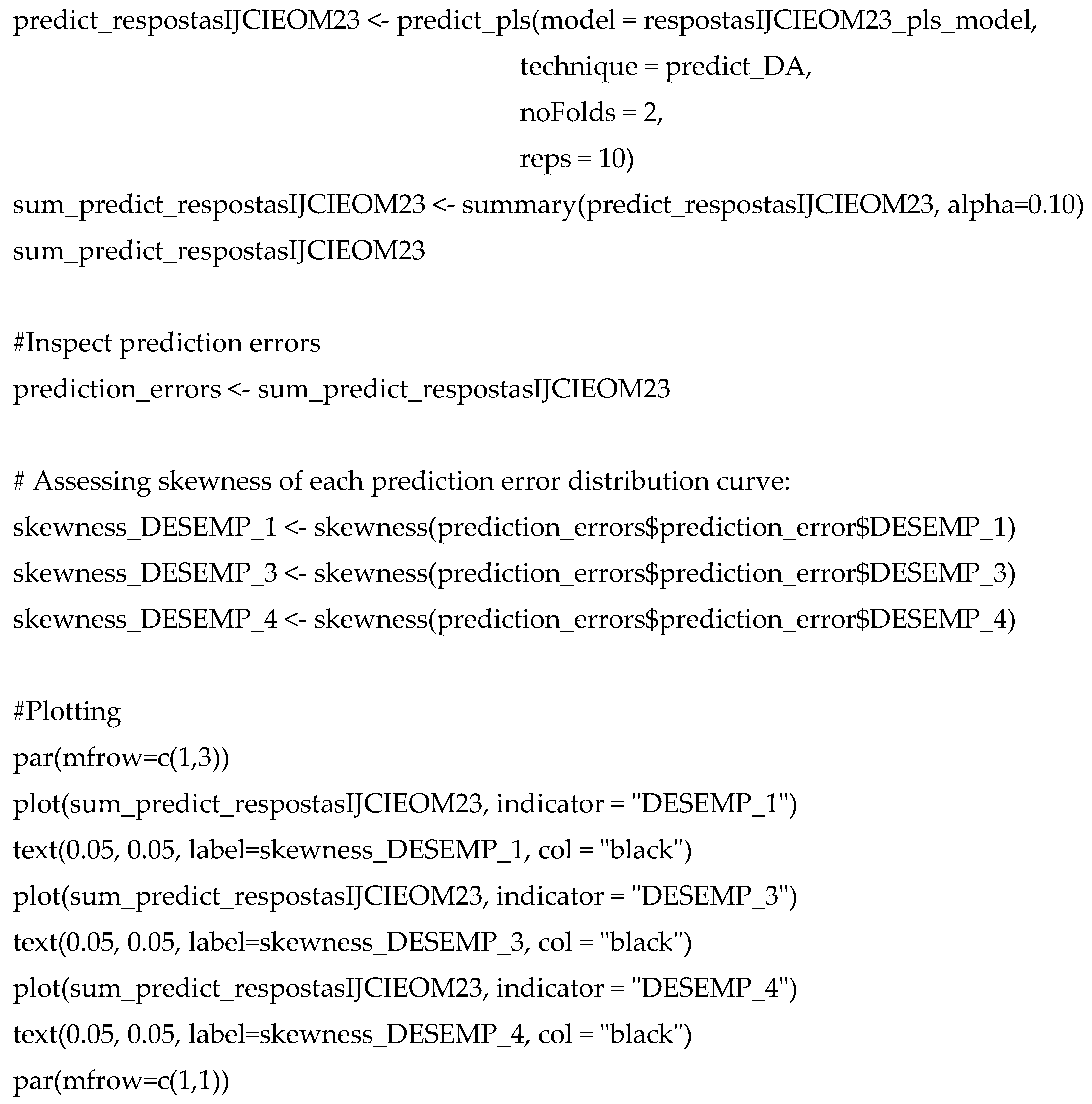
R’s seminr library also allows for creating and estimating structural equation models through the command predict_pls. It does not directly calculate Q² and q² values, but as an alternative approach, it employs both Mean Absolute Error (MAE) and Root Mean Square Error (RMSE) predictive statistics. Figure 6 shows the distribution of prediction errors after running the R code (Appendix D).
In addition, Shmueli et al. [47] recommend using a linear regression model (LM) to generate predictions to the observed variables. As Figure 6 shows, all the skewness printed in the plotting falls between −1 and +1, considered excellent [15]. Since no curve is significantly skewed, RMSE should be preferred over MAE in the evaluation [48]. Table 6 shows these values.
There is medium predictive power of the supported hypotheses in predicting the DESEMP construct score, according to criteria by Danks and Ray [49], because most of the three indicators, exactly two, in the PLS out-of-sample metrics demonstrate lower RMSE values compared to those in LM out-of-sample metrics.
Only the supported hypotheses are considered in the discussion to suggest improvements for plastic waste management.
4. Discussion
Since almost double the minimum number of respondents answered the questionnaire and the statistics displayed by SmartPLS 4 showed that the model presents consistency, the discussion is relevant. The suggestions were divided into the following matters: recycling rate, market maturity, and infrastructural aspects [1].
The plastics recycling rate influences the reverse logistics performance. Materials to increase the recycling rate should be considered in industrial production, namely crystallized PET (Polyethylene Terephthalate), odor-free recyclable plastic, and fluorescent markers for improving sorting [19].
The maturity of the plastics waste market makes it more prone to invest in sorting technologies. It also makes it possible to work with a greater volume of plastics due to the increase in capacity arising from the investment, which allows for greater profitability.
The installation of Deposit-Return Systems (DRS) should be considered in parks, streets, and avenues to increase plastic recycling and render optimal MSW collection and transportation of recyclable plastic waste that minimize the total path length.
It is also important to take into account factors that contributed to Curitiba and Brasília emerging as the leading Brazilian states' capitals in matters of recyclable waste management. In Table A3, these two cities show the most beneficial overall numbers across all four aspects regarding selective collection (INFRA-1 indicator with 0.945 of outer loading). While the intention was to comprise all the states' capitals, some of them did not measure the data for at least one of the aspects. This is the situation of Salvador, where the corresponding fields in the original table from SNIS appear empty. That is the reason why it was not included in Table A3.
Rehman et al. [50] emphasized that Curitiba's municipal administration directly purchases waste from residents, compensating them with vouchers that can subsequently be redeemed for food. This approach has led to increased public engagement, a substantial reduction in improper waste disposal on the streets, and an expansion of the waste market.
Regarding Brasília, the door-to-door collection system has yielded an impressive municipal solid waste collection rate of 98% [51]. Brasília also stands out in environmental education. Online educational resources cover topics such as selective collection of waste, responsible waste disposal, and specialized waste collection kits for residential complexes. Additionally, the Museu de Limpeza Urbana (free entrance) serves as an educational hub, exposing knowledge about appropriate waste management practices, recycling procedures, and composting techniques.
5. Conclusions
Plastic waste companies that improve their performance in reverse logistics achieve optimized recycling productivity. Although the model was developed regarding the infrastructural and socioeconomic issues of the Brazilian metropolis of Salvador, the model can be a basis – which may require adaptations – for other cities worldwide sharing analogous characteristics.
As methodological contribution, this paper uses PLS-SEM for analyzing relationships between variables in plastic waste management, which might be of interest to researchers seeking new ways to analyze data. Additionally, this paper offers practical insights, which can benefit industry, plastic recycling providers, and local governments. The paper's findings include the identification of factors that influence plastic waste management and the development of a model explaining the relationships between these factors. By considering it, organizations can contribute to both reduced greenhouse gas emissions and reduced terrestrial pollution.
The opportunities offered by Reverse Logistics should lend support to reduce waste mismanagement and advance Circular Economy principles to be implemented by, for example, small and medium-sized enterprises (SMEs) that can align their business models accordingly in the design [52].
Budget planning for medium- and long-term public policies must be more assertive if the model is improved with a larger sample size to gather more indicators, constructs, and hypotheses in a broader version of this study with a more comprehensive literature review, such as the one conducted by [53]. They identified highly influential studies and generative and evolutionary research clusters through the utilization of bibliometric methods.
As future research, when taken into account the limitations of the current version, the questions related to each indicator should be inherently neutral and the model should be more complex, involving additional constructs of management factors, operation, and issues related to energy and environment, concerning life cycle [54]. Also, the strengthening of the results of Salvador’s waste pickers should be addressed even if socioeconomic issues need a better specification of indicators for conclusive findings.
Author Contributions
Conceptualization, F.F. and L.P.; methodology, F.F. and L.P.; software, L.P.; validation, F.F. and L.P.; formal analysis, F.F. and V.R.; investigation, L.P.; resources, L.P.; data curation, L.P.; writing—original draft preparation, F.F., L.P and V.R.; writing—review and editing, F.F., L.P. and V.R.; visualization, L.P. and V.R.; supervision, F.F.; project administration, F.F. All authors have read and agreed to the published version of the manuscript.
Funding
This research received no external funding.
Informed Consent Statement
Informed consent was obtained from all subjects involved in the study. Written informed consent has been obtained from the patient(s) to publish this paper.
Data Availability Statement
The data presented in this study are available in Appendices A, B, C, D and E.
Acknowledgments
We thank Programa de Pós-Graduação em Engenharia Industrial (PEI) for hosting the main author’s current master studies that are going to materialize into new papers.
Conflicts of Interest
The authors declare no conflict of interest.
Appendix A. R code to perform KMO and Bartlett’s tests.
Appendix B

Table A1.
The questionnaire that was electronically delivered to the respondents.
| Part 1 - Efficiency in Reverse Logistics, i.e., fast with less spending of resources. | |||||
| No. 1) High complexity of shape and size of plastic waste. | ○ 1-Very bad influence on RL performance | ○ 2 | ○ 3 | ○ 4 | ○ 5-Very good influence on RL performance. |
| No. 2) Working with varieties of plastic waste (e.g.: PET, HDPE, LDPE, PP, PVC, PS) at the same plant facility. | ○ 1-Very bad influence on RL performance. | ○ 2 | ○ 3 | ○ 4 | ○ 5-Very good influence on RL performance. |
| No. 3) High variability in plastic waste, i.e., the opposite of purity. | ○ 1-Very bad influence on RL performance. | ○ 2 | ○ 3 | ○ 4 | ○ 5-Very good influence on RL performance. |
| Part 2 - Effectiveness in Reverse Logistics, i.e., solving the logistics with better safety and better quality. | |||||
| No. 4) Maturity of the plastic waste market. | ○ 1-Very low influence on RL performance. | ○ 2 | ○ 3 | ○ 4 | ○ 5-Very high influence on RL performance. |
| No. 5) Value of plastic waste. | ○ 1-Very low influence on RL performance. | ○ 2 | ○ 3 | ○ 4 | ○ 5-Very high influence on RL performance. |
| No. 6) Volume of plastic waste processing. | ○ 1-Very low influence on RL performance. | ○ 2 | ○ 3 | ○ 4 | ○ 5-Very high influence on RL performance. |
| Part 3 - Performance in Reverse Logistics. | |||||
| No. 7) High recycling rate of plastic waste. | ○ 1-Very bad influence on RL performance. | ○ 2 | ○ 3 | ○ 4 | ○ 5-Very good influence on RL performance. |
| No. 8) High thermochemical conversion rate (for plastics that cannot be recycled but only incinerated). | ○ 1-Very bad influence on RL performance. | ○ 2 | ○ 3 | ○ 4 | ○ 5-Very good influence on RL performance. |
| No. 9) High profitability of the plastic waste business. | ○ 1-Very bad influence on RL performance. | ○ 2 | ○ 3 | ○ 4 | ○ 5-Very good influence on RL performance. |
| No. 10) Availability of plastics sorting technologies (e.g.: automated sorting machines). | ○ 1-Very bad influence on RL performance. | ○ 2 | ○ 3 | ○ 4 | ○ 5-Very good influence on RL performance. |
| Part 4 - Infrastructure of the Municipality | |||||
| No. 11) Availability of selective collection in the municipality. | ○ 1-Very bad influence on RL performance | ○ 2 | ○ 3 | ○ 4 | ○ 5-Very good influence on RL performance. |
| No. 12) Presence of Deposit-Return Systems in the municipality, i.e., vending machines that charge an extra deposit because of the packaging when purchasing a bottled drink, and they get a refund upon returning an empty bottle. | ○ 1-Very bad influence on RL performance. | ○ 2 | ○ 3 | ○ 4 | ○ 5-Very good influence on RL performance. |
| Part 5 - Socio-economic characteristics of the municipality | |||||
| No. 13) Socio-economic profile of the municipality. | ○ 1-Very low influence on RL performance. | ○ 2 | ○ 3 | ○ 4 | ○ 5-Very high influence on RL performance. |
| No. 14) Population density of the municipality. | ○ 1-Very low influence on RL performance. | ○ 2 | ○ 3 | ○ 4 | ○ 5-Very high influence on RL performance. |
Appendix C
Table A2.
Answers from the 71 respondents.
| EFICI-1 | EFICI-2 | EFICI-3 | EFICA-1 | EFICA-2 | EFICA-3 | DESEMP-1 | DESEMP-2 | DESEMP-3 | DESEMP-4 | INFRA-1 | INFRA-2 | SOCIO-1 | SOCIO-2 |
| 5 | 4 | 4 | 4 | 1 | 2 | 4 | 4 | 5 | 3 | 4 | 4 | 1 | 3 |
| 4 | 3 | 3 | 5 | 5 | 5 | 5 | 2 | 2 | 1 | 5 | 4 | 5 | 5 |
| 3 | 2 | 3 | 2 | 2 | 4 | 3 | 3 | 3 | 3 | 5 | 5 | 3 | 2 |
| 3 | 1 | 1 | 4 | 3 | 5 | 3 | 3 | 1 | 3 | 5 | 4 | 5 | 5 |
| 4 | 2 | 2 | 4 | 4 | 3 | 4 | 2 | 4 | 4 | 4 | 3 | 4 | 4 |
| 5 | 2 | 1 | 4 | 4 | 3 | 2 | 1 | 2 | 5 | 5 | 4 | 5 | 5 |
| 3 | 3 | 3 | 2 | 3 | 3 | 2 | 2 | 3 | 3 | 3 | 4 | 5 | 4 |
| 4 | 4 | 2 | 2 | 2 | 3 | 4 | 1 | 5 | 5 | 3 | 3 | 5 | 5 |
| 1 | 1 | 1 | 5 | 5 | 5 | 1 | 1 | 5 | 5 | 5 | 5 | 3 | 5 |
| 3 | 3 | 3 | 1 | 1 | 3 | 1 | 3 | 3 | 3 | 3 | 3 | 3 | 3 |
| 2 | 4 | 2 | 4 | 5 | 4 | 4 | 3 | 4 | 4 | 4 | 4 | 5 | 3 |
| 3 | 4 | 2 | 5 | 5 | 4 | 3 | 3 | 5 | 3 | 4 | 2 | 5 | 3 |
| 1 | 1 | 1 | 1 | 3 | 3 | 3 | 3 | 1 | 4 | 4 | 5 | 2 | 1 |
| 3 | 2 | 3 | 5 | 5 | 5 | 5 | 3 | 5 | 5 | 4 | 4 | 5 | 5 |
| 3 | 2 | 2 | 4 | 3 | 4 | 4 | 3 | 4 | 5 | 4 | 3 | 5 | 5 |
| 1 | 1 | 1 | 5 | 5 | 5 | 5 | 5 | 5 | 5 | 5 | 3 | 5 | 5 |
| 3 | 1 | 1 | 5 | 5 | 4 | 4 | 1 | 5 | 5 | 5 | 5 | 5 | 3 |
| 1 | 2 | 2 | 4 | 4 | 5 | 5 | 4 | 5 | 5 | 5 | 3 | 5 | 5 |
| 4 | 3 | 5 | 5 | 2 | 4 | 5 | 2 | 5 | 5 | 5 | 5 | 5 | 5 |
| 1 | 2 | 1 | 5 | 3 | 5 | 5 | 5 | 5 | 5 | 3 | 5 | 5 | 5 |
| 2 | 2 | 2 | 3 | 4 | 3 | 4 | 3 | 3 | 3 | 4 | 4 | 4 | 4 |
| 2 | 3 | 2 | 3 | 2 | 2 | 3 | 3 | 3 | 3 | 4 | 4 | 5 | 5 |
| 3 | 4 | 3 | 1 | 4 | 2 | 2 | 2 | 4 | 4 | 4 | 4 | 4 | 5 |
| 1 | 1 | 1 | 4 | 3 | 5 | 5 | 3 | 3 | 5 | 5 | 5 | 5 | 5 |
| 2 | 5 | 2 | 5 | 3 | 5 | 5 | 5 | 4 | 5 | 4 | 3 | 5 | 1 |
| 2 | 2 | 1 | 4 | 3 | 5 | 5 | 3 | 5 | 5 | 5 | 4 | 5 | 5 |
| 4 | 4 | 3 | 4 | 3 | 4 | 4 | 4 | 3 | 4 | 3 | 3 | 4 | 4 |
| 5 | 3 | 5 | 3 | 4 | 4 | 3 | 2 | 3 | 2 | 3 | 4 | 1 | 2 |
| 2 | 2 | 1 | 5 | 5 | 5 | 5 | 2 | 5 | 5 | 2 | 3 | 5 | 4 |
| 1 | 1 | 2 | 5 | 5 | 3 | 5 | 5 | 5 | 5 | 5 | 5 | 5 | 5 |
| 2 | 3 | 5 | 1 | 1 | 5 | 5 | 5 | 5 | 5 | 5 | 5 | 3 | 3 |
| 3 | 1 | 4 | 2 | 3 | 5 | 5 | 4 | 3 | 3 | 5 | 5 | 2 | 1 |
| 4 | 3 | 3 | 4 | 2 | 3 | 3 | 2 | 4 | 5 | 4 | 2 | 5 | 5 |
| 5 | 4 | 4 | 5 | 5 | 5 | 2 | 2 | 5 | 5 | 5 | 5 | 5 | 5 |
| 3 | 2 | 1 | 3 | 5 | 5 | 5 | 5 | 5 | 5 | 5 | 5 | 5 | 5 |
| 3 | 5 | 2 | 3 | 5 | 5 | 5 | 3 | 5 | 5 | 4 | 4 | 5 | 5 |
| 2 | 2 | 2 | 5 | 5 | 5 | 5 | 2 | 5 | 5 | 4 | 4 | 5 | 5 |
| 5 | 5 | 3 | 5 | 5 | 5 | 5 | 5 | 5 | 5 | 3 | 5 | 1 | 1 |
| 4 | 3 | 4 | 3 | 2 | 4 | 4 | 2 | 4 | 3 | 5 | 5 | 4 | 1 |
| 1 | 2 | 2 | 5 | 5 | 5 | 4 | 4 | 5 | 5 | 5 | 5 | 5 | 4 |
| 4 | 5 | 4 | 4 | 3 | 5 | 3 | 3 | 3 | 4 | 5 | 5 | 5 | 5 |
| 1 | 3 | 2 | 2 | 3 | 3 | 5 | 4 | 5 | 4 | 5 | 5 | 5 | 5 |
| 3 | 3 | 3 | 2 | 3 | 3 | 1 | 1 | 2 | 4 | 3 | 3 | 1 | 4 |
| 4 | 5 | 2 | 4 | 3 | 4 | 4 | 4 | 4 | 3 | 5 | 4 | 5 | 5 |
| 3 | 2 | 1 | 4 | 5 | 4 | 5 | 2 | 5 | 5 | 4 | 5 | 5 | 5 |
| 3 | 3 | 3 | 4 | 4 | 4 | 4 | 2 | 3 | 4 | 4 | 5 | 4 | 4 |
| 3 | 3 | 1 | 5 | 5 | 5 | 5 | 4 | 4 | 5 | 5 | 5 | 5 | 5 |
| 3 | 1 | 1 | 3 | 3 | 3 | 4 | 3 | 5 | 5 | 3 | 5 | 5 | 4 |
| 4 | 2 | 2 | 5 | 1 | 4 | 5 | 2 | 5 | 5 | 4 | 3 | 5 | 5 |
| 2 | 2 | 1 | 3 | 2 | 3 | 3 | 3 | 4 | 5 | 4 | 4 | 5 | 5 |
| 3 | 2 | 2 | 5 | 3 | 4 | 5 | 1 | 4 | 5 | 5 | 1 | 5 | 4 |
| 3 | 4 | 2 | 2 | 3 | 4 | 4 | 3 | 4 | 3 | 3 | 3 | 3 | 4 |
| 1 | 2 | 1 | 5 | 4 | 4 | 5 | 3 | 5 | 4 | 4 | 4 | 5 | 5 |
| 1 | 3 | 1 | 5 | 2 | 5 | 5 | 5 | 5 | 5 | 4 | 3 | 5 | 5 |
| 5 | 1 | 1 | 3 | 5 | 5 | 5 | 1 | 5 | 5 | 5 | 5 | 5 | 5 |
| 4 | 3 | 3 | 4 | 3 | 3 | 4 | 3 | 3 | 2 | 3 | 3 | 4 | 4 |
| 3 | 3 | 3 | 3 | 3 | 3 | 4 | 4 | 3 | 2 | 4 | 2 | 5 | 5 |
| 4 | 5 | 4 | 4 | 4 | 3 | 4 | 3 | 4 | 3 | 3 | 3 | 3 | 3 |
| 1 | 1 | 1 | 1 | 2 | 2 | 2 | 2 | 1 | 3 | 2 | 2 | 1 | 2 |
| 2 | 4 | 3 | 4 | 4 | 3 | 5 | 3 | 4 | 5 | 3 | 4 | 4 | 4 |
| 3 | 1 | 1 | 1 | 5 | 3 | 3 | 2 | 4 | 1 | 2 | 2 | 1 | 1 |
| 1 | 1 | 1 | 5 | 5 | 5 | 5 | 1 | 5 | 5 | 4 | 3 | 5 | 5 |
| 1 | 2 | 5 | 1 | 1 | 2 | 2 | 1 | 2 | 1 | 3 | 3 | 1 | 2 |
| 2 | 2 | 3 | 5 | 4 | 5 | 4 | 4 | 2 | 4 | 5 | 4 | 5 | 2 |
| 2 | 2 | 2 | 5 | 5 | 4 | 5 | 1 | 4 | 5 | 5 | 4 | 5 | 5 |
| 1 | 1 | 1 | 4 | 5 | 4 | 3 | 3 | 5 | 5 | 4 | 4 | 5 | 4 |
| 5 | 5 | 1 | 4 | 5 | 5 | 5 | 1 | 3 | 5 | 3 | 3 | 5 | 5 |
| 3 | 3 | 3 | 3 | 3 | 3 | 3 | 3 | 3 | 3 | 3 | 3 | 3 | 3 |
| 3 | 4 | 3 | 3 | 2 | 2 | 3 | 3 | 2 | 2 | 2 | 2 | 2 | 2 |
| 2 | 2 | 2 | 1 | 3 | 2 | 2 | 1 | 2 | 1 | 1 | 2 | 2 | 2 |
| 3 | 4 | 2 | 4 | 4 | 5 | 4 | 4 | 5 | 5 | 5 | 5 | 5 | 5 |
Appendix D. R code specifying the same PLS model as simulated in SmartPLS 4 but to perform RMSE and MAE calculations in Out-of-sample predictive power measurements
Appendix E
Table A3.
Data of the selective collection of recyclable solid waste in 2021 in 12 Brazilian states’ capitals. Source: Adapted from SNIS (2023).
Table A3.
Data of the selective collection of recyclable solid waste in 2021 in 12 Brazilian states’ capitals. Source: Adapted from SNIS (2023).
| Alternatives | Population covered by the door-to-door selective collection (%) | Recovery rate of inorganic recyclable materials from the total collected (%) | Per capita mass of recovered inorganic recyclable materials (kg/inhabitant) | Per capita mass of recyclable materials collected via selective collection (kg/inhabitant) |
|---|---|---|---|---|
| Aracaju (SE) | 38.06 | 0.25 | 1.05 | 1.53 |
| Belo Horizonte (MG) | 15.77 | 0.72 | 2.14 | 2.54 |
| Brasília (DF) | 75.15 | 2.05 | 5.42 | 18.78 |
| Campo Grande (MS) | 67.43 | 0.87 | 3.22 | 6.61 |
| Cuiabá (MT) | 16.39 | 0.65 | 1.85 | 5.28 |
| Curitiba (PR) | 100.00 | 2.92 | 8.64 | 14.40 |
| Manaus (AM) | 38.27 | 0.77 | 2.91 | 5.49 |
| Natal (RN) | 12.85 | 0.69 | 3.37 | 3.85 |
| Porto Alegre (RS) | 100.00 | 1.83 | 6.22 | 9.57 |
| Recife (PE) | 29.67 | 0.13 | 0.69 | 1.45 |
| Rio de Janeiro (RJ) | 61.53 | 1.30 | 5.73 | 7.16 |
| São Paulo (SP) | 74.91 | 0.85 | 2.74 | 5.94 |
References
- Pereira, L.M., Freires, F.G.M. Use of Structural Equation Modeling to improve the Plastic Waste Management of a Brazilian capital. In 29th Industrial Engineering and Operations Management (IJCIEOM), Lusófona University, Lisbon, Portugal, June 28-30, 2023. Available online: http://portalabepro.educacao.ws/ijcieom/restrito/arquivos/icieom2023/FULL_0032_37760.pdf , (accessed on 28 jul 2023).
- Li, C.H.; Lee, T.T.; Lau, S.S.Y. Enhancement of Municipal Solid Waste Management in Hong Kong through Innovative Solutions: A Review. Sustainability 2023, 15, 3310. [Google Scholar] [CrossRef]
- Sebrae: Estudo de Mercado – Comércio e Serviços: Reciclagem de Resíduos. Available online: https://www.sebrae.com.br/Sebrae/Portal%20Sebrae/UFs/BA/Anexos/Reciclagem%20de%20res%C3%ADduos%20na%20Bahia.pdf (accessed on 15 dec 2022).
- Nascimento, V.F.; Sobral, A.C.; Fehr, M.; Yesiller, N.; Andrade, P.R.; Ometto, J.P.H.B. Municipal Solid Waste Disposal in Brazil: Improvements and Challenges. IJEWM 2019, 23, 300. [Google Scholar] [CrossRef]
- Manzi, M.; Santana, J.S.; Marchi, C.M.D.F. ‘Accumulation by Appropriation’: The Integration of Recyclable-Waste Collector Cooperatives in Salvador, Brazil, and the Right to the City. Environ Plan D 2022, 40, 683–705. [Google Scholar] [CrossRef]
- Freires, F.G.M. A Influência dos Componentes Físicos e da Cooperação entre os Actores sobre o Desempenho de Sistemas Logísticos Inversos: O Caso dos Pneus-Resíduo. Doctoral dissertation in Industrial Engineering. Faculdade de Engenharia da Universidade do Porto. Porto, Portugal, 2007.
- Instituto Brasileiro de Geografia e Estatística Panorama Do Censo 2022. Available online: https://censo2022.ibge.gov.br/panorama/ (accessed on 25 October 2023).
- Empresa de Limpeza Urbana de Salvador (Limpurb) - Secretaria de Ordem Pública. Cooperativas e/ou associações de catadores de materiais recicláveis cadastradas na Limpurb. Available online: https://limpurb.salvador.ba.gov.br/wp-content/uploads/2023/05/RELACAO-DAS-COOPERATIVAS-Versao-site-16.05.2023.pdf. (accessed on 25 oct 2023).
- SNIS (Sistema Nacional de Informações sobre Saneamento): Série Histórica - Ministério do Desenvolvimento Regional. Diagnóstico do Manejo de Resíduos Sólidos Urbanos de 2017. Brasília, 2019, (accessed on 17 jul 2023).
- Almeida, E.; Oliveira, F.; Nascimento, F. Economia Circular em Salvador-BA: Perspectivas para Gestão e Gerenciamento dos Resíduos Sólidos Inorgânicos. Painel Salvador de Mudança do Clima - Cadernos Temáticos, 1, 2020.
- SNIS (Sistema Nacional de Informações sobre Saneamento): Série Histórica - Ministério das Cidades. Available online: http://app4.mdr.gov.br/serieHistorica/. (accessed on 30 jun 2023).
- Secretaria Municipal de Inovação e Tecnologia (SEMIT) Casa So+Ma Recolhe Mais de 700 Toneladas de Materiais Recicláveis Em 2022 – Secretaria de Comunicação. Available online: https://comunicacao.salvador.ba.gov.br/casa-soma-recolhe-mais-de-700-toneladas-de-materiais-reciclaveis-em-2022/ (accessed on 26 October 2023).
- Santana, W.B.; Maués, L.M.F. Environmental Protection Is Not Relevant in the Perceived Quality of Life of Low-Income Housing Residents: A PLS-SEM Approach in the Brazilian Amazon. Sustainability 2022, 14, 13171. [Google Scholar] [CrossRef]
- Bittencourt, E.S. Metabolismo socioeconômico dos resíduos sólidos: um modelo de análise através de equações estruturais de pneus em fim de vida. Doctoral dissertation in Industrial Engineering, Universidade Federal da Bahia, Salvador, Brazil, 2021.
- Hair, J.F.; Hult, G.T.M.; Ringle, C.M.; Sarstedt, M. A Primer on Partial Least Squares Structural Equation Modeling (PLS-SEM); Second edition.; SAGE: Los Angeles London New Delhi Singapore Washington DC Melbourne, 2017; ISBN 978-1-4833-7744-5.
- Wondimu, S. Measuring performance of reverse logistics system in pet bottles recovery in EABSCO. Master’s thesis in Lo-gistics and Supply Chain Management, Addis Ababa University, Addis Ababa, Ethiopia, 2016.
- Agustina Hidayat, Y.; Kiranamahsa, S.; Arya Zamal, M.; 1 Industrial Engineering Department, Faculty of Industrial Tech-nology, Bandung Institute of Technology, Jl Ganeca No. 10, Bandung, Indonesia; 2 Engineering Management Department, Faculty of Industrial Technology, Bandung Institute of Technology, Jl Ganeca No. 10, Bandung, Indonesia A Study of Plastic Waste Management Effectiveness in Indonesia Industries. AIMS Energy 2019, 7, 350–370. [CrossRef]
- Filho, J.C.; Nunhes, T.V.; Oliveira, O.J. Guidelines for Cleaner Production Implementation and Management in the Plastic Footwear Industry. Journal of Cleaner Production 2019, 232, 822–838. [Google Scholar] [CrossRef]
- Aludaisi Adekomaya; Thokozani Majozi Sustainable Management of Plastic Waste: Assessment of Recycled Biodegradable Plastic Market and Projection for the Future. Engineering and Applied Science Research 2020, 47, 216221. [CrossRef]
- Olivo, F.; Junqueira, M.C.; Furlan, M.B.; Justi, P.A.; De Morais Lima, P. Monetary Losses Caused by the Absence of Packaging Reverse Logistics: Environmental and Economic Impacts. J Mater Cycles Waste Manag 2020, 22, 1801–1817. [Google Scholar] [CrossRef]
- Correa, C.A.; De Oliveira, M.A.; Jacinto, C.; Mondelli, G. Challenges to Reducing Post-Consumer Plastic Rejects from the MSW Selective Collection at Two MRFs in São Paulo City, Brazil. J Mater Cycles Waste Manag 2022, 24, 1140–1155. [Google Scholar] [CrossRef]
- Andreasi Bassi, S.; Boldrin, A.; Faraca, G.; Astrup, T.F. Extended Producer Responsibility: How to Unlock the Environmental and Economic Potential of Plastic Packaging Waste? Resources, Conservation and Recycling 2020, 162, 105030. [CrossRef]
- Martin, E.J.P.; Oliveira, D.S.B.L.; Oliveira, L.S.B.L.; Bezerra, B.S. Life Cycle Comparative Assessment of Pet Bottle Waste Management Options: A Case Study for the City of Bauru, Brazil. Waste Management 2021, 119, 226–234. [Google Scholar] [CrossRef]
- Plastic Waste and Recycling: Environmental Impact, Societal Issues, Prevention, and Solutions; Letcher, T.M., Ed.; Elsevier: Cambridge, 2020; ISBN 978-0-12-817880-5.
- Streit, A.F.M.; De Santana, M.P.; De Oliveira Júnior, D.L.; Bassaco, M.M.; Tanabe, E.H.; Dotto, G.L.; Bertuol, D.A. Development of a Pre-Treatment Process of Polymeric Wastes (HDPE, LDPE/LLDPE, PP) for Application in the Qualification of Selectors of Recyclable Materials. Environ Dev Sustain 2022, 24, 6349–6371. [Google Scholar] [CrossRef]
- Mwanza, B. G.; Mbohwa, C.; Telukdarie, A. Drivers of Reverse Logistics in the Plastic Industry: Producer’s Perspective. Pro-ceedings of the International Conference on Industrial Engineering and Operations Management, Bogota, Colombia, October 25-26, 2017; IEOM Society International: Southfield, Michigan, USA, 2017; ISBN 978-1-5323-5943-9.
- Larrain, M.; Van Passel, S.; Thomassen, G.; Van Gorp, B.; Nhu, T.T.; Huysveld, S.; Van Geem, K.M.; De Meester, S.; Billen, P. Techno-Economic Assessment of Mechanical Recycling of Challenging Post-Consumer Plastic Packaging Waste. Resources, Conservation and Recycling 2021, 170, 105607. [CrossRef]
- European Commission A European Strategy for Plastics in a Circular Economy; European Union: Brussels, 2018. Available online: https://eur-lex.europa.eu/resource.html?uri=cellar:2df5d1d2-fac7-11e7-b8f5-01aa75ed71a1.0001.02/DOC_1&format=PDF , (accessed on 30 jul 2023).
- Daaboul, J.; Le Duigou, J.; Penciuc, D.; Eynard, B. Reverse Logistics: Network Design Based on Life Cycle Assessment. In Advances in Production Management Systems. Sustainable Production and Service Supply Chains; Prabhu, V., Taisch, M., Kiritsis, D., Eds.; IFIP Advances in Information and Communication Technology; Springer Berlin Heidelberg: Berlin, Heidelberg, 2013; Vol. 414, pp. 450–460 ISBN 978-3-642-41265-3.
- Waste to Energy Conversion Technology; Klinghoffer, N.B., Castaldi, M.J., Eds.; Woodhead publishing series in energy; Woodhead Publ: Oxford, 2013; ISBN 978-0-85709-636-4.
- Rudolph, N.S.; Kiesel, R.; Aumanate, C. Understanding Plastics Recycling: Economic, Ecological, and Technical Aspects of Plastic Waste Handling; Hanser Publishers ; Hanser Publications: Cincinnati : Munich, 2017; ISBN 978-1-56990-676-7.
- Gasde, J.; Woidasky, J.; Moesslein, J.; Lang-Koetz, C. Plastics Recycling with Tracer-Based-Sorting: Challenges of a Potential Radical Technology. Sustainability 2020, 13, 258. [Google Scholar] [CrossRef]
- Pimentel Pincelli, I.; Borges De Castilhos Júnior, A.; Seleme Matias, M.; Wanda Rutkowski, E. Post-Consumer Plastic Packaging Waste Flow Analysis for Brazil: The Challenges Moving towards a Circular Economy. Waste Management 2021, 126, 781–790. [Google Scholar] [CrossRef]
- Milios, L.; Holm Christensen, L.; McKinnon, D.; Christensen, C.; Rasch, M.K.; Hallstrøm Eriksen, M. Plastic Recycling in the Nordics: A Value Chain Market Analysis. Waste Management 2018, 76, 180–189. [Google Scholar] [CrossRef]
- Das, S.; Bhattacharyya, B.Kr. Optimization of Municipal Solid Waste Collection and Transportation Routes. Waste Management 2015, 43, 9–18. [Google Scholar] [CrossRef]
- Aybek, E.C.; Toraman, C. How Many Response Categories Are Sufficient for Likert Type Scales? An Empirical Study Based on the Item Response Theory. International Journal of Assessment Tools in Education 2022, 9, 534–547. [Google Scholar] [CrossRef]
- Mirahmadizadeh, A.; Shiraz University of Medical Sciences; Delam, H.; Shiraz University of Medical Sciences; Seif, M.; Shiraz University of Medical Sciences; Bahrami, R.; Shiraz University of Medical Sciences Designing, Constructing, and Analyzing Likert Scale Data. J Educ Community Health 2018, 5, 63–72. [CrossRef]
- Hair, J.F.; Hult, G.T.M.; Ringle, C.M.; Sarstedt, M. A Primer on Partial Least Squares Structural Equation Modeling (PLS-SEM); Third edition.; SAGE: Los Angeles, 2022; ISBN 978-1-5443-9640-8.
- Kaiser, H.F. A Second Generation Little Jiffy. Psychometrika 1970, 35, 401–415. [Google Scholar] [CrossRef]
- Kaiser, H.F.; Rice, J. Little Jiffy, Mark Iv. Educational and Psychological Measurement 1974, 34, 111–117. [Google Scholar] [CrossRef]
- Cureton, E.E.; D’Agostino, R.B. Factor Analysis, an Applied Approach; Psychology Press: New York, 1983; ISBN 978-1-315-79947-6.
- Bartlett, M.S. The Effect of Standardization on a χ 2 Approximation in Factor Analysis. Biometrika 1951, 38, 337. [Google Scholar] [CrossRef]
- Fornell, C.; Larcker, D.F. Structural Equation Models with Unobservable Variables and Measurement Error: Algebra and Statistics. Journal of Marketing Research 1981, 18, 382–388. [Google Scholar] [CrossRef]
- Chin, W.W. The Partial Least Squares Approach to Structural Equation Modeling. In Modern methods for business research.; Psychology Press; p. 448 ISBN 978-1-135-68413-6.
- Dijkstra, T.K.; Henseler, J. Consistent and Asymptotically Normal PLS Estimators for Linear Structural Equations. Computational Statistics & Data Analysis 2015, 81, 10–23. [CrossRef]
- Cohen, J. Statistical Power Analysis for the Behavioral Sciences; 2nd ed.; L. Erlbaum Associates: Hillsdale, N.J, 1988; ISBN 978-0-8058-0283-2.
- Shmueli, G.; Ray, S.; Velasquez Estrada, J.M.; Chatla, S.B. The Elephant in the Room: Predictive Performance of PLS Models. Journal of Business Research 2016, 69, 4552–4564. [Google Scholar] [CrossRef]
- Willmott, C.; Matsuura, K. Advantages of the Mean Absolute Error (MAE) over the Root Mean Square Error (RMSE) in Assessing Average Model Performance. Clim. Res. 2005, 30, 79–82. [Google Scholar] [CrossRef]
- Danks, N.P.; Ray, S. Predictions from Partial Least Squares Models. In Applying Partial Least Squares in Tourism and Hospitality Research; Ali, F., Rasoolimanesh, S.M., Cobanoglu, C., Eds.; Emerald Publishing Limited, 2018; pp. 35–52 ISBN 978-1-78756-700-9.
- Rehman, A. et al. Generation Effects and Management of Municipal Solid Waste: A Review. International Multidisciplinary Research Journal 2021, 9, 7, ISSN 2286-4822.
- Løcka, S.; Heggdal, J.H. The Economics of plastic recovery from rivers. Master’s thesis in Business Innovation, University of Stavanger, Norway, 2020.
- Awan, U.; Sroufe, R. Sustainability in the Circular Economy: Insights and Dynamics of Designing Circular Business Models. Applied Sciences 2022, 12, 1521. [Google Scholar] [CrossRef]
- Fagundes, M.V.C.; Teles, E.O.; Vieira De Melo, S.A.B.; Freires, F.G.M. Supply Chain Risk Management Modelling: A Systematic Literature Network Analysis Review. IMA Journal of Management Mathematics 2020, 31, 387–416. [Google Scholar] [CrossRef]
- Kousemaker, T.M.; Jonker, G.H.; Vakis, A.I. LCA Practices of Plastics and Their Recycling: A Critical Review. Applied Sciences 2021, 11, 3305. [Google Scholar] [CrossRef]
Figure 1.
The steps in this paper’s methodology.
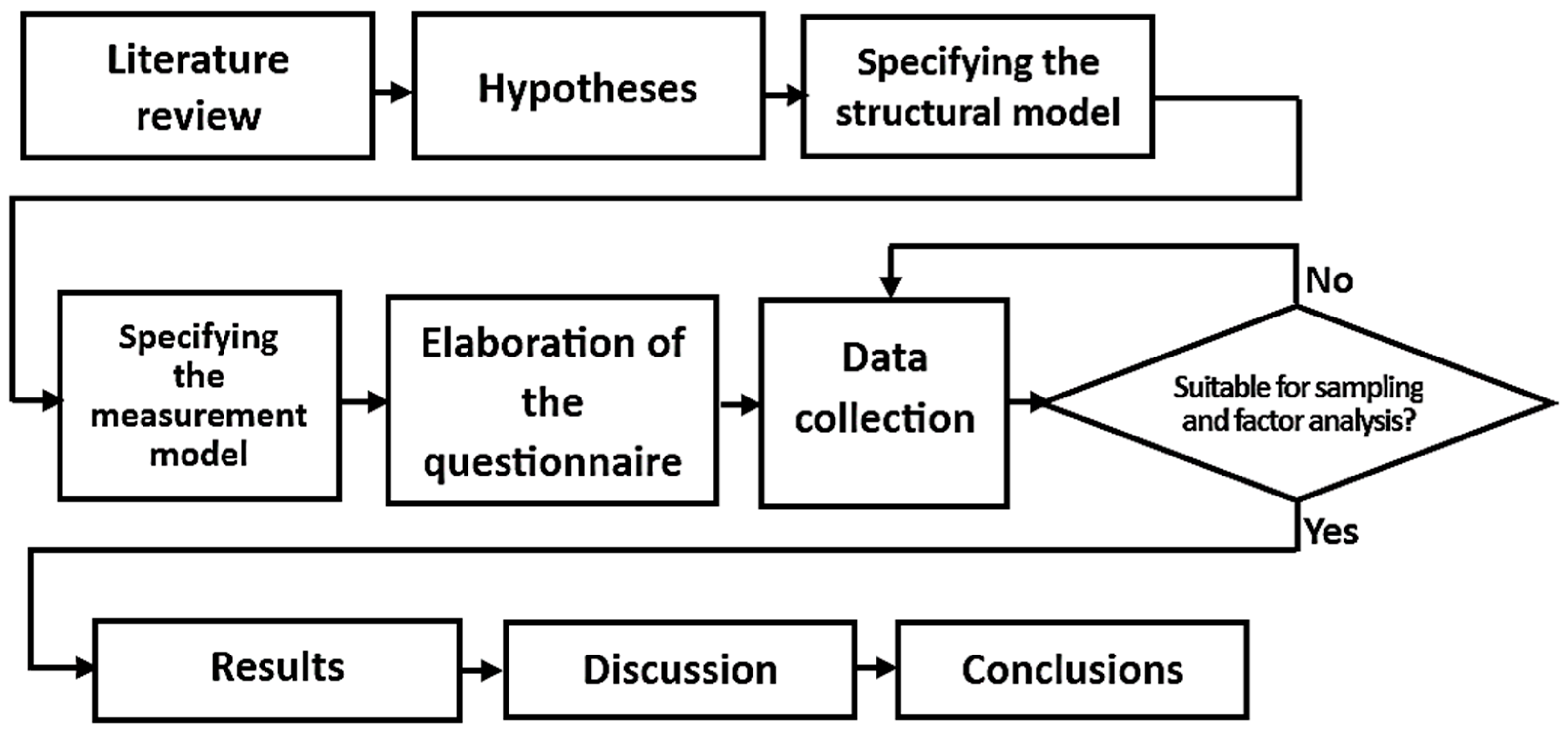
Figure 2.
The structure is divided into structural model and reflective measurement model.
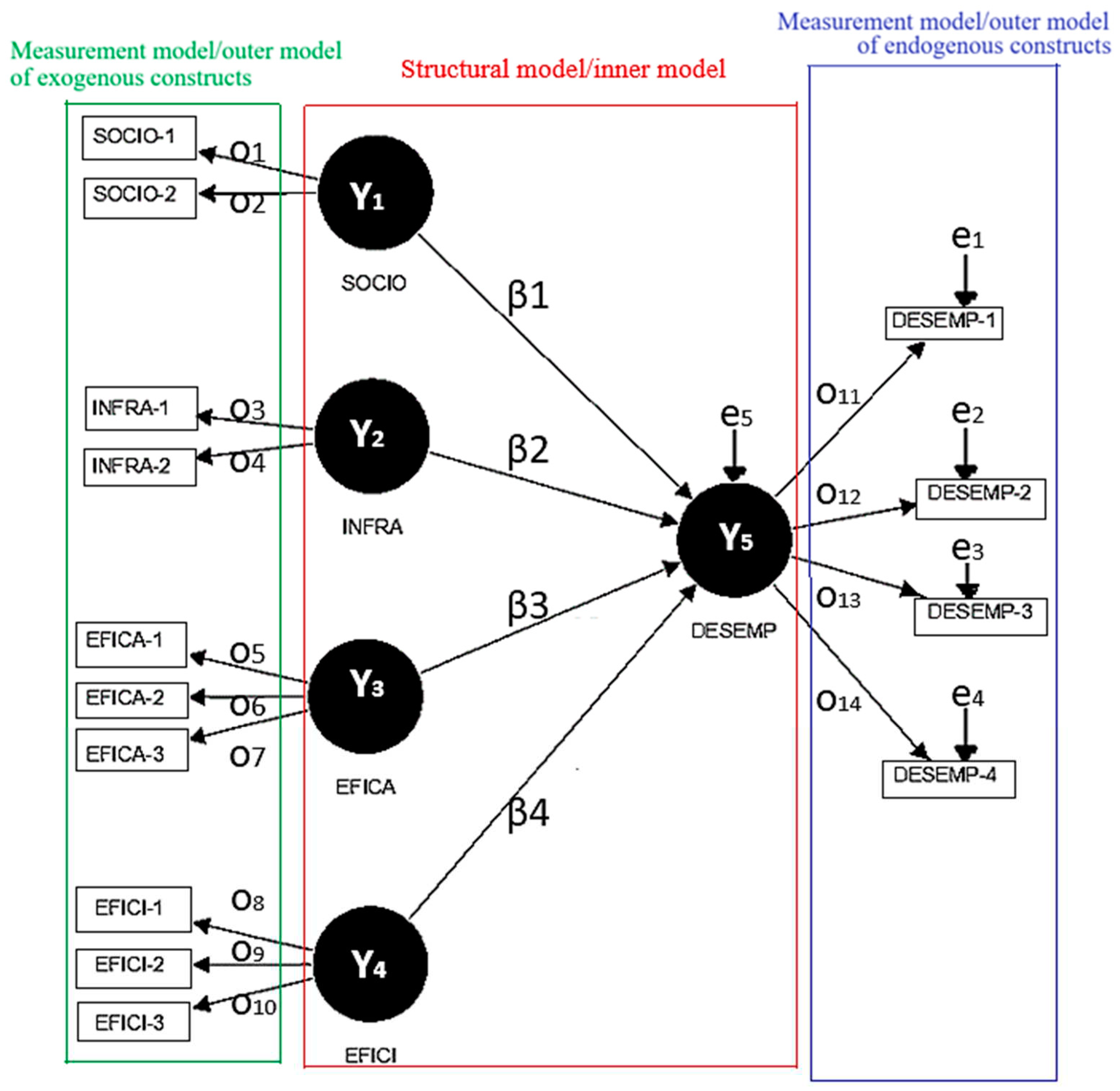
Figure 3.
The reflective structure with indicators, constructs, and hypotheses is depicted in SmartPLS 4.
Figure 3.
The reflective structure with indicators, constructs, and hypotheses is depicted in SmartPLS 4.
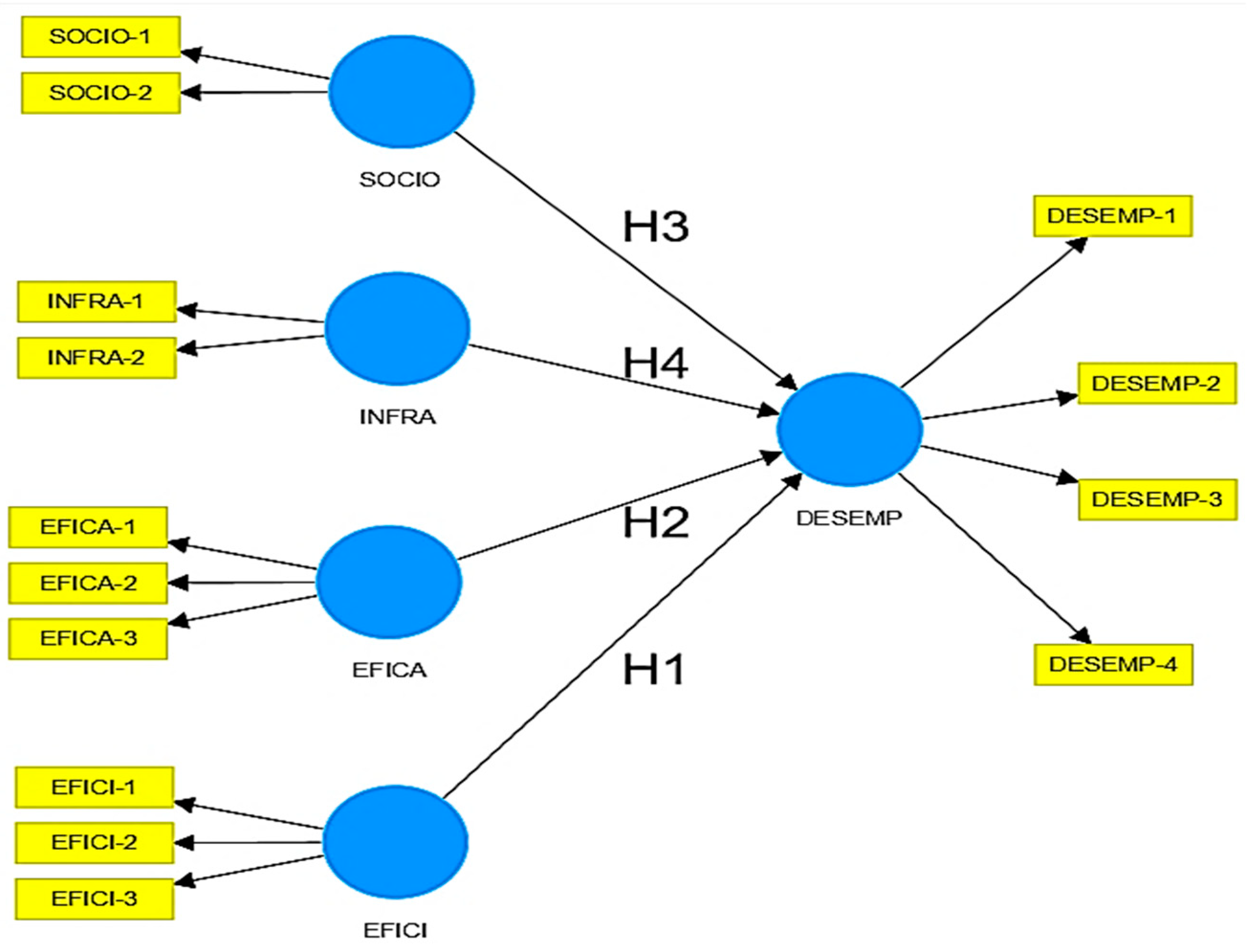
Figure 4.
Values of initial path coefficients and outer loadings after the first PLS-SEM algorithm run.
Figure 4.
Values of initial path coefficients and outer loadings after the first PLS-SEM algorithm run.
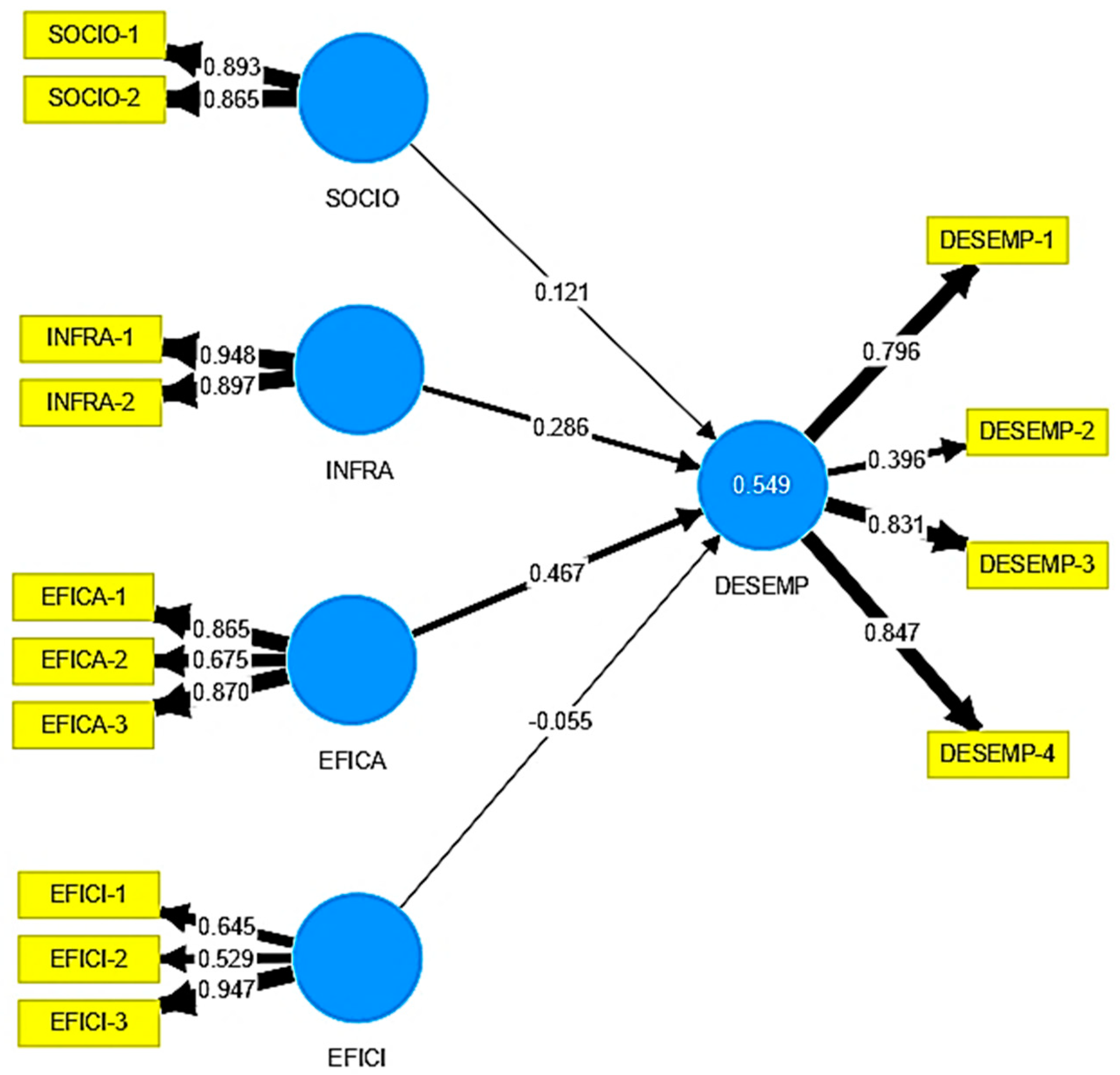
Figure 5.
Values of obtained path coefficients and outer loadings with the second run after the removal of indicators below the outer loading threshold.
Figure 5.
Values of obtained path coefficients and outer loadings with the second run after the removal of indicators below the outer loading threshold.
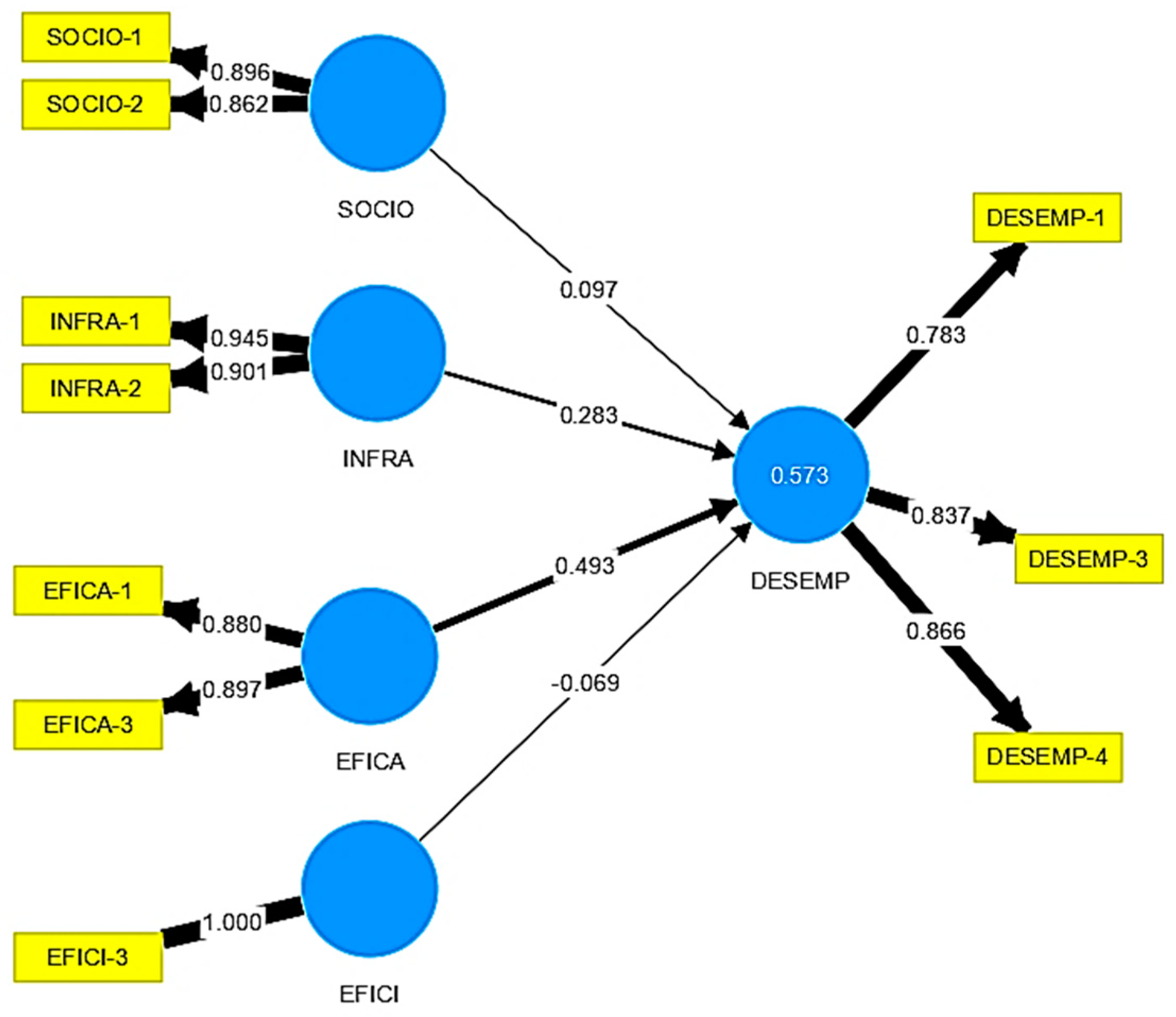
Figure 6.
Distribution of the prediction errors concerning each indicator of the endogenous construct.
Figure 6.
Distribution of the prediction errors concerning each indicator of the endogenous construct.
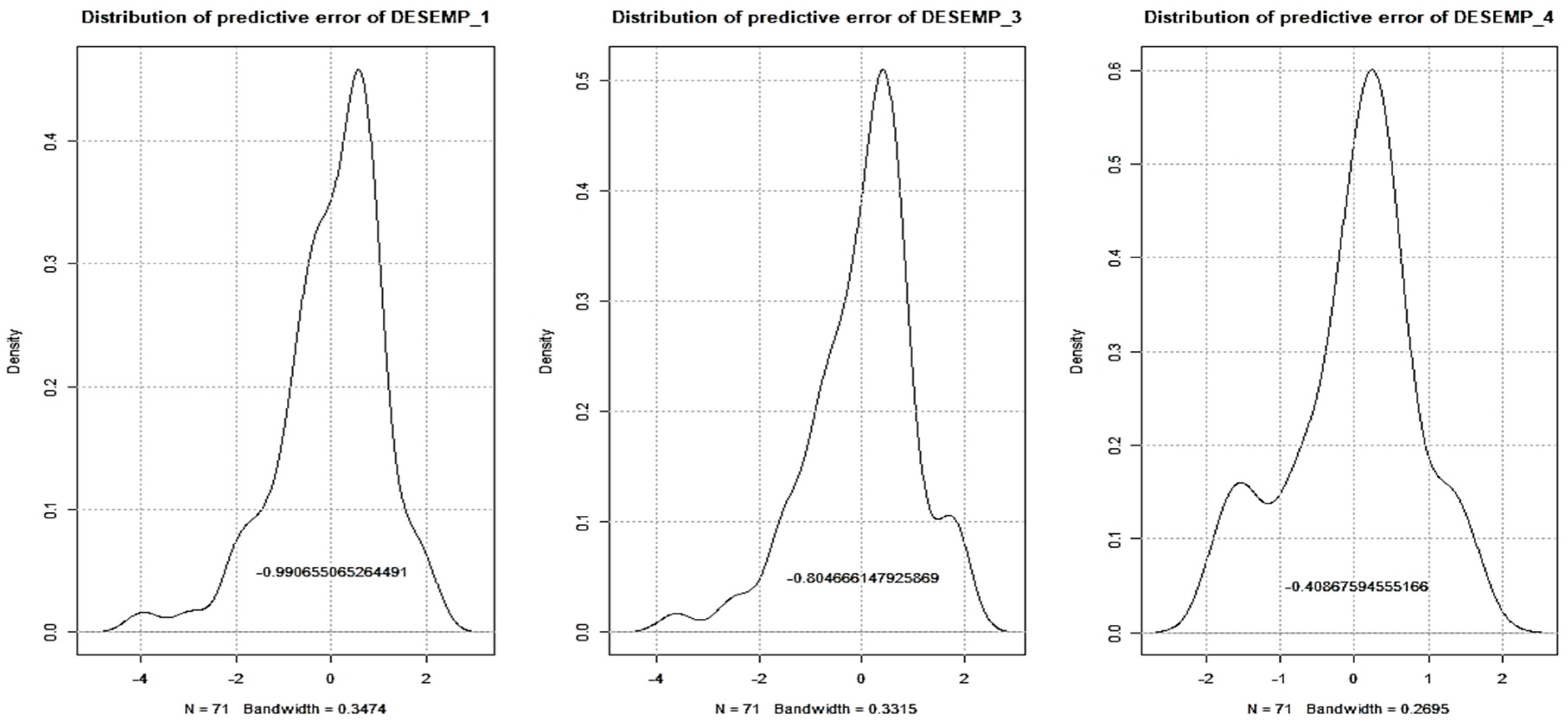
Table 1.
Hypotheses elaborated with basis on the literature. Source: Adapted from [1].
Table 1.
Hypotheses elaborated with basis on the literature. Source: Adapted from [1].
| Hypothesis | Basis |
|---|---|
| H1: Efficiency is directly correlated with the performance | [16,17] |
| H2: Effectiveness is directly correlated with the performance | [16,18] |
| H3: Municipality's socioeconomic aspects are directly correlated with the performance | [14,19,20] |
| H4: Municipality infrastructure is directly correlated with the performance | [22,23] |
Table 2.
Constructs and indicators in the model. Source: Adapted from [1].
Table 2.
Constructs and indicators in the model. Source: Adapted from [1].
| Construct | Position in the model | Indicator | Basis |
|---|---|---|---|
| Reverse Logistics Efficiency | Exogenous | EFICI-1 - Complexity of waste | [21,22] |
| EFICI-2 - Variety of waste (types of plastic: PET, HDPE, LDPE, PP, PS, PVC, or PUR...) | [21] | ||
| EFICI-3 - Variability of waste | [17,21,24] | ||
| Reverse Logistics Effectiveness | Exogenous | EFICA-1 - Market maturity | [25,26] |
| EFICA-2 - Value of waste | [27] | ||
| EFICA-3 - Volume processing | [19] | ||
| Reverse Logistics Performance (Effectivity) | Endogenous | DESEMP-1 - Recycling rate | [22,28] |
| DESEMP-2 - Thermochemical conversion rate | [29] | ||
| DESEMP-3 - Business profitability | [22,24,30] | ||
| DESEMP-4 - Availability of plastics sorting technologies | [31,32] | ||
| The infrastructure of the municipality | Exogenous | INFRA-1 - Availability of selective collection in the municipality | [33] |
| INFRA-2 - Presence of Deposit-Return Systems (DRS) | [34] | ||
| Socioeconomic characteristics of the municipality | Exogenous | SOCIO-1 - Socioeconomic profile of the municipality | [33] |
| SOCIO-2 - Population density of the municipality | [35] |
Table 3.
Outer Loadings, Cronbach's alphas, Composite Reliabilities, rho_A, and Average Variance Extracted values.
Table 3.
Outer Loadings, Cronbach's alphas, Composite Reliabilities, rho_A, and Average Variance Extracted values.
| Construct | Indicator | Description | Outer Loading | VIF | Cronbach's Alpha | CR | rho_A | AVE |
|---|---|---|---|---|---|---|---|---|
| DESEMP | DESEMP-1 | Recycling rate | 0.783 | 1.489 | 0.775 | 0.868 | 0.798 | 0.688 |
| DESEMP-3 | Business profitability | 0.837 | 1.752 | |||||
| DESEMP-4 | Availability of plastic sorting technologies | 0.866 | 1.626 | |||||
| EFICA | EFICA-1 | Market maturity | 0.880 | 1.508 | 0.734 | 0.883 | 0.737 | 0.790 |
| EFICA-3 | Volume processing | 0.897 | 1.508 | |||||
| EFICI | EFICI-3 | Variability of waste | 1.000 | 1.000 | 1.000 | 1.000 | 1.000 | 1.000 |
| INFRA | INFRA-1 | Availability of selective collection in the municipality | 0.945 | 2.013 | 0.830 | 0.920 | 0.879 | 0.852 |
| INFRA-2 | Presence of Deposit-Return Systems | 0.901 | 2.013 | |||||
| SOCIO | SOCIO-1 | Socioeconomic profile of the municipality | 0.896 | 1.425 | 0.706 | 0.872 | 0.715 | 0.772 |
| SOCIO-2 | Population density of the municipality | 0.862 | 1.425 |
Table 4.
Cross-loadings, Fornell and Larcker's criterion, and Heterotrait-monotrait ratios.
| Cross-loadings (correlations) | |||||
|---|---|---|---|---|---|
| Indicator | DESEMP | EFICA | EFICI | INFRA | SOCIO |
| DESEMP-1 | 0.783 | 0.556 | -0.174 | 0.371 | 0.270 |
| DESEMP-3 | 0.837 | 0.507 | -0.162 | 0.468 | 0.314 |
| DESEMP-4 | 0.866 | 0.649 | -0.369 | 0.580 | 0.527 |
| EFICA-1 | 0.594 | 0.880 | -0.249 | 0.513 | 0.388 |
| EFICA-3 | 0.639 | 0.897 | -0.184 | 0.342 | 0.519 |
| EFICI-3 | -0.298 | -0.242 | 1.000 | -0.364 | -0.067 |
| INFRA-1 | 0.603 | 0.536 | -0.359 | 0.945 | 0.414 |
| INFRA-2 | 0.453 | 0.317 | -0.308 | 0.901 | 0.282 |
| SOCIO-1 | 0.433 | 0.544 | -0.094 | 0.479 | 0.896 |
| SOCIO-2 | 0.379 | 0.346 | -0.019 | 0.181 | 0.862 |
| Fornell and Larcker's criterion | |||||
| Construct | DESEMP | EFICA | EFICI | INFRA | SOCIO |
| DESEMP | 0.829 | ||||
| EFICA | 0.695 | 0.889 | |||
| EFICI | -0.298 | -0.242 | 1.000 | ||
| INFRA | 0.581 | 0.477 | -0.364 | 0.923 | |
| SOCIO | 0.464 | 0.513 | -0.067 | 0.386 | 0.879 |
| Heterotrait-monotrait (HTMT) ratio | |||||
| Construct | DESEMP | EFICA | EFICI | INFRA | SOCIO |
| DESEMP | 1 | ||||
| EFICA | 0.911 | 1 | |||
| EFICI | 0.335 | 0.296 | 1 | ||
| INFRA | 0.696 | 0.597 | 0.399 | 1 | |
| SOCIO | 0.603 | 0.706 | 0.151 | 0.495 | 1 |
Table 5.
Decision about the hypotheses considering VIFs, coefficients of determination (R2), path coefficients (β), effect sizes (f²), standard errors, and t-values.
Table 5.
Decision about the hypotheses considering VIFs, coefficients of determination (R2), path coefficients (β), effect sizes (f²), standard errors, and t-values.
| Hypothesis | VIF | Original R2 | Sample Mean1 R2 | Original β | Sample Mean1 β | Original f² | Sample Mean1 f² | Standard Error1 | t-value2 | Decision |
|---|---|---|---|---|---|---|---|---|---|---|
| H1: EFICI -> DESEMP | 1.181 | 0.573 | 0.606 | -0.069 | -0.072 | 0.010 | -0.072 | 0.097 | 0.717 | Not Supported |
| H2: EFICA -> DESEMP | 1.576 | 0.573 | 0.606 | 0.493 | 0.492 | 0.361 | 0.492 | 0.105 | 4.671 | Supported |
| H3: SOCIO -> DESEMP | 1.431 | 0.573 | 0.606 | 0.097 | 0.100 | 0.015 | 0.100 | 0.095 | 1.026 | Not Supported |
| H4: INFRA -> DESEMP | 1.485 | 0.573 | 0.606 | 0.283 | 0.286 | 0.126 | 0.286 | 0.110 | 2.574 | Supported |
1 Bias-Corrected and Accelerated Bootstrapping. 2 Statistical significance is confirmed when t-value > 1.65 (p-value < 0.10).
Table 6.
PLS and LM out-of-sample metrics.
| PLS out-of-sample metrics | |||
|---|---|---|---|
| DESEMP_1 | DESEMP_3 | DESEMP_4 | |
| RMSE | 1.075 | 1.023 | 0.842 |
| MAE | 0.826 | 0.775 | 0.654 |
| LM out-of-sample metrics | |||
| DESEMP_1 | DESEMP_3 | DESEMP_4 | |
| RMSE | 1.107 | 1.020 | 0.845 |
| MAE | 0.853 | 0.811 | 0.658 |
Disclaimer/Publisher’s Note: The statements, opinions and data contained in all publications are solely those of the individual author(s) and contributor(s) and not of MDPI and/or the editor(s). MDPI and/or the editor(s) disclaim responsibility for any injury to people or property resulting from any ideas, methods, instructions or products referred to in the content. |
© 2023 by the authors. Licensee MDPI, Basel, Switzerland. This article is an open access article distributed under the terms and conditions of the Creative Commons Attribution (CC BY) license (http://creativecommons.org/licenses/by/4.0/).
Copyright: This open access article is published under a Creative Commons CC BY 4.0 license, which permit the free download, distribution, and reuse, provided that the author and preprint are cited in any reuse.


