

Submitted:
13 December 2023
Posted:
14 December 2023
You are already at the latest version
Abstract
Solid tumors are composed of a highly complex and heterogenic microenvironment, with increasing metabolic status, playing a crucial role in the clinical therapeutic outcome of conventional treatments and innovative tumor nanomedicines. Scientists, have devoted great effort in conquering the tumor microenvironment (TME) challenges, in respect of effective drug accumulation and activity in tumor site, overcoming the obstacles of abnormal vasculature, dense stroma and extracellular matrix, hypoxia, and pH gradient acidosis. In this conquest, nanomedicines targeting distinct TME features have flourished, in order to increase site specificity and deep penetration, for effective antitumor activity, and further reprogram TME promoting suppression of cancer stem cells and metastasis. Thereby, several successful nanomedicine therapeutics have been under clinical trials, and further applied in clinical practice. Various novel strategies have been employed in preclinical studies and clinical trials, among which nanomedicines based on biomaterial, that have shown great promise in improving the therapeutic efficacy, reducing side effects, and promoting synergistic activity for TME targeting. In this review, we have focused on the targeting mechanisms for solid TME by nanomedicines based on the application of natural and synthetic biomaterials. We have described critical formulations that have been considered for the design of stimuli-responsive nanomedicines for TME. The development of such systems, has significantly advanced the application of biomaterials, in combinational therapies and in immunotherapies, for improved effectiveness.
Keywords:
biomaterials
; tumor microenvironment
; nanomedicine
; hypoxia
; acidosis
; resistance
; tumor vasculature
; targeting
; stimuli-responsiveness
1. Introduction
Cancer incidence and mortality has increased dramatically, with female breast cancer being the most commonly diagnosed, surpassing lung cancer [1,2], presenting a major public health issue in emerging and developing countries, with great socioeconomic and psychological challenges. According to world statistics by 2020, cancer is the first or second leading cause of death with near 20 million new cases and almost 10 million deaths [1]. Global cancer statistics have estimated near to 30 million new cases should be expected by 2040, with a greater expectancy in developed versus emerging economies, due to migration and demographic changes, a rate that is seriously affected by everyday risk factors, such as tobacco, alcohol, unhealthy diet, and anxiety [1,2]. Despite the disappointing statistics, there is a decline in overall cancer death rate of about 33 %, since 1991 to 2020, with an estimated 4 million prevented deaths, and a decline of 65 % in cervical cancer incidence, among women of the age group of 20s in the period 2012 to 2019, due to the preventive effect of the human papillomavirus vaccine [1,2]. The encouraging declined rates of cancer mortality can, undoubtedly, be related to the increased research effort on the field of cancer vaccines (RNA technologies) and personalized nanomedicines [3]. The greatest challenges scientists need to conquer are early diagnosis and prevention that could effectively reduce cancer mortality.
Early diagnosis is crucial, due to the high differentiation rate of tumor cells, promoting the development of highly aggressive cancerous cells associated with multidrug resistance (MDR), stemness [4], and invasion [5]. A critical stimulus, cultivating MDR and invasion is tumor microenvironment (TME), being a complicated interpenetrating network of varied cancerous and stromal cell types, extracellular matrix (ECM) and interstitial fluid (IF) [6,7,8]. TME is hostile to normal cells, while hospitalizes stromal cells that are the nonmalignant components of solid tumors, including endothelial cells (ECs), fibroblasts (FCs), immune cells (lymphocytes, macrophages, dendritic cells), and perivascular cells (PCs), interconnected in a highly protein matrix that promotes angiogenesis and neovascularization [9,10]. Within the heterogenic TME, the vasculature abnormalities are related to variations in oxygenation with elevated presence of reactive oxygen species (ROS), glutathione (GSH), enzymes, and adenosine triphosphate (ATP) further promoting a hypoxic status with acidic pH levels (pH 5.5 – 6.2). These features in combination with secreted growth factors, cytokines, chemokines and macromolecules, such as proteases and proteins in the surrounding stroma, regulate the stimulation of cancer associated fibroblasts (CAFs) playing key role in metastatic potency [11,12,13]. The stroma in combination with the highly dynamic ECM, act as supportive reservoirs, directly or indirectly, interconnecting TME with capillary and vascular system cells, as well as immune system cells, therefore providing the essential nutrition components, oxygen, gas exchange, and metabolites withdrawal, for supporting tumorigenesis and continuous neovascularization [14,15,16].
The greatest disadvantage of TME of solid tumors is MDR, resulting in reduced therapeutic efficiency of traditional remedies, including chemo and radio therapy. The backbone of traditional therapeutic approaches is comprised of surgical ablation, followed by chemo and radio therapy, or their combination, depending on tumor severity, with serious side effects for the patients within the therapeutic window of the administered doses [17]. Great progress has been achieved with advanced investigation on new therapeutic agents, including peptides, antibodies and prodrugs [18,19,20,21,22]. Yet, the success of these compounds is greatly suffering by the limitations of abnormal vasculature, heterogenic basement membranes and poor blood supply, inherited by TME, being the niche of therapeutic failure [23,24,25]. Nanomedicine has been considered as the outmost solution pathway representing a substitute strategy to improve the delivery of therapeutic agents, such as drugs, peptides, antibodies, proteins, genes, immunotherapeutic agents in a selective and controlled manner for efficient intratumor accumulation and multi-stimuli responsiveness [26,27,28,29,30,31,32,33,34]. Though, great progress has been achieved on this field the clinical application of nanomedicine is still limited. In this review, we aim to present a discussion on the field of responsive nanomedicine, emphasizing the application of biomaterials, including natural polymers as polysaccharides, biodegradable polymers, metal oxides, in targeting TME of solid tumors. Biomaterials represent a field of distinct research interest, due to i) their unique inherent properties of biocompatibility and biodegradability, ii) their cross-linking efficacy with various compounds, iii) their application in many formulations, such as liposomes, polymersomes, nanoparticles, nanogels, solid lipid particles, in combination with metal oxides, carbon and graphene derivatives, iv) their ability to protect the delivered agents from enzymatic degradation, due to the increased levels of proteases and enzymes catalyzing hydrolytic reactions, v) their ability to co-deliver multiple compounds, ligands and diagnostic agents for theranostic, vi) their application in various therapeutic systems, as vaccines and immunotherapies through the delivery of immune-specific antigens and immunomodulators for effective antitumor immunity, vii) their ability to respond to an internal chemical and/or biological stimulus, or an external physical stimulus (magnetic field, light, radiation, ultrasound) [35,36]. In overall, in this review we will discuss the role of biomaterial based nanomedicine in targeting TME, including heterogenic vasculature, tumor stroma ECM, CAFs, tumor hypoxia and acidosis. We will examine the most recent advances of therapeutic nanomedicine against solid tumors with the prospect of improving the clinical outcome. Finally, we will summarize the challenges and future perspective of applying nanomedicine, in tumor immunotherapy and combinational therapy to overcome limitations and improve the therapeutic outcome.
2. Solid Tumor Nanomedicine: Distribution in Tumor Microenvironment
Intriguingly, solid tumors are pathological organ-like tissues that through their heterogenic TME with the increased metabolic status, promote and support processes mimicking normal tissues, as angiogenesis [37,38,39]. Due to the elevated dysregulation of angiogenetic factors, abnormal and destabilized blood and lymphatic vessels are developed, with major deviations referred to diameter, density, shape (spiral-like) and overall distribution within TME, with a simultaneous discontinuation of endothelium with leaking cell gaps, irregularly thick or thin basement membranes and disruption of blood flow, causing excessive spatial stress, and increased interstitial fluid pressure (IFP)[40,41,42]. These features promote the transport of nutrients, oxygen, and blood away from the solid tumors central region stimulating ATP regulation, hypoxia and acidosis, also, prohibiting the transfer of therapeutic drugs, that is associated with inferior targeting effect, and further increased drugs heterogenic biodistribution [43]. Great support has been provided by nanomedicines that are recognized to be allied with improved therapeutic index, enhanced pharmacokinetic drug profile, and increased targeting effectiveness and selectivity [44,45,46], especially supported by enhanced permeability and retention (EPR) effect, promoting extravasation and effectual intratumor localization [47]. Despite the progress, moderate clinical success has been achieved, since nanomedicine applications have encountered severe obstacles related to avascular tumor sites, such as high IFP, modified ECM, differentiated interactions of stromal and cancerous cells, promoting inflammation and restricting their access, only, to highly vascular with increased perfusion regions [47,48]. The limitations in therapeutic efficacy of nanomedicines have been tackled, lately, by thorough investigations on exploiting the complex mechanisms and associated properties of TME, thus strengthening the intratumor localization, and the stimuli-responsiveness in environmental features, as hypoxia and acidity, by combining ligand mediated active targeting of selective receptors with growth factors, inhibitors, enzymes, and peptides. Combining the benefits of external stimuli-responsiveness has, beneficially, increased the targeting effect of nanomedicines with their simultaneous amplified therapeutic effect [49,50,51,52].
Solid tumor nanomedicines, target therapeutically a highly versatile environment signifying the importance of adaptability and spatiotemporal pharmacological activity. The current treatment strategies, to overcome MDR and the multi-factorial TME, rely on combination of chemo/radio/immune therapies with co-administration of approved nanomedicines, for improved synergistic therapeutic effect. In this direction, biomaterials have greatly assisted on orchestrating the pharmacokinetic activity of drugs and compounds, due to their inherent properties of biodegradability, and biocompatibility offering low systemic toxicity, and their ease on surface modification offering effective sites for receptor-mediated ligand targeting (peptides, antibodies, nucleic acids, small organic molecules) and theranostic applications for real-time therapy and monitoring of tumor tissues. Moreover, biomaterials have presented improved efficacy on functionalization, for occupying responsive abilities and manipulate TME hypoxia and spatial pH distribution (acidic extracellularly vs basic intracellularly). Also, the effectual combination of biomaterials with acquired responsiveness on varied external stimuli (hyperthermia, photodynamic, sonodynamic), has highly improved tumor specific accumulation, modulating cellular apoptotic cascades and promoting cellular death, by associated gene regulation [53,54,55]. In this respect, biomaterials have been importantly targeted on TME-responsive applications demonstrating effective and promising results in combinational therapies and immunotherapies, some of which are FDA-approved or under clinical trials for specific tumor types (Table 1) [56,57,58,59]. The clinical trials and applications of nanomedicines, have mostly relied on improving drugs’ activity, besides reducing side effects, and on enhancing biodistribution of drugs and agents within solid tumor tissues. For this, have been followed strategies to overcome TME physical, biological and chemical obstacles, and achieve efficient specificity on molecular targets (such as cellular receptors, CAFs, CSC) and physiological factors (such as ECM, angiogenesis, IFP) [50,55,60]. The innate biological properties of biomaterials against opsonization have offered a great support, providing longer and efficient systemic circulation time of the nanomedicines [61]. Natural polymers and synthetic biodegradable polymers have been extensively reviewed and discussed on their application in the pharmaceutical and biomedical field, including i) polysaccharides, such as alginic acid (alginate), dextran, agarose, hyaluronic acid, carrageenan, chitosan, and cyclodextrin, ii) protein based polymers, as gelatin, albumin, soy and collagen, and iii) synthetic polymers, as polyesters, polyamides, polyanhydrides, phosphorous based, and polyurethanes [62,63,64,65,66,67]. In solid tumor therapeutics, the benefits of novel theranostic and multifunctional nanomedicines are being the niche of research [67], to overcome the limitations of TME and design novel therapies (Scheme 1). In the following, novel therapeutic and targeting concepts of biomaterial based nanomedicines will be discussed, exploiting TME specificity and responsiveness.
3. Nanomedicines for targeting TME: Application of Natural and Synthetic Biomaterials
3.1. The heterogenic vasculature
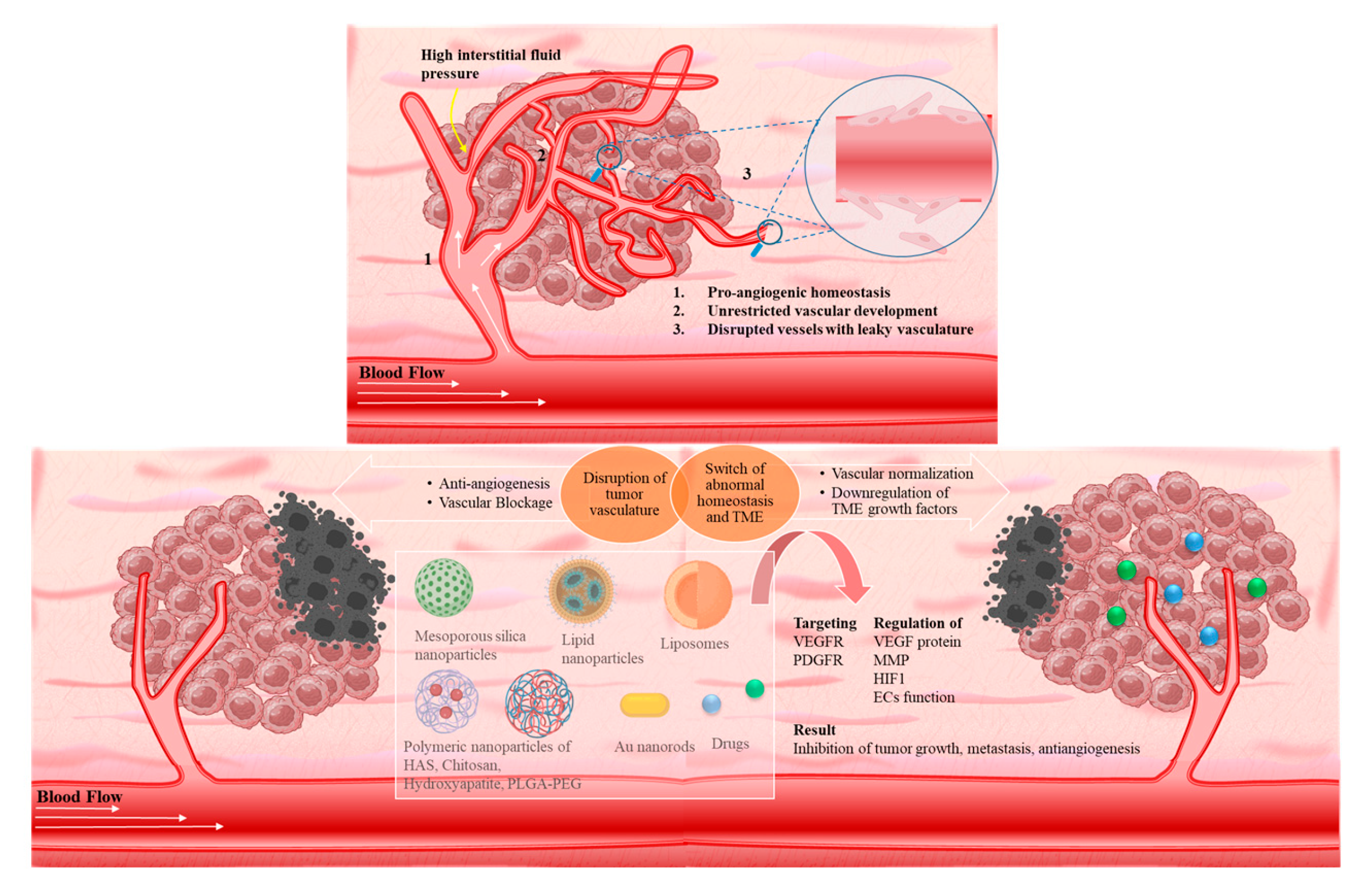
Angiogenetic mechanism is divided in two phases, the avascular wherein tumor progression is suppressed, due to controlled homeostasis of pro- and anti- angiogenetic factors, and the vascular wherein tumor development is promoted, by a switched homeostasis favoring a pro-angiogenetic environment. For solid tumors, in order to progress and develop, a de facto ultimate need is presented for blood, oxygen and nutrient supply, that is supported by the continuously evolving tumor vasculature [68,69,70]. Thus, regulating angiogenesis is a key step to tackle TME abnormal vasculature that is being targeted by nanomedicines through angiogenetic inhibitors studied for local transport, with the intention of promoting tumor suppression mechanisms, by limiting the unrestricted vascular development [71]. The main target of angiogenetic therapeutics, is the inhibition of growth factors of the pro-angiogenetic domain that present elevated affinity with surface receptors of ECs, including i) soluble factors, as vascular endothelial growth factor (VEGF family factors comprising of A to F members), platelet derived growth factor (PDGF), beta and alpha transforming growth factors (TGF -α, -β), angiopoietins (Ang), and ii) insoluble membrane-bound proteins, as ephrins, integrins, cadherins, matrix metalloproteinases (MMPs), and hypoxia induced factor-1 (HIF-1) [72].
Scheme 3.
Targeting of the abnormal TME vasculature by nanomedicines has been based on varied biomaterial formulations, including HA nanoparticles, CS and its derivatives, CS lipid nanoparticles, polymeric nanoparticles as PLGA, PLGA-PEG and pluronic PF, MSN, liposomes and PEG-liposomes, gold (Au) nanoparticles and nanorods. These nanomedicine vehicles have been evaluated i) for their antiangiogenic behavior, including sulfated derivatives of HA, and CS, CS carboxylated derivatives and Au nanorods and ii) additionally, for the effective transfer of agents, such as siRNA molecules, anti-VEGF molecules, anti-PDGF, Tie2 inhibitors, in single or in combination therapies with PDT. The therapeutic outcome has been related to effective regulation of anti-angiogenetic factors and inhibition, suppressing tumor growth and metastasis. (created with the assistance of BioRender.com, and Microsoft ppt).
Scheme 3.
Targeting of the abnormal TME vasculature by nanomedicines has been based on varied biomaterial formulations, including HA nanoparticles, CS and its derivatives, CS lipid nanoparticles, polymeric nanoparticles as PLGA, PLGA-PEG and pluronic PF, MSN, liposomes and PEG-liposomes, gold (Au) nanoparticles and nanorods. These nanomedicine vehicles have been evaluated i) for their antiangiogenic behavior, including sulfated derivatives of HA, and CS, CS carboxylated derivatives and Au nanorods and ii) additionally, for the effective transfer of agents, such as siRNA molecules, anti-VEGF molecules, anti-PDGF, Tie2 inhibitors, in single or in combination therapies with PDT. The therapeutic outcome has been related to effective regulation of anti-angiogenetic factors and inhibition, suppressing tumor growth and metastasis. (created with the assistance of BioRender.com, and Microsoft ppt).
3.1.1. VEGF therapeutic targeting
VEGF is the most widely researched target of anti-angiogenetic therapeutics, since VEGF/VEGFR2 signaling cascade is a crucial regulator promoting angiogenesis, vascular permeability, proliferation and migration [68,69,70,71,72,73]. Among angiogenesis inhibitors, heparin has been studied in cancer nanomedicine, due to its strong anticoagulation effects indicating enhanced binding affinity with VEGFR2. Heparin, is a FDA approved anticoagulant drug, however its implementation against malignant tumors presented limitations, mainly related to severe side effects, as bleeding and thrombocytopenia. The problem in heparins’ application has been tackled by utilization of low-molecular-weight heparins (LMWHs) or heparin analogues [74]. Other angiogenesis inhibitors in the category of biomaterials, have been the sulfated polysaccharides, such as hyaluronic acid (HA) and chitosan (CS) that have expressed selective binding affinity with VEGFR receptors and structural similarities with heparin. Lim et al. [75] studied the inhibition effect of sulfated HA (s-HA) against VEGF165 factor, which is present in two isoforms the VEGF165a angiogenetic and the VEGF165b anti-angiogenetic, both of which express the same receptor-binding domain (RBD), but different heparin-binding domain (HBD). The density of HA sulfation was varied from one hydroxyl group per repeating unit, resulting in strong affinity of VEGF165a, to more than one (up to four) promoting a strong binding affinity to both VEGF165 isoforms. The s-HA was reported to provide comparable properties to the commercially used anti-VEGF antibody Avastatin, for the non-selective binding of VEGF165 [75]. In another study, Li et al. [76] demonstrated that sulfated CS (s-CS) could act as angiogenetic inhibitor blocking the VEGF/VEGFR2 signaling pathway. The grade of CS sulfation at C2–NH2, C3–OH, and C6–OH sites per repeating unit could be related to the mechanism of angiogenetic inhibition. In contrast to heparin, s-CS presented stronger inhibitory effect on proliferation, migration, and tube formation of HUVEC cells, promoting tumor size inhibition by near 42.12 % and suppression of neovascularization by almost 63.8 %[76].
Biomaterials, present certain advantages for their application in nanomedicine in combination with angiogenetic inhibitors over VEGF/VEGFR signaling pathway, including synthesis, and modification for antibodies, inhibitors, and aptamers delivery, and no noticeable anticoagulant activity. Among biomaterials, great advantages are demonstrated by CS that apart from its antitumor effects include inhibition of proliferation, induction of apoptosis, and improvement of immune functions. In this respect, Salva et al. [77] studied the effect of CS nanoplexes with small interfering RNA (siRNA) targeting VEGF expression, on the suppression of tumor growth. CS was evaluated in nanoplexes with varied siRNAs, as siVEGF-A, siVEGFR-1, and siVEGFR-2 for their silencing effect, upon intratumoral injection of the nanoplexes into Sprague-Dawley rats bearing breast tumor, providing remarkable reduced tumor volume and mRNA levels of VEGF in tumor tissues. In another study, Jiang et al. [78] investigated on the antitumor and anti-angiogenetic effect of carboxymethyl chitosan (CMCS), that was proved able to constrain the 2D and 3D migration of HUVEC cells in vitro, and essentially promote tumor growth inhibition, and tumor cell necrosis in hepatocarcinoma 22 (H22) tumor bearing mouse. Moreover, CMCS regulated the expression of VEGF, MMP-1 and CD34 levels in the serum and H22 tumor tissues, and importantly improved the thymus and spleen index, TNF-α, and IF-γ levels. In overall, CMCS significantly promoted inhibition of tumor angiogenesis and stimulated immune functions.
3.1.2. Targeting molecular markers for vasculature regulation
Another promising therapeutic target that can effectively promote suppression of tumor angiogenesis is pericytes, of the category of mural cells (MCs). Pericytes play a key role in important intracellular interactions of ECs, including proliferation, migration and stabilization of angiogenesis and vascular basement membrane, thus acting as angiogenetic regulators, while ECs promote proliferation of pericytes by acting as angiogenetic stimulators [79]. In normal angiogenesis, sprouting ECs, by secreting PDGF, stimulate the proliferation of MCs, such as pericytes that are positive on the PDGF β receptor (PDGFR-β), further promoting the release of VEGF-A cytokine and Ang-1 protein, to stabilize and maintain vascular development. The cytokines secretion of the VEGF family can effectively mediate multiple signaling pathways, as the paracrine signaling cascade, to orchestrate direct and indirect interactions between ECs and pericytes, resulting in the regulation of cytokines, enzumes, and receptors, such as TGF-β, MMP, Tyrosine Kinase-2 (Tie2) receptors [80,81,82]. However, in tumor tissues the interactions between ECs and pericytes are defective, resulting in abnormalities in structure, regulation, and density of pericytes, thus contributing to increased heterogeneity on vasculature, further, triggering a hypoxic TME. Due to their dynamic characteristics, and multiple molecular markers expression, pericytes have a great potency to differentiate to cancerous stromal fibroblasts, in the TME, contributing to invasion and metastasis [80,81,82].
The therapeutic potency of tumor cells’ molecular markers, has raised intense research on targeting the heterogenic vasculature of solid tumors [83,84]. Bhattacharya et al. [85] reported the development of HA conjugated Pluronic® P123 / F127 copolymer nanoparticles (HA-TQ-NPS) for the selective delivery of thymoquinone (TQ) to TNBC cells. The synergistic effect of HA and TQ efficiently hindered cell migration, by modulating the expression of miR-362/Rac1/RhoA and miR-361/VEGF-A pathways, with the latter being involved in the suppression of tumor angiogenesis. The evaluation of the HA-TQ-NPS nanoparticles in MDA-MB-231 xenograft chick embryos, and 4T1 tumor bearing BALB/c mice, reported their ability to inhibit angiogenetic and metastatic activities. The combinational silencing of PDGF and their receptors was followed by Salva et al. [86] for suppressing multiple members of the same pathway. In this study, CS nanoplexes were used for the delivery of dual and single siRNA targeting PDGF-D and PDGFR-β expressions. The intratumoral administration of the nanoplexes in breast tumor-bearing mice xenografts, resulted in the inhibition of tumor growth and angiogenesis, thus preventing invasion and further downregulating PDGF-D / PDGFR-β mRNA and proteins’ level expression. Another type of nanoparticles, indicative of bioactive ceramics that have been proposed for their anti-angiogenetic properties are hydroxyapatite nanoparticles (HANPs). In a recent study, Shi et al. [87] demonstrated the biological interactions of HANPs with endothelial HUVEC cells providing insight into the suppressive effect of the nanoparticles to angiogenesis, through regulating ECs function by the PI3K/Akt/eNOS signaling pathway. Specifically, HANPs suppressed the phosphorylation of eNOS and p-eNOS resulting in the downregulation of p-Akt. In another study of Zhao et al. [88], the development of amine-functionalized HANPs was reported for the combinational delivery of p53 plasmid and candesartan (CD), an inhibitor with strong affinity on angiotensin II type 1 receptor (AT1R). The combined anti-angiogenetic and antitumor efficacy of the nanoparticles was reported by the downregulation of VEGF protein secretion and lower functional microvessel density. Tyrosine kinase inhibition activity has, also, been used for antitumor and anti-angiogenetic effectiveness, by Garizo et al. [89] investigation. A p28 (28 amino acids, 28kDa) cell penetrating peptide (CPP) was surface conjugated on poly (lactic-co-glycolic acid) (PLGA) nanoparticles loaded with gefitinib (GEF), a tyrosine kinase inhibitor with poor bioavailability and therapeutic activity, due to its weak solubility in gastric fluids. The PLGA nanoparticles were evaluated in female CBA/N mice bearing A549 lung adenocarcinoma tumors that express the EGFR. The nanoparticles, by combining selective accumulation with the tyrosine kinase inhibiting activity of gefitinib, promoted the inhibition of both primary tumor growth and metastatic burden.

Table 2.
Targeting nanomedicines based on biomaterials against heterogenic vasculature.
| Targeting Effects | Carrier Type | Therapeutic Agent | Characteristics | Ref. |
|---|---|---|---|---|
| VEGF | Hydroxyapatite (HA) | Sulfated s-HA | Non-selective binding of VEGF165a | [75] |
| Chitosan (CS) | Sulfated s-CS | Inhibition of VEGF/VEGFR2 signaling pathway | [76] | |
| CS/siRNA nanoplexes | siRNA | Silencing effect of siVEGF-A, siVEGFR-1, siVEGFR-2, NRP-1 inhibiting proliferation with improved immune functions | [77] | |
| carboxymethyl chitosan (CMCS) | CMCS | Regulate expression of VEGF levels, MMP-1 and CD34 and promoted inhibition of angiogenesis | [78] | |
| Endothelial Cell Regulation | HA-P123/F127 Polymeric nanoparticles |
thymoquinone | Modulating expression of miR-362/Rac1/RhoA and miR-361/VEGF-A pathways for inhibiting angiogenesis | [85] |
| CS nanoplexes | siRNA | Targeting PDGF-D and PDGFR-β expressions | [86] | |
| hydroxyapatite nanoparticles (HANP) | HANP | Regulating ECs function by the PI3K/Akt/eNOS signaling pathway | [87] | |
| hydroxyapatite nanoparticles | p53 plasmid and candesartan | Downregulation of VEGF protein secretion and functional microvessel density | [88] | |
| PLGA nanoparticles | P28 peptide and gefitinib | Inhibit tumor angiogenesis, primary tumor growth and metastasis | [89] | |
| FDA-Approved Drugs | Mesoporous silica nanoparticles (PEG-MSNs) | Sunitinib (anti-VEGFR) | Increased VEGFR targeting specificity, efficient inhibition of angiogenesis | [93] |
| Lipid-chitosan nanoparticles | Bevacizumab (VEGF-A antibody) | Suppressing proliferation and endothelial cells angiogenesis | [94] | |
| PLGA-PEG nanoparticles | Bevacizumab | higher internalization and bevacizumab delivery into CD44v6+ ECs | [95] | |
| human serum albumin nanoparticles | Bevacizumab | Decreased glycolysis and metabolic tumor volume, inhibition of tumor growth | [96] | |
| chitosan nanoparticles | Sorafenib (Tie2 inhibitor) | Superior antitumor activity | [97] | |
| Combinational Therapies | PEG-PCL-PAEA-SA nanoparticles | gambogenic acid / charge-reversible effect | Suppressed tumor angiogenesis, very little to no vascular tubes inside tumor models | [99] |
| PLGA nanoparticles | Sorafenib / Sunitinib / siRNA | Synergistic effect inhibiting cell proliferation | [101] | |
| PLGA-PEG nanoparticles | Anlotinib / pH-sensitivity | Inhibited tumor growth and metastasis suppressing lymphangiogenesis | [102] | |
| polycation liposomes | siRNA / calcium phosphate particles | Suppressed tumor growth and angiogenesis | [103] | |
| PEG-liposomes | doxorubicin / curcumin | Suppressed tumor growth, invasion and metastasis | [104] | |
| Au nanorods | NRP-1 peptide / PDT | inhibition of angiogenesis | [108] |
3.1.3. Targeting formulation based on FDA-approved drugs
The extensive research on anti-angiogenetic therapies has led to the development of varied agents being under clinical trials, and other being FDA and EMA approved, such as Bevacizumab (VEGF-A antibody), Ramucirumab (VEGFR2 antibody), Aflibercept (VEGF-Trap), Lenvatinib (Tie2 inhibitor), Sorafenib (Tie2 inhibitor), Axitinib (Tie2 inhibitor) [90,91,92]. Mainly these drugs have been applied as secondary or adjuvant therapies, to prohibit tumor vascularization and suppress tumor growth. Within the research field of anti-vascular therapies, the key function of VEGF/VEGFR signaling pathway in tumor angiogenesis and metastasis is well-studied. Goel et al. [93] reported the efficacy of mesoporous silica nanoparticles (MSNs), over the targeting delivery of sunitinib, a tyrosine kinase receptor inhibitor that is able of multi-targeting, almost all, VEGFRs. Sunitinib is a FDA approved anti-VEGFR drug for renal cell carcinoma (RCC) and imatinib-resistant gastrointestinal stromal tumor (GIST). In Goel et al. study, pegylated sunitinib-MSNs were modified with NOTA chelator agent, and further linked with VEGF121 and radioisotope (64Cu, t1/2 = 12.7 h) labeling. The sunitinib-MSNs, were evaluated for their theranostic application against U87MG human glioblastoma bearing athymic nude mice. The overall in vitro, in vivo and ex vivo analysis, confirmed i) the increased VEGFR targeting specificity in the vasculature regions (through CD31 staining), ii) the effective sunitinib accumulation to tumor sites for efficient inhibition, and iii) the ability of angiogenesis imaging. Bevacizumab, is a water-soluble recombinant monoclonal anti-VEGF antibody effective for inhibiting tumor angiogenesis, that is administered in combination with chemotherapy. However, bevacizumab is related with intense side effect, such as cardiovascular disorders, hypertension, thromboembolic, and central nervous system hemorrhage. Thus, the application of bevacizumab in nanomedicine has been highly researched, in order to alleviate its side effects. Quite recently, Abdi et al. [94] reported the synthesis of lipid coated chitosan nanoparticles for the local administration of bevacizumab (BEV), that resulted in enhanced antitumor activity by suppressing proliferation and ECs angiogenesis. In another research by Balao et al. [95], PLGA-PEG nanoparticles delivering bevacizumab (BEV), were surface functionalized with a targeting antibody fragment (Fab, AbD15179) with increased binding affinity over the CD44v6 cellular receptor. The BEV-loaded PLGA-PEG nanoparticles were evaluated against colorectal cancer (CRC) cells that overexpress the CD44v6 by near 50 %, exhibiting higher internalization into CD44v6+ ECs than bare, with elevated intracellular levels of bevacizumab and VEGF. The CD44v6 transmembrane protein is a CD44 receptor isoform containing exon v6 establishing a significant part of solid tumors metastasis and invasion, due to its function for c-Met, VEGFR-2, and angiogenesis. The efficacy of bevacizumab has also been studied by Luis de Redin et al. [96], through PEG coated human serum albumin (HSA) nanoparticles, evaluated on HT-29 colorectal cancer xenograft models in athymic nude mice. The nanoparticles exhibited increased binding affinity on ECs receptors, due to the innate properties of HSA, resulting in elevated levels of intratumoral localization of BEV. Moreover, encapsulation of BEV resulted in decreased glycolysis, reduced BEV blood levels, and inhibited metabolic tumor volume and angiogenesis (evaluated by CD31 staining), in contrast to free BEV administration.
Sorafenib (SF, Nexavar®) is another FDA approved agent, administered against liver cancer, thyroid cancer, and hepatocellular carcinoma (HCC). Mainly, sorafenib is a kinase inhibitor with the activity of inhibiting cancer cell proliferation and angiogenesis, by targeting and blocking the action of the multiple Raf family kinase proteins (B-Raf and C-Raf), the VEGFR-2 and the PDGFR, and their associated signaling cascades of the ERK pathway. However, the hydrophobic nature and poor solubility, of sorafenib, in deionized water (25 mg/ml) limits the daily administered dose. Thus, sorafenib tosylate (Nexavar®) the organosulfonate salt of sorafenib is, also, a FDA approved synthetic compound targeting growth signaling and angiogenesis, administered against renal, hepatocellular and differentiated thyroid cancers with a daily suggested oral administered dose up to 400 mg (2 pills of 200 mg tablet per diem). Ruman et al. [97] reported the development of folate coated CS nanoparticles for the delivery of SF, revealing the superior antitumor activity against hepatocellular carcinoma cells, and colorectal adenocarcinoma cells. Sorafenib has been extensively investigated in nanomedicine delivery systems, designed to overcome the limitation of poor solubility, non-specific targeting and drug resistance of free SF. Such SF nanomedicine systems have been evaluated in co-delivery with biomaterials, chemotherapeutic drugs, imaging agents and active agents for receptor-mediated binding, and have expressed great potential in application against various solid tumors, as recently reviewed by Wang et al. [98].
3.1.4. Responsive targeting and combinational therapies
For the efficient targeting of the heterogenic vasculature, an unprecedented growth has been demonstrated in functionalized biomaterials for multi-responsive nanomedicine applications, including liposomes, nanoparticles, micelles, MSNs, metal oxides as Au, ZnO, MnO2 nanoparticles, and polymeric particles, such as biopolymers including chitosan and cyclodextrin, synthetic polymers including PLGA, PEG, PEI and their co-polymers. In this concept, Du et al. [99], studied the effect of gambogenic acid (GNA), delivered by charge-reversible polymeric nanoparticles (CRNP) of (PEG45-PCL40-PAEA33-SA) for increased vascular permeability and improved drug accumulation. GNA is a vascular disrupting agent, that by inhibition of VEGF is playing a central role in exerting i) increased antitumor effect, due to its pro-apoptotic activity and ii) vascular disruption, owing to the downregulation of angiogenesis pathways. Thus, the CRNP-GNA particles resulted in increased vascular permeability and retention indexes (VPRI) by near 60 times and decreased tumor microvessel density by nearly 7 %, compared to their charge-irreversible analogue. The CRNP-GNA particles achieved effective intratumor accumulation in tumor-bearing C57BL/6 mice models, due to effectual vascular disruption and suppressed angiogenesis, with low to no presence of vascular tubes inside the tumor. The combinational therapies and mechanisms applied in regulating angiogenesis and metastasis of non-small cell lung solid tumors have been interestingly studied, by Zhang et al. that investigated the combinational effect of gefitinib and bevacizumab, delivered by MnO2-containing liposomes [100]. Another example is set by Punuch et al. [101], that investigated the synergistic effect of angiogenesis inhibitors (Sorafenib or Sunitinib) with AFP-specific siRNA, incorporated into polymeric PLGA nanoparticles. The combinational effect, resulted in the effective inhibition of cell proliferation of hepatocellular carcinoma. The strategy of multifunctional mechanisms was followed by Cong et al. [102], for the efficient delivery of anlotinib in pH-responsive PLGA-PEOz polymers mixed with PLGA-PEG co-polymers. Anlotinib is a multi-targeting inhibitor of tyrosine kinase receptors including VEGFR, FGFR, PDGFR, and c-Kit with increased inhibitory affinity on tumor angiogenesis. The anti-angiogenic mechanism of anlotinib was being combined with pH-responsive nanomedicine formulations for systemic administration in BALB/c nude mice bearing A549 and 4T1 tumor xenografts. The effective anlotinib targeting, successfully inhibited tumor growth and metastasis, by suppressing lymphangiogenesis through VEGFR-3 signaling cascade. In this concept, Cheng et al. [103] combined the effects of siRNA silencing of VEGF expression with doxorubicin, in a nanomedicine system of polycation liposomes, encapsulating calcium phosphate nanoparticles, that significantly suppressed tumor growth and angiogenesis in MCF-7 tumor bearing BALB/c nude mice. Multi-targeting effects were, also, reported by Barui et al. [104] in liposomes delivering curcumin, doxorubicin, and surface functionalized with a pegylated RGDK-lipopeptide for targeting ECs. The combinational system, co-delivered a chemotherapeutic agent, with curcumin, that is well-known for inhibition effect on the activation of NFκB transcription factor linked to chemoresistance, and on ATP-binding cassette drug transporter. Their synergistic action with the targeting lipopeptide suppressed tumor growth, invasion and metastasis related genes at mRNA and protein levels.
In combinational and multi-responsive nanomedicine applications, the metal nanoparticles have been of great research interest, due to the highly reported angiogenetic properties. Most of the metal nanoparticles, including gold, silver, zinc oxide, copper, have been found to participate in angiogenesis process, by regulating the expression of ROS and reactive nitrogen species (RNS) in cellular level. The inhibition of vascular development is based, on the ability of the metal nanoparticles to regulate the balance of secreted pro- and anti- angiogenetic factors, in order to promote apoptotic signaling mechanisms [105,106]. The selective inhibitory effect and modulation of angiogenesis were studied by Roma-Rodrigues et al. [107], for peptide conjugated gold nanoparticles in chick embryos. Moreover, Bartczak et al. [108] reported the effect of gold nanorods functionalized with peptides selectively binding to neuropilin-1 surface receptors (NRP-1) in combination with laser irradiation. In the combinational system, gold nanorods absorbed near-infrared laser irradiation to be transformed into localized heat, and the peptide acted as angiogenetic inhibitor. By modulating the metal nanorods dose and NIR irradiation effective inhibition of in vitro angiogenesis was promoted.
3.2. The tumor stroma extracellular matrix
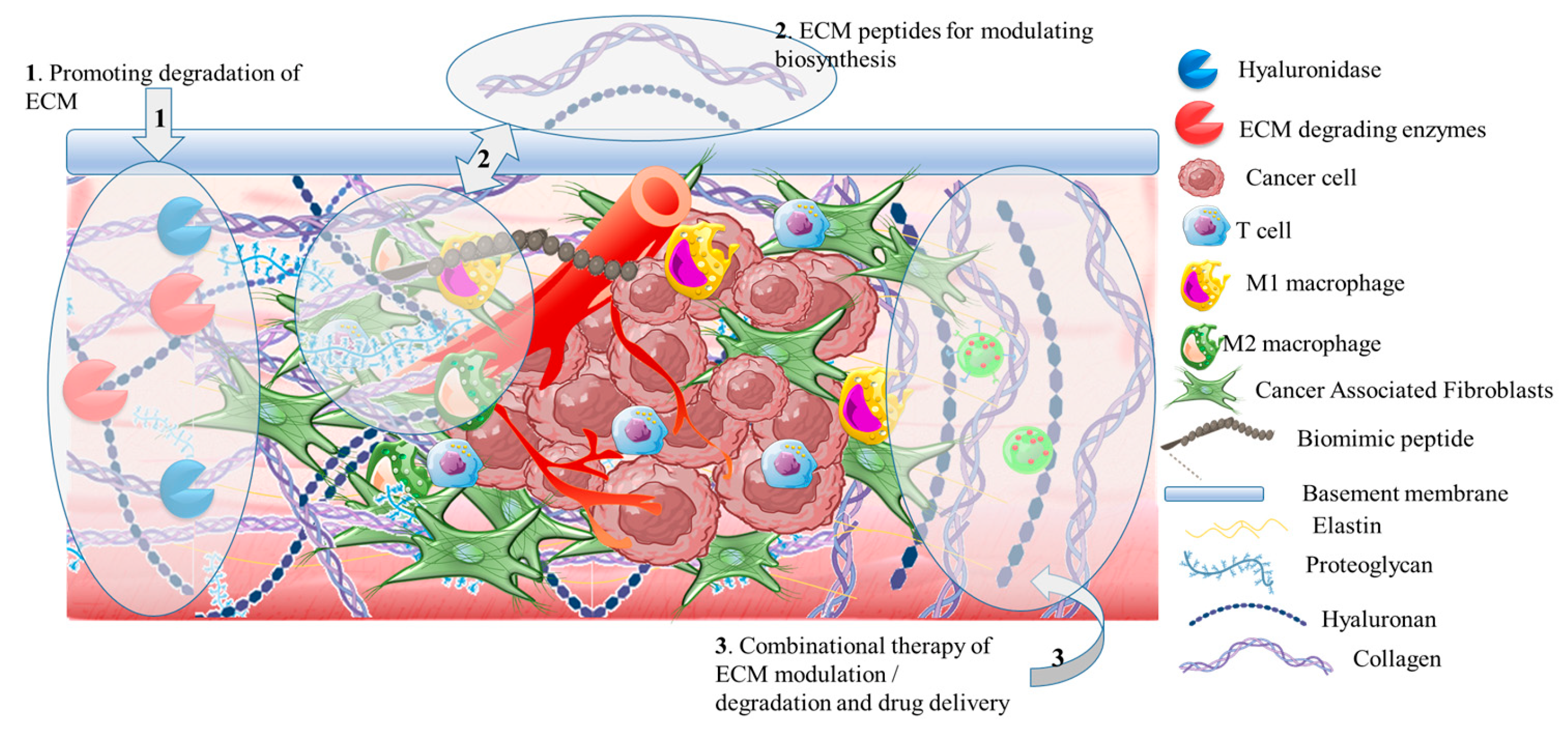
Therapeutic approaches against solid tumors expand on targeting tumor stroma, a dynamic heterogenic matrix, commonly, comprising of cellular components, such as cancer associated fibroblasts (CAFs), mesenchymal stromal cells, innate and adaptive immune cells, macrophages, and non-cellular compartments, such as extracellular matrix (ECM), tumor vasculature, and interstitial matrix [109,110]. Tumor stroma has been recognized as a critical part of TME, since its abundant components, can support the transformation of normal to tumorous cells, promoting tumorigenesis and progression [111]. In this process, ECM plays a pivotal role for the development and support of homeostasis of tumor tissue. Mainly, ECM is composed of proteins (as collagen, fibrilin, elastin), proteoglycans, and polysaccharides (hyaluronic acid or hyaluronan or HA)) that their unrestrained crosslinking with collagen type I, result in a densely rigid network being a critical obstacle for host immune systems’ function [112]. Tumor ECM has dynamic features with a pronounced effect on supporting TME vascularization [113], and, also, on i) presenting a physical barrier for drug perfusion, ii) inducing cell adhesion mediated drug resistance, owing to the elevated presence of ECM proteins, iii) activating glycolysis and glutamine metabolism providing abundant energy supply on tumor cells, iv) promoting aggressiveness, and metastasis by the deposition of malignant cells to the tumor endothelium [112,113,114]. Various factors participate in the ECM maintenance, including growth factors (VEGF, PDGF, Ang, stromal cell derived factor, SCDF), and proteins (MMP family), being the targeted by ECM specific nanomedicines [115].
Scheme 4.
Effective targeting of TME extracellular matrix (ECM). The tumor stroma ECM is a dynamic rigid construction of proteins, such as collagen, and elastin, proteoglycans and polysaccharides, as hyaluronan. Nanomedicine targeting ECM are based on 1) the promotion of degradation processes against ECM by the use of hyaluronidase and degradation enzymes, 2) the application of biomimic peptides to modulate biosynthesis of ECM by promoting artificial ECM or inhibiting connective tissue growth factors and 3) the combination of ECM degradation with drug delivery vehicles. For these applications, biomaterials such as PLGA-PEG nanoparticles, liposomes, antibodies, superparamagnetic iron oxide nanoparticles and peptide nanoparticles, have been evaluated. (created with the assistance of BioRender.com, and Microsoft ppt).
Scheme 4.
Effective targeting of TME extracellular matrix (ECM). The tumor stroma ECM is a dynamic rigid construction of proteins, such as collagen, and elastin, proteoglycans and polysaccharides, as hyaluronan. Nanomedicine targeting ECM are based on 1) the promotion of degradation processes against ECM by the use of hyaluronidase and degradation enzymes, 2) the application of biomimic peptides to modulate biosynthesis of ECM by promoting artificial ECM or inhibiting connective tissue growth factors and 3) the combination of ECM degradation with drug delivery vehicles. For these applications, biomaterials such as PLGA-PEG nanoparticles, liposomes, antibodies, superparamagnetic iron oxide nanoparticles and peptide nanoparticles, have been evaluated. (created with the assistance of BioRender.com, and Microsoft ppt).
3.2.1. Targeting biomaterial formulations of hyaluronidase under clinical trials
The degradation of ECM components, such as hyaluronic acid (HA) being responsible for the increased adhesion of tumor cells, has been targeted therapeutically by nanomedicines, with most characteristic example being the PEGylated recombinant human hyaluronidase enzyme PEGPH20 that is designed to inhibit HA crosslinking. PEGPH20 has been tested as a monotherapy and in combination with chemotherapeutic drugs, leading to diverse results, since in clinical trials there were cases of patients that the therapeutic scheme of PEGPH20 led to deterioration of the therapeutic outcome and side effects, such as muscle spasm and thromboembolism [115,116]. PEGPH20 is a multiple PEGylated recombinant HyAL5 (recombinant human hyaluronidase PH20, or rHUPH20) with a half-life of 1 to 2 days, clinically evaluated in Phase III trial (HALO-109-301) of advanced pancreatic cancer in combinational therapeutic scheme with gemcitabine and nab-paclitaxel, as reported by Doherty et al. [117]. HA is a strongly hydrophilic anionic, non-sulfated glycosaminoglycan (GAG) with physiological functions in cells’ activation and proliferation via interaction with surface receptors, as CD44 and RHAMM. There are five hyaluronidases (HyAL1-5) representing endogenous enzymes able to degrade HA into oligosaccharides and very low molecular weight HA, this way restoring tumor biology and drug access. The degradation products of HA, transmit inflammatory responses through toll-like receptor 2 and 4 (TRL2, TRL4) in macrophages and dendritic cells, playing pivotal role in innate immunity. Thus, hyaluronidase and other ECM-degrading enzymes have been the case study under nanomedicine and biomaterials research. However, certain biological barriers have limited their systemic administration and therapeutic efficacy, among which are short half-life (a few minutes) in the bloodstream, inactivation and loss of enzyme function, and side effects, such as breakdown of ECM in healthy tissues, due to non-tumor specificity. Thus, Zhou et al. [118] studied the conjugation of rHUPH20 in doxorubicin loaded PLGA-PEG nanoparticles functionalized with an extra PEG layer for protecting hyaluronidase. It was reported that the conjugated rHUPH20 was more effective than the free enzyme, importantly increasing tumor penetration and accumulation of the nanoparticles in 4T1 tumor bearing syngeneic BALB/c mouse. This effect was attributed to the extra PEG layer that reduced the exposure of rHUPH20 after systemic administration. The effective tumor accumulation resulted in enhanced antitumor effect of the doxorubicin nanoparticles.
Table 3.
Targeting nanomedicines based on biomaterials against stroma extracellular matrix.
| Targeting Effects | Carrier Type | Therapeutic Agent | Characteristics | Ref. |
|---|---|---|---|---|
| Hyaluronidase | PEGPH20 | PEGPH20/ gemcitabine / nab-paclitaxel | Phase III trial (HALO-109-301) | [117] |
| PLGA-PEG nanoparticles | rHUPH20 / doxorubicin | Effective tumor accumulation enhanced antitumor effect | [118] | |
| ECM Degradation | Doxorubicin liposome (Doxosome) | Bromelain / Hyaluronic acid linked collagen type IV-binding peptide | Decayed the density of collagen fibers and advanced the tumor distribution | [119] |
| PLGA- polydopamine-PEG nanoparticles | Collagenase I / Doxorubicin | Degradation, enhanced the intratumoral distribution, and enhanced antitumor immunity | [120] | |
| LOXL2 antibody | LOXL2 antibody | Control of collagen assembly in ECM, potentially control tumor progression | [123] | |
| PLGA-PEG-PLGA thermosensitive hydrogel | Trastuzumab (Herceptin) / collagenase | degradation of intratumoral collagen promoting the antibody effect | [124] | |
| mPEG-PLGA nanoparticles | LOL2 and DDR1 inhibitors / Nab-paclitaxel | enhanced penetration and accumulation in tumor | [125] | |
| ultrasmall superparamagnetic iron oxide (USPIO) nanoparticles | MMP9-sensitive peptide / Doxorubicin | effective bioimaging and synergistic chemo-photothermal antitumor effect | [126] | |
| ECM Biomolecules | Peptide nanoparticles | laminin (LN) mimic peptide | increased distribution in the tumor site and simultaneous transformation into nanofibers surrounding the tumor site | [128] |
| Hyaluronic acid mesoporous silica nanoparticles | siRNA suppressing CTGF expression / Doxorubicin | Inhibition of multidrug resistance and increased susceptibility of tumor cells to drug-induced apoptosis | [131] |
3.2.2. Targeting the extracellular matrix degradation
Degradation of the extracellular matrix of TME has been approached as a treatment strategy, to open pathways throughout the rigid ECM, for enhancing the transportation of therapeutic agents and drugs. The enzymatic degradation of ECM was studied by Ikeda-Imafuku et al. [119], with bromelain bioenzyme, being covalently conjugated through a hyaluronic acid (HA) linker with C4BP targeting peptide, of increased binding affinity with collagen type IV of ECM. Bromelain is a bioenzyme applied for enhancing the efficacy of chemotherapy, since ECM proteolysis is promoted, with enhanced enzymatic activity over a wide range of pH and ECM proteins. The administration of bromelain-HA-C4BP conjugates resulted in effective tumor accumulation, in 4T1 tumor bearing mice, and further decreased collagen fibers’ density enhancing the biodistribution of doxorubicin liposomes (Doxosome). Polymeric PLGA-based nanoparticles were investigated by Amoozgar et al. [120] in a combinational study, for promoting ECM degradation and enhancing antitumor activity of doxorubicin. The PLGA nanoparticles were coated with polydopamine acting as an adhesive layer, for further modification with PEG and proteins, including lysozyme, DNase, collagenase I, and E-selectin antibody. The administration in 4T1 breast tumor-bearing BALB/c mice, showed that the PLGA-collagenase I nanoparticles effectively promoted degradation and enhanced the intratumoral distribution of doxorubicin, further enhancing antitumor immunity, since doxorubicin was present in immunosuppressive M2 macrophages, and proliferation of lymphocytes was, also, observed. Bioenzymes, as hyaluronidases and collagenases, that catalytically promote the degradation of ECM substrate molecules have been widely investigated in nanomedicine, as reported in a recent review of Ding et al. [121]. ECM targeting therapeutics are based on degradation processes, to disrupt the crosslinking and stabilization of ECM proteins. In this mechanism, the inhibition of lysyl oxidase (LOX) activity has been highly studied, since LOX is acting as a catalyst especially facilitating collagen crosslinking. Among LOX inhibitors, Simtuzumab (LOXL2 antibody), PAT-1251 (LOXL2 inhibitor) and PXS-5382 A (LOX inhibitor), have been evaluated as adjuvant therapies at various phases of clinical trials, since as monotherapies have not improved the clinical outcome [122]. The effect of LOX inhibition on ECM morphology was investigated by Grossman et al. [123] by screening stages of fibrillary collagen assembly, through targeting LOXL2. The therapeutic efficacy of disrupting LOXL2 was further evaluated in tumor bearing CB-17 SCID mice, and resulted in the maintenance of normal fibril orientation and thickness, potentially affecting tumor progression, since LOXL2 levels are associated with collagen assemblies in the nanoscale, and fiber orientation in the microscale.
The combinational delivery of trastuzumab (Herceptin), a HER2-targeted monoclonal antibody, and collagenase were investigated by Pan et al. [124] in PLGA-PEG-PLGA polymeric thermosensitive hydrogels, upon peritumoral administration in HER2+ BT474 tumor bearing BALB/c mice. The synergistic administration resulted in degradation of the collagen fibrils in the intratumoral region, further promoting the antibody’s effect. LOXL2 targeted mPEG-PLGA polymeric nanoparticles loaded with DDR1 inhibitor were studied by Wei et al. [125], to effectively remodel tumor stroma in vitro and in vivo in KPC/M-PSC orthotopic xenografts, with desmoplastic stroma. The mPEG-PLGA-DDR1 polymeric nanoparticles were further encapsulated in peptide liposomes for the co-delivery of LOXL2 inhibitor. The polymer-lipid-peptide nanoparticles were applied, as a first line system, targeting the extracellular LOXL2 and the intracellular DDR1 domain, in tumor stroma cells. The system effectively suppressed collagen crosslinking and MMP1 secretion, promoting the remodeling of stromal arrangement. In a second administration step, Nab-paclitaxel was delivered across the remodeled stroma, enabling enhanced penetration and accumulation in KPC/M-PSC tumors.
Among biomarkers, MMP family targeting nanomedicine has been the site of interest for Chen et al. [126] that studied the effect of MMP9 responsive magnetic nanoparticles, for effective bioimaging and synergistic chemo-photothermal therapy. The ultrasmall superparamagnetic iron oxide (USPIO) nanoparticles loaded with doxorubicin were further encapsulated in self-assembling amphiphilic PEGylated polypeptides that expressed MMP9-sensitivity. The micelles were evaluated in BALB/c 4T1 tumor bearing mice, where the MMP9-sensitive polypeptide chains rapidly degraded releasing USPIONs and doxorubicin. Moreover, at the tumor site the USPIONs demonstrated enhanced ability as T2-T1 switching MRI contrast agents. In combination with laser irradiation, the nanoparticles presented good chemo-photothermal antitumor effect.
3.2.3. Targeting biomolecules for extracellular matrix
The intense research on the biological mechanisms has promoted the synthesis of ECM biomimetic materials, examined as a potential strategy for effective inhibition of tumor metastasis and invasion, by offering a network that functions as a physical barrier for cell migration, as reported by Guo et al. [127] for agarose hydrogel cell adhesive micropatterns. In this concept, Hu et al. [128] developed an in situ artificial ECM (AECM), as a barrier of tumor cell migration, based on transformable laminin (LN)-mimetic peptide nanoparticles. The laminin biomimetic peptide was composed of peptide amino-acid sequences, as RGD and YIGSR, and was capable of self-assembling forming nanoparticles. Upon intravenous administration in lung-metastasis tumor bearing mice, the laminin nanoparticles showed increased distribution and, simultaneous, transformation into nanofibers, surrounding the tumor site and forming an AECM effectively suppressing lung metastasis. Laminin is a family of glycoproteins of pivotal importance for ECM, being a main constituent of the basal lamina membranes’ layer, that with fibronectin and collagen represent adhesion proteins, able to bind to integrins on the cellular surface, through specific cell-binding domain epitopes. These epitopes are small amino-acid peptide sequences, including RGD, RGDS, IKVAV, and YIGSR [129].
Another strategy evaluating biomolecules for ECM targeting, is the blockade between ECM and cellular interactions by inhibition of signaling molecules, such as proteins that regulate ECM deposition, including the connective tissue growth factor (CTGF). Such therapeutic strategies are actively under clinical trial, as TGF-β, and integrin targeting molecules, FAK-inhibitors, and Pamrevlumab an anti-CTGF antibody therapy evaluated in phase III clinical trials [130]. Ding et al. [131], examined the effect of siRNA for suppressing CTGF expression in MDA-MB-231 in vitro and in vivo tumor bearing mice. Hyaluronic acid was coated on mesoporous silica nanoparticles, (MSNs) conjugated with a PEGA-pVEC cell penetration peptide and further delivering siRNA and doxorubicin, in order to provide RES protection and targeting ability on CD44 receptors, overexpressed on breast cancer cells. Upon administration, the targeting peptide enabled effective accumulation of the nanoparticles at the tumor site and HA provided increased cellular internalization through CD44-mediated endocytosis. Hyaluronidase in the lysosomes activated the degradation of HA coating enabling the responsive doxorubicin release and drug-induced apoptosis. Moreover, the release of siRNA effectually suppressed protein expression levels playing a key role in multidrug resistance, such as Bcl-xL, cIAP1 and CTGF, thus further promoted tumor cells susceptibility to apoptosis.
3.3. The tumor stroma cancer associated fibroblasts
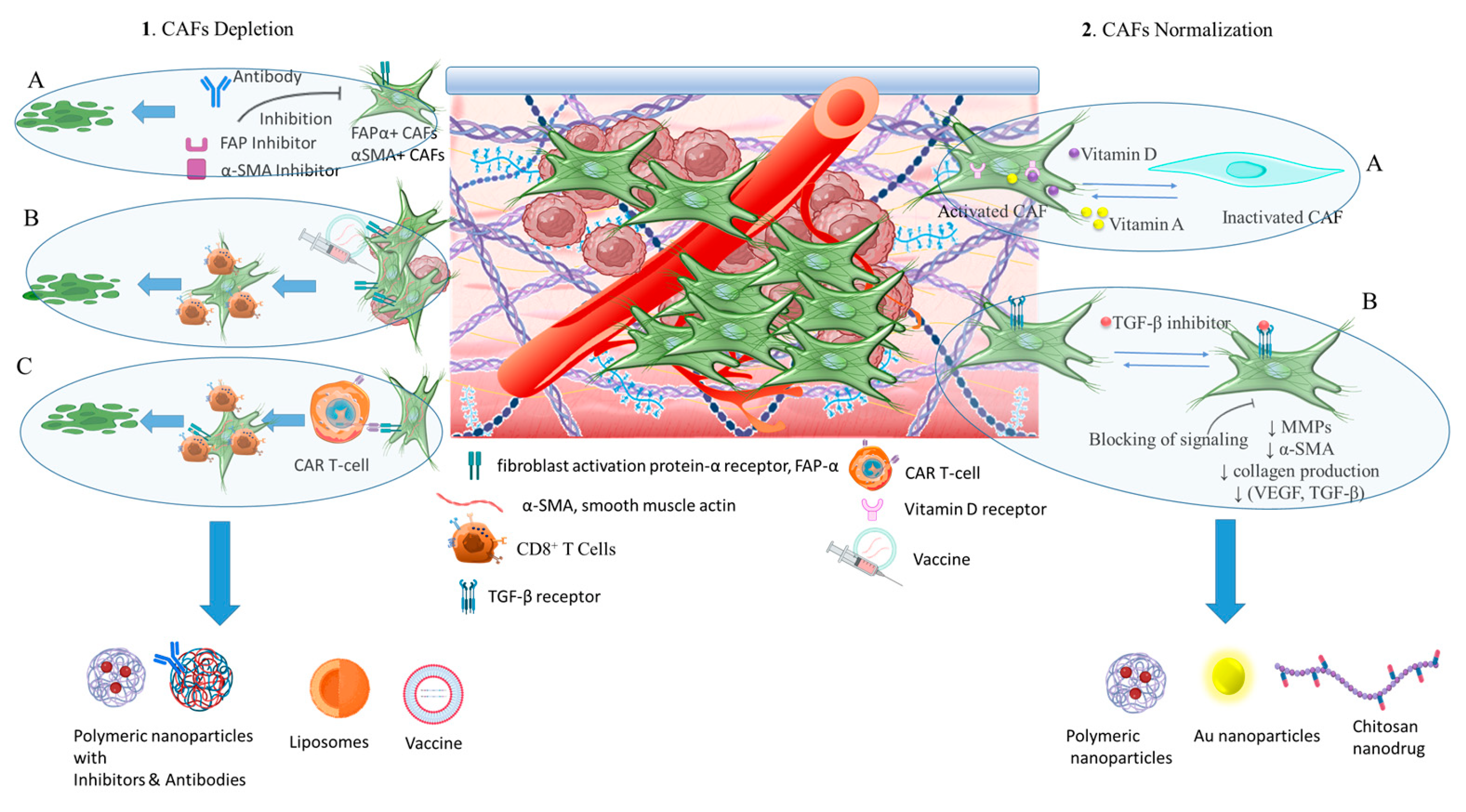
Tumor stroma is a dynamic environment that orchestrates tumor progression, angiogenesis, invasion and metastasis through various components, including stromal cells with most abundant being cancer associated fibroblasts (CAFs), mesenchymal stem cells (MSCs), ECs, stellate cells, and adipocytes. CAFs are activated fibroblasts that in contrast to normal fibroblasts have established a prevailing role in the development of i) increased rate of proliferation and migration, ii) the ability to regulate tumorigenesis, iii) inter and intra cellular interactions with tumor cells, iv) metabolic reprogramming of tumor cells during tumor initiation, v) energy supply through oxidative phosphorylation for sustaining the elevated proliferation rate, and vi) autophagy and oxidative stress pathways [132]. CAFs targeting is a strategically crucial therapeutic field of nanomedicines, since they are related to drug resistance, by secreting proteins, cytokines and extracellular vehicles that protect malignant tumor cells and make TME hostile to antitumor agents and host-immune attack [133]. For example, IL-8 secretion has been related to increased chemo-resistance and circulating CAFs, mainly detected in metastatic breast and prostate cancers presenting a negative prognostic factor [134,135]. The essential role of CAFs in tumorigenesis, multidrug resistance (MDR) and metastasis has been approached, in this review, by responsive biomaterials applied on the targeting of cellular surface markers for CAFs depletion, and on the normalization of activated CAFs for phenotype reprogramming. Among surface biomarkers the most distinguishing and well-researched are fibroblast activation protein-α (FAP-α) that represents a poor prognostic marker [136], and α-smooth muscle actin (α-SMA), being identified as novel biomarker [137]. FAP is a transmembrane glycoprotein (antigen) present in almost 90 % of stromal fibroblasts, that its effective targeting and seppression induced CD8+ T cell mediated damage of CAFs, thus resulting in inhibition of tumor growth [135,136,138].
Scheme 5.
Effective targeting of TME cancer associated fibroblasts (CAFs) through nanomedicine formulations based on biomaterials. Two distinct approaches are presented in this review 1) the depletion of CAFs though A) antibody delivery, FAP and α-SMA inhibitors delivery, B) vaccine delivery and promotion of CD8+ T cells and C) CAR T cells with FAP specificity that inhibit FAP+ CAFs activity via CD8+ T cells upregulation. 2) The normalization of CAFs through A) vitamin D receptor and Vitamin A metabolites targeting for genomic suppression, and B) TGF-β mediated inhibition, leading to inactivation of CAFs. These approaches have been combined with photothermal therapy (PTT) anticancer drugs in vehicles, such as liposomes cleavable amphiphilic peptide (CAP) self-assembly particles, hybrid polymeric hyaluronic acid particles, chitosan nanodrugs, PLA particles and gold particles. (created with the assistance of BioRender.com, and Microsoft ppt).
Scheme 5.
Effective targeting of TME cancer associated fibroblasts (CAFs) through nanomedicine formulations based on biomaterials. Two distinct approaches are presented in this review 1) the depletion of CAFs though A) antibody delivery, FAP and α-SMA inhibitors delivery, B) vaccine delivery and promotion of CD8+ T cells and C) CAR T cells with FAP specificity that inhibit FAP+ CAFs activity via CD8+ T cells upregulation. 2) The normalization of CAFs through A) vitamin D receptor and Vitamin A metabolites targeting for genomic suppression, and B) TGF-β mediated inhibition, leading to inactivation of CAFs. These approaches have been combined with photothermal therapy (PTT) anticancer drugs in vehicles, such as liposomes cleavable amphiphilic peptide (CAP) self-assembly particles, hybrid polymeric hyaluronic acid particles, chitosan nanodrugs, PLA particles and gold particles. (created with the assistance of BioRender.com, and Microsoft ppt).
3.3.1. Targeting nanomedicine for CAFs depletion
The targeting of surface biomarkers has been highly involved in CAFs targeting for promoting their depletion. Specifically, FAPs biomarker has been studied as a targeting domain for tumor imaging and diagnosis, by Ruger et al. [139] that developed fluorescence liposomes (anti-FAP-IL liposomes) conjugated with single-chain specific-fragments (Fv) directed against FAP (scFv’FAP), presenting increased binding affinity to FAP-overexpressing tumor cells, in tumor bearing athymic nude mice (HT1080-wt, HT1080-hFAP, MDA-MB435S tumors), for effective NIR fluorescence imaging, upon selectively accumulated at tumor sites via FAP. CAFs specific targeting was, also, approached by cleavable amphiphilic peptides (CAP) that can specifically and efficiently respond to FAP-α cell surface biomarker. Ji et al. [140], studied on the amphiphilic nature of CAP monomers containing a TGPA peptide sequence being cleaved by FAP-α. The CAP monomers self-assembled to nanofibers, that in the presence of doxorubicin, further induced their assembly to nanoparticles. The CAP nanoparticles (CAP-NP) disassembled upon FAP-α cleavage, promoting the rapid local release of doxorubicin in prostate tumor bearing mice, by disturbing the stromal barrier and further increasing drug intratumoral accumulation. FAP-α targeting was, also, studied by Yu et al. [141] in pancreatic Pan 02 subcutaneous and orthotopic tumor bearing C57BL/6 mice, for combined chemo- and photothermal therapy. The multi-targeting biomaterial system was evaluated against pancreatic tumors, due to their greatly dense and strong tumor stroma presenting a physical barrier to drug delivery. Thus, CAP peptide self-assembling thermosensitive liposomes (CAP-TSL) were evaluated for the combined delivery of IR-780 photothermal agent, and human serum albumin nanoparticles, further, conjugated with paclitaxel (HAS-PTX). The CAF-responsive thermosensitive liposome, developed enhanced drug accumulation to solid tumors and FAP-α mediated responsiveness. Thereby, CAP liposomes effectively promoted FAP-α mediated targeting of CAFs that resulted in their FAP-α responsive cleavage and effective release of the HSA nanoparticles for enhanced drug accumulation at the tumor site. Under the application of a NIR laser irradiation, IR-780 iodide produced local hyperthermia, beneficial for deep tissue penetration by expanding the tumor interstitial space, and further promoting drug accumulation, and tumor cells apoptosis.
Desmoplastic tumors are the most aggressive type of tumors, characterized by a rapid increase in the proliferation of α-SMA positive CAFs and by increased deposition of ECM components. The pancreatic ductal adenocarcinoma (PDAC) is the most characteristic example of tumors establishing a dense heterogenic desmoplastic stroma, maintaining abundant stromal cells and CAFs. The CAFs represent the major source of fibrotic ECM components (collagen, fibronectin, HA) of tumor stroma in PDAC and coordinate the signaling cascades between tumor cells. Thus, CAFs specific targeting is a prominent therapeutic strategy followed in pancreatic cancers, providing great opportunities and challenges, as recently reviewed by Liu et al. [142]. In a study by Hou et al. [143], cationic PAMAM polymeric dendrimers delivering doxorubicin, via disulfide bonding, were designed for CAFs targeting, in order to deeply penetrate into desmoplastic tumors of PC-3/CAFs tumor bearing mice. The PAMAM dendrimers were modified with hyaluronic acid and further cross-linked by a CAP peptide responsive to FAP-α biomarker on CAFs for tumor targeting ability. Upon administration, FAP-α targeting and cleavage promoted the disassembly of the system at the tumor site and the rapid release of doxorubicin and hyaluronic acid that were, effectively, internalized by CAFs and tumor cells promoting synergistic antitumor effect. In the tumor tissues, TGF-β, α-SMA, and FAP-α were importantly suppressed promoting the degradation of tumor fibrotic stroma. The most recent and prominent research field associated to CAFs depletion, is presented by the application of DNA vaccines that through FAP-α targeting promote synergistic antitumor and immunity effects, that are highly attributed to the upregulation of CD8+ T cells and downregulation of macrophages [136,146]. In preclinical studies and lately in phase I clinical trials, chimeric antigen receptors (CAR) T cells with FAP-α specificity, effectively inhibited FAP+ CAFs activity [136,147].
Table 4.
Targeting nanomedicine based on biomaterials for stroma CAFs.
| Targeting Effects | Carrier Type | Therapeutic Agent | Characteristics | Ref. |
|---|---|---|---|---|
| CAFs depletion | anti-FAP-IL liposomes | single-chain Fv fragments against FAP (scFv’FAP) | Specifically and efficiently respond to FAP-α cell surface biomarker | [139] |
| cleavable amphiphilic peptide (CAP) nanoparticles | Doxorubicin / CAP | Disturbed the stromal barrier and increased drug intratumoral accumulation | [140] | |
| thermosensitive liposomes (CAP-TSL) | IR-780 photothermal agent / Paaclitaxel / Human serum albumin | increased cells apoptosis, expanded tumor interstitial space, promoted deep tumor penetration | [141] | |
| poly(amidoamine) (PAMAM) hyaluronic acid nanoparticles | Doxorubicin / CAP peptide | Deep intratumoral penetration, suppression of TGF-β, α-SMA, and FAP-α, degradation of tumor fibrotic stroma | [143] | |
| Vaccines | FAP targeting | synergistic antitumor immunity effect | [136,146,147] | |
| Synergistic inactivation | glycol chitosan – DEAP nanodrug | Methotrexate / quercetin | inhibition of pre-metastatic initiation, downregulation of metastasis promoting factors inactivation of CAFs | [144] |
| hydroxyethyl starch PLA nanoparticles | Doxorubicin / TGF-β receptor inhibitor | suppression of tumor growth and metastasis | [145] | |
| Au nanoparticles | Photodynamic therapy | inhibit the expression of pro-fibrotic signaling via Akt pathway | [154] |
3.3.2. Synergistic inactivation with antitumor targeting
CAFs inactivation has been investigated in combinational systems with chemotherapeutic drugs and biomolecules, for synergistic antitumor and antimetastatic effect. In a recent research, Huo et al. [144] developed a methotrexate (MTX) nanodrug with a hydroxyethyl chitosan (glycol chitosan, GC) backbone and DEAP side chains (MTX-GC-DEAP) for the co-delivery of quercetin (QUE). The self-assembling nanodrug delivering QUE, known for its antifibrotic and antimetastatic effects, expressed mild acid pH sensitivity to TME (pH 6.8) and targeting ability to folic acid receptors (FR) of tumor cells, due to MTX. QUE effects originated from inhibiting TGF-β mediated CAFs activation, through suppression of TGF-β paracrine secretion and of β-catenin / PI3K signaling pathways. QUE downregulated the epithelial-to-mesenchymal transition (EMT), the MMPs secretion and the secretion of certain biomarkers, such as α-SMA, collagen production, and pro-metastatic growth factors (VEGF, TGF-β). The evaluation of the multi-responsive system in 4T1 tumor bearing BALB/c mice, demonstrated the inhibition pro-metastatic initiation by promoting CAFs inactivation and direct regulation on TME, as expressed by the suppression of EMT, and of blood vessel invasion. In another study, the synergistic effect of the combined delivery of doxorubicin and TGF-β receptor inhibitor was investigated by Zhou et al. [145] in hydroxyethyl starch PLA (HES-PLA) nanoparticle on mice models of subcutaneous 4T1 tumors, that demonstrated enhanced inhibition activity on the progression of EMT, and increased suppression of tumor growth and metastasis.
Vitamin D receptor (VDR) has been intensely evaluated on CAFs normalization, expressing a key role of genomic suppressor, promoting an inactivated state of CAFs [148]. The vitamin D analogues, such as calcipotriol or paricalcitol were studied as potential VDR ligands, in clinical trials [149]. Moreover, active metabolites of vitamin A were evaluated in clinical trials, due to their potency to inhibit aggressive tumor progression [150]. Also, the TGF-β signaling was evaluated for effective CAFs normalization via galunisertib, an inhibitor of TGFR-β I kinase, acting as immunosuppressor for CAFs inactivation [151]. Currently, the CAFs targeting is the focus of interest of nanomedicine research, especially, against aggressive tumors with a strong and dense stroma, by the application of CAFs targeting peptides for deep penetration and increased accumulation, and inhibitory agents of signaling pathways between CAFs and tumor cells for regulating immunosuppression effects and drug resistance, as outlined by Meng et al. [152] and Guo et al. [153]. Lately, gold nanoparticles with known antiangiogenic effects, were evaluated by Zhao et al. [154] on colorectal cancer tumor bearing mice for their suppressing effect on CAFs. Evidently, the Au nanoparticles could reduce the production of stromal collagen type I, and inhibit the expression of pro-fibrotic signaling via Akt pathway, including the downregulation of CTGF, TGF-β1 and VEGF expression levels.
3.4. The tumor hypoxia
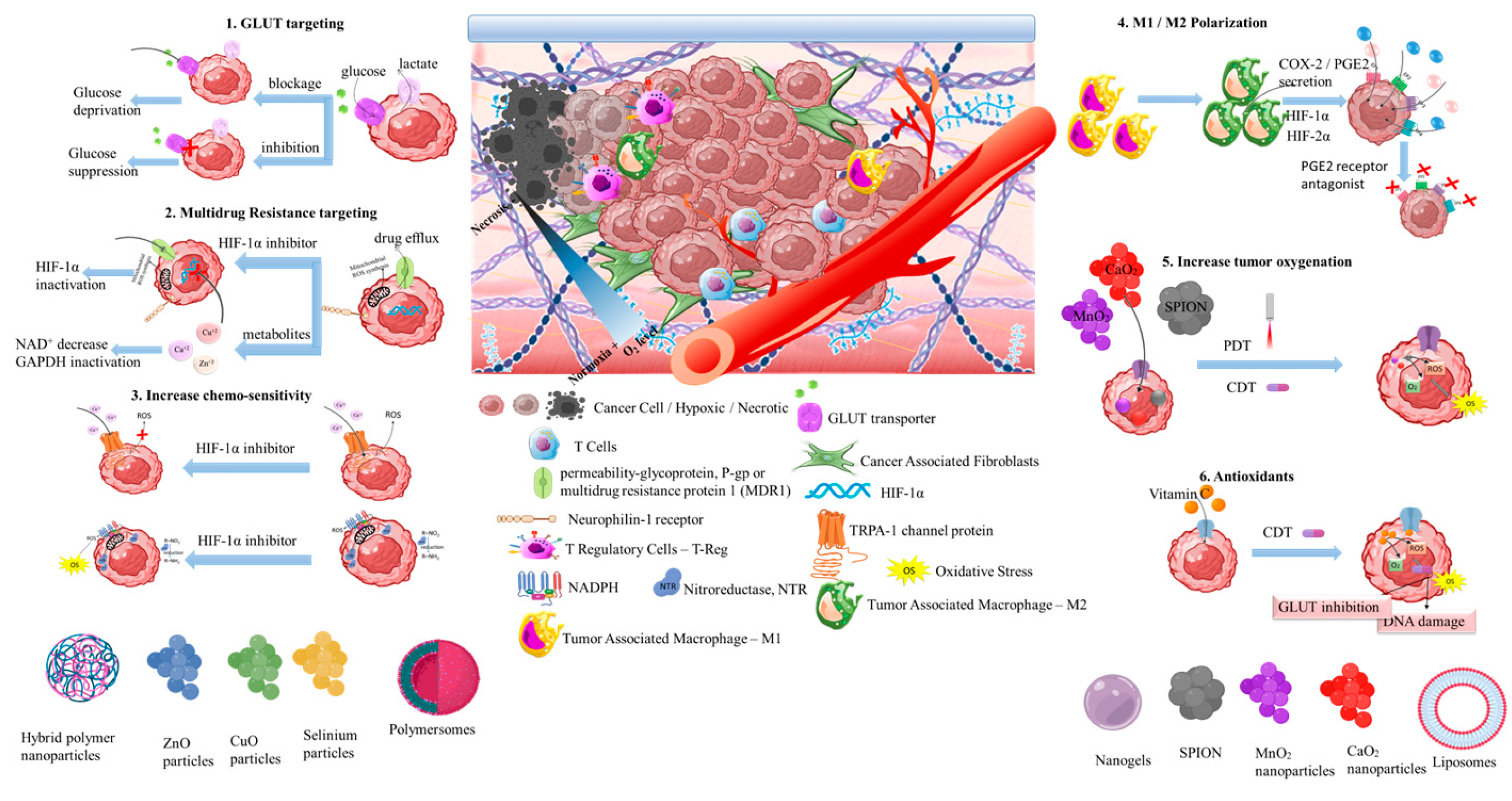
Another therapeutic target of responsive nanomedicine is the TME hypoxia, being a direct consequence of heterogenic vasculature and fluctuating blood flow, resulting in insufficient oxygen diffusion and perfusion within tumor environment. The rapid proliferation rate of tumor and stromal cells create an excessive consumption of supplied oxygen, nutrients and energy [155]. The imbalance on the diffusion mechanisms of oxygen supply is observed at depths after 70-150 μm from peripheral tumor blood vessels, resulting in gas oxygen (gas-O2) levels below 1-2 %, for hypoxic solid tumors. Basically, there are two types of hypoxia the chronic, wherein oxygen’s concentration is characterized by a longitudinal gradient drop for a prolonged time period of several hours, and the acute that tumor ECs and stromal cells are attached to vasculature with deprived oxygen perfusion [156]. The extensive research interest, resulted in the understanding of hypoxia mechanisms and effects on tumor biology, participating in the regulation of angiogenesis, metastasis, and multidrug resistance [157,158], and in the investigation of hypoxia-regulated genes, expressed among various tumor types, such as the squamous cell carcinoma (SCC) of the head and neck, lung, and cervix that present the highest hypoxic gene expressions [159].
Scheme 6.
Tumor hypoxia represent a significant target region of responsive nanomedicines, with characteristic examples being presented. Important axes of nanomedicine research are GLUT targeting, multidrug resistance targeting, increase of chemo-sensitivity, M1/M2 macrophage polarization, increase of tumor oxygenation, and antioxidants. Biomaterials used for hypoxia targeting nanomedicines include, polysaccharides, polymers, hybrid nanoparticles, metal oxides and hybrid metal-polymer nanoparticles, polymersomes, nanogels, and liposomes in combination with chemotherapeutic drug targeting (CDT), magnetic targeting, PDT/PTT therapy. (created with the assistance of BioRender.com, and Microsoft ppt).
Scheme 6.
Tumor hypoxia represent a significant target region of responsive nanomedicines, with characteristic examples being presented. Important axes of nanomedicine research are GLUT targeting, multidrug resistance targeting, increase of chemo-sensitivity, M1/M2 macrophage polarization, increase of tumor oxygenation, and antioxidants. Biomaterials used for hypoxia targeting nanomedicines include, polysaccharides, polymers, hybrid nanoparticles, metal oxides and hybrid metal-polymer nanoparticles, polymersomes, nanogels, and liposomes in combination with chemotherapeutic drug targeting (CDT), magnetic targeting, PDT/PTT therapy. (created with the assistance of BioRender.com, and Microsoft ppt).
3.4.1. GLUT targeting nanomedicines
A central role in targeting TME hypoxia is portrayed by effectively exploiting transcription factors related to various regulatory pathways of glycolysis, oxygen homeostasis, MDR and resistance to apoptosis. Such factors within TME, include the carbonic anhydrase IX (CA-IX), the glucose transporter-1 and 4 (GLUT-1, 4), and the hypoxia inducible factors (HIF) family, including HIF-1, HIF-2, HIF-3, that act as oxygen regulators to stabilize hypoxic conditions promoting tumor cell survival and angiogenesis through PDGF secretion [160]. Specifically, the blockage of GLUT-1 and GLUT-4 transporters was facilitated as an active targeting strategy for limiting nutrients supply in tumor cells by Abolhasani et al. [161], that studied glucose modified PLGA and chitosan nanoparticles effectively inhibiting GLUTs function, further stimulating glucose deprivation and increased apoptotic enzymes expression. In a recent study by Sun et al. [162], the ATRP copolymerization of glucose-containing methacrylate (GluMA) and OEGMA was used for the conjugation of interferon-α (IFN-α) for effective GLUTs targeting. The study outlined the importance in optimizing glucose content, since excessive glucose concentration resulted in inhibition of the antitumor activity, while the optimal system showed enhanced tumor targeting and antitumor immunity, as expressed by the secretion levels of TNF-α and IL-2 cytokines. In general, glycosylation of nanoparticles for efficient TME hypoxia nanomedicines has been exploited for increased GLUT targeting ability, promoting metabolic changes and immune responses, as reviewed by Torres-Perez et al. [163]. Moreover, glycolysis is the main source of energy production in hypoxic and, also, in aerobic tumor sites (the Warburg effect), denoting the importance of nanomedicines targeting the glycolytic mechanisms. In a recent review by Geng et al. [164] was effectively described, the targeting of glycolytic enzymes and transporters, and their combinational strategies in nanomedicine applications. Also, glucose metabolism in hypoxic tumor sites highly activates cancer stem cell (CSCs) phenotypes, promoting the activation of a stem-like polarization, mainly, regulated by the transcription factor HIF-1α and the Notch pathways [165]. Shibuya et al. [166], demonstrated the importance of modulating GLUT-1 transporter, for regulating the stem-like phenotype in pancreatic, ovarian, and glioblastoma CSCs. By specifically inhibiting GLUT-1 with WZB117, the self-renewal and tumor initiating activities of the CSCs were effectively suppressed in animal models upon implantation of CSCs.
Moreover, the energy supply blockage promoted by specific starvation therapeutics is highly associated with TME hypoxia targeting nanomedicines, especially by exploiting biological metal ions (e.g., Ca2+, Zn2+, Cu2+) in tumor starvation mechanisms. Among them, Cu2+ and Zn2+ being the most prevalent components of enzymes play crucial role in energy metabolism, gene expression and genomic stability. Yang et al. [167] studied the effect of copper-based ultra-small nanoparticles (Cu2-xSe), modified with HIF-1α inhibitor and, further, coated with tumor cell membrane. The nanoparticles were effectively transported through the blood-brain barrier, upon focused ultrasound application, and accumulated at glioblastoma tumor site, inhibiting HIF-1α expression and enhancing tumor sensitivity to disulfiram for effectual antitumor activity. In another study, Wu et al. [168] examined the effect of zinc imidazole metal-organic particles (ZIF-8) modified with hyaluronic acid for systemic glycolytic energy deprivation. The nanoparticles expressed CD44-targeting mechanism, leading to effective tumor accumulation and cellular endocytosis that promoted the disaggregation of zinc core by hyaluronidase, further, triggering decrease of NAD+ and inactivation of GAPDH, obtaining strong glycolysis inhibition, and additionally suppressing GLUT1 regulation, promoting energy starvation, in B16-F10 tumor bearing C57BL/6 mice. The energy demand of tumor cells is crucially supported by excess amounts of glucose production that lead to increased expression levels of GLUT1, and GLUT2, and abundant glycolytic enzymes. The phenotyping of tumor cells with elevated glucose expression levels, represent a negative prognostic factor that can be exploited in diagnosis, for the effective design of personalized nanomedicines. In this respect, glucose nanosensors have been investigated for application in diagnosis, by Nascimento et al. [169] that studied the effectiveness of nanopipette-based glucose sensors, functionalized with glucose oxidase (GOx), to quantify single cell intracellular glucose levels.
3.4.2. Multidrug resistance targeting therapeutics
The targeting of HIF transcription factors, will not be broadly discussed here, since its role in hypoxia mechanisms and in responsive therapeutic nanomedicine was extensively reviewed [170,171,172]. A comprehensive mini-review, on engineered nanomedicines summarizing recent progress on HIF-1 targeting was presented by Zhang et al. [173]. HIF is highly associated with multidrug resistance in solid tumors, being developed as tumor cells occupy a defense mechanism against drugs, resulting in drug efflux and decrease of intracellular drug concentration. MDR is an ultimately complex mechanism related to gene mutations, increased DNA repair ability, and epigenetic alterations involved in the regulation of gene expression, as silencing of tumor suppressor genes and overexpression of oncogenes. In MDR, drug efflux from tumor cells is mediated by efflux transmembrane pumps, such as the permeability-glycoprotein (P-gp), also, known as multidrug resistance protein 1 (MDR1), being important transmembrane proteins that are ATP-dependent and regulated by HIF proteins [174]. Certain chemotherapeutic agents that act through mitochondrial ROS formation, as cisplatin (CSP or DDP) can affect MDR, either through inducing ROS-mediated cancer cell death by activating apoptotic signaling pathways, or through promoting drug resistance, and activation of HIF-1 cascade due to elevated ROS production, also, leading to severe damage to normal tissues. In a recent study Zhang et al. [175], investigated the effect of cisplatin on inhibiting ROS induced HIF-1 activation and acquired resistance, by chitosan-coated selenium/cisplatin nanoparticles, based on the combination of cisplatin with selenium antioxidant properties. Chitosan provided long circulation and effective accumulation at the tumor site, in cisplatin-resistant A549 tumor bearing mice, and cisplatin promoted HIF-1 expression in a ROS dependent function, while the combined selenium antioxidant effect suppressed ROS formation and inhibited HIF-1 activation. The inhibitory effect of selenium nanoparticles was, also, confirmed by the downregulation of GCLM, P-gp, MDR2, and HIF-1α protein expression levels. The acquired drug resistance promoted by cisplatin application was examined, by Zhang et al. [176] in organosilica-coated cisplatin nanoparticles, co-delivering the HIF-1 inhibitor acriflavine (ACF). The nanoparticles were efficiently accumulated at tumor site being susceptible to glutathione triggered biodegradation, thus releasing ACF for inhibiting HIF-1 activity, by preventing the formation of HIF-1α/β dimers via HIF-1α binding. The synergistic release of cisplatin, resulted in a highly effective system suppressing tumor growth and metastasis. Reversing MDR was, also, studied by Li et al. [177] through the combined delivery of doxorubicin and the HIF inhibitor PX478, by silk fibroin nanoparticles functionalized with folic acid, for effective active targeting. The multi-responsive nanoparticles inhibited HIF gene expression, by the synergistic action of FA receptor mediated endocytosis and PX478 inhibition that effectively downregulated MDR1 expression levels, thus eliminating DOX efflux. Neuropilin-1 (NRP1) is another receptor involved in cellular processes related to MDR in tumor cells. The role of NRP-1 on the loss of therapeutic efficacy of lenvatinib was evaluated by Fernandez-Palanca et al. [178] in relation to hypoxia and modulation of HIF-1α. Mamnoon et al. [179] studied NRP-1 as a molecular target for the delivery of iRGD peptide and doxorubicin by hypoxia responsive PLA-diazobenzene-PEG polymersomes. The evaluation in tumor bearing animal models, demonstrated the accumulation of the polymersomes at tumor site and the antitumor effect by inhibiting tumor growth.
Table 5.
Targeted nanomedicines based on biomaterials for tumor hypoxia.
| Targeting Effects | Carrier Type | Therapeutic Agent | Characteristics | Ref. |
|---|---|---|---|---|
| GLUT | PLGA-chitosan particles | GLUT-1 | Glucose deprivation, increased apoptotic enzymes expression | [161] |
| Glucose-Methacrylate-OEGMA nanoparticles | Interferon-α | Tumor targeting and antitumor immunity | [162] | |
| Cu particles / tumor cell membrane coating | HIF-1α inhibitor / disulfiram | Enhanced tumor sensitivity | [167] | |
| Zn-imidazole – hyaluronic acid particles | DNAzymes | Antitumor effects inhibiting glucose energy | [168] | |
| Nanopipette sensors | Glucose Oxidase | Identification of intracellular glucose level | [169] | |
| Multidrug Resistance | Se / chitosan nanoparticles | Cisplatin | Suppressed ROS formation, inhibited HIF-1α, MDR-2, P-gp | [175] |
| Organosilica particles | Cisplatin / Acriflavine | Inhibition of tumor growth and metastasis | [176] | |
| Silk fibroin particles | Doxorubicin / PX478 HIF inhibitor | Downregulation of MDR1 and P-gp | [177] | |
| PLA-diazobenzene-PEG polymersomes | iRGD peptide / Doxorubicin | Increased accumulation, inhibition of tumor growth | [179] | |
| Chemo-Sensitivity | Hyaluronic acid nanogels / DSPE-PEG nano-micelles | Doxorubicin / TRPA-1 inhibitor | Enhanced tumors sensitivity, antitumor and antimetastatic effects | [183] |
| Chitosan-FA particles | Nitroreductase / Doxorubicin | Hypoxia triggered effective antitumor action | [184] | |
| CM-chitosan-maleimide particles | Dihydroartemicin / PDT | Suppression of HIF-1α and VEGF, inhibition of tumor metastasis | [185] | |
| M1/M2 polarization | Iron oxide-hyaluronic acid-chitosan nanoparticle | HIF-1α siRNA / PGE2 receptor antagonist | Suppression of proliferation, migration, angiogenesis, decreased protein levels, | [189] |
| Combinational | MnO2 – hyaluronic acid nanoparticles | Doxorubicin | Inhibiting tumor growth and cell proliferation | [193] |
| human serum albumin MnO2 nanoparticles | chlorin e6 / PDT | Tumor targeting ability, increased accumulation, elevated oxygen levels, tumor necrosis and apoptosis | [194] | |
| MnO2 – albumin nanoparticles | indocyanine green / PDT | Enhanced oxygen production, antitumor effect | [195] | |
| DSPE-PEG liposomes / MnO2-BSA nanoparticles | Atovaquone / hypericin / PDT | Suppressing hypoxia, increased antitumor effect | [196] | |
| lipid-PLGA-MnO2 particles | Sorafenib | Hypoxia suppression, inhibited tumor cells proliferation, suppressed angiogenesis and metastasis, | [198] | |
| solid lipid calcium peroxide (CaO2) nanocarriers | Doxorubicin / iron-oleate / Chemodynamic theapy | Oxidative damage to tumor tissues | [199] | |
| pH-sensitive methacrylate - CaO2 particles | CaO2 particles / PDT | Increased tumor oxygenation | [200] | |
| liposome nanoparticles | Cu-oleate / Acriflavine | Immunogenic cell death, combined antitumor immune responses | [201] | |
| Antioxidants | PEGylated liposomes | Palmitoyl ascorbate | Suppressed tumor growth | [206] |
| Liposomes | Doxorubicin / Palmitoyl ascorbate | Suppressed tumor growth | [207] |
3.4.3. Increasing chemo-sensitivity
On the basis of chemotherapy and radiotherapy resistance, the researched solutions focused in sensitizers and in enhancing TME oxygenation. The sensitizers are in general chemical compounds (originally nitro-aromatic ring compounds) that act by elevating the tumor cellular sensitivity to ionizing radiation, thus producing free radicals and promoting DNA damage [180]. A great drawback on the application of chemical sensitizers, was the dose-depended toxicity and adverse effects related to ROS and RNS expression levels, however more effective, with low toxicity sensitizers were designed, by exploiting small molecules (O2, NO), macromolecules (proteins, peptides, miRNA, siRNA), and nanomaterials (noble metals, ferrite, heavy metals) that act without distressing ROS expression levels [181]. In tumors, TRPA-1 is a channel plasma membrane protein, promoting extracellular Ca2+ influx and representing the most abundant redox sensor upregulated in metastatic cells of solid tumors, such as human oral squamous cell carcinoma, colorectal cancer adenocarcinoma, glioblastoma multiform. The TRPA-1 was evaluated as a ROS sensor, since its upregulation mediated enhanced ROS-induced Ca2+ influx, as a result of oxidative stress, thus promoting anti-apoptotic signaling pathways [182]. Wang et al. [183] studied on TRPA-1 inhibition in order to increase tumor chemosensitivity in tumor bearing mice, through hyaluronic acid nanogels functionalized with DSPE-PEG nano-micelles that were conjugated with a tumor homing penetrating tLyP-1 peptide for co-delivering doxorubicin and TRPA-1 inhibitor (AP-18). The combined effects of HA and penetrating peptide resulted in enhanced intratumoral and intracellular localization, since the HA nanogels disassembled in irregular fragments releasing peptide conjugated nano-micelles, upon hyaluronidase effect in TME. The TRPA-1 inhibitor, enhanced tumors sensitivity to DOX by suppressing Ca2+ uptake and AKT phosphorylation, promoting regulation of EMT-related proteins and, further, increasing antitumor and antimetastatic effects.
A redox enzyme highly associated with tumor hypoxia is nitroreductase (NTR) that catalyzes the reduction of nitro compounds in the mitochondria, by using NADPH. Jang et al. [184] examined the effect of NTR in self-assembled nanoparticles of glycol chitosan loaded with doxorubicin, functionalized with folic acid and, further, modified with 4-nitrobenzyl chloroformate (4NC). The nanoparticles effectively accumulated at the tumor site due to the combined effects of CS and FA targeting, and disassembled owing to the NTR/NADPH cascade reducing the chitosan bonded 4NC under hypoxic conditions, efficiently promoting DOX antitumor activity. Another study exploiting the hypoxia mediated bond reduction was by Luo et al. [185] that examined self-assembling thioether linked dihydroartemicin (DHA) prodrug nanoparticles loaded with chlorin e6 and further encapsulated in core-shell amphiphilic carboxymethyl chitosan polymer particles, grafted with maleimide and 2-nitroimidazole (NI) groups. The nanoparticles showed significantly long circulation time and accumulation ability through the combined chitosan and EPR effect. Once PDT was applied, oxygen consumption was increased and the NI groups were reduced destabilizing the structure of the chitosan particles, further promoting drug release at the tumor site.The synergistic effect resulted in suppression of HIF-1α and VEGF expression levels, inhibition of tumor metastasis and improved therapeutic effect in LLC tumor bearing rats and mice.
3.4.4. Targeting M1 / M2 macrophage polarization
In TME, hypoxia is responsible for inducing the reprogramming of pro-inflammatory M1 macrophages to occupy a M2 anti-inflammatory phenotype promoting tumor aggressiveness and MDR. M1 macrophages play critical roles in innate host immunity and tumor cell death by producing ROS/RNS and pro-inflammatory cytokines, such as IL-1β, IL-6, TNF-α. M2 macrophages polarization induced by Th2 cytokines such as IL-4, IL-10 and IL-13, play a critical immunosuppressive part in immune responses, under the activation of immune complexes (IC) and TLR ligands, producing anti-inflammatory cytokines, such as IL-10, IL-13 and TGF-β, to promote tumor development. By altering macrophage responses, hypoxia downregulates the expression of antigens and the release of pro-angiogenetic factors, thus exerting immunosuppressive effects promoting cell proliferation. While the M1/M2 states have been identified, the regulation of macrophage phenotypes remains a complex mechanism. The production of distinct functional phenotypes in macrophages (polarization), as a consequence of hypoxia, is essentially regulated by HIF-1α playing a key role in the expression of several genes [186]. Among them, the PTGS gene encoding cyclooxygenase-2 (COX-2) is of major importance, since is related to increased accumulation of pro-inflammatory signals, representing an indicator associating inflammation with cancer [187]. COX-2 is secreted by CAFs, M2 macrophages and TME cells, inducing cancer stem-like cells activity, MDR and metastasis. COX-2 induced HIF-1α activity is responsible for biosynthesis of prostanoids, like prostaglandin E2 (PGE2), that its overexpression was reported in a variety of cancers, including breast cancer, osteosarcoma, and colorectal cancer. The HIF-1α/COX2 signaling axis is highly related to resistance, invasion and metastasis [188]. Karpisheh et al. [189], studied the effect of HIF-1α silencing siRNA and PGE2 receptor antagonist (EP4-antagonist) as a combinational therapy upon tumor bearing BALB/c nude mice. For this purpose, superparamagnetic iron oxide nanoparticles (SPIONs) functionalized with hyaluronic acid and trimethyl chitosan were used for the delivery of siRNA and the EP4 antagonist. The synergistic effect of hyperthermia, CS and HA resulted in increased biodistribution at the tumor site, effectively delivering the siRNA. The combined effect of HIF-1α siRNA and the EP4 antagonist resulted in i) suppressing proliferation and migration of tumor cells by decreasing the expression levels of ki-67 gene, anti-apoptotic protein Bcl-2, and MMP-2 / -9, and ii) inhibition of VEGF, FGF and TGF-β promoting suppression of angiogenesis and inhibition of tumor growth.
3.4.5. Combinational targeting for increasing tumor oxygenation
In order to increase tumor oxygenation, various strategies were researched including i) modulation of tumor blood flow with compounds, such as noradrenaline, benzyl nicotinate, nicotinamide, pentoxifylline, ii) high oxygen breathing, through hyperbaric chambers, and carbogen breathing, iii) targeting tumor vasculature with anti-angiogenetic therapies, and vascular disruptive agents [190]. Hyperbaric oxygen (HBO) treatment was used in suppressing hypoxia, by effectively elevating the oxygen concentration in plasma and, subsequently, enhancing oxygen delivery in tumor tissues, independent of hemoglobin, resulting in reduced tumor growth in breast cancer, while cervical and bladder cancers have appeared to be insensitive to HBO [191]. In a recent study by Wang et al. [192], HBO was applied in combination with Abraxane and gemcitabine (GEM) to trigger antitumor activity against murine PDAC tumors, expressing inhibitory activity over ECM by decreasing fibril deposition of collagen I and fibronectin. As CAFs are main cellular components of ECM, HBO significantly inhibited their activity by suppressing tumor hypoxia that in combination with abraxane and GEM, resulted in inhibition CSCs as evidenced by the decreased expression levels of CD133 and Sox2 CSCs-related biomarkers, and further promoted the antitumor activity of the drugs, in primary and in metastatic PANC02 tumors.
In a recent review by Wu et al. [65], nanoparticle-based systems targeting TME were presented including hypoxia responsive nanomedicines effectively targeting hypoxic TME to promote tumor oxygenation. The tumor oxygenation in order to inhibit hypoxia was examined by Song et al. [193], with the application of manganese dioxide nanoparticles (MnO2) coated with hyaluronic acid and modified with mannan-PE ligands in combination with priming of pro-inflammatory M1 macrophages phenotype. The nanoparticles promoted tumor accumulation importantly elevating oxygenation as shown by the suppression of HIF-1α and VEGF expression levels and expressed immune-toxicological effects in reprogramming the antitumor M1 phenotype. The nanoparticles expressed synergistic effect upon administration with doxorubicin in tumor bearing mice inhibiting tumor growth and cell proliferation. Importantly, the MnO2 nanoparticles express a redox-active catalytic behavior toward hydrogen peroxide (H2O2) to produce oxygen and regulate acidic pH, since their Mn2+ decomposing products are excellent T1-shortening MRI agents, as described by Lin et al. [194] in human serum albumin MnO2 nanoparticles conjugated with Ce6 photosensitizer. The evaluation of the nanoparticles in tumor bearing mice, resulted in increased tumor targeting ability and accumulation efficacy, with elevated oxygenation levels that additionally treatment with PDT enhanced cellular apoptosis resulting in large tumor necrosis area. Another effective system promoting oxygenation was studied by Jiang et al. [195] in MnO2 albumin nanoparticles delivering indocyanine green (ICG), a hydrophilic anion drug, for effective PDT of hypoxic tumors. The nanoparticles were evaluated in both CT26 and B16F10 tumor bearing mice revealing the enhanced tumor accumulation efficacy and the successful responsive release of ICG in the presence of hydrogen peroxide. The combined effect with MnO2 and PDT resulted in enhanced oxygen production and attenuation of hypoxic TME, while elevated distribution of CD3+ and CD8+ T cells was promoted at tumor sites. In advanced hepatocellular carcinoma (HCC) the anti-angiogenetic agent sorafenib is a first line treatment. However, the hypoxic TME of advanced HCC regulated anti-apoptotic signaling pathways and promoted immunosuppressive reprogramming, resulting in MDR against sorafenib. Ren et al. [196] studied the synergistic effect of tumor oxygenation and PDT by strategic hypoxia relief nanodrug (SHRN) liposome of DSPE-PEG encapsulating MnO2-BSA nanoparticles, the oxygen consumption inhibitor atovaquone (ATO), and the photosensitizer hypericin (HY). In this system, oxygen production was effectively increased by MnO2 nanoparticles and the synergistic action of ATO with mitochondrial complex III resulted in the blockage of aerobic respiratory chain and the suppression of oxygen consumption. By suppressing hypoxia in TME of tumor bearing mice, PDT application essentially promoted HY action, to react with sufficient oxygen and promote increased antitumor effect. The antitumor activity of PDT originated from the elevated generation of ROS, as an outcome of electron transfer mechanisms of the photosensitizer and the molecular oxygen intracellularly. A review, on the mechanisms associated with PDT efficacy and the limitations induced by hypoxia is presented by Zhou et al. [197].
In another study, Chang et al. [198] investigated the effect of lipid-PLGA particles co-delivering MnO2 nanoparticles and sorafenib, as an effective approach for HCC. The nanoparticles promoted oxygen production in orthotopic HCC tumor mice xenografts, by catalyzing hydrogen peroxide that resulted in suppression of hypoxia and of MDR to sorafenib, further inhibiting tumor cells proliferation, suppressing angiogenesis and metastasis. The promotion of immunostimulatory M1 macrophages phenotype, resulted in the reprogramming of TME advancing the effect of co-administered immunotherapies, such as anti-PD-1 antibody and a whole-cell cancer vaccine.
Apart from MnO2, iron oxide nanoparticles were, also, studied as Fenton catalysts triggering reduction of hydrogen peroxide, by ferrous ions, to oxygen. He et al. [199], described the in vitro and in vivo effectiveness of solid lipid calcium dioxide (CaO2) nanocarriers (SLNs) that co-deliver doxorubicin and iron-oleate. At the tumor site, the SLNs dissociated by lipase overexpressed in cancer cells enabling the release of iron-oleate and CaO2 particles, that in response to acidic cellular environment released DOX and produced hydrogen peroxide molecules. The Fe3+ ferrous irons released from iron-oleate reacted with H2O2 molecules to produce oxygen and the Fe2+ ions created hydroxyl radicals, for antitumor chemodynamic therapy (CDT) that based on Fenton or Fenton-like reactions of metal catalysts, CDT can induce oxidative damage to tumor tissues. Moreover, CaO2 nanoparticles coated with a pH-sensitive methacrylate based copolymer were studied by Sheng et al. [200] to enable tumor oxygen generation in MIA PaCa-2 tumor bearing mice improving PDT treatment. The combination of CDT with immunotherapy was examined by Zhang et al. [201] in liposome nanoparticles co-delivering copper-oleate and the HIF-1 inhibitor acriflavine (ACF) for combined antitumor immune responses. The liposomes dissociated in the acidic hypoxic TME, with the subsequent release of copper ions that catalytically reduced hydrogen peroxide to highly active hydroxyl radicals. The activity of copper ions was supported by ACF that effectively inhibited the HIF-1/glutathione pathway, suppressing the expression of programmed death ligand-1 (PD-L1), further reducing the extracellular expression levels of lactate and adenosine, and finally promoting immunogenic cell death (ICD).
3.4.6. Synergistic targeting with antioxidants
Despite the limitation of TME, hypoxia in solid tumors remains a key barrier for improved therapeutic efficacy overcoming MDR, chemo and radio resistance. The synergistic effect of hypoxia targeting nanomedicines in combination with chemotherapeutic agents and antioxidants was highly researched and reviewed, due to their effect in reoxygenation and ROS expression levels [202,203,204]. The overproduction of ROS can promote oxidative stress (OS) and induce oxidative damage of biomolecules as DNA, lipids and proteins, eventually promoting the death of normal cells, while in tumor tissues, due to increased energy demand and metabolic modifications the demand on ROS production is excessively increased. The reduction on antioxidants’ level and/or the disruption of redox equilibrium within TME can further promote tumor cells growth and progression. Among various antioxidants studied in tumor therapeutics, polyphenols are associated with cancer cell apoptosis, inhibition of proliferation, and downregulation of COX-2 and tumor genes expression. Vitamins and minerals, elicit their antioxidant action by maintaining DNA methylation inhibiting cancer cell proliferation and progression [205]. Vitamins, such as Vitamin C (ascorbic acid, AA) are capable of scavenging tumor generated ROS by interacting and neutralizing them, providing normalization of OS within local tumor sites. This interaction is promoting the production of dehydroascorbic acid (DHAA) that is related with GLUT-1,3, and 4 transporters for effective and rapid cell influx. Intracellularly, DHAA is converted into AA depleting glutathione and ATP enzymes, thus affecting the expression levels of hypoxia signaling regulation factors [206]. However, the therapeutic efficacy of AA is related to ultra-high administration doses and chemical instability [207]. Thus, palmitoyl ascorbate (PA) an acylated derivative of AA, also, featuring antitumor activities was greatly applied in nanomedicines. Sawant et al. [206] investigated the effect of palmitoyl ascorbate PEGylated liposomes (PEG-PAL) in vitro and in vivo in BALB/c mice bearing 4T1 tumors, expressing enhanced effectiveness in suppressing tumor growth, versus free ascorbic acid. The mechanism of action of PEG-PAL was similar to that of ascorbic acid, since liposomes acted as ROS scavengers inhibiting extracellular ROS. In another study, Yang et al. [207] examined the combinational delivery of PA and doxorubicin by liposomes for efficient synergistic effect in suppressing tumor growth, since PA has a similar mechanism of action with DOX associated with reduced cardiotoxicity without delaying DOX activity. The evaluation in BALB/c mice and SD rats showed the synergistic antitumor effect of the liposomes with increased expression of tumor apoptotic cells and suppression of Ki-67 and CD31 protein expression levels.
3.5. The tumor acidosis
Tumor and stromal cells for their amplified energy supply requirements use aerobic glycolysis, as a direct consequence of hypoxia and defective vasculature, being an oxygen independent process, known as the Warburg effect. However, even in normally oxygenated tumor regions the main energy supplier remains aerobic glycolysis, in about 80 % of solid tumors [208]. In aerobic glycolysis, glucose constitutes the main macronutrient of tumor cells for their biosynthetic requirements that follows the lactate metabolic pathway, through GLUT transporters producing amplified levels of lactic acid (lactate). The main transcriptional factors of glycolytic activity regulating lactate production are the HIF-1α and c-Myc regulatory genes [209] that promote the overexpression of varied glycolytic enzymes, as lactate dehydrogenase A (LDHA) and monocarboxylate transporters (MCTs), such as MCT1, and MCT4 [210]. Mainly, the upregulation of LDHA gene favors the activity of LDH-5 and inhibits the activity of LDH-1, promoting the conversion of pyruvate to lactate. Through this metabolic pathway, elevated amounts of lactate, protons (H+) and carbon dioxide (CO2) are secreted into TME leading to acidosis [211] that further regulates the metabolism of innate and adaptive immune cells by i) hindering the function of CD8+ T, natural killer (NK), natural killer T (NKT) and dendritic (DC) cells, ii) supporting regulation of FOXP3+ T cells (Treg), and iii) promoting M2 activated macrophage polarization. In overall, the acidic TME is an immunosuppressive incubator of pro-oncogenic and tumorigenic factors, extensively reviewed for targeted nanomedicine applications [212,213,214]. The glycolytic metabolic pathway and acidic pH gradient are key participating factors in MDR by activation of enzymes and proteins responsible for resistance, drugs efflux through P-gp, and stimulation of migration [215,216].
In tumors, a unique pH-gradient effect is expressed with extracellular pH levels (pHe) being more acidic (6.4 – 7.0), while intracellular pH (pHi) is more alkaline (7.25 – 7.50). Distinct pH variations are presented in tumor cell organelles dividing them in acidic, as nucleosomes and lysosomes with a pH of 5.5 and 5.0 respectively, and in alkaline, as mitochondria and cytoplasm with a corresponding pH of 8.0 and 7.2. The pH gradient, is associated with the expression of membrane transporters, such as MCT1, and MCT4, carbonic anhydrases, and sodium-bicarbonate co-transporter (NBC), that participate in the translocation of lactic acid, CO2 and its bicarbonate ion byproducts. Other mechanisms influencing TME acidity are the efflux of endosomes acidic cargo, and the release of the acidic intracellular comportments of necrotic cells. In stimuli responsive nanomedicine pH sensitivity was highly exploited and reviewed [217,218,219,220,221]. Apart from drug delivery systems, tumor acidosis was targeted by pH-regulating molecular systems being at various stages of clinical trials as described by Corbet et al. [222], and by TME sensitive platforms for combined endogenous stimuli responsive effects, as reviewed by Wang et al. [223].
Table 6.
Targeted pH-sensitive nanomedicines based on biomaterials for tumor acidosis.
| Targeting Effects | Carrier Type | Therapeutic Agent | Characteristics | Ref. |
|---|---|---|---|---|
| pH-sensitive peptides | Chitosan nanoparticles / cRGD peptide | Raloxifene | Increased accumulation, enhanced antitumor effect inhibiting angiogenesis and migration | [224] |
| Glycogen nanoparticles / hydrazine-based bond | Doxorubicin / β-galactose | Enhanced accumulation, inhibiting tumor growth | [225] | |
| PLGA – BSA particles ATRAM peptide | Doxorubicin / TPP | Enhanced mitochondria targeting, inhibited tumor volume and mass | [226] | |
| Hyaluronic acid nanogels E3/K3 peptides | Cytochrome C (CC) / saporin proteins | Inhibition of protein synthesis in the cytosol, efficient antitumor effect | [228] | |
|
Metals / Metal Oxides Chemo-Sensitivity |
Cerium oxide – glycol chitosan nanoparticles | CXCR4 antagonist / Doxorubicin | Elevated internalization, increased ROS production at acidic pH, tumor size suppression and reduced blood vessel leakage | [231] |
| PEG - MnO2 nanoparticles | Doxorubicin / Ce6 PDT | Tumor oxygenation, inhibition of tumor growth, elevated antitumor immune responses | [232] | |
| MnO2-coated mesoporous silicon nanoparticles | Metformin / fluvastatin sodium | Induced intracellular acidosis promoting tumor cell death, suppressed tumor growth and metastasis | [233] | |
| Au nanorods / P(Glu-co-Lys) polypetides | Au nanorods | Enhanced accumulation in tumors periphery and hypoxic core | [234] | |
| Iron oxide SPIONs / cystamine-dextran | Doxorubicin | Increased pH-triggered internalization, inhibition of tumor volume | [235] | |
| Iron oxide SPIONs / PMAA-g-PEGMA | Canagliflozin / Radiotherapy | Accumulation in tumor tissue, inhibition of tumor growth | [236] | |
| pH-sensitive Polymeric particles | carboxyethyl chitosan – PEGDA hydrogels | Doxorubicin | Self-healing properties, antitumor effect | [241] |
| Chitosan-PEG niosomes | Tamoxifen | Increased drug accumulation and antitumor efficacy | [242] | |
| Chitosan microformulations | - | Screening of tumor progression | [243] | |
| FA-PMgDP-PDPA-PDEMA particles | Doxorubicin / Galactose | Efficient internalization, increased toxicity and apoptosis | [245] | |
| PCL-b-PAEP-TMA-Cya/DMA micelles | Doxorubicin | Enhanced internalization, inhibition of tumor growth | [246] | |
| Iron oxide-PDPA particles | PEG-polycamptothecin prodrug | Effective antitumor activities, effective antitumor activities | [247] | |
| Graphene quantum dots-PLGA-BSA particles | Doxorubicin | Sufficient internalization and in vitro toxicity | [248] | |
| PLGA particles | Doxorubicin / sodium carbonate / liquid perfluorocarbon | Tumor accumulating ability, and inhibited tumor growth | [249] | |
| PEG-b-PHMA particles | Doxorubicin-P85 prodrug / iRGD peptide / Ce6 PDT | Elevated antitumor effect and complete suppression of tumor growth | [251] | |
| PCL-PEG particles | Paclitaxel / Acetazolamide | Inhibitory effect on tumor growth, increasing the survival rate | [252] | |
| DSPE-PEOz liposomes in platelet membrane particles | Doxorubicin | Enhanced antitumor effect | [253] | |
| Zeolitic imidazolate framework-8 nanoparticles | Doxorubicin / hemoglobin / LOX | Tumor targeting effect, suppressed tumor hypoxia, remodeled tumor acidity and inhibited tumor growth | [254] |
Scheme 7.
The pH gradient acidity of TEM is a widely researched field for the development of pH-sensitive nanomedicines. Here, we present three directives as general examples including pH-sensitive peptides that form stable complexes with the cellular membrane thus increasing cellular uptake, metal and metal oxide formulations in combination with natural and synthetic biomaterials for effective pH-dependent degradation and release of drugs, and biomaterial based pH-responsive polymeric nanomedicines. (created with the assistance of BioRender.com, and Microsoft ppt).
Scheme 7.
The pH gradient acidity of TEM is a widely researched field for the development of pH-sensitive nanomedicines. Here, we present three directives as general examples including pH-sensitive peptides that form stable complexes with the cellular membrane thus increasing cellular uptake, metal and metal oxide formulations in combination with natural and synthetic biomaterials for effective pH-dependent degradation and release of drugs, and biomaterial based pH-responsive polymeric nanomedicines. (created with the assistance of BioRender.com, and Microsoft ppt).
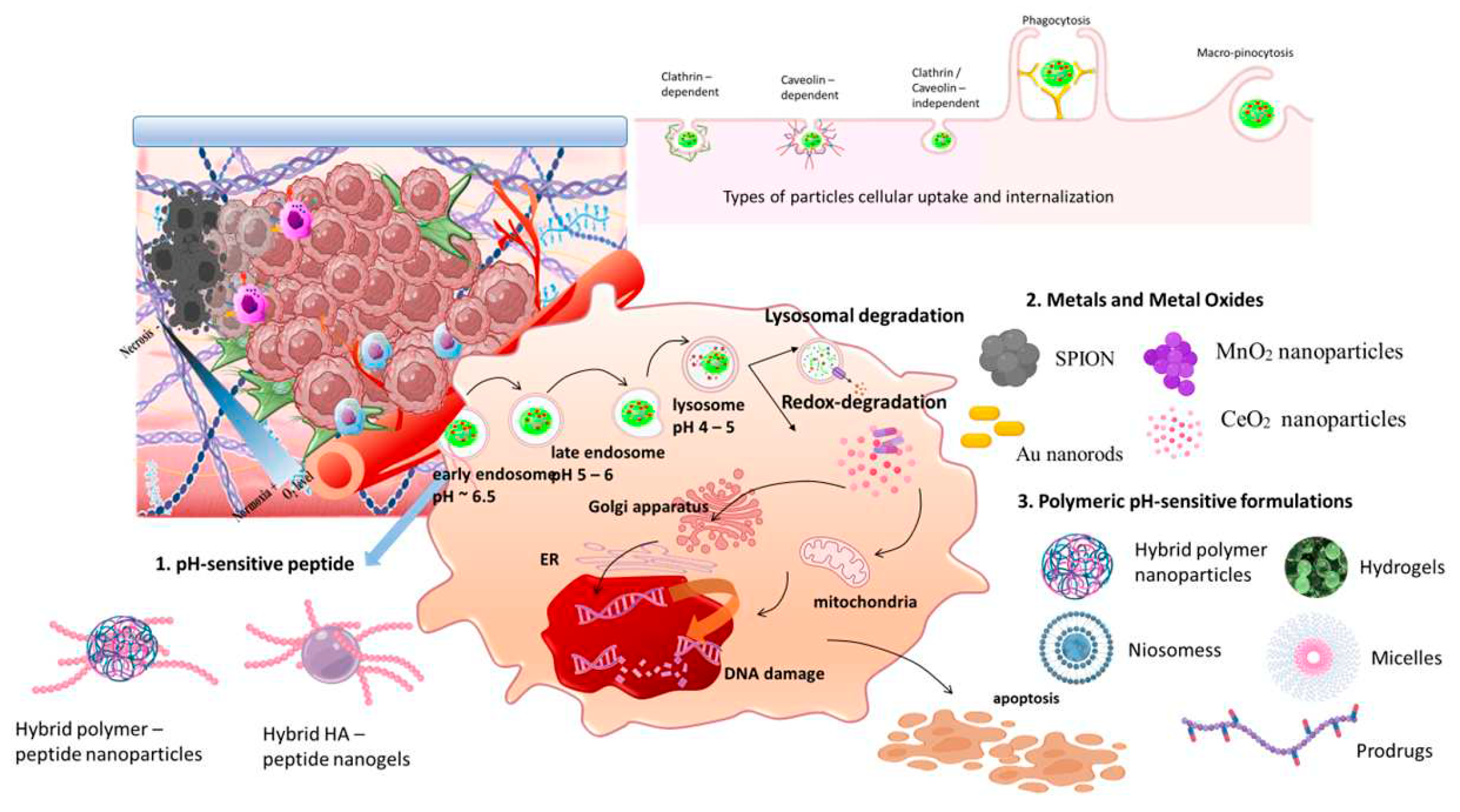
3.5.1. pH-sensitive peptides in acidic tumor targeting
A strategy for exploiting TME acidity, is based on pH responsive peptides that under physiological conditions interact weakly with the cellular membrane, but at TME create stable transmembrane complexes promoting nanomedicines internalization. Yadav et al. [224] examined chitosan nanoparticles modified with a pH-sensitive cRGD peptide (RGD-CHNP) for the delivery of raloxifene (Rlx) in NOD/SCID 4T1 tumor-bearing mice. The nanoparticles presented enhanced tumor accumulation by RGD peptide active targeting in αvβ3 integrin expressing breast cancer cells and expressed enhanced antitumor effect inhibiting angiogenesis and migration, by suppressing the regulation of osteopontin (OPN), thus inhibiting Akt and ERK signaling cascade. The combination of receptor-mediated specific binding and acidic pH was exploited by Han et al. [225] in glycogen nanoparticles, functionalized with doxorubicin via a pH responsive hydrazine-based bond and β-galactose, with selective binding affinity to the asialoglycoprotein transmembrane receptor (ASGPR) on hepatic cancer cells. Upon ASGPR binding, the subsequent cellular internalization and degradation of the nanoparticles was triggered and pH sensitive DOX release was promoted. The nanoparticles were evaluated in BALB/c nude hepatic tumor bearing mice, expressing enhanced accumulation at the tumor site accompanied with efficient antitumor activity of DOX inhibiting tumor growth. Palanikumar et al. [226] studied PLGA nanoparticles cross-linked with bovine serum albumin (BSA) and conjugated with pH-responsive membrane peptide (ATRAM) for the delivery of doxorubicin attached to TPP. BSA provided long circulation time of the nanoparticles for evaluation in tumor bearing C3H/HeJ mice, resulting in the effective intracellular localization in response to acidic pH, owing to the ATRAM peptide. The BSA coating was susceptible to GSH mediated degradation promoting the controlled release of DOX-TPP that resulted in enhanced mitochondria DOX accumulation, effectively inhibiting tumor volume and mass, while exhibited no apparent toxicity to healthy tissues.
Among pH-sensitive nanomedicine for tumor therapy, nanogels were significantly researched owing to their unique characteristics, featuring self-assembly ability, stability upon systemic circulation, improved drug delivery compared to polymeric nanoparticles, high specificity and tissue penetration through EPR due to their small size, and bioconjugation activity for microenvironment responsive therapeutics [227]. Biomaterials, such as hyaluronic acid, chitosan, DNA, and alginate were evaluated for tumor targeting nanogels with pH sensitivity owing to pH-responsive peptides or pH-sensitive degradation of the cross-linked drugs and molecules. Ding et al. [228] studied hyaluronic acid nanogels cross-linked with pH-sensitive E3 (GY(EIAALEK)3GC) and K3 (GY-(KIAALKE)3GC) peptides (HA-cNCs) for targeted delivery of cytochrome C (CC) and saporin proteins to CD44 overexpressing MCF-7 breast cancer cells. The intracellular localization of the nanogels was promoted by CD44 receptor mediated endocytosis, due to HA, triggering the endosomal degradation of the E3/K3 pH-sensitive cross-linked peptides and the release of the loaded proteins. The triggered release of CC and saporin from the nanogels, resulted in combined antitumor effect against breast cancer cells. CC is a hemeprotein weakly connected in the inner mitochondrial membrane, participating in ATP synthesis. During the early apoptotic phase, detachment of CC is stimulated by ROS production leading to CC efflux into the cytosol, acting as a regulator of apoptotic stimuli in cancer cells. Moreover, saporin is a ribosome-inactivating protein involved in the inhibition of protein synthesis in the cytosol resulting in cell death.
3.5.2. Metals and Metal oxides in acidic tumor targeting
Metal oxide nanoparticles attracted research interest in emerging tumor therapeutic and diagnostic applications. The investigation on these nanoparticles expanded on varied strategies including conjugation, combination with radiotherapy or chemotherapy, activity based on external or internal stimuli. Several research approaches that combine the effects of metal oxides (MO) with targeting acidic TME were developed for increased pH-sensitive antitumor efficacy. The interest on MO nanoparticles, is owing to their pro-apoptotic activity, and inhibition of tumor cell growth, metastasis, and ROS production [229,230]. A characteristic example of MO, is the cerium oxide nanoparticles (nanoceria) being inorganic antioxidants that at physiological pH express catalytic mimicking activity quenching ROS effect, while at acidic pH function as oxidases increasing oxidative stress and apoptosis. Gao et al. [231] studied multi-responsive nanoceria particles coated with glycol chitosan for the delivery of doxorubicin and expressing tumor targeting ability by CXCR4 antagonist (AMD11070). An important axis connecting tumor cells and TME is the CXCR4/CXCL12 signaling, based on the CXC G protein-coupled chemokine receptor 4 (CXCR4 or CD184) overexpressed in various human tumors, including human retinoblastoma. CXC chemokine ligand 12 (CXCL12, or stromal-derived-factor-1, SDF-1) is a ligand that acts through binding to the CXCR4, promoting cancer stem cell phenotype, tumor progression, invasion and metastasis. The nanoceria particles were evaluated for their antitumor activity on retinoblastoma cells, expressing elevated internalization significantly increasing ROS production at acidic pH. The therapeutic efficacy in orthotopic models of genetic p107s mice, resulted in the inhibition of tumor growth, expressing substantial tumor size suppression and reduction in blood vessel leakages.
Manganese dioxide nanoparticles (MnO2) represent promising theranostic candidates, combining TME oxygenation triggered by MnO2 reduction effect on ROS, with photodynamic therapy and pH-responsiveness. Yang et al. [232] studied hollow MnO2 nanoparticles functionalized with PEG, for the combined delivery of doxorubicin and the photodynamic agent Ce6. At the acidic tumor pH, the degradation of MnO2 nanoparticles was promoted by reaction with protons and GSH, generating Mn2+ ions and leading to the oxygenation of the tumors and the combined release of DOX and Ce6, further promoting the inhibition of tumor growth. The antitumor immune responses were, also, evaluated providing significantly decreased population of M2 macrophages, and suppressed expression levels of IL-10. Tumor acidosis was exploited as an endogenous stimulus by Chen et al. [233], for the targeting effect of FA-conjugated MnO2-coated mesoporous silicon nanoparticles for the co-delivery of metformin (Me) an oral drug for type 2 diabetes, and fluvastatin sodium (Flu) an inhibitor of monocarboxylate transporter 4 (MCT4 protein) responsible for mediating the intracellular lactate/H+ efflux. The nanoparticles expressed effective targeting affinity to folate receptor for enhanced internalization that promoted the degradation of the MnO2 particles by GSH through oxidation reduction, resulting in the release of Me and Flu. The synergistic effect of the drugs successfully regulated the pyruvate metabolic pathway, to promote the production of elevated lactate levels and suppress the lactate efflux, further inducing intracellular acidosis that promoted tumor cell death, suppressing tumor growth and inhibiting metastasis in MCF-7 tumor bearing nude mice.
Gold nanostructures are highly applied in tumor targeting, since upon internalization by tumor cells they act as sensitizers to radiation therapy. More advantages of gold nanoparticles encounter their efficient transportation through the leaky tumor vasculature, surface modification by thiol linkages, and use in clinical applications. Rauta et al. [234], studied the conjugation of gold nanorods with charge-reversal poly(Glu-co-Lys) polypeptides with pH responsiveness, effectively switching charge at the acidic extracellular TME enabling their internalization in tumor cells. The evaluation of the Au nanorods in orthotopic pancreatic tumors, resulted in enhanced accumulation at the tumors periphery and the hypoxic core of large tumors. No abnormalities were observed in normal organs and no hematological deviations, proving the safety of the gold nanorods. Another example of charge-reversal responsive polymers induced by pH acidity was studied by Xue et al. [235] in doxorubicin-loaded superparamagnetic iron oxide nanoparticles (SPIONs), modified with citraconic anhydride-dextran (Dex-COOH) and cystamine-dextran (Dex-SS-NH2). The nanoparticles were carrying a negative charge that expressed a pH-responsive charge decline due to the acid-sensitive dextran coating, enabling the internalization of the nanoparticles and the lysosomal escape by switching the charge from negative to positive. Subsequently, the nanoparticles due to the presence of the disulfide bond decomposed under the effect of GSH, triggering DOX release that promoted antitumor activity with significant inhibition of tumor volume in CT26 tumor bearing mice. Effective accumulation of the nanoparticles at tumor tissue was observed with low non-specific tissue toxicity. In a study by Angelopoulou et al. [236], SPIONs functionalized with PMAA-g-PEGMA polymers and conjugated with canagliflozin via pH-sensitive bond, were evaluated in PDV C57 tumor bearing mice, for their antitumor effect. Canagliflozin, is a type 2 diabetes drug that acts through inhibition of sodium-glucose transporter protein (SGLT2), thus taking advantage of the TME hypoxia. The nanoparticles expressed enhanced tumor accumulation by the application of a static magnetic field gradient and the pH-sensitive canagliflozin release was triggered providing efficient antitumor activity that in combination with radiotherapy significantly inhibited tumor growth.
3.5.3. Biomaterial based polymeric nanomedicines in acidic tumor targeting
Another highly investigated and widely reviewed type of nanomedicines is polymeric systems combined with biomaterials for pH-responsive TME targeting, including hydrogels [237], polymer nanoparticles [238,239], and micelles [240]. Despite the effort, the complex biological characteristics and aggressiveness of the acidic microenvironment of solid tumors, remains a challenge for effective delivery. Since, TME acidosis is not considered a limiting barrier, but signifies a micromilieu for smart targeted drug delivery, promising polymeric nanomedicine strategies were studied. Among them, hydrogels are injectable systems for in situ administration of drugs that enable the localized application at tumor site and, also pH-stimuli responsiveness and self-healing properties. As presented by Qu et al. [241] N-carboxyethyl chitosan (CEC) hydrogels cross-linked with dibenzaldehyde-terminated poly(ethylene glycol) (PEGDA) and conjugated with doxorubicin were injected upon subcutaneous injection in hepatocellular liver carcinoma bearing rats, to be evaluated for their antitumor activity. The hydrogels effectively accumulated at tumor site and pH-responsive DOX release was triggered. Moreover, the hydrogel promoted self-healing activities due to the Schiff-base linkage between CEC and PEGDA
In another study, Megahed et al. [242] evaluated pH-sensitive PEGylated chitosan niosomes for the delivery of Tamoxifen (Tam), a hormone antagonist used in breast cancer therapy. Chitosan was used as a pH-sensitive polymer and PEG for employing long-circulation effects. Tam is a selective estrogen receptor modulator (SERM) with the activity of binding to estrogen receptors and promoting agonist or antagonist effects depending on the targeted tissue. Tam represents a promising treatment for estrogen receptor positive (ER+) breast cancer, and for stromal targeting of pancreatic ductal adenocarcinoma (PDAC). The evaluation of cell cycle analysis revealed that the presence of chitosan and PEG in niosomes had a great influence on the induced apoptosis, with chitosan promoting apoptosis over necrosis of tumor cells, while PEG presence increased apoptotic and necrotic populations. The evaluation of the niosomes in breast tumor bearing rats, resulted in elevated antitumor efficacy and increased Tam accumulation at tumor site. Chitosan is preferentially applied in tumor acidosis, since its abundant amino groups on the polypeptide chain obtain a positive charge under acidic pHe. Thus, an innate pH-responsiveness is prompted by chitosan, enabling its application even in screening for deep analysis of invasive cancer cells, as reported by Ivanova et al. [243] that evaluated chitosan micro-formulations for screening of tumor progression, in response to acquired resistance of the acidic TME. Toxicity was hypothesized to be associated with biological and chemical metabolic changes of acidic microenvironment and pH gradient effect. The highly invasive metastatic tumor cells, occupy a strong negative charge, thus electrostatically attach to the chitosan micro-formulation enabling the screening of tumor metastasis.
Stimuli pH-responsive polymeric nanoparticles are the focus of interest in a wide range of cancer targeting applications, with review articles including engineered nanoparticles able to respond to TME endogenous stimuli [244], with pH-responsive activity based on charge shifting polymer structures, acid labile linkages and pH-responsive cross-linkers [238]. Zhao et al. [245] studied cross-linked polymeric nanoparticles with folic acid (FA) and galactose (GAL) targeting activity and dual pH/redox-sensitivity, due to the PDPA and PDEMA cross-linked block copolymers, respectively. The amphiphilic cross-linked polymeric resulted in self-assembled nanoparticles loaded with doxorubicin and evaluated in HepG2 hepatocellular carcinoma cells. GAL was responsible for selectively binding to asialoglycoprotein (ASGPR) receptors of HepG2 cells and FA to folate receptors, promoting dual active targeting for efficient internalization. Due to the protonation of the tertiary amine at acidic pH and the reduction of the disulfide bond by GSH, increased DOX release was promoted intracellularly, resulting in increased cytotoxicity and apoptosis. Another example of charge shifting polymers was reported by Yuan et al. [246], that studied zwitterionic polymers based on block copolymers of PCL-b-PAEP composed of equal anion and cation groups on their backbone chain, providing them greatly hydrophilic characteristics, that promote resistance to protein adsorption, avoidance of rapid recognition by immune system, and delayed blood clearance representing dynamic alternatives to PEG. The PCL-b-PAEP block copolymers were further grafted with thiol derivatives of cysteamine hydrochloride and TMA, resulting in positively charged polymers that were further reacted with 2,3-dimethylmaleic anhydride to acquire pH-sensitivity. The polymers were self-assembled in micelles for the delivery of doxorubicin, with surface charge switching ability in response to the acidic TME. The evaluation of the micelles in MDA-MB-231 tumor bearing mice, provided evidence for enhanced tumor cell internalization and inhibition of tumor growth. Wang et al. [247], also, examined charge shifting PDPA polymers in micelle-type nanoparticles, that incorporated iron oxide nanoparticles (IONPs), and β-lapachone (La). The pH-responsive PDPA-modified IONPs were further incorporated in H2O2-responsive polymeric prodrugs of PEG-polycamptothecin. Thus, dual responsive nanoparticles were obtained expressing pH and H2O2 sensitivity that were evaluated in A549 tumor bearing mice, resulting in acidic mediated degradation in the endosome/lysosome environments, due to the shifting pH-responsiveness of PDPA. Thus, La was released and catalyzed by nicotinamide adenine dinucleotide (phosphate): quinone oxidoreductase 1 (NAD(P)H: NQO1), producing elevated levels of hydrogen peroxide. Then, the newly produced H2O2 reacted with iron ions to further promote the generation of toxic ROS levels, with elevated expression of hydrogen peroxide species promoting the degradation of the peroxalate ester linkages, thus triggering camptothecin release. The synergistic effect of the nanoparticles resulted in effective antitumor activity, significantly inhibiting tumor volume and tumor growth (IRG), with low systemic toxicity.
PLGA nanoparticles were highly evaluated in nanomedicines, including pH-responsive applications, owing to excellent biocompatibility, biodegradability, and ease of functionalization properties. Liang et al. [248] studied PLGA nanoparticles coated with BSA and encapsulating doxorubicin and graphene quantum dots (GQDs) expressing fluorescence properties for cellular imaging. The pH-responsive DOX release was triggered due to the biodegradation of the PLGA structure and the protonation of daunosamine group in the acidic environment, promoting in vitro toxicity. In another study by Meng et al. [249], PLGA nanoparticles were evaluated for the combined delivery of doxorubicin, sodium carbonate (Na2CO3) and liquid perfluorocarbon (PFC) for effective ultrasound-responsive treatment of drug resistance by inhibiting lactic acidosis. The liquid PFC nanodroplets were ultrasound (US) responsive vaporizing upon US effect to gas phase, further stimulating the rapid Na2CO3 release acting as a neutralizing agent. This way, the cellular proton pumps were regulated resulting in inhibition of lactate acidosis and enhancing DOX release, thus increasing tumor growth inhibition.
As outlined by Shi et al. [250], the pH-sensitivity of nanomedicines in drug delivery systems can be contributed by various mechanisms, including protonation of biomolecules as drugs, peptides, and polymers, and degradation of pH-sensitive bonds. The study of nanoparticles composed of pH sensitive copolymers selectively dissociating was investigated by Wang et al. [251] that studied PEG-b-PHMA copolymers grafted with Chlorin e6 (Ce6) photosensitizer and doxorubicin prodrug composed of pluronic triblock P85 polymer, further functionalized with PLGLAG and iRGD peptides. At physiological pH the PEG-b-PHMA matrix was rigid, thus protecting DOX prodrug from degradation and non-specific targeting, while at acidic tumor pH the PEG-b-PHMA chain was susceptible to degradation releasing the DOX prodrug and restoring the Ce6 activity for real-time fluorescence imaging. The nanoparticles were evaluated in tumor spheroids and tumor bearing animal models, expressing effective tumor accumulation and increased tumor penetration owing to the iRGD peptide The P85 pluronic blocked the P-gp pumps preventing DOX efflux, further resulting in elevated antitumor effect. The combination of PDT resulted in activation of Ce6 significantly inducing ROS production, promoting DOX diffusion inside the tumor mass and further inhibiting acquired drug resistance by altering the gene expression profile of the tumor cells. Another example of acid-responsive polymers was described by Liu et al. [252], that developed pH-sensitive amphiphilic block PCL-b-PEG copolymers, for the encapsulation of paclitaxel (PTX) and acetazolamide (ACE), an inhibitor of carbonic anhydrase IX (CA IX) that was related to acidic tumor pH and MDR. The pH-responsiveness was attributed to the pH-cleavable hydrazine bond, promoting the degradation of the polymeric shell and the release of ACE and PTX. The evaluation of the nanoparticles resulted in successful tumor accumulation and inhibitory effect on tumor growth, increasing the survival rate of tumor bearing mice. The ability of the nanoparticles on restoring tumor acidity, resulted in enhanced effectiveness of paclitaxel.
An alternative on polymers was provided by biomimetic nanoparticles composed of membranes originating from natural cells. Liu et al. [253] studied hybrid DSPE-PEOz pH-sensitive liposomes loaded with doxorubicin and incorporated into platelet membrane coated nanoparticles (platesomes). Platesomes have a notable active tumor targeting behavior, since their membrane expresses several surface proteins including integrin α6, CD41 and CD62p that specifically bind to the CD44 receptor of tumor cells. The hybrid nanoparticles expressed increased plasma half-life and elevated tumor accumulation, enabling the selective release of DOX from the pH-sensitive liposomes in response to acidity of lysosomes. The evaluation of the platesome in 4T1 tumor bearing BALB/c mice, provided significantly enhanced antitumor effect. Platelet membrane nanoparticles were also studied by Luo et al. [254] for the synergistic effect against tumor acidosis and hypoxia. Zeolitic imidazolate framework-8 nanoparticles (ZIF8) delivering doxorubicin, hemoglobin (Hb), and lactate oxidase (LOX) were further coated with platelet membrane to enhance passive targeting, increase circulation time, and lower toxicity in the biological environment. The nanoparticles, synergistically combined DOX antitumor effect with hemoglobin that acted as a carrier of oxygen inhibiting hypoxia, and LOX that possessed elevated catalytic activity converting lactic acid to pyruvate and hydrogen peroxide. The evaluation in BALB/c tumor bearing mice, revealed the elevated tumor targeting effect of the nanoparticles that intracellularly degraded releasing Hb and LOX, thus inhibiting tumor hypoxia and acidity through oxygenation and lactate decomposition, respectively. The produced hydrogen peroxide resulted in oxidative stress of the tumor cells, that in combination with DOX enhanced cellular apoptosis. The synergistic effects of the platelet nanoparticles, resulted in suppressed tumor hypoxia, remodeling of tumor acidity and inhibition of tumor growth.
4. Discussion
Nanomedicine is a widely applied research field, for selective therapies targeting endogenous stimuli of TME of solid tumors. The dynamic features of TME, including the densely rigid ECM, CAFs, hypoxia, acidosis, and increased IFP, represent the greatest barriers for effective delivery of nanomedicines, and influence the development of acquired and multi drug resistance by tumor cells, and the promotion of cancer stem cells invasion and metastasis. Great effort was devoted in exploiting the internal features of TME by nanomedicine and functional biomaterials, for degradation of ECM components, site specific cancer associated cell targeting, disruption of glycolysis, increase of oxygenation, and pH-sensitivity [255,256,257]. Still, conventional cancer therapies remain the central part of cancer treatment, while TME-targeting FDA-approved nanomedicines are mostly applied in combination, but not as a monotherapy. In recent years, there was a great progress in overcoming TME obstacles by the application of nanomedicine in combinational therapies, either by combining multiple endogenous responses in a single system, or by regulating tumor responses with the effect of external stimuli as photodynamic therapy (PDT), sonodynamic therapy (SDT), and photothermal therapy (PTT), for augmented therapeutic outcome. Polymer nanoparticles based on biomaterials were widely studied, as by Chen R. et al. [258] that effectively applied polymeric PEG-b-PBS nanoparticles in dual responsive targeting and controlled release of doxorubicin. By EPR effect and passive targeting, increased tumor accumulation was expressed, resulting in the degradation of the phenylboronic ester by the effect of extracellular ROS. Intracellularly, the effect of elevated GSH levels in the cytoplasm and increased thiol levels in lysosomes further promoted the degradation of the disulfide bonds on the phenylboronic ester triggering DOX release. The dual redox-responsiveness resulting in enhanced tumor inhibitory effect and lower side effects. In another study by Chen X. et al. [259] DSPE-mPEG liposomes delivering S-nitroso-N-acetylpenicillamine (SNAP), a nitric oxide (NO) donor, and gemcitabine were evaluated for the combinational treatment of pancreatic ductal adenocarcinoma by suppressing TGF-β1 expression levels for the inhibition of the dense PDAC stroma. The liposomes were effectively accumulated at the tumor tissues for synergistic activity, effectively degrading the dense stroma for increased gemcitabine penetration and accumulation both in subcutaneous and in orthotopic tumor bearing mice. Dabaghi et al. [260] studied chitosan coated magnetic nanoparticles functionalized with 5FU for combinational magnetic hyperthermia and targeted antitumor activity. The evaluation in HT-29 tumor bearing mice under the effect of an alternating magnetic field, resulted in effective antitumor activity with regulation of ECM protein levels. From computation analysis elevated DNA damage, increased cellular stress and modifications in receptor signaling and immune responses was effectively predicted. The observations signified the need of repeating therapeutic cycles of chemotherapy and hyperthermia. Paholak et al. [261], also studied local hyperthermia by highly crystallized iron oxide nanoparticles, to facilitate PTT promoting effective inhibition of metastasis in NOD/SCID mice bearing triple negative breast cancer models. Local hyperthermia effectively suppressed breast cancer stem cells (BCSCs), and considerably inhibited metastasis to the lung and lymph nodes, signifying the importance of PTT in tumor therapeutic applications. Tan et al. [262] studied the combination of chemotherapy and PDT in biomimetic lipoprotein particles (BL-RD) composed of phospholipids and apolipoprotein A1 mimetic peptide (PK22), loaded with mertansine and photodynamic agent DiIC18(5) (DiD), and conjugated with CRGDfK targeting peptide. These natural endogenous nanoparticles, were evaluated in 4T1 tumor bearing mice expressing tumor targeting specificity, deep tissue penetration and internalization by stromal cells, such as TAM, CAF, and EC, due to the targeting peptide and the biomimetic character. Mertansine presented effective cytotoxic effect inducing mitotic arrest and promoting tumor cell death. The combined activity of DiD with PDT laser resulted in efficient production of ROS and further promoted inhibition of tumor growth. An interesting review by Kola et al. [263], presents the combination of chemotherapy with PTT, PDT, and SDT in theranostic nanomedicine applications for effective treatment of breast cancer, outlining the mechanism of action and the therapeutic efforts to overcome breast cancer stem cells.
Another important area of nanomedicine research representing a vital solution in TME limitations is tumor immunotherapies, mainly deviated in immune checkpoint inhibitors, immune tumor vaccines, and chimeric antigen receptor-modified CAR T cells. The development of nanomedicines for cancer immunotherapy is greatly based on the application of biomaterials [264], such as hyaluronic acid, alginic acid, chitosan, dextran and other polysaccharides, and synthetic polymers, including PEG, PLA, PLGA, PCL, polypeptides [265]. The development of immunotherapeutic nanomedicines based on biomaterials has emerged, in order to improve the therapeutic outcome by achieving tissue specific immunomodulation through cell, antibody, and gene immune responses [266]. The opportunities in applying biomaterials in tumor immunotherapy and their combination with conventional therapies was interestingly reviewed [267,268]. Among immunotherapies, immune checkpoint inhibitors present promising therapies mainly targeting cytotoxic T lymphocyte-associated molecule-4 (CTLA-4), programmed cell death receptor-1 (PD-1), and programmed cell death receptor-1 ligand (PD-L1). Immune checkpoints are proteins on the surface of immune T cells that recognize and bind to partner proteins on tumor cells, promoting intracellular inhibitory signals and immunosuppressive enzymes, suppressing host immune T cell attack against tumor cells. Checkpoint inhibitors were evaluated by Hu et al. [269] in amphiphilic nanoparticles of hydrophobic ROS-sensitive poly(thioketal phosphoester) core and hydrophilic lecithin/DSPE-PEG shell, encapsulating doxorubicin, Ce6 photosensitizer and anti-PD-L1 antibody for ICI. The nanoparticles were evaluated in 4T1 tumor bearing mice, expressing rapid degradation of the ROS-responsive core triggering DOX release that in combination with laser irradiation promoted effective PDT activity due to the Ce6. The combinational effect with anti-PD-L1 antibody ICI promoted the maturation of DCs significantly suppressing the growth of primary tumors and effective inhibiting distant tumors growth. Another type of immunotherapies is immunostimulatory agents that directly activate immune T cells by binding of agonistic antibodies on surface receptors, such as CD40, OX40 (CD134), and CD137, promoting downstream signaling pathways for T cell-mediated antitumor activity [267,268,269,270].
The application of biomaterials in cancer vaccines has promoted significant progress, due to the advantageous effect on enhancing the safety profile and stimulating antigen-specific T cell response. Immunotherapy vaccines aim to activate the immune system attack against tumor cells by downregulating the immune tolerance to tumor antigens, through the combined delivery of immunostimulatory agents to activate host immune cells, and immunogenic epitopes of specific tumor antigens [267,268]. Τhe effective delivery of the immunotherapy vaccines to dendritic cells is crucial, since DCs are the main antigen presenting immune cells. Rosalia et al. [271], studied PLGA nanoparticles coated with agonistic aCD40-mAb and encapsulating tumor associated Ag protein, as vaccine delivering systems, successfully improving priming of CD8+ T cells, thus prolonging the survival of tumor-bearing mice. In another study, Wang et al. [272] investigated amphiphilic pH-sensitive galactosyl dextran-retinal (GDR) nanogels with a pH-sensitive hydrazone bond for dextran conjugation with all-trans retinal (a metabolite of vitamin A) and further galactosylated to acquire DC-targeting ability. The nanogels were effectual vaccine delivery systems, since successfully amplified major histocompatibility class I, MHC I, antigen expression in DCs and induced effective antitumor immune responses.
The most recent immunotherapies are CAR T cell and CAR T cell receptor therapies being engineered immune cells, originating from the peripheral blood mononuclear cells of the patient blood that are harvested and stimulated to become T cells with specific DNA encoding to recognize certain tumor antigens. There are two FDA-approved CAR T cell therapies for blood cancer, although the application in solid tumors remains challenging with ongoing clinical trials [267,268]. Biomaterials are promising candidates for CAR-T cell modification improving the therapeutic efficacy and immune-editing processes [273]. Moreover, nano biomaterials can improve the effect of immunotherapies that is restricted by TME barriers triggering the rise of combinational strategies [274].
5. Conclusions
Stimuli responsive biomaterials are broadly researched for nanomedicines targeting TME, gaining considerable interest in both fundamental research studies and clinical applications. Natural and synthetic biomaterials are essentially investigated in varied applications for targeting the heterogenic vasculature, tumor stroma extracellular matrix and CAFs, hypoxia, and acidosis providing promising results for tumor specific applications. The effect of biomaterials in combinational therapy is significant triggering intense research interest in the evaluation of signaling pathways and mechanisms associated with multi drug resistance and TME immunosuppression. The extensive development of nanomedicines the past two decades promoted the development of immunotherapies that focus on triggering the patients’ immune system to recognize and attack cancer cells.
6. Future Directions
Thought the great achievements of nanomedicine, the obstacles of TME still threaten the efficacy of antitumor therapeutics. The advanced investigation on the interactions between nanomedicines and tumor immunity, may play a crucial role in the impending development of efficacious tumor therapies. Cancer immunotherapies have received enormous attention, since they promote impressive immune effects in primary and advanced tumors improving the long-term survival rates in preclinical studies and clinical trials. The combination of TME targeting and immunotherapies can potentially be the most feasible therapeutic approach for reprogramming host immune responses against tumor cells, TAMs, CAFs and CSCs. Greater advancements can be provided by the effective synergy of TME specific immunotherapies, with engineered biomaterials for enhanced therapeutic opportunities, owing to their crucial role in inhibiting primary, adaptive, and acquired resistance, delivering of immunomodulatory therapeutics and designing of immunogenic scaffolds.
Author Contributions
All authors have read and agreed to the published version of the manuscript.
Data Availability Statement
No new data were used.
Conflicts of Interest
The authors declare no conflict of interest.
References
- Sung H.; Ferlay J.; Siegel R.L.; Laversanne M.; Soerjomataram I.; Jemal A.; Bray F. Global Cancer Statistics 2020: GLOBOCAN Estimates of Incidence and Mortality Worldwide for 36 Cancers in 185 Countries. CA Cancer J Clin. 2021, 71, 209-249. [CrossRef]
- Siegel R.L.; Miller K.D.; Wagle N.S.; Jemal A. Cancer statistics 2023. CA Cancer J. Clin. 2023, 73, 17-48. [CrossRef]
- World health statistics 2022: monitoring health for the SDGs, sustainable development goals., page 23, Geneva: World Health Organization. 2022. Licence: CC BY-NC-SA 3.0 IGO.
- Peng S.; Xiao F.; Chen M.; Gao H. Tumor-Microenvironment-Responsive Nanomedicine for Enhanced Cancer Immunotherapy. Adv. Sci. 2022, 9, 2103836. [CrossRef]
- Miao L.; Lin C. M.; Huang L. Stromal barriers and strategies for the delivery of nanomedicine to desmoplastic tumors. J. Contr. Rel. 2015, 219, 192–204. [CrossRef]
- Liu J.; Chen Q.; Feng L.; Liu Z. Nanomedicine for tumor microenvironment modulation and cancer treatment enhancement. Nano Today. 2018, 21, 55–73. [CrossRef]
- Yang S.; Gao H. Nanoparticles for modulating tumor microenvironment to improve drug delivery and tumor therapy. Pharmacol. Res. 2017, 126, 97–108. [CrossRef]
- Das M.; Law S. Role of tumor microenvironment in cancer stem cell chemoresistance and recurrence. Int. J. Biochem. Cell Biol. 2018, 103, 115–124. [CrossRef]
- Ribeiro Franco P. I.; Perillo Rodrigues A.; Borges de Menezes L.; Pacheco Miguel M. Tumor microenvironment components: Allies of cancer progression. Pathol. Res. Pract. 2020, 216, 152729. [CrossRef]
- Wei R.; Liu S.; Zhang S.; Min L.; Zhu S. Cellular and Extracellular Components in Tumor Microenvironment and Their Application in Early Diagnosis of Cancers. Anal. Cell. Pathol. 2020, 6283796. [CrossRef]
- Gagliardi A.; Giuliano E.; Venkateswararao E.; Fresta M.; Bulotta S.; Awasthi V.; Cosco D. Biodegradable Polymeric Nanoparticles for Drug Delivery to Solid Tumors. Front. Pharmacol. 2021, 12, 601626. [CrossRef]
- Martin J.D.; Miyazaki T.; Cabral H. Remodeling tumor microenvironment with nanomedicines. WIREs Nanomed Nanobiotechnol. 2021, 13, 1730. [CrossRef]
- Saini H.; Eliato K.R; Veldhuizen J.; Zare A.; Allam M.; Silva C.; Kratz A.; Truong D.; Mouneimne G.; LaBaer J.; Ros R.; Nikkhah M. The role of tumor-stroma interactions on desmoplasia and tumorigenicity within a microengineered 3D platform. Biomaterials. 2020, 247, 119975. [CrossRef]
- Klemm F.; Joyce J. A. Microenvironmental regulation of therapeutic response in cancer. Trends in Cell Biol. 2015, 25, 198-213. [CrossRef]
- Deasy S. K.; Erez N. A glitch in the matrix: organ-specific matrisomes in metastatic niches. Trends in Cell Biol., 2022, 32, 110-123. [CrossRef]
- Lu P.; Weaver V.M.; Werb Z. The extracellular matrix: A dynamic niche in cancer progression, J. Cell Biol. 2012, 196, 395–406. www.jcb.org/cgi/doi/10.1083/jcb.201102147.
- Anand U.; Dey A.; Singh Chandel A. K.; Sanyal R.; Mishra A.; Kumar Pandey D.; De Falco V.; Upadhyay A.; Kandimalla R.; Chaudhary A.; Kaur Dhanjal J.; Dewanjee S.; Vallamkondu J.; Pérez de la Lastra J. M. Cancer chemotherapy and beyond: Current status, drug candidates, associated risks and progress in targeted therapeutics. Genes Dis. 2023, 10, 1367-1401. [CrossRef]
- Kifle Z.D.; Tadele M.; Alemu E.; Gedamu T.; Ayele A.G. A recent development of new therapeutic agents and novel drug targets for cancer treatment. SAGE Open Med. 2021, 23, 1-12. [CrossRef]
- Boohaker R.J.; Lee M. W.; Vishnubhotla P.; Perez J. M.; Khaled A. R. The Use of Therapeutic Peptides to Target and to Kill Cancer Cells. Curr Med Chem. 2012, 19, 3794, . [CrossRef]
- Khongorzul P.; Ling C.J.; Khan F.U.; Ihsan A.U.; Zhang J. Antibody-drug conjugates: A comprehensive review. Mol Cancer Res. 2020, 18, 3–19. [CrossRef]
- Labrijn A.F.; Janmaat M.L.; Reichert J.M.; Parren P.W.H.I. Bispecific antibodies: a mechanistic review of the pipeline. Nat Rev Drug Discov. 2019, 18, 585-608. [CrossRef]
- Muthiah G.; Jaiswal A. Can the Union of Prodrug Therapy and Nanomedicine Lead to Better Cancer Management? Adv. NanoBiomed Res. 2022, 2, 2100074. [CrossRef]
- Kashkooli F. M.; Soltani M.; Hamedi M.-H. Drug delivery to solid tumors with heterogeneous microvascular networks: Novel insights from image-based numerical modeling. Europ. J. Pharmac. Scien. 2020, 151, 105399. [CrossRef]
- Wu M.; Frieboes H. B.; Chaplain M. A. J.; McDougall S. R.; Cristini V.; Lowengrub J. S. The effect of interstitial pressure on therapeutic agent transport: Coupling with the tumor blood and lymphatic vascular systems. J. Theor. Biol. 2014, 355, 194–207 . [CrossRef]
- Lim Z.-F.; Ma P. C. Emerging insights of tumor heterogeneity and drug resistance mechanisms in lung cancer targeted therapy. J. Hematol. Oncol. 2019, 12, 134. [CrossRef]
- Sarkar S.; Levi-Polyachenko N. Conjugated polymer nano-systems for hyperthermia, imaging and drug delivery. Adv. Drug Deliv. Rev. 2020, 163–164, 40–64. [CrossRef]
- Liao J.; Jia Y.; Wu Y.; Shi K.; Yang D.; Li P.; Qian Z. Physical-, chemical-, and biological-responsive nanomedicine for cancer therapy. WIREs Nanomed Nanobiotechnol. 2020, 12, e1581. [CrossRef]
- Granja A.; Pinheiro M.; Sousa C. T.; Reis S. Gold nanostructures as mediators of hyperthermia therapies in breast cancer. Biochem. Pharmacol. 2021, 190, 114639. [CrossRef]
- Angelopoulou A.; Voulgari E.; Kolokithas-Ntoukas A.; Bakandritsos A.; Avgoustakis K. Magnetic Nanoparticles for the Delivery of Dapagliflozin to Hypoxic Tumors: Physicochemical Characterization and Cell Studies. AAPS PharmSciTech,. 2018, 19, 2. [CrossRef]
- Seynhaeve A.L.B.; Amin M.; Haemmerich D.; van Rhoon G.C.; ten Hagen T.L.M. Hyperthermia and smart drug delivery systems for solid tumor therapy. Adv. Drug Deliv. Rev. 2020, 163–164, 125–144. [CrossRef]
- Majumder N.; Das N. G.; Das S. K. Polymeric micelles for anticancer drug delivery. Ther. Deliv. 2020, 11, 613–635. [CrossRef]
- Perez-Herrero E.; Fernandez-Medarde A. Advanced targeted therapies in cancer: Drug nanocarriers, the future of chemotherapy. Europ. J. Pharmac. Biopharmac. 2015, 93, 52–79. [CrossRef]
- Klein O.; Kee D.; Markman B.; Carlino M. S.; Underhill C.; Palmer J.; Power D.; Cebon J.; Behren A. Evaluation of TMB as a predictive biomarker in patients with solid cancers treated with anti-PD-1/CTLA-4 combination immunotherapy. Cancer Cell. 2021, 39, 592-593. [CrossRef]
- Marofi F.; Motavalli R.; Safonov V. A.; Thangavelu L.; Yumashev A. V.; Alexander M.; Shomali N.; Chartrand M. S.; Pathak Y.; Jarahian M.; Izadi S.; Hassanzadeh A.; Shirafkan N.; Tahmasebi S.; Khiavi F. M. CAR T cells in solid tumors: challenges and opportunities. Stem Cell Res. Ther. 2021, 12, 81. [CrossRef]
- Kirtane K.; Elmariah H.; Chung C. H.; Abate-Daga D. Adoptive cellular therapy in solid tumor malignancies: review of the literature and challenges ahead. J. ImmunoTher. Cancer. 2021, 9, e002723. [CrossRef]
- Zhang X.; Zhang Y.; Zheng H.; He Y.; Jia H.; Zhang L.; Lin C.; Chen S.; Zheng J.; Yang Q.; Liu T.; Pan X.; Zhang H.; Wang C.; Ren L.; Shan W. In Situ biomimetic Nanoformulation for metastatic cancer immunotherapy. Acta Biomaterialia 2021, 134, 633–648. [CrossRef]
- Catalano V.; Turdo A.; Di Franco S.; Dieli F.; Todaro M.; Stassi G. Tumor and its microenvironment: A synergistic interplay. Semin. Cancer Biol. 2013, 23P, 522–532. [CrossRef]
- Ribatti D.; Pezzella F. Overview on the Different Patterns of Tumor Vascularization. Cells 2021, 10, 639. [CrossRef]
- Egeblad M.; Nakasone E. S.; Werb Z. Tumors as organs: complex tissues that interface with the entire organism. Dev Cell. 2010, 18, 884–901, . [CrossRef]
- Siemann D. W. The Unique Characteristics of Tumor Vasculature and Preclinical Evidence for its Selective Disruption by Tumor-Vascular Disrupting Agents. Cancer Treat Rev. 2011, 37, 63–74. [CrossRef]
- Nagl L.; Horvath L.; Pircher A.; Wolf D. Tumor Endothelial Cells (TECs) as Potential Immune Directors of the Tumor Microenvironment – New Findings and Future Perspectives. Front. Cell Dev. Biol. 2020, 8, 766. [CrossRef]
- Salavati H.; Debbaut C.; Pullens P.; Ceelen W. Interstitial fluid pressure as an emerging biomarker in solid tumors. BBA – Rev. Cancer 2022, 1877, 188792. [CrossRef]
- Jiao D.; Cai Z.; Choksi S.; Ma D.; Choe M.; Kwon H.-J.; Baik J. Y.; Rowan B. G.; Liu C.; Liu Z.-G. Necroptosis of tumor cells leads to tumor necrosis and promotes tumor metastasis. Cell Res. 2018, 28, 868–870. [CrossRef]
- Seok Youn Y.; Han Bae Y. Perspectives on the past, present, and future of cancer nanomedicine. Adv. Drug Deliv. Rev. 2018, 130, 3–11. [CrossRef]
- Al-Abd A.M.; Aljehani Z.K.; Gazzaz R.W.; Fakhri S.H.; Jabbad A.H.; Alahdal A.M.; Torchilin V.P. Pharmacokinetic strategies to improve drug penetration and entrapment within solid tumors. J. Control. Rel. 2015, 219, 269-277. [CrossRef]
- Lammers T.; Kiessling F.; Ashford M.; Hennink W.; Crommelin D.; Storm G. Cancer nanomedicine: is targeting our target? Nat Rev Mater 2016, 1, 16069. [CrossRef]
- Wu J. The Enhanced Permeability and Retention (EPR) Effect: The Significance of the Concept and Methods to Enhance Its Application. J. Pers. Med. 2021, 11, 771 . [CrossRef]
- Nicolas-Boluda A.; Silva A. K.A.; Fournei S.; Gazeau F. Physical oncology: New targets for nanomedicine. Biomaterials. 2018, 150, 87-99. [CrossRef]
- Dhaliwal A.; Zheng G. Improving accessibility of EPR-insensitive tumor phenotypes using EPR-adaptive strategies: Designing a new perspective in nanomedicine delivery. Theranostics. 2019, 9, 8091-8108. [CrossRef]
- Dai W.; Wang X.; Song G.; Liu T.; He B.; Zhang H.; Wang X.; Zhang Q. Combination antitumor therapy with targeted dual-nanomedicines. Adv. Drug Deliv. Rev. 2017, 115, 23-45. [CrossRef]
- Danhier F. To exploit the tumor microenvironment: Since the EPR effect fails in the clinic, what is the future of nanomedicine? J. Contr. Rel. 2016, 244, 108-121. [CrossRef]
- Khot V. M.; Salunkhe A. B.; Pricl S.; Bauer J.; Thorat N. D.; Townley H. Nanomedicine-driven molecular targeting, drug delivery, and therapeutic approaches to cancer chemoresistance. Drug Disc. Tod. 2021, 26, 724-739. [CrossRef]
- Ang M.J.Y.; Chan S.Y.;Goh Y.-Y.; Luo Z.; Lau J.W.; Liu X. Emerging strategies in developing multifunctional nanomaterials for cancer nanotheranostics. Adv. Drug Deliv. Rev. 2021, 178, 113907. [CrossRef]
- Anjali Das C.G.; Ganesh Kumar V.; Stalin Dhas T.; Karthick V. Vineeth Kumar C.M. Nanomaterials in anticancer applications and their mechanism of action - A review. Nanomed. Nanothech., Biol., Med. 2023, 47, 102613. [CrossRef]
- Souri M.; Soltani M.; Kashkooli F.M.; Shahvandi M.K. Engineered strategies to enhance tumor penetration of drug-loaded nanoparticles. J Contr. Rel. 2022, 341, 227-246. [CrossRef]
- Fulton M.D.; Najahi-Missaoui W. Liposomes in Cancer Therapy: How Did We Start and Where Are We Now. Int. J. Mol. Sci. 2023, 24, 6615. [CrossRef]
- Rodriguez F.; Caruana P.; De la Fuente N.; Espanol P.; Gamez M.; Balart J.; Llurba E.; Rovira R.; Ruiz R.; Martín-Lorente C.; et al. Nano-Based Approved Pharmaceuticals for Cancer Treatment: Present and Future Challenges. Biomolecules 2022, 12, 784. [CrossRef]
- Choo H.; Jeon S.I.; Ahn C.-H.; Shim M.K.; Kim K. Emerging Albumin-Binding Anticancer Drugs for Tumor-Targeted Drug Delivery: Current Understandings and Clinical Translation. Pharmaceutics 2022, 14, 728. [CrossRef]
- Pallerla S.; Abdul A.R.M.; Comeau J.; Jois S. Cancer Vaccines, Treatment of the Future: With Emphasis on HER2-Positive Breast Cancer. Int. J. Mol. Sci. 2021, 22, 779. [CrossRef]
- Micale N.; Molonia M.S.; Citarella A.; Cimino F.; Saija A.; Cristami M.; Speciale A. Natural Product-Based Hybrids as Potential Candidates for the Treatment of Cancer: Focus on Curcumin and Resveratrol. Molecules 2021, 26, 4665. [CrossRef]
- George A.; Shah P.A.; Shrivastav P.S. Natural biodegradable polymers based nano-formulations for drug delivery: A review. Int. J. Pharmac. 2019, 561, 244-264. [CrossRef]
- Tong X.; Pan W.; Su T.; Zhang M.;Dong W.; Qi X. Recent advances in natural polymer-based drug delivery systems. React. Funct. Polym. 2020, 148, 104501. [CrossRef]
- E van Vierken L.; Amiji M.M. Multi-functional polymeric nanoparticles for tumour-targeted drug delivery. Expert Opin. Drug Deliv. 2006, 3, 205. Doi. 10.1517/17425247.3.2.205.
- Kuang Y.; Zhai J.; Xiao Q.; Zhao S.; Li C. Polysaccharide/mesoporous silica nanoparticle-based drug delivery systems: A review. Int. J. Biol. Macromol. 2021, 193, 457. [CrossRef]
- Wu P.; Han J.; Gong Y.; Liu C.; Yu H.; Xie N. Nanoparticle-Based Drug Delivery Systems Targeting Tumor Microenvironment for Cancer Immunotherapy Resistance: Current Advances and Applications. Pharmaceutics 2022, 14, 1990. [CrossRef]
- Prajapati S. K.; Jain A.; Jain A.; Jain S. Biodegradable polymers and constructs: A novel approach in drug delivery. Europ. Polym. J. 2019, 120, 109191. [CrossRef]
- Fathi M.; Abdolahinia E.D.; Bara J.; Omidi Y. Smart stimuli-responsive biopolymeric nanomedicines for targeted therapy of solid tumors. Nanomedicine 2020, 15 . [CrossRef]
- Salavati H.; Soltani M.; Amanpour S. The pivotal role of angiogenesis in a multi-scale modeling of tumor growth exhibiting the avascular and vascular phases. Microvasc. Res. 2018, 119, 105–116. [CrossRef]
- Aguilar-Cazares D.; Chavez-Dominguez R.; Carlos-Reyes A.; Lopez-Camarillo C.; Hernadez de la Cruz O. N.; Lopez-Gonzalez J. S. Contribution of Angiogenesis to Inflammation and Cancer. Front. Oncol. 2019, 9, 1399. [CrossRef]
- Al-Ostoot F. H.; Salah S.; Khamees H. A.; Khanum S. A. Tumor angiogenesis: Current challenges and therapeutic opportunities. Canc. Treat. Res. Commun. 2021, 28, 100422. [CrossRef]
- Teleanu R. I.; Chircov C.; Grumezescu A. M.; Teleanu D. M. Tumor Angiogenesis and Anti-Angiogenic Strategies for Cancer Treatment. J. Clin. Med. 2020, 9, 84. [CrossRef]
- Fu L.-Q.; Du W.-L.; Cai M.-H.; Yao J.-Y.; Zhao Y.-Y.; Mou X.-Z. The roles of tumor-associated macrophages in tumor angiogenesis and metastasis. Cell. Immun. 2020, 353, 104119. [CrossRef]
- Vimalraj S. A concise review of VEGF, PDGF, FGF, Notch, angiopoietin, and HGF signalling in tumor angiogenesis with a focus on alternative approaches and future directions. Int. J. Biol. Macromol. 2022, 221, 1428–1438. [CrossRef]
- Banik N.; Yang S.-B.; Kang T.-B.; Lim J.-H.; Park J. Heparin and Its Derivatives: Challenges and Advances in Therapeutic Biomolecules. Int. J. Mol. Sci. 2021, 22, 10524. [CrossRef]
- Lim D.-K.; Wylie R.G.; Lange R.; Kohane D.S. Selective binding of C-6 OH sulfated hyaluronic acid to the angiogenic isoform of VEGF165. Biomater. 2016, 77, 130. [CrossRef]
- Li Y.; Wang W.; Zhang Y.; Wang X.; Gao X.; Yuan.; Li Y. Chitosan sulfate inhibits angiogenesis via blocking the VEGF/VEGFR2 pathway and suppresses tumor growth in vivo. Biomater. Sci., 2019, 7, . [CrossRef]
- Salva E.; Kabasakai L.; Eren F.; Ozkan N.; Cakalagaoglu F.; Akbuga J. Local Delivery of Chitosan/VEGF siRNA Nanoplexes Reduces Angiogenesis and Growth of Breast Cancer In Vivo. Nucleic Acid Ther. 2012, 22, 40. [CrossRef]
- Jiang Z.; Han B.; Li H.; Yang Y.; Liu W. Carboxymethyl chitosan represses tumor angiogenesis in vitro and in vivo. Carbohydr. Polym. 2015, 129, 1. [CrossRef]
- Picoli C. C.; Goncalves B. O. P.; Santos G. S. P.; Rocha B. G. S.; Costa A. C.; Resende R. R.; Birbrair A. Pericytes cross-talks within the tumor microenvironment. BBA – Rev. on Cancer. 2021, 1876, 188608. [CrossRef]
- Ma X.; Geng Z.; Wang S.; Yu Z.; Liu T.; Guan S.; Du S.; Zhu C. The driving mechanism and targeting value of mimicry between vascular endothelial cells and tumor cells in tumor progression. Biomed. Pharmacoth. 2023, 165, 115029. [CrossRef]
- Zalpoor H.; Aziziyan F.; Liaghat M.; Bakhtiyari M.; Akbari A.; Nabi-Afjadi M.; Forghaniesfidvajani R.; Rezaei N. The roles of metabolic profiles and intracellular signaling pathways of tumor microenvironment cells in angiogenesis of solid tumors. Cell Commun Signal 2022, 20, 186. [CrossRef]
- Larionova I.; Kazakova E.; Gerashchenko T.; Kzhyshkowska J. New Angiogenic Regulators Produced by TAMs: Perspective for Targeting Tumor Angiogenesis. Cancers 2021, 13, 3253. [CrossRef]
- Seyyednia E.; Oroojalian F.; Baradaran B.; Mojarrad J.S.; Mokhtarzadeh A.; Valizadeh H. Nanoparticles modified with vasculature-homing peptides for targeted cancer therapy and angiogenesis imaging. J. Contr. Rel. 2021, 338, 367. [CrossRef]
- Kargozar S.; Baino F.; Hamzehiou S.; Hamblin M.R.; Mozafari M. Nanotechnology for angiogenesis: opportunities and challenges. Chem. Soc. Rev. 2020, 49, 5008. DOI . [CrossRef]
- Bhattacharya S.; Ghosh A.; Maiti S.; Ahir M.; Debnath G.H.; Gupta P.; Bhattacharjee M.; Chosh S.; Chattopadhyay S.; Mukherjee P.; Adhikary A.; Delivery of thymoquinone through hyaluronic acid-decorated mixed Pluronic® nanoparticles to attenuate angiogenesis and metastasis of triple-negative breast cancer. J. Contr. Rel. 2020, 322, 357. [CrossRef]
- Salva E.; Ozbas S.; Alan S.; Ozkan N.; Ekentok-Atici C.; Kabasakal L.; Akbuga J. Combination therapy with chitosan/siRNA nanoplexes targeting PDGF-D and PDGFR-β reveals anticancer effect in breast cancer. J. Gene Med. 2023, 25, 3465. [CrossRef]
- Shi X.; Zhou K.; Huang F.; Wang C. Interaction of hydroxyapatite nanoparticles with endothelial cells: internalization and inhibition of angiogenesis in vitro through the PI3K/Akt pathway. Int. J. Nanomed. 2017, 12, 5781. [CrossRef]
- Zhao L.; Zhao W.; Liu Y.; Chen X.; Wang Y. Nano-Hydroxyapatite-Derived Drug and Gene Co-Delivery System for Anti-Angiogenesis Therapy of Breast Cancer. Med Sci Monit. 2017, 23, 4723. [CrossRef]
- Garizo A.R.; Castro F.; Martins C.; Almeida A.; Dias T.P.; Fernardes F.; Barrias C.C.; Bernardes N.; Fialho A.M.; Sarmento B. p28-functionalized PLGA nanoparticles loaded with gefitinib reduce tumor burden and metastases formation on lung cancer. J. Contr. Rel. 2021, 337, 329. [CrossRef]
- Micaily I.; Johnson J.; Argiris A. An update on angiogenesis targeting in head and neck squamous cell carcinoma. Cancers Head Neck 2020, 5, 5 . [CrossRef]
- Hu H.; Chen Y.; Tan S.; Wu S.; Huang Y.; Fu S.; Luo F.; He J. The Research Progress of Antiangiogenic Therapy, Immune Therapy and Tumor Microenvironment. Front. Immunol. 2022, 13, 802846. [CrossRef]
- Taylor M. H.; Schmidt E. V.; Dutcus C.; Pinheiro E. M.; Funahashi Y.; Lubiniecki G.; Rasco D. The LEAP program: lenvatinib plus pembrolizumab for the treatment of advanced solid tumors. Future Oncol. 2021, 17, 637–647. [CrossRef]
- Goel S.; Chen F.; Hong H.; Valdovinos H.F.; Hernandez R.; Shi S.; Barnhart T.E.; Cai W. VEGF121-Conjugated Mesoporous Silica Nanoparticle: A Tumor Targeted Drug Delivery System. Appl. Mater. Interfaces, 2014, 6, 21677. [CrossRef]
- Abdi F.; Arkan E.; Eidizadeh M.; Valipour E.; Naseriyeh T.; Gamizgy Y.H.; Mansouri K. The possibility of angiogenesis inhibition in cutaneous melanoma by bevacizumab-loaded lipid-chitosan nanoparticles. Drug Deliv. Transl. 2023, 13, 568. [CrossRef]
- Balao A.; Sousa F.; Oliveira V.; Oliveira C.; Sarmento B. Effective intracellular delivery of bevacizumab via PEGylated polymeric nanoparticles targeting the CD44v6 receptor in colon cancer cells. Biomater. Sci. 2020,8, 3720. [CrossRef]
- Luis de Redin I.; Exposito F.; Agueros M.; Collantes M.; Penuelas I.; Allemandi D.; Llabot J.M.; Calvo A.; Irache J.M. In vivo efficacy of bevacizumab-loaded albumin nanoparticles in the treatment of colorectal cancer. Drug Deliv. Transl. 2020, 10, 635. [CrossRef]
- Ruman U.; Buskaran K.; Pastorin G.; Masarudin M.J.; Fakurazi S.; Hussein M.Z. Synthesis and Characterization of Chitosan-Based Nanodelivery Systems to Enhance the Anticancer Effect of Sorafenib Drug in Hepatocellular Carcinoma and Colorectal Adenocarcinoma Cells. Nanomaterials 2021, 11, 497. [CrossRef]
- Wang, L.; Chen, M.; Ran, X.; Tang, H.; Cao, D. Sorafenib-Based Drug Delivery Systems: Applications and Perspectives. Polymers 2023, 15, 2638. [CrossRef]
- Du M.; Geng T.; Yu R.; Song G.; Cheng H.; Cao Y.; He W.; Haleem A.; Li Q.; Hu R.; Chen S. Smart anti-vascular nanoagent induces positive feedback loop for self-augmented tumor accumulation. J. Contr. Rel. 2023, 356, 595. [CrossRef]
- Zhang J.; Hu H.; Chen E. The combination of MnO2@Lipo-coated gefitinib and bevacizumab inhibits the development of non-small cell lung cancer. Drug Deliv. 2022, 29, 466. [CrossRef]
- Punuch K.; Wongwan C.; Jantana S.; Somboonyosdech C.; Rodponthukwaji K.; Kunwong N.; Nguyen K.T.; Sirivatanauksorn V.; Sirivatanauksorn Y.; Srisawat C.; Punnakitikashem P. Study of siRNA Delivery via Polymeric Nanoparticles in Combination with Angiogenesis Inhibitor for The Treatment of AFP-Related Liver Cancer. Int. J. Mol. Sci. 2022, 23, 12666. [CrossRef]
- Cong X.; Chen J.; Xu R. Tumor-Acidity Responsive Polymeric Nanoparticles for Targeting Delivery of Angiogenesis Inhibitor for Enhanced Antitumor Efficacy with Decreased Toxicity. Front. Bioeng. Biotechnol. 2021, 9, 664051. [CrossRef]
- Chen J.; Sun X.; Shao R.; Xu Y.; Gao J.; Liang W. VEG F siRNA delivered by polycation liposome-encapsulated calcium phosphate nanoparticles for tumor angiogenesis inhibition in breast cancer. Int. J. Nanomed. 2017, 12, 6075. [CrossRef]
- Barui S.; Saha S.; Mondal G.; Haseena S.; Chaudhuri A. Simultaneous delivery of doxorubicin and curcumin encapsulated in liposomes of pegylated RGDK-lipopeptide to tumor vasculature. Biomaterials. 2014, 35, 1643. [CrossRef]
- Barui A.K.; Nethi S.K.; Haque S.; Basuthakur P.; Patra C.R. Recent Development of Metal Nanoparticles for Angiogenesis Study and Their Therapeutic Applications. ACS Appl. Bio Mater. 2019, 2, 5492. [CrossRef]
- Darweesh R.S.; Ayoub N.M.; Nazzal S. Gold nanoparticles and angiogenesis: molecular mechanisms and biomedical applications. Int. J. Nanomed. 2019, 14, 7643. [CrossRef]
- Roma-Rodrigues C.; Heuer-Jungemann A.; Fernandes A.R.; Kanaras A.G.; Baptista P.V. Peptide-coated gold nanoparticles for modulation of angiogenesis in vivo. Int. J. Nanomed. 2016, 11, 2633. [CrossRef]
- Bartczak D.; Muskens O.L.; Nitti S.; Millar T.M.; Kanaras A.G. Nanoparticles for inhibition of in vitro tumour angiogenesis: synergistic actions of ligand function and laser irradiation. Biomater. Sci., 2015, 3, 733. [CrossRef]
- Ni Y.; Zhou X.; Yang J.; Shi H.; Li H.; Zhao X.; Ma X. The Role of Tumor-Stroma Interactions in Drug Resistance Within Tumor Microenvironment. Front. Cell Dev. Biol. 2021, 9, 637675. [CrossRef]
- Xu M.; Zhang T.; Xia R.; Wei Y.; Wei X. Targeting the tumor stroma for cancer therapy. Molecular Cancer 2022, 21, 208. [CrossRef]
- Zhao X.; He Y.; Chen H. Autophagic tumor stroma: mechanisms and roles in tumor growth and progression. Int. J. Cancer. 2013, 132, 1–8. [CrossRef]
- Simsek H.; Klotzsch E. The solid tumor microenvironment Breaking the barrier for T cells How the solid tumor microenvironment influences T cells. BioEssays. 2022, 44, 2100285. [CrossRef]
- Gargalionis A. N.; Papavassiliou K. A.; Papavassiliou A. G. Mechanobiology of solid tumors. BBA – Molec. Basis of Dis. 2022, 1868, 166555. [CrossRef]
- Rianna C.; Kumar P.; Radmacher M. The role of the microenvironment in the biophysics of cancer. Semin. Cell Dev. Biol. 2018, 73, 107–114. [CrossRef]
- Abyaneh H. S.; Regenold M.; McKee T. D.; Allen C.; Gauthier M. A. Towards extracellular matrix normalization for improved treatment of solid tumors. Theranostics. 2020, 10, 1960-1980, . [CrossRef]
- Henke E.; Nandigama R.; Ergun S. Extracellular Matrix in the Tumor Microenvironment and Its Impact on Cancer Therapy. Front. Mol. Biosci. 2020, 6, 160 . [CrossRef]
- Doherty G.J.; Tempero M.; Corrie P.G. HALO-109–301: a Phase III trial of PEGPH20 (with gemcitabine and nab-paclitaxel) in hyaluronic acid-high stage IV pancreatic cancer. Future Oncol. 2018, 14, 13. [CrossRef]
- Zhou H.; Fan Z.; Deng J.; Lemons P.K.; Arhontoulis D.C.; Bowne W.B.; Cheng H. Hyaluronidase Embedded in Nanocarrier PEG Shell for Enhanced Tumor Penetration and Highly Efficient Antitumor Efficacy. Nano Lett. 2016, 16, 3268. [CrossRef]
- Ikeda-Imafuku M.; Gao Y.; Shaha S.; Li-Weng Wang L.; Soo Park K.; Nakajima M.; Adebowale O.; Mitragotri S. Extracellular matrix degrading enzyme with stroma-targeting peptides enhance the penetration of liposomes into tumors. J. contr. Rel. 2022, 352, 1093. [CrossRef]
- Amoozgar Z.; Goldberg M.S. Surface modulation of polymeric nanocarriers enhances the stability and delivery of proteins and small molecules. Nanomed. 2017, 12, 729. [CrossRef]
- Ding M.; Zhang Y.; Li J.; Pu K. Bioenzyme-based nanomedicines for enhanced cancer therapy. Nano Converg. 2022, 9, 7. [CrossRef]
- Setargew Y. F. I.; Wyllie K.; Grant R. D.; Chitty J. L.; Cox T. R. Targeting Lysyl Oxidase Family Meditated Matrix Cross-Linking as an Anti-Stromal Therapy in Solid Tumours. Cancers 2021, 13, 491. [CrossRef]
- Grossman M.; Ben-Chetrit N.; Zhuravlev A.; Afik R.; Bassat E.; Solomonov I.; Yarden Y.; Sagi I. Tumor Cell Invasion Can Be Blocked by Modulators of Collagen Fibril Alignment That Control Assembly of the Extracellular Matrix. Cancer Res. 2016, 76, 4249. [CrossRef]
- Pan A.; Wang Z.; Chen B.; Dai W.; Zhang H.; He B.; Wang X.; Wang Y.; Zhang Q. Localized co-delivery of collagenase and trastuzumab by thermosensitive hydrogels for enhanced antitumor efficacy in human breast xenograft. Drug Deliv. 2018, 25, 1495. [CrossRef]
- Wei D.; Cheng X.; Du C.; Wang Y.; Sun J.; Li C.; Wu J.; Tian X.; Zhao Y.; Nie G.; Yang Y. Stroma-targeted nanoparticles that remodel stromal alignment to enhance drug delivery and improve the antitumor efficacy of Nab-paclitaxel in pancreatic ductal adenocarcinoma models. Nano Today. 2022, 45, 101533. [CrossRef]
- Chen A.; Lu H.; Cao R.; Zhu Y.; Li Y.; Ge R.; Zhang S.; Li Y.; Xiao L.; Su L.; Zhao J.; Hu H.; Wang Z. A novel MMP-responsive nanoplatform with transformable magnetic resonance property for quantitative tumor bioimaging and synergetic chemo-photothermal therapy. Nano Today. 2022, 45, 101524. [CrossRef]
- Guo Z.; Hu K.; Sun J.; Zhang T.; Zhang Q.; Song L.; Zhang X.; Gu N. Fabrication of Hydrogel with Cell Adhesive Micropatterns for Mimicking the Oriented Tumor-Associated Extracellular Matrix. ACS Appl. Mater. Interfaces. 2014, 6, 10963. [CrossRef]
- Hu X.-X.; He P.-P.; Qi G.-B.; Gao Y.-J.; Lin Y.-X.; Yang C.; Yang P.-P.; Hao H.; Wang L.; Wang H. Transformable Nanomaterials as an Artificial Extracellular Matrix for Inhibiting Tumor Invasion and Metastasis. ACS Nano 2017, 11, 4086. [CrossRef]
- Hellmud K.S.; Koksch B. Self-Assembling Peptides as Extracellular Matrix Mimics to Influence Stem Cell's Fate. Front. Chem. 2019, 7, 172. [CrossRef]
- Richeldi L.; Perez E. R.; Costabel U.; Albera C.; Lederer D. J; Flaherty K. R; Ettinger N.; Perez R.; Scholand M. B.; Goldin J.; Peony Yu K.-H.; Neff T.; Porter S.; Zhong M.; Gorina E.; Kouchakji E.; Raghu G. Pamrevlumab, an anti-connective tissue growth factor therapy, for idiopathic pulmonary fibrosis (PRAISE):a phase 2, randomised, double-blind, placebo-controlled trial. Lancet Respir Med 2020, 8, 25–33. [CrossRef]
- Ding J.; Liang T.; Zhou Y.; He Z.; Min Q.; Jiang L.; Zhu J. Hyaluronidase-triggered anticancer drug and siRNA delivery from cascaded targeting nanoparticles for drug resistant breast cancer therapy. Nano Res. 2017, 10, 690 . [CrossRef]
- Cheng B.; Yu Q.; Wang W. Intimate communications within the tumor microenvironment: stromal factors function as an orchestra. J. Biomed. Sci. 2023, 30, 1 – 17. [CrossRef]
- Li Z.; Zheng Z.; Li C.; Li Z.; Wu J.; Zhang B. Therapeutic drugs and drug delivery systems targeting stromal cells for cancer therapy: A review. J. Drug Deliv. 2020, 714-726. [CrossRef]
- Hurtado P.; Martinez-Pena I.; Pineiro R. Dangerous Liaisons: Circulating Tumor Cells (CTCs) and Cancer-Associated Fibroblasts (CAFs). Cancers 2020, 12, 2861. [CrossRef]
- Chen X.; Song E. Turning foes to friends: targeting cancer- associated fibroblasts, Nat Rev Drug Discov 2019, 18, 99–115. [CrossRef]
- Shahvali S.; Rahiman N.; Jaafari M. R.; Arabi L. Targeting fibroblast activation protein (FAP): advances in CAR-T cell, antibody, and vaccine in cancer immunotherapy. Drug Deliv. and Transl. Res. 2023, 13, 2041–2056. [CrossRef]
- Mao Y.; Keller E. T.; Garfield D. H.; Shen K.; Wang J. Stromal cells in tumor microenvironment and breast cancer, Cancer Metastasis Rev 2013, 32, 303–315. [CrossRef]
- Fanfan L.; Shuping Z.; Cheng W.; Yaodi H.; Tianlong X.; Xueyi X.; Tingwei Z.; Liting S.; Shanwen K.; Jiang Z.; Xiaojun X.; Yue G.; Ai Z.; Jimin G. Development of Nectin4/FAP-targeted CAR-T cells secreting IL-7, CCL19, and IL-12 for malignant solid tumors. Front. Immunol. 2022, 13, 958082. [CrossRef]
- Ruger R.; Tansi F.L.; Rabenhold M.; Steiniger F.; Kontermann R.E.; Fahr A.; Hilger I. In vivo near-infrared fluorescence imaging of FAP-expressing tumors with activatable FAP-targeted, single-chain Fv-immunoliposomes. J. Contr. Rel. 2014, 186, 1. [CrossRef]
- Ji T.; Zhao Y.; Ding Y.; Wang J.; Zhao R.; Lang J.; Qin H.; Liu X.; Shi J.; Tao N.; Qin Z.; Nie G.; Zhao Y. Transformable Peptide Nanocarriers for Expeditious Drug Release and Effective Cancer Therapy via Cancer-Associated Fibroblast Activation. Angew. Chem. Int. Ed. 2016, 55, 1050. [CrossRef]
- Yu Q.; Qiu Y.; Li J.; Tang X.; Wang X.; Cun X.; Xu S.; Liu Y.; Li M.; Zhang Z.; He Q. Targeting cancer-associated fibroblasts by dual-responsive lipid-albumin nanoparticles to enhance drug perfusion for pancreatic tumor therapy. J Contr. Rel. 2020, 321, 564. [CrossRef]
- Liu H.; Shi Y.; Qian F. Opportunities and delusions regarding drug delivery targeting pancreatic cancer-associated fibroblasts. Adv. Drug Deliv. Rev. 2021, 172, 37. [CrossRef]
- Hou L.; Chen D.; Hao L.; Tian C.; Yan Y.; Zhu L.; Zhang H.; Zhang Y.; Zhang Z. Transformable nanoparticles triggered by cancer associated fibroblasts for improving drug permeability and efficacy in desmoplastic tumors. Nanoscale, 2019, 11, 20030. [CrossRef]
- Huo M.; Zhou J.; Wang H.; Zheng Y.; Tong Y.; Zhou J.; Liu J.; Yin T. A pHe sensitive nanodrug for collaborative penetration and inhibition of metastatic tumors. J. Contr. Rel. 2022, 352, 893. [CrossRef]
- Zhou Q.; Li Y.; Zhu Y.; Yu C.; Jia H.; Bao B.; Hu H.; Xiao C.; Zhang J.; Zeng X.; Wan Y.; Xu H.; Li Z.; Yang X. Co-delivery nanoparticle to overcome metastasis promoted by insufficient chemotherapy. J. Contr. Rel. 2018, 275, 67. [CrossRef]
- Chen M.; Xiang R.; Wen Y.; Xu G.; Wang C.; Luo S.; Yin T.; Wei X.; Shao B.; Liu N.; Guo F.; Li M.; Zhang S.; Li M.; Ren K.; Wang Y.; Wei Y. A whole-cell tumor vaccine modified to express fibroblast activation protein induces antitumor immunity against both tumor cells and cancer-associated fibroblasts. Sci Rep 2015, 5, 14421. [CrossRef]
- Chintala N. K.; Restle D.; Quach H; Saini J; Bellis R; Offin M; Beattie J; Adusumilli P.S. CAR T-cell therapy for pleural mesothelioma: Rationale, preclinical development, and clinical trials. Lung Cancer. 2021, 157, 48-59, . [CrossRef]
- Li J.; Luco A.-L.; Camirand A.; St-Arnaud R.; Kremer R.; Vitamin D regulates CXCL12/CXCR4 and epithelial-to-mesenchymal transition in a model of breast cancer metastasis to lung, Endocrinol. 2021, 162, 1-15. [CrossRef]
- Gorchs L.; Ahmed S.; Mayer C.; Knauf A; Fernández Moro C.; Svensson M.; Heuchel R.; Rangelova E.; Bergman P.; Kaipe H. The vitamin D analogue calcipotriol promotes an anti-tumorigenic phenotype of human pancreatic CAFs but reduces T cell mediated immunity. Sci Rep 2020, 10, 17444. [CrossRef]
- Han X.; Xu Y.; Geranpayehvaghei M.; Anderson G. J.; Li Y.; Nie G. Emerging nanomedicines for anti-stromal therapy against desmoplastic tumors. Biomaterials 2020, 232, 119745 . [CrossRef]
- Mortezaee K.; Majidpoor J. Key promoters of tumor hallmarks., Int. J. Clin. Oncol. 2022, 27, 45-58. [CrossRef]
- Meng H.; Nel A.E. Use of nano engineered approaches to overcome the stromal barrier in pancreatic cancer. Adv. Drug Del. Rev. 2018, 130, 50. [CrossRef]
- Guo J.; Zeng H.; Chen Y. Emerging Nano Drug Delivery Systems Targeting Cancer-Associated Fibroblasts for Improved Antitumor Effect and Tumor Drug Penetration. Mol. Pharmaceutics 2020, 17, 1028. [CrossRef]
- Zhao X.; Pan J.; Li W.; Yang W.; Qin L.; Pan Y. Gold nanoparticles enhance cisplatin delivery and potentiate chemotherapy by decompressing colorectal cancer vessels. Int. J. Nanomed. 2018, 13, 6207. [CrossRef]
- Garcia-Bermudez J.; Williams R. T.; Guarecuco R.; Birsoy K. Targeting extracellular nutrient dependencies of cancer cells. Molecular Metabolism 2020, 33, 67-82. [CrossRef]
- Horsman M. R.; Sorensen B. S.; Busk M.; Siemann D. W. Therapeutic Modification of Hypoxia. Clinic. Oncol. 2021, 33, e492-e509. [CrossRef]
- McAleese C. E.; Choudhury C.; Butcher N. J.; Minchin R. F. Hypoxia-mediated drug resistance in breast cancers. Cancer Letters 2021, 502, 189–199. [CrossRef]
- Khoshinani H. M.; Afshar S.; Najafi R. Hypoxia: A Double-Edged Sword in Cancer Therapy. Canc. Investig. 2016, 34, 536-545. [CrossRef]
- Wiechec E.; Matic N.; Ali A.; Roberg K. Hypoxia induces radioresistance, epithelial-mesenchymal transition, cancer stem cell-like phenotype and changes in genes possessing multiple biological functions in head and neck squamous cell carcinoma. Oncology Reports 2022, 47, 58. [CrossRef]
- Zeng W.; Liu P.; Pan W.; Singh S. R.; Wei Y. Hypoxia and hypoxia inducible factors in tumor metabolism. Canc. Let. 2015, 356, 263-267, . [CrossRef]
- Abolhasani A.; Biria D.; Abolhasani]H.; Zarrabi A.; Komeili T. Investigation of the Role of Glucose Decorated Chitosan and PLGA Nanoparticles as Blocking Agents to Glucose Transporters of Tumor Cells. Int. J. Nanomed. 2019, 14, 9535. [CrossRef]
- Sun J.; Guo J.; Zhang L.; Gong L.; Sun Y.; Deng X.; Gao W. Active-targeting long-acting protein-glycopolymer conjugates for selective cancer therapy. J. Control. Release. 2023, 356, 175. [CrossRef]
- Torres-Perez S.A.; Torres-Perez C.E.; Pedraza-Escalona M.; Perez-Tapia S.M.; Ramon-Gallegos E. Glycosylated Nanoparticles for Cancer-Targeted Drug Delivery. Front. Oncol. 2020, 10, . [CrossRef]
- Geng C.; Pang S.; Ye R.; Shi J.; Yang Q.; Chen C.; Wang W. Glycolysis-based drug delivery nanosystems for therapeutic use in tumors and applications. Biomed. Pharmacother. 2023, 165, 115009. [CrossRef]
- Heddleston J.M.; Li Z.; Lathia J.D.; Bao S.; Hjelmeland A.B.; Rich J.N. Hypoxia inducible factors in cancer stem cells. British J. Cancer. 2010, 102, 789. [CrossRef]
- Shibuya K.; Okada M.; Suzuki S.; Seino M.; Seino S.; Takeda H.; Kitanaka C. Targeting the facilitative glucose transporter GLUT1 inhibits the self-renewal and tumor-initiating capacity of cancer stem cells. Oncotarget. 2015, 6, 651. [CrossRef]
- Yang S.; Han Y.; Bao B.; Hu C.; Li Z. Boosting the anti-tumor performance of disulfiram against glioblastoma by using ultrasmall nanoparticles and HIF-1α inhibitor. Compos. B: Eng. 2022, 243, 110117. [CrossRef]
- Wu S.; Zhang K.; Liang Y.; Wei Y.; An J.; Wang Y.; Yang J.; Zhang H.; Zhang Z.; Liu J.; Shi J. Nano-enabled Tumor Systematic Energy Exhaustion via Zinc (II) Interference Mediated Glycolysis Inhibition and Specific GLUT1 Depletion. Adv. Sci. 2022, 9, 2103534. [CrossRef]
- Nascimento R.A.S.; Ozel R.E.; Han Mak W.; Mulato M.; Singaram B.; Pourmand N. Single Cell “Glucose Nanosensor” Verifies Elevated Glucose Levels in Individual Cancer Cells. Nano Lett. 2016, 16, 1194. [CrossRef]
- Zhang Y.; Coleman M.; Brekken R.A. Perspectives on Hypoxia Signaling in Tumor Stroma. Cancers 2021, 13, 3070. [CrossRef]
- Shirai, Y.; Chow, C.C.T.; Kambe, G.; Suwa, T.; Kobayashi, M.; Takahashi, I.; Harada, H.; Nam, J.-M. An Overview of the Recent Development of Anticancer Agents Targeting the HIF-1 Transcription Factor. Cancers 2021, 13, 2813. [CrossRef]
- Xu X.-X.; Chen S.-Y.; Yi N.-B.; Li X.; Chen S.-L.; Lei Z.; Cheng D.-B.; Sun T. Research progress on tumor hypoxia-associative nanomedicine. J. Contr. Rel. 2022, 350, 829-840. [CrossRef]
- Zhang X.; He C.; Xiang G. Engineering nanomedicines to inhibit hypoxia-inducible Factor-1 for cancer therapy. Cancer Let. 2022, 530, 110. [CrossRef]
- Bukowski K.; Kciuk M.; Kontek R.; Mechanisms of Multidrug Resistance in Cancer Chemotherapy. Int. J. Mol. Sci. 2020, 21, 3233. [CrossRef]
- Zhang X.; He C.; Yan R.; Chen Y.; Zhao P.; Li M.; Fan T.; Yang T.; Lu Y.; Luo J.; Ma X.; Xiang G. HIF-1 dependent reversal of cisplatin resistance via anti-oxidative nano selenium for effective cancer therapy. Chem. Eng. J. 2020, 380, 122540. [CrossRef]
- Zhang X.; He C.; Liu X.; Zhao P.; Chen C.; Yan R.; Li M.; Fan T.; Altine B.; Yang T.; Lu Y.; Lee R.J.; Gai Y.; Xiang G. One-pot synthesis of a microporous organosilica-coated cisplatin nanoplatform for HIF-1–targeted combination cancer therapy. Theranostics 2020, 10, 2918. [CrossRef]
- Li Z.; Cheng G.; Zhang Q.; Wu W.; Zhang Y.; Wu B.; Liu Z.; Tong X.; Xiao B.; Cheng L.; Dai F. PX478-loaded silk fibroin nanoparticles reverse multidrug resistance by inhibiting the hypoxia-inducible factor. Int. J. Biol. Macromol. 2022, 222, 2309. [CrossRef]
- Fernandez-Palanca P.; Payo-Serafin T.; San-Miguel B.; Mendez-Blanco C.; Tunon M.J.; Gonzalez-Gallego J.; Mauriz J.L.; Hepatocellular carcinoma cells loss lenvatinib efficacy in vitro through autophagy and hypoxia response-derived neuropilin-1 degradation. Acta Pharmacol. Sin. 2022, 44, 1066. [CrossRef]
- Mamnoon B.; Loganathan J.; Confeld MI.; De Fonseka N.; Feng L.; Froberg J.; Choi Y.; Tuvin D.M.; Sathish V.; Mallik S. Targeted Polymeric Nanoparticles for Drug Delivery to Hypoxic, Triple-Negative Breast Tumors. ACS Appl. Bio Mater. 2021, 4, 1450. [CrossRef]
- Telarovic I.; Wenger R.H.; Pruschy M. Interfering with Tumor Hypoxia for Radiotherapy Optimization. J. Exp. Clin. Cancer Res. 2021, 40, 197. [CrossRef]
- Gong L.; Zhang Y.; Liu C.; Zhang M.; Han S. Application of Radiosensitizers in Cancer Radiotherapy. Int. J. Nanomed. 2021, 16, 1083-1102. [CrossRef]
- Faris P.; Rumolo A.; Pellavio G.; Tanzi M.; Vismara M.; Berra-Romani R.; Gerbino A.; Corallo S.; Pedrazzoli P.; Laforenza U.; Montagna D.; Moccia F. Transient receptor potential ankyrin 1 (TRPA1) mediates reactive oxygen species-induced Ca2+ entry, mitochondrial dysfunction, and caspase-3/7 activation in primary cultures of metastatic colorectal carcinoma cells. Cell Death Discov. 2023, 9, 213. [CrossRef]
- Wang Y.; Yin S.; Mei L.; Yang Y.; Xu S.; He X.; Wang M.; Li M.; Zhang Z.; He Q. A dual receptors-targeting and size-switchable “cluster bomb” co-loading chemotherapeutic and transient receptor potential ankyrin 1 (TRPA-1) inhibitor for treatment of triple negative breast cancer. J. Control. Release. 2020, 321, 71. [CrossRef]
- Jang E.H.; Shim M.K.; Kim G.L.; Kim S.-H.; Kang H.; Kim J.-H. Hypoxia-responsive folic acid conjugated glycol chitosan nanoparticle for enhanced tumor targeting treatment. Int. J. Pharm. 2020, 580, 119237. [CrossRef]
- Luo R.; Zhang Z.; Han L.; Xue Z.; Zhang K.; Liu F.; Feng F.; Xue J.; Liu W.; Qu W. An albumin-binding dimeric prodrug nanoparticle with long blood circulation and light-triggered drug release for chemo-photodynamic combination therapy against hypoxia-induced metastasis of lung cancer. Biomater. Sci., 2021, 9, 3718. [CrossRef]
- Chen Y.; Song Y.; Du W.; Gong L.; Chang H.; Zou Z. Tumor-associated macrophages: an accomplice in solid tumor progression. J Biomed Sci. 2019, 26, 78. [CrossRef]
- Cebola I.; Custodio J.; Munoz M.; Diez-Villanueva A.; Pare L.; Prieto P.; Ausso S.; Coll-Mulet L.; Bosca L.; Moreno V.; Peinado M.A. Epigenetics override pro-inflammatory PTGS transcriptomic signature towards selective hyperactivation of PGE2 in colorectal cancer. Clin. Epigenetics. 2015, 7, 74. [CrossRef]
- Jun J.C.; Rathore A.; Younas H.; Gilkes D.; Polotsky V. Y. Hypoxia-Inducible Factors and Cancer. Curr. Sleep Med. Rep. 2017, 3, 1. [CrossRef]
- Karpisheh V.; Afjadi J.F.; Afjadi M.N.; Haeri M.S.; Sough T.S.A.; Asl S.H.; Edalati M.; Atyabi F.; Masjedi A.; Hajizadeh F.; Izadi S.; Tekie F.S.M.; Hajiramezanali M.; Sojoodi M.; Jadidi-Niaragh F. Inhibition of HIF-1α/EP4 axis by hyaluronate-trimethyl chitosan-SPION nanoparticles markedly suppresses the growth and development of cancer cells. Int. J. Biol. Macromol. 2021, 167, 1006. [CrossRef]
- Hughes V.S.; Wiggins J.M.; Siemann D.W. Tumor oxygenation and cancer therapy—then and now. Br J Radiol 2019, 92 20170955. [CrossRef]
- Moen I.; Stuhr L.E.B. Hyperbaric oxygen therapy and cancer-a review. Targ Oncol. 2012, 7, 233. [CrossRef]
- Wang X.; Ye N.; Xu C.; Xiao C.; Zhang Z.; Deng Q.; Li S.; Li J.; Li Z.; Yang X. Hyperbaric oxygen regulates tumor mechanics and augments Abraxane and gemcitabine antitumor effects against pancreatic ductal adenocarcinoma by inhibiting cancer-associated fibroblasts. Nano Today 2022, 44, 101458. [CrossRef]
- Song M.; Liu T.; Shi C.; Zhang X.; Chen X. Bioconjugated Manganese Dioxide Nanoparticles Enhance Chemotherapy Response by Priming Tumor-Associated Macrophages toward M1-like Phenotype and Attenuating Tumor Hypoxia. ACS Nano. 2016, 10, 633. [CrossRef]
- Lin T.; Zhao X.; Zhao S.; Yu H.; Cao W.; Chen W.; Wei H.; Guo H. O2-generating MnO2 nanoparticles for enhanced photodynamic therapy of bladder cancer by ameliorating hypoxia. Theranostics. 2018, 8, 990 . [CrossRef]
- Jiang N.; Zhou Z.; Xiong W.; Chen J.; Shen J.; Li R.; Ye R. Tumor microenvironment triggered local oxygen generation and photosensitizer release from manganese dioxide mineralized albumin-ICG nanocomplex to amplify photodynamic immunotherapy efficacy. Chin Chem Lett. 2021, 32, 3948. [CrossRef]
- Ren C.; Xu X.; Yan D.; Gu M.; Zhang J.; Zhang H.; Han C.; Kong L. Dual-action nanoplatform with a synergetic strategy to promote oxygen accumulation for enhanced photodynamic therapy against hypoxic tumors. Acta Biomater. 2022, 146, 465. [CrossRef]
- Zhou R.; Zeng X.; Zhao H.; Chen Q.; Wu P. Combating the hypoxia limit of photodynamic therapy through reversing the survival-related pathways of cancer cells. Coord. Chem. Rev. 2022, 452, 214306. [CrossRef]
- Chang C.-C.; Dinh T.K.; Lee Y.-A.; Wang F.-N.; Sung Y.-C.; Yu P.-L.; Chiu S.-C.; Shih Y.-C.; Wu C.-Y.; Huang Y.-D.; Wang J.; Lu T.-T.; Wan D.; Chen Y. Nanoparticle Delivery of MnO2 and Anti-angiogenic Therapy to Overcome Hypoxia-Driven Tumor Escape and Suppress Hepatocellular Carcinoma. ACS Appl. Mater. Interfaces. 2020, 12, 44407. [CrossRef]
- He C.; Zhang X.; Chen C.; Liu X.; Chen Y.; Yan R.; Fan T.; Gai Y.; Lee R.J.; Ma X.; Luo J.; Lu Y.; Yang T.; Xiang G. A solid lipid coated calcium peroxide nanocarrier enables combined cancer chemo/chemodynamic therapy with O2/H2O2 self-sufficiency. Acta Biomater. 2021, 122, 354. [CrossRef]
- Sheng Y.; Nesbitt H.; Callan B.; Taylor M.A.; Love M.; McHale A.P.; Callan J.F. Oxygen generating nanoparticles for improved photodynamic therapy of hypoxic tumours. J. Control. Release. 2017, 264, 333. [CrossRef]
- Zhang X.; He C.; He X.; Fan S.; Ding B.; Lu Y.; Xiang G. HIF-1 inhibitor-based one-stone-two-birds strategy for enhanced cancer chemodynamic-immunotherapy. J. Contr. Rel. 2023, 356, 649. [CrossRef]
- Li Y.; Jeon J.; Park J.H. Hypoxia-responsive nanoparticles for tumor-targeted drug delivery. Cancer Let. 2020, 490, 31. [CrossRef]
- Wang H.; Li J.; Wang Y.; Gong X.; Xu X.; Wang J.; Li Y.; Sha X.; Zhang Z. Nanoparticles-mediated reoxygenation strategy relieves tumor hypoxia for enhanced cancer therapy. J. Control. Releas. 2020, 319, 25. [CrossRef]
- Patel A.; Sant S. Hypoxic tumor microenvironment: Opportunities to develop targeted therapies. Biotechnol. Adv. 2016, 34, 803. [CrossRef]
- Liu Z.; Ren Z.; Zhang J.; Chuang C.-C.; Kandaswamy E.; Zhou T.; Zuo L. Role of ROS and Nutritional Antioxidants in Human Diseases. Front. Rhysiol. 2018, 9, 477. [CrossRef]
- Sawant R.R.; Vaze O.S.; Wang T.; D’Souza G.G.M.; Rockwell K.; Gada K.; Khaw B.-A.; Torchilin V.P. Palmitoyl Ascorbate Liposomes and Free Ascorbic Acid: Comparison of Anticancer Therapeutic Effects Upon Parenteral Administration. Pharm Res. 2012, 29, 375. [CrossRef]
- Yang Y.; Lu X.; Liu Q.; Dai Y.; Zhu X.; Wen Y.; Xu J.; Lu J.; Lu Y.; Zhao D.; Chen X.; Li N. Palmitoyl ascorbate and doxorubicin co-encapsulated liposome for synergistic anticancer therapy. Eur. J. Pharm. Sci. 2017, 105, 219. [CrossRef]
- Razi S.; Haghparast A.; Khameneh S.C.; Sadrabadi A.E.; Aziziyan F.; Bakhtiyari M.; Nabi-Afjadi M.; Tarhriz V.; Jalili A.; Zalpoor H.; The role of tumor microenvironment on cancer stem cell fate in solid tumors. Cell Commun Signal. 2023, 21, 143. [CrossRef]
- Vaupel P.; Multhoff G. Fatal Alliance of Hypoxia-/HIF-1α-Driven Microenvironmental Traits Promoting Cancer Progression. In: Ryu, PD., LaManna, J., Harrison, D., Lee, SS. (eds) Oxygen Transport to Tissue XLI. Advances in Experimental Medicine and Biology, Springer, Cham. 2020 vol 1232. [CrossRef]
- Kes M.M.G.; Van den Bossche J.; Griffioen A.W.; Huijbers E.J.M. Oncometabolites lactate and succinate drive pro-angiogenic macrophage response in tumors. BBA – Rev. Cancer. 2020, 1874, 188427 . [CrossRef]
- Singh L.; Nair L.; Kumar D.; Arora M.K.; Bajaj S.; Gadewar M.; Mishra S.S.; Rath S.K.; Dubey A.K.; Kaithwas G.; Choudhary M.; Singh M. Hypoxia induced lactate acidosis modulates tumor microenvironment and lipid reprogramming to sustain the cancer cell survival. Front. Oncol. 2023, 13, 1034205. [CrossRef]
- Wang J.; Matisevic S. Functional and metabolic targeting of natural killer cells to solid tumors. Cell Oncol. 2020, 43, 577–600. [CrossRef]
- Chen C.; Wang Z.; Ding Y.; Qin Y. Manipulating T-cell metabolism to enhance immunotherapy in solid tumor. Front. Immunol. 2022, 13, 1090429. [CrossRef]
- Goswami K.K.; Banerjee S.; Bose A.; Baral R. Lactic acid in alternative polarization and function of macrophages in tumor microenvironment. Human Immunol. 2022, 83, 409-417. [CrossRef]
- Koltai T. The complex relationship between multiple drug resistance and the tumor pH gradient: a review. Cancer Drug Resist. 2022, 5, 277. [CrossRef]
- Vaidya F.U.; Chhipa A.S.; Mishra V.; Gupta V.K.; Rawat S.G.; Kumar A.; Pathak C. Molecular and cellular paradigms of multidrug resistance in cancer. Cancer Reports. 2022, 5, e1291. [CrossRef]
- AlSawaftah N.M.; Awad N.S.; Pitt W.G.; Husseini G.A. pH-Responsive Nanocarriers in Cancer Therapy. Polymers. 2022, 14, 936. [CrossRef]
- Zhou W.; Jia Y.; Liu Y.; Chen Y.; Zhao P. Tumor Microenvironment-Based Stimuli-Responsive Nanoparticles for Controlled Release of Drugs in Cancer Therapy. Pharmaceutics 2022, 14, 2346. [CrossRef]
- Yan Y.; Ding H. pH-Responsive Nanoparticles for Cancer Immunotherapy: A Brief Review. Nanomaterials 2020, 10, 1613. [CrossRef]
- Lim E.-K.; Chung B.H.; Chung S. Recent Advances in pH-Sensitive Polymeric Nanoparticles for Smart Drug Delivery in Cancer Therapy. Current Drug Targets 2018, 19, 300. [CrossRef]
- Sethuraman V.; Janakiraman K.; Krishnaswami V.; Kandasamy R. Recent Progress in Stimuli-Responsive Intelligent Nano Scale Drug Delivery Systems: A Special Focus Towards pH-Sensitive Systems. Current Drug Targets. 2021, 22, 947. [CrossRef]
- Corbet C.; Feron O. Tumour acidosis: from the passenger to the driver’s seat. Nat. Rev. Cancer. 2017, 17, 577. [CrossRef]
- Wang C.; Ding S.; Wang S.; Shi Z.; Pandey N.K.; Chudal L.; Wang L.; Zhang Z.; Wen Y.; Yao H.; Lin L.; Chen W.; Xiong L. Endogenous tumor microenvironment-responsive multifunctional nanoplatforms for precision cancer theranostics. Coord. Chem. Rev. 2021, 426, 213529. [CrossRef]
- Yadav A.S.; Venkata Radharani N.N.; Gorain M.; Bulbule A.; Shetti D.; Roy G.; Baby T.; Kundu G.C. RGD functionalized chitosan nanoparticle mediated targeted delivery of raloxifene selectively suppresses angiogenesis and tumor growth in breast cancer. Nanoscale 2020, 12, 10664. [CrossRef]
- Han Y.; Hu B.; Wang M.; Yang Y.; Zhang L.; Zhou J.; Chen J. pH-Sensitive tumor-targeted hyperbranched system based on glycogen nanoparticles for liver cancer therapy. Appl. Mater. Today. 2020, 18, 100521. [CrossRef]
- Palanikumar L.; Al-Hosani S.; Kalmouni M.; Nguyen V.P.; Ali L.; Pasricha R.; Barrera F.N.; Magzoub M. pH-responsive high stability polymeric nanoparticles for targeted delivery of anticancer therapeutics. Commun. Biol. 2020, 3, 95. [CrossRef]
- Li Z.; Huang J.; Wu J. pH-Sensitive nanogels for drug delivery in cancer therapy. Biomater. Sci. 2021, 9, 574. [CrossRef]
- Ding L.; Jiang Y.; Zhang J.; Klok H.-A.; Zhong Z. pH-Sensitive Coiled-Coil Peptide-Cross-Linked Hyaluronic Acid Nanogels: Synthesis and Targeted Intracellular Protein Delivery to CD44 Positive Cancer Cells. Biomacromolecules 2018, 19, 555. [CrossRef]
- Vinardell M.P.; Mitjans M. (2018). Metal/Metal Oxide Nanoparticles for Cancer Therapy. In: Gonçalves, G., Tobias, G. (eds) Nanooncology. Nanomedicine and Nanotoxicology. Springer, Cham. [CrossRef]
- Subhan MA. Advances with metal oxide-based nanoparticles as MDR metastatic breast cancer therapeutics and diagnostics. RSC Adv. 2022, 12, 32956. [CrossRef]
- Gao R.; Mitra R.N.; Zheng M.; Wang K.; Dahringer J.C.; Han Z. Developing Nanoceria-Based pH-Dependent Cancer-Directed Drug Delivery System for Retinoblastoma, Adv. Funct. Mater. 2018, 28, 1806248. [CrossRef]
- Yang G.; Xu L.; Chao Y.; Xu J.; Sun X.; Wu Y.; Peng R.; Liu Z. Hollow MnO2 as a tumor-microenvironment-responsive biodegradable nano-platform for combination therapy favoring antitumor immune responses. Nat. Commun. 2017, 8, 902. [CrossRef]
- Chen Z.-X.; Liu M.-D.; Guo D.-K.; Zou M.-Z.; Wang S.-B.; Cheng H.; Zhong Z.; Zhang X.-Z. A MSN-Based Tumor-Targeted Nanoplatform to Interfere with Lactate Metabolism to Induce Tumor Cell Acidosis for Tumor Suppression and Anti-Metastasis, Nanoscale, 2020, 12, 2966. [CrossRef]
- Rauta P.R.; Mackeyev Y.; Sanders K.; Kim J.B.K.; Gonzalez V.V.; Zahra Y.; Shohayeb M.A.; Abousaida B.; Vijay G.V.; Tezcan O.; Derry P.; Liopo A.V.; Zubarev E.R.; Carter R.; Singh P.; Krishnan S. Pancreatic tumor microenvironmental acidosis and hypoxia transform gold nanorods into cell-penetrant particles for potent radiosensitization. Sci. Adv. 2022, 8, eabm9729. [CrossRef]
- Xue Y.; Tao L.; Zhou Y.; Liu J.; Yu B.; Long S.; Huang S.; Yu F. Enhanced Targeted Delivery of Doxorubicin Based on Acid Induced Charge Reversal and Combinational Stimuli-Responsive Nanocarrier. Adv. Eng. Mater. 2018, 20, 1701151. [CrossRef]
- Angelopoulou A.; Kolokithas-Ntoukas A.; Papaioannou L.; Kakazanis Z.; Khoury N.; Zoumpourlis V.; Papatheodorou S.; Kardamakis D.; Bakandritsos A.; Hatziantoniou S.; Avgoustakis K. Canagliflozin-loaded magnetic nanoparticles as potential treatment of hypoxic tumors in combination with radiotherapy. Nanomed. 2018, 13, 2435. [CrossRef]
- Ma Q.; Li Q.; Cai X.; Zhou P.; Wu Z.; Wang B.; Ma W.; Fu S. Injectable hydrogels as drug delivery platform for in-situ treatment of malignant tumor. J. Drug. Deliv. Sci. Technol. 2022, 76, 103817. [CrossRef]
- Deirram N.; Zhang C.; Kermaniyan S.S.; Johnston A.P.R.; Such G.K. pH-Responsive Polymer Nanoparticles for Drug Delivery. Macromol. Rapid Commun. 2019, 40, 1800917. [CrossRef]
- Sim T.M. Nanoparticle-assisted targeting of the tumour microenvironment, OpenNano. 2022, 8, 100097. [CrossRef]
- Wang Q.; Atluri K.; Tiwari A.K.; Babu R.J. Exploring the Application of Micellar Drug Delivery Systems in Cancer Nanomedicine. Pharmaceuticals 2023, 16, 433. [CrossRef]
- Qu J.; Zhao X.; Ma P.X.; Guo B. pH-responsive self-healing injectable hydrogel based on N-carboxyethyl chitosan for hepatocellular carcinoma therapy. Acta Biomater. 2017, 58, 168. [CrossRef]
- Megahed M.A.; El-Sawy H.S.; Reda A.M.; Abd-Allah F.I.; Abu Elyazid S.K.; Lila A.E.; Ismael H.R.; El-Say H.M. Effect of nanovesicular surface-functionalization via chitosan and/or PEGylation on cytotoxicity of tamoxifen in induced-breast cancer model. Life Sci. 2022, 307, 120908. [CrossRef]
- Ivanova, D.; Tacheva, T.; Semkova, S.; Panovska, R.; Yaneva, Z. In Vitro Model for Evaluation of Cancer Cell Proliferative Activity under Simulated Acidosis and Using Chitosan Microparticles. Appl. Sci. 2022, 12, 12029. [CrossRef]
- Zhou T.; Lu W.; Mezhuev Y.; Lan M.; Li L.; Liu F.; Cai T.; Wu X.; Cai Y. A review of nanoparticle drug delivery systems responsive to endogenous breast cancer microenvironment. Eur. J. Pharm. Biopharm. 2021, 166, 30. [CrossRef]
- Zhao J.; Yan C.; Chen Z.; Liu J.; Song H.; Wang W.; Liu J.; Yang N.; Zhao Y.; Chen L. Dual-targeting nanoparticles with core-crosslinked and pH/redox bioresponsive properties for enhanced intracellular drug delivery. J. Colloid Interface Sci. 2019, 540, 66. [CrossRef]
- Yuan Y.-Y.; Mao C.-Q.; Du X.-J.; Du J.-Z.; Wang F.; Wang J. Surface Charge Switchable Nanoparticles Based on Zwitterionic Polymer for Enhanced Drug Delivery to Tumor. Adv. Mater. 2012, 24, 5476. [CrossRef]
- Wang S.; Wang Z.; Yu G.; Zhou Z.; Jacobson O.; Liu Y.; Ma Y.; Zhang F.; Chen Z.-Y.; Chen X. Tumor-Specific Drug Release and Reactive Oxygen Species Generation for Cancer Chemo/Chemodynamic Combination Therapy. Adv. Sci. 2019, 6, 1801986. [CrossRef]
- Liang J.; Huang Q.; Hua C.; Hu J.; Chen B.; Wan J.; Hu Z.; Wang B. pH-Responsive Nanoparticles Loaded with Graphene Quantum Dots and Doxorubicin for Intracellular Imaging, Drug Delivery and Efficient Cancer Therapy. Chemistry Select 2019, 4, 6004. [CrossRef]
- Meng X.; Xu Y.; Lu Q.; Sun L.; An X.; Zhang J.; Chen J.; Dao Y.; Zhang Y.; Ning X. Ultrasound-responsive alkaline nanorobots for the treatment of lactic acidosis-mediated doxorubicin resistance. Nanoscale, 2020,12, 13801. [CrossRef]
- Shi Z.; Li Q.; Mei L. pH-Sensitive nanoscale materials as robust drug delivery systems for cancer therapy. Chin. Chem. Lett. 2020, 31, 1345. [CrossRef]
- Wang T.; Wang D.; Liu J.; Feng B.; Zhou F.; Zhang H.; Zhou L.; Yin Q.; Zhang Z.; Cao Z.; Yu H.; Li Y. Acidity-Triggered Ligand-Presenting Nanoparticles To Overcome Sequential Drug Delivery Barriers to Tumors. Nano Lett. 2017, 17, 5429. [CrossRef]
- Liu S.; Luo X.; Liu S.; Xu P.; Wang J.; Hu Y. Acetazolamide-Loaded pH-Responsive Nanoparticles Alleviating Tumor Acidosis to Enhance Chemotherapy Effects. Macromol. Biosci. 2019, 19, 1800366. [CrossRef]
- Liu G.; Zhao X.; Zhang Y.; Xu J.; Xu J.; Li Y.; Min H.; Shi J.; Zhao Y.; Wei j.; Wang J.; Nie G. Engineering Biomimetic Platesomes for pH-Responsive Drug Delivery and Enhanced Antitumor Activity. Adv. Mater. 2019, 31, 1900795. [CrossRef]
- Luo X.; Cao J.; Yu J.; Dai D.; Jiang W.; Feng Y.; Hu Y. Regulating Acidosis and Relieving Hypoxia by Platelet Membrane-Coated Nanoparticle for Enhancing Tumor Chemotherapy. Front. Bioeng. Biotechnol. 2022, 10, 885105. [CrossRef]
- Overchuk M.; Zheng G. Overcoming obstacles in the tumor microenvironment: Recent advancements in nanoparticle delivery for cancer theranostics. Biomaterials. 2018, 156, 217. [CrossRef]
- Li Y.: Tang K.; Zhang X.; Pan W.; Li N.; Tang B. Tumor microenvironment responsive nanocarriers for gene therapy. Chem Commun. 2022, 58, 8754. [CrossRef]
- Lee S.H.; Park O.K.; Kim J.; Shin K.; Pack C.G.; Kim K.; Ko G.; Lee N.; Kwon S.-H.; Hyeon T. Deep Tumor Penetration of Drug-Loaded Nanoparticles by Click Reaction-Assisted Immune Cell Targeting Strategy. J. Am. Chem. Soc. 2019, 141, 13829. [CrossRef]
- Chen R.; Ma Z.; Xiang Z.; Xia Y.; Shi Q.; Wong S.-C.; Yin J. Hydrogen Peroxide and Glutathione Dual Redox-Responsive Nanoparticles for Controlled DOX Release. Macromol. Biosci. 2020, 20, 1900331. [CrossRef]
- Chen X.; Jia F.; Li Y.; Deng Y.; Huang Y.; Liu W.; Jin Q.; Ji J. Nitric oxide-induced stromal depletion for improved nanoparticle penetration in pancreatic cancer treatment. Biomaterials. 2020, 246, 119999. [CrossRef]
- Dabaghi M.; Rasa S.M.M.; Cirri E.; Ori A.; Neri F.; Quaas R.; Hilger I. Iron Oxide Nanoparticles Carrying 5-Fluorouracil in Combination with Magnetic Hyperthermia Induce Thrombogenic Collagen Fibers, Cellular Stress, and Immune Responses in Heterotopic Human Colon Cancer in Mice. Pharmaceutics 2021, 13, 1625. [CrossRef]
- Paholak H.J.; Stevers N.O.; Chen H.; Burnett J.P.; He M.; Korkaya H.; McDermott S.P.; Deol Y.; Clouthier S.G.; Luther T.; Li Q.; Wicha M.S.; Sun D. Elimination of epithelial-like and mesenchymal-like breast cancer stem cells to inhibit metastasis following nanoparticle-mediated photothermal therapy. Biomaterials. 2016, 104, 145. [CrossRef]
- Tan T.; Wang Y.; Wang J.; Wang Z, Wang H.; Cao H.; Li J.; Zhang Z.; Wang S. Targeting peptide-decorated biomimetic lipoproteins improve deep penetration and cancer cells accessibility in solid tumor. Acta Pharm. Sin. B. 2020, 10, 529. [CrossRef]
- Kola P.; Nagesh P.K.B.; Roy P.K.; Deepak K.; Reis R.L.; Kundu S.C.; Mandal M. Innovative nanotheranostics: Smart nanoparticles based approach to overcome breast cancer stem cells mediated chemo- and radioresistances. Wiley Interdiscip. Rev.: Nanomed. 2023, 15, e1876. [CrossRef]
- Ruan S.; Huang Y.; He M.; Gao H. Advanced Biomaterials for Cell-Specific Modulation and Restore of Cancer Immunotherapy. Adv. Sci. 2022, 9, 2200027. [CrossRef]
- Cai L.; Xu J.; Yang Z.; Tong R.; Dong Z.; Wang C.; Leong K.W. Engineered biomaterials for cancer immunotherapy. Med. Comm. 2020, 1, 35. [CrossRef]
- Xie Y.-Q.; Wei L.; Tang L. Immunoengineering with biomaterials for enhanced cancer immunotherapy. WIREs Nanomed Nanobiotechnol. 2018, 10, e1506. [CrossRef]
- Bo Y.; Wang H. Biomaterial-Based In Situ Cancer Vaccines. Adv. Mater. 2023, 2210452, . [CrossRef]
- Abdou P.; Wang Z.; Chen Q.; Chan A.; Zhou D.R.; Gunadhi V.; Gu Z. Advances in engineering local drug delivery systems for cancer immunotherapy. WIREs Nanomed Nanobiotechnol. 2020, 12, e1632. [CrossRef]
- Hu L.; Cao Z.; Ma L.; Liu Z.; Liao G.; Wang J.; Shen S.; Li D.; Yang X. The potentiated checkpoint blockade immunotherapy by ROS-responsive nanocarrier-mediated cascade chemo-photodynamic therapy. Biomaterials, 2019, 223, 119469. [CrossRef]
- Wang C.; Ye Y.; Hu Q.; Bellotti A.; Gu Z. Tailoring Biomaterials for Cancer Immunotherapy: Emerging Trends and Future Outlook. Adv. Mater. 2017, 29, 1606036. [CrossRef]
- Rosalia R.A.; Cruz L.J.; van Duikeren S.; Tromp A.T.; Silva A.L.; Jiskoot W.; de Gruijl T.; Lowik C.; Oostendorp J.; van der Burg A.; Ossendorp F. CD40-targeted dendritic cell delivery of PLGA-nanoparticle vaccines induce potent anti-tumor responses. Biomaterials. 2015, 40, 88. [CrossRef]
- Wang C.; Li P.; Liu L.I.; Pan H.; Li H.; Cai L.; Ma Y. Self-adjuvanted nanovaccine for cancer immunotherapy: Role of lysosomal rupture-induced ROS in MHC class I antigen presentation. Biomaterials. 2016, 79, 88. [CrossRef]
- Yan S.; Luo Z.; Li Z.; Wang Y.; Tao J.; Gong C.; Liu X. Improving Cancer Immunotherapy Outcomes Using Biomaterials. Angew. Chem. 2020, 132, 17484. [CrossRef]
- Yang J.; Zhang C. Regulation of cancer-immunity cycle and tumor microenvironment by nanobiomaterials to enhance tumor immunotherapy. WIREs Nanomed Nanobiotechnol. 2020, 12, e1612. [CrossRef]
Scheme 1.
Schematic representation of A. solid tumor microenvironment, B. nanomedicines accumulation and targeting, through EPR effect and site specific TME targeting. (created with the assistance of BioRender.com, and Microsoft ppt).
Scheme 1.
Schematic representation of A. solid tumor microenvironment, B. nanomedicines accumulation and targeting, through EPR effect and site specific TME targeting. (created with the assistance of BioRender.com, and Microsoft ppt).
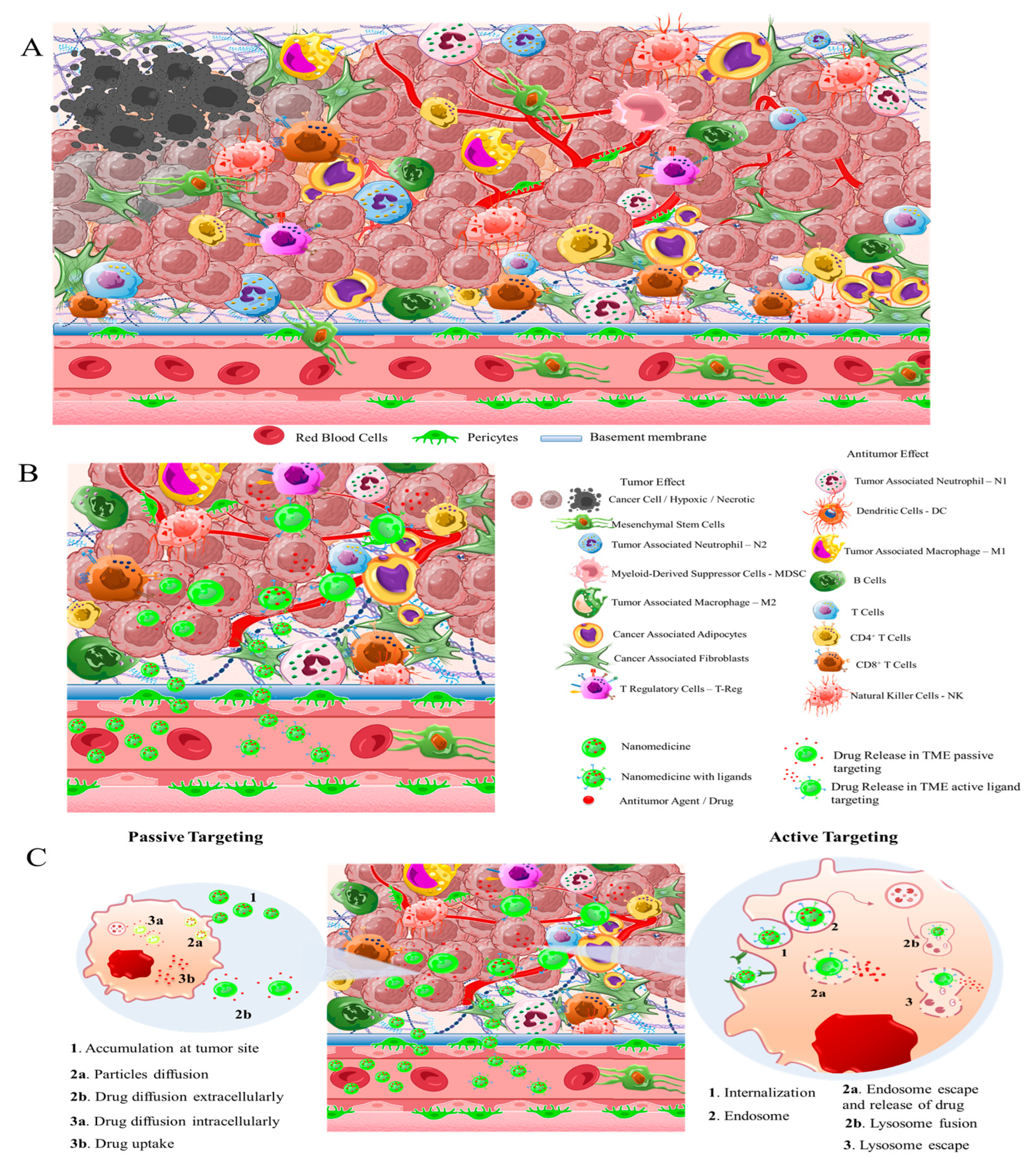
Scheme 2.
Flow chart representing various opportunities provided on nanomedicines for effective TME targeting of solid tumors. Nanomedicines can focus on i) heterogenic vasculature, ii) stroma extracellular matrix (ECM), iii) stroma cancer associated fibroblasts (CAFs), iv) hypoxia and v) acidosis. Varied formulations that have been evaluated for these targeting axes include liposomes, human serum albumin (HSA) particles, hydroxyapatite (HA) particles, chitosan (CS) and its derivatives, chitosan-lipid nanoparticles, peptide self-assembling particles, polymeric particles, as PLA, PLGA, PEG, PF, and mesoporous silica nanoparticles (MSN). The therapeutic processes take advantage of growth factors (VEGF, PDGF, CTGF), membrane bonded proteins as MMPs and HIF-1, pH gradient, evaluated in single or combination therapies with anticancer drugs, redox-GSH/ROS sensitivity, photodynamic therapy (PDT), magnetic field gradient, hyperthermia, ultrasound. The combination of TME targeting for effective sensitivity with antitumor strategies, may result to more efficient solid tumor therapeutics by exploiting the innate features of biomaterials. (created with the assistance of BioRender.com, and Microsoft ppt).
Scheme 2.
Flow chart representing various opportunities provided on nanomedicines for effective TME targeting of solid tumors. Nanomedicines can focus on i) heterogenic vasculature, ii) stroma extracellular matrix (ECM), iii) stroma cancer associated fibroblasts (CAFs), iv) hypoxia and v) acidosis. Varied formulations that have been evaluated for these targeting axes include liposomes, human serum albumin (HSA) particles, hydroxyapatite (HA) particles, chitosan (CS) and its derivatives, chitosan-lipid nanoparticles, peptide self-assembling particles, polymeric particles, as PLA, PLGA, PEG, PF, and mesoporous silica nanoparticles (MSN). The therapeutic processes take advantage of growth factors (VEGF, PDGF, CTGF), membrane bonded proteins as MMPs and HIF-1, pH gradient, evaluated in single or combination therapies with anticancer drugs, redox-GSH/ROS sensitivity, photodynamic therapy (PDT), magnetic field gradient, hyperthermia, ultrasound. The combination of TME targeting for effective sensitivity with antitumor strategies, may result to more efficient solid tumor therapeutics by exploiting the innate features of biomaterials. (created with the assistance of BioRender.com, and Microsoft ppt).
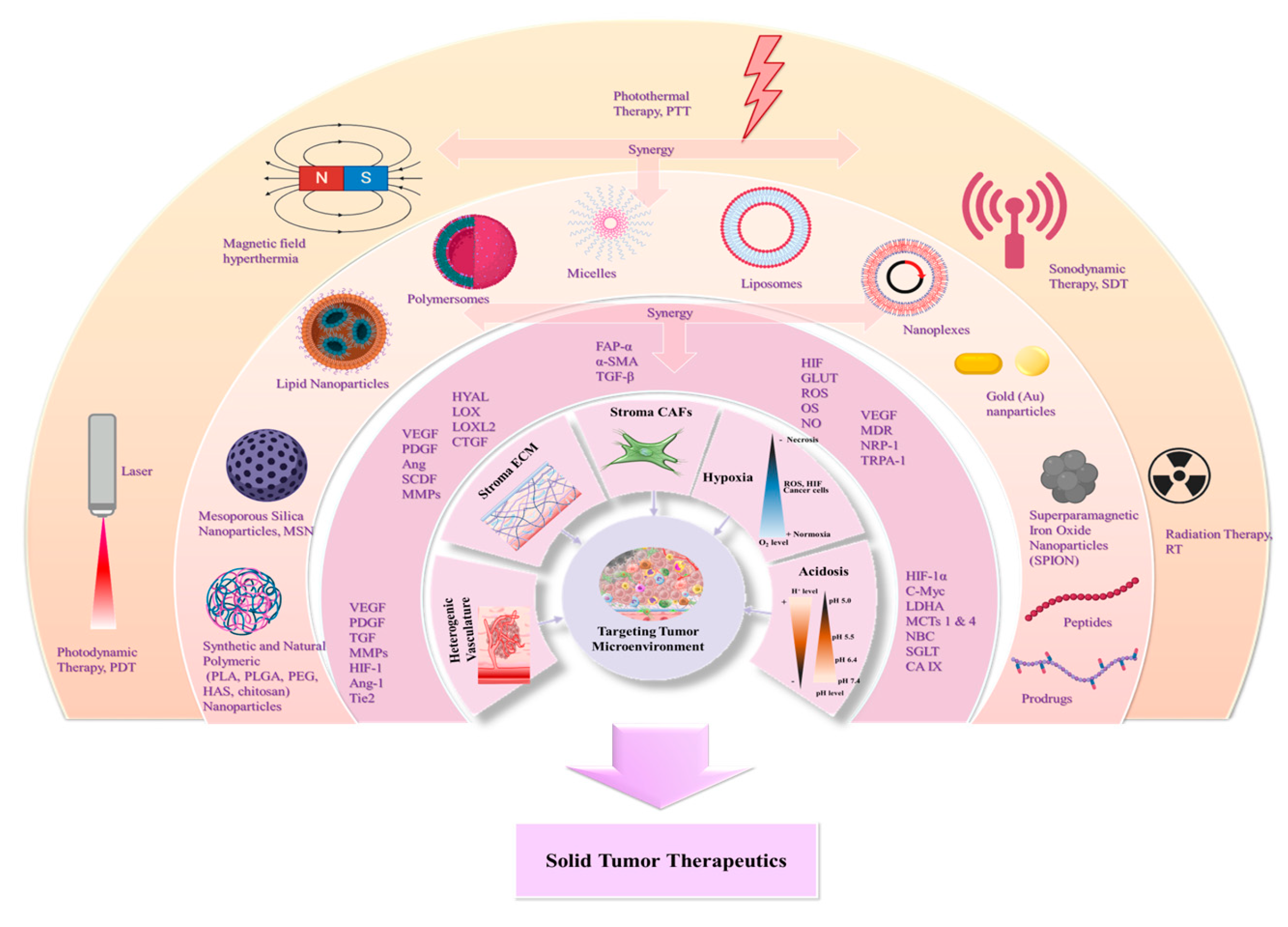
Table 1.
Therapeutic nanomedicines approved by U.S. Food and Drug Administration (FDA) and European Medicines Agency (EMA).
Table 1.
Therapeutic nanomedicines approved by U.S. Food and Drug Administration (FDA) and European Medicines Agency (EMA).
| Carrier Type | Product Name | Therapeutic Agent | Cancer Type | Stage | Ref. |
|---|---|---|---|---|---|
| Liposomes | Zolsketil® | Doxorubicin | Metastatic breast cancer, advanced ovarian cancer, multiple myeloma, AIDS-related Kaposi’s sarcoma | Approved (EMA, 2022) | [56,57] |
| Vyxeos® | Cytarabine: daunorubicin |
Newly diagnosed therapy–related acute myeloid leukemia, acute myeloid leukemia with myelodysplasia related changes | Approved (EMA, 2018) (FDA, 2017) | [56,57] | |
| Onivyde® / CPX-351 | Irinotecan | Pancreatic cancer | Approved (EMA, 2016) (FDA, 1996) | [56,57] | |
| Mepact® | Mifamurtide | Osteosarcoma | Approved (EMA, 2009) | [56,57] | |
| Ameluz® | 5-aminolevulinic acid | Superficial and/or nodular basal cell carcinoma | Approved (EMA, 2011) | [56,57] | |
| DaunoXome® | Daunorubicin | Kaposi’s sarcoma | Approved (FDA 1996) | [56,57] | |
| Iron Oxide nanoparticles | NanoTherm® | Fe2O3 | Glioblastoma, prostate, and pancreatic cancer | Approved (EMA, 2013) | [57] |
| Albumin nanoparticles | Abraxane® | Paclitaxel | Metastatic breast cancer, locally advanced or metastatic non-small cell lung cancer, Metastatic adenocarcinoma of the pancreas |
Approved (EMA 2008) (FDA 2005) |
[57,58] |
| Pazenir® | Paclitaxel | Metastatic breast cancer, metastatic adenocarcinoma of the pancreas, non-small cell lung cancer | Approved (EMA 2019) | [58] | |
| Vaccines | Adstiladrin® | adenoviral vector-based gene therapy | Bacillus Calmette-Guérin unresponsive non-muscle invasive bladder cancer with carcinoma in situ with or without papillary tumors | Approved (FDA 2022) | [59] |
| Provenge® | autologous peripheral-blood mononuclear cells | metastatic castration-resistant prostate cancer (mCRPC) | Approved (EMA 2013) (FDA 2019) | [59] |
Disclaimer/Publisher’s Note: The statements, opinions and data contained in all publications are solely those of the individual author(s) and contributor(s) and not of MDPI and/or the editor(s). MDPI and/or the editor(s) disclaim responsibility for any injury to people or property resulting from any ideas, methods, instructions or products referred to in the content. |
© 2023 by the authors. Licensee MDPI, Basel, Switzerland. This article is an open access article distributed under the terms and conditions of the Creative Commons Attribution (CC BY) license (http://creativecommons.org/licenses/by/4.0/).
Copyright: This open access article is published under a Creative Commons CC BY 4.0 license, which permit the free download, distribution, and reuse, provided that the author and preprint are cited in any reuse.


