

Submitted:
06 December 2023
Posted:
07 December 2023
You are already at the latest version
Abstract
The circular economy is based on maintaining a circular flow of resources. Policymakers face difficulties in balancing national security and circular economy aspects in the field of mineral resources policy. With a uniquely expanded input-output table, this study estimates the final destination of several critical minerals (lithium, cobalt, yttrium, lanthanum, cerium, neodymium and dysprosium) and base metals (iron, copper and aluminum) in the Japanese economy for 2015. Our model shows quite a good similarity between the estimated composition and the actual data of products. The results reveal a detailed distribution of critical minerals and indicate prioritized implementation for creating and maintaining a circular flow of critical minerals. Developed decision flow guidance provides a comprehensive approach to national security and circular economy aspects for policymakers. For further actions, inclusive indicator development is required for policymakers to support the determination of implementation possibilities from social and technological aspects.
Keywords:
mineral resource
; policymaking
; critical mineral
; input-output analysis
; circular economy
1. Introduction
Many countries have policy documents on mineral resources policy [1,2,3,4,5,6,7,8,9,10,11,12,13,14,15,16,17,18,19,20,21,22,23,24]. These countries define the critical minerals for their national economies based on their expert judgment and uniquely developed methodologies [2,9,12,22,25,26,27]. All these policy documents include the purpose of stable procurement of critical minerals to their national economies.
The mineral resources policy has mainly focused on national security; however, recycling became one of the vital policy implementations both for national security and waste management after the late 2000s [6,13,14,28]. The EU, France, Germany, Japan, Korea, Spain and the United Kingdom emphasize recycling post-consumer products as a circular economy implementation to provide secondary materials for the cleaner production of raw materials in their mineral resources policies [7,9,11,16,17,18,20,22]. The low self-sufficient ratio of mineral resources is a background for such a compositive mineral resources policy. After the Ellen MacArthur Foundation [29] proposed a practical "circular economy" concept, many policymakers and researchers have covered it. Some research reviewed related papers and indicate that recycling is one of the circular economy strategies [30,31,32]. Recycling is defined as an action contributing to a value recovery and consists of circular economy actions [33]. The objectives of mineral resources policy increasingly include recycling as a circular economy strategy as well as traditional national security.
The post-consumer products containing many elements have been initially revalued as the secondary deposit of critical minerals, so-called "urban mining" [34]. UNEP IRP [35] reveals the recycling rates of many metals in post-consumer products and proposes the importance of recycling. The governments, however, have not actively promoted the recycling of critical minerals for their national economies. In case of Japan, the government has promoted "3R (reducing waste generation, reusing and recycling)" concept in their legal system from the efficient use of mineral resources and waste management aspects [36,37,38,39,40]. Based on the governmental research of materials flow analysis, these legal schemes have not contributed to improving the recovery of critical minerals for the Japanese economy [41,42,43]. Only some base metals (e.g., iron, aluminum and copper) and valuable metals (e.g., gold, silver, platinum and palladium) are highly recovered. The EU region has a similar situation [44]. Commercially efficient recycling generally depends on the extensive collection of recyclable post-consumer products using abundant base metals and having high grades of valuable metals. Legal systems are required to support the extensive collection of post-consumer products and the development of advanced recycling technologies, such as comminution, dismantling, separation, and sorting processes, for critical minerals.
The current mineral resources policy aims to cover multiple goals, such as national security and circular economy; however, the implementations do not coincide with the objectives in the circular economy context. In addition to this issue, some policy documents cover material substitution to mitigate the supply risk of critical minerals [6,7,14,15,21,23]. Substituting recyclable materials is against facilitating recycling because the material grades often fall to an uncommercial recycling level. In the circular economy concept, people are required to maintain a circular flow of resources by recovering, retaining, or adding to their value while contributing to sustainable development [33]. Policymakers need to adopt a comprehensive policy approach to transition to the circular economy besides national security and recycling.
This study indicates decision-making guidance on comprehensive mineral resources policy from national security and circular economy aspects for policymakers. In the concept of circular economy, recycling is not necessarily highly prioritized [32,45]. Recycling, however, is a significant strategy next to repurposing, remanufacturing, refurbishing, repairing, and reusing from the perspective of mineral resources policy. In the short term, these prioritized strategies, like reusing, are opposite to recycling since the more reusing is promoted, the less recycling occurs. All products reach a time when reusing is no longer possible and desirable to be recycled efficiently rather than disposed of the products. Recycling, including partial disposal, is required as a backup to the reusing system [46].
We quantitatively estimate the final destination of critical minerals as a social stock and prioritized post-consumer products for recycling and the other circular economy strategies (e.g., remanufacturing and reusing). We use an input-output model to estimate the quantitative volume of critical minerals in the stock and the flow of intermediate and final products. The same model has been adopted to estimate the quantitative volume of the final destination of some materials and elements [47,48,49,50]. The quantitative estimation of battery materials (e.g., lithium and cobalt) and rare earths has not been examined to discuss the mineral resources policy from an energy transitioning aspect. The methodology of this study is based on the input-output approach using a uniquely expanded input-output table and applied and discussed concerning the case of Japan for the year 2015.
2. Materials and method
2.1. Elements selection in critical minerals
Ten elements, lithium, cobalt, yttrium, lanthanum, cerium, neodymium, dysprosium, iron, copper and aluminum, are selected for analysis. Lithium and cobalt are significant elements as raw materials for lithium-ion batteries in terms of energy storage. Lanthanum, neodymium and dysprosium are also substantial for electric vehicles, wind turbines and other generators or motors from efficient power source aspects. The other elements are selected as references. Iron, copper and aluminum are abundantly consumed as primary materials. Yttrium and cerium are the major elements of rare earths next to the above rare earth elements.
2.2. Input-Output analysis
This study was performed using an originally expanded input-output (IO) table to estimate the distribution of the selected elements in all consumer goods and infrastructures as social stocks in Japan. In an IO analysis approach, the domestic final demand represents the accumulated volume of such social stocks in a year. Each element's annual stock volume and distribution are calculated from the domestic final demand volume of goods containing the selected elements. The WIO-MFA model [48,49,50,51,52,53,54,55] provides a methodology to estimate the physical volume of elements distributed in the social stocks as the domestic final demand.
The model uses a hybrid IO table based on both flows of products in monetary units and physical units for analysis. The Ministry of Internal Affairs and Communications, Japan (MIC) provides an original IO table, which has a 509 by 391 matrix in monetary units for 2015 [56]. The producer price evaluation table (basic classification) was selected from the input-output tables set for this study. The initial IO table is described as a competitive import type in which domestic production and import data are merged in an input. This type is helpful in subdividing an import-specific sector from a domestic production and import merged sector.
The initial IO table (509 by 391 matrix in monetary units) is firstly squared down to a 390 by 390 matrix in monetary units and subsequently expanded and converted to a 442 by 442 hybrid square matrix for modeling. In the expanded hybrid IO table, the original 25 sectors are subdivided into 76 new sectors based on several governmental and association statistics [57,58,59,60,61,62,63,64,65,66,67,68] to supplement the low-resolution matrix of the initial IO table for analysis (Table 1). The domestic production volume of the subdivided sectors is according to the physical volume of each sector's domestic production or import based on the statistics. These subdivided sectors are related to the selected elements such as rare earths, cobalt and lithium mentioned above. The 50 sectors of 76 newly subdivided sectors are converted from monetary to physical units. Each sector's physical output data is fundamentally based on governmental and association statistics. The unit content ratios of the selected elements for the subdivided sectors are based on statistics, standard specifications, chemical composition formulas and atomic weights. Some subdivided sectors having no reliable statistics refer to hearing information about relevant industries. Some subdivided sectors, such as scrap cemented carbide and scrap magnet, are included as no domestic production sectors in the expanded IO table. The domestic production data of the sectors are not officially or commercially confirmed.
The initial IO table describes the flows of scraps and by-products in Stone's method. In the method, the generated volume of scraps and by-products is described as minus values and the demanded volume is described as plus values in the row of the IO table. This study converts the total minus values to plus and regards them as the domestic production value of scrap sectors.
The WIO-MFA model applies an inverse matrix (I−A) −1, calculated from the input coefficient matrix A, to analyze the ripple effects of demand changes. This inverse matrix is also called Leontief's inverse matrix. In the model, the matrix A is multiplied by two filter matrixes, nonquantitative flows such as electricity and services (Φ), and yield losses generated as scrap during production (Γ). These two filter matrix adjusts the initial input-output relationships described in monetary units to actual input-output relationships in physical units. The initial input-output relationships described in monetary units do not distinguish nonquantitative flows and yield losses. The filtered input coefficient matrix is calculated as follows:
where is Hadamard product, that is an element-wise product.
The model categorizes all the sectors into three parts: resources, materials and products (Table 2). The matrix of material composition of one monetary unit (million Japanese yes) of products () can be expressed by the coefficient matrix for the inputs of materials to products () and that for the input of products to products (). The parts categorized as resources are not used for the ripple effect calculation in the model.
The volume and distribution of elements in products for a final demand is calculated as follows:
where represents a vector for a final demand k, such as export and domestic final demand, of an element i. This vector is multiplied by a diagonalized composition matrix of the element i () and a hybrid vector of all sectors' final demand k categorized into products ().
3. Results and discussion
3.1. Test of the estimated element composition of products ()
The generated results from the model are compared with actual data [61,68,69,70,71,72]. The column sum of gives the estimated element weight of products per unit (metric tonnage and unit for subdivided sectors and one million Japanese yen for other sectors). In the previous research using the WIO-MFA model [48,54], less than one-tenth difference of a decimal place (mass fraction) is recognized as a good similarity for a value with a first decimal place. A difference of two to three-tenths is a good similarity for values with only the second decimal place (mass fraction). For values with only the third or fourth decimal places (mass fraction), a difference of two to seven-fold is permissible as a good similarity. In the WIO-MFA model, the domestically demanded materials of "materials" sectors spread to the other "products" sectors as the result of ripple effect calculation. The total volume of spread elements to all the other "products" sectors depends on the domestically demanded and imported elements of the "materials" and "products" sectors. Relative differences between the estimated composition and actual data generally become large if the number of significant digits of demanded and imported elements in the "materials" sectors is small. Instead, absolute differences become large in that case because of smaller inputs in the "materials" sectors.
As major intermediate products using battery materials and rare earths, this study selects ternary catalysts, optical lenses, lithium-ion rechargeable batteries, LaCo magnet and NdFeeB magnet to test the correspondence between the estimated composition and the actual data. The estimated composition data on ternary catalysts are quite similar to the actual data (Table 1). The estimated composition data also fall within a permissible level for yttrium, lanthanum and cerium in optical lenses, lithium-ion rechargeable batteries, cemented carbide tools, LaCo magnets and NdFeB magnets.
The "Passenger motor cars" sector is also tested as an example of complex final goods using various elements (Table 2). The generated result by the model shows a pretty good similarity to the actual data [70,72]. The estimated content ratio of copper and aluminum differs slightly from the actual data. The copper content is higher than the actual data, and the aluminum content is lower than the actual one. The actual data on copper and aluminum contents are based on the material proportions of dismantled cars collected in 2015 [70]. Those end-of-life cars are assumed to be old cars manufactured ten to fifteen years before if the average lifetime of cars is considered. The copper content has increased according to the automobile's electrification, such as an increase of wire harnesses, powered windows and power-steering. The current copper content of automobiles possibly increases rather than the actual data from the early 2000s. The estimated aluminum content is lower than the actual data, even though the use of aluminum has increased in weight-saving aspects. In the expanded IO table, the "Rolled and drawn aluminum" and "Non-ferrous metal castings and forgings" sectors output most aluminum of automobiles to the "Passenger motor cars" sector through "Motor vehicle parts and accessories" and "Internal combustion engines for motor vehicles" respectively. These input-outputs keep the original relationships between the sectors and are not modified at the expansion of the hybrid IO table. This difference requires an additional survey to analyze it in the future.
The neodymium and dysprosium content ratios are similar to the actual data [72] at the first decimal place (kg per unit). The amount of NdFeB magnet used for automobiles varies with the car types, such as engine displacements and brands. High-graded types and large engine displacement cars generally use many NdFeB magnets. The relationship of the type and amount of magnets with automobile types needs additional research and analysis.
Nakamura & Nakajima and Ohno et al. [48,54] examined the estimated material composition of cars for 2000 and 2005. Regarding the content ratio of iron, copper and aluminum, Nakamura & Nakajima (2005) showed 0.877 (Fe), 0.023 (Cu) and 0.085 (Al), respectively (mass fraction). The mass fraction data of each element are not obtained in this study because the car's total weight is not estimated; however, each proportion of copper and aluminum to iron is available to test the difference between the previous research and this study. The previous research does not cover the other minor elements like rare earths. In Nakamura & Nakajima (2005), the proportion of copper and aluminum to iron are 0.03 and 0.10, respectively. In this study, those proportions of data are calculated as 0.04 and 0.07, which shows quite a good similarity between the previous research and this study.
The estimated element composition and actual data strongly correlate positively (Figure 1). This result indicates that the actual data comprehensively supports the estimated element composition data despite the detailed difference between the estimated and actual data discussed above. The WIO-MFA model and other similar IO analysis models estimate only primary base metals (iron, copper, aluminum, lead and zinc) and additive elements to special steels (manganese, chromium, nickel, molybdenum, niobium, vanadium, tungsten, cobalt, platinum and neodymium) [48,50,53,54,55,76,77,78,79,80,81,82,83,84]. Battery materials and multiple rare earth elements have never been analyzed in an input-output approach. This study initially reveals the element composition, such as lithium, yttrium, lanthanum, cerium and dysprosium, by the input-output approach. The generated element composition data show the stock and flow of selected elements used for final goods as well as intermediate products. The quantitative volume of minor metals in intermediate products has not also been estimated, excluding the bottom-up approach for dysprosium [85,86]. The newly estimated composition of some critical minerals contributes to analyzing the circular flow of critical minerals.
3.2. Final destination (domestic final demand and export) of critical minerals as social stocks
We have estimated the final destination of the selected elements quantitatively with the calculated element composition of products (). Lithium and cobalt are used for lithium-ion rechargeable batteries, which include lithium cathodes and electrolytes, and are predominantly exported to foreign markets (Figure 2). This indicates that domestic recycling minimally impacts securing secondary lithium and cobalt for battery manufacturers in Japan. Considering the lifetime and accumulated volume of lithium-ion rechargeable batteries in the present and future, the primary provision of battery materials is strongly required for the time being. In addition to this viewpoint, the technological trend of cathodes requires consideration in estimating the future stock of recyclable battery materials. Lithium-ion rechargeable battery's cathode types vary with the energy and discharged capacities. Lithium-ion rechargeable batteries in the portable electronics market have mainly adopted lithium cobalt oxide (LCO) as a cathode due to its superb energy content per unit volume [74]. Lithium-ion batteries' energy capacity and ignition danger vary with cathode types [87]. The lithium-ion rechargeable batteries currently use other cathodes, such as lithium nickel-manganese-cobalt oxide (NMC), lithium nickel-cobalt-aluminum oxide (NCA), lithium manganese oxide (LMO), lithium ferro-phosphate (LFP). The cathode type is generally decided on the required energy capacity, the cost of raw materials, safety and environmental burdens. Based on the estimated volume of domestically accumulated battery materials and technological trends, policymakers need to consider the possible impacts of policy implementation to promote recycling end-of-life lithium-ion rechargeable batteries. Furthermore, policymakers are required to create intergovernmental cooperation for a global circular flow of lithium-ion batteries since most batteries are exported to foreign countries. In the context of a comprehensive mineral resources policy, the advanced forecast of technical trends of cathode types and the geographically estimated distribution of battery materials are required for policymakers. Nansai et al. and Nakajima et al. [78,80] estimate global distribution for some critical minerals, such as iron, copper, nickel, cobalt, neodymium and platinum, with the WIO-MFA model but not for lithium. For the creation of an international circular flow of critical minerals, the quantitative estimation of overseas destinations is required.
Regardless of difficulties in developing the recycling technology and advanced forecasts in cathode types, anode recycling can be recognized as a prioritized issue. Despite varied cathode types, the anode of lithium-ion batteries is typically natural graphite [74]. Natural high-grade graphite occurs predominantly in China [88]. Some countries, like the United States, the European Union and Japan, define graphite as one of their critical minerals [25,26,27]. Recycling graphite has a meaning for national security.
The estimated final destination of rare earth elements (yttrium, lanthanum, cerium, neodymium and dysprosium) depends on their main applications (Figure 3). The applications of rare earth elements are shown in Table 3, which varied with the expected function of each element based on electrons in partially filled 4f orbitals [89]. A common feature of the selected rare earth elements is that the passenger motor car is one of the highly ranked final destinations as a more significant application. The most demand-increasing application of rare earth elements is a permanent magnet [90], which is included as LaCo ferrite magnet and NdFeB magnet in this study. Lanthanum, neodymium and dysprosium increased their demand for permanent magnets because of vehicle electrification, the growth of household electric equipment in developing countries and the growing demand for wind turbines. Dysprosium, one of the heavy rare earth elements, is a rare earth element that improves high-temperature performance and resistance to demagnetization [91], which is used in such rapidly increasing applications as electric vehicles and wind turbines.
In the selected rare earth elements, yttrium and cerium have been generally over-supplied if the material balance is considered between the supply and demand of each rare earth element. Ginya Adachi [89] shows the global demand for each rare earth element for 2008 as 129,175t in oxide equivalent, with yttrium, lanthanum, cerium, neodymium, and dysprosium accounting for 9.0, 29.9, 32.9, 18.5 and 1.0 (mass fraction in oxide equivalent), respectively. The annual mine production of rare earths is estimated to be 124,000t in oxide equivalent for 2008 [92]. The globally largest rare earths mine is the Baiyan Obo (Baiyun Obo) mine, located in the Inner Mongolia region of China (US Geological Survey, 2017); the grades of each rare earth element in crude ore are 0.20, 26.50, 50.80, 15.40 and 0.10 for yttrium, lanthanum, cerium, neodymium, and dysprosium (mass fraction in oxide equivalent), respectively [93]. The largest rare earths mines outside China are Mount Weld in Western Australia and Mountain Pass in California [91]. Ota [93] shows that the grades of each rare earth element in the crude ore of Mount Weld are 0.25 (yttrium), 25.50 (lanthanum), 46.74 (cerium), 18.50 (neodymium) and 0.12 (dysprosium), and Mount Pass is 0.10 (yttrium), 33.20 (lanthanum), 49.10 (cerium), 12.00 (neodymium) and trace (dysprosium), respectively (mass fraction in oxide equivalent). Some rare earth elements, like yttrium and cerium, are strongly assumed to be over-supplied.
Rare earth elements are generally regarded as representative critical minerals [2,14,15,18,22,25,26,27]. The global demand volume of total rare earth elements is just 300,000t in oxide equivalent [88]. This volume is minimal if compared with the production volume of base metals, such as iron, copper and aluminum ores. Considering the tiny market volume of rare earths in the world, the development of new applications is adversely required to balance the supply and demand of each rare earth element and improve the feasibility of newly developed mines. A detailed criticality assessment of each individual rare earth element is needed for further discussion in mineral resources policy.
Table 4 shows the relationship between legally promoted applications (post-consumer products) and highly prioritized rare earth elements (lanthanum, neodymium and dysprosium) for recycling in Japan. Mobile phones and PCs, cars and household electric appliances are in the scope of related recycling promotion acts [37,38,39,40]. The recycling of optical instruments, construction, robots, nickel-metal hydride batteries and DC motors as post-consumer products are not covered by the current legal systems in Japan. Additional policy support is required for a circular flow of these rare earth elements. The post-consumer products rich in these rare earth elements are not commercially collected and recycled yet [43].
3.3. Guidance on mineral resources policy from national security and circular economy aspects
This study identifies prioritized parts and final products for creating a circular flow of critical minerals discussed concerning the case of Japan. For lithium and cobalt, abundant volumes of lithium and cobalt are exported overseas through lithium-ion rechargeable batteries, lithium cathodes and electrolytes. For the creation of the circular flow of lithium and cobalt, an international circular flow is required in the case of Japan. Regarding prioritized rare earth elements, DC motors using LaCo magnet and NdFeB magnet, and the other related applications, such as robots, household air-conditioners, household electric appliances and passenger motor cars, are highly prioritized for creating the circular flows of lanthanum, neodymium and dysprosium. For lanthanum, nickel-metal hydride rechargeable batteries, optical instruments and lenses are also highly prioritized next to permanent magnet-related applications. These applications require an additional legal system to promote an efficient collection of post-consumer products and parts that occurred in the country. International cooperation is required for export-dominant parts and final products, such as passenger motor cars, nickel-metal hydride rechargeable batteries, LaCo magnets, optical instruments and lenses.
Figure 4 shows a similarity-structure relationship between domestic and international circular flows from the comprehensive mineral resources policy viewpoint. Additional legal systems and policy support are required to create the domestic circular flow of critical minerals in the final products that are dominantly demanded in a country (scope two shown in Figure 4). Based on the hierarchy of circular economy strategies [32], discarded final products in good condition are recommended to be reused, repaired, refurbished, remanufactured or repurposed rather than recycled. Some export-dominant final products and parts need to be in the international circular flows (scope three shown in Figure 4). A new custom clearance system facilitates the adequate circulation of parts and scraps, which are uniquely identified as "circular goods" with international traceability systems.
Our results provide a quantitative decision-making tool to identify the prioritized parts and final products for creating the circular flows of critical minerals in the field of mineral resources policy. Figure 5 suggests a decision flow guidance on individual minerals in mineral resources policy for policymakers. Existing research reviews effective methodologies for determining the critical minerals for countries [94,95]. Policymakers can identify their critical minerals based on the developed methodologies. Our developed methodology reveals the quantitatively prioritized items for circular economy strategies (shown as "social stock (volume of final destination)" in Figure 5); however, implementation possibilities (shown as "implementation possibility" in Figure 5), that is, social and technological difficulties, are not sufficiently considered for extensive collection, efficient comminution, dismantling, separation and sorting.
Additional legal systems facilitate the extensive collection of post-consumer products rich in critical minerals. Innovative technologies on the liberation and separation of critical minerals contribute to the commercial feasibility of circular economy strategies. Owada et al. [96] propose "device separation" for an efficient physical separation process with electrical disintegration in this context. Under the concept of circular economy strategies, efficient evaluation technologies are also needed for determining a priority of reusing, repairing, refurbishing, remanufacturing, repurposing or recycling post-consumer products and their parts in good condition or not. Developing the impact evaluation methodology on policies and legal systems is essential to deciding effective policy implementation for policymakers. The concept of evidence-based policymaking is expected to provide a solution for this issue. The development of indicators for circular design in the sight of liberation and separation, which are based on the current and future expected technologies, is significantly required for policymakers to identify the socially and technologically prioritized parts and final products for circular economy strategies. These indicators also contribute to determining better technologies to be supported.
4. Conclusion and outlook
In summary, we have uniquely expanded the initial IO table on the Japanese economy from a monetary matrix of 509 by 391 to a hybrid matrix of 442 by 442. The original 25 sectors are subdivided into 76 new sectors based on several governmental and association statistics. The 50 sectors of 76 newly subdivided sectors are converted from monetary to physical units for input-output analysis to estimate the final destination of selected critical minerals (lithium, cobalt, yttrium, lanthanum, cerium, neodymium and dysprosium). Our model estimates the domestic and overseas distribution of the selected critical minerals. The results provide a comprehensive mineral resources policy concept from national security and circular economy aspects. For creating an international circular flow of critical minerals, international cooperation, such as new custom clearance systems and international traceability systems, is needed to facilitate adequate circulation of parts and scraps, uniquely identified as "circular goods." We suggest policymakers a decision flow guidance on comprehensive mineral resources policy. The guidance supports policymakers in identifying prioritized post-consumer products and their parts using critical minerals for circular economy strategies. In addition, it contributes to the implementation of creating domestic and international circular flows of critical minerals. Indicators development for implementation possibilities, such as inclusive indicators evaluating an extensive collection of post-consumer products and efficient liberation and separation of them, is required for advanced policymaking.
References
- Australian government, Critical Minerals Strategy 2023–2030. Australia, 2023. Accessed: Nov. 28, 2023. [Online]. Available: https://www.iea.org/policies/15858-2022-critical-minerals-strategy.
- Canadian government, Canada’s Critical Minerals Strategy. Canada, 2022. Accessed: Nov. 28, 2023. [Online]. Available: https://www.iea.org/policies/15869-critical-minerals-strategy-discussion-paper.
- Canadian government, Canadian Minerals and Metals Plan. Canada, 2019. Accessed: Nov. 28, 2023. [Online]. Available: https://www.iea.org/policies/15700-the-canadian-minerals-and-metals-plan.
- Chinese government, 14th FYP for Raw Material Industry Development. People’s Republic of China, 2021. Accessed: Nov. 28, 2023. [Online]. Available: https://www.iea.org/policies/14702-14th-fyp-for-raw-material-industry-development.
- Chinese government, National Plan for Mineral Resources (2016-2020). People’s Republic of China, 2016. Accessed: Nov. 28, 2023. [Online]. Available: https://www.iea.org/policies/15519-national-plan-for-mineral-resources-2016-2020.
- European Commission, Raw Materials Initiative. EU (European Union), 2008. Accessed: Nov. 28, 2023. [Online]. Available: https://www.iea.org/policies/15696-european-raw-materials-initiative.
- European Commission, European Action Plan on Critical Raw Materials. EU (European Union), 2020. Accessed: Nov. 28, 2023. [Online]. Available: https://www.iea.org/policies/15695-european-action-plan-on-critical-raw-materials.
- Finnish government, Finland’s Minerals Strategy. Finland, 2011. Accessed: Nov. 28, 2023. [Online]. Available: https://www.iea.org/policies/16740-finlands-minerals-strategy-minerals-list.
- French government, Resources for France Plan. France, 2018. Accessed: Nov. 28, 2023. [Online]. Available: https://www.iea.org/policies/15650-resources-for-france-plan.
- German government, Raw materials strategy of the Federal Government: Securing a sustainable supply of non-energy mineral raw materials for Germany. Germany, 2010. Accessed: Nov. 28, 2023. [Online]. Available: https://www.iea.org/policies/15266-raw-materials-strategy-of-the-federal-government-securing-a-sustainable-supply-of-non-energy-mineral-raw-materials-for-germany.
- German government, Raw materials strategy of the Federal Government: Securing a sustainable supply of non-energy mineral raw materials for Germany, updated. 2019. Accessed: Dec. 03, 2023. [Online]. Available: https://www.iea.org/policies/15266-raw-materials-strategy-of-the-federal-government-securing-a-sustainable-supply-of-non-energy-mineral-raw-materials-for-germany.
- Indian government, Critical Non-Fuel Mineral Resources for India’s Manufacturing Sector. India, 2016. Accessed: Nov. 28, 2023. [Online]. Available: https://www.iea.org/policies/16057-critical-non-fuel-mineral-resources-for-indias-manufacturing-sector.
- Japan Cabinet Office, Guidelines for Securing Resources (資源確保指針). Japan, 2008.
- Japanese government, Procurement Strategy of rare metals. Japan, 2009. Accessed: Nov. 28, 2023. [Online]. Available: https://warp.da.ndl.go.jp/info:ndljp/pid/6086248/www.meti.go.jp/press/20090728004/20090728004.html.
- Japanese government, Procurement Strategy of Natural Resources. Japan, 2012. Accessed: Nov. 28, 2023. [Online]. Available: https://warp.da.ndl.go.jp/info:ndljp/pid/8556468/www.enecho.meti.go.jp/policy/shinenseisaku2.pdf.
- Japanese government, International Resource Strategy - National stockpiling system. Japan, 2020. Accessed: Nov. 28, 2023. [Online]. Available: https://www.iea.org/policies/16639-international-resource-strategy-national-stockpiling-system.
- Japanese government, Sixth Strategic Energy Plan - 2050 Carbon neutral. Japan, 2022. Accessed: Nov. 28, 2023. [Online]. Available: https://www.iea.org/policies/14391-sixth-strategic-energy-plan-2050-carbon-neutral.
- Korean government, New national strategies for securing strategic minerals for Korea. Korea, 2023. Accessed: Nov. 29, 2023. [Online]. Available: https://www.jetro.go.jp/biznews/2023/03/bf06360b00e2700b.html.
- New Zealand government, Responsibility Delivering Value: A Minerals and Petroleum Resource Strategy for Aotearoa New Zealand. New Zealand, 2019. Accessed: Nov. 28, 2023. [Online]. Available: https://www.iea.org/policies/15880-responsibility-delivering-value-a-minerals-and-petroleum-resource-strategy-for-aotearoa-new-zealand.
- Spanish government, Roadmap for the sustainable management of mineral raw materials. Spain, 2021. Accessed: Nov. 28, 2023. [Online]. Available: https://www.iea.org/policies/16806-roadmap-for-the-sustainable-management-of-mineral-raw-materials.
- UK government, Resource Security Action Plan. United Kingdom, 2012. Accessed: Nov. 28, 2023. [Online]. Available: https://www.iea.org/policies/15267-resource-security-action-plan.
- UK government, Resilience for the future: The UK’s critical minerals strategy. United Kingdom, 2023. Accessed: Nov. 28, 2023. [Online]. Available: https://www.iea.org/policies/16069-resilience-for-the-future-the-uks-critical-minerals-strategy.
- US government, Critical Materials Strategy. United States of America, 2010. Accessed: Nov. 28, 2023. [Online]. Available: https://www.osti.gov/servlets/purl/1000846.
- US government, Critical Minerals and Materials: US Department of Energy’s Strategy to Support Domestic Critical Mineral and Material Supply Chains. United States of America, 2021. Accessed: Nov. 28, 2023. [Online]. Available: https://www.iea.org/policies/15533-critical-minerals-and-materials-us-department-of-energys-strategy-to-support-domestic-critical-mineral-and-material-supply-chains.
- US government, Final List of Critical Minerals 2018. 2018. Accessed: Dec. 03, 2023. [Online]. Available: https://www.federalregister.gov/documents/2018/05/18/2018-10667/final-list-of-critical-minerals-2018.
- European Commission, 2020 EU Critical Raw Materials List. EU (European Union), 2020. Accessed: Nov. 28, 2023. [Online]. Available: https://www.iea.org/policies/15274-the-2020-eu-critical-raw-materials-list.
- METI(Ministry of Economy Trade and Industry Japan), Initiatives to ensure stable supply of critical minerals. Tokyo, 2023. Accessed: Dec. 03, 2023. [Online]. Available: https://www.meti.go.jp/policy/economy/economic_security/metal/torikumihoshin.pdf.
- NRC (National Research Council), Minerals, critical minerals, and the U.S. economy. National Academies Press, 2008. [CrossRef]
- Ellen MacArthur Foundation, “CIRCULAR ECONOMY TOWARDS THE Economic and business rationale for an accelerated transition,” 2013. Accessed: Dec. 03, 2023. [Online]. Available: https://emf.thirdlight.com/file/24/xTyQj3oxiYNMO1xTFs9xT5LF3C/Towards%20the%20circular%20economy%20Vol%201%3A%20an%20economic%20and%20business%20rationale%20for%20an%20accelerated%20transition.pdf.
- M. Lewandowski, “Designing the business models for circular economy-towards the conceptual framework,” Sustainability (Switzerland), vol. 8, no. 1. MDPI, 2016. [CrossRef]
- P. Ghisellini, C. Cialani, and S. Ulgiati, “A review on circular economy: The expected transition to a balanced interplay of environmental and economic systems,” J Clean Prod, vol. 114, pp. 11–32, Feb. 2016. [CrossRef]
- J. Potting, M. Hekkert, E. Worrell, and A. Hanemaaijer, “Circular economy: Measuring innovation in the product chain policy report,” Jan. 2017. Accessed: Dec. 04, 2023. [Online]. Available: https://www.pbl.nl/sites/default/files/downloads/pbl-2016-circular-economy-measuring-innovation-in-product-chains-2544.pdf.
- ISO/TC323, ISO/DIS 59004 Circular Economy – Terminology, Principles and Guidance for Implementation. 2023. [Online]. Available: www.iso.org.
- M. Nanjo, “Urban mine, new resources for the year 2000 and beyond,” Bulletin of the Research Institute of Mineral Dressing and Metallurgy, Tohoku University, vol. 43, no. 2, pp. 239–251, 1988, Accessed: Dec. 02, 2023. [Online]. Available: http://hdl.handle.net/10097/00114635.
- UNEP IRP (United Nations Environment Programme. International Resource Panel.), Metal recycling : opportunities, limits, infrastructure. 2013. Accessed: Dec. 03, 2023. [Online]. Available: https://www.resourcepanel.org/sites/default/files/documents/document/media/e-book_metals_report2b_recyclingopportunities_130919.pdf.
- National diet of Japan, Basic Act on Establishing a Sound Material-Cycle Society. Japan, 2000. Accessed: Dec. 03, 2023. [Online]. Available: https://www.japaneselawtranslation.go.jp/ja/laws/view/3799.
- National diet of Japan, Act on the Promotion of Effective Utilization of Resources Japan, 1991. Accessed: Nov. 27, 2023. [Online]. Available: https://www.japaneselawtranslation.go.jp/ja/laws/view/3819.
- National diet of Japan, Act on Recycling of Specified Kinds of Home Appliances. Japan, 2012. Accessed: Nov. 27, 2023. [Online]. Available: https://elaws.e-gov.go.jp/document?lawid=410AC0000000097_20200401_429AC0000000061.
- National diet of Japan, Act on Promotion of Recycling of Small Waste Electrical and Electronic Equipment. Japan, 2012. Accessed: Nov. 27, 2023. [Online]. Available: https://www.japaneselawtranslation.go.jp/ja/laws/view/3209.
- National diet of Japan, Act on Recycling of End-of-Life Automobiles. Japan, 2002. Accessed: Nov. 27, 2023. [Online]. Available: https://www.japaneselawtranslation.go.jp/ja/laws/view/3829.
- MURC (Mitsubishi UFJ Research and Consulting) , “Stock and flow analysis on mineral resources: lithium and nickel,” Tokyo, Mar. 2023. Accessed: Dec. 03, 2023. [Online]. Available: https://mric.jogmec.go.jp/wp-content/uploads/2023/05/survey_mineral_recycling_flow_stock_r4.pdf.
- MURC (Mitsubishi UFJ Research and Consulting) , “Stock and flow analysis on mineral resources: copper and rare earths,” Tokyo, Mar. 2022. Accessed: Dec. 03, 2023. [Online]. Available: https://mric.jogmec.go.jp/wp-content/uploads/2022/04/survey_mineral_recycling_flow_stock.pdf.
- JOGMEC (Japan Organization for Metals and Energy Security) , “Material flows of mineral resources 2021,” Tokyo, Mar. 2023. Accessed: Dec. 03, 2023. [Online]. Available: https://mric.jogmec.go.jp/report/?category%5B%5D=material_flow.
- European Commission. Joint Research Centre., Towards recycling indicators based on EU flows and raw materials system analysis data : supporting the EU-28 raw materials and circular economy policies through RMIS. 2018.
- J. Kirchherr, D. Reike, and M. Hekkert, “Conceptualizing the circular economy: An analysis of 114 definitions,” Resources, Conservation and Recycling, vol. 127. Elsevier B.V., pp. 221–232, 2017. [CrossRef]
- S. Murakami, K. Shimizu, C. Tokoro, and T. Nakamura, “Role of Resource Circularity in Carbon Neutrality,” Sustainability (Switzerland), vol. 14, no. 24, Dec. 2022. [CrossRef]
- S. Murakami, M. Yamanoi, T. Adachi, G. Mogi, and J. Yamatomi, “Material Flow Accounting for Metals in Japan,” Mater Trans, vol. 45, no. 11, pp. 3184–3193, 2004.
- S. Nakamura and K. Nakajima, “Waste Input-Output Material Flow Analysis of Metals in the Japanese Economy,” Mater Trans, vol. 46, no. 12, pp. 2250–2253, 2005.
- H. Ohno, Y. Fukushima, K. Matsubae, K. Nakajima, and T. Nagasaka, “Revealing final destination of special steel materials with input- output-based material flow analysis,” ISIJ International, vol. 57, no. 1, pp. 193–199, 2017. [CrossRef]
- H. Ohno, K. Matsubae, K. Nakajima, K. Nansai, Y. Fukushima, and T. Nagasaka, “Consumption-based accounting of steel alloying elements and greenhouse gas emissions associated with the metal use: the case of Japan,” J Econ Struct, vol. 5, no. 1, Dec. 2016. [CrossRef]
- S. Nakamura, K. Nakajima, Y. Kondo, and T. Nagasaka, “The Waste Input-Output Approach to Materials Flow Analysis Concepts and Application to Base Metals,” Journal of Industry Ecology, vol. 11, no. 4, pp. 50–63, 2007, [Online]. Available: www.f.waseda.jp/nakashin.
- P. Nuss, H. Ohno, W. Q. Chen, and T. E. Graedel, “Comparative analysis of metals use in the United States economy,” Resour Conserv Recycl, vol. 145, pp. 448–456, Jun. 2019. [CrossRef]
- H. Ohno, K. Matsubae, K. Nakajima, S. Nakamura, and T. Nagasaka, “Unintentional flow of alloying elements in steel during recycling of end-of-life vehicles,” J Ind Ecol, vol. 18, no. 2, pp. 242–253, 2014. [CrossRef]
- H. Ohno, K. Matsubae, K. Nakajima, Y. Kondo, S. Nakamura, and T. Nagasaka, “Toward the efficient recycling of alloying elements from end of life vehicle steel scrap,” Resour Conserv Recycl, vol. 100, pp. 11–20, Apr. 2015. [CrossRef]
- H. Ohno, P. Nuss, W. Q. Chen, and T. E. Graedel, “Deriving the Metal and Alloy Networks of Modern Technology,” Environ Sci Technol, vol. 50, no. 7, pp. 4082–4090, Apr. 2016. [CrossRef]
- MIC (Ministry of Industrial Affairs and Communications Japan), 2015 Input-Output Table for Japan, 2015th ed. Tokyo: Ministry of Industrial Affairs and Communications, Japan, 2020.
- CMAJ (Catalyst Manufacturers Association Japan) , Catalyst statistics 2015. Tokyo, 2016.
- EMAJ (Electronic Materials Manufacturers Association of Japan) , Table of permanent magnet applications. 1997.
- JOGMEC (Japan Organization for Metals and Energy Security) , “Material flows of mineral resources 2016,” Tokyo, Jan. 2017.
- JSNM (Japan Society of Newer Metals) , Rare earths demand statistics 2015. Tokyo, 2016.
- METI (Ministry of Economy Trade and Industry Japan), Current Survey of Supply and Demand of Non-ferrous Metals 2015. 2016.
- METI (Ministry of Economy Trade and Industry Japan), Current Survey of Production 2015 - Mineral resources, petroleum products, ceramics and building materials. 2016.
- METI (Ministry of Economy Trade and Industry Japan), Current Survey of Production 2015 - Machinery . 2016.
- METI (Ministry of Economy Trade and Industry Japan), Current Survey of Production 2015 - Iron and Steel, non-ferrous metals and fabricated metals . 2016.
- METI (Ministry of Economy Trade and Industry Japan), Current Survey of Production 2015 - Chemical industry. Tokyo, 2016.
- METI (Ministry of Economy Trade and Industry Japan), Census of Manufactures 2015 . Tokyo, 2017.
- MOF (Ministry of Finance Japan), Trade statistics 2015 Tokyo, 2016.
- Rare Metal News, Industrial Rare Metals Annual Review 2016. Tokyo, 2016.
- Y. Kobayashi, “Felite magnet,” The Special Steel, vol. 68, no. 6, Jul. 2019.
- METI (Ministry of Economy Trade and Industry Japan) and MOE (Ministry of Economy Trade and Industry Japan), “Draft framework of an incentive system for automobiles using advanced recycled materials ,” Tokyo, Sep. 2017.
- MURC (Mitsubishi UFJ Research and Consulting), “Domestic demand-supply structure of non-ferrous metals and current industry status of major resource countries ” Tokyo, 2010.
- Yano Research Institute, “Current state of metals recycling originated from end-of-life vehicles ,” Tokyo, Mar. 2015.
- MURC (Mitsubishi UFJ Research and Consulting) , “Current distribution of rare metals,” Tokyo, Feb. 2020.
- E. A. Olivetti, G. Ceder, G. G. Gaustad, and X. Fu, “Lithium-Ion Battery Supply Chain Considerations: Analysis of Potential Bottlenecks in Critical Metals,” Joule, vol. 1, no. 2. Cell Press, pp. 229–243, Oct. 11, 2017. [CrossRef]
- S. Nakamura and K. Nakajima, “Waste Input-Output Material Flow Analysis of Metals in the Japanese Economy,” Mater Trans, vol. 46, no. 12, pp. 2250–2553, 2005.
- K. Nakajima et al., “Simultaneous material flow analysis of nickel, chromium, and molybdenum used in alloy steel by means of input-output analysis,” Environ Sci Technol, vol. 47, no. 9, pp. 4653–4660, May 2013. [CrossRef]
- K. Nakajima, K. Nansai, K. Matsubae, M. Tomita, W. Takayanagi, and T. Nagasaka, “Global land-use change hidden behind nickel consumption,” Science of the Total Environment, vol. 586, pp. 730–737, May 2017. [CrossRef]
- K. Nakajima et al., “Global distribution of material consumption: Nickel, copper, and iron,” Resour Conserv Recycl, vol. 133, pp. 369–374, Jun. 2018. [CrossRef]
- S. Nakamura, Y. Kondo, K. Nakajima, H. Ohno, and S. Pauliuk, “Quantifying Recycling and Losses of Cr and Ni in Steel Throughout Multiple Life Cycles Using MaTrace-Alloy,” Environ Sci Technol, vol. 51, no. 17, pp. 9469–9476, Sep. 2017. [CrossRef]
- K. Nansai et al., “Global flows of critical metals necessary for low-carbon technologies: The case of neodymium, cobalt, and platinum,” Environ Sci Technol, vol. 48, no. 3, pp. 1391–1400, Feb. 2014. [CrossRef]
- K. Nansai, K. Nakajima, S. Kagawa, Y. Kondo, Y. Shigetomi, and S. Suh, “Global mining risk footprint of critical metals necessary for low-carbon technologies: The case of neodymium, cobalt, and platinum in Japan,” Environ Sci Technol, vol. 49, no. 4, pp. 2022–2031, Feb. 2015. [CrossRef]
- K. Nansai et al., “The role of primary processing in the supply risks of critical metals,” Economic Systems Research, vol. 29, no. 3, pp. 335–356, Jul. 2017. [CrossRef]
- K. Nansai et al., “Nexus between economy-wide metal inputs and the deterioration of sustainable development goals,” Resour Conserv Recycl, vol. 149, pp. 12–19, Oct. 2019. [CrossRef]
- H. Ohno et al., “Optimal Recycling of Steel Scrap and Alloying Elements: Input-Output based Linear Programming Method with Its Application to End-of-Life Vehicles in Japan,” Environ Sci Technol, vol. 51, no. 22, pp. 13086–13094, Nov. 2017. [CrossRef]
- W. Shi, I. Daigo, Y. Matsuno, and Y. Adachi, “Substance Flow Analysis of Dysprosium in Japan,” Japan Institute of Metals, 2010.
- Y. Seo and S. Morimoto, “Comparison of dysprosium security strategies in Japan for 2010-2030,” Resources Policy, vol. 39, no. 1, pp. 15–20, Mar. 2014. [CrossRef]
- Y. K. H. O. A. Aoki, “The safety and evaluation test of Lithium-Ion Secondary Battery,” in Microelectronics Symposium 2012, Osaka, Sep. 2012. Accessed: Dec. 04, 2023. [Online]. Available: https://www.jstage.jst.go.jp/article/mes/22/0/22_187/_pdf/-char/ja.
- US Geological Survey, Mineral Commodity Summaries, 2023rd ed. US Geological Survey, 2023. Accessed: Dec. 04, 2023. [Online]. Available: https://www.usgs.gov/centers/national-minerals-information-center/commodity-statistics-and-information.
- Ginya Adachi, Introduction to Chemistry of Rare Earths. Kyoto: Kagaku-Dojin Publishing Company,INC, 2015.
- US Geological Survey, Mineral Yearbook Volume I - Metals and Minerals, 2023rd ed. 2022. Accessed: Dec. 04, 2023. [Online]. Available: https://www.usgs.gov/centers/national-minerals-information-center/commodity-statistics-and-information.
- US Geological Survey, Critical mineral resources of the United States—Economic and environmental geology and prospects for future supply. US Geological Survey, 2017. Accessed: Dec. 05, 2023. [Online]. Available: https://pubs.usgs.gov/publication/pp1802.
- US Geological Survey, Mineral Commodity Summaries, 2009th ed. 2009. Accessed: Dec. 05, 2023. [Online]. Available: https://www.usgs.gov/centers/national-minerals-information-center/commodity-statistics-and-information#R.
- T. Ota, “Resource economics on rare earths industry,” 2010. Accessed: Dec. 04, 2023. [Online]. Available: https://ndlonline.ndl.go.jp/#!/detail/R300000001-I000011114632-00.
- B. Achzet and C. Helbig, “How to evaluate raw material supply risks-an overview,” Resources Policy, vol. 38, no. 4, pp. 435–447, 2013. [CrossRef]
- C. Helbig, L. Wietschel, A. Thorenz, and A. Tuma, “How to evaluate raw material vulnerability - An overview,” Resources Policy, vol. 48, pp. 13–24, Jun. 2016. [CrossRef]
- S. Owada, T. Komuro, T. Ono, and R. Hayashi, “Concentration of Minor Rare Metals form E-scraps by Combining New Comminution and Physical Separation Processes,” in 12th International Symposium on East Asian Resources Recycling Technology (EARTH2013), Hunan, China, 2013.
Figure 1.
Correlation between the estimated composition and actual data. Note: The composition of each estimated element and actual data in intermediate goods (Table 1) and automobiles (Table 2) is shown here.
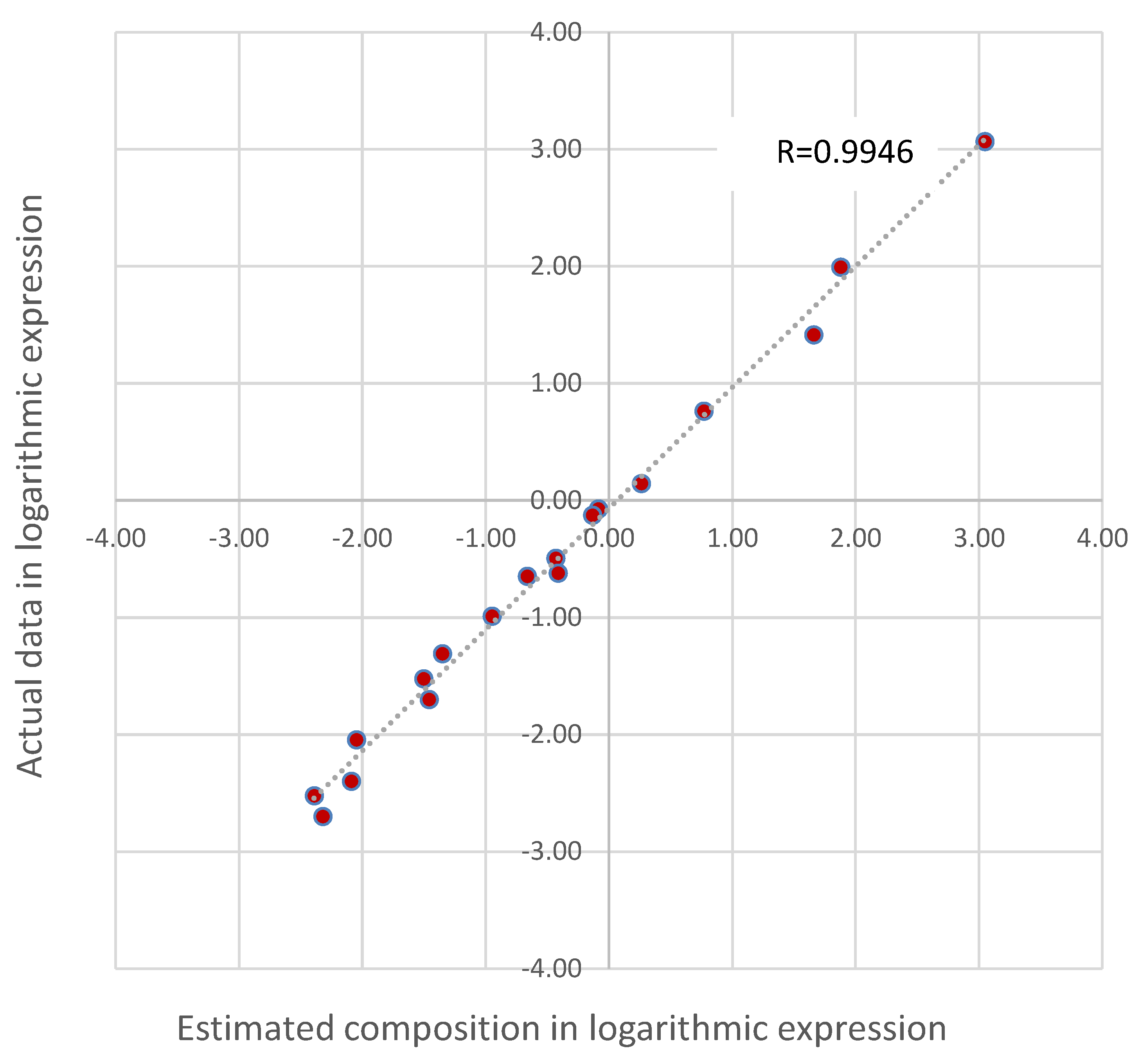
Figure 2.
Estimated domestic final demand of lithium (Li) and cobalt (Co) in Japan for 2015.
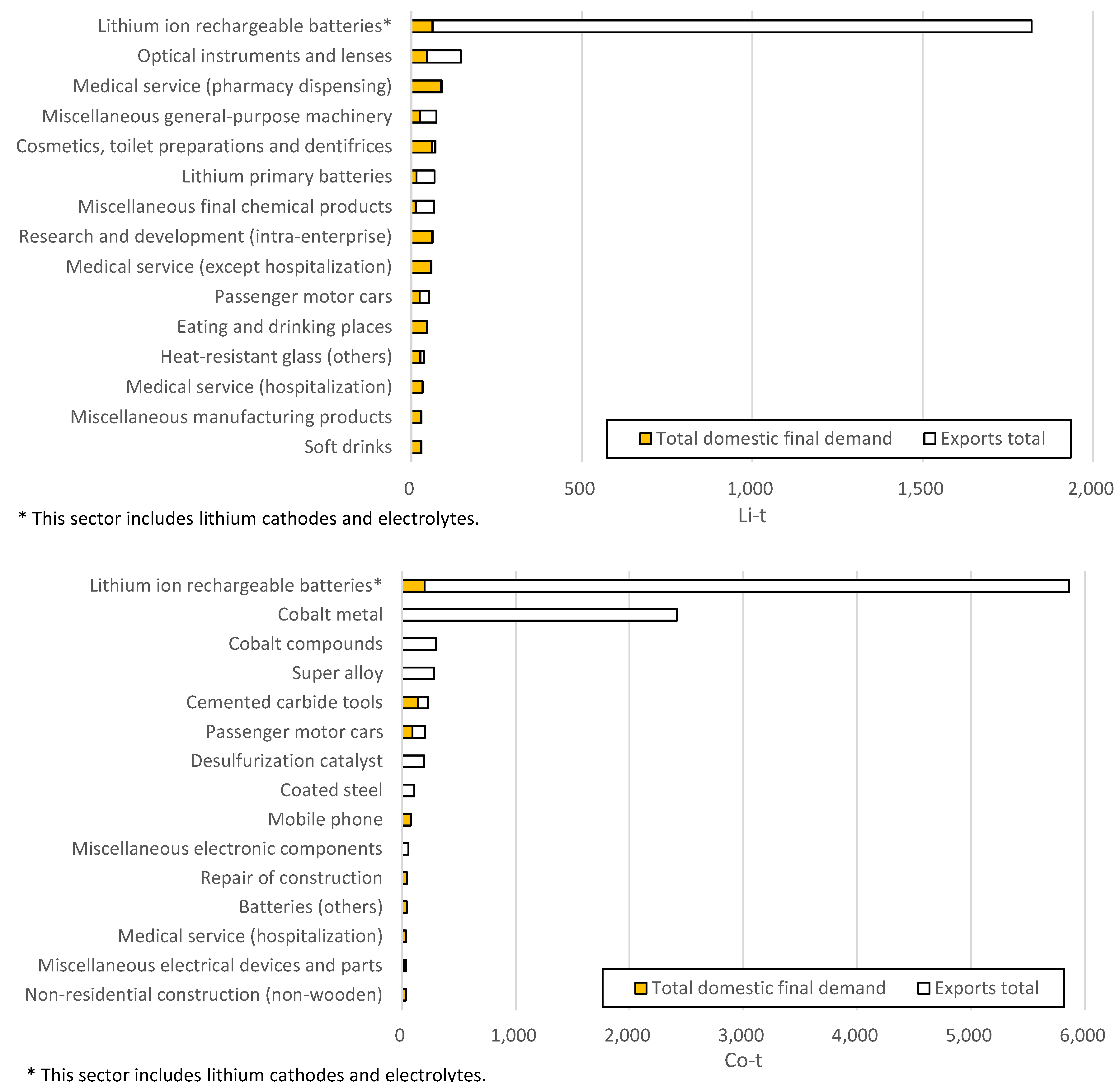
Figure 3.
Estimated domestic final demand of yttrium (Y), lanthanum (La), cerium (Ce), neodymium (Nd) and dysprosium (Dy) in Japan for 2015.
Figure 3.
Estimated domestic final demand of yttrium (Y), lanthanum (La), cerium (Ce), neodymium (Nd) and dysprosium (Dy) in Japan for 2015.
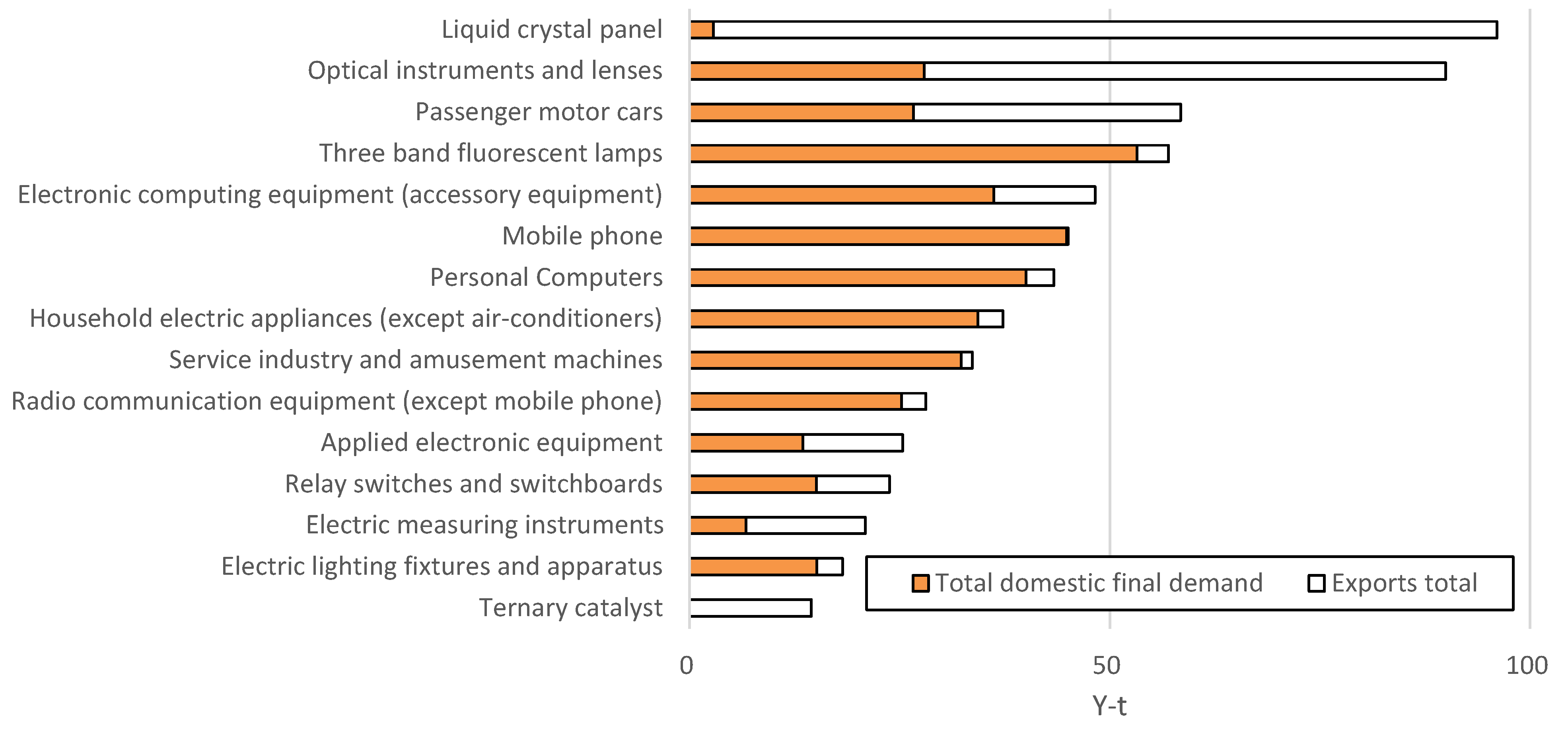
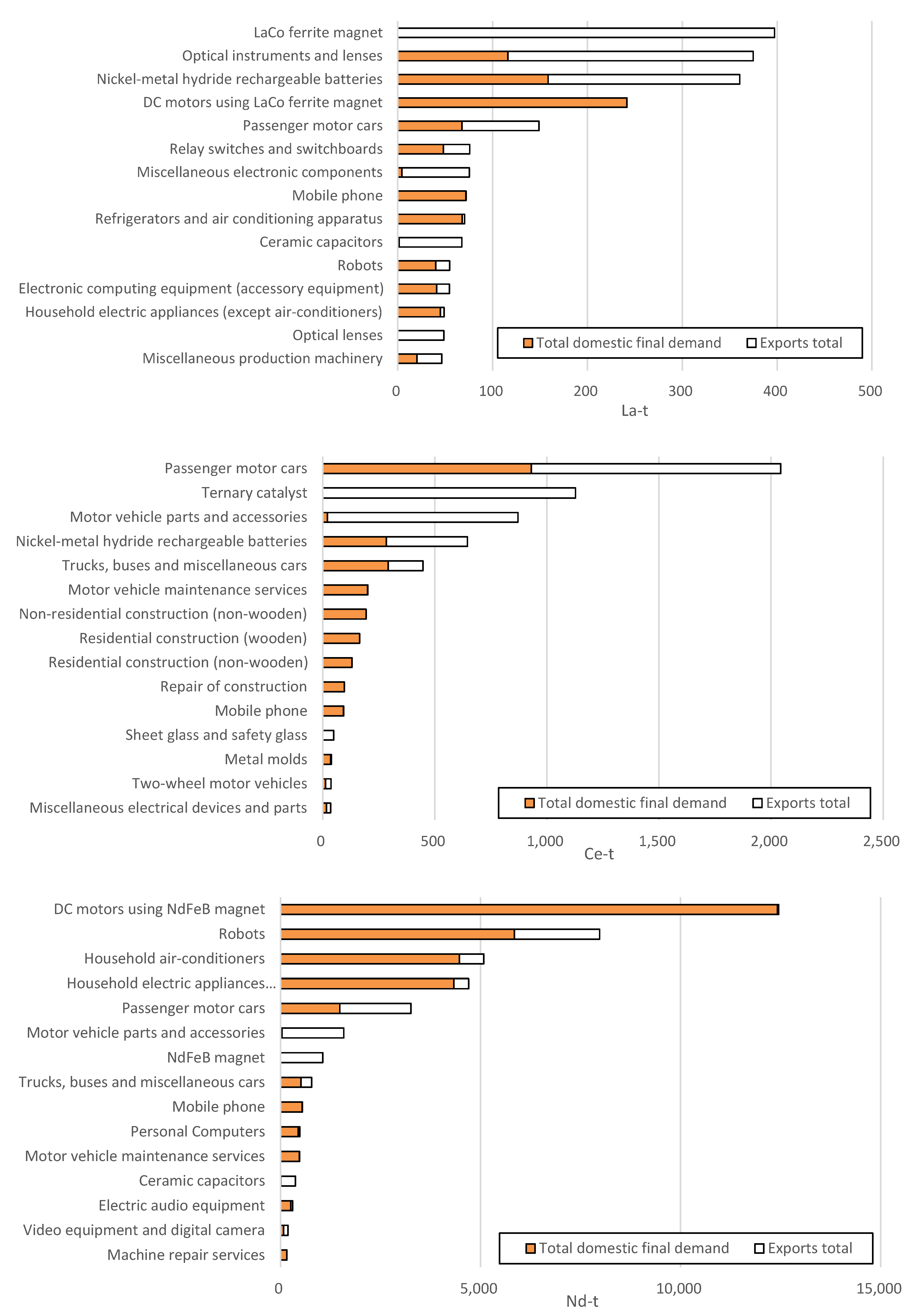
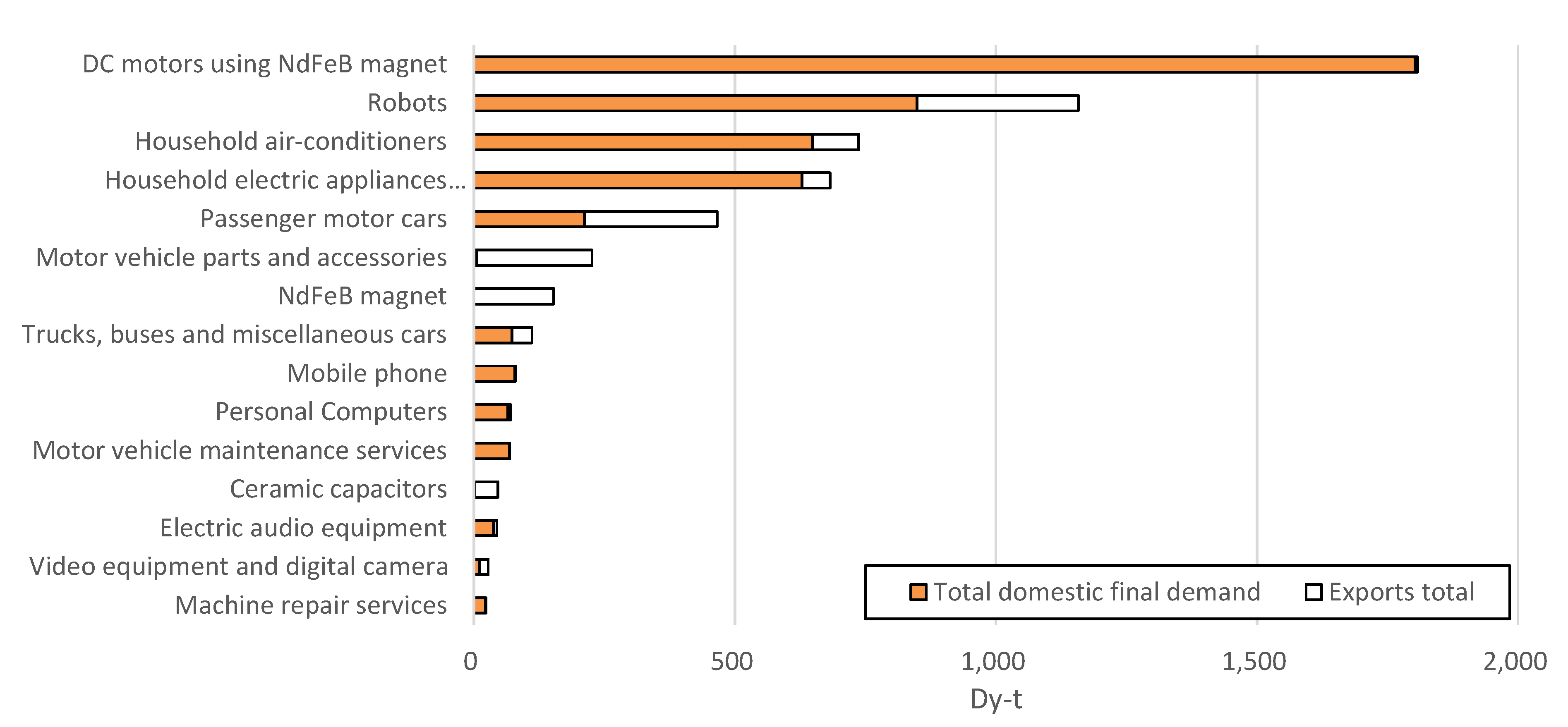
Figure 4.
Similarity structure between domestic and international circular flow of critical minerals from mineral resources policy aspect. Note 1: RP: Raw materials production; PRP: Primary raw materials production; ReC: Recycling; PM: Parts manufacturing; PPM: Primary parts manufacturing; ReM: Repurposing, remanufacturing, refurbishing, repairing and reusing; FM: Final products manufacturing; DsM: Dismantling; CSS: Comminution, separating and sorting; U: Users. Note 2: Scope 1: Suppliers of mineral resources as raw material producers; Scope 2: Sphere of domestic circular flow; Scope 3: Sphere of international circular flow.
Figure 4.
Similarity structure between domestic and international circular flow of critical minerals from mineral resources policy aspect. Note 1: RP: Raw materials production; PRP: Primary raw materials production; ReC: Recycling; PM: Parts manufacturing; PPM: Primary parts manufacturing; ReM: Repurposing, remanufacturing, refurbishing, repairing and reusing; FM: Final products manufacturing; DsM: Dismantling; CSS: Comminution, separating and sorting; U: Users. Note 2: Scope 1: Suppliers of mineral resources as raw material producers; Scope 2: Sphere of domestic circular flow; Scope 3: Sphere of international circular flow.
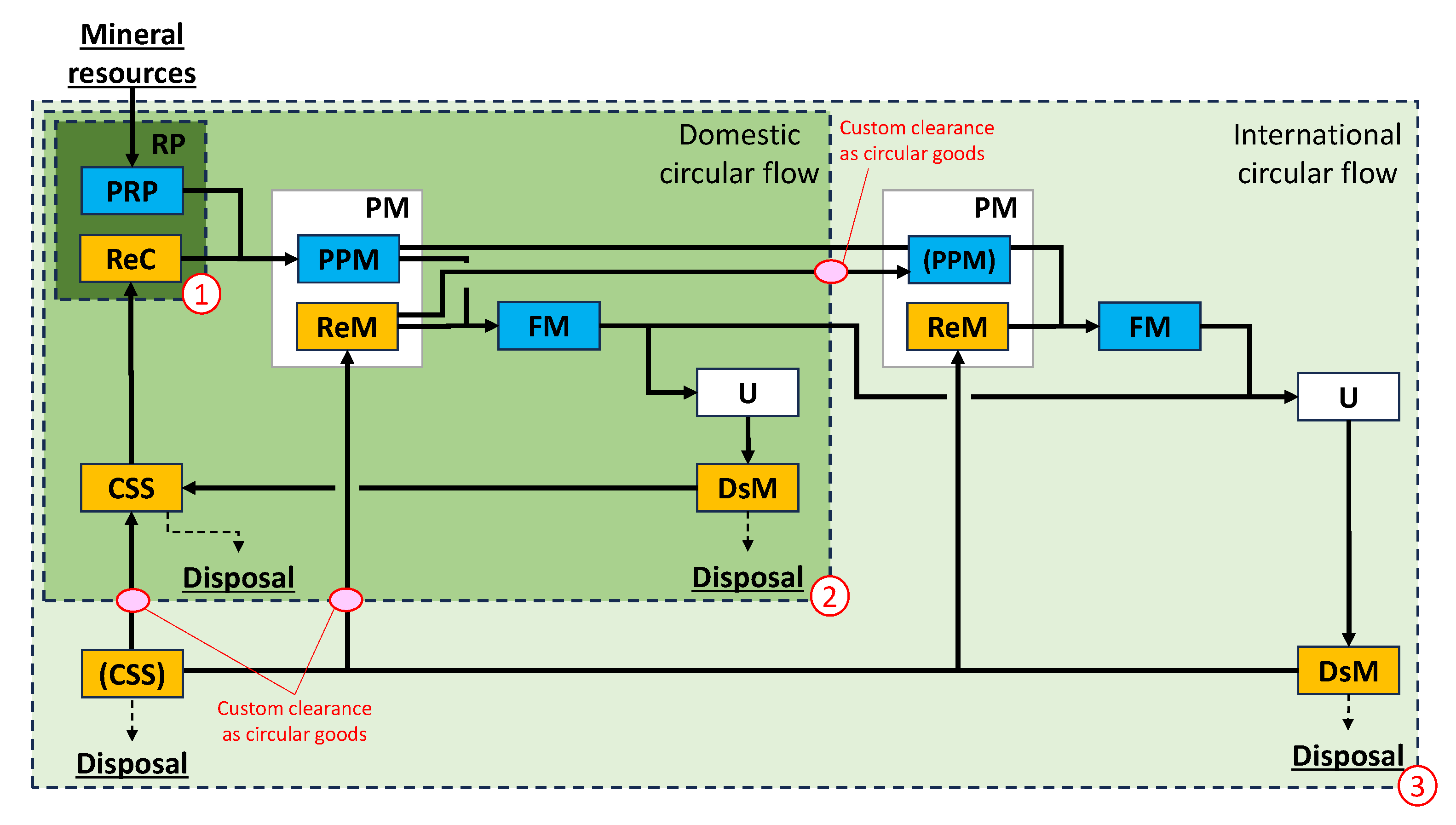
Figure 5.
Decision flow guidance in mineral resources policy.
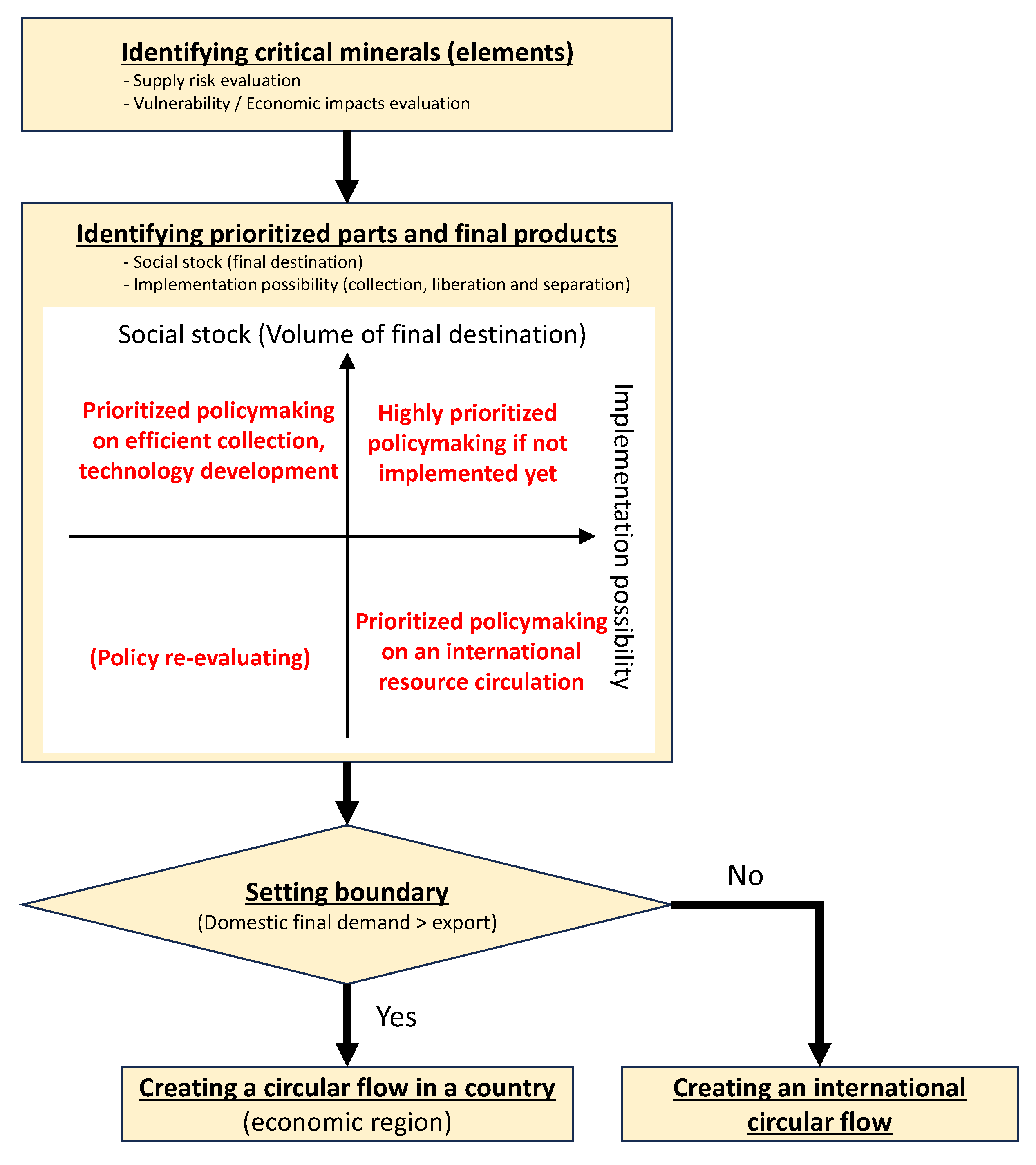

Table 1.
Domestic production of the original and subdivided sectors.
| Original sectors | Subdivided sectors in this study | Evaluated elements | ||
| Miscellaneous ores (domestic production only) | 160,237* | - Iron ores (imported) - Copper ores (imported) - Nickel ores (imported) - Miscellaneous ores (domestic production and imported others) |
130,954,875 t 4,815,914 t 4,394,770 t 367,961* |
Fe Cu Ni - |
| Miscellaneous industrial inorganic chemicals | 925461 * | - Lithium carbonate and lithium hydrocarbonate (imported) - Lithium bromide - Lithium chloride - Cobalt compounds - Yttrium oxide - Cerium oxide - Miscellaneous industrial inorganic chemicals (others) |
20,921 t 2,000 t 615 t 402 t 951 t 12,365 t 898,500* |
Li Li Li Co Y (REE) Ce (REE) - |
| Miscellaneous final chemical products | 2,002,522* | - Desulfurization catalyst - Ternary catalyst - Ferrocerium (imported) - Miscellaneous final chemical products (others) |
16,496 t 9,908 t 958 t 1,802,279* |
Co Y, La, Ce, Nd (REE) Ce - |
| Sheet glass and safety glass | 501,284* | - Ultraviolet protection glass - Sheet glass and safety glass (others) |
12,989 t 488,295* |
Ce (REE) - |
| Miscellaneous glass products | 542,317* | - Heat-resistant glass (pipes and bars) - Optical lenses - Heat-resistant glass (others) - Miscellaneous glass products (others) |
2,276 t 7,648 t 2,276 t 469,457* |
Li Y, La, Ce Li - |
| Abrasive and its products | 227,375* | - Chemical mechanical polishing powder - Abrasive and its products (others) |
2,800 t 226,255* |
Ce - |
| Pig iron | 3,033,611* | - Pig iron | 81,010,826 t | Fe |
| Ferro-alloys | 338,026* | - Ferro-alloys | 1,054,265 t | Fe |
| Crude steel (converters) | 4,449,985* | - Crude steel (converters) | 81,081,155 t | Fe |
| Crude steel (electric furnaces) | 1,481,049* | - Crude steel (electric furnaces) | 24,053,223 t | Fe |
| Scrap iron | 394,010* | - Scrap iron | 39,956,970 t | Fe |
| Copper | 1,027,515* | - Copper matte (imported) - Copper (except copper matte) |
4,924 t 1,482,601 t |
Cu Cu |
| Aluminum (including regenerated aluminum) | 664,369* | - Aluminum oxide and aluminum hydroxide - Aluminum (imported) (primary) - Aluminum (secondary) |
24,796 t 1,459,036 t 1,291,211 t |
Al Al Al |
| Miscellaneous non-ferrous metals | 1,500,558* | - Smelting cold materials (scrap copper) - Lithium metal - Super alloy - Nickel matte and mixed sulfide - Cobalt matte (imported) - Cobalt metal - Lanthanum oxide - Mischmetal - Neodymium oxide - Neodymium metal and ferro-neodymium - Dydimium - Dysprosium oxide - Dysprosium metal and ferro-dysprosium - Miscellaneous non-ferrous metals (others) |
207,075 t 68 t 4,679 t 93,957 t 0 t 4,260 t 2,264 t 2,409 t 670 t 0 t 3,463 t 0 t 437 t 1,327,729* |
Cu Li Co Co Co Co La (REE) La, Ce (REE) Nd (REE) Ne (REE) Nd (REE) Dy (REE) Dy (REE) - |
| Non-ferrous metal scrap | 426,784* | - Dross - Scrap aluminum - Scrap copper - Scrap cobalt - Scrap cemented carbide - Scrap magnet - Non-ferrous metal scrap (others) |
79,734 t 1,161,769 t 1,178,920 t 1,278 t 0 t 0 t 189,496* |
Al Al Cu Co Co Nd, Dy (REE) - |
| Miscellaneous non-ferrous metal products | 822,523* | - Super alloy products - Miscellaneous non-ferrous metal products (others) |
4,679 t 791,168* |
Co - |
| Plumbing accessories, powder metallurgy products and tools | 949,085* | - Cemented carbide - Plumbing accessories, powder metallurgy products and tools (others) |
8,128 t 695,902* |
Co - |
| Machinists' precision tools | 882,958* | - Cemented carbide tolls - Machinists' precision tools (others) |
8,128 t 629,775* |
Co |
| Liquid crystal panel | 2,190,471* | - Liquid crystal panel | 496,523,000 units |
Y, La, Ce (REE) |
| Flat-panel and electron tubes | 72,693* | - Flat-panel and electron tubes | 1,228,672 units |
Y, La, Ce (REE) |
| Miscellaneous electronic components | 5,330,247* | - Ceramic capacitors - Miscellaneous electronic components (others) |
4,118 t 4,863,518* |
La, Nd, Dy (REE) - |
| Rotating electrical equipment | 1,249,851* | - DC motors using LaCo ferrite magnet - DC motors using NdFeB magnet - Rotating electrical equipment (others) |
240,383,897 units 3,210,548 units 726,857* |
Co, La (REE) Nd, Dy (REE) - |
| Electric bulbs | 297,768* | - Three-band fluorescent lamps - Electric bulbs (others) |
76,523,500 Units 263,265* |
Y, La, Ce (REE) - |
| Batteries | 1,053,412* | - Lithium primary batteries - Lithium-ion rechargeable batteries (This sector includes lithium cathodes and electrolytes.) - Nickel-metal hydride rechargeable batteries - Batteries (others) |
710,161,000 Units 983,242,000 units 365,003,000 units 537,540* |
Li Li, Co La, Ce (REE) - |
| Miscellaneous electrical devices and parts | 750,999* | - LaCo ferrite magnet - NdFeB magnet - Miscellaneous electrical devices and parts (others) |
8,668 t 11,970 t 664,598* |
Co, La (REE) Nd, Dy (REE) - |
Note: "REE" means rare earth elements. The value with the symbol "*" is data in monetary units (million Japanese yen). The evaluated elements of each product or material are shown in atomic symbols.
Table 2.
Subdivided sectors categorized into "resources" and "materials" in the model.
| Category | Sector's name | Evaluated elements |
| Resources | - Miscellaneous ores (domestic production and imported others) | - |
| - Dysprosium oxide | Dy (REE) | |
| Materials | - Iron ores (imported) - Copper ores (imported) - Nickel ores (imported) |
Fe Cu Ni |
| - Lithium carbonate and lithium hydrocarbonate (imported) - Yttrium oxide - Cerium oxide |
Li Y (REE) Ce (REE) |
|
| - Ferrocerium (imported) | Ce | |
| - Ferro-alloys | Fe | |
| - Scrap iron | Fe | |
| - Copper matte (imported) | Cu | |
| - Aluminum oxide and aluminum hydroxide - Aluminum (imported) (primary) |
Al Al |
|
| - Nickel matte and mixed sulfide - Cobalt matte (imported) - Lanthanum oxide - Mischmetal (La) - Mischmetal (Ce) - Neodymium oxide - Neodymium metal and ferro-neodymium - Dydimium - Dysprosium metal and ferro-dysprosium |
Co Co La (REE) La (REE) Ce (REE) Nd (REE) Ne (REE) Nd (REE) Dy (REE) |
|
| - Dross - Scrap aluminum - Scrap copper - Scrap cobalt - Scrap cemented carbide - Scrap magnet (Nd) - Scrap magnet (Dy) |
Al Al Cu Co Co Nd (REE) Dy (REE) |
|
| Products | All the other sectors | - |
Table 1.
Comparison between actual data and estimated composition in intermediate goods.
| Sectors | Composition data | ||||||||||
| Fe | Cu | Al | Li | Co | Y | La | Ce | Nd | Dy | ||
| Ternary catalyst (t/t) |
E | 0.187 | 0.011 | 0.205 | 0.000 | 0.000 | 0.005 | 0.004 | 0.371 | 0.011 | 0.000 |
| A (a) | - | - | - | - | - | 0.002 | 0.003 | 0.320 | - | - | |
| Optical lenses (t/t) |
E | 0.069 | 0.003 | 0.009 | 0.000 | 0.000 | 0.008 | 0.035 | 0.000 | 0.000 | 0.000 |
| A (a) | - | - | - | - | - | 0.004 | 0.020 | - | - | - | |
| Cemented carbide tools (t/t) |
E | 0.283 | 0.006 | 0.033 | 0.000 | 0.044 | 0.000 | 0.000 | 0.000 | 0.000 | 0.000 |
| A (d) | - | - | - | - | 0.049 | - | - | - | - | - | |
| Lithium-ion rechargeable batteries (g/unit) |
E | 56.1 | 6.5 | 5.1 | 1.8 | 5.9 | 0.0 | 0.0 | 0.0 | 0.0 | 0.0 |
| A (b, c) | - | - | - | 1.4 | 5.8 | - | - | - | - | - | |
| LaCo magnet (t/t) |
E | 0.821 | 0.001 | 0.002 | 0.000 | 0.009 | 0.000 | 0.113 | 0.000 | 0.000 | 0.000 |
| A (d, e) | 0.850 | - | - | - | 0.009 | - | 0.103 | -- | - | - | |
| NdFeB magnet (t/t) |
E | 0.735 | 0.002 | 0.003 | 0.000 | 0.000 | 0.000 | 0.000 | 0.000 | 0.217 | 0.031 |
| A (f) | 0.750 | - | - | - | - | - | - | - | 0.225 | 0.030 | |
Table 2.
Comparison between actual data and estimated composition in Passenger motor cars.
| Sectors | Composition (kg per unit of Passenger motor cars) | |||||||||
| Fe | Cu | Al | Li | Co | Y | La | Ce | Nd | Dy | |
| Estimated (this study) |
1,114 | 46 | 75 | 0.01 | 0.02 | 0.01 | 0.02 | 0.24 | 0.39 | 0.06 |
| Actual data [70,72] |
1,169 | 26 | 99 | 0.24 | 0.12 | |||||
Table 3.
Major applications of rare earth elements.
| Rare earth element (atomic symbol) | Major application |
| *Lanthanum (La) | LaCo ferrite magnet, Optical glass, Fluid catalytic cracking (FCC) catalyst, Ceramic capacitor, Phosphor |
| *Cerium (Ce) | Promotor for automobile exhaust gas catalyst, Chemical mechanical polishing (CMP) powder, Ultraviolet protection glass, Fluid catalytic cracking (FCC) catalyst |
| Praseodymium (Pr) | Coloring (green) material for glass, Chromogenic (yellow) material for ceramics, Ceramic capacitor |
| *Neodymium (Nd) | NdFeB magnet, Ceramic capacitor |
| Promethium | (Few industrial application) |
| Samarium (Sm) | SmCo magnet |
| Europium (Eu) | Phosphor (blue and red), Optical glass |
| Gadolinium (Ga) | Optical glass, Neutron-absorbing material |
| Terbium (Tb) | NdFeB magnet, Phosphor (green), Optical glass, Mageto-optical disk target |
| *Dysprosium (Dy) | NdFeB magnet, Ceramic capacitor |
| Holmium (Ho) | (Few industrial applications) |
| Erbium (Er) | |
| Thulium (Tm) | |
| Ytterbium (Yb) | |
| Lutetium (Lu) | |
| *Yttrium (Y) | Phospher (red), Optical glass, Stabilizing material for zirconia |
| Scandium (Sc) | Light aluminum scandium alloys |
Note: *: Selected rare earth elements in this study.
Table 4.
Major domestic final demands of each selected rare earth elements in final and intermediate products.
Table 4.
Major domestic final demands of each selected rare earth elements in final and intermediate products.
| Rare earth element (atomic symbol) | Major domestic final demands (applications) | |||||||||
| Final products | Inter. products | |||||||||
| Three band fluorescent lamps | Mobile phones and PCs* | Cars* | Household electric appliances* | Optical instruments | Construction* | Robots | Nickel-metal hydride batteries | DC motors* | ||
| Yttrium (Y) | ✓ | ✓ | ✓ | |||||||
| Lanthanum (La) | ✓ | ✓ | ✓ | ✓ | ✓ | ✓ | ||||
| Cerium (Ce) | ✓ | ✓ | ✓ | |||||||
| Neodymium (Nd) | ✓ | ✓ | ✓ | ✓ | ✓ | |||||
| Dysprosium (Dy) | ✓ | ✓ | ✓ | ✓ | ✓ | |||||
Note 1: (*) Some related applications (sectors) are merged. Mobile phones and PCs: Mobile phone, Personal Computers and Electronic computing equipment (accessory equipment); Cars: Passenger motor cars, Trucks, buses and miscellaneous cars and Motor vehicle parts and accessories; Household electric appliances: Household electric appliances (except air-conditioners), Service industry and amusement machines, Refrigerators and air conditioning apparatus and Household air-conditioners; Construction: Non-residential construction (non-wooden), Residential construction (wooden) and Residential construction (non-wooden); DC motors: DC motors using LaCo ferrite magnet and DC motors using NdFeB magnet. Note 2: Shaded columns are the legally promoted applications of recycling post-consumer products in Japan. Shaded rows are highly prioritized elements for recycling from the supply-demand balance of rare earth elements.
Disclaimer/Publisher’s Note: The statements, opinions and data contained in all publications are solely those of the individual author(s) and contributor(s) and not of MDPI and/or the editor(s). MDPI and/or the editor(s) disclaim responsibility for any injury to people or property resulting from any ideas, methods, instructions or products referred to in the content. |
© 2023 by the authors. Licensee MDPI, Basel, Switzerland. This article is an open access article distributed under the terms and conditions of the Creative Commons Attribution (CC BY) license (http://creativecommons.org/licenses/by/4.0/).
Copyright: This open access article is published under a Creative Commons CC BY 4.0 license, which permit the free download, distribution, and reuse, provided that the author and preprint are cited in any reuse.


