
Submitted:
20 November 2023
Posted:
28 November 2023
You are already at the latest version
Abstract
A question of physical importance is whether finite-energy spatiotemporally localized (i.e., pulsed) generalizations of monochromatic accelerating Airy beams are feasible. For luminal solutions, this question has been answered affirmatively by Saari, Valdmann, Piksarv, Valta-Lukner and Saari, and Kaganovsky and Heyman within the framework of the paraxial geometry. The time-diffraction technique introduced by Porras recently has been motivated by Besieris and Shaarawi in terms of the Lorentz invariance of the equation governing the narrow angular spectrum and narrowband temporal spectrum paraxial approximation and has been used to derive finite-energy spatiotemporally confined subluminal, luminal, and superluminal Airy wave packets. The goal in this article is to provide exact finite-energy broadband spatiotemporally localized Airy solutions (a) to the scalar wave equation in free space; (b) in a dielectric medium moving at its phase velocity; (c) in a lossless second order temporally dispersive medium.
Keywords:
airy beams
; nondiffracting pulses
; localized waves
; space-time wavepackets
1. Introduction
The Airy beam, a remarkable finite-energy solution to the paraxial equation was first formulated analytically by Siviloglou and Christodoulides [1] and subsequently demonstrated experimentally by Siviloglou, Broky, Dogariu and Christodoulides [2]. Their work was motivated by the infinite-energy nonspreading accelerating Airy solution to the Schrödinger equation introduced by Berry and Balazs [3] in the context of quantum mechanics. The Airy beam is slowly diffracting while bending laterally along a parabolic path even though its centroid is constant, it can perform ballistic dynamics akin to those of projectiles moving under the action of gravity, and it is self-healing, that is, it regenerates when part of the “generating” aperture is obstructed; this is due to the reinforcement of the main lobe by the side lobes.
An important question is whether spatiotemporally localized (i.e., pulsed) versions of Airy beams are feasible. For luminal solutions, this question has been answered affirmatively by Saari [4], Valdmann, Piksarv, Valta-Lukner and Saari [5] and Kaganovsky and Heyman [6] within the framework of the paraxial geometry. The time-diffraction technique introduced by Porras [7,8] recently has been motivated by Besieris and Shaarawi [9] in terms of the Lorentz invariance of the equation governing the narrow angular spectrum and narrowband temporal spectrum paraxial approximation and has been used to derive finite-energy spatiotemporally confined subluminal, luminal, and superluminal Airy wave packets. The goal in this article is to provide exact (i.e., non-paraxial) finite-energy broadband spatiotemporally localized Airy solutions (a) to the scalar wave equation in free space; (b) in a dielectric medium moving at its phase velocity; (c) in a lossless second order temporally dispersive medium.
2. Finite-energy (3+1)D spatiotemporally localized Airy splash mode solution of the scalar wave equation in free space
Consider the scalar wave equation in free space, viz.,
written in terms of the nondimensional variables and The introduction of the characteristic variables changes Eq. (1) as follows:
A specific solution of this equation is the infinite energy accelerating Airy wavepacket
This wavefunction moves in a
parabolic trajectory along the characteristic variable
In 1910, Bateman [10,11] discovered a transformation, more general than a conformal change of the metric, which could be used to transform solutions of Maxwell equations into similar ones. In the case of the scalar wave equation, the Bateman transformation in assumes the form
The function also obeys the
scalar wave equation (2).
The Bateman transformation is applied twice to the solution given in Eq. (3). These two sequential operations result in the following new solution to Eq. (2):
Next, this expression is complexified by means of the changes where are two positive parameters. Consequently, one obtains
with the exponent given as
in cylindrical coordinates This is a finite-energy spatiotemporally localized luminal wave packet belonging to the class of splash modes studied by Ziolkowski [12]. It will be referred to as the Airy splash mode.
The parameter in the Bateman conformal transformation is arbitrary. On the other hand, the free positive parameters and entering the solution given in Eq. (7) are critical. As discussed originally by Ziolkowski ([12]; see also [13]), their presence ensures finite energy. Their relative values measure the size of the forward and backward wave components. Only when the backward components are minimized, and the solution is almost undistorted. This is further explained in [14], where it is shown that very close replicas of localized waves, such as the one in Eq. (6), can be launched causally from apertures constructed on the basis of the Huygens principle.
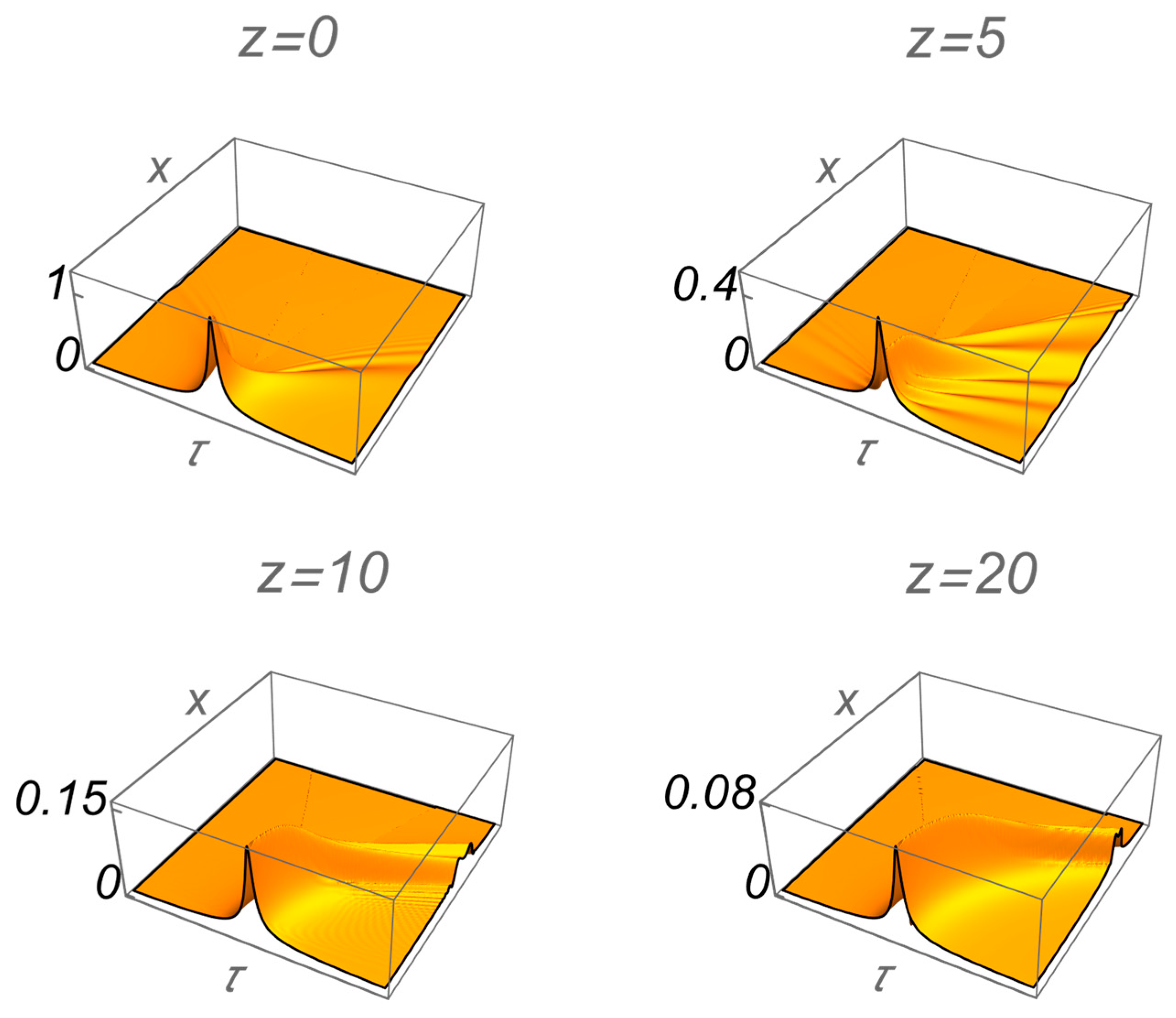
Figure 1 shows surface plots of the intensity of Airy splash mode versus and for various values of the latter defined by the relationship The parameters and have the values and respectively. The wave packet is relatively undistorted because
The finite-energy wavefunction obeys the paraxial forward pulsed beam equation
The transition from Eq. (3) to (6) is effected by means of the modified complexification As a result, one obtains broadband splash mode-type spatiotemporally localized wave solutions to the paraxial equation.
3. Finite-energy accelerating spatiotemporally localized Airy wavepacket solution to the scalar equation in free space
A solution to Eq. (2) is sought in the form
Then, is governed by the parabolic equation
A solution to this equation is the “accelerating beam”
With a small positive parameter and replaced by is essentially the finite-energy monochromatic paraxial accelerating Airy beam solution introduced by Siviloglou and Christodoulides [1]. In contrast, is not a finite-energy solution to the scalar wave equation. To achieve a finite-energy spatiotemporal solution an appropriate superposition over the free parameter of the form
must be undertaken. Such a superposition can be brought to the form
where is a positive free parameter. The integral in Eq. (12) is an Airy transform [15]. It can be carried out explicitly, yielding the finite-energy accelerating spatiotemporal Airy wavepacket
Figure 2 shows surface plots of the modulus square of the Airy wavepacket versus and for various values of the latter defined by the relationship The parameters and have the values and respectively.
The finite-energy wavefunction obeys the paraxial forward pulsed beam equation [cf. Eq. (8)] if the replacement is made in Eq. (13). As mentioned previously, one obtains then a broadband spatiotemporally localized accelerating Airy solution to the paraxial equation.
4. Finite-energy accelerating broadband Airy wavepacket solution in the presence of temporal dispersion
Basic Equation
Electromagnetic wave propagation in a linear, homogeneous, transparent, dispersive medium is governed by the scalar equation
if polarization is neglected. In this expression, is a real field and a real pseudo-differential operator. A physical interpretation of the latter is provided in the frequency domain.; specifically,
where denotes Fourier transformation and is the Fourier transform of with respect to time. The function appearing on the right-hand side of Eq. (15) is a real wave number.
For a physically convenient central radian frequency, the real field is expressed as follows:
Here, is a complex-valued envelope function and denotes the phase speed in the medium computed at the central frequency. For pulses as short as a single optical period and within the framework of the paraxial approximation, the envelope function obeys the following equation [16,17,18]:
Here, denotes the transverse (with respect to ) Laplacian operator and corresponds to a moving reference frame, defined in terms of the group speed . The operator is given by the expression
In the sequel only the first term the series will be retained. This approximation results in the equation
Here is the second-order index of dispersion. It is positive for normal dispersion and negative for anomalous dispersion.
Accelerating Airy solution
A solution to Eq. (19) is sought in the form Furthermore, with one obtains the parabolic equation
The azimuthally asymmetric expression
with a positive parameter, satisfies the paraxial equation (20). A spatiotemporal solution to Eq. (19) can be derived by means of the superposition
A large class of solutions can be obtained by using different spectra . Choosing the spectrum results in the solution
This is a finite-energy accelerating Airy-Gaussian wavepacket. Figure 3 shows the intensity versus and at for Figure 4 shows surface plots of the modulus of the azimuthally symmetric wavepacket versus and for three values of
5. Finite-energy accelerating broadband Airy wavepacket solution in a dielectric moving at its phase velocity
An equation arising in the case of a dielectric medium moving at its phase velocity is given by [19]
Here, denotes the phase speed, and stands for the longitudinal components and in the absence of sources. On the other hand, the equation of acoustic pressure under conditions of uniform flow is given as follows:
Here, is the speed of sound in the rest frame of the medium and is the uniform velocity of the background flow. In the special case where and the resulting equation for the acoustic pressure is isomorphic to Eq. (24).
Assuming independence on the transverse variable in Eq. (24), the ansatz
gives rise to the equation
This is an exact parabolic equation, in contradistinction to the paraxial approximation of the Helmholtz equation associated with the temporal Fourier transform of the ordinary scalar wave equation. In addition to the well-known beam solutions of the usual paraxial equation, Eq. (27) has the following “accelerating” one [1]:
Here, denotes the Airy function and the positive parameter ensures finite energy for the monochromatic solution. The beam follows a parabolic trajectory upon propagation.
Finite-energy broadband pulse solutions can be obtained by using the solution (28) together with the ansatz (26) and undertaking a superposition with respect to the frequency (see, e.g., Ref. [15]). A specific spatiotemporal broadband solution is given as follows:
Figure 5 shows surface plots of the modulus of the wavepacket versus and for four values of
6. Concluding Remarks
Space-time paraxial solutions based on the narrow angular spectrum obey the pulsed beam equation mentioned in Section 2 and Section 3. Broadband as well as narrowband spatiotemporal luminal solution to the beam equation were addressed in [4,5,6]. More recently, work on nonluminal spatiotemporally confined Airy wave packets has appeared in the literature [20,21,22]. The time diffraction method [7,8], motivated in terms of the Lorentz invariance of the narrow angular spectrum and narrow temporal spectrum paraxial equation [9], allows the derivation of finite-energy spatiotemporally localized subluminal, luminal and superluminal Airy wave packets.
In this article, four distinct finite-energy broadband spatiotemporally confined Airy-type solutions have been presented. In Section 2, one starts with a solution to the scalar wave equation in the form of an Airy pulse obeying the parabolic equation along one of the characteristic variables of the scalar wave equation, multiplied by a plane wave involving the second characteristic variable. Two sequential applications of the Bateman conformal transformation result in a finite-energy broadband splash mode-type spatiotemporally localized Airy solution to the scalar wave equation in free space. A different exact broadband solution to the scalar wave equation in free space is derived in Section 3. On starts with an infinite energy solution consisting of the product of a plane wave involving one of the characteristic variables of the scalar wave equation and a variant of the Siviloglou-Christodoulides Airy solution obeying the parabolic equation along the second characteristic variable. An integration over a free parameter entering the solution and use of the Airy transform yields a different type of a finite-energy broadband spatiotemporally localized Airy solution to the scalar wave equation in free space.
Different types of Airy solutions in the presence of second-order temporal dispersion have appeared in the literature. The simplest is the analog of the monochromatic Airy beam involving the axial variable and the transverse variable .The former involves the axial variable and the “transverse” variable , where denotes the group velocity. Another separable solution is of the form The symplectic solution of Eq. (19) in cylindrical coordinates given in Eq. (23) of Section 4 is much more complicated. It is a finite-energy paraxial broadband localized Airy solution.
In Section 5, broadband finite-energy spatiotemporally localized Airy solutions are presented to equations arising in two different physical settings: (a) in the case of a dielectric medium moving at its phase velocity; (b) for acoustic pressure under conditions of uniform flow.
Funding
This research received no external funding.
Informed Consent Statement
Not applicable.
References
- Siviloglou, G.A.; Christodoulides, D.N. Accelerating finite energy Airy beams. Opt. Lett. 2007, 32, 979–81. [Google Scholar] [CrossRef] [PubMed]
- Siviloglou, G.A.; Broky, J.; Dogariu, A.; Christodoulides, D.N. Observation of accelerating Airy beams. Phys. Rev. Lett. 2007, 99, 213901. [Google Scholar] [CrossRef] [PubMed]
- Berry, M.V. .; Balazs, N.L. Nonspreading wave packets. American Journal of Physics 1979, 47, 264–7. [Google Scholar] [CrossRef]
- Saari, P. Laterally accelerating Airy pulses. Opt. Express 2008, 16, 10303–8. [Google Scholar] [CrossRef] [PubMed]
- Valdmann, A. .; Piksarv, P..; Valtna-Lukner, H.; Saari, P. Realization of laterally nondispersing ultrabroadband Airy pulses. Opt. Lett. 2014, 39, 1877–80. [Google Scholar] [CrossRef] [PubMed]
- Kaganovsky, Y.; Heyman, E. Airy pulsed beams. JOSA A 2011, 28, 1243–55. [Google Scholar] [CrossRef] [PubMed]
- Porras, M.A. Gaussian beams diffracting in time. Opt. Lett. 2017, 42, 4679–82. [Google Scholar] [CrossRef] [PubMed]
- Porras, M.A. Nature, diffraction-free propagation via space-time correlations, and nonlinear generation of time-diffracting light beams. Phys. Rev. A 2018, 97, 063803. [Google Scholar] [CrossRef]
- Besieris, I.M.; Shaarawi, A.M. Finite-energy spatiotemporally localized Airy wavepackets. Opt. Express 2019, 17, 792–803. [Google Scholar] [CrossRef] [PubMed]
- Bateman, H. The transformation of the electrodynamical equations. Proc. London Math. Soc. 1910, 2, 223–64. [Google Scholar] [CrossRef]
- Bateman, H. The transformations of coordinates which can be used to transform one physical problem into another. Proc. London Math. Soc. 1910, 8, 469-488-264.
- Ziolkowski, R. W. Localized transmission of electromagnetic energy. Phys. Rev. A 1989, 39, 2005–2033. [Google Scholar] [CrossRef] [PubMed]
- Besieris, I.M.; Shaarawi, A.M.; Ziolkowski, R.W. A bidirectional traveling plane wave representation of exact solutions of the scalar wave equation. J. Math. Phys. 1989, 30, 1254–69. [Google Scholar] [CrossRef]
- Ziolkowski, R.W.; Besieris, I.M.; Shaarawi, A.M. Aperture realizations of exact solutions to homogeneous-wave equations. JOSA A 1993, 10, 75–87. [Google Scholar] [CrossRef]
- Vallée, O.; Soares, M. Airy Functions and Applications to Physics, World Scientific, 2004.
- Brabec, T.; Krausz, F. Nonlinear optical pulse propagation in the single-cycle regime. Phys. Rev. Lett. 1997, 78, 3282. [Google Scholar] [CrossRef]
- Porras, M.A. Ultrashort puled Gaussian light beams. Phys. Rev. E, 1998, 58, 1086-1093. [CrossRef]
- Porras, M.A. Propagation of single-cycle pulse light beams in dispersive media. Phys. Rev. A 1999, 60, 5069. [Google Scholar] [CrossRef]
- Besieris, I.M. Spatiotemporally localized waves and accelerating beams in a uniformly moving dielectric. Progress Electromagn. Research 2022, 112, 55–65. [Google Scholar] [CrossRef]
- Kondakci, H.E.; Abouraddy, A.F. Diffraction-free space–time light sheets. Nat. Photon. 2017, 11, 733–40. [Google Scholar] [CrossRef]
- Kondakci, H.E.; Yessenov, M.; Meem, M.; Reyes, D.; Thul, D.; Fairchild, S.R.; Richardson, M.; Menon, R.; Abouraddy, A.F. Synthesizing broadband propagation-invariant space-time wave packets using transmissive phase plates. Opt. Express. 2018, 26, 13628–38. [Google Scholar] [CrossRef] [PubMed]
- Kondakci, H.E.; Abouraddy, A.F. Airy wave packets accelerating in space-time. Phys. Rev. Lett. 2018, 120, 163901. [Google Scholar] [CrossRef] [PubMed]
Figure 1.
Surface plots of the modulus of versus and for three values of the latter defined by the relationship The parameters and have the values and respectively, with the speed of light in vacuum normalized to unity.
Figure 1.
Surface plots of the modulus of versus and for three values of the latter defined by the relationship The parameters and have the values and respectively, with the speed of light in vacuum normalized to unity.
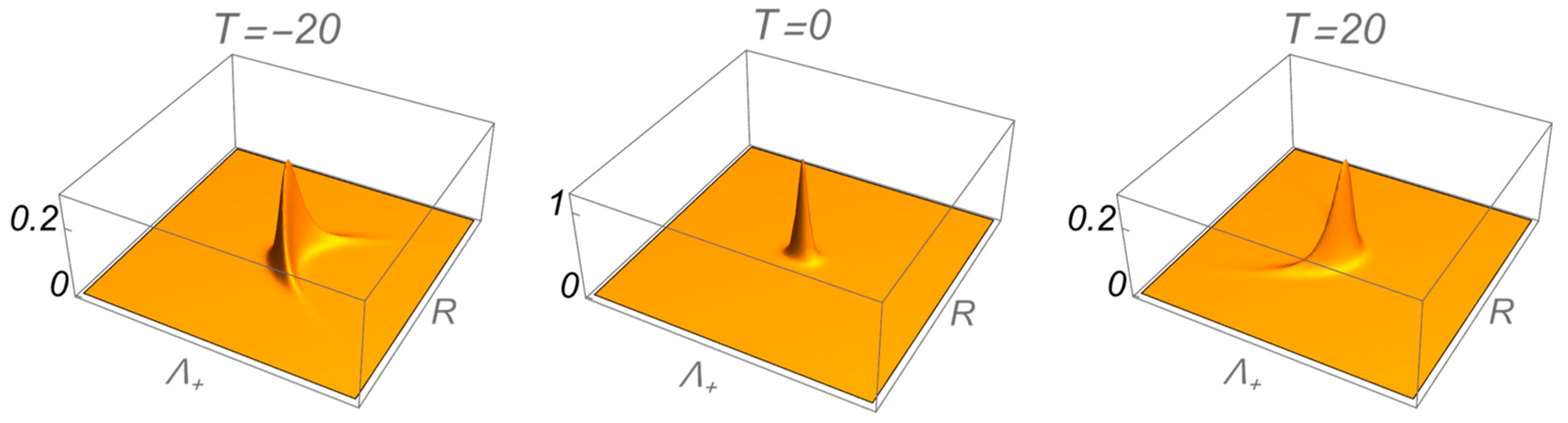
Figure 2.
Surface plots of the modulus of versus and for three values of the latter defined by the relationship The parameters and have the values and 100, respectively, with the speed of light in vacuum normalized to unity.
Figure 2.
Surface plots of the modulus of versus and for three values of the latter defined by the relationship The parameters and have the values and 100, respectively, with the speed of light in vacuum normalized to unity.
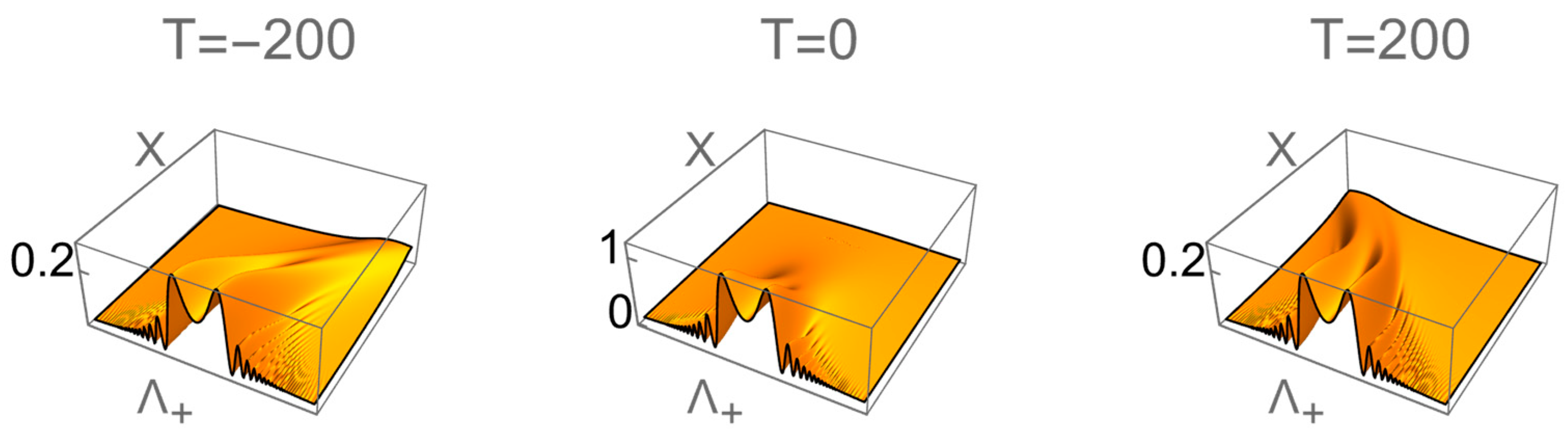
Figure 3.
Surface plot of the modulus of versus and for and .
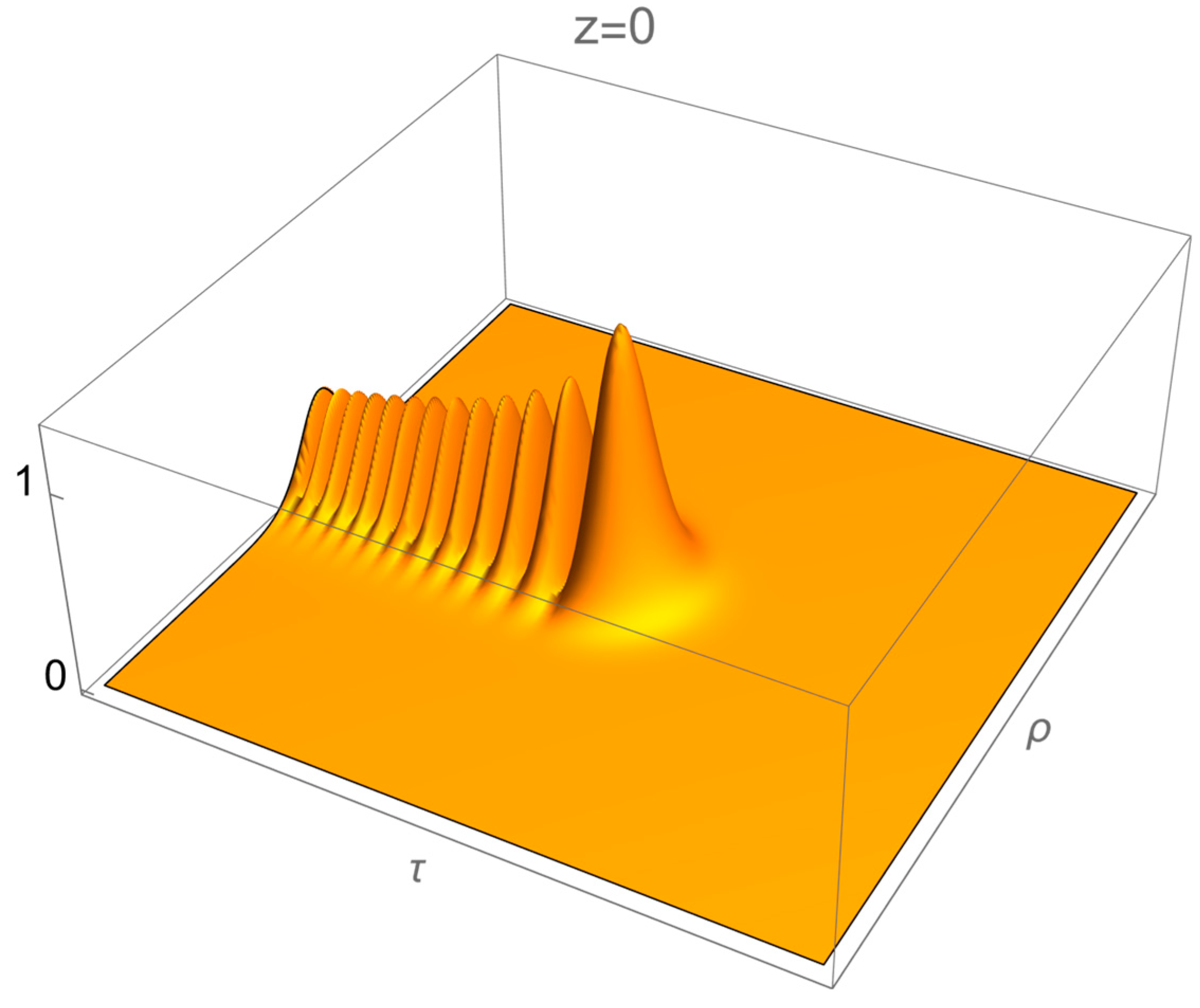
Figure 4.
Surface plot of the modulus of the azimuthally symmetric wavepacket versus and for three values of The dimensionless parameters are as follows: and .
Figure 4.
Surface plot of the modulus of the azimuthally symmetric wavepacket versus and for three values of The dimensionless parameters are as follows: and .
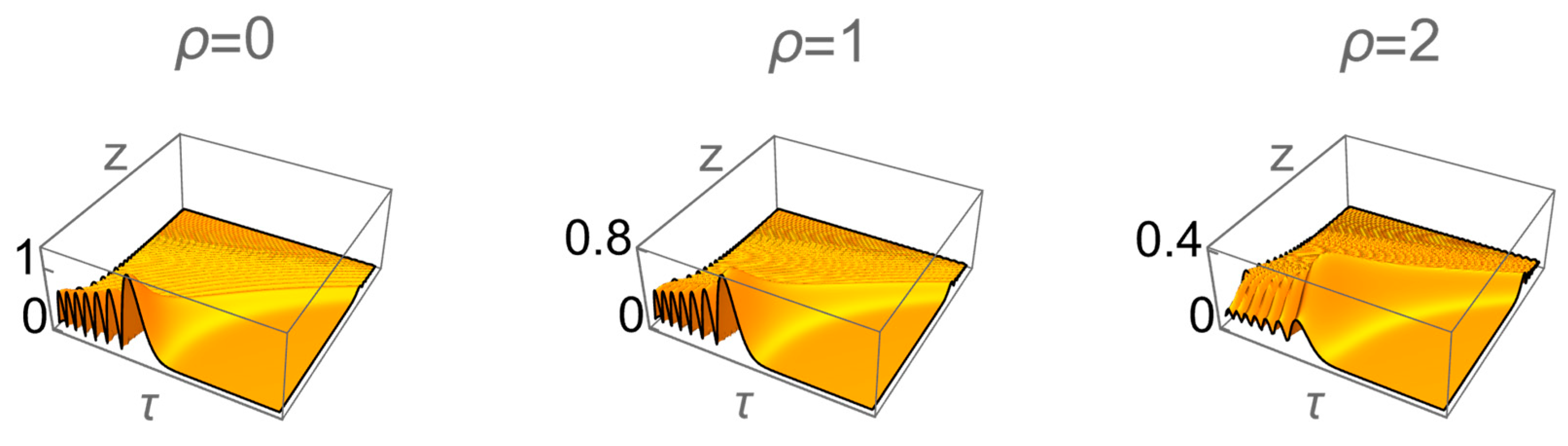
Figure 5.
Plot of the modulus of versus and for four values of The parameter values are and with the speed of light in vacuum normalized to unity.
Figure 5.
Plot of the modulus of versus and for four values of The parameter values are and with the speed of light in vacuum normalized to unity.
Disclaimer/Publisher’s Note: The statements, opinions and data contained in all publications are solely those of the individual author(s) and contributor(s) and not of MDPI and/or the editor(s). MDPI and/or the editor(s) disclaim responsibility for any injury to people or property resulting from any ideas, methods, instructions or products referred to in the content. |
© 2023 by the authors. Licensee MDPI, Basel, Switzerland. This article is an open access article distributed under the terms and conditions of the Creative Commons Attribution (CC BY) license (http://creativecommons.org/licenses/by/4.0/).
Copyright: This open access article is published under a Creative Commons CC BY 4.0 license, which permit the free download, distribution, and reuse, provided that the author and preprint are cited in any reuse.


