

Submitted:
08 November 2023
Posted:
09 November 2023
You are already at the latest version
Abstract
Based on the multiple coordination framework of “promising government-effective market-ordered society”, this paper takes 68 cases of adding elevators to old buildings as samples, and selects six conditional variables: approval optimization, financial subsidies, financing innovation, technological innovation, capable people leading and neighborhood committee guidance. Using Crisp-Set Qualitative Comparative Analysis (csQCA), this paper discusses the combination of conditions that affect the success or failure. It is found that: approval optimization and neighborhood committee guidance are sufficient conditions for the success; successful cases can be divided into three types: “political and social dual-drive type”, “market and social dual-drive type” and “ternary co-drive type”; lack of approval optimization, lack of financing innovation, and the existence of capable people leading are necessary conditions for the failure. The failure cases can be divided into “government and market double failure type” and “market failure type”.
Keywords:
Adding elevators to the old building in China
; Multiple coordination
; Crisp-Set Qualitative Comparative Analysis
1. Introduction
As an important livelihood project and an important carrier of urban renewal, “adding elevators to old buildings” has always received continuous attention from public opinion and policies in China [1], but its overall progress is quite difficult. Even in Guangzhou, which ranks first in China in terms of the total number of approved and built elevators, the ratio of the total approved amount to the total number of eligible buildings is only 17% [2]. There are various experience summaries in the practical field, such as “the theory of government subsidies leading to victory”, “the theory of court judgments being decisive”, “the theory of market development”, and “the theory of capable people leading to victory”. This reflects that the government, market, and society each have their own winning strategies. Exploring how these “magic weapons” complement each other can provide precise strategies and plan menus for the smooth promotion of adding elevators to old buildings. Therefore, based on the multiple coordination framework of “promising government-effective market-ordered society”, the article conducts Crisp-Set Qualitative Comparative Analysis (csQCA) of 68 cases to explore the influencing factors and path combinations of the promotion of adding elevators to old buildings.
Most existing studies on the installation of elevators in old buildings have preliminarily observed that the smooth progress is the result of the cooperation of multiple entities such as the government, the market, and society, but it is difficult to see the path. Among them, the prescription for government logic includes: the government shifting from “leading” to “guiding” [3], improving the institutional environment [2], and alleviating financing difficulties through financial subsidies [4,6]. The remedies for market logic include fundraising (self financing and fund sharing by owners [5], enterprise participation [7], project integration [8], enterprise franchise [9]) and technology integration [10] (relaxing the principle of owner consent, improving technology [9,12], and compensation standards [11]). The prescription for social logic is to advocate public participation [10] and leverage the role of community capable people [2,13]. However, the current case studies and theoretical abstractions have not been able to answer the question of how to treat these prescriptions based on syndrome differentiation, flexibly organize prescriptions, resolve the contradiction between the universality of demand and the limited financial subsidies, and resolve the contradiction between community public nature [14] and the delayed development of grassroots autonomous organizations [3].
As a complex social engineering project, the success of installing elevators in old buildings is a result of multiple and concurrent factors. What is the importance of these multiple entities and factors, and how do they affect the installation of elevators through the “joint effect” ? This article investigates and answers by introducing the Crisp-Set Qualitative Comparative Analysis (csQCA) method.
Based on the literature on the installation of elevators in old buildings, which is rich in the logic of various strengths of the government, market, and society, and in combination with the “Guiding Opinions of the State Council of China on Comprehensively Promoting the Renovation of Old Urban Residential Areas” [15], such as “reasonably implementing residents’ investment responsibilities”, “increasing government support”, “continuously improving financial service strength and quality efficiency”, and “promoting social participation”, based on the analysis of specific cases, the article constructs a diversified collaborative explanatory framework for the promotion of old buildings and elevators (as shown in Figure 1): “promising government-effective market-ordered society”.
Starting from these three dimensions, two variables are selected each to generate six conditional variables: approval optimization, financial subsidies, financing innovation, technological innovation, capable people leading, and neighborhood committee guidance. The Crisp-Set Qualitative Comparative Analysis (csQCA) method is used to explore the impact of these conditions as a single factor on the success or failure of adding elevators to old buildings, and typical configurations of success and failure are summarized.
2. Methods
2.1. Research methods and ideas
The qualitative comparative analysis method uses a case-based analysis approach, treating cases as conditional configurations, to support causal complexity analysis in the method [16]. Compared to regression analysis, QCA has an advantage in handling small and medium-sized samples [17]. It can identify the interdependence, configuration equivalence, and causal asymmetry between conditions [18], which is conducive to discovering the similarity and possibility of the system through cross case comparative analysis [19]. This to some extent avoids the abstraction and randomness of single case studies and tracking observations, and can also free oneself from the dilemma of listing multiple cases in a “quick glance” manner, where it is difficult to see the whole picture from a narrow perspective. This article selects the Crisp-Set Qualitative Comparative Analysis Method (CS-QCA) as the research method.
2.2. Sample selection and data sources
The article follows the principle of “information first”, based on the relevance and representativeness of events, and utilizes local government websites, various databases, and media platforms to search and collect practical cases of installing elevators in old buildings, striving for sample duration and diversity. A total of 68 detailed cases from 14 provinces and 23 cities in China from 2002 to 2022 were selected as samples1. Among them, 33 cases (48.5%) experienced various obstacles such as work stoppage, litigation, fines, demolition, etc., while 35 cases (51.5%) were relatively smooth.
2.3. Variable setting and assignment
The article is based on multiple coordination framework and selects variables from academic literature, policy texts, and case data. The assignment of variables, reference sources, and frequency distribution are shown in Table 1.
2. Results
2.1. Construct a truth table

Table 2.
Truth table.
| Number of cases | Conditional variable | Outcome variable |
|||||
|---|---|---|---|---|---|---|---|
| Approval optimization | Financial subsidies | Financing innovation | Technological innovation | Capable people leading | Neighborhood committee guidance | ||
| 5 | 1 | 1 | 0 | 1 | 1 | 1 | 1 |
| 4 | 0 | 1 | 0 | 0 | 1 | 1 | 1 |
| 4 | 0 | 1 | 0 | 1 | 1 | 1 | 1 |
| 2 | 0 | 0 | 1 | 1 | 1 | 0 | 1 |
| 2 | 0 | 1 | 0 | 0 | 0 | 1 | 1 |
| 2 | 1 | 1 | 1 | 0 | 0 | 1 | 1 |
| 2 | 1 | 1 | 1 | 1 | 1 | 1 | 1 |
| 1 | 0 | 1 | 1 | 0 | 1 | 0 | 1 |
| 1 | 1 | 0 | 1 | 1 | 1 | 0 | 1 |
| 1 | 1 | 0 | 1 | 0 | 0 | 1 | 1 |
| 1 | 0 | 1 | 1 | 0 | 0 | 1 | 1 |
| 1 | 0 | 1 | 0 | 1 | 0 | 1 | 1 |
| 1 | 1 | 1 | 0 | 1 | 0 | 1 | 1 |
| 1 | 0 | 1 | 1 | 1 | 0 | 1 | 1 |
| 1 | 1 | 1 | 0 | 0 | 1 | 1 | 1 |
| 1 | 1 | 0 | 1 | 0 | 1 | 1 | 1 |
| 1 | 0 | 1 | 1 | 0 | 1 | 1 | 1 |
| 1 | 1 | 1 | 1 | 0 | 1 | 1 | 1 |
| 1 | 0 | 0 | 1 | 1 | 1 | 1 | 1 |
| 1 | 1 | 0 | 1 | 1 | 1 | 1 | 1 |
| 1 | 0 | 1 | 1 | 1 | 1 | 1 | 1 |
| 9 | 0 | 0 | 0 | 0 | 1 | 1 | 0 |
| 9 | 0 | 0 | 0 | 1 | 1 | 1 | 0 |
| 5 | 0 | 0 | 0 | 0 | 1 | 0 | 0 |
| 3 | 1 | 0 | 0 | 0 | 1 | 0 | 0 |
| 3 | 1 | 0 | 0 | 1 | 1 | 1 | 0 |
| 2 | 1 | 0 | 0 | 0 | 1 | 1 | 0 |
| 1 | 1 | 0 | 1 | 0 | 1 | 0 | 0 |
| 1 | 1 | 0 | 0 | 1 | 1 | 0 | 0 |
The truth table produced a total of 29 combinations. Among all the combinations with a result variable of 1, the combination with the largest number of cases was “approval optimization*financial subsidies*~financing innovation*technological innovation*capable people leading*neighborhood committee guidance”. This combination met other condition variables in the absence of financing innovation, and there were 5 corresponding cases. Among all the combinations with a result variable of 0, the combination with the largest number of cases corresponds to 9 cases, and there are two types of combinations, namely “~ approval optimization*~financial subsidies*~financing innovation*~technological innovation *capable people leading*neighborhood committee guidance”, and “~approval optimization *~financial subsidies*financing innovation*technological innovation*capable people leading*neighborhood committee guidance”. The former shows that it is difficult to ensure the successful promotion of elevator installation in old buildings by social forces alone, and the latter shows that even if social forces are supplemented by technological innovation in market forces, elevator installation projects often end in failure.
2.2. Necessity analysis of individual variables
After constructing the truth table, necessity analysis was conducted on a single variable using fs/QCA3.0 software. If the consistency index is greater than 0.9, it is generally considered that the conditional variable is a necessary condition for the outcome variable. If it is greater than 0.8 but less than 0.9, it is considered a sufficient condition.The coverage index reflects the explanatory power of the conditional variable on the outcome variable, and the larger the value, the greater the explanatory power. The results are shown in Table 2.
From Table 2, it can be seen that there are no necessary conditions for the successful installation of elevators in the old building. Approval optimization and neighborhood committee guidance are sufficient conditions. Lack of approval optimization, lack of financing innovation, and the existence of capable people leading are necessary conditions for the failure.
2.3. Analysis of successful combination of conditions
The article uses fs/QCA3.0 for calculation, using default standards such as consistency set to 0.8 and case frequency threshold set to 1 for screening, followed by standard analysis. Based on the simple solution and intermediate solution, the conditional combination configurations of three types and six paths are obtained according to the different driving agents (as shown in Table 3).
Type 1: Political and social dual-drive type
This type includes paths 1 and 2, with the core condition being approval optimization. Path 1 indicates that in the absence of financial subsidies, government optimization and approval, coupled with guidance from community neighborhood committees, can promote the smooth installation of elevators in old buildings. Path 2 has the highest original coverage among all paths, indicating that while the government has introduced policies to assist in approval services, community elites and neighborhood committees in social forces have jointly played a role in promoting the installation of elevators. This “dual wheel drive” model provides ideas for regions lacking market financing and technological innovation conditions.
Type 2: Market and social dual-drive type
This type corresponds to path 3, with the highest unique coverage among all paths, and the core conditions are financing innovation and technological innovation. In the absence of government approval service optimization, it takes the lead of community capable people to promote the successful installation of elevators in old buildings through the “innovation driven” model of “market financing innovation+technological innovation”.
Type 3: Ternary co-drive type
This type corresponds to paths 4, 5, and 6.
The core condition of path 4 is financing innovation and neighborhood committee guidance, which indicates that in the case of government financial subsidies, through the guidance of neighborhood committees, and then carry out financing innovation in a market way to ensure the resolution of the fund problem. This model can be used as a reference for regions with sufficient financial resources. It is worth noting that the existing financial subsidies do not fit well with the urgency of residents’ needs and actual living conditions, and a large number of subsidies are given to the groups who can carry out the upgrading with consensus, rather than the vulnerable groups whose lack of payment ability affects their willingness to install elevators [36], becoming icing on the cherry rather than a coordinating tool. Therefore, the government should establish and improve the identification mechanism and subsidy plan of the subsidy object, and implement precise subsidies for the difficult people who have urgent demands for the installation of elevators, forming “selective” incentives to promote collective action.
The core condition of Path 5 is the optimization of government approval, which is characterized by “convenience”. That is, on the one hand, the government optimizes the approval service, so that the information run more and the masses can run less, and on the other hand, the market can handle safety, convenience, lighting, ventilation, noise, privacy and other issues through innovative technologies to meet different needs and facilitate residents’ lives. This model can be used as a reference for areas with large resident disputes and difficult coordination of needs.
The core condition of path 6 is approval optimization, showing the characteristics of “optimization of government approval + self-financing of residents”. In the absence of government financial subsidies and market technological innovation, under the support of the core condition of government optimization of approval services, through community capable people, residents are led to innovate financing methods, so as to promote the installation of elevators.
2.4. Analysis of failed combination of conditions
The above tools and standards are used to analyze the combination of conditions for the failure of “installing elevators in old buildings”, and the results are shown in Table 4.
Type 1: Government and market double failure type
This type corresponds to paths 1 and 2, which have in common the absence of government approval optimization and market financing innovation as core conditions. Among them, path 1 is a typical capable leading people “cannot clap with one hand”. Path 2 reveals that it is often difficult to ensure the smooth installation of elevators in old buildings by social forces alone, and a reasonable combination of the government and the market is needed.
Type 2: Market failure type
This type corresponds to paths 3 and 4. The common denominator is that financial subsidies in the government and the leadership of competent people in the social forces both play their roles, but financing innovation or technological innovation in the market forces is missing as the core condition, and approval optimization in the government forces is also missing as the core condition. Therefore, when the market force conditions are not sufficient, the government’s reasonable and effective approval optimization is an important factor to promote the success of the old buildings.
2.5. Typical case presentation of success
In order to further understand the three types of successful installation of elevators in old buildings, we have selected typical cases for presentation.
Type 1: Political and social dual-drive type: The two-way guidance mode of “government policy guidance + social neighborhood committee guidance” in Shanghai Yuanlong apartment community
The Yuanlong Apartment Community in Pengpu Town, Jing’an District, Shanghai was built in 1996, with a total of 8 multi story residential buildings and 13 story high-rise residential buildings, with an aging rate of over 60%. “My family lives on a high floor, and I’m getting older. Climbing stairs every day is really tiring! ” 73 year old homeowner Yao Aizhu had the idea of adding elevators early on. “I’m not too old, and I’m in good health. There are many elderly people in the community who have basic illnesses. Going up and down stairs is very tiring.” In 2016, Shanghai officially issued the “Notice on Construction Approval Related to the Construction and Management of Adding Elevators to Existing Multi-story Residential Residential Buildings in the City”, reducing the original 46 approval items to 15. Shen Yang, general manager of Shanghai Baijia Construction Engineering Co., Ltd., said: “Originally, the approval took about 6 to 7 months, or longer, but now it is approved in more than 2 months.” This has greatly increased the number of residents who need to add elevators. With enthusiasm and confidence, they expressed their demands one after another and received strong support from the District Housing Authority, the town government and the Longtan Residential District Party Branch.
When Yuanlong Apartment decided to add elevators to the entire community, the Pengpu Town Party Branch began to establish an “elevator installation joint construction group” composed of the apartment’s residential area party organizations, party members, building team leaders and other key forces, as well as neighborhood committee staff, and two team members were recruited in each building to form the “building elevator installation team” to implement various tasks such as publicity and mobilization, opinion solicitation, communication, answering questions, voting announcements, program design, enterprise screening, construction supervision and other matters. At the same time, in order to better realize residents’ dreams of elevators, the town party committee and government established a “three-level leading group for adding elevators”: the first level is the leading group established by the town party committee and the “office for adding elevators” established by the town government; the second level is the leadership group established by each neighborhood committee, and the third level is the autonomous group established for each gate building. With the joint efforts of all parties, the community finally passed the public opinion test with the result that “100% of residents agreed to install elevators in the building, and 87% of residents in the community agreed.” Recalling the road to adding elevators, Yao Aizhu, a key member of the “elevator installation joint construction team”, said with emotion: “Judging from the consultation at the time, Yuanlong Apartment was relatively smooth, because the first floor was full of shops, so there is no strong opposition from the residents on the ground floor. However, in order to communicate with the residents, we visited the house seventeen or eighteen times, and I secretly shed tears many times.”
After the public opinion consultation session, the general party branch of the neighborhood committee convened all the owners of Yuanlong Apartment and through independent voting, selected the Smail Elevator Company that was willing to provide free maintenance for five years, reducing the burden on the owners to raise maintenance fees. Before the official construction, the District Housing Management Bureau conducted a thorough investigation of the community, understood the obstacles and potential safety risks of adding elevators, and explored countermeasures. In January 2019, the apartment elevator project was completed, making it the first residential complex in Shanghai to install elevators throughout the entire community.
Government services are “added” and the approval process is “subtracted”, pressing the “acceleration button” for the installation of elevators in Pengpu Town. At the same time, the joint efforts of Yuanlong Apartment’s “elevator addition joint construction team” and the mutual cooperation of party members, residents and building leaders have provided solid organizational support for the elevator addition work, forming a “political and social dual-driven” elevator addition model.
Type 2: Market and social dual-drive type: The innovation-driven model of “market financing innovation + technological innovation” in Xintaoyuan Community and Chenjia Xiaoyuan Community in Nantong City
In 2019, there was a craze for installing elevators in old residential areas across the country. Faced with a large amount of start-up funds, many areas are still in the dilemma of lacking elevator subsidies and shared compensation mechanisms. Some residential areas in Nantong urban area have explored “leasing model” and “self-financing model” to solve this problem.
Building No.3 of Xintaoyuan Community in Taowu Community, Hongqiao Street, Nantong City, was built in the 1990s. It has a total height of 6 floors and most of the residents are elderly. At the beginning of 2019, Mr. Xu Jinlin, a resident of the building, initiated a proposal to install an elevator at his own expense, which received unanimous response from the residents of the unit. In May of the same year, Xu Jinlin followed the “Guiding Opinions on Installing Elevators in Existing Multi-story Residential Residential Areas in Urban Areas” issued by the municipal government, and was the first to obtain the administrative approval for the installation of elevators in Unit 3 of Building 3. Faced with an additional elevator cost of 450000 yuan, Xizi Elevator Nantong Branch, based on the actual situation of the community, designed a financing plan with the owner, which includes “70000 yuan on the sixth floor, 60000 yuan on the fifth floor, 50000 yuan on the fourth floor, 40000 yuan on the third floor, and no investment is required for the first and second floors”. Construction began on November 22, 2019. Considering lighting issues, the building chose to install a fully transparent tempered glass sightseeing elevator, adopting a spatial corridor design and implementing modular installation. This not only minimizes disturbance to the residents, but also accelerates the installation progress; Considering the comfort of use, the elevator installation company has adapted the internal space of the elevator to local conditions, allowing for a single passenger capacity of more than 7 people. On January 20, 2020, the elevator successfully passed the acceptance inspection. In July 2021, the “Implementation Rules for Financial Subsidies for Installing Elevators in Existing Multi-story Residential Residential Buildings in Nantong City (Trial)” was released. As the lead owner of elevator installations, Xu Jinlin took the initiative to take on the subsidy application work and submitted the materials as soon as possible. The unit where he works became one of the first units in Nantong City to receive subsidies for installing elevators.
The Chenjia Xiaoyuan Community in Chongchuan District, Nantong City, was built in 1994. There are 9 residential buildings in total. In Building 73, where Mr. Yao Hairu lives alone, there are 11 elderly people over 60 years old, so it is urgent to install elevators. Faced with internal demand and external incentives from the successful addition of elevators to the Xintaoyuan community, 73-year-old Yao Hairu took the initiative to take the lead in the preliminary research, material preparation and application for the installation of elevators. “We were moved when we learned that there were guidelines. Later, after we visited Building 3 of Xintaoyuan Community, which had an elevator installed, we became more determined to install an elevator.” Since it was during the epidemic prevention and control period, Yao Hairu Consent can only be obtained through phone calls and other methods. Starting from June 2021, Yao Hairu and other enthusiastic residents began to “run” the procedures. After obtaining the administrative approval permit, they officially entered the construction site in October. “It is because of the successful experience of Lao Xu (Xu Jinlin) that we can install elevators with confidence.” After preliminary market research, Yao Hairu chose the same elevator construction company as Unit 3, Building 3, Xintaoyuan Community. For the initial costs, the company designed an allocation plan that increases investment from floors 2 to 6 as the floors increase, and collects subsequent usage fees by swiping a card to take the elevator. During the installation process, the elevator uses glass exterior walls and stainless steel frames with better lighting effects, and is equipped with a spatial corridor design. Residents can easily reach home after getting out of the elevator by going up and down half a floor [26]. Before the Spring Festival of 2022, the elevator was successfully put into use. Talking about the experience of using it, Yao Hairu said: “The elevator maintenance company comes once every half month. It is very safe and there are no worries.”
Type 3: Ternary co-drive type: The bi-directional funding support model of “government subsidies + market financing” in Donghu Garden Community, Shanghai
Building No. 9 of Donghu Garden Community, Xinzhuang Town, Minhang District, Shanghai was built in 1999. Most of the residents are elderly. In 2017, many residents in Building 9 proposed to install an elevator. The town housing management office immediately held a symposium in the community to explain in detail the latest policies and benefits to representatives of the neighborhood committee, property owners, and owners. As the secretary of the East Lake Garden branch, Shi Guoqiang learned that Shanghai had issued relevant documents and that residential buildings had been successfully installed, so he visited and investigated with neighborhood committees and property management companies. In order to make the process of installing elevators autonomously by residents more standardized and more convenient, the neighborhood committee teamed up with the property owners committee and Huzhong Property Management Co., Ltd. to draft an “Open Letter on Elevator Installation in East Lake Garden” and publicized it on the electronic screens and corridors of the community. Afterwards, a “Eight Questions and Answers on Installing an Elevator” was drafted based on residents’ hot discussion points to answer everyone’s questions.
“Actually, there are not only process issues with installing elevators, but also the issue of whether elevators can be installed.” The relevant person in charge of the housing management office said, “The elevators are now installed in public houses built in the 1980s and 1990s. Elevators involve structural safety issues of the house, as well as construction issues such as how to install them. If residents want to install an elevator, they have to go through the whole process themselves, which will take more than two years if everything goes well.” To this end, the community has established “elevator installation working group” assists neighborhood committees and property owners committees in setting up a platform for negotiation of owners’ opinions when owners disagree, giving full play to their own work advantages, guiding residents to communicate and negotiate, and prompting relevant owners to voluntarily reach a consensus on the basis of equal consultation. Team member Xu Shu said: “When installing the elevator this time, it was not so easy at first. The quality, price, and surrounding environment of the elevator were the first things residents considered. Under the leadership of our neighborhood committee party branch, these The problems have been properly solved one by one.” At the same time, a “elevator installation studio” has been established to promote a “one-stop” service to further advance the work process. It provides policy consultation, technical and process guidance for residents to install elevators on their own, and provides preliminary design, financial estimation, and fundraising plans for elevator corridors, including reference plans for renovation fund allocation, later operation and maintenance cost allocation, etc. This helps to coordinate and guide residents in handling relevant procedures, and successfully complete the installation of elevators.
The installation of an elevator was once shelved due to the high one-time construction costs. According to calculations by the studio, the cost of installing an elevator is about 650,000 yuan. Excluding the government subsidy of 260,000 yuan (40%), residents still need to raise 390,000 yuan themselves. Faced with the high one-time payment, residents have yet to reach an agreement. In this regard, the relevant departments of the town are actively working to find a variety of preferential plans to allow residents to make the best choice. Later, Chenglong Industrial Service Company, which was responsible for installing the elevator, went to the community to investigate and provided a monthly mortgage payment method. That is, the residents did not pay a penny upfront, but provided 390,000 yuan to the residents based on a 15-year mortgage monthly payment method. Residents on the 2nd to 6th floors can pay monthly mortgage fees ranging from 68 to 387 yuan depending on the floor. Elevator rides adopt the “swipe card system”. Within 15 years after completion, the electricity bill, maintenance fee and insurance premium of the elevator will be borne by the elevator installation company, and residents do not need to contribute again. Therefore, Chen Jian, secretary of the Party branch of the East Lake Garden Residential Area, consulted the residents of Building 9 on this plan. Unexpectedly, the plan was immediately recognized by the residents. “After the elevator is installed and put into use, each household can choose to pay the mortgage fee monthly or annually according to the signed agreement. When the 15-year mortgage period is up, the elevator installation will be re-evaluated. If it can continue to be used, the elevator service company negotiates the corresponding maintenance fees with the residents. If it cannot continue to be used and needs to be replaced with a new elevator, it will re-sign a mortgage agreement with the residents.” Chen Jian added. “You can pay with a mortgage when you buy a house. I didn’t expect that you can do the same for installing an elevator.” A resident of Building 9 calculated an account. “Excluding the relevant subsidies for installing an elevator in Xinzhuang Town, the original cost of installing an elevator was about 400,000. Residents of the building have to pay about 70,000 yuan, but now they only need to pay 387 yuan per month, which greatly reduces our financial burden.” After the owners’ committee, property management, and elevator addition working groups learned about this model, they The work was promoted more actively and the speed of installation was increased. Shi Nanzheng, deputy director of the Property Owners Committee, said proudly: “Because our community has a relatively high degree of aging, we finally chose this company (Chenglong Company) for its ‘monthly mortgage payment’ payment model, which is also the first in Shanghai.”
The innovation and testing of the “monthly mortgage payment” model has lowered the threshold for installing elevators in old communities. Hu Yongyue, general manager of Shanghai Chenglong Industrial Group Co., Ltd., said: “This is a model we have created. East Lake Garden now has 5 units that are being consulted and will be signed soon.” At present, the installation of elevators in Building 9 has been put into operation. The agreement for Building 10 has been fully signed, and the projects for Buildings 21 and 25 are also in progress... “The butterfly effect of the monthly payment model for mortgage installation and elevator installation is gradually emerging, and residents feel that this model is very affordable.” Chen Jian said, “If there is a scale effect, the cost of installing elevators for elevator service companies can be greatly reduced, and both residents and elevator service companies can achieve a win-win effect.” The relevant person in charge of the town housing management office said, Yiyi Town will continue to study this new model, make adjustments based on actual operation conditions, and wait until all conditions are mature before promoting it widely. Overall, the successful installation of the elevator in Building 9 is closely related to the mortgage elevator installation model and the coordination of autonomous organizations of “40% government subsidy, free installation and paid use by companies adding elevators”.
3. Discussion and Conclusions
First, from the perspective of necessity analysis of individual variables, approval optimization and neighborhood committee guidance are sufficient conditions for the successful installation of elevators in old buildings. Among the 6 successful typical combinations, approval optimization and neighborhood committee guidance have occurred 4 times. Therefore, the government introduces relevant policies to assist in approval, optimizes approval procedures, and neighborhood committees provide reasonable guidance and mobilization, which will help promote the advancement of adding elevators to old buildings. In terms of the importance of conditions, the approval optimization was a core condition 4 times. Neighborhood committee guidance appeared once as a core condition and as a marginal condition 3 times. Therefore, the importance ranking of approval optimization is higher, and the difference in the importance of conditional variables reflects the internal mechanism of the promotion of old building escalators, that is, reasonable and effective approval optimization plays a crucial role in the smooth operation of old building escalators.
Secondly, after comparing and attributing successful cases, it can be found that the smooth progress of installing elevators in old buildings is the result of a reasonable combination of various forces and factors, which can be divided into three types: “political and social dual drive type”, “market and social dual-drive type”, and “ternary co-drive type”. From a specific perspective, there are also sub models such as the “dual wheel drive” model, the “innovation drive” model, the “two-way financial support” model, and the “convenient” model. After comparing the conditional configurations, it can be found that in all six successful paths, there were participation led by neighborhood committees or capable individuals. Among them, the variable of neighborhood committee guidance appeared as an edge condition three times, and as a core condition once. The variable of capable individuals leading appeared as an edge condition three times, but did not appear in the core condition. From this, it can be seen that social force has appeared as a core variable a total of once. Compared to this, government power and market power have appeared as core variables four times and three times, respectively. Therefore, the smooth progress of the old building ladder cannot be achieved without the participation of social forces, but it is difficult for them to become the core force for successful promotion. Therefore, the smooth progress of adding elevators to old buildings requires various regions to comprehensively utilize local resource endowments, adapt to local conditions, and combine social forces with government and market forces in a reasonable and effective manner.
Thirdly, after comparing and attributing the failed cases, it can be found that the failure of adding elevators to old buildings can be divided into “government and market double failure type” and “market failure type”. Most of them are driven by the “independent” power of social forces, and there is a contradiction between the role of community elites and what they should be. The lack of approval optimization and financing innovation is the key to the failure. Firstly, from the necessity analysis of a single variable, the lack of approval optimization, lack of financing innovation, and the presence of capable individuals are necessary conditions for the failure of adding elevators to old buildings. At the same time, from the perspective of the configuration of failure conditions, all four paths have the participation of social forces, which is the “independent” driving force of social forces, and community capable individuals have played a role in these four failure paths. Therefore, in the promotion of adding elevators to old buildings, there is a contradiction between the role of community capable people, which should play an important role in coordination and integration in theory, and is even considered a key role [13]. In reality, capable people have played a role in all four failed paths. However, due to the lack of core variables such as approval optimization and financing innovation, community capable people are unable to play their due role alone. From the simple solution of failure, it can be seen that the path of approval optimization and financing innovation can explain 97% of failure cases, and 72.7% of failure cases can only be explained by this path; From the failed intermediate solution, it can be seen that approval optimization as the core condition appeared four times in the four paths, and financing innovation as the core condition appeared three times in the four paths. Therefore, the lack of approval optimization and financing innovation is the key cause of the failure of adding elevators to old buildings. Regions with frequent failure cases can reflect and explore relief measures from these two aspects.
Author Contributions
Methodology, H.L.; Writing-original draft, H.L.; Visualization, G.J.; Funding acquisition, G.J. All authors have read and agreed to the published version of the manuscript.
Funding
This work has been supported by National Social Science Foundation of China (20BZZ024).
Conflicts of Interest
The authors declare that they have no conflicts of interest.
References
- Guo, S.L.; Yin, L. The Evolution and Logical Implications of the Policy for Installing Elevators in Old Communities: A Quantitative Analysis Based on 67 Policy Texts. Administrative Tribune 2021, 28, 82–91. (in Chinese). [Google Scholar]
- Yan, C.W.; Yang, Z.Y. From Destructive Conflict to Constructive Conflict: The Way to Break Through the Installation of Elevators in Old Communities. Journal of Tianjin Administration Institute 2020, 22, 60–69. (in Chinese). [Google Scholar]
- Wang, W.; Song, Y. The Mode Transition of Local Governments in Urban Governance: A Case Study on Elevators Installation on Stocked Housing in Hangzhou City. Urban Development Studies 2021, 28, 127–134. (in Chinese). [Google Scholar]
- Chen, S.S.; Bai, Y.F. Analysis of the Financial Subsidy Effect on the Renovation of Old Residential Areas. Sub National Fiscal Research 2022, 215, 57–68. (in Chinese). [Google Scholar]
- Ning, C.Q. Theoretical Analysis of the Compensation Method for Sharing the Cost of Installing Elevators in Existing Residential Buildings. Urban Problems 2014, 226, 44–48. (in Chinese). [Google Scholar]
- Feng, P. Research on the Operation Management of Old Urban Community Renovation Fund. Construction Economy 2022, 43, 70–75. (in Chinese). [Google Scholar]
- Yang, N.; Han, H.Y. He driving mechanism of long term governance of the old Community by Interest sharing Social Enterprise: Reshaping the roles and reallocating the resources. Journal of Beijing Administration Institute 2021, 133, 34–41. (in Chinese). [Google Scholar]
- Huang, S.B.; Li, D.B.; Li, W.L. Research on the Problems and Counter Measures of Adding Elevators to Existing residential Buildings in China. Construction Economy 2019, 40, 11–14. (in Chinese). [Google Scholar]
- Wang, J.; Wang, L.P. Renovation of Old Residential Community in Towns and Cities: New Impetus of Economic Growth in the Recovery of Covid-19 Panel. Administration Reform 2020, 5, 41–46. (in Chinese). [Google Scholar]
- Gao, Y.; Li, F.Q.; Huang, H. Research on Planning Approaches to Existing Residential Settlements from the Perspective of the Actor Network: Case of Community Micro Renewable of Shanghai. Urban Development Studies 2021, 28, 13–18. (in Chinese). [Google Scholar]
- Wang, N.; Li, Y. Resolving Conflicts in Installing Elevators for Existing Residential Buildings: Policy Analysis with Deliverable Role playing. Journal of Tianjin Administration Institute 2020, 22, 70–78+87. (in Chinese). [Google Scholar]
- Liu, H.; Li, B. Research on the Key Factors Affecting the Demand for Residential Buildings Renovation Catering for the elder people. Reformation & Strategy 2012, 28, 175–178. (in Chinese). [Google Scholar]
- Shi, S.X.; Chen, H. The multiple Streams Approach to Understand Policy Agenda Setting in Community: A Case Study of Elevators Retrofitting on Old Communities in H District of Fuzhou. Urban Development Studies 2021, 28, 11–15. (in Chinese). [Google Scholar]
- Zhou, Y.Y.; Wu, L.F. Appeals Promote Publicity: The Rationale of Participating in Community Governance Based on the Field Research of Installing New Elevators in the Long Established Condominium Communities of City H. Zhejiang Social Sciences 2019, 9, 88–95+158. (in Chinese). [Google Scholar]
- Liu, L.F. Interpretation of the “Guiding Opinions of the General Office of the State Council on Comprehensively Promoting the Renovation of Old Urban Residential Areas”. Urban and Rural Development 2020, 14–17. (in Chinese). [Google Scholar]
- Du, Y.Z.; Jia, L.D. Configuration Perspective and Qualitative Comparative Analysis (QCA): A New Path in Management Research. Journal of Management World 2017, 6, 155–167. (in Chinese). [Google Scholar]
- Mao, Z.W. Qualitative Comparative Analysis (QCA) and Research in Journalism and Communication. Chinese Journal of Journalism & Communication 2016, 38, 6–25. (in Chinese). [Google Scholar]
- Zhang, M.; Chen, W.H.; Lan, H.L. Why do Chinese enterprises Completely Acquire High tech Enterprises: A Fuzzy yet Qualitative Comparative Analysis (fsqca) Based on 94 Cases. China Industrial Economics 2019, 4, 117–135. (in Chinese). [Google Scholar]
- Wang, N.; Wang, B.H. Research on the Influence Factors of Internet Public Opinion on University Image: Qualitative Comparative Analysis(qca) based on 30 Public Opinion cases. Journal of National Academy of Education Administration 2020, 8, 77–85. (in Chinese). [Google Scholar]
- Ran, A.B.; Liu, J.Y. Policy System of China old Residential Community Renovation from the Perspective Policy Tool. Urban Development Studies 2021, 28, 57–63. (in Chinese). [Google Scholar]
- Xiahou, M.E.; Liu, W.C.; Li, Z.R.; et al. Research on the Policy Text of Old Residential Area Reconstruction from the Perspective of Policy Tools: A Case Study of Nanjing. Modern Urban Research 2023, 3, 15–20. (in Chinese). [Google Scholar]
- Wang, H.P. Public Service Co Production and its Mechanisms Driven by Grassroots: A Case Study of PPP Regeneration of Micro Infrastructure in Y Sub District in S City. Chinese Public Administration 2022, 4, 27–35. [Google Scholar]
- Li, J.X. Research on the Financing Model of the Old Residential Community Renewal under the New Situation. Modern Urban Research 2021, 11, 115–120. (in Chinese). [Google Scholar]
- Shan, S.; Li, J.X. Market Oriented Exploration on the Profit Model of the Old Community Reconstruction: Take J Community in Beijing as an Example. Construction Economy 2021, 42, 88–91. (in Chinese). [Google Scholar]
- An, J.M.; Guo, L.; Xu, Y.; et al. Discussion on Micro-fit Sustainable Business Model of Old Residential District Reconstruction from the Perspective of Micro-renewal. Urban Development Studies 2022, 29, 70–76. (in Chinese). [Google Scholar]
- Song, F.X.; Kang, S.Y. The Difficult Position and Path of the Reformation of Old Community Under the Background of the Aging Population. Hebei Academic Journal 2020, 40, 191–197. (in Chinese). [Google Scholar]
- Zhang, J.L.; Chen, D.L.; Zhang, W.J.; et al. Suitability Evaluation and Integrated Application of Comprehensive Technology for Renovation of old Community based on System Theory. Urban Development Studies 2023, 30, 18–24. (in Chinese). [Google Scholar]
- Zhang, Z.L.; Zhuang, T.; Jiang, L.D.; et al. Research on Type Identification and Renewal Strategy of Old Urban Residential Areas from the Perspective of Evolutionary Resilience. Urban Development Studies 2023, 30, 130–140. (in Chinese). [Google Scholar]
- Ru, P.; Shen, Y.Y.; Su, J. Do smart renovations increase neighborhood attachment: Evidence from field surveys in two old neighborhoods in Beijing. China Soft Science 2023, 66–75. (in Chinese). [Google Scholar]
- Li, D.Q.; Wang, Y. Research on the effect of the “Invisible Presence” of Danwei on Community Collective Action: Case Studies of Elevator Installation Projects for Old Residential Districts in Guangzhou. Journal of Public Management 2021, 18, 93–104+172. (in Chinese). [Google Scholar]
- Liu, T.G.; Xiang, F. “Influencing emotion with Informal Norms” and “Influencing emotion with emotion”: Re-understanding of Community Emotional Governance. Chinese Public Administration 2021, 432, 11–18. (in Chinese). [Google Scholar]
- Tan, J.J.; Liao, Q.J.; Yuan, Y.; et al. Research on Collaboration Mode of Regeneration of Old Residential District Dominated by Neighborhood Committee: A Case Study of Yangzhong Community in Guangzhou. Shanghai Urban Planning Review 2021, 160, 16–22. (in Chinese). [Google Scholar]
- Song, Y. Innovative Ways and Internal Logic of Old Community Governance: A Case Study of HC Community Governance in Beijing. Study & Exploration 2021, 316, 43–50. (in Chinese). [Google Scholar]
- Feng, H.; Fu, G.W. Governance of Old Urban Neighborhoods: Realistic Obstruction and Future Direction. Tribune of Study 2023, 447, 93–100. (in Chinese). [Google Scholar]
- Ragin, C.C.; Fiss, P.C. Net Effects Analysis versus Configurational Analysis: An Empirical Demonstration. In Redesigning Social Inquiry: Fuzzy Sets and Beyond; Ragin, C.C., Ed.; University of Chicago Press: Chicago, IL, USA, 2008; pp. 190–212. [Google Scholar]
- Zhou, Y.Y.; Tang, C. The Rationales of the Supply of Communal Public Goods: a Case Study of Installing New Elevators in the Long-established Condominium Communities. Chinese Public Administration 2019, 9, 62–66. (in Chinese). [Google Scholar]
| 1 | Due to space limitations, it will not be displayed temporarily. Interested readers can request it from the author at email: jinguofu@stu.ynu.edu.cn
|
Figure 1.
Configuration research ideas.
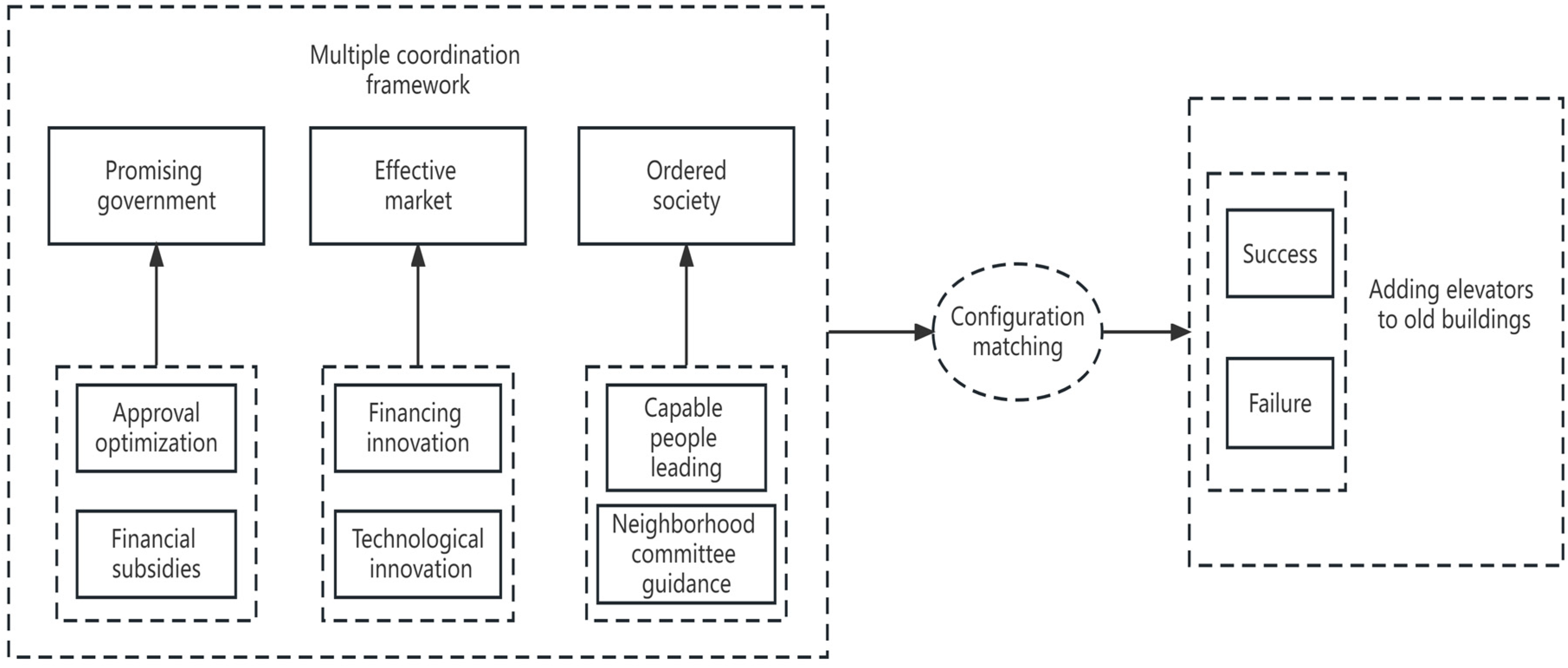
Table 1.
Variable setting and assignment.
| Variable category | Variable | Judgment explanation | Reference source | Weight | Assignment | |
|---|---|---|---|---|---|---|
| Outcome variable |
Result | Success | / | 51.5% | 1 | |
| Failure | 48.5% | 0 | ||||
| Conditional variable | Promising government | Approval optimization | Introduce relevant policies to assist in approval or optimize approval procedures | Wang [11] ; Guo [1] ; Ran [20] ; Xiahou [21] |
41.2% | 1 |
| Not optimized for approval | 58.8% | 0 | ||||
| Financial subsidies | With financial subsidies | Huang [8] ; Gao [10]; Chen [4] ; Wang [22] |
38.2% | 1 | ||
| No financial subsidies | 61.8% | 0 | ||||
| Effective market | Financing innovation | With financing innovation | Yang [7] ; Li [23] ; Shan [24] ; An [25] |
26.5% | 1 | |
| No financing innovation | 73.5% | 0 | ||||
| Technological innovation | With technological innovation | Song [26] ; Zhang [27] ; Zhang [28] ; Ru [29] |
48.5% | 1 | ||
| No technological innovation | 51.5% | 0 | ||||
| Ordered society | Capable people leading | With capable people leading | Yan [2] ; Li [30] ; Liu [31] ; Shi [13] |
86.8% | 1 | |
| No capable people leading | 13.2% | 0 | ||||
| Neighborhood committee guidance | With neighborhood committee guidance | Zhou [14] ; Tan [32] ; Song [33] ; Feng [34] |
79.4% | 1 | ||
| No neighborhood committee guidance |
20.6% | 0 | ||||
Table 2.
Variable setting and assignment.
| 条件变量 | Outcome variable | |||
|---|---|---|---|---|
| Success | Failure | |||
| Consistency | Coverage | Consistency | Coverage | |
| Approval optimization | 0.800000 | 1.000000 | 0.000000 | 0.000000 |
| ~Approval optimization | 0.200000 | 0.175000 | 1.000000 | 0.825000 |
| Financial subsidies | 0.457143 | 0.615385 | 0.303030 | 0.384615 |
| ~Financial subsidies | 0.542857 | 0.452381 | 0.696970 | 0.547619 |
| Financing innovation | 0.485714 | 0.944444 | 0.030303 | 0.055556 |
| ~Financing innovation | 0.514286 | 0.360000 | 0.969697 | 0.640000 |
| Technological innovation | 0.571429 | 0.606061 | 0.393939 | 0.393939 |
| ~Technological innovation | 0.428571 | 0.428571 | 0.606061 | 0.571429 |
| Capable people leading | 0.742857 | 0.440678 | 1.000000 | 0.559322 |
| ~Capable people leading | 0.257143 | 1.000000 | 0.000000 | 0.000000 |
| Neighborhood committee guidance | 0.885714 | 0.574074 | 0.696970 | 0.425926 |
| ~Neighborhood committee guidance | 0.114286 | 0.285714 | 0.303030 | 0.714286 |
Table 3.
Conditional combination configuration of success.
| Political and social dual-drive type | Market and social dual-drive type | Ternary co-drive type | ||||
|---|---|---|---|---|---|---|
| Conditional configuration | Path 1 | Path 2 | Path 3 | Path 4 | Path 5 | Path 6 |
| Approval optimization | ● | ● | ⨂ | ● | ● | |
| Financial subsidies | ⨂ | ● | ⨂ | |||
| Financing innovation | ● | ● | ⨂ | ● | ||
| Technological innovation | ● | ⨂ | ● | ⨂ | ||
| Capable people leading | ● | ● | ● | |||
| Neighborhood committee guidance | ● | ● | ● | ● | ||
| Consistency | 1 | 1 | 1 | 1 | 1 | 1 |
| Raw coverage | 0.429 | 0.543 | 0.143 | 0.143 | 0.314 | 0.057 |
| Unique coverage | 0.114 | 0.086 | 0.143 | 0.114 | 0.029 | 0.029 |
| Solution consistency | 1 | |||||
| Solution coverage | 1 | |||||
Note: According to Ragin and Fiss’ approach, use ● to indicate the existence of core conditions, ● to indicate the existence of edge conditions, ⨂ to indicate the absence of core conditions, ⨂ to indicate the absence of edge conditions, and blank to indicate that conditions can exist or be absent [35].
Table 4.
Conditional combination configuration of failure.
| Government and market double failure type |
Market failure type | |||
|---|---|---|---|---|
| Conditional configuration | Path 1 | Path 2 | Path 3 | Path 4 |
| Approval optimization | ⨂ | ⨂ | ⨂ | ⨂ |
| Financial subsidies | ● | ● | ||
| Financing innovation | ⨂ | ⨂ | ⨂ | |
| Technological innovation | ⨂ | ⨂ | ||
| Capable people leading | ● | ● | ● | ● |
| Neighborhood committee guidance | ● | ⨂ | ||
| Consistency | 1 | 1 | 1 | 1 |
| Raw coverage | 0.576 | 0.697 | 0.273 | 0.121 |
| Unique coverage | 0.152 | 0.273 | 0.030 | 0.030 |
| Solution consistency | 1 | |||
| Solution coverage | 1 | |||
Note: a. According to Ragin and Fiss’ approach, use ● to indicate the existence of core conditions, ● to indicate the existence of edge conditions, ⨂ to indicate the absence of core conditions, ⨂ to indicate the absence of edge conditions, and blank to indicate that conditions can exist or be absent [35]. b. In the “standard analysis” operation, because in path 4, “~approval optimization*~technological innovation*~neighborhood committee guidance” has a greater and more direct impact on failure than “financial subsidies*~technological innovation *~neighborhood committee guidance”, “~approval optimization*~technological innovation*~neighborhood committee guidance” is chosen as the quality implication.
Disclaimer/Publisher’s Note: The statements, opinions and data contained in all publications are solely those of the individual author(s) and contributor(s) and not of MDPI and/or the editor(s). MDPI and/or the editor(s) disclaim responsibility for any injury to people or property resulting from any ideas, methods, instructions or products referred to in the content. |
© 2023 by the authors. Licensee MDPI, Basel, Switzerland. This article is an open access article distributed under the terms and conditions of the Creative Commons Attribution (CC BY) license (http://creativecommons.org/licenses/by/4.0/).
Copyright: This open access article is published under a Creative Commons CC BY 4.0 license, which permit the free download, distribution, and reuse, provided that the author and preprint are cited in any reuse.


