

Submitted:
02 November 2023
Posted:
03 November 2023
You are already at the latest version
Abstract
Construction 4.0 is witnessing exponential growth in Digital Twin (DT) technology developments and applications, revolutionizing the adoption of Building Information Modelling (BIM) and other emerging technologies used throughout the lifecycle of the built environment. BIM provides technologies, procedures, and data schemas representing building components and systems. At the same time, DT enhances this with real-time data for cyber-physical integration, enabling live asset monitoring and better decision-making. Despite being in the early stages of development, DT applications have rapidly progressed in the AEC sector, resulting in a diverse literature landscape due to the various technologies and parameters involved in fully developing the DT technology. The intricate complexities inherent in digital twin advancements have confused professionals and researchers. This confusion arises from the nuanced distinctions between the two technologies, i.e., BIM and DT, causing a convergence that hinders realizing their potential. To address this confusion and lead to a swift development of DT technology, this study presents a holistic review of the existing research focusing on the critical components responsible for developing DT applications in the construction industry. The study identifies five crucial elements: technologies, maturity levels, data layers, enablers, and functionalities. Additionally, it identifies research gaps and proposes future avenues for streamlined DT developments and applications in the AEC sector. Future researchers and practitioners can target data integrity, integration and transmission, bi-directional interoperability, nontechnical factors, and data security to achieve mature digital twin applications for AEC practices. This study highlights the growing significance of DTs in construction and provides a foundation for further advancements in this field to harness its potential to transform built environment practices.
Keywords:
Bi-directional Interoperability
; Building Information Modelling (BIM)
; Construction 4.0
; Digital Transformation
; Digital Twin (DT)
; DT Advancements
; DT Technologies
; Holistic Review
1. Introduction
The Digital Twin (DT hereafter) technology, a game-changing technology in the Industry 4.0 era, is capturing the interest of both industry practitioners and academics from across industries. DT offers the ability to generate real-time virtual representations of physical objects through the integration of live data from sensor devices and operational systems, allowing for ongoing monitoring, analysis, and optimization processes throughout the entire lifecycle of the physical asset [1]. According to a Gartner survey conducted in 2019, 75% of Internet of Things (IoT) organizations will use or intend to utilize DT technology by 2020. More than 40% of large enterprises globally are expected to employ this technology in their projects to boost revenue by 2027 [2]. The market share of DT is increasingly overarching, as mentioned in several market reports; for instance, an increase of $24.8 billion from 2020 to 2025 at a compound annual growth rate of 39.5% [3], up to approximately $32 billion between 2021 and 2026 [4], and grow from $8 billion in 2022 at around 25% compound annual growth rate between 2023 and 2032 [1]. Collaboration between business and technology executives is vital for developing future-ready organizations, sustaining long-term and profitable client relationships, and achieving widespread adoption of technology across businesses, which requires optimizing physical operations, linking digital technologies with physical items, and merging hardware and software elements.
The term “Digital Twin” is relatively new in the construction industry and represents a cutting-edge technology that is rapidly revolutionizing the sector. It involves replicating various aspects of physical products, built assets, processes, or services in a digital space, providing engineers and practitioners with feedback from the virtual world. DT technology enhances processes and performance in built environment practices, enabling architecture, engineering, and construction (AEC) firms to quickly identify and address physical problems, design superior products, and realize value and advantages more efficiently than feasible [5]. In contrast, Building Information Modelling (BIM) technology has gained widespread adoption over the past few decades. It provides a mature 3D digital representation of assets, encompassing geometric and semantic information [6,7,8]. BIM allows collaboration between various project stakeholders in the AEC sector and extends its adoption throughout the building life cycle management, including the design phase [9], planning [10], construction [11], and facility operations and management phases [12,13]. Recent years have witnessed an increased adoption and advancements of digital technologies, such as Artificial Intelligence (AI) agents (such as data analytics, machine learning, deep learning, etc.), the Internet of Things (IoT), and extended reality (XR) technologies (such as Mixed Reality (MR), Augmented Reality (AR), and Virtual Reality (VR), and everything in between), in the AEC sector. These innovations have profoundly influenced the digital transformation of the construction industry. To effectively compete in this evolving landscape, the growth of BIM needs to be carefully structured to consider people, processes, and the development of these technologies in an increasingly interconnected world [14].
1.1. From BIM to Digital Twins in the Construction Industry
Construction 4.0 demands promises of enhanced efficiency, collaboration, and innovation, which could be relied on by the paradigm shifts of the construction industry’s transition from conventional BIM to rigorous DT. While BIM methodologies have laid the bases for digitizing construction processes, DTs offer a more comprehensive and dynamic approach that addresses the limitations of former technology and aligns with the demands of Construction 4.0 and Industry 4.0. Even though BIM and DT are essential components of this transition, this evolution is not without its complexities and challenges. BIM has become well-established in the construction industry, with numerous standards, application technologies, and flexible, extensively defined frameworks [15]. However, leveraging dynamic real-time data, big data, IoT, and AI poses significant challenges for BIM. These technologies have been seen as potential solutions to automate processes and incorporate broader environmental contexts in the construction industry [16]. On the other hand, the emerging concept of digital twins holds significant potential to extend beyond BIM and enable the digital transformation of the entire construction life cycle [17]. However, DT remains in its early stages of development [18]. While digitalization transforms AEC processes and improves efficiency through digital technologies, notable obstacles still exist. Thus, the strengths of BIM and DT, or harnessing BIM's fundamental capabilities to extend the capacities of DT beyond those of BIM, might be ways forward. For example, a study by [19] proposed a framework for adopting BIM to automate and minimize manufacturing processes, addressing flaws in the digital twin model called BIM Digital Object (BDO). Another study [20] mixed the terms by mentioning that digital twin (DT) and BIM are now employed in the construction sector as a digitization technique. Some researchers, such as [18], view DT as a crucial 3D representation of assets that facilitates better operation and maintenance tasks. They also predict that DT's data and information storage capabilities will require object-based graph networks maintained through cloud services. Other studies [21,22,23,24] attempt to combine both technologies and explore the potential of leveraging BIM to develop DT. However, DT technology encompasses multiple systems, IoT devices, and networks for data collection and analytics, introducing complexity that differentiates it from BIM and extends its capabilities.
1.2. Composition of Digital Twins
The development and evolution of the DT concept in the construction sector encompass a range of critical technologies, components, and core elements that collectively enable the creation and utilization of dynamic virtual replicas of physically built assets. Several crucial components, including BIM technology, contribute to the DT technology development, enabling its full potential to automate and optimize AEC operations. These components evolve alongside advancements in digital technology, data analytics, and connectivity, shaping how DTs are employed in construction practices. While the static nature of BIM models often leads to underutilization of data, ineffective decision-making, and inefficient practices, it serves as a starting point for the advancement of digital twins in the construction environment. DT technology continues to evolve in the construction sector, relying on various base components, such as technologies, maturity levels, data layers, and functionalities, depending on the specific application. In their work, Attaran, et al. [1,25], highlight four primary technologies—Internet of Things (IoT), Artificial Intelligence (AI), Cloud Computing, and Extended Reality (XR)—used for real-time data collection, information extraction, and the development of digital representations. Another study by Qi et al. [5] presents a 5-dimensional model for the cutting-edge technology of DT, emphasizing its complex systems and lengthy processes that have yet to realize their full potential. Song, et al. [22] recently decomposed the complexity and maturity of DT in terms of the information level derived from collected digital data. They provide a numerical characterization and representation of information maturity across five levels, including Digital Mirror, Digital Shadow, Digital Twin, and Cognitive and Autonomous DTs [26]. Hence, the development and evolution of DT technology in the AEC sector hinges on a multidisciplinary approach that comprises numerous parameters and components. It is essential to summarize these fragmented components clearly, reducing confusion and complexity and promoting a better understanding of DT elements among industry professionals and academia.
1.3. Widespread Adoption of Digital Twins in the Construction Industry
DT technology works as a digital representation that mimics real-world objects using causality, virtualized sensing, material qualities, and the laws of physics. This technology and its applications in the AEC sector have garnered significant attention from industry and academia, driven by rapid digital transformation across various industries. The AEC sector's fast-paced adoption of the digitalization [27], including DTs, is observing a phenomenal surpass from BIM to DTs because of their transformative potential and a paradigm shift toward data-driven decision-making. As such, the widespread expansion in DT applications in the construction industry is beyond BIM's capabilities, which provide real-time insights, continuous monitoring, and dynamic simulations throughout an asset's lifecycle. For instance, DTs can support iterative design and simulation through the project's lifecycle, unlike the BIM’s static representation of the built asset [28]. BIM can be linked with operations and maintenance information for real-time data-driven applications in the facilities management (FM) practices during a building’s life cycle, which is usually a costly and time-consuming approach for large-scale built assets [29].
On the other hand, DTs enable continuous monitoring of assets through numerous embedded sensors, allowing real-time data collection on various aspects of infrastructure facilities. This proactive approach of DTs to real-time monitoring and maintenance ensures timely interventions and minimizes downtime [30,31]. In the case of the operational optimization [32,33,34], DTs enable real-time optimization of operations by analyzing data streams from sensors and adjusting parameters in real-time, thus enhancing the performance of building units. During the current era of digital and green shifts in the built environment, resource consumption, and utilization are better monitored by DTs, allowing for data-driven optimization of energy, material usage, and water, which supports sustainability goals by identifying areas for improvement [20,35]. It could be argued that the widespread applications of DT technologies in the construction industry are beyond the static BIM representations by offering continuous monitoring, predictive capabilities, real-time optimizations, and a holistic understanding of assets throughout their lifecycles. Therefore, the expanding capabilities of DTs hold great potential for improving information management and decision-making in construction practices, leading to enhanced efficiency in construction and asset management operations.
1.4. Research Significance
The increasing complexity associated with DT necessitates a comprehensive understanding of its major components to enable practical contributions from researchers and practitioners toward its ongoing development. While a few studies have attempted to address this need by summarizing DT applications and components, they either focused on a single DT component or took a broad perspective encompassing multiple industries. For instance, Ozturk, G. B. [36] conducted a bibliometric analysis of digital twin research in the AECO-FM industry, providing a general overview of state-of-the-art DT applications. Liu, et al. [34] reviewed DT concepts, applications, and technologies, with a primary focus on summarizing DT applications across different industrial phases. Deng, et al. [37] presented a taxonomy of BIM to DT development levels within specific applications and domains, such as construction processes, building energy performance, and indoor environment monitoring, thereby limiting the scope of their critical review. In a recent study [38], a holistic review of DT technologies and their applications in the construction industry was conducted. The study also aimed to clarify the differences between BIM and DT and provided an extensive overview of emerging technologies used in DT development, albeit with a significant focus on digital data modeling and transmission domains. However, the previous review studies have yet to achieve a comprehensive view of the key components of DT technology and its applications in the construction industry, which is the primary objective of this paper. Furthermore, the current advancements in DT technology present significant technological challenges that warrant further emphasis from a research standpoint.
This study aims to comprehensively examine and summarize the current literature about the development and application of DT technology in the construction sector. The research focuses on five significant components: technologies, maturity levels, data layers, enablers, and functionalities. To ensure a thorough exploration of the existing literature, a step-by-step mixed method is employed, utilizing keyword-based searches in various databases. The retrieved research articles are then subjected to content analysis to refine their relevance to the study. Additionally, this paper aims to contribute to existing research by providing an in-depth perspective on DT applications and the constituent parts that comprise their capacity. This includes elucidating how modeling, simulation, monitoring, and visualization tools are integrated with DT to form its fundamental elements.
1.5. Research Questions and Objectives
This systematic literature review primarily focuses on exploring the answers to the following research questions (RQs):
- (RQ1) What are the key components and elements responsible for developing and evolving the digital twins’ concepts and applications in the construction industry?
- (RQ2) What are the existing research gaps and future avenues for research on digital twins in the construction sector?
To answer these research questions, the scope of this study was narrowed down to address the following research objectives (ROs).
- (RO1) To systematically analyze the status of research on digital twin developments.
- (RO2) To clarify the concepts and enhance understanding of key components and elements of digital twins in construction.
- (RO3) To structure the key constituents that help develop digital twins and their applications in the AEC sector.
- (RO4) To identify research gaps in the existing literature and recommend potential avenues for future research efforts.
2. Materials and Methods for Literature Review
This study employs the PRISMA (Preferred Reporting Items for Systematic Reviews and Meta-Analyses) approach to retrieve pertinent research records. Subsequently, it conducts a systematic literature review to analyze these records. The primary focus of these steps is to discern the key components that contribute to the evolution and advancement of digital twin technology and its applications in the construction sector. These steps are further complemented by the categorization of research records based on key components encompassing the development and application of DT technology in the construction sector. As such, the mixed methodology follows a step-by-step holistic approach [39], incorporating both quantitative and qualitative analyses of available research materials. This approach addresses previously unanswered review questions while resolving overlapping and complementing issues. The search process is limited to a specific period from 2010 to 2023, as there were minimal publications on digital twins in the AEC sector domain before 2010.
2.1. Classification and Scope Criteria
This study's primary literature classification criteria are based on pertinent digital twin research techniques, with the primary goal being to clarify the understanding of the DT concept and its applications in the AEC industry. The research method deconstructs, classifies, and summarizes the key components and elements that contribute to the evolution and development of Digital Twins. These "key components and elements" are essential constituents for DT development and form the significant contribution of this study. Technologies, maturity levels, data layers, enablers, and functionalities are identified as these key components and elements. While some other technologies and tools can enable DT development, such as hardware, devices, cameras, and robots, which aid in understanding the physical entity, they are beyond the scope of this study. DT use cases and applications extend to various industries, including manufacturing, automotive, utilities, agriculture, healthcare, and mining. However, this study focuses explicitly on DT applications in the AEC sector and how their development contributes to improving overall productivity through digital transformation.
2.2. Literature Retrieval and Review Process
The choice of literature search method, which enables an impartial and repeatable review, significantly influences the outcomes of systematic reviews [40]. This is particularly crucial for emerging topics like DT in the AEC sector, where digital transformation is accelerating. This study adopts a systematic review approach to provide a rigorous overview of the state-of-the-art research on critical elements and components of DT development and its applications in the AEC sector. Similar to previous studies [41,42,43], this study aims to explore and understand DT research via the PRISMA technique. Figure 1 represents a step-by-step process for literature retrieval from popular scientific research databases, including Web of Science (WoS), Scopus, Taylor and Francis, IEEE Xplore, Springer, and ASCE Library. The authors employed specific search strings on these databases to find relevant research on DTs, as Google Scholar is not suitable for systematic reviews [44].
Step 1) Literature Retrieval: The meticulous search queries used were as follows: (“digital twin” OR “digital twins” OR “virtual twin” OR “digital replica” OR “virtual counterpart” OR “cyber-physical system”) AND (“development” OR “evolution” OR “key technologies” OR “key components” OR “key elements” OR “applications”) AND (“construction engineering” OR “construction” OR “construction sector” OR “AEC industry” OR “construction industry” OR “construction engineering and management”). These queries aimed to retrieve articles published in the DT research field between 2010 and June 2023, covering a substantial number of articles in this research area. Initially, the Scopus database was targeted for the search, followed by other databases, leading to 885 research records. After employing a screening process for titles and abstracts, applying inclusion and exclusion criteria, and removing duplicate and extraneous documents, 110 documents were included in the systematic review.
Step 2) Literature Filtering: This step involves thoroughly reading each article, starting from the abstract and continuing through the introduction and conclusions. This process aimed to identify publications that define the three classes of digital twins: digital model, shadow, and twin. Statistical analyses of the current research state are presented through various graphs and tables.
Step 3) Literature Classification: The final step involves determining the five critical components of DT development and its applications in the AEC sector and classifying the research records accordingly. These categories encompass the technologies, maturity levels, data layers, enablers, and functionalities (further elaborated in the findings and discussions section). Table 1 briefly summarizes the steps involved in reviewing available research on DT developments and applications in the construction industry, including search strings, filtering, inclusion and exclusion, and categorization.
3. Data Extraction and Current State-of-the-art Analysis
This study adopts a mixed methods approach, combining quantitative and qualitative analyses to address the research objectives. After analyzing the content of research documents and eliminating irrelevant literature, 110 papers were included in the systematic review. The objective was to identify key components and elements contributing to the development and evolution of DT technology in the AEC domain. The study identifies the following five fundamental components and their sub-categories, representing the current state of DT technology advancements in the subject matter:
- I.
- Technologies are comprised of the Internet of Things (IoT), Artificial Intelligence (AI), Cloud Computing, and Extended Reality (XR).
- II.
- Maturity Levels are comprised of Pre-Digital Twin, Digital Twin, Adaptive-Digital Twin, and Intelligent-Digital Twin.
- III.
- Data Layers are comprised of the Data Acquisition Layer, Data Transmission Layer, Digital Modeling Layer, Data/model Integration and Fusion Layer, and Service Decision-Making Layer.
- IV.
- Enablers are comprised of the Physical Entity, Virtual Model, Data, Smart Service, and Connection.
- V.
- Functionalities are comprised of Simulation, Visualization, Prediction, Optimization, and Monitoring.
These key components are classified based on their significant contribution to the rapid advancement of DT capabilities and their potential to revolutionize the construction industry, addressing critical challenges. Table 2 further provides a summary of some of the eligible articles corresponding to each identified component and its sub-category.
The widespread adoption and integration of digital technologies, such as AI, IoT, big data analytics, machine learning, additive manufacturing, robots, and digital twins, have given rise to the current era of Industry 4.0 [80]. During its evolution, DT technology has played a crucial role in shaping the future of autonomous construction operations, fostering efficiency, flexibility, and sustainability [81]. Notably, NASA's adoption of DT-based solutions for the development of complex vehicles and aircraft has led to various definitions of the technology applied across industries. Tao, et al. [82] has reasonably explained the evolution of DT technology over the past few years, starting from the early concept of Grieves up to the 5-D DT model, as shown in Figure 2.
In the context of the AEC sector, understanding the classification of DT into different classes based on integration and connectivity levels between physical and digital representations is essential. Kritzinger, et al. [58] proposed three sub-classes for DT, providing a clearer understanding: the Digital Model (DM), similar to BIM competencies in the construction industry; the Digital Shadow (DS), where real-time data is automatically transmitted from the physical asset to its digital representation; and the Digital Twin (DT) as a DM with bidirectional automatic data exchange between the physical asset and its digital counterpart. While the original three-dimensional digital twin model defined by Grieves [83] remains prevalent, expanding application requirements have given rise to new trends and demands. DT has extended its reach beyond military and aerospace domains into civilian sectors [85], leading to diverse service demands from various fields and businesses with different objectives. DT has been characterized in multiple ways, such as a “digital representation” [86], “realistic model” [87], “virtual prototype” [59], “structure of inter-connected digital replicas” [4], and “dynamic virtual model” [88] that captures the characteristics and behavior patterns of a system in the physical world. DT technology, coupled with other emerging technologies like Sensors, IoT, AI, ML, and XR, can sense real-life experiences in the physical world. Several studies have summarized DT definitions in various industries, including AEC practices, to clarify further and highlight the concept as presented in Table 3.
Unlike other industries, the AEC sector has experienced a reported 1% annual growth rate over the past two decades, with digitization and innovation being key drivers to enhance productivity [102]. Yet, the adoption of digital twins in research academia was initially slow until the middle of the 2020s, based on the yearly trend of retrieved publication records. However, since 2017, there has been a significant surge in academic articles on the topic of DT, indicating a rapid embrace of the concept by academics and practitioners across industries. Figure 3 illustrates the total number of articles returned using the search string explained in Step 1 of the literature retrieval process, compiled from various databases. Moreover, after applying inclusion and exclusion criteria, Figure 3 compares the final documents using the (TITLE+ABSTRACT+KEYWORDS) strategy to refine the search results further, focusing on relevant articles. Notably, DT applications in the AEC sector are still in their early stages. They have yet to mature throughout the entire lifecycle of built assets, including the design, construction, operations, and maintenance phases. Until 2019, literature on DT concepts and paradigm shifts in the AEC sector remained scarce. However, the unexpected surge in DT adoption within the AEC industry by research and practice reflects the technology's transition from infancy to rapid development. The AEC sector increasingly embraces digital transformation to enhance productivity and remain competitive among other innovative industries.
Figure 4 provides a status analysis of publication records, highlighting the top journals that published the most digital twin research among articles initially obtained using the search string. Approximately 16% of the initially retrieved publications were published in the Automation in Construction journal, known for its leadership in publishing articles focused on employing digital technologies in the AEC sector. This journal also contributed the most significant percentage of finalized articles, accounting for nearly 25% of all publications. Other top journals with a relatively higher number of relevant publications include the Journal of Cleaner Production, Journal of Building Engineering, Advanced Engineering Informatics, IFAC-PapersOnLine, Energy and Buildings, International Journal of Construction Management, and Construction Management and Economics.
Figure 5 presents an analysis of the distribution of retrieved research records among different disciplines and research domains within the subject matter. Most publications, approximately 34% of the retrieved results, are found in Engineering, followed by Decision Sciences at 19%, Computer Science at 11%, Energy at 9%, and Business Management and Accounting at 7%. Due to its ability to integrate with the systems throughout the asset's life cycle, DT technology plays a crucial role in decision-making for various aspects of built assets, such as planning, scheduling, energy, sustainability, and cost management. Additionally, DT research has primarily focused on the engineering and computer-centric domains compared to the social sciences and general management domains. This trend can be attributed to the resources and techniques established in these disciplines, which are well-suited for digitalization and automation.
4. Findings and Discussions
This study identifies five key elements and components from the literature that contribute to the development and evolution of DT technology and its applications in the construction sector. The explicit representation of these key elements and components can be seen in Figure 6, demonstrating their significance in facilitating the advancement of DT and its increasing use in the AEC sector.
4.1. Technologies
According to research by Attaran et al. [1], DT combines four fundamental technologies (Figure 7) to collect and store real-time data, gather critical information to provide insightful data, and produce virtual representations of physical objects.
4.1.1. Internet of Things (IoT)
This study highlights the Internet of Things (IoT) as a crucial component at the core of every DT application across various industries, serving diverse use cases. IoT facilitates the connection of a vast network of objects, people, and their interactions. By 2027, more than 90% of IoT platforms are projected to possess Digital Twinning capabilities, collecting data from real-world objects to create digital replicas for analysis, manipulation, and optimization [1,25]. The real-time virtual representations are continuously updated with data. Integrating IoT and DT in Construction 4.0 applications revolutionizes various data exchange processes in the AEC sector. IoT contributes to expanding data volume, while DT utilizes this data to create digital representations, enabling analysis, manipulation, and optimization. This integration leads to advancements in predictive maintenance, fault detection, and other aspects during the facility management phase of built assets, offering better visibility, predictive maintenance, and machine behavior analysis.
The profound integration of big data and IoT with DTs has established an efficient network for two-way data transmission between physical and digital objects, enhancing automation flexibility, manufacturing efficiency, and productivity throughout the building's lifecycle. Regarding smart building applications in the AEC sector, IoT plays a fundamental role in unlocking the potential of smart buildings by connecting sensing and actuating devices, enabling information sharing and innovative applications. It leverages standard protocols and the convergence of devices, sensors, and actuators, which contributes to creating DTs for intelligent building analytics and decision-making. Furthermore, integrating BIM-based DT capabilities with IoT data sources provides a comprehensive view of assessing the performance of building units [70]. DT high-dimensional models offer high-fidelity representations, while IoT data provides real-time updates from construction processes and operations, including sensor data such as positioning and physical measurements [103]. Accessing both data sources is possible through interfaces, APIs, customized plugins, and open standards. This integration empowers stakeholders to make informed decisions and enhances project efficiency and performance. Thus, integrating IoTs with DTs holds promising revolutions in the construction sector in which the former provides real-time data that enriches the accuracy and functionality of the latter. However, varying data formats and protocols on a daily basis in the digital world could cause challenges in this integration, and seamless scalability and efficient data management become vital concerns.
4.1.2. Artificial Intelligence (AI)
The rise of DTs aligns with the growing trend of digitization and data-driven decision-making in the construction industry. This study explores the industry's increasing focus on data-centric approaches facilitated by technologies like AI and ML, resulting in the development of smart buildings and cities that optimize performance, sustainability, and user experience. The fusion of AI with DT applications amplifies the potential of both technologies in the construction sector. AI and DT technologies have become crucial elements in the ongoing digital transformation of the construction sector [22]. AI, which simulates human intelligence, constitutes a core component of DTs, providing advanced analytical tools to analyze data and offer valuable insights [50]. AI-driven DTs can decode complex AEC processes and systems, facilitating decision-making and monitoring. They can make predictions and provide suggestions to mitigate potential problems. AI encompasses various disciplines, including robotics, image recognition, and language recognition, and leverages techniques such as neural networks, machine learning, deep learning, and expert systems to assist DTs in automatically analyzing data, predicting outcomes, and offering suggestions [49].
In the context of the AEC sector, AI implementation is still in its early stages but holds great potential to revolutionize building construction and maintenance. Its application focuses on creating intelligent buildings that respond to human and organizational needs, while machine learning algorithms can analyze sensor data from a building's components, enabling quick problem diagnosis. Digital twins, with the aid of AI, will continue to evolve, efficiently processing vast amounts of data. AI's capabilities enable accurate predictions and proactive responses to unexpected circumstances during development or after project completion, enhancing reliability, performance, and cost control throughout the lifecycle of structures and systems. Additionally, autonomous robots can perform repetitive tasks accurately, reducing labor costs [104]. These technologies present opportunities to improve project planning and execution, minimize operational risks, and provide predictive insights for construction activities. In the context of the fourth industrial revolution, particularly in the construction industry, AI connects the physical and virtual worlds, contributing to developing the DT maturity [80]. Sophisticated AI/ML algorithms effectively learn from big data, enhancing productivity through quick and accurate data analysis. As a result, AI has garnered significant attention across industries, including AEC. It is a fact that Construction 4.0 practices rely primarily on the availability and quality of the data; thus, the accuracy and efficacy of AI-driven DTs depend heavily on the data integrity that is being ingested. Therefore, the successful integration of both technologies hinges upon a rigorous understanding of both creating and utilizing high-quality data to revolutionize construction industry practices.
4.1.3. Cloud Computing (CC)
This research underscores the significant role of Cloud Computing (CC) technology in the development and evolution of DT technology, especially within the construction sector's Construction 4.0 revolution. CC enables efficient storage and access to real-time data collected through IoT sensors deployed on built assets. The continuous data collection and storage over the internet are key advantages of CC, which have resulted in significant cost reductions in design, emulation, scheduling, analytics, and simulation services within the built environment [100]. The combination of CC and IoT has facilitated remote monitoring and training of specific construction and maintenance processes, with high-fidelity virtual representations adapting to real-time changes in the physical environment. Edge computing can be employed for data preprocessing before transmission to the cloud server to handle the massive volumes of data generated by DT-based devices in smart buildings [70]. This preprocessing step helps manage the data efficiently and ensures a seamless flow between physical devices and cloud servers.
As a core component of the DT, CC goes beyond the information flows defined by BIM standards, as it incorporates object-based graph networks stored using cloud services for data and information storage [105]. This integration enables AEC stakeholders to capture and analyze real-time information from various sources, including sensors, IoT devices, and other data sources. The cloud's storage and processing capabilities are critical in creating accurate digital replicas of physical assets, forming the foundation of digital twins. Moreover, the computational resources provided by cloud-based digital twins enable complex simulations, data analytics, and artificial intelligence algorithms for predictive and prescriptive analysis [65]. Beyond efficient processing, cloud-based digital twins also support collaboration and information sharing across distributed teams. AEC professionals can access and update digital twin models from anywhere, facilitating seamless collaboration and decision-making. The construction stakeholders usually leverage cloud infrastructures to securely store and access vast amounts of real-time data from IoT sensors and various sources and analyze and update digital twins remotely, fostering collaboration and enabling real-time decision-making. Several examples of cloud databases used in AEC applications include Internet my openHAB cloud, Google Cloud Platform, web database, BIM cloud database, Azure Microsoft, Alibaba cloud server, and Amazon Web Services (AWS) DynamoDB, among others [106]. However, data privacy and security and the continuous reliability of cloud infrastructures are crucial for maximizing real-time analytics through cloud-enabled DTs.
4.1.4. Extended Reality (XR)
Extended Reality (XR), encompassing Virtual Reality (VR), Augmented Reality (AR), and Mixed Reality (MR), merges the physical and virtual worlds to enhance our perception of reality. This study identifies XR as an enabling technology for creating DTs, representing physical objects, and providing valuable insights. For instance, in conjunction with DT, VR allows industry practitioners to immerse themselves in data and find feasible solutions. Similarly, AR empowers connected workers in Construction 4.0 by providing visualizations, reducing errors, and saving time [32]. These immersive technologies complement DT by rendering digital data with a sense of reality.
In the construction industry, which has been traditionally limited in digitalization, the development of XR brings about the need for new methodologies and technologies to empower users with intuitive interfaces for accessing and displaying DT data. During design and construction operations, operators can overlay 3D and BIM models onto physical objects using AR or MR devices, accessing real-time data feeds and historical maintenance information in context. As XR technologies continue to advance, they are crucial in calibrating building energy efficiencies, performing pose estimation during the construction stage to enhance safety measures, employing object recognition using XR camera devices, and identifying user locations [21]. These applications of XR contribute to the evolution and effectiveness of DT technology within the construction sector. Trained and skillful labor is a crucial problem in the construction industry [12,30], which can be solved by leveraging interactive training scenarios within XR-enabled DTs before the execution of any stage of the AEC project. This can help equip construction workers and design teams with realistic experiences to familiarize themselves with project environments and procedures to enhance overall productivity. As mentioned earlier, the accuracy of the data sources from sensor devices and BIM/DT models remains a concern. Limitations in the hardware capabilities also hinder the successful integration of XR devices with DTs, which demand seamless mutual alignments.
4.2. Maturity Levels
4.2.1. Pre-Digital Twin
In the construction industry context, the Pre-Digital Twin represents the initial stage of virtual prototyping used in upfront engineering. It is a virtual model of the envisioned system, created before the physical prototype is developed. The primary objective of the Pre-Digital Twin is to identify and address technical risks during the concept design and preliminary design phases, acting as a valuable tool for decision-making and risk mitigation [59]. It is worth noting that, like other model-driven approaches, virtual prototyping at this level involves creating a system model early in the design process. However, unlike the final DT system, a virtual prototype is often not utilized to derive the solution to the given problem [25]. Instead, it can be considered an extendable prototype, with the latter potentially contributing to the final system. By establishing the Pre-Digital Twin level, construction projects aim to minimize or mitigate specific technical risks and identify potential issues in the early design stages before the physical prototype is even developed. However, at this stage, the utilization of digital twins is limited, and their capabilities are not fully harnessed. Challenges may arise related to data integration, interoperability, or the lack of comprehensive digital twin platforms. The focus is primarily on understanding the concept, testing feasibility, and exploring possibilities for future adoption.
4.2.2. Digital Twin (DT)
In the construction industry context, the second level of DT maturity, the Digital Twin, plays a crucial role in monitoring and managing physical assets. This level involves gathering performance, status/condition, and maintenance data from the physical twins of the built asset and updating the corresponding digital models. As a result, it enables informed decision-making throughout the entire lifecycle of the built asset or project [1]. It is important to note that at this level, it becomes possible to analyze the behaviors of physical twins in various situations by acquiring condition and maintenance data directly from the physical assets. The digital twin at this level incorporates the collected data into its virtual system model, faithfully representing the real-world asset [34]. These updates from the physical system support decision-making processes related to conceptual design, technology specification, preliminary design, and development. The data collected from sensors installed in the physical world during construction operations or in the case of smart buildings, along with computational elements in the physical twin, encompasses crucial information such as status/condition and targeted performance. This data is then transmitted back to the digital twin, enabling it to update its model and maintenance schedule for the physical system. This bi-directional interaction between the digital and physical twins presents ample opportunities for the physical asset to benefit from the knowledge acquired from one or more digital twins, ultimately resulting in improved real-time performance of the digital models.
4.2.3. Adaptive-Digital Twin
The third level of DT maturity, the Adaptive-Digital Twin, within the construction industry context, utilizes machine learning to provide real-time planning and maintenance support, as evident from the literature analyses. It incorporates a virtual system model of its physical counterpart and employs an adaptive user interface (UI) to synchronize real-time data from the physical entity with the virtual model. This level of DT builds upon the previous-level Digital Twin and utilizes machine learning algorithms based on neural networks to create an adaptive user interface that caters to user preferences under various conditions [1]. Through neural network-based supervised machine learning algorithms, this level captures the preferences and priorities of users or practitioners in different contexts, which are continually updated through real-time data extracted from the physical twin, enabling the twin to adapt to changing conditions. For instance, the adaptive digital twin can continuously monitor and analyze real-time data from sensors embedded within a building's infrastructure during construction [52]. This data is then utilized to dynamically adjust construction processes, optimize resource allocation, and identify potential issues in real-time. The adaptive digital twin facilitates proactive decision-making, enhances productivity, and improves construction project outcomes by integrating data from various sources, such as environmental conditions, worker safety metrics, and equipment performance.
4.2.4. Intelligent-Digital Twin
The fourth maturity level of digital twins in the construction industry is known as the intelligent digital twin. This advanced level incorporates all the features of the previous three types of digital twins while providing a more sophisticated analysis of the corresponding real-world object, as evident from the literature analyses. The intelligent digital twin builds upon the capabilities of the adaptive digital twin by integrating reinforcement learning through machine learning techniques and supervised machine learning methodologies, enabling real-time updates of physical and digital elements [59]. Moreover, it possesses the capability of unsupervised machine learning to identify objects and patterns within the operational environment. It also incorporates reinforcement learning to adapt to uncertain and partially observable surroundings by learning from system and environment states. This high level of autonomy allows the digital twin to conduct an in-depth analysis of performance, maintenance, and monitoring data from the real-world counterpart at a more detailed level. During this level, a vast amount of data is collected from sensors, construction equipment, and worker activities [30]. Advanced AI technologies are utilized to process this data and autonomously optimize construction processes, predict maintenance needs, and proactively identify potential risks or bottlenecks. By combining real-time data with predictive analytics, the intelligent digital twin enables adaptive decision-making, enhances efficiency, and maximizes construction project performance. However, the dynamic nature of the heterogeneity and complexity of construction environments demands the development of agile and resilient algorithms capable of real-time adaptation in creating unified and adaptable digital twins.
4.3. Data Layers
The development and evolution of DTs in the construction sector applications involve several interconnected data layers, which are comprehensively studied by Tuhaise et al., [38]. Table 4 summarizes the data layers collected from the literature.
4.3.1. Data Acquisition Layer
The data acquisition layer is the foundation for achieving a comprehensive perception of maintenance decision-making environments. In the physical space, the collection and interaction of raw data occur. By leveraging embedded network devices and interconnected communication technologies, the data acquisition layer establishes a network that enables the full-factor perception of the maintenance decision environment. This network facilitates the perception and collection of operational status parameters and operational environment information from the target equipment, enabling the formation of a virtual mapping between physical devices and their corresponding digital twins [38]. To collect dynamic data from the physical environment, the data acquisition process depends on the intended functionality of the digital twin.
In the context of the AEC sector, IoT sensors and technologies play a crucial role in data acquisition from the physical environment. Therefore, sensor data can be obtained from existing building monitoring systems forming the data acquisition layer. For example, in a study by [109], a Restful API was employed to collect data from the hard-wired sensors of a Building Management System (BMS). This data included temperature readings, outdoor temperature measurements, temperature-sensitive airflow transmitters, and pressure values. Another study by Cheng J.C.P. et al. [107] obtained sensor data from a direct digital control (DDC) system within an IoT sensor network consisting of temperature, humidity, flow rate, and pressure sensors. Besides, mechanical data can also be collected using IoT sensor technologies in various applications. For example, in the case of a suspension bridge, temperature sensors were employed to measure the temperature of the chain links, while displacement transducers were used to monitor the displacement of the saddles [108]. Nevertheless, interoperability issues among diverse sensor systems, the sheer volume of data generated from multiple sources, and varying data formats lead to difficulties in aggregating and integrating data into a cohesive structure for analysis and decision-making.
4.3.2. Data Transmission Layer
Data transmission in DT applications involves processing and transporting raw data from the data acquisition layer. The collected data is typically transmitted through various wired and wireless technologies. In recent emerging advancements in the AEC sector, Wi-Fi, a widely utilized short-range wireless technology, has been applied to numerous applications. These include managing automated heating for smart homes, real-time synchronization for planning, scheduling, and execution in on-site construction, smart modular integrated construction systems, IoT-based smart maintenance of building facilities, and safety risk analysis during the prefabrication of building units.
The transmission of sensor data from BMS or other data processing systems adopted in the built environment often relies on internet-based communication and protocols such as BACnet (Building Automation and Control Networks) [109]. These protocols facilitate data exchange among various equipment, devices, and sensors. Specific communication layer protocols defined by organizations like IEEE (Institute of Electrical and Electronics Engineers) and IETF (Internet Engineering Task Force) are employed as industry standards to ensure effective data transmission. These protocols can be categorized into file transfer and messaging protocols, which are well-suited for web applications and IoT frameworks. Another widely utilized transmission protocol is HTTP (Hypertext Transfer Protocol). This web messaging protocol supports request/response RESTful web architecture and employs the Universal Resource Identifier (URI) to transmit data from servers to clients, who receive it via specific URIs. In the study by Hosamo et al. [109], a specific URL from the sensor data API was employed for data transfer to the BIM model. Jiang et al. [116] utilized HTTP and socket protocols in their research, with the socket protocol being a standard method for data transfer between machines. Furthermore, Lee et al. [110] employed an Azure blockchain platform as an IoT hub to receive GPS data from IoT sensors, which was subsequently transmitted to the as-built BIM model.
4.3.3. Digital Modeling Layer
This layer involves creating a virtual representation of physical entities through digital modeling, which converts physical entities into digital forms efficiently processed, analyzed, and managed by computers. Various measurement techniques, such as laser scanning, laser tape measurement, MR, and photogrammetry, collect relevant information about the physical environment, including geometric structure, functionality, state, time, location, process, and performance. These measurements generate a virtual replica that accurately reflects the physical entity.
In the AEC sector, Autodesk Revit has commonly employed software for the 3D modeling of buildings, as highlighted in multiple studies [31,70,107,109]. Other software tools, such as Autodesk Navisworks, Solidworks, 3D Max, Sketchup 3D, and Rhinoceros6, are also utilized for creating 3D geometric models [66]. Autodesk Civil 3D and Autodesk Revit are employed for road infrastructure, with the former used for generating road models and the latter for sensor modeling within the BIM framework. Geometry models at the system, building, and city levels are developed using Autodesk Revit and AECOsim building designer [106]. Sometimes, game development software creates virtual entities for digital twin applications. For example, human avatars were modeled using the Unity game engine and Autodesk 3D Max. Geometric data was imported into Unity 3D to develop 3D models, and a VR environment was constructed using the Unity 3D platform, Oculus Rift S VR headset, and Oculus Touch Controllers [65]. Furthermore, BIM components specific to the construction site can also be incorporated into the VR environment to model virtual assets for creating DTs for particular purposes. Nonetheless, the development of advanced software tools that enable the creation of detailed and dynamic virtual representations of construction projects and integrating sensor data into these models through real-time monitoring is crucial for the AEC sector to embrace the full potential of DTs.
4.3.4. Data/Model Integration and Fusion Layer
This layer in DT applications involves a series of stages to transform digital twin data into valuable information. These stages encompass data storage, data/model integration and fusion, data processing and analysis, and data visualization. Big data storage technologies are utilized for digital twin data's high volume and multi-source nature. Cloud-based computing platforms are commonly employed for their accessibility, scalability, high performance, and management capabilities. Data fusion techniques achieve the integration of various digital twin data from physical and virtual spaces [5]. This includes integrating sensor data, such as environmental, mechanical, image, and video, into BIM models to represent real-time status. Customized APIs are developed to facilitate data integration in 3D modeling software platforms.
Advanced technologies are employed to process and analyze digital twin data. Simple data analysis techniques involve comparing measured values against target values/thresholds, visibility analysis, numerical models, and rule-based reasoning. Additionally, AI techniques, including machine learning and deep learning algorithms, are extensively applied for data analysis [38]. Machine learning emerges as the most frequently utilized technique in most previous studies. Data visualization plays a crucial role in digital twin applications. Therefore, 3D modeling software platforms are used for visualizing temporal sensor data. Autodesk Forge and some gaming environment platforms are extensively employed in some studies to visualize sensor data within BIM models because of their powerful visualization capabilities. Following the steps in this layer, the processed digital twin data is then made available to end users through various visualization forms. Common visualization methods include trend graphs, pie charts, line graphs, real-time status Kanban, thermal comfort charts, S curves, and cumulative sum control charts [65]. Monitored parameters such as pedestrian count and sensor readings for ambient temperature and humidity are frequently displayed on visualization platforms.
4.3.5. Service Decision-Making Layer
The Service Decision-making Layer in DT applications facilitates dynamic and intelligent predictive maintenance decisions driven by data. It encompasses optimization objective selection, mathematical problem modeling, and intelligent optimal decision-making calculations [31]. Choosing optimization objectives refers to selecting digital device components (such as sensors, robotics, or IoT devices) that require predictive maintenance decisions based on real-time data gathered about their condition. The main elements are typically chosen to represent the current condition of the equipment installed during the construction phase or in the assets of intelligent buildings.
For instance, in the case of industrial IoT sensors, the core sensor node's primary function is to sense temperature data, and its sensing module may be selected for routine predictive maintenance. This layer provides a wide range of services tailored to specific contexts in construction sector applications, with real-time monitoring of assets and activities being a prevalent service offered. DTs have been utilized in various construction sector operations, including monitoring suspension bridges, building façades, façade brightness, pedestrian trends and time, construction site activities, compaction progress and quality, intelligent objects, machine and worker operations, construction progress, and room occupancy [1]. The intelligent optimal decision-making calculation in this layer relies on selecting the corresponding AI algorithm to train the processed data from the previous layers, obtain prediction results, and make maintenance decisions. As this layer holds the core data management objectives for DT employment, some challenges revolve around transforming collected data and model insights into actionable decisions, enhancing project efficiency and resource allocation in the construction businesses. Deploying advanced analytics and more robust yet aligned AI algorithms could help better interpret and analyze the integrated data in DTs, generating valuable insights for project managers and stakeholders. Additionally, establishing holistic strategies for integrating real-time data simultaneously from multiple layers can lead to informed decisions on various aspects of the construction processes.
4.4. Enablers
A five-dimensional digital twin model of the enabling technologies and entities is rigorously prepared by Qinglin et al. [5]. The model presents (Figure 8) the clarities and understanding of all the different parts of the objects or complex systems of the DTs and enables the DT technology's functionalities for various construction sector applications.
4.4.1. Physical Entity
In the context of the DT concept, a physical entity refers to a real-world object or system existing in the built environment, such as a building, infrastructure, equipment, or tangible component. The representation of these physical entities in a digital format forms the foundation for DT, enabling the simulation of their behaviors. Functionally and structurally, the physical world can be categorized into three levels: unit, system, and system of the system (SoS) levels [117].
The digital twin, comprising the virtual representation of a physical entity, provides valuable insights, analysis, and predictions about its performance and behavior. For instance, BIM is a digital representation of a building or infrastructure project in the construction sector and a precursor to a digital twin [37]. BIM models encompass architectural elements, structural components, and mechanical and electrical systems. BIM forms the basis for creating a digital twin during the construction and operational phases. Additionally, bridges or high-rise buildings can be equipped with sensors to monitor their structural health [22,23]. The data collected from these sensors is fed into the digital twin, enabling real-time monitoring and analysis of the structure's integrity. This aids in anomaly detection, predicting maintenance needs, and enhancing overall safety and reliability. However, developing and enhancing DT involves an extensive process due to the physical world's intricate attributes and explicit and implicit connections. Virtual models representing physical entities may require gradual improvement to accurately correspond to their real-world counterparts [77]. This necessitates a comprehensive understanding and perception of the physical world. Additionally, digitizing physical entities reveals implicit associations that contribute to the evolution and control of the physical world [58]. Therefore, achieving an accurate representation of physical entities through high-fidelity models is crucial, requiring critical attention to precise measurements of parameters and technologies at micro/nano-level precisions to synchronize virtual models with real-world entities.
4.4.2. Virtual Model
The integration of virtual entities and the digital world plays a vital role in the development and applications of DTs in the built environment. In the DT concept, a virtual entity or virtual model refers to the digital representation of the physical entity or environment. It is a computer-generated model that simulates the characteristics, behavior, and interactions of the physical entity or environment in a virtual space. The virtual entity/world is a critical component of digital twins in the built environment, especially within the construction sector, as it provides a platform for simulating and visualizing the behavior and performance of the physical entity.
Virtual models within DTs aim to accurately replicate physical entities, encompassing their geometries, properties, behaviors, and rules [77]. Geometric models describe the physical entity's shape, size, tolerance, and structural relations in three dimensions [5]. Physics models simulate physical phenomena such as deformation, delamination, fracture, and corrosion based on properties like speed, wear, and force [47]. Behavior models capture the entity's behaviors, state transitions, performance degradation, coordination, and responses to external changes [1]. Rule models endow DTs with logical abilities, including reasoning, judgment, evaluation, and autonomous decision-making, by employing rules extracted from historical data or provided by domain experts [34]. Virtual models play a crucial role in construction projects' design and prototyping stages. Practitioners can create and manipulate digital representations of buildings, infrastructure, or components to explore different design alternatives, test structural integrity, assess aesthetic aspects, and evaluate performance attributes. This allows for iterative design improvements and reduces costly errors during the construction phase. Nowadays, by integrating virtual representations of various physical entities, clashes or conflicts between different systems can be detected and resolved virtually. This helps identify and rectify design inconsistencies or clashes before actual construction begins, leading to cost and time savings.
4.4.3. Data
In the DT concept, data is crucial in comprising digital twins in the built environment, particularly in the construction sector. Data refers to the information collected, generated, and processed from various sources related to the physical entity and its environment, including sensor data, operational data, maintenance records, performance metrics, and other relevant data points. The data entity forms the foundation for analysis, prediction, and decision-making in digital twins, encompassing multi-temporal scale, multi-dimensional, multi-source, and heterogeneous data [65].
Physical entities contribute static attribute and dynamic condition data, while virtual models generate simulation-based data. Data collection in DT applications within the AEC sector involves various sources, such as hardware, software, and networks [85]. Hardware-based data acquisition employs identification technologies like barcodes, QR codes, RFID, cameras, sensors, and IoT technologies for real-time perception of static attributes and dynamic status data. Software-based data collection leverages software APIs and open database interfaces, while network data is obtained through web crawlers, search engines, and public APIs. For example, sensors embedded in buildings, infrastructure, or construction equipment can collect data on energy consumption patterns, enabling energy efficiency analysis and identifying potential optimizations [71]. Moreover, by integrating data from various sources, such as sensors, maintenance records, and operational data, the digital twin can analyze data to identify performance deviations, potential issues, and optimization opportunities [6,7,32]. Data management, including collection, transmission, storage, and fusion, plays a significant role in digital twin technology, as it is the fundamental component and requires a single source of truth and high data quality.
4.4.4. Smart Service
The smart service is a crucial component of DT technology and plays a significant role in digital twins across industries, specifically in the construction sector. It refers to integrating advanced technologies, such as AI, machine learning, data analytics, and automation, to provide intelligent functionalities and capabilities within the digital twin. These smart services enhance the value and effectiveness of digital twins in various applications, aligning with the Everything-as-a-Service (XaaS) paradigm [5]. Third-party services like data services, knowledge services, and algorithms services are necessary to develop a functioning DT.
The integration of multiple disciplines within the DT services enables advanced monitoring, simulation, diagnosis, and prognosis. Monitoring relies on computer graphics, image processing, 3-D rendering, graphics engines, and virtual reality synchronization [32]. Simulation encompasses various domains such as structural mechanics (e.g., fluid dynamics, solid mechanics, thermodynamics, and kinematics), electronic circuits, control systems, processes, and virtual test simulations [81,92,118]. Data analysis forms the basis for diagnosis and prognosis, involving statistical theory, machine learning, neural networks, fuzzy theory, and fault trees [75,85,99]. For instance, an intelligent service in the digital twin can simulate different construction scenarios and optimize task sequencing to minimize project duration and costs [119]. Smart services enable real-time monitoring and control of the physical entity within the digital twin by integrating sensors, data analytics, and automation. This allows the digital twin to continuously monitor and manage the physical entity's performance, energy consumption, and operational conditions.
4.4.5. Connection
Connections are critical enablers that play a vital role in digital twins, effectively integrating digital representations with their real-world counterparts in the built environment. These connections facilitate advanced simulations, operations, and analyses. Information and data exchange among all previous DT enablers, i.e., physical entities, virtual models, services, and data, are enabled by these connections. A recent study [5] has identified six key connections in a DT: the connection between physical entities and virtual models, the connection between physical entities and data, the connection between physical entities and services, the connection between virtual models and data, the connection between virtual models and services, and the connection between services and data. These connections foster collaboration among the different components of the DT, helping to develop the DT concept.
For instance, connections between temperature sensors, HVAC systems, and energy management platforms can be established in developing a DT for smart building analytics. By synchronizing collected data, a comprehensive view of the physical entity can be provided, optimizing energy consumption in the building [71]. During the construction, connections between sensors embedded in construction equipment or materials can be established, providing continuous data feeds to the digital twin for analysis and decision-making. Moreover, integrating different systems within the digital twin ecosystem, including BMS, BAS, and SHM, is vital for helping O&M operators prepare strategies for optimized maintenance of building facilities [113]. Thus, an interconnected view of the physical and digital entities, established through connections between various components and systems, enables stakeholders to make informed decisions and enhance performance in the built environment.
4.5. Functionalities
4.5.1. Simulation
The simulation function of DT applications in the AEC sector has revolutionized built environment practices during the current digital transformation era. It allows for virtual representation and analysis of physical assets, enabling stakeholders to evaluate and optimize various aspects of the built environment before construction begins. While high-fidelity simulations have proven successful in smaller-scale mass manufacturing industries [17,48,58], expectations and requirements differ when considering larger structures like buildings, infrastructure, or city districts. Thus, simulation precision varies across domains and use cases, necessitating adaptable platforms for hosting DTs.
In sensor-data-based simulations within a DT, sensors' quality, accuracy, and precision significantly impact the simulation process. The costs of implementing on-site sensing versus the required precision for each use case are influenced by sensor characteristics. For instance, practitioners can use simulations linked to the DT to predict the performance of the physical twin in real-world conditions, contrasting with relying solely on ideal or worst-case scenarios during the design process [1,25]. Incorporating data from the physical twin into the DT enhances system models, facilitating improved operation in the real world. Moreover, DTs can simulate the energy performance of buildings to analyze their energy efficiency, considering several factors and different scenarios. This helps designers identify the most energy-efficient solutions, reducing environmental impact and operational costs [57,71]. In the case of structural analysis and safety assessment [111,120], DTs can simulate the behavior of buildings and infrastructure under various load conditions, earthquakes, or extreme weather events. This enables engineers to evaluate the structural integrity, identify potential weaknesses, and optimize designs to enhance safety.
4.5.2. Visualization
The visualization functionality of DT applications in the AEC sector has become a powerful tool in the current digitalization era, allowing stakeholders to visualize and interact with virtual representations of physical assets. It enhances communication, understanding, and decision-making throughout the project lifecycle, enabling the representation of system operation and maintenance statuses in surreal forms [121]. Traditional visualization methods often rely on two-dimensional or static tools like tables, charts, graphs, and file printing. However, the visualization capabilities of DT technology are more advanced, primarily employing either 3D or higher dimensional and dynamic elements, such as images, videos, and virtual and augmented reality. By leveraging virtual simulation capabilities, DT offers faster verification of analysis results compared to traditional approaches, eliminating the need for physical execution processes or third-party simulations [5,38].
Among the various fundamental enabling technologies for visualization in DTs, 3D or higher dimensional platforms, gaming environments, AR, and VR are most famous for their extensive usage in the built environment. Common 3D modeling software and gaming environment platforms provide intuitive interfaces for interacting with digital models and enable real-time exploration of virtual environments. VR devices allow users to interact in real-time through sensorimotor channels, enhancing the visualization experience and facilitating better understanding and decision-making processes. Similarly, the AR technology of the DT overlays digital information onto a user's view of the physical environment using an interface, typically through a camera image. By blending virtual and real-world data, AR enables contextual visualization, making it particularly useful for on-site construction applications. Profound visualization capabilities are also utilized by integrating various BIM data into a DT, through which stakeholders can visually detect clashes or conflicts between different components or systems. For instance, architects can examine the placement of ductwork and electrical systems to ensure they do not interfere with structural elements, reducing costly rework during construction.
4.5.3. Prediction
In DT technology, prediction functionality has emerged as a valuable tool during the current era of digitalization, playing a crucial role in forecasting assets' future behavior and health status. Leveraging historical data and real-time inputs enables stakeholders to forecast and anticipate future performance, risks, and outcomes of built environment projects. Enabling technologies, particularly those associated with the IoT, facilitate prediction in DT applications by utilizing big data. Handling large amounts of data presents significant value potential for the DT deployment [103]. Prediction techniques on big data often rely on ML or Data Mining (DM), where ML reproduces known knowledge and DM discovers new patterns and implicit knowledge within the data itself. ML has been proposed as a top layer for smarter BIM-based building management, while the need for fusion and interoperability between data analysis and DTs has been emphasized to enhance the DT self-reliance [103].
Predictive maintenance is a prominent application of DTs in academic research and industry practice. DTs can analyze sensor data, historical performance, and maintenance records to predict equipment failures or deterioration. By forecasting maintenance needs, facility managers can proactively schedule repairs, optimize resource allocation, and minimize downtime, improving operational efficiency and reducing costs [107,109]. Additionally, prediction plays a significant role in sustainability and energy management. DTs can analyze data on energy consumption, weather patterns, and occupant behavior to predict energy usage and identify opportunities for energy optimization. For example, an intelligent DT can forecast the energy performance of a building under different scenarios, enabling designers to make informed decisions regarding energy-efficient systems and renewable energy integration [72]. However, the reliability of the source data is a critical concern; therefore, verifying the validity of predictions and their impact on physical actuation requires careful consideration.
4.5.4. Optimization
The optimization feature of DT applications is a powerful tool that enables AEC stakeholders to analyze and improve various aspects of the built environment, leading to enhanced performance, efficiency, and sustainability. The optimization process relies on simulated predictions to guide decision-making. The manufacturing industry aims to optimize the entire process by intelligently allocating resources, as seen in experimental test-beds optimizing assembly algorithms [17,58]. However, the operation stage incurs significant costs in the built environment and energy sectors. Balancing energy and resource consumption becomes the primary challenge.
The design and construction process of infrastructure and buildings significantly impact lifecycle operation costs. Therefore, construction optimization goals often differ from operational objectives, leading to a rift in the lifecycle [86]. This sets the built environment apart from the manufacturing industries. AI can add value to negotiation-intensive management approaches by advising on optimized duration, sequencing, and other factors. The more complex the construction site becomes in terms of people, vehicles, and materials, the more challenging optimization becomes. The semantic DT enables proactive modeling, tracking, and optimization of construction processes and their associated resources, both on- and off-site [8]. In the DT literature, there could be two types of process models for optimal operations: those focusing on optimizing construction processes and those focusing on optimizing equipment operations. The iterative optimization type also plays a crucial role in achieving good design throughout the conceptual and detailed design phases [121]. The DT technology then enables tracking of historical product design footprints and improvements, facilitating iterative design optimization between static configurations and dynamic execution.
4.5.5. Monitoring
The monitoring feature of DT applications has become an essential tool as it allows stakeholders to continuously monitor and assess the performance and condition of physical assets in real-time. This enables proactive maintenance, improved operations, and enhanced decision-making in the built environment. Monitoring aligns with building automation systems, where specific conditions trigger actions or actuation [122]. Real-time remote monitoring is also prevalent, allowing sensor data to be visualized, analyzed, and compared. Monitoring relies on a sensor network to select and filter relevant data for day-to-day operational management. This data needs to be conveyed in a machine-interpretable format and utilized for decision-making by remote agents, such as AI systems or humans, within the virtual counterpart of the DT.
For example, photogrammetry, laser scanning, handheld mobile devices, and aerial drones are used to capture site data and automate BIM during construction, enabling on-site scanning and data reflection within the BIM model [123]. However, challenges persist regarding data validation, interpretation, and effective real-time processing to facilitate responses [116]. Construction site safety is a critical aspect that requires practical monitoring tools, as safety risks vary in space and time. Conventional BIM platforms are commonly used for these purposes, but they often lack safety planning object libraries that can relate to temporary site structures, making safety management challenging in complex spatio-temporal contexts [103]. Modern site monitoring equipment, combined with ML-based DTs, has the potential to predict and classify safety events automatically, thereby enhancing safety management reliability.
5. Summary and Future Recommendations
While reviewing the available literature on the key elements and components of the DT technology development and evolution and its applications in the construction industry, identified research gaps and corresponding future research avenues are discussed in this section.
- Semantic data modeling for better integration and interoperability: The integration and fusion of diverse data sets, including BIM models, sensor data, and other systems, present challenges in data integration and interoperability. Future research should focus on semantic data modeling to enable standardized Digital Twin data, facilitating seamless and bi-directional integration of heterogeneous data sets. The rich data models preserving high-quality data integrity for different applications, data sets, assets, and processes should be developed rigorously.
- Advanced technologies for storing and processing big data: Digital twins of the digitalization era have led to an increase in dynamic and real-time data, posing challenges in storing, processing, and managing big data. Future research should explore advanced technologies for storing and processing smart big data while addressing issues related to raw data. The new improvements in data accuracy, intelligence levels, and decision-making in construction projects and assets management functions should be developed comprehensively.
- XR environments for DT applications: XR technologies (VR, AR, and MR) offer opportunities for visualizing and interacting with digital twin data in immersive environments for specific applications in the construction industry. Future developments should focus on enhancing the visualization of temporal, multi-temporal, and spatio-temporal data in a 3D virtual model and finding innovative ways to visualize abstract parameters collected by IoT sensors.
- Real-time monitoring, prediction, and feedback control: Further research is needed to achieve ideal digital twins that incorporate high-precision real-time monitoring and prediction capabilities within the built environment, especially in the sustainability and net-zero paradigms. Future studies should focus on enabling automated two-way feedback control for adjusting building parameters when necessary. An intelligent exploration of the integration of technologies such as AI, AR, and advanced analytics to enhance the capabilities of digital twins is also needed.
- Cloud computing and IoT-based services for city-level digital twins: As digital twins evolve, future research might need to explore practical applications at the city level, integrating heterogeneous sub-assets like smart buildings, smart utilities, transportation infrastructure, and people. Future research efforts need to develop comprehensive and interconnected city digital twins by leveraging cloud computing and IoT-based services enhancement.
- Security and privacy considerations: Data transmission in digital twins involves sensitive and confidential information, making it prone to possible cyber-attacks and security threats. In future research efforts, addressing security requirements and developing secure transmission protocols for digital twins' network and communication layers is crucial for DT applications in the construction sector. Additionally, privacy-preserving networks and context-aware privacy policies should be investigated to protect data privacy.
6. Conclusions
The advent of digital twins comprises several vital components and elements that develop and evolve this technology for its different applications in the construction industry. These components are crucial to growing the DT concept and can potentially improve performance and productivity in the construction industry through intelligent decision-making. Therefore, this study explores the key components and elements of DT technology development based on the available state-of-the-art. A step-by-step literature search using relevant keywords yielded 110 research articles mainly focused on DT development in the AEC sector based on key emerging technologies. Quantitative and qualitative analyses of the research records provided an extensive outlook on the key constituents of DT technology and its applications in the construction sector.
Five key components, namely technologies, data layers, maturity levels, enablers, and functionalities, are identified as the core elements of the DT concept. AI, IoT, XR, and cloud computing are identified as the core emerging technologies that build the DT technology to be intelligently employed to automate operations during different stages of the built asset. Data acquisition, transmission, modeling, integration, and service are critical activities when digital data is handled during the DT concept employment to convert the physical world into a meaningful virtual entity. Maturity levels of DT technology were also discussed to highlight the quality and usability of the DT at different stages of its composition. A few essential items enabling DT employment are a physical entity, virtual model, data, service, and connection. The last building block of the DT, i.e., functionalities, is divided into simulation, visualization, prediction, monitoring, and prediction. The applications of DT technology are comprehensively analyzed to review the implementation of these key components and their contribution to DT evolution. After an intensive review of the available research, DT has been identified as a core of intelligent operations in the AEC industry during the current Construction 4.0 age that might automate processes and systems in real-time and accelerate them to deliver appropriate feedback.
DT technology is found to have an overarching impact on the construction industry operations throughout the lifecycle of the building asset, whether it is a conventional building component or a smart building of a sustainable future. Finally, this review study has identified some research gaps compromising the DT evolution to offer fully autonomous operations across industries. For example, the lack of profound bi-directional communication between the physical entity and the virtual model compromises data integrity and the support for practical decision-making. A few future research avenues corresponding to identified research gaps were also offered; for instance, a need for AI-based two-way communication between systems to have an iterative process is recommended. This study contributes to the body of knowledge by systematically classifying the key elements that comprise the development of DT technology for its applications, specifically in the construction sector. This can assist current and upcoming research efforts as well as industry practitioners in developing a clearer understanding of the primary technologies behind the DT concept and advancements based on that understanding.
Supplementary Materials
Not applicable.
Author Contributions
Conceptualization, M.A., R.Y.M.L., M.S., M.F.A., and L.C.T.; methodology, M.A. and M.S.; software, M.A., M.B., and H.G.; validation, M.A., R.Y.M.L., M.S., and L.C.T.; formal analysis, M.A. and M.S.; investigation, M.A.; resources, M.F.A. and M.B.; data curation, M.A. and H.G.; writing—original draft preparation, M.A., M.S., and M.F.A.; writing—review and editing, M.A., R.Y.M.L., M.F.A., and L.C.T.; visualization, M.S., M.B., and H.G.; supervision, R.Y.M.L. and L.C.T.; project administration, R.Y.M.L. and L.C.T. All authors have read and agreed to the published version of the manuscript.
Funding
This study received no external funding for conducting research activities.
Institutional Review Board Statement
Not applicable.
Informed Consent Statement
Not applicable.
Data Availability Statement
Not applicable.
Acknowledgments
Not applicable.
Conflicts of Interest
The authors declare no conflict of interest.
References
- Attaran, M. and B. G. Celik. "Digital twin: Benefits, use cases, challenges, and opportunities." Decision Analytics Journal 6 (2023): 100165. [CrossRef]
- Agrawal, A., R. Thiel, P. Jain, V. Singh and M. Fischer. "Digital twin: Where do humans fit in?" Automation in Construction 148 (2023): 104749. [CrossRef]
- Botín-Sanabria, D. M., A.-S. Mihaita, R. E. Peimbert-García, M. A. Ramírez-Moreno, R. A. Ramírez-Mendoza and J. d. J. Lozoya-Santos. "Digital twin technology challenges and applications: A comprehensive review." Remote Sensing 14 (2022): 1335. [CrossRef]
- Martínez-Olvera, C. "Towards the development of a digital twin for a sustainable mass customization 4.0 environment: A literature review of relevant concepts." Automation 3 (2022): 197-222. [CrossRef]
- Qi, Q., F. Tao, T. Hu, N. Anwer, A. Liu, Y. Wei, L. Wang and A. Y. C. Nee. "Enabling technologies and tools for digital twin." Journal of Manufacturing Systems 58 (2021): 3-21. [CrossRef]
- Afzal, M. Evaluation and development of automated detailing design optimization framework for rc slabs using bim and metaheuristics. M.Phil. Hong Kong University of Science and Technology, 2019, 137.
- Liu, Y., M. Afzal, J. C. P. Cheng and J. Gan. "Concrete reinforcement modelling with ifc for automated rebar fabrication." Presented at The 8th International Conference on Construction Engineering and Project Management (ICCEPM 2020), Hong Kong, 2020. https://hdl.handle.net/1783.1/110084.
- Sacks, R., C. Eastman, G. Lee and P. Teicholz. Bim handbook: A guide to building information modeling for owners, designers, engineers, contractors, and facility managers. John Wiley & Sons, 2018.
- Zhuang, D., X. Zhang, Y. Lu, C. Wang, X. Jin, X. Zhou and X. Shi. "A performance data integrated bim framework for building life-cycle energy efficiency and environmental optimization design." Automation in Construction 127 (2021): 103712. [CrossRef]
- Kim, K. and M. Peavy. "Bim-based semantic building world modeling for robot task planning and execution in built environments." Automation in Construction 138 (2022): 104247. [CrossRef]
- Doumbouya, L., G. Gao and C. Guan. "Adoption of the building information modeling (bim) for construction project effectiveness: The review of bim benefits." American Journal of Civil Engineering and Architecture 4 (2016): 74-79.
- Durdyev, S., M. Ashour, S. Connelly and A. Mahdiyar. "Barriers to the implementation of building information modelling (bim) for facility management." Journal of Building Engineering 46 (2022): 103736. [CrossRef]
- Leygonie, R., A. Motamedi and I. Iordanova. "Development of quality improvement procedures and tools for facility management bim." Developments in the Built Environment 11 (2022): 100075. [CrossRef]
- Batty, M. "Digital twins." Environment and Planning B: Urban Analytics and City Science 45 (2018): 817-20. [CrossRef]
- Bradley, A., H. Li, R. Lark and S. Dunn. "Bim for infrastructure: An overall review and constructor perspective." Automation in Construction 71 (2016): 139-52. [CrossRef]
- Khudhair, A., H. Li, G. Ren and S. Liu. "Towards future bim technology innovations: A bibliometric analysis of the literature." Applied Sciences 11 (2021): 1232. [CrossRef]
- Tao, F., J. Cheng, Q. Qi, M. Zhang, H. Zhang and F. Sui. "Digital twin-driven product design, manufacturing and service with big data." The International Journal of Advanced Manufacturing Technology 94 (2018): 3563-76. [CrossRef]
- Sacks, R., I. Brilakis, E. Pikas, H. S. Xie and M. Girolami. "Construction with digital twin information systems." Data-Centric Engineering 1 (2020): e14. [CrossRef]
- Al-Saeed, Y., D. J. Edwards and S. Scaysbrook. "Automating construction manufacturing procedures using bim digital objects (bdos)." Construction Innovation 20 (2020): 345-77. [CrossRef]
- Kaewunruen, S., S. Peng and O. Phil-Ebosie. "Digital twin aided sustainability and vulnerability audit for subway stations." Sustainability 12 (2020): 7873. [CrossRef]
- Coupry, C., S. Noblecourt, P. Richard, D. Baudry and D. Bigaud. "Bim-based digital twin and xr devices to improve maintenance procedures in smart buildings: A literature review." Applied Sciences 11 (2021): 6810. [CrossRef]
- Honghong, S., Y. Gang, L. Haijiang, Z. Tian and J. Annan. "Digital twin enhanced bim to shape full life cycle digital transformation for bridge engineering." Automation in Construction 147 (2023): 104736. [CrossRef]
- Lu, R. and I. Brilakis. "Digital twinning of existing reinforced concrete bridges from labelled point clusters." Automation in Construction 105 (2019): 102837. [CrossRef]
- Sun, H. and Z. Liu. "Research on intelligent dispatching system management platform for construction projects based on digital twin and bim technology." Advances in Civil Engineering 2022 (2022): 8273451. [CrossRef]
- Attaran, M., S. Attaran and B. G. Celik. "The impact of digital twins on the evolution of intelligent manufacturing and industry 4.0." Advances in Computational Intelligence 3 (2023): 11. [CrossRef]
- Julien, N. and E. Martin. "How to characterize a digital twin: A usage-driven classification." IFAC-PapersOnLine 54 (2021): 894-99. [CrossRef]
- Bryant, R. "The digital future of the construction industry." Construction Engineering Australia 7 (2021): 46-47. Available online: https://search.informit.org/doi/10.3316/informit.908674127509430.
- Wang, W., H. Guo, X. Li, S. Tang, Y. Li, L. Xie and Z. Lv. "Bim information integration based vr modeling in digital twins in industry 5.0." Journal of Industrial Information Integration 28 (2022): 100351. [CrossRef]
- Davtalab, O. Benefits of real-time data driven bim for fm departments in operations control and maintenance. ASCE, 2017, 202-210.
- Zhao, J., H. Feng, Q. Chen and B. Garcia de Soto. "Developing a conceptual framework for the application of digital twin technologies to revamp building operation and maintenance processes." Journal of Building Engineering 49 (2022): 104028. [CrossRef]
- Tan, Y., P. Chen, W. Shou and A.-M. Sadick. "Digital twin-driven approach to improving energy efficiency of indoor lighting based on computer vision and dynamic bim." Energy and Buildings 270 (2022): 112271. [CrossRef]
- Alizadehsalehi, S. and I. Yitmen. "Digital twin-based progress monitoring management model through reality capture to extended reality technologies (drx)." Smart and Sustainable Built Environment 12 (2023): 200-36. [CrossRef]
- Davila Delgado, J. M. and L. Oyedele. "Digital twins for the built environment: Learning from conceptual and process models in manufacturing." Advanced Engineering Informatics 49 (2021): 101332. [CrossRef]
- Liu, M., S. Fang, H. Dong and C. Xu. "Review of digital twin about concepts, technologies, and industrial applications." Journal of Manufacturing Systems 58 (2021): 346-61. [CrossRef]
- Kaewunruen, S. and Q. Lian. "Digital twin aided sustainability-based lifecycle management for railway turnout systems." Journal of Cleaner Production 228 (2019): 1537-51. [CrossRef]
- Ozturk, G. B. "Digital twin research in the aeco-fm industry." Journal of Building Engineering 40 (2021): 102730. [CrossRef]
- Deng, M., C. C. Menassa and V. R. Kamat. "From bim to digital twins: A systematic review of the evolution of intelligent building representations in the aec-fm industry." Journal of Information Technology in Construction 26 (2021): 58-83. [CrossRef]
- Tuhaise, V. V., J. H. M. Tah and F. H. Abanda. "Technologies for digital twin applications in construction." Automation in Construction 152 (2023): 104931. [CrossRef]
- Afzal, M., Y. Liu, J. C. P. Cheng and V. J. L. Gan. "Reinforced concrete structural design optimization: A critical review." Journal of Cleaner Production 260 (2020): 120623. [CrossRef]
- Kugley, S., A. Wade, J. Thomas, Q. Mahood, J. Anne-Marie Klint, K. Hammerstrøm and N. Sathe. "Searching for studies: A guide to information retrieval for campbell systematic reviews." Campbell Systematic Reviews 13 (2017): 1-73. [CrossRef]
- David, A., T. Yigitcanlar, R. Y. Li, J. M. Corchado, P. H. Cheong, K. Mossberger and R. Mehmood. "Understanding local government digital technology adoption strategies: A prisma review." Sustainability 15 (2023). [CrossRef]
- Li, N., R. Y. M. Li, Q. Yao, L. Song and J. Deeprasert. "Housing safety and health academic and public opinion mining from 1945 to 2021: Prisma, cluster analysis, and natural language processing approaches." Frontiers in Public Health 10 (2022). [CrossRef]
- Mou, X. and R. Y. M. Li. "The impact of artificialintelligence educational robots in the field of education: A prismareview." In Current state of art in artificial intelligence and ubiquitous cities. R. Y. M. Li, K. W. Chau and D. C. W. Ho. Singapore: Springer Nature Singapore, 2022, 63-77.
- Gusenbauer, M. and N. R. Haddaway. "Which academic search systems are suitable for systematic reviews or meta-analyses? Evaluating retrieval qualities of google scholar, pubmed, and 26 other resources." Research Synthesis Methods 11 (2020): 181-217. [CrossRef]
- Shu, Z., J. Wan, D. Zhang and D. Li. "Cloud-integrated cyber-physical systems for complex industrial applications." Mobile Networks and Applications 21 (2016): 865-78. [CrossRef]
- Baucas, M. J., P. Spachos and S. Gregori. "Internet-of-things devices and assistive technologies for health care: Applications, challenges, and opportunities." IEEE Signal Processing Magazine 38 (2021): 65-77. [CrossRef]
- Fuller, A., Z. Fan, C. Day and C. Barlow. "Digital twin: Enabling technologies, challenges and open research." IEEE Access 8 (2020): 108952-71. [CrossRef]
- Geng, R., M. Li, Z. Hu, Z. Han and R. Zheng. "Digital twin in smart manufacturing: Remote control and virtual machining using vr and ar technologies." Structural and Multidisciplinary Optimization 65 (2022): 321. [CrossRef]
- Hou, L., S. Wu, G. Zhang, Y. Tan and X. Wang. Literature review of digital twins applications in construction workforce safety. 11. 2021.
- Lv, Z. and S. Xie. "Artificial intelligence in the digital twins: State of the art, challenges, and future research topics [version 2; peer review: 2 approved]." Digital Twin 1 (2022). [CrossRef]
- Mandolla, C., A. M. Petruzzelli, G. Percoco and A. Urbinati. "Building a digital twin for additive manufacturing through the exploitation of blockchain: A case analysis of the aircraft industry." Computers in Industry 109 (2019): 134-52. [CrossRef]
- Shahzad, M., M. T. Shafiq, D. Douglas and M. Kassem. Digital twins in built environments: An investigation of the characteristics, applications, and challenges. 12. 2022.
- Shirowzhan, S., W. Tan and S. M. E. Sepasgozar. "Digital twin and cybergis for improving connectivity and measuring the impact of infrastructure construction planning in smart cities." ISPRS International Journal of Geo-Information 9 (2020). [CrossRef]
- White, G., A. Zink, L. Codecá and S. Clarke. "A digital twin smart city for citizen feedback." Cities 110 (2021): 103064. [CrossRef]
- Wu, Y., J. Shang and F. Xue. Regard: Symmetry-based coarse registration of smartphone’s colorful point clouds with cad drawings for low-cost digital twin buildings. 13. 2021.
- Zhao, L., H. Zhang, Q. Wang and H. Wang. "Digital-twin-based evaluation of nearly zero-energy building for existing buildings based on scan-to-bim." Advances in Civil Engineering 2021 (2021): 6638897. [CrossRef]
- Bao, J., D. Guo, J. Li and J. Zhang. "The modelling and operations for the digital twin in the context of manufacturing." Enterprise Information Systems 13 (2019): 534-56. [CrossRef]
- Kritzinger, W., M. Karner, G. Traar, J. Henjes and W. Sihn. "Digital twin in manufacturing: A categorical literature review and classification." IFAC-PapersOnLine 51 (2018): 1016-22. [CrossRef]
- Madni, A. M., C. C. Madni and S. D. Lucero. "Leveraging digital twin technology in model-based systems engineering." Systems 7 (2019): 7. [CrossRef]
- Osadcha, I., A. Jurelionis and P. Fokaides. "Geometric parameter updating in digital twin of built assets: A systematic literature review." Journal of Building Engineering 73 (2023): 106704. [CrossRef]
- Sharif Ullah, A. M. M. "Modeling and simulation of complex manufacturing phenomena using sensor signals from the perspective of industry 4.0." Advanced Engineering Informatics 39 (2019): 1-13. [CrossRef]
- Tao, F., W. Liu, J. Liu, X. Liu, Q. Liu, T. Qu, T. Hu, Z. Zhang, F. Xiang, W. Xu, et al. "Digital twin and its potential application exploration." Jisuanji Jicheng Zhizao Xitong/Computer Integrated Manufacturing Systems, CIMS 24 (2018): 1-18. [CrossRef]
- de Wilde, P. "Building performance simulation in the brave new world of artificial intelligence and digital twins: A systematic review." Energy and Buildings 292 (2023): 113171. [CrossRef]
- Hannele, K., M. Reijo, M. Tarja, P. Sami, K. Jenni and R. Teija. "Expanding uses of building information modeling in life-cycle construction projects." Work 41 (2012): 114-19. [CrossRef]
- Jiang, Y., M. Li, D. Guo, W. Wu, R. Y. Zhong and G. Q. Huang. "Digital twin-enabled smart modular integrated construction system for on-site assembly." Computers in Industry 136 (2022): 103594. [CrossRef]
- Jiang, Y., M. Li, M. Li, X. Liu, R. Y. Zhong, W. Pan and G. Q. Huang. "Digital twin-enabled real-time synchronization for planning, scheduling, and execution in precast on-site assembly." Automation in Construction 141 (2022): 104397. [CrossRef]
- Kim, C., T. Park, H. Lim and H. Kim. "On-site construction management using mobile computing technology." Automation in Construction 35 (2013): 415-23. [CrossRef]
- Pan, Y. and L. Zhang. "A bim-data mining integrated digital twin framework for advanced project management." Automation in Construction 124 (2021): 103564. [CrossRef]
- Peng, C. "Calculation of a building's life cycle carbon emissions based on ecotect and building information modeling." Journal of Cleaner Production 112 (2016): 453-65. [CrossRef]
- Shahinmoghadam, M., W. Natephra and A. Motamedi. "Bim- and iot-based virtual reality tool for real-time thermal comfort assessment in building enclosures." Building and Environment 199 (2021): 107905. [CrossRef]
- Spudys, P., N. Afxentiou, P.-Z. Georgali, E. Klumbyte, A. Jurelionis and P. Fokaides. "Classifying the operational energy performance of buildings with the use of digital twins." Energy and Buildings 290 (2023): 113106. [CrossRef]
- Tagliabue, L. C., F. Re Cecconi, S. Rinaldi and A. L. C. Ciribini. "Data driven indoor air quality prediction in educational facilities based on iot network." Energy and Buildings 236 (2021): 110782. [CrossRef]
- Guo, J., N. Zhao, L. Sun and S. Zhang. "Modular based flexible digital twin for factory design." Journal of Ambient Intelligence and Humanized Computing 10 (2019): 1189-200. [CrossRef]
- Legner, C., T. Eymann, T. Hess, C. Matt, T. Böhmann, P. Drews, A. Mädche, N. Urbach and F. Ahlemann. "Digitalization: Opportunity and challenge for the business and information systems engineering community." Business & Information Systems Engineering 59 (2017): 301-08. [CrossRef]
- Schroeder, G. N., C. Steinmetz, C. E. Pereira and D. B. Espindola. "Digital twin data modeling with automationml and a communication methodology for data exchange." IFAC-PapersOnLine 49 (2016): 12-17. [CrossRef]
- Tao, F., F. Sui, A. Liu, Q. Qi, M. Zhang, B. Song, Z. Guo, S. C. Y. Lu and A. Y. C. Nee. "Digital twin-driven product design framework." International Journal of Production Research 57 (2019): 3935-53. [CrossRef]
- Tao, F. and M. Zhang. "Digital twin shop-floor: A new shop-floor paradigm towards smart manufacturing." IEEE Access 5 (2017): 20418-27. [CrossRef]
- Glaessgen, E. and D. Stargel. "The digital twin paradigm for future nasa and u.S. Air force vehicles." In 53rd aiaa/asme/asce/ahs/asc structures, structural dynamics and materials conference. Structures, structural dynamics, and materials and co-located conferences. American Institute of Aeronautics and Astronautics, 2012.
- Jiang, F., L. Ma, T. Broyd and K. Chen. "Digital twin and its implementations in the civil engineering sector." Automation in Construction 130 (2021): 103838. [CrossRef]
- Scharl, S. and A. Praktiknjo. "The role of a digital industry 4.0 in a renewable energy system." International Journal of Energy Research 43 (2019): 3891-904. [CrossRef]
- Shafto, M., M. Conroy, R. Doyle, E. Glaessgen, C. Kemp, J. LeMoigne and L. Wang. "Modeling, simulation, information technology & processing roadmap." National Aeronautics and Space Administration 32 (2012): 1-38. [CrossRef]
- Tao, F., W. Liu, M. Zhang, T. Hu, Q. Qi, H. Zhang, F. Sui, T. Wang, H. Xu, Z. Huang, et al. "Five-dimension digital twin model and its ten applications." Jisuanji Jicheng Zhizao Xitong/Computer Integrated Manufacturing Systems, CIMS 25 (2019): 1-18. [CrossRef]
- Grieves, M. W. "Product lifecycle management: The new paradigm for enterprises." International Journal of Product Development 2 (2005): 71-84. [CrossRef]
- Grieves, M. "Digital twin: Manufacturing excellence through virtual factory replication." White Paper 1 (2015): 1-7. Available online: https://www.researchgate.net/publication/275211047_Digital_Twin_Manufacturing_Excellence_through_Virtual_Factory_Replication.
- Qi, Q. and F. Tao. "Digital twin and big data towards smart manufacturing and industry 4.0: 360 degree comparison." IEEE Access 6 (2018): 3585-93. [CrossRef]
- Stark, R., S. Kind and S. Neumeyer. "Innovations in digital modelling for next generation manufacturing system design." CIRP Annals 66 (2017): 169-72. [CrossRef]
- Rosen, R., G. von Wichert, G. Lo and K. D. Bettenhausen. "About the importance of autonomy and digital twins for the future of manufacturing." IFAC-PapersOnLine 48 (2015): 567-72. [CrossRef]
- Zhuang, C., J. Liu and H. Xiong. "Digital twin-based smart production management and control framework for the complex product assembly shop-floor." The International Journal of Advanced Manufacturing Technology 96 (2018): 1149-63. [CrossRef]
- NASA. Draft modeling, simulation, information technology & processing roadmap—technology area 11. National Aeronautics and Space Administration Washington, DC, USA, 2010.
- Hochhalter, J. D., W. P. Leser, J. A. Newman, E. H. Glaessgen, V. K. Gupta and V. I. Yamakov. "Coupling damage-sensing particles to the digitial twin concept." 2014. https://ntrs.nasa.gov/api/citations/20140006408/downloads/20140006408.pdf. 2023.
- Boschert, S. and R. Rosen. "Digital twin—the simulation aspect." In Mechatronic futures: Challenges and solutions for mechatronic systems and their designers. P. Hehenberger and D. Bradley. Cham: Springer International Publishing, 2016, 59-74.
- Schluse, M. and J. Rossmann. "From simulation to experimentable digital twins: Simulation-based development and operation of complex technical systems." Presented at 2016 IEEE International Symposium on Systems Engineering (ISSE), 2016. 1-6. [CrossRef]
- Weyer, S., T. Meyer, M. Ohmer, D. Gorecky and D. Zühlke. "Future modeling and simulation of cps-based factories: An example from the automotive industry." IFAC-PapersOnLine 49 (2016): 97-102. [CrossRef]
- Negri, E., L. Fumagalli and M. Macchi. "A review of the roles of digital twin in cps-based production systems." Procedia Manufacturing 11 (2017): 939-48. [CrossRef]
- Grieves, M. and J. Vickers. "Digital twin: Mitigating unpredictable, undesirable emergent behavior in complex systems." In Transdisciplinary perspectives on complex systems: New findings and approaches. F.-J. Kahlen, S. Flumerfelt and A. Alves. Cham: Springer International Publishing, 2017, 85-113.
- Demkovich, N., E. Yablochnikov and G. Abaev. "Multiscale modeling and simulation for industrial cyber-physical systems." Presented at 2018 IEEE Industrial Cyber-Physical Systems (ICPS), 2018. 291-96. [CrossRef]
- Liu, Q., B. Liu, G. Wang and C. Zhang. "A comparative study on digital twin models." Presented at AIP Conference Proceedings, 2019. AIP Publishing, 2073. [CrossRef]
- Autiosalo, J., J. Vepsäläinen, R. Viitala and K. Tammi. "A feature-based framework for structuring industrial digital twins." IEEE Access 8 (2020): 1193-208. [CrossRef]
- Kong, T., T. Hu, T. Zhou and Y. Ye. "Data construction method for the applications of workshop digital twin system." Journal of Manufacturing Systems 58 (2021): 323-28. [CrossRef]
- Al-Sehrawy, R. and B. Kumar. "Digital twins in architecture, engineering, construction and operations. A brief review and analysis." Presented at Proceedings of the 18th International Conference on Computing in Civil and Building Engineering, Cham, 2021. Springer International Publishing, 924-39. [CrossRef]
- ECSO. "Digitalisation in the construction sector: Analytical report." European Construction Sector Observatory Brussels, 2021. https://single-market-economy.ec.europa.eu/system/files/2021-11/ECSO_CFS%20Poland_2021.pdf. 2023.
- Afzal, M., H. S. Sousa, I. Valente and S. Roux. Bim 7d–research on applications for operations & maintenance. Masters. University of Minho (UMinho), 2021, 88.
- Boje, C., A. Guerriero, S. Kubicki and Y. Rezgui. "Towards a semantic construction digital twin: Directions for future research." Automation in Construction 114 (2020): 103179. [CrossRef]
- Kamat, V. "Real-time process-level digital twin for collaborative human-robot construction work." Proceedings of the 37th International Symposium on Automation and Robotics in Construction (ISARC), 2020/10/14. International Association for Automation and Robotics in Construction (IAARC), 2020. 1528-35. [CrossRef]
- Yitmen, I., S. Alizadehsalehi, İ. Akıner and M. E. Akıner. "An adapted model of cognitive digital twins for building lifecycle management." Applied Sciences 11 (2021): 4276. [CrossRef]
- Lu, Q., K. Parlikad Ajith, P. Woodall, G. Don Ranasinghe, X. Xie, Z. Liang, E. Konstantinou, J. Heaton and J. Schooling. "Developing a digital twin at building and city levels: Case study of west cambridge campus." Journal of Management in Engineering 36 (2020): 05020004. [CrossRef]
- Cheng, J. C. P., W. Chen, K. Chen and Q. Wang. "Data-driven predictive maintenance planning framework for mep components based on bim and iot using machine learning algorithms." Automation in Construction 112 (2020): 103087. [CrossRef]
- Pregnolato, M., S. Gunner, E. Voyagaki, R. De Risi, N. Carhart, G. Gavriel, P. Tully, T. Tryfonas, J. Macdonald and C. Taylor. "Towards civil engineering 4.0: Concept, workflow and application of digital twins for existing infrastructure." Automation in Construction 141 (2022): 104421. [CrossRef]
- Hosamo, H. H., P. R. Svennevig, K. Svidt, D. Han and H. K. Nielsen. "A digital twin predictive maintenance framework of air handling units based on automatic fault detection and diagnostics." Energy and Buildings 261 (2022): 111988. [CrossRef]
- Lee, D., S. H. Lee, N. Masoud, M. S. Krishnan and V. C. Li. "Integrated digital twin and blockchain framework to support accountable information sharing in construction projects." Automation in Construction 127 (2021): 103688. [CrossRef]
- Liu, Z., G. Shi, Z. Jiao and L. Zhao. "Intelligent safety assessment of prestressed steel structures based on digital twins." Symmetry 13 (2021): 1927. [CrossRef]
- Lee, D. and S. Lee. "Digital twin for supply chain coordination in modular construction." Applied Sciences 11 (2021): 5909. [CrossRef]
- Xie, X., Q. Lu, A. K. Parlikad and J. M. Schooling. "Digital twin enabled asset anomaly detection for building facility management." IFAC-PapersOnLine 53 (2020): 380-85. [CrossRef]
- Lu, Q., X. Xie, A. K. Parlikad and J. M. Schooling. "Digital twin-enabled anomaly detection for built asset monitoring in operation and maintenance." Automation in Construction 118 (2020): 103277. [CrossRef]
- Peng, Y., M. Zhang, F. Yu, J. Xu and S. Gao. "Digital twin hospital buildings: An exemplary case study through continuous lifecycle integration." Advances in Civil Engineering 2020 (2020): 8846667. [CrossRef]
- Jiang, W., L. Ding and C. Zhou. "Cyber physical system for safety management in smart construction site." Engineering, Construction and Architectural Management 28 (2021): 788-808. [CrossRef]
- Tao, F., Q. Qi, L. Wang and A. Y. C. Nee. "Digital twins and cyber–physical systems toward smart manufacturing and industry 4.0: Correlation and comparison." Engineering 5 (2019): 653-61. [CrossRef]
- Kamat, V. "Bi-directional communication bridge for state synchronization between digital twin simulations and physical construction robots." Proceedings of the 37th International Symposium on Automation and Robotics in Construction (ISARC), 2020/10/14. International Association for Automation and Robotics in Construction (IAARC), 2020. 1480-87. [CrossRef]
- Teisserenc, B. and S. Sepasgozar. "Project data categorization, adoption factors, and non-functional requirements for blockchain based digital twins in the construction industry 4.0." Buildings 11 (2021): 626. [CrossRef]
- Liu, Z.-S., X.-T. Meng, Z.-Z. Xing, C.-F. Cao, Y.-Y. Jiao and A.-X. Li. "Digital twin-based intelligent safety risks prediction of prefabricated construction hoisting." Sustainability 14 (2022): 5179. [CrossRef]
- Zhong, D., Z. Xia, Y. Zhu and J. Duan. "Overview of predictive maintenance based on digital twin technology." Heliyon 9 (2023): e14534. [CrossRef]
- Ding, K., H. Shi, J. Hui, Y. Liu, B. Zhu, F. Zhang and W. Cao. "Smart steel bridge construction enabled by bim and internet of things in industry 4.0: A framework." Presented at 2018 IEEE 15th International Conference on Networking, Sensing and Control (ICNSC), 2018. 1-5. [CrossRef]
- Yuan, X. and C. J. Anumba. "Cyber-physical systems for temporary structures monitoring." In Cyber-physical systems in the built environment. C. J. Anumba and N. Roofigari-Esfahan. Cham: Springer International Publishing, 2020, 107-38.
Figure 1.
A step-by-step PRISMA approach for retrieving, filtering, and finalizing the research articles based on the research objectives. (Figure source: authors).
Figure 1.
A step-by-step PRISMA approach for retrieving, filtering, and finalizing the research articles based on the research objectives. (Figure source: authors).
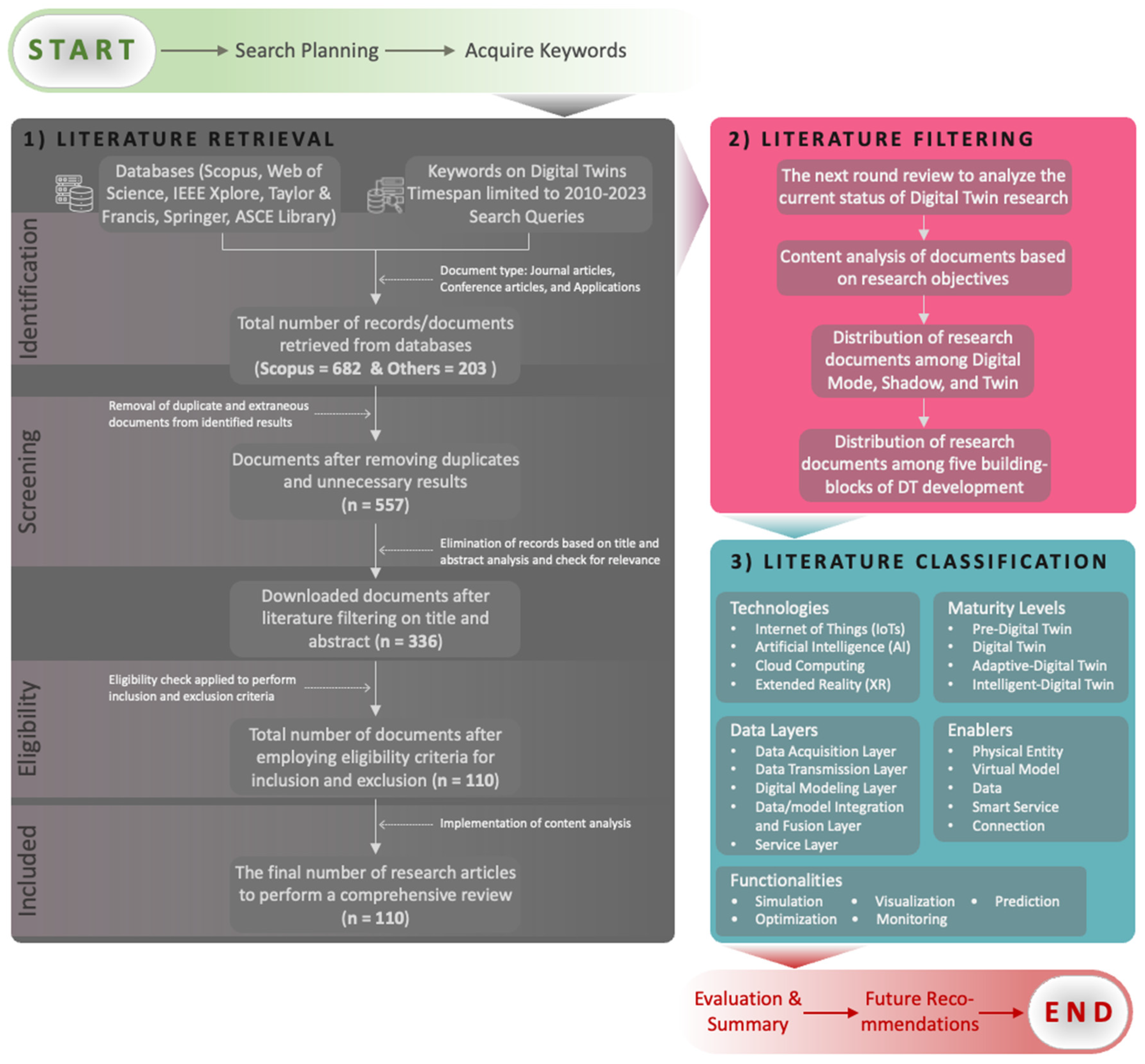
Figure 2.
Evolution of the Digital Twins concept over the past few years as evaluated from the existing studies [78,82,83,84]. (Figure source: authors).

Figure 3.
Summary of the number of total papers retrieved about the Digital Twin research using the defined literature-search strategies. (Figure source: authors).
Figure 3.
Summary of the number of total papers retrieved about the Digital Twin research using the defined literature-search strategies. (Figure source: authors).
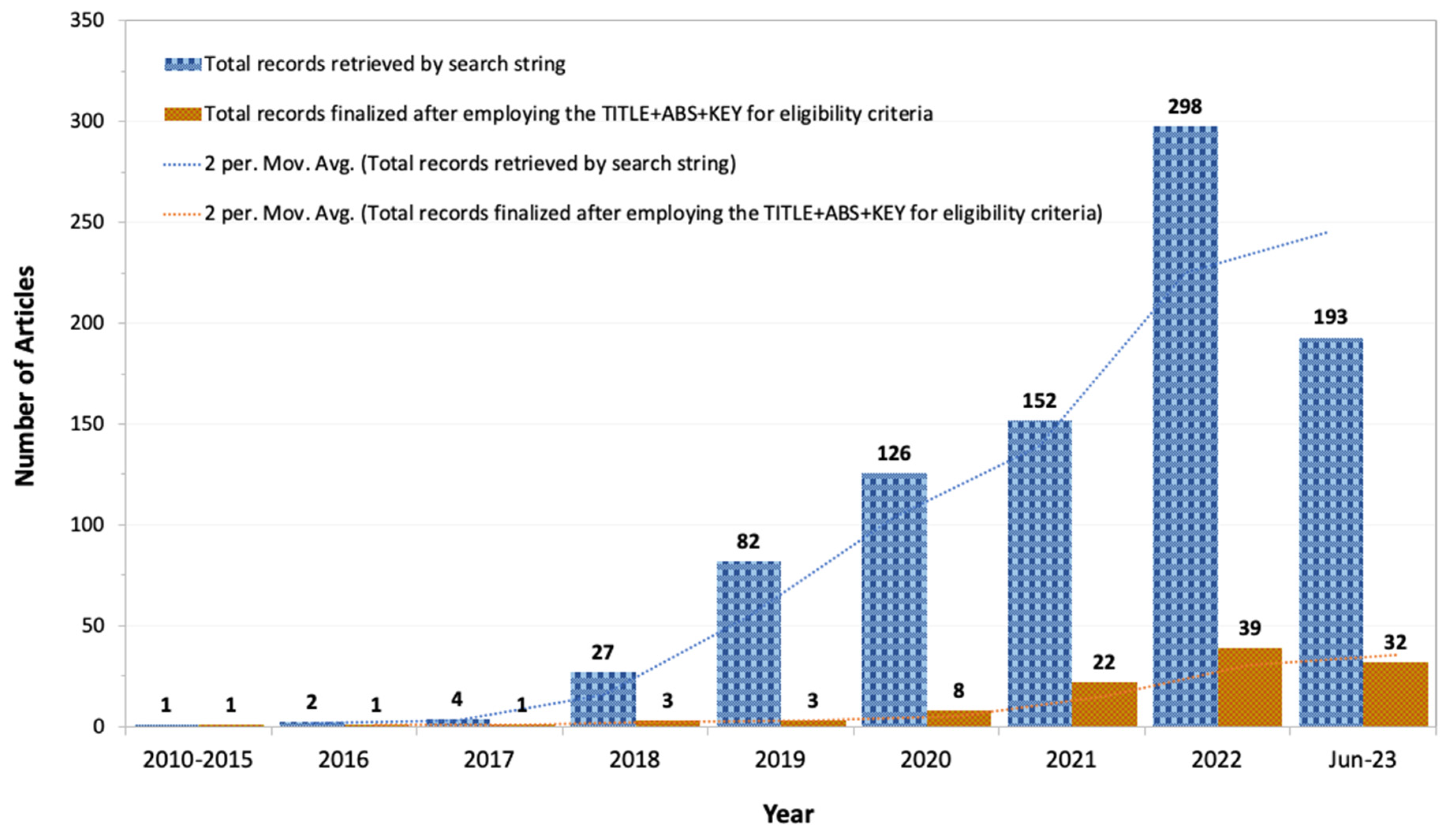
Figure 4.
The number of total research papers appeared in major journals using the defined literature-search strategies. (Figure source: authors).
Figure 4.
The number of total research papers appeared in major journals using the defined literature-search strategies. (Figure source: authors).
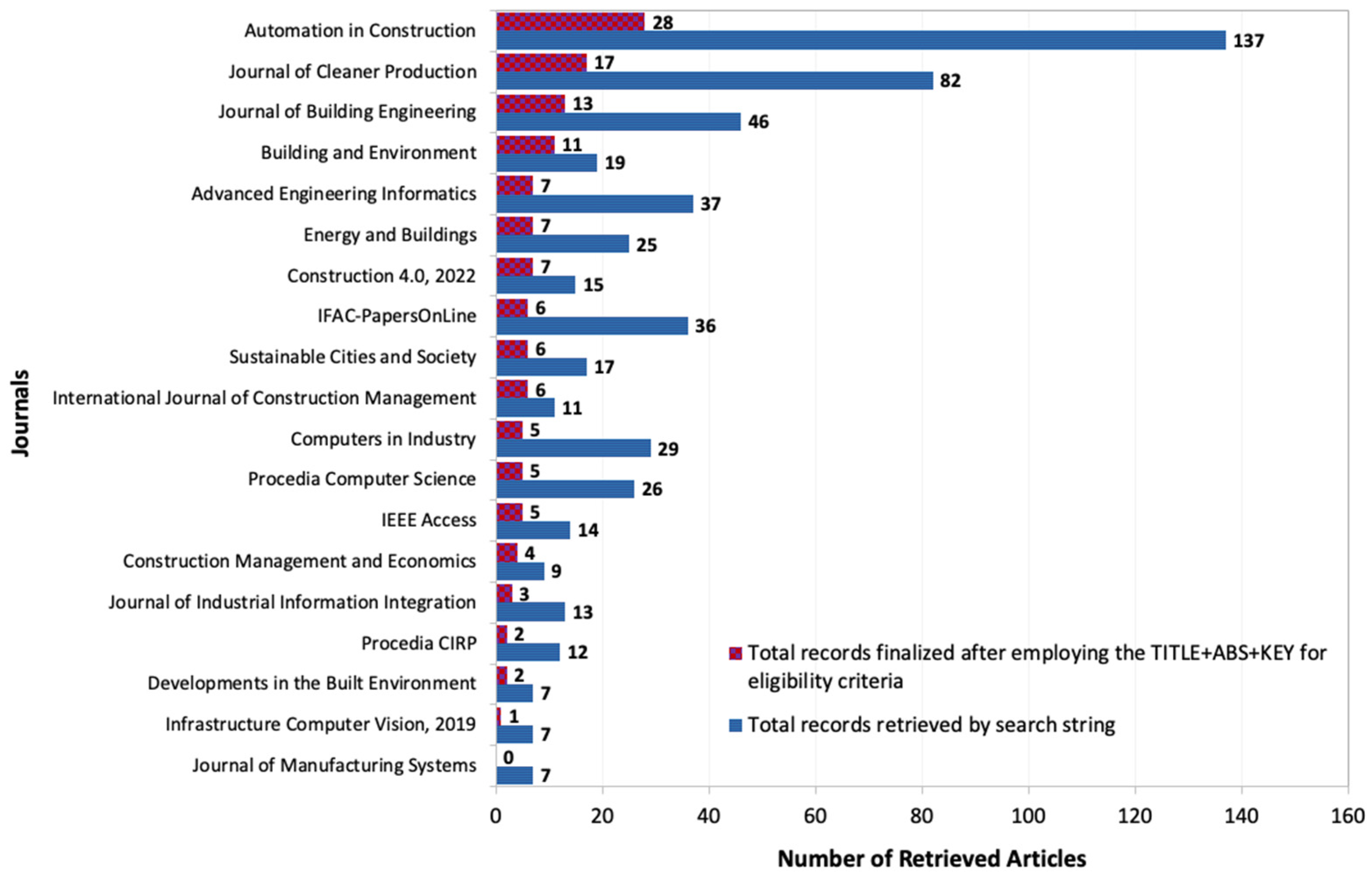
Figure 5.
Distribution of retrieved research papers among different research disciplines. (Figure source: authors).
Figure 5.
Distribution of retrieved research papers among different research disciplines. (Figure source: authors).
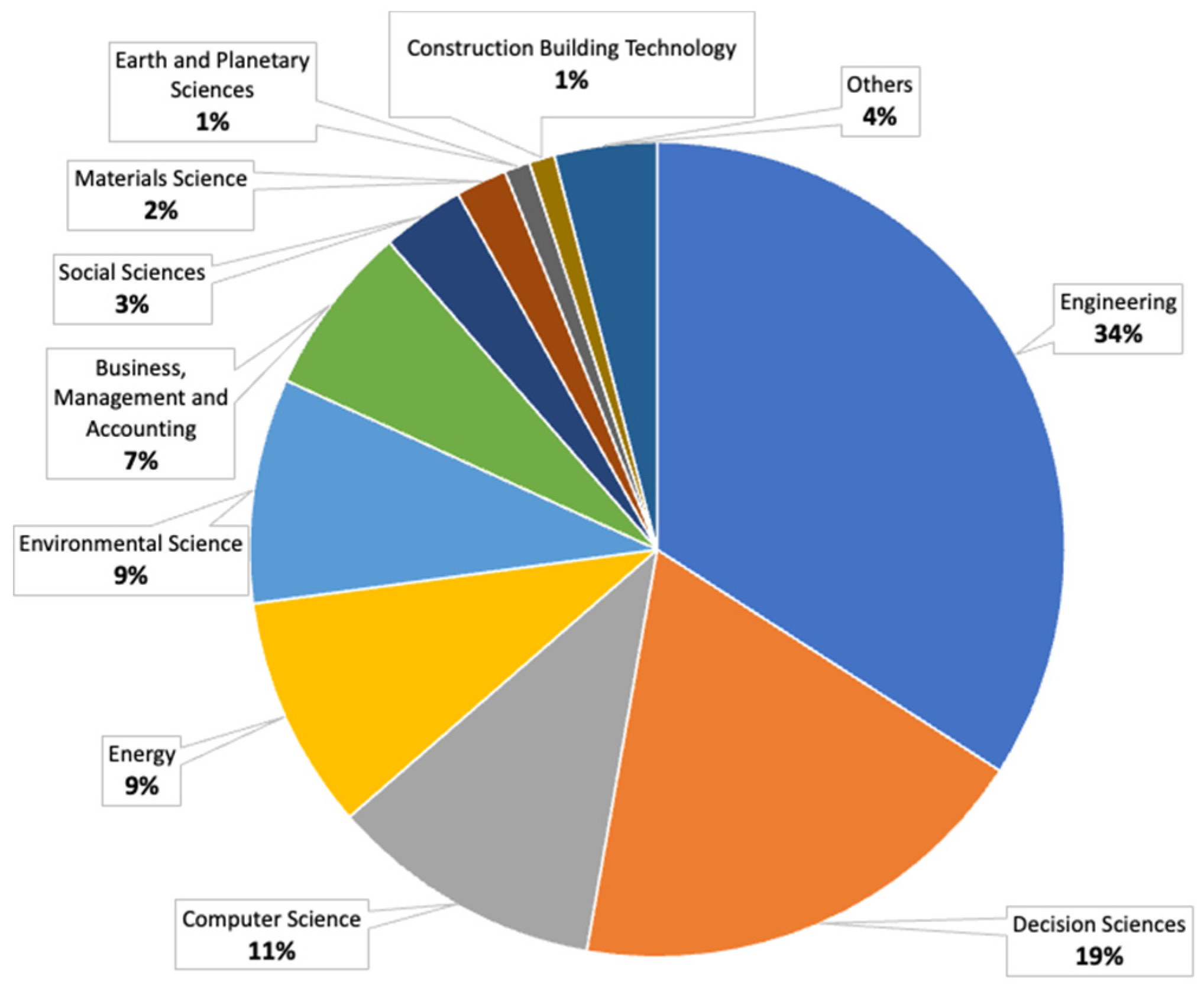
Figure 6.
Identified key components of the DT technology development and evolution for applications in the AEC sector. (Figure source: authors).
Figure 6.
Identified key components of the DT technology development and evolution for applications in the AEC sector. (Figure source: authors).
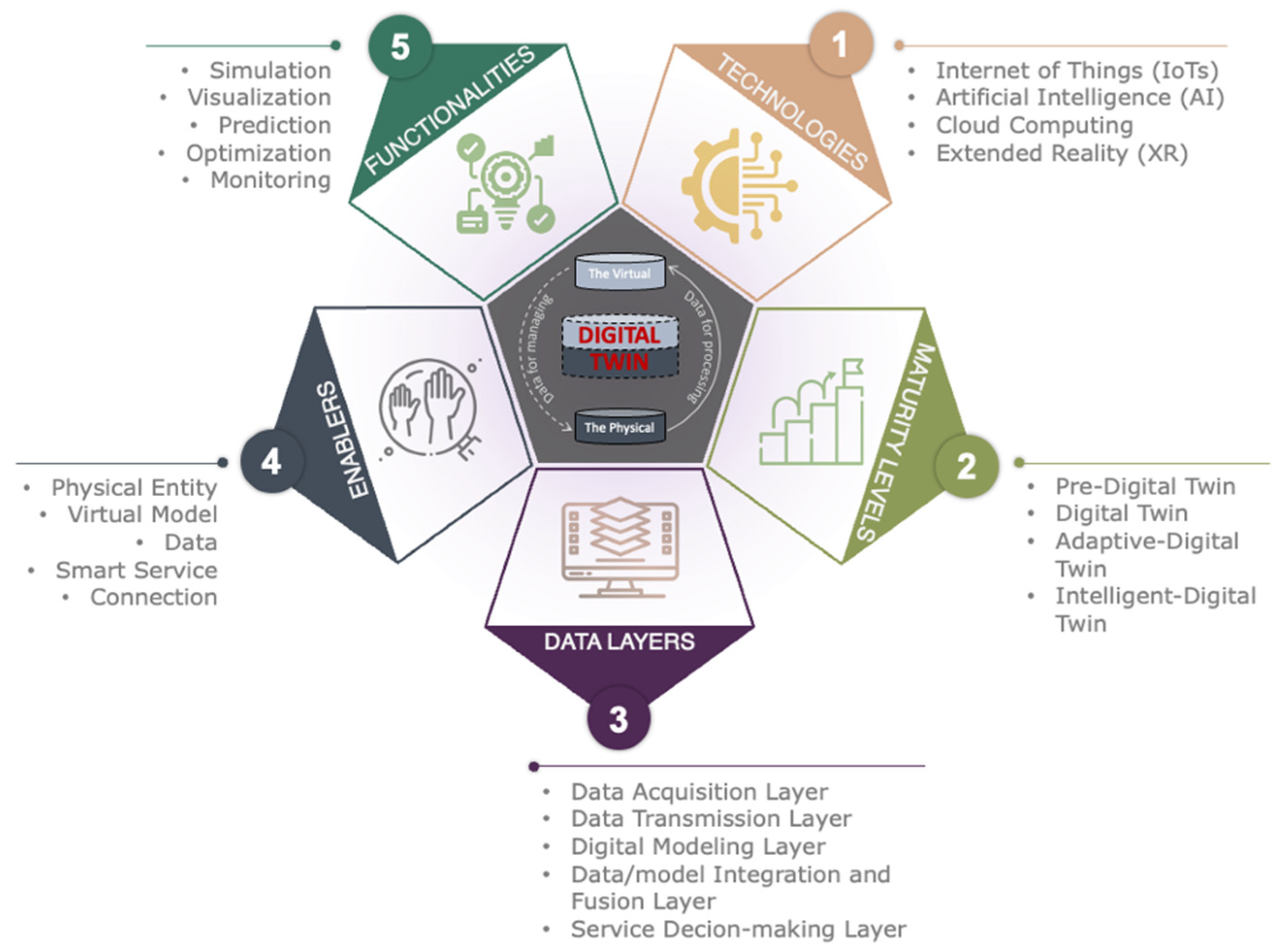
Figure 7.
Core technologies encompassing the Digital Twin applications in the construction industry. (Figure source: authors).
Figure 7.
Core technologies encompassing the Digital Twin applications in the construction industry. (Figure source: authors).
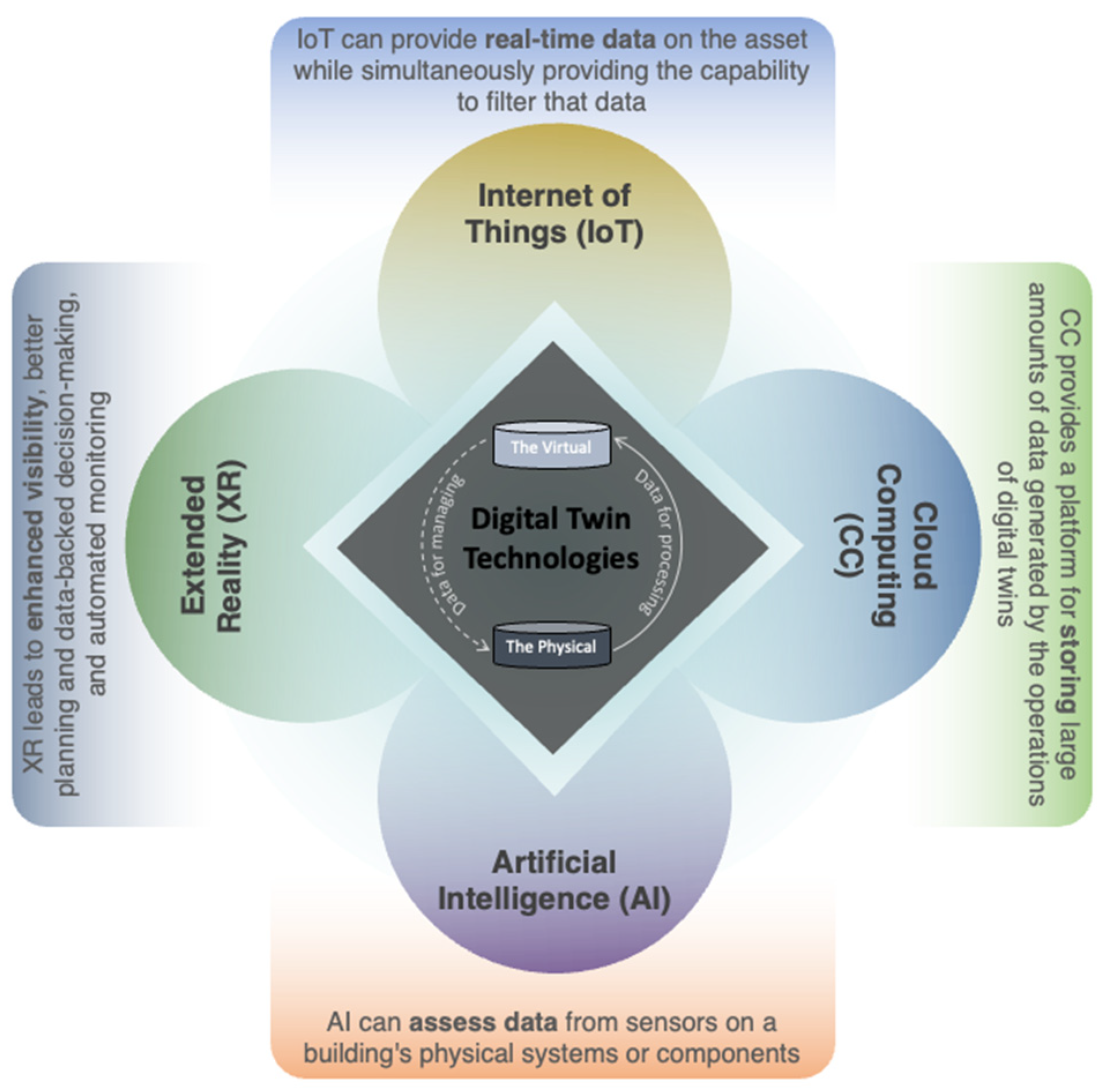
Figure 8.
Five-dimensional model of Digital Twin technology that enables the functionalities. (Figure source: authors).
Figure 8.
Five-dimensional model of Digital Twin technology that enables the functionalities. (Figure source: authors).
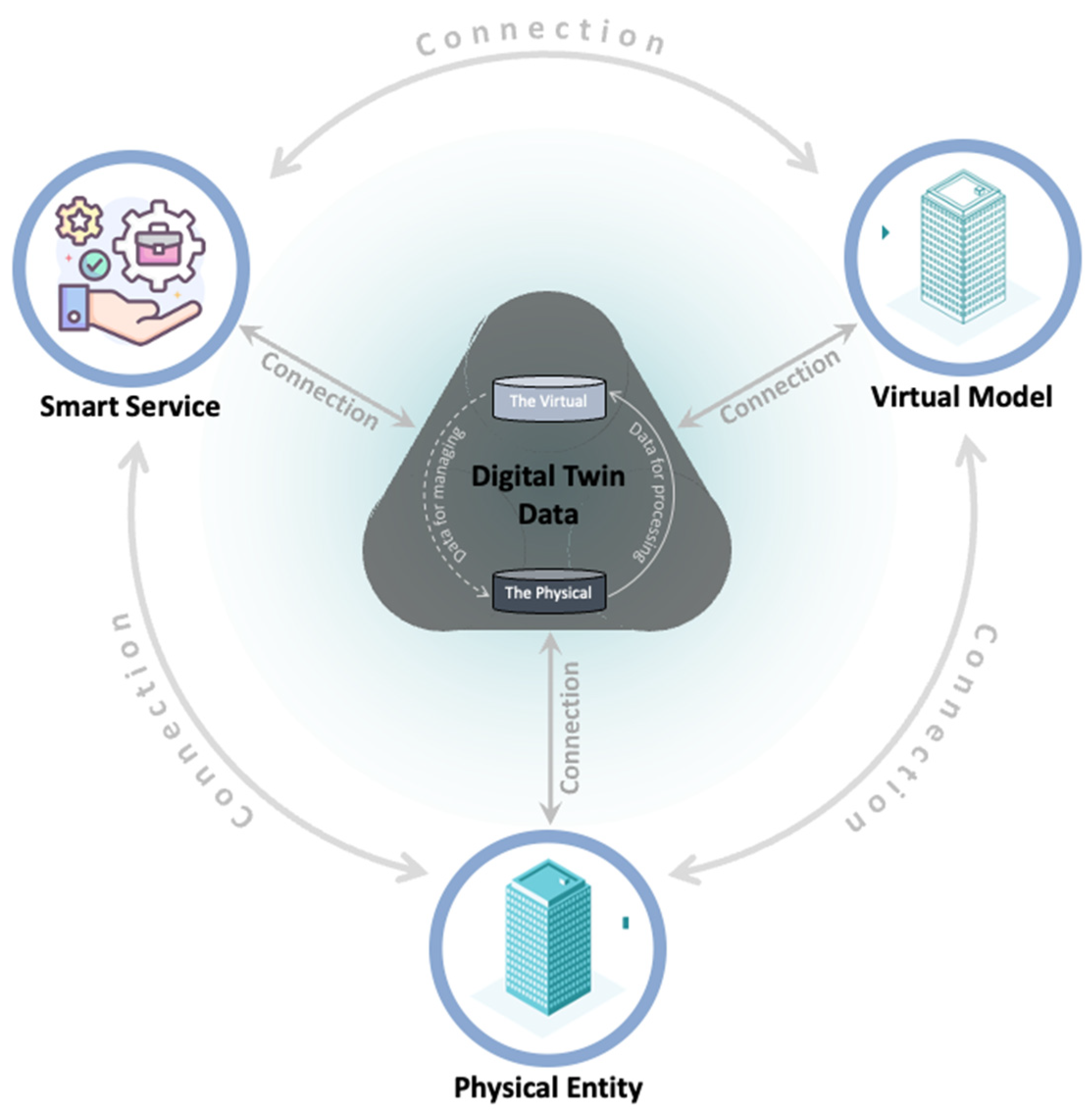

Table 1.
Parameters and conditions involved during the literature search for review.
| Source Databases | Web of Science (WoS), Scopus, Taylor and Francis, IEEE Xplore, Springer, and ASCE Library |
| Search String | (“digital twin” OR “digital twins” OR “virtual twin” OR “digital replica” OR “virtual counterpart” OR “cyber-physical system”) AND (“development” OR “evolution” OR “key technologies” OR “key components” OR “key elements” OR “applications”) AND (“construction engineering” OR “construction” OR “construction sector” OR “AEC industry” OR “construction industry” OR “construction engineering and management”) |
| Time-period Restriction | 2010-2023 |
| Article Types | Journal, Conference Paper, Book Chapter, Review |
| Language Restriction | English |
| Included Subject Areas | Engineering, Computer Science, Energy, Mathematics, Environmental Science, Materials Science, Decision Sciences, Business, Management and Accounting |
| Excluded Subject Areas | Social Sciences, Earth and Planetary Sciences, Chemical Engineering, Medicine, Economics, Econometrics and Finance, Arts and Humanities, Agricultural and Biological Sciences, Neuroscience, Chemistry, Biochemistry, Genetics and Molecular Biology |
| Work Area/Industry | Construction Industry, AEC Sector, Civil Engineering |
Table 2.
Summary of some research articles corresponding to each identified vital component of the DT development.
Table 2.
Summary of some research articles corresponding to each identified vital component of the DT development.
| No | Key Components | Description | Corresponding Literature |
| I | Technologies | The core technologies that help develop the interaction of DT with real-world physical entities are: the Internet of Things (IoTs), Artificial Intelligence (AI), Cloud Computing (CC), Extended Reality (XR) | [1,21,25,45,46,47,48,49,50,51,52,53,54,55,56] |
| II | Maturity Levels | The basic levels of DT maturity have specific purposes and scope to help in decision-making throughout the system’s lifecycle: Pre-Digital Twin, Digital Twin, Adaptive-Digital Twin, Intelligent-Digital Twin | [2,22,26,33,34,57,58,59,60,61,62] |
| III | Data Layers | Data is the core of DT integration and fusion of the virtual model, and data flows in layers between systems: Data Acquisition Layer, Data Transmission Layer, Digital Modeling Layer Data/model Integration and Fusion Layer, Service Layer | [35,56,63,64,65,66,67,68,69,70,71,72] |
| IV | Enablers | Five fundamental entities are responsible for promoting and enabling the DT functioning: Physical Entity, Virtual Model, Data, Smart Service, Connection | [5,22,45,58,73,74,75,76,77] |
| V | Functionalities | A variety of functionalities are carried out with DT employment; however, the crucial ones for the AEC sector applications over the product lifecycle are: Simulation, Visualization, Prediction, Optimization, Monitoring | [5,17,20,23,32,35,36,65,66,68,71,76,78,79] |
Table 3.
Definitions of the digital twin concept from the literature to help clarify it from various perspectives and applications.
Table 3.
Definitions of the digital twin concept from the literature to help clarify it from various perspectives and applications.
| Corresponding Study | Year | Key Point in the Study | DT-Definition |
| [89] | 2010 | Integrated simulation | A digital twin is a comprehensive simulation of a vehicle or system, integrating multi-physics multi-scale aspects and leveraging the best available physical models, sensor updates, and past operational data to mirror the life of its real-world counterpart. |
| [78] | 2012 | Ultra-high-fidelity model | A Digital Twin is a simulation of an as-built system that seamlessly mirrors its real-life counterpart by incorporating models, sensors, and other intelligent devices. |
| [90] | 2014 | High-fidelity modeling | Digital Twin is a life management and certification paradigm integrating as-built vehicle states, as-experienced loads and environments, and another vehicle-specific history into models and simulations. This approach enables high-fidelity modeling of individual aerospace vehicles throughout their service lives. |
| [84] | 2015 | Lightweight virtual model | The Digital Twin comprises a physical entity existing in the real environment, a virtual representation existing in the digital domain, and information connectors bridging the real and virtual counterparts. |
| [87] | 2015 | Realistic model | The term “Digital Twin” typically refers to highly realistic models of the current process state and their behaviors as they interact with the real-world environment. |
| [91] | 2016 | Functional description of a product | The Digital Twin is a virtual representation of a component, product, or system that benefits the entire lifecycle of the entity. |
| [92] | 2016 | Virtual substitutes | Digital twins are virtual substitutes for real-world objects, embodying virtual representations and communication capabilities. These smart objects function as intelligent nodes within the Internet of Things and services. |
| [93] | 2016 | Advancement in modeling, simulation, and optimization | Digital twin represents one of the imminent major advancements in modeling, simulation, and optimization technology. |
| [94] | 2017 | Multi-disciplinary replica | The Digital Twin serves as a virtual representation of a production system, capable of synchronization with the actual system through real-time data sensed from connected smart devices. |
| [95] | 2017 | Virtual equivalent | The Digital Twin is a set of virtual information constructs that fully describe a physical product. |
| [86] | 2017 | Digital representation of an asset | A Digital Twin is the digital representation of a distinct asset (such as a product, machine, service, or intangible asset) encompassing its properties, condition, and behavior using models, information, and data. |
| [17] | 2018 | Virtual product data | The components of a complete Digital Twin include a physical entity, a virtual counterpart, a connection linking the physical and virtual counterparts, as well as data and services. |
| [58] | 2018 | Product mirror and Digital counterpart | The Digital Twin is a digital counterpart of a physical object. |
| [96] | 2018 | Multi-level digital layout | The Digital Twin of a physical entity encompasses layers of data, including information about the product itself, the processes involved, and the resources within its operational environment. |
| [59] | 2019 | Updated virtual instance | A digital twin is a virtual representation of a physical system (twin) that continuously updates its performance, maintenance, and health status data throughout its entire life cycle. |
| [97] | 2019 | Data mapping | Digital Twin refers to a virtual object or a collection of virtual entities defined within the digital virtual space, establishing a mapping relationship with real-world objects in the physical space. |
| [98] | 2020 | Virtual entity | A cyber-physical system comprises of both a physical entity and a cyber entity in the form of a Digital Twin. |
| [99] | 2021 | Twin of physical entity | Digital Twin is an innovative concept that strives to create a virtual counterpart of a physical entity in the digital world. |
| [100] | 2021 | Mirror world | Digital Twin is an approach that establishes a bidirectional connection between a physical system and its virtual representation, enabling the utilization of Artificial Intelligence and Big Data Analytics. |
| [101] | 2021 | Real-time digital representation | Digital Twin is a real-time digital representation of a physical building or infrastructure. Typically, on-site sensors continuously monitor changes within the building and its environment, providing data to update the BIM model with the latest measurements and information. |
Table 4.
Data layers encompass the development and evolution of DTs in the construction sector by handling vast amounts of data from different sources.
Table 4.
Data layers encompass the development and evolution of DTs in the construction sector by handling vast amounts of data from different sources.
| Corresponding Study | Data Acquisition Layer | Data Transmission Layer | Digital Modeling Layer | Data/Model Integration and Fusion Layer | Service Decision-Making Layer |
| [107] | Environmental sensor data by direct digital control system | Direct digital control system & BACnet protocol for data communication | Autodesk Revit for 3D modeling | MSSQL, COBie, IFC 4 extension, Autodesk Revit plug-in, ML algorithms | Monitoring and prediction of conditions of the chiller plant |
| [108] | Temperature and mechanical sensors data | WSN (wireless sensor network) & MQTT (Message Queuing Telemetry Transport) | 3D FEM (Finite Element Model) | Metadata APIs for calculations of measured values | Real-time monitoring and warning alerts on reaching defined thresholds |
| [31] | Cameras and video stream data | LAN (Local Area Network) & Internet | BIM model. Autodesk Revit, Three.js & Draco 3D | MySQL, Cloud service, Deep learning, Three.js program, Trend graphs | Detection and monitoring of pedestrian trends and pedestrian time |
| [66] | RFID tags, Positioning data | Smart mobile gateway & MQTT | Unity 3D model | Time numerical models, Unity 3D, Analytic charts | Real-time monitoring of activities and task alerts & ticket visualization |
| [109] | Environmental sensors data by Restful API and Wired sensors | URL via API, Internet, and BACnet | BIM models by Autodesk Revit | Machine learning, MSSQL, IFC, COBie | Fault detection and prediction in air handling unit (AHU) |
| [65] | RFID tags, Industrial wearables, Positioning data | Mobile Gateway Operating System (MGOS), Light middleware, Wireless network | 3D models by Solidworks and Autodesk 3D Max | Web database and API for Unity 3D | Real-time positioning tracing for smart objects, robots, and instantiation for prefabricated modules |
| [70] | Environmental and thermal data by Wind sensors and IoT nodes | HTTP (Hypertext Transfer Protocol) | BIM models by Autodesk Revit | Google cloud platform, Game engines, Thermal comfort charts | Display environmental, thermography, and thermal comfort levels in real- time |
| [110] | RFID and GPS tags, Positioning data | Internet, Azure blockchain platform to provide IoT hub, Web server, Blockchain network | Unity 3D | Microsoft Azure cloud, API for Unity, Compliance checking for BIM and Blockchain | Real-time information tracing by blockchain network |
| [111] | Environmental and mechanical data by Wind, Speed, and Temperature sensors | - | Autodesk Revit, Laser scanning, 3D point cloud | Machine learning algorithm using Markov chain & Line graphs | Simulation of condition predictions, structural health monitoring, and early warning for maintenance |
| [112] | Location and tracking data from the virtual server generating hypothetical IoT sensor data | - | Virtual modelling, Unity 3D | Unity engine, Data analytics, 3D simulations, API into Bing Maps | Monitoring and simulation of different scenarios in real-time |
| [106] | Environmental data and component information by BMS sensor network and QR codes | HTTP (Hypertext Transfer Protocol), Ethernet gateways | 3D models by Autodesk Revit and AECOsim building designer, Laser scanning, Photogrammetry | Autodesk forge API, IFC schema, Amazon web services (AWS), DynamoDB, Time series graphs | Real-time anomaly detection in pumps, environmental monitoring, and maintenance prediction of faults of boilers |
| [113, 114] | Mechanical data by vibration sensors | - | BIM models by Autodesk Revit | Autodesk forge API, .NET using C# and Javascript, IFC schema, Cumulative sum control charts (CUSUM) | Anomaly detection and monitoring of the working condition of pumps |
| [115] | Environmental, energy, and video data by BAS sensors network | HTTP & Building systems communication networks | Laser scanning and Mixed Reality (MR) | MySQL, Private cloud storage, Deep learning, Trend charts, and Real-time animations | Security and monitoring of energy consumption & Visualizations for space management |
| [116] | Positioning and location label data by positioning devices, ultrasonic sensors, and 3D gyroscope sensors | HTTP, Bluetooth, and Wi-Fi | - | Algorithm engines for face recognition, personnel positioning and mechanical attitude positioning | Monitoring of operations, worker and component tracking alerts for risks in real-time |
| [104] | Image data by Microsoft Kinect cameras | Gazebo_ros_pkg for simulation | VR (Virtual Reality), Unity 3D, Unified Robotics Description Format (UDRF) | Robot Operating Software (ROS), VR headset | Real-time data capturing to control the Robot on site |
Disclaimer/Publisher’s Note: The statements, opinions and data contained in all publications are solely those of the individual author(s) and contributor(s) and not of MDPI and/or the editor(s). MDPI and/or the editor(s) disclaim responsibility for any injury to people or property resulting from any ideas, methods, instructions or products referred to in the content. |
© 2023 by the authors. Licensee MDPI, Basel, Switzerland. This article is an open access article distributed under the terms and conditions of the Creative Commons Attribution (CC BY) license (http://creativecommons.org/licenses/by/4.0/).
Copyright: This open access article is published under a Creative Commons CC BY 4.0 license, which permit the free download, distribution, and reuse, provided that the author and preprint are cited in any reuse.


