

Submitted:
31 October 2023
Posted:
01 November 2023
You are already at the latest version
Abstract
Certain services can help avoid environmental impact in larger contexts. However, there is no commonly agreed bottom-up methodology for calculation of the total net reduction effect of specific digital services. Life Cycle Assessment (LCA) is a common denominator for most methodologies. The most common method is the Attributional LCA (ALCA), and recently the emerging handprint ALCA estimating so-called positive environmental impacts. Moreover, Consequential LCA (CLCA) can be used to capture market effects. The third conceptual approach is Input-Output LCA. The purpose is to propose and test a new method based on some of the existing ones. The existing concepts are compared and a synthesis is made to create a practical but still useful method. The new method is applied to two illustrative cases in the Information and Communication Technology (ICT) domain; the introduction of a 5G enabled drone for pipe inspection and the 5G enabled health consultation. Compared to simplified ALCA, the difference between the absolute score for the baseline system and the target system changes up to 15% when the proposed simplified CLCA (SCLCA) method is used. The results show that SCLCA, when combined with analytical methods for expressing digital ICT services’ own impact, is a fruitful approach which is both practical and feasible.
Keywords:
avoided impact
; digital
; ICT services
; life cycle assessment
1. Introduction
For several years there have been attempts to estimate the potentially avoided, reduced, offset and enabled environmental impact thanks to replacing products/systems/solutions/services with others, mostly using subtracting one attributional LCA (ALCA) [1] from another. ALCA asks the question: What are the absolute environmental impacts (first order effects) of the existing solution and the new solution? Especially digital Information and Communication Technology (ICT) solutions may avoid impacts [2,3] (second order effects) when replacing physical solutions or other digital ones.
The avoided impact is estimated on the level of individual product savings, individual service savings, savings by corporations and savings in society.
Most research in this domain uses simplified ALCA (SALCA) [4,5,6,7,8] of product or service systems to draw conclusions about avoided impact. So far when using ALCA it is clear that comparisons between smart ICT and “physical” is always beneficial for the former. ICT Services have an increasing economic effect on other sectors, in a very intricate and knotted way [9]. That said, more proof is required to show avoided impact in society as a result of using the innovations. Especially knowing the consequences of digital solutions [8,10] replacing each other will be useful. Moreover, the functions and functional units are not described well enough in existing research case studies of avoided impact by ICT Services. Setting an appropriate functional unit is always crucial for comparative LCA, and in particular for complex studies which involve ICT Services which help reduce impacts in larger systems.
The existing methods, mainly ALCA, may be able to prove the impact avoidance more or less convincingly and efficiently.
Some macro-perspective studies of societal savings show no [11] or a rather small [9,12] avoidance potential thanks to the introduction of ICT Services while others show very large reduction [13,14]. In this context, the idea of the internet’s handprint is based on a top-down macro view of how much general ICT Services (handprint services) can reduce impact in main societal sectors (customers product systems) compared to the baseline systems [14]. The approach asks which fraction of e.g. global electricity generation is applicable for smart facilitation of renewable electricity. Related it also asks which is the reduction potential of smart facilitation of renewable electricity compared to traditional facilitation of renewable electricity. Another example is the fraction of global travel impact that could be addressed by 5G Health Consultation and what is the reduction potential of 5G Virtual Health compared to face-to-face meetings. However, the macro internet handprint approach [14] for societal savings does not account for market and rebound effects.
A similar approach but bottom-up procedure [15] outlines the following steps to estimate the avoided impact by ICT Services: 1) identify the efficiency of the ICT Service, 2) estimate the baseline impact without the ICT Service, 3) estimate the share of population (or other base) that will use the ICT Service, 4) estimate the material and energy savings per quantifiable metric of the ICT Service, and 5) estimate the expected rebound effect.
Still, existing ALCA approaches lack the identification of marginal consumers and complementary production and use.
Advanced ALCA (AALCA) [2], handprint ALCA (HALCA) [16] and consequential LCA (CLCA) [17] are methodological concepts which may help articulate the calculation rationale further beyond just subtracting one ALCA from another. Nevertheless, AALCA can primarily be used [18] if the global sales of relevant sub-materials and sub-parts are available. Hence, AALCA seems only applicable for comparable systems with minor complexity.
The goal of HALCA calculations is to assess the positive impacts that would be achieved when a presumed HALCA solution is used by an existing or potential customer (a customer product system as defined by LCA). In essence HALCA is another way of showing ALCA results.
As it stands, neither HALCA nor (detailed and simplified) CLCA methodologies are used extensively compared to SALCA for estimating impact reductions. Input-Output LCA (IOLCA) is used but mainly so far for top-down reduction studies [9,12,19,20]. HALCA seems clearer than AALCA and CLCA as far as data availability and uncertainty. Anyway, HALCA wants to position itself as a positive footprint referring to the beneficial impacts that organizations can achieve by providing products/services/solutions that reduce the footprints of customer product systems.
CLCA uses different techniques to determine what is expected to happen in the future if the status quo remains compared to introducing a new product. CLCA has two main steps: 1) identify the processes which will change for Baseline System and Target System. More or less electricity consumption and/or transportation are very common for ICT services. 2) identify the consumers of products made available by the change. In this sense the goal of CLCA is noticeably different from the HALCA calculation. CLCA should be used when significant changes in surrounding markets can be assumed to occur as a result of changing technologies. CLCA seems a good fit for those ICT services which have caused, or will cause, relatively large market effects when introduced, e.g. health consultation or flexible mobile office.
Consequential system expansion can be employed to account for secondary functions provided.
In practice, the CLCA methodology often has to be simplified and adapted for practical reasons. The uncertainty is also large and habitually not assessed.
Even so, the role of CLCA is useful in adding some more detail into first order rebound effect [21] calculations. In summary avoided impact calculations should contain the impact of the innovation, the rebound effects and the enabling effect. Any reliable methodology for calculating avoided impact needs to be based on bottom-up analysis with immediate and quantifiable aspects having strong statistical and causal relations to the functions and studied systems.
It is somewhat possible to identify the exact unit processes which are affected by the introduced change in the system such as virtual meeting.
The main hotspot in an LCA of a physical meeting is travel. Only the immediate travels will be affected by this change.
The gap found in the literature is that the main approaches for avoiding impact calculations do not provide a practical method for bottom-up estimations for specific digital services. The hypothesis proposed in the present research is that simplified CLCA (SCLCA) can be combined with bottom-up cloud-service LCA estimation methods to estimate the avoided impact. Table 1 shows the main advantages and disadvantages of existing approaches compared to the proposed.
2. Materials and Methods
Equation (1) describes how the total avoided environmental impact of a specific ICT Service can be calculated.
Where
= Total Avoided Environmental Impact (or emissions) from the ICT Service i at hand.
= Total life cycle Environmental Impact (or emissions) without ICT service i in studied product system per functional unit. This is the Baseline system.
= Total Environmental Impact (or emissions) with ICT service type i with used data volume (V) in studied product system per functional unit. This is the Target system.
= Total Environmental Impact (or emissions) for all ICT service types i used.
= type of ICT service, e.g. 5G, fixed broadband, cloud.
= data volume processed by the network per functional unit for the ICT service i at hand.
Equation (2) describes how the total lifetime environmental impact of a specific ICT Equipment when replaced can be calculated.
Equation (3) describes how the total lifetime environmental impact of a specific ICT Equipment when reused can be calculated.
where
= Total environmental impact when Equipment type j is replaced.
= Total environmental impact when Equipment type j is reused.
= Environmental impact for manufacturing of the first Equipment.
= Environmental impact for manufacturing of the Equipment replacing the first Equipment.
= Environmental impact for manufacturing of the spare parts for the first Equipment.
= Environmental impact for distribution of the first Equipment.
= Environmental impact for distribution of the Equipment replacing the first Equipment.
= Environmental impact for distribution of the first Equipment when reused.
= Annual Environmental impact for use of the first Equipment.
= Annual Environmental impact for use of the Equipment replacing the first Equipment.
= Annual Environmental impact for use of the first Equipment when reused.
= Environmental impact for end-of-life treatment of the first Equipment.
= Environmental impact for the end-of-life treatment of the Equipment replacing the first Equipment.
= Environmental impact for end-of-life treatment of the spare parts used for the first Equipment.
= Total lifetime of first and replacing Equipment.
=Time when the first Equipment is replaced
=Time when the first Equipment is reused.
= type of Equipment.
Equations (2) and (3) are applied to the PCs and Monitors in the examples in Section 2.3 and Section 2.4. These equations – inspired by [22,23] - can be used to decide in any situation if a product should be reused or replaced.
2.1. Total Environmental Impact for Individual ICT Service Types
A simplified way to estimate is to multiply the energy efficiency () of the ICT Service(s) with its bandwidth () the time of duration () per session, and the environmental impact intensity of the electricity (See Equations (4)-(6)) [24].
= Power usage of specific Network (kW)
= Total specific network traffic (Gb/s)
= Bandwidth for studied ICT service i, (Gb/s)
= Duration of ICT Service {h}.
= ICT Service Energy Efficiency (kW/[Gb/s])
= Studied ICT Service energy usage (kWh)
= environmental impact intensity of electricity used by studied ICT service (environmental impact/kWh)
A more detailed approach for estimating the energy consumption () of the use phase for an ICT Service is provided in [25]. The scope consists of the Data transmission (in the Wi-Fi Router&Access Equipment and in the Metro&Core Networks) and the Data processing/storage in the Data Centers. Equations (7) - (10) give the individual electricity use per ICT Service, and Equation (11) gives in a more precise manner than Equation (5). Wireless Access network equipment energy consumption is more data dependent than time-dependent [26] and is therefore modelled as the Metro&Core network Equipment in Equation (8).
Where
= Electricity consumption of the Fixed&Wireless Access CPE {kWh per ICT Service}.
= Power consumption of Equipment type j {kW}.
= Overhead factor for inclusion of electricity consumption of supporting functions for Equipment type j.
= Electricity consumption of the Metro and Core and Wireless Access networks {kJ per ICT Service}.
= data volume processed by the network per functional unit for the ICT service at hand {GB}.
= throughput rate of Equipment j [GB/s, Gb/s divided by 8].
Electricity consumption of the Data Centers {kWh per ICT Service}.
= Electricity consumption of Equipment j in data centers at hand {kWh/year}.
= Total power consumption of data centers at hand {kW}.
= Total Global Data Center IP Traffic {GB/year}.
= Total Power consumption of Global Data Centers {kW}.
= Total Electricity consumption of Global Data Centers {kWh}.
and estimates can be obtained from [27]. can be used to estimate if data are not available.
The fraction of idle time per day has been removed from Equation (7) compared to [25] (Eq. 1) due to difficulties for a designer to quantify this parameter. Moreover, the redundancy and utilization rate have been removed from Equation (8) compared to [25] (Eq. 2) due to problematic quantifications compared to their relevance for driving . The wireless networks are modelled as metro and core networks. The impact of producing the hardware is also omitted as it is usually rather insignificant for ICT Services [25].
2.2. Validation of ICT Service Impact with IOLCA
If the cost of delivering the ICT Service at hand is known, the bottom-up results from Equation (7) and Equation (11) may be compared to the IOLCA scores in 2009 for EU27, 0.264 kg CO2e/USD for “Computer and related services” [28].
The corresponding intensity had shrunk to around 0.15 kg CO2e/USD in 2017 for “Data Processing, Hosting, and Related Services” [29].
Based on literature, cases can be identified in which avoided impacts have occurred and are expected. The comparable product systems are then decided from the existing baseline system and target system (new innovation). The function to be delivered by both systems is identified and then the functional unit for both. Then Equations (1) to (11) are applied as appropriate.
2.3. Cooling of Base Stations – Use of Marginal Electricity and Heat Production Technologies
The first example is used to show how marginal energy technologies can be identified. This example does not feature any ICT Service.
Base stations can be cooled in different ways, e.g. air cooling or liquid cooling. The latter provides waste heat that is recoverable through the cooling liquid for various heating purposes [16].
The identified function is: providing cooling of base stations.
The functional unit is: “A subsystem providing the cooling to be suited for the needs of one 0.695kW base station in Finland for one year”.
Figure 2 shows the CLCA for the baseline system (air cooling).
Figure 3 shows the scope of the target system for cooling of base stations.
The numbers in Table 2 for power and heat are based on [16]. The most sensitive process is the most competitive in a situation with an increasing or constant market trend, while it is the least competitive in a situation with a decreasing market trend [30]. Nuclear power is assumed to be the most competitive baseload power production method in Finland and district heat is assumed to be the most competitive heat generation technology for residential houses.
When demand increases, short-term marginal production is the unit with the highest operation costs [31]. Light fuel combustion is assumed to be the costliest way in Finland of producing heat for this application, i.e. light fuel combustion is the marginal heat production technology.
The simplest calculation for avoided impact (or emissions) is subtractive simplified ALCA for the use stage: Baseline System - Target System. The parameters used for the calculation are shown in Table 2.

Table 2.
Parameters used in [16] for simplified ALCA baseline and target system for cooling of base stations.
Table 2.
Parameters used in [16] for simplified ALCA baseline and target system for cooling of base stations.
| Feature | Baseline System | Target System |
|---|---|---|
| Power consumption (kW) | 0.695 | 0.591 |
| Heat consumption (kW) | 0.4728 | |
| Environmental impact intensity of electricity used (kgCO2e/kWh) | 0.164 | 0.164 |
| Environmental impact intensity of heat used (kgCO2e/kWh) | 0.188 | |
| Calculation | 0.695 kW × 8760 hours/year × 0.164 kgCO2e/kWh + 0.591 kW × 0.8 × 8760 hours/year × 0.188 kgCO2e/kWh | 0.591 kW × 8760 hours/year × 0.164 kgCO2e/kWh |
| Total result | 1777 kg CO2e/year | 849 kg CO2e/year |
| Avoided impact | 1777 – 849 = 928 kg CO2e/year per 0.695 kW base station | |
- The next simplest calculation for avoided emissions is done with SCLCA is:
- CLCA (Baseline System) – CLCA (Target System).
- The parameters used for the SCLCA calculation are shown in Table 3.
2.4. 5G Enabled Drone for Pipe Inspection – Use of Framework and Marginal Electricity
The first example [32] (pp. 23-25, 41-43) of a case study which includes an ICT Service which can help avoid impact is pipe inspection. Such inspection can be done with humans visiting the pipes for inspection or by Unmanned Aerial Vehicle (UAV) in combination with 5G wireless networks.
Table 4.
Present proposed methodology applied to pipe inspection in China.
| Item | Description | ||
|---|---|---|---|
| Goal | Avoided emissions in pipe inspection technology comparison | ||
| Scope | CO2e emissions resulting from
Function: Providing inspection of gas pipes. The functional unit is: “A subsystem providing the inspection to be suited for the needs of 160 km of gas pipe in China”. |
||
| System related avoided emissions | |||
| Baseline System | Target System | ||
| Description | Human inspection | 5G-equipped Unmanned Aerial Vehicle (UAVs) inspection | |
| System Boundary | Use and production stage for inspection of 160 km pipe in China on average. | Use and production stage for inspection of 160 km pipe in China on average. | |
| Result of avoided emissions calculations | |||
|
:160km/250000km × ((8340kWh×0.9 kg CO2e/kWh)+5000)) kg CO2e/car {Petrol vehicle production} + 26.67dm3×0.73kg/dm3×0.45 kg CO2e/kg {Petrol production} + 16.66dm3/100km×2.31 kg CO2e/dm3 ×160km {Use of Petrol vehicle} = 81 kg CO2e/160 km. : 2months/200months×((609kWh×0.9 kg CO2e/kWh + 365)) kg CO2e/UAV {UAV production} + 1month/48months×(202kWh×0.9 kg CO2e/kWh + 121.4 kg CO2e/PC + 0.01kW×4years×8760hrs/year×0.9 kg CO2e/kWh) {PC production and use} + 0.7dm3 ×0.45 kg CO2e/kg {Diesel production} + 160km × 0.16 kg CO2e/km {UAV use} }8760hours×0.0075 kW×1.3×0.9 kg CO2e/kWh = 54 kg CO2e/160 km. Avoided emissions = 81 – 54 = 27 kg CO2e per 160 km pipe inspected. | |||
2.5. 5G Enabled Health Consultation
The second example [32] (pp. 27-28) involving an ICT Service - potentially avoiding impact - is health consultation. It is a well-established practice for doctors to use computerized tomography (CT) scans to help diagnose patients’ conditions and to guide the formulation of suitable treatment plans. Hospitals in second- and third-tier cities regularly invite highly experienced medical experts from tier-one cities to carry out on-site consultation and differential diagnosis. The consultation can also be done remotely with 5G which may avoid some travelling. Travelling by aircraft is excluded as the medical experts in this case do not travel by private jets. Regular aircraft cannot be claimed to be immediately avoided.
Table 5.
Present proposed methodology applied to health consultation in China.
| Item | Description | ||
|---|---|---|---|
| Goal | Health Consultation Technology comparison, effect of digitalization | ||
| Scope | CO2e emissions resulting from
Function: Providing consultation remotely of computerized tomography (CT) scans. The functional unit is: “A health consultation subsystem for 24 remote consultations per day involving analysis of CT scans to be suited for the needs of the purchasing customer”. |
||
| System related avoided emissions | |||
| Baseline Scenario | Target Product or System | ||
| Description | F2F consultation | 5G health consultation | |
| System Boundary | Use and production stage for 24 consultations in China on average. | Use and production stage for 24 consultations in China on average. | |
| Result of avoided emissions calculations | |||
|
: 320km × (4cars/250000km × ((8340kWh×0.9 kg CO2e/kWh)+5000) kg CO2e/car)) {Petrol car production} + 320km× ((5.58dm3/100km×0.73kg/dm3×(0.375kWh×0.9 kg CO2e/kWh + 0.225 kgCO2e/kg)) {Petrol used} + 320km×(5.58dm3/100km×2.31 kgCO2e/dm3) {Use of petrol car} + 1 PC×8hours×((202kWh×0.9 kg CO2e/kWh + 121.4 kg CO2e/PC))/(4years×8760hours) + 0.01kW×0.9 kg CO2e/kWh) {PC production and use}+ 1 monitor×8hours×((222kWh×0.9 kg CO2e/kWh + 200 kg CO2e/Monitor))/(4years×8760hours) +0.01kW×0.9 kg CO2e/kWh)) {Monitors production and use} = 113 kg CO2e/24 consultations : 3 PCs×13hours×((202kWh×0.9 kg CO2e/kWh + 121.4 kg CO2e/PC))/(4years×8760hours)+ 0.01kW×0.9 kg CO2e/kWh) {PC production and use} + 3 monitors×13hours×((222kWh×0.9 kg CO2e/kWh + 200 kg CO2e/Monitor))/(4years×8760hours) +0.01kW×0.9 kg CO2e/kWh)) {Monitors production and use} , wireless network use 5GB/hour×13hours×7kW/(0.05GB/s)×1/1000 kJ/MJ×1/3.6 MJ/kWh×1.3×0.9kgCO2e/kWh {5G wireless network use} = 4.4 kg CO2e/24 consultations. Avoided emissions = 113 – 4.4 = 108.6 kg CO2e per 24 health consultations. =2 years increase the production emissions slightly for the replace scenario (Equation (2)) but does not change the total scores significantly. Reuse scenario (Equation (3)) with these assumptions give almost the same values as the original. | |||
3. Results
The results show that SCLCA combined with analytical methods for expressing digital services own impact is a fruitful approach.
Figure 4 to Figure 6 show the comparison between ALCA and the proposed SCLCA method for the case studies in Section 2.2 to Section 2.4.
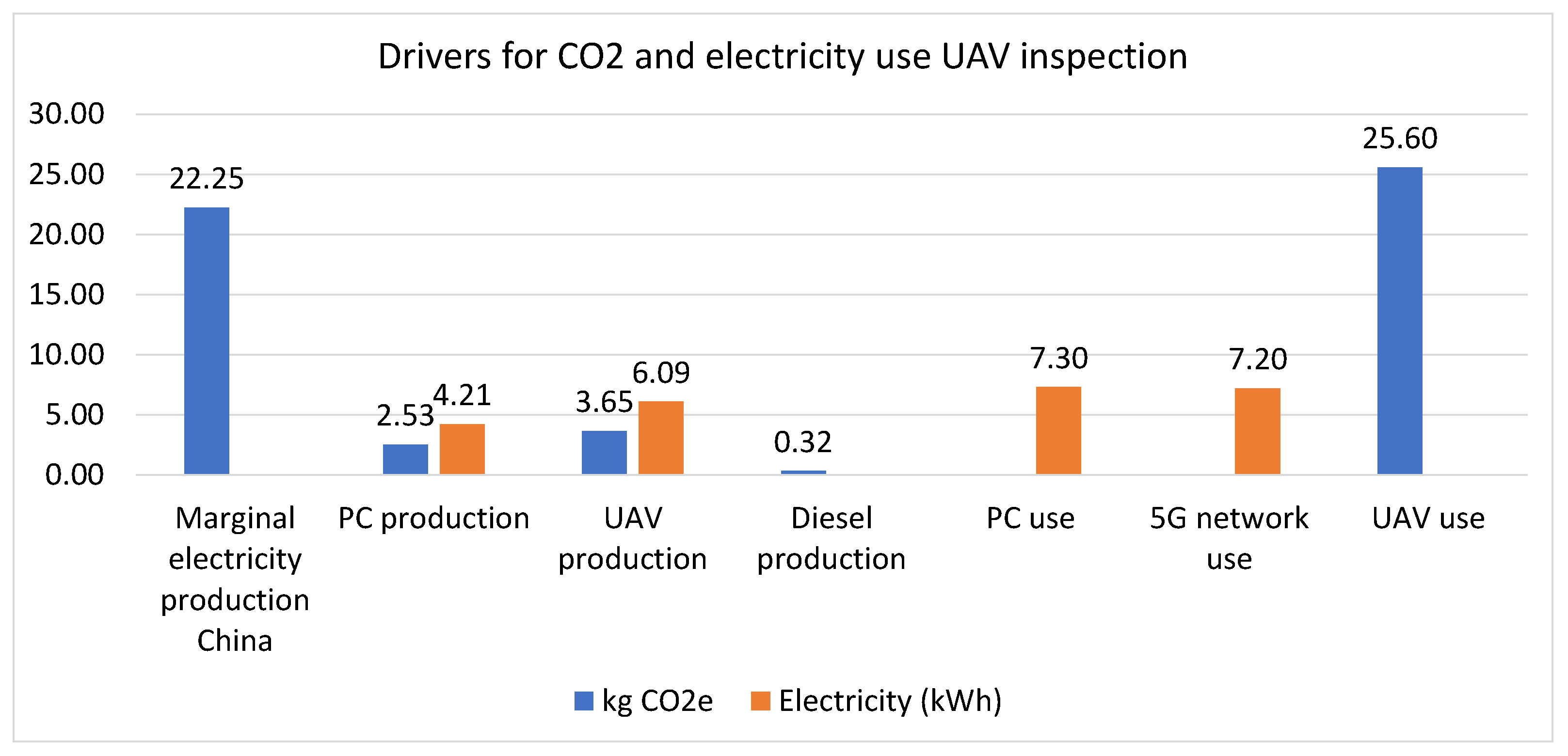
Figure 7 to Figure 10 show the drivers for CO2 and electricity for the case studies in Section 2.3 and Section 2.4.
As shown in Figure 8 and Figure 9, the avoided vehicles use and production explain much of the avoided impact for health consultation.
Figure 8.
Drivers for CO2 and electricity for Remote health consultation.
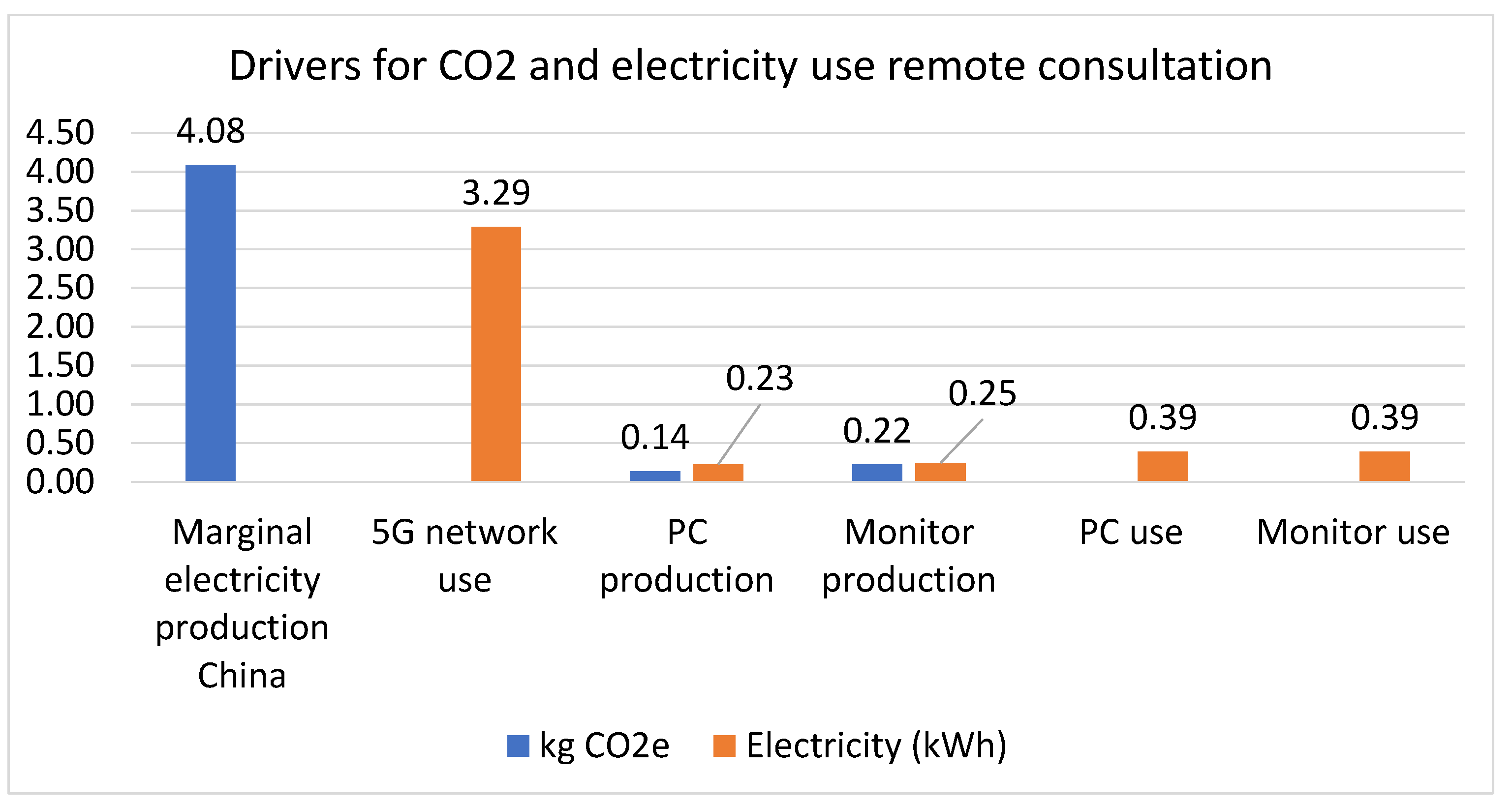
Figure 9.
Drivers for CO2 and electricity for human pipe inspection.
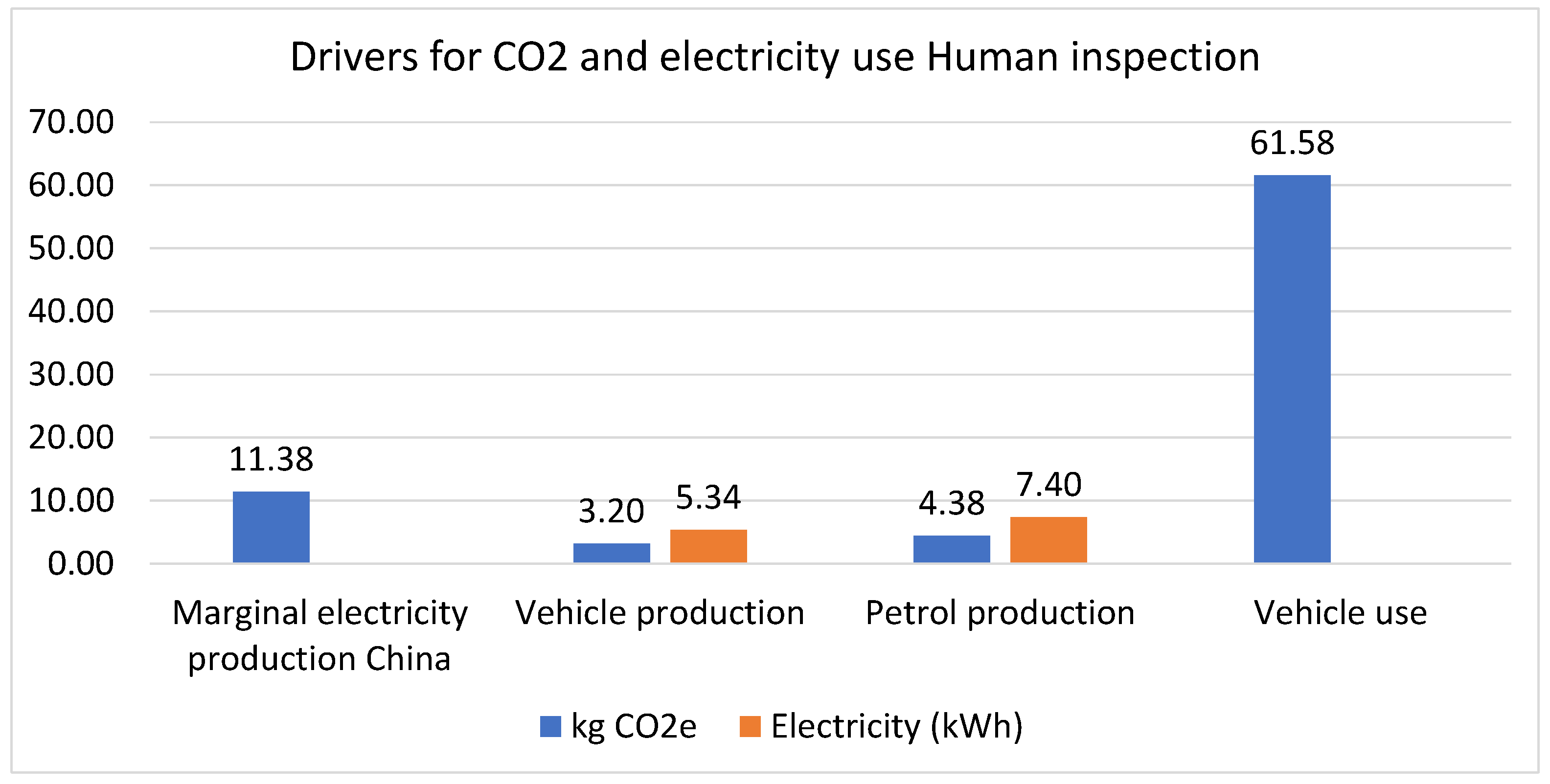
Figure 10.
Drivers for CO2 and electricity for UAV pipe inspection.
4. Discussion
The topic of avoided impact is both a bottom-up and a top-down issue. It spans from specific ICT Services to ICT impact on the whole society (Figure 1).
The overall effect of avoided carbon is very complex [34,35,36,37] and more research is necessary on hypotheses to be tested.
For the proposed SCLCA approach, Figure 4 to Figure 6 do not show significant differences for chosen ICT Service systems compared to ALCA. Anyway, the proposed method at least contains the possibility for marginal technologies, data volumes and replace/reuse considerations.
The differences may become larger if marginal fuel type producers are introduced and if the correct marginal consumers could be identified. Hence, the general conclusion that SCLCA will not show considerably different results than SALCA, for bottom-up ICT Service avoided impact calculations, cannot yet be drawn.
Equation (1) does not deal with reductions of total societal sectors like [14] but is a bottom-up approach for non-experts looking at ICT Services.
Corporate annual reporting of avoided impacts refers to impacts of sold products having causation outside Scope 1 and 2 [38]. Apart from the absolute impact, it is logical that Scope 3 Category 11 (use of sold products and services) should also contain the (separately reported) avoided impact from sold products and services. The proposed approach can support such corporate calculations. The reason is that the functional units defined for the ICT Services are reflecting the functions sold by each company.
Furthermore, Detailed CLCA (DCLCA) will need a basic description of the economy in monetary units.
Is it realistic to include higher order effects before very fine granular impact and computable general equilibrium models [12] have been established worldwide? If such databases were available for DCLCA, the consequences of introducing specific technologies in the economies could be more accurately predicted. However, the level of aggregation for such models is still a problem for studying specific systems for which ALCA or SCLCA is more appropriate. Still, databases such as ''Full International and Global Accounts for Research in inputOutput analysis' (FIGARO) and EXIOBASE [39] lack the detailed industry, engineering, and household data that are needed for generating emission profiles at the detailed product and service level.
For all methods listed in Table 1 the main issue concerns how far the studied product system needs to be expanded to get useful and informed results.
DCLCA will often lead to complex identifications as it tends to be hard to point out the correct marginal consumers and producers in a ripple effect analysis. A typical example is the physical meeting versus virtual meeting exemplified in section 2.4. A related example is “office work”. A popular dematerialization case is flexible work in which physical meetings/office work are replaced by online meetings/home office, reducing commuting and business travel. Another reduction effect is for the office space.
Both the baseline system and target system can provide space for apartments.
Function: Providing area in buildings suitable for office work places and residential apartments.
The functional unit is: “A working place subsystem providing the area to be suited for the needs of one employee and one resident for one year”. The baseline system has to provide residential area places by building new ones while the target system can provide office work at home and residential area space by refurbishing office area which is no longer needed. Here it is not certain which is the marginal consumer of surplus office space created by smart home offices. In Figure 11 and Figure 12 it is assumed that refurbished apartments area is the marginal consumer.
The SCLCA scenario for avoided impact may look like “Transport to company office plus construction and use (with marginal electricity) of new apartments” minus “Marginal electricity for home office + ICT Service enabling home office”. Still, it should be attempted to make scenarios of (maybe also do modelling of) the plausible avoided impacts with DCLCA and further system expansion. However, when no significant changes in surrounding markets are to be expected, DCLCA is superfluous.
The number of both statistical and causal factors which influence the identification of the marginal technologies in DCLCA should not be underestimated. SCLCA is a practical way forward.
While several efforts are ongoing attempting to standardize the avoided impact calculation, the SCLCA method is rather neglected so far.
It remains to be researched whether SCLCA is generally applicable to e.g. Smart Energy Systems [40].
5. Conclusions
SALCA would give the same conclusion as SCLCA for the chosen systems of pipe inspection and health consultation. A bottom-up approach of using SCLCA, reuse/replace scenarios and data volume approach is developed which give reasonable results and can be used by non-LCA experts.
Author Contributions
Andrae wrote the entire paper.
Funding
This research received no external funding.
Conflicts of Interest
The author declares no conflict of interest.
References
- Heijungs, R. Identification of key issues for further investigation in improving the reliability of life-cycle assessments. J. Clean. Prod. 1996, 4, 159-166. [CrossRef]
- Andrae, A.S.G. Method based on market changes for improvement of comparative attributional life cycle assessments. Int. J. Life Cycle Assess. 2015, 20, 263-275. DOI 10.1007/s11367-014-0830-2.
- Wang, L.; T. Zhu, T. Will the Digital Economy Increase Energy Consumption?–An Analysis Based on the ICT Application Research. Chinese J. Urban Environ. Studies 2022, 10, p. 2250001. [CrossRef]
- Hischier, R.; Reichart, I. Multifunctional electronic media-traditional media: The Problem of an Adequate Functional Unit A case study of a printed newspaper, an internet newspaper and a TV broadcast. Int. J. Life Cycle Assess. 2003, 8, 201-208. [CrossRef]
- Jeswani, H.K.; Azapagic, A. Is e-reading environmentally more sustainable than conventional reading?. Clean Technol. Environ. Policy 2015, 17, 803-809. [CrossRef]
- Chavanne, X.; Schinella, S.; Marquet, D.; Frangi, J.P.; Le Masson, S. Electricity consumption of telecommunication equipment to achieve a telemeeting. Appl. Energy 2015, 137, 273-281. [CrossRef]
- Seidel, A.; May, N.; Guenther, E.; Ellinger, F. Scenario-based analysis of the carbon mitigation potential of 6G-enabled 3D videoconferencing in 2030. Telemat. Inform. 2021, 64, 101686. [CrossRef]
- Andrae, A.S.G. Comparative micro life cycle assessment of physical and virtual desktops in a cloud computing network with consequential, efficiency, and rebound considerations. J.Green Eng. 2013, 3, 193-218.
- Kopp, T.; Nabernegg, M.; Lange, S. The net climate effect of digitalization, differentiating between firms and households. Energ. Econ. 2023, 106941. [CrossRef]
- Maga, D.; Hiebel, M.; & Knermann, C. Comparison of two ICT solutions: desktop PC versus thin client computing. Int. J. Life Cycle Assess. 2013, 18, 861-871. [CrossRef]
- Lange, S.; Pohl, J.; Santarius, T. Digitalization and energy consumption. Does ICT reduce energy demand?. Ecol. Econ., 2020, 176, 106760. [CrossRef]
- Sorrell, S. Digitalisation of goods: a systematic review of the determinants and magnitude of the impacts on energy consumption. Environ. Res. Let. 2020, 15, 043001. DOI 10.1088/1748-9326/ab6788.
- Zhang, X.; M. Shinozuka, M.; Y. Tanaka, Y.; Y. Kanamori, Y.; Masui, T. How ICT can contribute to realize a sustainable society in the future: a CGE approach. Environ. Dev. Sustain. 2022, 24, 5614-5640. [CrossRef]
- Andrae, A.S.G. Internet’s handprint, Eng. Appl. Sci. Let. 2021, 4, 80-97. [CrossRef]
- Bieser, J.; Hilty, L. Assessing indirect environmental effects of information and communication technology (ICT): A systematic literature review. Sustainability, 2018, 10, 2662.1. [CrossRef]
- Kasurinen, H.; Vatanen, S.; Grönman, K.; Pajula, T.; Lakanen, L.; Salmela, O.; Soukka, R. Carbon handprint: Potential climate benefits of a novel liquid-cooled base station with waste heat reuse. Energies 2019, 12, 4452. [CrossRef]
- Yang, Y.; Heijungs, R. On the use of different models for consequential life cycle assessment. Int. J. Life Cycle Assess. 2018, 23, 751-758. [CrossRef]
- Andrae, A.S.G. Comparative screening life cycle impact assessment of renewable and fossil power supply for a radio base station site. Int. J. Green Technol. 2015, 1, 21-34.
- Li, X.; Liu, J.; Ni, P. The Impact of the Digital Economy on CO2 Emissions: A Theoretical and Empirical Analysis. Sustainability 2021, 13, 7267. [CrossRef]
- Lei, X.; Ma, Y.; Ke, J.; Zhang, C. The Non-Linear Impact of the Digital Economy on Carbon Emissions Based on a Mediated Effects Model. Sustainability 2023, 15, 7438. [CrossRef]
- Shu, L.H.; Duflou, J.; Herrmann, C.; Sakao, T.; Shimomura, Y.; De Bock, Y.; Srivastava, J. Design for reduced resource consumption during the use phase of products. CIRP annals 2017, 66, 635-658. [CrossRef]
- Bovea, M.D.; Ibáñez-Forés, V.; Pérez-Belis, V. Repair vs. replacement: Selection of the best end-of-life scenario for small household electric and electronic equipment based on life cycle assessment. J. Environ. Manag. 2020, 254, 109679. [CrossRef]
- Andrae, A.S.G. From an Environmental Viewpoint Large ICT Networks Infrastructure Equipment must not be Reused. WSEAS Trans. Env. Dev. 2023, 19, 375-382. [CrossRef]
- Chan, C.A.; Wong, E.; Nirmalathas, A.; Gygax, A.F.; Leckie, C.; Kilper, D.C. Towards an energy rating system for telecommunications. Telecommun. J. Australia 2012, 62, 77.1-77.10.
- Ullrich, N.; Piontek, F.M.; Herrmann, C.; Saraev, A.; Viere, T. Estimating the resource intensity of the Internet: A meta-model to account for cloud-based services in LCA. Procedia CIRP 2022, 105, 80-85. [CrossRef]
- Oxenløwe, L.K.; Saudan, Q.; Riebesehl, J.; Zahidy, M.; Swain, S. Evaluating Energy Consumption of Internet Services. IEICE Trans. Comm. 2023, 2022OBI0001. [CrossRef]
- Andrae, A.S.G; Edler, T. On global electricity usage of communication technology: trends to 2030. Challenges 2015, 6, 117-157. [CrossRef]
- Rueda-Cantuche, J.M; Beutel, J.; Neuwahl, F.; Mongelli, I.; Loeschel, A. A symmetric input–output table for EU27: latest progress. Econ. Sys. Res. 2009, 21, 59-79. [CrossRef]
- Ingwersen, W.W.; Li, M.; Young, B.; Vendries, J.; Birney, C. USEEIO v2. 0, the US environmentally-extended input-output model v2. 0. Sci. Data 2022, 9, 194.
- Thomassen, M.A.; Dalgaard, R.; Heijungs, R.; De Boer, I. Attributional and consequential LCA of milk production. Int. J. Life Cycle Assess. 2008, 13, 339-349. [CrossRef]
- Ahlgren, S.; Baky, A.; Bernesson, S.; Nordberg, Å.; Norén, O.; Hansson, P.A. Consequential life cycle assessment of nitrogen fertilisers based on biomass–a Swedish perspective. Insciences J. 2012, 2, 80-101. doi: 10.5640/insc.020480.
- Green 5G: building a sustainable world. Available online: https://www.analysysmason.com/research/content/perspectives/green-5g-sustainability-rma18-rdns0/ (accessed on 10 October 2023).
- Zhao, G.; Guerrero, J.M.; Pei, Y. Marginal generation technology in the Chinese power market towards 2030 based on consequential life cycle assessment. Energies 2016, 9, 788. [CrossRef]
- Mörner, N.A. The approaching new grand solar minimum and little ice age climate conditions. Nat. Sci. 2015, 7, 510. [CrossRef]
- Svensmark, H.; Svensmark, J.; Enghoff, M.B.; Shaviv, N. J. Atmospheric ionization and cloud radiative forcing. Sci. Rep. 2021, 11, 19668. [CrossRef]
- Koutsoyiannis, D.; Onof, C.; Kundzewicz, Z.W.; Christofides, A. On Hens, Eggs, Temperatures and CO2: Causal Links in Earth’s Atmosphere. Sci 2023, 5, 35. [CrossRef]
- Dagsvik, J.K.; Fortuna, M.; Moen, S.H. How does temperature vary over time?: evidence on the stationary and fractal nature of temperature fluctuations. J. R. Stat. Soc. Ser. A Stat. Soc. 2020, 183, 883-908. [CrossRef]
- Kumar Rajesh Jha, A.; Andrae, A.S.G.; Mainali, B. Comparison of Methods for Calculating Indirect Upstream Carbon Emissions from Information and Communication Technology Manufacturing. WSEAS Trans. Env. Dev. 2023, 19, 1045-1097. [CrossRef]
- Merciai, S.; Schmidt, J. Methodology for the construction of global multi-regional hybrid supply and use tables for the EXIOBASE v3 database. J. Ind. Ecol. 2018, 22, 516-531. [CrossRef]
- Wohlschlager, D.; Bluhm, H.; Beucker, S.; Pohl, J.; Fröhling, M. Overcoming challenges in life cycle assessment of smart energy systems–A map of solution approaches. J. Clean. Prod. 2023, 138584. [CrossRef]
Figure 1.
Hierarchy for estimation of avoided impact of ICT and the focus of the present research.

Figure 2.
Scope of baseline system with proposed simplified CLCA method for cooling of base station.
Figure 2.
Scope of baseline system with proposed simplified CLCA method for cooling of base station.
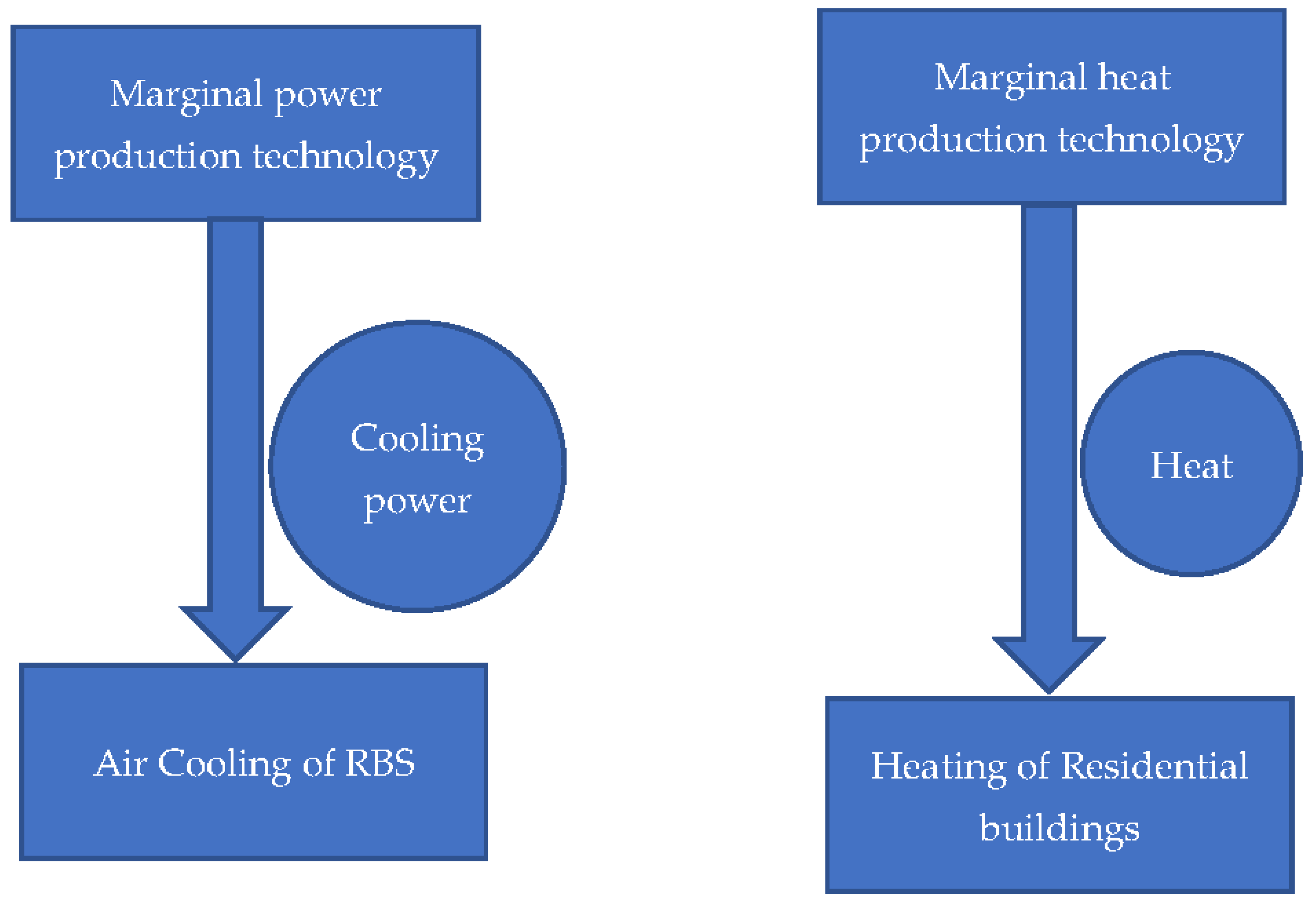
Figure 3.
Scope of target system with proposed simplified CLCA method for cooling of base station.
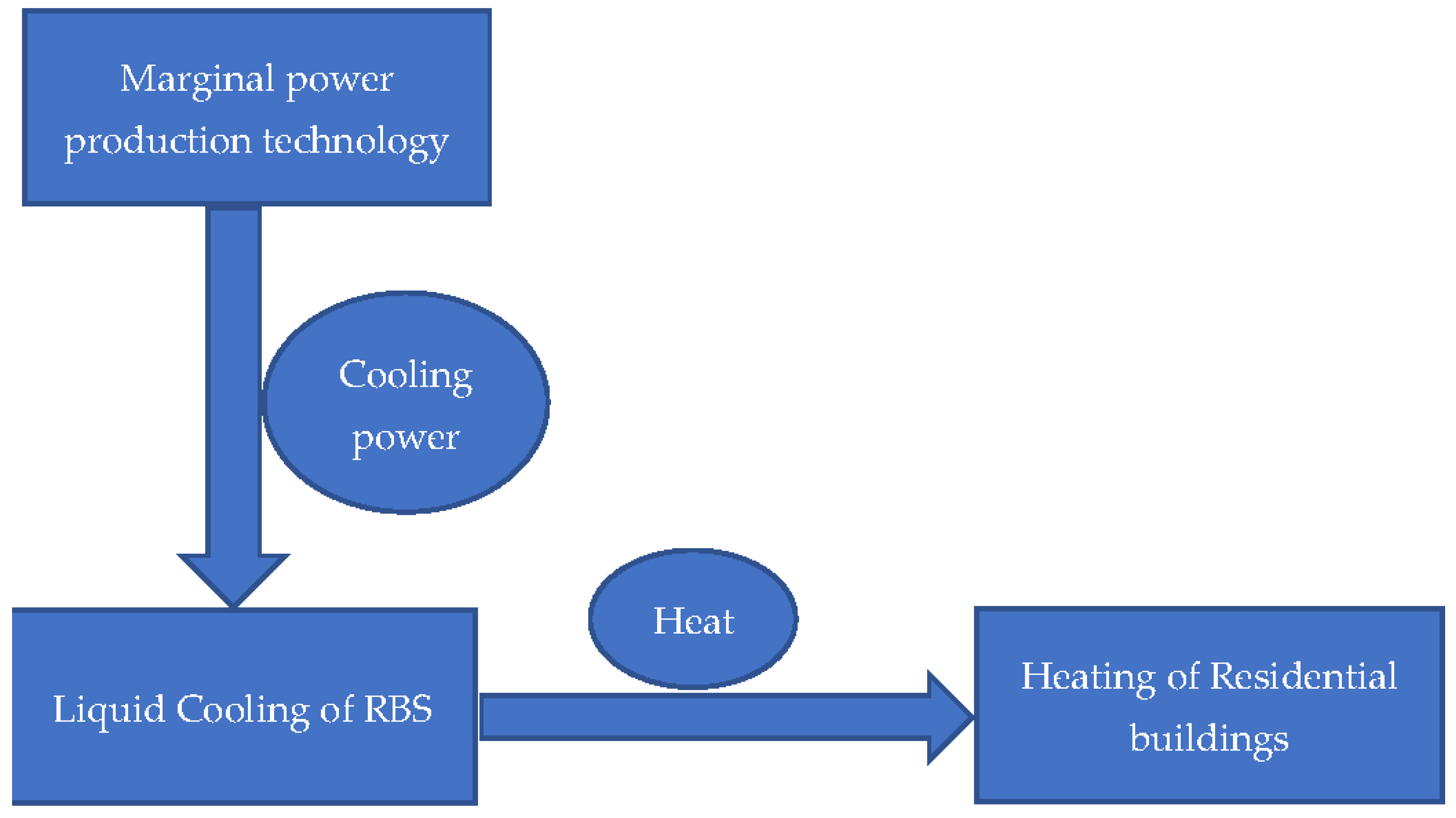
Figure 4.
Difference between ALCA [16] and proposed simplified CLCA for base station cooling.
Figure 4.
Difference between ALCA [16] and proposed simplified CLCA for base station cooling.
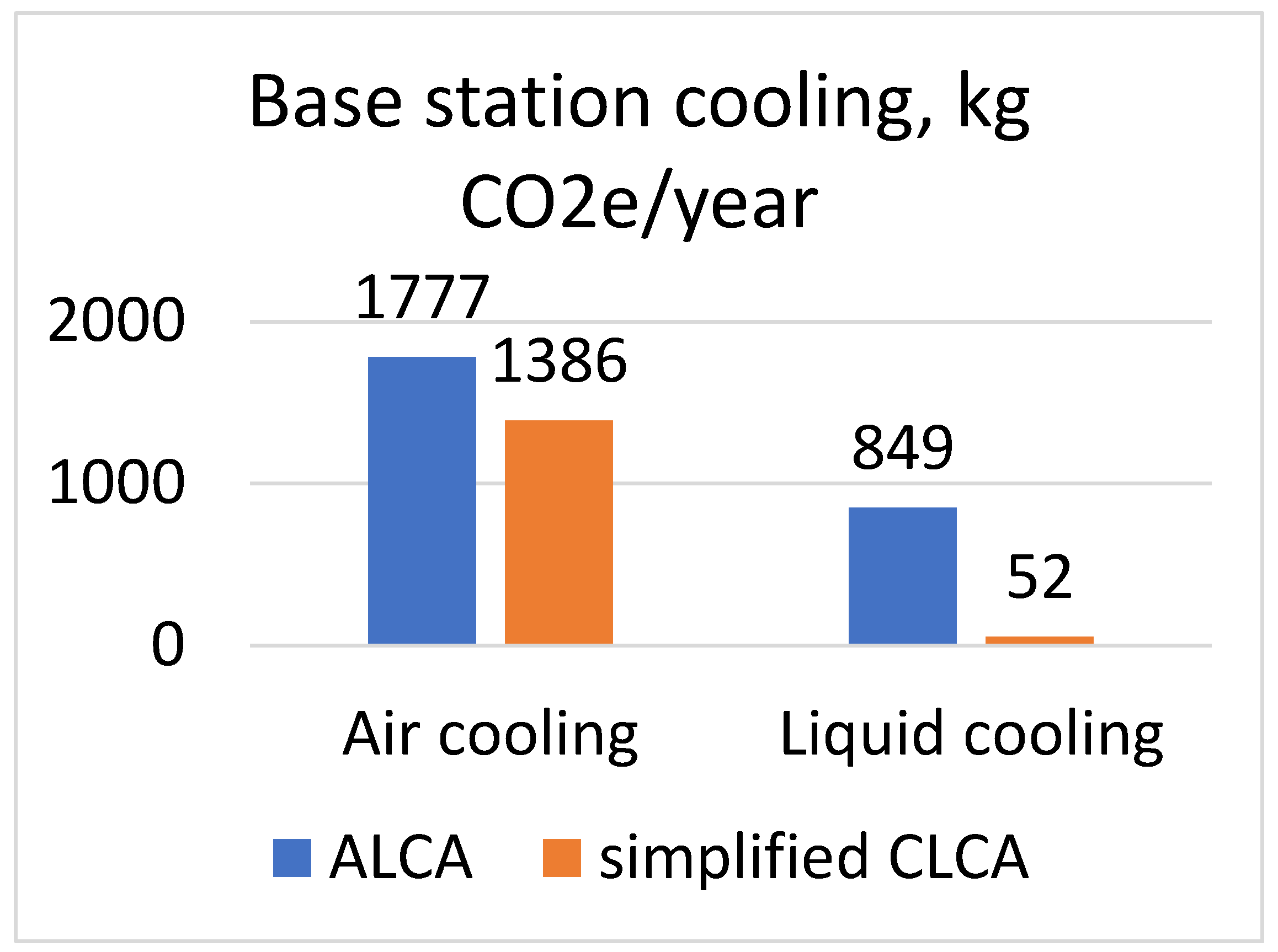
Figure 5.
Difference between ALCA [32] and proposed simplified CLCA for pipe inspection.
Figure 5.
Difference between ALCA [32] and proposed simplified CLCA for pipe inspection.
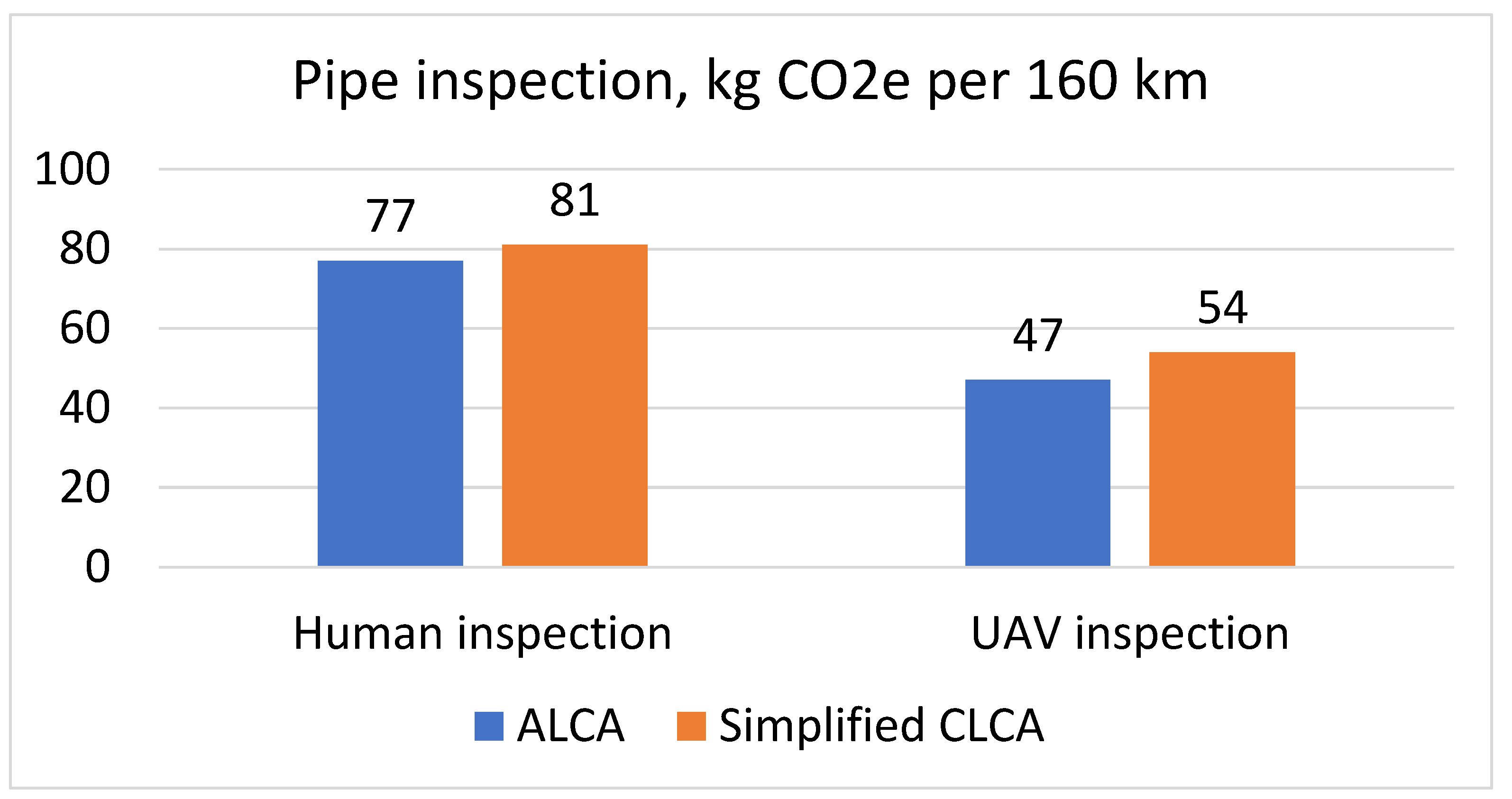
Figure 6.
Difference between ALCA [32] and proposed simplified CLCA for health consultation.
Figure 6.
Difference between ALCA [32] and proposed simplified CLCA for health consultation.
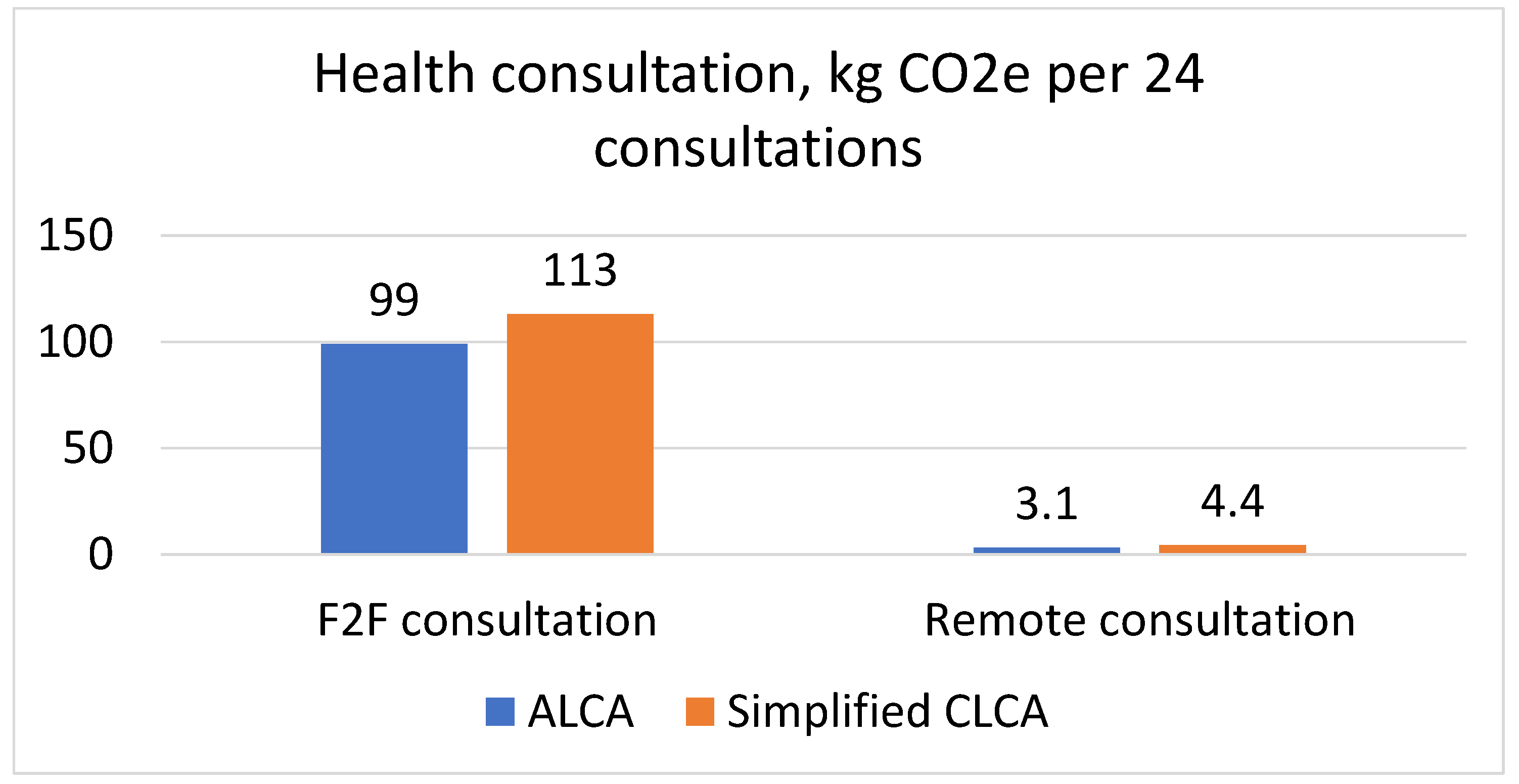
Figure 7.
Drivers for CO2 and electricity for F2F health consultation.

Figure 11.
Scope of baseline system with proposed simplified CLCA method for office work in area (A).
Figure 11.
Scope of baseline system with proposed simplified CLCA method for office work in area (A).
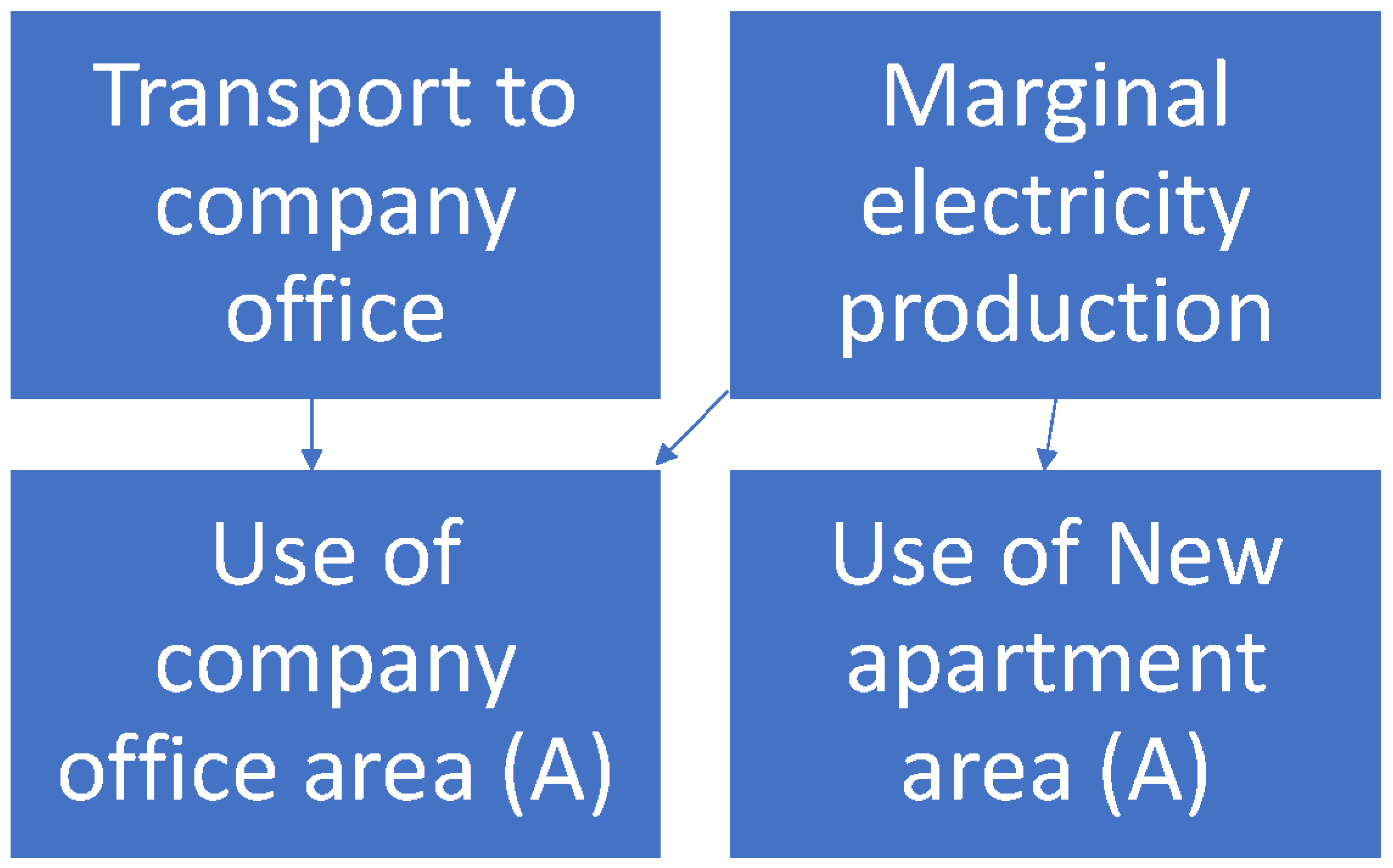
Figure 12.
Scope of target system with proposed simplified CLCA method for office work in area (A).
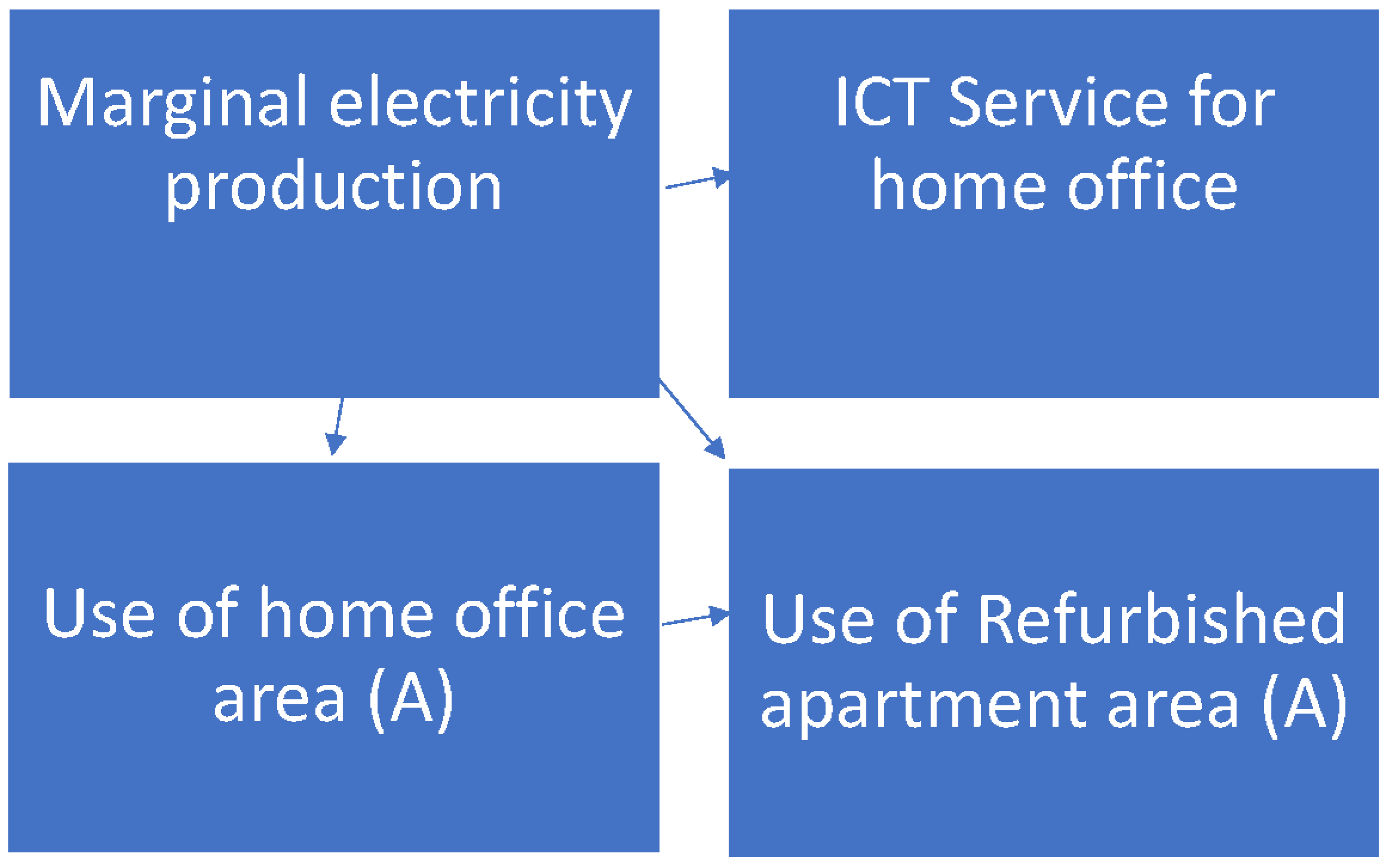
Table 1.
Comparison of methodological approaches for quantifying avoided impact of ICT Services.
| Methodological approach | Main advantage | Main disadvantage | Complexity | Data availability | Reliability of result |
|---|---|---|---|---|---|
| Attributional LCA (ALCA) | Simplified, direct, fast if streamlined | Market effects excluded | Low | High | Medium |
| Advanced ALCA | Some market effects included | Data availability, no real added value compared to CLCA | Medium | Medium | Medium |
| Handprint ALCA | Focus on customer product systems | No real added value compared to ALCA | Medium | Medium | Medium |
| Detailed Consequential LCA (DCLCA) | High specificity, may include rebound effect | Variable interpretation of marginal data | High | Low | Low |
| Input-Output LCA | Comprehensive, fast, may include rebound effect | Low specificity | Very Low | Low | Low |
| Proposed method, Simplified CLCA | High specificity, fast, some market effects included | Rebound effect excluded | Low | High | High |
Table 3.
Parameters used by proposed simplified CLCA method by baseline and target system for cooling of base stations.
Table 3.
Parameters used by proposed simplified CLCA method by baseline and target system for cooling of base stations.
| Feature | Baseline System | Target System |
|---|---|---|
| Power consumption (kW) | 0.695 | 0.591 |
| Heat consumption (kW) | 0.4728 | |
| Environmental impact intensity of electricity used (kgCO2e/kWh) | 0.01 (Nuclear) | 0.01 (Nuclear) |
| Environmental impact intensity of heat used (kgCO2e/kWh) | 0.32 (Light fuel combustion) | |
| Calculation | 0.695 kW × 8760 hours/year × 0.01 kgCO2e/kWh + 0.591 kW × 0.8 × 8760 hours/year × 0.32 kgCO2e/kWh | 0.591 kW × 8760 hours/year × 0.01 kgCO2e/kWh |
| Total result | 1386 kg CO2e/year | 52 kg CO2e/year |
| Avoided impact | 1386 – 52 = 1334 kg CO2e/year per 0.695 kW base station | |
Disclaimer/Publisher’s Note: The statements, opinions and data contained in all publications are solely those of the individual author(s) and contributor(s) and not of MDPI and/or the editor(s). MDPI and/or the editor(s) disclaim responsibility for any injury to people or property resulting from any ideas, methods, instructions or products referred to in the content. |
© 2023 by the authors. Licensee MDPI, Basel, Switzerland. This article is an open access article distributed under the terms and conditions of the Creative Commons Attribution (CC BY) license (http://creativecommons.org/licenses/by/4.0/).
Copyright: This open access article is published under a Creative Commons CC BY 4.0 license, which permit the free download, distribution, and reuse, provided that the author and preprint are cited in any reuse.


