
Submitted:
18 October 2023
Posted:
19 October 2023
You are already at the latest version
Abstract
Aspergillus flavus is a pathogenic fungus that affects and contaminates several foodstuffs and is associated with cancer in humans. In Senegal, significant losses of groundnut production are mainly due to contamination caused by this species. This study evaluated in vitro antifungal activities of Cyperus articulatus, Cyperus rotundus and Lippia alba essential oils against A. flavus isolated from peanut seeds. Essential oils obtained by hydrodistillation of rhizomes of the two Cyperus species and leaves of L. alba were analyzed by GC-DIF and GC-MS. The essential oil yields from C. articulatus, C. rotundus and L. alba were 1.1%, 1.3% and 1.7%, respectively. These three samples had the following chemotypes: (i) Mustakone (21.4%)/eudesma-4(15)-7-dien-1β-ol (8.8%)/caryophyllene oxide (5.9%), (ii) caryophyllene oxide (25.2%)/ humulene epoxyde 2 (35.0%) and (iii) geranial (46.6%)/neral (34.6%). The three oils tested inhibited the growth of A. flavus at concentrations between 100 and 1000 ppm. The L. alba oil was the most effective with total clearance of A. flavus on PDA. For the essential oils of C. rotundus (93.65%) and C. articulatus (78.11%), the highest inhibition rates were obtained with 1000 ppm dose. Thus, the L. alba oil could be used safely as an effective protector of groundnuts against A. flavus.
Keywords:
essential oils
; Aspergillus flavus
; antifungal activity
; aflatoxin
; peanuts
; GC/MS
1. Introduction
More than 120 countries around the world grow groundnuts on more than 26.4 million hectares, for a total production of more than 50.32 million tons, with an average productivity of 1.4 tons per hectare [1,2,3]. It is the world's 4th most important oilseed crop [1]. Despite their rudimentary resources and outdated techniques, developing countries account for over 85% of global production [4]. Groundnuts are therefore an important crop both for domestic consumption and for foreign trade [1].
Groundnuts are grown across a vast area of Senegal, from the center to the east and south. Groundnut production is estimated at 1,680,000 tons in 2022 [5]. However, the sector has been rocked by a number of setbacks, including the impact of aflatoxins produced by fungi of the genus Aspergillus on stored and processed products [2,6]. Aflatoxins mainly affect food in tropical and subtropical regions of the world, where farming systems (cultivation practices, storage conditions) are not adequate to manage food safety risks [3,7]. Infestations generally begin in fields, but become more serious in storage areas (silos, warehouses) when environmental conditions become conducive to the proliferation of the fungus, causing irreversible losses [8,9,10].
These losses include changes to the appearance of the products, organoleptic changes, reduced productivity and rejection of products contaminated with aflatoxin. According to Chen et al (2013), 5 billion people are chronically exposed to aflatoxin in their diet and 80% of cases of liver cancer are linked to the consumption of food contaminated by this mycotoxin [11].
Combating aflatoxins therefore requires effective methods of controlling the development for the fungi responsible of their secretion. A range of physical, chemical and management approaches have been used to reduce the risk factor associated with post-harvest aflatoxin contamination [12,13,14,15,16,17]. However, all these strategies have several limitations, such as residual toxicity, microbial resistance as well as loss of sensory and nutritional properties of food products [18].
In this context, the use of natural products of plant origin would have better prospects as a safe and effective method against A. flavus. The role of plant products as preservative has been well known since ancient times and essential oils are especially recommended as one of the most promising natural products for fungal inhibition [12,19,20,21].
The present study aimed to determine the chemical composition of the essential oils from Cyperus articulatus, Cyperus rotundus and Lippia alba, and evaluate their antifungal action against Aspergillus flavus isolated from peanut seeds in Senegal.
2. Materials and Methods
2.1. Plant material
The samples were collected from different localities: C. articulatus rhizomes in Sedhiou; C. rotundus rhizomes in Montrolland (Thies); L. alba leaves in Sindia (Thies). The plant material was identified by the technicians from the department of botanical and geology of the Fundamental Institute of Black Africa (IFAN) of University Cheikh Anta Diop of Dakar.
2.2. Flavus strain
The A. flavus TNC2 strain used in this study was isolated in 2022 at the Plant Pathology and Weed Science Laboratory of the Plant Protection Department of Senegal from a groundnut seed sample taken in Kaolack (agro-ecological zone of the groundnut basin) during the 2022-2023 groundnut season.
Viewed from the front, it appears on the CYA medium as a powdery yellow colony without sclerotia, with a light green border. On the reverse side, the colony is brown to yellow from the centre to the periphery (Figure 1). Microscopically, it has a biseriate conidial head (Figure 2). The strain develops very rapidly, with an average colony diameter of 9 cm after 7 days in culture.
On G25N, the strain has a yellow coloration on both sides with a whitish border. It grows very slowly on this culture medium, with an average colony diameter of just 0.9 cm after 7 days' incubation.
2.3. Extraction of essential oils
Plant samples were air dried for a period of two weeks at ambient temperature. Samples were hydrodistilled (5 h) using a Clevenger-type apparatus according to the method recommended in the European Pharmacopoeia [22]. The yields of essential oils (w/w, calculated on dry weight basis) were given in the results and discussion part.
2.4. Chemical compositions
The chromatographic analyses were carried out using a Perkin-Elmer Autosystem XL GC apparatus (Walthon, MA, USA) equipped with dual flame ionization detection (FID) system and fused-silica capillary columns, namely, Rtx-1 (polydimethylsiloxane) and Rtx-wax (poly-ethyleneglycol) (60 m × 0.22 mm i.d; film thickness 0.25 μm). The oven temperature was programmed from 60 to 230°C at 2°C/min and then held isothermally at 230°C for 35 min: hydrogen was used as carrier gas (1mL/min). The injector and detector temperatures were maintained at 280°C, and samples were injected (0.2 μL of pure oil) in the split mode (1:50). Retention indices (RI) of compounds were determined relative to the retention times of a series of n-alkanes (C5–C30) by linear interpolation using the equation of Van den Dool and Kratz (1963) through Perkin-Elmer software (Total Chrom navigator). The relative percentages of the oil constituents were calculated from the GC peak areas, without application of correction factors.
Samples were also analyzed with a Perkin-Elmer Turbo mass detector (quadrupole) coupled to a Perkin-ElmerAutosystem XL, equipped with Rtx-1 and Rtx-Wax fused-silica capillary columns. The oven temperature was programmed from 60 to 230°C at 2°C/min and then held isothermally at 230°C (35 min): hydrogen was used as carrier gas (1 mL/min). The following chromatographic conditions were employed: injection volume, 0.2 μL of pure oil; injector temperature, 280°C; split, 1:80; ion source temperature, 150°C; ionization energy, 70 eV; MS (EI) acquired over the mass range, 35–350 Da; scan rate, 1 s. The identification of the components was based on: (a) the comparison of their GC retention indices (RI) on non-polar and polar columns, determined from the retention times of a series of n-alkanes with linear interpolation, with those of authentic compounds or literature data; (b) on computer matching with commercial mass spectral libraries [23,24,25] and comparison of spectra with those of our personal library; and (c) comparison of RI and MS spectral data of authentic compounds or literature data.
2.5. Treatments and incubation
The basic culture medium used in this study was Potato Dextrose Agar (PDA). It was prepared by dissolving PDA powder in distilled water at a dose of 39 g/L, followed by autoclaving at 121°C for 20 minutes. From each essential oil (EO), 1 ml was taken and mixed with 1 ml of pure ethanol to promote dissolution. Each EO + ethanol mixture was then added at different concentrations (100, 500 and 1000 ppm) to a 50 ml volume of PDA cooled to approximately 50°C. The resulting solution was shaken well for 1 minute before being dispensed into 3 Petri dishes 9 cm in diameter. As a reference control, Azoxystrobin (T10) at a dose of 1000 ppm was used instead of the EO + ethanol mixture. Three Petri dishes containing PDA+ ethanol alone were used as negative controls (Table 1). Circular portions 0.6 cm in diameter were taken from the 5-day-old fungal strain on PDA and placed centrally in the dishes containing the different culture media. These were then placed in an incubator set at 25°C.
2.6. Parameters assessed and assessment methods
Mycelial growth was monitored in all culture dishes by daily measurements of fungal colony diameter using a graduated ruler. After 7 days of culture, the inhibition rate (IR) of mycelial growth was calculated using the formula:
NT0 = colony diameter in control; NT = colony diameter in the treaty
2.7. Statistical analyses
The data collected for this study were entered into Excel, which was also used to express them graphically. Statistical analyses were carried out using R 4.3.0 software. An analysis of variance and a comparison of means were carried out between the different treatments on changes in the diameter of the mycelial colony of the Aspergillus strain, using the Student-Newmann-Keuls test with a threshold of 5%.
3. Results and discussion
3.1. Chemical composition of essential oils
The essential oil yields, the rhizomes of C. rotundus, of C. articulatus and from the leaves of L. alba were 1.67%, 1.3% and 1.1%, respectively.
The results of the chemical analyses of essential oils investigated are given in Table 2. In the essential oil of C. articulatus, 43 components were identified, accounting for 73.6% of the total composition. Mustakone (21.4%) was the main component. The other components in significant percent were eudesma-4(15)-7-dien-1β-ol (8.8%), caryophyllene oxide (5.9%), cyperene (4.8%) and humulene epoxyde 2 (4.5%). To our knowledge, this chemotype has never been described in C. articulatus essential oils. However, the high presence of muskatone has been reported in three studies, two in Brazil (i), (ii) and one in India (iii): (i) α-pinene (0.7-12.9%), mustakone (7.3-14.5%) and caryophyllene oxide (4.6-28.5%) [26]; (ii) muskatone (11.6%), cyclocolorenone (10.3%), α-pinene (8.26%), pogostol (6.36%), α-copaene (4.83%) and caryophyllene oxide (4.82%) [27]; (iii) mustakone (20.2%), longifolenaldehyde (14.9%), cedroxyde (8.7%) [28].
Forty-six components were identified in the essential oil of C. rotundus, which represented 88.7% of the total oil. The major constituents were humulene epoxyde 2 (35.0%) and caryophyllene oxide (25.2%). The other components in significant percent were longiverbenone (4.5%) and amorpha-4,7(11)-dien-3-one (3.4%). Similarly, high contents of humulene epoxide 2 (26.1%) and caryophyllene oxide (19.2%) have been reported for C. rotundus oils from Louga region in Senegal [29]. However, these compounds were at low levels or absent in essential oils of C. rotundus from Iran [30], India [31] and Brazil [31].
In the essential oil of L. alba, 19 compounds were identified, amounting to 96.4% of total oil composition. The main components are geranial (46.6%) and neral (34.6%). Another component in significant percent was trans-β-caryophyllene (4.2%). The geranial and neral mixture is also known as citral. This high citral content (neral 33.32% and geranial 50.94%) has been described in the essential oil of L. alba from Brazil [32]. Significant levels of citral have also been reported in the literature: Brazil (citral 60-72%) [33], Guatemala (geranial 26% and neral 18%) [34], India (citral 27-49%) [35]. However, citral is practically absent in other chemotypes described in the literature: limonene/piperitone (1); linalol/1,8-cineole [36]; carvone/limonene/germacrène D [33]; estragole/1,8-cineole/camphene [37]; camphre/1,8-cineole/β-cubebene [38]; linalol/β-caryophyllene/germacrene D [39]; myrcenone/(Z)-ocymenone/myrcene [34].
3.2. Antifungal activity of essential oils
Analysis of the results revealed varying degrees of sensitivity of the A. flavus strain isolated in the Taïba Niassene area (Kaolack) to the different doses of essential oils of L. alba, C. rotundus and C. articulatus used in this study. This strain is characterized by exponential growth at a temperature of 25°C, as shown by the T0 negative control containing only PDA. After three days in culture, the A. flavus strain covered the entire Petri dish. In the positive control T10 (1000 ppm) containing Azoxystrobin, a 34.3% reduction in the development of the fungus was observed after 7 days of incubation. However, the results obtained in this study showed that the essential oils were much more effective than the positive control T10 (1000 ppm) (Figure 3 and Figure 4, Table 3).
The most remarkable susceptibility of the strain was observed with L. alba essential oil. Indeed, throughout the duration of the test, no mycelial development was observed on the dishes and even at the lowest T7 doses (100 ppm). This essential oil totally inhibited the development of the strain 100%. Therefore, it has good fungicidal properties. This activity could be explained by its high content of oxygenated monoterpenes such as geranial and neral. Studies attest to the antifungal powers of these two monoterpene aldehydes (neral and geranial). According to the findings of Pandey (2017), L. alba essential oil absolutely inhibits all mycelial growth at low doses (0.28 μL/mL). This fungitoxicity also blocks any ability of the fungus to synthesise Aflatoxin B1 at 2.0 μL/mL [40]. In the same logic, Glamočlija et al., (2011) [32], Shukla et al., (2009) [41] and Mesa-Arango et al., (2009) [42] proved that geranial and neral have remarkable antifungal properties against A. flavus at the same time as they inhibit the production of aflatoxin B1 with low concentrations. Thus, L. alba essential oil could be safely used as an effective preservative for food products against fungal infections and mycotoxins due to A. flavus.
The comparison between the two species of Cyperus indicated that the essential oil of C. rotundus is more effective than that of C. articulatus. The antifungal activity of the essential oil of C. rotundus against the development of the strain of A. flavus decreases over time. Indeed, during the first 4 days of incubation, the strain was highly sensitive to this essential oil. It therefore exerted a temporary inhibitory action on mycelial growth at all doses T4 (100 ppm), T5 (500 ppm) and T6 (1000 ppm) before becoming fungistatic from the 5th day. There is thus a slight mycelial growth at all doses with a colony diameter of 1 cm. This growth continued modestly until the 7th day. At these doses T4, T5 and T6, the average diameters of the colonies of the strain are respectively 1.58 cm, 1.28 cm and 1.33 cm, giving a control efficiency rate of 83.79%, 85.00% and 93.65%. The results of this study therefore suggest that from the T5 dose the rate of inhibition of the growth of the strain is quasi-static. The pronounced effectiveness of the essential oil of C. rotundus would be related to its chemical composition. This type of chemotype has never been evaluated against A. flavus. However, previous studies have shown that extracts and essential oils of C. rotundus inhibit the growth and production of aflatoxins by A. flavus [43,44,45].
The essential oil of C. articulatus showed a fungistatic effect at its three doses T1 (100 ppm), T2 (500 ppm) and T3 (1000 ppm). After seven days of incubation, the mean growth diameter of the strain recorded was 3.10 cm at the dose of T1, i.e. an inhibition rate of 75.08%. At the T2 dose, the radial growth of the fungus is inhibited with an efficiency rate of 76.65%. It follows from the observations that the T3 dose was more effective. At this dose, the development of the fungus is stopped and the average diameter of the colony was 2.83 cm, i.e. an inhibition rate of 78.11%. The antifungal activity of the essential oil of C. articulatus is described in the literature. Swain et al (2022), showed in their study that A. flavus is very sensitive (zone of inhibition of 12 mm) to the essential oil of C. articulatus rich in Mustakone (20 mg/mL) [28].
Author Contributions
Y.T., SN. S.S., A.F., A.K., A.N., A.W., J.C. designed and coordinated the study. Y.T., A.D., C.G., A.W., J.C., J.P. carried out the extraction and chemical characterization of essential oils. S.G., S.S., A.F., C.S., M.C., A.N., A.K. evaluated the antifungal activity of these oils. All authors reviewed the results and approved the final version of the manuscript.
Acknowledgments
We thank the National Plan for the Fight against Aflatoxins in Senegal and the Territorial Collectivity of Corsica (France) for their logistical support.
Conflicts of Interest
The authors declare no conflict of interest.
References
- Manizan, A.L.; Akaki, D.; Piro-Metayer, I.; Montet, D.; Brabet, C.; Koffi-Nevry, R. Évaluation Des Pratiques Post Récolte Favorables à La Contamination de l’arachide Par Les Mycotoxines Dans Trois Régions de Côte d’Ivoire. J. Appl. Biosci. 2018, 124, 12446–12454. [Google Scholar] [CrossRef]
- Guchi, E.; Ayalew, A.; Dejene, M.; Ketema, M.; Asalf, B.; Fininsa, C. Occurrence of Aspergillus Species in Groundnut (Arachis Hypogaea L.) along the Value Chain in Different Agro-Ecological Zones of Eastern Ethiopia. Appl. Environ. Microbiol. 2014, 2, 309–317. [Google Scholar]
- Noba, K.; Ngom, A.; Guèye, M.; Bassène, C.; Kane, M.; Diop, I.; Ndoye, F.; Mbaye, M.S.; Kane, A.; Ba, A.T. L’arachide au Sénégal : état des lieux, contraintes et perspectives pour la relance de la filière. OCL. 2014, 21, D205. [Google Scholar] [CrossRef]
- Schilling, R. Données Agronomiques de Base sur la Culture Arachidière. OCL. 2001, 8, 230–236. [Google Scholar] [CrossRef]
- USDA, F.A.S. World Agricultural Production. Available online: https://apps.fas.usda.gov/PSDOnline/Circulars/2022/12/production.pdf (accessed on 17 May 2023).
- Ajmal, M.; Alshannaq, A.F.; Moon, H.; Choi, D.; Akram, A.; Nayyar, B.G.; Gibbons, J.G.; Yu, J.-H. Characterization of 260 Isolates of Aspergillus Section Flavi Obtained from Sesame Seeds in Punjab, Pakistan. Toxins 2022, 14, 117. [Google Scholar] [CrossRef]
- Dangou, J.M.; Sambo, B.-H.; Moeti, M.; Diarra-Nama, A.-J. Cancer Prevention and Control in the WHO African Region: A Plea for Action. J Afr Cancer. 2009, 1, 56–60. [Google Scholar] [CrossRef]
- Miri, Y.B.; Benabdallah, A.; Taoudiat, A.; Mahdid, M.; Djenane, D.; Tacer-Caba, Z.; Topkaya, C.; Simal-Gandara, J. Potential of Essential Oils for Protection of Couscous against Aspergillus Flavus and Aflatoxin B1 Contamination. Food Control 2023, 145, 109474. [Google Scholar] [CrossRef]
- Cho, H.-J.; Son, S.-H.; Chen, W.; Son, Y.-E.; Lee, I.; Yu, J.-H.; Park, H.-S. Regulation of Conidiogenesis in Aspergillus flavus. Cells 2022, 11, 2796. [Google Scholar] [CrossRef] [PubMed]
- DIOP, Y.; FAYE, A.; SARR, D.; COLY, A.; NGOM, S. Efficacy Test of Melaleuca leucadendra and Callistemon viminalis Essential Oils on in Vitro Control of a Strain of Aspergillus flavus Isolated from Peanut Seeds in Senegal. African Journal of Chemistry 2022, 9, 1–6. [Google Scholar]
- Chen, J.-G.; Egner, P.A.; Ng, D.; Jacobson, L.P.; Muñoz, A.; Zhu, Y.-R.; Qian, G.-S.; Wu, F.; Yuan, J.-M.; Groopman, J.D. Reduced Aflatoxin Exposure Presages Decline in Liver Cancer Mortality in an Endemic Region of China. Cancer Prev Res. 2013, 6, 1038–1045. [Google Scholar] [CrossRef]
- Hu, F.; Tu, X.-F.; Thakur, K.; Hu, F.; Li, X.-L.; Zhang, Y.-S.; Zhang, J.-G.; Wei, Z.-J. Comparison of Antifungal Activity of Essential Oils from Different Plants against Three Fungi. Food Chem Toxicol. 2019, 134, 110821. [Google Scholar] [CrossRef] [PubMed]
- Peles, F.; Sipos, P.; Kovács, S.; Gy\Hori, Z.; Pócsi, I.; Pusztahelyi, T. Biological Control and Mitigation of Aflatoxin Contamination in Commodities. Toxins 2021, 13, 104. [Google Scholar] [CrossRef] [PubMed]
- Pandey, M.K.; Kumar, R.; Pandey, A.K.; Soni, P.; Gangurde, S.S.; Sudini, H.K.; Fountain, J.C.; Liao, B.; Desmae, H.; Okori, P. Mitigating Aflatoxin Contamination in Groundnut through a Combination of Genetic Resistance and Post-Harvest Management Practices. Toxins 2019, 11, 315. [Google Scholar] [CrossRef] [PubMed]
- Bhatnagar-Mathur, P.; Sunkara, S.; Bhatnagar-Panwar, M.; Waliyar, F.; Sharma, K.K. Biotechnological Advances for Combating Aspergillus flavus and Aflatoxin Contamination in Crops. Plant sci. 2015, 234, 119–132. [Google Scholar] [CrossRef] [PubMed]
- Waliyar, F.; Osiru, M.; Ntare, B.R.; Kumar, K.V.K.; Sudini, H.; Traore, A.; Diarra, B. Post-Harvest Management of Aflatoxin Contamination in Groundnut. World Mycotoxin J. 2015, 8, 245–252. [Google Scholar] [CrossRef]
- Udomkun, P.; Wiredu, A.N.; Nagle, M.; Müller, J.; Vanlauwe, B.; Bandyopadhyay, R. Innovative Technologies to Manage Aflatoxins in Foods and Feeds and the Profitability of Application–A Review. Food control 2017, 76, 127–138. [Google Scholar] [CrossRef]
- Hu, Y.; Zhang, J.; Kong, W.; Zhao, G.; Yang, M. Mechanisms of Antifungal and Anti-Aflatoxigenic Properties of Essential Oil Derived from Turmeric (Curcuma longa L. ) on Aspergillus flavus. Food Chem. 2017, 220, 1–8. [Google Scholar] [CrossRef]
- Hou, T.; Sana, S.S.; Li, H.; Xing, Y.; Nanda, A.; Netala, V.R.; Zhang, Z. Essential Oils and Its Antibacterial, Antifungal and Anti-Oxidant Activity Applications: A Review. Food Biosci. 2022, 47, 101716. [Google Scholar] [CrossRef]
- D’agostino, M.; Tesse, N.; Frippiat, J.P.; Machouart, M.; Debourgogne, A. Essential Oils and Their Natural Active Compounds Presenting Antifungal Properties. Molecules 2019, 24, 3713. [Google Scholar] [CrossRef]
- Achar, P.N.; Quyen, P.; Adukwu, E.C.; Sharma, A.; Msimanga, H.Z.; Nagaraja, H.; Sreenivasa, M.Y. Investigation of the Antifungal and Anti-Aflatoxigenic Potential of Plant-Based Essential Oils against Aspergillus flavus in Peanuts. J Fungi. 2020, 6, 383. [Google Scholar] [CrossRef]
- Council of Europe. European Pharmacopoeia, 3rd ed.; Council of Europe: Strasbourg, 1997; ISBN 978-92-871-2991-8. [Google Scholar]
- Joulain, D.; König, W.A. The Atlas of Spectral Data of Sesquiterpene Hydrocarbons; EB-Verlag, 1998; ISBN 3- 930826-48-8.
- Adams, R.P.; others Identification of Essential Oil Components by Gas Chromatography/Mass Spectrometry.; Allured publishing corporation, Carol Stream, IL, 2007.
- NIST (National Institute of Standards and Technology), N. PC Version of the NIST/EPA/NIH Mass Spectra Library. Available online: http://www.nist.gov/srd/nist1a.cfm (accessed on 4 July 2022).
- Zoghbi, M. das G.B.; Andrade, E.H.A.; Oliveira, J.; Carreira, L.M.M.; Guilhon, G.M.S.P. Yield and Chemical Composition of the Essential Oil of the Stems and Rhizomes of Cyperus articulatus L. Cultivated in the State of Pará, Brazil. J. Essent. Oil Res. 2006, 18, 10–12. [CrossRef]
- Nogueira, M.L.; Lima, E.J.S.P. de; Adrião, A.A.X.; Fontes, S.S.; Silva, V.R.; Santos, L. de S.; Soares, M.B.P.; Dias, R.B.; Rocha, C.A.G.; Costa, E.V.; et al. Cyperus articulatus L. (Cyperaceae) Rhizome Essential Oil Causes Cell Cycle Arrest in the G2/M Phase and Cell Death in HepG2 Cells and Inhibits the Development of Tumors in a Xenograft Model. Molecules 2020, 25, 2687. [CrossRef]
- Swain, A.; Duraivadivel, P.; Choudhir, G.; Hariprasad, P. Chemical Composition and Antimicrobial Properties of the Rhizome Essential Oil of Cyperus articulatus L. Grown in Karnataka, India. Indian J Nat Prod Resour. 2022, 13, 112–118. [Google Scholar] [CrossRef]
- Cisse, K.; Gassama, D.; Thiam, A.; Ndiaye, E.H.B.; Gueye, M.T.; Fall, M. Comparative Study of S235 Steel Corrosion Inhibition by Eucalyptus camaldulensis and Cyperus rotundus Essential Oils in Hydrochloric Acid Solution. Am. J. Phys. Chem. 2021, 10, 6–15. [Google Scholar] [CrossRef]
- Ghannadi, A.; Rabbani, M.; Ghaemmaghami, L.; Malekian, N. Phytochemical Screening and Essential Oil Analysis of One of the Persian Sedges; Cyperus rotundus L. IJPSR, 2012, 3, 424. [CrossRef]
- Jirovetz, L.; Wobus, A.; Buchbauer, G.; Shafi, M.P.; Thampi, P.T. Comparative Analysis of the Essential Oil and SPME-Headspace Aroma Compounds of Cyperus rotundus L. Roots/Tubers from South-India Using GC, GC-MS and Olfactometry. J. Essent. Oil-Bear. Plants. 2004, 7, 100–106. [CrossRef]
- Glamočlija, J.; Soković, M.; Tešević, V.; Linde, G.A.; Colauto, N.B. Chemical Characterization of Lippia alba Essential Oil: An Alternative to Control Green Molds. Braz. J. Microbiol. 2011, 42, 1537–1546. [Google Scholar] [CrossRef] [PubMed]
- Tavares, E.S.; Julião, L.S.; Lopes, D.; Bizzo, H.R.; Lage, C.L.S.; Leitão, S.G. Análise Do Óleo Essencial de Folhas de Três Quimiotipos de Lippia Alba (Mill.) NE Br.(Verbenaceae) Cultivados Em Condições Semelhantes. Rev. bras. farmacogn. 2005, 15, 1–5. [Google Scholar] [CrossRef]
- Fischer, U.; Lopez, R.; Pöll, E.; Vetter, S.; Novak, J.; Franz, C.M. Two Chemotypes within Lippia alba Populations in Guatemala. Flavour Fragr. J. 2004, 19, 333–335. [Google Scholar] [CrossRef]
- Kumar, S.; Bahl, J.R.; Bansal, R.P.; Garg, S.N.; Naqvi, A.A.; Khanuja, S.P.S.; Shasany, A.K.; Darokar, M.P.; Singh, V.; Sinha, S. Lippia Alba Plant Named ‘Bhurakshak’ 2002.
- Atti-Serafini, L.; Pansera, M.R.; Atti-Santos, A.C.; Rossato, M.; Pauletti, G.F.; Rota, L.D.; Paroul, N.; Moyna, P. Variation in Essential Oil Yield and Composition of Lippia alba (Mill. NE Br.) Grown in Southern Brazil. Rev. Bras. Pl. Med. 2002, 4, 72–74. [Google Scholar]
- Tucker, A.O.; Madarello, M.J. Volatile Leaf Oil of the “Licorice Verbena”[Lippia alba (Mill.) NE Brown Ex Britton and P. Wils. Var. Carterae Moldenke] from the North American Herb Trade. J. Essent. Oil Res. 1999, 11, 314–316. [Google Scholar] [CrossRef]
- Dellacassa, E.; Menéndez, P.; Moyna, P.; Soler, E. Chemical Composition of Eucalyptus Essential Oils Grown in Uruguay. Flavour Fragr. J. 1990, 5, 91–95. [Google Scholar] [CrossRef]
- Lorenzo, D.; Paz, D.; Davies, P.; Vila, R.; Canigueral, S.; Dellacassa, E. Composition of a New Essential Oil Type of Lippia alba (Mill.) NE Brown from Uruguay. Flavour Fragr. J. 2001, 16, 356–359. [Google Scholar] [CrossRef]
- Pandey, A.K.; Sonker, N.; Singh, P. Efficacy of Some Essential Oils against Aspergillus flavus with Special Reference to Lippia alba Oil an Inhibitor of Fungal Proliferation and Aflatoxin B1 Production in Green Gram Seeds during Storage. J. Food Sci. 2016, 81, M928–M934. [Google Scholar] [CrossRef] [PubMed]
- Shukla, R.; Kumar, A.; Singh, P.; Dubey, N.K. Efficacy of Lippia alba (Mill.) NE Brown Essential Oil and Its Monoterpene Aldehyde Constituents against Fungi Isolated from Some Edible Legume Seeds and Aflatoxin B1 Production. Int. J. Food Microbiol. 2009, 135, 165–170. [CrossRef]
- Mesa-Arango, A.C.; Montiel-Ramos, J.; Zapata, B.; Durán, C.; Betancur-Galvis, L.; Stashenko, E. Citral and Carvone Chemotypes from the Essential Oils of Colombian Lippia alba (Mill.) NE Brown: Composition, Cytotoxicity and Antifungal Activity. Mem. Inst. Oswaldo Cruz. 2009, 104, 878–884. [Google Scholar] [CrossRef] [PubMed]
- Abd El-Kaream, G.F. Role of Cyperus rotundus Oil in Decreasing Hair Growth. J. Complement. Med. Res. 2012, 1, 111–118. [Google Scholar]
- Abo-Altemen, R.A.; Al-Shammari, A.M.; Shawkat, M.S. GC-MS Analysis and Chemical Composition Identification of Cyperus rotundus L. from Iraq. Energy Procedia 2019, 157, 1462–1474. [Google Scholar] [CrossRef]
- Aeganathan, R.; Rayar, A.; Ilayaraja, S.; Prabakaran, K.; Manivannan, R. Anti-Oxidant, Antimicrobial Evaluation and GC-MS Analysis of Cyperus rotundus L. Rhizomes Chloroform Fraction. AJEthno. 2015, 2, 14–20. [Google Scholar]
Figure 1.
Macroscopic illustration of the A. flavus TNC2 strain on CYA (A) and G25N (B).
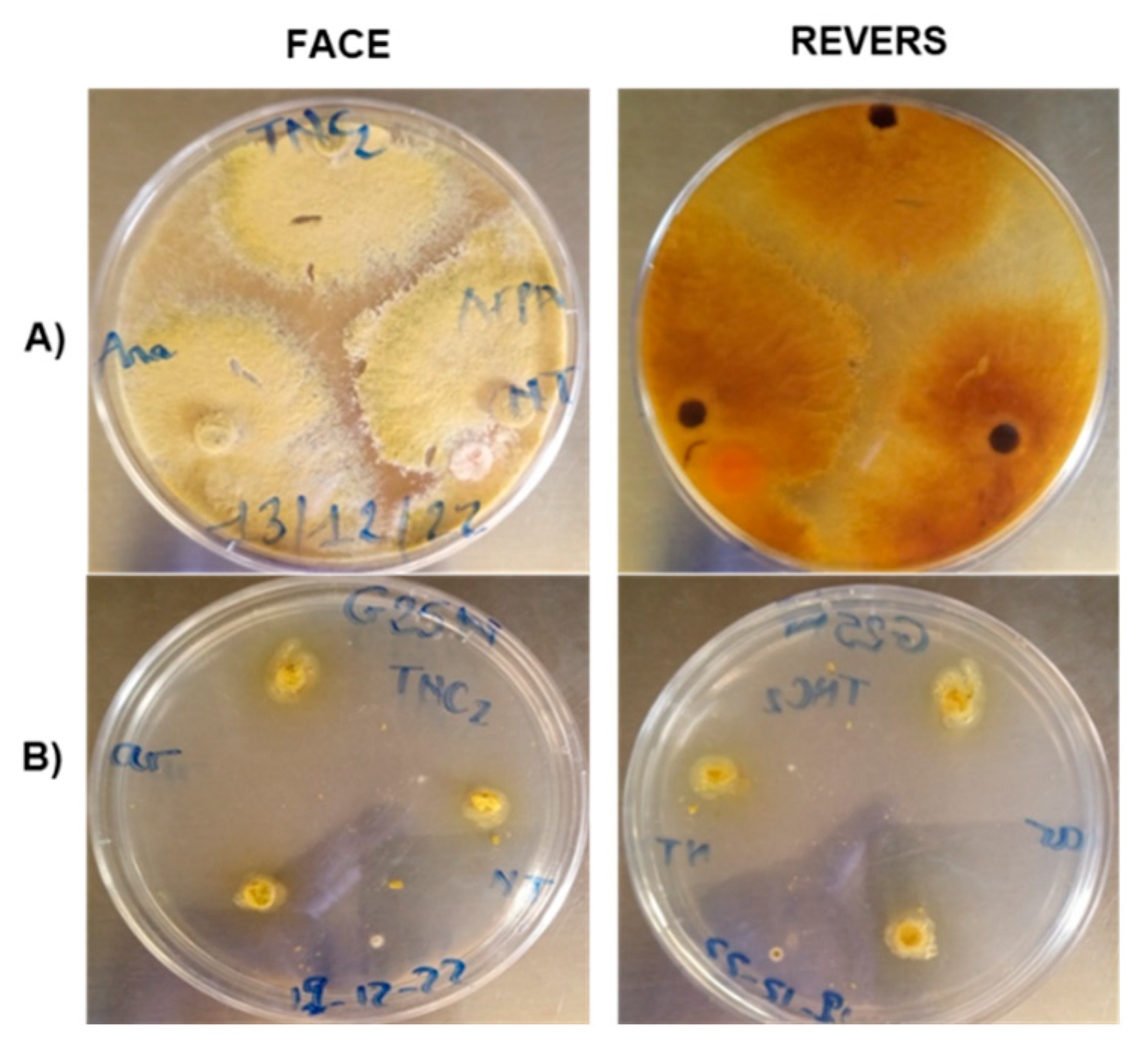
Figure 2.
Microscopic illustration of the A. flavus TNC2 strain.
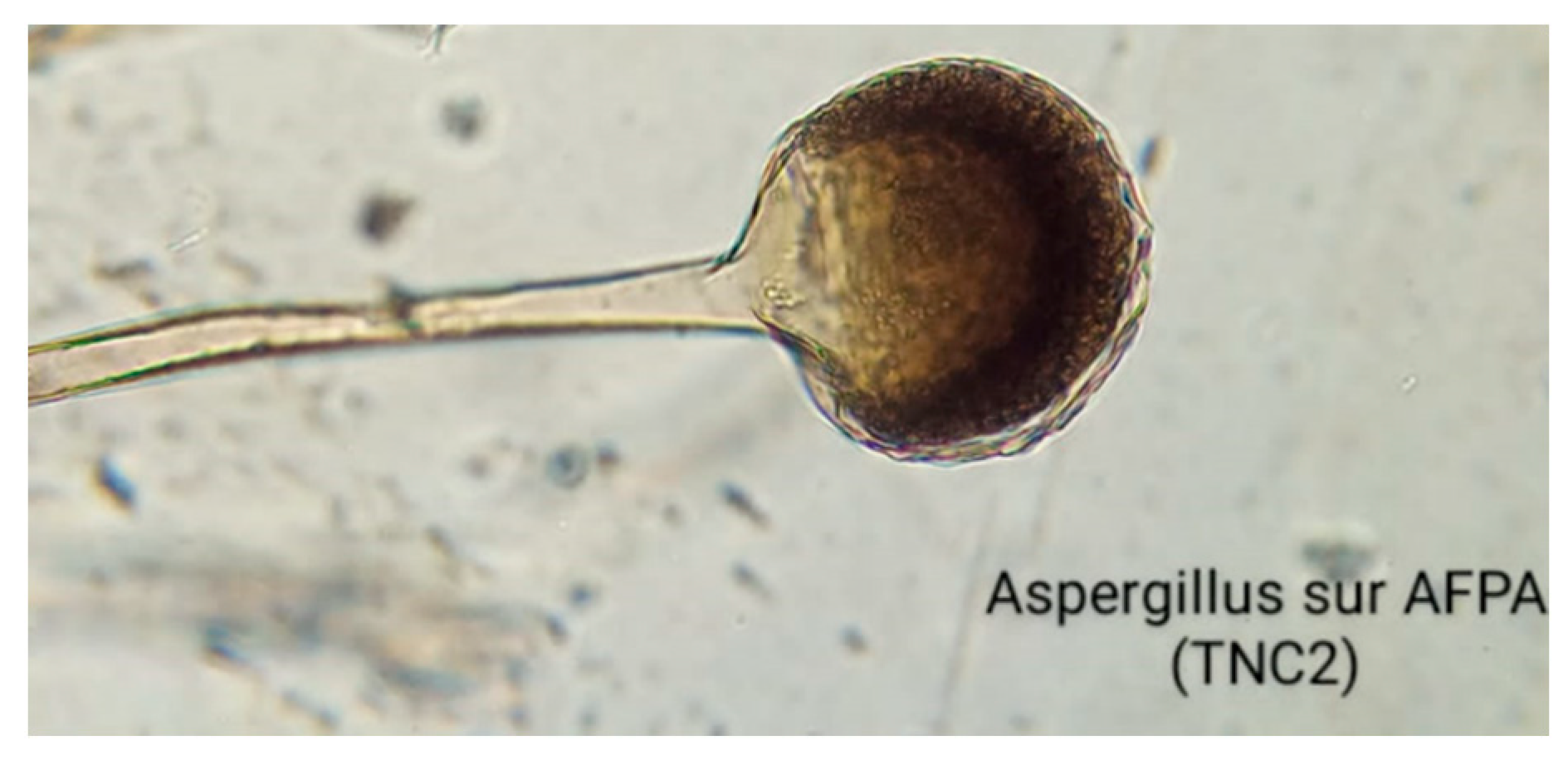
Figure 3.
Illustration of the impact of treatments on the mycelial growth of the fungal strain with: A : C. articulatus essential oil in three different doses: T1 (100 ppm), T2 (500 ppm) et T3 (1000 ppm); B: C. rotundus essential oil in three different doses: T4 (100 ppm), T5 (500 ppm) et T6 (100 ppm); C : L. alba essential oil in three different doses: T7 (100 ppm), T8 (500 ppm) et T9 (1000 ppm); D : Azoxystrobin (1000 ppm); PDA : negative control.
Figure 3.
Illustration of the impact of treatments on the mycelial growth of the fungal strain with: A : C. articulatus essential oil in three different doses: T1 (100 ppm), T2 (500 ppm) et T3 (1000 ppm); B: C. rotundus essential oil in three different doses: T4 (100 ppm), T5 (500 ppm) et T6 (100 ppm); C : L. alba essential oil in three different doses: T7 (100 ppm), T8 (500 ppm) et T9 (1000 ppm); D : Azoxystrobin (1000 ppm); PDA : negative control.
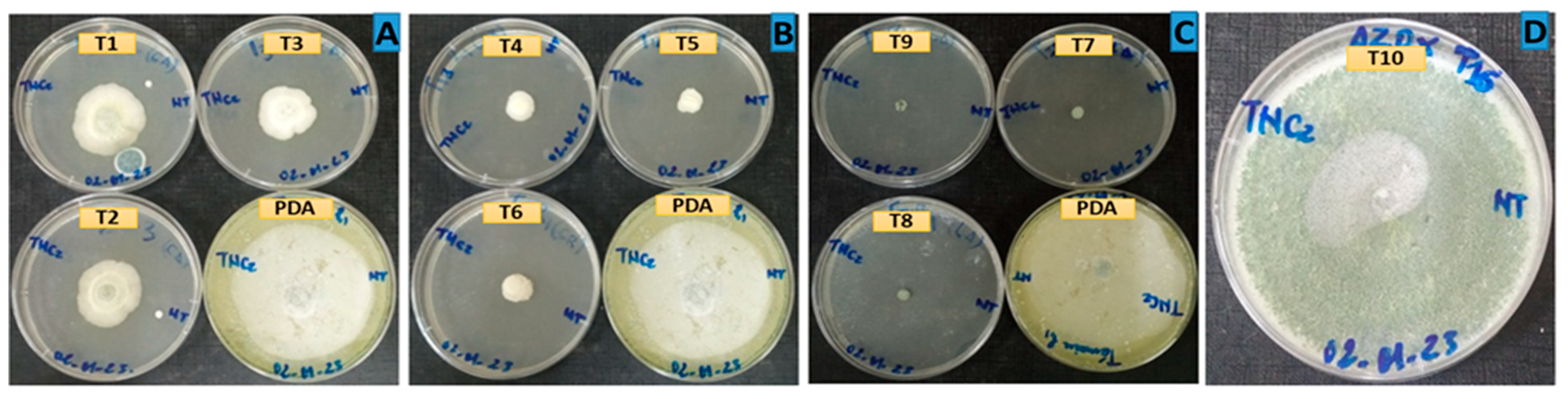
Figure 4.
Evolutionary tendencies of the inhibition of the fungus growth by the three essential oils / A: Essential oil of C. articulatus; B: C. rotundus essential oil; C: Lippia alba essential oil.
Figure 4.
Evolutionary tendencies of the inhibition of the fungus growth by the three essential oils / A: Essential oil of C. articulatus; B: C. rotundus essential oil; C: Lippia alba essential oil.
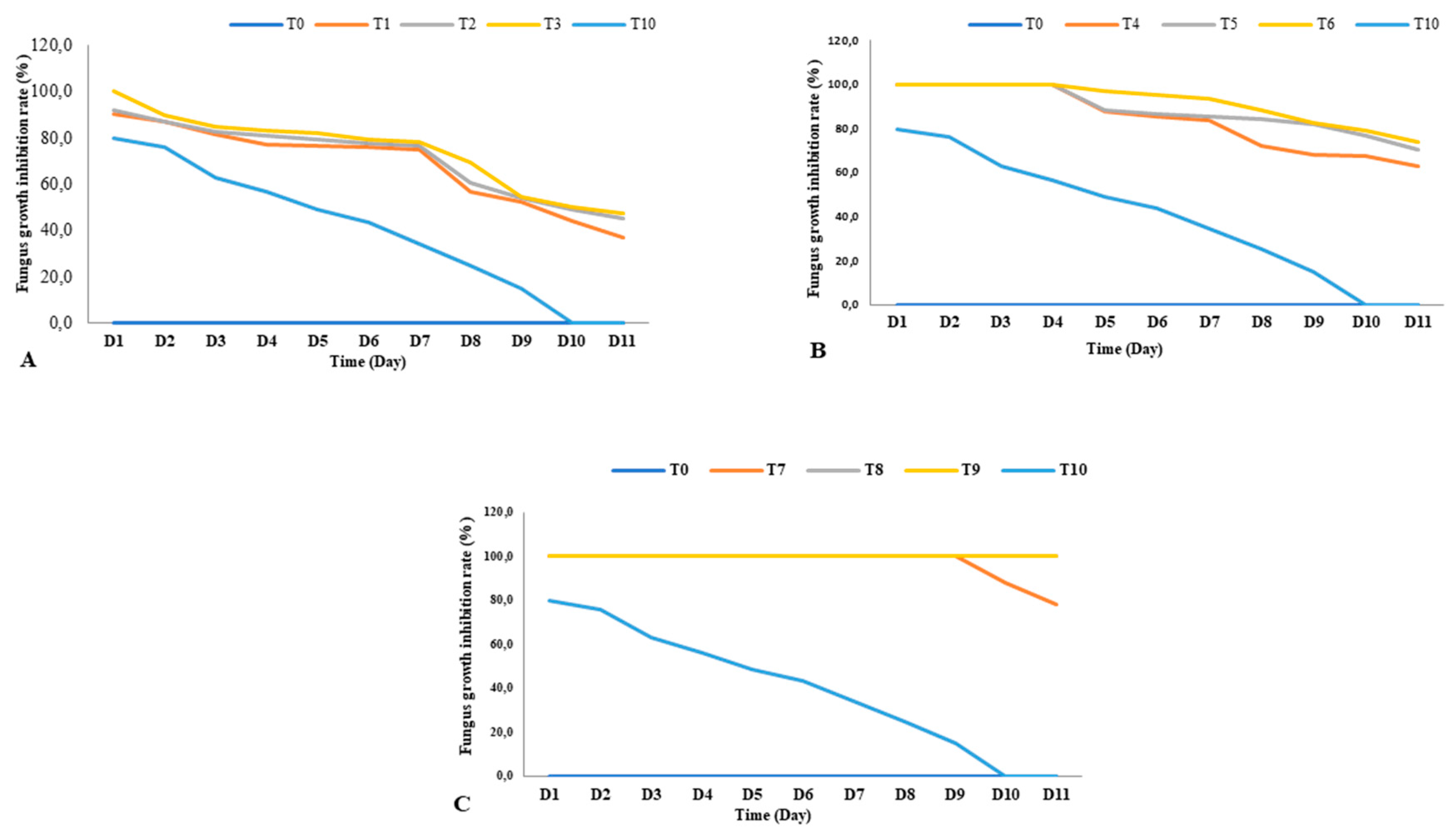

Table 1.
Overview of different treatments
| Treatment code | Products | Doses (ppm) | Study status |
|---|---|---|---|
| T0 | PDA + ethanol | - | Negative control |
| T1 | EO of C. articulatus | 100 | Tested |
| T2 | 500 | ||
| T3 | 1000 | ||
| T4 | EO of C. rotondus | 100 | |
| T5 | 500 | ||
| T6 | 1000 | ||
| T7 | EO of L. alba | 100 | |
| T8 | 500 | ||
| T9 | 1000 | ||
| T10 | Azoxystrobin | 1000 | Positive control |
Table 2.
Chemical composition of the essential oils of C. articulatus, C. rotundus and L. alba.
| Na | Compounds | lRIb | RIac | RIpd | C. articulatus | C. rotondus | L. alba |
| 1 | α-Pinene | 931 | 931 | 1015 | 0.5 | 0.7 | - |
| 2 | Tuja-2,4(10)diene | 946 | 941 | 1123 | 0.1 | - | - |
| 3 | 6-Methylhept-5-en-2-one | 963 | 963 | 1337 | - | - | 0.5 |
| 4 | β-Pinene | 978 | 972 | 1108 | 0.3 | 0.6 | - |
| 5 | p-Cymene | 1015 | 1013 | 1264 | 0.1 | 0.1 | - |
| 6 | Limonene | 1025 | 1022 | 1200 | 0.1 | 0.4 | 0.7 |
| 7 | (E)-β-Ocimene | 1041 | 1034 | 1247 | - | - | 0.1 |
| 8 | γ-Terpineole | 1051 | 1058 | 1239 | 0.1 | - | - |
| 9 | p-Cymenene | 1075 | 1071 | 1432 | 0.1 | - | - |
| 10 | Linalol | 1086 | 1081 | 1544 | - | - | 0.5 |
| 11 | Nopinone | 1116 | 1108 | 1578 | - | 0.1 | - |
| 12 | α-Camphenal | 1105 | 1109 | 1481 | 0.3 | 0.1 | - |
| Na | Compounds | lRIb | RIac | RIpd | C. articulatus | C. rotondus | L. alba |
| 13 | Trans-pinocarveol | 1126 | 1127 | 1650 | 1.7 | - | - |
| 14 | Citronellal | 1132 | 1131 | 1479 | - | - | 0.1 |
| 15 | Cis-verbenol | 1132 | 1131 | 1655 | - | 0.1 | - |
| 16 | Transverbenone | 1136 | 1131 | 1652 | 0.8 | - | - |
| 17 | Pinocarvone | 1137 | 1141 | 1558 | 0.4 | 0.2 | - |
| 18 | p-Mentha-1,5-dien-8-ol | 1148 | 1149 | 1689 | 0.5 | - | - |
| 19 | Isogeranial | 1156 | 1159 | 1748 | - | - | 1.2 |
| 20 | Terpinen-4-ol | 1164 | 1164 | 1570 | 0.3 | - | - |
| 21 | Myrtenal | 1172 | 1169 | 1628 | 0.8 | 0.6 | - |
| 22 | α-Terpineol | 1177 | 1176 | 1684 | 0.2 | - | - |
| 23 | Myrtenol | 1176 | 1181 | 1789 | 1.8 | - | - |
| 24 | Trans-Dihydrocarvone | 1177 | 1181 | 1626 | - | 0.2 | - |
| 25 | Verbenone | 1183 | 1185 | 1707 | - | 0.3 | - |
| 26 | Cuminaldehyde | 1213 | 1212 | 1782 | - | Tr | - |
| 27 | Transcarveol | 1200 | 1202 | 1824 | - | Tr | - |
| 28 | Carvone | 1214 | 1216 | 1739 | 0.1 | 0.2 | - |
| 29 | Neral | 1215 | 1214 | 1679 | - | - | 34.6 |
| 30 | Geranial | 1244 | 1247 | 1731 | - | - | 46.6 |
| 31 | Geranyl acetate | 1362 | 1361 | 1752 | - | - | 1.3 |
| 32 | Cyperadiene | 1365 | 1363 | 1536 | 0.3 | - | - |
| 33 | α-Ylangene | 1374 | 1371 | 1476 | - | 0.4 | - |
| 34 | α-Copaene | 1379 | 1375 | 1468 | 1.9 | 2.1 | - |
| 35 | β-Elemene | 1389 | 1386 | 1589 | 0.1 | 0.2 | 0.5 |
| 36 | Sativene | 1395 | 1393 | 1529 | - | 0.3 | - |
| 37 | Cyperene | 1402 | 1400 | 1525 | 4.8 | 1.1 | - |
| 38 | Trans-β-Caryophyllene | 1421 | 1417 | 1583 | 0.3 | 0.4 | 4.2 |
| 39 | α-Guaiene | 1440 | 1440 | 1583 | 0.2 | - | 0.9 |
| 40 | Humulene | 1455 | 1450 | 1660 | - | 0.7 | 1.1 |
| 41 | Rotundene | 1461 | 1456 | 1629 | 1.2 | 0.3 | - |
| 42 | Alloaromadendrene | 1462 | 1462 | 1638 | - | 0.3 | - |
| 43 | γ-Muurolene | 1474 | 1470 | 1681 | 0.6 | 1.0 | 0.4 |
| 44 | Germacrene D | 1479 | 1476 | 1704 | 0.6 | Tr | 0.7 |
| 45 | β-Guaiene | 1482 | 1484 | 1719 | - | 0.1 | - |
| 46 | Germacrene A | 1484 | 1485 | 1695 | - | 0.1 | - |
| 47 | α-Bulnesene | 1503 | 1494 | 1711 | 0.2 | 0.4 | 0.5 |
| 48 | Nootkatene | 1512 | 1509 | 1812 | - | 0.2 | - |
| 49 | δ-Cadinene | 1515 | 1510 | 1746 | - | 0.3 | - |
| 50 | Cis-calamenene | 1517 | 1512 | 1816 | 0.5 | - | - |
| 51 | α-Calocorene | 1527 | 1528 | 1895 | 0.7 | 0.3 | - |
| 52 | Trans-α-bisabolene | 1530 | 1532 | 1753 | - | - | 0.1 |
| Na | Compounds | lRIb | RIac | RIpd | C. articulatus | C. rotondus | L. alba |
| 53 | Salvidienol | 1541 | 1540 | 1980 | - | 1.6 | - |
| 54 | β-Calocorene | 1548 | 1548 | 1936 | 0.2 | 0.3 | - |
| 55 | Spathulenol | 1572 | 1560 | 2119 | 0.5 | 1.0 | - |
| 56 | Epiglobulol | 1552 | 1562 | 2037 | - | 0.4 | - |
| 57 | (E)-Nerolidol | 1553 | 1552 | 2027 | 2.3 | - | - |
| 58 | 5-Formyl-5-nor-β-caryophyllene | 1567 | 1569 | 1994 | 0.5 | - | - |
| 59 | Caryophyllene oxide | 1570 | 1573 | 1959 | 5.9 | 25.2 | 2.0 |
| 60 | β-Copaen-4-α-ol | 1572 | 1583 | 2141 | 1.7 | 0.2 | - |
| 61 | 14-Hydroxy-α-muurolene | 1758 | 1585 | 2531 | 1.4 | - | - |
| 62 | β-Oplopenone | 1594 | 1595 | 2052 | - | - | - |
| 63 | Humulene epoxyde 2 | 1602 | 1598 | 2044 | 4.5 | 35.0 | 0.4 |
| 64 | Caryophylla-4(14),8(15)-dien-5α-ol | 1620 | 1628 | 2285 | - | 0.3 | - |
| 65 | Cubenol | 1630 | 1633 | 1998 | 1.1 | - | - |
| 66 | Longiverbenone | 1644 | 1652 | 2230 | - | 4.5 | - |
| 67 | Amorpha-4,7(11)-dien-3-one | 1667 | 1664 | 2245 | - | 3.4 | - |
| 68 | Mustakone | 1669 | 1667 | 2270 | 21.4 | 2.0 | - |
| 69 | Eudesma-4(15)-7-dien-1β-ol | 1672 | 1673 | 1671 | 8.8 | - | - |
| 70 | Cyperotundone | 1671 | 1673 | 2278 | 2.2 | 1.5 | - |
| 71 | Ylangenal | 1675 | 1677 | 2300 | - | 0.6 | - |
| 72 | Cyclocolorenone | 1751 | 1765 | 2348 | - | 0.6 | - |
| 73 | α-Cyperone | 1758 | 1778 | 2358 | - | 0.3 | - |
| 74 | 14-Hydroxy-α-humulene | 1691 | 1690 | 2448 | 2.2 | - | - |
| 75 | Aristolone | 1745 | 1738 | 2396 | 1.3 | - | - |
| Hydrocarbon monoterpenes | 1.2 | 1.8 | 0.8 | ||||
| Oxygenated monoterpenes | 7.0 | 1.8 | 84.3 | ||||
| Hydrocarbon sesquiterpenes | 11.6 | 8.5 | 8.4 | ||||
| Oxygenated sesquiterpenes | 53.8 | 76.6 | 2.4 | ||||
| Other compounds | - | - | 0.5 | ||||
| Total identified (%) | 73.6 | 88.7 | 96.4 | ||||
| Yields (w/w vs dry material) | 1.1 | 1.3 | 1.7 | ||||
|
a Order of elution is given on apolar column (Rtx-1). b Retention indices of literature on the apolar column (lRIa). c Retention indices on the apolar Rtx-1 column (RIa). d Retention indices on the polar Rtx-Wax column (RIp). |
|||||||
Table 3.
Variation in mycelial growth inhibition rates of A. flavus TNC strain as a function of treatments
Table 3.
Variation in mycelial growth inhibition rates of A. flavus TNC strain as a function of treatments
| Species | Doses (ppm) | Inhibition of mycelial growth | |
|---|---|---|---|
| Inhibition rate (%) 1 | Average diameter (cm) 1 | ||
| C. articulatus | T1 (100) | 75.08 | 3.10 |
| T2 (500) | 76.65 | 3.01 | |
| T3 (1000) | 78.11 | 2.83 | |
| C. rotundus | T4 (100) | 83.79 | 1.58 |
| T5 (500) | 85.00 | 1.33 | |
| T6 (1000) | 93.65 | 1.28 | |
| L. alba | T7 (100 ) | 100 | 0.00 |
| T8 (500) | 100 | 0.00 | |
| T9 (1000) | 100 | 0.00 | |
| Azoxystrobin | T10 (1000) | 34.30 | 8.20 |
1 Plaque diameters were measured at the 7th day after inoculation. In the table, the values are expressed as mean (n = 3).
Disclaimer/Publisher’s Note: The statements, opinions and data contained in all publications are solely those of the individual author(s) and contributor(s) and not of MDPI and/or the editor(s). MDPI and/or the editor(s) disclaim responsibility for any injury to people or property resulting from any ideas, methods, instructions or products referred to in the content. |
© 2023 by the authors. Licensee MDPI, Basel, Switzerland. This article is an open access article distributed under the terms and conditions of the Creative Commons Attribution (CC BY) license (http://creativecommons.org/licenses/by/4.0/).
Copyright: This open access article is published under a Creative Commons CC BY 4.0 license, which permit the free download, distribution, and reuse, provided that the author and preprint are cited in any reuse.


