

Submitted:
17 October 2023
Posted:
18 October 2023
You are already at the latest version
Abstract
The objective of this work was to evaluate the blending and grinding influence over the nutritional, sensorial and sustainable aspects of coffee. To do so, a systematic review of the literature was accomplished. The database for the selection of relevant papers was the Portal de Periódicos da Capes, with remote access via CAFe. For the elaboration of the research, a chronological criterion with period restriction was used, considering the period between 2008-2022, to access all possible works related to the theme of this work. The following terms were used: blending; grinding; coffee; nutrition-al; sensorial; sustainability. To filter the searches, the association of these terms was also used by means of links and word associations. In the terminology, the Boolean operator AND was used to interconnect the terms used. Roasting degree, grinding, and amount of each coffee species impacts the nutritional and sensorial aspects of coffee. And the determination of each blending influences the sustainability of the environment, economic and social aspects of the coffee chain.
Keywords:
sustainability
; coffee production
; quality.
1. Introduction
Brazil is the main producer and exporter of coffee in the world, with 3.06 million of tons of harvested coffee and a total of 1.83 million of tons of exported coffee in 2017/18 [1]. In addition, Brazil is the second consumer of coffee in the world, above 1.2 million of tons, being 6.02 kg of green coffee or 4.82 kg of roasted coffee, per person per year [2]. Coffee belongs to Coffea genus and possess two species of greater importance for world commerce, Coffea arabica L. and Coffea canephora, known as arabica and robusta coffee, respectively.
Arabica coffee represents 70.0% of Brazilian production, with an estimated production of 2.29 million of tons in 2019, while robusta coffee represents 979,800 tons [3]. State of Minas Gerais is the main producer and provides over 50.8% of the Brazilian production, mainly with arabica coffee. State of Espírito Santo is the second producer, which cultivates mainly the robusta coffee, with production estimate of 76.5% of this specie [3].
These two species differ from each other regarding flowering period, physical and sensorial characteristics of the fruit, propagation process, among others. Because of its higher drink acceptance, Arabica coffee is more explored worldwide, which provides a higher valorization when compared to the Robusta coffee [4]. On the other hand, some characteristics of the Robusta coffee such as higher productivity, lower susceptibility of diseases and adaptation at lower altitude (until 400 m) and higher average temperature (between 22 and 26 ºC), increased its market share [5]. In addition, Robusta coffee produces a drink with higher body, which is an important sensorial characteristic for several consumers. Thus, blends (mixtures) between these two species is being made [6]. Blends can be accomplished with different coffee varieties, within the same species, however, it is not common when compared to blends between Arabica and Robusta coffees; thus, this chapter will focus on blends between Arabica and Robusta coffee.
Coffee blends has the objective to exploit sensorial potential of different species, or different varieties within the same species, combining them to enrich flavor and aroma of the final product, to attend a specific market. Furthermore, in addition to sensorial aspects of the blends, sustainability of the business and social aspects is important. Different value and plant productivity between Arabica and Robusta coffee explains these trends; Robusta coffee has higher productivity and Arabica coffee possess higher price, thus, blends between these two species provides volume, price stability and different sensorial attributes, because of its different chemical composition (Table 1).
Addition of Robusta coffee in high proportion is not easily accepted by the consumers [8], because despite the aforementioned higher body drink, it provides a bitter taste, proportional to the amount added of robusta coffee. Additionally, blends can be made with different cultivars from the same species, with the same objective as stated before.
There are different approaches to formulate the coffee blends. Traditionally, it can be accomplished with raw coffee beans or roasted coffee. In the first case, prior to roasting, proportions of Arabica and Robusta coffee can be made and then submitted to roast procedure. However, due to differences between these two species (i.e. form, size, composition), roasting of a mixture coffee may lead to different roast degree of each bean, providing under or over roast of the batch. Thus, the second approach, mixture of roasted coffee, is indicated. After roasting Arabica coffee and Robusta coffee in a separate manner, these batches are submitted to grinding and then blends according to the proportion of Arabica and Robusta coffee are made.
Despite of the cited techniques, a different approach of the brew manufacture was made by [9]. They used a reversed method, grind first, then roast. The particle size of coffee was 21.0% lower and the amount of trigonelline was higher for the reversed method when compared to the conventional method. Also, the volatile flavor compound profiles of two samples were slightly different [9]. Authors indicated that the reversed method requires lower energy, indicating a more sustainable approach. Nevertheless, it is known that both roasting and grinding, regardless of its sequence, impacts over the cup quality of coffee.
During the roasting process, formation of different chemical components that contributes to the final aroma of the drink occurs [10]. Acid, lactones and other phenolic derived components are formed after roasting of the green grain, product of the degradation of chlorogenic acids, which impacts at the aroma and flavor of roasted coffee, final acidity and astringency of the drink [11].
Comminution or simply the grinding procedure may provide different powdery particle sizes according to the market's needs [12]. It aims to increase the specific surface area of the product, enabling an increase of compounds extraction [13]. Grinding impacts directly on water sorption due to the increment of interactions between coffee and the environment [14]. [15] stated that smaller particles of coffee lead to lower values of equilibrium moisture content. [16] reported that grinding ruptures the coffee tissues and cells, releasing the volatile compounds that responds to the coffee aroma.
Being that stated, this work has the objective to review recent work regarding the nutritional, sensorial and sustainable aspects of coffee due to blending and grinding.
2. Materials and Methods
The research is characterized by being a systematic review of the literature, in which, according to [17], it is research that indicates the databases consulted, the search forms used in these databases, the parameters of the selection process of scientific articles, as well as the criteria for inclusion and exclusion of articles and the process of analysis of each article.
The database for the selection of relevant papers was the Portal de Periódicos da Capes, with remote access via CAFe. For the elaboration of the research, a chronological criterion with period restriction was used, considering the period between 2013-2022, to access all possible works related to the theme of this work.
The terminological criterion was also used, which aimed to find articles by means of terms and keywords. The following terms were used: blending; grinding; coffee; nutritional; sensorial; sustainability. To filter the searches, the association of these terms was also used by means of links and word associations. In the terminology, the Boolean operator AND was used to interconnect the terms used.
In the choice of articles for this work, it was analyzed which would be more pertinent to the subject in question, having as a principle the exclusion of articles that were not relevant by their title and considering the pre-established publication period mentioned above. The articles were selected for the next stage of analysis those that already presented the terms sustainability, coffee, grinding and blending in the title. Then, the abstract of the pre-selected articles was read to classify them as pertinent or not. The non-pertinent ones were discarded, and the selected ones were completely read of the article, determining whether they could be used as a base text.
3. Results and Discussion
3.1. Coffee blends: Development and innovative aspects
Sustainability, in recent years, has become an essential aspect to be observed during the productive chain of products, such as coffee. This trend is related to the consumers requirement regarding how coffee is being produced, in an environmental, social and sustainability aspect. Thus, coffee production nowadays must inform the farm location, organic farming practices, if native forests and biodiversity are preserved, which coffee varieties and fertilization were used, harvest and post-harvest procedures, and blends composition, among others, depending upon consumers.
Consumers presents a higher worry with aroma, flavor, and color of roasted and grinded coffee, appraising its sensorial characteristics, leading the industries to search for higher quality of its products by means of acceptability tests, using sensorial analysis, which depends upon the physical and chemical characteristics of the product [18]. To attend the different consumers, chemical and sensorial analysis of these blends should be accomplished. Sensorial analysis permits to diagnose in a scientific and objective manner the characteristics that influences the acceptability of a food by the consumer, utilizing the senses of an integrated team, trained or not, to identify different organoleptic characteristics of the product. This descriptive analysis evaluates the intensity of the sensorial attributes of several products, allowing a complete description of the differences among samples, orienting modification of the characteristics of the studied product to attend the consumer demands [19]. Several investigations regarding coffee blends were made at the past years, regarding chemical composition, sensorial analysis, and other important aspects.
[20] analyzed different coffee blends formulation between Arabica and Robusta coffees, regarding acrylamide content, which is probably carcinogenic to humans. They’ve concluded that acrylamide content increases when the percentage of Robusta within the blend increased.
[21] verified the acceptance of 112 coffee consumers of different blends, containing zero (100% Arabica), 10, 20, 40, 60, 80 and 100% of Robusta. Beverages up to 40% of Robusta coffee was accepted by the consumers, whilst up to 20% of Robusta coffee maintained desired sensory characteristics, such as high intensity of chocolate aroma, coffee aroma and flavor, sweet aroma, and sweet taste.
[22] studied the effect of different coffee blends composition over the body weight, food intake, satiety markers and DNA integrity of 84 healthy subjects. It was reported that 100% Arabica coffee were more pronounced on body fat, energy and nutrient intakes, when compared to coffee with Robusta in its composition.
[23] investigated solutions of glucose, fructose and sucrose in order to soak Robusta beans within them, concluding that this procedure impacted aroma generation during roasting leading to an altered level of pyrazines, furans, ketones, organic acid and heterocyclic nitrogen-containing compounds.
[24] used a pretreatment of acetic acid at Robusta coffee, which provided a closer aroma profile to Arabica, permitting a higher proportion of Robusta coffee at the blends, from 20% up until 80%.
[25] indicated that blending green Arabica coffee up to 35% in preparing spray-dried coffee blend with roasted Robusta were well accepted by sensory panelists, along with greater total phenolic content and antioxidant activity, when compared to 100% of Robusta, 15:85 (Arabica:Robusta), 20:80 (Arabica:Robusta) and 25:75 (Arabica:Robusta).
[26] researched the overall acceptance of 100% Arabica coffee, 50% of Arabica coffee and 50% of steamed defective coffee, 100% Robusta coffee and 50% of Robusta coffee and 50% of steamed defective coffee. It was concluded that, despite of differences of caffeine, trigonelline, melanoidins, total soluble solids, pH and acidity, the addition of 50% of defective steam treated C. canephora coffee to C. arabica and C. canephora did not generate in the blends different sensory attributes from those used to describe pure coffee brews.
From the previous works, it can be seen that a higher amount of Robusta coffee in blends leads to a lower acceptance of the drink. Due to lower price of Robusta coffee (lower product's costs and higher resistance) and lack of information of some consumers, fraudulent coffee is easily encountered at the market. The blend of Arabica and Robusta coffee by itself does not represent a food fraud, but it’s common to find premium or gourmet coffee with higher composition of Robusta coffee than permitted by regulations.
According to [27], In Brazil, the “Regulation on Minimum Standards of Quality for Roasted Coffee Beans and Roasted Ground Coffee” defines the composition of Superior (Premium) coffee, which may have or not Robusta coffee, limited to 15% of the total volume. Gourmet coffees are the ones of 100% Arabica coffee, from a single origin [28,29].
Thus, it is important to verify the amount of each species in the blend, to aid food industry and consumers to avoid fraud coffee. Some research has been made with the goal to detect the amount of Robusta coffee within the blends, using techniques or detecting some chemical components.
[30] successfully used the content of P, Mn and Cu to discriminate Arabica and Robusta roasted coffee varieties.
[31] researched a model to predict the amount of Robusta and Arabica coffee within blends. They indicated that linoleic and α-linolenic acid were more abundant in Arabica coffee, while in Robusta contained a greater amount of oleic acid.
[32] verified if volatile organic compounds (VOC) spectra were able to differentiate Arabica from Robusta coffee, within green beans, roasted beans, ground coffee and brews. The authors concluded that VOC may be used throughout coffee processing, especially for roasted beans. Particularly for the volatile compounds, [33] used a steam treatment as an alternative to improve the volatile profile and cup quality of coffee. According to these authors, the steam treatment increased the contents of acetoin, benzyl alcohol, maltol, 2,6-dimethylpyrazine, 2-furfurylthiol, and 5-methylfurfural and decreasing the contents of 4-ethylguaiacol, isovaleric acid, methional, 2,3-diethyl-5-methylpyrazine, and 3-methoxy-3-methylpyrazine. They indicated that a blend of 30% of steamed coffee and 70% of Arabica coffee was well accepted.
[34] applied infrared spectroscopy with photoacoustic detection (FTIR-PAS) at several blends between Arabica and Robusta coffee. Application of FTIR-PAS on coffee was able to characterize and classify blends, with the advantage of a sustainable, accurate, easy and quick method.
[27] used a molecular technique (real-time PCR) to differentiate coffee blends, and arabica coffee presented amplification whilst robusta coffee didn’t. Thus, detection of coffee species by real-time PCR is a promising technique for further analysis of green and roasted coffee.
Differently from most of the research presented, [35] formulated a new type of blend: mixture of 94% roasted coffee powder (Robusta and Arabica, 70/30, w/w), 3% cocoa powder, 2% coffee silverskin and 1% golden coffee (i.e., green coffee minimally processed). The authors concluded that this new blend had higher content of bioactive compounds and peculiar characteristics when compared with other commercial blends (Arabica and Robusta coffee).
From a sustainable point of view, coffee silverskin is an environmental problem, produced mainly during coffee roasting. Nowadays, it is used as fuel, composting and soil fertilization [36, 37). Due to its nutritional composition, research’s has been made of silverskin within coffee blends, as stated before. Dietary fiber (56–62%), protein (19%), minerals (8% ash) and fat (1.6–3.3%) [36,37,38] are some of the chemical compounds of silverskin. Also, phenolic compounds, as chlorogenic acids (CGA) (1–6%), caffeine (0.8–1.25%) and melanoidins (17–23%) (Maillard reaction products) are found [39]. Depending upon the origin of the coffee and thus its silverskin, chemical composition differs, as seen in Table 2.
From Table 2, it can be seen the reasons why some work is beginning to be made to mix silverskin to coffee blends. Other procedures were also investigated to increase and/or mask the bitterness of robusta coffee. Torrefacto coffee is one of them, which it is produced by roasting whole beans with sucrose or glucose [40]. Sugar addition forms a thin film on the beans surface which protects the beans from oxidation and speeds up the Maillard reaction [40]. Thus, this addition is not to increase the sweetness of the coffee brew [23].
[41] investigated the influence of different coffee varieties and blends over the antioxidant activity. Coffee blends with high percentages of torrefacto roast had stronger antioxidant activities.
Thus, in addition to blends composition and new products mixture, roasting and grinding process has the potential to provide unique coffee flavors and aromas, according to the desired market.
3.2. Roasting and grindind
The characteristic flavor and aroma of coffee result from a combination of hundreds of chemical compounds produced by the reactions that occur during roasting [42]. It is well known that roasting can be explained by three steps: drying, pyrolysis (roasting) and cooling. The first step removes water and volatile substances from grain, with color changes from green to yellow. The second step continues to remove water and volatile substances, along with CO2 formed, with color changes to brown. This step is where several chemical reactions take place, including Maillard and Strecker reactions, degradation of proteins, polysaccharides, trigonelline and chlorogenic acids [43]. Furans, pyrazines, pirroles, pyridines, among others, that will affect both the flavor and aroma of the beverage, are formed from sugars and trigonelline [42]. Finally, cooling is required to prevent further oxidation (burn) of the beans. Figure 1 shows the color variation of coffee throughout roasting.
Impelled by the roast degree importance over the sensorial characteristics of coffee, Specialty Coffee Association (SCA), former Specialty Coffee Association of America (SCAA), proposed a classification system of the roasted grain by its color, the SCA-Agtron [45]. In this system, there are five color degrees of the grain, allowing intermediate classifications between very dark, dark, medium, light and very light.
Roast degrees more used commercially and the ones that most value up flavor and aroma of grain are roast degree medium light and moderately dark [46]. Depending upon the roasting degree, different cup qualities may appear, due to different chemical components appearance during roasting (Table 3). Thus, different work has been made to assess the acceptability and/or assessment of chemical composition of roasted coffee.
[42] studied the composition of green and roasted Arabica coffee of different cup qualities, namely soft, hard, rioysh and rio. The soft sample, of higher quality, presented higher protein levels, caffeine and lipid contents, before and after roasting. Acidity increased and pH levels decreased as cup quality decreased.
[47] evaluated the acceptance of the drink coffee of the type’s soft, hard and rio at different types of roast (light, express and dark), with the aid of 65 consumers of coffee. The samples of roast dark, independent of the coffee type, were of the consumers larger preference in relation to the attributes color, aroma, flavor and overall.
[48] investigated the impact of degree of roasting, grinding, and brewing on the evolution of coffee aroma in green coffee beans. The light roast was sweeter in all stages and the darker roasts attained higher intensity of the typical ‘coffee’ attributes (coffee, roasted, burnt/acrid, and ashy/sooty) [48].
[49] determined polyphenolic compounds and caffeine of Arabica and Robusta coffees varying three roasting degrees: light, medium and dark. The highest content of polyphenolic compounds and caffeine was achieved in coffees roasted at light roasting conditions, decreasing with intensified roasting.
[50] analyzed free radical contents of coffee beans. Free radicals are precursors of coloured products in roasted food. Authors stated that increasing roasting time (roasting degree) led to an increment of free radicals content. During storage, free radicals content increased, lower in whole beans than with half and fully ground beans, for which the rate was similar [50].
[51] indicated that roasting resulted in the degradation of chlorogenic acid and formation of melanoidins and did not affect antioxidant activity. Blends that possess higher percentage of Robusta coffee presented higher values of caffeine content, with greater antioxidant activity. Caffeine content, due to grinding extent, was studied by [52]. Larger extents of grinding led to significantly higher caffeine contents.
Grinding devices also impacts the coffee composition, as stated by [53]. Elements Ba, Ca, Co, Fe and P were significantly altered due to the type of milling process (ball, cryogenic and knife mills). Composition of the materials from which the mill devices are made also impacts the final coffee composition, hence even the same type of mill can result in different kind of contamination depending on its material (e.g. steel, titanium, tungsten carbide) and also the hardness and composition of the samples [53].
After roasting and grinding, coffee goes under a brewing method. According to [54], several variables can modify in-cup coffee quality, including the contact time between the water and ground coffee, extraction time, the ground coffee/water ratio, water temperature and pressure (for espresso coffee), type of filter, and the boiling process.
Some investigations were made regarding the grinding level and the brewing method. [54] studied the extraction method (espresso coffee, specialty espresso, caffè Firenze, Moka, V60, Cold Brew, Aeropress and French press) and the grinding level (fine, coarse). They used the same raw material, however, due to extraction method and grinding level, different quality cups of coffee were attained. [55] made a review of some parameters onto physicochemical and flavour of coffee brews, such as particle size (grinding degree) and extraction method.
However, work which correlates roasting level, grinding degree and types of extraction method and their impact on nutritional values and sensorial acceptance is absent or scarce. In addition, the several residues formed during coffee processing is a problem that science can and must work on to aid industry and producers to send those to a proper treatment. Thus, future research is probably to be made regarding these trends.
Author Contributions
Conceptualization, GH.H.O. and A.P.L.R.O.; methodology, GH.H.O. and A.P.L.R.O.; software, GH.H.O. and A.P.L.R.O.; validation, GH.H.O. and A.P.L.R.O.; formal analysis, GH.H.O. and A.P.L.R.O.; investigation, GH.H.O. and A.P.L.R.O.; resources, GH.H.O. and A.P.L.R.O.; data curation, GH.H.O. and A.P.L.R.O.; writing—original draft preparation, GH.H.O.; writing—review and editing, A.P.L.R.O.; visualization, GH.H.O. and A.P.L.R.O.; project administration, GH.H.O. and A.P.L.R.O.; funding acquisition, A.P.L.R.O and G.H.H.O. All authors have read and agreed to the published version of the manuscript.
Funding
This research was funded by FAPEMIG, grant number APQ-02177-21 and by CNPq, grant number 315135/2020-4.
Institutional Review Board Statement
Not applicable.
Data Availability Statement
Not applicable.
Conflicts of Interest
The authors declare no conflict of interest.
References
- OIC – Organização Internacional do Café. Estatísticas do Comércio. Available online: http://www.ico.org/pt/trade_statisticsp.asp?section=Estat%EDstica. (accessed on 07 June 2019).
- ABIC – Associação Brasileira da Indústria de Café. Indicadores da Indústria de Café no Brasil. Available online: http://abic.com.br/estatisticas/indicadores-da-industria/indicadores-da-industria-de-cafe-2018/#consint2018. (accessed on 07 June 2019).
- CONAB – Companhia de Nacional de Abastecimento. Acompanhamento de safra brasileira: Café. Available online: https://www.conab.gov.br/component/k2/item/download/24572_0d93c50ad02a492689d26f1319defa39. (accessed on 10 June 2019).
- Cheng, B.; Furtado, A.; Smyth, H.E.; Henry, R.J. Influence of genotype and environment on coffee quality. Trends in Food Sci Technol 2016, 57, 20-30. [CrossRef]
- Paterson, R.R.M.; Lima, N.; Taniwaki, M.H. Coffee, mycotoxins and climate change. Food Res Int 2014, 61, 1–15. [CrossRef]
- Illy, A.; Viani, R. Espresso Coffee: The chemistry of quality, 2nd ed.; Academic press: San Diego, USA, 1996; 253p.
- Wintgens, J.N. Coffee: Growing, Processing, Sustainable Production. Wiley-VCH, 2004.
- Pacetti, D.; Boselli, E.; Balzano, M.; Frega, N.G. Authentication of Italian Espresso coffee blends through the GC peak ratio between kahweol and 16-O-methylcafestol. Food Chem 2012, 135, 1569–1574. [CrossRef]
- Lee, S.J.; Kim, M.K.; Lee, H-G. Effect of reversed coffee grinding and roasting process on physicochemical properties including volatile compound profiles. Innovative Food Sci and Emerging Technol 2017, 44, 97-102. [CrossRef]
- Kim, S-Y; Ko, J-A; Kang, B-S; Park, H-J. Prediction of key aroma development in coffees roasted to different degrees by colorimetric sensor array. Food Chem 2018, 240, 808–816. [CrossRef]
- Lópes-Galilea, I.; Penã, M.P.; Cid, C.I. Correlation of selected constituents with the total antioxidant capacity of coffee beverages: Influence of the brewing procedure. J Agr Food Chem 2007, 55, 6110-6117. [CrossRef]
- Schmidt, C.A.P.; Miglioranza, É.; Prudêncio, S.H. Interação da torra e moagem do café na preferência do consumidor do oeste paranaense. Ciência Rural 2008, 38, 1111-1117. [CrossRef]
- Oliveira, G.H.H.; Corrêa, P.C.; Oliveira, A.P.L.R.; Baptestini, F.M.; Vargas-Elías, G.A. Roasting, grinding, and storage impact on thermodynamic properties and adsorption isotherms of Arabica coffee. J Food Proc Pres 2017, 41, e12779. [CrossRef]
- Corrêa, P.C.; Oliveira, G.H.H.; Oliveira, A.P.L.R.; Vargas-Elías, G.A.; Santos, F.L.; Baptestini, F.M. Preservation of roasted and ground coffee during storage Part 1: Moisture content and repose angle. Ver Bras Eng Agric Amb 2016, 20, 581-587. [CrossRef]
- Baptestini, F.M.; Corrêa, P.C.; Oliveira, G.H.H.; Cecon, P.R.; Soares, N.F.F. Kinetic modeling of water sorption by roasted and ground coffee. Acta Scient Agron 2017, 39, 273-281. [CrossRef]
- Andueza, S.; De Peña, M.P.; Cid, C. Chemical and sensorial characteristics of espresso coffee as affected by grinding and torrefacto roast. J Agric Food Chem 2003, 51, 7034–7039. [CrossRef]
- Galvão, M.C.B.; Ricarte, I.L.M. Revisão Sistemática da Literatura: Conceituação, Produção e Publicação. Logeion: Filosofia da Informação 2019, 6, 57–73. [CrossRef]
- Oliveira, A.P.L.R.; Corrêa, P.C.; Reis, E.L.; Oliveira, G.H.H. Comparative Study of the Physical and Chemical Characteristics of Coffee and Sensorial Analysis by Principal Components. Food Analytical Methods 2015, 8, 1303–1314. [CrossRef]
- Larmond, E. Laboratory methods for sensory evaluation of food. Food Research Institute/Canada Department of Agriculture: Ottawa, 1977; 73 p.
- Alves, R.C.; Soares, C.; Susana Casal, J.O.F.; Oliveira, M.B.P.P. Acrylamide in espresso coffee: Influence of species, roast degree and brew length. Food Chem 2010, 119, 929–934. [CrossRef]
- Santos, E.S.M.; Deliza, R.; Freitas, D.D.G.C.; Corrêa, F.M. Effect of conilon beans on the sensory profile and consumer acceptance of coffee beverages. Semina: Ciencia Agr 2013, 34, 2297-2306. [CrossRef]
- Bakuradze, T.; Parra, G.A.M.; Riedel, A.; Somoza, V.; Lang, R.; Dieminger, N.; Hofmann, T.; Winkler, S.; Hasmann, U.; Marko, D.; Schipp, D.; Raedle, J.; Bytof, G.; Lantz, I.; Stiebitz, H.; Richling, E. Four-week coffee consumption affects energy intake, satiety regulation, body fat, and protects DNA integrity. Food Res Int 2014, 63, 420-427. [CrossRef]
- Liu, C.; Yang, N.; Yang, Q.; Ayed, C.; Linforth, R.; Fisk, I.D. Enhancing Robusta coffee aroma by modifying flavour precursors in the green coffee bean. Food Chem 2019, 281, 8-17. [CrossRef]
- Liu, C.; Yang, Q.; Linforth, R.; Fisk, I.D.; Yang, N. Modifying Robusta coffee aroma by green bean chemical pre-treatment. Food Chem 2019, 272, 251-257. [CrossRef]
- Wongsa, P.; Khampa, N.; Horadee, S.; Chaiwarith, J.; Rattanapanone, N. Quality and bioactive compounds of blends of Arabica and Robusta spray dried coffee. Food Chem 2019, 283, 579-587. [CrossRef]
- Kalschne, D.L.; Biasuz, T.; De Conti, A.J.; Viegas, M.C.; Corso, M.P.; Benassi, M.T. Sensory characterization and acceptance of coffee brews of C. arabica and C. canephora blended with steamed defective coffee. Food Res Int 2019, 124, 234-238. [CrossRef]
- Couto, C.C.; Santos, T.F.; Mamede, A.M.G.N.; Oliveira, T.C.; Souza, A.M.; Freitas-Silva, O.; Oliveira, E.M.M. Coffea arabica and C. canephora discrimination in roasted and ground coffee from reference material candidates by real-time PCR. Food Res Int 2019, 115, 227–233. [CrossRef]
- SAA. Secretaria da Agriculta e Abastecimento do Estado de São Paulo. Resolução SAA 30, Norma de Padrões Mínimos de Qualidade para Café torrado em Grão e Torrado e Moído. Diário Oficial, Brazil, 2007.
- SAA. Secretaria da Agriculta e Abastecimento do Estado de São Paulo. Resolução SAA 31, Norma de Padrões Mínimos de Qualidade para Café torrado em Grão e Torrado e Moído. Diário Oficial, Brazil, 2007.
- Martín, M.J.; Pablos, F.; González, A.G. Characterization of arabica and robusta roasted coffee varieties and mixture resolution according to their metal content. Food Chem 1999, 66, 365-370. [CrossRef]
- Romano, R.; Santini, A.; Grottaglie, L.L.; Manzo, N.; Visconti, A.; Ritieni, A. Identification markers based on fatty acid composition to differentiate between roasted Arabica and Canephora (Robusta) coffee varieties in mixtures. J Food Composition Analysis 2017, 35, 1–9. [CrossRef]
- Colzi, I.; Taiti, C.; Marone, E.; Magnelli, S.; Gonnelli, C.; Mancuso, S. Covering the different steps of the coffee processing: Can headspace VOC emissions be exploited to successfully distinguish between Arabica and Robusta? Food Chem 2017, 237, 257-263. [CrossRef]
- Kalschne, D.L.; Viegas, M.C.; De Conti, A.J.; Corso, M.P.; Benassi, M.T. Steam pressure treatment of defective Coffea canephora beans improves the volatile profile and sensory acceptance of roasted coffee blends. Food Res Int 2018, 105, 393–402. [CrossRef]
- Dias, R.C.E.; Valderrama, P.; Março, P.H.; Scholz, M.B.S.; Edelmann, M.; Yeretzian, C. Quantitative assessment of specific defects in roasted ground coffee via infrared-photoacoustic spectroscopy. Food Chem 2018, 255, 132-138. [CrossRef]
- Ribeiro, V.S.; Leitão, A.E.; Ramalho, J.C.; Lidon, F.C. Chemical characterization and antioxidant properties of a new coffee blend with cocoa, coffee silverskin and green coffee minimally processed. Food Res Int 2014, 61, 39-47. [CrossRef]
- Borrelli, R.C.; Esposito, F.; Napolitano, A.; Ritieni, A.; Fogliano, V. Characterization of a new potential functional ingredient: coffee silverskin. J Agric Food Chem 2004, 52, 1338–1343. [CrossRef]
- Costa, A.S.G.; Alves, R.C.; Vinha, A.F.; Costa, E.; Costa, C.S.G.; Nunes, M.A.; Almeida, A.A.; Santos-Silva, A.; Oliveira, M.B.P.P. Nutritional, chemical and antioxidant/prooxidant profiles of silverskin, a coffee roasting by-product. Food Chem 2018, 267, 28-35, 2018. [CrossRef]
- Jiménez-Zamora, A.; Pastoriza, S.; Rufián-Henares, J.A. Revalorization of coffee byproducts. Prebiotic, antimicrobial and antioxidant properties. LWT Food Sci Technol 2015, 61, 12–18. [CrossRef]
- Bessada, S.M.F.; Alves, R.C.; Costa, A.S.G.; Nunes, M.A.; Oliveira, M.B.P.P. Coffea canephora silverskin from different geographical origins: A comparative study. Sci Total Environ 2018, 645, 1021-2028. [CrossRef]
- Wrigley, G. Coffee. Longman Scientific and Technical, 1988. [CrossRef]
- Lópes-Galilea, I.; Penã, M.P.; Cid, C.I. Correlation of selected constituents with the total antioxidant capacity of coffee beverages: Influence of the brewing procedure. J Agric Food Chem 2007, 55, 6110-6117. [CrossRef]
- Franca, A.S.; Mendonça, J.C.F.; Oliveira, S.D. Composition of green and roasted coffees of different cup qualities. LWT 2005, 38, 709–715. [CrossRef]
- De Maria, C.A.B.; Trugo, L.C.; Aquino Neto, F.R.; Moreira, R.F.A.; Alviano, C.S. Composition of green coffee water soluble fractions and identification of volatiles formed during roasting. Food Chem 1996, 55, 203–207. [CrossRef]
- Bollinger, D. Coffee roasting. Available online: https://en.wikipedia.org/wiki/Coffee_roasting. (accessed on 09 March 2020).
- Specialty Coffee Association of America (SCA). Protocols. Available online: https://sca.coffee/research/protocols-best-practices. (accessed on 09 March 2020).
- Vargas-Elias, G.A. Avaliação das propriedades físicas e qualidade do café em diferentes condições de torrefação. Dissertation, Master in Agriculture Engineering, Universidade Federal de Viçosa, Brazil, 2011.
- Monteiro, M.A.M.; Minim, V.P.R.; Silva, A.F.; Chaves, J.B.P. Influência da torra sobre a aceitação da bebida café. Rev Ceres 2010, 57, 145-150. [CrossRef]
- Bhumiratana, N.; Adhikari, K.; Chambers IV, E. Evolution of sensory aroma attributes from coffee beans to brewed coffee. LWT Food Sci Technol 2011, 44, 2185-2192. [CrossRef]
- Hecimovic, I.; Belscak-Cvitanovic, A.; Horzic, D.; Komes, D. Comparative study of polyphenols and caffeine in different coffee varieties affected by the degree of roasting. Food Chem 2011, 129, 991-1000. [CrossRef]
- Yeretzian, C.; Pascual, E.C.; Goodman, B.A. Effect of roasting conditions and grinding on free radical contents of coffee beans stored in air. Food Chem 2012, 131, 811–816. [CrossRef]
- Vignoli, J.A.; Bassoli, D.G.; Benassi, M.T. Antioxidant activity, polyphenols, caffeine and melanoidins in soluble coffee: The influence of processing conditions and raw material. Food Chem 2011, 124, 863–868. [CrossRef]
- Bell, L.N.; Wetzel, C.R.; Grand, A.N. Caffeine content in coffee as influenced by grinding and brewing techniques. Food Res Int 1996, 29, 185-189. [CrossRef]
- Santos, W.P.C.; Hatje, V.; Lima, L.N.; Trignano, S.V.; Barros, F.; Castro, J.T.; Korn, M.G.A. Evaluation of sample preparation (grinding and sieving) of bivalves, coffee and cowpea beans for multi-element analysis. Microchem J 2008, 89, 123–130. [CrossRef]
- Angeloni, G.; Guerrini, L.; Masella, P.; Bellumori, M.; Daluiso, S.; Parenti, A.; Innocenti, M. What kind of coffee do you drink? An investigation on effects of eight different extraction methods. Food Res Int 2019, 116, 1327–1335. [CrossRef]
- Cordoba, N.; Fernandez-Alduenda, M.; Moreno, F. L.; Ruiz, Y. Coffee extraction: A review of parameters and their influence on the physicochemical characteristics and flavour of coffee brews. Trends in Food Sci Technol 2020, 96, 45–60. [CrossRef]
Figure 1.
Coffee color throughout roasting [44].
Figure 1.
Coffee color throughout roasting [44].
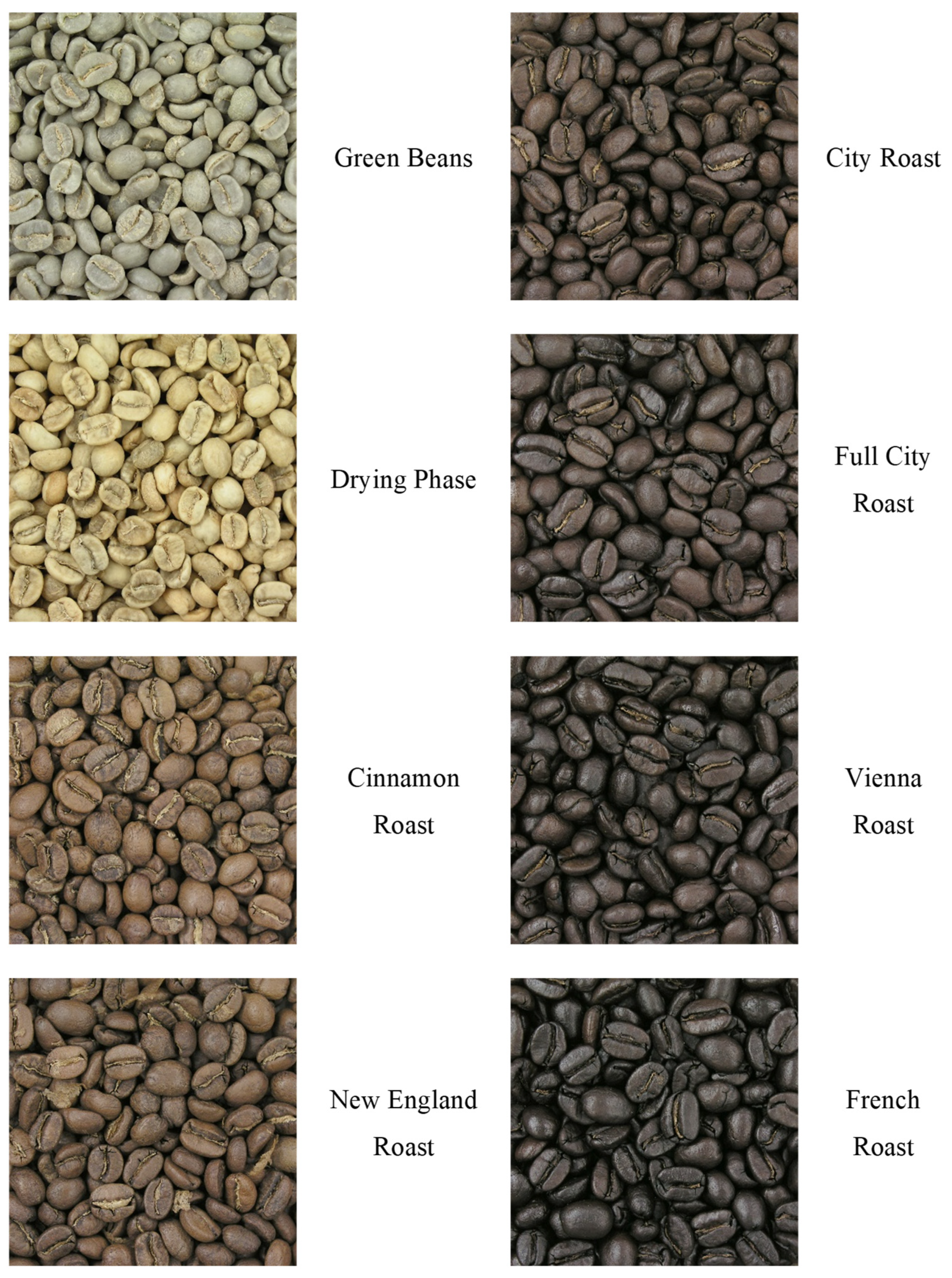

Table 1.
Chemical composition of green coffee Arabica and Robusta.
| Composition | Dry matter range (%) | |
|---|---|---|
| Arabica | Robusta | |
| Kahweol | 0.7 – 1.1 | NA |
| Caffeine | 0.6 – 1.5 | 2.2 – 2.7 |
| Chlorogenic acids | 6.2 – 7.9 | 7.4 – 11.2 |
| Sucrose and reducing sugars | 5.3 – 9.3 | 3.7 – 7.1 |
| Total free amino acids | 0.4 – 2.4 | 0.8 – 0.9 |
| Strecker-active | 0.1 – 0.5 | 0.2 – 0.3 |
| Araban | 9.0 – 13.0 | 6.0 – 8.0 |
| Reserve Mannane | 25.0 – 30.0 | 19.0 – 22.0 |
| Reserve Galactan | 4.0 – 6.0 | 10.0 – 14.0 |
| Other polysaccharides | 8.0 – 10.0 | 8.0 – 10.0 |
| Tryglycerides | 10.0 – 14.0 | 8.0 – 10.0 |
| Proteins | 12.0 | 12.0 |
| Trigonelline | 1.0 | 1.0 |
| Other lipids | 2.0 | 2.0 |
| Other acids | 2.0 | 2.0 |
| Ash | 4.0 | 4.0 |
| Totals* | 90.0 – 114.0 | 86.0 – 107.0 |
*Totals of the lower and upper values reflect the scope of the variations of the 100% of dry matter in particular coffees. Source: [7].
Table 2.
Nutritional composition of silverskin from six different geographical origins.
| Geographical origin | Nutritional composition | |||||||
| Moisture (%) | Ash (%) | Fat (%) | Protein (%) | Insoluble Fiber (%) | Soluble fiber (%) | Available carbohydrate (%) | Caffeine (mg 100g-1) |
|
| Cameroon | 9.91 | 8.31 | 1.81 | 20.6 | 49.5 | 5.95 | 3.95 | 1154 |
| India | 10.30 | 7.34 | 1.19 | 18.9 | 50.6 | 9.00 | 2.70 | 676 |
| Indonesia | 9.28 | 8.71 | 2.46 | 18.2 | 47.5 | 7.55 | 6.35 | 1100 |
| Brazil | 9.53 | 10.4 | 3.15 | 16.7 | 44.2 | 11.20 | 4.80 | 1215 |
| Vietnam | 9.55 | 9.29 | 2.27 | 20.3 | 47.4 | 10.95 | 0.25 | 1140 |
| Uganda | 9.35 | 10.5 | 1.86 | 19.5 | 45.0 | 7.85 | 5.85 | 709 |
Source: Adapted from [39].
Table 3.
Characteristics of coffee beans/brew according to the roasting degree.
| Roasting | Weight loss (%) | Agtron number | Bean temperature (ºC) | Characteristics |
| Cinnamon | 13.0 | 80-75 | 90-130 | Volatile compounds start to expand the beans |
| American | 14.0 | 74-65 | 170-190 | First crack. Acidity higher than sugar |
| City | 15.0 | 64-60 | 210-220 | First crack ends |
| Full City | 16.5 | 60-50 | 224-230 | Second crack. Balance between acidity and sugar. Oils starts to appear |
| Vienna | 17.0 | 49-45 | 230-235 | Second crack ends. Lower acidity |
| French | 19.0 | 34-25 | 240-246 | Caramelization of sugars. Decrease of acidity. Burn smell |
| Italian | 20.0 | 24-15 | 246-265 | Loss of flavor. Shinny surface (Oil) |
Disclaimer/Publisher’s Note: The statements, opinions and data contained in all publications are solely those of the individual author(s) and contributor(s) and not of MDPI and/or the editor(s). MDPI and/or the editor(s) disclaim responsibility for any injury to people or property resulting from any ideas, methods, instructions or products referred to in the content. |
© 2023 by the authors. Licensee MDPI, Basel, Switzerland. This article is an open access article distributed under the terms and conditions of the Creative Commons Attribution (CC BY) license (http://creativecommons.org/licenses/by/4.0/).
Copyright: This open access article is published under a Creative Commons CC BY 4.0 license, which permit the free download, distribution, and reuse, provided that the author and preprint are cited in any reuse.


