

Submitted:
11 October 2023
Posted:
12 October 2023
You are already at the latest version
Abstract
This review resumes published data on fungal diversity in and within monuments (e.g., religious and secular monuments, museums, and statues), covering a multidisciplinary investigation into the complex interactions between fungi and cultural heritage structures. Fungi represent remarkable adversaries to monuments, potentially compromising their structural integrity and aesthetic value. Based on a bibliographic search of manuscripts published, the knowledge of fungal communities colonizing monuments was comprehensively assessed. This work first describes the diverse fungal species implicated in the degradation of monument materials (e.g., stone, metal, and glass). It elucidates the factors governing fungal colonization and proliferation in and within these structures (e.g., environmental conditions, construction materials, and human interventions). Finally, the efficacy of preservation and restoration techniques to mitigate fungal threats and safeguard our cultural heritage is also discussed. This synthesis highlights the pivotal role of mycological research in heritage conservation, and a platform for future studies to address critical knowledge gaps is provided. Understanding fungal diversity in and within monuments is critical to preserving these invaluable cultural treasures, as it informs targeted conservation strategies and ensures their longevity in the face of fungal challenges.
Keywords:
cultural heritage
; monument degradation
; fungal diversity
; preservation and restoration
1. Introduction
According to the United Nations Educational, Scientific and Cultural Organization (UNESCO), heritage is the legacy from the past, what we live with today, and what we pass on to future generations, that constitutes irreplaceable sources of life and inspiration [1]. Therefore, the total or partial destruction of a country's heritage is the denial of its identity, comparable to attacks on freedom of thought, conscience, and religion [2].
Heritage includes natural and cultural or historical monuments. Natural monuments include natural places, characterized by their natural beauty or outstanding biodiversity, ecosystem, and geological values (e.g., East Africa’s Serengeti, the Great Barrier Reef in Australia) [3,4]. Cultural or historical monuments includes artefacts, monuments, buildings and sites, museums with symbolic, historic, artistic, aesthetic, ethnological or anthropological, scientific, and social value (e. g., the Pyramids of Egypt or the Great Wall of China) [4,5] (Figure 1).
The architectural marvels that constitute these cultural or historical monuments, intaglio with artistic finesse and plentiful in historical context, must be recognized not as silenced edifices but as living repositories of our collective heritage [6]. Since forgotten ages, these monuments represent human virtues such as creativity, perseverance, friendship, love, and hope [7]. The resounding echoes of history, culture, and art within these structures make them invaluable treasures.
Four days after the beginning of the war against Ukraine, the Ivankiv Regional History Museum and part of its collection (Maria Primachenko paintings) were lost due to an attack perpetrated by the Russian troops. After this initial attack, the world witnessed the destruction of 289 Ukrainian cultural heritage sites (i.e., 120 religious sites, 27 museums, 109 buildings of historical or artistic interest, 19 monuments, 13 libraries, and one archive) have been destroyed (Figure S1) [8].
Also, on September 2, 2018, the fire at the National Museum of Brazil affected this historic building located at the Boa Vista Park, in Rio de Janeiro. This incident almost destroyed the historical collection, accumulated in around two hundred years, and which had become one of the oldest in the world [9].
Nevertheless, a more insidious and subtle threat lurks within their foundations: diverse fungal colonies that inhabit these monuments. Fungi (yeasts, molds, mushrooms, and toadstools), often inconspicuous and underestimated, infiltrate these monuments, carving their presence into the materials composing these edifices [10,11,12]. Studying fungal diversity within cultural and historical monuments cannot be overstated. Fungi are not merely passive bystanders; they are active participants in the aging and degradation of these structures [13,14].
This work aims to emphasize the relevance of fungal diversity to monument preservation and conservation, discuss factors influencing fungal diversity, evaluate the potential impact of fungal diversity on monument degradation and structural integrity, revise the role of mycological research in monument management, and highlight the importance of a multidisciplinary approach involving mycologists and heritage conservation experts.
2. Monuments
This section focuses on historical and cultural monuments. Herein, the different types of religious and secular monuments and other pieces of artistic and architectural interest are described, and examples are presented.
2.1. Religious Monuments
Churches and cathedrals are used as places of congregation for believers and practice religious ceremonies by the Christian Faith (i.e., Catholic, Protestant, Orthodox, or Anglican) [15]. Built under different architectural styles - from Romanesque to Post-modernism, they reflect the evolution of religious and artistic sensibilities [16]. (e.g., the Notre-Dame Cathedral in Paris, France, and the Saint-Sophia Cathedral in Kyiv, Ukraine).
The Islamic Faith uses mosques to gather prayers, conduct religious ceremonies, and study Islamic teachings [17]. Built according to a simple and functional architectural design, they possess a prayer hall facing the qibla (Mecca's direction) and a minaret to call to prayer (adhan) [18], and the interiors are decorated with calligraphy and geometric motifs [19] (e.g., the Hagia Sophia in Istanbul, Turkey, and the Al-Aqsa Mosque in Jerusalem, Palestine).
For many worldwide belief systems, temples and shrines are places of worship where religious ceremonies occur and community gathers (e.g., Judaism, Buddhism, Hinduism, Shinto). Often housing religious idols, symbols, and artefacts, these structures are used for veneration, prayer, and offerings to deities, ancestors, or spirits [20] (e.g., the Angkor Wat in Siem Reap, Cambodian, and the Ise Grand Shrine in Ise, Japan).
2.2. Secular Monuments
Palaces, associated with royalty and nobility, episcopate, or heads of state, serve as residences, administrative centres, and symbols of authority (e.g., the Palace of Versailles in Versailles, France, and the Alhambra in Granada, Spain) [21].
Castles, fortified structures primarily designed for defensive purposes, present walls and towers and are strategically positioned. Historically, these structures were used as military strongholds to protect against invaders [22] (e.g., the Neuschwanstein Castle in Bavaria, Germany, and the Himeji Castle in Himeji, Japan).
Government buildings are constructed to serve as government administrative, legislative, or executive centres. They house public officials and civil servants to carry out governance-related duties, policy-making, and public service [23] (e.g., the Capitol in Washington, D.C., USA, and the Palace of Westminster in London, England).
2.3. Cultural and Knowledge Institutions
Museums collect, preserve, exhibit, and interpret objects, artefacts, artworks, and specimens with cultural and artistic (art museums), historical (history museums), and scientific or educational significance (science or natural history museums). Besides serving as repositories of human knowledge and creativity, they provide opportunities for public engagement, learning, and appreciation of the past, present, and future [24] (e.g., the Louvre in Paris, France, and the Metropolitan Museum of Art in New York, USA).
Cultural centers are institutions, venues, or spaces dedicated to promoting, preserving, and celebrating culture, arts, heritage, and education. These institutions are hubs for cultural activities, including exhibitions, performances, workshops, lectures, and community events. Also, they focus on specific cultural groups, art forms, or interdisciplinary approaches, allowing cultural understanding and appreciation [25] (e.g., the Japan Cultural Institute in Paris, France, and the National Hispanic Cultural Center in Albuquerque, USA).
Libraries house curated collections of books, periodicals, digital resources, and other materials organized and available for public access, study, research, and borrowing. As educational and cultural institutions, they provide resources, services, and spaces for learning, reading, and intellectual exploration, promote literacy, access to information, and knowledge dissemination [26] (e.g., the Library of Congress in Washington, D.C., USA, and the Vatican Library in Vatican City).
2.4. Monumental Artefacts
Memorials, including statues, plaques, gardens, museums, and architectural landmarks, evoke expressions of the collective memory and remembrance and provide constituting places for reflection, tribute, and recognition [27] (e.g., the 9/11 Memorial in New York, USA, and the Holocaust Memorial in Berlin; Germany).
Statues, three-dimensional representational objects depicting people, animals, mythological figures, or objects, are created to honor or commemorate a specific individual, event, or concept [28]. Compared to statues, sculptures encompass a broader range of three-dimensional artistic expressions, including abstract and non-representational works created for diverse aims, such as decorative pieces or conceptual purposes beyond honoring specific individuals or events [29] (e.g., the Statue of Liberty in New York, USA, and the Great Sphinx in Giza, Egypt).
Monoliths are large, single stones or rock formations standing upright. These structures can naturally occur as large standing stones or columns or be arranged by humans for specific purposes as megalithic monuments or artistic installations [30] (e.g., Stonehenge in Wiltshire, England, and Ahu Tongariki in Easter Island, Chile).
Obelisks are tall, narrow, four-sided monuments with a pyramidal top. Used since ancient civilizations, such as Egyptians, these structures were regarded as symbols of power or religion or as commemorative markers. Typically made from a single stone piece, they were carved with inscriptions and decorative motifs [30] (e.g., the Cleopatra's Needle in London, England, and the Washington Monument in Washington, D.C., USA).
2.5. Bridges and Aqueducts
Built to span gaps (i.e., rivers, ravines, or roads), bridges provide a pathway for vehicles, pedestrians, and trains. These structures are designed according to specific needs and geographic conditions, including arch bridges, suspension bridges, cable-stayed bridges, and beam bridges [31] (e.g., the Golden Gate Bridge in San Francisco, USA, and the Tower Bridge in London, England).
Aqueducts are engineered channels, tunnels, or conduits that transport water from the spring to a given destination. Historically, these structures have supplied cities and agricultural areas with reliable water [31] (e.g., the Pont du Gard in Vers-Pont-du-Gard, France, and the Segovia Aqueduct in Segovia, Spain).
2.6. Fountains and Water Structures
Fountains are decorative water elements that include a central water source, such as a jet or spout, that expels water that returns to a basin or pool. Simple or more elaborate, they can be found in public squares, parks, gardens, and private estates [32] (e.g., the Trevi Fountain in Rome, Italy, and the Fountain of Wealth in Suntec City, Singapore).
Water structures include architectural elements that have water as a critical component, such as ponds, pools, canals, cascades, waterfalls, and aqua gardens. These structures can be incorporated into landscapes, architectural designs, and urban planning to create environments that are serene and aesthetically pleasing [33] (e.g., the Gardens of Versailles in Versailles, France, and the Alhambra Generalife Gardens in Granada, Spain).
3. Materials Used for Building and Decoration
The choice of materials used for construction and decoration defines the characteristics of structural integrity and aesthetic value. The present section delves into the materials used for building and decoration and provides examples of monuments using these materials (Table S1) [34].
3.1. Building materials
- Stone:
Due to its durability, strength, versatility, and aesthetic value, stone has been the preferred choice for constructing monuments and structures throughout history. This material has been used since the Prehistoric Period (Before 10,000 BCE) for building shelters, walls, fortifications, or megalithic structures. The most common types of stone used by artists over time have been marble and limestone, of the calcareous type, and granite, of the siliceous type [35].
Marble is a metamorphic rock mainly composed of calcite (CaCO3) minerals. Frequently used for its beauty, translucency, and ability to be polished, it is considered the material of excellence for architecture (as building material) and plastic arts (in floorings, statues, and other decorative elements). In terms of color, it can be monochromatic (white, cream, red, pink, black, yellow) or polychromatic (made up of several colors, given by the veins or fragments that form part of the stone) [36] (e.g., the Parthenon in Athens, Greece, and David by Michelangelo).
Limestone, a sedimentary rock mainly composed of calcium carbonate (CaCO3) in the form of calcite or aragonite, magnesium carbonate (dolomite), and other minor constituents, such as clay, iron carbonate, feldspar, pyrite, and quartz. Being relatively soft and easy to carve, this stone is ideal for architectural details and sculptures. This stone presents several colors, from white to beige and grey [37] (e.g., the Chartres Cathedral in Chartres, France, and the Great Sphinx in Giza, Egypt).
Granite is an igneous rock composed of feldspar, quartz, mica, and smaller quantities of other minerals (e.g., hornblende, biotite, and pyroxene). Characterized by its hardness, durability, and elevated resistance to erosion and weathering, it has been commonly used for structural elements, such as columns and facades. Granite's colors range from pink to grey and black [38] (e.g., the Mount Rushmore National Memorial in South Dakota, USA, and the Avukana Buddha Statue in Sri Lanka).
- Wood
Due to its excellent mechanical properties, lightweightness, and easiness of shape, timber has remained a primary construction material since prehistoric times [39]. Some types of wood used for monument construction and decoration will be presented.
Oak (Quercus spp.), a hardwood, is notorious for its strength, durability, and resistance to decay [40,41]. This wood is often used for flooring, furniture, cabinetry, and other decorative elements (e.g., the Hall of Mirrors in the Palace of Versailles, France).
Black cherry (Prunus serotina), belonging to the same group, is moderately heavy, strong, stiff, and hard and presents high resistance to shock. This wood is frequently employed for furniture, moldings, and cabinetry [40,41] (e.g., the Shaker Village of Pleasant Hill in Kentucky, USA).
Maple (Acer spp.), another hardwood, is resistant to shock and has high shrinkage. This wood is frequently used for flooring, furniture, cabinetry, and interior details [40,41] (e.g., the Maple Leaf Gardens in Toronto, Canada).
Cedar (including Chamaecyparis app, Juniperus spp., and Thuja spp.), a softwood, is moderately lightweight, stiff, strong, and hard, known for its resistance to decay, insects, and rot. In monuments, it is applied for doors, roofing, and decorative details [40,41] (e.g., the Cedar Shingle Mill at Old Sturbridge Village, Massachusetts, USA).
Pine (Pinus spp.), belonging to the same group, constitutes an affordable choice for construction. Although not as durable as hardwoods, it can be treated and used for framing, sheathing, and interior woodwork [40,41] (e.g., the Old North Church in Boston, USA).
Redwood (Sequoia sempervirens), a softwood, is durable and naturally resistant to insects and decay. It is used in doors, siding, and structural elements [40,41] (e.g., the Ahwahnee Hotel in Yosemite National Park in California, USA).
Teak (Tectona grandis), belonging to the group of exotic hardwoods, is characterized by its durability and resistance to moisture and insects. It is used for carvings, panels, and outdoor elements, especially in regions with high moisture levels [40] (e.g., the Phra Thinang Dusit Maha Prasat Hall at the Royal Palace of Bangkok, Thailand).
Mahogany (Swietenia macrophylla), another exotic hardwood, is frequently used for architectural details, carvings, furniture, cabinetry, and other decorative elements [40,41] (e.g., the Mahogany Bay Village in Belize).
- Metal
The long history of using metals in construction began in the Ancient Civilizations - the Sumerians and Egyptians used bronze in tools and decorative elements, while the Hittites and Assyrians used iron for construction elements, including structural beams, nails, and tools.
Bronze, a copper and tin alloy, is known for its durability, corrosion resistance, and attractive patina. This metal can be used for casting plaques, statues, and sculptures [42] (e.g., the Statue of Liberty in New York, USA, and the Little Mermaid in Copenhagen, Denmark).
Iron is frequently used as a structural component of bridges and industrial-era buildings or as a decorative detail with ornate designs in gates, railings, and balconies [43] (e.g., the Eiffel Tower in Paris, France, and the French Quarter in New Orleans, USA).
Steel, an iron and carbon alloy, is a versatile and robust material widely used in structural components, frameworks, and support systems [44] (e.g., the Gateway Arch in Missouri, USA, and the Atomium in Brussels, Belgium).
Copper, appreciated for its natural beauty and corrosion resistance, has been used for roofing, cladding, and decorative elements [45] (e.g., the top of the Washington Monument in Washington, D.C., USA, and the Museum of Fire in Żory, Poland)
Stainless steel is an alloy containing at least 10.5% chromium and usually other elements (e.g., nickel, molybdenum, titanium, aluminum, niobium, copper, nitrogen, sulfur, phosphorus, or selenium). This alloy, known for its high corrosion resistance, is commonly used for structural components, cladding, and sculptures [46] (e.g., the Cloud Gate sculpture in Millennium Park in Chicago, USA, and the One World Trade Center in New York City, USA).
Aluminum, a lightweight metal, presents excellent corrosion resistance. It is suitable for structural components, facades, and modern architectural designs [47] (e.g., the Winged Anteros at the top of the Shaftesbury Memorial Fountain in Piccadilly Circus in London, England, and the Christ the Redeemer statue in Rio de Janeiro, Brazil).
Lead, recognized for being highly durable and corrosion-resistant, is used for roofing and ornamental details in traditional architecture [48] (e.g., the roof of the Lincoln Memorial in Washington, D.C., USA).
Gold leaf, made from thin sheets of gold, is used for gilding architectural details and sculptures [49] (e.g., the Golden Temple in Amritsar, India, and the dome of the Bahai Temple in Haifa, in Israel).
- Glass
Glass, mainly composed of silica (provided by sand) and fluxing agents (e.g., ashes of plants, trees, and bracken), is a versatile building material used for its transparency, aesthetics, and functional properties [50]. Herein, different types of glass used in monuments, along with examples where it has been incorporated, are presented.
With a characteristic circular pattern and relatively good optical quality, crown glass is made by blowing a large glass bubble and flattening it. Widely used in the 18th and 19th centuries, this type of glass has been used in windows of ancient monuments [51] (e.g., the Crown Glass Windows in St. Mary's Church in Fairford, England).
Stained glass, a decorative glass often used in monuments and buildings, creates intricate and colorful designs of light and color. During manufacturing, metallic salts are added to molten glass, producing various colors. The glass is then cut into small pieces and assembled to form patterns, images, or scenes [52] (e.g., the stained glass of Notre-Dame Cathedral in Paris, France, and the Sagrada Família in Barcelona, Spain).
Glass mosaics, small colored glass pieces - glass tesserae - are used to create intricate and detailed designs or patterns in wall coverings, flooring, or other decorative elements [53] (e.g., the Hagia Sophia in Istanbul, Turkey, and the Temple of the Reclining Buddha in Bangkok, Thailand).
- Clay-based ceramics
Clay-based ceramics are amongst the oldest, being used since Ancient Mesopotamia (around 4000 BCE), they are the most versatile materials used in construction. These ceramics differ in chemical composition, properties, and applications [54].
Bricks are made of clay, shale, or a combination of both, molded into shape, dried, and fired at high temperatures in a kiln. Bricks are molded in different shapes and sizes and present diverse colors according to their composition. When laid in various patterns, it is possible to create decorative facades. Due to their durability, versatility, and ease of manufacturing, bricks are commonly used for walls, arches, and structural elements [55] (e.g., the Great Wall of China and the Red Fort in Delhi, India).
Terracotta, meaning "baked earth" in Italian, is made from clay that is more refined than the clay used in bricks, resulting in a less dense and more porous material with a distinctive reddish-brown color. Terracotta is commonly used for decorative purposes, such as architectural details, sculptures, ornamental facades, and pottery [56] (e.g., the Terracotta Army in China's Qin Shi Huang Mausoleum and the Roof of the Watts Towers in Los Angeles, USA).
- Concrete
Concrete results from the combination of cement, water, aggregates (e.g., sand, gravel, or crushed stone), additives, and admixtures. This material is known for its strength, durability, processability, adaptability, and low-cost, concrete and has been a popular choice in construction over the last 200 years [57,58] (e.g., the Hoover Dam on the Colorado River, Arizona and Nevada, USA, and the Sydney Opera House in Australia).
3.2. Decorative Arts
Decorative arts are objects and artworks specially created with functional and aesthetic purposes. These items are frequently used to enhance monuments' beauty, historical authenticity, and cultural significance of living spaces. Thereafter, some of these materials will be described.
- Paintings and Frescoes
Paintings are artworks created by applying paint onto a canvas or wood that decorate walls and ceilings or be displayed as standalone art pieces [59] (e.g., Mona Lisa by Leonardo da Vinci and Kiss by Gustav Klimt).
Frescoes apply watercolor pigments to wet plaster, creating durable and long-lasting murals, which are found decorating the ceiling and walls of historical and religious monuments [60] (e.g., the Frescoes of Pompeii, Italy, and the Sistine Ceiling of the Chapel in Vatican City).
- Tapestry
Tapestry, a textile art form where designs or scenes are woven into a fabric, is often used to cover walls or as decorative hangings in monuments. Tapestries are made from different materials, such as wool, silk, cotton, and synthetic fibers. Historically, they have been used as insulation in grand palaces and homes to add warmth and style to interior spaces [61] (e.g., the collection of tapestries at the Château de Chenonceau, France, and the Cloisters in the Metropolitan Museum of Art in New York, USA).
- Furniture
Furniture is movable items designed for several purposes that support human activities such as seating, storage, seating, sleeping, and working, among other uses. In monuments, despite its practical applications, historical or ornate furniture can be used to enhance the beauty of the interior design. [62] (e.g., the furniture at the Palazzo Pitti in Florence, Italy, and the furniture at the Hampton Court Palace in London, England).
- Other elements
Other decorative arts include ceramics and pottery (e.g., vases, bowls, plates, and figurines with intricate designs, glazes, and patterns), textiles (e.g., embroidered textiles, quilts, rugs, and lacework), glassware (e.g., stained glass windows, decorative glass vases, and glass sculptures), metalwork (e.g., iron gates, brass lamps, silverware, and cutlery), woodworking (e.g., ornate frames, wooden sculptures, and inlaid furniture), porcelain and china (e.g., dinnerware sets, teapots, and figurines), jewelry (e.g., ornamental pieces made of precious metals and gemstones), clocks and timepieces (e.g., antique and ornate clocks), decorative mirrors (e.g., framed mirrors ), and bookbinding (e.g., book covers and bindings).
4. Fungal species associated with monument degradation
Biodeterioration is a geophysical and geochemical process driven by biological organisms (e.g., bacteria, cyanobacteria, fungi, lichens) inducing undesirable physical, chemical, mechanical, and aesthetic modification and damage to historic monuments and artworks [63]. Fungi are chemoheterotrophic organisms, ubiquitous in almost all environments (air, soil, water). These microorganisms play critical ecological roles as decomposers (biogeochemical cycling of the elements), symbionts, pathogens, or associated with the spoilage of natural and manufactured materials. This ability to actively participate in biogeochemical cycles allows fungi to constitute biodeterioration agents of several building materials [64].
The effects of fungi in the biodeterioration of building materials have been a well-known phenomenon since ancient times, being even mentioned in the bible as the "leprosy" or "fretting" on brick, clay, and wood (Old Testament, Third Book of Moses, chapter 14, verses 33–57) [64]. Several fungal species can contribute to this problem, compromising building and decorative materials preservation and maintenance and cultural heritage. These fungi colonize various materials and surfaces, accelerating their decay (Table S1). Understanding the fungal species associated with the deterioration of these materials is essential for effective preservation strategies.
Fungal species associated with stone surface deterioration, referred to as "stone-inhabiting fungi" or "building mycobiota, do not actively break down the mineral components of stone materials but indirectly contribute to its degradation through several mechanisms. Stone is colonized by epilithic (settling in stone surface), chasmolithic (settling in stone crevices and fissures), and endolithic fungi (settling some millimeters or centimeters into the rock pore) [65]. For instance, these microorganisms produce organic acids and enzymes that erode stone, making it more susceptible to physical weathering processes like freeze-thaw cycles and chemical weathering from acid rain. The dominant fungal species associated with stone deterioration include Alternaria spp., Aspergillus spp., Aureobasidium spp., Cladosporium spp., Curvularia spp., Devriesia spp., Epicoccum spp., Fusarium spp., Mucor spp., Paecilomyces spp., Penicillium spp., Phoma spp., and Rhizopus spp., Talaromyces spp., and Trichoderma spp. accompanied by lichen-forming fungi can be identified [64,65,66,67,68,69,70,71,72,73,74,75,76,77,78,79,80,81,82,83,84,85,86,87,88,89]. Visible signs of stone deterioration are surface etching, pitting, staining, discoloration, the formation of black or greenish biofilms, and surface roughening and erosion [90]. These alterations are related to acid production and excretions by fungal species. De la Torre and co-workers [91] reported that large quantities of oxalic, citric, and gluconic acids were produced by P. frequentans in broth cultures. These metabolites caused extensive deterioration of clay silicates, micas, and feldspars (from sandstone and granite), and also to calcite and dolomite (from limestone), resulting in high cation release and organic salts formation, such as calcium, magnesium, and ferric oxalates and calcium citrates. Comparatively, the biodegradative effect of C. cladosporoides was less significant since no organic acids nor organic salts were produced.
Fungal species associated with wood deterioration, called wood-decaying fungi, produce enzymes that break down the wood's cellulose and lignin into simpler compounds like carbon dioxide and water used as nutritional sources [92]. This decomposition process leads to the weakening and eventual failure of wooden structural elements in buildings or their decorative elements used as decoration [92]. Some fungal species associated with wood deterioration include Antrodia spp., Athelia spp., Botryobasidium spp., spp., Cladosporium spp., Coniophora spp., Donkioporia spp., Gloeophyllum spp., Hyphoderma spp., Hyphodontia spp., Meruliporia spp., Penicillium spp., Pharenochaete spp., Postia spp., Mucor spp., Serpula spp., Trametes spp., and Trichoderma spp. [93,94,95,96,97,98,99,100,101,102,103,104,105,106,107]. Species of the ascomycete Chaetomium can degrade various polymers and are often found growing on cellulose-containing substrates [108]. Color, texture, and structural integrity changes are visible signs of wood deterioration. In advanced stages, the growth of fruiting bodies (mushrooms) or mycelium on the wood surface may also be observed [109].
Fungal species associated with metal surface deterioration, referred to as "microbiologically influenced corrosion" (MIC), contribute to metal degradation by producing compounds, like exopolymers and organic acids, that create a more favorable microenvironment for corrosion [110]. Some common fungal species associated with metal degradation include Aspergillus niger, Aureobasidium pullulans, Cladosporium spp., Hormoconis resinae, and Penicillium spp. [110,111,112,113,114,115]. Visible signs of metal deterioration are the formation of biofilms, pitting corrosion, general corrosion, darkening, and staining [109].
Fungal species associated with glass deterioration are less common than those affecting wood or stone. Although fungi do not actively degrade glass, their metabolic activities can indirectly affect its appearance [116]. Some fungal species associated with glass deterioration include Alternaria spp., Aspergillus spp., A. pullulans, Cladosporium spp., and Penicillium spp. [117,118,119,120,121,122]. Visible signs of glass deterioration are staining or discoloration, irregular patterns or spots, and the formation of biofilms [109].
Fungal species associated with brick and terracotta surface deterioration typically colonize the porous surface of these materials. Fungi metabolic activity (e.g., production of organic acids and mycotoxins) and biofilm formation create conditions conducive to changes in their appearance [123]. Some fungal species associated with glass deterioration include A. niger, A. pullulans, Chaetomium spp., Cladosporium spp., Penicillium spp., and Stachybotrys chartarum [124]. Visible signs of brick deterioration are staining or discoloration, irregular patterns, and pigmentation production [109].
Fungal species associated with concrete deterioration, designated as "microbial-induced concrete corrosion" [125,126], produce organic (e.g., citric acid, oxalic acid, lactic acid) and inorganic acids, enzymes, and metabolic other products that react with the calcium in the concrete, weakening it and leading to surface degradation [127,128]. Some fungal species commonly associated with the deterioration of concrete include Alternaria spp., Aspergillus spp., Aureobasidium pullulans, Cladosporium spp., Fusarium spp., Trichoderma spp., Mucor spp., Penicillium spp., Phoma spp., and Rhizopus spp. [129,130,131,132]. Visible signs of degradation typically include surface discoloration, pitting, cracking, and fungal growth [109]. Despite causing the artwork's biodeterioration, some of these fungi also induce health concerns in personnel's health working and visiting monuments [133].
Fungal species associated with the deterioration of paintings and frescoes pose a significant threat to these artworks, potentially causing irreversible damage. Fungi can colonize paint layers (pigment solubilization capacity) and the support structure. Some fungal species associated with the deterioration of paintings and frescoes include Alternaria spp., Aspergillus spp., Chaetomium spp., Fusarium spp., Memnoniella spp., Myrothecium spp., Neurospora spp., Penicillium spp., Scopulariopsis, Stachybotrys spp., and Stemphylium spp. [134,135,136,137,138,139,140,141,142,143,144,145,146,147,148,149,150,151,152,153,154,155,156,157]. Visible signs of fungal colonization on paintings and frescoes are staining, discoloration, fungal growth, and structural damage to paint layers or support materials [109].
Fungal species associated with the deterioration of tapestries and textiles cause significant damage to these materials [159]. Fungi colonize the textile fibers, degrading cellulose, and other organic components, leading to material weakening and degradation. Some fungal species associated with the deterioration of tapestries and textiles include Alternaria spp., Aspergillus spp., Chaetomium spp., Cladosporium spp., Gymnoascus spp., and Penicillium spp. [159,160,161]. Visible signs of fungal colonization on tapestries and textiles are staining, discoloration, fungal growth, and structural damage to the fibers [109]. The spacesuits used in Apollo lunar missions (1968 – 1972), preserved at The United States Smithsonian Institution’s National Air and Space Museum, have been degraded by Paecilomyces sp. and Cladosporium sp., being observed the degradation of the synthetic polymers, development of fungal hyphae on individual fibers of the cloth, and the deterioration of interior layers [162].
Fungal species associated with the deterioration of books and archival manuscripts pose a significant threat to preserving these repositories of human knowledge and history [163]. Several fungal species secrete cellulolytic enzymes and organic acids that degrade cellulose and other paper components. Some of the fungal species associated with paper degradation include Alternaria spp., Aspergillus spp., Chaetomium spp., Cladosporium spp., Fusarium spp., Mucor spp., Penicillium spp., Stachybotrys spp., Rhizopus spp., and Trichoderma spp. [163,164,165,166,167,168,169,170,171,172,173,174,175,176,177,178,179,180,181,182]. Visible signs of fungal colonization on books and archival manuscripts are discoloration, staining, paper weakening, powdery mold, and a musty odor [109].
5. Factors influencing fungal colonization and proliferation
Factors affecting fungal colonization and proliferation in monuments are diverse, complex, and often interdependent. Understanding these factors is critical to preserving cultural and historical monuments' integrity and aesthetic value [183]. This section focuses on key factors influencing fungal colonization and monuments' proliferation.
5.1. Moisture
High moisture content and elevated humidity levels (> 80% RH) provide an ideal environment for fungal growth [184,185,186]. When these levels are elevated, fungal spores are activated and germinate, and hyphae begin their development, initiating colonization [187]. During fungal growth, the mycelium secretes enzymes and organic acids that facilitate the degradation of organic materials [188]. Moreover, moist conditions promote fungal sporulation activity [189], producing spores that can easily become airborne and spread to other parts of the monument or nearby monuments [190].
5.2. Temperature
Temperature also significantly impacts fungal proliferation in monuments. Different fungal species have specific optimal temperature ranges for growth and deviations from these ranges affect the fungal ability to colonize and deteriorate monument materials. For instance, mesophilic fungi grow best at moderate temperatures (20-30°C), psychrophilic fungi prefer colder conditions (0-20°C), and thermophilic fungi thrive at higher temperatures (above 45°C) [191].
Also, temperature and moisture levels are interconnected. Warmer temperatures can increase the capacity of air to hold moisture, leading to higher humidity within monument structures. Elevated levels of humidity, in combination with warm temperatures, create an ideal environment for fungal growth. In tropical climates, the harmful effects are maximized by high values of temperature and relative humidity prevailing during most of the year [108].
5.3. Material characteristics
Some intrinsic characteristics of the materials may either facilitate or inhibit fungal growth. One of these characteristics is nutrient availability. Organic materials, such as wood, textiles, and organic pigments used in paintings and frescoes, provide nutrients (e.g., cellulose, lignin, and starch) to sustain fungal growth and colonization; while inorganic materials like stone, metal, and glass are less susceptible to these processes [192,193,194].
Materials' porosity and texture also influence fungal colonization. Porous materials, including many types of stone and terracotta, provide niches for fungal spores to be deposited, offering more opportunities for fungal hyphae to establish themselves and form fungal colonies [195].
The ability of materials to absorb and retain moisture affects the efficiency of fungal colonization. Materials with high moisture absorption rates, such as wood, are more prone to fungal growth when exposed to high humidity or moisture [196].
Finally, some materials possess natural resistance to fungal attack. For instance, certain types of wood, such as cedar, produce natural compounds that inhibit fungal growth [197].
5.4. Microenvironment
Microclimatic conditions around monuments can differ from the surrounding environment, affecting fungal growth. Factors such as airflow and ventilation, sunlight exposure, and proximity to vegetation can influence microclimates [198,199]. Adequate airflow and ventilation prevent moisture condensation, reducing the risk of fungal colonization [200,201,202,203]. Sunlight exposure presents a drying effect of sunlight that, coupled with ultraviolet (UV) radiation, inhibits fungal spore germination [204,205]. Fallen leaves, pollen, and organic matter in the areas surrounding monuments act as reservoirs of fungal species [206], releasing spores that are introduced into monument surfaces by air movements and visitor traffic.
4.6. Pollution and Contaminants
Air pollution, particularly sulfur dioxide (SO2) and nitrogen oxides (NOx:) emissions, reacts with moisture in the air to form sulfuric (H2SO4) and nitric acids (HNO₃) [207]. These acids damaged material surfaces, forming additional niches for fungal spores' deposition and growth [208,209]. Soot and particulate matter contain organic contaminants, such as oil residues or organic waste [210], that introduce additional nutrients, favoring fungal growth; while others, such as heavy metals (e.g., Cd, Mn, or Zn), interfere with fungal metabolic processes and have toxic effects on fungal growth [211].
Urbanization has led to rapid changes in the climate, air and ground temperatures have increased in urban areas compared to their surroundings - the urban heat island effect – caused by increased heat absorption by pavement and buildings and increased heat production by air-conditioners, traffic, and factories. In general, urban heat islands are characterized by higher minimum, average, and maximum temperatures. Urban heat islands have been exerting evolutionary pressure on organisms for at least 50 years and for more than 100 years in some cities [212,213,214].
5.7. Historical Factors:
Previous treatments, conservation efforts, and restoration practices have profoundly impact fungal colonization, altering the composition of the communities inhabiting monument surfaces [215]. Despite being essential for heritage preservation, these interventions may facilitate fungal growth and dispersion when inadvertently performed. Among the most sensitive treatments are moisture management, removing biological growth, applying biocides and fungicides, cleaning, and surface alterations, introducing restoration materials, and using sealants and protective coatings [216].
6. Preservation and restoration techniques
Preservation and restoration techniques are critical to limit and revert the effects of fungal action and ensure the long-term survival of historical artifacts and iconic landmarks. The methods for preserving and restoring monuments impacted by fungal degradation include several steps.
6.1. Prevention and Environmental Control:
Maintaining stable environmental conditions within and around the monument is crucial since fluctuations in these parameters create ideal conditions for fungal growth. High humidity levels and warmer temperatures favor fungal colonization. Heating, Ventilation, and Air Conditioning Humidity control systems (HVAC) units maintain humidity levels and temperatures to decrease fungal activity [202].
Water accumulation is a critical factor for fungal growth and moment colonization by fungal species [217]. Therefore, is important to implement effective drainage systems, such as gutters and downspouts, to prevent moisture accumulation by redirecting water away from the monument's foundation and surfaces [218]. Other measures include proper landscaping and grading to minimize water pooling [218,220], using porous materials to allow rainwater to penetrate the ground, and applying waterproof and moisture-resistant coatings to monuments to prevent groundwater intrusion [221]. Cleofas and co-workers demonstrated [222] the prevalence of fungal growth in five flood-prone public elementary schools. The frequency of flood occurrence was associated with the prevalence of fungi in the study sites. Among the materials inside the classrooms, the students’ chairs harbored the greatest number of visible fungal growth primarily because they are made up of wood [222].
6.2. Cleaning and Removal:
Several techniques have been developed to control cultural heritage microbial deterioration, including chemical, physical, and biological methods.
Chemical treatments, such as biocides and fungicides, inhibit fungal colonization and disrupt the life cycle of the organisms responsible for the biodeterioration. However, the use of these products requires careful consideration, meaning that the appropriate fungicide must be selected to be effective against the specific fungi while minimizing harm to the monument and the environment [223,224]. In recent years, innovative materials and techniques have emerged to protect these monuments and artifacts. Nanoparticles (hydroxide, silver, copper, and zinc oxide), incorporated into protective coatings, paints, or other materials, penetrate fungal cell walls, disrupt cellular processes and inhibit growth, and constitute a cutting-edge solution for preserving monuments affected by fungal degradation [225,226]. Other alternatives are microemulsions. These colloidal dispersions of water, oil, and surfactants constitute a platform for delivering various active ingredients, such as fungicides and consolidants, to the monument surface. Micelles, self-assembling structures formed by surfactant molecules in a solution, encapsulate and solubilize hydrophobic compounds, such as fungicides, enhancing their bioavailability. Functional gels are thixotropic materials loaded with active agents, such as fungicides and consolidants, that adhere to vertical surfaces, and allow the agent to have a long-lasting effect [227,228].
Physical methods, such as mechanical fungal removal, include gentle methods like brushing and vacuuming. These methods suit lightly contaminated areas and physically remove fungal growth without damaging the monument. Ultra-violet radiation, especially UV-C, damages fungal DNA and effectively reduces fungal colonization without chemical residues [229]. Gamma radiation disrupts cellular processes, preventing fungal growth. Highly effective at eliminating fungal colonization, it poses minimal risk to the structural integrity of monuments and artifacts [230]. Laser cleaning utilizes targeted laser technology to selectively remove fungal growth from surfaces without damaging the underlying material [231,232]. Heat shock involves subjecting surfaces with fungi to controlled temperature increases that disrupt fungal cell membranes and inhibit their growth [233]. On the contrary, cryogenic cleaning uses dry ice pellets accelerated by compressed air to remove fungal growth [234]. Both techniques are non-abrasive, leave no residue, and are environmentally friendly [233,234]. Finally, microwaves generate electromagnetic radiation that heats fungal cells, disrupting their cellular structure and inhibiting growth, removing fungal biofilms and contaminants [230,235].
Biological methods harness the power of natural molecules with biocidal activity, enzymes, and microorganisms to limit fungal colonization and ensure the longevity of monuments effectively. Natural molecules often possess inherent biocidal properties, acting as natural fungicides. Among these molecules are essential oils (e.g., tea tree oil, thyme oil, and oregano oil), tannins, and copper-based compounds (e.g., copper sulfate) [236,237]. These molecules are biodegradable, non-toxic, and environmentally friendly, safely applied without harming the monument or the surrounding ecosystem [238]. Enzymes (e.g., cellulases and proteases) are biological catalysts that degrade organic matter. These treatments are used under controlled conditions to ensure the enzymes target fungal contamination and preserve the monument [239]. Certain microorganisms (e.g., Streptomyces spp. and Trichoderma spp.) outcompete or antagonize pathogenic fungi and establish a natural balance that discourages fungal colonization when applied to monument surfaces or the surrounding environment [240,241].
6.3. Consolidation and Reinforcement:
Over time, fungal colonization compromises monument stability, making it necessary to implement consolidation and reinforcement strategies.
Consolidation involves strengthening and stabilizing deteriorated surfaces, particularly porous materials (e.g., stone, wood, or plaster), to restore cohesion and structural integrity. Consolidation helps prevent further fragmentation or detachment of surfaces affected by fungal degradation. Treated surfaces become more resistant to environmental factors, reducing the risk of further deterioration. Finally, this technique improves the monument's appearance by restoring lost details and texture [242].
Reinforcement, which involves adding supplementary materials (e.g., steel rods, fiberglass, or carbon fiber composites) or structural repairs (e.g., reconstruction or repair work) to enhance monument structural stability, is particularly relevant when fungal degradation has deeply compromised its load-bearing capacity. These measures strengthen the monument's overall structure by mitigating the risk of collapse or further damage, extending the monument's lifespan, ensuring its preservation for future generations, and enhancing safety, reducing the risk of accidents caused by unstable monument structures [243].
6.4. Surface Treatments:
Surface treatments are essential to preserving monuments and artifacts. These treatments include applying different types of coatings (i.e., protective - contains fungicides and creates a physical barrier on monument surfaces, consolidating - protects and consolidates deteriorated surfaces, and barrier coatings - repels water) that provide fungal and weather resistance and enhance durability [244,245].
Sealants (flexible or consolidating) are applied to fill cracks, gaps, and voids in monument surfaces, preventing moisture infiltration and fungal colonization. These products ensure waterproofing, structural protection, and appearance enhancement [246].
6.5. Replication and Replacement:
In some cases, replication and replacement become necessary strategies to ensure the longevity of monuments and the retention of their historical and cultural significance.
Replication of decorative elements involves the creation of accurate reproductions of damaged or missing pieces using traditional techniques, materials, and craftsmanship. This technique assures historical authenticity since the replicated parts closely resemble the original ones, aesthetic restoration by reinstating missing or deteriorated features, structural integrity once reproduced elements reinforce structural stability when used with authentic materials, and replacement of damaged sections with matching materials to maintain the monument's integrity [247].
Replacement involves removing and replacing entire sections or components that are so damaged that they cannot be restored. New materials are carefully selected to match the original aesthetics. This technique assures structural integrity, aesthetic continuity, and monument preservation [248].
6.6. Monitoring:
Monitoring is fundamental for conservation efforts, ensuring that monuments remain structurally sound, aesthetically pleasing, and protected against the forces of time and nature.
Regular visual inspections are critical in monument monitoring to detect signs of fungal colonization, structural damage, or deterioration. These inspections should be conducted by trained conservators or professionals familiar with monument preservation [249]. Traditionally, fungal spore monitorization can be performed using viable volumetric sampling methods [250,251,252,253]. However, modern technology (e.g., remote sensing, digital imaging, and Infra-red thermography) are used to assess the condition of monuments and detect hidden damage or areas of concern not visible to the naked eye [254,255,256]. Environmental conditions (e.g., temperature, relative humidity, and pollution levels) cause harmful effects on the cultural heritage assets, being critical to implement effective and reliable monitoring systems to continuously assess environmental conditions and determine the need for some specific action for heritage safeguard [257]. Likewise, fungal analysis on surfaces and circulating air is required to identify specific fungal species present. Traditional include culture-based methods using a variety of standardized media, such as MEA, DG18, and dichlorane rose Bengal (DRBC) medium. The advent of molecular techniques, including molecular markers such as the Internal Transcribed Spacers (ITS regions), provides a deeper understanding of these fungal communities [258]. More recently, next-generation sequencing techniques have been used for this purpose, reviling an even greater diversity of communities when compared to the Sanger method and allowing to study the interrelationships between different microorganisms [259]. This information helps conservators effectively tailor treatment strategies to target the predominant fungal threats.
6.7. Documentation and Research:
When fungal degradation threatens monuments and artifacts, comprehensive documentation and research are indispensable to understand, conserve, and safeguard cultural heritage.
Documentation of the monument must include historical records that serve as reference materials for restoration and replication efforts, detailed condition assessments document of the current state of monuments to track changes over time, materials analysis to select the appropriate conservation treatments, fungal analysis to determine treatment strategies and assess the potential for further damage, and treatment records of any changes made to the monument's structure or appearance [260].
Research must focus on fungal ecology that informs on preventive measures and treatment strategies, treatment developments including the testing of new consolidants, biocides, and surface treatments, historical context that informs on decisions regarding replication, replacement, and restoration to ensure authenticity, environmental impact assessing the ecological consequences of treatments and ensuring they align with sustainability goals, preventive measures including studies on drainage systems, vegetation management, and visitor impact, public awareness promoting a sense of ownership and responsibility among communities and visitors toward monument preservation, and technological advancements that aid in documentation, assessment, and research efforts [261].
7. Conclusions
This work delves into the intricate relationship between fungal diversity and heritage degradation, exploring various facets of this complex issue. Firstly, the diverse range of monuments were described, recognizing that the heterogeneity of these structures tailors all preservation strategies. Secondly, materials that constitute these monuments were presented, emphasizing the susceptibility of these materials to fungal degradation. Understanding the vulnerabilities of these materials is paramount for adequate preservation. Thirdly, the multifaceted factors influencing fungal colonization and proliferation were discussed (e.g., moisture levels, temperature, and pollution), acknowledging that these factors empower conservators to implement preventive measures and targeted treatments. Lastly, various preservation and restoration techniques were explored, from biocidal treatments to consolidation methods, offering solutions that balance efficacy with preserving historical and aesthetic authenticity. Preserving cultural heritage is a multifaceted endeavor that requires a deep understanding of fungal diversity, monument materials, environmental factors, and conservation techniques. Ensuring that the heritage endures for future generations is crucial and mitigating the destructive impact of fungal degradation is paramount.
Supplementary Materials
The following supporting information can be downloaded at the website of this paper posted on Preprints.org. Figure S1: Ukraine’s heritage destroyed during the Russian invasion of Ukraine (https://www.unesco.org/en/articles/damaged-cultural-sites-ukraine-verified-unesco), distributed by the different Oblasts (A) and heritage type (B).; Table S1: Cultural heritage and the materials used for its construction, including its characteristics, applications, examples, and fungi associated with its degradation (the most common fungi are presented in bold).
Author Contributions
MO: conceptualization, methodology, formal analysis, investigation, resources, writing—original draft preparation, writing, review and editing, and visualization; JR: investigation, resources, writing—original draft preparation, writing, review and editing, and visualization; MA: conceptualization, methodology, formal analysis, investigation, resources, writing—original draft preparation, writing, review and editing, and visualization.
Funding
This work was financed by FEDER - Fundo Europeu de Desenvolvimento Regional funds through the COMPETE 2020 - Operational Programme for Competitiveness and Internationalisation (POCI), Portugal 2020, and by Portuguese funds through FCT- Fundação para a Ciência e a Tecnologia/Ministério da Ciência, Tecnologia e Inovação in the framework of the project "Institute for Research and Innovation in Health Sciences" (POCI-01-0145-FEDER-007274). Johnny Reis thanks FCT/MCTES for the financial support to CESAM (UIDP/50017/2020 + UIDB/50017/2020 + LA/P/0094/2020), through national funds. Thanks are due for the financial support to the Ph.D. grant of Johnny Reis (2022.12282.BD).
Institutional Review Board Statement
Not applicable.
Informed Consent Statement
Not applicable.
Conflicts of Interest
The authors declare no conflict of interest.
References
- “World Heritage” . Available online: https://whc.unesco.org/en/about/ (accessed on 23 September 2023).
- Rabbat, N. Identity, Modernity, and the Destruction of Heritage. Int. J. Middle East Stud. 2017, 49, 739–741. [Google Scholar] [CrossRef]
- “Natural World Heritage”, Available online: https://whc.unesco.org/en/natural-world-heritage (accessed on 23 September 2023).
- “World Heritage List”, Available online: http://uis.unesco.org/en/glossary-term/cultural-heritage (accessed on 6 September 2023).
- “Cultural heritage”, Available online: https://whc.unesco.org/en/natural-world-heritage/ (accessed on 6 September 2023).
- Munteanu, A. Valorificarea Patrimoniului Cultural Al Neamului Prin Monumente De Arhitectură De Exterior Și Interior Lăsate Uitării–Vila Urbană Vladimir Herţa, Perla Barocă” Din Chișinău. Stud. Art. Culturologie: istorie, teorie, practică 2022, 1, 105–115. [Google Scholar] [CrossRef]
- Silverman, H.; Ruggles, D. F. Cultural heritage and human rights. In Cultural heritage and human rights; Silverman, H., Ruggles, D. F., Eds.; Springer New York, USA, 2007; pp. 3-29.
- “Damaged cultural sites in Ukraine verified by UNESCO”, Available online: https://www.unesco.org/en/articles/damaged-cultural-sites-ukraine-verified-unesco (accessed on 23 September 2023).
- “Museu Nacional guarda acervo de mais de 20 milhões de itens”. Available online: https://g1.globo.com/rj/rio-de-janeiro/noticia/2018/09/02/museu-nacional-guarda-acervo-de-mais-de-20-milhoes-de-itens.ghtml (accessed on 23 September 2023).
- Tyagi, P.; Verma, R.K.; Jain, N. Fungal degradation of cultural heritage monuments and management options. Curr. Sci. 2021, 121, 1553–1560. [Google Scholar] [CrossRef]
- Ilieș, D.C.; Oneț, A.; Grigore, H.; Liliana, I.; Alexandru, I.; Ligia, B.; Gaceu, O.; Marcu, F.; Baias, Ș.; Caciora, T.; Marcu, A.P.; Oana, I.P.; Costea, M.; Ilieş, M.; Wendt, J.; Dana, M. Exploring the indoor environment of heritage buildings and its role in the conservation of valuable objects. Environ. Eng. Manag. J. 2019, 18. [Google Scholar]
- De Leo, F.; Marchetta, A.; Urzì, C. Black fungi on stone-built heritage: current knowledge and future outlook. Appl. Sci. 2022, 12, 3969. [Google Scholar] [CrossRef]
- Cioban, L.A.; Dochia, M.; Muresan, C.; Chambre, D. R. Weathering and deterioration of carbonate stones from historical monuments: a review. Sci. Tech. Bull., Series: Chem., Food Sci. Eng. 2022, 19, 15–33. [Google Scholar]
- Branysova, T.; Demnerova, K.; Durovic, M.; Stiborova, H. Microbial biodeterioration of cultural heritage and identification of the active agents over the last two decades. J. Cult. Herit. 2022, 55, 245–260. [Google Scholar] [CrossRef]
- Bass, D.B. The practicing congregation: Imagining a new old church. Rowman & Littlefield Publisher: Lanham, Maryland, USA, 2004, 128 pp.
- Kieckhefer, R. Theology in stone: Church architecture from Byzantium to Berkeley. Oxford University Press: Oxford, England, 2008, 386 pp.
- Haider, M. The role and importance of mosque as an educational institution. Res. Hub 2021, 9, 7–15. [Google Scholar]
- Weiner, R.S. Islamic Architecture: Form, function, and meaning. Middle East J. 2004, 58, 533. [Google Scholar]
- Kassim, N.; Taib, Z.B.M. Decoration in Praying Hall of Mosque: A review of current literature. Procedia Soc. Behav. Sci. 2014, 153, 55–60. [Google Scholar] [CrossRef]
- Kong, L. Negotiating conceptions of 'sacred space': a case study of religious buildings in Singapore. Trans. Inst. Br. Geogr. 1993, 342–358. [Google Scholar] [CrossRef]
- Stocker, D. The Palaces of Medieval England c. 1050–1550. royalty, nobility, the episcopate and their residences from Edward the confessor to Henry VIII. By T. James. Archaeol. J. 1991, 148, 318–319. [Google Scholar] [CrossRef]
- Zaraś-Januszkiewicz, E.; Botwina, J.; Żarska, B.; Swoczyna, T.; Krupa, T. Fortresses as specific areas of urban greenery defining the uniqueness of the urban cultural landscape: Warsaw Fortress—A case study. Sustainability 2020, 12, 1043. [Google Scholar] [CrossRef]
- Bednar, M. J. The Government Building Redefined [Debate on the State of Illinois Center]. Issue: Places 1987, 3 (4).
- Brulon Soares, B. Defining the museum: challenges and compromises of the 21st century. ICOFOM Stud. Ser. 2020, 16–32. [Google Scholar] [CrossRef]
- Pfeifere, D. The Issues of Defining and Classifying Cultural Centres. Econ. Cult. 2022, 19, 28–37. [Google Scholar] [CrossRef]
- Fagbola, O.; Uzoigwe, C.; Ajegbomogun, V. O. Libraries driving access to knowledge in the 21st century in developing coun-tries: an overview. Libr. Philos. Pract. 2011, 1–7. [Google Scholar]
- Bonder, J. On memory, trauma, public space, monuments, and memorials. Places, 2009, 21(1).
- Osmond, G. Shaping lives: Statues as biography. Sport. Trad. 2010, 27, 101–111. [Google Scholar]
- Lee, P. M. The Sculptural Imagination: Figurative, Modernist, Minimalist. Art Bull. 2002, 84, 392–396. [Google Scholar] [CrossRef]
- Frazier, M. T. Monuments: Landmarks and Reflections of the Past. Technol. Eng. Teach. 2008, 68, 12. [Google Scholar]
- Troyano, L. F. (2003). Bridge engineering: a global perspective; Inst of Civil Engineers Pub, 2003; pp. 1-42.
- Juuti, P.S.; Antoniou, G.P.; Dragoni, W.; El-Gohary, F.; De Feo, G.; Katko, T.S.; Rajala, R.P; Zheng, X.Y.; Drusiani, R.; Angelakis, A. N. Short global history of fountains. Water 2015, 7, 2314–2348. [Google Scholar] [CrossRef]
- Rodionov, A.S.; Danilina, M.V.; Pimenov, N.A.; Romanchenko, L.N.; Yarkin, V.V. Comparison and analysis of the main building materials’ characteristics for construction. In Journal of Physics: Conference Series, 1614, 012047. IOP Publishing: Bristol, England, 2020.
- Külekçi, E.A. Investigation of plant designs on water surfaces in terms of landscape design. Int. J. Ecosyst. Ecol. Sci. 2020, 10. [Google Scholar]
- Scheerer, S.; Ortega-Morales, O.; Gaylarde, C. Microbial deterioration of stone monuments—an updated overview. Adv. Appl. Microbiol. 2009, 66, 97–139. [Google Scholar]
- Mason, R. Petrology of the Metamorphic Rocks. 2nd Edition; Unwin Hyman Ltd: London, England, 1990; 398 pp. [Google Scholar]
- Boggs, S. Petrology of sedimentary rocks, 2nd Edition; Cambridge University Press: Cambridge, England, 2009; 610 pp. [Google Scholar]
- Hughes, C.J. Igneous Petrology, 1st Edition; Elsevier Science: New York, USA, 2013; 551 pp. [Google Scholar]
- Smith, I.; Snow, M.A. Timber: An ancient construction material with a bright future. For. Chron. 2008, 84, 504–510. [Google Scholar] [CrossRef]
- Meier, E.W. Identifying and using hundreds of woods worldwide. Wood Database, 2015.
- Wiemann, M.C. Chapter 2: Characteristics and availability of commercially important woods. In: Wood handbook wood as an engineering material, U.S. Department of Agriculture, Forest Service, Forest Products Laboratory Madison, USA, 2021; 45 pp.
- Scott, D.A. Copper and bronze in art: corrosion, colorants, conservation, 1st ed.; Getty Conservation Institute, Los Angeles, USA, 2002; 534 pp.
- Van Dyke, S. The history of wrought and cast iron. Doctoral dissertation, University of Tennessee, Knoxville, USA, 2004, 70 pp.
- Mandal, S. K. Steel metallurgy: Properties, specifications and applications. McGraw Hill Education Private: Uttar Pradesh, India, 2015, 362 pp.
- Konečná, R.; Fintová, S. Copper and copper alloys: casting, classification and characteristic microstructures. In Copper al-loys-early applications and current performance-enhancing processes, Collini, L.; IntechOpen: London, England 2012; pp. 3–30. [Google Scholar]
- Backhouse, A.; Baddoo, N. Recent developments of stainless steels in structural applications. ce/papers 2021, 4(2-4), 2349-2355.
- Dokšanović, T.; Džeba, I.; Markulak, D. Applications of aluminium alloys in civil engineering. Tehnički vjesnik 2017, 24, 1609–1618. [Google Scholar]
- Lyon, S.; Richardson, T.; Cottis, B.; Lindsay, R.; Scantlebury, D.; Graham, M.; Stott, H. Corrosion of lead and its alloys. In Shreir's Corrosion: Volume 3: Corrosion and Degradation of Engineering Materials. Elsevier BV: Amsterdam, Netherlands, 2009.
- Crina Anca Sandu, I.; de Sá, M. H.; Pereira, M. C. Ancient ‘gilded’art objects from European cultural heritage: a review on different scales of characterization. Surf. Interface Anal. 2011, 43, 1134–1151. [Google Scholar] [CrossRef]
- Arbab, M.; Finley, J. J. Glass in architecture. Int. J. Appl. Glass Sci. 2010, 1, 118–129. [Google Scholar] [CrossRef]
- Kennedy, C.J.; Murdoch, K.R. Window Glass. Build. Conserv. J. 2017, 31–31. [Google Scholar]
- Mould, D. A stained glass image filter. In Proceedings of the 14th Eurographics workshop on Rendering, 2003. pp. 20–25.
- Gómez-Morón, M.A.; Palomar, T.; Alves, L.C.; Ortiz, P.; Vilarigues, M.; Schibille, N. Christian-Muslim contacts across the Mediterranean: Byzantine glass mosaics in the Great Umayyad Mosque of Córdoba (Spain). J. Archaeol. Sci. 2021, 129, 105370. [Google Scholar] [CrossRef]
- Warlimont, H. Ceramics. In Springer Handbook of Materials Data, 2nd ed.; Warlimont, H., Martienssen, W., Eds.; Springer: New York, USA, 2018; pp. 445–488. [Google Scholar]
- Fernandes, F. M. Clay bricks. In Long-Term Performance and Durability of Masonry Structures, 1st ed; Ghiassi, B., Lourenço, P.B., Eds.; Woodhead Publishing: Cambridge, England, 2019; pp. 3–19. [Google Scholar]
- Corner, D. B.; Rowell, J. Architectural Terra Cotta: Design Concepts, Techniques and Applications. Routledge: Abingdon, England, 2022; 290 pp.
- Mehta, P.K.; Monteiro, P. J. Concrete: microstructure, properties, and materials, 1st ed. McGraw-Hill Education: New York, USA, 2014.
- Wang, D.; Guan, F.; Feng, C.; Mathivanan, K.; Zhang, R.; Sand, W. Review on Microbially Influenced Concrete Corrosion. Microorganisms 2023, 11, 2076. [Google Scholar] [CrossRef] [PubMed]
- Barnett, J.R.; Miller, S.; Pearce, E. Colour and art: A brief history of pigments. Opt. Laser Technol. 2006, 38(4-6), 445-453.
- Hasekamp, U. Frescoes: Art Periods & Movements, 1st ed. Koenemann: Chicago, USA, 2022; 504 pp.
- Fluck, C. (2018). The use of textiles in early Christian churches–evidence from Egypt (fourth to seventh centuries). In church building in Cyprus (Fourth to Seventh Centuries). A mirror of intercultural contacts in the Eastern Mediterranean, 1st ed.; Nicolau, D., Eds.; Waxmann Verlag GmbH: Kornwestheim, Germany, 2018; pp. 29-48.
- Postell J. Furniture Design, 2nd Edition; Wiley: New Jersey, USA, 2012; 416 pp. [Google Scholar]
- Dakal, T. C.; Cameotra, S. S. Microbially induced deterioration of architectural heritages: routes and mechanisms involved. Environ. Sci. Eur. 2012, 24, 1–13. [Google Scholar] [CrossRef]
- Gadd, G.M. Geomycology: biogeochemical transformations of rocks, minerals, metals and radionuclides by fungi, bioweath-ering and bioremediation. Mycol. Res. 2007, 111, 3–49. [Google Scholar] [CrossRef]
- Sterflinger, K. Fungi: Their role in deterioration of cultural heritage. Fungal Biol. Rev. 2010, 24(1-2), 47-55.
- Mohammadi, P.; Krumbein, W. E. Biodeterioration of ancient stone materials from the Persepolis monuments (Iran). Aerobiologia 2008, 24, 27–33. [Google Scholar] [CrossRef]
- Ljaljević-Grbić, M.V.; Vukojević, J. B. Role of fungi in biodeterioration process of stone in historic buildings. Zbornik Matice srpske za prirodne nauke 2009, (116), 245–251. [Google Scholar] [CrossRef]
- Sarita, B. Fungal diversity on the historical monuments of Doon Valley in response to biodeterioration. Indian J. For. 2009, 32, 307–312. [Google Scholar]
- Sharma, K.; Lanjewar, S. Biodeterioration of ancient monument (Devarbija) of Chhattisgarh by fungi. J. Phytol. 2010, 2, 47–49. [Google Scholar]
- la Rosa-García, D.; del Carmen, S.; Ortega-Morales, O.; Gaylarde, C.C.; Beltrán-García, M.; Quintana-Owen, P.; Reyes-Estebanez, M. Influence of fungi in the weathering of limestone of Mayan monuments. Revista Mexicana de Micología 2011, 33, 43–51. [Google Scholar]
- Gupta, S.P.; Sharma, K. The role of fungi in biodeterioration of sandstone with reference to Mahadev temple, Bastar, Chhatisgarh. Recent Res. Sci. Technol. 2012, 4. [Google Scholar]
- Mohammadi, P.; Ma-ghboli-Balasjin, N. Isolation and molecular identification of deteriorating fungi from Cyrus the Great tombstones. Iran. J. Microbiol. 2014, 6, 361. [Google Scholar]
- Farooq, M.; Hassan, M.; Gull, F. Mycobial Deterioration of Stone Monuments of Dharmarajika, Taxila. J. Microbiol. Exp. 2015, 2, 00036. [Google Scholar] [CrossRef]
- Li, Q.; Zhang, B.; He, Z.; Yang, X. Distribution and diversity of bacteria and fungi colonization in stone monuments analyzed by high-throughput sequencing. PLoS One 2016, 11, e0163287. [Google Scholar] [CrossRef]
- Rosado, T.; Silva, M.; Galvão, A.; Mirão, J.; Candeias, A.; Caldeira, A. T. A first insight on the biodegradation of limestone: the case of the World Heritage Convent of Christ. Appl. Phys. A 2016, 122, 1–7. [Google Scholar] [CrossRef]
- Savković, Ž.; Unković, N.; Stupar, M.; Franković, M.; Jovanović, M.; Erić, S.; Šarić, K.; Stanković, S.; Dimkić, I.; Vukojević, J.; Grbić, M. L. Diversity and biodeteriorative potential of fungal dwellers on ancient stone stela. Int. Biodeterior. Biodegradation 2016, 115, 212–223. [Google Scholar] [CrossRef]
- Boniek, D.; de Castro Mendes, I.; Paiva, C.A.O.; de Paula Lana, U.G.; Dos Santos, A.F.B.; de Resende Stoianoff, M.A. Ecology and identification of environmental fungi and metabolic processes involved in the biodeterioration of Brazilian soapstone historical monuments. Lett. App. Microbiol. 2017, 65, 431–438. [Google Scholar] [CrossRef]
- Sirghi, A.C.; Gheorghe, I.; Sarbu, I.; Marutescu, L.; Stoian, G.; Zhiyong, Z.; Chifiriuc, M. C. Identification of fungal strains isolated from buildings of cultural importance in Romania and antagonistic relationships amongst them. Biotechnol. Lett. 2018, 24, 1008–1014. [Google Scholar] [CrossRef]
- Trovão, J.; Portugal, A.; Soares, F.; Paiva, D.S.; Mesquita, N.; Coelho, C.; Pinheiro, A.C.; Catarino, L.; Gil, F.; Tiago, I. Fungal diversity and distribution across distinct biodeterioration phenomena in limestone walls of the old cathedral of Coimbra, UNESCO World Heritage Site. Int. Biodeterior. Biodegradation 2019, 142, 91–102. [Google Scholar] [CrossRef]
- Antunes, J.T.L.S. The role of fungi on monumental stone biodeterioration within the UNESCO World heritage site of “University of Coimbra–Alta and Sofia”. Doctoral dissertation, Universidade de Coimbra, 2021.
- Petraretti, M.; Duffy, K.J.; Del Mondo, A.; Pollio, A.; De Natale, A. Community composition and ex situ cultivation of fungi associated with UNESCO heritage monuments in the bay of Naples. App. Sci. 2021, 11, 4327. [Google Scholar] [CrossRef]
- Li, J.; Deng, M.; Gao, L.; Yen, S.; Katayama, Y.; Gu, J.D. The active microbes and biochemical processes contributing to dete-rioration of Angkor sandstone monuments under the tropical climate in Cambodia–a review. J. Cult. Herit. 2021, 47, 218–226. [Google Scholar] [CrossRef]
- Trovao, J.; Soares, F.; Tiago, I.; Catarino, L.; Portugal, A.; Gil, F. A contribution to understand the Portuguese emblematic Ançã limestone bioreceptivity to fungal colonization and biodeterioration. J. Cult. Herit. 2021, 49, 305–331. [Google Scholar] [CrossRef]
- Paiva, D.S.; Fernandes, L.; Trovão, J.; Mesquita, N.; Tiago, I.; Portugal, A. Uncovering the fungal diversity colonizing limestone walls of a forgotten monument in the central region of Portugal by high-throughput sequencing and culture-based methods. App. Sci. 2022, 12, 10650. [Google Scholar] [CrossRef]
- Sazanova, K.V.; Zelenskaya, M. S.; Vlasov, A.D.; Bobir, S.Y.; Yakkonen, K.L.; Vlasov, D.Y. Microorganisms in superficial deposits on the stone monuments in Saint Petersburg. Microorganisms 2022, 10, 316. [Google Scholar] [CrossRef]
- Shilova, O.A.; Vlasov, D.Y.; Khamova, T.V.; Zelenskaya, M.S.; Frank-Kamenetskaya, O.V. Microbiologically induced deterioration and protection of outdoor stone monuments. In Biodegradation and Biodeterioration at the Nanoscale, 1st Edition; Iqbal, H.M.N., Bilal, M., Nguyen, T.A., Yasin, G., Eds.; Elsevier: New York, USA, 2022; pp. 339–367. [Google Scholar]
- Gupta, S.P.; Kurmi, M. K. Impact of fungi on historical monument with reference to Mahadev temple Bastar of Chhatisgarh, IJLSRA 2023, 04, 001–005. 04.
- Zhang, Y.; Su, M.; Wu, F.; Gu, J.D.; Li, J.; He, D.; Guo, Q.; Cui, H.; Zhang, Q.; Feng, H. Diversity and Composition of Culturable Microorganisms and Their Biodeterioration Potentials in the Sandstone of Beishiku Temple, China. Microorganisms 2023, 11, 429. [Google Scholar] [CrossRef]
- Li, T.; Cai, Y.; Ma, Q. Microbial diversity on the surface of historical monuments in Lingyan Temple, Jinan, China. Microbial Ecol. 2023, 85, 76–86. [Google Scholar] [CrossRef] [PubMed]
- Salvadori, O.; Municchia, A. C. The role of fungi and lichens in the biodeterioration of stone monuments. In The Open Conference Proceedings Journal, 7, 2016.
- de la Torre, M.A.; Gomez-Alarcon, G. , Vizcaino, C.; Garcia, M.T. Biochemical mechanisms of stone alteration carried out by filamentous fungi living in monuments. Biogeochemistry 1992, 19, 129–147. [Google Scholar] [CrossRef]
- Aarti, C.; Arasu, M.V.; Agastian, P. Lignin degradation: a microbial approach. Indian J. Biol. Sci. 2015, 1, 119–127. [Google Scholar]
- Sanchez-Silva, M.; Rosowsky, D. V. Biodeterioration of construction materials: state of the art and future challenges. J. Mater. Civ. Eng. 2008, 20, 352–365. [Google Scholar] [CrossRef]
- Schmidt, O. Indoor wood-decay basidiomycetes: damage, causal fungi, physiology, identification and characterization, prevention and control. Mycol. Prog. 2007, 6, 261–279. [Google Scholar] [CrossRef]
- Haas, D.; Mayrhofer, H.; Habib, J.; Galler, H.; Reinthaler, F.F.; Fuxjäger, M.L.; Buzina, W. Distribution of building-associated wood-destroying fungi in the federal state of Styria, Austria. Eur. J. Wood Wood Prod. 2019, 77, 527–537. [Google Scholar] [CrossRef]
- Slimen, A.; Barboux, R.; Mihajlovski, A.; Moularat, S.; Leplat, J.; Bousta, F.; Di Martino, P. High diversity of fungi associated with altered wood materials in the hunting lodge of “La Muette”, Saint-Germain-en-Laye, France. Mycol. Prog. 2020, 19, 139–146. [Google Scholar] [CrossRef]
- Marcu, F.; Hodor, N.; Indrie, L.; Dejeu, P.; Ilieș, M.; Albu, A.; Sandor, M.; Sicora, C.; Costea, M.; Ilieș, D.C.; Caciora, T.; Huniadi, A.; Chiș, I.; Barbu-Tudoran, L.; Szabo-Alexi, P.; Grama, V.; Safarov, B. Microbiological, health and comfort aspects of indoor air quality in a Romanian historical wooden church. Int. J. Environ. Res. Public Health 2021, 18, 9908. [Google Scholar] [CrossRef]
- Irbe, I.; Andersone, I. Wood decay fungi in Latvian buildings including cultural monuments. In Proceedings of the International Conference held by COST Action IE0601, Braga; 2008; pp. 94–100. [Google Scholar]
- Irbe, I.; Andersone, I.; Andersons, B. Diversity and distribution of wood decay fungi and wood discoloring fungi in buildings in Latvia. Latvijas Lauksaimniecības Universitāte-Raksti. 2009, (23), 91-102.
- Gamal, R.F.; Nasr, S.A.; Hassan, E.A.; Attia, A.M.; Meligy, D.A. Biological evaluation of fungal deteriorated archaeolog-ical wood (Islamic period) and the impact of using some fungicides. Egypt. J. Microbiol. 2011, 46, 177–192. [Google Scholar]
- Irbe, I.; Karadelev, M.; Andersone, I.; Andersons, B. Biodeterioration of external wooden structures of the Latvian cultural heritage. J. Cult. Herit. 2012, 13, S79–S84. [Google Scholar] [CrossRef]
- Koziróg, A.; Otlewska, A.; Piotrowska, M.; Rajkowska, K.; Nowicka-Krawczyk, P.; Hachułka, M; Wolski, G. J.; Gutarowska, B.; Kunicka-Styczyńska, A.; Libudzisz, Z.; Żakowska, Z.; Żydzik-Białek, A. Colonising organ-isms as a biodegradation factor affecting historical wood materials at the former concentration camp of Auschwitz II–Birkenau. Int. Biodeterior. Biodegradation 2014, 86, 171–178. [Google Scholar] [CrossRef]
- Kozlov, V.; Kisternaya, M. Biodeterioration of historic timber structures: A comparative analysis. Wood Mater. Sci. Eng. 2014, 9, 156–161. [Google Scholar] [CrossRef]
- Cojocariu, A.M.; Tănase, C. Comparative aspects regarding the diversity of wood-destroying macro-mycetes in two open air village museums from Romania. Revista Botanică 2015, 10, 57–64. [Google Scholar]
- Rosado, T.; Silva, M.; Pereira, C.; Mirao, J.; Candeias, A.; Caldeira, A. T. Gilded woodcarving alteration: assessment of filamentous fungi action. Int. J. Conserv. Sci. 2015, 6. [Google Scholar]
- Gheorghe, I.; Sârbu, I.; Pecete, I.; Blăjan, I.; Balotescu, I. Multi-level characterization of microbial consortia involved in the biodeterioration of wooden and stone romanian heritage churches. Conserv. Sci. Cult. Herit. 2020, 20, 289–308. [Google Scholar]
- Kovachovska, L.; Rusevska, K.; Karadelev, M. Diversity of wood-inhabiting fungi (Basidiomycota) in Мacedonian cultural heritage. MJEE 2020, 22, 5–16. [Google Scholar] [CrossRef]
- Rojas, T.I.; Aira, M.J.; Batista, A.; Cruz, I.L.; González, S. Fungal biodeterioration in historic buildings of Havana (Cuba). Grana 2012, 51, 44–51. [Google Scholar] [CrossRef]
- Savković, Ž.; Stupar, M.; Unković, N.; Knežević, A.; Vukojević, J.; Ljaljević Grbić, M. Fungal deterioration of cultural heritage objects. Biodegradation Technology of Organic and Inorganic Pollutants, 2021, pp. 267-288.
- Little, B.J.; Ray, R. The role of fungi in microbiologically influenced corrosion. Naval Research Laboratory, Stennis Space Center 2002, MS, 39529.
- Rao, P.; Mulky, L. Microbially Influenced Corrosion and its Control Measures: A Critical Review. J. Bio-Tribo-Corros. 2023, 9, 57. [Google Scholar] [CrossRef]
- Gadd, G.M.; Rhee, Y.J.; Stephenson, K.; Wei, Z. Geomycology: metals, actinides and biominerals. Environ. Microbiol. Rep. 2012, 4, 270–296. [Google Scholar] [CrossRef]
- Gozdanek, M. Microbiological corrosion in the refining and petrochemical industry-preliminary laboratory tests, Doctoral dissertation, Instytut Chemii, 2020.
- Singh, A.K.; Singh, A.K. Microbial Induced Corrosion and Related Theories. Microbially Induced Corrosion and its Mitigation 2020, 27–43. [Google Scholar]
- Zhao, J.; Csetenyi, L.; Gadd, G.M. Biocorrosion of copper metal by Aspergillus niger. Int. Biodeterior. Biodegradation 2020, 154, 105081. [Google Scholar] [CrossRef]
- Weaver, J.L.; DePriest, P.T.; Plymale, A.E.; Pearce, C. I.; Arey, B.; Koestler, R. J. Microbial interactions with silicate glasses. NPJ Mater. Degrad. 2021, 5, 11. [Google Scholar] [CrossRef]
- Rodrigues, A.; Gutierrez-Patricio, S.; Miller, A. Z.; Saiz-Jimenez, C.; Wiley, R.; Nunes, D.; Vilarigues, M.; Macedo, M. F. Fungal biodeterioration of stained-glass windows. Int. Biodeterior. Biodegradation 2014, 90, 152–160. [Google Scholar] [CrossRef]
- Palomar, T.; Redol, P.; Cruz Almeida, I.; Pereira da Silva, E.; Vilarigues, M. The influence of environment in the alteration of the stained-glass windows in Portuguese monuments. Heritage 2018, 1, 365–376. [Google Scholar] [CrossRef]
- Pinto, A.C.; Palomar, T.; Alves, L.C.; da Silva, S.H.M.; Monteiro, R.C.; Macedo, M.F.; Vilarigues, M. G. Fungal biodeterioration of stained-glass windows in monuments from Belém do Pará (Brazil). Int. Biodeterior. Biodegradation 2019, 138, 106–113. [Google Scholar] [CrossRef]
- Macedo, M.F.; Vilarigues, M.G.; Coutinho, M.L. Biodeterioration of glass-based historical building materials: an overview of the heritage literature from the 21st century. App. Sci. 2021, 11, 9552. [Google Scholar] [CrossRef]
- Carmona, N.; Laiz, L.; Gonzalez, J.M.; Garcia-Heras, M.; Villegas, M.A.; Sáiz-Jiménez, C. Biodeterioration of historic stained glasses from the Cartuja de Miraflores (Spain). Int. Biodeterior. Biodegradation. 2006, 58(3-4), 155-161. [CrossRef]
- Piñar, G.; Garcia-Valles, M.; Gimeno-Torrente, D.; Fernandez-Turiel, J. L.; Ettenauer, J.; Sterflinger, K. Microscopic, chemical, and molecular-biological investigation of the decayed medieval stained window glasses of two Catalonian churches. Int. Biodeterior. Biodegradation 2013, 84, 388–400. [Google Scholar] [CrossRef] [PubMed]
- Coutinho, M.L.; Miller, A.Z.; Macedo, M. F. Biological colonisation and biodeterioration of architectural ceramic materials: An overview. J. Cult. Herit. 2015, 16, 759–777. [Google Scholar] [CrossRef]
- Ma, G.Y.; He, L.Y.; Sheng, X.F. Characterisation of bacterial community inhabiting the surfaces of weathered bricks of Nanjing Ming city walls. Sci. Total Environ. 2011, 409, 756–762. [Google Scholar]
- Wang, D.; Guan, F.; Feng, C.; Mathivanan, K.; Zhang, R.; Sand, W. Review on microbially influenced concrete corrosion. Microorganisms 2023, 11, 2076. [Google Scholar] [CrossRef] [PubMed]
- Grengg, C.; Mittermayr, F.; Ukrainczyk, N.; Koraimann, G.; Kienesberger, S.; Dietzel, M. Advances in concrete materials for sewer systems affected by microbial induced concrete corrosion: A review. Water Res. 2018, 134, 341–352. [Google Scholar] [CrossRef]
- Wei, S.; Jiang, Z.; Liu, H.; Zhou, D.; Sanchez-Silva, M. Microbiologically induced deterioration of concrete: a review. Braz. J. Microbiol. 2013, 44, 1001–1007. [Google Scholar] [CrossRef]
- Jiang, L. , Pettitt, T. R., Buenfeld, N., & Smith, S. R. A critical review of the physiological, ecological, physical and chemical factors influencing the microbial degradation of concrete by fungi. Build. Environ. 2022, 214, 108925. [Google Scholar]
- Giannantonio, D.J.; Kurth, J.C.; Kurtis, K.E.; Sobecky, P. A. Effects of concrete properties and nutrients on fungal colonization and fouling. Int. Biodeterior. Biodegradation 2009, 63, 252–259. [Google Scholar] [CrossRef]
- George, R.P.; Ramya, S.; Ramachandran, D.; Mudali, U. K. Studies on Biodegradation of normal concrete surfaces by fungus Fusarium sp. Cem. Concr. Res. 2013, 47, 8–13. [Google Scholar] [CrossRef]
- Yakovleva, G.; Sagadeev, E.; Stroganov, V.; Kozlova, O.; Okunev, R.; Ilinskaya, O. Metabolic activity of micromycetes affecting urban concrete constructions. Sci. World 2018. [CrossRef]
- Jiang, L.; Pettitt, T.R.; Buenfeld, N.; Smith, S.R. A critical review of the physiological, ecological, physical and chemical factors influencing the microbial degradation of concrete by fungi. Build. Environ. 2022, 214, 108925. [Google Scholar] [CrossRef]
- Borrego, S.; Molina, A. Fungal assessment on storerooms indoor environment in the National Museum of Fine Arts, Cuba. Air Qual. Atmos. Health 2019, 12, 1373–1385. [Google Scholar] [CrossRef]
- Gorbushina, A.A.; Heyrman, J.; Dornieden, T.; Gonzalez-Delvalle, M.; Krumbein, W. E.; Laiz, L.; Petersen, K.; Saiz-Jimenez, C.; Swings, J. Bacterial and fungal diversity and biodeterioration problems in mural painting environments of St. Martins church (Greene–Kreiensen, Germany). Int. Biodeterior. Biodegradation 2004, 53, 13–24. [Google Scholar] [CrossRef]
- Capodicasa, S.; Fedi, S.; Porcelli, A.M.; Zannoni, D. The microbial community dwelling on a biodeteriorated 16th century painting. Int. Biodeterior. Biodegradation 2010, 64, 727–733. [Google Scholar] [CrossRef]
- Pepe, O.; Sannino, L.; Palomba, S.; Anastasio, M.; Blaiotta, G.; Villani, F.; Moschetti, G. Heterotrophic microorganisms in deteriorated medieval wall paintings in southern Italian churches. Microbiol. Res. 2010, 165, 21–32. [Google Scholar] [CrossRef] [PubMed]
- Vukojević, J.; Grbić, M. L. Moulds on paintings in Serbian fine art museums. Afr. J. Microbiol. Res. 2010, 4, 1453–1456. [Google Scholar]
- Moza, M.I.; Mironescu, M.; Georgescu, C.; Florea, A.; Bucşa, L. Isolation and characterisation of moulds degrading mural paintings. Ann. RSCB 2012, 17, 136–142. [Google Scholar]
- Biswas, J.; Sharma, K.; Harris, K. K.; Rajput, Y. Biodeterioration agents: Bacterial and fungal diversity dwelling in or on the pre-historic rock-paints of Kabra-pahad, India. Iran. J. Microbiol. 2013, 5, 309. [Google Scholar]
- López-Miras, M.D.M.; Martín-Sánchez, I.; Yebra-Rodríguez, Á.; Romero-Noguera, J.; Bolívar-Galiano, F.; Ettenauer, J.; Ster-flinger, K.; Piñar, G. Contribution of the microbial communities detected on an oil painting on canvas to its biodeterioration. PloS One 2013, 8, e80198. [Google Scholar] [CrossRef] [PubMed]
- Giustetto, R. : Gonella, D.; Bianciotto, V.; Lumini, E.; Voyron, S.; Costa, E.; Diana, E. Transfiguring biodegradation of frescoes in the Beata Vergine del Pilone Sanctuary (Italy): Microbial analysis and minero-chemical aspects. Int. Biodeterior. Biodegradation 2015, 98, 6–18. [Google Scholar] [CrossRef]
- Ma, Y.; Zhang, H.; Du, Y.; Tian, T.; Xiang, T.; Liu, X.; Wu, F.; An, L.; Wang, W.; Gu, J.-D.; Feng, H. The community distribution of bacteria and fungi on ancient wall paintings of the Mogao Grottoes. Sci. Rep. 2015, 5, 7752. [Google Scholar] [CrossRef]
- Veneranda, M.; Prieto-Taboada, N.; de Vallejuelo, S.F.O.; Maguregui, M.; Morillas, H.; Marcaida, I.; Castro, K.; Madariaga. J.M.; Osanna, M. Biodeterioration of Pompeian mural paintings: fungal colonization favoured by the presence of volcanic material residues. Environ. Sci. Pollut. Res. 2017, 24, 19599–19608. [Google Scholar] [CrossRef]
- Caselli, E.; Pancaldi, S.; Baldisserotto, C.; Petrucci, F.; Impallaria, A.; Volpe, L.; D’Accolti, M.; Soffritti, I.; Coccagna, M.; Sassu, G.; Bevilacqua, F.; Volta, A.; Bisi, M.; Lanzoni, L.; Mazzacane, S. Characterization of biodegradation in a 17th century easel painting and potential for a biological approach. PLoS One 2018, 13, e0207630. [Google Scholar] [CrossRef]
- Ion, R.M.; Iancu, L.; Turcanu Carutiu, D.; Schroder, V.; Tincu, S.; Roman, C.; Ion, N.; Alin Bucurica, I.; Teodorescu, S.; Dulama, I.D.; Stirbescu, R.M.; Gheboianu, A. Traditional building materials and modern restoration products identified at the painted Matia-fresco Loggia, Corvins' Castle, Romania. In EGU General Assembly Conference Abstracts, 2018; p. 5198.
- Zubin Ferri, T.; Pustijanac, E.; Kovačić, I.; Bilić, J. Micro-analytical evidence of copper-based pigment and fungal contamination of medieval mural paintings in Beram, Croatia. Microsc. Microanal. 2019, 25, 1471–1481. [Google Scholar] [CrossRef]
- Kumar, S. ; Priyanka; Kumar, U. Microbial community present on the reverse side of a deteriorated canvas. Microbial Biotechnology Approaches to Monuments of Cultural Heritage. 2020, 1–12. [Google Scholar]
- Ma, W.; Wu, F.; Tian, T.; He, D.; Zhang, Q.; Gu, J.D.; Duan, Y.; Ma, D.; Wang, W.; Feng, H. Fungal diversity and its contribution to the biodeterioration of mural paintings in two 1700-year-old tombs of China. Int. Biodeterior. Biodegradation 2020, 152, 104972. [Google Scholar] [CrossRef]
- Mang, S.M. , Scrano, L.; Camele, I. Preliminary studies on fungal contamination of two rupestrian churches from Matera (Southern Italy). Sustainability 2020, 12, 6988. [Google Scholar] [CrossRef]
- Cennamo, P.; De Luca, D. A metabarcoding approach for the study of biodeterioration of ancient wall paintings in an Italian cave. In Journal of Physics: Conference Series 2022, Vol. 2204, No. 1, p. 012011, IOP Publishing.
- Fomina, M.; Cuadros, J.; Pinzari, F.; Hryshchenko, N.; Najorka, J. , Gavrilenko, M.; Hong, J.W.; Gadd, G. M. Fungal transformation of mineral substrata of biodeteriorated medieval murals in Saint Sophia's cathedral, Kyiv, Ukraine. Int. Biodeterior. Biodegradation 2022, 175, 105486. [Google Scholar] [CrossRef]
- Kavkler, K.; Humar, M.; Kržišnik, D.; Turk, M.; Tavzes, Č.; Gostinčar, C.; Džeroski, S.; Popov, S.; Penko, A.; Gunde - Cimerman, N.; Zalar, P. A multidisciplinary study of biodeterio-rated Celje Ceiling, a tempera painting on canvas. Int. Biodeterior. Biodegradation 2022, 170, 105389. [Google Scholar] [CrossRef]
- Ljaljević Grbić, M.; Dimkić, I.; Savković, Ž.; Stupar, M.; Knežević, A.; Jelikić, A.; Unković, N. Mycobiome Diversity of the Cave Church of Sts. Peter and Paul in Serbia—Risk Assessment Implication for the Conservation of Rare Cavern Habitat Housing a Peculiar Fresco Painting. J. Fungi 2022, 8, 1263. [Google Scholar] [CrossRef] [PubMed]
- Suphaphimol, N.; Suwannarach, N.; Purahong, W.; Jaikang, C.; Pengpat, K.; Semakul, N.; Yimklan, S.; Yimklan, S.; Jongjit-ngam, S.; Jindasu, S.; Thiangtham, S.; Chantawannakul, P.; Disayathanoowat, T. Identification of microorganisms dwelling on the 19th century Lanna mural paintings from Northern Thailand using culture-dependent and -independent approaches. Biol. 2022, 11, 228. [Google Scholar] [CrossRef] [PubMed]
- Văcar, C.L.; Mircea, C.; Pârvu, M.; Noohi, N.; Papizadeh, M. Study of biodeterioration potential of microorganisms isolated in the paintings storeroom of Mouze Makhsus museum, Golestan palace, Tehran. Stud. Conserv. 2022, 1–11. [Google Scholar]
- Podar, D. Diversity and metabolic activity of fungi causing biodeterioration of canvas paintings. J. Fungi 2022, 8, 589. [Google Scholar]
- Zucconi, L.; Canini, F.; Isola, D.; Caneva, G. Fungi affecting wall paintings of historical value: A worldwide meta-analysis of their detected diversity. App. Sci. 2022, 12, 2988. [Google Scholar] [CrossRef]
- Kavkler, K.; Demšar, A. Impact of fungi on contemporary and accelerated aged wool fibres. Polym. Degrad. Stab. 2012, 97, 786–792. [Google Scholar] [CrossRef]
- Błyskal, B. Gymnoascus arxii's potential in deteriorating woollen textiles dyed with natural and synthetic dyes. Int. Biodeterior. Biodegradation 2014, 86, 349–357. [Google Scholar] [CrossRef]
- Elamin, A.; Takatori, K.; Matsuda, Y.; Tsukada, M.; Kirino, F. Fungal biodeterioration of artificial aged linen textile: Evaluation by microscopic, spectroscopic and viscometric methods. Mediterr. Archaeol. Archaeom. 2018, 18, 103–120. [Google Scholar]
- Marcu, F.; Ilieș, D.C.; Wendt, I.A.; Indrie, L.; Ilieș, A.; Burta, L.; Caciora, T.; Herman, G.V.; Todoran, A.; Baias, S.; Albu, A.; Gozner, M. Investigations regarding the biodegradation of the cultural heritage. Case study of traditional embroidered peasant shirt (Maramures, Romania). Rom. Biotechnol. Lett. 2020, 25, 1362–1368. [Google Scholar] [CrossRef]
- Breuker, M.; McNamara, C.; Young, L.; Perry, T.; Young, A.; Mitchell, R. Fungal growth on synthetic cloth from Apollo spacesuits. Ann. Microbiol. 2003, 53, 47–54. [Google Scholar]
- Mai, B.; Liu, N.; Liu, X.; Teri, G.; Liu, P.; Wang, J.; Li, Y.; Cao, J. Mould prevention of archive packaging based microenvironment intervention and regulation. J. Cult. Herit. 2022, 57, 16–25. [Google Scholar] [CrossRef]
- Shamsian, A.; Fata, A.; Mohajeri, M.; Ghazvini, K. Fungal contaminations in historical manuscripts at Astan Quds museum library, Mashhad, Iran. Int. J. Agric. Biol. 2006, 8, 420–422. [Google Scholar]
- Bankole, O.M. A review of biological deterioration of library materials and possible control strategies in the tropics. Libr. Rev. 2010, 59, 414–429. [Google Scholar] [CrossRef]
- Michaelsen, A.; Piñar, G.; Pinzari, F. Molecular and microscopical investigation of the microflora inhabiting a deteriorated Italian manuscript dated from the thirteenth century. Microbial Ecol. 2010, 60, 69–80. [Google Scholar] [CrossRef] [PubMed]
- El Bergadi, F.; Laachari, F.; Elabed, S.; Mohammed, I.H.; Ibnsouda, S. K. Cellulolytic potential and filter paper activity of fungi isolated from ancients manuscripts from the Medina of Fez. Ann. Microbiol. 2014, 64, 815–822. [Google Scholar] [CrossRef]
- Di Bella, M.; Randazzo, D.; Di Carlo, E.; Barresi, G.; Palla, F. Monitoring biological damage on paper-based documents in the historical archive of the Palermo astronomical observatory. Conserv. Sci. Cult. Herit. 2015, 15, 85–94. [Google Scholar]
- Borrego, S.; Guiamet, P.; Vivar, I.; Battistoni, P. Fungi involved in biodeterioration of documents in paper and effect on sub-strate. Acta Microsc. 2018, 27, 37–44. [Google Scholar]
- Hassan, R.R.; Mansour, M. M. A microscopic study of paper decayed by Trichoderma harzianum and Paecilomyces variotii. J. Polym. Environ. 2018, 26, 2698–2707. [Google Scholar] [CrossRef]
- Koul, B.; Upadhyay, H. Fungi-mediated bio-deterioration of household materials, libraries, cultural heritage and its control. In Fungi and their Role in Sustainable Development: Current Perspectives, 1st ed; Gehlot, P., Singh, J., Eds.; Springer: New York, USA, 2018; pp. 597–615. [Google Scholar]
- Kraková, L.; Šoltys, K.; Otlewska, A.; Pietrzak, K.; Purkrtová, S.; Savická, D.; Puškárová, A.; Bučková, M.; Szemes, T.; Budiš, J.; Demnerová, K.; Gutarowska, B.; Pangallo, D. Comparison of methods for identification of microbial communities in book collections: Culture-dependent (sequencing and MALDI-TOF MS) and culture-independent (Illumina MiSeq). Int. Biodeterior. Biodegradation 2018, 131, 51–59. [Google Scholar] [CrossRef]
- Sakr, A.; Ghaly, M.; Reda, F.; Ezzat, S.M.; Hameid, E.A. Characterization of microbiota deteriorating specific coptic manuscripts, Coptic Museum, Egypt. IJRSB 2018, 6, 1–15. [Google Scholar]
- Al-Gharawi, H.J.; Jeaz, E. T. Isolation and identification of contaminated fungi of books and manuscripts in the libraries of a number of Iraqi universities and holy sites. Plant Arch. 2019, 19, 2359–2362. [Google Scholar]
- Fouda, A.; Ab-del-Maksoud, G.; Abdel-Rahman, M.A.; Eid, A.M.; Barghoth, M.G.; El-Sadany, M.A.H. Monitoring the effect of biosynthesized nanoparticles against biodeterioration of cellulose-based materials by Aspergillus niger. Cellulose 2019, 26, 6583–6597. [Google Scholar] [CrossRef]
- Kim, Y.H.; Choi, K.H.; Hong, J.Y.; Lee, J.M.; Kim, S.J.; Jo, C.W.; Jeong, S.Y. Investigation of Microorganisms Deteriorating Ancient Ola Leaf Manuscripts. International Journal for the Preservation of Library and Archival Material 2020, 41, 119–129. [Google Scholar] [CrossRef]
- Givar, L.; Sodaei, B.; Hamedi, S. Investigation of fungal contamination in some manuscript of Malek Museum. Iran. J. Wood Paper Sci. Res. 2021, 36, 170–178. [Google Scholar]
- Glevitzky, M.; Aleya, L.; Vică, M.L.; Dumitrel, G.A.; Avram, M.; Tit, D.M.; Popa, M.; Popa, V.C.; Behl, T.; Bungau, S. Assessing the microbiological contamination along with environmental factors of old books in the 1490-founded Bistrița Monastery, Romania. Environ. Sci. Pollut. Res. 2021, 28, 8743–8757. [Google Scholar] [CrossRef] [PubMed]
- Abdel-Maksoud, G.; Abdel-Nasser, M.; Sultan, M.H.; Eid, A.M.; Alotaibi, S.H.; Hassan, S.E.D.; Fouda, A. Fungal biodeterioration of a historical manuscript dating Back to the 14th century: an insight into various fungal strains and their enzymatic activities. Life 2022, 12, 1821. [Google Scholar] [CrossRef] [PubMed]
- Fouda, A. , Abdel-Nasser, M., Khalil, A. M. A., Hassan, S. E. D., & Abdel-Maksoud, G. Investigate the role of fungal communities associated with a historical manuscript from the 17th century in biodegradation. NPJ Mater. Degrad. 2022, 6, 88. [Google Scholar]
- Rahmani, T.P.D.; Ismail, I.; Aziz, I. R. Biodeterioration and biodegradation of cultural and religious heritage made of paper as a wood derivative. Islam Sci. 2022, 9, 52–57. [Google Scholar] [CrossRef]
- Mohammadi, P.; Shokrzadeh, L.; Bahreini, M.; Behdani, S. Investigation on microbial deterioration of exquisite collection of old manuscripts in Iran. Iran. J. Microbiol. 2023, 15, 574–584. [Google Scholar] [CrossRef] [PubMed]
- Carpino, C., Loukou, E., Andersen, B., Settino, J., & Arcuri, N. Biodeterioration in historic buildings. Indoor environmental conditions and risk of fungal growth. In Proceedings of the MEKO TC4 International Conference on Metrology for Archaeology and Cultural Heritage, Consenca, Italy; 2022; pp. 19-21.
- Johansson, P.; Ekstrand-Tobin, A.; Svensson, T.; Bok, G. Laboratory study to determine the critical moisture level for mould growth on building materials. Int. Biodeterior. Biodegradation 2012, 73, 23–32. [Google Scholar] [CrossRef]
- Johansson, P.; Svensson, T.; Ekstrand-Tobin, A. Validation of critical moisture conditions for mould growth on building materials. Build. Environ. 2013, 62, 201–209. [Google Scholar] [CrossRef]
- Johansson, P.; Ekstrand-Tobin, A.; Bok, G. An innovative test method for evaluating the critical moisture level for mould growth on building materials. Build. Environ. 2014, 81, 404–409. [Google Scholar] [CrossRef]
- Goodell, B.; Winandy, J.E.; Morrell, J.J. Fungal degradation of wood: Emerging data, new insights and changing perceptions. Coatings 2020, 10, 1210. [Google Scholar] [CrossRef]
- Wösten, H. A. Filamentous fungi for the production of enzymes, chemicals and materials. Curr. Opin. Biotechnol. 2019, 59, 65–70. [Google Scholar] [CrossRef] [PubMed]
- Dantigny, P.; Nanguy, S.P.M. Significance of the physiological state of fungal spores. Int. J. Food Microbiol. 2009, 134(1-2), 16-20. [CrossRef] [PubMed]
- Mensah-Attipoe, J.; Toyinbo, O. Fungal growth and aerosolization from various conditions and materials. Fungal Infect. 2019, 1–10. [Google Scholar]
- Ali, S. R. , Fradi, A. J., & Al-Aaraji, A. M. Effect of some physical factors on growth of five fungal species. Eur. Acad. Res. 2017, 2, 1069–1078. [Google Scholar]
- Ferrari, C. , Santunione, G., Libbra, A., Muscio, A., Sgarbi, E., Siligardi, C., & Barozzi, G. S. (2015). Review on the influence of biological deterioration on the surface properties of building materials: organisms, materials, and methods. Int. J. Des. Nat. Ecodynamics 2015, 10, 21–39. [Google Scholar]
- Kavkler, K. , Gunde-Cimerman, N., Zalar, P., & Demšar, A. Fungal contamination of textile objects preserved in Slovene museums and religious institutions. Int. Biodeterior. Biodegradation 2015, 97, 51–59. [Google Scholar]
- Karpovich-Tate, N. , & Rebrikova, N. L. Microbial communities on damaged frescoes and building materials in the cathedral of the nativity of the virgin in the Pafnutii-Borovskii monastery, Russia. Int. Biodeterior. 1991, 27, 281–296. [Google Scholar]
- Tonon, C. , Breitenbach, R., Voigt, O., Turci, F., Gorbushina, A. A., & Favero-Longo, S. E. Hyphal morphology and substrate porosity-rather than melanization-drive penetration of black fungi into carbonate substrates. J. Cult. Herit. 2021, 48, 244–253. [Google Scholar]
- Vanpachtenbeke, M. , Van den Bulcke, J., Van Acker, J., & Roels, S. (2020). Performance of wood and wood-based materials regarding fungal decay. In 12th Nordic Symposium on Building Physics (NSB) (Vol. 172). EDP Sciences.
- Nielsen, K. F. , Holm, G., Uttrup, L. P., & Nielsen, P. A. Mould growth on building materials under low water activities. Influence of humidity and temperature on fungal growth and secondary metabolism. Int. Biodeterior. Biodegradation 2004, 54, 325–336. [Google Scholar]
- Morel-Rouhier, M. Wood as a hostile habitat for ligninolytic fungi. In Advances in Botanical Research (Vol. 99,). Academic Press: Cambridge, Massachusetts, USA, 2021, pp. 115-149, 199.
- Caratelli, A.; Siani, A.M.; Casale, G.R.; Paravicini, A.; Bertolin, C.; Camuffo, D. Indoor measurements of microclimate parameters in the Mithraeum in the Baths of Caracalla (Rome, Italy). In Proceedings of the Conference Built Heritage; 2013. [Google Scholar]
- Bonora, A.; Costanzo, V.; Fabbri, K.; Pretelli, M.; Schito, E. Indoor Microclimate and conservation issues of the Medicean Villa La Petraia. A Preliminary Assessment. In International Conference Florence Heri-Tech: The Future of Heritage Science and Technologies. Cham: Springer International Publishing: New York, USA 2022. pp. 155-168.
- Valentín, N. Microbial contamination in archives and Museums: Health hazards and preventive strategies using air ventilation systems. The Getty Conservation Institute 2007, 1–26. [Google Scholar]
- Smedemark, S.H. , Ryhl-Svendsen, M.; Toftum, J. Distribution of temperature, moisture and organic acids in storage facilities with heritage collections. Build. Environ. 2020, 175, 106782. [Google Scholar] [CrossRef]
- Ferdyn-Grygierek, J.; Grygierek, K. HVAC control methods for drastically improved hygrothermal museum microclimates in warm season. Build. Environ. 2019, 149, 90–99. [Google Scholar] [CrossRef]
- Norros, V. , Karhu, E.; Nordén, J.; Vähätalo, A.V.; Ovaskainen, O. Spore sensitivity to sunlight and freezing can restrict dispersal in wood-decay fungi. Ecol. Evol. 2015, 5, 3312–3326. [Google Scholar] [CrossRef] [PubMed]
- Fuentes, E.; Pérez-Velón, D.; Prieto, B. Effects of changes in UV-B radiation levels on biofilm-forming organisms commonly found in cultural heritage surfaces. Environ. Res. 2022, 214, 114061. [Google Scholar] [CrossRef] [PubMed]
- Irga, P.J.; Burchett, M.D.; O’Reilly, G.; Torpy, F.R. Assessing the contribution of fallen autumn leaves to airborne fungi in an urban environment. Urban Ecosyst. 2016, 19, 885–898. [Google Scholar] [CrossRef]
- Aydin, H.; İlkiliç, C. Air pollution, pollutant emissions and harmfull effects. J. Eng. Technol. 2017, 1, 8–15. [Google Scholar]
- Steiger, M. Air pollution damage to stone. In Urban pollution and changes to materials and building surfaces 2016. pp. 65-102.
- Turkington, A. V. , Martin, E., Viles, H. A., & Smith, B. J. (2003). Surface change and decay of sandstone samples exposed to a polluted urban atmosphere over a six-year period: Belfast, Northern Ireland. Build. Environ. 2003, 38, 1205–1216. [Google Scholar]
- Jacobson, R.S.; Korte, A.R.; Vertes, A.; Miller, J. H. The molecular composition of soot. Angew. Chem. Int. Ed. 2020, 132, 4514–4520. [Google Scholar] [CrossRef]
- Baldrian, P. Interactions of heavy metals with white-rot fungi. Enzyme Microb. Technol. 2003, 32, 78–91. [Google Scholar] [CrossRef]
- Tereschenko, I.E.; Filonov, A.E. Air temperature fluctuations in Guadalajara, Mexico, from 1926 to 1994 in relation to urban growth. Int. J. Climatol. 2001, 21:483–94.
- Brazel, A.; Selover, N.; Vose, R.; Heisler, G. The tale of two climates—Baltimore and Phoenix urban LTER sites. Clim Res. 2000, 15:123–35. [CrossRef]
- McLean, M.A.; Angilletta, M.J.; Williams, K.S. If you can’t stand the heat, stay out of the city: termal reaction norms of chitinolytic fungi in an urban heat island. J. Therm. Biol. 2005, 20:384–91. [CrossRef]
- Maravelaki, P. N. Surface cleaning: implications from choices & future perspectives. In Conserving Stone Heritage: Traditional and Innovative Materials and Techniques, 1st ed.; Gherardi, F., Maravelaki, P.N., Eds.; Springer: New York, USA 2000; 37-74. [Google Scholar]
- Tyagi, P.; Verma, R.K.; Jain, N. Fungal degradation of cultural heritage monuments and management options. Curr. Sci. 2021, 121, 1553–1560. [Google Scholar] [CrossRef]
- Liu, X.; Meng, H.; Wang, Y.; Katayama, Y.; Gu, J.D. Water is a critical factor in evaluating and assessing microbial colonization and destruction of Angkor sandstone monuments. Int. Biodeterior. Biodegradation 2018, 133, 9–16. [Google Scholar] [CrossRef]
- Hogan, D.M.; Jarnagin, S.T.; Loperfido, J.V.; Van Ness, K. Mitigating the effects of landscape development on streams in urbanizing watersheds. J. Am. Water Resour. Assoc. 2014, 50, 163–178. [Google Scholar] [CrossRef]
- Londoño, A.C.; Williams, P.R.; Hart, M.L. A change in landscape: Lessons learned from abandonment of ancient Wari agicultural terraces in Southern Peru. J. Environ. Manage. 2017, 202, 532–542. [Google Scholar] [CrossRef]
- Collins, C.M.; Safiuddin, M. Lotus-leaf-inspired biomimetic coatings: different types, key properties, and applications in infrastructures. Infrastructures 2022, 7, 46. [Google Scholar] [CrossRef]
- Sterflinger, K. Fungi: Their role in deterioration of cultural heritage. Fungal Biol. Rev. 2010, 24(1-2), 47-55. [CrossRef]
- Cleofas, M.E.A.; Abnasan, S.J.B.; Garbo, M.C.B.; Paragas, E.C.A.; Sevilla, P.D.O.; Tobias-Altura, M.C. Prevalence of fungal growth in flood-prone public elementary schools in district 3, Malabon, Philippines. Southeast Asian J. Trop. Med. Public Health 2020, 51, 80–97. [Google Scholar]
- Fidanza, M.R.; Caneva, G. Natural biocides for the conservation of stone cultural heritage: A review. J. Cult. Herit. 2019, 38, 271–286. [Google Scholar] [CrossRef]
- Kakakhel, M.A.; Wu, F.; Gu, J.D.; Feng, H.; Shah, K.; Wang, W. Controlling biodeterioration of cultural heritage objects with biocides: A review. Int. Biodeterior. Biodegradation 2019, 143, 104721. [Google Scholar] [CrossRef]
- Aldosari, M.A.; Darwish, S.S.; Adam, M.A.; Elmarzugi, N.A.; Ahmed, S. M. Using ZnO nanoparticles in fungal inhibition and self-protection of exposed marble columns in historic sites. Archaeol. Anthropol. Sci. 2019, 11, 3407–3422. [Google Scholar] [CrossRef]
- Piętka, J.; Adamczuk, A.; Zarzycka, E.; Tulik, M.; Studnicki, M.; Oszako, T.; Aleksandrowicz-Trzcińska, M. The application of copper and silver nanoparticles in the protection of fagus sylvatica wood against decomposition by Fomes fomentarius. Forests 2022, 13, 1724. [Google Scholar] [CrossRef]
- Giorgi, R.; Baglioni, M.; Berti, D.; Baglioni, P. New methodologies for the conservation of cultural heritage: micellar solutions, microemulsions, and hydroxide nanoparticles. Acc. Chem. Res. 2010, 43, 695–704. [Google Scholar] [CrossRef] [PubMed]
- Chelazzi, D.; Giorgi, R.; Baglioni, P. Microemulsions, micelles, and functional gels: how colloids and soft matter preserve works of art. Angew. Chem. Int. Ed. 2018, 57, 7296–7303. [Google Scholar] [CrossRef]
- Pfendler, S.; Einhorn, O.; Karimi, B.; Bousta, F.; Cailhol, D.; Alaoui-Sosse, L.; Alaoui-Sosse, B.; Aleya, L. UV-C as an efficient means to combat biofilm formation in show caves: evidence from the La Glacière Cave (France) and laboratory experiments. Environ. Sci. Pollut. Res. 2017, 24, 24611–24623. [Google Scholar] [CrossRef]
- Mascalchi, M.; Osticioli, I.; Riminesi, C.; Cuzman, O.A.; Salvadori, B.; Siano, S. Preliminary investigation of combined laser and microwave treatment for stone biodeterioration. Stud. Conserv. 2015, 60(sup1), S19–S27. [Google Scholar] [CrossRef]
- Pozo-Antonio, J.S.; Rivas, T.; López, A.J.; Fiorucci, M.P.; Ramil, A. Effectiveness of granite cleaning procedures in cultural heritage: A review. Sci. Total Environ. 2016, 571, 1017–1028. [Google Scholar] [CrossRef]
- Gemeda, B.T.; Lahoz, R.; Caldeira, A.T.; Schiavon, N. Efficacy of laser cleaning in the removal of biological patina on the volcanic scoria of the rock-hewn churches of Lalibela, Ethiopia. Environ. Earth Sci. 2018, 77, 1–12. [Google Scholar] [CrossRef]
- Lin, J.Y.; Li, B.J.; Cheng, C.; Zhang, Y.D.; Gao, M.; Long, M.Z. Research status of bioweathering control of stone buildings. J. App. Ecol. 2021, 32, 3023–3030. [Google Scholar]
- Kohli, R. Applications of solid carbon dioxide (dry ice) pellet blasting for removal of surface contaminants. In Developments in surface contamination and cleaning: applications of cleaning techniques, 1st Ed; Kohli, R., Mittal, K.L., Eds.; Elsevier: New York, USA, 2019; pp. 117–169. [Google Scholar]
- Romeo, S.; Zeni, O. Microwave Heating for the Conservation of Cultural Heritage Assets: A Review of Main Approaches and Challenges. IEEE J. Electromagn. 2022, 7, 110–121. [Google Scholar] [CrossRef]
- Marco, A.; Santos, S.; Caetano, J.; Pintado, M.; Vieira, E.; Moreira, P.R. Basil essential oil as an alternative to commercial biocides against fungi associated with black stains in mural painting. Build. Environ. 2020, 167, 106459. [Google Scholar] [CrossRef]
- Russo, R.; Palla, F. Plant essential oils as biocides in sustainable strategies for the conservation of cultural heritage. Sustainability 2023, 15, 8522. [Google Scholar] [CrossRef]
- Salvadori, O.; Charola, A. E. Methods to prevent biocolonization and recolonization: an overview of current research for architectural and archaeological heritage. In Biocolonization of Stone: Control and Preventive Methods: Proceedings from the MCI Workshop Series (No. 2). Smithsonian Institution Scholarly Press Washington, DC, USA, 2011; pp. 37-50.
- Schröer, L.; Fiers, G.; Deprez, M.; Boon, N.; Cnudde, V.; Soens, L.; De Kock, T. Examining the potential of enzyme-based detergents to remove biofouling from limestone heritage. Coatings 2022, 12, 375. [Google Scholar] [CrossRef]
- Goredema, N.; Ndowora, T.; Shoko, R.; Ngadze, E. In vitro suppression of pathogenic fungi by Streptomyces spp. Afr. J. Crop Sci. 2020, 28, 141–149. [Google Scholar] [CrossRef]
- Ali, A.; Zeshan, M.A.; Mehtab, M.; Khursheed, S.; Mudasir, M.; Abid, M.; Mahdi, M.; Rauf, H.A.; Ameer, S.; Younis, M.; Altaf, M.T.; Tahir, A. A comprehensive note on Trichoderma as a potential biocontrol agent against soil borne fungal pathogens: a review. Plant Prot. 2021, 5, 171–196. [Google Scholar] [CrossRef]
- Karatasios, I.; Theoulakis, P.; Kalagri, A.; Sapalidis, A.; Kilikoglou, V. Evaluation of consolidation treatments of marly lime-stones used in archaeological monuments. Constr. Build. Mater. 2009, 23, 2803–2812. [Google Scholar] [CrossRef]
- Cerretini, G.; Giacomin, G. Structural Reinforcement of a Masonry Building. Key Engineering Materials 2019, 817, 673–679. [Google Scholar] [CrossRef]
- Artesani, A.; Di Turo, F.; Zucchelli, M.; Traviglia, A. Recent advances in protective coatings for cultural heritage–an overview. Coatings 2020, 10, 217. [Google Scholar] [CrossRef]
- Ershad-Langroudi, A.; Fadaei, H.; Ahmadi, K. Application of polymer coatings and nanoparticles in consolidation and hydrophobic treatment of stone monuments. Iran. Polym. J. 2019, 28, 1–19. [Google Scholar]
- Polyakova, A.V.; Goryashnik, Y.S.; Bukharev, G.M.; Eliseev, O.A. Fungal resistance of sealants. Polym. Sci. Ser. D 2016, 9, 195–198. [Google Scholar] [CrossRef]
- Cooper, H. Thoughts on thoughts on replication. Tate Papers 2007, 19. [Google Scholar]
- Quist, W.J. Replacement of natural stone in conservation of historic buildings. Heron 2009, 54, 259–267. [Google Scholar]
- Auras, M.; Snethlage, R.; Meinhardt, J. Natural Stone Monitoring as a Tool for Sustainable Conservation of Cultural Heritage. In EGU General Assembly Conference Abstracts, Aprim 2012; p. 7206.
- Aira, M.J.; Rodríguez-Rajo, F.J.; Jato, V.; Piontelli, E. Análisis cuantitativo y cualitativo de la aeromicota aislada de la catedral de Santiago de Compostela (Galicia, España). Bol. Micol. 2006, 21. [Google Scholar] [CrossRef]
- Aira, M.J.; Jato, V.; Stchigel, A.M.; Rodríguez-Rajo, F.J.; Piontelli, E. Aeromycological study in the Cathedral of Santiago de Compostela (Spain). Int. Biodeterior. Biodegrad. 2007, 60, 231–237. [Google Scholar] [CrossRef]
- Oliveira, M.; Ribeiro, H.; Delgado, J.L.; Abreu, I. Aeromycological profile of indoor and outdoor environments. J. Environ. Monit. 2009, 11, 1360–1367. [Google Scholar] [CrossRef]
- Oliveira, M. , Lage, O., & Araujo, R. Airborne fungi and bacteria in public indoor environments. In: Indoor air quality: bioindicators, improvements methods, and health effects. Nova Science Publishers: Hauppauge, New York, USA, 2012, pp. 53-84.
- Grinzato, E. IR thermography applied to the cultural heritage conservation. In 18th world conference on nondestructive testing (2012, April). (Vol. 46).
- Cuca, B.; Zaina, F.; Tapete, D. Monitoring of damages to cultural heritage across europe using remote sensing and earth observation: assessment of scientific and grey literature. Remote Sens. 2023, 15, 3748. [Google Scholar] [CrossRef]
- Eom, T.H.; Lee, H. S. A study on the diagnosis technology for conservation status of painting cultural heritage using digital image analysis program. Heritage 2023, 6, 1839–1855. [Google Scholar] [CrossRef]
- Lombardo, L.; Parvis, M.; Corbellini, S.; Arroyave Posada, C.E.; Angelini, E.; Grassini, S. Environmental monitoring in the cultural heritage field⋆. Eur. Phys. J. Plus 2019, 134, 1–10. [Google Scholar] [CrossRef]
- Oliveira, M.; Azevedo, L. Molecular markers: An overview of data published for fungi over the last ten years. J. Fungi 2022, 8, 803. [Google Scholar] [CrossRef] [PubMed]
- Zhu, C.; Wang, B.; Tang, M.; Wang, X.; Li, Q.; Hu, Y.; Zhang, B. Analysis of the microbiomes on two cultural heritage sites. Geomicrobiol. J. 2023, 40, 203–212. [Google Scholar] [CrossRef]
- Kioussi, A.; Karoglou, M.; Labropoulos, K.; Bakolas, A.; Moropoulou, A. Integrated documentation protocols enabling deci-sion-making in cultural heritage protection. J. Cult. Herit. 2013, 14, e141–e146. [Google Scholar] [CrossRef]
- Scherer, G.W.; Flatt, R.; Wheeler, G. Research for the Conservation of Sculpture and Monuments. MRS Bulletin 2001, 45. [Google Scholar] [CrossRef]
Figure 1.
World heritage, including cultural, natural, and mixed sites, distributed by country (A) and list of the countries with higher concentration of heritage sites (B) (adapted [4]).
Figure 1.
World heritage, including cultural, natural, and mixed sites, distributed by country (A) and list of the countries with higher concentration of heritage sites (B) (adapted [4]).
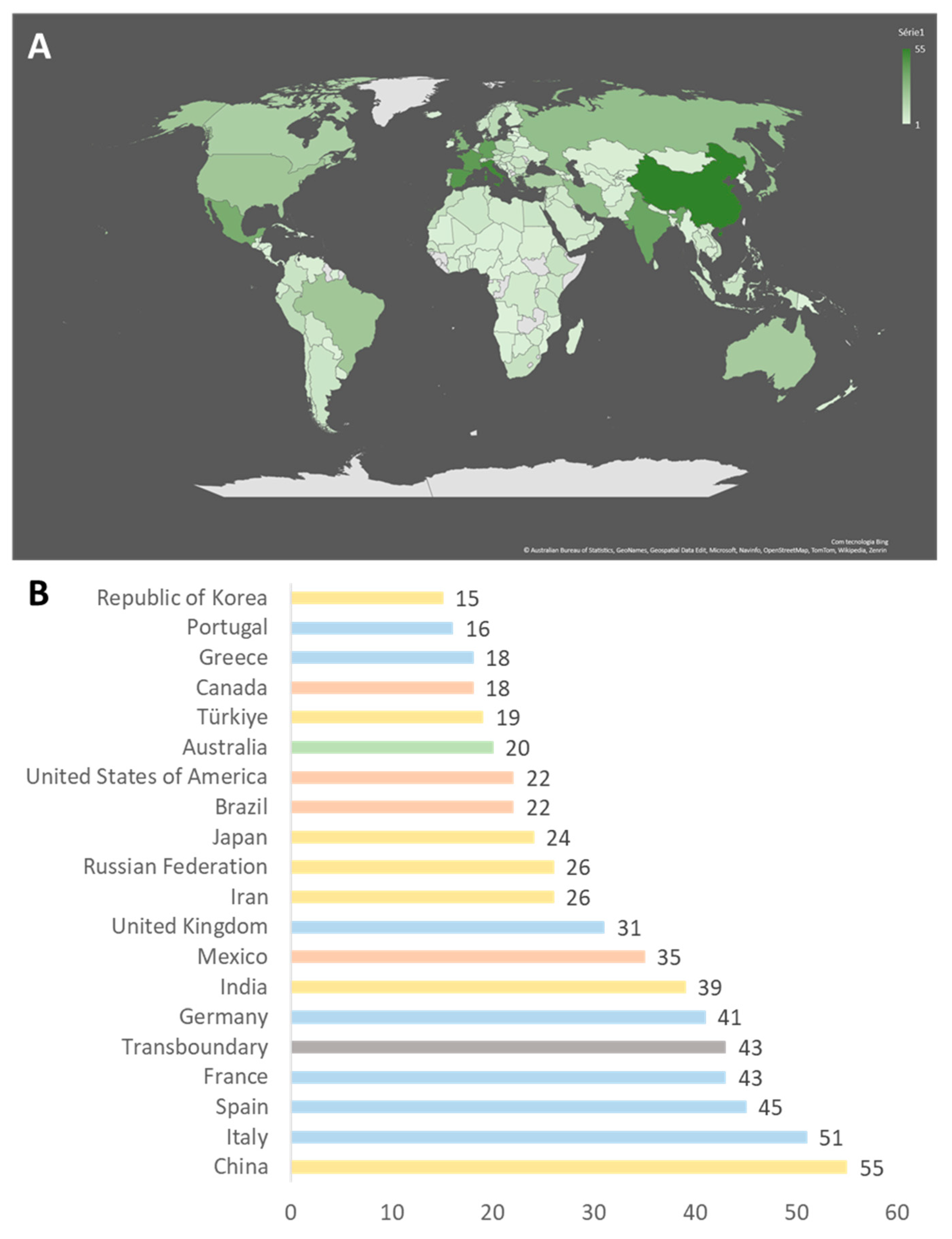
Disclaimer/Publisher’s Note: The statements, opinions and data contained in all publications are solely those of the individual author(s) and contributor(s) and not of MDPI and/or the editor(s). MDPI and/or the editor(s) disclaim responsibility for any injury to people or property resulting from any ideas, methods, instructions or products referred to in the content. |
© 2023 by the authors. Licensee MDPI, Basel, Switzerland. This article is an open access article distributed under the terms and conditions of the Creative Commons Attribution (CC BY) license (http://creativecommons.org/licenses/by/4.0/).
Copyright: This open access article is published under a Creative Commons CC BY 4.0 license, which permit the free download, distribution, and reuse, provided that the author and preprint are cited in any reuse.