

Submitted:
09 October 2023
Posted:
11 October 2023
You are already at the latest version
Abstract
(1) Background: The compound ytterbium trifluoride is used as a component of several dental materials, and this is reviewed in the current article. (2) Methods: Published articles on this substance were identified from PubMed, and showed that it has been included in a variety of dental restorative materials, including composite resins, glass polyalkenoate cements and calcium trisilicate cements. (3) Results: Ytterbium trifluoride is reported to be insoluble in water. Despite this, its presence is associated with fluoride release from dental materials. There is evidence that it reacts with the components of calcium trisilicate cements to form small amounts of a variety of compounds, including ytterbium oxide, Yb2O3, and calcium-ytterbium fluoride, CaYbF5. In nanoparticulate form, it has been shown to reinforce glass polyalkenoates and it also provides high contrast in X-ray images. (4) Conclusions: Ytterbium trifluoride is a useful component of dental materials, though some of the published findings suggest that there are aspects of its chemistry which are poorly understood.
Keywords:
ytterbium trifluoride
; structure
; properties
; solubility
; dental cements
; restorative materials
1. Introduction
The element ytterbium was first identified in 1878 by the Swiss chemist de Marignac as its oxide [1]. He named it after the Swedish town of Ytterby, near where the ores in which it was found had originated. Later the chemists Urbain and von Welsbach demonstrated independently that what de Marignac had actually discovered was a mixture of oxides of two new elements, the second of which they named lutetium. Ytterbium is actually one of the rarest of the so-called Rare Earths, also known as lanthanides [1]. It was first isolated in the pure state by Klemm and Bonner in 1937 by reduction of the chloride with potassium [2]:
YbCl3 + 3K → Yb + 3KCl
Aspects of the reduction process were improved by Daane et al. in 1953 [3], and this allowed sufficient quatities of the metal to be obtained for full characterisation. The currently accepted properties of the element ytterbium are shown in Table 1.
In terms of its more general properties, ytterbium is soft and malleable. It tarnishes in air, undergoing a slow oxidation reaction to form a layer of the oxide Yb2O3 on the metal surface [1].
2. Ytterbium Compounds
Ytterbium forms a number of simple binary compounds [1]. Its most common oxidation state is +3, which it shows in compounds such as Yb2O3, YbF3 and YbCl3. It also forms reasonably stable compounds in the +2 oxidation state, for example the difluoride YbF2, a feature which is unusual for a lanthanide element.
The compound ytterbium (III) fluoride is the particular subject of this review article. Its properties are listed in Table 2. Typically for compounds of Yb3+, the trifluoride is colorless, i.e., white in appearance [1,4,5]. It has a single unpaired electron and any possible electronic transitions lie outside the region of the visible spectrum, hence the absence of color.
Ytterbium trifluoride has the crystal structure shown in Figure 1 [8]. In this structure, the Yb3+ ions are in 8 coordination with the fluoride ions, which form a bicapped trigonal prism [4]. Because ytterbium is a heavy metal (atomic mass 173.04), it is able to absorb X-rays strongly [9]. This means that the presence of an ytterbium compound, typically the trifluoride, in a dental restorative material enhances the contrast in X-ray images. This is the reason that the substance has been used increasingly in a variety of such materials.
The question of the toxicity of YbF3 is important in the context of its use in dental materials. As a lanthanide, ytterbium has no role in the biochemistry of either animals or plants [10]. The suggestion has been made that lanthanide elements may show some degree of toxicity through completing with calcium in calcium-mediated biological reactions. However, any reported toxicity appears to be low. For example, a recent study found no obvious toxicity over 14 days following the exposure of rats to nanoparticles doped with Yb3+ ions [11]. Also, safety data sheets provided by companies typically claim that ytterbium fluoride lacks any significant toxicity [12,13]. In particular, this substance is reported not to be persistent, bio-accumulative or toxic [12].
Those heavy metals that are unquestionably toxic are typically Main Group elements, such as mercury, lead and thallium, rather than lanthanides [14]. They are also Lewis acids which are soft in Pearson’s Hard and Soft Acids and Bases (HSAB) scheme [15]. By contrast, lanthanides in general and ytterbium in particular, are also Lewis acids but hard. This scheme, which is based on the polarisability of the central metal ion in compounds, suggests that the most stable complexes of hard acids are those formed with hard bases, typically those based on oxygen donor atoms in the Lewis base [15]. Although there is some correlation between softness in the HSAB scheme and acute toxicity, possible because of the ease with which soft acids can bind to sulfur-containing bases, such as enzymes, hardness alone is not a sufficient property to determine whether an element or ion is non-toxic or not.
In fact, in the cells of living systems, much use is made of the ion Ca2+ in key biological processes. The calcium ion is hard in the HSAB scheme [15]. This means that lanthanides, including ytterbium, may displace these ions in certain cellular functions, and compete with them for active binding sites in enzymes and other important bio-molecules [16]. Hence, lanthanides may impair the biological function of these substances, interfering with metabolism and showing toxicity [17], at least to an extent.
These results suggest that a degree of caution may be prudent in the handling of lanthanide compounds. On the other hand, there is also evidence that they are not particularly toxic. For example, one recent study showed that the presence of lanthanide elements in urban street dust caused no increase in cancer in populations exposed to these dusts [18], and no adverse effects have been reported in connection with the use of YbF3 in dental materials. Hence, YbF3 seems to be acceptable for its application in dentistry from the toxicological point of view [12,13].
3. Ytterbium Fluoride in Dental Materials
The major reason for incorporating ytterbium trifluoride into dental materials is to make them radiopaque. This means that the contrast between them and the natural tissues is enhanced in X-ray images. This allows the material to be readily distinguished from the surrounding oral structures, ensuring that the clinician can detect voids in repairs such as root fillings or direct restorations [19] and also marginal gaps and other defects at the interface with the tooth [20,21,22].
X-ray beams are absorbed by atoms of high atomic number. In dentistry, the most widely used such elements have been barium and strontium, typically added in the form a powdered speciality glass based on oxides of these elements [23]. Other heavy elements that have been used include bismuth, zirconium and titanium [24,25]. However, use is increasingly made of ytterbium, in the form of YbF3 [20,26]. Particulate fillers based on any of these elements have the advantage that they can also improve the mechanical properties of the material when set [20,27,28]. Many of the studies involving such radiopaque fillers study not only their effect on X-ray attenuation, but also in mechanical properties. In the case of YbF3, there has also been interest in the extent to which the materials can release fluoride ions to the surroundings [29,30].
It is worth noting that the majority of the elements employed in dental materials are relatively light. This includes carbon, hydrogen and oxygen in the polymer phase and silicon and oxygen in the filler [31]. As such, their inherent radiopacity is low. The inclusion of fillers based on heavy elements overcomes this problem [32], and is therefore beneficial clinically.
The use of ytterbium fluoride in dental materials seems to have originated in the mid 1980s, when a patent was granted to what was then the Ivoclar company in Liechtenstein (now Ivoclar Vivadent) [33]. This concerned the use of such compounds in dental composite resins. The use was clearly aimed at improving the radiopacity of the composite resin, and YbF3 was only one of several lanthanide fluorides named in the patent. The others were the trifluorides of lanthanum, cerium, samarium, gadolinium, dysprosium and erbium [33]. In fact, lthough this implies a wide range of possibilities, only four examples were described, two of which were based on ytterbium trifluoride. There was also some data provided to indicate that YbF3 gave the best radiopacity of all the compounds tested [33].
Ivoclar Vivadent remains a major international manufacturer of dental materials, and their current brands of composite resin such as Tetric EvoCeram and Tetric EvoFlow still employ ytterbium trifluoride as the contrast agent for radiopacity [34,35]. Interestingly, these materials have been shown to release fluoride in small amounts [36,37,38,39,40], even though the only source of fluoride in the material is the YbF3 radiopacifying agent [34,35]. This suggests that the substance is not completely insoluble, despite what is claimed elsewhere in the literature.
The fluoride-release experiments were carried out as follows [36]: Samples were suspended with a fluoride-free dental floss in 4 ml deionized water in a plastic tube at 37 °C. The whole assembly was covered to prevent water loss and stored for 24 h, after which the sample was washed with a 1 ml volume of deionised water that was combined with the original volume to give a total of 5 ml.
The sample was then stored again in deionised water that was changed each day. After periods of 1 week and 4 weeks, the samples were again washed with a 1 ml volume of deionised water which was added to the final 4 ml storage volume, and the resulting solution was analysed.
Analysis for fluoride analysis was carried out with a calibrated ion-selective electrode. Prior to analysis, all storage solutions were diluted with TISAB (total ionic strength acid buffer) at a ratio of 10:1. This was to decomplex all of the fluoride and to ensure that it was all present as free F- ions.
Similar experimental procedures have been used in other studies (37-40], and this means that results can be compared. Some representative values of fluoride release from composite resins in this type of experiment are shown in Table 3. In all cases YbF3 was the only source of fluoride within the material.
Composite resins containing ytterbium trifluoride have also been shown to be capable of taking up fluoride when stored in aqueous solutions of an appropriate metal fluoride, such as sodium or potassium fluoride, or when exposed to a fluoridated gel [30,36,37,38,39,40]. There is no evidence that this is due to a complete reversal of the fluoride release reaction, and it may be that a small amount of fluoride ion simply becomes entrained within the surface layers of the composite resin. However, it is notable that the Tetric materials within each study have both released and taken up the lowest amounts of fluoride of all the materials studied [30,39], suggesting that there is a connection between the fluoride release and fluoride recharge effects.
Some composite resin materials have been formulated as fluoride-releasing materials by including speciality fluoride-containing glasses in the formulation alongside ytterbium trifluoride [41,42]. This means that the source of the fluoride is not clear. However, given the high levels released compared with materials that contain ytterbium trifluoride alone, it seems likely that most of the fluoride comes from the glass filler.
Another material that releases fluoride and contains two possible sources of this ion is the so-called “alkasite” material Cention N, also manufactured by Ivoclar Vivadent [43]. Its setting is based on a complicated blend of chemistry, though it is claimed to be mainly of the composite resin type [44]. It contains ytterbium trifluoride, but again, the principal role of this substance appears to be to confer radiopacity rather than to provide fluoride for release. The major fluoride-releasing component seems more likely to be the calcium-barium-aluminum fluorosilicate glass which is also present as a major component of the filler phase in this material [43].
As well as in composite resin restorative materials, ytterbium trifluoride has been used in several polymer-based materials for use in endodontics for root-end sealing. There have been a number of studies published that demonstrate that YbF3 is an effective radiopacifier for these polymer-based materials. Because of where they are used, these materials need to have an appropriate level of radiopacity and, in 2001 the relevant ISO standard established 3 mm of aluminum to be the minimum radiopacity value for them. This is still the value stated in the current standard [45]. The American Dental Association further specified that endodontic sealers should be at least 2 mm of aluminium more radiopaque than either dentin or bone [46].
To determine this, most researchers employ the technique of evaluating the radiopacity of endodontic materials that was developed by Tagger and Katz [47]. In this technique, radiographic images of the material are recorded together with those of an aluminium step-wedge (penetrometer). The resulting images are digitized, and their grey-scale values detected by specific software [47].
An early study, carried out over 30 years ago, evaluated the effect of including ytterbium trifluoride in the root-end cover material Retroplast. This material, which is no longer available, was an adhesive composite resin. When first manufactured, it used silver to impart radiopacity, but in 1990, it was reformulated and the silver was replaced with ytterbium trifluoride [48]. In this case, the evaluation was done clinically, and these studies showed that the substitution led to an improved material which not only gave good radiopacity but also gave better levels of complete healing than with silver [48,49].
Ytterbium trifluoride has been studied for use as a radiopacifier in an experimental epoxy system suitable for use as a root canal sealer for endodontics [50]. The study involved three different radiopaque additives with, as well as YbF3, calcium tungstate and barium sulfate. All three additives were found to affect the mechanical and chemical properties of the sealer, and had acceptable radiopacity (Table 4). There was some indication that YbF3 was superior in terms of radiopacity, but the effect was slight [50]. For all aspects of the chemical behavior (setting time, water sorption, solubility), both ytterbium trifluoride and barium sulfate were very similar. This is the ideal situation, as it is desirable that radiopacifying additives should not alter the chemical properties of the material. Calcium tungstate, but contrast, had a variety of adverse effects, lengthening the setting time and substantially increasing both the water sorption and solubility of the final material. Only in terms of its radiopacity was its performance equivalent to that of ytterbium trifluoride and barium sulfate. Overall, the key finding from this work, from the point of the view of the present review, is that ytterbium trifluoride can be used in epoxy systems to confer radiopacity, just as they have been with composite resin systems based in either bisGMA [16] or bisEMA [51].
As well as polymer-based materials, ytterbium fluoride has been used in cements to impart radiopacity. This includes both glass polyalkenoate cements (also known as glass-ionomers) and calcium trisilicate cements. These will now be considered in turn.
Glass polylkenoate cements (GPC) are acid-base cements that set by a neutralization process [52]. They consist of a powder comprising a complex basic glass based on calcium and sodium alumino-silicates with added phosphate and fluoride compounds. These powders are reacted with an aqueous solution of polymeric acid, such as poly(acrylic acid) or acrylic-maleic acid copolymer [52]. Setting is fairly rapid and the final material is a hard, slightly translucent material. Setting can be augmented by the addition of a polymerizable system, typically 2-hydroxyethyl methacrylate monomer together with an appropriate initiator. The latter materials are known as resin-modified glass polyakenoates [52].
Ytterbium trifluoride in the form of nanoparticles has been studied as a possible radiopacifier in glass polyalkenoate cements [26]. This study compared the effect of nanoparticulate barium sulfate, and also examined the effect of both substances on the setting and working times, compressive strength (at 24 hours) and hardness (also at 24 hours). The cement into which they were incorporated was a commercial conventional glass polyalkenoate called Riva SC (SDI Ltd., Bayswater, Australia). Nanoparticles were added at levels of 1, 2, 5, 10, 15 and 25% (w/w), being mixed with the glass powder. The modified mixtures were placed in capsules, closed, and mixed with poly(acrylic acid solution) on a vibratory mixer [26].
Ytterbium trifluoride had a greater effect on the working and setting time of the glass polyalkenoate than the barium sulfate. Representative data to demonstrate this are shown in Table 5. Compressive strengths were also reduced, but to a lesser extent with yttrium fluoride than with barium sulfate. For example, from an initial value of 160 MPa, compressive strength at 24 hours was reduced to about 132 MPa with 15% YbF3, but to about 95 MPa for 15% BaSO4. Hardness showed a more complex pattern, with a slight increase for low levels of either type of nanoparticle, but a substantial decrease at higher levels. There was little or no difference between the two additives for most levels of addition. The exception was at 25% loading, where cements containing BaSO4 showed such poor hydrolytic stability that the surface hardness could not be measured [26].
These results show that both of these additives interfere with the setting reaction of glass polyalkenoates. In the case of YbF3, it consistently shortened the working and setting times, showing that it accelerated the setting reaction. Exactly how it does so is not clear, but these results suggest that there was a distinct chemical reaction involving YbF3 and the other components of the cement, and that these lead to additional hardening processes within the cement.
Lastly, ytterbium trifluoride has also been employed in experimental calcium trisilicate cements to make them radiopaque [53]. Calcium trisilicates are used in endodontics as root-end sealers [54,55]. The main material is known as MTA, and is similar to Portland cement [53]. Two main brands are currently available, namely ProRoot MTA, grey and white (Tulsa Dental Products, Tulsa, USA) and MTA-Angelus (Angelus, Londrina, Brazil). There also related products based on refined calcium trisilicate, where the detailed compositions vary from those of MTA, but the essential setting chemistry is the same. The main brand of this type of material is Biodentine (Septodont, St Maur des Fausses, France). All of these calcium trisilicate materials have good sealing ability and, through their high pH, stimulate natural tissue repair at the root apex. They also show good biocompatibility in this application [54,57].
Calcium trisilicate sets by a hydration reaction [58]. Two phases are involved, namely alite (Ca2SiO5) and belite (β-Ca2SiO4), and the initial product of reaction is a poorly crystalline phase comprising calcium hydroxide in calcium silicate hydrate. The latter substance corresponds approximately to Ca3Si2O7 [59]. It undergoes further condensation reactions that form short silicate chains and these are responsible for improving the strength of the set cement [60].
The presence of Ca(OH)2 in the cement causes it to be alkaline [61,62], a feature which stimulates cell growth in vivo. It also provides a component capable of reacting with ytterbium trifluoride.
It is worth considering the behavior of ytterbium trifluoride in calcium trisilicate cements in some detail. Typical cement formulations were those used in the study of the inclusion of YbF3 at 30% previously mentioned [53] and details of these compositions are shown in Table 6.
The properties of the various modified cements are shown in Table 7 [53]. These cements all had pH values that were well on the alkaline side and they also had adequate radiopacity. As results in the Table show, all three cements released reasonable amounts of fluoride and the modified Portland cement gave quite a considerable fluoride release. Cements also released small amounts of ytterbium, presumably as Yb3+ ions [53]. In reporting this, the authors raise some concern about its toxicity, describing it as “potentially cytotoxic”.
However, no evidence of any cytotoxicity was observed in the biological studies reported [53]. Rather, both osteoblast and osteoclast cells were found to grow in close contact with all three experimental cements, and both types of cell were found to be completely normal in size and shape when they did so. This shows that the small amount of Yb3+ released was insufficient to cause any adverse biological effects.
All three cements were examined with both FTIR spectroscopy and X-ray diffraction, and these techniques showed that there were several reaction products of ytterbium fluoride within the cement, notably ytterbium (III) oxide and calcium ytterbium fluoride, CaYbF5. Calcium hydroxide and calcium silicate hydrates were also present [53]. There was also evidence of a substance corresponding to Ca17Yb10F64 in Cement 1. Formation of this substance was held to be the reason that this cement released the smallest amounts of Yb3+ and F- ions [53]. The authors suggest that a similar substance is formed in Cement 2, but with some of the fluoride ions replaced by hydroxide ions. This, they suggest, leaves free fluoride ions which are capable of being released by the cement. The authors do not comment on the possible calcium-ytterbium-fluoride species in Cement 3, but presumably there is a similar effect, which would explain the even greater release of fluoride from this material.
Whatever the details of the chemistry, the feature that is apparent about the ion release is that much more fluoride is released than ytterbium. This suggests that the YbF3 originally present undergoes some sort of dissociation in order for the two constituent elements to be released separately, an observation that suggests that the compound has a degree of solubility in the aqueous medium found within the setting cement.
F- release/μg/L
The simpler ytterbium compounds reported are able to arise from reactions of the ytterbium trifluoride with calcium hydroxide formed within the cement. These reactions are as follows:
2YbF3 + 2Ca(OH)2 → Yb2O3 + 2CaF2,
2YbF3 + Ca(OH)2 → CaYbF5 + YbF(OH)2
Both reactions imply that YbF3 is acidic, at least to some extent. However, one paper in describing its inclusion in a dental composite resin claims, incorrectly, that it is alkaline [63]. In fact, ytterbium trifluoride is a Lewis acid, as we have seen and as are other simple compounds of ytterbium (III) [1]. Both ytterbium (III) chloride [64] and ytterbium (III) triflate [65] are known to be Lewis acids, a property that underpins their widespread use as catalysts in organic chemistry. Typically, metal fluorides are stronger Lewis acids than their equivalent metal chlorides [66], which suggests that YbF3 is likely to have considerable Lewis acidity. This provides part of the driving force for the reactions with calcium hydroxide shown above which occur within the cement.
4. The Chemical Behavior of Ytterbium Fluoride when Used in Dental Materials
The behavior of ytterbium trifluoride in dental cements challenges some of the claims about the properties of this substance, and also highlights where information is lacking on its reactions. When included in either polymer-based materials, such as composite resins, or calcium trisilicate cements, it imparts the ability to release fluoride. This suggests that it has at least some solubility in aqueous systems, otherwise it would not supply free F- ions. Such fluoride release seems to contradict the statement that the substance is insoluble in water [1].
The ability to undergo reactions within calcium trisilicate cements is consistent with ytterbium trifluoride having a reasonable acidity. YbF3 seems certain to be a reasonably strong Lewis acid, by comparison with YbCl3 [59], though this property is surprisingly not mentioned by certain authorities [4]. Indeed, the reactivity that ytterbium trifluoride has within calcium trisilicate cements is not to be expected from the textbook descriptions of its chemistry [1,4].
This suggests that more work is needed to determine its solubility under a range of conditions and also to establish its reactions with simple reagents. It may be that ytterbium trifluoride would find other uses as an additive in implantable materials if its essential chemistry were better understood.
Lastly, the concerns that have been expressed about the toxicity of YbF3 [10,17] do not seem to be supported by the published evidence on the effect of trace amounts of the substance on humans [11,53]. However, given the use described in this review as an additive to dental materials this lack of clarity about toxicity is concerning, and further studies on this topic are clearly desirable as well.
Funding
This work received no external funding.
Acknowledgments
I acknowledge the contribution of Peter Nicholson for drawing Figure 1.
Conflicts of Interest
The author declares no conflict of interest.
References
- Cotton, S. Lanthanide and Actinide Chemistry; John Wiley & Sons: Chichester, UK, 2006. [Google Scholar]
- Klemm, W.; Bommer, H. Contribution to the knowledge of the rare earths. Z. Anorg. Allg.Chem., 1937, 231, 138–171. [Google Scholar] [CrossRef]
- Daane, A.H.; Dennison, D.H.; Spedding, F.H. The preparation of samarium and ytterbium metals. J. Amer. Chem. Soc., 1953, 75, 2272–2273. [Google Scholar] [CrossRef]
- Greenwood, N.N.; Earnshaw, A. Chemistry of the Elements; Butterworth-Heinemnann: Oxford, UK, 1984; pp. 1437–1440. [Google Scholar]
- Lide, D.R. (Ed.) Handbook of Chemistry and Physics, 90th ed.; CRC Press: Boca Raton, Florida, USA, 1998. [Google Scholar]
- Shannon, R.D. Revised effective ionic radius and systematic studies of interatomic distances in halides and chalcogenides. Acta Crystallogr 1976, Sect. A32, 751–767. [Google Scholar] [CrossRef]
- Jia, Y.Q. Crystal radii and effective ionic radii of the Rare Earth ions. J. Solid State Chem., 1991, 95, 184–187. [Google Scholar] [CrossRef]
- Wells, A.F. Structural Inorganic Chemistry, 5th ed.Oxford Science Publishers: Oxford, UK, 1984. [Google Scholar]
- Schmidt, L.; Dimitrov, A.; Kemnitz, E. A new approach to prepare nanoscopic rare earth metal fluoride: the fluorolytic sol-gel synthesis of ytterbium fluoride. Chem. Commun., 2014, 50, 6613–6616. [Google Scholar] [CrossRef]
- Hiranao, S.; Suzuki, K.T. Exposure, metabolism, and toxicity of rare earths and related compounds. Environ. Health Perspect 1996, 104 (Suppl. 1), 85–95. [Google Scholar]
- Shahba, M.; El-Khyat, Z.; El-Wassef, M.M.; Sliem, M.A.; Farid, O.; El-Tayen, T.A. Study of mammalin acute toicity of sodium yttrium fluoride, erbium and yttrium doped upconversion materials. Egyptian J. Chem., 2022, 65, 699–705. [Google Scholar]
- Aldrich Chemical Company, Gillingham, Dorset, UK. Safety Data Sheet for ytterbium (III) fluoride. https://www.sigmaaldrich.com/GB/en/sds/ALDRICH/432121. Accessed 16th Sptember 2023.
- Strem Chemicals Inc., Newburyport, MA, USA, Safety Data Sheet for ytterbium (III) fluoride, 2021.
- Chang, L.W.; Magis, L.; Suzuki, T. (eds), Toxicology of Metals; CRC Press: Boca Raton, Florida, USA, 1996. [Google Scholar]
- Pearson, R.G. Hard and Soft Acids and Bases. J. Am. Chem. Soc. 1963, 85, 3533–3539. [Google Scholar] [CrossRef]
- Haley, T.J. ; Pharmacology and toxicology of the rare earth elements. J. Pharm. Sci., 1965, 54, 663–670. [Google Scholar] [CrossRef] [PubMed]
- Pallares, R.M.; Hebery, D.D.A.; Loguinov, A.; Proctor, M.; Villalobos, J.A.; Bjornsrad, K.A.; Rosen, C.J.; Vulpe, C.D.; Anergel, R.J. Identifying toxicity mechanisms associated with early lanthanide exposure through multi-dimensional genome-wide screening. ACS Omega, 2022, 7, 34412–34419. [Google Scholar] [CrossRef] [PubMed]
- Sun, G.; Li, Z.; Liu, T.; Chen, J.; Wu,; Feng, X. Rare earth elements in street dust and associated health risk in a municipal industrial base of central China. Environ. Geochem. Health, 2017, 39, 1469–1486. [Google Scholar] [CrossRef] [PubMed]
- Whaites, E. Essentials of dental radiography and radiology, 3rd ed.Churchill Livingstone: London, UK, 2002. [Google Scholar]
- Collares, F.M.; Ogliari, F.A.; Lima, G.S.; Fontanella, V.R.C.; Piva, E.; Samuel, S.M.W. Ytterbium trifluoride as a radiopaque agent for dental cements. Int. Endod. J., 2010, 43, 792–797. [Google Scholar] [CrossRef] [PubMed]
- Swartz, R.S; Robbins, J.W. ; Post placement and restoration of endodontically treated teeth: a literature review. J. Endod., 2004, 30, 289–301. [Google Scholar] [CrossRef] [PubMed]
- Soares, C.J.; Santana, F.R.; Fonesca, R.B.; Martens, L.R.; Neto, F.H. In vitro analysis of the radiopacity of indirect composites and ceramic inlay systems and its influence on the detection of cement overhangs. Clin. Oral Investig., 2007, 11, 331–336. [Google Scholar] [CrossRef] [PubMed]
- Moszner, N; Salz, U. ; Recent developments of new components for dental adhesives and composites. Macromol. Mater. Eng., 2007, 292, 245–271. [Google Scholar] [CrossRef]
- Bowen, R.L.; Cleek, G.W. A new series of X-ray-opaque reinforcing fillers for composite materials. J. Dent. Res., 1972, 51, 177–182. [Google Scholar] [CrossRef] [PubMed]
- Matsumura, H.; Sneyoshi, M; Atsuta, M. Radiopacity and physical properties of titanium-polymethacrylate composite. J. Dent. Res., 1992, 71, 2–6. [Google Scholar] [CrossRef] [PubMed]
- Prentice, L.H.; Tyas, M.J.; Burrow, M.F. The effect of ytterbium fluoride and barium sulphate nanoparticles on the reactivity and strength of a glass-ionomr cement. Dent. Mater., 2006, 22, 746–751. [Google Scholar] [CrossRef]
- Bowen, R.L.; Cleek, G.W. X-ray opaque reinforcing fillers for composite materials. J. Dent. Res., 1969, 48, 79–82. [Google Scholar] [CrossRef]
- Ginebra, M.P.; Albuixech, L.; Fernandez-Barragan, E.; Aparicio, C.; Gil, F.J.; San Roman, J.; Vazquez, B.; Planell, J.A. Mechanical performance of acrylic bone cements containing different radioacifying agents. Biomaterials, 2002, 23, 1873–1882. [Google Scholar] [CrossRef]
- Young, A.; von der Fehr, F.R.; Sonju, T.; Nordbo, H. Fluoride release and uptake in vitro from a composite resin and two orthodontic adhesives. Acta Odontol. Scand., 1996, 54, 223–228. [Google Scholar] [CrossRef]
- Naoum, S.; Ellakwa, A.; Martin, F.; Swan, M. Fluoride release, recharge and mechanical property stability of various fluoride-containing resin composites. Oper. Dent., 2011, 36, 422–432. [Google Scholar] [CrossRef] [PubMed]
- Ferracane, J.L. Resin composite – state of the art. Dent. Mater., 2011, 27, 29–38. [Google Scholar] [CrossRef] [PubMed]
- Aoyagi, Y.; Takahashi, H.; Iwasaki, N.; Honda, E. Kurabayashi, T.; Radiopacity of experimental composite resins containing radiopaque materials. Dent. Mater. J., 2005, 24, 315–320. [Google Scholar] [CrossRef] [PubMed]
- Michl, R.J.; Rheinberger, V.M.; Ott, G. Radiopaque dental materials, US Patent 4,629, 746 1986. [Google Scholar]
- Ivoclar Vivadent, Safety Data Sheet for Tetric EvoFlow, dated 06. 03. 2019.
- Ivoclar Vivadent, Safety Data Sheet for Tetric EvoCeram, dated 31. 01. 2020.
- Harhash, A.Y.; El Sayad, I.I.; Zaghloul, A.G.S. A comparative in vitro study on fluoride release and water sorption of different flowable esthetic restorative materials. Eur. J. Dent., 2017, 11, 174–179. [Google Scholar] [CrossRef]
- Porenczuk, A.; Jankiewicz, B.; Naurecka, M.; Bartosewicz, B.; Sierakowski, B.; Gozdowski, D.; Kostecki, J.; Nasiłowska, B.; Mielczarek, A. A comparison of the remineralizing potential of dental restorative materials by analyzing their fluoride release profiles. Adv. Clin. Exp. Med. 2019, 28, 815–823. [Google Scholar] [CrossRef]
- Mathias, M.R.; Rathi, N.; Bendgude, V.D.; Tirupathi, S.; Chauhan, R.S.; Border, A.; Lath, T.; Shas, S.S. Comparative fluoride ion release pre and postrecharge situations among three different pediatric dental restorative materials: An in vitro study. Int. J. Clin. Pediatr. Dent. 2022, 15, 729–735. [Google Scholar]
- Attar, N.; Turgul, M.D. Fluoride release and uptake capacities of fluoride-releasing restorative materials. Oper. Dent., 2003, 28, 395–402. [Google Scholar]
- Dasgupta, S.; Saraswarthi, M.V.; Somayaji, K.; Pentapati, K.C.; Shetty, P. Comparative evaluation of fluoride release and recharge potential of novel and traditional fluoride-releasing restorative materials: An in vitro study. J. Conserv. Dent., 2018, 21, 622–626. [Google Scholar] [PubMed]
- Burgess, J.O.; Walker, R.; Davidson, J.M. Posterior resin-based composites: review of the literature. Pediatr. Dent., 2002, 24, 465–479. [Google Scholar] [PubMed]
- Xu, X.; Burgess, J.O. Compressive strength, fluoride release and recharge of fluoride-releasing materials. Biomaterials, 2003, 24, 2451–2461. [Google Scholar] [CrossRef] [PubMed]
- Mangota, V.; Sharma, S. A new alkasite restorative material – Cention N. Asian Pac. J. Health Sci., 2021, 8, 18–19. [Google Scholar] [CrossRef]
- Abdallah, R.M.; Aref, N.S. Development of newly formulated nanoalumina-alkasite-based restorative material. Int. J. Dent., 2021, 2021, article 9944909. [Google Scholar] [CrossRef]
- International Organization for Standardization. ISO, 6876: Dentistry - Root canal sealing materials. Geneva, Switzerland: International Organization for Standardization, 2012.
- American Dental Association. Specification no. 57 for endodontic filling materials. J. Am. Dent. Assoc. 1984, 108, 108. [Google Scholar]
- Tagger, M.; Katz, A. Radiopacity of endodontic sealers: development of a new method for direct measurement. J. Endod., 2003, 29, 751–755. [Google Scholar] [CrossRef] [PubMed]
- Rud, J.; Rud, V.; Munksgaard, E.C. Retrograde root filling with dentin-bonded modified resin composite. J. Endod., 1996, 22, 477–480. [Google Scholar] [CrossRef]
- Niederman, R.; Theodosopoulou, J.N. A systematic review of in vivo retrograde obturation materials. Int. Endod. J., 2003, 36, 577–585. [Google Scholar] [CrossRef]
- Collares, F.M.; Klein, M.; Santos, P.D.; Portella, F.F.; Ogliari, F.; Leitune, V.C.B.; Samuel, S.M.W. Inlfuence of radiopaque fillers on physicochemical properties of a model epoxy resin-based root canal sealer. J. Appl. Oral Sci., 2013, 21, 533–539. [Google Scholar] [CrossRef]
- De Souza, M.O.; Leitune, V.C.B.; Bohn, P.V.; Samuel, S.M.W.; Collares, F.M. Phyisical-mechanical properties of bis-EMA based root canal sealer with different fillers addition. J. Conserv. Dent., 2015, 18, 227–231. [Google Scholar] [PubMed]
- Sidhu, S.K.; Nicholson, J.W. A review of glass-ionomer cements for clinical dentistry. J. Funct. Biomater., 2016, 7, 16. [Google Scholar] [CrossRef] [PubMed]
- Antonijevic, D.; Jeschke, A.; Colovic, B. , Milovanovic, P.; Jevremovic, D.; vom Scheidt, A.; Hahn, M.; Amling, M.; Jokanovic, V.; Busse, B.; Djuric, M. Addition of a fluoride-containing radiopacifier improves micromechanical and biological charcateristics of modified calcium silicate cements. J. Endod., 2015, 41, 2050–2057. [Google Scholar] [CrossRef] [PubMed]
- Torabinejad, M.; Parirokh, M. Mineral trioxide aggregate: a comprehensive review – Part II: leakage and biocompatibility investigations. J. Endod., 2010, 36, 190–202. [Google Scholar] [CrossRef] [PubMed]
- Roberts, H.W.; Toth, J.M.; Berzins, D.W.; Charlton, D.W. Mineral trixide aggregate material use in endodontic treatment: a review of the literature. Dent. Mater., 2008, 24, 149–164. [Google Scholar] [CrossRef] [PubMed]
- Tawil, P.Z.; Duggan, D.J.; Galicia, J.C. MTA: A clinical review. Compend. Contin. Educ. Dent., 2015, 36, 247–264. [Google Scholar] [PubMed]
- Holland, R.; de Souza, V.; Nery, M.J.; Filho, J.A.O.; Bernabe, P.F.; Dezan Jr, E. Reaction of rat connective tissue to implanted dentin tube filled with mineral trioxide aggregate, Portland cement or calcium hydroxide. J. Endod., 1999, 25, 161–166. [Google Scholar] [CrossRef]
- Li, Q.; Coleman, N.J. The hydration chemistry of ProRoot MTA. Dent. Mater. J., 2015, 34, 458–465. [Google Scholar] [CrossRef]
- Taylor, H.F.W. Cement Chemistry; Academic Press: London, 1990. [Google Scholar]
- Li, Q.; Coleman, N.J. Early hydration of white Portland cement in the presence of bismuth oxide. Adv. Appl. Ceram., 2013, 112, 207–212. [Google Scholar] [CrossRef]
- Camilleri, J.; Pitt Ford, T.R. Review of constituents and properties of mineral trioxide aggregate. Int. Endod. J., 2006, 39, 747–754. [Google Scholar] [CrossRef]
- Camilleri, J. Hydration mechanisms of mineral trioxide aggregate. Int. Endod. J., 2007, 40, 462–470. [Google Scholar] [CrossRef]
- Mohamed, N.I.; Safy, R.K.; Elezz, A.F.A. Microtensile bond strength, marginla leakage, and antibacterial effect of bulk fill resin composite with alkaline fillers versus incremental nanohybrid composite resin. Eur. J. Dent., 2021, 15, 425–432. [Google Scholar]
- Lou, S.; Westbrook, J.A.; Schaus, S.E. Decarboxylative aldol reactions of allyl β-keto esters via heterobimetallic catalysts. Prep. Org. Chem., 2000, 41, 447–449. [Google Scholar]
- Zhang, L.J.; Lu, H-L. ; Wu, Z-W.; Huang, Y-S. Ytterbium triflate: A versatile catalyst in organic chemistry. Curr. Org. Chem., 2013, 17, 2906–2920. [Google Scholar] [CrossRef]
- Davis, M.F.; Levason, W.; Reid, G.; Webster, M. Synthesis and charactersation of tin (IV) fluoride complexes phosphine and arsine oxide ligands. Polyhedron, 2006, 25, 930–936. [Google Scholar] [CrossRef]
Figure 1.
Crystal structure of YbF3 (Yb3+ in grey; F- in green).
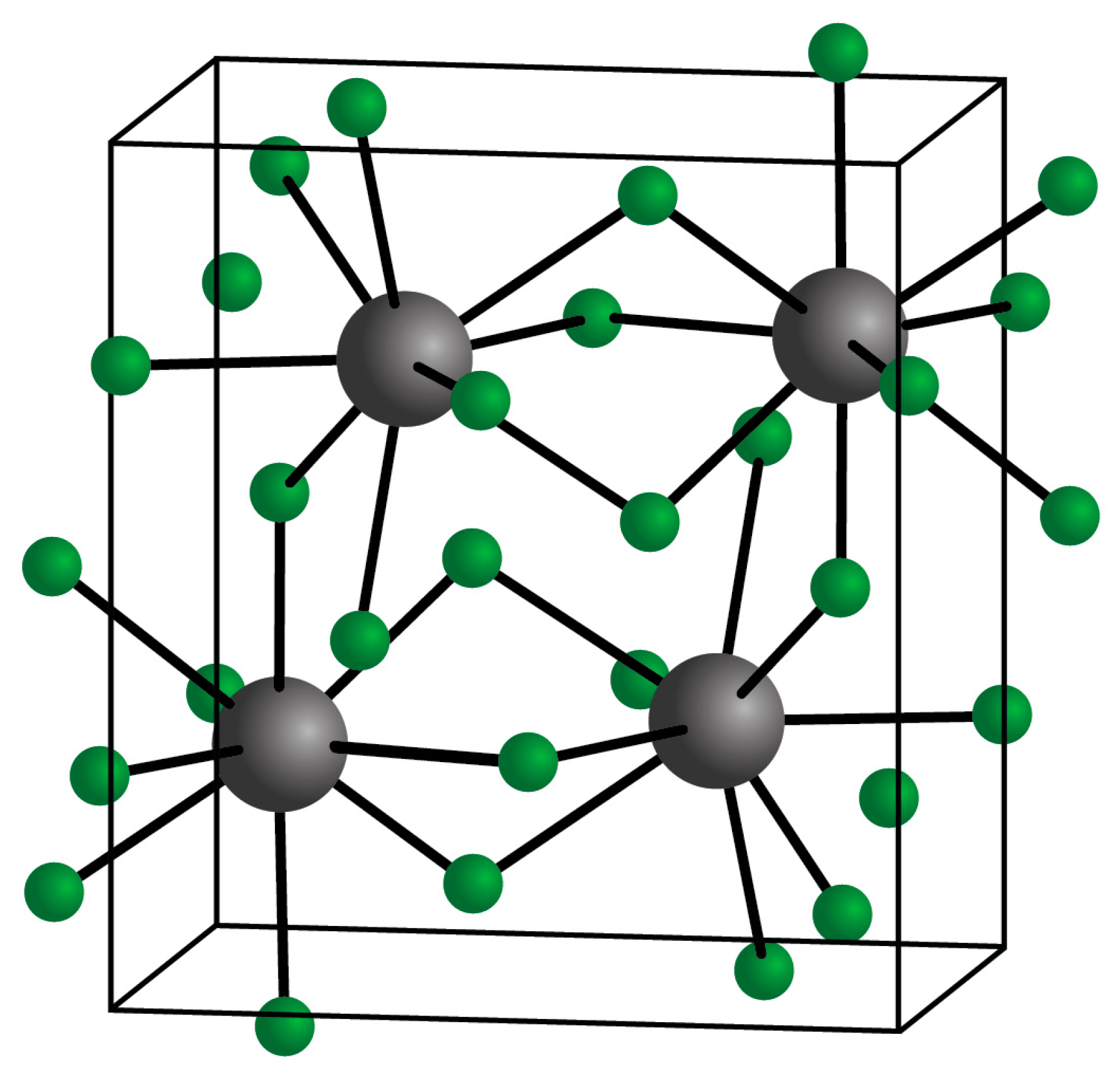

Table 1.
The properties of ytterbium.
| Property | Value | Reference |
|---|---|---|
| Atomic number | 70 | 4 |
| Relative atomic mass | 173.04 | 4 |
| Stable isotopes (relative abundance) | 168 (0.13%), 170 (3.02% 171 (14.2%, 172 (21.8%), 173 (16.1%), 174 (31.9%, 176 (12.9%). |
4 |
| Oxidation states | +3, +2 | 4 |
| Atomic radius | 176 pm | 5 |
| Electronic configuration | [Xe]4f146s2 | 4 |
| Ionic radius (8 coordination) | 98.5 pm1 | 6, 7 |
| Ionic radius (6 coordination) | 86.8 pm1 | 6, 7 |
1 Slighter larger values are given on certain websites, but those in the Table appear to be the most reliable values quoted in the peer-reviewed literature.
Table 2.
The properties of ytterbium (III) fluoride.
| Property | Value | |
|---|---|---|
| Appearance | White crystalline solid | |
| Relative molecular mass | 230.04 | |
| Melting point | 1157 °C | |
| Boiling point | 2380 °C | |
| Atomic radius | 176 pm | |
| Solubility in water | Insoluble | |
| Density | 8.17 g cm-1 |
Table 3.
Fluoride release at 1 day from two composite resins containing YbF3 (standard deviations in parentheses).
Table 3.
Fluoride release at 1 day from two composite resins containing YbF3 (standard deviations in parentheses).
| Material | Fluoride release/ppm | Reference |
|---|---|---|
| Tetric N-flow | 0.60 (0.07) | 36 |
| Tetric N-Ceram | 0.41 (0.08) | 40 |
Table 4.
Properties of experimental bisEMA root canal sealers with various radiopacifying agents.
| Property | CaWO4 | YbF3 | BaSO4 |
|---|---|---|---|
| Setting time/min | 501 | 388 | 385 |
| pH | 6.84 | 6.25 | 6.45 |
| Radiopacity/mm Al | 1.96 | 2.07 | 1.62 |
| Water sorption/μg/mm³ | 183.2 | 67.8 | 51.3 |
| Solubility/μg/mm³ | 200.1 | 10.7 | 13.2 |
Table 5.
Working and setting times for conventional glass polyalkenoate (GPA) cement with and without radiopacifying agents.
Table 5.
Working and setting times for conventional glass polyalkenoate (GPA) cement with and without radiopacifying agents.
| Cement | Working time/s | Setting time/s |
|---|---|---|
| GPA only (no additive) | 155.4 | 442.6 |
| GPA + 5% YbF3 | 64.6 | 213.0 |
| GPA + 5% BaSO4 | 132.4 | 376.0 |
| GPA + 15% YbF3 | 73.0 | 163.0 |
| GPA + 15% BaSO4 | 169.8 | 351.0 |
Table 6.
Experimental calcium trisilicate cements with added YbF3.
| Material | Composition |
|---|---|
| Cement 1 | Calcium silicate 30%, calcium carbonate 40%, YbF3 30% |
| Cement 2 Cement 3 |
Calcium silicate 17.5%, nano-HA 35%, gypsum 17.5%,YbF3 30% 70% Portland cement, 30% YbF3 |
Table 7.
Properties of experimental calcium trisilicate cements modified by adding 30% YbF3.
| Property | Cement 1 | Cement 2 | Cement 3 |
|---|---|---|---|
| Setting time/min | 6 | 24 | 20 |
| pH | 9.38 | 9.23 | 9.43 |
| Radiopacity/mm Al | 5.45 | 4.90 | 5.75 |
| F- release/μg/L | 8.79 | 44.87 | 74.47 |
| Yb release/μg/cm2 | 0.073 | 0.16 | 1.35 |
|
Disclaimer/Publisher’s Note: The statements, opinions and data contained in all publications are solely those of the individual author(s) and contributor(s) and not of MDPI and/or the editor(s). MDPI and/or the editor(s) disclaim responsibility for any injury to people or property resulting from any ideas, methods, instructions or products referred to in the content.
The radiopacity of specimens is typically measured on a specimen of size… The radiopacity value is determined using an aluminium step-wedge standard whose thickness ranges from 0.5 to 9.0 mm. The radiographic images are analysed using appropriate software that is able to measure the pixel density of the grey image. This gives values equivalent to thickness of aluminium as the measure of the radiopacity of the sample.
|
© 2023 by the authors. Licensee MDPI, Basel, Switzerland. This article is an open access article distributed under the terms and conditions of the Creative Commons Attribution (CC BY) license (http://creativecommons.org/licenses/by/4.0/).
Copyright: This open access article is published under a Creative Commons CC BY 4.0 license, which permit the free download, distribution, and reuse, provided that the author and preprint are cited in any reuse.


