

Submitted:
04 December 2023
Posted:
06 December 2023
You are already at the latest version
Abstract
Natural radioactivity of 238U, 232Th and 40K for liquid and solid samples collected from Sidi Salem dam (Tunisia) and Aïn Dalia dam (Algeria) were measured using TERRA detector of rays (gam-ma, beta, and alpha), Atomic adsorption and Gamma-ray spectrometry were used to analyze the levels of radionuclides and toxic heavy metals, respectively. Toxic heavy metals (Fe, Bb, Zn, Ni, Cu, Cr and Cd) and associated health risks in surface water and sediment of dams have been in-vestigated in this present study. The radioactivity mean rates in the water samples were 1.72±0.01, 0.068±0.01 and 94.6±1.04 Bql-1 for 238U, 232Th and 40K respectively (Tunisia dam) and were 1.9± 0.24, 0.09±0.01 and 131.43±1.03 Bql-1 for 238U, 232Th and 40K respectively (Algeria dam). The 238U, 232Th and 40K radioactivity mean concentration measured in the sediment samples were 2.67±0.01, 0.18±0.012 and 197.87±2.01 Bqkg-1 respectively (Tunisian dam) and were 4.34±0.05, 0.27±0.05 and 287.61±3.34 Bqkg-1 respectively (Algeria dam). The activity concentration of 40K was higher than that of 238U and 232Th for the water and sediment samples. The mean activity concen-trations follow the order 40K > 238U > 232Th. The cumulative impact can be a serious immediate radiological health burden on the ecosystem, environment and people's health in this study area and can be transposable to any other similar region. The good knowledge of monitoring quality and quantity for the transboundary water resources and the international collaborations are es-sential to safeguard human health (women’s breasts cancer, thyroid cancer, neurological im-pact…), and avoid the conflicts, especially during these climatic upheavals of drought.
Keywords:
natural radioactivity
; water
; sediment
; environmental implications
; north africa
1. Introduction
Natural radiation is a normal part of the environment that emanates from two main sources: cosmic radiation, which originates in outer space and passes through the atmosphere, and the decay of radionuclides (radioactive isotopes or radio-isotopes) in the soil and the rock. Radionuclides undergo spontaneous disintegration into daughter nuclides with an associated emission of ionizing radiation in the form of alpha and beta particles, gamma rays and other cosmic rays. Daughter nuclides may be either stable or may themselves be radionuclides which also undergo radioactive decay. Many people might be surprised to learn that drinking water sources, especially rainwater, surface water and groundwater, can contain radioactive elements (radionuclides). Radionuclides in water can be a concern for human health because several are toxic or carcinogenic. Other radionuclides (18O, 2H, 3H, 13C and 14C) are useful tools for determining the hydrodynamic of groundwater, the residence time, the intercommunication between the aquifers, the recharge rate of aquifers, the radioactivity rate disintegration, the water quality, the contamination source/rate, and the age of groundwater in an aquifer or of sediment deposited at the bottom of a water body (dead zone of the dams).
Radionuclides of natural origins are normally present in different amounts in drinking water (dams surface water, surface water and shallow/deep water). They are released from rocks and minerals which form the water reservoirs as happens with composition (anions, cations, and different isotopes): erosion, transportation, dissolution, and oxydo-reduction…bring toxic heavy metals (Fe, Pb, Zn, Ni, Cr, Cu and Cd) and radioactive elements (U-228, Th-234, Ra-226, Rn-222…) from rocks into the water.
The Majerda transboundary basin, a prominent watershed in North Africa, extends from Eastern Algeria, near Souk Ahras, and stretches into Tunisia. Covering a vast expanse of approximately 23,175 square kilometers, with around 7,700 square kilometers lying within Algeria's borders, it plays a crucial role in the region's water resources. The exploitation of Uranium-rich ore deposits such as diapiric rocks in the Atlas of Algeria (Souk Ahras basin), together with nuclear development around the world, has increased the risk of anthropogenic radioactive pollution. Protection against such risks is essential. Aware of the importance of the problem, the Tunisian government has already launched a program that envisages the development of studies of the radiological environment in collaboration with the International Atomic Energy Agency (IAEA) and with the World Health Organization (WHO).
This study was initiated in the transboundary basin (Tuniso-Algerian basin) known, in particular, by its richness in mines (phosphate-U, Pb/Zn, Fe…), diapiric sediments (clay, limestone, gypsum, salt…) and volcanic (magmatic and metamorphic rocks) deposits characterized by an average Uranium content of 35 ppm. The main objective of this study is to make in situ measurements of the natural gamma radioactivity and the geochemical analysis of (238U, 232Th, and 40K) and the toxic elements (Fe, Pb, Zn, Ni, Cr, Cu and Cd) in the greatest dam in Tunisia (Sidi Salem dam) and Aïn Dalia dam from Algeria (Tuniso-Algerian transboundary basin) and to estimate the naturally occurring radioactivity in the surface water and the sediment from the dead zone of the dams. A comparative study with analyzes from non-contaminated areas (Beni Haroun Dam-Algeria) and (Sidi El Barak-Tunisia).
Natural radioactivity radiation comes in many forms (varieties of cosmic rays) [1]. Human health exposure to a high concentration of background radiation (cumulative effect) may cause health risks. The taking radionuclides naturally present in the atmospheric environment, water resources (surface and groundwater), sediment or food above the international limit can provoke cardiovascular epidemic and other problems of excessive radiation dosing during the time [1]. In this current study area, water quality deterioration has been reported and the dependence of the inhabitants on the water supply available without security guarantees [2,3]. Many scientific reports have been conducted on the direct investigation of radioactivity levels in soil, water, food and sediment around the world, including North African countries (Tunisia and Algeria) [4,5]. No immediate harmful effects on health due to the exposure of diapiric/metamorphic rocks but in the long term by cumulative effect everything is possible and plausible. Several countries in the world suffer from this type of problem such as Tunisia, Algeria, Saudi Arabia, Kuwait, Iran, Qatar, Oman, Spain, Portugal, Niger, and Nigeria. In southern Tunisia, recent studies carried out by Hamed et al. [6], have shown high rate of radioactivity (U, Th, Ra, Rn, Cs…) and toxic heavy metals (Cd, Pb, Zn, Fe, Cr, Sr, Li…), which have exceeded the standards in the phosphate-U/petroleum and geothermal basin (North Western Sahara Aquifer System: NWSAS of the great transboundary basin of North Africa-Southern Mediterranean Basin, divided between Algeria, Tunisia and Libya). The damage to human health is visible by an abnormal level of cancer disease in this phosphate-U mining polluting basin (Gafsa, Sfax, Gabes, Tozeur and Kebili), which affects all ages and both sexes. Therefore, the objective of this scientific report is to show the radiological effect and deduce the level of possible risk from the level of radioactivity and toxic heavy metals measured in surface water and sediments in the Aïn Dalia and Beni Haroun dams in the Algerian territory (recharge zone) and the same thing in the biggest dams of Sidi Salem and Sidi El Barak in Tunisian territory (discharge area).
2. Study area
This transboundary basin is located in North Africa between Algeria (recharge area) and Tunisia (discharge area) Southern of the Mediterranean Sea/Carthage Sea (Figure 1). This basin was characterized by specific geomorphology influenced by the Euro-African collision plates. It is characterized by the existence of natural volcanic deposits (diapiric, magmatic, and metamorphic rocks) in the North of the Atlas transboundary Tuniso-Algerian basin. The hydrographic network is dendritic type, it is made up of a single permanent watercourse (Majerda River) belonging to the cross-border Majerda-Mallegue watershed, the upstream of which is in the Algerian territory and the downstream in the Tunisian territory. The entire hydrographic network converges towards the Tunisian Mediterranean coast/Carthage Sea.
In general, in the Southern Mediterranean Basin, dams are essential for sustainable water supply due to the unbalanced distribution and the irregularity of precipitation during the humid period of the year (September to April). During the humid period the winter and spring, the reservoirs of dams store the water, while during the dry period of summer (May to August), the water is used for domestic and agricultural use and sometimes for industrial use. The study area is famous for its huge number of dams in both territories and iron, Pb, and Zn ore deposits and industrial sectors from these mine minerals...which were part of the raw materials of the large ironwork in North Africa and cement works. The Majerda basin falls within the sub-humid climatic zone, characterized by very high rainfall (500 – 1,200 mm/y) and dry seasons and it is located in the trough of the great collapse ditch of the Majerda [7]. The study area is characterized by a superposition of multi-layer aquiclude/aquitard [8] with the exception of the perched karstic carbonate (limestone and dolomite) units in NE Algeria and in NW Tunisia which are very vulnerable to this type of pollution by toxic and radioactive elements, or the possibility of contamination is possible by fracturations and/surface and subsurface faults (decreasing the residence time). There are therefore significant surface reserves that are used in agricultural, domestic, industrial, and tourist areas.
The Aïn Dalia dam is located in the town of Annaba in the Majerda river (Algerian part), their coordinates are latitude 36.263439°N and longitude 7.862016°E. It has been built since 1956 to store surface water and protect cities against flooding. Concerning the geographical locations, the Sidi Salem dam is located in the town of Beja (Testour) in the Majerda River (Tunisian part). The coordinates position are latitude 36.590614°N and longitude 9.396958°E. The dam has been built since 1977 to also store surface water and use it during periods of shortage. The dimension of the foot of this ancient gigantic dam is 73 meters in height and 345 meters in length. The principal objectives of this dam are the artificial recharge of aquifers, use in tourism, and industrial activities in the coastal part of Tunisia by pipeline transfer (Bizerte, Tunis, Hammamet, Sousse, Monastir, Sfax…).
3. Materials and methods
3.1. Work methodology
Our study consists of following international steps and precautions. A combination of several factors was carried out during this study. The flowchart in the following figure summarizes all the steps (geological/climatological data, field measurements, geo-informatic using remote sensing and GIS, sampling water/sediment, laboratory analysis and results interpretation). The samples collected included 24 samples (water and sediment). They were collected for the purpose of this work at various locations in the transboundary Tuniso-Algerian basin (Figure 2).
3.2. Sample collection and preparation
In this present research, 24 samples (16 surface water and 08 solids) have been collected during spring 2023, liquid and sediment parts (top and basal parts) of the 02 dams (Aïn Dalia-Algeria and Sidi Salem-Tunisia) in the polluted area and of the 02 other dams (Beni Haroun-Algeria and Sidi El Barak-Tunisia) but outside the pollution area, they are analyzed as a witness for geochemical comparison (Figure 3). The water container is sampled and washed with chloric acid (0.1 M HCl) according to the international protocol of WHO and US Environmental Protection Agency. During our study, we did not do diffusion for liquid samples because the freshwater salinity from dams is less than 500 mg/l. The solid samples were placed in cellophane bags to avoid any kind of evaporation and contact with open air (avoid the contact air/sediment: biological and/or physical contamination). 1.5 liters of liquid water and 2.5 kg of sediment were collected, labeled and properly sealed. All the glass bottles without exception were first washed according to the international protocol with sulfuric acid (diluted H2SO4) then rinsed with distilled water and then with dam water to avoid any external physical and/or biological contamination (temperature, humidity, pressure and/or loss of Radon or other isotopes). For this reason, water samples should always completely fill sample container leaving no space for gaseous to avoid any kind of exchange-gas. Concerning the organic phase will be separated into a separation funnel to avoid any error from the interaction between the organic and the mineral composition in the water and in the sediment. During this sampling phase, careful documentation of important parameters such as location, date, time and weather conditions that could have an influence on the produced data is required in this study area. Among the precautions to take also in this study, it is necessary to determine the weight of the empty vials in an analytical balance and measure the gamma radioactivity rate after calibration with known laboratory samples (reference of pure water and pure phosphoric acid samples analyzed by the IAEA).
3.3. Gamma Counting
It is very important and crucial to note during the sampling period that the simple act of collecting a liquid or solid sample can trigger errors in results, therefore, special care should be taken during the sampling and transportation especially for the gross alpha and beta measurement and the determination of radionuclides in water and sediments. Terra detector (Pocket-type instruments, Ukraine-made / April-2021: battery life 800 hours under no alarm condition and with 3 hours under alarm condition, -15°C < Temperature < +45°C and relative humidity around 95%) was used for the gamma counting at the Faculties of Sciences of Gafsa-Chemical department/Laboratory for the Application of Materials to the Environment, Water and Energy (LAM3E) (Tunisia) and the Geolab (Sétif-Algeria). The geochemical analysis has been effected in the Sfax Tina/lab (Tunisia) to determine the concentration of metals in solution in ppm or ppb ranges, using atomic absorption spectrometry (AAS) that consists of four main components: the light source, the atomization system, the monochromater and the detection system (filtration, dilution, nebulization, disolvation, volatilization and dissociation). The accuracy of these analysis depends on the quality of the sample preparation, any contamination or incomplete dissolution of the sample can lead to erosion in the results. The ionic balance between the anions and the cations (% error) of geochemical analyzes is less than 5%, which indicates that the error is very acceptable. Concerning the measurement of activity concentrations of U-238, Th-232, and K-40 was carried out with Gamma-ray Spectrometer equipped with Broad Energy Germanium (BEGe) detector. The radioactivity detector has a resolution of 8%. This detector after calibration and testing in the laboratory with specific standards (liquid and solid) whose radioactivity rate is known (pure water, pure phosphoric acid and phosphate-U rock), it will be used in the field with precaution to measure the rate of total gamma and beta radioactivity. When the limit is exceeded (0.3 microSv/h), it triggers an alarm to announce radioprotection and make necessary measures in the study area. It determines the type of radioactivity and energy. The isotopic disintegration counting has been reported by numerous specialists in the field of radioactivity [12,13]. The radioactive activity concentrations in the samples were obtained using equation 1.
Knowing that:
M: dried mass (solid sample in Kilogram), V: water sample (volume in Liter), Pγ: gamma emission probability, Tc: counting time and ε: detector efficiency.
3.4. Ecotoxicological and radiological parameters risks
To evaluate the ecotoxicological and radiological risks and the danger to human health, some isotopic parameters were also calculated from the radioactivity measured on the ground in the study area and in the laboratory. The absorbed dose rate D due to the radioactivity concentrations (U-238, Th-232 and K-40) was evaluated using equation 2 according to international references [8,12].
D (nGy xh-1) = CU CU + CTH CTH + CK CK /
D (nGy xh-1) = 0.462 CU + 0.604 CTH + 0.0417 CK
D (nGy xh-1) = 0.462 CU + 0.604 CTH + 0.0417 CK
These parameters (CU, CTh and CK): the radioactivity concentration (Bqkg-1 and Bql-1) of solid and liquid samples, from the study area, respectively, while (CU = 0.462), (CTh = 0.604) and (CK= 0.0417): dose conversion factors [8]. The radium equivalent (Raeq) activity index was determined by following the equation 3.
Raeq = CU + 1.43 CTh + 0.077 CK
The external and the internal radiation hazards (Hext and Hint) were calculated using equations 4 and 5.
Hext = (CRa/370) + (CTh/259) + (CK/4810)
Hint = (CRa/185) + (CTh/259) + (CK/4810)
In this study, the annual gonadal equivalent dose (AGED) was calculated using equation 6.
AGED (µSvy-1) = 3.09.CU + 4.18.CTh + 0.314.CK
The ecotoxicological or health risk (H: effective dose) was calculated using equation 7 [9].
H = Ra.Ai.Cf
Ra: the U, Th or K radioactivity concentration (in solid or liquid samples) (Bql-1), Ai: annual intake (1y-1) and Cf: ingested dose conversion factor for radionuclides (mSvy-1).
The total annual effective dose HE (mSvy-1) was calculated using equation 8.
HE = ∑(Ra . Ai . Cf)
According to the international protocol (age, sex, living area, exposition time), during our study we adopted a subdivision according to different ages (for both sexes) in the study area for good precision. The conversions data/factors used in this study were adopted from the International Commission on Radiological Protection (ICRP) [10,11,12] for nine age different groups (Table 2).
4. Results and Discussions
4.1. Spatial distribution of the radioactivity in the Dams
The radiological concentrations activities for liquid and solid samples (U-238, Th-232 and K-40) are shown in Figure 4 and Figure 5 respectively. In our study we will calculate the average between the top part (2 samples/dam) and the basal part (2 samples/dam). The mean radioactivity concentration measured for the water samples in the upper dam (Tunisia) was 1.74, 0.07, and 95.8 Bql-1 for 238U, 232Th, and 40K respectively. The mean concentration measured on the lower side of the dam was 1.70, 0.066, and 93.4 Bql-1 for 238U, 232Th, and 40K respectively. The mean radioactivity concentrations follow the order 40K > 238U > 232Th. The mean radioactivity concentration measured in the sediments collected at the upper side of the Sidi Salem dam (Tunisia) was 2.67, 0.18, and 197.87 Bqkg-1 for 238U, 232Th, and 40K respectively. Concerning the Algerian Dam (Aïn Dalia), the mean concentration measured on the lower side of the water dam was 1.9, 0.09, and 131.43 Bql-1 for 238U, 232Th, and 40K respectively. The mean radioactivity concentration measured in the sediments collected at the upper side of the dam was 4.34, 0.27, and 287.61 Bqkg-1 for 238U, 232Th, and 40K respectively. It was observed that the radioactivity measured in the sediments was higher by a factor range of 1.57, 2.64, and 2.1 for 238U, 232Th, and 40K respectively, than what was measured in water samples in Sidi Salem (Tunisia). In the Algerian territory (Aïn Dalia Dam), it is the range of 2.3, 3, and 2.2 for 238U, 232Th, and 40K respectively, then what was measured in water samples. This is not surprising since sediments will transfer part of the radionuclide contents to the water and the Algerian area (Souk Ahras area: recharge area) constitute the origin of this natural radioactivity by diapirism (sediment upwelling). The estimated radiological impact parameters are presented in Table 1. The absorbed dose rate (nGyh-1) for sediment samples was below the word standard limit value (Table 1).
The AGED is also less than the world limit of 1 Svy-1 [8]. The calculated absorbed dose for water was used to further calculate the total annual effective dose HE (mSvy-1) as shown in Table 2. The total annual effective dose obtained for all age different groups was below the permissible reference limit [12]. This scientific report shows that this radioactivity contamination may be dangerous by the cumulative effect in the long term (depending on the socio-economic in this transboundary basin) and depending also in the future regional and global scenario in the North Africa basin and its relationship with the atmospheric Mediterranean circulation and with the global atmospheric circulation of the North and South Ocean Atlantic (impact of the anthropogenic activities during the rainstorms, windstorms and/or sandstorms).

Table 2.
Total effective dose (HE) for surface water samples (Sidi Salem Dam-Tunisia basin).
| Age Group | 0-1 | 1-2 | 2-7 | 7-12 | 12-17 | 17-25 | 25-45 | 45-65 | >65 |
| Upper side (mSvy-1) | 1.22 | 1.59 | 1.83 | 2.14 | 3.66 | 4.45 | 5.12 | 6.34 | 7.04 |
| Lower side (mSvy-1) | 0.84 | 1.09 | 1.26 | 1.47 | 2.52 | 3.06 | 3.76 | 4.12 | 5.02 |
| Word Standard value [8] | 0.12 mSvy-1 | ||||||||
Aïn Dalia Dam (recharge area-Algeria) and Sidi Salem Dam (discharge area-Tunisia) reveals significant variations in radioactivity levels. The results indicate that the highest radioactivity concentrations were observed in the lower part of the dams (sediment parts) which can be attributed to the organic matter and the clay minerals adsorption of the radionuclides toxic elements [6]. The dead area (stagnation and compact zone in the bottom part) of the dam is composed of stratified/compacted sediments. In this part, depending to the drainage network input from the mount’s erosion (clay, gypsum, sand, limestone/dolomite…). That’s why the nearest dam (Aïn Dalia) from the sources of the natural diapiric radioactivity sediments (salt, gypsum, clay, sandstones…) from the Algerian Atlas is very enriched by this natural diapiric and metamorphic radioactivities. The decrease of the radioactivity rate from the Algerian territory to the Tunisian territory is due to the process of dispersion of the sediments (contact air/water/rock interactions) in many effluents of the drainage network of Mallègue-Majerda basin (Tuniso-Algerian transboundary basin) and due to the bioaccumulation/complexation during the residence time of water and sediments [14,15].
This radioactive distribution can be influenced by the tectonic activity, rock types, aquifer intercommunications, residence time, climatic/meteorological parameters, and direction of the rain/wind, which can transport the radioactive particles and disperse them in different directions in the Majerda basin from the Algerian Atlas to the Mediterranean Sea (Tunis Gulf) (approximately within a radius of 300 km with a wind speed which oscillates between 20 and 100 km/h which depends on regional and global climatic conditions. The tectonic impact has a good role in the rechargeability/contamination of the shallow karstic water reservoirs and in the intercommunication between them in the study area [16,17].
These dams show significant radioactivity variability concerning the analysis of surface water and sediments. High levels of total radioactivity are generally in the range of 0.21 μSv to 0.28 μSv in the soil in Aïn Dalia dam and it increases with the water depth. From this recharge area (Algerian area) to Sidi Salem Dam (Tunisian discharge area), the levels of the total radioactivity are generally in the range of 0.2 μSv to 0.23 μSv in the soil and it increases with the depth also. It is the cumulative impact on the water and on the soil. These higher values are mainly recorded in specific areas such as the cities of Tebessa, Souk Ahras, Annaba, Jendouba, El Kef, and Beja, which are associated with the mining and ore industry and also with the presence of the diapiric and the metamorphic rocks in the high altitude of this transboundary basin (1,500 - 2,800 m) [18,19,20,21,22].
These values are often observed in regions close to the surrounding mountainous areas, where the geological characteristics and the agriculture/industrial activities may play a role in the increase of radioactivity in the soil. These variations in radioactivity levels reflect the complexity of the geology, tectonic, environmental processes and socio-economic of North Africa area (Mallègue-Majerda basin of the Tuniso-Algerian transboundary basin). It is important to note that the radioactivity values mentioned are indicative and may vary depending on many factors, including local geological, geomorphological, climatic conditions, soil erosion and human activities. In this context, the study area is climatological under the influence of two types of air masses: (1)-Mediterranean origin and the transport engine is the north/south direction wind, any radioactive activity (enrichment zone) in the southern European countries can be transported into this direction (to North Africa and the western part of the Middle East). (2)- The second air mass is desert/Atlantic, and the direction is South/North and West/East (to North Africa and to the western part of the Middle East). All extraction activities from uranium mines as is the case in Niger and other countries in Central Africa (Tchad, Nigeria) will be transported by the wind and will be discharged in the study area (2,000 Km) and in the rest of the MENA region countries (3,500 to 4,500 Km). The radioactivity disintegration can be resume in these equations:
238U → 234Th + 4He + Energy
234Th → 234Pa + 4He + Energy
234Pa → 234U + 4He + Energy
234U → 230Th + 4He + Energy
230Th → 226Ra + 4He + Energy
226Ra → 222Rn + 4He + Energy
234Th → 234Pa + 4He + Energy
234Pa → 234U + 4He + Energy
234U → 230Th + 4He + Energy
230Th → 226Ra + 4He + Energy
226Ra → 222Rn + 4He + Energy
Regional and global climate change has a key role in the balances and imbalances of ecological and environmental ecosystems. The conceptual model of the hydrodynamic of the surface water in these dams vs. the regional/global climate variation (arid/humid) (Figure 4 and Figure 5), shows that the organic matter (OM) and the clay minerals have a good role in the radioactivity adsorption, in the immobilization of the radioactive isotopes and in the cosmic radiation. Combined with the influence of the irregularity of the flooding stage due to the regional and global climate variability in North Africa, the increasing arid paleo-climate played a very important role in decreasing the radioactivity by reducing the supply of clay minerals (adsorption/release), radioactive materials, and other minerals. This situation has also benefited primary paleo-productivity and anoxic conditions; their integrated effect could induce sapropelic “OM” accumulation (preservation and/or degradation). Therefore, the relationship between the OM content/clay minerals and the radioactivity is very complex; Rather than only assuming a positive correlation, its characteristics and formation mechanism need to be analyzed in a specific environment.
In the humid climate (Figure 4), the rainstorm and/or sandy storm bring sediments rich in radioactive elements (clay, OM, sandstone, salts…), and rain showers recharge the dams and cause heterogeneity in the water column of the dams. This is why the level of radioactivity is high in the water column during wet periods. However, during the arid climate (Figure 5) when rain and/or wind shower are almost null, the water column will be stratified (evaporation and density effects). From where the radioactive elements are deposited at the bottom part to their weight and the rate of radioactivity will be important in the basal parts of the dams. Moreover, during this period the shallow aquifer (alluvial and karstic) downstream of the dams will be recharged by infiltration (period of deep-water contamination).
In this present scientific report, it was noted that in all surface water samples from Aïn Dalia and Sidi Salem dams (contaminated area) in this tectonized transboundary basin in North Africa, the concentrations of 238U were higher than those of 232Th. U-238 incorporated with the upwelling of diapiric/metamorphic/sedimentary rocks together with limestone, dolomite, marl, salt, gypsum and clay commonly found in Tebessa, Souk Ahras and Annaba mounts (in Algerian Atlas) and in El Kef and Jendouba mounts (in Tunisian Atlas) can explain these geochemical and radiological data in this report. The variability of the radio-activities can also be attributed to the oxydo-reduction conditions. Also, the fossil geothermal of the NWSAS hydrothermal aquifers (40 Ky - 45 Ky) upwelling through the major faults increases the dissolution of these radioactive minerals (the radioactivity disintegration increases with the temperature and the depth).
The K-40 is a radiological and toxic element which abounds in the rocks and Ocean/Sea [13]. Its high rate in the surface water (dams and drainage networks) of the transboundary Majerda area may be due to the leaching of topsoil of nearby agricultural areas that employ inorganic potassium fertilizers to boot soil nutrients (orange, wheat, barley...). Using fertilizers in agricultural land (TSP, DAP…), this isotope (K-40) can percolate by infiltration and be leached in significant proportions in quantity into nearby vulnerable water reservoirs (alluvial and/or karstified). The rational safety of drinking water is an important water quality parameter of concern [8]. Most countries based their rational risk regulation and guidelines for drinking water on the UNSCEAR reports [8] and WHO limits [11]. 40K and 238U rates obtained in this present study were significantly higher than UNSCEAR and WHO world average limits of 10.0 and 1.0 Bq.l-1 respectively for drinking water. That of 232Th is near the limit of 0.1 Bq.l-1. However, the values of the radioactivity in the soil show severe contamination and can be very dangerous for human health. From the radiological point of view, the accumulation of radionuclides 238U, 232Th and 40K due to the ingestion of water from Majerda dams could present a low dose radiological risk of longer-term effects on health status of the Majerda population (the higher agriculture land in Tunisia and in North Africa, as it has been known for a long time until today: Matmour Carthage). The comparison with other international studies from the world (Table 3), it was found that the mean radioactivity concentration of 40K and 238U was greater than those observed in water samples from Port Harcourt (Nigeria) [23]; Kuala Lumpur (Malaysia) [24], Ghana, Nigeria, Egypt, Makkah (Saudi Arabia) [25] and Gafsa (Tunisia) [6]. 232Th concentration is lower than that found in some of these locations except for the value 0.12 Bq.l-1 from KSA water reservoirs of drinking water [25].
The 238U, 232Th, and 40K concentrations observed in this Tuniso-Algerian transboundary basin are also compared with those reported for other regions of MENA region (North Africa and Middle East) and worldwide average values in Table 3. However, the mean value of activity concentration of 238U for the Tunisia zone was higher in the southern part of Tunisia (phosphate-U/petroleum mining basin) [6]. But lower in the Majerda basin (study area) when compared to the average values reported for the Middle East regions (KSA, Qatar, Bahrain, Emirate, Kuwait…) and the worldwide average values, the overall mean value for the entire study region was similar to these reported values.
Aim, the individual mean values of 238U, 232Th and 40K activity concentration for each zone as well as the overall mean value were lower when compared to the average value reported for the Middle East and the world. It is interesting to observe that the 238U activity is higher in the soil when compared to the 232Th concentration in the proposed uranium-mining region (cumulative impact).
In this work the control samples are taken from dams’ water far from polluted areas (Beni Haroun Dam-Algeria and Sidi El Barrak Dam-Tunisia). The analyzes show low values compared to the analyzes of samples from contaminated dams (Aïn Dalia Dam-Algeria and Sidi Salem-Tunisia).
High U, Th, and K rates have been detected in surface water associated with diapirism/metamorphic/sedimentary rocks of the Algerian Atlas. These high concentrations are attributed to uranium minerals in granites and uranium minerals in pegmatites associated with these rock types of the Tuniso-Algerian Atlas and maybe also the result of the combination of these regional rocks' origin with the atmospheric circulation (Mediterranean origin from the north and Atlantic/desertic origin from the south).
4.2. Risk map of the radioactivity distribution in the study area
Through the combination of the 12 parameters (Altitude, tectonic/fracturation, slope, lithology, aquifer levels/thickness, radioactivity rates of U, Th and K, drainage network, surface/groundwater flow direction, rate/direction of rain and wind), using remote sensing, GIS, geochemistry analysis we can establish the risk map (Figure 6a,b). The most significant values are observed at Aïn Dalia Dam located near the diapirism outcrops (Algerian territory) and also at Sidi Salem Dam (Tunisian territory) by cumulative effect and finally in the final outlet (Tunis Gulf of the Mediterranean Sea/Carthage Sea) with average values. While the lowest values are observed in high altitudes in the study area. The drainage network with the permanent surface water has an important role in the transportation of the radioactive sediment and also has a role in the dilution of this radioactivity from the source of radioactivity (diapirism sediment) to the Tunis Gulf (cumulative sediments).
The following map (Figure 7) shows that the highest levels of radioactivity are observed at the level of the diapirsm rocks which constitute the source and the origin of the contamination in the Algerian territory (Transboundary Algero-Tunisian Atlas). We also see that the outlet of the watershed (Tunis Gulf) is marked by very high levels of radioactivity. This is essentially due to the cumulative effect. The lowest values are observed at high altitudes, generally carbonates, whose the radioactivity rate is low.
The United States Environmental Protection Agency (USEPA) [41] published in 2000 the final regulations on radionuclides in drinkable water. In this regulation, the objectives of maximum contaminant levels (MCLG), maximum contaminant levels (MCL) as well as monitoring, reporting and public notification requirements for radionuclides are given. The rule only applies to the community water systems. MCLGs (non-enforceable health targets) are zero for all radionuclides, according to on the cancer risk model without threshold for ionizing radiation products (Table 4) [41].
4.3. Spatial distribution of the toxic heavy metals
The result of the concentrations of the toxic heavy metals (Fe, Pb, Zn, Ni, Cr, Cu and Cd) in the surface waters of the two dams of the Majerda River (contaminated area of the study area: Aïn Dalia and Sidi Salem dams) is presented in Table 4. The concentrations of Fe, Pb, Zn, Ni, Cr, Cu and Cd in surface water range from 5.430 to 9.700 mg/L, 0.022 to 0.168, 0.018 to 0.142, 0.065 to 0.366, BDL to .0351, BDL-0.071 and BDL-0.048 mg/L respectively. The average concentration of heavy metals follows the trend Fe > Pb > Zn > Ni > Cr > Cu > Cd. This command indicates the dominance of Fe, Pb and Zn in surface water samples from the Aïn Dalia dam (Algeria). The average concentration level of Fe (7.565 mg/L), this value is much higher than the standard values (0.3 mg/l) it is almost 25,217 times, Cu (0.0225 mg/L) was found to be below 2.00 mg/L of the WHO recommended limit. Ni (0.086 mg/L), Cr (0.061 mg/L) and Cd (0.009 mg/L) were slightly above the WHO recommended levels of 0.07, 0.05 and 0.003 mg/L respectively for drinking water [11], the Pb (0.218 mg/L) was found to be above the WHO authorized limits of 0.01 mg/L.
The implication of drinking such contaminated water may be in retarding certain biological and/or physiological processes. The anthropogenic activities (mining extraction) along the transboundary Majerda River which feeds the two dams (Aïn Dalia and Sidi Salem dams) is the principal cause of the increasing of the Pb and Ni levels in the water samples. Runoff from mines, dumps, and agricultural practices visibly present along the road and around the riverbank are plausible sources of heavy metal pollution. Fertilizers and other agrochemical applications are a major contributing factor to the ubiquity of Pb in surface water bodies [9]. Lead is mainly used in the manufacture of lead batteries, it remains in landfills near rivers and streams and can serve as a source of lead pollution [34,35].
The enrichment of the Pb concentration in surface water from dams or through a cumulative effect can cause serious health epidemics such as poor memory, social disturbances, and reduced cognitive ability [36]. Ni and Fe are found and very abundant elements in the environmental ecosystem (diapiric, meta-magmatic, and metamorphic rocks) [37]. The cropland is the main occupation of the inhabitants of the study area; therefore, a high concentration of metals in nearby streams and rivers is expected when the use of nitrogen fertilizers is common [38]. According to Hamed et al. [6,39], Cd is also present in a polluting form in apatite fertilizers. The soil affected by sulfate minerals increased in acidity, in many cases reaching values below pH = 3.5 due to the acidity of the water (pH ≈ 5.2) and the pyrite sludge which, given its heterogeneity, ranged between 3.8 < pH < 5 [6]. The acidification of soils was aggravated by the oxidation of the sludge at the surface and even continued after the sludge removal tasks. The oxidation of the sulphides involves oxidation, hydrolysis, and hydration processes that Stumm and Morgan [40] summarized in Eq. (9).
FeS2 + 3.75O2 +3.5H2O → Fe(OH)3 + 2H2SO4
This reaction starts with the release of Fe2+ and under oxidizing conditions is converted into Fe3+. When soil pH is above 4, then Fe3+ precipitates as iron hydroxide and the pH becomes more acidic (Eq. (10)).
Fe3+ + 3H2O → Fe(OH)3 + 3H+
However, when soil pH remains under 4, the Fe3+ can oxidize the pyrite. This reaction is faster and can generate more acidity (Eq. (11)).
FeS2 + 14Fe3+ + 8H2O →15Fe2+ + 2SO42− + 16H+
The concentration of these metals in solid samples is almost 20 times that in water, this is explained by the cumulative effect and by the presence of organic matter and fine clay sediments which are fixators of these toxic metals. In the polluted area by these metals can provoke many serious human illnesses.
5. Conclusion and recommendations
The radioisotopes of 238U, 232Th and their decay descendants as well as the single non-series 40K are transported to water by leaching and by infiltration through the vadose zone. This specific study will serve as a witness and index to carry out any environmental health monitoring in the transboundary basin of North Africa (Tunisian-Algerian zone) in the southern Mediterranean basin and why not in other similar areas. The derived result will serve as a transposable study in other areas to verify any geochemical levels of surface and underground water resources (drinking water from dams, hill lakes and shallow aquifers). It will also provide future guidelines for providing safe drinking water sources to the community in the study area and may be transferable to similar locations in the MENA region (North Africa and the Middle East). The consumption of water contaminated with radionuclides will result in the irradiation of human internal organs by alpha, beta, gamma and other types of radiation. This typical study showed that radioactivity in water gives clear information about the radiation exposure from different sources. Likewise, it showed that different types of health epidemic and ecotoxicological of radioactive elements due to the ingestion of radium and radon from drinking water are equal to the total number of lung cancers due to these radionuclides inhalation. Long time exposition of toxic heavy elements and other chemical contaminants, even at low levels, could have a harmful effect on ecosystem and environment, especially the impact of water quality on human health (under 17 years: the growing age of children).
Through this study, it is time to become aware of the control of transboundary water resources and to make master plans for quality and quantity control. To control the relationship between natural radiation and anthropogenic activities and the fact that human senses cannot detect low radiation (excluding the mine workers). International collaborations are essential to stop this type of quality degradation, especially of air and surface waters, which are in direct contact with the atmospheric column, ecosystem and human health. A global view on an international scale is crucial to fully understand the regional climatic situation in relation to the socio-economic development of the regions.
Author Contributions
Conceptualization, Y.H.; and E.E.; methodology, Y.H.; software, Y.A; and Y.H; validation, Y.H, E.E. and R.H.; formal analysis, Y.H.; investigation, Y.H.; and E.E.; resources and data curation, R.H. A.B.S, and E.E.; writing-original draft preparation, Y.H.; writing review and editing, Y.H, M.G, R.H., and E.E.; visualization, R.H. and M.G.; supervision, R.H.; E.E. All authors have read and agreed to the published version of the manuscript.
Acknowledgments
The authors would like to thank the editor and the three anonymous reviewers which greatly improved the earlier version of this paper by their relevant critiques and to thank the GeoLab/ExpertGeo-Group. Lab-Aïn Azel-Setif Algeria for the TERRA material of gamma/beta radioactivities and to thank the staff of LAM3E lab. and the staff of the private Sfax Tina/lab, (Tunisia). The authors express their grateful thanks to the staff of the International Association of Water Resources in the Southern Mediterranean Bain-Tunisia and the Chairmen and all members of WREIANA SYMPOSIUM (Tunisia - April 25-27, 2023) for generously contributing their time and expertise to improve the quality of the manuscript.
Conflicts of Interest
The present paper is an original work, it is the first in the study area, and all the authors declare that they have no conflicts of interest. The authors jointly carried out this research study and they confirm that they are not associated with or involved in any profitable organization or company that has any financial interest. All authors have read and agreed to the published version of the manuscript.
References
- International Atomic Energy Agency (IAEA). Measurement of radionuclides in food and environments. A guide book, IAEA Technical Report, 1989, Series No.
- Hamed, Y. Hydrogeological, Hydrochemical and Isotopic characterization of deep groundwater in Kef Basin (NW Tunisia) Master report, Faculty of Sciences of Sfax, 2004, p 180. 2004.
- Ayadi, Y.; Redhaounia, B.; Mokadem, N.; Karim, Z.; Dhaoui, M.; Hamed, Y. Hydro-geophysical and geochemical studies of the aquifer systems in El Kef region (NW Tunisia). Carbonates and Evaporites 34, 1391–1413, 2019. [CrossRef]
- Hamed, Y.; Hadji, R.; Ncibi, K.; Hamad, A.; Ben Saad, A.; Melki, A.; Khelifi, F. Modelling of potential groundwater artificial recharge in the transboundary Algero-Tunisian Basin (Tebessa-Gafsa): The application of stable isotopes and hydroinformatics tools. 2022. [Google Scholar] [CrossRef]
- Hamad, A.; Hadji, R.; Bâali, F.; Houda, B.; Redhaounia, B.; Zighmi, K.; Legrioui, R.; Brahmi, S.; Hamed, Y. Conceptual model for karstic aquifers by combined analysis of GIS, chemical, thermal, and isotopic tools in Tuniso-Algerian transboundary basin. Arab J Geosci 11, 409, 2018. [CrossRef]
- Hamed, Y.; Khelifi, F.; Houda, B.; Ben Sâad, A.; Ncibi, K.; Hadji, R.; Melki, A.; Hamad, A. Phosphate mining pollution in southern Tunisia: environmental, epidemiological, and socioeconomic investigation. Environ Dev Sustain 2022. [CrossRef]
- Ayadi, Y.; Mokadem, N.; Besser, H.; Redhaounia, B.; Khelifi, F.; Harabi, S.; Nasri, T.; Hamed, Y. Statistical and geochemical assessment of groundwater quality in Teboursouk area (Northwestern Tunisian Atlas). Environ Earth Sci, 2018, 77, 349. [Google Scholar] [CrossRef]
- UNSCEAR, United Nations Scientific Committee on the Effects of Atomic Radiation. Sources and Effects of Ionizing Radiation, 2000, Volume I: Annex A. Dose Assessment Methodologies.
- ICRP, International Commission on Radiological Protection. Protection of the Public in Situations of Prolonged Radiation Exposure, ICRP Publication82. Ann. ICRP. 1: 29, 2000; 2. [CrossRef]
- ICRP, International Commission on Radiological Protection, Age-dependent Doses to Members of the Public From Intake Of Radionuclides: Part 5, Compilation of Ingestion and Inhalation Dose Coefficients. 1996; 72.
- WHO, World Health Organization, Guidelines For Drinking-Water Quality (4th Ed.), WHO Library Cataloguing-in-Publication Data NLM classification, Geneva, 2011 WA 675.
- USEPA, US Environmental Protection Agency, Risk Assessment Guidance For superfund. Volume I, Human Health Evaluation Manual : Part E, Supplemental Guidance for Dermal Risk Assessment), Report EPA/540/R/99/005, US Environmental Protection Agency, Washington, DC. 2014.
- El Arabi, A.M.; Ahmed, N.K; Din, K.S. Natural radionuclides and dose estimation in natural water resources from Elba protective area, Egypt. Radiat Prot Dosimetry. 2006;121(3):284-92. [CrossRef]
- Boulemia, S.; Hadji, R.; Hamimed, M. Depositional environment of phosphorites in a semiarid climate region, case of El Kouif area (Algerian–Tunisian border). Carbonates and Evaporites, 2021.36(3), 53. [CrossRef]
- Mahleb, A.; Hadji, R.; Zahri, F.; Boudjellal, R.; Chibani, A.; Hamed, Y. Water-Borne Erosion Estimation Using the Revised Universal Soil Loss Equation (RUSLE) Model Over a Semiarid Watershed: Case Study of Meskiana Catchment, Algerian-Tunisian Border. Geotechnical and Geological Engineering, 2022, 40(8), 4217-4230. [CrossRef]
- Ncibi, K.; Mastrocicco, M.; Colombani, N.; Busico, G.; Hadji, R.; Hamed, Y.; Shuhab, K. Differentiating Nitrate Origins and Fate in a Semi-Arid Basin (Tunisia) via Geostatistical Analyses and Groundwater Modelling. Water 2022, 14, 4124. [Google Scholar] [CrossRef]
- Brahmi, S.; Baali, F.; Hadji, R. , Hamad, A., Rahal, O., Zerrouki, H., Saadali, B.; Hamed, Y. Assessment of groundwater and soil pollution by leachate using electrical resistivity and induced polarization imaging survey, case of Tebessa municipal landfill, NE Algeria. Arab J Geosci 14, 249, 2021. [CrossRef]
- Ncibi, K. , Hadji, R., Hajji, S., Besser, H., Hajlaoui, H., Hamad, A., Mokadem, N.; Ben Saad, A.; Hamdi, M.; Hamed, Y. Spatial variation of groundwater vulnerability to nitrate pollution under excessive fertilization using index overlay method in central Tunisia (Sidi Bouzid basin). Irrigation and Drainage, 2021, 70(5), 1209-1226. [CrossRef]
- Fredj, M.; Hafsaoui, A.; Riheb, H.; Boukarm, R.; Saadoun, A. Back-analysis study on slope instability in an open pit mine (Algeria). Natsional'nyi Hirnychyi Universytet. Naukovyi Visnyk, 2020, № 2, 24-29, 14. [CrossRef]
- Benmarce, K.; Hadji, R.; Zahri, F.; Khanchoul, K.; Chouabi, A.; Zighmi, K.; Hamed, Y. Hydrochemical and geothermometry characterization for a geothermal system in semiarid dry climate: The case study of Hamma spring (Northeast Algeria). Journal of African Earth Sciences, 182, 2021, 104285. [CrossRef]
- Zerzour, O.; Gadri, L.; Hadji, R.; Mebrouk, F.; Hamed, Y. Geostatistics-Based Method for Irregular Mineral Resource Estimation, in Ouenza Iron Mine, Northeastern Algeria. Geotechnical and Geological Engineering, 2021, 39(5), 3337-3346. [CrossRef]
- Dib, I.; Khedidja, A.; Chattah, W.; Hadji, R. Multivariate statistical-based approach to the physical-chemical behavior of shallow groundwater in a semiarid dry climate: The case study of the Gadaïne-Ain Yaghout plain NE Algeria. Mining of Mineral Deposits, Volume 16, 2022, Issue 3, 38-47. [CrossRef]
- Akpolile, F.A.; Ugbede, F.O. Akpolile, F.A.; Ugbede, F.O. Natural radioactivity study and radiological risk assessment in surface water and sediments from Tuomo river in Burutu, delta state Nigeria. J. Nig. Ass. Math. Phys. (J. NAMP) 50, 2019, 267–274.
- Khandaker, M.U.; Uwatse, O.B.; Khairi, B.A.B.S.; Faruque, M.R.I.; Bradley, D.A. Terrestrial radionuclides in surface (dam) water and concomitant dose in metropolitan kuala Lumpur. Radiation Protection Dosimetry, Volume 185, Issue 3, 2019, Pages 343–350. [CrossRef]
- Al-Zahrani, K. H.; Baig, M. B. Water in the Kingdom of Saudi Arabia: sustainable management options. J Anim Plant Sci, 2011, 21(3), 601-604.
- Olszewska-Wasiolek, M. Estimates of the Occupational Radiological Hazard in the Phosphate Fertilizers Industry in Poland, Radiation Protection Dosimetry, Volume 58, Issue 4, , Pages 269–276. 1 March. [CrossRef]
- Pfister, H.; Philipp, G.; Pauly, H. Population dose from natural radionuclides in phosphate fertilizers. Radiation and Environmental Biophysics, 1976, 13, 247–261. [Google Scholar] [CrossRef]
- Chauhan, V. P.; Jain, R. K. Chauhan, V. P.; Jain, R. K. Strategies for advancing cancer nanomedicine. Nature Materials, 2013, 12(11), 958-962. [CrossRef]
- Guimond, R. J.; Hardin, J. M. Radioactivity released from phosphate-containing fertilizers and from gypsum. International Journal of Radiation Applications and Instrumentation. Part C. Radiation Physics and Chemistry, 1989, 34(2), 309-315. [CrossRef]
- Al Shaaibi, M.; Ali, J.; Duraman, N.; Tsikouras, B.; Masri, Z. Assessment of radioactivity concentration in intertidal sediments from coastal provinces in Oman and estimation of hazard and radiation indices. Mar Pollut Bull. 2021 Jul;168:112442. [CrossRef]
- Saad, H.R. Radioactivity concentrations in sediments and their correlation to the coastal structure in Kuwait. Volume 56, Issue 6, 2002, 991-997. [CrossRef]
- Darabi-Golestan, F. , Hezarkhani, A., & Zare, M. R. Assessment of 226Ra, 238U, 232Th, 137Cs and 40K activities from the northern coastline of Oman Sea (water and sediments). Marine Pollution Bulletin. Volume 118, Issues 1–2, 2017, 197-205. [CrossRef]
- Özmen, S. F.; Cesur, A.; Boztosun, I.; Yavuz, M. E. L. E. K. Distribution of natural and anthropogenic radionuclides in beach sand samples from Mediterranean Coast of Turkey. Radiation Physics and Chemistry. Volume 103, 2014, 37-44. [CrossRef]
- Hardman, D.J.; McEldowney, S.; Waite S, S. Pollution, ecology and biotreatment, Longman Sci. Tech. 1994. Harlow.
- Milivojevic, J.; Krstic, D.; Šmit, B.; Djekic, V. Assessment of heavy metal contamination and calculation of its pollution index for Uglješnica River, Serbia, Bull. Environ. Contam. Toxicol. 97, 2016, 737–742. [CrossRef]
- Barbee, J.Y.J.; Prince, T.S. Acute respiratory distress syndrome in a welder exposed to metal fumes, South. Med. J. 92, 1999, 510–520. [CrossRef]
- Aleksandra, D.; Urszula, B. The impact of Nickel on human health, J. Elementol. 13 (4), 2008, 685–696.
- Adimalla, N.; Wu, J. Groundwater quality and associated health risks in a semi-arid region of south India: implication to sustainable groundwater management, Hum. Ecol. Risk Assess: An Int. J. 25 (1–2), 2019, 191–216. [CrossRef]
- Hamed, Y.; Dassi, L.; Ahmadi, R.; Ben Dhia, H. Geochemical and isotopic study of the multilayer aquifer system in the Moulares-Redayef basin, southern Tunisia. Hydrol Sci J. 2008, 53(5):1241–1252. [CrossRef]
- Stumm, W.; Morgan, J.J. Aquatic Chemistry: An Introduction Emphasizing Chemical Equilibria in Natural Waters. 1981, 2nd edn., J.
- US Environmental Protection Agency 2000. Radionuclides Rule: A Quick Reference Guide.
Figure 1.
Geographic location of the Tuniso-Algerian transboundary basin-North Africa (Southern Mediterranean basin).
Figure 1.
Geographic location of the Tuniso-Algerian transboundary basin-North Africa (Southern Mediterranean basin).
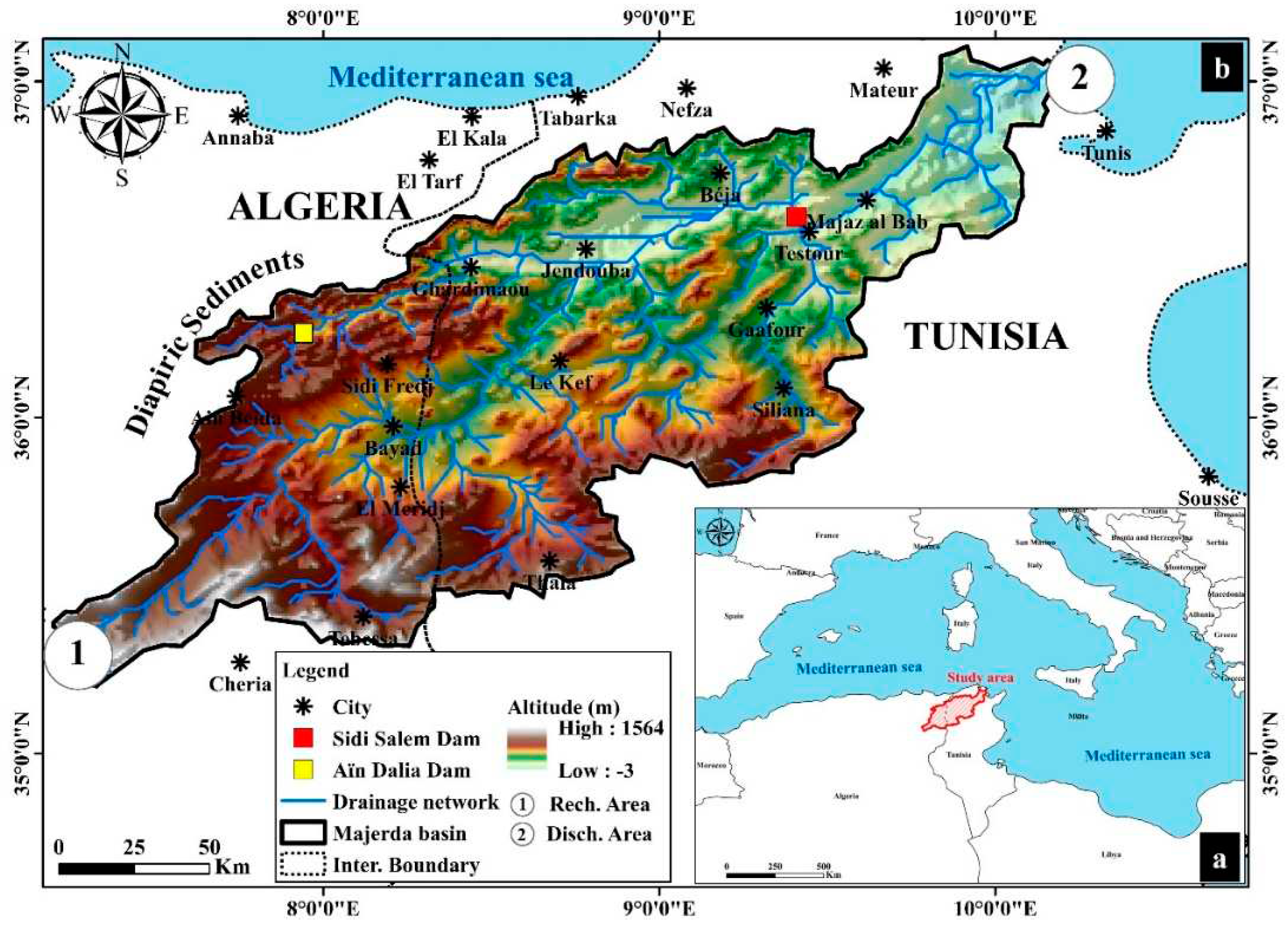
Figure 2.
Flowchart of the work methodology in the study area.
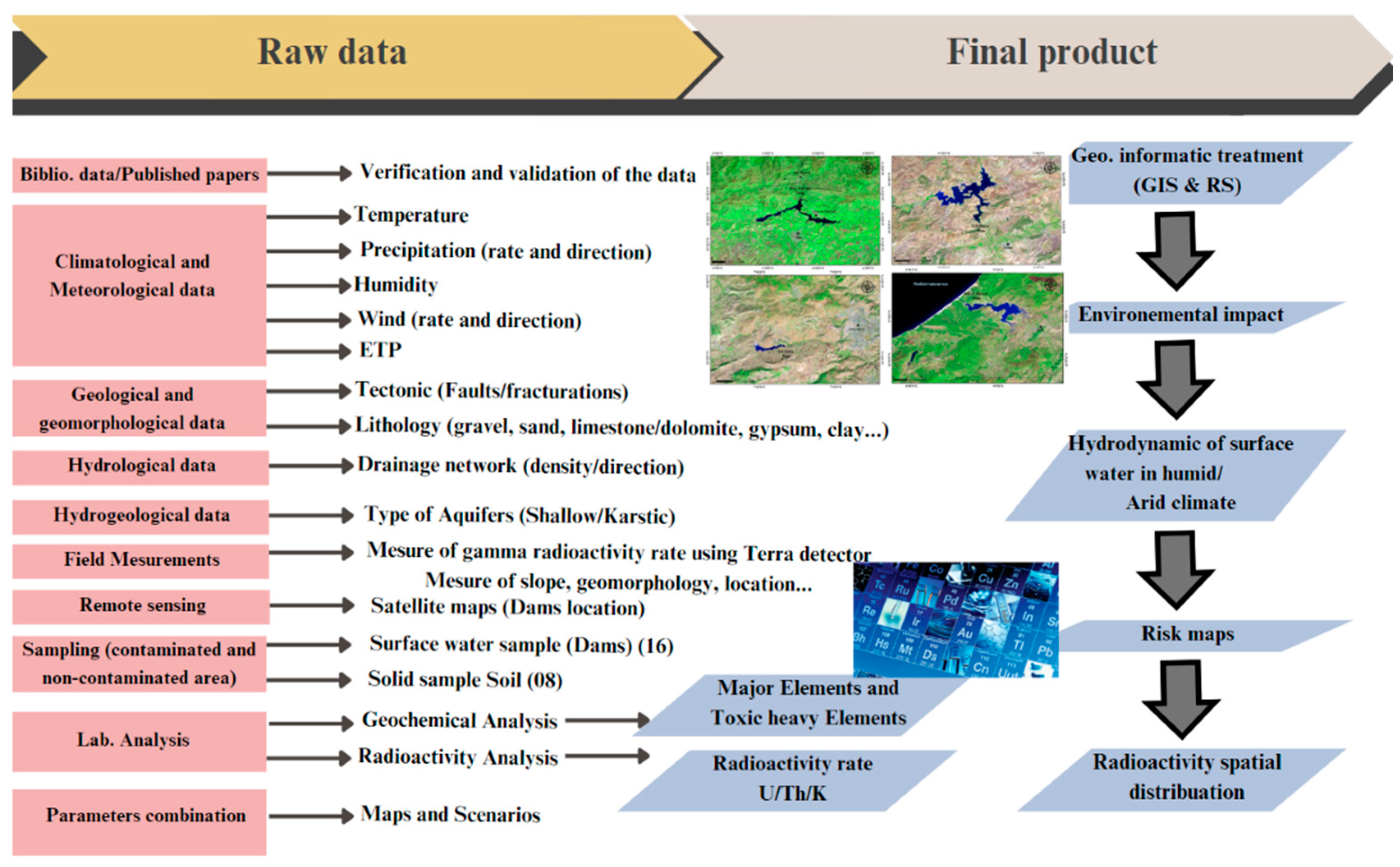
Figure 3.
Location of Tuniso-Algerian dams (objective of sampling water and solid). * Beni Haroun Dam (Algeria) and Sidi El Barek Dam (Tunisia)-sampling for non-contaminated area / ** Aïn Dalia Dam (Algeria) and Sidi Salem Dam-sampling for contaminated water and sediment.
Figure 3.
Location of Tuniso-Algerian dams (objective of sampling water and solid). * Beni Haroun Dam (Algeria) and Sidi El Barek Dam (Tunisia)-sampling for non-contaminated area / ** Aïn Dalia Dam (Algeria) and Sidi Salem Dam-sampling for contaminated water and sediment.
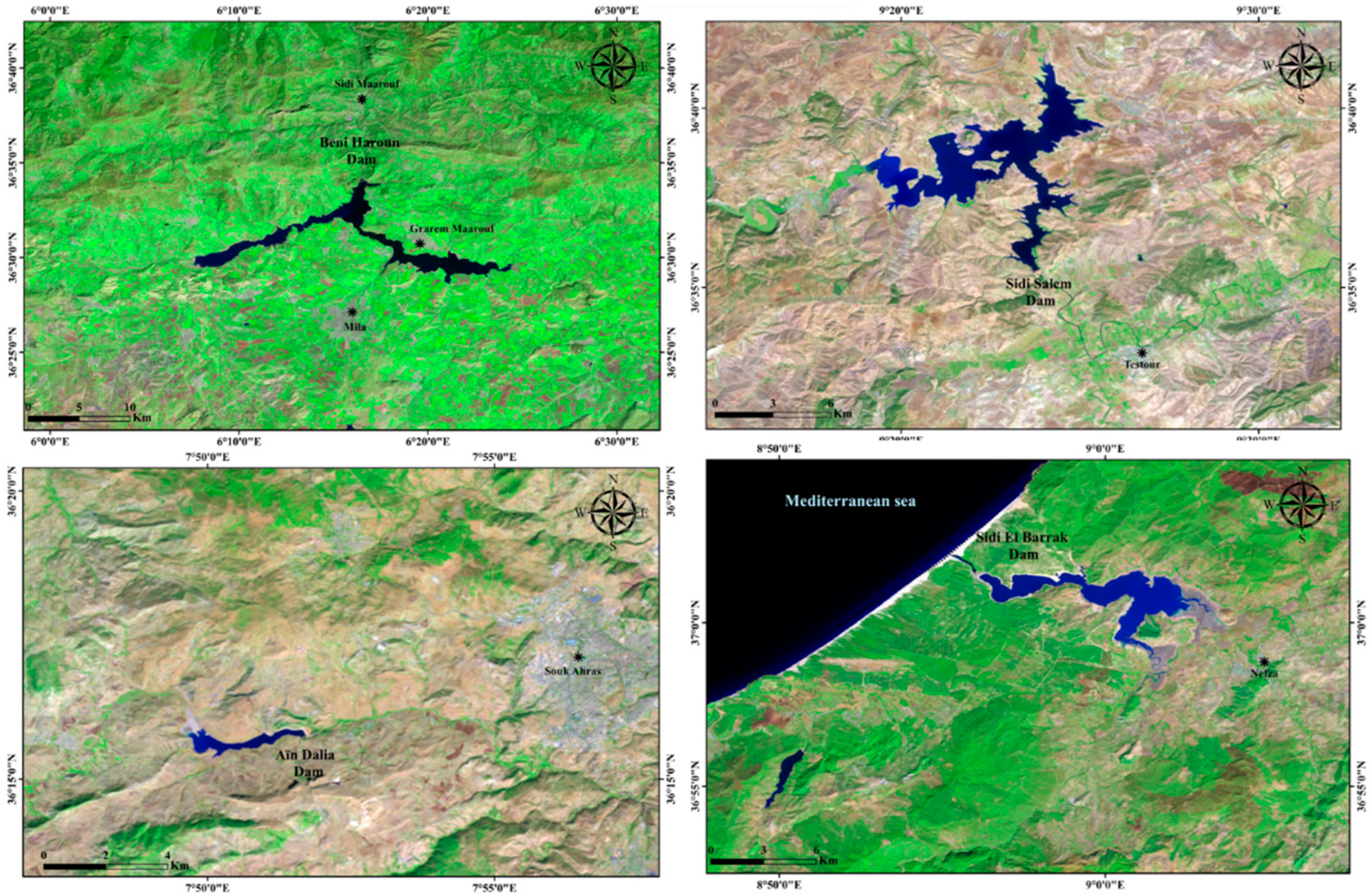
Figure 4.
Conceptual model showing the hydrodynamic of surface water during humid climate in the study area (contaminated area of Aïn Dalia and Sidi Salem dams).
Figure 4.
Conceptual model showing the hydrodynamic of surface water during humid climate in the study area (contaminated area of Aïn Dalia and Sidi Salem dams).
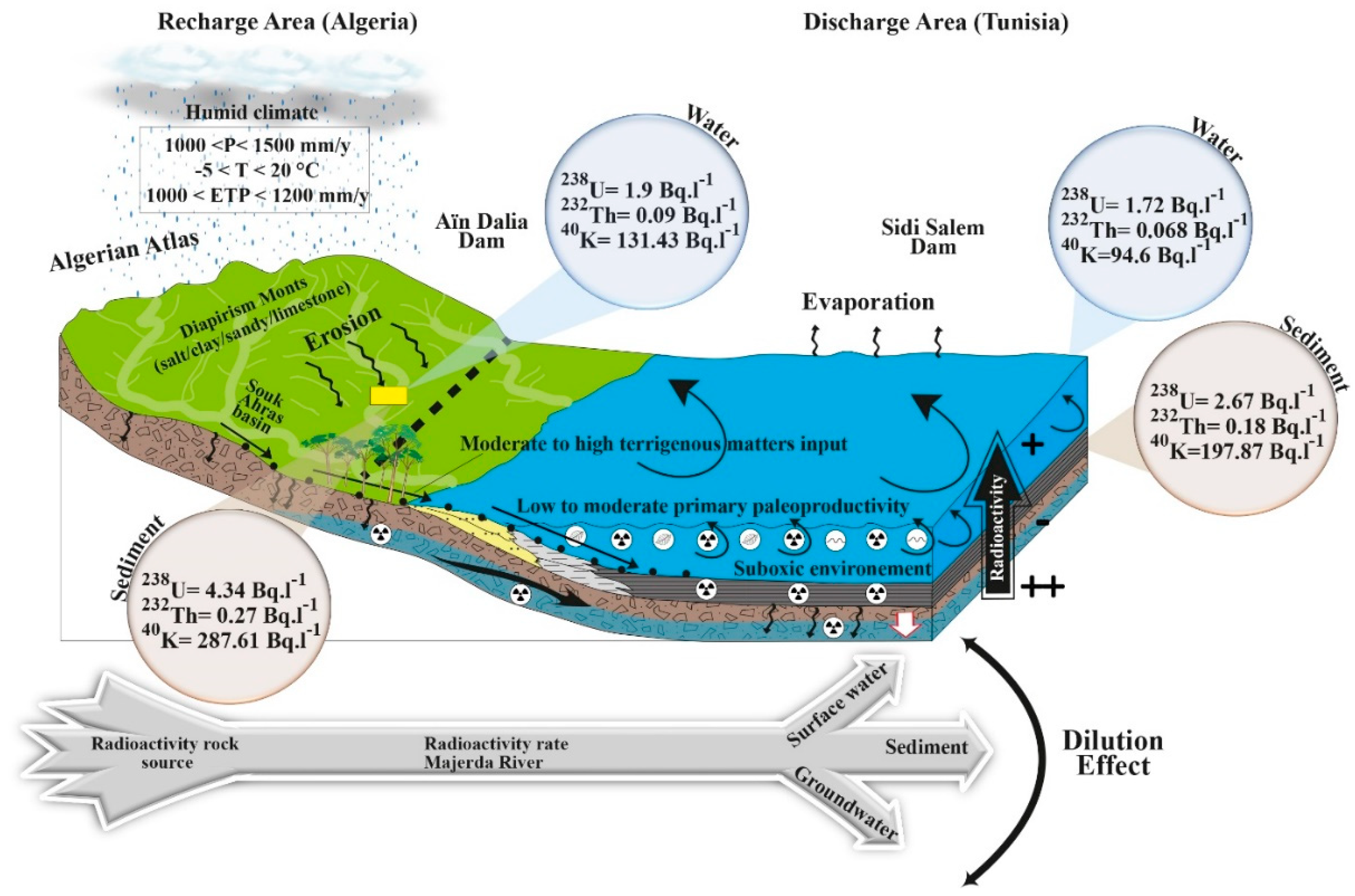
Figure 5.
Conceptual model showing the hydrodynamic of surface water during the arid climate in the study area (contaminated area of Aïn Dalia and Sidi Salem dams).
Figure 5.
Conceptual model showing the hydrodynamic of surface water during the arid climate in the study area (contaminated area of Aïn Dalia and Sidi Salem dams).

Figure 6.
a-Risk map of the radioactivity spatial distribution in the study area with the drainage network; b- Risk map of the radioactivity spatial distribution in the study area without the drainage network.
Figure 6.
a-Risk map of the radioactivity spatial distribution in the study area with the drainage network; b- Risk map of the radioactivity spatial distribution in the study area without the drainage network.
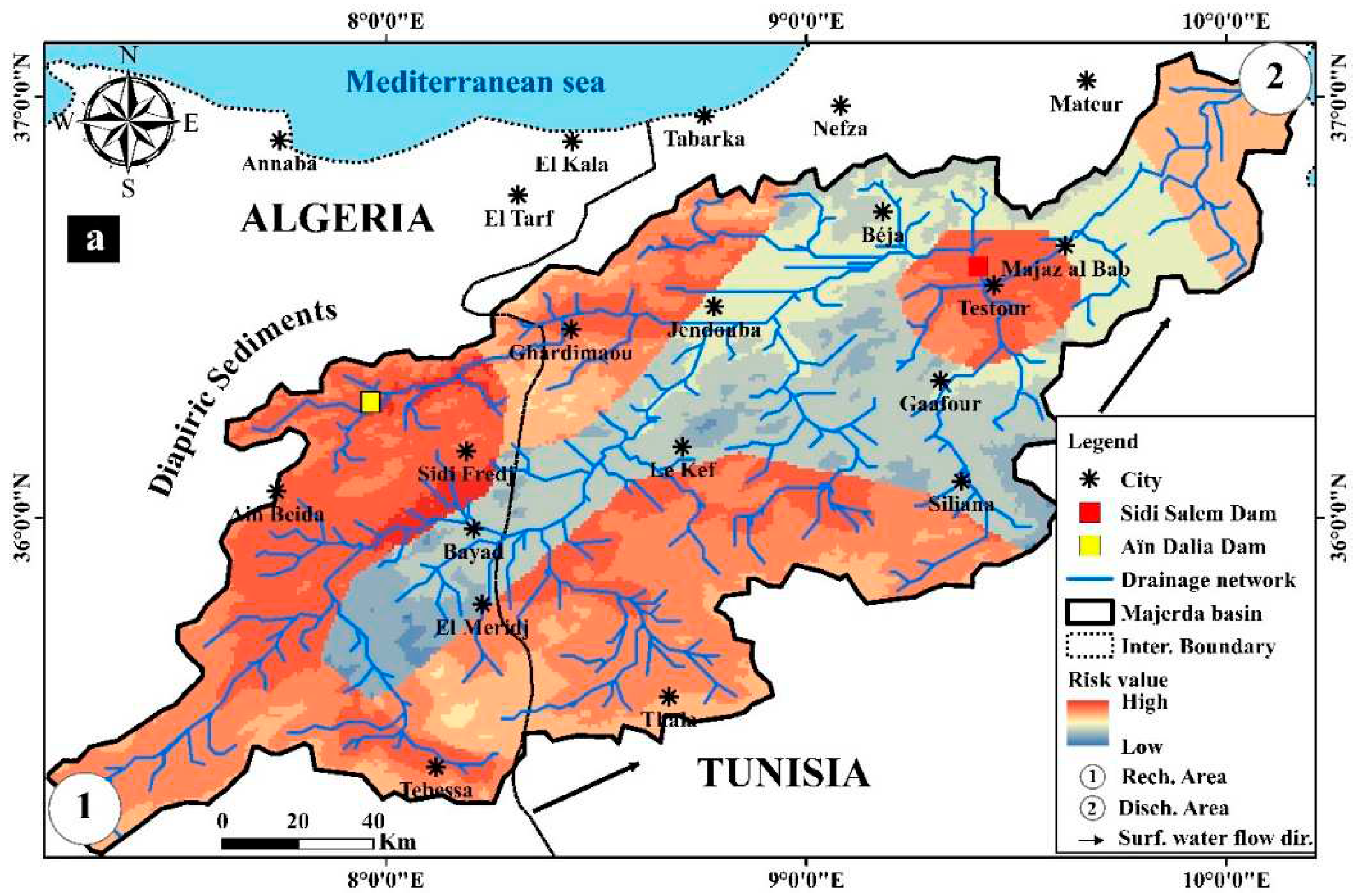
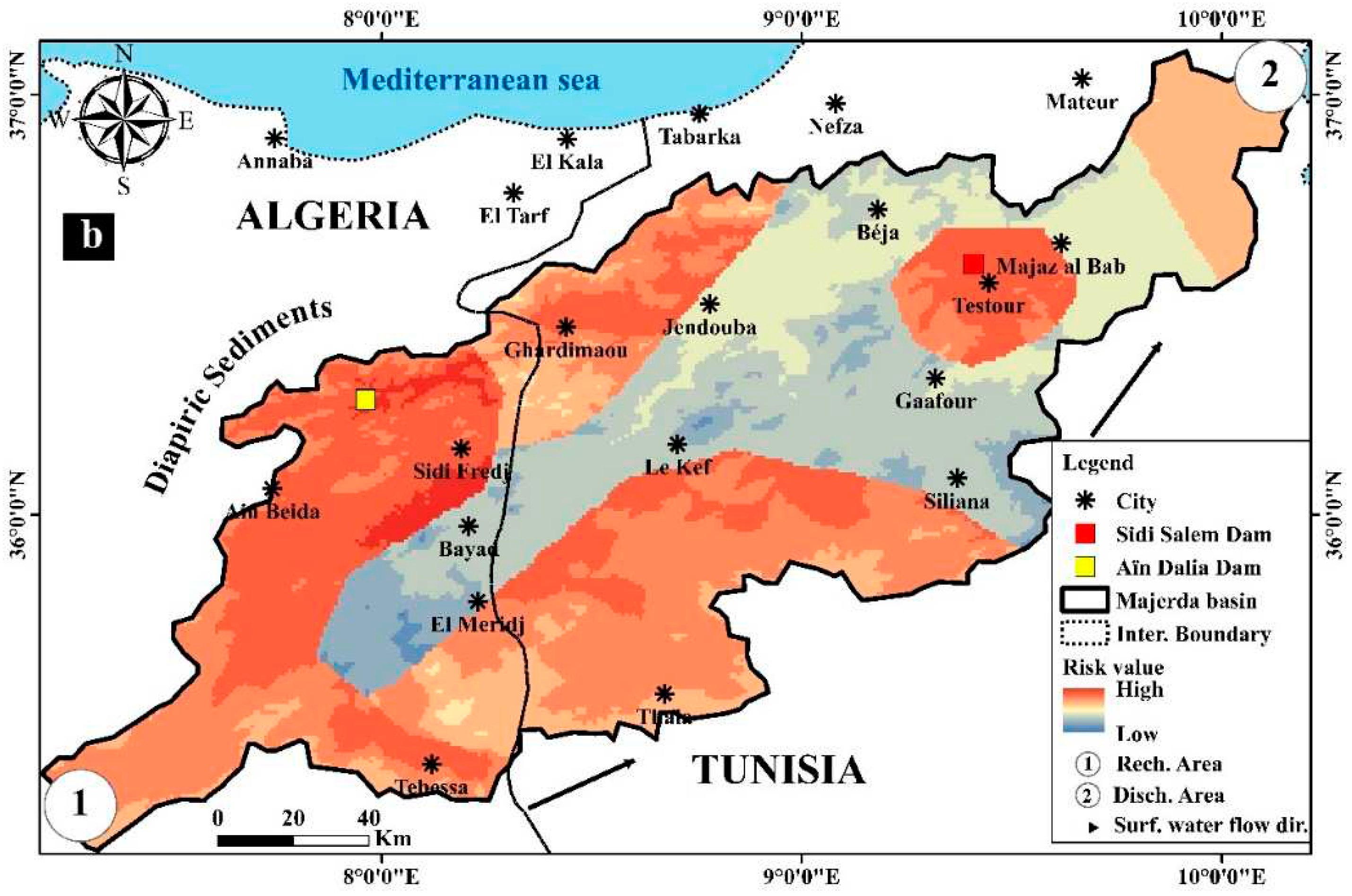
Figure 7.
Health risk map of the radioactivity impact in the study area.
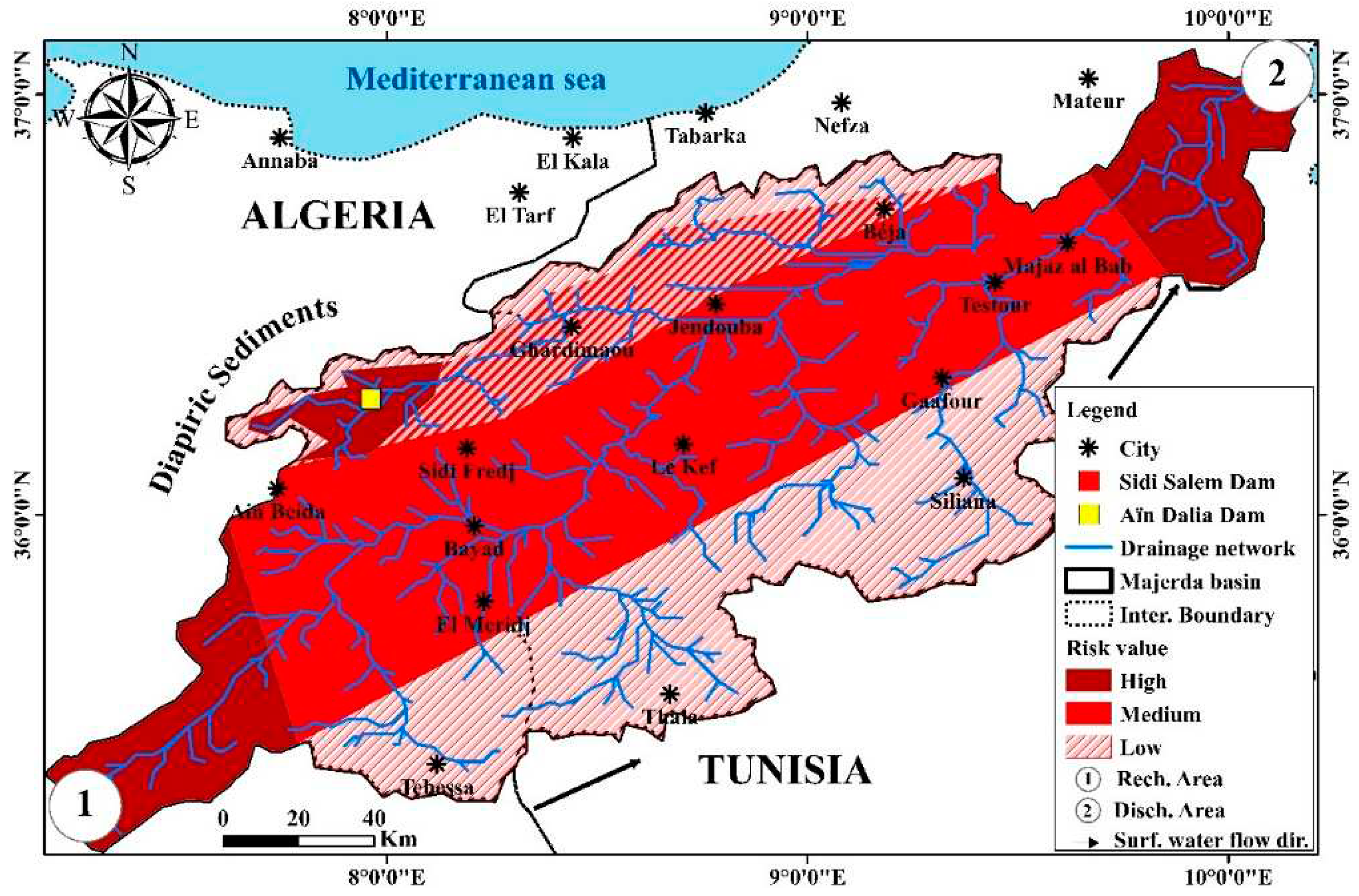
Table 1.
The sediments radiological parameters in the study area.
| Location/country |
D (nGyh-1) |
Raeq (Bqkg-1) |
Hext | Hint |
AGED (μSvy-1) |
| Aïn Dalia dam/Algeria | 14.12 | 36.79 | - | - | 104.53 |
| Sidi Salem dam/Tunisia | 9.59 | 18.16 | - | - | 71.13 |
| World standard value [8] | 57.00 | 370.00 | 1.00 | 1.00 | 1.00 Svy-1 |
Table 3.
Comparison of specific activity of 238U, 232Th and 40K (water and sediment) with other studies from different parts of the words (* : control liquid and solid samples from non-polluted area-Tunisia and Algeria).
Table 3.
Comparison of specific activity of 238U, 232Th and 40K (water and sediment) with other studies from different parts of the words (* : control liquid and solid samples from non-polluted area-Tunisia and Algeria).
| Region/Country | 238U, Bq kg-1 | 232Th, Bq kg-1 | 226Ra, Bq kg-1 | 40K, Bq kg-1 | Reference |
| Sidi Salem Dam (Water)/Tunisia | 1.72 | 0.068 | - | 94.6 | Present study |
| Sidi Salem Dam (Sediment) /Tunisia | 2.67 | 0.18 | - | 197.87 | Present study |
| *Sidi El Barrak Dam (Water)/Tunisia | 0.82 | 0.032 | - | 67.98 | Present study |
| *Sidi El Barrak Dam (Sediment)/Tunisia | 0.45 | 0.024 | - | 45.62 | Present study |
| Aïn Dalia Dam (Water) /Algeria | 1.9 | 0.09 | - | 131.43 | Present study |
| Aïn Dalia Dam (Sediment) /Algeria | 4.34 | 0.27 | - | 286.61 | Present study |
| *Beni Haroun Dam (Water/Algeria) | 0.7 | 0.04 | - | 98.7 | Present study |
| *Beni Haroun Dam (Sediment/Algeria) | 0.52 | 0.03 | - | 75.4 | Present study |
| Gafsa Phos.Rock/Tunisia | 702 | 75 | 911 | 90 | [6] |
| Tunisia | - | 29 | 821 | 32 | [26] |
| Egypt | 686 | 5.7 | 656 | 68.6 | [13] |
| Morocco | - | 20 | 1600 | 10 | [27] |
| Algeria | - | 64 | 619 | 22 | [28] |
| Saudi Arabia | - | 17-39 | 64-513 | 242-2453 | [24] |
| Germany | - | 15 | 520 | 720 | [27] |
| USA | - | 49 | 780 | 200 | [29] |
| India | - | 65 | 120 | 2624 | [28] |
| Jordan | - | 2 | 1044 | 8 | [26] |
| Kuala Lampur-Malaysia | - | 1.2 | - | 35.1 | [24] |
| Buruta-Nigeria | - | 26.9 | - | 61 | [23] |
| Oman | - | 2.26 | 20.49 | 44.83 | [30] |
| Kuwait | - | 6 | 36 | 227 | [31] |
| Iran | - | 17.61 | 14.96 | 361.6 | [32] |
| Turkey | - | 9.0 | 12.2 | 157.7 | [33] |
Table 4.
US Environmental Protection Agency maximum contaminant levels for radionuclides in drinking water (other than radon) [41].
Table 4.
US Environmental Protection Agency maximum contaminant levels for radionuclides in drinking water (other than radon) [41].
| Contaminant | Maximum contaminant levels |
| Uranium | 30 microg/l |
| Combined Rn-226 and Ra-228 | 5 pCi/l (0.185 Bq/l) |
| Gross alpha (excluding Rn and U but inclusding Ra-226) | 15 pCi/l (0.555 Bq/l) |
| Beta particle and photon radioactivity | 40 mrem/y (0.04 mSv/y) |
Table 5.
Specific Activity concentrations of 238U, 232Th, 40K (Bq/Kg) and the toxic heavy metals (Fe, Pb, Zn, Ni, Cu, Cr, Cd) (mg/L) in dams’ surface water and sediments.
Table 5.
Specific Activity concentrations of 238U, 232Th, 40K (Bq/Kg) and the toxic heavy metals (Fe, Pb, Zn, Ni, Cu, Cr, Cd) (mg/L) in dams’ surface water and sediments.
| 238U | 232Th | 40K | Fe | Pb | Zn | Ni | Cu | Cr | Cd | |
| Dalw2 | 1.90 ± 0.24 | 0.09±0.01 | 131.43±1.03 | 5.430 | 0.0980 | 0.087 | 0.024 | 0.063 | 0.015 | 0.025 |
| Dals3 | 4.34±0.05 | 0.27±0.05 | 287.61±3.34 | 201.9 | 5.88 | 5.046 | 0.216 | 0.441 | 0.06 | 0.20 |
| Dtnw4 | 1.72±0.01 | 0.068±0.01 | 94.6±1.04 | 9.700 | 0.065 | 0.061 | 0.018 | 0.043 | BDL1 | 0.130 |
| Dtns5 | 2.67±0.01 | 0.18±0.012 | 197.87±2.01 | 136.7 | 3.41 | 3.22 | 0.182 | 0.213 | BDL1 | 0.15 |
| WHO limits | 1.0 | 0.1 | 10.0 | 0.01 | 0.07 | 2.00 | 0.05 | 0.003 |
1 BDL: Below detection limit. 2 Dalw: Dam Algerian water. 3 Dals: Dam Algerian sediment. 4 Dtnw: Dam Tunisian water. 5 Dtns: Dam Tunisian sediment.
Disclaimer/Publisher’s Note: The statements, opinions and data contained in all publications are solely those of the individual author(s) and contributor(s) and not of MDPI and/or the editor(s). MDPI and/or the editor(s) disclaim responsibility for any injury to people or property resulting from any ideas, methods, instructions or products referred to in the content. |
© 2023 by the authors. Licensee MDPI, Basel, Switzerland. This article is an open access article distributed under the terms and conditions of the Creative Commons Attribution (CC BY) license (http://creativecommons.org/licenses/by/4.0/).
Copyright: This open access article is published under a Creative Commons CC BY 4.0 license, which permit the free download, distribution, and reuse, provided that the author and preprint are cited in any reuse.


