

Submitted:
09 December 2024
Posted:
10 December 2024
You are already at the latest version
Abstract
Naturally occurring radionuclides are ubiquitous at various levels of concentration while exposure to ionizing radiation by humans is of global concern. The assessment of radiological health risk associated with the consumption of natural spring mineral water is critical for ensuring public health and safety. The study aims at investigating the activity concentration levels of natural radionuclides 226Ra, 232Th and 40K and the associated radiological health risk in commercial natural spring bottled water in South Africa. 21 most consumed brands of bottled water collected from the market were analysed using HPGe gamma detector. The results indicate that activity concentrations ranged from 1.060 ± 0.067 to 2.571 ± 0.143 BqL-1, with mean of 1.766± 0.399 BqL-1 for 226Ra; 1.736 ± 0.112 to 7.807 ± 0.099 BqL-1, with mean of 3.688 ± 1.371 BqL-1 for 232Th and 149.000 ± 38.480 to 242.900 ± 59.700 BqL-1 with mean of 220.229 ± 22.297 BqL-1 for 40K. The potential radiological health risks evaluated show mean values for Raeq, DAb, AEID and AGED as 23.976 ± 0.446 BqL-1, 12.232 ± 1.445 nGyh-1, 0.060 ± 0.007 mSvy-1 and 0.090 ± 0.027 mSvy-1, respectively. The radiation dose received by age group is in order of infant (≤ 1 year) > teenagers (12-17 years) > children (1-12 years) > adult (> 17 years). The findings reveal that the activity concentration levels and estimated radiological health risks are within permissible limits set by UNSCEAR guidelines. Therefore, consumption of bottled water is radiologically safe. However, findings also suggests that 12 out of 1000 individuals may suffer cancer fatality while 6 out of 1 million individuals may experience hereditary effects over lifetime, from consumption of bottled water. Regular monitoring and stringent regulatory controls are recommended to ensure the radiological safety of natural spring mineral bottled water in South Africa.
Keywords:
Radioactivity
; natural spring mineral bottled drinking water
; radiological health risk
; effective dose
; gamma spectrometry
; South Africa
1. Introduction
The availability and accessibility of safe drinking water is a global critical public health issue, especially in regions where natural and anthropogenic factors may contribute to the quality of water. In the republic of South Africa, natural spring mineral bottled drinking water is a popular alternative to tap and other sources of drinking water, as obtainable globally, often perceived to be safer and of higher quality [1,2,3,4]. With the rising global population, sanitation and global warming effect, the demand for and consumption of bottled drinking water is estimated to increase in the coming years [5,6,7]. However, the activity concentrations of the naturally occurring radionuclides in the commercial bottled drinking water can pose some potential radiological health risks to consumers, if not regularly checked and regulated, especially with the increased demand for drinking water [8,9,10].
Naturally occurring radioactive materials (NORM) such as uranium-238, thorium-232, and potassium-40, along with their progenies, are ubiquitous in the earth and can be present in drinking water sources, as well [2,11]. These radionuclides get into water supplies through the geological formations and human activities, potentially leading to long-term exposure when ingested. Continuous consumption of water with elevated levels of radionuclides may increase the risk of adverse health effects, including cancer and other radiation-induced diseases [12,13].
Studies on the activity concentration of natural radionuclides in bottled drinking water have been reported [9,14,15,16], using various analytical procedures with varied activity concentrations. However, careful search of literature showed that such work has not been report on the South African bottled drinking water, hence, this baseline study aims to assess the activity concentrations of the radionuclides in natural spring mineral bottled commercial drinking water brands mostly consumed in South Africa. Using the High-Purity Germanium (HPGe) gamma spectrometry technique, we measured the levels of radioactive contaminants in the various bottled drinking water samples. By finding the levels of natural radioactive contaminants, we estimated the associated radiological health risks because of the consumption of bottled drinking water and compared with national and international safety standards as well as other published related data. The findings in this research will provide valuable insights into the safety of consuming natural spring mineral bottled drinking water in South Africa and inform regulatory bodies to ensure public health protection.
In this article, we will discuss the methodology used for sampling and analysis, present the results of the activity concentrations, and analyze the potential health risks based on the national and international guidelines and standards. Our sole objective is to contribute to the ongoing efforts to safeguard public health by highlighting the importance of monitoring and regulating the levels of natural radionuclides 226Ra, 232Th and 40K, in drinking water, for sustainable growth and development, aligning with goal 6 of the sustainable development goal.
2. Materials and Methods
The twenty-one different brands of water samples analysed in this study are made up of the most available and topmost consumed bottled natural spring mineral commercial drinking water, collected from the grocery stores after mini survey, in south Africa [6]. The samples were prepared according to the specified standards by the South African Water Quality Guidelines [2] and world health organization [10]. The water samples were poured into a 0.5 L cylindrical polyethylene vials based on the gamma detector geometry and then sealed using black polyethylene adhesive tape, to make it airtight and stored for a period of thirty days for the purpose of secular equilibrium to be attained between the parent and daughter natural series radionuclides of 238U (226Ra) and 232Th, in Figure 1.
A Canberra n-type well High-Purity Germanium (HPGe) gamma detector, model GCW2021 (USA), connected to an MCA of model DSA 1000, incorporated with software for analysis known as Genie 2000, at the Centre for Applied Radiation Science and Technology (CARST), North-West University (Mahikeng Campus) was used in this study for data acquisition and spectrum analysis, as shown in Figure 1. The spectrometer has energy resolution of 2.1 keV FWHM at 1.33 MeV of 60Co gamma line, 20 % relative efficiency. A multinuclide Europium-152 standard source(s) which can emit a wide range of gamma rays between 46.54 - 1836 keV, applied to calibrate of the detector, in terms of the energy (keV) and efficiency (%) with the curve shown in Figure 2. The prepared water samples were each placed into a cylindrical enclosure made of lead with low-background, 11.50 cm thick on the detector, and counted for 12 hours. Prior to the determination of the activity, the value of the background was subtracted from the gamma radiation spectrum.
The equipment validation using international atomic energy agency (IAEA) standardised reference materials such as 152Eu, 133Ba and IAEA-RGU-1, to ascertain the level of accuracy of the detector. It was by determining the activity of the sources at production, from their respective certificates and then at present after decay, using the online Rad Pro decay calculator, and comparing with the measured activity by the detector. The results showed agreement with calculated activity of 152Eu to be 25.447 kBq while measured activity to be 26.027 kBq with percentage error of 2.281 %. The laboratory has recently participated in the IAEA interlaboratory proficiency exercise 2024.
In this study, the various gamma lines of the radionuclides together with their daughters used to determine the activity concentrations values by computing their weighted mean values with their respective uncertainties. The gamma line peak energy used for 238U (226Ra) progenies were 214Pb (295.21 keV, Pγ = 19.2% and 351.95 keV, Pγ = 37.20%) and 214Bi (609.31 keV, Pγ = 46.30% and 1120.29 keV, Pγ = 15.10%). For 232Th the gamma lines of its progenies, 212Pb (238.63 keV, Pγ = 44.60% and 727.17 keV, Pγ = 11.80%), 212Bi (727.17 keV, Pγ = 11.80%) and 228Ac (911.60 keV, Pγ = 27.70% and 969.11 keV, Pγ = 16.60%) were used, while for 40K, its single gamma lined at 1460.81 keV, Pγ = 10.67% was used.
The activity concentration A (BqL-1) was calculated using Equation 1, which was preceded by the subtraction of decay corrections [17].
where is the net peak area of a peak at a given energy line in the spectrum, Pγ is the emission probability of gamma rays at the given energy photopeak, εγ is the efficiency of detecting a radionuclide, t is the total time taken in seconds (s) for the sample counting and V is the sample volume, in litres (L).
The radium equivalent (Raeq) which describes the output of gamma rays, from a sample and the associated radiological hazard, provides a base guideline useful in the regulation of radiation safety standards. It is estimated by assuming that 370 BqL-1 of 226Ra, 259 Bq L-1 of 232Th and 4810 Bq L-1 of 40K produces gamma radiation of the same dose rate, given by Equation 2 [17,18,19,20]
where , and are the average activity concentrations of 226Ra, 232Th and 40K, respectively.
Dose rate (D) is the radiation dose absorbed per hour due to terrestrial or NORMs sources of gamma radiation in air or material. Equation 5 is used to calculate the absorbed dose rate according to [20,21].
where , and are the mean activity concentrations of the radionuclides 226Ra, 232Th and 40K and their respective coefficients 0.462, 0.621 and 0.0417 as dose conversion factors in nSv/h/Bq/L.
The total annual effective ingestion dose (TAEID) because of the various radionuclides in mSvy-1 in the drinking water estimated for the members of the public for the age categories of infant (≤1y), children (1-2y), teenager (12-17y) and adult (>17y). It is the radiation dose absorbed or received in a year by the ingestion of bottled water and computed using Equations 4 and 5, based on the data from Table 1 and Table 2 [10,12,22].
where AEID is the annual effective ingestion dose in mSvy-1 because of radionuclide is the radionuclide activity concentration in the bottled drinking water sample in BqL-1, I is the drinking water annual intake rate shown in the 5th row of Table 1 and is the effective dose coefficient of the relevant radionuclide for the various age group as provided for by the [20,22].
Due to the sensitivity of the gonads (testes and ovaries) and organs such as the bone surface and active bone marrow to ionising radiation, the United Nations Scientific Committee on the Effects of Atomic Radiation (UNSCEAR) has identified them as organs of interest because if they are exposed to radiation, reproductive health could be affected. Hence, the index, annual gonadal equivalent dose (AGED) has been set to serve as a measure of ionising radiation that the gonads received for one year. The AGED (mSvy-1) because of radionuclides 226Ra, 232Th and 40K can be determined by Equation 6.
where , and are the activity concentrations of the radionuclides 226Ra, 232Th and 40K (BqL-1) with the respective coefficients as conversion factors.
The internal and external hazard indices (Hin and Hex) used to quantify the level of risk due to internal and external exposure to radon which is carcinogenic and the short-lived progenies. Both Hin and Hex calculated using Equations 7 and 8, either of which must be less than one for a negligible level of radiation risk [17,21,23,24].
where ARa, ATh and AK are the activity concentrations of the radionuclides 226Ra, 232Th and 40K, in (BqL-1) with the respective coefficients as conversion factors.
The representative alpha gamma level indices (Iα and Iγ) are used to estimate levels of risks in relation to exposure to annual effective ingested doses by humans from alpha and gamma radiations of radionuclide source. Iα and Iγ are determined using Eqs. 9 and 10 such that, the value of annual effective ingested dose increases by 0.3 µSv if Iγ ≤ 2, but for 2 ≤ (Iγ) ≤ 6, it will increase by 1.0 µSv. Therefore, (Iγ) can be used for materials identification purpose [17,24].
where ARa, ATh and AK are the specific activity concentrations of the radionuclides 226Ra, 232Th and 40K, in (BqL-1).
Based on the International Commission on Radiological Protection (ICRP) and the South African Water Quality Guidelines [2] recommendations for adult members of the public, the stochastic effects of ionizing radiation due to the ingestion of bottled drinking water sources were estimated using Eqs 11 – 14. Additionally, other health risk parameters because of exposure from radionuclides 226Ra, 232Th and 40K yielding low dose of radiation considered to be chronic risk of effects on the somatic as well as hereditary organs, have also been estimated using lifetime fatal cancer risk and hereditary effects coefficient [25,26].
where FCR is the fatal cancer risk, TAEID is the total annual effective ingestion dose, is the lifetime fatal cancer risk factor , LFCR is the lifetime fatal cancer risk to adult, is the adult lifetime age of 70 years [27] of continuous exposure to low level of radiation by the population, SHE is the severe hereditary effects, is the hereditary effect conversion factor and ELH is the estimated lifetime hereditary effects for the adult group.
3. Results
3.1. Radioactivity Concentration of Radionuclides
The radioactivity concentrations (BqL-1) with their respective uncertainties (± Standard Deviation) of the natural radionuclides 226Ra, 232Th and 40K present in the mineral spring bottled water measured is presented in Table 2, columns 2 to 4. Additionally, the total annual effective ingestion dose (TAEID) (mSvy-1) for the various age groups infants (≤ 1 year), children (1-12 years), teenagers (12-17 years) and adults (> 17 years) due to the intake of radionuclide in the natural spring mineral bottled water from South Africa, is in the same table but columns 5 to 8, computed using the information from Table 1. The mean activity concentration of 226Ra ranged from 1.060 ± 0.067 BqL-1 in sample W-11 to 2.571 ± 0.143 BqL-1 in sample W-2 with a mean value of 1.766± 0.399 BqL-1 ; 232Th varied from 1.736 ± 0.112 BqL-1 in sample W-14 to 7.807 ± 0.099 BqL-1 in W-8, with a mean value of 3.688 ± 1.371 BqL-1 and 40K ranged from 149.000 ± 38.480 BqL-1 in W-17 to 242.900 ± 59.700 BqL-1 in W-5 with a mean of 220.229 ± 22.297 BqL-1. The TAEID for the infants (≤ 1 y) varied from (1.303 - 4.639) ×10-2 mSvy-1, with a mean value of (2.422 ± 0.768) ×10-2 mSvy-1, children (1-12 y) range between (4.012 - 11.597) ×10-3 mSvy-1, with a mean of (6.669 ± 1.771) ×10-3 mSvy-1, teenagers (12-17 y) is between (0.945 - 3.305) ×10-2 mSvy-1, with a mean of (1.745 ± 0.549) ×10-2 mSvy-1, while for the adult (> 17 y) ranged from (2.074 - 5.168) ×10-3 mSvy-1, with a mean of (3.218 ± 0.749) ×10-3 mSvy-1. The distribution of the activity concentration levels of the natural radionuclides are also presented in Figure 3. The results of both the activity concentration of the natural radionuclides and the total annual effective ingestion dose are variable across the samples and comparable to similar studies in the literatures [21,28]
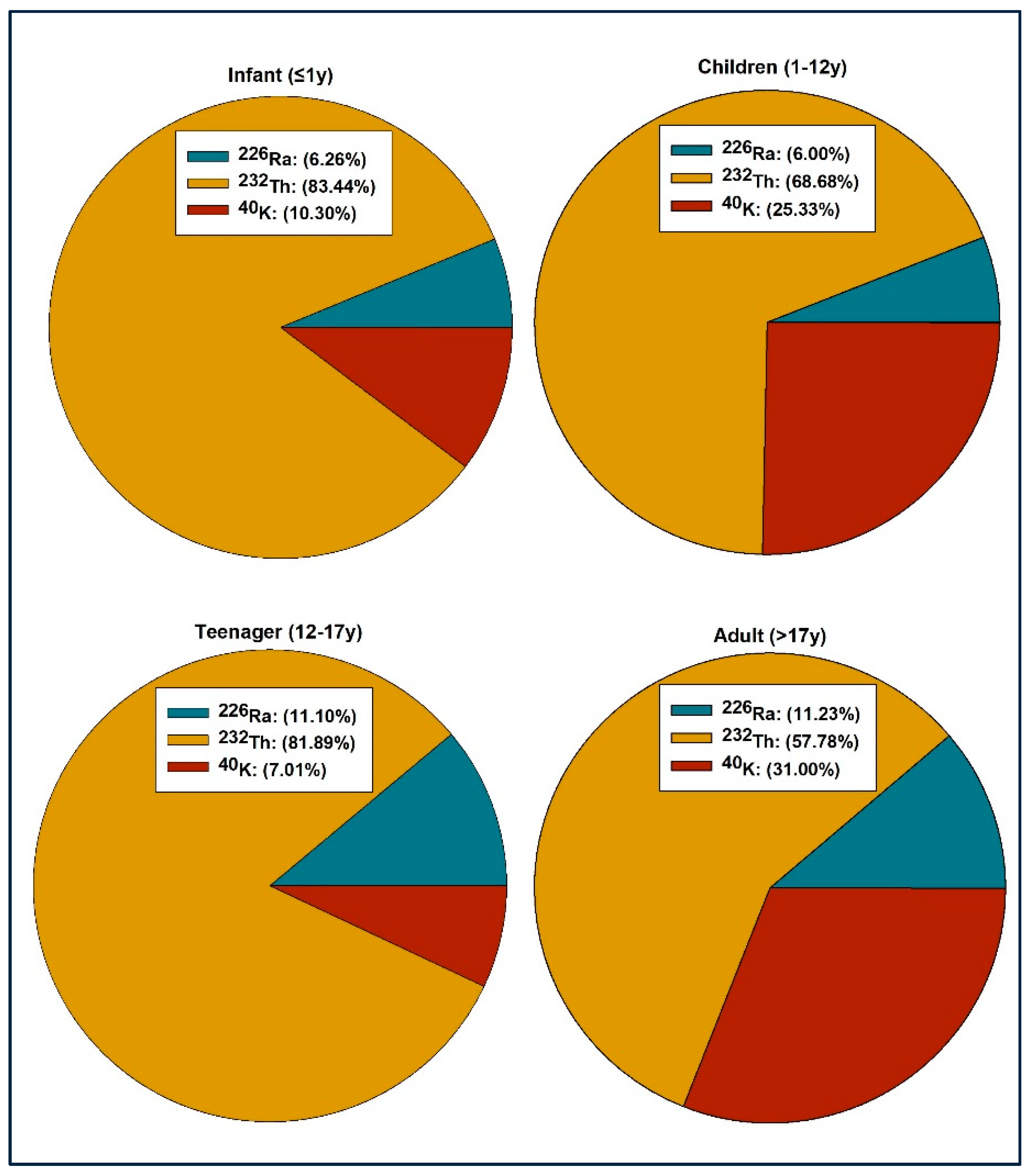
The estimated contribution of each of the analysed natural radionuclides to the total annual effective ingestion dose for the different age groups in the natural spring mineral bottled drinking water is shown in Fiture 4. The results show that 232Th contributed the highes percentage to the dose of 83.44 % for infants (≤ 1year), followed by 81.89 % for teenagers (12-17 years), 68.68 % for children (1-12 years), and 57. 78 % for the adults (> 17 years) group. 40K contributed average percentage to the dose of 31.00 % for the adults (> 17 years), followed by 25.33 % for children (1-12 years), 10.30 % for infants (≤ 1year), and 7.01 % for teenagers (12-17 years) group. 226Ra contributed the lowest percentage to the dose of 11.23 % for the adults (> 17 years), followed by 11.10 % for teenagers (12-17 years), 6.26 % for infants (≤ 1year), and 6.00 % children (1-12 years) group.
Figure 4.
Contribution of each of the analysed natural radionuclide to the total annual effective ingestion dose for the different age groups in the natural spring mineral bottled drinking water from South Africa.
Figure 4.
Contribution of each of the analysed natural radionuclide to the total annual effective ingestion dose for the different age groups in the natural spring mineral bottled drinking water from South Africa.
3.2. Radiun Equivalent and Absorbed Dose Rate
The radium equivalent (Raeq) in unit of BqL-1, which is the index of the combined activity concentration levels of the natural radionuclides 226Ra, 232Th and 40K in the natural spring mineral bottled drinking water, was evaluated using Equation 2, and result is presented in Figure 5. The result of Raeq showed maximum activity value of 28.252 ± 0.613 BqL-1 and minimum activity value of 15.929 ± 0.268 BqL-1, which are the respective radium equivalent activity values of sample W-8 and sample W-17, with an average value of 23.976 ± 0.446 BqL-1. The absorbed dose rate DAb in nGyh-1 was also estimated using Equation 3, and the result is presented in Figure 5. The result show that the maximum value of absorbed radiation dose rate is 14.092 ± 0.436 nGh-1 from sample W-5, while the minimum value is 8.152 ± 0.207 nGyh-1 from sample W-17 with a mean of 12.232 ± 1.445 nGyh-1.
3.3. Annual Gonadal Equivalent Dose and Hazard Indices
The annual gonadal equivalent dose (AGED), internal and external hazard indices (Hin and Hex), representative alpha and gamma indices ((Iα and Iγ) estimated results are presented Figure 6a. The results show that, the annual effective ingestion dose (AEID) varies between 0.040 ± 0.038 mSvy-1 to 0.069 ± 0.054 mSvy-1 in samples W-17 and W-5, with an average value of 0.060 ± 0.007 mSvy-1. The AGED has maximum value of radiation dose from drinking water as 0.103 ± 0.037 mSvy-1 while minimum value is 0.060 ± 0.017 mSvy-1 in samples W-5 and W-17 respectively, mean is 0.090 ± 0.027 mSvy-1. The mean values of the radiological health hazard indices, Hex, Hin, Iγ and Iα are 0.065 ± 0.008, 0.070 ± 0.009, 0.098 ± 0.012 and 0.009 ± 0.002 respectively, as shown in Figure 6a.
3.4. Cancer Risks and Hereditary Effects
Figure 6b presents the results of the estimated cancer risks and hereditary effects due to the consumption of natural spring bottled drinking water, containing natural radionuclides 226Ra, 232Th and 40K. The fatal cancer risk (FCR) varies between 1.141 x 10⁻⁴ to 2.842 x 10⁻⁴, with a mean value of 1.769 x 10⁻⁴ ± 4.119 x 10⁻⁵. The lifetime fatality cancer risk (LFCR), taking into cognizance the reference Man age of 70 years, varies between 7.983 x 10⁻³ to 19.897 x 10⁻³, with a mean value of 12.389 x 10⁻³ ± 2.883 x 10⁻³. The severe hereditary effects (SHE) to adults per year range between 4.147 x 10⁻⁶ and 10.336 x 10⁻⁶, with an average value of 6.436 x 10⁻⁶ ± 1.498 x 10⁻⁶, while the estimated lifetime hereditary effect (ELHE) varies from 2.903 x 10⁻⁴ to 7.235 x 10⁻⁴ with a mean of 4.505 x 10⁻⁴ ± 1.049 x 10⁻⁴. These results are lower but comparable to those reported by [26]
3.5. Statistical Analysis
The descriptive statistical analysis (minimum, maximum, mean, standard deviation (STD DV), range, variance, skewness and kurtosis) of the measured activity concentration levels of the natural radionuclides 226Ra, 232Th and 40K together with the estimated radiological health risk parameters in the bottled drinking water is shown in Table 3 while the frequency distribution with the Gaussian distribution curve is presented in Figure 7. The statistical analysis was performed using the following statistical packages MS Excel, SigmaPlot version 15.0 and IBM SPSS Statistics 29.0.0.0.
Table 4 presents the statistical analysis of the Pearson correlation coefficient between the activity concentration levels of the natural radionuclides 226Ra, 232Th and 40K and the estimated radiological health risk parameters in this study. The purpose is to ascertain the order of mutual relationships between the pairs of the variables determined. It also test the interrelationship between the different models used in the estimation of the radiological health risks as well as the cancer risk and hereditary effects. The correlation could be positive or negative whereas the level of significance is based on whether the P-value is < 0.050. The interrelationship between the natural radionuclides 226Ra, 232Th and 40K showed a weak positive correlation (P Values in parenthesis) of 0.331 (0.142), 0.598 (0.004), and 0.137(0.554), implying that although the pairs increase together, there is no significant relationship between them with P Values > 0.050 except for 232Th. This explains the fact that both 226Ra and 232Th are from different natural radionuclide decay series whereas 40K is a non-decay series radionuclide. However, a strong positive correlation was observed between the 3 natural radionuclides and radium equivalent index of 0.684, 0.767 and 0.733, with respective P Values < 0.050, evidence of significant correlation between the pairs, implying that the radionuclides all contributed to the index, proportionately. In a similar vein, a positively strong correlation was observed between the 3 natural radionuclides and the corresponding radiological health risk variables, in the range of 0.881 to 1.000, except for 226Ra and 40K which are low having uniform values of 0.327 and 0.496, which reflects their individual contributions to the parameters as shown also in Figure 4.
The Physico-chemical parameters, trace and heavy metals concentration levels of the natural spring mineral bottled drinking water from South Africa and the associated carcinogenic and non-carcinogenic risks have been reported [6].
The statistical analysis of the relationship between the natural radionuclides activity concentration levels 226Ra, 232Th and 40K and the potential hydrogen (pH) and the total dissolved solids (TDS) (ppm) has been performed. The purpose is to evaluate the drinking water geochemical properties’ correlation with the natural radionuclides, and the result are presented in Figures 8a-c and 9a-c, respectively.
Figure 8.
The relationship between pH and natural radionuclide activity concentration levels (BqL-1) for (a) 226Ra, (b) 232Th and (c) 40K for the bottled drinking water.
Figure 8.
The relationship between pH and natural radionuclide activity concentration levels (BqL-1) for (a) 226Ra, (b) 232Th and (c) 40K for the bottled drinking water.
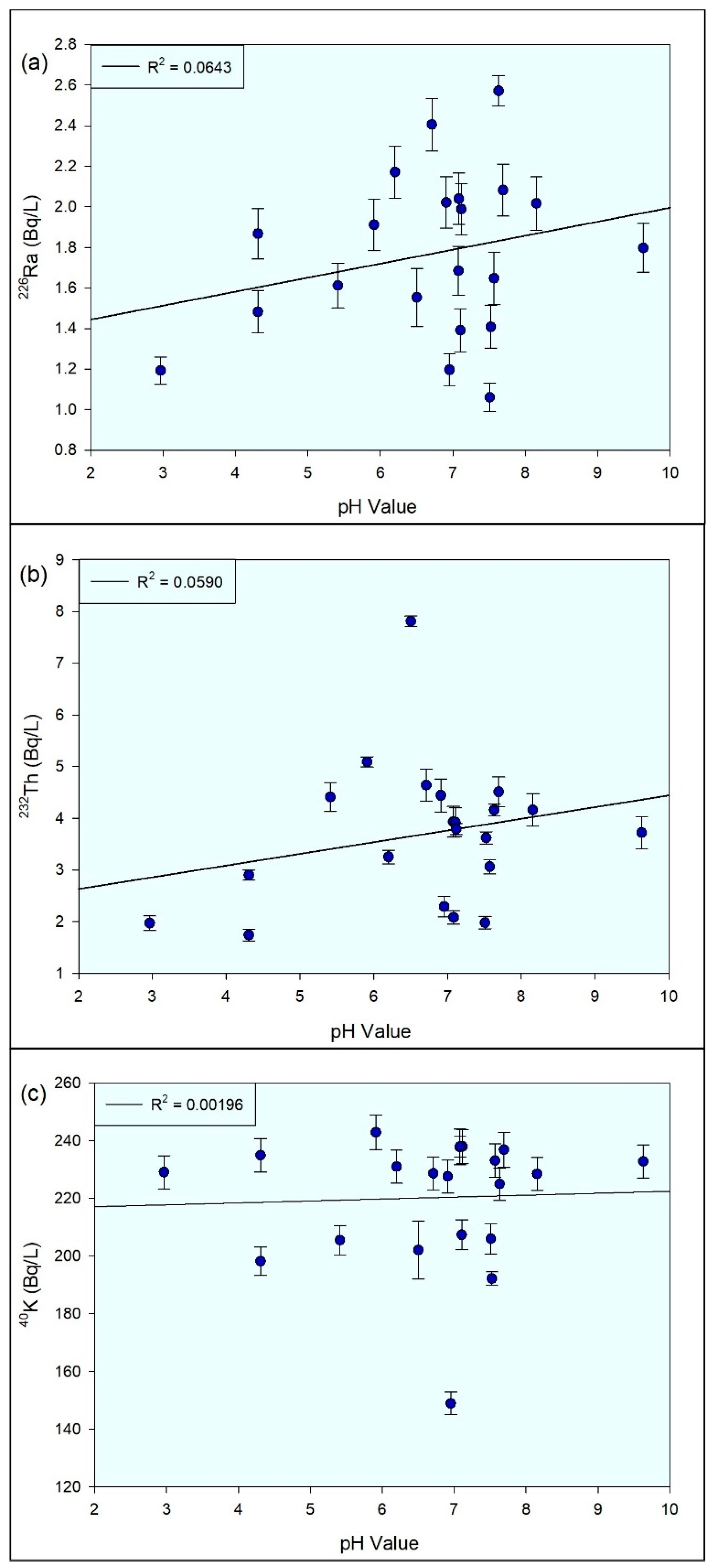
Figure 9.
The relationship between total dissolved solids (TDS) (ppm) and radionuclide activity concentration (BqL-1) for (a) 226Ra, (b) 232Th and (c) 40K for the bottled drinking water.
Figure 9.
The relationship between total dissolved solids (TDS) (ppm) and radionuclide activity concentration (BqL-1) for (a) 226Ra, (b) 232Th and (c) 40K for the bottled drinking water.
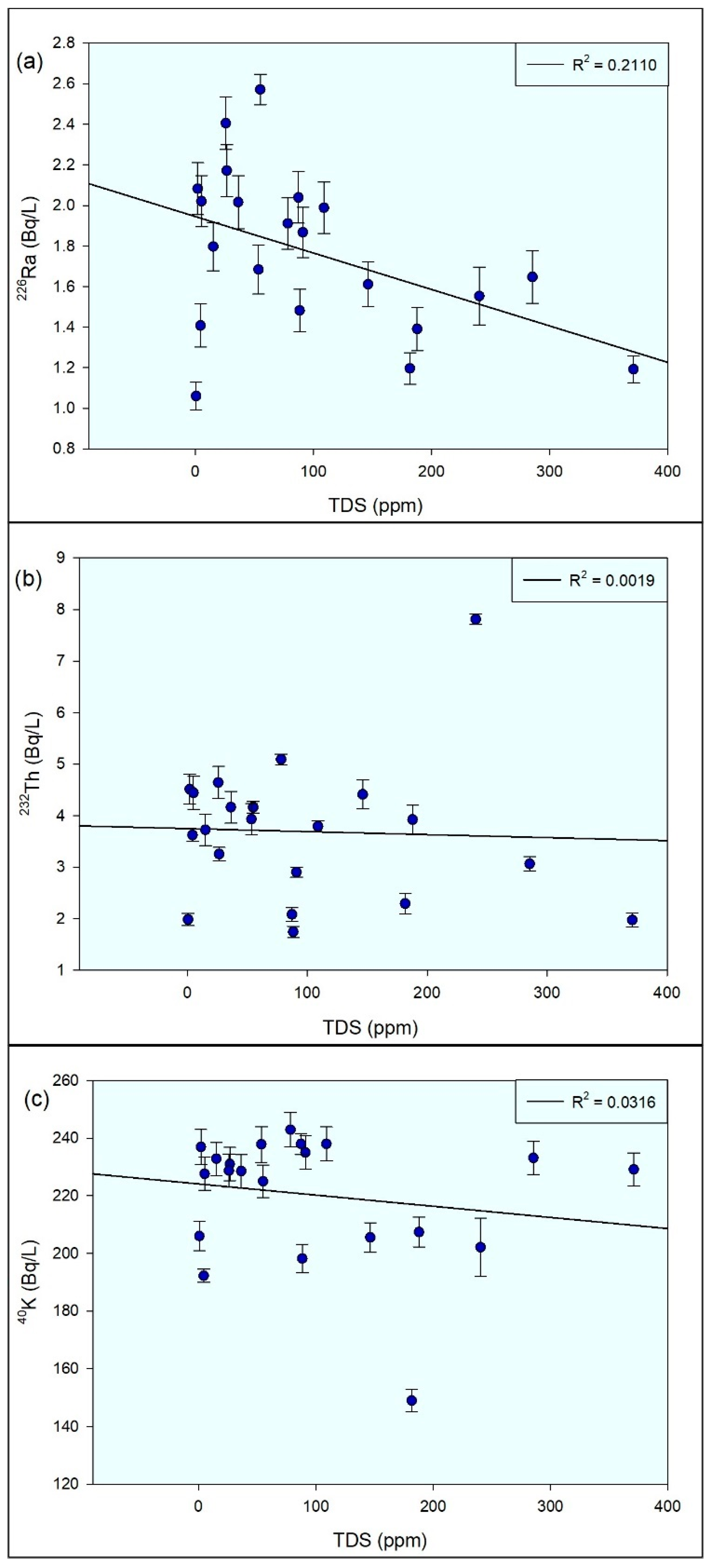
A positively very low correlation was observed between the natural radionuclides’ activity concentration levels of 226Ra and 232Th and the pH of the drinking water, which was insignificant, with the regression curve fit indicating that both variables increase together, while no correlation between 40K and pH, results of this trends have been reported by [15,28]. The general trend observed concerning the relationship between the activity concentration of the radionuclides and the TDS, where the correlation coefficient of the radionuclides 226Ra, 232Th and 40K is found to be 0.2110, 0.0019 and 0.0136, respectively, showed that 226Ra seem to present more relations than others due to its ability to readily dissolve in water rich in minerals.
Table 5 presents the comparison of the activity concentrations of the natural radionuclides 226Ra, 232Th and 40K (BqL-1) and the associated radiological health risk variable, the total annual effective ingestion dose (TAEID) (mSvy-1) in this study and other nations of the world. The activity concentration levels in bottled drinking water of African countries including Morocco, Egypt, Nigeria ranged between 0.00194 to 11.100 BqL-1, for 226Ra, 0.00246 to 4.600 BqL-1 for 232Th and 0.237 to 28.500 BqL-1 for 40K, whereas the TAEID values varied from 0.991E-03 mSvy-1 (for Morocco) to 3.300 mSvy-1 (for Nigeria) [12,14]. The value for the radioactivity concentration for South Africa from this study is found to be within the range of those reported from other African countries, except for 40K whose values are much greater. The activity concentration levels in bottled drinking water of countries other than Africa ranged between 0.105E-03 to 4.900 BqL-1 for 226Ra, 0.016E-3 to 1.600 BqL-1 for 232Th and 0.157 to 10.500 BqL-1 for 40K, whereas the TAEID values varied from 0.0016 mSvy-1 (for Croatia) to 0.500 mSvy-1 (for Spain) [9,16]. It can be observed that the activity concentration of the radionuclides in this work compares well with those reported by [21,28].
4. Discussion
Natural radionuclides such as 226Ra, 232Th and 40K abounds everywhere in the natural environment at various concentration levels, including foodstuff and water, and are ingested by humans releasing radiation dose to vital organs providing risk of developing various cancers [13,32]. This study discusses the radioactivity concentration levels of the natural radionuclides 226Ra, 232Th and 40K (BqL-1) and the associated radiological health risks due to the consumption of mineral spring bottled water. From the findings all the radionuclides being studied were detected at various concentration levels in the bottled drinking water. It can be observed that the activity concentration levels of 40K is greater than that of the 226Ra and 232Th, showing a pattern of activity concentrations in the order of 40K > 232Th > 226Ra, comparable to that reported by [12,14]. Potassium-40 an alpha emitter, has been described as being found everywhere, both in all water supplies and in all living organism because it is a very useful intracellular mineral [2,20]. The mean activity concentration levels exceed the recommended guideline limit for drinking water by the South African Water Quality Guideline but are way less than the worldwide average value [2,14,20]. The reason could be due to the diverse geology of South Africa, which is rich in NORMs such as uranium and thorium, anthropogenic factors as well as industrial processing of the bottled drinking water. However, the estimation of the TAEID presents on the overall, results that are way below the recommended dose limit of 0.1 mSvy-1, for all the age groups assessed. The radiation dose from the drinking water is received by the age groups in the order of infant (≤1y) > teenagers (12-17 y) > children (1-12 y) > adult (>17). It shows that 232Th or its progeny 228Ra which is radiotoxic usually contributes more proportion to the annual effective ingestion dose in water and especially, highest in infants age group. It therefore requires remediation action especially that the infants are more sensitive and vulnerable to radiation exposure. This result is also way below the ambient and cosmic (above sea-level) levels of background radiation reported for the South Africa and global average, of 1.5 – 3.0 mSvy-1 and 0.3 mSvy-1, respectively. It implies that the mineral spring bottled drinking water from South Africa is safe for drinking according to global guideline limits for radionuclides contamination [20] and may not pose any significant health risk to the populace in the interim.
Radiological health risk models usually estimate the impact of natural radionuclide activity concentration on human organs due to ingestion of foodstuff and water. The parameters utilized in this study such as radium equivalent, absorbed dose rate, annual gonadal equivalent dose, hazard indices and representative alpha and gamma indices, presented values that are within acceptable limits, with the following implications. The Raeq findings will provide a base guideline which will be used to regulate safety standards regarding consumption of bottled water [19]. The absorbed dose gives an idea of the risk of exposure as the water is consumed, bearing also in mind the stochastic effect from accumulation of small doses over prolong periods of consumption. The gonads and bone surface which are very sensitive to radiation dose will be receiving very minimal AGED based on the findings in this study. Meanwhile, the internal and external exposure to radon which is short-lived and carcinogenic, as well as the representative alpha and gamma indices, from the bottled water is less than 1 hence offers negligible levels of radiation risk.
The estimated lifetime cancer risks and severe hereditary effects to the adults due to consumption of bottled water could be interpreted to mean that 12 out of 1000 may likely suffer some kind of cancer fatality while 6 out of 1 million may suffer some form of hereditary effect. However, the findings presents values to be within the recommended guidance limit set by the United State Environmental Agency (USEPA), of 1.0 x 10⁻⁶ to 1.0 x 10⁻⁴, which is interpreted to mean 1 person out of 1 million to 10,000 persons may suffer from some form of cancer fatality [25,26].
The statistical analysis of the data in this study indicates that, for the 21 samples, the values of the standard deviation are less than the values of corresponding mean, of the 3 radionuclides 226Ra, 232Th and 40K as well as the radiological health risk parameters. This implies that the distribution of the data has a very high degree of uniformity, and it is comparable with result reported by [24] but differ from [26]. The frequency distribution of the natural radionuclides shows that 226Ra and 232Th together with TAEID for the various age groups are skewed to the right or are slightly asymmetric (positively skewed) having distribution tail pointing to the right with value of skewness greater than 0, while 40K and Raeq are skewed to the left or slightly asymmetric (negatively skewed) also having skewness value less than 0, as shown in Table 3, column 9. Skewness of data indicates its nature or extent of symmetry with perfect symmetry at zero, hence, frequency distribution of the radionuclides and the corresponding radiological health risk parameters in this study are only slightly asymmetric. Additionally, the kurtosis of the radionuclide concentrations presents negative value for 226Ra while 232Th, 40K, Raeq and TAEID for various age group showed positive value (Table 3 column 10). An indication that the frequency distribution curve of the radionuclides is less peaked than the normal curve known as platykurtic, for 226Ra while more peaked than normal curve called leptokurtic, for 232Th, 40K, Raeq and TAEID for various age group. The behaviour of the statistical frequency distribution in this study could be due to the unequal distributions of the natural radionuclides in the natural spring mineral drinking water, especially from the source aquifers bedrock. The Pearson’s correlation coefficient used in this study presents positively very low correlation between the natural radionuclides’ activity concentration levels of 226Ra and 232Th and the pH of the drinking water, which was insignificant with the regression curve fit indicating that both variables increase together, while no correlation between 40K and pH, findings with this kind of trend have been reported by [15,28]. The effect of pH on the variable behaviour of 238U and 232Th decay series as well as acid leaching could be responsible for the findings in this study. With increase in pH, uranium and thorium as well as other minerals are usually leached in the surrounding rocks likewise the sediment [33]. The general trend observed concerning the relationship between the activity concentration of the radionuclides and the TDS, where the correlation coefficient of the radionuclides 226Ra, 232Th and 40K is found to be 0.2110, 0.0019 and 0.0136, respectively, showed that 226Ra seem to present more relations than others due to its ability to readily dissolve in water rich in minerals.
The findings in this study as compared to those reported from other countries suggests that, the radioactivity concentration levels of the radionuclides 226Ra, 232Th and 40K are comparable to similar studies from the African countries [14,28] with values lower than [12]. However, this study’s values are higher than those reported in non-African countries [9,16], yet all values are within the permissible limit set by [2,20], implying that the bottled water is radiological safe for consumption.
5. Conclusions
The assessment of radioactivity concentration levels in natural spring mineral bottled commercial drinking water in South Africa using HPGe gamma spectrometry, has provided significant insights into radiological quality of these water sources. The study revealed varying levels of naturally occurring radionuclides across different brands, with mean values of 1.766± 0.399 BqL-1 for 226Ra, 3.688 ± 1.371 BqL-1 for 232Th and 220.229 ± 22.297 BqL-1 for 40K. The radiological health risks associated with these concentrations were found to be below the recommended safety guideline limits set by the United Nations Scientific Committee on the Effects of Atomic Radiation, indicating that the consumption of natural spring mineral bottled water in South Africa is radiologically safe.
However, our findings also highlight the potential health risks associated with the prolonged consumption of bottled drinking water containing elevated radionuclide levels. The radiation dose from the drinking water is received by different age groups in the following order: infant (≤ 1 year) > teenagers (12-17 years) > children (1-12 years) > adult (> 17 years). Among the radionuclides, 232Th contributes the highest radiation dose, accounting for 83.44% in the infant group, while 226Ra contributes the least, with 6.00% in the children group. 40K falls in-between, with contributions ranging from 7.01% in teenagers to 31.00% in adults.
Based on our findings, approximately 12 out of 1000 individuals may suffer cancer fatality, and 6 out of 1 million individuals may experience hereditary effects due to the ingestion of the bottled drinking water over their lifetime. While the immediate risk appears exceptionally low and provides overall safe water quality, the cumulative effects over time could pose significant health hazards. This emphasizes the need for public awareness and education on the importance of choosing safe drinking water.
The findings of this study are comparable to those reported in the literature, with levels lower than those found in some African countries but higher than non-African countries. This highlights the importance of geological location variations in radionuclide concentrations.
The results of this study call for a collaborative effort between regulatory agencies, water bottling companies, health organisations to strengthen the enforcement of guidelines that ensure the safety of bottled drinking water. Regular testing and transparent reporting of radionuclide levels should be mandated to prevent possible radiological health risks.
In conclusion, this research contributes to better understanding of the radiological quality of bottled drinking water in South Africa and serves as a foundation for future studies and policy development aimed at ensuring safe drinking water for all, in alignment with the global sustainable development goals. By addressing the identified radiological risks, we can take proactive steps towards safeguarding public health and enhancing the overall quality of bottled drinking water available to consumers.
Author Contributions
Conceptualization, S.O.O.J.; methodology, S.O.O.J.; software, S.O.O.J.; validation, S.O.O.J., S.F.O. and M.M.; formal analysis, S.O.O.J.; investigation, S.O.O.J. and S.F.O.; resources, M.M.; data curation, S.O.O.J.; writing—original draft preparation, S.O.O.J.; writing—review and editing, S.F.O. and M.M.; visualization, M.M.; supervision, M.M.; project administration, S.O.O.J. and S.F.O.; funding acquisition, M.M. All authors have read and agreed to the published version of the manuscript.
Funding
This research was funded by North-West University Postdoctoral Research Support, grant number NW 1G01982, 1D 01986 and The APC was funded by the North-West University, South Africa.
Data Availability Statement
Data will be made available on request.
Acknowledgments
The authors appreciates the Center for Applied Radiation Science and Technology (CARST), North-West University (Mahikeng Campus), South Africa for their administrative and technical support. This research was supported by the Postdoctoral Research Fund of the North-West University, South Africa.
Conflicts of Interest
The authors declare no conflicts of interest.
References
- Cohen A, Cui J, Song Q, Xia Q, Huang J, Yan X, Guo Y, Sun Y, Colford JM, Ray I: Bottled water quality and associated health outcomes: a systematic review and meta-analysis of 20 years of published data from China. Environmental Research Letters 2022, 17(1). [CrossRef]
- DWAF: South African Water Quality Guidelines Volume 1 Domestic Use. In., vol. 1, 2nd edn. Pretoria: Department of Water Affairs and Forestry; 1996.
- John SOO, Akpa TC, Onoja RA: Gross alpha and gross beta radioactivity measurements in groundwater from Nasarawa North district Nasarawa state Nigeria. Radiation Protection and Environment 2021, 44(1):3-11. [CrossRef]
- Kekes T, Tzia C, Kolliopoulos G: Drinking and natural mineral water: Treatment and quality–safety assurance. Water 2023, 15(13):2325. [CrossRef]
- Aslani, H.; Pashmtab, P.; Shaghaghi, A.; Mohammadpoorasl, A.; Taghipour, H.; Zarei, M. Tendencies towards bottled drinking water consumption: Challenges ahead of polyethylene terephthalate (PET) waste management. Health Promotion Perspectives 2021, 11, 60. [CrossRef]
- John, S.O.O.; Olukotun, S.F.; Kupi, T.G.; Mathuthu, M. Health risk assessment of heavy metals and physicochemical parameters in natural mineral bottled drinking water using ICP-MS in South Africa. Applied Water Science 2024, 14, 1-17. [CrossRef]
- Younos, T. Bottled water: global impacts and potential. Potable Water: Emerging Global Problems and Solutions 2014, 213-227.
- Nuccetelli, C.; Rusconi, R.; Forte, M. Radioactivity in drinking water: regulations, monitoring results and radiation protection issues. Annali dell'Istituto superiore di sanità 2012, 48, 362-373. [CrossRef]
- Rožmarić, M.; Rogić, M.; Benedik, L.; Štrok, M. Natural radionuclides in bottled drinking waters produced in Croatia and their contribution to radiation dose. Science of the total environment 2012, 437, 53-60. [CrossRef]
- WHO. Guidelines for drinking-water quality, Fourth edition incorporating the first and second addenda. Licence: CC BY-NC-SA 3.0 IGO. ed.; World Health Organization (WHO), Geneva.: 2022.
- John, S.O. Isotopic profiling of natural uranium mined from northern Nigeria for nuclear forensic application. South African Journal of Science 2022, 118, 1-6. [CrossRef]
- Agbalagba, E.; Avwiri, G.; Ononugbo, C. Activity concentration and radiological impact assessment of 226Ra, 228Ra and 40K in drinking waters from (OML) 30, 58 and 61 oil fields and host communities in Niger Delta region of Nigeria. Journal of environmental radioactivity 2013, 116, 197-200. [CrossRef]
- IAEA. Measurement of Radionuclides in Food and the Environment. Vienna: International Atomic Energy Agency 1989.
- Bazza, A.; Rhiyourhi, M.; Marhou, A.; Hamal, M. Assessment of natural radioactivity in Moroccan bottled drinking waters using gamma spectrometry. Environmental Monitoring and Assessment 2023, 195, 1307. [CrossRef]
- Fatima, I.; Zaidi, J.; Arif, M.; Tahir, S. Measurement of natural radioactivity in bottled drinking water in Pakistan and consequent dose estimates. Radiation Protection Dosimetry 2007, 123, 234-240.
- Janković, M.M.; Todorović, D.J.; Todorović, N.A.; Nikolov, J. Natural radionuclides in drinking waters in Serbia. Applied Radiation and Isotopes 2012, 70, 2703-2710. [CrossRef]
- John, S.O.O.; Usman, I.T.; Akpa, T.C.; Abubakar, S.A.; Ekong, G.B. Natural radionuclides in rock and radiation exposure index from uranium mine sites in parts of Northern Nigeria. Radiation Protection and Environment 2020, 43, 36-43. [CrossRef]
- Kamunda, C.; Mathuthu, M.; Madhuku, M. An assessment of radiological hazards from gold mine tailings in the province of Gauteng in South Africa. International Journal of environmental research and public health 2016, 13, 138. [CrossRef]
- Tufail, M. Radium equivalent activity in the light of UNSCEAR report. Environmental monitoring and assessment 2012, 184, 5663-5667. [CrossRef]
- UNSCEAR. Sources and effects of Ionizing Radiation. United Nations, New York 2000, I, 453-487.
- Jameel, A.N. Radioactivity Levels Determination and Radiological Hazards in the Drink and Well Water Samples in Baghdad. Al-Nahrain Journal of Science 2023, 26, 67-72. [CrossRef]
- ICRP. Compendium of Dose Coefficients based on ICRP Publication 60; In: ICRP publication. vol. 119, ICRP Publication 119. Ann. ICRP 41(Suppl.) edn:; International Commission on Radiological Protection: 2012.
- Agbalagba, E.O.; Agbalagba, H.O.; Avwiri, G.O. Cost-benefit analysis approach to risk assessment of natural radioactivity in powdered and liquid milk products consumed in Nigeria. Environmental forensics 2016, 17, 191-202. [CrossRef]
- El-Gamal, H.; Sidique, E.; El-Haddad, M.; Farid, M.E.-A. Assessment of the natural radioactivity and radiological hazards in granites of Mueilha area (South Eastern Desert, Egypt). Environmental earth sciences 2018, 77, 1-14. [CrossRef]
- USEPA. Guidelines for Water Reuse; U. S. Environmental Protection Agency, Office of Wastewater Management, Office of Water.: Washington, D.C., 2012.
- Ononugbo, C.; Nwaka, B. Natural radioactivity and radiological risk estimation of drinking water from Okposi and Uburu salt lake area, Ebonyi state, Nigeria. Physical Science International Journal 2017, 15, 1-15. [CrossRef]
- ICRP. Age-dependent doses to members of the public from intake of radionuclides. Part 5 compilation of ingestion and inhalation coefficients.; In., vol. 26, Publication 72 edn. International Commission on Radiological Protection: 1996.
- El Arabi, A.; Ahmed, N.; Salahel Din, K. Natural radionuclides and dose estimation in natural water resources from Elba protective area, Egypt. Radiation protection dosimetry 2006, 121, 284-292. [CrossRef]
- Kitto, M.E.; Kim, M.S. Naturally occurring radionuclides in community water supplies of New York State. Health Physics 2005, 88, 253-260.
- Soto, J.; Quindos, L.; Diaz-Caneja, N.; Gutierrez, I.; Fernández, P. 226Ra and 222Rn in natural waters in two typical locations in Spain. Radiation Protection Dosimetry 1988, 24, 109-111.
- M. Isam Salih, M.; BL Pettersson, H.; Lund, E. Uranium and thorium series radionuclides in drinking water from drilled bedrock wells: correlation to geology and bedrock radioactivity and dose estimation. Radiation protection dosimetry 2002, 102, 249-258.
- WHO. Guidelines for drinking-water quality. WHO chronicle 2011, 38, 104-108.
- Lin, C.-C.; Chu, T.-C.; Huang, Y.-F. Variations of U/Th-series nuclides with associated chemical factors in the hot spring area of northern Taiwan. Journal of radioanalytical and nuclear chemistry 2003, 258, 281-286.
Figure 1.
Experimental setup shows pictures of the collected and prepared samples as well as HPGe gamma spectrometer for the natural spring mineral bottled drinking water analysis. .
Figure 1.
Experimental setup shows pictures of the collected and prepared samples as well as HPGe gamma spectrometer for the natural spring mineral bottled drinking water analysis. .
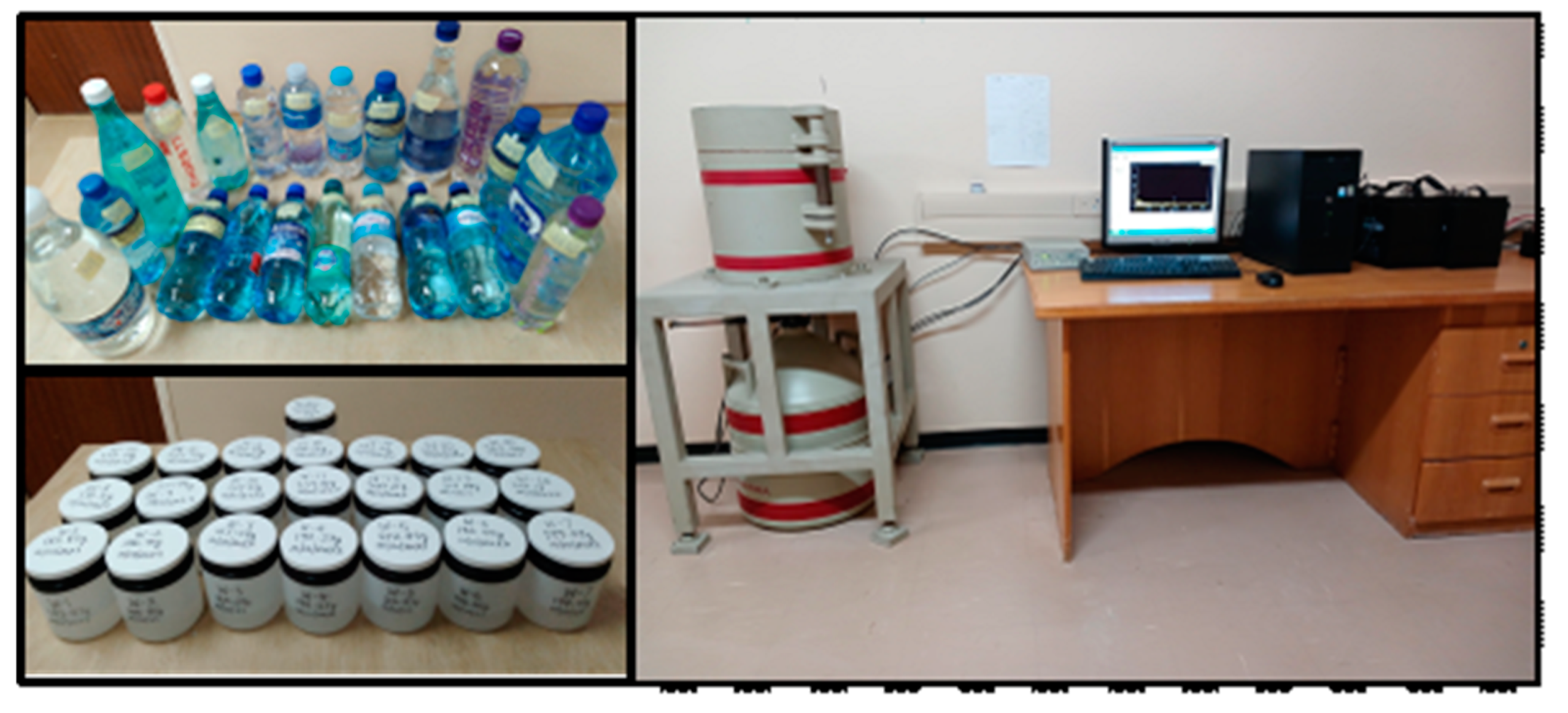
Figure 2.
Energy calibration and Efficiency Curves of the HPGe gamma spectrometer at CARST-NWU South Africa.
Figure 2.
Energy calibration and Efficiency Curves of the HPGe gamma spectrometer at CARST-NWU South Africa.
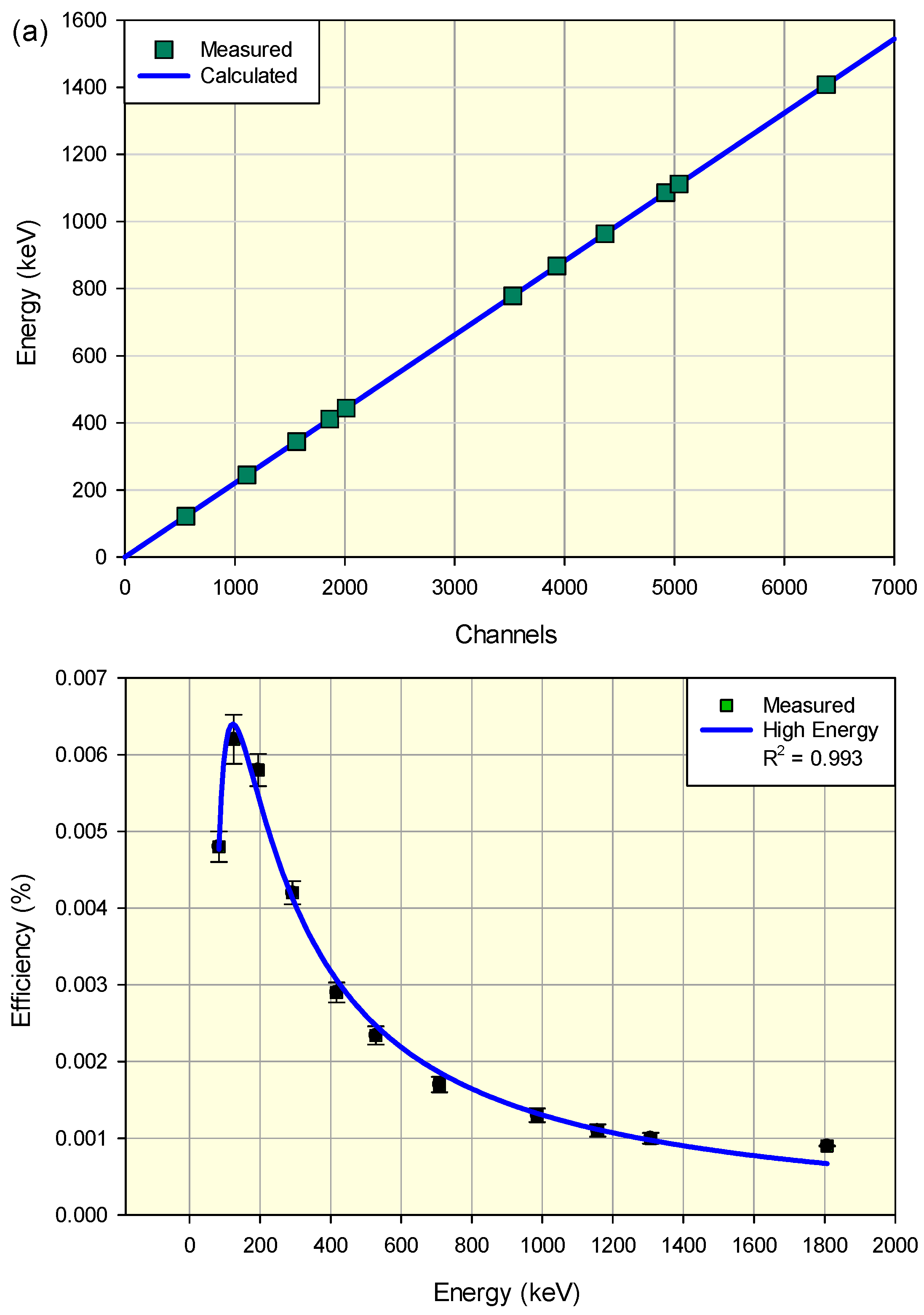
Figure 3.
The distribution of the activity concentration levels (BqL-1) of the natural radionuclides 226Ra, 232Th and 40K in the commercial bottled drinking water of South Africa.
Figure 3.
The distribution of the activity concentration levels (BqL-1) of the natural radionuclides 226Ra, 232Th and 40K in the commercial bottled drinking water of South Africa.

Figure 5.
Result of the radium equivalent-(Raeq)(BqL-1) and absorbed dose (Dab)(nGyh-1) for the water samples due to radionuclide 226Ra, 232Th and 40K.
Figure 5.
Result of the radium equivalent-(Raeq)(BqL-1) and absorbed dose (Dab)(nGyh-1) for the water samples due to radionuclide 226Ra, 232Th and 40K.
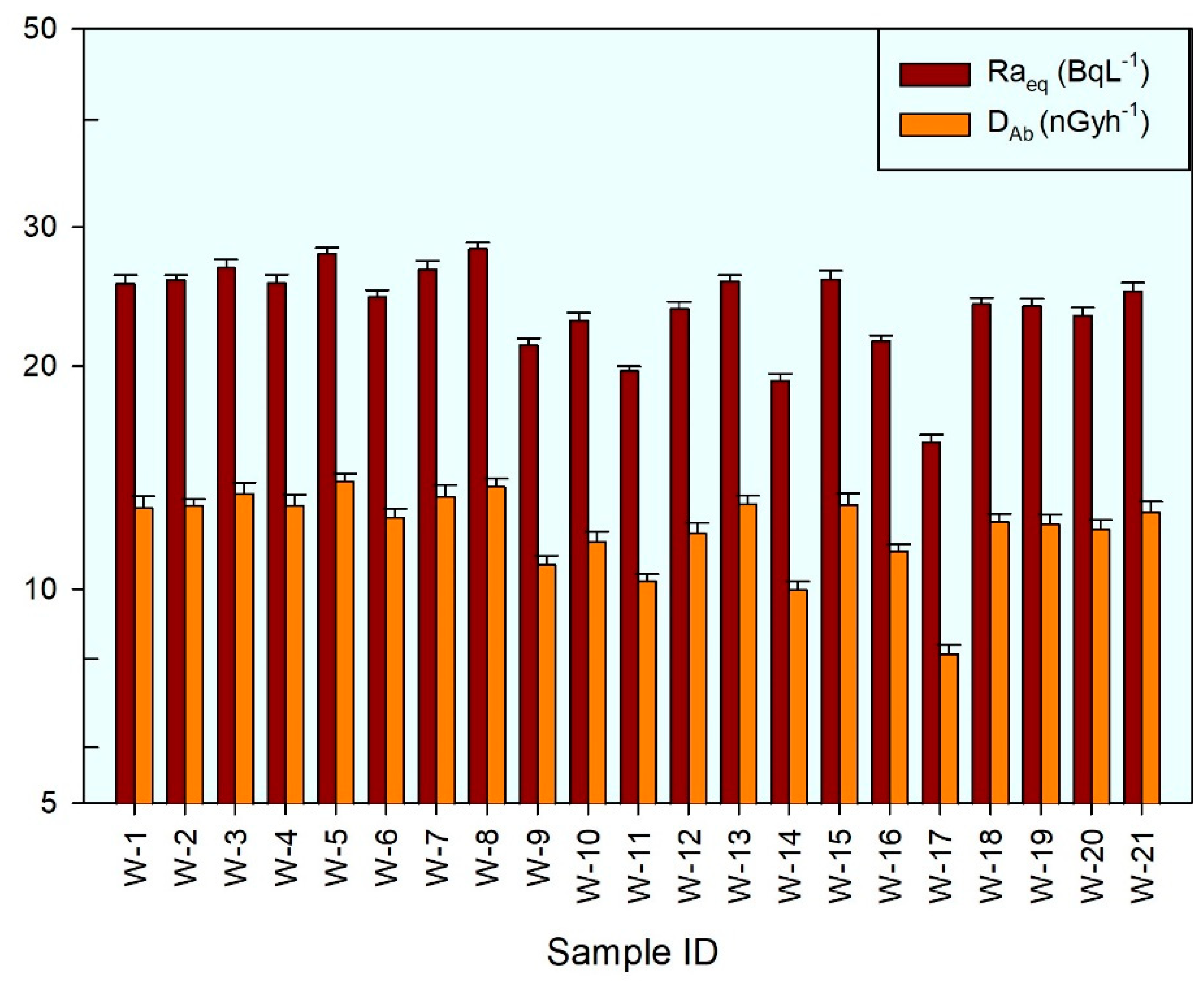
Figure 6.
Estimated results for the radiological health risk indices and the corresponding estimated cancer risks and hereditary effects of the adult member of the public because of the consumption of natural spring mineral bottled water from South Africa (a) shows the radiological health risk parameters (b) shows the cancer risk and hereditary effects parameters.
Figure 6.
Estimated results for the radiological health risk indices and the corresponding estimated cancer risks and hereditary effects of the adult member of the public because of the consumption of natural spring mineral bottled water from South Africa (a) shows the radiological health risk parameters (b) shows the cancer risk and hereditary effects parameters.
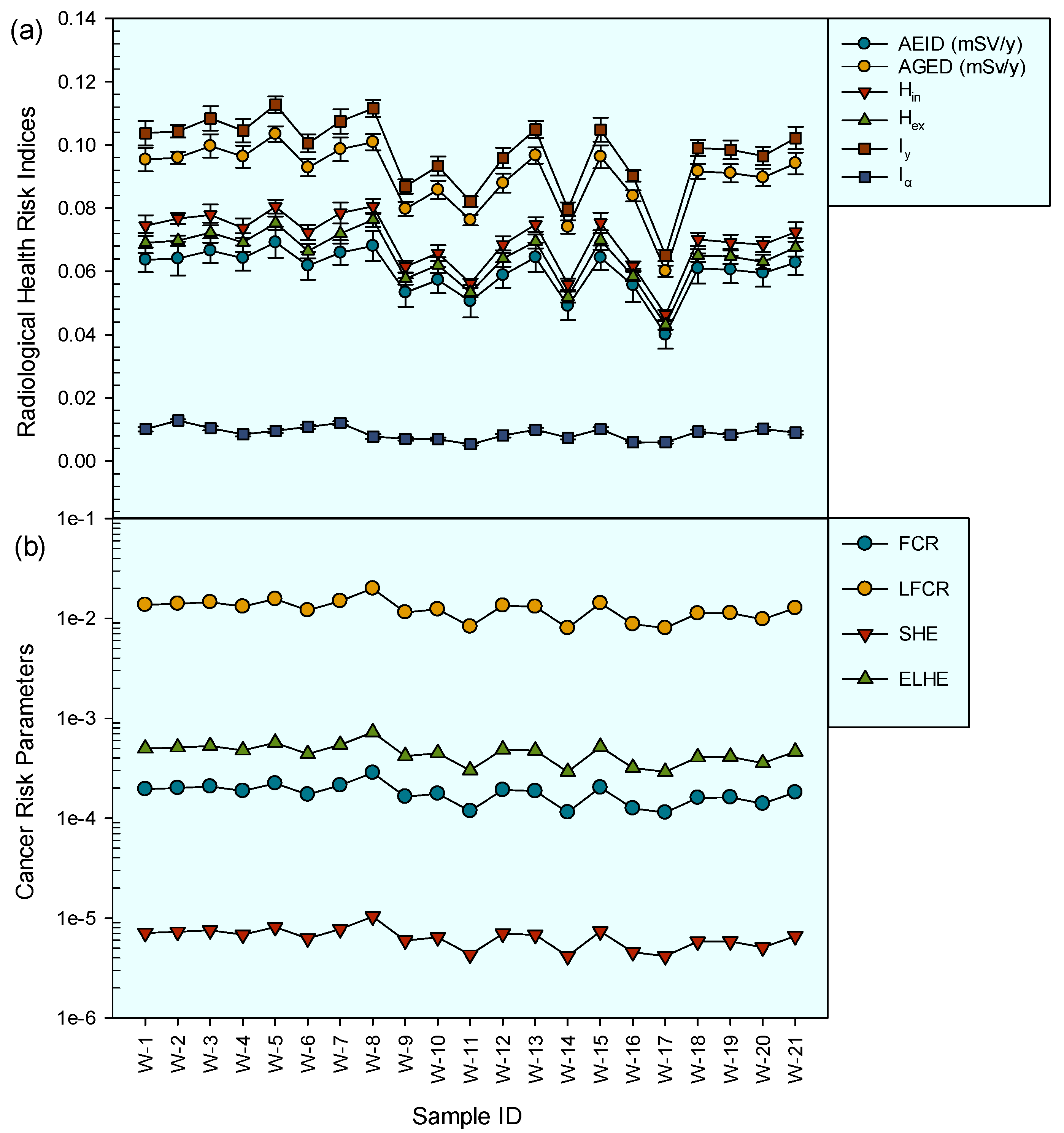
Figure 7.
Frequency distributions with Gaussian distribution curve of the activity concentration levels of natural radionuclides 226Ra, 232Th and 40K in the bottled drinking water.
Figure 7.
Frequency distributions with Gaussian distribution curve of the activity concentration levels of natural radionuclides 226Ra, 232Th and 40K in the bottled drinking water.
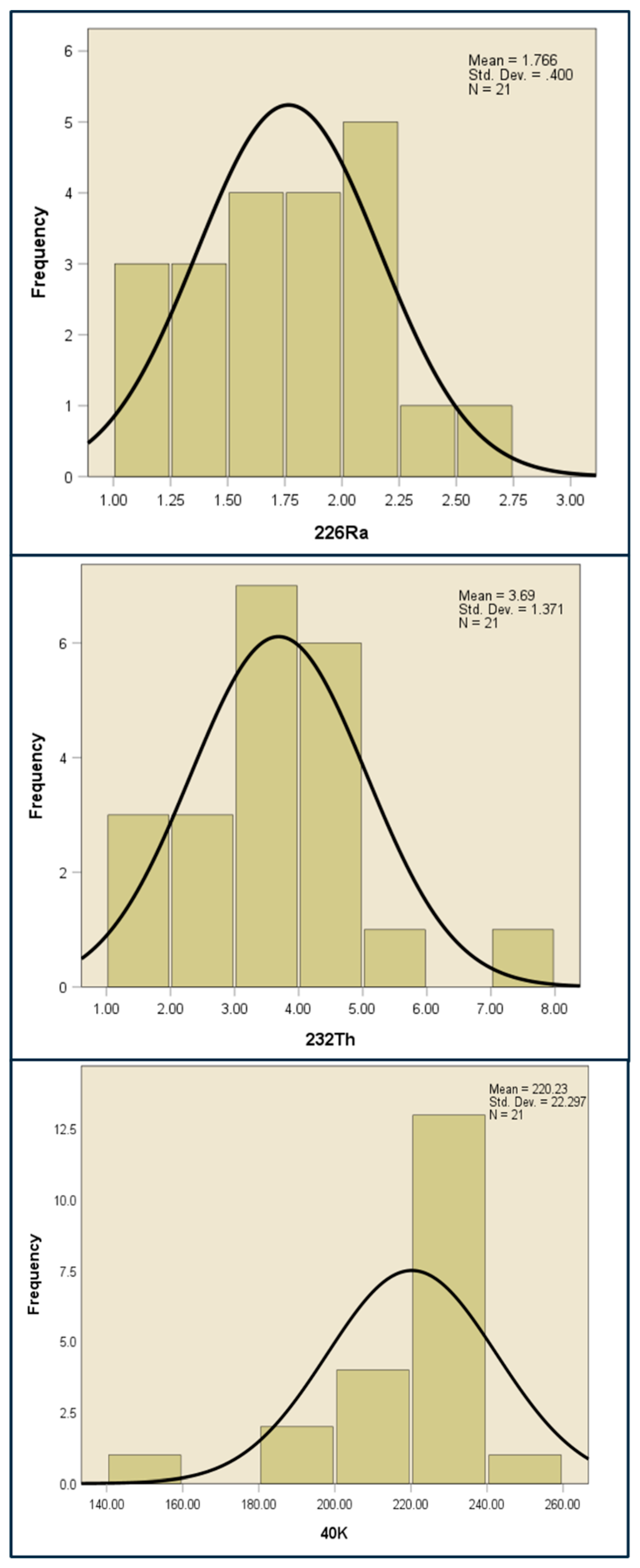

Table 1.
The coefficients for effective dose (SvBq-1) for ingestion of radionuclides for members of the public to 70 years of age [7,8,10,21].
| Radionuclide | Infant (≤1y) | Children (1-12y) | Teenager (12-17y) | Adult (>17y) |
| 226Ra | 4.2E-06 | 6.2E-07 | 1.5E-06 | 2.8E-07 |
| 232Th | 3.0E-05 | 3.4E-06 | 5.3E-06 | 6.9E-07 |
| 40K | 6.2E-08 | 2.1E-08 | 7.6E-09 | 6.2E-07 |
| Water intake (Lyear-1) | 182.625 | 365.250 | 730.500 | 730.500 |
Table 2.
Activity concentration (BqL-1) of the radionuclides 226Ra, 232Th and 40K and the total annual effective ingestion doses (TAEID) (mSvy-1) for the infants (≤ 1year), children (1-12 years), teenagers (12-17 years) and adults (> 17 years) due to the intake of radionuclide in the natural spring mineral bottled water from South Africa.
Table 2.
Activity concentration (BqL-1) of the radionuclides 226Ra, 232Th and 40K and the total annual effective ingestion doses (TAEID) (mSvy-1) for the infants (≤ 1year), children (1-12 years), teenagers (12-17 years) and adults (> 17 years) due to the intake of radionuclide in the natural spring mineral bottled water from South Africa.
| Sample ID | Activity Concentration of Radionuclide (BqL-1) | Total Annual Effective Ingestion Doses (TAEID) (mSvy-1) | |||||
| 226Ra | 232Th | 40K |
Infants (≤ 1 year) (x10-2) |
Children (1-12 years) (x10-3) |
Teenagers (12-17 years) (x10-2) |
Adults (> 17 years) (x10-3) |
|
| W-1 | 2.016 ± 0.131 | 4.164 ± 0.308 | 228.500 ± 57.100 | 2.713 | 7.380 | 1.960 | 3.546 |
| W-2 | 2.571 ± 0.075 | 4.156 ± 0.108 | 225.000 ± 56.700 | 2.752 | 7.469 | 2.016 | 3.639 |
| W-3 | 2.082 ± 0.128 | 4.506 ± 0.293 | 236.900 ± 60.930 | 2.916 | 7.884 | 2.104 | 3.770 |
| W-4 | 1.684 ± 0.121 | 3.931 ± 0.303 | 237.800 ± 61.800 | 2.567 | 7.087 | 1.838 | 3.403 |
| W-5 | 1.911 ± 0.126 | 5.090 ± 0.097 | 242.900 ± 59.700 | 3.228 | 8.617 | 2.315 | 4.057 |
| W-6 | 2.171 ± 0.128 | 3.253 ± 0.125 | 231.000 ± 57.690 | 2.230 | 6.303 | 1.626 | 3.129 |
| W-7 | 2.405 ± 0.129 | 4.644 ± 0.305 | 228.700 ± 56.700 | 3.010 | 8.066 | 2.188 | 3.869 |
| W-8 | 1.553 ± 0.143 | 7.807 ± 0.099 | 202.100 ± 10.120 | 4.639 | 11.597 | 3.305 | 5.168 |
| W-9 | 1.408 ± 0.106 | 3.615 ± 0.117 | 192.200 ± 23.020 | 2.319 | 6.282 | 1.661 | 2.981 |
| W-10 | 1.391 ± 0.106 | 3.915 ± 0.276 | 207.400 ± 51.530 | 2.499 | 6.768 | 1.783 | 3.197 |
| W-11 | 1.060 ± 0.069 | 1.982 ± 0.124 | 206.000 ± 51.890 | 1.410 | 4.281 | 0.998 | 2.149 |
| W-12 | 1.611 ± 0.110 | 4.412 ± 0.280 | 205.500 ± 51.240 | 2.788 | 7.420 | 1.999 | 3.484 |
| W-13 | 1.988 ± 0.126 | 3.787 ± 0.111 | 238.000 ± 58.870 | 2.515 | 6.979 | 1.816 | 3.393 |
| W-14 | 1.482 ± 0.104 | 1.736 ± 0.112 | 198.200 ± 49.250 | 1.303 | 4.012 | 0.945 | 2.076 |
| W-15 | 2.021 ± 0.126 | 4.440 ± 0.321 | 227.600 ± 56.920 | 2.863 | 7.717 | 2.067 | 3.682 |
| W-16 | 1.192 ± 0.067 | 1.973 ± 0.135 | 229.100 ± 57.160 | 1.443 | 4.477 | 1.022 | 2.276 |
| W-17 | 1.196 ± 0.078 | 2.290 ± 0.199 | 149.000 ± 38.480 | 1.526 | 4.258 | 1.100 | 2.074 |
| W-18 | 1.867 ± 0.124 | 2.899 ± 0.100 | 235.000 ± 58.360 | 2.015 | 5.825 | 1.457 | 2.907 |
| W-19 | 1.647 ± 0.129 | 3.059 ± 0.138 | 233.100 ± 57.870 | 2.081 | 5.959 | 1.494 | 2.934 |
| W-20 | 2.039 ± 0.127 | 2.078 ± 0.134 | 238.000 ± 36.730 | 1.583 | 4.868 | 1.160 | 2.542 |
| W-21 | 1.797 ± 0.120 | 3.721 ± 0.313 | 232.800 ± 57.490 | 2.456 | 6.813 | 1.767 | 3.297 |
| Range | 1.060 - 2.571 | 1.736 - 7.807 | 149.000 - 242.900 | 1.303 - 4.639 | 4.012 - 11.597 | 0.945 - 3.305 | 2.074 - 5.168 |
| Mean | 1.766± 0.399 | 3.688 ± 1.371 | 220.229 ± 22.297 | 2.422 ± 0.768 | 6.669 ± 1.771 | 1.745 ± 0.549 | 3.218 ± 0.749 |
| DWAF, 1996 | 0 – 0.42 | 0 - 0.228 | - | 0.3 | 0.3 | 0.3 | 0.3 |
| Worldwide | 35 | 30 | 400 | 0.2-1 | 0.2-1 | 0.2-1 | 0.1-1 |
Table 3.
Descriptive statistics for the radionuclides and radiological health risk parameters.
| Parameter | No | Minimum | Maximum | Mean | Stdev | Range | Variance | Skewness | Kurtosis |
| 226Ra | 21 | 1.060 ±0.067 | 2.571 ± 0.143 | 1.766 | 0.398 | 1.511 | 0.1598 | 0.07099 | -0.47215 |
| 232Th | 21 | 1.736 ± 0.097 | 7.807 ± 0.321 | 3.688 | 1.371 | 6.071 | 1.879 | 1.069 | 2.922 |
| 40K | 21 | 149.0 ± 10.120 | 242.9 ± 50.931 | 220.229 | 22.297 | 93.9 | 497.161 | -1.816 | 4.029 |
| Raeq | 21 | 15.929 ± 0.268 | 28.252 ± 0.613 | 23.976 | 3.033 | 12.323 | 9.201 | -1.056 | 1.144 |
| TAEID Infants | 21 | 0.013 | 0.046 | 0.024 | 0.008 | 0.033 | 5.894E-05 | 0.874 | 2.243 |
| TAEID Children | 21 | 0.004 | 0.012 | 0.007 | 0.002 | 0.008 | 3.137E-06 | 0.698 | 1.726 |
| TAEID Teenagers | 21 | 0.009 | 0.033 | 0.017 | 0.005 | 0.024 | 3.017E-06 | 0.799 | 1.992 |
| TAEID Adults | 21 | 0.002 | 0.005 | 0.003 | 0.001 | 0.003 | 5.609E-07 | 0.430 | 1.012 |
Table 4.
Pearson’s correlation coefficient analysis for the radionuclides and radiological health risks.
Table 4.
Pearson’s correlation coefficient analysis for the radionuclides and radiological health risks.
| Parameter | 226Ra | 232Th | 40K | Raeq | TAEID Infant (≤1y) | TAEID Children (1-12y) | TAEID Teenager (12-17y) | TAEID Adult (>17) | FCR | LFCR | SHE | ELH |
| 226Ra | 1 | 0.331 | 0.598 | 0.684 | 0.389 | 0.428 | 0.414 | 0.496 | 0.496 | 0.496 | 0.496 | 0.496 |
| 232Th | 1 | 0.137 | 0.767 | 0.998 | 0.991 | 0.996 | 0.977 | 0.977 | 0.977 | 0.977 | 0.977 | |
| 40K | 1 | 0.733 | 0.194 | 0.259 | 0.203 | 0.327 | 0.327 | 0.327 | 0.327 | 0.327 | ||
| Raeq | 1 | 0.805 | 0.843 | 0.812 | 0.881 | 0.881 | 0.881 | 0.881 | 0.881 | |||
| TAEID Infant (≤1y) | 1 | 0.998 | 1.000 | 0.989 | 0.989 | 0.989 | 0.989 | 0.989 | ||||
| TAEID Children (1-12y) | 1 | 0.998 | 0.996 | 0.996 | 0.996 | 0.996 | 0.996 | |||||
| TAEID Teenager (12-17y) | 1 | 0.991 | 0.991 | 0.991 | 0.991 | 0.991 | ||||||
| TAEID Adult (>17) | 1 | 1.000 | 1.000 | 1.000 | 1.000 | |||||||
| FCR | 1 | 1.000 | 1.000 | 1.000 | ||||||||
| LFCR | 1 | 1.000 | 1.000 | |||||||||
| SHE | 1 | 1.000 | ||||||||||
| ELH | 1 |
Table 5.
Comparison of mean and or range activity concentration of the radionuclides 226Ra, 232Th and 40K (BqL-1) and the total annual effective ingestion dose (TAEID) (mSvy-1) from different origins.
Table 5.
Comparison of mean and or range activity concentration of the radionuclides 226Ra, 232Th and 40K (BqL-1) and the total annual effective ingestion dose (TAEID) (mSvy-1) from different origins.
| Origin | 226Ra (BqL-1) | 232Th (BqL-1) | 40K (BqL-1) | TAEID (mSvy-1) | Reference |
| South Africa | 1.766 ± 0.399 | 3.688 ± 1.371 | 220.229 ± 22.297 | 0.01275 ± 0.004 | Present study |
| Iraq | 1.19 ± 0.5 | 0.96 ± 0.2 | 10.5 ± 0.5 | 0.015 ± 0.0025 | [20] |
| Morocco | 0.00194 | 0.00246 | 0.2366 | 0.991E-03 | [12] |
| Egypt | 1.6-11.1 | 0.21-0.97 | 9.1-23.0 | 0.67 | [27] |
| USA | 0.052 | 0.052 | - | 0.027 | [28] |
| Croatia | 0.0422 ± 0.0032 | 0.0219 ± 0.0035 | - | 0.0016-0.0115(NSW); 0.0109-0.0183(MW) | [6] |
| Nigeria | 4.3 ± 0.8 | 4.6 ± 0.5 | 28.5 ± 3.0 | 3.3 | [10] |
| Spain | 0.02-4.0 | - | - | 0.5 | [14,29] |
| Pakistan | 0.0113 ± 0.0023 | 0.0052 ± 0.0004 | 0.140 ± 0.0306 | 0.0041 | [13] |
| Sweden | 4.9 | 1.6 | - | 0.45 | [30] |
| Serbia | <0.070 | <0.050 | <0.250 | 0.0092 | [14] |
| Poland | 0.0008-0.437 | - | 0.157-10.064 | - | [14] |
| France | 0.007-0.70 | - | - | - | [14] |
| Germany | 0.00085-0.35 | - | [14] | ||
| Hungary | 0.0043-0.910 | - | - | - | [14] |
| Saudi Arabia | (0.105-0.568)E-03 | (0.016-0.382)E-03 | 18.84E-03 | - | [12] |
| Malaysia | (0.7-7.03)E-03 | (0.55-8.64)E-03 | (22-53)E-03 | - | [12] |
| SAWQG | 0 – 0.42 | 0 - 0.228 | - | 0.3 | [8] |
| Worldwide | 35 | 30 | 400 | 0.2-1 | [19] |
Disclaimer/Publisher’s Note: The statements, opinions and data contained in all publications are solely those of the individual author(s) and contributor(s) and not of MDPI and/or the editor(s). MDPI and/or the editor(s) disclaim responsibility for any injury to people or property resulting from any ideas, methods, instructions or products referred to in the content. |
© 2024 by the authors. Licensee MDPI, Basel, Switzerland. This article is an open access article distributed under the terms and conditions of the Creative Commons Attribution (CC BY) license (http://creativecommons.org/licenses/by/4.0/).
Copyright: This open access article is published under a Creative Commons CC BY 4.0 license, which permit the free download, distribution, and reuse, provided that the author and preprint are cited in any reuse.


