
Submitted:
03 October 2023
Posted:
09 October 2023
You are already at the latest version
Abstract
This article is a scoping review analyzing advances in experimental studies on bacterial self-healing of concrete. From Scopus, ScienceDirect, Web of Science and Google Scholar search engine databases, 54 studies were selected for analysis, and an increasing trend of publications since 2015 was found, with India as the country with the largest research presence. Different ma-terials are used as replacement or admixture in concrete, such as fibers, particles and recycled material from construction waste. It was found that the most commonly used bacteria are Bacillus subtilis and Bacillus sphaericus, which can improve the strength of concrete by generating calcite and sealing cracks. In addition, it was found that the presence of materials such as fibers, ashes and construction recyclates can protect bacteria in an alkaline environment. The designs usually in-clude more than two experimental groups and a control. In summary, this study highlights the importance of bacterial self-healing in concrete and provides information on advances in this field of research.
Keywords:
self-healing
; Bacillus
; concrete
; materials
1. Introducción
Concrete is one of the most widely used structural materials in the construction industry, but its behavior is brittle and its tensile strength is limited [1]. This characteristic makes it prone to cracking and causes deterioration of its microstructure [2]. Cracks create a passage for harmful substances to generate corrosion in the steel and consequently weaken the concrete [3]. Self-healing concrete is a revolutionary building material that uses bacteria to improve the performance of concrete against the generation of micro-cracks [4].
Research has been carried out to test the types of microorganisms that can be useful for repairing cracks in concrete by precipitating mainly calcite (CaCO3). For example, Bacillus subtilis encapsulated in calcium alginate used to seal micro-cracks in mortar [5], Bacillus pseudofirmus provide better effectiveness in optimal alkalinity conditions [6,7], Bacillus mucilaginosus used in mortar specimens allow decreasing the amount of pores after the curing period [8], among others. These bacteria help concrete self-healing and provide new alternatives for the development of intelligent concrete.
This review on the subject of bacterial self-healing of concrete is essential due to its growing relevance in the construction industry, which would allow a deeper understanding of the biological mechanisms involved, as well as the benefits and limitations of this technology. In addition, it could provide a critical review of current techniques and suggest areas for future research. Given that this technology has the potential to improve sustainability and efficiency in construction, a comprehensive review could be invaluable to engineers and scientists in this field and could drive significant advances in this emerging area.
In this scoping review, the question is posed: Does bacterial aggregate concrete have better mechanical and self-healing properties compared to standard concrete? In that perspective, the general objective developed is to analyze the advances in experimental studies on self-healing and mechanical properties of concrete with bacteria aggregate. As specific objectives, it was considered to identify the type of experimental design, the types of calcite mineralizing bacteria, the types of replacement materials for aggregates and cement in concrete, and the behavior of concrete through its mechanical properties when adding replacement materials and bacteria for self-healing.
2. Methodology
2.1. Databases and search strategy
A search and review of literature related to bacterial self-healing of concrete was carried out. The focus was on selecting and analyzing peer-reviewed research articles published in indexed journals, with the objective of showing the trend in the use of new resources and materials in this topic. Empirical research was considered whose methodology involved the use of laboratory tests and analytical techniques for the characterization of materials, which allowed understanding the behavior of concrete.
An exhaustive search was carried out in three relevant databases: ScienceDirect, Scopus and Web of Science. English search terms such as: concrete, self-healing, Bacteria, Bacillus, microorganisms were used and combined with Boolean AND, OR and NOT operators. The search was performed as follows:

Table 1.
Information search operations in databases.
| Database | Search |
|---|---|
| Scopus | (TITLE-ABS-KEY ( "self-healing") AND TITLE-ABS-KEY ( "Bacteria" OR "Bacillus" ) AND TITLE-ABS-KEY ( "concrete" ) ) AND ( LIMIT-TO ( PUBSTAGE , "final" ) ) AND ( LIMIT-TO ( PUBYEAR , 2022 ) OR LIMIT-TO ( PUBYEAR , 2021 ) OR LIMIT-TO ( PUBYEAR , 2020 ) OR LIMIT-TO ( PUBYEAR , 2019 ) OR LIMIT-TO ( PUBYEAR , 2018 ) OR LIMIT-TO ( PUBYEAR , 2017 ) OR LIMIT-TO ( PUBYEAR , 2016 ) OR LIMIT-TO ( PUBYEAR , 2015 ) ) AND ( LIMIT-TO ( DOCTYPE , "ar") ) |
| ScieceDirect | "self-healing" AND (Bacteria OR Bacillus) AND concrete NOT review |
| Web of Science | concrete + (Bacteria OR Bacillus OR microorganisms) +"self-healing" -review |
2.2. Inclusion and exclusion criteria
Inclusion criteria for the selection of studies comprised those primary source, downloadable and published in English only, institutionally accessible, all original research describing the action of bacteria on concrete curing in laboratory experiments comprised between the years 2015 to 2022. In contrast, research that did not specifically focus on bacterial self-healing of concrete, systematic reviews, and non-peer-reviewed papers were excluded.
2.3. Data extraction and eligibility of items
A first filter of information was carried out according to the inclusion criteria in the databases. The selected articles were exported to the Rayyan platform (https://www.rayyan.ai/) in risk format. The authors evaluated the information within this platform and eliminated duplicate files. Eligibility criteria were applied for the articles to be included in the discussion of this review, which were: studies that presented at least one mechanical property, studies focused on mortar self-healing, those that showed unclear results in the units of measurement, deficiencies in the experimental design or were the result of conference papers were eliminated.
Figure 1.
Flowchart for identification and selection of studies.
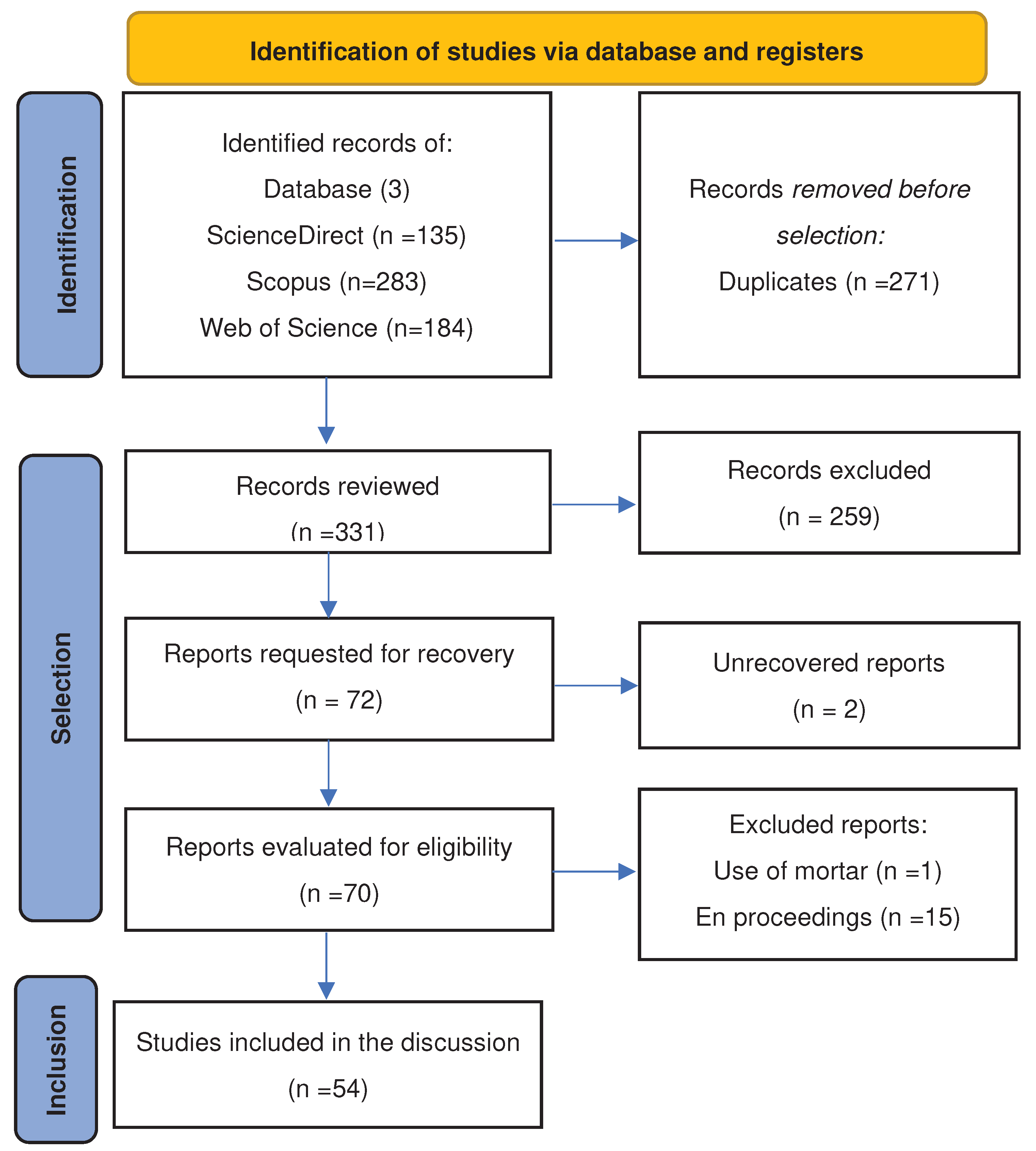
A total of 602 publications related to the topic were found in the three databases, ScienceDirect (135), Scopus (283) and Web of Science (184). The documents found were exported to Rayyan software, which allowed organizing and speeding up the process of selecting articles for analysis. A total of 271 duplicate articles were identified; 259 articles that were focused on mortar self-healing or presented problems in the design or presentation of the results were eliminated; 2 studies that could not be retrieved were also excluded. There remained 70 publications that met the eligibility criteria, of which 15 were eliminated because they corresponded to proceedings and one study that worked with mortar described in the design. Finally, 54 studies were chosen for discussion in this review.
2.4. Summary of included studies
The studies included for the analysis were recorded in a summary table (Table 2) indicating author, year and country; type of material with its corresponding author reference (Table 3), for the identification of bacteria and type of design with their respective references (Table 4) and the results corresponding to the mechanical properties of the bioconcrete.
3. Results
The 54 final articles included for analysis were ordered as shown in Table 2, which considers aspects such as: author, year of publication and country of origin of the research. The studies were conducted in various countries, with India having the largest presence (37%), followed by China (15%), Pakistan (9%), Egypt (7%), Iran and Malaysia (6% each) and other countries (20%). It is clear the increasing trend of publications since 2015, highlighting 2019 (24%), 2020 (26%) and 2021 (22%) the years with the highest number of studies on this topic.
Table 3 shows the studies organized by type of material used in the concrete as a replacement or as an additive, of industrial or natural origin, such as fibers, particles, ashes and recycled material from construction waste. These materials are used to improve the durability and self-repairing capacity of concrete. In the group of fibers, the predominant use of steel [9,10,11] in its different presentations is observed. Fibers of natural origin are also used, among which coconut fiber [12,13], jute and flax [12], and rice husk [14] stand out. In the group of particles, materials such as granulated slag [15,16,17,18], expanded glass [15], silica fume [19] and nanoparticles [20] are also used.
Fibers can reduce the width of cracks by bridging the concrete matrix, and in the space occupied by the fibers, bacteria develop a filler material that allows the crack to heal [21]. Bacteria can trigger biochemical processes that contribute to crack healing, reduce porosity, and improve concrete strength throughout its service life. Natural fibers from coconut, jute, flax and rice husk, as well as industrial fibers from steel, glass, polypropylene, basalt, rubber and polyvinyl alcohol, can be used in cementitious composites to improve their properties. Natural fibers are gaining relevance due to the need for environmentally friendly and sustainable building materials to reduce density, fragmentation and crack propagation in concrete.
The use of granulated particles can improve the durability and self-repairing capacity of concrete. These particulate replacement or admixture materials, such as granulated slag, silica fume, iron oxide nanoparticles, bentonite, expanded glass, crushed granite, dolomite, and Metakaolin, can affect the mechanical properties of concrete in various ways [15,16,18,19,22,23,24]. For example, granulated slag can improve the compressive strength of concrete [23]. Silica fume can improve the compressive strength and durability of concrete [15]. Iron oxide nanoparticles can improve the flexural strength and compressive strength of concrete [16]. Bentonite can improve the workability and durability of concrete [13].
Fly ash can interact with the concrete matrix and produce chemical reactions that affect its durability because it has pozzolanic properties, i.e., it can react with calcium hydroxide in concrete to form additional cementitious compounds [25].
Regarding recycled construction waste material, it presents a double configuration in its use; first, it has to be used with care since it can reduce the strength of concrete [26], compared to natural aggregates, and its quality will depend on the original concrete, the loading conditions and exposure of the demolished structure [27,28]. Secondly, it can be useful if combined with other materials such as fly ash, silica fume, rice husk ash and Metakaolin, or superplasticizing admixtures that improve its properties [16,29,30]. Several of these materials are used as carriers for self-healing of cracks in the concrete by bacteria with high urease activity. These bacteria can trigger biochemical processes that heal the cracks and reduce the porosity of the concrete. Consequently, the bacteria act as a catalytic agent by changing the initial compound into a material suitable for filling pore spaces and cracks.
Table 4 shows the application of bacteria individually and in combinations for different experimental designs that evaluate the properties of bioconcrete. There is a greater tendency for studies with more than two experimental groups and a control group, as well as factorial designs. It can be observed that the most used microorganisms correspond to Bacillus subtilis [10,13,15,21,24] [27,28,30,31,32,34,35,36,37] and Sporosarcina pasteurii [14,23,26,38,39,40,41,42,43,44]. In the case of Bacillus subtilis, its inherent effect has been tested and its concentration used, the contribution of other conditions such as the type of fiber, recycled material, type of immobilization, substrate used and genetic modification. In bioconcretes with Sporosarcina pasteurii, in addition to the substrate [23,26] and type of aggregates [14,39,42] used in the designs, interestingly, its effect was evaluated when subjected to special conditions, such as compressive strength, crack depth, as well as the water/cement ratio in the mix [41]. In relation to experimental designs with increasing stimulus, it has been applied in relation to the bacterial concentration [17,28,36,43,44], substrate [36,45], recycled aggregate [28], fly ash [44,46] and fiber used [11,47]. It has been shown that increasing up to a certain bacterial concentration favors the properties of concrete, as long as the curing water is potable, since these are reduced if salt water is used, but this is not the case with Dunaliella salina, which has the ability to improve the properties of concrete and even more when increasing its concentration in the mixture and this is due to the fact that it is halophilic [17].
3.1. Compressive strength
Concrete can have better mechanical and self-healing characteristics if some materials with special characteristics, such as bacteria and fibers of different types, are added or substituted. These materials can increase the durability and strength of concrete, since bacteria can facilitate the transformation of the initial composite into one more suitable for filling pore spaces and cracks, and fibers reduce the width of cracks through a bridging action [21]. Thus, it is evidenced that after 28 days of curing and using recycled concrete from demolished buildings, a reduction of up to 14% is observed in mixtures with and without bacteria with substrates and a calcium source [26]; this same experience is shown in [24] when using recycled brick aggregate (30, 50 and 70%) and bacteria, which decrease the compressive strength between 4.9% and 9.5%.
However, the use of calcium urea chloride and calcium urea nitrate, as bacterial nutrients, increased the compressive strength by 9.33% and 27.3% when Sporosarcina pasteurii was added [38]. Likewise, with the incorporation of dolomite (calcium magnesium carbonate) as a coarse aggregate in the mixture, calcium lactate as a substrate and the concentration in the bacteria solution increased the compressive strength at 28, 56 and 120 days by 50.8% and 52.9% [22]. In another study, a combination of bacteria (Bacillus subtilis), at a concentration of 105 cells/mL, and lactate at a concentration of 50% improved the compressive strength of concrete by 20% [36]. Also, with calcium lactate concentrations of 0.22, 1.09 and 2.18 g/L, an increase in compressive strength of 5%, 6.9% and 10%, respectively, was observed [45]. It was also evident in another study that mixtures with nutrients and Bacillus wiedmannii and Bacillus paramycoides spores outperformed the control mixture (with nutrients only) by 46.52% and 23.91%, respectively [19]. These facts demonstrate that the use of bacteria and calcium substrates in concrete mixtures can have a significant impact on the compressive strength of concrete, with some combinations resulting in better performance and others unfavorable.
Other materials have also been used to improve the properties of concrete without much success, so we have that mixtures of bacteria with recycled brick aggregate at 30, 50 and 70% decreased the compressive strength between 4.9% and 9.5% [24]; similarly, mixtures with polymers (SAP and PVA) and Bacillus pseudofirmus bacteria, with calcium lactate food and yeast extract, reduced the compressive strength by 29.44% and 79.19%, respectively [48]. It can also be noted that the use of bacteria, biochar and mixed mixtures with both materials in concrete can result in a significant increase in compressive strength. It was observed that mixtures with bacteria increased the compressive strength by 16.2%, while mixtures with biochar and mixed mixtures increased it by 13.08% and 22.01%, respectively [31]. These results suggest that the incorporation of bacteria and biochar in concrete mixtures can have a positive impact on performance, improving their compressive strength and potentially increasing their durability and longevity.
Also, using bacteria, biochar and other admixtures in concrete mixtures can have important results. Using bacteria in combination with recycled concrete, Silica fume and Metakaolin allows better results over typical concrete in terms of compressive strength, either initial, as well as a recovered strength after cracking in the range of 53% to 93%, especially with the use of silica fume for its high content of silicon dioxide that reduces the average pore size and improves durability and strength [16]. Silica fume as a 20% replacement of Portland cement and also steel fibers as reinforcement increased the strength at 7 and 28 days of curing [15], showing better durability with respect to typical self-compacting concrete.
Other important materials that can aid in the compressive strength of concrete are: fly ash and different types of fibers. Mixtures with fly ash (class F) and with Bacillus sp. bacterial suspension (4×10⁸ cells/mL) increased the compressive strength by 11% and 40%, respectively [46]; the best values were given for B. pasteurii at 60 days, with a concentration of 105 cells/mL for fly ash at 0%, 10%, 20% and 30%, probably due to the precipitation and accumulation of CaCO3 induced by bacteria in the matrix of concrete with fly ash [44]. The presence of CaCO3 in concrete was determined by X-ray fluorescence (XRF) and scanning electron microscopy (SEM) microstructural analysis. In principle, the addition of microorganisms contributes to improve the compressive strength of concrete, but together with ground granulated slag, as an aggregate, it produces a reduction in compressive strength [18], probably due to the fact that this material develops compressive strength over a longer period (ultimate strength).
Blends with high modulus glass fibers and low modulus polypropylene fibers, the combination of both fibers and bacteria (Bacillus subtilis and Bacillus sphaericus), increased the compressive strength between 13.52% and 27.75% [32]. Bacillus subtilis spores induced an improvement in strength up to a maximum of 8% at 28 days of curing; likewise, the same bacteria immobilized on iron oxide nano/microparticles increased the compressive strength, but immobilized on bentonite (clay) nano/microparticles reduced it at 28 days [13]. A gradual increase in compressive strength was also observed in both normal and lightweight concretes (with class F fly ash) up to day 90 [14].
The use of microbial healing agents in concrete mixes is another possibility that can have a significant impact on compressive strength. It was found that at 28 days of curing a microbial self-healing concrete mix with powdered (PSC) and capsule-based (CSC) healing agents were superior to the control mix by 4% and 2%, respectively [49]. In contrast to these results, another study identified that PSC only outperformed the control strength by 2% in contrast to CSC which decreased the strength by up to 2.95% [50]. Several studies also highlight that different concentrations of bacterial solutions induce an improvement in the compressive strength of concrete. Thus, the mixtures tested at 28 days of curing exceeded the compressive strength by 8 to 15% for the different bacterial suspensions (5×10⁴ and 5×10⁵ cells/mLAwater) of B. pasteurii and B. sphaericus, and by 8% for Dunaliella salina algae (7 mg/mL) [17]. Partially replacing water with bacterial solutions is a mechanism for improving the concretes. In this regard, using S. pasteurii and L. sphaericus at different solutions (5x10⁶, 107 and 2x10⁷ cells/mL) increases the resistance between 4 and 15% [51].
Concrete can increase its durability and compressive strength with the help of bacteria, which can produce calcium carbonate crystals that can fill small cracks in the concrete. This can make the concrete stronger and more durable. In this sense, the microorganisms B. subtilis, B. megaterium and the consortia generated from them can increase the strength by 19.62%, 22.58% and 10.61%, respectively [52]; consequently, bacteria coated with chitosan in proportions of 0.5, 1.0 and 1.5%, allowed increasing the compressive strength by 5.98%, 2.39%, 10.28% and 5.98% compared to the control. The use of this polysaccharide is of utmost importance, since it can react with calcium carbonate and form a compound that seals the microcracks produced by the contraction and expansion of concrete [47].
An important aspect of this type of studies is to evaluate the mechanical properties of self-repairing concrete considering the type of bacteria and the concentration of bioagents, thus, it has been identified that at 28 days of curing, mixtures with B. halodurans and B. subtilis are superior to conventional concrete (7% and 18% higher, respectively) [53]. Likewise, several studies report the use of other types of bacteria that improve compressive strength over conventional strength, among them we have: B. sphaericus (15.95%), B. cohnii (11.45%), and B. megaterium MTCC 1684 (16%) [54]; B. megaterium MTCC 1684 (14.8%), and Lysinibacillus sp. I13 (34.6%) [55]; B. megaterium MTCC 1684 (16%), B. megaterium BSKAU (12.12%), B. licheniformis (10.6%) and B. flexus (6.1%) [56] and the genetically improved strain B. subtilis T, which significantly improves compressive strength [30].
There is clear evidence that the addition of bacteria and fibers in concrete mixes can significantly increase their strength. Thus, mixtures with bacteria (B. subtilis, B. cohnii and B. sphaericus) and three types of fibers (coconut, flax and jute), as bacteria carriers, increase strength from 4.5% to 42%, being coconut fiber the one that obtained the highest value [57]. In addition, an increase in strength was observed in reinforced concrete mixtures with basalt fibers, bacterial concrete (Bacillus subtilis with calcium lactate as nutrient) and bacterial concrete with basalt fibers, surpassing conventional concrete by 20%, 24% and 27%, respectively [21]. Also, bacterial specimens with 0.5% coir fibers offered an improved strength of 38% at 28 days of curing compared to conventional concrete [58]. In another study, concrete with long rubber particles (SRC-L), 1 to 3 mm, and concrete with short rubber particles (SRC-S), 0.2 to 0.4 mm, outperformed normal rubber concrete by 16.4% and 0.7%, respectively [59]. In addition, strength recovery was observed by the combination of bacteria immobilized by biochar, SAP (Sodium Poly Acrylate Sodium) and hybrid fiber compared to the control and the mixture with only SAP and fiber [9].
In another experiment, it was found that concrete with 5% rice husk replacement presented low strength, with B. cohnii increased its strength by 12.1%, while concrete with 5% rice husk replacement plus B. cohnii presented a drastic decrease in strength [29]. Finally, the addition of steel fiber has been shown to improve the property in all bioconcretes (Bacillus subtilis, B. subtilis spore and control), regardless of the curing environment used (tap water, urea-calcium lactate or nutrient solution) [10]. Direct incorporation of bacteria or bacterial cells into the concrete mix, either with recycled coarse aggregate (RCA), as a carrier medium, or with virgin fine aggregate, saturated with bacterial suspension, can increase the strength of concrete by 4 to 6%. However, when accompanied only with RCA, a 3% decrease in strength was observed with respect to the control [27]. Another study shows that Bacillus subtilis bacteria play an important role in increasing the compressive strength of conventional concrete, as well as concrete with waste in replacement of 25% of coarse aggregate and 50 ml bacteria aggregate; observing better results for concrete with recycled material with an increase of 17.58% with respect to conventional concrete [28].
3.2. Flexural strength
The flexural strength of concrete is a property that can be improved through the use of fibers and bacteria. Fibers can be added to concrete to improve its strength and elasticity. Bacteria can also be used to improve the strength of concrete, as they can produce calcium carbonate that fills cracks and increases durability.
A reduction in the flexural strength of concrete of up to 6% was observed in abiotic mixtures with addition of substrates and calcium source, and 15% in microbiotic mixtures with addition of bacterial spores, substrates and calcium source at 28 days of curing [26]. In addition, it was found that as the percentage of recycled brick aggregate (RBA) in replacement of natural coarse aggregate (NCA) increases, the flexural strength starts to decrease. A reduction of 3.5%, 5.7% and 8.7% is observed for the replacement of 30%, 50% and 70% of RBA by NCA, respectively. This shows that the reduction in flexural strength due to 30% and 50% RBA is small and almost 50% of NCA can be safely replaced by recycled brick aggregate (RBA) in rigid pavements [24]. In other studies, it was shown that the number of bacteria (105 CFU/mL) and lactate at 50% improves the flexural strength of concrete by 20% [36] and the increase in the concentration of calcium lactate of 0.22, 1.09 and 2.18 g/L increases the strength of concrete, with respect to the control, by 22.38%, 38.7% and 40.59%, respectively [45]. Another important material in the improvement of flexural strength is charcoal or biochar, which combined with Bacillus subtilis in concrete mixtures can significantly improve their strength. Indeed, an increase in concrete strength of 14.08%, 26.17% and 6.50% was observed for mixtures with biochar, Bacillus subtilis mixtures and the combination of Bacillus subtilis and biochar, respectively [31].
There are other materials that can interact with the concrete matrix and produce chemical reactions that affect its durability, these are fly ash, which together with bacteria and some fibers can significantly improve the strength of concrete. In this case the fly ash modified cement slurry was used to repair cracks and evaluate the flexural strength after curing. It was observed that in all the samples analyzed the strength recovery is positive, being 26% higher in the concrete with 40% fly ash cement slurry compared to the control concrete; likewise, the concrete with bacterial slurry with spray and puddling treatment was better by 10% and 76.3%, respectively [46]. As can be noted, crack repair with 40% fly ash modified bacterial slurry would serve as a potential healing product for concrete structures.
Another environmentally friendly alternative to cement is geopolymer concrete, which is synthesized by alkaline activation of industrial by-products such as fly ash and ground granulated blast furnace slag that would replace cement. This concrete was enriched with bacteria (Bacillus Subtilis and Bacillus Sphaericus) and high modulus glass fibers and low modulus polypropylene fibers that increased flexural strength at 7 and 28 days of curing, to be used in the development of self-repairing pavers for heavy duty and very heavy traffic conditions. When glass fiber was used in the mix, the strength reached up to 43.75% and 44.44%; for the use of hybrid fiber the strength increased by 45.83% and 49.07%, bacterial geopolymer concrete with glass fiber reached 47.92% and 50%, and bacterial geopolymer concrete with hybrid fiber increased by 50% and 53.70% [32]. Thus, producing hybrid fiber reinforced bacterial geopolymer concrete provides better energy absorption characteristics and better post-cracking behavior under heavy loads. It has been shown that the addition of fly ash and bio-based agents resulted in a significant increase in the relative recovery (%) of flexural strength and modulus. Contrary to the results of the degree of cure, a better recovery of mechanical performance was obtained by microbial specimens than fly ash specimens [40].
The addition of bacteria and chitosan to concrete mixtures can significantly improve their strength, so an increase in flexural strengths was observed for either species, B. pasteurii and B. sphaericus. Specimens prepared with B. pasteurii showed more pronounced concentrations than those with B. sphaericus. The 5×10⁵ cells/mL content of the two species recorded the maximum value. Concrete with B. pasteurii at 5×10⁴, 5×10⁵ and 5×10⁶ cells/mL improved by 77.62%, 51.09% and 38.46%, respectively; while mixtures with B. sphaericus at 5×10⁴, 5×10⁵ and 5×10⁶, exceeded it by 74.29%, 51.09% and 15.38%, with respect to the control mixture and at the three ages [17]. In addition, chitosan (polysaccharide biopolymer) was used to coat the Bacillus pseudofirmus spores and survive in the high alkalinity concrete. Bacterial mixtures with chitosan incorporation at 0, 0.5, 1.0 and 1.5% increased strength by 1.97%, 3.44%, 13.79% and 1.48% with respect to the control mixture (Dolomite-sand-cement-water-superplasticizer) [47]. In another study, it was found that at 28 days the concrete with B. halodurans with solutions of 105 CFU/mL reached the highest strength, being superior to the mixture with B. subtilis at the same concentration [53]. In addition, by using a genetically improved strain (B. subtilis T), a significant increase in resistance was achieved [30].
An increase in strength has been observed in mixtures of bacterial concrete, bacterial concrete with basalt fibers for low water/cement ratio and in the presence of bacteria. The addition of B. Subtilis and B. Sphaericus to the concrete, the strength at 28 days increases 2.52% with respect to the standard concrete. With the addition of polypropylene fiber, the strength increases 4.32%. By adding bacteria and fibers to the concrete, the strength increases 9.35% [60]. Bacterial concrete should be cured in a separate medium containing calcium chloride (CaCl2) and urea mixed in normal water to enhance calcite precipitation from bacteria. Samples of normal concrete were cured in plain water and samples of bacterial concrete, concrete with fibers and concrete with bacteria and fibers were cured in a separate deposition medium containing calcium chloride (CaCl2) + urea as nutrients in water. Calcium chloride (CaCl2) has the ability to accelerate the hydration of cement and it has been shown that there is an increase in strength for each addition of calcium chloride (CaCl2) in water. Specimens cured in a medium containing CaCl2 + urea show an increase in strength of 16.7% at 28 days [58].
In another study, it was found that mixtures with 5% replacement of rice husk by fine sand decreased in strength with respect to the control sample; on the contrary, B. cohnii allowed strength to increase; but when 5% rice husk and B. cohnii were combined, strength decreased [29]. Mixtures incorporating glass (0.5%) and steel (1.5%) fibers, as well as Bacillius megaterium MTCC 1684 (105 cells/mL), provided the best results when using 0.5 % glass fiber + 1.5 % steel fiber + Bacillius megaterium MTCC 105 cells/mL [11].
Finally, it has been shown that the addition of bacteria to concrete mixtures can significantly improve their flexural strength. It was found that bacteria favor the flexural strength of normal concrete, as well as of recycled concrete from demolished structures replaced with 50 ml of bacteria solution. In addition, better results were observed in mixtures with recycled concrete in replacement of 25% of the coarse aggregate and 50 mL of bacterial solution [28].
3.3. Tensile strength
The use of Sporosarcina pasteurii together with calcium chloride-urea and calcium nitrate-urea increases the tensile strength by 5.8% and 18.1%, respectively, after 28 days of curing [38]. In addition, it has been found that mixing with Superabsorbent Polymer (SAP) powder increases the strength by 7.81%, while Polyvinyl Alcohol (PVA) in the form of aqueous solution decreases it by 56.25% [48]. On the other hand, self-compacting concrete mix with 20% silica as a replacement for cement, reinforced with steel and enriched with bacteria, provides better results in terms of split tensile strength at 7 and 28 days. The addition of steel fibers contributes to increase the strength of concrete due to their bridging action in the cementitious matrix [15].
Also, mixtures with bacteria and glass and polypropylene fibers increase the strength at 28 days by 28.21% to 46.15% [32]. The addition of B. subtilis improves split tensile strength by up to 2% at 28 days, while B. subtilis immobilized on Nano/microparticles of iron oxide improves by up to 7.5%. However, immobilized on Nano/microparticles of bentonite reduces its strength [13].
Finally, it has been observed that bacterial lightweight concrete shows better results due to the encapsulation of bacteria within the lightweight aggregates only at 56 days, but this is reversed in favor of normal bioconcrete at 90 days [14].
After 28 days, it has been observed that mixtures with B. subtilis, megaterium and bacterial consortium bacteria increased their strength by 25.3%, 18.29% and 19.50%, respectively [59]. In addition, it has been found that bioconcrete mixtures with different addition percentages present variations in strength: bioconcrete with 0.5%, 1.0% and 1.5% increased its strength by 9.18%, 16.58% and 6.12%, respectively, and bioconcrete with 2.0% decreased its strength by 7.65% [43]. B. subtilis T (genetically improved strain) has been shown to significantly improve the tensile strength of concrete [30]. Furthermore, the addition of B. subtilis and B. sphaericus in the concrete mix increase the tensile strength by 7.51% over control concrete, while the addition of polypropylene fiber at 28 days increases the strength by 12.65%. The combination of bacteria and fibers in concrete increases the strength at 28 days by 26.09%, with the fiber-reinforced bacterial concrete producing the highest result [60].
On the other hand, it has been observed that the ultimate tensile strength of concretes with long and short rubber particles improves by 17.5% and 9.4%, respectively, over the corresponding normal rubber concretes [59]. Concrete with 5% rice husk replacement decreases its strength by 19.4%, while concrete with B. cohnii increases its strength by 11.7%. The combination of 5% rice husk replacement and B. cohnii decreases strength by 8.7% [29]. It has been found that the best results are obtained when 0.5% glass fiber, 1.5% steel fiber and Bacillius megaterium MTCC at a concentration of 105 cells/mL are incorporated into the concrete. The strength of the concrete increased by 11.1% when bacterial cells incorporated directly through the make-up water were used, and by 38.88% when bacterial cells were included through recycled concrete as coarse aggregate (RCA) and 50% virgin fine aggregate (saturated with bacterial suspension). However, when bacteria were immobilized through RCA as a carrier medium, the resistance decreased up to 33.3% with respect to the control concrete.
3.4. Concrete self-healing
Concrete crack healing is a process that seeks to restore the structural integrity and water tightness of the material against infiltration of water and other substances. For this purpose, microbial concrete is used, which is a material that incorporates bacteria capable of producing calcium carbonate, a compound that fills and seals cracks and microcracks formed by various causes [16,31,61]. One of the most innovative techniques to achieve this objective is the incorporation of bacteria that produce a mineral (calcium carbonate) that fills the cracks and reinforces the concrete. These bacteria can be introduced into the concrete by different methods, such as powder, capsules or beads [49,50], and can be of different species, such as those of the genus Bacillus or Sporosarcina, which have the ability to hydrolyze urea and generate carbonate ions [23]. Some materials that can be used as encapsulation media are expanded clay particles, in self-encapsulated mixed cultures or immobilized with iron oxide or bentonite [13].
Since the healing of cracks (or microcracks) in concrete is a topic of great interest in the construction industry, several studies have been conducted that report the successful use of bacteria to repair cracks in concrete. In cylindrical concrete specimens with S. pasteurii, healing of up to 0.5 mm of the crack was observed and after 4 weeks 71% of the cracks had healed [26]. Furthermore, 200 μm cracks in concrete RC beams can be completely healed in 28 days using Sporosarcina pasteurii bacteria, which were administered with nutrients calcium chloride-urea and calcium nitrate-urea, which allowed them to remain active for a longer time. X-ray diffraction (XRD) and scanning electron microscopy (SEM) show evidence of calcite precipitations as well as calcium hydroxide (Ca(OH)2) and calcium silicate hydrate (C-S-H), important products that provide the strength of the concrete [38]. It has been shown that the ureolytic bacteria Bacillus wiedmannii and Bacillus paramycoides can completely repair cracks after 28 and 90 days, respectively, incorporated into concrete with bacterial nutrients and in the form of spores. Thus, the strong capacity for CaCO3 precipitation is related to bacterial ureolytic activity [19]. In another study, it is verified that recycled brick aggregate (RBA) works perfectly as a bacterial spore-bearing material, achieving a significant amount of healing (self-healing) of cracks, ranging from a width of 0.66 to 0.92 mm, at 7 days of curing, and from 0.55 to 0.68 mm at 28 days, and after this period the repair becomes slower but still remains significant. Consequently, XRD and SEM tests confirmed the precipitation of calcium carbonate by the action of bacteria in the mixture [24]. This fact shows that, the curing capacity is effective, although it is reduced when the samples are cracked at a later age (28 days). That is, samples cracked even after 28 days of curing showed significant curing, indicating that bacterial spores were well protected in the RBA and were able to precipitate calcium carbonate when cracks appeared.
Another interesting approach is the use of bacteria and superabsorbent polymers (SAP) to cure cracks (up to 300 microns) in concrete. They applied powdered SAP polymers and a 16% polyvinyl alcohol (PVA) aqueous solution; and after 28 days of water immersion the SAP and bacterial spores achieved pronounced healing [48]. In addition, microbiologically induced calcite precipitation has been shown to be effective in sealing cracks between 0.3 and 0.4 mm. The mixture with calcium nitrate-urea solution and bacterial solution, at a relative humidity of 60%, had the highest flexural strength after repair [62].
Other studies have been conducted on the use of bacteria to repair cracks in concrete. In particular, it has been observed that Enterococcus faecalis bacteria can contribute to the self-curing of concrete by 5.3%. Furthermore, when calcium lactate was added at different concentrations, it was found that the percentage of self-curing increased, reaching a maximum of 10.8% with a concentration of 2.18 g/l calcium lactate. These results suggest that the combination of bacteria and calcium lactate can be an effective strategy to improve the self-curing ability of concrete [45]. Mixtures with Bacillus subtilis (BSM) and Bacillus subtilis plus biochar (BSCM) are effective in adequately healing cracks, achieving complete healing in most cases at 28 days (BSCM) and after 56 days for BSM, sealing up to 0.6 mm for both mixtures [31]. In addition, the maximum crack width of 0.63 mm was completely cured after 56 days using Bacillus megaterium bacteria in combination with materials such as silica fume, Metakaolin and recycled concrete [16].
The puddling curing method with bacterial suspension proved to be the most efficient [46]. Using Bacillus Subtilis and Bacillus Sphaericus, precipitation was observed at the crack corners on the fifth day and half of the cracks were sealed at 14 days. The cracks were completely sealed at 28 days, between 400 microns and 1 mm. [32].
Working with Sporosarcina pasteurii, a distinctive healing performance was achieved, cracks up to 150 μm healed more than 90% in the first 14 days. After 120 days, almost 100% crack closure was achieved for crack width up to 350 μm and more than 90% for crack width up to 450 μm. The maximum crack width threshold that could be cured for the microbial samples at 120 days was in the range of 350-450 μm. This result was favored by the addition of porous Ceramsite particles, which partially replaced the fine aggregate and acted as carriers and protectants, saturated with bacterial spores and nutrients, which functioned as healing agents [40]. Also, the use of Bacillus subtilis immobilized with iron oxide achieved successive healing of cracks up to 1.2 mm wide. Immobilization with bentonite generated healing of cracks up to 0.15 mm and 0.45 mm wide [13]. Likewise, using Bacillus pasteurii (Sporosarcina pasteurii) crack width analysis was performed and it was observed that at 56 days’ cracks up to 0.5-0.6 mm were cured for normal bacterial concrete; for bacterial lightweight concrete (class F fly ash with high silica content) cracks of 0.6-0.7 mm were cured [14]. In addition, by SEM testing, calcite precipitation and pore filling in the cementitious matrix as well as in the cracks were reported, this task being induced by resistant spore-forming bacteria B. sphaericus and B. pasteruii [44]. Finally, the combined effect of bacteria with other materials, such as graphite Nano platelets, has been studied, showing greater healing compared to other techniques, such is the case of spores with lightweight aggregates that closed 0.52 mm of crack and spores alone managed to close 0.15 mm. [37].
There are different ways of incorporating bacteria into concrete, such as powder or capsules. It has been verified that microbial concrete in powder form repaired 30% of the crack at 56 days, but only 10% at 122 days. In contrast, microbial concrete in capsules achieved 98% repair at 56 days and 97% at 122 days. These results show that the encapsulation method is more effective in achieving a high repair rate [49]. Another factor that influences the self-healing ability of microbial concrete is the type and concentration of bacteria used. One study compared the effect of two bacterial species, B. pasteurii and B. sphaericus, at a concentration of 5×10⁷ cells/mL. The authors observed that bacteria pre-cured in seawater were more efficient than those pre-cured in freshwater. In addition, the cracks and surface pores of specimens treated with these bacteria were completely filled with white deposits after one week. However, other specimens treated with other bacterial series showed only partial healing or remediation of cracks after two months [17].
Self-repairing concrete is a material that can close its own cracks through the use of biological or chemical healing agents. These agents are incorporated into the concrete in powder or capsule form and are activated when a crack occurs. Some studies have demonstrated the effectiveness of this method in improving the durability and strength of concrete. It has been observed that calcium silicate-based powder can completely repair cracks after 28 days of curing. Likewise, capsules containing calcium carbonate-producing bacteria can reduce crack width by up to 98.5% in the same period [50]. Furthermore, it has been found that different bacterial strains, such as B. subtilis, B. megaterium and B. cohnii, can increase the CaO content in concrete by up to 80% after 28 days; also [52]. Likewise, using S. pasteurii and L. sphaericus, 48% (0.192 mm), 78% (0.224 mm) and 100% (0.4 mm) of the cracks were covered after 28, 56 and 70 days [51].
Another way to protect bacteria in high alkalinity concrete is to use chitosan, a natural polysaccharide that forms beads around bacterial spores so that they survive and form crystals. With this method, cracks up to 4 cm long and 1 mm wide have been cured using Bacillus pseudofirmus [47]. Likewise, the presence of calcite, a mineral formed by bacteria, has been detected in concrete with B. megaterium and Lysinibacillus sp I13 [55]. Finally, total crack healing has been reported in bacterial beam samples with B. megaterium BSKAU, B. licheniformis BSKNAU and B. megaterium MTCC 1684 [56].
One of the strategies to improve self-healing concrete is to use genetically modified bacteria that can produce more calcium carbonate. One such bacterium is the enhanced B. subtilis T strain, which has been shown to have a better self-healing ability than natural strains [30]. This bacterium, as well as B. cohnii and B. Sphaericus, can close surface cracks in concrete by 60% to 65% after 28 and 56 days of curing, depending on the crack width, which can vary between 0.40 mm and 0.50 mm [57]. Another factor that influences self-healing is the water-cement ratio of the concrete, as well as the presence of basalt fiber. These elements favor bacterial activity and calcite deposition in the cracks. It has been reported that concrete with lower water-cement ratio and basalt fiber has a higher curing percentage than concrete without these admixtures [21]. In addition, the effect of using recycled concrete as coarse aggregate and virgin fine aggregate as synergistic carriers to B. subtilis has been studied. This mixture has successfully cured cracks up to 1.1 mm wide in 28 days [27]. Cracks between 100 and 150 μm have also been observed to fill with calcite crystals of rhombohedral shape and size of approximately 10-70 μm at 56 days [9]. These crystals are typical of the morphology produced by Bacillus sphaericus, another calcium carbonate producing bacterium.
4. Discussion
In relation to substrates, urea added to the culture medium provides an alkaline environment and is also the substrate for the urease activity of bacteria that present it, as is the case of Sporosarcina pasteurii, Bacillus subtilis, Bacillus sphaericus and Bacillus megaterium used in various experimental designs, since it hydrolyzes urea to form carbonic acid and ammonia. Ammonia also provides the alkaline environment for carbonate to be released from carbonic acid. The latter reaction can be favored with the use of other salts such as NH4Cl. Carbonate can react with calcium from saline sources such as calcium lactate, calcium nitrate, calcium acetate and calcium chloride [25]. It has also been determined that calcium acetate has better ability to increase tensile strength, compressive strength, smaller modal pore size and pore distribution than other calcium sources, probably due to the shape of the acicular crystals of calcium carbonate, known as aragonite [63].
Encapsulation of bacterial spores in a carrier material can enhance the self-curing process of concrete by protecting them from adverse concrete conditions and allowing them to survive until they are needed. When cracks in the concrete allow water and nutrients to enter, the spores germinate and the bacteria begin to produce calcite, which is deposited in the cracks and repairs them. In addition, immobilization can help regulate the release of spores and keep them viable for an extended period [59].
The combination of fibers and bacteria can improve the self-curing process of concrete by providing a solution for cracks. The fibers act as a bridge across the cracks, reducing their width. In addition, by immobilizing the bacteria in the fibers, they can be protected from the adverse conditions of the concrete and remain viable until they are needed for the self-curing process. This can improve the strength and durability of bacterial concrete [21].
There is no one type of fiber that is clearly superior to another in aiding in bacterial immobilization and self-curing of concrete. Both natural and industrial fibers, such as steel [9,10,11], basalt [42] or glass [11,32], can be effective in this process. The choice of the type of fiber to use may depend on several factors, such as its ability to retain bacteria, its ability to improve concrete properties, and its cost and availability. Therefore, it is important to perform tests and evaluations to determine which type of fiber is most suitable for a specific application.
It has been observed that combinations of materials can counteract individual beneficial properties in bioconcrete; thus, for example, the spherical shape of micro silica improves the workability of bioconcrete, but the presence of steel fiber hinders it [15].
The metabolic activity in calcite production differs in bacteria, this has been observed by [29] with B. sphaericus that presented a better curing efficiency in concrete due to its higher calcite formation capacity than B. subtilis and B. cohnii. This is because B. sphaericus is a urease-producing microorganism par excellence [40], while B. subtilis, despite having urease, does not have accessory proteins necessary for the incorporation of nickel for its activity [34], and in the case of B. cohnii its activity requires lactate [40], as a source of CO2, when transformed into pyruvate and acetyl-coA, the latter enters the Krebs Cycle, so the rate of carbonate production will be slower.
Similar results have also been found between B. megaterium and B. Sphaericum, in compressive strength, however B. megaterium was slightly superior in calcite production [54]. It has also been determined that there is better compressive strength and higher calcite precipitation activity in concrete modified with Lysinibacillus sp. compared to bioconcrete made with B. megaterium [55].
It is important to take into account the pH of the medium, in this case concrete, especially if in the experimental designs one wants to compare between individual microorganisms and consortia. Thus, for example, in the study of [31] this aspect is not commented on and the results are not entirely clear, where it was supposedly expected that B. megaterium would have higher urease activity than B. subtilis and it was only superior to it in compressive strength, but not in tensile strength, probably because the pH 7 of its higher urease activity was not taken into account [32]. This aspect is important in the limitations of the studies in order to improve the experimental designs.
The use of microbial consortia can improve the efficiency of the microbiologically induced calcite precipitation process and, therefore, improve the self-curing process of concrete; however, this aspect was only verified in two studies compared to a control concrete, in which a bacterial concentration of 105 cells/mL was used [32,60]. There is only one study in which the microbial consortium does not improve the properties provided by the individual microorganisms, in which case a concentration of 3x10⁸ cells/mL was used [54]. Therefore, further research is needed to establish whether bacterial mixtures favor compressive and tensile strength.
Regarding the functionality of the bacteria, two methods are suggested for adding bacteria to the concrete mix. The first is to add the bacteria directly to the water of the mix, although this way is not beneficial since the alkaline environment of the concrete affects their action. The second method, which guarantees better functionality, is to incorporate the bacteria into auxiliary precursors such as hydrogel, expanded perlite, Ceramsite [40], zeolite, rice husk [29], polyurethane foam, fly ash [44,46], biochar [9,31], iron oxide nanoparticles [13], diatomite, microcapsules, expanded clay particles [13] and graphite Nano platelets [37], such that when cracks occur in hardened concrete the healing system is activated by water ingress and maintained by the availability of oxygen.
5. Conclusions
Studies on concrete self-healing with the intervention of bacteria and various replacement materials or additives, of natural and industrial origin, have led to the improvement of its mechanical properties and alternative use to cure or close cracks or microcracks that form in concrete due to service load stresses. This review examines the contents of several publications that focus on the self-healing of concrete, as well as the improvement of its properties.
Among the predominant findings, the presence of different species of Bacillus is verified, among which B. subtilis and B. sphaericus stand out, which allow improving the resistance of concrete taking into account its concentration, pH, nutrients or calcium sources for the generation of calcite in its different types of crystals and therefore the sealing of cracks or microcracks. Another important aspect of the research is the presence of different materials such as fibers, ashes, particles and construction recyclates that are used and accompany the bacteria as a protective or immobilizing medium in a highly alkaline concrete environment, which allows them to prolong their functionality beyond 28 days of curing. Regarding the experimental designs, it can be mentioned that those with more than two experimental groups and a control, as well as factorial designs, predominate.
Author Contributions
Conceptualization, M.F.; methodology, M.F. and J.D.; validation, U.C.V., M.F. and J.D.; formal analysis, M.F. and J.D.; research, M.F. and J.D.; resources, U.C.V.; writing the original draft, M.F. and J.D.; writing, revising and editing, M.F. and J.D.; visualization, M.F.; supervision, M.F.; project administration, M.F.; All authors have read and accepted the published version of the manuscript.
Funding
This research has been funded by CESAR VALLEJO UNIVERSITY, subvention number RESOLUTION OF THE VICE-RECTORATE FOR RESEARCH N°299-2022-VI-UCV. The APC has been funded by Cesar Vallejo University.
Conflicts of Interest
The authors declare that they have no conflict of interest.
References
- Rajczakowska, M. Self-Healing Concrete. Licentiate thesis, Luleå University of Technology, Luleå, 2019. [Google Scholar]
- Alhalabi, Z.S.; Dopudja, D. Self-healing concrete: definition, mechanism and application in different types of structures. 2017, 5, 55–57. [Google Scholar] [CrossRef]
- Magalla, M. Bacteria Based Self-Healing Concrete. A Master Thesis, Delft University of Technology, Delft-The Netherlands, 2017. [Google Scholar]
- Paine, K.; Sharma, T.; Alazhari, M.; Heath, A.; Cooper, R. Application and Performance of Bacteria-Based Self-Healing Concrete. In Proceedings of the Final Conference of RILEM TC 253-MCI: Microorganisms-Cementitious Materials Interactions, Toulouse-France, 2018; Vol. 2, pp. 387–394. [Google Scholar]
- Souid, A.; Esaker, M.; Elliott, D.; Hamza, O. Experimental Data of Bio Self-Healing Concrete Incubated in Saturated Natural Soil. Data in brief 2019, 26, 1–11. [Google Scholar] [CrossRef] [PubMed]
- Prošek, Z.; Ryparová, P.; Tesárek, P. Application of Bacteria as Self-Healing Agent for the Concrete and Microscopic Analysis of the Microbial Calcium Precipitation Process. In Proceedings of the Key Engineering Materials; Trans Tech Publ, 2020; Vol. 846; pp. 237–242. [Google Scholar]
- Žáková, H.; Pazderka, J.; Rácová, Z.; Ryparová, P. Effect of Bacteria Bacillus Pseudofirmus and Fungus Trichoderma Reesei on Self-Healing Ability of Concrete. Acta Polytechnica CTU Proceedings 2019, 21, 45–45. [Google Scholar] [CrossRef]
- Su, Y.; Feng, J.; Jin, P.; Qian, C. Influence of Bacterial Self-Healing Agent on Early Age Performance of Cement-Based Materials. Construction and Building Materials 2019, 218, 224–234. [Google Scholar] [CrossRef]
- Kua, H.W.; Gupta, S.; Aday, A.N.; Srubar, I., W. V. Biochar-Immobilized Bacteria and Superabsorbent Polymers Enable Self-Healing of Fiber-Reinforced Concrete after Multiple Damage Cycles. Cement and Concrete Composites 2019, 100, 35–52. [Google Scholar] [CrossRef]
- Salmasi, F.; Mostofinejad, D. Investigating the Effects of Bacterial Activity on Compressive Strength and Durability of Natural Lightweight Aggregate Concrete Reinforced with Steel Fibers. Construction and Building Materials 2020, 251, 119032. [Google Scholar] [CrossRef]
- Bifathima, S.; Lakshmi, T.; Matcha, B. Self-Healing Concrete by Adding Bacillus Megaterium MTCC with Glass & Steel Fibers. Civil and Environmental Engineering 2020, 16, 184–197. [Google Scholar]
- Algaifi, H.A.; Bakar, S.A.; Alyousef, R.; Mohd Sam, A.R.; Ibrahim, M.H.W.; Shahidan, S.; Ibrahim, M.; Salami, B.A. Bio-Inspired Self-Healing of Concrete Cracks Using New B. Pseudomycoides Species. Journal of Materials Research and Technology 2021, 12, 967–981. [Google Scholar] [CrossRef]
- Shaheen, N.; Khushnood, R.A.; Khaliq, W.; Murtaza, H.; Iqbal, R.; Khan, M.H. Synthesis and Characterization of Bio-Immobilized Nano/Micro Inert and Reactive Additives for Feasibility Investigation in Self-Healing Concrete. Construction and Building Materials 2019, 226, 492–506. [Google Scholar] [CrossRef]
- Pannem, R.; Chintalapudi, K. Evaluation of Strength Properties and Crack Mitigation of Self-Healing Concrete. Jordan Journal of Civil Engineering 2019, 13, 386–393. [Google Scholar]
- Raman, V.; Philip, N.; Baven, N. The Self-Healing Effect on Bacteria-Enriched Steel Fiber-Reinforced SCC. Ingenieria e Investigacion 2022, 42. [Google Scholar] [CrossRef]
- Rais, M.S.; Khan, R.A. Experimental Investigation on the Strength and Durability Properties of Bacterial Self-Healing Recycled Aggregate Concrete with Mineral Admixtures. Construction and Building Materials 2021, 306. [Google Scholar] [CrossRef]
- Osman, K.M.; Taher, F.M.; Abd EL-Tawab, A.; Faried, A.S. Role of Different Microorganisms on the Mechanical Characteristics, Self-Healing Efficiency, and Corrosion Protection of Concrete under Different Curing Conditions. Journal of Building Engineering 2021, 41. [Google Scholar] [CrossRef]
- Mohammed, H.; Ortoneda-Pedrola, M.; Nakouti, I.; Bras, A. Experimental Characterisation of Non-Encapsulated Bio-Based Concrete with Self-Healing Capacity. Construction and Building Materials 2020, 256, 119411. [Google Scholar] [CrossRef]
- Mokhtar, G.; Ahmed, A.A.-E.-A.; Reyad, A.M. The Effect of Isolated Bacillus Ureolytic Bacteria in Improving the Bio-Healing of Concrete Cracks. Beni-Suef University Journal of Basic and Applied Sciences 2021, 10. [Google Scholar] [CrossRef]
- Mullem, T.; Gruyaert, E.; Caspeele, R.; Belie, N. First Large Scale Application with Self-Healing Concrete in Belgium: Analysis of the Laboratory Control Tests. Materials 2020, 13. [Google Scholar] [CrossRef]
- Vijay, K.; Murmu, M. Self-Repairing of Concrete Cracks by Using Bacteria and Basalt Fiber. SN Applied Sciences 2019, 1. [Google Scholar] [CrossRef]
- Riad, I.M.; Elshami, A.A.; Elshikh, M.M.Y. Influence of Concentration and Proportion Prepared Bacteria on Properties of Self-Healing Concrete in Sulfate Environment. Innovative Infrastructure Solutions 2022, 7. [Google Scholar] [CrossRef]
- Zhang, L.V.; Nehdi, M.L.; Suleiman, A.R.; Allaf, M.M.; Gan, M.; Marani, A.; Tuyan, M. Crack Self-Healing in Bio-Green Concrete. Composites Part B: Engineering 2021, 227. [Google Scholar] [CrossRef]
- Saleem, B.; Hussain, A.; Khattak, A.; Khan, A. Performance Evaluation of Bacterial Self-Healing Rigid Pavement by Incorporating Recycled Brick Aggregate. Cement and Concrete Composites 2021, 117. [Google Scholar] [CrossRef]
- Cui, Y.; Liu, J.; Wang, L.; Liu, R.; Pang, B. Effect of Fly Ash with Different Particle Size Distributions on the Properties and Microstructure of Concrete. J. of Materi Eng and Perform 2020, 29, 6631–6639. [Google Scholar] [CrossRef]
- Wang, X.; Xu, J.; Wang, Z.; Yao, W. Use of Recycled Concrete Aggregates as Carriers for Self-Healing of Concrete Cracks by Bacteria with High Urease Activity. Construction and Building Materials 2022, 337. [Google Scholar] [CrossRef]
- Khushnood, R.A.; Ali, A.M.; Faraz Bhatti, M.; Ahmed Khan, H. Self-Healing Fungi Concrete Using Potential Strains Rhizopus Oryzae and Trichoderma Longibrachiatum. Journal of Building Engineering 2022, 50. [Google Scholar] [CrossRef]
- Rohini, I.; Padmapriya, R. Effect of Bateria Subtilis on Conrete Substituted Fully and Partially with Demolition Wastes. International Journal of Civil Engineering and Technology 2018, 9, 230–243. [Google Scholar]
- Ganesh, G.M.; Santhi, A.S.; Kalaichelvan, G. Self-Healing Bacterial Concrete by Replacing Fine Aggregate with Rice Husk. International Journal of Civil Engineering and Technology 2017, 8, 539–545. [Google Scholar]
- Sarkar, M.; Adak, D.; Tamang, A.; Chattopadhyay, B.; Mandal, S. Genetically-Enriched Microbe-Facilitated Self-Healing Concrete–a Sustainable Material for a New Generation of Construction Technology. RSC advances 2015, 5, 105363–105371. [Google Scholar] [CrossRef]
- Kanwal, M.; Khushnood, R.A.; Khaliq, W.; Wattoo, A.G.; Shahid, T. Synthesis of Pyrolytic Carbonized Bagasse to Immobilize Bacillus Subtilis; Application in Healing Micro-Cracks and Fracture Properties of Concrete. Cement and Concrete Composites 2022, 126. [Google Scholar] [CrossRef]
- Ganesh, C.; Muthukannan, M.; Kumar, A.S.; Arunkumar, K. Influence of Bacterial Strain Combination in Hybrid Fiber Reinforced Geopolymer Concrete Subjected to Heavy and Very Heavy Traffic Condition. Journal of Advanced Concrete Technology 2021, 19, 359–369. [Google Scholar] [CrossRef]
- Khushnood, R.A.; Qureshi, Z.A.; Shaheen, N.; Ali, S. Bio-Mineralized Self-Healing Recycled Aggregate Concrete for Sustainable Infrastructure. Science of the Total Environment 2020, 703. [Google Scholar] [CrossRef]
- Prayuda, H.; Soebandono, B.; Cahyati, M.D.; Monika, F. Repairing of Flexural Cracks on Reinforced Self-Healing Concrete Beam Using Bacillus Subtillis Bacteria. International Journal of Integrated Engineering 2020, 12, 300–309. [Google Scholar]
- Huynh, N.N.T.; Imamoto, K.-I.; Kiyohara, C. A Study on Biomineralization Using Bacillus Subtilis Natto for Repeatability of Self-Healing Concrete and Strength Improvement. Journal of Advanced Concrete Technology 2019, 17, 700–714. [Google Scholar] [CrossRef]
- Reddy, P.N.; Kavyateja, B.V. Experimental Study on Strength Parameters of Self Repairing Concrete. Annales de Chimie: Science des Materiaux 2019, 43, 305–310. [Google Scholar] [CrossRef]
- Khaliq, W.; Ehsan, M.B. Crack Healing in Concrete Using Various Bio Influenced Self-Healing Techniques. Construction and Building Materials 2016, 102, 349–357. [Google Scholar] [CrossRef]
- Mirshahmohammad, M.; Rahmani, H.; Maleki-Kakelar, M.; Bahari, A. Effect of Sustained Service Loads on the Self-Healing and Corrosion of Bacterial Concretes. Construction and Building Materials 2022, 322. [Google Scholar] [CrossRef]
- Liu, C.; Xing, L.; Liu, H.; Huang, W.; Nong, X.; Xu, X. Experimental on Repair Performance and Complete Stress-Strain Curve of Self-Healing Recycled Concrete under Uniaxial Loading. Constr Build Mater 2021, 285. [Google Scholar] [CrossRef]
- Xu, J.; Tang, Y.; Wang, X.; Wang, Z.; Yao, W. Application of Ureolysis-Based Microbial CaCO3 Precipitation in Self-Healing of Concrete and Inhibition of Reinforcement Corrosion. Construction and Building Materials 2020, 265. [Google Scholar] [CrossRef]
- Metwally, G.A.; Mahdy, M.; Abd El, A.E.-R.H. Performance of Bio Concrete by Using Bacillus Pasteurii Bacteria. Civil Engineering Journal 2020, 6, 1443–1456. [Google Scholar] [CrossRef]
- Chen, H.-J.; Chen, M.-C.; Tang, C.-W. Research on Improving Concrete Durability by Biomineralization Technology. Sustainability (Switzerland) 2020, 12. [Google Scholar] [CrossRef]
- Santhi Kala, R.; Chandramouli, K.; Pannirselvam, N.; Varalakshmi, T.V.S.; Anitha, V. Strength Studies on Bio Cement Concrete. International Journal of Civil Engineering and Technology 2019, 10, 147–154. [Google Scholar]
- Kadapure, S.A.; Kulkarni, G.S.; Prakash, K.B. Biomineralization Technique in Self-Healing of Fly-Ash Concrete. International Journal of Sustainable Building Technology and Urban Development 2017, 8, 54–65. [Google Scholar]
- Irwan, J.M.; Anneza, L.H.; Othman, N. Effect of Enterococcus Faecalis Bacteria and Calcium Lactate on Concrete Properties and Self-Healing Capability. International Journal of Sustainable Construction Engineering and Technology 2019, 10, 80–92. [Google Scholar] [CrossRef]
- Joshi, S.; Goyal, S.; Sudhakara Reddy, M. Bio-Consolidation of Cracks with Fly Ash Amended Biogrouting in Concrete Structures. Construction and Building Materials 2021, 300. [Google Scholar] [CrossRef]
- Gao, M.; Guo, J.; Cao, H.; Wang, H.; Xiong, X.; Krastev, R.; Nie, K.; Xu, H.; Liu, L. Immobilized Bacteria with PH-Response Hydrogel for Self-Healing of Concrete. Journal of Environmental Management 2020, 261. [Google Scholar] [CrossRef]
- Schreiberova, H.; Trtik, T.; Chylik, R.; Prosek, Z.; Seps, K.; Fladr, J.; Bily, P.; Kohoutkova, A. Self-Healing in Cementitious Composite Containing Bacteria and Protective Polymers at Various Temperatures. Magazine of Civil Engineering 2021, 107. [Google Scholar]
- Zhang, X.; Jin, Z.; Li, M.; Qian, C. Effects of Carrier on the Performance of Bacteria-Based Self-Healing Concrete. Construction and Building Materials 2021, 305. [Google Scholar] [CrossRef]
- Qian, C.; Zheng, T.; Zhang, X.; Su, Y. Application of Microbial Self-Healing Concrete: Case Study. Construction and Building Materials 2021, 290. [Google Scholar] [CrossRef]
- Amer Algaifi, H.; Abu Bakar, S.; Rahman Mohd. Sam, A.; Ismail, M.; Razin Zainal Abidin, A.; Shahir, S.; Ali Hamood Altowayti, W. Insight into the Role of Microbial Calcium Carbonate and the Factors Involved in Self-Healing Concrete. Construction and Building Materials 2020, 254. [Google Scholar] [CrossRef]
- Nain, N.; Surabhi, R.; Yathish, N.V.; Krishnamurthy, V.; Deepa, T.; Tharannum, S. Enhancement in Strength Parameters of Concrete by Application of Bacillus Bacteria. Construction and Building Materials 2019, 202, 904–908. [Google Scholar] [CrossRef]
- Durga, C.S.S.; Ruben, N.; Chand, M.S.R.; Venkatesh, C. Evaluation of Mechanical Parameters of Bacterial Concrete. Annales de Chimie: Science des Materiaux 2019, 43, 395–399. [Google Scholar] [CrossRef]
- Tiwari, S.; Pal, S.; Puria, R.; Nain, V.; Pathak, R.P. Microbial Crack Healing and Mechanical Strength of Light Weight Bacterial Concrete. International Journal of Civil Engineering and Technology 2018, 9, 721–731. [Google Scholar]
- Vashisht, R.; Attri, S.; Sharma, D.; Shukla, A.; Goel, G. Monitoring Biocalcification Potential of Lysinibacillus Sp. Isolated from Alluvial Soils for Improved Compressive Strength of Concrete. Microbiological Research 2018, 207, 226–231. [Google Scholar] [CrossRef] [PubMed]
- Krishnapriya, S.; Venkatesh Babu, D.L.; G., P.A. Isolation and Identification of Bacteria to Improve the Strength of Concrete. Microbiological Research 2015, 174, 48–55. [Google Scholar] [CrossRef] [PubMed]
- Rauf, M.; Khaliq, W.; Khushnood, R.A.; Ahmed, I. Comparative Performance of Different Bacteria Immobilized in Natural Fibers for Self-Healing in Concrete. Construction and Building Materials 2020, 258. [Google Scholar] [CrossRef]
- Prabhath Ranjan Kumar, S.; Vighnesh, R.; Karthikeyan, G.; Maiyuri, S. Self-Healing of Microcracks in Linings of Irrigation Canal Using Coir Fibre Reinforced Bio-Concrete. International Journal of Innovative Technology and Exploring Engineering 2019, 8, 3275–3280. [Google Scholar] [CrossRef]
- Xu, H.; Lian, J.; Gao, M.; Fu, D.; Yan, Y. Self-Healing Concrete Using Rubber Particles to Immobilize Bacterial Spores. Mater. 2019, 12. [Google Scholar] [CrossRef] [PubMed]
- Chithambar Ganesh, A.; Muthukannan, M.; Malathy, R.; Ramesh Babu, C. An Experimental Study on Effects of Bacterial Strain Combination in Fibre Concrete and Self-Healing Efficiency. KSCE Journal of Civil Engineering 2019, 23, 4368–4377. [Google Scholar] [CrossRef]
- Njau, M.W.; Mwero, J.; Abiero-Gariy, Z.; Matiru, V. Effect of Temperature on the Self-Healing Efficiency of Bacteria and on That of Fly Ash in Concrete. International Journal of Engineering Trends and Technology 2022, 70, 174–187. [Google Scholar] [CrossRef]
- Yuan, J.; Chen, X.; Alazhari, M.; Yang, B.; Zhang, G. Characterisation of Bacteria-Based Concrete Crack Rejuvenation by Externally Applied Repair. Journal of Harbin Institute of Technology (New Series) 2020, 27, 20–30. [Google Scholar]
- Zhang, Y.; Guo, H.X.; Cheng, X.H. Role of Calcium Sources in the Strength and Microstructure of Microbial Mortar. Construction and Building Materials 2015, 77, 160–167. [Google Scholar] [CrossRef]
Table 2.
References of the studies included in the review.
| Author (year) | Country | Author (year) | Country | |
|---|---|---|---|---|
| Wang et al. (2022) | China | Mullem et al. (2020) | Belgium | |
| Khushnood et al. (2022) | Pakistan | Chen et al. (2020) | Taiwan | |
| Njau et al. (2022) | Kenya | Prayuda et al. (2020) | Indonesia | |
| Mirshahmohammad et al. (2022) | Iran | Shaheen et al. (2019) | Italia | |
| Kanwal et al. (2022) | Pakistan | Vijay & Murmu (2019) | India | |
| Riad et al. (2022) | Egypt | Chithambar Ganesh et al. (2019) | India | |
| Raman et al. (2022) | India | Prabhath Ranjan Kumar et al. (2019) | India | |
| Zhang et al. (2021) | Canada | Xu et al. (2019) | China | |
| Mokhtar et al. (2021) | Egypt | Kua et al. (2019) | U.S.A. | |
| Rais & Khan (2021) | India | Santhi Kala et al. (2019) | India | |
| Zhang et al. (2021) | China | Nain et al. (2019) | India | |
| Joshi et al. (2021) | India | Huynh et al. (2019) | Japan | |
| Osman et al. (2021) | Egypt | Durga et al. (2019) | India | |
| Qian et al. (2021) | China | Reddy & Kavyateja (2019) | India | |
| Liu et al. (2021) | China | Irman et al. (2019) | Malaysia | |
| Ganesh et al. (2021) | India | Pannem & Chintalapudi (2019) | India | |
| Saleem et al. (2021) | Pakistan | Tiwari et al. (2018) | India | |
| Schreiberova et al. (2021) | Czech Republic | Rohini & Padmapriya (2018) | India | |
| Algaifi et al. (2021) | Malaysia | Vashisht et al. (2018) | India | |
| Xu et al. (2020) | China | Ganesh et al. (2017) | India | |
| Pourfallahi et al. (2020) | Iran | Kadapure et al. (2017) | India | |
| Rauf et al. (2020) | Pakistan | Khaliq & Ehsan (2016) | Pakistan | |
| Amer Algaifi et al. (2020) | Malasia | Krishnapriva et al. (2015) | India | |
| Yuan et al. (2020) | China | Sarkar et al. (2015) | India | |
| Metwally et al. (2020) | Egipt | Salmasi & Mostofinejad (2020) | Iran | |
| Gao et al. (2020) | China | Mohammed et al. (2020) | England | |
| Khushnood et al. (2020) | Italy | Bifathima et al. (2020) | India |
Table 3.
Materials used as replacement or admixtures in concrete mixes.
| Type of material and its references | |||
|---|---|---|---|
| Author | Industrial | Author | Natural |
| Fibers | |||
| 36, 52, 54 | Steel fiber | 16, 31 | Coconut fiber |
| 7, 36 | Polyvinyl alcohol fibers (PAF). | 19 | Jute fiber |
| 16, 54 | High modulus glass fibers | 19 | Flax fiber |
| 15 | Low modulus polypropylene fibers | 43 | Rice husk |
| 29 | Basalt fiber | --- | --- |
| 30 | Polypropylene fiber | --- | --- |
| 32 | Rubber fiber | --- | --- |
| Particles | |||
| 8, 10, 13, 53 | Granulated slag; granulated ground blast furnace slag (GGBFS) | 5 | Ground biochar |
| 9 | Silica fume (MS) | 17 | Crushed granite |
| 28 | Nano/microparticles: iron oxide | 6, 12 | Dolomite |
| 28 | Nano/microparticles: bentonite (clay) | 9 | Metakaolin (MK) |
| 18 | Ceramsite | --- | --- |
| 7 | Expanded glass (EG). | --- | --- |
| Ashes | |||
| 3, 10, 11, 13, 20, 24, 43, 48 | fly ash | --- | --- |
| Recycled construction waste material | |||
| 1, 9, 14, 27, 45 | Recycled concrete | --- | --- |
Table 4.
Experimental designs with different types of bacteria.
| Bacteria(s) | Experimental Designs | ||||
|---|---|---|---|---|---|
| One group and one control | Two groups and a control | More than two groups and control | Factorials | Conditions involved | |
| Sporosarcinapasteurii | 1, 43 | 29 | 4, 8, 15, 20, 24, 37* | 25, 48* | Substrate type: Urea, Ca(NO3)2; NH4Cl, calcium lactate/calcium acetate/expanded glass/adsorption to recycled coarse aggregate/fly ash/relative humidity/water/cement ratio, compressive strength/light aggregate/cement concentration*/fly ash concentration*/crack depth. |
| Bacillus thuringiensis | — | 3 | — | — | Fly ash |
| Bacillus subtilis | 30, 39 | 51 | 5, 7, 16, 17, 27, 31, 52, 49 | 32, 41*, 45* | Presence of biocarbon/silica*/Fiber type (glass, hybrid)/Recycled brick*/Bacteria immobilization and/or suspension/Basalt fiber/Bacterial concentration and substrate concentration (Ca lactate)/ % recycled aggregates and bacterial concentration*/Genetically enhanced bacteria vs. unmodified bacteria/environment (water, urea-calcium lactate, culture broth, steel fiber). |
| Bacillus sphaericus | — | — | 36 | — | Superabsorbent polymers A and B, fiber, biocarbon immobilizer. |
| Bacillus megaterium | — | — | 10, 54* | 34 | Coarse aggregates NCA (granite), RCA (Concrete Probe), Metakaolin, Microsilica/Fiber, CaCl2 Cured/Fiberglass Fiber*, Steel Fiber*. |
| Bacillus sp. | — | — | 12* | — | Class F fly ash |
| Bacillus pseudofirmus | — | — | 26* | 18 | Polymer type: Superabsorbent polymer (SPA), Polyvinyl alcohol/ Encapsulation of bacteria at different concentrations of chitosan. |
| Bacillus cohnii | — | — | — | 47 | Replacement of fine sand with rice husks. |
| Bacillus pseudomycoides | 19 | — | — | — | — |
| Bacillus paralicheneniformis y Bacillus sp. | — | — | — | 21 | Cement type, anti-sulfate, slow sulfate infiltration |
| Enterococcus faecalis | — | — | 42* | — | Calcium lactate concentration* |
| Cepa tipo Shewanella | — | — | — | 53 | Ground granulated slag (GGBS) |
| Comparisons among bacteria | |||||
| Sporosarcina pasteurii vs Bacillus Sphaericus | — | — | — | 6*, 23* | Substrate: Calcium lactate/ Bacterial concentration. |
| Rhizopus oryzae vs Trichoderma longibrachiatum | — | — | — | 2 | Immobilizer (superplasticizer 1%). |
| B.subtilis vs B.cohnii vs B. sphaericus | — | — | — | 22 | Type of fiber (coconut, flax, jute) |
| B. subtilis vs B. megaterium vs consorcio | — | — | 38 | — | — |
| B.subtilis vs B.Halodurans | — | — | 40* | — | Bacterial concentration |
| Bacillus wiedmannii vs Bacillus paramycoides | — | 9 | — | — | — |
| B. megaterium MTCC1684 vs B. megaterium BSKNAU, B. flexus BSKNAU, B. licheniformis AS-4 | — | — | 50 | — | — |
| B. sphaericus vs B. Cohnii vs B. megaterium | — | — | 44 | — | — |
| B. sphaericus NCIM NO 2478 vs B. pasteruii NCIM NO 2477 | — | — | — | 48* | Fly ash concentration*, bacteria concentration. |
| B. megaterium vs Lysinibacillus sp. | — | 46 | — | — | — |
| B. sphaericus EMCC 1253 vs B. Pasteurii DSM33 vs Dunaliella salina | — | — | 13* | — | Bacterial concentration* |
| Combinations of microorganisms | |||||
| B. subtilis y B. sphaericus | — | — | — | 16 | Type of fiber (glass, hybrid glass + polypropylene). |
| B.subtilis y B.sphaericus | — | — | — | 33 | Propylene fiber |
* Increasing stimulus in the concentration of substrate, aggregates, bacteria, etc.
Disclaimer/Publisher’s Note: The statements, opinions and data contained in all publications are solely those of the individual author(s) and contributor(s) and not of MDPI and/or the editor(s). MDPI and/or the editor(s) disclaim responsibility for any injury to people or property resulting from any ideas, methods, instructions or products referred to in the content. |
© 2023 by the authors. Licensee MDPI, Basel, Switzerland. This article is an open access article distributed under the terms and conditions of the Creative Commons Attribution (CC BY) license (http://creativecommons.org/licenses/by/4.0/).
Copyright: This open access article is published under a Creative Commons CC BY 4.0 license, which permit the free download, distribution, and reuse, provided that the author and preprint are cited in any reuse.


