

Submitted:
27 September 2023
Posted:
30 September 2023
You are already at the latest version
Abstract
The internet of things and growing demand for smaller and advanced devices has created the problem of high heat production in the electronic equipment which greatly reduces the work performance and life of the electronic instruments. Thermal interface materials (TIMs) are placed in between heat generating micro-chip and the heat dissipater to conduct all the produced heat to the heat sink. Development of suitable TIMs with excellent thermal conductivity (TC) in both in-plane and through-plane directions is a very important need at present. For efficient thermal management, polymer composites are potential candidates. But in general their thermal conductivity is low compared to that of metals. The filler integration into the polymer matrix is one of the two approaches used to increase the thermal conductivity of polymer composites and is also easy to scale up for industrial production. Another way to achieve this is to change the structure of polymer chains, which fall out of the scope of this work. In this review, considering the first approach, the authors have summarized recent development in many types of fillers with different scenarios by providing multiple cases with successful strategies to improve through-plane thermal conductivity (TPTC) (K⊥). For better understanding of TC the comprehensive background is also presented. In the end, it is given a detailed conclusion which provides drawbacks of some filler, multiple significant routes recommended by other researchers to build Thermally Conductive Polymer Composites, future aspects along with direction so that the researchers can get a guideline to design an effective polymer based Thermal interface materials. A number of methods to improve the effective (out-plane) thermal conductivity of polymer composites are also discussed.
Keywords:
thermally conducive fillers
; through-plane thermal conductivity (K⊥)
; thermal conductivity
; polymer composites
; Thermally Conductive Polymer Composites (TCPC)
; Thermal interface materials (TIMs)
; thermal management
1. Introduction
Polymers are massive organic material consisting on hydrogen, carbon and other atoms joined by a set of repeated sections. Monomers are repeating molecules within a polymer structure [1]. Two or more separate materials are combined to form composite materials, so that some of the properties of the final assembly are better than those of the separate components [2]. A polymer composite is a versatile material that combines various fillers with the polymer matrix to produce coordinated electrical and mechanical properties that are not possible from any one of the components alone [3]. Polymers and polymer composites are extensively used in medical, [4] biological, [5] energy, [6] industry [7] and all fields of daily life , owing to their lightweight, stability, low cost, good processing and excellent corrosion resistance, etc [8].
From a technological point of view, polymers can be classified into three types: thermosets, thermoplastics and elastomers (rubbers).Thermosets are polymers which cannot be re-formed when heated, and adopt a fixed or permanent shape and breakdown when heated further. Thermosets are generally amorphous type of polymers. Thermoplastics are polymeric materials that can be remolded if heated and solidify again on cooling. Thermoplastics can be amorphous or crystalline. Elastomers are those polymeric materials whose dimensions can be greatly altered by applying moderate force and when the force is released, the elastomers return to their initial dimensions. Soft thermally conductive elastomers are of interest in electronic devices because of their thermally conductive properties [1]. Elastomers illustrate a fresh category of soft and versatile composites when tiny liquid metal (LM) alloy droplets are dispersed in their matrix, these composites have the power to revolutionize wearable electronics, soft robotics, as well as biocompatible machining. However, LM alloys have to stay liquid throughout the complete range of temperature if they are to be used in the aforementioned applications and preserve acceptable mechanical performance throughout the duty cycle [9].
As time goes by, electronics are getting more powerful and compact and have new functions. This rapid development is facing the problem of unequal temperature distribution and high heat accumulation in the device which leads to short life and unreliability of the electronic equipment. This is the main challenge for best operation and reliability of electronics [10]. Thermal management failures cause almost 55% of problems in electronic devices. Thermal management is defined as the heat transfer through the device to heat dissipaters, such as heat sinks and spreaders [11]. The results of earlier experiments showed that a temperature rise of just 2oC can cause a 10 % reduction in device performance [12]. Therefore, the establishment of an effective and cost-effective procedure is crucial for automatic cooling of electronic devices. Generally the metals like gold (Au), silver (Ag), copper (Cu) and aluminum (Al) have higher TC than polymers. But metals are heavy and come at a high price [13]. Thermally conductive polymer composites (TCPC) have become more important due to growing demand for smaller, lighter and powerful electronic devices. They represent an interesting option for efficient heat management [14]. This is undoubtedly owing to the truth that thermally conductive and electrically insulating polymers have developed considerably in present era, mainly because of remarkable developments in materials science and technology. Due to the poor transport capacity of the thermal carriers (phonons), the intrinsic TC of polymers is just 0.1–0.5 Wm-1K-1 [15,16]. Because polymer composites are simple to construct, environmentally acceptable, and have affordable processability, new ways to increase the TC of TCPCs are attracting a great deal of interest [17]. These efforts can be divided into two types, depending on the approach used. The first strategy is to appropriately organize molecules and chain and their orientations in the pure polymer to improve TC, usually by creating a highly organized structure, which encourages the transport of phonons. At the same time, the rearrangement will cause a decrease in the phonon scattering at interface defects and minimize chain entanglement. These two aspects work together to encourage the intrinsic polymer to achieve high value of TC while keeping up a low value of EC without the addition of electrically conductive materials. The second is the improvement of the TC of the polymer by including thermally conductive fillers, or a structure produced by such fillers, in the polymer matrix. By modifying the content, type, geometry and distribution of the different fillers, the characteristics of the resulting polymer composites can be enhanced [18]. Of these two approaches, the first is challenging for large-scale production and is therefore limited to nanoscale laboratory research. Therefore, this review focuses mainly on the second approach. The TC of polymers can be effectively improved by introducing different fillers into their matrix [19,20,21] .
This review gives the summary of the achievable ways to optimize the TC of polymers. There are many good reviews on the advancement of TC of polymers but less investigation is done on the effective TC (Through Plane Thermal Conductivity, (TPTC, K⊥)) and types of suitable fillers. For the better development and effective design of polymer based compounds a broad review is needed which would be helpful for removal of heat particularly when insulation is required. The organization of this review paper will be as follows: For better understanding of TC in polymers and potential of polymer materials, the background is first presented and then the types of fillers and results by using these different types of fillers in terms of through plane TC (K⊥) of polymers are mentioned. In the end author has given a detailed conclusion which provides drawbacks of some fillers, challenges, multiple significant routes recommended by other investigators to build Thermally Conductive Polymer Composites, future aspects along with direction so that the researchers can get a guideline to design an effective polymer based TIM.
2. Background
Polymers have generated new markets of their own. Since 1930 polymers are making significant improvements in the industries of vulcanized rubber that have been used extensively in most of the industrial components and household goods in the past. Polymers also play a significant role in the leather, glass, wood and paper markets [22].
The quick development in the field of artificial intelligence, 5G technology and internet of things has created a substantial need for the materials that can conduct heat efficiently while providing electrical insulation for microelectronic devices. These devices are facing challenges due to high operating temperatures. The difficulty in transferring the heat generated by the chip to the cooling equipment rapidly is the main reason for this problem during the operation of microelectronic devices [23]. To minimize the heat produced from electronic components, the typical approach is to transfer the heat to materials that dissipate heat, like heat sinks, heat spreaders or external casings. TIM is installed between the heat removal material and the thermal source which is semiconductor chip (Figure 1). The primary purpose of TIM is to create a bridge in between the heat radiator fin and the microelectronic device that reduces the interfacial thermal resistance. Although a heat source may seem to be in close interaction with a thermal dissipater there will actually be a small gap of air at the interaction site on a microscopic level. This gap is caused by tiny surface irregularities that prevent the two surfaces from making full contact with each other. Due to the smaller TC of the air gaps, the heat produced by the heating material can only transfer through the points with no air gap between the materials, leading to inefficient heat dissipation (Figure 2). To solve this problem, TIMs can be used to fill the empty space and facilitate efficient heat transfer [24]. The selection of TIMs should prioritize their thermal properties that have an impact on heat transmission. In choosing TIMs, one should consider the material and shape of both the heat source and dissipater surfaces. Additionally, it is important to consider not only the TC properties, but also the flexibility and ease of use of the material [23].
Traditionally, the thermal problems of encapsulated electronics have been solved by costly integrated heat sinks, prone to thermal cracking and with fewer benefits in thinner packages. In this context, high-TC polymeric materials have become cost-effective solutions for heat management [25]. With the application of very thin polymer frameworks, heat sink systems can be efficiently established with outcomes as compare to the traditional systems at cheaper prices and lighter weight. It has become possible to create affordable thermal sinks that can perform similarly to copper by employing polymer matrix composites (PMCs).
Because of their good thermal stability, excellent adhesiveness, and electrical insulation, polymeric materials just like epoxy resin and silicone rubber are often utilized as TIMs. Unfortunately, their low values of TC (below 0.3 W m−1 K−1) are insufficient to satisfy the requirements of microelectronic devices. The introduction of new types of fillers (with continuous network) into polymer matrix opens up numerous opportunities for polymeric materials to acquire more favorable comprehensive properties. TIMs with outstanding through-plane TC (K⊥) that can transport heat outside the system after carrying it to the radiator fin, are desperately needed [23].
On the basis of softness or flexibility of the polymer matrix, TIMs can be divided into two types, namely hard and soft. With hard TIMs, a high TC (27-160 W m−1 K−1) has been attained. But, the main issues with their applications in daily life were fragility and non-conformal contact with corresponding rough edges. Soft TIMs have being extensively researched to address these obstacles. Despite the high filler loading, the TC of soft isotropic TIMs was very small (≤12 W m−1 K−1). When 1D or 2D anisotropic fillers (BNNS, natural graphite, graphite nanosheets, and CF) were arranged, the TC of soft TIMs may be enhanced along the perpendicular axes (5-80 W m−1 K−1). Nevertheless, the random printing method could not be used to coordinate the anisotropic fillers. Also, the TC in the vertical direction (through-plane) was clearly lower [26].
It is important to comprehend TC (K) and thermal resistance. TC refers to the quality of a composite material that determines how easily it can transfer the heat. Materials with higher thermal conductivity (TC) facilitate faster heat transfer, resulting in more efficient cooling.
For heat conduction through a material, the relation between the rate of heat transfer and temperature difference can be calculated using Fourier's equation,
Q =Rate of heat flow (W), A = Area through which the heat is conducted (m2), T = Temperature gradient (K), K = Thermal conductivity (W m−1 K−1), x = Distance between the two temperatures of interest (m). This equation describes how efficiently a compound can exchange heat at various temperature differences, either from a heated to a chilled zone or the opposite. It also explains how TC facilitates heat dissipation within the material [17]. Thermal energy manifests itself in a material through the electron transport and the frequency of atomic vibrations (phonons). Only certain discrete vibrational frequencies are permitted in a way similar to light energy. These quanta of thermal energy are known as phonons. Phonons transmit energy by interaction with other phonons as well as subatomic particles (neutrons, electrons, protons) [27]. Energy is transmitted during these interactions because momentum must be conserved.
These two mechanisms in TC taken together can be expressed by following Equation (2):
Where Ke and Kl respectively, the contributions from electrons and phonons to TC. TC behavior varies among solid materials due to the involvement of different heat carriers. In insulating materials such as those based on polymers and ceramics, the dominant influence on TC comes from lattice vibration waves or phonons, whereas in metals, the main carriers are electrons and holes. This means that the TC of insulators is affected by phonons significantly, while in metals, electrons and holes play a more dominant role. However, in comparison to phonons, electrons can transfer heat in a more effective way because of their reduced scattering effect. Consequently, metal and carbon-based fillers exhibit significantly better TC than ceramic-based fillers [17].
K = Kl + Ke
Phonon-mediated heat transport is also efficient. However, phonon transmission is only efficient along crystalline structures, and it is significantly decreased by numerous scattering processes that result in increased thermal resistance. Amorphous solids, for example, have such disordered molecular structures that phonon scattering is even more prominent. This explains why these materials have such low TC. Especially semi-crystalline polymers include enough amorphous areas and inter-crystalline flaws that considerably limit their TC due to heat resistance. Experiments on highly orientated chain extended polyethylene have confirmed this [27].
The formula below can be used to determine thermal resistance.
R = Thermal resistance (W), A = Solid body heat transfer Area (m2), L = Length of heat transferring solid structure (m), K = Thermal conductivity (W m−1 K−1). When the TC remains constant, the thermal resistance is determined by the material thickness and the area of heat transfer at the contact surface between the materials. Between two or more connected fillers the contact thermal resistance can be significant. If there are fine irregularities on the surface of materials or poor interfacial bonding between polymers and fillers, it may cause an air gap or scattering of phonons, resulting in heat flow resistance at the contact interface between the materials. The distribution of fillers in a discontinuous pattern also obstructs the establishment of ongoing thermally conductive channels, which results in the broadening of the area of interface, and therefore, a rise in contact thermal resistance [28].
The overall thermal resistance (thermal impedance) includes both the actual thermal resistance of the materials plus the thermal resistance that is produced at the interface where the materials come into contact. Therefore, the thermal impedance θ is calculated as follows.
Θ = Rcomponent A + Rcontact + Rcomponent B
A Thermal Interface Material must possess both excellent TC in the inner region (thickness) and adaptability to fill any air gaps to effectively decrease thermal resistance at the bonding interface.
In order to implement TIMs on a large scale, it is crucial for them not only to have strong thermal conduction capabilities but also the capability to reduce fluctuations during their installation and to accommodate inconsistencies on the surface of attachment. Therefore, the ease of use and workability during installation of TIMs is also a significant factor to consider.
In the past, about 40 years ago, the studies were mainly focused on analyzing three crucial factors that influence the TC (K) of polymeric materials, namely, the impact of temperature changes, the influence of crystallinity and the effect of orientation [29]. These observed characteristics can be explained by the balance between two opposing factors: the naturally greater conductivity in crystalline areas and the decrease in TC caused by an extra mechanism of phonon scattering that becomes significant at lower temperatures. The scattering observed could be attributed to either the relation between spatial variations in the velocity of sound within the polymer or the acoustic incompatibility that occurs at the interfaces in between both the amorphous and crystalline regions [29]. Choy conducted a thorough examination of how TC in polymers is impacted by factors such as orientation, crystallinity and temperature [29].
Silicon nitride, aluminum alloy, boron fiber epoxy composite, AISI stainless steel, glass fiber epoxy composite, and pyroceram Corning were the selected aerospace materials till 1977 [30]. Glass-metal composites were one of the solutions proposed for increasing thermal conduction in glassy solids having high nuclear waste. Glass-copper composites were chosen and their conductivities were investigated to explore the effect of metal addition on TC of glasses. Pressure sintering of mixtures of glass and copper in powder form at different temperatures resulted in fully densified composites. Depending on the type of copper powder used, TC enhanced with increasing copper loading. The TC of composites with the same copper loadings varies significantly. Fine copper powder increased TC effectively [31]. The most commonly used polymers untill 1980 were epoxy, polystyrene, silicone rubber, polyester, natural rubber, Ethylene Vinyl Acetate and common fillers were copper, silver, gold, stainless steel, aluminum, glass, tin, CaO, MgO, Al2O3, quartz, diamond.
When using high or super-high levels of quartz or Al2O3 as fillers to increase the TC effectively in polyethylene and polystyrene composites, which were prepared through the standard melt-casting method, the resulting fractional void volume is not filled completely by the filler particles. This leads to incomplete filling of void space. A research was performed to look into the connection between the mixing percentages of filler particles of different sizes and the discrete voidage at various levels of compression force. It was observed that a specific combination of filler particles resulted in the lowest fractional voidage. To create polymers with significantly reduced fractional voidage, this effective mixture of fillers was used during the compression process. The resulting TC of polymers increased monotonically across a variety of filler concentrations, from low to super high [32]. The main purpose of the study was to investigate the influence of conductive particle chains on the electrical conductivity (EC) and TC of poly (vinyl chloride) and polyethylene composites filled with carbon compounds across a broad range. As the concentration of carbon particles in the composites increases, the number of generated conductive chains also increases exponentially. These conductive chains predominantly increase a polymer composite's TC [33]. A piece of molded plastic with a coating of metallic, conducting surface was one of the most commonly utilized systems. The coating was created by spreading conductive paint or vapor depositing a metallic layer on the item’s surface. Such procedures, however, are usually pricey, and results over the long run are not always as satisfactory as anticipated. Due to the shortcomings of these procedures, there has been increased interest in the thermally conductive composite approach, which involves the integration of filler with a nonmetallic matrix [34].
Polymer Composites have traditionally been used for structural applications. Currently, ongoing research is being conducted on multifunctional polymer composites which are able to be used in heat management and electronic packaging applications. The versatile characteristics of polymer composites have been advanced throughout the time, making them even more significant to the electrical sector by expanding their useable range. Polymers are most frequently used in electronics for electrical insulation and thermal conduction, which prevents the loss of signal currents and confines them to the desired paths as well as eliminating excess heat [22].
3. Through-Plane Thermal Conductivity (TPTC) of polymer composites with different fillers
Although there has been significant progress in the development of paper-like sheets that are extremely thermally conductive in the in-plane direction (K∥), still their uses are restricted by the insufficient TPTC (K⊥) (0.05-2 W m−1K−1). In actual practice, paper-like durable composites with greater value of TPTC are highly preferred over bulk materials for TIMs. In order to improve the TC of polymer compounds, it is common practice to incorporate conductive fillers that can form new composites which have improved thermal and mechanical characteristics. Even so, using a lot of unique fillers in a polymer matrix to develop thermally conductive polymer composite (TCPC) presents several scientific and technological challenges. Despite theoretical predictions, the measured TC of these composites often falls short. This is because of the presence of thermal resistances, which cannot be avoided [28].
As illustrated in Figure 3, TC depends on the composition and characteristics of the polymer and fillers, the structure of the polymer composites and the association of the polymers and fillers. When designing a TCPC, a comprehensive strategy must be adopted to ensure that all application criteria are met. It is not enough to just choose proper polymers and fillers. The structure of polymers and fillers, as well as their interactions, must be thoroughly understood and managed. Additionally, various qualities and processability must be examined and balanced in addition to the TC.
The impacts of different types of fillers on the through-plane TC of various polymer matrixes are reviewed in this section. Different types of fillers to be discussed in this section are summarized in Figure 4. This section also discusses filler selection according to specifications and applications.
3.1. Thermal Conductivity with metallic fillers
Metallic thermally conductive fillers like Al, Au, Cu and Ag offer significant benefits such as efficient heat conduction and their adjustable morphology [28]. Liquid metal droplets inserted into silicone elastomer were reported to have an excellent TC of 4.7 W m−1 K−1 and a good capacity for stretching of over 600 percent strain [36].
A new method has been developed by Chuan at al. [37] for creating a film with exceptional mechanical strength and durability, as well as high TC. The film is made by the use of vacuum infiltration method by the combination of liquid metal (LM) and aramid nanofibers (ANFs). This composite film demonstrates excellent TC in both longitudinal and vertical directions (7.14 W m−1 K−1 and 1.68 W m−1 K−1) due to the development of a densely organized framework, in which LM droplets were arbitrarily dispersed within the organized ANFs to create effective heat transmission channels. Meanwhile, The LM/ANF composite films exhibited a stiffness of 10.3 MJ m−3 along with remarkable tensile strength of 108.5 MPa.
The ice-templated technique [38,39,40] and salt-templated techniques [41] are used to obtain the best arrangement in required direction. They describe the method of first creating a porous packing structure before submerging it in the polymer. Owing to the fillers' effective interaction, they offer great TC and are a good choice for thermal interface materials. But they always require multiple treatment steps. An ice-template assembly technique, for constructing thermally conductive three-dimensional BN nanosheets’ networks and silver nanowires (AgNWs) in epoxy composites, has been published by Li et al. [40]. The combined impacts of 2D BNNS and 1D AgNWs make it simple to construct a thermal-conduction pathway. Additionally, the bonding of neighboring AgNWs via low-temperature sintering increases the overall area of connection per unit volume of filler. The generated polymer composite has a TPTC of 1.10 W m−1 K−1 at a filler volume of just 5.0 vol%, which is six times greater than pure epoxy resin (Figure 5).This innovation is very promising for today's packaging materials, just like printed circuit boards (PCBs) and substrates. Semiconductors possessing excellent TC and high electron-hole mobility have significant importance for the production of photonic and electronic devices as well as for the purpose of fundamental research. Cubic boron arsenide (c-BAs) is considered as one of the most effective ultrahigh thermal conductive materials owing to its ability to exhibit high electron and holes mobility exceeding 1000 cm2/Vs. This quality makes it a strong contender for the development of next-generation electronics, as the combination of higher ambipolar mobility and ultrahigh TC offers significant advantages [42]. Sheng. et al. [43] reported the preliminary achievement of excellent TC at ambient temperature in cubic boron arsenide (BAs) which is synthesized by using a modified chemical vapor transport process. Only diamond and graphite's basal-plane values are better than BAs's TC of 1000 W m−1K−1. Their research demonstrates that BAs belong to a class of materials with extremely high TC, as suggested by a recent theory, according to which it could be a suitable material for heat management in high power density electrical appliances [43].
Metals are excellent heat conductors. Metallic fillers with shorter sizes of particles and low filler loading provide greater thermal conductivity. When polymers are loaded with metallic particles, mechanical characteristics like modulus and stress at break generally improve [44]. However, when metallic particles are added into a polymer matrix, they degrade the electrical insulation as well as dielectric characteristics of the composites, which lead to an enormous boost in electrical conduction and a decrease in dielectric strength, restricting their broader applications in the industry of electronic packaging materials. Additionally, other problems like increase in density, high manufacturing expenses and the ease with which they oxidize in humid and hot environments have also limited their properties and uses in polymer composites [28]. It is necessary to use treatments to stop corrosion and surface oxidation. Metals are added as filler in situations where weight reduction and electrical insulation are not significant factors [17]. Some metallic fillers and their values of TC are mentioned in table 1.
3.2. Thermal Conductivity with ceramic fillers
Ceramic compounds have been investigated broadly as insulators and thermally conductive fillers because of their high TC. Non-oxide fillers such as Si3N4, SiC, AlN, BNNT, h-BN and BNNS are preferred due to their higher TC and electrical resistivity as compared to the metal oxide fillers. This is attributed to the strong inter-atomic bonds and crystalline structure of ceramic fillers, which effectively reduce the scattering of phonons [28]. TC values of some ceramic fillers are mentioned in table 2.
Ceramic fillers can be classified into three types,
- Oxide fillers
- Nitride fillers
- Carbide fillers
3.2.1. Oxide Fillers
As a common ceramic, Al2O3 is broadly utilized as thermally conductive filler in commercial applications owing to its greater TC, reasonable cost and significantly high electrical resistivity. It is considered as good quality filler for the production of composites that offer both TC and electrical insulation. Despite not having a very high intrinsic TC, due to its consistent chemical performance Al2O3 is still receiving significant interest in the field of TCPCs. As a result Al2O3 is emerging as a promising filler material for future industrial applications [28]. By using a simple vacuum-assisted self-assembly procedure, Chang et al. [48] created flexible paper like composites which are based on bacterial cellulose (BC) having a perfect structure for transfer of heat, in this structure one layer of Al2O3 particles is subjected in perpendicular direction to the films, and the particles of Al2O3 are wrapped by highly TC graphene nanoplatelets (GNPs). Among known polymer-based paper-like composites, the films had the excellent TPTC value (9.09 W m−1K−1), exceptional adjustability (in over
20,000 bending cycles), as well as durable mechanical characteristics (Figure 6). The excellent heat managing capacity of the generated film was illustrated by evidence-based studies and finite volume modeling, clearly indicating their considerable potential for usage as super TIMs in modern electronic packaging technologies [48]. Gayoung, et al. [49] added spherical aluminum oxide (s-AOs) as a filler at a concentration of 40 wt. % into the h-BN composites. This leads to the increase in TPTC of the h-BN/AO composites, which reached a value of 2.47 Wm-1K-1. Additionally, the h-BN/AO hybrid composites had a low viscosity due to the round shape of the AOs despite high loading of filler [49].
3.2.2. Nitride Fillers
Among nitride fillers, h-BN has gained significant interest as thermally conductive filler owing to its exceptionally high TC. It is very stable and has an exceptional temperature resistance, which when combined with its low density, it is an excellent choice for today's electronic devices, communication machinery, and illuminating equipment. Amongst different ceramic fillers, 2D BN has also become a focus of study because of its remarkable IPTC (approximately 400 W m−1 K−1), high electrical insulation, and less dielectric constant in comparison to conventional ceramic fillers [28]. Chen et al. [50] discovered that isotopically pure cubic BN (cBN) possesses a TC which is 75% as compared to diamond. Utilizing boron-11 or boron-10 permits the heat-carrying vibrations of crystal to pass through the substance effectively. This quality can be used to improve the temperature regulation of high-power electronics. cBN also has a very broad band gap (6.2 eV), making it very appealing for ultraviolet optoelectronics. With isotopically enriched cBN crystals, they showed a high TC of over 1600 W m-1 K-1. By reducing the prominent phonon-isotope scattering that happens in natural cBN, this ultrahigh TC was accomplished [50].
A straightforward and eco-friendly strategy was suggested by Zhengdong, et al. [23] to improve the TPTC of epoxy composites, which involved the utilization of a framework of 3D boron nitride (3D-BN). The results showed that the epoxy composites having larger lateral size of BN displayed a superior through-plane TC of 2.01 W m-1 K-1 while maintaining a low dielectric constant of 3.7 (Figure 7a). These characteristics make it an appealing choice for its application in microelectronic devices [23].
The oriented arrangement of fillers makes it easier to build continuous as well as efficient thermal conduction pathways in the desired direction. For example, 3D-BN foaming structure method [51], use of sandwich structure to develop vertical nano-plates of BN [52], hot-pressing procedure to create 3D network of BNNSs and the vacuum filtration technique proceeded with slicing up and then ending with arranging the slices in desired direction. Xue. et al. [53] fabricated the silicon rubber/vertically arranged boron nitride composites and then the TC of fabricated composites was thoroughly examined. The vertically arranged BNs established efficient thermal conduction pathways in the out-plane direction in the silicon rubber matrix. This resulted in the higher TPTC (5.4 W m−1 K−1) of SR/ABN composites when compared with those composites of SR/BN that are not oriented. Additionally, the analysis of surface thermal infrared has shown that SR/ABN composites, which were aligned vertically, have impressive ability to transfer heat during the process of heating and cooling (Figure 7b, 7c). These findings suggest that there is potential to create TIMs with exceptional through-plane TC. Such materials could be used in fields requiring both thermal conduction and electrical insulation [53]. Polymer composites that exhibit high through-plane TC, low modulus and significantly high flexibility are considered ideal TIMs. The utilization of soft polymer composites can lessen the thermal contact resistance along with stress resulting from coefficient of thermal expansion mismatch, while high through-plane TC ensures efficient heat transfer. Qinghua et al. [54] reported a SR-based composites having high through-plane TC and softness created by the combination of layer-by-layer stacking approach and shear orientation (Figure 7d). The composites showed an amazing through-plane TC of 7.62Wm-1K−1, while maintaining the flexibility and high elastic recovery of SR [54]. Electric and magnetic fields can both influence the arrangement of BN in the substrate [55]. Electrostatic flocking technique has recently been used to create excellent thermally conductive interface materials in the desired direction. Use of a magnetic field to adjust the position of the filler particles in the packed structure with the help of a magnetic response is the fundamentals of magnetic field help. This is absolutely clear that the arrangement of the packed structure is influenced by the magnetization's impact. But one restriction is that the magnetic field-based filler orientation management must take place in a polymer matrix of low-viscosity. To boost the performance of specialization, magnetized fillers are required to be anisotropic, and BN is unquestionably a great option [56].
3.2.3. Carbide Fillers
Carbides are the most common carbon precipitate products, either as primary MC-type carbides (with M being a metal component) or as secondary carbides [70]. Epoxy composites were made by Vu. et al. [71]. They used 3D (3-Dimensional) SiC sheet scaffolds that are vertically aligned (VA). A unique technique was used to create the desired VA-SiC sheet scaffolds, which began with a graphene oxide (GO) scaffold. In an argon atmosphere, the VA-GO scaffolds were reduced to VA-graphene scaffolds, which were then turned into VA-SiC sheet scaffolds using a template-assisted chemical vapor deposition approach. To construct the mass of composite, unfilled areas in the 3D scaffold of SiC sheets were filled with epoxy resin (Figure 8). At a content of 3.71 vol% of SiC sheet, this material has shown anisotropic thermal properties and an extremely high TPTC of 14.32 W m–1 K–1 [71].
Dai et al. [72] created the graphene hybrid paper (GHP) through the intercalation of Si source and the in situ synthesis of SiC nanorods in between the sheets of graphene by using carbothermal reduction reaction. The GHP has a better TPTC of 10.9 W m–1 K–1 and might be up to 17.6 W m–1 K–1 because of formation of covalent bonds between carbon and silicon at the contact surface of graphene-SiC (Figure 9) [72]. Song, J. and Y. Zhang [73] prepared vertically oriented SiCNWs/rGO networks by ice-templated assembly method. Composites made of SiCNWs/rGO/SR were created by introducing SR into the filler matrix. The interface flaws present in the structural framework of filler and SR were reduced and the TC of SiCNWs/rGO/SR composites was boosted by using a novel copolymer named PEG-g-PDMS. With higher SiCNWs and rGO concentrations, the composites' TC was improved. SiCNWs/rGO/SR composite showed TC of 2.74 W m–1 K–1 at the filler network concentration of 1.84 vol% [73].
Pan. et al. [74] created a network of vertically arranged SiCNWs/BN successfully by utilizing ice template-assisted method, which resulted in cellulose aerogel (CA) with greatly increased cross-plane TC . The specific network design of SiC NWs coupled with BN provided the good TPTC of 2.21 W m–1 K–1 in the composite at modest hybrid filler content of 16.69 wt.% [74].
Hu. et al. [75] reported a new type of composite material made from polyethylene glycol (PEG) and BN/silicon carbide aerogel (T-BSA) scaffold. The scaffold was designed with lamellar alignment and modified with dopamine. The composite material was created using a two-way freezing setup and PEG vacuum-infiltration, which resulted in vertically arranged pathways for transfer of heat with minimum thermal obstacles at the interface. The resulting T-BSA/PEG composite material showed impressive properties, including good TPTC of 3.94 W m−1 K−1 (Figure 10) [75].
3.3. Thermal Conductivity with Carbon fillers
Among different kinds of fillers, carbon-based ones have the greatest intrinsic TC, followed by metallic and ceramic fillers. Although a number of intriguing materials have lately been discovered, but diamond always keep the first position with the highest TC [50]. (around 2000 Wm−1 K−1) [76] [77]. In the meantime, diamonds can be graphitized by processing in vacuum at above 1000 K temperature, leading to even better TC, particularly for the diamond on a micrometer level. Additionally, graphite with a size of 8.5 μm exhibits an IPTC of 4300 Wm−1 K−1, which rises with the decrease in size of graphite [78]. Materials which are based on carbon such as CNTs, CFs, graphite and graphene, possess favorable characteristics such as excellent TC, resistance to corrosion and a lower coefficient of thermal expansion. These materials are often utilized in the production of TCPC that do not require high levels of electrical insulation [28]. TC value of some carbon fillers are mentioned in table 3.
3.3.1. Carbon Fibers (CFs) and Carbon Nanotubes (CNTs)
Carbon fibers are a highly advantageous option for fillers due to their exceptional properties such as excellent TC, impressive strength to weight ratio and desirable resistance to fatigue and corrosion [79] [80]. However, the incorporation of carbon fibers into TIMs is not commonly practiced due to the fact that their one-dimensional structure significantly increases the viscosity of the composites when using traditional methods. This results in high processing complexity [81]. A thermally conductive TIM has been developed by Ma. et al. [82] by using a vertically aligned three-dimensional carbon fiber structure. The 3D-CFs structure is created by freezing a solution of CFs vertically, using freeze-drying method to withdraw the ice followed by its insertion into the matrix of epoxy resin. Even at a less concentration of CFs (13.0 vol%), the composites exhibit significantly improved TPTC of 2.84 W m−1 K−1 when put together with a pure epoxy resin which is 0.19 W m−1 K−1 [82].
Vinyl polydimethylsiloxane (PDMS) composites were generated by Huang. et al. [83] by the use of carbon fibers (CFs) which were precisely oriented and linked by Al2O3 particles through the flow field (Figure 11). The TPTC (K⊥) of the resulting composites was increased up to 38.0 W m−1 K−1 with filler content of 24 vol% and 47 vol% of CFs and Al2O3 respectively. The effective out-plane thermal conductive network was made up of the arranged CFs connected by Al2O3 [83].
The generation of 1D arranged network within the interlayer of graphite (GT) has been found to enhance its through-plane TC (K⊥). However this structure is lost when the GT is subjected to hot-pressing, as the 1D structure has less stability and is prone to degradation. A composite material comprising vertically aligned carbon nanotubes (VACNTs) and graphite (GT) was coated by a layer of three-dimensional (3D) graphene by Lv. et al. [84]. This resulting composite rGO-VACNTs/GT consists of arranged arrays in the perpendicular direction and exhibits an excellent TPTC (K⊥) 32.96 W m-1 K-1because of high structural integrity. The VACNTs are uniformly coated with reduced graphene oxide (rGO), which facilitates good heat conduction through the whole area. By varying the length of VACNTs and the uniformity of coating of rGO, the TC of the graphite based blocks, which are produced through hot-pressing, can be managed by the impact they have when combined together (Figure 12a). The composite material, rGO-VACNTs/GT, has a comparatively low density of 1.67 g/cm3 but displays an impressive K⊥ of 32.96 W m-1 K-1, this is 60 % greater than K⊥ of VACNTs/GT, a material with a higher density of 1.85 g/cm3 and a K⊥ of 20.1 W m-1 K-1. By optimizing the hierarchical microstructure of the material, it is possible to develop advanced high-strength and thermally-conductive 2D coated/1D array assemblies [84]. Laser induced thermos-chromatic patterns have been used to confirm the exceptional thermal conduction capacity of the rGO-VACNTs/GT composite. This approach generates reasonably reliable test results for the macroscopic components only. Certain precise and reliable characterization techniques have been established at the micro level for nanocomposites or ultra-thin films, such as Raman scattering thermometry, scanning thermal microscopy as well as thermal reflection thermometry, but because of technical limitations, no default detection criterion is there for precise calculation of real value of TC.
Li. et al. [85] proposed a specific approach which is based on orienting carbon fibers (CFs) by using a stress field. Epoxy based composites consisting of carbon fiber framework were fabricated by in-situ solidification inside the matrix of epoxy. At the CFs concentration of 46 wt. % the maximum TPTC of the epoxy composites was achieved as 32.6 W m−1 K−1. This is around 171 times than neat epoxy (Figure 12b) [85]. Carbon fibers (CFs) display extremely high TC as 1-D thermal conductive fillers. However, conventional techniques, do not fully take implement of this advantage, particularly for short carbon fibers. A micro-phragmites communis framework was produced by Hou. et al. [86] to increase the TC of composites. Then the composites were assembled by vacuum-assisted submersion in polydimethylsiloxane (PDMS). The TPTC of the polymer composites was achieved as 6.04 W m−1 K−1 because of the vertical morphology of CFs at their very low concentration. Additionally, the infrared camera was also used to examine the overall temperature shift of composites during the cooling and heating actions, and it shows outstanding thermal transmission capability. By using this composite in CPU for the elimination of heat, its practical use was examined. This work suggests acceptable methods for implementing the extraordinary through-plane TC of CFs in order to create highly thermally conductive composites (Figure 12c) [86].
3.3.2. Graphene and Graphite
Graphene is the earliest discovered two-dimensional compound with high aspect ratio and specific surface area made up of carbon atoms. It has been extensively utilized in dual-functional compounds that operate effectively as EMI shields because of its extraordinary TC (> 5000 W m−1 K−1), dielectric loss coefficient, and EC (> 6000 S cm−1). Graphene/polymer composites are capable of achieving a substantial boost in TC at a low graphene percentage when compared to other thermally conductive fillers [89,90]. Gao. et al. [91] proposed a strategy to construct heat conduction pathways within graphene paper along the cross plane direction in order to achieve excellent through-plane TC. This was achieved by filtering graphene sheets of two dissimilar lateral sizes simultaneously. Following a typical graphitization post-treatment, the hierarchically organized graphene paper exhibited an improved TPTC of 12.6 W m−1 K−1 due to the thermal conduction pathways which are produced by short graphene sheets in the perpendicular direction (Figure 13) [91].
The coupling of 3D printing and 2D compounds like graphene, BN, and others opens up an endless number of possibilities for hierarchically ordered structure programming. The creation of an asymmetrically oriented structure of thermoplastic polyurethane (TPU) composites loaded with graphene in the course of 3D printing technique has been reported by Guo. et al. [92]. At 45 wt. % graphene content, as-printed framework with a vertical orientation has a TPTC up to 12 W m−1 K−1, this is almost 8 times greater than the framework which is horizontally printed and outperforms several standard polymer composites made up of other fillers. The better TC is mostly because of the anisotropic morphology, which is profited by graphene's optimum degree of alignment, and the multiscale dense framework of composite created by carefully managing the printing conditions [92].
Polyamic acid salt/graphene oxide (PAAS/GO) suspension, which went through bidirectional freezing and then lyophilization, was used to create lamellar-structured PAAS/GO hybrid aerogels by Liu. et al. [93]. Following that, polyimide (PI) was created by the polymerization of PAAS serving as monomers, whereas GO was turned into thermally reduced graphene oxide (RGO) by 300 °C thermal annealing. At around 2800 °C, PI was converted to graphitized carbon as a result of last graphitization through the inductive effect of RGO, while graphene with excellent characteristics was produced by the thermal reduction of RGO simultaneously. As a result, for the first time, graphene aerogel with lamellar morphology possessing excellent through-plane TC were created. Its improved through-plane TC is attributed to its vertically oriented and densely packed graphene lamellae with outstanding quality. Following vacuum-assisted interpenetration with the epoxy, at a graphene percentage of 2.30 vol%, the resulting epoxy composite showed an exceptional TPTC of up to 20.0 W m−1 K−1 , with a TC increase of 4310%. Additionally, the graphene aerogel with lamellar morphology provides epoxy with the breaking strength [93]. An. et al. [94] generated an advanced procedure to create strong covalent bonds in between the reduced graphene oxide (rGO) and BN through conducting chemical reactions between different functional groups and using chemical surface modification technology. These integrated materials were then used to create a three dimensional network in natural rubber (NR) using the ice templated technique. After vulcanization, the resulting TIM which is BN-rGO/NR demonstrated excellent overall performance including good TPTC of 1.04 W m−1 K−1 and sensitivity to heat flux [94].
Carbon-based fillers improve TC at reduced filler loading; yet, filler dispersion remains a challenge in their research and implementation. Despite carbon materials' high TC and light weight, their poor processing, very high cost, and poor electrical insulation restrict them from finding practical industrial applications in thermal sink equipment [28].
3.4. Thermal Conductivity with micro fillers
This section addresses the ability of micro-filled composites containing filler networks oriented in random directions to transfer heat. Graphene has received a lot of interest as a filler to increase the TC of polymers owing to its unique heat-transfer characteristic. However, the improvement in TC for graphene-loaded polymers is less than the estimated amount in reality. One possible option to solve this problem is to incorporate 2D graphene into 3D interconnected graphene, in this way maximum advantage can be taken from graphene’s extraordinary characteristics. A liquid nitrogen-driven construction method was reported by Chen, et al. [19] to produce a 3D, interconnected graphene microsphere. The graphene microspheres showed excellent augmentation efficiency (437%) of TC per 1 wt. % content when employed as thermally conductive fillers for the matrix of epoxy resin, resulting in an exceptional TPTC of 0.96 Wm−1 K−1. This increase in TC is ascribed to graphene microspheres' well-arranged 3D structural framework, which creates efficient thermal conduction channels inside the epoxy resin [19]. There are two major forms of BN, amorphous and crystalline. Amorphous (a-BN) and crystalline (hexagonal and cubic) the two forms are commercially available, but hexagonal form (h-BN) is the single layered most durable organized form, with a structure similar to graphite. This form shows a TC of 4.41 W m−1 K−1 at a micro-sized filler volume of 19.6% [95].
Xie. et al. [95] introduced the application of hexagonal boron nitride micro platelets as fillers to enhance the TC of polyvinyl alcohol (PVA). The unique shape of h-BN micro platelets allows them to orient themselves during processing; creating a rough pattern inside the matrix of polymer that facilitates the establishment of heat conduction channels. Consequently, even very low filler loadings can achieve high TCs. For instance, for h-BN/PVA composite a loading of only 1 wt. % (0.6 vol %) resulted in a TC of 1.45 W m−1 K−1, while a percentage of 10 wt. % (5.9 vol %) led to a TC of 3.92 W m−1 K−1. The study also discovered that the h-BN micro platelets’ shape is crucial, and the harmony among the organic matrix and inorganic fillers is enhanced by the surface treatment on h-BN fillers, improving distribution and degree of alignment, and thus increasing TC [96]. The surface treatment of filler is beneficial in lowering the entire viscosity and thus assists in enhancing filler distribution. More significantly, it lowers thermal interfacial resistance (TIR), allowing for the achievement of greater TC [35]. Jang. et al. [97] developed high TPTC composites of h-BN and epoxy by the use of core-shell h-BN/epoxy (e-BN) microspheres. These microspheres were fabricated in an environmentally-safe aqueous medium via a one-pot emulsion polymerization process. The surface of the epoxy microspheres was surrounded with self-organized 1 μm lateral sized flakes of h-BN resulting e-BN microspheres, which helped to align and distribute the flakes effectively in the epoxy matrix. By combining the e-BN microspheres with the h-BN flakes (17 μm lateral size), the resulting e-BN/BN/epoxy composites provided outstanding TPTC as compared to BN/epoxy composites (which lacked e-BN microspheres) having the same h-BN flake concentration. The e-BN/BN/epoxy composite containing 50 wt% (33 vol%) h-BN flakes demonstrated a remarkable TPTC of 4.27 W m−1 K−1, which was around 3.7 times higher than the BN/epoxy composite (1.17 W m−1 K−1). The reason behind this was that the h-BN flakes had a more randomized or isotropic orientation within the e-BN/BN/epoxy composite. The calculated TC values were consistent with those estimated by the use of customized Mori-Tanaka method for micromechanical analysis. This production process for e-BN microspheres and e-BN/BN/epoxy composites, which is both environmentally friendly and scalable, has the potential to provide a novel technique for the development of electrically insulating polymer composites having exceptional TPTC (Figure 14) [97].
3.5. Thermal Conductivity with nano fillers
Since the last decade, researchers have become increasingly interested in nanofillers because of their potential to confer unique properties to micro fillers. However, a significant challenge in their use is the prevention of agglomeration of nanoparticles during dispersion. Ceramic fillers at nanoscale are particularly promising because of their TC, electrical insulation and less coefficient of thermal expansion. However, the discontinuous filler contact and mismatch in thermal expansion coefficient limit their ability to enhance TC in randomly dispersed ceramic-polymer composites. Therefore, recent studies have focused on creating highly networked filler contacts to facilitate efficient channels for the flow of heat, while minimizing the loading of filler in the composite [98].
A study was conducted where epoxy composites reinforced with glass fiber were produced by using a pultrusion technique. Graphene nanoplatelets (GNP) and Alumina trihydrate along with multi-walled carbon nanotubes (MWCNT) were used as fillers. The researchers measured IPTC (K∥) and TPTC (K⊥) of the composites. The composite with 3 wt. % graphene and 2 wt. % MWCNT showed the good IPTC of 1.6 W m−1 K−1, its credit was given to the beneficial relationships among the fibers, fillers, and epoxy. Along the perpendicular direction, the composite with 2 wt. % content of each of the two, MWCNT and graphene had the maximum TC of 0.58 W m−1 K−1[99].
Core-shell nanoparticles have emerged as a promising type of nano fillers for the improvement of TC in composite materials. In this approach, nanoparticles are first created as cores and then coated with one or multiple layers of high TC materials as shells, before being incorporated into the polymer matrix. By using these core-shell nanoparticles instead of the core-only nanoparticles, the TC of the resulting composite could be enhanced remarkably because of the enhanced TC of the shell layers [100].
A new type of thermally conductive filler network has been fabricated by combining zero-dimensional silver nanoparticles (AgNPs), one-dimensional silver nanowires (AgNWs) as well as carbon fibers (CFs) and incorporating them in epoxy matrix. The CFs were coated by AgNPs to enhance the heat conducting paths among them. The incorporation of a very less percentage of AgNWs (only 3 wt. %) to CFs mats, garnished with AgNPs, resulting in a remarkable increase in TC of epoxy. The epoxy composites containing AgNP@CF/AgNWs networks exhibited a TPTC of 0.76 W m−1 K−1 that is 50% higher than CF-based composites with no silver particles. These findings indicate that the 0D and 1D Ag fillers are highly efficient in improving TC. Furthermore, the epoxy nanocomposites exhibit improved thermal management properties in cross-plane direction compared to CF-based composites, making them promising for efficient cooling applications [47].
3.6. Thermal Conductivity with hybrid fillers
The incorporation of one kind of ceramic material (h-BN) has the obvious benefit of easy and limited procedures and artificial factors for their synthesis, as well as improved development of related computational models that have undergone extensive research. However, when composites are filled with only one type of filler, improving their TC is challenging because of phonon scattering that is caused by defects or interfaces. Using fillers with high TC as reinforcement in the matrix of a polymer causes a rise in the effective TPTC of the composite with increasing filler percentage. However, the composites can become hard due to heavy amount of filler. The main disadvantages of composites with this high filler content are the significant weight of the polymer, its expensive price, and the loss of the polymer's electrical, optical, and mechanical characteristics with the hard (usually ceramic) filler particles serving as flaws in the matrix of polymer. Furthermore, the viscosity of the composite rises according to the rise in the volume fraction of filler, because of this the high content of filler reduces the material's processability, which is one of the most significant advantages of polymers. Also, high loading of filler results in abrasion of processing equipment [17].
Hybrid fillers can be used to compensate for the inherent flaws of single fillers to get higher TC improvement efficiency. Fillers of various shapes and sizes can be used to facilitate the formation of efficient and continuous thermal conduction passage by filling in the spaces or voids in between the particles. Researchers have broadly studied the incorporation of multiple thermally conductive fillers having high intrinsic TC into the polymers. They have observed that these composites exhibit clearly larger TC (even at low filler loadings) than the composites which are loaded with one kind of filler. This increase in TC is due to the synergistic effect between the two or more different fillers. The primary reason for this is because the hybrid fillers cause improved dispersion of fillers inside the matrix of polymer and the bridging of particles which facilitate the generation of efficient thermal channels, and in this way reducing the gap in the matrix of polymer [102].
To enhance the TC of hybrid fillers, it is crucial to consider multiple interface-scattering at the filler contact. There is critical need to adopt a rational approach to design the filler contact, even though there is currently a lack of established principles in this area. A contact probability model was designed by Qi. et al. [102] to assess the impact of hybrid fillers, including different types of Al2O3 and SiC whiskers, on TC and chances of contact in silicone rubber composites. Results from both experiments and simulations indicate that the TC of composites is significantly determined by three key factors: filler size, filler shape, and volume fraction. Therefore, these factors should be carefully considered when selecting hybrid fillers for composites.
After conducting thorough research, it has been concluded that incorporating different fillers with varying morphologies (such as different sizes, shapes and types) into polymer composites results in the creation of interfacial thermal resistance (ITR), leading to a significant limitation of the TC value. However, it has also been observed that utilizing a combination of two different fillers can result in a notable increase in TC due to their synergistic effect, resulting in the formation of a 3D structure and improved conduction channel. The shape as well as the size of the fillers usually perform a critical part in increasing the TC of the polymer composite as they increase the contact area, thereby reducing ITR more effectively than the type of filler used [17]. The Hybridization of 2D BN with combination of Al2O3 fillers can offer a way to support the strengths of each component and create composites with exceptional TC, making them highly desirable for electronic packaging applications [28].
3.6.1. Mixture of fillers with different sizes
The TC of a polymer composite could be substantially impacted by the size of the filler due to its effect on the area of interaction among the fillers. Pawelski et al. [103] conducted an experiment in 2019 where they mixed different two sizes (2 μm, 12 μm) of platelet-shaped h-BN with epoxy resin along with the oval-shaped Boehmite (BT) having a size of 2 μm. In the first step the mixture of the above mentioned two fillers was used in a glass fiber-reinforced epoxy matrix, which was treated with a diamine-based hardener. The study examined the impact of platelet size BN (2 and 12 μm) along with the nature of filler (BN vs. BT) on the final thermal performance. The results showed that incorporating the fillers led to an increase in through-plane TC from about 0.2 to 1.04 W m−1 K−1 by using a hybrid combination. This increase in TC was attributed to the larger area of contact between the particles, which allowed for more heat transfer [103].
Increasing the filler size in a polymer composite has been shown to enhance the TC as compared to smaller filler sizes, primarily because of the decrease in specific surface area (SSA). SSA represents the particle's overall surface area per unit mass (m2/g). When filler with large size is introduced into the matrix of polymer, the surface area at the contact surface between the filler and polymer binder is reduced because of small SSA of large filler, resulting in a decrease in filler-polymer interface and ultimately lowering the ITR [104]. It is not a good idea to use small sized filler in polymer composites as they create a high interfacial area, leading to an increase in ITR. Filler characteristics may also alter when the filler size is at the nanoscale. For instance, the melting point of nano-metallic particles may be considerably less, which might cause the particles to sinter and create a TC network during the curing process of polymer [35]. Figure 16 illustrates the difference in interfacial area between small and large filler sizes. Increasing the size of filler particles can enhance the TC performance by enhancing the contact area between the fillers. However, a great percentage of defect density can impede the smooth transfer of heat, thereby decreasing the TC value. According to Senturk et al. [105] the presence of defects, which correspond to missing atoms, in the structure of a filler or polymer can result in the formation of dangling bonds. This, in turn, can lead to a reduction in the number of active sites available, potentially bad for the ITR. The filler packing density was optimized by mixing fillers of the same shape but multiple sizes (Figure 17). The composites having the combination of small BN (0.2 μm) and large BN (0.4 μm) showed a significantly greater TC as compared to those having a one size range of particles at the same filler percentage. The TC of epoxy composites incorporated with BN was increased up to 217% by combining multimodal sizes of filler particles (two different sizes of h-BN and one size of c-BN) and by treatment of fillers through silane surface before fabricating the epoxy composite [106].
A binary composition of AlN with different sizes of particles ( 2 and 30-micron) was added into the matrix of an epoxy composite and it shown enhanced TC and flowability than the composite incorporated with the filler of only one size. The significant improvement in TC was seen when the percentage of minute particles of filler in the binary mixture of AlN was about 0.2-0.3 [107].
A polymer matrix was filled with a mixture of irregularly shaped Al2O3 and AlN of varying sizes. There were two scenarios studied: big-sized AlN mixed in Al2O3 of tiny size, and Al2O3 of huge size was combined with AlN of small size. For these two cases, the obtained TC was 3.402 Wm−1 K−1 and 2.842 Wm−1 K−1 respectively at 58.4 vol. % percentage of filler. The volume ratio of small particles/large particles was kept 3/7 [108].
Specifically, the existence of cavities or spaces among the particles of fillers might result in Thermal boundary resistance (TBR), which destroys the continuous heat conducting routes. Therefore , the introduction of other type of filler having lower size would assist in filling out the spaces or voids among the particles of the present filler (larger size) by generating many extra routes among the fillers, making more continuous paths, which are highly effective in reducing the TBR / ITR and thus raising the TC (Figure 17). By raising their packing density (densification), the mechanical characteristics of the polymer composites can be enhanced [109].
3.6.2. Mixture of fillers with different shapes
If the size and total loading of fillers remains constant, the TC of composites is greatly determined by the shape of the fillers. This is because the filler shape can directly impact the type of contact (such as point, line or surface), that occurs between the fillers, as well as their distribution within the matrix of polymer in the time of blending and deposition process into a substrate [17,102].
Various filler shapes will result in inconsistent aspect ratios (ARs). It describes the relationship between a shape's width and height, when
AR = Aspect ratio, W = Width, H = Height. The TC can be improved by increasing AR, which will help to attain a minimum percolation threshold for the composite, lowering the manufacturing price dramatically. Fillers having high aspect ratio can develop excellent TC in the composites at lower percentage of filler. The structure of filler having a large AR means it has a longer channel for heat conduction, x, and can transfer heat more efficiently than the shape of filler having a lower value of AR. According to Equation (1), x is in direct relation with K (TC), which shows that, longer the x, the greater will be the TC. It is important to notice that thermal conduction can occur via through-plane direction (y-axis) or in-plane direction (z-axis or x-axis) [17] as shown in Figure 18b and 18a respectively.
Whisker is a type of filler bearing a large aspect ratio (AR) and is commonly used to optimize the TC of composites. Because of greater AR, it is possible for the particles of filler to coincide easily and form a thermally conductive channel, which helps to improve TC [102]. On the basis of dimensions, there are three types of filler shapes (Figure 19):
- (1)
- zero-dimensional (0D),
- (2)
- One-dimensional (1D),
- (3)
- Two-dimensional (2D).
A nanoparticle with spherical shape is an example of 0D shape, and forms of fillers just like tubes, fibers, rods, and wires are the examples of 1D shape. BN and graphene family are the examples of 2D shapes of fillers. Usually 1D and 2D fillers have greater AR than 0D fillers and are expected to significantly increase TC, particularly along the longitudinal (in-plane) direction rather than the perpendicular (through-plane) direction, due to having a longer heat conduction path x in longitudinal direction. The important thing to notice here is that the thermal fow in 1D and 2D shape of filler is in anisotropic direction, it indicates that the rate of transfer of heat is not same in all directions. When compared to fillers with uneven morphologies or fillers that have large aspect ratios (1D & 2D Fillers), spherical fillers, such as spherical Al2O3, are less viscous. Al2O3 has a minimal TC, though. Many applications may benefit greatly from the use of spherical fillers that have significant TC, for example, spherical particles of boron nitride [35]. Therefore the 0D filler shapes are recommended to be used in some cases due to their ease of spreading, better dispersion and making of continuous conduction networks by filling in small gaps across the surface [17]. Filler particles with irregular shapes have many corners and edges, which cause large friction with the matrix; whereas, spherical particles, due to their smooth surface and spherical shape, can minimize the system friction and improve the material processing performance. As a result, composites containing spherical fillers with smooth surfaces can withstand heavier loading while possessing a higher viscosity percolation threshold [17,28].
On the other hand, some conflicting findings have been published, that is, the use of same kind of fillers but with variable structures and sizes to improve TC. To achieve a good synergistic effect, larger platelet BN (BN-PT110) were mixed with smaller round shaped agglomerates of BN (BN-PTX60) and resulting mixture was added to the matrix of PPS as hybrid filler in a melt blending procedure. The tiny spherical particles adjust in between bigger platelets to establish interconnected framework across the entire matrix of polymer, thus increasing the through-plane TC of composites [110]. Many experts believe that a continuous thermal conduction network can be generated by using diverse filler morphologies for hybrid polymer composites which establish bridges in between the fillers while reducing the loading of filers also [17].
In an experiment the mixture of platelet-shaped BN and polygonal Aluminum Nitride was incorporated into the matrix of epoxy to get the maximum TC [111]. By using optimum shapes of fillers and composition of the AlN/BN composites a TC value of 8.0 Wm−1 K−1 was observed for a volume ratio of 1/1 of two fillers with same size [111].
By building a compact filler packing structure using spherical particles of alumina (Al2O3) and planar boron nitride (BN) Bai. et al. [112] proposed a simple technique for simultaneously optimizing the two IPTC and TPTC of composites based on injection molded polycarbonate (PC). The presence of Al2O3 changes the alignment of BN platelets, which is beneficial for improving IPTC and TPTC of successive moldings. According to rheological studies, the creation of intact thermally conductive routes is essential for the overall improvement of TC. PC/BN(20 wt%)/Al2O3 (40 wt%) composites had IPTC and TPTC of 1.52 and 1.09 W m−1 K−1, respectively. Also, the fabricated samples showed high electrical insulation and dielectric features, indicating prospective uses in the electronic industry [112].
3.6.3. Mixture of different types of fillers
The growing desire for excellent TC has accelerated the production of composites which are capable of manipulating heat energy efficiently for later uses. Polymer composites which are consisting of h-BN are typically suitable for producing thermally conductive while electrically insulating channels. But, it is hard for BN to form powerful interfacial interactions inside the chains of polymer on its own. First of all, h-BN and carbon nanotubes (CNTs) were hydroxylated by Bashir. et al. [113] and then a urethane crosslink was created in between the filler-filler interfaces as well as the matrix of thermoplastic polyurethane (TPU). Due to the unexpected morphology of these hybrid fillers, a good TC of 4.52 W m-1K−1 was attained from h-BN (60 wt. %) and CNT (2 wt. %) (Figure 20) [113].
Other multiple kinds of fillers have also been blended in this manner to achieve the required TC, processing flexibility, and other parameters. The hybrid atoms tend to have varying forms and sizes. Ball milling was used by Lee, W. and J. Kim, [114] to prepare a hybrid filler treated with amine-group (BA-NH2) in a single-step exfoliation and functionalization procedure. The hybrid filler (BA-NH2) was composed of AlN and BN. The hybrid filler (BA-NH2) and matrix of CNF were then used to fabricate a thermally conductive film (CNF/BAH-NH2) by vacuum filtering and hot-pressing method. After modifying the exterior of all the different fillers, the hybrid filler showed greater distribution in the matrix of film because of H-bonding interactions, which resulted in better interfacial adhesion among the filler and matrix. Furthermore, the modified particles of AlN were allowed to get deposit on the surface which was already treated by BN. This was very helpful in the generation of TC routes in the vertical direction leading to the increase in TPTC of neat CNF film from 0.5 W m−1 K−1 to 5.93 W m−1 K−1 at a filler percentage of 50 wt. %, while maintaining good mechanical properties for the film [114].
Using the design of experiments (DOE) method, Nguyen et al. [115] researched on the effects of factors on TC of hybrid epoxy composites comprising BN clusters, talc nanoclay and ZnO particles. A statistical model based on the component compositions was developed for the TC of composites, with an R-squared of 98.17%. The impacts of filler shape, size, TC, and organized framework were examined. The organized edge-connecting nanosheets of BN endowed in nanostructured clusters of BN have a prominent function in improving the TC of composite. The improved value of TC might reach 1.3 W m−1 K−1, that is 6 times greater than the pure epoxy resin while preserving exceptional dielectric characteristics. DOE analysis results can be used for the composition of polymer composites [115].
Graphene has significant application potential in enhancing the TC of polymeric composites owing to its excellent intrinsic TC. Nevertheless, the introduction of only graphene in polymeric composites sometimes declines to satisfy the standards for excellent heat conduction and electrical insulation. By incorporating a comprehensive organized carbon/graphene/MgO ternary foam (CGMF) using surface customization plus ice template approach Wang. et al. [116] created an epoxy-based composite having outstanding TC and electrical insulation. The vertically oriented structure of CGMF provides a heat conduction shortcut, resulting in good TPTC of 4.87 W m−1 K−1at filler percentage of 12.96 vol%. At the same time, the obstacle of PVA and MgO to electron transmission in CGMF leads to the composite with good volume and surface electrical resistivity, which meets the electrical insulation requirement [116].
Xiao et al. [117] effectively generated epoxy-based composites with greatly increased TPTC by building a vertically aligned and self-supporting functionalized boron nitride nanosheets (f-BNNS)/silicon carbide nanowires (SiCw) framework by a modified filtration technique. The synergistic interaction of hybrid fillers enabled very effective vertical pathways for phonons, providing good TC of 4.22 W m−1 K−1at 21.9 vol% hybrid filler loading. Because of the increased interfacial contact, produced as a result of BNNS modification, and the tangling effect of the network of SiCw/f-BNNS, the ITR across filler/filler as well as filler/matrix was greatly lowered as compared to the random dispersion approach. The vertically aligned architecture's exceptional heat dissipation performance was also shown through applications for chip wrapping and theoretical simulation. Furthermore, the composite's coefficient of thermal expansion was low (41.1 ppm/°C), which is half of the epoxy resin (83.5 ppm/°C). This study presents a reliable method for producing polymer composites with excellent TPTC in applications requiring heat management [117].
Because of its outstanding dielectric properties, friction qualities, and thermal stability, polytetrafluoroethylene (PTFE) is gaining popularity in electronic packaging materials. Unfortunately, it’s very low TC prevents it from being used anymore. Chen. et al. [118] introduced platelets of h-BN into the matrix of PTFE to increase the TC at the expense of significantly reduced friction property. Alumina particles (AO) have also been added in order to restore the friction property, and they discovered that when the filler ratio of alumina and h-BN was fixed at 1:2, the IPTC and TPTC of PTFE composite can be enhanced to 2.029 Wm−1 K−1 and 1.544 Wm−1 K−1 respectively (5.7 and 5.5 times than PTFE) at a hybrid filler percentage of 30%. This work provides a simple strategy for significantly improving TC of PTFE while keeping its outstanding dielectric and friction properties by introducing a hybrid filler comprising h-BN and AO [118].
4. Conclusion
Carbon-based fillers provide the best through-plane TC at reduced filler loading; yet, filler dispersion and processing remains a challenge in their implementation. They can be promising to meet all the demands but their high cost and poor electrical insulation needs attention in future research. The author believes that the h-BN is a promising candidate to touch all the demands for the high performance TCPC. But, the particles of BN fabricated on industrial scales exhibit a plate-like structure. Owing to the low filling density and poor processing capacity of plate-like BN, it is desirable to manufacture spherical shaped BN nanoparticles with smaller and homogeneous sizes of particles. This might make it possible for significantly higher loading densities in polymers while maintaining the processability of the nanocomposites.
The type of filler, aspect ratio, filler concentration, shape and size of filler particle have a significant impact on the TC of polymer composites. There does not appear a distinct percolation threshold for thermally conducting composites. Future research should focus on establishing new mechanisms and models to assess the reliance of the TC of composite on the above mentioned factors. Combining experimental and computational information may result in the understanding of trends along with quantifiable ideas for future studies. Author believes that the hybrid fillers consisting of carbon and h-BN with proper surface treatment, high aspect ratio, less filler content, spherical shape of filler particles with large and small sizes, and the oriented arrangement of fillers makes it easier to build continuous as well as efficient thermal conduction pathways in the desired direction.
High TC can be produced by polymer combinations with a strongly packed framework and an abundance of hydrogen bonds. For fabrication of strong frameworks, ice and salt-templated techniques are good, although magnetic and electrostatic techniques are the best and most reliable for creating excellent interface materials that exhibit good thermal conduction in the desired direction. However, magnetic and electrostatic techniques require multiple processing steps, and a less viscous and anisotropic polymer matrix, for which BN is certainly a great option. Other fillers still need further research.
Scientifically, testing the effectiveness of the developed material should not be limited to TC evaluation. The contact surface between the heat-generating chip, the TIM and the heat sink is one of the main challenges to obtain the best performance of the TIM. Its surface must be carefully improved by modifying the design of the device and TIM. If the entire coating of the electronic equipment is composed of TIM, maximum heat can be dissipated in all directions, but much research is needed to build a reliable and mechanically strong TIM with excellent TC. This idea may be helpful in improving future thermal management developments.
Author Contributions
N.M, A.M and Z.F wrote the initial draft of the manuscript. N.M, A.M, Z.F, FUN and Q.G made all necessary corrections. N.M, R.A and Y.L proof read and revised the manuscript. All authors contributed to the article as well as they have read and agreed to the published version of the manuscript.
Funding
This research was funded by Ministry of Science and Technology of the People’s Republic of China, “Light Shipbuilding Fire-Resistant Sandwich Panels with Improved Balance of Acoustic Insulation, Mechanical and Environmentally-Friendly Properties”, grant number 2019YFE0124000.
Data availability
This is a review article, and the authors have provided the citation permission certificate of the corresponding references during submission of manuscript.
Acknowledgments
The authors acknowledge the funding from the Ministry of Science and Technology of the People’s Republic of China. Nighat Mumtaz thank the Yanchun Li and Ramon Artiaga for their kind support.
Conflicts of Interest
The authors declare no conflict of interest.
Symbols
Thermal conductivity (K)
Through-plane thermal conductivity 15 (K⊥)
In-plane thermal conductivity (K∥)
Thermal resistance (R)
Abbreviations
Aluminum nitride (AlN)
Aluminum oxides (AO)
Aligned boron nitride (ABN)
Aramid nanofibers (ANFs)
Aspect ratios (ARs)
Bacterial cellulose (BC)
Boron nitride (BN)
BN nanosheets (BNNS)
Boron nitride nanotubes (BNNTs)
Carbon fibers (CFs)
Cellulose aerogel (CA)
Cellulose nanofibers (CNFs)
Coefficient of thermal expansion (CTE)
Core-shell BN/epoxy (e-BN)
Cubic boron arsenide (c-BAs)
Cubic Boron nitride (c-BN)
Graphene hybrid paper (GHP)
Grapheme nanoplatelets (GNPs)
Graphite (GT)
Hexagonal Boron nitride (h-BN)
In-plane thermal conductivity (IPTC)
Interfacial Thermal resistance (ITR)
Liquid metals (LMs)
Multi-walled carbon nanotubes (MWCNTs)
Polyamic acid salt (PAAS)
Polydimethylsiloxane (PDMS)
Polyethylene glycol (PEG)
Polytetrafluoroethylene (PTFE)
Polyvinyl alcohol (PVA)
Silicone rubber (SR)
Silicon carbide (SiC)
Silicon Carbide nanowires (SiCNWs)
Silver nanowires (AgNWs)
Thermal boundary resistance (TBR)
Thermal conductivity (TC)
Thermally Conductive Polymer Composites (TCPCs)
Thermal interface materials (TIMs)
Thermoplastic polyurethane (TPU)
Through-plane thermal conductivity (TPTC)
Vertically aligned (VA)
Vertically aligned carbon nanotubes (VACNTs)
References
- Vadivelu, M.A.; Kumar, C.R.; Joshi, G.M. Polymer composites for thermal management: a review. Compos. Interfaces 2016, 23, 847–872. [Google Scholar] [CrossRef]
- Hsissou, R.; Seghiri, R.; Benzekri, Z.; Hilali, M.; Rafik, M.; Elharfi, A. Polymer composite materials: A comprehensive review. Compos. Struct. 2021, 262, 113640. [Google Scholar] [CrossRef]
- Wang, G.; Yu, D.; Kelkar, A.D.; Zhang, L. Electrospun nanofiber: Emerging reinforcing filler in polymer matrix composite materials. Prog. Polym. Sci. 2017, 75, 73–107. [Google Scholar] [CrossRef]
- Eslahi, N.; Mahmoodi, A.; Mahmoudi, N.; Zandi, N.; Simchi, A. Processing and Properties of Nanofibrous Bacterial Cellulose-Containing Polymer Composites: A Review of Recent Advances for Biomedical Applications. Polym. Rev. 2019, 60, 144–170. [Google Scholar] [CrossRef]
- Prajapati, D.G.; Kandasubramanian, B. Progress in the Development of Intrinsically Conducting Polymer Composites as Biosensors. Macromol. Chem. Phys. 2019, 220, 1800561. [Google Scholar] [CrossRef]
- Lasrado, D.; Ahankari, S.; Kar, K. Nanocellulose-based polymer composites for energy applications—a review. Journal of Applied Polymer Science, 2020, 137, 48959. [Google Scholar] [CrossRef]
- Nurazzi, N.M.; Asyraf, M.R.M.; Fatimah Athiyah, S.; Shazleen, S.S.; Rafiqah, S.A.; Harussani, M.M.; Kamarudin, S.H.; Razman, M.R.; Rahmah, M.; Zainudin, E.S.; et al. A Review on Mechanical Performance of Hybrid Natural Fiber Polymer Composites for Structural Applications. Polymers 2021, 13, 2170. [Google Scholar] [CrossRef]
- Guo, Y.; Ruan, K.; Shi, X.; Yang, X.; Gu, J. Factors affecting thermal conductivities of the polymers and polymer composites: A review. Compos. Sci. Technol. 2020, 193, 108134. [Google Scholar] [CrossRef]
- Malakooti, M.H.; Kazem, N.; Yan, J.; Pan, C.; Markvicka, E.J.; Matyjaszewski, K.; Majidi, C. Liquid Metal Supercooling for Low-Temperature Thermoelectric Wearables. Adv. Funct. Mater. 2019, 29, 1906098. [Google Scholar] [CrossRef]
- Ren, Q.; Guo, P.; Zhu, J. Thermal management of electronic devices using pin-fin based cascade microencapsulated PCM/expanded graphite composite. Int. J. Heat Mass Transf. 2020, 149, 119199. [Google Scholar] [CrossRef]
- He, Z.; Yan, Y.; Zhang, Z. Thermal management and temperature uniformity enhancement of electronic devices by micro heat sinks: A review. Energy 2021, 216, 119223. [Google Scholar] [CrossRef]
- Zhao, C.; Li, Y.; Liu, Y.; Xie, H.; Yu, W. A critical review of the preparation strategies of thermally conductive and electrically insulating polymeric materials and their applications in heat dissipation of electronic devices. Adv. Compos. Hybrid Mater. 2022, 6, 1–26. [Google Scholar] [CrossRef]
- Tong, Z.; Li, S.; Ruan, X.; Bao, H. Comprehensive first-principles analysis of phonon thermal conductivity and electron-phonon coupling in different metals. Phys. Rev. B 2019, 100, 144306. [Google Scholar] [CrossRef]
- Zhang, F.; Feng, Y.; Feng, W. Three-dimensional interconnected networks for thermally conductive polymer composites: Design, preparation, properties, and mechanisms. Mater. Sci. Eng. R: Rep. 2020, 142, 100580. [Google Scholar] [CrossRef]
- Rahman, M.M.; Puthirath, A.B.; Adumbumkulath, A.; Tsafack, T.; Robatjazi, H.; Barnes, M.; Wang, Z.; Kommandur, S.; Susarla, S.; Sajadi, S.M.; et al. Fiber Reinforced Layered Dielectric Nanocomposite. Adv. Funct. Mater. 2019, 29, 1900056. [Google Scholar] [CrossRef]
- Sun, X.; Huang, C.; Wang, L.; Liang, L.; Cheng, Y.; Fei, W.; Li, Y. Recent Progress in Graphene/Polymer Nanocomposites. Adv. Mater. 2021, 33, e2001105. [Google Scholar] [CrossRef]
- Jasmee, S.; Omar, G.; Othaman, S.S.C.; Masripan, N.A.; Hamid, H.A. Interface thermal resistance and thermal conductivity of polymer composites at different types, shapes, and sizes of fillers: A review. Polym. Compos. 2021, 42, 2629–2652. [Google Scholar] [CrossRef]
- Wu, S.; Yan, T.; Kuai, Z.; Pan, W. Thermal conductivity enhancement on phase change materials for thermal energy storage: A review. Energy Storage Mater. 2020, 25, 251–295. [Google Scholar] [CrossRef]
- Li, C.; Zeng, X.-L.; Tan, L.-Y.; Yao, Y.-M.; Zhu, D.-L.; Sun, R.; Xu, J.-B.; Wong, C.-P. Three-dimensional interconnected graphene microsphere as fillers for enhancing thermal conductivity of polymer. Chem. Eng. J. 2019, 368, 79–87. [Google Scholar] [CrossRef]
- Hemath, M.; Rangappa, S.M.; Kushvaha, V.; Dhakal, H.N.; Siengchin, S. A comprehensive review on mechanical, electromagnetic radiation shielding, and thermal conductivity of fibers/inorganic fillers reinforced hybrid polymer composites. Polym. Compos. 2020, 41, 3940–3965. [Google Scholar] [CrossRef]
- Ma, H.; Gao, B.; Wang, M.; Yuan, Z.; Shen, J.; Zhao, J.; Feng, Y. Strategies for enhancing thermal conductivity of polymer-based thermal interface materials: a review. J. Mater. Sci. 2021, 56, 1064–1086. [Google Scholar] [CrossRef]
- Khan, M.O. Thermally conductive polymer composites for electronic packaging applications; University of Toronto: Canada, 2012. [Google Scholar]
- Wang, Z.; Zhang, T.; Wang, J.; Yang, G.; Li, M.; Wu, G. The Investigation of the Effect of Filler Sizes in 3D-BN Skeletons on Thermal Conductivity of Epoxy-Based Composites. Nanomaterials 2022, 12, 446. [Google Scholar] [CrossRef] [PubMed]
- Chung, D. Performance of Thermal Interface Materials. Small 2022, 18, e2200693. [Google Scholar] [CrossRef] [PubMed]
- Lee, G.-W.; Park, M.; Kim, J.; Lee, J.I.; Yoon, H.G. Enhanced thermal conductivity of polymer composites filled with hybrid filler. Compos. Part A: Appl. Sci. Manuf. 2006, 37, 727–734. [Google Scholar] [CrossRef]
- Suh, D.; Lee, S.; Xu, C.; Jan, A.A.; Baik, S. Significantly enhanced phonon mean free path and thermal conductivity by percolation of silver nanoflowers. Phys. Chem. Chem. Phys. 2019, 21, 2453–2462. [Google Scholar] [CrossRef]
- Bigg, D. Thermally conductive polymer compositions. Polymer composites 1986, 7, 125–140. [Google Scholar] [CrossRef]
- Ouyang, Y.; Bai, L.; Tian, H.; Li, X.; Yuan, F. Recent progress of thermal conductive ploymer composites: Al2O3 fillers, properties and applications. Compos. Part A: Appl. Sci. Manuf. 2022, 152, 106685. [Google Scholar] [CrossRef]
- Choy, C. Thermal conductivity of polymers. Polymer 1977, 18, 984–1004. [Google Scholar] [CrossRef]
- Touloukian, Y. and C. Ho, Thermophysical properties of selected aerospace materials. Part 2. Thermophysical properties of seven materials. 1977, THERMOPHYSICAL AND ELECTRONIC PROPERTIES INFORMATION ANALYSIS CENTER ….
- Kinoshita, M.; Terai, R.; Haidai, H. Thermal Conductivity of Glass Copper-Composite. J. Ceram. Assoc. Jpn. 1980, 88, 44–49. [Google Scholar] [CrossRef]
- Agari, Y.; Ueda, A.; Tanaka, M.; Nagai, S. Thermal conductivity of a polymer filled with particles in the wide range from low to super-high volume content. J. Appl. Polym. Sci. 1990, 40, 929–941. [Google Scholar] [CrossRef]
- Agari, Y.; Uno, T. Thermal conductivity of polymer filled with carbon materials: Effect of conductive particle chains on thermal conductivity. J. Appl. Polym. Sci. 1985, 30, 2225–2235. [Google Scholar] [CrossRef]
- Bigg, D.M.; Bradbury, E.J. Conductive polymeric composites from short conductive fibers. In Conductive Polymers; Springer, 1981; pp. 23–28. [Google Scholar]
- Chen, H.; Ginzburg, V.V.; Yang, J.; Yang, Y.; Liu, W.; Huang, Y.; Du, L.; Chen, B. Thermal conductivity of polymer-based composites: Fundamentals and applications. Prog. Polym. Sci. 2016, 59, 41–85. [Google Scholar] [CrossRef]
- Bartlett, M.D.; Kazem, N.; Powell-Palm, M.J.; Huang, X.; Sun, W.; Malen, J.A.; Majidi, C. High thermal conductivity in soft elastomers with elongated liquid metal inclusions. Proc. Natl. Acad. Sci. 2017, 114, 2143–2148. [Google Scholar] [CrossRef]
- Jia, L.-C.; Jin, Y.-F.; Ren, J.-W.; Zhao, L.-H.; Yan, D.-X.; Li, Z.-M. Highly thermally conductive liquid metal-based composites with superior thermostability for thermal management. J. Mater. Chem. C 2021, 9, 2904–2911. [Google Scholar] [CrossRef]
- Zeng, X.; Yao, Y.; Gong, Z.; Wang, F.; Sun, R.; Xu, J.; Wong, C. Ice-Templated Assembly Strategy to Construct 3D Boron Nitride Nanosheet Networks in Polymer Composites for Thermal Conductivity Improvement. Small 2015, 11, 6205–6213. [Google Scholar] [CrossRef]
- Pan, D.; Dong, J.; Yang, G.; Su, F.; Chang, B.; Liu, C.; Zhu, Y.-C.; Guo, Z. Ice template method assists in obtaining carbonized cellulose/boron nitride aerogel with 3D spatial network structure to enhance the thermal conductivity and flame retardancy of epoxy-based composites. Adv. Compos. Hybrid Mater. 2021, 5, 58–70. [Google Scholar] [CrossRef]
- Li, H.; Fu, C.; Chen, N.; Zhang, T.; Liu, J.; Du, G.; Ren, L.; Zeng, X.; Sun, R. Ice-templated assembly strategy to construct three-dimensional thermally conductive networks of BN nanosheets and silver nanowires in polymer composites. Compos. Commun. 2021, 25, 100601. [Google Scholar] [CrossRef]
- Chen, X.; Lim, J.S.K.; Yan, W.; Guo, F.; Liang, Y.N.; Chen, H.; Lambourne, A.; Hu, X.M. Salt Template Assisted BN Scaffold Fabrication toward Highly Thermally Conductive Epoxy Composites. ACS Appl. Mater. Interfaces 2020, 12, 16987–16996. [Google Scholar] [CrossRef]
- Shin, J.; Gamage, G.A.; Ding, Z.; Chen, K.; Tian, F.; Qian, X.; Zhou, J.; Lee, H.; Zhou, J.; Shi, L.; et al. High ambipolar mobility in cubic boron arsenide. Science 2022, 377, 437–440. [Google Scholar] [CrossRef]
- Li, S.; Zheng, Q.; Lv, Y.; Liu, X.; Wang, X.; Huang, P.Y.; Cahill, D.G.; Lv, B. High thermal conductivity in cubic boron arsenide crystals. Science 2018, 361, 579–581. [Google Scholar] [CrossRef]
- Hussain, A.R.J.; Alahyari, A.A.; Eastman, S.A.; Thibaud-Erkey, C.; Johnston, S.; Sobkowicz, M.J. Review of polymers for heat exchanger applications: Factors concerning thermal conductivity. Appl. Therm. Eng. 2017, 113, 1118–1127. [Google Scholar] [CrossRef]
- Bai, G.; Wang, L.; Zhang, Y.; Wang, X.; Wang, J.; Kim, M.J.; Zhang, H. Tailoring interface structure and enhancing thermal conductivity of Cu/diamond composites by alloying boron to the Cu matrix. Mater. Charact. 2019, 152, 265–275. [Google Scholar] [CrossRef]
- Wang, Z.; et al. Epsilon-negative BaTiO3/Cu composites with high thermal conductivity and yet low electrical conductivity. Journal of Materiomics, 2020, 6, 145–151. [Google Scholar] [CrossRef]
- Wu, X.; Shi, S.; Tang, B.; Chen, J.; Shan, L.; Gao, Y.; Wang, Y.; Jiang, T.; Sun, K.; Yang, K.; et al. Achieving highly thermal conductivity of polymer composites by adding hybrid silver–carbon fiber fillers. Compos. Commun. 2022, 31, 101129. [Google Scholar] [CrossRef]
- Feng, C.-P.; Chen, L.-B.; Tian, G.-L.; Bai, L.; Bao, R.-Y.; Liu, Z.-Y.; Ke, K.; Yang, M.-B.; Yang, W. Robust polymer-based paper-like thermal interface materials with a through-plane thermal conductivity over 9 Wm−1K−1. Chem. Eng. J. 2020, 392, 123784. [Google Scholar] [CrossRef]
- Lim, G.; Bok, G.; Park, S.-D.; Kim, Y. Thermally conductive hexagonal boron nitride/spherical aluminum oxide hybrid composites fabricated with epoxyorganosiloxane. Ceram. Int. 2022, 48, 1408–1414. [Google Scholar] [CrossRef]
- Chen, K.; Song, B.; Ravichandran, N.K.; Zheng, Q.; Chen, X.; Lee, H.; Sun, H.; Li, S.; Gamage, G.A.G.U.; Tian, F.; et al. Ultrahigh thermal conductivity in isotope-enriched cubic boron nitride. Science 2020, 367, 555–559. [Google Scholar] [CrossRef]
- Lee, J.; Kim, J. Improved through-plane thermal conductivity of 3D structured composites via BN alignment and AlN surface modification. Compos. Commun. 2021, 28, 100935. [Google Scholar] [CrossRef]
- Guo, F.; Shen, X.; Zhou, J.; Liu, D.; Zheng, Q.; Yang, J.; Jia, B.; Lau, A.K.T.; Kim, J. Highly Thermally Conductive Dielectric Nanocomposites with Synergistic Alignments of Graphene and Boron Nitride Nanosheets. Adv. Funct. Mater. 2020, 30, 1910826. [Google Scholar] [CrossRef]
- Xue, Y.; Li, X.; Wang, H.; Zhao, F.; Zhang, D.; Chen, Y. Improvement in thermal conductivity of through-plane aligned boron nitride/silicone rubber composites. Mater. Des. 2019, 165, 107580. [Google Scholar] [CrossRef]
- Hu, Q.; Bai, X.; Zhang, C.; Zeng, X.; Huang, Z.; Li, J.; Li, J.; Zhang, Y. Oriented BN/Silicone rubber composite thermal interface materials with high out-of-plane thermal conductivity and flexibility. Compos. Part A: Appl. Sci. Manuf. 2022, 152, 106681. [Google Scholar] [CrossRef]
- Gao, S.; Bai, X.; Li, J.; Han, M.; Yao, Y.; Zeng, X.; Sun, R.; Zhang, P. Facile fabrication of large-area BN films for thermal management in flexible electronics. Compos. Commun. 2022, 36, 101392. [Google Scholar] [CrossRef]
- Su, Z.; Wang, H.; He, J.; Guo, Y.; Qu, Q.; Tian, X. Fabrication of Thermal Conductivity Enhanced Polymer Composites by Constructing an Oriented Three-Dimensional Staggered Interconnected Network of Boron Nitride Platelets and Carbon Nanotubes. ACS Appl. Mater. Interfaces 2018, 10, 36342–36351. [Google Scholar] [CrossRef] [PubMed]
- An, L.; Yang, Z.; Zeng, X.; Hu, W.; Yu, Y.; Zhang, J.; Wang, Q. Flexible and quasi-isotropically thermoconductive polyimide films by guided assembly of boron nitride nanoplate/boron nitride flakes for microelectronic application. Chem. Eng. J. 2022, 431, 133740. [Google Scholar] [CrossRef]
- Wei, Z.; Xie, W.; Ge, B.; Zhang, Z.; Yang, W.; Xia, H.; Wang, B.; Jin, H.; Gao, N.; Shi, Z. Enhanced thermal conductivity of epoxy composites by constructing aluminum nitride honeycomb reinforcements. Compos. Sci. Technol. 2020, 199, 108304. [Google Scholar] [CrossRef]
- Zeng, X.; Sun, J.; Yao, Y.; Sun, R.; Xu, J.-B.; Wong, C.-P. A Combination of Boron Nitride Nanotubes and Cellulose Nanofibers for the Preparation of a Nanocomposite with High Thermal Conductivity. ACS Nano 2017, 11, 5167–5178. [Google Scholar] [CrossRef]
- Hong, H.; et al. Anisotropic thermal conductive composite by the guided assembly of boron nitride nanosheets for flexible and stretchable electronics. Advanced Functional Materials, 2019, 29, 1902575. [Google Scholar] [CrossRef]
- Chen, J.; Huang, X.; Zhu, Y.; Jiang, P. Cellulose Nanofiber Supported 3D Interconnected BN Nanosheets for Epoxy Nanocomposites with Ultrahigh Thermal Management Capability. Adv. Funct. Mater. 2017, 27, 1604754. [Google Scholar] [CrossRef]
- Han, J.; Du, G.; Gao, W.; Bai, H. An Anisotropically High Thermal Conductive Boron Nitride/Epoxy Composite Based on Nacre-Mimetic 3D Network. Adv. Funct. Mater. 2019, 29, 1900412. [Google Scholar] [CrossRef]
- Wu, K.; et al. Highly thermoconductive, thermostable, and super-flexible film by engineering 1D rigid rod-like aramid nanofiber/2D boron nitride nanosheets. Advanced Materials, 2020, 32, 1906939. [Google Scholar] [CrossRef]
- Wu, K.; Liao, P.; Du, R.; Zhang, Q.; Chen, F.; Fu, Q. Preparation of a thermally conductive biodegradable cellulose nanofiber/hydroxylated boron nitride nanosheet film: the critical role of edge-hydroxylation. J. Mater. Chem. A 2018, 6, 11863–11873. [Google Scholar] [CrossRef]
- Wang, X.; Wu, P. Preparation of Highly Thermally Conductive Polymer Composite at Low Filler Content via a Self-Assembly Process between Polystyrene Microspheres and Boron Nitride Nanosheets. ACS Appl. Mater. Interfaces 2017, 9, 19934–19944. [Google Scholar] [CrossRef] [PubMed]
- Yao, Y.; Sun, J.; Zeng, X.; Sun, R.; Xu, J.; Wong, C. Construction of 3D Skeleton for Polymer Composites Achieving a High Thermal Conductivity. Small 2018, 14, e1704044. [Google Scholar] [CrossRef] [PubMed]
- Xu, X.; Hu, R.; Chen, M.; Dong, J.; Xiao, B.; Wang, Q.; Wang, H. 3D boron nitride foam filled epoxy composites with significantly enhanced thermal conductivity by a facial and scalable approach. Chem. Eng. J. 2020, 397, 125447. [Google Scholar] [CrossRef]
- An, L.; et al. Quasi-Isotropically Thermal Conductive, Highly Transparent, Insulating and Super-Flexible Polymer Films Achieved by Cross Linked 2D Hexagonal Boron Nitride Nanosheets. Small, 2021, 17, 2101409. [Google Scholar] [CrossRef] [PubMed]
- Yao, Y.; et al. Achieving significant thermal conductivity enhancement via an ice-templated and sintered BN-SiC skeleton. ACS applied materials & interfaces, 2019, 12, 2892–2902. [Google Scholar]
- Ojo, O.; Richards, N. Heat-affected zone cracking in welded nickel superalloys. In Welding and Joining of Aerospace Materials; Elsevier, 2012; pp. 142–177. [Google Scholar]
- Vu, M.C.; Choi, W.-K.; Lee, S.G.; Park, P.J.; Kim, D.H.; Islam, A.; Kim, S.-R. High Thermal Conductivity Enhancement of Polymer Composites with Vertically Aligned Silicon Carbide Sheet Scaffolds. ACS Appl. Mater. Interfaces 2020, 12, 23388–23398. [Google Scholar] [CrossRef]
- Dai, W.; Lv, L.; Lu, J.; Hou, H.; Yan, Q.; Alam, F.E.; Li, Y.; Zeng, X.; Yu, J.; Wei, Q.; et al. A Paper-Like Inorganic Thermal Interface Material Composed of Hierarchically Structured Graphene/Silicon Carbide Nanorods. ACS Nano 2019, 13, 1547–1554. [Google Scholar] [CrossRef]
- Song, J.; Zhang, Y. Vertically aligned silicon carbide nanowires/reduced graphene oxide networks for enhancing the thermal conductivity of silicone rubber composites. Compos. Part A: Appl. Sci. Manuf. 2020, 133, 105873. [Google Scholar] [CrossRef]
- Pan, D.; Yang, G.; Abo-Dief, H.M.; Dong, J.; Su, F.; Liu, C.; Li, Y.; Bin Xu, B.; Murugadoss, V.; Naik, N.; et al. Vertically Aligned Silicon Carbide Nanowires/Boron Nitride Cellulose Aerogel Networks Enhanced Thermal Conductivity and Electromagnetic Absorbing of Epoxy Composites. Nano-Micro Lett. 2022, 14, 1–19. [Google Scholar] [CrossRef]
- Hu, B.; Guo, H.; Liu, J.; Cao, M.; Li, M.; Cui, Y.; Li, B. Vertically oriented boron nitride/silicon carbide scaffold for thermal-conductive and electrical-insulating phase change composites. Compos. Part A: Appl. Sci. Manuf. 2023, 168, 107460. [Google Scholar] [CrossRef]
- Li, Y.; Liao, X.; Guo, X.; Cheng, S.; Huang, R.; Zhou, Y.; Cai, W.; Zhang, Y.; Zhang, X.-A. Improving thermal conductivity of epoxy-based composites by diamond-graphene binary fillers. Diam. Relat. Mater. 2022, 126, 109141. [Google Scholar] [CrossRef]
- Zhang, Z.; Li, M.; Wang, Y.; Dai, W.; Li, L.; Chen, Y.; Kong, X.; Xu, K.; Yang, R.; Gong, P.; et al. Ultrahigh thermal conductive polymer composites by the 3D printing induced vertical alignment of carbon fiber. J. Mater. Chem. A 2023, 11, 10971–10983. [Google Scholar] [CrossRef]
- Machida, Y.; Matsumoto, N.; Isono, T.; Behnia, K. Phonon hydrodynamics and ultrahigh–room-temperature thermal conductivity in thin graphite. Science 2020, 367, 309–312. [Google Scholar] [CrossRef] [PubMed]
- Hoang, V.-T.; Kwon, B.-S.; Sung, J.-W.; Choe, H.-S.; Oh, S.-W.; Lee, S.-M.; Kweon, J.-H.; Nam, Y.-W. Postprocessing method-induced mechanical properties of carbon fiber-reinforced thermoplastic composites. J. Thermoplast. Compos. Mater. 2023, 36, 432–447. [Google Scholar] [CrossRef]
- Zhang, Z.; Li, M.; Wang, Y.; Dai, W.; Li, L.; Chen, Y.; Kong, X.; Xu, K.; Yang, R.; Gong, P.; et al. Correction: Ultrahigh thermal conductive polymer composites by the 3D printing induced vertical alignment of carbon fiber. J. Mater. Chem. A 2023, 11, 11534–11534. [Google Scholar] [CrossRef]
- Hao, M.; Qian, X.; Zhang, Y.; Yang, J.; Li, C.; Gong, H.; Wang, X.; Wang, P.; Liu, L.; Huang, Y. Thermal conductivity enhancement of carbon fiber/epoxy composites via constructing three-dimensionally aligned hybrid thermal conductive structures on fiber surfaces. Compos. Sci. Technol. 2022, 231, 109800. [Google Scholar] [CrossRef]
- Ma, J.; Shang, T.; Ren, L.; Yao, Y.; Zhang, T.; Xie, J.; Zhang, B.; Zeng, X.; Sun, R.; Xu, J.-B.; et al. Through-plane assembly of carbon fibers into 3D skeleton achieving enhanced thermal conductivity of a thermal interface material. Chem. Eng. J. 2019, 380, 122550. [Google Scholar] [CrossRef]
- Huang, R.; Ding, D.; Guo, X.; Liu, C.; Li, X.; Jiang, G.; Zhang, Y.; Chen, Y.; Cai, W.; Zhang, X.-A. Improving through-plane thermal conductivity of PDMS-based composites using highly oriented carbon fibers bridged by Al2O3 particles. Compos. Sci. Technol. 2022, 230, 109717. [Google Scholar] [CrossRef]
- Lv, F.; Qin, M.; Zhang, F.; Yu, H.; Gao, L.; Lv, P.; Wei, W.; Feng, Y.; Feng, W. High cross-plane thermally conductive hierarchical composite using graphene-coated vertically aligned carbon nanotubes/graphite. Carbon 2019, 149, 281–289. [Google Scholar] [CrossRef]
- Li, M.; Ali, Z.; Wei, X.; Li, L.; Song, G.; Hou, X.; Do, H.; Greer, J.C.; Pan, Z.; Lin, C.-T.; et al. Stress induced carbon fiber orientation for enhanced thermal conductivity of epoxy composites. Compos. Part B: Eng. 2020, 208, 108599. [Google Scholar] [CrossRef]
- Hou, X.; Chen, Y.; Dai, W.; Wang, Z.; Li, H.; Lin, C.-T.; Nishimura, K.; Jiang, N.; Yu, J. Highly thermal conductive polymer composites via constructing micro-phragmites communis structured carbon fibers. Chem. Eng. J. 2019, 375, 121921. [Google Scholar] [CrossRef]
- Zhang, G.; Xue, S.; Chen, F.; Fu, Q. An efficient thermal interface material with anisotropy orientation and high through-plane thermal conductivity. Compos. Sci. Technol. 2023, 231, 109784. [Google Scholar] [CrossRef]
- Malakooti, S.; et al. High thermo-mechanical stability in polybenzoxazine aerogels. In ASME International Mechanical Engineering Congress and Exposition; American Society of Mechanical Engineers, 2019. [Google Scholar]
- Balandin, A.A. Phononics of Graphene and Related Materials. ACS Nano 2020, 14, 5170–5178. [Google Scholar] [CrossRef]
- Tan, X.; Yuan, Q.; Qiu, M.; Yu, J.; Jiang, N.; Lin, C.-T.; Dai, W. Rational design of graphene/polymer composites with excellent electromagnetic interference shielding effectiveness and high thermal conductivity: a mini review. J. Mater. Sci. Technol. 2022, 117, 238–250. [Google Scholar] [CrossRef]
- Gao, J.; Yan, Q.; Lv, L.; Tan, X.; Ying, J.; Yang, K.; Yu, J.; Du, S.; Wei, Q.; Xiang, R.; et al. Lightweight thermal interface materials based on hierarchically structured graphene paper with superior through-plane thermal conductivity. Chem. Eng. J. 2021, 419, 129609. [Google Scholar] [CrossRef]
- Guo, H.; Zhao, H.; Niu, H.; Ren, Y.; Fang, H.; Fang, X.; Lv, R.; Maqbool, M.; Bai, S. Highly Thermally Conductive 3D Printed Graphene Filled Polymer Composites for Scalable Thermal Management Applications. ACS Nano 2021, 15, 6917–6928. [Google Scholar] [CrossRef]
- Liu, P.; Li, X.; Min, P.; Chang, X.; Shu, C.; Ding, Y.; Yu, Z.-Z. 3D Lamellar-Structured Graphene Aerogels for Thermal Interface Composites with High Through-Plane Thermal Conductivity and Fracture Toughness. Nano-Micro Lett. 2020, 13, 1–15. [Google Scholar] [CrossRef]
- An, D.; Li, Z.; Chen, H.; Liang, C.; Sun, Z.; Li, J.; Yao, J.; Liu, Y.; Wong, C. Modulation of covalent bonded boron nitride/graphene and three-dimensional networks to achieve highly thermal conductivity for polymer-based thermal interfacial materials. Compos. Part A: Appl. Sci. Manuf. 2022, 156, 106890. [Google Scholar] [CrossRef]
- Huang, X.; Jiang, P.; Tanaka, T. A review of dielectric polymer composites with high thermal conductivity. IEEE Electr. Insul. Mag. 2011, 27, 8–16. [Google Scholar]
- Xie, B.-H.; Huang, X.; Zhang, G.-J. High thermal conductive polyvinyl alcohol composites with hexagonal boron nitride microplatelets as fillers. Compos. Sci. Technol. 2013, 85, 98–103. [Google Scholar] [CrossRef]
- Jang, W.; Lee, S.; Kim, N.R.; Koo, H.; Yu, J.; Yang, C.-M. Eco-friendly and scalable strategy to design electrically insulating boron nitride/polymer composites with high through-plane thermal conductivity. Compos. Part B: Eng. 2023, 248, 110355. [Google Scholar] [CrossRef]
- Hong, H.; Kim, J.U.; Kim, T.-I. Effective Assembly of Nano-Ceramic Materials for High and Anisotropic Thermal Conductivity in a Polymer Composite. Polymers 2017, 9, 413. [Google Scholar] [CrossRef] [PubMed]
- Venkataramanaiah, P.; Aradhya, R.; J, S.R. Investigations on the effect of hybrid carbon fillers on the thermal conductivity of glass epoxy composites. Polym. Compos. 2020, 42, 618–633. [Google Scholar] [CrossRef]
- Ngo, I.L.; Truong, V.A. An investigation on effective thermal conductivity of hybrid-filler polymer composites under effects of random particle distribution, particle size and thermal contact resistance. Int. J. Heat Mass Transf. 2019, 144, 118605. [Google Scholar] [CrossRef]
- Zhang, Y.; Wang, W.; Zhang, F.; Huang, L.; Dai, K.; Li, C.; Liu, D.; Sun, Y.; Ren, D.; Wu, J.; et al. Micro-diamond assisted bidirectional tuning of thermal conductivity in multifunctional graphene nanoplatelets/nanofibrillated cellulose films. Carbon 2021, 189, 265–275. [Google Scholar] [CrossRef]
- Qi, W.; Liu, M.; Wu, J.; Xie, Q.; Chen, L.; Yang, X.; Shen, B.; Bian, X.; Song, W.-L. Promoting the thermal transport via understanding the intrinsic relation between thermal conductivity and interfacial contact probability in the polymeric composites with hybrid fillers. Compos. Part B: Eng. 2022, 232, 109613. [Google Scholar] [CrossRef]
- Pawelski-Hoell, C.; Bhagwat, S.; Altstädt, V. Thermal, fire, and mechanical properties of solvent-free processed BN/boehmite-filled prepregs. Polymer Engineering & Science, 2019, 59, 1840–1852. [Google Scholar]
- Moradi, S.; Calventus, Y.; Román, F.; Hutchinson, J.M. Achieving High Thermal Conductivity in Epoxy Composites: Effect of Boron Nitride Particle Size and Matrix-Filler Interface. Polymers 2019, 11, 1156. [Google Scholar] [CrossRef]
- Senturk, A.E.; Oktem, A.S.; Konukman, A.E.S. Investigation of interfacial thermal resistance of hybrid graphene/hexagonal boron nitride. Int. J. Mech. Mater. Des. 2019, 15, 727–737. [Google Scholar] [CrossRef]
- Yung, K.C.; Liem, H. Enhanced thermal conductivity of boron nitride epoxy-matrix composite through multi-modal particle size mixing. J. Appl. Polym. Sci. 2007, 106, 3587–3591. [Google Scholar] [CrossRef]
- Bae, J.-W.; et al. The properties of AlN-filled epoxy molding compounds by the effects of filler size distribution. Journal of materials science 2000, 35, 5907–5913. [Google Scholar] [CrossRef]
- Choi, S.; Kim, J. Thermal conductivity of epoxy composites with a binary-particle system of aluminum oxide and aluminum nitride fillers. Compos. Part B: Eng. 2013, 51, 140–147. [Google Scholar] [CrossRef]
- Abbas, F.A.; Alhamdo, M.H. Enhancing the thermal conductivity of hot-mix asphalt. Results Eng. 2023, 17, 100827. [Google Scholar] [CrossRef]
- Leung, S.N.; Khan, M.O.; Chan, E.; Naguib, H.E.; Dawson, F.; Adinkrah, V.; Lakatos-Hayward, L. Synergistic effects of hybrid fillers on the development of thermally conductive polyphenylene sulfide composites. J. Appl. Polym. Sci. 2012, 127, 3293–3301. [Google Scholar] [CrossRef]
- Hong, J.-P.; Yoon, S.-W.; Hwang, T.; Oh, J.-S.; Hong, S.-C.; Lee, Y.; Nam, J.-D. High thermal conductivity epoxy composites with bimodal distribution of aluminum nitride and boron nitride fillers. Thermochim. Acta 2012, 537, 70–75. [Google Scholar] [CrossRef]
- Bai, Y.; Shi, Y.; Zhou, S.; Zou, H.; Liang, M. A Concurrent Enhancement of Both In-Plane and Through-Plane Thermal Conductivity of Injection Molded Polycarbonate/Boron Nitride/Alumina Composites by Constructing a Dense Filler Packing Structure. Macromol. Mater. Eng. 2021, 306, 2100267. [Google Scholar] [CrossRef]
- Bashir, A.; Maqbool, M.; Lv, R.; Usman, A.; Aftab, W.; Niu, H.; Kang, L.; Bai, S.-L. Engineering of Interfacial Interactions Among BN And CNT Hybrid Towards Higher Heat Conduction Within TPU Composites. Compos. Part A: Appl. Sci. Manuf. 2023, 167, 107428. [Google Scholar] [CrossRef]
- Lee, W.; Kim, J. Enhanced through-plane thermal conductivity of paper-like cellulose film with treated hybrid fillers comprising boron nitride and aluminum nitride. Compos. Sci. Technol. 2020, 200, 108424. [Google Scholar] [CrossRef]
- Nguyen, H.H.; Konstantinou, A.; Wang, Y.; Ronzello, J.; Davis, K.; Cao, Y. Design of an experimental study of high through-plane thermal conductivity hybrid epoxy composite insulation with superior dielectric strength. Mater. Adv. 2022, 3, 7132–7141. [Google Scholar] [CrossRef]
- Wang, J.; Ren, P.; Chen, Z.; Sun, Z.; Wu, T.; You, C. Highly thermally conductive and electrical insulating epoxy-based composites containing oriented ternary carbon/graphene/MgO hybrid network. Ceram. Int. 2022, 48, 13115–13124. [Google Scholar] [CrossRef]
- Xiao, C.; Guo, Y.; Tang, Y.; Ding, J.; Zhang, X.; Zheng, K.; Tian, X. Epoxy composite with significantly improved thermal conductivity by constructing a vertically aligned three-dimensional network of silicon carbide nanowires/ boron nitride nanosheets. Compos. Part B: Eng. 2020, 187, 107855. [Google Scholar] [CrossRef]
- Chen, H.; Li, C.; Yao, Q.; Chen, F.; Fu, Q. Enhanced thermal conductivity and wear resistance of polytetrafluoroethylene via incorporating hexagonal boron nitride and alumina particles. J. Appl. Polym. Sci. 2021, 139, 51497. [Google Scholar] [CrossRef]
Figure 1.
In the electronics sector, a very common power device plan, the TIM is installed in between the heat sink and the thermal source which is semiconductor chip.
Figure 1.
In the electronics sector, a very common power device plan, the TIM is installed in between the heat sink and the thermal source which is semiconductor chip.
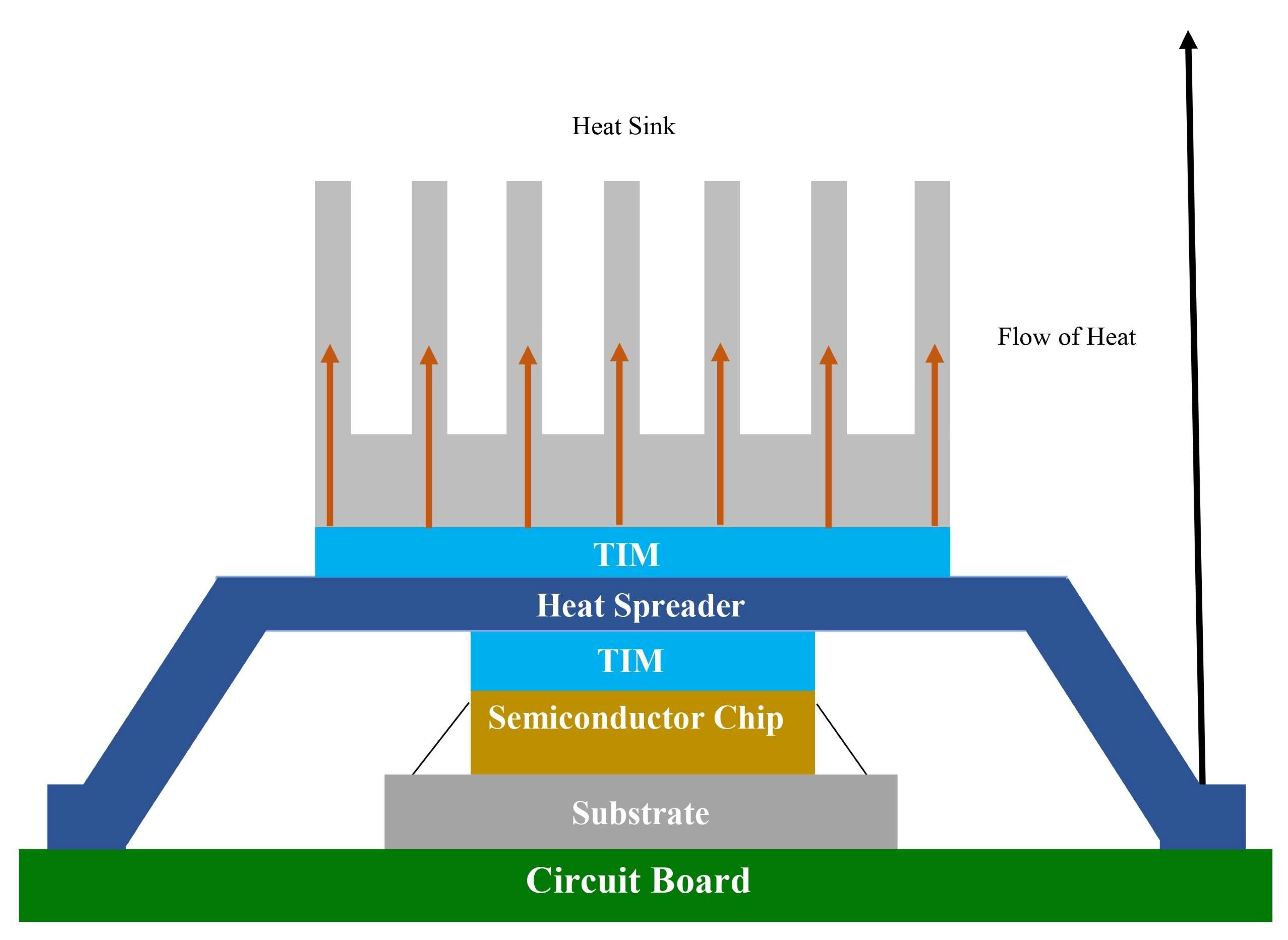
Figure 2.
Heat dissipation (A) without TIM and (B) with TIM.
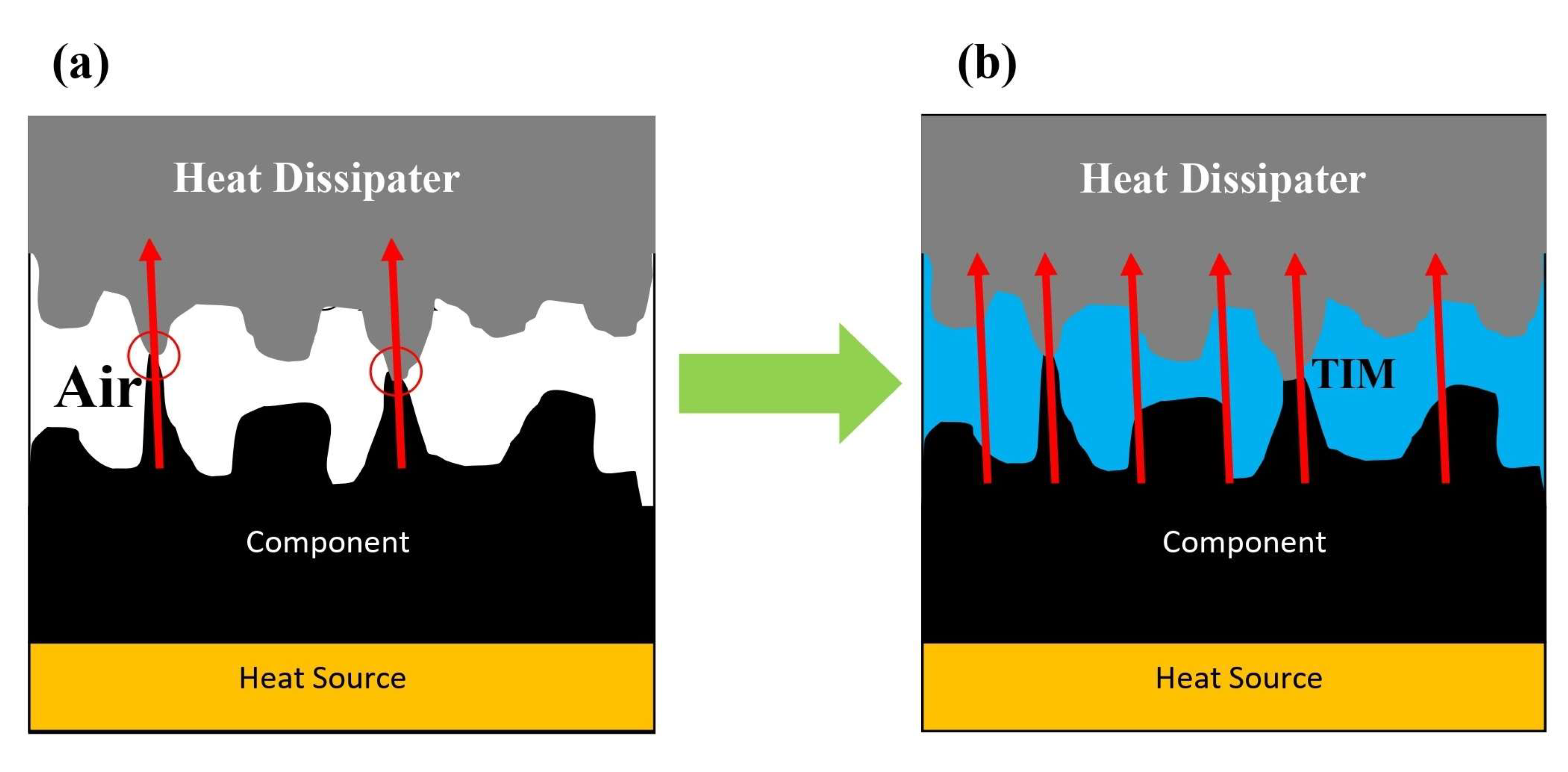
Figure 3.
Various elements that influence the TC of composites should be considered while developing new composites [35].
Figure 3.
Various elements that influence the TC of composites should be considered while developing new composites [35].
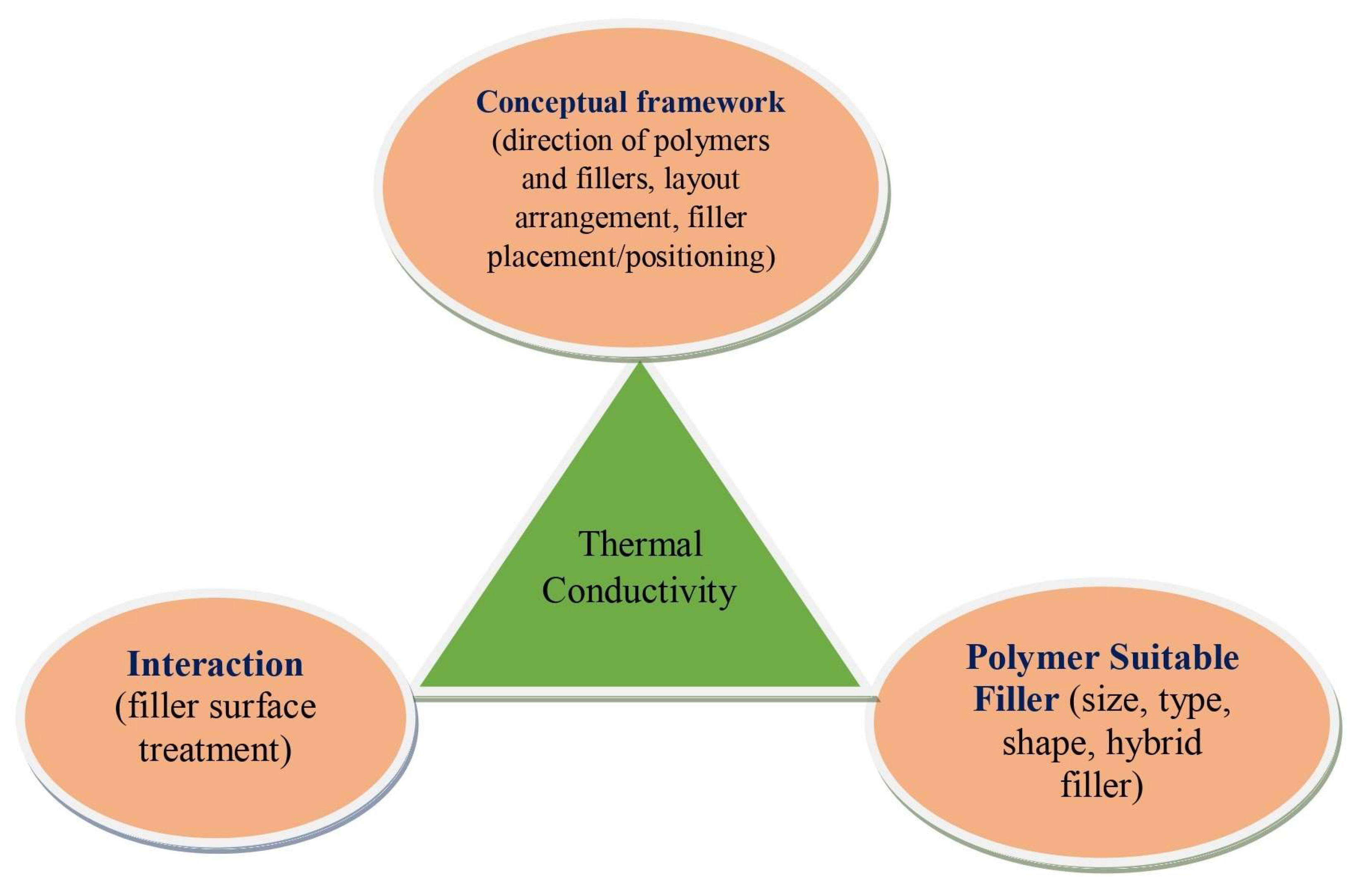
Figure 4.
Different types of thermally conductive fillers to make polymer composites.
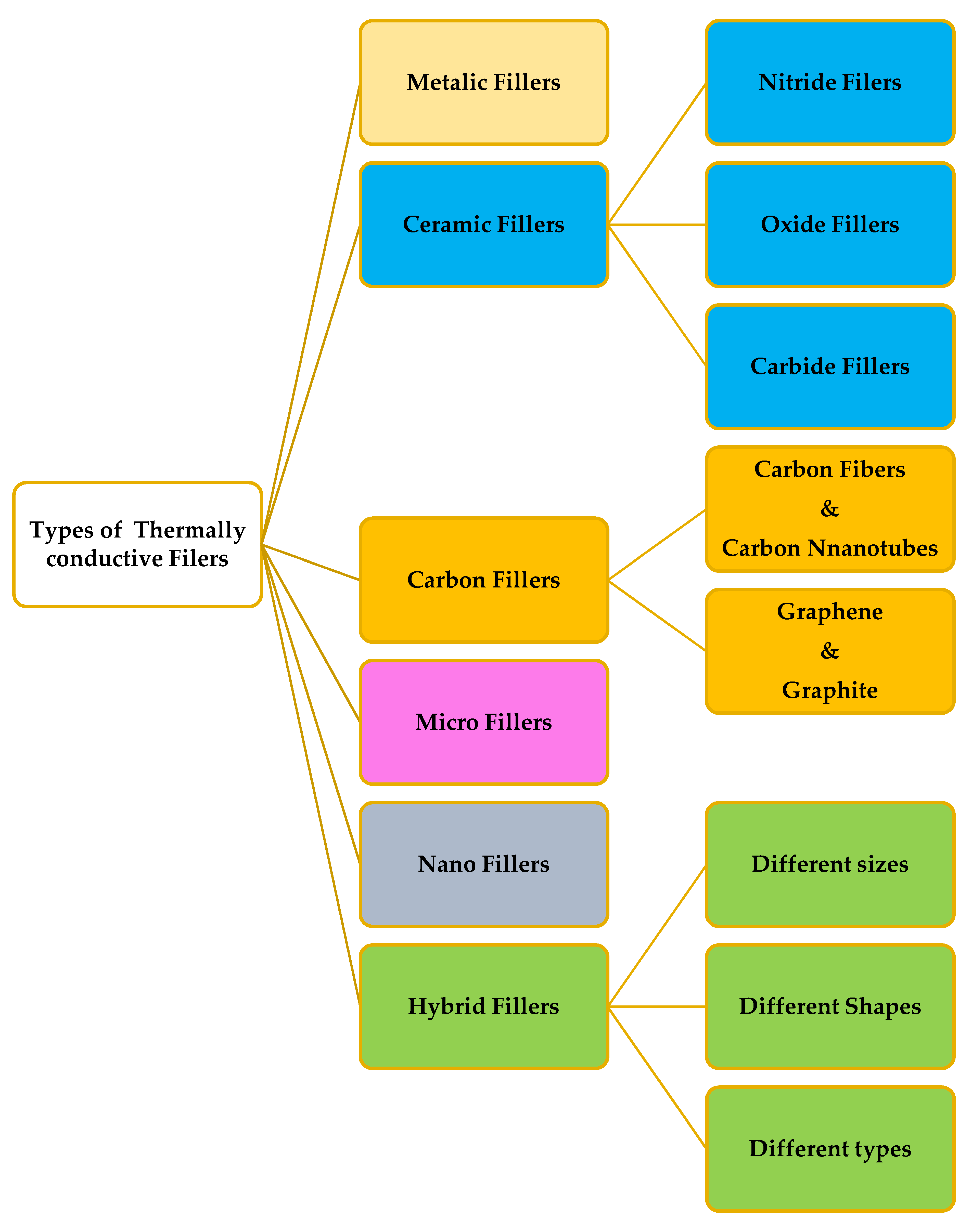
Figure 5.
Diagrammatic representation of production of the BNNS-AgNWs-300/epoxy composite (reprinted with permission from reference [40] copyright 2021 Elsevier).
Figure 5.
Diagrammatic representation of production of the BNNS-AgNWs-300/epoxy composite (reprinted with permission from reference [40] copyright 2021 Elsevier).
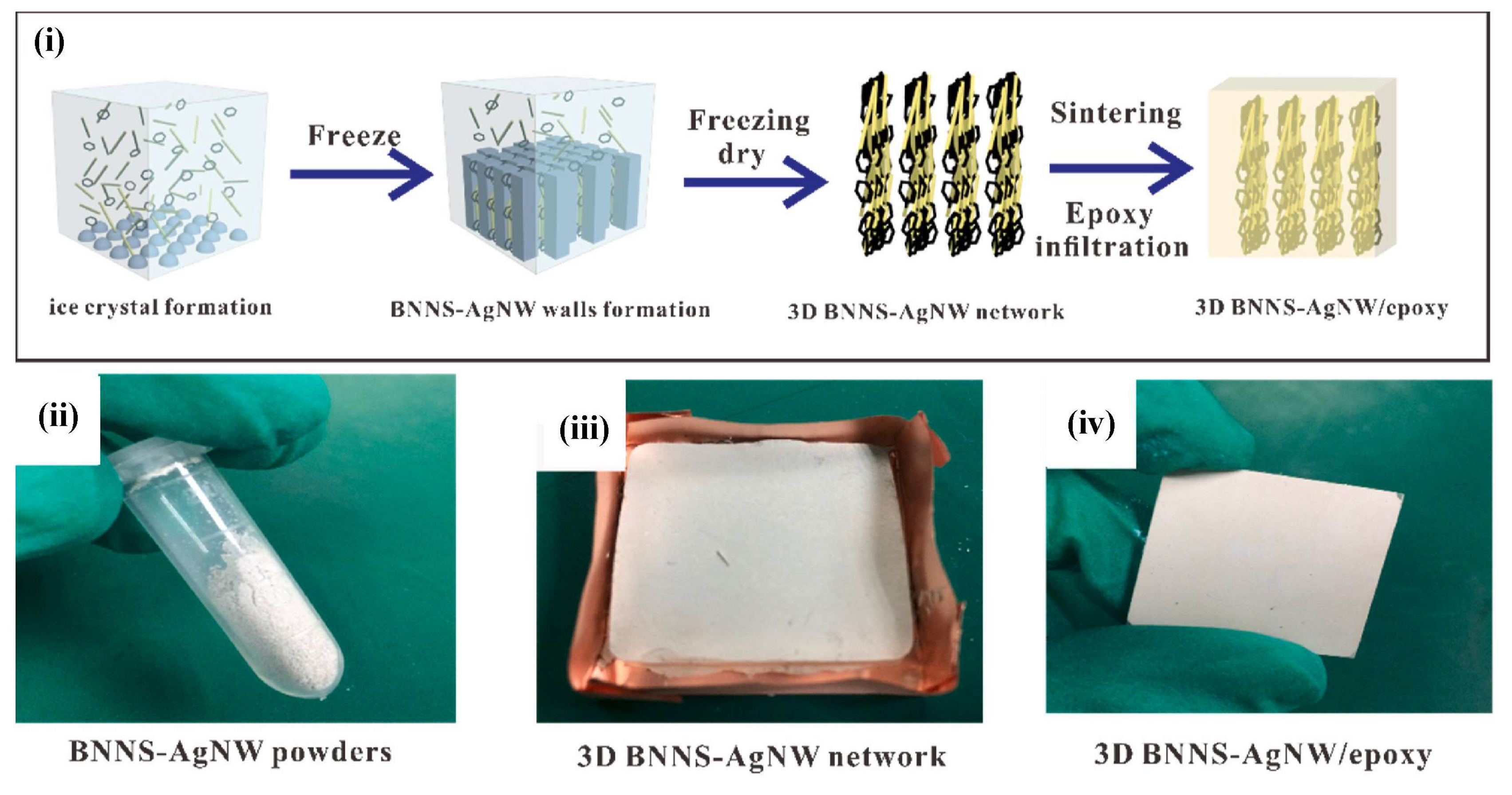
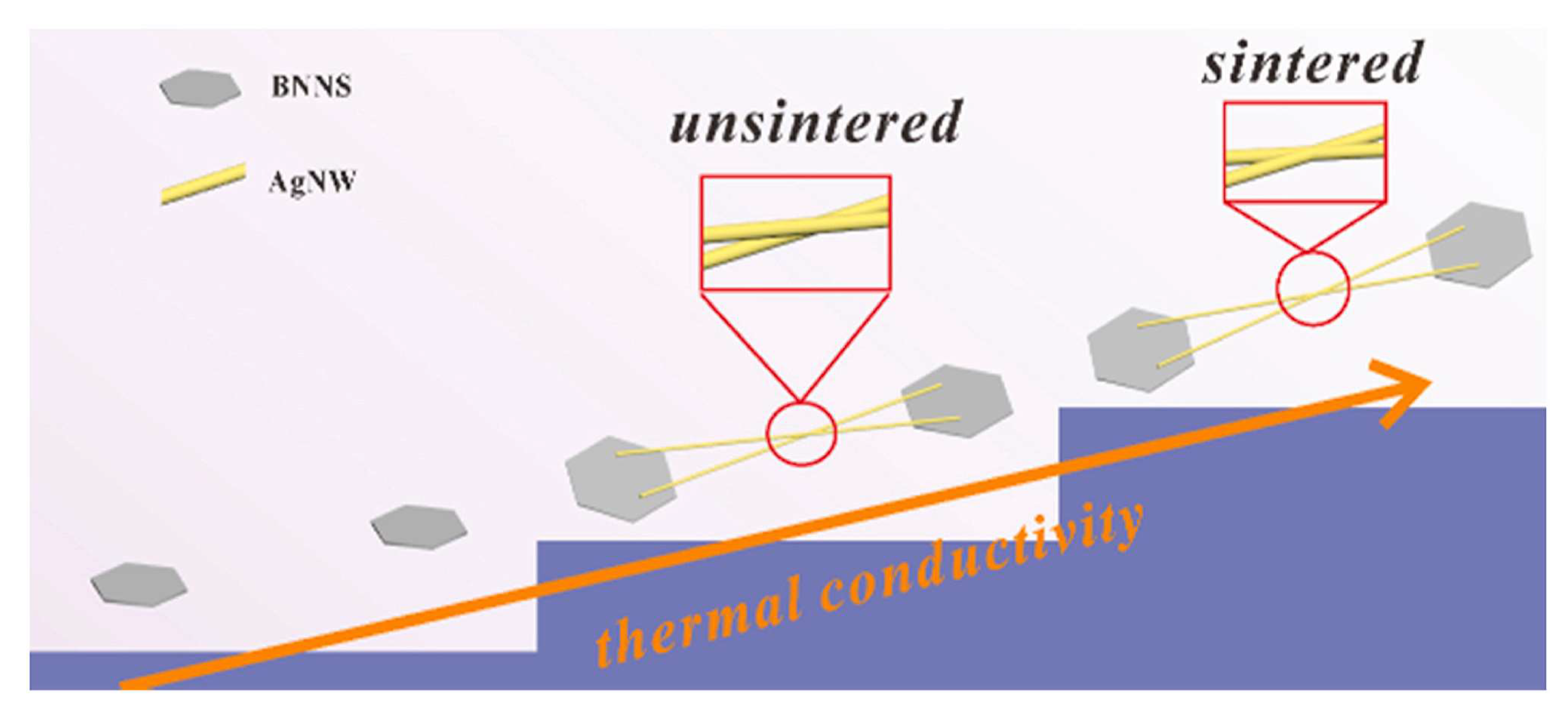
Figure 6.
Diagrammatic illustration of the fabrication procedure and the images of AgNPs@BC/Al2O3/GNPs composites. The TPTC of BC-based composites with various morphologies (Reprinted with permission from reference [48] copyright 2020 Elsevier).
Figure 6.
Diagrammatic illustration of the fabrication procedure and the images of AgNPs@BC/Al2O3/GNPs composites. The TPTC of BC-based composites with various morphologies (Reprinted with permission from reference [48] copyright 2020 Elsevier).
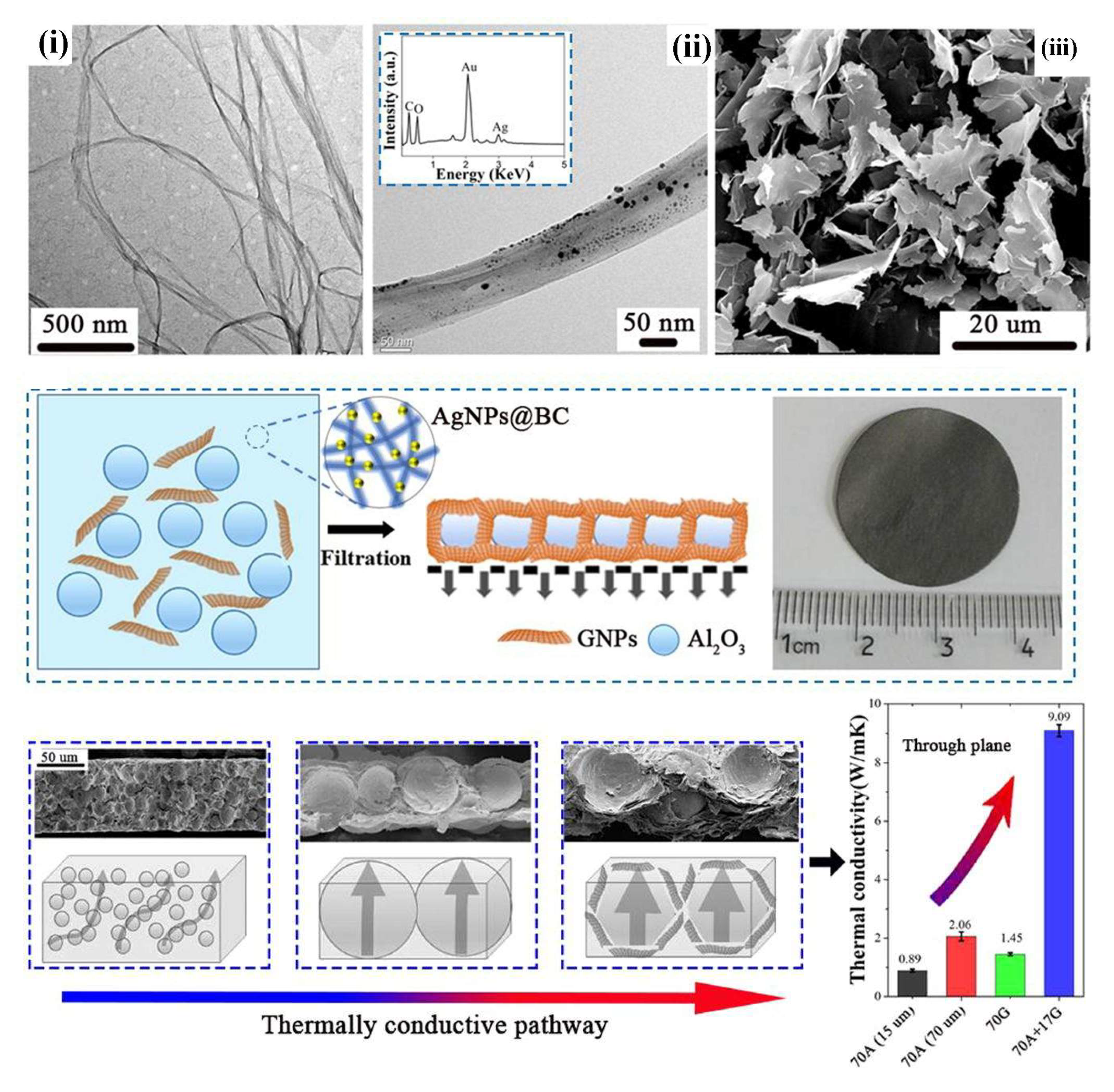
Figure 7.
(a) Schematic representation of the fabrication process of 3D-BN/epoxy composite (Reprinted with permission from reference [23] copyright 2022, Nanomaterials, MDPI). (b) drawing of production method of SR/ABN composites (Reprinted with permission from reference [53] copyright 2019 Elsevier). (c) Graphic representation of the fabrication method of aligned BN/SiR composites (Reprinted with permission from reference [54] copyright 2022 Elsevier).
Figure 7.
(a) Schematic representation of the fabrication process of 3D-BN/epoxy composite (Reprinted with permission from reference [23] copyright 2022, Nanomaterials, MDPI). (b) drawing of production method of SR/ABN composites (Reprinted with permission from reference [53] copyright 2019 Elsevier). (c) Graphic representation of the fabrication method of aligned BN/SiR composites (Reprinted with permission from reference [54] copyright 2022 Elsevier).
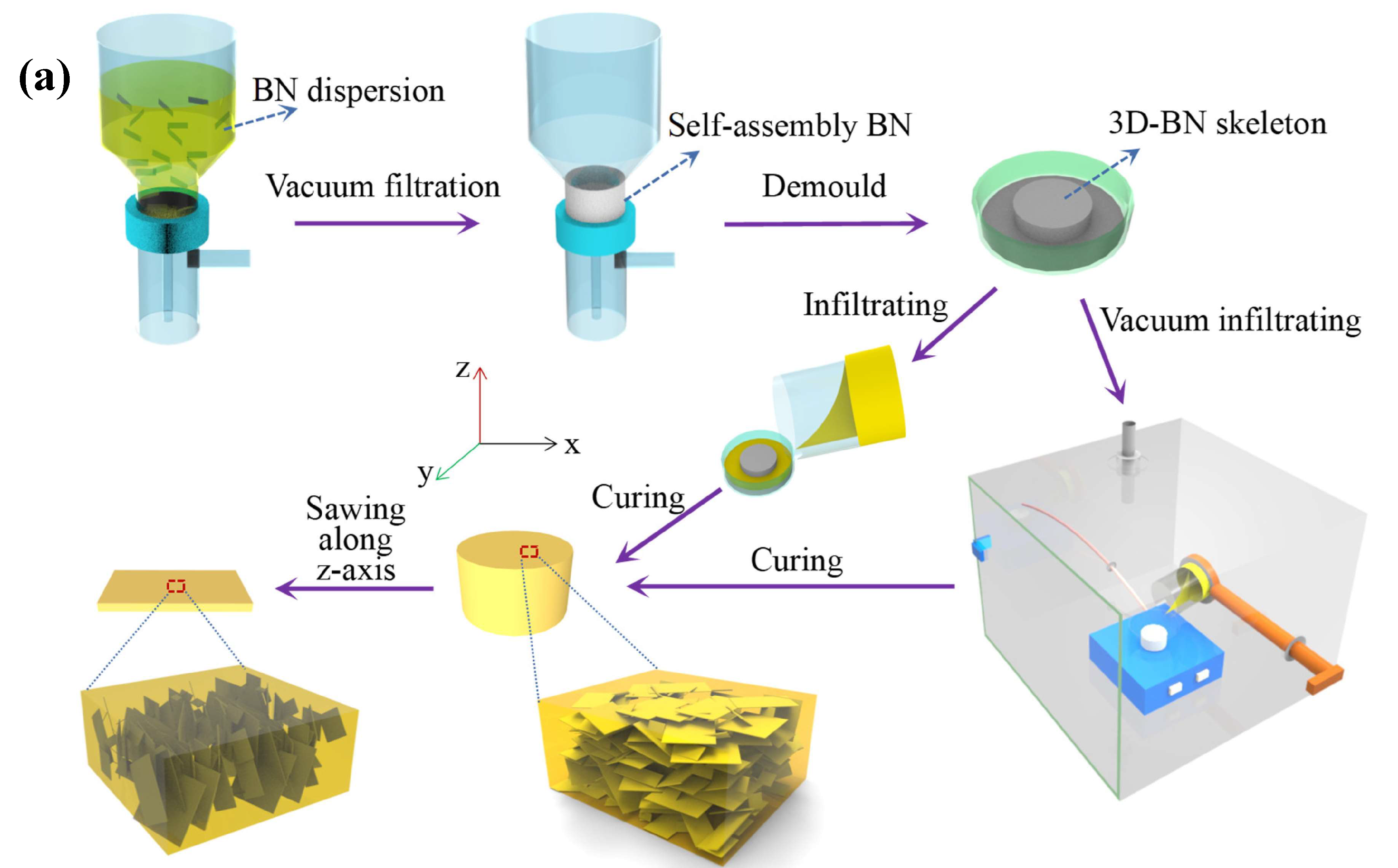
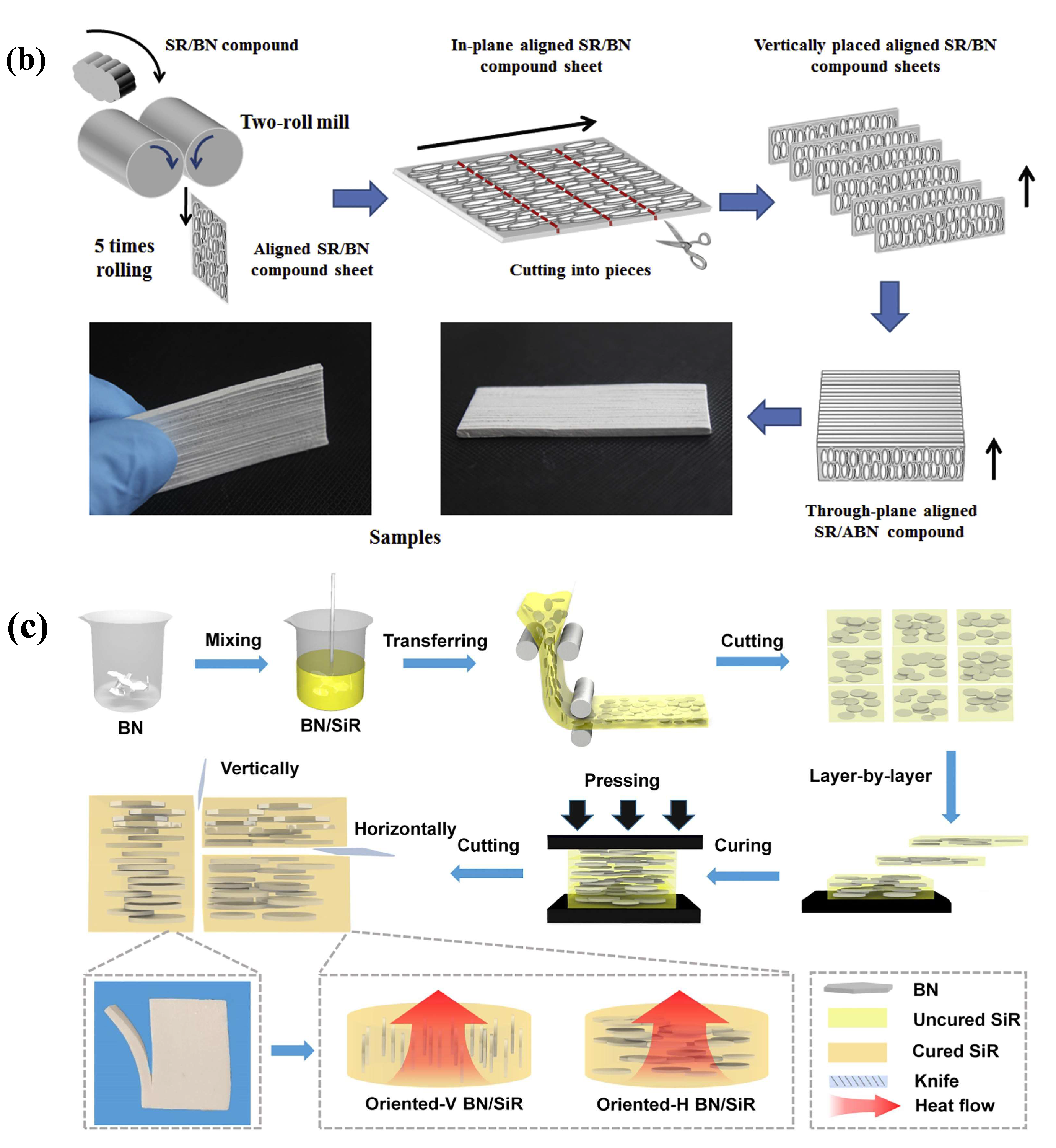
Figure 8.
Diagrammatic illustration of the production procedure of VA-SiC sheet scaffolds (Reprinted with permission from reference [71] copyright 2020, American Chemical Society).
Figure 8.
Diagrammatic illustration of the production procedure of VA-SiC sheet scaffolds (Reprinted with permission from reference [71] copyright 2020, American Chemical Society).
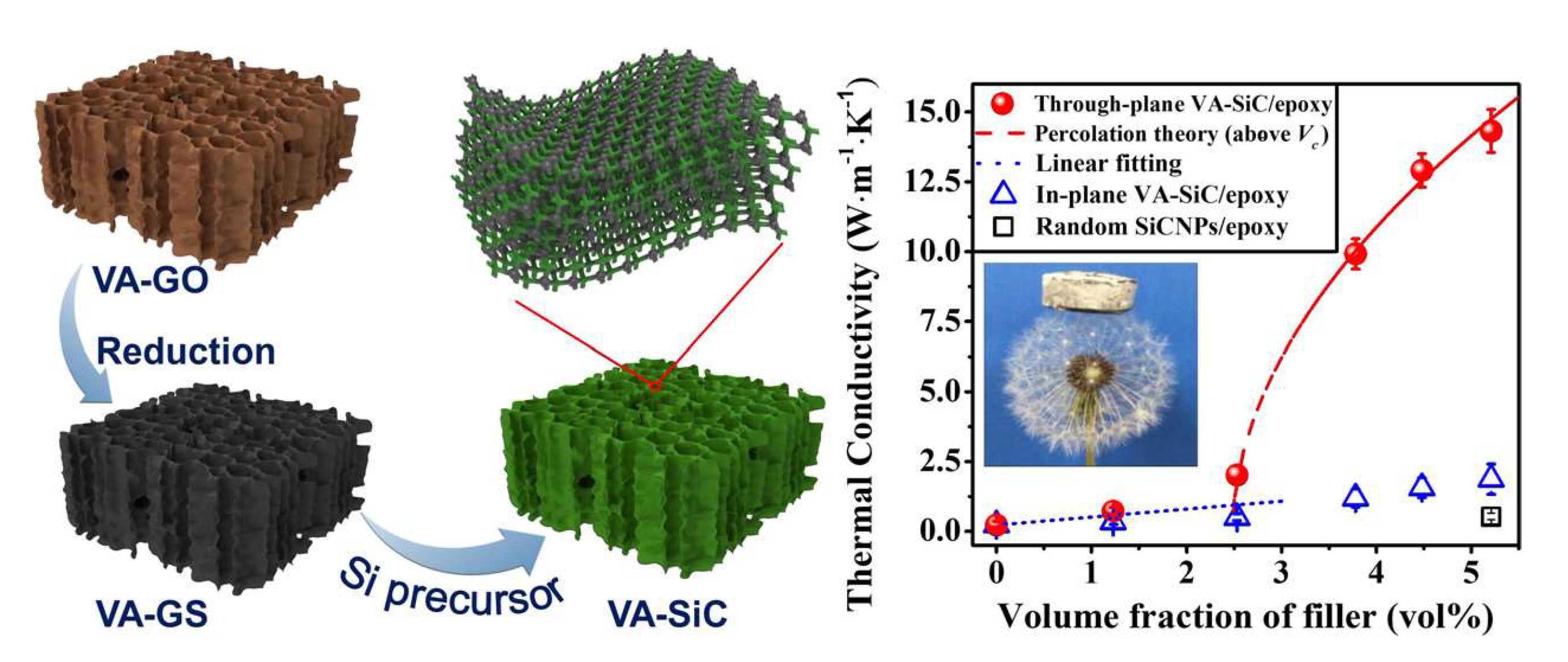
Figure 9.
Surface structures, Diagram of the production method, the image of GHP (Reprinted with permission from reference [72] copyright 2019, American Chemical Society).
Figure 9.
Surface structures, Diagram of the production method, the image of GHP (Reprinted with permission from reference [72] copyright 2019, American Chemical Society).
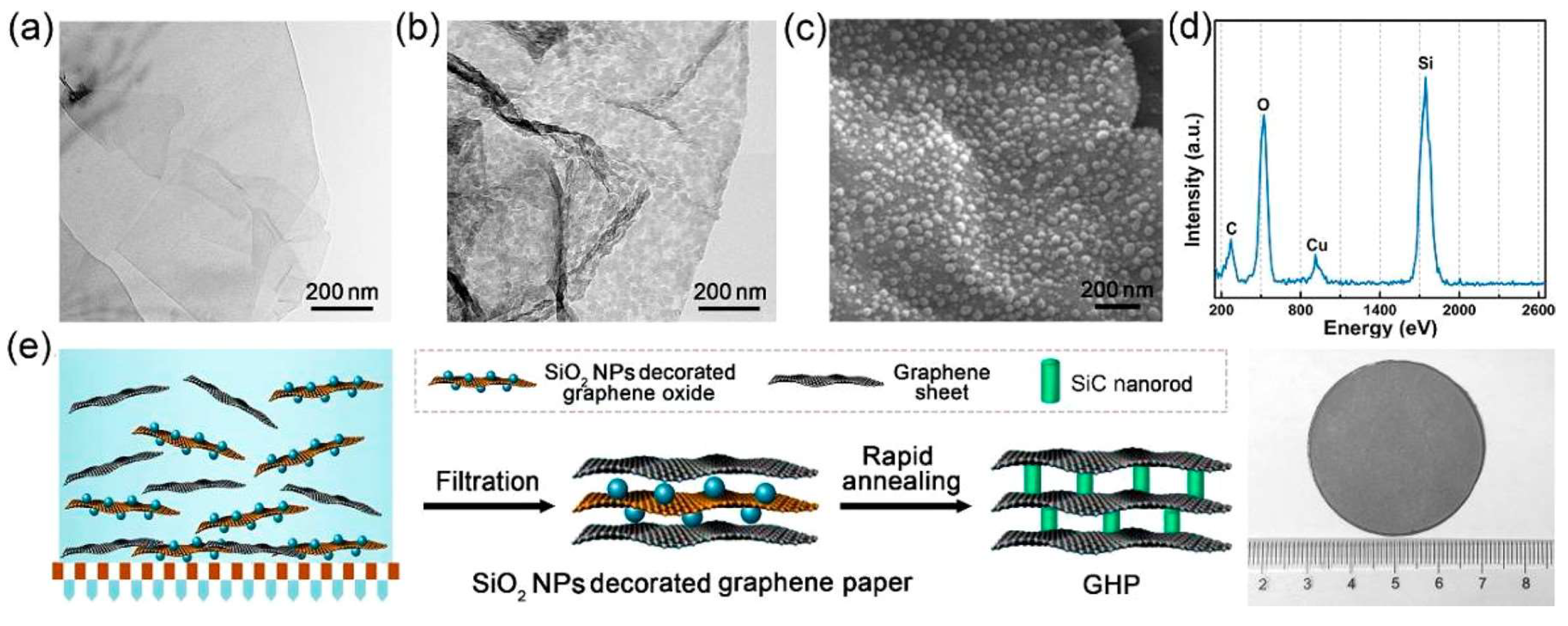
Figure 10.
(a) Diagrammatic illustration for producing nacre-mimetic T-BSA/PEG PCCs. (Reprinted with permission from reference [75] copyright 2023 Elsevier).
Figure 10.
(a) Diagrammatic illustration for producing nacre-mimetic T-BSA/PEG PCCs. (Reprinted with permission from reference [75] copyright 2023 Elsevier).
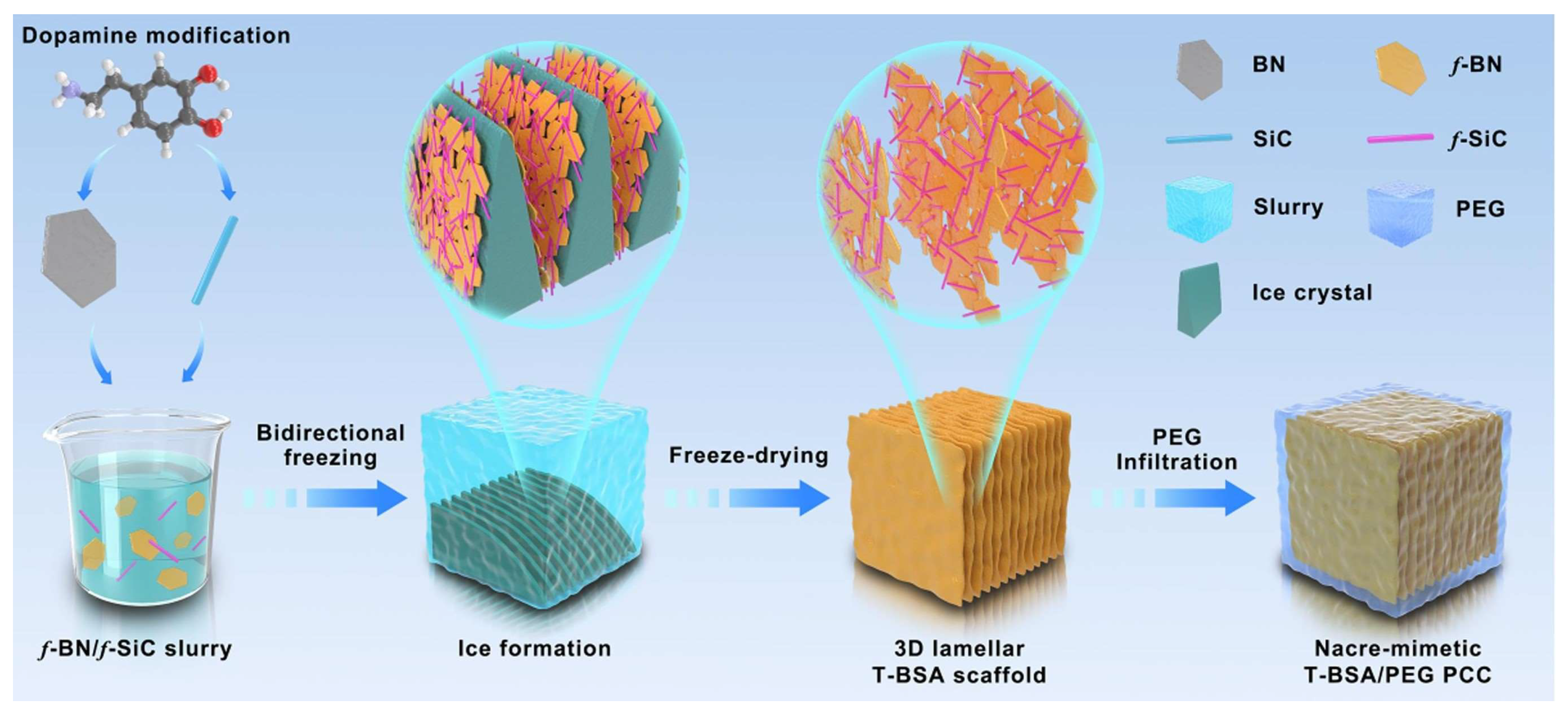
Figure 11.
(a) Illustrative representation for the fabrication of O-PAC (PDMS/Al2O3/CFs) composites. (b) Softness and processability of O-PAC composites (Reprinted with permission from reference [83] Copyright 2022, Elsevier).
Figure 11.
(a) Illustrative representation for the fabrication of O-PAC (PDMS/Al2O3/CFs) composites. (b) Softness and processability of O-PAC composites (Reprinted with permission from reference [83] Copyright 2022, Elsevier).
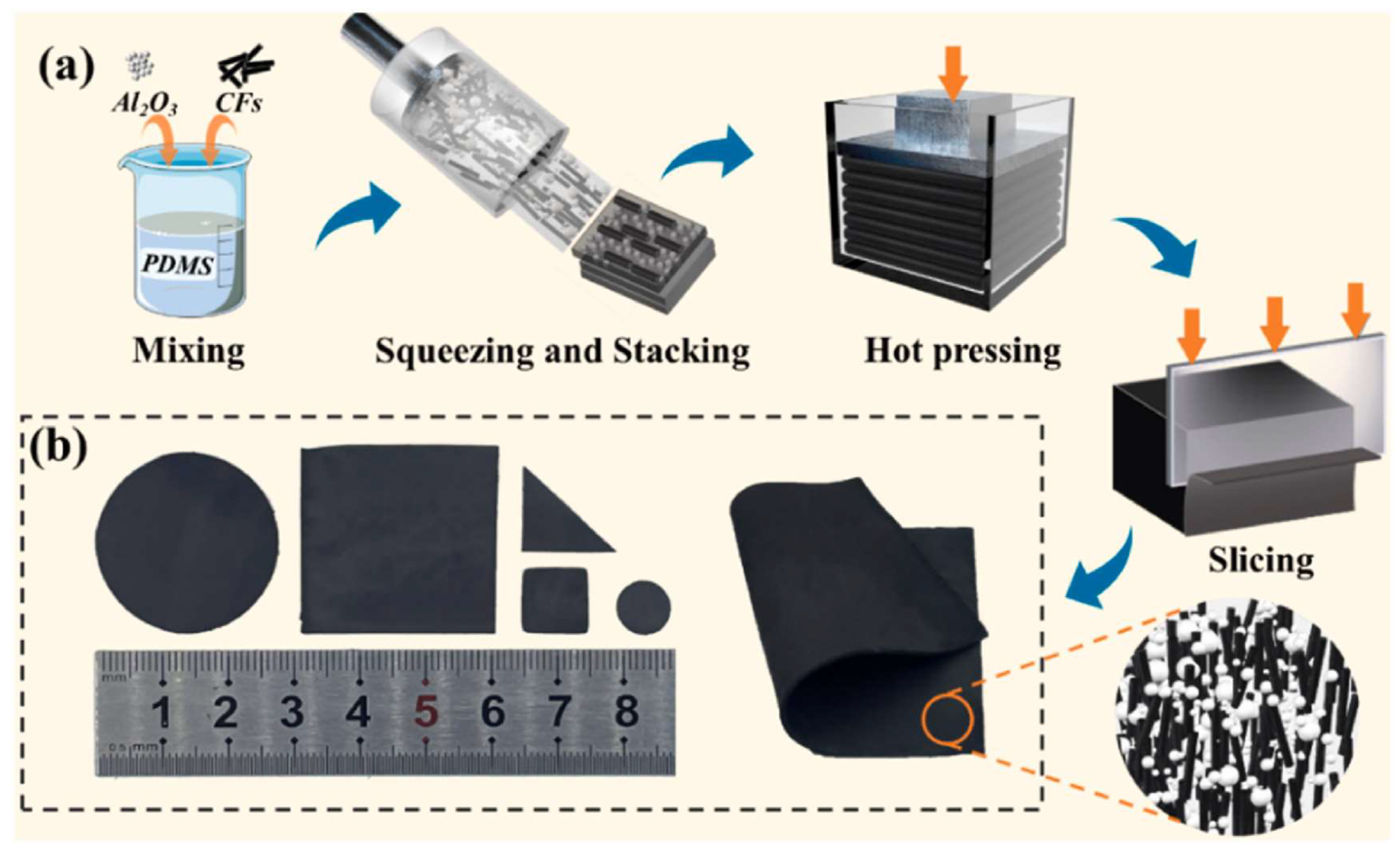
Figure 12.
(a) Illustrative diagram of method for fabrication of GO-VACNTs-EG framework (Reprinted with permission from reference [84] Copyright 2019, Elsevier). (b) Diagrammatic representation of orientation process and simulation of CFs (Reprinted with permission from reference [85] Copyright 2021, Elsevier). (c) Schematic illustration of the fabrication of CF foam (Reprinted with permission from reference [86] Copyright 2019, Elsevier).
Figure 12.
(a) Illustrative diagram of method for fabrication of GO-VACNTs-EG framework (Reprinted with permission from reference [84] Copyright 2019, Elsevier). (b) Diagrammatic representation of orientation process and simulation of CFs (Reprinted with permission from reference [85] Copyright 2021, Elsevier). (c) Schematic illustration of the fabrication of CF foam (Reprinted with permission from reference [86] Copyright 2019, Elsevier).
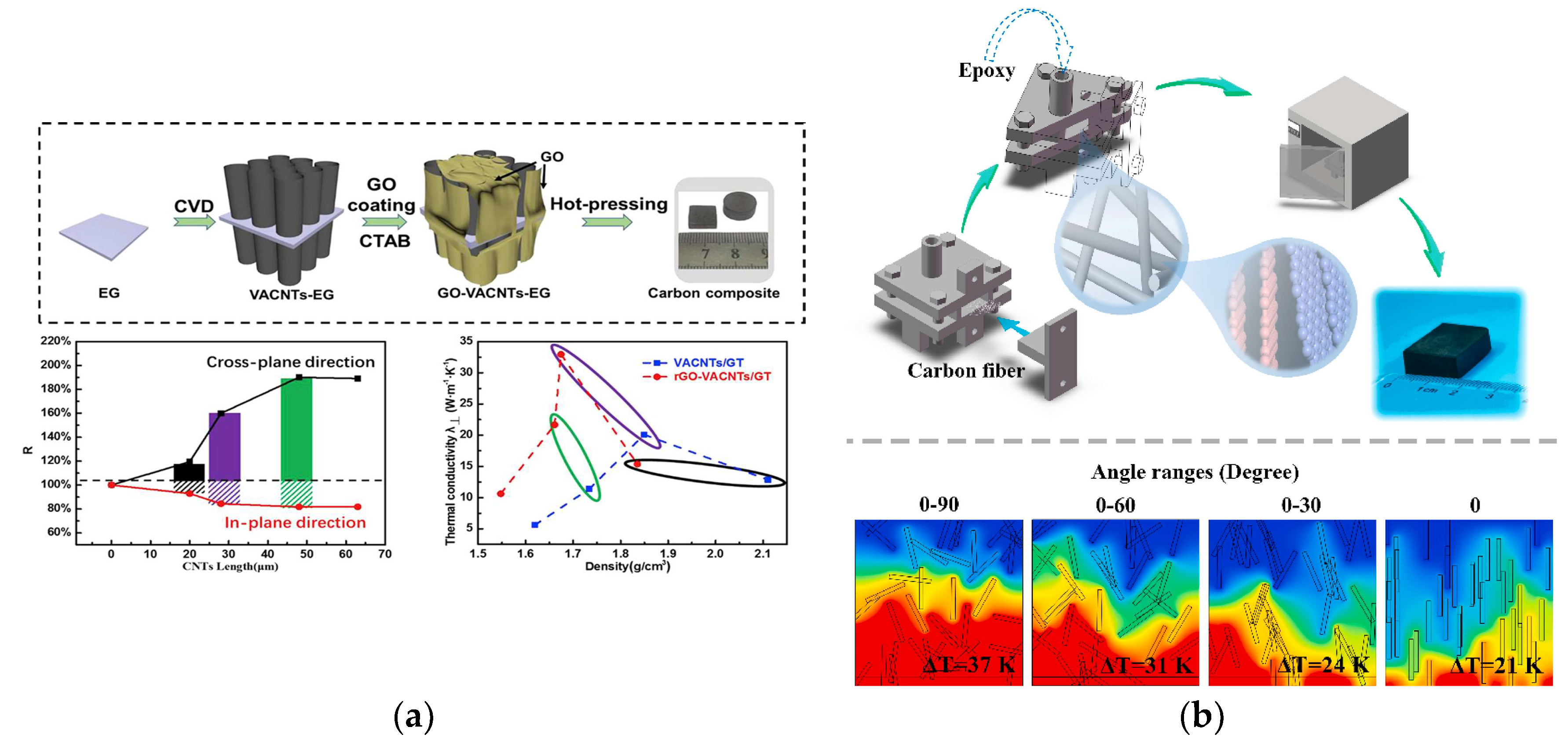
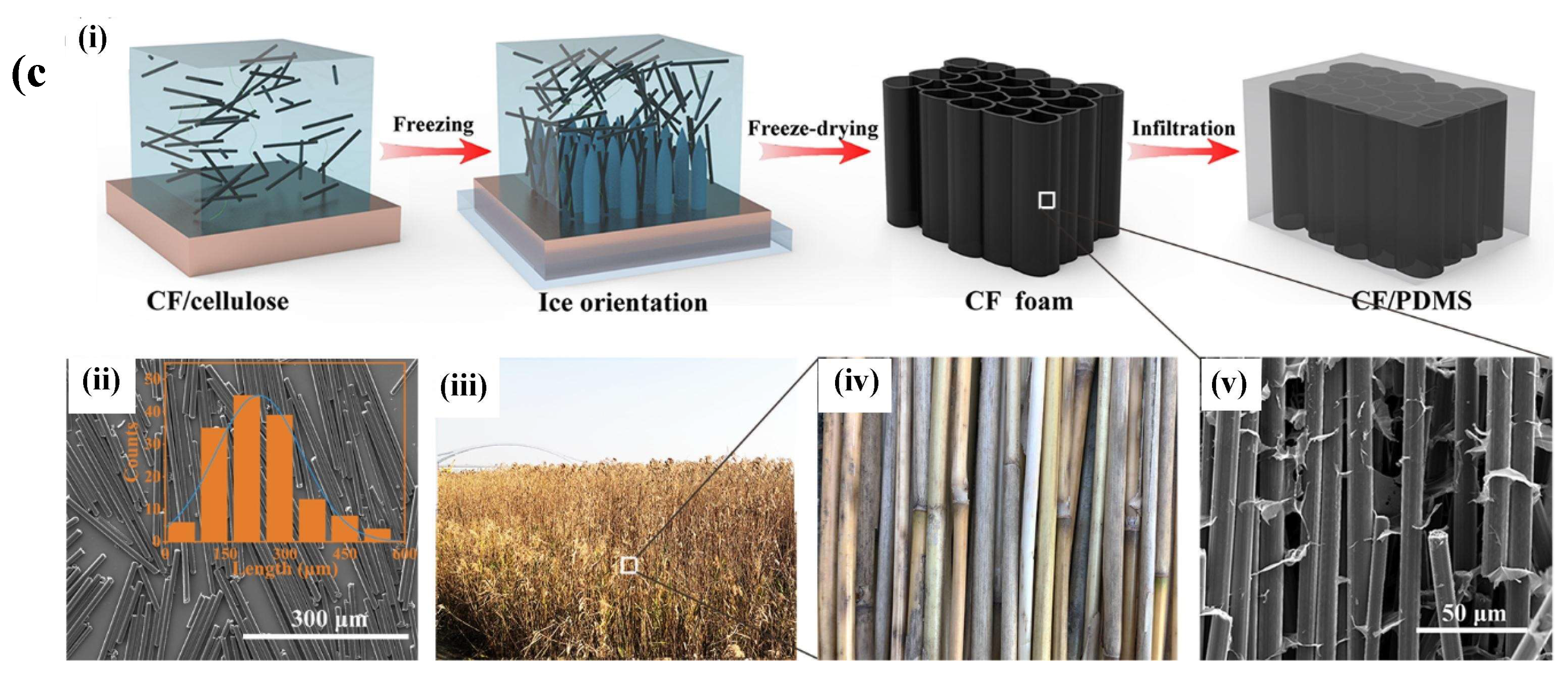
Figure 13.
(a) Diagrammatic scheme of the production procedure of HGP. (b) Diagrammatic representation of the manner of assembling in which a mixed distribution made up of two different measurements of graphene sheets in the time of a quick filtration technique, resulting in the generation of a hierarchically oriented graphene paper (Reprinted with permission from reference [91] Copyright 2021, Elsevier).
Figure 13.
(a) Diagrammatic scheme of the production procedure of HGP. (b) Diagrammatic representation of the manner of assembling in which a mixed distribution made up of two different measurements of graphene sheets in the time of a quick filtration technique, resulting in the generation of a hierarchically oriented graphene paper (Reprinted with permission from reference [91] Copyright 2021, Elsevier).
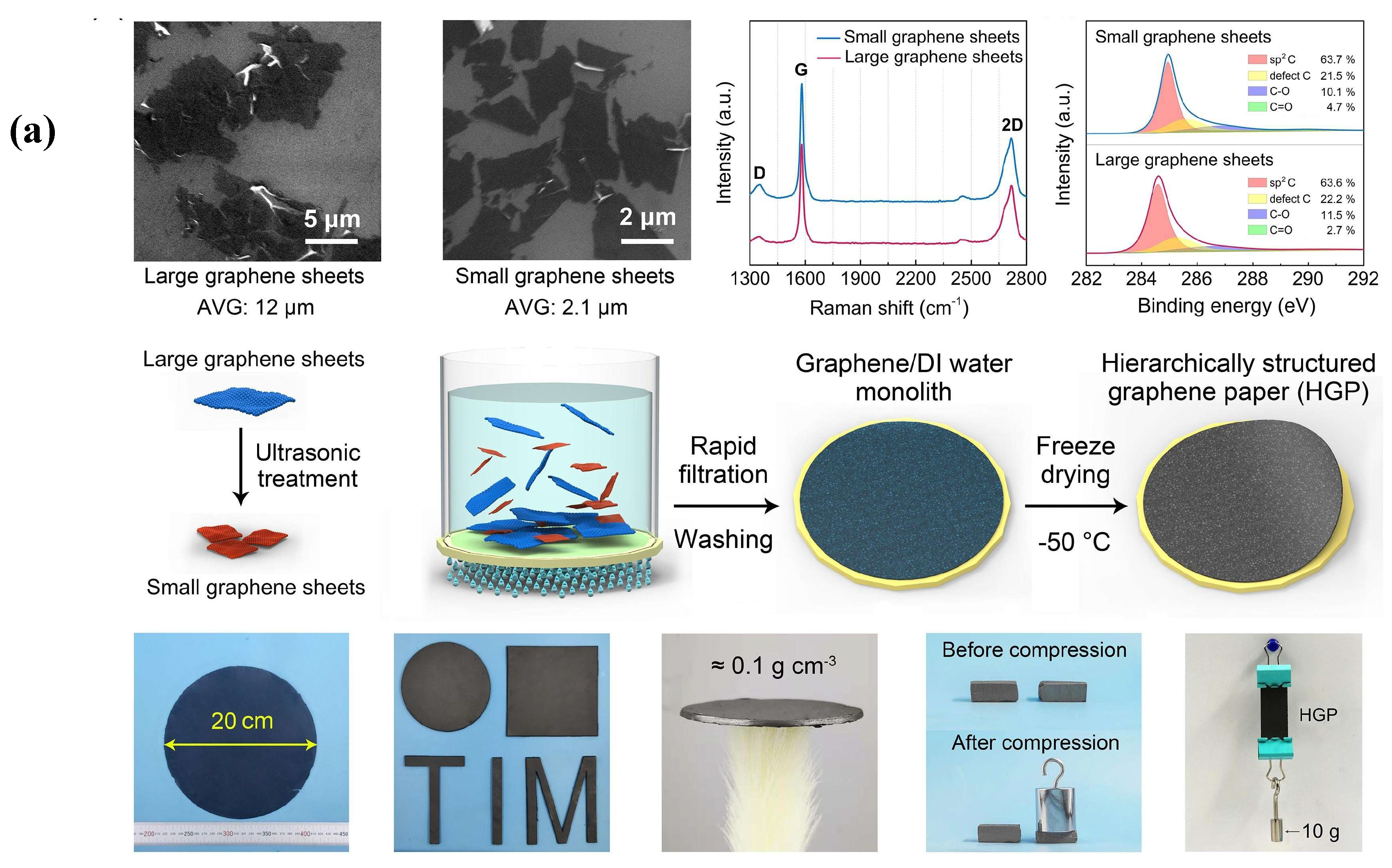
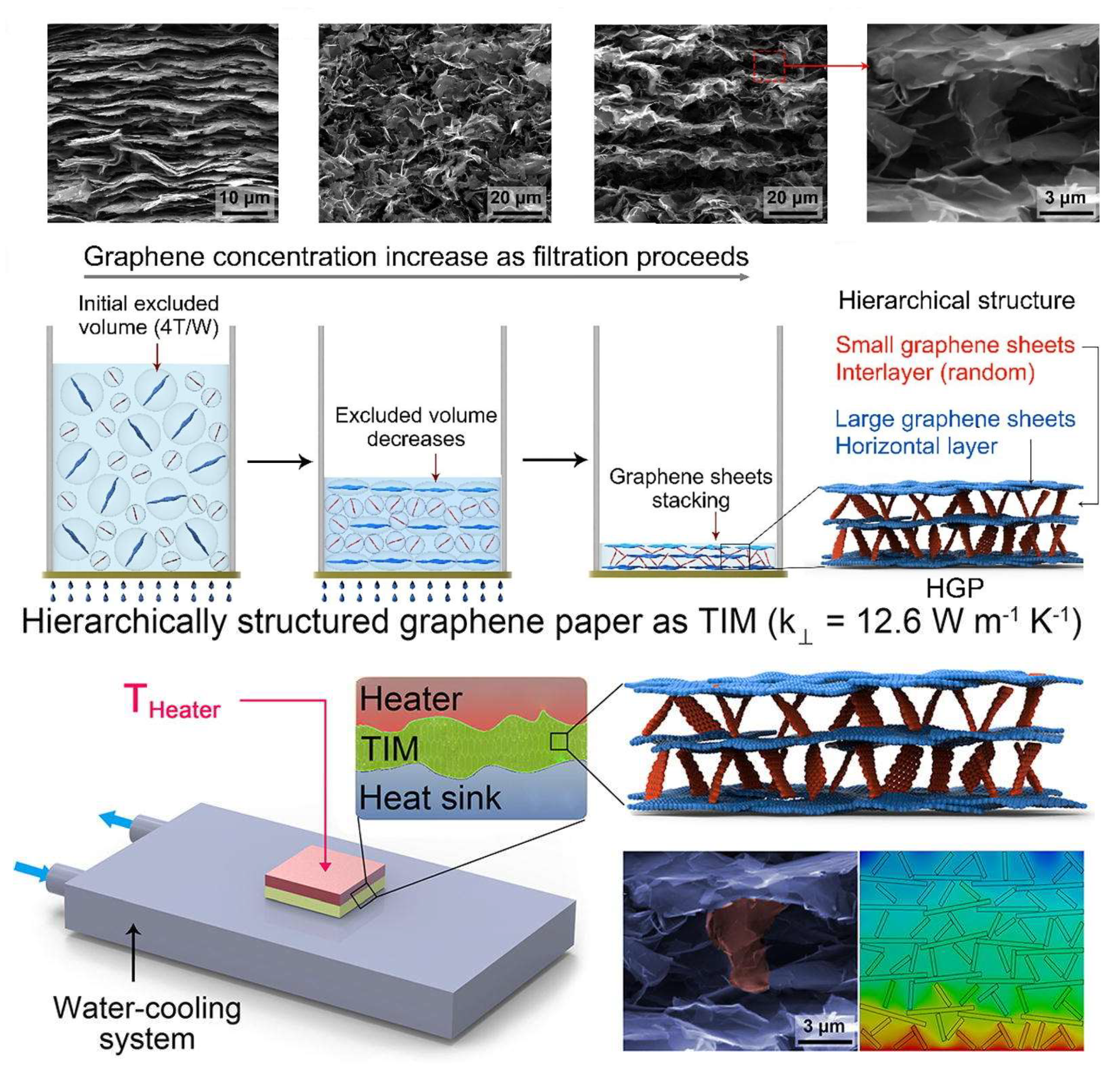
Figure 14.
Diagrammatic scheme of the e-BN microsphere and e-BN/BN/epoxy composite fabrication method (Reprinted with permission from reference [97] Copyright 2023, Elsevier).
Figure 14.
Diagrammatic scheme of the e-BN microsphere and e-BN/BN/epoxy composite fabrication method (Reprinted with permission from reference [97] Copyright 2023, Elsevier).
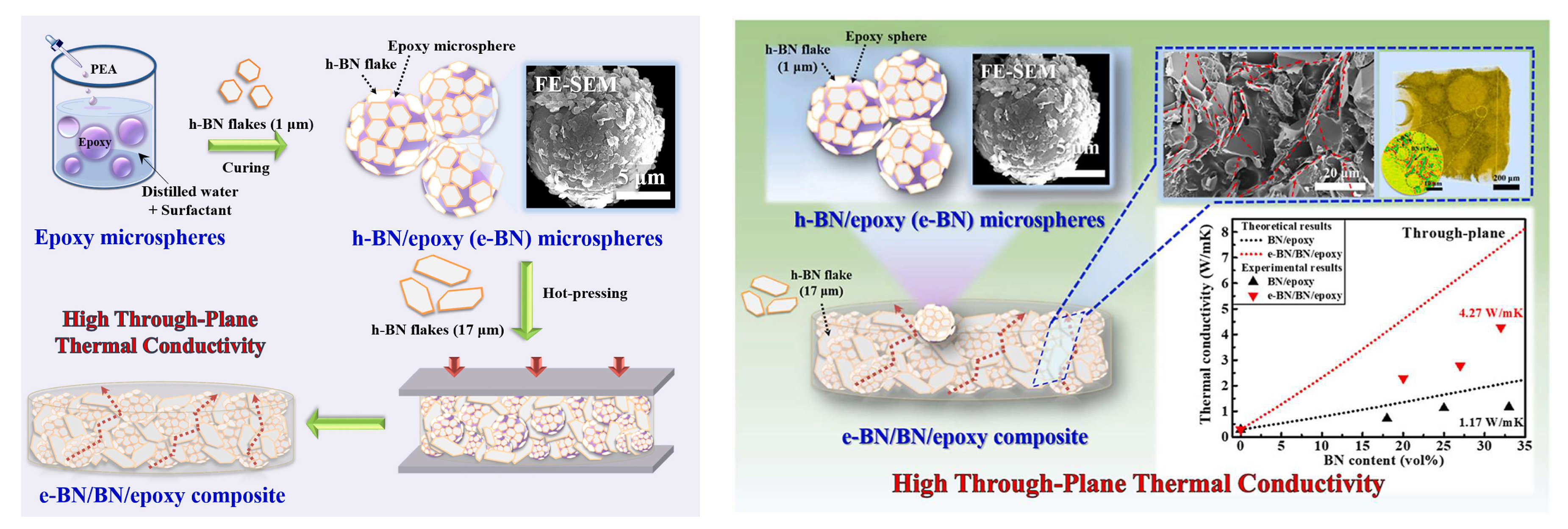
Figure 15.
Diagrammatic scheme of MDs@GNPs/NFC film generation (Reprinted with permission from reference [101] Copyright 2022, Elsevier).
Figure 15.
Diagrammatic scheme of MDs@GNPs/NFC film generation (Reprinted with permission from reference [101] Copyright 2022, Elsevier).
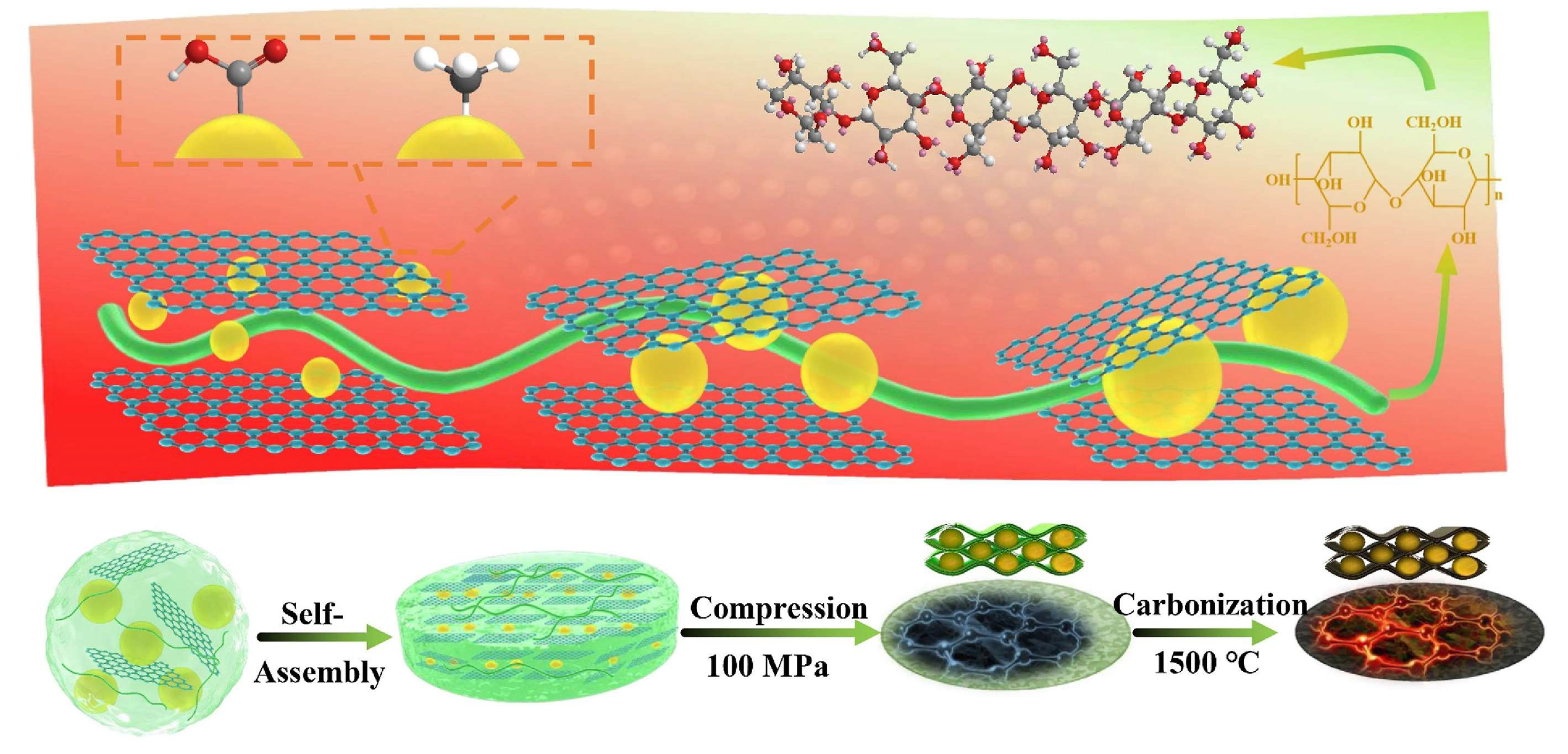
Figure 16.
(a) High interfacial surface area of small filler, (b) Less interfacial surface area of large-sized filler [17].
Figure 16.
(a) High interfacial surface area of small filler, (b) Less interfacial surface area of large-sized filler [17].
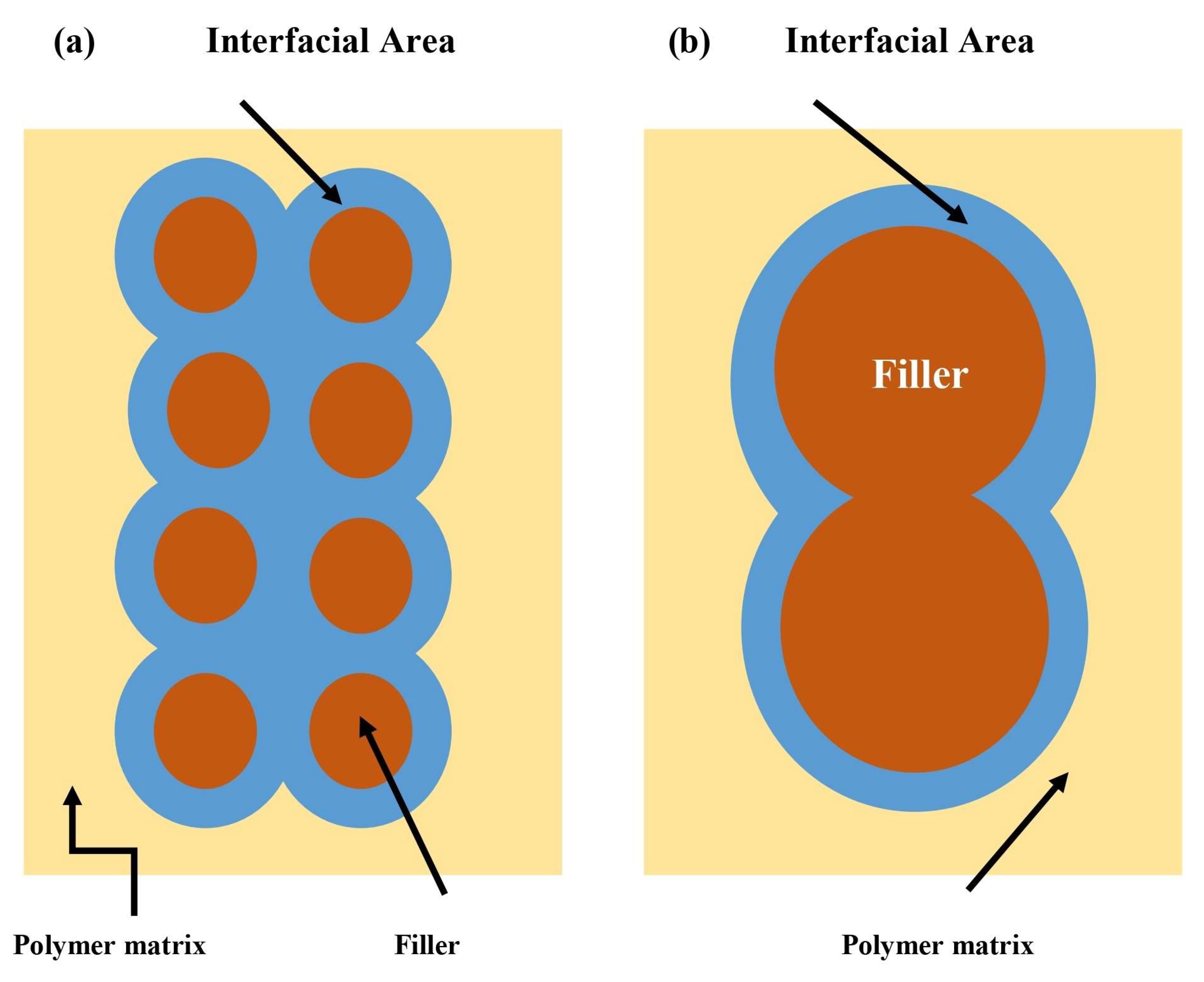
Figure 17.
(a) Thermal conduction path of single-sized filler, (b) Heat conduction network of hybrid multiple-sized fillers [17].
Figure 17.
(a) Thermal conduction path of single-sized filler, (b) Heat conduction network of hybrid multiple-sized fillers [17].
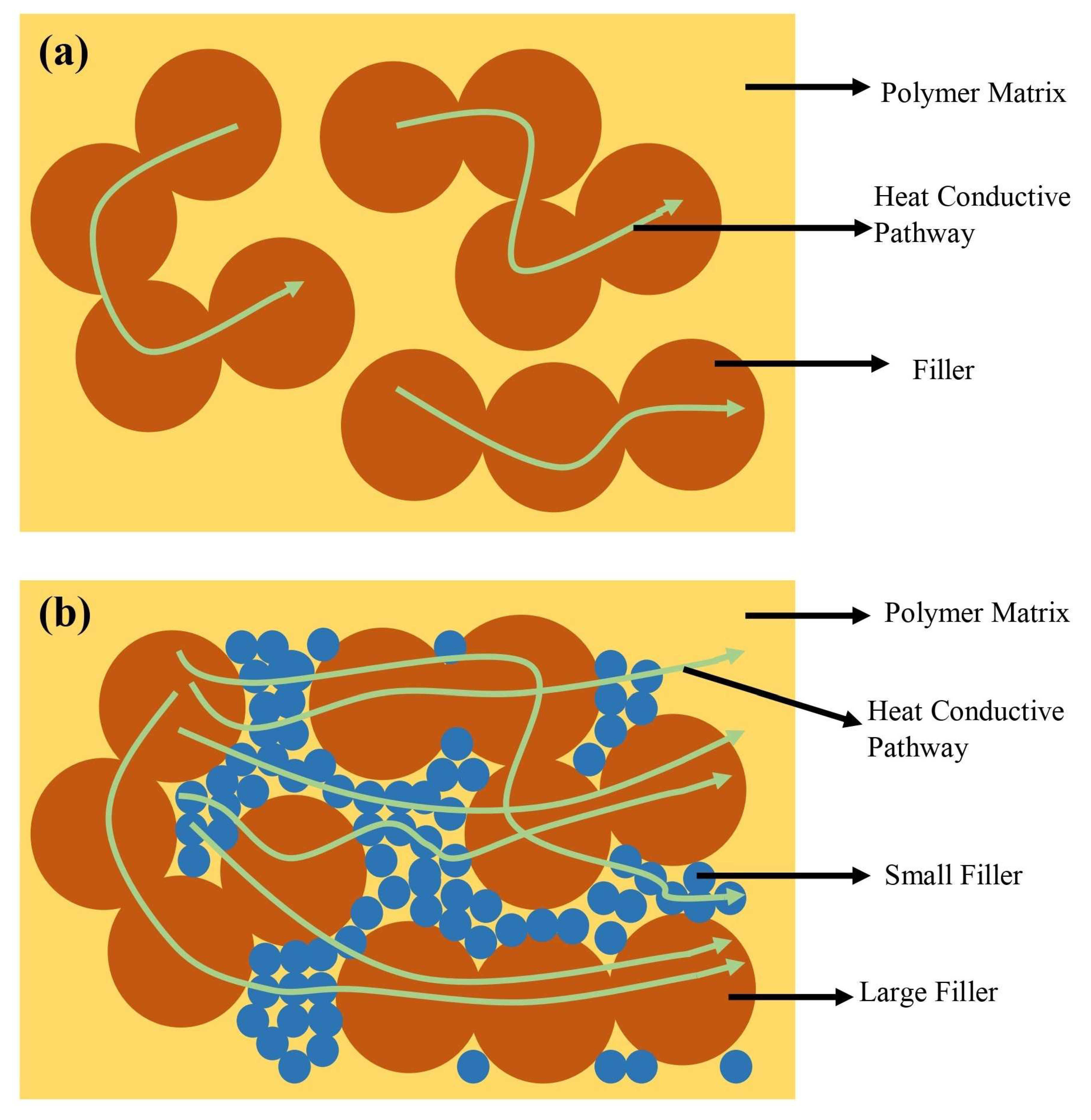
Figure 18.
Direction of thermal conduction: (a) in-plane (longitudinal direction) and (b) through-plane or cross-plane (perpendicular direction) [17] .
Figure 18.
Direction of thermal conduction: (a) in-plane (longitudinal direction) and (b) through-plane or cross-plane (perpendicular direction) [17] .
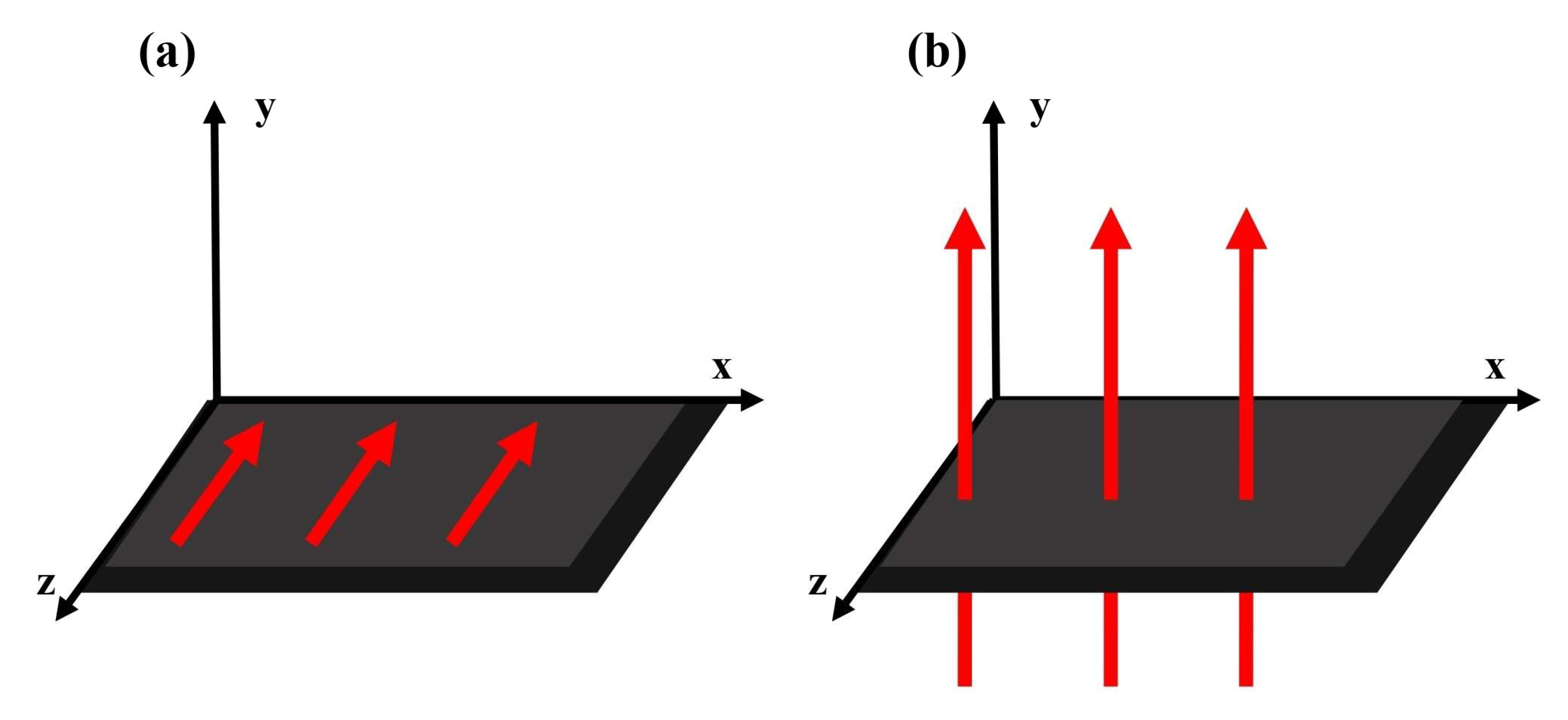
Figure 19.
(a) Spherical shape of 0D, (b) fiber, rod, tube, wire shapes of 1D filler; (c) platelets, sheets, flakes shape of 2D fillers, (d, e) agglomeration, (f) piling up of each nano filler [17].
Figure 19.
(a) Spherical shape of 0D, (b) fiber, rod, tube, wire shapes of 1D filler; (c) platelets, sheets, flakes shape of 2D fillers, (d, e) agglomeration, (f) piling up of each nano filler [17].
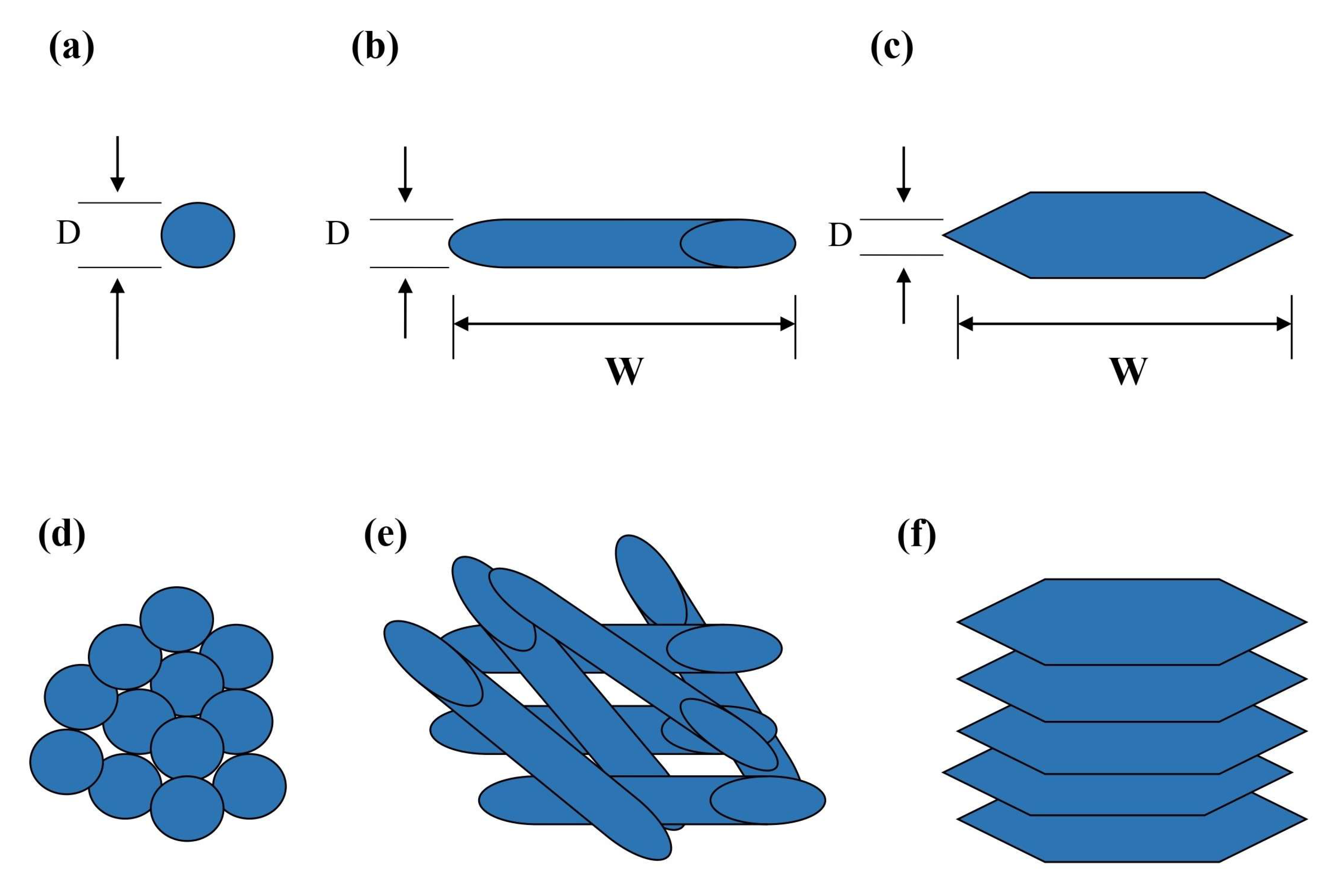
Figure 20.
(a) Diagrammatic scheme of the exfoliation and hydroxylation of h-BN and CNT distributions respectively. (b) Labeled Diagrammatic representation for the fabrication of f-BN/CNT@TPU framework. ( reprinted with permission from reference [113] Copyright 2023, Elsevier).
Figure 20.
(a) Diagrammatic scheme of the exfoliation and hydroxylation of h-BN and CNT distributions respectively. (b) Labeled Diagrammatic representation for the fabrication of f-BN/CNT@TPU framework. ( reprinted with permission from reference [113] Copyright 2023, Elsevier).
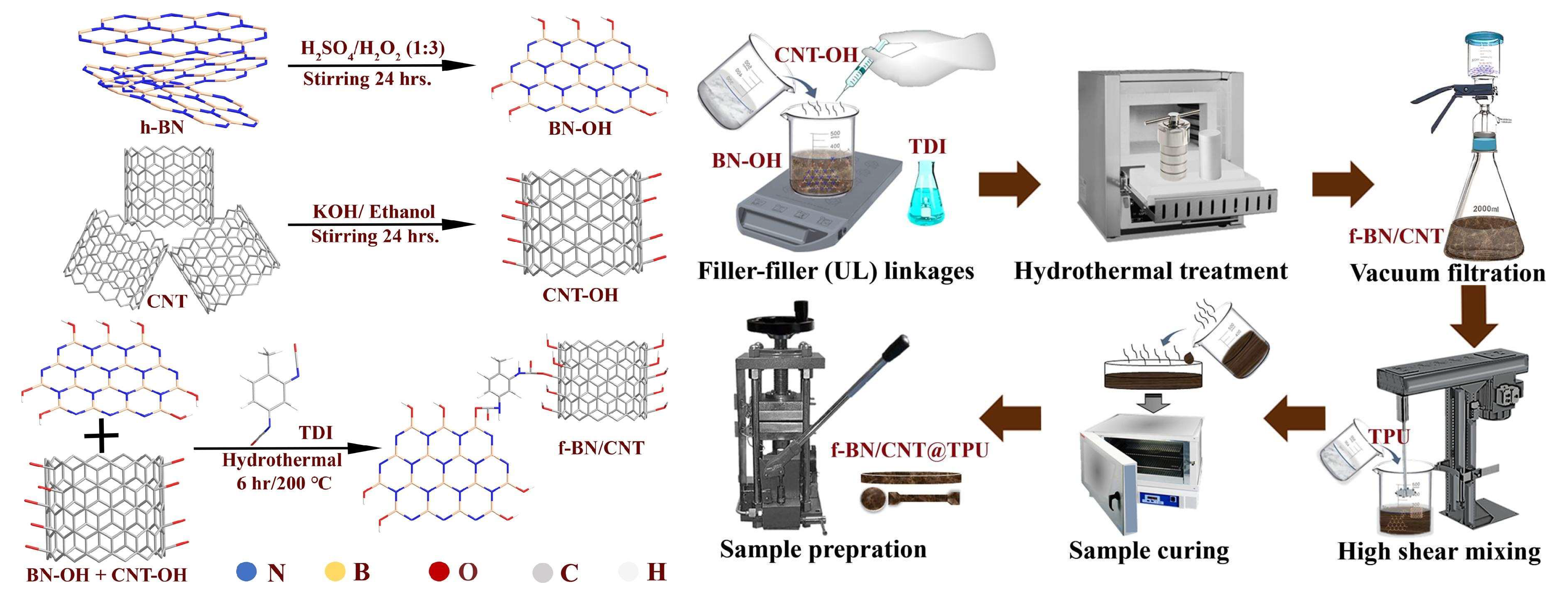

Table 1.
Recently Reported TC values of metallic fillers.
| Matrix | Filler | Loading | Interaction | Technique | Thermal Conductivity(W m-1K-1) | YearRef |
|---|---|---|---|---|---|---|
| Cu-B | DiamondBoron | 67 vol%0.3 wt% | interfacial bonding due to covalent bond | metal matrix alloying method,gas pressure infiltration | 868 (K∥) | 2019 [45] |
| BaTiO3 | Cu | 22.3 vol% | Epsilon-negativepermittivity behavior | 17.7 at 150 °C | 2020 [46] | |
| epoxy | AgNPs, AgNWs,CFs | 3 wt% | 0.76 (K⊥) | 2022 [47] |
Cu-B= boron-modified Cu, BaTiO3 = Barium titanate, AgNPs =Ag nanoparticles, AgNWs= Ag nanowires, CFs= carbon fibers, The in-plane and through-plane direction of TC is represented by K∥ and K⊥ respectively. The original paper did not indicate the direction of TC which is not labeled.
Table 2.
Recently Reported Thermal Conductivity values with ceramic fillers.
| Matrix | Filler | Loading | Interaction | Technique | Thermal Conductivity(Wm-1K−1) | YearRef |
|---|---|---|---|---|---|---|
| PI | PDA-BNF@BNNPs | 40 wt.% | brick and plank strategy | 6.43 (K∥)11.85 (K⊥) | 2022 [57] | |
| epoxy | (AlN–H) | 47.26 vol% | freeze-casting methodinfiltration method | 9.48 (K∥)4.45 (K⊥) | 2020 [58] | |
| CNF | BNNT | 25 wt % | Hydrophobic- hydrophobic interaction | Vacuum assisted fiteration | 21.39 (K∥) | 2017 [59] |
| PDMS | BNNS | 16 wt % | Guided assembly | 11.05 (K∥) 1.15 (K⊥) |
2019 [60] | |
| Epoxy | 3D-BNNS | 9.6 vol % | Covalent bonding,H-bonding | Templated assembly | 3.13 | 2017 [61] |
| ANF | BNNS | 10 wt % | H-Bonding,Van der waals interaction, | Vacuum assisted filtration | 2.4 (K∥) 0.7 (K⊥) |
2019 [15] |
| Epoxy | BNNS | 15 vol % | Freezing assembly (bidirectional | 6.54 (K∥) 0.7 (K⊥) |
2019 [62] | |
| ANF | BNNS (functionalized) | 30 wt % | H-Bonding,Van der waals interaction | Vacuum assisted filtration | 46.7 (K∥) | 2020 [63] |
| CNF | BNNS (hydroxylated) | 60 wt % | H-bonding | Vacuum assisted filtration | 24.27 (K∥) | 2018 [64] |
| PS @PDDA | BNNS | 13.4 vol % | Electrostatic interaction | Mold pressing | 8.0 (K∥) | 2017 [65] |
| Epoxy | BNNS-rGO | 13.16 vol % | Van der waals interaction | Ice-templated assembly | 5.05 (K⊥) | 2018 [66] |
| Epoxy | 3D-BN | 59.43 vol % | Templated assembly | 6.11 (K⊥) | 2020 [67] | |
| PVA | h-BNNS | 0 to 60 wt% | vacuum filtration processself-assembly process | 14.21 (K∥) 7.29 (K⊥) |
2021 [68] | |
| BN-SiC | (PDMS) | 8.35 vol % | atomic-level coupling | ice-templated assembly and high-temperature sintering | 3.87 (K⊥) | 2022 [69] |
(AlN–H) = Aluminum nitride honeycomb, (BN) = Boron Nitride, h-BNNS =Hexagonal boron nitride nanosheets, (PDMS) = polydimethylsiloxane, BNNT = boron nitride nanotubes, (PVA) = Polyvinyl alcohol, (ANFs) = Aramid Nanofibers, (CNFs) =Cellulose Nanofibers,(PI) = polyimide The in-plane and through-plane direction of TC is represented by K∥ and K⊥ respectively. The original paper did not indicate the direction of TC which is not labeled.
Table 3.
Recently Reported Thermal Conductivity values with Carbon fillers.
| Matrix | Filler | Loading | Interaction | Technique | Thermal Conductivity (Wm-1K−1) | YearRef |
|---|---|---|---|---|---|---|
| olefin block copolymer (OBC) | carbon fiber | 30 vol% | sharing force induce alignment | melting extrusion method | 15.06 (K⊥) | 2023 [87] |
| epoxy | graphene-diamond framework (GRDF) | 43 wt% | simple filtration method | 22.7 (K⊥) 21.8 (K∥) |
2022 [76] | |
| Polylactic acid (PLA) | graphene nanoplatelets (GNP) | 6 wt% | solution blendingcompression molding process | 0.87 (K∥) 0.58 (K⊥) |
2019 [88] |
The in-plane and through-plane direction of TC is represented by K∥ and K⊥ respectively.
Disclaimer/Publisher’s Note: The statements, opinions and data contained in all publications are solely those of the individual author(s) and contributor(s) and not of MDPI and/or the editor(s). MDPI and/or the editor(s) disclaim responsibility for any injury to people or property resulting from any ideas, methods, instructions or products referred to in the content. |
© 2023 by the authors. Licensee MDPI, Basel, Switzerland. This article is an open access article distributed under the terms and conditions of the Creative Commons Attribution (CC BY) license (http://creativecommons.org/licenses/by/4.0/).
Copyright: This open access article is published under a Creative Commons CC BY 4.0 license, which permit the free download, distribution, and reuse, provided that the author and preprint are cited in any reuse.


