
Submitted:
21 September 2023
Posted:
25 September 2023
You are already at the latest version
Abstract
Land-use planning review seems relatively lower in publication rate and in coverage of content. This review contributes its part in two dimensions. First, it assesses ability of the popularly growing bibliometric method in tracking the real contribution of publications. Then it summarizes developments in the land use planning literature in three themes - general literature path building, land use planning context, and development of methods. It is observed that bibliometric method rewards information carriage paper more than the original contributors. Key planning context gaps include detachment of the general goal-oriented objective formulations from the basic land use allocation theories and models and certain urban land use optimization objectives even contradict the original though of sustainable city. Key research frontiers include: linking basic land use allocation and utility theories in urban land use planning; shifting the current urban land use planning from spatial optimization to activities into optimizing flow resources to available spatial configurations; evaluating existing built environment for optimality; transferring knowledge from rural land-use planning to urban land use planning. In method development, the key frontier would be advancing the current loosely coupled methods into more integrated systems.
Keywords:
literature path
; land use optimization methods
; land use allocation theories and concepts
; bibliometric method
1. Introduction
Land is the spatial carrier of all sorts of human life. It shapes a community’s socio-political and economic establishments through the interplay of use and value. The spatial configuration of land use is a physical manifestation of the distribution of benefits and costs relationships in a society (Ma, et al., 2019; Krehel et al., 2016; Bertaud, 2004; Anas and Kim, 1996; Anderson and Samartin, 1985). On the other side, changing the relation of use-value and Land Use Land Cover (LULC) such as alteration of ecosystem services causes charges on the spatial relation of human activities (Liu et al., 2022; Li et al., 2021). Given as a human economic development carrier resource, as a natural endowment of ecosystem services provider (Chen, et al., 2023), and as an institutional entity that shapes socio-political behaviors of humans by the tenure conditions, both rural and urban land have attracted effective planning for its productive use.
Since the first land use planning model by von Thunen (Mori, 2006), land use planning, especially urban land, has transcended across generations of models including the structured mathematical models of the 1950s and 1960s (Broitman, 2012 ) where the bid-rent and optimal firm location theories have played an indisputable role in conceptualizing the modeling of spatial allocation of activities. Spatial simulation models dominated the 1970s and 1980s. Since the 1990s, sustainable development has been on its perch in theorizing the land use planning literature and the planning literature appears to integrate demand-supply quantity structure and spatial simulation. Sustainable development requires balanced attainment of economic, societal, and ecological products. Furthermore, land use allocation based on optimal tradeoff for objectives is not a complete response; instead, land use planning also requires optimization for spatial layout of activities based on the view that land use pattern is a consequence of competition between different land-use types (Wang et al., 2022; Liu et al., 2015).
Following the shift in theoretical ground, traditional structured mathematical models have become less attractive while the dynamic heuristic methods have dominated the land use planning literature. Within the sustainable development paradigm, Ecosystem Service (ES) concepts link science and policy effectively in rural land use planning (Wu et al., 2018; Li et al., 2021). In urban land use planning, the major linking concept is a sustainable built environment characterized by different forms, mainly compactness, contiguity, mixed-use development, and compatibility (Jabareen, 2006; Jenks and Burgess, 2000).
Land-use optimization can be conceptualized as the contemporary view of the classical highest-and-best-use allocation. And it is a promising approach to achieving sustainability (Rahman & Szabó, 2021). Analysis of spatial measures and drivers of land use change and understanding the laws of spatiotemporal changes in land use and influencing factors are the basics of optimizing the spatial pattern of land use (Liu et al., 2022).
Literature study is instrumental in grasping the development trend, current status, and possible future direction of any research theme or discipline. This is especially true for land planning literature where a huge volume of study is accumulating (Rahman & Szabó, 2021). However, one may observe low coverage and the narrow nature of the review works. The rate of review studies is low (Rahman & Szabó, 2021), only 6 (1.13%) of 530 <TI = land use optimization> articles in the Web of Sciences (WS). On the other hand, review works often focus on a specific issue such as a single optimization method, a group of certain optimization methods, a few objectives of land use optimization, etc. A broader exploration as to bow fundamental theories/concepts and utility models of land use allocation and methods is not visible specifically in urban land use planning literature This paper intends to contribute to the literature on these issues. In addition, it also touches on the application of the bibliometric literature study method with an emphasis given on its credibility to rely on it as a main method for investigating knowledge development.
2. Materials and Methods
Snyder (2019) categorizes literature study methods into systematic, semi-systematic, and integrative. Picking up a specific research question, the purpose of it is driving a synthesis and complete evidence of that particular study theme. It applies a systematic strategy to select published articles for its investigation. The outcomes of the qualitative and quantitative analysis are mainly policy implications. Integrative review is conducted for a synthesis and critique on an issue. Since published articles are not the only sources information, it does not apply systematic selection strategy. The outcomes of the qualitative analysis are taxonomy of themes and theoretical models/frameworks. In between the two is a semi-systematic review focusing on research areas and tracking the development of a research theme over time. Sources selection strategy may or may not be systematic. The outcome of the analysis is basically theme identification, historical overview, and identifying research frontiers.
This article belongs to the third taxonomy. Basically, the purpose of the review is to summarize how the overall optimization-based land use planning background information have synthesized for the last two decades and indicate potential further research directions based on carefully selected sample articles. The investigation is organized into two parts - a bibliometric summary statistics and qualitative investigation applying traditional literature reading for exploring content. The study resources were sampled from the WS core collections based on title <land use optimization>. By the first of August 2023, there were 670 publications spanning the period 1993-2023 that met the search parameters of which 339 were articles distributed in 201 journals, 789 institutions, and 122 countries (Appendex-A). The articles passed scrutiny following the PRISMA screening process.
Figure 1.
Research process flowchart. Note: Rv. = Review; Rlv. = Relevant; HC. = Higliest Citation; RP. = Recently Published.
Figure 1.
Research process flowchart. Note: Rv. = Review; Rlv. = Relevant; HC. = Higliest Citation; RP. = Recently Published.
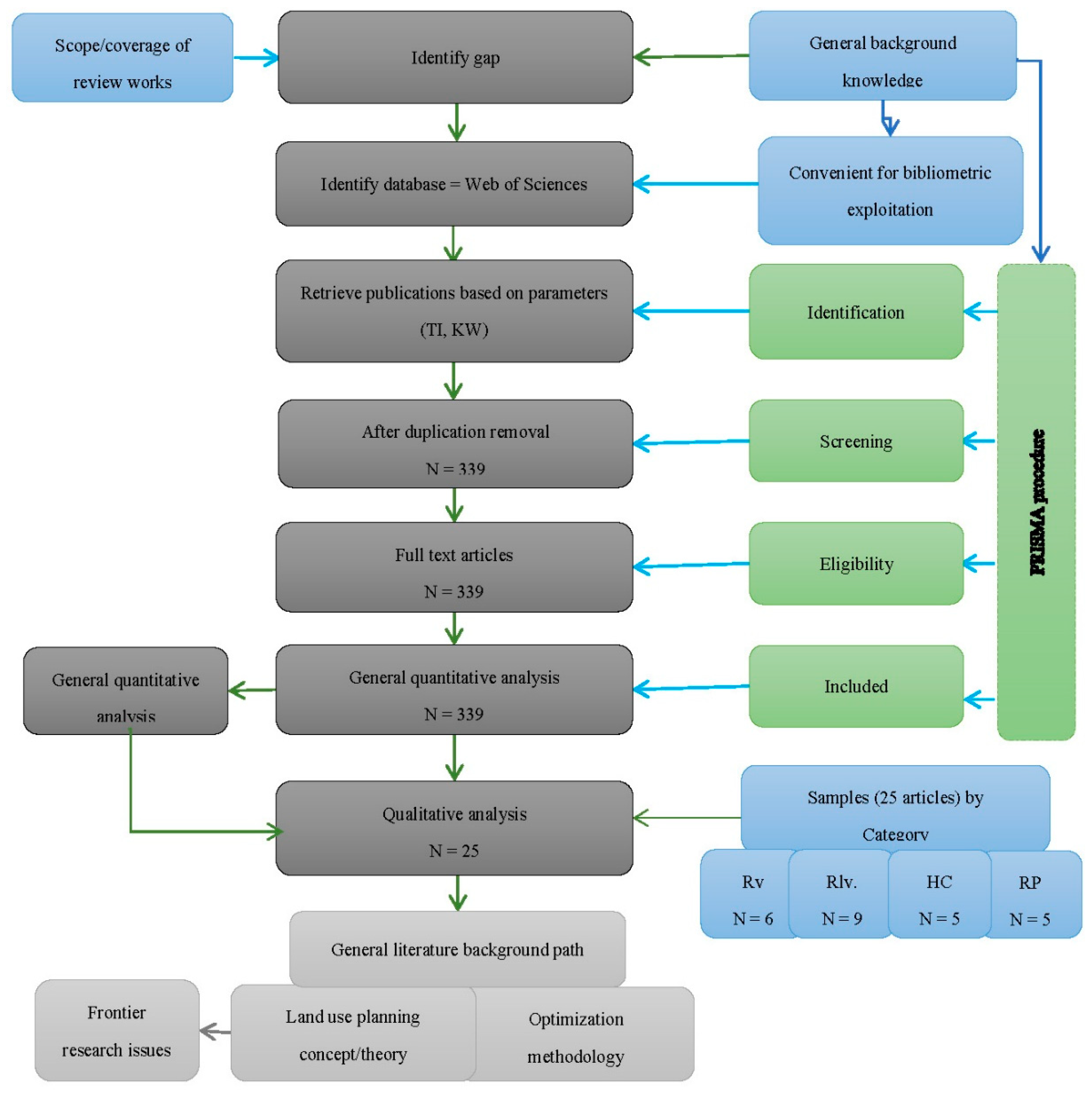
CiteSpace 6.2.R4 was used to conduct the bibliometric statistical summary on the 339 articles of which eight were review types. For the content thematic analysis, 25 of the 339 articles were selected based on four criteria; i.e. relevance to optimal land use planning context (top nine), highest citation rank (top five), recent time publication (top five), and review type publications (all six). To select representatives of each criterion, the retrieved 339 articles list was sorted in descending order for each criterion. To avoid the possibility of redundancy, articles selected for one criterion were excluded from the list while selecting representatives for the other criteria. If an article was restricted for full-text access, it had to be replaced by the immediate next article on the sorted list.
While understanding rural/regional land use planning and urban land use planning have walked independently, we do not prefer to confine our review to either stream. Instead, we prefer knowledge transfer between them because the basics of land use planning science are the same.
3. Bibliometric indications
The bibliometric statistics were conducted on citation and keyword. We generated citation clusters setting the threshold = 2. Based on the Log-likelihood Ratio Labeling, four clusters each having at least 23 members and two clusters each are of only four members were identified. Each of the other 34 clusters was a single-member cluster. The four clusters with members above 23 were rural land use (N = 58), practical efficient regional land use planning (N = 47), change land use effect on small region model (N = 44), and land use pattern (N = 23). The citation count in these clusters ranges between 17 and 49. Stewart, et al (2004), Cao, et al (2011), Aerts, et al (2003), Ligmann-Zielinska, et al (2008), and Aerts and Heuvenlink (2002), with respective citations counts of 49, 37, 34, 34, and 22 were highest cited articles in cluster #0. Cao, et al (2012), Deb, et al (2002), and Liu, et al (2013) were member of cluster #1 cited 42, 18 and 17 times in their sequence. Costanza, et al (1997) in cluster #2 and Liu, et al (2017) in cluster #3 each got 21 citations (Appendex-B).
The average publication years of the articles in the four top clusters were 2004, 2009, 2017, and 2005. The standard deviation of the publication years across the clusters is 5.12 and the corresponding value for membership size is 12.67 whereas the standard deviation for the number of citations across clusters is 62.50 (Appendex-C). These standard deviations relational pattern depict incongruence of citation to the age of the cited sources and to the size of cluster membership size. This observation provides an entry point for analyzing whether the citation network indicates the degree of relevance or whether the citation is influenced by other factors. In cluster #0, the most cited members are Stewart, et al (2004) the focus of which was a special purpose GIS-based genetic algorithm to solve additive and spatial objectives; Cao, et al (2011) who dealt with boundary-based GA operators; and Ligmann-Zeilinsk, et al., (2008) whose key contribution was the density based constraint design. The major citing article of the cluster Mohammadi, (2016)[1] was however a comparison of four metaheuristics and their hybrid application in optimizing urban land use plans. In cluster #1, three top-cited members are Cao, et al (2012), Deb, et al (2002), and Liu, et al (2013). The work of Cao, et al (2012) was basically the same as Cao, et al (2011). The work of Deb was introducing the NSGA-II. Liu, et al (2013) integrated system dynamics and hybrid particle swarm optimization to solve land use allocation problems in a large area.The most citing article of the cluster by Pan, et al (2021) deals with land use intensity restricted multiobjective spatial optimization. Pan, et al (2021) cited Cao, et al (2012) for its special operators. The other two were referred to for general literature information. All four papers have little connection to the context of the change land use effect on small region method. In cluster #2, the work of Zhang, et al (2016) was a hybridized multi-agent system and PSO to simulate multiobjective optimal land use. The work of Liu, et al., (2017) was two-pronged - simulating long-term multiple Land Use Land Cover (LUCC) plus, from method side, coupling system dynamics and cellular automata. Li and Ma (2018) acted to improve Simulated Annealing (SA) for land use planning under an interactive stakeholder involvement framework. The most citing article in the cluster by Liu, et al (2020) dealt with low-carbon multiobjective land use allocation simulation based on patch generation executed by the NSGA-II. The trend is the same for cluster #3. In general, the key finding is that the citation network indicates citation is not strongly related to the core contribution of the source used.
Figure 2.
Citation clusters mapping.
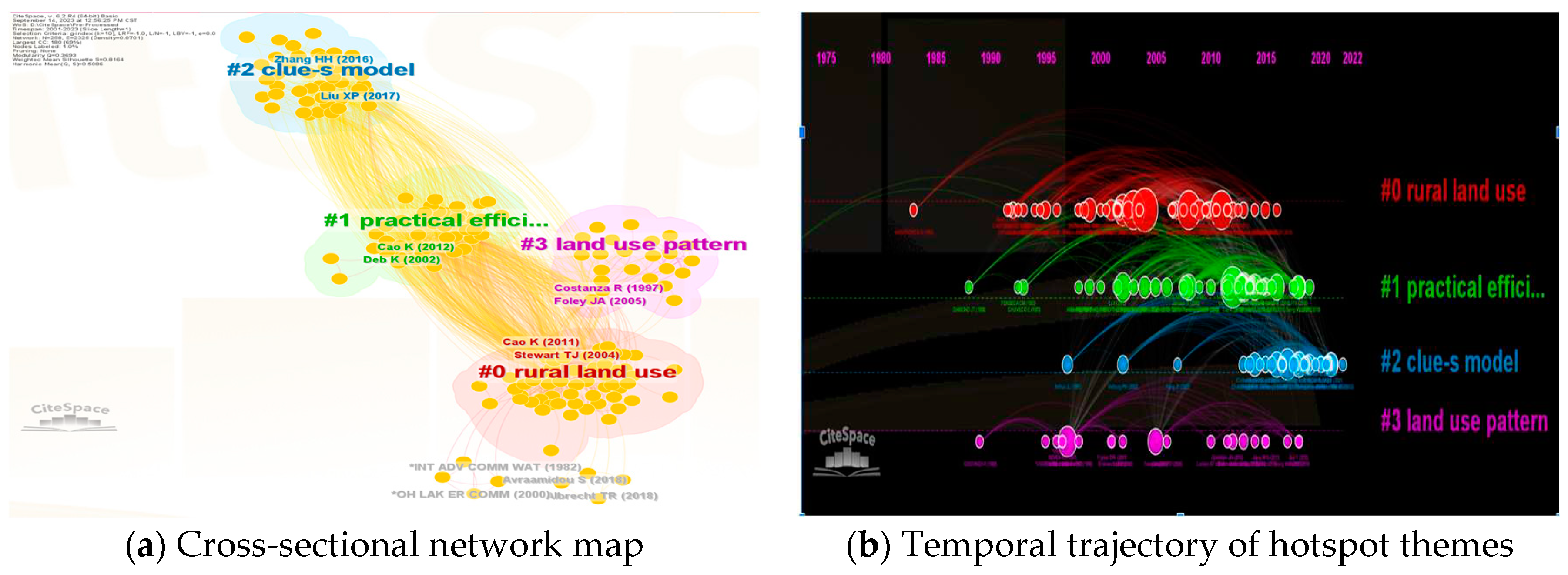
In order to better understand the strength of the citation network across the land use planning literature we draw additional articles into the investigation. We examine whether citation simply credits articles merely for being information carriage or based on its contribution to the knowledge pool. We examine six of the 12 papers reported for citation burst (Appendex-D(1,2)). Based on ease of full text accessibility, two to 10 (avg. = 7) citing papers (total 41) were randomly selected for each of the six (of 12) citation-burst article. Three of the 10 sampled articles that cited Zheng, et al (2016)[2] referred the source for its core research context while the seven articles referred to it for general background literature information. Only one among ten articles that cited Aerts and Heuvenlink (2002)[3] and only one among three articles that cited Song and Chen (2018)[4] referred the respective source for respective core research content. In total, 35 (85.4%) of 41 citing articles referred their respective sources for mere general literature information. In general, the citation investigation conducted on both the nine articles drawn from the citation network clusters and the six articles drawn from the citation-burst report do not provide sufficient evidence to support citation correspondence to the core content of the articles being referred to as sources. Instead, 47 (88.7) of the 53 citing articles demonstrate most sources are referred for background literature information rather than for respective key research content. The same is true with temporal extraction. The mapping shows the rolling of the general literature information through time. Unless each paper is cited for what it specifically contributes, citation frequency (and other citation statistic summaries) may not necessarily indicate the relevance of the paper. In line with this finding, Ding et al. (2021) report significant content variation among the top 10 papers with the highest local citation scores indicating the potential interpretation flaws regarding consistency of trend or content. This condition may pose a challenge to the citation network statistics-based bibliometric method.
Review authors also believe that keywords can map the development trajectory of a certain study issue such as Ding, et al (2021) who used the first appearing keyword as an indicator. In this manuscript, we mapped the temporal trajectory of the entire authors’ keywords in two different parameters, i.e. (i) selection criteria “By Degree” and threshold parameter = 10; and (ii) selection criteria “By Frequency” and threshold parameter =1 (Figure 3). Both plots demonstrate the density of keywords is very sparse compared to the size of the pooled data (339 articles). The main reason is because many papers use higher (discipline or research theme) level keywords rather than keywords directly indicating the core contribution of the study within a discipline or study theme. Discipline or theme-level keywords would make much of the literature to be redundant (keyword plot space more sparse). The discipline/study-theme level keyword aggregation would appear to curtain out knowledge progress to be inferred from the bibliometric mapping method.
In a crude yardstick, however, the citation cluster mapping (Figure 2) indicates that the topmost cluster, rural land use was hotspot research theme during 2010-2015 and now it seems getting stabilized; land use pattern (#4) was dominant in the 2000s and 2010s; practical efficient regional land use planning (#2) was strong during 2010 - 2015. Currently, the change land use effect on small area is the leading theme.
In general, although the bibliometric method is supposed to be robust (Donthu, et al., 2021), it is worth noting that most articles have not been cited for their core purpose/contribution and it may lead to an argument that bibliometric dependence on mechanical summary statistics appears to be insufficient to investigate past trends and possible frontiers in land use optimization. Real knowledge development may be traced by the conventional literature reading method. However, systematic selection of sources may be beneficial more than random pooling. Based on this finding, we prefer to conduct our review to be explorative based on traditional in-depth reading on carefully selected 25 articles.
4. Previous review works
4.1. Brief summary of content coverage
Memmah, et al (2015) reviewed the use of metaheuristic methods in agricultural land optimization and that of Kaim, et al (2018) was an application of optimization methods for agricultural land use planning in a broader scope. Ding, et al (2021) review focused on the current state and development of Genetic Algorithm (GA) in land use optimization. The review of Liu, et al (2021) spans the conventional heuristic global optimization methods and the land use optimization research context transformation in the framework of the ecosystem. Yao, et al (2018) and Rahman and Szabo (2021) reviewed urban land use optimization. The former focused on optimization approaches within the framework of sustainable development whereas the latter’s scope is the frequency of representation of objectives, constraints, and data models.
As mentioned in the method, only six review articles were available among the 339 articles that meet the <TI = land use optimization>. A simple quantitative connotation of studying all six articles covers 100% what has been reviewed. In other words, it is possible to say that 100% of what has been summarized regarding land use planning for the last two decades is already documented. Each of the six reviews is briefly described one at a turn in the following few paragraphs and then the value of the works is summarized and frontiers within the scope of these six works is suggested.
Memmah et al., (2015) are of the view that pollution and biodiversity loss challenge agricultural intensification to respond to food demand. As a result, they presume that land use optimization is a frontier solution. The authors are of the view that high credibility optimization methods are required to determine high-quality land use plans that ensure a sustainable balance between ecosystem and economy and that respond to demand for food production sustainably. They explored 50 articles (38 case studies) by applying the PRISMA protocol (Moher, et al., 2009). They used CiteSpace for their statistical summary and mapping of knowledge cooperation. Reportedly, the findings can be organized into three points - selection of metaheuristic optimization tools, success factors of metaheuristics in implementation, and involvement of stakeholders in the decision-making process. Reportedly, Simulated Annealing (SA), Taboo Search (TS), Evolutionary Algorithms (EA), Differential Evolution (DEq), and Swarm Intelligence (SI) have been in use in agricultural land use optimization. Selection of a specific method is often influenced by the past trend of its use where researchers pick a method by looking at what method has been applied to similar problems. Regarding the involvement of stakeholders, the posteriori method where trade-off solutions are filtered based on multicriteria analysis has been common practice. Yet, stakeholders can be involved during the iteration process and after efficient maps are proposed (Kaim, et al., 2018). In fact, the stage at which stakeholders participate depends on the nature of the problem as discussed by the work of Kaim, et al (20018).
The key contribution of the paper, given a problem context, lies on its general guideline to be followed while selecting an optimization method. Their suggestion is based on associating characteristics of a problem versus the method applied across the studies they reviewed. They suggest that SA and TS tend to yield well where constraints are more in number, a situation where more constraints limit navigation of the search space. In other studies, SA is preferred for its parallelization capacity while TS is capable of searching for potentially improved solutions in the current solution’s immediate neighborhoods and it penalizes revisiting once-visited neighborhoods. Evolutionary Algorithms, on the other hand, are preferred for handling multiple conflicting objectives. Their second finding addresses the scalability challenge of heuristics with increasing number of objectives and constraints. Part of the problem is, however, because algorithm selection is often path-dependent while heuristic algorithm design should be specific to a problem at hand. Part of the solution to the scalability limitation emanating from problem specificity of metaheuristic methods is hybridizing two or more methods (Ding, et al., 2021). Mmemmah, et al (2015) saw that coupling the global optimizers and local search methods effectively solve the multidimensional combinatorial land use planning problems because of the relative exploration-exploitation capabilities complementation. Diving into the broader literature, it is well-known that coupling is not the only solution though. Parallelization and the use of heuristic type operators are other alternatives to deal with the efficiency and effectiveness scalability challenges. Yao, et al (2018) add decision variables as a criterion for the method selection discussion. They contend that decision variable type plays a notable role. Exact methods are effective with discrete types while heuristics are compatible with continuous variables. Mixed variables are better handled by Mixed-Integer Programming (MIP). Kaim, et al (2018) share the optimization method selection problem Memmah, et al (2015) are concerned about. But, the approach of the former is more scientific. The question is the lack of clear guidelines for choosing the best optimization method. The rationality of their review can further be strengthened by the fact that the optimization method success is problem-specific (Memmah, et al., 2015; Cao, et al., 2011). Rather than relying on the association of the nature of a problem and the corresponding method applied to solve it as Memmah, et al (2015), they depend on summarizing the advantages and drawbacks of various optimization methods (TS, SA, SI, genetic algorithm/GA, artificial immune system/AIS, linear programming/LP, and fuzzy programming/FP), nature of objective formulation (Pareto-based versus scalar aggregation), constraint handling mechanism (penalty function versus defining feasibility criteria), objectives aggregation method when applied (weighted sum/WS versus goal programming/GP), and conditions of involvement of stakeholders (priori, posteriori, interactive). Based on their three parameters analysis, they suggest a well-structured hierarchical evaluation a problem to select an appropriate method. The first task is the identification of the nature of the problem. If the problem does not necessitate tradeoff analysis, priori methods (WS, GP, TS, and SA) are preferred and stakeholders' iterative involvement is possible. If the problem requires complete tradeoff analysis, whether objectives can be scalarized or changed to -constraints form is decided. If possible, Pareto-based methods are preferred and stakeholder involvement would be posteriori.
Liu et al., (2022) address both spatial measurements and drivers of land use change and simulation and prediction methods in land use spatial change. From a theoretical viewpoint, they pinpoint that the context of a spatial change of land use can be addressed in terms of mutual feedback between human socioeconomic activities and the eco-environment capacities and change. That is, socioeconomic activities cause land use change that ultimately affects the eco-environment, and eco-environmental changes in turn cause spatial changes of activities on land use. This mutual feedback conceptualization helps in identifying and characterizing spatial land use change factors. Increasing attention to the effect of ecological limitation on human activity on land, the analytic paradigm of land use spatial change driving factors turned to pay proportionate weight to economic growth and restraints. In another spectrum, the mutual feedback entails optimization activities taking land use change as factors and optimizing land use for a given activity. Given modeling methods are as important as the theories are, based on the mutual feedback framework, the authors contend that CLUE-S and Markov models are good tools for integrating socioeconomic and natural driving factors because the methods are capable of handling conflicting land use relationships. Planning models (such as LP, system dynamics/SyD, multi-objective programming/MOP) facilitate the analysis by quantifying economic and social driving factors and determining the demand-supply equilibrium equation. Regarding the measurement of land use change, the authors emphasized the use of multiple data types because of spatial scale and limitations of data to comply with requirements.
The reviews of Yang, et al (2018) and Rahman and Szabó (2021) are devoted to urban land use planning. The scope of the review by Yao et al. (2018) is narrowly confined to how compactness and contiguity, supposedly key characteristics of sustainable land use, are established as objectives or constraints. Their orientation to the issue of suitable city and the position of the parameters is consistent to Ligmann-Zeilinsk, et al (2008). Compactness is often formulated as consolidation of uses into larger clusters enforced in variants of mathematical objective formulation expressions (perimeter-to-area ratio, diagonal length of the minimum bounding rectangle, the weighted average ratio of area to perimeter square, core-buffer cell assignments, minimizing the number of clusters, maximizing largest cluster), and constraints (imposition of a minimum threshold of certain cells of use u as a requirement for allocation in a certain neighborhood). They contend that the most explicit way of modeling contiguity is based on graph theory (either the path-based, order-based, network-based variants). Rahman and Szabó (2021) also assessed the representation and formulation of sustainable built environment objectives (contiguity, compactness, and compatibility) in a broader scope than Yao, et al (2018). Following the PRISMA protocol, they examined 55 articles. Reportedly compactness objective appeared at 16.67%, the contiguity objective at 13.667%, and the suitability objective at 11.9%. In aggregate, Economic, ecological/environmental, and social objectives appeared at 46.67%, 43.33%, and 10% respectively. They also assessed methodological approaches to land use planning and spatial data model usage. Reportedly, GA in its various modifications accounts for 80% followed by Particle Swarm Optimization (PSO) (12.73%) and Ant Colony Optimization (ACO) (9.1%). Regarding data models, 80% of the time land use optimization works depend on the raster data model. The authors also discuss objective formulation methods. Pareto front-based construction is dominant, sharing 42.86%, WS 36.73%, and GP 20.41%.
The literature study by Ding et al. (2021) exclusively explores the application of GA in land use optimization in the framework of multiple objectives. By using CiteSpace software, they map the knowledge cooperation of 1154 articles among countries and institutions. To show the temporal trajectory of GA knowledge development, they mapped the frequency of the first-appearing keyword. Reportedly, the period 1995-2004 was a period of mainstreaming the GA as a method; 2004-2008 was the optimization stage of the GA itself; hybridized GA dominated 2009-2016. Since 2017, the land use planning literature has advanced from deepening the algorithm to integration of GA with big data. Based on their study, they suggest three future research directions. At the blatant edge, they suggest further integration of GA to newly evolving AI capabilities. Adding a temporal dimension to land use optimization and integration of GA and land use planning knowledge are other recommendations for land use optimization research undertakings.
4.2. Value and frontiers
The above six literature studies explored much work on land use planning concepts and methods. They systematically facilitate analysis of the merits and drawbacks of land use optimization method across categories (EAs, SI, LP, IP, and many local optimization tools) by pooling them in the form of face-value reporting of utilization and synthetic summaries. Probably, the major contribution of the review works is the generic guidelines for method selection. We found two approaches. One is based on an association of problem domain and applied method. This approach may offer a crude first entry into a more scientific approach. The second approach we encountered is based on scientific analysis of the nature of problem domains and the inherent behavior of the optimization methods. To add to the problem analysis-based method selection strategy, it is worth mentioning that available time for making a decision, solution quality criteria such as diversity and reliability as criteria for algorithm selection (OuYang and Hongyun, 2015; Magalhaes-Mendes, 2013; Misevicius and Killda, 2005). Problem size is another determinant factor in method selection. Stewart, et al (2004) argue that exact methods are less convenient for large problem sizes (>200). Probably, the most important aspect that makes exact methods less suitable for land use optimization is geographic and ecological relationship requirements and geographic unit characteristics (shape, distance, adjacency, etc.). Variable type is another method selection determinant factor (Rahman and Szabó (2021). Considering the multiple parameters that determine method selection is yet to be done in an objective approach. A comprehensive objective-based analysis would help to better comprehend available methods and making selection strategy more concrete.
Given each land use planning problem may be formulated based on a specific theory or context, and possibly its mathematical formulation is distinct, the method selection strategy both Memmah, et al (2015) and Kaim, et al (2018) suggested can help only at a crude scale. This can be verified by the fact that different comparative studies report different findings. Masoumi, et al (2023) compared nondominated sorting genetic algorithm II (NSGA-II), multiobjective PSO, and multiobjective evolutionary algorithm (EA/D) based on the dispersion of the solutions, diversity of the solution space, and the number of dominant solutions in Pareto-Fronts. The multiobjective PSO provided the best diversity of solutions. The multiobjective EA/D performed better than the other two in computational time. Jahanishakib, et al (2022) Compared LP, SA, multiobjective land use allocation (MOLA), and multidimensional choice (MDCHOICE) for land use planning. MOLA attained better in landscape metrics; SA was better in forestry land use allocation; LP returned the least degree of demand violation; and MDCHOICE was best in harmonizing uses. Sajith, et al (2022) compared the performance of multiobjective GA, Cuckoo Search, and PSO in agricultural land allocation for diversified crop planning. They report the GA’s capability. Compared to results evaluated by routines, GA evaluated profits and crop yield increase are 103% and 97% respectively and water consumption was reduced by 5%. Ou, et al (2023) compared the Markov-Cellular Automata (CA) hybrid mode against CA-Markov and the CLUE-S models applied to land use optimization-based ESV. The non-stationary Markov state transition CA probability realized high layout precision. Furthermore, works also indicate what works best depends on the performance comparison metrics selected. In another parallel manuscript, a semi-systematic literature study by the authors of this manuscript explored that the genetic algorithm (if it represents major characteristics of the evolutionary algorithms) is specific to a specific problem indicating that the general literature information and historical trends of the use of an algorithm is less likely to guarantee successful method selection. Given appropriate and comprehensive effort in analyzing artificial intelligence-based optimization algorithms is little (Masoumi, et al., 2023) and available method judgment environment is inconclusive, a more detailed and objective parameter(s) based selection strategy may be required. The direction could be concretizing the generic qualitative judgements into an objective parameter-based classification of the methods. In this regard, argues that.
A second important contribution of the review works is related to concepts in spatial development planning. Yao, et al (2021) claim that the depth and breadth dimensions of sustainable urban land use optimization is just touched. One of the limitations in the literature is representation of social development aspects is rare (10%). It is worth noting that studies that consider all three aspects of sustainable development are rare; in the work of Rahman and Szabó (2021), for instance, only two of 55 articles. Where the social dimension objective appears, the representation is often vague such as in social security service values (Zhang et al, 2016), spatial compactness (Yuan et al, 2013), and accessibility to the main roads (Cao et al., 2011). Another key limitation to point out is the lack of standard/consensus in using proxy variables to calculate the benefits of objective parameters in each dimension. Studies are welcoming for each of these gaps.
5. Review of the regular articles
As with any regular research, literature study is bound to a defined scope. Each study addresses a specific aspect of a given research theme of a specific discipline. In this regard, it is natural for the above six reviews to leave much space unaddressed spanning theoretical contexts and methods of determining optimal land use plans. In this section, the paper explores trajectory of literature path building following chronological sequence, the development of land use planning method, and the position of the basic land allocation theories/concepts and utility models within the popular optimization-based land use planning literature.
5.1. Literature path building
Any research undertaking departs from an existing knowledge base (Snyder, 20019). Hence, we presume that every study addresses what has been done right till its commencement in its review section. This section tries to assess how the literature has developed over the past 20 years. One way of doing that is by assessing what each following paper identified in its review/introduction section. Table 1 below is a concise summary of the historic building of regional land use optimization literature over the past two decades.
Land use optimization can be conducted at different spatial scales spanning the globe (Hasegawa, et al., 2017), continent (Verburg, et al., 2013), nation (Chakir and Le Gallo, 2013), river basin (Wu, et al., 2018) and city (Zhang, et al., 2018; Delphin et al., 2016).
Non-urban land use optimization is framed around ESs management or balancing ESs and economic gains. In other words, at a regional level optimal land use planning is a question of balancing the spatial scope of construction/development and ecological protection (Chen, et al., 2023). Seppelt and Voinov (2002) assessed recent publications on simulation models applied to ecosystem management including Stochastic Variation, variants of LP (conventional linear; hierarchical structures), 0-1 integer programming (IP), nonlinear programming/NLP including two-stage non-linear optimization, Bayesian Belief Network (BBN), hierarchical dynamic programming (HDyP), SA, spatial dynamic programming (SDyP). The authors' literature summary gap was that optimization techniques in environmental modeling were problem-specific which is attributed to the ecosystem model and spatial complexity differences. Accordingly, they argued scenario analysis is the preferred solution rather than exploring various implementation algorithms, i.e. they suggested enhancing the computational efficiency of any model solver. Sdshu, et al (2008) traced econometrics, mathematical dynamic programming (MDyP), and GA for land use optimization under a dynamic environment. They argued that models are detached from the land use planning perspective. Most optimization models assume a static state at a particular point in time while land use planning covers a period in the future. In the same year, Sadeghi, et al (2008) skimmed the application of conventional programming constraint (CPC) and chance-constrained programming (CCP), linear optimization (LO), MOLP, GP, LP-ANN (Artificial Neural Networks) coupling, LP-GIS (Geographic Information Systems) coupling, and NLP. Reportedly, the standalone and hybrid methods were applied to different objectives, constraints assumptions and contexts, and spatial scales in different countries. The authors argued that translation of available optimization models into practical problems is rather shallow. Optimization techniques have been in use extensively to support general management systems in land use allocation. Knowledge of linking practical problems with the optimum use of all land resources under conflicting demands is lacking at a watershed level.
Yang, et al (2012) discussed multi-agent systems (MAS), generalized LP, unbalanced support-vector machines, and aggregated multivariate regression in modeling land use change. They also discussed the pros and cons of the Markov chain, multivariate statistics, SyD, and CLUE-S and CA. The gap they noted was that the coupling of methods is not exhaustive. As a result, they claimed that they were pioneering to suggest and apply ACO, Markov, and CA in combination. While consulting a wide range of optimization methods for land use planning, Liu, et al (2015) place emphasis on game theory (GT) and GA. The GT can simulate the behavior of various stakeholders and assist them in making better decisions in a conflicting environment (Zhang, 2004) but it lacks global capability. In this regard, Yang, et al (2012) claimed that the application of the GT in combination with other global optimizers has not been in use and they applied it in their own study.
Uncertainty has been accommodated in multiple disciplines while optimizing resource deployment including water allocation, solid waste disposal site allocation (Cheng, et al., 2003), Agricultural plantation (Dong, et al., 2014), land use (Liu, et al., 2009; Zhou, et al., 2015; Liu, et al., 2015). Regardless of its application across a wide array of disciplines, Liu and Ma (2017) traced that much of the land use optimization literature is executed under a determinate assumption. The outcome of ignoring dynamism in land use planning is a low scientific credibility of planning schemes. Land use plans that do not consider advanced uncertainty may be refused because such plans often fail. The authors claim that Chinese scholars understand the failure of exact constraints of past planning and now acknowledge uncertainty very well. In cases uncertainty may be acknowledged, failures occur in either lack of systematic means of analyzing sources of the uncertainties or lack transparent means for stakeholders' involvement during objective decisions (Liu, et al., 2015).
Regardless of the remarkable achievements of ecological restoration from the Grain for Green Program of China, Wu, et al (2018) note that previous ecosystem-based optimal land use allocation studies in China mainly focused on quantification, variation, and spatial patterns of multiple ESs, tradeoffs among different ESs and their influencing factors, identification of tradeoff hotspots, and developing optimization tools. The key gap they identified was that methods developed so far were short of considering how to minimize the magnitude of tradeoffs among the ecosystem services.
Among the popular land use simulation models, Zhu, et al (2020) reviewed CLUE and FLUS (Future Land Use Simulation) (Liu, et al., 2017), CA–Markov (Veldkamp, 2004), CLUMondo (Jin, et al., 2019) have been in use. The authors claim that the FLUS as a probabilistic surface with uncertainties is not well developed. Li, et al (2021) skimmed through and discussed the limitations of the bottom-up and top-down land use simulation methods. The limitation of top-down methods is less likely to return spatial layout plans. On the contrary, bottom-up methods use transition rules to map the layout of activities to corresponding suitable locations but lack quantity determination. The implication for the coupling of methods in the ecosystem service-based land use optimization is driven not merely by the scalability problem but because of the view that disaggregates planning and spatial arrangement activities into two independent models in the land use planning process. Land use optimization methods have gone through a series of development from conception and practice through refinement to cooperation (Ding, et al., 2021). Within this view, Li, et al (2023a) note that land use optimization practice focuses on structural-level quantitative solutions that need further adjustment at the local level. Regarding the global and local optimizers, Li, et al (2023b) are in the same page with Li, et al (2023a). Li, et al (2023b) further address the limitation of spatial layout optimizers such as CA and CLUE-S that historical trends of the land use change process determine the final activities layout map, which is a new challenge to the hybridization of structure/global optimizers and spatial layout/local optimizers. From a planning concept view point, the historical trend determined transition rules disregard the heterogeneity of spatial units providing ESs. The spatial heterogeneity calls for the optimization of spatial suitability of activities. In addition, Li, et al (2023b) noted multiple criteria-based qualitative evaluations coupled with filtration techniques that allow maximum participation of stakeholders. Chen, et al (2023) are of the opinion that the current approach of incorporating land ecological suitability into land use planning, the aim of which is forecasting ecological space, is insufficient to solve socio-economic and ecological contradictions in the process of forming urban agglomerations. Traditional land ecological suitability assessment methods like local rule recombination and map overlay only deal with vertical processes and lack horizontal processes.
Urban land use planning problems should differ from regional land use planning problems in theories/concepts that shape the land use allocation and behaviors of utility. In application, they also appear to differ in methods. Rural land use planning optimizes either different ESs or socioeconomic and ESs tradeoffs whereas urban land use planning is considered a consumer of ESs. Regional/rural land use planning often applies local optimizers either as a sole method or in combination with global optimizers. Global optimizers are dominant in urban land use planning while the use of bottom-up methods is not notably visible and differentiation between spatial context and planning method is not visible. Problems are often formulated as general management strategies. Both the demand for land uses structures and spatial layout maps of activities are determined concurrently. Yet, the literature on urban land use planning also attained some progress.
The issue of land use efficiency continues to be a pressing urban development concern. Inefficient resource use and traffic congestion are mainly the outcomes of the pattern of growth rather than the amount of growth (Randolph 2004). Following this argument, sustainable development becomes the main mainstreaming concept in optimal urban land use planning. Ligmann-Zielinska, et al (2008) consulted studies that discuss sustainable development forms including infill development, mixed uses, and compactness. Reportedly, their assessment of the literature suggests the concept of sustainability is incomprehensive. They believed that the way compactness, compatibility, and compatibility are addressed as either objectives or as constraints are insufficient to reflect sustainability. As a result, they proposed a density-based design constraint that promotes more consolidation of like uses. Studies by Cao, et al (2012) and Handayanto, et al (2017) are method-oriented, so were the focus of their respective introductory reviews. The former consulted multiobjective optimization methods including LP-GIS couple method of Chuvieco, et al (1993), SA based LP of Aerts, et al (2003), the density constraint method of Ligmann-Zielinska et al. (2008), vector-GA of Balling et al (1999), GP based GA of Stewart, et al (2004) and Janssen, et al (2008). In the spatial development context, Cao, et al (2012) claim fewer objectives cannot address the scope of sustainable development. Given GA is the main optimization method; the second criticism is the inefficiency of grid-based optimization for large combinatorial land use optimization problems. As a result, they suggested heuristic boundary-based crossover and boundary-based and constraint steering mutation types to enhance the efficiency for their own case study area.
The study of urban morphological study is a study of spatial separation explained in many forms. The bid-rent theory (Rodrigue, 19940) is a study of the separation of households and workplaces (Anas, et al., 1997); accessibility studies of various forms (Allen and Sanglier, 1985a,b; Boussauw and Witlox, 2009; Guth, et al., 2009); sprawl (Ewing, 1997) are all studies of spatial separation between residents and workplaces and consumption services. Despite the land use and transportation literature is vast in the conventional mathematical modeling, Yang, et al (2015) argued that the existing land use optimization literature is less comprehensive in modeling transport. Ashenafi (2015) claimed that transport has not been integrated to the land use optimization study. Yang, et al (2015) believed that studies fail to consider commuting as a function of different land uses. In other words, spatial separation has not been treated comprehensively in relation to trip generation and attraction land uses. What is often considered, even in the structured classic mathematical modeling, is the separation of workplaces and residence. Other purposes of travel are hardly addressed. As a result, the authors suggested residential location selection model in their new development area case study to deepen land use planning. Travel behavior has also been studied without making a connection to types of land uses. Wang, et al (2022) skimmed previous land use optimization studies that consider elements of transportation into consideration. The common approaches are Euclidean or rectilinear distance to roads (Li & Parrott, 2016; Ligmann-Zielinska et al. 2008; Liu et al., 2013), the decreasing distance function variant in works by Cao, et al (2011, 2012). The authors criticize the Euclidean distance-based accessibility study because it is too simplistic to capture the role of road networks in the formation of land use patterns. The authors’ argument can easily be justified from the transport-oriented development literature (Ewing, 1997). Accordingly, Wang, et al (2022) acknowledged and applied a composite modal infrastructure-based accessibility in their case study to capture the effect of transport in deciding optimal land use allocation. Handyanto, et al (2017) account for the general essence of sustainable city forms. Within that concept, they consider possible zoning approaches. Two zoning organization options are available; tree and semi-lattice structures (Alexander, 1992). The semi-lattice structure is assumed to be a natural way of city growth. However, Handayanto et al (2017) state that its applicability is debatable because of the difficulty of calculating connections among land uses manually. Instead, they suggest zoning determination based on groupings of uses.
The literature building path summarized in Table 1 and briefly described in the above paragraphs leads to two important generalizations regarding the historic building of land use optimization literature over the past two decades:
- (i)
- The current state of the art of optimization method is hybridization, especially a combination of global and local optimizers. The spatial optimization part advanced to the level to consider both vertical completion and horizontal competition processes. It is further indicates that the demand for coupling is not just because of scalability problems but also because of the view that disaggregates planning from the assignment of activities over available space.
- (ii)
- The development of optimization knowledge is getting more in-depth both in method rigor and in conceptualizing land use planning as a discipline. Yet, breadth scope is more visible than depth advancement.
The sampled articles show a clear establishment of the literature that successive studies identify gaps of their predecessors and suggest/act on filling those gaps that broadens and deepens though horizontal advancement is more visible than depth and urban land use planning literature tends to be late both in capturing the basic land allocation theories and method rigor. .
5.2. Land use planning context and method development
This section explores the planning knowledge and method developments based on the works of the sample 19 regular articles. Although distinguishing land use planning studies into method-oriented and planning context oriented (theories/concepts associated with land use allocation and utility modeling) domains is difficult, we categorize them based on the relative depth of the domains and objectives the authors stated explicitly in their abstracts, introductions, or conclusions. As reported in Table 2, nine of the articles focused on spatial development planning context and the other 10 articles are method development oriented.
5.2.1. Land use planning context
Rural and urban land use planning literature shows significant context differences. Rural land use planning is mainly mainstreamed by ecosystem services within the general framework of sustainable development. This makes real-world problem representation more rational, detailed, and concrete to practically tangible problems level. On the contrary, urban land use planning problems have been formulated as general management-oriented problems. Another key difference is the extent to which the problem is established in accordance with relevant theories/concepts and the representation of reality. In all aspects, important knowledge can be transferred from rural land use planning literature to urban land use planning study. Nondeterminism, uncertainty, intertemporal span, and heterogeneity land uses that offer certain functions (ecosystem services) are crucial aspects of reality representation identified in the sampled papers. Brief description of each work and discussion follows.
Current state:
The temporal dimension makes land use optimization a spatiotemporal problem. Sdshu, et al (2008) optimized agricultural land allocation problems that maximize income from sheep and grouse farming activities. Five activities are available to choose different mixes under tenant farmer managers and landlord managers lland management options. The overall land management problem was reconciling the benefits of short-term tenant farmers’ benefits and long-term investment proprietors’ benefits. The short-termism tenant farmers were supposed to maximize their income on an annual basis whereas landlords seek medium to long-run investment returns. Whether land has to be managed by the tenant farmers or the landlord management each of which maximizes income adds temporal conflict to the conventional spatial problem. Under the tenant formers management, land use change is supposed to occur for every contract term, possibly every year. Under the landlord management, land use change would be determined by the cumulative return assessment for t-years. The land allocation problem of the tenant farmers that maximizes income would be evaluated for every single production cycle. Whereas that of the landlords, since a one-time solution solved under a static situation will not respond to comparing the benefits of short-termism and long-term, would be evaluated for a five-year period or 10-year intertemporal scenarios. The intertemporal model is a dynamic model that inputs dynamic variables (changing grouse population, grouse price, and government subsidy). Results demonstrated a strong correspondence between the length of management and stability of land use change (mixing of farming activities). Land use changed nine times after the subsidy reform under the temporal scenario which is not ideal for the proprietors. Under the five-year intertemporal scenario, 3-sheeps/hectare farming would turn well before the subsidy reform program ends. For the next 2-five years, land use would change seven times. Under the 10-year intertemporal scenario, 3-sheep/hectare would be profitable, and land use change would occur only once within 14 years. After the end of the subsidy program, grouse shooting would become a dominant activity accompanied by a more stable land use. The intertemporal models indicated the frequency of land use changes that respond to decision makers' and land managers’ understanding of how land use planning changes over a defined period. Nonetheless, the temporal component of optimal land use planning remains underrepresented because of the deterministic tradition.
Uncertainty programming enhances resource allocation rationality. Flexibility accommodates various aspects of unpredictable elements spanning inputs, processes, and output. The continuously changing land use structure involves spatiotemporal characteristics (Zhu et al., 2020) but the temporal dimension is addressed very weakly. Socioeconomic, biophysical, and biological factors cause changes. Such change parameters need to be captured periodically. Most spatial optimization models for sustainable land use planning are designed to answer which land parcels are used for what purpose (Yao et al., 2018) usually under static state assumption. At this point, one can think of transferring the temporal dimension associated with the accession and succession relation of businesses and households in the bid-rent land allocation theory. A corresponding practice can be referred to in timber harvest scheduling (Verburg, et al., 2002) which concerns spatial harvesting patterns over a multi-period time horizon (St. John & Tóth, 2015). Although the practice of uncertainty modeling is common in different environmental, ecological, and land use optimization research, Li & Ma (2017) argue previous works lacked a systematic approach to the determination of types and sources of uncertainties. They also claim that lack of transparent methods for the involvement of stakeholders in deciding objectives in the account that objective identification involves uncertain environment. In their own study, the authors modeled uncertainty within input parameters and output (objective function values). Input parameter values were simulated stochastically between the upper and lower demand targets (historical data and experts’ evaluations) under different significance level scenarios. For the output (objective function values), the range was constructed based on the 10,000 best solutions sampled from each run. The study by Li et al (2021) analyzed the spatiotemporal evolution of ESs in association with LULC changes. They optimized both ESs and economic benefits under business as usual, ecological priority, and balancing economy and ecology scenarios. They modeled the uncertainty of input parameters by applying the Gray Multi-objective Optimization programming (GMOP) and they simulated the spatial layout using Patch-generating Land Use Simulation (PLUS). First, the quantitative LULC was optimized to the target year. In the second stage, the spatial distribution was simulated applying the PLUS. Zhu, et al (2020) contributed to the uncertainty by considering the temporal element. The works of Wu, et al (2018) and Li, et al (2021) introduced uncertainty via gray value objectives and constraints. The intertemporal work of Jin, et al (2019) is another variant of uncertainty. The geometric progression element in the compensation determination in Liu, et al (2015) dynamic game model addresses the periodic oscillation of decisions of the parties where the action of one party is conditioned by the decision of the other party is another variant uncertainty modeling. The elements of uncertainty in the work by Wu et al (2018) are of two types. In their study of the effect of land use change over ecosystem service, they applied a range of input values and experts’ opinions based on multiple criteria to filter final solutions. In their land use optimization work, the objectives were water sustainability, water production sustainability, soil retention, carbon sequestration, and agricultural production evaluated for 6859 land unit scenarios (land units differing for slope grades/low, medium, and high; land use type/farm, forest, shrub, construction; and water constraint/ below minimum requirement, within minimum requirement range, above minimum requirement). An important value addition to the uncertainty in land use optimization is modeling uncertainty of stakeholders’ posteriori involvement via multi-criteria decisions to select planning options. The decision variables were the attainment of optimized objectives and the number of sub-watersheds that meet minimum water demand threshold for maintaining socio-economic activities. The authors did not use any tool for optimization. They simply assessed areas for target ESs using InVEST and Biophysical models. They found solutions for ecosystem service trade-offs in five scenarios. All scenarios improved each objective (Table-2). The importance of the study also lies in its demonstration of the importance of heterogeneity in land use policy for closing the magnitude of tradeoffs among ecosystem services and promoting a more rational sustainable development.
Unlike the regional land use planning problem, the urban land use planning problem has to respond to a multitude of theories governing land allocation behaviors that are more complex than the ecosystem service accounting in the regional land use planning. Although urban land use optimization problems are often formulated as general management problems where objectives are generic, some works address important urban land allocation theories and models. Ligmann-Zielinska et al (2008) developed a multiobjective optimization model that promotes a compact built environment. They promoted compaction by minimizing the distance of the new development sites from existing developed areas and minimizing open space development objectives and density-based design constraints that require a threshold for a certain use allocation in a neighborhood. Yang et al (2015) explicitly addressed residential location choice mode in optimal land use planning. The residential choice model is among the core concepts that explain spatial separation based on utility theory. Spatial separation degrades the quality of life (i.e. accessibility to work, medical care, shopping, and leisure facilities). In the work by Yang, et al (2015), Workers live in the old districts for facilities and commute to the new development areas for employment. As a response, the authors integrated workers’ residential area and land use models in which they maximized the quality of life of the workers and productivity of facilities in the new development area formulated as a WS problem. Their work demonstrated that the land use of a new development area can be utilized more effectively if the land use allocation decision is based on housing location behaviors. Wang et al (2022) built another important theory, transportation accessibility, into urban land use optimization along with compactness, compatibility, and suitability objectives. Transport characteristics were quantified by driving accessibility, cycling accessibility, and walking accessibility maps. The accessibility objective function measures the degree of match between land use type and transport characteristics. The NSGA-II implemented a control group (without an accessibility objective) and an experiment group, demonstrating the importance of accessibility making the optimal land use map compatible with existing development potential.
The land use planning context can be categorized into basic land use allocation theories/models and dynamics. In relative terms, the latter is getting more depth and breadth development. A shift has occurred from temporal to intertemporal perspective and from deterministic assumption to uncertainty accommodation in many forms (including input parameters and output scope, participation and interaction of parties/stakeholders), to capturing degree of uncertainty. The progress on the fundamental theoretical/conceptual models of land use allocation theories (and spatial morphology in urban) is limited.
Frontiers:
Regardless of such a few works, many of the concepts related to the land use allocation problem of the built environment have remained either immature, the breadth of application is narrow, or completely unaddressed. Furthermore, specification of certain objectives contradicts with the basic land allocation and morphological concepts. These points are potential frontier research issues briefly indicated in the next paragraphs.
One way or another, transportation is an integral part of land use planning. Mathematical models use origin-destination data to model accessibility (Boussauw and Witlox, 2009; Allen and Sanglier, 1981a,b; Anas, et al., 1997). This way of modeling accessibility in urban land use optimization is not visible, however. Instead, Wang, et al (2022) applied a geographic accessibility map based on driving, cycling, and walking. The origin-destination model requires explicit commuting time/distance and impedance whereas the input of Wang, et al (2022) was mobility service of given transport systems aggregated into a composite accessibility index map. In case neither the origin-destination distance or time nor the accessibility infrastructure data is readily available, spatial proximity among functional uses can be an alternative approach, in which accessibility maps can be created for each travel purpose and the map index value can be utilized as input. The composite accessibility computed at a neighborhood level for all destinations of purpose metric shall also serve as an alternative mechanism to resolve the deficiency of Euclidean distance-based accessibility. Furthermore, neighborhood-based accessibility is leverage to problems of inconsistent traffic analysis zone sizes. Finally, neighborhood-based accessibility is consistent with the mixed-use version of sustainable development (Jabareen, 2006; Sharimin, 2011).
While transport infrastructure remains a key spatial organization entity, spatial structure may be better predicted based on comprehensive factors. The logistic regression method and the minimum cumulative resistance (MCR) model that are common in regional land use planning research can be transferred to the built environment. Logistic regression can be utilized to construct a probability map of land use types across space based on change-driving factors and the MCR can be applied to fine-tune the spatial allocations of uses based on the degree of resistance from a defined source of planning elements such as high-density residential land, special protected uses, industrial establishments, etc. Travel behavior is another key element that needs addressing in the optimal allocation of land under a given spatial structure the outcome of which may reflect feedback to a modal assignment policy. Currently, travel behavior is detached not only from the optimization literature but also is not integrated into land use types in other traditional modeling. For better modeling of the built environment, the work of Yang, et al (2015) is a typical example of the introduction of behavioral characteristics. It can be extended to modeling behaviors in its broader dimensions of which travel behavior modeling may contribute another perspective to optimal land use planning. It can be extended to integrate different land use models into a unified model so as to minimize the consequences of spatial separation meaningfully.
Urban land use planning optimization literature seems growing but detached from critical land allocation and urban morphology theories. The scientific potential of land use planning that does not account for the fundamental land use allocation theories would obviously be less credible for application. Distribution of economic benefits, say land value, employment, and investment, etc. and therefore associated social benefits (access to employment, investment in local physical and social infrastructure) can be captured well if the bid-rent theory/economic geography/ is considered while mapping the spatial layout of land use activities. The macro-morphological structure of a city is crucial to the modal distribution of traffic (Bertaud, 2004) and modal assignment (Ashenafi, 2015) because of the significant population density variation from one place to another place. In this line, a recent case study by the authors of this manuscript demonstrated a significant accessibility performance variation attributed to the morphological structure of Mek’ele city along centralized-multicenter-decentralized spatial structures (Mehari and Genovese, 2023).
Regional land use planning accommodates relatively more frequent changes than urban land use planning. This is so because it is the major carrier of human socioeconomic activities and ESs. ESs can be altered among different uses relatively easily and regional land is the source of every development (construction) land that makes use conversion more frequent. Therefore, optimizing land use for the attainment of better ecosystem products is normative. The relatively fixed supply of urban land and long-lasting structures (buildings, physical infrastructures, and even societal fabrics) make land use change within the built environment relatively static. That is why much of land use planning is a simulation of expansion areas. However, it can be argued that the simulation of future expansion does not capture the overall land use, and by extension, the overall development of the city. While the simulation may remain essential for handling the expansion part, it seems feasible to conceive an alternative approach to the already developed part. The possible alternative could be optimizing the distribution of flow resources such as restructuring population density patterns and transport modal assignments to existing major morphological and functional structures and capabilities, which is a reversal of the conventional way that seeks spatial restructuring to attain certain objective tradeoffs. In some cases where the redevelopment project objective is considered, the existing built-up area appears as a restriction. Yet, sustainable urban development requires infill developments and the use of available resources such as mobility networks. In this respect, the direction of land use optimization can be shifted towards adjusting stocks such as distribution of population densities, creation of new service or employment points, balancing catchment areas, flattening land-value gradients, etc. The work of Yang and Bian (2004) dealt with the optimization of the spatial distribution of the population aiming for total car traffic distance and by Yang et al (2015) who optimized the distribution of workers based on the quality of life and productivity of amenities are examples that indicate the potential the research direction for allocating flows over given spatial layouts. It is crucial to underscore that flow resources allocation to existing land use could be a more reasonable planning approach than considering changing land use to respond to flow resources in the built environment.
Studies that evaluate the effectiveness/efficiency of the built environment are rare. Evaluation of existing land use plans objectively is lacking. Demonstrating new methods and models returning land use maps having a better objective value does not necessarily indicate that the city would perform at its optimal state supposed by the model. More importantly, how planning policies affect the land use structure is not fully captured by comparison of scenarios. Scenario analysis is simply a relative metric. Evaluating the performance of the built-up environment may allow policymakers to revisit their past trends and learn from them. Furthermore, it may allow them to correct the structure of the built environment either via their redevelopment programs or by consider compensatory programs in the expansion area.
We also encounter a situation where urban land use optimization contradicts the basic principles of a sustainable built environment. Compactness has been mainstreamed in two forms in the sustainable built environment discourse. In the conceptual realm, it is gyrated around minimizing sprawl and infill development for the efficient use of land resources. In this mainstreaming, attainments are increasing accessibility to services, enhancing social mix, energy use efficiency, reducing pollution rate, etc. In this original thought, many studies (Kenworthy et al. 1989; Simmonds and Coombe, 2000; Masnavi, 2000, Stead, et al., 2000; Reid et al. 2011; De Lara et al., 2013) demonstrate the positive contribution of the availability of services at the local scale and mixed-use development. The basic concept of the compact city can be either of high density, a mix of uses, or high intensity of use (Burton, 2000; Jabareen, 2006; Sharmin, 2011). The normative association of compactness and sustainability is mainstreamed by the size of the entire city as a function of the productivity of land (Jenks and Burgess, 2000; Jabareen, et al., 2006; Boussauw and Witlox, 2009; Sharmin, 2011; Al-Thani, et al., 2013; Anthony, et al., 2018). Nevertheless, the mathematical expression of compactness objective function in land use optimization problems overlaps with the second mainstreaming that claims consolidation of the same use to certain clusters (Aerts and Heuvelink, 2002; Aerts et al., 2003; Ligmann-Zielinska et al., 2008) the outcome of which is spatial differentiation and by no means emission from transport is minimized, walking and cycling or use of public transport is promoted, travel distance is shorten, ecological land is conserved, equitable access to social infrastructure and services is ensured, etc. (Mouratidis, 2019). In principle, the objectives of maximizing larger clusters /minimize number of clusters/, contradict the basic thought of compact development, which is one of the sustainability criteria. In theory, clustering of the same uses should promote spatial separation among purposes of travel thereby increasing travel cost (distance, time, out of pocket pay), energy consumption, pollution level, etc. it is also worth mentioning that no empirical work that demonstrates the relative advantages of clustering over mixed-use in terms of resource efficiency, accessibility, and social equity is available to support the large cluster objectives. Compactness/contiguity, number of clusters, cluster size, and a minimum number of cells of certain use objectives are also employed to restrict use conversion or preserve certain locations. In such a case, molding them as constraints may sound more rational. Otherwise, such imposition is a kind of setting certain spatial configurations out of the algorithm environment. In the work by (Liu et al., 2015), the additive parameter (land use suitability) declined for agriculture (by 2.5%) because of the preferential treatment of compactness by the applied operators. In that research, the sensitivity analysis challenged modeling shape-oriented objectives in combination with additive objectives. Compactness showed higher sensitivity to the distribution of weights than its suitability counterpart. In general, if clustering is admitted for a certain rationale, identification of the organizing planning elements must be clear rather than simply minimizing the number of clusters or maximizing the size of clusters for certain uses.
Another dimension of the conceptual level discussion can be whether certain shapes (contiguity and compactness) should be the result of satisfying aspatial objectives or spatial objectives have to be determined within the imposed shape.
Detailing objectives to the level it is in line with economic accounting units of analysis such as the monetary value of use conversion cost, the value of industrial products or services values, fairness of distribution of location value of land, or measurable social development indicators, social fabric integration in urban design, etc. in terms of accessibility is another frontier in urban land use planning research.
Rural land use is very rich in depth. Contents are detailed socioeconomic and eco-environmental variables probing to disaggregating variables into accounting items level. On the contrary, much of the land use optimization of the built environment dwells heavily on coarse indicators such as the GDP contribution of certain land use types or the magnitude of land use conversion, for instance in the work of (Cao, et al., 2012) instead of computing the actual monetary value associated with the conversion matrix.
In the huge accumulation of urban land use optimization research, what factors cause the land use change and their relative degree of influence are rarely studied. Monetary equivalence quantification of the built environment services introduced as objectives is almost nonexistent. This time, it is not known whether the reportedly significant improvement in compactness realizes significant fuel consumption or travel time reduction; the value of sound and air pollution from compatibility; the value of travel cost (time or monetary) reduction associated with attained accessibility; etc. Furthermore, there are no standard values that define a certain land use in relation to objective parameters. Conceptual models can be adopted with appropriate customizations from environmental modeling that are common in a broad array of ESs accounting.
5.2.2. Optimization method
Current status:
A review by Ding, et al (2021) that explored the development of GA on land use planning indicates the current state of the art is coupling and hybridization. This finding seems conclusive to a wide array of metaheuristic optimization methods. As reported in Table 2 above, 15 of the 19 (78.95%) regular articles we examined applied two or three methods. The six review articles also show that majority of the papers they reviewed applied hybrid methods. The reasons for using two or more methods are two - scalability limitations (efficiency and effectiveness) of global optimizers and the view that disaggregated spatial allocation of activities from the planning activity. The reason for the independent treatment of planning demand for land for different activities and spatial outlay mapping of the activities is further justified by decision-makers of certain policy specificities at the local spatial scale.
The scalability limitation of metaheuristic global optimizers is a classic knowledge. With an emphasis placed on the application of GA, because it is the dominant implementation algorithm, it is needless to cite sources that the common approach to solving the efficiency problem has been replacing the standard operators with purpose-oriented operators. The work of Cao, et al (2011, 2012) are examples where they modified genetic operators acting on neighborhood windows and its boundary information is an effective way of maintaining diversity in the population and another (constraint steering) mutation to filter out infeasible solutions from the evolution process along the evolution process. Another interesting solution is simplex-LP Sadeghi et al. (2009) applied. Although linear programming is criticized for objectives scalarization requirement (Arthur & Nalle, 1997; Chuvieco, 1993; Sadeghi, Jalili, & Nikkami, 2009), the simplex method optimized land use in an area where the dynamic of water and energy supply was at stake along with environmental sensitivity and economic goals pressuring agricultural land without the need for aggregation of the two objectives. The maximum economic return and minimum soil loss were formulated as a multiple objectives simplex-LP implemented in ADBASE, which is capable of solving multiobjective problems. Compared to the existing state, gains were 18.62% economic benefits growth and 7.78% soil erosion reduction. The magnitude of associated land use change was a 93% increase in orchard land and a 50% decline in dry farmland. This paramount shifting of land uses indicates on one hand the ability of the simplex-LP method and on the other side the magnitude of planning inefficiency.
The dominant solution is in fact hybridization; and various forms are available. Handayanto et al (2017) applied a semi-parallel hybridization of PSO and GA further strengthened by local search. First, all initial individuals would be evaluated by the PSO. Particles that were unable to pass the PSO (lower fitness) would be evaluated by the GA. The two-streamed solutions would be pooled together for local search operation. Mohammadyari et al (2023) hybridized SA-GA in servitude companion type to evaluate the effect of LULC on the distribution of ESs. Crossover and mutation functions of GA were applied at each temperature cycle of the SA to improve the solution quality. The SA initializes random solutions and fitness is evaluated. Selected solutions for the next generation undergo crossover and mutation. The cycle continues until the SA termination criterion is met. Liu, et al (2013) applied the same technique of integrating GA functionality in SA. The advantage of servitude companion hybridization is not just exploiting the advantage of both SA and GA functionalities. The integration of functionalities of one method with another avoids the input-to-output management task that otherwise would occur with simple couplings. The use of nonstandard operators such as the geometric operator in García, et al (2017) and the integration of a Multi-Agent system into the heuristics, say GA, (Zhang, et al., 2010) are other common hybridization strategies to enhance the scalability of the metaheuristic algorithms.
Seppelt and Voinov (2002) acted out of the algorithm environment. They introduced a partially known solution method. Initially, their problem had three objectives (minimum fertilizer use, minimum nutrient outflow, and maximum agricultural output). To facilitate the performance speed of GA, they reduced the objective space to two by first optimizing the minimum fertilizer use objective and then they used the optimal fertilizer use map as an input while optimizing the nutrient outflow and agricultural yield objectives under different land use management schemes. The fertilizer use map underwent a performance check by a Monte Carlo method before its use. It was obvious for the authors to report better convergence for the simulation that inputted the optimal fertilizer use map compared to the problem initialized from scratch. Apart from the classic problem of scalability of global metaheuristic optimization algorithms, the advancement of the research on land use planning context necessitates the hybridization of methods. With an increasing representation of local policies and issues of spatial quality, global optimization becomes insufficient to reflect requirements for explicit local spatial layout requirements. The global and local optimizers coupling are two-step or three-step operations. In the two-step version, global optimizers determine quantitative land use structures and the local optimizers determine the spatial layout of the uses. In the three-step version, one of the local optimizers determines the layout and the other fine-tunes the layout for suitability which is a horizontal process.
Yang et al., 2012 applied ACO, Markov Chain, and CA for modeling a spatiotemporal land use change. Markov and CA were utilized to manage the total amount of land use coverage while the spatial distribution of land use was managed by ACO and CA. The local transition rules for land use change were results of integrating the advantages in ACO and CA whereas the transition matrix that predicts the area of land use change was managed by the Markov chain. The simulation effectively predicted area of the two larger uses and errors occurred for the uses with small areas. Though the authors claim the model’s effectiveness, the spatial matching (quality) turned out to be 73.99%. More importantly, the spatial accuracy of construction land was as low as 58.49%. Area prediction error was at most 18.2% (construction land). However, this does not reflect drawback of the coupling method but may be due to specific setting of the specific problem.
Li et al (2023a) applied multiple methods in view of a comprehensive approach to land use optimization. They coupled multiobjective dynamic planning (MODyP), CLUE-S, and MCR in sequential cooperation coupling format. First, the area requirement of every use was determined based on maximizing ecosystem services by the MODyP. Then logistic regression was applied to identify land use distributions versus relationships among the influencing factors (land use demands, regression results, elasticities of transformation, and the transfer matrix) used as inputs for the CLUE-S that simulates future land use changes and optimize spatial layout of the uses. Finally, the minimal cumulative resistance model was applied to adjust the land structure for suitability zoning.
Li, et al (2023b) criticize existing studies that integrate ecosystem service into land use planning in three aspects; (i) questioning whether spatial evaluation and stakeholders’ survey generate appropriate alternative scheme(s) that shape the effectiveness of the planning decision, (ii) integration of ecosystem service into land use without optimization technology (See Wu, et al., 2018, for instance), and (iii) efficiency limitation of manually generated planning schemes (Hhandayanto, et al., 2017). Li, et al (2023b) claim that government policy restrictions are often hard to be represented in a model easily. In addition, quantification of ecosystem service and land use configuration is hard because the relationship between some ecosystem services and spatial layout is often non-linear. The authors suggested a two-step spatially explicit optimization approach that better embodies ES in land use planning. First, they optimized the land use structure (quantity) by applying MOLP that maximizes ES for different scenarios. In the second step, they determined spatial layout based on suitability objectives that account for biophysical and geographical factors. Their contributions are twofold; horizontal and vertical comparisons of suitability maps and stepwise allocation. After structure is determined, land use allocation would be decided by first looking at spatial units with the highest suitability for each use type. If more units of the highest suitability are available, the units would be compared based on the average value of a respective neighborhood. In the second step, units of the highest suitability for a certain use are assessed for their suitability for other uses too. This current status information is fed to the implementation algorithm at each iteration cycle. Once each use is allocated with its respective highest suitable cells, the information would be fed back into the algorithm for the next iteration for the allocation of the remaining cells based on the second highest suitability. The cycle repeats until allocation of cells exhausts.
Chen, et al (2023) applied LP, MCR, and dynamic-CLUE (DyCLUE) to integrate land use ecological suitability into land use planning in an urban agglomeration scale evaluated for business as usual and ecological restoration scenarios. The MOLP combined the objectives into a single objective for quantitative optimization. The MCR was used to calculate the cumulative resistance that land units overcome during horizontal movement. Resistance factors from sources (ecological and construction) were determined by weighted surface analysis. The MCR returned the ecological suitability zones. The ecological suitability zones are classified by the difference between the two resistance surfaces. The Dy-CLUE explored the optimal spatial layout of the allocations. The Dy-CLUE inputted results of the MOLP model, the ecological suitability zoning map (MCR), and logistic regression coefficients of land use change factors (Traffic and location factors, natural environmental factors, social and economic factors).
Certain optimizers are entirely local-scale applications. The work of Liu, et al (2015) is one. The concern of the authors is how to coordinate local scale competitions within an optimized plan. During a development process, discrete leapfrog construction competes with agricultural or ecological lands. This construction competition may motivate policymaker for early acquisition of the competition zone in the interest of early harmonization. Accordingly, optimization methods need to address the negotiation between the government and agricultural/ecological land use interest holders. The authors applied a dynamic game theory (DyGT) of order-10 to model the negotiation process operationalized by a geometric progression of compensation rate improvement. The government improves compensation offers iteratively. Farmers accept the compensation if current compensation is at least equal to their assessed or perceived income of a certain period. If the compensation offer is below the farmers’ assessed benefit, the deal fails and the government improves the rate. The process continues up to an order n in where either the farmers accept the rate or the government gives up further improving the rate; in either case the deal terminates. If the deal terminates with success, government acquisition shall be effected over the entire competition zone. The authors applied the method to optimize the suitability of land for certain uses and the compactness of the built environment modeled as weighted aggregation. The implementation involved two steps. First, GA was executed for each land use type (farm, forest, garden, development) and an efficient land use map was produced. Then the efficient map would be compared against the existing use map. The difference between the two maps would be the competition zones. In the second stage, the DyGT was applied to determine the final land use allocation. Paritosh et al (2019) applied a similar GA plus GT to solve urban land use problems. In case the competition is among different agricultural uses, Liu, et al (2015) applied planning knowledge to determine the use. The use of the completion zone would be the use type whose area sum is largest in the competition zone.
Zhu et al (2020) applied CLUMondo model to simulate the land use probability for historical trend, government planning, and windbreak and sand fixation scenarios. This simulation method combines land use change with the degree of use change factors and evaluates the effect of land use conversion. The core of the CLUMondo is (i) analysis of land use change driving factors (in their specific work were climate, soil property, topographic, vegetation, socioeconomic, and location) and (ii) consideration of temporal dynamism to the land use planning. The model estimates the priority of a use type for each grid cell by employing the parameters fed to it. The land use type with the highest priority becomes the new allocation.
To summarize, land use optimization method advances emanate from two domains - scalability problems and policies that place special requirements at local scales such as geographic standards of distribution for certain ESs, geomorphological and biophysical quality requirements, transport access, etc. The former problem has been addressed by strategies that enhance the efficiency and effectiveness of global optimizers. Incorporation of knowledge and hybridizing multiple algorithms, one of them has an explorative capacity and another having an exploitative capacity, in different modalities. Simplex-LP methods and partially known solution methods also apply though they appear very rarely. Though there exist situations the hybridization of multiple global optimizers cannot address the conditions of a problem, usually specific restrictions at the local scale, hybrid methods remain more powerful than any standalone single method. To facilitate the understanding of the hybridization approaches and shaping then for further study, we characterize the nature of the hybrid modalities we encounter in the articles we explored based on the degree of integration.
(i) Servitude Companion (SC) - certain functionalities of one global optimizer is mapped into another global optimizer as integral parts.
(ii) Semi-parallel cooperation (SPC) - solutions that are unable to pass one global optimizer is evaluated by another global optimizer and solutions of both streams are pooled together (and may undergo further operation such as by local search).
(iii) Sequential Coupling (SqC) - the output of one (usually the global optimizer) is used as input to the other(s) (usually local optimizers)
(iv) Bonded Integration of Transition Rules (BITR) - rules are drawn from multiple methods and then built into one of the methods as a hosting agent.
Frontiers:
Given hybridizing is contemporarily the state of the art of optimal land use planning methodological approach, many ways to go further can be mentioned. One key frontier is advancing the current relatively weak SPC and SqC to a stronger integration. Designs that make the beneficial part of one method become an integral part of the host algorithm are important so as to avoid input-output flow management among the different methods. In other words, the integration of multiple methods in hybrid methods is often strong where more than one method acts simultaneously rather than one method waiting for outputs of the other. The way Handayanto, et al (2017) applied the PSO-GA coupling is equivalent to testing each method and selecting one. The SA-GA servitude companion Mohammadyari et al (2023) applied and the local transition rule Yang et al (2012) developed from ACO and CA are examples. But such works are less in frequent in application and in diversity.
The effect of parameter setting is unsearched theme in the application of heuristics for the optimization of land use. Each study defines its own global parameters set but follows previous studies’ general information rather than determining own based on experiments. Given numerous parameter and implementation tool combinations, the assessment of the effectiveness of tools remain to be less-objective and more of a general subjective evaluation. The process of refinement of multiobjective decision approaches may be facilitated by developing a standard test spatial problem that is comprehensive enough in terms of parameter coverage and standardized mathematical expressions of each objective parameter (a subset of parameters). Standard test problems are common in Travel Salesman Problem (Cheing and Wahid, 2014; Otman and Jaafar, 2014) and its advanced features such as the Capacitated Vehicle Routing Problem (Kumar and Panneerselevam, 2017), Job Shop Scheduling Problem (Magalhaes-Mendes, 2013), Investment represented by the Knapsack problem (Hhakimi, et al., 2016), and any engineering problems (Alajmi, Wright, 2014).
In addition to the exploration-exploitation capabilities and global and local cooperation that enhance effectiveness of hybrid methods, parameters and temporal dynamics advance its robustness. Yet, studies that examine performance evaluation across different hybrid methods in terms of solution quality, computational cost, and whether the cooperating methods in a certain hybrid are potential research areas that would unleash the full potential of hybrid methods.
While fitness level tells the magnitude of attainment of objectives in the spatial structure a model offers in mechanically artificial indicators, usually it lacks spatial quality evaluations. This is especially true of urban land use optimization. There are situations where neither the knowledge-informed/modified global optimizing algorithms nor resistance to use change objective/constraint is responsive to spatial quality. The highest fitness may be achieved at the cost of spatial quality. This situation calls for the incorporation of objectives or operators that promote the quality of spatial configuration. So far, the only available mechanism is the density-based design (Ligmann-Zielinska et al., 2008) that preconditions allocation of a certain use by the number of existing and newly proposed cells of that use type. However, the method left the task of determining the clustering location to the algorithm’s stochastic decision. In other words, the method is sensitive to the number of target use cells without defining geographic location and turns to be ineffective.
Domain harmony is another issue that needs intervention in urban land use optimization. While it is clear that additive parameters and shape-oriented parameters (compactness, contiguity, number of clusters, size of clusters) are different in nature and the structure of the mathematical expressions are quite different, both objectives are evaluated together without considering the harmonization of mathematical representations. Given no objective is inferior in the Pareto assumption, whether the incompatible mathematical structure has an impact on the overall state is unknown. If so, whether such a mixed domain of objectives problem can be modeled into two sub models where the output of either sub model can be utilized as an input to the other sub model needs attention for a study.
Finally, we note about spatial scale. In the contemporary optimization-based land use planning literature, geographic are the information carriers of the study area (region, watershed, city region, city, district, etc.). Determining appropriate regular cells is a key to balancing the tradeoff scale among objectives. Unstandardized geographic units on the contrary may affect the quality of objective tradeoffs regardless of constraints that might have been met as in Sadeghi, et al (2009). The information carrier unit of Sadeghi, et al (2009) was sub-watersheds of uniform use that were not uniform in size. It resulted in unbalanced tradeoffs among objectives. Irrigation land and rangeland attained only lower bounds, orchard land increased by 93% above its lower bound, and dry farming by 50% above its existing state. The outcome of such allocation imbalance was a high sensitivity of ecosystem services to changing even a single land unit. Reportedly, reduction in benefit showed the highest sensitivity to the reduction of orchard and irrigated farming areas whereas benefit increment was only sensitive to an increase in the orchard area. Similarly, reduction in the rangeland area shows high sensitivity to increased erosion.
6. Conclusion
A literature study addresses a research issue more than any single study can do (Snyders, 20019) because it integrates/synthesizes findings and perspectives of many researches. It has become a well-established method of study and is increasingly attracting attention or journals editors’ more than regular papers. The literature study method also gets depth from database identification and resources screening to technical capabilities of statically summary and mapping of hotspot areas of investigation and trajectory of knowledge of a theme along time and cooperation across territories/institutions. Well-structured databases and their user friendly quarry functionalities make the identification of relevant sources easy and facilitate aggregate analysis possible. Analysis and visualization tools like CiteSpace, VOSviwer, Sci2 Tool, and Gephi, etc., effectively support the bibliometric analysis. Nonetheless, the statistical summaries conducted on citation information/data and the spatiotemporal plotting do not respond to what content is referred to. One cannot identify the citation is done for general background information or core content of the papers under consideration. The implication is that such bibliometric analysis should be utilized with caution, and mainly it can be a first entry to the literature study rather than using it as a complete method. Among the 25 sampled papers considered in this manuscript, citation reflects publication time concurrence rather than contents. Most recent publications are cited more than earlier published counterparts regardless of content similarity, concept uniformity, and use of the same study method. For example, works by Li et al (2021) and Wu et al (2018) are similar to those of Li et al (2023a), Li, et al (2023b), Chen et al (2023), and Mohammadyari et al (2023) in major aspects of the research context and methods used. However, the latter group got a strong citation. More importantly, about 85% of sources were cited for general literature information. Six (14.6%) papers cited their sources for respective core research content. It is important to note that a major portion of the introduction and the full review papers report the works/ideas of others. Quantifying such information does not indicate the relevance of the paper being cited. The overall conclusion regarding bibliometric is very helpful when the research interest is identifying hot/cold spots of research issues and identification of territorial/institution cooperation on the study issue of interest. Identification of impactful studies and real development of an issue can be identified by traditional literature reading method. We observe that article title (even keywords) demonstrate key contribution of the study only rarely. Another keynote regarding literature in land use planning is the use of Preferred Reporting Items for Systematic Reporting and Meta-Analyses (PRISMA) that is often credited for a critical appraisal of published works (Moher, et al., 2009) but reporting protocols are not developed for land use planning. Researcher-defined preferred reporting items may not support building a coherent knowledge track. In this regard, detailing the aims and scope of journals can be advanced into such forms organized into method development and content development streams.
While exploring the land use planning context analysis, it is clear that depth and breadth developments have been recorded in rural/regional land use planning within the sustainable development framework operationalized by the ES accounting. In rural land use optimization, the overall planning has been approached as two sub-models. The planning for demand for land is often determined by optimizing ESs often applying metaheuristic optimization techniques or other planning/prediction methods. The quantitative land uses structure is then optimized for layout configuration by local optimizers that apply defined transition rules of use change and further adjustment for suitability zoning is often applicable. In other words, spatial configuration of activities involves vertical (among different uses/departments) and horizontal (suitability zone refinement) processes. This approach can be adapted to urban land use planning. Mutual feedback between ecological change and human socioeconomic activities is another emerging concept that may initiate optimization of spatial allocation in response to changing ES changes. Rural land use planning is also rich in considering uncertainties including temporal dimension and other parameters that capture uncertain situations within the input variables and output objectives. In urban land use planning, a shift has occurred away from basic spatial development theories. On the one hand, the classic land use allocation theories and drivers of urban morphological structures such as the bid rent and the nation of economic geography and utility models of land use such as accessibility and residential quality preference have been invisible. On the other spectrum, the classic concept of sustainable urban/city development and the formulation of compactness and contiguity and the density-based constraint appears to contradict other aspects of the sustainable built environment discourse such as the mixed-use; yet to the reading of the authors, no study has questioned such gaps and contradictions. Another major limitation in urban land use planning relates to the identification of factors that cause the use change and their relative degree of influence. Rural land use planning is rich in this knowledge. Among the key planning contexts include:
(i) Linking basic land use allocation and utility theories in urban land use planning;
(ii) Shifting the current urban land use planning from spatial optimization of activities into optimizing flow resources to available spatial configurations;
(iii) Evaluating existing built environment for optimality;
(iv) Transferring knowledge from rural land use planning to urban land use planning;
Land use planning has also proved advancement both in method diversity and rigor. The current state-of-the-art implementation method is dominated by the coupling of two or more algorithms involving multiple global optimizers or global and local optimizers. The hybridizing integration level spans from sequential coupling through semi-parallelization to a blatant end of servitude companion and bonded integration. Some frontiers in method development would include advancing the integration to a level that beneficial parts of multiple algorithms may be advanced into new platforms and diversifying the hybridization horizontally. Another potential frontier would be objective exploration of the performance of the myriad hybrid methods. So far the evaluation methods are either general literature information claim or characterizing the scientific nature of the algorithms independently.
Author Contributions
Conceptualization, Ashenafi Mehari; Methodology, Ashenafi Mehari; Formal Analysis, Ashenafi Mehari and Paolo Genovese; Investigation, Ashenafi Mehari and Paolo Genovese; Data Curation, Ashenafi Mehari and Paolo Genovese; Writing – Original Draft Preparation, Ashenafi Mehari; Writing – Review & Editing, Paolo Genovese; Visualization, Ashenafi Mehari.
Conflicts of Interest
The authors declare no conflict of interest.
Appendix A. Database retrieval report indicating number of publications, citing articles, and times cited as of 1st August 2023
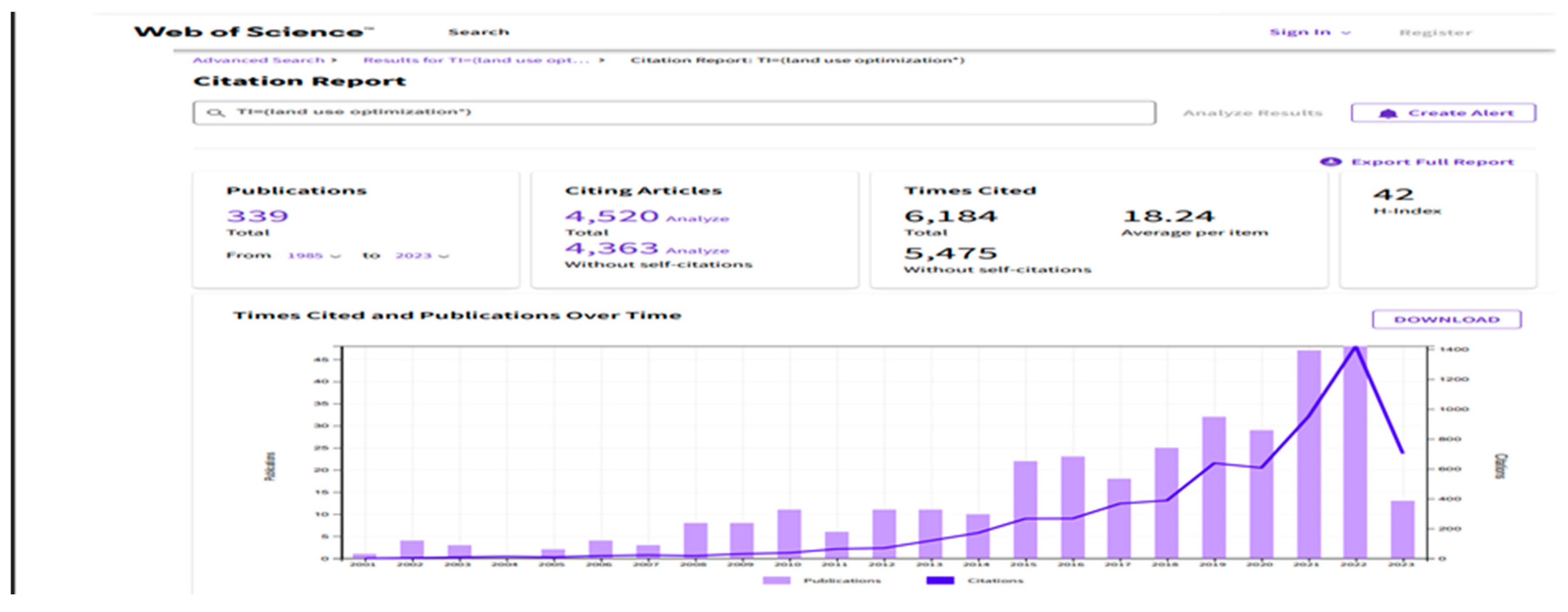
Appendex B. Citation counts by major clusters
| Cluster ID | Citation Counts | References | DOI |
| 0 | 49 | Stewart TJ, 2004, COMPUT OPER RES, V31, P2293 | 10.1016/S0305-0548(03)00188-6 |
| 1 | 42 | Cao K, 2012, COMPUT ENVIRON URBAN, V36, P257 | 10.1016/j.compenvurbsys.2011.08.001 |
| 0 | 37 | Cao K, 2011, INT J GEOGR INF SCI, V25, P1949 | 10.1080/13658816.2011.570269 |
| 0 | 34 | Aerts JCJH, 2003, GEOGR ANAL, V35, P148 | 10.1353/geo.2003.0001 |
| 0 | 34 | Ligmann-Zielinska A, 2008, INT J GEOGR INF SCI, V22, P601 | 10.1080/13658810701587495 |
| 0 | 22 | Aerts JCJH, 2002, INT J GEOGR INF SCI, V16, P571 | 10.1080/13658810210138751 |
| 3 | 21 | Costanza R, 1997, NATURE, V387, P253 | 10.1038/387253a0 |
| 2 | 21 | Liu XP, 2017, LANDSCAPE URBAN PLAN, V168, P94 | 10.1016/j.landurbplan.2017.09.019 |
| 1 | 18 | Deb K, 2002, IEEE T EVOLUT COMPUT, V6, P182 | 10.1109/4235.996017 |
| 1 | 17 | Liu XP, 2013, ECOL MODEL, V257, P11 | 10.1016/j.ecolmodel.2013.02.027 |
Appendex C. Summary of the largest 6 clusters
| Cluster ID | Size | Silhouette | Label (LSI) | Label (LLR) | Label (MI) | Avg. Year |
| 0 | 58 | 0.74 | land use | rural land use (43.41, 1.0E-4) | land-use pattern (1.65) | 2004 |
| 1 | 47 | 0.777 | case study | practical efficient regional land-use planning (25.91, 1.0E-4) | using accessibility map (1.85) | 2009 |
| 2 | 44 | 0.849 | case study | clue-s model (56.76, 1.0E-4) | potential area identification (1.39) | 2017 |
| 3 | 23 | 0.963 | land use pattern | land use pattern (75.62, 1.0E-4) | land use pattern evolution (0.41) | 2005 |
| 10 | 4 | 1 | a hierarchical optimization approach to watershed land use planning | watershed land use planning (16.92, 1.0E-4) | case study (0.08) | 1993 |
| 11 | 4 | 0.995 | two-stage land use optimization for a food-energy-water nexus system: a case study in Texas Edwards region | energy-water nexus system (12.42, 0.001) | case study (0.07) | 2018 |
Appendex D
(1). Citation burst papers generated during the database extraction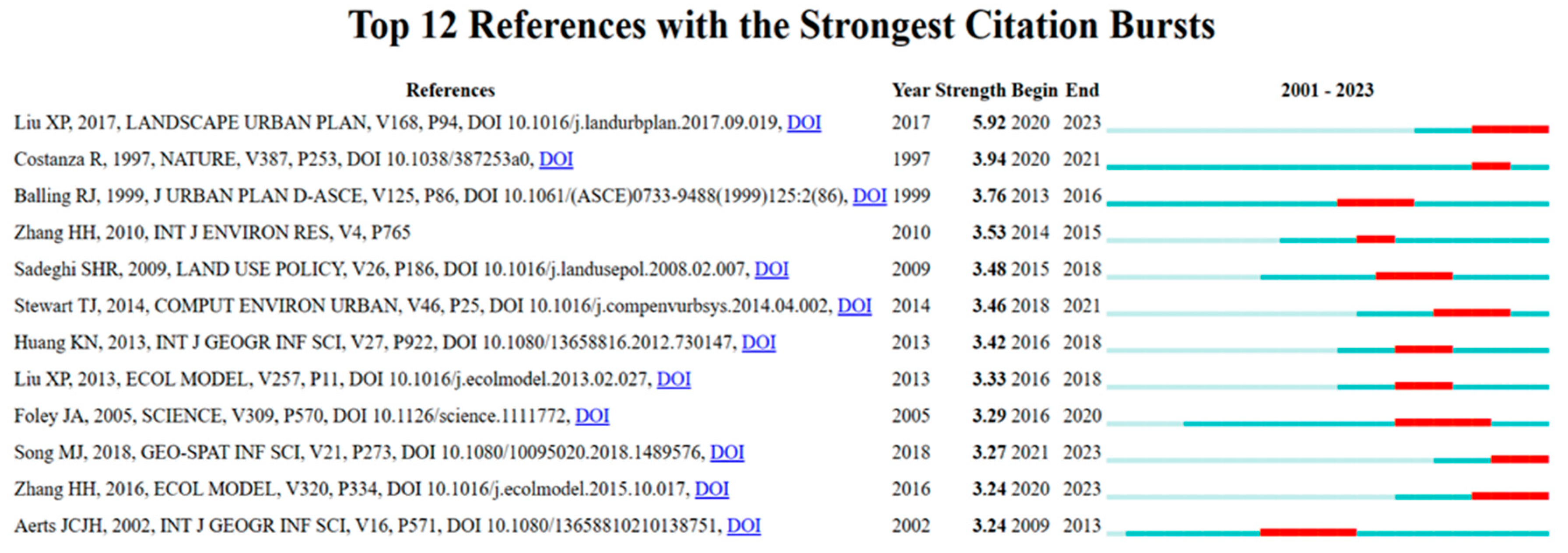
(2). Citation burst papers cited for background literature information versus (BLI) core research context (CRC)
| Cited paper | Citing paper | |||
| Author(s) and DOI | Research issue | Author(s) and DOI | Core research content | Cited content |
| Aerts and Heuvenlink (2002) https://doi.org/10.1080/13658810210138751 | Application of SA to high dimensional non-linear multi-objective multisite land allocation | Song and Chen (2018) https://doi.org/10.1080/10095020.2018.1489576 | Improved knowledge informed GA for Multiobjective land use allocation | BLI - Heuristic algorithms |
| Coa, et al., (2011) https://doi.org/10.1080/13658816.2011.570269 | Modified NSGA-II | BLI - Sustainable development | ||
| Luo and Huang (2023) https://doi.org/10.1080/13658816.2023.2178001 | Probabilistic based gradient multobjective land-use optimization | BLI - Gradient methods in optimization | ||
| Jahanishakib, et al (2022) https://doi.org/10.1080/10106049.2022.2037734 | validity and accuracy comparison b/n various algorithms in land-use allocation (including SA) | CRC - What SA it is and its application | ||
| Masoumi, et al. (2012) https://doi.org/10.1080/13658816.2012.698016 | Application of Particle Swarm Optimization for miultiobjective urban land use optimization | BLI - Heuristic algorithm | ||
| Huang et al (2012) https://doi.org/10.1080/13658816.2012.730147 | Application of improved artificial immune system for multi-objective land-use allocation | BLI - Heuristic algorithms | ||
| Damghani, et al (2014) https://doi.org/10.1080/13658816.2014.927471 | Application of hybrid heuristic algorithms to multiobjective land-use suitability assessment Quadratic Assignment Problem | BLI - Heuristic algorithms | ||
| Taromi, et al (2015) https://doi.org/10.1080/03081060.2014.997450 | multiobjective optimization model to consider transportation formulated as mixed integer programing | BLI - Iinteger programing | ||
| Yang, et al (2015) | Improved artificial bee colony algorithm optimize spatial problem | BLI - Heuristic algorithms | ||
| Paritosh, et al (2018) https://doi.org/10.1080/17509653.2018.1505566 | Application of GA and game theory to solve land allocation problem | BLI - Heuristic algorithms | ||
| Zhang et al (2016) https://doi.org/10.1016/j.ecolmodel.2015.10.017 |
Simulating optimal multiobjective land-use Applying multi-agent system and particle swarm |
Ma, et al (2022a) https://doi.org/10.1016/j.jclepro.2022.131191 | Urban growth boundary determination based on multiobjective land use optimization applying Pareto front degradation searching strategy where lands were defined as agents | CRC - application of agent in land use optimization |
| Ma, et al (2022b) https://doi.org/10.1016/j.cities.2022.103645 | Collaborative optimal allocation of urban land to determine growth boundary of urban agglomeration | BLI - The difficulty of transforming optimal land-use structures into spatial layout | ||
| Nauri, et al (2022) https://doi.org/10.1016/j.gsd.2022.100826 | An agent based optimization of water allocation (market) where farmers were represented as an agricultural agent | CRC - Application of agent in land use optimization | ||
| Ding and Achiten (2022) https://doi.org/10.1016/j.jclepro.2022.134914 | Linking agent-based modeling with the territorial Life Cycle Assessment to land-use planning | BLI - Complexity of spatial and temporal dynamics of territorial transformation | ||
| Zhang et al (2023) https://doi.org/10.1016/j.tust.2023.105046 | Optimizing Deep Underground Infrastructure layouts based on a multi-agent system where each DUI is represented by an agent | CRC - The se of multi-agent system | ||
| Fan et al (2023) https://doi.org/10.3390/land12040917 | Land-use simulation (optimization) using CLUMondo mode | BLI - Complexity of quantifying conflicting interests; Use of fractal dimension; Sensitivity of complex landscape patch boundary to human disturbance | ||
| Meng, et al (2023) https://doi.org/10.3390/su15053977 | Use of gray multiobjective optimization and Patch generating land-use simulation in land-use optimization (hybrid methods) | BLI - The relation of land-use structure optimization and sustainable development | ||
| Qin et al (2023) https://doi.org/10.1007/s11769-023-1327-3 | Ecosystem service value optimization for different scenarios | BLI - Previous studies on carbon sinks focus the relationship between carbon sinks and land use | ||
| Liu and Xia (2023) https://doi.org/10.3390/su15021401 | Optimization of land-use using Multi-Agent System and Multiobjective Particle Swarm Optimization | BLI - Chinese land-use planning hierarchies | ||
| Song and Chen (2018) https://doi.org/10.1080/10095020.2018.1489576 | Improved knowledge-informed NSGA-II for multiobjective land-use optimization | Masoumi and Genderen (2023) https://doi.org/10.1080/10095020.2023.2184729 | Compare performances of multiobjective optimization algorithm, NSGA-II, multiobjective particle swarm optimization, and multiobjective evolutionary algorithm in solving urban land-use allocation problems | BLI - Many studies applied multiobjective optimization algorithms at regional level; Type of data model in LU optimization; Scalarization of objectives; CRC - Comparison of GA, PPSO, SA |
| Niyomubyeyi, et al (2022) https://doi.org/10.1080/10095020.2022.2127380 | Improved or multi-objective land-use allocation | CRC - Improvement mechanisms to NSGA-II | ||
| Liu et al (2013) https://doi.org/10.1016/j.ecolmodel.2013.02.027 | Integration of system dynamics and hybrid PS optimization for solving land use allocation problems | Ma, et al (2022b) https://doi.org/10.1016/j.cities.2022.103645 | Collaborative optimal allocation of urban land to determine growth boundary of urban agglomeration | BLI - Planning process involves quantity predication and spatial arrangements |
| Sajith, et al (2022) https://doi.org/10.1016/j.agwat.2022.107638 | Comparison of Multiobjective GA, Cuckoo Search, and PPSO in agricultural land use optimization | BLI - Extensive application of artificial and swarm intelligence in land-use allocation optimization | ||
| Wei, et al (2022) https://doi.org/10.1016/j.ejrh.2022.101180 | Investigating whether converting types of agricultural land can mitigate soil erosion | CRC - Advantage of PSO over others for land-use optimization | ||
| Qu, et al (2023) https://doi.org/10.1016/j.scitotenv.2022.159319 | Coupling Markov and CA to solve the structural-spatial couple optimization problem | BLI - Wide application of hybrid models to solve land-use optimization | ||
| Yu, et al (2023) https://doi.org/10.3390/rs15143629 | Use of CA-Markov, Land Change Modeler, Patch-generating Land Use Simulation to simulate the LUCC | BLI - Description of quantitative prediction models in land-use optimization | ||
| Xu, et al (2023) https://doi.org/10.1007/s11430-022-1077-y | Study on past and future land use changes in the Qinghai-Tibet Plateau to reflect effects of different policies/scenarios | BLI - Dynamic system is among the main simulation modeling | ||
| Chen, et al (2023) https://doi.org/10.3390/land12030710 | Multi-objective particle swarm optimization algorithm to find the best land use adjustment strategies for village classification | BLI - Land-use optimization accounts current situation and multiple objectives | ||
| Wnag et al (2022) | Integrating transport into urban land-use optimization | BLI - How different studies consider accessibility | ||
| Cao, et al (2022) https://doi.org/10.3390/su142214941 | Modeling land use spatial conflict measurement based on a quantitative analysis of land use changes using GIS, Yaahp, and SPSSAU software | BLI - Advantage of entropy method in weighting objectives | ||
| Stewart and Janssens (2014) https://doi.org/10.1016/j.compenvurbsys.2014.04.002 | A special purpose GIS GA to solve both direct (additive) objectives and indirect (spatial) objective | Erosemiah and Viji (2023) https://doi.org/10.1007/s12594-023-2421-y | Accuracy in the extraction of the drainage network and morphometric analysis for assessing geomorphological characteristics and hydrological processes | BLI - Mentioning works undertaken to study the areas that are vulnerable to flood |
| Li, et al (2023) https://doi.org/10.3390/ijerph20054286 | Analyzing change in green space in different scenarios and the index characteristics of landscape patterns using FLUUS | BLI - Mentioning the authors optimized the spatial distribution of land resources using handling multiple objectives | ||
| Li, et al (2023) https://doi.org/10.1016/j.ecolind.2023.109950 | Evaluating the Carbon and GDP reconciliation using a multi-objective particle swarm algorithm | BLI - The authors utilized multi-objective programming | ||
| Basirati, et al (2023) Annals of Mathematics and Artificial Intelligence https://doi.org/10.1007/s10472-023-09853-2 | Compare performance of Synchronous Hypervolume-based NSGA-II and a memetic algorithm (MA) in which SH-NSGA-II is enhanced with a local search in Multiobjective Marian Spatial Planning Problem | BLI - The iterative approach in land-use optimization | ||
| Teijeiro, et al (2022) https://link.springer.com/article/10.1007/s11227-022-04627-9 | High performance GA in land-use optimization | BLI - The use of Ga in land use allocation | ||
| Sadeghi, et al (92009) https://doi.org/10.1016/j.landusepol.2008.02.007 Citations = 106 |
Land-use optimization based on ESV | Chen and Xu (2021) doi:10.1088/1755-1315/687/1/012042 | Adjusted dynamic two-stage optimization to explore comprehensive managerial insights of irrigative areas and forest expansion | BLI - The danger of water and soil erosion for sustainable development |
| Sheikh, et al (2021) https://doi.org/10.1111/nrm.12301 | NSGA-II for land use optimization that minimize runoff and sediment and maximize economic benefits, occupational opportunities, and land use suitability | BLI - Categorization of land optimization methods | ||
| Jiang et al (2021) https://doi.org/10.3390/su131810431 | Use multi-objective linear programming and CLUE-S to optimize under different scenarios | BLI - Land-use optimization need to address both economic and ecosystem elements | ||
| Zhang, et al (2021) https://doi.org/10.3390/land10111242 | Application of MOP and FLUS to optimize land-use allocation under strict ecological constraints | BLI - Optimization objectives are specific where the study area is small | ||
| Phinyoyang and Ongsomwang (2021) https://doi.org/10.3390/land10121317 | Allocate land use and land cover (LULC) to minimize the surface for flood mitigation using goal programing and CLUE-S | BLI - Land use optimization is one of the proper solutions for soil and water conservation at the watershed level | ||
References
- Alajmi, A. , and Wright, J. (2014). Selecting the most efficient genetic algorithm sets in solving unconstrained building optimization problem,” International Journal of Sustainable Built Environment, 3(1), 18-26. [CrossRef]
- Aerts, J.C.J.H. , van Herwijnen, M., Stewart, T.J. (2003). Using Simulated Annealing and Spatial Goal Programming for Solving a Multi Site Land Use Allocation Problem. In: Fonseca, C.M., Fleming, P.J., Zitzler, E., Thiele, L., Deb, K. (eds) Evolutionary Multi-Criterion Optimization. EMO 2003. Lecture Notes in Computer Science,. [CrossRef]
- Alexander, C. (1992). A City is Not a Tree. In The City Reader, 1st ed.; Routledge: New York, NY, USA, pp. 118–131.
- Allen, P.M. , & Sanglier, M. (1981a). A dynamic model of central place system – II. Geographical Analysis, /: Wiley Online Library, https, 1111. [Google Scholar]
- Allen, P. M. , & Sanglier, M. (1981b). Urban evolution, self-organization, and decision making. Environment and Planning, /: https. [CrossRef]
- Al-Thani, S.K. , Amato, A., Kok, M., & Al-Ghamid, S. G. (2019). Urban sustainability and livability: An analysis of Doha’s urban-form and possible mitigation strategies. Sustainability. [CrossRef]
- Anas, A. , & Kim, I. (1996). General equilibrium models of polycentric endogenous congestion and job agglomeration. ( 40(2), 232–256. [CrossRef]
- Anas, A. , Arnott, R., & Small, K. A. (1997). Urban spatial structure. Transport Center, The University of California Working paper No. 357, 4981. [Google Scholar]
- Andersson, R. , & Samartin, A. (1985). A Model for Urban Commuting in a Multicenter City. University of Stockholm, Sweden. ( 20(2), 173–191. [CrossRef]
- Anthony, A.F. , Offia. I.E., Abidemi. B.R., Oladunjoye Kola, O., & Kamoru, G.G. (2018). Urban Sustainability Concepts and Their Implications on Urban Form. Urban and Regional Planning, /: https, 1164. [Google Scholar]
- Ashenafi, A. (2015). Optimization based approach for landuse/transportation policy making, /: thesis, Faculty of Sciences and Technology, University of Coimbra. https, 1031. [Google Scholar]
- Bertaud, A. (2004). The Spatial Organization of Cities : Deliberate Outcome or Unforeseen Consequence? Institute of Urban and Regional Development University of California at Berkeley, Working Paper No. 2004-01. 4513. [Google Scholar]
- Boussauw, K. & F. Witlox. (2009). Introducing a commute-energy performance index for Flanders. Transportation Research Part A. [CrossRef]
- Broitman, D. (2012). Dynamics of polycentric urban structure Dynamics of polycentric urban structure, 2012. [Google Scholar]
- Burton, E. (2000). The Potential of the Compact City for Promoting Social Equity. In Achieving Sustainable Urban Form. Taylor Francis: London, UK, pp. 19–29.
- Cao, K. , Batty, M., Huang, B., Liu, Y., Yu, L., & Chen, J. (2011). Spatial multi-objective land use optimization: Extensions to the non-dominated sorting genetic algorithm-II. International Journal of Geographical Information Science, 1969. [Google Scholar] [CrossRef]
- Cao, K. , Huang, B., Wang, S., & Lin, H. (2012). Sustainable land use optimization using Boundary-based Fast Genetic Algorithm. Computers, Environment and Urban Systems, 36(3), 257–269. [CrossRef]
- Chakir, R.; Le Gallo, J. (2013). Predicting land use allocation in France: A spatial panel data analysis. Ecological Economics. 92, 114–125. [CrossRef]
- Chen, X. , Zhao, R. ( 12(6), 1164. [CrossRef] [PubMed]
- Cheng, S. , Chan, C.W., & Huang, G.H (2003). An integrated multi-criteria decision analysis and inexact mixed integer linear programming approach for solid waste management. Engineering Applications of Artificial Intelligence, 16(5–6): 543–554. /: https. [CrossRef]
- Chieng, H. , and Wahid, N. (2014). A performance comparison of genetic algorithm’s mutation operators in n-cities open loop travel salesman problem. Recent Advances on Soft Computing and Data Mining, /: https, 1007. [Google Scholar]
- Chuvieco, E. (1993). Integration of linear programming and GIS for land use modelling. International Journal of Geographical Information Science. [CrossRef]
- Clark, W.C. , van Kerkhoff, L., Lebel, L., & Gallopin, G.C. (2016). Crafting usable knowledge for sustainable development. C. ( 113, 4570–4578. [CrossRef]
- De Lara, M. , De Palma, A., Kilani, M., & Piperno, S. (2013). Congestion pricing and long term urban form: Application to Paris region. Reginal Science and Urban Economics, 43(2), 282–295. [CrossRef]
- Deb, K. , Pratap, A., Agrawal, S., & Meyarivan, T. (2002). A fast and elitist multiobjective genetic algorithm: NSGA-II. IEEE Transactions on Evolutionary Computation. [CrossRef]
- Ding, X. , Zheng, M., & Zheng, X. (2021). The application of genetic algorithm in land use optimization research: A review. Land. [CrossRef]
- Dong, C. , Huang, G. H., Tan, Q. Cai, Y. (2014). Coupled planning of water resources and agricultural landuse based on an inexact-stochastic programming model. Frontiers of Earth Science, /: 70–80. https. [CrossRef]
- Donthu, N. , Kumar, S., Mukherjee, D., Pandey, N., & Lim, W. M. (2021). How to conduct a bibliometric analysis: An overview and guidelines. Journal of Business Research. [CrossRef]
- Ewing, R. (1997). Is Los Angeles Style Sprawl Desirable? Journal of the American Planning Association. [CrossRef]
- 30. Frost. A.D., Hróbjartsson, A., & Nejstgaard, C.A. (2022). Adherence to the PRISMA-P 2015 reporting guideline was inadequate in systematic review protocols. Journal of Clinical Epidemiology. [CrossRef]
- García, G.A. , Rosas, E.P., García-Ferrer, A., & Barrios, P.M. (2017). Multi-Objective Spatial Optimization: Sustainable Land Use Allocation at Sub-Regional Scale. Sustainability, 2071. [Google Scholar]
- Guth, D. , Holz-Rau, C., & Maciolek, M. (2009). Employment suburbanisation and commuter traffic in German city regions. 9th Swiss Transport Research Conference, 1: Switzerland, Sep. 9-11, 1-22. https://api.semanticscholar.org/CorpusID, 1301; -11. [Google Scholar]
- Handayanto, R.T. , Tripathi, N.K., Kim, S.M., & Guha, S. (2017). Achieving a sustainable urban form through land use optimisation: Insights from Bekasi City’s land use plan (2010-2030). Sustainability (Switzerland). [CrossRef]
- Hakimi, D. , Oyewola, D.O., Yahaya, Y. and Bolarin, G. (2016). Comparative analysis of genetic crossover operators in Knapsack problem. Journal of Applied Environmental Management, 1: 593-596. https://api.semanticscholar.org/CorpusID, 1259. [Google Scholar]
- Hasegawa, T. , Fujimori, S., Ito, A., Takahashi, K., & Masui, T. (2017). Global land use allocation model linked to an integrated assessment model. ( 580, 787–796. [CrossRef] [PubMed]
- Jabareen, Y.R. (2006). Sustainable urban forms: Their typologies, models, and concepts. Journal of Planning Education and Research. [CrossRef]
- Jahanishakib, F. , Ardakani, T., Sabaee, M. S., & Salmanmahiny, A. (2022). Accuracy and validity assessment of application algorithms in land use allocation into comparison LP, SA, MOLA and MDCHOICE. Geocarto International, /: https, 1061. [Google Scholar]
- Jenks, M. , & Burgess, R. Eds. (2000). Compact cities: sustainable urban forms for developing countries. London and New York: Spon Press. https://api.semanticscholar.org/CorpusID:152608747.
- Jeroen, C.J.H. Aerts, Gerard, B.M., & Heuvelink (2002). Using simulated annealing for resource allocation. International Journal of Geographical Information Science, /: https, 1080. [Google Scholar]
- Jin, X. , Jiang, P., Ma, D., & Li, M. (2019). Land system evolution of Qinghai-Tibetan Plateau under various development strategies. Applied Geography, 104, 1–9.
- Kaim, A. , Cord, A.F., & Volk, M. (2018). A review of multi-criteria optimization techniques for agricultural land use allocation. Environmental Modelling and Software. [CrossRef]
- Kenworthy, J. , Fansler, D., & Newman, P. (1989). Cities and automobile dependence: An international sourcebook.
- Krehl, A. , Siedentop, S., Taubenböck, H., & Wurm, M. (2016). A Comprehensive View on Urban Spatial Structure: Urban Density Patterns of German City Regions. International Journal of Geo-Information, 5(76), pp. 1-21. https://api.semanticscholar.org/CorpusID:1366807.
- Kumar, S.G. , and Panneerselevam, R. (2017). A study of crossover operators for genetic algorithm to solve VRP and its variants and new Sinusoidal Motion crossover operator. International Journal of Computational Intelligence Research, 1: 1717-1735. https://api.semanticscholar.org/CorpusID, 1717. [Google Scholar]
- Li, C. , Wu, Y., Gao, B., Zheng, K., Wu, Y., & Li, C. (2021). Multi-scenario simulation of ecosystem service value for optimization of land use in the Sichuan-Yunnan ecological barrier, China. Ecological Indicators. [CrossRef]
- Li, G. , Zhao, Z. ( 149(1), 1–14. [CrossRef] [PubMed]
- Li, X.X. , Ma, W.Y., & Xu, L. (2013). Land use structure optimization research based on the Markov chain in the west of Jilin province. Research of Soil and Water Conservation, 1: https://api. semanticscholar.org/CorpusID, 1317. [Google Scholar]
- Li, X. , & Ma, X. (2017). An uncertain programming model for land use structure optimization to promote effectiveness of land use planning. ( 27(6), 974–988. [CrossRef]
- Li, X. , & Ma, X. (2018). An improved simulated annealing algorithm for interactive multi-objective land resource spatial allocation. Ecological Complexity. [CrossRef]
- Li, X. , Xu, H., Ma, X., & Huang, Y. (2023). A two-step spatially explicit optimization approach of integrating ecosystem services (ES) into land use planning (LUP) to generate the optimally sustainable schemes. Land Degradation and Development, 2522. [Google Scholar] [CrossRef]
- Liao, G.T. , He, P. , Gao, X.S., Lin, Z.Y., Huang, C.Y., Zhou, W., Deng, O.P., Xu, C.H., & Deng, L.J. (2022). Land use optimization of rural production-living-ecological space at different scales based on the BP-ANN and CLUE-S models. Ecological Indicators, 2022, 137, 108710. [Google Scholar] [CrossRef]
- Ligmann-Zielinska, A. , Church, R., & Jankowski, P. (2008). Spatial optimization as a generative technique for sustainable multiobjective land use allocation. ( 22(6), 601–622. [CrossRef]
- Liu, Y. , Yu, Y., Guo, H.., Yang, P. (2009). Optimal land use management for surface source water protection under uncertainty: a case study of Songhuaba watershed (Southwestern China). Water Resources Management, /; 2069–2083. [CrossRef]
- Liu, C. , Deng, C., Li, Z., Liu, Y., & Wang, S. (2022). Optimization of Spatial Pattern of Land Use: Progress, Frontiers, and Prospects. International Journal of Environmental Research and Public Health. [CrossRef]
- Liu, G. , Jin, Q., Li, J., Li, L., He, C., Huang, Y., & Yao, Y. (2017). Policy factors impact analysis based on remote sensing data and the CLUE-S model in the Lijiang River Basin, China. CATENA. [CrossRef]
- Liu, H. , Yan, F., & Tian, H. (2022). Towards low-carbon cities: Patch-based multi-objective optimization of land use allocation using an improved non-dominated sorting genetic algorithm-II. Ecological Indicators, 34, 108455. [CrossRef]
- Liu, X. , Ou, J., Li, X., & Ai, B. (2013). Combining system dynamics and hybrid particle swarm optimization for land use allocation. ( 257, 11–24. [CrossRef]
- Liu, Y. , Tang, W., He, J., Liu, Y., Ai, T., & Liu, D. (2014). A land use spatial optimization model based on genetic optimization and game theory. ( 49, 1–14. [CrossRef] [PubMed]
- Longato, D. , Cortinovis, C., Albert, C., & Geneletti, D. (2021). Practical applications of ecosystem services in spatial planning: Lessons learned from a systematic literature review. Environmental Science & Policy. [CrossRef]
- Lu, S. S. , Zhou, M., Guan, X. L., & Tao, L. (2015). An integrated GIS-based interval-probabilistic programming model for land use planning management under uncertainty: a case study at Suzhou, China. Environmental Science and Pollution Research International, 22(6): 4281–4296. https://doi.10.1007/ s11356-014-3659-0.
- Ma, S. , Zhang, Y., & Sun, C. (2019). Optimization and Application of Integrated Land Use and Transportation Model in Small-and Medium-Sized Cities in China. Sustainability, 11(9) 2555. [CrossRef]
- Magalhaes-Mendes, J. (2013). A comparative study of crossover operators for genetic algorithms to solve the job shape scheduling problem. WSEAS Transactions Computations, 9: https://api. semanticscholar.org/CorpusID, 9217. [Google Scholar]
- Masnavi, M.R. (2000). The New Millennium and the New Urban Paradigm: The Compact City in Practice. In Achieving Sustainable Urban Form. Taylor Francis: London, UK, pp. 64–73.
- Masoumi, Z. & van Genderen, J. (2023). Artificial intelligence for sustainable development of smart cities and urban land use management. Geo-spatial Information Science. [CrossRef]
- Matthews, K.B. , Sibbald, A.R., & Craw, S. (1999). Implementation of a spatial decision support system for rural land use planning: Integrating geographic information system and environmental models with search and optimisation algorithms. Computers and Electronics in Agriculture. [CrossRef]
- Mehari, A. , and Genovese, Paolo. (2023). Modeling Global and Local Aspects of Spatial Structure Explicitly in land use Optimization: The Case of Mek’ele City, Ethiopia. Chinese Journal of Urban and Environmental Studies, /: 1-35. https, 1142. [Google Scholar]
- Memmah, M.M. , Lescourret, F. ( 35(3), 975–998. [CrossRef]
- Zhou, M. , Cai, Guan, X., Tan, S., & Lu, S. (2015). A hybrid inexact optimization model for land use allocation of China. ( 25, 62–73. [CrossRef]
- Misevicius, A. , & Kilda, B. (2005). Comparison of crossover operators for the quadratic assignment problem. Information Technology and Control, 1: https://api.semanticscholar.org/CorpusID, 1409. [Google Scholar]
- Mohammadyari, F. , Tavakoli, M., Zarandian, A., & Abdollahi, S. (2023). Optimization land use based on multi-scenario simulation of ecosystem service for sustainable landscape planning in a mixed urban - Forest watershed. Ecological Modelling. [CrossRef]
- Moher, D. , Liberati, A., Tetzlaff, J., & Altman, D. G. (2009). Preferred reporting items for systematic reviews and meta-analyses: the PRISMA statement. Research Methods & Reporting, 1371. [Google Scholar]
- Mori, T. (2006). Monocentric versus polycentric models in urban economics. Kyoto Institute of Economic Research Kier discussion paper series No. 611. http://www.kier.kyoto-u.ac.jp/index.
- Nie, X.H. , Huang, G.H., Wang, D. && Li, H.L. (2008). Robust optimisation for inexact water quality management under uncertainty. Civil Engineering and Environmental Systems, 25(25): 167–184. https://doi.10.1080/10286600801908964.
- Ning, S. , Zhang, Z. N. ( 2019). Optimization of land use structure based on ecological service value in Manas River Basin. Acta Ecol. Sin. 39, 5208–5217.
- Otman, A. , and Jaafar, A. (2014). A comparative study of adaptive crossover for GA to resolve the travel salesman problem. International Journal of Computer Applications.
- Ou, D. , Zhang, Q., Tang a, H., Qin, J., Yu, D., Deng, O., Gao, X., & Liu, T. (2023). Ecological spatial intensive use optimization modeling with framework of cellular automata for coordinating ecological protection and economic development. Science of the Total Environment. [CrossRef]
- Pan, T. , Zhang, Y., Su, F., Lyne, V., Cheng, F., & Xiao, H. (2021). Practical Efficient Regional Land-Use Planning Using Constrained Multi-Objective Genetic Algorithm Optimization. ISPRS International Journal of Geo-Information, 10(2), 100. [CrossRef]
- Paritosh, P. , Kalita, B. & Sharma, D. (2019). A game theory based land layout optimization of cities using genetic algorithm. International Journal of Management Science and Engineering Management, /: https, 1080. [Google Scholar]
- Rahman, M.M. , & Szabó, G. (2021). Multi-objective urban land use optimization using spatial data: A systematic review. Sustainable Cities and Society, /: https, 1016. [Google Scholar]
- Randolph, J. (2004). Environmental Land Use Planning and Management.
- Reid, E. , Greenwald., M, Zhangm M., Walters, J., Feldman, M., Cervero, R., Frank, L., & Thomas, J. (2011). Traffic generated by mixed-use developments - Six-region study using consistent built environmental measures. Journal of Urban Planning and Development, /: https, 1061. [Google Scholar]
- Sajith, G. , Srinivas, R., Golberg, A., and Magner, J. (2022). Bio-inspired and artificial intelligence enabled hydro-economic model for diversified agricultural management. Agricultural Water Management. [CrossRef]
- Sdshu, W. , Wkh, H. ( 2008). Genetic algorithm for dynamic land use optimization. IEEE Congress on Evolutionary Computation, 3816–3821.
- Seppelt, R. , & Voinov, A. (2002). Optimization methodology for land use patterns using spatially explicit landscape models. In Ecological Modelling, 151. https://doi.10.1016/S0304-3800(01) 00455-0.
- Sharmin, T. (2011). A comparative study of sustainable urban forms: Compact city and short cycle strategy. AIUB Journal of Science and Engineering, /: 10(1), 1-9. https, 3135. [Google Scholar]
- Simmonds, D. & Coombe, D. (2000). The Transport Implication of Alternative Urban Form. In Achieving Sustainable Urban Form 2. Taylor Francis: London, UK, pp. 121–130.
- Snyder, H. (2019). Literature review as a research methodology: An overview and guidelines. Journal of Business Research. [CrossRef]
- St. John, R., & Tóth, S.F. (2015). Spatially explicit forest harvest scheduling with difference equations. F. ( 232(1), 235–257. [CrossRef]
- Stead, D. , Williams, J., & Tifheridge, H. (2000). “Land Use, Transport and People: Identifying the Connections”. In Achieving Sustainable Urban Form, Taylor Francis: London, UK, pp. 174–186.
- Tayyebi, A. , & Pijanowski, B. C. (2014). Modeling multiple land use changes using ANN, CART and MARS: Comparing tradeoffs in goodness of fit and explanatory power of data mining tools. International Journal of Applied Earth Observation and Geoinformation. [CrossRef]
- Verburg, P.H. , Tabeau, A., & Hatna, E. (2013).Assessing spatial uncertainties of land allocation using a scenario approach and sensitivity analysis: A study for land use in Europe. Journal of Environmental. Management, 127, S132–S144. [CrossRef]
- Verburg, P.H. , Soepboer, W., Veldkamp, A., Limpiada, R. & Espaldon, V. (2002). Modeling the spatial dynamics of regional land use: the CLUE-S model. Environmental Management. [CrossRef]
- Wang, Y. , Li, X., Zhang, Q., Li, J., & Zhou, X. (2018). Projections of future land use changes: Multiple scenarios-based impacts analysis on ecosystem services for Wuhan city, China. Ecological Indicators. [CrossRef]
- Wang, Z. , Han, Q., & De Vries, B. (2022). Land Use Spatial Optimization Using Accessibility Maps to Integrate Land Use and Transport in Urban Areas. ( 15(4), 1193–1217. [CrossRef]
- Wu, X. , Wang, S., Fu, B., Liu, Y., & Zhu, Y. (2018). Land use optimization based on ecosystem service assessment: A case study in the Yanhe watershed. Land Use Policy. [CrossRef]
- Yang, O. , & Hongyun, H. (2015). The study of the comparison of three crossover operators in genetic algorithm for solving single machine scheduling problem. In ICMSE, https://doi.10.2991/ icmse-15.2015.55.
- Yang, X. , Zheng, X. Q., & Lv, L. N. (2012). A spatiotemporal model of land use change based on ant colony optimization, Markov chain and cellular automata. N. ( 233, 11–19. [CrossRef]
- Yang, Z. , Zhu, X., & Moodie, D. R. (2015). Optimization of Land Use in a New Urban District. R. ( 141(2), 1–10. [CrossRef]
- Yao, J. , Zhang, X., & Murray, A. T. (2018). Spatial Optimization for land use Allocation: Accounting for Sustainability Concerns. International Regional Science Review. [CrossRef]
- Yuan, M. , Liu, Y., He, J., & Liu, D. (2014). Regional land use allocation using a coupled MAS and GA model: From local simulation to global optimization, a case study in Caidian District, Wuhan, China. Cartography and Geographic Information Science. [CrossRef]
- 101. Zhang H H, Zeng Y N, & Bian L. (2010). Simulating multi-objective spatial optimization allocation of land use based on the integration of multi-agent system and genetic algorithm. International Journal of Environmental Research, 1766.
- Zhang, H. , Zeng, Y., Jin, X., Shu, B., Zhou, Y., & Yang, X. (2016). Simulating multi objective land use optimization allocation using Multi-agent system-A case study in Changsha, China. Ecological Modelling,. [CrossRef]
- Zheng, W.W. , Ke, X.L., Xiao, B.Y., & Zhou, T. (2019). Optimising land use allocation to balance ecosystem services and economic bene-fits - A case study in Wuhan, China. Journal of Environmental Management, 248, 109306. https://doi.0.1016/j.jenvman.2019.109306.
- Zheng, X.Q. , Zhao, L., Xiang, W.N., Li, N., Lv, L.N., &; Yang, X. (2012). A coupled model for simulating spatio-temporal dynamics of land use change: A case study in Changqing, Jinan, China. Landscape and Urban Planning. [CrossRef]
- Zhu, W. , Gao, Y., Zhang, H., & Liu, L. (2020). Science of the Total Environment Optimization of the land use pattern in Horqin Sandy Land by using the CLUMondo model and Bayesian belief network. ( 739, 139929. [CrossRef] [PubMed]
| [1] | |
| [2] | |
| [3] | |
| [4] |
Figure 3.
Temporal trajectory of keywords plot.
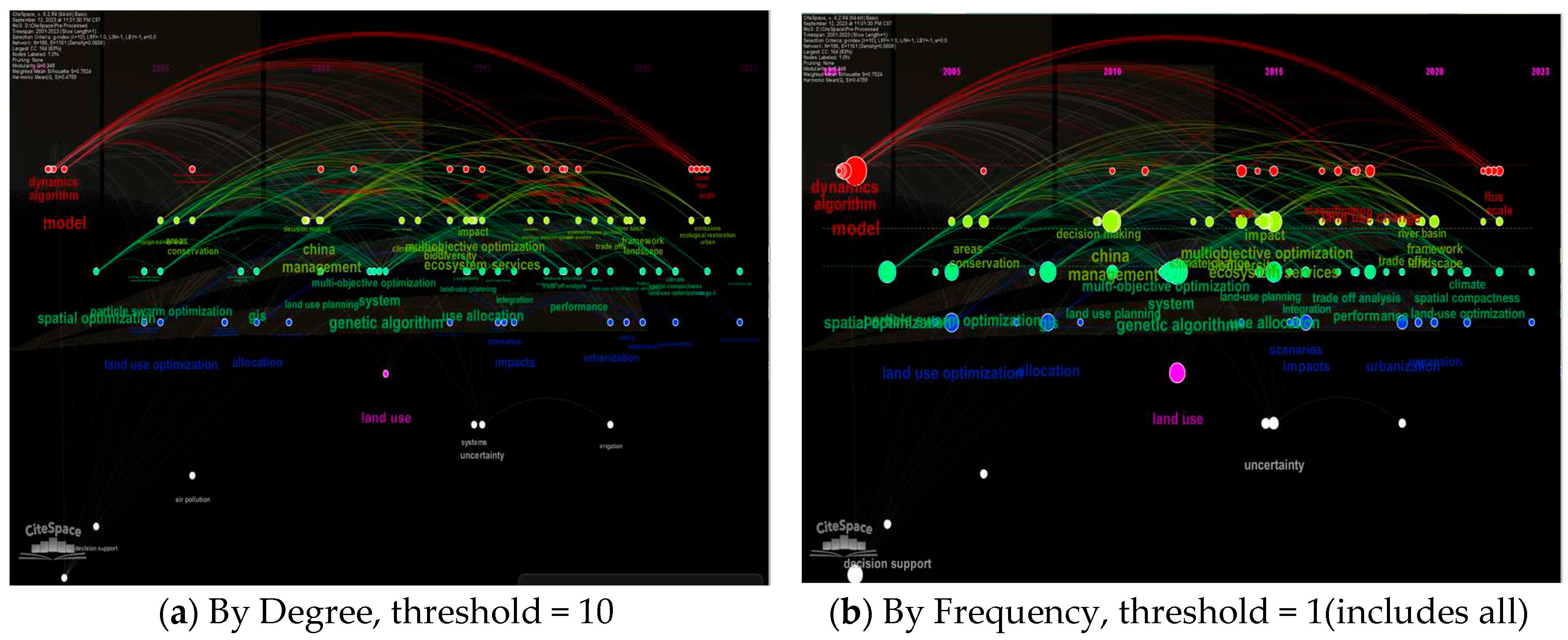

Table 1.
The trajectory of literature development path.
| Ref. | Identified gap | Suggested direction/implication for |
| 2002 | Optimization methods are problem-dependent. No generalized behavior | Improve the efficiency of algorithms; Comparison of multiple scenarios |
| 2008 | Mismatch between optimization methods and planning perspective. I.e. assumption of determinate time | Intertemporal approach |
| Global optimization was implemented as general management. The problem still persists in urban land use problems | Detailing objectives to quantify resources | |
| 2015 | Coupling was not mature enough | Wide application and research |
| Limitations of local scale optimizers (game theory) applied independently | Hybridization with global optimizers | |
| 2017 | Determinate assumption of constraints | Modeling uncertainty |
| 2018 | Any trade-off is considered acceptable alternative | Minimizing magnitude of tradeoffs among objectives is a quality advantage |
| 2020 | Land use change driving factors are not considered. | Building probability of land use change factors into simulation |
| 2021 | Global optimizers lack layout capability while local optimizers lack structure capability | Coupling top-down and bottom-up becomes normative approach |
| 2023 | Spatial layout determined by local optimizers is affected by the historical trends of the land use change process | Spatial suitability analysis /horizontal process/ |
| Heterogeneity nature of spatial units providing ecosystem services is affected by the logical rule historical trend of the layout optimizers | Open |
Table 2.
Categorization of the sampled 19 articles by their focus of core content.
| Author(s) | Geog. domain | Core content | Objectives | Method |
| Seppelt, et al (2002) | Watershed | ES based optimization under different land use management scenarios | Min. fertilizer use, Min. nutrient outflow and Max. economic yield | Monte Carlo; GA |
| Sadeghi et al. (2009) | Watershed | ES based optimization | Min. soil erosion and Max. Economic benefit | Simplex-LP |
| Jin, et al (2010) | Management farming | Temporal dimension of land use planning | Max. income | GA |
| Liu, et al (2015) | Urban-rural region | Coordination of land uses at local level | Max. Suitability of land for a certain use and Max. Compactness | GA; DyGT |
| Yang, et al (2015) | City | Residential choice model in land use planning | Max. Quality of life for workers and Max. Productivity of facilities | GA |
| Li and Ma (2017) | City | Uncertainty incorporation in land use planning | Max. GDP Ecological benefit (ESV) |
GA |
| Hadayanto, et al ((2017) | City | Zoning mechanism in land use planning | Max. Compactness; Max. Compactness; Max. Dependency; Max. suitability | PSO; GA; Local search |
| Zhu,et al (2020) | Large region | Land use change driving factors; Probability surface based land use optimization | Priority of land use type i | CLUMondo BBN |
| Wang, et al (2022) | City | Accessibility model in land use planning | Max. Accessibility; Max. Compactness; Max. Suitability | NSGA-II |
| Ligmann-Zielinska et al (2008) | City | Compact form of sustainable city concept in land use planning | Min. Open space development; Min. Redevelopment; Min. Distance of new development site; Max. compatibility | GIS-MOLA |
| Yang, et al (2012) | District of a city | Hybrid optimization method for modeling land use change | NA | Markov-CA; ACO-CA |
| Cao, et a (2012) | City | Efficiency of NSGA-II for implementation | Max. GDP; Max. Environmental benefit; Max. Ecological suitability; Max. Accessibility; Max. Compactness; Max. Compatibility; Min. Use conversion; Max. NIMBY |
NSGA-II |
| Wu, et al (2018) | Watershed | Effect of land use change over ES | Max. Agricultural production ; Max. Sediment retention ; Max. Carbon sequestration ; Max. Water quality; Max. sustainability of water production |
InVEST; Biophysical models |
| C Li, et al (2021) | Large region | Effect of land use change over ES | Economic benefits Max. ESV |
GMOP and PLUS |
| G Li, et al (2023a) | Large (rural + cities) | Application of hybrid methods for land use optimization | ESVs | DyMOO; CLUE-S; MCR |
| X Li, et al (2023b) | City region | Method of integrating ecological benefits into land use planning | ESVs Land use suitability |
MOOLP CLUE-S |
| Chen, et al (2023) | Urban agglomeration | Embedding land use optimization in ecological suitability | ESVs land use suitability |
MOLP; DyCLUE; MCR |
| Mohammedyari, et al (2023) | Urban region | Application of hybrid methods for land use optimization | Max. Farm production; Max. Water yield; Max. Habitat quality; Max. Sediment retention; Max. Recreational quality; Max. Aesthetic quality | SA-GA |
Disclaimer/Publisher’s Note: The statements, opinions and data contained in all publications are solely those of the individual author(s) and contributor(s) and not of MDPI and/or the editor(s). MDPI and/or the editor(s) disclaim responsibility for any injury to people or property resulting from any ideas, methods, instructions or products referred to in the content. |
© 2023 by the authors. Licensee MDPI, Basel, Switzerland. This article is an open access article distributed under the terms and conditions of the Creative Commons Attribution (CC BY) license (https://creativecommons.org/licenses/by/4.0/).
Copyright: This open access article is published under a Creative Commons CC BY 4.0 license, which permit the free download, distribution, and reuse, provided that the author and preprint are cited in any reuse.


