

Submitted:
13 September 2023
Posted:
19 September 2023
You are already at the latest version
Abstract
Castor oil may be differentiated from other non-edible vegetable oils because of its main composition of hydroxylated fatty acids. Ricinoleic acid comprises 80–90% wt. of fatty acids in castor oil (Ricinus communis). In this study, the thermo-oxidative stability and tribological behavior of bio-based lubricant samples synthesized from castor oil using isoamyl alcohol were evaluated. Initially, the compositional and physicochemical properties of the obtained samples were assessed using 1H NMR, FTIR, and ASTM methods. Oxidative stability of the samples was evaluated using Rancimat method at 110 °C under air flow. The final biolubricant sample (BL2), obtained after esterification, epoxidation, and oxirane rings opening reactions, presented an oxidation stability time (OST) of 14.3 h. The thermal stability was also evaluated by thermogravimetry (TG) from the mass variations under inert and oxidative atmosphere. BL2 showed higher thermal stability compared to the other samples, demonstrating higher decomposition temperatures in both inert (339.04 °C) and oxidative (338.47 °C) atmospheres, for a mass loss of 50%. The tribological properties of the samples were evaluated using a four-ball tribometer configuration. The BL1 and BL2 samples exhibited lower friction coefficients than the mineral oil sample (MOS) by 21.5% and 43.1%, respectively. Regarding wear, the observed wear scar diameter (WSD) was also lower in BL1 and BL2 compared to MOS by 5.2% and 40.4%, respectively. The results of the tribological evaluation suggest that both samples obtained in this study have promising potential for applications in lubricating machines and mechanical systems.
Keywords:
bio-based lubricant
; thermal stability
; tribology
1. Introduction
World lubricants demand keeps increasing as well as the concern about the environmental hazards associated with non-sustainable petrochemicals. Lubricants are used primarily to reduce friction between surfaces and expand machinery lifespan [1]. Typical lubricants consist of mineral or synthetic oils that contain mainly paraffinic, naphthenic and aromatic (to a lesser extent) hydrocarbons [2]. As happens in extraction and refining of petroleum-derived products, spilling during transportation and improper disposal of lubricants may lead to soil contamination and groundwater pollution [3,4]. Therefore, economic and ecological factors require renewable lubricant base oils with higher biodegradability and lower toxicity for satisfying growing performance standards and increasingly stringent environmental regulations [5,6].
Brazil’s green market has a wide variety of potential oilseeds for biofuel production [7]. An interesting alternative to conventional lubricants is the use of fatty acids to obtain the so-called biolubricants. The possibility of using different vegetable oils, alcohols, and other materials may be beneficial in designing a wide range of products with varied physicochemical and tribological properties [8]. Bio-based oils have most of the properties required for lubricants such as high viscosity indices, low volatility, good lubricity and improved compatibility with additives molecules [9,10]. Despite the advantageous aspects of biolubricants, vegetable oils usually present poor thermo-oxidative stability, deposit-forming tendencies and hydrolytic instability [11]. Edible vegetable oil feedstocks show limitations on industrial applications, so that non-edible plant oils are potential biolubricant source options [12].
Castor oil (Ricinus communis) is an attractive feedstock for bio-based fuels and lubricants production [13,14,15,16]. This vegetable oil has high content of ricinoleic acid (approximately 90% wt.), which is a multifunctional compound used as chemical precursor in different synthesis routes [17,18,19,20]. The hydroxyl group in the ricinoleic acid molecule has a noticeable effect on the physicochemical properties of castor oil [21]. Also, chemical modifications on the ricinoleic acid molecule, such as saponification, esterification, epoxidation and hydrogenation, may improve some properties observed in castor oil [22].
Chemically modified bio-based oils can be used for several applications ranging from pour point depressants to boundary lubricants [23,24,25]. Some bio-based lubricants may have special properties, which reduce friction and prevent direct metal-to-metal contact through a thin film [26]. Polar functional groups attached to long carbon chains enable the oil molecules to cling to metal surfaces while sliding over themselves [11,18]. Thus, the antiwear/antifriction tribofilm acts as a protective layer for moving surfaces, which is essential in machining processes.
Nowadays, environmentally friendly lubricants are emphasized mostly due to renewability, biodegradability and sustainability. However, variations in chemical composition of vegetable oils remain a challenge to reach a final utilization for their oleochemicals [27,28]. Continuously, research studies have been focused on surpassing the shortcomings of bio-based lubricants while improving their applicability [29,30,31,32]. High-quality bio-based lubricants with higher performance are a feasible reality and a relevant option to mitigate environmental impacts.
In this study, the thermo-oxidative stability and tribological behavior of bio-based lubricants, synthesized using isoamyl alcohol, were evaluated. The esterification reaction between castor oil fatty acids and isoamyl alcohol was followed by epoxidation and epoxide ring-opening reactions, using the same alcohol as nucleophilic agent. The main chemical and physicochemical properties of samples were measured. The thermo-oxidative stability and tribological properties of the intermediate and final obtained samples were evaluated.
2. Materials and Methods
2.1. Materials
In this study Castor Oil Fatty Acids (COFA, 80 to 90 % wt. of ricinoleic acid) was provided by Miracema-Nuodex (Brazil). The physicochemical properties of COFA sample are shown in Table 1. Toluene (> 99 % wt.), hydrogen peroxide (30 % wt.), formic acid (95 % wt.), p-toluenesulfonic acid (> 98 % wt.), sodium bicarbonate (> 99.7 % wt.), sodium chloride (> 99 % wt.), and anhydrous sodium sulfate (> 99 % wt.) were purchased from Sigma-Aldrich (USA). Isoamyl alcohol (3-methyl-1-butanol, > 98 % wt.) was purchased from Neon (Brazil). Nitrogen gas (99.999 % vol.) was supplied by White Martins Praxair (Brazil). All chemicals were used as received, without further treatment. A commercial mineral oil sample (MOS), used as reference, was provided by Petrobras (Brazil), with physicochemical properties also listed in Table 1.
2.2. Synthesis Procedures
The synthesis procedures are summarized in Figure 1, with Castor Oil Fatty Acids (COFA) represented by the ricinoleic acid molecule (major component). A COFA sample of 250 g (0.838 mol) was added to isoamyl alcohol (COFA/alcohol molar ratio 1:3) in a round-bottom flask. The esterification reaction was carried out in the presence of p-toluenesulfonic acid (5 % wt. PTSA/COFA) as catalyst. The reaction mixture was stirred and refluxed at 90 °C for 6 h under inert atmosphere. After the reaction was over, the mixture was left to cool down at room temperature. In a separating funnel, the esterification products were washed with saturated NaHCO3 solution, and distilled water, until neutral pH. The washing process was repeated several times to neutralize the acidic catalyst, to break water-in-oil emulsions and to remove some impurities. Then the organic layer was dried over anhydrous sodium sulfate and taken to a vacuum distiller to evaporate traces of alcohol and water under reduced pressure at 90 °C for 40 min thus obtaining BL1.
A sample of 70 g (0.19 mol) of BL1 was then mixed to a solution containing 8.4 mL (0.19 mol) of formic acid and 50 mL of toluene in a flat-bottomed flask. Subsequently, 51.3 mL (0.76 mol) of a hydrogen peroxide solution (with a molar ratio BL1:CH2O2:H2O2 of 1:1:4) was slowly added dropwise to the reaction mixture. The reaction was then carried out at room temperature and under constant stirring at 900 rpm for 24 h, after which the reaction mixture was transferred to a separatory funnel. The upper phase was neutralized with NaHCO3 solution (5% wt.), washed with distilled water and dried with anhydrous Na2SO4. The toluene was removed using a rotary evaporator under reduced pressure at 90 °C for 40 minutes.
For the oxirane ring opening reaction of the epoxidized sample isoamyl alcohol was used as nucleophilic agent, with a molar ratio of 1:3 epoxidized ester/alcohol. PTSA was used again as catalyst at a mass ratio (PTSA/epoxidized ester) of 5%. The reaction was carried out in a three-necked flask at 90 °C for 4 h under reflux and constant magnetic stirring (900 rpm). Subsequently, the product was filtered to separate the catalyst and washed in a separating funnel with NaHCO3 (5% wt.) and distilled water, until reaching pH 7. The sample was dried with anhydrous sodium sulfate and distilled in a system Kugelrohr under vacuum (3.10−2 mbar) at 90 °C to remove excess isoamyl alcohol, thus obtaining a sample of BL2.
2.3. 1H NMR and FTIR Measurements
The proton nuclear magnetic resonance (1H NMR) spectra were collected using a DRX-500 spectrometer (Brunker, USA) operating at 500 MHz. Chloroform-d (CDCl3 99.8%) was utilized as solvent in the characterization and quantification of the samples.
Fourier-transform infrared spectroscopy (FTIR) was conducted on all samples using a Shimadzu IRTracer-100 instrument (Shimadzu, Japan) to ascertain the occurrence of the reactions (esterification, epoxidation, and oxirane ring opening). The scanning range was between 4000 and 400 cm−1 with a spectral resolution of 4 cm−1 [33,34].
2.4. Physicochemical Characterization
The density values at 20 °C and the kinematic viscosity values at 20 °C, 40 °C, and 100 °C of the samples were determined using the ASTM D7042 and ASTM D445 methods, respectively [35,36] in a SVM 3000 Stabinger Viscometer (Anton Parr, Austria). The Viscosity Index (VI), which evaluates the influence of temperature on viscosity, was determined using the ASTM D2270 method [37].
The acid value (AV) of the samples was determined by acid-base titration according to the AOCS Cd 3d-63 procedure. A 2.5 g sample was added to 50 mL of ethanol (previously neutralized) and titrated with potassium hydroxide solution (0.1 N) using phenolphthalein 1% as indicator. The AV indicates the mass of potassium hydroxide in milligrams required to neutralize 1 g of free fatty acids in the sample test.
The pour point (PP) was measured using a CPP 5Gs instrument (ISL, France) according to ASTM D97. The test tube was filled it up with the sample to the 45 mL mark. The sample was cooled down and checked at regular intervals (3 °C) to observe its flow properties. Basically, the pour point is the temperature at which the sample stops to flow.
2.5. Oxidative Stability
A Rancimat equipment (Metrohm, Switzerland) was used to carry out the oxidative stability tests according to an adapted method from EN 14112, a standard practice for biodiesel. Samples of 3.0 ± 0.1 g were settled in the reaction vessel and then submitted to a temperature of 110 °C at a constant filtered atmospheric air flow rate of 10 L/h as external oxidation accelerators. As the oxidation reactions proceeded, the volatile products, mainly carboxylic acids, were carried to the measurement vessel. Continuously, the presence of the oxidation reaction products increases the water conductivity. Then, the water conductivity vs. time was monitored until it reached a value of 200 µS/cm. At this time, the oxidative stability time (OST) was obtained for each sample. This approach is similar to others reported elsewhere [23,38].
2.6. Thermal Stability
A Thermal Gravimetric Analyzer (TGA) Model DTG-60 (Shimadzu, Japan) was used to monitor the weight changes of the samples, while the derivative of a TG curve (DTG) evaluated the rate of weight loss during heating versus temperature [39]. Samples of 10.0 mg were placed in an aluminum crucible and exposed to inert and oxidative atmospheres (40 mL/min). The temperature range for this TGA analysis extended from 30 °C to 700 °C at a constant heating rate of 10 °C/min.
2.7. Tribological Evaluation
Samples of the obtained bio-based lubricants and of the mineral oil (MOS) were taken to a four-ball tester coupled with a DHR-3 rheometer (TA Instruments, USA) [40]. Additional information about this equipment may be found in the reference. The tribological tests were conducted at a constant sliding velocity (0.46 m/s), a temperature of 75 °C, and a load force of 55 N. Over a period of 1 hour, the upper ball rotated against three fixed balls in the lower part as shown in Figure 2. The balls material is a chrome steel alloy (AISI52100) with a hardness of 64 HRC, a diameter of 12.7 mm, and an initial surface roughness of 0.015 μm. Before the test, acetone was used to clean the balls, which were then dried under ambient conditions. An optical microscope (Zeiss, Oberkochen, Germany) with 100x zoom was used to evaluate the morphology and determine the wear scar diameter (WSD). New balls were used for each new test. Mineral oil (MOS) was used as reference for a tribological comparison, using friction coefficients (FC) and wear scar diameters (WSD) of the bio-based lubricant samples.
3. Results and Discussion
3.1. Physicochemical Characterization
The physicochemical properties of the synthesized samples (BL1 and BL2) are shown in Table 2.
The density at 20 °C values did not change significantly, which implies minor modifications in the mass/volume ratio of the samples. On the other hand, the kinematic viscosity of the samples showed notable changes. Kinematic viscosity has a close relationship with intermolecular interactions. In other words, samples with a high number of hydrogen bonds are more resistant to flow [1,20,42]. The viscosity index of BL1 showed the highest value, indicating a lowest variation in viscosity at different temperatures [19]. In addition, the pour point is another physicochemical property that shows a notable result. The BL2 sample showed the lowest pour point value, this result may be explained by the length of the branched carbon chain, since as carbon chain length increases, lower is the pour point value [1].
Beyond the fact that a decrease in the acidity means less risk of surface corrosion, the acid value is an important property to confirm the esterification reaction since the acid value decreased from 116.56 mg KOH/g in COFA to 9.58 mg KOH/g in BL1. Indeed, some authors reported the use of acid value to determine the conversion of the esterification reaction [20,23,38]. For sample after epoxidation and oxirane rings reactions, the acid value of BL2 sample was lower, indicating that the reaction steps favor to improve this property.
3.2. Chemical Characterization
The FTIR spectra of all samples are shown in Figure 3. In all samples, sharp bands may be observed at 2924 cm-1 and 2854 cm-1, corresponding respectively to the stretching vibrations of -CH3 and -CH2- [31]. The band at 1710 cm-1 in the COFA sample is attributed to the carbonyl group (C=O) in long-chain fatty acids [8]. After esterification, this peak shifts to approximately 1741 cm-1, corresponding to the stretching vibration of the carbonyl ester bond, confirming the formation of the ester structure in BL1 [43,44,45]. Additionally, it is possible to observe the C-O stretching vibration at 1175 cm-1 in the BL1 sample, which was not present in COFA [46].
COFA and BL1 samples have peaks at 3007 cm-1 related to the band corresponding to the =CH stretch [42]. The absence of this peak in the epoxidized sample indicates the elimination of the double bond through the epoxidation reaction. Additionally, when comparing the epoxidized and the BL2 samples, it is observed that the peaks at 825 cm-1 and 840 cm-1, which are associated with the formation of epoxy groups, disappear, confirming the oxirane ring opening reaction. In the BL2 sample, there is a peak at 1737 cm-1 corresponding to carbonyl elongation (C=O), and the peaks at 1174 cm-1 and 1246 cm-1 are related to the stretching vibration in the C-O band in ester [47,48].
The results obtained in the FTIR spectra demonstrate the success of the chemical modifications performed, which is corroborated by the ¹H NMR spectra shown in Figure 4. In the COFA sample, the peak (I) is attributed to the double bonds present in its chemical structure [49], while the peak (II) corresponds to the hydrogen atoms of the methyl group [50]. The peaks (III) and (IV) indicate the hydrogen atoms attached to the sp³ carbon (–CH2–) [50,51].
As for the BL1 sample, the appearance of the peak (V), associated with the hydrogen atom attached to the carbon close to the sp³ oxygen of the ester functional group (RCOOR’), confirms the esterification reaction [8,52]. In the epoxidized sample, the absence of the peak (VI), related to the double bonds, and the appearance of the peak (VII), characteristic of the formation of the epoxy ring, indicate the success of the epoxidation reaction [53,54]. Likewise, the absence of peak (VII) in sample BL2 and the presence of peak (VIII), corresponding to hydrogen atoms bonded to the hydroxyl carbon [38,54], confirm the reaction of ring opening epoxy.
3.3. Thermal-Oxidative Stability
The oxidative stability time for each sample, measured in hours and using a criterion of reaching a conductivity of 200 µS/cm, was 12.89±0.57 hours for BL1 and 14.29±0.16 hours for BL2. The improvement in the stability of BL2 compared to BL1 may be attributed to the removal of unsaturation through the epoxidation reaction, as well as to the increased degree of branching in the chemical structure of BL2 through the opening of oxirane rings, as previously reported [55,56,57]. This improvement in the stability of the final product through chemical modifications makes its application more viable, considering that one of the main limitations in the direct use of vegetable oils as bio-based lubricants is their low oxidative stability [38,58].
Thermogravimetric (TG) and derivative thermogravimetric (DTG) curves in inert and oxidative atmospheres were used to evaluate the thermal stability of the COFA, BL1, and BL2 samples. The TG (a) and DTG (b) curves of the samples in inert atmosphere are presented in Figure 5. The profiles of the curves for all samples exhibited similar trends, composed of more than one event, indicating that analogous thermal mechanisms are involved in the degradation processes.
Establishing the temperature at which the samples exhibit a 5% loss in their mass as the onset temperature of thermal decomposition (Tonset) [43], the values for the COFA, BL1, and BL2 samples were 229.30 °C, 219.27 °C, and 195.03 °C, respectively. The decrease in the initial temperature of BL1 and BL2 may be attributed to residual solvent/alcohol, which could not be fully removed during distillation [59]. Nevertheless, all samples exhibited Tonset values above or very close to 200 °C, indicating good thermal stability [26].
According to the DTG of the COFA sample, the most significant thermal event occurs between 230 °C and 300 °C and is associated with the decomposition of the fatty acids, consistent with the usually reported range of 150 to 350 °C [42,44]. The initial mass loss observed in BL2 at temperatures below 200 °C was attributed to volatile components present in the sample [26]. In the BL1 and BL2 samples, the main thermal events observed between 250 and 450 °C are attributed to the evaporation and decomposition of hydrocarbons as previously reported [34]. The second-largest thermal event observed in BL2, around 480 to 525 °C, may suggest the onset of the combustion phenomenon, as previously reported in Bezerra et al. [48], for a babassu oil biolubricant sample in the temperature range of 330 °C to 550 °C.
The temperatures associated with 10%, 20%, 50% and 90% mass loss of the samples are described in Table 3. Comparing samples BL1 and BL2, it is possible to observe that BL2 exhibits greater thermal stability, which can be explained due to its chemical structure containing more hydroxyl groups and a higher degree of branching compared to BL1, as reported in previous studies [11,60]. When comparing BL2 with other samples under identical conditions (50% mass loss), it was observed that its result slightly exceeded the value reported in a previous study [58], for the trimethylolpropane ester of Karanja oil (Millettia pinnata), which recorded 312.53 °C. BL2 also exhibited a temperature higher than that of the 14 biolubricant samples derived from amino acid-based ionic liquids studied by Zhu et al. [61], which ranged between 174.8 °C and 236.1 °C. However, BL2 exhibited a lower temperature than that reported in the study by Jiang et al. [62] for the 5W-40 motor oil and the ionic liquid (1-vinyl-3-ethylimidazolium tetrafluoroborate), which for a 50% decomposition reached 359 °C and 402 °C, respectively.
The TG (a) and DTG (b) curves of the samples in an oxidative atmosphere are shown in Figure 6, in which the DTG results corroborate the observations of the TG curves. Similarly, to DTG in an inert atmosphere, it is possible to observe multiple thermal events in all samples, indicating the presence of different thermo-oxidative processes involved.
Using the same criterion that Tonset is the temperature at which the sample exhibits a 5% mass loss, the values for the COFA, BL1, and BL2 samples were 236.14 °C, 223.72 °C, and 187.62 °C, respectively. It may be seen that samples COFA and BL1 exhibited high thermal stability up to 200 °C, while BL2 remained thermally stable up to around 190 °C. The mass losses observed in all samples between approximately 200-350 °C are associated with the degradation of ester bonds or double bonds present in their chemical structures, while mass losses above 350 °C suggest the complete degradation of previously generated oxidized fragments [63].
The temperatures at which the samples lose 10%, 20%, 50%, and 90% of their mass in atmosphere oxidative are reported in Table 4. Based on the results, there is an improvement in the stability of the BL2 sample if compared to BL1. This suggests that the chemical modifications, such as epoxidation to remove unsaturation, improve thermal stability and maintain lubricity at high temperatures [64,65,66]. When comparing BL2 with other samples under identical conditions (50% mass loss), it was observed that the BL2 result surpassed the value of 281.3 °C reported by Ferreira et al. [67] for Pequi (Caryocar brasiliensis) oil ester with 2-ethylhexanol catalyzed by PTSA (the same catalyst in this study). However, the BL2 sample showed a lower temperature than that recorded for the Pequi oil ester with pentaerythritol produced in the same study [67], using PTSA as catalyst, which reached 437.9 °C.
3.5. Tribological Results
The friction coefficients (FC) and wear scar diameters (WSD) results obtained in the tribological tests for the samples of bio-based lubricants obtained and MOS are shown in Figure 7.
BL1 and BL2 exhibited lower friction coefficients and WSD than MOS throughout the tribological test. The presence of the polar region characterized by functional groups in the bio-based lubricant molecules enhances the adhesion to the spheres, and for this reason, the biologically sourced samples show lower FC when compared to MOS, which is predominantly a non-polar molecule [8,26]. However, the friction curve of BL1 (Fig. 7a) fluctuated throughout the test, indicating a type D friction trace behavior, where the lubricant is less efficient in resisting shear forces and, consequently, less ability to reduce wear between samples of biolubricants [68,69,70]. Other reported studies [8,71] obtained equivalent results for bio-based lubricants synthesized via esterification reaction using 2-ethylhexanol. This lower wear reduction efficiency in BL1 can be explained by the fact that the esterification reaction converted the carboxylic functional group into an alcohol group.
Among the functional groups present in biolubricants, carboxylic acid is the strongest polar group, which generates strong adhesion to the metallic surface of the spheres and excellent anti-wear properties. Therefore, the substitution of carboxylic acid with the alcohol group reduced the polarity and anti-wear efficiency of the BL1 molecule [11,72,73]. The BL2 sample exhibited the lowest FC (Fig. 7a and 7b) among all the samples studied and an equivalent WSD (Fig. 7c) to COFA. This behavior suggests that the introduction of ether-type branches (two hydroxyl functional groups and one alcohol group) improved the adhesion of the polar region to the metallic surface of the spheres while maintaining good anti-wear capacity due to strong intermolecular interactions induced by hydrogen bonding [11,74,75].
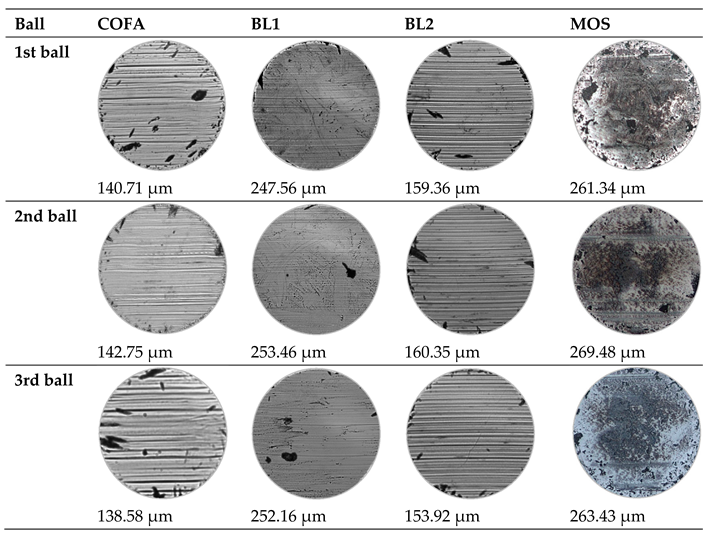
The morphologies of the worn surfaces are presented in Table 5. It is possible to observe aspects related to abrasion and adhesion wear, characterized by grooves in the direction of application [26,76,77,78].
The bio-based samples exhibit smoother surface aspects when compared to the MOS lubricated surface, which appears rougher. This is because surfaces lubricated with bio-based lubricants form a monomolecular or multimolecular structure that aligns with the polar end, inhibiting metal-to-metal contact between the balls. As a result, the surfaces exhibit smoother aspects with less pronounced grooves compared to those observed in MOS [26,77,79].
4. Conclusions
Samples of bio-based lubricants derived from the fatty acids of castor oil were obtained through chemical modifications, presenting interesting lubrication properties. The confirmation of the occurrence of these reactions was established using spectroscopic analysis techniques such as FTIR and H1NMR. The samples were characterized to assess a variety of properties, including thermo-oxidative, physicochemical, and tribological characteristics. Comparing thermal mass loss, sample BL2 showed greater thermal stability than the biological base COFA and the intermediate product BL1, for both inert and oxidative atmospheres. The pour point of the samples ranged from -27 °C to -45 °C, with the most desirable value obtained in the final product. During tribological tests, a sample of commercial mineral oil (MOS) was used as a reference for comparison with the results of the bio-based lubricant samples. The results revealed that the COFA, BL1, and BL2 samples exhibited a lower friction coefficient compared to the commercial oil, with the latter sample standing out as the top performer. Furthermore, the analysis of the wear scar diameter (WSD) indicated that the BL2 and COFA samples yielded similar results, suggesting excellent adhesion to the material's surface. Notably, the BL2 sample demonstrated particularly promising results in terms of thermo-oxidative properties. Its low pour point allows for effective lubrication even in extremely cold conditions, ensuring the proper operation of machinery and equipment. Consequently, it may be applied across a wide temperature range without compromising its properties, while also demonstrating an effective capacity for forming a lubricating film that conforms to observed tribological tests, reducing friction coefficients and material wear.
Funding
We thank CNPq (Conselho Nacional de Pesquisa e Desenvolvimento Científico) Projects: 304950/2019-0 (Luna, F.M.T.), 309046/2018-1 (Cavalcante Jr., C.L.) and FUNCAP (Fundação Cearense de Apoio ao Desenvolvimento Científico e Tecnológico) Project E1-0079-0004301 for financial support for this study. Ribeiro-Filho thanks the FAPEMA (Fundação de Amparo à Pesquisa e ao Desenvolvimento Científico e Tecnológico do Maranhão) Project 01131/18 (Ribeiro Filho, P.R.C.F) and Universidade Estadual do Maranhão (UEMA) for financial support.
Data Availability Statement
Not applicable.
Acknowledgments
We thank CNPq (Conselho Nacional de Pesquisa e Desenvolvimento Científico) and FUNCAP (Fundação Cearense de Apoio ao Desenvolvimento Científico e Tecnológico) for financial support for this study. Ribeiro-Filho thanks the FAPEMA (Fundação de Amparo à Pesquisa e ao Desenvolvimento Científico e Tecnológico do Maranhão) and Universidade Estadual do Maranhão (UEMA) for financial support.
Conflicts of Interest
The authors declare no conflict of interest.
References
- Karmakar, G.; Ghosh, P.; Sharma, B. Chemically Modifying Vegetable Oils to Prepare Green Lubricants. Lubricants 2017, 5, 44. [Google Scholar] [CrossRef]
- Zzeyani, S.; Mikou, M.; Naja, J.; Elachhab, A. Spectroscopic analysis of synthetic lubricating oil. Tribol. Int. 2017, 114, 27–32. [Google Scholar] [CrossRef]
- Suganthi, S.H.; Murshid, S.; Sriram, S.; Ramani, K. Enhanced biodegradation of hydrocarbons in petroleum tank bottom oil sludge and characterization of biocatalysts and biosurfactants. J. Environ. Manage. 2018, 220, 87–95. [Google Scholar] [CrossRef] [PubMed]
- Sabarinath, S.; Rajendrakumar, P.; Nair, K.P. , “Evaluation of tribological properties of sesame oil as biolubricant with SiO2 nanoparticles and imidazolium-based ionic liquid as hybrid additives,”. P I MECH ENG J-J ENG 2019, 233, 1306–1317. [Google Scholar] [CrossRef]
- Soni, S.; Agarwal, M. Lubricants from renewable energy sources – a review. Green Chem Lett Rev 2014, 7, 359–382. [Google Scholar] [CrossRef]
- Shah, R.; Woydt, M.; Zhang, S. The Economic and Environmental Significance of Sustainable Lubricants. Lubricants 2021, 9, 21. [Google Scholar] [CrossRef]
- Cardoso, B.F.; Shikida, P.F.A.; Finco, A. Development of Brazilian Biodiesel Sector from the Perspective of Stakeholders. Energies (Basel) 2017, 10, 399. [Google Scholar] [CrossRef]
- Ribeiro Filho, P.R.C.F.; Nascimento, M.R.; Silva, S.S.O.; Luna, F.M.T.; Rodríguez-Castellón, E.; Cavalcante, C.L. , Synthesis and Frictional Characteristics of Bio-Based Lubricants Obtained from Fatty Acids of Castor Oil. Lubricants 2023, 11, 57. [Google Scholar] [CrossRef]
- Salimon, J.; Salih, N.; Yousif, E. Biolubricants: Raw materials, chemical modifications and environmental benefits. Eur J Lipid Sci Technol 2010, 112, 519–530. [Google Scholar] [CrossRef]
- Singh, N.; Agarwal, P.; Porwal, S.K. ; Natural Antioxidant Extracted Waste Cooking Oil as Sustainable Biolubricant Formulation in Tribological and Rheological Applications. Waste Biomass Valorization 2022, 13, 3127–3137. [Google Scholar] [CrossRef]
- Chan, C.H.; Tang, S.W.; Mohd, N.K.; Lim, W.H.; Yeong, S.K.; Idris, Z. Tribological behavior of biolubricant base stocks and additives. Renew. sustain. energy rev. 2018, 93, 145–157. [Google Scholar] [CrossRef]
- Singh, Y.; Farooq, A.; Raza, A.; Mahmood, M.A.; Jain, S. Sustainability of a non-edible vegetable oil based bio-lubricant for automotive applications: A review. Process Saf. Environ. Prot. 2017, 111, 701–713. [Google Scholar] [CrossRef]
- Severino, L.S.; Auld, D.L.; Baldanzi, M.; Cândido, M.J.D.; Chen, G.; Crosby, W.; Tan, D.; He, X.; Lakshmamma, P.; Lavanya, C.; Machado, O.L.T.; Mielke, T.; Milani, M.; Miller, T.D.; Morris, J.B.; Morse, S.A.; Navas, A.A.; Soares, D.J.; Sofiatti, V.; Wang, M.L.; Zanotto, M.D.; Zieler, H. A Review on the Challenges for Increased Production of Castor. Agron J 2012, 104, 853–880. [Google Scholar] [CrossRef]
- Patel, V.R.; Dumancas, G.G.; Viswanath, L.C.K.; Maples, R.; Subong, B.J.J. Castor Oil: Properties, Uses, and Optimization of Processing Parameters in Commercial Production. Lipid Insights 2016, 9, LPI.S40233. [Google Scholar] [CrossRef]
- Salih, N.; Salimon, J. Optimization of High Yield Epoxidation of Malaysian Castor Bean Ricinoleic Acid with Performic Acid. Indones. J. Chem. 2022, 22, 609. [Google Scholar] [CrossRef]
- Montes-Núñez, D.G.; Montero-Alpírez, G.; Coronado-Ortega, M.A.; Ayala-Bautista, J.R.; León-Valdez, J.A.; Vázquez-Espinoza, A.M.; Torres-Ramos, R.; García-González, C. From seeds to bioenergy: a conversion path for the valorization of castor and jatropha sedes. Grasas y Aceites 2022, 73, e482. [Google Scholar] [CrossRef]
- Salimon, J.; Nallathamby, N.; Salih, N.; Abdullah, B.M. ; Synthesis and Physical Properties of Estolide Ester Using Saturated Fatty Acid and Ricinoleic Acid. J. autom. methods manag. chem. 2011, 2011, 1–4. [Google Scholar] [CrossRef]
- Salih, N.; Salimon, J.; Yousif, E.; Abdullah, B.M. Biolubricant basestocks from chemically modified plant oils: ricinoleic acid based-tetraesters. Chem Cent J 2013, 7, 128. [Google Scholar] [CrossRef]
- Luna, F.M.T.; Salmin, D.C.; Santiago, V.S.; Maia, F.J.N.; Silva, F.O.N.; Mazzetto, S.E.; Cavalcante, C.L. Oxidative Stability of Acylated and Hydrogenated Ricinoleates Using Synthetic and Natural Antioxidants. J. Chem. 2019, 2019, 1–10. [Google Scholar] [CrossRef]
- Rios, I.C.; Marques, J.P.C.; Arruda, T.B.M.G.; Rodrigues, F.E.A.; Uchoa, A.F.J.; Luna, F.M.T.; Cavalcante, C.L.; Ricardo, N.M.P.S. Chemical modification of castor oil fatty acids (Ricinus communis) for biolubricant applications: An alternative for Brazil’s green market. Ind Crops Prod 2020, 145, 112000. [Google Scholar] [CrossRef]
- Mensah, M.B.; Awudza, J.A.M.; O’Brien, P.; Castor oil: a suitable green source of capping agent for nanoparticle syntheses and facile surface functionalization. Royal Soc. Open Sci. 2018, 5, 180824. [Google Scholar]
- Mubofu, E.B. Castor oil as a potential renewable resource for the production of functional materials. Sustain. Chem. Process. 2016, 4, 11. [Google Scholar] [CrossRef]
- Marques, J.P.C.; Rios, I.C.; Arruda, T.B.M.G.; Rodrigues, F.E.A.; Uchoa, A.F.J.; Luna, F.M.T.; Cavalcante, C.L.; Ricardo, N.M.P.S. Potential Bio-Based Lubricants Synthesized from Highly Unsaturated Soybean Fatty Acids: Physicochemical Properties and Thermal Degradation. Ind. Eng. Chem. Res. 2019, 58, 17709–17717. [Google Scholar] [CrossRef]
- Salih, N.; Salimon, J.; Yousif, E. “The effect of chemical structure on pour point, oxidative stability and tribological properties of oleic acid triester derivatives,”. Malaysian J. Anal. Sci. 2013, 17, 119–128. [Google Scholar]
- Saha, D.K.; Ghosh, P. Almond Oil as Potential Biodegradable Lube Oil Additive: A Green Alternative. J Polym Environ 2018, 26, 2392–2400. [Google Scholar] [CrossRef]
- Souza, L.A.; Moreira, D.R.; Ricardo, N.M.P.S.; Maier, M.E.; Ribeiro Filho, P.R.C.F.; Luna, F.M.T.; Petzhold, C.L. Esters from castor oil functionalized with aromatic amines as a potential lubricant. J Am Oil Chem Soc 2023, 100, 175–184. [Google Scholar] [CrossRef]
- Singh, Y.; Sharma, A.; Singla, A. Non-edible vegetable oil–based feedstocks capable of bio-lubricant production for automotive sector applications—a review. Environ. Sci. Pollut. Res. 2019, 26, 14867–14882. [Google Scholar] [CrossRef] [PubMed]
- Cecilia, J.A.; Plata, D.B.; Saboya, R.M.A.; Luna, F.M.T.; Cavalcante, C.L.; Rodríguez-Castellón, E. An Overview of the Biolubricant Production Process: Challenges and Future Perspectives. Processes 2020, 8, 257. [Google Scholar] [CrossRef]
- Nagendramma, P.; Kaul, S. Development of ecofriendly/biodegradable lubricants: An overview. Renew. sustain. energy rev. 2012, 16, 764–774. [Google Scholar] [CrossRef]
- Reeves, C.J.; Menezes, P.L.; Jen, T.-C.; Lovell, M.R. The influence of fatty acids on tribological and thermal properties of natural oils as sustainable biolubricants. Tribol Int 2015, 90, 1123–134. [Google Scholar] [CrossRef]
- Dutta, S.; Ghosh, M.; Mitra, D. Performance evaluation studies of PEG esters as biolubricant base stocks derived from non-edible oil sources via enzymatic esterification. Ind Crops Prod 2023, 195, 116429. [Google Scholar] [CrossRef]
- Sulaimi, R. Al; Macknojia, A.; Eskandari, M.; Shirani, A.; Gautam, B.; Park, W.; Whitehead, P.; Alonso, A.P.; Sedbrook, J.C.; Chapman, K.D.; Berman, D. Evaluating the effects of very long chain and hydroxy fatty acid content on tribological performance and thermal oxidation behavior of plant-based lubricants. Tribol Int 2023, 185, 108576. [Google Scholar] [CrossRef]
- Ferreira, E.N.; Arruda, T.B.M.G.; Rodrigues, F.E.A.; Arruda, D.T.D.; da Silva Júnior, J.H.; Porto, D.L.; Ricardo, N.M.P.S. Investigation of the thermal degradation of the biolubricant through TG-FTIR and characterization of the biodiesel – Pequi (Caryocar brasiliensis) as energetic raw material. Fuel 2019, 245, 398–405. [Google Scholar] [CrossRef]
- Zhang, W.; Ji, H.; Song, Y.; Ma, S.; Xiong, W.; Chen, C.; Chen, B.; Zhang, X. Green preparation of branched biolubricant by chemically modifying waste cooking oil with lipase and ionic liquid. J. Clean. Prod. 2020, 274, 122918. [Google Scholar] [CrossRef]
- ASTM International. Standard Test Method for Kinematic Viscosity of Transparent and Opaque Liquids (and Calculation of Dynamic Viscosity); ASTM International: West Conshohocken, PA, USA, 2006. [Google Scholar]
- ASTM International. Standard Test Method for Dynamic Viscosity and Density of Liquids by Stabinger Viscometer (and the Calculation of Kinematic Viscosity); ASTM International: West Conshohocken, PA, USA, 2014. [Google Scholar]
- ASTM International. Standard Practice for Calculating Viscosity Index from Kinematic Viscosity at 40 °C and 100 °C.; ASTM International: West Conshohocken, PA, USA, 2016. [Google Scholar]
- Marques, J.P.C.; Rios, I.C.; Parente, E.J.S.; Quintella, S.A.; Luna, F.M.T.; Cavalcante, C.L. Synthesis and Characterization of Potential Bio-Based Lubricant Basestocks via Epoxidation Process. J Am Oil Chem Soc 2020, 97, 437–446. [Google Scholar] [CrossRef]
- Arumugam, S.; Chengareddy, P.; Sriram, G. Synthesis, characterisation and tribological investigation of vegetable oil-based pentaerythryl ester as biodegradable compressor oil. Ind Crops Prod 2018, 123, 617–628. [Google Scholar] [CrossRef]
- Tribo-Rheometry Accessory - TA Instruments.” Available online:. Available online: https://www.tainstruments.com/tribo-rheometry-accessory/ (accessed on 14 June 2023).
- Sarma, R.N.; Vinu, R. Current Status and Future Prospects of Biolubricants: Properties and Applications. Lubricants 2022, 10, 70. [Google Scholar] [CrossRef]
- Valle, C.P.; Rodrigues, J.S.; Fechine, L.M.U.D.; Cunha, A.P.; Malveira, J.Q.; Luna, F.M.T.; Ricardo, N.M.P.S. Chemical modification of Tilapia oil for biolubricant applications. J. Clean. Prod. 2018, 191, 158–166. [Google Scholar] [CrossRef]
- Attia, N.K.; El-Mekkawi, S.A.; Elardy, O.A.; Abdelkader, E.A. Chemical and rheological assessment of produced biolubricants from different vegetable oils. Fuel 2020, 271, 117578. [Google Scholar] [CrossRef]
- Mohamed, A.M.; Gülten, Y.Z.; Mustafa, D. Experimental investigation of the production of biolubricant from waste frying oil. Biomass Convers. Biorefin. 2023, 13, 6395–6407. [Google Scholar] [CrossRef]
- Heikal, E.K.; Elmelawy, M.S.; Khalil, S.A.; Elbasuny, N.M. Manufacturing of environment friendly biolubricants from vegetable oils. Egypt. J. Pet. 2017, 26, 53–59. [Google Scholar] [CrossRef]
- Bahadi, M.; Salimon, J.; Derawi, D. Synthesis of di-trimethylolpropane tetraester-based biolubricant from Elaeis guineensis kernel oil via homogeneous acid-catalyzed transesterification. Renew. Energ. 2021, 171, 981–993. [Google Scholar] [CrossRef]
- Bashiri, S.; Ghobadian, B.; Soufi, M.D.; Gorjian, S. Chemical modification of sunflower waste cooking oil for biolubricant production through epoxidation reaction. Mater. Sci. Technol. 2021, 4, 119–127. [Google Scholar] [CrossRef]
- Bezerra, R.C.F.; Rodrigues, F.E.A.; Arruda, T.B.M.G.; Moreira, F.B.F.; Chaves, P.O.B.; Assunção, J.C.C.; Ricardo, N.M.P.S. Babassu-oil-based biolubricant: Chemical characterization and physicochemical behavior as additive to naphthenic lubricant NH-10. Ind Crops Prod 2020, 154, 112624. [Google Scholar] [CrossRef]
- Torrentes-Espinoza, G.; Miranda, B.C.; Vega-Baudrit, J.; Mata-Segreda, J.F. Castor oil (Ricinus communis) supercritical methanolysis. Energy 2017, 140, 426–435. [Google Scholar] [CrossRef]
- Slivniak, R.; Domb, A.J. Macrolactones and Polyesters from Ricinoleic Acid. Biomacromolecules 2005, 6, 1679–1688. [Google Scholar] [CrossRef]
- Doudin, K.I. Quantitative and qualitative analysis of biodiesel by NMR spectroscopic methods. Fuel 2021, 284, 119114. [Google Scholar] [CrossRef]
- Salimon, J.; Salih, N.; Yousif, E. Biolubricant basestocks from chemically modified ricinoleic acid. J King Saud Univ Sci 2012, 24, 11–17. [Google Scholar] [CrossRef]
- Somidi, A.K.R.; Das, U.; Dalai, A.K. One-pot synthesis of canola oil based biolubricants catalyzed by MoO3/Al2O3 and process optimization study. Chem. Eng. J. 2016, 293, 259–272. [Google Scholar] [CrossRef]
- Kulkarni, R.D.; Deshpande, P.S.; Mahajan, S.U.; Mahulikar, P.P. Epoxidation of mustard oil and ring opening with 2-ethylhexanol for biolubricants with enhanced thermo-oxidative and cold flow characteristics. Ind Crops Prod 2013, 49, 586–592. [Google Scholar] [CrossRef]
- Zainal, N.A.; Zulkifli, N.W.M.; Gulzar, M.; Masjuki, H.H. A review on the chemistry, production, and technological potential of bio-based lubricants. Renew. sustain. energy rev. 2018, 82, 80–102. [Google Scholar] [CrossRef]
- Daniel, L.; Ardiyanti, A.R.; Schuur, B.; Manurung, R.; Broekhuis, A.A.; Heeres, H.J. Synthesis and properties of highly branched Jatropha curcas L. oil derivatives. Eur J Lipid Sci Technol 2011, 113, 18–30. [Google Scholar] [CrossRef]
- Azzena, U.; Montenero, A.; Carraro, M.; Crisafulli, R.; Luca, L.D.; Gaspa, S.; Muzzu, A.; Nuvoli, L.; Polese, R.; Pisano, L.; Pintus, E.; Pintus, S.; Girella, A.; Milanese, C. Recovery, Purification, Analysis and Chemical Modification of a Waste Cooking Oil. Waste Biomass Valorization 2023, 14, 145–157. [Google Scholar] [CrossRef]
- Sharma, U.C. , Chandra, A.K.; Sachan, S. Investigation on Thermo-Oxidative Stability of Karanja Oil Derived Biolubricant Base Oil. Asian J. Chem. 2019, 31, 839–844. [Google Scholar] [CrossRef]
- Santos, J.C.O.; Almeida, R.A.; Carvalho, M.W.N.C.; Lima, A.E.A.; Souza, A.G. Recycling of lubricating oils used in gasoline/alcohol engines. J. Therm. Anal. Calorim. 2019, 137, 1463–1470. [Google Scholar] [CrossRef]
- Ogunniyi, D.S. Castor oil: A vital industrial raw material. Bioresour. Technol. 2006, 97, 1086–1091. [Google Scholar] [CrossRef]
- Zhu, L.; Dong, J.; Zeng, Q.; Chao, M.; Gong, K.; Li, W.; Wang, X. A comprehensive study of amino acids based ionic liquids as green lubricants for various contacts. Tribol Int 2021, 162, 107137. [Google Scholar] [CrossRef]
- Jiang, H.; Hou, X.; Dearn, K.D.; Su, D.; Ali, M.K.A. Thermal stability enhancement mechanism of engine oil using hybrid MoS2/h-BN nano-additives with ionic liquid modification. Adv Powder Technol 2021, 32, 4658–4669. [Google Scholar] [CrossRef]
- Sabi, G.J.; Gama, R.S.; Fernandez-Lafuente, R.; Cancino-Bernardi, J.; Mendes, A.A. Decyl esters production from soybean-based oils catalyzed by lipase immobilized on differently functionalized rice husk silica and their characterization as potential biolubricants. Enzyme Microb. Technol. 2022, 157, 110019. [Google Scholar] [CrossRef]
- Xie, M.; Xu, D.; Zhang, C. Tribological properties and thermal-stability of epoxide-functionalized biolubricant derived from the abandon aerial part of Codonopsis pilosula. Tribol Int 2023, 185, 108537. [Google Scholar] [CrossRef]
- Borugadda, V.B.; Goud, V.V. Epoxidation of Castor Oil Fatty Acid Methyl Esters (COFAME) as a Lubricant base Stock Using Heterogeneous Ion-exchange Resin (IR-120) as a Catalyst. Energy Procedia 2014, 54, 75–84. [Google Scholar] [CrossRef]
- Almeida, M.O.; Silva, L.R.R.; Kotzebue, L.R.V.; Maia, F.J.N.; Acero, J.S.R.; Melé, G.; Mazzetto, S.E.; Sinatora, A.; Lomonaco, D. Development of Fully Bio-Based Lubricants from Agro-Industrial Residues under Environmentally Friendly Processes. Eur J Lipid Sci Technol 2020, 122, 1900424. [Google Scholar] [CrossRef]
- Ferreira, E.N.; Arruda, T.B.M.G.; Rodrigues, F.E.A.; Moreira, D.R.; Chaves, P.O.B.; Rocha, W.S.; Silva, L.M.R.; Petzhold, C.L.; Ricardo, N.M.P.S. Pequi Oil Esters as an Alternative to Environmentally Friendly Lubricant for Industrial Purposes. ACS Sustain. Chem. Eng. 2022, 10, 1093–1102. [Google Scholar]
- Minami, I.; Hong, H.S.; Mathur, N.C. Lubrication performance of model organic compounds in high oleic sunflower oil. J. Synth. Lubr. 1999, 16, 1–12. [Google Scholar] [CrossRef]
- Gates, R.S.; Hsu, S.M. Effect of selected chemical compounds on the lubrication of silicon nitride. Tribol. Trans. 1991, 34, 417–425. [Google Scholar] [CrossRef]
- Fox, N.J.; Tyrer, B.; Stachowiak, G.W. Boundary lubrication performance of free fatty acids in sunflower oil. Tribol. Lett. 2004, 16, 275–281. [Google Scholar] [CrossRef]
- Ribeiro Filho, P.R.C.F.; Nascimento, M.R.; Cavalcante, C.L.; Luna, F.M.T. Synthesis and tribological properties of bio-based lubricants from soybean oil. Biomass Convers. Biorefin 2023. [Google Scholar]
- Salih, N.; Salimon, J.; Abdullah, B.M.; Yousif, E. Thermo-oxidation, friction-reducing and physicochemical properties of ricinoleic acid based-diester biolubricants. Arab. J. Chem. 2017, 10, S2273–S2280. [Google Scholar] [CrossRef]
- Salimon, J.; Salih, N.; Yousif, E. Chemically modified biolubricant basestocks from epoxidized oleic acid: Improved low temperature properties and oxidative stability. J. Saudi Chem. Soc. 2011, 15, 195–201. [Google Scholar] [CrossRef]
- Quinchia, L.A.; Delgado, M.A.; Reddyhoff, T.; Gallegos, C.; Spikes, H.A. Tribological studies of potential vegetable oil-based lubricants containing environmentally friendly viscosity modifiers. Tribol. Int. 2014, 69, 110–117. [Google Scholar] [CrossRef]
- Qi, C.; Renhui, Z.; Zhongyi, H.; Liping, X. Effect of carbon-chain length and hydroxyl number on lubrication performance of alcohols. J. Hebei Univ. Sci. Technol. 2021, 42, 1–7. [Google Scholar]
- Ribeiro Filho, P.R.C.F.; Silva, S.S.O.; Nascimento, M.R.; Soares, S.A.; Luna, F.M.T.; Cavalcante, C.L. Tribological properties of bio-based lubricant basestock obtained from pequi oil (Caryocar brasiliensis). J. Braz. Soc. Mech. Sci. Eng. 2022, 44, 1–9. [Google Scholar] [CrossRef]
- Noorawzi, N.; Samion, S. Tribological effects of vegetable oil as alternative lubricant: A pin-on-disk tribometer and wear study. Tribol. Trans. 2016, 59, 831–837. [Google Scholar] [CrossRef]
- Afifah, A.N.; Syahrullail, S.; Azlee, N.I.W.; Sidik, N.A.C.; Yahya, W.J.; Abd Rahim, E. Biolubricant production from palm stearin through enzymatic transesterification method. Biochem. Eng. J. 2019, 148, 178–184. [Google Scholar] [CrossRef]
- Bahari, A. Investigation into Tribological Performance of Vegetable Oils as Biolubricants at Severe Contact Conditions. Ph.D. Thesis, University of Sheffield, Sheffield, UK.
Figure 1.
Scheme of the chemical routes used for the synthesis of bio-based lubricants from Castor Oil Fatty Acids (COFA). BL1 is the product of the esterification reaction and BL2 is the product of the oxirane ring-opening reaction using isoamyl alcohol as nucleophilic agent.
Figure 1.
Scheme of the chemical routes used for the synthesis of bio-based lubricants from Castor Oil Fatty Acids (COFA). BL1 is the product of the esterification reaction and BL2 is the product of the oxirane ring-opening reaction using isoamyl alcohol as nucleophilic agent.
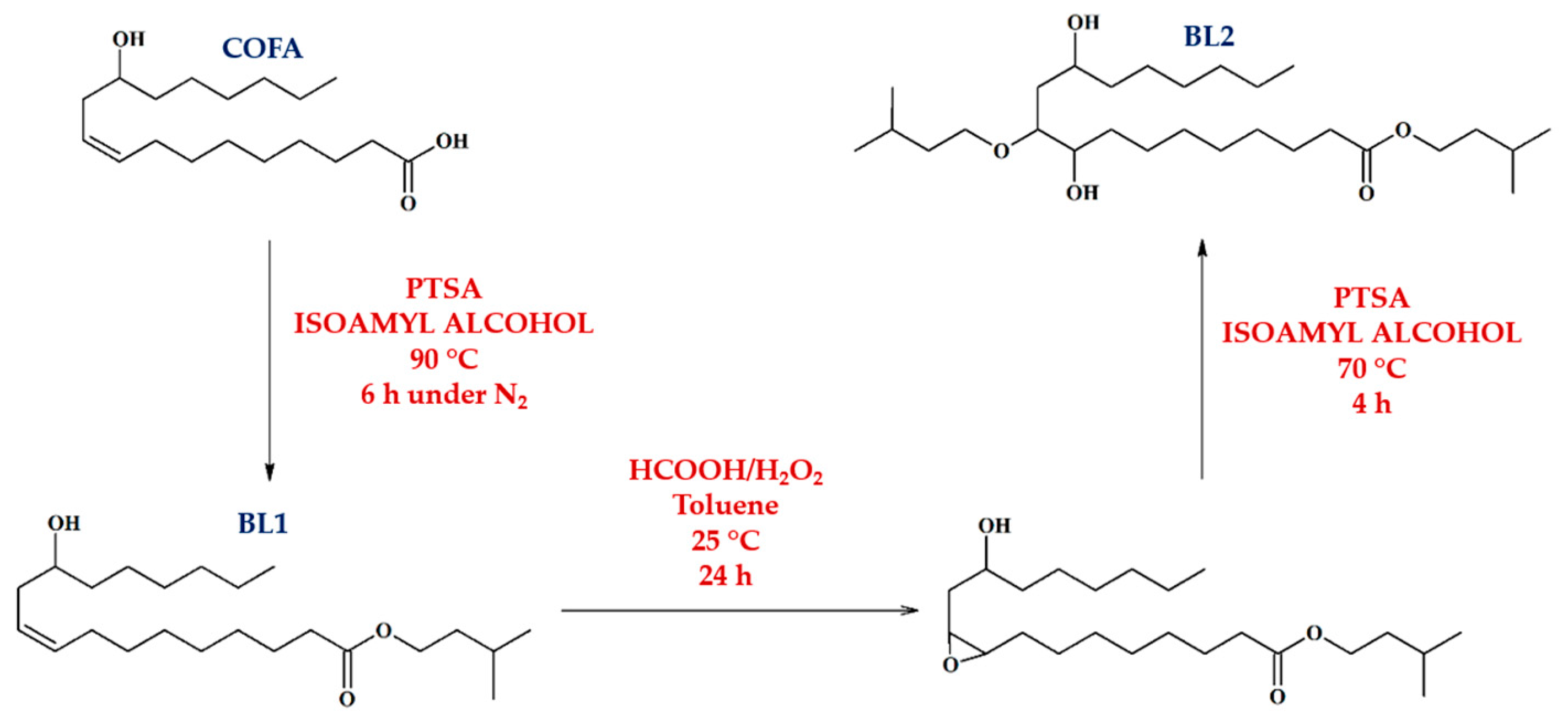
Figure 2.
Four-ball tribological test setup (sliding speed to 0.46 m/s, temperature to 75 °C, load force to 55 N and 1 h).
Figure 2.
Four-ball tribological test setup (sliding speed to 0.46 m/s, temperature to 75 °C, load force to 55 N and 1 h).
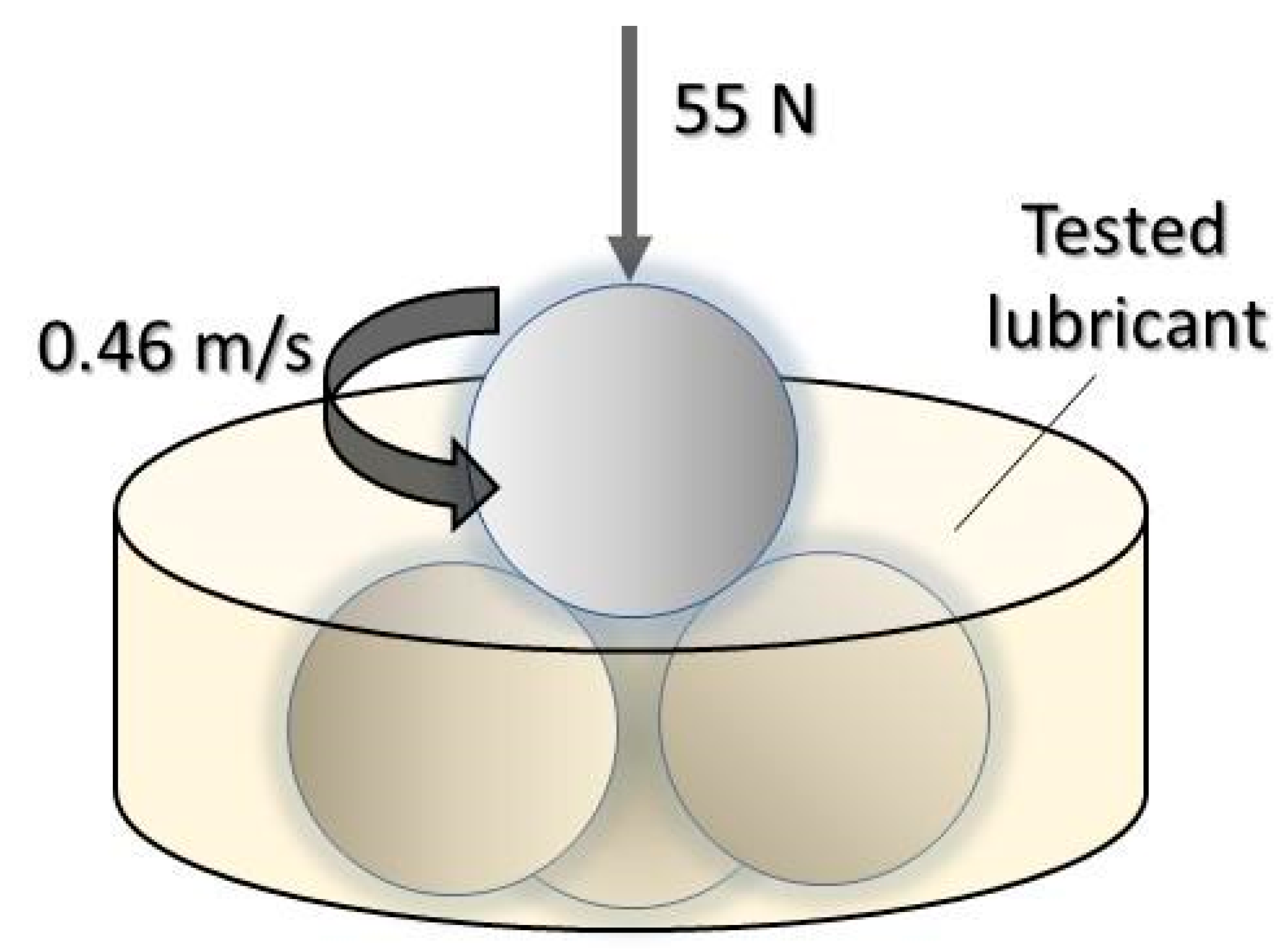
Figure 3.
FTIR spectra of the COFA, BL1, EPOXIDE and BL2 samples.
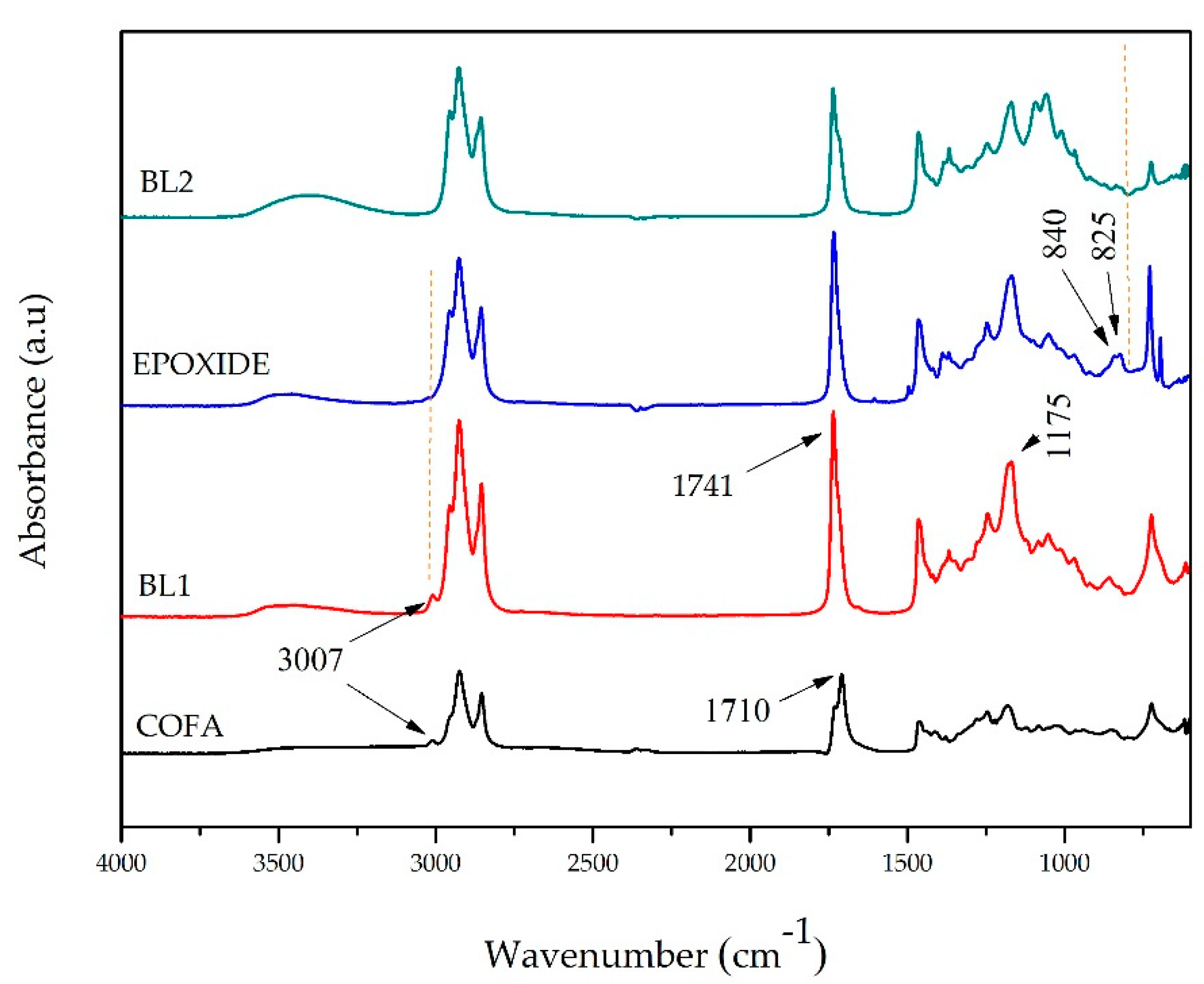
Figure 4.
1H NMR spectra of the COFA, BL1, EPOXIDE and BL2.
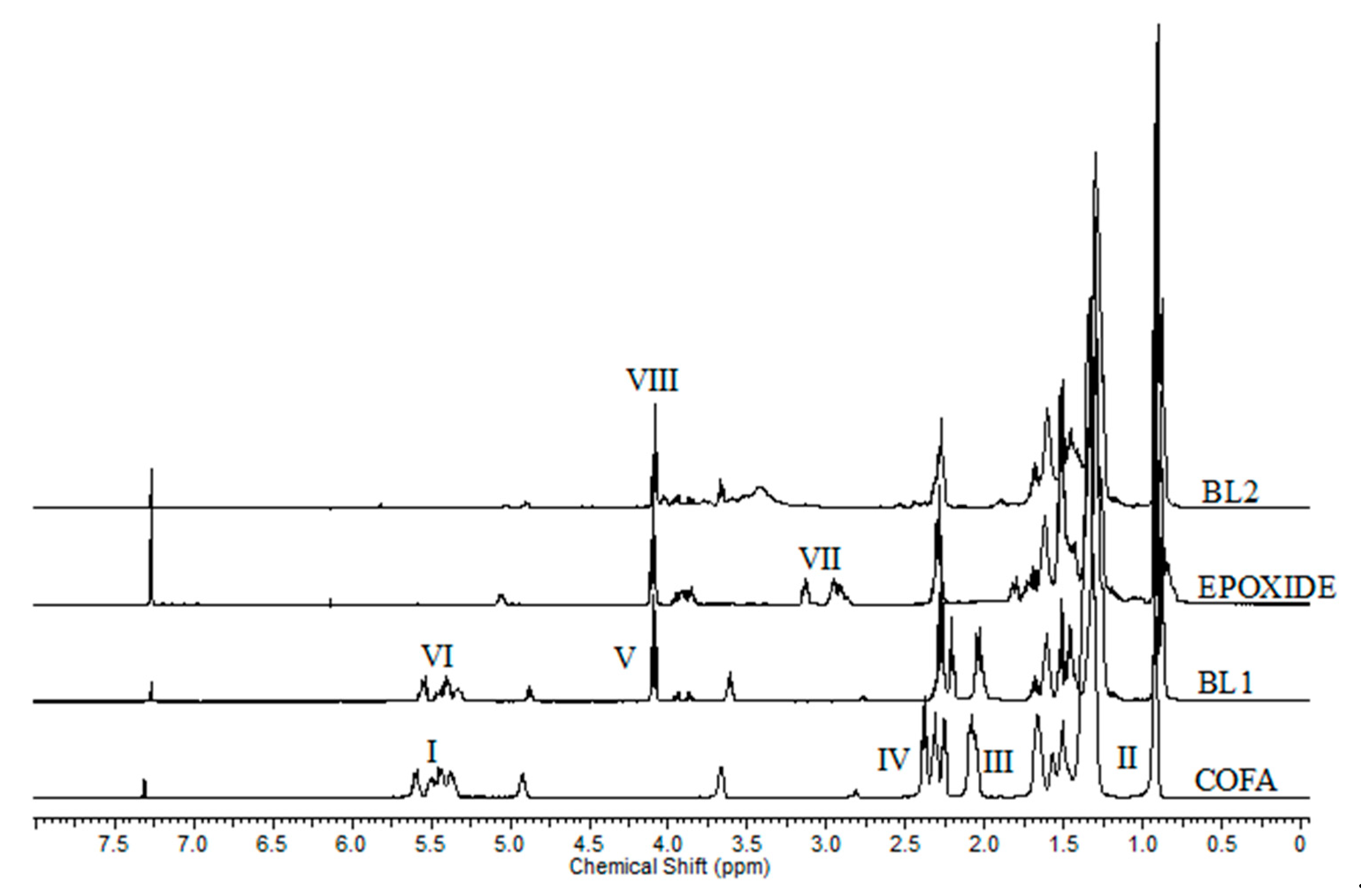
Figure 5.
TG (a) and DTG (b) curves samples COFA, BL1, and BL2 in inert atmosphere.
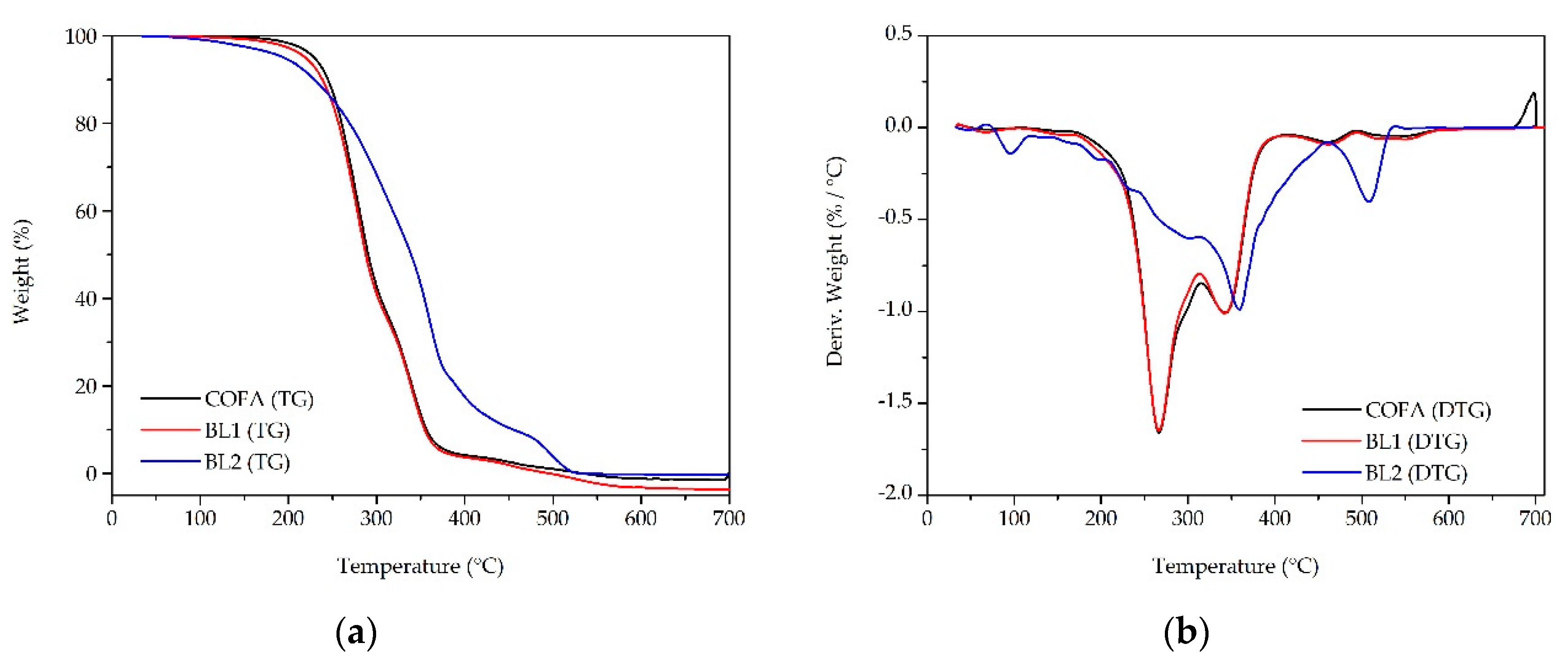
Figure 6.
TG (a) and DTG (b) curves samples COFA, BL1, and BL2 in air atmospheric.
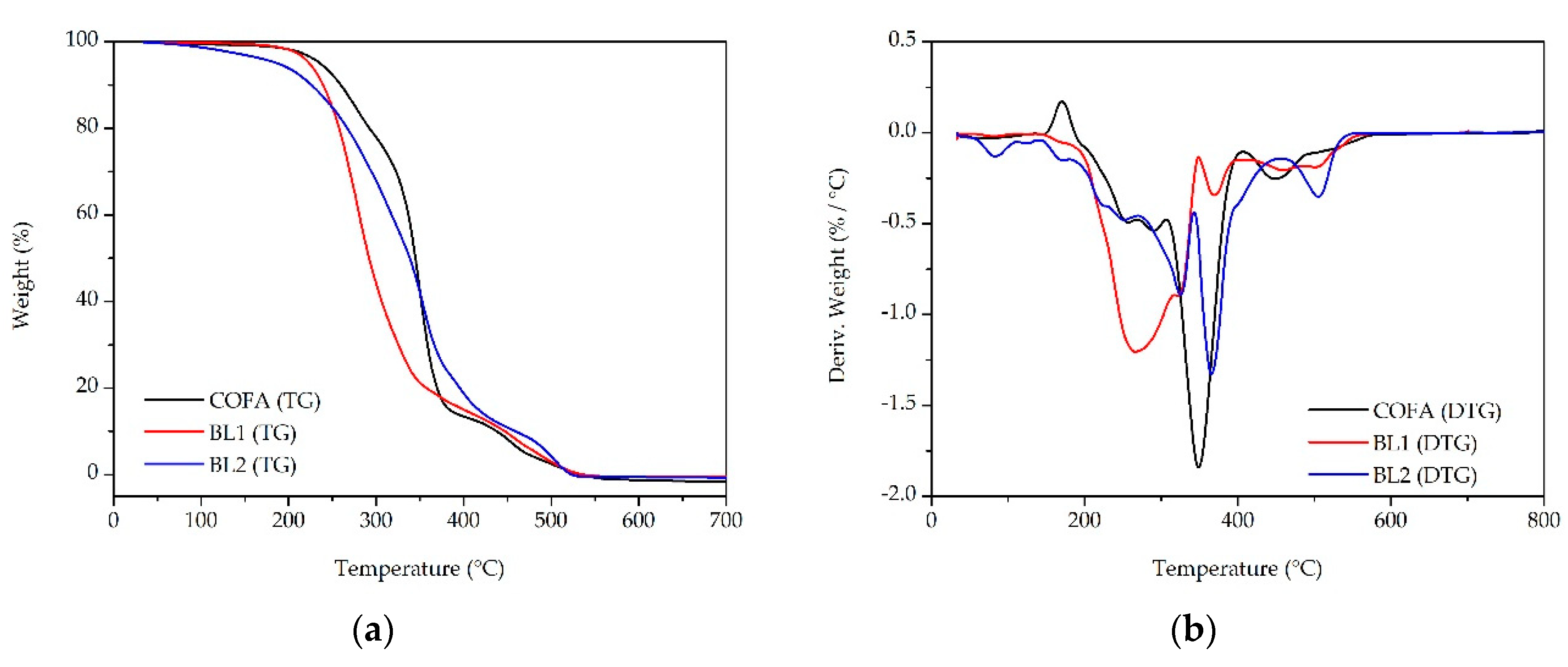
Figure 7.
Friction coefficient curves in tribological tests of the bio-based samples (BL1 and BL2), and of the mineral oil sample (MOS).
Figure 7.
Friction coefficient curves in tribological tests of the bio-based samples (BL1 and BL2), and of the mineral oil sample (MOS).
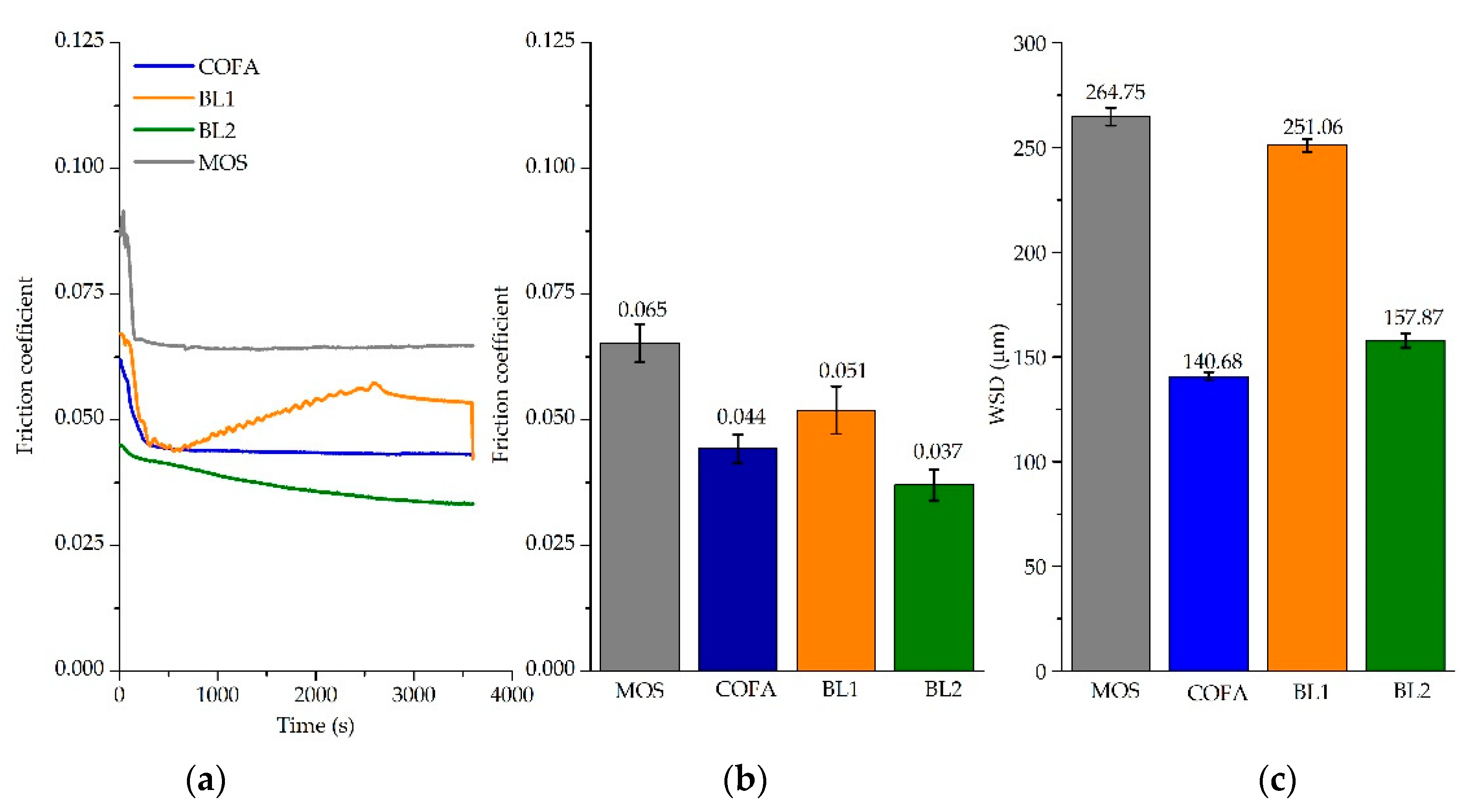

Table 1.
Physicochemical properties of the commercial mineral oil sample (MOS) and Castor Oil Fatty Acids (COFA).
Table 1.
Physicochemical properties of the commercial mineral oil sample (MOS) and Castor Oil Fatty Acids (COFA).
| Property | COFA | MOS | Method |
|---|---|---|---|
| Density at 20 °C (g/cm³) | 0.9393 | 0.9017 | ASTM D7042 |
| Kinematic viscosity at 40 °C (cSt) | 173.18 | 20.38 | ASTM D445 |
| Kinematic viscosity at 100 °C (cSt) | 16.938 | 3.590 | ASTM D445 |
| Viscosity index | 104 | 13 | ASTM D2270 |
| Pour point (°C) | -42 | -33 | ASTM D97 |
| Flash point (°C) | 216 | 160 | ASTM D92 |
Table 2.
Physicochemical properties of BL1 and BL2 samples.
| BL1 | BL2 | Method | |
|---|---|---|---|
| Density at 20 °C (g/cm³) | 0.9080 | 0.9437 | ASTM D7042 |
| Kinematic viscosity at 40 °C (cSt) | 28.23 | 96.92 | ASTM D445 |
| Kinematic viscosity at 100 °C (cSt) | 5.215 | 10.286 | ASTM D445 |
| Viscosity index | 116 | 85 | ASTM D2270 |
| Pour point (°C) | -27 | -45 | ASTM D97 |
| Acid value | 9.58 | 5.61 | AOCS CD 3d-63 |
Table 3.
Decomposition temperatures and weight losses of the samples estimated from the thermogravimetric curves in inert atmosphere.
Table 3.
Decomposition temperatures and weight losses of the samples estimated from the thermogravimetric curves in inert atmosphere.
| TG temperature/ °C per weight loss | |||||
|---|---|---|---|---|---|
| Samples | Tonset | 10% | 20% | 50% | 90% |
| COFA | 229.30 | 244.75 | 260.34 | 290.65 | 356.65 |
| BL1 | 219.27 | 238.622 | 256.947 | 287.93 | 354.50 |
| BL2 | 195.03 | 229.528 | 269.384 | 339.04 | 455.04 |
Table 4.
The decomposition temperatures and weight losses of the samples deduced from thermogravimetric curve in air atmospheric.
Table 4.
The decomposition temperatures and weight losses of the samples deduced from thermogravimetric curve in air atmospheric.
| TG temperature/°C per weight loss | |||||
|---|---|---|---|---|---|
| Samples | Tonset | 10% | 20% | 50% | 90% |
| COFA | 236.14 | 259.59 | 292.49 | 344.97 | 437.86 |
| BL1 | 223.72 | 239.68 | 257.83 | 291.98 | 447.31 |
| BL2 | 187.62 | 226.36 | 267.23 | 338.47 | 459.09 |
Table 5.
Wear morphology of balls lubricated with the bio-based samples (BL1 and BL2), and comparison with COFA and MOS after tribological tests.
Table 5.
Wear morphology of balls lubricated with the bio-based samples (BL1 and BL2), and comparison with COFA and MOS after tribological tests.
 |
Disclaimer/Publisher’s Note: The statements, opinions and data contained in all publications are solely those of the individual author(s) and contributor(s) and not of MDPI and/or the editor(s). MDPI and/or the editor(s) disclaim responsibility for any injury to people or property resulting from any ideas, methods, instructions or products referred to in the content. |
© 2023 by the authors. Licensee MDPI, Basel, Switzerland. This article is an open access article distributed under the terms and conditions of the Creative Commons Attribution (CC BY) license (http://creativecommons.org/licenses/by/4.0/).
Copyright: This open access article is published under a Creative Commons CC BY 4.0 license, which permit the free download, distribution, and reuse, provided that the author and preprint are cited in any reuse.


