
Submitted:
14 September 2023
Posted:
15 September 2023
You are already at the latest version
Abstract
This paper examines the use of business maturity models as a tool for achieving business maturity and improving organizational performance in a rapidly changing business environment. Specifi-cally, the paper evaluates existing maturity models and methodologies, analyzes their effective-ness, and develops a novel and enhanced model tailored to the oil and gas sector. The authors highlight the importance of considering fundamental factors that underlie the implementation of maturity models and the need to evaluate their fit with organizational goals and values. The pa-per concludes by emphasizing the ongoing nature of business maturity and the effectiveness of theproposed Business Maturity Framework (BMF) model in enhancing operational excellence, competitiveness, and sustainable growth in the oil and gas industry.
The paper makes a notable contribution to the specialized literature precisely through the differ-ent approaches to the business maturity process and through the proposed business maturity model itself as a base of strategy formulation, which includes a new dimension. This dimension analyzes whether the market and customers are ready for the level of digitization that the com-pany wants to achieve in a future state.
Keywords:
business transformation
; digital process maturity
; business maturity framework (BMF)
; incremental changes
; maturity assessment
; disruptive changes
; oil and gas industry
1. Introduction
In the current dynamic business environment, companies require appropriate tools to effectively manage change and maintain their competitiveness. A business maturity model is one such tool that offers a systematic approach for organizations to assess their level of development and growth in various areas such as strategy, operations, people, technology, and culture. It enables organizations to identify opportunities for improvement and enhance their performance.
This paper aims to conduct an analysis and evaluation of the principal business maturity models and methodologies. Additionally, the paper aims to develop and validate an innovative and refined business maturity model tailored to the unique needs and challenges of organizations operating in the oil and gas sector. While the model has not yet been fully developed for this industry, the first test of the model took place within an oil and gas company to evaluate its effectiveness and suitability for this sector.To achieve this goal, the paper will focus on two research questions and a hypothesis:
- What are the commonly used maturity models in different fields, and which areas do they typically focus on?
- How effective are maturity models in enhancing organizational performance, and what factors contribute to their success or failure?
The hypothesis: H – By developing and implementing a business maturity model tailored to the specific needs and challenges of the oil and gas industry, organizations operating in this sector can enhance their operational excellence, increase their competitiveness, and achieve sustainable growth, states that creating and implementing a business maturity model that is tailored to the specific needs and challenges of the oil and gas industry can enhance operational excellence, increase competitiveness, and achieve sustainable growth.
To achieve these objectives, the paper will first review the existing literature on business maturity models and their effectiveness. Subsequently, it will provide an overview of the oil and gas industry and its distinct challenges. Finally, the paper will propose an innovative and refined business maturity model that is specifically designed for the oil and gas sector. This model's effectiveness will be assessed through a case study.
In conclusion, this paper aims to contribute to the current literature by developing a practical and effective business maturity model for the oil and gas industry. This model can assist organizations operating in this sector to attain continuous improvement and sustainable growth.
2. Theoretical background
According to Adrodegari and Saccani (2019), maturity models are frameworks that offer organizations a recommended path of improvements to increase their capabilities. They serve as tools to assess a company's current situation, identify desirable maturity levels, and provide guidelines and improvement measures.
The concept of maturity models can be used to measure, compare, and describe the state of a company or production organization in order to improve processes. Maturity can be captured qualitatively or quantitatively, and maturity models are often used to compare different organizations.
Different approaches have been proposed for the use of maturity models. Uhrenholt et al. (2022) propose using maturity models to explain the elements of circular economy transformation and how they relate to organizational change. The maturity model's function is to define structured and evolving capability progression across maturity stages. Uhrenholt et al. (2022) present two principles to explain maturity progression for the circular economy domain: expertise and the systems perspective. Felch et al. (2019) discuss how maturity models can help organizations adapt to changing market conditions and improve organizational performance. Maturity models can document the current status of an organization, develop a vision for process excellence, and compare capabilities between different organizations. However, Felch et al. (2019) argue that the literature on maturity models lacks empirical validity and detailed guidelines for their application.
Voss et al. (2022) describe maturity models as illustrating the linear development path of a reference object to (complete) maturity through distinct stages. They classify maturity models into descriptive, prescriptive, and comparative types, with different designs according to their characteristic attributes. Despite their varied designs, most maturity models have a similar structure with regard to their content.
These models are applied to a wide range of industries and provide a recommended path of improvements and can be used to assess an organization's current situation, identify desirable maturity levels, and provide guidelines and improvement measures.
Notwithstanding the potential benefits of maturity models, their effective application is often impeded by a range of factors.
Tsai (2020) discusses the challenges faced by software development teams in terms of project cost, timeliness, and quality of software products. To address these issues, many standards and models related to the development process have been defined, such as the Capability Maturity Model (CMM). However, the adoption of CMM and similar models has not yielded the expected results, possibly due to their lack of applicability across various types of organizations and teams.In term of criticism, Virkkala et al. (2020) emphasize that most of maturity models are based on successful projects and lack of empirical validation. The models are criticized for their structural assumptions and neglecting alternative development paths. Other criticisms include narrow design methods, unsatisfactory documentation, and a non-reflective adoption of the approach. The text suggests that maturity models should focus on are factors that influence development rather than predetermined levels towards a final state.
If we consider the oil and gas industry, there exist numerous factors that have significantly affected the operations of the organizations over the past decade, such as the growing significance of sustainability, the COVID-19 pandemic, the volatility of oil prices, and the emergence of new technologies. In order for these entities to remain competitive and sustain their position in the market, it can require a significant amount of resources and effort to effectively incorporate solutions that address these various factors. Sari et al. (2020) argues that there is an increasing pressure for the oil and gas organizations to incorporate sustainability initiatives into their business processes without compromising economic sustainability. Also, Barbosa et al. (2020) emphsise that COVID-19 acted as acatalytic moment and accelerated permanent shifts in the oil and gas industry’s ecosystem, with new opportunities. The authors highlights the need for a profound reset in many segments of the industry and companies in order to win in the current business environment, which is characterized by a lot of change and disruption. In order to identify the main area to change to thrive in this new normal, the business maturity models can be the right answear.
Methodologies and Tools to Improve Business Maturity
The concept of business maturity refers to the sophisticated and advanced state that an organization has attained as a result of the progress and refinement of its internal processes, systems, and capabilities. This level of advancement and development is a crucial determinant of the organization's efficiency in delivering its products or services.
The maturity of a business is influenced by a multitude of factors, including the adoption of industry-recognized best practices, the establishment of streamlined and effective operational processes, the integration of technology to enhance organizational performance, and the ability to proactively manage risk.
One of the most significant benefits of business maturity is the improvement of organizational performance. As a business progresses towards a more mature state, it becomes better equipped to fulfill the needs and expectations of its customers and stakeholders, while also being more likely to achieve its established goals and objectives.
To accurately assess the maturity of a business, several frameworks and models have been developed, such as the Capability Maturity Model Integration (CMMI), the Balanced Scorecard, and the Project Management Maturity Model (PMMM). These frameworks provide a structured and systematic approach to evaluating the maturity of a business and can be utilized to identify areas for improvement and guide the implementation of best practices.
Six Sigma
Montgomery (2008) argues that Six Sigma is a method for improving business processes that are based on data analysis. It aims to minimize defects in products and services by applying statistical analysis and process improvement techniques. The target of Six Sigma is to attain a process capability of six standard deviations from the mean, where the standard deviation is a measure of how far a data point deviates from the average. Six Sigma projects use the DMAIC (Define, Measure, Analyze, Improve, Control) approach to pinpoint and eliminate the source of defects. Six Sigma prioritizes reducing variability in processes, enhancing quality and customer satisfaction, and boosting efficiency and profitability.
Information Technology Infrastructure Library – ITIL
ITIL (Information Technology Infrastructure Library) was developed by the Office of Government Commerce (OGC) and is a collection of best practices in IT service management that provides a structured framework for managing and enhancing IT services. It offers a systematic method for designing, delivering, operating, and monitoring IT services to align them with business needs and deliver value to the organization (Potgieter et al., 2005).
Capability Maturity Model Integration (CMMI)
Yamfashije (2017) emphasize that the Capability Maturity Model Integration is a tool created by the Software Engineering Institute at Carnegie Mellon University to help organizations assess and improve their processes and abilities. It's utilized to measure an organization's progression in areas such as product development, software engineering, and project management.
The CMMI uses a five-step maturity scale, level 1 (Initial), level 2 (Managed), level 3 (Defined), level 4 (Qualitatively Managed), and level 5 (Optimizing), to examine the maturity of an organization's processes. The higher the level, the more mature and effective the processes are.
Organizations can use the CMMI to follow best practices, enhance their processes and increase their efficiency. It is widely implemented in industries such as finance, defense, software development, and healthcare.
Balanced Scorecard
The Balanced Scorecard is a performance management tool created to offer a comprehensive view of an organization's strategy and performance.
According to Kaplan and Norton (1996), the Balanced Scorecard evaluates four perspectives: financial, customer, internal processes, and learning and growth. This approach provides a balanced view of the organization's performance by considering both financial and non-financial metrics.
From the financial perspective, it looks at financial metrics such as revenue, profits, and return on investment (ROI). From the customer perspective, metrics like customer satisfaction and market share are evaluated. The internal processes perspective evaluates metrics like efficiency and effectiveness of operations. The learning and growth perspective looks at metrics like employee satisfaction and training programs (Kaplan, 2005).
The Balanced Scorecard provides a structured method for defining and tracking strategic objectives and helps to understand the relationships between different elements of an organization's performance. It is widely used in various industries and by organizations of all sizes.
Comparative Analysis of the Methodologies and Tools that Improve Business Maturity.
These four frameworks share some similarities in terms of their goal of improving organizational performance, but they are distinct in their focus and approach. CMMI and Six Sigma are focused on process improvement, ITIL is focused on service management, and Balanced Scorecard is focused on performance management.
Common aspects of the business maturity models:
Process-oriented approach: These frameworks aim to enhance the processes and procedures within an organization to increase efficiency, effectiveness, and quality. They provide a structured method for improving processes.
Assessment and improvement: These frameworks assess a company's current performance and pinpoint areas that need improvement, with suggestions for implementing changes and tracking progress.
Focus on best practices: These frameworks are based on a set of effective best practices for performance improvement and offer organizations a roadmap for implementing these best practices and achieving better results.
Flexibility: Each framework has a clear area of emphasis, but it can be customized to meet the specific objectives and needs of the organization.
Differences between the business maturity models:
Area of focus: Every framework targets a specific area, like project management, IT service management, or process improvement. The appropriate framework for an organization will be determined by its specific requirements and objectives.
Level of detail: The level of detail provided by some frameworks is more extensive compared to others. For example, ITIL offers a full set of best practices for IT service management, while the Balanced Scorecard provides a broad-spectrum perspective of performance.
Approach to improvement: The ways to achieve improvement vary among the frameworks. For example, Six Sigma uses a data-centric method for enhancing processes, while ITIL offers a complete set of recommended practices for IT service management.
Level of complexity: The difficulty level of these frameworks varies, with some requiring a more comprehensive grasp of related concepts and procedures. For instance, the application of Six Sigma necessitates an in-depth understanding of statistical analysis, whereas the Balanced Scorecard is relatively straightforward to comprehend and implement.
A summary of similarities and differences between the business maturity models is depicted in Table 1.
In the oil and gas industry, these frameworks can be used to improve the efficiency and effectiveness of processes, minimize waste and defects, manage IT services, and measure and manage performance across multiple perspectives.
However, there exists a demand for an assessment tool that not only measures a company's level of maturity but also specifies the precise areas that necessitate focus to augment its level of maturity. It is more crucial for companies to comprehend how to enhance their maturity level than to merely grasp the level of maturity attained.
This study aims to determine the most appropriate business maturity model for implementation in the oil and gas industry, considering the diverse range of factors impacting the sector. To address this issue, the authors developed and tested a novel and adaptable model based on a comprehensive evaluation of existing maturity models and methodologies.
3. Methodology
This study is a constituent of a broader research endeavor, encompassing a qualitative and exploratory investigation that draws on secondary sources, comprising academic studies and corporate documents. Its objective is to unveil the primary business maturity models, appraise their shared characteristics, and discern their dissimilarities. The study seeks to comprehend such similarities and dissimilarities in order to develop and evaluate a more adaptable and novel model, while incorporating new features that are pertinent to the oil and gas companies, cognizant of the prevailing challenges that confront the retail industry. The model that has been developed is still in its incipient stage and has undergone preliminary testing in a leading oil and gas firm in Romania.
The paper proposes two research questions:
The first research inquiry aims to identify maturity models that are commonly used in various fields and the specific areas they target. This process allows the researcher to gain an understanding of the current models, identify possible gaps, and recognize limitations that can lead to the creation of a more efficient model tailored to the oil and gas industry.
The second research question intends to assess the effectiveness of maturity models in improving organizational performance and to identify factors that contribute to their success or failure. This assessment provides insights into the practical aspects of maturity models and the necessary conditions for their implementation, which can aid in developing and implementing a new model tailored to the oil and gas industry.
In summary, these research questions provide a clear research direction and ensure that the study concentrates on the most pertinent and critical issues concerning the development and validation of a new business maturity model for the oil and gas industry.
The hypothesis suggests that implementing a business maturity model tailored to the oil and gas industry's specific needs and challenges can increase competitiveness, achieve sustainable growth, and enhance operational excellence. The paper also mentions that a preliminary test of the developed model has been conducted within an oil and gas company.
4. Results
Proposing a Business Maturity Framework (BMF)
The business maturity models are uniform and built on distinct criteria. Examining the specialized literature and models discussed in the paper, we can observe several overlapping and supplementary factors, such as determining the present state of the company where the model is implemented, multi-level models, and the interplay between resources, organization, and technology.
The framework put forth in this study recognizes digitalization as a key element in achieving business maturity, a notion that is substantiated by the contemporary significance of the digitalization process. As a global trend, digitalization is utilized to optimize business processes and reduce costs by minimizing reliance on human capital, thus limiting the risk of human error and enhancing process efficiency.
The model proposed in this section is built around three vital questions in any type of strategic analysis:
"What" is wanted to be achieved? "Why" is it desired? and "How" can it be obtained?
The BMF encompasses a range of instruments that examine particular strategic domains within a company to comprehend its current state and pinpoint areas that require enhancement.
Operations – to understand the status of the business processes of a company and to identify improvement opportunities, several business tools can be used such as Business Process Classifier and mapping processes using a RACI [Responsible, Accountable, Consulted, Informed] matrix to standardize the processes.
Employees – to understand the level of digital competencies of the employees, a survey can generate the level of employees’ competencies and the potential cost to increase it.
Technology – to evaluate the IT infrastructure can use a mapping tool for all digital technologies, applications, and the relationship between them to reduce the applications that overlap.
Customers / Market – to evaluate customers and market behavior and expectations a two directions analysis should be performed:
Market study to evaluate the usage level of digital technologies by companies from the same industry.
Customer behavior and expectations study to understand if the consumers are using or open to using digital technology in a specific industry.
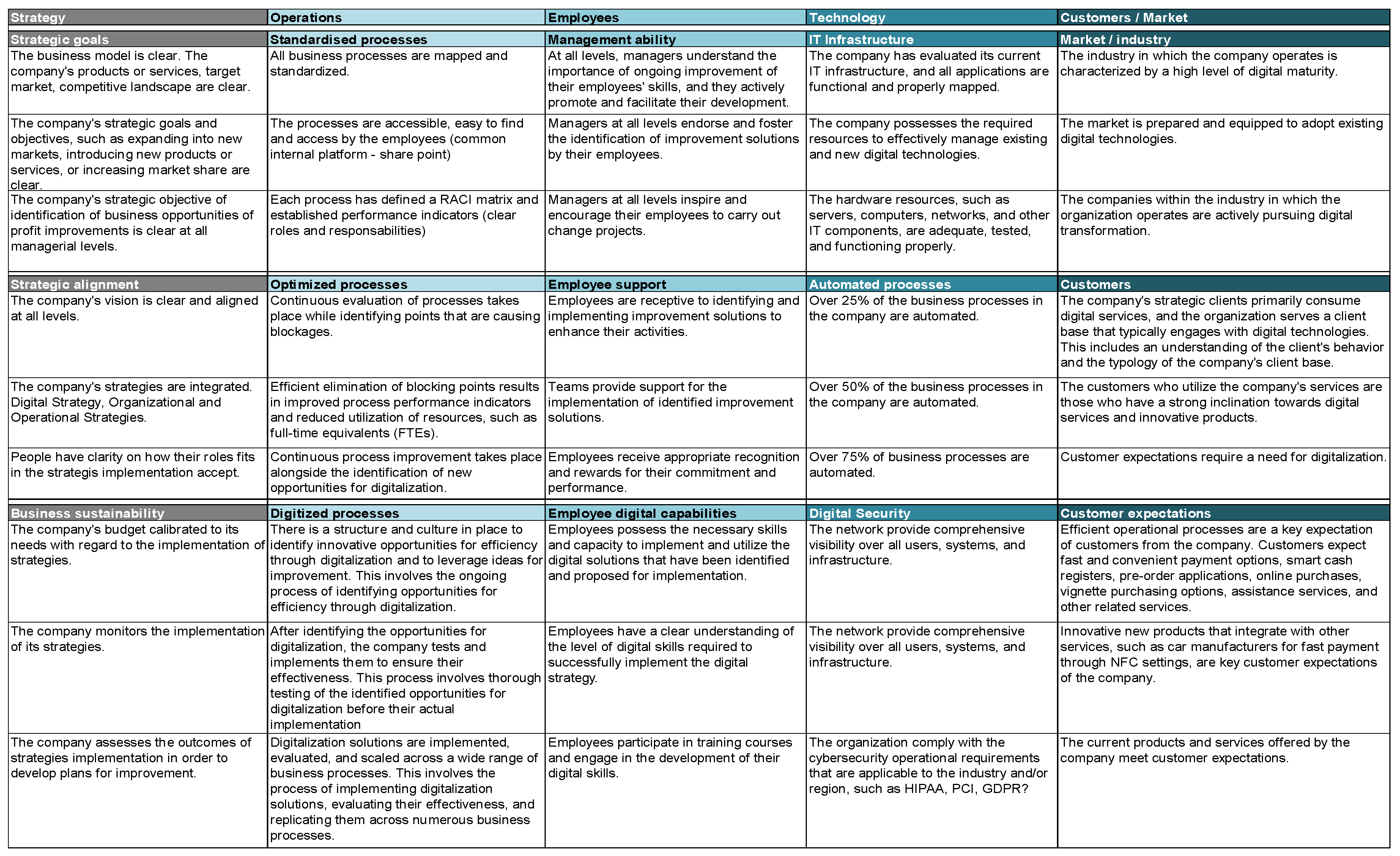
The primary instrument employed in this study is the Business Maturity Framework (BMF), as illustrated in Appendix A. The BMF serves a dual purpose of assessing both the management's perception of the company's maturity level and the actual state of the company's maturity. This framework consists of five dimensions, which are Strategy, Operations, Employees and their digital skills, Technology, and Customers/Market, and are used for evaluation purposes.
The dimension of "Strategy" is evaluated based on the extent to which a company's strategic goals and plans are disseminated and comprehended throughout all levels of the organization. The assessment of this dimension involves analyzing three distinct categories.
The first category is "Strategic goals", which examines whether the company's goals are effectively communicated and comprehended at every level of the organization. Additionally, this category evaluates whether the company's strategies are well-integrated into its operations.
The second category is "Strategic alignment", which focuses on whether the company's objectives are cascaded and aligned across all levels of the organization. Furthermore, this category assesses whether employees have a clear understanding of their roles and responsibilities in implementing the company's strategic plans.
Finally, the third category, "Business sustainability", examines the key indicators required to ensure the sustainability of potential transformation projects. This category assesses the long-term viability and profitability of the company's strategic initiatives.
The "Operations" dimension of the business maturity framework evaluates the management, utilization, and improvement of operational processes within a company. This dimension is analyzed through three distinct categories.
The first category is "Standardized processes," which assesses whether the company's processes are clearly mapped and easily accessible. Additionally, this category evaluates whether roles and responsibilities within these processes are well-defined and understood.
The second category is "Optimized processes," which measures the efficiency of the company's operational processes.
The third category, "Digitized processes," evaluates the existence and support of digitized processes within the company, as well as the company's commitment to the ongoing digitization of operational processes.
The "Employees" dimension analyzes the readiness of employees to utilize digital technologies, their support for the digitization process, and the extent to which their managers encourage and facilitate this process. This dimension is evaluated through three categories.
The first category is "Management ability”, which assesses whether managers at every level of the organization are aware of the importance of digitization and actively support this process.
The second category, "Support from employees", measures whether employees are motivated and encouraged to identify methods for digitization.
The third category, "Employee digital capabilities", evaluates the skills of individual employees as they relate to the use of digital technologies.
The "Technology" dimension analyzes the readiness of a company's hardware infrastructure, digitized processes, and cyber security to support a digital transformation. This dimension is evaluated through three categories.
The first category, "IT infrastructure", examines the sophistication of the company's existing infrastructure and whether resources are sufficient to support current and future activities.
The second category, "Automated processes", measures the degree of interest in digitization based on the number of digitized processes.
The third category, "Digital security", assesses the level of cyber security in place and compliance with legal requirements.
Finally, the "Customers/Market" dimension evaluates the readiness of the market and customers to utilize highly digitized products and services. This dimension is evaluated through three categories.
The first category, "Market/Industry", analyzes the level of digitization among market players.
The second category, "Customers", assesses the willingness of the company's target customers to utilize innovative, digitized products and services.
The third category, "Customer expectations", examines customer behavior and expectations based on industry-specific reports and the company's experience.
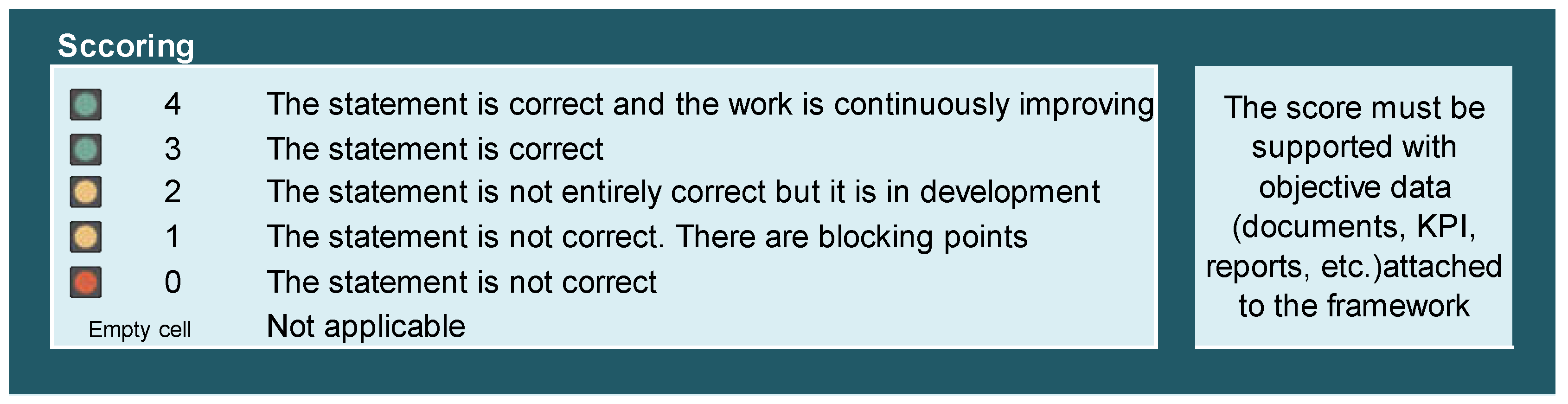
To evaluate the dimensions (Figure 1), categories, and parameters, the model uses a scale from 0 to 4, where 0 represents "the statement is not correct" and 4 represents "the statement is correct, and the work is continuously improving". There is also the possibility of selecting N/A, in case the statement is not applicable. While the statements may appear subjective, they should be substantiated by quantifiable key performance indicators linked to the model.
Figure 1.
The dimensions and categories of the proposed (BMF) Business Maturity Framework Model.

Figure 2.
The evaluation scale of the dimensions and categories of the proposed Business Maturity Framework Model.
Figure 2.
The evaluation scale of the dimensions and categories of the proposed Business Maturity Framework Model.
Following the evaluation, the proposed model generates two graphs, as depicted in Figure 3. One of these graphs illustrates the company's location on the business maturity scale according to different dimensions, while the other graph provides a breakdown of the company's maturity by dimensions. The graphs provide insights into the areas of the business that are performing well, as well as those that are not performing as well. This allows the identification of specific areas where the company can intervene to improve its overall level of maturity.
Results of Piloting the Business Maturity Framework (BMF)
The model proposed BMF Model (Business Maturity Framework) was piloted in one of the top 3 oil and gas companies from Romania for three months in 2022, with promising results.
As part of the positive outcomes, a Business Process Classifier file was developed, encompassing over 450 distinct processes. These processes were subsequently classified as either priority or non-priority, based on their operational or financial significance. Among the total of 450 processes, process owners designated 150 as priority processes. These were subsequently mapped onto a RACI matrix, and subject to improvement and standardization utilizing no-cost or low-cost solutions.
Also, the IT infrastructure has been mapped and 12% of the total number of applications have been reduced due to overlapped activities and low level of usage. The optimization of the IT infrastructure generated a considerable increase in financial savings.
Moreover, a training plan for 2023 has been developed to improve digital skills.
There were also observed several shortcomings:
The model has a subjective approach in areas such as employees and customers.
the team should have in its component a consistent number of specialists to be able to analyze in 2-4 months all the strategic directions in the model. Also, to apply the identified solutions to generate benefits.
The preliminary findings obtained from piloting the Business Maturity Model (BMF) have yielded promising outcomes, potentially validating the research hypothesis posited in this study. Specifically, the hypothesis proposes that by designing and implementing a customized business maturity model that is tailored to the specific requirements and constraints of the oil and gas industry, organizations operating within this domain can elevate their operational efficiency, bolster their competitiveness, and achieve sustainable growth.
5. Discussions
Drawing from the existing literature and the developed framework, the authors have endeavored to address the following questions in this paper: (i) What are the most commonly maturity models in different fields, and what are the main area that are focusing on? (ii) How effective are maturity models in improving organizational performance, and what factors contribute to their success or failure?
In response to the initial inquiry, the article utilizes a diverse array of methodologies and maturity models that are commonly encountered in the specialized literature. Furthermore, the authors underscore the significance of scrutinizing the fundamental factors that underlie their implementation.
Following the second paper’s question, the effectiveness of maturity models in enhancing organizational performance depends on various factors, including the specific model employed, the context of implementation, and the extent to which the model aligns with the organization's goals and values. Some authors as Felch et al. (2019), Adrodegari and Saccani (2019), Uhrenholt et al. (2022) and Voss et al. (2022) have found that maturity models can lead to improved performance by providing a framework for identifying strengths and weaknesses and facilitating continuous improvement. However, other authors as Tsai (2020), Virkkala et al. (2020) have criticized maturity models for being overly prescriptive and inflexible, and for failing to account for the unique complexities of each organization. Therefore, to assess the effectiveness of maturity models, it is important to consider both the benefits and limitations of their implementation and to evaluate the fit between the model and the organization's needs and circumstances.
As there is no fixed benchmark to calibrate the level of business maturity, the model developed by the authors is specific to the company in which it is applied. It is postulated that complete maturity can be achieved when all processes are fully automated, including initiating and concluding events. However, establishing a specific timeline for reaching this maturity level is challenging due to the complexity of this statement. Thus, business maturity should be viewed as an ongoing improvement process rather than a target. The BMF model presented in this study has been effectively applied in the oil and gas industry and is believed to produce substantial outcomes across various industries, from small and medium-sized enterprises to large corporations. Unlike other models, the BMF encompasses all areas of a company that are affected by or influence digitalization, including employees and the market.
6. Conclusions
The framework proposed in this study is constructed based on three fundamental business questions: Why? What? How? Using these questions as a starting point, the model is developed by incorporating 45 parameters that are divided into 15 categories and 5 dimensions. The five dimensions proposed in the model are Strategy, Operations, Employees and their digital skills, Technology, and Customers/Market.
To analyze these indicators, the study has used a series of appropriate tools, including IT infrastructure analysis, IT infrastructure mapping, the relationship between digital applications and their utility, employee digital skills analysis, and company strategy perception study.
One of the main aspects of this proposed framework is the inclusion of the Customers and Market dimension. Customers are a vital aspect of any business, and their satisfaction is a key factor in determining the success of an organization. Therefore, it is essential for businesses to understand their customers and their needs, as well as to continuously improve their customer experience. Including a section on customers in a maturity model can help businesses assess their current level of customer-centricity and identify areas for improvement. Aso, businesses can demonstrate their commitment to putting their customers at the center of their operations and continuously striving to improve their customer experience. In our paper, Customers and Marked dimensionaims to determine whether both the market and customers are prepared for a high degree of digitization of the company's products and services. This dimension adds value by assessing the ratio between the value of the investment in the digitization process and the profitability generated by the level of utilization of the digitization process outcomes.
Developing a business maturity framework that generates added value for a company is a challenging task. The identification of relevant performance indicators for the company, in the form of criteria for general dimensions, requires specific attention, taking into account parameters such as industry, local market, company strategy, and company size. Applying a "general" model is not a productive approach, as it consumes resources without clear benefits.
Thus, our proposed business maturity framework is modular and flexible, adaptable to the specific needs of the company requesting the service.
The BMF is a complex model that is constructed based on parameters that are pertinent and existent in most companies, regardless of the industry. This model serves two primary functions:
Firstly, it offers a comprehensive approach that enables companies to gain an overview of the current state of its main pillars, such as Strategy, Operations, Employees, and Technology. Secondly, the results of the model are presented visually, providing each company with the opportunity to define where they want to go, how to get there when to do it, and which strategic area to focus on.
Based on our findings, we conclude that these two functions offer significant advantages for the managerial team of each company in planning the best strategic decisions for the digitalization process. After conducting preliminary testing of the model, the initial results demonstrate that the proposed maturity model has both theoretical and practical significance as a management tool. The model not only indicates the level of digital maturity of a company but also identifies areas that require improvement to achieve a future state that the company has set as a goal.
7. Limitations and further research directions
The model has not been fully tested and due to its complexity, a subjective component may occur. To avoid this potential situation, future research considers the identification of objective tools for the analysis and measurement of the defined parameters, throughout the testing period.
Author Contributions
Conceptualization, D.A.P., C.S., and A.I.; methodology, D.A.P., C.S., and A.I.; software D.A.P.; validation, D.A.P., C.S. and A.I.; formal analysis, D.A.P., and C.S.; investigation, D.A.P., and C.S.; resources, D.A.P.; data curation, D.A.P., and C.S.; writing—original draft preparation, D.A.P., C.S., and A.I.; writing—review and editing, D.A.P., C.S. and A.I.; visualization, D.A.P.; supervision, C.S.; project administration, D.A.P., C.S., and A.I.; funding acquisition, A.I. All authors have read and agreed to the published version of the manuscript.
Funding
The publication of this article has been funded by the University Politehnica of Bucharest (UPB).
Conflicts of Interest
The authors declare no conflict of interest.
Appendix A. Dimensions, categories, and parameters of BMF
References
- Kaplan, R.S. How the balanced scorecard complements the McKinsey 7-S model. Strat. Leadersh. 2005, 33, 41–46. [Google Scholar] [CrossRef]
- Kaplan, R.S.; Norton, D.P. Linking the Balanced Scorecard to Strategy. Calif. Manag. Rev. 1996, 39, 53–79. [Google Scholar] [CrossRef]
- Montgomery, D. C.; Woodall, W. H. An overview of six sigma. International Statistical Review/Revue Internationale de Statistique 2008, 329–346. [Google Scholar] [CrossRef]
- Potgieter, B. C.; Botha, J. H.; Lew, C. Evidence that use of the ITIL framework is effective. In 18th Annual conference of the national advisory committee on computing qualifications; 2005. [Google Scholar]
- Yamfashije, J. Capability Maturity Model Integration; Carnagie Mellon University: Pittsburgh, PA, USA, 2017. [Google Scholar]
- Adrodegari, F.; Saccani, N. A maturity model for the servitization of product-centric companies. J. Manuf. Technol. Manag. 2020, 31, 775–797. [Google Scholar] [CrossRef]
- Uhrenholt, J.N.; Kristensen, J.H.; Rincón, M.C.; Adamsen, S.; Jensen, S.F.; Waehrens, B.V. Maturity Model as a Driver for Circular Economy Transformation. Sustainability 2022, 14, 7483. [Google Scholar] [CrossRef]
- Felch, V.; Asdecker, B.; Sucky, E. Maturity models in the age of Industry 4.0–Do the available models correspond to the needs of business practice? 2019. [Google Scholar]
- Sari, Y.; Hidayatno, A.; Suzianti, A.; Hartono, M.; Susanto, H. A corporate sustainability maturity model for readiness assessment: a three-step development strategy. Int. J. Prod. Perform. Manag. 2020, 70, 1162–1186. [Google Scholar] [CrossRef]
- Barbosa, F.; Bresciani, G.; Graham, P.; Nyquist, S.; Yanosek, K. Oil and gas after COVID-19: The day of reckoning or a new age of opportunity; McKinsey & Company, 2020. [Google Scholar]
- Voss, M.; Jaspert, D.; Ahlfeld, C.; Sucke, L. Developing a digital maturity model for the sales processes of industrial projects. J. Pers. Sell. Sales Manag. 2023, 1–21. [Google Scholar] [CrossRef]
- Tsai, W.-L. The Impact of Project Teams on CMMI Implementations: a Case Study from an Organizational Culture Perspective. Syst. Pr. Action Res. 2020, 34, 169–185. [Google Scholar] [CrossRef]
- Virkkala, P.; Saarela, M.; Hänninen, K.; Kujala, J.; Simunaniemi, A.-M. Business Maturity Models for Small and Medium-Sized Enterprises: A Systematic Literature Review. Management 2020. [Google Scholar] [CrossRef]
Figure 3.
Graphical results of the proposed (BMF) Business Maturity Framework Model – at the level of dimensions and categories.
Figure 3.
Graphical results of the proposed (BMF) Business Maturity Framework Model – at the level of dimensions and categories.
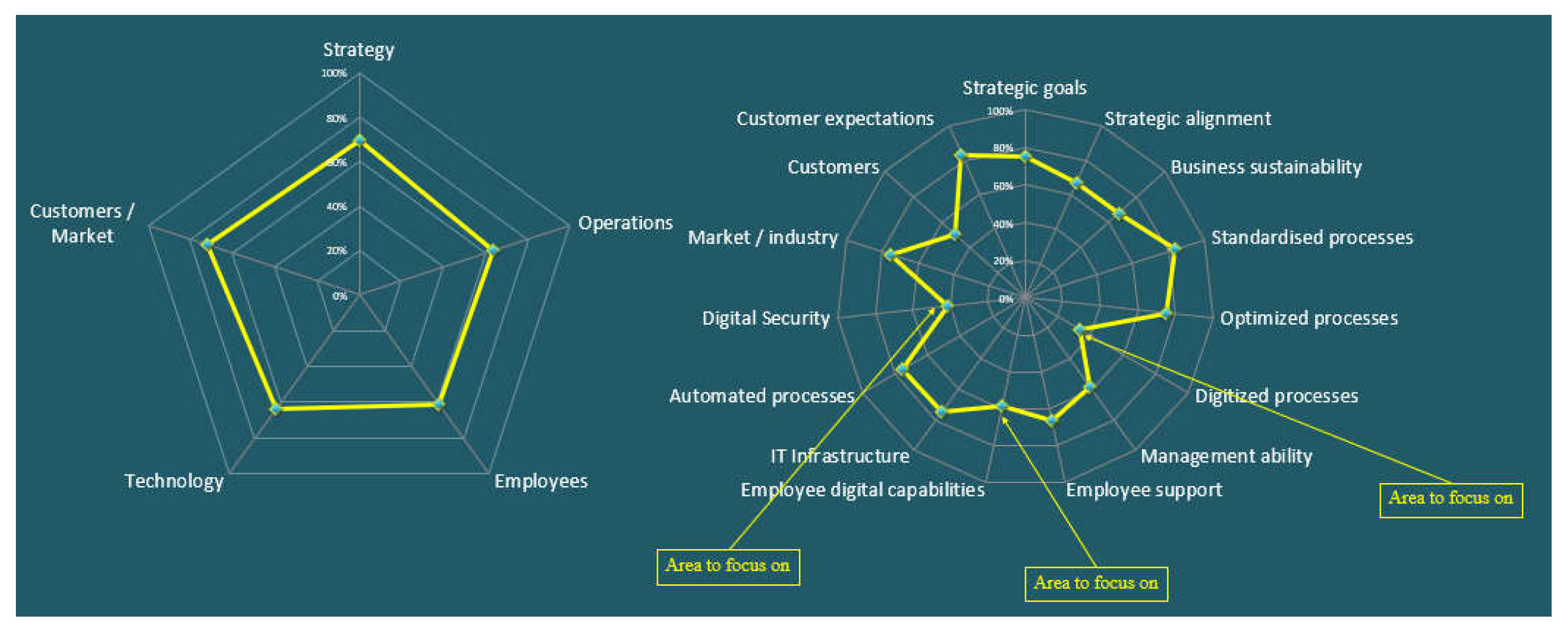

Table 1.
Business Maturity Models Comparison, Montgomery (2008), Potgieter et al., (2005), Yamfashije (2017), Kaplan and Norton (1996).
Table 1.
Business Maturity Models Comparison, Montgomery (2008), Potgieter et al., (2005), Yamfashije (2017), Kaplan and Norton (1996).
| Business Maturity Models Comparison | ||||
|---|---|---|---|---|
| Aspect | Capability Maturity Model Integration (CMMI) | Balanced Scorecard | ITIL (Information Technology Infrastructure Library) | Six Sigma |
| Area of focus | Process improvement | Performance measurement | IT service management | Process improvement |
| Approach | Process-oriented | Multi-perspective | Best practices | Data-driven |
| Assessment and improvement | Yes | Yes | Yes | Yes |
| Flexibility | Yes | Yes | Yes | Yes |
| Level of detail | High | Medium | High | High |
| Complexity | Medium | Low | High | High |
Disclaimer/Publisher’s Note: The statements, opinions and data contained in all publications are solely those of the individual author(s) and contributor(s) and not of MDPI and/or the editor(s). MDPI and/or the editor(s) disclaim responsibility for any injury to people or property resulting from any ideas, methods, instructions or products referred to in the content. |
© 2023 by the authors. Licensee MDPI, Basel, Switzerland. This article is an open access article distributed under the terms and conditions of the Creative Commons Attribution (CC BY) license (http://creativecommons.org/licenses/by/4.0/).
Copyright: This open access article is published under a Creative Commons CC BY 4.0 license, which permit the free download, distribution, and reuse, provided that the author and preprint are cited in any reuse.


